EP0776913A2 - Hochmolekulare Copolymere - Google Patents
Hochmolekulare Copolymere Download PDFInfo
- Publication number
- EP0776913A2 EP0776913A2 EP96118856A EP96118856A EP0776913A2 EP 0776913 A2 EP0776913 A2 EP 0776913A2 EP 96118856 A EP96118856 A EP 96118856A EP 96118856 A EP96118856 A EP 96118856A EP 0776913 A2 EP0776913 A2 EP 0776913A2
- Authority
- EP
- European Patent Office
- Prior art keywords
- group
- methyl
- hydrogen
- radicals
- weight
- Prior art date
- Legal status (The legal status is an assumption and is not a legal conclusion. Google has not performed a legal analysis and makes no representation as to the accuracy of the status listed.)
- Granted
Links
- 229920001577 copolymer Polymers 0.000 title claims abstract description 61
- 239000003054 catalyst Substances 0.000 claims abstract description 52
- 125000003118 aryl group Chemical group 0.000 claims abstract description 41
- VGGSQFUCUMXWEO-UHFFFAOYSA-N Ethene Chemical compound C=C VGGSQFUCUMXWEO-UHFFFAOYSA-N 0.000 claims abstract description 39
- 239000005977 Ethylene Substances 0.000 claims abstract description 39
- 229920000642 polymer Polymers 0.000 claims abstract description 36
- 239000001257 hydrogen Substances 0.000 claims abstract description 34
- 229910052739 hydrogen Inorganic materials 0.000 claims abstract description 34
- UFHFLCQGNIYNRP-UHFFFAOYSA-N Hydrogen Chemical compound [H][H] UFHFLCQGNIYNRP-UHFFFAOYSA-N 0.000 claims abstract description 26
- 125000004805 propylene group Chemical group [H]C([H])([H])C([H])([*:1])C([H])([H])[*:2] 0.000 claims abstract description 21
- 150000001336 alkenes Chemical class 0.000 claims abstract description 18
- 125000004432 carbon atom Chemical group C* 0.000 claims abstract description 13
- 125000004435 hydrogen atom Chemical group [H]* 0.000 claims abstract description 12
- 125000004429 atom Chemical group 0.000 claims abstract description 11
- 125000005843 halogen group Chemical group 0.000 claims abstract description 11
- 125000000041 C6-C10 aryl group Chemical group 0.000 claims abstract description 10
- 125000001931 aliphatic group Chemical group 0.000 claims abstract description 10
- 125000002877 alkyl aryl group Chemical group 0.000 claims abstract description 6
- 125000000217 alkyl group Chemical group 0.000 claims abstract description 6
- 125000003710 aryl alkyl group Chemical group 0.000 claims abstract description 6
- 229910052751 metal Inorganic materials 0.000 claims abstract description 6
- 239000002184 metal Substances 0.000 claims abstract description 6
- 125000000008 (C1-C10) alkyl group Chemical group 0.000 claims abstract description 5
- 125000006725 C1-C10 alkenyl group Chemical group 0.000 claims abstract description 4
- 125000002887 hydroxy group Chemical group [H]O* 0.000 claims abstract description 3
- 230000000737 periodic effect Effects 0.000 claims abstract description 3
- 238000000034 method Methods 0.000 claims description 29
- 150000001875 compounds Chemical class 0.000 claims description 17
- 125000004178 (C1-C4) alkyl group Chemical group 0.000 claims description 14
- 125000002496 methyl group Chemical group [H]C([H])([H])* 0.000 claims description 13
- QQONPFPTGQHPMA-UHFFFAOYSA-N propylene Natural products CC=C QQONPFPTGQHPMA-UHFFFAOYSA-N 0.000 claims description 13
- 229920001400 block copolymer Polymers 0.000 claims description 12
- 238000004519 manufacturing process Methods 0.000 claims description 12
- VXNZUUAINFGPBY-UHFFFAOYSA-N 1-Butene Chemical compound CCC=C VXNZUUAINFGPBY-UHFFFAOYSA-N 0.000 claims description 10
- WSSSPWUEQFSQQG-UHFFFAOYSA-N 4-methyl-1-pentene Chemical compound CC(C)CC=C WSSSPWUEQFSQQG-UHFFFAOYSA-N 0.000 claims description 10
- 229920006301 statistical copolymer Polymers 0.000 claims description 9
- 125000001797 benzyl group Chemical group [H]C1=C([H])C([H])=C(C([H])=C1[H])C([H])([H])* 0.000 claims description 8
- 229920001971 elastomer Polymers 0.000 claims description 7
- 150000002430 hydrocarbons Chemical group 0.000 claims description 7
- 239000005060 rubber Substances 0.000 claims description 7
- OJOWICOBYCXEKR-KRXBUXKQSA-N (5e)-5-ethylidenebicyclo[2.2.1]hept-2-ene Chemical compound C1C2C(=C/C)/CC1C=C2 OJOWICOBYCXEKR-KRXBUXKQSA-N 0.000 claims description 6
- LIKMAJRDDDTEIG-UHFFFAOYSA-N 1-hexene Chemical compound CCCCC=C LIKMAJRDDDTEIG-UHFFFAOYSA-N 0.000 claims description 6
- 150000001993 dienes Chemical class 0.000 claims description 6
- 150000002431 hydrogen Chemical class 0.000 claims description 6
- 125000000959 isobutyl group Chemical group [H]C([H])([H])C([H])(C([H])([H])[H])C([H])([H])* 0.000 claims description 6
- YWAKXRMUMFPDSH-UHFFFAOYSA-N pentene Chemical compound CCCC=C YWAKXRMUMFPDSH-UHFFFAOYSA-N 0.000 claims description 6
- 238000002360 preparation method Methods 0.000 claims description 6
- 125000005018 aryl alkenyl group Chemical group 0.000 claims description 5
- 238000004806 packaging method and process Methods 0.000 claims description 5
- 229910052710 silicon Inorganic materials 0.000 claims description 5
- 239000010703 silicon Substances 0.000 claims description 5
- 239000000460 chlorine Substances 0.000 claims description 4
- 238000000465 moulding Methods 0.000 claims description 4
- 125000001997 phenyl group Chemical group [H]C1=C([H])C([H])=C(*)C([H])=C1[H] 0.000 claims description 4
- 229910052723 transition metal Inorganic materials 0.000 claims description 4
- 150000003624 transition metals Chemical class 0.000 claims description 4
- 125000006656 (C2-C4) alkenyl group Chemical group 0.000 claims description 3
- 229910052799 carbon Inorganic materials 0.000 claims description 3
- 125000001495 ethyl group Chemical group [H]C([H])([H])C([H])([H])* 0.000 claims description 3
- 229910052732 germanium Inorganic materials 0.000 claims description 3
- GNPVGFCGXDBREM-UHFFFAOYSA-N germanium atom Chemical compound [Ge] GNPVGFCGXDBREM-UHFFFAOYSA-N 0.000 claims description 3
- 125000000956 methoxy group Chemical group [H]C([H])([H])O* 0.000 claims description 3
- 125000000027 (C1-C10) alkoxy group Chemical group 0.000 claims description 2
- 125000004169 (C1-C6) alkyl group Chemical group 0.000 claims description 2
- 125000006374 C2-C10 alkenyl group Chemical group 0.000 claims description 2
- ZAMOUSCENKQFHK-UHFFFAOYSA-N Chlorine atom Chemical compound [Cl] ZAMOUSCENKQFHK-UHFFFAOYSA-N 0.000 claims description 2
- XUIMIQQOPSSXEZ-UHFFFAOYSA-N Silicon Chemical compound [Si] XUIMIQQOPSSXEZ-UHFFFAOYSA-N 0.000 claims description 2
- ATJFFYVFTNAWJD-UHFFFAOYSA-N Tin Chemical compound [Sn] ATJFFYVFTNAWJD-UHFFFAOYSA-N 0.000 claims description 2
- 229910052801 chlorine Inorganic materials 0.000 claims description 2
- 125000003709 fluoroalkyl group Chemical group 0.000 claims description 2
- 125000004407 fluoroaryl group Chemical group 0.000 claims description 2
- 230000009477 glass transition Effects 0.000 claims description 2
- 238000001746 injection moulding Methods 0.000 claims description 2
- 229910052718 tin Inorganic materials 0.000 claims description 2
- 230000000379 polymerizing effect Effects 0.000 claims 2
- 239000000956 alloy Substances 0.000 claims 1
- 229910045601 alloy Inorganic materials 0.000 claims 1
- 229910052845 zircon Inorganic materials 0.000 claims 1
- GFQYVLUOOAAOGM-UHFFFAOYSA-N zirconium(iv) silicate Chemical compound [Zr+4].[O-][Si]([O-])([O-])[O-] GFQYVLUOOAAOGM-UHFFFAOYSA-N 0.000 claims 1
- 229910052740 iodine Inorganic materials 0.000 abstract description 3
- YXFVVABEGXRONW-UHFFFAOYSA-N Toluene Chemical compound CC1=CC=CC=C1 YXFVVABEGXRONW-UHFFFAOYSA-N 0.000 description 153
- VLKZOEOYAKHREP-UHFFFAOYSA-N n-Hexane Chemical compound CCCCCC VLKZOEOYAKHREP-UHFFFAOYSA-N 0.000 description 81
- YMWUJEATGCHHMB-UHFFFAOYSA-N Dichloromethane Chemical compound ClCCl YMWUJEATGCHHMB-UHFFFAOYSA-N 0.000 description 78
- 239000000243 solution Substances 0.000 description 58
- 238000006116 polymerization reaction Methods 0.000 description 50
- YBYIRNPNPLQARY-UHFFFAOYSA-N 1H-indene Natural products C1=CC=C2CC=CC2=C1 YBYIRNPNPLQARY-UHFFFAOYSA-N 0.000 description 48
- 239000000203 mixture Substances 0.000 description 42
- 239000002904 solvent Substances 0.000 description 37
- MZRVEZGGRBJDDB-UHFFFAOYSA-N N-Butyllithium Chemical compound [Li]CCCC MZRVEZGGRBJDDB-UHFFFAOYSA-N 0.000 description 36
- -1 2-phenyl-benzyl halide Chemical class 0.000 description 34
- KWYUFKZDYYNOTN-UHFFFAOYSA-M Potassium hydroxide Chemical compound [OH-].[K+] KWYUFKZDYYNOTN-UHFFFAOYSA-M 0.000 description 27
- 150000003254 radicals Chemical class 0.000 description 26
- 239000000725 suspension Substances 0.000 description 26
- 125000003454 indenyl group Chemical group C1(C=CC2=CC=CC=C12)* 0.000 description 24
- LFQSCWFLJHTTHZ-UHFFFAOYSA-N Ethanol Chemical compound CCO LFQSCWFLJHTTHZ-UHFFFAOYSA-N 0.000 description 22
- VYPSYNLAJGMNEJ-UHFFFAOYSA-N Silicium dioxide Chemical compound O=[Si]=O VYPSYNLAJGMNEJ-UHFFFAOYSA-N 0.000 description 22
- FYSNRJHAOHDILO-UHFFFAOYSA-N thionyl chloride Chemical compound ClS(Cl)=O FYSNRJHAOHDILO-UHFFFAOYSA-N 0.000 description 22
- XKRFYHLGVUSROY-UHFFFAOYSA-N Argon Chemical compound [Ar] XKRFYHLGVUSROY-UHFFFAOYSA-N 0.000 description 20
- 229920006395 saturated elastomer Polymers 0.000 description 20
- VPGLGRNSAYHXPY-UHFFFAOYSA-L zirconium(2+);dichloride Chemical compound Cl[Zr]Cl VPGLGRNSAYHXPY-UHFFFAOYSA-L 0.000 description 20
- WYURNTSHIVDZCO-UHFFFAOYSA-N Tetrahydrofuran Chemical compound C1CCOC1 WYURNTSHIVDZCO-UHFFFAOYSA-N 0.000 description 19
- 239000011541 reaction mixture Substances 0.000 description 19
- FAPWRFPIFSIZLT-UHFFFAOYSA-M Sodium chloride Chemical compound [Na+].[Cl-] FAPWRFPIFSIZLT-UHFFFAOYSA-M 0.000 description 18
- 239000012074 organic phase Substances 0.000 description 17
- 229910052760 oxygen Inorganic materials 0.000 description 17
- BLRPTPMANUNPDV-UHFFFAOYSA-N Silane Chemical compound [SiH4] BLRPTPMANUNPDV-UHFFFAOYSA-N 0.000 description 15
- 238000006243 chemical reaction Methods 0.000 description 15
- 238000010992 reflux Methods 0.000 description 15
- 238000005481 NMR spectroscopy Methods 0.000 description 14
- 229910007928 ZrCl2 Inorganic materials 0.000 description 14
- 229910000077 silane Inorganic materials 0.000 description 14
- JOXIMZWYDAKGHI-UHFFFAOYSA-N toluene-4-sulfonic acid Chemical compound CC1=CC=C(S(O)(=O)=O)C=C1 JOXIMZWYDAKGHI-UHFFFAOYSA-N 0.000 description 14
- 239000000741 silica gel Substances 0.000 description 13
- 229910002027 silica gel Inorganic materials 0.000 description 13
- 239000007787 solid Substances 0.000 description 13
- OKKJLVBELUTLKV-UHFFFAOYSA-N Methanol Chemical compound OC OKKJLVBELUTLKV-UHFFFAOYSA-N 0.000 description 12
- 229910007926 ZrCl Inorganic materials 0.000 description 12
- 230000000694 effects Effects 0.000 description 11
- 238000005160 1H NMR spectroscopy Methods 0.000 description 10
- IMNFDUFMRHMDMM-UHFFFAOYSA-N N-Heptane Chemical compound CCCCCCC IMNFDUFMRHMDMM-UHFFFAOYSA-N 0.000 description 10
- 229910052782 aluminium Inorganic materials 0.000 description 10
- 229910052786 argon Inorganic materials 0.000 description 10
- 239000013078 crystal Substances 0.000 description 10
- 239000007789 gas Substances 0.000 description 10
- 239000000178 monomer Substances 0.000 description 10
- 238000003756 stirring Methods 0.000 description 10
- 239000000047 product Substances 0.000 description 9
- 239000011734 sodium Substances 0.000 description 9
- 239000011780 sodium chloride Substances 0.000 description 9
- DUNKXUFBGCUVQW-UHFFFAOYSA-J zirconium tetrachloride Chemical compound Cl[Zr](Cl)(Cl)Cl DUNKXUFBGCUVQW-UHFFFAOYSA-J 0.000 description 9
- DGAQECJNVWCQMB-PUAWFVPOSA-M Ilexoside XXIX Chemical compound C[C@@H]1CC[C@@]2(CC[C@@]3(C(=CC[C@H]4[C@]3(CC[C@@H]5[C@@]4(CC[C@@H](C5(C)C)OS(=O)(=O)[O-])C)C)[C@@H]2[C@]1(C)O)C)C(=O)O[C@H]6[C@@H]([C@H]([C@@H]([C@H](O6)CO)O)O)O.[Na+] DGAQECJNVWCQMB-PUAWFVPOSA-M 0.000 description 8
- DIOQZVSQGTUSAI-UHFFFAOYSA-N decane Chemical compound CCCCCCCCCC DIOQZVSQGTUSAI-UHFFFAOYSA-N 0.000 description 8
- LIKFHECYJZWXFJ-UHFFFAOYSA-N dimethyldichlorosilane Chemical compound C[Si](C)(Cl)Cl LIKFHECYJZWXFJ-UHFFFAOYSA-N 0.000 description 8
- XBDQKXXYIPTUBI-UHFFFAOYSA-N dimethylselenoniopropionate Natural products CCC(O)=O XBDQKXXYIPTUBI-UHFFFAOYSA-N 0.000 description 8
- 238000001914 filtration Methods 0.000 description 8
- 239000012442 inert solvent Substances 0.000 description 8
- 238000002844 melting Methods 0.000 description 8
- 230000008018 melting Effects 0.000 description 8
- 239000000843 powder Substances 0.000 description 8
- 238000001953 recrystallisation Methods 0.000 description 8
- 229910052708 sodium Inorganic materials 0.000 description 8
- XLYOFNOQVPJJNP-UHFFFAOYSA-N water Substances O XLYOFNOQVPJJNP-UHFFFAOYSA-N 0.000 description 8
- 230000015572 biosynthetic process Effects 0.000 description 7
- 230000000052 comparative effect Effects 0.000 description 7
- UPQZOUHVTJNGFK-UHFFFAOYSA-N diethyl 2-methylpropanedioate Chemical compound CCOC(=O)C(C)C(=O)OCC UPQZOUHVTJNGFK-UHFFFAOYSA-N 0.000 description 7
- 229920001519 homopolymer Polymers 0.000 description 7
- 229930195733 hydrocarbon Natural products 0.000 description 7
- 125000001449 isopropyl group Chemical group [H]C([H])([H])C([H])(*)C([H])([H])[H] 0.000 description 7
- 238000001819 mass spectrum Methods 0.000 description 7
- 238000003786 synthesis reaction Methods 0.000 description 7
- 239000004215 Carbon black (E152) Substances 0.000 description 6
- RTZKZFJDLAIYFH-UHFFFAOYSA-N Diethyl ether Chemical compound CCOCC RTZKZFJDLAIYFH-UHFFFAOYSA-N 0.000 description 6
- XAGFODPZIPBFFR-UHFFFAOYSA-N aluminium Chemical compound [Al] XAGFODPZIPBFFR-UHFFFAOYSA-N 0.000 description 6
- AGEZXYOZHKGVCM-UHFFFAOYSA-N benzyl bromide Chemical compound BrCC1=CC=CC=C1 AGEZXYOZHKGVCM-UHFFFAOYSA-N 0.000 description 6
- 239000012230 colorless oil Substances 0.000 description 6
- 238000007334 copolymerization reaction Methods 0.000 description 6
- 239000012043 crude product Substances 0.000 description 6
- 239000003921 oil Substances 0.000 description 6
- JRZJOMJEPLMPRA-UHFFFAOYSA-N olefin Natural products CCCCCCCC=C JRZJOMJEPLMPRA-UHFFFAOYSA-N 0.000 description 6
- 229920001897 terpolymer Polymers 0.000 description 6
- 125000001637 1-naphthyl group Chemical group [H]C1=C([H])C([H])=C2C(*)=C([H])C([H])=C([H])C2=C1[H] 0.000 description 5
- OJVWBQRZCJLURF-UHFFFAOYSA-L C1=CC=C2C(C3=CC=CC4=C3C=C(C)C4[Zr](Cl)(Cl)(C3C4=C(C(=CC=C4)C=4C5=CC=CC=C5C=CC=4)C=C3C)=[Si](C)C)=CC=CC2=C1 Chemical compound C1=CC=C2C(C3=CC=CC4=C3C=C(C)C4[Zr](Cl)(Cl)(C3C4=C(C(=CC=C4)C=4C5=CC=CC=C5C=CC=4)C=C3C)=[Si](C)C)=CC=CC2=C1 OJVWBQRZCJLURF-UHFFFAOYSA-L 0.000 description 5
- 238000005194 fractionation Methods 0.000 description 5
- 239000011521 glass Substances 0.000 description 5
- 239000003446 ligand Substances 0.000 description 5
- 239000007788 liquid Substances 0.000 description 5
- 239000012071 phase Substances 0.000 description 5
- XOJVVFBFDXDTEG-UHFFFAOYSA-N pristane Chemical compound CC(C)CCCC(C)CCCC(C)CCCC(C)C XOJVVFBFDXDTEG-UHFFFAOYSA-N 0.000 description 5
- 238000005086 pumping Methods 0.000 description 5
- IUVKMZGDUIUOCP-BTNSXGMBSA-N quinbolone Chemical compound O([C@H]1CC[C@H]2[C@H]3[C@@H]([C@]4(C=CC(=O)C=C4CC3)C)CC[C@@]21C)C1=CCCC1 IUVKMZGDUIUOCP-BTNSXGMBSA-N 0.000 description 5
- MCULRUJILOGHCJ-UHFFFAOYSA-N triisobutylaluminium Chemical compound CC(C)C[Al](CC(C)C)CC(C)C MCULRUJILOGHCJ-UHFFFAOYSA-N 0.000 description 5
- KWKAKUADMBZCLK-UHFFFAOYSA-N 1-octene Chemical compound CCCCCCC=C KWKAKUADMBZCLK-UHFFFAOYSA-N 0.000 description 4
- NGNBDVOYPDDBFK-UHFFFAOYSA-N 2-[2,4-di(pentan-2-yl)phenoxy]acetyl chloride Chemical compound CCCC(C)C1=CC=C(OCC(Cl)=O)C(C(C)CCC)=C1 NGNBDVOYPDDBFK-UHFFFAOYSA-N 0.000 description 4
- QBPATROIDJMBJY-UHFFFAOYSA-L CC1=Cc2c(cccc2-c2ccc3ccccc3c2)C1[Zr](Cl)(Cl)(C1C(C)=Cc2c1cccc2-c1ccc2ccccc2c1)=[Si](C)C Chemical compound CC1=Cc2c(cccc2-c2ccc3ccccc3c2)C1[Zr](Cl)(Cl)(C1C(C)=Cc2c1cccc2-c1ccc2ccccc2c1)=[Si](C)C QBPATROIDJMBJY-UHFFFAOYSA-L 0.000 description 4
- FYYHWMGAXLPEAU-UHFFFAOYSA-N Magnesium Chemical compound [Mg] FYYHWMGAXLPEAU-UHFFFAOYSA-N 0.000 description 4
- BZLVMXJERCGZMT-UHFFFAOYSA-N Methyl tert-butyl ether Chemical compound COC(C)(C)C BZLVMXJERCGZMT-UHFFFAOYSA-N 0.000 description 4
- PCLIMKBDDGJMGD-UHFFFAOYSA-N N-bromosuccinimide Chemical compound BrN1C(=O)CCC1=O PCLIMKBDDGJMGD-UHFFFAOYSA-N 0.000 description 4
- NDJMNNSJDIFFTH-UHFFFAOYSA-L [Cl-].[Cl-].CC1=CC(C(=CC=C2)C=3C=CC=CC=3)=C2C1[Zr+2]([SiH](C)C)C1C(C)=CC2=C1C=CC=C2C1=CC=CC=C1 Chemical compound [Cl-].[Cl-].CC1=CC(C(=CC=C2)C=3C=CC=CC=3)=C2C1[Zr+2]([SiH](C)C)C1C(C)=CC2=C1C=CC=C2C1=CC=CC=C1 NDJMNNSJDIFFTH-UHFFFAOYSA-L 0.000 description 4
- 239000008346 aqueous phase Substances 0.000 description 4
- 238000009835 boiling Methods 0.000 description 4
- 239000012876 carrier material Substances 0.000 description 4
- 238000001816 cooling Methods 0.000 description 4
- 239000000706 filtrate Substances 0.000 description 4
- 239000011777 magnesium Substances 0.000 description 4
- 229910052749 magnesium Inorganic materials 0.000 description 4
- 239000002244 precipitate Substances 0.000 description 4
- 235000019260 propionic acid Nutrition 0.000 description 4
- KZNICNPSHKQLFF-UHFFFAOYSA-N succinimide Chemical compound O=C1CCC(=O)N1 KZNICNPSHKQLFF-UHFFFAOYSA-N 0.000 description 4
- RGDQEELGYQIORT-UHFFFAOYSA-N 1-(2-methyl-6-propan-2-yl-3h-inden-4-yl)naphthalene Chemical compound C1=CC=C2C(C=3C=4CC(C)=CC=4C=C(C=3)C(C)C)=CC=CC2=C1 RGDQEELGYQIORT-UHFFFAOYSA-N 0.000 description 3
- QSSXJPIWXQTSIX-UHFFFAOYSA-N 1-bromo-2-methylbenzene Chemical compound CC1=CC=CC=C1Br QSSXJPIWXQTSIX-UHFFFAOYSA-N 0.000 description 3
- LPQUJIFWQOFRMH-UHFFFAOYSA-N 2-methyl-4-naphthalen-2-yl-2,3-dihydroinden-1-one Chemical compound C1=CC=CC2=CC(C3=CC=CC4=C3CC(C4=O)C)=CC=C21 LPQUJIFWQOFRMH-UHFFFAOYSA-N 0.000 description 3
- NKFNCOZXYIKUMD-UHFFFAOYSA-N 2-methyl-7-phenyl-5-propan-2-yl-1h-indene Chemical compound C=1C(C(C)C)=CC=2C=C(C)CC=2C=1C1=CC=CC=C1 NKFNCOZXYIKUMD-UHFFFAOYSA-N 0.000 description 3
- MPCBCIIAQIDKTH-UHFFFAOYSA-N 7-[3,5-di(propan-2-yl)phenyl]-2-methyl-1h-indene Chemical compound CC(C)C1=CC(C(C)C)=CC(C=2C=3CC(C)=CC=3C=CC=2)=C1 MPCBCIIAQIDKTH-UHFFFAOYSA-N 0.000 description 3
- YQMLGDDBGRGBAW-UHFFFAOYSA-L CC1=Cc2c(cccc2-c2cc3ccccc3c3ccccc23)C1[Zr](Cl)(Cl)(C1C(C)=Cc2c1cccc2-c1cc2ccccc2c2ccccc12)=[Si](C)C Chemical compound CC1=Cc2c(cccc2-c2cc3ccccc3c3ccccc23)C1[Zr](Cl)(Cl)(C1C(C)=Cc2c1cccc2-c1cc2ccccc2c2ccccc12)=[Si](C)C YQMLGDDBGRGBAW-UHFFFAOYSA-L 0.000 description 3
- 229910004298 SiO 2 Inorganic materials 0.000 description 3
- HEMHJVSKTPXQMS-UHFFFAOYSA-M Sodium hydroxide Chemical compound [OH-].[Na+] HEMHJVSKTPXQMS-UHFFFAOYSA-M 0.000 description 3
- CHUSCWNZYTZYRP-UHFFFAOYSA-L [Cl-].[Cl-].C[Si](=[Zr+2](C1C(=CC2=C(C=C(C=C12)C(C)C)C1=CC=CC=C1)C)C1C(=CC2=C(C=C(C=C12)C(C)C)C1=CC=CC=C1)C)C Chemical compound [Cl-].[Cl-].C[Si](=[Zr+2](C1C(=CC2=C(C=C(C=C12)C(C)C)C1=CC=CC=C1)C)C1C(=CC2=C(C=C(C=C12)C(C)C)C1=CC=CC=C1)C)C CHUSCWNZYTZYRP-UHFFFAOYSA-L 0.000 description 3
- 125000003178 carboxy group Chemical group [H]OC(*)=O 0.000 description 3
- 238000004587 chromatography analysis Methods 0.000 description 3
- 239000002283 diesel fuel Substances 0.000 description 3
- 238000002474 experimental method Methods 0.000 description 3
- 239000012632 extractable Substances 0.000 description 3
- 239000000499 gel Substances 0.000 description 3
- 238000010348 incorporation Methods 0.000 description 3
- CPOFMOWDMVWCLF-UHFFFAOYSA-N methyl(oxo)alumane Chemical compound C[Al]=O CPOFMOWDMVWCLF-UHFFFAOYSA-N 0.000 description 3
- 239000002245 particle Substances 0.000 description 3
- 238000000746 purification Methods 0.000 description 3
- 230000035484 reaction time Effects 0.000 description 3
- 150000003839 salts Chemical class 0.000 description 3
- 239000000377 silicon dioxide Substances 0.000 description 3
- 239000000126 substance Substances 0.000 description 3
- VOITXYVAKOUIBA-UHFFFAOYSA-N triethylaluminium Chemical compound CC[Al](CC)CC VOITXYVAKOUIBA-UHFFFAOYSA-N 0.000 description 3
- JLTRXTDYQLMHGR-UHFFFAOYSA-N trimethylaluminium Chemical compound C[Al](C)C JLTRXTDYQLMHGR-UHFFFAOYSA-N 0.000 description 3
- PRBHEGAFLDMLAL-GQCTYLIASA-N (4e)-hexa-1,4-diene Chemical compound C\C=C\CC=C PRBHEGAFLDMLAL-GQCTYLIASA-N 0.000 description 2
- RFFLAFLAYFXFSW-UHFFFAOYSA-N 1,2-dichlorobenzene Chemical compound ClC1=CC=CC=C1Cl RFFLAFLAYFXFSW-UHFFFAOYSA-N 0.000 description 2
- VQSMDEGMFQYKRS-UHFFFAOYSA-N 1-(2-methyl-3h-inden-4-yl)naphthalene Chemical compound C1=CC=C2C(C=3C=CC=C4C=C(CC4=3)C)=CC=CC2=C1 VQSMDEGMFQYKRS-UHFFFAOYSA-N 0.000 description 2
- DRFPSPRQWNZEMK-UHFFFAOYSA-N 1-(2-methylphenyl)naphthalene Chemical compound CC1=CC=CC=C1C1=CC=CC2=CC=CC=C12 DRFPSPRQWNZEMK-UHFFFAOYSA-N 0.000 description 2
- OSVDDXPBWUGMFB-UHFFFAOYSA-N 1-[2-(bromomethyl)phenyl]naphthalene Chemical compound BrCC1=CC=CC=C1C1=CC=CC2=CC=CC=C12 OSVDDXPBWUGMFB-UHFFFAOYSA-N 0.000 description 2
- CMHWKURALISWAN-UHFFFAOYSA-N 2-(2-methyl-3h-inden-4-yl)naphthalene Chemical compound C1=CC=CC2=CC(C=3C=CC=C4C=C(CC4=3)C)=CC=C21 CMHWKURALISWAN-UHFFFAOYSA-N 0.000 description 2
- FCVQDADWCGVNDK-UHFFFAOYSA-N 2-(2-methylphenyl)naphthalene Chemical compound CC1=CC=CC=C1C1=CC=C(C=CC=C2)C2=C1 FCVQDADWCGVNDK-UHFFFAOYSA-N 0.000 description 2
- GJVSHKYHUSYPAG-UHFFFAOYSA-N 2-[2-(bromomethyl)phenyl]naphthalene Chemical compound BrCC1=CC=CC=C1C1=CC=C(C=CC=C2)C2=C1 GJVSHKYHUSYPAG-UHFFFAOYSA-N 0.000 description 2
- SHFAECXTNMEMCW-UHFFFAOYSA-N 2-methyl-3-(2-naphthalen-1-ylphenyl)propanoic acid Chemical compound OC(=O)C(C)CC1=CC=CC=C1C1=CC=CC2=CC=CC=C12 SHFAECXTNMEMCW-UHFFFAOYSA-N 0.000 description 2
- YXNLSABUBHHJCY-UHFFFAOYSA-N 2-methyl-3-(2-naphthalen-2-ylphenyl)propanoic acid Chemical compound OC(=O)C(C)CC1=CC=CC=C1C1=CC=C(C=CC=C2)C2=C1 YXNLSABUBHHJCY-UHFFFAOYSA-N 0.000 description 2
- GCBUNTNONFEZPX-UHFFFAOYSA-N 2-methyl-4-naphthalen-1-yl-2,3-dihydroinden-1-one Chemical compound C1=CC=C2C(C3=CC=CC4=C3CC(C4=O)C)=CC=CC2=C1 GCBUNTNONFEZPX-UHFFFAOYSA-N 0.000 description 2
- IVYCZGYSZDAEPE-UHFFFAOYSA-N 2-methyl-4-phenyl-2,3-dihydroinden-1-one Chemical compound O=C1C(C)CC2=C1C=CC=C2C1=CC=CC=C1 IVYCZGYSZDAEPE-UHFFFAOYSA-N 0.000 description 2
- JQCCMEDYANGBOG-UHFFFAOYSA-N 2-methyl-7-phenyl-1h-indene Chemical compound C=12CC(C)=CC2=CC=CC=1C1=CC=CC=C1 JQCCMEDYANGBOG-UHFFFAOYSA-N 0.000 description 2
- ZCYVEMRRCGMTRW-UHFFFAOYSA-N 7553-56-2 Chemical compound [I] ZCYVEMRRCGMTRW-UHFFFAOYSA-N 0.000 description 2
- PNEYBMLMFCGWSK-UHFFFAOYSA-N Alumina Chemical class [O-2].[O-2].[O-2].[Al+3].[Al+3] PNEYBMLMFCGWSK-UHFFFAOYSA-N 0.000 description 2
- IJGRMHOSHXDMSA-UHFFFAOYSA-N Atomic nitrogen Chemical compound N#N IJGRMHOSHXDMSA-UHFFFAOYSA-N 0.000 description 2
- KAKZBPTYRLMSJV-UHFFFAOYSA-N Butadiene Chemical compound C=CC=C KAKZBPTYRLMSJV-UHFFFAOYSA-N 0.000 description 2
- 0 CC(C(C)c1c2-c3c(C)c(I)c(*)c(*)c3*)C(*)C(C)c1c(*)c(C)c2S Chemical compound CC(C(C)c1c2-c3c(C)c(I)c(*)c(*)c3*)C(*)C(C)c1c(*)c(C)c2S 0.000 description 2
- 238000003747 Grignard reaction Methods 0.000 description 2
- TWRXJAOTZQYOKJ-UHFFFAOYSA-L Magnesium chloride Chemical compound [Mg+2].[Cl-].[Cl-] TWRXJAOTZQYOKJ-UHFFFAOYSA-L 0.000 description 2
- ATUOYWHBWRKTHZ-UHFFFAOYSA-N Propane Chemical compound CCC ATUOYWHBWRKTHZ-UHFFFAOYSA-N 0.000 description 2
- QCWXUUIWCKQGHC-UHFFFAOYSA-N Zirconium Chemical compound [Zr] QCWXUUIWCKQGHC-UHFFFAOYSA-N 0.000 description 2
- FIKDKWMGFNSEMI-UHFFFAOYSA-L [Cl-].[Cl-].C1=CC=C2C(C3=CC=CC4=C3C=C(C4[Zr+2])C)=CC=CC2=C1 Chemical compound [Cl-].[Cl-].C1=CC=C2C(C3=CC=CC4=C3C=C(C4[Zr+2])C)=CC=CC2=C1 FIKDKWMGFNSEMI-UHFFFAOYSA-L 0.000 description 2
- 239000002253 acid Substances 0.000 description 2
- 150000001298 alcohols Chemical class 0.000 description 2
- 150000004945 aromatic hydrocarbons Chemical class 0.000 description 2
- 239000002585 base Substances 0.000 description 2
- 150000001768 cations Chemical class 0.000 description 2
- 239000007795 chemical reaction product Substances 0.000 description 2
- 239000003153 chemical reaction reagent Substances 0.000 description 2
- MVPPADPHJFYWMZ-UHFFFAOYSA-N chlorobenzene Chemical compound ClC1=CC=CC=C1 MVPPADPHJFYWMZ-UHFFFAOYSA-N 0.000 description 2
- 238000004140 cleaning Methods 0.000 description 2
- 238000002425 crystallisation Methods 0.000 description 2
- 230000008025 crystallization Effects 0.000 description 2
- 125000000118 dimethyl group Chemical group [H]C([H])([H])* 0.000 description 2
- FOMJJCKPIDFDCV-UHFFFAOYSA-N dimethyl-bis(2-methyl-4-naphthalen-1-yl-1h-inden-1-yl)silane Chemical compound C1=CC=C2C(C3=CC=CC4=C3C=C(C)C4[Si](C)(C)C3C4=C(C(=CC=C4)C=4C5=CC=CC=C5C=CC=4)C=C3C)=CC=CC2=C1 FOMJJCKPIDFDCV-UHFFFAOYSA-N 0.000 description 2
- OZIJRVRERJTEGQ-UHFFFAOYSA-N dimethyl-bis(2-methyl-4-phenyl-1h-inden-1-yl)silane Chemical compound CC1=CC(C(=CC=C2)C=3C=CC=CC=3)=C2C1[Si](C)(C)C1C(C)=CC2=C1C=CC=C2C1=CC=CC=C1 OZIJRVRERJTEGQ-UHFFFAOYSA-N 0.000 description 2
- 239000008187 granular material Substances 0.000 description 2
- 239000011630 iodine Substances 0.000 description 2
- 229920001580 isotactic polymer Polymers 0.000 description 2
- 239000012968 metallocene catalyst Substances 0.000 description 2
- UNSDWONDAUAWPV-UHFFFAOYSA-N methylaluminum;oxane Chemical compound [Al]C.C1CCOCC1 UNSDWONDAUAWPV-UHFFFAOYSA-N 0.000 description 2
- UAEPNZWRGJTJPN-UHFFFAOYSA-N methylcyclohexane Chemical compound CC1CCCCC1 UAEPNZWRGJTJPN-UHFFFAOYSA-N 0.000 description 2
- TVMXDCGIABBOFY-UHFFFAOYSA-N n-Octanol Natural products CCCCCCCC TVMXDCGIABBOFY-UHFFFAOYSA-N 0.000 description 2
- ZBRJXVVKPBZPAN-UHFFFAOYSA-L nickel(2+);triphenylphosphane;dichloride Chemical compound [Cl-].[Cl-].[Ni+2].C1=CC=CC=C1P(C=1C=CC=CC=1)C1=CC=CC=C1.C1=CC=CC=C1P(C=1C=CC=CC=1)C1=CC=CC=C1 ZBRJXVVKPBZPAN-UHFFFAOYSA-L 0.000 description 2
- 125000000538 pentafluorophenyl group Chemical group FC1=C(F)C(F)=C(*)C(F)=C1F 0.000 description 2
- 239000002574 poison Substances 0.000 description 2
- 231100000614 poison Toxicity 0.000 description 2
- 230000037048 polymerization activity Effects 0.000 description 2
- 229920000098 polyolefin Polymers 0.000 description 2
- NTTOTNSKUYCDAV-UHFFFAOYSA-N potassium hydride Chemical compound [KH] NTTOTNSKUYCDAV-UHFFFAOYSA-N 0.000 description 2
- 229910000105 potassium hydride Inorganic materials 0.000 description 2
- 238000003825 pressing Methods 0.000 description 2
- 238000007789 sealing Methods 0.000 description 2
- 239000012279 sodium borohydride Substances 0.000 description 2
- 229910000033 sodium borohydride Inorganic materials 0.000 description 2
- 239000007858 starting material Substances 0.000 description 2
- 229960002317 succinimide Drugs 0.000 description 2
- 239000000375 suspending agent Substances 0.000 description 2
- VZGDMQKNWNREIO-UHFFFAOYSA-N tetrachloromethane Chemical compound ClC(Cl)(Cl)Cl VZGDMQKNWNREIO-UHFFFAOYSA-N 0.000 description 2
- 238000013022 venting Methods 0.000 description 2
- 229910052726 zirconium Inorganic materials 0.000 description 2
- 239000004711 α-olefin Substances 0.000 description 2
- NCMKHUPNOTVWSU-UHFFFAOYSA-N 1-(bromomethyl)-2-phenyl-4-propan-2-ylbenzene Chemical compound CC(C)C1=CC=C(CBr)C(C=2C=CC=CC=2)=C1 NCMKHUPNOTVWSU-UHFFFAOYSA-N 0.000 description 1
- SEXZHJJUKFXNDY-UHFFFAOYSA-N 1-(bromomethyl)-2-phenylbenzene Chemical compound BrCC1=CC=CC=C1C1=CC=CC=C1 SEXZHJJUKFXNDY-UHFFFAOYSA-N 0.000 description 1
- RWZKCIIBYMJJQM-UHFFFAOYSA-N 1-[2-(bromomethyl)-5-propan-2-ylphenyl]naphthalene Chemical compound CC(C)C1=CC=C(CBr)C(C=2C3=CC=CC=C3C=CC=2)=C1 RWZKCIIBYMJJQM-UHFFFAOYSA-N 0.000 description 1
- XSNBKMRTBFQOMX-UHFFFAOYSA-N 1-[2-(bromomethyl)phenyl]-3,5-di(propan-2-yl)benzene Chemical compound CC(C)C1=CC(C(C)C)=CC(C=2C(=CC=CC=2)CBr)=C1 XSNBKMRTBFQOMX-UHFFFAOYSA-N 0.000 description 1
- DLKQHBOKULLWDQ-UHFFFAOYSA-N 1-bromonaphthalene Chemical compound C1=CC=C2C(Br)=CC=CC2=C1 DLKQHBOKULLWDQ-UHFFFAOYSA-N 0.000 description 1
- HECLRDQVFMWTQS-RGOKHQFPSA-N 1755-01-7 Chemical compound C1[C@H]2[C@@H]3CC=C[C@@H]3[C@@H]1C=C2 HECLRDQVFMWTQS-RGOKHQFPSA-N 0.000 description 1
- APSMUYYLXZULMS-UHFFFAOYSA-N 2-bromonaphthalene Chemical compound C1=CC=CC2=CC(Br)=CC=C21 APSMUYYLXZULMS-UHFFFAOYSA-N 0.000 description 1
- HOJKWNIYKHFEFJ-UHFFFAOYSA-N 2-methyl-3-(2-naphthalen-1-yl-4-propan-2-ylphenyl)propanoic acid Chemical compound CC(C)C1=CC=C(CC(C)C(O)=O)C(C=2C3=CC=CC=C3C=CC=2)=C1 HOJKWNIYKHFEFJ-UHFFFAOYSA-N 0.000 description 1
- XWPHBDBCETUDSK-UHFFFAOYSA-N 2-methyl-3-(2-phenyl-4-propan-2-ylphenyl)propanoic acid Chemical compound CC(C)C1=CC=C(CC(C)C(O)=O)C(C=2C=CC=CC=2)=C1 XWPHBDBCETUDSK-UHFFFAOYSA-N 0.000 description 1
- VHIKUGITLWELJA-UHFFFAOYSA-N 2-methyl-3-(2-phenylphenyl)propanoic acid Chemical compound OC(=O)C(C)CC1=CC=CC=C1C1=CC=CC=C1 VHIKUGITLWELJA-UHFFFAOYSA-N 0.000 description 1
- FTJPRZYEXZXIBP-UHFFFAOYSA-N 2-methyl-4-naphthalen-1-yl-6-propan-2-yl-2,3-dihydroinden-1-one Chemical compound C1=CC=C2C(C=3C=4CC(C)C(=O)C=4C=C(C=3)C(C)C)=CC=CC2=C1 FTJPRZYEXZXIBP-UHFFFAOYSA-N 0.000 description 1
- OBDQAOAQIAWAJT-UHFFFAOYSA-N 2-methyl-4-phenyl-6-propan-2-yl-2,3-dihydroinden-1-one Chemical compound C=1C(C(C)C)=CC=2C(=O)C(C)CC=2C=1C1=CC=CC=C1 OBDQAOAQIAWAJT-UHFFFAOYSA-N 0.000 description 1
- VSYZXASVWVQEMR-UHFFFAOYSA-N 2-methylbuta-1,3-dienylalumane Chemical compound CC(=C[AlH2])C=C VSYZXASVWVQEMR-UHFFFAOYSA-N 0.000 description 1
- OCLCRYNZYRSURW-UHFFFAOYSA-N 2-phenyl-2,3-dihydroinden-1-one Chemical class C1C2=CC=CC=C2C(=O)C1C1=CC=CC=C1 OCLCRYNZYRSURW-UHFFFAOYSA-N 0.000 description 1
- KGRICMXGIPJLHQ-UHFFFAOYSA-N 4-[3,5-di(propan-2-yl)phenyl]-2-methyl-2,3-dihydroinden-1-one Chemical compound CC(C)C1=CC(C(C)C)=CC(C=2C=3CC(C)C(=O)C=3C=CC=2)=C1 KGRICMXGIPJLHQ-UHFFFAOYSA-N 0.000 description 1
- UQRONKZLYKUEMO-UHFFFAOYSA-N 4-methyl-1-(2,4,6-trimethylphenyl)pent-4-en-2-one Chemical group CC(=C)CC(=O)Cc1c(C)cc(C)cc1C UQRONKZLYKUEMO-UHFFFAOYSA-N 0.000 description 1
- WOMLTCOPRFPVBR-UHFFFAOYSA-N 7-phenyl-1h-indene Chemical class C=12CC=CC2=CC=CC=1C1=CC=CC=C1 WOMLTCOPRFPVBR-UHFFFAOYSA-N 0.000 description 1
- HBAQYPYDRFILMT-UHFFFAOYSA-N 8-[3-(1-cyclopropylpyrazol-4-yl)-1H-pyrazolo[4,3-d]pyrimidin-5-yl]-3-methyl-3,8-diazabicyclo[3.2.1]octan-2-one Chemical class C1(CC1)N1N=CC(=C1)C1=NNC2=C1N=C(N=C2)N1C2C(N(CC1CC2)C)=O HBAQYPYDRFILMT-UHFFFAOYSA-N 0.000 description 1
- FAPWLJJCFHVFSJ-UHFFFAOYSA-N 9-[2-(bromomethyl)phenyl]phenanthrene Chemical compound BrCC1=CC=CC=C1C1=CC2=CC=CC=C2C2=CC=CC=C12 FAPWLJJCFHVFSJ-UHFFFAOYSA-N 0.000 description 1
- 125000004399 C1-C4 alkenyl group Chemical group 0.000 description 1
- FLFNHHSXSLXYQB-UHFFFAOYSA-L CC1=CC(C(=CC=C2)C=3C=CC=CC=3)=C2C1[Zr](Cl)(Cl)(=[Si](C)C)C1C(C)=CC2=C1C=CC=C2C1=CC=CC=C1 Chemical compound CC1=CC(C(=CC=C2)C=3C=CC=CC=3)=C2C1[Zr](Cl)(Cl)(=[Si](C)C)C1C(C)=CC2=C1C=CC=C2C1=CC=CC=C1 FLFNHHSXSLXYQB-UHFFFAOYSA-L 0.000 description 1
- 229920000089 Cyclic olefin copolymer Polymers 0.000 description 1
- XDTMQSROBMDMFD-UHFFFAOYSA-N Cyclohexane Chemical compound C1CCCCC1 XDTMQSROBMDMFD-UHFFFAOYSA-N 0.000 description 1
- PXGOKWXKJXAPGV-UHFFFAOYSA-N Fluorine Chemical group FF PXGOKWXKJXAPGV-UHFFFAOYSA-N 0.000 description 1
- 238000005727 Friedel-Crafts reaction Methods 0.000 description 1
- NHTMVDHEPJAVLT-UHFFFAOYSA-N Isooctane Chemical compound CC(C)CC(C)(C)C NHTMVDHEPJAVLT-UHFFFAOYSA-N 0.000 description 1
- 229910000799 K alloy Inorganic materials 0.000 description 1
- CSNNHWWHGAXBCP-UHFFFAOYSA-L Magnesium sulfate Chemical compound [Mg+2].[O-][S+2]([O-])([O-])[O-] CSNNHWWHGAXBCP-UHFFFAOYSA-L 0.000 description 1
- OFOBLEOULBTSOW-UHFFFAOYSA-N Malonic acid Chemical class OC(=O)CC(O)=O OFOBLEOULBTSOW-UHFFFAOYSA-N 0.000 description 1
- 229910000528 Na alloy Inorganic materials 0.000 description 1
- QSZGOMRHQRFORD-UHFFFAOYSA-L [Cl-].[Cl-].C=C.C1=CC2=CC=CC=C2C1[Zr+2]C1C2=CC=CC=C2C=C1 Chemical compound [Cl-].[Cl-].C=C.C1=CC2=CC=CC=C2C1[Zr+2]C1C2=CC=CC=C2C=C1 QSZGOMRHQRFORD-UHFFFAOYSA-L 0.000 description 1
- 238000010521 absorption reaction Methods 0.000 description 1
- 230000002378 acidificating effect Effects 0.000 description 1
- 238000013019 agitation Methods 0.000 description 1
- 150000001338 aliphatic hydrocarbons Chemical class 0.000 description 1
- 229910001854 alkali hydroxide Inorganic materials 0.000 description 1
- 150000008044 alkali metal hydroxides Chemical class 0.000 description 1
- 239000002168 alkylating agent Substances 0.000 description 1
- 229940100198 alkylating agent Drugs 0.000 description 1
- 150000001450 anions Chemical class 0.000 description 1
- 239000003849 aromatic solvent Substances 0.000 description 1
- 229920001585 atactic polymer Polymers 0.000 description 1
- QVGXLLKOCUKJST-UHFFFAOYSA-N atomic oxygen Chemical compound [O] QVGXLLKOCUKJST-UHFFFAOYSA-N 0.000 description 1
- 238000000071 blow moulding Methods 0.000 description 1
- 239000001273 butane Substances 0.000 description 1
- 239000000969 carrier Substances 0.000 description 1
- 239000012320 chlorinating reagent Substances 0.000 description 1
- 150000001805 chlorine compounds Chemical class 0.000 description 1
- 238000002485 combustion reaction Methods 0.000 description 1
- 239000000470 constituent Substances 0.000 description 1
- 229910000365 copper sulfate Inorganic materials 0.000 description 1
- ARUVKPQLZAKDPS-UHFFFAOYSA-L copper(II) sulfate Chemical compound [Cu+2].[O-][S+2]([O-])([O-])[O-] ARUVKPQLZAKDPS-UHFFFAOYSA-L 0.000 description 1
- 125000004122 cyclic group Chemical group 0.000 description 1
- 230000006735 deficit Effects 0.000 description 1
- 230000018044 dehydration Effects 0.000 description 1
- 238000006297 dehydration reaction Methods 0.000 description 1
- 238000001212 derivatisation Methods 0.000 description 1
- 238000013461 design Methods 0.000 description 1
- 150000001991 dicarboxylic acids Chemical class 0.000 description 1
- LRBPFPZTIZSOGG-UHFFFAOYSA-N dimethyl 2-methylpropanedioate Chemical compound COC(=O)C(C)C(=O)OC LRBPFPZTIZSOGG-UHFFFAOYSA-N 0.000 description 1
- DIOSZEHGGMTBQZ-UHFFFAOYSA-N dimethyl-bis(2-methyl-4-naphthalen-2-yl-1h-inden-1-yl)silane Chemical compound C1=CC=CC2=CC(C3=CC=CC4=C3C=C(C)C4[Si](C)(C)C3C4=C(C(=CC=C4)C=4C=C5C=CC=CC5=CC=4)C=C3C)=CC=C21 DIOSZEHGGMTBQZ-UHFFFAOYSA-N 0.000 description 1
- LLMQUBBRGMQZLP-UHFFFAOYSA-N dimethyl-bis(2-methyl-4-phenanthren-9-yl-1h-inden-1-yl)silane Chemical compound C1=CC=C2C(C3=CC=CC4=C3C=C(C)C4[Si](C)(C)C3C4=C(C(=CC=C4)C=4C5=CC=CC=C5C5=CC=CC=C5C=4)C=C3C)=CC3=CC=CC=C3C2=C1 LLMQUBBRGMQZLP-UHFFFAOYSA-N 0.000 description 1
- JVSWJIKNEAIKJW-UHFFFAOYSA-N dimethyl-hexane Natural products CCCCCC(C)C JVSWJIKNEAIKJW-UHFFFAOYSA-N 0.000 description 1
- 238000009826 distribution Methods 0.000 description 1
- 239000000284 extract Substances 0.000 description 1
- 238000000605 extraction Methods 0.000 description 1
- 229910052731 fluorine Chemical group 0.000 description 1
- 239000011737 fluorine Chemical group 0.000 description 1
- 238000005187 foaming Methods 0.000 description 1
- 238000010528 free radical solution polymerization reaction Methods 0.000 description 1
- 238000012685 gas phase polymerization Methods 0.000 description 1
- 238000005227 gel permeation chromatography Methods 0.000 description 1
- 229910052735 hafnium Inorganic materials 0.000 description 1
- VBJZVLUMGGDVMO-UHFFFAOYSA-N hafnium atom Chemical compound [Hf] VBJZVLUMGGDVMO-UHFFFAOYSA-N 0.000 description 1
- 150000004820 halides Chemical class 0.000 description 1
- 125000001188 haloalkyl group Chemical group 0.000 description 1
- 150000008282 halocarbons Chemical class 0.000 description 1
- 238000010438 heat treatment Methods 0.000 description 1
- 239000002638 heterogeneous catalyst Substances 0.000 description 1
- 238000009776 industrial production Methods 0.000 description 1
- 239000011261 inert gas Substances 0.000 description 1
- 229910052500 inorganic mineral Inorganic materials 0.000 description 1
- 238000002955 isolation Methods 0.000 description 1
- 239000012280 lithium aluminium hydride Substances 0.000 description 1
- 229910001629 magnesium chloride Inorganic materials 0.000 description 1
- 239000000463 material Substances 0.000 description 1
- GYNNXHKOJHMOHS-UHFFFAOYSA-N methyl-cycloheptane Natural products CC1CCCCCC1 GYNNXHKOJHMOHS-UHFFFAOYSA-N 0.000 description 1
- DVSDBMFJEQPWNO-UHFFFAOYSA-N methyllithium Chemical compound C[Li] DVSDBMFJEQPWNO-UHFFFAOYSA-N 0.000 description 1
- 235000010755 mineral Nutrition 0.000 description 1
- 239000011707 mineral Substances 0.000 description 1
- 238000002156 mixing Methods 0.000 description 1
- 239000002808 molecular sieve Substances 0.000 description 1
- IJDNQMDRQITEOD-UHFFFAOYSA-N n-butane Chemical compound CCCC IJDNQMDRQITEOD-UHFFFAOYSA-N 0.000 description 1
- OFBQJSOFQDEBGM-UHFFFAOYSA-N n-pentane Natural products CCCCC OFBQJSOFQDEBGM-UHFFFAOYSA-N 0.000 description 1
- 230000007935 neutral effect Effects 0.000 description 1
- 229910052757 nitrogen Inorganic materials 0.000 description 1
- SJYNFBVQFBRSIB-UHFFFAOYSA-N norbornadiene Chemical compound C1=CC2C=CC1C2 SJYNFBVQFBRSIB-UHFFFAOYSA-N 0.000 description 1
- JFNLZVQOOSMTJK-KNVOCYPGSA-N norbornene Chemical compound C1[C@@H]2CC[C@H]1C=C2 JFNLZVQOOSMTJK-KNVOCYPGSA-N 0.000 description 1
- 239000001301 oxygen Substances 0.000 description 1
- 239000002685 polymerization catalyst Substances 0.000 description 1
- 229920000137 polyphosphoric acid Polymers 0.000 description 1
- 239000001294 propane Substances 0.000 description 1
- 125000001436 propyl group Chemical group [H]C([*])([H])C([H])([H])C([H])([H])[H] 0.000 description 1
- 229920005604 random copolymer Polymers 0.000 description 1
- 230000002040 relaxant effect Effects 0.000 description 1
- 238000006798 ring closing metathesis reaction Methods 0.000 description 1
- 238000007363 ring formation reaction Methods 0.000 description 1
- 238000007873 sieving Methods 0.000 description 1
- URGAHOPLAPQHLN-UHFFFAOYSA-N sodium aluminosilicate Chemical compound [Na+].[Al+3].[O-][Si]([O-])=O.[O-][Si]([O-])=O URGAHOPLAPQHLN-UHFFFAOYSA-N 0.000 description 1
- QDRKDTQENPPHOJ-UHFFFAOYSA-N sodium ethoxide Chemical compound [Na+].CC[O-] QDRKDTQENPPHOJ-UHFFFAOYSA-N 0.000 description 1
- 239000010935 stainless steel Substances 0.000 description 1
- 229910001220 stainless steel Inorganic materials 0.000 description 1
- 230000003068 static effect Effects 0.000 description 1
- 239000010414 supernatant solution Substances 0.000 description 1
- 238000010557 suspension polymerization reaction Methods 0.000 description 1
- YLQBMQCUIZJEEH-UHFFFAOYSA-N tetrahydrofuran Natural products C=1C=COC=1 YLQBMQCUIZJEEH-UHFFFAOYSA-N 0.000 description 1
- 238000003856 thermoforming Methods 0.000 description 1
- 230000036962 time dependent Effects 0.000 description 1
- 125000003944 tolyl group Chemical group 0.000 description 1
- 150000003623 transition metal compounds Chemical class 0.000 description 1
- LFXVBWRMVZPLFK-UHFFFAOYSA-N trioctylalumane Chemical compound CCCCCCCC[Al](CCCCCCCC)CCCCCCCC LFXVBWRMVZPLFK-UHFFFAOYSA-N 0.000 description 1
- 125000005023 xylyl group Chemical group 0.000 description 1
Classifications
-
- C—CHEMISTRY; METALLURGY
- C08—ORGANIC MACROMOLECULAR COMPOUNDS; THEIR PREPARATION OR CHEMICAL WORKING-UP; COMPOSITIONS BASED THEREON
- C08F—MACROMOLECULAR COMPOUNDS OBTAINED BY REACTIONS ONLY INVOLVING CARBON-TO-CARBON UNSATURATED BONDS
- C08F210/00—Copolymers of unsaturated aliphatic hydrocarbons having only one carbon-to-carbon double bond
- C08F210/04—Monomers containing three or four carbon atoms
- C08F210/06—Propene
-
- C—CHEMISTRY; METALLURGY
- C08—ORGANIC MACROMOLECULAR COMPOUNDS; THEIR PREPARATION OR CHEMICAL WORKING-UP; COMPOSITIONS BASED THEREON
- C08F—MACROMOLECULAR COMPOUNDS OBTAINED BY REACTIONS ONLY INVOLVING CARBON-TO-CARBON UNSATURATED BONDS
- C08F10/00—Homopolymers and copolymers of unsaturated aliphatic hydrocarbons having only one carbon-to-carbon double bond
-
- C—CHEMISTRY; METALLURGY
- C08—ORGANIC MACROMOLECULAR COMPOUNDS; THEIR PREPARATION OR CHEMICAL WORKING-UP; COMPOSITIONS BASED THEREON
- C08F—MACROMOLECULAR COMPOUNDS OBTAINED BY REACTIONS ONLY INVOLVING CARBON-TO-CARBON UNSATURATED BONDS
- C08F210/00—Copolymers of unsaturated aliphatic hydrocarbons having only one carbon-to-carbon double bond
- C08F210/16—Copolymers of ethene with alpha-alkenes, e.g. EP rubbers
-
- C—CHEMISTRY; METALLURGY
- C08—ORGANIC MACROMOLECULAR COMPOUNDS; THEIR PREPARATION OR CHEMICAL WORKING-UP; COMPOSITIONS BASED THEREON
- C08F—MACROMOLECULAR COMPOUNDS OBTAINED BY REACTIONS ONLY INVOLVING CARBON-TO-CARBON UNSATURATED BONDS
- C08F110/00—Homopolymers of unsaturated aliphatic hydrocarbons having only one carbon-to-carbon double bond
- C08F110/04—Monomers containing three or four carbon atoms
- C08F110/06—Propene
-
- C—CHEMISTRY; METALLURGY
- C08—ORGANIC MACROMOLECULAR COMPOUNDS; THEIR PREPARATION OR CHEMICAL WORKING-UP; COMPOSITIONS BASED THEREON
- C08F—MACROMOLECULAR COMPOUNDS OBTAINED BY REACTIONS ONLY INVOLVING CARBON-TO-CARBON UNSATURATED BONDS
- C08F4/00—Polymerisation catalysts
- C08F4/42—Metals; Metal hydrides; Metallo-organic compounds; Use thereof as catalyst precursors
- C08F4/44—Metals; Metal hydrides; Metallo-organic compounds; Use thereof as catalyst precursors selected from light metals, zinc, cadmium, mercury, copper, silver, gold, boron, gallium, indium, thallium, rare earths or actinides
- C08F4/60—Metals; Metal hydrides; Metallo-organic compounds; Use thereof as catalyst precursors selected from light metals, zinc, cadmium, mercury, copper, silver, gold, boron, gallium, indium, thallium, rare earths or actinides together with refractory metals, iron group metals, platinum group metals, manganese, rhenium technetium or compounds thereof
- C08F4/619—Component covered by group C08F4/60 containing a transition metal-carbon bond
- C08F4/61912—Component covered by group C08F4/60 containing a transition metal-carbon bond in combination with an organoaluminium compound
-
- C—CHEMISTRY; METALLURGY
- C08—ORGANIC MACROMOLECULAR COMPOUNDS; THEIR PREPARATION OR CHEMICAL WORKING-UP; COMPOSITIONS BASED THEREON
- C08F—MACROMOLECULAR COMPOUNDS OBTAINED BY REACTIONS ONLY INVOLVING CARBON-TO-CARBON UNSATURATED BONDS
- C08F4/00—Polymerisation catalysts
- C08F4/42—Metals; Metal hydrides; Metallo-organic compounds; Use thereof as catalyst precursors
- C08F4/44—Metals; Metal hydrides; Metallo-organic compounds; Use thereof as catalyst precursors selected from light metals, zinc, cadmium, mercury, copper, silver, gold, boron, gallium, indium, thallium, rare earths or actinides
- C08F4/60—Metals; Metal hydrides; Metallo-organic compounds; Use thereof as catalyst precursors selected from light metals, zinc, cadmium, mercury, copper, silver, gold, boron, gallium, indium, thallium, rare earths or actinides together with refractory metals, iron group metals, platinum group metals, manganese, rhenium technetium or compounds thereof
- C08F4/619—Component covered by group C08F4/60 containing a transition metal-carbon bond
- C08F4/61916—Component covered by group C08F4/60 containing a transition metal-carbon bond supported on a carrier, e.g. silica, MgCl2, polymer
-
- C—CHEMISTRY; METALLURGY
- C08—ORGANIC MACROMOLECULAR COMPOUNDS; THEIR PREPARATION OR CHEMICAL WORKING-UP; COMPOSITIONS BASED THEREON
- C08F—MACROMOLECULAR COMPOUNDS OBTAINED BY REACTIONS ONLY INVOLVING CARBON-TO-CARBON UNSATURATED BONDS
- C08F4/00—Polymerisation catalysts
- C08F4/42—Metals; Metal hydrides; Metallo-organic compounds; Use thereof as catalyst precursors
- C08F4/44—Metals; Metal hydrides; Metallo-organic compounds; Use thereof as catalyst precursors selected from light metals, zinc, cadmium, mercury, copper, silver, gold, boron, gallium, indium, thallium, rare earths or actinides
- C08F4/60—Metals; Metal hydrides; Metallo-organic compounds; Use thereof as catalyst precursors selected from light metals, zinc, cadmium, mercury, copper, silver, gold, boron, gallium, indium, thallium, rare earths or actinides together with refractory metals, iron group metals, platinum group metals, manganese, rhenium technetium or compounds thereof
- C08F4/619—Component covered by group C08F4/60 containing a transition metal-carbon bond
- C08F4/6192—Component covered by group C08F4/60 containing a transition metal-carbon bond containing at least one cyclopentadienyl ring, condensed or not, e.g. an indenyl or a fluorenyl ring
- C08F4/61922—Component covered by group C08F4/60 containing a transition metal-carbon bond containing at least one cyclopentadienyl ring, condensed or not, e.g. an indenyl or a fluorenyl ring containing at least two cyclopentadienyl rings, fused or not
- C08F4/61927—Component covered by group C08F4/60 containing a transition metal-carbon bond containing at least one cyclopentadienyl ring, condensed or not, e.g. an indenyl or a fluorenyl ring containing at least two cyclopentadienyl rings, fused or not two cyclopentadienyl rings being mutually bridged
-
- Y—GENERAL TAGGING OF NEW TECHNOLOGICAL DEVELOPMENTS; GENERAL TAGGING OF CROSS-SECTIONAL TECHNOLOGIES SPANNING OVER SEVERAL SECTIONS OF THE IPC; TECHNICAL SUBJECTS COVERED BY FORMER USPC CROSS-REFERENCE ART COLLECTIONS [XRACs] AND DIGESTS
- Y10—TECHNICAL SUBJECTS COVERED BY FORMER USPC
- Y10S—TECHNICAL SUBJECTS COVERED BY FORMER USPC CROSS-REFERENCE ART COLLECTIONS [XRACs] AND DIGESTS
- Y10S526/00—Synthetic resins or natural rubbers -- part of the class 520 series
- Y10S526/943—Polymerization with metallocene catalysts
Definitions
- the present invention relates to a metallocene catalyst system for the production of high-molecular copolymers and high-molecular copolymers and an economical and environmentally friendly process for their production.
- EP-A-263 718 describes statistical terpolymers of C 2 / C 3 / C n with n> 3, which are obtained by means of heterogeneous Ziegler catalysts.
- the C 3 content is 97 to 86 mol%, the C 2 content 0.5 to 6% ⁇ 6 mol% and the C n content (n> 3) 2 to 13 mol%.
- the material has good heat sealing properties, but is obtained in a two-step process with a suspension and a gas phase polymerization step.
- a terpolymer with a high proportion of foreign monomer must be produced.
- bipolymers are desirable because they are easier to handle and have a chemically more uniform chain structure.
- JP-A 62-212 707 discloses an ethylene / propylene copolymer with a high ethylene content and a process for its production. The process is carried out using ethylene bisindenyl zirconium dichloride at a temperature of less than -10 ° C and is therefore out of the question for industrial production. In addition, the activity of the catalyst is very low.
- EP-A 485 822 it is known to use substituted metallocenes for the preparation of copolymers in the 2-position on the indenyl ligand.
- EP-A-0 629 632 and EF-A-0 576 970 describe the use of substituted metallocenes in the 2- and 4-positions on the indenyl ligand. What these already very powerful systems have in common is that they can be used to implement good statistical comonomer incorporation, but that they cannot be used to produce a high molecular weight copolymer if a higher ethylene content is simultaneously sought.
- Statistical copolymers with higher ethylene contents are particularly preferred in areas of application where a high molecular weight is required.
- copolymers which are referred to as rubbers, become even clearer. They contain significantly more than 20% by weight, preferably 30 to 60% by weight, of ⁇ -olefin comonomer, possibly up to 10% by weight of a third ⁇ -olefin or diene.
- metallocene with which a polymer molding composition whose VZ is above 200 cm 3 / g can be produced under industrially feasible process temperatures (> 50 ° C).
- the present invention has for its object to provide a catalyst component and a catalyst system for the production of high molecular weight copolymers and high molecular weight copolymers and an economical and environmentally friendly process for their preparation.
- a catalyst component for the preparation of a high molecular weight copolymer which is a compound of the general formula I wherein M 1 is a metal from group IVb, Vb or VIb of the periodic table, R 1 and R 2 are identical or different and are a hydrogen atom, a C 1 -C 10 alkyl, a C 1 -C 10 alkoxy, a C 6 -C 10 aryl, a C 6 -C 10 - Aryloxy, a C 2 -C 10 alkenyl, a C 7 -C 40 arylalkyl, a C 7 -C 40 alkylaryl, a C 8 -C 40 arylalkenyl, an OH group or a halogen atom mean, the radicals R 3 are identical or different and are a halogen atom, a C 1 -C 20 hydrocarbon group, such as a C 1 -C 10 alkyl group, a C 1 -
- R 14 and R 15 are the same or are different and are a hydrogen atom, a halogen atom, a C 1 -C 10 , in particular C 1 -C 4 alkyl group, a C 1 -C 10 fluoroalkyl, in particular CF 3 group, a C 6 -C 10 - , in particular C 6 -C 8 aryl, a C 6 -C 10 fluoroaryl, in particular pentafluorophenyl group, a C 1 -C 10 , in particular C 1 -C 4 alkoxy group, in particular methoxy group, a C 2 -C 10 -, in particular C 2 -C 4 alkenyl group, a C 7 -C 40 -, in particular C 7 -C 10 arylalky
- M 1 is zirconium or hafnium.
- R 1 and R 2 are preferably the same and are preferably a C 1 -C 4 alkyl group or a halogen atom, the radicals R 3 are preferably a C 1 -C 4 alkyl group.
- R 4 to R 12 are the same or different and preferably a hydrogen atom or a C 1 -C 4 alkyl group, a C 1 -C 4 alkenyl group or a C 6 -C 10 aryl group, at least one of the radicals R 8 , R 9 , R 10 , R 11 or R 12 is different from hydrogen, unless one of the radicals R 5 , R 6 and R 7 is different from hydrogen.
- At least two of the radicals R 8 , R 9 , R 10 , R 11 or R 12 are preferably different from hydrogen if the radicals R 5 , R 6 and R 7 are hydrogen.
- Two or more adjacent radicals R 8 , R 9 , R 10 , R 11 or R 12 particularly preferably form one or more aromatic or aliphatic rings.
- the R 3 radicals are the same or different and are a C 1 -C 10 alkyl group which may be halogenated, a C 1 -C 10 alkenyl group which may be halogenated, a C 6 -C 10 aryl group which may be halogenated ,
- the radicals R 13 are preferably wherein M 2 is silicon or germanium and R 14 and R 15 are the same or different and represent a C 1 -C 4 alkyl group or a C 6 -C 10 aryl group.
- R 14 and R 15 are identical or different and are preferably a C 1 -C 4 alkyl group, especially methyl group, CF 3 group, C 6 -C 8 aryl, pentrafluorophenyl group, C 1 -C 10 -, especially C 1 -C 4 alkoxy group, especially methoxy group, C 2 -C 4 alkenyl group, C 7 -C 10 arylalkyl group, C 8 -C 12 arylalkenyl group, C 7 -C 12 alkylaryl group.
- R 4 and R 7 are hydrogen and R 5 and R 6 are a C 1 -C 4 -alkyl group or hydrogen.
- the metallocenes I are prepared by processes known from the literature and is shown in the following reaction scheme.
- the 2-phenyl-benzyl halide derivatives of the formula A are commercially available or can be prepared by methods known from the literature.
- the conversion to the compounds of formula B takes place by reaction with substituted malonic acid esters under basic conditions, such as, for example, in ethanolic solutions of sodium ethanolate.
- the compounds of formula B are saponified with alkali hydroxides such as potassium hydroxide or sodium hydroxide and decarboxylated by treating the resulting dicarboxylic acids with heat to give the compounds of formula C.
- alkali hydroxides such as potassium hydroxide or sodium hydroxide
- the ring closure to the corresponding phenyl-1-indanones of the formula D is carried out by reaction with chlorinating agents such as SOCl 2 to give the corresponding acid chlorides and subsequent cyclization with a Friedel-Crafts catalyst in an inert solvent such as AlCl 3 or polyphosphoric acid in methylene chloride or CS 2 .
- the conversion to the 7-phenyl-indene derivatives of the formula E is carried out by reduction with a hydride-transferring reagent, such as, for example, sodium borohydride or lithium aluminum hydride or hydrogen and a corresponding catalyst in an inert solvent, for example diethyl ether or tetrahyrofuran, to give the corresponding alcohols and dehydration of the alcohols under acidic conditions Conditions such as p-toluenesulfonic acid or an aqueous mineral acid or by reaction with dehydrating substances such as magnesium sulfate, anhydrous copper sulfate or molecular sieves.
- a hydride-transferring reagent such as, for example, sodium borohydride or lithium aluminum hydride or hydrogen and a corresponding catalyst in an inert solvent, for example diethyl ether or tetrahyrofuran
- Suitable solvents are aliphatic or aromatic solvents such as hexane or toluene, ethereal solvents such as tetrahydrofuran or diethyl ether or halogenated hydrocarbons such as methylene chloride or halogenated aromatic hydrocarbons such as o-dichlorobenzene.
- aliphatic or aromatic solvents such as hexane or toluene
- ethereal solvents such as tetrahydrofuran or diethyl ether
- halogenated hydrocarbons such as methylene chloride or halogenated aromatic hydrocarbons such as o-dichlorobenzene.
- the racemic and meso forms are separated by extraction or recrystallization with suitable solvents.
- the derivatization to the metallocenes of the formula I can be carried out by reaction with alkylating agents such as methyl lithium.
- the metallocenes I according to the invention are highly active catalyst components for olefin copolymerization.
- the chiral metallocenes are preferably used as a racemate.
- the pure enantiomer in the (+) or (-) form can also be used.
- An optically active polymer can be produced with the pure enantiomers.
- the meso form of the metallocenes should be separated, since the polymerization-active center (the metal atom) in these compounds is no longer chiral because of the mirror symmetry at the central metal atom and therefore cannot produce a highly isotactic polymer. If the meso form is not separated, atactic polymer is formed in addition to isotactic polymers. For certain applications, for example soft molded articles, this can be desirable.
- a catalyst system which contains a metallocene and a compound which can convert the metallocene into a polymerization-active species.
- This compound is a cocatalyst.
- the catalyst system can also contain a support.
- the catalyst system can also be prepolymerized. Such a supported and prepolymerized embodiment is preferred in polymerization processes in which a polymer powder with a high bulk density, uniform particle shape and good plant compatibility is necessary.
- an aluminoxane is preferably used as the cocatalyst, which preferably has the formula IIa for the linear type and / or the formula IIb for the cyclic type, where in the formulas IIa and IIb the radicals R 17 can be identical or different and denote a C 1 -C 6 alkyl group, a C 6 -C 18 aryl group, benzyl or hydrogen and p is an integer from 2 to 50, preferably 10 to 35 means.
- the radicals R 17 are preferably the same and are methyl, isobutyl, phenyl or benzyl, particularly preferably methyl.
- R 17 radicals are different, they are preferably methyl and hydrogen or alternatively methyl and isobutyl, with hydrogen or isobutyl preferably containing 0.01 to 40% (number of the R 17 radicals).
- the aluminoxane can be prepared in various ways by known methods.
- One of the methods is, for example, that an aluminum hydrocarbon compound and / or a hydridoaluminum hydrocarbon compound is reacted with water (gaseous, solid, liquid or bound - for example as water of crystallization) in an inert solvent (such as toluene).
- an inert solvent such as toluene
- two different aluminum trialkyls are reacted with water in accordance with the desired composition.
- the transition metal compound is preactivated in solution.
- the metallocene is preferably dissolved in a solution of the aluminoxane in an inert hydrocarbon.
- An aliphatic or aromatic hydrocarbon is suitable as the inert hydrocarbon.
- Toluene is preferably used.
- the concentration of the aluminoxane in the solution is in the range from about 1% by weight to the saturation limit, preferably from 5 to 30% by weight, based in each case on the total amount of solution.
- the metallocene can be used in the same concentration, but preferably it is used in an amount of 10 -4 - 1 mol per mol of aluminoxane.
- the preactivation is a few seconds to 60 hours, preferably 1 to 60 minutes. One works at a temperature of -78 to 100 ° C, preferably 0 to 70 ° C.
- a prepolymerization can be carried out using the metallocene. At least one of the olefins used in the polymerization is preferably used for the prepolymerization.
- Suitable carrier materials are, for example, silica gels, aluminum oxides, solid aluminoxane or other inorganic carrier materials, such as magnesium chloride.
- a suitable carrier material is also a polymer powder, in particular polyolefin powder in finely divided form.
- the cocatalyst e.g. B. the aluminoxane
- a carrier such as silica gels, aluminum oxides, solid aluminoxane, other inorganic carrier materials or a polyolefin powder in finely divided form and then reacted with the metallocene.
- the metallocene and cocatalyst are dissolved in a suitable solvent and then applied to the support. The solvent can then be removed.
- Oxides which have been generated by flame-pyrolytic combustion of element halides in a detonating gas flame or which can be prepared as silica gels in certain particle size distributions and particle shapes can be used as inorganic carriers.
- the supported cocatalyst can be produced, for example, as described in EP 92 107 331.8 in the following manner in a stainless steel reactor in an explosion-proof design with a pumping system of the pressure stage 60 bar, with inert gas supply, temperature control by jacket cooling and a second cooling circuit via a heat exchanger on the pumping system.
- the pumping system sucks the contents of the reactor through a connection in the bottom of the reactor with a pump and presses it into a mixer and back through a riser via a heat exchanger into the reactor.
- the mixer is designed so that there is a narrow pipe cross-section in the inlet, where an increased flow velocity occurs, and in its turbulence zone and counter to the direction of flow, a thin feed line is fed through which - clocked - a defined amount of water under 40 bar argon can be fed.
- the reaction is controlled by a sampler on the pump circuit.
- the aluminum content is 1.06 mmol Al per cm 3 suspension.
- the isolated solid contains 20% by weight aluminum, the suspending agent contains 0.1%. -% aluminum.
- the metallocene according to the invention is then applied to the supported cocatalyst by stirring the dissolved metallocene with the supported cocatalyst.
- the solvent is removed and replaced by a hydrocarbon in which both the cocatalyst and the metallocene are insoluble.
- the reaction to the supported catalyst system takes place at a temperature of from -20 ° C. to + 120 ° C., preferably 0-100 ° C., particularly preferably at 15 to 40 ° C.
- the metallocene is reacted with the supported cocatalyst in such a way that the cocatalyst as a suspension with 1 to 40 wt .-%, preferably with 5 to 20 wt .-% in an aliphatic, inert suspension medium such as n-decane, hexane, heptane, Diesel oil is contacted with a solution of the metallocene in an inert solvent such as toluene, hexane, heptane, dichloromethane or with the finely ground solid of the metallocene.
- a solution of the metallocene can also be reacted with the solid of the cocatalyst.
- the reaction is carried out by intensive mixing, for example by stirring at a molar Al / M 1 ratio of 100/1 to 10000/1, preferably 100/1 to 3000/1, and a reaction time of 5 to 600 minutes, preferably 10 to 120 Minutes, particularly preferably 10 to 60 minutes under inert conditions.
- the supernatant solution is separated off, for example by filtration or decanting.
- the remaining solid can be washed 1 to 5 times with an inert suspending agent such as toluene, n-decane, hexane, diesel oil, dichloromethane to remove soluble constituents in the catalyst formed, in particular to remove unreacted and thus soluble metallocene.
- an inert suspending agent such as toluene, n-decane, hexane, diesel oil, dichloromethane to remove soluble constituents in the catalyst formed, in particular to remove unreacted and thus soluble metallocene.
- the supported catalyst system produced in this way can be dried in vacuo as a powder or with solvent, resuspended and metered into the polymerization system as a suspension in an inert suspension medium.
- Inert suspension media are the aforementioned suspension media or waxy hydrocarbons.
- x is a number from 1 to 4, preferably 3, the radicals R 18 are the same or different, preferably the same, and are C 1 -C 10 alkyl, C 6 -C 18 aryl or form 2 radicals R 18 together with the atom connecting them a ring, and the radicals R 19 are the same or different, preferably the same, and represent C 6 -C 18 aryl, which can be substituted by alkyl, haloalkyl or fluorine.
- R 18 represents ethyl, propyl or phenyl and R 19 represents phenyl, pentafluorophenyl, 3,5-bistrifluoromethylphenyl, mesityl, xylyl or tolyl (cf. EP-A 277 003, EP-A 277 004 and EP-A 426 638) .
- the actual (active) polymerization catalyst consists of the reaction product of metallocene and at least one of the cocatalysts. Therefore, this reaction product is preferably prepared outside of the polymerization reactor in a separate step using a suitable solvent.
- any compound is suitable as a cocatalyst according to the invention which, because of its Lewis acidity, can convert the neutral metallocene into a cation and stabilize it ( unstable coordination ).
- the cocatalyst or the anion formed from it should not undergo any further reactions with the metallocene cation formed (cf. EP-A 427 697).
- an aluminum alkyl for example trimethyl aluminum, triisobutyl aluminum or triethyl aluminum
- This cleaning can take place both in the polymerization system itself, or the olefin is brought into contact with the Al compound before it is added to the polymerization system and then separated off again.
- a copolymer with a viscosity number (VZ)> 200, preferably> 250 and particularly preferably> 300 cm 3 / g is provided.
- the copolymer according to the invention contains 99.5 to 30% by weight, based on the total polymer, of propylene units, preferably 98.5 to 40% by weight, particularly preferably 97.5 to 50% by weight of propylene units.
- the contents of comonomer units are 0.5 to 70% by weight, preferably 1.5 to 60% by weight, particularly preferably 2.5 to 50% by weight.
- Examples of such comonomers are 1-olefins such as ethylene, 1-butene, 1-pentene, 1-hexene, 4-methyl-1-pentene or ethylidene norbornene.
- Static copolymers are very particularly preferably composed of 1.5 to 15% by weight of comonomer and 98.5 to 85% by weight of propylene, while rubbers contain comonomer contents of 20 to 60% by weight and propylene contents of 80 to 40% by weight. -% exhibit. Terpolymers can also contain up to 10% by weight, preferably up to 5% by weight, of the diene component.
- Such rubbers or terpolymers have viscosity numbers (VZ) of> 200, preferably> 250 and particularly preferably> 300 cm 3 / g.
- VZ viscosity numbers
- Statistical copolymers with C 2 contents> 4% by weight have VZ values of> 250 and preferably> 300 cm 3 / g.
- Statistical copolymers with C 2 contents of 1.5 to 4% by weight have VZ values> 350 cm 3 / g.
- a method for producing a copolymer is also provided.
- a temperature of 50 to 200 ° C, preferably 55 to 150 ° C, particularly preferably at 60 to 150 ° C, at a pressure of 0.5 to 100 bar, preferably 2 to 80 bar, particularly preferably 20 to 64 can be polymerized in solution, in suspension or in the gas phase, in one or more stages, in the presence of the catalyst system according to the invention.
- the copolymerization can be carried out in solution, in suspension or in the gas phase continuously or batchwise in one or more stages at a temperature of 50 to 200 ° C., preferably 5 to 150 ° C., particularly preferably 60 to 150 ° C.
- dienes can also be used as olefins, R a or R b in this case means a C 2 to C 12 alkene, and R a and R b can also be cyclically linked here.
- dienes are ethylidene norbornene, norbornadiene, dicyclopentadiene, 1,4-hexadiene or butadiene.
- dienes are preferably used for copolymerization with propylene and another olefin.
- olefins as comonomers are 1-olefins such as ethylene, 1-butene, 1-pentene, 1-hexene, 4-methyl-1-pentene, 1-octene, norbornene.
- propylene and ethylene are polymerized; in the case of a terpolymer production, propylene, ethylene and ethylidene norbornene are preferably polymerized.
- hydrogen is added as a molecular weight regulator and / or to increase the activity.
- the total pressure in the polymerization system is 0.5 to 100 bar. Polymerization in the technically particularly interesting pressure range from 5 to 64 bar is preferred.
- the metallocene is used in a concentration, based on the transition metal, of 10 -3 to 10 -8 , preferably 10 -4 to 10 -7 mol, transition metal per dm 3 reactor volume.
- the aluminoxane is used in a concentration of 10 -5 to 10 -1 mol, preferably 10 -4 to 10 -2 mol per dm 3 solvent or per dm 3 reactor volume.
- the other cocatalysts mentioned are used in approximately equimolar amounts to the metallocene. In principle, however, higher concentrations are also possible.
- an inert solvent customary for the Ziegler low-pressure process is used.
- an inert solvent customary for the Ziegler low-pressure process.
- a gasoline or hydrogenated diesel oil fraction can also be used.
- Toluene can also be used.
- Polymerization is preferably carried out in the liquid monomer.
- the monomers are added in gaseous or liquid form.
- the duration of the polymerization is arbitrary, since the catalyst system to be used according to the invention shows only a slight time-dependent drop in the polymerization activity.
- the supported catalyst system Before adding the catalyst, in particular the supported catalyst system (from a metallocene according to the invention and a supported cocatalyst or from a metallocene according to the invention and an organoaluminum compound on a polymer powder in finely divided form), another aluminum alkyl compound such as trimethyl aluminum, triethyl aluminum, triisobutyl aluminum, trioctyl aluminum can additionally be added or isoprenylaluminum can be added to the reactor to make the polymerization system inert (for example to separate catalyst poisons present in the olefin). This is added to the polymerization system in a concentration of 100 to 0.01 mmol Al per kg reactor content.
- another aluminum alkyl compound such as trimethyl aluminum, triethyl aluminum, triisobutyl aluminum, trioctyl aluminum can additionally be added or isoprenylaluminum can be added to the reactor to make the polymerization system inert (for example to separate catalyst poisons present in the
- Triisobutyl aluminum and triethyl aluminum are preferred in a concentration of 10 to 0.1 mmol Al per kg reactor content.
- the molar Al / M 1 ratio can be chosen to be small in the synthesis of a supported catalyst system.
- the process according to the invention is characterized in that it can be used to produce high molecular propylene copolymers in the technically particularly interesting temperature range from 65 to 150 ° C.
- this makes high-molecular statistical copolymers with a higher comonomer content accessible, which are characterized by high transparency and low extractables and rubbers which are at a very high level with industrially useful polymerization temperatures of> 50 ° C with their molar mass and viscosity numbers of> 200 cm 3 / g.
- the use of at least one catalyst component according to the invention or at least one catalyst system according to the invention is provided for the production of high molecular weight copolymers.
- Example B rac-dimethylsilanediylbis (2-methyl-4- (1-naphthyl) indenyl) zirconium dichloride (12)
- Example D Dimethylsilanediylbis (2-methyl-4- (9-phenanthryl) indenyl) zirconium dichloride (24)
- the supported aluminum compound (methylaluminoxane on silica gel Garce / Davison 948 FMAO on SiO 2 ".
- the isolated solid contained 20.6 wt .-% aluminum.
- a dry 24 dm 3 reactor was flushed with propylene and filled with 12 dm 3 of liquid propylene and 22 cm 3 of a hexanic triisobutylaluminum solution (8 mmol Al, 2 cm 3 triisobutylaluminum diluted with 20 cm 3 hexane) and the reactor agitation was set to 250 rpm.
- a third of the total amount of ethylene envisaged for the polymerization see Table 1, ethylene template
- 0.7 g of the catalyst prepared in support example B was suspended in 25 cm 3 of a dearomatized gasoline cut with a boiling range of 100 to 120 ° C. placed in the reactor. The reactor was heated to the polymerization temperature of 65 ° C.
- Examples 1-10 were repeated with the catalyst prepared in support example D. Amounts of ethylene, polymer yield, metallocene activities and product data are shown in Table 2.
- Examples 1-10 were carried out using the metallocene catalyst not according to the invention prepared in accordance with support example A. The results show that the polymer melting points can be lowered in the same way with this catalyst system the achievable molar mass level is, however, significantly lower than with the catalyst systems B and D in the corresponding examples 1 to 20. Polymer yields, metallocene activities and product data can be found in table 3.
- Example 7 was repeated. However, the supported metallocenes listed in Table 4 were used as the catalyst. The results of the polymerization are also shown in Table 4.
- a dry 24 dm 3 reactor was filled with 10 l of a dearomatized gasoline cut with a boiling range of 100 to 120 ° C.
- Example 45 was repeated, but the compound dimethylsilanediylbis (2-methyl-4-phenylindenyl) zirconium dichloride was used as the metallocene.
- the results of the polymerization are shown in Table 5. It is clear that the molecular weight which can be achieved with these metallocenes is clearly below the level which can be achieved with the metallocenes according to the invention.
- Comparative Example 55 was also repeated with the metallocenes used in Comparative Examples 36-42.
- the molar masses of the copolymers produced in this way reached maximum VZ values of 137 cm 3 / g and are thus still lower than can be achieved with the metallocenes not according to the invention mentioned in Example 55.
- So-called reactor blends can also be produced with the metallocenes according to the invention.
- a homopolymer is produced in a first polymerization stage and a copolymer in a second stage.
- a dry 150 dm 3 reactor was flushed with nitrogen and filled at 20 ° C. with 80 dm 3 of a dearomatized gasoline cut with a sieving range of 100 to 120 ° C. Then the gas space was flushed nitrogen-free by pressing 2 bar propylene five times and relaxing. After adding 50 l of liquid propylene, 64 cm 3 of toluene methylaluminumoxane solution (corresponding to 100 mmol of Al, molar mass according to cryoscopic determination 1080 g / mol) were added and the reactor contents were heated to 60.degree. A hydrogen content in the gas space of the reactor of 2.0% was set by metering in hydrogen and later kept constant during the first polymerization stage by subsequent metering.
- Example 56 was repeated, but the temperature in the second polymerization stage was 60 ° C. instead of 50 ° C. and the polymerization time was only 10 hours instead of 14 hours. 20.8 kg block copolymer was obtained, corresponding to a metallocene activity of 173 kg copolymer / g metallocene x h.
- Example 57 was repeated, instead of 2000 g of ethylene in the second Polymerization step were used 4000 g of ethylene.
- 22.0 kg block copolymer were obtained, corresponding to a metallocene activity of 184 kg copolymer / g metallocene x h.
- the block copolymer contained 20.6% by weight of ethylene.
- the fractionation of the product gave the following composition: 66.5% by weight homopolymer; 33.5% by weight of copolymer, the copolymer having an ethylene content of 61.5% by weight.
- the fractionation of the product gave the following composition: 70% by weight homopolymer; 30% by weight of copolymer, the copolymer having an ethylene content of 27.3% by weight.
- the average block length C 2 in the copolymer was 2.5.
- the comparison experiment shows that the high molar mass from Example 57 cannot be achieved.
- High-molecular terpolymers can also be prepared with the metallocenes according to the invention. Some examples should explain the principle in more detail:
- Example 45 The procedure was as in Example 45, but in addition 100 g of another monomer were placed in the reactor (for type of monomer and polymerization results, see Table 6).
- Table 6 example Monomer Metallocene act. [kg PP / g Met.xh] VZ [cm 3 / g] Comonomer content (% by weight) Ethylene another monomer 60 1-butene 305 349 40.8 3.0 61 4-methyl-1-pentene 336 328 44.0 2.3 62 1-witches 380 400 42.6 3.2 63 Ethylidene norbornene 264 305 41.5 2.4 64 1,4-hexadiene 288 278 45.2 2.8
- the metallocenes according to the invention can also be used to produce high molecular weight copolymers with olefins higher than ethylene.
- a few examples should explain the principle:
- Example 7 The procedure was as in Example 6, but instead of ethylene, the olefins from Table 7 were used in the same amount as comonomer. Results of the polymerizations see also Table 7.
- Table 7 example Comonomer Metallocene act. [kg PP / g Met.xh] VZ [cm 3 / g] Comonomer content [% by weight] 65 1-butene 154.2 452 2.4 66 4-methyl-1-pentene 107.3 437 2.6 67 1-witches 192.5 490 3.0 68 1-octene 124.5 417 2.2 69 Ethylidene norbornene 139.5 329 1.7
Landscapes
- Chemical & Material Sciences (AREA)
- Health & Medical Sciences (AREA)
- Chemical Kinetics & Catalysis (AREA)
- Medicinal Chemistry (AREA)
- Polymers & Plastics (AREA)
- Organic Chemistry (AREA)
- Transition And Organic Metals Composition Catalysts For Addition Polymerization (AREA)
- Addition Polymer Or Copolymer, Post-Treatments, Or Chemical Modifications (AREA)
- Food Preservation Except Freezing, Refrigeration, And Drying (AREA)
- Manufacture Of Macromolecular Shaped Articles (AREA)
Abstract
R1 und R2 gleich oder verschieden sind und ein Wasserstoffatom, eine C1-C10-Alkyl-, eine C7-C40-Arylalkyl-, eine C7-C40-Alkylaryl-, eine C8-C40-Arylalkenyl-, eine OH-Gruppe oder ein Halogenatom bedeuten, die Reste R3 gleich oder verschieden sind und ein Halogenatom, eine C1-C10-Alkylgruppe, eine C1-C10-Alkenylgruppe, eine C6-C10-Arylgruppe, R4 bis R12 gleich oder verschieden sind und die für R3 genannten Bedeutungen besitzen, oder benachbarte Reste R4 bis R12 mit den sie verbindenden Atomen einen oder mehrere aromatische oder aliphatische Ringe bilden, oder die Reste R5 und R8 oder R12 mit den sie verbindenden Atomen einen aromatischen oder aliphatischen Ring bilden, R4 bis R12 auch Wasserstoff sind, mindestens ein Rest R8, R9, R10, R11 oder R12 von Wasserstoff verschieden ist, wenn nicht einer der Reste R5, R6 und R7 von Wasserstoff verschieden ist. Weiter betrifft die vorliegende Erfindung ein Katalysatorsystem zur Herstellung eines hochmolekularen Copolymeren, welches mindestens eine Katalsatorkomponente und mindestens einen Cokatalysator, bevorzugt ein Aluminoxan enthält. Schließlich betrifft die vorliegende Erfindung Copolymer enthaltend 99,5 bis 30 Gew.-% Propyleneinheiten, bezogen auf das Gesamtpolymer, und 0,5 bis 70 Gew.-% mindestens eines Comonomers, bezogen auf das Gesamtpolymer, wobei das Comonomer Einheiten sind, die sich von Ethylen oder Olefinen mit mindestens 4 C-Atomen der Formel Ra-CH = CH-Rb ableiten, wobei Ra und Rb gleich oder verschieden sind und ein Wasserstoffatom oder einen Alkylrest bedeuten.
Description
- Die vorliegende Erfindung betrifft ein Metallocenkatalysatorsystem zur Herstellung von hochmolekularen Copolymeren sowie hochmolekulare Copolymere und ein wirtschaftliches und umweltfreundliches Verfahren zu ihrer Herstellung.
- Bei der Copolymerisation von Olefinen können je nach Verfahrensweise statistische Copolymere mit einem geringen Gehalt an Comonomeren, Copolymere, statistisch oder blockartig aufgebaut, die einen höheren Einbau an Comonomeren als die statistischen Copolymeren enthalten oder Copolymer-Kautschuks mit einem Comonomerengehalt von deutlich über 20 Gew.-% bezogen auf das Gesamtpolymer erhalten werden. Die Copolymere weisen unterschiedliche Eigenschaften und unterschiedliche Gehalte an Comonomeren auf. Statistische Copolymere unterscheiden sich von den entsprechenden Homopolymeren in der Regel durch eine geringere Kristallinität, einen niedrigeren Schmelzpunkt und eine geringere Härte. Gefordert wird für die statistischen Copolymere ein möglichst statistischer Kettenaufbau. Die in der Technik bekannten Olefin-Copolymeren, die mit Hilfe heterogener Ziegler Katalysatoren hergestellt werden, können diese Forderung nur sehr begrenzt erfüllen.
- In EP-A-263 718 sind statistische Terpolymere aus C2/C3/Cn mit n > 3 beschrieben, welche mittels heterogener Ziegler Katalysatoren erhalten werden. Der C3-Gehalt beträgt 97 bis 86 Mol.-%, der C2-Gehalt 0,5 bis 6 % → 6 Mol.-% und der Cn-Gehalt (n > 3) 2 bis 13 Mol.-%. Das Material besitzt gute Heißsiegeleigenschaften, wird aber in einem zweistufigen Verfahren mit einem Suspensions- und einem Gasphasenpolymerisationsschritt erhalten. Um die gewünschten Anti-Blocking-Eigenschaften zu erlangen, muß ein Terpolymer mit einem hohen Anteil an Fremdmonomer hergestellt werden. Erwünscht sind jedoch Bipolymere, da diese einfacher zu handhaben sind und einen chemisch einheitlicheren Kettenaufbau aufweisen.
- Aus EP-A-74 194 sind statistische C2/C3-Copolymere bekannt, die im Suspensionsverfahren hergestellt werden. Um das gewünschte Eigenschaftsbild zu erhalten, müssen die erhaltenen Polymeren abgebaut werden. Ein hoher C2-Anteil wird benötigt, um die chemische Uneinheitlichkeit eines heterogenen Katalysator-Systems zu mildern. Die Uneinheitlichkeit führt zu einem höheren Anteil an niedermolekularen, leichtlöslichen, hochethylenhaltingen Anteilen im Polymeren und somit zu eingeschränkter Anwendbarkeit im Bereich Lebensmittelverpackung.
- Aus JP-A 62-212 707 ist ein Ethylen/Propylen-Copolymer mit hohem Ethylengehalt und ein Verfahren zu seiner Herstellung bekannt. Das Verfahren wird unter Verwendung von Ethylen-bisindenyl-zirkondichlorid bei einer Temperatur von weniger als -10°C durchgeführt und kommt somit für die industrielle Fertigung nicht in Frage. Außerdem ist die Aktivität des Katalysators sehr gering.
- Aus EP-A 485 822 ist bekannt für die Herstellung von Copolymeren in 2-Stellung am Indenylliganden substituierte Metallocene zu verwenden. In EP-A-0 629 632 und EF-A-0 576 970 ist beschrieben, in 2- und 4-Stellung am Indenylliganden substituierte Metallocene einzusetzen. Diesen bereits sehr leistungsfähigen Systemen ist gemein, daß mit ihnen ein guter statistischer Comonomereneinbau realisiert werden kann, daß mit ihnen aber kein hochmolekulares Copolymer hergestellt werden kann, wenn gleichzeitig ein höherer Ethylengehalt angestrebt wird. Statistische Copolymere mit höheren Ethylengehalten sind besonders in Einsatzgebieten bevorzugt, in denen eine hohe Molmasse erforderlich ist. Das trifft insbesondere im Bereich der Tiefziehanwendungen, des Blasformens und bei Folien für den Verpackungsbereich zu. Siegelschichtfolien sind hier besonders zu nennen. Darüber hinaus ist ein geringer extrahierbarer Anteil besonders im Bereich der Lebensmittelverpackungen notwenig. Dies können bei höherem Comonomereneinbau nur Copolymerformmasse mit höherem Molekulargewicht erfüllen.
- Höhere Transparenzen sind ebenfalls gefragt. Dazu ist ebenfalls ein relativ hoher Gehalt an Comonomer im Polymer erforderlich. Um hier eine gute Verarbeitbarkeit zu gewährleisten, sind ebenfalls höhere Molmassen erforderlich, als die, die mit den bekannten Metallocenen des Standes der Technik bei technisch relevanten Polymerisationstemperaturen von 60 bis 80°C realisierbar sind.
- Die bisher besten bekannten Metallocene, nämlich Vertreter einer Gruppe mit in 2,4-Stellung substituierten Indenylliganden erfüllen dieses Molmassenziel mit VZ-Werten von etwa 300 cm3/g und Comonomerengehalten unter 2 Gew.-%, diese Comonomergehalte sind jedoch nicht ausreichend, um das Anforderungsprofil, das an gute Copolymere gestellt wird, zu erfüllen. Dazu sind höhere Comonomerengehalte notwendig, wobei bei den Polymeren, die mit diesen Metallocenen hergestellt werden, die Viskositätszahl (VZ) sehr schnell auf Werte von 200 cm3/g absinkt und somit zu tief liegt. Verarbeitbarkeit, Verwendbarkeit und Menge an niedermolekularen Anteilen liegen dann in einem Bereich, der eine sinnvolle Verwendung ausschließt.
- Noch deutlicher werden die Defizite bei Copolymeren, die als Kautschuke bezeichnet werden. Sie enthalten deutlich mehr als 20 Gew.-%, bevorzugt 30 bis 60 Gew.-% α-Olefin Comonomer, eventuell noch bis zu 10 Gew.-% eines dritten α-Olefins oder Diens. Zur Zeit ist kein Metallocen bekannt, mit dem unter industriell realisierbaren Verfahrenstemperaturen (> 50°C) eine solche Polymerformmasse erzeugt werden kann, deren VZ über 200 cm3/g liegt.
- Der vorliegenden Erfindung liegt die Aufgabe zugrunde, eine Katalysatorkomponente und ein Katalysatorsystem zur Herstellung von hochmolekularen Copolymeren sowie hochmolekulare Copolymere und ein wirtschaftliches und umweltfreundliches Verfahren zu ihrer Herstellung bereitzustellen.
- Die der vorliegenden Erfindung zugrundeliegende Aufgabe wird durch eine Katalysatorkomponente zur Herstellung eines hochmolekularen Copolymeren gelöst, die eine Verbindung der allgemeinen Formel I ist,

M1 ein Metall der Gruppe IVb, Vb oder VIb des Periodensystems ist,
R1 und R2 gleich oder verschieden sind und ein Wasserstoffatom, eine C1-C10-Alkyl-, eine C1-C10-Alkoxy-, eine C6-C10-Aryl-, eine C6-C10-Aryloxy-, eine C2-C10-Alkenyl-, eine C7-C40-Arylalkyl-, eine C7-C40-Alkylaryl-, eine C8-C40-Arylalkenyl-, eine OH-Gruppe oder ein Halogenatom bedeuten,
die Reste R3 gleich oder verschieden sind und ein Halogenatom, eine C1-C20-Kohlenwasserstoffgruppe, wie eine C1-C10-Alkylgruppe, eine C1-C10-Alkenylgruppe, eine C6-C10-Arylgruppe oder einen NR16 2-, -SR16-, -Osi R16 3- → -OSiR16 3- oder PR16 2-Rest bedeuten, worin R16 ein Halogenatom, eine C1-C10-Alkylgruppe oder eine C6-C10-Arylgruppe ist, R4 bis R12 gleich oder verschieden sind und die für R3 genannten Bedeutungen besitzen, oder zwei oder mehr benachbarte Reste R4 bis R12 mit den sie verbindenden Atomen einen oder mehrere aromatische oder aliphatische Ringe bilden, oder die Reste R5 und R8 oder R12 mit den sie verbindenden Atomen einen aromatischen oder aliphatischen Ring bilden, R4 bis R12 auch Wasserstoff sind und einer oder mehrere Reste R8, R9, R10, R11 oder R12 von Wasserstoff verschieden sind, wenn die Reste R5, R6 und R7 Wasserstoff sind
R13
- Für Verbindungen der Formel I gilt bevorzugt, daß M1 Zirkonium oder Hafnium ist.
R1 und R2 sind bevorzugt gleich und bedeuten bevorzugt eine C1-C4-Alkylgruppe oder ein Halogenatom, die Reste R3 bedeuten bevorzugt eine C1-C4-Alkylgruppe.
R4 bis R12 sind gleich oder verschieden und bevorzugt ein Wasserstoffatom oder eine C1-C4-Alkylgruppe, eine C1-C4-Alkenylgruppe oder eine C6-C10-Arylgruppe, wobei mindestens einer der Reste R8, R9, R10, R11 oder R12 von Wasserstoff verschieden ist, wenn nicht einer der Reste R5, R6 und R7 von Wasserstoff verschieden ist. Bevorzugt sind mindestens zwei der Reste R8, R9, R10, R11 oder R12 von Wasserstoff verschieden, wenn die Reste R5, R6 und R7 Wasserstoff sind. Besonders bevorzugt bilden zwei oder mehr benachbarte Reste R8, R9, R10, R11 oder R12 einen oder mehrere aromatische oder aliphatische Ringe. - Die Reste R3 sind gleich oder verschieden und eine C1-C10-Alkylgruppe, die halogeniert sein kann, eine C1-C10-Alkenylgruppe, die halogeniert sein kann, eine C6-C10-Arylgruppe, die halogeniert sein kann,
Die Reste R13 bedeuten bevorzugt
- R14 und R15 sind gleich oder verschieden und bedeuten bevorzugt eine C1-C4-Alkylgruppe, insbesondere Methylgruppe, CF3-Gruppe, C6-C8-Aryl-, Pentrafluorphenylgruppe, C1-C10-, insbesondere C1-C4-Alkoxygruppe, inbesondere Methoxygruppe, C2-C4-Alkenylgruppe, C7-C10-Arylalkylgruppe, C8-C12-Arylalkenylgruppe, C7-C12-Alkylarylgruppe.
- Weiterhin bevorzugt sind Verbindungen der Formel I, bei denen die Reste R4 und R7 Wasserstoff bedeuten und R5 und R6 für eine C1-C4-Alkylgruppe oder Wasserstoff stehen.
- Besonders bevorzugt sind Verbindungen der Formel I, bei denen M2 Zirkon ist, R1 und R2 gleich sind und Chlor oder eine Methylgruppe bedeuten, die Reste R3 gleich sind und eine Methyl- oder Ethylgruppe bedeuten, R4 und R7 Waserstoff bedeutet, R5 und R6 gleich oder verschieden sind und eine C1-C4-Alkylgruppe oder Wasserstoff bedeuten, mindestens zwei der Reste R8, R9, R10, R11 oder R12 von Wasserstoff verschieden sind und mindestens einen aromatischen Ring bilden, der bevorzugt 6-gliedrig ist, oder wenn die Reste R8, R9, R10, R11 oder R12 Wasserstoff sind, R5 und/oder R6 eine C1-C4-Alkylgruppe bedeuten, und R13
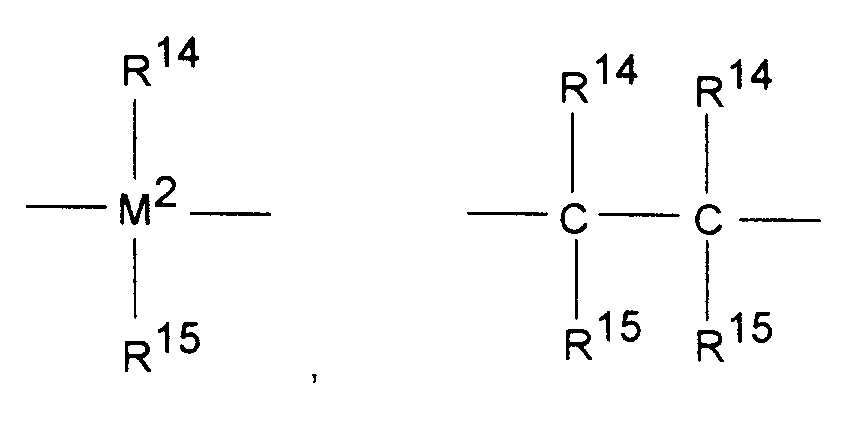
- Ganz besonders geeignet sind die in den Beispielen genannten Verbindungstypen bzw. Verbindungen.
- Die Herstellung der Metallocene I erfolgt nach literaturbekannten Verfahren und ist im nachfolgenden Reaktionsschema wiedergegeben.


- Die 2-Phenyl-benzylhalogenidderivate der Formel A sind im Handel erhältlich oder können nach literaturbekannten Methoden hergestellt werden.
- Die Umsetzung zu den Verbindungen der Formel B erfolgt durch Reaktion mit substituierten Malonsäureestern unter basischen Bedingungen, wie beispielsweise in ethanolischen Lösungen von Natriumethanolat.
- Die Verbindungen der Formel B werden mit Alkalihydroxiden wie Kaliumhydroxid oder Natriumhydroxid verseift und durch Behandeln der entstandenen Dicarbonsäuren mit Wärme zu den Verbindungen der Formel C decarboxyliert.
- Der Ringschluß zu den entsprechenden Phenyl-1-indanonen der Formel D erfolgt durch Umsetzung mit Chlorierungsreagentien wie beispielsweise SOCl2 zu den entsprechenden Säurechloriden und anschließender Cyclisierung mit einem Friedel-Crafts-Katalysator in einem inerten Solvent, wie z.B. AlCl3 oder Polyphosphorsäure in Methylenchlorid oder CS2.
- Die Umsetzung zu den 7-Phenyl-indenderivaten der Formel E erfolgt durch Reduktion mit einem hydridübertragenden Reagenz, wie beispielsweise Natriumborhydrid oder Lithiumaluminiumhydrid oder Wasserstoff und einem entsprechenden Katalysator in einem inerten Lösungsmittel wie beispielsweise Diethylether oder Tetrahyrofuran zu den entsprechenden Alkoholen und Dehydratisierung der Alkohole unter sauren Bedingungen, wie beispielsweise p-Toluolsulfonsäure oder einer wässrigen Mineralsäure oder durch Umsetzung mit wasserentziehenden Substanzen wie Magnesiumsulfat, wasserfreiem Kupfersulfat oder Molekularsiebe.
- Die Herstellung der Ligandsysteme der Formel G und die Umsetzung zu den verbrückten chiralen metallocenen der Formel H sowie die Isolierung der gewünschten racemischen Form ist im Prinzip bekannt. Hierzu wird das Phenylindenderivat der Formel E mit einer starken Base wie beispielsweise Butyllithium oder Kaliumhydrid in einem inerten Lösungsmittel deprotoniert und mit einem Reagenz der Formel F zu dem Ligandsystem der Formel G umgesetzt. Dieses wird anschließend mit zwei Äquivalenten einer starken Base wie beispielsweise Butyllithium oder Kaliumhydrid in einem inerten Lösungsmittel deprotoniert und mit dem entsprechenden Metalltetrahalogenid wie beispielsweise Zirkoniumtetrachlorid in einem geeigneten Lösemittel umgesetzt. Geeignete Lösemittel sind aliphatische oder aromatische Lösemittel, wie beispielsweise Hexan oder Toluol, etherische Lösemittel, wie beispielsweise Tetrahydrofuran oder Diethylether oder halogenierte Kohlenwasserstoffe, wie beispielsweise Methylenchlorid oder halogenierte aromatische Kohlenwasserstoffe wie beispielsweise o-Dichlorbenzol. Die Trennung der racemischen und der meso Form erfolgt durch Extraktion oder Umkristallisation mit geeigneten Lösemitteln.
- Die Derivatisierung zu den Metallocenen der Formel I kann durch Umsetzung mit Alkylierungsmitteln wie Methyllithium erfolgen.
- Die erfindungsgemäßen Metallocene I sind hochaktive Katalysatorkomponenten für die Olefincopolymerisation. Die chiralen Metallocene werden bevorzugt als Racemat eingesetzt. Verwendet werden kann aber auch das reine Enantiomere in der (+)- oder (-)-Form. Mit den reinen Enantiomeren ist ein optisch aktives Polymer herstellbar. Abgetrennt werden sollte jedoch die meso-Form der Metallocene, da das polymerisationsaktive Zentrum (das Metallatom) in diesen Verbindungen wegen der Spiegelsymmetrie am Zentralmetallatom nicht mehr chiral ist und daher kein hochisotaktisches Polymeres erzeugen kann. Wird die meso-Form nicht abgetrennt, entsteht neben isotaktischen Polymeren auch ataktisches Polymer. Für bestimmte Anwendungen, beispielsweise weiche Formkörper, kann dies durchaus wünschenswert sein.
- Erfindungsgemäß ist ein Katalysatorsystem vorgesehen, welches ein Metallocen und eine Verbindung, die das Metallocen in eine polymerisationsaktive Spezies überführen kann, enthält. Diese Verbindung ist ein Cokatalysator.
- Das Katalysatorsystem kann auch einen Träger enthalten. Das Katalysatorsystem kann auch vorpolymerisiert werden. Bevorzugt ist eine solche geträgerte und vorpolymerisierte Ausführungsform in Polymerisationsverfahren, bei denen ein Polymerpulver mit hoher Schüttdichte, gleichmäßiger Partikelform und guter Anlagengängigkeit notwendig ist.
- Erfindungsgemäß wird als Cokatalysator bevorzugt ein Aluminoxan verwendet, welches vorzugsweise die Formel IIa für den linearen Typ und/oder die Formel IIb für den cyclischen Typ aufweist,

- Bevorzugt sind die Reste R17 gleich und bedeuten Methyl, Isobutyl, Phenyl oder Benzyl, besonders bevorzugt Methyl.
- Sind die Reste R17 verschieden, so sind sie bevorzugt Methyl und Wasserstoff oder alternativ Methyl und Isobutyl, wobei Wasserstoff oder Isobutyl bevorzugt zu 0,01 bis 40 % (Zahl der Reste R17) enthalten sind.
- Das Aluminoxan kann auf verschiedene Arten nach bekannten Verfahren hergestellt werden. Eine der Methoden ist beispielsweise, daß eine Aluminiumkohlenwasserstoffverbindung und/oder ein Hydridoaluminiumkohlenwasserstoffverbindung mit Wasser (gasförmig, fest, flüssig oder gebunden - beispielsweise als Kristallwasser) in einem inerten Lösungsmittel (wie beispielsweise Toluol) umgesetzt wird. Zur Herstellung eines Aluminoxans mit verschiedenen Resten R17 werden beispielsweise entsprechend der gewünschten Zusammensetzung zwei verschiedene Aluminiumtrialkyle mit Wasser umgesetzt.
- Die genaue räumliche Struktur der Aluminoxane IIa und IIb ist nicht bekannt.
- Unabhängig von der Art der Herstellung ist allen Aluminoxanlösungen ein wechselnder Gehalt an nicht umgesetzter Aluminiumausgangsverbindung, die in freier Form oder als Addukt vorliegt, gemeinsam.
- Es ist möglich, das Metallocen vor dem Einsatz in der Polymerisationsreaktion mit einem Aluminoxan insbesondere der Formel IIa und/oder IIb vorzuaktivieren. Dadurch wird die Polymerisationsaktivität deutlich erhöht und die Kornmorphologie verbessert. Die Voraktivierung der Übergangsmetallverbindung wird in Lösung vorgenommen. Bevorzugt wird dabei das Metallocen in einer Lösung des Aluminoxans in einem inerten Kohlenwasserstoff aufgelöst. Als inerter Kohlenwasserstoff eignet sich ein aliphatischer oder aromatischer Kohlenwasserstoff. Bevorzugt wird Toluol verwendet.
- Die Konzentration des Aluminoxans in der Lösung liegt im Bereich von ca. 1 Gew.-% bis zur Sättigungsgrenze, vorzugsweise von 5 bis 30 Gew.-%, jeweils bezogen auf die Gesamtlösungsmenge. Das Metallocen kann in der gleichen Konzentration eingesetzt werden, vorzugsweise wird es jedoch in einer Menge von 10-4 - 1 mol pro mol Aluminoxan eingesetzt. Die Voraktivierung beträgt wenige Sekunden bis 60 Stunden, vorzugsweise 1 bis 60 Minuten. Man arbeitet bei einer Temperatur von -78 bis 100°C, vorzugsweise 0 bis 70°C.
- Mit Hilfe des Metallocens kann eine Vorpolymerisation erfolgen. Zur Vorpolymerisation wird bevorzugt mindestens eines der in der Polymerisation eingesetzte Olefine verwendet.
- Das Metallocen kann auch auf einen Träger aufgebracht werden. Geeignete Trägermaterialien sind beispielsweise Silikagele, Aluminiumoxide, festes Aluminoxan oder andere anorganische Trägermaterialien, wie beispielsweise Magnesiumchlorid. Ein geeignetes Trägermaterial ist auch ein Polymerpulver, insbesondere Polyolefinpulver in feinverteilter Form.
- Vorzugsweise wird der Cokatalysator, z. B. das Aluminoxan, auf einen Träger wie beispielsweise Silikagele, Aluminiumoxide, festes Aluminoxan, andere anorganische Trägermaterialien oder auch ein Polyolefinpulver in feinverteilter Form aufgebracht und dann mit dem Metallocen umgesetzt. Alternativ wird das Metallocen und der Cokatalysator in einem geeigneten Lösungsmittel gelöst und dann auf den Träger aufgebracht. Das Lösungsmittel kann dann wieder entfernt werden.
- Als anorganische Träger können Oxide eingesetzt werden, die flammenpyrolytisch durch Verbrennung von Element-Halogeniden in einer Knallgas-Flamme erzeugt wurden, oder als Kieselgele in bestimmten Korngrößen-Verteilungen und Kornformen herstellbar sind.
- Die Herstellung des geträgerten Cokatalysators kann beispielsweise wie in EP 92 107 331.8 beschrieben in der folgenden Weise in einem Edelstahl-Reaktor in explosionsgeschützter Ausführung mit einem Umpumpsystem der Druckstufe 60 bar, mit Inertgasversorgung, Temperierung durch Mantelkühlung und zweitem Kühlkreislauf über einen Wärmetauscher am Umpumpsystem erfolgen. Das Umpumpsystem saugt den Reaktorinhalt über einen Anschluß im Reaktorboden mit einer Pumpe an und drückt ihn in einen Mischer und durch eine Steigleitung über einen Wärmetauscher in den Reaktor zurück. Der Mischer ist so gestaltet, daß sich in dem Zulauf ein verengter Rohrquerschnitt befindet, wo eine erhöhte Strömungsgeschwindigkeit entsteht, und in dessen Turbulenzzone und entgegen der Strömungsrichtung eine dünne Zuleitung geführt ist, durch welche - getaktet - jeweils eine definierte Menge Wasser unter 40 bar Argon eingespeist werden kann. Die Kontrolle der Reaktion erfolgt über einen Probennehmer am Umpumpkreislauf.
- Im Prinzip sind jedoch auch andere Reaktionen und technische Ausführungsformen geeignet.
- Im vorstehend beschriebenen Reaktor mit 16 dm3 Volumen werden 5 dm3 Decan unter Inertbedingungen vorgelegt. 0,5 dm3 (= 5,2 mol) Trimethylaluminium werden bei 25°C zugefügt. Danach werden 350 g Kieselgel Grace/Davison 948, welche vorher bei 600°C in einem Argonfließbett getrocknet wurden, durch einen Feststofftrichter in den Reaktor eindosiert und mit Hilfe des Rührers und des Umpumpsystems homogen verteilt. Eine Gesamtmenge von 76,5 g Wasser wird in Portionen von 0,1 cm3 während 3,25 h jeweils alle 15 s in den Reaktor gegeben. Der Druck, herrührend vom Argon und den entwickelten Gasen, wird durch ein Druckregelventil konstant bei 10 bar gehalten. Nachdem alles Wasser eingebracht worden ist, wird das Umpumpsystem abgeschaltet und das Rühren noch 5 h bei 25°C fortgesetzt.
- Der in dieser Weise hergestellte geträgerte CokatalysatorFMAO auf SiO2" wird als eine 10 %ige Suspension in n-Decan eingesetzt. Der Aluminiumgehalt ist 1,06 mmol Al pro cm3 Suspension. Der isolierte Feststoff enthält 20 Gew.-% Aluminium, das Suspensionsmittel enthält 0,1 Gew.-% Aluminium.

- Weitere Möglichkeiten der Herstellung eines geträgerten Cokatalysators sind beispielsweise in EP 92 107 331.8 beschrieben.
- Danach wird das erfindungsgemäße Metallocen auf den geträgerten Cokatalysator aufgebracht, indem das gelöste Metallocen mit dem geträgerten Cokatalysator gerührt wird. Das Lösemittel wird entfernt und durch einen Kohlenwasserstoff ersetzt, in dem sowohl Cokatalysator als auch das Metallocen unlöslich sind.
- Die Reaktion zu dem geträgerten Katalysatorsystem erfolgt bei einer Temperatur von -20°C bis + 120°C, bevorzugt 0 - 100°C, besonders bevorzugt bei 15 bis 40°C. Das Metallocen wird mit dem geträgerten Cokatalysator in der Weise umgesetzt, daß der Cokatalysator als Suspension mit 1 bis 40 Gew.-%, bevorzugt mit 5 bis 20 Gew.-% in einem aliphatischen, inerten Suspensionsmittel wie n-Decan, Hexan, Heptan, Dieselöl mit einer Lösung des Metallocens in einem inerten Lösungsmittel wie Toluol, Hexan, Heptan, Dichlormethan oder mit dem feingemahlenen Feststoff des Metallocens zusammengebracht wird. Umgekehrt kann auch eine Lösung des Metallocens mit dem Feststoff des Cokatalysators umgesetzt werden.
- Die Umsetzung erfolgt durch intensives Mischen, beispielsweise durch Verrühren bei einem molaren Al/M1-Verhältnis von 100/1 bis 10000/1, bevorzugt 100/1 bis 3000/1, sowie einer Reaktionszeit von 5 bis 600 Minuten, bevorzugt 10 bis 120 Minuten, besonders bevorzugt 10 bis 60 Minuten unter inerten Bedingungen.
- Im Laufe der Raktionszeit zur Herstellung des geträgerten Katalysatorsystems treten insbesondere bei der Verwendung der erfindungsgemäßen Metallocene mit Absorptionsmaxima im sichtbaren Bereich Veränderungen in der Farbe der Reaktionsmischung auf, an deren Verlauf sich der Fortgang der Reaktion verfolgen läßt.
- Nach Ablauf der Reaktionszeit wird die überstehende Lösung abgetrennt, beispielsweise durch Filtration oder Dekantieren. Der zurückbleibende Feststoff kann 1- bis 5-mal mit einem inerten Suspensionsmittel wie Toluol, n-Decan, Hexan, Dieselöl, Dichlormethan zur Entfernung löslicher Bestandteile im gebildeten Katalysator, insbesondere zur Entfernung von nicht umgesetzten und damit löslichem Metallocen, gewaschen werden.
- Das so hergestellte geträgerte Katalysatorsystem kann im Vakuum getrocknet als Pulver oder noch Lösemittel behaftet wieder resuspendiert und als Suspension in einem inerten Suspensionsmittel in das Polymerisationssystem eindosiert werden. Inerte Suspensionsmittel sind die vorgenannten Suspensionsmittel oder wachsartige Kohlenwasserstoffe.
- Erfindungsgemäß können an Stelle oder neben eines Aluminoxans Verbindungen der Formeln R18 xNH4-xBR19 4, R18 xPH4-xBR19 4, R18 3CBR19 4, BR19 3 als geeignete Cokatalysatoren verwendet werden. In diesen Formeln bedeutet x eine Zahl von 1 bis 4, bevorzugt 3, die Reste R18 sind gleich oder verschieden, bevorzugt gleich, und bedeuten C1-C10-Alkyl, C6-C18-Aryl oder 2 Reste R18 bilden zusammen mit dem sie verbindenden Atom einen Ring, und die Reste R19 sind gleich oder verschieden, bevorzugt gleich, und stehen für C6-C18-Aryl, das durch Alkyl, Haloalkyl oder Fluor substituiert sein kann.
- Insbesondere steht R18 für Ethyl, Propyl oder Phenyl und R19 für Phenyl, Pentafluorphenyl, 3,5-Bistrifluormethylphenyl, Mesityl, Xylyl oder Tolyl (vgl. EP-A 277 003, EP-A 277 004 und EP-A 426 638).
- Bei Verwendung der obengenannten Cokatalysatoren besteht der eigentliche (aktive) Polymerisationskatalysator aus dem Reaktionsprodukt von Metallocen und mindestens einem der Cokatalysatoren. Daher wird zunächst dieses Reaktionsprodukt bevorzugt außerhalb des Polymerisationsreaktors in einem separaten Schritt unter Verwendung eines geeigneten Lösungsmittels hergestellt.
- Prinzipiell ist als Cokatalysator erfindungsgemäß jede Verbindung geeignet, die aufgrund ihres Lewis-Acidität das neutrale Metallocen in ein Kation überführen und dieses stabilisieren kann (labile Koordination). Darüberhinaus soll der Cokatalysator oder das aus ihm gebildete Anion keine weiteren Reaktionen mit dem gebildeten Metallocenkation eingehen (vgl. EP-A 427 697).

- Zur Entfernung von im Olefinmonomer vorhandenen Katalysatorgiften ist eine Reinigung mit einem Aluminiumalkyl, beispielsweise Trimethylaluminium, Triisobutylaluminum oder Triethylaluminium vorteilhaft. Diese Reinigung kann sowohl im Polymerisationssystem selbst erfolgen, oder das Olefin wird vor der Zugabe in das Polymerisationssystem mit der Al-Verbindung in Kontakt gebracht und anschließend wieder abgetrennt.
- Erfindungsgemäß ist ein Copolymer mit einer Viskositätszahl (VZ) > 200, bevorzugt > 250 und besonders bevorzugt > 300 cm3/g vorgesehen. Das erfindungsgemäße Copolymer enthält 99,5 bis 30 Gew.-%, bezogen auf das Gesamtpolymer Propyleneinheiten, bevorzugt 98,5 bis 40 Gew.-%, besonders bevorzugt 97,5 bis 50 Gew.-% Propyleneinheiten. Entsprechend betragen die Gehalte an Comonomereinheiten 0,5 bis 70 Gew.-%, bevorzugt 1,5 bis 60 Gew.-% besonders bevorzugt 2,5 bis 50 Gew.-%. Die Comonomereinheiten leiten sich von Ethylen oder Olefinen mit mindestens 4 C-Atomen der Formel Ra-CH = CH-Rb ab, wobei Ra und Rb gleich oder verschieden sind und ein Wasserstoffatom oder einen Kohlenwasserstoffrest mit 1 bis 15 C-Atomen, wie einen C1-C15-Alkylrest bedeuten, oder Ra und Rb mit den sie verbindenden C-Atomen einen Ring mit 4 bis 12 C-Atomen bilden. Beispiele für solche Comonomeren sind 1-Olefine wie Ethylen, 1-Buten, 1-Penten, 1-Hexen, 4-Methyl-1-penten oder Ethylidennorbornen.
- Ganz besonderes bevorzugt setzen sich statische Copolymere aus 1,5 bis 15 Gew.-% Comonomer und 98,5 bis 85 Gew.-% Propylen zusammen, während Kautschuke Comonomerengehalte von 20 bis 60 Gew.-% und Propylengehalte von 80 bis 40 Gew.-% aufweisen. Terpolymere können noch bis zu 10 Gew.-%, bevorzugt bis zu 5 Gew.-% der Dienkomponente enthalten.
- Solche Kautschucke oder Terpolymere weisen Viskositätszahlen (VZ) von > 200, bevorzugt > 250 und besonders bevorzugt > 300 cm3/g auf. Statistische Copolymere mit C2-Gehalten > 4 Gew.-% weisen VZ-Werte von > 250 und bevorzugt > 300 cm3/g auf. Statistische Copolymere mit C2-Gehalten von 1.5 bis 4 Gew.-% weisen VZ-Werte > 350 cm3/g auf.
- Erfindungsgemäß ist außerdem ein Verfahren zur Herstellung eines Copolymers vorgesehen. Dazu kann bei einer Temperatur von 50 bis 200°C, bevorzugt 55 bis 150°C, besonders bevorzugt bei 60 bis 150°C, bei einem Druck von 0,5 bis 100 bar, bevorzugt 2 bis 80 bar, besonders bevorzugt 20 bis 64 bar in Lösung, in Suspension oder in der Gasphase, einstufig oder mehrstufig, in Gegenwart des erfindungsgemäßen Katalysatorsystems polymerisiert werden.
- Die Copolymerisation kann in Lösung, in Suspension oder in der Gasphase kontinuierlich oder diskontinuierlich ein oder mehrstufig bei einer Temperatur von 50 bis 200°C, vorzugsweise 5 bis 150°C, besonders bevorzugt 60 bis 150°C durchgeführt werden. Copolymerisiert werden Propylen und Olefine, die sich von Ethylen oder Olefinen mit mindestens 4 C-Atomen der Formel Ra-CH = CH-Rb ableiten, wobei Ra und Rb gleich oder verschieden sind und ein Wasserstoffatom oder einen Kohlenwasserstoffrest mit 1 bis 15 C-Atomen wie einen Alkylrest bedeuten, oder Ra und Rb mit den sie verbindenden C-Atomen einen Ring mit 4 bis 12 C-Atomen bilden. Ferner sind als Olefine auch Diene einsetzbar, Ra oder Rb bedeutet in diesem Fall ein C2 bis C12-Alken und Ra und Rb können auch hier zyklisch verbunden sein. Beispiele für solche Diene sind Ethylidennorbornen, Norbornadien, Dicyclopentadien, 1,4-Hexadien oder Butadien. Bevorzugt werden solche Diene zur Copolymerisation mit Propylen und einem weiteren Olefin verwendet.
- Beispiele für Olefine als Comonomere sind 1- Olefine wie Ethylen, 1-Buten, 1-Penten, 1-Hexen, 4-Methyl-1-penten, 1-Octen, Norbornen. Insbesondere werden Propylen und Ethylen polymerisiert, im Falle einer Terpolymerherstellung werden Propylen, Ethylen und Ethylidennorbornen bevorzugt polymerisiert.
- Als Molmassenregeler und/oder zur Steigerung der Aktivität wird, falls erforderlich, Wasserstoff zugegeben. Der Gesamtdruck im Polymerisationssystem beträgt 0,5 bis 100 bar. Bevorzugt ist die Polymerisation in dem technisch besonders interessanten Druckbereich von 5 bis 64 bar.
- Dabei wird das Metallocen in einer Konzentration, bezogen auf das Übergangsmetall von 10-3 bis 10-8, vorzugsweise 10-4 bis 10-7 mol Übergangsmetall pro dm3 Reaktorvolumen angewendet. Das Aluminoxan wird in einer Konzentration von 10-5 bis 10-1 mol, vorzugsweise 10-4 bis 10-2 mol pro dm3 Lösemittel bzw. pro dm3 Reaktorvolumen verwendet. Die anderen genannten Cokatalysatoren werden in etwa äquimolaren Mengen zum Metallocen verwendet. Prinzipiell sind aber auch höhere Konzentrationen möglich.
- Wenn die Polymerisation als Suspensions- oder Lösungspolymerisation durchgeführt wird, wird ein für das Ziegler-Niederdruckverfahren gebräuchliches inertes Lösemittel verwendet. Beispielsweise arbeitet man in einem aliphatischen oder cycloaliphatischen Kohlenwasserstoff; als solcher sei beispielsweise Propan, Butan, Hexan, Heptan, Isooctan, Cyclohexan, Methylcyclohexan, genannt. Weiterhin kann eine Benzin bzw. hydrierte Dieselölfraktion benutzt werden. Brauchbar ist auch Toluol. Bevorzugt wird im flüssigen Monomeren polymerisiert.
- Werden inerte Lösemittel verwendet, werden die Monomeren, gasförmig oder flüssig zudosiert.
- Die Dauer der Polymerisation ist beliebig, da das erfindungsgemäß zu verwendende Katalysatorsystem einen nur geringen zeitabhängigen Abfall der Polymerisationsaktivität zeigt.
- Vor der Zugabe des Katalysators, insbesondere des geträgerten Katalysatorsystems (aus einem erfindungsgemäßen Metallocen und einem geträgerten Cokatalysator oder aus einem erfindungsgemäßen Metallocen und einer aluminiumorganischen Verbindung auf einem Polymerpulver in feinverteilter Form), kann zusätzlich eine andere Aluminiumalkylverbindung wie beispielsweise Trimethylaluminium, Triethylaluminium, Triisobutylaluminium, Trioctylaluminium oder Isoprenylaluminium zur Inertisierung des Polymerisationssystems (beispielsweise zur Abtrennung vorhandener Katalysatorgifte im Olefin) in den Reaktor gegeben werden. Diese wird in einer Konzentration von 100 bis 0,01 mmol Al pro kg Reaktorinhalt dem Polymerisationssystem zugesetzt. Bevorzugt werden Triisobutylaluminium und Triethylaluminium in einer Konzentration von 10 bis 0,1 mmol Al pro kg Reaktorinhalt. Dadurch kann bei der Synthese eines geträgerten Katalysatorsystems das molare Al/M1-Verhältnis klein gewählt werden.
- Grundsätzlich ist jedoch der Einsatz weiterer Substanzen zur Katalyse der Copolymerisationsreaktion nicht erforderlich, d.h. die erfindungsgemäßen Systeme können als alleinige Katalysatoren für die Olefincopolymerisation verwendet werden, insbesondere sind keine Stereoregulatoren (Donoren) erforderlich.
- Das erfindungsgemäße Verfahren zeichnet sich dadurch aus, daß mit ihm im technisch besonders interessanten Temperaturbereich von 65 bis 150°C hochmolekulare Propylencopolymere herstellbar sind. Insbesondere sind dadurch hochmolekulare statistische Copolymere mit höherem Comonomerengehalt zugänglich, die sich durch hohe Transparenz und geringe extrahierbare Anteile auszeichnen und Kautschuke, die unter industriell sinnvollen Polymerisationstemperaturen von > 50°C mit ihrer Molmasse auf einem sehr hohen Niveau liegen und Viskositätszahlen von > 200 cm3/g aufweisen.
- Erfindungsgemäß ist die Verwendung von mindestens einer erfindungsgemäßen Katalysatorkomponente oder mindestens eines erfindungsgemäßen Katalysatorsystems zur Herstellung von hochmolekularen Copolymeren vorgesehen.
- Erfindungsgemäß ist die Verwendung der erfindungsgemäßen Copolymere zur Herstellung von hochtransparenten, steifen Formkörpern, insbesondere im Dünnwandspritzguß, hochtransparenten steifen Folien, hochmolekularem Kautschuk mit tiefer Glastemperatur, hochpolymeren, hochschlagzähen Blockcopolymeren, hochmolekularen statistischen Copolymeren mit geringen extrahierbaren Anteilen für den Einstatz im Lebensmittelverpackungsbereich vorgesehen.
- Die Erfindung wird anhand der nachfolgenden Beispiele näher erläutert.
- Alle Glasgeräte wurden im Vakuum ausgeheizt und mit Argon gespült. Alle Operationen wurden unter Ausschluß von Feuchtigkeit und Sauerstoff in Schlenkgefäßen durchgeführt. Die verwendeten Lösemittel wurden unter Argon jeweils frisch über Na/K-Legierung destilliert und in Schlenkgefäßen aufbewahrt.
- Es bedeuten:
- VZ
- = Viskositätszahl in cm3/g
- Mw
- = Molmassengewichtsmittel in g/mol (ermittelt durch Gelpermeationschromatographie)
- Mw/Mn
- = Molmassendispersität
- Schmp.
- = Schmelzpunkt in °C (ermittelt mit DSC, 20°C/min. Aufheiz/Abkühlgeschwindigkeit)
- MFI 230/2.16
- MFI 230/5
- = Schmelzindex, gemessen nach DIN 53 735.
-
- 1. (±)-2-(2-Phenyl-benzyl)propionsäure (1).
Zu 6,5 g (0,285 mol) Natrium in 160 cm3 H2O-freiem EtOH wurden bei Raumtemperatur 48,6 g (0,279 mol) Diethylmethylmalonat zugetropft. Anschließend wurden 70,4 g (0,285 mol) 2-Phenyl-benzylbromid in 20 cm3 H2O-freiem EtOH zugetropft und der Ansatz 3 h zum Rückfluß erhitzt. Das Lösemittel wurde abgezogen und der Rückstand mit 200 cm3 H2O versetzt. Die organische Phase wurde abgetrennt, die wäßrige Phase mit NaCl gesättigt und 2mal mit je 200 cm3 Et2O extrahiert. Die mit den Extrakten vereinigte organische Phase wurde getrocknet (MgSO4).
Der nach Abziehen des Lösemittels verbliebene Rückstand wurde in 500 cm3 EtOH und 50 cm3 H2O aufgenommen und mit 56 g (1 mol) KOH versetzt. Die Reaktionsmischung wurde 4 h unter Rückfluß erhitzt. Das Lösemittel wurde im Vakuum abgezogen, der Rückstand in 500 cm3 H2O aufgenommen und mit konzentrierter wäßriger HCl bis pH 1 angesäuert. Der ausgefallene Niederschlag wurde abgesaugt und am Kugelrohr 30 min unter starkem Aufschäumen auf 250°C erhitzt. Man erhielt 58,3 g (85 %) 1 als zähflüssiges Öl.
1H-NMR (100 Mhz, CDCl3): 11,7 (s, 1H, COOH), 7,1-7,5 (m, 9H. Arom. H), 2,3-3,2 (m, 3H, CH u. CH2), 0,9 (d, 3H, CH3). - 2. (±)-2-Methyl-4-phenyl-indan-1-on (2)
Eine Lösung von 58 g (0,242 mol) 1 in 60 cm3 (0,83 mol) Thionylchlorid wurde 18 h bei Raumtemperatur gerührt. Überschüssiges Thionylchlorid wurde bei 10 mbar entfernt und der ölige Rückstand durch mehrmaliges Lösen in je 100 cm3 Toluol und Abziehen im Vakuum von anhaftenden Resten Thionylchlorid befreit.
Das Säurechlorid wurde in 150 cm3 Toluol aufgenommen und bei 10°C zu einer Suspension von 48 g (0,363 mol) AlCl3 in 400 cm3 Toluol getropft. Nach vollständiger Zugabe wurde das Gemisch noch 3 h unter Rückfluß erhitzt. Die Reaktionsmischung wurde auf 500 g Eis gegossen und mit konzentrierter wäßriger HCl bis pH 1 angesäuert. Die organische Phase wurde abgetrennt und die wäßrige Phase 3mal mit je 100 cm3 Et2O nachextrahiert. Die vereinigten organischen Phasen wurden mit gesättigter wäßriger NaHCO3-, gesättigter wäßriger NaCl-Lösung gewaschen und danach getrocknet (MgSO4). Es wurden 50,4 g (93 %) 2 erhalten, das ohne weitere Reinigung weiter umgesetzt wurde.
1H-NMR (100 Mhz, CDCl3): 7,2-7,8 (m, 8H, arom. H), 3,3 (dd, 1H, β-H), 2,5-2,9 (m, 2H, α- und β-H), 1,3 (d, 3H, CH3). - 3. 2-methyl-7-phenyl-inden (3)
50 g (0,226 mol) 2 wurden in 450 cm3 THF/MeOH (2:1) gelöst und bei 0°C unter Rühren portionsweise mit 12,8 g (0,34 mol) Natriumborhydrid versetzt und 18 h weiter gerührt. Die Reaktionsmischung wurde auf Eis gegossen und mit konzentrierter HCl bis pH 1 versetzt und mehrmals mit Et2O extrahiert. Die vereinigten organischen Phasen wurden mit gesättigter wäßriger NaHCO3-, NaCl-Lösung gewaschen und danach getrocknet (MgSO4). Das Lösemittel wurde im Vakuum entfernt und das Rohprodukt ohne weitere Reinigung in 1 dm3 Toluol aufgenommen, mit 2 g p-Toluolsulfonsäure versetzt und 2 h zum Rückfluß erhitzt. Die Reaktionsmischung wurde mit 200 cm3 gesättigter wäßriger NaHCO3-Lösung gewaschen und das Lösemittel im Vakuum entfernt. Das Rohprodukt wurde durch Filtration über 500 g Kieselgel (Hexan/CH2Cl2) gereinigt. Es wurden 42 g (90 %) 3 als farbloses Öl erhalten. 1H-NMR (100 Mhz, CDCl3): 7,0-7,6 (m, 8H, arom. H), 6.5 (m, 1H, H-C(3)), 3,4 (s, 2H, CH2), 2,1 (s, 3H, CH3). - 4. Dimethylbis(2-methyl-4-phenyl-indenyl)silan (4)
Eine Lösung von 15 g (72,7 mmol) 3 in 200 cm3 H2O- und O2-freiem Toluol und 10 cm3 H2O- und O2-freiem THF wurden bei Raumtemperatur unter Argon mit 29 cm3 (73 mmol) einer 2,5 M Lösung von Butyllithium in Hexan versetzt und 1 h auf 80°C erhitzt. Anschließend wurde der Ansatz auf 0°C gekühlt und mit 4,7 g (36,4 mmol) Dimethyldichlorsilan versetzt. Das Gemisch wurde 1 h auf 80°C erhitzt und anschließend auf 100 cm3 H2O gegossen. Es wurde mehrmals mit Et2O extrahiert und die vereinigten organischen Phasen getrocknet (MgSO4). Das nach Abziehen des Lösemittels im Vakuum verbliebene Rohprodukt wurde an 300 g Kieselgel (Hexan/CH2Cl2) chromatographiert. Es wurden 12,0 g (70 %) 4 erhalten.
1H-NMR (100 Mhz, CDCl3): 7,10-7,70 (m, 16H, arom. H)), 6,80 (m, 2H, H-C(3)), 3,80 (s, 2H, H-C(1)), 2,20 (m, 6H, CH3), -0,20 (m, 6H, CH3Si). - 5. Rac-Dimethylsilylbis(2-methyl-4-phenyl-indenyl)zirkiniumdichlorid (5)
Eine Lösung von 6,0 g (12,9 mmol) 4 in 100 cm3 H2O- und O2-freiem Toluol wurde unter Argon bei Raumtemperatur mit 10,6 cm3 (26 mmol) einer 2,5 M-Lösung von Butyllithium in Hexan versetzt und 3 h zum Rückfluß erhitzt. Anschließend wurde die Suspension des Dilithiosalzes auf -25°C abgekühlt und mit 3,2 g (13,6 mmol) Zirkoniumtetrachlorid versetzt. Man erwärmte den Ansatz innerhalb 1 h auf Raumtemperatur, rührte ihn noch 1 h und filtrierte dann über eine G3-Fritte. Der Rückstand wurde mit 50 cm3 Toluol extrahiert und die vereinigten Filtrate im Vakuum einer Ölpumpe vom Lösemittel befreit. Man erhielt 9,0 g des Metallocens als Mischung der racemischen und der meso-Form im Verhältnis 1:1 in Form eines gelben Pulvers. Das reine Racemat (5) konnte durch mehrfaches Verrühren der Rohmischung mit je 20 cm3 Methylenchlorid gewonnen werden, wobei das Racemat als gelbes Krristallpulver zurückblieb und die meso-Form ausgewaschen wurde. Man erhielt 2,74 g (33 %) des reinen Racemats.
1H-NMR (300 Mhz, CDCl3): 7,0-7,7 (m, 16H, arom. H), 6,9 (s, 2H, H-C(3)), 2,2 (s, 6H, CH3), 1,3 (m, 6H, CH3Si). Molmasse: 626 M+, korrektes Zerfallsmuster. -
- 1. 2-(1-Naphthyl)-toluol (6)
13,9 g (0,57 mol) Magnesium-Späne wurden mit 150 ml H2O-freiem Et2O überschichtet und die Grignard-Reaktion mit 5 g 2-Bromtoluol und eingigen Körnchen Jod zum Anspringen gebracht. Anchließend wurden 93 g (0,57 mol) 1-Bromtoluol in 450 ml H2O-freiem Et2O so zugetropft, daß die Reaktionsmischung am Sieden gehalten wurde. Nach vollständiger Zugabe wurde noch solange zum Sieden erhitzt, bis das Magnesium vollständig umgesetzt war.
Die Grignard-Lösung wurde anschließend zu einer Lösung von 118 g (0,57 mol) 1-Bromnaphthalin und 3,5 g
Bis(triphenylphosphin)nickeldichlorid in 800 cm3 Toluol getropft, so daß die Innentemperatur 50°C nicht überstieg. Anschließend wurde noch 3 h zum Rückfluß erhitzt, mit 500 ml 10 %iger wäßriger HCl versetzt, die Phasen getrennt und die organische Phase im Vakuum vom Lösemittel befreit. Nach Filtration über Kieselgel (Hexan) wurde 115 g (92 %) 6 als farbloses Öl erhalten.
1H-NMR (100 Mhz, CDCl3): 7,2-8,0 (m, 11h, arom. H), 2,0 (s, 3H, CH3). - 2. 2-(1-Naphthyl)-benzylbromid (7)
114 g (0,52 mol) 6 und 103 g (0,58 mol) N-Bromsuccinimid wurden bei Raumtemperatur in 2000 cm3 Terachlorkohlenstoff gelöst, mit 3 g Azobisisoburyronitril versetzt und 4 h zum Rückfluß erhitzt. Das ausgefallene Succinimid wurde abfiltriert, das Lösemittel im Vakuum entfernt und der Rückstand durch Filtration über 1000 g Kieselgel (Hexan/Methylenchlorid 9:1) gereinigt. Es wurden 141 g (82 %) 7 als farbloses, tränenreizendes Öl erhalten.
1H-NMR (100 Mhz, CDCl3): 7,1-8,0 (m, 11H, arom. H), 4,2 (q, 2H, CH2Br). - 3. (±)-2-(2(1-naphthyl)benzyl)propionsäure (8)
Zu 10 g (0,43 mmol) Natrium in 100 cm3 H2O-freiem EtOH werden bei Raumtemperatur 75 g (0.43 mmol) Methylmalonsäuredimethylester gelöst in 50 cm3 H2O-freiem EtOH zugetropft. Anschließend wurden 140 g (0,43 mmol) 7 in 200 cm3 H2O-freiem EtOH zugetropft und 3 h zum Rückfluß erhitzt. Bei Raumtemperatur wurden 85 g (1,3 mol) KOH gelöst in 100 cm3 H2O zugesetzt und weitere 4 h zum Rückfluß erhitzt. Die Lösemittel wurden im Vakuum entfernt, der Rückstand bis zur vollständigen Lösung mit H2O versetzt und mit konzentrierter wäßriger HCl bis pH 1 angesäuert. Der ausgefallene Niederschlag wurde abgesaugt, getrocknet und 1 h auf 130°C erhitzt. Man erhielt 96 g (77 %) 8 als zähflüssiges Öl.
1H-NMR (100 MHz,CDCl3): 10,1 (s, 1H, COOH), 6,9-8,0 (m, 11H, arom. H), 2,3-3,0 (m, 3H, CH2 und CH), 0,8 (d, 3H, CH3). - 4. (±)-2-Methyl-4-(1-naphthyl)-1-indanon (9)
Eine Lösung von 96 g (0,33 mol) 8 in 37 cm3 (0,5 mol) Thionylchlorid wurde 18 h bei Raumtemperatur gerührt. Überschüssiges Thionylchlorid wurde bei 10 mbar entfernt und der ölige Rückstand durch mehrmaliges Lösen in je 100 cm3 Toluol und Abziehen im Vakuum von anhaftenden Resten Thionylchlorid befreit.
Das Säurechlorid wurde in 200 cm3 Toluol aufgenommen und bei 10°C zu einer Suspension von 44 g (0,33 mol) AlCl3 in 1000 cm3 Toluol getropft und 3 h auf 80°C erhitzt. Die Reaktionsmischung wurde auf 1000 g Eis gegossen und mit konz. wäßriger HCl bis pH 1 angesäuert. Die organische Phase wurde abgetrennt und die wäßrige Phase 3mal mit je 200 cm3 Methylenchlorid nachextrahiert. Die vereinigten organischen Phasen wurden mit gesättigter wäßriger NaHCO3-, gesättigter wäßriger NaCl-Lösung gewaschen und anschließend getrocknet (MgSO4). Nach Chromatographie an 1000 g Kieselgel (Hexan/Methylenchlorid) wurden 12 g (13 %) 9 erhalten.
1H-NMR (100 Mhz, CDCl3): 7,3-8,0 (m, 10H, arom. H), 2,2-3,2 (m, 3H, CH2 und CH), 1,2 (d, 3H, CH3). - 5. 2-Methyl-7-(1-naphtyl)inden (10)
Zu einer Lösung von 12 g (44 mmol) 9 in 100 cm3 THF/Methanol 2:1 wurden bei 0°C 1,3 g (33 mmol) NaBH4 zugesetzt und 18 h bei Raumtemperatur gerührt. Die Reaktionsmischung wurde auf 100 g Eis gegossen, mit konz. wäßriger HCl bis pH 1 versetzt und mehrmals mit Et2O extrahiert. Die vereinigten organischen Phasen wurden mit gesättigter wäßriger NaHCO3-, gesättigter wäßriger NaCl-Lösung gewaschen und anschließend getrocknet (MgSO4).
Das Rohprodukt wurde in 200 cm3 Toluol aufgenommen, mit 0,5 g p-Toluolsulfonsäure versetzt und 2 h am Wasserabscheider zum Rückfluß erhitzt. Die Reaktionsmischung wurde 3mal mit 50 cm3 gesättigter wäßriger NaHCO3-Lösung gewaschen und das Lösemittel im Vakuum entfernt. Nach Filtration über 200 g Kieselgel (Hexan/Methylenchlorid) wurden 10 g (86 %) 10 als farbloses Öl erhalten.
1H-NMR (100 Mhz, CDCl3): 7,0-8,0 (m, 10H, arom. H), 6,6 (m, 1H, CH), 3,0 (m, 2H, CH2), 2,0 (m, 3H, CH3). - 6. Dimethylbis(2-methyl-4-(1-naphthyl)indenyl)silan (11)
Eine Lösung von 10 g (38 mmol) 10 in 100 cm3 H2O- und O2-freiem Toluol und 5 ml H2O- und O2-freiem THF wurden bei Raumtemperatur mit 14,4 cm3 (50 mmol) einer 20 %igen Lösung von Butyllitnium in Toluol versetzt und 2 h auf 80°C erhitzt. Anschließend wurde die gelbe Suspension auf 0°C gekühlt und mit 2,5 g (19 mmol) Dimethyldichlorsilan versetzt. Die Reaktionsmischung wurde noch 1 h auf 80°C erhitzt und anschließend mit 50 cm3 H2O gewaschen. Das Lösemittel wurde im Vakuum entfernt und der Rückstand aus Heptan bei -20°C umkristallisiert. Es wurde 8,2 g (75 %) 11 als farblose Kristalle erhalten.
1H-NMR (100 Mhz, CDCl3): 7,2-8,1 (m, 20H, arom. H), 6,4 (m, 2H, H-C(3)), 4,0 (m, 2H, H-C(1)), -0,1 (s, 6H, CH3Si). - 7. rac-Dimethylsilandiylbis(2-methyl-4-(1-naphthyl)indenyl)zirkoniumdichlorid (12)
Eine Lösung von 8,0 g (14 mmol) 11 in 70 cm3 H2O- und O2-freiem Et2O wurden unter Argon bei Raumtemperatur mit 10,5 cm3 einer 20 %igen Lösung von Butyllithium in Toluol versetzt und anschließend 3 h zum Rückfluß erhitzt. Das Lösemittel wurde im Vakuum entfernt und der Rückstand mit 50 ml H2O- und O2-freiem Hexan über eine G3-Schlenkfritte filtriert, mit 50 ml H2O- und O2-freiem Hexan nachgewaschen und getrocknet (0,1 mbar, RT).
Das Dilithiosalz wurde bei -78°C zu einer Suspension von 3,2 g (14 mmol) Zirkoniumtetrachlorid in 80 cm3 Methylenchlorid gegeben und im Verlauf von 18 h unter magn. Rühren auf Raumtemperatur erwärmt. Der Ansatz wurde über eine G3-Fritte filtriert und der Rückstand portionsweise mit insgesamt 400 cm3 Methylenchlorid nachextrahiert. Die vereinigten Filtrate wurden im Vakuum vom Lösemittel befreit und aus Methylenchlorid umkristallisiert. Es wurden 1,5 g (15 %) der racemischen und der meso-Form im Verhältnis 1:1 erhalten. Durch erneutes Umkristallisieren aus Methylenchlorid wurde der racemische Komplex in Form gelber Kristalle erhalten.
1H-NMR (100 Mhz, CDCl3): 7,0-8,0 (m, 22H, arom. H), 6,5 (s, 2H, H-C(3)), 2,2 (s, 6H, CH3), 1,3 (s, 6H, CH3'Si). Massenspektrum 729 m+, korrektes Zerfallsmuster. -
- 1. 2-(2-Naphthyl)-toluol (13)
14 g (0,57 mol) Magnesium-Späne wurden mit 150 ml H2O-freiem Et2O überschichtet und die Grignard-Reaktion mit 5 g 2-Bromtoluol und einigen Körnchen Jod zum Anspringen gebracht. Anschließend wurden 95 g (0,58 mol) Bromtoluol in 450 ml H2O-freiem Et2O so zugetropft, daß die Reaktionsmischung am Sieden gehalten wurde. Nach vollständiger Zugabe wurde noch solange zum Sieden erhitzt, bis das Magnesium vollständig umgesetzt war.
Die Grignard-Lösung wurde anschließend zu einer Lösung von 120 g (0,57 mol) 2-Bromnaphthalin und 3,5 g Bis(triphenylphosphin)nickelchlorid in 800 cm3 Toluol getropft, so daß die Innentemperatur 50°C nicht überstieg. Anschließend wurde noch 3 h zum Rückfluß erhitzt, mit 500 ml 10 %iger wäßriger HCl versetzt, die Phasen getrennt und die organische Phase im Vakuum vom Lösemittel befreit. Nach Filtration über Kieselgel (Hexan) wurden 107 g (87 %) 13 als farbloses Öl erhalten.
1H-NMR (100 Mhz, CDCl3): 7,0-7,9 (m, 11H, arom. H), 1,9 (s, 3H, CH3). - 2. 2-(2-Naphthyl)benzylbromid (14)
105 g (0,48 mol) 13 und 90 g (0,5 mol) N-Bromsuccinimid wurde bei Raumtemperatur in 2000 cm3 Tetrachlorkohlenstoff gelöst, mit 3 g Azobisisoburyronitril versetzt und 4 h zum Rückfluß erhitzt. Das ausgefallene Succinimid wurde abfiltriert, das Lösemittel im Vakuuum entfernt und der Rückstand durch Filtration über 1000 g Kieselgel (Hexan/Methylenchlorid 9:1) gereinigt. Es wurden 112 g (79 %) 14 als farbloses, tränenreizendes Öl erhalten.
1H-NMR (100 Mhz, CDCl3): 6,9-8,0 (m, 11H, arom. H), 4,1 (s, 2H, CH2Br). - 3. (±)-2-(2-(2-naphthyl)benzyl)-propionsäure (15)
Zu 8,5 g (0,37 mmol) Natrium in 100 cm3 H2O-freiem EtOH wurden bei Raumtemperatur 70 g (0,37 mmol) Methyl-malonsäurediethylester gelöst in 50 cm3 H2O-freiem EtOH zugetropft. Anschließend wurden 110 g (0,37 mmol) 14 in 200 cm3 H2O-freiem EtOH zugetropft und 3 h zum Rückfluß erhitzt. Bei Raumtemperatur wurden 62 g (1,1 mol) KOH gelöst in 100 cm3 H2O zugesetzt und weitere 4 h zum Rückfluß erhitzt. Die Lösemittel wurden im Vakuum entfernt, der Rückstand bis zur vollständigen Lösung mit H2O versetzt und mit konzentrierter wäßriger HCl bis pH 1 angesäuert. Der ausgefallene Niederschlag wurde abgesaugt, getrocknet und 1 h auf 130°C erhitzt. Man erhielt 90 g (84 %) 15 als zähflüssiges Öl.
1H-NMR (100 Mhz, CDCl3): 10,9 (s, 1H, COOH), 7,0-8,1 (m, 11H, arom. H), 2,3-3,0 (m, 3H, CH2 und CH), 1,0 (d, 3H, CH3). - 4. (±)-2-Methyl-4-(2-naphthyl)-1-indanon (16)
Eine Lösung von 89 g (0,31 mol) 15 in 37 cm3 (0,5 mol) Thionylchlorid wurde 18 h bei Raumtemperatur gerührt. Überschüssiges Thionylchlorid wurde bei 10 mbar entfernt und der ölige Rückstand durch mehrmaliges Lösen in je 100 cm3 Toluol und Abziehen im Vakuum von anhaftenden Resten Thionylchlorid befreit.
Das Säurechlorid wurde in 200 cm3 Toluol aufgenommen und bei 10°C zu einer Suspension von 44 g (0,33 mol) AlCl3 in 1000 cm3 Toluol getropft und 3 h auf 80°C erhitzt. Die Reaktonsmischung wurde auf 1000 g Eis gegossen und mit konz. wäßriger HCl bis pH 1 angesäuert. Die organische Phase wurde abgetrennt und die wäßrige Phase 3mal mit je 200 cm3 Methylenchlorid nachextrahiert. Die vereinigten organischen Phasen wurden mit gesättigter wäßriger NaHCO3-, gesättigter wäßriger NaCl-Lösung gewaschen und anschließend getrocknet (MgSO4). Nach Chromatographie an 1000 g Kieselgel (Hexan/AeOEt) wurden 27 g (33 %) 16 erhalten.
1H-NMR (100 Mhz, CDCl3): 7,1-8,0 (m, 10H, arom. H), 2,2-3,3 (m, 3H, CH2 und CH), 1,1 (d, 3H, CH3). - 5. 2-Methyl-7-(2-naphthyl)inden (17)
Zu einer Lösung von 27 g (100 mmol) 16 in 200 cm3 THF/Methanol 2:1 wurden bei 0°C 3,8 g (100 mmol) NaBH4 zugesetzt und 18 h bei Raumtemperatur gerührt. Die Reaktionsmischung wurde auf 100 g Eis gegossen, mit konz. wäßriger HCl bis pH 1 versetzt und mehrmals mit Et2O extrahiert. Die vereinigten organischen Phasen wurden mit gesättigter wäßriger NaHCO3-, gesättigter wäßriger NaCl-Lösung gewaschen und anschließend getrocknet (MgSO4).
Das Rohprodukt wurde in 500 cm3 Toluol aufgenommen, mit 1,5 g p-Toluolsulfonsäure versetzt und 2 h am Wasserabscheider zum Rückfluß erhitzt. Die Reaktionsmischung wurde 3mal mit 50 cm3 gesättigter wäßriger NaHCO3-Lösung gewaschen und das Lösemittel im Vakuum entfernt. Nach Filtration über 200 g Kieselgel (Hexan/Methylenchlorid) wurden 18,4 g (72 %) 17 als farbloses Öl erhalten.
1H-NMR (100 Mhz, CDCl3): 7,0-8,0 (m, 10H, arom. H), 6,6 (m, 1H, CH), 3,0 (m, 2H, CH2), 2,0 (m, 3H, CH3). - 6. Dimethylbis(2-methyl-4-(2-naphthyl)indenyl)silan (18)
eine Lösung von 18 g (70 mmol) 17 in 70 cm3 H2O- und O2-freiem Toluol und 4 ml H2O- und O2-freiem THF wurden bei Raumtemperatur mit 26 cm3 (70 mmol) einer 20 %igen Lösung von Butyllithium in Toluol versetzt und 2 h auf 80°C erhitzt. Anschließend wurde die gelbe Suspension auf 0°C gekühlt und mit 4,5 g (35 mmol) Dimethyldichlorsilan versetzt. Die Reaktionsmischung wurde noch 1 h auf 80°C erhitzt und anschließend mit 50 cm3 H2O gewaschen. Das Lösemittel wurde im Vakuum entfernt und der Rückstand aus Heptan bei -20°C umkristallisiert. Es wurden 19,8 g (54 %) 18 als farblose Kristalle erhalten.
1H-NMR (100 MHz, CDCl3): 7,0-8,1 (m, 20H, arom. H), 6,4 (m, 2H, H-C(3)), 4,0 (m, 2H, H-C(1)), -0,1 (1, 6H, CH3Si). - 7. rac-Dimethylsilandiylbis(2-methyl-4-(2-naphthyl)indenyl)zirkoniumdichlorid (19)
Eine Lösung von 10,5 g (19 mmol) 18 in 70 cm3 H2O- und O2-freiem Et2O wurden unter Argon bei Raumtemperatur mit 13,6 cm3 einer 20 %igen Lösung von Butyllithium in Toluol versetzt und anschließend 3 h zum Rückfluß erhitzt. Das Lösemittel wurde im Vakuum entfernt und der Rückstand mit 50 ml H2O- und O2-freiem Hexan über eine G3-Schlenkfritte filtriert, mit 50 ml H2O- und O2-freiem Hexan nachgewaschen und getrocknet (0,1 mbar, RT).
Das Dilithiosalz wurde bei -78°C zu einer Suspension von 4,2 g (18 mmol) Zirkoniumtetrachlorid in 80 cm3 Methylenchlorid gegeben und im Verlauf von 18 h unter magn. Rühren auf Raumtemperatur erwärmt. Der Ansatz wurde über eine G3-Fritte filtriert und der Rückstand portionsweise mit insgesamt 400 cm3 Methylenchlorid nachextrahiert. Die vereinigten Filtrate wurden im Vakuum vom Lösemittel befreit und aus Methylenchlorid umkristallisiert. Es wurden 3,1 g (23 %) der racemischen und der meso-Form im Verhältnis 1:1 erhalten. Durch erneutes Umkristallisieren aus Methylenchlorid wurde der racemische Komplex in Form gelber Kristalle erhalten.
1H-NMR (100 MHz, CDCl3): 7,0-8,0 (m, 22H, arom. H), 6,9 (s, 2H, H-C(3)), 2,2 (s, 6H, CH3), 1,3 (s, 6H CH3Si).
Massenspektrum: 729 M+, korrektes Zerfallsmuster. -
- 1. 2-(2'-(9''-Phenanthryl)benzyl)-propionsäure (20)
Zu 23 g (1,0 mol) Natrium in 500 cm3 H2O-freiem EtOH wurden bei Raumtemperatur 174 g (1,0 mol) Methylmalonsäurediethylester zugetropft. Anschließend wurden 347 g (1,0 mol) 2-(9-Phenanthryl)benzylbromid zugetropft und 3 h zum Rückfluß erhitzt. Bei Raumtemperatur wurden 168 g (3 mol) KOH gelöst in 600 cm3 H2Ozugesetzt und weitere 4 h zum Rückfluß erhitzt. Das EtOH wurde abdestilliert und der Rückstand bis zur vollständigen Lösung mit H2O versetzt und anschließend mit konzentrierter wässr. HCl bis pH 1 angesäuert. Der ausgefallene Niederschlag wurde abgesaugt, getrocknet und 1 h auf 130°C erhitzt. Man erhielt 286 g (84 %) 2-(2'-(9''-Phenanthryl)benzyl)propionsäure als Feststoff. - 2. 2-Methyl-4-(9'-phenanthryl)-1-indanon (21)
Eine Lösung von 200 g (0,59 mol) 2-(2'-(9''-Phenanthryl)benzyl)propionsäure in 81 cm3 (1,2 mol) Thionylchlorid wurde 18 h bei Raumtemperatur gerührt. Überschüssiges Thionylchlorid wurde bei 10 mbar entfernt und das Säurechlorid in 600 cm3 Toluol aufgenommen. Die Lösung wurde bei 10°C zu einer Suspension von 86 g (0,64 mol) AlCl3 in 1100 cm3 Toluol getropft und 1 h auf 80°C erhitzt. Die Reaktionsmischung wurde auf 2000 g Eis gegossen und mit konz. wässr. HCl bis pH 1 angesäuert. Die organische Phase wurde abgetrennt und die wässr. Phase 3mal mit je 200 cm3 Methyl-tert.-butylether nachextrahiert. Die vereinigten organischen Phasen wurden mit gesättigter wässr. NaHCO3-, gesättigter wässr. NaCl-Lösung gewaschen und anschließend getrocknet (MgSO4). Es wurden 151 g (56 %) 2-Methyl-4-(9'-phenanthryl)-1-indanon erhalten, das ohne weitere Reinigung weiter umgesetzt wurde. - 3. 2-Methyl-7-(9'-phenanthryl)inden (22)
Eine Lösung von 100 g (0,31 mol) 2-Methyl-4-(9'-phenanthryl)-1-indanon in 1000 cm3 THF/Methanol 2:1 wurde bei 0°C portionsweise mit 11,7 g (0,31 mol) NaBH4 versetzt und 18 h bei Raumtemperatur gerührt. Die Reaktionsmischung wurde auf 1000 g Eis gegossen, mit konz. wässr. HCl bis pH 1 versetzt und mehrmals mit Methyl-tert.-butylether extrahiert. Die vereinigten organischen Phasen wurden mit gesättigter wässr. NaHCO3-, gesättigter wässr. NaCl-Lösung gewaschen. Das Lösemittel wurde im Vakuum entfernt und das Rohprodukt in 1000 cm3 Toluol aufgenommen, mit 3 g p-Toluolsulfonsäure versetzt und 2 h am Wasserabscheider zum Rückfluß erhitzt. Die Reaktionsmischung wurde 3mal mit 250 cm3 gesättigter wässr. NaHCO3-Lösung gewaschen und das Lösemittel im Vakuum entfernt. Nach Chromatographie über Kieselgel (Hexan) wurden 64 g (68 %) 2-Methyl-7-(9' -phenanthryl)inden als farbloses Öl erhalten. - 4. Dimethylbis(2-methyl-4-(9'-phenanthryl)indenyl)silan (23)
Eine Lösung von 25 g (81 mmol) 2-Methyl-7-(9'-phenanthryl)inden in 250 cm3 H2O- und O2-freiem Toluol und 25 ml H2O- und O2-freiem THF wurden bei Raumtempertaur mit 30 cm3 (81 mmol) einer 20 %igen Lösung von Butyllithium in Toluol versetzt und 2 h auf 80°C erhitzt. Anschließend wurde die gelbe Suspension auf 0°C gekühlt und mit 5,1 g (40 mmol) Dimethyldichlorsilan versetzt. Die Reaktionsmischung wurde noch 1 h auf 80°C erhitzt und anschließend mit 200 cm3 H2O gewaschen. Das Lösemittel wurde im Vakuum entfernt und der Rückstand durch Kristallisation (Hexan) gereinigt. Es wurden 13,2 g (49 %) Dimethylbis(2-methyl-4-(9'-phenanthryl)indenyl)silan als farbloser Feststoff erhalten. - 5. Dimethylsilandiylbis(2-methyl-4-(9'-phenanthryl)indenyl)zirkoniumdichlorid (24)
Eine Lösung von 10 g (15 mmol) Dimethylbis(2-methyl-4-(9'-phenanthryl)indenyl)silan in 50 cm3 H2O- und O2-freiem Et2O wurden unter Argon bei Raumtemperatur mit 11 cm3 einer 20 %igen Lösung von Butyllithium in Toluol versetzt und anschließend 3 h zum Rückfluß erhitzt. Das Lösemittel wurde im Vakuum entfernt und der Rückstand mit 50 ml H2O- und O2-freiem Hexan über eine G3-Schlenkfritte filtriert, mit 100 ml H2O- und O2-freiem Hexan nachgewaschen und getrocknet (0,1 mbar, RT). Der Feststoff wurde bei -78°C zu einer Suspension von 3,5 g (15 mmol) Zirkoniumtetrachlorid in 100 cm3 Methylenchlorid gegeben und im Verlauf von 18 h unter magn. Rühren auf Raumtemperatur erwärmt. Der Ansatz wurde über eine G3-Fritte filtriert und der Rückstand portionsweise mit insgesamt 300 cm3 Methylenchlorid nachextrahiert. Die vereinigten Filtrate wurden im Vakuum vom Lösemittel befreit und erneut aus Dichlormethan (-30°C) umkristallisiert. Es wurden 3,5 g (28 %) der racemischen und der meso-Form im Verhältnis 1:1 erhalten. Durch erneutes Umkristallisieren aus Dichlormethan (0°C) wurde der racemische Komplex rac-Dimethylsilandiylbis(2-methyl-4-(9'-phenanthryl)indenyl)zirkoniumdichlorid in Form gelber Kristalle erhalten.
1H-NMR (100 MHz, CDCl3): 7,0 - 8.1 u. 8,7 (m, 18 H, arom. H), 6,4 (s, 2H, H-C(3)), 2,2 (s, 6H, CH3), 1,3 (s, 6H, CH3Si).
Massenspektrum: 829 M+, korrektes Zerfallsmuster. -
- 1. 2-Methyl-7-(3',5'-diisopropylphenyl)inden (25)
Es wurde analog Beispiel D.1 - D.3 verfahren. An Stelle von 2-(9'-Phenanthryl)benzylbromid wurden aus 331,3 g (1,0 mol) 2-(3',5'-diisopropylphenyl)benzylbromid 111 g (0,38 mol) 2-Methyl-7-(3',5'-diisopropylphenyl)inden erhalten (23 g (1,0 mol) Natrium, 174 g (1,0 mol) Methylmalonsäurediethylester, 168 g (3,0 mol) KOH; 269 g (0,83 mol) 2-(2-(3',5'diisopropylphenyl)benzyl)-propionsäure, 195 g (1,64 mol) SOCl2, 121,8 g (0,913 mol) AlCl3; 165 g (0,54 mol) 2-Methyl-4-(3',5'-diisopropylphenyl)-1-indanon; 20,4 g NaBH4, 3 g p-TsOH). - 2. Dimethylsilandiylbis(2-methyl-4-(3',5'-diisopropylphenyl)indenyl)zirkoniumdichlorid (26)
Es wurde analog Beispiel D.4 verfahren. An Stelle von 2-Methyl-7-(9'-phenanthryl)inden wurden aus 20 g (69 mmol) 2-Methyl-7-(3',5'-diisopropylphenyl)inden 15,6 g (70 %) Dimethylbis(2-methyl-4-(3',5'-diisopropylphenyl)indenyl)silan (26 ml (69 mmol) Butyllithium (20 % in Toluol), 4,5 g (35 mmol) Dimethyldichlorsilan) erhalten.
Die Komplexsynthese wurde analog Beispiel D.5 durchgeführt. An Stelle von Dimethylbis(2-methyl-4-(9-phenanthryl)indenyl)silan wurden aus 10 g (16 mmol) Dimethylbis(2-methyl-4(3',5'-diisopropylphenyl)indenyl)silan 6,9 g (54 %) der racemischen und der meso-Form im Verhältnis 1:1 erhalten (12 ml (232 mmol) Butyllithium (20 % in Toluol), 3,7 g (16 mmol) Zirkoniumtetrachlorid). Durch erneutes Umkristallisieren aus Chlorbenzol wurde der racemische Komplex rac-Dimethylsilandiylbis(2-methyl-4-(3',5'-diisopropylphenyl)indenyl)zirkoniumdichlorid in Form gelber Kristalle erhalten.
1H-NMR (100 MHz, CDCl3): 7,0 - 8,3 (m, 12 H, arom. H), 6,6 (s, 2H, H-C(3), 2,5 - 3,1 (m, 4H, iPr-CH), 2,1 (s, 6H, CH3), 1,0 - 1,3 (m, 30H, iPr-CH3 u. CH3Si). Massenspektrum: 797 M+. korrektes Zerfallsmuster. -
- 1. 2-Methyl-5-isopropyl-7-phenylinden (27)
Es wurde analog Beispiel D.1 - D.3 verfahren. An Stelle von 2-(9'-Phenanthryl)benzylbromid wurden aus 289 g (1,0 mol) 2-Phenyl-4-isopropylbenzylbromid 85 g (0,34 mol) 2-Methyl-7(3',5'-diisopropylphenyl)inden erhalten (23 g (1,0 mol) Natrium, 174 g (1,0 mol) Methylmalonsäurediethylester, 168 g (3,0 mol) KOH; 251 g (0,89 mol) 2-(2'-phenyl-4'-isopropylbenzyl)propionsäure, 212 g (1,78 mol) SOCl2, 130 g (0,98 mol) AlCl3; 127 g (0,48 mol) 2-Methyl-4-phenyl-6-isopropyl-1-indanon; 18,1 g NaBH4, 2,5 g p-TsOH). - 2. Dimethylsilandiylbis(2-methyl-4-phenyl-6-isopropyl)indenyl)zirkoniumdichlorid (28)
Es wurde analog Beispiel D.4 verfahren. An Stelle von 2-Methyl-7-(9'-phenanthryl)inden wurden aus 20 g (80 mmol) 2-Methyl-5-isopropyl-7-phenylinden 13,5 g (61 %) Dimethylbis(2-methyl-4-phenyl-6-isopropyl)indenyl)silan (30 ml (80 mmol) Butyllithium (20 % in Toluol), 5,2 g (40 mmol) Dimethyldichlorsilan) erhalten.
Die Komplexsynthese wurde analog Beispiel D.5 durchgeführt. An Stelle von Dimethylbis(2methyl-4-(9'-phenanthryl)indenyl)silan wurden aus 10 g (14 mmol) Dimethylbis(2-methyl-4-phenyl-6-isopropyl)indenyl)silan 4,4 g (44 %) der racemischen und der meso-Form im Verhältnis 1:1 erhalten (10 ml (28 mmol) Butyllithium (20 % in Toluol), 3,3 g (14 mmol) Zirkoniumtetrachlorid). Durch erneutes Umkristallisieren aus Dichlormethan wurde der racemische Komplex rac-Dimethylsilandiylbis(2-methyl-4-phenyl-6-isopropyl)indenyl)-zirkoniumdichlorid in Form gelber Kristalle erhalten.
1H-NMR (100 MHz, CDCl3): 7,0 - 8,3 (m, 12 H, arom. H), 6,6 (s, 2H, H-C(3), 2,5 -2,9 (m,2H, iPr-CH), 2,1 (s, 6H, CH3), 1,2 (s, 6H, CH3Si), 1,1 (d, 12H, iPr-CH3)- Massenspektrum: 712 M+, korrektes Zerfallsmuster. -
- 1. 2-Methyl-7-(5',6',7',8'-tetrahydro-1'-naphthyl)inden (29)
Es wurde analog Beispiel D.1 - D.3 verfahren. An Stelle von 2-(9'-Phenanthryl)benzylbromid wurden aus 301 g (1,0 mol) 2-(5',6',7',8'-tetrahydro-1'-naphthyl)benzylbromid 160 g (0,61 mol) 2-Methyl-7-(5',6',7',8'-tetrahydro-1'-naphthyl)inden erhalten (23 g (1,0 mol) Natrium, 174 g (1,0 mol) Methylmalonsäurediethylester, 168 g (3,0 mol) KOH; 270 g (0,92 mol) 2-(2-(5',6',7',8'-tetrahydro-1'-naphthyl)benzyl)propionsäure, 219 g (1,84 mol) SOCl2, 133 g (1,0 mol) AlCl3; 222 g (0,80 mol) 2-Methyl-4-(5',6',7',8'-tetrahydro-1'-naphthyl)-1-indanon; 30 g (0,80 mol) NaBH4, 4 g p-TsOH). - 2. Dimethylsilandiylbis(2-methyl-4-(5',6',7',8'-tetrahydro-1'-naphthyl)indenyl)-zirkoniumdichlorid (30)
Es wurde analog Beispiel D.4 verfahren. An Stelle von 2-Methyl-7-(9'-phenanthryl)inden wurden aus 20 g (76 mmol) 2-Methyl-7-(5',6',7',8'-tetrahydro-1'-naphthyl)inden 10,5 g (48 %) Dimethylbis(2-methyl-4-(5',6',7',8'-tetrahydro-1'-naphthyl)indenyl)silan (28 ml (76 mmol) Butyllithium (20 % in Toluol), 4,9 g (38 mmol) Dimethyldichlorsilan) erhalten.
Die Komplexsynthese wurde analog Beispiel D.5 durchgeführt. An Stelle von Dimethylbis(2-methyl-4-(9'-phenanthryl)indenyl)silan wurden aus 10 g (17 mmol) Dimethylbis(2-methyl-4-(5',6',7',8'-tetrahydro-1'-naphthyl)indenyl)silan 8,1 g (65 %) der racemischen und der meso-Form im Verhältnis 1:1 erhalten (13 ml (34 mmol) Butyllithium (20 % in Toluol), 3,9 g (17 mmol) Zirkoniumtetrachlorid). Durch erneutes Umkristallisieren aus Toluol wurde der racemische Komplex rac-Dimethylsilandiylbis(2-methyl-4-(5',6',7',8'-tetrahydro-1'-naphthyl)indenyl)zirkoniumdichlorid in Form gelber Kristalle erhalten.
1H-NMR (100 MHz, CDCl3): 7,0 - 8,3 (m, 12 H, arom. H), 6,6 (s, 2H, H-C(3), 2,7 (m, 8H,CH2), 2,1 (s, 6H, CH3), 1,8 (m, 8H, CH2),1,2 (s, 6H. CH3Si). Massenspektrum: 737 M+, korrektes Zerfallsmuster. -
- 1. 2-Methyl-5-isopropyl-7-(1-naphthyl)-inden (31)
Es wurde analog Beispiel D.1 - D.3 verfahren. An Stelle von 2-(9'-Phenanthryl)benzylbromid wurden aus 339 g (1,0 mol) 2-(1-Naphthyl)-4-isopropylbenzylbromid 101 g (0,34 mol) 2Methyl-5-isopropyl-7-(1-naphthyl)-inden erhalten (23 g (1,0 mol) Natrium, 174 g (1,0 mol) Methylmalonsäurediethylester, 168 g (3,0 mol) KOH; 296 g (0,89 mol) 2-(2'-(1-naphthyl)-4'-isopropyl-benzyl)propionsäure, 212 g (1,78 mol) SOCl2, 130 g (0,98 mol) AlCl3; 151 g (0,48 mol) 2-Methyl-4-(1-naphthyl)-6-isopropyl-1-indanon; 18,1 g NaBH4, 2,5 g p-TsOH). - 2. Dimethylsilandiylbis(2-methyl-4-(1-naphthyl)-6-isopropyl)indenyl)zirkoniumdichlorid (32)
Es wurde analog Beispiel D.4 verfahren. An Stelle von 2-Methyl-7-(9'-phenanthryl)inden wurden aus 24 g (80 mmol) 2-Methyl-5-isopropyl-7-(1-naphthyl)-inden 15,91 g (61 %) Dimethylbis(2-methyl-4-(1-naphthyl)-6-isopropyl)indenyl)silan (30 ml (80 mmol) Butyllithium (20 % in Toluoi), 5,2 g (40 mmol) Dimethyldichlorsilan) erhalten.
Die Komplexsynthese wurde analog Beispiel D.5 durchgeführt. An Stelle von Dimethylbis(2methyl-4-(9'-phenanthryl)indenyl)silan wurden aus 9,1 g (14 mmol) Dimethylbis(2-methyl-4-(1-naphthyl)-6-isopropyl)indenyl)silan 5,0 g (44 %) der racemischen und der meso-Form im Verhältnis 1:1 erhalten (10 ml (28 mmol) Butyllithium (20 % in Toluol), 3,3 g (14 mmol) Zirkoniumtetrachlorid). Durch erneutes Umkristallisieren aus Dichlormethan wurde der racemische Komplex rac-Dimethylsilandiylbis(2-methyl-4-phenyl-6-isopropyl)indenyl)zirkoniumdichlorid in Form gelber Kristalle erhalten.
1H-NMR(100 MHz, CDCl3): 7,0 - 8,3 (m, 16H, arom. H), 6,5 (s, 2H, H-C(3)), 2,5 -2,9 (m, 2H, iPr-CH), 2,2 (s, 6H, CH3), 1,1 (s, 6H, CH3Si), 1,0 (d, 12H, iPr-CH3). Massenspektrum: 811 M+, korrektes Zerfallsmuster. - Wie auf Seite 14 bis 15 beschrieben, wurde zunächst die geträgerte Aluminiumverbindung (Methylaluminoxan auf Kieselgel Garce/Davison 948FMAO auf SiO2" hergestellt. Der isolierte Feststoff enthielt 20.6 Gew.-% Aluminium.
- 40 gFMAO auf SiO2" (305 mmol Al) wurden in einem rührbaren Gefäß in 250 cm3 Toluol suspendiert und auf 0°C abgekühlt. Gleichzeitig wurden 450 mg des Metallocens (aus den Beispielen A bis H) in 200 cm3 Toluol gelöst und innerhalb von 30 Minuten zur Suspension zugetropft. Es wurde langsam unter Rühren auf 20°C erwärmt, die Suspension nimmt dabei eine blaßrote Farbe an. Nach 1 h bei 60°C wird wieder auf 20°C abgekühlt, filtriert und der Feststoff 3mal mit je 200 cm3 Toluol und 1mal mit 200 cm3 Hexan gewaschen. Der verbleibende, hexanfeuchte Filterrückstand wurde im Vakuum getrocknet. Ausbeute an frei fließendem geträgertem Katalysator siehe TabelleTrägerungsbeispiele. Gleichfalls enthält diese Tabelle die mit den verschiedenen Metallocenen erzielbaren Gehalte an fixiertem Metallocen auf dem Träger.
Trägerungsbeispiele A - H (Tabelle) Metallocen aus Synthese-Beispiel Ausbeute an Katalysator (g) Metallocengehalt des Katalysators [mgZirkonocen/gKat] A 35,7 10,1 B 37,8 10,7 C 36,5 10,3 D 35,0 10,2 E 39,1 10,0 F 38,5 9,2 G 39,0 10,9 H 39,2 10,5 - Ein trockener 24 dm3-Reaktor wurde mit Propylen gespült und mit 12 dm3 flüssigem Propylen und 22 cm3 einer hexanischen Triisobutylaluminiumlösung (8 mmol Al, 2 cm3 Triisobutylaluminium verdünnt mit 20 cm3 Hexan) befüllt und die Reaktorrührung auf 250 UpM eingestellt. Nach Zugabe eines Drittels der für die Polymerisation insgesamt vorgesehenen Ethylenmenge (siehe Tabelle 1, Ethylenvorlage), wurden 0,7 g des in Trägerungs-Beispiel B hergestellten Katalysators, suspendiert in 25 cm3 eines entaromatisierten Benzinschnittes mit dem Siedebereich 100 bis 120°C, in den Reaktor gegeben. Der Reaktor wurde auf die Polymerisationstemperatur von 65°C aufgeheizt (7,5°C/min) und 1 h bei dieser Polymerisationstemperatur durch Kühlung des Reaktormantels gehalten. Während dieser Polymerisationszeit wurde kontinuierlich weiteres Ethylengas in den Reaktor dosiert (siehe Tabelle 1, Ethylendosierung). Gestoppt wurde die Polymerisation durch schnelles Abgasen der überschüssigen Monomeren. Das Polymer wurde im Vakuum getrocknet. Polymerausbeute, Metallocenaktivitäten und Produktdaten sind der Tabelle 1 zu entnehmen.
- Die Beispiele 1 - 10 wurden mit dem im Trägerungsbeispiel D hergestellten Katalysator wiederholt. Ethylenmengen, Polymerausbeute, Metallocenaktivitäten und Produktdaten sind der Tabelle 2 zu entnehmen.
- Die Beispiele 1 - 10 wurden mit dem nicht erfindungsgemäßen Metallocenkatalysator hergestellt nach Trägerungsbeispiel A durchgeführt. Die Ergebnisse zeigen, daß mit diesem Katalysatorsystem die Polymerschmelzpunkte zwar in gleicher Weise abgesenkt werden können, daß das erzielbare Molmassenniveau jedoch deutlich niedriger liegt als mit den Katalysatorsystemenen B und D in den entsprechenden Beispielen 1 bis 20. Polymerausbeuten, Metallocenaktivitäten und Produktdaten sind der Tabelle 3 zu entnehmen.


- Beispiel 7 wurde wiederholt. Als Katalysator wurden jedoch die in der Tabelle 4 aufgeführten geträgerten Metallocene verwendet. Die Ergebnisse der Polymerisation sind ebenfalls der Tabelle 4 zu entnehmen.
- Analog zu den Beispielen 31 - 35 wurde Beispiel 7 mit den nicht erfindungsgemäßen Metallocenen
- rac-Dimethylsilandiylbis(indenyl)ZrCl2 (Beispiel 36)
- rac-Dimethylsilandiylbis(2-methylindenyl)ZrCl2 (Beispiel 37)
- rac-Dimethylsilandiylbis(2,4-dimethylindenyl)ZrCl2 (Beispiel 38)
- rac-Dimethylsilandiylbis(2,4,6-trimethylindenyl)ZrCl2 (Beispiel 39)
- rac-Dimethylsilandiylbis(2,4,7-trimethylindenyl)ZrCl2 (Beispiel 40)
- rac-Dimethylsilandiylbis(2,5,6-trimethylindenyl)ZrCl2 (Beispiel 41)
- rac-Dimethylsilandiylbis(2-methyl-4,5-benzoindenyl)ZrCl2 (Beispiel 42)
- In keiner der Polymerisationen konnte ein Copolymer mit hoher Molmasse erhalten werden, die VZ-Werte die erzielt werden konnten, lagen generell unter 200 cm3/g, in einigen Fällen sogar deutlich unter 100 cm3/g.
Tabelle 4 Beispiel Katalysator aus Trägerungsbeispiel Metallocenaktivität [kg PP/g Met. x h] MFl (230/5) [dg/min] VZ [cm3/g] Gehalt Ethylen [Gew.-%] Schmp. [°C] 31 C 159,8 1,1 498 3,0 133 32 E 174,5 0.9 515 2,9 133 33 F 197,5 1,8 387 3,1 134 34 G 238,0 1,3 417 2,8 133 35 H 251,5 0,8 535 2,7 132 - Ein trockener 24 dm3-Reaktor wurde mit 10 l eines entaromatisierten Benzinschnittes mit dem Siedebereich 100 bis 120°C gefüllt.
- Dann wurde der Gasraum durch fünfmaliges Aufdrücken von 2 bar Propylen und Entspannen gespült. Nach Zugabe von 2000 g Propylen und der in Tabelle 5 angegebenen Ethylenvorlage wurden 10 cm3 toluolische Methylaluminoxanlösung (entsprechend 15 mmol Al, Molmasse nach kryoskopischer Bestimmung 1200 g/mol) zugegeben und der Reaktorinhalt auf 60°C aufgeheizt. 2,0 mg Dimethylsilandiylbis(2-methyl-4-(1-naphthyl)indenyl)zirkondichlorid wurden in 10 cm3 der toluolischen Methylaluminoxanlösung (entsprechend 15 mmol Al) gelöst und ebenfalls in den Reaktor gegeben. Während der nun zweistündigen Polymerisationszeit wurde die in Tabelle 5 angegebene Ethylenmenge (Ethylendosierung) zusätzlich zudosiert. Gestoppt wurde die Polymerisation durch schnelles Abgasen der überschüssigen Monomeren. Das Polymer wurde vom Benzin abgetrennt und im Vakuum bei 100°C getrocknet. Polymerausbeuten, Metallocenaktivitäten und Produktdaten siehe Tabelle 5.
- Beispiel 45 wurde wiederholt, jedoch statt des Metallocens
- Dimethylsilandiylbis(2-methyl-4-(1-naphthyl)indenylzirkondichlorid wurden die erfindungsgemäßen Metallocene
- Dimethylsilandiylbis(2-methyl-4-(2-naphthyl)indenyl)ZrCl2 (Beispiel 49)
- Dimethylsilandiylbis(2-methyl-4-(9-phenanthryl)indenyl)ZrCl2 (Beispiel 50)
- Dimethylsilandiylbis(2-methyl-4-(3',5'-diisopropylphenyl) indenyl)ZrCl2 (Beispiel 51)
- Dimethylsilandiylbis(2-methyl-4-phenyl-6-isopropyl)-indenyl)ZrCl2 (Beispiel 52)
- Dimethylsilandiylbis(2-methyl-4-(5',6',7',8'-tetrahydro-1'-naphthyl)indenyl)ZrCl2 (Beispiel 53)
- Dimethylsilandiylbis(2-methyl-4-(1-naphthyl)-6-isopropyl)indenyl)ZrCl2 (Beispiel 54)
- Beispiel 45 wurde wiederholt, als Metallocen wurde jedoch die nicht erfindungsgemäße Verbindung Dimethylsilandiylbis(2-methyl-4-phenylindenyl)zirkondichlorid verwendet. Die Ergebnisse der Polymerisation sind in Tabelle 5 aufgeführt. Es wird deutlich, daß die mit diesen Metallocenen erzielbare Molmasse deutlich unter dem Niveau liegt, das mit den erfindungsgemäßen Metallocenen erreicht werden kann.
- Darüberhinaus wurde Vergleichsbeispiel 55 auch mit den in den Vergleichsbeispielen 36 - 42 verwendeten Metallocenen wiederholt. Die Molmassen der so hergestellten Copolymere erreichten maximale VZ-Werte von 137 cm3/g und liegen somit nochmals tiefer, als mit dem in Beispiel 55 angeführten nicht erfindungsgemäßen Metallocenen erreicht werden kann.

- Mit den erfindungsgemäßen Metallocenen können auch sogenannte Reaktorblends hergestellt werden. Beispielsweise wird dazu in einer ersten Polymerisationsstufe ein Homopolymer hergestellt und in einer zweiten Stufe ein Copolymer.
- Einige Beispiel sollen dieses Prinzip näher erläutern.
- Ein trockener 150 dm3 Reaktor wurde mit Stickstoff gespült und bei 20°C mit 80 dm3 eines entaromatisierten Benzinschnittes mit dem Siebereich 100 bis 120°C gefüllt.
Dann wurde der Gasraum durch fünfmaliges Aufdrücken von 2 bar Propylen und Entspannen Stickstoff-frei gespült. Nach Zugabe von 50 l flüssigem Propylen wurden 64 cm3 toluolische Methylaluminiumoxanlösung (entsprechend 100 mmol Al, Molmasse nach kryoskopischer Bestimmung 1080 g/mol) zugegeben und der Reaktorinhalt auf 60°C aufgeheizt. Durch Zudosierung von Wasserstoff wurde ein Wasserstoffgehalt im Gasraum des Reaktors von 2,0 % eingestellt und später dann während der 1. Polymerisationsstufe durch Nachdosierung konstant gehalten. - 8,0 mg Dimethylsilandiylbis(2-methyl-4-(3',5'-diisopropylphenyl)-indenyl)zirkondichlorid wurden in 32 cm3 der toluolischen Methylaluminiumoxanlösung (entsprechend 50 mmol Al) gelöst und nach 15 Minuten in den Reaktor gegeben. Die Polymerisation erfolgte nun in einer 1. Polymerisationsstufe bei 60°C 5 h lang. Danach wurde auf 3 bar Reaktordruck abgegast und 2000 g Ethylengas zugeführt. Der Reaktordruck stieg dabei auf 8 bar an und bei 50°C wurden weitere 14 h polymerisiert, bevor die Reaktion mit CO2-Gas gestoppt wurde.
- Es wurden 19.9 kg Blockcopolymer erhalten, entsprechend einer Metallocenaktivität von 131 kg Copolymer/g Metallocen x h.
VZ = 345 cm3/g; MFl (230/5) = 1.9 dg/min; MFl (230 /2.16) = 0.7 dg/min;
Schmelzpunkt des Polymers der 1. Polymerisationsstufe: 159°C;
Glastemperatur des Polymers der 2. Polymerisationsstufe: -46°C; das Blockcopolymer enthielt 7.8 Gew.-% Ethylen; die Fraktionierung des Produktes ergab folgende Zusammensetzung:
79 Gew.-% Homopolymer, 21 Gew.-% Copolymer, wobei das Copolymer einen Ethylengehalt von 37,2 Gew.-% aufwies. Die mittlere Blocklänge C2 im Copolymer war 1,9. - Beispiel 56 wurde wiederholt, die Temperatur in der 2. Polymerisationsstufe betrug statt 50°C jedoch 60°C und die Polymerisationsdauer war statt 14 h nur 10 h.
Es wurde 20.8 kg Blockcopolymer erhalten, entsprechend einer Metallocenaktivität von 173 kg Copolymer/g Metallocen x h.
VZ = 305 cm3/g; MFl (230/5) = 5.3 dg/min; MFl (230/2.16) = 2.0 dg/min;
Schmelzpunkt des Polymers der 1. Polymerisationsstufe = 159°C;
Glastemperatur des Polymers der 2. Polymerisationsstufe: -50°C; das Blockcopolymer enthielt 8.4 Gew.-% Ethylen; die Fraktionierung des Produktes ergab folgende Zusammensetzung:
68 Gew.-% Homopolymer, 32 Gew.-% Copolymer, wobei das Copolymer einen Ethylengehalt von 26.2 Gew.-% aufwies. Die mittlere Blocklänge C2 im Copolymer war 2.0. - Beispiel 57 wurde wiederholt, statt 2000 g Ethylen in der 2.
Polymerisationsstufe wurden jedoch 3000 g Ethylen eingesetzt.
Es wurden 21.5 kg Blockcopolymer erhalten, entsprechend einer Metallocenaktivität von 179 kg Copolymer/g Metallocen x h.
VZ = 285 cm3/g; MFl (230/5) = 5.6 dg/min; MFl (230/2.16) = 2.1 dg/min;
Schmelzpunkt des Polymers der 1. Polymerisationsstufe: 160°C;
Glastemperatur des Polymers der 2. Polymerisationsstufe: -52°C; Das Blockcopolymer enthielt 14.1 Gew.-% Ethylen. Die Fraktionierung des Produktes ergab folgende Zusammensetzung:
72,5 Gew.-% Homopolymer, 27,5 Gew.-% Copolymer, wobei das Copolymer einen Ethylengehalt von 51,3 Gew.-% aufwies. - Beispiel 57 wurde wiederholt, statt 2000 g Ethylen in der 2.
Polymerisationsstufe wurden jeodch 4000 g Ethylen verwendet. Es wurden 22.0 kg Blockcopolymer erhalten, entsprechend einer Metallocenaktivität von 184 kg Copolymer/g Metallocen x h.
VZ = 292 cm3/g; MFl (230/5) = 5.3 dg/min; MFl (230/2.16) = 2.3 dg/min;
Schmelzpunkt des Polymers der 1. Polymerisationsstufe: 160°C;
Glastemperatur des Polymers der 2. Polymerisationsstufe: -53°C; Das Blockcopolymer enthielt 20.6 Gew.-% Ethylen. Die Fraktionierung des Produktes ergab folgende Zusammensetzung:
66.5 Gew.-% Homopolymer; 33.5 Gew.-% copolymer, wobei das Copolymer einen Ethylengehalt von 61.5 Gew.-% aufwies. - Es wurde verfahren wie bei Beispiel 57, als nicht erfindungsgemäßes Metallocen wurde jedoch Dimethylsilandiylbis(2-methyl-4-phenyl-1-indenyl)zirkondichlorid verwendet. Es wurden 20.0 kg Blockcopolymer erhalten.
VZ = 225 cm3/g; MFl (230/5) = 14 dg/min; MFl (230/2.16) = 4.1 dg/min;
Schmelzpunkt des Polymers der 1. Polymerisationsstufe 159°C; Glastemepratur des Polymers der 2. Polymerisationsstufe: -45°C; das Blockcopolymere enthielt 8.2 Gew.-% Ethylen. - Die Fraktionierung des Produktes ergab folgende Zusammensetzung:
70 Gew.-% Homopolymer; 30 Gew.-% Copolymer, wobei das Copolymer einen Ethylengehalt von 27.3 Gew.-% aufwies. Die mittlere Blocklänge C2 im Copolymer war 2.5. Der Vergleichsversuch zeigt, daß die hohe Molmasse aus Beispiel 57 nicht erreicht werden kann. - Mit den erfindungsgemäßen Metallocenen können auch hochmolekulare Terpolymere hergestellt werden. Einige Beispiele sollen das Prinzip näher erläutern:
- Es wurde verfahren wie in Beispiel 45, zusätzlich wurden jedoch noch 100 g eines weiteren Monomers in den Reaktor vorgelegt (Art des Monomers und Polymerisationsergebnisse siehe Tabelle 6).
Tabelle 6 Beispiel Monomer Metallocen-akt. [kg PP/g Met.x.h] VZ [cm3/g] Gehalt an Comonomer (Gew.-%) Ethylen weiteres Monomer 60 1-Buten 305 349 40.8 3.0 61 4-Methyl-1-penten 336 328 44.0 2.3 62 1-Hexen 380 400 42.6 3.2 63 Ethylidennorbornen 264 305 41.5 2.4 64 1,4-Hexadien 288 278 45.2 2.8 - Mit den erfindungsgemäßen Metallocenen können auch hochmolekulare Copolymere mit höheren Olefinen als Ethylen hergestellt werden. Einige Beispiele sollen das Prinzip erläutern:
- Es wurde verfahren wie in Beispiel 6, an Stelle von Ethylen wurden in gleicher Menge jedoch die Olefine aus Tabelle 7 als Comonomer verwendet. Ergebnisse der Polymerisationen siehe ebenfalls Tabelle 7.
Tabelle 7 Beispiel Comonomer Metallocen-akt. [kg PP/g Met.x.h] VZ [cm3/g] Gehalt Comonomer [Gew.-%] 65 1-Buten 154.2 452 2.4 66 4-Methyl-1-penten 107.3 437 2.6 67 1-Hexen 192.5 490 3.0 68 1-Octen 124.5 417 2.2 69 Ethylidennorbornen 139.5 329 1.7
Claims (22)
- Katalysatorkomponente zur Herstellung eines hochmolekularen Copolymeren mit der allgemeinen Formel I

M1 ein Metall der Gruppe IVb, Vb oder VIb des Periodensystems ist,
R1 und R2 gleich oder verschieden sind und ein Wasserstoffatom, eine C1-C10-Alkyl-, eine C1-C10-Alkoxy-, eine C6-C10-Aryl-, eine C6-C10-Aryloxy-, eine C2-C10-Alkenyl-, eine C7-C40-Arylalkyl-, eine C7-C40-Alkylaryl-, eine C8-C40-Arylalkenyl-, eine OH-Gruppe oder ein Halogenatom bedeuten,
die Reste R3 gleich oder verschieden sind und ein Halogenatom, eine C1-C20-Kohlenwasserstoffgruppe wie eine C1-C10-Alkylgruppe, eine C1-C10-Alkenylgruppe, eine C6-C10-Arylgruppe oder einen NR16 2-, -SR16-, -OsiR16 3-, -SiR16 3- oder PR16 2-Rest bedeuten, worin R16 ein Halogenatom, eine C1-C10-Alkylgruppe oder eine C6-C10-Arylgruppe ist, R4 bis R12 gleich oder verschieden sind und die für R3 genannten Bedeutungen besitzen, oder zwei oder mehr benachbarte Reste R4 bis R12 mit den sie verbindenden Atomen einen oder mehrere aromatische oder aliphatische Ringe bilden, oder die Reste R5 und R8 oder R12 mit den sie verbindenden Atomen einen aromatischen oder aliphatischen Ring bilden, R4 bis R12 auch Wasserstoff sind und einer oder mehrere Reste R8, R9, R10, R11 der R12 von Wasserstoff verschieden sind, wenn die Reste R5, R6 und R7 Wasserstoff sind,
R13
- Katalysatorkomponente nach Anspruch 1, bei der M2 Zirkon ist, R1 und R2 gleich sind und Chlor oder eine Methylgruppe bedeuten, die Reste R3 gleich sind und eine Methyl- oder Ethylgruppe bedeuten, R4 und R7 Waserstoff bedeutet, R5 und R6 gleich oder verschieden sind und eine C1-C4-Alkylgruppe oder Wasserstoff bedeuten, mindestens zwei der Reste R8, R9, R10, R11 oder R12 von Wasserstoff verschieden sind und mindestens einen aromatischen Ring bilden, der bevorzugt 6-gliedrig ist, oder wenn die Reste R8, R9, R10, R11 oder R12 Wasserstoff sind, R5 und/oder R6 eine C1-C4-Alkylgruppe bedeuten,
und R13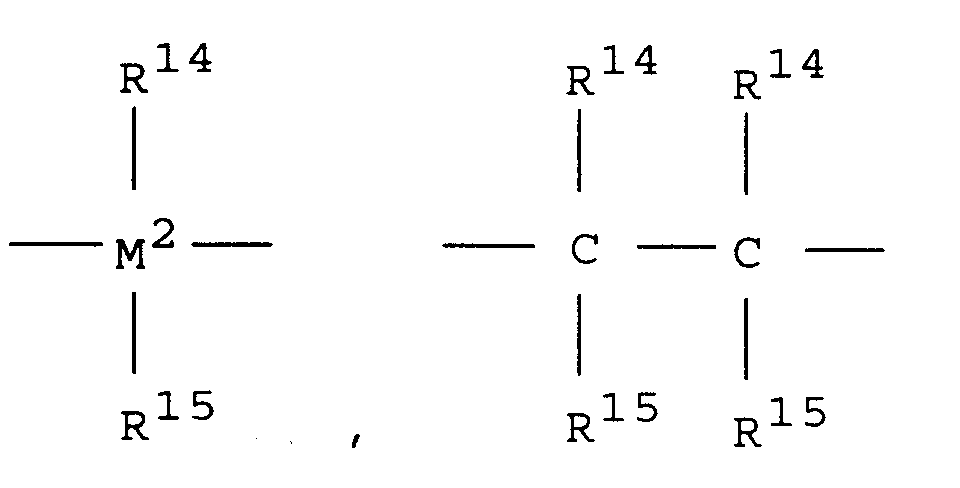
- Katalysatorsystem zur Herstellung eines hochmolekularen Copolymeren enthaltend mindestens eine Katalsatorkomponente gemäß Anspruch 1 oder 2 und mindestens einen Cokatalysator, bevorzugt ein Aluminoxan der Formel IIa und/oder der Formel IIb,

- Katalysatorsystem nach Anspruch 3, wobei die Reste R17 im Cokatalysator gleich sind und Methyl, Isobutyl, Phenyl oder Benzyl, bevorzugt Methyl bedeuten.
- Katalysatorsystem nach Anspruch 3, wobei die Reste R17 im Cokatalysator verschieden sind und Methyl und Wasserstoff oder Methyl und Isobutyl, wobei Wasserstoff oder Isobutyl bevorzugt zu 0,01 - 40 % (Zahl der Reste R17) enthalten sind.
- Katalysatorsystem nach einem oder mehreren der Ansprüche 3 bis 5, wobei ein Träger enthalten ist.
- Katalysatorsystem nach einem oder mehreren der Ansprüche 3 bis 6, wobei ein Träger enthalten ist und das Katalysatorsystem vorpolymerisiert ist.
- Copolymer enthaltend 99,5 bis 30 Gew.-% Propyleneinheiten, bezogen auf das Gesamtpolymer, und 0,5 bis 70 Gew.-% mindestens eines Comonomers, bezogen auf das Gesamtpolymer, wobei das Comonomer Einheiten sind, die sich von Ethylen oder Olefinen mit mindestens 4 C-Atomen der Formel Ra-CH = CH-Rb ableiten, wobei Ra und Rb gleich oder verschieden sind und ein Wasserstoffatom oder einen Alkylrest mit 1 bis 15 C-Atomen bedeuten, oder Ra und Rb mit den sie verbindenden C-Atomen einen Ring mit 4 bis 12 C-Atomen bilden.
- Copolymer nach Anspruch 8, enthaltend 98,5 bis 40 Gew.-%, Propyleneinheiten und 1,5 bis 60 Gew.-%, Comonomer.
- Copolymer nach Anspruch 8 oder 9, enthaltend 98,5 bis 85 Gew.-% Propyleneinheiten und 1,5 bis 15 Gew.-% Comonomer.
- Copolymere nach Anspruch 8, enthaltend 80 bis 40 Gew.-% Propyleneinheiten und 20 bis 60 Gew.-% Comonomer.
- Copolymer nach Anspruch 8, enthaltend 80 bis 40 Gew.-% Propyleneinheiten und 20 bis 60 Gew.-% Comonomer, wobei das Polymer zusätzlich bis zu 10 Gew.-% einer Dienkomponente enthält.
- Copolymer nach einem oder mehreren der Ansprüche 8 bis 12, wobei als Comonomere mindestens eine Verbindung wie Ethylen, 1-Buten, 1-Penten, 1-Hexen, 4-Methyl-1-penten oder Ethylidennorbornen verwendet werden.
- Copolymer nach einem oder mehreren der Ansprüche 8 bis 13, erhältlich durch Polymerisation von Propyleneinheiten und mindestens eines Comonomers in Gegenwart eines Katalysatorsystems.
- Copolymer nach einem oder mehreren der Ansprüche 8 bis 14, erhältlich bei einer Temperatur von 50 bis 200°C und bei einem Druck von 0,5 bis 100 bar.
- Polymerlegierung enthaltend mindestens ein Copolymer gemäß einem oder mehreren der Ansprüche 8 bis 15.
- Verfahren zur Herstellung eines Copolymers gemäß einem oder mehreren der Ansprüche 8 bis 15 durch Polymerisation von Propylen und mindestens eines Comonomers in Gegenwart eines Katalysatorsystems gemäß einem oder mehreren der Ansprüche 3 bis 7 bei einer Temperatur von 50 bis 200°C und bei einem Druck von 0,5 bis 100 bar.
- Verfahren nach Anspruch 17, wobei Wasserstoff zugegeben wird.
- Verfahren nach Anspruch 17 oder 18, wobei der Druck im Bereich von 5 bis 64 bar eingestellt wird.
- Verfahren nach einem oder mehreren der Ansprüche 17 bis 19, wobei die Katalysatorkomponente in einer Konzentration, bezogen auf das Übergangsmetall von 10-3 bis 10-8, vorzugsweise 10-4 bis 10-7 mol Übergangsmetall pro dm3 Reaktorvolumen und der Cokatalysator in einer Konzentration von 10-5 bis 10-1 mol, vorzugsweise 10-4 bis 10-2 mol pro dm3 Reaktorvolumen eingesetzt werden.
- Verwendung mindestens einer Katalysatorkomponente gemäß Anspruch 1 oder 2 oder mindestens eines Katalysatorsystems gemäß einem oder mehreren der Ansprüche 3 bis 7 zur Herstellung von hochmolekularen Copolymeren.
- Verwendung der Copolymere gemäß einem oder mehreren der Ansprüche 8 bis 15 zur Herstellung von hochtransparenten, steifen Formkörpern, insbesondere im Dünnwandspritzguß, hochtransparenten steifen Folien, hochmolekularem Kautschuk mit tiefer Glastemperatur, hochpolymeren, hochschlagzähen Blockcopolymeren, hochmolekularen statistischen Copolymeren mit geringen extrahierbaren Anteilen für den Einsatz im Lebensmittelverpackungsbereich.
Priority Applications (1)
| Application Number | Priority Date | Filing Date | Title |
|---|---|---|---|
| EP02019624A EP1270614B1 (de) | 1995-12-01 | 1996-11-26 | Copolymere enthaltend Propyleneinheiten und Alpha-Olefin Comonomer |
Applications Claiming Priority (2)
| Application Number | Priority Date | Filing Date | Title |
|---|---|---|---|
| DE19544828A DE19544828A1 (de) | 1995-12-01 | 1995-12-01 | Hochmolekulare Copolymere |
| DE19544828 | 1995-12-01 |
Related Child Applications (1)
| Application Number | Title | Priority Date | Filing Date |
|---|---|---|---|
| EP02019624A Division EP1270614B1 (de) | 1995-12-01 | 1996-11-26 | Copolymere enthaltend Propyleneinheiten und Alpha-Olefin Comonomer |
Publications (3)
| Publication Number | Publication Date |
|---|---|
| EP0776913A2 true EP0776913A2 (de) | 1997-06-04 |
| EP0776913A3 EP0776913A3 (de) | 1998-09-02 |
| EP0776913B1 EP0776913B1 (de) | 2004-02-04 |
Family
ID=7778922
Family Applications (2)
| Application Number | Title | Priority Date | Filing Date |
|---|---|---|---|
| EP02019624A Expired - Lifetime EP1270614B1 (de) | 1995-12-01 | 1996-11-26 | Copolymere enthaltend Propyleneinheiten und Alpha-Olefin Comonomer |
| EP96118856A Expired - Lifetime EP0776913B1 (de) | 1995-12-01 | 1996-11-26 | Hochmolekulare Copolymere |
Family Applications Before (1)
| Application Number | Title | Priority Date | Filing Date |
|---|---|---|---|
| EP02019624A Expired - Lifetime EP1270614B1 (de) | 1995-12-01 | 1996-11-26 | Copolymere enthaltend Propyleneinheiten und Alpha-Olefin Comonomer |
Country Status (11)
| Country | Link |
|---|---|
| US (1) | US6057408A (de) |
| EP (2) | EP1270614B1 (de) |
| JP (1) | JP4519952B2 (de) |
| AT (2) | ATE258940T1 (de) |
| BR (1) | BR9605779A (de) |
| CA (1) | CA2191661A1 (de) |
| DE (3) | DE19544828A1 (de) |
| ES (1) | ES2216031T3 (de) |
| NO (1) | NO310877B1 (de) |
| TW (1) | TW454021B (de) |
| ZA (1) | ZA9610051B (de) |
Cited By (59)
| Publication number | Priority date | Publication date | Assignee | Title |
|---|---|---|---|---|
| WO2002002576A1 (en) * | 2000-06-30 | 2002-01-10 | Exxonmobil Chemical Patents Inc. | Bridged bis (indenyl) metallocene compounds |
| US6376410B1 (en) | 2000-06-30 | 2002-04-23 | Exxonmobil Chemical Patents Inc. | Metallocene compositions |
| US6376627B1 (en) | 2000-06-30 | 2002-04-23 | Exxonmobil Chemical Patents Inc. | Metallocene compositions |
| US6376412B1 (en) | 2000-06-30 | 2002-04-23 | Exxonmobil Chemical Patents Inc. | Metallocene compositions |
| US6376408B1 (en) | 2000-06-30 | 2002-04-23 | Exxonmobil Chemical Patents Inc. | Metallocene compositions |
| US6376409B1 (en) | 2000-06-30 | 2002-04-23 | Exxonmobil Chemical Patents Inc. | Metallocene compositions |
| US6376411B1 (en) | 2000-06-30 | 2002-04-23 | Exxonmobil Chemical Patents Inc. | Metallocene compositions |
| US6376407B1 (en) | 2000-06-30 | 2002-04-23 | Exxonmobil Chemical Patents Inc. | Metallocene compositions |
| US6380331B1 (en) | 2000-06-30 | 2002-04-30 | Exxonmobil Chemical Patents Inc. | Metallocene compositions |
| US6380124B1 (en) | 2000-06-30 | 2002-04-30 | Exxonmobil Chemical Patents Inc. | Metallocene compositions |
| US6380330B1 (en) | 2000-06-30 | 2002-04-30 | Exxonmobil Chemical Patents Inc. | Metallocene compositions |
| US6380123B1 (en) | 2000-06-30 | 2002-04-30 | Exxonmobil Chemical Patents Inc. | Metallocene compositions |
| US6380122B1 (en) | 2000-06-30 | 2002-04-30 | Exxonmobil Chemical Patents Inc. | Metallocene compositions |
| US6380334B1 (en) | 2000-06-30 | 2002-04-30 | Exxonmobil Chemical Patents Inc. | Metallocene compositions |
| US6380121B1 (en) | 2000-06-30 | 2002-04-30 | Exxonmobil Chemical Patents Inc. | Metallocene compositions |
| US6380120B1 (en) | 2000-06-30 | 2002-04-30 | Exxonmobil Chemical Patents Inc. | Metallocene compositions |
| US6399723B1 (en) | 2000-06-30 | 2002-06-04 | Exxonmobil Chemical Patents Inc. | Metallocene compositions |
| US6414095B1 (en) | 2000-06-30 | 2002-07-02 | Exxon Mobil Chemical Patents Inc. | Metallocene compositions |
| WO2004106351A1 (en) * | 2003-05-28 | 2004-12-09 | Basell Polyolefine Gmbh | Bisindenyl zirconium complexes for use in the polymerisation of olefins |
| US6870016B1 (en) | 2000-06-30 | 2005-03-22 | Exxonmobil Chemical Patents Inc. | Polymerization process and polymer composition |
| US6894179B2 (en) | 2000-06-30 | 2005-05-17 | Exxon Mobil Chemical Patents Inc. | Metallocene compositions |
| US6960676B2 (en) | 2000-02-08 | 2005-11-01 | Exxonmobil Chemical Patents Inc. | Method of preparing group 14 bridged biscyclopentadienyl ligands |
| US7122498B2 (en) | 2000-06-30 | 2006-10-17 | Exxonmobil Chemical Patents Inc. | Metallocenes and catalyst compositions derived therefrom |
| DE19722104B4 (de) * | 1996-05-27 | 2007-07-26 | Sumitomo Chemical Co. Ltd. | Propylen/Ethylen-α-Olefin-Blockcopolymer und Verfahren zur Verbesserung der Schlagfestigkeit |
| WO2007107448A1 (en) * | 2006-03-17 | 2007-09-27 | Basell Polyolefine Gmbh | Metallocene compounds |
| US7452949B2 (en) | 2003-12-10 | 2008-11-18 | Basell Polyolefine Gmbh | Organometallic transition metal compound, biscyclopentadienyl ligand system, catalyst system and preparation of polyolefins |
| US7834205B2 (en) | 2006-04-12 | 2010-11-16 | Basell Polyolifine GmbH | Metallocene compounds |
| EP2322568A1 (de) | 2009-11-13 | 2011-05-18 | Borealis AG | Verfahren zur Herstellung eines Olefin-Polymerisationskatalysatoren |
| WO2011058088A1 (en) | 2009-11-13 | 2011-05-19 | Borealis Ag | Process for recovering a transition metal compound |
| WO2011058089A1 (en) | 2009-11-13 | 2011-05-19 | Borealis Ag | Process for producing a polymerization catalyst |
| WO2011058091A1 (en) | 2009-11-13 | 2011-05-19 | Borealis Ag | Process for olefin polymerization |
| WO2011069888A1 (en) | 2009-12-07 | 2011-06-16 | Borealis Ag | Process for the preparation of an unsupported, solid metallocene catalyst system and its use in polymerization of olefins |
| EP2495038A1 (de) | 2011-03-02 | 2012-09-05 | Borealis AG | Flexible Reaktoranordnung zur Olefinpolymerisation |
| EP2495037A1 (de) | 2011-03-02 | 2012-09-05 | Borealis AG | Flexible Reaktoranordnung zur Olefinpolymerisation |
| EP2535372A1 (de) | 2011-06-15 | 2012-12-19 | Borealis AG | In-situ Reaktormischung eines Ziegler-Natta-katalysierten, nucleierten Polypropylens und metallocen-katalysiertes Polypropylen |
| WO2014032794A1 (en) | 2012-08-29 | 2014-03-06 | Borealis Ag | Reactor assembly and method for polymerization of olefins |
| EP2746289A1 (de) | 2012-12-21 | 2014-06-25 | Borealis AG | Katalysatoren |
| EP2745926A1 (de) | 2012-12-21 | 2014-06-25 | Borealis AG | Gasphasenpolymerisation und Reaktoranordnung mit einem Fließbettreaktor und einem externen Wanderbettreaktor |
| EP2745927A1 (de) | 2012-12-21 | 2014-06-25 | Borealis AG | Fließbettreaktor mit interner Wanderbettreaktionseinheit |
| EP2759554A1 (de) * | 2013-01-23 | 2014-07-30 | Total Research & Technology Feluy | Verfahren zur Herstellung von Olefin/3-methyl-1-buten-Copolymeren |
| EP3023450A1 (de) | 2014-11-21 | 2016-05-25 | Borealis AG | Verfahren zur Herstellung von Pellets aus weichen Copolymeren |
| EP3124567A1 (de) | 2015-07-30 | 2017-02-01 | Borealis AG | Polypropylenbasierte heissschmelzklebstoffzusammensetzung |
| US9598517B2 (en) | 2012-12-21 | 2017-03-21 | Borealis Ag | Catalysts |
| US9598516B2 (en) | 2012-12-21 | 2017-03-21 | Borealis Ag | Catalyst |
| EP3178853A1 (de) | 2015-12-07 | 2017-06-14 | Borealis AG | Verfahren zur polymerisierung von alpha-olefin-monomeren |
| EP3243622A1 (de) | 2016-05-13 | 2017-11-15 | Borealis AG | Verfahren zur herstellung und zum transportieren von rieselfähigen pellets aus weichen copolymeren |
| EP3608382A1 (de) | 2018-08-06 | 2020-02-12 | Borealis AG | Auf propylen-random-copolymer basierende heissschmelzklebstoffzusammensetzung |
| EP3608364A1 (de) | 2018-08-06 | 2020-02-12 | Borealis AG | Multimodale propylen-random-copolymer-basierte zusammensetzung zur verwendung als schmelzklebstoffzusammensetzung |
| WO2020109452A1 (en) | 2018-11-30 | 2020-06-04 | Borealis Ag | Washing process |
| EP4144435A1 (de) | 2021-09-01 | 2023-03-08 | Borealis AG | Gasphasenpolymerisationsverfahren mit verbesserter gasrückführung |
| EP4389783A1 (de) | 2022-12-20 | 2024-06-26 | Borealis AG | Katalysatorübergangsverfahren |
| EP4389776A1 (de) | 2022-12-20 | 2024-06-26 | Borealis AG | Verfahren |
| WO2024133044A1 (en) | 2022-12-23 | 2024-06-27 | Borealis Ag | Process for producing a polypropylene homo- or copolymer |
| WO2024133046A1 (en) | 2022-12-23 | 2024-06-27 | Borealis Ag | Process for producing a polypropylene copolymer |
| WO2024133045A1 (en) | 2022-12-23 | 2024-06-27 | Borealis Ag | Process for producing a high-flow polypropylene homopolymer |
| WO2024240540A1 (en) | 2023-05-23 | 2024-11-28 | Borealis Ag | Process for producing pellets of polyolefins, and pellets so produced |
| WO2025003435A1 (en) | 2023-06-30 | 2025-01-02 | Borealis Ag | Process |
| WO2025219537A1 (en) | 2024-04-18 | 2025-10-23 | Borealis Gmbh | Process for propylene polymerization with optimized prepolymerization conditions |
| WO2025219533A1 (en) | 2024-04-18 | 2025-10-23 | Borealis Gmbh | Process for the preparation of a propylene homopolymer |
Families Citing this family (37)
| Publication number | Priority date | Publication date | Assignee | Title |
|---|---|---|---|---|
| KR100254936B1 (ko) | 1995-10-18 | 2000-05-01 | 고토 기치 | 올레핀(공)중합체 조성물과 그 제조방법 및 올레핀(공)중합용 촉매와 그 제조방법 |
| US6303696B1 (en) * | 1997-04-11 | 2001-10-16 | Chisso Corporation | Propylene (co)polymer composition using metallocene catalyst |
| US6818585B2 (en) * | 1998-12-30 | 2004-11-16 | Univation Technologies, Llc | Catalyst compounds, catalyst systems thereof and their use in a polymerization process |
| JP2003128720A (ja) | 2001-10-19 | 2003-05-08 | Sunallomer Ltd | オレフィン重合用固体助触媒成分、オレフィン重合用触媒およびイオン含有化合物 |
| US20050182266A1 (en) * | 2002-06-12 | 2005-08-18 | Schulte Jorg L. | Transition metal componds their preparation and their use in catalyst systems for the polymerization and copolymerization of olefins |
| US20080153997A1 (en) * | 2006-12-20 | 2008-06-26 | Exxonmobil Research And Engineering | Polymer production at supercritical conditions |
| US8008412B2 (en) * | 2002-09-20 | 2011-08-30 | Exxonmobil Chemical Patents Inc. | Polymer production at supersolution conditions |
| KR100579843B1 (ko) * | 2003-04-01 | 2006-05-12 | 주식회사 엘지화학 | 혼성 담지 메탈로센 촉매 및 그의 제조방법과 이를 이용한폴리올레핀의 제조방법 |
| SA04250253B1 (ar) | 2003-08-21 | 2009-11-10 | استرازينيكا ايه بي | احماض فينوكسي اسيتيك مستبدلة باعتبارها مركبات صيدلانية لعلاج الامراض التنفسية مثل الربو ومرض الانسداد الرئوي المزمن |
| WO2005105865A1 (en) * | 2004-05-04 | 2005-11-10 | Basell Polyolefine Gmbh | Process for the preparation of atactic 1-butene polymers |
| EP1774485B1 (de) * | 2004-07-08 | 2016-05-04 | ExxonMobil Chemical Patents Inc. | Polymerproduktion unter superkritischen bedingungen |
| GB0418830D0 (en) * | 2004-08-24 | 2004-09-22 | Astrazeneca Ab | Novel compounds |
| GB0422057D0 (en) * | 2004-10-05 | 2004-11-03 | Astrazeneca Ab | Novel compounds |
| US7169864B2 (en) * | 2004-12-01 | 2007-01-30 | Novolen Technology Holdings, C.V. | Metallocene catalysts, their synthesis and their use for the polymerization of olefins |
| US7232869B2 (en) * | 2005-05-17 | 2007-06-19 | Novolen Technology Holdings, C.V. | Catalyst composition for olefin polymerization |
| CN101243221A (zh) * | 2005-08-19 | 2008-08-13 | 陶氏环球技术公司 | 丙烯基熔喷无纺层及复合结构 |
| TW200745003A (en) | 2005-10-06 | 2007-12-16 | Astrazeneca Ab | Novel compounds |
| US8242237B2 (en) | 2006-12-20 | 2012-08-14 | Exxonmobil Chemical Patents Inc. | Phase separator and monomer recycle for supercritical polymerization process |
| EP2160419B1 (de) * | 2007-06-04 | 2013-11-13 | ExxonMobil Chemical Patents Inc. | Homogene propylenpolymerisation unter superlösungsbedingungen |
| US8318875B2 (en) * | 2008-01-18 | 2012-11-27 | Exxonmobil Chemical Patents Inc. | Super-solution homogeneous propylene polymerization and polypropylenes made therefrom |
| KR101918175B1 (ko) | 2011-07-08 | 2019-01-29 | 보레알리스 아게 | 헤테로상 공중합체 |
| US8445620B2 (en) | 2011-08-04 | 2013-05-21 | Exxonmobil Research And Engineering Company | Elastic propylene-alpha-olefin copolymer compositions and processes to produce them |
| EP2573091A1 (de) | 2011-09-23 | 2013-03-27 | Lummus Novolen Technology Gmbh | Verfahren zur Wiedergewinnung freier Liganden aus ihren jeweiligen Metallocenkomplexen |
| EP3022236B1 (de) | 2013-07-17 | 2017-11-15 | ExxonMobil Chemical Patents Inc. | Verfahren mit substituierten metallocenkatalysatoren und produkte daraus |
| ES2703344T3 (es) | 2013-07-17 | 2019-03-08 | Exxonmobil Chemical Patents Inc | Metalocenos y composiciones catalíticas derivadas de ellos |
| EP3539993A1 (de) | 2013-07-17 | 2019-09-18 | ExxonMobil Chemical Patents Inc. | Cyclopropyl-substituierte metallocenkatalysatoren |
| US9938364B2 (en) | 2013-07-17 | 2018-04-10 | Exxonmobil Chemical Patents Inc. | Substituted metallocene catalysts |
| CN105377904B (zh) | 2013-07-17 | 2018-07-10 | 埃克森美孚化学专利公司 | 金属茂和由其衍生的催化剂组合物 |
| CN110177798B (zh) | 2016-11-18 | 2022-08-30 | 博里利斯股份公司 | 催化剂 |
| EP3555148B1 (de) | 2016-12-15 | 2023-04-05 | Borealis AG | Katalysatorsystem zur herstellung von polyethylencopolymeren in einem hochtemperaturlösungspolymerisationsverfahren |
| EP3555149B1 (de) | 2016-12-15 | 2025-11-12 | Borealis GmbH | Neues katalysatorsystem zur herstellung von polyethylencopolymeren in einem hochtemperaturlösungspolymerisationsverfahren |
| US11807655B2 (en) | 2016-12-29 | 2023-11-07 | Borealis Ag | Catalysts |
| JP7027988B2 (ja) | 2017-04-27 | 2022-03-02 | 住友化学株式会社 | プロピレン重合体組成物 |
| ES2905783T3 (es) | 2018-03-19 | 2022-04-12 | Borealis Ag | Catalizadores para polimerización de olefinas |
| CN112424241B (zh) | 2018-06-28 | 2023-06-06 | 博里利斯股份公司 | 催化剂 |
| WO2021083309A1 (zh) | 2019-10-30 | 2021-05-06 | 中国石油化工股份有限公司 | 一种茂金属化合物及其制备方法和应用 |
| EP4332132A4 (de) | 2021-04-25 | 2025-08-20 | China Petroleum & Chem Corp | Copolymer auf propylenbasis, herstellungsverfahren dafür und verwendung davon sowie polypropylenzusammensetzung damit |
Family Cites Families (18)
| Publication number | Priority date | Publication date | Assignee | Title |
|---|---|---|---|---|
| JPS59204646A (ja) * | 1983-05-09 | 1984-11-20 | Japan Synthetic Rubber Co Ltd | ポリプロピレン樹脂組成物 |
| DE3769528D1 (de) * | 1986-06-30 | 1991-05-29 | Rexene Prod Co | Propylenpolymere und ihre herstellung. |
| CA1327673C (en) * | 1988-06-16 | 1994-03-08 | Sigmund Floyd | Process for production of high molecular weight epdm elastomers using a metallocene-alumoxane catalyst system |
| JP3402473B2 (ja) * | 1991-08-20 | 2003-05-06 | 日本ポリケム株式会社 | オレフィン重合用触媒 |
| TW294669B (de) * | 1992-06-27 | 1997-01-01 | Hoechst Ag | |
| ATE177436T1 (de) * | 1992-08-15 | 1999-03-15 | Targor Gmbh | Verfahren zur herstellung von polyolefinen |
| CA2125246C (en) * | 1993-06-07 | 2001-07-03 | Junichi Imuta | Transition metal compound and olefin polymerization catalyst using the same |
| DE69427999T3 (de) * | 1993-06-07 | 2012-09-27 | Mitsui Chemicals, Inc. | Übergangsmetallverbindung, diese enthaltende Olefinpolymerisationskatalysator, Verfahren zur Olefinpolymerisation damit und Homo- und Copolymere des Propylens |
| US5414027A (en) * | 1993-07-15 | 1995-05-09 | Himont Incorporated | High melt strength, propylene polymer, process for making it, and use thereof |
| DE4333128A1 (de) * | 1993-09-29 | 1995-03-30 | Hoechst Ag | Verfahren zur Herstellung von Polyolefinen |
| DE4333569A1 (de) * | 1993-10-01 | 1995-04-06 | Hoechst Ag | Verfahren zur Olefinpolymerisation |
| JP3423378B2 (ja) * | 1993-11-12 | 2003-07-07 | 三井化学株式会社 | 新規な遷移金属化合物および該遷移金属化合物からなるオレフィン重合用触媒成分、該オレフィン重合用触媒成分を含むオレフィン重合用触媒ならびにオレフィンの重合方法 |
| DE4340018A1 (de) * | 1993-11-24 | 1995-06-01 | Hoechst Ag | Metallocene, Verfahren zu ihrer Herstellung und ihre Verwendung als Katalysatoren |
| ES2154664T3 (es) * | 1993-11-24 | 2001-04-16 | Targor Gmbh | Metalocenos, procedimientos para su obtencion, y su empleo como catalizadores. |
| FI945958L (fi) * | 1993-12-21 | 1995-06-22 | Hoechst Ag | Menetelmä polyolefiinien valmistamiseksi |
| DE4344688A1 (de) * | 1993-12-27 | 1995-06-29 | Hoechst Ag | Metallocenverbindung |
| EP0745099B1 (de) * | 1994-12-20 | 2000-09-13 | Montell Technology Company bv | Polypropylenreaktionsmischung und verfahren zu ihrer herstellung |
| TW383314B (en) * | 1994-12-20 | 2000-03-01 | Mitsui Petrochemical Ind | Ethylene-alpha-olefin-nonconjugated polyene random copolymer, rubber composition, and process for preparing the random copolymer |
-
1995
- 1995-12-01 DE DE19544828A patent/DE19544828A1/de not_active Ceased
-
1996
- 1996-11-26 AT AT96118856T patent/ATE258940T1/de not_active IP Right Cessation
- 1996-11-26 DE DE59610907T patent/DE59610907D1/de not_active Expired - Lifetime
- 1996-11-26 AT AT02019624T patent/ATE456589T1/de not_active IP Right Cessation
- 1996-11-26 EP EP02019624A patent/EP1270614B1/de not_active Expired - Lifetime
- 1996-11-26 DE DE59611505T patent/DE59611505D1/de not_active Expired - Lifetime
- 1996-11-26 EP EP96118856A patent/EP0776913B1/de not_active Expired - Lifetime
- 1996-11-26 ES ES96118856T patent/ES2216031T3/es not_active Expired - Lifetime
- 1996-11-28 TW TW085114702A patent/TW454021B/zh not_active IP Right Cessation
- 1996-11-29 CA CA002191661A patent/CA2191661A1/en not_active Abandoned
- 1996-11-29 ZA ZA9610051A patent/ZA9610051B/xx unknown
- 1996-11-29 NO NO19965106A patent/NO310877B1/no not_active IP Right Cessation
- 1996-12-02 JP JP32180896A patent/JP4519952B2/ja not_active Expired - Lifetime
- 1996-12-02 BR BR9605779A patent/BR9605779A/pt active Search and Examination
-
1998
- 1998-04-13 US US09/058,828 patent/US6057408A/en not_active Expired - Lifetime
Cited By (83)
| Publication number | Priority date | Publication date | Assignee | Title |
|---|---|---|---|---|
| DE19722104B4 (de) * | 1996-05-27 | 2007-07-26 | Sumitomo Chemical Co. Ltd. | Propylen/Ethylen-α-Olefin-Blockcopolymer und Verfahren zur Verbesserung der Schlagfestigkeit |
| US6960676B2 (en) | 2000-02-08 | 2005-11-01 | Exxonmobil Chemical Patents Inc. | Method of preparing group 14 bridged biscyclopentadienyl ligands |
| US7081543B2 (en) | 2000-02-08 | 2006-07-25 | Exxonmobil Chemical Patents Inc. | Bridged biscyclopentadienyl ligands and method of preparation |
| US6380120B1 (en) | 2000-06-30 | 2002-04-30 | Exxonmobil Chemical Patents Inc. | Metallocene compositions |
| US6414095B1 (en) | 2000-06-30 | 2002-07-02 | Exxon Mobil Chemical Patents Inc. | Metallocene compositions |
| US6376627B1 (en) | 2000-06-30 | 2002-04-23 | Exxonmobil Chemical Patents Inc. | Metallocene compositions |
| US6376412B1 (en) | 2000-06-30 | 2002-04-23 | Exxonmobil Chemical Patents Inc. | Metallocene compositions |
| US6376408B1 (en) | 2000-06-30 | 2002-04-23 | Exxonmobil Chemical Patents Inc. | Metallocene compositions |
| US6376409B1 (en) | 2000-06-30 | 2002-04-23 | Exxonmobil Chemical Patents Inc. | Metallocene compositions |
| US6376411B1 (en) | 2000-06-30 | 2002-04-23 | Exxonmobil Chemical Patents Inc. | Metallocene compositions |
| US6376407B1 (en) | 2000-06-30 | 2002-04-23 | Exxonmobil Chemical Patents Inc. | Metallocene compositions |
| US6380331B1 (en) | 2000-06-30 | 2002-04-30 | Exxonmobil Chemical Patents Inc. | Metallocene compositions |
| US6380124B1 (en) | 2000-06-30 | 2002-04-30 | Exxonmobil Chemical Patents Inc. | Metallocene compositions |
| US6380330B1 (en) | 2000-06-30 | 2002-04-30 | Exxonmobil Chemical Patents Inc. | Metallocene compositions |
| US6380123B1 (en) | 2000-06-30 | 2002-04-30 | Exxonmobil Chemical Patents Inc. | Metallocene compositions |
| US6380122B1 (en) | 2000-06-30 | 2002-04-30 | Exxonmobil Chemical Patents Inc. | Metallocene compositions |
| US6380334B1 (en) | 2000-06-30 | 2002-04-30 | Exxonmobil Chemical Patents Inc. | Metallocene compositions |
| US6380121B1 (en) | 2000-06-30 | 2002-04-30 | Exxonmobil Chemical Patents Inc. | Metallocene compositions |
| WO2002002576A1 (en) * | 2000-06-30 | 2002-01-10 | Exxonmobil Chemical Patents Inc. | Bridged bis (indenyl) metallocene compounds |
| US6376410B1 (en) | 2000-06-30 | 2002-04-23 | Exxonmobil Chemical Patents Inc. | Metallocene compositions |
| US6399723B1 (en) | 2000-06-30 | 2002-06-04 | Exxonmobil Chemical Patents Inc. | Metallocene compositions |
| US6870016B1 (en) | 2000-06-30 | 2005-03-22 | Exxonmobil Chemical Patents Inc. | Polymerization process and polymer composition |
| US6888017B2 (en) | 2000-06-30 | 2005-05-03 | Exxonmobil Chemical Patents Inc. | Metallocene compositions |
| US6894179B2 (en) | 2000-06-30 | 2005-05-17 | Exxon Mobil Chemical Patents Inc. | Metallocene compositions |
| US6903229B2 (en) | 2000-06-30 | 2005-06-07 | Exxonmobil Chemical Patents Inc. | Metallocene compositions |
| EP1632506A1 (de) * | 2000-06-30 | 2006-03-08 | ExxonMobil Chemical Patents Inc. | Propylen Polymer |
| US7122498B2 (en) | 2000-06-30 | 2006-10-17 | Exxonmobil Chemical Patents Inc. | Metallocenes and catalyst compositions derived therefrom |
| WO2004106351A1 (en) * | 2003-05-28 | 2004-12-09 | Basell Polyolefine Gmbh | Bisindenyl zirconium complexes for use in the polymerisation of olefins |
| US7452949B2 (en) | 2003-12-10 | 2008-11-18 | Basell Polyolefine Gmbh | Organometallic transition metal compound, biscyclopentadienyl ligand system, catalyst system and preparation of polyolefins |
| WO2007107448A1 (en) * | 2006-03-17 | 2007-09-27 | Basell Polyolefine Gmbh | Metallocene compounds |
| US7858717B2 (en) | 2006-03-17 | 2010-12-28 | Basell Polyolefine Gmbh | Metallocene compounds |
| US7834205B2 (en) | 2006-04-12 | 2010-11-16 | Basell Polyolifine GmbH | Metallocene compounds |
| EP2322568A1 (de) | 2009-11-13 | 2011-05-18 | Borealis AG | Verfahren zur Herstellung eines Olefin-Polymerisationskatalysatoren |
| WO2011058088A1 (en) | 2009-11-13 | 2011-05-19 | Borealis Ag | Process for recovering a transition metal compound |
| WO2011058089A1 (en) | 2009-11-13 | 2011-05-19 | Borealis Ag | Process for producing a polymerization catalyst |
| WO2011058091A1 (en) | 2009-11-13 | 2011-05-19 | Borealis Ag | Process for olefin polymerization |
| US8501881B2 (en) | 2009-11-13 | 2013-08-06 | Borealis Ag | Process for olefin polymerization |
| WO2011069888A1 (en) | 2009-12-07 | 2011-06-16 | Borealis Ag | Process for the preparation of an unsupported, solid metallocene catalyst system and its use in polymerization of olefins |
| WO2012116844A1 (en) | 2011-03-02 | 2012-09-07 | Borealis Ag | High throughput reactor assembly for polymerization of olefins |
| US9192903B2 (en) | 2011-03-02 | 2015-11-24 | Borealis Ag | High throughput reactor assembly for polymerization of olefins |
| EP2495037A1 (de) | 2011-03-02 | 2012-09-05 | Borealis AG | Flexible Reaktoranordnung zur Olefinpolymerisation |
| EP2495038A1 (de) | 2011-03-02 | 2012-09-05 | Borealis AG | Flexible Reaktoranordnung zur Olefinpolymerisation |
| WO2012116845A1 (en) | 2011-03-02 | 2012-09-07 | Borealis Ag | Flexible reactor assembly for polymerization of olefins |
| US9192905B2 (en) | 2011-03-02 | 2015-11-24 | Borealis Ag | Flexible reactor assembly for polymerization of olefins |
| EP2535372A1 (de) | 2011-06-15 | 2012-12-19 | Borealis AG | In-situ Reaktormischung eines Ziegler-Natta-katalysierten, nucleierten Polypropylens und metallocen-katalysiertes Polypropylen |
| WO2012171745A1 (en) | 2011-06-15 | 2012-12-20 | Borealis Ag | In-situ reactor blend of a ziegler-natta catalysed, nucleated polypropylene and a metallocene catalysed polypropylene |
| WO2014032794A1 (en) | 2012-08-29 | 2014-03-06 | Borealis Ag | Reactor assembly and method for polymerization of olefins |
| US9382359B2 (en) | 2012-08-29 | 2016-07-05 | Borealis Ag | Reactor assembly and method for polymerization of olefins |
| US9469699B2 (en) | 2012-12-21 | 2016-10-18 | Borealis Ag | Catalysts |
| EP2746289A1 (de) | 2012-12-21 | 2014-06-25 | Borealis AG | Katalysatoren |
| WO2014096164A1 (en) | 2012-12-21 | 2014-06-26 | Borealis Ag | Catalysts |
| EP2745927A1 (de) | 2012-12-21 | 2014-06-25 | Borealis AG | Fließbettreaktor mit interner Wanderbettreaktionseinheit |
| EP2745926A1 (de) | 2012-12-21 | 2014-06-25 | Borealis AG | Gasphasenpolymerisation und Reaktoranordnung mit einem Fließbettreaktor und einem externen Wanderbettreaktor |
| US9988323B2 (en) | 2012-12-21 | 2018-06-05 | Borealis Ag | Catalyst |
| US9598517B2 (en) | 2012-12-21 | 2017-03-21 | Borealis Ag | Catalysts |
| US9598516B2 (en) | 2012-12-21 | 2017-03-21 | Borealis Ag | Catalyst |
| EP2759554A1 (de) * | 2013-01-23 | 2014-07-30 | Total Research & Technology Feluy | Verfahren zur Herstellung von Olefin/3-methyl-1-buten-Copolymeren |
| EP3023450A1 (de) | 2014-11-21 | 2016-05-25 | Borealis AG | Verfahren zur Herstellung von Pellets aus weichen Copolymeren |
| EP3124567A1 (de) | 2015-07-30 | 2017-02-01 | Borealis AG | Polypropylenbasierte heissschmelzklebstoffzusammensetzung |
| US10000674B1 (en) | 2015-07-30 | 2018-06-19 | Borealis Ag | Polypropylene based hot-melt adhesive composition |
| WO2017097577A1 (en) | 2015-12-07 | 2017-06-15 | Borealis Ag | Process for polymerising alpha-olefin monomers |
| EP3178853A1 (de) | 2015-12-07 | 2017-06-14 | Borealis AG | Verfahren zur polymerisierung von alpha-olefin-monomeren |
| WO2017194488A1 (en) | 2016-05-13 | 2017-11-16 | Borealis Ag | Process for hydraulic conveying of polyolefin pellets |
| EP3243622A1 (de) | 2016-05-13 | 2017-11-15 | Borealis AG | Verfahren zur herstellung und zum transportieren von rieselfähigen pellets aus weichen copolymeren |
| EP3608382A1 (de) | 2018-08-06 | 2020-02-12 | Borealis AG | Auf propylen-random-copolymer basierende heissschmelzklebstoffzusammensetzung |
| EP3608364A1 (de) | 2018-08-06 | 2020-02-12 | Borealis AG | Multimodale propylen-random-copolymer-basierte zusammensetzung zur verwendung als schmelzklebstoffzusammensetzung |
| WO2020030565A1 (en) | 2018-08-06 | 2020-02-13 | Borealis Ag | Multimodal propylene random copolymer based composition suitable as hot melt adhesive composition |
| WO2020030567A1 (en) | 2018-08-06 | 2020-02-13 | Borealis Ag | Propylene random copolymer based hot melt adhesive composition |
| US12146019B2 (en) | 2018-11-30 | 2024-11-19 | Borealis Ag | Washing process |
| WO2020109452A1 (en) | 2018-11-30 | 2020-06-04 | Borealis Ag | Washing process |
| EP4144435A1 (de) | 2021-09-01 | 2023-03-08 | Borealis AG | Gasphasenpolymerisationsverfahren mit verbesserter gasrückführung |
| WO2023031201A1 (en) | 2021-09-01 | 2023-03-09 | Borealis Ag | Gas phase polymerization process with improved gas recycling |
| EP4389776A1 (de) | 2022-12-20 | 2024-06-26 | Borealis AG | Verfahren |
| WO2024133340A1 (en) | 2022-12-20 | 2024-06-27 | Borealis Ag | Process |
| WO2024133592A1 (en) | 2022-12-20 | 2024-06-27 | Borealis Ag | Catalyst transition process |
| EP4389783A1 (de) | 2022-12-20 | 2024-06-26 | Borealis AG | Katalysatorübergangsverfahren |
| WO2024133044A1 (en) | 2022-12-23 | 2024-06-27 | Borealis Ag | Process for producing a polypropylene homo- or copolymer |
| WO2024133046A1 (en) | 2022-12-23 | 2024-06-27 | Borealis Ag | Process for producing a polypropylene copolymer |
| WO2024133045A1 (en) | 2022-12-23 | 2024-06-27 | Borealis Ag | Process for producing a high-flow polypropylene homopolymer |
| WO2024240540A1 (en) | 2023-05-23 | 2024-11-28 | Borealis Ag | Process for producing pellets of polyolefins, and pellets so produced |
| WO2025003435A1 (en) | 2023-06-30 | 2025-01-02 | Borealis Ag | Process |
| WO2025219537A1 (en) | 2024-04-18 | 2025-10-23 | Borealis Gmbh | Process for propylene polymerization with optimized prepolymerization conditions |
| WO2025219533A1 (en) | 2024-04-18 | 2025-10-23 | Borealis Gmbh | Process for the preparation of a propylene homopolymer |
Also Published As
| Publication number | Publication date |
|---|---|
| JPH09176222A (ja) | 1997-07-08 |
| EP1270614A2 (de) | 2003-01-02 |
| ZA9610051B (en) | 1997-06-01 |
| NO965106D0 (no) | 1996-11-29 |
| ATE456589T1 (de) | 2010-02-15 |
| DE59611505D1 (de) | 2010-03-18 |
| EP0776913B1 (de) | 2004-02-04 |
| NO310877B1 (no) | 2001-09-10 |
| ATE258940T1 (de) | 2004-02-15 |
| EP0776913A3 (de) | 1998-09-02 |
| ES2216031T3 (es) | 2004-10-16 |
| DE59610907D1 (de) | 2004-03-11 |
| DE19544828A1 (de) | 1997-06-05 |
| EP1270614B1 (de) | 2010-01-27 |
| US6057408A (en) | 2000-05-02 |
| TW454021B (en) | 2001-09-11 |
| EP1270614A3 (de) | 2004-12-22 |
| CA2191661A1 (en) | 1997-06-02 |
| NO965106L (no) | 1997-06-02 |
| BR9605779A (pt) | 1998-08-25 |
| JP4519952B2 (ja) | 2010-08-04 |
Similar Documents
| Publication | Publication Date | Title |
|---|---|---|
| EP0776913B1 (de) | Hochmolekulare Copolymere | |
| EP0790076B1 (de) | Katalysatoren, die Metallocene mit arylsubstituierten Indenylderivaten als Liganden enthalten, Verfahren und Zwischenprodukte zur Herstellung dieser Metallocene und ihre Verwendung | |
| EP0661300B1 (de) | Verfahren zur Herstellung von Polyolefinen | |
| EP0549900B1 (de) | Metallocene mit benzokondensierten Indenylderivaten als Liganden, Verfahren zu ihrer Herstellung und ihre Verwendung als Katalysatoren | |
| EP0654476B1 (de) | Metallocene, Verfahren zu ihrer Herstellung und ihrer Verwendung als Katalysatoren | |
| EP0537686B1 (de) | Verfahren zur Herstellung eines Olefinpolymers unter Verwendung von Metallocenen mit speziell substituierten Indenylliganden | |
| EP0942938B1 (de) | Geträgertes katalysatorsystem, verfahren zu seiner herstellung und seine verwendung zur polymerisation von olefinen | |
| EP0659756B1 (de) | Metallocenverbindung | |
| DE69427999T3 (de) | Übergangsmetallverbindung, diese enthaltende Olefinpolymerisationskatalysator, Verfahren zur Olefinpolymerisation damit und Homo- und Copolymere des Propylens | |
| DE60112307T2 (de) | Metallocenverbindungen mit einem verbrückten 4-phenylindenyl-ligandsystem zur polymerisation von olefinen | |
| DE69631902T2 (de) | Metallocene mit offen-pentodienyl, deren vorläufer und diese enthaltende polymerisationskatalysatoren | |
| EP0743317B1 (de) | Metallocene mit einem heterocyclischen Ring und Katalysatoren, die sie enthalten | |
| DE19739946A1 (de) | Verfahren zur Herstellung von Metallocenen | |
| DE10158656A1 (de) | Organoübergangsmetallverbindung, Biscyclopentadienylligandsystem, Katalysatorsystem und Verfahren zur Herstellung von Polyolefinen | |
| DE19903306A1 (de) | Organometallverbindung, Katalysatorsystem enthaltend diese Organometallverbindung und seine Verwendung | |
| EP0984973B1 (de) | Stereorigide metallocenverbindung | |
| EP0836608B1 (de) | Metallocene mit silylsubstituierten brücken und deren einsatz für die olefinpolymerisation | |
| EP1000073B1 (de) | Verfahren zur herstellung von metallocenen | |
| EP0749985B1 (de) | Stereorigide Metallocenverbindung | |
| EP0557718B1 (de) | Katalysator für die Olefinpolymerisation, Verfahren zu seiner Herstellung und seine Verwendung | |
| EP1003757B1 (de) | Verfahren zur herstellung von metallocenen | |
| EP1334107B1 (de) | Non-metallocene, verfahren zur herstellung von diesen und deren verwendung zur polymerisation von olefinen | |
| EP0837068A2 (de) | Stereorigide Metallocenverbindung | |
| DE19962905A1 (de) | Übergangsmetallverbindung, Ligandensystem, Katalysatorsystem und seine Verwendung zur Polymerisation und Copolymerisation von Olefinen | |
| EP0868441A2 (de) | Übergangsmetallverbindung |
Legal Events
| Date | Code | Title | Description |
|---|---|---|---|
| PUAI | Public reference made under article 153(3) epc to a published international application that has entered the european phase |
Free format text: ORIGINAL CODE: 0009012 |
|
| AK | Designated contracting states |
Kind code of ref document: A2 Designated state(s): AT BE DE ES FI FR GB IT NL |
|
| RAP1 | Party data changed (applicant data changed or rights of an application transferred) |
Owner name: TARGOR GMBH |
|
| PUAL | Search report despatched |
Free format text: ORIGINAL CODE: 0009013 |
|
| AK | Designated contracting states |
Kind code of ref document: A3 Designated state(s): AT BE DE ES FI FR GB IT NL |
|
| 17P | Request for examination filed |
Effective date: 19990302 |
|
| RAP1 | Party data changed (applicant data changed or rights of an application transferred) |
Owner name: BASELL POLYOLEFINE GMBH |
|
| RAP1 | Party data changed (applicant data changed or rights of an application transferred) |
Owner name: BASELL POLYOLEFINE GMBH |
|
| 17Q | First examination report despatched |
Effective date: 20020424 |
|
| GRAH | Despatch of communication of intention to grant a patent |
Free format text: ORIGINAL CODE: EPIDOS IGRA |
|
| RAP1 | Party data changed (applicant data changed or rights of an application transferred) |
Owner name: BASELL POLYOLEFINE GMBH |
|
| GRAS | Grant fee paid |
Free format text: ORIGINAL CODE: EPIDOSNIGR3 |
|
| GRAA | (expected) grant |
Free format text: ORIGINAL CODE: 0009210 |
|
| AK | Designated contracting states |
Kind code of ref document: B1 Designated state(s): AT BE DE ES FI FR GB IT NL |
|
| PG25 | Lapsed in a contracting state [announced via postgrant information from national office to epo] |
Ref country code: NL Free format text: LAPSE BECAUSE OF FAILURE TO SUBMIT A TRANSLATION OF THE DESCRIPTION OR TO PAY THE FEE WITHIN THE PRESCRIBED TIME-LIMIT Effective date: 20040204 Ref country code: FI Free format text: LAPSE BECAUSE OF FAILURE TO SUBMIT A TRANSLATION OF THE DESCRIPTION OR TO PAY THE FEE WITHIN THE PRESCRIBED TIME-LIMIT Effective date: 20040204 |
|
| REG | Reference to a national code |
Ref country code: GB Ref legal event code: FG4D Free format text: NOT ENGLISH |
|
| REF | Corresponds to: |
Ref document number: 59610907 Country of ref document: DE Date of ref document: 20040311 Kind code of ref document: P |
|
| GBT | Gb: translation of ep patent filed (gb section 77(6)(a)/1977) |
Effective date: 20040324 |
|
| NLV1 | Nl: lapsed or annulled due to failure to fulfill the requirements of art. 29p and 29m of the patents act | ||
| ET | Fr: translation filed | ||
| REG | Reference to a national code |
Ref country code: ES Ref legal event code: FG2A Ref document number: 2216031 Country of ref document: ES Kind code of ref document: T3 |
|
| PG25 | Lapsed in a contracting state [announced via postgrant information from national office to epo] |
Ref country code: BE Free format text: LAPSE BECAUSE OF NON-PAYMENT OF DUE FEES Effective date: 20041130 |
|
| PLBE | No opposition filed within time limit |
Free format text: ORIGINAL CODE: 0009261 |
|
| STAA | Information on the status of an ep patent application or granted ep patent |
Free format text: STATUS: NO OPPOSITION FILED WITHIN TIME LIMIT |
|
| 26N | No opposition filed |
Effective date: 20041105 |
|
| BERE | Be: lapsed |
Owner name: *BASELL POLYOLEFINE G.M.B.H. Effective date: 20041130 |
|
| PGFP | Annual fee paid to national office [announced via postgrant information from national office to epo] |
Ref country code: AT Payment date: 20051102 Year of fee payment: 10 |
|
| PG25 | Lapsed in a contracting state [announced via postgrant information from national office to epo] |
Ref country code: AT Free format text: LAPSE BECAUSE OF NON-PAYMENT OF DUE FEES Effective date: 20061126 |
|
| BERE | Be: lapsed |
Owner name: *BASELL POLYOLEFINE G.M.B.H. Effective date: 20041130 |
|
| PGFP | Annual fee paid to national office [announced via postgrant information from national office to epo] |
Ref country code: IT Payment date: 20091128 Year of fee payment: 14 Ref country code: GB Payment date: 20091125 Year of fee payment: 14 |
|
| GBPC | Gb: european patent ceased through non-payment of renewal fee |
Effective date: 20101126 |
|
| PG25 | Lapsed in a contracting state [announced via postgrant information from national office to epo] |
Ref country code: GB Free format text: LAPSE BECAUSE OF NON-PAYMENT OF DUE FEES Effective date: 20101126 |
|
| PG25 | Lapsed in a contracting state [announced via postgrant information from national office to epo] |
Ref country code: IT Free format text: LAPSE BECAUSE OF NON-PAYMENT OF DUE FEES Effective date: 20101126 |
|
| PGFP | Annual fee paid to national office [announced via postgrant information from national office to epo] |
Ref country code: ES Payment date: 20111124 Year of fee payment: 16 |
|
| REG | Reference to a national code |
Ref country code: ES Ref legal event code: FD2A Effective date: 20140305 |
|
| PG25 | Lapsed in a contracting state [announced via postgrant information from national office to epo] |
Ref country code: ES Free format text: LAPSE BECAUSE OF NON-PAYMENT OF DUE FEES Effective date: 20121127 |
|
| REG | Reference to a national code |
Ref country code: FR Ref legal event code: PLFP Year of fee payment: 20 |
|
| PGFP | Annual fee paid to national office [announced via postgrant information from national office to epo] |
Ref country code: DE Payment date: 20151130 Year of fee payment: 20 |
|
| PGFP | Annual fee paid to national office [announced via postgrant information from national office to epo] |
Ref country code: FR Payment date: 20151027 Year of fee payment: 20 |
|
| REG | Reference to a national code |
Ref country code: DE Ref legal event code: R071 Ref document number: 59610907 Country of ref document: DE |