EP0553234B2 - Luciferase-zusammensetzungen und verfahren - Google Patents
Luciferase-zusammensetzungen und verfahren Download PDFInfo
- Publication number
- EP0553234B2 EP0553234B2 EP91919421A EP91919421A EP0553234B2 EP 0553234 B2 EP0553234 B2 EP 0553234B2 EP 91919421 A EP91919421 A EP 91919421A EP 91919421 A EP91919421 A EP 91919421A EP 0553234 B2 EP0553234 B2 EP 0553234B2
- Authority
- EP
- European Patent Office
- Prior art keywords
- luciferase
- concentration
- coa
- luciferin
- thiol reagent
- Prior art date
- Legal status (The legal status is an assumption and is not a legal conclusion. Google has not performed a legal analysis and makes no representation as to the accuracy of the status listed.)
- Expired - Lifetime
Links
- 108060001084 Luciferase Proteins 0.000 title claims abstract description 228
- 239000005089 Luciferase Substances 0.000 title claims abstract description 194
- 238000000034 method Methods 0.000 title claims abstract description 67
- 239000000203 mixture Substances 0.000 title claims abstract description 60
- 238000006243 chemical reaction Methods 0.000 claims abstract description 127
- 241000254173 Coleoptera Species 0.000 claims abstract description 108
- CYCGRDQQIOGCKX-UHFFFAOYSA-N Dehydro-luciferin Natural products OC(=O)C1=CSC(C=2SC3=CC(O)=CC=C3N=2)=N1 CYCGRDQQIOGCKX-UHFFFAOYSA-N 0.000 claims abstract description 77
- IGXWBGJHJZYPQS-SSDOTTSWSA-N D-Luciferin Chemical compound OC(=O)[C@H]1CSC(C=2SC3=CC=C(O)C=C3N=2)=N1 IGXWBGJHJZYPQS-SSDOTTSWSA-N 0.000 claims abstract description 73
- BJGNCJDXODQBOB-UHFFFAOYSA-N Fivefly Luciferin Natural products OC(=O)C1CSC(C=2SC3=CC(O)=CC=C3N=2)=N1 BJGNCJDXODQBOB-UHFFFAOYSA-N 0.000 claims abstract description 69
- DDWFXDSYGUXRAY-UHFFFAOYSA-N Luciferin Natural products CCc1c(C)c(CC2NC(=O)C(=C2C=C)C)[nH]c1Cc3[nH]c4C(=C5/NC(CC(=O)O)C(C)C5CC(=O)O)CC(=O)c4c3C DDWFXDSYGUXRAY-UHFFFAOYSA-N 0.000 claims abstract description 69
- 230000000694 effects Effects 0.000 claims abstract description 67
- 238000004519 manufacturing process Methods 0.000 claims abstract description 49
- 239000000243 solution Substances 0.000 claims description 83
- ZKHQWZAMYRWXGA-UHFFFAOYSA-N Adenosine triphosphate Natural products C1=NC=2C(N)=NC=NC=2N1C1OC(COP(O)(=O)OP(O)(=O)OP(O)(O)=O)C(O)C1O ZKHQWZAMYRWXGA-UHFFFAOYSA-N 0.000 claims description 62
- ZKHQWZAMYRWXGA-KQYNXXCUSA-J ATP(4-) Chemical compound C1=NC=2C(N)=NC=NC=2N1[C@@H]1O[C@H](COP([O-])(=O)OP([O-])(=O)OP([O-])([O-])=O)[C@@H](O)[C@H]1O ZKHQWZAMYRWXGA-KQYNXXCUSA-J 0.000 claims description 58
- 239000003774 sulfhydryl reagent Substances 0.000 claims description 58
- VHJLVAABSRFDPM-QWWZWVQMSA-N dithiothreitol Chemical compound SC[C@@H](O)[C@H](O)CS VHJLVAABSRFDPM-QWWZWVQMSA-N 0.000 claims description 46
- 238000004020 luminiscence type Methods 0.000 claims description 40
- JLVVSXFLKOJNIY-UHFFFAOYSA-N Magnesium ion Chemical compound [Mg+2] JLVVSXFLKOJNIY-UHFFFAOYSA-N 0.000 claims description 33
- PEDCQBHIVMGVHV-UHFFFAOYSA-N Glycerine Chemical compound OCC(O)CO PEDCQBHIVMGVHV-UHFFFAOYSA-N 0.000 claims description 27
- 210000004027 cell Anatomy 0.000 claims description 24
- 229910001425 magnesium ion Inorganic materials 0.000 claims description 23
- 238000012360 testing method Methods 0.000 claims description 20
- 108091003079 Bovine Serum Albumin Proteins 0.000 claims description 19
- 229940098773 bovine serum albumin Drugs 0.000 claims description 19
- HZAXFHJVJLSVMW-UHFFFAOYSA-N 2-Aminoethan-1-ol Chemical compound NCCO HZAXFHJVJLSVMW-UHFFFAOYSA-N 0.000 claims description 16
- LYCAIKOWRPUZTN-UHFFFAOYSA-N Ethylene glycol Chemical compound OCCO LYCAIKOWRPUZTN-UHFFFAOYSA-N 0.000 claims description 15
- 239000007864 aqueous solution Substances 0.000 claims description 15
- 241000254064 Photinus pyralis Species 0.000 claims description 14
- 150000001875 compounds Chemical class 0.000 claims description 13
- 230000002934 lysing effect Effects 0.000 claims description 11
- NBIIXXVUZAFLBC-UHFFFAOYSA-K phosphate Chemical compound [O-]P([O-])([O-])=O NBIIXXVUZAFLBC-UHFFFAOYSA-K 0.000 claims description 10
- RWSXRVCMGQZWBV-WDSKDSINSA-N glutathione Chemical compound OC(=O)[C@@H](N)CCC(=O)N[C@@H](CS)C(=O)NCC(O)=O RWSXRVCMGQZWBV-WDSKDSINSA-N 0.000 claims description 8
- 239000003623 enhancer Substances 0.000 claims description 7
- 210000004962 mammalian cell Anatomy 0.000 claims description 7
- 239000003599 detergent Substances 0.000 claims description 6
- 239000012491 analyte Substances 0.000 claims description 5
- 238000001514 detection method Methods 0.000 claims description 5
- 229920002113 octoxynol Polymers 0.000 claims description 5
- 108010024636 Glutathione Proteins 0.000 claims description 4
- 229960003180 glutathione Drugs 0.000 claims description 4
- 229940066429 octoxynol Drugs 0.000 claims description 4
- DGVVWUTYPXICAM-UHFFFAOYSA-N β‐Mercaptoethanol Chemical compound OCCS DGVVWUTYPXICAM-UHFFFAOYSA-N 0.000 claims description 4
- QNNVICQPXUUBSN-UHFFFAOYSA-N 2-sulfanylpropan-1-ol Chemical compound CC(S)CO QNNVICQPXUUBSN-UHFFFAOYSA-N 0.000 claims description 3
- SHLSSLVZXJBVHE-UHFFFAOYSA-N 3-sulfanylpropan-1-ol Chemical compound OCCCS SHLSSLVZXJBVHE-UHFFFAOYSA-N 0.000 claims description 3
- WQABCVAJNWAXTE-UHFFFAOYSA-N dimercaprol Chemical compound OCC(S)CS WQABCVAJNWAXTE-UHFFFAOYSA-N 0.000 claims description 3
- 229940085991 phosphate ion Drugs 0.000 claims description 3
- VHJLVAABSRFDPM-ZXZARUISSA-N dithioerythritol Chemical compound SC[C@H](O)[C@H](O)CS VHJLVAABSRFDPM-ZXZARUISSA-N 0.000 claims 2
- RGJOEKWQDUBAIZ-UHFFFAOYSA-N coenzime A Natural products OC1C(OP(O)(O)=O)C(COP(O)(=O)OP(O)(=O)OCC(C)(C)C(O)C(=O)NCCC(=O)NCCS)OC1N1C2=NC=NC(N)=C2N=C1 RGJOEKWQDUBAIZ-UHFFFAOYSA-N 0.000 abstract description 107
- 239000005516 coenzyme A Substances 0.000 abstract description 107
- 229940093530 coenzyme a Drugs 0.000 abstract description 107
- KDTSHFARGAKYJN-UHFFFAOYSA-N dephosphocoenzyme A Natural products OC1C(O)C(COP(O)(=O)OP(O)(=O)OCC(C)(C)C(O)C(=O)NCCC(=O)NCCS)OC1N1C2=NC=NC(N)=C2N=C1 KDTSHFARGAKYJN-UHFFFAOYSA-N 0.000 abstract description 107
- RGJOEKWQDUBAIZ-IBOSZNHHSA-N CoASH Chemical compound O[C@@H]1[C@H](OP(O)(O)=O)[C@@H](COP(O)(=O)OP(O)(=O)OCC(C)(C)[C@@H](O)C(=O)NCCC(=O)NCCS)O[C@H]1N1C2=NC=NC(N)=C2N=C1 RGJOEKWQDUBAIZ-IBOSZNHHSA-N 0.000 abstract description 105
- 238000003149 assay kit Methods 0.000 abstract description 12
- JJVOROULKOMTKG-UHFFFAOYSA-N oxidized Photinus luciferin Chemical compound S1C2=CC(O)=CC=C2N=C1C1=NC(=O)CS1 JJVOROULKOMTKG-UHFFFAOYSA-N 0.000 abstract description 10
- LIYGYAHYXQDGEP-UHFFFAOYSA-N firefly oxyluciferin Natural products Oc1csc(n1)-c1nc2ccc(O)cc2s1 LIYGYAHYXQDGEP-UHFFFAOYSA-N 0.000 abstract description 9
- 150000007970 thio esters Chemical class 0.000 abstract description 9
- CDMKLKAZVMTVHX-UHFFFAOYSA-N 4,5-dihydro-1,3-thiazol-3-ium-4-carboxylate Chemical compound OC(=O)C1CSC=N1 CDMKLKAZVMTVHX-UHFFFAOYSA-N 0.000 abstract 1
- 239000005515 coenzyme Substances 0.000 abstract 1
- 238000003556 assay Methods 0.000 description 78
- 102000004190 Enzymes Human genes 0.000 description 67
- 108090000790 Enzymes Proteins 0.000 description 67
- SEQKRHFRPICQDD-UHFFFAOYSA-N N-tris(hydroxymethyl)methylglycine Chemical compound OCC(CO)(CO)[NH2+]CC([O-])=O SEQKRHFRPICQDD-UHFFFAOYSA-N 0.000 description 28
- 239000000872 buffer Substances 0.000 description 21
- 239000000523 sample Substances 0.000 description 19
- 238000006555 catalytic reaction Methods 0.000 description 18
- 239000003153 chemical reaction reagent Substances 0.000 description 18
- 238000005415 bioluminescence Methods 0.000 description 17
- 230000029918 bioluminescence Effects 0.000 description 17
- UZMAPBJVXOGOFT-UHFFFAOYSA-N Syringetin Natural products COC1=C(O)C(OC)=CC(C2=C(C(=O)C3=C(O)C=C(O)C=C3O2)O)=C1 UZMAPBJVXOGOFT-UHFFFAOYSA-N 0.000 description 14
- 239000007997 Tricine buffer Substances 0.000 description 14
- KCFYHBSOLOXZIF-UHFFFAOYSA-N dihydrochrysin Natural products COC1=C(O)C(OC)=CC(C2OC3=CC(O)=CC(O)=C3C(=O)C2)=C1 KCFYHBSOLOXZIF-UHFFFAOYSA-N 0.000 description 14
- KCXVZYZYPLLWCC-UHFFFAOYSA-N EDTA Chemical compound OC(=O)CN(CC(O)=O)CCN(CC(O)=O)CC(O)=O KCXVZYZYPLLWCC-UHFFFAOYSA-N 0.000 description 13
- 238000002156 mixing Methods 0.000 description 13
- 239000000126 substance Substances 0.000 description 13
- 108020004711 Nucleic Acid Probes Proteins 0.000 description 12
- 239000002853 nucleic acid probe Substances 0.000 description 12
- 239000011541 reaction mixture Substances 0.000 description 12
- 239000000284 extract Substances 0.000 description 11
- 238000002347 injection Methods 0.000 description 11
- 239000007924 injection Substances 0.000 description 11
- 239000000047 product Substances 0.000 description 10
- 230000002829 reductive effect Effects 0.000 description 10
- 230000001413 cellular effect Effects 0.000 description 9
- 125000003396 thiol group Chemical group [H]S* 0.000 description 9
- LFQSCWFLJHTTHZ-UHFFFAOYSA-N Ethanol Chemical compound CCO LFQSCWFLJHTTHZ-UHFFFAOYSA-N 0.000 description 8
- 229910019142 PO4 Inorganic materials 0.000 description 8
- 238000007792 addition Methods 0.000 description 8
- 239000010452 phosphate Substances 0.000 description 8
- 239000000758 substrate Substances 0.000 description 8
- 230000005281 excited state Effects 0.000 description 7
- 238000003018 immunoassay Methods 0.000 description 7
- 230000002779 inactivation Effects 0.000 description 7
- 230000005764 inhibitory process Effects 0.000 description 7
- 230000010354 integration Effects 0.000 description 7
- -1 nucleoside triphosphates Chemical class 0.000 description 7
- 241000254158 Lampyridae Species 0.000 description 6
- 230000015572 biosynthetic process Effects 0.000 description 6
- 239000002299 complementary DNA Substances 0.000 description 6
- 230000007423 decrease Effects 0.000 description 6
- 238000002474 experimental method Methods 0.000 description 6
- 238000009396 hybridization Methods 0.000 description 6
- 230000006872 improvement Effects 0.000 description 6
- 239000003112 inhibitor Substances 0.000 description 6
- 238000005259 measurement Methods 0.000 description 6
- 238000002360 preparation method Methods 0.000 description 6
- DJHGAFSJWGLOIV-UHFFFAOYSA-K Arsenate3- Chemical compound [O-][As]([O-])([O-])=O DJHGAFSJWGLOIV-UHFFFAOYSA-K 0.000 description 5
- 108020004635 Complementary DNA Proteins 0.000 description 5
- 229940000489 arsenate Drugs 0.000 description 5
- 230000002068 genetic effect Effects 0.000 description 5
- 230000005283 ground state Effects 0.000 description 5
- 150000003013 phosphoric acid derivatives Chemical class 0.000 description 5
- 238000013518 transcription Methods 0.000 description 5
- 230000035897 transcription Effects 0.000 description 5
- UDMBCSSLTHHNCD-KQYNXXCUSA-N adenosine 5'-monophosphate Chemical compound C1=NC=2C(N)=NC=NC=2N1[C@@H]1O[C@H](COP(O)(O)=O)[C@@H](O)[C@H]1O UDMBCSSLTHHNCD-KQYNXXCUSA-N 0.000 description 4
- 150000001413 amino acids Chemical class 0.000 description 4
- 150000001450 anions Chemical class 0.000 description 4
- YMAWOPBAYDPSLA-UHFFFAOYSA-N glycylglycine Chemical compound [NH3+]CC(=O)NCC([O-])=O YMAWOPBAYDPSLA-UHFFFAOYSA-N 0.000 description 4
- 210000000056 organ Anatomy 0.000 description 4
- 108090000623 proteins and genes Proteins 0.000 description 4
- 241000894006 Bacteria Species 0.000 description 3
- 108020004414 DNA Proteins 0.000 description 3
- MYMOFIZGZYHOMD-UHFFFAOYSA-N Dioxygen Chemical compound O=O MYMOFIZGZYHOMD-UHFFFAOYSA-N 0.000 description 3
- 108090000364 Ligases Proteins 0.000 description 3
- 102000003960 Ligases Human genes 0.000 description 3
- 239000013504 Triton X-100 Substances 0.000 description 3
- 229920004890 Triton X-100 Polymers 0.000 description 3
- 239000002253 acid Substances 0.000 description 3
- 230000009471 action Effects 0.000 description 3
- BFNBIHQBYMNNAN-UHFFFAOYSA-N ammonium sulfate Chemical compound N.N.OS(O)(=O)=O BFNBIHQBYMNNAN-UHFFFAOYSA-N 0.000 description 3
- 229910052921 ammonium sulfate Inorganic materials 0.000 description 3
- 235000011130 ammonium sulphate Nutrition 0.000 description 3
- 238000004458 analytical method Methods 0.000 description 3
- 238000013459 approach Methods 0.000 description 3
- QVGXLLKOCUKJST-UHFFFAOYSA-N atomic oxygen Chemical compound [O] QVGXLLKOCUKJST-UHFFFAOYSA-N 0.000 description 3
- 125000003178 carboxy group Chemical group [H]OC(*)=O 0.000 description 3
- 239000003638 chemical reducing agent Substances 0.000 description 3
- 238000010790 dilution Methods 0.000 description 3
- 239000012895 dilution Substances 0.000 description 3
- 229910001882 dioxygen Inorganic materials 0.000 description 3
- 238000000338 in vitro Methods 0.000 description 3
- 230000003993 interaction Effects 0.000 description 3
- 230000007246 mechanism Effects 0.000 description 3
- 108020004707 nucleic acids Proteins 0.000 description 3
- 150000007523 nucleic acids Chemical class 0.000 description 3
- 102000039446 nucleic acids Human genes 0.000 description 3
- 230000003647 oxidation Effects 0.000 description 3
- 238000007254 oxidation reaction Methods 0.000 description 3
- 229910052760 oxygen Inorganic materials 0.000 description 3
- 239000001301 oxygen Substances 0.000 description 3
- 239000013612 plasmid Substances 0.000 description 3
- 235000018102 proteins Nutrition 0.000 description 3
- 102000004169 proteins and genes Human genes 0.000 description 3
- 230000009467 reduction Effects 0.000 description 3
- 230000035945 sensitivity Effects 0.000 description 3
- JKMHFZQWWAIEOD-UHFFFAOYSA-N 2-[4-(2-hydroxyethyl)piperazin-1-yl]ethanesulfonic acid Chemical compound OCC[NH+]1CCN(CCS([O-])(=O)=O)CC1 JKMHFZQWWAIEOD-UHFFFAOYSA-N 0.000 description 2
- DVLFYONBTKHTER-UHFFFAOYSA-N 3-(N-morpholino)propanesulfonic acid Chemical compound OS(=O)(=O)CCCN1CCOCC1 DVLFYONBTKHTER-UHFFFAOYSA-N 0.000 description 2
- 230000002407 ATP formation Effects 0.000 description 2
- DJHGAFSJWGLOIV-UHFFFAOYSA-N Arsenic acid Chemical class O[As](O)(O)=O DJHGAFSJWGLOIV-UHFFFAOYSA-N 0.000 description 2
- 108090000363 Bacterial Luciferases Proteins 0.000 description 2
- CURLTUGMZLYLDI-UHFFFAOYSA-N Carbon dioxide Chemical compound O=C=O CURLTUGMZLYLDI-UHFFFAOYSA-N 0.000 description 2
- 241000196324 Embryophyta Species 0.000 description 2
- 108090000331 Firefly luciferases Proteins 0.000 description 2
- 108010008488 Glycylglycine Proteins 0.000 description 2
- 239000007995 HEPES buffer Substances 0.000 description 2
- OWXMKDGYPWMGEB-UHFFFAOYSA-N HEPPS Chemical compound OCCN1CCN(CCCS(O)(=O)=O)CC1 OWXMKDGYPWMGEB-UHFFFAOYSA-N 0.000 description 2
- 239000007996 HEPPS buffer Substances 0.000 description 2
- 108090000942 Lactalbumin Proteins 0.000 description 2
- 102000004407 Lactalbumin Human genes 0.000 description 2
- 108010011449 Long-chain-fatty-acid-CoA ligase Proteins 0.000 description 2
- 239000007993 MOPS buffer Substances 0.000 description 2
- 108010058846 Ovalbumin Proteins 0.000 description 2
- 241001340896 Pyralis Species 0.000 description 2
- 240000004808 Saccharomyces cerevisiae Species 0.000 description 2
- 108010071390 Serum Albumin Proteins 0.000 description 2
- 102000007562 Serum Albumin Human genes 0.000 description 2
- 239000007983 Tris buffer Substances 0.000 description 2
- 230000006978 adaptation Effects 0.000 description 2
- 239000000427 antigen Substances 0.000 description 2
- 230000008901 benefit Effects 0.000 description 2
- 230000027455 binding Effects 0.000 description 2
- 210000004671 cell-free system Anatomy 0.000 description 2
- 230000008859 change Effects 0.000 description 2
- 239000003795 chemical substances by application Substances 0.000 description 2
- 239000003086 colorant Substances 0.000 description 2
- 230000002301 combined effect Effects 0.000 description 2
- 230000002860 competitive effect Effects 0.000 description 2
- 230000008878 coupling Effects 0.000 description 2
- 238000010168 coupling process Methods 0.000 description 2
- 238000005859 coupling reaction Methods 0.000 description 2
- 230000009089 cytolysis Effects 0.000 description 2
- 238000003745 diagnosis Methods 0.000 description 2
- XPPKVPWEQAFLFU-UHFFFAOYSA-J diphosphate(4-) Chemical compound [O-]P([O-])(=O)OP([O-])([O-])=O XPPKVPWEQAFLFU-UHFFFAOYSA-J 0.000 description 2
- 235000011180 diphosphates Nutrition 0.000 description 2
- 229940043257 glycylglycine Drugs 0.000 description 2
- 230000000977 initiatory effect Effects 0.000 description 2
- 238000003670 luciferase enzyme activity assay Methods 0.000 description 2
- 159000000003 magnesium salts Chemical class 0.000 description 2
- MYWUZJCMWCOHBA-VIFPVBQESA-N methamphetamine Chemical compound CN[C@@H](C)CC1=CC=CC=C1 MYWUZJCMWCOHBA-VIFPVBQESA-N 0.000 description 2
- 239000002736 nonionic surfactant Substances 0.000 description 2
- 229940092253 ovalbumin Drugs 0.000 description 2
- 238000011160 research Methods 0.000 description 2
- 241000894007 species Species 0.000 description 2
- 230000000087 stabilizing effect Effects 0.000 description 2
- 238000003860 storage Methods 0.000 description 2
- 229910052717 sulfur Inorganic materials 0.000 description 2
- 150000003573 thiols Chemical class 0.000 description 2
- 238000013519 translation Methods 0.000 description 2
- LENZDBCJOHFCAS-UHFFFAOYSA-N tris Chemical compound OCC(N)(CO)CO LENZDBCJOHFCAS-UHFFFAOYSA-N 0.000 description 2
- VHJLVAABSRFDPM-UHFFFAOYSA-N 1,4-dithiothreitol Chemical compound SCC(O)C(O)CS VHJLVAABSRFDPM-UHFFFAOYSA-N 0.000 description 1
- HBAQYPYDRFILMT-UHFFFAOYSA-N 8-[3-(1-cyclopropylpyrazol-4-yl)-1H-pyrazolo[4,3-d]pyrimidin-5-yl]-3-methyl-3,8-diazabicyclo[3.2.1]octan-2-one Chemical class C1(CC1)N1N=CC(=C1)C1=NNC2=C1N=C(N=C2)N1C2C(N(CC1CC2)C)=O HBAQYPYDRFILMT-UHFFFAOYSA-N 0.000 description 1
- 241000251468 Actinopterygii Species 0.000 description 1
- 241000059559 Agriotes sordidus Species 0.000 description 1
- 238000012935 Averaging Methods 0.000 description 1
- BVKZGUZCCUSVTD-UHFFFAOYSA-M Bicarbonate Chemical compound OC([O-])=O BVKZGUZCCUSVTD-UHFFFAOYSA-M 0.000 description 1
- BVKZGUZCCUSVTD-UHFFFAOYSA-L Carbonate Chemical compound [O-]C([O-])=O BVKZGUZCCUSVTD-UHFFFAOYSA-L 0.000 description 1
- 108010035563 Chloramphenicol O-acetyltransferase Proteins 0.000 description 1
- 241000238424 Crustacea Species 0.000 description 1
- 241000700108 Ctenophora <comb jellyfish phylum> Species 0.000 description 1
- BWGNESOTFCXPMA-UHFFFAOYSA-N Dihydrogen disulfide Chemical compound SS BWGNESOTFCXPMA-UHFFFAOYSA-N 0.000 description 1
- 241000258963 Diplopoda Species 0.000 description 1
- 241000255925 Diptera Species 0.000 description 1
- 238000002965 ELISA Methods 0.000 description 1
- 241001427543 Elateridae Species 0.000 description 1
- 241000588724 Escherichia coli Species 0.000 description 1
- 241000233866 Fungi Species 0.000 description 1
- 241000238631 Hexapoda Species 0.000 description 1
- UFHFLCQGNIYNRP-UHFFFAOYSA-N Hydrogen Chemical compound [H][H] UFHFLCQGNIYNRP-UHFFFAOYSA-N 0.000 description 1
- AVXURJPOCDRRFD-UHFFFAOYSA-N Hydroxylamine Chemical compound ON AVXURJPOCDRRFD-UHFFFAOYSA-N 0.000 description 1
- 108010044467 Isoenzymes Proteins 0.000 description 1
- XUJNEKJLAYXESH-REOHCLBHSA-N L-Cysteine Chemical compound SC[C@H](N)C(O)=O XUJNEKJLAYXESH-REOHCLBHSA-N 0.000 description 1
- 241000254056 Luciola Species 0.000 description 1
- 241000254054 Luciola cruciata Species 0.000 description 1
- 241000013261 Lypoglossa lateralis Species 0.000 description 1
- FYYHWMGAXLPEAU-UHFFFAOYSA-N Magnesium Chemical compound [Mg] FYYHWMGAXLPEAU-UHFFFAOYSA-N 0.000 description 1
- 241000237852 Mollusca Species 0.000 description 1
- 102000035195 Peptidases Human genes 0.000 description 1
- 108091005804 Peptidases Proteins 0.000 description 1
- 102000004160 Phosphoric Monoester Hydrolases Human genes 0.000 description 1
- 108090000608 Phosphoric Monoester Hydrolases Proteins 0.000 description 1
- 241000254058 Photinus Species 0.000 description 1
- 101000622060 Photinus pyralis Luciferin 4-monooxygenase Proteins 0.000 description 1
- 241000133753 Photuris Species 0.000 description 1
- 239000004365 Protease Substances 0.000 description 1
- 241001427617 Pyrophorus Species 0.000 description 1
- 241001427618 Pyrophorus plagiophthalamus Species 0.000 description 1
- 241000714474 Rous sarcoma virus Species 0.000 description 1
- QAOWNCQODCNURD-UHFFFAOYSA-L Sulfate Chemical compound [O-]S([O-])(=O)=O QAOWNCQODCNURD-UHFFFAOYSA-L 0.000 description 1
- NINIDFKCEFEMDL-UHFFFAOYSA-N Sulfur Chemical compound [S] NINIDFKCEFEMDL-UHFFFAOYSA-N 0.000 description 1
- 230000004913 activation Effects 0.000 description 1
- 239000000654 additive Substances 0.000 description 1
- 230000002411 adverse Effects 0.000 description 1
- 235000001014 amino acid Nutrition 0.000 description 1
- 108091007433 antigens Proteins 0.000 description 1
- 102000036639 antigens Human genes 0.000 description 1
- 239000002585 base Substances 0.000 description 1
- 230000009286 beneficial effect Effects 0.000 description 1
- 102000005936 beta-Galactosidase Human genes 0.000 description 1
- 108010005774 beta-Galactosidase Proteins 0.000 description 1
- 210000001772 blood platelet Anatomy 0.000 description 1
- 239000008366 buffered solution Substances 0.000 description 1
- 239000006172 buffering agent Substances 0.000 description 1
- 239000001506 calcium phosphate Substances 0.000 description 1
- 229910000389 calcium phosphate Inorganic materials 0.000 description 1
- 235000011010 calcium phosphates Nutrition 0.000 description 1
- 239000001569 carbon dioxide Substances 0.000 description 1
- 229910002092 carbon dioxide Inorganic materials 0.000 description 1
- 150000005323 carbonate salts Chemical class 0.000 description 1
- 150000007942 carboxylates Chemical class 0.000 description 1
- 230000003197 catalytic effect Effects 0.000 description 1
- 238000004113 cell culture Methods 0.000 description 1
- 238000005119 centrifugation Methods 0.000 description 1
- 239000005081 chemiluminescent agent Substances 0.000 description 1
- 239000000356 contaminant Substances 0.000 description 1
- 210000004748 cultured cell Anatomy 0.000 description 1
- UFULAYFCSOUIOV-UHFFFAOYSA-N cysteamine Chemical compound NCCS UFULAYFCSOUIOV-UHFFFAOYSA-N 0.000 description 1
- XUJNEKJLAYXESH-UHFFFAOYSA-N cysteine Natural products SCC(N)C(O)=O XUJNEKJLAYXESH-UHFFFAOYSA-N 0.000 description 1
- 235000018417 cysteine Nutrition 0.000 description 1
- SUYVUBYJARFZHO-RRKCRQDMSA-N dATP Chemical compound C1=NC=2C(N)=NC=NC=2N1[C@H]1C[C@H](O)[C@@H](COP(O)(=O)OP(O)(=O)OP(O)(O)=O)O1 SUYVUBYJARFZHO-RRKCRQDMSA-N 0.000 description 1
- 201000010099 disease Diseases 0.000 description 1
- 208000037265 diseases, disorders, signs and symptoms Diseases 0.000 description 1
- 238000004090 dissolution Methods 0.000 description 1
- 239000003814 drug Substances 0.000 description 1
- 230000008030 elimination Effects 0.000 description 1
- 238000003379 elimination reaction Methods 0.000 description 1
- 238000005516 engineering process Methods 0.000 description 1
- 230000002255 enzymatic effect Effects 0.000 description 1
- 238000006911 enzymatic reaction Methods 0.000 description 1
- 239000007850 fluorescent dye Substances 0.000 description 1
- 230000009395 genetic defect Effects 0.000 description 1
- 229910052739 hydrogen Inorganic materials 0.000 description 1
- 239000001257 hydrogen Substances 0.000 description 1
- QAOWNCQODCNURD-UHFFFAOYSA-M hydrogensulfate Chemical compound OS([O-])(=O)=O QAOWNCQODCNURD-UHFFFAOYSA-M 0.000 description 1
- 238000002169 hydrotherapy Methods 0.000 description 1
- 238000002955 isolation Methods 0.000 description 1
- 230000000670 limiting effect Effects 0.000 description 1
- 238000007422 luminescence assay Methods 0.000 description 1
- 239000011777 magnesium Substances 0.000 description 1
- 229910052749 magnesium Inorganic materials 0.000 description 1
- ZLNQQNXFFQJAID-UHFFFAOYSA-L magnesium carbonate Chemical compound [Mg+2].[O-]C([O-])=O ZLNQQNXFFQJAID-UHFFFAOYSA-L 0.000 description 1
- 239000001095 magnesium carbonate Substances 0.000 description 1
- 229910000021 magnesium carbonate Inorganic materials 0.000 description 1
- GVALZJMUIHGIMD-UHFFFAOYSA-H magnesium phosphate Chemical compound [Mg+2].[Mg+2].[Mg+2].[O-]P([O-])([O-])=O.[O-]P([O-])([O-])=O GVALZJMUIHGIMD-UHFFFAOYSA-H 0.000 description 1
- 239000004137 magnesium phosphate Substances 0.000 description 1
- 229910000157 magnesium phosphate Inorganic materials 0.000 description 1
- 229960002261 magnesium phosphate Drugs 0.000 description 1
- 235000010994 magnesium phosphates Nutrition 0.000 description 1
- 239000003550 marker Substances 0.000 description 1
- 239000000463 material Substances 0.000 description 1
- 230000001404 mediated effect Effects 0.000 description 1
- 229960003151 mercaptamine Drugs 0.000 description 1
- 229910052751 metal Inorganic materials 0.000 description 1
- 239000002184 metal Substances 0.000 description 1
- 229910021645 metal ion Inorganic materials 0.000 description 1
- 239000013642 negative control Substances 0.000 description 1
- 239000002777 nucleoside Substances 0.000 description 1
- 150000007524 organic acids Chemical class 0.000 description 1
- 244000052769 pathogen Species 0.000 description 1
- 238000011533 pre-incubation Methods 0.000 description 1
- 238000001556 precipitation Methods 0.000 description 1
- 230000002265 prevention Effects 0.000 description 1
- 230000001566 pro-viral effect Effects 0.000 description 1
- 230000008569 process Effects 0.000 description 1
- 230000001681 protective effect Effects 0.000 description 1
- 230000002285 radioactive effect Effects 0.000 description 1
- 230000037425 regulation of transcription Effects 0.000 description 1
- 230000022532 regulation of transcription, DNA-dependent Effects 0.000 description 1
- 230000004044 response Effects 0.000 description 1
- 229920006395 saturated elastomer Polymers 0.000 description 1
- 238000009738 saturating Methods 0.000 description 1
- 238000012216 screening Methods 0.000 description 1
- 239000001488 sodium phosphate Substances 0.000 description 1
- 229910000162 sodium phosphate Inorganic materials 0.000 description 1
- 230000009870 specific binding Effects 0.000 description 1
- 208000010110 spontaneous platelet aggregation Diseases 0.000 description 1
- 230000006641 stabilisation Effects 0.000 description 1
- 238000011105 stabilization Methods 0.000 description 1
- 239000003381 stabilizer Substances 0.000 description 1
- 230000000638 stimulation Effects 0.000 description 1
- 239000011550 stock solution Substances 0.000 description 1
- 239000011593 sulfur Substances 0.000 description 1
- 125000004434 sulfur atom Chemical group 0.000 description 1
- 239000006228 supernatant Substances 0.000 description 1
- 239000004094 surface-active agent Substances 0.000 description 1
- 238000003786 synthesis reaction Methods 0.000 description 1
- 230000001225 therapeutic effect Effects 0.000 description 1
- 125000002769 thiazolinyl group Chemical group 0.000 description 1
- 239000003053 toxin Substances 0.000 description 1
- 231100000765 toxin Toxicity 0.000 description 1
- 108700012359 toxins Proteins 0.000 description 1
- QORWJWZARLRLPR-UHFFFAOYSA-H tricalcium bis(phosphate) Chemical compound [Ca+2].[Ca+2].[Ca+2].[O-]P([O-])([O-])=O.[O-]P([O-])([O-])=O QORWJWZARLRLPR-UHFFFAOYSA-H 0.000 description 1
- 239000001226 triphosphate Substances 0.000 description 1
- 235000011178 triphosphate Nutrition 0.000 description 1
- JLEXUIVKURIPFI-UHFFFAOYSA-N tris phosphate Chemical compound OP(O)(O)=O.OCC(N)(CO)CO JLEXUIVKURIPFI-UHFFFAOYSA-N 0.000 description 1
- RYFMWSXOAZQYPI-UHFFFAOYSA-K trisodium phosphate Chemical compound [Na+].[Na+].[Na+].[O-]P([O-])([O-])=O RYFMWSXOAZQYPI-UHFFFAOYSA-K 0.000 description 1
- 239000002023 wood Substances 0.000 description 1
Images



Classifications
-
- C—CHEMISTRY; METALLURGY
- C12—BIOCHEMISTRY; BEER; SPIRITS; WINE; VINEGAR; MICROBIOLOGY; ENZYMOLOGY; MUTATION OR GENETIC ENGINEERING
- C12N—MICROORGANISMS OR ENZYMES; COMPOSITIONS THEREOF; PROPAGATING, PRESERVING, OR MAINTAINING MICROORGANISMS; MUTATION OR GENETIC ENGINEERING; CULTURE MEDIA
- C12N9/00—Enzymes; Proenzymes; Compositions thereof; Processes for preparing, activating, inhibiting, separating or purifying enzymes
- C12N9/0004—Oxidoreductases (1.)
- C12N9/0069—Oxidoreductases (1.) acting on single donors with incorporation of molecular oxygen, i.e. oxygenases (1.13)
-
- C—CHEMISTRY; METALLURGY
- C12—BIOCHEMISTRY; BEER; SPIRITS; WINE; VINEGAR; MICROBIOLOGY; ENZYMOLOGY; MUTATION OR GENETIC ENGINEERING
- C12Q—MEASURING OR TESTING PROCESSES INVOLVING ENZYMES, NUCLEIC ACIDS OR MICROORGANISMS; COMPOSITIONS OR TEST PAPERS THEREFOR; PROCESSES OF PREPARING SUCH COMPOSITIONS; CONDITION-RESPONSIVE CONTROL IN MICROBIOLOGICAL OR ENZYMOLOGICAL PROCESSES
- C12Q1/00—Measuring or testing processes involving enzymes, nucleic acids or microorganisms; Compositions therefor; Processes of preparing such compositions
- C12Q1/66—Measuring or testing processes involving enzymes, nucleic acids or microorganisms; Compositions therefor; Processes of preparing such compositions involving luciferase
-
- C—CHEMISTRY; METALLURGY
- C12—BIOCHEMISTRY; BEER; SPIRITS; WINE; VINEGAR; MICROBIOLOGY; ENZYMOLOGY; MUTATION OR GENETIC ENGINEERING
- C12Y—ENZYMES
- C12Y113/00—Oxidoreductases acting on single donors with incorporation of molecular oxygen (oxygenases) (1.13)
- C12Y113/12—Oxidoreductases acting on single donors with incorporation of molecular oxygen (oxygenases) (1.13) with incorporation of one atom of oxygen (internal monooxygenases or internal mixed function oxidases)(1.13.12)
- C12Y113/12007—Photinus-luciferin 4-monooxygenase (ATP-hydrolysing) (1.13.12.7), i.e. firefly-luciferase
-
- Y—GENERAL TAGGING OF NEW TECHNOLOGICAL DEVELOPMENTS; GENERAL TAGGING OF CROSS-SECTIONAL TECHNOLOGIES SPANNING OVER SEVERAL SECTIONS OF THE IPC; TECHNICAL SUBJECTS COVERED BY FORMER USPC CROSS-REFERENCE ART COLLECTIONS [XRACs] AND DIGESTS
- Y10—TECHNICAL SUBJECTS COVERED BY FORMER USPC
- Y10S—TECHNICAL SUBJECTS COVERED BY FORMER USPC CROSS-REFERENCE ART COLLECTIONS [XRACs] AND DIGESTS
- Y10S435/00—Chemistry: molecular biology and microbiology
- Y10S435/81—Packaged device or kit
-
- Y—GENERAL TAGGING OF NEW TECHNOLOGICAL DEVELOPMENTS; GENERAL TAGGING OF CROSS-SECTIONAL TECHNOLOGIES SPANNING OVER SEVERAL SECTIONS OF THE IPC; TECHNICAL SUBJECTS COVERED BY FORMER USPC CROSS-REFERENCE ART COLLECTIONS [XRACs] AND DIGESTS
- Y10—TECHNICAL SUBJECTS COVERED BY FORMER USPC
- Y10S—TECHNICAL SUBJECTS COVERED BY FORMER USPC CROSS-REFERENCE ART COLLECTIONS [XRACs] AND DIGESTS
- Y10S435/00—Chemistry: molecular biology and microbiology
- Y10S435/968—High energy substrates, e.g. fluorescent, chemiluminescent, radioactive
-
- Y—GENERAL TAGGING OF NEW TECHNOLOGICAL DEVELOPMENTS; GENERAL TAGGING OF CROSS-SECTIONAL TECHNOLOGIES SPANNING OVER SEVERAL SECTIONS OF THE IPC; TECHNICAL SUBJECTS COVERED BY FORMER USPC CROSS-REFERENCE ART COLLECTIONS [XRACs] AND DIGESTS
- Y10—TECHNICAL SUBJECTS COVERED BY FORMER USPC
- Y10S—TECHNICAL SUBJECTS COVERED BY FORMER USPC CROSS-REFERENCE ART COLLECTIONS [XRACs] AND DIGESTS
- Y10S435/00—Chemistry: molecular biology and microbiology
- Y10S435/975—Kit
-
- Y—GENERAL TAGGING OF NEW TECHNOLOGICAL DEVELOPMENTS; GENERAL TAGGING OF CROSS-SECTIONAL TECHNOLOGIES SPANNING OVER SEVERAL SECTIONS OF THE IPC; TECHNICAL SUBJECTS COVERED BY FORMER USPC CROSS-REFERENCE ART COLLECTIONS [XRACs] AND DIGESTS
- Y10—TECHNICAL SUBJECTS COVERED BY FORMER USPC
- Y10S—TECHNICAL SUBJECTS COVERED BY FORMER USPC CROSS-REFERENCE ART COLLECTIONS [XRACs] AND DIGESTS
- Y10S436/00—Chemistry: analytical and immunological testing
- Y10S436/807—Apparatus included in process claim, e.g. physical support structures
- Y10S436/808—Automated or kit
Definitions
- This invention relates generally to bioluminescence. More particularly, the invention concerns methods for improved light production from beetle luciferase activity and compositions for carrying out the methods
- the invention is particularly well-suited for assays and test kits which use luciferase as a reporter or marker for quantitating products or occurrences of certain biospecific reactions.
- reporter molecules or labels to qualitatively or quantitatively monitor molecular events is well established in assays used for medical diagnosis, for the detection of toxins and other substances in industrial environments, and for basic and applied research in biology, biomedicine, and biochemistry.
- assays include immunoassays, nucleic acid probe hybridization assays, and assays wherein production of a reporter molecule is due to transcription from a particular promoter.
- Reporter molecules or labels in such assay systems have included radioactive isotopes, fluorescent agents, enzymes and chemiluminescent agents.
- luciferase assays in which chemiluminescence has been employed to monitor or measure events of interest, are those in which the activity of a bioluminescent enzyme, a luciferase, is measured.
- a bioluminescent enzyme a luciferase
- Use of luciferase assays has not been widespread because of the brevity and pattern of the light emission in the assays. With beetle luciferases, this emission involves very rapid attainment of a peak intensity, i.e., a flash of light, followed by a slower, but still problematically rapid, decay to an even more slowly decaying "steady-state" intensity of, initially, approximately only about 10% of the peak intensity.
- the brevity of the intense light emission usually requires specialized laboratory procedures, such as rapid injection of the enzyme into a substrate solution, to prepare the bioluminescent reaction mixture in carrying out the assay.
- the need to measure the light emitted during the "flash” continues as a cause of experimental problems. It remains difficult, even with present day luminometers, to precisely measure such light.
- Light-emitting systems have been known and isolated from many luminescent organisms, including certain bacteria, protozoa, coelenterates, molluscs, fish, millipedes, flies, fungi, worms, crustaceans, and beetles, particularly the fireflies of the genera Photinus, Photuris, and Luciola and click beetles of genus Pyrophorus.
- enzymatically catalyzed oxidoreductions take place in which the free energy change is utilized to excite a molecule to a high energy state. Then, when the excited molecule spontaneously returns to the ground state, visible light is emitted. This emitted light is called "bioluminescence”.
- P. pyralis luciferase is an enzyme which appears to have no prosthetic groups or tightly bound metal ions and has 550 amino acids and a molecular weight of about 60,000 daltons ; the enzyme has been available to the art in crystalline form for many years.
- firefly luciferin a polyheterocyclic organic acid, D-(-)-2-(6'-hydroxy-2'-benzothiazolyl)- ⁇ 2 -thiazoline-4-carbox-ylic acid (hereinafter referred to as "luciferin", unless otherwise indicated).
- the beetle luciferase-catalyzed reaction which yields bioluminescence (hereinafter referred to simply as “the beetle luciferase-luciferin reaction”) has been described as a two-step process involving firefly luciferin, adenosine triphosphate (ATP), and molecular oxygen.
- the beetle luciferase-luciferin reaction has been described as a two-step process involving firefly luciferin, adenosine triphosphate (ATP), and molecular oxygen.
- the luciferin and ATP react to form luciferyl adenylate with the elimination of inorganic pyrophosphate as indicated in the following reaction: E + LH 2 + ATP + Mg +2 ⁇ E ⁇ LH 2 -AMP + PP i
- E is the luciferase
- LH 2 is the luciferin
- Mg 2+ is magnesium ion
- PP i is pyrophosphate.
- the luciferyl adenylate, LH 2 -AMP remains tightly bound to the catalytic site of luciferase.
- the excited oxidized luciferin emits light on returning to the ground state as indicated in the following reaction: One quantum of light is emitted for each molecule of luciferin oxidized.
- the electronically excited state of the oxidized luciferin is a state that is characteristic of the luciferase-luciferin reaction of a beetle luciferase; the color (and, therefore, the energy) of the light emitted upon return of the oxidized luciferin to the ground state is determined by the enzyme, since different species of beetles having the same luciferin emit light of different colors.
- Luciferase has been used as a means of assaying minute concentrations of ATP; as little as 10 -16 molar ATP can be detected with high quality preparations of the enzyme.
- the luciferase-luciferin reaction is highly specific for ATP. For example, deoxy-ATP produces less than 2% of the light generated by ATP, and other nucleoside triphosphates produce less than 0.1%.
- beetle luciferases for use as reporters in other assays are not a problem. Such uses have been limited, however, by the problematic kinetics of light emission in the luciferase-luciferin reaction. But for such problematic kinetics, readily available beetle luciferases could have been employed in applications, such as immunoassays, such as enzyme-linked immunosorbent assays, in which an enzyme serves as reporter, and nucleic acid probe hybridization assays, in which an enzyme serves as a reporter.
- immunoassays such as enzyme-linked immunosorbent assays, in which an enzyme serves as reporter
- nucleic acid probe hybridization assays in which an enzyme serves as a reporter.
- cDNAS encoding luciferases of several beetle species (including, among others, the luciferase of P pyralis (firefly), the four luciferase isozymes of P. plagiophthalamus (click beetle), the luciferase of L. cruciata (firefly) and the luciferase of L. lateralis) (de Wet et al., Molec. Cell. Biol.
- cDNAS encoding beetle luciferases and the ability to rapidly screen for cDNAS that encode enzymes which catalyze the luciferase-luciferin reaction (see de Wet et al., Meth Enz, supra, and Wood et al., supra) also allow the skilled to prepare, and obtain in large amounts in pure form, mutant luciferases that retain activity in catalyzing production of bioluminescence through the luciferase-luciferin reaction.
- Such a mutant luciferase will have an amino acid sequence that differs from the sequence of a naturally occurring beetle luciferase at one or more positions.
- beetle luciferase comprehends not only the luciferases that occur naturally in beetles but also the mutants, which retain activity in providing bioluminescence by catalyzing the luciferase-luciferin reaction, of such naturally occurring luciferases.
- cDNAS encoding beetle luciferases makes possible the use of the luciferases as reporters in assays employed to signal, monitor or measure genetic events associated with transcription and translation, by coupling expression of such a cDNA, and consequently production of the enzyme, to such genetic events.
- beetle luciferases as reporter molecules have become increasingly important and quite varied, the brevity and pattern of the light emission caused by the enzymes has limited their utility in practice. It would be desirable to enhance the utility of beetle luciferases as reporters by effecting with them more efficient light production, i.e., light emission at a more nearly continuous, yet high, rate.
- CoA coenzyme A
- Airth et al. also report that cysteine and glutathione do not stimulate light emission and, without providing details, that hydroxylamine stimulates and thioethanolamine slightly stimulates emission in a manner similar to CoA.
- Synthetic preparations of luciferin typically are contaminated with less than 1%, and preferably less than 0 3 %, dehydroluciferin by weight relative to luciferin
- CoA would be expected to have no effect on luciferase activity with synthetically prepared luciferin.
- the teaching of Airth et al. and subsequent workers on stimulation of light -mission with beetle luciferases by CoA (and other compounds mentioned in the Airth et al. reference) has been completely ignored for more than 30 years in efforts to broaden the practical applicability of assays based on luciferase-catalyzed light emission. For example, CoA has never been suggested as a substitute for arsenate, notwithstanding the recognised undesirability of arsenate.
- DTT dithiothreitol
- beetle luciferases and bacterial luciferases differ in structure and action, both appear to have a reactive sulfhydryl group which may be protected from general oxidation by certain reducing agents.
- DTT dithiothreitol
- the present invention provides improvements in the kinetics of light production in beetle luciferase-luciferin reactions and entails various discoveries relating to the chemistry of such light production.
- the improved kinetics of light production are associated with chemistry that slows or reduces product inhibition of luciferase in the luciferase-luciferin reaction and slows inactivation of the luciferase that occurs during catalysis of the light-producing reaction.
- the improved kinetics are also attributable in part to two previously unrecognized compositions: the thioester of CoA and luciferin and the complex of CoA, luciferase and oxidized luciferin in its excited state.
- the invention encompasses these compositions.
- the present invention provides improved methods, and compositions and test kits for carrying out the methods, for using the beetle luciferase-luciferin reaction, and the bioluminescence produced thereby, to test or assay samples for the presence of a beetle luciferase, for genetic events in such samples (e.g., of cells) that lead to production of a beetle luciferase, for the presence of ATP, or for chemical or biochemical events that lead to production of ATP.
- the kinetics of light production from the beetle luciferase-luciferin reaction is improved by virtue of a reduced ratio of peak intensity to the total yield of such light and increased total yield of the light or by virtue of a reduction in the rate at which the intensity decreases after the peak intensity is achieved.
- An advantage of the present invention is that it provides beetle luciferase-luciferin reactions with kinetics of light production, from which the "flash,” that has plagued the reaction in the prior art, is significantly reduced but with total yield of light that is significantly increased, typically by more than 10-fold, over such reactions in the prior art.
- Such improvements in the kinetics of light production and the total light produced in the beetle luciferase-luciferin reaction render assaying for luciferase, or for ATP using luciferase, significantly simpler and more sensitive than with prior art methods.
- the assays do not require special procedures, such as rapid sample injection, or special equipment, such as sophisticated luminometers, to measure the light emitted in the rapid flash of conventional luciferase-luciferin reactions.
- luciferase refers to a naturally occurring or mutant beetle luciferase.
- the luciferase if naturally occurring, may be obtained easily by the skilled from the beetle itself, and par-ticularly the light organ thereof.
- the luciferase is one that occurs naturally or is a mutant, which retains activity in the luciferase-luciferin reaction, of a naturally occurring luciferase, it can be obtained readily from a culture of bacteria, yeast, mammalian cells, insect cells, plant cells, or the like, transformed to express a cDNA encoding the luciferase, or from an in vitro cell-free system for making the luciferase from a nucleic acid encoding same
- the preferred luciferase is that of the firefly Photinus pyralis.
- luciferin is defined above.
- the invention is a method for detecting the presence of a beetle luciferase in a sample suspected of containing the luciferase, comprising (a) making with an aliquot of said sample a solution comprising, at concentrations effective for activity of the luciferase in the luciferase-luciferin reaction, luciferin, adenosine triphosphate, a thiol reagent, and Mg 2+ ; and (b) measuring luminescence from the solution resulting from step (a).
- This first aspect of the invention entails simply taking a portion (i.e., an aliquot) of a sample to be analyzed (e.g., an extract of a mammalian cell culture in the cells of which the luciferase might have been expressed or not expressed if a promoter controlling such expression was active, or inactive, respectively), combining the aliquot with a solution, in which the luciferase, if present, will be active in the luciferase-luciferin reaction, and which comprises a thiol reagent, and measuring the solution (or a part of it) to ascertain whether bioluminescence is being produced in it.
- a sample to be analyzed e.g., an extract of a mammalian cell culture in the cells of which the luciferase might have been expressed or not expressed if a promoter controlling such expression was active, or inactive, respectively
- a solution in which the luciferase, if present, will be active in
- the combining of the aliquot of sample with such a solution will preferably, and usually, entail simple dissolution of all components of the aliquot in the solution. In any case, the combining must be such that luciferase, if present in the aliquot, will become dissolved in the solution, where the reaction underlying the assay method takes place.
- this method of the invention being an assay method, will usually be carried out with suitable controls or standards (e.
- a sample being analyzed will be analyzed in parallel with solutions with no luciferase and with known concentrations of luciferase) and, with appropriate standards, the method can be adapted to quantitating the concentration of the beetle luciferase in a test sample (i.e., a sample being analyzed).
- the assay method of the invention for luciferase can detect the enzyme over a range from about 10 -18 M to about 10 -6 M, with the lower limit being limited only by the noise in even the best available light-detecting apparatus.
- Beetle luciferases differ somewhat in the ranges of conditions, of pH, ionic strength, temperature, ATP concentration, magnesium ion concentration, luciferin concentration, and the like, over which they are active in the luciferase-luciferin reaction. It is, however, a simple matter for a skilled artisan to ascertain such ranges, and even the optimum ranges, for any particular beetle luciferase.
- compositions other than those specifically recited above will be or may be present in any assay reaction mixture, in order to, for example, maintain or enhance the activity of the enzyme or as a consequence of the procedures used to obtain the aliquot of sample being subjected to the assay procedures.
- typically buffering agents such as tricine, HEPPS, HEPES, MOPS, Tris, glycylglycine, a phosphate salt, or the like, will be present to maintain pH and ionic strength; a proteinaceous material, such as a mammalian serum albumin (preferably bovine serum albumin) or lactalbumin or an ovalbumin, that enhances the activity of luciferases in the luciferase-luciferin reaction, may be present; EDTA or CDTA (cyclohexylenediaminetetraacetate) or the like, may be present, to suppress the activity of metal-containing proteases or phosphatases that might be present in systems (e.g., cells) from which luciferase to be assayed is extracted and that could adversely affect the luciferase or the ATP.
- a proteinaceous material such as a mammalian serum albumin (preferably bovine serum albumin) or lactalbumin or an ovalbumin
- Glycerol or ethylene glycol, which stabilize luciferases might be present.
- detergents or surfactants particularly nonionic detergents, such as those of octoxynol (e.g., sold under the trademark "Triton X" of Rohm & Haas, such as Triton X-100) might be included, typically as remnants, carried into a solution used in an assay according to the invention, of a solution used to lyse cells from which luciferase is extracted for the assay.
- Counterions to the magnesium will, of course, be present, as the skilled will understand, the chemical identities and concentrations of these counterions can vary widely, depending on the magnesium salt used to provide the magnesium ion, the buffer employed, the pH of the solution, the substance (acid or base) used to adjust the pH, and the anions present in the solution from sources other than the magnesium salt, buffer, and acid or base used to adjust pH.
- the magnesium ion can be supplied as the carbonate salt, to provide the desired magnesium ion concentration, in a solution with the buffer to be used (e.g., tricine) and then the pH of the buffered solution can be adjusted by addition of a strong acid, such as sulfuric, which will result in loss of most of the carbonate (and bicarbonate) as carbon dioxide and replacement of these anions with sulfate, bisulfate, tricine anion, and possibly also other types of anions (depending on other substances (e.g., phosphate salts) that provide anions and might be present in the solution).
- a strong acid such as sulfuric
- Oxygen-saturation from the air of the solution in which the assay method is carried out is sufficient to provide the molecular oxygen required in the luciferase-luciferin reaction.
- concentrations of the various components in an assay reaction mixture including the components specifically recited above in the description of the method, that are effective for activity of the luciferase in the luciferase-luciferin reaction.
- the component that is essential to the improved kinetics of light production is the thiol reagent other than CoA present in concentrations as recited in the claims.
- the thiol reagents used in the methods and compositions of the invention are CoA or thiol reagents other than CoA.
- the thiol reagents other than CoA are reagents which have a free sulfhydryl group that is capable of being effective as a reducing agent in an air-saturated aqueous solution under conditions, of temperature, pH, ionic strength, chemical composition, and the like, at which the luciferase-luciferin reaction occurs. Preferred among these reagents is dithiothreitol.
- ⁇ -mercaptoethanol ⁇ -ME
- 2-mercaptopropanol either enantiomer or both enantiomers in any combination
- 3-mercaptopropanol 2,3-dithiopropanol, and glutathione.
- the types of samples which can be assayed for a luciferase in accordance with the method of the invention include, among others, samples which include a luciferase that had been used as a reporter in an immunoassay or samples which include a luciferase that had been used as a reporter in a nucleic acid probe hybridization assay.
- the luciferase assayed in accordance with the present invention will have been chemically linked, by any of numerous methods known in those arts, to an antibody or nucleic acid probe used in detecting an analyte in an immunoassay or nucleic acid probe hybridization assay, respectively.
- the luciferase-labeled antibody or nucleic acid probe will have been combined with a sample to be analyzed, to become bound to an analyte (e.g., antigen or an anti-antigen antibody, in the case of an immunoassay, or a target nucleic acid, in the case of a nucleic acid probe hybridization assay) that is sought to be detected and might be present in the sample and then luciferase-labeled antibody or nucleic acid probe that did not become bound to analyte will have been separated from that, if any, which did become bound.
- analyte e.g., antigen or an anti-antigen antibody, in the case of an immunoassay, or a target nucleic acid, in the case of a nucleic acid probe hybridization assay
- the sample to be assayed in accordance with the present invention will be of luciferase that was label on luciferase-labeled antibody or nucleic acid probe that bound to the analyte of such antibody or probe.
- the luciferase can remain chemically linked to the labeled antibody or probe during the assay for luciferase in accordance with the present invention or, again by known methods, can have been separated from the labeled antibody or nucleic acid probe prior to the assay for luciferase in accordance with the present invention.
- Immunoassays and nucleic acid probe hybridization assays in which a beetle luciferase can be used as a reporter or label, have many practical and research uses in biology, biotechnology, and medicine, including detection of pathogens, detection of genetic defects, diagnosis of diseases, and the like.
- Another type of sample which can be assayed for the presence of a luciferase in accordance with the method of the invention is an extract of cells in which expression of the luciferase occurs in response to activation of transcription from a promoter, or other transcription-regulating element, linked to a DNA segment which encodes the luciferase, or as a result of translation of RNA encoding the luciferase.
- luciferases are used, similarly to the way other enzymes, such as chloramphenicol acetyltransferase or beta-galactosidase, have been used to monitor genetic events such as transcription or regulation of transcription.
- beetle luciferases are of value in molecular biology and biomedicine and can be employed, for example, in screening of compounds for therapeutic activity by virtue of transcription-activating or transcription-repressing activity at particular promoters or other transcription-regulating elements.
- the invention entails a method of detecting ATP.
- This method follows from the aspect of the invention involving the method for assaying for luciferase by virtue of the fact that ATP is required for the production of bioluminescence and differs from the method of assaying for luciferase only in that a beetle luciferase but not ATP is a required component in the assay reaction mixture.
- the method of the invention for detecting the presence of adenosine triphosphate in a sample suspected of containing said compound comprises (a) making with an aliquot of said sample a solution comprising a beetle luciferase, luciferin, a thiol reagent, and Mg 2+ , all at concentrations effective for activity of the luciferase in the luciferase-luciferin reaction, and (b) measuring luminescence from the solution resulting from step (a).
- the method can be adapted to determining the concentrations of ATP in the samples of unknown concentration.
- the ATP in samples being analyzed can arise from any of a variety of biochemical events or reactions, e.g., blood platelet aggregation.
- this method of the invention for assaying for ATP can be used to monitor the events or reactions that produced the ATP.
- the luciferin that is used is synthetically prepared; both CoA and a thiol reagent other than CoA are employed or present, and in compositions of the invention which are solutions, the CoA is present at a concentration between about 0.1 mM and about 1.0 mM, and the thiol reagent other than CoA is present at a concentration between about 20 mM and 100 mM.
- the invention entails a composition which comprises a beetle luciferase, which is capable of catalyzing the luciferase-luciferin reaction, CoA and a thiol reagent other than CoA.
- Such compositions are preferably aqueous solutions but may, for example, be a lyophilized mixture of components.
- capable of catalyzing the luciferase-luciferin reaction is meant that either the enzyme in the composition as is can catalyze the reaction or that the composition can be reconstituted, dissolved, or otherwise treated chemically or physically so that the enzyme becomes active in catalyzing the reaction.
- compositions according to the invention provide markedly improved kinetics of light production in the luciferase-luciferin reaction and are used in assays according to the invention, test kits according to the invention, standards in assays and test kits according to the invention, and in preparing assay mixtures and test kits of the invention as well as standards for use in the mixtures and kits.
- the compositions can include numerous other components besides the essential three, a beetle luciferase capable of activity as described, CoA and a thiol reagent other than CoA.
- kits for carrying out the assay methods of the invention comprise, in one or more containers, usually conveniently packaged to facilitate use in assays, quantities of various compositions essential for carrying out the assays in accordance with the invention.
- a composition referred to as a "luciferase-luciferin reaction composition,” which comprises, in addition to magnesium ion, ATP and luciferin, well known to be essential for the reaction, also a thiol reagent.
- composition will preferably comprise both CoA and a thiol reagent, such as DTT, other than CoA, and may comprise other components, such as, for example, a proteinaceous luciferase-activity enhancer (e g , bovine serum albumin), EDTA or CDTA, a phosphate salt or 2-aminoethanol (see below), or a buffer to provide a solution at a pH and ionic strength at which the beetle luciferase-luciferin reaction will proceed at a suitable rate.
- a proteinaceous luciferase-activity enhancer e g , bovine serum albumin
- EDTA or CDTA e.g EDTA
- CDTA e.g a proteinaceous luciferase-activity enhancer
- a phosphate salt or 2-aminoethanol see below
- the luciferin in the kit is preferably prepared synthetically.
- the various components can be combined, e.g.
- luciferase in cells in which the luciferase is expressed, there will also be included a solution (or the components for preparing a solution) useful for lysing the cells while preserving (against the action of various enzymes released during lysis) luciferase that might be in the cells in an active form, or a form which can be made active.
- test kits for assaying for ATP are similar to those for assaying for luciferase, except that such kits include a beetle luciferase in place of ATP
- test kits of the invention can also include, as well known to the skilled, various controls and standards, such as solutions of known luciferase or ATP concentrations, including no luciferase or ATP (negative control), to ensure the reliability and accuracy of the assays carried out using the kits, and to permit quantitative analyses of samples for the analytes (e.g., luciferase, ATP) of the kits.
- various controls and standards such as solutions of known luciferase or ATP concentrations, including no luciferase or ATP (negative control)
- the invention encompasses an improvement in methods of assaying for the presence of substances (e.g., ATP, substances which result in the production of ATP, luciferase) in a sample, which methods comprise measuring light produced in a beetle luciferase-luciferin reaction.
- the improvement comprises carrying out the luciferase-luciferin reaction in the presence of CoA under conditions which reduce the peak intensity of light produced in the reaction by a small amount (e.g., between about 3 % and about 30 % relative to the peak intensity in the absence of such conditions).
- This aspect of the invention rests on the discovery that altering the conditions, under which a luciferase-luciferin reaction proceeds in the presence of CoA, so that the peak intensity of light production from the reaction is reduced by a small amount, results in an increase in the total light emitted in the reaction (i.e., as measured by integration of the intensity vs time curve).
- This is advantageous in that it entails flattening of the intensity vs. time curve for light produced in the reaction and, thereby, renders measurement of the total light output simpler and more accurate.
- the pH, ionic strength or temperature of the reaction can be changed, in ways that are easily ascertained by the skilled and vary somewhat depending on the particular beetle luciferase involved, so that the peak intensity is reduced; or various substances which are inhibitors of luciferase can be included at appropriate concentrations in the solution in which the luciferase-luciferin reaction is to proceed.
- substances which are inhibitors of luciferase can be included at appropriate concentrations in the solution in which the luciferase-luciferin reaction is to proceed.
- 2-aminoethanol at a concentration between about 10 mM and about 100 mM
- phosphate at a concentration between about 5 mM and about 60 mM (see Figs. 7 and 8).
- the improvement applies as well to the novel methods of the present invention, e.g., 36 mM 2-aminoethanol or 25 mM phosphate may be included in a luciferase-luciferin reaction mixture wherein not only CoA but also a thiol reagent other than CoA is present.
- one aspect of the present invention is a complex of CoA, a beetle luciferase, and oxyluciferin in its excited state on the enzyme.
- CoA-beetle luciferase-excited oxyluciferin complexes occurred in any solution in which CoA, luciferin, ATP, oxygen and a beetle luciferase, in an enzymatically active form, are together, including in vitro (e.g., in a solution of the luciferase being used in an assay) and in the cells of light organs of beetles, in which bioluminescence is generated in the luciferase-luciferin reaction.
- luclferyl-CoA occurs in any solution in which luciferin, ATP, CoA and a beetle luciferase, in an enzymatically active form, are together, including in vitro (e.g., in a solution of the luciferase being used in an assay) and in the cells of light organs of beetles, in which bioluminescence is generated in the luciferase-luciferin reaction.
- Luciferyl-CoA is a compound that is important in mediating the beneficial effects of CoA on the kinetics of light production in the beetle luciferase-luciferin reaction. Formation of the thioester is involved in the reduction, in the presence of CoA, of product inhibition in the Luciferase-luciferin reaction.
- thiol reagents i.e., substances such as DTT or ⁇ -ME, or the like, with free thiol groups which function as reductants, interact in some way with beetle luciferases, or with a product of catalysis by the enzymes, while they catalyze production of Luminescence.
- the reagent slows inactivation of the enzyme from the rate at which the inactivation would occur in the absence of thiol reagent.
- CoA is both a substrate of the enzyme, with a specific binding site associated with such role, and a thiol reagent, with associated enzyme-activity-stabilizing properties. With CoA the situation might be even more complicated, as it is possible that, in connection with slowing the rate of product inhibition during the luciferase-luciferin reaction, CoA increases the rate of enzyme inactivation that occurs during the reaction. CoA, at a concentration in excess over that required to saturate the CoA substrate binding site during catalysis, would then also, like other thiol reagents, slow the rate of inactivation.
- CoA The effect of CoA on the kinetics of beetle luciferase-luciferin reactions saturates at relatively low CoA concentrations, between about 0.1 mM and about 1 mM, which is a range typical for saturation of binding to an enzyme by a substrate.
- the effect of thiol reagents, other than CoA, on the kinetics of beetle luciferase-luciferin reactions is not suggested by the prior art.
- the effect saturates at between about 30 mM and about 80 mM, much higher concentrations than the 1 mM - 5 mM suggested in the art to protect the proteins from inactivation during preparation and storage and much higher than the 0.1 mM - 1 mM at which the effect of CoA on such kinetics saturates.
- the stabilizing effect of the thiol reagents is not simply due to protection against oxidation of the enzyme generally, as suggested by the prior art.
- the thiol reagents have no stabilizing effect on the enzyme in the absence of catalysis of the bioluminescence reaction, as the reagents would have if the stabilization were due simply to protection generally against oxidation of groups on the enzyme, but do stabilize the enzyme while such catalysis is proceeding.
- the invention provides luciferase compositions, in which, in the luciferase-luciferin reaction, the kinetics of light production are improved as a consequence of reduced product inhibition or reduced inactivation of the luciferase.
- One such composition is an aqueous solution which comprises a beetle luciferase, CoA at between about 0.1 mM and 1.0 mM, and a thiol reagent other than CoA at between about 10 mM and about 100 mM.
- the composition may also comprise other substances such as ATP at between about 0.1 mM and 1.0 mM; luciferin at between about 0.1 mM and 1.0 mM; Mg +2 ion at between about 2 mM and about 15 mM; phosphate ion, 2-aminoethanol or other peak-intensity-reducing compounds at concentrations effective to reduce peak intensity by up to about 30 %; a buffer, such as tricine, HEPPS, HEPES, MOPS, Tris, glycylglycine, a phosphate salt, or the like, to maintain the pH and ionic strength of the solution in ranges at which the beetle luciferase is active in the luciferase-luciferin reaction; a proteinaceous luciferase-activity enhancer, such as a mammalian serum albumin or lactalbumin or an ovalbumin, preferably bovine serum albumin, at between about 10 ⁇ g/ml and 5 mg/
- the invention provides methods and test kits for detecting ATP in samples thought to contain the compound. These methods and kits of the invention rely on bioluminescence from a beetle luciferase-luciferin reaction and employ compositions whereby, in accordance with the invention, the kinetics of light production from such a reaction is improved.
- compositions of the invention, or used in methods of the invention which are aqueous solutions and in which luciferin is present
- the luciferin is typically present in a concentration of about 0.1 mM about 1 mM, preferably about 1mM.
- the ATP concentration ranges from about 0.1 mM to about 5 mM, preferably about 0.5 mM.
- concentration of CoA ranges from about 0.001 mM to about 1 mM, preferably about 1 mM.
- the concentration of DTT present is from about 20 mM to about 200 mM, preferably about 30 to 40 mM, and that of BSA is from about 0.5 mg/ml to about 5 mg/ml, preferably about 1 mg/ml.
- the luminescence of the luciferin-luciferase reaction may be measured using a commercially available luminometer, a scintillation counter, a photomultiplier photometer or a photoemulsion film.
- reaction solution can be made by simple mixing of (usually two) solutions or by injection of one solution into another to accomplish very rapid mixing of the two.
- thiol reagents in accordance with the present invention permits the need for a rapid-mixing (injection) format to be avoided in most cases.
- the method of the present invention was tested by a variety of experiments designed to compare light production from conventional luciferase assays with assay methods in accordance with the present invention.
- the total amount of light emitted by a reaction was estimated by integrating the intensity of the exponential decay extrapolated to infinite time.
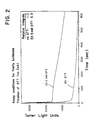
- Figure 2 depicts the luminescence curve with 33.3 mM DTT present in the assay mixture.
- 100 ⁇ l of a solution containing 3 mM luciferin, 3 mM ATP and 100 mM DTT in the same buffer, as described in the immediately preceding paragraph for the experiments with CoA was injected into 200 ⁇ l of 0.8 nM luciferase in the same buffer.
- the curve shows a much higher "steady-state” and total light production was increased 6 3 times over that without DTT present.
- Preincubation of DTT with the enzyme was also tested. Addition of 10 mM of DTT to the enzyme before assay resulted in no significant increase in light production.
- the results with other thiol reagents are similar to those found for DTT.
- Tests were also performed to test the mode of action of DTT as compared to protective effects of thiols generally reported in the prior art.
- two 1000 ⁇ l solutions were prepared containing 20 mM Tricine at pH 7.8, 8 mM Mg 2+ , 0.13 mM EDTA, 0.53 mM ATP and 0.27 mM CoA; one of the solutions also contained 5 mM DTT while the other contained 40 mM DTT.
- An equal aliquot of luciferase was added to each. At various times, 200 ⁇ l of solution were removed and luciferin was added to a concentration of 0 47 mM to initiate enzyme activity.
- BSA increased light intensity about 20%, but did not change the rate of decay.
- Increased initial light intensity was also found with the addition of a nonionic surfactant, Triton X-100, but was followed by an increased rate of decay.
- Other nonionic surfactants appeared to have little effect on enzyme activity.
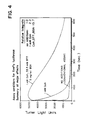
- Figure 4 depicts the luminescence curves in which a combination of CoA, DTT and BSA were present in the assay, CoA alone was present in the assay, and there were no additions to the conventional assay.
- the combined effect of CoA, DTT and BSA resulted in total light production greater than 15 times that with no additions.
- a surprising result of the method of the present invention is that an increase in total luminescence of 15- to 17-fold over 10 minutes can be effected compared to luminescence in the absence of the thiol reagents and enzyme stabilizer.
- the combined effect of these agents enhances the utility of luciferases as reporters. Improved light production permits a highly sensitive, rapid method of detecting products or events in certain biospecific reactions.
- a kit for detecting the synthesis of luciferase in foreign hosts was prepared which consisted of a lysing reagent and an assay reagent.
- the lysing reagent consisted of 25 mM Tris-phosphate at pH 7.8, 10% glycerol (which could have been replaced with ethylene glycol), 1 % Triton X-100 (trademark of Rohm & Hass Corp.
- non-ionic detergent which is an octoxynol mixture with the average number of ethylenyloxy (-CH 2 CH 2 O-) units per molecule between 9 and 10), 1 mg/ml of bovine serum albumin (BSA), 2 mM CDTA (cyclohexylenediaminetetraacetate) and 2 mM DTT.
- BSA bovine serum albumin
- CDTA cyclohexylenediaminetetraacetate
- DTT 2 mM DTT.
- the assay reagent consisted of 20 mM tricine (N-tris(hydroxymethyl) methyl glycine) buffer at pH 7.8, 33.3 mM DTT, 8 mM Mg +2 , 0.13 mM EDTA, 0.53 mM ATP, 0.47 mM luciferin and 0.27 mM CoA.
- a cellular extract was derived from NIH 3T3 cells containing plasmid pRSVL, a plasmid containing a cDNA encoding P. pyralis firefly luciferase under transcriptional control of the 5'-LTR of proviral DNA corresponding to the Rous sarcoma virus genome.
- the cells were grown to about one third confluency in a 100 mm petri dish.
- the cells were then transformed with 10 ⁇ g of plasmid DNA using the standard calcium phosphate method known in the art, and grown for an additional 48 hours.
- the cultured cells were lysed by addition 1 ml of lysing reagent at room temperature for 2 to 5 min. After lysis, the cellular debris was removed by brief centrifugation, about 10 sec, and the supernatant (i.e., the solution of cellular extract) was tested for luciferase activity.
- the enzyme activity was tested by mixing the cellular extract with the assay reagent in a ratio of between about 1:5 and 1:25, cellular extract:assay reagent. Injection was not used in carrying out the mixing.
- Luminescence of the cell extract-luciferin reaction in accordance with the assay of the present invention was compared with a conventional assay for luciferase activity. The comparison was performed using an injection-type format for mixing, as required in the conventional, prior art assay, although the assay of the present invention does not require an injection procedure.
- the comparison conventional assay which is an adaptation of the assay published in the first reports of luciferase used as a reporter of genetic events, such as transcription, Mol. Cell. Biol. 7, 725 - 737 (1987), Science 234, 856 - 859 (1986), consisted of injecting 100 ⁇ l of a solution containing 0.67 mM luciferin in a buffer of 25 mM glyclyglycine, 12 mM Mg +2 , pH 7.8, into 220 ⁇ l of a solution made by mixing 20 ⁇ l of cellular extract with 200 ⁇ l buffer (25 mM glyclyglycine, 12 mM Mg +2 , pH 7.8) having 5.83 mM ATP.
- Figure 5 depicts the results of these tests.
- the intensity of luminescence is plotted as a function of time from the time of injection.
- the results demonstrate that the assay in accordance with the present invention yielded a 10-fold increase in light output (i.e., luminescence produced) over the conventional assay, when output was determined by integration of the intensity vs. time curve from 0 to 60 seconds, and a 17-fold increase in luminescence produced in comparison with the conventional assay, when the output was determined in an integration of the intensity vs time curve from 0 to 5 minutes.
- the absence of the sharp peak in intensity in the assay in accordance with the invention, in comparison with the conventional assay is also apparent in Figure 5.
- a 1 mg/ml stock luciferase solution was prepared from crystalline pure, P. pyralis luciferase in 10% ammonium sulfate and 10% glycerol. Luciferase solutions used for reaction purposes were prepared from the stock solution by 100-fold consecutive dilutions into the lysing reagent described in Example 1. From each dilution, 20 ⁇ l was added (without injection) to 200 ⁇ l of the assay reagent described in Example 1 and placed in a standard luminometer for measurement of the light emission.
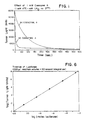
- Figure 6 is a plot of the log of the luminescence produced (as measured by integration of luminescence intensity for 60 seconds) as a function of the log of the luciferase concentration for the various samples.
- the curve in Fig. 6 shows excellent linearity over 8 orders of magnitude of luciferase concentration.
- the concentration of luciferase for the data point on the graph of Fig. 6 representing the lowest such concentration is 50-times lower than the lowest concentration of luciferase detectable in the most sensitive assays for luciferase reported heretofore.
- Such high sensitivity is achieved with the present invention because of the increase in luminescence produced in comparison with the prior art systems and the "flat" kinetics, which allows the effects of random noise in the light-measuring device to be averaged out.
- the practical range of luciferase concentrations for the assays of the present invention extends from the lowest that light-detecting instrumentation, with the lowest possible background, can detect (presently about 10 -18 to 10 -17 M, or about 200 molecules of the enzyme in a 200 ⁇ l volume of solution) up to about 10 ⁇ M.
- concentration of a luciferase in any sample of practical interest will be well inside this range.
- Figure 7 illustrates that including the luciferase inhibitor 2-aminoethanol at 36 mM in a luciferase-luciferin reaction mixture which includes CoA reduces the peak intensity of the luminescence by about 12 % and increases yield of luminescence, as measured by integration of luminescence intensity for more than about 3 minutes from initiation of the reaction.
- Figure 8 shows that including phosphate, also a luciferase inhibitor, in a luciferase-luciferin reaction mixture which includes CoA reduces peak intensity of luminescence (by a percentage that depends on the phosphate concentration) but increases total luminescence, when measured by integration of luminescence intensity over a time period that differs with phosphate ion concentration. Higher phosphate concentrations depress peak intensities to a greater extent and require integration of intensity over longer periods of time to make evident the increase in total luminescence.
- Both the 4-coumarate:CoA ligase and the long chain acyl-CoA-synthetase catalyze formation of thioesters between CoA and carboxyl groups of their respective substrates. With both enzymes, ATP reacts with a substrate to form an acyl-AMP intermediate in formation of the thioester. As indicated above, luciferase similarly forms luciferyl adenylate from ATP and luciferin.
- DethioCoA is identical to CoA without the sulfur atom.
- dethioCoA rather than CoA, was added to a luciferase-luciferin reaction mixture, there was no effect on the kinetics of light production from the reaction. Further, the increase in light production in such a reaction caused by CoA is specifically inhibited by dethioCoA.
- buffer for the luminescence assays was 30 mM tricine, 8 mM magnesium carbonate, 10 mM DTT, 0.2 mM EDTA, pH 7.8.
- Luminescence was initiated by injection, into the resulting 210 ⁇ l, of 100 ⁇ l of buffer supplemented with 3 mM luciferin, 1.5 mM ATP, and various concentrations of CoA and dethioCoA (with 3 mM dethioCoA: 0.012 mM, 0.06 mM, and 0.3 mM CoA, with no dethioCoA: 0.012 mM, 0.06 mM, 0.3 mM CoA, and 1.0 mM CoA). Luminescence was measured on a Turner Model 20 luminometer.
- the presence of CoA in a solution in which light is being produced by a beetle luciferase-luciferin reaction has been discovered to shift to shorter wavelength the color of the light being produced.
- the color of this light is determined by the difference in energy between enzyme-bound, oxidized luciferin in the excited state and enzyme-bound, oxidized luciferin in the ground state.
- the shift to shorter wavelength means that, on the average among the complexes of oxidized luciferin and luciferase, this difference in energy is increased by CoA.
- a second solution was prepared in the same way, except without any CoA or DTT.
- the first and second solutions were observed by eye while light from the luciferase-luciferin reaction was being produced.
- the first solution was slightly, but distinctly, greener in color than the second solution.
Landscapes
- Chemical & Material Sciences (AREA)
- Life Sciences & Earth Sciences (AREA)
- Organic Chemistry (AREA)
- Health & Medical Sciences (AREA)
- Wood Science & Technology (AREA)
- Zoology (AREA)
- Engineering & Computer Science (AREA)
- Bioinformatics & Cheminformatics (AREA)
- Genetics & Genomics (AREA)
- Biochemistry (AREA)
- General Health & Medical Sciences (AREA)
- General Engineering & Computer Science (AREA)
- Proteomics, Peptides & Aminoacids (AREA)
- Molecular Biology (AREA)
- Biotechnology (AREA)
- Microbiology (AREA)
- Biophysics (AREA)
- Physics & Mathematics (AREA)
- Analytical Chemistry (AREA)
- Medicinal Chemistry (AREA)
- Biomedical Technology (AREA)
- Immunology (AREA)
- Measuring Or Testing Involving Enzymes Or Micro-Organisms (AREA)
- Enzymes And Modification Thereof (AREA)
- Detergent Compositions (AREA)
- Investigating Or Analysing Materials By The Use Of Chemical Reactions (AREA)
Claims (42)
- Methode zur Feststellung des Vorhandenseins von Käferluciferase in einer Probe, von der angenommen wird, daß sie die Luciferase enthält, umfassend:a) Zumischung einer wäßrigen Lösung bestehend aus einem Thiolreagens, bei dem es sich nicht um CoA handelt, Luciferin, Adenosintriphosphat und Mg2+, alle in Konzentrationen, die für die Aktivität der Luciferase in der Luciferase-Luciferin-Reaktion effektiv sind, und wobei die wäßrige Lösung keine Luciferase umfaßt, zu einem aliquoten Teil der Probe undb) Messung der Lumineszenz von der Lösung, die sich aus Schritt (a) ergibt, wobei die sich aus Schritt (a) ergebende Lösung ein Thiolreagens, wobei es sich nicht um CoA handelt, mit einer Konzentration oberhalb von 5 mM umfaßt.
- Methode gemäß Anspruch 1, wobei in der sich aus Schritt (a) ergebenden Lösung das Thiolreagens, bei dem es sich nicht um ein CoA handelt, aus der Gruppe ausgewählt wird, die sich aus Dithiothreitol, Dithioerythritol, β-Mercaptoethanol, 2-Mercaptopropanol, 3-Mercaptopropanol, 2,3-Dithiopropanol und Glutathion zusammensetzt.
- Methode gemäß Anspruch 2, wobei die Lösung, die sich aus Schritt (a) ergibt, CoA umfaßt.
- Methode gemäß Anspruch 3, wobei die Lösung, die sich aus Schritt (a) ergibt, zusätzlich einen proteinartigen Verstärker der Luciferaseaktivität umfaßt.
- Methode gemäß Anspruch 3, wobei das Thiolreagens, bei dem es sich nicht um CoA handelt, Dithiothreitol ist.
- Methode gemäß Anspruch 4, wobei das Thiolreagens, bei dem es sich nicht um CoA handelt, Dithiothreitol ist und der Verstärker der Luciferaseaktivität Rinderserumalbumin ist.
- Methode gemäß Anspruch 5, wobei in der Lösung, die sich aus Schritt (a) ergibt, die Konzentration von CoA zwischen 0,1 mM und 1,0 mM liegt.
- Methode gemäß Anspruch 6, wobei in der Lösung, die sich aus Schritt (a) ergibt, die Konzentration von CoA zwischen 0,1 mM und 1,0 mM liegt und die Konzentration des Rinderserumalbumins zwischen 10 µg/ml und 5 mg/ml liegt.
- Methode gemäß Anspruch 7, wobei in der Lösung, die sich aus Schritt (a) ergibt, die Konzentration von ATP zwischen 0,1 mM und 1 mM liegt, die Konzentration des Luciferins zwischen 0,1 mM und 1 mM und die Konzentration des Mg2+ zwischen 2 mM und 15 mM liegt.
- Methode gemäß Anspruch 8, wobei in der Lösung, die sich aus Schritt (a) ergibt, die Konzentration von ATP zwischen 0,1 mM und 1 mM, die Konzentration von Luciferin zwischen 0,1 mM und 1 mM und die Konzentration von Mg2+ zwischen 2 mM und 15 mM liegt.
- Methode gemäß einem der Ansprüche 1 bis 10, wobei es sich bei der Käferluciferase um die Luciferase von P. pyralis handelt.
- Methode gemäß einem der Ansprüche 7 bis 10, wobei die Konzentration von Dithiothreitol in der Lösung, die sich aus Schritt (a) ergibt, zwischen 30 mM und 80 mM liegt.
- Methode gemäß Anspruch 12, wobei es sich bei der Käferluciferase um die Luciferase von P. pyralis handelt.
- Verwendung eines Thiolreagens, bei dem es sich nicht um CoA handelt, bei einer Konzentration zwischen 5 mM und 200 mM, zur Erweiterung der Kinetik der Lichterzeugung in der Käferluciferase-Luciferin-Reaktion bei einer Methode zur Feststellung von ATP in einer Probe, von der angenommen wird, daß sie ATP enthält, umfassend:a) Zumischung einer wäßrigen Lösung bestehend aus dem Thiolreagens, bei dem es sich nicht um CoA handelt, einer Käferluciferase, Luciferin und Mg2+, alle in Konzentrationen, die für die Aktivität der Luciferase in der Luciferase-Luciferin-Reaktion effektiv sind, zu einem aliquoten Teil der Probe undb) Messung der Lumineszenz von der Lösung, die sich aus Schritt (a) ergibt.
- Verwendung eines Thiolreagens gemäß Anspruch 14, wobei in der Lösung, die sich aus Schritt (a) ergibt, das Thiolreagens, bei dem es sich nicht um CoA handelt, aus der Gruppe ausgewählt wird, die sich aus Dithiothreitol, Dithioerythritol, β-Mercaptoethanol, 2-Mercaptopropanol, 3-Mercaptopropanol, 2,3-Dithiopropanol und Glutathion zusammensetzt.
- Verwendung eines Thiolreagens gemäß Anspruch 15, wobei die Lösung, die sich aus Schritt (a) ergibt, CoA umfaßt.
- Verwendung eines Thiolreagens gemäß Anspruch 16, wobei die Lösung, die sich aus Schritt (a) ergibt, zusätzlich einen proteinartigen Verstärker der Luciferaseaktivität umfaßt.
- Verwendung eines Thiolreagens gemäß Anspruch 16, wobei das Thiolreagens, bei dem es sich nicht um CoA handelt, Dithiothreitol ist.
- Verwendung eines Thiolreagens gemäß Anspruch 17, wobei das Thiolreagens, bei dem es sich nicht um CoA handelt, Dithiothreitol und der Verstärker für die Luciferaseaktivität Rinderserumalbumin ist.
- Verwendung eines Thiolreagens gemäß Anspruch 18, wobei in der Lösung, die sich aus Schritt (a) ergibt, die Konzentration von CoA zwischen 0,1 mM und 1,0 mM liegt.
- Verwendung eines Thiolreagens gemäß Anspruch 19, wobei in der Lösung, die sich aus Schritt (a) ergibt, die Konzentration des CoA zwischen 0,1 mM und 1,0 mM und die Konzentration des Rinderserumalbumins zwischen 10 µg/ml und 5 mg/ml liegt.
- Verwendung eines Thiolreagens gemäß Anspruch 20, wobei in der Lösung, die sich aus Schritt (a) ergibt, die Konzentration von CoA zwischen 0,1 mM und 1 mM, die Konzentration von Luciferin zwischen 0,1 mM und 1 mM und die Konzentration von Mg2+ zwischen 2 mM und 15 mM liegt.
- Verwendung eines Thiolreagens gemäß Anspruch 21, wobei in der Lösung, die sich aus Schritt (a) ergibt, die Konzentration von CoA zwischen 0,1 mM und 1 mM, die Konzentration von Luciferin zwischen 0,1 mM und 1,0 mM und die Konzentration von Mg2+ zwischen 2 mM und 15 mM liegt.
- Verwendung eines Thiolreagens gemäß einem der Ansprüche 14 bis 23, wobei es sich bei der Käferluciferase um die Luciferase von P. pyralis handelt.
- Verwendung eines Thiolreagens gemäß einem der Ansprüche 14 bis 23, wobei die Konzentration von Dithiothreitol in der Lösung, die sich aus Schritt (a) ergibt, zwischen 30 mM und 80 mM liegt.
- Verwendung eines Thiolreagens gemäß Anspruch 25, wobei es sich bei der Käferluciferase um die Luciferase von P. pyralis handelt.
- Wäßrige Lösung bestehend aus einer Käferluciferase, die in der Lage ist, die Luciferase-Luciferin-Reaktion zu katalysieren, einem Thiolreagens, bei dem es sich nicht um CoA handelt, in einer Konzentration von zwischen 5 mM und 200 mM und CoA in einer Konzentration zwischen 0,1 mM und 1,0 mM.
- Zusammensetzung gemäß Anspruch 27, wobei das Thiolreagens, bei dem es sich nicht um CoA handelt, Dithiothreitol in einer Konzentration zwischen 30 mM und 80 mM ist.
- Zusammensetzung gemäß Anspruch 28, die zusätzlich Rinderserumalbumin in einer Konzentration zwischen 10 µg/ml und 5 mg/ml umfaßt.
- Zusammensetzung gemäß Anspruch 29, die zusätzlich 2-Aminoethanol in einer Konzentration von 5 mM bis 50 mM oder Phosphationen in einer Konzentration von 10 mM bis 60 mM umfaßt.
- Zusammensetzung gemäß einem der Ansprüche 27 bis 30, wobei es sich bei der Käferluciferase um die Luciferase von P. pyralis handelt.
- Zusammensetzung gemäß Anspruch 31, die zusätzlich (1) Magnesiumionen in einer Konzentration zwischen 2 mM und 15 mM und (2) entweder eines oder beide Adenosin-Triphosphat(e) in einer Konzentration zwischen 0,1 mM und 1,0 mM und Luciferin in einer Konzentration zwischen 0,1 mM und 1,0 mM umfaßt.
- Test-Kit zur Bestimmung des Vorhandenseins einer Käferluciferase in einer Probe, von der angenommen wird, daß sie eine derartige Luciferase enthält, wobei das Test-Kit eine Luciferase-Luciferin-Reaktionszusammensetzung umfaßt, bei der es sich um eine wäßrige Lösung handelt, die ein Thiolreagens, bei dem es sich nicht um CoA handelt, in einer Konzentration zwischen 5 mM und 200 mM, Adenosin-Triphosphat, Luciferin und Mg2+ umfaßt, wobei die Reaktionszusammensetzung frei von Luciferase ist.
- Test-Kit gemäß Anspruch 33, wobei die wäßrige Lösung der Luciferase-Luciferin-Reaktionszusammensetzung ein anderes Thiolreagens als CoA zwischen 30 mM und 80 mM, Adenosin-Triphosphat zwischen 0,10 mM und 1,0 mM, Luciferin zwischen 0,1 mM und 1,0 mM und Magnesiumionen zwischen 2 mM und 15 mM umfaßt.
- Test-Kit gemäß Anspruch 34, wobei das Thiolreagens, bei dem es sich nicht um CoA handelt, Dithiothreitol ist.
- Test-Kit gemäß Anspruch 33 zur Bestimmung der Gegenwart einer Käferluciferase in einer Probe einer Säugerzellenkultur, von der angenommen wird, daß sie eine derartige Luciferase enthält, wobei das Kit zusätzlich und getrennt von der Luciferase-Luciferin-Reaktionszusammensetzung eine Zusammensetzung für das Lysieren der Zellen umfaßt, wobei die lysierende Zusammensetzung eine wäßrige Lösung mit einem pH und einer Ionenstärke ist, bei der die Luciferase in der Luciferase-Luciferin-Reaktion aktiv ist, und ein nichtionisches Detergens in einer Konzentration zwischen 0,1 % und 10 % (Gew.%), einen proteinartigen Verstärker für die Luciferase-Luciferin-Aktivität in einer Konzentration zwischen 0,1 mg/ml und 5 mg/ml, ein Thiolreagens, bei dem es sich nicht um CoA handelt, in einer Konzentration zwischen 1 mM und 10 mM und Glycerol oder Ethylenglycol in einer Konzentration zwischen 1 % und 50 % (Vol.%) umfaßt.
- Test-Kit gemäß Anspruch 34 zur Bestimmung des Vorhandenseins einer Käferluciferase in einer Probe einer Säugerzellenkultur, von der angenommen wird, daß sie eine derartige Luciferase enthält, wobei das Kit zusätzlich und getrennt von der Luciferase-Luciferin-Reaktionszusammensetzung eine Zusammensetzung für das Lysieren der Zellen umfaßt, wobei die lysierende Zusammensetzung eine wäßrige Lösung mit einem pH und einer Ionenstärke ist, bei der die Luciferase in der Luciferase-Luciferin-Reaktion aktiv ist, und ein nichtionisches Detergens, bei dem es sich um eine Octoxynol-Mischung mit einer Durchschnittszahl von Ethylenoxy-Einheiten pro Molekül zwischen 9 und 10, in einer Konzentration zwischen 0,1 % und 10 % (Vol.%) handelt, Rinderserumalbumin in einer Konzentration zwischen 0,1 mg/ml und 5 mg/ml, Dithiothreitol in einer Konzentration zwischen 1 mM und 10 mM und Glycerin oder Ethylenglycol in einer Konzentration zwischen 1 % und 50 % (Vol.%) umfaßt.
- Test-Kit gemäß Anspruch 35 zur Bestimmung des Vorhandenseins einer Käferluciferase in einer Probe einer Säugerzellenkultur, von der angenommen wird, daß sie eine derartige Luciferase enthält, wobei das Kit zusätzlich und getrennt von der Luciferase-Luciferin-Reaktionszusammensetzung eine Zusammensetzung für das Lysieren der Zellen umfaßt, wobei die lysierende Zusammensetzung eine wäßrige Lösung mit einem pH und einer Ionenstärke ist, bei der die Luciferase in der Luciferase-Luciferin-Reaktion aktiv ist, und ein nichtionisches Detergens, bei dem es sich um eine Octoxynol-Mischung mit einer Durchschnittszahl von Ethylenoxy-Einheiten pro Molekül zwischen 9 und 10, in einer Konzentration zwischen 0,1 % und 10 % (Vol.%), Rinderserumalbumin in einer Konzentration zwischen 0,1 mg/ml und 5 mg/ml, Dithiothreitol in einer Konzentration zwischen 1 mM und 10 mM und Glycerol oder Ethylenglycol in einer Konzentration zwischen 1 % und 50 % (Vol.%) umfaßt.
- Test-Kit gemäß einem der Ansprüche 33 bis 38, wobei es sich bei der Käferluciferase, die der Analyt des Kits ist, um die Luciferase von P. pyralis handelt.
- Test-Kit zur Bestimmung des Vorhandenseins von Adenosin-Triphosphat in einer Probe, von der angenommen wird, daß sie die Verbindung enthält, wobei das Kit eine wäßrige Lösung umfaßt, welche CoA zwischen 0,1 mM und 1,0 mM, eine Käferluciferase, ein Thiolreagens, bei dem es sich nicht um CoA handelt, in einer Konzentration zwischen 30 mM und 80 mM , Luciferin zwischen 0,1 mM und 1,0 mM und Magnesiumionen zwischen 2 mM und 15 mM umfaßt.
- Test-Kit gemäß Anspruch 40, wobei das Thiolreagens, bei dem es sich nicht um CoA handelt, Dithiothreitol ist.
- Test-Kit gemäß Anspruch 40 oder 41, wobei es sich bei der Käferluciferase um die Luciferase von P. pyralis handelt.
Applications Claiming Priority (3)
| Application Number | Priority Date | Filing Date | Title |
|---|---|---|---|
| US07/580,371 US5283179A (en) | 1990-09-10 | 1990-09-10 | Luciferase assay method |
| PCT/US1991/006474 WO1992004468A1 (en) | 1990-09-10 | 1991-09-09 | Luciferase compositions and methods |
| US580371 | 2000-05-26 |
Publications (4)
| Publication Number | Publication Date |
|---|---|
| EP0553234A1 EP0553234A1 (de) | 1993-08-04 |
| EP0553234A4 EP0553234A4 (de) | 1995-08-02 |
| EP0553234B1 EP0553234B1 (de) | 1998-11-11 |
| EP0553234B2 true EP0553234B2 (de) | 2005-07-13 |
Family
ID=24320802
Family Applications (1)
| Application Number | Title | Priority Date | Filing Date |
|---|---|---|---|
| EP91919421A Expired - Lifetime EP0553234B2 (de) | 1990-09-10 | 1991-09-09 | Luciferase-zusammensetzungen und verfahren |
Country Status (10)
| Country | Link |
|---|---|
| US (4) | US5283179A (de) |
| EP (1) | EP0553234B2 (de) |
| JP (2) | JP3171595B2 (de) |
| AT (1) | ATE173298T1 (de) |
| AU (1) | AU649289B2 (de) |
| DE (1) | DE69130482T3 (de) |
| DK (1) | DK0553234T4 (de) |
| ES (1) | ES2126576T5 (de) |
| GR (1) | GR3029352T3 (de) |
| WO (1) | WO1992004468A1 (de) |
Families Citing this family (111)
| Publication number | Priority date | Publication date | Assignee | Title |
|---|---|---|---|---|
| US5283179A (en) * | 1990-09-10 | 1994-02-01 | Promega Corporation | Luciferase assay method |
| GB9224058D0 (en) * | 1992-11-17 | 1993-01-06 | Celsis Ltd | Bioluminescence reagent formulation |
| AT401526B (de) * | 1993-02-10 | 1996-09-25 | Scheirer Winfried | Reagenzlösung zur stabilisierung der lumineszenz bei der luciferasemessung |
| JP2651651B2 (ja) * | 1993-04-21 | 1997-09-10 | チッソ株式会社 | 蛍酵素ルシフェラーゼ遺伝子 |
| US5695928A (en) | 1993-12-10 | 1997-12-09 | Novartis Corporation | Rapid immunoassay for detection of antibodies or antigens incorporating simultaneous sample extraction and immunogenic reaction |
| US6770446B1 (en) * | 1994-06-14 | 2004-08-03 | Wyeth | Cell systems having specific interaction of peptide binding pairs |
| US6217847B1 (en) | 1994-07-01 | 2001-04-17 | The Board Of Trustees Of The Leland Stanford Junior University | Non-invasive localization of a light-emitting conjugate in a mammal |
| US7255851B2 (en) * | 1994-07-01 | 2007-08-14 | The Board Of Trustees Of The Leland Stanford Junior University | Non-invasive localization of a light-emitting conjugate in a mammal |
| US5679515A (en) * | 1994-10-03 | 1997-10-21 | Pathogenesis Corporation | Mycobacterial reporter strains and uses thereof |
| US5744320A (en) * | 1995-06-07 | 1998-04-28 | Promega Corporation | Quenching reagents and assays for enzyme-mediated luminescence |
| US5726041A (en) * | 1995-08-30 | 1998-03-10 | Gentest Corporation | Method for detecting a receptor-ligand complex using a cytochrome P450 reporter gene |
| US8349602B1 (en) | 1996-04-19 | 2013-01-08 | Xenogen Corporation | Biodetectors targeted to specific ligands |
| US5798263A (en) * | 1996-09-05 | 1998-08-25 | Promega Corporation | Apparatus for quantifying dual-luminescent reporter assays |
| US6602677B1 (en) * | 1997-09-19 | 2003-08-05 | Promega Corporation | Thermostable luciferases and methods of production |
| US6171809B1 (en) | 1998-01-29 | 2001-01-09 | Packard Instrument Company | Method and compositions for detecting luciferase biological samples |
| CA2263784A1 (en) | 1998-03-23 | 1999-09-23 | Megabios Corporation | Dual-tagged proteins and their uses |
| US6183978B1 (en) * | 1998-09-04 | 2001-02-06 | Tropix, Inc. | Luciferase assay, compositions and kits for use in connection therewith |
| NL1010224C2 (nl) * | 1998-09-30 | 2000-03-31 | Packard Biosciene B V | Werkwijze voor het detecteren van ATP. |
| AU2404500A (en) * | 1999-01-08 | 2000-07-24 | Medical Analysis Systems, Inc. | Compositions and methods for stabilizing thiol-containing biomolecules |
| US6410255B1 (en) | 1999-05-05 | 2002-06-25 | Aurora Biosciences Corporation | Optical probes and assays |
| JP2001103972A (ja) * | 1999-10-06 | 2001-04-17 | Kikkoman Corp | ルシフェリンを再生する能力を有するタンパク質をコードする遺伝子、新規な組み換え体dna及びルシフェリンを再生する能力を有するタンパク質の製造法 |
| US20040214227A1 (en) * | 1999-12-22 | 2004-10-28 | Erik Joly | Bioluminescence resonance energy transfer (bret) fusion molecule and method of use |
| US6502774B1 (en) * | 2000-03-08 | 2003-01-07 | J + L Fiber Services, Inc. | Refiner disk sensor and sensor refiner disk |
| US6927851B2 (en) * | 2000-03-31 | 2005-08-09 | Neogen Corporation | Methods and apparatus to improve the sensitivity and reproducibility of bioluminescent analytical methods |
| US6667287B2 (en) * | 2000-04-20 | 2003-12-23 | Colgate-Palmolive Company | Light duty cleaning composition comprising an amine oxide and polyacrylic acid homopolymer |
| MXPA02010446A (es) * | 2000-04-24 | 2003-04-25 | Wyeth Corp | Sistemas celulares novedosos, con interaccion especifica de los pares que se unen a los peptidos. |
| US7473244B2 (en) * | 2000-06-02 | 2009-01-06 | The University Of Utah Research Foundation | Active needle devices with integrated functionality |
| US7118878B1 (en) | 2000-06-09 | 2006-10-10 | Promega Corporation | Method for increasing luminescence assay sensitivity |
| US7198924B2 (en) | 2000-12-11 | 2007-04-03 | Invitrogen Corporation | Methods and compositions for synthesis of nucleic acid molecules using multiple recognition sites |
| US7879540B1 (en) * | 2000-08-24 | 2011-02-01 | Promega Corporation | Synthetic nucleic acid molecule compositions and methods of preparation |
| US20030157643A1 (en) * | 2000-08-24 | 2003-08-21 | Almond Brian D | Synthetic nucleic acids from aquatic species |
| CA2427472A1 (en) | 2000-10-27 | 2002-06-06 | Tae Kook Kim | Double and triple readout assay systems |
| US6660489B2 (en) | 2000-12-01 | 2003-12-09 | Becton, Dickinson And Company | ATP extraction method |
| CA2328684A1 (en) * | 2000-12-15 | 2002-06-15 | Yahia Gawad | Photon-triggered luminescent assay |
| ATE538380T1 (de) * | 2001-01-23 | 2012-01-15 | Harvard College | Nukleinsäure-programmierbare protein-arrays |
| US7666615B2 (en) * | 2001-01-29 | 2010-02-23 | Hemogenix, Inc. | High-throughput assay of hematopoietic stem and progenitor cell proliferation |
| US7354730B2 (en) * | 2002-01-29 | 2008-04-08 | Hemogenix, Inc. | High-throughput assay of hematopoietic stem and progenitor cell proliferation |
| US7989178B2 (en) * | 2001-01-29 | 2011-08-02 | Hemogenix, Inc. | Colony assay miniaturization with enumeration output |
| AU2002335610C1 (en) * | 2001-01-29 | 2008-09-25 | Hemogenix, Inc. | High-throughput stem cell assay of hematopoietic stem and progenitor cell proliferation |
| US7083911B2 (en) * | 2001-02-16 | 2006-08-01 | Promega Corporation | Method for detection of ATP |
| US6858773B2 (en) * | 2001-04-20 | 2005-02-22 | Xenogen Corporation | Transgenic mice comprising transcription control elements associated with mouse eosinophil peroxidase expression |
| WO2003016839A2 (en) * | 2001-08-15 | 2003-02-27 | Xenogen Corporation | Modified railroad worm red luciferase coding sequences |
| US7268229B2 (en) * | 2001-11-02 | 2007-09-11 | Promega Corporation | Compounds to co-localize luminophores with luminescent proteins |
| AU2002348287A1 (en) * | 2001-11-16 | 2003-06-10 | Pierce Biotechnology, Inc. | Phosphine-containing formulations for chemiluminescent luciferase assays |
| US6696473B2 (en) * | 2001-12-21 | 2004-02-24 | X-Ceptor Therapeutics, Inc. | Heterocyclic modulators of nuclear receptors |
| AU2002351412B2 (en) | 2001-12-21 | 2010-05-20 | Exelixis Patent Company Llc | Modulators of LXR |
| US7482366B2 (en) | 2001-12-21 | 2009-01-27 | X-Ceptor Therapeutics, Inc. | Modulators of LXR |
| US20040044063A1 (en) * | 2002-05-31 | 2004-03-04 | Brent Stockwell | SMA therapy and cell based assay for identifying therapies |
| AU2003258319B2 (en) * | 2002-08-21 | 2009-09-17 | Hemogenix, Inc. | High-throughput assay of hematopoietic stem and progenitor cell proliferation |
| JP2004089117A (ja) * | 2002-09-03 | 2004-03-25 | Toyo B-Net Co Ltd | ルシフェラーゼ検出試薬キット及び当該キットを使用したルシフェラーゼ検出方法 |
| AU2003268489B2 (en) | 2002-09-06 | 2008-01-24 | Promega Corporation | Method for detecting transferase enzymatic activity |
| AU2003267245C1 (en) * | 2002-09-20 | 2008-05-29 | Promega Corporation | Luminescence-based methods and probes for measuring cytochrome P450 activity |
| US7413874B2 (en) * | 2002-12-09 | 2008-08-19 | University Of Miami | Nucleic acid encoding fluorescent proteins from aquatic species |
| AU2003300008B2 (en) | 2002-12-23 | 2007-04-05 | Promega Corporation | Improved luciferase-based assays |
| US20080227085A1 (en) * | 2003-01-17 | 2008-09-18 | Pellegrini Matthew C | Methods and Systems for the Identification of Rna Regulatory Sequences and Compounds that Modulate their Function |
| AU2004210982B2 (en) * | 2003-02-12 | 2008-12-18 | Promega Corporation | Methods and kits for dual enzymatic assays whereby light is quenched from luminescent reactions |
| US7390670B2 (en) | 2003-02-20 | 2008-06-24 | Lumigen, Inc. | Signalling compounds and methods for detecting hydrogen peroxide |
| US6970240B2 (en) * | 2003-03-10 | 2005-11-29 | Applera Corporation | Combination reader |
| DE10315640A1 (de) | 2003-04-04 | 2004-10-14 | Ignatov, Konstantin | Verfahren zur kontrollierten Freisetzung von Komponenten in eine Lösung |
| US7132249B1 (en) | 2003-05-12 | 2006-11-07 | Charm Sciences, Inc. | Method of determining allergenic food on surfaces |
| US7494781B1 (en) | 2003-05-12 | 2009-02-24 | Charm Sciences, Inc. | Sensitive method for detecting low levels of ATP |
| CA2445420A1 (en) | 2003-07-29 | 2005-01-29 | Invitrogen Corporation | Kinase and phosphatase assays |
| US7619059B2 (en) | 2003-07-29 | 2009-11-17 | Life Technologies Corporation | Bimolecular optical probes |
| US7727752B2 (en) | 2003-07-29 | 2010-06-01 | Life Technologies Corporation | Kinase and phosphatase assays |
| US20050069929A1 (en) | 2003-08-08 | 2005-03-31 | Invitrogen Corporation | Methods and compositions for seamless cloning of nucleic acid molecules |
| EP1687399A4 (de) * | 2003-10-03 | 2007-09-05 | Univ Michigan Tech | Modifizierte luciferase |
| US8304189B2 (en) | 2003-12-01 | 2012-11-06 | Life Technologies Corporation | Nucleic acid molecules containing recombination sites and methods of using the same |
| EP1763584B1 (de) * | 2004-07-02 | 2009-04-22 | Promega Corporation | Zusammensetzungen und verfahren zur extraktion und detektion von mikrobiellem atp |
| US7728118B2 (en) | 2004-09-17 | 2010-06-01 | Promega Corporation | Synthetic nucleic acid molecule compositions and methods of preparation |
| TWI290956B (en) * | 2004-12-31 | 2007-12-11 | Ind Tech Res Inst | Luminescence-based recipe and device using the same |
| US7939286B2 (en) * | 2005-03-07 | 2011-05-10 | Targeting Systems | Enhancing a luminescent signal |
| US20060214141A1 (en) * | 2005-03-23 | 2006-09-28 | Yankielun Norbert E | Luminescent illumination adjunct for night vision |
| US20060234323A1 (en) * | 2005-04-18 | 2006-10-19 | Cali James J | Luminescent ATP detection with extended linearity |
| EP1724359A1 (de) * | 2005-05-18 | 2006-11-22 | PerkinElmer Life and Analytical Sciences B.V. | Luciferase-Assaysystem |
| EP2272973B1 (de) * | 2005-05-31 | 2015-05-27 | Promega Corporation | Luminogene und fluorogene Verbindungen und Verfahren für den Nachweis von Molekülen oder Leiden |
| WO2007002563A1 (en) | 2005-06-27 | 2007-01-04 | Exelixis, Inc. | Imidazole based lxr modulators |
| CN101501187A (zh) * | 2006-06-06 | 2009-08-05 | 田纳西大学研究基金会 | 富含赘生干细胞的组合物及包含其的方法 |
| US8178316B2 (en) * | 2006-06-29 | 2012-05-15 | President And Fellows Of Harvard College | Evaluating proteins |
| WO2008045121A1 (en) * | 2006-10-13 | 2008-04-17 | Charm Sciences, Inc. | Method and apparatus for reducing luminescent test result interferences |
| JP2008113620A (ja) * | 2006-11-07 | 2008-05-22 | Toyobo Co Ltd | ルシフェラーゼの発光方法 |
| DE102006054562A1 (de) * | 2006-11-20 | 2008-05-21 | Bayer Healthcare Ag | Verfahren zum Nachweis von Pyrophosphat mit Biolumineszenz Detektion |
| AU2007335194B2 (en) * | 2006-12-21 | 2014-01-23 | Gene Stream Pty Ltd | Bioluminescent assays utilising secreted luciferases |
| NZ579010A (en) * | 2007-02-20 | 2012-03-30 | Anaptysbio Inc | Somatic hypermutation systems |
| WO2008109459A1 (en) | 2007-03-02 | 2008-09-12 | University Of Massachusetts | Luciferins |
| US20080248511A1 (en) * | 2007-03-26 | 2008-10-09 | Promega Corporation | Methods to quench light from optical reactions |
| US20090081715A1 (en) * | 2007-09-07 | 2009-03-26 | Cobalt Technologies, Inc., A Delaware Corporation | Engineered Light-Emitting Reporter Genes |
| JP5332178B2 (ja) * | 2007-11-02 | 2013-11-06 | 東洋紡株式会社 | 多色ルシフェラーゼの検出方法 |
| WO2009061837A1 (en) * | 2007-11-05 | 2009-05-14 | Novostem Therapeutics Inc | Neoplastic stem cell system and method |
| CL2009000879A1 (es) | 2008-04-09 | 2010-05-07 | Talfryn S A | Metodo para fabricar un producto en un biorreactor que comprende cultivar microorganismos que son adaptados o mutagenizados para que exhiban por lo menos un 150% de tolerancia al producto; sistema para fabricar un producto; biorreactor. |
| US8288559B2 (en) * | 2008-08-18 | 2012-10-16 | Promega Corporation | Luminogenic compounds and methods to detect cytochrome P450 3A enzymes |
| WO2010113039A1 (en) | 2009-04-03 | 2010-10-07 | Medical Research Council | Mutants of activation-induced cytidine deaminase (aid) and methods of use |
| CN102482690A (zh) | 2009-06-26 | 2012-05-30 | 钴技术有限公司 | 生物产物生产的集成系统和方法 |
| US8569002B2 (en) | 2010-10-20 | 2013-10-29 | The Board Of Regents Of The University Of Texas System | Multiplexed luciferase reporter assay systems |
| JP5863338B2 (ja) | 2011-08-25 | 2016-02-16 | 株式会社東芝 | プラスミド型ベクター、遺伝子プロモーター活性の検出方法、及びアッセイキット |
| WO2013037482A1 (en) | 2011-09-15 | 2013-03-21 | Phenex Pharmaceuticals Ag | Farnesoid x receptor agonists for cancer treatment and prevention |
| US9074186B2 (en) | 2012-08-15 | 2015-07-07 | Boston Medical Center Corporation | Production of red blood cells and platelets from stem cells |
| WO2015116867A1 (en) | 2014-01-29 | 2015-08-06 | Promega Corporation | Quinone-masked probes as labeling reagents for cell uptake measurements |
| US10513694B2 (en) * | 2015-06-25 | 2019-12-24 | Promega Corporation | Thienopyrrole compounds and uses thereof |
| CN108026172B (zh) | 2015-06-26 | 2022-04-29 | 赛诺菲生物技术公司 | 单克隆抗il-1racp抗体 |
| WO2017155036A1 (ja) | 2016-03-11 | 2017-09-14 | 国立研究開発法人産業技術総合研究所 | 発光酵素タンパク質 |
| EP3241845A1 (de) | 2016-05-06 | 2017-11-08 | MAB Discovery GmbH | Humanisierte anti-il-1r3-antikörper |
| WO2018125992A1 (en) | 2016-12-28 | 2018-07-05 | Promega Corporation | Functionalized nanoluc inhibitors |
| EP3401332A1 (de) | 2017-05-08 | 2018-11-14 | MAB Discovery GmbH | Anti-il-1r3 antikörper zur verwendung bei entzündungskrankheiten |
| MX2021000092A (es) * | 2018-06-29 | 2021-04-13 | Int Paper Co | Indicador de humedad quimioluminiscente para productos absorbentes. |
| CN111089859A (zh) * | 2018-10-23 | 2020-05-01 | 北京中医药大学 | 新型三磷酸腺苷生物发光测定方法及其用途 |
| RU2744869C2 (ru) * | 2019-08-08 | 2021-03-16 | Общество с ограниченной ответственностью "ПЛАНТА" | Метод и реактивы для детекции активности люциферазы |
| CN113030052B (zh) * | 2021-03-18 | 2022-10-21 | 中国科学院华南植物园 | 一种香蕉采后果实eATP水平的检测方法 |
| CA3217862A1 (en) | 2021-05-05 | 2022-11-10 | Radius Pharmaceuticals, Inc. | Animal model having homologous recombination of mouse pth1 receptor |
| CN114350626A (zh) * | 2021-12-21 | 2022-04-15 | 合肥巅峰生物科技有限公司 | 一种荧光素酶冻干粉稀释反应液 |
| CN114736949B (zh) * | 2022-03-22 | 2024-03-01 | 药科元(上海)生物技术有限公司 | 一种萤火虫荧光素酶报告基因检测试剂盒 |
| EP4590704A1 (de) | 2022-09-21 | 2025-07-30 | Sanofi Biotechnology | Humanisierter anti-il-1r3-antikörper und verfahren zur verwendung |
Family Cites Families (10)
| Publication number | Priority date | Publication date | Assignee | Title |
|---|---|---|---|---|
| SE428379B (sv) * | 1978-05-31 | 1983-06-27 | Lkb Produkter Ab | Bioluminiscens bestemning av atp och reagens herfor |
| DE2828658C3 (de) * | 1978-06-29 | 1981-10-22 | Lkb-Produkter Ab, Stockholm | Verfahren zur photometrischen Bestimmung der Untereinheit B der Creatinkinase und Reagens hierfür |
| US4234681A (en) * | 1978-07-21 | 1980-11-18 | The Regents Of The University Of California | Immobolized light emitting systems |
| US4614712A (en) * | 1983-02-25 | 1986-09-30 | The Upjohn Company | Immunoassays with luciferase labeled ligands or receptors |
| US4665022A (en) * | 1984-02-17 | 1987-05-12 | The Regents Of The University Of California | Bioluminescent assay reagent and method |
| FR2566798B1 (fr) * | 1984-06-27 | 1986-12-12 | Centre Nat Rech Scient | Membrane porteuse de la luciferase pour le dosage de l'atp et son procede de production |
| JPS6163855A (ja) * | 1984-09-05 | 1986-04-02 | Fuji Photo Film Co Ltd | 静電写真用液体現像剤 |
| DK258787D0 (da) * | 1987-05-21 | 1987-05-21 | Foss Electric As N | Fremgangsmaade til bestemmelse af bakteriekoncentration i en proeve |
| GB8722252D0 (en) * | 1987-09-22 | 1987-10-28 | Brewing Res Found | Atp extraction |
| US5283179A (en) * | 1990-09-10 | 1994-02-01 | Promega Corporation | Luciferase assay method |
-
1990
- 1990-09-10 US US07/580,371 patent/US5283179A/en not_active Expired - Lifetime
-
1991
- 1991-09-09 ES ES91919421T patent/ES2126576T5/es not_active Expired - Lifetime
- 1991-09-09 AT AT91919421T patent/ATE173298T1/de not_active IP Right Cessation
- 1991-09-09 DE DE69130482T patent/DE69130482T3/de not_active Expired - Lifetime
- 1991-09-09 AU AU88583/91A patent/AU649289B2/en not_active Ceased
- 1991-09-09 EP EP91919421A patent/EP0553234B2/de not_active Expired - Lifetime
- 1991-09-09 WO PCT/US1991/006474 patent/WO1992004468A1/en not_active Ceased
- 1991-09-09 DK DK91919421T patent/DK0553234T4/da active
- 1991-09-09 JP JP51753191A patent/JP3171595B2/ja not_active Expired - Lifetime
-
1994
- 1994-01-31 US US08/189,558 patent/US5650289A/en not_active Expired - Lifetime
-
1995
- 1995-06-07 US US08/485,834 patent/US5641641A/en not_active Expired - Lifetime
-
1997
- 1997-04-09 US US08/831,781 patent/US5814471A/en not_active Expired - Lifetime
-
1999
- 1999-02-10 GR GR990400439T patent/GR3029352T3/el unknown
-
2000
- 2000-12-28 JP JP2000400335A patent/JP2001224398A/ja active Pending
Also Published As
| Publication number | Publication date |
|---|---|
| ES2126576T5 (es) | 2005-12-01 |
| AU8858391A (en) | 1992-03-30 |
| US5650289A (en) | 1997-07-22 |
| JP2001224398A (ja) | 2001-08-21 |
| WO1992004468A1 (en) | 1992-03-19 |
| ATE173298T1 (de) | 1998-11-15 |
| US5641641A (en) | 1997-06-24 |
| DK0553234T3 (da) | 1999-07-26 |
| JPH06500921A (ja) | 1994-01-27 |
| DE69130482T2 (de) | 1999-05-27 |
| AU649289B2 (en) | 1994-05-19 |
| EP0553234A4 (de) | 1995-08-02 |
| EP0553234A1 (de) | 1993-08-04 |
| GR3029352T3 (en) | 1999-05-28 |
| DE69130482D1 (de) | 1998-12-17 |
| EP0553234B1 (de) | 1998-11-11 |
| US5814471A (en) | 1998-09-29 |
| US5283179A (en) | 1994-02-01 |
| DK0553234T4 (da) | 2005-08-01 |
| ES2126576T3 (es) | 1999-04-01 |
| DE69130482T3 (de) | 2006-05-04 |
| JP3171595B2 (ja) | 2001-05-28 |
Similar Documents
| Publication | Publication Date | Title |
|---|---|---|
| EP0553234B1 (de) | Luciferase-zusammensetzungen und verfahren | |
| US7951551B2 (en) | Kits and reagents for luciferase detection assay system | |
| US6171809B1 (en) | Method and compositions for detecting luciferase biological samples | |
| Ford et al. | Improvements in the application of firefly luciferase assays | |
| JPH0847399A (ja) | 生物発光の測定方法 | |
| US20040219622A1 (en) | Phosphine-containing formulations for chemiluminescent luciferase assays | |
| US20060234323A1 (en) | Luminescent ATP detection with extended linearity | |
| RU2164241C2 (ru) | Реагент для определения аденозин-5'-трифосфата | |
| Kamidate et al. | Cationic liposomes enhanced firefly bioluminescent assay of adenosine 5′-triphosphate disodium salt | |
| SU1041568A1 (ru) | Реагент дл определени аденозин-5-трифосфата | |
| JP2002524086A (ja) | ルシフェラーゼアッセイ、それに関連して使用するための組成物及びキット | |
| JP2006280365A (ja) | アデノシン三リン酸の検出方法及び検出用試薬 |
Legal Events
| Date | Code | Title | Description |
|---|---|---|---|
| PUAI | Public reference made under article 153(3) epc to a published international application that has entered the european phase |
Free format text: ORIGINAL CODE: 0009012 |
|
| 17P | Request for examination filed |
Effective date: 19930413 |
|
| AK | Designated contracting states |
Kind code of ref document: A1 Designated state(s): AT BE CH DE DK ES FR GB GR IT LI LU NL SE |
|
| R17P | Request for examination filed (corrected) |
Effective date: 19930408 |
|
| A4 | Supplementary search report drawn up and despatched | ||
| AK | Designated contracting states |
Kind code of ref document: A4 Designated state(s): AT BE CH DE DK ES FR GB GR IT LI LU NL SE |
|
| 17Q | First examination report despatched |
Effective date: 19960429 |
|
| GRAG | Despatch of communication of intention to grant |
Free format text: ORIGINAL CODE: EPIDOS AGRA |
|
| GRAG | Despatch of communication of intention to grant |
Free format text: ORIGINAL CODE: EPIDOS AGRA |
|
| GRAH | Despatch of communication of intention to grant a patent |
Free format text: ORIGINAL CODE: EPIDOS IGRA |
|
| GRAH | Despatch of communication of intention to grant a patent |
Free format text: ORIGINAL CODE: EPIDOS IGRA |
|
| GRAA | (expected) grant |
Free format text: ORIGINAL CODE: 0009210 |
|
| AK | Designated contracting states |
Kind code of ref document: B1 Designated state(s): AT BE CH DE DK ES FR GB GR IT LI LU NL SE |
|
| REF | Corresponds to: |
Ref document number: 173298 Country of ref document: AT Date of ref document: 19981115 Kind code of ref document: T |
|
| REG | Reference to a national code |
Ref country code: CH Ref legal event code: EP |
|
| REF | Corresponds to: |
Ref document number: 69130482 Country of ref document: DE Date of ref document: 19981217 |
|
| ITF | It: translation for a ep patent filed | ||
| REG | Reference to a national code |
Ref country code: CH Ref legal event code: NV Representative=s name: KATZAROV S.A. |
|
| ET | Fr: translation filed | ||
| REG | Reference to a national code |
Ref country code: ES Ref legal event code: FG2A Ref document number: 2126576 Country of ref document: ES Kind code of ref document: T3 |
|
| REG | Reference to a national code |
Ref country code: DK Ref legal event code: T3 |
|
| PLBI | Opposition filed |
Free format text: ORIGINAL CODE: 0009260 |
|
| PLBQ | Unpublished change to opponent data |
Free format text: ORIGINAL CODE: EPIDOS OPPO |
|
| PLBI | Opposition filed |
Free format text: ORIGINAL CODE: 0009260 |
|
| 26 | Opposition filed |
Opponent name: ROCHE DIAGNOSTICS GMBH Effective date: 19990810 |
|
| 26 | Opposition filed |
Opponent name: ROCHE DIAGNOSTICS GMBH Effective date: 19990810 Opponent name: WINFRIED SCHEIRER Effective date: 19990811 |
|
| PLBF | Reply of patent proprietor to notice(s) of opposition |
Free format text: ORIGINAL CODE: EPIDOS OBSO |
|
| NLR1 | Nl: opposition has been filed with the epo |
Opponent name: WINFRIED SCHEIRER Opponent name: ROCHE DIAGNOSTICS GMBH |
|
| PLBF | Reply of patent proprietor to notice(s) of opposition |
Free format text: ORIGINAL CODE: EPIDOS OBSO |
|
| PLBF | Reply of patent proprietor to notice(s) of opposition |
Free format text: ORIGINAL CODE: EPIDOS OBSO |
|
| PLBF | Reply of patent proprietor to notice(s) of opposition |
Free format text: ORIGINAL CODE: EPIDOS OBSO |
|
| REG | Reference to a national code |
Ref country code: GB Ref legal event code: IF02 |
|
| PLAW | Interlocutory decision in opposition |
Free format text: ORIGINAL CODE: EPIDOS IDOP |
|
| APAC | Appeal dossier modified |
Free format text: ORIGINAL CODE: EPIDOS NOAPO |
|
| APAC | Appeal dossier modified |
Free format text: ORIGINAL CODE: EPIDOS NOAPO |
|
| PGFP | Annual fee paid to national office [announced via postgrant information from national office to epo] |
Ref country code: GR Payment date: 20040928 Year of fee payment: 14 |
|
| PGFP | Annual fee paid to national office [announced via postgrant information from national office to epo] |
Ref country code: LU Payment date: 20041004 Year of fee payment: 14 |
|
| APBU | Appeal procedure closed |
Free format text: ORIGINAL CODE: EPIDOSNNOA9O |
|
| APAA | Appeal reference recorded |
Free format text: ORIGINAL CODE: EPIDOS REFN |
|
| PUAH | Patent maintained in amended form |
Free format text: ORIGINAL CODE: 0009272 |
|
| STAA | Information on the status of an ep patent application or granted ep patent |
Free format text: STATUS: PATENT MAINTAINED AS AMENDED |
|
| 27A | Patent maintained in amended form |
Effective date: 20050713 |
|
| AK | Designated contracting states |
Kind code of ref document: B2 Designated state(s): AT BE CH DE DK ES FR GB GR IT LI LU NL SE |
|
| REG | Reference to a national code |
Ref country code: DK Ref legal event code: T4 |
|
| REG | Reference to a national code |
Ref country code: CH Ref legal event code: AEN Free format text: AUFRECHTERHALTUNG DES PATENTES IN GEAENDERTER FORM |
|
| NLR2 | Nl: decision of opposition |
Effective date: 20050713 |
|
| PG25 | Lapsed in a contracting state [announced via postgrant information from national office to epo] |
Ref country code: LU Free format text: LAPSE BECAUSE OF NON-PAYMENT OF DUE FEES Effective date: 20050930 |
|
| NLR3 | Nl: receipt of modified translations in the netherlands language after an opposition procedure | ||
| REG | Reference to a national code |
Ref country code: SE Ref legal event code: RPEO |
|
| APAH | Appeal reference modified |
Free format text: ORIGINAL CODE: EPIDOSCREFNO |
|
| REG | Reference to a national code |
Ref country code: ES Ref legal event code: DC2A Date of ref document: 20050831 Kind code of ref document: T5 |
|
| REG | Reference to a national code |
Ref country code: GR Ref legal event code: EP Ref document number: 20050403013 Country of ref document: GR |
|
| ET3 | Fr: translation filed ** decision concerning opposition | ||
| PGFP | Annual fee paid to national office [announced via postgrant information from national office to epo] |
Ref country code: IT Payment date: 20070927 Year of fee payment: 17 Ref country code: NL Payment date: 20070923 Year of fee payment: 17 Ref country code: DK Payment date: 20070927 Year of fee payment: 17 |
|
| PGFP | Annual fee paid to national office [announced via postgrant information from national office to epo] |
Ref country code: BE Payment date: 20071025 Year of fee payment: 17 Ref country code: SE Payment date: 20070926 Year of fee payment: 17 |
|
| PG25 | Lapsed in a contracting state [announced via postgrant information from national office to epo] |
Ref country code: GR Free format text: LAPSE BECAUSE OF NON-PAYMENT OF DUE FEES Effective date: 19981111 |
|
| BERE | Be: lapsed |
Owner name: *PROMEGA CORP. Effective date: 20080930 |
|
| REG | Reference to a national code |
Ref country code: DK Ref legal event code: EBP |
|
| PG25 | Lapsed in a contracting state [announced via postgrant information from national office to epo] |
Ref country code: NL Free format text: LAPSE BECAUSE OF NON-PAYMENT OF DUE FEES Effective date: 20090401 |
|
| NLV4 | Nl: lapsed or anulled due to non-payment of the annual fee |
Effective date: 20090401 |
|
| PG25 | Lapsed in a contracting state [announced via postgrant information from national office to epo] |
Ref country code: BE Free format text: LAPSE BECAUSE OF NON-PAYMENT OF DUE FEES Effective date: 20080930 |
|
| PG25 | Lapsed in a contracting state [announced via postgrant information from national office to epo] |
Ref country code: IT Free format text: LAPSE BECAUSE OF NON-PAYMENT OF DUE FEES Effective date: 20080909 |
|
| PGFP | Annual fee paid to national office [announced via postgrant information from national office to epo] |
Ref country code: ES Payment date: 20090928 Year of fee payment: 19 |
|
| PGFP | Annual fee paid to national office [announced via postgrant information from national office to epo] |
Ref country code: CH Payment date: 20090925 Year of fee payment: 19 Ref country code: AT Payment date: 20090819 Year of fee payment: 19 |
|
| PG25 | Lapsed in a contracting state [announced via postgrant information from national office to epo] |
Ref country code: DK Free format text: LAPSE BECAUSE OF NON-PAYMENT OF DUE FEES Effective date: 20090331 |
|
| PG25 | Lapsed in a contracting state [announced via postgrant information from national office to epo] |
Ref country code: SE Free format text: LAPSE BECAUSE OF NON-PAYMENT OF DUE FEES Effective date: 20080910 |
|
| PGFP | Annual fee paid to national office [announced via postgrant information from national office to epo] |
Ref country code: FR Payment date: 20100930 Year of fee payment: 20 |
|
| PGFP | Annual fee paid to national office [announced via postgrant information from national office to epo] |
Ref country code: GB Payment date: 20100927 Year of fee payment: 20 |
|
| PGFP | Annual fee paid to national office [announced via postgrant information from national office to epo] |
Ref country code: DE Payment date: 20100929 Year of fee payment: 20 |
|
| REG | Reference to a national code |
Ref country code: CH Ref legal event code: PL |
|
| PG25 | Lapsed in a contracting state [announced via postgrant information from national office to epo] |
Ref country code: LI Free format text: LAPSE BECAUSE OF NON-PAYMENT OF DUE FEES Effective date: 20100930 Ref country code: CH Free format text: LAPSE BECAUSE OF NON-PAYMENT OF DUE FEES Effective date: 20100930 |
|
| PG25 | Lapsed in a contracting state [announced via postgrant information from national office to epo] |
Ref country code: AT Free format text: LAPSE BECAUSE OF NON-PAYMENT OF DUE FEES Effective date: 20100909 |
|
| REG | Reference to a national code |
Ref country code: DE Ref legal event code: R071 Ref document number: 69130482 Country of ref document: DE |
|
| REG | Reference to a national code |
Ref country code: DE Ref legal event code: R071 Ref document number: 69130482 Country of ref document: DE |
|
| REG | Reference to a national code |
Ref country code: GB Ref legal event code: PE20 Expiry date: 20110908 |
|
| REG | Reference to a national code |
Ref country code: ES Ref legal event code: FD2A Effective date: 20111019 |
|
| PG25 | Lapsed in a contracting state [announced via postgrant information from national office to epo] |
Ref country code: GB Free format text: LAPSE BECAUSE OF EXPIRATION OF PROTECTION Effective date: 20110908 Ref country code: ES Free format text: LAPSE BECAUSE OF NON-PAYMENT OF DUE FEES Effective date: 20100910 |
|
| PG25 | Lapsed in a contracting state [announced via postgrant information from national office to epo] |
Ref country code: DE Free format text: LAPSE BECAUSE OF EXPIRATION OF PROTECTION Effective date: 20110910 |