EP0522778B1 - Tubular knitted fabric having a three-dimensional silhouette shape and method of knitting the same - Google Patents
Tubular knitted fabric having a three-dimensional silhouette shape and method of knitting the same Download PDFInfo
- Publication number
- EP0522778B1 EP0522778B1 EP92306056A EP92306056A EP0522778B1 EP 0522778 B1 EP0522778 B1 EP 0522778B1 EP 92306056 A EP92306056 A EP 92306056A EP 92306056 A EP92306056 A EP 92306056A EP 0522778 B1 EP0522778 B1 EP 0522778B1
- Authority
- EP
- European Patent Office
- Prior art keywords
- knitting
- needle bed
- loops
- needle
- needles
- Prior art date
- Legal status (The legal status is an assumption and is not a legal conclusion. Google has not performed a legal analysis and makes no representation as to the accuracy of the status listed.)
- Expired - Lifetime
Links
- 238000009940 knitting Methods 0.000 title claims description 222
- 239000004744 fabric Substances 0.000 title claims description 49
- 238000000034 method Methods 0.000 title claims description 36
- 230000003247 decreasing effect Effects 0.000 claims description 15
- 238000009963 fulling Methods 0.000 claims description 2
- 230000004048 modification Effects 0.000 description 4
- 238000012986 modification Methods 0.000 description 4
- 210000000481 breast Anatomy 0.000 description 2
- 241000219122 Cucurbita Species 0.000 description 1
- 235000009852 Cucurbita pepo Nutrition 0.000 description 1
- 150000001875 compounds Chemical class 0.000 description 1
- 230000008878 coupling Effects 0.000 description 1
- 238000010168 coupling process Methods 0.000 description 1
- 238000005859 coupling reaction Methods 0.000 description 1
- 238000004904 shortening Methods 0.000 description 1
Images






Classifications
-
- D—TEXTILES; PAPER
- D04—BRAIDING; LACE-MAKING; KNITTING; TRIMMINGS; NON-WOVEN FABRICS
- D04B—KNITTING
- D04B7/00—Flat-bed knitting machines with independently-movable needles
- D04B7/10—Flat-bed knitting machines with independently-movable needles with provision for narrowing or widening to produce fully-fashioned goods
-
- D—TEXTILES; PAPER
- D04—BRAIDING; LACE-MAKING; KNITTING; TRIMMINGS; NON-WOVEN FABRICS
- D04B—KNITTING
- D04B1/00—Weft knitting processes for the production of fabrics or articles not dependent on the use of particular machines; Fabrics or articles defined by such processes
- D04B1/22—Weft knitting processes for the production of fabrics or articles not dependent on the use of particular machines; Fabrics or articles defined by such processes specially adapted for knitting goods of particular configuration
- D04B1/24—Weft knitting processes for the production of fabrics or articles not dependent on the use of particular machines; Fabrics or articles defined by such processes specially adapted for knitting goods of particular configuration wearing apparel
-
- D—TEXTILES; PAPER
- D04—BRAIDING; LACE-MAKING; KNITTING; TRIMMINGS; NON-WOVEN FABRICS
- D04B—KNITTING
- D04B1/00—Weft knitting processes for the production of fabrics or articles not dependent on the use of particular machines; Fabrics or articles defined by such processes
- D04B1/10—Patterned fabrics or articles
- D04B1/102—Patterned fabrics or articles with stitch pattern
Definitions
- the present invention relates to a tubular knitted fabric in which the circumferential length is varied to form a three-dimensional silhouette shape and a method of knitting the same.
- a tubular knitted fabric is produced by knitting a front half of the tubular fabric from yarn threaded onto knitting needles of the front needle bed and a back half, which is joined at both side ends to the front half, from the yarn threaded onto the rear needle bed, in which the procedure is repeated a predetermined number of times for forming a tubular shape.
- tubular knitted fabrics are finished as garments, e.g. sweaters, tights, or pants.
- the tubular knitted fabric can be adjusted in the size or circumferential length by increasing and/or decreasing the number of the knitting needles to be used or more specifically, by varying the number of wales.
- the tubular shape can be turned to e.g. a sleeve having a wide cuff.
- the prior art method is successfully applicable to knitting of a front-to-back asymmetrical shape, e.g. a gourd shape.
- a tubular fabric is designed for producing a sweater or one-piece garment, it should have a front half raised at the breast for corresponding to a human body while a back half needs no raise.
- the tubular fabric is not symmetrical from the front to the back.
- the present invention has been introduced for overcoming the foregoing drawbacks and its object is to provide an improved tubular knitted fabric of three-dimensional silhouette shape which ensures a natural fit in use as a garment without impairing an appearance and a method of knitting the same.
- the invention provides a method of knitting a tubular fabric of three-dimensional silhouette shape by varying the circumferential length of the tubular fabric and comprising knitting a tubular fabric consisting of front and back halves joined at side ends to each other, with the use of a flat knitting machine having four, upper front, lower front, upper rear, and lower rear, needle beds (FU,FD,BU,BD); characterised by increasing or decreasing the number of wales at one of the two, front and back, halves of the tubular fabric so that a difference in the wale number is given between the two halves; and further characterised by a process of transferring loops of yarn from needles (A and T) of a first needle bed (BD) which carries a greater number of wales to a second needle bed (FD) carrying a lesser number of wales; the process comprising feeding yarn to form loops on the needles (B to S) of the second needle bed (FD) and tucking the yarn on to an unoccupied needle (T) located adjacent needles carrying said loops
- the invention provides a method of knitting a tubular fabric of three-dimensional silhouette shape by varying the circumferential length of the tubular fabric and comprising knitting a tubular fabric consisting of front and back halves joined at side ends to each other, with the use of a flat knitting machine having four, upper front, lower front, upper rear, and lower rear, needle beds (FU,FD,BU,BD); characterised by increasing or decreasing the number of wales at one of the two, front and back, halves of the tubular fabric so that a difference in the wale number is given between the two halves; and further characterised by a process of transferring loops of yarn from needles (A and T) of a first needle bed (BD) which carries a greater number of wales to a second needle bed (FD) carrying a lesser number of wales; the method comprising, after the yarn is fed to form loops on needles (T to B) of the first needle bed (BD), feeding yarn in an opposite direction to form another loop on a needle (A) of said
- the invention provides a tubular knitted fabric comprising a front and a back half coupled at the side ends to each other, in which the circumferential length is varied by increasing and/or decreasing the number of wales of one of the two, front and back, halves for forming a three-dimensional silhouette shape.
- the front half of e.g. a sweater is knitted on one of the front or rear needle beds while the back half is knitted on the opposite needle bed as being joined to the front half so that a tubular shape can be produced.
- the number of wales in the front half is increased in steps by a degree corresponding to the size of a raise while the wales in the back half remain unchanged.
- a row of loops is added to the loops transferred to the back half.
- the specifically shaped three-dimensional knitted fabric can thus be produced through increasing and/or decreasing the number of wales in either of the two, front and back, halves.
- a knitting machine employed for implementation of the embodiments is a so called “four-bed flat knitting machine" which comprises two pairs of front and rear needle beds arranged upper and lower and a carriage of single lock type having both knitting lock and transfer lock in the same phase.
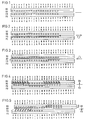
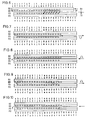
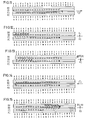
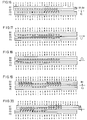
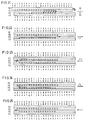
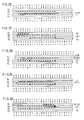
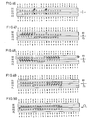
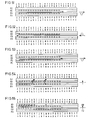
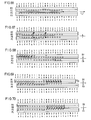
- Fig.1 to 73 illustrate a series of courses for knitting procedure, in which the lower front needle bed is denoted by FD, the upper front needle bed by FU, the lower rear needle bed by BD, the upper rear needle bed by BU. Also the alphabetical letters A to Z represent knitting needles on the lower needle beds and the small letters a to z represent knitting needles on the upper needle beds.
- each knitted fabric is fabricated by plain knitting with the use of a minimum number of the knitting needles for ease of description.
- a tubular fabric shaped symmetrical front to rear is knitted using a thread of yarn fed in the counter-clockwise direction.
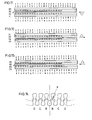
- the number of wales of a front half of the fabric is first reduced in steps to shorten the circumferential length and then, increased thus forming a constricted part of the tubular fabric along a waistline, as shown in Fig.75.
- a straight portion of the tubular fabric is produced by coupling both side ends to each other which are hanged on the knitting needles (A and T) of their respective lower needle beds FD and BD, as shown in Fig.2.
- the repeating of the courses of Figs.2 and 3 is for decrease in at least every two courses in order to avert twisting of loops during transfer from needles to other needles.
- the two rear needle beds BD,BU are moved one knitting needle distance to the right by racking and the loops on the knitting needles a to g of the upper rear needle bed BU are transferred onto the knitting needles B to H of the lower front needle bed FD so that two loops of the yarn overlap with each other on the knitting needle H of the lower front needle bed FD.
- the two rear needle beds BD,BU are moved back one knitting needle distance to the left by racking and the loops on the knitting needles n to t of the lower rear needle bed BD are transferred onto the knitting needles M to S of the lower front needle bed FD so that the loop from the knitting needle n of the lower rear needle bed BD can be placed over the loop hanged on the knitting needle M of the lower front needle bed FD, as shown in Fig.6.
- the yarn is fed to form loops on the knitting needles B to S of the lower front needle bed FD. Accordingly, the loops hanged on the knitting needles A to T of the lower front needle bed FD shown in Fig.1 are reduced by two to hang on the knitting needles B to S.
- the feeder which forms a loop on the knitting needle A of the lower rear needle bed BD is displaced out from the knitting area of the machine and then, the yarn is fed to form a row of loops on the knitting needles B to S of the lower front needle bed FD, as shown in Fig.11, while the knitting needle T remains unoccupied where the yarn is tucked.
- the loops on the knitting needles B to G of the lower front needle bed FD are transferred onto the knitting needles b to g of the upper rear needle bed BU, as shown in Fig.12.
- the two rear needle beds BD,BU are moved one knitting needle distance to the right, as shown in Fig.13, and the loops on the knitting needles b to g of the upper rear needle bed BU are transferred onto the knitting needles C to H of the lower front needle bed FD so that two loops of the yarn overlap with each other on the knitting needle H of the lower front needle bed FD.
- the loop on the knitting needle A of the lower rear needle bed BD is transferred onto the knitting needle B of the lower front needle bed FD.
- the two rear needle beds BD,BU are then returned one knitting needle distance to the left and the yarn is fed to form a further row of loops on the knitting needles S to B of the lower rear needle bed BD.
- the loops on the knitting needles N to S of the lower front needle bed FD are transferred onto the knitting needles n to s of the upper rear needle bed BU, as shown in Fig.15, and also, the tucked yarn shown in Fig.11 is transferred onto the knitting needle T of the lower rear needle bed BD.
- the loops are transferred as knocked over across the loop transferred from the knitting needle T of the lower front needle bed FD to the knitting needle T of the lower rear needle bed BD.
- the knitting needles for receiving the loops should be arranged to move upward to a height where the loops to be transferred can clear over the distal end of the opening latch of each knitting needle.
- the loops to be transferred shall be arranged to ride over the slider during the upward movement of the knitting needles for receiving the loops and when the knitting needles move backward, slide on the slider to be knocked over across the tucked yarn.
- the two rear needle bed BD,BU are moved one knitting needle distance to the left by racking and the loops on the knitting needles n to s of the upper rear needle bed BU are transferred onto the knitting needles M to R of the lower front needle bed FD so that two loops overlap with each other on the knitting needle M of the lower front needle bed FD.
- the loop on the knitting needle T of the lower rear needle bed is transferred onto the knitting needle S of the lower front needle bed FD.
- the yarn on the knitting needle T of the lower rear needle bed BD which was not looped at the step of Fig.14 is threaded through the loop carried on the knitting needle T of the lower rear needle bed BD for transfer to the knitting needle S of the lower front needle bed FD.
- the tucked yarn on the knitting needle T of the lower front needle bed FD becomes a loop of the tubular knitted fabric in the end, as shown in Fig.16, like as the other loops.
- the feeding length of the tucked yarn is preferably equal to the yarn length which forms a unit loop or stitch.
- the yarn is fed to form a row of loops on the knitting needles B to S of the lower front needle bed FD, as shown in Fig.17, and in turn, another row of loops on the knitting needles S to B of the lower rear needle bed BD, as shown in Fig.18.
- This action shown in Figs.17 and 18 is repeated once more.
- the loops on the knitting needles B to G and N to S of the lower front needle bed FD are then transferred onto the corresponding knitting needles b to g and n to s of the upper rear needle bed BU.
- the two rear needle beds BD,BU are moved one knitting needle distance to the right by racking and the loops on the knitting needles b to g of the upper rear needle bed BU are transferred onto the knitting needles C to H of the lower front needle bed FD so that two loops overlap with each other on the knitting needle H of the lower front needle bed FD, as shown in Fig.20.
- the two rear needle beds BD,BU are moved back one knitting needle distance to the left by racking and the loops on the knitting needles n to s of the lower rear needle bed BD are transferred onto the knitting needles M to R of the lower front needle bed FD so that the loop from the knitting needle n of the lower rear needle bed BD is placed over the loop on the knitting needle M of the lower front needle bed FD, as shown in Fig.21.
- the yarn is fed to from a row of loops on the knitting needles C to R of the lower front needle bed FD. Accordingly, the row of loops on the knitting needles C to R is two loops less than the preceding row of the loops on the knitting needles B to S of the lower front needle bed FD shown in Fig.18.
- the yarn is fed from right to left to form a row of loops on the knitting needles S to C of the lower rear needle bed BD, as shown in Fig.23, and then threaded in a reverse direction to form another row of loops starting from the knitting needle B of the lower rear needle bed BD, as shown in Fig.24.
- the feeder after threading through the knitting needle A of the lower rear needle bed BD is removed out to the left from the knitting area, as shown in Fig.25, and the yarn is fed to from a row of loops on the knitting needles C to R of the lower front needle bed FD, as shown in Fig.26, while the knitting needle S remains unoccupied where the yarn is tucked.
- the loops on the knitting needles C to G of the lower front needle bed FD are transferred onto the knitting needles c to g of the upper rear needle bed BU.
- the two rear needle beds BD,BU are displaced one knitting needle distance to the right by racking and the loops on the knitting needles c to g of the upper rear needle bed BU are transferred onto the knitting needles D to H of the lower front needle bed FD so that two loops overlap with each other on the knitting needle H, as shown in Fig.28.
- the loop on the knitting needle B of the lower rear needle bed BD is transferred onto the knitting needle B of the lower front needle bed FD.
- the two rear needle beds BD,BU are moved back to the left by one knitting needle distance and the yarn is fed to from a row of loops on the knitting needles R to C of the lower rear needle bed BD, as shown in Fig.29.
- the loops on the knitting needles N to R of the lower front needle bed FD are transferred onto the knitting needles n to r of the upper rear needle bed BU.
- the tucked yarn shown in Fig.26 is transferred onto the knitting needle S of the lower rear needle bed BD.
- the loops to the knitting needles of the lower rear needle bed BU are knocked over across the tucked loop transferred from the needle bed FD to the needle bed BD in the same manner as described previously.
- the two rear needle beds BD,BU are moved one knitting needle distance to the left by racking and the loops on the knitting needles n to r of the upper rear needle bed BU are transferred onto the knitting needles M to Q of the lower front needle bed FD so that two loops overlap with each other on the knitting needle M of the lower front needle bed FD, as shown in Fig.31.
- the procedure shown in Figs.1 to 31 is repeated a given number of times to reduce the circumferential length of the tubular knitted fabric. Then, the yarn is fed to from a row of loops on the knitting needles C to R of the lower front needle bed FD, as shown in Fig.32. In succession, the number of wales is increased in the procedure from Fig.33. More specifically, the two loops are transferred by split stitch from the knitting needles H and M of the lower front needle bed FD to the knitting needles h and m of the upper rear needle bed BU respectively, as shown in Fig.33. Then, the loops on the knitting needles C to G of the lower front needle bed FD are transferred onto the knitting needles c to g of the upper rear needle bed BU, as shown in Fig.34.
- the two rear needle bed BD,BU are moved one knitting needle distance to the left by racking and the loops on the knitting needles c to h of the upper rear needle bed BU are transferred onto the knitting needles B to G of the lower front needle bed FD. Simultaneously, the loops on the knitting needles M to R of the lower front needle bed FD are transferred onto the knitting needles n to s of the upper rear needle bed BU.
- the two rear needle beds BD,BU are moved back to the right by the same distance and the loops on the knitting needles m to s of the upper rear needle bed BU are transferred onto the knitting needles M to S of the lower front needle bed FD, as shown in Fig.36.
- the yarn is fed to form a row of loops on the knitting needles R to C of the lower rear needle bed BD and its end is tucked on the knitting needle B which remains unoccupied, as shown in Fig.37. Then, the yarn is fed to form a row of loops on the knitting needles C to R of the lower front needle bed FD, as shown in Fig.38.
- the tucked yarn on the knitting needle B of the lower rear needle bed BD is transferred onto the knitting needle B of the lower front needle bed FD. It is then transferred back to the knitting needle B of the lower rear needle bed BD, as shown in Fig.40.
- the yarn from the feeder is threaded from right to left to form a loop on the knitting needle S of the lower front needle bed FD, as shown in Fig.41.
- the feeder is removed out from the knitting area, as shown in Fig.42, and the yarn is fed to form a row of loops on the knitting needles R to B of the lower rear needle bed BD, as shown in Fig.43.
- the loop on the knitting needle S of the lower front needle bed FD is transferred onto the knitting needle S of the lower rear needle bed BD, as shown in Fig.44, and the yarn is fed to form another row of loops on the knitting needles C to R of the lower front needle bed FD, as shown in Fig.45.
- the number of the wales is increased by two as the loops on the knitting needles C to R of the needle bed BD turn to those on the knitting needles B to S.
- the two loops on the knitting needles H and M of the lower front needle bed FD are transferred by split stitch onto the knitting needle h and m of the upper rear needle bed BU respectively, as shown in Fig.46. Then, the loops on the knitting needles C to G of the lower front needle bed FD are transferred onto the knitting needles c to g of the upper rear needle bed BU, as shown in Fig.47.
- the two rear needle beds BD,BU are moved one knitting needle distance to the left by racking and the loops on the knitting needles c to h of the upper rear needle bed BU are transferred onto the knitting needles B to G of the lower front needle bed FD, as shown in Fig.48. Simultaneously, the loops on the knitting needles M to R of the lower front needle bed FD are transferred onto the knitting needles n to s of the upper rear needle bed BU. In succession, the two rear needle beds BD,BU are moved back by one knitting needle distance to the right and the loops on the knitting needles m to s of the upper rear needle bed BU are transferred onto the knitting needles M to S of the lower front needle bed FD, as shown in Fig.49.
- the yarn is fed to form a row of loops on the knitting needles S to B of the lower rear needle bed BD. Then, the yarn is further fed to form another row of loops on the knitting needles B to S of the lower front needle bed FD, as shown in Fig.51, and also, threaded to form a further row of loops on the knitting needles S to B of the lower rear needle bed BD, as shown in Fig.52. Finally, the yarn is fed to form a row of loops on the knitting needles B to S of the lower front needle bed FD, as shown in Fig.53.
- the two loops on the knitting needles H and M of the lower front needle bed FD are transferred by split stitch onto the knitting needle h and m of the upper rear needle bed BU respectively, as shown in Fig.54.
- the loops on the knitting needles B to G of the lower front needle bed FD are transferred onto the knitting needles b to g of the upper rear needle bed BU, as shown in Fig.55.
- the two rear needle beds BD,BU are moved one knitting needle distance to the left by racking and the loops on the knitting needles b to h of the upper rear needle bed BU are transferred onto the knitting needles A to G of the lower front needle bed FD, as shown in Fig.56. Simultaneously, the loops on the knitting needles M to S of the lower front needle bed FD are transferred onto the knitting needles n to t of the upper rear needle bed BU. In succession, the two rear needle beds BD,BU are moved back by one knitting needle distance to the right and the loops on the knitting needles m to t of the upper rear needle bed BU are transferred onto the knitting needles M to T of the lower front needle bed FD, as shown in Fig.57.
- the yarn is fed to form a row of loops on the knitting needles S to B of the lower rear needle bed BD and its end is tucked on the knitting needle A which remains unoccupied.
- the yarn is then fed to form a row of loops on the knitting needles B to S of the lower front needle bed FD, as shown in Fig.59.
- the tucked yarn on the knitting needle A of the lower rear needle bed BD shown in Fig.58 is transferred onto the knitting needle A of the lower front needle bed FD, as shown in Fig.60. It is then transferred back to the knitting needle A of the lower rear needle bed BD, as shown in Fig.62.
- the yarn from the feeder is threaded from right to left to form a loop on the knitting needle T of the lower front needle bed FD, as shown in Fig.62.
- the feeder is rightwardly removed out from the knitting area, as shown in Fig.63, and the yarn is fed to form a row of loops on the knitting needles S to A of the lower rear needle bed BD, as shown in Fig.64.
- the loop on the knitting needle T of the lower front needle bed FD is transferred onto the knitting needle T of the lower rear needle bed BD, as shown in Fig.65, and the yarn is fed to form another row of loops on the knitting needles B to S of the lower front needle bed FD, as shown in Fig.66.
- the number of the wales is further increased by two as the loops on the knitting needles B to S of the needle bed BD turn to those on the knitting needles A to T.
- the two loops on the knitting needles H and M of the lower front needle bed FD are transferred by split stitch onto the knitting needle h and m of the upper rear needle bed BU respectively, as shown in Fig.67.
- the loops on the knitting needles B to G of the lower front needle bed FD are transferred onto the knitting needles b to g of the upper rear needle bed BU, as shown in Fig.68.
- the two rear needle beds BD,BU are moved one knitting needle distance to the left by racking and the loops on the knitting needles b to h of the upper rear needle bed BU are transferred onto the knitting needles A to G of the lower front needle bed FD, as shown in Fig.69. Simultaneously, the loops on the knitting needles M to S of the lower front needle bed FD are transferred onto the knitting needles n to t of the upper rear needle bed BU. In succession, the two rear needle beds BD,BU are moved back by one knitting needle distance to the right and the loops on the knitting needles m to t of the upper rear needle bed BU are transferred onto the knitting needles M to T of the lower front needle bed FD, as shown in Fig.70.
- the yarn is fed to form a row of loops on the knitting needles T to A of the lower rear needle bed BD. Then, the yarn is further fed to form another row of loops on the knitting needles A to T of the lower front needle bed FD, as shown in Fig.72, and also, threaded to form a further row of loops on the knitting needles T to A of the lower rear needle bed BD, as shown in Fig.73.
- the resultant tubular knitted fabric has a front-to-back asymmetrical shape in which the front half is composed of a less number of wales, as best shown in Fig.75.
- the back half has both side ends extending to the front for joining to the front half.
- the two front needle beds FD,FU may be moved by racking although the racking movement of the two rear needle beds BD,BU only is implemented in the embodiment.
- the waist constricted part of the tubular fabric is knitted by decreasing the number of wales at both the side ends of the front half, it may be produced by decreasing the number of wales at one side end of the front half, as shown in Fig.76, by increasing the number of wales at the side end of the same, as shown in Fig.77, or by increasing the number of wales at the two side ends and then, decreasing the same for forming extensions, as shown in Fig.77.
- a three-dimensional silhouette form of the tubular fabric may be produced using any combination of the foregoing techniques.
Landscapes
- Engineering & Computer Science (AREA)
- Textile Engineering (AREA)
- Knitting Machines (AREA)
- Knitting Of Fabric (AREA)
- Looms (AREA)
- Woven Fabrics (AREA)
Applications Claiming Priority (2)
| Application Number | Priority Date | Filing Date | Title |
|---|---|---|---|
| JP192652/91 | 1991-07-05 | ||
| JP3192652A JPH0781228B2 (ja) | 1991-07-05 | 1991-07-05 | 立体的なシルエットを有する筒状編地及びその編成方法 |
Publications (2)
| Publication Number | Publication Date |
|---|---|
| EP0522778A1 EP0522778A1 (en) | 1993-01-13 |
| EP0522778B1 true EP0522778B1 (en) | 1997-08-13 |
Family
ID=16294805
Family Applications (1)
| Application Number | Title | Priority Date | Filing Date |
|---|---|---|---|
| EP92306056A Expired - Lifetime EP0522778B1 (en) | 1991-07-05 | 1992-06-30 | Tubular knitted fabric having a three-dimensional silhouette shape and method of knitting the same |
Country Status (6)
| Country | Link |
|---|---|
| EP (1) | EP0522778B1 (enExample) |
| JP (1) | JPH0781228B2 (enExample) |
| KR (1) | KR100205192B1 (enExample) |
| CN (1) | CN1045114C (enExample) |
| DE (1) | DE69221557T2 (enExample) |
| ES (1) | ES2106832T3 (enExample) |
Cited By (3)
| Publication number | Priority date | Publication date | Assignee | Title |
|---|---|---|---|---|
| EP3572570B1 (de) | 2018-05-23 | 2022-05-18 | BSN-Jobst GmbH | Kompressionsartikel |
| US11959205B2 (en) | 2019-04-12 | 2024-04-16 | Essity Hygiene And Health Aktiebolag | Method to produce a double-layer knitted fabric |
| WO2025021276A1 (en) * | 2023-07-21 | 2025-01-30 | Essity Hygiene And Health Aktibolag | Method of manufacturing a compression garment and compression garment |
Families Citing this family (24)
| Publication number | Priority date | Publication date | Assignee | Title |
|---|---|---|---|---|
| JPH0751998A (ja) * | 1993-08-09 | 1995-02-28 | Fanuc Ltd | 工具の寿命推定方法 |
| DE19616003A1 (de) * | 1996-04-18 | 1997-10-23 | Beckmann Wolfgang Dr | Spickeln/Zunehmen/Mindern |
| DE19653315A1 (de) * | 1996-12-20 | 1998-06-25 | Stoll & Co H | Verfahren zur Verbindung zweier oder mehrerer auf einer Zweibett-Flachstrickmaschine hergestellter schlauchfömiger Gestricke |
| JP3121283B2 (ja) * | 1997-03-26 | 2000-12-25 | 株式会社島精機製作所 | 筒状編地の編成方法 |
| US6212149B1 (en) | 1997-11-21 | 2001-04-03 | Rohm Co., Ltd. | Modified light-receiving element in an optical pickup for reading optical discs |
| WO2000028121A1 (fr) * | 1998-11-10 | 2000-05-18 | Shima Seiki Mfg.,Ltd. | Procede de tricotage d'un tricot tridimensionnel |
| DE19924503A1 (de) * | 1999-05-28 | 2000-11-30 | Stoll & Co H | Verfahren zur Herstellung von Schlauchgestricken auf einer Flachstrickmaschine |
| DE19962032A1 (de) * | 1999-12-22 | 2001-06-28 | Stoll & Co H | Verfahrung zur Bildung neuer Maschen auf einer Strickmaschine |
| FR2806102B1 (fr) * | 2000-03-08 | 2002-05-24 | Terrot | Article tricote, notamment body, et procede de fabrication |
| JP4285955B2 (ja) | 2001-09-07 | 2009-06-24 | 三洋電機株式会社 | ホログラム光学素子、位置ずれ検出装置および光学記録媒体駆動装置 |
| JP4374310B2 (ja) * | 2004-12-01 | 2009-12-02 | 株式会社島精機製作所 | 編地の編成方法 |
| JP4336306B2 (ja) | 2004-12-28 | 2009-09-30 | 株式会社島精機製作所 | 筒状編地の編成方法 |
| JP4852092B2 (ja) * | 2006-02-28 | 2012-01-11 | 株式会社島精機製作所 | 増し目を形成する方法および編地の編幅方向端部よりも内側に増し目が形成されている編地 |
| JP5567556B2 (ja) * | 2009-05-08 | 2014-08-06 | 株式会社島精機製作所 | 筒状編地の編成方法、および筒状編地 |
| DE102011012767A1 (de) * | 2010-09-18 | 2012-03-22 | H. Stoll Gmbh & Co. Kg | Verfahren zur Herstellung eines Schlauchgestricks |
| JP5719584B2 (ja) * | 2010-12-24 | 2015-05-20 | 株式会社島精機製作所 | 多層構造の編地の編成方法 |
| CN102605527B (zh) * | 2012-03-15 | 2014-05-28 | 东华大学 | 一种葡萄状立体花形的编织结构 |
| JP6025484B2 (ja) | 2012-10-03 | 2016-11-16 | 株式会社島精機製作所 | 伏目方法、および編地 |
| JP2014227611A (ja) * | 2013-05-17 | 2014-12-08 | 株式会社島精機製作所 | リブ風編地の編成方法、およびリブ風編地 |
| JP2015110849A (ja) | 2013-12-06 | 2015-06-18 | 株式会社島精機製作所 | 編地の編成方法 |
| CN106480592B (zh) * | 2016-12-29 | 2018-12-04 | 湖州汉和制衣有限公司 | 一种立体毛衣编织结构及其编织方法 |
| DE102018219464A1 (de) | 2017-11-15 | 2019-05-16 | Shima Seiki Mfg., Ltd. | Gestrick mit einer tasche und verfahren zum herstellen des gestricks mit einer tasche |
| CN113604952B (zh) * | 2021-09-07 | 2022-10-11 | 江南大学 | 一种针对底面较宽的全成形立方体织物的织造工艺 |
| CN119194721A (zh) * | 2024-11-05 | 2024-12-27 | 江苏华宜医用新材料有限公司 | 一种利用四针床横机织造三维管状织物的方法 |
Family Cites Families (4)
| Publication number | Priority date | Publication date | Assignee | Title |
|---|---|---|---|---|
| US3668898A (en) * | 1968-09-23 | 1972-06-13 | Courtaulds Ltd | Knitting methods |
| GB1343110A (en) * | 1971-04-19 | 1974-01-10 | Courtaulds Ltd | Knitting machine and method |
| JPH02229248A (ja) * | 1989-03-03 | 1990-09-12 | Shima Seiki Seisakusho:Kk | 筒状編地の編成方法 |
| DE4107316C1 (enExample) * | 1991-03-07 | 1992-05-27 | Universal Maschinenfabrik Dr. Rudolf Schieber Gmbh & Co Kg, 7084 Westhausen, De |
-
1991
- 1991-07-05 JP JP3192652A patent/JPH0781228B2/ja not_active Expired - Lifetime
-
1992
- 1992-06-30 KR KR1019920011514A patent/KR100205192B1/ko not_active Expired - Fee Related
- 1992-06-30 DE DE69221557T patent/DE69221557T2/de not_active Expired - Lifetime
- 1992-06-30 ES ES92306056T patent/ES2106832T3/es not_active Expired - Lifetime
- 1992-06-30 EP EP92306056A patent/EP0522778B1/en not_active Expired - Lifetime
- 1992-07-05 CN CN92108822A patent/CN1045114C/zh not_active Expired - Lifetime
Cited By (5)
| Publication number | Priority date | Publication date | Assignee | Title |
|---|---|---|---|---|
| EP3572570B1 (de) | 2018-05-23 | 2022-05-18 | BSN-Jobst GmbH | Kompressionsartikel |
| US11952686B2 (en) | 2018-05-23 | 2024-04-09 | Essity Hygiene And Health Aktiebolag | Compression article |
| US12421635B2 (en) | 2018-05-23 | 2025-09-23 | Essity Hygiene And Health Aktiebolag | Compression article |
| US11959205B2 (en) | 2019-04-12 | 2024-04-16 | Essity Hygiene And Health Aktiebolag | Method to produce a double-layer knitted fabric |
| WO2025021276A1 (en) * | 2023-07-21 | 2025-01-30 | Essity Hygiene And Health Aktibolag | Method of manufacturing a compression garment and compression garment |
Also Published As
| Publication number | Publication date |
|---|---|
| DE69221557T2 (de) | 1997-12-18 |
| DE69221557D1 (de) | 1997-09-18 |
| JPH0781228B2 (ja) | 1995-08-30 |
| JPH059851A (ja) | 1993-01-19 |
| ES2106832T3 (es) | 1997-11-16 |
| KR100205192B1 (ko) | 1999-07-01 |
| EP0522778A1 (en) | 1993-01-13 |
| CN1045114C (zh) | 1999-09-15 |
| KR930002572A (ko) | 1993-02-23 |
| CN1069785A (zh) | 1993-03-10 |
Similar Documents
| Publication | Publication Date | Title |
|---|---|---|
| EP0522778A1 (en) | Tubular knitted fabric having a three-dimensional silhouette shape and method of knitting the same | |
| US6766667B2 (en) | Knitted fabric having open part and knitting method therefor | |
| US3474643A (en) | Knitting process | |
| US6286340B1 (en) | Knitting method for knit clothing | |
| EP0468687A1 (en) | Method for processing end portion of fabric | |
| US6889530B2 (en) | Method of forming gusset and knitwear comprising gusset formed | |
| US7577488B2 (en) | Knitting method of knitted fabric | |
| GB2228750A (en) | Knitting tubular fabric with fashion lines on a flat machine | |
| EP0462822A2 (en) | Method of making joined fabric | |
| US5692399A (en) | Method of knitting fabric having three-dimensional silhouette shape | |
| US6748770B2 (en) | Method of linking tubular knitted fabrics together and knitted fabric therefor | |
| EP0533612A3 (en) | Process for knitting a seamless garment on flat knitting machines | |
| US20040112094A1 (en) | Method of knitting neck portion of knit wear by flat knitting machine and the knit wear | |
| EP1887116B1 (en) | Knitting method for knitting fabric and knitted product | |
| EP0460915A1 (en) | Fabric connecting method and fabric having stylish joins | |
| US6655175B1 (en) | Method for joining knitted fabrics and joined knitted fabrics | |
| EP2385160B1 (en) | Knitting method of tubular knitted fabric | |
| GB1580455A (en) | Knitting method | |
| US5537843A (en) | Rib knitting method that provides cross-over yarns | |
| JP2573101B2 (ja) | ニット製品におけるボタンホールの編成方法 | |
| EP1829995B1 (en) | Knitwear knitted by weft knitting machine and method of knitting the same | |
| GB1574736A (en) | Method of machine knitting of a clothing blank | |
| EP0466439B1 (en) | Cast on method for knitting and knitted fabric formed by the same | |
| US7168271B2 (en) | Method of knitting knit-wear having front neck and knit-wear having front neck | |
| JPH1072746A (ja) | 継目なしに開かれるか又は閉じられて縁で結合される平編地を製造する方法 |
Legal Events
| Date | Code | Title | Description |
|---|---|---|---|
| PUAI | Public reference made under article 153(3) epc to a published international application that has entered the european phase |
Free format text: ORIGINAL CODE: 0009012 |
|
| AK | Designated contracting states |
Kind code of ref document: A1 Designated state(s): DE ES FR GB IT |
|
| 17P | Request for examination filed |
Effective date: 19930423 |
|
| RIN1 | Information on inventor provided before grant (corrected) |
Inventor name: OKUNO, MASAO Inventor name: TAKAHASHI, NOBUYASU |
|
| 17Q | First examination report despatched |
Effective date: 19950411 |
|
| GRAG | Despatch of communication of intention to grant |
Free format text: ORIGINAL CODE: EPIDOS AGRA |
|
| GRAH | Despatch of communication of intention to grant a patent |
Free format text: ORIGINAL CODE: EPIDOS IGRA |
|
| GRAH | Despatch of communication of intention to grant a patent |
Free format text: ORIGINAL CODE: EPIDOS IGRA |
|
| ITF | It: translation for a ep patent filed | ||
| GRAA | (expected) grant |
Free format text: ORIGINAL CODE: 0009210 |
|
| AK | Designated contracting states |
Kind code of ref document: B1 Designated state(s): DE ES FR GB IT |
|
| REF | Corresponds to: |
Ref document number: 69221557 Country of ref document: DE Date of ref document: 19970918 |
|
| REG | Reference to a national code |
Ref country code: ES Ref legal event code: FG2A Ref document number: 2106832 Country of ref document: ES Kind code of ref document: T3 |
|
| ET | Fr: translation filed | ||
| PLBE | No opposition filed within time limit |
Free format text: ORIGINAL CODE: 0009261 |
|
| STAA | Information on the status of an ep patent application or granted ep patent |
Free format text: STATUS: NO OPPOSITION FILED WITHIN TIME LIMIT |
|
| 26N | No opposition filed | ||
| REG | Reference to a national code |
Ref country code: GB Ref legal event code: IF02 |
|
| PGFP | Annual fee paid to national office [announced via postgrant information from national office to epo] |
Ref country code: ES Payment date: 20070717 Year of fee payment: 16 |
|
| PGFP | Annual fee paid to national office [announced via postgrant information from national office to epo] |
Ref country code: GB Payment date: 20070627 Year of fee payment: 16 |
|
| PGFP | Annual fee paid to national office [announced via postgrant information from national office to epo] |
Ref country code: FR Payment date: 20070608 Year of fee payment: 16 |
|
| GBPC | Gb: european patent ceased through non-payment of renewal fee |
Effective date: 20080630 |
|
| REG | Reference to a national code |
Ref country code: FR Ref legal event code: ST Effective date: 20090228 |
|
| PG25 | Lapsed in a contracting state [announced via postgrant information from national office to epo] |
Ref country code: GB Free format text: LAPSE BECAUSE OF NON-PAYMENT OF DUE FEES Effective date: 20080630 |
|
| REG | Reference to a national code |
Ref country code: ES Ref legal event code: FD2A Effective date: 20080701 |
|
| PG25 | Lapsed in a contracting state [announced via postgrant information from national office to epo] |
Ref country code: FR Free format text: LAPSE BECAUSE OF NON-PAYMENT OF DUE FEES Effective date: 20080630 |
|
| PG25 | Lapsed in a contracting state [announced via postgrant information from national office to epo] |
Ref country code: ES Free format text: LAPSE BECAUSE OF NON-PAYMENT OF DUE FEES Effective date: 20080701 |
|
| PGFP | Annual fee paid to national office [announced via postgrant information from national office to epo] |
Ref country code: IT Payment date: 20110624 Year of fee payment: 20 |
|
| PGFP | Annual fee paid to national office [announced via postgrant information from national office to epo] |
Ref country code: DE Payment date: 20110622 Year of fee payment: 20 |
|
| REG | Reference to a national code |
Ref country code: DE Ref legal event code: R071 Ref document number: 69221557 Country of ref document: DE |
|
| REG | Reference to a national code |
Ref country code: DE Ref legal event code: R071 Ref document number: 69221557 Country of ref document: DE |
|
| PG25 | Lapsed in a contracting state [announced via postgrant information from national office to epo] |
Ref country code: DE Free format text: LAPSE BECAUSE OF EXPIRATION OF PROTECTION Effective date: 20120703 |