EP0490281B1 - 3'- Amino- oder thiolmodifizierte, Fluoreszenzfarbstoff-gekoppelte Nukleoside, Nukleotide und Oligonukleotide sowie ein Verfahren zur Herstellung und ihre Verwendung - Google Patents
3'- Amino- oder thiolmodifizierte, Fluoreszenzfarbstoff-gekoppelte Nukleoside, Nukleotide und Oligonukleotide sowie ein Verfahren zur Herstellung und ihre Verwendung Download PDFInfo
- Publication number
- EP0490281B1 EP0490281B1 EP91120935A EP91120935A EP0490281B1 EP 0490281 B1 EP0490281 B1 EP 0490281B1 EP 91120935 A EP91120935 A EP 91120935A EP 91120935 A EP91120935 A EP 91120935A EP 0490281 B1 EP0490281 B1 EP 0490281B1
- Authority
- EP
- European Patent Office
- Prior art keywords
- amino
- synthesis
- group
- formula
- oligonucleotide
- Prior art date
- Legal status (The legal status is an assumption and is not a legal conclusion. Google has not performed a legal analysis and makes no representation as to the accuracy of the status listed.)
- Expired - Lifetime
Links
Classifications
-
- C—CHEMISTRY; METALLURGY
- C07—ORGANIC CHEMISTRY
- C07H—SUGARS; DERIVATIVES THEREOF; NUCLEOSIDES; NUCLEOTIDES; NUCLEIC ACIDS
- C07H19/00—Compounds containing a hetero ring sharing one ring hetero atom with a saccharide radical; Nucleosides; Mononucleotides; Anhydro-derivatives thereof
- C07H19/02—Compounds containing a hetero ring sharing one ring hetero atom with a saccharide radical; Nucleosides; Mononucleotides; Anhydro-derivatives thereof sharing nitrogen
- C07H19/04—Heterocyclic radicals containing only nitrogen atoms as ring hetero atom
- C07H19/16—Purine radicals
- C07H19/20—Purine radicals with the saccharide radical esterified by phosphoric or polyphosphoric acids
-
- C—CHEMISTRY; METALLURGY
- C07—ORGANIC CHEMISTRY
- C07H—SUGARS; DERIVATIVES THEREOF; NUCLEOSIDES; NUCLEOTIDES; NUCLEIC ACIDS
- C07H21/00—Compounds containing two or more mononucleotide units having separate phosphate or polyphosphate groups linked by saccharide radicals of nucleoside groups, e.g. nucleic acids
-
- C—CHEMISTRY; METALLURGY
- C12—BIOCHEMISTRY; BEER; SPIRITS; WINE; VINEGAR; MICROBIOLOGY; ENZYMOLOGY; MUTATION OR GENETIC ENGINEERING
- C12Q—MEASURING OR TESTING PROCESSES INVOLVING ENZYMES, NUCLEIC ACIDS OR MICROORGANISMS; COMPOSITIONS OR TEST PAPERS THEREFOR; PROCESSES OF PREPARING SUCH COMPOSITIONS; CONDITION-RESPONSIVE CONTROL IN MICROBIOLOGICAL OR ENZYMOLOGICAL PROCESSES
- C12Q1/00—Measuring or testing processes involving enzymes, nucleic acids or microorganisms; Compositions therefor; Processes of preparing such compositions
- C12Q1/68—Measuring or testing processes involving enzymes, nucleic acids or microorganisms; Compositions therefor; Processes of preparing such compositions involving nucleic acids
- C12Q1/6813—Hybridisation assays
-
- C—CHEMISTRY; METALLURGY
- C12—BIOCHEMISTRY; BEER; SPIRITS; WINE; VINEGAR; MICROBIOLOGY; ENZYMOLOGY; MUTATION OR GENETIC ENGINEERING
- C12Q—MEASURING OR TESTING PROCESSES INVOLVING ENZYMES, NUCLEIC ACIDS OR MICROORGANISMS; COMPOSITIONS OR TEST PAPERS THEREFOR; PROCESSES OF PREPARING SUCH COMPOSITIONS; CONDITION-RESPONSIVE CONTROL IN MICROBIOLOGICAL OR ENZYMOLOGICAL PROCESSES
- C12Q1/00—Measuring or testing processes involving enzymes, nucleic acids or microorganisms; Compositions therefor; Processes of preparing such compositions
- C12Q1/68—Measuring or testing processes involving enzymes, nucleic acids or microorganisms; Compositions therefor; Processes of preparing such compositions involving nucleic acids
- C12Q1/6813—Hybridisation assays
- C12Q1/6816—Hybridisation assays characterised by the detection means
-
- Y—GENERAL TAGGING OF NEW TECHNOLOGICAL DEVELOPMENTS; GENERAL TAGGING OF CROSS-SECTIONAL TECHNOLOGIES SPANNING OVER SEVERAL SECTIONS OF THE IPC; TECHNICAL SUBJECTS COVERED BY FORMER USPC CROSS-REFERENCE ART COLLECTIONS [XRACs] AND DIGESTS
- Y02—TECHNOLOGIES OR APPLICATIONS FOR MITIGATION OR ADAPTATION AGAINST CLIMATE CHANGE
- Y02P—CLIMATE CHANGE MITIGATION TECHNOLOGIES IN THE PRODUCTION OR PROCESSING OF GOODS
- Y02P20/00—Technologies relating to chemical industry
- Y02P20/50—Improvements relating to the production of bulk chemicals
- Y02P20/55—Design of synthesis routes, e.g. reducing the use of auxiliary or protecting groups
Definitions
- Labeled oligonucleotides have found an extremely large number of applications in genetic engineering, since their handling is easier than that of the DNA probes which are conventionally used as hybridization samples and which are produced by restriction digestion from native genetic material.
- Labeled oligonucleotides which are used in the form of so-called “antisense” DNA oligonucleotides, can intervene regulatingly in the cell process and thus gain z. B. for the in vivo investigation of the expression of proteins increasingly important. According to current knowledge, the mechanism is based on DNA-DNA, DNA-RNA and RNA-RNA interactions, but has not yet been clarified in detail.
- Labeled oligonucleotides serve in vitro e.g. B. the identification of gene fragments within a gene bank by probing and identifying blotted gene samples from the gene bank with the aid of the labeled oligonucleotide.
- oligonucleotides In order to be able to carry out such experiments in vitro or in vivo, the oligonucleotides must be labeled, as already mentioned.
- derivatized fluorescent dyes are used as a form of non-radioactive labeling, which offer the possibility of easier and safer handling.
- WO 88/00201 discloses fluorescent dye-labeled oligonucleotides in the 2 'or 5' position which are prepared from the corresponding oligonucleotides which are amino-substituted in the 2 'or 5' position.
- the fluorescence label is either on the 5 'end of the oligonucleotide (LE Hood, LM Smith and C. Heiner, Nature 321, 674 (1986)) or on the nucleobase (JM Prober, GL Trainor and RJ Dam, Science 238, 336 (1987 )) attached (GL Trainor, Anal. Chem. 62, 418 (1990)).
- a crucial disadvantage of the last-mentioned method resides in the fact that the fluorescence label during synthesis, i.e. H. is introduced during the polymerization and here specifically during the enzymatic polymerization. The consequence of this process step is that only a few polymerases can still be used for the synthesis, that the acceptance of the triphosphates by the polymerases decreases and that a strong excess of substrate is also necessary.
- fluorescence label is not limited to Sanger sequencing.
- Chemical sequencing according to Maxam-Gilbert with a fluorescence label is also known (H. Voss, C. Schwager, U. Wirkner, B. Sproat, J. Zimmermann, A. Rosenthal, H. Erfle, J. Stegemann and W. Ansorge, Nucl Acids Res. 17: 2517 (1989)).
- a fluorescent dye is coupled via an amino or thiol group in the 3 'position (in the ⁇ or ⁇ position) of a nucleoside, nucleotide or oligonucleotide and this compound is advantageous for the synthesis of counterstrands in the presence of a template strand or of Oligonucleotides and for the detection of genetic material in vivo and in vitro can be used.
- a coupling of the dye at the 3 'position is based on a compound of the formula II, preferably a nucleoside.
- a leaving group is introduced in the 3 'position.
- the leaving group is preferably triflate or mesylate or tosylate.
- the azide is introduced by a nucleophilic attack with azide, preferably lithium azide.
- the nucleophilic attack of a thiolate or S-protected thiolate gives the thiol or protected thiol.
- the desired stereochemistry on the sugar part of the nucleoside can best be achieved by S n 2 substitutions.
- the amino group can easily be obtained via the azide and the subsequent reduction to the amine (Lit .: W.S. Mungall and R.L. Letsinger, J. Org. Chem., Vol. 40, No. 11, 1659 (1975)).
- the Staudinger reaction with triphenylphosphine and water is preferred (Lit .: M. May and J.W. Engels, Nucl. Acids Res. 17, 15, 5973 (1989)).
- the free 3'-amino or thiol group of the sugar part at the 3 'end of the DNA can react with a reactive fluorescent dye according to methods known from the literature (Hunkapiller, Nucl. Acids, Res. 13, 2399, 1 985; Hodges RR et al. Biochemistry, vol. 28, 261 (1989)).
- the amino group can also be obtained via the Mitsunobu reaction (Synthesis, Vol 1, 1 98 1, p. 1) and according to the method described by Yamamoto et al. (J. Chem. Soc. Perk. Trans. I, 1, 306, 1980).
- the fluorescent dye is coupled via the thiol group in an analogous manner.
- a thiol group is introduced in an estimated or unprotected form.
- the fluorescent dye can be coupled to the free amino group or thiol function of the nucleoside, nucleotide or oligonucleotide only after they have been used.
- fluorescent dyes preferably fluoresceins, rhodamines, Texas red, NBD (4-fluoro-7-nitrobenzofurazan from Sigma), coumarins, fluorescamines, succinylfluoreszines and dansyls.
- the derivatized reaction mixture can be separated by gel electrophoresis and detected by photometry or laser spectroscopy (H. Swerdlow and R. Gesterland, Nucl. Acids Res. 18, p. 1415 (1990)).
- Capillary electrophoresis A.S. Cohen et al., P.N.A.S. US. 85, 9660 (1988)
- the detection is then preferably carried out at the outlet of the capillary (H. Swerdlow, S. Wu, H. Harke, N. Dovichi, Chromatography 516, 61 (1990)).
- the termination of the synthesis can be determined specifically in each case by using a 3'-amino-modified A, C, G, T nucleotide of the formula I. This is of particular importance for the synthesis of DNA counter-strands in the presence of a template strand and thus also for the sequencing of DNA strands, since the use of a modified nucleotide ensures a very base-specific termination of the reaction.
- RNA nucleosides The synthesis of RNA nucleosides, nucleotides and oligonucleotides takes place in an analogous manner.
- All DNA and RNA nucleotides produced in the conventional sense are considered oligonucleotides, but preferably in a length of 2 to 100, particularly preferably 12-50 nucleotides (chemical synthesis) or in a length of up to approximately 3,000 nucleotides (enzymatic synthesis), depending on the efficiency of the polymerase used.
- the oligonucleotide synthesis takes place, starting from the starting nucleotide-carrier complex, in the conventional sense, ie in the 3 'and 5' direction, and enables the synthesis of an oligonucleotide of a defined sequence.
- the start nucleoside is fixed to commercially available carriers via a connecting arm (spacer) which can be cleaved after synthesis; for example via the succinic acid linkage known from the literature or via a linkage with urethane (Efimov et al., Nucl. Acids. Res. 11, 8369, 1983).
- the oligonucleotide After synthesis has taken place, the oligonucleotide must be cleaved from the support using suitable reagents. The derivatization with any fluorescent dye takes place immediately afterwards.
- oligonucleotides synthesized in this way and modified at the 3 'end can then be used for the detection of e.g. B. complementary oligonucleotides can be used.
- 3'-Azidothymidine (Sigma) (160 mg, 0.6 mmol) is dissolved in 10 ml of triethyl phosphate with stirring. With a dropping funnel, 0.2 ml of POCl 3 in 6 ml of triethyl phosphate is added to the solution at 40 ° C. After 24 h, the mixture is neutralized with 50 ml of saturated NaHCO 3 solution and shaken out twice with 60 ml of toluene and 100 ml of ether. The aqueous phase is distilled with distilled water.
- the DC-positive 20 ml fractions are combined and concentrated by freeze-drying.
- the triethylammonium bicarbonate is removed by adding ethanol several times.
- the product is in the form of a white, crystalline triethylammonium salt.
- the residue is mixed with 5 ml of a 0.2 M solution of tri-n-butylammonium pyrophosphate in DMF and stirred overnight at room temperature.
- the precipitate consisting of imidazole pyrophosphate is filtered off, washed with 20 ml of DMF and the filtrate is concentrated on a rotary evaporator.
- the residue is dissolved in 250 ml of 0.1 M TBK buffer and the solution is added to an HCO 3 - loaded Sephadex A-25 anion exchange column.
- the product is cleaned by passing 200 ml of distilled water. and eluted with a linear gradient from 0 to 0.5 M TBK buffer (total gradient volume 2,000 ml).
- 5'-triphosphate-3'-azido-3 ', 2'-deoxyriboside-thymine (68 mg, 0.075 mmol) is distilled in 5 ml of dioxane aqua. (2: 1) and triphenylphosphine (200 mg, 0.75 mmol) was added with stirring at room temperature. The reaction mixture is stirred at 25 ° C. for 30 h and then the solvent is stripped off. The residue is dissolved in 30 ml of distilled water. and extracted three times with 30 ml ether each. The aqueous phase is diluted to 150 ml and the solution is added to an HCO 3 - loaded Sephadex A-25 anion exchange column. The product is cleaned by passing 200 ml of distilled water.
- the chromatogram shows three peaks, the first of which represents the monophosphate compound 6, the second the product peak and the third the educt peak 7.
- the product eluted at a buffer concentration of 0.40 to 0.42 M TBK buffer.
- the positive 25 ml fractions are combined and concentrated by freeze drying.
- the triethylammonium bicarbonate is removed by adding ethanol.
- the product is in the form of a white amorphous triethylammonium salt.
- Triphenylphosphine is added to a stirred solution of 1- (3'-azido-2 ', 3'-dideoxy-5'-O-dimethoxytrityl- ⁇ -D-threopentofuranosyl) thymine (0.5 g, 0.8 mmol) (1.3 g, 4.94 mmol) and allowed to react for 4 h.
- the amine can be colored violet by treatment with ninhydrin in thin layer chromatography (TLC). Yield 87.5%, 0.42 g.
- the product shows the corresponding 1 H-NMR spectrum.
- the dimethoxytrityl group is removed, as described in M. Gait, Oligonucleotide synthesis, IRL Press p. 49 (1984), and the coupling of the triphosphate to the 5'-position, as in Example 1 mentioned, carried out.
- a suspension of 920 mg (2 mmol) N 6 , 5'-O-dibenzoyl-2'-deoxyadenosine was prepared by the method described by Nishino et al., Nucleosides & Nucleotides 1986, 5, 159) in 30 ml abs.
- Dichloromethane (contains 2 ml of pyridine) is cooled to 30 ° C. and 5 ml of a trifluoromethanesulfonic anhydride solution in dichloromethane (10% by volume) is slowly added dropwise. After removing the cold bath, the solution is allowed to warm and 1 ml of water is added.
- the 5'-triphosphate is prepared analogously to Example 1. Then, as in Example 2, the azide is reduced to the amine.
- the 3'-amino-2 ', 3'-dideoxy-5'-triphosphate guanosine is prepared starting from the N 2 -isobutyryl-5'-O-benzoyl-2'-deoxyguanosine that can be obtained by the method of Nishino et al. (Nucleosides & Nucleotides 5, 159, 1986).
- the conversion of the nucleoside to the 3'-azide is carried out analogously to the illustration in Example 3. It should be noted here that treatment with ammoniacal methanol solution is omitted because the removal of the isobutyryl protective group only after the introduction of the triphosphate group and before Reduction of the azide to the amine takes place.
- the conversion to triphosphate also takes place with guanosine according to the method mentioned in Example 1.
- the reduction to the amine is described in Example 2.
- the compound is then reduced with triphenylphosphine as described in Example 1.
- the next stage is the representation of the carrier material. For this, 200 mg of 5'-0- (4,4'-dimethoxytrityl) -3'-amino-3'-deoxy-thymidine in 700 ul abs. Submitted pyridine. 45 mg of DMAP (dimethylaminopyridine) and then 40 mg of succinic anhydride are added to this solution. After standing overnight, the remaining succinic anhydride is hydrolyzed by adding 10 ⁇ l of water.
- the subsequent derivatization of the oligomers at the 3'-amino terminus is carried out with fluorescein isothiocyanate.
- 50 nmol of the 3'-amino oligonucleotide are dissolved in an Eppendorf tube in 25 ul of a 500 mM sodium hydrogen carbonate solution.
- 20 ul of a 300 mM FITC solution (Sigma) in DMSO are added.
- the reaction mixture is purified by passing it over a Sephadex G-25 column in a 20 mM ammonium acetate solution.
- the 3'-FITC oligomer was analyzed by an analytical HPLC run by both fluorescence detection and UV detection. The HPLC results were also verified by analyzes on a capillary gel electrophoresis (Dionex company).
- Formula picture of fluorescein isothiocyanate Formula picture of fluorescein isothiocyanate:
- Both 3'-amino oligomers from Examples 1 and 2 are reacted with rhodamine and tetramethylrhodamine isothiocyanate by the method as described in Example 3.
- the 3'-fluorescence-labeled oligomers are analyzed by an analytical HPLC run both by fluorescence detection and by UV detection. The HPLC results were also verified by analyzes on a capillary gel electrophoresis (Dionex company).
- the 5'-triphosphate-3'-amino-3'-deoxyriboside-thymidine shown as example 1 was exchanged for 2 ', 3'-dideoxy-5'-triphosphate-thymidine. This was done with the termination solutions of all of the polymerases specified above. Equimolar, ten times larger and ten times lower dNTP / terminator ratios were tried out. The sequencing was carried out according to standard protocols. In these investigations, autoradiographic detection was carried out by the installation of alpha- 35 S-dATP.
- 5'-triphosphate-3'-amino-3 ', 2'-deoxyriboside-thymine (2.5 mg, 2.8 ⁇ mol) is in an Eppendorf cap in 200 ⁇ l distilled water. dissolved and mixed with 200 ul 1 M Na 2 C0 3 / NaHCO 3 buffer (pH 9). The reaction mixture is protected from daylight by coating with aluminum foil and 80 .mu.l of a fluorescein isothiocyanate solution (10 mg in 1 ml of DMF) is added with a 100 .mu.l pipette. After a reaction time of 1 min at room temperature, the starting material was converted quantitatively in the TLC. The purification is carried out by gel filtration.
- the Sephadex G-10 column is protected from light by coating with aluminum foil, then the complete reaction mixture is applied to the column material and eluted with water at a flow of 1 ml / min.
- the chromatogram shows two peaks. The first peak is generated by the product and the second by the unreacted dye.
- the fraction size is 5 ml, a total of 24 fractions are obtained.
- Fraction 4 is positive due to the chromatogram. This is confirmed by DC.
- the solvent is concentrated by lyophilization and the substance is stored at -80 ° C.
- the 5'-triphosphate-3'-amino-3'-deoxyriboside-3'-N-fluorescein isothiocyanate-thymidine shown was exchanged for 2 ', 3'-dideoxy-5'-triphosphate-thymidine. This was done with the termination solutions of the T7 and Taq polymerases. Ten times larger dNTP / terminator ratios were used. The sequencing was carried out according to standard protocols. In these investigations, the incorporation of alpha- 35 S-dATP was dispensed with and the sequence analysis with the 3'-fluorescence-labeled terminator was successfully carried out on a commercially available DNA sequencer.
- the sulfur is introduced at the 3'-position by substituting a leaving group (mesylate) with sodium thiobenzoate.
- Sodium thiobenzoate is synthesized by adding 10 M NaOH to an ice-cooled solution of thiobenzoic acid (10 g) in water 15 ml until the solution is just alkaline. Then adjust the pH to pH 7 with aqueous thiobenzoic acid, cool to -5 ° C. and filter the solution to remove solid residues. After removing the water on a rotary evaporator with ethanol, the yellow salt is dried in a vacuum over phosphorus pentoxide.
- the 5'-dimethoxytrityl protective group is cleaved off for the phosphitilation at the 5 'position by methods known from the literature (M. Gait, Oligonucleotide Synthesis, IRL-Press, Oxford 1984).
- the 5'-triphosphate is then prepared by the method of Eckstein and Ludwig (J. Org. Chem., 1989, Vol. 54, No. 3, 631) with salicylphosphochloridite (Aldrich) and treatment with pyrophosphate.
- the thiol is released by reaction with 10 M NaOH in argon-saturated ethanol (R. Cosstick, Nucleic Acids Research 18, 4, 829).
- the 3'-thio-5'-triphosphate thymidine was coupled with iodoacetamidofluorescein (Molecular Probes) according to the method in Example 8 and the fluorescence-labeled thionucleotide is obtained in this step with an 80% yield.
- oligomer 3'- ⁇ -H 2 N-TTT TTT TTT T-5 ' is synthesized starting from 1- (3'-amino-2', 3'-dideoxy-5'-DMTr- ⁇ -D-threopentofuranosyl) -Thymin, which is converted according to the method as described in Example 6 to the support material for the phosphoramidite process.
- the subsequent fluorescent labeling of the 3'- ⁇ -amino oligonucleotide with fluorescein isothiocyanate is carried out according to Example 7.
Landscapes
- Chemical & Material Sciences (AREA)
- Organic Chemistry (AREA)
- Life Sciences & Earth Sciences (AREA)
- Health & Medical Sciences (AREA)
- Engineering & Computer Science (AREA)
- Biochemistry (AREA)
- Molecular Biology (AREA)
- Proteomics, Peptides & Aminoacids (AREA)
- Wood Science & Technology (AREA)
- Zoology (AREA)
- Genetics & Genomics (AREA)
- General Health & Medical Sciences (AREA)
- Biotechnology (AREA)
- Physics & Mathematics (AREA)
- Biophysics (AREA)
- Analytical Chemistry (AREA)
- Bioinformatics & Cheminformatics (AREA)
- General Engineering & Computer Science (AREA)
- Microbiology (AREA)
- Immunology (AREA)
- Saccharide Compounds (AREA)
- Measuring Or Testing Involving Enzymes Or Micro-Organisms (AREA)
- Pharmaceuticals Containing Other Organic And Inorganic Compounds (AREA)
Description
- Markierte Oligonukleotide haben in der Gentechnologie außerordentlich viele Anwendungen gefunden, da ihre Handhabung leichter ist als die der herkömmlich als Hybridisierungsproben verwendeten DNA-Sonden, die durch Restriktionsverdau aus nativem Genmaterial hergestellt werden.
- Markierte Oligonukleotide, die in Form von sogenannten "antisense"-DNA-Oligonukleotiden eingesetzt werden, können regulierend in das Zellgeschehen eingreifen und gewinnen damit z. B. für die in vivo Untersuchung der Expression von Proteinen immer größere Bedeutung. Der Mechanismus läuft nach heutiger Kenntnis über DNA-DNA-, DNA-RNA- und RNA-RNA-Wechselwirkungen ab, ist aber im einzelnen noch nicht geklärt.
- In vitro dienen markierte Oligonukleotide z. B. der Identifizierung von Genfragmenten innerhalb einer Genbank, indem man mit Hilfe des markierten Oligonukleotids geblottete Genproben der Genbank sondiert und identifiziert.
- Um solche Versuche in vitro oder in vivo durchführen zu können, müssen die Oligonukleotide, wie schon erwähnt, markiert werden. Neben der radioaktiven Markierung durch geeignete Isotope werden als Form einer nichtradioaktiven Markierung schon derivatisierte Fluoreszenzfarbstoffe verwendet, die die Möglichkeit einer leichteren und ungefährlicheren Handhabung bieten. Aus der WO 88/00201 sind beispielsweise in 2'- oder in 5'-Position fluoreszenzfarbstoffmarkierte Oligonukleotide bekannt, welche aus dem entsprechenden, in 2'- bzw. 5'-Position aminosubstituierten Oligonukleotiden hergestellt werden.
- Bislang wurde eine solche Technik auch schon erfolgreich zur nichtradioaktiven Sequenzierung von DNA angewendet. Hier sind im wesentlichen auf der Methode von Sanger (F. Sanger, S. Nicklen und S. Coulson, Proc. Natl. Acad. Sci. USA 74, 5463 (1977)) basierende Ansätze durchgeführt worden.
- Das Fluoreszenzlabel wird entweder am 5'-Ende des Oligonukleotids (L. E. Hood, L. M. Smith und C. Heiner, Nature 321, 674 (1986)) oder an der Nukleobase (J. M. Prober, G. L. Trainor und R. J. Dam, Science 238, 336 (1987)) angebracht (G. L. Trainor, Anal. Chem. 62, 418 (1990)). Ein entscheidender Nachteil des zuletzt angeführten Verfahrens beruht darauf, daß das Fluoreszenzlabel während der Synthese, d. h. während der Polymerisation und hier speziell während der enzymatischen Polymerisation eingeführt wird. Dieser Verfahrensschritt hat zur Konsequenz, daß nur noch einige Polymerasen für die Synthese eingesetzt werden können, daß die Akzeptanz der Triphosphate durch die Polymerasen sinkt und daß außerdem ein starker Substrat-Oberschuß notwendig ist.
- Die Einführung eines Fluoreszenzlabels ist jedoch nicht auf die Sanger-Sequenzierung beschränkt. Auch die chemische Sequenzierung nach Maxam-Gilbert mit Fluoreszenzlabel ist bekannt (H. Voss, C. Schwager, U. Wirkner, B. Sproat, J. Zimmermann, A. Rosenthal, H. Erfle, J. Stegemann und W. Ansorge, Nucl. Acids Res. 17, 2517 (1989)).
- Analog dazu ist auch die Kartierung von Restriktionsfragmenten mit Fluoreszenzdetektoren beschrieben (A.V. Carrano, J. Lamerdin, L.K. Ashworth, B. Watkins, E. Branscomb, T. Slezak, M. Raff, P.J. de Jong, D. Keith, L. McBride, S. Meister, M. Kronick, Genomics 4, 129 (1989) und S. Brenner und K.J. Livak, Proc. Nati. Acad. Sci. USA 86, 8902 (1989)).
- Es wurde nun gefunden, daß ein Fluoreszenzfarbstoff über eine Amino- oder Thiolgruppe in 3'-Position (in α- oder β-Stellung) eines Nukleosids, Nukleotids oder Oligonukleotids gekoppelt und diese Verbindung vorteilhaft für Synthese von Gegensträngen in Anwesenheit eines Template-Stranges oder von Oligonukleotiden sowie für die Detektion von genetischem Material in vivo und in vitro angewendet werden kann.
- Die Erfindung betrifft somit:
- 1. Einen Stoff der Formel I

- R1
- eine Purin- oder Pyrimidinbase ist,
- R3
- ein über eine Amino- oder Thiolgruppe gebundener Fluoreszenzfarbstoff in α- oder β-Stellung und
- R2
- Wasserstoff, eine Hydroxyl-, geschützte Hydroxyl- oder Methoxygruppe in α- oder β-Stellung bedeuten,
- n
- eine Zahl von ≧ 0 ist,
- R4
- eine 5'-Schutzgruppe oder Phosphat, Pyrophosphat, Triphosphat ist,
- R5
- Sauerstoff, Fluormethylen, Difluormethylen oder Methylen ist,
- R6
- eine Hydroxyl- oder Methoxygruppe oder Wasserstoff in α- oder β-Stellung, bedeutet, wobei R1, R5 und R6 jeweils gleiche oder unterschiedliche Bedeutungen haben können,
wobei X und Y jeweils gleich oder verschieden sein können. - 2. Ein Verfahren zur Herstellung der unter 1, charakterisierten Verbindung, dadurch gekennzeichnet, daß die in 3'-Stellung befindliche OH-Gruppe des Nukleosids, Nukleotids oder Oligonukleotids zu einer Amino- oder Thiolgruppe derivatisiert und anschließend ein Fluoreszenzfarbstoff angekoppelt wird.
- 3. Die Verwendung der unter 1. charakterisierten Verbindungen bei
- a) der Synthese von Gegensträngen in Anwesenheit eines Template-Stranges,
- b) der Synthese von definierten Oligonukleotiden,
- c) ihrer Detektion in vivo und in vitro und
- d) der Delektion von Nukleinsäuren in vivo und in vitro.
- Im folgenden wird die Erfindung detailliert beschrieben, insbesondere in ihren bevorzugten Ausführungsformen, Ferner wird die Erfindung durch den Inhalt der Ansprüche bestimmt.
- Die Verbindungen der allgemeinen Formel I werden im wesentlichen nach literaturbekannten Methoden synthetisiert (M. Gait, Oligonucleotide Synthesis, IRL-Press, Oxford 1984).
- Für die Kopplung des Farbstoffs an der 3'-Position geht man von einer Verbindung der Formel II, vorzugsweise von einem Nucleosid aus.

- Die Verbindung der Formel II, in der R1-R6, X, Y, und n die oben genannten Bedeutungen haben, wobei die Substituenten gleich oder verschieden sein können und R7 oder R8 Wasserstoff, eine Hydroxyl- oder geschützte Hydroxyl- oder Methoxygruppe bedeuten, wird für die Kopplung eingesetzt. Die Farbstoffkopplung erfolgt über die 3'-ständige Hydroxylgruppe durch Einführung eines Amins oder Thiols.
- Zur Einführung des Azids wird in 3'-Position eine Leaving-Gruppe eingeführt. Als Leaving-Gruppe gilt vorzugsweise Triflat oder Mesylat oder Tosylat. Durch einen nukleophilen Angriff mit Azid, vorzugsweise Lithiumazid erfolgt die Einführung des Azids. Der nukleophile Angriff eines Thiolats oder S-geschützten Thiolats ergibt das Thiol oder das geschützte Thiol.
Die gewünschte Stereochemie am Zuckerteil des Nukleosids läßt sich am besten durch Sn2-Substitutionen erzielen. - Die Aminogruppe läßt sich einfach über das Azid und die anschließende Reduktion zum Amin erhalten (Lit.: W.S. Mungall und R.L. Letsinger, J. Org. Chem., Vol. 40, No. 11, 1659 (1975)). Bevorzugt ist in diesem Schritt die Staudingerreaktion mit Triphenylphosphin und Wasser (Lit.: M. May und J.W. Engels, Nucl. Acids Res. 17, 15, 5973 (1989)).
- Alle Verbindungen wurden durch NMR, Elementaranalyse, UV, IR etc. in ihrer Konstitution und Konfiguration bestimmt.
- Nach Beendigung der Polykondensation kann die freie 3'-Amino- oder Thiolgruppe des Zuckerteils am 3'-Ende der DNA mit einem reaktiven Fluoreszenzfarbstoff nach literaturbekannten Verfahren reagieren (Hunkapiller, Nucl. Acids, Res. 13, 2399, 1 985; Hodges R.R. et al. Biochemistry, Vol. 28, 261 (1989)).
- Alternativ erhält man die Aminogruppe auch über die Mitsunobu-Reaktion (Synthesis, Vol 1, 1 98 1, S. 1) und entsprechend der von Yamamoto et al. (J. Chem. Soc. Perk. Trans. I, 1, 306, 1980) beschriebenen Reaktion.
- Die Kupplung des Fluoreszenzfarbstoffs über die Thiolgruppe erfolgt in analoger Art und Weise. Es wird jedoch statt der Azid- eine Thiolgruppe in geschätzter oder ungeschützter Form eingeführt.
- Die Kopplung des Fluoreszenzfarbstoffs an die freie Aminogruppe oder Thiolfunktion des Nukleosids, Nukleotids oder Oligonukleotids kann alternativ auch erst nach deren Verwendung erfolgen. Es ist beispielsweise möglich, die Fluoreszenzfarbstoff-Reaktion nach dem Terminationsschritt der DNA- oder RNA-Sequenzierungsreaktion durchzufahren, indem man den Gesamtansatz mit dem Fluoreszenzfarbstoff markiert.
- Als Fluoreszenzfarbstoffe können prinzipiell alle handelsüblich erhältlichen Farbstoffe verwendet werden, die mit einer Amino- oder Thiolgruppe reagieren, vorzugsweise Fluoresceine, Rhodamine, Texasrot, NBD (4-Fluoro-7-nitrobenzofurazan von Sigma), Coumarine, Fluorescamine, Succinylfluoreszine und Dansyle.
- Das derivatisierte Reaktionsgemisch kann durch eine Gelelektrophorese aufgetrennt und durch Photometrie oder Laserspektroskopie detektiert werden (H. Swerdlow und R. Gesterland, Nucl. Acids Res. 18, S. 1415 (1990)). Als gut einsetzbar hat sich auch die Kapillarelektrophorese (A.S. Cohen et al., P.N.A.S. US. 85, 9660 (1988)), z. B. mit Acrylamidgelen gefüllt, erwiesen. Die Detektion erfolgt dann vorzugsweise am Austritt der Kapillare (H. Swerdlow, S. Wu, H. Harke, N. Dovichi, Chromatography 516, 61 (1990)).
- Ausgehend von einer Verbindung der Formel I, die in 5'-Position ein Triphosphat besitzt, kann man mittels eines beliebigen Primers und eines Templatestranges mit Hilfe einer Polymerase, d. h. eines Enzyms, welches in Gegenwart geeigneter Substrate eine getreue, komplementäre Kopie der Sequenz synthetisiert, in Gegenwart der vier Nukleosidtriphosphate die Synthese des DNA-Doppelstranges durchfuhren, vorzugsweise mit Hilfe der T7- oder Taq-Polymerase, der DNA-Polymerase I und der Reversen Transkriptase. Als 5'-Schutzgruppen gelten Trityl, Methoxy- oder Dimethoxytrityl (Gait, Oligonucleotide Synthesis, IRL-Press, Oxford 1984).
- Die Termination der Synthese kann jeweils durch Einsatz eines 3'-aminomodifizierten A,C,G,T-Nukleotids der Formel I spezifisch bestimmt werden. Dies ist für die Synthese von DNA-Gegensträngen in Anwesenheit eines Template-Stranges und damit auch für die Sequenzierung von DNA-Strängen von besonderer Bedeutung, da der Einsatz eines modifizierten Nukleotids einen sehr basenspezifischen Abbruch der Reaktion gewährleistet.
- Die Synthese von RNA-Nukleosiden, Nukleotiden und Oligonukleotiden erfolgt in analoger Art und Weise.
- Darüber hinaus ist die Synthese von derivatisierbaren Oligonukleotiden mit Hilfe eines Startnukleotids, welches am 3'-Ende amino- oder thiovariiert und an einem polymeren Träger fixiert wurde, möglich.
- Als Oligonukleotide gelten alle im herkömmlichen Sinn hergestellten DNA- und RNA-Nukleotide, vorzugsweise jedoch in einer Länge von 2 bis 100, besonders bevorzugt 12-50 Nukleotiden (chemische Synthese) bzw. in einer Länge bis ca. 3.000 Nukleotiden (enzymatische Synthese), je nach Effizienz der verwendeten Polymerase.
- Die Oligonukleotidsynthese erfolgt, ausgehend von dem Startnukleotid-Träger-Komplex, im herkömmlichen Sinn, d. h. in 3'- und 5'-Richtung und ermöglicht die Synthese eines Oligonukleotids definierter Sequenz.
- Die Fixierung des Startnukleosids an handelsüblichen Trägern erfolgt über einen Verbindungsarm (Spacer), der sich nach der Synthese spalten läßt; beispielsweise über die literaturbekannte Bernsteinsäureverknüpfung oder aber über eine Verknüpfung mit Urethan (Efimov et al., Nucl. Acids. Res. 11, 8369, 1983).
- Nach erfolgter Synthese muß das Oligonukleotid mit geeigneten Reagenzien vom Träger abgespalten werden. Die Derivatisierung mit einem beliebigen Fluoreszenzfarbstoff erfolgt direkt danach.
- Die so synthetisierten und am 3'-Ende modifizierten Oligonukleotide können dann zur Detektion von z. B. komplementären Oligonukleotiden verwendet werden.
- Die erfindungsgemäße Verwendung verbindet zwei Vorteile miteinander:
- 1) Bei der Herstellung eines markierten Gegenstranges erfolgt gleichzeitig der Strangabbruch durch das endständige 3'-amino- oder thiolmodifizierte Nukleotid.
Durch die Fluoreszenzfarbstoff-Markierung desselben an der 3-Position ist außerdem eine gefahrlose Detektion möglich. - 2) Bei der Herstellung von genau definierten Oligonukleotiden ist durch Markierung des an einen Träger gekoppelten und ebenfalls 3'-amino- oder thiolmodifizierten Startnukleotids eine exakte Oligonukleotidsynthese verbunden mil der Möglichkeit zur Fluoreszenzmarkierung und damit zur Detektion möglich.
- Die im folgenden aufgeführten Beispiele dienen der weiteren Erläuterung der Erfindung.
-

- 3'-Azidothymidin (Sigma) (160 mg, 0,6 mmol) wird unter Rühren in 10 ml Triethylphosphat gelöst. Mit einem Tropftrichter setzt man der Lösung bei 40°C 0,2 ml POCl3 in 6 ml Triethylphosphat zu. Nach 24 h neutralisiert man mit 50 ml gesättigter NaHCO3-Lösung und schüttelt je zweimal mit 60 ml Toluol und 100 ml Ether aus. Die wäßrige Phase wird mit Aqua dest. auf 500 ml verdünnt und auf eine Anionenaustauschersäule (®Sephadex A-25; 50 x 2,5 cm) gegeben, die durch Überleiten mit 200 ml 0,2 M TBK-Puffer (Triethylammoniumbicarbonat-Puffer; pH 7,5 wurde selbst eingestellt) Mit HCO3 - als Gegenion beladen ist. Dann reinigt man durch Überleiten von 300 ml Aqua dest. und eluiert zuerst mit 200 ml 0,1 M TBK-Puffer und dann mit einem linearen Gradienten von 0,1 - 0,2 M TBK-Puffer (Gradientengesamtvolumen 1350 ml). Im Chromatogramm zeigt sich ein Peak, der Produktpeak. Das Produkt eluierte bei einer Pufferkonzentration von 0,12 bis 0,15 M TBK-Puffer. Die DC-positiven 20 ml-Fraktionen werden vereinigt und durch Gefriertrocknung eingeengt. Das Triethylammoniumbicarbonat entfernt man durch mehrmaligen Zusatz von Ethanol. Das Produkt liegt als weißes, kristallines Triethylammoniumsalz vor.
- Ausbeute: 220 mg (56,2 %); MG: 651,81; Rf (Ammoniak : Isoprop. : Wasser 10 : 70 :20): 0,40; 300 MHz-1H-NMR (D2O): 1,36 (t, 3H, CH3); 1,90 (s, 3H, CH3); 2,50 (m, 4H, 2',2''-H); 3,18-3,30 (dd, 2H, CH2); 4,10 (m, 1H, 4'-H); 4,3 (m, 1H, 3'- H); 6,31 (t, 1 H, 1'-H); 7,7 (s, 1H, 6-H); 11,50 (s, 1H, NH), 300 MHZ-31P-NMR (85%ige H3P04 extern, D20): 1,23 (s, 1P).
- 5'-Monophosphat-3'-azido-3',2'-desoxyribosid-Thymin als Triethylammoniumsalz (130 mg, 0,2 mmol) wird in 6 ml abs. DMF (Dimethylformamid) gelöst und der Lösung bei 25°C N,N'-Carbonyl-diimidazol (162,15 mg, 1 mmol) in 3 ml abs. DMF unter Rühren zugesetzt. Nach 2 h Reaktionszeit setzt man 1 ml abs. Methanol zu, rührt weitere 15 min und destilliert das Methanol ab. Der Rückstand wird mit 5 ml einer 0,2 M Lösung von Tri-n-butylammonium-Pyrophosphat in DMF versetzt und über Nacht bei Raumtemperatur gerührt. Man filtriert den aus Imidazol-Pyrophosphat bestehenden Niederschlag ab, wäscht mit 20 ml DMF und engt das Filtrat am Rotationsverdampfer ein. Den Rückstand löst man in 250 ml 0,1 M TBK-Puffer und gibt die Lösung auf eine mit HCO3 - beladene Sephadex A-25 Anionenaustauschersäule. Man reinigt das Produkt durch Überleiten von 200 ml Aqua dest. und eluiert mit einem linearen Gradienten von 0 bis 0,5 M TBK-Puffer (Gradientengesamtvolumen 2.000 ml). Im Chromatogramm erscheinen zwei Peaks, von denen der erste durch das Monophosphat und der zweite durch das Produkt erzeugt wird. Das Produkt eluierte bei einer Pufferkonzentration von 0,30 bis 0,35 M TBK-Puffer. Die positiven 20 ml Fraktionen werden vereinigt und durch Gefriertrocknung eingeengt. Das Triethylammoniumbicarbonat entfernt man durch mehrmaligen Zusatz von Ethanol. Das Produkt liegt als weißes, kristallines Triethylammoniumsalz vor.
- Ausbeute: 92 mg (50,4 %ig); MG: 911,95; Rf (Ammoniak : Isoprop. : Wasser 10 : 70 : 20): 0,14; 300 MHz-31P-NMR (85 %ige H3P04 extern, D20): -10,74 (d, 2JPP = 22,1 Hz, 1P, Alpha-P-Atom); -11,45 (d, 2JPP = 21,9 Hz, 1P, Gamma-P-Atom); -22,99 (t, 3JPP = 20,3 Hz, 1P, Beta-P-Atom).
- 5'-Triphosphat-3'-azido-3',2'-desoxyribosid-Thymin (68 mg, 0,075 mmol) wird in 5 ml Dioxan-Aqua dest. (2 : 1) gelöst und unter Rühren bei Raumtemperatur mit Triphenylphosphin (200 mg, 0,75 mmol) versetzt. Die Reaktionsmischung wird bei 25°C für 30 h gerührt und danach das Lösungsmittel abgezogen. Den Rückstand löst man in 30 ml Aqua dest. und extrahiert dreimal mit je 30 ml Ether. Die wäßrige Phase verdünnt man auf 150 ml und gibt die Lösung auf eine mit HCO3 - beladene Sephadex A-25 Anionenaustauschersäule. Man reinigt das Produkt durch Überleiten von 200 ml Aqua dest. und eluiert mit einem linearen Gradienten von 0 bis 0,5 M TBK-Puffer (Gradientenvolumen 2.000 ml). Das Chromatogramm zeigt drei Peaks, von denen der erste die Monophosphatverbindung 6, der zweite den Produktpeak und der dritte den Eduktpeak 7 darstellt. Das Produkt eluierte bei einer Pufferkonzentration von 0,40 bis 0,42 M TBK-Puffer. Die positiven 25 ml Fraktionen werden vereinigt und durch Gefriertrocknung eingeengt. Das Triethylammoniumbicarbonat entfernt man durch Zusatz von Ethanol. Das Produkt liegt als weiß-amorphes Triethylammoniumsalz vor.
- Ausbeute: 57 mg (85,7 %ig); MG: 885,90; Rf (Ammoniak : Isoprop. : Wasser 10 : 70 : 20): 0,08; 300 MHz-1H-NMR (D20): 1,30 (t, 3H, CH3); 1,92 (s, 3H, CH3); 2,64 (m, 4H, 2',2''-H); 3,19-3,21 (dd, 2H, CH2); 4,26 (m, 1H, 4'-H); 4,41 (m, 1H, 3'-H); 6,34 (t, 3JHH = 6,74 Hz, 1H, 1'-H); 7,69 (s, 1H, 6-H); 11,50 (s, 1H, NH). 300 MHz-31P-NMR (85 %ige H3P04 extern, D20); -10,75 (d, 2JPP = 22 Hz, 1P; Alpha-P-Atom); - 11,45 (d, 2JPP = 21,9 Hz, 1P, Gamma-P-Atom); -22,05 (t, 3JPP = 20,4 Hz, 1P, Beta-P-Atom).
-

- Zu einer Lösung von 5'-Dimethoxytritylthymidin (Darstellung siehe M. Gait, Oligonucleotide synthesis, IRL Press (1984), S. 27) (5,98 g, 1 1 mmol), Triphenylphosphin (3,076 g, 11,73 mmol) und Lithiumazid (3,1 g, 55 mmoli) in 37 ml trockenem DMF gibt man unter Rühren Kohlenstofftetrabromid (11,91 mmol, 4,10 g) hinzu. Man rührt den Ansatz 56 h bei Raumtemperatur (RT) und fügt dann 15 ml Methanol zu. Das Produkt wird anschließend in 800 ml eiskaltem Aqua dest. präzipitiert. Den Niederschlag nimmt man in Chloroform auf und reinigt durch Flash-Chromatographie (Essigester : n-Hexan = 3 : 1). Rf-Wert Chloroform Methanol 9 : 1 = 0,52. IR (cm-1): 2100 Azid, Ausbeute 80 %, 4,95 g.
- Zu einer gerührten Lösung von 1-(3'-Azido-2',3'-didesoxy-5'-O-dimethoxytrityl-β-D-threopentofuranosyl)-Thymin (0,5 g, 0,8 mmol) gibt man Triphenylphosphin (1,3 g, 4,94 mmol) hinzu und läßt 4 h reagieren. Zum Hydrolysieren des Phosphinimins versetzt man mit 3 ml Aqua dest. und rührt weitere 3 h. Nach dem Abrotieren des Lösungsmittels reinigt man das zurückbleibende Öl durch Flash-Chromatographie (Chloroform : Methanol 99 : 1 + 1 % Triethylamin). Rf-Wert im gleichen Laufmittel = 0,27. Das Amin läßt sich durch Behandlung mit Ninhydrin in der Dünnschichtchromatographie (DC) violett anfärben. Ausbeute 87,5 %, 0,42 g. Das Produkt zeigt das entsprechende 1H-NMR-Spektrum.
- Für die weitere Umsetzung zum 5'-Triphosphat wird die Dimethoxytritylgruppe, analog wie bei M. Gait, Oligonucleotide synthesis, IRL Press S. 49 (1984) beschrieben, entfernt und die Ankupplung des Triphosphates an die 5'-Position, wie in Beispiel 1 erwähnt, durchgeführt.
-

- Eine Suspension von 920 mg (2 mmol) N6,5'-O-dibenzoyl-2'-deoxyadenosin (wurde durch die bei Nishino et al., Nucleosides & Nucleotides 1986, 5, 159 beschriebene Methode dargestellt) in 30 ml abs. Dichlormethan (enthält 2 ml Pyridin) wird auf 30°C abgekühlt und langsam 5 ml einer Trifluormethansulfonsäureanhydrid-Lösung in Dichlormethan (10 Vol.-%) zugetropft. Nach dem Entfernen des Kältebades läßt man die Lösung erwärmen und gibt 1 ml Wasser hinzu. Nach 3 h gibt man weitere 5 ml Wasser hinzu und wäscht die organische Phase. Nach dem Entfernen des Lösungsmittels wird der verbleibende Rückstand mit 50 ml Methanol gelöst und 100 mg Natriumbicarbonat zugesetzt. Man rührt weitere 2 h bei RT, neutralisiert mit 10 %iger Essigsäure, destilliert das Lösungsmittel ab und reinigt durch Flash-Chromatographie über Kieselgel auf (Chloroform Methanol 97 : 3). Ausbeute 710 mg (1,48 mmol) 75 %. Rf-Wert Chloroform Methanol 97 : 3 = 0,49. MS = 459.
- Eine Lösung von 920 mg (2 mmol) N6-Benzoyl-9-(5-O-benzoyl-2-deoxy-β-D-threopentofuranosyl)-Adenin in 20 ml abs. Dichlormethan (und 2 ml Pyridin) wird auf 30°C abgekühlt. Dann tropft man 5 ml (3 mmol) einer Trifluormethansulfonsäureanhydridlösung in abs. Dichlormethan hinzu. Man entfernt das Kältebad, rührt weitere 20 min und setzt 980 mg (20 mmol) Lithiumazid in 20 ml DMF zur Lösung. Nach weiteren 2 h Rühren bei RT werden 50 ml Wasser und 150 ml Chloroform zugesetzt, die organische Phase aufgeschüttelt und mit Aqua dest. gewaschen. Man entfernt das Lösungsmittel am ®Rotavapor und behandelt zum Entfernen der Basenschutzgruppe über Nacht mit ammoniakalischer Methanol-Lösung. Nach erneutem Entfernen des Lösungsmittels reinigt man durch Flash-Chromatographie (Chloroform : Methanol 95 : 5) über Kieselgel auf. Ausbeute: 430 mg (1,6 mmol, 79 %) weißes, kristallines Pulver. IR: 2.100 cm-1 Azido-Gruppe.
- Die Darstellung des 5'-Triphosphates erfolgt analog zum Beispiel 1. Anschließend wird wie in Beispiel 2 das Azid zum Amin reduziert.
-

- Die Darstellung des 3'-Amino-2',3'-didesoxy-5'-triphosphat-Guanosins erfolgt ausgehend vom N2-Isobutyryl-5'-O-benzoyl-2'-desoxyguanosin, daß sich durch die Methode von Nishino et al. (Nucleosides & Nucleotides 5, 159, 1986) darstellen läßt. Die Umsetzung des Nucleosids zum 3'-Azid erfolgt analog der Darstellung in Beispiel 3. Zu beachten ist hierbei, daß die Behandlung mit ammoniakalischer Methanol-Lösung unterbleibt, weil die Entfernung der Isobutyryl-Schutzgruppe erst nach der Einführung der Triphosphat-Gruppe und vor der Reduzierung des Azids zum Amin stattfindet. Die Umsetzung zum Triphosphat erfolgt auch beim Guanosin nach der in Beispiel 1 erwähnten Methode. Die Reduktion zum Amin ist im Beispiel 2 beschrieben.
- Die Synthese eines Oligomers aus 20 Nukleotiden
3'-H2N-TTTTTTTTTTTTTTTTTTTT-5'
erfolgt ausgehend vom 5'-Dimethoxytrityl geschätzten 3'-Amino-3'-desoxy-Thymidin. Die Darstellung dieser Verbindung verläuft nach der Beschreibung des Beispiels 1. Man geht hierbei von 5'-Dimethoxytrityl geschütztem AZT (Azido-3'-desoxyribosid-Thymidin) aus, welches sich aus AZT und Dimethoxytritylchlorid nach der Methode von M. Gait (Oligonucleotide Synthesis, IRL Press 1984, S. 27) darstellen läßt. - Anschließend wird die Verbindung, wie in Beispiel 1 beschrieben, mit Triphenylphosphin reduziert. Die nächste Stufe ist die Darstellung des Trägermaterials. Hierzu werden 200 mg 5'-0-(4,4'-Dimethoxytrityl)-3'-amino-3'-desoxy-Thymidin in 700 µl abs. Pyridin vorgelegt. Zu dieser Lösung werden 45 mg DMAP (Dimethylaminopyridin) und anschließend 40 mg Bernsteinsäureanhydrid hinzugegeben. Nach Stehenlassen über Nacht hydrolysiert man durch die Zugabe von 10 µl Wasser restliches Bernsteinsäureanhydrid. Man koevaporiert dreimal mit Toluol und nimmt den Rückstand in 12 ml Methylenchlorid auf, wäscht mit 4 ml kalter Zitronensäure (10 %ig) und zweimal mit 4 ml Wasser. Man trocknet die organische Phase über Natriumsulfat, engt das Lösungsmittelvolumen ein und löst die Substanz mit 1 ml Methylenchlorid. Diese Lösung läßt man langsam unter Rühren in 30 ml n-Hexan eintropfen. Den ausgefallenen Niederschlag saugt man ab und trocknet ihn bei 40°C im Ölpumpenvakuum. Die weitere Darstellung des Trägermaterials auf CPG-Basis erfolgt nach Standardprotokollen und zur Darstellung des Oligomers aus 12 Nukleotiden wird mit dem Standardzyklus (ABI 380A User Bulletin, Issue No. 36, Juli 1986) auf einem ABI 380 A DNA-Synthesizer nach dem Phosphoramiditverfahren weitergearbeitet. Nach Entschützung und Abspaltung des 3'-Aminooligonucleotids vom Träger wird standardgemäß auf gereinigt und charakterisiert. Bessere Ergebnisse lassen sich hierbei durch basenlabilere Kupplungsmethoden für die Anbindung an den Träger erzielen.
- Günstig ist die Substitution des zu spaltenden Säureamids durch eine Urethan-Funktion, wie dies bei Efimov (Nucleic Acid Res. 11, 8369, 1983) beschrieben wurde.
- Die Synthese eines Oligomers aus 23 Nukleotiden mit 3'-Aminoende
3'-H2N-ACACCCAATTCTGAAAATGGAT-5'
erfolgt nach der Beschreibung in Beispiel 1. Die Aufreinigung und Charakterisierung erfolgt durch Standardmethoden. - Die nachfolgende Derivatisierung der Oligomeren an dem 3'-Amino-Terminus erfolgt mit Fluoresceinisothiocyanat. 50 nmol des 3'-Aminooligonucleotids werden in einem Eppendorf-Gefäß in 25 µl einer 500 mM Natriumhydrogencarbonatlösung aufgelöst. Es werden 20 µl einer 300 mM FITC-Lösung (Sigma) in DMSO zugesetzt. Nach 6 h Reaktionszeit bei Raumtemperatur wird der Reaktionsansatz durch Überleiten in einer 20 mM Ammoniumacetatlösung über eine Sephadex G-25 Säule aufgereinigt. Das 3'-FITC-Oligomer wurde durch einen analytischen HPLC-Lauf sowohl durch Fluoreszenzdetektion als auch durch UV-Detektion analysiert. Die HPLC-Ergebnisse wurden auch durch Analysen auf einer Kapillargelelektrophorese (Firma Dionex) verifiziert.
Formelbild von Fluoresceinisothiocyanat:
- Beide 3'-Aminooligomere aus Beispiel 1 und 2 werden nach der Methode wie in Beispiel 3 beschrieben mit Rhodamin- und Tetramethylrhodamin-isothiocyanat umgesetzt. Die 3'-fluoreszenzmarkierten-Oligomere werden durch einen analytischen HPLC-Lauf sowohl durch Fluoreszenzdetektion als auch durch UV-Detektion analysiert. Die HPLC-Ergebnisse wurden auch durch Analysen auf einer Kapillargelelektrophorese (Firma Dionex) verifiziert.
- Formelbilder der Farbstoffe Rhodamin- und Tetramethylrhodaminisothiocyanat

- Beide 3'-Aminooligomere aus Beispiel 1 und 2 werden nach der Methode wie in Beispiel 3 beschrieben mit dem abgebildeten Coumarinderivat umgesetzt. Das 3'-fluoreszenzmarkierte Oligomer wird durch einen analytischen HPLC-Lauf sowohl durch Fluoreszenzdetektion als auch durch UV-Detektion analysiert. Die HPLC-Ergebnisse werden auch durch Analysen auf einer Kapillargelelektrophorese (Firma Dionex) verifiziert.
- Formelbild des Coumarinfarbstoffmoleküls:

- Zur Überprüfung der Akzeptanz der Aminotriphosphate durch die gängigen Sequenzierenzyme wurden entsprechende Terminationslösungen hergestellt und die Polymerasen (Klenow, Boehringer; Taq, Amersham; T7, Pharmacia; Sequenase®, USB) ausgetestet. Hierbei wurden die Einbauraten und die Terminationseigenschaften der Triphosphate sowohl klassisch als auch durch die Markierung mit Fluoreszenzfarbstoffen analysiert.
- Das wie Bespiel 1 dargestellte 5'-Triphosphat-3'-amino-3'-desoxyribosid-Thymidin wurde gegen 2',3'-Didesoxy-5'-triphosphat-Thymidin ausgetauscht. Dies erfolgte bei den Terminationslösungen aller oben angegebenen Polymerasen. Es wurden jeweils äquimolare, zehnfach größere und zehnfach geringere dNTP/Terminator-Verhältnisse ausprobiert. Die Sequenzierungen wurden nach Standardprotokollen durchgeführt. Bei diesen Untersuchungen wurde durch den Einbau von alpha-35S-dATP autoradiographisch detektiert. Es zeigt sich, daß a) das 3'-Amino-Nucleotid auf die verwendeten Enzyme terminierend wirkt, b) die Einbauraten bei T7, Taq und Sequenase identisch zu den üblichen Didesoxyterminatoren sind und c) letztendlich mit dem Amino-Nucleotid eine unproblematische Sequenzierung durchgeführt werden kann.
- Die Verbindung 5'-Triphosphat-3'-amino-3'-desoxyribosid-Thymidin wurde mit Fluoresceinisothiocyanat zum 5'-Triphosphat-3'-amino-3'-desoxyribosid-3'-N-Fluoresceinisothiocyanat-Thymidin umgesetzt.
- 5'-Triphosphat-3'-amino-3',2'-desoxyribosid-Thymin-(2,5 mg, 2,8 µmol) wird in einem Eppendorf-Cap in 200 µl Aqua dest. gelöst und mit 200 µl 1 M Na2C03/NaHCO3-Puffer (pH 9) versetzt. Der Reaktionsansatz wird durch 10 Ummantelung mit Aluminiumfolie vor Tageslicht geschützt und es wird mit einer 100 µl-Pipette 80 µl einer Fluoresceinisothiocyanat-Lösung (10 mg in 1 ml DMF) zugegeben. Nach 1 0 min Reaktionszeit bei Raumtemperatur ist das Edukt im DC quantitativ umgesetzt. Die Aufreinigung erfolgt durch Gelfiltration. Die Sephadex G-10 Säule wird durch Ummantelung mit Aluminiumfolie vor Licht geschützt, anschließend trägt man den kompletten Reaktionsansatz auf das Säulenmaterial auf und eluiert mit einem Fluß von 1 ml/min mit Wasser. Das Chromatogramm zeigt zwei Peaks. Der erste Peak wird durch das Produkt erzeugt und der zweite durch den nicht umgesetzten Farbstoff. Die Fraktionsgröße beträgt 5 ml, ingesamt erhält man 24 Fraktionen. Aufgrund des Chromatogramms erweist sich die Fraktion 4 als positiv. Dies wird durch DC bestätigt. Man engt das Lösungsmittel durch Lyophilisieren ein und lagert die Substanz bei -80°C. Ausbeute 3,32 mg (93 %); MG: 1.274,32; Rf (Ammoniak : Isopropanol : Wasser 10 : 70 : 60) = 0,62; Fluoreszenzemissionsspektrum: Die Wellenlänge des eingestrahlten Lichts liegt bei 420 nm. Das Emissionsmaximum der Verbindung liegt bei 514,8 nm. Vermessen wurde eine 2,5 mM Lösung in Aqua dest. Das Emissionsmaximum einer 2,5 mM Lösung des underivatisierten Farbstoffs in Aqua dest. liegt bei einer Wellenlänge von 519,4 nm.
- Das dargestellte 5'-Triphosphat-3'-amino-3'-desoxyribosid-3'-N-Fluoresceinisothiocyanat-Thymidin wurde gegen 2',3'-Didesoxy-5'-triphosphat-Thymidin ausgetauscht. Dies erfolgte bei den Terminationslösungen aller oben angegebenen Polymerasen. Es wurden jeweils äquimolare, zehnfach größere und zehnfach geringere dNTP/Terminator-Verhältnisse ausprobiert. Die Sequenzierungen wurden nach Standardprotokollen durchgeführt. Bei diesen Untersuchungen wurde durch den Einbau von alpha-35S-dATP autoradiographisch detektiert. Es zeigt sich, daß a) das 3'-fluoreszenzmarkierte Nucleotid auf die verwendeten Enzyme terminierend wirkt, b) die Einbauraten bei T7, Taq und Sequenase aufgrund des sterisch anspruchsvollen Farbstoffrestes bei zehnfach höheren Konzentrationen zu den üblichen Didesoxyterminatoren identisch sind und c) mit dem 3'-fluoreszenzmarkierten Terminator eine unproblematische Sequenzierung durchgeführt werden kann.
- Das dargestellte 5'-Triphosphat-3'-amino-3'-desoxyribosid-3'-N-Fluoresceinisothiocyanat-Thymidin wurde gegen 2',3'-Didesoxy-5'-triphosphat-Thymidin ausgetauscht. Dies erfolgte bei den Terminationslösungen der T7 und Taq Polymerasen. Es wurden zehnfach größere dNTP/Terminator-Verhältnisse zugrundegelegt. Die Sequenzierungen wurden nach Standardprotokollen durchgeführt. Bei diesen Untersuchungen wurde auf den Einbau von alpha-35S-dATP verzichtet und die Sequenzanalyse mit dem 3'-fluoreszenzmarkierten Terminator auf einem kommerziell erhältlichen DNA-Sequenzer erfolgreich durchgeführt.
-
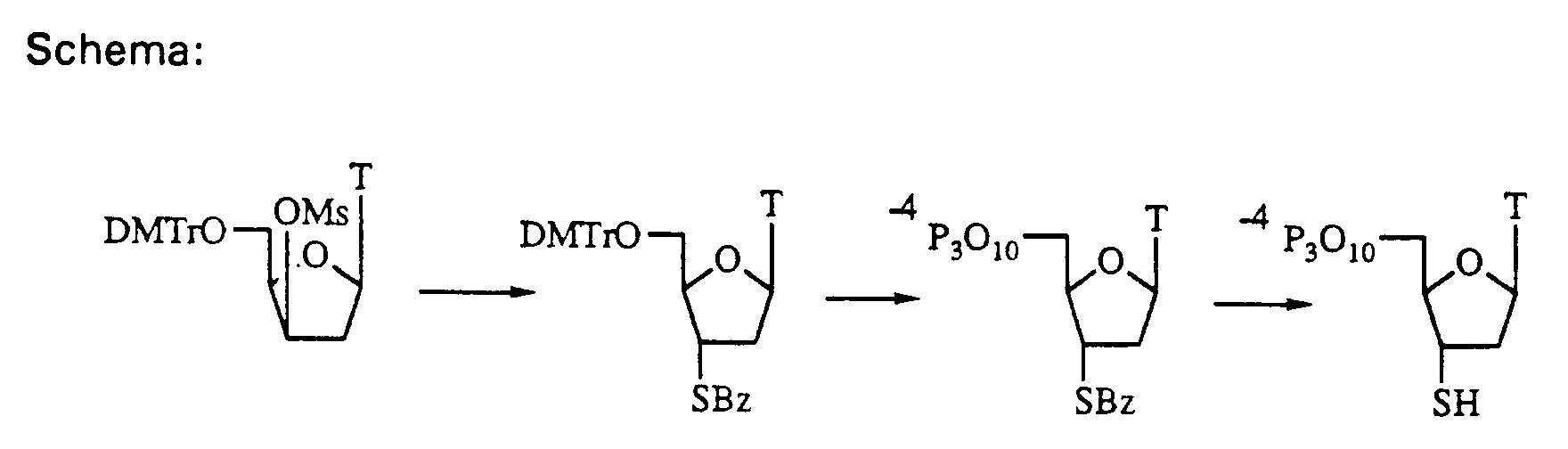
- Die Einführung des Schwefels an der 3'-Position erfolgt durch die Substitution einer Abgangsgruppe (Mesylat) mit Natriumthiobenzoat.
- Die Synthese von Natriumthiobenzoat erfolgt durch die Zugabe von 10 M NaOH zu einer eisgekühlten Lösung Thiobenzoesäure (10 g) in Wasser 15 ml bis die Lösung gerade alkalisch ist. Anschließend stellt man den pH-Wert auf pH 7 mit wäßriger Thiobenzoesäure ein, kühlt auf -5°C ab und filtriert die Lösung um feste Rückstände zu entfernen. Nach Entfernen des Wassers am Rotationsverdampfer mit Ethanol trocknet man das gelbe Salz im Vacuum über Phosphorpentoxid.
Eine Lösung von 5'-O-Dimethoxytrityl-3'-O-methansulfonyl-2'-deoxyxylothymidin (8,45 mmol) (Synthese des Mesylats: Miller, Fox (1964) J. Org. Chem. 29, 1772) und Natriumthiobenzoat (33 mmol) in DMF (30 ml) wird für 4 h bei 100°C gerührt.
Man schüttelt den Ansatz mit Dichlormethan aus und wäscht die org. Phase mit gesättigter NaHCO3-Lösung und gesättigter NaCl-Lösung. Nach Trocknen der organischen Phase über Natriumsulfat, koevaporiert man zweimal mit Toluol und reinigt das ölige Rohprodukt durch Flash-Chromatographie (Kieselgel 6OH, Chloroform/Methanol 0-1 0 %). - Ausbeute: 60 %, das Produkt besitzt das erwartete 1H-NMR-Spektrum.
- Die 5'-Dimethoxytritylschutzgruppe wird für die Phosphitilierung an der 5'-Position nach literaturbekannten Methoden (M. Gait, Oligonucleotide Synthesis, IRL-Press, Oxford 1984) abgespalten. Anschließend wird das 5'-Triphosphat nach der Methode von Eckstein und Ludwig (J. Org. Chem., 1989, Vol. 54, No. 3, 631) mit Salicylphosphochloridit (Aldrich) und der Behandlung mit Pyrophosphat hergestellt. Das Thiol wird durch die Reaktion mit 10 M NaOH in Argon gesättigtem Ethanol (R. Cosstick, Nucleic Acids Research 18, 4, 829) freigesetzt.
Das 3'-Thio-5'-Triphosphat-Thymidin wurde nach der Methode in Beispiel 8 mit Jodacetamidofluorescein (Molecular Probes) gekuppelt und man erhält bei diesem Schritt mit 80 %iger Ausbeute das fluoreszenzmarkierte Thionukleotid. -

- Ausgehend von 5'-DMTr-0-, 3'-O-mesyl-Thymidin wird, wie in Beispiel 14 beschrieben, mit Natriumthiobenzoat substituiert. Anschließend erfolgt die Abspaltung der 5'-Schutzgruppe, die Einführung des 5'-Triphosphates, die Freisetzung des Thiols und die Anbindung von Jodacetamidfluorescein analog den Vorschriften in Beispiel 13.
- Die Synthese eines Oligomers 3'-β-H2N-TTT TTT TTT T-5' erfolgt ausgehend von 1-(3'-Amino-2',3'-dideoxy-5'-DMTr-β-D-threopentofuranosyl)-Thymin, das nach der Methode wie in Beispiel 6 beschrieben zum Trägermaterial für das Phosphoramiditverfahren umgesetzt wird. Die anschließende Fluoreszenzmarkierung des 3'-β-Amino-Oligonukleotids mit Fluoresceinisothiocyanat erfolgt nach Beispiel 7.
Claims (6)
- 3'-Amino- und thiolmodifizierte Nukleoside, Nukleotide und Oligonukleotide der allgemeinen Formel I
 R1 eine Purin- oder Pyrimidinbase ist,R3 ein über eine Amino- oder Thiolgruppe gebundener Fluoreszenzfarbstoff in α- oder β-Stellung undR2 Wasserstoff, eine Hydroxyl-, geschützte Hydroxyl- oder Methoxygruppe in α- oder β-Stellung bedeuten, und n eine Zahl von ≧ 0 ist,R4 eine 5'-Schutzgruppe oder Phosphat, Pyrophosphat oder Triphosphat,R5 Sauerstoff, Fluormethylen, Difluormethylen oder Methylen ist,R6 eine Hydroxyl- oder Methoxygruppe oder Wasserstoff in α- oder β-Stellung, wobei R1, R5 und R6 jeweils gleiche oder unterschiedliche Bedeutungen haben können,Y und X Sauerstoff, Schwefel, NH oder Methylen bedeuten,
wobei X und Y jeweils gleich oder verschieden sein können. - Verfahren zur Herstellung der Verbindung der Formel I nach Anspruch 1, dadurch gekennzeichnet, daß die in 3'-Stellung befindliche OH-Gruppe eines Nukleosids, Nukleotids oder Oligonukleotids zu einer Amino- oder Thiolgruppe derivatisiert wird und anschließend ein Fluoreszenzfarbstoff angekoppelt wird.
- Verfahren zur Herstellung der Verbindung der Formel I, dadurch gekennzeichnet, daß in die Verbindung der Formel II
 a) in 3'-Stellung durch nukleophilen Angriff ein Azid bzw. ein Thiol in geschützter oder ungeschützter Form eingeführt und gegebenenfalls das Azid zum Amin reduziert undb) der Fluoreszenzfarbstoff über die Amino- bzw. über die Thiolgruppe gekoppelt wird.
 - Verfahren nach Anspruch 3, dadurch gekennzeichnet, daß als Fluoreszenzfarbstoffe Fluoresceine, Rhodamine, Texasrot, NBD, Coumarine, Fluorescamine, Succinylfluoreszine und Dansyle verwendet werden.
- Verwendung der Verbindung der Formel I nach Anspruch 1a) für die Synthese von DNA- und RNA-Nukleosiden, Nukleotiden und Oligonukleotidenb) für die fluoreszenzmikroskopische und -makroskopische Detektion in vivo und in vitro.
- Verwendung der Verbindung der Formel I nach Anspruch 5a) für die Synthese von Gegensträngen in Anwesenheit eines Template-Strangesb) für die Synthese von Oligonukleotiden.
Applications Claiming Priority (2)
| Application Number | Priority Date | Filing Date | Title |
|---|---|---|---|
| DE4039488 | 1990-12-11 | ||
| DE4039488 | 1990-12-11 |
Publications (2)
| Publication Number | Publication Date |
|---|---|
| EP0490281A1 EP0490281A1 (de) | 1992-06-17 |
| EP0490281B1 true EP0490281B1 (de) | 1996-09-04 |
Family
ID=6420050
Family Applications (1)
| Application Number | Title | Priority Date | Filing Date |
|---|---|---|---|
| EP91120935A Expired - Lifetime EP0490281B1 (de) | 1990-12-11 | 1991-12-06 | 3'- Amino- oder thiolmodifizierte, Fluoreszenzfarbstoff-gekoppelte Nukleoside, Nukleotide und Oligonukleotide sowie ein Verfahren zur Herstellung und ihre Verwendung |
Country Status (27)
| Country | Link |
|---|---|
| US (3) | US5679785A (de) |
| EP (1) | EP0490281B1 (de) |
| JP (1) | JP3140127B2 (de) |
| KR (1) | KR920012107A (de) |
| AT (1) | ATE142222T1 (de) |
| AU (1) | AU643856B2 (de) |
| BG (1) | BG61484B1 (de) |
| BR (1) | BR9105335A (de) |
| CA (1) | CA2057475A1 (de) |
| CS (1) | CS374391A3 (de) |
| DE (1) | DE59108143D1 (de) |
| DK (1) | DK0490281T3 (de) |
| ES (1) | ES2093671T3 (de) |
| FI (1) | FI915779A7 (de) |
| GR (1) | GR3021041T3 (de) |
| HU (1) | HUT60505A (de) |
| IE (1) | IE75726B1 (de) |
| IL (1) | IL100298A (de) |
| MX (1) | MX9102468A (de) |
| NO (1) | NO914859L (de) |
| NZ (1) | NZ240900A (de) |
| PL (1) | PL168874B1 (de) |
| PT (1) | PT99747A (de) |
| RO (1) | RO111575B1 (de) |
| RU (1) | RU2073682C1 (de) |
| TR (1) | TR27715A (de) |
| YU (1) | YU187991A (de) |
Families Citing this family (56)
| Publication number | Priority date | Publication date | Assignee | Title |
|---|---|---|---|---|
| US5476925A (en) * | 1993-02-01 | 1995-12-19 | Northwestern University | Oligodeoxyribonucleotides including 3'-aminonucleoside-phosphoramidate linkages and terminal 3'-amino groups |
| EP0754242A4 (de) * | 1994-03-18 | 1997-06-11 | Lynx Therapeutics Inc | SYNTHESE UND SUBSTANZ, HYBRIDISIERUNG UND NUKLEASEFESTE EIGENSCHAFTEN DES OLIGONUKLEOTID-N3'-m(7)P5'-PHOSPHORAMIDATS |
| US5599922A (en) * | 1994-03-18 | 1997-02-04 | Lynx Therapeutics, Inc. | Oligonucleotide N3'-P5' phosphoramidates: hybridization and nuclease resistance properties |
| US5726297A (en) * | 1994-03-18 | 1998-03-10 | Lynx Therapeutics, Inc. | Oligodeoxyribonucleotide N3' P5' phosphoramidates |
| DE4418691A1 (de) * | 1994-05-28 | 1996-02-22 | Boehringer Mannheim Gmbh | 3'-(4'-) nicht-radioaktiv markierte Nukleoside und Nukleotide mit Aminocarbonsäure-, Peptid- oder Carbonsäure-Spacer |
| US5962271A (en) * | 1996-01-03 | 1999-10-05 | Cloutech Laboratories, Inc. | Methods and compositions for generating full-length cDNA having arbitrary nucleotide sequence at the 3'-end |
| US5859233A (en) * | 1996-02-21 | 1999-01-12 | Lynx Therapeutics, Inc. | Synthons for synthesis of oligonucleotide N3-P5 phosphoramidates |
| US5684143A (en) * | 1996-02-21 | 1997-11-04 | Lynx Therapeutics, Inc. | Oligo-2'-fluoronucleotide N3'->P5' phosphoramidates |
| US6017702A (en) * | 1996-12-05 | 2000-01-25 | The Perkin-Elmer Corporation | Chain-termination type nucleic acid sequencing method including 2'-deoxyuridine-5'-triphosphate |
| DE19741084A1 (de) * | 1997-09-18 | 1999-03-25 | Knoell Hans Forschung Ev | Hochaffine Nukleinsäuremoleküle mit funktionellen Gruppen zur spezifischen Erkennung von Zielmolekülen, ihre Herstellung und Verwendung |
| US6289229B1 (en) | 1998-01-20 | 2001-09-11 | Scimed Life Systems, Inc. | Readable probe array for in vivo use |
| US6184347B1 (en) | 1998-11-19 | 2001-02-06 | Agilent Technologies Inc. | Minimization of blooming in high-density arrays by using reactive wash reagents |
| US6761877B2 (en) * | 2000-02-18 | 2004-07-13 | Biocrystal, Ltd. | Functionalized encapsulated fluorescent nanocrystals |
| ATE352586T2 (de) | 2000-09-29 | 2007-02-15 | Molecular Probes Inc | Modifizierte carbocyaninfarbstoffe und deren konjugate |
| US7563618B2 (en) | 2001-03-23 | 2009-07-21 | Geron Corporation | Oligonucleotide conjugates |
| KR100762261B1 (ko) * | 2001-04-27 | 2007-10-04 | (주)바이오니아 | 전장 상보 디옥시리보핵산 제조 방법과 이에 사용되는앵커와 프라이머 |
| DE60234382D1 (de) * | 2001-09-17 | 2009-12-24 | Life Technologies Corp | Nanokristalle |
| US7214428B2 (en) * | 2001-09-17 | 2007-05-08 | Invitrogen Corporation | Highly luminescent functionalized semiconductor nanocrystals for biological and physical applications |
| US7205048B2 (en) * | 2001-09-17 | 2007-04-17 | Invitrogen Corporation | Functionalized fluorescent nanocrystal compositions and methods of making |
| WO2004055160A2 (en) * | 2002-12-13 | 2004-07-01 | The Trustees Of Columbia University In The City Of New York | Biomolecular coupling methods using 1,3-dipolar cycloaddition chemistry |
| JP4177123B2 (ja) * | 2003-01-10 | 2008-11-05 | 富士通株式会社 | 配線図形検証方法、プログラム及び装置 |
| KR20070121853A (ko) | 2003-03-31 | 2007-12-27 | 에프. 호프만-라 로슈 아게 | 일본 뇌염 바이러스 혈청군의 구성원을 포함하는, 특정플라비바이러스 검출용 조성물 및 방법 |
| US20050131224A1 (en) * | 2003-12-15 | 2005-06-16 | Cti Pet Systems, Inc. | Method for preparing radiolabeled thymidine |
| US7160537B2 (en) * | 2003-12-15 | 2007-01-09 | Siemens Medical Solutions Usa, Inc. | Method for preparing radiolabeled thymidine having low chromophoric byproducts |
| US7939251B2 (en) | 2004-05-06 | 2011-05-10 | Roche Molecular Systems, Inc. | SENP1 as a marker for cancer |
| EP1797224B1 (de) * | 2004-08-17 | 2012-10-03 | Life Technologies Corporation | Synthese hochlumineszierender kolloidpartikel |
| ATE556126T1 (de) | 2004-10-29 | 2012-05-15 | Life Technologies Corp | Funktionalisierte fluoreszierende nanokristalle und verfahren zu deren herstellung und verwendung |
| WO2006048262A2 (en) * | 2004-11-04 | 2006-05-11 | Roche Diagnostics Gmbh | Classification of acute myeloid leukemia |
| US7541144B2 (en) * | 2005-01-31 | 2009-06-02 | Agilent Technologies, Inc. | RNA labeling method |
| EP2272983A1 (de) | 2005-02-01 | 2011-01-12 | AB Advanced Genetic Analysis Corporation | Reagentien, Verfahren und Bibliotheken zur Sequenzierung mit Kügelchen |
| US7544471B2 (en) * | 2005-07-30 | 2009-06-09 | Agilent Technologies, Inc. | Preparing RNA from a wax-embedded tissue specimen |
| US7700289B2 (en) * | 2006-04-03 | 2010-04-20 | Agilent Technologies, Inc. | Method for labeling RNA |
| JP2009538123A (ja) * | 2006-04-19 | 2009-11-05 | アプライド バイオシステムズ, エルエルシー | ゲル非含有ビーズベースの配列決定のための試薬、方法およびライブラリー |
| US7572585B2 (en) * | 2006-07-31 | 2009-08-11 | Agilent Technologies, Inc. | Enzymatic labeling of RNA |
| RU2326888C1 (ru) * | 2006-10-23 | 2008-06-20 | Институт химической биологии и фундаментальной медицины Сибирского отделения Российской академии наук (СО РАН) | Способ получения солей 5'-трифосфатов дезоксирибо- и рибоолигонуклеотидов |
| CN102443030B (zh) * | 2006-12-05 | 2015-12-16 | 激光基因公司 | 光可断裂的标记核苷酸和核苷与标记的核苷酸和核苷以及其在dna测序中的使用方法 |
| ES2453108T3 (es) | 2007-08-06 | 2014-04-04 | Orion Genomics, Llc | Nuevos polimorfismos de un único nucleótido y combinaciones de polimorfismos nuevos y conocidos para determinar la expresión específica de alelo del gen IGF2 |
| CA2639416C (en) | 2007-09-11 | 2019-12-31 | F. Hoffmann-La Roche Ag | Diagnostic test for susceptibility to b-raf kinase inhibitors |
| WO2009046149A1 (en) * | 2007-10-01 | 2009-04-09 | Applied Biosystems Inc. | Chase ligation sequencing |
| US20100086914A1 (en) * | 2008-10-03 | 2010-04-08 | Roche Molecular Systems, Inc. | High resolution, high throughput hla genotyping by clonal sequencing |
| EP2396429B1 (de) | 2009-02-11 | 2015-05-27 | Orion Genomics, LLC | Kombinationen aus polymorphismen zur bestimmung von allelspezifischer igf2-expression |
| US8431416B2 (en) | 2009-04-01 | 2013-04-30 | Becton, Dickinson And Company | Reactive heterocycle-substituted 7-hydroxycoumarins and their conjugates |
| JP5730311B2 (ja) | 2009-08-31 | 2015-06-10 | プロメガ コーポレイションPromega Corporation | 反応性シアニン化合物 |
| WO2011128096A1 (en) | 2010-04-16 | 2011-10-20 | Roche Diagnostics Gmbh | Polymorphism markers for predicting response to interleukin-6 receptor-inhibiting monoclonal antibody drug treatment |
| CA2801468C (en) | 2010-06-04 | 2018-09-04 | Chronix Biomedical | Prostate cancer associated circulating nucleic acid biomarkers |
| US8623324B2 (en) | 2010-07-21 | 2014-01-07 | Aat Bioquest Inc. | Luminescent dyes with a water-soluble intramolecular bridge and their biological conjugates |
| EP2768985B1 (de) | 2011-10-21 | 2019-03-20 | Chronix Biomedical | Mit kolorektalkarzinom assoziierte zirkulierende nukleinsäurebiomarker |
| ES2413566B1 (es) | 2011-12-14 | 2014-05-20 | Fundación Pública Andaluza Progreso Y Salud | Método de obtención de datos útiles para el diagnóstico y pronóstico de la hipoacusia neurosensorial. |
| JP6181751B2 (ja) | 2012-06-18 | 2017-08-16 | ニューゲン テクノロジーズ, インコーポレイテッド | 望まれない核酸配列のネガティブ選択のための組成物および方法 |
| PL2931922T3 (pl) | 2012-12-14 | 2019-04-30 | Chronix Biomedical | Personalizowane biomarkery nowotworu |
| US20160115541A1 (en) | 2013-05-29 | 2016-04-28 | Chronix Biomedical | Detection and quantification of donor cell-free dna in the circulation of organ transplant recipients |
| HUE049094T2 (hu) | 2014-10-01 | 2020-09-28 | Chronix Biomedical | Sejtmentes DNS kvantifikálási módszerei |
| WO2017172608A1 (en) | 2016-03-28 | 2017-10-05 | Aat Bioquest, Inc. | Polyfluoreno[4,5-cde]oxepine conjugates and their use in methods of analyte detection |
| US11220628B2 (en) | 2019-02-20 | 2022-01-11 | Aat Bioquest, Inc. | Condensed polycyclic conjugated polymers and their use for biological detection |
| WO2021154933A1 (en) | 2020-01-30 | 2021-08-05 | Aat Bioquest, Inc. | Uv excitable polyfluorene based conjugates and their use in methods of analyte detection |
| EP4469589A4 (de) * | 2022-01-25 | 2026-01-21 | Univ Oregon Health & Science | Verfahren und systeme zur erhöhung des erfassungspotentials eines räumlichen arrays |
Family Cites Families (6)
| Publication number | Priority date | Publication date | Assignee | Title |
|---|---|---|---|---|
| US5015733A (en) * | 1983-12-20 | 1991-05-14 | California Institute Of Technology | Nucleosides possessing blocked aliphatic amino groups |
| US4849513A (en) * | 1983-12-20 | 1989-07-18 | California Institute Of Technology | Deoxyribonucleoside phosphoramidites in which an aliphatic amino group is attached to the sugar ring and their use for the preparation of oligonucleotides containing aliphatic amino groups |
| EP0267996A1 (de) * | 1986-11-20 | 1988-05-25 | Tamir Biotechnology Ltd. | Nukleotid-Derivate |
| GB2236852B (en) * | 1989-09-25 | 1994-04-06 | Scotgen Ltd | DNA probe based assays and intermediates useful in the synthesis of cleavable nucleic acids for use in such assays |
| US5227487A (en) * | 1990-04-16 | 1993-07-13 | Molecular Probes, Inc. | Certain tricyclic and pentacyclic-hetero nitrogen rhodol dyes |
| US5541307A (en) * | 1990-07-27 | 1996-07-30 | Isis Pharmaceuticals, Inc. | Backbone modified oligonucleotide analogs and solid phase synthesis thereof |
-
1991
- 1991-12-02 YU YU187991A patent/YU187991A/sh unknown
- 1991-12-04 BG BG95575A patent/BG61484B1/bg unknown
- 1991-12-06 ES ES91120935T patent/ES2093671T3/es not_active Expired - Lifetime
- 1991-12-06 DK DK91120935.1T patent/DK0490281T3/da active
- 1991-12-06 DE DE59108143T patent/DE59108143D1/de not_active Expired - Fee Related
- 1991-12-06 AT AT91120935T patent/ATE142222T1/de not_active IP Right Cessation
- 1991-12-06 EP EP91120935A patent/EP0490281B1/de not_active Expired - Lifetime
- 1991-12-09 RO RO148926A patent/RO111575B1/ro unknown
- 1991-12-09 TR TR01195/91A patent/TR27715A/xx unknown
- 1991-12-09 FI FI915779A patent/FI915779A7/fi unknown
- 1991-12-09 NZ NZ24090091A patent/NZ240900A/en unknown
- 1991-12-09 IL IL100298A patent/IL100298A/xx not_active IP Right Cessation
- 1991-12-10 MX MX9102468A patent/MX9102468A/es unknown
- 1991-12-10 AU AU88927/91A patent/AU643856B2/en not_active Ceased
- 1991-12-10 RU SU915010267A patent/RU2073682C1/ru active
- 1991-12-10 CS CS913743A patent/CS374391A3/cs unknown
- 1991-12-10 IE IE430191A patent/IE75726B1/en not_active IP Right Cessation
- 1991-12-10 PL PL91292701A patent/PL168874B1/pl unknown
- 1991-12-10 CA CA002057475A patent/CA2057475A1/en not_active Abandoned
- 1991-12-10 NO NO91914859A patent/NO914859L/no unknown
- 1991-12-10 HU HU913885A patent/HUT60505A/hu unknown
- 1991-12-10 PT PT99747A patent/PT99747A/pt not_active Application Discontinuation
- 1991-12-11 KR KR1019910022614A patent/KR920012107A/ko not_active Ceased
- 1991-12-11 JP JP03350821A patent/JP3140127B2/ja not_active Expired - Fee Related
- 1991-12-11 BR BR919105335A patent/BR9105335A/pt unknown
-
1994
- 1994-01-18 US US08/184,759 patent/US5679785A/en not_active Expired - Fee Related
-
1995
- 1995-06-01 US US08/457,377 patent/US5659025A/en not_active Expired - Fee Related
- 1995-06-01 US US08/456,734 patent/US5668269A/en not_active Expired - Fee Related
-
1996
- 1996-09-13 GR GR960402400T patent/GR3021041T3/el unknown
Also Published As
Similar Documents
| Publication | Publication Date | Title |
|---|---|---|
| EP0490281A1 (de) | 3'- Amino- oder thiolmodifizierte, Fluoreszenzfarbstoff-gekoppelte Nukleoside, Nukleotide und Oligonukleotide sowie ein Verfahren zur Herstellung und ihre Verwendung | |
| DE3750080T2 (de) | Deoxyribonucleosid-phosphoramidite und deren verwendung zur hertellung von oligonukleotiden. | |
| DE69700303T2 (de) | Asymmetrische benzoxanthenfarbstoffe | |
| DE60014051T2 (de) | 4,7-dichlororhodaminfarbstoffe als molekulare sonden | |
| DE112007002932B4 (de) | Vierfarben DNA-Sequenzierung mittels Synthese unter Verwendung von abspaltbaren, reversiblen, fluoreszierenden Nucleotidterminatoren | |
| DE69433811T2 (de) | Dns - sequenzierung durch massenspektronomie | |
| DE3851889T2 (de) | Nukleosid-derivate. | |
| EP1725572B1 (de) | Makromolekulare nukleotidverbindungen und methoden zu deren anwendung | |
| DE69704205T2 (de) | 4,7-dichlorrhodaminfarbstoffe | |
| US5861287A (en) | Alternative dye-labeled primers for automated DNA sequencing | |
| DE69701612T2 (de) | Verfahren und zusammensetzungen zum analysieren von nukleinsäuremolekulen mittels bemessungstechniken | |
| DE69324494T2 (de) | 4,7-dichlorofluoroszein-farbestoffe als molekulare sonden | |
| DE69131164T2 (de) | Einführung selektiv spaltbarer stellen in oligonukleotidketten und reagenzien dafür | |
| DE69632456T2 (de) | Nukleinsäuresynthese unter verwendung von mittels licht abspaltbaren schutzgruppen | |
| EP1801114B1 (de) | Polynukleotid mit Phosphatmimetikum | |
| DE69813622T2 (de) | Verbindungen für massenspektrometrie bestehend aus nukleinsäure-basen und arylether-massmarkern | |
| EP2125856B1 (de) | Durch lichteinwirkung spaltbare markierte nukleotide und nukleoside und markierte nukleotide und nukleoside und verfahren zu ihrer verwendung bei der dna-sequenzierung | |
| DE3446635C2 (de) | Synthese von Aminoderivaten von Oligonukleotiden | |
| DE69130612T2 (de) | Grosse kammförmig verzweigte polynukleotide | |
| AU699939B2 (en) | Alternative dye-labeled primers, ribonucleotides, deoxyribonucleotides, and dideoxyribonucleotides for automated DNA analysis and homogeneous amplification/detection assays | |
| EP0600965B1 (de) | Primer für matrizenabhängige enzymatische nukleinsäuresynthesen | |
| EP0567841A2 (de) | Fluoreszenzmarkierte Verbindungen, ihre Herstellung und Verwendung | |
| DE3642939A1 (de) | Verfahren zur dna-markierung | |
| EP1401851B1 (de) | Zweistufige schutzgruppen für die synthese von biopolymeren | |
| EP2189468B1 (de) | Verfahren zur modifizierung von nukleotiden in nukleinsäuren und nukleinsäure mit modifiziertem nukleotid |
Legal Events
| Date | Code | Title | Description |
|---|---|---|---|
| PUAI | Public reference made under article 153(3) epc to a published international application that has entered the european phase |
Free format text: ORIGINAL CODE: 0009012 |
|
| AK | Designated contracting states |
Kind code of ref document: A1 Designated state(s): AT BE CH DE DK ES FR GB GR IT LI LU NL SE |
|
| 17P | Request for examination filed |
Effective date: 19920820 |
|
| 17Q | First examination report despatched |
Effective date: 19950209 |
|
| GRAH | Despatch of communication of intention to grant a patent |
Free format text: ORIGINAL CODE: EPIDOS IGRA |
|
| GRAA | (expected) grant |
Free format text: ORIGINAL CODE: 0009210 |
|
| GRAH | Despatch of communication of intention to grant a patent |
Free format text: ORIGINAL CODE: EPIDOS IGRA |
|
| AK | Designated contracting states |
Kind code of ref document: B1 Designated state(s): AT BE CH DE DK ES FR GB GR IT LI LU NL SE |
|
| REF | Corresponds to: |
Ref document number: 142222 Country of ref document: AT Date of ref document: 19960915 Kind code of ref document: T |
|
| ET | Fr: translation filed | ||
| REF | Corresponds to: |
Ref document number: 59108143 Country of ref document: DE Date of ref document: 19961010 |
|
| ITF | It: translation for a ep patent filed | ||
| REG | Reference to a national code |
Ref country code: GR Ref legal event code: FG4A Free format text: 3021041 |
|
| GBT | Gb: translation of ep patent filed (gb section 77(6)(a)/1977) |
Effective date: 19961122 |
|
| REG | Reference to a national code |
Ref country code: ES Ref legal event code: FG2A Ref document number: 2093671 Country of ref document: ES Kind code of ref document: T3 |
|
| REG | Reference to a national code |
Ref country code: DK Ref legal event code: T3 |
|
| PLBE | No opposition filed within time limit |
Free format text: ORIGINAL CODE: 0009261 |
|
| STAA | Information on the status of an ep patent application or granted ep patent |
Free format text: STATUS: NO OPPOSITION FILED WITHIN TIME LIMIT |
|
| 26N | No opposition filed | ||
| PGFP | Annual fee paid to national office [announced via postgrant information from national office to epo] |
Ref country code: DK Payment date: 19971127 Year of fee payment: 7 |
|
| PGFP | Annual fee paid to national office [announced via postgrant information from national office to epo] |
Ref country code: GR Payment date: 19971219 Year of fee payment: 7 |
|
| REG | Reference to a national code |
Ref country code: CH Ref legal event code: PUE Owner name: HOECHST AKTIENGESELLSCHAFT TRANSFER- DADE BEHRING |
|
| PG25 | Lapsed in a contracting state [announced via postgrant information from national office to epo] |
Ref country code: DK Free format text: LAPSE BECAUSE OF NON-PAYMENT OF DUE FEES Effective date: 19981206 |
|
| PG25 | Lapsed in a contracting state [announced via postgrant information from national office to epo] |
Ref country code: GR Free format text: LAPSE BECAUSE OF NON-PAYMENT OF DUE FEES Effective date: 19981231 |
|
| NLS | Nl: assignments of ep-patents |
Owner name: BEHRING DIAGNOSTICS GMBH |
|
| NLT1 | Nl: modifications of names registered in virtue of documents presented to the patent office pursuant to art. 16 a, paragraph 1 |
Owner name: DADE BEHRING MARBURG GMBH |
|
| REG | Reference to a national code |
Ref country code: FR Ref legal event code: TP |
|
| REG | Reference to a national code |
Ref country code: ES Ref legal event code: PC2A |
|
| REG | Reference to a national code |
Ref country code: FR Ref legal event code: CD |
|
| PGFP | Annual fee paid to national office [announced via postgrant information from national office to epo] |
Ref country code: ES Payment date: 19991213 Year of fee payment: 9 |
|
| PGFP | Annual fee paid to national office [announced via postgrant information from national office to epo] |
Ref country code: DE Payment date: 20001116 Year of fee payment: 10 |
|
| PGFP | Annual fee paid to national office [announced via postgrant information from national office to epo] |
Ref country code: FR Payment date: 20001117 Year of fee payment: 10 |
|
| PGFP | Annual fee paid to national office [announced via postgrant information from national office to epo] |
Ref country code: SE Payment date: 20001120 Year of fee payment: 10 Ref country code: NL Payment date: 20001120 Year of fee payment: 10 Ref country code: CH Payment date: 20001120 Year of fee payment: 10 |
|
| PGFP | Annual fee paid to national office [announced via postgrant information from national office to epo] |
Ref country code: GB Payment date: 20001121 Year of fee payment: 10 Ref country code: AT Payment date: 20001121 Year of fee payment: 10 |
|
| PGFP | Annual fee paid to national office [announced via postgrant information from national office to epo] |
Ref country code: BE Payment date: 20001207 Year of fee payment: 10 |
|
| PGFP | Annual fee paid to national office [announced via postgrant information from national office to epo] |
Ref country code: LU Payment date: 20010212 Year of fee payment: 10 |
|
| REG | Reference to a national code |
Ref country code: DK Ref legal event code: EBP |
|
| PG25 | Lapsed in a contracting state [announced via postgrant information from national office to epo] |
Ref country code: LU Free format text: LAPSE BECAUSE OF NON-PAYMENT OF DUE FEES Effective date: 20011206 Ref country code: GB Free format text: LAPSE BECAUSE OF NON-PAYMENT OF DUE FEES Effective date: 20011206 Ref country code: AT Free format text: LAPSE BECAUSE OF NON-PAYMENT OF DUE FEES Effective date: 20011206 |
|
| PG25 | Lapsed in a contracting state [announced via postgrant information from national office to epo] |
Ref country code: SE Free format text: LAPSE BECAUSE OF NON-PAYMENT OF DUE FEES Effective date: 20011207 Ref country code: ES Free format text: LAPSE BECAUSE OF NON-PAYMENT OF DUE FEES Effective date: 20011207 |
|
| PG25 | Lapsed in a contracting state [announced via postgrant information from national office to epo] |
Ref country code: LI Free format text: LAPSE BECAUSE OF NON-PAYMENT OF DUE FEES Effective date: 20011231 Ref country code: CH Free format text: LAPSE BECAUSE OF NON-PAYMENT OF DUE FEES Effective date: 20011231 Ref country code: BE Free format text: LAPSE BECAUSE OF NON-PAYMENT OF DUE FEES Effective date: 20011231 |
|
| REG | Reference to a national code |
Ref country code: GB Ref legal event code: IF02 |
|
| BERE | Be: lapsed |
Owner name: DADE BEHRING MARBURG G.M.B.H. Effective date: 20011231 |
|
| PG25 | Lapsed in a contracting state [announced via postgrant information from national office to epo] |
Ref country code: NL Free format text: LAPSE BECAUSE OF NON-PAYMENT OF DUE FEES Effective date: 20020701 |
|
| PG25 | Lapsed in a contracting state [announced via postgrant information from national office to epo] |
Ref country code: DE Free format text: LAPSE BECAUSE OF NON-PAYMENT OF DUE FEES Effective date: 20020702 |
|
| GBPC | Gb: european patent ceased through non-payment of renewal fee |
Effective date: 20011206 |
|
| EUG | Se: european patent has lapsed |
Ref document number: 91120935.1 |
|
| REG | Reference to a national code |
Ref country code: CH Ref legal event code: PL |
|
| PG25 | Lapsed in a contracting state [announced via postgrant information from national office to epo] |
Ref country code: FR Free format text: LAPSE BECAUSE OF NON-PAYMENT OF DUE FEES Effective date: 20020830 |
|
| NLV4 | Nl: lapsed or anulled due to non-payment of the annual fee |
Effective date: 20020701 |
|
| REG | Reference to a national code |
Ref country code: FR Ref legal event code: ST |
|
| REG | Reference to a national code |
Ref country code: ES Ref legal event code: FD2A Effective date: 20020112 |
|
| PG25 | Lapsed in a contracting state [announced via postgrant information from national office to epo] |
Ref country code: IT Free format text: LAPSE BECAUSE OF NON-PAYMENT OF DUE FEES;WARNING: LAPSES OF ITALIAN PATENTS WITH EFFECTIVE DATE BEFORE 2007 MAY HAVE OCCURRED AT ANY TIME BEFORE 2007. THE CORRECT EFFECTIVE DATE MAY BE DIFFERENT FROM THE ONE RECORDED. Effective date: 20051206 |