EP0446039B1 - Bus à segments multiples et méthode d'opération - Google Patents
Bus à segments multiples et méthode d'opération Download PDFInfo
- Publication number
- EP0446039B1 EP0446039B1 EP91301880A EP91301880A EP0446039B1 EP 0446039 B1 EP0446039 B1 EP 0446039B1 EP 91301880 A EP91301880 A EP 91301880A EP 91301880 A EP91301880 A EP 91301880A EP 0446039 B1 EP0446039 B1 EP 0446039B1
- Authority
- EP
- European Patent Office
- Prior art keywords
- bus
- segment
- data
- level
- register
- Prior art date
- Legal status (The legal status is an assumption and is not a legal conclusion. Google has not performed a legal analysis and makes no representation as to the accuracy of the status listed.)
- Expired - Lifetime
Links
Images



Classifications
-
- G—PHYSICS
- G06—COMPUTING OR CALCULATING; COUNTING
- G06F—ELECTRIC DIGITAL DATA PROCESSING
- G06F13/00—Interconnection of, or transfer of information or other signals between, memories, input/output devices or central processing units
- G06F13/38—Information transfer, e.g. on bus
- G06F13/40—Bus structure
- G06F13/4063—Device-to-bus coupling
- G06F13/409—Mechanical coupling
-
- G—PHYSICS
- G06—COMPUTING OR CALCULATING; COUNTING
- G06F—ELECTRIC DIGITAL DATA PROCESSING
- G06F13/00—Interconnection of, or transfer of information or other signals between, memories, input/output devices or central processing units
- G06F13/38—Information transfer, e.g. on bus
- G06F13/40—Bus structure
- G06F13/4004—Coupling between buses
- G06F13/4022—Coupling between buses using switching circuits, e.g. switching matrix, connection or expansion network
Definitions
- the present invention relates to the field of chip carriers and bus architecture. More specifically, the invention relates to a multi-chip carrier for connection to a multi-segmented pipeline bus and its method of operation.
- Each chip is mounted in a chip carrier which is connected to one or more buses.
- the buses may be either a private bus in which all the components connected to the private bus are either the recipient or source of all the signals on the bus, or a shared bus.
- a shared bus may carry signals which, at any given time, are not being sent to or received from some of the chips connected to the bus. Rather, communication to or from the various connected chips is placed on the bus and each chip is provided with a device for determining whether the particular signal is pertinent to its operation.
- the present invention is concerned with shared bus systems.
- Communication systems can be unsegmented or multi-segmented.
- unsegmented systems a signal, once placed on the bus, propagates the length of the bus without a delay other than that required by the electrical characteristics of the bus and the connections thereto.
- a segmented system one or more registers are provided for holding a signal for a period of time.
- a signal will propagate on a first segment until it reaches a holding register where it will be held for a period of time. Later, the signal will be sent from the register to the next segment where it will propagate until reaching the termination of the bus or another register.
- the latency period of the bus When the signal is unusable by components which are attached to the bus during the period in which it is held in a register, such period is referred to below as the latency period of the bus.
- EP-A-0 344 081 describes a bi-directional buffer with latch and parity capability which includes a plurality of bi-directional bit buffer circuits located between first and second data busses. Each circuit includes a first and a second data path, each including a data receiver, a latch and a driver. Control means are provided for controlling the drivers to place their output in an active or high impedance state and for controlling the latches so that data can be selectively latched therein or passed through.
- DE-A-37 08 887 discloses a parallel data bus which is used for connecting a plurality of units of a data processing device.
- the data bus is divided into a plurality of segments by means of intermediate registers, which are switched in parallel, in order to increase clock speed and transfer output while obtaining simultaneous transfer of a plurality of units.
- the functions of the units and the data bus at every location are controlled globally by a control unit.
- the data bus can be constructed as a module, where all the segments of one or a plurality of parallel-switched busses forming part of a certain unit are combined with a part of the control unit.
- the present invention is intended to overcome these deficiencies, and accordingly provides a synchronous segmented bus system for use in data transmission comprising: at least first and second bus segments for conveying multi-bit data in parallel, each segment having two ends; at least first, second and third registers for receiving multi-bit data from a connected bus segment and for sending multi-bit data onto a connected segment, said first register being coupled to one end of said first bus segment, said second register being coupled to the other end of said first bus segment and to one end of said second bus segment, said third register being coupled to the other end of said second bus segment, in the absence of coupling of said first register to said second bus segment; and means for clocking said first, second and third registers wherein first multi-bit data sent from said first register is received at said second register in one clock cycle, synchronously with sending second multi-bit data from said second register to said third register, and wherein said first multi-bit data is sent from said second register and received at said third register in a second clock cycle, without said first multi-bit data being sent over said first bus segment during
- the bi-directional bus may be a backplane bus.
- all data which is placed on a bus segment is held in one of said registers before being placed on a bus segment.
- the bus segments may have balanced propagation times such that the propagation time for all bus segments is substantially equal.
- the computing system may include a plurality of processors.
- all data on a first bus segment is held in a register before it is placed on an adjacent-level bus segment.
- At least one bus segment may include a first unidirectional portion for providing data in a first direction and a second unidirectional portion for providing data in a second direction different from said first direction.
- the highest-level bus segment may be bi-directional.
- the transmission period for all bus segments on at least two adjacent bus levels may be a value which is substantially identical for all such bus segments.
- the transmission period for all bus segments is no greater than said value.
- the voltage level of signals on at least one bus segment may be different from the voltage level of signals on an adjacent-level bus segment. It has been found that by using a multi-chip carrier with multiple segments, the latency which occurs in the system is outweighed by a number of advantages of the system such as increased bandwidth. It is particularly advantageous to accept latency as the price for an increase in bandwidth in multi-processor systems. This is because in multi-processor systems, the burden of latency is distributed among the various processors. In multi-processor systems, therefore, the more serious consideration is the bandwidth which determines the speed at which operations like a cache fill can be accomplished.
- the present invention is directed to a segmented bus which employs bus pipelining.
- a bus pipelining system data which is travelling from a source to a destination travels from the source along a first bus segment and is held in at least one register for a period of time before being placed on a second bus segment and thereafter travelling to the destination.
- Pipelining processes have been known in the past for use in data processing in which the data is changed at one or more of the various pipeline segments.
- the present invention is directed to a bus for use in data transmission rather than a bus for use in data processing.
- the data is not changed at the various pipeline segments or bus segments, but rather arrives at the destination in a form substantially identical to the form in which it left the source and having undergone substantially no information changes in its travel from the source to the destination.
- the present invention includes a multi-segmented, high bandwidth bus.
- Providing high bandwidth includes both providing an effectively wide bus and providing a high frequency bus.
- Preferably the present bus is used at a frequency of at least 50 MHz, providing several hundred megabytes of data per second.
- a plurality of chips are mounted on a multi-chip carrier (MCC) which includes a short bus segment.
- the multi-chip carrier includes bus interface chips ( BIC) for providing communication between the MCC bus segment and the adjacent segment, namely the board bus.
- BIC bus interface chips
- the multi-chip carriers are configured so that the input and output electrical characteristics of the BIC are identical for all multi- chip carriers, thus easing design constraints on both the chips and the system and increasing flexibility of the system.
- Each segment of the system operates during a segment cycle of a predetermined period, viz. the time elapsed between placing a signal onto the segment (e.g.
- the segment period must equal or exceed the segment propagation time (i.e., the time required for a signal to travel the full length of the segment), plus the segment overhead time (i.e. the time required for the signal to settle to a value so that it can be reliably read).
- multi-chip carriers are mounted on each board. At least one of the multi-chip carriers contains additional bus interface chips which permit communication between the board bus and the adjacent bus segment, namely the backplane bus.
- the segments of the multi-segmented bus are balanced, i.e., similar delays occur in each pipeline segment.
- the present invention is directed to a data communication bus, in which no computation or other modification of the data occurs between its source and destination.
- the bus includes a plurality of bus segments.
- the bus preferably includes a plurality of bus levels. Each bus segment in the system can communicate with a bus on an adjacent level. Except for the highest level and lowest level bus segments, preferably all bus segments can both communicate to a higher level bus segment and a lower level bus segment.
- the bus levels are substantially ordered in the sense that no bus segment can communicate directly with any other bus segment than those on the same or an adjacent level. Communication between bus segments is accomplished using registers for holding the data. Thus, data which is placed on a given bus segment will be held in a register before being placed on an adjacent bus segment.
- the bus is a communication bus and does not involve data computation
- data which is received from a first register, transmitted along a bus and stored in a second register is unchanged in the sense that the information in the first register is substantially or identical to the information in the second register.
- the data received in the third register has information which is substantially identical to the information sent from the first and second register.
- the multi-chip carrier and bus system of the present invention have well-defined characteristics making it easier to predict the response of the system. Compared with previous devices, the system provides increased bandwidth and provides for substantially simultaneous receipt of signals at all destinations.
- the multi-chip carrier is designed to eliminate the need for bus loading and reduces capacitance while also reducing bus noise and loading, and permitting high frequency operation.
- the present invention utilizes uni-directional buses at least in the lower segments to provide better efficiency in bus utilization.
- segmentation of the bus provides a reduced effective bus length (i.e. effective source-to-destination length) and signal propagation time which permits higher frequency communication such that more information can be transmitted.
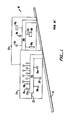
- Fig. 1 depicts schematically a backplane and board bus system 10.
- a plurality of boards 12a, 12b each containing a board bus 14a, 14b, are connected to a common backplane bus 16.
- Each board 12a, 12b also contains a plurality of integrated circuits or chips, each mounted in a chip carrier 18a through 18r.
- Each chip is connected by a line or private bus 20a through 20r to the board buses 14a, 14b.
- a signal which is placed on the backplane bus 16 will propagate directly onto the board buses 14a, 14b without being stored in a register or buffer.
- the board buses 14a, 14b are connected to terminal resistors 22 to simulate an infinite-length bus 14a and thus to prevent unwanted reflection from the end of the bus 14a.
- the various integrated circuit chips 18a through 18r are typically designed to drive the largest load which is likely to be encountered. For this reason, the ICs must typically be designed to drive relatively large loads.
- one embodiment of the present invention includes a plurality of boards 26a, 26b connected to a backplane bus 28.
- the integrated circuits 30a through 30r are not connected individually to the board buses 32a, 32b.
- the integrated circuit chips 30a through 30r are mounted on a plurality of multiple chip carriers (MCC) 34a through 34f.
- MCC multiple chip carriers
- the MCC's 34 are in turn, mounted on the boards.
- the MCC's are preferably surface mounted or wire-bond mounted to reduce capacitive loading on the bus and increase the packing density.
- Each MCC 34 contains an MCC bus 36a through 36f.
- the MCC's 34 also include bus interface chips (BIC) 38a through 38x for controlling communication between the MCC 34 and the board bus 32.
- BIC bus interface chips
- An additional set of BIC's 40 provides communication between the board buses 32a, 32b and the backplane bus 28.
- the additional set of BICs 40 are located on one of the MCCs 34c, 34f on each board 26a, 26b, although the additional BICs 40 could be located elsewhere, such as being mounted on the board.
- High bus bandwidth is achieved at least partly because the shared bus is segmented into several shorter busses, each with fewer components attached, compared to previous bus configurations.
- Figs. 3 and 4 depict a single MCC.
- the silicon substrate of the MCC is connected to a copper or aluminum finned heat sink 54.
- the substrate 42 is mounted with the integrated circuits 30, 38 facing the board 26 so that heat can be transferred through the heat sink 54 which is exposed to air for cooling.
- Integrated circuits 30a, 30b, 30c, 30d are connected to the MCC bus 36a, e.g., using conventional wirebonding with a 0.007 in. (0. 18 mm.) pitch.
- a silicon substrate 42 includes, in the preferred embodiment, 2 layers of metal interconnect and ground and power planes fabricated using typical integrated circuit processing technology.
- the metal interconnect includes the signal traces which make up the MCC bus 36a as well as the traces which connect the BICs 38a through 38d to the MCC bus 36a.
- the signal interconnect traces are preferably aluminum with a three micron thickness and a minimum width of 25 microns with 100 micron separation from adjacent features.
- the metal levels are separated by an insulating polyimide film and are connected vertically using 15 micron vias.
- Each multi-chip module is connected to the board 26a, 26b through a connector.
- the connector is similar to those sold under the trademark "INTERPOSER", manufactured by AMP, Incorporated, Harrisburg, Pennsylvania.
- the connector produces no more than about 0.6 pF capacitance and 1.4 nH inductance. Total loading on the bus signal path is about 5 pF.
- the MCC connectors have a spacing of 0.025 inches (0.6 mm.) with about 100 bus pins on each of two opposed edges and about 100 external connection pins on each of the two remaining edges.
- signals on the board bus 26a are bit-sliced such that each BIC handles both incoming and outgoing signals.
- This configuration combined with the surface mount connection method, and the bus running underneath the MCC, provides for efficient connection because both opposed edges of the MCC can be utilized for bus communication. It is preferred to disperse the drivers and receivers in order to even out the current requirements of the BIC and to provide a simpler interconnect geometry for the MCC.
- the BICs 38a, 38b, 38c, 38d are placed along opposite edges of the MCC 26. Such opposite-edge connectors are able to contact the board bus 32 because the board bus 32 passes underneath the surface-mounted MCC 34. This permits space-efficient connection while avoiding long tab length.
- the BICs include bus drivers and bus receivers.
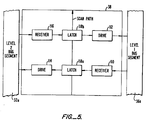
- Fig. 5 depicts a BIC which is positioned between a level one bus 36a and a level two bus 32a although, as described, BICs can also be provided between other levels of the bus system.
- the BIC 38 is connected to the level one bus segment 36a by a receiver 110 for receiving data from the level one bus segment 36a and a drive 112 for sending data onto the level one bus segment 36a.
- the BIC 38 communicates with the level two bus segment 32a by a drive 114 for placing data onto the level two bus segment 32a and a receiver 116 for receiving data from the level two bus segment 32a.
- the bus drivers are open drain N-channel CMOS transistors with nominal on resistance of about 3 ohms. The nominal signal levels are 2 V and 0.33 V.
- the bus receivers use a biased-gate configuration. Each driver and each receiver is connected to a synchronously clocked latch or register 118a, 118b in the BIC. When a signal resides on the level one bus segment 36a, it is obtained and preferably amplified by the receiver 110. A clock edge causes the latch 118a to store the received data.
- the data stored in the latch 118a is provided to the driver 114 which causes the data to be placed onto the level two bus segment 32a.
- a similar operation occurs when data is being sent from the level two bus segment to the level one bus segment.
- the data on the level two bus segment 32a is obtained and amplified by the receiver 116, and at a clock edge, stored at the latch 118b.
- the value stored in the latch 118b is amplified by the drive 112 and placed on the level one bus segment 36a.
- the receivers 116, 110 and drives 112, 114 are configured to accept and provide data at predefined voltage levels.
- the BICs act to provide communication between a two volt level board bus 32a (Fig.
- the BICs 38 can be provided using a number of application technologies, preferably using two micron CMOS technology.
- the BICs 38 are preferably located close to the two opposing edges of the MCC, preferably about 2 millimeters from the edge.
- the BICs 38 are preferably provided with a relatively extreme aspect ratio, i.e. such that the BICs are long and narrow. In this manner, the BIC-to-bus connector leads 46 can be of minimal length thus minimizing inductance and capacitance problems. In the preferred embodiment, each lead has a capacitance of about 2 pF or less.
- the other two edges of the MCC can be used to accommodate additional sets of connectors 48a, 48b, e.g., for providing communication other than over the shared bus system.
- additional sets of connectors 48a, 48b e.g., for providing communication other than over the shared bus system.
- Examples of such non-shared bus communication included communication between a memory management unit mounted on a MCC and the memory which it controls and provision of control signals to the IC's.
- These edges are also used for communicating with the backplane bus 28 in those MCC's that have backplane BIC's 40.
- the BIC's 38 by providing an interface between a group of integrated circuits 30 and a higher level bus such as the board bus 32, effectively relaxes design constraints on the integrated circuits 30 and also provides a degree of modularity of the MCCs 34.
- the integrated circuits When individual integrated circuits 30 are directly connected to a higher level bus such as a board bus, the integrated circuits must be designed not only to have the proper functionality or logic but must also produce output with electrical characteristics (e.g. voltage and capacitance characteristics) compatible with the board bus 32.
- electrical characteristics e.g. voltage and capacitance characteristics
- each integrated circuit was required to drive a signal at a high capacitance, for example about 200 pF over a relatively long bus, e.g. about 100 cm., typically connected to a load resistor 22.
- the IC designer was concerned not only with functioning or logic of the IC but also with meeting relatively stringent electrical characteristics for the IC output.
- the ICs are not directly connected to a board bus, but to a relatively short, low capacitance, unloaded MCC bus 36.
- the BICs 38 perform the function of providing an output signal which is compatible with the board bus requirements 32. Because, according to the present invention, the electrical output requirements of the ICs are relaxed, i.e., relatively less difficult to meet, IC design becomes easier. It is no longer required that a single component meet both strict logic or functional requirements and strict electrical output requirements. Rather, one group of components, the ICs 30, are designed to produce the desired functionality or logic with relatively relaxed electrical output requirements while another set of components, the BIC's, provide the necessary electrical output characteristics.
- the advantages of the BIC's are particularly pronounced when the group of ICs residing on an MCC are functionally related.
- a particular MCC can be substantially dedicated to I/O control, memory control, processor operation or the like.
- Functionally related ICs on a single MCC can be redesigned or modified substantially without affecting the design or operation of functionally unrelated ICs on other MCCs.
- each MCC provides an output to the board bus which is substantially identical in certain electrical characteristics (viz. voltage and capacitance) to the output of every other MCC. For this reason, the particular functionality of an MCC is transparent to the board bus. In this sense, the MCCs are modular, i.e., substantially interchangeable.
- the present configuration is particularly useful when a bus segment at one level operates at a different voltage level than a bus segment at an adjacent level.
- the described BIC configuration makes it possible to modify the backplane or board bus characteristics without substantially modifying the integrated circuits.
- the board bus is modified to require a different electrical output, for example a different voltage
- the BICs can be redesigned or replaced to provide the required output without substantially reconfiguring or redesigning the integrated circuits 30.
- the MCC bus 36a is preferably composed of two uni-directional buses 52a, 52b.
- One bus, 52a is used for conveying signals from the board bus 32a to the chips 30.
- the second unidirectional bus 52b is used for conveying signals from the chips 30 to the board bus 32a.
- the signal path in each bus 52a, 52b is preferably less than about fifteen inches (about 38 centimeters) in some embodiments preferably less than about ten inches (about 25 centimeters) and in other embodiments preferably about three inches (about 7.5 cm).
- the MCC of the present invention makes the use of such short buses possible.
- the short bus length permits dispensing with bus termination when operating at frequencies up to about 100 megahertz. At this frequency the round trip propagation time for a signal is about one nanosecond.
- the board bus 32 strip line signal traces are 0.006 inches (about 0.15 mm.) wide and separated by 0.025 inches (0.63 mm.). The path length from one MCC to the next MCC is approximately one centimeter.
- Each board bus 32a, 32b is terminated with a 50 ohm load 56.
- the board bus 32a, 32b is configured as two unidirectional buses, one for providing communication from the backplane bus 28 to the MCC, and the other for providing communication from the MCC to the backplane bus 28.
- the board is connected to the backplane using conventional board-to-backplane connectors such as those available from Burndy Corporation.
- Fig. 6 depicts pipeline operation of the described system.
- communication originates from an IC in a first pipeline stage 1 and will arrive simultaneously at all ICs on all MCCs at the seventh pipeline stage 7 (Fig. 7).
- a signal is generated by a chip 30 on one of the MCCs 34b and travels over the MCC bus 36b to one of the BICs 38h.
- the BIC 38h contains a register for holding the signal which was sent from the chip 30. The signal is held in the register until the beginning of the next bus cycle.
- the signal is sent from the BIC 38f onto the board bus 32a.
- the signal can be received by MCC 34c on the board bus 32a.
- the signal can be received by the MCC 34c which also contains the backplane interface chips 40a, 40b.
- the signal is received into one of the BICs 38k of the MCC 34c and held in the BIC 38k until the beginning of the third bus cycle.
- the signal travels from the BIC 38k over the MCC bus 36c to the backplane BIC 40a.
- the signal is held in the backplane BIC 40a register until the beginning of the fourth pipeline segment.
- the signal which is held in the backplane BIC 40a is placed on the backplane bus 28.
- the signal can be received on any of the MCC's which contain backplane bus BICs 34c, 34f. In the preferred embodiment, there will be one such backplane-connecting MCC for each board 26a, 26b.
- the signal is received from the backplane bus 28 into the backplane BICs 40a, 40c of the backplane-connecting MCCs 34c, 34f on each board 26a, 26b.
- the signals are then held in the backplane BICs 40a, 40c until the beginning of the fifth pipeline segment.
- the signal is transferred from each backplane BIC 40a, 40c onto the MCC bus 36c, 36f of each backplane-connecting MCC 34c, 34f and thence to a BIC 38i, 38u.
- the signal is held in the BICs 38i, 38u until the beginning of the sixth pipeline segment.
- the signal is transferred from the BICs 38i, 38u onto the board buses 32a, 32b of each board. Once it has been placed on the board buses of each board 26a, 26b it is received onto a BIC of the MCC's in the system 38b, 38f, 38n, 38r. The signal is held in a BIC of each MCC until the beginning of the seventh pipeline segment.
- the seventh pipeline segment 7 the signal is conveyed from the BICs 38b, 38f, 38n, 38r of each MCC onto the MCC bus of each MCC and thence is received at every integrated circuit 30 on every MCC in the system. In this way, a signal is sent from any integrated circuit in the system for receipt by every integrated circuit in the system in seven bus pipeline segments.
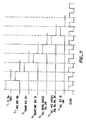
- a timing diagram corresponding to the example of data communication is depicted in Fig. 7.
- a first clock cycle 1 data is sent from one of the ICs 30 and travels over the MCC bus 36b on which the source IC 30 resides.
- the second clock cycle 2 the data travels over the board bus 32a on which the MCC 34b is mounted.
- the third clock cycle 3 the signal travels across the multi-chip carrier to the backplane coupling.
- the data travels over the back plane bus 28 and is received in the BIC's of all MCC's which are coupled to the backplane.
- the fifth clock cycle data travels over the MCC buses of the MCC's which are connected to the backplane.
- the sixth clock cycle 6 data travels over the board bus. All backplane-connecting MCCS's put it on their respective boards.
- the seventh bus cycle 7 the data travels to all chips that are on the MCC bus.
- the bottom line in the figures shows the clock signal which is the synchronizing signal for the synchronous bus.
- the registers all operate at a timing with respect to a single clock signal, i.e. all of the registers latch data and send data at substantially the same frequency and phase (disregarding, for example, normal clock slew).
- all registers which are connected to a given bus segment are synchronous.
- Preferably all registers in the bus are synchronous.
- the various levels of the system are balanced in the sense that the time which is needed for a signal to travel from a component to the bus edge is about the same for each level of the bus. For example, it takes approximately the same amount of time for a signal to travel register-to register on an MCC bus as to travel register-to-register on the board bus or on a backplane bus.
- the propagation times of the bus segments are preferably balanced (i.e., approximately equal), at least in some bus segments such as the higher level bus segments, e.g., the board bus and backplane bus segments. Balanced propagation times mean that bottleneck situations are reduced or eliminated in which one or a few bus segments have a particularly long propagation time, thus requiring other, faster bus segments to operate at less than peak transmission efficiency in order to operate synchronously with the slower segments.
- the MCC bus includes a first bus portion which is dedicated to communications which are travelling in the direction from the board bus 32a to an integrated circuit 30 and a second bus component which is dedicated to communications which are travelling from the integrated circuit 30 toward the board bus 32a.
- the board bus 32 contains a first bus component which is dedicated to communications which are travelling in the direction from a MCC 34 to the backplane bus 28 and a second bus component which is dedicated to communications which are travelling from the backplane bus 28 toward the MCC 34.
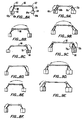
- Fig. 8 depicts communication without unidirectional busses.
- Fig. 8 shows, schematically, communication from a first node 62 which can have, for example, an input buffer 62a and an output buffer 62b to a second node 64 also having an input buffer 64a and an output buffer 64b. Communication is over a segmented bus.
- the segmented bus includes a higher level bi-directional bus 66 which is joined to the nodes 62, 64 by lower level bi-directional buses 68, 70.
- Fig. 8 illustrates communication of a signal from the first node 62 to the second node 64 and from the second node 64 to the first node 62. In the first stage shown in Fig.
- this signal is sent from the output buffer 62b over the first lower level bus 68 to the register 67 connecting upper level bus 66.
- the signal travels from one end of the upper level bus to the register 67' at the other end of the upper level bus 66.
- the signal is sent over the lower level bi-directional bus 70 from the upper level bus 66 to the second node 64. Note that even though there may be a signal in the output buffer 64b of node 64 this outgoing signal cannot be transmitted during the third pipeline segment because the lower level bus 70 is a bi-directional bus and is already in use, preventing further communication.
- FIG. 9 The improved system according to the present invention, is depicted in Fig. 9.
- the device shown in Fig. 9 is similar to that of Fig. 8 except that the lower level bus includes two unidirectional buses 68a, 68b, 70a, 70b.
- Figures 9A and 9B are similar to Figures 8A and 8B.
- the lower level buses are unidirectional, it is possible to have simultaneous transfer of data from the upper level bus 66 to the second node 64 over the first uni-directional lower level bus 70a and also from the node 64 to the upper level bus 66 over the second uni-directional bus 70b. Communication of the signal is completed in Figures 9D and 9E which are similar to Figures 8E and 8F.
- communication of a signal from a first node to a second node and from a second node back to the first node requires only five pipeline segments, representing a savings of one segment over the previous device.
- the upper level bus 66 is idle for only three out of five segments rather than four out of six.
- Providing uni-directional bus segments as shown, in the context of the disclosed synchronous segmented bus results in an increase in effective bandwidth of the bus system.
- further improvements can be realized by providing other bus segments as uni-directional segments so that signals can be simultaneously carried in either direction. In most cases, it is impractical to provide the backplane bus 28 as two uni-directional buses.
- the present invention provides high bus bandwidth together with substantial system design flexibility.
- the high bus bandwidth is particularly useful in multi-processor systems. Segmentation of the buses through pipelining introduces additional latency, but reduces the cycle time between stages. All components are surface mounted on multi-chip packages which interact with the system buses through interface chips.
- the drive requirements for the components are simplified. Because ICs for use in the connection with the MCC have reduced drive requirements (i.e., can be designed to drive smaller loads than typical for previous ICs) the ICs for use in the present invention can be designed to consume reduced power, thus reducing both the power drain problems and heat dissipation problems (on a per-chip basis). Furthermore, ICs with reduced drive requirements can be made physically smaller and the consequent savings in space can be used to provide additional logic. Such additional logic capacities are particularly useful in application specific integrated circuits (ASICs). Standardization of the packages allows system flexibility. Because a number of chips are housed in each multi-chip package, the total number of packages on the board is reduced. This is particularly useful in embodiments which implement wide uni-directional bus portions because such bus portions require a large number of pins. Thus, providing multi-chip packages where several chips share the same pin helps reduce the total number of pins on the board and thus the cost.
- ASICs application specific integrated circuits
- the buses on all levels are balanced so that similar delays occur between pipeline stages. At the lowest pipeline stage, delay can be reduced since the bus length is shortened (less than about three inches, about 7.5 centimeters) and the bus loading is lowered (to less than about 20 pF).
- High pin count is possible in the MCCs by placing connection pads at a dense spacing (0.025 inches, about 0.6 millimeters) and contacting the buses on two sides of the package. This arrangement also allows for a symmetric board bus running under the packages which makes impedance matching easier. All major ICs are connected similarly to multi-chip packages to form modules which interface identically to the system buses. Thus, system configuration can be changed by using a different configuration of modules.
- a module can contain memory control components, processor components, a mixture of both or IO components. Reconfigurations such as substituting memory for processing power can be implemented by routine changes in the board. Because of the modularity of MCCs, a distributor or a user can inventory MCCs to make it easier to modify or repair computing facilities. Boards can be added to the backplane for system expansion. Providing for multi-chip carriers on a board, rather than individual IC carriers on the board permits a higher density of ICs and simultaneously, permits providing a smaller bus length on each board, compared to previous devices.
- the present invention is particularly advantageous in the context of a multiprocessor system.
- a typical multi-processor system includes one or more cache devices for each processor.
- the capacity of the bus thus places an upper bound on how many micro-processors can communicate on the bus without overloading the bus and destroying many of the advantages of a multi-processor system.
- one of the most critical aspects of a multi-processor bus system is the bus bandwidth.
- the present invention as described provides for a high bus bandwidth, at the cost of bus latency. However, the increase in bus bandwidth is believed to outweigh the disadvantages of latency, particularly in a multi-processor system in which the burden of latency is shared among the processors.
- BICs standard interface integrated circuits
- Inductance and capacitance problems are minimized by configuring the interface chips as relatively long (e.g., 14 millimeter) components which are mounted close to the package edge in order minimize stub length from the package edge to the chip pad.
- each MCC can be scaled to smaller or larger sizes and also can be scaled in the sense that a larger number of bus segments can be used, for example, four, five, or more bus segments can be used in connection with the present invention.
- BICs are provided on each MCC, such BICs could be deleted and the MCC bus could be directly connected to the board bus to effectively provide a single board-MCC bus segment on each board.
- each chip could include a register for holding data to be placed onto the bus or which is received from the bus.
- each MCC could include one or more registers without having a BIC and do away with a level of pipelining.
Landscapes
- Engineering & Computer Science (AREA)
- General Engineering & Computer Science (AREA)
- Theoretical Computer Science (AREA)
- Physics & Mathematics (AREA)
- Computer Hardware Design (AREA)
- General Physics & Mathematics (AREA)
- Mathematical Physics (AREA)
- Semiconductor Integrated Circuits (AREA)
- Information Transfer Systems (AREA)
- Bus Control (AREA)
- Small-Scale Networks (AREA)
Claims (7)
- Système de bus segmenté synchrone destiné à être utilisé pour la transmission des données comprenant :caractérisé en ce que l'un desdits segments de bus (36) est bidirectionnel et tous les autres segments de bus (28, 32) comprennent une première partie unidirectionnelle destinée à transmettre des données dans un premier sens et une seconde partie unidirectionnelle destinée à transmettre des données dans un second sens qui diffère dudit premier sens, simultanément à ladite transmission des données sur ladite première partie unidirectionnelle.au moins des premier et second segments de bus (28, 32, 36) destinés à acheminer des données à bits multiples en parallèle, chaque segment comportant deux extrémités,au moins des premier, second et troisième registres (38) destinés à recevoir des données à bits multiples depuis un segment de bus relié et à envoyer des données à bits multiples jusque sur un segment relié, ledit premier registre étant relié à une première extrémité dudit premier segment de bus (36), ledit second registre étant relié à l'autre extrémité dudit premier segment de bus et à une première extrémité dudit second segment de bus (32), ledit troisième registre étant relié à l'autre extrémité dudit second segment de bus (32), en l'absence d'un couplage dudit premier registre audit second segment de bus (32), etun moyen destiné à cadencer lesdits premier, second et troisième registres (38), dans lequel des premières données à bits multiples émises à partir dudit premier registre sont reçues au niveau dudit second registre en un premier cycle d'horloge, de façon synchrone avec l'émission de secondes données à bits multiples depuis ledit second registre vers ledit troisième registre, et dans lequel lesdites premières données à bits multiples sont émises depuis ledit second registre et sont reçues au niveau dudit troisième registre dans un second cycle d'horloge, sans que lesdites premières données à bits multiples soient émises sur ledit premier segment de bus durant ledit second cycle d'horloge,
- Système de bus segmenté synchrone selon la revendication 1, dans lequel lesdits segments de bus (28, 32, 36) comprennent au moins un segment de bus de niveau le plus bas et un segment de bus de niveau le plus élevé, chacun desdits segments de bus étant relié pour une communication avec au moins un autre segment de bus, lesdits segments de bus étant reliés de façon à définir une pluralité de niveaux de bus ordonnés dans laquelle chaque segment de bus peut communiquer avec au moins un autre segment de bus qui est à un niveau adjacent, lesdits registres (38) étant reliés auxdits bus afin de conserver les données reçues depuis un bus avant que lesdites données soient émises vers un segment de bus du niveau adjacent, dans lequel lorsque lesdites données sont émises depuis l'un desdits registres, sur un segment de bus vers un autre desdits registres, lesdites données sont pratiquement inchangées.
- Système de bus segmenté synchrone selon la revendication 2, dans lequel :toutes les données sur un premier segment de bus sont conservées dans un registre avant qu'elles ne soient placées sur un segment de bus du niveau adjacent.
- Système de bus segmenté synchrone selon la revendication 2 ou 3, dans lequel ledit segment de bus de niveau le plus élevé est bidirectionnel.
- Système de bus segmenté synchrone selon l'une quelconque des revendications précédentes, comprenant :une pluralité de segments de bus de premier niveau (36),une pluralité de modules à puces multiples (34), chaque module comportant un segment de bus de premier niveau (36), et un moyen destiné à relier une pluralité de puces de circuits intégrés (30) audit segment de bus de premier niveau (36),une pluralité de segments de bus de second niveau (32), au moins l'un desdits segments de bus de second niveau (32) formant une connexion entre un premier et un second desdits modules à puces multiples (34),au moins une puce d'interface de bus de premier niveau (38) comprenant l'un desdits registres sur chaque dit module à puces multiples afin de mémoriser et de transférer des données entre l'un desdits segments de bus de premier niveau (36) et l'un desdits segments de bus de second niveau (32),au moins un segment de bus de troisième niveau (28) formant une connexion entre un premier et un second desdits segments de bus de second niveau (32), etau moins une puce d'interface de bus de second niveau (40) comprenant un autre desdits registres afin de mémoriser et de transférer des données entre l'un desdits segments de bus de second niveau (32) et ledit segment de bus de troisième niveau (28).
- Système de bus segmenté synchrone selon l'une quelconque des revendications 1 à 5, comprenant au moins un support à puces multiples (34) comprenant :un substrat (42) comportant des premier et second bords et des première et seconde faces,une pluralité de pistes conductrices formées sur ledit substrat (42) et formant ledit premier segment de bus (36),une pluralité de circuits intégrés (30) positionnés sur ladite première face dudit substrat (42) et couplés audit premier segment de bus (36),au moins des première et seconde puces d'interface de bus (38, 40) destinées à recevoir des données depuis ledit premier segment de bus (36), à conserver lesdites données et à transmettre lesdites données vers ledit second segment de bus (32), lesdites première et seconde puces d'interface de bus (37, 40) étant positionnées sur ledit substrat (42) à proximité desdits premier et second bords.
- Système de bus segmenté synchrone selon l'une quelconque des revendications 1 à 5, comprenant une carte de circuits (26) comportant :une base de carte,une pluralité de pistes formant ledit second segment de bus (32), formées dans ladite base de carte située pratiquement dans un plan,au moins un premier support à puces multiples (34) monté sur ladite base de carte qui comprend : un substrat (42) comportant des premier et second bords et des première et seconde faces, une pluralité de pistes conductrices formées sur ledit substrat (42) et formant ledit premier segment de bus (36), une pluralité de circuits intégrés (30) positionnés sur ladite première face dudit substrat (42) et reliés audit premier segment de bus (36), au moins des première et seconde puces d'interface de bus (38, 40) destinées à recevoir des données depuis ledit premier segment de bus (36), à conserver lesdites données et à transmettre lesdites données vers ledit second segment de bus (32), lesdites première et seconde puces d'interface de bus (38, 40) étant positionnées sur ledit substrat (42) à proximité desdits premier et second bords, ledit second segment de bus (32) s'étendant au-dessous desdits supports à puces multiples (34) montés sur ladite carte pratiquement entre lesdites première et seconde puces d'interface de bus (38, 40).
Applications Claiming Priority (2)
| Application Number | Priority Date | Filing Date | Title |
|---|---|---|---|
| US49011390A | 1990-03-06 | 1990-03-06 | |
| US490113 | 1990-03-06 |
Publications (3)
| Publication Number | Publication Date |
|---|---|
| EP0446039A2 EP0446039A2 (fr) | 1991-09-11 |
| EP0446039A3 EP0446039A3 (en) | 1991-12-27 |
| EP0446039B1 true EP0446039B1 (fr) | 1998-07-15 |
Family
ID=23946685
Family Applications (1)
| Application Number | Title | Priority Date | Filing Date |
|---|---|---|---|
| EP91301880A Expired - Lifetime EP0446039B1 (fr) | 1990-03-06 | 1991-03-06 | Bus à segments multiples et méthode d'opération |
Country Status (4)
| Country | Link |
|---|---|
| US (3) | US5685004A (fr) |
| EP (1) | EP0446039B1 (fr) |
| JP (1) | JP3118266B2 (fr) |
| DE (1) | DE69129767T2 (fr) |
Families Citing this family (37)
| Publication number | Priority date | Publication date | Assignee | Title |
|---|---|---|---|---|
| US5483518A (en) | 1992-06-17 | 1996-01-09 | Texas Instruments Incorporated | Addressable shadow port and protocol for serial bus networks |
| US6675333B1 (en) | 1990-03-30 | 2004-01-06 | Texas Instruments Incorporated | Integrated circuit with serial I/O controller |
| DE69333479T2 (de) * | 1992-06-17 | 2005-03-24 | Texas Instruments Inc., Dallas | Hierarchisches Verbindungsverfahren und -gerät |
| AU685615B2 (en) * | 1994-03-21 | 1998-01-22 | Intel Corporation | Method and apparatus for integrated circuit voltage regulation |
| US5734840A (en) * | 1995-08-18 | 1998-03-31 | International Business Machines Corporation | PCI and expansion bus riser card |
| US5969538A (en) | 1996-10-31 | 1999-10-19 | Texas Instruments Incorporated | Semiconductor wafer with interconnect between dies for testing and a process of testing |
| US6493407B1 (en) * | 1997-05-27 | 2002-12-10 | Fusion Micromedia Corporation | Synchronous latching bus arrangement for interfacing discrete and/or integrated modules in a digital system and associated method |
| EP0892352B1 (fr) | 1997-07-18 | 2005-04-13 | Bull S.A. | Système d'ordinateur avec un bus de structure segmentée |
| US6043558A (en) * | 1997-09-12 | 2000-03-28 | Micron Technology, Inc. | IC packages including separated signal and power supply edge connections, systems and devices including such packages, and methods of connecting such packages |
| US6408413B1 (en) | 1998-02-18 | 2002-06-18 | Texas Instruments Incorporated | Hierarchical access of test access ports in embedded core integrated circuits |
| US6405335B1 (en) | 1998-02-25 | 2002-06-11 | Texas Instruments Incorporated | Position independent testing of circuits |
| GB2341770B (en) * | 1998-09-18 | 2004-01-21 | Pixelfusion Ltd | Modular bus architecture |
| US7058862B2 (en) | 2000-05-26 | 2006-06-06 | Texas Instruments Incorporated | Selecting different 1149.1 TAP domains from update-IR state |
| WO2000077652A2 (fr) | 1999-06-10 | 2000-12-21 | Pact Informationstechnologie Gmbh | Partionnement de sequences dans des structures cellulaires |
| US6647450B1 (en) | 1999-10-06 | 2003-11-11 | Cradle Technologies, Inc. | Multiprocessor computer systems with command FIFO buffer at each target device |
| US6728915B2 (en) | 2000-01-10 | 2004-04-27 | Texas Instruments Incorporated | IC with shared scan cells selectively connected in scan path |
| US6769080B2 (en) | 2000-03-09 | 2004-07-27 | Texas Instruments Incorporated | Scan circuit low power adapter with counter |
| JP2002026130A (ja) * | 2000-07-06 | 2002-01-25 | Nec Microsystems Ltd | 半導体集積回路及びi/oブロック配置方法 |
| US8058899B2 (en) | 2000-10-06 | 2011-11-15 | Martin Vorbach | Logic cell array and bus system |
| US6934785B2 (en) * | 2000-12-22 | 2005-08-23 | Micron Technology, Inc. | High speed interface with looped bus |
| US9250908B2 (en) | 2001-03-05 | 2016-02-02 | Pact Xpp Technologies Ag | Multi-processor bus and cache interconnection system |
| US9552047B2 (en) | 2001-03-05 | 2017-01-24 | Pact Xpp Technologies Ag | Multiprocessor having runtime adjustable clock and clock dependent power supply |
| US9411532B2 (en) | 2001-09-07 | 2016-08-09 | Pact Xpp Technologies Ag | Methods and systems for transferring data between a processing device and external devices |
| US9436631B2 (en) * | 2001-03-05 | 2016-09-06 | Pact Xpp Technologies Ag | Chip including memory element storing higher level memory data on a page by page basis |
| US9037807B2 (en) | 2001-03-05 | 2015-05-19 | Pact Xpp Technologies Ag | Processor arrangement on a chip including data processing, memory, and interface elements |
| US6882082B2 (en) * | 2001-03-13 | 2005-04-19 | Micron Technology, Inc. | Memory repeater |
| US10031733B2 (en) | 2001-06-20 | 2018-07-24 | Scientia Sol Mentis Ag | Method for processing data |
| US6640331B2 (en) * | 2001-11-29 | 2003-10-28 | Sun Microsystems, Inc. | Decoupling capacitor assignment technique with respect to leakage power |
| US9170812B2 (en) | 2002-03-21 | 2015-10-27 | Pact Xpp Technologies Ag | Data processing system having integrated pipelined array data processor |
| WO2004088502A2 (fr) * | 2003-04-04 | 2004-10-14 | Pact Xpp Technologies Ag | Procede et dispositif de traitement de donnees |
| US7394284B2 (en) | 2002-09-06 | 2008-07-01 | Pact Xpp Technologies Ag | Reconfigurable sequencer structure |
| US6996652B1 (en) * | 2002-09-19 | 2006-02-07 | Inapac Technology, Inc. | High-speed segmented data bus architecture |
| EP1581864A2 (fr) * | 2002-12-30 | 2005-10-05 | Koninklijke Philips Electronics N.V. | Processeur ilp en grappes |
| KR100631673B1 (ko) * | 2003-12-30 | 2006-10-09 | 엘지전자 주식회사 | 이동통신용 고주파 모듈 구조 |
| JP2006245336A (ja) * | 2005-03-03 | 2006-09-14 | Koito Mfg Co Ltd | 発光装置 |
| US20070015464A1 (en) * | 2005-07-12 | 2007-01-18 | Mark Disalvo | Interactive venue system |
| GB2464703A (en) * | 2008-10-22 | 2010-04-28 | Advanced Risc Mach Ltd | An array of interconnected processors executing a cycle-based program |
Family Cites Families (33)
| Publication number | Priority date | Publication date | Assignee | Title |
|---|---|---|---|---|
| FR2432175A1 (fr) * | 1978-07-27 | 1980-02-22 | Cii Honeywell Bull | Procede pour tester un systeme logique et systeme logique pour la mise en oeuvre de ce procede |
| US4296469A (en) * | 1978-11-17 | 1981-10-20 | Motorola, Inc. | Execution unit for data processor using segmented bus structure |
| DE3275595D1 (en) * | 1981-10-01 | 1987-04-09 | Stratus Computer Inc | Digital data processor with fault-tolerant bus protocol |
| US4562535A (en) * | 1982-04-05 | 1985-12-31 | Texas Instruments Incorporated | Self-configuring digital processor system with global system |
| US4509008A (en) * | 1982-04-20 | 1985-04-02 | International Business Machines Corporation | Method of concurrently testing each of a plurality of interconnected integrated circuit chips |
| US4604689A (en) * | 1983-04-15 | 1986-08-05 | Convergent Technologies, Inc. | Bus repeater |
| JPS608972A (ja) * | 1983-06-29 | 1985-01-17 | Fujitsu Ltd | マルチプロセツサシステム |
| GB8432533D0 (en) * | 1984-12-21 | 1985-02-06 | Plessey Co Plc | Integrated circuits |
| NL192801C (nl) * | 1986-09-10 | 1998-02-03 | Philips Electronics Nv | Werkwijze voor het testen van een drager met meerdere digitaal-werkende geïntegreerde schakelingen, geïntegreerde schakeling geschikt voor het aanbrengen op een aldus te testen drager, en drager voorzien van meerdere van zulke geïntegreerde schakelingen. |
| FR2605768B1 (fr) * | 1986-10-23 | 1989-05-05 | Bull Sa | Dispositif de commande de bus constitue par plusieurs segments isolables |
| DE3708887A1 (de) * | 1987-03-19 | 1988-09-29 | Martin Neschen | Paralleler datenbus |
| US4899307A (en) * | 1987-04-10 | 1990-02-06 | Tandem Computers Incorporated | Stack with unary encoded stack pointer |
| JPS63256877A (ja) * | 1987-04-14 | 1988-10-24 | Mitsubishi Electric Corp | テスト回路 |
| US4827476A (en) * | 1987-04-16 | 1989-05-02 | Tandem Computers Incorporated | Scan test apparatus for digital systems having dynamic random access memory |
| US4933846A (en) * | 1987-04-24 | 1990-06-12 | Network Systems Corporation | Network communications adapter with dual interleaved memory banks servicing multiple processors |
| DE3782819D1 (de) * | 1987-06-02 | 1993-01-07 | Itt Ind Gmbh Deutsche | Steuerprozessor. |
| US4933838A (en) * | 1987-06-03 | 1990-06-12 | The Boeing Company | Segmentable parallel bus for multiprocessor computer systems |
| US4845663A (en) * | 1987-09-03 | 1989-07-04 | Minnesota Mining And Manufacturing Company | Image processor with free flow pipeline bus |
| US4974153A (en) * | 1987-09-04 | 1990-11-27 | Digital Equipment Corporation | Repeater interlock scheme for transactions between two buses including transaction and interlock buffers |
| US4933845A (en) * | 1987-09-04 | 1990-06-12 | Digital Equipment Corporation | Reconfigurable bus |
| US4965723A (en) * | 1987-10-23 | 1990-10-23 | Digital Equipment Corporation | Bus data path control scheme |
| JP2944084B2 (ja) * | 1988-04-14 | 1999-08-30 | 日本電気株式会社 | シリアル入出力回路 |
| US5107507A (en) * | 1988-05-26 | 1992-04-21 | International Business Machines | Bidirectional buffer with latch and parity capability |
| JPH01320564A (ja) * | 1988-06-23 | 1989-12-26 | Hitachi Ltd | 並列処理装置 |
| US5119483A (en) * | 1988-07-20 | 1992-06-02 | Digital Equipment Corporation | Application of state silos for recovery from memory management exceptions |
| US5173864A (en) * | 1988-08-20 | 1992-12-22 | Kabushiki Kaisha Toshiba | Standard cell and standard-cell-type integrated circuit |
| US5050066A (en) * | 1988-10-14 | 1991-09-17 | Intel Corporation | Apparatus with a single memory and a plurality of queue counters for queuing requests and replies on a pipelined packet bus |
| EP0365322A3 (fr) * | 1988-10-19 | 1991-11-27 | Hewlett-Packard Company | Méthode et dispositif de traitement des exceptions dans des processeurs de pipeline ayant des profondeurs différentes de pipeline d'instruction |
| US5006982A (en) * | 1988-10-21 | 1991-04-09 | Siemens Ak. | Method of increasing the bandwidth of a packet bus by reordering reply packets |
| US5097410A (en) * | 1988-12-30 | 1992-03-17 | International Business Machines Corporation | Multimode data system for transferring control and data information in an i/o subsystem |
| GB2234613B (en) * | 1989-08-03 | 1993-07-07 | Sun Microsystems Inc | Method and apparatus for switching context of state elements in a microprocessor |
| US5408146A (en) * | 1992-01-31 | 1995-04-18 | Lsi Logic Corporation | High performance backplane driver circuit |
| US5491428A (en) * | 1993-12-20 | 1996-02-13 | Hitachi Microsystems, Inc. | Bus-isolating pre-charge buffer |
-
1991
- 1991-03-05 JP JP03038283A patent/JP3118266B2/ja not_active Expired - Lifetime
- 1991-03-06 DE DE69129767T patent/DE69129767T2/de not_active Expired - Lifetime
- 1991-03-06 EP EP91301880A patent/EP0446039B1/fr not_active Expired - Lifetime
-
1993
- 1993-03-01 US US08/024,877 patent/US5685004A/en not_active Expired - Lifetime
-
1995
- 1995-05-23 US US08/447,648 patent/US5978880A/en not_active Expired - Lifetime
- 1995-05-23 US US08/449,398 patent/US5632029A/en not_active Expired - Lifetime
Also Published As
| Publication number | Publication date |
|---|---|
| EP0446039A3 (en) | 1991-12-27 |
| US5978880A (en) | 1999-11-02 |
| DE69129767D1 (de) | 1998-08-20 |
| EP0446039A2 (fr) | 1991-09-11 |
| US5685004A (en) | 1997-11-04 |
| DE69129767T2 (de) | 1999-02-04 |
| JPH06266659A (ja) | 1994-09-22 |
| JP3118266B2 (ja) | 2000-12-18 |
| US5632029A (en) | 1997-05-20 |
Similar Documents
| Publication | Publication Date | Title |
|---|---|---|
| EP0446039B1 (fr) | Bus à segments multiples et méthode d'opération | |
| KR100267430B1 (ko) | 멀티칩시스템및그제조방법 | |
| US5999437A (en) | Processor-inclusive memory module | |
| US4393464A (en) | Chip topography for integrated circuit communication controller | |
| EP0664514B1 (fr) | Dispositif pour intégrer le droit de propriété bus-master de la charge de bus local | |
| US6108731A (en) | Information processor and method of its component arrangement | |
| US6687780B1 (en) | Expandable slave device system | |
| US5418911A (en) | Data path switch method and apparatus that provides capacitive load isolation | |
| EP0535479A1 (fr) | Empaquetages et systèmes pour circuits intégrés à multi-puces | |
| US6417462B1 (en) | Low cost and high speed 3-load printed wiring board bus topology | |
| US20070198758A1 (en) | Bus apparatus, bus system and information transferring method | |
| US5867419A (en) | Processor-inclusive memory module | |
| US6151257A (en) | Apparatus for receiving/transmitting signals in an input/output pad buffer cell | |
| MY127415A (en) | Integrated circuit and information processing device | |
| US6417688B1 (en) | Method and apparatus for implementing a highly robust, fast, and economical five load bus topology based on bit mirroring and a well terminated transmission environment | |
| US6839856B1 (en) | Method and circuit for reliable data capture in the presence of bus-master changeovers | |
| US5968155A (en) | Digital gate computer bus | |
| CN116266973A (zh) | 交错双侧多芯片互连 | |
| CN1127141C (zh) | 采用虚拟镜像封装件的电路互连 | |
| US5583998A (en) | Method and apparatus for increasing the speed of data exchange among the subsystems of a data processing system | |
| US7328361B2 (en) | Digital bus synchronizer for generating read reset signal | |
| US6067232A (en) | System for connecting subsystems of dissimilar thermal properties | |
| US6760855B1 (en) | System and method for reducing a ground bounce during write by selectively delaying address and data lines with different multiple predetermined amount of delay | |
| Tewksbury et al. | Cointegration of optoelectronics and silicon ULSI for scaled, high-performance distributed computing systems | |
| Walling et al. | High bandwidth low latency chip to chip interconnects using high performance MLC glass ceramic POWER4/sup R/MCM |
Legal Events
| Date | Code | Title | Description |
|---|---|---|---|
| PUAI | Public reference made under article 153(3) epc to a published international application that has entered the european phase |
Free format text: ORIGINAL CODE: 0009012 |
|
| AK | Designated contracting states |
Kind code of ref document: A2 Designated state(s): DE FR GB |
|
| PUAL | Search report despatched |
Free format text: ORIGINAL CODE: 0009013 |
|
| AK | Designated contracting states |
Kind code of ref document: A3 Designated state(s): DE FR GB |
|
| 17P | Request for examination filed |
Effective date: 19920604 |
|
| 17Q | First examination report despatched |
Effective date: 19950123 |
|
| GRAG | Despatch of communication of intention to grant |
Free format text: ORIGINAL CODE: EPIDOS AGRA |
|
| GRAG | Despatch of communication of intention to grant |
Free format text: ORIGINAL CODE: EPIDOS AGRA |
|
| GRAH | Despatch of communication of intention to grant a patent |
Free format text: ORIGINAL CODE: EPIDOS IGRA |
|
| GRAH | Despatch of communication of intention to grant a patent |
Free format text: ORIGINAL CODE: EPIDOS IGRA |
|
| GRAA | (expected) grant |
Free format text: ORIGINAL CODE: 0009210 |
|
| AK | Designated contracting states |
Kind code of ref document: B1 Designated state(s): DE FR GB |
|
| REF | Corresponds to: |
Ref document number: 69129767 Country of ref document: DE Date of ref document: 19980820 |
|
| ET | Fr: translation filed | ||
| PLBE | No opposition filed within time limit |
Free format text: ORIGINAL CODE: 0009261 |
|
| STAA | Information on the status of an ep patent application or granted ep patent |
Free format text: STATUS: NO OPPOSITION FILED WITHIN TIME LIMIT |
|
| 26N | No opposition filed | ||
| REG | Reference to a national code |
Ref country code: GB Ref legal event code: IF02 |
|
| PGFP | Annual fee paid to national office [announced via postgrant information from national office to epo] |
Ref country code: FR Payment date: 20100324 Year of fee payment: 20 |
|
| PGFP | Annual fee paid to national office [announced via postgrant information from national office to epo] |
Ref country code: GB Payment date: 20100303 Year of fee payment: 20 |
|
| PGFP | Annual fee paid to national office [announced via postgrant information from national office to epo] |
Ref country code: DE Payment date: 20100318 Year of fee payment: 20 |
|
| REG | Reference to a national code |
Ref country code: DE Ref legal event code: R071 Ref document number: 69129767 Country of ref document: DE |
|
| REG | Reference to a national code |
Ref country code: GB Ref legal event code: PE20 Expiry date: 20110305 |
|
| PG25 | Lapsed in a contracting state [announced via postgrant information from national office to epo] |
Ref country code: GB Free format text: LAPSE BECAUSE OF EXPIRATION OF PROTECTION Effective date: 20110305 |
|
| PG25 | Lapsed in a contracting state [announced via postgrant information from national office to epo] |
Ref country code: DE Free format text: LAPSE BECAUSE OF EXPIRATION OF PROTECTION Effective date: 20110306 |