EP0444536A2 - Fernsprechvermittlungsanlage und -verfahren - Google Patents
Fernsprechvermittlungsanlage und -verfahren Download PDFInfo
- Publication number
- EP0444536A2 EP0444536A2 EP91102563A EP91102563A EP0444536A2 EP 0444536 A2 EP0444536 A2 EP 0444536A2 EP 91102563 A EP91102563 A EP 91102563A EP 91102563 A EP91102563 A EP 91102563A EP 0444536 A2 EP0444536 A2 EP 0444536A2
- Authority
- EP
- European Patent Office
- Prior art keywords
- recording
- telephone
- voice
- exchange system
- control means
- Prior art date
- Legal status (The legal status is an assumption and is not a legal conclusion. Google has not performed a legal analysis and makes no representation as to the accuracy of the status listed.)
- Granted
Links
- 238000000034 method Methods 0.000 title description 17
- 238000004891 communication Methods 0.000 claims abstract description 35
- 238000001514 detection method Methods 0.000 claims abstract description 4
- 238000012546 transfer Methods 0.000 claims description 12
- 230000004044 response Effects 0.000 claims description 6
- 230000000694 effects Effects 0.000 claims description 4
- 230000008859 change Effects 0.000 claims description 3
- 230000001276 controlling effect Effects 0.000 claims 3
- 230000002596 correlated effect Effects 0.000 claims 2
- 238000012545 processing Methods 0.000 description 38
- 238000010586 diagram Methods 0.000 description 17
- 238000010276 construction Methods 0.000 description 15
- 230000004048 modification Effects 0.000 description 9
- 238000012986 modification Methods 0.000 description 9
- 238000007726 management method Methods 0.000 description 8
- 230000006870 function Effects 0.000 description 6
- 238000012544 monitoring process Methods 0.000 description 4
- 230000008569 process Effects 0.000 description 2
- 239000004065 semiconductor Substances 0.000 description 2
- 239000003086 colorant Substances 0.000 description 1
- 230000002708 enhancing effect Effects 0.000 description 1
- 230000007704 transition Effects 0.000 description 1
- 230000000007 visual effect Effects 0.000 description 1
Images




Classifications
-
- H—ELECTRICITY
- H04—ELECTRIC COMMUNICATION TECHNIQUE
- H04M—TELEPHONIC COMMUNICATION
- H04M3/00—Automatic or semi-automatic exchanges
- H04M3/42—Systems providing special services or facilities to subscribers
- H04M3/50—Centralised arrangements for answering calls; Centralised arrangements for recording messages for absent or busy subscribers ; Centralised arrangements for recording messages
- H04M3/53—Centralised arrangements for recording incoming messages, i.e. mailbox systems
- H04M3/533—Voice mail systems
-
- H—ELECTRICITY
- H04—ELECTRIC COMMUNICATION TECHNIQUE
- H04M—TELEPHONIC COMMUNICATION
- H04M3/00—Automatic or semi-automatic exchanges
- H04M3/42—Systems providing special services or facilities to subscribers
-
- H—ELECTRICITY
- H04—ELECTRIC COMMUNICATION TECHNIQUE
- H04M—TELEPHONIC COMMUNICATION
- H04M2201/00—Electronic components, circuits, software, systems or apparatus used in telephone systems
- H04M2201/38—Displays
-
- H—ELECTRICITY
- H04—ELECTRIC COMMUNICATION TECHNIQUE
- H04M—TELEPHONIC COMMUNICATION
- H04M3/00—Automatic or semi-automatic exchanges
- H04M3/42—Systems providing special services or facilities to subscribers
- H04M3/487—Arrangements for providing information services, e.g. recorded voice services or time announcements
-
- H—ELECTRICITY
- H04—ELECTRIC COMMUNICATION TECHNIQUE
- H04M—TELEPHONIC COMMUNICATION
- H04M3/00—Automatic or semi-automatic exchanges
- H04M3/42—Systems providing special services or facilities to subscribers
- H04M3/50—Centralised arrangements for answering calls; Centralised arrangements for recording messages for absent or busy subscribers ; Centralised arrangements for recording messages
- H04M3/53—Centralised arrangements for recording incoming messages, i.e. mailbox systems
- H04M3/537—Arrangements for indicating the presence of a recorded message, whereby the presence information might include a preview or summary of the message
Definitions
- This invention relates to a telephone exchange system which accommodates a plurality of main lines and a plurality of telephones. More particularly, the invention relates to a telephone exchange system in which the audio of a telephonic communication is recorded in a recording area shared by a plurality of telephones, and the recorded audio is played back by any of the telephones or transferred.
- a conventional telephone exchange system telephones each having a recording/playback function are used as extension telephones connected to the system in order to record the audio of a telephonic communication that is in progress. This makes it possible for each extension to individually record and/or playback the audio of the communication.
- the system is provided with a memory device shared by each extension telephone, the storage area of the memory device is divided among the extensions, and a telephonic communication is recorded in or played back from an area that has been designated from an extension telephone by an operation performed at this telephone.
- the former arrangement having a recording/playback function for every extension is adopted, it raises the cost of the telephone exchange system.
- a troublesome operation is required in which the recording medium such as a recording tape is handed over to the party for which the message is intended or the recording is re-recorded on the recording medium possessed by this party.
- the storage area of one memory device is apportioned to each of a plurality of extension telephones and used to record and/or playback a telephonic communication
- the storage areas used are fixedly assigned to the telephones. Consequently, the storage capacity for a particular user may be inadequate or, even if the storage capacity for a user is more than enough, it cannot be used by another telephone. Thus, the storage areas cannot be effectively exploited by the system as a whole.
- an object of the present invention is to provide an inexpensively constructed telephone exchange system in which efficient use is made of a recording/playback memory shared by each extension telephone accommodated by the exchange system, thereby raising degree of freedom in terms of recording/playback and improving service.
- Another object of the present invention is to provide a telephone exchange system in which a party to receive a message is capable of knowing that the message is in the process of being recorded, thereby making it possible for this party to respond to the party leaving the message.
- a telephone exchange system comprising recording control means for controlling the starting and stopping of recording of a voice on recording means, managing means for managing the recording operation of the recording means, specific-information storing means for storing, based upon results of management performed by the managing means, at least recording area information, telephone-specifying information, recording starting-position information and recording end-position information as information specifying a recording, altering means for altering information, which has been stored in the specific-information storing means, in accordance with a change in the information specifying recording based upon the management performed by the managing means, erasing means for erasing a recording on the recording means after the recording is transferred in response to a transfer request, voice detecting means for detecting whether a voice is present during a telephone call, means for starting or stopping recording of the voice by the recording means based upon results of detection performed by the voice detecting means, recording sensing means for sensing whether there is a recording for a specific telephone based upon results of management performed by the
- Still another object of the present invention is to provide a telephone exchange system in which, when a recording is played back, the time at which the recording was made is announced by voice, thereby enhancing the reliability of recorded information.
- a telephone exchange system comprising recording control means for controlling the starting and stopping of recording of a voice on recording means, managing means for managing the recording operation of the recording means, recording specifying means for specifying a recording in the recording means based upon results of management performed by the managing means, telephone specifying means for specifying a telephone among a plurality of telephones based upon results of management performed by the managing means, playback control means for playing back the recording, which has been specified by the recording specifying means, by the telephone specified by the telephone specifying means, timekeeping means for clocking time, and converting means for converting time clocked by the timekeeping means into an audible voice.
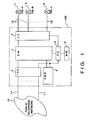
- Fig. 1 is a block diagram showing the overall construction of a telephone exchange system according to a first embodiment of the present invention.
- the telephone exchange system includes a switch circuit network (SW) 1 for performing time-division switching, a trunk circuit unit (TRK) 2 which interfaces a plurality of line wires 11 accommodated in the system 100 and connected to a public telephone network 10, a line circuit (LC) 3 having an interface for extensions 12, a memory (MM) 4 for storing a control program and data, a central controller (CC) 5 for controlling the overall system, and a voice message controller (VMR) 6 which, in response to instructions from the CC 5, applies predetermined processing, described later, to voice information handled by the telephone exchange system.
- Extension telephones 7 through 9 are connected to the LC 3 via the extensions 12.
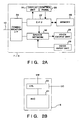
- Fig. 2A is a block diagram showing the construction of the extension telephones, which are private telephones connected to the telephone exchange system 100.
- Each of the extension telephones 7 through 9 includes a communication interface 24 for connecting channels to the telephone exchange system 100 and communicating control data between the telephones and the exchange system, a display unit 31 for displaying dialed numbers, messages and the like, a CPU 27 comprising a microprocessor which controls the overall operation of the extension telephones 7 through 9, a control panel 25 comprising dial buttons or the like, a memory 26 which stores a program that decides the operation of the CPU 27 as well as control information such as information necessary for operation of the extension telephones 7 through 9, a voice input unit 28 comprising a microphone or transmitter, and a voice output unit 29 comprising a speaker or receiver.
- Fig. 2B is a block diagram illustrating the internal construction of the voice message controller 6 constituting part of the telephone exchange system 100.
- the voice message controller 6 is provided with a voice memory (REC) 21 constituted by a semiconductor memory for storing a recorded voice, and a voice controller (CTL) 22 which controls the recording and playback operations of the voice memory.
- REC voice memory
- CTL voice controller
- the voice controller 22 starts recording a voice, which is received from the switch circuit network 1, from a recording starting position in the voice memory 21 designated by the central controller 5, and continues the recording operation until the end is designated by the central controller 5. After the recording operation is ended by the end designation, the central controller 5 is informed of the recording end position in the voice memory 21.
- the voice controller 22 plays back the voice data from the starting position to the end position of the voice memory 21 designated by the central controller 5.
- the voice controller 22 outputs the played back voice data to the switch circuit network 1 and, at the conclusion of playback, so informs the central controller 5.
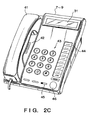
- Fig. 2C is an external view of the extension telephones 7 through 9 connected to the telephone exchange system of this embodiment.
- each of the extension telephones 7 through 9 includes a ten-key pad 43 serving as a control panel, a line-wire selecting key 44, a recording key 45, a hold key 46, and a speaker 42 serving as a voice output unit.
- a handset 41 functions as both a voice output unit and a voice input unit.
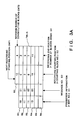
- Fig. 3 is a diagram showing a management index table of the voice memory 21.
- the voice memory 21 is managed by being divided into storage areas (hereinafter referred to as "blocks") of four-second units serving as recording time.
- the management index table comprises a table A (TBL-A) shown in Fig. 3a and a table B (TBL-B) shown in Fig. 3B.
- the table A has records R0 through Rn.
- the record R0 comprises a counter (CNT1) the value of which represents the block number of the next recording starting position, and a counter (CNT2) the value of which represents the number of blocks capable of being recorded on consecutively from the recording starting position.
- the records R1 through Rn are constituted by an extension number (D1) serving as information indicating the possessor of a recorded voice message, a message number (D2) for specifying individual voice messages for the same possessor, a block number (D3) which indicates the recording starting position of the voice message within the voice memory 21, and a block number D4 which indicates the recording end position of the voice message within the voice memory 21.
- the table B indicates the status of use of every block. If the status of a block is that the block is unused, this is indicated by a "0"; if the status of a block is that the block is being used, this is indicated by a "1".
- the remaining blocks 8, 9, 12 - 15 are unused.
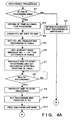
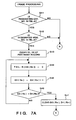
- Fig. 4 is a flowchart illustrating a processing procedure for recording a voice message while a call is in progress.
- the extension telephone is informed, from the value of CNT2, of the amount of time available for recording (step S3).
- the central controller 5 connects the line wire involved in the call and the voice message controller 6 via the switch circuit network 1 (step S4).
- the central controller 5 searches for a blank record in the table A.
- the extension number (assumed to be "10") of the extension telephone which has made the recording request is stored at D1 of record R5 (step S5).
- "10" is searched from D1 of each record in table A, the maximum value among the already used message numbers is retrieved, one is added to this value and the sum is set at D2 of record R5.
- "2" is set (step S6).
- the central controller 5 then instructs the voice message controller 6 to start recording from the position indicated at CNT1, and sets this recording starting position at D3 of record R5 in table A (step S7). In this example, "12" is set.
- the system then waits for a recording-end request from the extension telephone (step S8).
- This request is made using a special number (e.g., 81) entered from the extension telephone, in the same manner as the request for starting recording.
- the central controller 5 If the central controller 5 has received the recording-end request transmitted via the line circuit 3, then it instructs the voice message controller 6 to terminate the recording (step S9).
- the central controller 5 Upon receiving the recording end position from the voice message controller 6, the central controller 5 sets this position at D4 of record R5 (step S10) and opens the connection between the voice message controller 6 and the line wire 11 (step S11).
- the record R5 is completed by the foregoing processing.
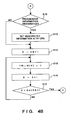
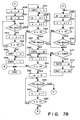
- the extension telephone which has made the recording request (its extension number is "10" in this case) is the possessor of the recorded message, however, the possesor can be designated when the recording ends. For example, this can be done if the pertinent extension number is dialed in following the special number "81" mentioned above.
- step S12 If possessor information is designated (step S12), D1 of record R5 is changed by the central controller 5 to what has been designated (step S13).
- step S14 the block number of the currently prevailing recording starting position is set in the counter X (step S14), and the value of the position in table B indicated by the counter X is made "1", which indicates that recording has been completed (step S15).
- step S16 one is added to counter X (step S16), and the value in counter X is compared with the value of D4 (step S17). Steps S14 and S15 are repeated until it is determined that the position is the recording end position.
- processing for updating CNT1 and CNT2 is carried out. This processing will be described later.
- the voice message can only be played back by the extension telephone indicated at D1 of each record in table A.
- the extension telephone In order for a playback request to be made by the extension telephone, it will suffice to dial in a special number indicative of a playback request as well as the message number after the telephone is taken off the hook.
- the central controller 5 instructs the extension telephone where the voice message is to be played back, to display the fact that there is the message stored to the telephone and the message number associated with it.
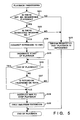
- Fig. 5 is a flowchart for describing processing in a case where a playback request is received.
- the central controller 5 determines whether a voice message possessed by the extension telephone which has issued the playback request is present in the table A (step S21) and checks to see whether the requested message number is present (S22) in table A. If these are not present in table A, then the program proceeds to step S23, where the central controller 5 informs the requesting extension telephone, by means of an audible tone or visual display, of the fact that playback is impossible. Processing is then terminated.
- step S24 the voice message controller 6 is connected, via the switch circuit network 1, to the extension which has issued the request (step S24).
- the central controller 5 obtains the playback starting and end positions from D3 and D4 of the record in table A that match the playback request, and the voice message controller 6 is instructed to perform playback based upon these positions (step S25).
- step S26, S27 monitoring is performed to determine if the extension telephone which has made the playback request has been hung up. If the latter is detected, the voice message controller 6 is instructed to terminate playback (step S28), and the connection between the voice message controller 6 and the requesting extension is opened (step S29).
- a voice of a telephonic communication in progress can be recorded and played back from any extension telephone.
- step S31 After the extension telephone "11" is taken off the hook, a special number requesting conveyance of the message, the message number and the extension number "12" which is the destination of the message are dialed in.
- step S32 When there is such a request for conveyance of a message (YES at step S31), it is verified at step S32 whether the record corresponding to the extension telephone "11", which is the extension telephone making the request, is present in table A, and then it is verified at step S33 whether the designated message number is present in table A. If the answer is YES at steps S32 and S33, then D1 of the pertinent record is changed to the designated extension number "12"(step S34), and the message number also is updated in dependence upon the changed extension number (step S35).
- step S36 Processing for conveyance of the message is then terminated.
- extension telephone "11” could receive a message from a superior outside the office, and this message could then be delivered to all of the extensions. The same is true for the operation at step 13 (Fig. 4B)
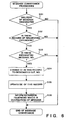
- Fig. 7 is a flowchart illustrating processing for erasing an already recorded voice message.
- Erasing of a voice message is carried out based upon dialing in, from an extension telephone, a special number requesting erasure and a message number.
- the central controller 5 verifies whether a record matching the requesting extension number and the designated message number is present in table A (steps S41, S42). If the record is not present, this processing is terminated. If the abovementioned numbers are present, however, D1, D2 of the pertinent record are cleared (step S43) and table B is updated by making "0" the status of use of this block in table B, which is indicated by D3 of the pertinent record (step S44). ("0" means that the block is not being used.) The value of D3 is then incremented (step S45), and the processing which makes the pertinent blocks of table B "0" is continued until the value of D3 exceeds a value corresponding to the position indicated by D4 of the pertinent record (step S46).
- n represents a working counter which corresponds to block position in the table B
- m represents a working counter which represents the number of blocks in a non-utilized state.
- the counters n, m are initialized to "0" (steps S50, S51) and a search is performed successively from 0 in order to detect blocks not being used (steps S52, S53, S54). If there are no unused blocks over the total number of blocks, the values of counters n, m are set in CNT1, CNT2, respectively (steps S55, S56). This indicates that CNT1, CNT2 are both "0", meaning that the entirety of the voice memory 21 has been used up.
- step S57 If an unused block has been found in table B at step S52, then the value of n prevailing at this time is set in CNT1 (step S57). Counter m is then incremented (step S58) and the number of consecutive unused blocks is counted (steps S58, S59, S60, S61).
- step S60 When it is determined at step S60 that the value of n has exceeded 15, indicating that the end of table B has been reached, or when it is determined at step S61 that there are no unused blocks, the value in counter m is set in CNT2 (step S56 or S62). After the processing of step S62, the counter n is incremented (step S63). If the search has reached the end of table B, i.e., if the decision rendered at step S64 is NO, then processing is terminated.
- step S64 if it is decided at step S64 that the search has not reached the end of table B, then the program proceeds to step S65, where counter m is initialized to "0", and unused blocks are retrieved (steps S66, S67, S68) just as in steps S52 through S54 above.
- step S66 If an unused block is found at step S66, the number of consecutive unused blocks is counted (steps S69, S70, S71) just as in steps S58 through S61 above.
- step S71 If it is decided at step S71 that the end of table B has been reached, or if an unused block is found at step S72, then the program proceeds to step S73, where the number m of blocks just counted and the block count CNT2 counted last are compared. If m is greater, the program proceeds to step S74, where the value of m is set in CNT2. Next, a value obtained by subtracting m from the present block position n is set in CNT1 (step S75) as the recording starting position which corresponds to CNT2. The program then proceeds to step S63 and processing is repeated up to the end of the table B.
- the maximum number of consecutive blocks in an unused state in voice memory 21 can be set in CNT2 and the number of the recording starting block can be set in CNT1 at the same time.
- a memory which stores voice messages and an index for managing individual voice messages in the entire memory are provided, the memory is shared mutually by the extension telephones connected to the system, and the memory is managed upon being divided into units of minimum capacity sufficient for ordinary recording purposes.
- requests for starting and ending recording and playback, a request for erasure, etc. are capable of being made by dialing in special numbers from an extension telephone.
- an arrangement can be adopted in which the extension telephone is provided with function buttons corresponding to these various requests.
- the message numbers used in the embodiment can be omitted.
- the possessor information is not limited to extension numbers.
- use can be made of other information specifying a particular individual, such as the physical location at which the telephone has been installed, an employee number at the time or recording, etc.
- confidentiality can be better protected. All of these options can be realized with facility by expanding the possessor information in table A.
- the capacity of the voice memory 21 and the units of the blocks are of the minimum necessary capacity needed to record a single telephonic communication, these values may be set as desired, and the size of the table B can be changed accordingly.
- the voice memory 21 can be a magnetic tape instead of a semiconductor memory, and it will suffice if the information recorded on these media is information indicative of starting- and end-positions in table A.
- processing for delivering a message is such that the possessor of extension telephone "11" performs a prescribed operation to inform the extension telephone "12" of the fact that there is a message to be delivered.
- step S81 the central controller 5 verifies at step S82 whether the record corresponding to the extension telephone "11", which is the extension telephone making the request, is present in table A, and then verifies at step S83 whether the designated message number is present in table A. If the answer is YES at steps S82 and S83, then D1 of the pertinent record is changed to the designated extension number (step S84), and the message number also is updated in dependence upon the changed extension number (step S85). Upon completion of such updating, the extension telephone that has newly become the possessor of the voice message is informed, by an audible tone or visible display, of the fact that there is a message to be conveyed (step S86).
- the central controller 5 starts, via the line circuit 3, a recording/playback unit (not shown) belonging to the extension telephone "12", and transfers the voice data, that has been stored in the voice memory 21, to this recording/playback unit (step S87).
- step S88 it is determined whether the transfer has ended. If the answer is YES, then the voice data in the voice memory 21 is erased at the ensuing step S89. It should be noted that this erasing processing is the same as that illustrated in Fig. 7 and therefore need not be described again.
- the possessor of extension telephone "12" which has received the transfer of voice data, is capable of determining, by the aforementioned audible tone or visible display, that there is a message to be delivered to this telephone. By performing a prescribed operation, the possessor of this telephone is capable of hearing the contents of the message.
- this modification is such that in a telephone exchange system having a function for recording a telephonic communication for the purpose of allowing it to be heard by a third party, it is no longer necessary to hold all recordings in a memory within the system. This makes it possible to reduce the necessary memory capacity that is provided within the system for the purpose of voice recording/playback, and to effectively utilize any extra memory area for other applications.
- Fig. 9 is a block diagram illustrating the internal construction of the voice message controller constituting the telephone exchange system of the second embodiment.
- a voice detector 23 is for detecting the absence or presence of a voice during a telephonic communication.
- the voice detector 23 determines that there is a voice present only when a voice above a predetermined level continues in excess of a predetermined period of time. The result of this determination is delivered to the central controller 5.
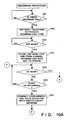
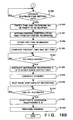
- Fig. 10 is a flowchart illustrating recording processing according to the second embodiment.
- the central controller 5 monitors an incoming-call signal from line wire 11 via the trunk circuit 2.
- a predetermined extension telephone 7 is made to issue an incoming-call tone (step S92) and the line circuit 3 is actuated to monitor whether the extension telephone 9 has been taken off the hook (step S93).
- the trunk circuit 2 When it is detected that the extension telephone 9 has been taken off the hook, the trunk circuit 2 is actuated to close a loop in the line wire 11, and the switch circuit network 1 is controlled to connect a channel between the line wire 11 and extension telephone 9, thereby establishing a state of communication (step S94). Next, monitoring of the end of the call (step S95) and monitoring of a recording-start operation (step S96) is performed repeatedly.
- step S105 On-hook processing is executed (step S105) and this cycle of processing is terminated.
- the central controller 5 instructs the voice controller 22 to connect the switch circuit network 1 and the voice memory 21 in order that a recording may be made, and to connect the switch circuit network 1 and the voice detector 23 in order that a voice may be detected.
- a recording-standby state is thus established (step S97).
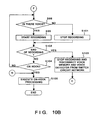
- step S98 When the voice detector 23 detects a voice in a telephonic communication (step S98), the central controller 5 actuates the voice controller 22, which responds by starting recording (step S99). As a result, voice data from the line wire 11 is stored in the voice memory 21. However, when the voice detector 23 cannot detect a voice, the voice controller 22 is actuated to halt the recording operation (step S101).
- step S102 when a recording-end operation from the extension telephone 9 is detected via the line circuit 3 (step S102), the central controller 5 actuates the voice controller 22 to halt the recording operation and controls the switch circuit network 1 to break the connection between the switch circuit network 1 and voice memory 21 and between the switch circuit network 1 and voice detector 23, thereby establishing the voice data, which has been stored in the voice memory 21, as one message to be delivered (step S103). Thereafter, on-hook monitoring is performed at step S95.
- step S104 On-hook processing is executed (step S105) and this cycle of processing is terminated.
- step S105 On-hook processing is executed (step S105) and this cycle of processing is terminated.
- the program returns to step S98, where it is determined whether or not a voice is present.
- an arrangement can be adopted in which the operation of the voice detector 23 is halted, i.e., the connection between the voice detector 23 and the switch circuit network 1 is broken, the possessor of the extension telephone 9 determines himself whether there is a voice and then either starts recording or stops recording.
- the speaker can start or stop recording based upon whether the subject matter of the conversation is important or not.
- the arrangement is such that if the voice of the other party is recorded during a telephonic communication, recording can be stopped when the other party is not speaking. This makes it possible to utilize the voice storage area effectively.
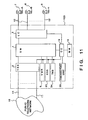
- Fig. 11 is a block diagram illustrating the overall construction of a telephone exchange system according to the third embodiment. Elements identical with those in the telephone exchange system of the first embodiment are designated by like reference characters and need not be described again.
- the telephone exchange system 100 includes a guidance signal generator 33 which, upon receiving an instruction from the central controller 5, generates a guidance signal, which is indicative of the start of recording, to the other party in a conversation via the switch circuit network 1, a sound source 34 which generates an audible tone at the extension telephones 7 through 9 and at the other party, and a timekeeping unit 35 which, in accordance with an instruction from the central controller 5, performs a timekeeping operation to inform the central controller 5 of the result of timekeeping, namely when time has run out, etc.
- a guidance signal generator 33 which, upon receiving an instruction from the central controller 5, generates a guidance signal, which is indicative of the start of recording, to the other party in a conversation via the switch circuit network 1, a sound source 34 which generates an audible tone at the extension telephones 7 through 9 and at the other party, and a timekeeping unit 35 which, in accordance with an instruction from the central controller 5, performs a timekeeping operation to inform the central controller 5 of the result of timekeeping, namely when time has run out,
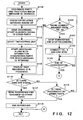
- Fig. 12 is a flowchart illustrating a call processing procedure according to the third embodiment.
- the speaker on extension telephone 7 When, during communication between the line wire 11 and the extension telephone 7, the party engaged in the conversation with the extension telephone 7 reports to the speaker on extension telephone 7 that there is a message to be relayed to the possessor of the extension telephone 8, who is absent, the speaker on extension telephone 7 first presses a key for designating the extension telephone 8, namely the party for which the message is intended (step S110), and then performs an on-hook operation, such as hanging up the handset (step S111). This is the operation to relay the message.
- the central controller 5 of the telephone exchange system 100 actuates the guidance signal generator 33 so that a guidance signal indicative of the start of recording is transmitted to the other party (step S112). Also, the timekeeping unit 35 is started (step S113). In addition, the voice message controller is actuated to start recording, and the voice is stored in the voice memory 21 along with information designating the party for which the message is intended (step S114).
- the extension telephone 8 causes the display unit 31 to present a display to the effect that the message is being recorded (step S115).
- the central controller 5 determines whether a time-out signal, which indicates that a preset period of time has elapsed, has been generated by the timekeeping unit 35 (step S116). If the time has run out, the guidance signal generator 33 is actuated again to transmit a guidance signal to the other party (step S117). This is guidance which indicates to this party that the time for recording is at an end. Recording is then terminated at step S118.
- step S119 it is determined at step S119 by the central controller 5 whether the other party terminated the call. If the answer at step S119 is YES, then the program proceeds to step S118 and recording is ended.
- the central controller 5 determines whether a connect request has been made by the extension telephone 8, which is the party that is to receive the message.
- the determination as to whether a connect request has been made is performed by detecting input of a password specifically assigned to each of the system extension telephone users or merely by detecting that this extension telephone has been taken off the hook.
- step S120 If it is determined at step S120 that a connect request has been made, the central controller 5 halts the timekeeping operation of the timekeeping unit 35 and the recording in the voice memory 21 (step S121), and then makes a connection between the extension telephone 8 and the other party, namely the party that requested delivery of the message (step S122).
- step S120 If it is determined at step S120 that a connect request has not been made, the program returns to step S116 and processing for determining whether the time-out signal is present or not is continued.
- the indication given at step S115 informing of the fact that recording is in progress need not be presented using the display unit 31.
- this indication can be made by flashing an LED belonging to a line-wire select/status display button constituting part of the control panel 25.
- the flashing of the LED in this case would have a period different from that indicating that a call is on hold.
- the LED is capable of emitting light having two or more colors, the fact that the display is one indicating that recording is in progress can be distinguished by color.
- the arrangement is such that if a party for whom a message is intended returns to the location of his or her own extension telephone while recording of the message is in progress, and if this party then realizes from the display that recording of this message is in progress and responds by issuing a connect request from his or her own extension telephone, then this extension telephone and the party attempting to convey the message are connected, thereby making it possible for the two parties to promptly carry on a conversation.
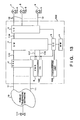
- Fig. 13 is a block diagram illustrating the overall construction of a telephone exchange system according to the fourth embodiment. Elements identical with those in the telephone exchange system of the first embodiment are designated by like reference characters and need not be described again.
- the telephone exchange system 100 is provided with a time-stamp ROM (TS) 102 which stores time-stamp information for recording, in a manner described below, the time at which a telephonic communication starts to be recorded.
- TS time-stamp ROM
- the time-stamp ROM 102 Upon receiving instructions from the central controller 5, the time-stamp ROM 102 sends this time-stamp information to the voice message controller 6 via a PCM highway 115 and the switch circuit network 1.
- a timekeeping unit 103 successively transmits the present time to the central controller 5 in a prescribed format.
- the time-stamp ROM 102 constituting part of the telephone exchange system according to the fourth embodiment will now be described in detail.
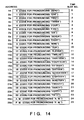
- PCM codes which correspond to the actual pronunciations of times, are written in the time-stamp ROM 102 in order to record time in the form of a voice at each of addresses 1n through 26n.
- a PCM code for pronouncing "zero" (numeral 0) is stored at address 1n
- a PCM code for pronouncing "one” (numeral 1) is stored at address 2n.
- PCM codes are sent to time slots, which correspond to the illustrated time-slot numbers, on the up-side of a PCM highway 115 at all times. For example, "zero" at address 1n is sent to time slot 0, and "P.M.” at address 26n is sent to time slot 25.
- the voice from telephone 111 enters the switch circuit network 1 via the public telephone network 10, trunk circuit 2 and a PCM highway 113.
- the central controller 5 controls the switch circuit network 1 to connect the PCM highway 113 and a PCM highway 114 so that the voice from the telephone 111 arrives at the extension telephone 7 via the PCM highway 114, line circuit 3 and extension 12.
- the line circuit 3 senses this operation and sends this information to the central controller 5.
- the central controller 5 receives this information, the present time is read from the timekeeping unit 103.
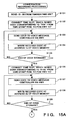
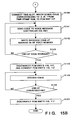
- Fig. 15 to describe conversation recording processing which includes the recording of recording starting time in a case where the time read out from the timekeeping unit 103 is 10:05 A.M., by way of example.
- the central controller 5 controls the switch circuit network 1 so that the time slot 10, which transmits the PCM code for pronouncing "ten" stored at address 11n of the time-stamp ROM 102, is connected to a PCM highway 117 (step S132), and this code is sent to the voice message controller 6 (step S133).
- the controller When the voice message controller 6 receives the PCM code from the PCM highway 117, the controller stores this PCM code at a predetermined address of the voice memory 21 (step S134).
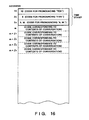
- Fig. 16 is a diagram showing the contents of the voice memory in which the code information is stored.
- the PCM code for "ten" is stored at address 1n.
- step S135) When it has been determined (step S135) that storage of the code information has ended, the central controller 5 controls the switch circuit network 1 to connect time slot 5, which transmits the PCM code for pronouncing "five", to the PCM highway 117 (step S136). This code is sent to the voice message controller 6 (step S137). Just as in the case of "ten” described above, the voice message controller 6 stores the PCM code for "five" at address 2n of the voice memory (step S138).
- the time slot 24 which transmits the PCM code for pronouncing "A.M.” is connected to the PCM highway 117, and this code is stored at address 3n of the voice memory (steps S140 through S143).
- the central controller 5 controls the switch circuit network 1 to open the bus between the PCM highway 115 of the time-stamp ROM 102 and the PCM highway 117 of the voice message controller 6, after which the PCM highway 113 and PCM highway 117 are connected (step S148) to preform recording of a telephonic communication (step S149).
- the central controller 5 controls the switch circuit network 1 to open the PCM highway 117 leading to the voice message controller 6 (step S151).
- the time-stamp information is stored from the address which follows that in the voice memory used previously as a storage area, and recording of the telephonic communication is then carried out.
- the recording starting time is always recorded in the form of a voice at the beginning of the recording of a telephonic communication.
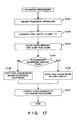
- Fig. 17 is a flowchart illustrating the operation for playing back the contents of a recording.
- the line circuit 3 serving as the extension interface detects that this playback operation has occurred and transmits this information to the central controller 5 (step S161).
- the central controller 5 controls the switch circuit network 1 to connect the PCM highway 117, which leads to the voice message controller 6, with the PCM highway 114 (step S162).
- the voice memory 21 is actuated so that the PCM codes stored there are read out sequentially starting from the smaller-number addresses and transmitted to the PCM highway 114 (step S163).
- the type of extension telephone is discriminated (step S164). If the extension telephone is of the analog type, the PCM codes are converted into analog voice signals by a D/A converter (not shown) (step S165), and these analog signals are delivered to the extension telephone. If the extension telephone is of the digital type, the PCM codes are transmitted to the extension telephone as is. In case of the digital extension telephone, the PCM codes are D/A converted internally (step S166). Then the extension telephone outputs the voice signal (step S167).
- the operator of the extension telephone 7 is capable of hearing a time-stamped recorded message, namely a message "10:05 A.M.; Good day!” according to the example mentioned above.
- the time at the start of recording of a telephonic communication is recorded in the form of a voice at the beginning of the recorded communication, thereby making it possible to determine, at playback, when the recording started. This enhances the reliability of the recorded information.
- the extension telephone 7 When, in the telephone exchange system shown in Fig. 13, the extension telephone 7 is taken off the hook (step S171), the CPU 27 (see Fig. 2A) within this extension telephone 7 detects the fact and so informs the central controller 5 via the line circuit 3 serving as the extension interface (step S172).
- the central controller 5 controls the switch circuit network 1 to connect a sound source (not shown) to the extension 12 via the line circuit 3, thereby transmitting a dial tone to the extension telephone 7 (step S173).
- the operator of the extension telephone 7 verifies the output of this dial tone from the voice output unit 29 (Fig. 2A).
- the operator enters the telephone number of the other party from the control panel 25 and, when the other party responds, performs a recording operation in order to record the telephonic communications (step S174).
- the CPU 27 of the telephone detects the recording operation and so informs the central controller 5 (step S176) in the same way as when the telephone was taken off the hook.
- the central controller 5 places the voice message controller 6 in a recording-enable state (step S177) and controls the switch circuit network 1 to connect the extension 12 to the voice message controller 6.
- the voice of the operator of extension telephone 7 is recorded in the voice memory 21 within the voice message controller 6 via the voice input unit 28, speech network 30, communication interface 24, extension 12 and switch circuit network 1 (step S178).
- step S179 when the extension telephone 7 is hung up (step S179), the CPU 27 of this telephone detects the fact and so informs the central controller 5 (step S180). The latter regards this as being the end of recording and severs the channel between the voice message controller 6 and the extension 12 (step S181).
- step S182 when the operator of the extension telephone 7 performs a prescribed playback-time setting operation (step S182) using the control panel 25 and enters the present time as well as the telephone number of the party to be notified of the particular business (step S183), the CPU 27 communicates this information to the central controller 5 (step S184). The latter then stores the set time in memory 4 (step S185).
- the central controller 5 reads the present time from the timekeeping unit 103 and compares this time with the time that has been stored in the memory 4 (step S186). If the two agree (YES at step S187), the extension telephones that are the parties to be notified, e.g., the extension telephones 8, 9, are instructed to activate their respective voice output units 29 (step S188).
- the central controller 5 controls the switch circuit network 1 to connect the voice message controller 6 with the extension telephones 8, 9 (step S189) and actuates the voice memory 21 to play back the contents of the recording.
- the voice from the extension telephone 7 that has been recorded in the voice memory 21 is transmitted to the extension telephones 8, 9 via the switch circuit network 1 and extensions 12, whereby the voice is outputted by the voice output units 29 of the respective extension telephones (step S190).
- step S191 When the voice message controller 6 informs the central controller 5 of the fact that the entire message has been played back, or when the recording time and the playback time agree, this is regarded as being the end of playback (step S191) and the CPU's of the extension telephones 8, 9 are so informed. When this is done, the CPU's of the extension telephones 8, 9 deactivate the respective voice output units 29 (step S192). Thereafter, the central controller 5 again controls the switch circuit network 1 to open the channel connecting the voice message controller 6 with the extension telephones 8, 9, thereby restoring the initial state (step S193).
- the operator of the extension telephone 7 is capable of recording an item of business at any time, and of playing back the recorded message at any set time and sending its contents to the users of the extension telephones 8 and 9.
- the playback time is set after the item of business to be conveyed is recorded.
- it can be arranged to record the item of business after the playback time is set.
- an arrangement can be adopted in which the voice played back is outputted not only to the extension telephones 8, 9 but also to its own telephone (extension telephone 7) in order that the contents of the recording may be confirmed.
- the extension telephone which outputs the played-back voice can be all extension telephones in the system.
- extension telephones can be divided into groups and all of the extension telephones in a specific group can be adopted as extension telephones capable of outputting a played-back voice.
- a voice recorded at any desired time can be transmitted to a plurality of parties at any set time as a service function in a so-called general broadcast- or general calling-type telephone exchange system. Accordingly, the labor entailed by transmitting a message indicating the start of a conference or the like to several parties one at a time is curtailed. If, at the time it is decided to hold a conference, a matter of business to this effect is recorded and the time at which the conference is to start is set in advance, the matter of business can be conveyed to the other parties reliably at the set time.
- a telephone exchange system accommodates a plurality of central office lines and a plurality of telephones and records a telephonic communication in a recording area shared by the plurality of telephones. When predetermined conditions are satisfied, the recording is played back or transferred.
- the shared recording area can be utilized effectively by erasing a recording after it has been transferred, and by detecting the presence of a voice during a telephonic communication and starting and stopping the recording operation based upon the results of detection. The time at which a recording has been made can be comprehended in the form of a voice when the recording is played back.
Landscapes
- Engineering & Computer Science (AREA)
- Signal Processing (AREA)
- Sub-Exchange Stations And Push- Button Telephones (AREA)
- Telephonic Communication Services (AREA)
Applications Claiming Priority (14)
| Application Number | Priority Date | Filing Date | Title |
|---|---|---|---|
| JP42902/90 | 1990-02-23 | ||
| JP42901/90 | 1990-02-23 | ||
| JP42903/90 | 1990-02-23 | ||
| JP4290290A JPH03245652A (ja) | 1990-02-23 | 1990-02-23 | 構内交換装置 |
| JP4290390A JPH03245653A (ja) | 1990-02-23 | 1990-02-23 | 構内交換装置 |
| JP4290190A JPH03245651A (ja) | 1990-02-23 | 1990-02-23 | 構内交換装置 |
| JP4903690A JP2928933B2 (ja) | 1990-02-28 | 1990-02-28 | 電話交換装置 |
| JP49036/90 | 1990-02-28 | ||
| JP5325690A JPH03254560A (ja) | 1990-03-05 | 1990-03-05 | ボタン電話装置 |
| JP53256/90 | 1990-03-05 | ||
| JP5439690A JP2896396B2 (ja) | 1990-03-06 | 1990-03-06 | 電話交換装置 |
| JP54396/90 | 1990-03-06 | ||
| JP9002590A JPH03289249A (ja) | 1990-04-04 | 1990-04-04 | 電話交換システム |
| JP90025/90 | 1990-04-04 |
Publications (3)
| Publication Number | Publication Date |
|---|---|
| EP0444536A2 true EP0444536A2 (de) | 1991-09-04 |
| EP0444536A3 EP0444536A3 (en) | 1992-01-22 |
| EP0444536B1 EP0444536B1 (de) | 1996-09-11 |
Family
ID=27564554
Family Applications (1)
| Application Number | Title | Priority Date | Filing Date |
|---|---|---|---|
| EP91102563A Expired - Lifetime EP0444536B1 (de) | 1990-02-23 | 1991-02-21 | Fernsprechvermittlungsanlage und -verfahren |
Country Status (3)
| Country | Link |
|---|---|
| US (1) | US5586172A (de) |
| EP (1) | EP0444536B1 (de) |
| DE (1) | DE69121939T2 (de) |
Cited By (3)
| Publication number | Priority date | Publication date | Assignee | Title |
|---|---|---|---|---|
| US5805671A (en) * | 1992-12-04 | 1998-09-08 | Canon Kabushiki Kaisha | Audio message service apparatus |
| AU749917B2 (en) * | 1998-04-14 | 2002-07-04 | Alcatel | Voice mail detector arrangement for a telephone |
| DE10114997A1 (de) * | 2001-03-26 | 2002-10-17 | Elchanan Tanzer | Aufnahmesystem für schnurlose Telefongeräte |
Families Citing this family (28)
| Publication number | Priority date | Publication date | Assignee | Title |
|---|---|---|---|---|
| US5646839A (en) * | 1990-05-29 | 1997-07-08 | Mcic Communications Corporation | Telephone-based personnel tracking system |
| DE4438941A1 (de) * | 1994-10-31 | 1996-05-02 | Sel Alcatel Ag | Verfahren zur Steuerung einer Vermittlungsstelle sowie Steuereinrichtungen und Programm-Module dafür und Vermittlungsstelle und Vermittlungssystem damit |
| JPH0965430A (ja) * | 1995-08-28 | 1997-03-07 | Nec Corp | 移動体ボイスメールメッセージ連絡システム |
| US6252944B1 (en) * | 1997-06-11 | 2001-06-26 | Estech Systems, Inc. | Telephone call/voice processing system |
| US7421066B1 (en) * | 1996-06-12 | 2008-09-02 | Estech Systems, Inc. | Telephone call/voice processing system |
| KR100268664B1 (ko) * | 1996-12-21 | 2000-10-16 | 윤종용 | 기지국장치의핸드폰자동응답서비스제어장치및방법 |
| JP3501623B2 (ja) | 1997-06-18 | 2004-03-02 | キヤノン株式会社 | 送信装置 |
| JPH1198281A (ja) * | 1997-09-16 | 1999-04-09 | Hitachi Telecom Technol Ltd | ディーリング通話システムにおける録音制御装置 |
| US6850609B1 (en) * | 1997-10-28 | 2005-02-01 | Verizon Services Corp. | Methods and apparatus for providing speech recording and speech transcription services |
| FI110152B (fi) * | 1999-08-18 | 2002-11-29 | Elisa Comm Oyj | Menetelmä puhelun tallentamiseksi |
| EP1206105A4 (de) * | 2000-05-15 | 2005-06-08 | Matsushita Electric Industrial Co Ltd | Sprachspeicherungssystem, wechsel und sprachspreicherungsgerät |
| US7272210B1 (en) * | 2001-01-02 | 2007-09-18 | Ss8 Networks, Inc. | System and method for voice organizer message delivery |
| US6674459B2 (en) * | 2001-10-24 | 2004-01-06 | Microsoft Corporation | Network conference recording system and method including post-conference processing |
| US7133362B2 (en) | 2001-11-14 | 2006-11-07 | Microsoft Corporation | Intelligent buffering process for network conference video |
| US7162418B2 (en) * | 2001-11-15 | 2007-01-09 | Microsoft Corporation | Presentation-quality buffering process for real-time audio |
| US20040203752A1 (en) * | 2002-11-18 | 2004-10-14 | Toshiba America Information Systems, Inc. | Mobility communications system |
| US7362858B2 (en) * | 2003-11-07 | 2008-04-22 | Telematrix, Inc. | High-speed telephone connection |
| JP2006325003A (ja) * | 2005-05-19 | 2006-11-30 | Toshiba Corp | 交換システム、電話交換装置及び音声メッセージ通知方法 |
| US9106737B2 (en) * | 2007-03-30 | 2015-08-11 | Verint Americas, Inc. | Systems and methods for recording resource association for recording |
| US8054954B1 (en) * | 2007-06-20 | 2011-11-08 | Avaya Inc. | One touch voice memo |
| JP2009290783A (ja) * | 2008-05-30 | 2009-12-10 | Canon Inc | 通信システム、通信システムの制御方法、プログラム及び記憶媒体 |
| JP5473643B2 (ja) * | 2010-02-04 | 2014-04-16 | キヤノン株式会社 | 電源装置及びそれを使用する画像形成装置 |
| JP5676945B2 (ja) | 2010-07-08 | 2015-02-25 | キヤノン株式会社 | 電子装置、電子装置の素子分離方法、電子装置の製造方法、及び電子装置を備えた表示装置 |
| US9084058B2 (en) | 2011-12-29 | 2015-07-14 | Sonos, Inc. | Sound field calibration using listener localization |
| US9106192B2 (en) | 2012-06-28 | 2015-08-11 | Sonos, Inc. | System and method for device playback calibration |
| US9763018B1 (en) | 2016-04-12 | 2017-09-12 | Sonos, Inc. | Calibration of audio playback devices |
| US10372406B2 (en) | 2016-07-22 | 2019-08-06 | Sonos, Inc. | Calibration interface |
| JP7080623B2 (ja) | 2017-11-29 | 2022-06-06 | キヤノン株式会社 | 電源装置及び画像形成装置 |
Family Cites Families (13)
| Publication number | Priority date | Publication date | Assignee | Title |
|---|---|---|---|---|
| US4602129A (en) * | 1979-11-26 | 1986-07-22 | Vmx, Inc. | Electronic audio communications system with versatile message delivery |
| JPS5928747A (ja) * | 1982-08-09 | 1984-02-15 | Nippon Telegr & Teleph Corp <Ntt> | メツセ−ジ蓄積・交換システムの入出力管理方式 |
| US4625081A (en) * | 1982-11-30 | 1986-11-25 | Lotito Lawrence A | Automated telephone voice service system |
| US4582957A (en) * | 1982-12-30 | 1986-04-15 | Wang Laboratories, Inc. | Call interceptor |
| CA1337570C (en) * | 1986-07-30 | 1995-11-14 | Steven Clifford Grady | Call transfer between a message service system and a telephone switching system |
| US4975896A (en) * | 1986-08-08 | 1990-12-04 | Agosto Iii Nicholas A D | Communications network and method |
| GB2202107B (en) * | 1987-03-11 | 1990-12-12 | Hashimoto Kazuo | Automatic telephone answering device with conversation recording function |
| US4790003A (en) * | 1987-04-27 | 1988-12-06 | American Telephone And Telegraph Company, At&T Information Systems | Message service system network |
| US4853952A (en) * | 1987-12-03 | 1989-08-01 | Dictaphone Corporation | Method and apparatus for visual indication of stored voice signals |
| US5003575A (en) * | 1987-12-24 | 1991-03-26 | Chamberlin David B | Method and apparatus for storing and forwarding voice signals with controlled access |
| US4837807A (en) * | 1987-12-30 | 1989-06-06 | American Telephone And Telegraph Company | Station to station message arrangement |
| US4926462A (en) * | 1988-02-24 | 1990-05-15 | Vmx/Opcom | Interface to and operation of a voice messaging system |
| JPH0648835B2 (ja) * | 1989-09-26 | 1994-06-22 | 橋本コーポレイション株式会社 | 留守番電話装置とボイスメール装置との結合システム |
-
1991
- 1991-02-21 EP EP91102563A patent/EP0444536B1/de not_active Expired - Lifetime
- 1991-02-21 DE DE69121939T patent/DE69121939T2/de not_active Expired - Fee Related
-
1994
- 1994-09-20 US US08/309,968 patent/US5586172A/en not_active Expired - Lifetime
Cited By (3)
| Publication number | Priority date | Publication date | Assignee | Title |
|---|---|---|---|---|
| US5805671A (en) * | 1992-12-04 | 1998-09-08 | Canon Kabushiki Kaisha | Audio message service apparatus |
| AU749917B2 (en) * | 1998-04-14 | 2002-07-04 | Alcatel | Voice mail detector arrangement for a telephone |
| DE10114997A1 (de) * | 2001-03-26 | 2002-10-17 | Elchanan Tanzer | Aufnahmesystem für schnurlose Telefongeräte |
Also Published As
| Publication number | Publication date |
|---|---|
| EP0444536B1 (de) | 1996-09-11 |
| US5586172A (en) | 1996-12-17 |
| DE69121939T2 (de) | 1997-02-27 |
| DE69121939D1 (de) | 1996-10-17 |
| EP0444536A3 (en) | 1992-01-22 |
Similar Documents
| Publication | Publication Date | Title |
|---|---|---|
| US5586172A (en) | Telephone exchange system | |
| US5220599A (en) | Communication terminal apparatus and its control method with party identification and notification features | |
| CA1315428C (en) | Communication terminal apparatus and its control method | |
| EP0211860B1 (de) | Integriertes nachrichtendienstsystem | |
| KR960011831B1 (ko) | 호출 전달 기능 제공 방법 및 장치 | |
| CA1244536A (en) | Integrated message service system | |
| CA1267207A (en) | Method and apparatus for automatically transmitting a message to a telephone terminal | |
| JP3130529B2 (ja) | 通信端末装置 | |
| EP0637158A1 (de) | Telefonbeantwortungssystem | |
| JPS62214799A (ja) | 電話装置 | |
| JPH07336413A (ja) | 通信装置 | |
| KR100404094B1 (ko) | 기지국의 음성 사서함 서비스 방법 | |
| JPS63211949A (ja) | 電話装置 | |
| JPS6395764A (ja) | 情報の自動送信方式 | |
| JP2935953B2 (ja) | ボイスメールシステム | |
| JPS62152254A (ja) | 通信装置 | |
| KR200267227Y1 (ko) | 음성녹음장치를 관리하는 키폰 시스템 | |
| JP2002064846A (ja) | ボタン電話装置 | |
| KR100352266B1 (ko) | 전화기의 착신자 통화방법 | |
| KR19980020512A (ko) | 전화단말장치에서 여러종류의 보류음 송출회로 및 그 방법 | |
| JP3123570B2 (ja) | 通信端末 | |
| KR100217037B1 (ko) | 간이 전자 교환장치의 메시지 예약 전송방법 | |
| KR100238526B1 (ko) | 음성우편장치에서 호출자 식별정보를 이용하여 메세지 송신자표시방법 | |
| CA2429739C (en) | Telephone answering device linking displayed data with recorded audio message | |
| JPH0946415A (ja) | 通信端末装置 |
Legal Events
| Date | Code | Title | Description |
|---|---|---|---|
| PUAI | Public reference made under article 153(3) epc to a published international application that has entered the european phase |
Free format text: ORIGINAL CODE: 0009012 |
|
| AK | Designated contracting states |
Kind code of ref document: A2 Designated state(s): DE FR GB IT |
|
| PUAL | Search report despatched |
Free format text: ORIGINAL CODE: 0009013 |
|
| AK | Designated contracting states |
Kind code of ref document: A3 Designated state(s): DE FR GB IT |
|
| 17P | Request for examination filed |
Effective date: 19920303 |
|
| 17Q | First examination report despatched |
Effective date: 19940526 |
|
| GRAH | Despatch of communication of intention to grant a patent |
Free format text: ORIGINAL CODE: EPIDOS IGRA |
|
| GRAA | (expected) grant |
Free format text: ORIGINAL CODE: 0009210 |
|
| GRAH | Despatch of communication of intention to grant a patent |
Free format text: ORIGINAL CODE: EPIDOS IGRA |
|
| AK | Designated contracting states |
Kind code of ref document: B1 Designated state(s): DE FR GB IT |
|
| PG25 | Lapsed in a contracting state [announced via postgrant information from national office to epo] |
Ref country code: IT Free format text: LAPSE BECAUSE OF FAILURE TO SUBMIT A TRANSLATION OF THE DESCRIPTION OR TO PAY THE FEE WITHIN THE PRE;WARNING: LAPSES OF ITALIAN PATENTS WITH EFFECTIVE DATE BEFORE 2007 MAY HAVE OCCURRED AT ANY TIME BEFORE 2007. THE CORRECT EFFECTIVE DATE MAY BE DIFFERENT FROM THE ONE RECORDED.SCRIBED TIME-LIMIT Effective date: 19960911 Ref country code: FR Effective date: 19960911 |
|
| REF | Corresponds to: |
Ref document number: 69121939 Country of ref document: DE Date of ref document: 19961017 |
|
| EN | Fr: translation not filed | ||
| PLBE | No opposition filed within time limit |
Free format text: ORIGINAL CODE: 0009261 |
|
| STAA | Information on the status of an ep patent application or granted ep patent |
Free format text: STATUS: NO OPPOSITION FILED WITHIN TIME LIMIT |
|
| 26N | No opposition filed | ||
| REG | Reference to a national code |
Ref country code: GB Ref legal event code: IF02 |
|
| PGFP | Annual fee paid to national office [announced via postgrant information from national office to epo] |
Ref country code: DE Payment date: 20090228 Year of fee payment: 19 |
|
| PGFP | Annual fee paid to national office [announced via postgrant information from national office to epo] |
Ref country code: GB Payment date: 20090218 Year of fee payment: 19 |
|
| GBPC | Gb: european patent ceased through non-payment of renewal fee |
Effective date: 20100221 |
|
| PG25 | Lapsed in a contracting state [announced via postgrant information from national office to epo] |
Ref country code: DE Free format text: LAPSE BECAUSE OF NON-PAYMENT OF DUE FEES Effective date: 20100901 |
|
| PG25 | Lapsed in a contracting state [announced via postgrant information from national office to epo] |
Ref country code: GB Free format text: LAPSE BECAUSE OF NON-PAYMENT OF DUE FEES Effective date: 20100221 |