EP0442847B2 - Gegen Schädigung durch Licht, Wärme und Sauerstoff stabilisierte Ueberzugsmittel - Google Patents
Gegen Schädigung durch Licht, Wärme und Sauerstoff stabilisierte Ueberzugsmittel Download PDFInfo
- Publication number
- EP0442847B2 EP0442847B2 EP91810090A EP91810090A EP0442847B2 EP 0442847 B2 EP0442847 B2 EP 0442847B2 EP 91810090 A EP91810090 A EP 91810090A EP 91810090 A EP91810090 A EP 91810090A EP 0442847 B2 EP0442847 B2 EP 0442847B2
- Authority
- EP
- European Patent Office
- Prior art keywords
- alkyl
- substituted
- coating composition
- alkylene
- tert
- Prior art date
- Legal status (The legal status is an assumption and is not a legal conclusion. Google has not performed a legal analysis and makes no representation as to the accuracy of the status listed.)
- Expired - Lifetime
Links
- 0 Cc(cc1C)ccc1-c1nc(-c2c(C)cc(C)cc2)nc(-c2ccc(*)cc2O)n1 Chemical compound Cc(cc1C)ccc1-c1nc(-c2c(C)cc(C)cc2)nc(-c2ccc(*)cc2O)n1 0.000 description 5
Classifications
-
- C—CHEMISTRY; METALLURGY
- C08—ORGANIC MACROMOLECULAR COMPOUNDS; THEIR PREPARATION OR CHEMICAL WORKING-UP; COMPOSITIONS BASED THEREON
- C08K—Use of inorganic or non-macromolecular organic substances as compounding ingredients
- C08K5/00—Use of organic ingredients
- C08K5/16—Nitrogen-containing compounds
- C08K5/34—Heterocyclic compounds having nitrogen in the ring
- C08K5/3467—Heterocyclic compounds having nitrogen in the ring having more than two nitrogen atoms in the ring
- C08K5/3477—Six-membered rings
- C08K5/3492—Triazines
-
- C—CHEMISTRY; METALLURGY
- C09—DYES; PAINTS; POLISHES; NATURAL RESINS; ADHESIVES; COMPOSITIONS NOT OTHERWISE PROVIDED FOR; APPLICATIONS OF MATERIALS NOT OTHERWISE PROVIDED FOR
- C09D—COATING COMPOSITIONS, e.g. PAINTS, VARNISHES OR LACQUERS; FILLING PASTES; CHEMICAL PAINT OR INK REMOVERS; INKS; CORRECTING FLUIDS; WOODSTAINS; PASTES OR SOLIDS FOR COLOURING OR PRINTING; USE OF MATERIALS THEREFOR
- C09D7/00—Features of coating compositions, not provided for in group C09D5/00; Processes for incorporating ingredients in coating compositions
- C09D7/40—Additives
- C09D7/48—Stabilisers against degradation by oxygen, light or heat
-
- C—CHEMISTRY; METALLURGY
- C08—ORGANIC MACROMOLECULAR COMPOUNDS; THEIR PREPARATION OR CHEMICAL WORKING-UP; COMPOSITIONS BASED THEREON
- C08K—Use of inorganic or non-macromolecular organic substances as compounding ingredients
- C08K5/00—Use of organic ingredients
- C08K5/16—Nitrogen-containing compounds
- C08K5/34—Heterocyclic compounds having nitrogen in the ring
- C08K5/3467—Heterocyclic compounds having nitrogen in the ring having more than two nitrogen atoms in the ring
- C08K5/3477—Six-membered rings
- C08K5/3492—Triazines
- C08K5/34926—Triazines also containing heterocyclic groups other than triazine groups
Definitions
- the invention relates to stabilized against damage by light, heat and oxygen Coating agent which is an o-hydroxyphenyl-s-triazine derivative as a stabilizer contain.
- Coating agent which is an o-hydroxyphenyl-s-triazine derivative as a stabilizer contain.
- These are coating agents that act as a curing catalyst organic metal compound, an amine, an amino group-containing resin or a Contain phosphine.
- the thermal curing of stoving enamels can be used with certain types of binders accelerated by catalysts. This results in shorter curing times or lower curing temperatures possible.
- the Catalysts can be acids or bases.
- the basic catalysts include organic metal compounds such as metal chelates, metal carbonates or Organometallic compounds, or amines.
- Light stabilizers especially a UV absorber.
- the light stabilization of some hardenable coatings, e.g. reactive, with melamine-formaldehyde, urea-formaldehyde or isocyanates of crosslinked acrylates, by adding certain compounds of the type Bis-o-hydroxyphenyl-s-triazine is described in U.S. Patent No. 4,826,978.
- UV absorbers most commonly used for coating media are the 2-hydroxybenzophenones and 2- (2-hydroxyphenyl) benzotriazoles. If you set such UV absorber to a coating agent that acts as an organic hardener Metal compound containing an amine or phosphine, discoloration occurs apparently by reaction of the light stabilizer with the curing catalyst arise. Another disturbance caused by the UV absorber is a blockage of the Curing catalyst occur, resulting in insufficient curing of the coating results. Chelation of the base by the aromatic ones presumably occurs Hydroxyl groups of the UV absorber.
- UV absorbers that do not catalyze any interference in this way causes coating agents
- certain derivatives of the 2-Hydroxyphenyl-s-triazines the disadvantages of the other UV absorbers Not show although they are also good UV absorbers and although they are also phenolic Have hydroxyl groups that are capable of chelation.
- the binder can be any resin or resin mixture that can be hardened by organic metal compounds or amines can be catalyzed.
- Component B is preferably a binder made from a functional acrylate resin and a crosslinker.
- Component B is an organic metal compound and / or an amine and / or a resin containing amino groups and / or a phosphine.
- Organic metal compounds are e.g. metal carboxylates, in particular those of the metals Pb, Mn, Co, Zn, Zr or Cu, or Metal chelates, in particular those of the metals Al, Ti or Zr or Organometallic compounds such as organotin compounds.
- metal carboxylates are the stearates of Pb, Mn or Zn, the octoates of Co, Zn or Cu, the naphthenates of Mn and Co or the corresponding linoleates, resinates or Tallate.
- metal chelates are the aluminum, titanium or zirconium chelates of Acetylacetone, ethyl acetylacetate, salicylaldehyde, salicylaldoxime, o-hydroxyacetophenone or ethyl trifluoroacetylacetate and the alkoxides of these metals.
- organotin compounds are dibutyltin oxide and dibutyltin dilaurate or Dibutyl tin dioctoate.
- amines are mainly tertiary amines, such as tributylamine, Triethanolamine, N-methyl-diethanolamine, N-dimethylethanolamine, N-ethylmorpholine, N-methylmorpholine or diazabicyclooctane (triethylenediamine) and their salts. Further examples are quaternary ammonium salts such as trimethylbenzylammonium chloride.
- Resins containing amino groups are both binders and curing catalysts. Examples of this are acrylate copolymers containing amino groups.
- Phosphines can also be used as the curing catalyst, e.g. Triphenylphosphine.
- o-hydroxyphenyl-s-triazines of component C are known compounds or are described in EP-A-434 608.
- the use of such compounds as UV absorbers in coating compositions is described, for example, in US Pat. No. 4,619,956.
- the coating agent preferably contains solid binder A per 100 parts by weight 0.01-20 parts by weight of curing catalyst B and 0.01-10 parts by weight of C, in particular 0.05-5 parts by weight of B and 0.2-5 parts by weight of C.
- the coating agent can contain other components contain, e.g. solvents, pigments, dyes, plasticizers, stabilizers, Thioxotropic agents and / or flow control agents.
- the coating agents contain an organic solvent or solvent mixture, in which the binder is soluble.
- the coating agent can also be an aqueous solution or dispersion.
- the vehicle can also be a mixture of one organic solvent and water.
- the coating agent can also be rich in solids Paint (high solids paint) or can be solvent-free (powder paint).
- the pigments can be inorganic, organic or metallic pigments.
- the coating compositions according to the invention preferably contain no pigments and are used as a clear coat.
- the coating agent can also contain other stabilizers contain, such as antioxidants, other light stabilizers, metal deactivators, Phosphites or phosphonites.
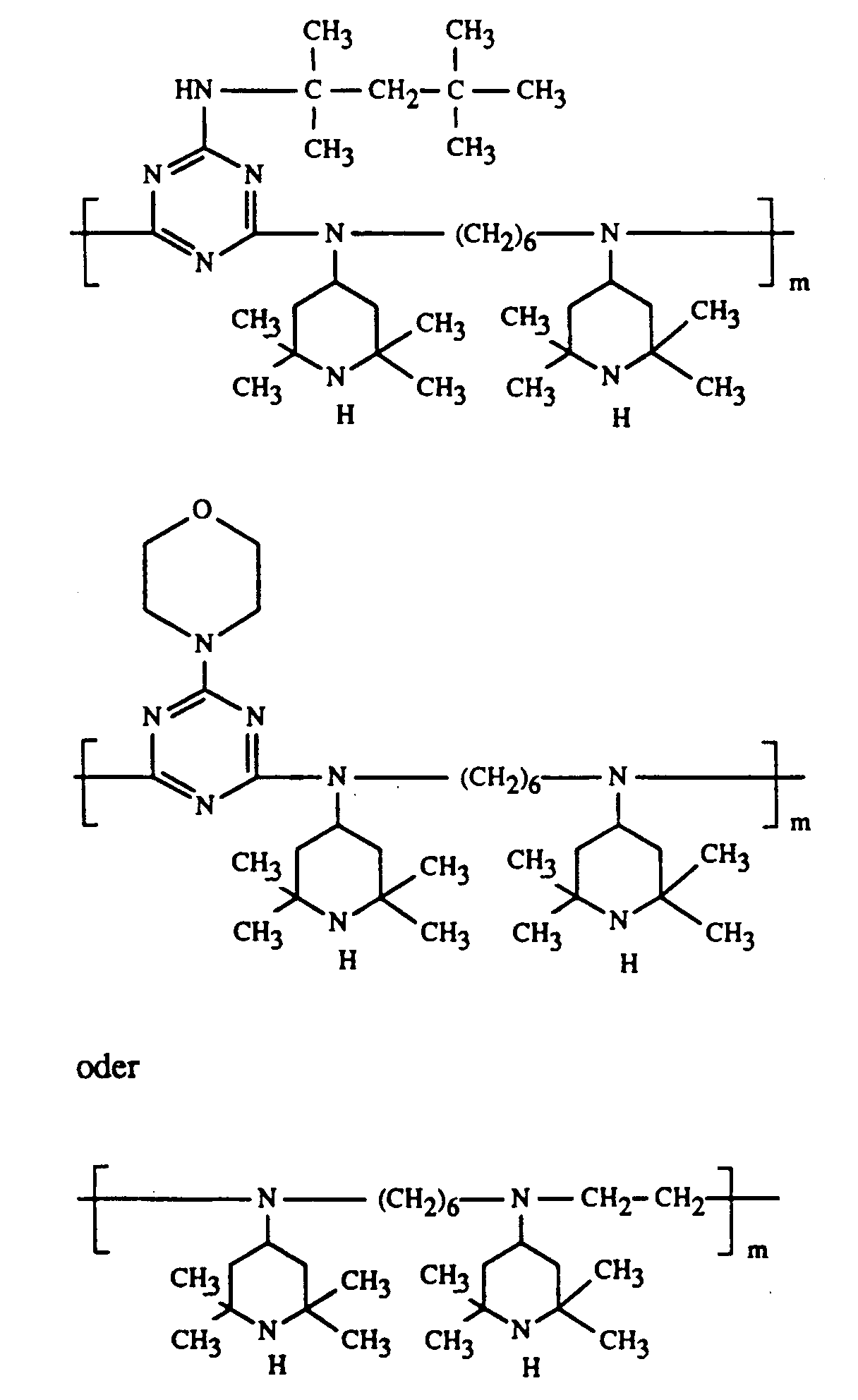
- the invention therefore also relates to a coating agent, which in addition to components A, B and C as Component D contains a light stabilizer of the sterically hindered amine type.
- It is preferably a 2,2,6,6-tetraalkylpiperidine derivative which contains at least one group of the formula contains, wherein R is hydrogen or methyl, especially hydrogen.
- the component D is preferably used in an amount of 0.1-5 parts by weight on 100 parts by weight of the solid binder used.
- the coating compositions according to the invention can be applied to any substrates for example on metal, wood, plastic or ceramic materials. They are preferably used as a topcoat when painting automobiles.
- the top coat consists of two layers, of which the lower layer is pigmented and If the upper layer is not pigmented, the coating agent according to the invention can be used be used for the top or bottom layer or for both layers, but preferably for the upper layer.
- compositions according to the invention can be applied to the substrates according to the usual methods Process are applied, for example by painting, spraying, pouring, Immersion or electrophoresis.
- the hardening of the coatings can - depending on the binder system - at room temperature or by heating.
- the coatings are preferably cured at 50-150 ° C, Powder coatings even at higher temperatures.
- the coatings obtained in this way are distinguished by a high level of light resistance, as well as due to an increased thermal-oxidative resistance.
- those binders are used in which a 2-hydroxyphenyl-s-triazine is incorporated by copolymerization or copolycondensation.
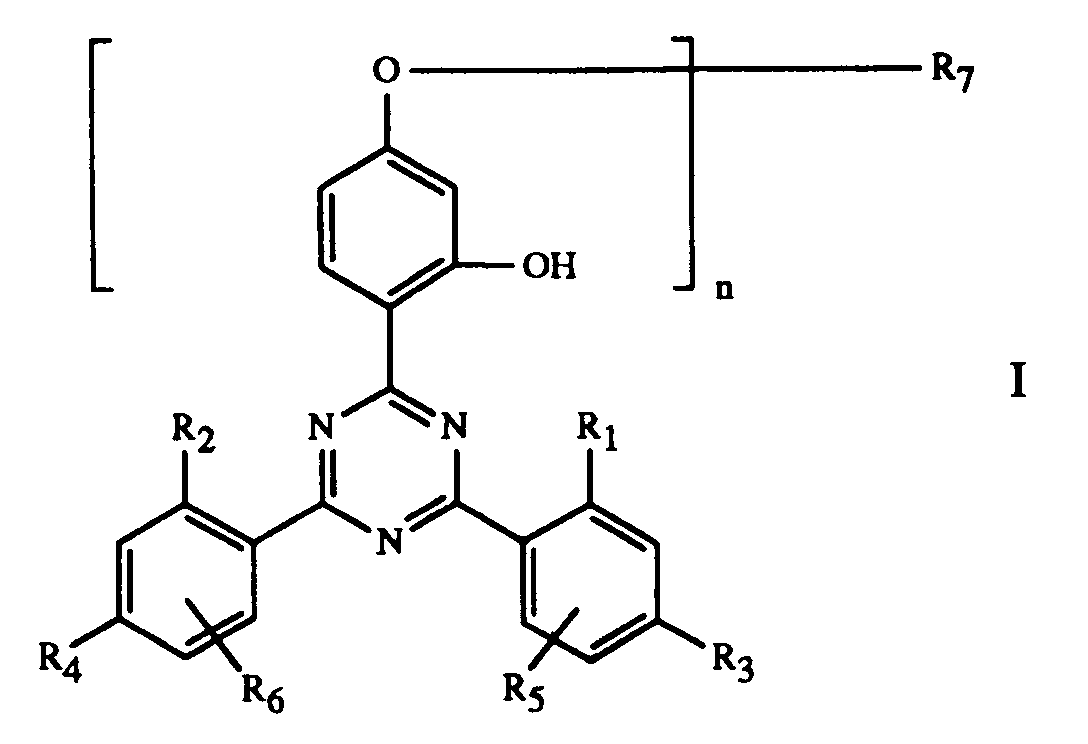
- Compounds of the formula I in which the radical R 7 contains a copolymerizable ethylenically unsaturated group or a functional group suitable for copolycondensation are suitable for this purpose.
- the coating agent can only consist of components A and B.
- Example 1 two-component polyacrylate-urethane paint with a combination of a metal-containing catalyst and an amine
- the sample panels are weathered in a UVCON® weathering device (Atlas Corp., UVB-313 lamps, cycle: 4 h UV light 60 ° C., 4 h condensation 50 ° C.). After 24 hours, the yellowness index (YI) is measured in accordance with ASTM D 1925. UV absorber YI after 24 h UVCON 2% UV-1 1.2 2% UV-2 0.5 2% UV-3 2.3 2% V-1 6.5
- Example 2 polyacrylate melamine lacquer with a metal chelate catalyst
- the clear lacquer obtained in this way is applied with a doctor blade to aluminum sheets which are coated with a white coil coat.
- the samples are cured at 130 ° C. for 30 minutes, resulting in a layer thickness of approx. 40 ⁇ m.
- the yellowness index (YI) is then measured in accordance with ASTM D 1925. UV absorber YI after curing none -1.8 2% UV-1 -1.6 2% UV-4 0.9 2% V-2 16.8 2% V-3 28.6 2% V-4 25.6
- Example 3 polyacrylate-epoxy resin paint with amine catalyst
- the samples are diluted with xylene to make them sprayable and sprayed onto an aluminum sheet coated with a white coil coat. After 15 minutes of flashing off, the samples are cured at 70 ° C. for 30 minutes. The result is a dry film thickness of approx. 40 ⁇ m. The samples are then heated to 100 ° C. for 30 minutes and the yellowness index according to ASTM D 1925 is measured. UV absorber Yellowness Index UV-1 1.4 UV-5 1.3 V-3 8.5
- Example 4 polyacrylate-epoxy resin paint with amine catalyst
- Example 3 The procedure is as in Example 3, but the clear lacquer is applied to aluminum sheets which are coated with a silver metallic basecoat. After curing (30 min at 70 ° C.), the samples are weathered in a UVCON weathering device with UVB-313 lamps (cycle: 8 h UV light 70 ° C., 4 h condensation 50 ° C.). After 48 hours of weathering, the yellowness index is measured. UV absorber Yellowness Index 2% UV-1 -0.7 2% UV-5 -0.6 V-3 3.9
- Example 5 two-component polyacrylate lacquer with an amino group-containing resin
- Component A is a compound having Component A:
- Component B is a compound having Component B:
- the components A, B and C are mixed and result in a clear lacquer with approx. 30% Solid.
- the UV absorbers listed in Table 5 (dissolved in xylene) are dissolved in an amount of 2% based on solids added.
- Example 6 polyacrylate resin with alkoxysilane groups and metal chelate catalyst
- the resin obtained has a molecular weight (Mw) of 21,300 and a content of 0.56 mol / kg of epoxy oxygen.
- the copolymer is dissolved in methyl isobutyl ketone and mixed with 2% UV absorber and 5% aluminum tris (acetylacetonate) - in each case based on solids.
- the paint is applied with a doctor blade to aluminum sheets coated with a white coil coat and cured at 130 ° C. for 30 minutes. The resulting dry film thickness is approx. 18 ⁇ m.
- the yellowness index of the samples is then measured.
Landscapes
- Chemical & Material Sciences (AREA)
- Organic Chemistry (AREA)
- Life Sciences & Earth Sciences (AREA)
- Engineering & Computer Science (AREA)
- Materials Engineering (AREA)
- Wood Science & Technology (AREA)
- Health & Medical Sciences (AREA)
- Chemical Kinetics & Catalysis (AREA)
- Medicinal Chemistry (AREA)
- Polymers & Plastics (AREA)
- Paints Or Removers (AREA)
- Compositions Of Macromolecular Compounds (AREA)
Description
und/oder -OCOR11 substituiert ist, bedeutet oder R7 durch ein oder mehrere O unterbrochenes und durch OH oder C1-C12-Alkoxy substituiertes C4-C20-Alkyl, C3-C6-Alkenyl, Glycidyl, C5-C8-Cycloalkyl, durch OH, C1-C4-Alkyl oder -OCOR11 substituiertes Cyclohexyl, unsubstituiertes oder durch OH, Cl oder CH3 substituiertes C7-C11-Phenylalkyl, -CO-R12 oder -SO2-R13 bedeutet, und wenn n 2 ist, C2-C16-Alkylen, C4-C12-Alkenylen, Xylylen, durch ein oder mehrere O unterbrochenes und/oder durch OH substituiertes C3-C20-Alkylen, eine Gruppe -CH2CH(OH)CH2O-R15-OCH2CH(OH)CH2-, -CO-R16-CO-, -CO-NH-R17-NH-CO- oder -(CH2)m-COO-R18-OCO-(CH2)m-bedeutet, worin m 1-3 ist,
Die Verwendung solcher Verbindungen als UV-Absorber in Ueberzugsmitteln ist z.B. im US-A-4 619 956 beschrieben.
-
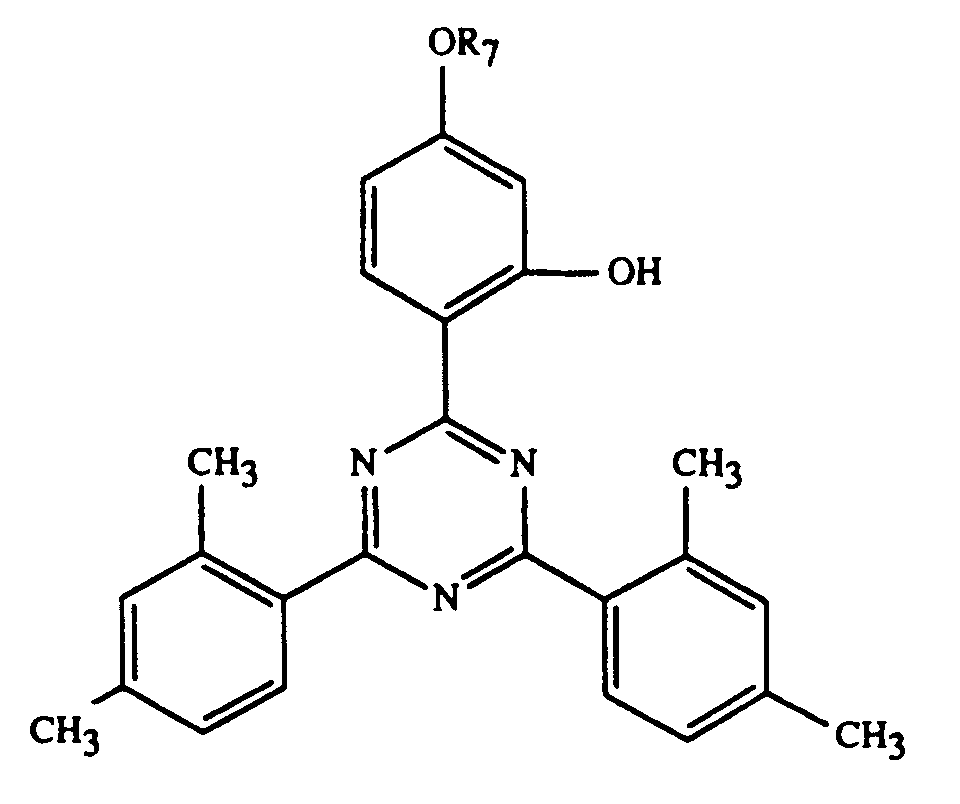
- R7 =
- -H
-C2H5
-C4H9
-C8H17
-C12H25
-C18H37
-Cyclohexyl
-CH2 Phenyl
-CH2CH2OH
-CH2CH2OCOCH3
-CH2CH2OCOCH=CH2
-CH2CH(OH)C8H17
-CH2CH(OH)C12H25
-CH2CH(OH)CH2OC8H17-CH2CH(OH)CH2OPhenyl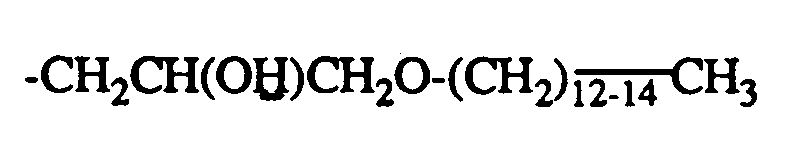
-CH2CH(OH)CH2OCOC(CH3)=CH2-CH2COOH
-CH2CH2COOC4H9
-CH2COOC8H17
-CH2COO(CH2CH2O)7H
-CH2COOCH2CH(OH)CH2OC4H9
-CH2COOCH2CH(CH3)OCH2CH(CH3)OCH(CH3)CH3
-CH2COOCH2P(O)(OC2H5)2
-CH2COOCH2CH(OH)CH2P(O)(OC4H9)2
-CH2COO(CH2)7CH=CHC8H17
-CH2COOCH2CH2OCH2CH2OC6H13
-CH2CON(C2H5)2
-CH2CONHCH2CH2CH2N(CH3)2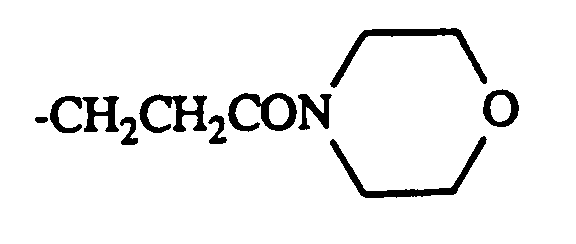
-CH2CONHC8H17
-CH2CON(C8H17)2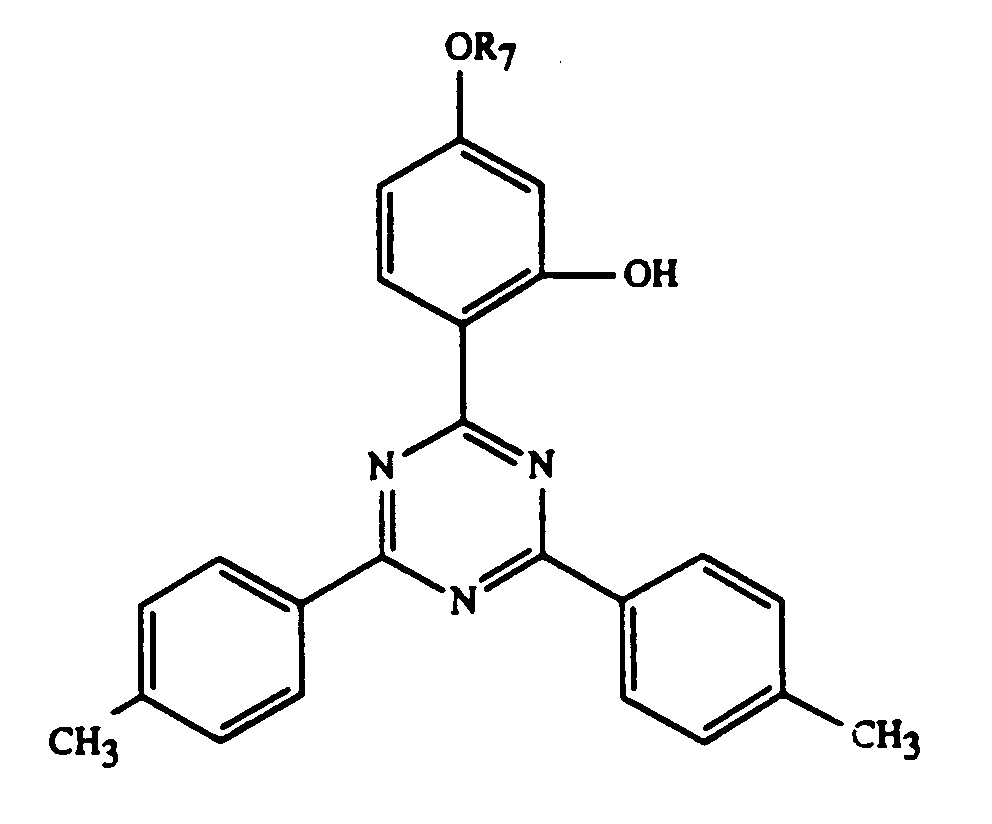
- R7=
- -C4H9
-C8H17
-C12H25
-CH2CH(OH)CH2OC8H17-CH2COOC2H5
-CH2COOCH2OCH3
-CH2COOCH2CH=CH-Phenyl-CH2COOCH2CH(OH)CH2OC8H17
-CH2Phenyl
-CH2CH=CH2
-CH2CON(C4H9)2
-CH2CH2CONH8H17-CO-OC6H13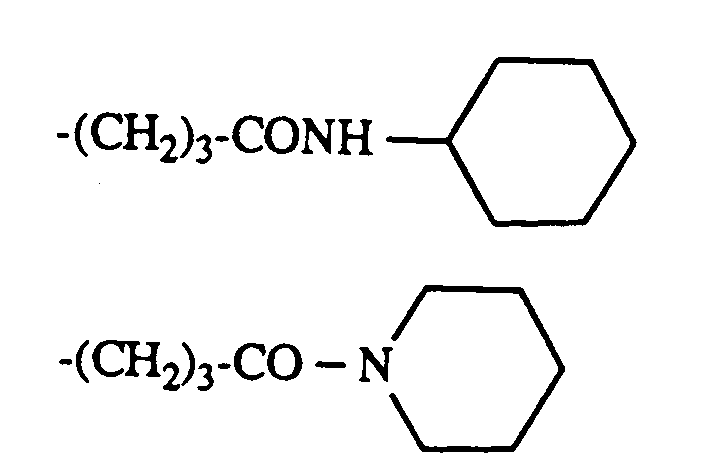
-CH2CH2Cl
-CH2CH2CN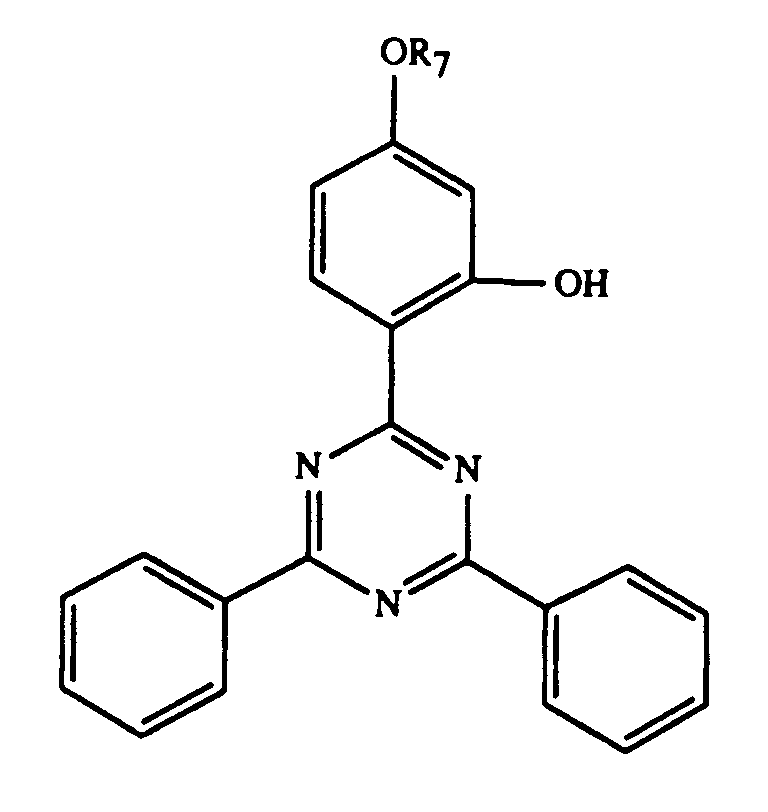
- R7 =
- -H
-CH3
-C3H7
-C6H13
-C8H17
-C12H25
-CH2CH(OH)CH2OC8H17-CH2CH(OH)Phenyl
-CH2CH(OH)CH2OCOPhenyl
-CH2CH(CH3)OCOCH3
-SO2-C12H15-CH2COOC10H21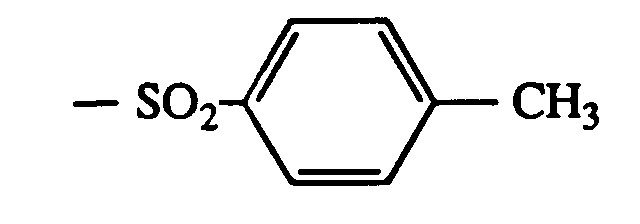
-CH2CONHCH2CH2OCH3
-CH2CH2CONHCH2Phenyl
-(CH2)3CONH(CH2)3N(C2H5)2
-CH2CONHC12H25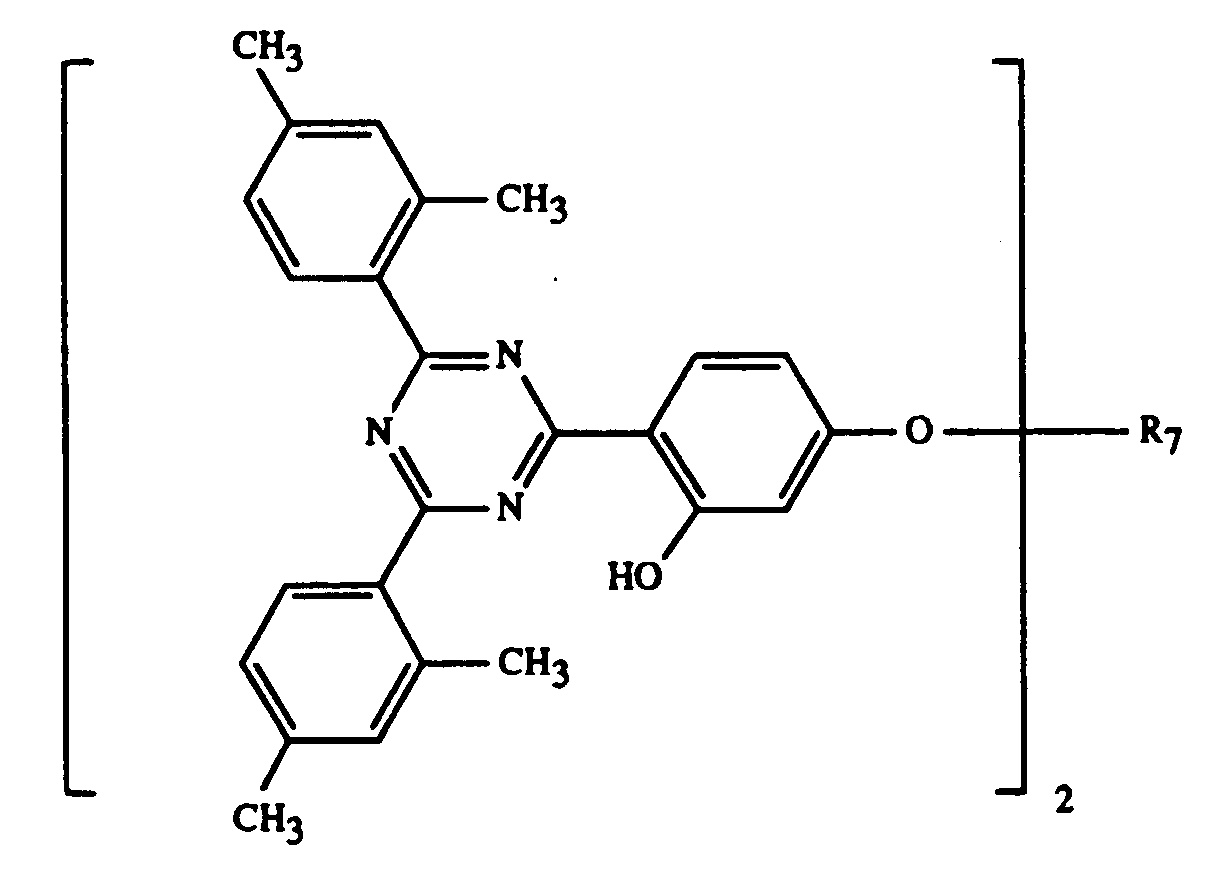
- R7 =
- -CH2CH(OH)CH2--CH2-CH=CH-CH2-
-(CH2)4-

-(CH2)6-
-(CH2)8
-(CH2)12-
-CH2CH(OH)CH2O-CH2CH2-OCH2CH(OH)CH2-
-CH2CH(OH)CH2O-(CH2)6-OCH2CH(OH)CH2--CH2COO-(CH2)6-OCOCH2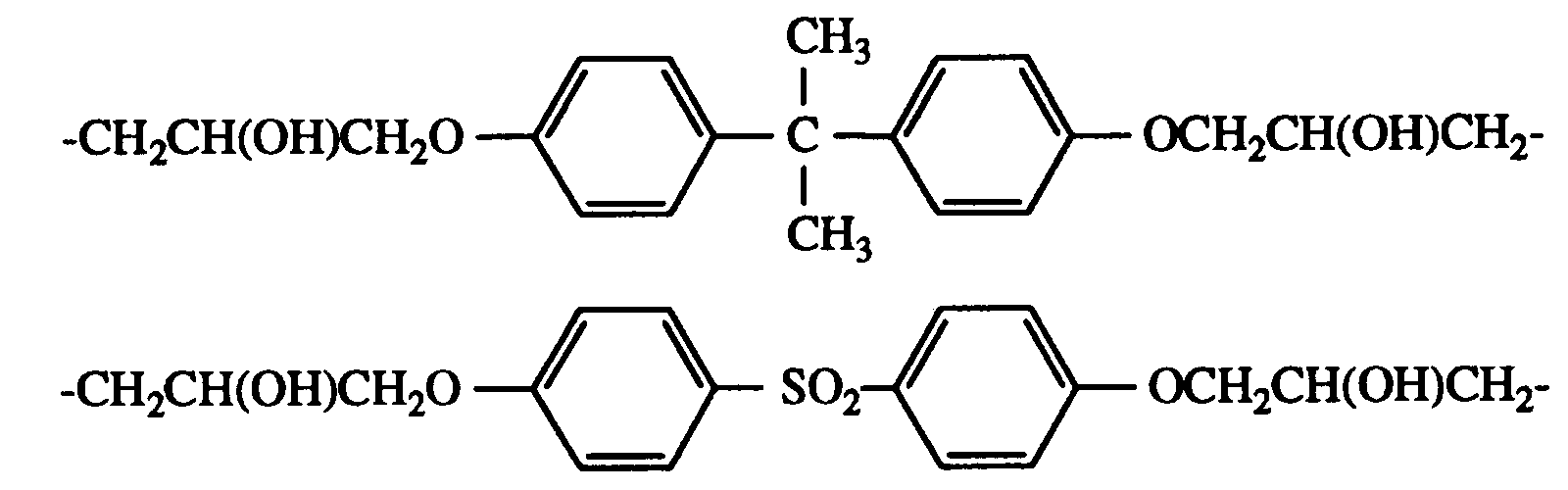 -CO-(CH2)8-CO-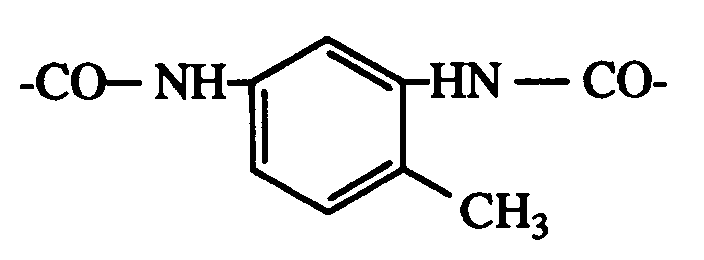


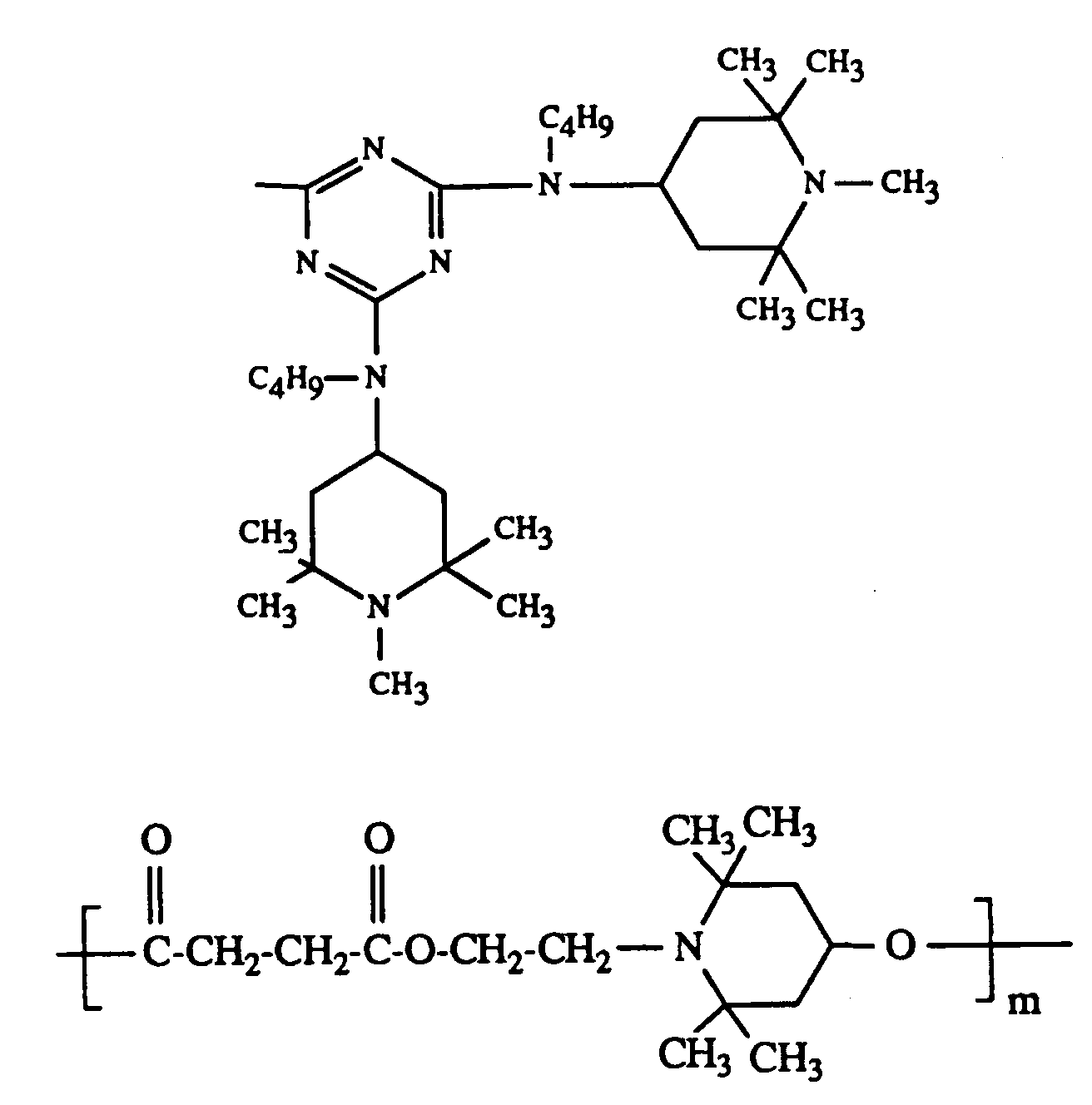
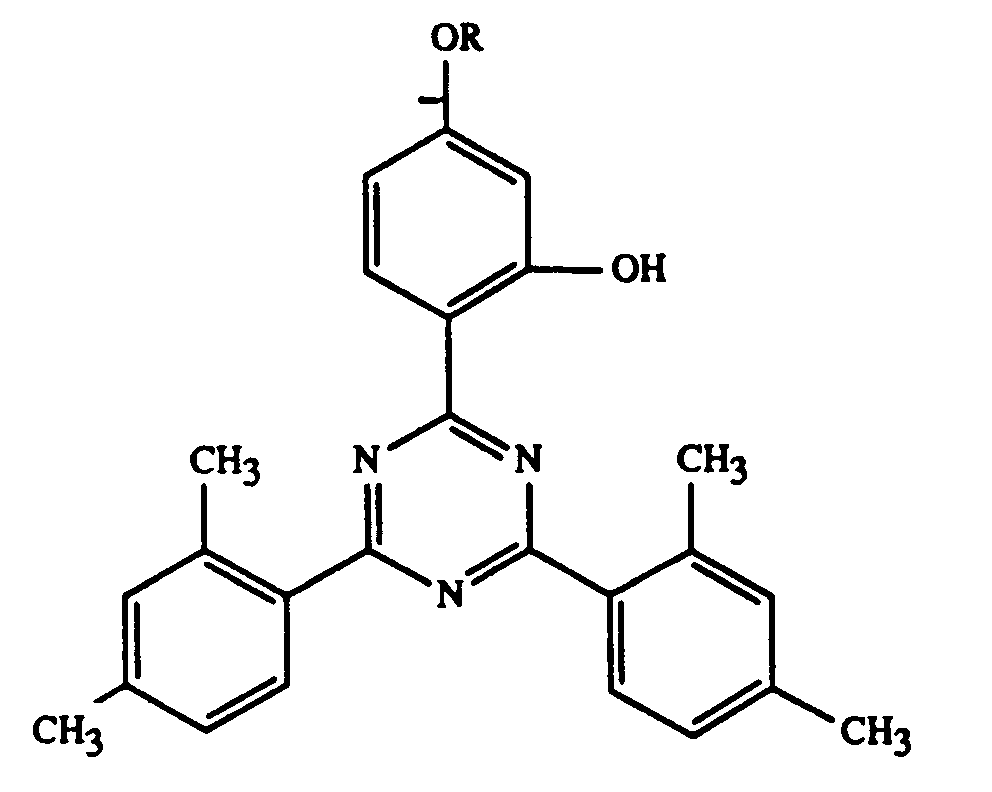
- UV-1:
- R = -C8H17
- UV-2:
- R = -CH2CH(OH)CH2OC4H9
- UV-3:
- R = -CH2COO(CH2)8CH=CH-C8H17
- UV-4:
- R = -H
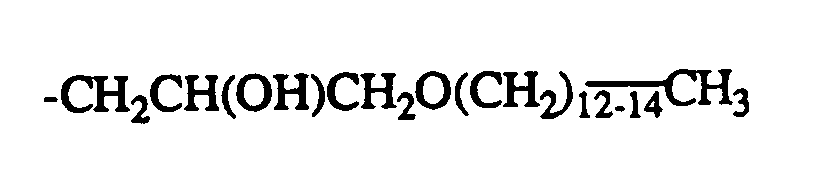
- UV-5:
- R =

- UV-6:
- R =
- V-1:
- Umsetzungsprodukt von 2-[2-Hydroxy-3-tert.butyl-5-(2-methoxy-carbonylethyl)-phenyl]-benztriazol mit Polyethylenglykol 300
- V-2:
- 2-Hydroxy-4-dodecycloxybenzophenon
- V-3:
- 2,4-Dihydroxybenzophenon
- V-4:
- 2-[2-Hydroxy-3,5-di(α,α-dimethylbenzyl)-phenyl]-benztriazol.
| UV-Absorber | YI nach 24 h UVCON |
| 2 % UV-1 | 1,2 |
| 2 % UV-2 | 0,5 |
| 2 % UV-3 | 2,3 |
| 2 % V-1 | 6,5 |
| UV-Absorber | YI nach der Härtung |
| keiner | -1,8 |
| 2 % UV-1 | -1,6 |
| 2 % UV-4 | 0,9 |
| 2 % V-2 | 16,8 |
| 2 % V-3 | 28,6 |
| 2 % V-4 | 25,6 |
| UV-Absorber | Yellowness Index |
| UV-1 | 1,4 |
| UV-5 | 1,3 |
| V-3 | 8,5 |
| UV-Absorber | Yellowness Index |
| 2 % UV-1 | -0,7 |
| 2 % UV-5 | -0,6 |
| V-3 | 3,9 |
| UV-Absorber | Yellowness-Index |
| keiner | -0,7 |
| 2 % UV-1 | -0,1 |
| 2 % UV-2 | 0,6 |
| 2 % UV-5 | 0,1 |
| 2 % UV-6 | -0,1 |
| 2 % V-1 | 6,5 |
| 2 % V-2 | 7,1 |
| 2 % V-3 | 8,3 |
| 2 % V-4 | 13,0 |

| UV-Absorber | Yellowness-Index |
| 2 % UV-5 | 2,2 |
| 2 % V-2 | 6,3 |
| 2 % V-3 | 7,9 |
Claims (13)
- Ueberzugsmittel, enthaltendA) ein BindemittelB) als Härtungskatalysator eine organische Metallverbindung oder/und ein Amin oder/und ein aminogruppenhaltiges Harz und/oder ein Phosphin undC) als Stabilisator gegen Schädigung durch Licht, Wärme und Sauerstoff eine Verbindung der Formel I
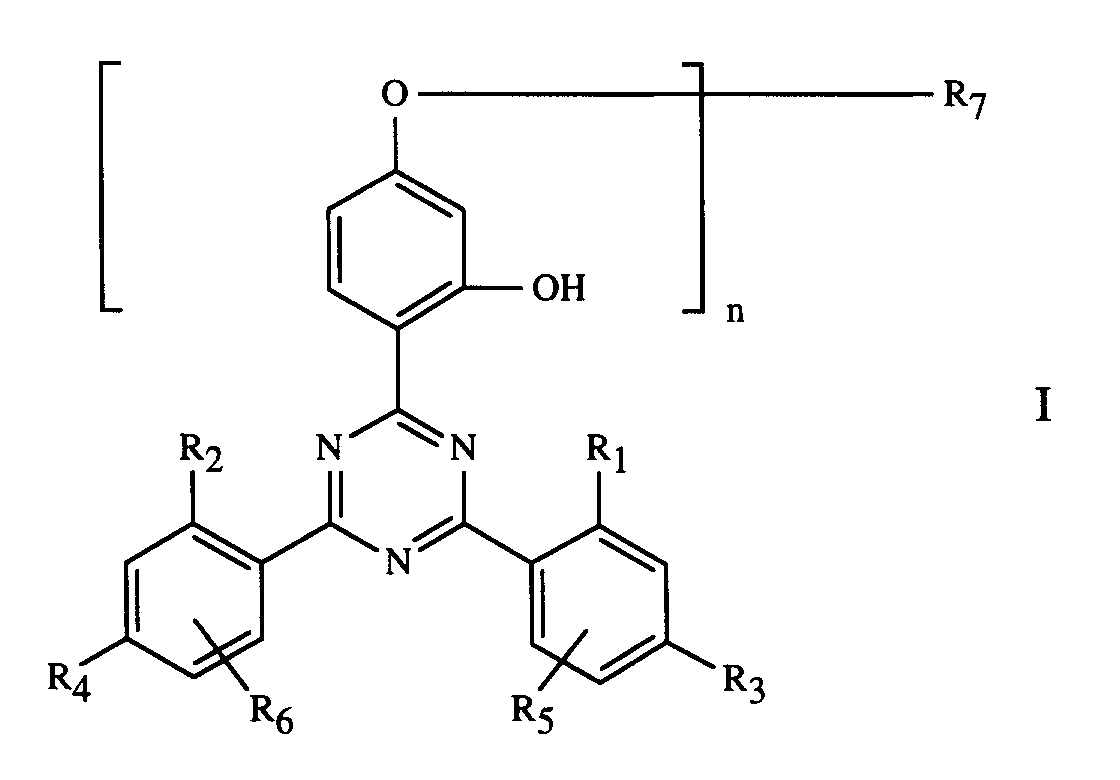 worin n 1 oder 2 ist,R1 und R2 unabhängig voneinander H, C1-C12-Alkyl oder Halogenmethyl bedeuten,R3 und R4 unabhängig voneinander H, OH, C1-C12-Alkyl, C1-C18-Alkoxy oder Halogen bedeuten,R5 und R6 unabhängig voneinander H, C1-C12-Alkyl oder Halogen bedeuten,R7, wenn n 1 ist, Wasserstoff, C1-C18-Alkyl oder C1-C12-Alkyl, das durch OH, C1-C18-Alkoxy, Halogen, Phenoxy oder durch C1-C18-Alkyl, C1-C18-Alkoxy oder Halogen substituiertes Phenoxy, -COOH, -COOR8, -CONH2, -CONHR9, -CON(R9)(R10), -NH2, -NHR9, -N(R9)(R10), -NHCOR11, -CN
und/oder -OCOR11 substituiert ist, bedeutet oder R7 durch ein oder mehrere O unterbrochenes und durch OH oder C1-C12-Alkoxy substituiertes C4-C20-Alkyl, C3-C6-Alkenyl, Glycidyl, C5-C8-Cycloalkyl, durch OH, C1-C4-Alkyl oder -OCOR11 substituiertes Cyclohexyl, unsubstituiertes oder durch OH, Cl oder CH3 substituiertes C7-C11-Phenylalkyl, -CO-R12 oder -SO2-R13 bedeutet, und wenn n 2 ist, C2-C16-Alkylen, C4-C12-Alkenylen, Xylylen, durch ein oder mehrere O unterbrochenes und/oder durch OH substituiertes C3-C20-Alkylen, eine Gruppe -CH2CH(OH)CH2O-R15-OCH2CH(OH)CH2-, -CO-R16-CO-, -CO-NH-R17-NH-CO- oder -(CH2)mCOO-R18-OCO-(CH2)m- bedeutet, worin m 1-3 ist,R8 C1-C18-Alkyl, C3-C18-Alkenyl, durch O, N oder S unterbrochenes und/oder durch OH substituiertes C3-C20-Alkyl, durch -P(O)(OR14)2, -N(R9)(R10) oder -OCOR11 und/oder OH substituiertes C1-C4-Alkyl, Glycidyl, Cyclohexyl oder C7-C11-Phenylalkyl bedeutet,R9 und R10 unabhängig voneinander C1-C12-Alkyl, C3-C12-Alkoxyalkyl, C4-C16-Dialkylaminoalkyl oder C5-C12-Cycloalkyl bedeuten oderR9 und R10 zusammen C3-C9-Alkylen oder -Oxaalkylen oder -Azaalkylen bedeuten,R11 C1-C18-Alkyl, C2-C18-Alkenyl oder Phenyl bedeutet,R12 C1-C18-Alkyl, C2-C18-Alkenyl, Phenyl, C1-C12-Alkoxy, Phenoxy, C1-C12-Alkylamino, Phenylamino, Tolylamino oder Naphthylamino bedeutet,R13 C1-C12-Alkyl, Phenyl, Naphthyl oder C7-C14-Alkylphenyl bedeutet,R14 C1-C12-Alkyl oder Phenyl bedeutet,R15 C2-C10-Alkylen, Phenylen oder eine Gruppe -Phenylen-X-Phenylen- bedeutet, worin X -O-, -S-, -SO2-, -CH2- oder -C(CH3)2- bedeutet,R16 C2-C10-Alkylen, -Oxaalkylen oder -Thiaalkylen, Phenylen, Naphthylen, Diphenylen oder C2-C6-Alkenylen bedeutet,R17 C2-C10-Alkylen, Phenylen, Maphthylen, Methylendiphenylen oder C7-C15-Alkylphenylen bedeutet undR18 C2-C10-Alkylen oder durch O unterbrochenes C4-C20-Alkylen bedeutet, wobei in Komponente B die 3 Kombinationen organischer Metallverbindungen aus1. Kobaltnaphthenat, Calciumnaphthenat und Zirconoctoat,2. Kobalt-, Blei- und Mangantrockner oder3. Bleinaphthenat, Kobaltnaphthenat und Mangannaphthenat
als Härtungskatalysatoren ausgeschlossen sind. - Ueberzugsmittel gemäss Anspruch 1, dadurch gekennzeichnet, dass die Komponente B ein Bindemittel aus einem funktionellen Acrylatharz und einem Vernetzer ist.
- Ueberzugsmittel gemäss Anspruch 1, dadurch gekennzeichnet, dass der Härtungskatalysator (Komponente B) ein Metallcarboxylat oder ein Metallchelat oder eine Organozinnverbindung oder ein Amin ist.
- Ueberzugsmittel gemäss Anspruch 3, dadurch gekennzeichnet, dass der Härtungskatalysator ein Carboxylat von einem der Metalle Pb, Mn, Co, Zn, Zr oder Cu ist oder ein Chelat von einem der Metalle Al, Ti oder Zr ist oder ein tertiäres Amin ist.
- Ueberzugsmittel gemäss Anspruch 1, dadurch gekennzeichnet, dass die Komponente C eine Verbindung der Formel I ist, worin n 1 oder 2 ist,R1 und R2 unabhängig voneinander H oder C1-C4-Alkyl bedeuten,R3 und R4 unabhängig voneinander H, OH, C1-C4-Alkyl, C1-C4-Alkoxy oder Halogen bedeuten,R5 und R6 unabhängig voneinander H oder C1-C4-Alkyl bedeuten,R7, wenn n 1 ist, Wasserstoff, C1-C18-Alkyl, durch OH, C1-C18-Alkoxy, Phenoxy, -COOR8, -CONHR9, -CON(R9)(R10) und/oder -OCOR11 substituiertes C1-C6-Alkyl, Allyl, Glycidyl oder Benzyl bedeutet, und wenn n 2 ist, C4-C12-Alkylen, C4-C6-Alkenylen, Xylylen oder durch ein oder mehrere O unterbrochenes und/oder durch OH substituiertes C3-C20-Alkylen bedeutet,R8 C1-C12-Alkyl, C3-C18-Alkenyl, durch O unterbrochenes und/oder durch OH substituiertes C3-C20-Alkyl oder durch -P(O)(OR14)2 substituiertes C1-C4-Alkyl bedeutet,R9 und R10 unabhängig voneinander C1-C8-Alkyl oder Cyclohexyl bedeuten, oder R9 und R10 zusammen Pentamethylen oder 3-Oxapentamethylen bedeuten,R11 C1-C8-Alkyl, C2-C5-Alkenyl oder Phenyl bedeutet undR14 C1-C4-Alkyl bedeutet.
- Ueberzugsmittel gemäss Anspruch 1, dadurch gekennzeichnet, dass die Komponente C eine Verbindung der Formel 1 ist, worin n 1 oder 2 ist,R1 und R2 unabhängig voneinander H oder CH3 bedeuten,R3 und R4 unabhängig voneinander H, CH3 oder Cl bedeuten,R5 und R6 Wasserstoff bedeuten,R7, wenn n 1 ist, Wasserstoff, C1-C12-Alkyl, durch OH, C4-C18-Alkoxy, -COOR8, -CON(R9)(R10) und/oder -OCOR11 substituiertes C1-C4-Alkyl, Glycidyl oder Benzyl bedeutet, und wenn n 2 ist, C6-C12-Alkylen, 2-Butenylen, 1,4-Xylylen oder durch O unterbrochenes und/oder durch OH substituiertes C3-C20-Alkylen bedeutet,R8 C4-C12-Alkyl, C12-C18-Alkenyl, durch O unterbrochenes und/oder durch OH substituiertes C6-C20-Alkyl oder durch -P(O)(OR14)2 substituiertes C1-C4-Alkyl bedeutet,R9 und R10 C4-C8-Alkyl bedeuten,R11 C1-C8-Alkyl oder C2-C3-Alkenyl bedeutet undR14 C1-C4-Alkyl bedeutet.
- Ueberzugsmittel gemäss Anspruch 1, dadurch gekennzeichnet, dass die Komponente C eine Verbindung der Formel I ist, worin n 1 oder 2 ist und R7, wenn n 1 ist, eine Gruppe -CH2CH(OH)CH2O-R19 ist, worin R19 C1-C12-Alkyl, Phenyl, durch C1-C12-Alkyl, C1-C12-Alkoxy oder Halogen substituiertes Phenyl oder C3-C5-Alkenoyl bedeutet, und wenn n 2 ist, R7 eine Gruppe -CH2CH(OH)CH2O-R15-OCH2CH(OH)CH2-, bedeutet, worin R15 die in Anspruch 1 gegebene Bedeutung hat.
- Ueberzugsmittel gemäss Anspruch 1, enthaltend auf 100 Gew.-Teile festes Bindemittel A 0,01 bis 20 Gew.-Teile Härtungskatalysator B und 0,1-10 Gew.-Teile Stabilisator C.
- Ueberzugsmittel gemäss Anspruch 1, enthaltend neben den Komponenten A, B und C als weitere Komponenten Lösungsmittel, Pigmente, Farbstoffe, Weichmacher, Stabilisatoren, Thixotropiemittel oder/und Verlaufhilfsmittel.
- Ueberzugsmittel gemäss Anspruch 9, enthaltend neben den Komponenten A, B und C als Komponente D ein Lichtschutzmittel vom Typ der sterisch gehinderten Amine.
- Verwendung eines Ueberzugsmittels gemäss Anspruch 1 als Decklack für Automobile.
- Lackfilm, erhalten durch Härtung eines Ueberzugsmittels gemäss Anspruch 1.
- Verwendung von Verbindungen der Formel I gemäß Anspruch 1 als Stabilisatoren in Überzugsmitteln, die ein Bindemittel und mindestens einen Härtungskatalysator aus der Klasse der organischen Metallverbindungen, Amine, aminogruppen haltigen Harze und Phosphine enthalten, wobei die 3 Kombinationen organischer Metallverbindungen aus1. Kobaltnaphthenat, Calciumnaphthenat und Zirconoctoat,2. Kobalt-, Blei- und Mangantrockner oder3. Bleinaphthenat, Kobaltnaphthenat und Mangannaphthenat
als Härtungskatalysatoren ausgeschlossen sind.
Applications Claiming Priority (6)
| Application Number | Priority Date | Filing Date | Title |
|---|---|---|---|
| CH512/90 | 1990-02-16 | ||
| CH51290 | 1990-02-16 | ||
| CH51290 | 1990-02-16 | ||
| CH124990 | 1990-04-11 | ||
| CH1249/90 | 1990-04-11 | ||
| CH124990 | 1990-04-11 |
Publications (3)
| Publication Number | Publication Date |
|---|---|
| EP0442847A1 EP0442847A1 (de) | 1991-08-21 |
| EP0442847B1 EP0442847B1 (de) | 1995-09-06 |
| EP0442847B2 true EP0442847B2 (de) | 2000-08-23 |
Family
ID=25684792
Family Applications (1)
| Application Number | Title | Priority Date | Filing Date |
|---|---|---|---|
| EP91810090A Expired - Lifetime EP0442847B2 (de) | 1990-02-16 | 1991-02-07 | Gegen Schädigung durch Licht, Wärme und Sauerstoff stabilisierte Ueberzugsmittel |
Country Status (6)
| Country | Link |
|---|---|
| US (1) | US5322868A (de) |
| EP (1) | EP0442847B2 (de) |
| JP (2) | JP3424081B2 (de) |
| CA (1) | CA2036346C (de) |
| DE (1) | DE59106390D1 (de) |
| HK (1) | HK1001695A1 (de) |
Families Citing this family (48)
| Publication number | Priority date | Publication date | Assignee | Title |
|---|---|---|---|---|
| EP0458741B1 (de) * | 1990-05-10 | 1996-01-24 | Ciba-Geigy Ag | Strahlenhärtbare lichtstabilisierte Zusammensetzungen |
| EP0483488B1 (de) * | 1990-10-29 | 1997-03-12 | Cytec Technology Corp. | Hydroxyaryltriazine und Tetraalkylpiperidine enthaltende synergistische UV-Absorbermischung |
| JP2609569B2 (ja) * | 1992-09-21 | 1997-05-14 | 東レチオコール株式会社 | 硬化型組成物 |
| BE1006797A5 (fr) * | 1992-12-03 | 1994-12-13 | Ciba Geigy Ag | Absorbeurs d'uv. |
| US5489503A (en) * | 1992-12-03 | 1996-02-06 | Ciba-Geigy Corp. | UV absorbers |
| US5354794A (en) * | 1993-02-03 | 1994-10-11 | Ciba-Geigy Corporation | Electro coat/base coat/clear coat finishes stabilized with S-triazine UV absorbers |
| US6706215B1 (en) | 1993-05-17 | 2004-03-16 | Ciba Specialty Chemicals Corporation | Coating compositions stabilized against damage by light, heat and oxygen |
| GB2278115B (en) * | 1993-05-17 | 1997-08-06 | Ciba Geigy Ag | 2-(2-Hydroxyphenyl)-1,3-pyrimidine derivatives and their use as stabilizers for coating compositions |
| GB9400681D0 (en) * | 1994-01-14 | 1994-03-09 | Sandoz Ltd | Organic compounds |
| DE69513644T2 (de) * | 1994-03-16 | 2000-06-29 | Asahi Kasei Kogyo K.K., Osaka | Härtbare harzzusammensetzung |
| US5556973A (en) * | 1994-07-27 | 1996-09-17 | Ciba-Geigy Corporation | Red-shifted tris-aryl-s-triazines and compositions stabilized therewith |
| TW308601B (de) * | 1995-01-18 | 1997-06-21 | Ciba Sc Holding Ag | |
| KR19990044020A (ko) * | 1995-08-30 | 1999-06-25 | 마이클 제이. 켈리 | 1,3,5-트리아진 카바메이트 및 에폭시 화합물을 함유하는조성물 |
| US5585422A (en) * | 1995-09-20 | 1996-12-17 | Ciba-Geigy Corporation | Hybrid s-triazine light stabilizers substituted by benzotriazole or benzophenone moieties and compositions stabilized therewith |
| ES2107971B1 (es) * | 1996-01-17 | 1998-07-01 | Ciba Geigy Ag | Combinacion estabilizante. |
| CH692739A5 (de) * | 1996-03-26 | 2002-10-15 | Ciba Sc Holding Ag | Polymerzusammensetzungen enthaltend 2-Hydroxyphenyl-1,3,5-triazine als UV-Absorber sowie neue 2-Hydroxyphenyl-1,3,5-triazine |
| CZ14299A3 (cs) | 1996-07-18 | 1999-04-14 | Ciba Specialty Chemicals Holding Inc. | Polyoxyalkylenovou skupinou substituované a přemostěné deriváty triazinu, benzotriazolu a benzofenonu pro použití jako UV absorbéry |
| US5726309A (en) * | 1996-08-27 | 1998-03-10 | Ciba Specialty Chemicals Corporation | Tris-aryls-triazines substituted with biphenylyl groups |
| WO1998015587A1 (en) * | 1996-10-08 | 1998-04-16 | Cytec Technology Corp. | Crosslinker compositions and low gloss epoxy coatings therefrom |
| ZA9810605B (en) | 1997-11-21 | 1999-05-25 | Cytec Techonoly Corp | Trisaryl-1,3,5-triazine ultraviolet light absorbers |
| BR9909962A (pt) | 1998-04-27 | 2000-12-26 | Ciba Sc Holding Ag | Processo para a preparação de revestimentos protetores de uv por deposição realçada de plasma |
| JP2002518489A (ja) | 1998-06-22 | 2002-06-25 | チバ スペシャルティ ケミカルズ ホールディング インコーポレーテッド | ポリ(トリスアリール−1,3,5−トリアジン=カルバマート)紫外光吸収剤 |
| US6297377B1 (en) | 1998-06-22 | 2001-10-02 | Cytec Technology Corporation | Benzocycle-substituted triazine and pyrimidine ultraviolet light absorbers |
| DE69927372T2 (de) | 1998-06-22 | 2006-07-13 | Cytec Technology Corp., Wilmington | In den roten Bereich verschobene Trisaryl-1,3,5-Triazin-Ultraviolettlicht-Absorptionsmittel |
| US6239276B1 (en) | 1998-06-22 | 2001-05-29 | Cytec Technology Corporation | Non-yellowing para-tertiary-alkyl phenyl substituted triazine and pyrimidine ultraviolet light absorbers |
| US6258880B1 (en) * | 1998-11-25 | 2001-07-10 | Morton International, Inc. | Stabilizers for improved weatherability of clear polyvinyl chloride compositions |
| KR100842407B1 (ko) | 2000-05-19 | 2008-07-01 | 시바 홀딩 인코포레이티드 | 폴리에틸렌 또는 폴리에틸렌 배합물의 분자량 제어 증가방법 |
| US6867250B1 (en) | 2000-10-30 | 2005-03-15 | Cytec Technology Corp. | Non-yellowing ortho-dialkyl aryl substituted triazine ultraviolet light absorbers |
| CN1500126A (zh) * | 2001-02-27 | 2004-05-26 | 阿克佐诺贝尔股份有限公司 | 反应性非异氰酸酯涂料组合物 |
| DE60215790T2 (de) | 2001-04-06 | 2007-09-13 | Adeka Corp. | Uv-absorber für kunstharz und diesen enthaltende kunstharzzusammensetzung |
| TWI316513B (en) * | 2001-07-02 | 2009-11-01 | Ciba Sc Holding Ag | Highly compatible hydroxyphenyltriazine uv-absorbers |
| US6855269B2 (en) * | 2001-11-09 | 2005-02-15 | Cytec Technology Corp. | Phenyl ether-substituted hydroxyphenyl triazine ultraviolet light absorbers |
| US7214742B2 (en) * | 2001-11-30 | 2007-05-08 | Ciba Specialty Chemicals Corp. | 2-hydroxyphenyl-s-triazine crosslinkers for polymer networks |
| EP2664629B1 (de) | 2004-02-02 | 2014-11-12 | Basf Se | Funktionalisierte Fotoinitiatoren |
| US20070238814A1 (en) * | 2006-04-10 | 2007-10-11 | Basf Corporation | Method of making coating compositions |
| JP5581208B2 (ja) * | 2007-07-18 | 2014-08-27 | データレース リミテッド | レーザー感受性被覆配合物 |
| KR20100063014A (ko) * | 2007-07-18 | 2010-06-10 | 바스프 에스이 | 피복 조성물 |
| WO2009016046A2 (en) * | 2007-07-27 | 2009-02-05 | Basf Se | Sunless tanning compositions comprising substituted polyamine compounds |
| TWI440505B (zh) * | 2008-05-27 | 2014-06-11 | Toto Ltd | Photocatalyst coating |
| CN102197076A (zh) | 2008-10-23 | 2011-09-21 | 巴斯夫欧洲公司 | 吸热添加剂 |
| US9267042B2 (en) | 2008-10-27 | 2016-02-23 | Datalase Ltd. | Coating composition for marking substrates |
| KR101315543B1 (ko) | 2009-01-08 | 2013-10-08 | 바스프 에스이 | 중합 개시제 |
| EP2387600B1 (de) | 2009-01-19 | 2014-04-02 | Basf Se | Organische schwarzpigmente und ihre herstellung |
| EP2414324A1 (de) | 2009-03-30 | 2012-02-08 | Basf Se | Polymerisierbare zusammensetzungen |
| EP2671449A1 (de) | 2012-06-06 | 2013-12-11 | Construction Research & Technology GmbH | Verwendung von Vanadiumpentoxidpartikeln als Biozid |
| EP2912023B1 (de) | 2012-10-23 | 2017-01-11 | Basf Se | Iminoxytriazine als radikalbildner |
| EP2786987B1 (de) | 2013-04-01 | 2016-06-15 | Shin-Etsu Chemical Co., Ltd. | Reaktiver UV-Absorber, Herstellungsverfahren, Beschichtungszusammensetzung, und beschichteter Artikel |
| JP6887891B2 (ja) * | 2017-06-21 | 2021-06-16 | 株式会社パイロットコーポレーション | 筆記具用油性インキ組成物およびそれを用いた筆記具 |
Family Cites Families (7)
| Publication number | Priority date | Publication date | Assignee | Title |
|---|---|---|---|---|
| JPS5133128A (de) * | 1974-09-13 | 1976-03-22 | Sumitomo Chemical Co | |
| AU559667B2 (en) * | 1982-12-03 | 1987-03-19 | Kanegafuchi Kagaku Kogyo K.K. | Curable polyoxyalkylene polymer composition |
| US4619956A (en) * | 1985-05-03 | 1986-10-28 | American Cyanamid Co. | Stabilization of high solids coatings with synergistic combinations |
| US4772672A (en) * | 1986-05-15 | 1988-09-20 | Kansai Paint Company, Limited | Curable compositions and method of curing same |
| US5064883A (en) * | 1987-09-21 | 1991-11-12 | Ciba-Geigy Corporation | Stabilization of acid catalyzed thermoset resins with n-hydroxy hindered amines |
| US5112890A (en) * | 1987-09-21 | 1992-05-12 | Ciba-Geigy Corporation | Stabilization of acid catalyzed thermoset resins |
| US4826978A (en) * | 1987-12-29 | 1989-05-02 | Milliken Research Corporation | Reactive, non-yellowing triazine compounds useful as UV screening agents for polymers |
-
1991
- 1991-02-07 EP EP91810090A patent/EP0442847B2/de not_active Expired - Lifetime
- 1991-02-07 DE DE59106390T patent/DE59106390D1/de not_active Expired - Lifetime
- 1991-02-14 CA CA002036346A patent/CA2036346C/en not_active Expired - Fee Related
- 1991-02-15 JP JP04283691A patent/JP3424081B2/ja not_active Expired - Lifetime
-
1992
- 1992-02-28 US US07/844,945 patent/US5322868A/en not_active Expired - Lifetime
-
1998
- 1998-01-21 HK HK98100548A patent/HK1001695A1/xx not_active IP Right Cessation
-
2003
- 2003-02-26 JP JP2003049300A patent/JP4048541B2/ja not_active Expired - Lifetime
Also Published As
| Publication number | Publication date |
|---|---|
| JP2003246968A (ja) | 2003-09-05 |
| US5322868A (en) | 1994-06-21 |
| JP3424081B2 (ja) | 2003-07-07 |
| JP4048541B2 (ja) | 2008-02-20 |
| EP0442847A1 (de) | 1991-08-21 |
| DE59106390D1 (de) | 1995-10-12 |
| CA2036346A1 (en) | 1991-08-17 |
| CA2036346C (en) | 2003-10-14 |
| JPH04214785A (ja) | 1992-08-05 |
| EP0442847B1 (de) | 1995-09-06 |
| HK1001695A1 (en) | 1998-07-03 |
Similar Documents
| Publication | Publication Date | Title |
|---|---|---|
| EP0442847B1 (de) | Gegen Schädigung durch Licht, Wärme und Sauerstoff stabilisierte Ueberzugsmittel | |
| EP0502816B1 (de) | Gegen Lichtschädigung stabilisierte Ueberzugsmaterialien | |
| EP0309401B2 (de) | Stabilisierung einer Beschichtung mit sterisch gehinderten N-hydroxysubstituierten Aminen | |
| US4426471A (en) | Stabilization of acid catalyzed stoving lacquers | |
| US5124378A (en) | Stabilization of ambient cured coatings | |
| US5112890A (en) | Stabilization of acid catalyzed thermoset resins | |
| DE69433641T2 (de) | Mit uv-absorbierenden s-triazinenstabilisierte elektrotauch/grundschicht/klarlack aufweisende lackschichten | |
| CA1339741C (en) | N-acyloxy hindered amine stabilizers | |
| DE69924490T2 (de) | Poly-trisaryl-1,3,5-triazin-carbamate als uv-lichtabsorber | |
| DE19601213B9 (de) | Stabilisatorgemisch, dessen Verwendung und diese enthaltende Zusammensetzungen | |
| DE60026177T2 (de) | Stabilisatormischung | |
| DE19739797A1 (de) | Stabilisatorkombination | |
| HK1001695B (en) | Coating composition resistant to light, heat and acids | |
| EP0667379B1 (de) | Holzschutzanstrich | |
| DE19739781A1 (de) | Hydroxyphenyltriazine | |
| DE19712277A1 (de) | Hydroxyphenyltriazine | |
| US5006577A (en) | Stabilization of ambient cured coatings with N-hydroxy hindered amines | |
| EP0453405B1 (de) | Verbindungen aus o-Hydroxyphenyl-1,3,5-triazinen und sterisch gehinderten Aminen | |
| DE69921478T2 (de) | Vergilbungsbeständige para-tertiär-alkyl phenyl substituierte triazine und pyrimidine als uv-licht-absorber | |
| EP0434619A2 (de) | Verfahren zum Einbau von O-Hydroxyphenyl-S-triazinen in organische Polymere | |
| DE19920435B4 (de) | Trisresorcinyltriazine | |
| EP0440580B1 (de) | Holzschutzanstrich | |
| EP0873991A1 (de) | Polyalkylenglykolgruppen enthaltende gehinderte Amine als Stabilisatoren | |
| DE69716598T2 (de) | Stabilisierung von anstrichen durch spiroindanderivaten | |
| EP0323803A1 (de) | Stabilisierung von Lacken mit N-formylierten gehinderten Aminen |
Legal Events
| Date | Code | Title | Description |
|---|---|---|---|
| PUAI | Public reference made under article 153(3) epc to a published international application that has entered the european phase |
Free format text: ORIGINAL CODE: 0009012 |
|
| 17P | Request for examination filed |
Effective date: 19910211 |
|
| AK | Designated contracting states |
Kind code of ref document: A1 Designated state(s): DE FR GB IT |
|
| 17Q | First examination report despatched |
Effective date: 19940323 |
|
| GRAA | (expected) grant |
Free format text: ORIGINAL CODE: 0009210 |
|
| AK | Designated contracting states |
Kind code of ref document: B1 Designated state(s): DE FR GB IT |
|
| REF | Corresponds to: |
Ref document number: 59106390 Country of ref document: DE Date of ref document: 19951012 |
|
| ITF | It: translation for a ep patent filed | ||
| GBT | Gb: translation of ep patent filed (gb section 77(6)(a)/1977) |
Effective date: 19951102 |
|
| ET | Fr: translation filed | ||
| PLBQ | Unpublished change to opponent data |
Free format text: ORIGINAL CODE: EPIDOS OPPO |
|
| PLBI | Opposition filed |
Free format text: ORIGINAL CODE: 0009260 |
|
| PLBF | Reply of patent proprietor to notice(s) of opposition |
Free format text: ORIGINAL CODE: EPIDOS OBSO |
|
| 26 | Opposition filed |
Opponent name: CYTEC INDUSTRIES INC. Effective date: 19960607 |
|
| PLBF | Reply of patent proprietor to notice(s) of opposition |
Free format text: ORIGINAL CODE: EPIDOS OBSO |
|
| PLBF | Reply of patent proprietor to notice(s) of opposition |
Free format text: ORIGINAL CODE: EPIDOS OBSO |
|
| RAP2 | Party data changed (patent owner data changed or rights of a patent transferred) |
Owner name: CIBA SPECIALTY CHEMICALS HOLDING INC. |
|
| REG | Reference to a national code |
Ref country code: GB Ref legal event code: 732E |
|
| PLAW | Interlocutory decision in opposition |
Free format text: ORIGINAL CODE: EPIDOS IDOP |
|
| PLAW | Interlocutory decision in opposition |
Free format text: ORIGINAL CODE: EPIDOS IDOP |
|
| REG | Reference to a national code |
Ref country code: FR Ref legal event code: TP |
|
| APAC | Appeal dossier modified |
Free format text: ORIGINAL CODE: EPIDOS NOAPO |
|
| APAE | Appeal reference modified |
Free format text: ORIGINAL CODE: EPIDOS REFNO |
|
| PLBQ | Unpublished change to opponent data |
Free format text: ORIGINAL CODE: EPIDOS OPPO |
|
| PLAB | Opposition data, opponent's data or that of the opponent's representative modified |
Free format text: ORIGINAL CODE: 0009299OPPO |
|
| R26 | Opposition filed (corrected) |
Opponent name: CYTEC INDUSTRIES INC. Effective date: 19960607 |
|
| APAC | Appeal dossier modified |
Free format text: ORIGINAL CODE: EPIDOS NOAPO |
|
| APAC | Appeal dossier modified |
Free format text: ORIGINAL CODE: EPIDOS NOAPO |
|
| PLAW | Interlocutory decision in opposition |
Free format text: ORIGINAL CODE: EPIDOS IDOP |
|
| PUAH | Patent maintained in amended form |
Free format text: ORIGINAL CODE: 0009272 |
|
| 27A | Patent maintained in amended form |
Effective date: 20000823 |
|
| AK | Designated contracting states |
Kind code of ref document: B2 Designated state(s): DE FR GB IT |
|
| GBTA | Gb: translation of amended ep patent filed (gb section 77(6)(b)/1977) | ||
| ITF | It: translation for a ep patent filed | ||
| ET3 | Fr: translation filed ** decision concerning opposition | ||
| REG | Reference to a national code |
Ref country code: GB Ref legal event code: IF02 |
|
| APAH | Appeal reference modified |
Free format text: ORIGINAL CODE: EPIDOSCREFNO |
|
| PGFP | Annual fee paid to national office [announced via postgrant information from national office to epo] |
Ref country code: FR Payment date: 20100319 Year of fee payment: 20 Ref country code: IT Payment date: 20100226 Year of fee payment: 20 |
|
| PGFP | Annual fee paid to national office [announced via postgrant information from national office to epo] |
Ref country code: GB Payment date: 20100226 Year of fee payment: 20 |
|
| PGFP | Annual fee paid to national office [announced via postgrant information from national office to epo] |
Ref country code: DE Payment date: 20100430 Year of fee payment: 20 |
|
| REG | Reference to a national code |
Ref country code: DE Ref legal event code: R071 Ref document number: 59106390 Country of ref document: DE |
|
| REG | Reference to a national code |
Ref country code: GB Ref legal event code: PE20 Expiry date: 20110206 |
|
| PG25 | Lapsed in a contracting state [announced via postgrant information from national office to epo] |
Ref country code: GB Free format text: LAPSE BECAUSE OF EXPIRATION OF PROTECTION Effective date: 20110206 |
|
| PG25 | Lapsed in a contracting state [announced via postgrant information from national office to epo] |
Ref country code: DE Free format text: LAPSE BECAUSE OF EXPIRATION OF PROTECTION Effective date: 20110207 |