EP0453405B1 - Verbindungen aus o-Hydroxyphenyl-1,3,5-triazinen und sterisch gehinderten Aminen - Google Patents
Verbindungen aus o-Hydroxyphenyl-1,3,5-triazinen und sterisch gehinderten Aminen Download PDFInfo
- Publication number
- EP0453405B1 EP0453405B1 EP91810269A EP91810269A EP0453405B1 EP 0453405 B1 EP0453405 B1 EP 0453405B1 EP 91810269 A EP91810269 A EP 91810269A EP 91810269 A EP91810269 A EP 91810269A EP 0453405 B1 EP0453405 B1 EP 0453405B1
- Authority
- EP
- European Patent Office
- Prior art keywords
- hydrogen
- alkyl
- formula
- methyl
- tert
- Prior art date
- Legal status (The legal status is an assumption and is not a legal conclusion. Google has not performed a legal analysis and makes no representation as to the accuracy of the status listed.)
- Expired - Lifetime
Links
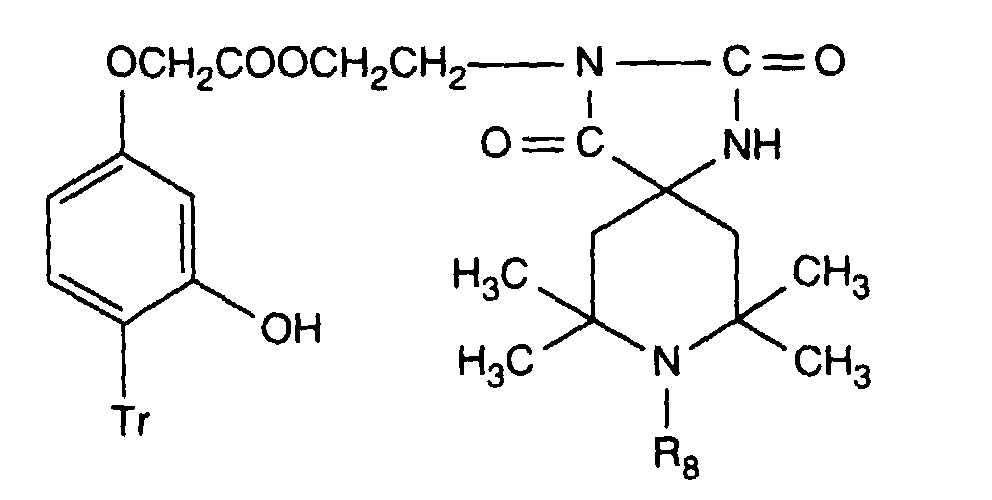
- 0 C**N(*c(cc1O)ccc1[Tl])C1CC(C)(C)NC(C)(C)C1 Chemical compound C**N(*c(cc1O)ccc1[Tl])C1CC(C)(C)NC(C)(C)C1 0.000 description 2
Classifications
-
- C—CHEMISTRY; METALLURGY
- C07—ORGANIC CHEMISTRY
- C07D—HETEROCYCLIC COMPOUNDS
- C07D401/00—Heterocyclic compounds containing two or more hetero rings, having nitrogen atoms as the only ring hetero atoms, at least one ring being a six-membered ring with only one nitrogen atom
- C07D401/02—Heterocyclic compounds containing two or more hetero rings, having nitrogen atoms as the only ring hetero atoms, at least one ring being a six-membered ring with only one nitrogen atom containing two hetero rings
- C07D401/12—Heterocyclic compounds containing two or more hetero rings, having nitrogen atoms as the only ring hetero atoms, at least one ring being a six-membered ring with only one nitrogen atom containing two hetero rings linked by a chain containing hetero atoms as chain links
-
- C—CHEMISTRY; METALLURGY
- C07—ORGANIC CHEMISTRY
- C07D—HETEROCYCLIC COMPOUNDS
- C07D401/00—Heterocyclic compounds containing two or more hetero rings, having nitrogen atoms as the only ring hetero atoms, at least one ring being a six-membered ring with only one nitrogen atom
- C07D401/14—Heterocyclic compounds containing two or more hetero rings, having nitrogen atoms as the only ring hetero atoms, at least one ring being a six-membered ring with only one nitrogen atom containing three or more hetero rings
-
- C—CHEMISTRY; METALLURGY
- C08—ORGANIC MACROMOLECULAR COMPOUNDS; THEIR PREPARATION OR CHEMICAL WORKING-UP; COMPOSITIONS BASED THEREON
- C08K—Use of inorganic or non-macromolecular organic substances as compounding ingredients
- C08K5/00—Use of organic ingredients
- C08K5/16—Nitrogen-containing compounds
- C08K5/34—Heterocyclic compounds having nitrogen in the ring
- C08K5/3467—Heterocyclic compounds having nitrogen in the ring having more than two nitrogen atoms in the ring
- C08K5/3477—Six-membered rings
- C08K5/3492—Triazines
- C08K5/34926—Triazines also containing heterocyclic groups other than triazine groups
-
- C—CHEMISTRY; METALLURGY
- C09—DYES; PAINTS; POLISHES; NATURAL RESINS; ADHESIVES; COMPOSITIONS NOT OTHERWISE PROVIDED FOR; APPLICATIONS OF MATERIALS NOT OTHERWISE PROVIDED FOR
- C09D—COATING COMPOSITIONS, e.g. PAINTS, VARNISHES OR LACQUERS; FILLING PASTES; CHEMICAL PAINT OR INK REMOVERS; INKS; CORRECTING FLUIDS; WOODSTAINS; PASTES OR SOLIDS FOR COLOURING OR PRINTING; USE OF MATERIALS THEREFOR
- C09D7/00—Features of coating compositions, not provided for in group C09D5/00; Processes for incorporating ingredients in coating compositions
- C09D7/40—Additives
- C09D7/48—Stabilisers against degradation by oxygen, light or heat
Definitions
- the present invention relates to new compounds from o-hydroxyphenyl-1,3,5-triazines and sterically hindered amines, the use of which to stabilize organic materials as well as the organic stabilized with the new compounds Materials.
- US-A 4 619 956 describes the use of synergistic mixtures of one 2,2,6,6-tetraalkylpiperidine compound, its acid salts or complexes with metals and certain o-hydroxyphenyl-s-triazines for stabilizing polymer films, coatings and moldings.
- US Pat. No. 4,289,686 discloses compounds which have at least one 2- (2'-hydroxyphenyl) benzotriazole or 2-hydroxybenzophenone group and at least one in their molecule Contain polyalkylpiperidine group known as light stabilizers.
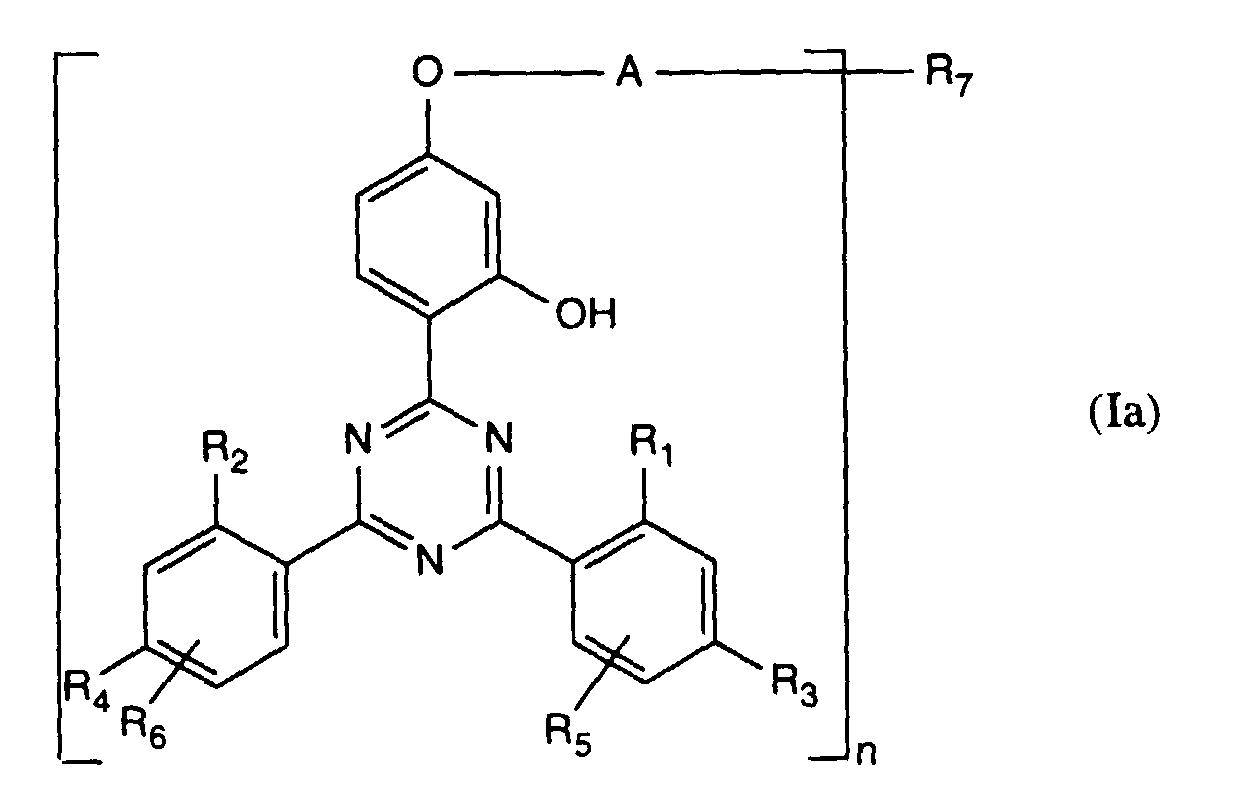
- the bond on the left in the case of divalent radicals such as -CH 2 CH (R ') O- or - (CH 2 ) s -CO-, means the link to the symbol or atom on the left-hand side thereof.
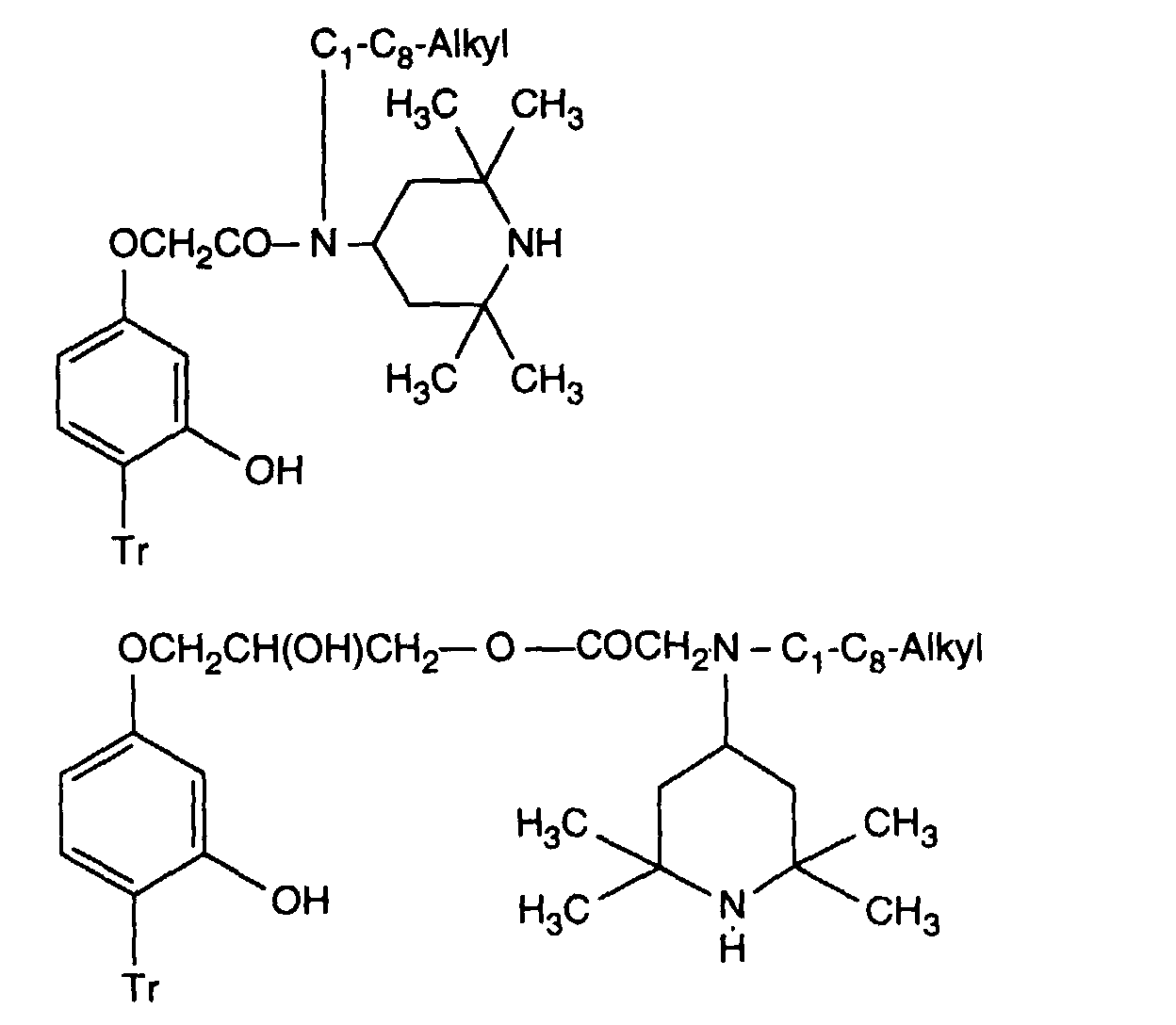
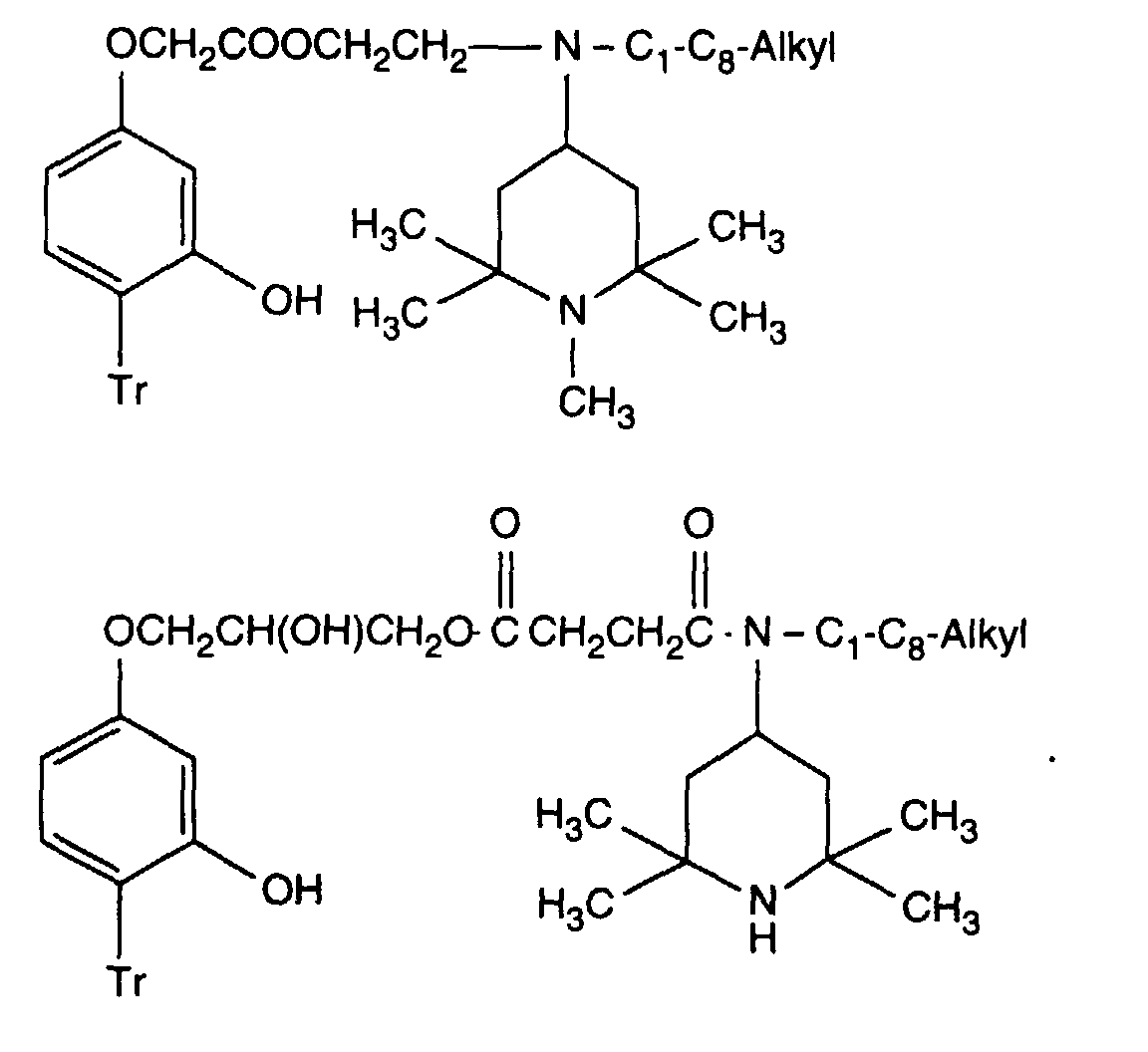
- A preferably represents -CH 2 CH (OH) CH 2 - and in particular -CH 2 CO-.
- R preferably denotes hydrogen and R 'is in particular hydrogen or methyl.
- Alkyl, alkoxy, alkenyl, alkynyl, alkanoyl, Alkenoyl, alkenyloxy, alkylene or alkenylene groups can be straight-chain or branched his. The groups mentioned are preferably straight-chain.
- alkyl groups R 2 to R 6 , R 8 and R 14 are methyl, ethyl, n-propyl, isopropyl, n-, sec. and tert-butyl, n-pentyl, n-hexyl, 2-ethylhexyl, 2-methylpentyl, n-heptyl, n-octyl, n-nonyl, n-decyl, n-dodecyl; R 9 , R 10 , T 1 and T 2 can also be C 1 -C 18 alkyl n-tetradecyl, n-hexadecyl or n-octadecyl.
- Alkyl groups R 1 to R 6 are preferably straight-chain and have 1-4 C atoms.
- R 8 in the meaning of alkyl is especially C 1 -C 8 alkyl and especially C 1 -C 4 alkyl.
- Alkyl groups R 9 , R 10 , T 1 and T 2 preferably have 1-12, especially 1-8 and in particular 1-4 C atoms.
- the groups mentioned are particularly preferably ethyl and especially methyl.
- alkoxy groups R 3 , R 4 , R 8 and Y with up to 12 or 18 carbon atoms are methoxy, ethoxy, n- and isopropyloxy, n-, sec. and tert-butyloxy, n-pentyloxy, n-hexyloxy, n-heptyloxy, n-octyloxy, n-decyloxy, n-dodecyloxy, n-tetradecyloxy, n-hexadecyloxy and n-octadecyloxy.
- These alkoxy groups preferably have 1-12 and in particular 1-4 C atoms. Ethoxy and especially methoxy groups are very particularly preferred.
- alkylene groups or contain these substituents Alkylene parts, it is preferably straight-chain alkylene with preferably 2 to 12 carbon atoms.
- any substituents phenylene, naphthylene or biphenylene groups so is it e.g. o-, m- or p-phenylene, 1,4-naphthylene or 4,4'-biphenylene.
- R 1 to R 6 are halogen, it is in particular chlorine or bromine.
- R 1 and R 2 , R 3 and R 4 and R 5 and R 6 preferably each have the same meaning in pairs.
- R 1 and R 2 and R 3 and R 4 are preferably each in pairs hydrogen or C 1 -C 4 alkyl and R 5 and R 6 are each hydrogen.
- R 1 and R 2 or R 3 and R 4 each represent in particular hydrogen, -OH or methyl.
- R 5 and R 6 are preferably hydrogen.
- R 1 and R 2 in formulas I and Ia are particularly preferably each hydrogen or methyl and R 3 and R 4 are preferably each hydrogen and in particular each methyl.
- R 8 as alkyl or alkoxy preferably has 1-8 and in particular 1-4 C atoms. If R 8 is C 3 -C 8 alkenyl or C 3 -C 8 alkenyloxy, it is, for example, 1-propenyl, allyl, methallyl, 2-butenyl, 2-pentenyl, 2-hexenyl, 2-octenyl or 4 -tert.Butyl-2-butenyl or the corresponding alkenyloxy radicals.
- R 5 as C 3 -C 8 alkynyl is preferably propargyl.
- R 8 are in particular cyclohexyl or cyclohexyloxy. If R 8 is C 1 -C 8 alkanoyl, it is, for example, formyl, propionyl, isobutyryl, hexanoyl or octanoyl, preferably acetyl.
- C 3 -C 9 alkenoyl is preferably acryloyl or methacryloyl. If R 8 , R 9 or R 10 is phenyl-C 1 -C 4 -alkyl, phenylethyl and especially benzyl are particularly suitable.
- R 8 is preferably hydrogen, oxyl, C 1 -C 12 alkyl, C 3 -C 8 alkenyl, C 3 -C 8 alkynyl, phenyl-C 1 -C 4 alkyl, C 1 -C 8 alkanoyl, C 3 -C 8 alkenoyl or -CH 2 CH (OH) R '.
- R 8 particularly preferably represents hydrogen, oxyl, C 1 -C 8 -, particularly C 1 -C 4 -alkyl, allyl, benzyl, acetyl or acryloyl and in particular hydrogen, methyl, allyl, benzyl or acetyl. Hydrogen is very particularly preferred and methyl.
- R 9 and R 10 preferably have 1-12, in particular 1-8 and especially 1-4 C atoms. Ethyl and especially methyl are very particularly preferred. If R 9 or R 10 is C 5 -C 6 cycloalkyl, it is in particular cyclohexyl. As C 3 -C 18 alkyl which is interrupted by one or more O atoms, R 9 and R 10 are, for example, -CH 2 CH 2 OCH 3 , -CH 2 OCH 2 CH 3 , -CH 2 CH 2 OC 4 H 9 or -CH 2 CH 2 OCH 2 CH 2 CH 3 .
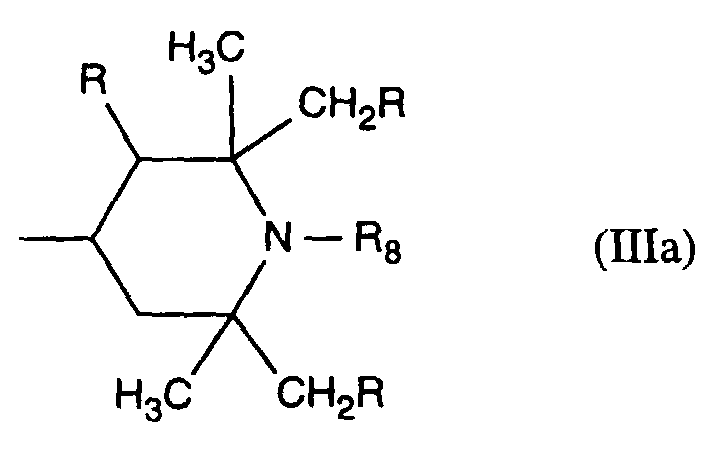
- R 9 and R 10 preferably independently of one another represent hydrogen, C 1 -C 8 - and in particular C 1 -C 4 -alkyl, especially ethyl or methyl, allyl, cyclohexyl, benzyl or a group of the formula IIIa, in which R is hydrogen and R 5 has the preferred meaning mentioned above.
- R 9 and R 10 are particularly preferably each H or C 1 -C 4 alkyl, very particularly preferably each hydrogen.
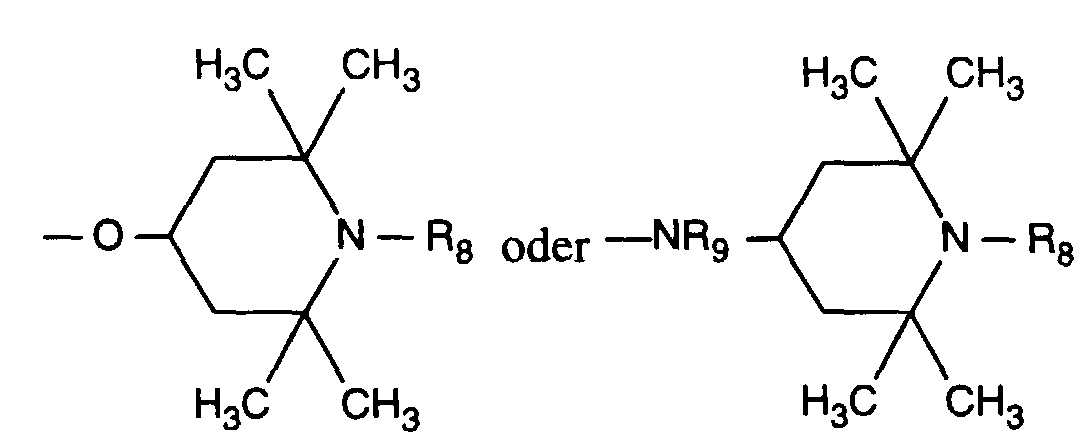
- Preferred radicals of the formula V are those in which R is hydrogen, Q 1 is -NH-C 2 -C 4 -alkylene or -OC 2 -C 4 -alkylene and in particular the direct bond and R 8 has the preferred meaning indicated above .
- R represents hydrogen
- R 9 is preferably C 1 -C 8 alkyl, in particular C 1 -C 4 alkyl and especially hydrogen
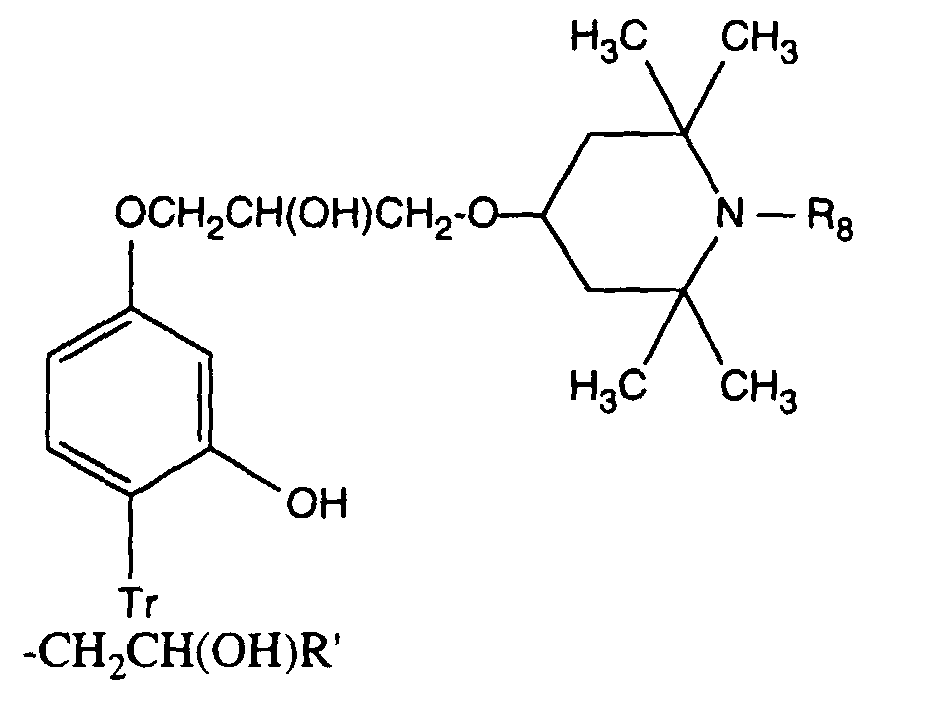
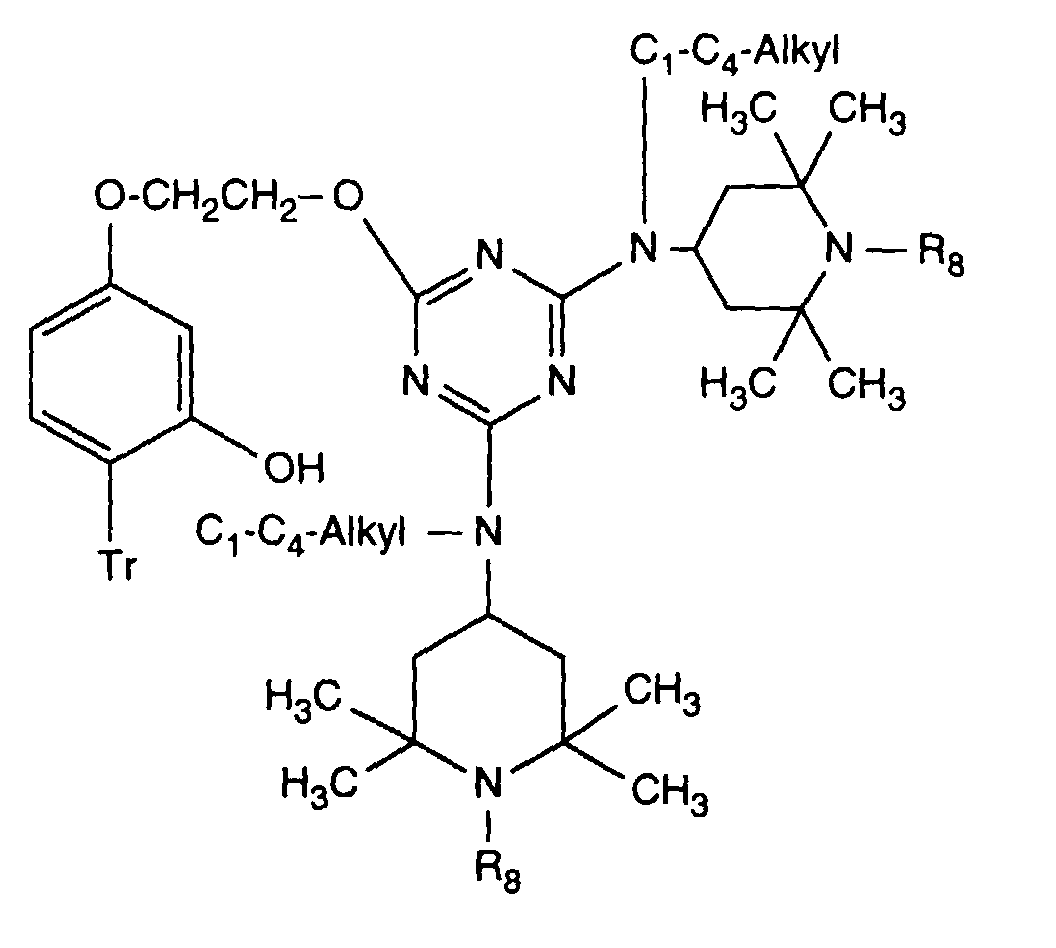
- Examples of compounds of the formula Ia of such radicals are:
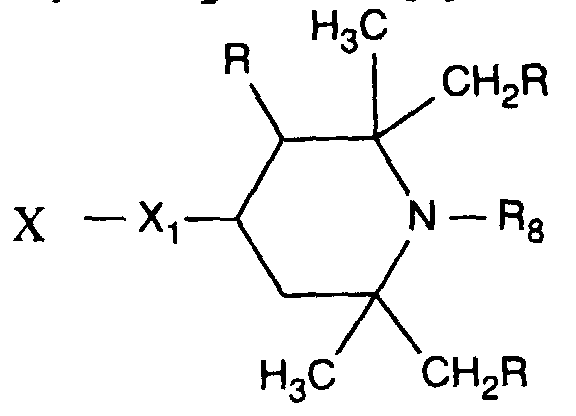
- X 1 and X 2 in formula VIIb are preferably independently of one another -O-or -NH-.
- R is preferably hydrogen and R 8 has the preferred meaning given above.
- R 14 as C 2 -C 6 alkoxyalkyl is, for example, methoxymethyl, ethoxymethyl, propoxymethyl, tert-butoxymethyl, ethoxyethyl, ethoxypropyl or propoxypropyl.
- R 14 is preferably C 1 -C 4 -alkyl, allyl or benzyl and in particular H.
- Alkyl groups T 1 and T 2 are preferably straight-chain and in particular have 1-4 C atoms. As are phenyl-C 1 -C 4 -alkyl T 1 and T 2 in particular phenylethyl and especially benzyl.
- T 1 and T 2 form a cycloalkane ring together with the bonding carbon atom, this can be, for example, a cyclopentane, cyclohexane, cyclooctane or cyclododecane ring.
- T 1 and T 2 are preferably hydrogen or together with the bonding carbon atom form a cyclododecane ring.
- A is -CH 2 CH (OH) CH 2 -
- R 1 and R 2 and R 3 and R 4 each represent hydrogen or C 1 -C 4 -alkyl in pairs
- R 5 and R 6 are each hydrogen
- R 7 is a radical of formula V
- Q 1 is the direct bond
- R 8 is hydrogen, C 1 -C 4 alkyl, benzyl, allyl, acetyl or -CH 2 CH (OH) R '
- R 7 represents a radical of formula V
- Q 1 is the direct bond
- R 8 is methyl, benzyl, allyl or -CH 2 CH (OH) CH 3 .
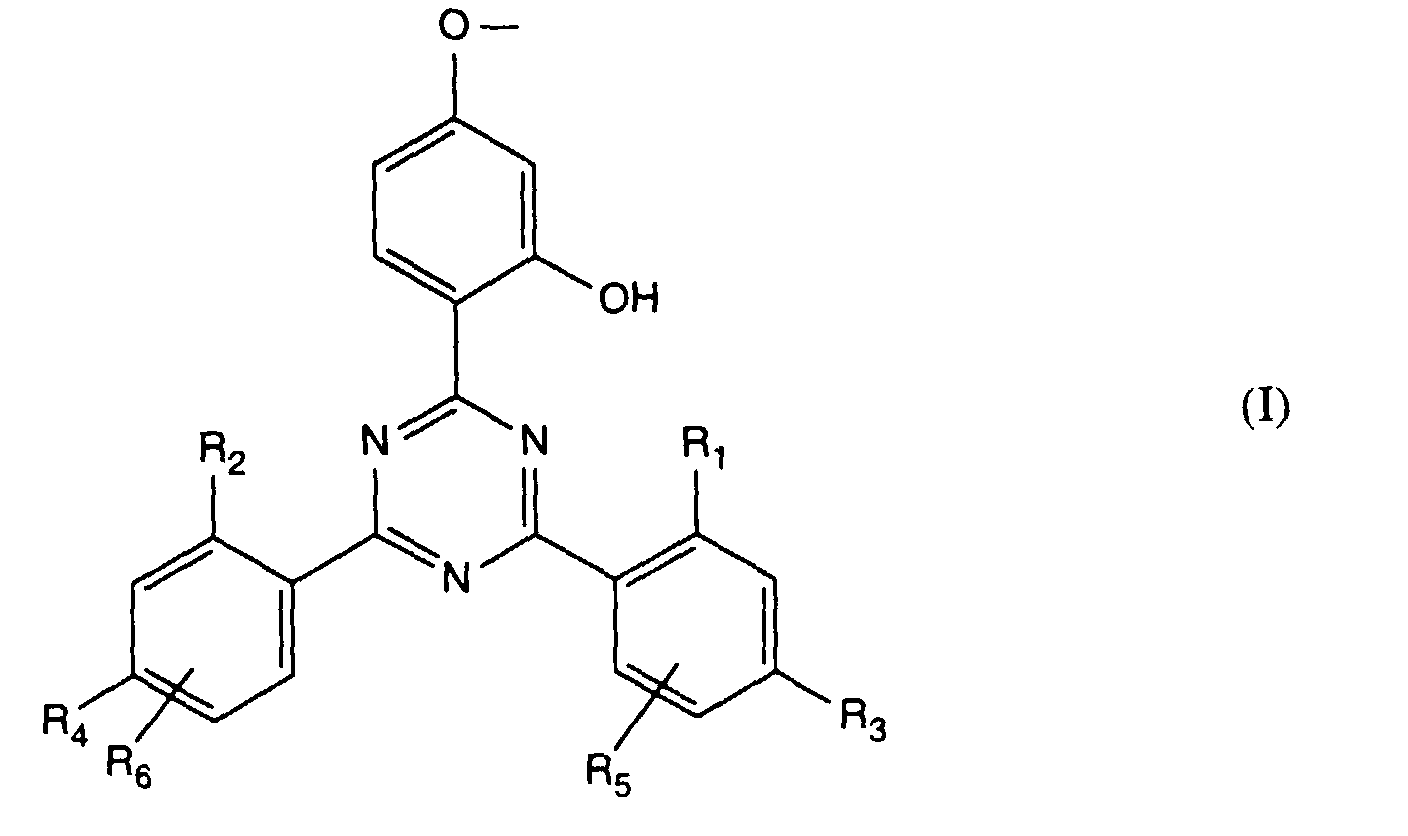
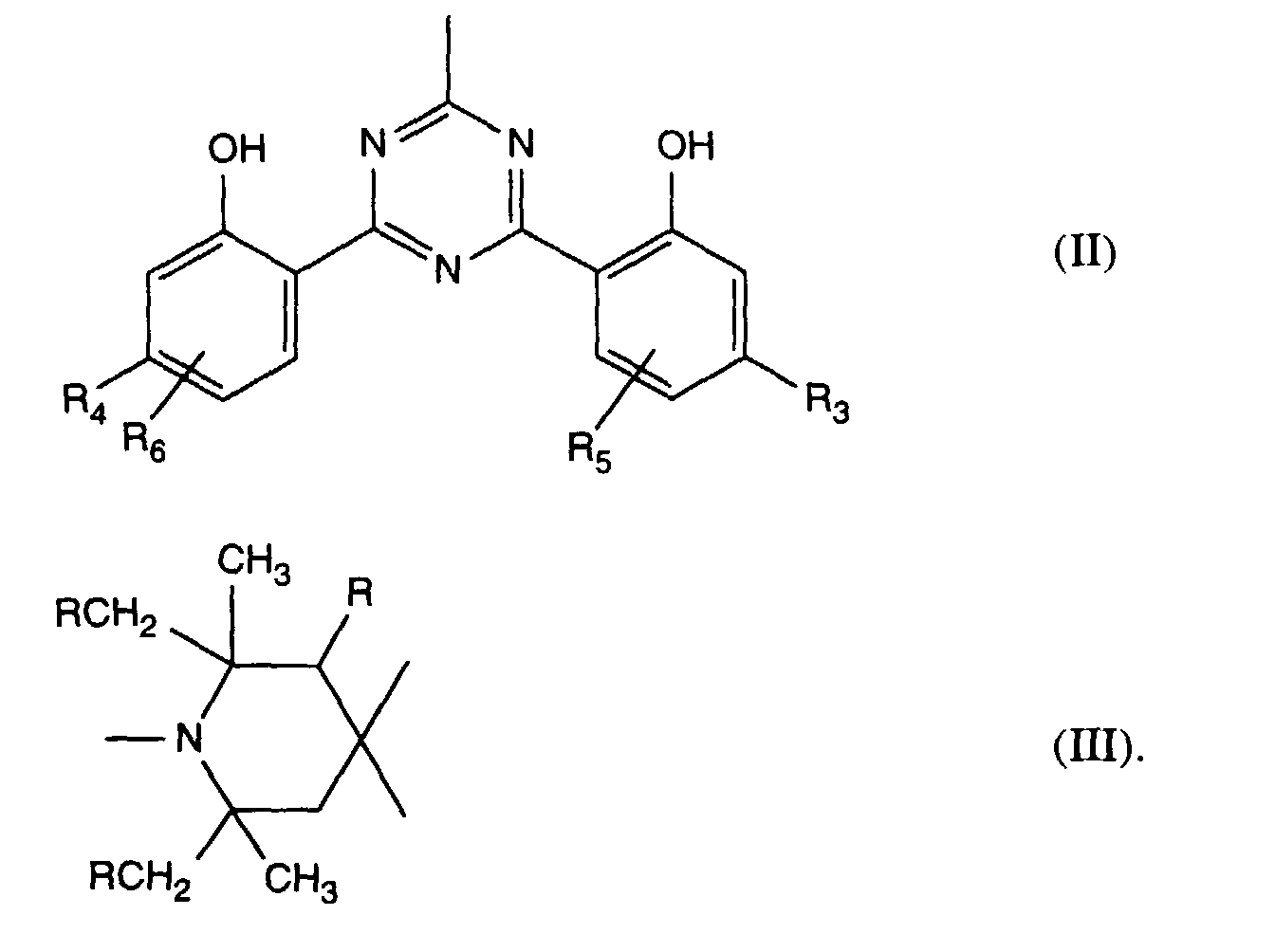
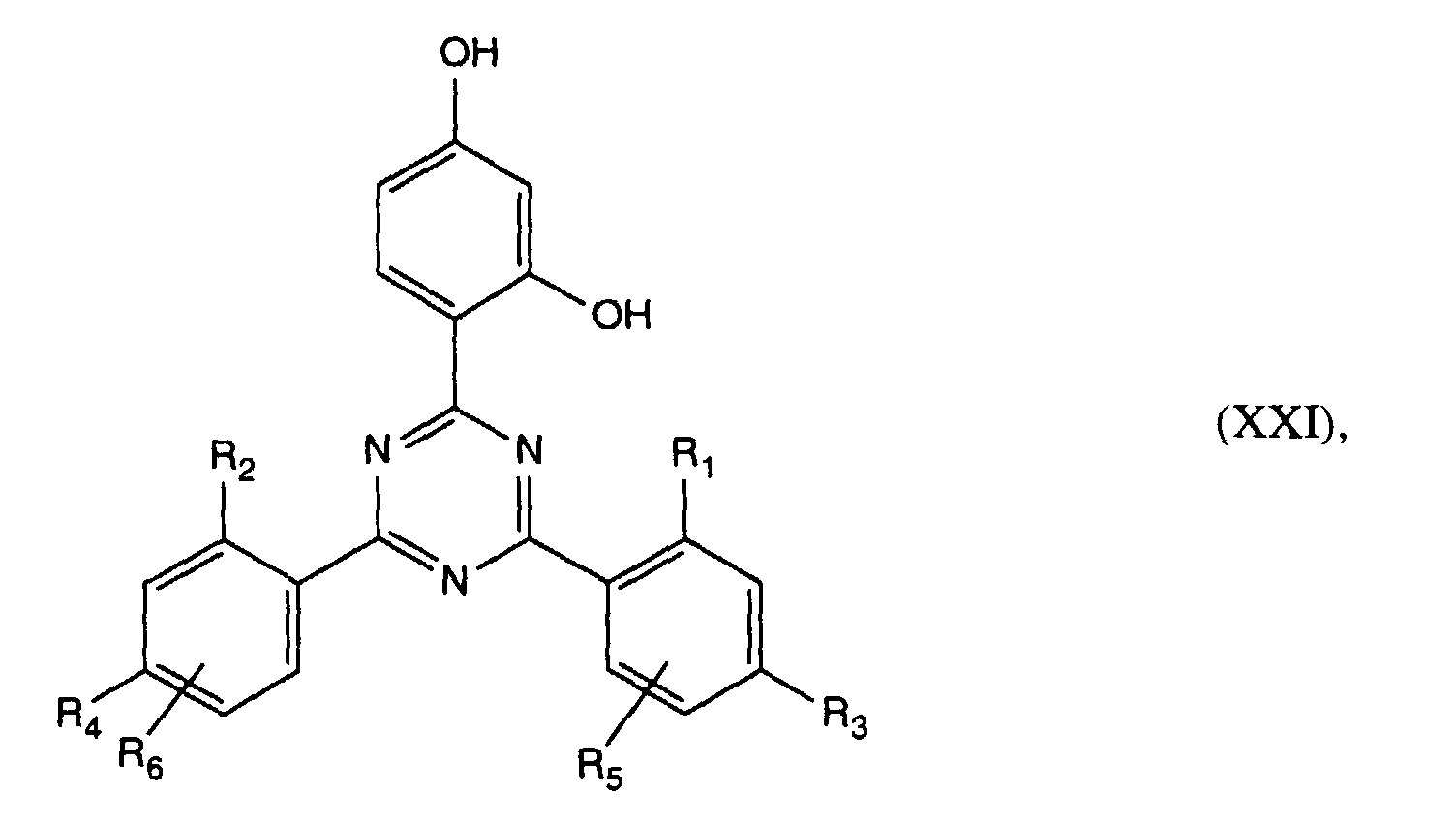
- the compounds according to the invention can be prepared by methods known per se by reacting groups of the formula I or II and groups of the formula III containing functional derivatives;
- the functional polyalkylpiperidine derivatives required for the above reactions are known per se or can be prepared by known methods.
- the invention thus also relates to light, oxygen and / or heat sensitive organic material, the at least one compound according to the invention contains.
- Synthetic polymers in particular should be mentioned as organic materials, e.g. thermoplastics or elastomers, especially the former.
- polyolefins are examples of organic materials.
- Varnishes of all kinds can be pigmented or unpigmented varnishes or metallic effect varnishes his. They can contain an organic solvent or be solvent-free or be water-based paints.
- the paints can also be radiation-curable paints.
- the binding agent exists from monomeric or oligomeric compounds, the ethylenic double bonds contained and by irradiation with actinic light or with electron beams in a cross-linked high molecular form. Usually this is a Mixture of such compounds.
- lacquers can be applied as single-layer or two-layer lacquers, the ones according to the invention Stabilizers are preferably added to the unpigmented top layer become.
- the varnishes can be applied to the substrates (metal, plastic, wood, etc.) using the usual methods are applied, for example by painting, spraying, pouring, dipping or electrophoresis.
- a preferred embodiment of the present invention is therefore paint or paints (e.g. automotive paints), the at least one compound according to the invention contain.
- suitable binders are those mentioned above.
- the amount of addition of compounds according to the invention depends on the substrate and the requirements for its stability. In general, based on the organic material, 0.01 to 10% by weight, in particular 0.02 to 5% by weight, in particular 0.05-3, e.g. 0.1-2% by weight of it. Mixtures of different types can also be used compounds by definition are added.
- the incorporation into the organic materials can, for example, by mixing the compounds according to the invention and optionally further additives according to the in the usual methods in technology.
- polymers in particular synthetic polymers, can be incorporated before or during molding, or by applying the dissolved or dispersed compounds to the polymer, if necessary with subsequent evaporation of the solvent.
- Elastomers can also be stabilized as latices.
- One more way The incorporation of the compounds according to the invention into polymers consists in their Add before or during the polymerization of the corresponding monomers or before of networking.
- the compounds according to the invention or mixtures thereof can also be in the form of a masterbatch containing these compounds, for example, in a concentration of Contains 2.5 to 25% by weight, which are added to the plastics to be stabilized.
- the polymers thus stabilized can be used in various forms, e.g. as foils, fibers, tapes, molded parts, profiles, latex, dispersions, lacquers or putties.
- the compounds according to the invention can be used as stabilizers, in particular as light stabilizers, also for practically all materials known in reproduction technology can be used as described in Research Disclosure 90/31429 [No. 314, S, 474-480 (1990)].
- the present invention thus also relates to recording materials as in the above described above-mentioned literature, especially photomaterials, especially color photographic materials containing at least one in at least one layer Contain compound according to the present invention.
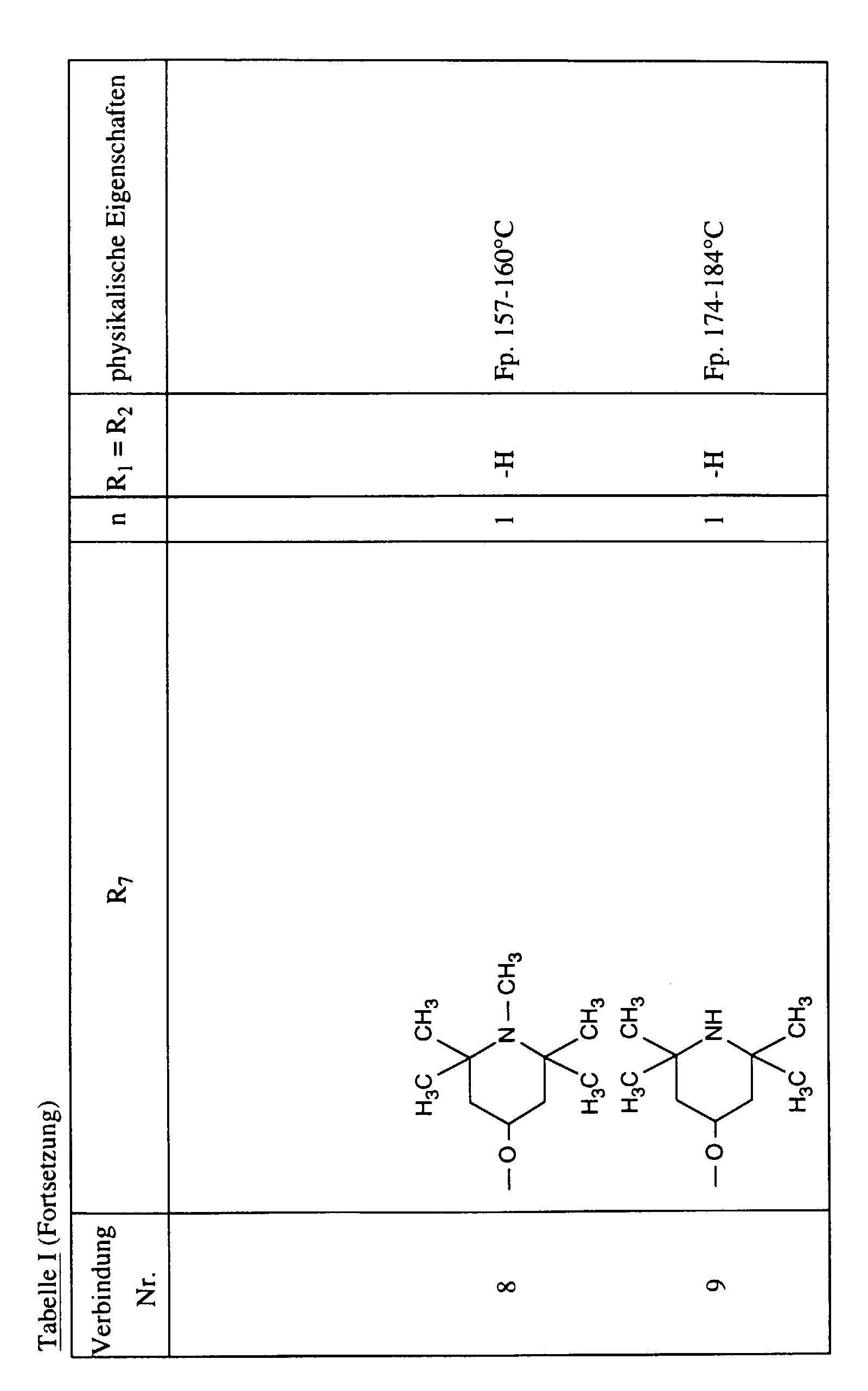
- the beige solid Crude product is recrystallized from 500 ml of gasoline (boiling point 110-140 ° C) and dried. 9.9 g (85% of theory) of compound no. 8 are obtained as a slightly yellow powder; M.p. 157-160 ° C.
- Example 6 Testing compounds according to the invention in a two-component polyacrylate lacquer
- the sample sheets are weathered in a xenon weatherometer (Atlas Corp., CAM 159, KFA method).
- the 20 ° gloss according to DIN 67530 before weathering and after 800, 1600 and 2000 hours as well as the time (in hours) until the cracking and the appearance of the paint are determined according to the TNO cracking scale, description 353 / D. stabilizer 20 ° gloss after .... hours Cracking after ... hours / appearance 0 800 1600 2000 without stabilizer 87 87 2nd - 1600, matt Stabilizer No. 1 87 88 86 80 2800, E4b Stabilizer No. 2 89 89 89 89 2400, E4b
Landscapes
- Chemical & Material Sciences (AREA)
- Organic Chemistry (AREA)
- Medicinal Chemistry (AREA)
- Polymers & Plastics (AREA)
- Materials Engineering (AREA)
- Wood Science & Technology (AREA)
- Health & Medical Sciences (AREA)
- Chemical Kinetics & Catalysis (AREA)
- Life Sciences & Earth Sciences (AREA)
- Engineering & Computer Science (AREA)
- Plural Heterocyclic Compounds (AREA)
- Nitrogen Condensed Heterocyclic Rings (AREA)
- Nitrogen And Oxygen Or Sulfur-Condensed Heterocyclic Ring Systems (AREA)
- Organic Low-Molecular-Weight Compounds And Preparation Thereof (AREA)
- Compositions Of Macromolecular Compounds (AREA)
- Hydrogenated Pyridines (AREA)
- Macromolecular Compounds Obtained By Forming Nitrogen-Containing Linkages In General (AREA)
- Detergent Compositions (AREA)
Description







- als Emulsion oder Dispersion (z.B. zu Latices oder Emulsionspolymeren)
- als Trockenmischung während des Vermischens von Zusatzkomponenten oder Polymermischungen
- durch direktes Zugeben in die Verarbeitungsapparatur (z.B. Extruder, Innenmischer usw.)
- als Lösung oder Schmelze.

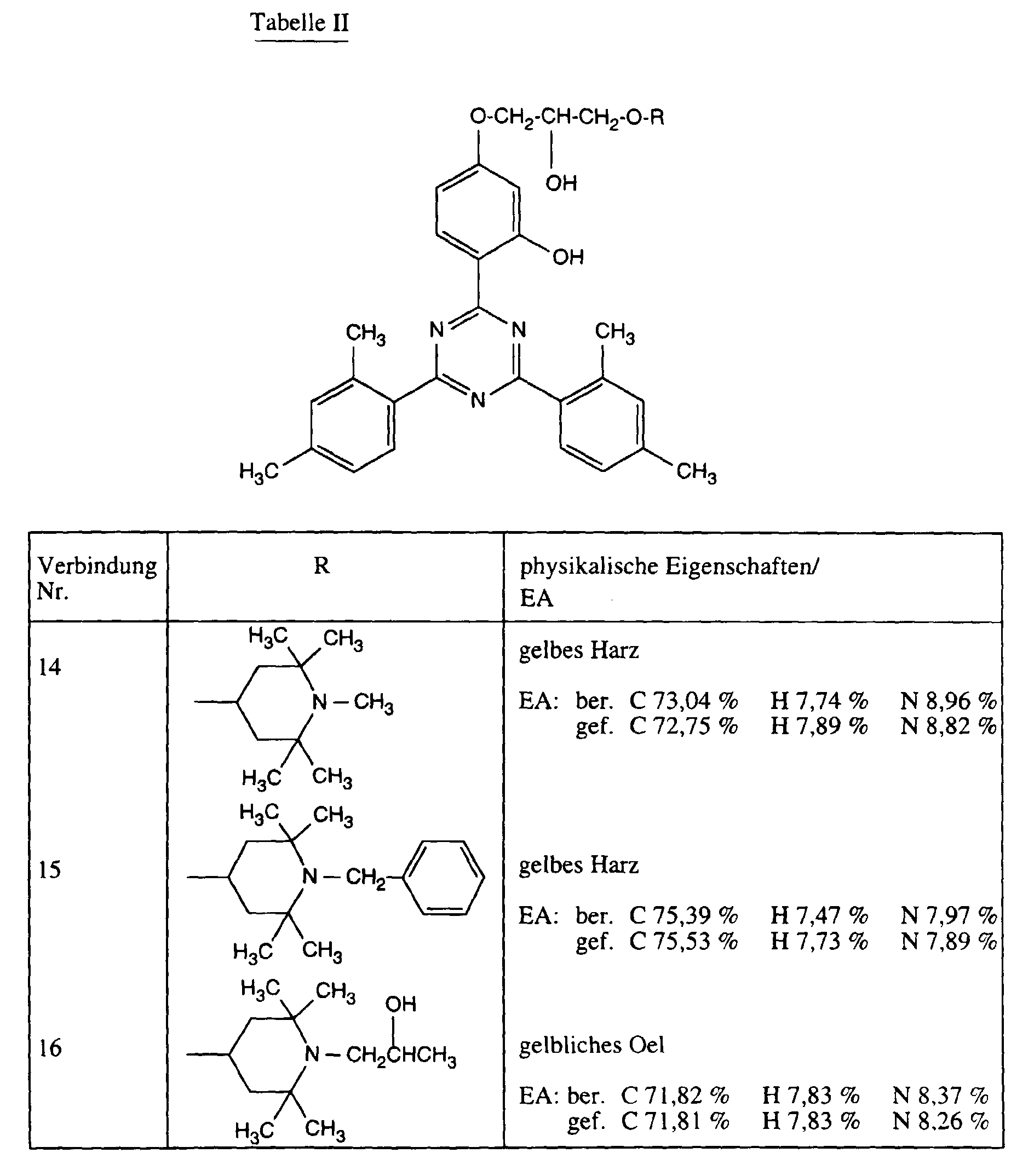
| EA: | berechnet | C 73,81 % | H 7,74 % | N 8,60 % |
| gefunden | C 73,65 % | H 7,66 % | N 8,50 %. |
| Stabilisator | 20° Glanz nach .... Stunden | Rissbildung nach ... Stunden/Aussehen | |||
| 0 | 800 | 1600 | 2000 | ||
| ohne Stabilisator | 87 | 87 | 2 | - | 1600, matt |
| Stabilisator Nr. 1 | 87 | 88 | 86 | 80 | 2800, E4b |
| Stabilisator Nr. 2 | 89 | 89 | 89 | 89 | 2400, E4b |
Claims (15)
- Verbindung der Formel Ia
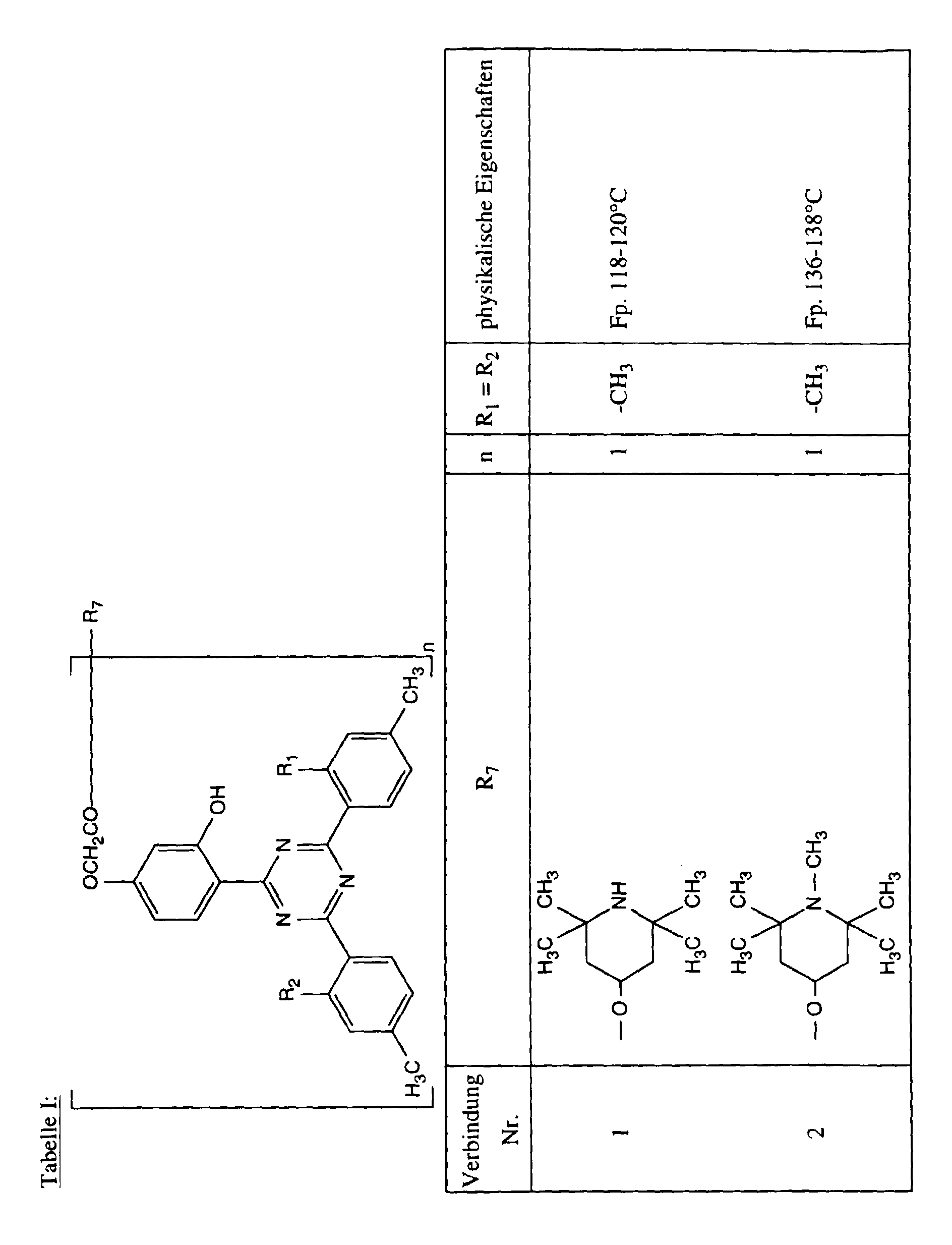
 n 1 ist,R1 und R2 unabhängig voneinander Wasserstoff, -OH, C1-C12-Alkyl oder Halogen,R3 und R4 unabhängig voneinander Wasserstoff, -OH, C1-C12-Alkyl, C1-C18-Alkoxy, Halogen oder einen Rest -O-A-R7 darstellen,R5 und R6 unabhängig voneinander Wasserstoff, C1-C12-Alkyl, Halogen oder einen Rest -O-A-R7 bedeuten,A eine direkte Bindung, -(CH2)mCO- mit m = Null oder 1 bis 4, -CH2CH(R')O- oder -CH2CH(OH)CH2- ist,R7 ein Rest der Formeln V bis VIIb oder Xa oder Xb ist:
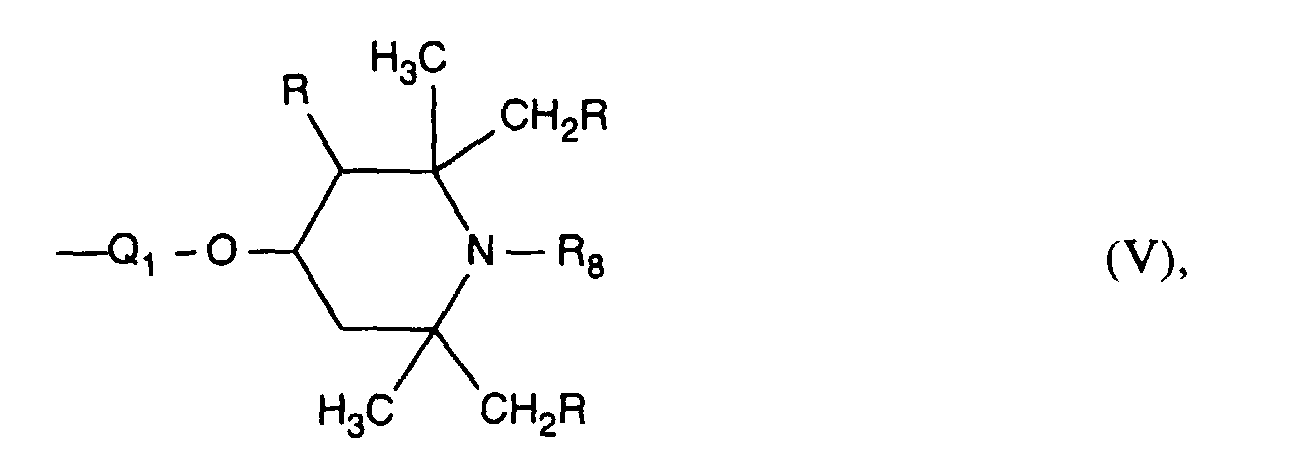 wobei Reste der Formeln VIIa nur in Verbindungen der Formel Ia mit A = direkte Bindung oder -CH2CH(R')O- und Reste der Formeln VIIb in Verbindungen der Formel Ia vorliegen, worin A ungleich direkte Bindung oder -CH2CH(R')O- ist, und worin
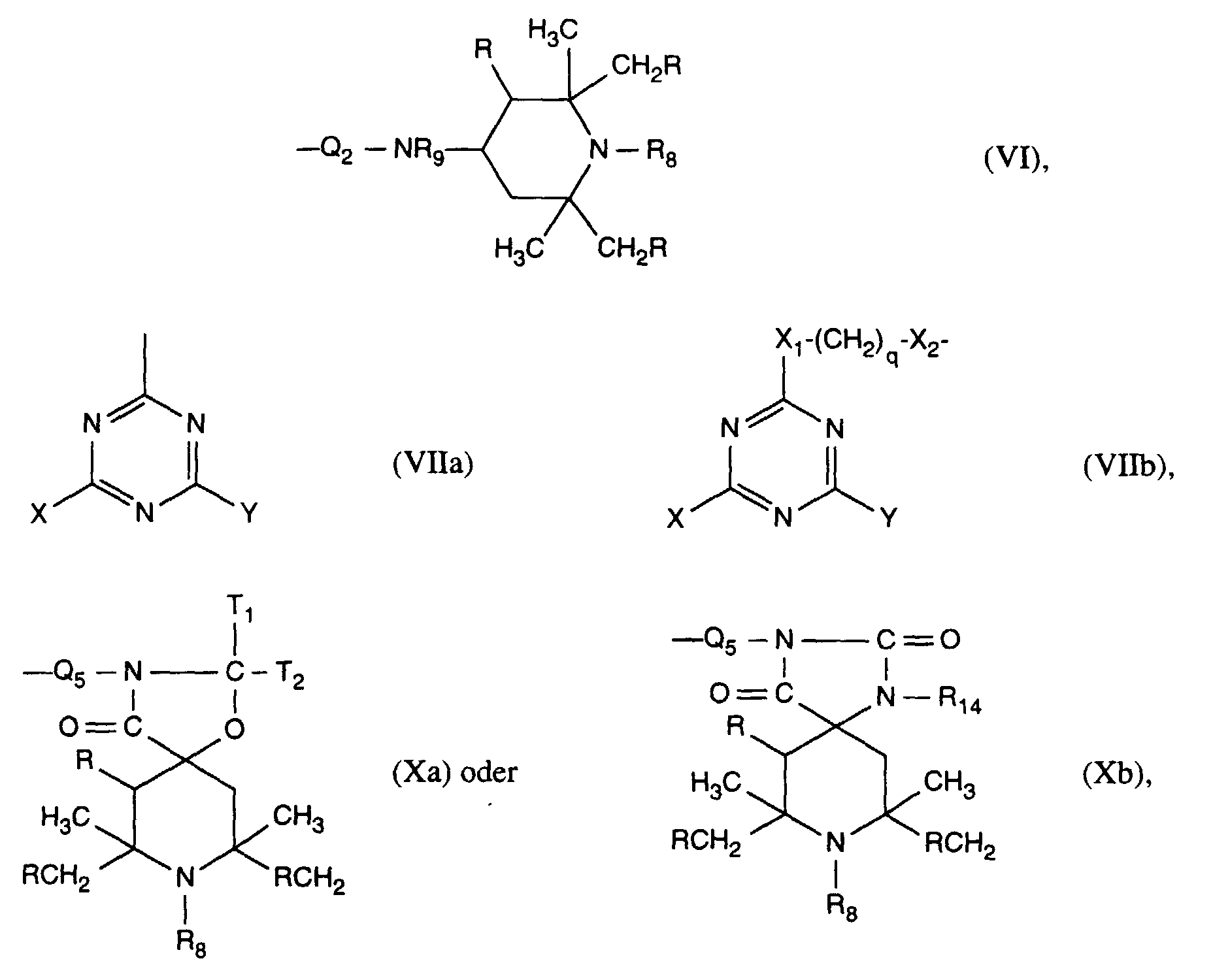 R Methyl und insbesondere Wasserstoff ist,R8 Wasserstoff, Oxyl, C1-C12-Alkyl, C1-C12-Alkoxy, C3-C8-Alkenyl, C3-C8-Alkenyloxy, C3-C8-Alkinyl, C5-C6-Cycloalkyl, C5-C6-Cycloalkyloxy, Phenyl-C1-C4-alkyl, C1-C8-Alkanoyl, C3-C5-Alkenoyl, -CH2CH(OH)R' oder Phenoxy bedeutet,R' Wasserstoff, Methyl oder Phenyl ist,R9 Wasserstoff, C1 -C18-Alkyl, Allyl, C5-C6-Cycloalkyl, Phenyl-C1-C4-alkyl, durch ein oder mehrere -O-unterbrochenes C3-C18-Alkyl oder eine Gruppe der Formel IIIadarstellt,
 Q1 die direkte Bindung, -O-C2-C12-Alkylen oder -NR9-C2-C12-Alkylen ist, wenn A die angegebene Bedeutung haben, A aber ungleich direkte Bindung oder -CH2CH(R')O- ist, oder in Verbindungen der Formel Ia Q1 C2-C12-Alkylen ist, wenn A die direkte Bindung oder -CH2CH(R')O- darstellt, oder -OCO-C2-C12-Alkylen darstellt, wenn A in Verbindungen der Formel Ia -CH2CH(OH)CH2- ist,Q2 die direkte Bindung oder -NR9-C2-C12-Alkylen ist, wenn A ungleich direkte Bindung oder -CH2CH(R')O- ist, oder in Verbindungen der Formel Ia Q2 -CO-C2-C12-Alkylen darstellt, wenn A die direkte Bindung oder -CH2CH(R')O- ist, oder -OCO-C1-C12-Alkylen oder -OCO-C1-C12-Alkylen-CO- ist, wenn A in Formel Ia -CH2CH(OH)CH2- ist, q 2-12, besonders 2-4 ist,X1 und X2 unabhängig voneinander -O- oder -R9N- darstellen,ist und Y dieselbe Bedeutung wie X hat oder C1-C18-Alkoxy oder -NR9R10 bedeutet,
 R10 die gleiche Bedeutung wie R9 haben kann oder zusammen mit R9 und dem Bindungs-N-Atom einen 5- oder 6-gliedrigen heterocyclischen Ring bildet,Q5 -OCH2CH2- oder -OCH2CH(OH)CH2- ist, wenn A oder B die angegebene Bedeutung haben, A aber ungleich direkte Bindung oder -CH2CH(R')O- ist, oder in Verbindungen der Formel Ia Q5 -CO(CH2)2- oder -CO(CH2)3- ist, wenn A die direkte Bindung oder -CH2CH(R')O- darstellt, Q5 die direkte Bindung bedeutet, wenn A -CH2CH(OH)CH2- ist, oder Q5 -OCO(CH2)s- mit s = 1-4 ist, wenn A in Formel Ia -CH2CH(OH)CH2- ist,T1 und T2 unabhängig voneinander Wasserstoff, C1-C18-Alkyl, Phenyl-C1-C4-alkyl oder unsubstituiertes oder durch Halogen oder C1-C4-Alkyl substituiertes Phenyl oder Naphthyl bedeuten, oder T1 und T2 zusammen mit dem sie verbindenden C-Atom einen C5-C12-Cycloalkanring bilden,R14 Wasserstoff, C1-C12-Alkyl, Allyl, Benzyl oder C2-C6-Alkoxyalkyl ist.
 - Verbindung nach Anspruch 1, worin R Wasserstoff, R' Wasserstoff oder Methyl und m und s je die Zahl 1 sind und R1 und R2, R3 und R4 sowie R5 und R6 je paarweise dieselbe Bedeutung haben.
- Verbindung nach Anspruch 1, worin R1 und R2 sowie R3 und R4 je paarweise Wasserstoff oder C1-C4-Alkyl bedeuten und R5 und R6 je Wasserstoff sind.
- Verbindung nach Anspruch 1, worin in Formel Ia R1 und R2 je Wasserstoff, -OH oder Methyl, insbesondere Wasserstoff oder Methyl bedeuten, R3 und R4 je Wasserstoff, -OH oder Methyl, insbesondere Wasserstoff und besonders Methyl darstellen, und R5 und R6 je Wasserstoff sind.
- Verbindung nach Anspruch 1, worin R8 Wasserstoff, Oxyl, C1-C12-Alkyl, C3-C8-Alkenyl, C3-C8-Alkinyl, Phenyl-C1-C4-alkyl, C1-C8-Alkanoyl, C3-C8-Alkenoyl oder -CH2CH(OH)R', insbesondere Wasserstoff, Oxyl, C1-C8-Alkyl, Allyl, Benzyl, Acetyl oder Acryloyl ist.
- Verbindung nach Anspruch 1 oder 5, worin R9 und R10 Wasserstoff, C1-C8-Alkyl, Allyl, Cyclohexyl, Benzyl oder eine Gruppe der Formel IIIa, worin R Wasserstoff ist und R8 die in Anspruch 5 angegebene Bedeutung hat, und insbesondere C1-C4-Alkyl oder Wasserstoff ist.
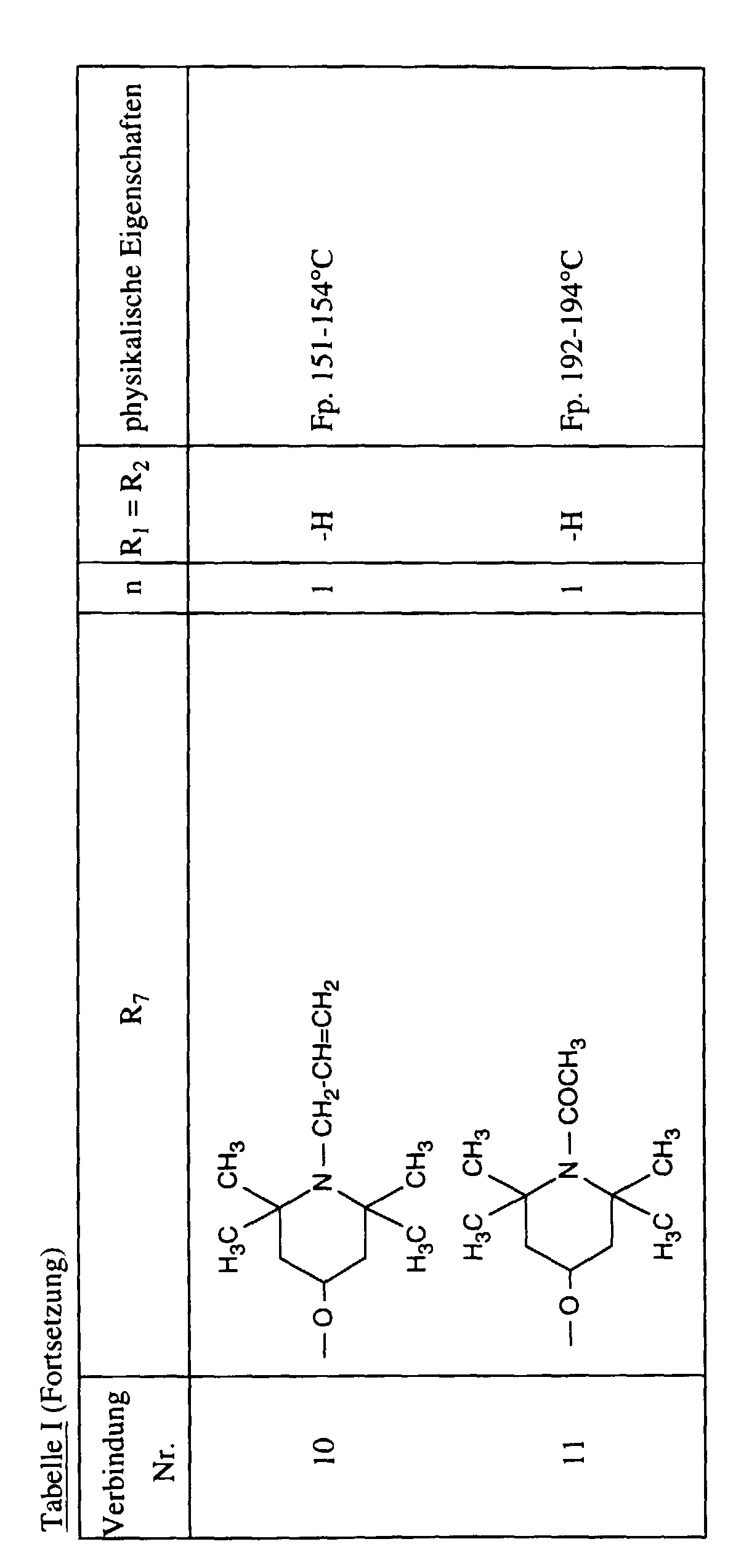
- Verbindung der Formel Ia nach Anspruch 1, worin A -CH2CO- ist, R1 und R2 sowie R3 und R4 je paarweise Wasserstoff oder C1-C4-Alkyl darstellen, R5 und R6 je Wasserstoff sind, R7 einen Rest der Formel V darstellt, Q1 die direkte Bindung ist, R8 Wasserstoff, C1-C4-Alkyl, Benzyl, Allyl, Acetyl oder Acryloyl bedeutet, und R' Wasserstoff, Methyl oder Phenyl darstellt.
- Verbindung der Formel Ia nach Anspruch 1, worin A -CH2CO- ist, R1 und R2 je Wasserstoff und insbesondere je Methyl darstellen, R3 und R4 je Methyl und R5 und R6 je Wasserstoff sind und R7 einen Rest der Formel V bedeutet, worin Q1 die direkte Bindung, R8 Wasserstoff, Methyl, Benzyl, Allyl oder Acetyl, und R' Wasserstoff oder Methyl darstellen.
- Verbindung der Formel Ia nach Anspruch 1, worin A -CH2CH(OH)CH2- ist, R1 und R2 sowie R3 und R4 je paarweise Wasserstoff oder C1-C4-Alkyl darstellen, R5 und R6 je Wasserstoff sind, R7 einen Rest der Formel V darstellt, Q1 die direkte Bindung ist, R8 Wasserstoff, C1-C4-Alkyl, Benzyl, Allyl, Acetyl oder -CH2CH(OH)R' ist.
- Verbindung der Formel Ia nach Anspruch 1, worin A -CH2CH(OH)CH2- ist, R1 und R2 je Wasserstoff und insbesondere je Methyl darstellen. R3 und R4 je Methyl und R5 und R6 je Wasserstoff sind und R7 einen Rest der Formel V darstellt, Q1 die direkte Bindung ist, R8 Methyl, Benzyl, Allyl oder -CH2CH(OH)CH3 ist.
- Organisches Material, enthaltend als Stabilisator mindestens eine Verbindung nach Anspruch 1.
- Organisches Material nach Anspruch 11, worin das organische Material ein organisches Polymer ist.
- Organisches Material nach Anspruch 11, worin das organische Material ein Anstrichstoff ist.
- Organisches Material nach Anspruch 11, worin das organische Material ein Aufzeichnungsmaterial ist.
- Verwendung von Verbindungen nach Anspruch 1 als Stabilisatoren für organische Materialien gegen Schädigung durch Licht, Sauerstoff und/oder Hitze.
Applications Claiming Priority (3)
| Application Number | Priority Date | Filing Date | Title |
|---|---|---|---|
| CH133890 | 1990-04-20 | ||
| CH1338/90 | 1990-04-20 | ||
| CH133890 | 1990-04-20 |
Publications (2)
| Publication Number | Publication Date |
|---|---|
| EP0453405A1 EP0453405A1 (de) | 1991-10-23 |
| EP0453405B1 true EP0453405B1 (de) | 2000-07-12 |
Family
ID=4208146
Family Applications (1)
| Application Number | Title | Priority Date | Filing Date |
|---|---|---|---|
| EP91810269A Expired - Lifetime EP0453405B1 (de) | 1990-04-20 | 1991-04-11 | Verbindungen aus o-Hydroxyphenyl-1,3,5-triazinen und sterisch gehinderten Aminen |
Country Status (5)
| Country | Link |
|---|---|
| US (3) | US5229512A (de) |
| EP (1) | EP0453405B1 (de) |
| JP (1) | JP3259180B2 (de) |
| CA (1) | CA2040774C (de) |
| DE (1) | DE59109192D1 (de) |
Families Citing this family (19)
| Publication number | Priority date | Publication date | Assignee | Title |
|---|---|---|---|---|
| EP0546993A1 (de) * | 1991-12-09 | 1993-06-16 | Ciba-Geigy Ag | Wasserlöschliche Triazinderivate zur photochemischen und thermischen Stabilisierung von Polyamidfasermaterialien |
| GB9216191D0 (en) * | 1992-07-30 | 1992-09-09 | Sandoz Ag | Improvements in or relating to organic compounds |
| DE59307892D1 (de) * | 1992-08-17 | 1998-02-05 | Ciba Geigy Ag | Bei raumtemperatur vernetzbare massen, verfahren zu ihrer herstellung und ihre verwendung |
| KR940003933A (ko) * | 1992-08-17 | 1994-03-14 | 가와무라 요시부미 | 피페리딘 유도체 |
| TW270131B (de) * | 1993-07-13 | 1996-02-11 | Ciba Geigy | |
| EP0703227A1 (de) * | 1994-09-19 | 1996-03-27 | Ciba-Geigy Ag | Wasserlösliche Antioxidantien, Verfahren zu deren Herstellung und deren Verwendung zur photochemischen und thermischen Stabilisierung von Polyamid-Fasermaterialien |
| TW308601B (de) * | 1995-01-18 | 1997-06-21 | Ciba Sc Holding Ag | |
| US5585422A (en) * | 1995-09-20 | 1996-12-17 | Ciba-Geigy Corporation | Hybrid s-triazine light stabilizers substituted by benzotriazole or benzophenone moieties and compositions stabilized therewith |
| US6013704A (en) * | 1996-09-13 | 2000-01-11 | Ciba Specialty Chemicals Corporation | Hydroxyphenyltriazines |
| US5955532A (en) * | 1997-07-17 | 1999-09-21 | E. I. Du Pont De Nemours And Company | Aqueous coating composition of a self-stabilized crosslinked latex |
| IL139413A0 (en) | 1998-05-19 | 2001-11-25 | Du Pont | Polyacrylics containing pendant acetoacetonate moieties |
| IL140446A0 (en) | 1998-06-22 | 2002-02-10 | Cytec Tech Corp | Red-shifted trisaryl-1,3,5-triazine ultraviolet light absorbers |
| US6239276B1 (en) | 1998-06-22 | 2001-05-29 | Cytec Technology Corporation | Non-yellowing para-tertiary-alkyl phenyl substituted triazine and pyrimidine ultraviolet light absorbers |
| US6297377B1 (en) | 1998-06-22 | 2001-10-02 | Cytec Technology Corporation | Benzocycle-substituted triazine and pyrimidine ultraviolet light absorbers |
| US6867250B1 (en) | 2000-10-30 | 2005-03-15 | Cytec Technology Corp. | Non-yellowing ortho-dialkyl aryl substituted triazine ultraviolet light absorbers |
| US6855269B2 (en) * | 2001-11-09 | 2005-02-15 | Cytec Technology Corp. | Phenyl ether-substituted hydroxyphenyl triazine ultraviolet light absorbers |
| JP5675647B2 (ja) | 2009-01-19 | 2015-02-25 | ビーエーエスエフ ソシエタス・ヨーロピアBasf Se | 有機黒色顔料およびその製造 |
| CN102010520A (zh) * | 2010-11-10 | 2011-04-13 | 大连化工研究设计院 | 含受阻胺基团的三嗪类光稳定剂 |
| CN104140556B (zh) * | 2014-08-13 | 2017-01-18 | 北京天罡助剂有限责任公司 | 一种具有抗光氧化、抗热氧化性能的三嗪类化合物及其合成方法 |
Citations (1)
| Publication number | Priority date | Publication date | Assignee | Title |
|---|---|---|---|---|
| US4745194A (en) * | 1983-10-06 | 1988-05-17 | The United States Of America As Represented By The United States Department Of Energy | Ultraviolet light absorbers having two different chromophors in the same molecule |
Family Cites Families (9)
| Publication number | Priority date | Publication date | Assignee | Title |
|---|---|---|---|---|
| NL302946A (de) * | 1963-01-24 | |||
| US3941744A (en) * | 1971-06-05 | 1976-03-02 | Sankyo Company Limited | Piperidine derivatives and their use as stabilizers |
| JPS5222578A (en) * | 1975-08-15 | 1977-02-19 | Adeka Argus Chem Co Ltd | Stabilizing agent for organic materials |
| US4118369A (en) * | 1976-07-28 | 1978-10-03 | Argus Chemical Corporation | 2,2,6,6-Tetrasubstituted-4-piperidyl carboxy heterocyclic compounds as stabilizers for synthetic polymers |
| DE2963604D1 (en) * | 1978-06-21 | 1982-10-28 | Ciba Geigy Ag | Light stabilization of acid catalysed stoving enamels |
| US4289686A (en) * | 1978-09-27 | 1981-09-15 | Ciba-Geigy Corporation | Tetra-alkyl piperidine derivatives as light stabilizers |
| US4619956A (en) * | 1985-05-03 | 1986-10-28 | American Cyanamid Co. | Stabilization of high solids coatings with synergistic combinations |
| DE69008405T2 (de) * | 1989-03-21 | 1994-08-25 | Ciba Geigy Ag | Verbindungen mit sowohl UV absorbierenden als auch eine gehinderte 1-Hydrocarbyloxy-Aminogruppe enthaltenden Resten und damit stabilisierte Mischungen. |
| US5021478A (en) * | 1989-03-21 | 1991-06-04 | Ciba-Geigy Corporation | Compounds containing both UV-absorber and 1-hydrocarbyloxy hindered amine moieties and stabilized compositions |
-
1991
- 1991-04-11 DE DE59109192T patent/DE59109192D1/de not_active Expired - Fee Related
- 1991-04-11 EP EP91810269A patent/EP0453405B1/de not_active Expired - Lifetime
- 1991-04-15 US US07/685,367 patent/US5229512A/en not_active Expired - Lifetime
- 1991-04-18 CA CA002040774A patent/CA2040774C/en not_active Expired - Fee Related
- 1991-04-19 JP JP11562291A patent/JP3259180B2/ja not_active Expired - Fee Related
-
1993
- 1993-03-10 US US08/029,213 patent/US5376710A/en not_active Expired - Fee Related
-
1994
- 1994-10-06 US US08/319,835 patent/US5502189A/en not_active Expired - Fee Related
Patent Citations (1)
| Publication number | Priority date | Publication date | Assignee | Title |
|---|---|---|---|---|
| US4745194A (en) * | 1983-10-06 | 1988-05-17 | The United States Of America As Represented By The United States Department Of Energy | Ultraviolet light absorbers having two different chromophors in the same molecule |
Also Published As
| Publication number | Publication date |
|---|---|
| US5229512A (en) | 1993-07-20 |
| DE59109192D1 (de) | 2000-08-17 |
| CA2040774C (en) | 2001-07-31 |
| CA2040774A1 (en) | 1991-10-21 |
| JPH07109274A (ja) | 1995-04-25 |
| EP0453405A1 (de) | 1991-10-23 |
| US5502189A (en) | 1996-03-26 |
| JP3259180B2 (ja) | 2002-02-25 |
| US5376710A (en) | 1994-12-27 |
Similar Documents
| Publication | Publication Date | Title |
|---|---|---|
| EP0453405B1 (de) | Verbindungen aus o-Hydroxyphenyl-1,3,5-triazinen und sterisch gehinderten Aminen | |
| DE60026177T2 (de) | Stabilisatormischung | |
| DE19712277A1 (de) | Hydroxyphenyltriazine | |
| EP0502821B1 (de) | Silylierte 2-(2-Hydroxyphenyl)-4,6-diaryl-1,3,5-triazine | |
| DE19601213A1 (de) | Stabilisatorkombination | |
| DE3811117A1 (de) | Lichtschutzmittelgemisch | |
| EP0750011B1 (de) | Polysiloxane als Lichtschutzmittel | |
| EP0634399A1 (de) | Addukte von gehinderten Amin-Epoxiden als Stabilisatoren | |
| EP0669330B1 (de) | Dimere Benztriazole als UV-Absorber | |
| EP0434619B1 (de) | Verfahren zum Einbau von O-Hydroxyphenyl-S-triazinen in organische Polymere | |
| EP0634449B1 (de) | Polyether mit gehinderten Amin-Seitenketten als Stabilisatoren | |
| EP0130945B1 (de) | N-Piperidyl-lactame als Lichtschutzmittel | |
| EP0344114B1 (de) | Ungesättigte Derivate von 2,2,6,6-Tetramethylpiperidin | |
| EP0328024B1 (de) | Tetramethylpiperidino-s-triazine | |
| EP0119961B1 (de) | Oligoester mit Polyalkylpiperidingruppen | |
| EP0434618B1 (de) | Uv-Absorber und diese enthaltendes lichtempfindliches organisches Material | |
| DE69012619T2 (de) | Bis(1-Hydrocarbyloxy-2,2,6,6-tetramethylpiperidin-4-yl)-amin-derivate und stabilisierte Zusammensetzungen. | |
| EP0873991A1 (de) | Polyalkylenglykolgruppen enthaltende gehinderte Amine als Stabilisatoren | |
| EP0634450B1 (de) | Polyether mit abspaltbaren gehinderten Aminen als Stabilisatoren | |
| DE3809628A1 (de) | Sich von 2,2,6,6-tetramethylpiperidin ableitende triazin-verbindungen | |
| EP0230401B1 (de) | Aminoxypyrrolidin-2,5-dione | |
| DE69008406T2 (de) | N-Hydroxycarbyloxy-Derivate von s-Triazinen mit gehinderter Aminogruppe. | |
| DE69019855T2 (de) | Mercaptosäureester, Thioacetale, Sulfide und Disulfide von sterisch gehinderten Aminen mit 1-Hydrocarbyloxygruppe. | |
| EP0157734A1 (de) | Substituierte Piperazinone als Lichtschutzmittel | |
| DE69012618T2 (de) | Derivate des Triazins und des Hexahydrotriazins mit gehinderter Aminfunktion. |
Legal Events
| Date | Code | Title | Description |
|---|---|---|---|
| PUAI | Public reference made under article 153(3) epc to a published international application that has entered the european phase |
Free format text: ORIGINAL CODE: 0009012 |
|
| 17P | Request for examination filed |
Effective date: 19910415 |
|
| AK | Designated contracting states |
Kind code of ref document: A1 Designated state(s): DE FR GB IT |
|
| 17Q | First examination report despatched |
Effective date: 19930816 |
|
| RAP1 | Party data changed (applicant data changed or rights of an application transferred) |
Owner name: CIBA SC HOLDING AG |
|
| RAP3 | Party data changed (applicant data changed or rights of an application transferred) |
Owner name: CIBA SPECIALTY CHEMICALS HOLDING INC. |
|
| GRAG | Despatch of communication of intention to grant |
Free format text: ORIGINAL CODE: EPIDOS AGRA |
|
| GRAG | Despatch of communication of intention to grant |
Free format text: ORIGINAL CODE: EPIDOS AGRA |
|
| GRAH | Despatch of communication of intention to grant a patent |
Free format text: ORIGINAL CODE: EPIDOS IGRA |
|
| GRAH | Despatch of communication of intention to grant a patent |
Free format text: ORIGINAL CODE: EPIDOS IGRA |
|
| GRAA | (expected) grant |
Free format text: ORIGINAL CODE: 0009210 |
|
| AK | Designated contracting states |
Kind code of ref document: B1 Designated state(s): DE FR GB IT |
|
| REF | Corresponds to: |
Ref document number: 59109192 Country of ref document: DE Date of ref document: 20000817 |
|
| GBT | Gb: translation of ep patent filed (gb section 77(6)(a)/1977) |
Effective date: 20000808 |
|
| ITF | It: translation for a ep patent filed | ||
| ET | Fr: translation filed | ||
| PLBE | No opposition filed within time limit |
Free format text: ORIGINAL CODE: 0009261 |
|
| 26N | No opposition filed | ||
| REG | Reference to a national code |
Ref country code: GB Ref legal event code: IF02 |
|
| PGFP | Annual fee paid to national office [announced via postgrant information from national office to epo] |
Ref country code: FR Payment date: 20030318 Year of fee payment: 13 |
|
| PGFP | Annual fee paid to national office [announced via postgrant information from national office to epo] |
Ref country code: DE Payment date: 20030331 Year of fee payment: 13 |
|
| PGFP | Annual fee paid to national office [announced via postgrant information from national office to epo] |
Ref country code: GB Payment date: 20030409 Year of fee payment: 13 |
|
| PG25 | Lapsed in a contracting state [announced via postgrant information from national office to epo] |
Ref country code: GB Free format text: LAPSE BECAUSE OF NON-PAYMENT OF DUE FEES Effective date: 20040411 |
|
| PG25 | Lapsed in a contracting state [announced via postgrant information from national office to epo] |
Ref country code: DE Free format text: LAPSE BECAUSE OF NON-PAYMENT OF DUE FEES Effective date: 20041103 |
|
| GBPC | Gb: european patent ceased through non-payment of renewal fee |
Effective date: 20040411 |
|
| PG25 | Lapsed in a contracting state [announced via postgrant information from national office to epo] |
Ref country code: FR Free format text: LAPSE BECAUSE OF NON-PAYMENT OF DUE FEES Effective date: 20041231 |
|
| REG | Reference to a national code |
Ref country code: FR Ref legal event code: ST |
|
| PG25 | Lapsed in a contracting state [announced via postgrant information from national office to epo] |
Ref country code: IT Free format text: LAPSE BECAUSE OF NON-PAYMENT OF DUE FEES Effective date: 20050411 |