EP0441870B1 - Akkumulator und verfahren zu seiner herstellung - Google Patents
Akkumulator und verfahren zu seiner herstellung Download PDFInfo
- Publication number
- EP0441870B1 EP0441870B1 EP89912793A EP89912793A EP0441870B1 EP 0441870 B1 EP0441870 B1 EP 0441870B1 EP 89912793 A EP89912793 A EP 89912793A EP 89912793 A EP89912793 A EP 89912793A EP 0441870 B1 EP0441870 B1 EP 0441870B1
- Authority
- EP
- European Patent Office
- Prior art keywords
- carbon
- metal
- sodium
- active mass
- chloride
- Prior art date
- Legal status (The legal status is an assumption and is not a legal conclusion. Google has not performed a legal analysis and makes no representation as to the accuracy of the status listed.)
- Expired - Lifetime
Links
- 238000000034 method Methods 0.000 title claims description 8
- 238000004519 manufacturing process Methods 0.000 title claims description 3
- OKTJSMMVPCPJKN-UHFFFAOYSA-N Carbon Chemical compound [C] OKTJSMMVPCPJKN-UHFFFAOYSA-N 0.000 claims abstract description 43
- 229910052799 carbon Inorganic materials 0.000 claims abstract description 36
- FAPWRFPIFSIZLT-UHFFFAOYSA-M Sodium chloride Chemical compound [Na+].[Cl-] FAPWRFPIFSIZLT-UHFFFAOYSA-M 0.000 claims abstract description 22
- 239000011780 sodium chloride Substances 0.000 claims abstract description 12
- 239000011248 coating agent Substances 0.000 claims abstract description 11
- 238000000576 coating method Methods 0.000 claims abstract description 11
- 239000003792 electrolyte Substances 0.000 claims abstract description 10
- 150000003624 transition metals Chemical class 0.000 claims abstract description 8
- 239000007784 solid electrolyte Substances 0.000 claims abstract description 7
- 229910021381 transition metal chloride Inorganic materials 0.000 claims abstract description 5
- 239000007787 solid Substances 0.000 claims abstract description 4
- 229910052723 transition metal Inorganic materials 0.000 claims abstract description 4
- 239000002184 metal Substances 0.000 claims description 27
- 229910052751 metal Inorganic materials 0.000 claims description 25
- 229910001510 metal chloride Inorganic materials 0.000 claims description 21
- 239000002245 particle Substances 0.000 claims description 18
- KEAYESYHFKHZAL-UHFFFAOYSA-N Sodium Chemical compound [Na] KEAYESYHFKHZAL-UHFFFAOYSA-N 0.000 claims description 10
- 238000003860 storage Methods 0.000 claims description 8
- 238000005229 chemical vapour deposition Methods 0.000 claims description 3
- 239000000463 material Substances 0.000 claims description 3
- 238000004544 sputter deposition Methods 0.000 claims description 2
- 150000002736 metal compounds Chemical class 0.000 claims 1
- 239000011734 sodium Substances 0.000 abstract description 6
- DGAQECJNVWCQMB-PUAWFVPOSA-M Ilexoside XXIX Chemical compound C[C@@H]1CC[C@@]2(CC[C@@]3(C(=CC[C@H]4[C@]3(CC[C@@H]5[C@@]4(CC[C@@H](C5(C)C)OS(=O)(=O)[O-])C)C)[C@@H]2[C@]1(C)O)C)C(=O)O[C@H]6[C@@H]([C@H]([C@@H]([C@H](O6)CO)O)O)O.[Na+] DGAQECJNVWCQMB-PUAWFVPOSA-M 0.000 abstract description 5
- 229910052708 sodium Inorganic materials 0.000 abstract description 4
- VEXZGXHMUGYJMC-UHFFFAOYSA-M Chloride anion Chemical compound [Cl-] VEXZGXHMUGYJMC-UHFFFAOYSA-M 0.000 abstract description 2
- 239000011149 active material Substances 0.000 abstract 1
- PXHVJJICTQNCMI-UHFFFAOYSA-N nickel Substances [Ni] PXHVJJICTQNCMI-UHFFFAOYSA-N 0.000 description 57
- 229910052759 nickel Inorganic materials 0.000 description 27
- 239000003245 coal Substances 0.000 description 14
- 229910021586 Nickel(II) chloride Inorganic materials 0.000 description 9
- QMMRZOWCJAIUJA-UHFFFAOYSA-L nickel dichloride Chemical compound Cl[Ni]Cl QMMRZOWCJAIUJA-UHFFFAOYSA-L 0.000 description 9
- 235000002639 sodium chloride Nutrition 0.000 description 9
- 238000006243 chemical reaction Methods 0.000 description 7
- 239000011159 matrix material Substances 0.000 description 6
- 239000003575 carbonaceous material Substances 0.000 description 5
- 239000000203 mixture Substances 0.000 description 5
- 238000007599 discharging Methods 0.000 description 3
- 229910002804 graphite Inorganic materials 0.000 description 3
- 239000010439 graphite Substances 0.000 description 3
- 239000000843 powder Substances 0.000 description 3
- XEEYBQQBJWHFJM-UHFFFAOYSA-N Iron Chemical compound [Fe] XEEYBQQBJWHFJM-UHFFFAOYSA-N 0.000 description 2
- ZSFZQNSWHYVSDP-UHFFFAOYSA-G dialuminum;sodium;heptachloride Chemical compound [Na+].[Al+3].[Al+3].[Cl-].[Cl-].[Cl-].[Cl-].[Cl-].[Cl-].[Cl-] ZSFZQNSWHYVSDP-UHFFFAOYSA-G 0.000 description 2
- 239000008187 granular material Substances 0.000 description 2
- 239000002923 metal particle Substances 0.000 description 2
- 150000002816 nickel compounds Chemical class 0.000 description 2
- 238000007747 plating Methods 0.000 description 2
- 238000001556 precipitation Methods 0.000 description 2
- 239000000126 substance Substances 0.000 description 2
- 229920000049 Carbon (fiber) Polymers 0.000 description 1
- 229910021580 Cobalt(II) chloride Inorganic materials 0.000 description 1
- UFHFLCQGNIYNRP-UHFFFAOYSA-N Hydrogen Chemical compound [H][H] UFHFLCQGNIYNRP-UHFFFAOYSA-N 0.000 description 1
- 229910021577 Iron(II) chloride Inorganic materials 0.000 description 1
- 239000002253 acid Substances 0.000 description 1
- 239000013543 active substance Substances 0.000 description 1
- 239000004917 carbon fiber Substances 0.000 description 1
- 239000004020 conductor Substances 0.000 description 1
- 238000010276 construction Methods 0.000 description 1
- 230000007423 decrease Effects 0.000 description 1
- 238000000151 deposition Methods 0.000 description 1
- 230000008021 deposition Effects 0.000 description 1
- 230000006866 deterioration Effects 0.000 description 1
- 238000009792 diffusion process Methods 0.000 description 1
- 238000004146 energy storage Methods 0.000 description 1
- 239000000835 fiber Substances 0.000 description 1
- 239000007789 gas Substances 0.000 description 1
- 229910052739 hydrogen Inorganic materials 0.000 description 1
- 239000001257 hydrogen Substances 0.000 description 1
- 229910052742 iron Inorganic materials 0.000 description 1
- NMCUIPGRVMDVDB-UHFFFAOYSA-L iron dichloride Chemical compound Cl[Fe]Cl NMCUIPGRVMDVDB-UHFFFAOYSA-L 0.000 description 1
- 239000007788 liquid Substances 0.000 description 1
- 239000011148 porous material Substances 0.000 description 1
- 238000005204 segregation Methods 0.000 description 1
- 229910001415 sodium ion Inorganic materials 0.000 description 1
Images
Classifications
-
- H—ELECTRICITY
- H01—ELECTRIC ELEMENTS
- H01M—PROCESSES OR MEANS, e.g. BATTERIES, FOR THE DIRECT CONVERSION OF CHEMICAL ENERGY INTO ELECTRICAL ENERGY
- H01M10/00—Secondary cells; Manufacture thereof
- H01M10/36—Accumulators not provided for in groups H01M10/05-H01M10/34
- H01M10/39—Accumulators not provided for in groups H01M10/05-H01M10/34 working at high temperature
-
- H—ELECTRICITY
- H01—ELECTRIC ELEMENTS
- H01M—PROCESSES OR MEANS, e.g. BATTERIES, FOR THE DIRECT CONVERSION OF CHEMICAL ENERGY INTO ELECTRICAL ENERGY
- H01M4/00—Electrodes
- H01M4/02—Electrodes composed of, or comprising, active material
-
- Y—GENERAL TAGGING OF NEW TECHNOLOGICAL DEVELOPMENTS; GENERAL TAGGING OF CROSS-SECTIONAL TECHNOLOGIES SPANNING OVER SEVERAL SECTIONS OF THE IPC; TECHNICAL SUBJECTS COVERED BY FORMER USPC CROSS-REFERENCE ART COLLECTIONS [XRACs] AND DIGESTS
- Y02—TECHNOLOGIES OR APPLICATIONS FOR MITIGATION OR ADAPTATION AGAINST CLIMATE CHANGE
- Y02E—REDUCTION OF GREENHOUSE GAS [GHG] EMISSIONS, RELATED TO ENERGY GENERATION, TRANSMISSION OR DISTRIBUTION
- Y02E60/00—Enabling technologies; Technologies with a potential or indirect contribution to GHG emissions mitigation
- Y02E60/10—Energy storage using batteries
Definitions
- the invention relates to an accumulator cell with a positive electrode which is solid at the working temperature and has an active mass of a transition metal and sodium chloride and of carbon for a sodium-metal chloride accumulator with a sodium-ion-conducting solid electrolyte and a molten electrolyte.
- a new option for efficient energy storage in secondary batteries is the sodium / metal chloride battery, which is available from RM Dell, RJ Bones, Proc. 22nd IECEC 1987, pages 1072-77, RC Galloway, Jornal of the Electrochemical Society 134 (1987) 256, RJ Bones et al, Jornal of the Electrochemical Society 134 (1987) 2379.
- FeCl2, CoCl2 and NiCl2 can be used as metal chlorides. Because of the high open-circuit voltage of 2.59 volts, the system with NiCl2 is particularly suitable. The reaction takes place in the cell from.
- Another advantage of this combination of materials is a wide temperature range that is permissible during operation: 270 ° C - 400 ° C. This enables high outputs during discharge without quickly reaching the temperature limits due to the power loss due to the internal resistance.
- the non-conductive nickel chloride is formed from nickel during charging. This means that the structure of the fixed electrode must be designed in such a way that the electronic conductivity from the reaction point within the positive electrode to the positive pole of the cell must be guaranteed at all times.
- the reacting mass must remain in constant contact with its molten electrolyte in order to ensure that the Na + ions are removed and transported. This is achieved by using porous positive electrodes into which the electrolyte is absorbed.
- Powder fillings, granulate fillings or sintered bodies have proven themselves as electrode structures.
- the disadvantage of this arrangement is the large amount of metal that must be used per kWh of storage capacity (e.g. 423 g Ni / kWh battery theoretically; approx. 1300 g Ni / kWh practical).
- Nickel is not a cheap material; therefore, the more than stoichiometric use of nickel makes the kWh price of the battery considerably more expensive (more than for iron). As a result, the competitiveness of this high-energy battery compared to today's standard batteries such. B. a lead acid battery significantly affected. Another aspect is the excess weight, which is caused by the over-stoichiometric proportion of nickel (specific weight 8.9 g / cm3). For special applications, e.g. B. in traction, high specific energy and performance values (Wh / kg or W / kg) are essential. For electric cars, values of over 100 W / kg have to be reached in order to guarantee sufficient ranges of the vehicle. The excess metal significantly deteriorates the specific data.
- DE 3245812 proposes to introduce the active mass into an electronically conductive matrix.
- This matrix can be any suitable electronically conductive substance. Carbon in the form of graphite is proposed. It is further mentioned that in addition to shaped bodies, the form the matrix, the active substance, the metal chloride, can be mixed with graphite and the cathode can be pressed as an artifact from the mixture.
- a porous matrix body it is important to choose the porosities such that the sodium ion-conducting electrolyte has access to all points of the matrix and a reaction can take place. However, this also means that diffusion in the electrolyte is inhibited in the narrow pores. Furthermore, due to its fixed geometry, the matrix body prevents a simple manufacturing process for building the cells.
- the active particles lie next to the carbon particles.
- the chloride that is not conductive forms on the metal particles.
- the metal particle coats with a non-conductive layer even when the carbon particles are present, so that the reaction comes to a standstill at this point due to the lack of electrical contact, ie there is unused mass inside the active particle and thus contributes to a deterioration in the specific one Energy densities at.
- this form of positive electrode leads to grain growth of the metal / metal chloride particles during the charge / discharge cycles. On the one hand, this reduces the current carrying capacity, ie the performance of the electrode, and on the other hand, the capacity of the electrode decreases with the charge / discharge cycles, since the active mass can be used less and less because of the grain growth.
- the positive electrode is formed from carbon particles which are coated with transition metal (discharged state).
- the active component of the electrode in this case the metal, in the discharged or the metal chloride in the charged state, is largely utilized, the electronic conductivity being largely ensured by the carbon particles which are the carrier, since the metal / Metal chloride is not evenly sealed on the carbon particle, but is broken through. On this results in a considerable saving in weight costs for the battery.
- Coal in its various forms is not only light (specific weight 1.8 - 2 g / cm3) but also inexpensive. Coal has sufficient conductivity and is also sufficiently stable in the system of the Na / metal chloride cell under consideration.
- Coal is mainly used as carbon powder (graphite as well as partially crystallized carbon).
- the positive electrode is preferably manufactured in the discharged state, i. H. the electrode is made of carbon particles with a metal coating and sodium chloride. Carbon material can be used in various forms as a carrier. Carbon graphite powder can be used, but larger carbon particles, which in turn have a porosity, can also be used. These carbon bodies, no matter what grain size, are coated with a metal, e.g. B. nickel provided. The coal / nickel particles are mixed with dry saline powder and shaken into the cell. Then this electrode is soaked with molten electrolyte. The cell is then closed and can be charged.
- a metal e.g. B. nickel provided.
- the coal / nickel particles are mixed with dry saline powder and shaken into the cell. Then this electrode is soaked with molten electrolyte. The cell is then closed and can be charged.
- the mixture of coal / nickel grains and table salt can first be granulated and then filled into the cells as granules. This has the advantage that the mixture is more free-flowing and the risk of segregation when filling is lower.
- the metal portion (nickel portion) is used almost completely during the charging / discharging cycle.
- An over-stoichiometric factor of 1.2 - 1.5 for the metal has proven itself well.
- Semolina made of carbon or electrographite with grain sizes between 2 and 3000 ⁇ m are suitable as carbon powder.
- the thickness of the nickel coating varies according to the grain size of the coal grains. For example, nickel layers of the order of 100 ⁇ m are applied to carbon grains with a grain diameter of approx. 1 mm. Coal grains with a grain diameter of 0.3 mm result in nickel layer thicknesses between 1 and 10 ⁇ m.
- the active component In the discharged state of the cell, the active component is in the form of metal, ie the metallic coating is on the carbon grains. This coating is converted to the metal chloride during loading.
- the metallic coating In the example of nickel, this means that nickel is lying on carbon in the discharged state charged state nickel chloride on carbon. It goes without saying that the entire amount of nickel is not converted into nickel chloride due to the excess.
- the nickel chloride is largely, but not necessarily completely, converted to nickel during discharge. Since this system can be manufactured in an unloaded state, the construction of the cells is very simple. As already mentioned, the coal grains with the nickel coating are mixed with table salt and filled into the cell.
- the metal is applied to the coal carrier by known methods. Precipitation from the gas phase using the chemical vapor deposition or sputtering method and deposition from solutions are to be mentioned. Electrochemical processes are primarily considered here, the electroless nickel plating as well as the nickel plating using current being suitable. The precipitation of nickel compounds on the coal is also possible. These nickel compounds are then reduced with hydrogen at 300 - 400 ° C. In all cases, a carbon material results, on the surface of which the metal in our example is nickel.
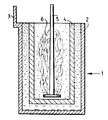
- the following example serves to explain the invention for a cell which is to have a capacity of approximately 40 Ah, 100 g of the coal / nickel particles are used. These 100 g coal / nickel particles contain 50 g nickel deposited on 50 g coal particles. The grain size of the coal / nickel particles is in the order of 300 - 500 ⁇ m. 100 g of carbon / nickel particles are mixed uniformly with approx. 100 g of sodium chloride and the mixture is poured into the space in the battery cell intended for the positive electrode. After adding the molten electrolyte sodium aluminum chloride, the cell can be closed and charged. A sodium metal chloride accumulator cell is shown schematically in cross section in a drawing.
- a sodium-metal chloride accumulator cell 1 contains a housing 2 which has a connection 3 as a negative electrode.
- a solid electrolyte 4 is located in the interior of the housing 2 at a distance from the walls.
- Liquid sodium is located in the space between the inside walls of the housing and the outside of the solid electrolyte 4. Inside the Solid electrolyte 4 protrudes a lead electrode 5 made of electrically conductive material. The lead electrode is at least partially surrounded by the positive electrode 6.
- the positive electrode consists of the active mass metal and sodium chloride, the metal being deposited on the carbon carrier.
- carbon particles can be used as a carrier for the active metal component, but the carbon in another form, e.g. B. fiber structure is also suitable.
- the metal as mentioned in the example, ie nickel, is deposited on the carbon fibers.
- These fibrous carbon materials with the metal coating are also provided with the appropriate amount of sodium chloride.
- the sodium chloride can be shaken into the fibrous carbon material. However, it can also be precipitated out of solutions.
- the fibrous carbon material with the metal coating and the nickel chloride represent the positive mass. The positive mass is introduced into the space of the battery cell intended for the positive electrode. After adding the intended amount of sodium aluminum chloride, this cell can be closed and charged.
Landscapes
- Chemical & Material Sciences (AREA)
- Chemical Kinetics & Catalysis (AREA)
- Electrochemistry (AREA)
- General Chemical & Material Sciences (AREA)
- Engineering & Computer Science (AREA)
- Manufacturing & Machinery (AREA)
- Secondary Cells (AREA)
- Stabilization Of Oscillater, Synchronisation, Frequency Synthesizers (AREA)
Abstract
Description
- Die Erfindung bezieht sich auf eine Akkumulatorzelle mit einer bei Arbeitstemperatur festen, positiven Elektrode mit einer aktiven Masse aus einem Übergangsmetall und Natriumchlorid und aus Kohlenstoff für einen Natrium-Metallchlorid Akkumulator mit einen natriumionenleitenden Festelektrolyten und einem schmelzflüssigen Elektrolyten.
- Eine neue Möglichkeit zur effizienten Energiespeicherung in Sekundärbatterien bietet die Natrium/Metallchloridbatterie, die bei R.M. Dell, R.J. Bones, Proc. 22nd IECEC 1987, pages 1072 - 77, R.C. Galloway, Jornal of the Electrochemical Society 134 (1987) 256, R.J. Bones et al, Jornal of the Electrochemical Society 134 (1987) 2379, ausführlich beschrieben ist. Als Metallchloride können FeCl₂, CoCl₂ und NiCl₂ eingesetzt werden. Wegen der hohen Ruhespannung von 2,59 Volt ist das System mit NiCl₂ besonders geeignet.
In der Zelle läuft die Reaktion
ab. Ein weiterer Vorteil dieser Stoffkombination ist ein weiter Temperaturbereich, der während des Betriebs zulässig ist: 270 °C - 400 °C. Dadurch sind hohe Leistungen während des Entladens möglich, ohne dass die Temperaturgrenzen wegen der Verlustleistung aufgrund des inneren Widerstandes rasch erreicht werden. - Während der Reaktion (Laden und Entladen) findet in der positiven Elektrode (Ni/NiCl₂) eine Stoffumwandlung statt. Dabei wird beim Laden aus Nickel das nicht leitfähige Nickelchlorid gebildet. Das bedeutet, dass der Aufbau der Festelektrode so gestaltet werden muss, dass die elektronische Leitfähigkeit von der Reaktionsstelle innerhalb den positiven Elektrode zum positiven Pol der Zelle permanent gewährleistet sein muss.
- Auf der anderen Seite muss die reagierende Masse im ständigen Kontakt mit deren schmelzflüssigen Elektrolyten bleiben, um den Ab- bzw. Antransport der Na+-Ionen sicherzustellen. Dies wird realisiert durch Verwendung von porösen positiven Elektroden, in die der Elektrolyt aufgesaugt ist.
- Als Elektrodenstrukturen haben sich Pulverschüttungen, Granulatschüttungen oder Sinterkörper bewährt.
- Da nicht das gesamte Metall (z. B. Nickel) in nichtleitendes Metallchlorid (z. B. NiCl₂) überführt werden darf - dies würde die Funktionsfähigkeit der Elektrode unterbinden - wird ein erheblicher Überschuss an Nickel eingesetzt (Ca Faktor 3 der stöchiometrischen Menge). Dadurch wird die Elektrodenfunktion während des gesamten Lade- und Entladezyklus aufrechterhalten und die Beteiligung des gesamten Elektrodenvolumens an der Reaktion gesichert.
- Nachteil dieser Anordnung ist die grosse Metallmenge, die pro kWh Speicherkapazität eingesetzt werden muss (z. B. 423 g Ni/kWh Batterie theoretisch; ca. 1300 g Ni/kWh praktisch).
- Nickel ist kein billiger Werkstoff; deshalb verteuert (stärker als bei Eisen) der überstöchiometrische Nickeleinsatz den kWh-Preis der Batterie beträchtlich. Dadurch wird die Konkurrenzfähigkeit dieser Hochenergiebatterie gegenüber heutigen marktgängigen Batterien wie z. B. einer Bleibatterie erheblich beeinträchtigt. Ein weiterer Aspekt ist das überschüssige Gewicht, das durch den überstöchiometrischen Nickelanteil (spez. Gewicht 8,9 g/cm³) verursacht wird. Für spezielle Anwendungen, z. B. in der Traktion, sind hohe spezifische Energie- und Leistungswerte (Wh/kg bzw. W/kg) unerlässlich. Für Elektroautos müssen Werte von über 100 W/kg erreicht werden, um ausreichende Reichweiten des Fahrzeuges zu garantieren. Durch das überschüssige Metall werden die spezifischen Daten erheblich verschlechtert.
- In DE 3245812 wird vorgeschlagen, die aktive Masse in eine elektronisch leitfähige Matrix einzubringen. Diese Matrix kann jede geeignete elektronisch leitfähige Substanz sein. Dabei wird Kohlenstoff in Form von Graphit vorgeschlagen. Es wird weiter erwähnt, dass neben Formkörpern, die die Matrix bilden, die aktive Substanz, das Metallchlorid, mit Graphit gemischt werden kann und die Kathode als Artifakt aus dem Gemisch gepresst werden kann. Bei Verwendung eines porösen Matrixkörpers kommt es darauf an, die Porösitäten so zu wählen, dass der Zutritt des natriumionenleitenden Elektrolyten zu allen Stellen der Matrix gegeben ist und eine Umsetzung stattfinden kann. Dies bedeutet aber auch, dass in den engen Poren die Diffusion im Elektrolyten gehemmt ist. Weiter verhindert der Matrixkörper durch seine fest vorgegebene Geometrie einen einfachen Herstellungsprozess zum Aufbau der Zellen. Wenn Pulvermischungen von aktiver Masse und Kohlenstoff vorgegeben werden, so liegen die aktiven Teilchen neben den Kohlenstoffteilchen. Beim Laden bildet sich nun auf den Metallpartikelchen das Chlorid, das nicht leitend ist. Dadurch überzieht sich das Metallpartikelchen auch bei Vorhandensein der Kohlepartikelchen mit einer nicht leitenden Schicht, so dass die Reaktion wegen des fehlenden elektrischen Kontaktes an dieser Stelle zum Stillstand kommt, d. h. im Inneren des aktiven Partikels liegt ungenutzte Masse vor und trägt somit zu einer Verschlechterung der spezifischen Energiedichten bei. Weiter wurde beobachtet, dass es bei dieser Form der positiven Elektrode während der Lade/Entladezyklen zu einem Kornwachstum der Metall/Metallchloridpartikel kommt. Dadurch wird einerseits die Strombelastbarkeit, d. h. die Leistung der Elektrode geringer, andererseits nimmt mit den Lade/Entladezyklen die Kapazität der Elektrode ab, da die aktive Masse wegen des Kornwachstums immer weniger ausgenutzt werden kann.
- Aufgabe der Erfindung ist es daher, für einen Natrium-Metallchlorid-Akkumulator der eingangs beschriebenen Art eine positive Elektrode zu entwickeln, die bei einem geringen überstöchiometrischen Anteil an Metall eine hohe elektrische Leitfähigkeit besitzt und die Nachteile der oben beschriebenen Elektroden nicht aufweist.
- Die Aufgabe wird dadurch gelöst, dass gemäß Anspruch 1 die positive Elektrode aus Kohlepartikeln, die mit Übergangsmetall überzogen sind (entladener Zustand) gebildet wird. In einer derartigen Elektrode wird die aktive Komponente der Elektrode, in diesem Fall das Metall, im entladenen bzw. das Metallchlorid im geladenen Zustand, weitgehend ausgenutzt, wobei die elektronische Leitfähigkeit weitgehend von den Kohlepartikeln, die den Träger darstellen, gewährleistet wird, da die Metall/Metallchloridsnicht auf dem Kohlepartikelchen nicht gleichmässig dicht, sondern durchbrochen ist. Auf diese Art und Weise ergibt sich eine erhebliche Gewichtskosteneinsparung bei der Batterie.
- Kohle in seinen vielfältigen Formen ist nicht nur leicht (spez. Gewicht 1,8 - 2 g/cm³) sondern auch preiswert. Kohle weist ausreichende Leitfähigkeit auf und ist in dem betrachteten System der Na/Metallchlorid-Zelle auch ausreichend stabil.
- Kohle wird vorwiegend als Kohlepulver (Graphit als auch partiell kristallisierter Kohlenstoff) angewandt. Die positive Elektrode wird vorzugsweise im entladenen Zustand hergestellt, d. h. die Elektrode wird aus Kohlepartikeln, die einen Metallüberzug besitzen und Natriumchlorid gefertigt. Als Träger kann Kohlematerial in verschiedener Form eingesetzt werden. Es kann Kohlegraphitpulver verwendet werden, es können aber auch grössere Kohlepartikel, die in sich wiederum eine Porösität aufweisen, eingesetzt werden. Diese Kohlekörper, egal welche Korngrösse, werden mit einem Überzug des Metalls, z. B. Nickel, versehen. Die Kohle/Nickelpartikeln werden mit trockenem Kochsalzpulver gemischt und in die Zelle eingerüttelt. Danach wird diese Elektrode mit schmelzflüssigem Elektrolyten getränkt. Anschliessend wird die Zelle verschlossen und kann geladen werden. Die Mischung aus den Kohle/Nickelkörnern und Kochsalz kann zuerst granuliert und anschliessend als Granulat in die Zellen gefüllt werden. Dies hat den Vorteil, dass die Mischung besser rieselfähig und die Gefahr der Entmischung beim Einfüllen geringer ist. Bei dieser Elektrodenart wird der Metallanteil (Nickelanteil) nahezu vollständig während, des Lade/Entladezyklusses ausgenutzt. Ein Überstöchiometriefaktor von 1,2 - 1,5 für das Metall hat sich gut bewährt. Als Kohlepulver sind Griesse aus Kohlenstoff oder Elektrographit mit Korngrössen zwischen 2 und 3000 µm geeignet. Entsprechend der Korngrösse der Kohlekörner variiert die Dicke des Nickelüberzuges. So werden auf Kohlekörner mit einem Korndurchmesser von ca. 1 mm Nickelschichten in der Grössenordnung von 100 µm aufgebracht. Bei Kohlekörner mit einem Korndurchmesser von 0,3 mm ergeben sich Nickelschichtdicken zwischen 1 und 10 µm.
- Im entladenen Zustand der Zelle liegt die aktive Komponente als Metall vor, d. h. auf den Kohlekörnern befindet sich der metallische Überzug. Beim Laden wird dieser Überzug in das Metallchlorid überführt. Im Beispiels des Nickels bedeutet das, dass im entladenen Zustand Nickel auf Kohle hervorliegt, im geladenen Zustand Nickelchlorid auf kohle. Dabei ist es selbstverständlich, dass aufgrund des überschusses nicht die gesamte Nickelmenge in Nickelchlorid überführt wird. Bei der Entladung wird dagegen das Nickelchlorid weitgehend, aber zwangsweise nicht vollständig, in Nickel umgewandelt. Da dieses System im entladenen Zustand gefertigt werden kann, gestaltet sich der Bau der Zellen sehr einfach. Wie bereits erwähnt werden die Kohlekörner mit dem Nickelüberzug mit Kochsalz gemischt und in die Zelle eingefüllt.
- Die Aufbringung des Metalls auf den Kohleträger wird nach bekannten Verfahren durchgeführt. Im einzelnen sind zu nennen Abscheidungen aus der Gasphase mit dem Verfahren Chemical Vapour Deposition oder Sputtern, sowie Abscheidung aus Lösungen. Hier kommen in erster Linie elektrochemische Verfahren in Frage, wobei die stromlose Vernickelung als auch die Vernickelung unter Stromanwendung geeignet sind. Weiterhin ist auch das Ausfallen von Nickelverbindungen auf der Kohle möglich. Diese Nickelverbindungen werden anschliessend bei 300 - 400 °C mit Wasserstoff reduziert. In allen Fällen resultiert ein Kohlematerial, auf dessen Oberfläche das Metall in unserem Beispiel Nickel abgeschieden ist.
- Das folgende Beispiel dient der Erläuterung der Erfindung für eine Zelle, die eine kapazität von ca. 40 Ah besitzen soll, werden 100 g der Kohle/Nickelpartikel eingesetzt. Diese 100 g kohle/Nickelpartikel enthalten 50 g Nickel abgeschieden auf 50 g Kohlepartikel. Die Korngrösse der Kohle/Nickelpartikel liegt in der Grössenordnung 300 - 500 µm. Je 100 g Kohle/Nickelpartikel werden gleichmässig mit ca. 100 g Natriumchlorid vermischt und die Mischung in den für die positive Elektrode vorgesehenen Raum der Akkumulatorzelle eingefüllt. Nach Hinzufügen des schmelzflüssigen Elektrolyten Natriumaluminiumchlorid kann die Zelle verschlossen und geladen werden. Eine Natrium-Metallchlorid-Akkumulatorzelle ist schematisch im Querschnitt in einer Zeichnung dargestellt.
- Eine Natrium-Metallchlorid-Akkumulatorzelle 1 enthält ein Gehäuse 2, das als negative Elektrode einen Anschluss 3 aufweist. Im Inneren des Gehäuses 2 befindet sich im Abstand von den Wänden ein Festelektrolyt 4.
- Im Raum zwischen den Gehäuseinnenwänden und der Aussenseite des Festelektrolyten 4 befindet sich flüssiges Natrium. In das Innere des Festelektrolyten 4 ragt eine Ableitelektrode 5 aus elektrisch leitendem Material. Die Ableitelektrode ist von der positiven Elektrode 6 zumindest teilweise umgeben. Die positive Elektrode besteht aus der aktiven Masse Metall und Natriumchlorid, wobei das Metall auf dem kohleträger abgeschieden ist.
- Ergänzend ist zu erwähnen, dass als Träger für die aktive Metallkomponente nicht nur Kohlepartikel eingesetzt werden können, sondern der Kohlenstoff in anderer Form, z. B. Faserstruktur, ebenfalls geeignet ist. Hierbei wird das Metall, wie im Beispiel angeführt, also Nickel, auf den Kohlefasern abgeschieden. Diese fasrigen Kohlematerialien mit dem Metallüberzug werden ebenfalls mit der entsprechenden Menge Natriumchlorid versehen. Das Natriumchlorid kann in das fasrige Kohlematerial eingerüttelt werden. Es kann aber auch aus Lösungen ausgefällt werden. Das fasrige Kohlematerial mit dem Metallüberzug und das Nickelchlorid stellen die positive Masse dar. Die positive Masse wird in den für die positive Elektrode vorgesehenen Raum der Akkumulatorzelle eingebracht. Nach Zugabe der vorgesehenen Menge Natrium- Aluminiumchlorid kann diese Zelle verschlossen und geladen werden.
Claims (10)
- Verfahren zur Herstellung einer Natrium-Metallchlorid-Akkumulatorzelle mit einem natriumionenleitenden Festelektrolyten, sowie einem schmelzflüssigen Elektrolyten und einer bei Arbeitstemperatur festen, positiven Elektrode mit einer aktiven Masse aus einem Übergangsmetall und Natriumchlorid und aus Kohlenstoff, dadurch gekennzeichnet,- daß die Akkumulatorzelle im entladenen Zustand hergestellt wird,- daß im entladenen Zustand das Übergangsmetall der aktiven Masse als Überzug auf den Kohlenstoff aufgebracht wird, und- daß als aktive Masse ein Material verwendet wird, das die 1,2 bis 1,5 fache Menge Metall bezogen auf die stöchiometrischen Verhältnisse enthält.
- Verfahren nach Anspruch 1, dadurch gekennzeichnet, daß das Metall der aktiven Masse auf dem Kohlenstoff elektrochemisch abgeschieden wird.
- Verfahren nach Anspruch 1, dadurch gekennzeichnet, daß das Metall der aktiven Masse auf dem Kohlenstoff durch Reduktion aus einer Metallverbindung gebildet wird.
- Verfahren nach Anspruch 1, dadurch gekennzeichnet, daß das Metall der aktiven Masse durch Sputtern auf den Kohlenstoff aufgebracht wird.
- Verfahren nach Anspruch 1, dadurch gekennzeichnet, daß das Metall der aktiven Masse durch Chemical Vapour Deposition (CVD) auf den Kohlenstoff aufgebracht wird.
- Im entladenen Zustand hergestellte Natrium-Metallchlorid-Akkumulatorzelle mit einem natriumionenleitenden Festelektrolyten, sowie einem schmelzflüssigen Elektrolyten, und einer bei Arbeitstemperatur festen, positiven Elektrode mit einer aktiven Masse aus einem Übergangsmetall und Natriumchlorid und aus Kohlenstoff nach einem der vorhergehenden Ansprüche, dadurch gekennzeichnet, daß im entladenen Zustand das Übergangsmetall als Überzug auf dem Kohlenstoff angeordnet ist, und daß das Metall der aktiven Masse die 1,2 bis 1,5fache Menge Metall bezogen auf stöchiometrische Verhältnisse enthält.
- Natrium-Metallchlorid-Akkumulatorzelle nach Anspruch 6, dadurch gekennzeichnet, daß im geladenen Zustand Übergangsmetallchlorid als Überzug auf dem Kohlenstoff angeordnet ist.
- Natrium-Metallchlorid-Akkumulatorzelle nach einem oder mehreren der vorhergehenden Ansprüche, dadurch gekennzeichnet, daß der Kohlenstoff Grießform hat.
- Natrium-Metallchlorid-Akkumulatorzelle nach einem oder mehreren der Ansprüche 1 bis 7, dadurch gekennzeichnet, daß der Kohlenstoff Partikelform hat, wobei die Partikel Abmessungen zwischen 2 und 3000µm haben.
- Natrium-Metallchlorid-Akkumulatorzelle nach einem oder mehreren der Ansprüche 1 bis 7, dadurch gekennzeichnet, daß der Kohlenstoff im Form einer Faserstruktur vorliegt.
Applications Claiming Priority (2)
| Application Number | Priority Date | Filing Date | Title |
|---|---|---|---|
| DE3837721 | 1988-11-07 | ||
| DE3837721 | 1988-11-07 |
Publications (2)
| Publication Number | Publication Date |
|---|---|
| EP0441870A1 EP0441870A1 (de) | 1991-08-21 |
| EP0441870B1 true EP0441870B1 (de) | 1993-03-24 |
Family
ID=6366645
Family Applications (1)
| Application Number | Title | Priority Date | Filing Date |
|---|---|---|---|
| EP89912793A Expired - Lifetime EP0441870B1 (de) | 1988-11-07 | 1989-11-02 | Akkumulator und verfahren zu seiner herstellung |
Country Status (4)
| Country | Link |
|---|---|
| EP (1) | EP0441870B1 (de) |
| JP (1) | JPH04501786A (de) |
| DE (1) | DE58903896D1 (de) |
| WO (1) | WO1990005386A1 (de) |
Families Citing this family (2)
| Publication number | Priority date | Publication date | Assignee | Title |
|---|---|---|---|---|
| DE4430233B4 (de) * | 1993-08-26 | 2004-01-29 | Programme 3 Patent Holdings | Verfahren zur Herstellung einer Kathode, Kathodenvorläufer und Verfahren zur Herstellung eines Kathodenvorläufers |
| US20130157140A1 (en) * | 2011-12-20 | 2013-06-20 | General Electric Company | Methods of making and using electrode compositions and articles |
Family Cites Families (6)
| Publication number | Priority date | Publication date | Assignee | Title |
|---|---|---|---|---|
| US3963516A (en) * | 1974-02-26 | 1976-06-15 | Westinghouse Electric Corporation | High energy density fused salt battery and cathode for use therein |
| GB1533853A (en) * | 1975-02-14 | 1978-11-29 | Chloride Group Ltd | Electric storage batteries |
| FR2423873A1 (fr) * | 1978-04-17 | 1979-11-16 | Comp Generale Electricite | Generateur electrochimique a electrolyte fondu |
| AU532635B2 (en) * | 1979-11-06 | 1983-10-06 | South African Inventions Development Corporation | Metal oxide cathode |
| US4367159A (en) * | 1981-01-19 | 1983-01-04 | The United States Of America As Represented By The United States Department Of Energy | Method for uniformly distributing carbon flakes in a positive electrode, the electrode made thereby and compositions |
| ZA828603B (en) * | 1981-12-10 | 1983-09-28 | South African Inventions | Electrochemical cell |
-
1989
- 1989-11-02 EP EP89912793A patent/EP0441870B1/de not_active Expired - Lifetime
- 1989-11-02 DE DE8989912793T patent/DE58903896D1/de not_active Expired - Fee Related
- 1989-11-02 JP JP2500513A patent/JPH04501786A/ja active Pending
- 1989-11-02 WO PCT/EP1989/001310 patent/WO1990005386A1/de not_active Ceased
Non-Patent Citations (2)
| Title |
|---|
| Journal of Power Sources, Vol. 18, No. 4, November 1986, Elsevier Sequoia, Lausanne CH, pages 377-380; J. Coetzer: "A new high energy density battery system" see page 377, last paragraph - page 378 * |
| Patent Abstracts of Japan, vol. 6, No. 9 (E-90)(887) 20 January 1982, & JP-A-56 130080 (Matsushita Denki Sangyo K.K.) 12 October 1981, see the whole document * |
Also Published As
| Publication number | Publication date |
|---|---|
| DE58903896D1 (de) | 1993-04-29 |
| JPH04501786A (ja) | 1992-03-26 |
| EP0441870A1 (de) | 1991-08-21 |
| WO1990005386A1 (de) | 1990-05-17 |
Similar Documents
| Publication | Publication Date | Title |
|---|---|---|
| DE69405220T2 (de) | Elektrochemische zelle | |
| DE68917045T2 (de) | Nickelelektrode für eine alkalische Batterie. | |
| DE3041766C2 (de) | ||
| DE3632130C2 (de) | Verfahren zur Herstellung einer Kathode und Mittel zur Durchführung des Verfahrens | |
| DE69527324T2 (de) | Alkalische Mangan Batterie | |
| DE3533483C2 (de) | Kathode für eine elektrochemische Zelle und deren Verwendung | |
| DE69712189T2 (de) | Zinkanode für elektrochemische zelle | |
| DE2837729C3 (de) | Wiederaufladbare galvanische Zelle und Verfahren zu ihrer Herstellung | |
| DE3718919C2 (de) | Vorläufer für eine elektrochemische Hochtemperaturzelle, Verfahren zur Herstellung und dessen Verwendung | |
| DE3419279C2 (de) | ||
| DE4430233B4 (de) | Verfahren zur Herstellung einer Kathode, Kathodenvorläufer und Verfahren zur Herstellung eines Kathodenvorläufers | |
| EP1201004A1 (de) | Wiederaufladbare elektrochemische zelle | |
| DE3718921C2 (de) | Verfahren zur Herstellung einer Kathode, eine nach diesem Verfahren erhältliche Kathode und Verwendung der Kathode in einer elektrochemischen Zelle | |
| DE2810795A1 (de) | Elektrode fuer elektrische speichereinrichtungen | |
| DE1496352B2 (de) | Akkumulatorelektrode aus einem geruest von parallel liegenden metallischen fasern | |
| DE3942181C2 (de) | Vorläufer für eine Hochtemperaturzelle und Verfahren zur Herstellung einer Hochtemperaturzelle | |
| DE3842773C2 (de) | Hochtemperatur-Stromspeicherzelle und Verfahren zu deren Herstellung | |
| DE102023121567A1 (de) | Anodenlose festkörper-batterie, welche eine verbundstrukturschicht aufweist, und herstellungsverfahren dafür | |
| DE2951167A1 (de) | Elektrochemische primaerzelle und verfahren zur herstellung eines kathodenstromkollektors dafuer | |
| DE69835938T2 (de) | Positives aktives Material für alkalische Speicherbatterie | |
| DE2510090A1 (de) | Lithiumelektrode und verfahren zur herstellung derselben | |
| DE4107749C2 (de) | Wiederaufladbare elektrochemische Hochtemperatur-Energiespeicherzelle und Verfahren zu deren Herstellung | |
| EP0460425B1 (de) | Gasdichter alkalischer Akkumulator | |
| DE69422204T2 (de) | Alkalische Speicherbatterie und Verfahren zur Herstellung derselben | |
| DE2011135C3 (de) | Vorrichtung zum Speichern elektrischer Energie |
Legal Events
| Date | Code | Title | Description |
|---|---|---|---|
| PUAI | Public reference made under article 153(3) epc to a published international application that has entered the european phase |
Free format text: ORIGINAL CODE: 0009012 |
|
| 17P | Request for examination filed |
Effective date: 19910320 |
|
| AK | Designated contracting states |
Kind code of ref document: A1 Designated state(s): DE FR GB |
|
| 17Q | First examination report despatched |
Effective date: 19920605 |
|
| GRAA | (expected) grant |
Free format text: ORIGINAL CODE: 0009210 |
|
| AK | Designated contracting states |
Kind code of ref document: B1 Designated state(s): DE FR GB |
|
| REF | Corresponds to: |
Ref document number: 58903896 Country of ref document: DE Date of ref document: 19930429 |
|
| ET | Fr: translation filed | ||
| GBT | Gb: translation of ep patent filed (gb section 77(6)(a)/1977) |
Effective date: 19930624 |
|
| PG25 | Lapsed in a contracting state [announced via postgrant information from national office to epo] |
Ref country code: GB Effective date: 19931102 |
|
| PGFP | Annual fee paid to national office [announced via postgrant information from national office to epo] |
Ref country code: DE Payment date: 19931221 Year of fee payment: 5 |
|
| PLBE | No opposition filed within time limit |
Free format text: ORIGINAL CODE: 0009261 |
|
| STAA | Information on the status of an ep patent application or granted ep patent |
Free format text: STATUS: NO OPPOSITION FILED WITHIN TIME LIMIT |
|
| 26N | No opposition filed | ||
| GBPC | Gb: european patent ceased through non-payment of renewal fee |
Effective date: 19931102 |
|
| PG25 | Lapsed in a contracting state [announced via postgrant information from national office to epo] |
Ref country code: FR Effective date: 19940729 |
|
| REG | Reference to a national code |
Ref country code: FR Ref legal event code: ST |
|
| PG25 | Lapsed in a contracting state [announced via postgrant information from national office to epo] |
Ref country code: DE Effective date: 19950801 |