EP0430000B1 - Bleichbad - Google Patents
Bleichbad Download PDFInfo
- Publication number
- EP0430000B1 EP0430000B1 EP90121996A EP90121996A EP0430000B1 EP 0430000 B1 EP0430000 B1 EP 0430000B1 EP 90121996 A EP90121996 A EP 90121996A EP 90121996 A EP90121996 A EP 90121996A EP 0430000 B1 EP0430000 B1 EP 0430000B1
- Authority
- EP
- European Patent Office
- Prior art keywords
- layer
- mol
- bleaching
- bath
- gelatin
- Prior art date
- Legal status (The legal status is an assumption and is not a legal conclusion. Google has not performed a legal analysis and makes no representation as to the accuracy of the status listed.)
- Expired - Lifetime
Links
- 239000007844 bleaching agent Substances 0.000 title description 9
- 238000004061 bleaching Methods 0.000 claims description 36
- -1 iron complex salt Chemical class 0.000 claims description 18
- 239000008139 complexing agent Substances 0.000 claims description 17
- MGFYIUFZLHCRTH-UHFFFAOYSA-N nitrilotriacetic acid Chemical group OC(=O)CN(CC(O)=O)CC(O)=O MGFYIUFZLHCRTH-UHFFFAOYSA-N 0.000 claims description 4
- UFHFLCQGNIYNRP-UHFFFAOYSA-N Hydrogen Chemical compound [H][H] UFHFLCQGNIYNRP-UHFFFAOYSA-N 0.000 claims description 3
- 239000002253 acid Substances 0.000 claims description 3
- 125000002887 hydroxy group Chemical group [H]O* 0.000 claims description 3
- 150000004698 iron complex Chemical class 0.000 claims description 3
- VTLYFUHAOXGGBS-UHFFFAOYSA-N Fe3+ Chemical compound [Fe+3] VTLYFUHAOXGGBS-UHFFFAOYSA-N 0.000 claims description 2
- 229910052739 hydrogen Inorganic materials 0.000 claims description 2
- 239000001257 hydrogen Substances 0.000 claims description 2
- 150000003839 salts Chemical class 0.000 claims description 2
- 239000010410 layer Substances 0.000 description 43
- SQGYOTSLMSWVJD-UHFFFAOYSA-N silver(1+) nitrate Chemical compound [Ag+].[O-]N(=O)=O SQGYOTSLMSWVJD-UHFFFAOYSA-N 0.000 description 42
- QTBSBXVTEAMEQO-UHFFFAOYSA-N Acetic acid Chemical compound CC(O)=O QTBSBXVTEAMEQO-UHFFFAOYSA-N 0.000 description 24
- 229910052709 silver Inorganic materials 0.000 description 24
- 239000004332 silver Substances 0.000 description 24
- 108010010803 Gelatin Proteins 0.000 description 20
- DOIRQSBPFJWKBE-UHFFFAOYSA-N dibutyl phthalate Chemical compound CCCCOC(=O)C1=CC=CC=C1C(=O)OCCCC DOIRQSBPFJWKBE-UHFFFAOYSA-N 0.000 description 20
- 229920000159 gelatin Polymers 0.000 description 20
- 239000008273 gelatin Substances 0.000 description 20
- 235000019322 gelatine Nutrition 0.000 description 20
- 235000011852 gelatine desserts Nutrition 0.000 description 20
- BQCADISMDOOEFD-UHFFFAOYSA-N Silver Chemical compound [Ag] BQCADISMDOOEFD-UHFFFAOYSA-N 0.000 description 14
- 239000000463 material Substances 0.000 description 12
- XLYOFNOQVPJJNP-UHFFFAOYSA-N water Substances O XLYOFNOQVPJJNP-UHFFFAOYSA-N 0.000 description 12
- QGZKDVFQNNGYKY-UHFFFAOYSA-N Ammonia Chemical compound N QGZKDVFQNNGYKY-UHFFFAOYSA-N 0.000 description 10
- KCXVZYZYPLLWCC-UHFFFAOYSA-N EDTA Chemical compound OC(=O)CN(CC(O)=O)CCN(CC(O)=O)CC(O)=O KCXVZYZYPLLWCC-UHFFFAOYSA-N 0.000 description 10
- 239000000839 emulsion Substances 0.000 description 9
- XMBWDFGMSWQBCA-UHFFFAOYSA-N hydrogen iodide Chemical compound I XMBWDFGMSWQBCA-UHFFFAOYSA-N 0.000 description 8
- 239000000203 mixture Substances 0.000 description 7
- YSMRWXYRXBRSND-UHFFFAOYSA-N TOTP Chemical compound CC1=CC=CC=C1OP(=O)(OC=1C(=CC=CC=1)C)OC1=CC=CC=C1C YSMRWXYRXBRSND-UHFFFAOYSA-N 0.000 description 6
- 239000006096 absorbing agent Substances 0.000 description 4
- 229910021529 ammonia Inorganic materials 0.000 description 4
- 239000011241 protective layer Substances 0.000 description 4
- NABFRHBCIHEYTA-UHFFFAOYSA-N 2,5-bis(6-methylheptyl)benzene-1,4-diol Chemical compound CC(C)CCCCCC1=CC(O)=C(CCCCCC(C)C)C=C1O NABFRHBCIHEYTA-UHFFFAOYSA-N 0.000 description 3
- QVLXDGDLLZYJAM-UHFFFAOYSA-N 2,5-dioctylbenzene-1,4-diol Chemical compound CCCCCCCCC1=CC(O)=C(CCCCCCCC)C=C1O QVLXDGDLLZYJAM-UHFFFAOYSA-N 0.000 description 3
- CPELXLSAUQHCOX-UHFFFAOYSA-M Bromide Chemical compound [Br-] CPELXLSAUQHCOX-UHFFFAOYSA-M 0.000 description 3
- VEXZGXHMUGYJMC-UHFFFAOYSA-M Chloride anion Chemical compound [Cl-] VEXZGXHMUGYJMC-UHFFFAOYSA-M 0.000 description 3
- WSFSSNUMVMOOMR-UHFFFAOYSA-N Formaldehyde Chemical compound O=C WSFSSNUMVMOOMR-UHFFFAOYSA-N 0.000 description 3
- SWLVFNYSXGMGBS-UHFFFAOYSA-N ammonium bromide Chemical compound [NH4+].[Br-] SWLVFNYSXGMGBS-UHFFFAOYSA-N 0.000 description 3
- 150000004820 halides Chemical class 0.000 description 3
- GEHJYWRUCIMESM-UHFFFAOYSA-L sodium sulfite Chemical compound [Na+].[Na+].[O-]S([O-])=O GEHJYWRUCIMESM-UHFFFAOYSA-L 0.000 description 3
- 229920002284 Cellulose triacetate Polymers 0.000 description 2
- 239000004698 Polyethylene Substances 0.000 description 2
- NNLVGZFZQQXQNW-ADJNRHBOSA-N [(2r,3r,4s,5r,6s)-4,5-diacetyloxy-3-[(2s,3r,4s,5r,6r)-3,4,5-triacetyloxy-6-(acetyloxymethyl)oxan-2-yl]oxy-6-[(2r,3r,4s,5r,6s)-4,5,6-triacetyloxy-2-(acetyloxymethyl)oxan-3-yl]oxyoxan-2-yl]methyl acetate Chemical compound O([C@@H]1O[C@@H]([C@H]([C@H](OC(C)=O)[C@H]1OC(C)=O)O[C@H]1[C@@H]([C@@H](OC(C)=O)[C@H](OC(C)=O)[C@@H](COC(C)=O)O1)OC(C)=O)COC(=O)C)[C@@H]1[C@@H](COC(C)=O)O[C@@H](OC(C)=O)[C@H](OC(C)=O)[C@H]1OC(C)=O NNLVGZFZQQXQNW-ADJNRHBOSA-N 0.000 description 2
- KZTASAUPEDXWMQ-UHFFFAOYSA-N azane;iron(3+) Chemical compound N.[Fe+3] KZTASAUPEDXWMQ-UHFFFAOYSA-N 0.000 description 2
- 239000003795 chemical substances by application Substances 0.000 description 2
- 230000018109 developmental process Effects 0.000 description 2
- 230000000694 effects Effects 0.000 description 2
- 239000001046 green dye Substances 0.000 description 2
- 229920000573 polyethylene Polymers 0.000 description 2
- 238000003672 processing method Methods 0.000 description 2
- 238000000926 separation method Methods 0.000 description 2
- 230000000087 stabilizing effect Effects 0.000 description 2
- 239000000126 substance Substances 0.000 description 2
- PAWQVTBBRAZDMG-UHFFFAOYSA-N 2-(3-bromo-2-fluorophenyl)acetic acid Chemical compound OC(=O)CC1=CC=CC(Br)=C1F PAWQVTBBRAZDMG-UHFFFAOYSA-N 0.000 description 1
- XNCSCQSQSGDGES-UHFFFAOYSA-N 2-[2-[bis(carboxymethyl)amino]propyl-(carboxymethyl)amino]acetic acid Chemical compound OC(=O)CN(CC(O)=O)C(C)CN(CC(O)=O)CC(O)=O XNCSCQSQSGDGES-UHFFFAOYSA-N 0.000 description 1
- INVVMIXYILXINW-UHFFFAOYSA-N 5-methyl-1h-[1,2,4]triazolo[1,5-a]pyrimidin-7-one Chemical compound CC1=CC(=O)N2NC=NC2=N1 INVVMIXYILXINW-UHFFFAOYSA-N 0.000 description 1
- QGZKDVFQNNGYKY-UHFFFAOYSA-O Ammonium Chemical compound [NH4+] QGZKDVFQNNGYKY-UHFFFAOYSA-O 0.000 description 1
- VHUUQVKOLVNVRT-UHFFFAOYSA-N Ammonium hydroxide Chemical compound [NH4+].[OH-] VHUUQVKOLVNVRT-UHFFFAOYSA-N 0.000 description 1
- DGAQECJNVWCQMB-PUAWFVPOSA-M Ilexoside XXIX Chemical compound C[C@@H]1CC[C@@]2(CC[C@@]3(C(=CC[C@H]4[C@]3(CC[C@@H]5[C@@]4(CC[C@@H](C5(C)C)OS(=O)(=O)[O-])C)C)[C@@H]2[C@]1(C)O)C)C(=O)O[C@H]6[C@@H]([C@H]([C@@H]([C@H](O6)CO)O)O)O.[Na+] DGAQECJNVWCQMB-PUAWFVPOSA-M 0.000 description 1
- ZLMJMSJWJFRBEC-UHFFFAOYSA-N Potassium Chemical compound [K] ZLMJMSJWJFRBEC-UHFFFAOYSA-N 0.000 description 1
- 229910021607 Silver chloride Inorganic materials 0.000 description 1
- QAOWNCQODCNURD-UHFFFAOYSA-N Sulfuric acid Chemical compound OS(O)(=O)=O QAOWNCQODCNURD-UHFFFAOYSA-N 0.000 description 1
- 150000007513 acids Chemical class 0.000 description 1
- 235000011114 ammonium hydroxide Nutrition 0.000 description 1
- XYXNTHIYBIDHGM-UHFFFAOYSA-N ammonium thiosulfate Chemical compound [NH4+].[NH4+].[O-]S([O-])(=O)=S XYXNTHIYBIDHGM-UHFFFAOYSA-N 0.000 description 1
- UMEAURNTRYCPNR-UHFFFAOYSA-N azane;iron(2+) Chemical compound N.[Fe+2] UMEAURNTRYCPNR-UHFFFAOYSA-N 0.000 description 1
- 230000015572 biosynthetic process Effects 0.000 description 1
- 150000001649 bromium compounds Chemical class 0.000 description 1
- 150000001805 chlorine compounds Chemical class 0.000 description 1
- 150000001875 compounds Chemical class 0.000 description 1
- 239000000470 constituent Substances 0.000 description 1
- 238000001035 drying Methods 0.000 description 1
- 238000005658 halogenation reaction Methods 0.000 description 1
- 150000002505 iron Chemical class 0.000 description 1
- 239000004816 latex Substances 0.000 description 1
- 229920000126 latex Polymers 0.000 description 1
- 238000010979 pH adjustment Methods 0.000 description 1
- 229910052700 potassium Inorganic materials 0.000 description 1
- 239000011591 potassium Substances 0.000 description 1
- 230000001681 protective effect Effects 0.000 description 1
- 239000002516 radical scavenger Substances 0.000 description 1
- 230000008929 regeneration Effects 0.000 description 1
- 238000011069 regeneration method Methods 0.000 description 1
- ADZWSOLPGZMUMY-UHFFFAOYSA-M silver bromide Chemical compound [Ag]Br ADZWSOLPGZMUMY-UHFFFAOYSA-M 0.000 description 1
- HKZLPVFGJNLROG-UHFFFAOYSA-M silver monochloride Chemical compound [Cl-].[Ag+] HKZLPVFGJNLROG-UHFFFAOYSA-M 0.000 description 1
- 229910052708 sodium Inorganic materials 0.000 description 1
- 239000011734 sodium Substances 0.000 description 1
- 235000010265 sodium sulphite Nutrition 0.000 description 1
- 239000000758 substrate Substances 0.000 description 1
- 235000011149 sulphuric acid Nutrition 0.000 description 1
- 239000002699 waste material Substances 0.000 description 1
Classifications
-
- G—PHYSICS
- G03—PHOTOGRAPHY; CINEMATOGRAPHY; ANALOGOUS TECHNIQUES USING WAVES OTHER THAN OPTICAL WAVES; ELECTROGRAPHY; HOLOGRAPHY
- G03C—PHOTOSENSITIVE MATERIALS FOR PHOTOGRAPHIC PURPOSES; PHOTOGRAPHIC PROCESSES, e.g. CINE, X-RAY, COLOUR, STEREO-PHOTOGRAPHIC PROCESSES; AUXILIARY PROCESSES IN PHOTOGRAPHY
- G03C7/00—Multicolour photographic processes or agents therefor; Regeneration of such processing agents; Photosensitive materials for multicolour processes
- G03C7/30—Colour processes using colour-coupling substances; Materials therefor; Preparing or processing such materials
- G03C7/42—Bleach-fixing or agents therefor ; Desilvering processes
-
- G—PHYSICS
- G03—PHOTOGRAPHY; CINEMATOGRAPHY; ANALOGOUS TECHNIQUES USING WAVES OTHER THAN OPTICAL WAVES; ELECTROGRAPHY; HOLOGRAPHY
- G03C—PHOTOSENSITIVE MATERIALS FOR PHOTOGRAPHIC PURPOSES; PHOTOGRAPHIC PROCESSES, e.g. CINE, X-RAY, COLOUR, STEREO-PHOTOGRAPHIC PROCESSES; AUXILIARY PROCESSES IN PHOTOGRAPHY
- G03C5/00—Photographic processes or agents therefor; Regeneration of such processing agents
- G03C5/26—Processes using silver-salt-containing photosensitive materials or agents therefor
- G03C5/40—Chemically transforming developed images
- G03C5/44—Bleaching; Bleach-fixing
Definitions
- the invention relates to a bleaching bath which is suitable for processing color photographic silver halide materials and which is particularly environmentally friendly.
- Iron complex salts of aminopolycarboxylic acids for example the iron ammonium complex salt of ethylenediaminetetraacetic acid, are usually used to bleach the silver formed during the development of color photographic materials. This and similar complexing agents, which are also used, are only very slowly biodegradable.
- bleaching baths containing iron complexes of readily biodegradable complexing agents such as nitrilotriacetic acid are used for the bleaching of color photographic materials under the usual conditions at pH 6 to 8, they lack sufficient bleaching capacity.
- the object of the invention was to provide a bleaching bath which is suitable for processing color photographic silver halide materials and which contains readily biodegradable constituents and has a sufficient bleaching effect.
- Preferred compounds within the formula I are nitrilotriacetic acid and nitrilomonopropionediacetic acid of the formulas N- (CH2COOH) 3 and (HOOC-CH2) 2-N-CH2-CH2-COOH.
- complexing agent can be conventional complexing agents such as ethylenediaminetetraacetic acid or propylenediaminetetraacetic acid. Only the complexing agents according to the invention are preferably used.
- bleach baths also contain a halide for the re-halogenation of the silver.
- the halides of the bleaching baths are in particular the chlorides and bromides of sodium, potassium and ammonium.
- the bleach bath When ready for use, the bleach bath contains 0.05 to 1.5 mol / l halide.
- the bleaching bath according to the invention is particularly suitable for color photographic silver halide recording materials whose silver halide emulsions consist predominantly of AgBr, AgBrI, AgBrCl or AgCl.
- the color photographic material preferably contains on a reflective or transparent support (for example paper coated on both sides with polyethylene or cellulose triacetate film) at least one blue-sensitive, at least one green-sensitive and at least one red-sensitive silver halide emulsion layer, to which at least one yellow coupler, at least one magenta coupler and at least one cyan coupler in the order given assigned.
- the bleaching bath according to the invention is used within the usual processing method for silver halide color photographic materials, which consists of the steps of imagewise exposure, development, optionally stopping, bleaching, fixing or bleach-fixing, watering, optionally stabilizing and drying, the watering being omitted if at the end of Processing a stabilizing bath is applied.
- the processing method can be carried out continuously with constant regeneration of the individual processing baths.
- the bleaching baths listed in the examples were examined for their bleaching behavior (residual silver in the processed material).
- the exposed step wedge of the photographic material which was subsequently processed as described below, was examined for residual silver in the image blackness using an infrared silver detector PM 8030 from Photo-Matic, Denmark.
- a color photographic recording material was produced by applying the following layers in the order given to a support on paper coated on both sides with polyethylene.
- the quantities given relate to 1 m2.
- the corresponding amounts of AgNO3 are given.
- a step wedge was exposed on the photographic material described above and processed as follows:
- the individual processing baths had the following composition:
- Example 1 The exposure and processing were carried out as described in Example 1.
- the developer had the same composition as in Example 1.
- Example 1 The exposure and processing were carried out as described in Example 1.
- the developer had the same composition as in Example 1.
- Table 1 shows the good bleaching action of the bleaching bath A according to the invention, which contains a biodegradable complexing agent.
- the bleaching effect corresponds to that of the usual bleaching bath C, which contains the biodegradable EDTA.
- the bleaching bath B which is composed essentially like bleaching bath A, but is in the pH range prescribed for EDTA bleaching baths, on the other hand only bleaches insufficiently.
- a step wedge was exposed on the photographic material described above and processed as follows:
- the processing baths had the following composition:
- the result with regard to residual silver is shown in Table 2 below.
- the color image produced was of the type.
- the bleaching action of the bleaching bath D according to the invention with a biodegradable complexing agent corresponds to the bleaching action of the conventional bleaching bath F with the biodegradable complexing agent EDTA.
- the bleaching bath E which is composed essentially like bleaching bath D, but has a pH value which is customary for EDTA bleaching baths, on the other hand only bleaches insufficiently.
- the bleaching tests carried out showed that the bleaching bath D according to the invention does not lead to the formation of leuco blue-green dye, while in a conventional bleaching bath with EDTA there are significant losses of blue-green dye at the corresponding pH.
Landscapes
- Physics & Mathematics (AREA)
- General Physics & Mathematics (AREA)
- Silver Salt Photography Or Processing Solution Therefor (AREA)
Description
- Die Erfindung betrifft ein für die Verarbeitung farbfotografischer Silberhalogenidmaterialien geeignetes Bleichbad, das besonders umweltfreundlich ist.
- Zum Bleichen des bei der Entwicklung farbfotografischer Materialien entstandenen Silbers verwendet man üblicherweise Eisenkomplexsalze von Aminopolycarbonsäuren, beispielsweise das Eisenammoniumkomplexsalz der Ethylendiamintetraessigsäure. Dieser und ähnliche, ebenfalls verwendete Komplexbildner sind biologisch nur sehr langsam abbaubar.
- Verwendet man unter den üblichen Bedingungen bei pH 6 bis 8 zum Bleichen farbfotografischer Materialien Bleichbäder, die Eisenkomplexe biologisch leicht abbaubarer Komplexbildner wie Nitrilotriessigsäure aufweisen, so fehlt ihnen ein ausreichendes Bleichvermögen.
- Aufgabe der Erfindung war die Bereitstellung eines für die Verarbeitung farbfotografischer Silberhalogenidmaterialien geeigneten Bleichbades, das biologisch gut abbaubare Bestandteile enthält und eine ausreichende Bleichwirkung hat.
- Diese Aufgabe wird mit einem Bleichbad gelöst, das (1) einen Eisen (III)-komplex, dessen Komplexbildner zu wenigstens 20 Mol-%, vorzugsweise zu wenigstens 80 Mol-% der Formel I

entspricht, worin - R₁
- Wasserstoff oder Hydroxy,
- n
- 1 oder 2
- x
- 2 oder 3 und
- y
- 0 oder 1
- (2) einen Überschuß an freiem Komplexbildner von 1 bis 120 Mol-%, vorzugsweise von 5 bis 20 Mol-%, bezogen auf den Eisenkomplex oder das Eisenkomplexsalz enthält, und
- (3) auf einen pH-Wert ≦ 4,5 eingestellt ist.
- Als Komplexbildner der Formel (I) können Reinstoffe, aber auch Gemische eingesetzt werden.
- Bevorzugte Verbindungen innerhalb der Formel I sind Nitrilotriessigsäure und Nitrilomonopropiondiessigsäure der Formeln
N-(CH₂COOH)₃
und
(HOOC-CH₂)₂-N-CH₂-CH₂-COOH.
- Die restlichen höchstens 80 Mol-%, bzw. vorzugsweise höchstens 20 Mol-% an Komplexbildner können übliche Komplexbildner wie Ethylendiamintetraessigsäure oder Propylendiamintetraessigsäure sein. Bevorzugt werden nur die erfindungsgemäßen Komplexbildner eingesetzt.
- An Eisenkomplex oder Eisenkomplexsalz werden insbesondere 0,005 bis 0,5 Mol/l eingesetzt.
- Bleichbäder enthalten außer den erfindungsgemäßen Komponenten noch ein Halogenid zur Rehalogenierung des Silbers.
- Als Halogenide der Bleichbäder kommen insbesondere die Chloride und Bromide des Natriums, Kaliums und Ammoniums in Betracht.
- Im gebrauchsfertigen Zustand enthält das Bleichbad 0,05 bis 1,5 Mol/l Halogenid.
- Das erfindungsgemäße Bleichbad eignet sich insbesonders für farbfotografische Silberhalogenidaufzeichnungsmaterialien, deren Silberhalogenidemulsionen überwiegend aus AgBr, AgBrI, AgBrCl oder AgCl bestehen. Vorzugsweise enthält das farbfotografische Material auf einem reflektierenden oder transparenten Träger (z.B. beidseitig mit Polyethylen beschichtetes Papier oder Cellulosetriacetatfilm) wenigstens eine blauempfindliche, wenigstens eine grünempfindliche und wenigstens eine rotempfindliche Silberhalogenidemulsionsschicht, denen in der angegebenen Reihenfolge wenigstens ein Gelbkuppler, wenigstens ein Purpurkuppler und wenigstens ein Blaugrünkuppler zugeordnet sind.
- Das erfindungsgemäße Bleichbad wird innerhalb des üblichen Verarbeitungsverfahrens für farbfotografische Silberhalogenidmaterialien eingesetzt, das aus den Schritten bildmäßiges Belichten, Entwickeln, gegebenenfalls Stoppen, Bleichen, Fixieren bzw. Bleichfixieren, Wässern, gegebenenfalls Stabilisieren und Trocknen besteht, wobei das Wässern entfallen kann, wenn am Ende der Verarbeitung ein Stabilisierbad angewendet wird.
- Das Verarbeitungsverfahren läßt sich unter ständigem Regenerieren der einzelnen Verarbeitungsbäder kontinuierlich ausführen.
- Die in den Beispielen aufgeführten Bleichbäder wurden auf ihr Bleichverhalten (Restsilber im verarbeiteten Material) untersucht.
- Der belichtete und anschließend wie unten beschrieben verarbeitete Stufenkeil des fotografischen Materials wurde mit einem Infrarot-Silberdetektor PM 8030 der Firma Photo-Matic, Dänemark auf Restsilber in den Bildschwärzen untersucht.
- Über die biologische Abbaubarkeit des im erfindungsgemäßen Bleichbad verwendeten Komplexbildners gibt die Druckschrift: Nitrilotriessigsäure, BUA-Stoffbericht 5 (Oktober 1986), herausgegeben vom Bundesgremium für umweltrelevante Altstoffe (BUA) der Gesellschaft Deutscher Chemiker, Verlag Chemie, Weinheim 1987, Auskunft.
- Ein farbfotografisches Aufzeichnungsmaterial wurde hergestellt, indem auf einen Schichtträger auf beidseitig mit Polyethylen beschichtetem Papier die folgenden Schichten in der angegebenen Reihenfolge aufgetragen wurden. Die Mengenangaben beziehen sich jeweils auf 1 m². Für den Silberhalogenidauftrag werden die entsprechenden Mengen AgNO₃ angegeben.
-
- 1. Schicht (Substratschicht):
0,2 g Gelatine - 2. Schicht (blauempfindliche Schicht):
blauempfindliche Silberhalogenidemulsion (99,5 Mol-% Chlorid, 0,5 Mol-% Bromid, mittlerer Korndurchmesser 0,8 µm) aus 0,63 g AgNO₃ mit
1,38 g Gelatine
0,95 g Gelbkuppler Y
0,29 g Trikresylphosphat (TKP) - 3. Schicht (Schutzschicht)
1,1 g Gelatine
0,06 g 2,5-Dioctylhydrochinon
0,06 g Dibutylphthalat (DBP) - 4. Schicht (grünempfindliche Schicht)
grünsensibilisierte Silberhalogenidemulsion (99,5 Mol-% Chlorid, 0,5 Mol-% Bromid, mittlerer Korndurchmesser 0,6 µm) aus 0,45 g AgNO₃ mit
1,08 g Gelatine
0,41 g Purpurkuppler M
0,08 g 2,5-Dioctylhydrochinon
0,34 g DBP
0,04 g TKP - 5. Schicht (UV-Schutzschicht)
1,15 g Gelatine
0,6 g UV-Absorber der Formel
0,04 g TKP - 6. Schicht (rotempfindliche Schicht)
rotsensibilisierte Silberhalogenidemulsion (99,5 Mol-% Chlorid, 0,5 Mol-% Bromid, mittlerer Korndurchmesser 0,5 µm) aus 0,3 g AgNO₃ mit
0,75 g Gelatine
0,36 g Blaugrünkuppler C
0,36 g TKP - 7. Schicht (UV-Schutzschicht)
0,35 g Gelatine
0,15 g UV-Absorber gemäß 5. Schicht
0,2 g TKP - 8. Schicht (Schutzschicht)
0,9 g Gelatine
0,3 g Härtungsmittel H der folgenden Formel
- Die verwendeten Komponenten haben folgende Formel:


- Ein Stufenkeil wurde auf das oben beschriebene fotografische Aufzeichnungsmaterial aufbelichtet und wie folgt verarbeitet:

- Die einzelnen Verarbeitungsbäder hatten die folgende Zusammensetzung:
-

pH-Wert Einstellung auf 10 mit KOH bzw. H₂SO₄.
Mit Wasser auf 1 Liter auffüllen. -

-
- Wasser
- 900 ml
- Natriumsulfit
- 10 g
- Ammoniumthiosulfat
- 100 g
- Ergebnis der Restsilberbestimmung siehe Tab. 1.
- Die Belichtung und Verarbeitung erfolgten wie in Beispiel 1 beschrieben. Der Entwickler hatte die gleiche Zusammensetzung wie in Beispiel 1.
-

- Ergebnis der Restsilberbestimmung: siehe Tabelle 1.
- Die Belichtung und Verarbeitung erfolgten wie in Beispiel 1 beschrieben. Der Entwickler hatte die gleiche Zusammensetzung wie in Beispiel 1.
-
- Wasser
- 800 ml
- Ammonium-Eisen(III)EDTA
- 50 g
- EDTA
- 5 g
- Ammoniumbromid
- 80 g
- Einstellung auf pH 6,0 mit Ammoniakwasser oder Essigsäure.
Mit Wasser auf 1 Liter auffüllen. - Ergebnis der Restsilberbestimmung: siehe Tabelle 1.

- Tabelle 1 zeigt die gute Bleichwirkung des erfindungsgemäßen Bleichbades A, in dem ein biologisch abbaubarer Komplexbildner enthalten ist. Die Bleichwirkung entspricht der des üblichen Bleichbades C, das die biologisch schwer abbaubare EDTA enthält. Das Bleichbad B, das im wesentlichen wie Bleichbad A zusammengesetzt ist, aber in dem für EDTA-Bleichbäder vorgeschriebenen pH-Bereich liegt, bleicht dagegen nur ungenügend.
- Auf einen transparenten Schichtträger aus Cellulosetriacetat wurden jeweils folgende Schichten in der hier angegebenen Reihenfolge aufgetragen.
- Die Mengenangaben beziehen sich jeweils auf 1 m² . Für den Silberhalogenidauftrag werden die äquivalenten Mengen an AgNO₃ angegeben.
- Alle Silberhalogenidemulsionen waren mit 0,1 g 4-Hydroxy-6-methyl-1,3,3a,7-tetraazainden pro 100 g AgNO₃ stabilisiert.
- 0,2 g schwarzes kolloidales Silber
1,2 g Gelatine
0,1 g UV-Absorder UV 1
0,2 g UV-Absorder UV 2
0,02 g Trikresylphosphat
0,03 g Dibutylphthalat - 0,25 g AgNO₃ einer Mikrat-Ag (Br,J)-Emulsion: mittlerer Korn-ø = 0,07 µm, 0,5 Mol-% Iodid
1,0 g Gelatine
0,05 g farbiger Kuppler RM 1
0,10 g Trikresylphosphat - 2,2 g AgNO₃, 4 Mol-% Iodid, mittlerer Korndurchmesser
0,45 µm, rotsensibilisiert
2,0 g Gelatine
0,6 g farbloser Blaugrünkuppler C 1 emulgiert in
0,5 g Trikresylphosphat (TKP)
50 mg farbiger Blaugrünkuppler RM 1 und
30 mg DIR-Kuppler DIR 1 emulgiert in 20 mg TKP. - 2,8 g AgNO₃, 8,5 Mol-% Iodid, mittlerer Korndurchmesser
0,8 µm, rotsensibilisiert
1,8 g Gelatine
0,15 g farbloser Blaugrünkuppler C 2 emulgiert mit 0,15 g Dibutylphthalat (DBP) - 0,7 g Gelatine
0,2 g 2,5-Diisooctylhydrochinon
emulgiert mit 0,15 g DBP - 1,8 g AgNO₃ einer spektral grünsensibilisierten Ag(Br,I)-Emulsion mit 4,5 Mol-% Iodid und einem mittleren Korndurchmesser von 0,4 µm, grünsensibilisiert,
1,6 g Gelatine
0,6 g Purpurkuppler M 1 (Latexkuppler)
50 mg Maskenkuppler YM 1 emulgiert mit 50 mg TKP,
30 mg DIR-Kuppler DIR 2 emulgiert in 20 mg DBP
80 mg DIR-Kuppler DIR 3 emulgiert in 60 mg TKP - 2,2 g AgNO₃ mit 7 Mol-% Iodid und einem mittleren Korndurchmesser von 0,7 µm, grünsensibilisiert,
1,4 g Gelatine
0,15 g Purpurkuppler M 2 emulgiert mit 0,45 g TKP
30 mg Maskenkuppler gemäß 6. Schicht, emulgiert mit 30 mg TKP - 0,5 g Gelatine
0,1 g 2,5-Diisooctylhydrochinon emulgiert mit 0,08 g DBP - 0,2 g Ag (gelbes kolloidales Silbersol)
0,9 g Gelatine
0,2 g 2,5-Diisooctylhydrochinon emulgiert mit 0,16 g DBP - 0,6 g AgNO₃, 4,9 Mol-% Iodid, mittlerer Korndurchmesser 0,45 µm, blausensibilisiert,
0,85 g Gelatine
0,7 g Gelbkuppler Y 1 emulgiert mit 0,7 g TKP,
0,5 g DIR-Kuppler DIR 3 emulgiert mit 0,5 g TKP - 1,0 g AgNO₃, 9,0 Mol-% Iodid, mittlerer Korndurchmesser 0,9 µm, blausensibilisiert,
0,85 g Gelatine
0,3 g Gelbkuppler gemäß 10. Schicht emulgiert mit 0,3 g TKP - 0,5 g AgNO₃ einer Mikrat-Ag(Br,I)-Emulsion, mittlerer Korndurchmesser 0,07 µm, 0,5 Mol-% Iodid
1,2 g Gelatine
0,4 g Härtungsmittel der Formel
(CH₂=CH-SO₂-CH₂-CONH-CH₂-)₂-
1,0 g Formaldehydfänger der Formel

Gewichtsverhältnis x : y = 7:3


- Ein Stufenkeil wurde auf das oben beschriebene fotografische Aufzeichnungsmaterial aufbelichtet und wie folgt verarbeitet:

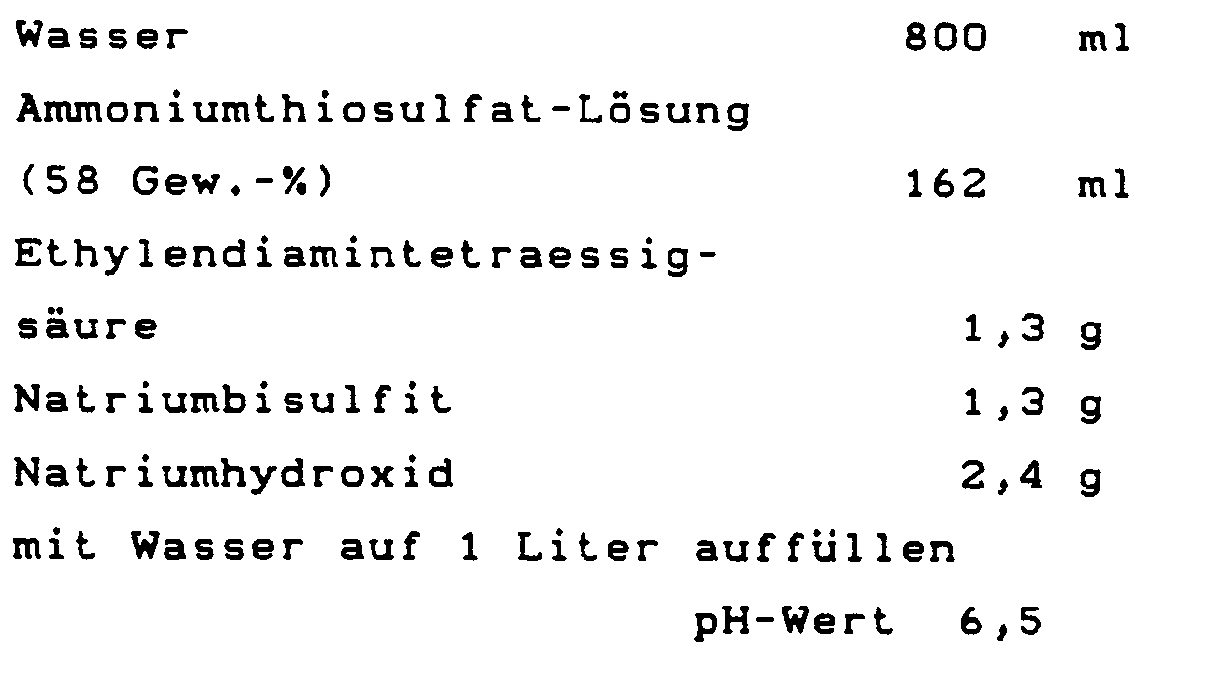
- Die Verarbeitungsbäder hatten die folgende Zusammensetzung:
-

-

- mit Ammoniak oder Essigsäure
auf pH 4,2 einstellen
mit Wasser auf 1 Liter auffüllen -
-

- Das Ergebnis bezüglich Restsilber ist der nachfolgenden Tabelle 2 zu entnehmen. Das erzeugte Farbbild war typgemäß.
- Die Belichtung und Verarbeitung erfolgten wie in Beispiel 4 beschrieben. Entwickler-, Fixier- und Schlußbad hatten die gleiche Zusammensetzung wie in Beispiel 4.
-

mit Ammoniak oder Essigsäure
pH-Wert auf 6,0 einstellen
mit Wasser auf 1 Liter auffüllen - Das Ergebnis der Restsilberbestimmung ist der nachfolgenden Tabelle 2 zu entnehmen.
- Die Belichtung und Verarbeitung erfolgten wie in Beispiel 4 beschrieben. Entwickler-, Fixier- und Schlußbad hatten die gleiche Zusammensetzung wie in Beispiel 4.
-
- Wasser
- 600 ml
- Ammonium-Eisen(III)-EDTA
- 99 g
- Essigsäure (80 Gew.-%) ca.
- 10 ml
- Ammoniumbromid
- 150 g
- Ammoniumnitrat
- 16 g
- Das Ergebnis bezüglich Restsilber ist der nachfolgenden Tabelle 2 zu entnehmen.

- Wie aus Tabelle 2 zu ersehen ist, entspricht die Bleichwirkung des erfindungsgemäßen Bleichbades D mit einem biologisch abbaubaren Komplexbildner der Bleichwirkung des üblichen Bleichbades F mit dem biologisch schwer abbaubaren Komplexbildner EDTA. Das Bleichbad E, das im wesentlichen wie Bleichbad D zusammengesetzt ist, aber einen für EDTA-Bleichbäder üblichen pH-Wert besitzt, bleicht dagegen nur ungenügend. Die durchgeführten Bleichversuche zeigten, daß das erfindungsgemäße Bleichbad D nicht zur Bildung von Leuco-Blaugrünfarbstoff führt, während bei einem üblichen Bleichbad mit EDTA bei entsprechendem pH-Wert deutliche Verluste an Blaugrünfarbstoff auftreten.
bedeuten und die Summe aus x und y stets 3 ist, und
Einstellung auf pH 7 mit Ammoniak oder Essigsäure Mit Wasser auf 1 Liter auffüllen.
mit Ammoniak oder Essigsäure
pH-Wert auf 6,0 einstellen
mit Wasser auf 1 Liter auffüllen
Claims (4)
- Bleichbad, das (1) einen Eisen (III)-komplex dessen Komplexbildner zu wenigstens 20 Mol-% der Formel I
 R₁ Wasserstoff oder Hydroxy,n 1 oder 2x 2 oder 3 undy 0 oder 1bedeuten und die Summe aus x und y stets 3 ist, und(2) einen Überschuß an freiem Komplexbildner von 1 bis 120 Mol-% bezogen auf den Eisenkomplex oder das Eisenkomplexsalz enthält, und(3) auf einen pH-Wert ≦ 4,5 eingestellt ist.
 - Bleichbad nach Anspruch 1, dessen Komplexbildner zu wenigstens 80 Mol-% der Formel I entspricht.
- Bleichbad nach Anspruch 1, wonach der Komplexbildner Nitrilotriessigsäure oder Nitrolomonopropiondiessigsäure ist.
- Bleichbad nach Anspruch 1 mit einem Überschuß an freiem Komplexbildner von 5 bis 20 Mol-%.
Applications Claiming Priority (2)
| Application Number | Priority Date | Filing Date | Title |
|---|---|---|---|
| DE3939755A DE3939755A1 (de) | 1989-12-01 | 1989-12-01 | Bleichbad |
| DE3939755 | 1989-12-01 |
Publications (2)
| Publication Number | Publication Date |
|---|---|
| EP0430000A1 EP0430000A1 (de) | 1991-06-05 |
| EP0430000B1 true EP0430000B1 (de) | 1994-09-21 |
Family
ID=6394588
Family Applications (1)
| Application Number | Title | Priority Date | Filing Date |
|---|---|---|---|
| EP90121996A Expired - Lifetime EP0430000B1 (de) | 1989-12-01 | 1990-11-17 | Bleichbad |
Country Status (3)
| Country | Link |
|---|---|
| EP (1) | EP0430000B1 (de) |
| JP (1) | JP3034018B2 (de) |
| DE (2) | DE3939755A1 (de) |
Families Citing this family (15)
| Publication number | Priority date | Publication date | Assignee | Title |
|---|---|---|---|---|
| DE69224867T2 (de) * | 1991-07-26 | 1998-09-17 | Konishiroku Photo Ind | Bleichlösung für farbfotografisches Verfahren |
| JP2896541B2 (ja) * | 1991-09-11 | 1999-05-31 | コニカ株式会社 | ハロゲン化銀写真感光材料用処理液 |
| DK0545464T3 (da) * | 1991-11-25 | 1999-06-23 | Eastman Kodak Co | Forbedrede udblegningsmiddelsammensætninger og fremgangsmåder til fotografisk forarbejdning |
| DE69215656T2 (de) * | 1991-12-27 | 1997-06-12 | Konishiroku Photo Ind | Verfahren zur Behandlung von farbphotografischen lichtempfindlichen Silberhalogenidmaterialien |
| JP3086979B2 (ja) * | 1992-02-17 | 2000-09-11 | コニカ株式会社 | 漂白液または漂白定着液およびこれら処理液を用いてのハロゲン化銀カラー写真感光材料の処理方法 |
| JP2886748B2 (ja) * | 1992-09-17 | 1999-04-26 | 富士写真フイルム株式会社 | 写真用処理組成物及び処理方法 |
| DE69310098T2 (de) * | 1992-10-15 | 1997-07-31 | Fuji Photo Film Co., Ltd., Minami-Ashigara, Kanagawa | Verarbeitungsverfahren für farbphotographisches Silberhalogenidmaterial |
| EP0595102B1 (de) * | 1992-10-29 | 1996-08-07 | Fuji Photo Film Co., Ltd. | Verarbeitungsverfahren für farbphotographisches Silberhalogenidmaterial |
| DE69426851T2 (de) * | 1993-09-28 | 2001-09-13 | Eastman Kodak Co., Rochester | Fotografische Entwicklungs-Lösung, die ternäre Ferri-Komplexsalze enthält |
| DE69424983T2 (de) | 1993-11-24 | 2000-10-19 | Fuji Photo Film Co., Ltd. | Photographische Verarbeitungszusammensetzung und Verarbeitungsverfahren |
| US5508150A (en) * | 1993-12-29 | 1996-04-16 | Eastman Kodak Company | Fixer additives used in combination with iron complex based bleaches to prevent iron retention |
| JPH0836252A (ja) * | 1994-07-22 | 1996-02-06 | Fuji Photo Film Co Ltd | ハロゲン化銀カラー写真感光材料の処理方法 |
| US5582958A (en) * | 1995-01-10 | 1996-12-10 | Eastman Kodak Company | Photographic bleaching composition and processing method using ternary iron carboxylate complexes as bleaching agents |
| US5521056A (en) * | 1995-01-10 | 1996-05-28 | Eastman Kodak Company | Photographic peracid bleaching composition and processing method using ternary iron carboxylate complexes as catalysts in peracid bleaching solutions |
| JPH09143132A (ja) | 1995-11-21 | 1997-06-03 | Fuji Photo Film Co Ltd | アミン類とα, β−不飽和化合物の付加生成物の製造方法 |
Family Cites Families (6)
| Publication number | Priority date | Publication date | Assignee | Title |
|---|---|---|---|---|
| DE866605C (de) * | 1944-11-27 | 1953-02-12 | Bayer Ag | Verfahren zur Herstellung photographischer Abschwaecher- und Bleichfixierbaeder |
| BE528764A (de) * | 1953-05-13 | |||
| GB991412A (en) * | 1961-05-03 | 1965-05-05 | Pavelle Ltd | Chemical compositions |
| GB1032024A (en) * | 1964-04-16 | 1966-06-08 | Ilford Ltd | Processing of colour photographic materials |
| EP0243866B1 (de) * | 1986-04-23 | 1994-03-09 | Konica Corporation | Verfahren zur Behandlung eines lichtempfindlichen farbphotographischen Halogenidmaterials |
| JP2622839B2 (ja) * | 1987-05-25 | 1997-06-25 | コニカ株式会社 | 漂白用パーツ組成物 |
-
1989
- 1989-12-01 DE DE3939755A patent/DE3939755A1/de not_active Withdrawn
-
1990
- 1990-11-17 EP EP90121996A patent/EP0430000B1/de not_active Expired - Lifetime
- 1990-11-17 DE DE59007242T patent/DE59007242D1/de not_active Expired - Fee Related
- 1990-11-26 JP JP2318142A patent/JP3034018B2/ja not_active Expired - Fee Related
Also Published As
| Publication number | Publication date |
|---|---|
| JP3034018B2 (ja) | 2000-04-17 |
| DE3939755A1 (de) | 1991-06-06 |
| JPH03186841A (ja) | 1991-08-14 |
| DE59007242D1 (de) | 1994-10-27 |
| EP0430000A1 (de) | 1991-06-05 |
Similar Documents
| Publication | Publication Date | Title |
|---|---|---|
| EP0173203B1 (de) | Verfahren zur Herstellung farbfotografischer Bilder | |
| DE69225936T2 (de) | Bleichfixier-Lösung für farbphotographisches, lichtempfindliches Silberhalogenidmaterial | |
| EP0430000A1 (de) | Bleichbad | |
| US5238791A (en) | Bleaching bath | |
| DE3850221T2 (de) | Photographische Elemente, die einen Bleich-Beschleuniger-Vorläufer enthalten. | |
| DE69325949T2 (de) | Verfahren zur Entwicklung eines photographischen Elementes mit einem Persäure-Bleichmittel | |
| EP0481251B1 (de) | Bleichfixierverfahren | |
| EP0045427B1 (de) | Lichtempfindliches fotografisches Aufzeichnungsmaterial und dessen Verwendung zur Herstellung fotografischer Bilder | |
| EP0526795B1 (de) | Verfahren zur Herstellung eines fotografischen Bildes | |
| DE69007286T2 (de) | Verfahren zum fotografischen verfahren. | |
| DE3516417C2 (de) | Verfahren zur Verarbeitung eines farbphotographischen Silberhalogenidmaterials | |
| DE3346621A1 (de) | Farbfotografisches aufzeichnungsmaterial und entwicklungsverfahren | |
| DE69421509T2 (de) | Zusätze zum Gebrauch in Kombination mit Eisenkomplexzusammensetzungen um Eisenabsetzungen zu verhindern | |
| DE69224867T2 (de) | Bleichlösung für farbfotografisches Verfahren | |
| DE3939756A1 (de) | Bleich- und bleichfixierbad | |
| EP0468325B1 (de) | Bleichbad | |
| DE69426851T2 (de) | Fotografische Entwicklungs-Lösung, die ternäre Ferri-Komplexsalze enthält | |
| DE2402899C2 (de) | Verfahren zum Unterdrücken der Schleierbildung in mehrschichtigen farbphotographischen Aufzeichnungsmaterialien bei der Farbentwicklung | |
| EP0370348A1 (de) | Fotografisches Umkehrverfahren | |
| EP0652476B1 (de) | Bleichmittel | |
| DE69308016T2 (de) | Photographisches verarbeitungsverfahren und verwendung photographischer produkte mit einer feinkorndeckschicht | |
| DE2735262A1 (de) | Verfahren zur erzeugung eines photographischen bildes | |
| EP0405237B1 (de) | Fotografisches Verarbeitungsverfahren | |
| EP0364845A2 (de) | Fotografisches Umkehrverfahren | |
| DE4029805A1 (de) | Bleichbad |
Legal Events
| Date | Code | Title | Description |
|---|---|---|---|
| PUAI | Public reference made under article 153(3) epc to a published international application that has entered the european phase |
Free format text: ORIGINAL CODE: 0009012 |
|
| 17P | Request for examination filed |
Effective date: 19901117 |
|
| AK | Designated contracting states |
Kind code of ref document: A1 Designated state(s): BE DE FR GB IT NL SE |
|
| 17Q | First examination report despatched |
Effective date: 19940311 |
|
| GRAA | (expected) grant |
Free format text: ORIGINAL CODE: 0009210 |
|
| AK | Designated contracting states |
Kind code of ref document: B1 Designated state(s): BE DE FR GB IT NL SE |
|
| REF | Corresponds to: |
Ref document number: 59007242 Country of ref document: DE Date of ref document: 19941027 |
|
| GBT | Gb: translation of ep patent filed (gb section 77(6)(a)/1977) |
Effective date: 19941101 |
|
| ITF | It: translation for a ep patent filed | ||
| ET | Fr: translation filed | ||
| EAL | Se: european patent in force in sweden |
Ref document number: 90121996.4 |
|
| PLBE | No opposition filed within time limit |
Free format text: ORIGINAL CODE: 0009261 |
|
| STAA | Information on the status of an ep patent application or granted ep patent |
Free format text: STATUS: NO OPPOSITION FILED WITHIN TIME LIMIT |
|
| 26N | No opposition filed | ||
| ITTA | It: last paid annual fee | ||
| PGFP | Annual fee paid to national office [announced via postgrant information from national office to epo] |
Ref country code: SE Payment date: 19991115 Year of fee payment: 10 |
|
| PGFP | Annual fee paid to national office [announced via postgrant information from national office to epo] |
Ref country code: NL Payment date: 19991125 Year of fee payment: 10 |
|
| REG | Reference to a national code |
Ref country code: GB Ref legal event code: 746 Effective date: 20000629 |
|
| REG | Reference to a national code |
Ref country code: FR Ref legal event code: D6 |
|
| PG25 | Lapsed in a contracting state [announced via postgrant information from national office to epo] |
Ref country code: SE Free format text: THE PATENT HAS BEEN ANNULLED BY A DECISION OF A NATIONAL AUTHORITY Effective date: 20001129 |
|
| PG25 | Lapsed in a contracting state [announced via postgrant information from national office to epo] |
Ref country code: NL Free format text: LAPSE BECAUSE OF NON-PAYMENT OF DUE FEES Effective date: 20010601 |
|
| EUG | Se: european patent has lapsed |
Ref document number: 90121996.4 |
|
| NLV4 | Nl: lapsed or anulled due to non-payment of the annual fee |
Effective date: 20010601 |
|
| PGFP | Annual fee paid to national office [announced via postgrant information from national office to epo] |
Ref country code: FR Payment date: 20011105 Year of fee payment: 12 |
|
| PGFP | Annual fee paid to national office [announced via postgrant information from national office to epo] |
Ref country code: GB Payment date: 20011108 Year of fee payment: 12 |
|
| REG | Reference to a national code |
Ref country code: GB Ref legal event code: IF02 |
|
| PG25 | Lapsed in a contracting state [announced via postgrant information from national office to epo] |
Ref country code: GB Free format text: LAPSE BECAUSE OF NON-PAYMENT OF DUE FEES Effective date: 20021117 |
|
| GBPC | Gb: european patent ceased through non-payment of renewal fee | ||
| PG25 | Lapsed in a contracting state [announced via postgrant information from national office to epo] |
Ref country code: FR Free format text: LAPSE BECAUSE OF NON-PAYMENT OF DUE FEES Effective date: 20030731 |
|
| REG | Reference to a national code |
Ref country code: FR Ref legal event code: ST |
|
| PGFP | Annual fee paid to national office [announced via postgrant information from national office to epo] |
Ref country code: DE Payment date: 20061124 Year of fee payment: 17 |
|
| PGFP | Annual fee paid to national office [announced via postgrant information from national office to epo] |
Ref country code: IT Payment date: 20061130 Year of fee payment: 17 |
|
| PGFP | Annual fee paid to national office [announced via postgrant information from national office to epo] |
Ref country code: BE Payment date: 20061214 Year of fee payment: 17 |
|
| BECA | Be: change of holder's address |
Owner name: *A&O IMAGING SOLUTIONS G.M.B.H.ROONSTRASSE 9-11, D Effective date: 20050201 |
|
| BECH | Be: change of holder |
Owner name: *A&O IMAGING SOLUTIONS G.M.B.H. Effective date: 20050201 |
|
| BERE | Be: lapsed |
Owner name: *A&O IMAGING SOLUTIONS G.M.B.H. Effective date: 20071130 |
|
| PG25 | Lapsed in a contracting state [announced via postgrant information from national office to epo] |
Ref country code: BE Free format text: LAPSE BECAUSE OF NON-PAYMENT OF DUE FEES Effective date: 20071130 |
|
| PG25 | Lapsed in a contracting state [announced via postgrant information from national office to epo] |
Ref country code: DE Free format text: LAPSE BECAUSE OF NON-PAYMENT OF DUE FEES Effective date: 20080603 |
|
| PG25 | Lapsed in a contracting state [announced via postgrant information from national office to epo] |
Ref country code: IT Free format text: LAPSE BECAUSE OF NON-PAYMENT OF DUE FEES Effective date: 20071117 |