EP0390992B1 - Zweischichtige Hohlfasermembran aus aromatischen Polyimiden und Verfahren zu deren Herstellung - Google Patents
Zweischichtige Hohlfasermembran aus aromatischen Polyimiden und Verfahren zu deren Herstellung Download PDFInfo
- Publication number
- EP0390992B1 EP0390992B1 EP89303456A EP89303456A EP0390992B1 EP 0390992 B1 EP0390992 B1 EP 0390992B1 EP 89303456 A EP89303456 A EP 89303456A EP 89303456 A EP89303456 A EP 89303456A EP 0390992 B1 EP0390992 B1 EP 0390992B1
- Authority
- EP
- European Patent Office
- Prior art keywords
- aromatic
- membrane
- hollow
- hollow filamentary
- filamentary
- Prior art date
- Legal status (The legal status is an assumption and is not a legal conclusion. Google has not performed a legal analysis and makes no representation as to the accuracy of the status listed.)
- Expired - Lifetime
Links
Images
Classifications
-
- B—PERFORMING OPERATIONS; TRANSPORTING
- B01—PHYSICAL OR CHEMICAL PROCESSES OR APPARATUS IN GENERAL
- B01D—SEPARATION
- B01D69/00—Semi-permeable membranes for separation processes or apparatus characterised by their form, structure or properties; Manufacturing processes specially adapted therefor
- B01D69/08—Hollow fibre membranes
-
- B—PERFORMING OPERATIONS; TRANSPORTING
- B01—PHYSICAL OR CHEMICAL PROCESSES OR APPARATUS IN GENERAL
- B01D—SEPARATION
- B01D71/00—Semi-permeable membranes for separation processes or apparatus characterised by the material; Manufacturing processes specially adapted therefor
- B01D71/06—Organic material
- B01D71/58—Other polymers having nitrogen in the main chain, with or without oxygen or carbon only
- B01D71/62—Polycondensates having nitrogen-containing heterocyclic rings in the main chain
- B01D71/64—Polyimides; Polyamide-imides; Polyester-imides; Polyamide acids or similar polyimide precursors
-
- D—TEXTILES; PAPER
- D01—NATURAL OR MAN-MADE THREADS OR FIBRES; SPINNING
- D01D—MECHANICAL METHODS OR APPARATUS IN THE MANUFACTURE OF ARTIFICIAL FILAMENTS, THREADS, FIBRES, BRISTLES OR RIBBONS
- D01D5/00—Formation of filaments, threads, or the like
- D01D5/24—Formation of filaments, threads, or the like with a hollow structure; Spinnerette packs therefor
Definitions
- the present invention relates to an aromatic polyimide double layered hollow filamentary membrane and a process for producing the same. More particularly, the present invention relates to an aromatic polyimide double layered hollow filamentary membrane having an excellent gas-permeating and separating property, heat resistance, chemical resistance, and pressure resistance and useful as a reverse osmosis membrane, ultrafiltration membrane, gas-separating membrance, for example, hydrogen-separating membrane, carbon dioxide-separating membrane or oxygen-concentrating membrane, pervaporation membrane, organic vapor-dehydration membrane, and dehumidification membrane, and a process for producing same at a high reproductivity and efficiency.
- the known separation membranes are usually composed of a separating resinous layer for separating a substance and a supporting layer for imparting a mechanical strength to the membrane.
- the known methods of producing the separating membranes can be classified into two groups:
- US-A-4,460,526 discloses a process for producing an asymmetric separating membranes from an aromatic imide polymer, and the resultant membranes exhibit a high heat resistance, chemical resistance, and gas-permeating property.
- the conventional hollow filamentary membranes having a satisfactory gas-permeating property are often unsatisfactory due to a poor pressure resistance thereof.
- a single spinning solution of a polyimide is used to simultaneously form both the dense separating layer and the porous supporting layer united with the separating layer. Accordingly, it is very difficult to provide a dense separating layer and a porous supporting layer, respectively, having the necessary satisfactory properties for effecting desired functions, from the one and the same polyimide spinning solution by the one and the same spinning procedure. Namely, the type and concentration of the polyimide in the dope solution and the spinning conditions are very restricted; e.g., sometimes the resultant hollow filamentary membrane exhibits unsatisfactory separating and permeating properties, or sometimes the spinning operation requires the expertise of a person specifically skilled in the art. Also, sometimes it is difficult to stably produce the hollow filamentary membrane at a satisfactory reproductivity.
- US-A-4,690,873 discloses a process for producing an asymmetric gas-separating membrane from an asymmetric biphenyltetracarboxylic acid type aromatic imide polymer.
- a dope solution is produced by dissolving a solvent-soluble aromatic imide polymer produced from an aromatic tetracarboxylic acid component comprising, as a principal ingredient, a biphenyltetracarboxylic acid and an aromatic diamine component comprising, as a principal ingredient, an aromatic diamine compound having a divalent radical of the formula -SO2-, in an organic solvent, and the resultant dope solution is subjected to a wet membrane-forming method in which a thin layer of the dope solution is solidified in a coagulating liquid, to form an asymmetric gas-separating membrane, which may be in the form of a hollow filament, consisting of a dense outer surface layer and a porous inner layer.
- the resultant aromatic polyimide gas-separating membrane exhibits an excellent heat resistance and chemical resistance, and
- the methods of forming the dense separating layer in a composite membrane are as follows:
- JP-A-49-62,380, JP-A-62-191,019 and JP-A-64-15,104 disclose multilayered hollow filamentary membranes and processes for producing same from polymeric materials, for example, cellulose acetate, and polyamide.
- the conventional multilayered hollow filamentary membranes have an unsatisfactory heat resistance, chemical resistance, and pressure resistance.
- the conventional aromatic polyimide gas-separating membrane does not always have a satisfactory pressure resistance and gas-permeability.
- An object of the present invention is to provide an aromatic polyimide double layered polyimide hollow filamentary membrane having not only an excellent heat and chemical resistance but also an enhanced pressure resistance and a satisfactory gas-permeability, and a process for producing same at a high reproductivity.
- aromatic polyimide double layered hollow filamentary membrane of the present invention which comprises;
- the above-mentioned aromatic polyimide double layered hollow filamentary membrane is produced by the process of the present invention, which comprises the steps of:
- the first aromatic imide polymer in the hollow filamentary microporous inner layer is a polymerization-imidization product of a tetracarboxylic acid component consisting essentially of 70 to 100 molar% of at least one member selected from biphenyltetracarboxylic acid compounds and 0 to 30 molar% of at least one member selected from an aromatic tetracarboxylic acid compounds other than those mentioned above, with a diamine component consisting essentially of 50 to 100 molar% of at least one aromatic diamine having two or more aromatic cyclic structures and 0 to 50 molar% of at least one aromatic diamine other than the above-mentioned diamine.
- a tetracarboxylic acid component consisting essentially of 70 to 100 molar% of at least one member selected from biphenyltetracarboxylic acid compounds and 0 to 30 molar% of at least one member selected from an aromatic tetracarboxylic acid compounds other than those mentioned above
- the second aromatic imide polymer in the tubular filamentary outer layer is a polymerization-imidization product of a tetracarboxylic acid component consisting essentially of 70 to 100 molar% of at least one member selected from biphenyltetracarboxylic acid compounds and 0 to 30 molar% of at least one member selected from aromatic tetracarboxylic acid compounds other than those mentioned above, with a diamine component consisting essentially of 50 to 98 molar% of at least one aromatic diamine having at least one divalent radical of the formula: -SO2-, 2 to 30 molar% of at least one aromatic diamine having at least one divalent radical of the formula: -C(CF3)2-, and 0 to 48 molar% of at least one aromatic diamine other than those mentioned above.
- a tetracarboxylic acid component consisting essentially of 70 to 100 molar% of at least one member selected from biphenyltetracarboxylic acid compounds and 0 to 30 m
- the aromatic polyimide double layered hollow filamentary membrane of the present invention comprises (A) a hollow filamentary microporous inner layer and (B) a tubular filamentary asymmetric outer layer consisting essentially of (a) a tubular filamentary microporous intermediate layer and (b) a thin filamentary dense outside surface layer.
- a central portion of the double layered hollow filamentary membrane is composed of the hollow filamentary microporous inner layer (A), and a tubular filamentary asymmetric outer layer (B) covers and is united with the inner layer (A).
- a tubular filamentary microporous intermediate layer (a) directly covers and is united with the inner layer (A) and a thin dense outside surface layer (b) covers and is united with the intermediate layer (a).
- the outside surface layer (b) has a dense structure, and preferably, has a thickness of from 0.01 to 1 ⁇ m.
- the intermediate layer (a) has a microporous structure, and preferably, has a thickness of 3 to 200 ⁇ m, more preferably 5 to 100 ⁇ m.
- the inner layer (A) has a microporous structure, and preferably, has a thickness of 10 to 500 ⁇ m, more preferably 20 to 300 ⁇ m.
- the thickness ratio of the outer layer (B) to the inner layer (A) is preferably from 1:0.5 to 1:100, more preferably from 1:1 to 1:80.
- the average density of the inner layer (A) is larger than that of the outer layer (B).
- the average porosity of the inner layer (A) is from 45 to 70% by volume, preferably from 50 to 65% by volume
- the average porosity of the outer layer (B) is from 55 to 75% by volume, preferably from 60 to 70% by volume, and is 2% to 10% higher than that of the inner layer (A).
- the hollow filamentary membrane of the present invention has an outside diameter of 50 to 2000 ⁇ m, preferably 100 to 1500 ⁇ m, more preferably 150 to 1000 ⁇ m, and an inside diameter (diameter of the filamentary hollow) of 30 to 1500 ⁇ m, preferably 50 to 800 ⁇ m.
- the aromatic imide polymers usable for forming the inner and outer layers of the hollow filamentary membrane of the present invention must be soluble in a particular organic solvent, the solution of the aromatic imide polymer in the organic solvent must be capable of forming a hollow filamentary membrane, and the hollow filamentary stream of the solution must be coagulatable by a coagulating liquid.
- the aromatic imide polymers usable for the present invention consist essentially of at least one polymerization-imidization product of a tetracarboxylic acid component with a diamine component.
- the tetracarboxylic acid component usable for the present invention comprises, 50 to 100 molar% of a principal ingredient consisting of at least one member selected from aromatic tetracarboxylic acids, and dianhydrides, esters and salts thereof and 0 to 50 molar% of an additional ingredient consisting of at least one member selected from the tetracarboxylic acids, dianhydrides, esters and salts thereof other than those in the principal ingredient.
- the diamine component usable for the present invention comprises 50 to 100 molar% of a principal ingredient consisting of at least one aromatic diamine and 0 to 50 molar% of an additional ingredient consisting of at least one member selected from diamines other than those in the principal ingredient; for example, aliphatic diamines and cycloaliphatic diamines.
- the aromatic imide polymer usable for the present invention preferably comprises at least 80% by weight of at least one solvent soluble wholly aromatic imide polymer, to provide a hollow filamentary membrane having an enhanced heat and chemical resistance.
- the aromatic tetracarboxylic acid compounds usable for the tetracarboxylic acid component are preferably selected from biphenyltetracarboxylic acids, for example, 3,3′,4,4′-biphenyltetracarboxylic acid and 2,3,3′,4′-biphenyltetracarboxylic acid, benzophenonetetracarboxylic acids, for example, 3,3′,4,4′-benzophenonetetracarboxylic acid, 2,3,3′,4′-benzophenonetetracarboxylic acid, and dianhydrides, esters and salts of the above-mentioned acids.
- biphenyltetracarboxylic acids for example, 3,3′,4,4′-biphenyltetracarboxylic acid and 2,3,3′,4′-biphenyltetracarboxylic acid
- benzophenonetetracarboxylic acids for example, 3,3′,4,4′
- the tetracarboxylic acid component for the present invention comprises 50 to 100 molar%, more preferably 60 to 100 molar% of at least one biphenyltetracarboxylic acid, to provide an aromatic imide polymer having a high solubility in organic solvents, for example, phenol compounds and capable of forming a solution thereof having a high stability in the organic solvents and a thin membrane-forming property to form a hollow filamentary membrane having an excellent heat and chemical resistance.
- organic solvents for example, phenol compounds and capable of forming a solution thereof having a high stability in the organic solvents and a thin membrane-forming property to form a hollow filamentary membrane having an excellent heat and chemical resistance.
- the other tetracarboxylic acid usable for the first and second aromatic imide polymers is selected from aliphatic tetracarboxylic acids, for example, butane tetracarboxylic acid and cycloaliphatic tetracarboxylic acids, for example, 1,2,4-tricarboxy-3-carboxymethyl cyclopentane dianhydride.
- aromatic diamine usable for the principal ingredient of the diamine component can be selected from the following groups:
- the aromatic diamine usable for the additional ingredient of the diamine component can be selected from, for example, o-, m- and p-phenylenediamines, 3,5-diaminobenzoic acid and 2,6-diaminopyridine.
- the first aromatic imide polymer in the inner layer is a polymerization-imidization product of a carboxylicacid component consisting essentially of 70 to 100 molar%, more preferably 80 to 100 molar%, most preferably, 90 to 100 molar%, of at least one member selected from biphenyltetracarboxylic acids and dianhydrides, esters and salts thereof and 0 to 30 molar% of at least one additional member selected from aromatic tetracarboxylic acids, and dianhydrides, esters and salts other than those mentioned above, with a diamine component consisting essentially of 50 to 100 molar%, more preferably, 60 to 100 molar%, still more preferably 70 to 100 molar%, of at least one aromatic diamine having two or more, preferably 2 to 5 aromatic cyclic structures, preferably benzene rings, and 0 to 50 molar%, more preperably 0 to 40 molar%, still more preferably 0 to 30 molar
- the second aromatic imide polymer in the outer layer is a polymerization-imidization product of a tetracarboxylic component consisting essentially of 70 to 100 molar%, more preferably 80 to 100 molar%, most preferably 90 to 100 molar%, of at least one member selected from biphenyltetracarboxylic acid and dianhydrides, esters and salts thereof and 0 to 30 molar% of at least one additional member selected from tetracarboxylic acids, and dianhydrides, esters and salts thereof different from that mentioned above, with a diamine component consisting essentially of 50 to 98 molar%, more preferably 60 to 98 molar%, most preferably 70 to 98 molar%, of at least one aromatic diamine having at least one divalent radical of the formula: -SO2-, 2 to 30 molar%, more preferably 3 to 25 molar%, most preferably 5 to 20 molar%, of at least one aromatic diamine having at
- the resultant polymer sometimes exhibits an unsatisfactory solubility in the organic solvents, and even if dissolved, the resultant solution is unstable and thus the polymer sometimes deposits from the solution and exhibits an unsatisfactory membrane-forming property.
- the resultant first aromatic imide polymer sometimes exhibits an unsatisfactory solubility in the organic solvent.
- the resultant outer layer sometimes causes the resultant hollow filamentary membrane to exhibit an unsatisfactory gas-permeability for hydrogen gas and carbon dioxide gas.
- the biphenyltetracarboxylic acid compound for the first and second aromatic imide polymers in the inner and outer layers is preferably selected from 3,3′,4,4′-biphenyltetracarboxylic acid and 2,3,3′,4′-biphenyltetracarboxylic acid, and dianhydrides, esters and salts of the above-mentioned acids.
- the additional aromatic tetracarboxylic acid compound usable for first and second aromatic imide polymers is preferably selected from pyromellitic acid, benzophenonetetracarboxylic acids, biphenylethertetracarboxylic acids, and dianhydrides, esters and salts of the above-mentioned acids.
- the aromatic diamine having two or more aromatic cyclic structures usable for the first aromatic imide polymer in the inner layer is preferably selected from diaminodiphenylethers, diaminodiphenylmethanes, 2,2-bis-(aminophenyl)propanes, 2,2-bis(aminophenoxyphenyl)-propanes, diaminobiphenyles, diaminodiphenylsulfones, bis(aminophenoxyphenyl)sulfones, diaminodiphenylenesulfones, diaminothioxanthenes and derivatives thereof, 2,2-bis(aminophenyl)hexafluoropropanes, and 2,2-bis-(aminophenoxyphenyl)hexafluoropropanes.
- the additional aromatic diamine usable for the first aromatic imide polymer is preferably selected from o, m and p-phenylenediamines, 3,5-diaminobenzoic acid, and 2,6-diaminopyridine.
- the aromatic diamine having at least one divalent radical of the formula: -SO2- and usable for the second aromatic imide polymer in the outer layer is preferably selected from diaminodiphenylsulfones, for example, 4,4′-diamino-diphenylsulfone, 4,4′-diamino-3,3′-dimethyl-diphenylsulfone, 3,3′-diamino-diphenylsulfone and 3,4′-diaminodiphenylsulfone; bis(aminophenoxyphenyl)sulfones, for example, bis[4-(4′-aminophenoxy)phenyl]sulfone and bis[4-(3′-aminophenoxy)phenyl]sulfone; diaminodiphenylenesulfones, for example, 3,7-diamino-2,8-dimethyl-diphenylenesulfone, 3,7-diamin
- the aromatic diamine having at least one divalent radical of the formula -C(CF3)2-, usable for the second aromatic imide polymer in the outer layer is preferably selected from those having at least one aromatic ring, for example, benzene ring, bonded to the divalent radical -C(CF3)2-, for example, 2,2-bis(aminophenyl)-hexafluoropropane, for example, 2,2-bis(4-aminophenyl)hexafluoropropane, 2,2-bis(3-aminophenyl)hexafluoropropane, 2,2-bis(4-amino-3-methylphenyl)hexafluoropropane, and 2,2-bis(3-amino-4-methylphenyl)hexafluoropropane; and 2,2-bis(aminophenoxyphenyl)hexafluoropropanes, for example, 2,2-bis[4-(4-aminophenoxy)-phenyl]hexafluor
- the additional diamine usable for the second aromatic imide polymer in the outer layer is preferably selected from diaminodiphenylethers, for example, 4,4′-diaminodiphenylether, 3,3′-dimethyl-4,4′-diaminodiphenylether, 3,3′-diethoxy-4,4′-diaminodiphenylether and 3,3' -diaminodiphenylether; diaminodiphenylmethanes, for example, 4,4′-diaminodiphenylmethane and 3,3′-diaminodiphenylmethane; 2,2-bis(aminophenyl)propanes, for example, 2,2-bis(3-aminophenyl)propane and 2,2-bis-(4-aminophenyl)propane; 2,2′ -bis(aminophenoxyphenyl)propanes, for example, 2,2-bis[4-(4′-aminophen
- the first aromatic imide polymer in the inner layer preferably has a logarithmic viscosity of from 0.07 to 7, more preferably, 0.2 to 5, measured at a concentration of 0.5 g/100 ml in a solvent consisting of 4 parts by volume of p-chlorophenol and 1 part by volume of o-chlorophenol at a temperature of 30°C.
- the second aromatic imide polymer in the outer layer preferably has a logarithmic viscosity of 0.1 to 7, more preferably, 0.2 to 5, measured under the same conditions as mentioned above.
- the hollow filamentary membrane of the present invention can be produced from two different spinning dope solutions which contain aromatic imide polymers soluble in an organic solvent and have at least a different concentration of the polymer, by using a double-layered hollow filament-spinning nozzle.
- the nozzle has an inner annular extruding opening and an outer annular extruding opening formed concentrically with and about the inner annular extruding opening.
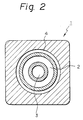
- a double layered hollow filament spinning nozzle 1 has a inner annular extruding opening 2, a center hollow 3 formed in the center portion of the inner annular opening 2 and an outer annular extruding opening 4.
- the center hollow 3 is used to blow a core gas consisting of air or nitrogen gas therethrough to control the diameter of the hollow to be formed in the inner layer.
- a first spinning dope solution of a first aromatic imide polymer in a concentration of 5 to 35% by weight, preferably 6 to 30% by weight, in an organic solvent is fed to an inner annular extruding opening of a hollow filament-spinning nozzle.
- a second spinning dope solution of a second aromatic imide polymer in a concentration of 1 to 25% by weight, preferably 1.2% to 23% by weight, more preferably 1.5% to 22% by weight, in an organic solvent is fed to an outer annular extruding opening in the spinning nozzle.
- the concentration of the first aromatic imide polymer in the first spinning dope solution must be 0.5% to 10% by weight, preferably 1% to 8% by weight, higher than the concentration of the second aromatic imide polymer in the second spinning dope solution.
- concentration features are important to ensure a proper control of the average densities or porosities of the inner layer and the outer layer to the specific values as mentioned hereinbefore.
- the first and second spinning dope solutions are respectively, concurrently extruded through the inner and outer annular extruding opening of the spinning nozzle, and the extruded first and second hollow filamentary streams of the first and second spinning dope solutions are drafted to allow the first and second hollow filamentary streams to be concentrically united with each other to form a double layered hollow filamentary stream.
- the double layered hollow filamentary stream is brought into contact with a coagulating liquid and converted to a solidified aromatic polyimide double layered hollow filamentary membrane.
- the first or second aromatic imide polymer is evenly dissolved in the above-mentioned specific concentration in a polar organic solvent which must be capable of dissolving the polymer and compatible with the coagulating liquid, and preferably has a melting point of 200°C or less, more preferably 150°C or less.
- the polar organic solvent usable for the process of present invention consists essentially of at least one member selected from halogenated phenol compounds, for example, 3-chlorophenol, 4-chlorophenol (or p-chlorophenol, PCP), 4-bromophenol, 2-chloro-5-hydroxytoluene; phenol compounds, for example, phenol, cresol and xylenol; amide type polar solvents, for example, N-methyl-2-pyrrolidone, N,N-dimethylformamide, N,N-dimethylacetamide and dimethylsulfoxide; and cyclic ether type solvents, for example, dioxane.
- halogenated phenol compounds for example, 3-chlorophenol, 4-chlorophenol (or p-chlorophenol, PCP), 4-bromophenol, 2-chloro-5-hydroxytoluene
- phenol compounds for example, phenol, cresol and xylenol
- amide type polar solvents for example
- the organic solvent in the first and second spinning dope solutions may be the same as that used for the polymerization of the first and second aromatic imide polymers.
- the organic solvent may contain a particular amount of at least one poor solvent, for example, benzene, xylene and toluene, for the aromatic imide polymers.
- the second spinning dope solution for forming the outer layer preferably has a rotation viscosity of about 0,1 to 2000 Pa ⁇ s (1 to 20,000 poises), more preferably 0,5 to 1000 Pa ⁇ s (5 to 10,000 poises), most preferably 1 to 800 Pa.s (10 to 8,000 poises) at the extruding temperature used, i.e., from about 20°C to 150°C.
- the first spinning dope solution for forming the inner layer preferably has a rotation viscosity of 1.01 to 10 times, more preferably, 1.05 to 5 times, that of the second spinning dope solution at a temperature of 100°C.
- the first and second spinning dope solutions are separately fed to the inner and outer annular extruding openings at a temperature of preferably about 20°C to 150°C, more preferably 30°C to 120°C, under a proper back pressure.
- the concurrently extruded hollow filamentary streams of the first and second spinning dope solution are drafted and concentrically united to form a double layered hollow filamentary stream.
- a ratio of the extruding rate of the second spinning dope solution to the first spinning dope solution is preferably from 1:60 to 1:1.5, preferably 1:40 to 1:2. This specific extruding rate ratio is effective for stabilizing the concurrent extruding procedures.
- the ratio in width of the outer annular extruding opening to the inner annular extruding opening is from 5:1 to 1:10, more preferably from 1:1 to 1:5.
- the resultant double layered hollow filamentary stream of the first and second aromatic imide polymers are coagulated at a temperature of preferably from -10°C to 60°C, more preferably from -5°C to 4°C, in a coagulating liquid.
- the coagulating liquid consists essentially of at least one liquid which is not capable of dissolving the first and second aromatic imide polymers and compatible with the polar organic solvent in which the first and second aromatic imide polymers are dissolved.
- the coagulating liquid preferably consists essentially of at least one member selected from water; lower aliphatic alcohols, for example, methyl alcohol, ethyl alcohol, n-propyl alcohol and isopropyl alcohol; and lower aliphatic ketones, for example, acetone, methylethyl ketone, diethyl ketone and ethylpropyl ketone.
- the coagulating liquid may contain, as an additional component, a small amount of at least one polar organic solvent capable of dissolving the aromatic imide polymers, to control the coagulating rate of the spinning dope solution stream.
- a coagulating liquid consists of 70 to 90% by volume of water and 10 to 30% by volume of N,N-dimethylformamide.
- the double layered hollow filamentary stream is introduced into the coagulating liquid, and then the surface-coagulated double layered hollow filamentary stream of the first and second aromatic imide polymers is led around a pair of guide roller located in the coagulating liquid two or more times and completely coagulated.
- the coagulated double layered hollow filamentary membrane is preferably taken up at a speed of about 2 to 80 m/min from the coagulating liquid.
- the coagulated double layered hollow filamentary membrane is then treated with an aliphatic hydrocarbon treating liquid comprising at least one member of, for example, isopentane, n-hexane, isooctane and n-heptane, to completely replace the residual coagulating liquid in the membrane by the hydrocarbon liquid.
- an aliphatic hydrocarbon treating liquid comprising at least one member of, for example, isopentane, n-hexane, isooctane and n-heptane
- the hydrocarbon liquid-containing hollow filamentary membrane is dried to evaporate away the hydrocarbon liquid.
- the resultant hollow filamentary membrane is preferably heat-treated at a temperature lower than the softening temperatures or second order transition points of the first and second aromatic imide polymers.
- the obtained spinning dope solution A had a concentration of the resultant aromatic imide polymer of 15% by weight and exhibited a rotation viscosities of 101 Pa ⁇ s (1010 poises) at a temperature of 100°C and of 355 Pa ⁇ s (3550 poises) at a temperature of 70°C.
- the obtained spinning dope solution B had a concentration of the resultant aromatic imide polymer of 18% by weight, and exhibited a rotation viscosity of 130 Pa ⁇ s (1300 poises) at 100°C and of 500 Pa ⁇ s (5000 poises) at 70°C.
- reaction admixture consisted of 99 m moles of 3,3′,4,4′-biphenyltetracarboxylic dianhydride, 90 m moles of diaminodimethyldiphenylenesulfone, 10 m moles of 4,4′ diaminodiphenylether, and 293 g of p-chlorophenol.
- the obtained spinning dope solution C had a concentration of the resultant aromatic imide polymers of 15% by weight and exhibited rotation viscosities of 95 Pa ⁇ s (950 poises) at 100°C and of 280 Pa ⁇ s (2800 poises) at 70°C.
- the obtained spinning dope solution D had a concentration of the resultant aromatic imide polymer of 20% by weight and exhibited rotation viscosities of 124 Pa ⁇ s (1240 poises) at 100°C and 480 Pa ⁇ s (4800 poises) at 70°C.
- the obtained spinning dope solution E had a concentration of the resultant aromatic imide polymer of 20% by weight and exhibited rotation viscosities of 105 Pa ⁇ s (1050 poises) at 100°C and 450 Pa ⁇ s (4500 poises) at 70°C.
- the obtained spinning dope solution F had a concentration of the aromatic imide polymer of 10% by weight and exhibited solution viscosities of 90 Pa ⁇ s (900 poises) at 100°C and 230 Pa ⁇ s (2300 poises) at 70°C.
- All the spinning dope solutions A to F were filtered through a stainless steel filtering screen having a sieve opening of 0,037 mm (400 mesh), before use.
- the spinning dope solutions as indicated in Table 1 were extruded through the outer and inner openings, the resultant hollow-filamentary stream was fed through a nitrogen atmosphere, and then coagulated in a coagulating bath consisting of 65 parts by weight of ethyl alcohol and 35 parts by weight of water at a temperature of 0°C by feeding the stream around a pair of guide rollers, and the resultant coagulated hollow filamentary membrane was taken up from the coagulating both at a speed of 15 m/min.
- the resultant hollow filamentary membrane was wound up on a bobbin and washed with ethyl alcohol to completely remove the coagulating liquid from the membrane, the ethyl alcohol in the membrane was replaced by n-hexane, and the membrane was then dried by evaporating n-hexane at a temperature of 50°C, and finally, heat treated at the temperature indicated in Table 1 for 30 minutes.
- the resultant dried, heat-treated double layered hollow filamentary membrane had an outside diameter of about 400 ⁇ m and a inside diameter of about 250 ⁇ m.
- An element for measuring the gas-permeability of the hollow filamentary membrane and an element for measuring the pressure resistance thereof were prepared from stainless steel pipes, the membrane, and an adhesive agent.
- the gas-permeability was measured by fixing the gas-permeability measurement element in a stainless steel container, a mixture of 52 parts by volume of hydrogen gas and 48 parts by volume of methane gas was caused to flow through the container under a pressure of 10 kg/cm2 and a temperature of 50°C.
- the permeabilities of the hydrogen and methane gases (PH2 and PCH4) and a ratio (PH2/PCH4) in permeability of hydrogen gas to methane gas were calculated from the results of gas-chromatography analysis.
- the ratio PH2/PCH4 corresponds to the gas-separating property of the membrane.
- the pressure resistance was measured by fixing the pressure resistance-measurement element in a stainless steel container in such a manner that both the hollow ends of the hollow filamentary membrane in the measurement element were open, causing nitrogen gas to flow through the hollow of the hollow filamentary membrane, introducing a fluid paraffin under pressure into a space between the inside wall of the container and the outer surface of the hollow filamentary membrane, and continuously measuring the flow rate of the nitrogen gas.
- the maximum pressure resistance of the hollow filamentary membrane was calculated from the relationship between the fluid paraffin-introducing pressure and the change in the flow rate of nitrogen gas through the hollow filamentary membrane.
- a single layer hollow filament-spinning nozzle had the following dimensions. Outside diameter of single annular opening: 1200 ⁇ m Width of annular opening: 300 ⁇ m Diameter of central hollow: 400 ⁇ m
- the spinning dope solution of the type indicated in Table 1 was extruded through the single layer hollow filament-spinning nozzle and coagulated and treated in the same manner as in Example 1, and a single layer hollow filamentary membrane was obtained.
- the hollow filamentary membrane of Comparative Example 3 had a cross-sectional profile which was out of round.
- Example 6 The same procedures as in Example 6 were carried out except that the spinning dope solution E was extruded through the outer annular opening and the spinning dope solution F was extruded through the inner annular opening.
- the cross-sectional profile of the resultant hollow filament membrane was out of round.
- Comparative Example 1 the resultant single layer hollow filamentary membrane exhibited a high permeability ratio (PH2/PCH4) but exhibited a poor pressure resistance, whereas the double layered hollow filamentary membrane of Example 1 exhibited not only a high permeability ratio (PH2/PCH4) but also an excellent pressure resistance.
- the inner layer had an average porosity of 61% and the outer layer had an average porosity of 67%.
- Example 2 the resultant hollow filamentary membrane consisting of two different types of aromatic imide polymers exhibited a high permeability ratio PH2/PCH4 and an excellent pressure resistance.
- Example 6 In view of Example 6 and Comparative Example 4, it is clear that the spinning dope solution for forming the inner layer must have a higher polymer concentration than that for the outer layer.
- Example 4 the resultant membrane exhibited the hydrogen gas permeabilities and ratios (PH2/PCH4) (H2-CH4 separating property) at temperatures of 80°C, 120°C, and 150°C as shown in Table 2.
- Table 2 Temperature (°C) Hydrogen gas-permeability (cm3/cm2 ⁇ sec ⁇ cmHg) Gas-permeability ratio (PH2/PCH4 80 32 x 10 ⁇ 5 76 120 49 x 10 ⁇ 5 48 150 64 x 10 ⁇ 5 36
- the composite membrane of Example 4 exhibited a helium gas permeability of 25.1 x 10 ⁇ 5 cm3/cm2 ⁇ sec ⁇ cmHg at a temperature of 80°C and at a pressure of 150 kg/cm2.
- Tables 1 and 2 clearly show that the double layered hollow-filamentary membranes of the present invention exhibit a satisfactory pressure resistance of 100 kg/cm2 or more, particularly 150 kg/cm2 or more due to the presence of the inner porous layer and a satisfactory gas permeability and gas separating property because the outer layer had a dense outside surface layer and a porous intermediate layer.
- the inner hollow filamentary stream of the first aromatic imide polymer can be concentrically, firmly united to the outer hollow filamentary stream of the second aromatic imide polymer due to the Barus effect of the extruded polymer solution streams and the diffusion effect of the organic solvent in the streams during the extruding and drafting procedures to form a united hollow filamentary membrane.
- a reaction admixture of 99 m moles of 3,3′,4,4′-biphenyltetracarboxylic dianhydride and 100 m moles of 3,7-diamino-dimethyl diphenylene-sulfone with 302 g of p-chlorophenol was charged in a separable flask with a stirrer and a nitrogen gas-introduction conduit and subjected to polymerization-imidization at a temperature of 180°C for 16 hours while introducing nitrogen gas into the flask and stirring the reaction admixture.
- the resultant spinning dope solution G had a concentration of the resultant aromatic imide polymer of 15% by weight and rotation viscosities of 100,4 Pa ⁇ s (1004 poises) at 100°C and 143,2 Pa ⁇ s (1432 poises) at 90°C.
- the resultant aromatic imide polymer exhibited a logarithmic viscosity of 1.1 measured at a concentration of 0.5 g/100 ml in a solvent consisting of 4 parts by volume of p-chlorophenol and 1 part by volume of o-chlorophenol at a temperature of 30°C.
- each of the spinning dope solutions H to N the same procedures as those for the solution G were carried out except that the carboxylic acid component and the diamine component consisted of the types and amounts of the compounds indicated in Table 3 and the resultant solutions had the polymer concentration and the rotation viscosity at 100°C as indicated in Table 3. Also, the resultant aromatic imide polymers in the spinning dope solutions H to M had a logarithmic viscosity of 1.1 measured in the same manner as mentioned above.
- the resultant aromatic imide polymer in the spinning dope solution N had a logarithmic viscosity of 1.0 measured in the same manner mentioned above.
- Table 3 Type of spinning dope solution Polymerization component Concentration of polymer in solution (% by wt.) Rotation viscosity of solution at 100°C Pa ⁇ s (poise) Tetracarboxylic dianhydride Diamine Type Amount (m mole) Type Amount (m mole) H s-BPDA 99 TSN 90 15 119 (1190) DADE 10 J s-BPDA 99 TSN 95 15 122,8 (1228) HFIP 5 K s-BPDA 99 TSN 90 15 104,2 (1042) HFIP 10 L s-BPDA 99 TSN 90 15 109,7 (1097) HFIP 10 M s-BPDA 99 TSN 80 15 91,1 (911) HFPP 20 N s-BADA 98 TSN 70 17 230,6 (2306) DABA 30 Note: s-BPDA: 3,3
- Two spinning dope solutions of the types indicated in Table 3 were concurrently extruded through the spinning nozzle.
- the extruded two layered hollow filamentary stream of the solutions was introduced through a nitrogen gas atmosphere into a coagulating bath consisting of a mixture of 65 parts by weight of ethyl alcohol and 35 parts by weight of water at a temperature of 0°C and fed around a pair of guide rollers, and then the completely coagulated hollow filamentary membrane was taken up from the coagulating bath at a speed of 15 m/min.
- the coagulated hollow filamentary membrane was wound up on a bobbin, washed with ethyl alcohol to remove the coagulating liquid from the membrane, treated with n-hexane to replace the ethyl alcohol in the membrane thereby, dried by evaporating n-hexane from the membrane, and finally heat-treated at a temperature of 300°C for 30 minutes.
- the resultant double layered hollow filamentary membrane had the dimensions as shown in Table 4 and gas-permeating and separating properties as indicated in Table 4.
- the gas-permeating and separating properties were measured in the same manner as mentioned above. The measurement results are shown in Table 4.
- the average porosity of the inner layer was about 58% and the average porosity of the outer layer was 65%.
- Example 8 the resultant hollow filamentary membrane exhibited a maximum pressure resistance of 130 kg/cm2 calculated in the afore-mentioned manner.
- Example 8 exhibited the hydrogen gas permeabilities and ratios (PH2/PCH4) (H2-CH4 separating property) measured in the afore-mentioned manner at temperature of 80°C, 120°C, and 150°C as indicated in Table 5.
- Table 5 Temperature (°C) Hydrogen gas-permeability (cm3/cm2 ⁇ sec ⁇ cmHg) Gas-permeability ratio (PH2/PCH4) 80 58 x 10 ⁇ 5 63 120 90 x 10 ⁇ 5 41 150 120 x 10 ⁇ 5 30
- Tables 4 and 5 clearly indicate that the double layered hollow filamentary composite membranes of the present invention exhibit not only a satisfactory gas (H2 , CO2 , O2)-permeability and gas-separating property, due to the outer layer but also an excellent pressure resistance due to the inner layer, and are useful as gas-separating membranes.
- the resultant single layer hollow filamentary membrane had an outside diameter of 405 ⁇ m and a thickness of the membrane of 75 ⁇ m, and exhibited a poor maximum pressure resistance of 80 kg/cm2.
Landscapes
- Chemical & Material Sciences (AREA)
- Chemical Kinetics & Catalysis (AREA)
- Engineering & Computer Science (AREA)
- Mechanical Engineering (AREA)
- Textile Engineering (AREA)
- Separation Using Semi-Permeable Membranes (AREA)
- Artificial Filaments (AREA)
- Multicomponent Fibers (AREA)
Claims (23)
- Eine zweischichtige Hohlfasermembran aus aromatischen Polyimiden, enthaltend:(A) eine mikroporöse Hohlfaser-Innenschicht, die im wesentlichen aus einem ersten aromatischen Imidpolymer besteht und einen Filamenthohlraum aufweist, der entlang der Längsachse derselben gebildet ist; und(B) eine asymmetrische Rohrfaser-Außenschicht, die im wesentlichen aus einem zweiten aromatischen Imidpolymer besteht und (a) eine mikroporöse Rohrfaser-Zwischenschicht, die die Außenseite der mikroporösen Hohlfaser-Innenschicht überdeckt und damit verbunden ist, und (b) eine dünne, dichte, äußere Oberflächenschicht hat, die die mikroporöse Rohrfaser-Zwischenschicht überdeckt und damit verbunden ist, wobei die ersten und zweiten aromatischen Imidpolymere sowohl der Innenschicht als auch der Außenschicht in organischen Lösungsmitteln löslich sind.
- Die Hohlfasermembran gemäß Anspruch 1, bei der die äußere Oberflächenschicht eine dicke von 0,01 bis 1 µm hat.
- Die Hohlfasermembran nach Anspruch 1, bei der die Zwischenschicht eine Dicke von 2 bis 200 µm hat.
- Die Hohlfasermembran nach Anspruch 1, bei der die Innenschicht eine Dicke von 10 bis 500 µm hat.
- Die Hohlfasermembran nach Anspruch 1, bei der ein Dickenverhältnis der Außenschicht zur Innenschicht zwischen 1 : 0,5 bis 1 : 100 vorliegt.
- Die Hohlfasermembran nach Anspruch 1, welche einen Außendurchmesser von 50 bis 2000 µm und einen Innendurchmesser von 30 bis 150 µm hat.
- Die Hohlfasermembran nach Anspruch 1, bei der das erste aromatische Imidpolymer der Innenschicht ein Polymerisations-Imidisationsprodukt einer Tetracarbonsäurekomponente, die im wesentlichen aus 70 bis 100 Mol-% mindestens eines Mitgliedes, welches ausgewählt ist aus Biphenyltetracarbonsäuren, und Dianhydriden, Estern und Salzen derselben, und 0 bis 30 Mol-% mindestens eines Mitglieds besteht, das ausgewählt ist aus aromatischen Tetracarbonsäuren, und Dianhydriden, Estern und Salzen, die sich von den oben erwähnten unterscheiden, mit einer Diaminkomponente ist, die im wesentlichen aus 50 bis 100 Mol-% mindestens eines aromatischen Diamins, welches zwei oder mehrere aromatische, zyklische Strukturen hat, und 0 bis 50 Mol-% mindestens eines anderen aromatischen Diamins als dem oben erwähnten Diamins besteht.
- Die Hohlfasermembran nach Anspruch 1, bei der das zweite aromatische Imidpolymer in der Außenschicht ein Polymerisations-Imedisationsprodukt einer Tetracarbonsäurekomponente, die im wesentlichen aus 70 bis 100 Mol-% mindestens eines Mitgliedes, welches ausgewählt ist aus Biphenyltetracarbonsäure und Dianhydriden, Estern und Salzen derselben, und 0 bis 30 Mol-% mindestens eines Mitgliedes besteht, das ausgewählt ist aus aromatischen Tetracarbonsäuren und Dianhydriden, Estern und Salzen, welche sich von den oben erwähnten unterscheiden, mit einer Diaminkomponente ist, die im wesentlichen aus 50 bis 98 Mol-% mindestens eines aromatischen Diamins besteht, das mindestens ein bivalentes Radikal der Formel: -SO₂-, 2 bis 30 Mol% mindestens eines aromatischen Diamins, das mindestens ein bivalentes Radikal der Formel: -C(CF₃)₂-, und 0 bis 48 Mol% mindestens eines aromatischen Diamins besteht, welches sich von den obengenannten unterscheidet.
- Die Hohlfasermembran nach Anspruch 7 oder 8, bei der die Biphenyltetracarbonsäure ausgewählt ist aus 3,3', 4,4'-Biphenyltetracarbonsäure und 2,3,3',4',-Biphenyltetracarbonsäure.
- Die Hohlfasermembran nach Anspruch 7, bei der das aromatische Diamin mit zwei oder mehreren aromatischen, zyklischen Strukturen ausgewählt ist aus der Gruppe, bestehend aus Diaminodiphenylethern, Diaminodiphenylmethanen, 2,2-Bis (aminophenyl)propanen, Diaminodiphenylen, Diaminodiphenylsulfonen, Bis(aminophenoxyphenyl)sulfonen, Diaminodiphenylensulfonen, Diaminothioxanthenen, 2,2-Bis(aminophenyl) hexafluoropropanen und 2,2-Bis(aminophenoxyphenyl)hexafluoropropanen.
- Die Hohlfasermembran nach Anspruch 8, bei der das aromatische Diamin, welches mindestens ein bivalentes Radikal der Formel: -SO₂- aufweist, ausgewählt ist aus der Gruppe, bestehend aus Diaminodiphenylsulfonen, Bis(aminophenoxyphenyl)sulfonen, Diaminodiphenylensulfonen und Diaminothioxanthenen.
- Die Hohlfasermembran nach Anspruch 8, bei der das aromatische Diamin, welches mindestens ein bivalentes Radikal der Formel: -C(CF₃)₂-aufweist, ausgewählt ist aus der Gruppe bestehend aus 2,2-Bis(aminophenyl)hexafluoropropanverbindungen und 2,2-Bis(aminophenoxyphenyl)hexafluoropropanverbindungen.
- Die Hohlfasermembran nach Anspruch 1, bei der die mikroporöse Hohlfaser-Innenschicht eine mittlere Porösität von 45 bis 70 Vol.-%, und die asymmetrische Rohrfaser-Außenschicht eine mittlere Porösität von 55 bis 75 Vol.-% und 2 bis 10 Vol.-% mehr als diejenige der Innenschicht hat.
- Ein Verfahren zur Herstellung einer zweischichtigen Hohlfasermembran aus aromatischen Polyimiden gemäß einem der Ansprüche 1 bis 13, umfassend die Schritte:(1) Zuleiten einer ersten Spinnflüssigkeitslösung eines ersten aromatischen Imidpolymers in einer Konzentration von 5 bis 35 Gew.-% in einem organischen Lösungsmittel zu einer inneren, ringförmigen Extrudieröffnung einer Hohlfaser-Spinndüse;(2) Zuleiten einer zweiten Spinnflüssigkeitslösung eines zweiten aromatischen Imidpolymers in einer Konzentration von 1 bis 25 Gew.-% in einem organischen Lösungsmittel zu einer äußeren, ringförmigen Extrudieröffnung, die um die und konzentrisch zu der inneren, ringförmigen Extrudieröffnung angeordnet ist, wobei die Konzentration des ersten aromatischen Imidpolymers in der ersten Spinnflüssigkeitslösung 0,5 bis 10 Gew.-% über der Konzentration des zweiten aromatischen Imidpolymers in der zweiten Spinnflüssigkeitslösung liegt;(3) gleichzeitiges Extrudieren der ersten und zweiten Spinnflüssigkeitslösungen durch die inneren bzw. äußeren, ringförmigen Extrudieröffnungen, wobei gleichzeitig die extrudierten ersten und zweiten Hohlfaserströme der ersten und zweiten Spinnflüssigkeitslösungen verstreckt werden, um die ersten und zweiten Hohlfaserströme konzentrisch miteinander zu einer zweischichtigen Hohlfaserströmung zu verbinden; und(4) Inkontaktbringen der zweischichtigen Hohlfaserströmung mit einer Koagulierflüssigkeit, um die zweischichtige Strömung zu verfestigen und eine zweischichtige Hohlfasermembran aus aromatischen Polyimiden zu bilden.
- Das Verfahren nach Anspruch 14, bei dem die Zuleitstufen (1) und (2) und die Extrudierstufe (3) bei einer Temperatur der ersten und zweiten Spinnflüssigkeitslösungen von 20 °C bis 150 °C durchgeführt werden.
- Das Verfahren nach Anspruch 14, bei dem die zweite Spinnflüssigkeitslösung bei der Extrudiertemperatur eine Rotationsviscosität von etwa 0,1 bis 200 Pa · s (1 bis 20000 Poise) hat.
- Das Verfahren nach Anspruch 14, bei dem die erste Spinnflüssigkeitslösung eine Rotationsviscosität hat, die bei einer Temperatur von 100 °C das 1,01- bis 10-fache derjenigen der zweiten Spinnflüssigkeitslösung ist.
- Das Verfahren nach Anspruch 14, bei dem ein Verhältnis der Extrudiergeschwindigkeit der zweiten Spinnflüssigkeitslösung zur ersten Spinnflüssigkeitslösung bei 1 : 60 bis 1 : 1,5 liegt.
- Das Verfahren nach Anspruch 14, bei dem ein Verhältnis der Weite der äußeren, ringförmigen Extrudieröffnung zu der inneren, ringförmigen Extrudieröffnung im Bereich von 5 : 1 bis 1 : 10 liegt.
- Das Verfahren nach Anspruch 14, bei dem die organischen Lösungsmittel in den ersten und zweiten Spinnflüssigkeitslösungen im wesentlichen aus mindestens einem Mitglied bestehen, welches ausgewählt ist aus der Gruppe bestehend aus Phenolverbindungen, Catecholverbindungen, halogenierten Phenolverbindungen, N-Methyl-2-pyrrolidon, N,N-Dimethylformamid, N,N-Dimethylacetamid, N,N-Diethylformamid, N,N-Diethylacetamid und Dimethylsulfoxid.
- Das Verfahren nach Anspruch 14, bei dem die Koagulierflüssigkeit mindestens ein Mitglied aufweist, welches ausgewählt ist aus der Gruppe bestehend aus Wasser, niederen aliphatischen Alkoholen und niederen aliphatischen Ketonen.
- Das Verfahren nach Anspruch 14, bei dem die Koagulierflüssigkeit eine Temperatur von - 10 °C bis 60 °C hat.
- Das Verfahren nach Anspruch 14, bei dem die resultierende zweischichtige Hohlfasermembran aus aromatischen Polyimiden mit einer Geschwindigkeit von etwa 2 bis 80 m/min abgezogen wird.
Priority Applications (4)
| Application Number | Priority Date | Filing Date | Title |
|---|---|---|---|
| JP62253785A JPH0673616B2 (ja) | 1987-10-09 | 1987-10-09 | ポリイミド二層中空糸膜の製造法 |
| US07/333,950 US5141642A (en) | 1987-10-09 | 1989-04-06 | Aromatic polyimide double layered hollow filamentary membrane and process for producing same |
| EP89303456A EP0390992B1 (de) | 1987-10-09 | 1989-04-07 | Zweischichtige Hohlfasermembran aus aromatischen Polyimiden und Verfahren zu deren Herstellung |
| DE68915742T DE68915742T2 (de) | 1987-10-09 | 1989-04-07 | Zweischichtige Hohlfasermembran aus aromatischen Polyimiden und Verfahren zu deren Herstellung. |
Applications Claiming Priority (2)
| Application Number | Priority Date | Filing Date | Title |
|---|---|---|---|
| JP62253785A JPH0673616B2 (ja) | 1987-10-09 | 1987-10-09 | ポリイミド二層中空糸膜の製造法 |
| EP89303456A EP0390992B1 (de) | 1987-10-09 | 1989-04-07 | Zweischichtige Hohlfasermembran aus aromatischen Polyimiden und Verfahren zu deren Herstellung |
Publications (2)
| Publication Number | Publication Date |
|---|---|
| EP0390992A1 EP0390992A1 (de) | 1990-10-10 |
| EP0390992B1 true EP0390992B1 (de) | 1994-06-01 |
Family
ID=39739970
Family Applications (1)
| Application Number | Title | Priority Date | Filing Date |
|---|---|---|---|
| EP89303456A Expired - Lifetime EP0390992B1 (de) | 1987-10-09 | 1989-04-07 | Zweischichtige Hohlfasermembran aus aromatischen Polyimiden und Verfahren zu deren Herstellung |
Country Status (4)
| Country | Link |
|---|---|
| US (1) | US5141642A (de) |
| EP (1) | EP0390992B1 (de) |
| JP (1) | JPH0673616B2 (de) |
| DE (1) | DE68915742T2 (de) |
Cited By (1)
| Publication number | Priority date | Publication date | Assignee | Title |
|---|---|---|---|---|
| US11471823B2 (en) | 2019-02-12 | 2022-10-18 | Haffmans B.V. | System and method for separating a gas mixture |
Families Citing this family (40)
| Publication number | Priority date | Publication date | Assignee | Title |
|---|---|---|---|---|
| US5085676A (en) * | 1990-12-04 | 1992-02-04 | E. I. Du Pont De Nemours And Company | Novel multicomponent fluid separation membranes |
| US5290497A (en) * | 1991-11-08 | 1994-03-01 | Chisso Corporation | Process for producing molded articles of polyimide precursor |
| US5472607A (en) * | 1993-12-20 | 1995-12-05 | Zenon Environmental Inc. | Hollow fiber semipermeable membrane of tubular braid |
| US5514413A (en) * | 1994-03-31 | 1996-05-07 | Air Products And Chemicals, Inc. | Process for producing composite membranes |
| US5468430A (en) * | 1994-05-19 | 1995-11-21 | L'air Liquide S.A. | Process of making multicomponent or asymmetric gas separation membranes |
| CA2149806A1 (en) * | 1994-05-20 | 1995-11-21 | William John Koros | Polymeric membrane |
| JPH1085571A (ja) * | 1996-07-26 | 1998-04-07 | Dainippon Ink & Chem Inc | 分離膜 |
| US6354444B1 (en) * | 1997-07-01 | 2002-03-12 | Zenon Environmental Inc. | Hollow fiber membrane and braided tubular support therefor |
| US6395066B1 (en) | 1999-03-05 | 2002-05-28 | Ube Industries, Ltd. | Partially carbonized asymmetric hollow fiber separation membrane, process for its production, and gas separation method |
| US6672164B1 (en) * | 1999-06-16 | 2004-01-06 | Teijin Twaron B.V. | Process for determining the polymer concentration in a spinning dope solution |
| US6579341B2 (en) | 2000-05-19 | 2003-06-17 | Membrane Technology And Research, Inc. | Nitrogen gas separation using organic-vapor-resistant membranes |
| US6572679B2 (en) | 2000-05-19 | 2003-06-03 | Membrane Technology And Research, Inc. | Gas separation using organic-vapor-resistant membranes in conjunction with organic-vapor-selective membranes |
| US6361583B1 (en) | 2000-05-19 | 2002-03-26 | Membrane Technology And Research, Inc. | Gas separation using organic-vapor-resistant membranes |
| US6592650B2 (en) | 2000-05-19 | 2003-07-15 | Membrane Technology And Research, Inc. | Gas separation using organic-vapor-resistant membranes and PSA |
| US6544316B2 (en) | 2000-05-19 | 2003-04-08 | Membrane Technology And Research, Inc. | Hydrogen gas separation using organic-vapor-resistant membranes |
| US6572680B2 (en) | 2000-05-19 | 2003-06-03 | Membrane Technology And Research, Inc. | Carbon dioxide gas separation using organic-vapor-resistant membranes |
| US6361582B1 (en) | 2000-05-19 | 2002-03-26 | Membrane Technology And Research, Inc. | Gas separation using C3+ hydrocarbon-resistant membranes |
| EP1197699A3 (de) * | 2000-09-20 | 2003-05-21 | Tokai Rubber Industries, Ltd. | Kraftstoffschlauch für Wasserstoff |
| DE10054591A1 (de) * | 2000-11-03 | 2002-06-06 | Geesthacht Gkss Forschung | Vorrichtung zur Herstellung einer Polymermembran |
| KR100485620B1 (ko) * | 2002-01-15 | 2005-04-27 | 주식회사 파라 | 보강용 지지체를 가진 중공사막, 그 제조방법 및 이를제조하기 위한 방사구금 |
| DE10211051A1 (de) * | 2002-03-13 | 2003-10-02 | Fresenius Medical Care De Gmbh | Kapillarmembran und Vorrichtung zur Herstellung derselben |
| US6896717B2 (en) * | 2002-07-05 | 2005-05-24 | Membrane Technology And Research, Inc. | Gas separation using coated membranes |
| US6663805B1 (en) * | 2002-09-20 | 2003-12-16 | L'air Liquide Societe Anonyme A Directoire Et Conseil De Surveillance Pour L'etude Et L'exploitation Des Procedes Georges Claude | Process for making hollow fiber mixed matrix membranes |
| US6648944B1 (en) | 2003-01-28 | 2003-11-18 | Membrane Technology And Research, Inc. | Carbon dioxide removal process |
| CA2435538A1 (en) * | 2003-07-18 | 2005-01-18 | Universite Laval | Solvent resistant asymmetric integrally skinned membranes |
| US20070056901A1 (en) * | 2005-09-14 | 2007-03-15 | General Electric Company | Solvent-resistant membranes from solvent-inert polyimides and polyketones |
| DE102007019051B3 (de) * | 2007-04-23 | 2008-10-09 | Fresenius Medical Care Deutschland Gmbh | Hohlfaserkapillarmembran und Verfahren zu deren Herstellung |
| WO2011066024A1 (en) | 2009-11-30 | 2011-06-03 | Exxonmobil Upstream Research Company | Systems and methods for forming high performance compressible objects |
| DE102010055731A1 (de) * | 2010-12-22 | 2012-06-28 | Fresenius Medical Care Deutschland Gmbh | Delaminationsfreie Membran |
| JP6018076B2 (ja) | 2010-12-22 | 2016-11-02 | フレゼニウス メディカル ケアー ドイチュラント ゲゼルシャフト ミット ベシュレンクテル ハフツングFresenius Medical Care Deutschland GmbH | 層間剥離が生じない膜 |
| US8828121B1 (en) | 2014-02-19 | 2014-09-09 | Membrane Technology And Research, Inc. | Gas separation membranes based on perfluorinated polymers |
| US9643124B2 (en) | 2014-02-19 | 2017-05-09 | Membrane Technology And Research, Inc. | Gas separation membranes based on fluorinated and perfluorinated polymers |
| US9636632B2 (en) | 2014-02-19 | 2017-05-02 | Membrane Technology And Research, Inc | Gas separation membranes based on fluorinated and perfluorinated polymers |
| US9975084B2 (en) | 2014-02-19 | 2018-05-22 | Membrane Technology And Research, Inc. | Fluid separation processes using membranes based on fluorinated and perfluorinated polymers |
| PL3288668T3 (pl) | 2015-04-29 | 2025-01-20 | Membrane Technology And Research, Inc | Sposób rozdzielania gazów oparty na membranie zawierającej polimer fluorowany i perfluorowany |
| WO2017069795A1 (en) | 2015-10-23 | 2017-04-27 | Membrane Technology And Research, Inc. | Gas separation membranes based on fluorinated and perfluorinated polymers |
| WO2017162554A1 (en) | 2016-03-21 | 2017-09-28 | Basf Se | Method, spinneret and system for fabricating multilayer membranes |
| US12473391B2 (en) | 2021-05-18 | 2025-11-18 | Chromis Fiberoptics, Inc. | Gas separation articles composed of amorphous fluorinated copolymers of dioxolanes and other fluorinated ring monomers and methods of making and using thereof |
| CN113444612B (zh) * | 2021-05-20 | 2022-12-13 | 北京工业大学 | 一种微宇宙培养装置及其在土壤碳扩散与微生物利用过程的定量分析中的应用 |
| KR102498198B1 (ko) * | 2022-07-26 | 2023-02-08 | 오관식 | 종이 호일 제조 공정 장치 |
Family Cites Families (4)
| Publication number | Priority date | Publication date | Assignee | Title |
|---|---|---|---|---|
| DE2705734C3 (de) * | 1977-02-11 | 1982-04-22 | Akzo Gmbh, 5600 Wuppertal | Dialysemembran für die Hämodialyse |
| JPS57209608A (en) * | 1981-06-22 | 1982-12-23 | Ube Ind Ltd | Preparation of composite polyimide separation film |
| US4743189A (en) * | 1986-06-27 | 1988-05-10 | E. I. Du Pont De Nemours And Company | Spinneret for a co-spun filament within a hollow filament |
| JP2646562B2 (ja) * | 1987-07-10 | 1997-08-27 | 東洋紡績株式会社 | 選択透過性複合中空糸膜の製造方法 |
-
1987
- 1987-10-09 JP JP62253785A patent/JPH0673616B2/ja not_active Expired - Fee Related
-
1989
- 1989-04-06 US US07/333,950 patent/US5141642A/en not_active Expired - Lifetime
- 1989-04-07 EP EP89303456A patent/EP0390992B1/de not_active Expired - Lifetime
- 1989-04-07 DE DE68915742T patent/DE68915742T2/de not_active Expired - Fee Related
Cited By (2)
| Publication number | Priority date | Publication date | Assignee | Title |
|---|---|---|---|---|
| US11471823B2 (en) | 2019-02-12 | 2022-10-18 | Haffmans B.V. | System and method for separating a gas mixture |
| US11964231B2 (en) | 2019-02-12 | 2024-04-23 | Haffmans B.V. | System and method for separating a gas mixture |
Also Published As
| Publication number | Publication date |
|---|---|
| EP0390992A1 (de) | 1990-10-10 |
| US5141642A (en) | 1992-08-25 |
| DE68915742D1 (de) | 1994-07-07 |
| JPH0199616A (ja) | 1989-04-18 |
| JPH0673616B2 (ja) | 1994-09-21 |
| DE68915742T2 (de) | 1995-01-05 |
Similar Documents
| Publication | Publication Date | Title |
|---|---|---|
| EP0390992B1 (de) | Zweischichtige Hohlfasermembran aus aromatischen Polyimiden und Verfahren zu deren Herstellung | |
| EP0446947B1 (de) | Asymmetrische Gastrennungsmembran | |
| JP2588806B2 (ja) | ガス分離中空糸膜及びその製法 | |
| EP0820805B1 (de) | Verwendung einer Polyhydrazidimidmembran zum Trennen von Luft | |
| US4938902A (en) | Process for producing aromatic imide polymer hollow filaments | |
| EP0459623A1 (de) | Asymmetrische Hohlfadenmembran aus Kohlenstoff und Verfahren zu deren Herstellung | |
| US5246743A (en) | Method of enhancing gas separation performance of an aromatic polyimide membrane | |
| JP2874741B2 (ja) | 非対称性中空糸ポリイミド気体分離膜 | |
| JP2626837B2 (ja) | 非対称性中空糸炭素膜の製法 | |
| JP2003024755A (ja) | 非対称中空糸ガス分離膜の製造方法 | |
| JPH0247930B2 (de) | ||
| JP5359957B2 (ja) | ポリイミドガス分離膜、及びガス分離方法 | |
| JP5359914B2 (ja) | ポリイミドガス分離膜、及びガス分離方法 | |
| JPH0636854B2 (ja) | ポリイミド気体分離膜 | |
| JPH0693988B2 (ja) | ポリイミド二層中空糸膜およびその製法 | |
| JPH0970523A (ja) | ポリイミド分離膜、およびポリイミド中空糸複合膜の製造方法 | |
| JPH0924260A (ja) | ポリ(イミダゾピロロン−イミド)共重合体分離膜及びその製造方法 | |
| JPH08198964A (ja) | ポリイミド気体分離膜 | |
| JP2022152519A (ja) | 非対称中空糸ガス分離膜 | |
| JPH0693985B2 (ja) | ポリイミド二層中空糸膜の製法 | |
| JPS62231017A (ja) | コポリイミド中空糸及びその製造方法 | |
| JPH08290046A (ja) | ポリイミダゾピロロン中空糸複合膜及びその製造方法 | |
| JPS6155401B2 (de) | ||
| JP2010104985A (ja) | ポリイミドガス分離膜、及びガス分離方法 | |
| JPH0636856B2 (ja) | ガス分離用非対称性膜及びその製法 |
Legal Events
| Date | Code | Title | Description |
|---|---|---|---|
| PUAI | Public reference made under article 153(3) epc to a published international application that has entered the european phase |
Free format text: ORIGINAL CODE: 0009012 |
|
| 17P | Request for examination filed |
Effective date: 19900409 |
|
| AK | Designated contracting states |
Kind code of ref document: A1 Designated state(s): DE FR GB IT |
|
| 17Q | First examination report despatched |
Effective date: 19930211 |
|
| GRAA | (expected) grant |
Free format text: ORIGINAL CODE: 0009210 |
|
| RAP1 | Party data changed (applicant data changed or rights of an application transferred) |
Owner name: UBE INDUSTRIES, LTD. |
|
| AK | Designated contracting states |
Kind code of ref document: B1 Designated state(s): DE FR GB IT |
|
| ITF | It: translation for a ep patent filed | ||
| REF | Corresponds to: |
Ref document number: 68915742 Country of ref document: DE Date of ref document: 19940707 |
|
| ET | Fr: translation filed | ||
| PLBE | No opposition filed within time limit |
Free format text: ORIGINAL CODE: 0009261 |
|
| STAA | Information on the status of an ep patent application or granted ep patent |
Free format text: STATUS: NO OPPOSITION FILED WITHIN TIME LIMIT |
|
| 26N | No opposition filed | ||
| REG | Reference to a national code |
Ref country code: GB Ref legal event code: IF02 |
|
| PGFP | Annual fee paid to national office [announced via postgrant information from national office to epo] |
Ref country code: FR Payment date: 20050308 Year of fee payment: 17 |
|
| PGFP | Annual fee paid to national office [announced via postgrant information from national office to epo] |
Ref country code: GB Payment date: 20050323 Year of fee payment: 17 |
|
| PGFP | Annual fee paid to national office [announced via postgrant information from national office to epo] |
Ref country code: DE Payment date: 20050531 Year of fee payment: 17 |
|
| PG25 | Lapsed in a contracting state [announced via postgrant information from national office to epo] |
Ref country code: GB Free format text: LAPSE BECAUSE OF NON-PAYMENT OF DUE FEES Effective date: 20060407 |
|
| PGFP | Annual fee paid to national office [announced via postgrant information from national office to epo] |
Ref country code: IT Payment date: 20060430 Year of fee payment: 18 |
|
| PG25 | Lapsed in a contracting state [announced via postgrant information from national office to epo] |
Ref country code: DE Free format text: LAPSE BECAUSE OF NON-PAYMENT OF DUE FEES Effective date: 20061101 |
|
| GBPC | Gb: european patent ceased through non-payment of renewal fee |
Effective date: 20060407 |
|
| REG | Reference to a national code |
Ref country code: FR Ref legal event code: ST Effective date: 20061230 |
|
| PG25 | Lapsed in a contracting state [announced via postgrant information from national office to epo] |
Ref country code: FR Free format text: LAPSE BECAUSE OF NON-PAYMENT OF DUE FEES Effective date: 20060502 |
|
| PG25 | Lapsed in a contracting state [announced via postgrant information from national office to epo] |
Ref country code: IT Free format text: LAPSE BECAUSE OF NON-PAYMENT OF DUE FEES Effective date: 20070407 |