EP0386508B1 - Quaternäre Ammoniumsalze, Verfahren zu deren Herstellung und Verwendung derselben - Google Patents
Quaternäre Ammoniumsalze, Verfahren zu deren Herstellung und Verwendung derselben Download PDFInfo
- Publication number
- EP0386508B1 EP0386508B1 EP90103086A EP90103086A EP0386508B1 EP 0386508 B1 EP0386508 B1 EP 0386508B1 EP 90103086 A EP90103086 A EP 90103086A EP 90103086 A EP90103086 A EP 90103086A EP 0386508 B1 EP0386508 B1 EP 0386508B1
- Authority
- EP
- European Patent Office
- Prior art keywords
- general formula
- quaternary ammonium
- linear
- group
- ammonium salts
- Prior art date
- Legal status (The legal status is an assumption and is not a legal conclusion. Google has not performed a legal analysis and makes no representation as to the accuracy of the status listed.)
- Expired - Lifetime
Links
Images

Classifications
-
- A—HUMAN NECESSITIES
- A01—AGRICULTURE; FORESTRY; ANIMAL HUSBANDRY; HUNTING; TRAPPING; FISHING
- A01N—PRESERVATION OF BODIES OF HUMANS OR ANIMALS OR PLANTS OR PARTS THEREOF; BIOCIDES, e.g. AS DISINFECTANTS, AS PESTICIDES OR AS HERBICIDES; PEST REPELLANTS OR ATTRACTANTS; PLANT GROWTH REGULATORS
- A01N47/00—Biocides, pest repellants or attractants, or plant growth regulators containing organic compounds containing a carbon atom not being member of a ring and having no bond to a carbon or hydrogen atom, e.g. derivatives of carbonic acid
- A01N47/02—Biocides, pest repellants or attractants, or plant growth regulators containing organic compounds containing a carbon atom not being member of a ring and having no bond to a carbon or hydrogen atom, e.g. derivatives of carbonic acid the carbon atom having no bond to a nitrogen atom
- A01N47/06—Biocides, pest repellants or attractants, or plant growth regulators containing organic compounds containing a carbon atom not being member of a ring and having no bond to a carbon or hydrogen atom, e.g. derivatives of carbonic acid the carbon atom having no bond to a nitrogen atom containing —O—CO—O— groups; Thio analogues thereof
-
- A—HUMAN NECESSITIES
- A01—AGRICULTURE; FORESTRY; ANIMAL HUSBANDRY; HUNTING; TRAPPING; FISHING
- A01N—PRESERVATION OF BODIES OF HUMANS OR ANIMALS OR PLANTS OR PARTS THEREOF; BIOCIDES, e.g. AS DISINFECTANTS, AS PESTICIDES OR AS HERBICIDES; PEST REPELLANTS OR ATTRACTANTS; PLANT GROWTH REGULATORS
- A01N47/00—Biocides, pest repellants or attractants, or plant growth regulators containing organic compounds containing a carbon atom not being member of a ring and having no bond to a carbon or hydrogen atom, e.g. derivatives of carbonic acid
- A01N47/08—Biocides, pest repellants or attractants, or plant growth regulators containing organic compounds containing a carbon atom not being member of a ring and having no bond to a carbon or hydrogen atom, e.g. derivatives of carbonic acid the carbon atom having one or more single bonds to nitrogen atoms
- A01N47/10—Carbamic acid derivatives, i.e. containing the group —O—CO—N<; Thio analogues thereof
- A01N47/12—Carbamic acid derivatives, i.e. containing the group —O—CO—N<; Thio analogues thereof containing a —O—CO—N< group, or a thio analogue thereof, neither directly attached to a ring nor the nitrogen atom being a member of a heterocyclic ring
- A01N47/14—Di-thio analogues thereof
-
- A—HUMAN NECESSITIES
- A01—AGRICULTURE; FORESTRY; ANIMAL HUSBANDRY; HUNTING; TRAPPING; FISHING
- A01N—PRESERVATION OF BODIES OF HUMANS OR ANIMALS OR PLANTS OR PARTS THEREOF; BIOCIDES, e.g. AS DISINFECTANTS, AS PESTICIDES OR AS HERBICIDES; PEST REPELLANTS OR ATTRACTANTS; PLANT GROWTH REGULATORS
- A01N47/00—Biocides, pest repellants or attractants, or plant growth regulators containing organic compounds containing a carbon atom not being member of a ring and having no bond to a carbon or hydrogen atom, e.g. derivatives of carbonic acid
- A01N47/08—Biocides, pest repellants or attractants, or plant growth regulators containing organic compounds containing a carbon atom not being member of a ring and having no bond to a carbon or hydrogen atom, e.g. derivatives of carbonic acid the carbon atom having one or more single bonds to nitrogen atoms
- A01N47/10—Carbamic acid derivatives, i.e. containing the group —O—CO—N<; Thio analogues thereof
- A01N47/16—Carbamic acid derivatives, i.e. containing the group —O—CO—N<; Thio analogues thereof the nitrogen atom being part of a heterocyclic ring
-
- C—CHEMISTRY; METALLURGY
- C07—ORGANIC CHEMISTRY
- C07C—ACYCLIC OR CARBOCYCLIC COMPOUNDS
- C07C329/00—Thiocarbonic acids; Halides, esters or anhydrides thereof
- C07C329/12—Dithiocarbonic acids; Derivatives thereof
- C07C329/14—Esters of dithiocarbonic acids
- C07C329/16—Esters of dithiocarbonic acids having sulfur atoms of dithiocarbonic groups bound to acyclic carbon atoms
-
- C—CHEMISTRY; METALLURGY
- C07—ORGANIC CHEMISTRY
- C07C—ACYCLIC OR CARBOCYCLIC COMPOUNDS
- C07C333/00—Derivatives of thiocarbamic acids, i.e. compounds containing any of the groups, the nitrogen atom not being part of nitro or nitroso groups
- C07C333/14—Dithiocarbamic acids; Derivatives thereof
- C07C333/18—Esters of dithiocarbamic acids
- C07C333/20—Esters of dithiocarbamic acids having nitrogen atoms of dithiocarbamate groups bound to hydrogen atoms or to acyclic carbon atoms
Definitions
- the invention relates to new quaternary ammonium salts of the general formula their production and the use thereof as microbicides.
- quaternary ammonium salts in particular those which have at least one (C8-C16) alkyl group, are used as microbicides in the hygiene sector and in industry - see soap-oil-fat waxes 104 No. 15 (1978), 433-479 .
- the application-specific requirements as well as aspects of ecology and toxicology and not least the economy create a need to expand the existing range of quaternary ammonium salts, because selected products generally do not meet all requirements at the same time.
- Sodium dithiocarbaminates are used in aqueous solution as microbicides, for example for combating mucus in water circuits or as preservatives in emulsions and dispersions - see company brochure from Bayer AG "Preventol Z" (09/1981).
- This equally accessible and generally inexpensive class of biocides has the disadvantage of a rather limited spectrum of activity.
- the quaternary ammonium salts according to the invention can contain one or two ammonium cations.
- Salts with the structural element of the general formula (II), (III) or (IV) have two ammonium cations; Preferred of these are salts with the structural element of the formula (IV) where Y is (C2-C6) alkylene and R7 is H.
- Compounds with an ammonium cation correspond to the general formula (I) with a monovalent radical for X and R1.
- Salts with R2 and R3 equal to methyl and R1 equal to n- (C8-C12) -alkyl and X equal to n- (C8-C12) -alkyloxy or mono- or di-n- (C8-C12) -alkylamino or methylamino in the case of R 1 equal to dodecyl are particularly preferred.
- the anion or ions of the ammonium salts can be mono- or divalent. Anions of strong and medium strong acids are preferred. Quaternary ammonium chlorides according to the invention are particularly easily accessible if 2-hydroxy-3-chloropropyl-substituted quaternary ammonium chlorides serve as starting materials.
- Microbicidally active compounds according to the invention have at least one (C8-C1 -) -, preferably a linear (C8-C12) alkyl group or a (C8-C1-) alkylphenoxyethoxyethyl group on ammonium nitrogen and / or a (C8-C16) -, preferably a linear (C8-C12) alkyl group as part of the dithiocarbamate or dithiocarbonic acid ester structural element.
- the quaternary ammonium salts of the general formula (I) according to the invention can be prepared in a simple manner by an alkali salt of a dithiocarbamic acid of the general formula (Va) or (Vb) in aqueous solution or an alkali salt of a dithiocarbonic acid O-ester of the general formula (Vc) or (Vd) in which Me can be Li, Na or K and R4, R5, R6, R7 and Y have the meaning given for the substances according to the invention, with a 3-halo-2-hydroxypropyltrialkylammonium salt of the general formula (VIa) or (VIb) wherein Hal is chlorine or bromine and R1, R2, R3 A, n and Q have the meaning given for the substances according to the invention, and the salt of the formula (I) formed is isolated in a known manner from the reaction mixture and, if desired, purified.
- the quaternary ammonium salts of the formula (I) can also be prepared by adding a salt of the general formula Va, Vb, Vc or Vd in aqueous solution with a 2,3-epoxypropyl trialkylammonium salt of the general formula (VIIa) or (VIIb) wherein R1, R2, R3, A, n and Q have the same meaning as in formulas (I) and (II), and the quaternary ammonium hydroxide which forms by adding an equivalent amount of an acid H n A to the salt of the formula ( I) is transferred.
- the reactants are generally reacted with one another in an equivalent ratio, that is to say in a molar ratio of 1: 1, when compounds of the formula (Va) or (Vc) are reacted with those of the formula (VIa) with R 1 unlike the structural element of the formula (II), and 1: 2 if instead of the compounds of the formula (Va) or (Vc) those of the formula (Vb) or (Vd) are used.
- Compounds of the formula VIb are reacted with those of the formula (Va) or (Vc) in a molar ratio of 1: 2.
- An excess of a reactant generally does not interfere and can even be useful if the reaction mixture is used as a biocidal agent or as a constituent thereof without isolating the salts according to the invention.
- the reaction takes place at room temperature, but it can also be heated.
- the reaction is particularly easy when A in the salts of the formulas (VIa) and (VIb) is the same halide as that of the 2-hydroxy-3-halogenopropyl substituent.
- the aqueous solution in which the reaction takes place can also contain water-soluble organic solvents, such as, for example, lower alcohols or acetone.
- the salt of the formula I is usually separated off as the second phase and can then be purified in a known manner after the aqueous phase has been separated off.
- the anion A of the salts of the formula I which is present as a result of the preparation can be exchanged for other anions A in a known manner, for example using ion exchangers.
- the salts of the formula I according to the invention can also be prepared by using those of the corresponding epoxypropyl-substituted salts of the formula (VIIa) or (VIIb) instead of the compounds of the formula (VIa) or (VIb). That which is initially formed during the implementation quaternary ammonium hydroxide is converted into the salt of the formula I by adding the equivalent amount of an acid H n A, where A is the desired anion of the end product and n is the valence of the anion.
- the quaternary ammonium salts according to the invention can be used as microbicides.
- the versatile possible combinations of the starting compounds for the preparation of the salts of the formula I make it possible to obtain microbicides which are tailored to the particular application.
- the microbiocidal activity of the salts according to the invention includes in particular bacteria, fungi and algae.
- the salts according to the invention can therefore be used as microbicides in, for example, industrial, process and cooling waters, in technical products such as color dispersions, koalin slurries, drilling and cutting fluids and for combating slime in the paper industry.
- the strong foaming customary in known, biocidally active quaternary ammonium compounds can be reduced in the salts according to the invention by the fact that shorter-chain alkyl residues, preferably octyl residues, are bound to the ammonium nitrogen and / or are part of the NR5R6 or OR4 group.
- the salts according to the invention have a significantly higher microbicidal action compared to their starting compounds compared to individual microorganisms.
- the salts according to the invention are generally not corrosive. In general, they can also be readily biodegraded.
- the figure shows the ratio of the number of germs to the kill rate. From this it is clear that a killing rate increased from 99.9% to 100% corresponds to a significant improvement in effectiveness.
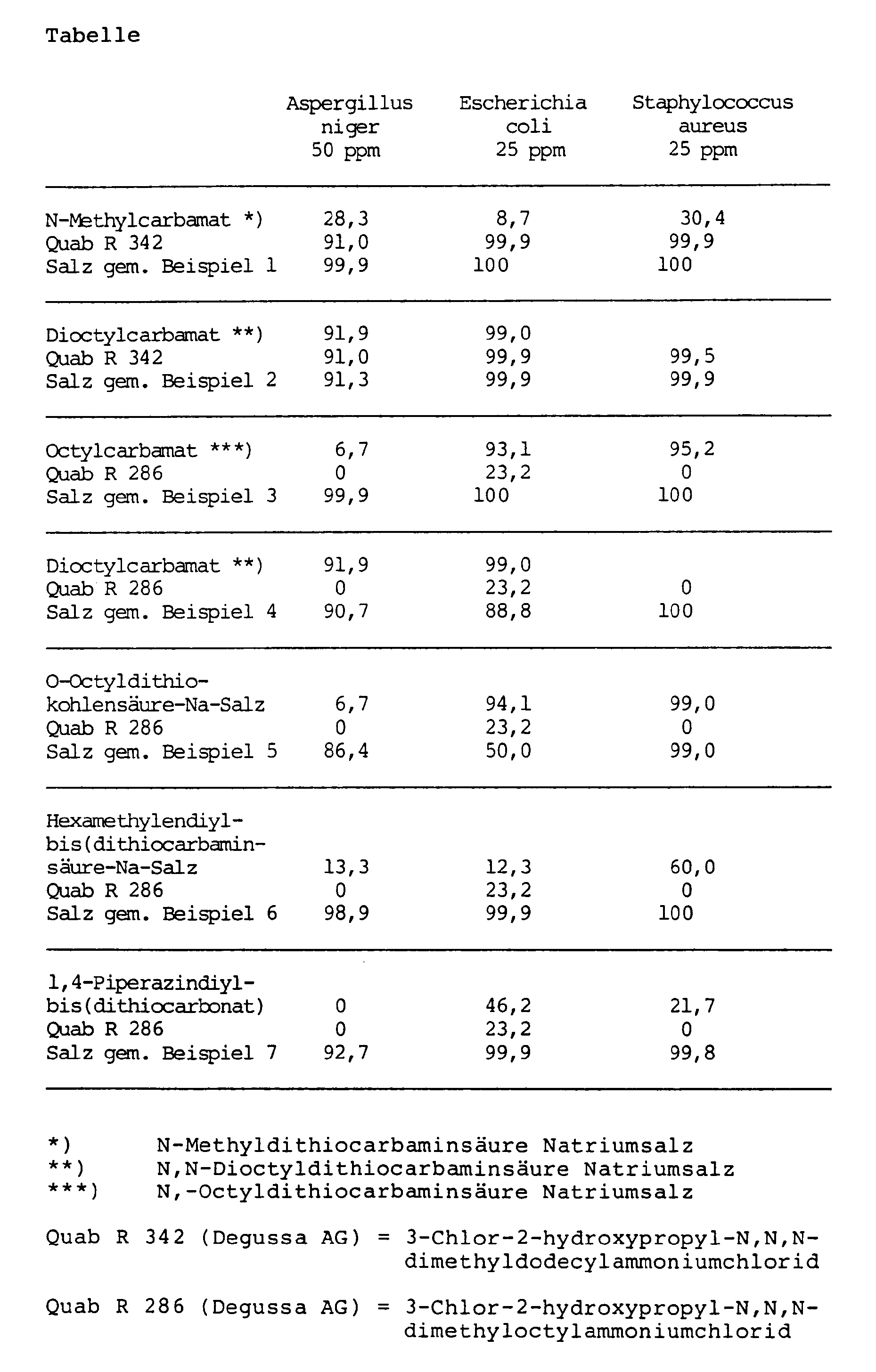
- the table shows the biocidal activity of the investigated salts of the formula (I) against fungi and bacteria in comparison with the biocidal activity of the starting compounds.
- the kill rate compared to the test germs is given, the application concentration of the biocides being 50 ppm and 25 ppm, respectively.
- the biocides were added as a 1% strength by weight aqueous solution to the enriched germ suspension (40 ml), which contained 8.5 g of NaCl / l.
Landscapes
- Life Sciences & Earth Sciences (AREA)
- Chemical & Material Sciences (AREA)
- Organic Chemistry (AREA)
- Dentistry (AREA)
- Wood Science & Technology (AREA)
- Plant Pathology (AREA)
- Health & Medical Sciences (AREA)
- Engineering & Computer Science (AREA)
- Agronomy & Crop Science (AREA)
- General Health & Medical Sciences (AREA)
- Pest Control & Pesticides (AREA)
- Zoology (AREA)
- Environmental Sciences (AREA)
- Organic Low-Molecular-Weight Compounds And Preparation Thereof (AREA)
- Agricultural Chemicals And Associated Chemicals (AREA)
- Detergent Compositions (AREA)
- Pyridine Compounds (AREA)
Description
- Die Erfindung betrifft neue quaternäre Ammoniumsalze der allgemeinen Formel

deren Herstellung sowie die Verwendung derselben als Mikrobiozide. - Verschiedene Klassen quaternärer Ammoniumsalze, insbesondere solche, welche mindestens eine (C₈-C₁₆) -Alkylgruppe aufweisen, finden als Mikrobiozide im Hygienebereich und in der Industrie Anwendung - siehe Seifen-Öle-Fette-Wachse 104 Nr. 15 (1978), 433-479. Die anwendungsspezifischen Erfordernisse sowie Aspekte der Ökologie und Toxikologie und nicht zuletzt der Wirtschaftlichkeit schaffen ein Bedürfnis, die bestehende Palette an quaternären Ammoniumsalzen zu erweitern, weil ausgewählte Produkte im allgemeinen nicht allen Erfordernissen gleichzeitig gerecht werden.
- Es ist auch bekannt, daß aus tertiären Aminen wie Dodecyl-dimethylamin und Epichlorhydrin leicht zugängliche quaternäre Ammoniumsalze mit einem 2-Hydroxy-3-chlorpropyl-Substituenten mikrobiozide Aktivität aufweisen. Es zeigte sich allerdings, daß die Wirkung gegenüber Pilzen, wie Aspergillus niger, häufig unbefriedigend ist. Es bestand somit ein Interesse, das Eigenschaftsspektrum dieser Stoffklasse zu verbessern.
- Natrium-dithiocarbaminate finden in wäßriger Lösung Verwendung als Mikrobiozide, zum Beispiel zur Schleimbekämpfung in Wasserkreisläufen oder als Konservierungsmittel in Emulsionen und Dispersionen - siehe Firmenprospekt der Firma Bayer AG "Preventol Z" (09/1981). Diese gleichfalls leicht zugängliche und im allgemeinen preiswerte Biozid-Stoffklasse hat aber den Nachteil eines ziemlich begrenzten Wirkungsspektrums.
- Es wurde nun gefunden, daß aus quaternären Ammoniumsalzen mit einem am Stickstoff gebundenen 2-Hydroxy-3-chlorpropyl- oder einem 2,3-Epoxypropylrest durch Umsetzung mit einem Alkalisalz einer Dithiocarbaminsäure oder einem Alkalisalz eines Dithiokohlensäure-O-esters neue quaternäre Ammoniumsalze entstehen. Diese neuen Salze zeichnen sich durch eine hohe mikrobiozide Wirkung aus, welche diejenige der Ausgangssubstanzen zum Teil ganz erheblich übertrifft.
- Die erfindungsgemäßen quaternären Ammoniumverbindungen haben die allgemeine Formel (I)

worin bedeuten: - R¹
- eine lineare (C₈-C₁₆)-Alkylgruppe oder eine (C₈-C₁₆)-Alkylphenoxyethoxyethylgruppe, wenn R² und R³ gleich sind und Methyl oder Hydroxyethyl bedeuten, oder ein Strukturelement der allgemeinen Formel (II)


- X
- die Gruppe OR⁴, worin R⁴ für einen linearen oder verzweigten Alkylrest mit 8 bis 18 C-Atomen steht, oder
die Gruppe NR⁵R⁶, worin R⁵ Wasserstoff oder eine lineare (C₈-C₁₈)-Alkylgruppe und R⁶ eine (C₁-C₁₈)-Alkyl- oder Benzylgruppe bedeuten oder NR⁵R⁶ für den Pyrrolidino-, 1,3-Oxazolidino, Piperidino oder Morpholinorest steht, wobei in das Strukturelement (II) enthaltenden Salzen die Gruppe NR⁵R⁶ mindestens einen linearen (C₈-C₁₂)-Alkylrest aufweist, oder
ein Strukturelement der allgemeinen Formel (III) oder (IV)

- A
- ein Halogenid, Sulfat, Hydrogensulfat, Hydrogen- oder Dihydrogenphosphat, Nitrat, Formiat, Acetat, Benzoat und
- n
- die Wertigkeit 1 oder 2 des Anions.
- Die Unteransprüche zu diesen neuen quaternären Ammoniumsalzen betreffen Salze mit ausgewählten Substituenten und Strukturelementen. Diese Stoffe zeichnen sich durch ihre besondere biozide Wirksamkeit aus.
- Die erfindungsgemäßen quaternären Ammoniumsalze können ein oder zwei Ammoniumkationen enthalten. Salze mit dem Strukturelement der allgemeinen Formel (II), (III) oder (IV) weisen zwei Ammoniumkationen auf; bevorzugt sind hiervon Salze mit dem Strukturelement der Formel (IV) mit Y gleich (C₂-C₆)-Alkylen und R⁷ gleich H. Verbindungen mit einem Ammoniumkation entsprechen der allgemeinen Formel (I) mit einem einwertigen Rest für X und R¹. Salze mit R² und R³ gleich Methyl und R¹ gleich n-(C₈-C₁₂)-Alkyl und X gleich n-(C₈-C₁₂)-Alkyloxy oder Mono- oder Di-n-(C₈-C₁₂)-Alkylamino oder Methylamino im Falle von R¹ gleich Dodecyl sind besonders bevorzugt.
- Das bzw. die Anionen der Ammoniumsalze können ein- oder zweiwertig sein. Anionen starker und mittelstarker Säuren werden bevorzugt. Erfindungsgemäße quaternäre Ammoniumchloride sind besonders einfach zugänglich, wenn 2-Hydroxy-3-chlorpropyl-substituierte quaternäre Ammoniumchloride als Ausgangsstoffe dienen.
- Mikrobiozid wirksame erfindungsgemäße Verbindungen weisen mindestens eine (C₈-C₁₆)-, vorzugsweise eine lineare (C₈-C₁₂)-Alkylgruppe oder eine (C₈-C₁₆)-Alkylphenoxyethoxyethylgruppe am Ammoniumstickstoff und/oder eine (C₈-C₁₆)-, vorzugsweise eine lineare (C₈-C₁₂)-Alkylgruppe als Bestandteil des Dithiocarbamat- bzw. Dithiokohlensäureester-Strukturelements auf.
- Die erfindungsgemäßen quaternären Ammoniumsalze der allgemeinen Formel (I) lassen in einfacher Weise dadurch herstellen, daß man in wäßriger Lösung ein Alkalisalz einer Dithiocarbaminsäure der allgemeinen Formel (Va) oder (Vb)

oder ein Alkalisalz eines Dithiokohlensäure-O-esters der allgemeinen Formel (Vc) oder (Vd)
worin Me Li, Na oder K sein kann und R⁴, R⁵, R⁶, R⁷ und Y die bei den erfindungsgemäßen Stoffen angegebene Bedeutung haben, mit einem 3-Halogen-2-hydroxypropyltrialkylammoniumsalz der allgemeinen Formel (VIa) oder (VIb)

worin Hal Chlor oder Brom und R¹, R², R³ A, n und Q die bei den erfindungsgemäßen Stoffen angegebene Bedeutung haben, umsetzt und das gebildete Salz der Formel (I) in bekannter Weise aus dem Reaktionsgemisch isoliert und, falls erwünscht, reinigt. Alternativ können die quaternären Ammoniumsalze der Formel (I) auch dadurch hergestellt werden, daß ein Salz der allgemeinen Formel Va, Vb, Vc oder Vd in wäßriger Lösung mit einem 2,3-Epoxypropyl-trialkylammoniumsalz der allgemeinen Formel (VIIa) oder (VIIb)

worin R¹, R², R³, A, n und Q die gleiche Bedeutung wie in Formel (I) und (II) haben, umgesetzt und das sich bildende quaternäre Ammoniumhydroxid durch Zugabe einer äquivalenten Menge einer Säure HnA in das Salz der Formel (I) überführt wird. - Die Reaktionspartner werden im allgemeinen im äquivalenten Verhältnis miteinander umgesetzt, also im Molverhältnis 1:1, wenn Verbindungen gemäß Formel (Va) oder (Vc) mit solchen der Formel (VIa) mit R¹ ungleich dem Strukturelement der Formel (II) umgesetzt werden, und 1:2, wenn anstelle der Verbindungen der Formel (Va) oder (Vc) solche der Formel (Vb) oder (Vd) zum Einsatz kommen. Verbindungen der Formel VIb werden mit solchen der Formel (Va) oder (Vc) im Molverhältnis 1:2 umgesetzt. Ein Überschuß eines Reaktionspartners stört im allgemeinen nicht und kann dann sogar nützlich sein, wenn das Reaktionsgemisch ohne Isolierung der erfindungsgemäßen Salze als biozides Mittel oder Bestandteil von solchen verwendet wird.
- Die Umsetzung erfolgt bei Raumtemperatur, jedoch kann auch erwärmt werden. Besonders leicht gelingt die Umsetzung, wenn A in den Salzen der Formel (VIa) und (VIb) das gleiche Halogenid ist wie dasjenige des 2-Hydroxy-3-halogenpropyl-Substituenten. Die wäßrige Lösung, in welcher die Umsetzung erfolgt, kann auch wasserlösliche organische Lösungsmittel, wie beispielsweise niedere Alkohole oder Aceton enthalten. Bei der Umsetzung in wäßrig-alkoholischer Lösung trennt sich das Salz der Formel I meist als zweite Phase ab und kann dann nach Abtrennung der wäßrigen Phase in bekannter Weise gereinigt werden.
- Falls erwünscht, kann das herstellungsbedingt anwesende Anion A der Salze der Formel I in bekannter Weise, beispielsweise unter Verwendung von Ionenaustauschern, gegen andere Anionen A ausgetauscht werden.
- Die erfindungsgemäßen Salze der Formel I lassen sich auch dadurch herstellen, daß man anstelle der Verbindungen gemäß Formel (VIa) bzw. (VIb) solche der entsprechenden epoxy-propyl-substituierten Salze der Formel (VIIa) bzw. (VIIb) einsetzt. Das sich bei der Umsetzung zunächst bildende quaternäre Ammoniumhydroxid wird durch Zugabe der äquivalenten Menge einer Säure HnA, wobei A das gewünschte Anion des Endproduktes und n die Wertigkeit des Anions bedeuten, in das Salz der Formel I überführt.
- Die erfindungsgemäßen quaternären Ammoniumsalze sind, wie gesagt, als Mikrobiozide verwendbar. Die vielseitige Kombinationsmöglichkeit der Ausgangsverbindungen zur Herstellung der Salze der Formel I gestattet es, auf dem jeweiligen Anwendungszweck abgestimmte Mikrobiozide zu erhalten.
- Die mikrobiozide Wirksamkeit der erfindungsgemäßen Salze umfaßt insbesondere Bakterien, Pilze und Algen. Die erfindungsgemäßen Salze können daher als Mikrobiozid in beispielsweise Brauch-, Prozeß- und Kühlwässern, in technischen Produkten, wie Farbdispersionen, Koalin-slurries, Bohr- und Schneidflüssigkeiten sowie zur Schleimbekämpfung in der Papierindustrie Verwendung finden.
- Das bei bekannten, biozid wirksamen quaternären Ammoniumverbindungen übliche starke Schäumen läßt sich in den erfindungsgemäßen Salzen dadurch mindern, daß kürzerkettige Alkylreste, vorzugsweise Octylreste am Ammoniumstickstoff gebunden und/oder Bestandteil der NR⁵R⁶- oder OR⁴-Gruppe sind. Dies ist überraschend, weil beispielsweise Ausgangssalze (VIa) mit R¹ gleich n-Octyl praktisch nicht biozid wirksam sind, daraus hergestellte erfindungsgemäße Salze aber eine hohe mikrobiozide Wirkung entfalten. Es gelingt somit, diese Mikrobiozide auch in technischen Bereichen in turbulent bewegten System, wie Kühlwasserkreisläufen, einzusetzen.
- Wie aus den Beispielen folgt, weisen die erfindungsgemäßen Salze im Vergleich zu ihren Ausgangsverbindungen gegenüber einzelnen Mikroorganismen eine signifikant höhere mikrobiozide Wirkung auf.
- Die erfindungsgemäßen Salze sind im allgemeinen nicht korrosiv. Sie lassen sich im allgemeinen auch gut biologisch abbauen.
- In den folgenden Beispielen werden die Herstellung erfindungsgemäßer quaternärer Ammoniumsalze sowie deren Untersuchung auf ihre mikrobiozide Wirksamkeit beschrieben.
- Zu 320 g einer 40 gew.-%igen wäßrigen Lösung von Natrium-N-methyl-dithiocarbamat gibt man 450 g Isopropanol und tropft dann 840 g einer 40 gew.-%igen wäßrigen Lösung von 3-Chlor-2-hydroxypropyl-N,N,N-dimethyldodecylammoniumchlorid zu. Man läßt den Reaktionsansatz über Nacht stehen und trennt das sich ausbildende zweiphasige System. Die obere, i-propanol-haltige Phase wird mehrere Stunden bei 0 °C gelagert. Das oben bezeichnete Salz kristallisiert in langen, farblosen Nadeln aus. Schmelzpunkt: 72 °C.

- Die oben angegebene Struktur wurde durch IR- und NMR-Messungen bestätigt.
- Zu 1.130 g einer 30 gew.-%igen Lösung von Natrium-N,N-dioctyldithiocarbamat in einer 1:1 Mischung aus Wasser/Isopropanol werden 840 g einer 40,7 gew.-%igen wäßrigen Lösung von 3-Chlor-2-hydroxy-propyl-N,N,N-dimethyldodecylammoniumchlorid zugetropft. Der sich abscheidende ölige Niederschlag wird von der kochsalzhaltigen wäßrigen Phase getrennt, mit Wasser gewaschen und im Vakuum getrocknet. Hochviskoses, schwach gelbliches Öl, praktisch geruchlos.

- Zu 1.791 g einer 12 gew.-%igen wäßrigen Lösung von Natrium-N-octyl-dithiocarbamat werden 530 g einer 54 gew.-%igen wäßrigen Lösung von 3-Chlor-2hydroxypropyl-N,N,N-dimethyloctylammoniumchlorid zugegeben. Das gewünschte Salz fällt als Feststoff sofort aus, wird abgesaugt, mit Wasser gewaschen und im Vakuum getrocknet. Eine weitere Reinigung kann durch Umfällen oder Umkristallisation aus Alkohol erfolgen.

- Zu 1.130 g einer 30 gew.-%igen Lösung von Natrium-N,N-dioctyldithiocarbamat in einer H₂O/i-Propanol-Mischung werden 530 g einer 54 gew.-%igen wäßrigen Lösung von 3-Chlor-2-hydroxypropyl-N,N,N-dimethyloctylammoniumchlorid gegeben. Beim Stehenlassen bilden sich sich 2 Phasen aus, die obere, organische Phase wird abgetrennt, mit Wasser gewaschen, vom iso-Propanol befreit und getrocknet. Viskoses, gelbes Öl.

- 244 g Kalium-dithiokohlensäure-O-n-octylester werden in 400 ml Wasser gelöst und 530 g einer 54 gew.-%igen Lösung von 3-Chlor-2-hydroxypropyl-N,N,N-dimethyloctylammoniumchlorid zugegeben. Das gewünschte Salz scheidet sich als gelbes Öl ab und wird durch Zugabe von Chloroform gelöst. Das 2-phasige System wird getrennt, die Chloroformphase sorgfältig mit Wasser gewaschen und eingeengt. Trocknen im Vakuum.

- Zu 2.080 g einer 15 gew.-%igen wäßrigen Lösung von Di-Natrium-hexamethylenbisdithiocarbamat werden 1060 g einer 54 gew.-%igen wäßrigen Lösung von 3-Chlor-2-hydroxypropyl-N,N,N-dimethyloctylammoniumchlorid gegeben. Das gebildete quaternäre Salz scheidet sich unmittelbar als viskoses gelbes Öl ab. Man trennt die Phasen, wäscht sorgfältig mit Wasser chlorfrei und trocknet.

-

- Zu 1.880 g einer 15 gew.-%igen wäßrigen Lösung von Di-Na-1,4-Piperazindiylbis(dithiocarbonat) werden 1.060 g einer 54 gew.-%-igen wäßrigen Lösung von 3-Chlor-2-hydroxy-propyl-N,N,N-dimethyloctylammoniumchlorid gegeben. Das ölig abgeschiedene quaternäre Salz wird abgetrennt und sorgfältig mit Wasser chloridfrei gewaschen. Man reinigt durch Behandeln mit Alkohol. Gelbes, viskoses Öl.

- Bei diesem in Anlehnung an die Empfehlungen des American Petroleum Instituts (API, RP 38 2nd ed., Dec. 1965) durchgeführten Test wird eine hoch angereicherte Keimsuspension (Keimzahl 10⁶-10⁸) mit der gewünschten Menge Biozid versetzt und 24 h bei 25 °C bebrütet. Anschließend wird eine geometrische Verdünnungsreihe bis 6 durchgeführt; je 1 ml wird mit 10 ml Nähragar auf Platten vermischt und 48 h bei 37 °C bebrütet. Aus der Auszählung der Kolonien wird die Abtötungsrate berechnet.

- Die Figur zeigt das Verhältnis von Keimzahl zur Abtötungsrate. Hieraus wird deutlich, daß auch eine von 99,9 % auf 100 % gesteigerte Abtötungsrate einer bedeutenden Wirkungsverbesserung entspricht.
- Der Tabelle ist die biozide Wirksamkeit der untersuchten Salze der Formel (I) gegen Pilze und Bakterien im Vergleich zur bioziden Wirksamkeit der Ausgangsverbindungen zu entnehmen. Angegeben ist die Abtötungsrate gegenüber den Testkeimen, wobei die Anwendungskonzentration der Biozide 50 ppm bzw. 25 ppm betrug. Die Biozide wurden als 1 gew.-%ige wäßrige Lösung der angereicherten Keimsuspension (40 ml), welche 8,5 g NaCl/l enthielt, zugesetzt.
Claims (8)
- Quaternäre Ammoniumsalze der allgemeinen Formel (I)
 R¹ eine lineare (C₈-C₁₆)-Alkylgruppe oder eine (C₈-C₁₆)-Alkylphenoxyethoxyethylgruppe, wenn R² und R³ gleich sind und Methyl oder Hydroxyethyl bedeuten, oder ein Strukturelement der allgemeinen Formel (II)
 X die Gruppe OR⁴, worin R⁴ für einen linearen oder verzweigten Alkylrest mit 8 bis 18 C-Atomen steht, oder
die Gruppe NR⁵R⁶, worin R⁵ Wasserstoff oder eine lineare (C₈-C₁₈)-Alkylgruppe und R⁶ eine (C₁-C₁₈)-Alkyl- oder Benzylgruppe bedeuten oder NR⁵R⁶ für den Pyrrolidino-, 1,3-Oxazolidino, Piperidino oder Morpholinorest steht, wobei in das Strukturelement (II) enthaltenden Salzen die Gruppe NR⁵R⁶ mindestens einen linearen (C₈-C₁₂)-Alkylrest aufweist, oder
ein Strukturelement der allgemeinen Formel (III) oder (IV)
 A ein Halogenid, Sulfat, Hydrogensulfat, Hydrogen- oder Dihydrogenphosphat, Nitrat, Formiat, Acetat, Benzoat undn die Wertigkeit 1 oder 2 des Anions.
 - Quaternäre Ammoniumsalze nach Anspruch 1,
dadurch gekennzeichnet,
daß R¹ eine lineare (C₈-C₁₂)-Alkyl-, R² und R³ eine Methylgruppe, R⁵ Wasserstoff oder eine lineare (C₈-C₁₂)-Alkyl- und R⁶ eine Methyl- oder eine lineare (C₈-C₁₂)-Alkylgruppe bedeuten. - Quaternäre Ammoniumsalze nach Anspruch 1,
dadurch gekennzeichnet,
daß Y 1,6-Hexamethylen, R⁷ Wasserstoff, R¹ eine lineare (C₈-C₁₂)-Alkylgruppe und R² und R³ Methylgruppen bedeuten. - Quaternäre Ammoniumsalze nach Anspruch 1,
dadurch gekennzeichnet,
daß R¹ eine lineare (C₈-C₁₂)-Alkyl-, R² und R³ Methyl- und R⁴ eine lineare (C₈-C₁₂)-Alkylgruppe bedeuten. - Quaternäre Ammoniumsalze nach Anspruch 1,
dadurch gekennzeichnet,
daß A Chlorid bedeutet. - Verfahren zur Herstellung quaternärer Ammoniumsalze gemäß allgemeiner Formel (I) des Anspruchs 1,
dadurch gekennzeichnet,
daß man in wäßriger Lösung ein Alkalisalz einer Dithiocarbaminsäure der allgemeinen Formel (Va) oder (Vb)


- Verfahren zur Herstellung quaternärer Ammoniumsalze gemäß allgemeiner Formel (I) des Anspruchs 1,
dadurch gekennzeichnet,
daß man in wäßriger Lösung ein Alkalisalz einer Dithiocarbaminsäure der allgemeinen Formel (Va) oder (Vb)


- Verwendung der quaternären Ammoniumsalze gemäß Formel I des Anspruchs 1 als Mikrobiozid.
Priority Applications (1)
| Application Number | Priority Date | Filing Date | Title |
|---|---|---|---|
| AT90103086T ATE89270T1 (de) | 1989-03-04 | 1990-02-17 | Quaternaere ammoniumsalze, verfahren zu deren herstellung und verwendung derselben. |
Applications Claiming Priority (2)
| Application Number | Priority Date | Filing Date | Title |
|---|---|---|---|
| DE3907070A DE3907070C2 (de) | 1989-03-04 | 1989-03-04 | Quaternäre Ammoniumsalze, Verfahren zu deren Herstellung und deren Verwendung |
| DE3907070 | 1989-03-04 |
Publications (2)
| Publication Number | Publication Date |
|---|---|
| EP0386508A1 EP0386508A1 (de) | 1990-09-12 |
| EP0386508B1 true EP0386508B1 (de) | 1993-05-12 |
Family
ID=6375589
Family Applications (1)
| Application Number | Title | Priority Date | Filing Date |
|---|---|---|---|
| EP90103086A Expired - Lifetime EP0386508B1 (de) | 1989-03-04 | 1990-02-17 | Quaternäre Ammoniumsalze, Verfahren zu deren Herstellung und Verwendung derselben |
Country Status (3)
| Country | Link |
|---|---|
| EP (1) | EP0386508B1 (de) |
| AT (1) | ATE89270T1 (de) |
| DE (2) | DE3907070C2 (de) |
Family Cites Families (5)
| Publication number | Priority date | Publication date | Assignee | Title |
|---|---|---|---|---|
| US2961466A (en) * | 1957-05-14 | 1960-11-22 | Monsanto Chemicals | Quaternary ammonium thiocarbonates |
| US3280162A (en) * | 1963-07-08 | 1966-10-18 | American Cyanamid Co | Bis(2-aminoethyl)dithiolcarbonate salts and process |
| US3407222A (en) * | 1965-08-24 | 1968-10-22 | American Cyanamid Co | Preparation of 2-hydroxyalkyldithio carbamates from epoxides and amine salts of dithio-carbamic acid |
| DD228162A1 (de) * | 1984-07-04 | 1985-10-09 | Dresden Pillnitz Obstforsch | Mittel zur beseitigung der bodenmuedigkeit in obstbaum- und baumschulkulturen |
| DD236669A1 (de) * | 1985-05-02 | 1986-06-18 | Bitterfeld Chemie | Fungizide mittel |
-
1989
- 1989-03-04 DE DE3907070A patent/DE3907070C2/de not_active Expired - Lifetime
-
1990
- 1990-02-17 DE DE9090103086T patent/DE59001392D1/de not_active Expired - Fee Related
- 1990-02-17 AT AT90103086T patent/ATE89270T1/de not_active IP Right Cessation
- 1990-02-17 EP EP90103086A patent/EP0386508B1/de not_active Expired - Lifetime
Also Published As
| Publication number | Publication date |
|---|---|
| DE59001392D1 (de) | 1993-06-17 |
| EP0386508A1 (de) | 1990-09-12 |
| DE3907070C2 (de) | 1994-02-03 |
| DE3907070A1 (de) | 1990-10-11 |
| ATE89270T1 (de) | 1993-05-15 |
Similar Documents
| Publication | Publication Date | Title |
|---|---|---|
| DE68918910T2 (de) | Jodpropargylmonoester von Dicarbonsäureanhydriden und ihre Anwendung als Antimikrobenmittel. | |
| DE2510525B2 (de) | Quartaere 2-alkylimidazoliumsalze | |
| DE2223766A1 (de) | Bis-biguanidsalze,Verfahren zu deren Herstellung und deren Verwendung | |
| EP0029617A1 (de) | Verwendung tertiärer heterocyclischer Amine als Potenzierungsmittel für Insektizide; Cyclo-Amin-Derivate | |
| DE69403039T2 (de) | Bis-biguanidverbindungen als Desinfektionsmittel verwendbar | |
| DE2530243C2 (de) | Verwendung von N-substituierten Aminoalkanolen als antimikrobielle Wirkstoffe | |
| DE2641836B1 (de) | Alkylierte Polyamine,deren Herstellung und Verwendung als Mikrobicide | |
| DE3907070C2 (de) | Quaternäre Ammoniumsalze, Verfahren zu deren Herstellung und deren Verwendung | |
| EP0386509B1 (de) | Mikrobiozide Mittel | |
| AT334134B (de) | Bekampfung von pilzschadlingen | |
| DE2263596C3 (de) | Mikrobicide Mittel | |
| DE2030464C3 (de) | bis-Formamidverbindungen, Verfahren zu ihrer Herstellung und ihre Verwendung zur Bekämpfung phytopathogener Pilze | |
| DE2744353A1 (de) | Hydantoinderivate, verfahren zu ihrer herstellung und ihre verwendung | |
| DE2303420C2 (de) | Tetrahydro-1,3-thiaziniumsalze | |
| DE2036896C3 (de) | N-(Dithiocarbamoylmethyl)-morpholinderivate, Verfahren zu ihrer Herstellung und ihre Verwendung | |
| DE2262333C3 (de) | Verfahren zur Herstellung eines Gemisches von Tripopylentetraminderivaten und deren Verwendung als Mikrobicid | |
| AT269888B (de) | Verfahren zur Herstellung von neuen Tetrahydro-1,3,5-thiadiazin-2-thionen | |
| AT354806B (de) | Fungizide mittel | |
| DE2144123A1 (de) | Komplexverbindungen aus dithiocarbamidsauren schwermetallsalzen und guanidinen, verfahren zu ihrer herstellung und ihre fungizide und mikrobizide verwendung | |
| AT233319B (de) | Fungizide Mittel | |
| DE2313845C3 (de) | Thiocarbaminsäurederivate und diese enthaltende Arzneimittelzubereitungen | |
| AT227248B (de) | Verfahren zur Herstellung von neuen quaternären Ammoniumverbindungen | |
| AT365042B (de) | Fungizide mittel | |
| AT338282B (de) | Verfahren zur herstellung von neuen ketoximcarbamaten | |
| DE2233996A1 (de) | Verfahren zur herstellung von mikrobicid wirksamen verbindungen oder verbindungsgemischen |
Legal Events
| Date | Code | Title | Description |
|---|---|---|---|
| PUAI | Public reference made under article 153(3) epc to a published international application that has entered the european phase |
Free format text: ORIGINAL CODE: 0009012 |
|
| 17P | Request for examination filed |
Effective date: 19900217 |
|
| AK | Designated contracting states |
Kind code of ref document: A1 Designated state(s): AT BE CH DE FR GB IT LI NL |
|
| 17Q | First examination report despatched |
Effective date: 19920513 |
|
| GRAA | (expected) grant |
Free format text: ORIGINAL CODE: 0009210 |
|
| AK | Designated contracting states |
Kind code of ref document: B1 Designated state(s): AT BE CH DE FR GB IT LI NL |
|
| REF | Corresponds to: |
Ref document number: 89270 Country of ref document: AT Date of ref document: 19930515 Kind code of ref document: T |
|
| ITF | It: translation for a ep patent filed | ||
| ET | Fr: translation filed | ||
| REF | Corresponds to: |
Ref document number: 59001392 Country of ref document: DE Date of ref document: 19930617 |
|
| GBT | Gb: translation of ep patent filed (gb section 77(6)(a)/1977) |
Effective date: 19930809 |
|
| PG25 | Lapsed in a contracting state [announced via postgrant information from national office to epo] |
Ref country code: GB Effective date: 19940217 Ref country code: AT Effective date: 19940217 |
|
| PG25 | Lapsed in a contracting state [announced via postgrant information from national office to epo] |
Ref country code: LI Effective date: 19940228 Ref country code: CH Effective date: 19940228 Ref country code: BE Effective date: 19940228 |
|
| BERE | Be: lapsed |
Owner name: DEGUSSA A.G. Effective date: 19940228 |
|
| PG25 | Lapsed in a contracting state [announced via postgrant information from national office to epo] |
Ref country code: NL Effective date: 19940901 |
|
| GBPC | Gb: european patent ceased through non-payment of renewal fee |
Effective date: 19940217 |
|
| NLV4 | Nl: lapsed or anulled due to non-payment of the annual fee | ||
| PG25 | Lapsed in a contracting state [announced via postgrant information from national office to epo] |
Ref country code: FR Effective date: 19941031 |
|
| REG | Reference to a national code |
Ref country code: CH Ref legal event code: PL |
|
| PG25 | Lapsed in a contracting state [announced via postgrant information from national office to epo] |
Ref country code: DE Effective date: 19941101 |
|
| REG | Reference to a national code |
Ref country code: FR Ref legal event code: ST |
|
| PG25 | Lapsed in a contracting state [announced via postgrant information from national office to epo] |
Ref country code: IT Free format text: LAPSE BECAUSE OF NON-PAYMENT OF DUE FEES;WARNING: LAPSES OF ITALIAN PATENTS WITH EFFECTIVE DATE BEFORE 2007 MAY HAVE OCCURRED AT ANY TIME BEFORE 2007. THE CORRECT EFFECTIVE DATE MAY BE DIFFERENT FROM THE ONE RECORDED. Effective date: 20050217 |
|
| PLBE | No opposition filed within time limit |
Free format text: ORIGINAL CODE: 0009261 |
|
| STAA | Information on the status of an ep patent application or granted ep patent |
Free format text: STATUS: NO OPPOSITION FILED WITHIN TIME LIMIT |