EP0366296A2 - Verfahren zur Herstellung einer biologisch aktiven Substanz - Google Patents
Verfahren zur Herstellung einer biologisch aktiven Substanz Download PDFInfo
- Publication number
- EP0366296A2 EP0366296A2 EP89310311A EP89310311A EP0366296A2 EP 0366296 A2 EP0366296 A2 EP 0366296A2 EP 89310311 A EP89310311 A EP 89310311A EP 89310311 A EP89310311 A EP 89310311A EP 0366296 A2 EP0366296 A2 EP 0366296A2
- Authority
- EP
- European Patent Office
- Prior art keywords
- extraction
- extract
- extracting
- shrimps
- litres
- Prior art date
- Legal status (The legal status is an assumption and is not a legal conclusion. Google has not performed a legal analysis and makes no representation as to the accuracy of the status listed.)
- Withdrawn
Links
- 238000000034 method Methods 0.000 title claims abstract description 20
- 238000002360 preparation method Methods 0.000 title description 2
- 229940088623 biologically active substance Drugs 0.000 title 1
- 238000001914 filtration Methods 0.000 claims abstract description 23
- 102000004190 Enzymes Human genes 0.000 claims abstract description 15
- 108090000790 Enzymes Proteins 0.000 claims abstract description 15
- 229940088598 enzyme Drugs 0.000 claims abstract description 15
- 238000000605 extraction Methods 0.000 claims abstract description 15
- 102000012286 Chitinases Human genes 0.000 claims abstract description 10
- 108010022172 Chitinases Proteins 0.000 claims abstract description 10
- 230000000975 bioactive effect Effects 0.000 claims abstract description 10
- 239000012267 brine Substances 0.000 claims abstract description 9
- HPALAKNZSZLMCH-UHFFFAOYSA-M sodium;chloride;hydrate Chemical compound O.[Na+].[Cl-] HPALAKNZSZLMCH-UHFFFAOYSA-M 0.000 claims abstract description 9
- 239000000126 substance Substances 0.000 claims abstract description 9
- 108010003272 Hyaluronate lyase Proteins 0.000 claims abstract description 8
- XLYOFNOQVPJJNP-UHFFFAOYSA-N water Substances O XLYOFNOQVPJJNP-UHFFFAOYSA-N 0.000 claims abstract description 8
- 241000238424 Crustacea Species 0.000 claims abstract description 6
- 238000002955 isolation Methods 0.000 claims abstract description 4
- 238000005119 centrifugation Methods 0.000 claims abstract description 3
- 241000143060 Americamysis bahia Species 0.000 claims abstract 4
- 102000009066 Hyaluronoglucosaminidase Human genes 0.000 claims abstract 2
- 239000000306 component Substances 0.000 claims description 8
- 239000002994 raw material Substances 0.000 claims description 5
- 238000004587 chromatography analysis Methods 0.000 claims description 3
- 230000006641 stabilisation Effects 0.000 claims description 3
- 238000011105 stabilization Methods 0.000 claims description 3
- 239000003795 chemical substances by application Substances 0.000 claims description 2
- 230000008018 melting Effects 0.000 claims description 2
- 238000002844 melting Methods 0.000 claims description 2
- 238000007445 Chromatographic isolation Methods 0.000 claims 1
- 102000004160 Phosphoric Monoester Hydrolases Human genes 0.000 claims 1
- 108090000608 Phosphoric Monoester Hydrolases Proteins 0.000 claims 1
- 229960002773 hyaluronidase Drugs 0.000 abstract description 7
- 238000000746 purification Methods 0.000 abstract description 3
- 229910019142 PO4 Inorganic materials 0.000 abstract description 2
- 235000021317 phosphate Nutrition 0.000 abstract description 2
- 150000003013 phosphoric acid derivatives Chemical class 0.000 abstract description 2
- TWRXJAOTZQYOKJ-UHFFFAOYSA-L Magnesium chloride Chemical compound [Mg+2].[Cl-].[Cl-] TWRXJAOTZQYOKJ-UHFFFAOYSA-L 0.000 description 12
- FAPWRFPIFSIZLT-UHFFFAOYSA-M Sodium chloride Chemical compound [Na+].[Cl-] FAPWRFPIFSIZLT-UHFFFAOYSA-M 0.000 description 12
- 241000238557 Decapoda Species 0.000 description 11
- 239000000047 product Substances 0.000 description 11
- 230000000694 effects Effects 0.000 description 8
- QKNYBSVHEMOAJP-UHFFFAOYSA-N 2-amino-2-(hydroxymethyl)propane-1,3-diol;hydron;chloride Chemical compound Cl.OCC(N)(CO)CO QKNYBSVHEMOAJP-UHFFFAOYSA-N 0.000 description 7
- 102000004169 proteins and genes Human genes 0.000 description 7
- 108090000623 proteins and genes Proteins 0.000 description 7
- 102000002260 Alkaline Phosphatase Human genes 0.000 description 6
- 108020004774 Alkaline Phosphatase Proteins 0.000 description 6
- 102000001974 Hyaluronidases Human genes 0.000 description 6
- 239000000706 filtrate Substances 0.000 description 6
- 229910001629 magnesium chloride Inorganic materials 0.000 description 6
- 239000002245 particle Substances 0.000 description 6
- 239000011780 sodium chloride Substances 0.000 description 6
- 229920002492 poly(sulfone) Polymers 0.000 description 5
- 229920002401 polyacrylamide Polymers 0.000 description 5
- 239000012614 Q-Sepharose Substances 0.000 description 4
- 238000000108 ultra-filtration Methods 0.000 description 4
- 241000238070 Pandalus borealis Species 0.000 description 3
- 238000009295 crossflow filtration Methods 0.000 description 3
- 238000005189 flocculation Methods 0.000 description 3
- 230000016615 flocculation Effects 0.000 description 3
- 239000000463 material Substances 0.000 description 3
- 239000007787 solid Substances 0.000 description 3
- 230000015572 biosynthetic process Effects 0.000 description 2
- 244000309466 calf Species 0.000 description 2
- 238000001035 drying Methods 0.000 description 2
- 239000012510 hollow fiber Substances 0.000 description 2
- 239000007788 liquid Substances 0.000 description 2
- 150000003839 salts Chemical class 0.000 description 2
- 239000002904 solvent Substances 0.000 description 2
- KIUKXJAPPMFGSW-DNGZLQJQSA-N (2S,3S,4S,5R,6R)-6-[(2S,3R,4R,5S,6R)-3-Acetamido-2-[(2S,3S,4R,5R,6R)-6-[(2R,3R,4R,5S,6R)-3-acetamido-2,5-dihydroxy-6-(hydroxymethyl)oxan-4-yl]oxy-2-carboxy-4,5-dihydroxyoxan-3-yl]oxy-5-hydroxy-6-(hydroxymethyl)oxan-4-yl]oxy-3,4,5-trihydroxyoxane-2-carboxylic acid Chemical compound CC(=O)N[C@H]1[C@H](O)O[C@H](CO)[C@@H](O)[C@@H]1O[C@H]1[C@H](O)[C@@H](O)[C@H](O[C@H]2[C@@H]([C@@H](O[C@H]3[C@@H]([C@@H](O)[C@H](O)[C@H](O3)C(O)=O)O)[C@H](O)[C@@H](CO)O2)NC(C)=O)[C@@H](C(O)=O)O1 KIUKXJAPPMFGSW-DNGZLQJQSA-N 0.000 description 1
- 102000009027 Albumins Human genes 0.000 description 1
- 108010088751 Albumins Proteins 0.000 description 1
- 241000238421 Arthropoda Species 0.000 description 1
- 101000588395 Bacillus subtilis (strain 168) Beta-hexosaminidase Proteins 0.000 description 1
- 229920002101 Chitin Polymers 0.000 description 1
- 241000575946 Ione Species 0.000 description 1
- LTXREWYXXSTFRX-QGZVFWFLSA-N Linagliptin Chemical group N=1C=2N(C)C(=O)N(CC=3N=C4C=CC=CC4=C(C)N=3)C(=O)C=2N(CC#CC)C=1N1CCC[C@@H](N)C1 LTXREWYXXSTFRX-QGZVFWFLSA-N 0.000 description 1
- OVRNDRQMDRJTHS-UHFFFAOYSA-N N-acelyl-D-glucosamine Natural products CC(=O)NC1C(O)OC(CO)C(O)C1O OVRNDRQMDRJTHS-UHFFFAOYSA-N 0.000 description 1
- OVRNDRQMDRJTHS-FMDGEEDCSA-N N-acetyl-beta-D-glucosamine Chemical compound CC(=O)N[C@H]1[C@H](O)O[C@H](CO)[C@@H](O)[C@@H]1O OVRNDRQMDRJTHS-FMDGEEDCSA-N 0.000 description 1
- MBLBDJOUHNCFQT-LXGUWJNJSA-N N-acetylglucosamine Natural products CC(=O)N[C@@H](C=O)[C@@H](O)[C@H](O)[C@H](O)CO MBLBDJOUHNCFQT-LXGUWJNJSA-N 0.000 description 1
- 210000001015 abdomen Anatomy 0.000 description 1
- 239000002253 acid Substances 0.000 description 1
- 150000007513 acids Chemical class 0.000 description 1
- 239000013543 active substance Substances 0.000 description 1
- 238000001042 affinity chromatography Methods 0.000 description 1
- 239000007864 aqueous solution Substances 0.000 description 1
- 244000309464 bull Species 0.000 description 1
- 239000012876 carrier material Substances 0.000 description 1
- 150000001875 compounds Chemical class 0.000 description 1
- 239000012141 concentrate Substances 0.000 description 1
- 238000000354 decomposition reaction Methods 0.000 description 1
- 238000011026 diafiltration Methods 0.000 description 1
- ZBCBWPMODOFKDW-UHFFFAOYSA-N diethanolamine Chemical compound OCCNCCO ZBCBWPMODOFKDW-UHFFFAOYSA-N 0.000 description 1
- 238000003912 environmental pollution Methods 0.000 description 1
- 230000002349 favourable effect Effects 0.000 description 1
- 238000000855 fermentation Methods 0.000 description 1
- 230000004151 fermentation Effects 0.000 description 1
- 239000012467 final product Substances 0.000 description 1
- 239000008394 flocculating agent Substances 0.000 description 1
- 238000004108 freeze drying Methods 0.000 description 1
- 238000007710 freezing Methods 0.000 description 1
- 230000008014 freezing Effects 0.000 description 1
- 238000002523 gelfiltration Methods 0.000 description 1
- 229920002674 hyaluronan Polymers 0.000 description 1
- 229960003160 hyaluronic acid Drugs 0.000 description 1
- 239000012535 impurity Substances 0.000 description 1
- 238000011534 incubation Methods 0.000 description 1
- 210000000936 intestine Anatomy 0.000 description 1
- 229920002521 macromolecule Polymers 0.000 description 1
- 238000004519 manufacturing process Methods 0.000 description 1
- 238000005374 membrane filtration Methods 0.000 description 1
- 229950006780 n-acetylglucosamine Drugs 0.000 description 1
- 235000016709 nutrition Nutrition 0.000 description 1
- 239000003960 organic solvent Substances 0.000 description 1
- 210000002826 placenta Anatomy 0.000 description 1
- 229920000447 polyanionic polymer Polymers 0.000 description 1
- 239000003755 preservative agent Substances 0.000 description 1
- 239000003381 stabilizer Substances 0.000 description 1
- 238000010561 standard procedure Methods 0.000 description 1
- 238000011282 treatment Methods 0.000 description 1
- 239000002699 waste material Substances 0.000 description 1
- 239000011592 zinc chloride Substances 0.000 description 1
- 235000005074 zinc chloride Nutrition 0.000 description 1
- JIAARYAFYJHUJI-UHFFFAOYSA-L zinc dichloride Chemical compound [Cl-].[Cl-].[Zn+2] JIAARYAFYJHUJI-UHFFFAOYSA-L 0.000 description 1
Images
Classifications
-
- C—CHEMISTRY; METALLURGY
- C12—BIOCHEMISTRY; BEER; SPIRITS; WINE; VINEGAR; MICROBIOLOGY; ENZYMOLOGY; MUTATION OR GENETIC ENGINEERING
- C12N—MICROORGANISMS OR ENZYMES; COMPOSITIONS THEREOF; PROPAGATING, PRESERVING, OR MAINTAINING MICROORGANISMS; MUTATION OR GENETIC ENGINEERING; CULTURE MEDIA
- C12N9/00—Enzymes; Proenzymes; Compositions thereof; Processes for preparing, activating, inhibiting, separating or purifying enzymes
- C12N9/14—Hydrolases (3)
- C12N9/24—Hydrolases (3) acting on glycosyl compounds (3.2)
- C12N9/2402—Hydrolases (3) acting on glycosyl compounds (3.2) hydrolysing O- and S- glycosyl compounds (3.2.1)
- C12N9/2405—Glucanases
- C12N9/2408—Glucanases acting on alpha -1,4-glucosidic bonds
-
- C—CHEMISTRY; METALLURGY
- C12—BIOCHEMISTRY; BEER; SPIRITS; WINE; VINEGAR; MICROBIOLOGY; ENZYMOLOGY; MUTATION OR GENETIC ENGINEERING
- C12N—MICROORGANISMS OR ENZYMES; COMPOSITIONS THEREOF; PROPAGATING, PRESERVING, OR MAINTAINING MICROORGANISMS; MUTATION OR GENETIC ENGINEERING; CULTURE MEDIA
- C12N9/00—Enzymes; Proenzymes; Compositions thereof; Processes for preparing, activating, inhibiting, separating or purifying enzymes
-
- C—CHEMISTRY; METALLURGY
- C12—BIOCHEMISTRY; BEER; SPIRITS; WINE; VINEGAR; MICROBIOLOGY; ENZYMOLOGY; MUTATION OR GENETIC ENGINEERING
- C12N—MICROORGANISMS OR ENZYMES; COMPOSITIONS THEREOF; PROPAGATING, PRESERVING, OR MAINTAINING MICROORGANISMS; MUTATION OR GENETIC ENGINEERING; CULTURE MEDIA
- C12N9/00—Enzymes; Proenzymes; Compositions thereof; Processes for preparing, activating, inhibiting, separating or purifying enzymes
- C12N9/14—Hydrolases (3)
- C12N9/16—Hydrolases (3) acting on ester bonds (3.1)
-
- C—CHEMISTRY; METALLURGY
- C12—BIOCHEMISTRY; BEER; SPIRITS; WINE; VINEGAR; MICROBIOLOGY; ENZYMOLOGY; MUTATION OR GENETIC ENGINEERING
- C12N—MICROORGANISMS OR ENZYMES; COMPOSITIONS THEREOF; PROPAGATING, PRESERVING, OR MAINTAINING MICROORGANISMS; MUTATION OR GENETIC ENGINEERING; CULTURE MEDIA
- C12N9/00—Enzymes; Proenzymes; Compositions thereof; Processes for preparing, activating, inhibiting, separating or purifying enzymes
- C12N9/14—Hydrolases (3)
- C12N9/24—Hydrolases (3) acting on glycosyl compounds (3.2)
- C12N9/2402—Hydrolases (3) acting on glycosyl compounds (3.2) hydrolysing O- and S- glycosyl compounds (3.2.1)
- C12N9/2405—Glucanases
- C12N9/2434—Glucanases acting on beta-1,4-glucosidic bonds
Definitions
- the present invention relates to a method for the preparation of biologically active substances, for instance enzymes, such as alkaline phosphatase, extracted from crustacea (of Phylum Arthropodes), especially shrimps.
- enzymes such as alkaline phosphatase, extracted from crustacea (of Phylum Arthropodes), especially shrimps.
- Enzymes of the highest purity are used for research and analyzing purposes in the biochemical and clinical chemistry. Thus there is a rapidly increasing demand for enzymes of high purity with a strong enzyme activity.
- bioactive compounds can be isolated from the raw material, i.e. the crustacea by a simple extraction using a waterbased eluant, so that the bioactive components are present in a soluted state, thus implicating that the components can be isolated by concentration, extraction and filtration to remove impurities.
- a second advantage with the process according to the present invention is that it is possible to work with a very low activity loss for the bioactive components, resulting in that the main quantity of the bioactive components can be isolated from the brine.
- a further advantage with the said invention is the possibility to extract commercially valuable products from a waste product which otherwise eventually would have had to be treated to avoid environmental pollution.
- the valuable substances are isolated according to present invention by extraction from fresh or preserved raw material comprising crustaceouses, mainly shrimps, as well as parts or products thereof, using a waterbased eluant.
- the extraction brine is according to present invention treated in an independent order by one or several of the following steps one or several times: purifycation, concentration, extraction and/or removal of unwanted substances and isolation and possibly standardization and stabilization of the purified bioactive substance. Further features of the present invention will appear from the enclosed claims.
- the preserved rawmaterial can either be available frozen (in blocks or individually), chemically preserved for instance in brine, preserved by fermentation, ensilation, drying, irradiation or by adding preservatives.
- Extraction according to the invention can be carried out by using a waterbased solvent, especially clean water in a temperature range of 0 - 100 o C and a pH in the range 1 - 14 depending on the product to be isolated.
- a waterbased solvent especially clean water in a temperature range of 0 - 100 o C and a pH in the range 1 - 14 depending on the product to be isolated.
- the most favourable temperature and pH is 15 o C and pH 8,1.
- the purification steps comprise firstly a coarse filtration of the first, extracted brine for removing insoluble particular material for instance by filtration or centrifugation for formation of a raw extract, secondly a fine purification of the biologic active components by using chromatographic methods such as ione exchange chromatography, affinity chromatography, gel filtration or the like.
- chromatographic methods such as ione exchange chromatography, affinity chromatography, gel filtration or the like. The methode chosen will depend on the specific biological and physiochemical features of the individual macro molecules.
- the colloidal material can be removed from the raw material by adding a filtration aid, like polyacrylamid based polycationes or polyaniones, and by extraction and/or filtration under formation of the final extract.
- a filtration aid like polyacrylamid based polycationes or polyaniones
- the process steps according to the invention comprises a concentration of the raw extract and the final extract which can be done by for instance membrane filtration (cross flow filtration) or concentration under reduced pressure. It is useful to repeat the concentration steps several times during the isolation process and to concentrate the substance 1 - 50 times at each step.
- the final extract can for instance be treated by diafiltration/ultrafiltration and if necessary also by a further cromatographic step.
- the final product can be available as a solid or liquid.
- Stabilization of the purified bioactive product as a liquid may be done by freezing or adding for instance salts, acids and/or a base (to adjust the pH) or other commonly used stabilizers.
- the product can be transferred to a solid state by commonly used drying processes such as for instance freeze-drying.
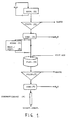
- Block frozen fresh shrimps are extracted (1) at least 8 hours with water (pH 8,1, temperature 15 o C).
- the extract formed is treated by coarse filtration (2) for instance a rotating strainer with openings of 0,5 mm.
- the extract is concentrated (3) 10 times in a cross-flow filtering system. If necessary or wanted, the extract may be frozen or freeze-dried for intermediate storing (4). If the extract is frozen, it has to be melted or dissolved and tempered (5) before further treatment.
- Particular material is flocculated in a tank (6) by adding a flocculating agent, for instance polyacrylamid based polycation in a concentration of 0,1 g/litre extract, which is filtrated (7) by using a filterpress.
- the cleared filtrate is concentrated (8) 10 times in a cross-flow filtration system.
- the enzymes are bound to 10 litres Q-sepharose in a column (9) having a surface area of 500 cm2 with a velocity of 8 l/hour.
- the column is equilibrated with a tris-HCl buffer (pH 7,2, 1 mM MgCl2).
- the wanted enzymes are eluated from the column with a tris-HCl buffer with the addition of 0,1 -0,5 M NaCl.
- the measuring method is according to the standard method where the hydrolysation velocity of the p-nitrofenylphosphate in a diethanolamine buffer at 37 o C is measured. (Ref. Mossner et al., Hoppe-Seyler 2. Physiol. Chem., 361.543 (1980)).
- the extract is coarsly filtrated by using a rotating sieve (Rotosieve) with openings of 0,5 mm.
- the filtrate is concentrated 10 times by ultrafiltration in a cross-flow filtring system with hollow fibres of polysulphon cartridge with a molecular cut-off of 10 000 dalton. This concentration is obtained without serious loss of activity (less than 10 %).
- the volume after said concentration is approx. 250 litres.
- Collodial particles are removed from the concentrated extract by a direct filtration after adding a polyacrylamid based polycation. It is used approximately 0,1 gram polycation/litre extract. After the flocculation and the filtration of the flocculated particles by using a frame filter, the final extract is concentrated further. A second concentration of 10 times in a cross flow filtration system comprising hollow fibres polysulphone cartridge with a molecular cut-off of 10 000 dalton. The volume after this last concentration is approx. 20 litres.
- the alkaline phosphatase is bounded to 10 litres Q-Sepharose (continious flow) in a column with a surface area of approx. 500 cm2 with a velocity of 8 litres/hour.
- the column is equilibrated with tris-HCl buffer (pH 7,2, 1 mM MgCl).
- Undesired proteins are eluated with tris-HCl buffer (pH 7,2, 1 mM MgCl2) to which has been added 0,25 M NaCl.
- the alkaline phosphatase is eluated with said buffer to which has been added 0,4 M NaCl.
- the eluate containing alkaline phosphatase is concentrated to the required end concentration and is then diafiltrated by using a 0,03 M trietalolamin buffer (pH 7,6, 3 M NaCl, 0,001 M ZnCl2).
- Colloidal particles are removed from the concentrated extract by direct filtration after adding a polyacrylamid based polycation. It is used approximately 0,1 gram filtrering agent pr. litre extract. After the flocculation and removal of the particles by a filter press, the filtrate is concentrated another 10 times in a cross flow filtering system comprising a polysulfon cartridge of hollow fibers, with a molecular cut-off of approx. 10 000 dalton. The final volume after said concentration is approx. 20 litres.
- the hyaluronidase is bound to approx. 10 litres Q-Sepharose (continuous flow) in a column with a surface area of 500 m2 with a velocity of 8 litres/hour.
- the column is equilibrated with a tris-HCl buffer (pH 7,2, 1 mM MgCl2).
- the hylauronidase is eluated with tris-Hcl buffer (pH 7,2, 1 mM MgCl2) to which has been added 0,25 M NaCl.
- the eluate which comprises hyaluronidase is concentrated to the required end concentration and is then freeze dried.
- the extract is coarsly filtrated on a rotating sieve with openings of 0,5 mm.
- the filtrate is concentrated approx. 10 times by ultrafiltration on a polysulfon cartridge of hollow fibers, with a molecular cut off of 10 000 dalton.
- the activity loss during this filtration step is low.
- the volume after said concentration is approx. 250 litres.
- Colloidal particles are removed from the concentrated extract by a direct filtration after adding a polyacrylamid based polycation.
- the chitinase is bound to 10 litres of Q-sepharose (fast flow) in a column with a surface area of 500 m2 with a velocity of 8 litres/hour.
- the column is equilibrated with a tris-HCl buffer (pH 7,2, 1 mM MgCl2).
- the chitinase is eluated with a thris-HCl buffer (pH 7,2, 1 mM MgCl2) by using a salt gradiant ranging from 0,1 - 0,5 M NaCl.
- the eluate which comprises chitinase is concentrated to the required end concentration and is then freeze dried.
Landscapes
- Life Sciences & Earth Sciences (AREA)
- Chemical & Material Sciences (AREA)
- Health & Medical Sciences (AREA)
- Genetics & Genomics (AREA)
- Organic Chemistry (AREA)
- Zoology (AREA)
- Engineering & Computer Science (AREA)
- Bioinformatics & Cheminformatics (AREA)
- Wood Science & Technology (AREA)
- Microbiology (AREA)
- Medicinal Chemistry (AREA)
- Biomedical Technology (AREA)
- Molecular Biology (AREA)
- Biochemistry (AREA)
- General Engineering & Computer Science (AREA)
- General Health & Medical Sciences (AREA)
- Biotechnology (AREA)
- Enzymes And Modification Thereof (AREA)
- Peptides Or Proteins (AREA)
- Preparation Of Compounds By Using Micro-Organisms (AREA)
- Medicines Containing Material From Animals Or Micro-Organisms (AREA)
- Extraction Or Liquid Replacement (AREA)
- Compounds Of Unknown Constitution (AREA)
Applications Claiming Priority (2)
| Application Number | Priority Date | Filing Date | Title |
|---|---|---|---|
| NO884721 | 1988-10-24 | ||
| NO884721A NO164844C (no) | 1988-10-24 | 1988-10-24 | Fremgangsmaate ved utvinning av enzymer fra krepsdyr. |
Publications (2)
| Publication Number | Publication Date |
|---|---|
| EP0366296A2 true EP0366296A2 (de) | 1990-05-02 |
| EP0366296A3 EP0366296A3 (de) | 1991-09-11 |
Family
ID=19891357
Family Applications (1)
| Application Number | Title | Priority Date | Filing Date |
|---|---|---|---|
| EP19890310311 Withdrawn EP0366296A3 (de) | 1988-10-24 | 1989-10-09 | Verfahren zur Herstellung einer biologisch aktiven Substanz |
Country Status (12)
| Country | Link |
|---|---|
| US (1) | US5061627A (de) |
| EP (1) | EP0366296A3 (de) |
| JP (1) | JPH02171185A (de) |
| AU (1) | AU637584B2 (de) |
| CA (1) | CA2001242A1 (de) |
| DK (1) | DK524489A (de) |
| FI (1) | FI895025A7 (de) |
| IS (1) | IS3514A7 (de) |
| NO (1) | NO164844C (de) |
| NZ (1) | NZ230985A (de) |
| RU (1) | RU1838406C (de) |
| ZA (1) | ZA897677B (de) |
Cited By (2)
| Publication number | Priority date | Publication date | Assignee | Title |
|---|---|---|---|---|
| WO1997038006A1 (en) * | 1994-10-04 | 1997-10-16 | Wilchap I Limited | Extraction and purification of hyaluronidase from crustacean waste |
| WO1999040989A1 (en) * | 1998-02-17 | 1999-08-19 | Trustees Of Tufts University | Natural products from terrestrial and marine sources, and drug discovery based thereon |
Families Citing this family (8)
| Publication number | Priority date | Publication date | Assignee | Title |
|---|---|---|---|---|
| JPH0691819B2 (ja) * | 1991-05-27 | 1994-11-16 | 工業技術院長 | デアセチラーゼの製造方法 |
| CA2180826A1 (en) | 1994-01-13 | 1995-07-20 | Richard J. Ii Stoner | Organic disease control system |
| US5866120A (en) * | 1995-11-22 | 1999-02-02 | Advanced Corneal Systems, Inc. | Method for accelerating clearance of hemorrhagic blood from the vitreous humor with hyaluronidase |
| US6610292B2 (en) | 1995-11-22 | 2003-08-26 | Ista Pharmaceuticals, Inc. | Use of hyaluronidase in the manufacture of an ophthalmic preparation for liquefying vitreous humor in the treatment of eye disorders |
| US5998173A (en) * | 1996-02-20 | 1999-12-07 | The University Of Bristish Columbia | Process for producing N-acetyl-D-glucosamine |
| JP2002506013A (ja) | 1998-03-09 | 2002-02-26 | イスタ ファーマシューティカルズ インコーポレイテッド | 酵素角膜矯正術における角膜硬化剤の使用 |
| MXPA03011987A (es) | 2003-12-19 | 2005-06-23 | Osio Sancho Alberto | Metodo para el tratamiento de la presbicia induciendo cambios en el poder y fisiologia corneal. |
| ES2994608T3 (en) | 2012-08-10 | 2025-01-27 | Osio Corp D/B/A Yolia Health | Contact lens use in the treatment of an ophthalmologic condition |
Family Cites Families (4)
| Publication number | Priority date | Publication date | Assignee | Title |
|---|---|---|---|---|
| US3075886A (en) * | 1960-09-19 | 1963-01-29 | Baxter Laboratories Inc | Purification of enzymes |
| JPS59501908A (ja) * | 1982-10-25 | 1984-11-15 | ヘルグレン・ラルス・グスタ−ヴ・インゲ | クリーニング用酵素組成物 |
| SE454566B (sv) * | 1984-04-24 | 1988-05-16 | Lars G I Hellgren | Farmaceutisk komposition innehallande en verksam mengd av vattenlosliga proteinaser som extraherats fran ett vattenlevande djur valt av ordningen euphausiaceae eller slektet mallotus |
| SE456245B (sv) * | 1986-07-09 | 1988-09-19 | Pharmacia Ab | Enzympreparation innehallande krillhyaluronidas |
-
1988
- 1988-10-24 NO NO884721A patent/NO164844C/no unknown
-
1989
- 1989-10-09 EP EP19890310311 patent/EP0366296A3/de not_active Withdrawn
- 1989-10-09 ZA ZA897677A patent/ZA897677B/xx unknown
- 1989-10-11 US US07/420,001 patent/US5061627A/en not_active Expired - Fee Related
- 1989-10-12 NZ NZ230985A patent/NZ230985A/xx unknown
- 1989-10-18 AU AU42982/89A patent/AU637584B2/en not_active Ceased
- 1989-10-23 DK DK524489A patent/DK524489A/da not_active Application Discontinuation
- 1989-10-23 CA CA002001242A patent/CA2001242A1/en not_active Abandoned
- 1989-10-23 FI FI895025A patent/FI895025A7/fi not_active IP Right Cessation
- 1989-10-23 IS IS3514A patent/IS3514A7/is unknown
- 1989-10-23 JP JP1273899A patent/JPH02171185A/ja active Pending
- 1989-10-23 RU SU894742338A patent/RU1838406C/ru active
Cited By (2)
| Publication number | Priority date | Publication date | Assignee | Title |
|---|---|---|---|---|
| WO1997038006A1 (en) * | 1994-10-04 | 1997-10-16 | Wilchap I Limited | Extraction and purification of hyaluronidase from crustacean waste |
| WO1999040989A1 (en) * | 1998-02-17 | 1999-08-19 | Trustees Of Tufts University | Natural products from terrestrial and marine sources, and drug discovery based thereon |
Also Published As
| Publication number | Publication date |
|---|---|
| AU637584B2 (en) | 1993-06-03 |
| FI895025A7 (fi) | 1990-04-25 |
| NO164844B (no) | 1990-08-13 |
| ZA897677B (en) | 1990-07-25 |
| NO884721D0 (no) | 1988-10-24 |
| NO164844C (no) | 1990-11-21 |
| NZ230985A (en) | 1991-09-25 |
| RU1838406C (ru) | 1993-08-30 |
| DK524489D0 (da) | 1989-10-23 |
| JPH02171185A (ja) | 1990-07-02 |
| NO884721L (no) | 1990-04-25 |
| CA2001242A1 (en) | 1990-04-24 |
| EP0366296A3 (de) | 1991-09-11 |
| US5061627A (en) | 1991-10-29 |
| FI895025A0 (fi) | 1989-10-23 |
| IS3514A7 (is) | 1990-04-25 |
| AU4298289A (en) | 1990-04-26 |
| DK524489A (da) | 1990-04-25 |
Similar Documents
| Publication | Publication Date | Title |
|---|---|---|
| US4623723A (en) | Process for separating ribonucleic acids from a solution containing deoxyribonucleic acids | |
| US5061627A (en) | Method for preparing enzymes from crustaceans | |
| EP0291264B1 (de) | Verfahren zur Herstellung von K-Kasein-Glykomakropeptid | |
| EP1545235B1 (de) | Verfahren zur herstellung von peptiden und aminosäuren aus proteinhaltigem produkt aus tierischer herkunft | |
| SI9400107A (en) | New process of the isolation of clavulanic acid and its pharmaceutical salts from fermented broth of streptomyces sp.p 6621 ferm p 2804. | |
| CN1336434A (zh) | 胰激肽原酶的制备及其亲和层析纯化方法 | |
| CA2326374C (en) | Process for the recovery and purification of a recombinant protein from a cell | |
| US5108908A (en) | Process for the treatment of proteinic solutions containing pigments such as heminic groups or chlorophylls in view of their decolorization and products thus obtained | |
| SU611595A3 (ru) | Способ одновременного получени ингибитора протеазы и гепарина | |
| RU2039819C1 (ru) | Способ получения коллагеназы | |
| JP2003092996A (ja) | イミダゾールジペプチド類含有組成物の製造方法 | |
| RU2225441C1 (ru) | Способ получения препарата коллагеназы | |
| RU2054943C1 (ru) | Способ получения гиалуронидазы | |
| RU2067868C1 (ru) | Способ получения основного ингибитора протеиназ из органов крупного рогатого скота | |
| JPS6160050B2 (de) | ||
| RU2265052C2 (ru) | Способ получения препарата коллагеназы | |
| SU843915A1 (ru) | Способ получени суммарного гистонаиз жиВОТНОгО СыРь | |
| EP0319890A1 (de) | Verfahren zur Herstellung von Monosialogangliosiden | |
| KR880001120B1 (ko) | 엘라스타제의 정제 방법(Elastase의 精製方法) | |
| RU2195316C1 (ru) | Способ получения основного ингибитора протеиназ | |
| SU981360A1 (ru) | Способ выделени комплекса протеолитических ферментов из поджелудочной железы китов | |
| SU467536A1 (ru) | Способ получени сывороточного альбумина | |
| SU1735273A1 (ru) | Способ получени цистина | |
| JPH021500A (ja) | コンアルブミン及びその金属複合体の製造方法 | |
| SU1161111A1 (ru) | Способ получени агглютинина |
Legal Events
| Date | Code | Title | Description |
|---|---|---|---|
| PUAI | Public reference made under article 153(3) epc to a published international application that has entered the european phase |
Free format text: ORIGINAL CODE: 0009012 |
|
| AK | Designated contracting states |
Kind code of ref document: A2 Designated state(s): DE ES FR GB IT NL SE |
|
| PUAL | Search report despatched |
Free format text: ORIGINAL CODE: 0009013 |
|
| AK | Designated contracting states |
Kind code of ref document: A3 Designated state(s): DE ES FR GB IT NL SE |
|
| 17P | Request for examination filed |
Effective date: 19911025 |
|
| RAP1 | Party data changed (applicant data changed or rights of an application transferred) |
Owner name: MARINE BIOCHEMICALS A.S. |
|
| 17Q | First examination report despatched |
Effective date: 19930311 |
|
| STAA | Information on the status of an ep patent application or granted ep patent |
Free format text: STATUS: THE APPLICATION IS DEEMED TO BE WITHDRAWN |
|
| 18D | Application deemed to be withdrawn |
Effective date: 19930922 |