EP0344729B1 - Procédé et appareil de traitement du coton affecté par le miélat - Google Patents
Procédé et appareil de traitement du coton affecté par le miélat Download PDFInfo
- Publication number
- EP0344729B1 EP0344729B1 EP89109777A EP89109777A EP0344729B1 EP 0344729 B1 EP0344729 B1 EP 0344729B1 EP 89109777 A EP89109777 A EP 89109777A EP 89109777 A EP89109777 A EP 89109777A EP 0344729 B1 EP0344729 B1 EP 0344729B1
- Authority
- EP
- European Patent Office
- Prior art keywords
- flock
- conveyor belt
- fleece
- microwave
- microwave oven
- Prior art date
- Legal status (The legal status is an assumption and is not a legal conclusion. Google has not performed a legal analysis and makes no representation as to the accuracy of the status listed.)
- Expired - Lifetime
Links
Images

Classifications
-
- D—TEXTILES; PAPER
- D01—NATURAL OR MAN-MADE THREADS OR FIBRES; SPINNING
- D01G—PRELIMINARY TREATMENT OF FIBRES, e.g. FOR SPINNING
- D01G99/00—Subject matter not provided for in other groups of this subclass
-
- H—ELECTRICITY
- H05—ELECTRIC TECHNIQUES NOT OTHERWISE PROVIDED FOR
- H05B—ELECTRIC HEATING; ELECTRIC LIGHT SOURCES NOT OTHERWISE PROVIDED FOR; CIRCUIT ARRANGEMENTS FOR ELECTRIC LIGHT SOURCES, IN GENERAL
- H05B6/00—Heating by electric, magnetic or electromagnetic fields
- H05B6/64—Heating using microwaves
- H05B6/78—Arrangements for continuous movement of material
Definitions
- the present invention relates to a continuous process or device for reducing the stickiness of the fibers of cotton fibers contaminated with honeydew by heating with microwave energy, thereby converting the honeydew into a substantially non-sticky substance.
- honeydew cotton flakes from some provenances are more or less infested with sugar-containing excretions from insects. These excretions containing sugar are commonly referred to as honeydew.
- a laboratory method is known by means of which the honeydew is caramelized by heating cotton flake samples in an oven, with the aim of determining the degree of contamination with honeydew from the change in the color of the cotton flake that occurs. This is very important because, in the event of heavy infestation, the cotton flakes become sticky and tend to stick to different parts of the yarn production system or form rolls on rollers or other rotatable organs, which is very undesirable since it leads to frequent interruptions in the yarn production process .
- the object of the present invention is to provide a method and a device of the type mentioned at the outset, which selectively heats up the honeydew component of the contaminated flakes by means of microwave energy with reduced energy expenditure.
- the flakes are pressed into a flake fleece or a flake wadding and then placed on a conveyor belt and moved thereon by a microwave oven constructed as a tunnel and heated therein by means of the microwave energy mentioned.
- a dissolving unit for dissolving the flake fleece As a dissolving unit for dissolving the flake fleece, a dissolving unit with a cleaning roller and a grate arranged at least partially around it is advantageously provided next to the feed rollers.
- a further preferred embodiment consists in that means for cooling the flake cotton wool emerging from the microwave oven are subsequently provided at the output end of the conveyor belt, these means being two superimposed cooling conveyor belts that convey the flake wool between them.
- a particularly preferred embodiment of the device according to the invention is characterized in that alarm sensors are arranged inside the housing of the microwave oven and are coupled to a halon gas fire extinguishing system via a control system. Should a fire arise in the microwave oven due to any unforeseeable circumstances, the fire extinguishing system is able to extinguish this fire while switching off the microwave generator. This enables effective fire fighting within the quasi-closed microwave oven.
- reference numeral 13 denotes the outlet shaft of a combined mixing and cleaning machine 10, for example Rieter Unimix B 7/3 or mixer opener B 3/3, which is arranged in front of the microwave oven 11 according to the invention, which is followed by a dissolving unit 12.
- This disintegration unit can be the disintegration unit of a fine cleaning machine, for example the Rieter ERM cleaner.
- the first deflecting roller 19 is already arranged shortly after the pair of draw rollers 15, 16 of the combined cleaner 10 and is separated therefrom by means of a guide plate 22 for the fleece 17.
- the driven deflection roller 21 is located immediately after the exit of the microwave oven 11 in front of the feed rollers 23, 24 of the opening unit 12, which in the further course of the nonwoven fabric 17 consists of feed rollers 25, 26, a cleaning roller 27 and a grate 28.
- the fleece 17 obtained from the conveyor belt is dissolved and cleaned by the cleaning roller 27 and the dissolved flakes are then fed into a shaft 29 rising vertically upwards, which leads to a flake feeder (not shown).
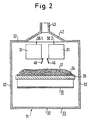
- the microwave oven 11 consists of two rows 30.1, 30.2 of six microwave generators 31 each.
- the fleece 17 deposited on the conveyor belt which has a width of 1 m and a thickness of approximately 10 cm, is approximately 15 cm below the lower ends of the microwave generators 31, so that the microwaves emitted by these microwave generators have the possibility of being distributed evenly over the width of the fleece. This distribution is promoted by multiple reflections on the metallic walls 32 of the microwave housing 33 or on a metallic support plate 35 provided below the upper run 34 of the conveyor belt 18.
- shielding plates 36 are provided, which are attached on the input and output sides and extend from the underside of the microwave generator to just above the surface of the fleece 17. Furthermore, around the rectangular inlet 37 and around the rectangular outlet 38 of the microwave oven, respective parallel arrangements of ferrite rods 39, 41 are arranged, which absorb any microwaves that are still present and thus prevent these microwaves from entering the housing of the combined cleaning machine 10 or in this way get to the dissolving unit 12. This keeps the radiation away from the operating personnel.
- the top of the microwave oven housing 33 is designed as an extractor hood 42, a fan (not shown) extracting the vapors generated by the microwave heating via a nozzle 43 provided at the upper end of the hood 42.
- Various IR detection sensors 44 are provided within the housing 33 and are connected to a control system. Should local overheating occur during operation, the system, especially the microwave generator 31, is switched off via the control system and a halon extinguishing gas is introduced into the housing via the nozzles 45, which displaces oxygen and prevents a fire or an emerging fire is extinguished immediately.
- the heat supply can be easily adapted to the moisture content of the cotton and the honeydew contamination.
- the microwave devices themselves work with a 12 cm wavelength at a frequency of 2.45 gigahertz.
- the energy supply to the fleece should be such that, taking into account the throughput speed of the conveyor belt, the honeydew deposits are warmed up to about 140 ° C, which is sufficient to remove about 80% of the water contained therein and the deposits in a well processable, non-sticky state to convict.
- deflectors 46 which can be controlled within the microwave oven housing for controlling the microwaves, such deflectors 46 being shown in FIG. 2 between the adjacent rows 30.1, 30.2 by microwave generators. These deflectors can be controlled in such a way that a uniform energy distribution over the entire width of the fleece is obtained without the radiation obtained in the middle of the fleece from the two neighboring microwave generators leading to local overheating of the fleece or the honeydew deposits there. These bumpers are normally set once and for all in the manufacture of the microwave oven, taking into account the properties of the microwave generators installed there.
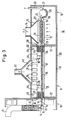
- FIG. 3 shows a variant of the device of FIG. 1 in that a cooling zone 70 is provided between the deflection roller 21 of the conveyor belt 18 and the feed rollers 23 and 24 in order to cool the heated fiber wadding between two cooling conveyor belts 71 and 72.
- the cooling zone 70 is covered by a suction hood 73, on which a connecting piece 74 is provided.
- This connection piece 74 is connected to a suction fan (not shown) in order to generate the air flow L through the cooling conveyor belts 71 and 72.
- Air inlet openings are provided in the walls which surround the cooling zone and the dissolving unit 12, to which the feed rollers 23 and 24 belong, in order to allow the aforementioned air flow L and the air for the shaft 29 to flow in.
- an air conditioning device (not shown) can be connected upstream of the aforementioned air inlet openings.
- the conveyor belts 71 and 72 are driven synchronously by a single drive (not shown) and convey the fiber wadding at the output speed of the fiber wadding on the conveyor belt 18.
- the shaft 29 has a cross section and a length which enables cooling during the conveyance.
- the air speed in the shaft 29 will be slightly above the floating speed of the fiber flakes in order to allow a sufficient dwell time without too great a height of the shaft.
- conditioning the air sucked into the shaft 29 beforehand is also possible.
Landscapes
- Engineering & Computer Science (AREA)
- Textile Engineering (AREA)
- Physics & Mathematics (AREA)
- Electromagnetism (AREA)
- Treatment Of Fiber Materials (AREA)
- Preliminary Treatment Of Fibers (AREA)
- Nonwoven Fabrics (AREA)
- Jellies, Jams, And Syrups (AREA)
- Constitution Of High-Frequency Heating (AREA)
- Telephone Function (AREA)
Claims (16)
- Procédé continu servant à diminuer la glutinosité des fibres de flocons de coton contaminés par un miélat, par échauffement à l'aide d'énergie micro-ondes, afin de transformer par cela le miélat en une substance essentiellement non glutineuse,
caractérisé par le fait que
les flocons sont pressés en un voile de flocons ou en une nappe de flocons, et sont ensuite déposés sur une bande de transport (18) et mûs par celle-ci à travers un four microondes (11) construit comme un tunnel, et sont échauffés dans celui-ci à l'aide de ladite énergie micro-ondes. - Procédé selon revendication 1,
caractérisé par le fait que les vapeurs, s'échappant pendant le développement de chaleur à l'aide de l'énergie micro-ondes, sont extraites. - Procédé selon revendication 1,
caractérisé par le fait que
le voile de flocons est ouvert et nettoyé après ledit traitement par énergie micro-ondes. - Procédé selon revendication 1,
caractérisé par le fait que
le voile de flacons est refroidi après ledit traitement par énergie micro-ondes. - Procédé selon revendication 4,
caractérisé par le fait que
le voile est refroidi à l'aide d'air. - Procédé selon revendication 5,
caractérisé par le fait
qu'un courant d'air est produit et s'écoule essentiellement d'une manière verticale à travers la couche de voile. - Procédé selon revendications 3 et 4,
caractérisé par le fait que
le voile de flocons est refroidi, avant que celui-ci ne soit ouvert et nettoyé. - Dispositif travaillant en continu, servant à diminuer la glutinosité des fibres de coton contaminées par un miélat, par échauffement à l'aide d'énergie micro-ondes,
caractérisé par- un four micro-ondes (11) en forme de tunnel, possédant une hotte d'extraction d'air (42) située sur la partie supérieure du four micro-ondes (11),- une bande de transport (18) constituée d'une matière absorbant peu d'énergie, par exemple de silicone ou de polypropylène, qui change de direction à l'aide de deux galets de renvoi (19, 21), disposés aux extrémités du four (11) en forme de tunnel, et dont un peut être entraîné,- ainsi que par deux rouleaux délivreurs (15, 16) disposés a l'extrémité coté entrée de la bande de transport (18), pour la compression des flocons de fibres en une nappe de flocons avant que cette nappe de flocons ne soit livrée à la bande de transport (18),- ainsi que deux rouleaux d'entrée (23, 24) disposés à l'extrémité coté sortie de la bande de transport pour la réception du voile de flocons (17), délivré par la bande de transport (18). - Dispositif selon revendication 8,
caractérisé par le fait
qu'une unité d'ouvraison (12) est prévue à la suite des rouleaux d'entrée (23, 24), possédant un rouleau nettoyeur (27) et une grille (28) disposée au moins partiellement autour de celui-ci, pour l'ouvraison et le nettoyage de la nappe de flocons. - Dispositif selon revendication 9,
caractérisé par le fait
qu'une conduite de transport (29) est prévue à la suite de l'unité d'ouvraison (12), pour la réception de la nappe de flocons (17) ouverte. - Dispositif selon revendication 8,
caractérisé par le fait que
des moyens utilisés pour le refroidissement de la nappe de flocons (17) sortant du four micro-ondes (11), sont prévus à la suite de l'extrémité côté sortie de la bande de transport (18). - Dispositif selon revendication 11,
caractérisé par le fait que
les moyens utilisés pour le refroidissement comprennent deux bandes transporteuses de refroidissement (71, 72), disposées l'une au-dessus de l'autre et transportant la nappe de flocons (17) entre elles. - Dispositif selon revendication 12,
caractérisé par le fait que
les rouleaux d'entrée (23, 24) sont prévus à la suite des deux bandes transporteuses de refroidissement (71, 72) disposées l'une au-dessus de l'autre, et l'unité d'ouvraison (12) fait suite à ces rouleaux. - Dispositif selon revendication 11,
caractérisé par le fait que
le moyen de refroidissement (70)comprend une hotte d'aspiration (73) prévue au-dessus des bandes transporteuses de refroidissement (71, 72). - Dispositif selon revendication 12,
caractérisé par le fait que
les bandes transporteuses de refroidissement (71, 72) sont des bandes perméables à l'air. - Dispositif selon revendication 11,
caractérisé par le fait que
des détecteurs de signalisation R (44) sont prévus à l'intérieur du carter (33) du four micro-ondes (11), qui sont accouplés à un système d'asservissement possédant une installation d'extinction par gaz halogène (45).
Applications Claiming Priority (2)
| Application Number | Priority Date | Filing Date | Title |
|---|---|---|---|
| CH2121/88 | 1988-06-03 | ||
| CH212188 | 1988-06-03 |
Publications (2)
| Publication Number | Publication Date |
|---|---|
| EP0344729A1 EP0344729A1 (fr) | 1989-12-06 |
| EP0344729B1 true EP0344729B1 (fr) | 1995-06-21 |
Family
ID=4226369
Family Applications (1)
| Application Number | Title | Priority Date | Filing Date |
|---|---|---|---|
| EP89109777A Expired - Lifetime EP0344729B1 (fr) | 1988-06-03 | 1989-05-30 | Procédé et appareil de traitement du coton affecté par le miélat |
Country Status (9)
| Country | Link |
|---|---|
| US (2) | US5048156A (fr) |
| EP (1) | EP0344729B1 (fr) |
| JP (1) | JPH0226910A (fr) |
| KR (1) | KR920005792B1 (fr) |
| CN (1) | CN1019210B (fr) |
| AT (1) | ATE124097T1 (fr) |
| DE (2) | DE3819883A1 (fr) |
| IL (1) | IL90240A (fr) |
| RU (1) | RU1836505C (fr) |
Families Citing this family (21)
| Publication number | Priority date | Publication date | Assignee | Title |
|---|---|---|---|---|
| IL74469A (en) * | 1985-02-28 | 1988-04-29 | Shenkar College Textile Tech | Treatment of cotton |
| IT1227705B (it) * | 1988-12-21 | 1991-04-23 | Polli Edoardo M | Procedimento ed apparecchiatura, particolarmente studiati per sottoporre cotone in balle pressate ad un trattamento di sterilizzazione, atto ad eliminare funghi e microrganismi, presenti nel cotone stesso |
| IL92299A0 (en) * | 1989-11-14 | 1990-07-26 | Israel Fiber Inst State Of Isr | Process and device for the treatment of cotton |
| FR2664796A1 (fr) * | 1990-07-18 | 1992-01-24 | Moreau Sa | Procede de nettoyage de racines et tubercules, notamment de betteraves, apres leur arrachage. |
| IT1252852B (it) * | 1991-11-15 | 1995-06-28 | Cerit Sarl | Procedimento per selezionare polipropilene nella lavorazione della seta e selezionatore di polipropilene adottante tale procedimento |
| FR2685709A1 (fr) * | 1991-12-30 | 1993-07-02 | Cirad | Procede de traitement du coton et installation pour l'application du procede. |
| FR2691545B1 (fr) * | 1992-05-20 | 1994-07-13 | Cirad | Procede et installation pour l'evaluation du caractere collant de matieres fibreuses vegetales telles que des cotons et utilisation de ce procede et de cette installation. |
| AU2001248711A1 (en) * | 2000-05-01 | 2001-11-12 | Xorella Ag | Method for the heat treatment of bales |
| DE10104320A1 (de) * | 2001-01-25 | 2002-08-01 | Univ Schiller Jena | Vorrichtung zur Erfüllung von Sicherheitsfunktionen in Räumen mit Hochfrequenzstrahlung |
| WO2003062970A1 (fr) * | 2001-12-24 | 2003-07-31 | Lg Electronics Inc. | Ensemble charniere pour ecran plat |
| WO2003056415A1 (fr) * | 2001-12-24 | 2003-07-10 | Lg Electronics Inc. | Ensemble d'articulation pour dispositif d'affichage a ecran plat |
| WO2003056414A1 (fr) * | 2001-12-24 | 2003-07-10 | Lg Electronics Inc. | Ensemble pivot pour dispositif d'affichage a panneau plat |
| US20040188430A1 (en) * | 2003-03-31 | 2004-09-30 | Qazi Ghulam Nabi | Microbial decontaminator |
| AU2003302300A1 (en) * | 2003-12-19 | 2005-08-12 | Spinner, Hermann | Method for removing honeydew and synthetic fibres of fibrous materials and device for carrying out said method |
| CN100439840C (zh) * | 2006-01-05 | 2008-12-03 | 卓卫民 | 一种采用金属链条传动的微波加热设备 |
| DE102007063374A1 (de) * | 2007-12-30 | 2009-07-02 | Dieffenbacher Gmbh + Co. Kg | Verfahren und Vorrichtung zur Vorwärmung einer Pressgutmatte im Zuge der Herstellung von Holzwerkstoffplatten |
| US8046877B2 (en) * | 2008-08-26 | 2011-11-01 | Jimmy R. Stover | Drying of seed cotton and other crops |
| US20100307120A1 (en) * | 2009-06-05 | 2010-12-09 | Stover Jimmy R | Harvester with heated duct |
| CN103103704A (zh) * | 2012-12-11 | 2013-05-15 | 吴江兰瑞特纺织品有限公司 | 一种微波棉絮蓬松装置 |
| US9739530B2 (en) | 2014-02-28 | 2017-08-22 | Jimmy Ray Stover | Microwave drying of seed cotton and other crops |
| DE102017104061A1 (de) * | 2017-02-27 | 2018-08-30 | Dieffenbacher GmbH Maschinen- und Anlagenbau | Durchlaufofen zur Erwärmung von Material mittels Mikrowellen |
Family Cites Families (15)
| Publication number | Priority date | Publication date | Assignee | Title |
|---|---|---|---|---|
| DE175338C (fr) * | ||||
| GB433091A (en) * | 1934-07-25 | 1935-08-08 | Preston Street Combing Co Ltd | Improvements in combing machines |
| DE1133286B (de) * | 1959-10-06 | 1962-07-12 | Fritz Hadwich Dipl Ing | Verfahren und Vorrichtung zum Ausscheiden von festen und in der Hitze erweichbaren Fremdkoerpern aus einem Faserflor |
| GB1294648A (en) * | 1969-06-25 | 1972-11-01 | Unisearch Ltd | Apparatus for drying textile materials |
| LU62048A1 (fr) * | 1970-11-12 | 1972-07-26 | ||
| NL189363C (nl) * | 1977-03-17 | 1993-03-16 | Truetzschler Gmbh & Co Kg | Inrichting voor het afnemen en samenvatten van uit een kaarde komend vezelvlies. |
| AU531418B2 (en) * | 1978-09-11 | 1983-08-25 | Philip Morris Products Inc. | Cigarette filters |
| SU771425A1 (ru) * | 1978-11-02 | 1980-10-15 | За витель | Устройство дл сушки волокнистого материала |
| US4631380A (en) * | 1983-08-23 | 1986-12-23 | Durac Limited | System for the microwave treatment of materials |
| DE3430673C2 (de) * | 1984-08-21 | 1987-01-08 | Hermann Berstorff Maschinenbau Gmbh, 3000 Hannover | Einrichtung zum Pasteurisieren und Sterilisieren von rieselfähigen oder stückigen Materialien |
| NL8402999A (nl) * | 1984-10-02 | 1986-05-01 | Philips Nv | Mikrogolfinrichting voor het verhitten van materiaal. |
| IL74469A (en) * | 1985-02-28 | 1988-04-29 | Shenkar College Textile Tech | Treatment of cotton |
| GB2182149B (en) * | 1985-10-25 | 1989-12-20 | Coal Ind | Improved moisture meter |
| DE3538899A1 (de) * | 1985-11-02 | 1987-05-07 | Hauni Werke Koerber & Co Kg | Anlage zur mikrowellenbehandlung eines gutes |
| IT8721377A0 (it) * | 1987-07-21 | 1987-07-21 | Edoardo Polli | Procedimento ed apparecchiatura per il trattamento di fibre tessili, in particolare di cotone in balle pressate, per la rimozione o riduzione da tali fibre di eventuali residui organici di insetti, ad esse aderenti. |
-
1988
- 1988-06-10 DE DE3819883A patent/DE3819883A1/de not_active Withdrawn
-
1989
- 1989-05-09 IL IL90240A patent/IL90240A/xx unknown
- 1989-05-30 EP EP89109777A patent/EP0344729B1/fr not_active Expired - Lifetime
- 1989-05-30 AT AT89109777T patent/ATE124097T1/de not_active IP Right Cessation
- 1989-05-30 RU SU894614194A patent/RU1836505C/ru active
- 1989-05-30 DE DE58909304T patent/DE58909304D1/de not_active Expired - Fee Related
- 1989-05-31 US US07/359,495 patent/US5048156A/en not_active Expired - Lifetime
- 1989-06-02 JP JP1139391A patent/JPH0226910A/ja active Pending
- 1989-06-03 CN CN89103702A patent/CN1019210B/zh not_active Expired
- 1989-06-03 KR KR1019890007651A patent/KR920005792B1/ko not_active Expired
-
1990
- 1990-04-02 US US07/503,524 patent/US5008978A/en not_active Expired - Fee Related
Also Published As
| Publication number | Publication date |
|---|---|
| EP0344729A1 (fr) | 1989-12-06 |
| DE58909304D1 (de) | 1995-07-27 |
| IL90240A0 (en) | 1989-12-15 |
| CN1019210B (zh) | 1992-11-25 |
| DE3819883A1 (de) | 1989-12-07 |
| US5008978A (en) | 1991-04-23 |
| IL90240A (en) | 1993-02-21 |
| JPH0226910A (ja) | 1990-01-29 |
| RU1836505C (ru) | 1993-08-23 |
| KR920005792B1 (ko) | 1992-07-18 |
| CN1040231A (zh) | 1990-03-07 |
| ATE124097T1 (de) | 1995-07-15 |
| KR900000539A (ko) | 1990-01-30 |
| US5048156A (en) | 1991-09-17 |
Similar Documents
| Publication | Publication Date | Title |
|---|---|---|
| EP0344729B1 (fr) | Procédé et appareil de traitement du coton affecté par le miélat | |
| DE3003814C2 (de) | Verfahren und Vorrichtung zum Entfernen von Linters von Baumwollesamen | |
| DE60222150T2 (de) | Maschine und Verfahren für die kontinuierliche Behandlung einer Stoffbahn | |
| DE102019114016B4 (de) | Verfahren und Vorrichtung zur Erwärmung einer Pressgutmatte | |
| DE2755380A1 (de) | Vorrichtung zum oeffnen und reinigen von baumwollabfaellen | |
| DE1510395B1 (de) | Verfahren und Vorrichtung zum OEffnen von Faserflocken,insbesondere zur Faservliesherstellung | |
| EP0344631B1 (fr) | Procédé et dispositif pour diminuer l'effet de mièlat du coton | |
| DE3735235A1 (de) | Erntemaschine fuer gruenen flachs | |
| DE69900164T2 (de) | Verfahren und Einrichtung zum Formen eines luftgelegten Faservlieses | |
| DE69911799T2 (de) | Faserbündelabscheider | |
| EP0874070B1 (fr) | Appareil de préparation à la filature | |
| EP0350669B1 (fr) | Procédé pour réduire les matières adhérantes sur des fibres de coton souillées par des insectes | |
| EP0806512A1 (fr) | Procédé et dispositif de fibrillation de fibres cellulosiques facilement fibrillables, notamment de fibres tencel | |
| DE941384C (de) | Verfahren und Vorrichtung zur Herstellung von Fasern aus faserbildenden Werkstoffen | |
| DE2313376A1 (de) | Verfahren zur bildung und sammlung von fasern und vorrichtung zur durchfuehrung des verfahrens | |
| DE2950367C2 (de) | Karde oder Krempel mit einer Umkleidung | |
| WO1994003406A1 (fr) | Procede et dispositif de traitement thermique de dechets et/ou de residus | |
| DE4124702A1 (de) | Vorrichtung zur ueberfuehrung eines faserflors in einen verdichter | |
| DE2605003C3 (de) | Verfahren zur Herstellung von Faservliesen und Vorrichtung zur Durchführung des Verfahrens | |
| DE19507643C1 (de) | Verfahren zum Unschädlichmachen von in einem Mineralwollevlies befindlichen heißen Einschlüssen und Vorrichtung zur Durchführung des Verfahrens | |
| AT244011B (de) | Verfahren zum Herstellen von Fasern aus zähflüssigen Massen und Vorrichtung zum Durchführen des Verfahrens | |
| DE3446556C2 (de) | Vorrichtung zum kontinuierlichen Dämpfen von Stapelfasern oder Faserbändern | |
| DE4126625A1 (de) | Verfahren und vorrichtung zur voraufloesung, reinigung und zerfaserung von fasermaterial | |
| DE1669362C3 (de) | Verfahren zum kontinuierlichen Karbonisieren von Wolle | |
| AT398585B (de) | Vorrichtung zum herstellen eines vlieses |
Legal Events
| Date | Code | Title | Description |
|---|---|---|---|
| PUAI | Public reference made under article 153(3) epc to a published international application that has entered the european phase |
Free format text: ORIGINAL CODE: 0009012 |
|
| AK | Designated contracting states |
Kind code of ref document: A1 Designated state(s): AT CH DE FR GB IT LI |
|
| 17P | Request for examination filed |
Effective date: 19900112 |
|
| 17Q | First examination report despatched |
Effective date: 19910709 |
|
| GRAA | (expected) grant |
Free format text: ORIGINAL CODE: 0009210 |
|
| AK | Designated contracting states |
Kind code of ref document: B1 Designated state(s): AT CH DE FR GB IT LI |
|
| PG25 | Lapsed in a contracting state [announced via postgrant information from national office to epo] |
Ref country code: FR Effective date: 19950621 |
|
| REF | Corresponds to: |
Ref document number: 124097 Country of ref document: AT Date of ref document: 19950715 Kind code of ref document: T |
|
| REF | Corresponds to: |
Ref document number: 58909304 Country of ref document: DE Date of ref document: 19950727 |
|
| ITF | It: translation for a ep patent filed | ||
| GBT | Gb: translation of ep patent filed (gb section 77(6)(a)/1977) |
Effective date: 19950829 |
|
| EN | Fr: translation not filed | ||
| PLBE | No opposition filed within time limit |
Free format text: ORIGINAL CODE: 0009261 |
|
| STAA | Information on the status of an ep patent application or granted ep patent |
Free format text: STATUS: NO OPPOSITION FILED WITHIN TIME LIMIT |
|
| PGFP | Annual fee paid to national office [announced via postgrant information from national office to epo] |
Ref country code: CH Payment date: 19960502 Year of fee payment: 8 |
|
| PG25 | Lapsed in a contracting state [announced via postgrant information from national office to epo] |
Ref country code: AT Effective date: 19960530 |
|
| 26N | No opposition filed | ||
| PG25 | Lapsed in a contracting state [announced via postgrant information from national office to epo] |
Ref country code: LI Free format text: LAPSE BECAUSE OF NON-PAYMENT OF DUE FEES Effective date: 19970531 Ref country code: CH Free format text: LAPSE BECAUSE OF NON-PAYMENT OF DUE FEES Effective date: 19970531 |
|
| REG | Reference to a national code |
Ref country code: CH Ref legal event code: PL |
|
| PGFP | Annual fee paid to national office [announced via postgrant information from national office to epo] |
Ref country code: GB Payment date: 20010423 Year of fee payment: 13 |
|
| REG | Reference to a national code |
Ref country code: GB Ref legal event code: IF02 |
|
| PGFP | Annual fee paid to national office [announced via postgrant information from national office to epo] |
Ref country code: DE Payment date: 20020502 Year of fee payment: 14 |
|
| PG25 | Lapsed in a contracting state [announced via postgrant information from national office to epo] |
Ref country code: GB Free format text: LAPSE BECAUSE OF NON-PAYMENT OF DUE FEES Effective date: 20020530 |
|
| GBPC | Gb: european patent ceased through non-payment of renewal fee |
Effective date: 20020530 |
|
| PG25 | Lapsed in a contracting state [announced via postgrant information from national office to epo] |
Ref country code: DE Free format text: LAPSE BECAUSE OF NON-PAYMENT OF DUE FEES Effective date: 20031202 |
|
| PG25 | Lapsed in a contracting state [announced via postgrant information from national office to epo] |
Ref country code: IT Free format text: LAPSE BECAUSE OF NON-PAYMENT OF DUE FEES Effective date: 20050530 |