EP0341687A2 - Nebenstellenanlagesystem - Google Patents
Nebenstellenanlagesystem Download PDFInfo
- Publication number
- EP0341687A2 EP0341687A2 EP89108387A EP89108387A EP0341687A2 EP 0341687 A2 EP0341687 A2 EP 0341687A2 EP 89108387 A EP89108387 A EP 89108387A EP 89108387 A EP89108387 A EP 89108387A EP 0341687 A2 EP0341687 A2 EP 0341687A2
- Authority
- EP
- European Patent Office
- Prior art keywords
- calling party
- line
- extension terminal
- terminal
- branch exchange
- Prior art date
- Legal status (The legal status is an assumption and is not a legal conclusion. Google has not performed a legal analysis and makes no representation as to the accuracy of the status listed.)
- Granted
Links
Images






Classifications
-
- H—ELECTRICITY
- H04—ELECTRIC COMMUNICATION TECHNIQUE
- H04Q—SELECTING
- H04Q11/00—Selecting arrangements for multiplex systems
- H04Q11/04—Selecting arrangements for multiplex systems for time-division multiplexing
- H04Q11/0428—Integrated services digital network, i.e. systems for transmission of different types of digitised signals, e.g. speech, data, telecentral, television signals
-
- H—ELECTRICITY
- H04—ELECTRIC COMMUNICATION TECHNIQUE
- H04M—TELEPHONIC COMMUNICATION
- H04M3/00—Automatic or semi-automatic exchanges
- H04M3/42—Systems providing special services or facilities to subscribers
- H04M3/50—Centralised arrangements for answering calls; Centralised arrangements for recording messages for absent or busy subscribers ; Centralised arrangements for recording messages
- H04M3/53—Centralised arrangements for recording incoming messages, i.e. mailbox systems
- H04M3/533—Voice mail systems
Definitions
- the present invention relates to a private automatic exchange (PBX) system for controlling a calling party address in an Integrated Systems Digital Network (ISDN public network), and more particularly, to a connecting system between a terminal connected to an ISDN public network and an extension terminal accommodated by a PBX system.
- PBX private automatic exchange
- the extension terminal when a call is effected from a terminal connected to the ISDN public network to an extension terminal accommodated by the PBX system, the extension terminal receives the calling party address from the calling party terminal through the ISDN public network and a PBX network in the PBX system.
- the called party extension terminal could not identify whether the received calling party address is from a terminal connected to the ISDN network or from another extension terminal accommodated by the PBX system. This was inconvenient for the user of the PBX system.
- the user is away from the called party extension terminal when a call is made to the extension terminal, after the termination of the call, if the user wants to return the call to the person at the calling party terminal, the user cannot call back to the calling party terminal because the user has no way of knowing whether the calling party was from the ISDN network or from another extension terminal accommodated by the PBX system.
- an object of the present invention is to provide a private automatic branch exchange system which can distinguish whether an incoming call received by an extension terminal accommodated by the PBX system is a call from an another extension terminal accommodated by the PBX system or a call from a terminal connected to the ISDN public network.
- Another object of the present invention is to provide a private automatic branch exchange system which can effect a call back from an extension terminal accommodated by the PBX system to a terminal, which previously originated a call to the extension terminal, connected to the ISDN public network.
- a private automatic branch exchange system connected through a communication line to an ISDN public network, comprising a switching network for switching between the communication line connected to said ISDN public network and an extension line accommodated by the PBX system, a control unit for controlling the switching operation of the switching network, and an extension terminal accommodated by the PBX system and connected through the extension line to the switching network.
- the control unit operates to add a line access number to a calling party address in incoming call information received through the communication line so as to form incoming information to be received by the extension terminal, and to transmit the incoming information including the line access number to the extension terminal.
- the extension terminal comprises a display unit for displaying the incoming information including the line access number, or ringing generators for generating different sounds depending on the line access number received.
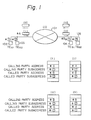
- FIG. 1 is a diagram showing a conventional connecting system in an ISDN public network, for explaining the background of the invention.
- 101 is an ISDN (CO)
- 102 to 105 are ISDN terminals (TE a1 , TE a2 , TE b1 , TE b2 ), respectively.
- TE a1 , TE a2 , TE b1 , TE b2 are ISDN terminals
- TE a1 , TE a2 , TE b1 , TE b2 are ISDN terminals (TE a1 , TE a2 , TE b1 , TE b2 ), respectively.
- TE a1 , TE a2 TE a2
- TE b1 , TE b2 TE b1 , TE b2
- a subscriber line A is provided with a subscriber line number #A and subaddresses #1 or #2 for identifying the ISDN terminal (TE a1 or TE a2 ) 102 or 103 connected to the subscriber line A.
- a subscriber line B is provided with a subscriber line number #B and subaddresses #1 or #2 for identifying the ISDN terminal (TE b1 or TE b2 ) 104 or 105 connected to the subscriber line B.
- (i), (ii), (iii) and (iv) represent signals including call setup messages for setting up calls.
- address information i.e., a calling party address (or in other words a calling party main address), a calling party subaddress, a called party address (or in other words a called party main address), and a called party subaddress.
- Figure 2 is a diagram showing a call connecting sequence in a public network
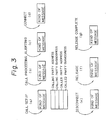
- Fig. 3 is a diagram showing contents of messages in respective steps in the public network connecting sequence.
- the call setup message (i) is setup, and the call setup message (i) then sent to the ISDN public network (CO) 101 (see Fig. 2, 1).
- the calling party address in this case is the subscriber line number #A; the calling party subaddress is the subaddress #1 identifying the ISDN terminal (TE a1 ) 102; the called party address is the subscriber line number #B identifying the destinating subscriber line B; and the called party subaddress is the subaddress #2 identifying the destination ISDN terminal (TE b2 ) 105.
- the call setup message (i) further includes, as shown in Fig. 3, (a), a message indicating the type of message. In this case, the type of message indicates that the message (i) is a call setup message.
- the ISDN public network (CO) 101 When the ISDN public network (CO) 101 receives the call setup message, it recognizes that the destination subscriber line is #B and transmits a call setup message which is the same as the call setup message (i) as shown in Fig. 1 to the subscriber line #B (see Fig. 2, 2). Then, the ISDN public network (CO) 101 returns a call proceeding message as shown in Fig. 3, (b) to the calling party ISDN terminal (TE a1 ) 102 (see Fig. 2, 3), and then transmits an alert message (see Fig. 3, (C)), received from the called party terminal (TE b2 ) 105, to the calling party terminal (TE a1 ) 102.
- a person is informed of the alert state by its being displayed or by a sound (see Fig. 2, 4).
- a ringing tone is generated (see Fig. 2, 5).
- the subscriber line #B receives the alert message in accordance with a predetermined ISDN sequence. Since the called party subaddress in this example is #2 , only a person at the ISDN terminal (TE b2 ) 105 responds to the ringing tone by lifting the receiver off hook so that a connection message as shown in Fig. 3, (d) is transmitted from the terminal (TE b2 ) 105 to the ISDN public network (CO) 101 (see Fig. 2, 6). The ISDN public network (CO) 101, when receiving the connection message, transmits it to the calling party terminal (TE a1 ) 102. The calling party terminal (TE a1 ) 102 then stops the alert display or sound, and a connection is established between the calling party terminal (TE a1 ) 102 and the called party terminal (TE b2 ) 105.
- a disconnection, a release, and a release complete after the end of the communication are carried out by7, 8 and 9 in Fig. 2.
- the contents of the messages in the disconnection, release, and release complete are illustrated in Fig. 12, (e), (f), and (g).
- connection system is very convenient for the user.
- the user by storing the calling party address and the calling party subaddress received by the called party terminal into a memory unit provided in the called party terminal, and by displaying the stored contents on a display unit or the like, the user, who was away from the called party terminal when the incoming call was terminated at the called party terminal, can immediately recognize the calling party address and subaddress on the display on the like. Therefore, by setting the displayed address and subaddress into a call setup message to be called back from the called party terminal to the original calling party terminal, the user at the called party terminal can call back the person at the original calling party terminal.
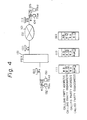
- Fig. 4 is a block diagram of a system including a PBX system and an ISDN for explaining a conventional call receiving operation by an extension terminal accommodated by the PBX system.
- a call is effected from a terminal (TE b2 ) 105 connected to an ISDN public network (CO) 101 to an extension terminal (TE a1 ) 132 accommodated through an extension line #a by a PBX system.
- the subscriber line number of the PBX 131 is #A
- the extension line number of the PBX is #a.
- eight extension terminals at the maximum can be connected to the extension line #a.
- the public network (CO) 101, the terminal (TE b1 ) 104, and the terminal (TE b2 ) 105 are the same as those shown in Fig. 1.
- the call setup message (i) as illustrated in Fig. 1 is setup, and then the call setup message (i) is sent to the ISDN public network (CO) 101.
- the calling party address in this case is the subscriber line number #B; the calling party subaddress is the subaddress #2 for identifying the ISDN terminal (TE b2 ) 105; the called party address is the subscriber line number #A for identifying the destination subscriber line A connected between the PBX 131 and the ISDN public network 101; and the called party subaddress is #a#1 which is a combination of a number #a of the called party extension line accommodated by the PBX 131 and a number #1 of the called party extension terminal accommodated by the PBX 131.
- the call setup message is represented by (i). The contents of the call setup message are similar to that shown if Fig.
- the called party subaddress is different as can be seen from the above description.
- the ISDN public network (CO) 101 receives the call setup message (i), it recognizes that the destination subscriber line is #A and transmits a call setup message (ii) which is the same as the call setup message (i) to the PBX 131.
- the PBX 131 then analyzes the called party subaddress and takes out from the subaddress the extension line number #a to form a call setup message (iii) having the called party address #a and a called party subaddress #1 which is obtained by deleting the extension line number #a from the called party subaddress received from the ISDN public network (CO) 101.
- the PBX 131 then transmits the thus obtained called party subaddress #1 to the extension line a.
- the extension terminal (TE a1 ) 132 compares its own address with the called party subaddress #1, and if they coincide, it generates a ringing tone. When a person who hears the ringing tone takes the receiver off hook, a connection is established between the terminal (TRE b2 ) 105 and the extension terminal (TE a1 ) 132.
- Fig. 5 is a block diagram of a system including a PBX system and an ISDN for explaining a conventional call originating operation by an extension terminal accommodated by the PBX system.
- a call is effected from an extension terminal (TE a1 ) 132 accommodated by the PBX 131 through the ISDN public network (CO) 101 to an ISDN terminal (TE b2 ) 105.
- the extension terminal (TE a1 ) 132 sets a setup message (i) and transmits it to the PBX 131.
- the setup message (i) in this case has, as illustrated in the figure, a calling party address #a which is the extension line number; a calling party subaddress is the subaddress #1 for identifying the extension terminal (TE a1 ) 132; a called party address ⁇ #B which is a combination of a line accessing number ⁇ for identifying the communication line A connected between the PBX 131 and the ISDN public network (CO) 101 and the subscriber line number #B for identifying the destination subscriber line B connected to the destination terminal (TE b2 ) 105; and a called party subaddress #2 for identifying the destination terminal (TE b2 ).
- the call setup message is represented by (i).
- the PBX 131 When the PBX 131 receives the call setup message (i) from the extension terminal (TE a1 ) 132, the PBX 131 analyzes the called party address in the call setup message. If the line accessing number ⁇ is found in the call setup message, the PBX 131 recognizes that the destination terminal is not an extension terminal accommodated by the PBX 131 but is a terminal connected to the ISDN public network (CO) 101. The PBX 131 then edits a call setup message (ii) and transmits it to the ISDN public network (CO) 101.
- CO ISDN public network
- the call setup message (ii) has, in this case, a called party address #B which is the number of the subscriber line B connected to the ISDN terminal (TE b2 ) 105 and which is obtained by subtracting the line accessing number ⁇ from the called party address ⁇ #B received from the extension line; a called party subaddress #2 for identifying the terminal (TE b2 ) 105 and which is received from the extension line; a calling party address #A which is the subscriber line number of the communication line connected between the PBX 131 and the ISDN public network (CO) 101; and a calling party subaddress #a#1 which is a combination of the calling party subaddress #1 received from the extension line and the number #a of an extension line connected to the calling party extension terminal (TE a1 ) 132 accommodated by the PBX 131.
- a called party address #B which is the number of the subscriber line B connected to the ISDN terminal (TE b2 ) 105 and which is obtained by subtracting the line
- the ISDN terminal (TE b2 ) 105 connected to the subscriber line B which is connected to the ISDN public network (CO) 101 can be called.
- the terminal (TE b2 ) 105 responds to the call, the connection between the extension terminal (TE a1 ) 132 and the ISDN terminal (TE b2 ) 105 is established.
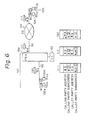
- Fig. 6 is a block diagram showing a connecting system between an ISDN and a PBX system for explaining the principle of a first embodiment of the present invention.
- an ISDN PBX system 60 is connected through a communication line 61 to an ISDN public network (CO) 101.
- the PBX system 60 includes a switching network 131a for switching between the communication line 61 connected to the ISDN public network 131a and an extension line 62 accommodated to the ISDN PBX system 60, a control unit (CC) 63 connected to the switching network, for controlling the switching operation of the switching network, and an extension terminal (TE a1 ) 132a accommodated by the PBX system 60 and connected through the extension line 62 to the switching network 131a.
- CC control unit
- the control unit (CC) 63 operates to add a line accessing number ⁇ to a calling party address #B in an incoming call information (ii) from the ISDN public network (CO) 101 and received by the switching network 131a through said communication line 61.
- the line accessing number ⁇ can be used when a call is originated from the extension terminal (TE a1 ) 132a through the switching network 131a and through the communication line 61 to the ISDN public network (CO) 101.
- the control unit 63 forms an information ⁇ #B provided with the line accessing number ⁇ and transmits the information ⁇ #B to the extension terminal, when the incoming call information (ii) from the communication line is received by the switching network 131a.
- Fig. 4 different from the conventional constitution shown in Fig. 4, to the calling party address information #B in the call setup message (ii) transmitted from the ISDN public network (CO) 101 to the switching network 131a, the line accessing number is provided to form a new calling party address, and the new calling party address is inserted into a calling party address section in a call setup message (iii) to be transmitted from the switching network 131a to the extension terminal (TE a1 ) 132a.
- the other portions except for the above mentioned difference are the same as the portions in the conventional constitution shown in Fig. 4. That is, the subscriber line number of the switching network 131a is #A, and the extension line number of the extension line 62 accommodated by the PBX system 60 is #a.
- extension terminals at the maximum can be connected to the extension line 62.
- the call setup message (i) as illustrated in Fig. 6 is setup, and then the call setup message (i) is sent to the ISDN public network (CO) 101.
- the calling party address in this case is the subscriber line number #B; the calling party subaddress is the subaddress #2 for identifying the ISDN terminal (TE b2 ) 105; the called party address is the subscriber line number #A for identifying the destinating subscriber line 61 connected between the PBX switching network 131a and the ISDN public network (CO)101; and the called party subaddress is #a#1 which is a combination of a number #a of the called party extension line 62 accommodated by the PBX system 60 and a number #1 of the called party extension terminal (TE a1 ) 132a accommodated by the PBX system 60.
- the call setup message (i) is the same as that shown in Fig. 4.
- the ISDN public network (CO) 101 When the ISDN public network (CO) 101 receives the call setup message (i), it recognizes that the destination subscriber line is #A and transmits a call setup message (ii) which is the same as the call setup message (i) to the switching network 131a.
- the PBX switching network 131a then analyzes the called party subaddress and takes out from the subaddress the extension line number #a to form a call setup message (iii) having the called party address #a and a called party subaddress #1 which is obtained by deleting the extension line number #a from the called party subaddress received from the ISDN public network (CO) 101.
- the PBX switching network 131a then transmits the thus obtained called party subaddress #1 to the extension line 62.
- the extension terminal (TE a1 ) 132a compares its own address with the called party subaddress #1, and if they coincide, the terminal 132a generates a ringing tone. When a person who hears the ringing tone takes the receiver off hook, a connection is established between the terminal (TE b2 ) 105 and the extension terminal (TE a1 ) 132a.
- the calling party address in the setup message (iii) received by the extension terminal (TE a1 ) 132a includes the line access number ⁇ for identifying the communication line connected between the switching network 131a and the ISDN public network (CO) 101, and by displaying the line number ⁇ on a display for example, the user at the extension terminal (TE a1 ) 132a can recognize that the incoming call is not a call from another extension terminal accommodated by the PBX system 60 but is a call from a terminal connected to the ISDN public network 101.
- TE b2 it is sufficient to send back a message, having a destination address and a destination subaddress which are respectively the calling party address ⁇ #B and the calling party subaddress #2 in the call setup message (iii), from the called party extension terminal (TE a1 ) 132a to the calling party terminal (TE b2 ) 105.
- the communication line 61 is formed by a central office line connected between the ISDN public network (CO) 101 and the switching network 131a.
- the communication line 61 may alternatively be a private line connected between the ISDN public network (CO) 101 and the switching network 131a.
- CO ISDN public network
- the incoming call information (ii) is a call setup message.
- the extension terminal (TE a1 ) 132a includes a display unit for displaying the line accessing number ⁇ and the calling party address #B when the extension terminal (TE a1 ) 132a receives an incoming message (iii) transmitted from the switching network 131a.
- the incoming message (iii) is transmitted by the use of one channel in a plurality of channels in a subscriber line connected between the switching network 131a and the extension terminal (TE a1 ) 132a.
- the plurality of channels are 2B + D channels.
- the channel for transmitting the incoming message (iii) is a control channel D in the 2B + D channels.
- the extension terminal (TE a1 ) 132a includes a storage unit for storing the incoming message (iii), a plurality of function keys for instructing predetermined functions, and a terminal control unit operatively connected to the storing unit, the function keys, and the display unit, for controlling the storing unit, the display unit, and the function keys, whereby by using the line accessing number in the calling party information in the incoming message (iii) read from the storing unit, a call back can be automatically carried out from the destinating extension terminal (TE a1 ) 132a to the calling party terminal.
- the storage unit for storing the incoming message has a plurality of storage areas corresponding to the function keys.
- the extension terminal (TE a1 ) 132a comprises a detecting unit for detecting one of the function keys being pushed, a reading unit for reading the line accessing number ⁇ and the calling party address information #B stored in a memory area corresponding to the pushed function key, and a transmitting unit for transmitting the read line accessing number ⁇ and the read calling party address information #B to the switching network 131a, whereby, when a call back is carried out from the extension terminal (TE a1 ) 132a to the calling party which previously called the extension terminal (TE a1 ) 132a, the switching network 131a receives the line accessing number ⁇ and the calling party address information #B, and transmits them to the calling party corresponding to the line accessing number ⁇ .
- the extension terminal (TE a1 ) 132a detects that one of the function keys is pushed, the calling party address information temporarily stored in the storage unit is transferred from a temporary storage memory area to a memory area corresponding to the pushed key.
- the detecting unit detects that the function key is pushed, the calling party address is read from the memory area corresponding to the specified function key and transmitted to the calling party.
- the extension terminal (TE a1 ) 132a identifies a line number provided to the calling party information in the incoming message received by the switching network 131a, and, depending on whether the identified line number is for an extension line accommodated by the PBX system or for an external communication line connected between the switching network 131a and the ISDN public network (CO) 101, the extension terminal (TE a1 ) 132a generates different ringing tones.
- FIG. 7 is a block diagram showing the detailed construction of the switching network 131a in the system shown in Fig. 6.
- 71 is a network (NW)
- 72 is a digital extension line circuit (DLC) or in other words a line circuit for ISDN terminals
- 73 is a communication line trunk (TRK)
- 74 is a common control unit (CC) which is the same as the control unit (CC) 63 in Fig. 6, and 75 is a main memory (MM).
- NW network
- DLC digital extension line circuit
- TRK communication line trunk
- 74 is a common control unit (CC) which is the same as the control unit (CC) 63 in Fig. 6
- 75 is a main memory (MM).
- the common control unit (CC) 74 receives a call setup message from the communication line trunk (TRK) 73, provides the line accessing number ⁇ to the calling address #B in the received call setup message, carries out other editing processes, and transmits the call setup message through the digital extension line circuit (DLC) 72 to the extension line 62.
- TRK communication line trunk
- DLC digital extension line circuit
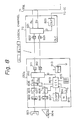
- Fig. 8 is a block diagram showing the constitution of the extension terminal (TE a1 ) 132a and the digital extension line circuit (DLC) 72.
- 801 is a telephone hand set (H)
- 802 is a speech path circuit (SP)
- 803 is a code (C/D)
- 804 is a data terminal (DTE)
- 805 is a level converter (LV)
- 806 is a data speed converter (RA)
- 807 is a display unit (DSP)
- 808 is a switch (SW)
- 809 is a controller (CTL)
- 810 is a frame assembling/disassembling part (FC)
- 811 is a driver (DV)
- 812 is a receiver (R)
- 813 is a power source (POW)
- 814 is a hook switch (HS)
- 815 is a function key
- 816 is a memory.
- the calling party address from the switching network (NW) 71 is directly displayed.
- the calling party address from the switching network (NW) 71 is also stored in the memory 816, and its contents can be displayed later on the display unit (DSP) 807.
- the user can determine whether the incoming call is from another extension terminal accommodated to the PBX system 60 or from a terminal connected to the ISDN public network 101. Further, a call back can be carried out to the original calling party by operating the key 815 so as to form a destination address and a destination subaddress which are respectively the same as the calling party address and the calling party subaddress being displayed on the display part (DSP) 807.
- DLC 72 820 is a frame assemble/disassemble circuit (FC)
- 821 is a driver (D)
- 822 is a receiver (R)
- 823 is an interface part (INF).
- the line between the digital extension line circuit (DLC) 72 and the extension terminal (TE a1 ) 132a is a digital subscriber line referred to as 2B + D.
- the B channels are data channels and the D channel is a control signal channel.
- Figure 9 is a diagram showing a call connection sequence between the ISDN public network (CO) 101 and the PBX network.
- CO ISDN public network
- Fig. 9 the difference from the conventional public network sequence shown in Fig. 2 resides only in that there is a PBX switching network between the called party extension terminal and the ISDN public network.
- the calling party address received from the ISDN public network is processed ad described before and the call setup message is then transmitted to the called party extension terminal.
- a call is originated from the ISDN terminal TE b2 ) 105 to the extension terminal (TE a1 ) 132a.
- the call setup message (i) as illustrated in Fig. 6 is setup, and then the call setup message (i) is sent to the ISDN public network (CO) 101 (see Fig. 9, 1).
- the ISDN public network (CO) 101 receives the call setup message, it recognizes that the destination subscriber line is the communication line 61 and transmits a call setup message which is the same as the call setup message (i) as shown in Fig.
- the PBX switching network 131a receives the call setup message (ii) through the communication line 61, and forms the call setup message (iii) as shown in Fig. 6.
- the call setup message (iii) is then sent to the extension terminal (TE a1 ) 132a (see Fig. 9, 2′).
- the ISDN public network (CO) 101 returns a call proceeding message (B) as shown in Fig. 3 to the calling party ISDN terminal (TE B2 ) 105 (see Fig. 9, 3), and then transmits an alert message (C) (see Fig. 3), received from the called party extension terminal (TE a1 ) 132a, to the calling party terminal (TE b2 ) 105.
- a person is informed of the alert state by displaying it or by sound (see Fig. 9, 4).
- the called party extension terminal (TE a1 ) 132a simultaneous with the transmission of the alert message to the ISDN public network (CO) 101, a ringing tone is generated (see Fig. 9, 5).
- the communication line 61 receives the alert message in accordance with a predetermined ISDN sequence. Since the called party subaddress in this example is #2, only a person at the extension terminal (TE a1 ) 132a responds to the ringing tone by taking the receiver off hook, so that a connection message (d) as shown in Fig. 3 is transmitted from the extension terminal (TE a1 ) 132a through the switching network 131a to the ISDN public network (CO) 101 (see Fig. 9, 6 ).
- the ISDN public network (CO) 101 when receiving the connection message, transmits it to the calling party terminal (TE b2 ) 105.
- the calling party terminal (TE b2 ) 105 stops the alert display or sound, and a connection is established between the calling party terminal (TE b2 ) 105 and the called party extension terminal (TE a1 ) 132a.
- a disconnection , a release, and a release completion after the end of the communication are carried out by 7, 8, and 9 in Fig. 9.
- the contents of the messages in the disconnection, release, and release completion are illustrated in Fig. 3, (e), (f), and (g).
- a call back connection according to the embodiment of the present invention can be effected as follows.
- the user by storing the calling party address including the line accessing number ⁇ and the calling party subaddress received by the called party terminal, in the memory unit (M) 816 provided in the called party terminal, and by displaying the stored contents on the display unit (DSP) 807 or the like, the user, who was away from the called party terminal when the incoming call is terminated at the called party terminal, can immediately recognize whether the calling party is from the ISDN public network or from another extension terminal accommodated by the PBX system. So, by setting the displayed address including the line accessing number and subaddress into a call setup message to be transmitted from the called party terminal to the original calling party terminal, the user at the called party terminal can call back the person at the original calling party terminal.
- M memory unit
- DSP display unit
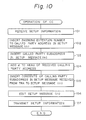
- Fig. 10 is a flowchart explaining the operation of the common control unit (CC) 74 connected to the switching network 131a as shown in Fig. 7.
- the common control unit (CC) 74 receives a call setup message, such as the call setup message (ii), from the communication line trunk (TRK) 73.
- step 102 from the called party subaddress #a#1 in the call setup message received from the communication line trunk (TRK) 73, the called party extension line number #a is taken out and the taken out number #a is inserted as a called party address into the setup message (iii) to be transmitted to the called party digital extension line circuit (DLC) 72.
- DLC digital extension line circuit
- the called party subaddress #1 in the received call setup message (ii) is inserted as a called party subaddress into the setup message (iii) to be transmitted to the called party digital extension line circuit (DLC) 72.
- DLC digital extension line circuit
- the line accessing number ⁇ is added to the head of the calling party address #B received from the communication line trunk (TRK) 73, and the combined number ⁇ #B is inserted as a calling party address into the setup message (iii) to be transmitted to the called party digital extension line circuit (DLC) 72.
- DLC digital extension line circuit
- the calling party subaddress #2 in the call setup message received from the communication line trunk (TRK) 73 is inserted as a calling party subaddress into the setup message (iii) to be transmitted to the called party digital extension line circuit (DLC) 72.
- step 106 the other processes necessary for editing the setup message (iii) are carried out.
- setup message (iii) is transmitted to the called party digital extension line circuit (DLC) 72.
- DLC digital extension line circuit
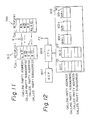
- Fig. 11 is a diagram explaining the processes on the main memory (MM) 75 shown in Fig. 7. From the figure, it can be seen that the call setup message (ii) from the communication line trunk (TRK) 73 is changed to the call setup message (iii) in the PBX system, and is transmitted to the called party digital extension line circuit (DLC) 72.
- DLC digital extension line circuit
- Fig. 12 is a diagram explaining the contents of the memory (M) 816 in the extension terminal (TE a1 ) 132a shown in Fig. 8.
- the memory (M) 816 includes two buffer memories (BF1) 121 and (BF2) 122, and a plurality of saving memories (SA#1 to SA#n) 123 -1 to 123 -n for saving data to be used for effecting the call back functions.
- the buffer memory (BF1) 121 stores the received setup message
- the buffer memory (BF2) 122 stores a setup message used for the call back operation.
- the saving memories (SA#1 to SA#n) 123 -1 to 123 -n respectively correspond to the function keys.
- Fig. 13 is a flowchart explaining the display operation by the controller (CTL) 809 shown in Fig. 12.
- the controller (CTL) 809 receives the call setup message (iii) from the switching network (NT) 71 and stores it into the buffer memory (BF1) 121.
- the calling party address and the calling party subaddress in the call setup message are read from the buffer memory (BF1) 121 and are displayed on the display unit (DSP) 307. From the displayed date, the user can recognize whether the calling party is from the ISDN public network or from another extension terminal accommodated by the PBX system.
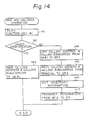
- Fig. 14 is a flowchart explaining a save and a call back operation by the controller (CTL) 809 shown in Fig. 12.
- CTL controller
- step 143 the calling party address and the calling party subaddress stored in the buffer (BF1) 121 are saved into the saving memory (SA#i) 123 -i corresponding to the pushed function key, and the process is finished.
- step 144 the calling party address and the calling party subaddress stored in the saving memory (SA#i) 123 -i are copied to the buffer memory (BF2) 122.
- step 145 the address and the subaddress of the extension terminal (TE a1 ) 132a are stored as a calling party address and a calling party subaddress into the buffer memory (BF2) 122 for the call back operation.
- step 146 necessary information as a call setup message for the call back operation is edited.
- the data in the buffer memory (BF2) 122 is transmitted through the switching network 71 and the ISDN public network (CO) 101 to the original calling party terminal (TE b2 ) 105.
- the call back function can be effected according to the first embodiment of the present invention.
- Fig. 15 is a block diagram showing an extension terminal accommodated by the PBX system 60, according to another embodiment of the present invention.
- 612 is a controller
- 613 is a memory (MEM)
- 621 and 622 are ringing tone signal resources
- 623 is a register key
- 624 is a calling party registered identifying information registering part (REG)
- 625 is a ringing tone signal switch control part (RSW)
- 627 is a ringing tone signal switching part
- 608 is a speaker.
- An extension terminal 132b receives from the network switch 71 calling party identifying information for identifying a calling party when a call connection is set up.
- the calling party identifying information is for example the calling party address #B and the calling party subaddress #2 in the call setup message (ii) shown in Fig. 6.
- the calling party registered identifying information registering part (REG) 624 previously stores calling party registered identifying information by a predetermined registering operation carried out by a user of the extension terminal 132b.
- the calling party registered identifying information is for example the line accessing number ⁇ for identifying the communication line 61 shown in Fig. 6.
- the controller 612 compares the calling party identifying information with the calling party registered identifying information. Depending on whether or not the calling party registered identifying information is detected in the calling party identifying information, a call indicating sound for informing the user of the fact of the incoming call is changed.
- both the incoming indicating sound is generated and the calling party information is displayed.
- the calling signal sources 621 and 622 generate specific calling signals R1 and R2 having different frequencies or different intermittent frequencies.
- the calling signal R1 or R2 is supplied to the speaker 608 so that the user can hear a different call indicating sound.
- the user When the user wants to identify whether the incoming call is from another extension terminal accommodated to the PBX system or from the communication line connected to the ISDN public network (CO) 101, the user may operate the registering key 623 and can input from the key board 815 the calling party registered identifying information ⁇ for example "0".
- the controller (CTL) 612 after detecting the operation of the registering key 623, drives the calling party registered identifying information registering part (REG) 624.
- the driven part (REG) 624 stores the calling party registered identifying information ⁇ from the keyboard 815 into a registering area 626 in the memory (MEM) 613, as well as displaying it on the display unit (DSP) 610 so that the user can recognize that the calling party registered identifying information is ⁇ .
- the calling signal R1 is sent to the speaker 608.
- the calling signal R2 is sent to the speaker 608.
- the user at the extension terminal can call back the original calling party terminal regardless of whether the calling party terminal is connected to the ISDN public network or the calling party terminal is another extension terminal accommodated to the PBX system. Therefore, even in the connecting system between the ISDN public network and the PBX system, a call back operation is possible so that the service is also improved from this point.
- the extension terminal becomes very convenient.
Landscapes
- Engineering & Computer Science (AREA)
- Computer Networks & Wireless Communication (AREA)
- Sub-Exchange Stations And Push- Button Telephones (AREA)
- Telephonic Communication Services (AREA)
Applications Claiming Priority (4)
| Application Number | Priority Date | Filing Date | Title |
|---|---|---|---|
| JP111698/88 | 1988-05-10 | ||
| JP63111698A JPH0654929B2 (ja) | 1988-05-10 | 1988-05-10 | Isdn公衆網における発アドレス制御方式 |
| JP22790488A JPH0276357A (ja) | 1988-09-12 | 1988-09-12 | 着信表示音切替方式 |
| JP227904/88 | 1988-09-12 |
Publications (3)
| Publication Number | Publication Date |
|---|---|
| EP0341687A2 true EP0341687A2 (de) | 1989-11-15 |
| EP0341687A3 EP0341687A3 (de) | 1992-05-27 |
| EP0341687B1 EP0341687B1 (de) | 1996-12-04 |
Family
ID=26451031
Family Applications (1)
| Application Number | Title | Priority Date | Filing Date |
|---|---|---|---|
| EP89108387A Expired - Lifetime EP0341687B1 (de) | 1988-05-10 | 1989-05-10 | Nebenstellenanlagesystem |
Country Status (5)
| Country | Link |
|---|---|
| US (1) | US5008884A (de) |
| EP (1) | EP0341687B1 (de) |
| AU (1) | AU612026B2 (de) |
| CA (1) | CA1320555C (de) |
| DE (1) | DE68927507T2 (de) |
Cited By (1)
| Publication number | Priority date | Publication date | Assignee | Title |
|---|---|---|---|---|
| EP0489619A3 (en) * | 1990-11-27 | 1992-11-04 | Canon Kabushiki Kaisha | Private branch exchange |
Families Citing this family (28)
| Publication number | Priority date | Publication date | Assignee | Title |
|---|---|---|---|---|
| US5291549A (en) * | 1989-06-07 | 1994-03-01 | Canon Kabushiki Kaisha | Private branch exchange and line exchange method |
| US5420918A (en) * | 1990-03-20 | 1995-05-30 | Canon Kabushiki Kaisha | Telephone apparatus for invalidating incoming call signals during dialing |
| WO1992008290A1 (en) * | 1990-10-16 | 1992-05-14 | Motorola, Inc. | Mobile isdn radio system |
| JP2817105B2 (ja) * | 1990-11-15 | 1998-10-27 | キヤノン株式会社 | 構内交換機 |
| US5184345A (en) * | 1991-01-02 | 1993-02-02 | At&T Bell Laboratories | Enhanced isdn 800 service |
| US5179554A (en) * | 1991-04-08 | 1993-01-12 | Digital Equipment Corporation | Automatic association of local area network station addresses with a repeater port |
| US5457693A (en) * | 1991-06-20 | 1995-10-10 | Sharp Kabushiki Kaisha | Data terminal control unit including table for efficiently making connections between data terminal equipments and between data terminal equipment and outside lines |
| JPH05160886A (ja) * | 1991-12-09 | 1993-06-25 | Canon Inc | ディジタル端末装置 |
| JP2744376B2 (ja) * | 1992-02-27 | 1998-04-28 | キヤノン株式会社 | 構内交換装置 |
| DE4210407C1 (de) * | 1992-03-30 | 1993-09-30 | Siemens Ag | Verfahren zur Rufnummernsignalisierung in einem Fernmeldenetz |
| DE4210401C1 (de) * | 1992-03-30 | 1993-09-30 | Siemens Ag | Verfahren zur Rufnummernsignalisierung in einem Fernmeldenetz |
| US5970135A (en) * | 1992-08-11 | 1999-10-19 | Rockwell International Corporation | Automatic call distributor with agent controlled call connection |
| US5329572A (en) * | 1992-09-24 | 1994-07-12 | At&T Bell Laboratories | Dial-up switching and transmission of broadband communication channels through a local exchange |
| DE69329845T2 (de) * | 1992-10-19 | 2001-07-19 | Koninklijke Philips Electronics N.V., Eindhoven | Kommunikationssystem und Nebenstellenanlage dafür |
| DE4317893A1 (de) * | 1993-05-28 | 1994-12-01 | Siemens Ag | Schaltungsanordnung für ein Vermittlungssystem |
| EP0635987A3 (de) * | 1993-06-21 | 1997-06-25 | Philips Electronics Nv | Nebenstellenanlage und Teilnehmersatz zur Verwendung in einer solchen Nebenstellenanlage. |
| US5388095A (en) * | 1993-08-06 | 1995-02-07 | Telefonaktiebolaget L M Ericsson | Representing subscribers in a multiple interface environment switching system |
| US5621731A (en) * | 1994-02-04 | 1997-04-15 | Omnilink Communications Corporation | Private exchange for ISDN |
| JP2812205B2 (ja) * | 1994-08-12 | 1998-10-22 | 日本電気株式会社 | Dチャネルパケット通信方式 |
| US5692126A (en) * | 1995-01-24 | 1997-11-25 | Bell Atlantic Network Services, Inc. | ISDN access to fast packet data network |
| US5577115A (en) * | 1995-03-31 | 1996-11-19 | Lucent Technologies Inc. | Customer premise equipment interface |
| US5629926A (en) * | 1995-03-31 | 1997-05-13 | Lucent Technologies Inc. | Customer premise equipment interface |
| US5946319A (en) * | 1996-07-04 | 1999-08-31 | Nec Corporation | ISDN communication apparatus |
| US6721790B1 (en) * | 2000-03-09 | 2004-04-13 | Avinta Communications, Inc | User settable unified workstation identification system |
| US20070083918A1 (en) * | 2005-10-11 | 2007-04-12 | Cisco Technology, Inc. | Validation of call-out services transmitted over a public switched telephone network |
| US8243895B2 (en) * | 2005-12-13 | 2012-08-14 | Cisco Technology, Inc. | Communication system with configurable shared line privacy feature |
| US8687785B2 (en) | 2006-11-16 | 2014-04-01 | Cisco Technology, Inc. | Authorization to place calls by remote users |
| US8817061B2 (en) * | 2007-07-02 | 2014-08-26 | Cisco Technology, Inc. | Recognition of human gestures by a mobile phone |
Family Cites Families (8)
| Publication number | Priority date | Publication date | Assignee | Title |
|---|---|---|---|---|
| US4125745A (en) * | 1977-06-13 | 1978-11-14 | International Telephone And Telegraph Corporation | Method and apparatus for signaling and framing in a time division multiplex communication system |
| ES477175A1 (es) * | 1978-02-14 | 1979-07-16 | Siemens Ag | Una disposicion de circuito para una instalacion telefonica. |
| JPS60144049A (ja) * | 1983-12-30 | 1985-07-30 | Fujitsu Ltd | 網間接続制御方式 |
| AU607417B2 (en) * | 1986-04-08 | 1991-03-07 | John Coles | Telephone exchange with calling telephone identification |
| US4788682A (en) * | 1986-09-23 | 1988-11-29 | Northern Telecom Limited | Telephone system adapted to telemarketing |
| JP2696509B2 (ja) * | 1987-05-13 | 1998-01-14 | 株式会社リコー | データ端末装置の制御方式 |
| US4805171A (en) * | 1987-07-10 | 1989-02-14 | Solid State Systems, Inc. | Unitary PCM rate converter and multiframe buffer |
| US4866704A (en) * | 1988-03-16 | 1989-09-12 | California Institute Of Technology | Fiber optic voice/data network |
-
1989
- 1989-05-02 US US07/346,544 patent/US5008884A/en not_active Expired - Lifetime
- 1989-05-02 CA CA000598460A patent/CA1320555C/en not_active Expired - Fee Related
- 1989-05-03 AU AU34004/89A patent/AU612026B2/en not_active Ceased
- 1989-05-10 DE DE68927507T patent/DE68927507T2/de not_active Expired - Fee Related
- 1989-05-10 EP EP89108387A patent/EP0341687B1/de not_active Expired - Lifetime
Non-Patent Citations (4)
| Title |
|---|
| CONFERENCE ON COMMUNICATIONS EQUIPMENT AND SYSTEMS, 20-22 APRIL 1982, PAGES 8-13, LONDON GB G.P. OLIVER: 'The Integrated Services Digital Network' * |
| HITACHI REVIEW. vol. 37, no. 1, February 1988, TOKYO JP pages 31 - 36; M. GILSTRAP ET AL: 'A Terminal Family for the Hitachi HCX5000 PBX' * |
| PROCEEDINGS OF THE SIXTH INTERNATIONAL CONFERENCE ON COMPUTER COMMUNICATIONS, 7-10 SEPTEMBER 1982, PAGES 345-350, LONDON GB S. YOSIDA ET AL: 'A Modular Integrated EPABX for the Office of the Future' * |
| PROCEEDINGS, INTERNATIONAL SWITCHING SYMPOSIUM, 15-20 MARCH 1987, VOL. 4 PAGES 899-906, PHOENIX US J.A. NEWALL ET AL: 'The Role of Customer Premises Equipment in ISDN' * |
Cited By (2)
| Publication number | Priority date | Publication date | Assignee | Title |
|---|---|---|---|---|
| EP0489619A3 (en) * | 1990-11-27 | 1992-11-04 | Canon Kabushiki Kaisha | Private branch exchange |
| US5481605A (en) * | 1990-11-27 | 1996-01-02 | Canon Kabushiki Kaisha | Private branch exchange capable of analyzing information received from ISDN |
Also Published As
| Publication number | Publication date |
|---|---|
| CA1320555C (en) | 1993-07-20 |
| US5008884A (en) | 1991-04-16 |
| EP0341687B1 (de) | 1996-12-04 |
| DE68927507T2 (de) | 1997-04-24 |
| DE68927507D1 (de) | 1997-01-16 |
| AU612026B2 (en) | 1991-06-27 |
| EP0341687A3 (de) | 1992-05-27 |
| AU3400489A (en) | 1989-11-16 |
Similar Documents
| Publication | Publication Date | Title |
|---|---|---|
| US5008884A (en) | Private automatic branch exchange system with line accessing number adding feature | |
| US5317630A (en) | Interface for a data telephone and data terminal in a digital telephone system | |
| JP3115772B2 (ja) | 電話呼処理方法 | |
| JPH05160886A (ja) | ディジタル端末装置 | |
| US6490346B2 (en) | Apparatus and method for providing music-on-hold service in key telephone system | |
| US5991397A (en) | Voice paging service control method in a switching system | |
| US5655012A (en) | Private branch exchange apparatus | |
| JPH07110020B2 (ja) | デイジタル電話の転送方法 | |
| KR100506277B1 (ko) | 사설교환기에서착신호전환상태통보방법 | |
| KR100273631B1 (ko) | 사설 교환기에서 내선 가입자의 착신거부상태 알림방법 | |
| JP2968780B1 (ja) | 通話中着信サービス方法、通話中着信サービスプログラムを記録した記録媒体、通話中着信サービス装置および通話中着信サービス機能を備えた交換機 | |
| JP2500418B2 (ja) | 加入者回線音声情報伝送装置 | |
| JPS6277745A (ja) | 音声デ−タ統合交換システム | |
| KR0146903B1 (ko) | 자동전환장치가 설치된 키폰시스템에서 팩시밀리의 착신자동연결 장치 및 방법 | |
| KR100251720B1 (ko) | 페이징 음성사서함시스템에서 연락전화번호 자동 호출 방법 | |
| KR100270735B1 (ko) | 사설교환기에서음성사서함으로호전환방법 | |
| JPS60121865A (ja) | ステツプコ−ル方式 | |
| KR19990055454A (ko) | 교환시스템에서 각종 전화상태 통보방법 | |
| JPH08205213A (ja) | 構内交換機 | |
| JPS6113859A (ja) | 発信音送出方式 | |
| JPS5866457A (ja) | 着信規制通知方式 | |
| KR19980077416A (ko) | 자동응답기능을 구비한 키폰전화기의 자동중계대 구현방법 | |
| JPH09233196A (ja) | 音声蓄積装置 | |
| JPH0221762A (ja) | 通信端末装置 | |
| JPH0654929B2 (ja) | Isdn公衆網における発アドレス制御方式 |
Legal Events
| Date | Code | Title | Description |
|---|---|---|---|
| PUAI | Public reference made under article 153(3) epc to a published international application that has entered the european phase |
Free format text: ORIGINAL CODE: 0009012 |
|
| AK | Designated contracting states |
Kind code of ref document: A2 Designated state(s): DE FR GB |
|
| PUAL | Search report despatched |
Free format text: ORIGINAL CODE: 0009013 |
|
| AK | Designated contracting states |
Kind code of ref document: A3 Designated state(s): DE FR GB |
|
| 17P | Request for examination filed |
Effective date: 19920804 |
|
| 17Q | First examination report despatched |
Effective date: 19940906 |
|
| GRAG | Despatch of communication of intention to grant |
Free format text: ORIGINAL CODE: EPIDOS AGRA |
|
| GRAH | Despatch of communication of intention to grant a patent |
Free format text: ORIGINAL CODE: EPIDOS IGRA |
|
| GRAH | Despatch of communication of intention to grant a patent |
Free format text: ORIGINAL CODE: EPIDOS IGRA |
|
| GRAA | (expected) grant |
Free format text: ORIGINAL CODE: 0009210 |
|
| AK | Designated contracting states |
Kind code of ref document: B1 Designated state(s): DE FR GB |
|
| REF | Corresponds to: |
Ref document number: 68927507 Country of ref document: DE Date of ref document: 19970116 |
|
| ET | Fr: translation filed | ||
| PLBE | No opposition filed within time limit |
Free format text: ORIGINAL CODE: 0009261 |
|
| STAA | Information on the status of an ep patent application or granted ep patent |
Free format text: STATUS: NO OPPOSITION FILED WITHIN TIME LIMIT |
|
| 26N | No opposition filed | ||
| PGFP | Annual fee paid to national office [announced via postgrant information from national office to epo] |
Ref country code: DE Payment date: 20000508 Year of fee payment: 12 |
|
| PGFP | Annual fee paid to national office [announced via postgrant information from national office to epo] |
Ref country code: GB Payment date: 20000510 Year of fee payment: 12 Ref country code: FR Payment date: 20000510 Year of fee payment: 12 |
|
| PG25 | Lapsed in a contracting state [announced via postgrant information from national office to epo] |
Ref country code: GB Free format text: LAPSE BECAUSE OF NON-PAYMENT OF DUE FEES Effective date: 20010510 |
|
| GBPC | Gb: european patent ceased through non-payment of renewal fee |
Effective date: 20010510 |
|
| PG25 | Lapsed in a contracting state [announced via postgrant information from national office to epo] |
Ref country code: FR Free format text: LAPSE BECAUSE OF NON-PAYMENT OF DUE FEES Effective date: 20020131 |
|
| PG25 | Lapsed in a contracting state [announced via postgrant information from national office to epo] |
Ref country code: DE Free format text: LAPSE BECAUSE OF NON-PAYMENT OF DUE FEES Effective date: 20020301 |