EP0330018A2 - Verfahren zur Herstellung farbiger Bilder und hierfür geeignetes farbfotografisches Aufzeichnungsmaterial - Google Patents
Verfahren zur Herstellung farbiger Bilder und hierfür geeignetes farbfotografisches Aufzeichnungsmaterial Download PDFInfo
- Publication number
- EP0330018A2 EP0330018A2 EP89102220A EP89102220A EP0330018A2 EP 0330018 A2 EP0330018 A2 EP 0330018A2 EP 89102220 A EP89102220 A EP 89102220A EP 89102220 A EP89102220 A EP 89102220A EP 0330018 A2 EP0330018 A2 EP 0330018A2
- Authority
- EP
- European Patent Office
- Prior art keywords
- silver halide
- halide emulsion
- alkyl
- optionally substituted
- recording material
- Prior art date
- Legal status (The legal status is an assumption and is not a legal conclusion. Google has not performed a legal analysis and makes no representation as to the accuracy of the status listed.)
- Withdrawn
Links
- 239000000463 material Substances 0.000 title claims abstract description 42
- 238000000034 method Methods 0.000 title claims abstract description 29
- 230000008569 process Effects 0.000 title claims abstract description 19
- 239000000839 emulsion Substances 0.000 claims abstract description 100
- -1 silver halide Chemical class 0.000 claims abstract description 90
- 229910052709 silver Inorganic materials 0.000 claims abstract description 78
- 239000004332 silver Substances 0.000 claims abstract description 78
- 239000003381 stabilizer Substances 0.000 claims abstract description 32
- 238000012545 processing Methods 0.000 claims abstract description 19
- 125000000753 cycloalkyl group Chemical group 0.000 claims abstract description 13
- 125000004169 (C1-C6) alkyl group Chemical group 0.000 claims abstract description 12
- 125000004648 C2-C8 alkenyl group Chemical group 0.000 claims abstract description 12
- 125000002373 5 membered heterocyclic group Chemical group 0.000 claims abstract description 8
- 125000004070 6 membered heterocyclic group Chemical group 0.000 claims abstract description 8
- VEXZGXHMUGYJMC-UHFFFAOYSA-M Chloride anion Chemical compound [Cl-] VEXZGXHMUGYJMC-UHFFFAOYSA-M 0.000 claims abstract description 8
- 239000000203 mixture Substances 0.000 claims abstract description 8
- 238000004519 manufacturing process Methods 0.000 claims abstract description 7
- 229910052736 halogen Inorganic materials 0.000 claims abstract description 5
- 150000002367 halogens Chemical class 0.000 claims abstract description 5
- 125000002924 primary amino group Chemical group [H]N([H])* 0.000 claims abstract description 5
- 125000004191 (C1-C6) alkoxy group Chemical group 0.000 claims abstract description 4
- 125000006700 (C1-C6) alkylthio group Chemical group 0.000 claims abstract description 4
- 125000004209 (C1-C8) alkyl group Chemical group 0.000 claims abstract description 4
- 101100134925 Gallus gallus COR6 gene Proteins 0.000 claims abstract description 4
- 125000004442 acylamino group Chemical group 0.000 claims abstract description 4
- 125000001951 carbamoylamino group Chemical group C(N)(=O)N* 0.000 claims abstract description 4
- 125000001072 heteroaryl group Chemical group 0.000 claims abstract description 4
- 125000000449 nitro group Chemical group [O-][N+](*)=O 0.000 claims abstract description 4
- SQGYOTSLMSWVJD-UHFFFAOYSA-N silver(1+) nitrate Chemical compound [Ag+].[O-]N(=O)=O SQGYOTSLMSWVJD-UHFFFAOYSA-N 0.000 claims description 32
- 238000011161 development Methods 0.000 claims description 20
- WVDDGKGOMKODPV-UHFFFAOYSA-N Benzyl alcohol Chemical compound OCC1=CC=CC=C1 WVDDGKGOMKODPV-UHFFFAOYSA-N 0.000 claims description 18
- RAXXELZNTBOGNW-UHFFFAOYSA-N imidazole Natural products C1=CNC=N1 RAXXELZNTBOGNW-UHFFFAOYSA-N 0.000 claims description 18
- CPELXLSAUQHCOX-UHFFFAOYSA-M Bromide Chemical compound [Br-] CPELXLSAUQHCOX-UHFFFAOYSA-M 0.000 claims description 9
- 235000019445 benzyl alcohol Nutrition 0.000 claims description 6
- ZCQWOFVYLHDMMC-UHFFFAOYSA-N Oxazole Chemical compound C1=COC=N1 ZCQWOFVYLHDMMC-UHFFFAOYSA-N 0.000 claims description 5
- CZPWVGJYEJSRLH-UHFFFAOYSA-N Pyrimidine Chemical compound C1=CN=CN=C1 CZPWVGJYEJSRLH-UHFFFAOYSA-N 0.000 claims description 5
- FZWLAAWBMGSTSO-UHFFFAOYSA-N Thiazole Chemical compound C1=CSC=N1 FZWLAAWBMGSTSO-UHFFFAOYSA-N 0.000 claims description 4
- ZMZDMBWJUHKJPS-UHFFFAOYSA-M Thiocyanate anion Chemical compound [S-]C#N ZMZDMBWJUHKJPS-UHFFFAOYSA-M 0.000 claims description 4
- XMBWDFGMSWQBCA-UHFFFAOYSA-N hydrogen iodide Chemical compound I XMBWDFGMSWQBCA-UHFFFAOYSA-N 0.000 claims description 4
- 150000003536 tetrazoles Chemical class 0.000 claims description 4
- BQCADISMDOOEFD-UHFFFAOYSA-N Silver Chemical compound [Ag] BQCADISMDOOEFD-UHFFFAOYSA-N 0.000 claims description 3
- 238000003860 storage Methods 0.000 abstract description 15
- DHCDFWKWKRSZHF-UHFFFAOYSA-N sulfurothioic S-acid Chemical compound OS(O)(=O)=S DHCDFWKWKRSZHF-UHFFFAOYSA-N 0.000 abstract description 7
- 230000007774 longterm Effects 0.000 abstract description 5
- 238000011109 contamination Methods 0.000 abstract description 3
- 230000006872 improvement Effects 0.000 abstract description 2
- 239000010410 layer Substances 0.000 description 84
- 108010010803 Gelatin Proteins 0.000 description 21
- 150000001875 compounds Chemical class 0.000 description 21
- 239000008273 gelatin Substances 0.000 description 21
- 229920000159 gelatin Polymers 0.000 description 21
- 235000019322 gelatine Nutrition 0.000 description 21
- 235000011852 gelatine desserts Nutrition 0.000 description 21
- 235000013339 cereals Nutrition 0.000 description 13
- 239000000975 dye Substances 0.000 description 13
- 230000005070 ripening Effects 0.000 description 10
- 230000003595 spectral effect Effects 0.000 description 10
- 239000011230 binding agent Substances 0.000 description 9
- 238000005266 casting Methods 0.000 description 9
- 239000003795 chemical substances by application Substances 0.000 description 9
- DOIRQSBPFJWKBE-UHFFFAOYSA-N dibutyl phthalate Chemical compound CCCCOC(=O)C1=CC=CC=C1C(=O)OCCCC DOIRQSBPFJWKBE-UHFFFAOYSA-N 0.000 description 8
- 150000004820 halides Chemical class 0.000 description 8
- 239000000126 substance Substances 0.000 description 8
- 125000004432 carbon atom Chemical group C* 0.000 description 7
- 239000004848 polyfunctional curative Substances 0.000 description 7
- 238000001556 precipitation Methods 0.000 description 7
- 230000035945 sensitivity Effects 0.000 description 7
- XLYOFNOQVPJJNP-UHFFFAOYSA-N water Chemical compound O XLYOFNOQVPJJNP-UHFFFAOYSA-N 0.000 description 7
- 206010070834 Sensitisation Diseases 0.000 description 6
- 230000036961 partial effect Effects 0.000 description 6
- 230000008313 sensitization Effects 0.000 description 6
- 229910021607 Silver chloride Inorganic materials 0.000 description 5
- NINIDFKCEFEMDL-UHFFFAOYSA-N Sulfur Chemical compound [S] NINIDFKCEFEMDL-UHFFFAOYSA-N 0.000 description 5
- 125000000217 alkyl group Chemical group 0.000 description 5
- 238000011160 research Methods 0.000 description 5
- 150000003839 salts Chemical class 0.000 description 5
- HKZLPVFGJNLROG-UHFFFAOYSA-M silver monochloride Chemical compound [Cl-].[Ag+] HKZLPVFGJNLROG-UHFFFAOYSA-M 0.000 description 5
- 229910052717 sulfur Inorganic materials 0.000 description 5
- 239000011593 sulfur Substances 0.000 description 5
- QGZKDVFQNNGYKY-UHFFFAOYSA-N Ammonia Chemical compound N QGZKDVFQNNGYKY-UHFFFAOYSA-N 0.000 description 4
- JUJWROOIHBZHMG-UHFFFAOYSA-N Pyridine Chemical compound C1=CC=NC=C1 JUJWROOIHBZHMG-UHFFFAOYSA-N 0.000 description 4
- 239000000084 colloidal system Substances 0.000 description 4
- 239000013078 crystal Substances 0.000 description 4
- 239000012153 distilled water Substances 0.000 description 4
- 230000003647 oxidation Effects 0.000 description 4
- 238000007254 oxidation reaction Methods 0.000 description 4
- 229920000642 polymer Polymers 0.000 description 4
- 239000011241 protective layer Substances 0.000 description 4
- 239000000758 substrate Substances 0.000 description 4
- 238000012360 testing method Methods 0.000 description 4
- UMGDCJDMYOKAJW-UHFFFAOYSA-N thiourea Chemical compound NC(N)=S UMGDCJDMYOKAJW-UHFFFAOYSA-N 0.000 description 4
- OVGWMUWIRHGGJP-WTODYLRWSA-N (z)-7-[(1r,3s,4s,5r)-3-[(e,3r)-3-hydroxyoct-1-enyl]-6-thiabicyclo[3.1.1]heptan-4-yl]hept-5-enoic acid Chemical compound OC(=O)CCC\C=C/C[C@H]1[C@H](/C=C/[C@H](O)CCCCC)C[C@H]2S[C@@H]1C2 OVGWMUWIRHGGJP-WTODYLRWSA-N 0.000 description 3
- JYEUMXHLPRZUAT-UHFFFAOYSA-N 1,2,3-triazine Chemical compound C1=CN=NN=C1 JYEUMXHLPRZUAT-UHFFFAOYSA-N 0.000 description 3
- QVLXDGDLLZYJAM-UHFFFAOYSA-N 2,5-dioctylbenzene-1,4-diol Chemical compound CCCCCCCCC1=CC(O)=C(CCCCCCCC)C=C1O QVLXDGDLLZYJAM-UHFFFAOYSA-N 0.000 description 3
- QTBSBXVTEAMEQO-UHFFFAOYSA-N Acetic acid Chemical compound CC(O)=O QTBSBXVTEAMEQO-UHFFFAOYSA-N 0.000 description 3
- 101100366889 Caenorhabditis elegans sta-2 gene Proteins 0.000 description 3
- KCXVZYZYPLLWCC-UHFFFAOYSA-N EDTA Chemical compound OC(=O)CN(CC(O)=O)CCN(CC(O)=O)CC(O)=O KCXVZYZYPLLWCC-UHFFFAOYSA-N 0.000 description 3
- KWYUFKZDYYNOTN-UHFFFAOYSA-M Potassium hydroxide Chemical compound [OH-].[K+] KWYUFKZDYYNOTN-UHFFFAOYSA-M 0.000 description 3
- 101150081243 STA1 gene Proteins 0.000 description 3
- 239000006096 absorbing agent Substances 0.000 description 3
- 239000000654 additive Substances 0.000 description 3
- 125000003277 amino group Chemical group 0.000 description 3
- XYXNTHIYBIDHGM-UHFFFAOYSA-N ammonium thiosulfate Chemical compound [NH4+].[NH4+].[O-]S([O-])(=O)=S XYXNTHIYBIDHGM-UHFFFAOYSA-N 0.000 description 3
- 125000003178 carboxy group Chemical group [H]OC(*)=O 0.000 description 3
- 239000001913 cellulose Substances 0.000 description 3
- 235000010980 cellulose Nutrition 0.000 description 3
- 229920002678 cellulose Polymers 0.000 description 3
- 238000006243 chemical reaction Methods 0.000 description 3
- 230000000295 complement effect Effects 0.000 description 3
- 239000008139 complexing agent Substances 0.000 description 3
- 230000008878 coupling Effects 0.000 description 3
- 238000010168 coupling process Methods 0.000 description 3
- 238000005859 coupling reaction Methods 0.000 description 3
- MTHSVFCYNBDYFN-UHFFFAOYSA-N diethylene glycol Chemical compound OCCOCCO MTHSVFCYNBDYFN-UHFFFAOYSA-N 0.000 description 3
- PCHJSUWPFVWCPO-UHFFFAOYSA-N gold Chemical compound [Au] PCHJSUWPFVWCPO-UHFFFAOYSA-N 0.000 description 3
- 229910052737 gold Inorganic materials 0.000 description 3
- 239000010931 gold Substances 0.000 description 3
- 125000002887 hydroxy group Chemical group [H]O* 0.000 description 3
- 229910052741 iridium Inorganic materials 0.000 description 3
- XEEYBQQBJWHFJM-UHFFFAOYSA-N iron Substances [Fe] XEEYBQQBJWHFJM-UHFFFAOYSA-N 0.000 description 3
- 150000003378 silver Chemical class 0.000 description 3
- 238000003756 stirring Methods 0.000 description 3
- 238000005406 washing Methods 0.000 description 3
- KJCVRFUGPWSIIH-UHFFFAOYSA-N 1-naphthol Chemical compound C1=CC=C2C(O)=CC=CC2=C1 KJCVRFUGPWSIIH-UHFFFAOYSA-N 0.000 description 2
- CSCPPACGZOOCGX-UHFFFAOYSA-N Acetone Chemical compound CC(C)=O CSCPPACGZOOCGX-UHFFFAOYSA-N 0.000 description 2
- NLXLAEXVIDQMFP-UHFFFAOYSA-N Ammonia chloride Chemical compound [NH4+].[Cl-] NLXLAEXVIDQMFP-UHFFFAOYSA-N 0.000 description 2
- 238000001016 Ostwald ripening Methods 0.000 description 2
- KDLHZDBZIXYQEI-UHFFFAOYSA-N Palladium Chemical compound [Pd] KDLHZDBZIXYQEI-UHFFFAOYSA-N 0.000 description 2
- NQRYJNQNLNOLGT-UHFFFAOYSA-N Piperidine Chemical compound C1CCNCC1 NQRYJNQNLNOLGT-UHFFFAOYSA-N 0.000 description 2
- 239000004698 Polyethylene Substances 0.000 description 2
- WCUXLLCKKVVCTQ-UHFFFAOYSA-M Potassium chloride Chemical compound [Cl-].[K+] WCUXLLCKKVVCTQ-UHFFFAOYSA-M 0.000 description 2
- YSMRWXYRXBRSND-UHFFFAOYSA-N TOTP Chemical compound CC1=CC=CC=C1OP(=O)(OC=1C(=CC=CC=1)C)OC1=CC=CC=C1C YSMRWXYRXBRSND-UHFFFAOYSA-N 0.000 description 2
- WYURNTSHIVDZCO-UHFFFAOYSA-N Tetrahydrofuran Chemical compound C1CCOC1 WYURNTSHIVDZCO-UHFFFAOYSA-N 0.000 description 2
- 239000002253 acid Substances 0.000 description 2
- 230000002378 acidificating effect Effects 0.000 description 2
- 150000007513 acids Chemical class 0.000 description 2
- 229910021529 ammonia Inorganic materials 0.000 description 2
- 125000003118 aryl group Chemical group 0.000 description 2
- 239000007844 bleaching agent Substances 0.000 description 2
- 239000011248 coating agent Substances 0.000 description 2
- 238000000576 coating method Methods 0.000 description 2
- 239000003086 colorant Substances 0.000 description 2
- 238000004132 cross linking Methods 0.000 description 2
- 125000000524 functional group Chemical group 0.000 description 2
- 125000005843 halogen group Chemical group 0.000 description 2
- 150000002391 heterocyclic compounds Chemical class 0.000 description 2
- 125000000623 heterocyclic group Chemical group 0.000 description 2
- 125000004435 hydrogen atom Chemical class [H]* 0.000 description 2
- 239000003112 inhibitor Substances 0.000 description 2
- GKOZUEZYRPOHIO-UHFFFAOYSA-N iridium atom Chemical compound [Ir] GKOZUEZYRPOHIO-UHFFFAOYSA-N 0.000 description 2
- 229910052742 iron Inorganic materials 0.000 description 2
- 229920000126 latex Polymers 0.000 description 2
- 238000005259 measurement Methods 0.000 description 2
- 229910052751 metal Inorganic materials 0.000 description 2
- 239000002184 metal Substances 0.000 description 2
- 150000002739 metals Chemical class 0.000 description 2
- BASFCYQUMIYNBI-UHFFFAOYSA-N platinum Chemical compound [Pt] BASFCYQUMIYNBI-UHFFFAOYSA-N 0.000 description 2
- 229920000573 polyethylene Polymers 0.000 description 2
- BWHMMNNQKKPAPP-UHFFFAOYSA-L potassium carbonate Chemical compound [K+].[K+].[O-]C([O-])=O BWHMMNNQKKPAPP-UHFFFAOYSA-L 0.000 description 2
- FGIUAXJPYTZDNR-UHFFFAOYSA-N potassium nitrate Chemical compound [K+].[O-][N+]([O-])=O FGIUAXJPYTZDNR-UHFFFAOYSA-N 0.000 description 2
- 238000003672 processing method Methods 0.000 description 2
- 125000002577 pseudohalo group Chemical group 0.000 description 2
- UMJSCPRVCHMLSP-UHFFFAOYSA-N pyridine Natural products COC1=CC=CN=C1 UMJSCPRVCHMLSP-UHFFFAOYSA-N 0.000 description 2
- 239000002904 solvent Substances 0.000 description 2
- 230000006641 stabilisation Effects 0.000 description 2
- 238000011105 stabilization Methods 0.000 description 2
- 125000001424 substituent group Chemical group 0.000 description 2
- 239000000725 suspension Substances 0.000 description 2
- 230000008961 swelling Effects 0.000 description 2
- 150000003568 thioethers Chemical class 0.000 description 2
- ANRHNWWPFJCPAZ-UHFFFAOYSA-M thionine Chemical compound [Cl-].C1=CC(N)=CC2=[S+]C3=CC(N)=CC=C3N=C21 ANRHNWWPFJCPAZ-UHFFFAOYSA-M 0.000 description 2
- IRFSXVIRXMYULF-UHFFFAOYSA-N 1,2-dihydroquinoline Chemical class C1=CC=C2C=CCNC2=C1 IRFSXVIRXMYULF-UHFFFAOYSA-N 0.000 description 1
- ODIRBFFBCSTPTO-UHFFFAOYSA-N 1,3-selenazole Chemical compound C1=C[se]C=N1 ODIRBFFBCSTPTO-UHFFFAOYSA-N 0.000 description 1
- ZRHUHDUEXWHZMA-UHFFFAOYSA-N 1,4-dihydropyrazol-5-one Chemical compound O=C1CC=NN1 ZRHUHDUEXWHZMA-UHFFFAOYSA-N 0.000 description 1
- CBCKQZAAMUWICA-UHFFFAOYSA-N 1,4-phenylenediamine Chemical compound NC1=CC=C(N)C=C1 CBCKQZAAMUWICA-UHFFFAOYSA-N 0.000 description 1
- QTLHLXYADXCVCF-UHFFFAOYSA-N 2-(4-amino-n-ethyl-3-methylanilino)ethanol Chemical compound OCCN(CC)C1=CC=C(N)C(C)=C1 QTLHLXYADXCVCF-UHFFFAOYSA-N 0.000 description 1
- URDCARMUOSMFFI-UHFFFAOYSA-N 2-[2-[bis(carboxymethyl)amino]ethyl-(2-hydroxyethyl)amino]acetic acid Chemical compound OCCN(CC(O)=O)CCN(CC(O)=O)CC(O)=O URDCARMUOSMFFI-UHFFFAOYSA-N 0.000 description 1
- JKFYKCYQEWQPTM-UHFFFAOYSA-N 2-azaniumyl-2-(4-fluorophenyl)acetate Chemical compound OC(=O)C(N)C1=CC=C(F)C=C1 JKFYKCYQEWQPTM-UHFFFAOYSA-N 0.000 description 1
- 125000003903 2-propenyl group Chemical group [H]C([*])([H])C([H])=C([H])[H] 0.000 description 1
- CBHTTYDJRXOHHL-UHFFFAOYSA-N 2h-triazolo[4,5-c]pyridazine Chemical class N1=NC=CC2=C1N=NN2 CBHTTYDJRXOHHL-UHFFFAOYSA-N 0.000 description 1
- NYYSPVRERVXMLJ-UHFFFAOYSA-N 4,4-difluorocyclohexan-1-one Chemical compound FC1(F)CCC(=O)CC1 NYYSPVRERVXMLJ-UHFFFAOYSA-N 0.000 description 1
- QNGVNLMMEQUVQK-UHFFFAOYSA-N 4-n,4-n-diethylbenzene-1,4-diamine Chemical compound CCN(CC)C1=CC=C(N)C=C1 QNGVNLMMEQUVQK-UHFFFAOYSA-N 0.000 description 1
- 241001479434 Agfa Species 0.000 description 1
- 102000009027 Albumins Human genes 0.000 description 1
- 108010088751 Albumins Proteins 0.000 description 1
- USFZMSVCRYTOJT-UHFFFAOYSA-N Ammonium acetate Chemical compound N.CC(O)=O USFZMSVCRYTOJT-UHFFFAOYSA-N 0.000 description 1
- 239000005695 Ammonium acetate Substances 0.000 description 1
- NOWKCMXCCJGMRR-UHFFFAOYSA-N Aziridine Chemical compound C1CN1 NOWKCMXCCJGMRR-UHFFFAOYSA-N 0.000 description 1
- WKBOTKDWSSQWDR-UHFFFAOYSA-N Bromine atom Chemical compound [Br] WKBOTKDWSSQWDR-UHFFFAOYSA-N 0.000 description 1
- 101100493713 Caenorhabditis elegans bath-45 gene Proteins 0.000 description 1
- 229920002134 Carboxymethyl cellulose Polymers 0.000 description 1
- ZAMOUSCENKQFHK-UHFFFAOYSA-N Chlorine atom Chemical compound [Cl] ZAMOUSCENKQFHK-UHFFFAOYSA-N 0.000 description 1
- 229920001174 Diethylhydroxylamine Polymers 0.000 description 1
- 239000004593 Epoxy Substances 0.000 description 1
- PXGOKWXKJXAPGV-UHFFFAOYSA-N Fluorine Chemical compound FF PXGOKWXKJXAPGV-UHFFFAOYSA-N 0.000 description 1
- 229910004042 HAuCl4 Inorganic materials 0.000 description 1
- YNAVUWVOSKDBBP-UHFFFAOYSA-N Morpholine Chemical group C1COCCN1 YNAVUWVOSKDBBP-UHFFFAOYSA-N 0.000 description 1
- SECXISVLQFMRJM-UHFFFAOYSA-N N-Methylpyrrolidone Chemical compound CN1CCCC1=O SECXISVLQFMRJM-UHFFFAOYSA-N 0.000 description 1
- ISWSIDIOOBJBQZ-UHFFFAOYSA-N Phenol Chemical compound OC1=CC=CC=C1 ISWSIDIOOBJBQZ-UHFFFAOYSA-N 0.000 description 1
- 239000004372 Polyvinyl alcohol Substances 0.000 description 1
- BUGBHKTXTAQXES-UHFFFAOYSA-N Selenium Chemical compound [Se] BUGBHKTXTAQXES-UHFFFAOYSA-N 0.000 description 1
- 229910021612 Silver iodide Inorganic materials 0.000 description 1
- DWAQJAXMDSEUJJ-UHFFFAOYSA-M Sodium bisulfite Chemical compound [Na+].OS([O-])=O DWAQJAXMDSEUJJ-UHFFFAOYSA-M 0.000 description 1
- 229920002125 Sokalan® Polymers 0.000 description 1
- 229920002472 Starch Polymers 0.000 description 1
- GSEJCLTVZPLZKY-UHFFFAOYSA-N Triethanolamine Chemical compound OCCN(CCO)CCO GSEJCLTVZPLZKY-UHFFFAOYSA-N 0.000 description 1
- 240000003834 Triticum spelta Species 0.000 description 1
- 238000006887 Ullmann reaction Methods 0.000 description 1
- XSQUKJJJFZCRTK-UHFFFAOYSA-N Urea Natural products NC(N)=O XSQUKJJJFZCRTK-UHFFFAOYSA-N 0.000 description 1
- 230000001133 acceleration Effects 0.000 description 1
- 125000000738 acetamido group Chemical group [H]C([H])([H])C(=O)N([H])[*] 0.000 description 1
- 125000003647 acryloyl group Chemical group O=C([*])C([H])=C([H])[H] 0.000 description 1
- 125000002252 acyl group Chemical group 0.000 description 1
- 230000002411 adverse Effects 0.000 description 1
- 150000001298 alcohols Chemical class 0.000 description 1
- 229920000615 alginic acid Polymers 0.000 description 1
- 235000010443 alginic acid Nutrition 0.000 description 1
- 125000003342 alkenyl group Chemical group 0.000 description 1
- 125000003545 alkoxy group Chemical group 0.000 description 1
- 125000004453 alkoxycarbonyl group Chemical group 0.000 description 1
- 125000004414 alkyl thio group Chemical group 0.000 description 1
- 230000002152 alkylating effect Effects 0.000 description 1
- 150000001412 amines Chemical class 0.000 description 1
- 235000019257 ammonium acetate Nutrition 0.000 description 1
- 229940043376 ammonium acetate Drugs 0.000 description 1
- 235000019270 ammonium chloride Nutrition 0.000 description 1
- SOIFLUNRINLCBN-UHFFFAOYSA-N ammonium thiocyanate Chemical compound [NH4+].[S-]C#N SOIFLUNRINLCBN-UHFFFAOYSA-N 0.000 description 1
- 239000003963 antioxidant agent Substances 0.000 description 1
- 150000001491 aromatic compounds Chemical class 0.000 description 1
- 125000003710 aryl alkyl group Chemical group 0.000 description 1
- 125000004429 atom Chemical group 0.000 description 1
- UMEAURNTRYCPNR-UHFFFAOYSA-N azane;iron(2+) Chemical compound N.[Fe+2] UMEAURNTRYCPNR-UHFFFAOYSA-N 0.000 description 1
- 244000052616 bacterial pathogen Species 0.000 description 1
- TZCXTZWJZNENPQ-UHFFFAOYSA-L barium sulfate Chemical compound [Ba+2].[O-]S([O-])(=O)=O TZCXTZWJZNENPQ-UHFFFAOYSA-L 0.000 description 1
- 239000010428 baryte Substances 0.000 description 1
- 229910052601 baryte Inorganic materials 0.000 description 1
- 125000005605 benzo group Chemical group 0.000 description 1
- 125000001797 benzyl group Chemical group [H]C1=C([H])C([H])=C(C([H])=C1[H])C([H])([H])* 0.000 description 1
- 230000033228 biological regulation Effects 0.000 description 1
- 230000015572 biosynthetic process Effects 0.000 description 1
- 229910052797 bismuth Inorganic materials 0.000 description 1
- 238000004061 bleaching Methods 0.000 description 1
- 238000009835 boiling Methods 0.000 description 1
- KKAXNAVSOBXHTE-UHFFFAOYSA-N boranamine Chemical class NB KKAXNAVSOBXHTE-UHFFFAOYSA-N 0.000 description 1
- GDTBXPJZTBHREO-UHFFFAOYSA-N bromine Substances BrBr GDTBXPJZTBHREO-UHFFFAOYSA-N 0.000 description 1
- 229910052794 bromium Inorganic materials 0.000 description 1
- 125000006309 butyl amino group Chemical group 0.000 description 1
- 229910052793 cadmium Inorganic materials 0.000 description 1
- 239000000298 carbocyanine Substances 0.000 description 1
- 239000001768 carboxy methyl cellulose Substances 0.000 description 1
- 235000010948 carboxy methyl cellulose Nutrition 0.000 description 1
- 239000008112 carboxymethyl-cellulose Substances 0.000 description 1
- 239000005018 casein Substances 0.000 description 1
- BECPQYXYKAMYBN-UHFFFAOYSA-N casein, tech. Chemical compound NCCCCC(C(O)=O)N=C(O)C(CC(O)=O)N=C(O)C(CCC(O)=N)N=C(O)C(CC(C)C)N=C(O)C(CCC(O)=O)N=C(O)C(CC(O)=O)N=C(O)C(CCC(O)=O)N=C(O)C(C(C)O)N=C(O)C(CCC(O)=N)N=C(O)C(CCC(O)=N)N=C(O)C(CCC(O)=N)N=C(O)C(CCC(O)=O)N=C(O)C(CCC(O)=O)N=C(O)C(COP(O)(O)=O)N=C(O)C(CCC(O)=N)N=C(O)C(N)CC1=CC=CC=C1 BECPQYXYKAMYBN-UHFFFAOYSA-N 0.000 description 1
- 235000021240 caseins Nutrition 0.000 description 1
- 230000008859 change Effects 0.000 description 1
- 239000003638 chemical reducing agent Substances 0.000 description 1
- 239000000460 chlorine Substances 0.000 description 1
- 229910052801 chlorine Inorganic materials 0.000 description 1
- OIDPCXKPHYRNKH-UHFFFAOYSA-J chrome alum Chemical compound [K]OS(=O)(=O)O[Cr]1OS(=O)(=O)O1 OIDPCXKPHYRNKH-UHFFFAOYSA-J 0.000 description 1
- 150000001868 cobalt Chemical class 0.000 description 1
- 239000000470 constituent Substances 0.000 description 1
- 229920001577 copolymer Polymers 0.000 description 1
- 125000000113 cyclohexyl group Chemical group [H]C1([H])C([H])([H])C([H])([H])C([H])(*)C([H])([H])C1([H])[H] 0.000 description 1
- 238000009792 diffusion process Methods 0.000 description 1
- 239000002270 dispersing agent Substances 0.000 description 1
- 239000006185 dispersion Substances 0.000 description 1
- 238000009826 distribution Methods 0.000 description 1
- AFOSIXZFDONLBT-UHFFFAOYSA-N divinyl sulfone Chemical compound C=CS(=O)(=O)C=C AFOSIXZFDONLBT-UHFFFAOYSA-N 0.000 description 1
- 238000001035 drying Methods 0.000 description 1
- 230000000694 effects Effects 0.000 description 1
- 125000001495 ethyl group Chemical group [H]C([H])([H])C([H])([H])* 0.000 description 1
- 238000002474 experimental method Methods 0.000 description 1
- 238000005189 flocculation Methods 0.000 description 1
- 230000016615 flocculation Effects 0.000 description 1
- 229910052731 fluorine Inorganic materials 0.000 description 1
- 239000011737 fluorine Substances 0.000 description 1
- 125000002541 furyl group Chemical group 0.000 description 1
- 150000002343 gold Chemical class 0.000 description 1
- 150000002344 gold compounds Chemical class 0.000 description 1
- 150000002390 heteroarenes Chemical class 0.000 description 1
- BRWIZMBXBAOCCF-UHFFFAOYSA-N hydrazinecarbothioamide Chemical compound NNC(N)=S BRWIZMBXBAOCCF-UHFFFAOYSA-N 0.000 description 1
- 150000002429 hydrazines Chemical class 0.000 description 1
- 229910052739 hydrogen Inorganic materials 0.000 description 1
- 239000001257 hydrogen Substances 0.000 description 1
- 230000002209 hydrophobic effect Effects 0.000 description 1
- 229920013821 hydroxy alkyl cellulose Polymers 0.000 description 1
- 150000002460 imidazoles Chemical class 0.000 description 1
- LOCAIGRSOJUCTB-UHFFFAOYSA-N indazol-3-one Chemical compound C1=CC=C2C(=O)N=NC2=C1 LOCAIGRSOJUCTB-UHFFFAOYSA-N 0.000 description 1
- 230000003993 interaction Effects 0.000 description 1
- 150000002500 ions Chemical class 0.000 description 1
- 125000001449 isopropyl group Chemical group [H]C([H])([H])C([H])(*)C([H])([H])[H] 0.000 description 1
- 239000004816 latex Substances 0.000 description 1
- 229910052745 lead Inorganic materials 0.000 description 1
- 230000035800 maturation Effects 0.000 description 1
- 125000000956 methoxy group Chemical group [H]C([H])([H])O* 0.000 description 1
- 125000002496 methyl group Chemical group [H]C([H])([H])* 0.000 description 1
- 125000001570 methylene group Chemical group [H]C([H])([*:1])[*:2] 0.000 description 1
- 238000002156 mixing Methods 0.000 description 1
- 238000012986 modification Methods 0.000 description 1
- 230000004048 modification Effects 0.000 description 1
- 238000012544 monitoring process Methods 0.000 description 1
- 239000000178 monomer Substances 0.000 description 1
- CLJDCQWROXMJAZ-UHFFFAOYSA-N n-[2-(4-amino-n-ethyl-3-methylanilino)ethyl]methanesulfonamide;sulfuric acid Chemical compound OS(O)(=O)=O.CS(=O)(=O)NCCN(CC)C1=CC=C(N)C(C)=C1 CLJDCQWROXMJAZ-UHFFFAOYSA-N 0.000 description 1
- 125000001624 naphthyl group Chemical group 0.000 description 1
- 229930014626 natural product Natural products 0.000 description 1
- 230000007935 neutral effect Effects 0.000 description 1
- 229910052757 nitrogen Inorganic materials 0.000 description 1
- 229910017464 nitrogen compound Inorganic materials 0.000 description 1
- 239000003960 organic solvent Substances 0.000 description 1
- WCPAKWJPBJAGKN-UHFFFAOYSA-N oxadiazole Chemical compound C1=CON=N1 WCPAKWJPBJAGKN-UHFFFAOYSA-N 0.000 description 1
- 230000001590 oxidative effect Effects 0.000 description 1
- 229910052763 palladium Inorganic materials 0.000 description 1
- 235000015927 pasta Nutrition 0.000 description 1
- 230000000737 periodic effect Effects 0.000 description 1
- JRKICGRDRMAZLK-UHFFFAOYSA-L persulfate group Chemical group S(=O)(=O)([O-])OOS(=O)(=O)[O-] JRKICGRDRMAZLK-UHFFFAOYSA-L 0.000 description 1
- 125000001997 phenyl group Chemical group [H]C1=C([H])C([H])=C(*)C([H])=C1[H] 0.000 description 1
- WVDDGKGOMKODPV-ZQBYOMGUSA-N phenyl(114C)methanol Chemical compound O[14CH2]C1=CC=CC=C1 WVDDGKGOMKODPV-ZQBYOMGUSA-N 0.000 description 1
- 150000003009 phosphonic acids Chemical class 0.000 description 1
- 125000001557 phthalyl group Chemical group C(=O)(O)C1=C(C(=O)*)C=CC=C1 0.000 description 1
- QWYZFXLSWMXLDM-UHFFFAOYSA-M pinacyanol iodide Chemical class [I-].C1=CC2=CC=CC=C2N(CC)C1=CC=CC1=CC=C(C=CC=C2)C2=[N+]1CC QWYZFXLSWMXLDM-UHFFFAOYSA-M 0.000 description 1
- 229910052697 platinum Inorganic materials 0.000 description 1
- 229920000191 poly(N-vinyl pyrrolidone) Polymers 0.000 description 1
- 229920002401 polyacrylamide Polymers 0.000 description 1
- 239000004584 polyacrylic acid Substances 0.000 description 1
- 230000000379 polymerizing effect Effects 0.000 description 1
- 229920000098 polyolefin Polymers 0.000 description 1
- 229920002451 polyvinyl alcohol Polymers 0.000 description 1
- 229910000027 potassium carbonate Inorganic materials 0.000 description 1
- 239000001103 potassium chloride Substances 0.000 description 1
- 235000011164 potassium chloride Nutrition 0.000 description 1
- 235000010333 potassium nitrate Nutrition 0.000 description 1
- BHZRJJOHZFYXTO-UHFFFAOYSA-L potassium sulfite Chemical compound [K+].[K+].[O-]S([O-])=O BHZRJJOHZFYXTO-UHFFFAOYSA-L 0.000 description 1
- 235000019252 potassium sulphite Nutrition 0.000 description 1
- 238000002360 preparation method Methods 0.000 description 1
- 230000002035 prolonged effect Effects 0.000 description 1
- 235000018102 proteins Nutrition 0.000 description 1
- 108090000623 proteins and genes Proteins 0.000 description 1
- 102000004169 proteins and genes Human genes 0.000 description 1
- UGZVCHWAXABBHR-UHFFFAOYSA-O pyridin-1-ium-1-carboxamide Chemical class NC(=O)[N+]1=CC=CC=C1 UGZVCHWAXABBHR-UHFFFAOYSA-O 0.000 description 1
- GZTPJDLYPMPRDF-UHFFFAOYSA-N pyrrolo[3,2-c]pyrazole Chemical compound N1=NC2=CC=NC2=C1 GZTPJDLYPMPRDF-UHFFFAOYSA-N 0.000 description 1
- 230000009467 reduction Effects 0.000 description 1
- 230000002829 reductive effect Effects 0.000 description 1
- 230000000717 retained effect Effects 0.000 description 1
- 229910052703 rhodium Inorganic materials 0.000 description 1
- 229910052711 selenium Inorganic materials 0.000 description 1
- 239000011669 selenium Substances 0.000 description 1
- 230000001235 sensitizing effect Effects 0.000 description 1
- 238000000926 separation method Methods 0.000 description 1
- 150000004756 silanes Chemical class 0.000 description 1
- AQRYNYUOKMNDDV-UHFFFAOYSA-M silver behenate Chemical compound [Ag+].CCCCCCCCCCCCCCCCCCCCCC([O-])=O AQRYNYUOKMNDDV-UHFFFAOYSA-M 0.000 description 1
- ADZWSOLPGZMUMY-UHFFFAOYSA-M silver bromide Chemical compound [Ag]Br ADZWSOLPGZMUMY-UHFFFAOYSA-M 0.000 description 1
- 229940045105 silver iodide Drugs 0.000 description 1
- 229910001961 silver nitrate Inorganic materials 0.000 description 1
- MCKXPYWOIGMEIZ-UHFFFAOYSA-M silver;2h-benzotriazole-4-carboxylate Chemical compound [Ag+].[O-]C(=O)C1=CC=CC2=NNN=C12 MCKXPYWOIGMEIZ-UHFFFAOYSA-M 0.000 description 1
- 238000004088 simulation Methods 0.000 description 1
- 235000010267 sodium hydrogen sulphite Nutrition 0.000 description 1
- 235000019698 starch Nutrition 0.000 description 1
- 239000008107 starch Substances 0.000 description 1
- 125000005504 styryl group Chemical group 0.000 description 1
- 125000000547 substituted alkyl group Chemical group 0.000 description 1
- 125000003107 substituted aryl group Chemical group 0.000 description 1
- 235000000346 sugar Nutrition 0.000 description 1
- SEEPANYCNGTZFQ-UHFFFAOYSA-N sulfadiazine Chemical compound C1=CC(N)=CC=C1S(=O)(=O)NC1=NC=CC=N1 SEEPANYCNGTZFQ-UHFFFAOYSA-N 0.000 description 1
- PGWMQVQLSMAHHO-UHFFFAOYSA-N sulfanylidenesilver Chemical class [Ag]=S PGWMQVQLSMAHHO-UHFFFAOYSA-N 0.000 description 1
- 125000000020 sulfo group Chemical group O=S(=O)([*])O[H] 0.000 description 1
- 229940124530 sulfonamide Drugs 0.000 description 1
- 150000003456 sulfonamides Chemical group 0.000 description 1
- 239000004094 surface-active agent Substances 0.000 description 1
- 239000000979 synthetic dye Substances 0.000 description 1
- 229910052714 tellurium Inorganic materials 0.000 description 1
- PORWMNRCUJJQNO-UHFFFAOYSA-N tellurium atom Chemical compound [Te] PORWMNRCUJJQNO-UHFFFAOYSA-N 0.000 description 1
- YLQBMQCUIZJEEH-UHFFFAOYSA-N tetrahydrofuran Natural products C=1C=COC=1 YLQBMQCUIZJEEH-UHFFFAOYSA-N 0.000 description 1
- 229910052716 thallium Inorganic materials 0.000 description 1
- VLLMWSRANPNYQX-UHFFFAOYSA-N thiadiazole Chemical compound C1=CSN=N1.C1=CSN=N1 VLLMWSRANPNYQX-UHFFFAOYSA-N 0.000 description 1
- 125000001544 thienyl group Chemical group 0.000 description 1
- 150000003567 thiocyanates Chemical class 0.000 description 1
- 125000003396 thiol group Chemical class [H]S* 0.000 description 1
- ZIBGPFATKBEMQZ-UHFFFAOYSA-N triethylene glycol Chemical compound OCCOCCOCCO ZIBGPFATKBEMQZ-UHFFFAOYSA-N 0.000 description 1
- RYEZERQIMITWHD-UHFFFAOYSA-K trisodium;5,6-dihydroxybenzene-1,2,4-trisulfonate Chemical compound [Na+].[Na+].[Na+].OC1=C(O)C(S([O-])(=O)=O)=C(S([O-])(=O)=O)C=C1S([O-])(=O)=O RYEZERQIMITWHD-UHFFFAOYSA-K 0.000 description 1
- 238000000108 ultra-filtration Methods 0.000 description 1
- 238000009736 wetting Methods 0.000 description 1
- 239000000080 wetting agent Substances 0.000 description 1
- 229910052725 zinc Inorganic materials 0.000 description 1
Classifications
-
- G—PHYSICS
- G03—PHOTOGRAPHY; CINEMATOGRAPHY; ANALOGOUS TECHNIQUES USING WAVES OTHER THAN OPTICAL WAVES; ELECTROGRAPHY; HOLOGRAPHY
- G03C—PHOTOSENSITIVE MATERIALS FOR PHOTOGRAPHIC PURPOSES; PHOTOGRAPHIC PROCESSES, e.g. CINE, X-RAY, COLOUR, STEREO-PHOTOGRAPHIC PROCESSES; AUXILIARY PROCESSES IN PHOTOGRAPHY
- G03C7/00—Multicolour photographic processes or agents therefor; Regeneration of such processing agents; Photosensitive materials for multicolour processes
- G03C7/30—Colour processes using colour-coupling substances; Materials therefor; Preparing or processing such materials
- G03C7/3003—Materials characterised by the use of combinations of photographic compounds known as such, or by a particular location in the photographic element
-
- G—PHYSICS
- G03—PHOTOGRAPHY; CINEMATOGRAPHY; ANALOGOUS TECHNIQUES USING WAVES OTHER THAN OPTICAL WAVES; ELECTROGRAPHY; HOLOGRAPHY
- G03C—PHOTOSENSITIVE MATERIALS FOR PHOTOGRAPHIC PURPOSES; PHOTOGRAPHIC PROCESSES, e.g. CINE, X-RAY, COLOUR, STEREO-PHOTOGRAPHIC PROCESSES; AUXILIARY PROCESSES IN PHOTOGRAPHY
- G03C7/00—Multicolour photographic processes or agents therefor; Regeneration of such processing agents; Photosensitive materials for multicolour processes
- G03C7/30—Colour processes using colour-coupling substances; Materials therefor; Preparing or processing such materials
- G03C7/392—Additives
- G03C7/39208—Organic compounds
- G03C7/3924—Heterocyclic
Definitions
- the invention relates to a method for producing colored images, in which an imagewise exposed color photographic silver halide recording material which contains a special stabilizer or a combination of several stabilizers is subjected to a short processing process.
- the invention relates to a particularly suitable color photographic recording material.
- chloride-rich silver halide emulsions have proven advantageous. Such emulsions are described, for example, in US-A-4,269,927 and WO 87/04535. Emulsions with at least 80 mol%, preferably with 95-100 mol%, of chloride are suitable.
- Silver chloride-rich emulsions which are characterized by very rapid developability, however, have disadvantages in the form of increased fog. Furthermore, sensitometric changes in long-term storage occur in color photographic recording materials which contain such silver chloride-rich emulsions.
- photographic silver halide emulsions are added to reduce fog, so-called antifoggants or stabilizers, e.g. B. heterocyclic compounds containing sulfur, for example in the form of a mercapto group.
- antifoggants or stabilizers e.g. B. heterocyclic compounds containing sulfur, for example in the form of a mercapto group.
- Such stabilizers are known, in particular in connection with chloride-rich silver halide emulsions, from EP-A-0 246 624. However, they do not always show satisfactory results in terms of veils and long-term storage.
- Bromide ions act as development inhibitors and are disadvantageous in terms of development speed in a rapid processing process.
- the object of the invention is now to develop a color photographic recording material which is suitable for the short-term processing method and which has a low tendency to fog and to sensitometric changes during long-term storage.
- the advantages of the rapid developability of emulsions rich in silver chloride while at the same time dispensing with bromide and benzyl alcohol in the developer bath should be retained.
- the increase in fog in developers who are contaminated by thiosulfate ions is to be suppressed.
- the invention relates to a method for producing colored images, in which an imagewise exposed, color photographic recording material, which is on a reflective layer support contains at least one blue-sensitive silver halide emulsion layer and one of these associated yellow couplers, at least one green-sensitive silver halide emulsion layer and one of these associated purple couplers, at least one red-sensitive silver halide emulsion layer and one of these associated cyan couplers and possibly other non-light-sensitive layers, is subjected to a short-time processing process, characterized in that the silver halide is characterized, characterized in that the silver halide have a chloride content of ⁇ 95 mol% and a stabilizer of the formula (I) in what mean R1 H, optionally substituted C1-C8 alkyl, C2-C8 alkenyl, C5-C10 cycloalkyl, C6-C12 aryl, heteroaryl, SH, SR5 R2 H, optionally substituted C1-C6 alkyl,
- the 5- or 6-membered heterocyclic rings completed by Z in formula III can be imidazole, oxazole, thiazole, selenazole, thiadiazole, oxadiazole, tetrazole, pyridine, pyrimidine, triazine and their benzo and represent naphtho derivatives.
- the heterocyclic compounds can be further substituted.
- substituents customary in the field of photography are possible, for example halogen, such as fluorine, chlorine, bromine; optionally substituted alkyl with preferably up to 8 carbon atoms such as methyl, ethyl, isopropyl; Alkenyl such as allyl; Cycloalkyl such as cyclohexyl; optionally substituted aryl such as phenyl or naphthyl, hydroxy, alkoxy with preferably up to 6 C atoms such as methoxy or butoxy, mercapto, alkylthio with preferably up to 6 C atoms such as methylthio, butylthio; Carboxy, alkoxycarbonyl, sulfo, optionally substituted sulfonamide, nitro, amino, amino substituted with alkyl, aryl or acyl, such as butylamino or acetylamino.
- halogen such as fluorine, chlorine, bromine
- the radical R 1 from formula (I) can represent the following heteroaromatics: pyridine, pyrimidine, triazine, imidazole, oxazole, thiazole, furyl and thienyl. -H and R9 -H.
- the 5- or 6-membered heterocyclic rings completed by Z in formula (III) are preferably pyrimidine, imidazole, tetrazole, tiazole and oxazole, which can optionally be substituted.
- Suitable solvents are, for example, lower alcohols, tetrahydrofuran, N-methylpyrrolidone or acetone.
- the compounds of the formulas I to III are preferably used in amounts of 10 ⁇ 5 to 5 ⁇ 10 ⁇ 2, preferably 5 ⁇ 10 ⁇ 5 to 10 ⁇ 3 mol per mol of silver halide.
- the emulsions can contain, in combination with the further antifoggants and stabilizers according to the invention.
- Suitable are azaindenes, preferably tetra- or penta-azaindenes, in particular those which are substituted by hydroxyl or amino groups.
- Such connections are, for example, in the article by Birr, Z.Wiss. Phot. 47 , (1952), pp. 2-58.
- Other suitable stabilizers and antifoggants are given in Research Disclosure No. 17643 of December 1978, Section VI, published by Industrial Opportunities Ltd., Homewell Havant, Hampshire, PO9 1 EF in Great Britain.
- the antifoggants can be added to the light-sensitive silver halide emulsions before chemical ripening, for chemical ripening or after chemical ripening. In a preferred embodiment, they are added to the finished casting solution after chemical ripening.
- the silver halide emulsions suitable for rapid development contain at least 95 mol% of chloride, the remainder, which is 100 mol% in addition, consisting of 0 to 5 mol% of bromide, iodide and rhodanide, individually or in combination.
- Rhodanide is considered to be a halide substitute (pseudohalide).
- These halides and pseudohalides are preferably used in the following amounts: 0.01 to 0.5 mol% iodide, 0.02 to 5 mol% bromide and 0.02 to 5 mol% rhodanide.
- the grain size varies from 0.1 to 2.0 ⁇ m depending on the layer.
- platelet-shaped crystals may preferably also be present, the average ratio of diameter to thickness of which is greater than 5: 1, preferably greater than 8: 1, the diameter of a grain being defined as the diameter of a circle with a circle content corresponding to the projected area of the Kornes.
- the silver halide grains can also have a multi-layered grain structure, in the simplest case with an inner and an outer grain area (core / shell), the halide composition and / or other modifications, such as doping of the individual grain areas, being different.
- silver halides with layered grain structure and methods for their preparation are specified.
- other silver halides are struck on the silver chloride grains.
- Silver bromide is preferred, which may optionally contain small amounts of silver iodide.
- the amount of other silver halides precipitated is, as stated above, up to 5 mol%.
- the optimal molar amount of the other silver halide for the respective case can be determined by simple experiments.
- the average grain size of the emulsions is preferably between 0.2 ⁇ m and 1.0 ⁇ m.
- the grain size distribution is preferably homodisperse, the coefficient of variation ⁇ 0.20.
- Preferred embodiments have a coefficient of variation of ⁇ 0.10.
- the emulsions can also contain organic silver salts, e.g. Silver benzotriazolate or silver behenate.
- Two or more kinds of silver halide emulsions, which are prepared separately, can be used as a mixture.
- the photographic emulsions can be prepared using various methods (e.g. P. Glafkides, Chimie et Physique Photographique, Paul Montel, Paris (1967), GF Duffin, Photographic Emulsion Chemistry, The Focal Press, London (1966), VL Zelikman et al, Making and Coating Photographic Emulsion, The Focal Press, London (1966) from soluble silver salts and soluble halides.
- various methods e.g. P. Glafkides, Chimie et Physique Photographique, Paul Montel, Paris (1967), GF Duffin, Photographic Emulsion Chemistry, The Focal Press, London (1966), VL Zelikman et al, Making and Coating Photographic Emulsion, The Focal Press, London (1966) from soluble silver salts and soluble halides.
- the silver halide is preferably precipitated in the presence of the binder, for example the gelatin, and can be carried out in the acidic, neutral or alkaline pH range, silver halide complexing agents preferably being additionally used.
- the latter include, for example, ammonia, thioether, imidazole, ammonium thiocyanate or excess halide.
- the water-soluble silver salts and the halides are combined either in succession by the single-jet process or simultaneously by the double-jet process or by any combination of the two processes. Dosing with increasing inflow rates is preferred, the "critical" feed rate, at which no new germs are being produced, should not be exceeded.
- the pAg range can vary within wide limits during the precipitation, preferably the so-called pAg-controlled method is used, in which a certain pAg value is kept constant or a defined pAg profile is traversed during the precipitation.
- so-called inverse precipitation with an excess of silver ions is also possible.
- the silver halide crystals can also grow by physical ripening (Ostwald ripening), in the presence of excess halide and / or silver halide complexing agent.
- the growth of the emulsion grains can even take place predominantly by Ostwald ripening, preferably a fine-grained, so-called Lippmann emulsion, mixed with a less soluble emulsion and redissolved on the latter.
- salts or complexes of metals e.g. Cd, Zn, Pb, Tl, Bi, Ir, Rh, Fe may be present.
- the precipitation can also be carried out in the presence of sensitizing dyes.
- Complexing agents and / or dyes can be rendered ineffective at any time, e.g. by changing the pH or by an oxidative treatment.
- the soluble salts are removed from the emulsion, e.g. by pasta and washing, by flakes and washing, by ultrafiltration or by ion exchangers.
- the silver halide emulsion is generally subjected to chemical sensitization under defined conditions - pH, pAg, temperature, gelatin, silver halide and sensitizer concentration - until the optimum sensitivity and fog are reached.
- chemical sensitization under defined conditions - pH, pAg, temperature, gelatin, silver halide and sensitizer concentration - until the optimum sensitivity and fog are reached.
- the procedure is described, for example, by H. Frieser "The Basics of Photographic Processes with Silver Halides" page 675-734, Akademische Verlagsgesellschaft (1968).
- the chemical sensitization can be carried out with the addition of compounds of sulfur, selenium, tellurium and / or compounds of the metals of subgroup VIII of the periodic table (for example gold, platinum, palladium, iridium), and thiocyanate compounds, surface-active compounds such as thioethers, heterocyclic compounds Nitrogen compounds (e.g. imidazoles, azaindenes) or spectral sensitizers (described, for example, by F. Hamer "The Cyanine Dyes and Related Compounds", 1964, or Ullmanns Encyclopedia of Industrial Chemistry, 4th edition, vol. 18, pp. 431 ff. and Research Disclosure No. 17643, Section III).
- compounds of sulfur, selenium, tellurium and / or compounds of the metals of subgroup VIII of the periodic table for example gold, platinum, palladium, iridium
- thiocyanate compounds surface-active compounds such as thioethers
- surface-active compounds such as thioethers
- a reduction sensitization with the addition of reducing agents can be carried out by hydrogen, by low pAg (eg less than 5) and / or high pH (eg above 8) .
- sulfur ripening generally come capable of silver sulfide compounds z.
- Thiosulfate is preferred.
- Inorganic gold salts are used as gold ripening bodies.
- Organic gold compounds as described in patents DE-A-854 883 and DE-A-848 910 are also suitable.
- the emulsions can only be subjected to sulfur ripening, but also to a combined sulfur / gold ripening (e.g. DE-A 22 63 910).
- the emulsions are iridium-doped, the amount of iridium being 0.01 to 0.5 ⁇ g / gAg.
- the photographic emulsion layers or other hydrophilic colloid layers of the light-sensitive material produced according to the invention can contain surface-active agents for various purposes, such as coating aids, to prevent electrical charging, to improve the sliding properties, to emulsify the dispersion, to prevent adhesion and to improve the photographic characteristics (eg acceleration of development, high contrast, sensitization etc.).
- Solution E 1 Distilled water 1,000 ml gelatin 100 g
- Solution E 2 Distilled water 3,000 ml Silver nitrate 1,000 g
- Solution E 3 Distilled water 1,000 ml Ammonium chloride 370 g Na2IrCl6 solution (0.01%) 5 g Na3RhCl6 solution (0.001%) 1 ml
- Solution E 1 Distilled water 9,000 ml gelatin 900 g
- the initial solution E 1 was heated to 55 ° C. and adjusted to pH 5.0. With intensive mixing, the solutions E 2 and E 3 heated to 55 ° C. were simultaneously within 60 min. added. At the beginning it was the running-in speed 70 ml / min. In the further course it was slowly increased to 8 times the metering speed. After the end of the run-in, the emulsion was cooled and then freed from the soluble salts by flocculation and washing in the customary manner. The washed flocculate was then redispersed in solution E 4 within 30 min with simultaneous stirring at 40.degree.
- the emulsion was then mixed with 0.05 mol% KI and 0.4 mol% KBr per mol AgNO3 and 120 min at 50 ° C and 2 x 10 ⁇ 5 mol thiosulfate per mol AgNO3 and 2 x 10 ⁇ 6 mol HAuCl4 matured per mole of AgNO3.
- the emulsion was spectrally sensitized (amount of sensitizer: 4 x 10 ⁇ 4 mol per mol of AgNO3) and mixed with 100 ml of a 1 wt .-% solution of a stabilizer. More details about the sensitizer and stabilizer are given in the example.
- Suitable spectral sensitizers are polymethine dyes, such as neutrocyanines, basic or acidic carbocyanines, rhodacyanines, hemicyanines, styryl dyes, oxonols and the like. Such sensitizers are described by F. M. Hamer in "The Cyanine Dyes and related Compounds", (1964). In this regard, reference is made in particular to Ullmann's Encyclopedia of Industrial Chemistry, 4th edition, volume 18, pages 431 ff and to Research Disclosure No. 17 643, section IV, given above.
- At least one is predominantly blue-sensitive, one predominantly green-sensitive and a predominantly red-sensitive silver halide emulsion layer is stacked on top of one another on a layer support.
- the blue-sensitive layer is arranged at the top of the layer structure, there can be a layer with a yellow filter dye underneath and above the green- or red-sensitive layers.
- intermediate layers can be arranged between two silver halide emulsion layers of different spectral sensitivity.
- the predominantly blue-sensitive silver halide emulsion layer contains a yellow coupler
- the predominantly green-sensitive silver halide emulsion layer contains a magenta coupler
- the predominantly red-sensitive silver halide emulsion layer contains a cyan coupler.
- the light-sensitive layers are coated on an opaque light-reflecting substrate, for example on a paper substrate which can carry a barite layer and / or can be covered on one or both sides with a layer of a polyolefin.
- the photographic material of the present invention may contain one or more polymers as a binder for the silver halide and the color couplers.
- a common binder is gelatin.
- Synthetic gelatin substitutes are, for example, polyvinyl alcohol, poly-N-vinylpyrrolidone, polyacrylamides, polyacrylic acid and their derivatives, in particular copolymers.
- Naturally occurring gelatin substitutes are, for example, others Proteins such as albumin or casein, cellulose, sugar, starch or alginates, semi-synthetic gelatin substitutes are generally modified natural products.
- Cellulose derivatives such as hydroxyalkyl cellulose, carboxymethyl cellulose and phthalyl cellulose as well as gelatin derivatives which have been obtained by reaction with alkylating or acylating agents or by grafting on polymerizable monomers are examples of this.
- a binder it is important that the polymers in question still have a sufficient amount of functional groups, so that enough resistant layers can be produced by reaction with suitable curing agents.
- Such functional groups are in particular amino groups, but also carboxyl groups, hydroxyl groups and active methylene groups.
- the preferred binder of the color photographic recording material according to the invention is gelatin.
- the layers of the photographic material can be hardened in the usual manner, for example with hardeners of the epoxy type, the heterocyclic ethylene imine and the acryloyl type. Furthermore, it is also possible to harden the layers in accordance with the process of German laid-open specification 2 218 009 in order to obtain color photographic materials which are suitable for high-temperature processing. It is also possible to harden the photographic layers with hardeners of the diazine, triazine or 1,2-dihydroquinoline series or with Vinyl sulfone type hardeners. Further suitable hardening agents are known from German laid-open documents 2 439 551, 2 225 230, 2 317 672 and from Research Disclosure 17 643, section XI, mentioned above.
- Immediate hardeners are understood to mean compounds which crosslink suitable binders in such a way that the hardening is completed immediately after casting or at the latest after 24 hours, preferably after 8 hours, to the extent that no further change in the sensitometry caused by the crosslinking reaction and the swelling of the layer structure occurs.
- Swelling is understood to mean the difference between the wet layer thickness and the dry layer thickness during the aqueous processing of the film (Photogr. Sci. Eng. 8 (1964), 275; Photogr. Sci. Eng. 16 (1972), 449.
- hardeners which react very quickly with gelatin, are e.g. B. carbamoylpyridinium salts, which presumably are able to react with free carboxyl groups of the proteinaceous binder, so that the latter can react with free amino groups to form paptid bonds and crosslinking.
- Suitable examples of instant hardeners are compounds of the following general formulas: in which mean: R10 and R11 individually the same or different, each an alkyl group having 1 to 8 carbon atoms or an aryl or aralkyl group optionally substituted with an alkyl group with 1 or 2 carbon atoms or with a halogen atom, or together to complete an optionally with an alkyl group with 1 or 2 carbon atoms or a heterocyclic ring substituted with a halogen atom, e.g. B. a piperidine or morpholine ring required atoms, R12 represents a hydrogen atom or an alkyl group with 1 or 2 carbon atoms, n is 0 or 2.
- Such curing agents are described, for example, in DE-A-24 39 551. Examples of such curing agents (H-) are listed below:
- the diffusion-resistant couplers can be incorporated into the casting solution of the silver halide emulsion layers or other colloid layers in a known manner.
- the oil-soluble or hydrophobic couplers can preferably be added to a hydrophilic colloid solution from a solution in a suitable coupler solvent (oil former), if appropriate in the presence of a wetting or dispersing agent.
- the hydrophilic casting solution can of course contain other conventional additives in addition to the binder.
- the solution of the coupler need not be directly dispersed in the casting solution for the silver halide emulsion layer or other water permeable layer; she can rather, it is also advantageous first to disperse in an aqueous, non-photosensitive solution of a hydrophilic colloid, whereupon the mixture obtained, if appropriate after the removal of the low-boiling organic solvents used, is mixed with the casting solution for the photosensitive silver halide emulsion layer or another water-permeable layer before application.
- the color photographic recording material according to the invention for producing multicolored images contains, in spatial and spectral assignment to the silver halide emulsion layers of different spectral sensitivity, color couplers for producing the different partial color images cyan, purple and yellow.
- Spatial assignment is understood to mean that the color coupler is in such a spatial relationship to the silver halide emulsion layer that an interaction between them is possible which permits an image-wise match between the silver image formed during development and the color image generated from the color coupler. This is usually achieved in that the Color coupler is contained in the silver halide emulsion layer itself or in a neighboring, optionally non-light-sensitive binder layer.
- Spectral assignment is understood to mean that the spectral sensitivity of each of the light-sensitive silver halide emulsion layers and the color of the partial color image generated from the spatially assigned color coupler are in a specific relationship to one another, with each of the spectral sensitivities (red, green, blue) having a different color of the relevant partial color image (in general, for example, the colors cyan, purple or yellow in this order).
- One or more color couplers can be assigned to each of the differently spectrally sensitized silver halide emulsion layers. If there are several silver halide emulsion layers of the same spectral sensitivity, each of them can contain a color coupler, which color couplers need not necessarily be identical. They should only result in at least approximately the same color during color development, normally a color that is complementary to the color of the light, for which the silver halide emulsion layers in question are predominantly sensitive.
- red-sensitive silver halide emulsion layers are consequently assigned to at least one non-diffusing color coupler for producing the blue-green partial color image, usually one Phenol or ⁇ -naphthol type couplers.
- Suitable color couplers are described in EP-A-0 184 057, EP-A-0 175 573, EP-A-0 161 626, EP-A-0 028 099, EP-A-0 067 689, EP-A-0 142 086, DE-A-2 028 601.
- Green-sensitive silver halide emulsion layers are assigned at least one non-diffusing color coupler for producing the purple partial color image, color couplers of the 5-pyrazolone, indazolone or various pyrazoloazole type usually being used. Purple couplers of this type can be found in DE-A-3 516 996 and DE-A-3 516 945.
- blue-sensitive silver halide emulsion layers are assigned at least one non-diffusing color coupler for generating the yellow partial color image.
- Color couplers of this type are known in large numbers and are described in a large number of patents. Examples include the publications “Farbkuppler” by W. PELZ in “Mitanderen aus den Anlagenslaboratorien der Agfa, Leverkusen / Ober", Volume III, page 111 (1961) and by K. VENKATARAMAN in "The Chemistry of Synthetic Dyes", Vol 4, 341 to 387, Academic Press (1972).
- the color couplers can be both conventional 4-equivalent couplers and 2-equivalent couplers, which use a smaller number to produce color Amount of silver halide is required.
- 2-equivalent couplers are derived from the 4-equivalent couplers in that they contain a substituent in the coupling site, which is split off during the coupling.
- the 2-equivalent couplers include both those that are practically colorless and those that have an intense intrinsic color that disappears when the color is coupled or is replaced by the color of the image dye produced.
- the latter couplers can also be present in the light-sensitive silver halide emulsion layers and serve there as mask couplers to compensate for the undesired secondary densities of the image dyes.
- the known white couplers are also to be counted among the 2-equivalent couplers, but they do not give any dye when reacted with color developer oxidation products.
- the 2-equivalent couplers are also the known DIR couplers, which are couplers which contain a detachable residue in the coupling point, which is released as a diffusing development inhibitor when reacted with color developer oxidation products.
- Other photographically active compounds, e.g. Development aferators or fogging agents can be released from such couplers during development.
- the couplers can also be in polymeric form, e.g. B. come as a polymer latex for use.
- High molecular weight color couplers are described for example in DE-C-1 297 417, DE-A-24 07 569, DE-A-31 48 125, DE-A-32 17 200, DE-A-33 20 079, DE-A-33 24 932, DE-A-33 31 743, DE-A-33 40 376, EP-A-27 284, US-A -4 080 211.
- the high molecular weight color couplers are generally produced by polymerizing ethylenically unsaturated monomeric color couplers.
- the color couplers used can also be those which provide dyes with poor or restricted mobility.
- the color photographic recording material of the present invention can contain further additives, such as, for example, antioxidants, dye-stabilizing agents and agents for influencing the mechanical and electrostatic properties.
- antioxidants such as, for example, antioxidants, dye-stabilizing agents and agents for influencing the mechanical and electrostatic properties.
- dye-stabilizing agents such as, for example, dye-stabilizing agents for influencing the mechanical and electrostatic properties.
- UV absorbers are described for example in US-A-3 253 921, DE-C-2 036 719 and EP-A-0 057 160.
- the color photographic recording material according to the invention is developed with a color developer compound.
- All developer compounds which have the ability to react in the form of their oxidation product with color couplers to form azomethine dyes can be used as the color developer compound.
- Suitable color developer compounds are aromatic compounds of the p-phenylenediamine type containing at least one primary amino group, for example N, N-dialkyl-p-phenylenediamines, such as N, N-diethyl-p-phenylenediamine, 1- (N-ethyl-N-methylsulfonamidoethyl) -3 -methyl-p-phenylenediamine, 1- (N-ethyl-N-hydroxyethyl-3-methyl-p-phenylenediamine and 1- (N-ethyl-N-methoxyethyl) -3-methyl-p-phenylenediamine.
- N, N-dialkyl-p-phenylenediamines such as N, N-diethyl-p-phenylenediamine, 1- (N-ethyl-N-methylsulfonamidoethyl) -3 -methyl-p-phenylenediamine, 1- (N-eth
- the recording material according to the invention is particularly suitable for processing in an abbreviated processing process, for example in a processing process whose development step takes less than 3 minutes, preferably less than 1 minute, at temperatures between 25 and 45 ° C.
- Advantageous results are obtained especially when developing with benzyl alcohol-free developer baths.
- the color developer solution preferably contains ⁇ 0.01 mol / l bromide and ⁇ 5 ml / l benzyl alcohol.
- the material is usually bleached and fixed. Bleaching and fixing can be carried out separately or together.
- the usual compounds can be used as bleaching agents, e.g. Fe3+ salts and Fe3+ complex salts such as ferricyanides, dichromates, water-soluble cobalt complexes, etc.
- Particularly preferred are iron III complexes of aminopolycarboxylic acids, in particular e.g. Ethylenediaminetetraacetic acid, N-hydroxyethylethylenediamine triacetic acid, alkyliminodicarboxylic acids and corresponding phosphonic acids.
- Persulphates are also suitable as bleaching agents.
- compositions and processing times of the development and bleach-fix bath in which the material according to the invention is processed are given below. Watering is followed by usual drying.
- a) Color developer - 45 s - 35 ° C Triethanolamine 9.0 g / l NN-diethylhydroxylamine 4.0 g / l Diethylene glycol 0.05 g / l 3-methyl-4-amino-N-ethyl-N-methanesulfonamidoethyl aniline sulfate 5.0 g / l Potassium sulfite 0.2 g / l Triethylene glycol 0.05 g / l Potassium carbonate 22 g / l Potassium hydroxide 0.4 g / l Ethylenediaminetetraacetic acid di-Na salt 2.2 g / l Potassium chloride 2.5 g / l 1,2-Dihydroxybenzene-3,4,6-trisulfonic acid triso
- the spectrally sensitized emulsions prepared by the above process were mixed with stabilizer and then stirred at 40 ° C. for 10 minutes.
- Table 1 shows nine differently stabilized blue, green or red sensitized silver halide emulsions, three serving as a comparison and six containing the stabilizers or stabilizer combinations according to the invention.
- Table 1 Emulsion no. Awareness raising Stabilizers Concentration of (mmol stabilizer / mol AgNO3) 1 (comparison) blue STA-2 0.4 2 " green STA-1 0.6 3 " red STA-3 0.5 4 (according to the invention) blue I-3 0.4 5 " green I-3 0.6 6 " green I-3 / III-7 0.3 / 0.3 7 " green I-3 / II-4 / III-7 0.2 / 0.2 / 0.2 8th " red I-11 0.5 9 " red I-3 / II-4 0.3 / 0.2
- the silver halide emulsions sensitized and stabilized in this way are supplemented to form casting suspensions in accordance with the following regulation and cast on a reflective layer support (polyethylene-coated paper on both sides).
- a reflective layer support polyethylene-coated paper on both sides.
- a substrate layer consisting of 0.2 g / m2 gelatin with the addition of KNO3 and chrome alum is applied as the bottom layer.
- a portion of the casting suspension of each test is first stirred at 40 ° C. for 24 h and then poured.
- the quantities given relate to 1 m2.
- the corresponding amounts of AgNO3 are given.
- the monodisperse silver halide emulsion described above for a layer application corresponding to 0.63 g AgNO3 per m2 is blue-sensitized and with 1.38 g gelatin 0.95 g yellow coupler Y-10 0.2 g white coupler W-1 0.29 g tricresyl phosphate (CPM) was added.
- the monodisperse silver halide emulsion described above for a layer application corresponding to 0.45 g AgNO3 per m2 is green-sensitized and with 1.08 g gelatin 0.41 g purple coupler M-26 0.16 g of ethyl ⁇ - (3-t-butyl-4-hydroxyphenoxy) myristic acid 0.08 g 2,5-dioctyl hydroquinone 0.34 g dibutyl phthalate (DBP) 0.4 g CPM added.
- DBP dibutyl phthalate
- the monodisperse silver halide emulsion described above for a layer application corresponding to 0.3 g AgNO3 per m2 is red-sensitized and with 0.75 g gelatin 0.36 g cyan coupler C-13 0.36 g CPM added.
- the layers were hardened with a hardening layer consisting of 0.6 g / m2 gelatin and 0.29 g / m2 hardening agent H-15.
- the material was cut open and in some cases immediately exposed under a gray wedge and processed in the specified short-term process (Fresh material without storage); In some cases, the material was subjected to a processing variant in which the developer bath of the rapid process was mixed with 40 mg / l ammonium thiosulfate (simulation of a thiosulfate contamination of the developer, which increases the fog). Another part of the material was subjected to storage at 60 ° C. before exposure and processing or stored for 3 months in a normal climate. The minimum density of the color complementary to the spectral sensitization was then measured using a Macbeth sensitometer.
- Table 2 shows the results of the measurements: Table 2 Emulsion no. Stabilizers Filter color of the densitometer Minimum density fresh Minimum density after stirring for 24 hours at 40 ° C Minimum density after storage for 3 days at 60 ° C Minimum density after storage 3 months in normal climate Minimum density after thiosulfate development 1 (comparison) STA-2 blue 0.109 0.137 0.121 0.119 0.122 2 " STA-1 green 0.098 0.112 0.116 0.104 0.106 3 " STA-3 red 0.110 0.108 0.109 0.112 0.106 4 (according to the invention) I-3 blue 0.105 0.122 0.121 0.114 0.110 5 " I-3 green 0.092 0.096 0.100 0.090 0.095 6 " I-3 / III-7 green 0.090 0.098 0.098 0.094 0.099 7 " I-3 / II-4 / III-7 green 0.092 0.095 0.098 0.093 0.098 8th " I-11 red 0.100 0.101 0.100 0.103 0.105 9 " I-3 / II-4 red 0.098 0.104 0.
- the other sensitometric properties in particular the sensitivity of emulsions 4 to 9 measured at a density of 0.6, were comparable to the values of the comparison emulsions 1 to 3.
- emulsions 1, 2 and 3 being used in the comparison structure and the layer structure according to the invention containing emulsions 4, 6 and 9 (see example 1).
- the layer structures described below represent a color photographic material which is suitable for a rapid processing process and which was produced on paper coated on both sides with polyethylene with the following layers in the order given.
- emulsion 4 was used instead of emulsion 1
- in layer 4 was emulsion 6 instead of emulsion 2
- in layer 6 was emulsion 9 instead of emulsion 3 used.
- Table 3 shows the measured minimum densities of test setups 1 and 2 under different processing and storage conditions: Table 3 Emulsion no. Stabilizers Filter color of the densitometer Minimum density fresh Minimum density after storage for 3 days at 60 ° C Minimum density after storage 3 months in normal climate Minimum density after thiosulfate development 1 (comparison) STA-2 blue 0.128 0.142 0.144 0.135 2 " STA-1 green 0.114 0.130 0.110 0.114 3 " STA-3 red 0.108 0.107 0.108 0.106 4 (according to the invention) I-3 blue 0.120 0.130 0.135 0.125 6 " I-3 / III-7 green 0.105 0.120 0.108 0.109 9 " I-3 / II-4 red 0.099 0.100 0.102 0.104
Landscapes
- Physics & Mathematics (AREA)
- General Physics & Mathematics (AREA)
- Spectroscopy & Molecular Physics (AREA)
- Silver Salt Photography Or Processing Solution Therefor (AREA)
Abstract

R¹ H, gegebenenfalls substituiertes C₁-C₈-Alkyl, C₂-C₈-Alkenyl, C₅-C₁₀-Cycloalkyl, C₆-C₁₂-Aryl, Heteroaryl, SH, SR⁵
R² H, gegebenenfalls substituiertes C₁-C₆-Alkyl, C₂-C₈-Alkenyl, C₅-C₁₀-Cycloalkyl, C₆-C₁₂-Aryl, CONR⁶R⁷ oder COOR⁶
R³, R⁴ H, COR⁶ oder COOR⁷
R⁵, R⁶, R⁷ C₁-C₆-Alkyl, C₂-C₈-Alkenyl, C₅-C₁₀-Cycloalkyl
allein oder in Kombination mit einem Stabilisator der Formel (II)

R⁸ H, Halogen, C₁-C₆-Alkoxy, C₁-C₆-Alkyl, C₁-C₆-Alkylthio, Nitro, gegebenenfalls substituiertes Amino, Acylamino oder Ureido
n 1 - 4
oder in Kombination mit einem Stabilisator der Formel (III)
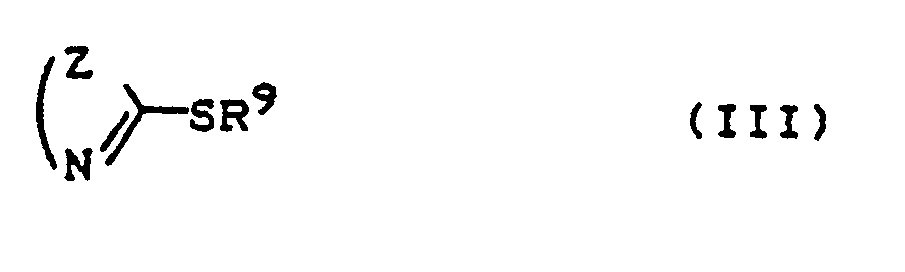
R⁹ die gleiche Bedeutung wie R³/R⁴ hat, und
Z die zur Vervollständigung eines gegebenenfalls substituierten 5- oder 6-gliedrigen heterocyclischen Ringes benötigten Glieder bedeutet,
oder in Kombination mit einem Gemisch aus II und III, enthalten,
zeigt Verbesserungen hinsichtlich der Minimaldichteerhöhung bei Lagerung (Frisch-, Heiß- und Langzeitlagerung) und bei Thiosulfatverunreinigung des Entwicklerbades.
Description
- Die Erfindung betrifft ein Verfahren zur Herstellung farbiger Bilder, bei dem ein bildmäßig belichtetes farbfotografisches Silberhalogenidaufzeichnungsmaterial, welches einen speziellen Stabilisator bzw. eine Kombination von mehreren Stabilisatoren enthält, einem Kurzverarbeitungsprozeß unterworfen wird.
- Desweiteren betrifft die Erfindung ein hierfür besonders geeignetes farbfotografisches Aufzeichnungsmaterial.
- Es ist bekannt, farbfotografische Bilder durch chromogene Entwicklung herzustellen, d. h. dadurch, daß man ein bildmäßig belichtetes Aufzeichnungsmaterial mit mindestens einer Silberhalogenidemulsionsschicht in Gegenwart geeigneter Farbkuppler mittels geeigneter farbbildender Entwicklersubstanzen entwickelt, wobei das in Übereinstimmung mit dem Silberbild entstehende Oxidationsprodukt der Entwicklersubstanzen mit dem Farbkuppler unter Bildung eines Farbstoffbildes reagiert.
- Eine wichtige Voraussetzung für die Schnellverarbeitung von farbfotografischen Aufzeichnungsmaterialien ist die Verwendung von schnellentwickelbaren Emulsionen. In dieser Hinsicht haben sich chloridreiche Silberhalogenidemulsionen als vorteilhaft erwiesen. Derartige Emulsionen werden beispielsweise in US-A-4 269 927 und WO 87/04535 beschrieben. Geeignet sind Emulsionen mit mindestens 80 Mol-%, vorzugsweise mit 95 - 100 Mol-% Chloridanteil.
- Silberchloridreiche Emulsionen, die sich durch eine sehr schnelle Entwickelbarkeit auszeichnen, zeigen jedoch Nachteile in Form von erhöhter Schleierbildung. Desweiteren treten bei farbfotografischen Aufzeichnungsmaterialien, die solche silberchloridreichen Emulsionen enthalten, sensitometrische Veränderungen bei Langzeitlagerungen auf.
- Aus diesem Grund setzt man fotografischen Silberhalogenidemulsionen zur Verminderung der Schleierbildung sogenannte Antischleiermittel oder Stabilisierungsmittel zu, z. B. heterocyclische Verbindungen, die Schwefel, beispielsweise in Form einer Mercaptogruppe, enthalten.
- Solche Stabilisatoren sind, insbesondere in Verbindung mit chloridreichen Silberhalogenidemulsionen, aus EP-A-0 246 624 bekannt. Sie zeigen jedoch nicht immer zufriedenstellende Ergebnisse in Bezug auf Schleier und Langzeitlagerung.
- Eine weitere wichtige Voraussetzung bei der Anwendung des Kurzzeitverarbeitungsverfahrens mit Entwicklungs zeiten von < 2 min. 30 sec. ist der Verzicht von Bromidionen und Benzylalkohol im Entwicklerbad. Bromidionen wirken als Entwicklungshemmer und sind insofern bei einem Schnellverarbeitungsprozeß bezüglich der Entwicklungsgeschwindigkeit von Nachteil.
- Die Anwesenheit von Benzylalkohol im Entwickler gibt leicht Anlaß zur Abscheidung von teerartigen Massen im Entwicklertank. Ein weiterer Nachteil beruht auf der leichten Oxidierbarkeit des Benzylalkohols, was eine sorgfältige Überwachung und Konstanthaltung des Entwicklerbades erfordert um gleichmäßige Entwicklungsergebnisse zu gewährleisten. Es ist daher erwünscht, derartige Aufzeichnungsmaterialien in Abwesenheit von Benzylalkohol zu entwickeln.
- Aufgabe der Erfindung ist es nun, ein für das Kurzzeitverarbeitungsverfahren geeignetes farbfotografisches Aufzeichnungsmaterial zu entwickeln, welches geringe Neigung zur Schleierbildung und zu sensitometrischen Veränderungen bei Langzeitlagerung zeigt. Dabei sollen jedoch die Vorteile der schnellen Entwickelbarkeit von silberchloridreichen Emulsionen bei gleichzeitigem Verzicht auf Bromid und Benzylalkohol im Entwicklerbad erhalten bleiben. Weiterhin soll die Schleiererhöhung in Entwicklern, die durch Thiosulfationen verunreinigt sind, unterdrückt werden.
- Gegenstand der Erfindung ist ein Verfahren zur Herstellung farbiger Bilder, bei dem ein bildmäßig belichtetes, farbfotografisches Aufzeichnungsmaterial, das auf einem reflektierenden Schichtträger mindestens eine blauempfindliche Silberhalogenidemulsionsschicht und einen dieser zugeordneten Gelbkuppler, mindestens eine grünempfindliche Silberhalogenidemulsionsschicht und einen dieser zugeordneten Purpurkuppler, mindestens eine rotempfindliche Silberhalogenidemulsionsschicht und einen dieser zugeordneten Blaugrünkuppler und gegebenenfalls weitere nicht lichtempfindliche Schichten enthält, einem Kurzzeitverarbeitungsprozeß unterworfen wird, dadurch gekennzeichnet, daß die Silberhalogenidemulsionsschichten einen Chloridgehalt von ≧ 95 Mol-% aufweisen und einen Stabilisator der Formel (I)

R¹ H, gegebenenfalls substituiertes C₁-C₈-Alkyl, C₂-C₈-Alkenyl, C₅-C₁₀-Cycloalkyl, C₆-C₁₂-Aryl, Heteroaryl, SH, SR⁵
R² H, gegebenenfalls substituiertes C₁-C₆-Alkyl, C₂-C₈-Alkenyl, C₅-C₁₀-Cycloalkyl, C₆-C₁₂-Aryl, CONR⁶R⁷ oder COOR⁶
R³, R⁴, H, COR⁶ oder COOR⁷
R⁵, R⁶, R⁷ C₁-C₆-Alkyl, C₂-C₈-Alkenyl, C₅-C₁₀-Cycloalkyl
allein oder in Kombination mit einem Stabilisator der Formel (II)
R⁸ H, Halogen, C₁-C₆-Alkoxy, C₁-C₆-Alkyl, C₁-C₆-Alkylthio, Nitro, gegebenenfalls substituiertes Amino, Acylamino oder Ureido
n 1 - 4
oder in Kombination mit einem Stabilisator der Formel (III)
R⁹ die gleiche Bedeutung wie R³/R⁴ hat, und
Z die zur Vervollständigung eines gegebenenfalls substituierten 5- oder 6-gliedrigen heterocyclischen Ringes benötigten Glieder bedeutet,
oder in Kombination mit einem Gemisch aus II und III, enthalten. - Die in Formel III durch Z vervollständigten 5- oder 6-gliedrigen heterocyclischen Ringe können Imidazol, Oxazol, Thiazol, Selenazol, Thiadiazol, Oxadiazol, Tetrazol, Pyridin, Pyrimidin, Triazin sowie deren Benzo- und Naphthoderivate darstellen. Die heterocyclischen Verbindungen können weiter substituiert sein. Dazu kommen die auf dem Gebiet der Photographie üblichen Substituenten in Frage, beispielsweise Halogen, wie Fluor, Chlor, Brom; gegebenenfalls substituiertes Alkyl mit vorzugsweise bis zu 8 C-Atomen wie Methyl, Ethyl, Isopropyl; Alkenyl wie Allyl; Cycloalkyl wie Cyclohexyl; gegebenenfalls substituiertes Aryl wie Phenyl oder Naphthyl, Hydroxy, Alkoxy mit vorzugsweise bis zu 6 C-Atomen wie Methoxy oder Butoxy, Mercapto, Alkylthio mit vorzugsweise bis zu 6 C-Atomen wie Methylthio, Butylthio; Carboxy, Alkoxycarbonyl, Sulfo, gegebenenfalls substituiertes Sulfonamid, Nitro, Amino, mit Alkyl, Aryl oder Acyl substituiertes Amino wie Butylamino oder Acetylamino.
- Der Rest R¹ aus Formel (I) kann folgende Heteroaromaten darstellen: Pyridin, Pyrimidin, Triazin, Imidazol, Oxazol, Thiazol, Furyl und Thienyl.

- Beispiele für Verbindungen der Formeln (I) sind im folgenden angegeben:


- Verbindungen gemäß Formel II sind beispielhaft im folgenden aufgeführt:

- Beispiele erfindungsgemäß verwendeter Stabilisatoren der Formel III sind im folgenden tabellarisch aufgelistet:


- Es ist günstig, die erfindungsgemäßen Verbindungen in Form von Lösungen zuzusetzen. Geeignet als Lösungsmittel sind beispielsweise niedere Alkohole, Tetrahydrofuran, N-Methylpyrrolidon oder Aceton.
- Die Verbindungen der Formeln I bis III werden vorzugsweise in Mengen von 10⁻⁵ bis 5 · 10⁻², vorzugsweise von 5 · 10⁻⁵ bis 10⁻³ Mol pro Mol Silberhalogenid eingesetzt.
- Die Emulsionen können in Kombination mit den erfindungsgemäßen weitere Antischleiermittel und Stabilisatoren enthalten. Geeignet sind Azaindene, vorzugsweise Tetra- oder Pentaazaindene, insbesondere solche, die mit Hydroxyl- oder Aminogruppen substituiert sind. Derartige Verbindungen sind z.B. in dem Artikel von Birr, Z.Wiss. Phot. 47, (1952), S. 2-58, beschrieben. Weitere geeignete Stabilisatoren und Antischleiermittel sind in der Zeitschrift Research Disclosure Nr. 17643 vom Dezember 1978, Abschnitt VI, veröffentlicht von Industrial Opportunities Ltd., Homewell Havant, Hampshire, PO9 1 EF in Großbritannien angegeben.
- Die Antischleiermittel einschließlich der erfindungsgemäß zu verwendenden Verbindungen der Formel I bis III können den lichtempfindlichen Silberhalognidemulsionen vor der chemischen Reifung, zur chemischen Reifung oder nach der chemischen Reifung zugesetzt werden. In einer bevorzugten Ausführungsform werden sie nach der chemischen Reifung zur fertigen Gießlösung zugesetzt.
- Die zur Schnellentwicklung geeigneten Silberhalogenidemulsionen enthalten mindestens 95 Mol-% Chlorid, wobei der zu 100 Mol-% ergänzende Rest aus 0 bis 5 Mol-% Bromid, Iodid und Rhodanid, einzeln oder in Kombination, besteht. Rhodanid wird hierbei als Halogenidersatz angesehen (Pseudohalogenid). Diese Halogenide und Pseudohalogenide werden vorzugsweise in folgenden Mengen eingesetzt: 0,01 bis 0,5 Mol-% Iodid, 0,02 bis 5 Mol-% Bromid und 0,02 bis 5 Mol-% Rhodanid. Die Korngröße variiert nach Schicht von 0,1 bis 2,0 µm.
- Es kann sich um überwiegend kompakte Kristalle handeln, die z.B. regulär kubisch oder oktaedrisch sind oder Übergangsformen aufweisen können. Vorzugsweise können aber auch plättchenförmige Kristalle vorliegen, deren durchschnittliches Verhältnis von Durchmesser zu Dicke größer als 5:1, vorzugsweise größer als 8:1, ist, wobei der Durchmesser eines Kornes definiert ist als der Durchmesser eines Kreises mit einem Kreisinhalt entsprechend der projizierten Fläche des Kornes.
- Die Silberhalogenidkörner können auch einen mehrfach geschichteten Kornaufbau aufweisen, im einfachsten Fall mit einem inneren und einem äußeren Kornbereich (core/shell), wobei die Halogenidzusammensetzung und/oder sonstige Modifizierungen, wie z.B. Dotierungen der einzelnen Kornbereiche unterschiedlich sind.
- Verwiesen wird zum Beispiel auf GB-1.027.146. Dort sind Silberhalogenide mit geschichtetem Kornaufbau und Methoden zu ihrer Herstellung angegeben. Im vorliegenden Fall werden auf die Silberchloridkörner andere Silberhalogenide aufgefällt. Bevorzugt ist Silberbromid, das gegebenenfalls geringe Mengen Silberiodid enthalten kann. Die Menge der aufgefällten anderen Silberhalogenide beträgt, wie weiter oben angegeben, bis zu 5 Mol-%. Die für den jeweiligen Fall optimale molare Menge des anderen Silberhalogenids kann durch einfache Versuche festgestellt werden.
- Die mittlere Korngröße der Emulsionen liegt vorzugsweise zwischen 0,2 µm und 1,0 µm. Die Korngrößenverteilung ist vorzugsweise homodispers, wobei der Variationskoeffizient ≦ 0,20 ist. Bevorzugte Ausführungsformen weisen einen Variationskoeffizienten von ≦ 0,10 auf. Die Emulsionen können außer dem Silberhalogenid auch organische Silbersalze enthalten, z.B. Silberbenztriazolat oder Silberbehenat.
- Es können zwei oder mehrere Arten von Silberhalogenidemulsionen, die getrennt hergestellt werden, als Mischung verwendet werden.
- Die fotografischen Emulsionen können nach verschiedenen Methoden (z.B. P. Glafkides, Chimie et Physique Photographique, Paul Montel, Paris (1967), G.F. Duffin, Photographic Emulsion Chemistry, The Focal Press, London (1966), V.L. Zelikman et al, Making and Coating Photographic Emulsion, The Focal Press, London (1966) aus löslichen Silbersalzen und löslichen Halogeniden hergestellt werden.
- Die Fällung des Silberhalogenids erfolgt bevorzugt in Gegenwart des Bindemittels, z.B. der Gelatine und kann im sauren, neutralen oder alkalischen pH-Bereich durchgeführt werden, wobei vorzugsweise Silberhalogenidkomplexbildner zusätzlich verwendet werden. Zu letzteren gehören z.B. Ammoniak, Thioether, Imidazol, Ammoniumthiocyanat oder überschüssiges Halogenid. Die Zusammenführung der wasserlöslichen Silbersalze und der Halogenide erfolgt wahlweise nacheinander nach dem single-jet- oder gleichzeitig nach dem double-jet-Verfahren oder nach beliebiger Kombination beider Verfahren. Bevorzugt wird die Dosierung mit steigenden Zuflußraten, wobei die "kritische" Zufuhrgeschwindigkeit, bei der gerade noch keine Neukeime entstehen, nicht überschritten werden sollte. Der pAg-Bereich kann während der Fällung in weiten Grenzen variieren, vorzugsweise wird das sogenannte pAg-gesteuerte Verfahren benutzt, bei dem ein bestimmter pAg-Wert konstant gehalten oder ein definiertes pAg-Profil während der Fällung durchfahren wird. Neben der bevorzugten Fällung bei Halogenidüberschuß ist aber auch die sogenannte inverse Fällung bei Silberionenüberschluß möglich. Außer durch Fällung können die Silberhalogenidkristalle auch durch physikalische Reifung (Ostwaldreifung), in Gegenwart von überschüssigem Halogenid und/oder Silberhalogenidkomplexierungsmittel wachsen. Das Wachstum der Emulsionskörner kann sogar überwiegend durch Ostwaldreifung erfolgen, wobei vorzugsweise eine feinkörnige, sogenannte Lippmann-Emulsion, mit einer schwerer löslichen Emulsion gemischt und auf letzterer umgelöst wird.
- Während der Fällung und/oder der physikalischen Reifung der Silberhalogenidkörner können auch Salze oder Komplexe von Metallen, wie z.B. Cd, Zn, Pb, Tl, Bi, Ir, Rh, Fe vorhanden sein.
- Ferner kann die Fällung auch in Gegenwart von Sensibilisierungsfarbstoffen erfolgen. Komplexierungsmittel und/oder Farbstoffe lassen sich zu jedem beliebigen Zeitpunkt unwirksam machen, z.B. durch Änderung des pH-Wertes oder durch eine oxidative Behandlung.
- Nach abgeschlossener Kristallbildung oder auch schon zu einem früheren Zeitpunkt werden die löslichen Salze aus der Emulsion entfernt, z.B. durch Nudeln und Waschen, durch Flocken und Waschen, durch Ultrafiltration oder durch Ionenaustauscher.
- Die Silberhalogenidemulsion wird im allgemeinen einer chemischen Sensibilisierung unter definierten Bedingungen - pH, pAg, Temperatur, Gelatine-, Silberhalogenid- und Sensibilisatorkonzentration - bis zum Erreichen des Empfindlichkeits- und Schleieroptimums unterworfen. Die Verfahrensweise ist z.B. bei H. Frieser "Die Grundlagen der Photographischen Prozesse mit Silberhalogeniden" Seite 675-734, Akademische Verlagsgesellschaft (1968) beschrieben.
- Dabei kann die chemische Sensibilisierung unter Zusatz von Verbindungen von Schwefel, Selen, Tellur und/oder Verbindungen der Metalle der VIII. Nebengruppe des Periodensystems (z.B. Gold, Platin, Palladium, Iridium) erfolgen, weiterhin können Thiocyanatverbindungen, oberflächenaktive Verbindungen, wie Thioether, heterocyclische Stickstoffverbindungen (z.B. Imidazole, Azaindene) oder auch spektrale Sensibilisatoren (beschrieben z.B. bei F. Hamer "The Cyanine Dyes and Related Compounds", 1964, bzw. Ullmanns Encyclopädie der technischen Chemie, 4. Auflage, Bd. 18, S. 431 ff. und Research Disclosure Nr. 17643, Abschnitt III) zugegeben werden. Ersatzweise oder zusätzlich kann eine Reduktionssensibilisierung unter Zugabe von Reduktionsmitteln (Zinn-II-Salze, Amine, Hydrazinderivate, Aminoborane, Silane, Formamidinsulfinsäure) durch Wasserstoff, durch niedrigen pAg (z.B. kleiner 5) und/oder hohen pH (z.B. über 8) durchgeführt werden.
- Als Schwefelreifkörper kommen im allgemeinen zur Silbersulfidbildung befähigte Verbindungen z. B. Thiosulfat, Thioharnstoff, Thiosemicarbazid und Thiocarbamid in Frage. Thiosulfat ist bevorzugt.
- Als Goldreifkörper werden anorganische Goldsalze eingesetzt. Aber auch organische Goldverbindungen wie in den Patenten DE-A-854 883 und DE-A-848 910 beschrieben, kommen in Frage.
- Die Emulsionen können nur einer Schwefelreifung, aber auch einer kombinierten Schwefel-/Goldreifung (z. B. DE-A 22 63 910) unterworfen werden.
- In einer weiteren bevorzugten Ausführungsform werden die Emulsionen iridiumdotiert, wobei die Iridiummenge 0,01 bis 0,5 µg/gAg beträgt.
- Die fotografischen Emulsionsschichten oder andere hydrophile Kolloidschichten des erfindungsgemäß hergestellten lichtempfindlichen Materials können oberflächenaktive Mittel für verschiedene Zwecke enthalten, wie Überzugshilfen, zur Verhinderung der elektrischen Aufladung, zur Verbesserung der Gleiteigenschaften, zum Emulgieren der Dispersion, zur Verhinderung der Adhäsion und zur Verbesserung der fotografischen Charakteristika (z.B. Entwicklungsbeschleunigung, hoher Kontrast, Sensibilisierung usw.).
- Nachfolgend wird die Herstellung einer monodispersen (Variationskoeffizient < 0,2) Silberchloridemulsion mit einem mittleren Korndurchmesser von 0,8 µm beschrieben, wobei in einem Doppeleinlaufverfahren folgende Lösungen verwendet werden:
Lösung E 1: Destilliertes Wasser 1.000 ml Gelatine 100 g Lösung E 2: Destilliertes Wasser 3.000 ml Silbernitrat 1.000 g Lösung E 3: Destilliertes Wasser 1.000 ml Ammoniumchlorid 370 g Na₂IrCl₆-Lösung (0,01 %ig) 5 g Na₃RhCl₆-Lösung (0,001 %ig) 1 ml Lösung E 1: Destilliertes Wasser 9.000 ml Gelatine 900 g - Die Vorlagelösung E 1 wurde auf 55°C erwärmt und auf pH 5,0 eingestellt. Unter intensiver Durchmischung wurden die auf 55°C erwärmten Lösungen E 2 und E 3 gleichzeitig innerhalb von 60 min. zudosiert. Zu Beginn betrug die Einlaufgeschwindigkeit 70 ml/min. Im weiteren Verlauf wurde langsam bis auf die 8fache Dosiergeschwindigkeit gesteigert. Nach Einlaufende wurde die Emulsion gekühlt und anschließend in üblicher Weise durch Flocken und Waschen von den löslichen Salzen befreit. Das gewaschene Flockulat wurde dann in der Lösung E 4 innerhalb von 30 min unter gleichzeitigem Rühren bei 40°C redispergiert. Die Emulsion wurde anschließend mit 0,05 Mol-% KI und 0,4 Mol-% KBr pro Mol AgNO₃ versetzt und 120 min bei 50°C und 2 x 10⁻⁵ Mol Thiosulfat pro Mol AgNO₃ und 2 x 10⁻⁶ Mol HAuCl₄ pro Mol AgNO₃ gereift. Nach Beendigung der Reifung wurde die Emulsion spektral sensibilisiert (Sensibilisatormenge: 4 x 10⁻⁴ Mol pro Mol AgNO₃) und mit 100 ml einer 1 gew.-%igen Lösung eines Stabilisators versetzt. Nähere Angaben über Sensibilisator und Stabilisator sind in dem Beispiel gemacht.
- Als spektrale Sensibilisatoren kommen Polymethinfarbstoffe, wie Neutrocyanine, basische oder saure Carbocyanine, Rhodacyanine, Hemicyanine, Styrylfarbstoffe, Oxonole und ähnliche in Frage. Derartige Sensibilisatoren sind von F. M. Hamer in "The Cyanine Dyes and related Compounds", (1964), beschrieben. Verwiesen sei diesbezüglich insbesondere auf Ullmanns Enzyklopädie der technischen Chemie, 4. Auflage, Band 18, Seiten 431 ff und auf die oben angegebene Research Disclosure Nr. 17 643, Abschnitt IV.
- Bei den erfindungsgemäßen farbfotografischen Aufzeichnungsmaterialien sind mindestens je eine überwiegend blauempfindliche, eine überwiegend grünempfindliche und eine überwiegend rotempfindliche Silberhalogenidemulsionsschicht übereinander auf einem Schichtträger aufgeschichtet. Falls die blauempfindliche Schicht in dem Schichtverband zuoberst angeordnet ist, kann sich unter ihr und oberhalb der grün- bzw. rotempfindlichen Schichten eine Schicht mit einem gelben Filterfarbstoff befinden. Desweiteren können zwischen zwei Silberhalogenidemulsionsschichten unterschiedlicher Spektralempfindlichkeit Zwischenschichten angeordnet sein. Die überwiegend blauempfindliche Silberhalogenidemulsionsschicht enthält einen Gelbkuppler, die überwiegend grünempfindliche Silberhalogenidemulsionsschicht einen Purpurkuppler und die überwiegend rotempfindliche Silberhalogenidemulsionsschicht einen Blaugrünkuppler. Bei dem erfindungsgemäßen Aufzeichnungsmaterial sind die lichtempfindlichen Schichten auf einem opaken lichtreflektierenden Schichtträger aufgeschichtet, z.B. auf einem Schichtträger aus Papier, der eine Barytschicht tragen kann und/oder ein- oder beidseitig mit einer Schicht aus einem Polyolefin überschichtet sein kann.
- Das fotografische Aufzeichnungsmaterial der vorliegenden Erfindung kann als Bindemittel für das Silberhalogenid und die Farbkuppler ein oder mehrere Polymere enthalten. Ein gebräuchliches Bindemittel ist Gelatine. Diese kann jedoch ganz oder teilweise durch andere synthetische, halbsynthetische oder auch natürlich vorkommende Polymere ersetzt werden. Synthetische Gelatineersatzstoffe sind beispielsweise Polyvinylalkohol, Poly-N-vinylpyrrolidon, Polyacrylamide, Polyacrylsäure und deren Derivate, insbesondere Mischpolymerisate. Natürlich vorkommende Gelatineersatzstoffe sind beispielsweise andere Proteine wie Albumin oder Casein, Cellulose, Zucker, Stärke oder Alginate, Halbsynthetische Gelatineersatzstoffe sind in der Regel modifizierte Naturprodukte.
- Cellulosederivate wie Hydroxyalkylcellulose, Carboxymethylcellulose und Phthalylcellulose sowie Gelatinederivate, die durch Umsetzung mit Alkylierungs- oder Acylierungsmitteln oder durch Aufpfropfung von polymerisierbaren Monomeren erhalten worden sind, sind Beispiele hierfür. Für die Verwendung als Bindemittel ist es von Bedeutung, daß die betreffenden Polymere noch über eine ausreichende Menge an funktionellen Gruppen verfügen, so daß durch Umsetzung mit geeigneten Härtungsmitteln genügend widerstandsfähige Schichten erzeugt weden können. Solche funktionellen Gruppen sind insbesondere Aminogruppen, aber auch Carboxylgruppen, Hydroxylgruppen und aktive Methylengruppen. Bevorzugtes Bindemittel des erfindungsgemäßen farbfotografischen Aufzeichnungsmaterials ist Gelatine.
- Die Schichten des fotografischen Materials können in der üblichen Weise gehärtet sein, beispielsweise mit Härtern des Epoxidtyps, des heterocyclischen Ethylenimins und des Acryloyltyps. Weiterhin ist es auch möglich, die Schichten gemäß dem Verfahren der deutschen Offenlegungsschrift 2 218 009 zu härten, um farbfotografische Materialien zu erzielen, die für eine Hochtemperaturverarbeitung geeignet sind. Es ist ferner möglich, die fotografischen Schichten mit Härtern der Diazin-, Triazin- oder 1,2-Dihydrochinolin-Reihe zu härten oder mit Härtern vom Vinylsulfon-Typ. Weitere geeignete Härtungsmittel sind aus den deutschen Offenlegungsschriften 2 439 551, 2 225 230, 2 317 672 und aus der oben angegebenen Research Disclosure 17 643, Abschnitt XI, bekannt.
- Weitere geeignete Zusätze werden in der Research Disclosure 17 643 und in "Product Licensing Index" von Dezember 1971, Seiten 107-110, angegeben. Besonders bevorzugt ist die Verwendung von Sofort-Härtungsmitteln.
- Unter Soforthärtern werden Verbindungen verstanden, die geeignete Bindemittel so vernetzen, daß unmittelbar nach Beguß bzw. spätestens nach 24 Stunden, vorzugsweise nach 8 Stunden die Härtung soweit abgeschlossen ist, daß keine weitere durch die Vernetzungsreaktion bedingte Änderung der Sensitometrie und der Quellung des Schichtverbandes auftritt. Unter Quellung wird die Differenz von Naßschichtdicke und Trockenschichtdicke bei der wäßrigen Verarbeitung des Films verstanden (Photogr. Sci. Eng. 8 (1964), 275; Photogr. Sci. Eng. 16 (1972), 449.
- Bei diesen mit Gelatine sehr schnell reagierenden Härtungsmitteln handelt es sich z. B. um Carbamoylpyridiniumsalze, die vermutlich mit freien Carboxylgruppen des proteinartigen Bindemittels zu reagieren vermögen, so daß letztere mit freien Aminogruppen unter Ausbildung von Paptidbindungen und Vernetzung reagieren können.
- Geeignete Beispiele für Sofort-Härtungsmittel sind Verbindungen der folgenden allgemeinen Formeln:

R¹⁰ und R¹¹ einzeln gleich oder verschieden, jeweils eine Alkylgruppe mit 1 bis 8 Kohlenstoffatomen oder eine gegebenenfalls mit einer Alkylgruppe mit 1 oder 2 Kohlenstoffatomen oder mit einem Halogenatom substituierte Aryl- oder Aralkylgruppe, oder zusammen die zur Vervollständigung eines gegebenenfalls mit einer Alkylgruppe mit 1 oder 2 Kohlenstoffatomen oder mit einem Halogenatom substituierten heterocyclischen Ringes, z. B. eines Piperidin- oder Morpholinringes erforderlichen Atome,
R¹² ein Wasserstoffatom oder eine Alkylgruppe mit 1 oder 2 Kohlenstoffatomen,
n gleich 0 oder 2. - Solche Härtungsmittel sind beispielsweisein DE-A-24 39 551 beschrieben. Beispiele für solche Härtungsmittel (H-) sind im folgenden aufgeführt:


- Bei der Herstellung des lichtempfindlichen farbfotografischen Aufzeichnungsmaterials können die diffusionsfesten Kuppler in bekannter Weise in die Gießlösung der Silberhalogenidemulsionsschichten oder anderer Kolloidschichten eingearbeitet werden. Beispielsweise können die öllöslichen oder hydrophoben Kuppler vorzugsweise aus einer Lösung in einem geeigneten Kupplerlösungsmittel (Ölbildner) gegebenenfalls in Anwesenheit eines Netz- oder Dispergiermittels zu einer hydrophilen Kolloidlösung zugefügt werden. Die hydrophile Gießlösung kann selbstverständlich neben dem Bindemittel andere übliche Zusätze enthalten. Die Lösung des Kupplers braucht nicht direkt in die Gießlösung für die Silberhalogenidemulsionsschicht oder eine andere wasserdurchlässige Schicht dispergiert zu werden; sie kann vielmehr auch vorteilhaft zuerst in einer wäßrigen nichtlichtempfindlichen Lösung eines hydrophilen Kolloids dispergiert werden, worauf das erhaltene Gemisch gegebenenfalls nach Entfernung der verwendeten niedrig siedenden organischen Lösungsmittel mit der Gießlösung für die lichtempfindliche Silberhalogenidemulsionsschicht oder einer anderen wasserdurchlässigen Schicht vor dem Auftragen vermischt wird.
- Entsprechende Methoden sind besipielsweise beschrieben in US-A-2 322 027, DE-A-1 722 192 und EP-A-0 043 037. Die Verbindungen können auch in Form beladener Latices in die Gießlösung eingebracht werden. Verwiesen wird beispielsweise auf DE-A-25 41 230, DE-A-25 41 274, DE-A-28 35 856, EP-A-0 014 921, EP-A-0 069 671, EP-A-0 130 115, US-A-4 291 113.
- Das erfindungsgemäße farbfotografische Aufzeichnungsmaterial zur Herstellung mehrfarbiger Bilder enthält in räumlicher und spektraler Zuordnung zu den Silberhalogenidemulsionsschichten unterschiedlicher Spektralempfindlichkeit Farbkuppler zur Erzeugung der unterschiedlichen Teilfarbenbilder Cyan, Purpur und Gelb. Unter räumlicher Zuordnung ist dabei zu verstehen, daß der Farbkuppler sich in einer solchen räumlichen Beziehung zu der Silberhalogenidemulsionsschicht befindet, daß eine Wechselwirkung zwischen ihnen möglich ist, die eine bildgemäße Übereinstimmung zwischen dem bei der Entwicklung gebildeten Silberbild und dem aus dem Farbkuppler erzeugten Farbbild zuläßt. Dies wird in der Regel dadurch erreicht, daß der Farbkuppler in der Silberhalogenidemulsionsschicht selbst enthalten ist oder in einer hierzu benachbarten gegebenenfalls nichtlichtempfindlichen Bindemittelschicht.
- Unter spektraler Zuordnung ist zu verstehen, daß die Spektralempfindlichkeit jeder der lichtempfindlichen Silberhalogenidemulsionsschichten und die Farbe des aus dem jeweils räumlich zugeordneten Farbkuppler erzeugten Teilfarbenbildes in einer bestimmten Beziehung zueinander stehen, wobei jeder der Spektralempfindlichkeiten (Rot, Grün, Blau) eine andere Farbe des betreffenden Teilfarbenbildes (im allgemeinen z.B. die Farben Cyan, Purpur bzw. Gelb in dieser Reihenfolge) zugeordnet ist.
- Jeder der unterschiedlich spektral sensibilisierten Silberhalogenidemulsionsschichten kann ein oder können auch mehrere Farbkuppler zugeordnet sein. Wenn mehrere Silberhalogenidemulsionsschichten gleicher Spektralempfindlichkeit vorhanden sind, kann jede von ihnen einen Farbkuppler enthalten, wobei diese Farbkuppler nicht notwendigerweise identisch zu sein brauchen. Sie sollen lediglich bei der Farbentwicklung wenigstens annähernd die gleiche Farbe ergeben, normalerweise eine Farbe, die komplementär ist zu der Farbe des Lichtes, für das die betreffenden Silberhalogenidemulsionsschichten überwiegend empfindlich sind.
- Rotempfindlichen Silberhalogenidemulsionsschichten ist folglich bei bevorzugten Ausführungsformen mindestens ein nichtdiffundierender Farbkuppler zur Erzeugung des blaugrünen Teilfarbenbildes zugeordnet, in der Regel ein Kuppler vom Phenol- oder α-Naphtholtyp. Geeignete Farbkuppler sind in EP-A-0 184 057, EP-A-0 175 573, EP-A-0 161 626, EP-A-0 028 099, EP-A-0 067 689, EP-A-0 142 086, DE-A-2 028 601 beschrieben.
- Grünempfindlichen Silberhalogenidemulsionsschichten ist mindestens ein nichtdiffundierender Farbkuppler zur Erzeugung des purpurnen Teilfarbenbildes zugeordnet, wobei üblicherweise Farbkuppler vom Typ des 5-Pyrazolons, des Indazolons oder verschiedener Pyrazoloazole Verwendung finden. Purpurkuppler dieser Art sind in DE-A-3 516 996 und DE-A-3 516 945 zu finden.
- Blauempfindlichen Silberhalogenidemulsionsschichten schließlich ist mindestens ein nichtdiffundierender Farbkuppler zur Erzeugung des gelben Teilfarbenbildes zugeordnet. Farbkuppler dieser Art sind in großer Zahl bekannt und in einer Vielzahl von Patentschriften beschrieben. Beispielhaft sei hier auf die Veröffentlichungen "Farbkuppler" von W. PELZ in "Mitteilungen aus den Forschungslaboratorien der Agfa, Leverkusen/München", Band III, Seite 111 (1961) und von K. VENKATARAMAN in "The Chemistry of Synthetic Dyes", Vol. 4, 341 bis 387, Academic Press (1972), verwiesen.
- Bei den Farbkupplern kann es sich sowohl um übliche 4-Äquivalentkuppler handeln als auch um 2-Äquivalentkuppler, bei denen zur Farberzeugung eine geringere Menge Silberhalogenid erforderlich ist. 2-Äquivalentkuppler leiten sich bekanntlich von den 4-Äquivalentkupplern dadurch ab, daß sie in der Kupplungsstelle einen Substituenten enthalten, der bei der Kupplung abgespalten wird. Zu den 2-Äquivalentkupplern sind sowohl solche zu rechnen, die praktisch farblos sind, als auch solche, die eine intensive Eigenfarbe aufweisen, die bei der Farbkupplung verschwindet bzw. durch die Farbe des erzeugten Bildfarbstoffes ersetzt wird. Letztere Kuppler können ebenfalls zusätzlich in den lichtempfindlichen Silberhalogenidemulsionsschichten vorhanden sein und dort als Maskenkuppler zur Kompensierung der unerwünschten Nebendichten der Bildfarbstoffe dienen. Zu den 2-Äquivalentkupplern sind aber auch die bekannten Weißkuppler zu rechnen, die jedoch bei Reaktion mit Farbentwickleroxidationsprodukten keinen Farbstoff ergeben. Zu den 2-Äquivalentkupplern sind ferner die bekannten DIR-Kuppler zu rechnen, bei denen es sich um Kuppler handelt, die in der Kupplungsstelle einen abspaltbaren Rest enthalten, der bei Reaktion mit Farbentwickleroxidationsprodukten als diffundierender Entwicklungsinhibitor in Freiheit gesetzt wird. Auch andere fotografisch wirksame Verbindungen, z. B. Entwicklungsaceferatoren oder Schleiermittel, können bei der Entwicklung aus solchen Kupplern freigesetzt werden.
- Die Kuppler können auch in polymerer Form, z. B. als Polymerisatlatex zur Anwendung gelangen.
- Hochmolekulare Farbkuppler sind beispielsweise beschrieben in DE-C-1 297 417, DE-A-24 07 569, DE-A-31 48 125, DE-A-32 17 200, DE-A-33 20 079, DE-A-33 24 932, DE-A-33 31 743, DE-A-33 40 376, EP-A-27 284, US-A-4 080 211. Die hochmolekularen Farbkuppler werden in der Regel durch Polymerisation von ethylenisch ungesättigten monomeren Farbkupplern hergestellt.
- Die verwendeten Farbkuppler können auch solche sein, die Farbstoffe mit einer schwachen bzw. eingeschränkten Beweglichkeit liefern.
- Beispiele für besonders geeignete Gelbkuppler sind in folgender Tabelle angegeben:


- Beispiele für besonders geeignete Blaugrünkuppler sind in folgender Tabelle angegeben:


- Als Purpurkuppler können folgende Verbindungen verwendet werden:


- Über die genannten Bestandteile hinaus kann das farbfotografische Aufzeichnungsmaterial der vorliegenden Erfindung weitere Zusätze enthalten, wie zum Beispiel Antioxidantien, farbstoffstabilisierende Mittel und Mittel zur Beeinflussung der mechanischen und elektrostatischen Eigenschaften. Um die nachteilige Einwirkung von UV-Licht auf die mit dem erfindungsgemäßen farbfotografischen Aufzeichnungsmaterial hergestellten Farbbilder zu vermindern oder zu vermeiden, ist es beispielsweise vorteilhaft, in einer oder mehreren der in dem Aufzeichnungsmaterial enthaltenen Schichten, vorzugsweise in einer der oberen Schichten, UV-absorbierende Verbindungen zu verwenden.
- Geeignete UV-Absorber sind beispielsweise in US-A-3 253 921, DE-C-2 036 719 und EP-A-0 057 160 beschrieben.
- Zur Herstellung farbfotografischer Bilder wird das erfindungsgemäße farbfotografische Aufzeichnungsmaterial mit einer Farbentwicklerverbindung entwickelt. Als Farbentwicklerverbindung lassen sich sämtliche Entwicklerverbindungen verwenden, die die Fähigkeit besitzen, in Form ihres Oxidationsproduktes mit Farbkupplern zu Azomethinfarbstoffen zu reagieren. Geeignete Farbentwicklerverbindungen sind aromatische mindestens eine primäre Aminogruppe enthaltende Verbindungen vom p-Phenylendiamintyp, beispielsweise N,N-Dialkyl-p-phenylendiamine, wie N,N-Diethyl-p-phenylendiamin, 1-(N-ethyl-N-methylsulfonamidoethyl)-3-methyl-p-phenylendiamin, 1-(N-ethyl-N-hydroxyethyl-3-methyl-p-phenylendiamin und 1-(N-ethyl-N-methoxyethyl)-3-methyl-p-phenylendiamin.
- Weitere brauchbare Farbentwickler sind beispielsweise beschrieben in J. Amer. Chem. Soc. 73, 3100 (1951) und in G. Haist, Modern Photographic Processing, 1979, John Wiley and Sons, New York, Seiten 545 ff.
- Das erfindungsgemäße Aufzeichnungsmaterial eignet sich vorzüglich für die Verarbeitung in einem abgekürzten Verarbeitungsprozeß, z.B. in einem Verarbeitungsprozeß, dessen Entwicklungsschritt bei Temperaturen zwischen 25 und 45°C weniger als 3 Minuten, vorzugsweise weniger als 1 Minute dauert. Speziell bei Entwicklung mit benzylalkoholfreien Entwicklerbädern werden vorteilhafte Ergebnisse erhalten.
- Vorzugsweise enthält die Farbentwicklerlösung ≦ 0,01 Mol/l Bromid und ≦ 5 ml/l Benzylalkohol.
- Nach der Farbentwicklung wird das Material üblicherweise gebleicht und fixiert. Bleichung und Fixierung können getrennt voneinander oder auch zusammen durchgeführt werden. Als Bleichmittel können die üblichen Verbindungen verwendet werden, z.B. Fe³⁺-Salze und Fe³⁺-Komplexsalze wie Ferricyanide, Dichromate, wasserlösliche Kobaltkomplexe usw. Besonders bevorzugt sind Eisen-III-Komplexe von Aminopolycarbonsäuren insbesondere z.B. Ethylendiamintetraessigsäure, N-Hydroxyethylethylendiamintriessigsäure, Alkyliminodicarbonsäuren und von entsprechenden Phosphonsäuren. Geeignet als Bleichmittel sind weiterhin Persulfate.
- Im folgenden sind die Zusammensetzungen und Verarbeitungszeiten von Entwicklungs- und Bleichfixierbad angegeben, in denen das erfindungsgemäße Material verarbeitet wird. Auf das Wässern folgt übliches Trocknen.
a) Farbentwickler - 45 s - 35°C Triethanolamin 9,0 g/l NN-Diethylhydroxylamin 4,0 g/l Diethylenglykol 0,05 g/l 3-Methyl-4-amino-N-ethyl-N-methansulfonamidoethyl-anilin-sulfat 5,0 g/l Kaliumsulfit 0,2 g/l Triethylenglykol 0,05 g/l Kaliumcarbonat 22 g/l Kaliumhydroxid 0,4 g/l Ethylendiamintetraessigsäure di-Na-Salz 2,2 g/l Kaliumchlorid 2,5 g/l 1,2-Dihydroxybenzol-3,4,6-trisulfonsäure-trinatriumsalz 0,3 g/l auffüllen mit Wasser auf 1.000 ml; pH 10,0 b) Bleichfixierbad - 45 s - 35°C Ammoniumthiosulfat 75 g/l Natriumhydrogensulfit 13,5 g/l Ammoniumacetat 2,0 g/l Ethylendiamintetraessigsäure (Eisen-Ammonium-Salz) 57 g/l Ammoniak 25 %ig 9,5 g/l Essigsäure 9,0 g/l auffüllen mit Wasser auf 1.000 ml; pH 5,5 c) Wässern - 2 min - 33°C - In den folgenden Versuchsaufbauten wurden die nach dem vorstehenden Verfahren hergestellten spektral sensibilisierten Emulsionen mit Stabilisator versetzt und anschließend 10 Minuten bei 40°C gerührt.
- Zum Vergleich mit den erfindungsgemäßen Stabilisatoren bzw. Stabilisatorkombinationen wurden folgende Verbindungen verwendet:

- Die folgende Tabelle 1 zeigt neun unterschiedlich stabilisierte blau, grün oder rot sensibilisierte Silberhalogenidemulsionen, wobei drei als Vergleich dienen und sechs die erfindungsgemäßen Stabilisatoren bzw. Stabilisatorkombinationen enthalten.
Tabelle 1 Emulsion-Nr. Sensibilisierung Stabilisatoren Konzentration von (mmol Stabilisator / Mol AgNO₃) 1 (Vergleich) blau STA-2 0,4 2 " grün STA-1 0,6 3 " rot STA-3 0,5 4 (erfindungsgemäß) blau I-3 0,4 5 " grün I-3 0,6 6 " grün I-3/III-7 0,3 / 0,3 7 " grün I-3 /II-4/III-7 0,2 / 0,2 / 0,2 8 " rot I-11 0,5 9 " rot I-3/II-4 0,3 / 0,2 - Die auf diese Weise sensibilisierten und stabilisierten Silberhalogenidemulsionen werden gemäß nachstehender Vorschrift zu Gießsuspensionen ergänzt und auf einem reflektierenden Schichtträger vergossen (beidseitig polyethylenkaschiertes Paper). Zuvor wird als unterste Schicht eine Substratschicht, bestehend aus 0,2 g/m² Gelatine unter Zusatz von KNO₃ und Chromalaun aufgebracht.
- Ein Teil der Gießsuspension jedes Versuchs wird zunächst 24 h bei 40°C gerührt und anschließend vergossen.
- Die Mengenangaben beziehen sich jeweils auf 1 m². Für den Silberhalogenidauftrag werden die entsprechenden Mengen AgNO₃ angegeben.
- Die vorstehend beschriebene monodisperse Silberhalogenidemulsion für einen Schichtauftrag entsprechend 0,63 g AgNO₃ pro m² wird blausensibilisiert und mit
1,38 g Gelatine
0,95 g Gelbkuppler Y-10
0,2 g Weißkuppler W-1
- Die vorstehend beschriebene monodisperse Silberhalogenidemulsion für einen Schichtauftrag entsprechend 0,45 g AgNO₃ pro m² wird grünsensibilisiert und mit
1,08 g Gelatine
0,41 g Purpurkuppler M-26
0,16 g α-(3-t-Butyl-4-hydroxyphenoxy)-myristinsäureethylester
0,08 g 2,5-Dioctylhydrochinon
0,34 g Dibutylphthalat (DBP)
0,4 g TKP versetzt. - Die vorstehend beschriebene monodisperse Silberhalogenidemulsion für einen Schichtauftrag entsprechend 0,3 g AgNO₃ pro m² wird rotsensibilisiert und mit
0,75 g Gelatine
0,36 g Blaugrünkuppler C-13
0,36 g TKP versetzt. - Die Schichten wurden mit einer Härtungsschicht, bestehend aus 0,6 g/m² Gelatine und 0,29 g/m² des Härtungsmittels H-15 gehärtet.
- Die unterschiedliche Stabilisierung der Schichten ist der Tabelle 1 zu entnehmen.
- Das Material wurde nach der Herstellung der Prüfblätter aufgeschnitten und zum Teil sofort unter einem Graukeil belichtet und im angegebenen Kurzzeitprozeß verarbeitet (Frischmaterial ohne Lagerung); zum Teil wurde das Material einer Verarbeitungsvariante unterzogen, bei der das Entwicklerbad des Schnellprozesses mit 40 mg/l Ammoniumthiosulfat versetzt wurde (Simulation einer Thiosulfatverunreinigung des Entwicklers, welche den Schleier erhöht). Ein weiterer Teil des Materials wurde vor Belichtung und Verarbeitung einer Lagerung bei 60°C unterworfen oder 3 Monate bei Normalklima gelagert. Anschließend wurde mit einem Sensitometer der Firma Macbeth die Minimaldichte der zur spektralen Sensibilisierung komplementären Farbe gemessen.
- Die nachfolgende Tabelle 2 zeigt die Ergebnisse der Messungen:
Tabelle 2 Emulsions-Nr. Stabilisatoren Filterfarbe des Densitometers Minimaldichte frisch Minimaldichte nach 24h Rühren bei 40°C Minimaldichte nach Lagerung 3 Tage bei 60°C Minimaldichte nach Lagerung 3 Monate bei Normalklima Minimaldichte nach Thiosulfatentwicklung 1 (Vergleich) STA-2 blau 0,109 0,137 0,121 0,119 0,122 2 " STA-1 grün 0,098 0,112 0,116 0,104 0,106 3 " STA-3 rot 0,110 0,108 0,109 0,112 0,106 4 (erfindungsgemäß) I-3 blau 0,105 0,122 0,121 0,114 0,110 5 " I-3 grün 0,092 0,096 0,100 0,090 0,095 6 " I-3/III-7 grün 0,090 0,098 0,098 0,094 0,099 7 " I-3/II-4/III-7 grün 0,092 0,095 0,098 0,093 0,098 8 " I-11 rot 0,100 0,101 0,100 0,103 0,105 9 " I-3/II-4 rot 0,098 0,104 0,102 0,102 0,103 - Die sonstigen sensitometrischen Eigenschaften, insbesondere die bei einer Dichte von 0,6 gemessene Empfindlichkeit der Emulsionen 4 bis 9, waren den Werten der Vergleichsemulsionen 1 bis 3 vergleichbar.
- In diesem Beispiel wurden zwei komplette Schichtaufbauten mit spektral unterschiedlich sensibilisierten Silberhalogenidemulsionsschichten miteinander verglichen, wobei bei dem Vergleichsaufbau die Emulsionen 1, 2 und 3 verwendet wurden und der erfindungsgemäße Schichtaufbau die Emulsionen 4, 6 und 9 enthielt (siehe Beispiel 1). Die im folgenden beschriebenen Schichtaufbauten stellen ein farbfotografisches Material dar, das für einen Schnellverarbeitungsprozeß geeignet ist und auf beidseitig mit Polyethylen beschichtetem Papier mit folgenden Schichten in der angegebenen Reihenfolge hergestellt wurde.
-
- 1. Schicht (Substratschicht):
0,2 g Gelatine - 2. Schicht: blauempfindliche Schicht mit Emulsion 1
- 3. Schicht (Schutzschicht)
1.1 g Gelatine
0,06 g 2,5-Dioctylhydrochinon
0,06 g Dibutylphthalat (DBP) - 4. Schicht: grünempfindliche Schicht mit Emulsion 2
- 5. Schicht (UV-Schutzschicht)
1,15 g Gelatine
0,6 g UV-Absorber der Formel
0,04 g TKP - 6. Schicht: rotempfindliche Schicht mit Emulsion 3
- 7. Schicht (UV-Schutzschicht)
0,35 g Gelatine
0,15 g UV-Absorber wie in Schicht 5
0,2 g TKP - 8. Schicht (Schutzschicht)
0,6 g Gelatine
0,3 g Härtungsmittel H-15 - Die Schichten und die Schichtenfolgen entsprechen Versuchsaufbau 1 bis auf die folgenden Änderungen:
- In Schicht 2 wurde Emulsion 4 statt Emulsion 1,
in Schicht 4 wurde Emulsion 6 statt Emulsion 2 und
in Schicht 6 wurde Emulsion 9 statt Emulsion 3
verwendet. - Die auf diese Weise hergestellten Materialien wurden wie in Beispiel 1 verarbeitet und gelagert.
- Die Ausmessung der Minimaldichten erfolgte in allen drei zu den Sensibilisierungen komplementären Farben.
- In der folgenden Tabelle 3 sind die gemessenen Minimaldichten der Versuchsaufbauten 1 und 2 bei unterschiedlichen Verarbeitungs- und Lagerungsbedingungen aufgeführt:
Tabelle 3 Emulsions-Nr. Stabilisatoren Filterfarbe des Densitometers Minimaldichte frisch Minimaldichte nach Lagerung 3 Tage bei 60°C Minimaldichte nach Lagerung 3 Monate bei Normalklima Minimaldichte nach Thiosulfatentwicklung 1 (Vergleich) STA-2 blau 0,128 0,142 0,144 0,135 2 " STA-1 grün 0,114 0,130 0,110 0,114 3 " STA-3 rot 0,108 0,107 0,108 0,106 4 (erfindungsgemäß) I-3 blau 0,120 0,130 0,135 0,125 6 " I-3/III-7 grün 0,105 0,120 0,108 0,109 9 " I-3/II-4 rot 0,099 0,100 0,102 0,104 - Aus den Ergebnissen der Messungen aus Beispiel 1 und 2 geht hervor, daß sowohl die einzelne Emulsionsschicht als auch das mehrschichtige fotografische Material durch die erfindungsgemäße Stabilisierung besser stabilisiert werden als durch die herkömmliche. Die Verbesserung betrifft die "Frisch"-Minimaldichte, d. h. sofortige Verarbeitung ohne Lagerung, die Minimaldichte bei Heißluftlagerung (60°C) und die Langzeitlagerung bei Normalklima. In den einzelnen Emulsionen wurde gezeigt, daß die Stabilität auch bei längerem Rühren der Emulsion verbessert wird (24 h, 40°C).
- Ebenfalls verringert sind die Minimaldichteerhöhungen, die durch Entwicklerverunreinigung mit Ammoniumthiosulfat bewirkt werden.
Claims (13)

R¹ H, gegebenenfalls substituiertes C₁-C₈-Alkyl, C₂-C₈-Alkenyl, C₅-C₁₀-Cycloalkyl, C₆-C₁₂-Aryl, Heteroaryl, SH, SR⁵
R² H, gegebenenfalls substituiertes C₁-C₆-Alkyl, C₂-C₈-Alkenyl, C₅-C₁₀-Cycloalkyl, C₆-C₁₂-Aryl, CONR⁶R⁷ oder COOR⁶
R³, R⁴ H, COR⁶ oder COOR⁷
R⁵, R⁶, R⁷ C₁-C₆-Alkyl, C₂-C₈-Alkenyl, C₅-C₁₀-Cycloalkyl
allein oder in Kombination mit einem Stabilisator der Formel (II)

R⁸ H, Halogen, C₁-C₆-Alkoxy, C₁-C₆-Alkyl, C₁-C₆-Alkylthio, Nitro, gegebenenfalls substituiertes Amino, Acylamino oder Ureido
n 1 - 4
oder in Kombination mit einem Stabilisator der Formel (III)

R⁹ die gleiche Bedeutung wie R³/R⁴ hat, und
Z die zur Vervollständigung eines gegebenenfalls substituierten 5- oder 6-gliedrigen heterocyclischen 5- Ringes benötigten Glieder bedeutet,
oder in Kombination mit einem Gemisch aus II und III, enthalten.


R¹ H, gegebenenfalls substituiertes C₁-C₈-Alkyl, C₂-C₈-Alkenyl, C₅-C₁₀-Cycloalkyl, C₆-C₁₂-Aryl, Heteroaryl, SH, SR⁵
R² H, gegebenenfalls substituiertes C₁-C₆-Alkyl, C₂-C₈-Alkenyl, C₅-C₁₀-Cycloalkyl, C₆-C₁₂-Aryl, CONR⁶R⁷ oder COOR⁶
R³, R⁴ H, COR⁶ oder COOR⁷
R⁵, R⁶, R⁷ C₁-C₆-Alkyl, C₂-C₈-Alkenyl, C₅-C₁₀-Cycloalkyl
oder in Kombination mit einem einen Stabilisator der Formel (II)

R⁸ H, Halogen, C₁-C₆-Alkoxy, C₁-C₆-Alkyl, C₁-C₆-Alkylthio, Nitro, gegebenenfalls substituiertes Amino, Acylamino oder Ureido
n 1 - 4
oder in Kombination mit einem Stabilisator der Formel (III)

R⁹ die gleiche Bedeutung wie R³/R⁴ hat, und
Z die zur Vervollständigung eines gegebenenfalls substituierten 5- oder 6-gliedrigen heterocyclischen 5- Ringes benötigten Glieder bedeutet,
oder in Kombination mit einem Gemisch aus II und III, enthalten.

Applications Claiming Priority (2)
| Application Number | Priority Date | Filing Date | Title |
|---|---|---|---|
| DE3805348 | 1988-02-20 | ||
| DE19883805348 DE3805348A1 (de) | 1988-02-20 | 1988-02-20 | Verfahren zur herstellung farbiger bilder und hierfuer geeignetes farbfotografisches aufzeichnungsmaterial |
Publications (2)
| Publication Number | Publication Date |
|---|---|
| EP0330018A2 true EP0330018A2 (de) | 1989-08-30 |
| EP0330018A3 EP0330018A3 (en) | 1990-07-11 |
Family
ID=6347821
Family Applications (1)
| Application Number | Title | Priority Date | Filing Date |
|---|---|---|---|
| EP89102220A Withdrawn EP0330018A3 (en) | 1988-02-20 | 1989-02-09 | Process for producing colour images, and colour-photographic recording material therefor |
Country Status (3)
| Country | Link |
|---|---|
| EP (1) | EP0330018A3 (de) |
| JP (1) | JPH01252955A (de) |
| DE (1) | DE3805348A1 (de) |
Cited By (1)
| Publication number | Priority date | Publication date | Assignee | Title |
|---|---|---|---|---|
| US6395894B2 (en) | 1998-04-16 | 2002-05-28 | Philip J. Pye | Process for the synthesis of carbapenem intermidiates, and compounds produced |
Families Citing this family (1)
| Publication number | Priority date | Publication date | Assignee | Title |
|---|---|---|---|---|
| JP2504871B2 (ja) * | 1991-04-03 | 1996-06-05 | 三菱製紙株式会社 | ハロゲン化銀写真感光材料 |
Family Cites Families (5)
| Publication number | Priority date | Publication date | Assignee | Title |
|---|---|---|---|---|
| US3901713A (en) * | 1971-06-02 | 1975-08-26 | Fuji Photo Film Co Ltd | Process for the manufacture of silver halide photographic emulsion containing iridium and rhodium |
| EP0046871B1 (de) * | 1980-09-02 | 1983-12-07 | Agfa-Gevaert AG | Fotografisches Material, Herstellungsverfahren, Verfahren zur Herstellung fotografischer Bilder sowie neue Triazole |
| US4828970A (en) * | 1986-04-18 | 1989-05-09 | Konishiroku Photo Industry Co., Ltd. | Method for processing a light-sensitive silver halide color photographic material by controlling the pH value of the bleach fixing solution |
| JP2546645B2 (ja) * | 1986-04-24 | 1996-10-23 | コニカ株式会社 | ハロゲン化銀カラー写真感光材料 |
| DE3618118A1 (de) * | 1986-05-30 | 1987-12-03 | Agfa Gevaert Ag | Durch waermebehandlung entwickelbares farbfotografisches aufzeichnungsmaterial |
-
1988
- 1988-02-20 DE DE19883805348 patent/DE3805348A1/de not_active Withdrawn
-
1989
- 1989-02-09 EP EP89102220A patent/EP0330018A3/de not_active Withdrawn
- 1989-02-14 JP JP3290089A patent/JPH01252955A/ja active Pending
Cited By (1)
| Publication number | Priority date | Publication date | Assignee | Title |
|---|---|---|---|---|
| US6395894B2 (en) | 1998-04-16 | 2002-05-28 | Philip J. Pye | Process for the synthesis of carbapenem intermidiates, and compounds produced |
Also Published As
| Publication number | Publication date |
|---|---|
| DE3805348A1 (de) | 1989-08-31 |
| JPH01252955A (ja) | 1989-10-09 |
| EP0330018A3 (en) | 1990-07-11 |
Similar Documents
| Publication | Publication Date | Title |
|---|---|---|
| DE3736410A1 (de) | Farbfotografisches silberhalogenidmaterial | |
| EP0358071B1 (de) | Fotografisches Aufzeichnungsmaterial | |
| EP0040771B1 (de) | Fotografisches Aufzeichnungsmaterial und dessen Verwendung zur Herstellung von Bildern | |
| DE4020058A1 (de) | Farbfotografisches aufzeichnungsmaterial | |
| EP0193826B1 (de) | Farbfotografisches Aufzeichnungsmaterial mit einer Silberhalogenidemulsion und Verfahren zu deren Herstellung | |
| DE4039022A1 (de) | Farbfotografisches aufzeichnungsmaterial | |
| EP0234392B1 (de) | Fotografisches Aufzeichnungsmaterial und Verfahren zur Herstellung fotografischer Bilder | |
| EP0351588A2 (de) | Farbfotografisches Aufzeichnungsmaterial | |
| DE4133823A1 (de) | Fotografisches silberhalogenidmaterial | |
| EP0345514B1 (de) | Farbfotografisches Silberhalogenidmaterial | |
| EP0330018A2 (de) | Verfahren zur Herstellung farbiger Bilder und hierfür geeignetes farbfotografisches Aufzeichnungsmaterial | |
| EP0234460A2 (de) | Farbfotografisches Aufzeichnungsmaterial | |
| EP0327976A2 (de) | Farbfotografisches Aufzeichnungsmaterial zur Herstellung farbiger Aufzeichnungsbilder | |
| EP0413204A2 (de) | Farbfotografisches Silberhalogenidmaterial | |
| EP0447656A1 (de) | Farbfotografisches Silberhalogenidmaterial und seine Entwicklung | |
| EP0141128B1 (de) | Farbfotografisches Aufzeichnungsmaterial | |
| DE4444258A1 (de) | Fotografisches Aufzeichnungsmaterial | |
| EP0369235B1 (de) | Fotografisches Aufzeichnungsmaterial | |
| EP0377181A2 (de) | Farbfotografisches Material | |
| DE4338104A1 (de) | Farbfotografisches Aufzeichnungsmaterial | |
| DE3744004A1 (de) | Farbfotografisches aufzeichnungsmaterial und verfahren zur herstellung einer fotografischen silberhalogenidemulsion | |
| EP0377889A1 (de) | Silberhalogenidaufzeichnungsmaterial | |
| EP0330948A2 (de) | Verfahren zur Erzeugung von Colorbildern | |
| DE3931629A1 (de) | Silberhalogenidemulsion und fotografisches material | |
| DE4310703A1 (de) | Farbfotografisches Aufzeichnungsmaterial zur Herstellung farbiger Bilder |
Legal Events
| Date | Code | Title | Description |
|---|---|---|---|
| PUAI | Public reference made under article 153(3) epc to a published international application that has entered the european phase |
Free format text: ORIGINAL CODE: 0009012 |
|
| 17P | Request for examination filed |
Effective date: 19890209 |
|
| AK | Designated contracting states |
Kind code of ref document: A2 Designated state(s): BE DE FR GB NL |
|
| PUAL | Search report despatched |
Free format text: ORIGINAL CODE: 0009013 |
|
| AK | Designated contracting states |
Kind code of ref document: A3 Designated state(s): BE DE FR GB NL |
|
| PGFP | Annual fee paid to national office [announced via postgrant information from national office to epo] |
Ref country code: LU Payment date: 19920106 Year of fee payment: 10 |
|
| 17Q | First examination report despatched |
Effective date: 19930401 |
|
| EPTA | Lu: last paid annual fee | ||
| STAA | Information on the status of an ep patent application or granted ep patent |
Free format text: STATUS: THE APPLICATION HAS BEEN WITHDRAWN |
|
| 18W | Application withdrawn |
Withdrawal date: 19930805 |