EP0299043B1 - Microporous asymmetric polyamide membranes - Google Patents
Microporous asymmetric polyamide membranes Download PDFInfo
- Publication number
- EP0299043B1 EP0299043B1 EP88901386A EP88901386A EP0299043B1 EP 0299043 B1 EP0299043 B1 EP 0299043B1 EP 88901386 A EP88901386 A EP 88901386A EP 88901386 A EP88901386 A EP 88901386A EP 0299043 B1 EP0299043 B1 EP 0299043B1
- Authority
- EP
- European Patent Office
- Prior art keywords
- polyamide
- solution
- weight
- membrane
- zone
- Prior art date
- Legal status (The legal status is an assumption and is not a legal conclusion. Google has not performed a legal analysis and makes no representation as to the accuracy of the status listed.)
- Expired - Lifetime
Links
Images



Classifications
-
- B—PERFORMING OPERATIONS; TRANSPORTING
- B01—PHYSICAL OR CHEMICAL PROCESSES OR APPARATUS IN GENERAL
- B01D—SEPARATION
- B01D71/00—Semi-permeable membranes for separation processes or apparatus characterised by the material; Manufacturing processes specially adapted therefor
- B01D71/06—Organic material
- B01D71/56—Polyamides, e.g. polyester-amides
-
- B—PERFORMING OPERATIONS; TRANSPORTING
- B01—PHYSICAL OR CHEMICAL PROCESSES OR APPARATUS IN GENERAL
- B01D—SEPARATION
- B01D67/00—Processes specially adapted for manufacturing semi-permeable membranes for separation processes or apparatus
- B01D67/0002—Organic membrane manufacture
- B01D67/0009—Organic membrane manufacture by phase separation, sol-gel transition, evaporation or solvent quenching
- B01D67/0016—Coagulation
- B01D67/00165—Composition of the coagulation baths
-
- B—PERFORMING OPERATIONS; TRANSPORTING
- B01—PHYSICAL OR CHEMICAL PROCESSES OR APPARATUS IN GENERAL
- B01D—SEPARATION
- B01D69/00—Semi-permeable membranes for separation processes or apparatus characterised by their form, structure or properties; Manufacturing processes specially adapted therefor
- B01D69/10—Supported membranes; Membrane supports
- B01D69/107—Organic support material
- B01D69/1071—Woven, non-woven or net mesh
-
- B—PERFORMING OPERATIONS; TRANSPORTING
- B01—PHYSICAL OR CHEMICAL PROCESSES OR APPARATUS IN GENERAL
- B01D—SEPARATION
- B01D69/00—Semi-permeable membranes for separation processes or apparatus characterised by their form, structure or properties; Manufacturing processes specially adapted therefor
- B01D69/12—Composite membranes; Ultra-thin membranes
- B01D69/1213—Laminated layers
-
- B—PERFORMING OPERATIONS; TRANSPORTING
- B01—PHYSICAL OR CHEMICAL PROCESSES OR APPARATUS IN GENERAL
- B01D—SEPARATION
- B01D69/00—Semi-permeable membranes for separation processes or apparatus characterised by their form, structure or properties; Manufacturing processes specially adapted therefor
- B01D69/12—Composite membranes; Ultra-thin membranes
- B01D69/1218—Layers having the same chemical composition, but different properties, e.g. pore size, molecular weight or porosity
-
- B—PERFORMING OPERATIONS; TRANSPORTING
- B01—PHYSICAL OR CHEMICAL PROCESSES OR APPARATUS IN GENERAL
- B01D—SEPARATION
- B01D2323/00—Details relating to membrane preparation
- B01D2323/12—Specific ratios of components used
-
- B—PERFORMING OPERATIONS; TRANSPORTING
- B01—PHYSICAL OR CHEMICAL PROCESSES OR APPARATUS IN GENERAL
- B01D—SEPARATION
- B01D2325/00—Details relating to properties of membranes
- B01D2325/02—Details relating to pores or porosity of the membranes
- B01D2325/022—Asymmetric membranes
-
- B—PERFORMING OPERATIONS; TRANSPORTING
- B01—PHYSICAL OR CHEMICAL PROCESSES OR APPARATUS IN GENERAL
- B01D—SEPARATION
- B01D2325/00—Details relating to properties of membranes
- B01D2325/02—Details relating to pores or porosity of the membranes
- B01D2325/0283—Pore size
- B01D2325/02831—Pore size less than 1 nm
-
- B—PERFORMING OPERATIONS; TRANSPORTING
- B01—PHYSICAL OR CHEMICAL PROCESSES OR APPARATUS IN GENERAL
- B01D—SEPARATION
- B01D2325/00—Details relating to properties of membranes
- B01D2325/02—Details relating to pores or porosity of the membranes
- B01D2325/0283—Pore size
- B01D2325/02832—1-10 nm
-
- B—PERFORMING OPERATIONS; TRANSPORTING
- B01—PHYSICAL OR CHEMICAL PROCESSES OR APPARATUS IN GENERAL
- B01D—SEPARATION
- B01D2325/00—Details relating to properties of membranes
- B01D2325/02—Details relating to pores or porosity of the membranes
- B01D2325/0283—Pore size
- B01D2325/02833—Pore size more than 10 and up to 100 nm
-
- B—PERFORMING OPERATIONS; TRANSPORTING
- B01—PHYSICAL OR CHEMICAL PROCESSES OR APPARATUS IN GENERAL
- B01D—SEPARATION
- B01D2325/00—Details relating to properties of membranes
- B01D2325/02—Details relating to pores or porosity of the membranes
- B01D2325/0283—Pore size
- B01D2325/02834—Pore size more than 0.1 and up to 1 µm
-
- B—PERFORMING OPERATIONS; TRANSPORTING
- B01—PHYSICAL OR CHEMICAL PROCESSES OR APPARATUS IN GENERAL
- B01D—SEPARATION
- B01D2325/00—Details relating to properties of membranes
- B01D2325/04—Characteristic thickness
-
- B—PERFORMING OPERATIONS; TRANSPORTING
- B01—PHYSICAL OR CHEMICAL PROCESSES OR APPARATUS IN GENERAL
- B01D—SEPARATION
- B01D2325/00—Details relating to properties of membranes
- B01D2325/36—Hydrophilic membranes
-
- B—PERFORMING OPERATIONS; TRANSPORTING
- B32—LAYERED PRODUCTS
- B32B—LAYERED PRODUCTS, i.e. PRODUCTS BUILT-UP OF STRATA OF FLAT OR NON-FLAT, e.g. CELLULAR OR HONEYCOMB, FORM
- B32B2262/00—Composition or structural features of fibres which form a fibrous or filamentary layer or are present as additives
- B32B2262/02—Synthetic macromolecular fibres
- B32B2262/0276—Polyester fibres
- B32B2262/0284—Polyethylene terephthalate [PET] or polybutylene terephthalate [PBT]
Definitions
- This invention relates to novel microporous asymmetric polyamide membranes. More particularly, this invention relates to novel integral gradient, microporous, aniso-tropic, hydrophilic, polyamide membranes which are asymmetric in pore size, i.e., which have an increasing gradation in average pore diameter from one surface of the membrane to the other. These membranes are particularly useful as microfilters, and especially as the filtration components of microfiltration cartridges, which can be used to remove fine particle size contaminants having diameters as small as about 0.001 ⁇ m from fluids such as those encountered in the electronics and pharmaceutical industries. For example, these novel membranes can be used in cold sterilization processes to remove bacterial contaminants and to remove fine particle contaminants from fluids used in the manufacture of microchips. This invention also relates to a novel process for preparing these microporous asymmetric polyamide membranes.
- Microporous polyamide membranes characterized by being "skinless" and consequently unlike prior art skinned microporous polyamide membranes are disclosed in U.S. Patents Nos. 4,340,379 and 4,340,380 to Pall. And, among the patents acknowledged by Pall as disclosing prior art skinned membranes are U.S. Patents Nos. 3,615,024 to Michaels and 3,876,738 to Marinaccio et al.
- polyamide membranes which are said to be suitable for use in ultrafiltration applications, i.e., filtration of high molecular weight (macromolecular) substances.
- These membranes are made up of an ultrafiltration skin formed by subjecting a membrane-forming polyamide solution in formic acid (in which the minimum concentration of formic acid is 75%), cast or spread onto a carrier film, to a dwell time of a few seconds in ambient air before immersion in a coagulating and washing bath, and a backing layer, i.e., that portion of the initially cast or spread membrane-forming polyamide solution which has not formed the ultrafiltration skin, whose pore size increases with increasing distance from the ultrafiltration skin.
- Microporous polyamide "breathable" structures which are permeable to gases, including water vapor, prepared by distributing a layer of a polyamide resinous solution over a woven, knit or felted fabric, cooling the resulting composite and then removing the solvent are disclosed in U.S. Patent No. 3,427,179 to Davis.
- Pall patents also disclose: ... [skinless] polyamide resin membranes that are supported by the substrate on which the polyamide resin membrane is formed, either imbedded therein, or having the substrate attached to one face thereof", or "... [skinless] microporous polyamide resin membrane composites having a plurality of polyamide resin membrane layers, formed of membranes prepared separately by precipitation on separate substrates and then bonded together by drying two or more layers maintained in close contact”; see, e.g., U.S. Patent No. 4,340,479 at column 12, lines 5-15.
- Skinned polyamide resin microporous asymmetric membranes offer the following advantages over skinless polyamide resin membrane composites such as those disclosed in the Pall patents: 1) higher flux rates for a given porosity; 2) improved skin dynamics; 3) superior dirt holding capacity; 4) longer service life; and 5) a deeper depth filter with longer and deeper pores.
- Another object of this invention is to provide novel integral gradient, skinned, microporous, aniso-tropic, hydrophilic, asymmetric polyamide membranes, whose unique pore structure, high porosity, high strength, high flux and superior dirt holding capacity make them particularly useful as microfilters, and especially as the filtration components of filtration components of microfiltration cartridges, which can be used to remove fine particle size contaminants from fluids such as those encountered in the electronics and pharmaceutical industries.
- a still further object of this invention is to provide a novel process for preparing these microporous asymmetric polyamide membranes.
- an integral, gradient, skinned, microporous, aniso-tropic, hydrophilic, asymmetric polyamide membrane comprising:
- the membrane according to the invention is 50 to 1270 ⁇ m (0.002 to 0.050 inch) in overall thickness.
- the first porous polyamide zone comprises a relatively open, discontinuous polyamide zone with pores 5 to 100 times larger than those in the second porous polyamide zone, and the second porous polyamide zone is from 10 to 500 ⁇ m (from 0.0004 to 0.020 inches) in overall thickness and has surface pores whose maximum average diameter is from 0.001 to 1.0 ⁇ m.
- the invention also provides a process for the preparation of an integral, gradient, skinned, microporous, aniso-tropic, hydrophilic, asymmetric polyamide membrane which comprises:
- the first polyamide solution and the second polyamide solution comprise from 14 weight % to 18 weight % polyamide, from 55 weight % to 57 weight % formic acid, from 16 weight % to 18 weight % water, from 7 weight % to 9 weight % aliphatic alcohol and from 1.5 weight % to 3.5 weight % salt, and the aliphatic alcohol is isopropanol and the salt is lithium chloride.
- the composite is coagulated by immersion in a coagulation bath comprising from 35 weight % to 40 weight % formic acid and from 60 weight % to 65 weight % water.
- novel microporous asymmetric polyamide membranes of this invention may be prepared by:
- thermoplastic alcohol-soluble or -insoluble polyamide can be used in making the microporous asymmetric polyamide membranes of this invention, including, but not limited to, nylon 4, nylon 4/6, nylon 6, nylon 6/6, nylon 6/10, nylon 6/12, nylon 11, nylon 12 and the like, with nylon 6/6 being preferred for use as all or a preponderant amount of the polyamide in the first and second membrane-forming solutions.
- Master batches of polyamide polymer solutions are prepared for use in practicing this invention by first dissolving the polyamide in an amount of aqueous formic acid sufficient to dissolve the polymer at a temperature of from about 35°C to about 70°C, and preferably at from about 35°C to about 50°C.
- Aqueous formic acid of from about 85% to about 98% concentration, preferably of from about 95% to about 98% concentration, can be used for this purpose, and will be used in an amount sufficient to insure complete dissolution of the polyamide.
- Additional amounts of the remainder of the solvent system are added to the prepared initial polyamide/aqueous formic acid solution in a manner calculated to ensure an unprecipitated, visibly clear, completely dissolved solution during the entire process. This may be achieved by maintaining an excess of the polyamide polymer solution.
- the solvent system should be continuously added in small amounts, such as through the use of an atomizer nozzle, since an excess of solvent will result in the formation of a precipitate.
- the solvent system consists of a formic acid and water solution which may further contain an aliphatic alcohol co-solvent such as ethanol, propanol or isopropanol, as well as salts, such as lithium chloride and calcium chloride.
- an aliphatic alcohol co-solvent such as ethanol, propanol or isopropanol, as well as salts, such as lithium chloride and calcium chloride.
- a preferred polymer solution comprises: Component Weight Percent 1 / Nylon 6/6 16.5 Formic acid 56.0 Water 17.0 Lithium chloride 2.5 Isopropanol 8.0 1 / Based on total weight of solution.
- This preferred polymer solution is used as both the first and second casting solutions.
- One portion is introduced directly onto the casting machine and cast at or near the master batch solution temperature, at about 50 to 80°C, without intervening solution temperature changes.
- a second portion is post-treated and then introduced onto the casting machine as the second casting solution.
- this post-treatment involves cooling the clear, warm master batch solution, generally at a rate of from about 0.5°C to about 5°C per minute, preferably from about 1°C to about 2°C per minute for batch processes and from about 3°C to about 4°C per minute for continuous processes, with stirring, from the temperature at which it was formed, i.e., a temperature of from about 50°C to about 80°C, and preferably a temperature of from about 65°C to about 75°C, until at least a discernible turbidity is observed, indicating the formation of a precipitate.
- the temperature at which turbidity first becomes visible will generally be from about 45°C or less to about 55°C.
- the cool, turbid, solution is then reheated, with stirring, until the point is reached at which very little or no visible precipitate remains. Generally this will be accomplished by heating, generally at a rate of from about 1°C to about 4°C per minute, to a temperature of from about 50°C to about 80°C, and preferably to a temperature of from about 55°C to about 70°C, for from about 15 to about 30 minutes.
- the post-treated solution is then used as the second casting solution which provides the skin surface of the microporous asymmetric polyamide membrane.
- This skin surface normally has surface pores 5 to 100 times smaller in average diameter, and preferably from 5 to 60 times smaller, than those in the remainder of the membrane which results from the first portion of the casting solution.
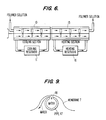
- the post-treatment is carried out in a two zone tubular vessel such as that illustrated schematically in FIG. 6, having a cooling section 10 followed by a heating section 15.
- the cooling section 10 is cooled using a cooling medium, such as recirculating through the vessel jacket and cooling reservoir 11.
- the heating section 15 is heated by recirculating a heating medium, hot water, for example, through the vessel jacket and heating reservoir 16.
- the recirculating heating medium may be continually increased in temperature during this heating process.
- Each of these sections contains a rotating flat blade 18 wiping the outer cooled or heated surface to assist heat transfer.
- the moving, continuous solid support 4 onto which the layer of the first polyamide solution is cast can be any flexible film or other nonporous material. Polyethylene terephthalate or other such solid polymer films are preferred for this purpose.
- the solid support is preferably of a uniform thickness to aid in formation of a membrane of uniform thickness.
- the fabric support 3 applied to the first polyamide solution layer prior to the solidification of this layer can be any woven, knit or felted fabric of sufficient porosity and thinness to permit it to be forced into the polyamide solution layer.
- Particularly preferred fabric supports are non-woven fabrics such as calendared Du Pont "Remay” spun bonded polyethylene terephthalate fabric having a nominal weight of 17 to 68 g/m2 (0.5 to 2.0 ounces per square yard), a thickness of 3.8 x 10 ⁇ 3 to 14 x 10 ⁇ 3 cm (1.5 to 5.5 mils) and an air permeability of 17 x 103 to 20 x 103 litres/min/air (600 to 700 CFM/air). ["Remay” is a trademark of Du Pont].
- the fabric support is laid on top of the cast first polyamide solution layer.
- the tension on the fabric support causes the first polyamide solution layer to saturate the fabric support and a portion of the first polyamide solution layer to collect on top.
- Sweep bar 5, or an equivalent thereof, such as a doctor blade, is used to make the solution layer/fabric support composite a particular desired thickness by removing the excess first polymer solution layer.
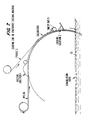
- the second polyamide solution after being subjected to post-treatment, is cast onto the first polyamide solution layer/fabric support composite. This casting process is illustrated in FIG. 7.
- the resulting composite is then subjected to a coagulation step which results in the formation of an integral, gradient microporous asymmetric polyamide membrane having a continuum of pore sizes.
- a coagulation step which results in the formation of an integral, gradient microporous asymmetric polyamide membrane having a continuum of pore sizes.
- the composite is coagulated by immersion in a coagulation bath 20 of about 38% formic acid in an aqueous solution at from about 25°C to about 30°C for at least 30 seconds, preferably from about 60 seconds to about 90 seconds.
- An increased formic acid concentration of the coagulation bath results in a more porous and less dense membrane, while a decreased formic acid concentration results in a less porous and more dense membrane.
- the coagulation bath solution is constantly recirculated in a direction countercurrent to the movement of the composite membrane.
- the coagulated membrane 7 is then separated from the continuous, moving solid support 4 in the separation zone 30, illustrated in Fig. 8.
- the separated coagulated membrane continues on through a washing bath zone, and the continuous moving solid support is cleaned for reuse.
- the separated coagulated membrane goes directly to washing bath 40, where the membrane is washed in water maintained at from about 25°C to about 30°C.
- the washing bath may consist of several zones, with each successive zone containing water with a greater degree of purity.
- the water for the washing baths is recirculated in a countercurrent direction. The result of this is that the membrane as it exits the last washing zones is washed in essentially pure water, i.e. water substantially free of coagulation bath and casting residues.
- the water bath zones contain water bearings 45.
- the membrane travels over these water bearings following a zig-zag path while the recirculating water washes the membrane.
- FIG. 9 An example of water bearings used in the water baths is shown in detail in FIG. 9.
- the water bearing is essentially a pipe 47 with a slit, 48, on the side facing the membrane.
- Those water bearings shown in the upper row of FIG. 8 would have the slit at the top of the pipe while those in the lower row would have a slit in the bottom of the pipe.
- the membrane is then removed from the water bath and wound on roller 50.
- the clean membrane is then dried, using conventional means such as a drying frame or a hot drum.
- the pore sizes of the membrane of the invention can be precisely controlled by changing the composition of polyamide material solution, the solids content, the alcohol concentration, the water concentration, the water concentration, the post-treatment conditions, and the composition of the coagulation bath.
- Examples 1 to 4 are comparative. All parts and percentages are by weight, unless otherwise stated.
- 165 grams of dry polyamide 6/6 pellets (70% by weight Monosanto Vydyne 66B, 30% by weight DuPont Zytel 3071 - "Vydene” and “Zytel” are trade marks of Monsanto and DuPont respectively) were slowly added to 591.2 grams of a solvent system containing 85.7% of 96% formic acid, 0.8% anhydrous lithium chloride, and 13.5% isopropanol, over a period of three hours at 45°C while mixing at a speed of 250 rpm.
- the resulting solution viscosity at 45°C was approximately 9 m ⁇ 1 kg.5 ⁇ 1 (9000 centipoise).
- the resulting solution had a composition of 16.5% polyamide 6/6, 2.5% lithium chloride, 56.0% formic acid, 17.0% water, and 8.0% isopropanol with a solution viscosity at 55°C of approximately 74 m ⁇ 1.kg.s ⁇ 1 (1400 centipoise).
- Membrane was produced from a 0.2 cm (.010") thick solution cast onto a glass plate using a Gardner Casting Bar by coagulation in a 38% by weight formic acid solution. Opacity of the forming membrane increased until a point was reached, around 30-35 seconds, after which time no discernible change occurred. The coagulated membrane was removed from the formic acid coagulating solution after 15 minutes, washed overnight in a deionized water and subsequently dried.
- the solution composition of example 1 was post-treated in two steps, the first a cooling step and then a second, heating step.
- Compressed air used as a cooling medium was passed through the solution vessel jacket and the homogeneous solution prepared in example 1 cooled to 38°C at a rate of 0.33°C/minute at a stirring rate of 50 rpm until a heterogeneous solution slurry was formed.
- This heterogeneous solution has high turbidity and a light absorbence of 1.3-1.4 at 430 nm was recorded on a Bausch & Lomb Spectronic 20. While still stirring, this slurry was then immediately reheated by recirculating hot water, starting at 60°C and then continually increasing to 75°C, through the vessel jacket.
- a 1000 grams batch over a 70 minute period was warmed to 70°C (temperature recorded at wall of vessel). At this point, the solution showed only slight degree of turbidity, displaying a light absorbence of 0.3-0.4 at 430 nm.
- the coagulated membrane was removed from the formic acid coagulating solution after 15 minutes, washed overnight in deionized water, and subsequently dried. The following physical properties were recorded.
- the solution, materials, composition, preparation, and state are identical to that shown in example 1 with the single exception that 100% of the polyamide 6/6 used was Monsanto Vydyne 66B. A higher average molecular weight is evident with this casting solution.
- the rate of membrane formation was also similar to that shown in example 1. Opacity of the forming membrane increased until a point was reached, around 30-35 seconds, after which time no discernible change occurred.
- the coagulated membrane was removed from the formic acid coagulating solution after 15 minutes, washed overnight in deionized water, and subsequently dried.
- solution, materials, composition and preparations are as shown in example 3 with the addition, however, of the identical solution post-treatment shown in example 2.
- the rate of membrane formation was similar to that shown in example 2, and faster than both membranes produced in examples 1 and 3.
- Opacity of the forming membrane increased until a point was reached, around 20-25 seconds, after which time no discernible change occurred.
- the coagulated membrane was removed form the formic acid coagulating solution after 15 minutes, washed overnight in deionized water, and subsequently dried.
- a fabric supported asymmetric membrane was prepared on a casting machine in a continuous run.
- This solution was separated into two fractions.
- the first solution was used as produced and introduced directly onto the casting machine as the saturant solution.
- the second solution was post-treated. Post-treatment consisted of pumping the warm solution, at about 55 to 60°C, through a jacketed and stirred tubular reactor such as the one depicted in FIG. 6.
- the solution was cooled in the first reactor zone to about 25°C at an average rate of about 3 to 4°C/minute, reheated in the second reactor zone to 55-60°C at an average rate of 3-4°C/minute.
- Sorbence of 0.3 - 0.4 at 430 nm This was reduced from the higher turbidity with an estimated light absorbence of 1-2 at 430 nm, observed at the end of the cooling zone of the tube reactor.
- the first solution was deposited on a 0.018 cm (0.007 inch) thick polyester film solid continuous moving support.
- An Eaton Dikeman Hollytex 3256 non-woven polyester fabric (Hollytex is a trade mark of Eaton Dikeman), ranging from about 0.006 to 0.008 cm (0.0025 to 0.003 inch) thick, was laid on and worked into the first solution.
- the second post-treated solution was cast directly onto the first solution layer/fabric composite.
- the resultant composite was pulled on and by the polyester film solid support through a coagulation bath containing 38% formic acid in water. After emerging from the coagulation bath, the coagulated membrane was separated from the solid support. The fabric supported membrane was then washed free of residual coagulating solution.
- the membrane produced after drying showed the following physical properties: thickness 0.018 to 0.020 cm (.007-.008”) water flux 0.15 ml/min/cm2/pKa (1 ml/min/cm2/psi) bubble point (in water) 310 kPa (45 psi) foam all overpoint (in water) 345 kPa (50 psi) These results indicate a range of pores up to about 0.25 ⁇ m in diameter.
Landscapes
- Chemical & Material Sciences (AREA)
- Chemical Kinetics & Catalysis (AREA)
- Dispersion Chemistry (AREA)
- Engineering & Computer Science (AREA)
- Manufacturing & Machinery (AREA)
- Separation Using Semi-Permeable Membranes (AREA)
- Manufacture Of Porous Articles, And Recovery And Treatment Of Waste Products (AREA)
- Manufacture Of Macromolecular Shaped Articles (AREA)
- Moulding By Coating Moulds (AREA)
- Polyamides (AREA)
Priority Applications (1)
| Application Number | Priority Date | Filing Date | Title |
|---|---|---|---|
| AT88901386T ATE84443T1 (de) | 1987-01-29 | 1988-01-29 | Mikroporoese asymmetrische polyamidmembranen. |
Applications Claiming Priority (2)
| Application Number | Priority Date | Filing Date | Title |
|---|---|---|---|
| US8227 | 1987-01-29 | ||
| US07/008,227 US4770777A (en) | 1987-01-29 | 1987-01-29 | Microporous asymmetric polyamide membranes |
Publications (3)
| Publication Number | Publication Date |
|---|---|
| EP0299043A1 EP0299043A1 (en) | 1989-01-18 |
| EP0299043A4 EP0299043A4 (en) | 1990-04-10 |
| EP0299043B1 true EP0299043B1 (en) | 1993-01-13 |
Family
ID=21730456
Family Applications (1)
| Application Number | Title | Priority Date | Filing Date |
|---|---|---|---|
| EP88901386A Expired - Lifetime EP0299043B1 (en) | 1987-01-29 | 1988-01-29 | Microporous asymmetric polyamide membranes |
Country Status (11)
| Country | Link |
|---|---|
| US (1) | US4770777A (ja) |
| EP (1) | EP0299043B1 (ja) |
| JP (1) | JPH01502007A (ja) |
| KR (1) | KR890700379A (ja) |
| AT (1) | ATE84443T1 (ja) |
| CA (1) | CA1329740C (ja) |
| DE (1) | DE3877440T2 (ja) |
| DK (1) | DK538688A (ja) |
| FI (1) | FI884449L (ja) |
| NO (1) | NO884311L (ja) |
| WO (1) | WO1988005686A1 (ja) |
Families Citing this family (50)
| Publication number | Priority date | Publication date | Assignee | Title |
|---|---|---|---|---|
| DE68923295T2 (de) * | 1988-12-16 | 1996-03-07 | Micron Seperations Inc | Wärmebeständiges mikroporöses material, dessen herstellung und erzeugnis. |
| DE3928934C2 (de) * | 1989-08-31 | 1999-04-29 | Sartorius Gmbh | Textilverstärktes mikroporöses Membranfilter, Verfahren zu seiner Herstellung und seine Verwendung |
| US5017292A (en) * | 1990-05-10 | 1991-05-21 | Millipore Corporation | Membrane, process and system for isolating virus from solution |
| US5084179A (en) * | 1990-06-28 | 1992-01-28 | Cuno, Incorporated | Narrow pore-size distribution polytetramethylene adipamide or nylon 46 membranes and process for making them |
| US5076817A (en) * | 1990-11-30 | 1991-12-31 | E. I. Du Pont De Nemours And Company | Polyamide gas separation membranes and process of using same |
| SE470534B (sv) * | 1992-11-27 | 1994-07-25 | Electrolux Ab | Förfarande för framställning av ett membranfilter samt membranfilter för fluidrenare |
| US5433859A (en) * | 1993-07-12 | 1995-07-18 | Pall Corporation | Supported microporous filtration membrane and method of using same |
| CA2128296A1 (en) * | 1993-12-22 | 1995-06-23 | Peter John Degen | Polyvinylidene fluoride membrane |
| GB2285935B (en) * | 1994-02-01 | 1998-06-24 | Scapa Group Plc | Industrial fabric |
| US5916521A (en) * | 1995-01-04 | 1999-06-29 | Spectral Diagnostics, Inc. | Lateral flow filter devices for separation of body fluids from particulate materials |
| US6264044B1 (en) | 1997-04-11 | 2001-07-24 | Cuno, Inc. | Reinforced, three zone microporous membrane |
| US6090441A (en) * | 1998-03-18 | 2000-07-18 | Cuno, Inc. | Process of making reinforced, three zone microporous membrane |
| US6413070B1 (en) * | 1997-04-11 | 2002-07-02 | Cuno Incorporated | System for manufacturing reinforced three-zone microporous membrane |
| US6280791B1 (en) | 1997-04-11 | 2001-08-28 | Cuno, Inc. | Process of making a three-region reinforced microporous filtration membrane |
| US6056529A (en) * | 1998-02-11 | 2000-05-02 | Cuno, Inc. | Systems for producing a plurality of different microporous phase inversion membrane each having any one of a plurality of different pore sizes from a single master dope batch |
| US7942274B2 (en) * | 2000-05-24 | 2011-05-17 | Millipore Corporation | High-throughput asymmetric membrane |
| EP2813278B1 (en) | 2000-05-24 | 2019-01-09 | EMD Millipore Corporation | Process of forming multilayered membranes |
| US7229665B2 (en) * | 2001-05-22 | 2007-06-12 | Millipore Corporation | Process of forming multilayered structures |
| US20020179521A1 (en) * | 2000-06-05 | 2002-12-05 | Paul C. Thomas | Expansion resistant filter cartridge |
| US6994789B2 (en) * | 2000-08-07 | 2006-02-07 | Cuno Incorporated | Pre-metered, unsupported multilayer microporous membrane |
| US6736971B2 (en) * | 2000-08-07 | 2004-05-18 | Cuno Incorporated | Pre-metered, unsupported multilayer microporous membrane |
| US6706184B2 (en) | 2000-08-07 | 2004-03-16 | Cuno Incorporated | Unsupported multizone microporous membrane |
| AU2003209187B2 (en) * | 2000-08-07 | 2009-01-22 | 3M Innovative Properties Company | Pre-metered, unsupported multilayer microporous membrane |
| NL1016779C2 (nl) * | 2000-12-02 | 2002-06-04 | Cornelis Johannes Maria V Rijn | Matrijs, werkwijze voor het vervaardigen van precisieproducten met behulp van een matrijs, alsmede precisieproducten, in het bijzonder microzeven en membraanfilters, vervaardigd met een dergelijke matrijs. |
| US6962946B2 (en) * | 2001-11-21 | 2005-11-08 | 3M Innovative Properties Company | Nanoparticles having a rutile-like crystalline phase and method of preparing same |
| US7560024B2 (en) * | 2002-05-14 | 2009-07-14 | Millipore Corporation | Method and system for controlling pore size of microporous phase inversion membranes |
| AU2003256771A1 (en) * | 2002-07-24 | 2004-02-09 | Cuno, Inc. | Multiple layer membrane and method for fabrication thereof |
| WO2005070524A1 (en) * | 2004-01-09 | 2005-08-04 | Trisep Corporation | Filtration with low-fouling, high-flow, low-energy spiral wound membrane cartridges |
| WO2006023743A2 (en) * | 2004-08-20 | 2006-03-02 | The Trustees Of Columbia University In The City Of New York | Laminar scrubber apparatus for capturing carbon dioxide from air and methods of use |
| WO2006084008A1 (en) * | 2005-02-02 | 2006-08-10 | Global Research Technologies, Llc | Removal of carbon dioxide from air |
| US9266051B2 (en) | 2005-07-28 | 2016-02-23 | Carbon Sink, Inc. | Removal of carbon dioxide from air |
| AU2006275799B8 (en) | 2005-07-28 | 2011-07-14 | Carbon Sink, Inc. | Removal of carbon dioxide from air |
| WO2007114991A2 (en) | 2006-03-08 | 2007-10-11 | Global Research Technologies, Llc | Air collector with functionalized ion exchange membrane for capturing ambient co2 |
| ES2784490T3 (es) | 2006-10-02 | 2020-09-28 | Carbon Sink Inc | Método para extraer dióxido de carbono del aire |
| US20090250390A1 (en) * | 2007-01-24 | 2009-10-08 | Wix Filtration Corp Llc | Filter |
| US7842214B2 (en) * | 2007-03-28 | 2010-11-30 | 3M Innovative Properties Company | Process for forming microporous membranes |
| EP2139584A4 (en) | 2007-04-17 | 2011-05-18 | Global Res Technologies Llc | DEPOSITION OF CARBON DIOXIDE (CO2) FROM THE AIR |
| WO2009061836A1 (en) * | 2007-11-05 | 2009-05-14 | Global Research Technologies, Llc | Removal of carbon dioxide from air |
| MX2010004447A (es) * | 2007-11-20 | 2010-05-13 | Global Res Technologies Llc | Colector de aire con membrana de intercambio ionico funcional para capturar co2 del ambinete. |
| CA2715874C (en) | 2008-02-19 | 2019-06-25 | Global Research Technologies, Llc | Extraction and sequestration of carbon dioxide |
| WO2009149292A1 (en) | 2008-06-04 | 2009-12-10 | Global Research Technologies, Llc | Laminar flow air collector with solid sorbent materials for capturing ambient co2 |
| US8961790B2 (en) | 2008-10-17 | 2015-02-24 | General Electric Company | Separator assembly |
| CN103687895A (zh) * | 2011-07-26 | 2014-03-26 | 水合系统有限责任公司 | 改善正渗透膜性能的方法 |
| US9795924B2 (en) | 2011-10-31 | 2017-10-24 | General Electric Company | Central core element for a separator assembly |
| WO2014156644A1 (ja) * | 2013-03-28 | 2014-10-02 | 東レ株式会社 | 多孔質膜および浄水器 |
| US9610548B2 (en) * | 2014-02-28 | 2017-04-04 | Pall Corporation | Composite porous polymeric membrane with high void volume |
| CN105169971A (zh) * | 2015-09-09 | 2015-12-23 | 中国海洋大学 | 一种反渗透复合膜 |
| WO2019161114A1 (en) | 2018-02-16 | 2019-08-22 | Carbon Sink, Inc. | Fluidized bed extractors for capture of co2 from ambient air |
| CN108939950B (zh) * | 2018-07-23 | 2021-05-04 | 大连理工大学 | 一种芳香族聚酰胺膜的制备方法 |
| CN114075792B (zh) * | 2020-08-20 | 2023-12-22 | 浙江凯瑞博科技股份有限公司 | 一种无卤或低卤聚酰胺涂层织物及制备方法 |
Family Cites Families (6)
| Publication number | Priority date | Publication date | Assignee | Title |
|---|---|---|---|---|
| AU505494B1 (en) * | 1977-10-21 | 1979-11-22 | Unisearch Limited | Anisotropic multilayered synthetic semipermeable membrane |
| FI70421C (fi) * | 1978-05-15 | 1986-09-19 | Pall Corp | Foerfarande foer framstaellning av skinnfria hydrofila i alkohol oloesliga polyamidmembraner polyamidhartsmembranhinna filterelement och gjuthartsloesning |
| DE82393T1 (de) * | 1981-12-18 | 1983-10-13 | AMF Inc., 10604 White Plains, N.Y. | Verstaerkte mikroporoese membran. |
| US4707265A (en) * | 1981-12-18 | 1987-11-17 | Cuno Incorporated | Reinforced microporous membrane |
| AU1435883A (en) * | 1983-05-09 | 1984-11-15 | Baxter Travenol Laboratories Inc. | Porous membranes |
| JPS6291543A (ja) * | 1985-10-17 | 1987-04-27 | Fuji Photo Film Co Ltd | 多層の微孔性膜の製造方法 |
-
1987
- 1987-01-29 US US07/008,227 patent/US4770777A/en not_active Expired - Fee Related
-
1988
- 1988-01-27 CA CA000557491A patent/CA1329740C/en not_active Expired - Fee Related
- 1988-01-29 WO PCT/US1988/000205 patent/WO1988005686A1/en not_active Ceased
- 1988-01-29 FI FI884449A patent/FI884449L/fi not_active Application Discontinuation
- 1988-01-29 AT AT88901386T patent/ATE84443T1/de not_active IP Right Cessation
- 1988-01-29 DE DE8888901386T patent/DE3877440T2/de not_active Expired - Fee Related
- 1988-01-29 JP JP63501580A patent/JPH01502007A/ja active Pending
- 1988-01-29 EP EP88901386A patent/EP0299043B1/en not_active Expired - Lifetime
- 1988-09-28 DK DK538688A patent/DK538688A/da not_active Application Discontinuation
- 1988-09-29 NO NO884311A patent/NO884311L/no unknown
- 1988-09-29 KR KR1019880701198A patent/KR890700379A/ko not_active Withdrawn
Also Published As
| Publication number | Publication date |
|---|---|
| DE3877440D1 (de) | 1993-02-25 |
| JPH01502007A (ja) | 1989-07-13 |
| NO884311D0 (no) | 1988-09-29 |
| US4770777A (en) | 1988-09-13 |
| EP0299043A1 (en) | 1989-01-18 |
| FI884449A7 (fi) | 1988-09-28 |
| ATE84443T1 (de) | 1993-01-15 |
| EP0299043A4 (en) | 1990-04-10 |
| FI884449A0 (fi) | 1988-09-28 |
| WO1988005686A1 (en) | 1988-08-11 |
| KR890700379A (ko) | 1989-04-24 |
| DK538688D0 (da) | 1988-09-28 |
| NO884311L (no) | 1988-11-29 |
| CA1329740C (en) | 1994-05-24 |
| DE3877440T2 (de) | 1993-05-13 |
| DK538688A (da) | 1988-11-23 |
| FI884449L (fi) | 1988-09-28 |
Similar Documents
| Publication | Publication Date | Title |
|---|---|---|
| EP0299043B1 (en) | Microporous asymmetric polyamide membranes | |
| US4595503A (en) | Ultrafiltration membrane of polyamide | |
| US4230583A (en) | Supported anisotropic reverse osmosis membranes based on synthetic polyamides and processes for their preparation | |
| US4772391A (en) | Composite membrane for reverse osmosis | |
| JPH02151636A (ja) | 等方性の微孔性ポリスルホン膜の製造法 | |
| JPS5925602B2 (ja) | ポリアミド製微孔質膜の製造方法 | |
| JPH05212255A (ja) | 中空繊維膜 | |
| JPH02136229A (ja) | 微孔性peek膜とその製造法 | |
| JP3248632B2 (ja) | 芳香族重縮合物の非対称半透膜、それらの製造方法およびそれらの使用 | |
| KR910003115B1 (ko) | 내알칼리성 한외여과막 | |
| JPH03114516A (ja) | 強化微孔性濾過膜の製法 | |
| JPH09141071A (ja) | 複合膜、その製造方法および使用方法 | |
| JP3681219B2 (ja) | ポリスルホン多孔質分離膜 | |
| EP0247597B1 (en) | Process for producing porous membranes | |
| JP3999367B2 (ja) | シート状分離膜の製造法 | |
| JPS5837842B2 (ja) | 限外濾過膜の製造方法 | |
| CN115245757B (zh) | 一种复合纳滤膜及其制备方法和应用 | |
| IL31713A (en) | Preparation of semi-permeable membranes | |
| JPH0468010B2 (ja) | ||
| JPS6151928B2 (ja) | ||
| KR101568032B1 (ko) | 다공성 막의 제조방법 및 그 방법에 의해 제조된 다공성 막 | |
| EP0099686B1 (en) | Process for preparing polypiperazinamide anisotropic membranes | |
| JPS636111A (ja) | 中空繊維及びその製法 | |
| KR960012027B1 (ko) | 새로운 중공사막의 제조방법 | |
| JPH0490832A (ja) | 複合多孔膜 |
Legal Events
| Date | Code | Title | Description |
|---|---|---|---|
| PUAI | Public reference made under article 153(3) epc to a published international application that has entered the european phase |
Free format text: ORIGINAL CODE: 0009012 |
|
| 17P | Request for examination filed |
Effective date: 19881011 |
|
| AK | Designated contracting states |
Kind code of ref document: A1 Designated state(s): AT BE CH DE FR GB IT LI LU NL SE |
|
| A4 | Supplementary search report drawn up and despatched |
Effective date: 19900410 |
|
| 17Q | First examination report despatched |
Effective date: 19910730 |
|
| GRAA | (expected) grant |
Free format text: ORIGINAL CODE: 0009210 |
|
| AK | Designated contracting states |
Kind code of ref document: B1 Designated state(s): AT BE CH DE FR GB IT LI LU NL SE |
|
| PG25 | Lapsed in a contracting state [announced via postgrant information from national office to epo] |
Ref country code: NL Effective date: 19930113 Ref country code: LI Effective date: 19930113 Ref country code: CH Effective date: 19930113 Ref country code: BE Effective date: 19930113 Ref country code: AT Effective date: 19930113 Ref country code: IT Free format text: LAPSE BECAUSE OF FAILURE TO SUBMIT A TRANSLATION OF THE DESCRIPTION OR TO PAY THE FEE WITHIN THE PRESCRIBED TIME-LIMIT;WARNING: LAPSES OF ITALIAN PATENTS WITH EFFECTIVE DATE BEFORE 2007 MAY HAVE OCCURRED AT ANY TIME BEFORE 2007. THE CORRECT EFFECTIVE DATE MAY BE DIFFERENT FROM THE ONE RECORDED. Effective date: 19930113 Ref country code: SE Effective date: 19930113 |
|
| REF | Corresponds to: |
Ref document number: 84443 Country of ref document: AT Date of ref document: 19930115 Kind code of ref document: T |
|
| ET | Fr: translation filed | ||
| PG25 | Lapsed in a contracting state [announced via postgrant information from national office to epo] |
Ref country code: LU Free format text: LAPSE BECAUSE OF NON-PAYMENT OF DUE FEES Effective date: 19930131 |
|
| REF | Corresponds to: |
Ref document number: 3877440 Country of ref document: DE Date of ref document: 19930225 |
|
| REG | Reference to a national code |
Ref country code: CH Ref legal event code: PL |
|
| NLV1 | Nl: lapsed or annulled due to failure to fulfill the requirements of art. 29p and 29m of the patents act | ||
| PLBE | No opposition filed within time limit |
Free format text: ORIGINAL CODE: 0009261 |
|
| STAA | Information on the status of an ep patent application or granted ep patent |
Free format text: STATUS: NO OPPOSITION FILED WITHIN TIME LIMIT |
|
| 26N | No opposition filed | ||
| PGFP | Annual fee paid to national office [announced via postgrant information from national office to epo] |
Ref country code: FR Payment date: 19951207 Year of fee payment: 9 |
|
| PGFP | Annual fee paid to national office [announced via postgrant information from national office to epo] |
Ref country code: GB Payment date: 19951219 Year of fee payment: 9 |
|
| PGFP | Annual fee paid to national office [announced via postgrant information from national office to epo] |
Ref country code: DE Payment date: 19951220 Year of fee payment: 9 |
|
| PG25 | Lapsed in a contracting state [announced via postgrant information from national office to epo] |
Ref country code: GB Effective date: 19970129 |
|
| GBPC | Gb: european patent ceased through non-payment of renewal fee |
Effective date: 19970129 |
|
| PG25 | Lapsed in a contracting state [announced via postgrant information from national office to epo] |
Ref country code: FR Effective date: 19970930 |
|
| PG25 | Lapsed in a contracting state [announced via postgrant information from national office to epo] |
Ref country code: DE Effective date: 19971001 |
|
| REG | Reference to a national code |
Ref country code: FR Ref legal event code: ST |