EP0261385B1 - Fremdvernetzende Bindemittelkombination für mit Wasser verdünnbare Lacke, an der Kathode abscheidbares Elektrotauchlacküberzugsmittel und deren Verwendung - Google Patents
Fremdvernetzende Bindemittelkombination für mit Wasser verdünnbare Lacke, an der Kathode abscheidbares Elektrotauchlacküberzugsmittel und deren Verwendung Download PDFInfo
- Publication number
- EP0261385B1 EP0261385B1 EP87111853A EP87111853A EP0261385B1 EP 0261385 B1 EP0261385 B1 EP 0261385B1 EP 87111853 A EP87111853 A EP 87111853A EP 87111853 A EP87111853 A EP 87111853A EP 0261385 B1 EP0261385 B1 EP 0261385B1
- Authority
- EP
- European Patent Office
- Prior art keywords
- weight
- groups
- group
- amino
- component
- Prior art date
- Legal status (The legal status is an assumption and is not a legal conclusion. Google has not performed a legal analysis and makes no representation as to the accuracy of the status listed.)
- Expired - Lifetime
Links
- 238000000576 coating method Methods 0.000 title claims abstract description 14
- 239000003795 chemical substances by application Substances 0.000 title claims description 7
- 239000008199 coating composition Substances 0.000 title description 6
- 235000020354 squash Nutrition 0.000 title description 2
- 125000002887 hydroxy group Chemical group [H]O* 0.000 claims abstract description 50
- 239000000178 monomer Substances 0.000 claims abstract description 49
- 239000011230 binding agent Substances 0.000 claims abstract description 36
- 229920000647 polyepoxide Polymers 0.000 claims abstract description 25
- 125000002924 primary amino group Chemical group [H]N([H])* 0.000 claims abstract description 24
- 125000003277 amino group Chemical group 0.000 claims abstract description 15
- 229920003002 synthetic resin Polymers 0.000 claims abstract description 15
- 239000000057 synthetic resin Substances 0.000 claims abstract description 13
- 239000004922 lacquer Substances 0.000 claims abstract description 12
- 239000011248 coating agent Substances 0.000 claims abstract description 10
- 229920005989 resin Polymers 0.000 claims description 53
- 239000011347 resin Substances 0.000 claims description 53
- 150000001412 amines Chemical class 0.000 claims description 38
- 239000007787 solid Substances 0.000 claims description 31
- 239000003431 cross linking reagent Substances 0.000 claims description 22
- 239000002253 acid Substances 0.000 claims description 20
- XLYOFNOQVPJJNP-UHFFFAOYSA-N water Substances O XLYOFNOQVPJJNP-UHFFFAOYSA-N 0.000 claims description 19
- POAOYUHQDCAZBD-UHFFFAOYSA-N 2-butoxyethanol Chemical compound CCCCOCCO POAOYUHQDCAZBD-UHFFFAOYSA-N 0.000 claims description 14
- 239000003054 catalyst Substances 0.000 claims description 14
- 125000000467 secondary amino group Chemical group [H]N([*:1])[*:2] 0.000 claims description 14
- 238000005809 transesterification reaction Methods 0.000 claims description 14
- 150000002170 ethers Chemical class 0.000 claims description 12
- IQPQWNKOIGAROB-UHFFFAOYSA-N isocyanate group Chemical group [N-]=C=O IQPQWNKOIGAROB-UHFFFAOYSA-N 0.000 claims description 10
- 150000007513 acids Chemical class 0.000 claims description 9
- 238000004070 electrodeposition Methods 0.000 claims description 8
- 125000004185 ester group Chemical group 0.000 claims description 8
- 239000000049 pigment Substances 0.000 claims description 8
- 125000001302 tertiary amino group Chemical group 0.000 claims description 8
- 239000003960 organic solvent Substances 0.000 claims description 7
- 229920006395 saturated elastomer Polymers 0.000 claims description 6
- 230000007797 corrosion Effects 0.000 claims description 4
- 238000005260 corrosion Methods 0.000 claims description 4
- 230000009477 glass transition Effects 0.000 claims description 4
- 239000000654 additive Substances 0.000 claims description 3
- 239000000945 filler Substances 0.000 claims description 2
- 239000003112 inhibitor Substances 0.000 claims description 2
- 239000002952 polymeric resin Substances 0.000 claims description 2
- 230000005588 protonation Effects 0.000 claims description 2
- 238000010526 radical polymerization reaction Methods 0.000 claims 2
- 239000000203 mixture Substances 0.000 abstract description 31
- 239000003822 epoxy resin Substances 0.000 abstract description 20
- -1 amino epoxides Chemical class 0.000 description 44
- 238000006243 chemical reaction Methods 0.000 description 40
- 150000001875 compounds Chemical class 0.000 description 23
- 150000002009 diols Chemical class 0.000 description 22
- 125000003700 epoxy group Chemical group 0.000 description 19
- 239000010408 film Substances 0.000 description 18
- 239000007795 chemical reaction product Substances 0.000 description 14
- 229940052303 ethers for general anesthesia Drugs 0.000 description 14
- 239000000047 product Substances 0.000 description 14
- NIXOWILDQLNWCW-UHFFFAOYSA-M Acrylate Chemical compound [O-]C(=O)C=C NIXOWILDQLNWCW-UHFFFAOYSA-M 0.000 description 12
- VZCYOOQTPOCHFL-OWOJBTEDSA-N Fumaric acid Chemical compound OC(=O)\C=C\C(O)=O VZCYOOQTPOCHFL-OWOJBTEDSA-N 0.000 description 12
- 238000004132 cross linking Methods 0.000 description 12
- 150000002148 esters Chemical class 0.000 description 12
- 229920000193 polymethacrylate Polymers 0.000 description 12
- 239000002904 solvent Substances 0.000 description 12
- RTZKZFJDLAIYFH-UHFFFAOYSA-N Diethyl ether Chemical compound CCOCC RTZKZFJDLAIYFH-UHFFFAOYSA-N 0.000 description 11
- LYCAIKOWRPUZTN-UHFFFAOYSA-N Ethylene glycol Chemical compound OCCO LYCAIKOWRPUZTN-UHFFFAOYSA-N 0.000 description 11
- 150000001298 alcohols Chemical class 0.000 description 11
- 239000005056 polyisocyanate Substances 0.000 description 11
- 229920001228 polyisocyanate Polymers 0.000 description 11
- 239000004925 Acrylic resin Substances 0.000 description 10
- KFZMGEQAYNKOFK-UHFFFAOYSA-N Isopropanol Chemical compound CC(C)O KFZMGEQAYNKOFK-UHFFFAOYSA-N 0.000 description 10
- 125000000217 alkyl group Chemical group 0.000 description 10
- 229910052751 metal Inorganic materials 0.000 description 10
- 239000002184 metal Substances 0.000 description 10
- VZCYOOQTPOCHFL-UHFFFAOYSA-N trans-butenedioic acid Natural products OC(=O)C=CC(O)=O VZCYOOQTPOCHFL-UHFFFAOYSA-N 0.000 description 10
- OFOBLEOULBTSOW-UHFFFAOYSA-N Malonic acid Chemical compound OC(=O)CC(O)=O OFOBLEOULBTSOW-UHFFFAOYSA-N 0.000 description 9
- 125000001931 aliphatic group Chemical group 0.000 description 9
- 150000004985 diamines Chemical group 0.000 description 9
- OZAIFHULBGXAKX-UHFFFAOYSA-N 2-(2-cyanopropan-2-yldiazenyl)-2-methylpropanenitrile Chemical compound N#CC(C)(C)N=NC(C)(C)C#N OZAIFHULBGXAKX-UHFFFAOYSA-N 0.000 description 8
- IISBACLAFKSPIT-UHFFFAOYSA-N bisphenol A Chemical compound C=1C=C(O)C=CC=1C(C)(C)C1=CC=C(O)C=C1 IISBACLAFKSPIT-UHFFFAOYSA-N 0.000 description 8
- 125000004386 diacrylate group Chemical group 0.000 description 8
- 230000001965 increasing effect Effects 0.000 description 8
- 238000000034 method Methods 0.000 description 8
- 238000006386 neutralization reaction Methods 0.000 description 8
- 150000003335 secondary amines Chemical class 0.000 description 8
- 238000000151 deposition Methods 0.000 description 7
- 230000008021 deposition Effects 0.000 description 7
- 125000005442 diisocyanate group Chemical group 0.000 description 7
- JBKVHLHDHHXQEQ-UHFFFAOYSA-N epsilon-caprolactam Chemical compound O=C1CCCCCN1 JBKVHLHDHHXQEQ-UHFFFAOYSA-N 0.000 description 7
- 239000001530 fumaric acid Substances 0.000 description 7
- 239000011133 lead Substances 0.000 description 7
- 150000002763 monocarboxylic acids Chemical class 0.000 description 7
- 239000003973 paint Substances 0.000 description 7
- 150000003839 salts Chemical class 0.000 description 7
- 239000000243 solution Substances 0.000 description 7
- NIXOWILDQLNWCW-UHFFFAOYSA-N 2-Propenoic acid Natural products OC(=O)C=C NIXOWILDQLNWCW-UHFFFAOYSA-N 0.000 description 6
- SOGAXMICEFXMKE-UHFFFAOYSA-N Butylmethacrylate Chemical compound CCCCOC(=O)C(C)=C SOGAXMICEFXMKE-UHFFFAOYSA-N 0.000 description 6
- LFQSCWFLJHTTHZ-UHFFFAOYSA-N Ethanol Chemical compound CCO LFQSCWFLJHTTHZ-UHFFFAOYSA-N 0.000 description 6
- WSFSSNUMVMOOMR-UHFFFAOYSA-N Formaldehyde Chemical compound O=C WSFSSNUMVMOOMR-UHFFFAOYSA-N 0.000 description 6
- XEEYBQQBJWHFJM-UHFFFAOYSA-N Iron Chemical class [Fe] XEEYBQQBJWHFJM-UHFFFAOYSA-N 0.000 description 6
- CERQOIWHTDAKMF-UHFFFAOYSA-N Methacrylic acid Chemical compound CC(=C)C(O)=O CERQOIWHTDAKMF-UHFFFAOYSA-N 0.000 description 6
- PPBRXRYQALVLMV-UHFFFAOYSA-N Styrene Chemical compound C=CC1=CC=CC=C1 PPBRXRYQALVLMV-UHFFFAOYSA-N 0.000 description 6
- XXROGKLTLUQVRX-UHFFFAOYSA-N allyl alcohol Chemical compound OCC=C XXROGKLTLUQVRX-UHFFFAOYSA-N 0.000 description 6
- 125000003178 carboxy group Chemical group [H]OC(*)=O 0.000 description 6
- 229920001577 copolymer Polymers 0.000 description 6
- 238000010790 dilution Methods 0.000 description 6
- 239000012895 dilution Substances 0.000 description 6
- 150000004658 ketimines Chemical class 0.000 description 6
- BDAGIHXWWSANSR-UHFFFAOYSA-N methanoic acid Natural products OC=O BDAGIHXWWSANSR-UHFFFAOYSA-N 0.000 description 6
- 229920005862 polyol Polymers 0.000 description 6
- 230000008569 process Effects 0.000 description 6
- 150000005846 sugar alcohols Polymers 0.000 description 6
- 125000000391 vinyl group Chemical group [H]C([*])=C([H])[H] 0.000 description 6
- QTBSBXVTEAMEQO-UHFFFAOYSA-N Acetic acid Natural products CC(O)=O QTBSBXVTEAMEQO-UHFFFAOYSA-N 0.000 description 5
- 239000004593 Epoxy Substances 0.000 description 5
- NTIZESTWPVYFNL-UHFFFAOYSA-N Methyl isobutyl ketone Chemical compound CC(C)CC(C)=O NTIZESTWPVYFNL-UHFFFAOYSA-N 0.000 description 5
- UIHCLUNTQKBZGK-UHFFFAOYSA-N Methyl isobutyl ketone Natural products CCC(C)C(C)=O UIHCLUNTQKBZGK-UHFFFAOYSA-N 0.000 description 5
- XSQUKJJJFZCRTK-UHFFFAOYSA-N Urea Chemical compound NC(N)=O XSQUKJJJFZCRTK-UHFFFAOYSA-N 0.000 description 5
- 150000001252 acrylic acid derivatives Chemical class 0.000 description 5
- 150000001414 amino alcohols Chemical class 0.000 description 5
- 125000004432 carbon atom Chemical group C* 0.000 description 5
- 238000007334 copolymerization reaction Methods 0.000 description 5
- 230000007547 defect Effects 0.000 description 5
- GYZLOYUZLJXAJU-UHFFFAOYSA-N diglycidyl ether Chemical class C1OC1COCC1CO1 GYZLOYUZLJXAJU-UHFFFAOYSA-N 0.000 description 5
- 238000001652 electrophoretic deposition Methods 0.000 description 5
- VOZRXNHHFUQHIL-UHFFFAOYSA-N glycidyl methacrylate Chemical compound CC(=C)C(=O)OCC1CO1 VOZRXNHHFUQHIL-UHFFFAOYSA-N 0.000 description 5
- 239000012948 isocyanate Substances 0.000 description 5
- 229920000768 polyamine Polymers 0.000 description 5
- 238000006116 polymerization reaction Methods 0.000 description 5
- 150000003141 primary amines Chemical class 0.000 description 5
- 238000003756 stirring Methods 0.000 description 5
- 229920002554 vinyl polymer Polymers 0.000 description 5
- 238000004383 yellowing Methods 0.000 description 5
- JLBXCKSMESLGTJ-UHFFFAOYSA-N 1-ethoxypropan-1-ol Chemical compound CCOC(O)CC JLBXCKSMESLGTJ-UHFFFAOYSA-N 0.000 description 4
- OMIGHNLMNHATMP-UHFFFAOYSA-N 2-hydroxyethyl prop-2-enoate Chemical compound OCCOC(=O)C=C OMIGHNLMNHATMP-UHFFFAOYSA-N 0.000 description 4
- YNAVUWVOSKDBBP-UHFFFAOYSA-N Morpholine Chemical compound C1COCCN1 YNAVUWVOSKDBBP-UHFFFAOYSA-N 0.000 description 4
- LRHPLDYGYMQRHN-UHFFFAOYSA-N N-Butanol Chemical compound CCCCO LRHPLDYGYMQRHN-UHFFFAOYSA-N 0.000 description 4
- ZJCCRDAZUWHFQH-UHFFFAOYSA-N Trimethylolpropane Chemical compound CCC(CO)(CO)CO ZJCCRDAZUWHFQH-UHFFFAOYSA-N 0.000 description 4
- 150000001408 amides Chemical class 0.000 description 4
- 125000003118 aryl group Chemical group 0.000 description 4
- 238000001816 cooling Methods 0.000 description 4
- SWXVUIWOUIDPGS-UHFFFAOYSA-N diacetone alcohol Chemical compound CC(=O)CC(C)(C)O SWXVUIWOUIDPGS-UHFFFAOYSA-N 0.000 description 4
- HPNMFZURTQLUMO-UHFFFAOYSA-N diethylamine Chemical compound CCNCC HPNMFZURTQLUMO-UHFFFAOYSA-N 0.000 description 4
- 150000002118 epoxides Chemical class 0.000 description 4
- 125000003055 glycidyl group Chemical group C(C1CO1)* 0.000 description 4
- LNEPOXFFQSENCJ-UHFFFAOYSA-N haloperidol Chemical compound C1CC(O)(C=2C=CC(Cl)=CC=2)CCN1CCCC(=O)C1=CC=C(F)C=C1 LNEPOXFFQSENCJ-UHFFFAOYSA-N 0.000 description 4
- WGCNASOHLSPBMP-UHFFFAOYSA-N hydroxyacetaldehyde Natural products OCC=O WGCNASOHLSPBMP-UHFFFAOYSA-N 0.000 description 4
- 125000002768 hydroxyalkyl group Chemical group 0.000 description 4
- 239000011261 inert gas Substances 0.000 description 4
- 239000003999 initiator Substances 0.000 description 4
- 150000002513 isocyanates Chemical class 0.000 description 4
- JVTAAEKCZFNVCJ-UHFFFAOYSA-N lactic acid Chemical compound CC(O)C(O)=O JVTAAEKCZFNVCJ-UHFFFAOYSA-N 0.000 description 4
- 239000010410 layer Substances 0.000 description 4
- 238000004519 manufacturing process Methods 0.000 description 4
- 150000002739 metals Chemical class 0.000 description 4
- 125000004433 nitrogen atom Chemical group N* 0.000 description 4
- 229920000642 polymer Polymers 0.000 description 4
- 238000010992 reflux Methods 0.000 description 4
- 239000000126 substance Substances 0.000 description 4
- DVKJHBMWWAPEIU-UHFFFAOYSA-N toluene 2,4-diisocyanate Chemical compound CC1=CC=C(N=C=O)C=C1N=C=O DVKJHBMWWAPEIU-UHFFFAOYSA-N 0.000 description 4
- ZWEHNKRNPOVVGH-UHFFFAOYSA-N 2-Butanone Chemical compound CCC(C)=O ZWEHNKRNPOVVGH-UHFFFAOYSA-N 0.000 description 3
- GOXQRTZXKQZDDN-UHFFFAOYSA-N 2-Ethylhexyl acrylate Chemical compound CCCCC(CC)COC(=O)C=C GOXQRTZXKQZDDN-UHFFFAOYSA-N 0.000 description 3
- SVONRAPFKPVNKG-UHFFFAOYSA-N 2-ethoxyethyl acetate Chemical compound CCOCCOC(C)=O SVONRAPFKPVNKG-UHFFFAOYSA-N 0.000 description 3
- YIWUKEYIRIRTPP-UHFFFAOYSA-N 2-ethylhexan-1-ol Chemical compound CCCCC(CC)CO YIWUKEYIRIRTPP-UHFFFAOYSA-N 0.000 description 3
- 125000003903 2-propenyl group Chemical group [H]C([*])([H])C([H])=C([H])[H] 0.000 description 3
- OSWFIVFLDKOXQC-UHFFFAOYSA-N 4-(3-methoxyphenyl)aniline Chemical compound COC1=CC=CC(C=2C=CC(N)=CC=2)=C1 OSWFIVFLDKOXQC-UHFFFAOYSA-N 0.000 description 3
- JHWGFJBTMHEZME-UHFFFAOYSA-N 4-prop-2-enoyloxybutyl prop-2-enoate Chemical compound C=CC(=O)OCCCCOC(=O)C=C JHWGFJBTMHEZME-UHFFFAOYSA-N 0.000 description 3
- CSCPPACGZOOCGX-UHFFFAOYSA-N Acetone Chemical compound CC(C)=O CSCPPACGZOOCGX-UHFFFAOYSA-N 0.000 description 3
- HRPVXLWXLXDGHG-UHFFFAOYSA-N Acrylamide Chemical compound NC(=O)C=C HRPVXLWXLXDGHG-UHFFFAOYSA-N 0.000 description 3
- GAWIXWVDTYZWAW-UHFFFAOYSA-N C[CH]O Chemical group C[CH]O GAWIXWVDTYZWAW-UHFFFAOYSA-N 0.000 description 3
- RPNUMPOLZDHAAY-UHFFFAOYSA-N Diethylenetriamine Chemical compound NCCNCCN RPNUMPOLZDHAAY-UHFFFAOYSA-N 0.000 description 3
- XEKOWRVHYACXOJ-UHFFFAOYSA-N Ethyl acetate Chemical compound CCOC(C)=O XEKOWRVHYACXOJ-UHFFFAOYSA-N 0.000 description 3
- 239000005058 Isophorone diisocyanate Substances 0.000 description 3
- OKKJLVBELUTLKV-UHFFFAOYSA-N Methanol Chemical compound OC OKKJLVBELUTLKV-UHFFFAOYSA-N 0.000 description 3
- VVQNEPGJFQJSBK-UHFFFAOYSA-N Methyl methacrylate Chemical compound COC(=O)C(C)=C VVQNEPGJFQJSBK-UHFFFAOYSA-N 0.000 description 3
- OPKOKAMJFNKNAS-UHFFFAOYSA-N N-methylethanolamine Chemical compound CNCCO OPKOKAMJFNKNAS-UHFFFAOYSA-N 0.000 description 3
- NBIIXXVUZAFLBC-UHFFFAOYSA-N Phosphoric acid Chemical compound OP(O)(O)=O NBIIXXVUZAFLBC-UHFFFAOYSA-N 0.000 description 3
- DNIAPMSPPWPWGF-UHFFFAOYSA-N Propylene glycol Chemical compound CC(O)CO DNIAPMSPPWPWGF-UHFFFAOYSA-N 0.000 description 3
- RWRDLPDLKQPQOW-UHFFFAOYSA-N Pyrrolidine Chemical compound C1CCNC1 RWRDLPDLKQPQOW-UHFFFAOYSA-N 0.000 description 3
- WYURNTSHIVDZCO-UHFFFAOYSA-N Tetrahydrofuran Chemical compound C1CCOC1 WYURNTSHIVDZCO-UHFFFAOYSA-N 0.000 description 3
- ATJFFYVFTNAWJD-UHFFFAOYSA-N Tin Chemical class [Sn] ATJFFYVFTNAWJD-UHFFFAOYSA-N 0.000 description 3
- GWEVSGVZZGPLCZ-UHFFFAOYSA-N Titan oxide Chemical compound O=[Ti]=O GWEVSGVZZGPLCZ-UHFFFAOYSA-N 0.000 description 3
- 230000015572 biosynthetic process Effects 0.000 description 3
- 229940106691 bisphenol a Drugs 0.000 description 3
- KRKNYBCHXYNGOX-UHFFFAOYSA-N citric acid Chemical compound OC(=O)CC(O)(C(O)=O)CC(O)=O KRKNYBCHXYNGOX-UHFFFAOYSA-N 0.000 description 3
- ZBCBWPMODOFKDW-UHFFFAOYSA-N diethanolamine Chemical compound OCCNCCO ZBCBWPMODOFKDW-UHFFFAOYSA-N 0.000 description 3
- MTHSVFCYNBDYFN-UHFFFAOYSA-N diethylene glycol Chemical compound OCCOCCO MTHSVFCYNBDYFN-UHFFFAOYSA-N 0.000 description 3
- IUNMPGNGSSIWFP-UHFFFAOYSA-N dimethylaminopropylamine Chemical compound CN(C)CCCN IUNMPGNGSSIWFP-UHFFFAOYSA-N 0.000 description 3
- 235000019253 formic acid Nutrition 0.000 description 3
- 125000000524 functional group Chemical group 0.000 description 3
- 229910052736 halogen Inorganic materials 0.000 description 3
- 150000002367 halogens Chemical class 0.000 description 3
- 229910052739 hydrogen Inorganic materials 0.000 description 3
- 230000006872 improvement Effects 0.000 description 3
- 238000010348 incorporation Methods 0.000 description 3
- 229910052742 iron Inorganic materials 0.000 description 3
- NIMLQBUJDJZYEJ-UHFFFAOYSA-N isophorone diisocyanate Chemical compound CC1(C)CC(N=C=O)CC(C)(CN=C=O)C1 NIMLQBUJDJZYEJ-UHFFFAOYSA-N 0.000 description 3
- VQPKAMAVKYTPLB-UHFFFAOYSA-N lead;octanoic acid Chemical compound [Pb].CCCCCCCC(O)=O VQPKAMAVKYTPLB-UHFFFAOYSA-N 0.000 description 3
- VZCYOOQTPOCHFL-UPHRSURJSA-N maleic acid Chemical compound OC(=O)\C=C/C(O)=O VZCYOOQTPOCHFL-UPHRSURJSA-N 0.000 description 3
- 239000011976 maleic acid Substances 0.000 description 3
- 239000000463 material Substances 0.000 description 3
- 239000002609 medium Substances 0.000 description 3
- 229910052757 nitrogen Inorganic materials 0.000 description 3
- 150000007524 organic acids Chemical class 0.000 description 3
- 235000005985 organic acids Nutrition 0.000 description 3
- 229920000728 polyester Polymers 0.000 description 3
- 229920000570 polyether Polymers 0.000 description 3
- 150000003077 polyols Chemical class 0.000 description 3
- 150000003254 radicals Chemical class 0.000 description 3
- 239000007921 spray Substances 0.000 description 3
- 238000012360 testing method Methods 0.000 description 3
- JOYRKODLDBILNP-UHFFFAOYSA-N urethane group Chemical group NC(=O)OCC JOYRKODLDBILNP-UHFFFAOYSA-N 0.000 description 3
- MYRTYDVEIRVNKP-UHFFFAOYSA-N 1,2-Divinylbenzene Chemical compound C=CC1=CC=CC=C1C=C MYRTYDVEIRVNKP-UHFFFAOYSA-N 0.000 description 2
- HECLRDQVFMWTQS-RGOKHQFPSA-N 1755-01-7 Chemical compound C1[C@H]2[C@@H]3CC=C[C@@H]3[C@@H]1C=C2 HECLRDQVFMWTQS-RGOKHQFPSA-N 0.000 description 2
- SMZOUWXMTYCWNB-UHFFFAOYSA-N 2-(2-methoxy-5-methylphenyl)ethanamine Chemical compound COC1=CC=C(C)C=C1CCN SMZOUWXMTYCWNB-UHFFFAOYSA-N 0.000 description 2
- LEJBBGNFPAFPKQ-UHFFFAOYSA-N 2-(2-prop-2-enoyloxyethoxy)ethyl prop-2-enoate Chemical compound C=CC(=O)OCCOCCOC(=O)C=C LEJBBGNFPAFPKQ-UHFFFAOYSA-N 0.000 description 2
- HZAXFHJVJLSVMW-UHFFFAOYSA-N 2-Aminoethan-1-ol Chemical compound NCCO HZAXFHJVJLSVMW-UHFFFAOYSA-N 0.000 description 2
- INQDDHNZXOAFFD-UHFFFAOYSA-N 2-[2-(2-prop-2-enoyloxyethoxy)ethoxy]ethyl prop-2-enoate Chemical compound C=CC(=O)OCCOCCOCCOC(=O)C=C INQDDHNZXOAFFD-UHFFFAOYSA-N 0.000 description 2
- HCLJOFJIQIJXHS-UHFFFAOYSA-N 2-[2-[2-(2-prop-2-enoyloxyethoxy)ethoxy]ethoxy]ethyl prop-2-enoate Chemical compound C=CC(=O)OCCOCCOCCOCCOC(=O)C=C HCLJOFJIQIJXHS-UHFFFAOYSA-N 0.000 description 2
- SVTBMSDMJJWYQN-UHFFFAOYSA-N 2-methylpentane-2,4-diol Chemical compound CC(O)CC(C)(C)O SVTBMSDMJJWYQN-UHFFFAOYSA-N 0.000 description 2
- KUDUQBURMYMBIJ-UHFFFAOYSA-N 2-prop-2-enoyloxyethyl prop-2-enoate Chemical compound C=CC(=O)OCCOC(=O)C=C KUDUQBURMYMBIJ-UHFFFAOYSA-N 0.000 description 2
- PFCHFHIRKBAQGU-UHFFFAOYSA-N 3-hexanone Chemical compound CCCC(=O)CC PFCHFHIRKBAQGU-UHFFFAOYSA-N 0.000 description 2
- NDWUBGAGUCISDV-UHFFFAOYSA-N 4-hydroxybutyl prop-2-enoate Chemical compound OCCCCOC(=O)C=C NDWUBGAGUCISDV-UHFFFAOYSA-N 0.000 description 2
- FIHBHSQYSYVZQE-UHFFFAOYSA-N 6-prop-2-enoyloxyhexyl prop-2-enoate Chemical compound C=CC(=O)OCCCCCCOC(=O)C=C FIHBHSQYSYVZQE-UHFFFAOYSA-N 0.000 description 2
- OAOABCKPVCUNKO-UHFFFAOYSA-N 8-methyl Nonanoic acid Chemical compound CC(C)CCCCCCC(O)=O OAOABCKPVCUNKO-UHFFFAOYSA-N 0.000 description 2
- KWOLFJPFCHCOCG-UHFFFAOYSA-N Acetophenone Chemical compound CC(=O)C1=CC=CC=C1 KWOLFJPFCHCOCG-UHFFFAOYSA-N 0.000 description 2
- 229930185605 Bisphenol Natural products 0.000 description 2
- ROSDSFDQCJNGOL-UHFFFAOYSA-N Dimethylamine Chemical compound CNC ROSDSFDQCJNGOL-UHFFFAOYSA-N 0.000 description 2
- BRLQWZUYTZBJKN-UHFFFAOYSA-N Epichlorohydrin Chemical compound ClCC1CO1 BRLQWZUYTZBJKN-UHFFFAOYSA-N 0.000 description 2
- QUSNBJAOOMFDIB-UHFFFAOYSA-N Ethylamine Chemical compound CCN QUSNBJAOOMFDIB-UHFFFAOYSA-N 0.000 description 2
- UFHFLCQGNIYNRP-UHFFFAOYSA-N Hydrogen Chemical compound [H][H] UFHFLCQGNIYNRP-UHFFFAOYSA-N 0.000 description 2
- QIGBRXMKCJKVMJ-UHFFFAOYSA-N Hydroquinone Chemical compound OC1=CC=C(O)C=C1 QIGBRXMKCJKVMJ-UHFFFAOYSA-N 0.000 description 2
- UEEJHVSXFDXPFK-UHFFFAOYSA-N N-dimethylaminoethanol Chemical compound CN(C)CCO UEEJHVSXFDXPFK-UHFFFAOYSA-N 0.000 description 2
- QCOGKXLOEWLIDC-UHFFFAOYSA-N N-methylbutylamine Chemical compound CCCCNC QCOGKXLOEWLIDC-UHFFFAOYSA-N 0.000 description 2
- BPQQTUXANYXVAA-UHFFFAOYSA-N Orthosilicate Chemical compound [O-][Si]([O-])([O-])[O-] BPQQTUXANYXVAA-UHFFFAOYSA-N 0.000 description 2
- WYNCHZVNFNFDNH-UHFFFAOYSA-N Oxazolidine Chemical compound C1COCN1 WYNCHZVNFNFDNH-UHFFFAOYSA-N 0.000 description 2
- NQRYJNQNLNOLGT-UHFFFAOYSA-N Piperidine Chemical compound C1CCNCC1 NQRYJNQNLNOLGT-UHFFFAOYSA-N 0.000 description 2
- 239000004721 Polyphenylene oxide Substances 0.000 description 2
- QYKIQEUNHZKYBP-UHFFFAOYSA-N Vinyl ether Chemical class C=COC=C QYKIQEUNHZKYBP-UHFFFAOYSA-N 0.000 description 2
- HCHKCACWOHOZIP-UHFFFAOYSA-N Zinc Chemical compound [Zn] HCHKCACWOHOZIP-UHFFFAOYSA-N 0.000 description 2
- XLOMVQKBTHCTTD-UHFFFAOYSA-N Zinc monoxide Chemical compound [Zn]=O XLOMVQKBTHCTTD-UHFFFAOYSA-N 0.000 description 2
- ORLQHILJRHBSAY-UHFFFAOYSA-N [1-(hydroxymethyl)cyclohexyl]methanol Chemical compound OCC1(CO)CCCCC1 ORLQHILJRHBSAY-UHFFFAOYSA-N 0.000 description 2
- UKMBKKFLJMFCSA-UHFFFAOYSA-N [3-hydroxy-2-(2-methylprop-2-enoyloxy)propyl] 2-methylprop-2-enoate Chemical compound CC(=C)C(=O)OCC(CO)OC(=O)C(C)=C UKMBKKFLJMFCSA-UHFFFAOYSA-N 0.000 description 2
- KXBFLNPZHXDQLV-UHFFFAOYSA-N [cyclohexyl(diisocyanato)methyl]cyclohexane Chemical compound C1CCCCC1C(N=C=O)(N=C=O)C1CCCCC1 KXBFLNPZHXDQLV-UHFFFAOYSA-N 0.000 description 2
- UKLDJPRMSDWDSL-UHFFFAOYSA-L [dibutyl(dodecanoyloxy)stannyl] dodecanoate Chemical compound CCCCCCCCCCCC(=O)O[Sn](CCCC)(CCCC)OC(=O)CCCCCCCCCCC UKLDJPRMSDWDSL-UHFFFAOYSA-L 0.000 description 2
- 235000011054 acetic acid Nutrition 0.000 description 2
- 150000003926 acrylamides Chemical class 0.000 description 2
- WNLRTRBMVRJNCN-UHFFFAOYSA-N adipic acid Chemical compound OC(=O)CCCCC(O)=O WNLRTRBMVRJNCN-UHFFFAOYSA-N 0.000 description 2
- 125000003158 alcohol group Chemical group 0.000 description 2
- 150000001338 aliphatic hydrocarbons Chemical class 0.000 description 2
- 150000003973 alkyl amines Chemical class 0.000 description 2
- XYLMUPLGERFSHI-UHFFFAOYSA-N alpha-Methylstyrene Chemical compound CC(=C)C1=CC=CC=C1 XYLMUPLGERFSHI-UHFFFAOYSA-N 0.000 description 2
- 229910000147 aluminium phosphate Inorganic materials 0.000 description 2
- 125000003368 amide group Chemical group 0.000 description 2
- ADCOVFLJGNWWNZ-UHFFFAOYSA-N antimony trioxide Chemical compound O=[Sb]O[Sb]=O ADCOVFLJGNWWNZ-UHFFFAOYSA-N 0.000 description 2
- 150000004945 aromatic hydrocarbons Chemical class 0.000 description 2
- 239000011324 bead Substances 0.000 description 2
- PXKLMJQFEQBVLD-UHFFFAOYSA-N bisphenol F Chemical compound C1=CC(O)=CC=C1CC1=CC=C(O)C=C1 PXKLMJQFEQBVLD-UHFFFAOYSA-N 0.000 description 2
- 238000009835 boiling Methods 0.000 description 2
- CDQSJQSWAWPGKG-UHFFFAOYSA-N butane-1,1-diol Chemical compound CCCC(O)O CDQSJQSWAWPGKG-UHFFFAOYSA-N 0.000 description 2
- 239000004202 carbamide Substances 0.000 description 2
- 125000002091 cationic group Chemical group 0.000 description 2
- 230000000052 comparative effect Effects 0.000 description 2
- 208000009808 cranioectodermal dysplasia Diseases 0.000 description 2
- JHIVVAPYMSGYDF-UHFFFAOYSA-N cyclohexanone Chemical compound O=C1CCCCC1 JHIVVAPYMSGYDF-UHFFFAOYSA-N 0.000 description 2
- BGTOWKSIORTVQH-UHFFFAOYSA-N cyclopentanone Chemical compound O=C1CCCC1 BGTOWKSIORTVQH-UHFFFAOYSA-N 0.000 description 2
- 229960002887 deanol Drugs 0.000 description 2
- 239000008367 deionised water Substances 0.000 description 2
- 229910021641 deionized water Inorganic materials 0.000 description 2
- 125000005265 dialkylamine group Chemical group 0.000 description 2
- 239000012975 dibutyltin dilaurate Substances 0.000 description 2
- 235000014113 dietary fatty acids Nutrition 0.000 description 2
- SBZXBUIDTXKZTM-UHFFFAOYSA-N diglyme Chemical compound COCCOCCOC SBZXBUIDTXKZTM-UHFFFAOYSA-N 0.000 description 2
- XBDQKXXYIPTUBI-UHFFFAOYSA-N dimethylselenoniopropionate Natural products CCC(O)=O XBDQKXXYIPTUBI-UHFFFAOYSA-N 0.000 description 2
- 239000006185 dispersion Substances 0.000 description 2
- 230000000694 effects Effects 0.000 description 2
- LIWAQLJGPBVORC-UHFFFAOYSA-N ethylmethylamine Chemical compound CCNC LIWAQLJGPBVORC-UHFFFAOYSA-N 0.000 description 2
- 230000007717 exclusion Effects 0.000 description 2
- 229930195729 fatty acid Natural products 0.000 description 2
- 239000000194 fatty acid Substances 0.000 description 2
- 150000004665 fatty acids Chemical class 0.000 description 2
- 238000010528 free radical solution polymerization reaction Methods 0.000 description 2
- 238000010438 heat treatment Methods 0.000 description 2
- 239000001257 hydrogen Substances 0.000 description 2
- AQBLLJNPHDIAPN-LNTINUHCSA-K iron(3+);(z)-4-oxopent-2-en-2-olate Chemical compound [Fe+3].C\C([O-])=C\C(C)=O.C\C([O-])=C\C(C)=O.C\C([O-])=C\C(C)=O AQBLLJNPHDIAPN-LNTINUHCSA-K 0.000 description 2
- JEIPFZHSYJVQDO-UHFFFAOYSA-N iron(III) oxide Inorganic materials O=[Fe]O[Fe]=O JEIPFZHSYJVQDO-UHFFFAOYSA-N 0.000 description 2
- QQVIHTHCMHWDBS-UHFFFAOYSA-N isophthalic acid Chemical compound OC(=O)C1=CC=CC(C(O)=O)=C1 QQVIHTHCMHWDBS-UHFFFAOYSA-N 0.000 description 2
- 150000003951 lactams Chemical class 0.000 description 2
- 239000004310 lactic acid Substances 0.000 description 2
- 235000014655 lactic acid Nutrition 0.000 description 2
- RTWNYYOXLSILQN-UHFFFAOYSA-N methanediamine Chemical compound NCN RTWNYYOXLSILQN-UHFFFAOYSA-N 0.000 description 2
- 238000002156 mixing Methods 0.000 description 2
- 150000002762 monocarboxylic acid derivatives Chemical class 0.000 description 2
- SLCVBVWXLSEKPL-UHFFFAOYSA-N neopentyl glycol Chemical compound OCC(C)(C)CO SLCVBVWXLSEKPL-UHFFFAOYSA-N 0.000 description 2
- 230000007935 neutral effect Effects 0.000 description 2
- RPQRDASANLAFCM-UHFFFAOYSA-N oxiran-2-ylmethyl prop-2-enoate Chemical compound C=CC(=O)OCC1CO1 RPQRDASANLAFCM-UHFFFAOYSA-N 0.000 description 2
- FDPIMTJIUBPUKL-UHFFFAOYSA-N pentan-3-one Chemical compound CCC(=O)CC FDPIMTJIUBPUKL-UHFFFAOYSA-N 0.000 description 2
- 150000002978 peroxides Chemical class 0.000 description 2
- 229920000151 polyglycol Polymers 0.000 description 2
- 239000010695 polyglycol Substances 0.000 description 2
- 229920001451 polypropylene glycol Polymers 0.000 description 2
- WGYKZJWCGVVSQN-UHFFFAOYSA-N propylamine Chemical compound CCCN WGYKZJWCGVVSQN-UHFFFAOYSA-N 0.000 description 2
- 125000006239 protecting group Chemical group 0.000 description 2
- 230000009257 reactivity Effects 0.000 description 2
- CXMXRPHRNRROMY-UHFFFAOYSA-N sebacic acid Chemical compound OC(=O)CCCCCCCCC(O)=O CXMXRPHRNRROMY-UHFFFAOYSA-N 0.000 description 2
- 239000011877 solvent mixture Substances 0.000 description 2
- 239000004575 stone Substances 0.000 description 2
- 150000003440 styrenes Chemical class 0.000 description 2
- CIHOLLKRGTVIJN-UHFFFAOYSA-N tert‐butyl hydroperoxide Chemical compound CC(C)(C)OO CIHOLLKRGTVIJN-UHFFFAOYSA-N 0.000 description 2
- 239000011135 tin Substances 0.000 description 2
- 229910052718 tin Inorganic materials 0.000 description 2
- 229920001567 vinyl ester resin Polymers 0.000 description 2
- 239000003799 water insoluble solvent Substances 0.000 description 2
- 229910052725 zinc Inorganic materials 0.000 description 2
- 239000011701 zinc Substances 0.000 description 2
- IMYZYCNQZDBZBQ-UHFFFAOYSA-N (+-)-8-(cis-3-octyl-oxiranyl)-octanoic acid Natural products CCCCCCCCC1OC1CCCCCCCC(O)=O IMYZYCNQZDBZBQ-UHFFFAOYSA-N 0.000 description 1
- DEQUKPCANKRTPZ-UHFFFAOYSA-N (2,3-dihydroxyphenyl)-phenylmethanone Chemical compound OC1=CC=CC(C(=O)C=2C=CC=CC=2)=C1O DEQUKPCANKRTPZ-UHFFFAOYSA-N 0.000 description 1
- OBETXYAYXDNJHR-SSDOTTSWSA-M (2r)-2-ethylhexanoate Chemical compound CCCC[C@@H](CC)C([O-])=O OBETXYAYXDNJHR-SSDOTTSWSA-M 0.000 description 1
- SZCWBURCISJFEZ-UHFFFAOYSA-N (3-hydroxy-2,2-dimethylpropyl) 3-hydroxy-2,2-dimethylpropanoate Chemical compound OCC(C)(C)COC(=O)C(C)(C)CO SZCWBURCISJFEZ-UHFFFAOYSA-N 0.000 description 1
- NMRPBPVERJPACX-UHFFFAOYSA-N (3S)-octan-3-ol Natural products CCCCCC(O)CC NMRPBPVERJPACX-UHFFFAOYSA-N 0.000 description 1
- KMOUUZVZFBCRAM-OLQVQODUSA-N (3as,7ar)-3a,4,7,7a-tetrahydro-2-benzofuran-1,3-dione Chemical compound C1C=CC[C@@H]2C(=O)OC(=O)[C@@H]21 KMOUUZVZFBCRAM-OLQVQODUSA-N 0.000 description 1
- 125000004169 (C1-C6) alkyl group Chemical group 0.000 description 1
- 229920002818 (Hydroxyethyl)methacrylate Polymers 0.000 description 1
- BSSNZUFKXJJCBG-OWOJBTEDSA-N (e)-but-2-enediamide Chemical compound NC(=O)\C=C\C(N)=O BSSNZUFKXJJCBG-OWOJBTEDSA-N 0.000 description 1
- POILWHVDKZOXJZ-ARJAWSKDSA-M (z)-4-oxopent-2-en-2-olate Chemical compound C\C([O-])=C\C(C)=O POILWHVDKZOXJZ-ARJAWSKDSA-M 0.000 description 1
- BSSNZUFKXJJCBG-UPHRSURJSA-N (z)-but-2-enediamide Chemical compound NC(=O)\C=C/C(N)=O BSSNZUFKXJJCBG-UPHRSURJSA-N 0.000 description 1
- QMTFKWDCWOTPGJ-KVVVOXFISA-N (z)-octadec-9-enoic acid;tin Chemical compound [Sn].CCCCCCCC\C=C/CCCCCCCC(O)=O QMTFKWDCWOTPGJ-KVVVOXFISA-N 0.000 description 1
- RBNPOMFGQQGHHO-UHFFFAOYSA-N -2,3-Dihydroxypropanoic acid Natural products OCC(O)C(O)=O RBNPOMFGQQGHHO-UHFFFAOYSA-N 0.000 description 1
- JXLLEVVDVFPMDH-UHFFFAOYSA-N 1,2-bis(ethenyl)-4-methylbenzene Chemical compound CC1=CC=C(C=C)C(C=C)=C1 JXLLEVVDVFPMDH-UHFFFAOYSA-N 0.000 description 1
- FKTHNVSLHLHISI-UHFFFAOYSA-N 1,2-bis(isocyanatomethyl)benzene Chemical compound O=C=NCC1=CC=CC=C1CN=C=O FKTHNVSLHLHISI-UHFFFAOYSA-N 0.000 description 1
- QWUWMCYKGHVNAV-UHFFFAOYSA-N 1,2-dihydrostilbene Chemical group C=1C=CC=CC=1CCC1=CC=CC=C1 QWUWMCYKGHVNAV-UHFFFAOYSA-N 0.000 description 1
- MTZUIIAIAKMWLI-UHFFFAOYSA-N 1,2-diisocyanatobenzene Chemical compound O=C=NC1=CC=CC=C1N=C=O MTZUIIAIAKMWLI-UHFFFAOYSA-N 0.000 description 1
- WVWYODXLKONLEM-UHFFFAOYSA-N 1,2-diisocyanatobutane Chemical compound O=C=NC(CC)CN=C=O WVWYODXLKONLEM-UHFFFAOYSA-N 0.000 description 1
- ZGDSDWSIFQBAJS-UHFFFAOYSA-N 1,2-diisocyanatopropane Chemical compound O=C=NC(C)CN=C=O ZGDSDWSIFQBAJS-UHFFFAOYSA-N 0.000 description 1
- BIGYLAKFCGVRAN-UHFFFAOYSA-N 1,3,4-thiadiazolidine-2,5-dithione Chemical compound S=C1NNC(=S)S1 BIGYLAKFCGVRAN-UHFFFAOYSA-N 0.000 description 1
- OUPZKGBUJRBPGC-UHFFFAOYSA-N 1,3,5-tris(oxiran-2-ylmethyl)-1,3,5-triazinane-2,4,6-trione Chemical compound O=C1N(CC2OC2)C(=O)N(CC2OC2)C(=O)N1CC1CO1 OUPZKGBUJRBPGC-UHFFFAOYSA-N 0.000 description 1
- NGIOPMGSHUSVNG-UHFFFAOYSA-N 1,3-bis(ethenyl)-2-nonylbenzene Chemical compound CCCCCCCCCC1=C(C=C)C=CC=C1C=C NGIOPMGSHUSVNG-UHFFFAOYSA-N 0.000 description 1
- UFXYYTWJETZVHG-UHFFFAOYSA-N 1,3-diisocyanatobutane Chemical compound O=C=NC(C)CCN=C=O UFXYYTWJETZVHG-UHFFFAOYSA-N 0.000 description 1
- IKYNWXNXXHWHLL-UHFFFAOYSA-N 1,3-diisocyanatopropane Chemical compound O=C=NCCCN=C=O IKYNWXNXXHWHLL-UHFFFAOYSA-N 0.000 description 1
- RYHBNJHYFVUHQT-UHFFFAOYSA-N 1,4-Dioxane Chemical compound C1COCCO1 RYHBNJHYFVUHQT-UHFFFAOYSA-N 0.000 description 1
- MWZJGRDWJVHRDV-UHFFFAOYSA-N 1,4-bis(ethenoxy)butane Chemical compound C=COCCCCOC=C MWZJGRDWJVHRDV-UHFFFAOYSA-N 0.000 description 1
- OVBFMUAFNIIQAL-UHFFFAOYSA-N 1,4-diisocyanatobutane Chemical compound O=C=NCCCCN=C=O OVBFMUAFNIIQAL-UHFFFAOYSA-N 0.000 description 1
- DFPJRUKWEPYFJT-UHFFFAOYSA-N 1,5-diisocyanatopentane Chemical compound O=C=NCCCCCN=C=O DFPJRUKWEPYFJT-UHFFFAOYSA-N 0.000 description 1
- KUNHMPRZRLYIFK-UHFFFAOYSA-N 1-(2-isocyanato-3-methylbutan-2-yl)-2-methylbenzene Chemical compound O=C=NC(C)(C(C)C)C1=CC=CC=C1C KUNHMPRZRLYIFK-UHFFFAOYSA-N 0.000 description 1
- IZCXQDYKFFBERI-UHFFFAOYSA-N 1-(diethylamino)ethyl 2-methylprop-2-enoate Chemical compound CCN(CC)C(C)OC(=O)C(C)=C IZCXQDYKFFBERI-UHFFFAOYSA-N 0.000 description 1
- XQUPVDVFXZDTLT-UHFFFAOYSA-N 1-[4-[[4-(2,5-dioxopyrrol-1-yl)phenyl]methyl]phenyl]pyrrole-2,5-dione Chemical compound O=C1C=CC(=O)N1C(C=C1)=CC=C1CC1=CC=C(N2C(C=CC2=O)=O)C=C1 XQUPVDVFXZDTLT-UHFFFAOYSA-N 0.000 description 1
- KTZVZZJJVJQZHV-UHFFFAOYSA-N 1-chloro-4-ethenylbenzene Chemical compound ClC1=CC=C(C=C)C=C1 KTZVZZJJVJQZHV-UHFFFAOYSA-N 0.000 description 1
- OSSNTDFYBPYIEC-UHFFFAOYSA-N 1-ethenylimidazole Chemical compound C=CN1C=CN=C1 OSSNTDFYBPYIEC-UHFFFAOYSA-N 0.000 description 1
- BUXKULRFRATXSI-UHFFFAOYSA-N 1-hydroxypyrrole-2,5-dione Chemical compound ON1C(=O)C=CC1=O BUXKULRFRATXSI-UHFFFAOYSA-N 0.000 description 1
- QWDQYHPOSSHSAW-UHFFFAOYSA-N 1-isocyanatooctadecane Chemical compound CCCCCCCCCCCCCCCCCCN=C=O QWDQYHPOSSHSAW-UHFFFAOYSA-N 0.000 description 1
- LHENQXAPVKABON-UHFFFAOYSA-N 1-methoxypropan-1-ol Chemical compound CCC(O)OC LHENQXAPVKABON-UHFFFAOYSA-N 0.000 description 1
- CUZLJOLBIRPEFB-UHFFFAOYSA-N 1-methoxypropan-2-one Chemical compound COCC(C)=O CUZLJOLBIRPEFB-UHFFFAOYSA-N 0.000 description 1
- YWOYCXNNAGNDKT-UHFFFAOYSA-N 1-prop-2-enoyloxyethyl prop-2-enoate Chemical compound C=CC(=O)OC(C)OC(=O)C=C YWOYCXNNAGNDKT-UHFFFAOYSA-N 0.000 description 1
- VOBUAPTXJKMNCT-UHFFFAOYSA-N 1-prop-2-enoyloxyhexyl prop-2-enoate Chemical compound CCCCCC(OC(=O)C=C)OC(=O)C=C VOBUAPTXJKMNCT-UHFFFAOYSA-N 0.000 description 1
- PTBDIHRZYDMNKB-UHFFFAOYSA-N 2,2-Bis(hydroxymethyl)propionic acid Chemical compound OCC(C)(CO)C(O)=O PTBDIHRZYDMNKB-UHFFFAOYSA-N 0.000 description 1
- LCVCUJWKJNFDMY-UHFFFAOYSA-N 2,2-diphenylpropane-1,1-diol Chemical compound C=1C=CC=CC=1C(C(O)O)(C)C1=CC=CC=C1 LCVCUJWKJNFDMY-UHFFFAOYSA-N 0.000 description 1
- YAJYJWXEWKRTPO-UHFFFAOYSA-N 2,3,3,4,4,5-hexamethylhexane-2-thiol Chemical compound CC(C)C(C)(C)C(C)(C)C(C)(C)S YAJYJWXEWKRTPO-UHFFFAOYSA-N 0.000 description 1
- QRIMLDXJAPZHJE-UHFFFAOYSA-N 2,3-dihydroxypropyl 2-methylprop-2-enoate Chemical compound CC(=C)C(=O)OCC(O)CO QRIMLDXJAPZHJE-UHFFFAOYSA-N 0.000 description 1
- LHNAURKRXGPVDW-UHFFFAOYSA-N 2,3-diisocyanatobutane Chemical compound O=C=NC(C)C(C)N=C=O LHNAURKRXGPVDW-UHFFFAOYSA-N 0.000 description 1
- ZFFMLCVRJBZUDZ-UHFFFAOYSA-N 2,3-dimethylbutane Chemical group CC(C)C(C)C ZFFMLCVRJBZUDZ-UHFFFAOYSA-N 0.000 description 1
- MOBNLCPBAMKACS-UHFFFAOYSA-N 2-(1-chloroethyl)oxirane Chemical compound CC(Cl)C1CO1 MOBNLCPBAMKACS-UHFFFAOYSA-N 0.000 description 1
- HRHKBQXBOFVHMK-UHFFFAOYSA-N 2-(2,2-dimethylpropyl)-1,1-dimethylhydrazine Chemical compound CN(C)NCC(C)(C)C HRHKBQXBOFVHMK-UHFFFAOYSA-N 0.000 description 1
- KDAKDBASXBEFFK-UHFFFAOYSA-N 2-(tert-butylamino)ethyl prop-2-enoate Chemical compound CC(C)(C)NCCOC(=O)C=C KDAKDBASXBEFFK-UHFFFAOYSA-N 0.000 description 1
- XNWFRZJHXBZDAG-UHFFFAOYSA-N 2-METHOXYETHANOL Chemical compound COCCO XNWFRZJHXBZDAG-UHFFFAOYSA-N 0.000 description 1
- HWSSEYVMGDIFMH-UHFFFAOYSA-N 2-[2-[2-(2-methylprop-2-enoyloxy)ethoxy]ethoxy]ethyl 2-methylprop-2-enoate Chemical compound CC(=C)C(=O)OCCOCCOCCOC(=O)C(C)=C HWSSEYVMGDIFMH-UHFFFAOYSA-N 0.000 description 1
- IHEDBVUTTQXGSJ-UHFFFAOYSA-M 2-[bis(2-oxidoethyl)amino]ethanolate;titanium(4+);hydroxide Chemical compound [OH-].[Ti+4].[O-]CCN(CC[O-])CC[O-] IHEDBVUTTQXGSJ-UHFFFAOYSA-M 0.000 description 1
- ISRGONDNXBCDBM-UHFFFAOYSA-N 2-chlorostyrene Chemical compound ClC1=CC=CC=C1C=C ISRGONDNXBCDBM-UHFFFAOYSA-N 0.000 description 1
- CYEJMVLDXAUOPN-UHFFFAOYSA-N 2-dodecylphenol Chemical compound CCCCCCCCCCCCC1=CC=CC=C1O CYEJMVLDXAUOPN-UHFFFAOYSA-N 0.000 description 1
- FVCDMHWSPLRYAB-UHFFFAOYSA-N 2-ethenyl-2-methyloxirane Chemical compound C=CC1(C)CO1 FVCDMHWSPLRYAB-UHFFFAOYSA-N 0.000 description 1
- ZNQVEEAIQZEUHB-UHFFFAOYSA-N 2-ethoxyethanol Chemical compound CCOCCO ZNQVEEAIQZEUHB-UHFFFAOYSA-N 0.000 description 1
- SFPNZPQIIAJXGL-UHFFFAOYSA-N 2-ethoxyethyl 2-methylprop-2-enoate Chemical compound CCOCCOC(=O)C(C)=C SFPNZPQIIAJXGL-UHFFFAOYSA-N 0.000 description 1
- LZDXRPVSAKWYDH-UHFFFAOYSA-N 2-ethyl-2-(prop-2-enoxymethyl)propane-1,3-diol Chemical compound CCC(CO)(CO)COCC=C LZDXRPVSAKWYDH-UHFFFAOYSA-N 0.000 description 1
- LTHNHFOGQMKPOV-UHFFFAOYSA-N 2-ethylhexan-1-amine Chemical compound CCCCC(CC)CN LTHNHFOGQMKPOV-UHFFFAOYSA-N 0.000 description 1
- HXDLWJWIAHWIKI-UHFFFAOYSA-N 2-hydroxyethyl acetate Chemical compound CC(=O)OCCO HXDLWJWIAHWIKI-UHFFFAOYSA-N 0.000 description 1
- VHSHLMUCYSAUQU-UHFFFAOYSA-N 2-hydroxypropyl methacrylate Chemical compound CC(O)COC(=O)C(C)=C VHSHLMUCYSAUQU-UHFFFAOYSA-N 0.000 description 1
- CFVWNXQPGQOHRJ-UHFFFAOYSA-N 2-methylpropyl prop-2-enoate Chemical compound CC(C)COC(=O)C=C CFVWNXQPGQOHRJ-UHFFFAOYSA-N 0.000 description 1
- QCDWFXQBSFUVSP-UHFFFAOYSA-N 2-phenoxyethanol Chemical compound OCCOC1=CC=CC=C1 QCDWFXQBSFUVSP-UHFFFAOYSA-N 0.000 description 1
- FRIBMENBGGCKPD-UHFFFAOYSA-N 3-(2,3-dimethoxyphenyl)prop-2-enal Chemical compound COC1=CC=CC(C=CC=O)=C1OC FRIBMENBGGCKPD-UHFFFAOYSA-N 0.000 description 1
- QCAHUFWKIQLBNB-UHFFFAOYSA-N 3-(3-methoxypropoxy)propan-1-ol Chemical compound COCCCOCCCO QCAHUFWKIQLBNB-UHFFFAOYSA-N 0.000 description 1
- HNNQYHFROJDYHQ-UHFFFAOYSA-N 3-(4-ethylcyclohexyl)propanoic acid 3-(3-ethylcyclopentyl)propanoic acid Chemical compound CCC1CCC(CCC(O)=O)C1.CCC1CCC(CCC(O)=O)CC1 HNNQYHFROJDYHQ-UHFFFAOYSA-N 0.000 description 1
- RNLHGQLZWXBQNY-UHFFFAOYSA-N 3-(aminomethyl)-3,5,5-trimethylcyclohexan-1-amine Chemical compound CC1(C)CC(N)CC(C)(CN)C1 RNLHGQLZWXBQNY-UHFFFAOYSA-N 0.000 description 1
- SLJFKNONPLNAPF-UHFFFAOYSA-N 3-Vinyl-7-oxabicyclo[4.1.0]heptane Chemical compound C1C(C=C)CCC2OC21 SLJFKNONPLNAPF-UHFFFAOYSA-N 0.000 description 1
- VTLKLYJOUVMHIY-UHFFFAOYSA-N 3-ethenylpenta-1,3-diene;urea Chemical compound NC(N)=O.CC=C(C=C)C=C VTLKLYJOUVMHIY-UHFFFAOYSA-N 0.000 description 1
- FAXDZWQIWUSWJH-UHFFFAOYSA-N 3-methoxypropan-1-amine Chemical compound COCCCN FAXDZWQIWUSWJH-UHFFFAOYSA-N 0.000 description 1
- NTQKCHFGSAHAPN-UHFFFAOYSA-N 3-methylpentane-1,3,5-triamine Chemical compound NCCC(N)(C)CCN NTQKCHFGSAHAPN-UHFFFAOYSA-N 0.000 description 1
- VATRWWPJWVCZTA-UHFFFAOYSA-N 3-oxo-n-[2-(trifluoromethyl)phenyl]butanamide Chemical compound CC(=O)CC(=O)NC1=CC=CC=C1C(F)(F)F VATRWWPJWVCZTA-UHFFFAOYSA-N 0.000 description 1
- FQMIAEWUVYWVNB-UHFFFAOYSA-N 3-prop-2-enoyloxybutyl prop-2-enoate Chemical compound C=CC(=O)OC(C)CCOC(=O)C=C FQMIAEWUVYWVNB-UHFFFAOYSA-N 0.000 description 1
- UPMLOUAZCHDJJD-UHFFFAOYSA-N 4,4'-Diphenylmethane Diisocyanate Chemical compound C1=CC(N=C=O)=CC=C1CC1=CC=C(N=C=O)C=C1 UPMLOUAZCHDJJD-UHFFFAOYSA-N 0.000 description 1
- ZBCATMYQYDCTIZ-UHFFFAOYSA-N 4-methylcatechol Chemical compound CC1=CC=C(O)C(O)=C1 ZBCATMYQYDCTIZ-UHFFFAOYSA-N 0.000 description 1
- PLLBRTOLHQQAQQ-UHFFFAOYSA-N 8-methylnonan-1-ol Chemical compound CC(C)CCCCCCCO PLLBRTOLHQQAQQ-UHFFFAOYSA-N 0.000 description 1
- NLHHRLWOUZZQLW-UHFFFAOYSA-N Acrylonitrile Chemical compound C=CC#N NLHHRLWOUZZQLW-UHFFFAOYSA-N 0.000 description 1
- 239000004342 Benzoyl peroxide Substances 0.000 description 1
- OMPJBNCRMGITSC-UHFFFAOYSA-N Benzoylperoxide Chemical compound C=1C=CC=CC=1C(=O)OOC(=O)C1=CC=CC=C1 OMPJBNCRMGITSC-UHFFFAOYSA-N 0.000 description 1
- ZOXJGFHDIHLPTG-UHFFFAOYSA-N Boron Chemical compound [B] ZOXJGFHDIHLPTG-UHFFFAOYSA-N 0.000 description 1
- KXDHJXZQYSOELW-UHFFFAOYSA-N Carbamic acid Chemical compound NC(O)=O KXDHJXZQYSOELW-UHFFFAOYSA-N 0.000 description 1
- OKTJSMMVPCPJKN-UHFFFAOYSA-N Carbon Chemical compound [C] OKTJSMMVPCPJKN-UHFFFAOYSA-N 0.000 description 1
- 239000004970 Chain extender Substances 0.000 description 1
- RYGMFSIKBFXOCR-UHFFFAOYSA-N Copper Chemical compound [Cu] RYGMFSIKBFXOCR-UHFFFAOYSA-N 0.000 description 1
- 239000004641 Diallyl-phthalate Substances 0.000 description 1
- RWSOTUBLDIXVET-UHFFFAOYSA-N Dihydrogen sulfide Chemical class S RWSOTUBLDIXVET-UHFFFAOYSA-N 0.000 description 1
- GXBYFVGCMPJVJX-UHFFFAOYSA-N Epoxybutene Chemical compound C=CC1CO1 GXBYFVGCMPJVJX-UHFFFAOYSA-N 0.000 description 1
- 239000004606 Fillers/Extenders Substances 0.000 description 1
- 239000005057 Hexamethylene diisocyanate Substances 0.000 description 1
- WOBHKFSMXKNTIM-UHFFFAOYSA-N Hydroxyethyl methacrylate Chemical compound CC(=C)C(=O)OCCO WOBHKFSMXKNTIM-UHFFFAOYSA-N 0.000 description 1
- 229930194542 Keto Natural products 0.000 description 1
- 239000002841 Lewis acid Substances 0.000 description 1
- PEEHTFAAVSWFBL-UHFFFAOYSA-N Maleimide Chemical compound O=C1NC(=O)C=C1 PEEHTFAAVSWFBL-UHFFFAOYSA-N 0.000 description 1
- 229920000877 Melamine resin Polymers 0.000 description 1
- CERQOIWHTDAKMF-UHFFFAOYSA-M Methacrylate Chemical compound CC(=C)C([O-])=O CERQOIWHTDAKMF-UHFFFAOYSA-M 0.000 description 1
- SECXISVLQFMRJM-UHFFFAOYSA-N N-Methylpyrrolidone Chemical compound CN1CCCC1=O SECXISVLQFMRJM-UHFFFAOYSA-N 0.000 description 1
- UJURFSDRMQAYSU-UHFFFAOYSA-N N=C=O.N=C=O.C1=CC=CC2=C(C=CC=C3)C3=C21 Chemical compound N=C=O.N=C=O.C1=CC=CC2=C(C=CC=C3)C3=C21 UJURFSDRMQAYSU-UHFFFAOYSA-N 0.000 description 1
- KYIMHWNKQXQBDG-UHFFFAOYSA-N N=C=O.N=C=O.CCCCCC Chemical compound N=C=O.N=C=O.CCCCCC KYIMHWNKQXQBDG-UHFFFAOYSA-N 0.000 description 1
- JTDWCIXOEPQECG-UHFFFAOYSA-N N=C=O.N=C=O.CCCCCC(C)(C)C Chemical compound N=C=O.N=C=O.CCCCCC(C)(C)C JTDWCIXOEPQECG-UHFFFAOYSA-N 0.000 description 1
- YCZVNBQAIZENBU-UHFFFAOYSA-N NC(=O)N.C(=C)C=CC=C Chemical compound NC(=O)N.C(=C)C=CC=C YCZVNBQAIZENBU-UHFFFAOYSA-N 0.000 description 1
- 229920002292 Nylon 6 Polymers 0.000 description 1
- CTQNGGLPUBDAKN-UHFFFAOYSA-N O-Xylene Chemical compound CC1=CC=CC=C1C CTQNGGLPUBDAKN-UHFFFAOYSA-N 0.000 description 1
- 239000002202 Polyethylene glycol Substances 0.000 description 1
- 239000004793 Polystyrene Substances 0.000 description 1
- 229920002396 Polyurea Polymers 0.000 description 1
- 241001620634 Roger Species 0.000 description 1
- RGEUAAQATNDBEU-UHFFFAOYSA-N SCC(=O)C(C(C(O)C(CS)=O)(C(O)C(CS)=O)C(O)C(CS)=O)O Chemical compound SCC(=O)C(C(C(O)C(CS)=O)(C(O)C(CS)=O)C(O)C(CS)=O)O RGEUAAQATNDBEU-UHFFFAOYSA-N 0.000 description 1
- 229910000831 Steel Inorganic materials 0.000 description 1
- GSEJCLTVZPLZKY-UHFFFAOYSA-N Triethanolamine Chemical group OCCN(CCO)CCO GSEJCLTVZPLZKY-UHFFFAOYSA-N 0.000 description 1
- IAXXETNIOYFMLW-COPLHBTASA-N [(1s,3s,4s)-4,7,7-trimethyl-3-bicyclo[2.2.1]heptanyl] 2-methylprop-2-enoate Chemical compound C1C[C@]2(C)[C@@H](OC(=O)C(=C)C)C[C@H]1C2(C)C IAXXETNIOYFMLW-COPLHBTASA-N 0.000 description 1
- QQWAKSKPSOFJFF-NSHDSACASA-N [(2S)-oxiran-2-yl]methyl 2,2-dimethyloctanoate Chemical compound CCCCCCC(C)(C)C(=O)OC[C@@H]1CO1 QQWAKSKPSOFJFF-NSHDSACASA-N 0.000 description 1
- ULQMPOIOSDXIGC-UHFFFAOYSA-N [2,2-dimethyl-3-(2-methylprop-2-enoyloxy)propyl] 2-methylprop-2-enoate Chemical compound CC(=C)C(=O)OCC(C)(C)COC(=O)C(C)=C ULQMPOIOSDXIGC-UHFFFAOYSA-N 0.000 description 1
- TUOBEAZXHLTYLF-UHFFFAOYSA-N [2-(hydroxymethyl)-2-(prop-2-enoyloxymethyl)butyl] prop-2-enoate Chemical compound C=CC(=O)OCC(CO)(CC)COC(=O)C=C TUOBEAZXHLTYLF-UHFFFAOYSA-N 0.000 description 1
- APZPSKFMSWZPKL-UHFFFAOYSA-N [3-hydroxy-2,2-bis(hydroxymethyl)propyl] 2-methylprop-2-enoate Chemical compound CC(=C)C(=O)OCC(CO)(CO)CO APZPSKFMSWZPKL-UHFFFAOYSA-N 0.000 description 1
- FHLPGTXWCFQMIU-UHFFFAOYSA-N [4-[2-(4-prop-2-enoyloxyphenyl)propan-2-yl]phenyl] prop-2-enoate Chemical compound C=1C=C(OC(=O)C=C)C=CC=1C(C)(C)C1=CC=C(OC(=O)C=C)C=C1 FHLPGTXWCFQMIU-UHFFFAOYSA-N 0.000 description 1
- 125000005396 acrylic acid ester group Chemical group 0.000 description 1
- 229920006243 acrylic copolymer Polymers 0.000 description 1
- 239000001361 adipic acid Substances 0.000 description 1
- 235000011037 adipic acid Nutrition 0.000 description 1
- 230000032683 aging Effects 0.000 description 1
- 230000001476 alcoholic effect Effects 0.000 description 1
- 150000004705 aldimines Chemical class 0.000 description 1
- 125000002947 alkylene group Chemical group 0.000 description 1
- 239000000956 alloy Substances 0.000 description 1
- 229910045601 alloy Inorganic materials 0.000 description 1
- OBETXYAYXDNJHR-UHFFFAOYSA-N alpha-ethylcaproic acid Natural products CCCCC(CC)C(O)=O OBETXYAYXDNJHR-UHFFFAOYSA-N 0.000 description 1
- 229910052782 aluminium Inorganic materials 0.000 description 1
- XAGFODPZIPBFFR-UHFFFAOYSA-N aluminium Chemical compound [Al] XAGFODPZIPBFFR-UHFFFAOYSA-N 0.000 description 1
- 239000002518 antifoaming agent Substances 0.000 description 1
- 229910052787 antimony Inorganic materials 0.000 description 1
- WATWJIUSRGPENY-UHFFFAOYSA-N antimony atom Chemical class [Sb] WATWJIUSRGPENY-UHFFFAOYSA-N 0.000 description 1
- 239000000010 aprotic solvent Substances 0.000 description 1
- 239000012736 aqueous medium Substances 0.000 description 1
- 230000008901 benefit Effects 0.000 description 1
- 235000019400 benzoyl peroxide Nutrition 0.000 description 1
- 239000004305 biphenyl Substances 0.000 description 1
- 235000010290 biphenyl Nutrition 0.000 description 1
- 125000006267 biphenyl group Chemical group 0.000 description 1
- MLVSWIXRZNPEKF-OWOJBTEDSA-N bis(oxiran-2-ylmethyl) (e)-but-2-enedioate Chemical compound C1OC1COC(=O)/C=C/C(=O)OCC1CO1 MLVSWIXRZNPEKF-OWOJBTEDSA-N 0.000 description 1
- KTPIWUHKYIJBCR-UHFFFAOYSA-N bis(oxiran-2-ylmethyl) cyclohex-4-ene-1,2-dicarboxylate Chemical compound C1C=CCC(C(=O)OCC2OC2)C1C(=O)OCC1CO1 KTPIWUHKYIJBCR-UHFFFAOYSA-N 0.000 description 1
- XFUOBHWPTSIEOV-UHFFFAOYSA-N bis(oxiran-2-ylmethyl) cyclohexane-1,2-dicarboxylate Chemical compound C1CCCC(C(=O)OCC2OC2)C1C(=O)OCC1CO1 XFUOBHWPTSIEOV-UHFFFAOYSA-N 0.000 description 1
- ZPOLOEWJWXZUSP-WAYWQWQTSA-N bis(prop-2-enyl) (z)-but-2-enedioate Chemical compound C=CCOC(=O)\C=C/C(=O)OCC=C ZPOLOEWJWXZUSP-WAYWQWQTSA-N 0.000 description 1
- QUDWYFHPNIMBFC-UHFFFAOYSA-N bis(prop-2-enyl) benzene-1,2-dicarboxylate Chemical compound C=CCOC(=O)C1=CC=CC=C1C(=O)OCC=C QUDWYFHPNIMBFC-UHFFFAOYSA-N 0.000 description 1
- 229910052797 bismuth Inorganic materials 0.000 description 1
- JCXGWMGPZLAOME-UHFFFAOYSA-N bismuth atom Chemical class [Bi] JCXGWMGPZLAOME-UHFFFAOYSA-N 0.000 description 1
- 229910052796 boron Inorganic materials 0.000 description 1
- SIIVGPQREKVCOP-UHFFFAOYSA-N but-1-en-1-ol Chemical compound CCC=CO SIIVGPQREKVCOP-UHFFFAOYSA-N 0.000 description 1
- YHWCPXVTRSHPNY-UHFFFAOYSA-N butan-1-olate;titanium(4+) Chemical compound [Ti+4].CCCC[O-].CCCC[O-].CCCC[O-].CCCC[O-] YHWCPXVTRSHPNY-UHFFFAOYSA-N 0.000 description 1
- CQEYYJKEWSMYFG-UHFFFAOYSA-N butyl acrylate Chemical compound CCCCOC(=O)C=C CQEYYJKEWSMYFG-UHFFFAOYSA-N 0.000 description 1
- 229910052799 carbon Inorganic materials 0.000 description 1
- 239000006229 carbon black Substances 0.000 description 1
- BVKZGUZCCUSVTD-UHFFFAOYSA-N carbonic acid Chemical class OC(O)=O BVKZGUZCCUSVTD-UHFFFAOYSA-N 0.000 description 1
- 150000003857 carboxamides Chemical class 0.000 description 1
- 150000001735 carboxylic acids Chemical class 0.000 description 1
- 229940072282 cardura Drugs 0.000 description 1
- 238000006555 catalytic reaction Methods 0.000 description 1
- 235000015165 citric acid Nutrition 0.000 description 1
- 238000003776 cleavage reaction Methods 0.000 description 1
- 239000010941 cobalt Chemical class 0.000 description 1
- 229910017052 cobalt Inorganic materials 0.000 description 1
- GUTLYIVDDKVIGB-UHFFFAOYSA-N cobalt atom Chemical class [Co] GUTLYIVDDKVIGB-UHFFFAOYSA-N 0.000 description 1
- QAEKNCDIHIGLFI-UHFFFAOYSA-L cobalt(2+);2-ethylhexanoate Chemical compound [Co+2].CCCCC(CC)C([O-])=O.CCCCC(CC)C([O-])=O QAEKNCDIHIGLFI-UHFFFAOYSA-L 0.000 description 1
- 239000008139 complexing agent Substances 0.000 description 1
- 238000009833 condensation Methods 0.000 description 1
- 230000005494 condensation Effects 0.000 description 1
- 239000000470 constituent Substances 0.000 description 1
- 229910052802 copper Inorganic materials 0.000 description 1
- 239000010949 copper Substances 0.000 description 1
- 238000012937 correction Methods 0.000 description 1
- OIWOHHBRDFKZNC-UHFFFAOYSA-N cyclohexyl 2-methylprop-2-enoate Chemical compound CC(=C)C(=O)OC1CCCCC1 OIWOHHBRDFKZNC-UHFFFAOYSA-N 0.000 description 1
- KQWGXHWJMSMDJJ-UHFFFAOYSA-N cyclohexyl isocyanate Chemical compound O=C=NC1CCCCC1 KQWGXHWJMSMDJJ-UHFFFAOYSA-N 0.000 description 1
- 238000011161 development Methods 0.000 description 1
- 230000018109 developmental process Effects 0.000 description 1
- LSXWFXONGKSEMY-UHFFFAOYSA-N di-tert-butyl peroxide Chemical compound CC(C)(C)OOC(C)(C)C LSXWFXONGKSEMY-UHFFFAOYSA-N 0.000 description 1
- 125000004663 dialkyl amino group Chemical group 0.000 description 1
- 150000001470 diamides Chemical class 0.000 description 1
- WRZAGCUJZBBAAW-SWJSCKDZSA-N dibutyltin;dioctyl (z)-but-2-enedioate Chemical compound CCCC[Sn]CCCC.CCCCCCCCOC(=O)\C=C/C(=O)OCCCCCCCC WRZAGCUJZBBAAW-SWJSCKDZSA-N 0.000 description 1
- 150000001990 dicarboxylic acid derivatives Chemical class 0.000 description 1
- 150000001993 dienes Chemical class 0.000 description 1
- BNDUTBQCVFGPJZ-UHFFFAOYSA-N diethyl 2,3-dicyano-2,3-bis(4-methylphenyl)butanedioate Chemical compound C=1C=C(C)C=CC=1C(C#N)(C(=O)OCC)C(C#N)(C(=O)OCC)C1=CC=C(C)C=C1 BNDUTBQCVFGPJZ-UHFFFAOYSA-N 0.000 description 1
- 125000004177 diethyl group Chemical group [H]C([H])([H])C([H])([H])* 0.000 description 1
- LVTYICIALWPMFW-UHFFFAOYSA-N diisopropanolamine Chemical compound CC(O)CNCC(C)O LVTYICIALWPMFW-UHFFFAOYSA-N 0.000 description 1
- 229940043276 diisopropanolamine Drugs 0.000 description 1
- 239000003085 diluting agent Substances 0.000 description 1
- 125000000118 dimethyl group Chemical group [H]C([H])([H])* 0.000 description 1
- XXBDWLFCJWSEKW-UHFFFAOYSA-N dimethylbenzylamine Chemical compound CN(C)CC1=CC=CC=C1 XXBDWLFCJWSEKW-UHFFFAOYSA-N 0.000 description 1
- PVAONLSZTBKFKM-UHFFFAOYSA-N diphenylmethanediol Chemical compound C=1C=CC=CC=1C(O)(O)C1=CC=CC=C1 PVAONLSZTBKFKM-UHFFFAOYSA-N 0.000 description 1
- 238000007598 dipping method Methods 0.000 description 1
- 208000037265 diseases, disorders, signs and symptoms Diseases 0.000 description 1
- 208000035475 disorder Diseases 0.000 description 1
- 238000004821 distillation Methods 0.000 description 1
- 238000009826 distribution Methods 0.000 description 1
- WNAHIZMDSQCWRP-UHFFFAOYSA-N dodecane-1-thiol Chemical compound CCCCCCCCCCCCS WNAHIZMDSQCWRP-UHFFFAOYSA-N 0.000 description 1
- RUZYUOTYCVRMRZ-UHFFFAOYSA-N doxazosin Chemical compound C1OC2=CC=CC=C2OC1C(=O)N(CC1)CCN1C1=NC(N)=C(C=C(C(OC)=C2)OC)C2=N1 RUZYUOTYCVRMRZ-UHFFFAOYSA-N 0.000 description 1
- 238000000909 electrodialysis Methods 0.000 description 1
- 238000001962 electrophoresis Methods 0.000 description 1
- 230000008030 elimination Effects 0.000 description 1
- 238000003379 elimination reaction Methods 0.000 description 1
- 238000004945 emulsification Methods 0.000 description 1
- 238000005538 encapsulation Methods 0.000 description 1
- 230000032050 esterification Effects 0.000 description 1
- 238000005886 esterification reaction Methods 0.000 description 1
- 125000001033 ether group Chemical group 0.000 description 1
- SUPCQIBBMFXVTL-UHFFFAOYSA-N ethyl 2-methylprop-2-enoate Chemical compound CCOC(=O)C(C)=C SUPCQIBBMFXVTL-UHFFFAOYSA-N 0.000 description 1
- STVZJERGLQHEKB-UHFFFAOYSA-N ethylene glycol dimethacrylate Chemical compound CC(=C)C(=O)OCCOC(=O)C(C)=C STVZJERGLQHEKB-UHFFFAOYSA-N 0.000 description 1
- 230000002349 favourable effect Effects 0.000 description 1
- 238000005227 gel permeation chromatography Methods 0.000 description 1
- 229910002804 graphite Inorganic materials 0.000 description 1
- 239000010439 graphite Substances 0.000 description 1
- 229910001385 heavy metal Inorganic materials 0.000 description 1
- 150000002391 heterocyclic compounds Chemical class 0.000 description 1
- 125000000623 heterocyclic group Chemical group 0.000 description 1
- RRAMGCGOFNQTLD-UHFFFAOYSA-N hexamethylene diisocyanate Chemical compound O=C=NCCCCCCN=C=O RRAMGCGOFNQTLD-UHFFFAOYSA-N 0.000 description 1
- NAQMVNRVTILPCV-UHFFFAOYSA-N hexane-1,6-diamine Chemical compound NCCCCCCN NAQMVNRVTILPCV-UHFFFAOYSA-N 0.000 description 1
- XXMIOPMDWAUFGU-UHFFFAOYSA-N hexane-1,6-diol Chemical compound OCCCCCCO XXMIOPMDWAUFGU-UHFFFAOYSA-N 0.000 description 1
- 229940051250 hexylene glycol Drugs 0.000 description 1
- 229920001519 homopolymer Polymers 0.000 description 1
- 150000002430 hydrocarbons Chemical group 0.000 description 1
- 238000005984 hydrogenation reaction Methods 0.000 description 1
- 150000002432 hydroperoxides Chemical class 0.000 description 1
- 150000003949 imides Chemical class 0.000 description 1
- 230000001771 impaired effect Effects 0.000 description 1
- 230000001939 inductive effect Effects 0.000 description 1
- 239000013067 intermediate product Substances 0.000 description 1
- 150000002500 ions Chemical class 0.000 description 1
- 229940119545 isobornyl methacrylate Drugs 0.000 description 1
- LRDFRRGEGBBSRN-UHFFFAOYSA-N isobutyronitrile Chemical compound CC(C)C#N LRDFRRGEGBBSRN-UHFFFAOYSA-N 0.000 description 1
- 150000002576 ketones Chemical class 0.000 description 1
- PBOSTUDLECTMNL-UHFFFAOYSA-N lauryl acrylate Chemical compound CCCCCCCCCCCCOC(=O)C=C PBOSTUDLECTMNL-UHFFFAOYSA-N 0.000 description 1
- 150000007517 lewis acids Chemical class 0.000 description 1
- 239000007788 liquid Substances 0.000 description 1
- 239000004850 liquid epoxy resins (LERs) Substances 0.000 description 1
- JDSHMPZPIAZGSV-UHFFFAOYSA-N melamine Chemical compound NC1=NC(N)=NC(N)=N1 JDSHMPZPIAZGSV-UHFFFAOYSA-N 0.000 description 1
- 239000000155 melt Substances 0.000 description 1
- 150000002736 metal compounds Chemical class 0.000 description 1
- 229910044991 metal oxide Inorganic materials 0.000 description 1
- 150000004706 metal oxides Chemical class 0.000 description 1
- 125000005397 methacrylic acid ester group Chemical group 0.000 description 1
- 125000005395 methacrylic acid group Chemical group 0.000 description 1
- RBQRWNWVPQDTJJ-UHFFFAOYSA-N methacryloyloxyethyl isocyanate Chemical compound CC(=C)C(=O)OCCN=C=O RBQRWNWVPQDTJJ-UHFFFAOYSA-N 0.000 description 1
- CRVGTESFCCXCTH-UHFFFAOYSA-N methyl diethanolamine Chemical group OCCN(C)CCO CRVGTESFCCXCTH-UHFFFAOYSA-N 0.000 description 1
- 230000005012 migration Effects 0.000 description 1
- 238000013508 migration Methods 0.000 description 1
- UDGSVBYJWHOHNN-UHFFFAOYSA-N n',n'-diethylethane-1,2-diamine Chemical compound CCN(CC)CCN UDGSVBYJWHOHNN-UHFFFAOYSA-N 0.000 description 1
- FUSJFDKVZJCPOQ-UHFFFAOYSA-N n'-(aminomethyl)propane-1,3-diamine Chemical compound NCCCNCN FUSJFDKVZJCPOQ-UHFFFAOYSA-N 0.000 description 1
- QHJABUZHRJTCAR-UHFFFAOYSA-N n'-methylpropane-1,3-diamine Chemical compound CNCCCN QHJABUZHRJTCAR-UHFFFAOYSA-N 0.000 description 1
- ZETYUTMSJWMKNQ-UHFFFAOYSA-N n,n',n'-trimethylhexane-1,6-diamine Chemical compound CNCCCCCCN(C)C ZETYUTMSJWMKNQ-UHFFFAOYSA-N 0.000 description 1
- GEMHFKXPOCTAIP-UHFFFAOYSA-N n,n-dimethyl-n'-phenylcarbamimidoyl chloride Chemical compound CN(C)C(Cl)=NC1=CC=CC=C1 GEMHFKXPOCTAIP-UHFFFAOYSA-N 0.000 description 1
- DAZXVJBJRMWXJP-UHFFFAOYSA-N n,n-dimethylethylamine Chemical compound CCN(C)C DAZXVJBJRMWXJP-UHFFFAOYSA-N 0.000 description 1
- UUORTJUPDJJXST-UHFFFAOYSA-N n-(2-hydroxyethyl)prop-2-enamide Chemical compound OCCNC(=O)C=C UUORTJUPDJJXST-UHFFFAOYSA-N 0.000 description 1
- OKPYIWASQZGASP-UHFFFAOYSA-N n-(2-hydroxypropyl)-2-methylprop-2-enamide Chemical compound CC(O)CNC(=O)C(C)=C OKPYIWASQZGASP-UHFFFAOYSA-N 0.000 description 1
- WHIVNJATOVLWBW-UHFFFAOYSA-N n-butan-2-ylidenehydroxylamine Chemical compound CCC(C)=NO WHIVNJATOVLWBW-UHFFFAOYSA-N 0.000 description 1
- DYUWTXWIYMHBQS-UHFFFAOYSA-N n-prop-2-enylprop-2-en-1-amine Chemical compound C=CCNCC=C DYUWTXWIYMHBQS-UHFFFAOYSA-N 0.000 description 1
- NXPPAOGUKPJVDI-UHFFFAOYSA-N naphthalene-1,2-diol Chemical compound C1=CC=CC2=C(O)C(O)=CC=C21 NXPPAOGUKPJVDI-UHFFFAOYSA-N 0.000 description 1
- 125000001624 naphthyl group Chemical group 0.000 description 1
- 229940117969 neopentyl glycol Drugs 0.000 description 1
- 230000006855 networking Effects 0.000 description 1
- 230000003472 neutralizing effect Effects 0.000 description 1
- 230000009972 noncorrosive effect Effects 0.000 description 1
- 229920003986 novolac Polymers 0.000 description 1
- IOQPZZOEVPZRBK-UHFFFAOYSA-N octan-1-amine Chemical compound CCCCCCCCN IOQPZZOEVPZRBK-UHFFFAOYSA-N 0.000 description 1
- 238000006384 oligomerization reaction Methods 0.000 description 1
- 150000002923 oximes Chemical class 0.000 description 1
- 238000010422 painting Methods 0.000 description 1
- 150000002976 peresters Chemical class 0.000 description 1
- ISWSIDIOOBJBQZ-UHFFFAOYSA-N phenol group Chemical group C1(=CC=CC=C1)O ISWSIDIOOBJBQZ-UHFFFAOYSA-N 0.000 description 1
- 229920001568 phenolic resin Polymers 0.000 description 1
- 229960005323 phenoxyethanol Drugs 0.000 description 1
- 125000001997 phenyl group Chemical group [H]C1=C([H])C([H])=C(*)C([H])=C1[H] 0.000 description 1
- DGTNSSLYPYDJGL-UHFFFAOYSA-N phenyl isocyanate Chemical compound O=C=NC1=CC=CC=C1 DGTNSSLYPYDJGL-UHFFFAOYSA-N 0.000 description 1
- ZUOUZKKEUPVFJK-UHFFFAOYSA-N phenylbenzene Natural products C1=CC=CC=C1C1=CC=CC=C1 ZUOUZKKEUPVFJK-UHFFFAOYSA-N 0.000 description 1
- 150000004714 phosphonium salts Chemical class 0.000 description 1
- XKJCHHZQLQNZHY-UHFFFAOYSA-N phthalimide Chemical compound C1=CC=C2C(=O)NC(=O)C2=C1 XKJCHHZQLQNZHY-UHFFFAOYSA-N 0.000 description 1
- 229920001748 polybutylene Polymers 0.000 description 1
- 229920001610 polycaprolactone Polymers 0.000 description 1
- 239000004632 polycaprolactone Substances 0.000 description 1
- 238000006068 polycondensation reaction Methods 0.000 description 1
- 229920005906 polyester polyol Polymers 0.000 description 1
- 229920001223 polyethylene glycol Polymers 0.000 description 1
- 229920002223 polystyrene Polymers 0.000 description 1
- 239000004814 polyurethane Substances 0.000 description 1
- 229920003226 polyurethane urea Polymers 0.000 description 1
- 239000002244 precipitate Substances 0.000 description 1
- FBCQUCJYYPMKRO-UHFFFAOYSA-N prop-2-enyl 2-methylprop-2-enoate Chemical compound CC(=C)C(=O)OCC=C FBCQUCJYYPMKRO-UHFFFAOYSA-N 0.000 description 1
- 235000019260 propionic acid Nutrition 0.000 description 1
- NHARPDSAXCBDDR-UHFFFAOYSA-N propyl 2-methylprop-2-enoate Chemical compound CCCOC(=O)C(C)=C NHARPDSAXCBDDR-UHFFFAOYSA-N 0.000 description 1
- HNJBEVLQSNELDL-UHFFFAOYSA-N pyrrolidin-2-one Chemical compound O=C1CCCN1 HNJBEVLQSNELDL-UHFFFAOYSA-N 0.000 description 1
- IUVKMZGDUIUOCP-BTNSXGMBSA-N quinbolone Chemical compound O([C@H]1CC[C@H]2[C@H]3[C@@H]([C@]4(C=CC(=O)C=C4CC3)C)CC[C@@]21C)C1=CCCC1 IUVKMZGDUIUOCP-BTNSXGMBSA-N 0.000 description 1
- 230000008439 repair process Effects 0.000 description 1
- 230000002441 reversible effect Effects 0.000 description 1
- 238000005096 rolling process Methods 0.000 description 1
- 230000007017 scission Effects 0.000 description 1
- 238000000926 separation method Methods 0.000 description 1
- 238000007086 side reaction Methods 0.000 description 1
- 239000002356 single layer Substances 0.000 description 1
- 238000005507 spraying Methods 0.000 description 1
- 239000010935 stainless steel Substances 0.000 description 1
- 229910001220 stainless steel Inorganic materials 0.000 description 1
- 238000001256 steam distillation Methods 0.000 description 1
- 239000010959 steel Substances 0.000 description 1
- 125000001424 substituent group Chemical group 0.000 description 1
- 125000000446 sulfanediyl group Chemical group *S* 0.000 description 1
- 230000002195 synergetic effect Effects 0.000 description 1
- GJBRNHKUVLOCEB-UHFFFAOYSA-N tert-butyl benzenecarboperoxoate Chemical compound CC(C)(C)OOC(=O)C1=CC=CC=C1 GJBRNHKUVLOCEB-UHFFFAOYSA-N 0.000 description 1
- BWSZXUOMATYHHI-UHFFFAOYSA-N tert-butyl octaneperoxoate Chemical compound CCCCCCCC(=O)OOC(C)(C)C BWSZXUOMATYHHI-UHFFFAOYSA-N 0.000 description 1
- ISXSCDLOGDJUNJ-UHFFFAOYSA-N tert-butyl prop-2-enoate Chemical compound CC(C)(C)OC(=O)C=C ISXSCDLOGDJUNJ-UHFFFAOYSA-N 0.000 description 1
- 150000003512 tertiary amines Chemical class 0.000 description 1
- YLQBMQCUIZJEEH-UHFFFAOYSA-N tetrahydrofuran Natural products C=1C=COC=1 YLQBMQCUIZJEEH-UHFFFAOYSA-N 0.000 description 1
- 229910052716 thallium Inorganic materials 0.000 description 1
- BKVIYDNLLOSFOA-UHFFFAOYSA-N thallium Chemical compound [Tl] BKVIYDNLLOSFOA-UHFFFAOYSA-N 0.000 description 1
- 239000010409 thin film Substances 0.000 description 1
- NBOMNTLFRHMDEZ-UHFFFAOYSA-N thiosalicylic acid Chemical compound OC(=O)C1=CC=CC=C1S NBOMNTLFRHMDEZ-UHFFFAOYSA-N 0.000 description 1
- 229940103494 thiosalicylic acid Drugs 0.000 description 1
- KSBAEPSJVUENNK-UHFFFAOYSA-L tin(ii) 2-ethylhexanoate Chemical compound [Sn+2].CCCCC(CC)C([O-])=O.CCCCC(CC)C([O-])=O KSBAEPSJVUENNK-UHFFFAOYSA-L 0.000 description 1
- 239000004408 titanium dioxide Substances 0.000 description 1
- 238000007056 transamidation reaction Methods 0.000 description 1
- 230000032258 transport Effects 0.000 description 1
- LHHPEAQVCCPLBC-UHFFFAOYSA-N tributyltin;hydrate Chemical compound O.CCCC[Sn](CCCC)CCCC LHHPEAQVCCPLBC-UHFFFAOYSA-N 0.000 description 1
- ZIBGPFATKBEMQZ-UHFFFAOYSA-N triethylene glycol Chemical compound OCCOCCOCCO ZIBGPFATKBEMQZ-UHFFFAOYSA-N 0.000 description 1
- SRPWOOOHEPICQU-UHFFFAOYSA-N trimellitic anhydride Chemical compound OC(=O)C1=CC=C2C(=O)OC(=O)C2=C1 SRPWOOOHEPICQU-UHFFFAOYSA-N 0.000 description 1
- 238000005829 trimerization reaction Methods 0.000 description 1
- 238000000108 ultra-filtration Methods 0.000 description 1
- 150000004670 unsaturated fatty acids Chemical class 0.000 description 1
- 235000021122 unsaturated fatty acids Nutrition 0.000 description 1
- 229930195735 unsaturated hydrocarbon Natural products 0.000 description 1
- 239000008096 xylene Substances 0.000 description 1
- 239000011787 zinc oxide Substances 0.000 description 1
- 150000007934 α,β-unsaturated carboxylic acids Chemical class 0.000 description 1
- PAPBSGBWRJIAAV-UHFFFAOYSA-N ε-Caprolactone Chemical compound O=C1CCCCCO1 PAPBSGBWRJIAAV-UHFFFAOYSA-N 0.000 description 1
Classifications
-
- C—CHEMISTRY; METALLURGY
- C09—DYES; PAINTS; POLISHES; NATURAL RESINS; ADHESIVES; COMPOSITIONS NOT OTHERWISE PROVIDED FOR; APPLICATIONS OF MATERIALS NOT OTHERWISE PROVIDED FOR
- C09D—COATING COMPOSITIONS, e.g. PAINTS, VARNISHES OR LACQUERS; FILLING PASTES; CHEMICAL PAINT OR INK REMOVERS; INKS; CORRECTING FLUIDS; WOODSTAINS; PASTES OR SOLIDS FOR COLOURING OR PRINTING; USE OF MATERIALS THEREFOR
- C09D163/00—Coating compositions based on epoxy resins; Coating compositions based on derivatives of epoxy resins
-
- C—CHEMISTRY; METALLURGY
- C08—ORGANIC MACROMOLECULAR COMPOUNDS; THEIR PREPARATION OR CHEMICAL WORKING-UP; COMPOSITIONS BASED THEREON
- C08G—MACROMOLECULAR COMPOUNDS OBTAINED OTHERWISE THAN BY REACTIONS ONLY INVOLVING UNSATURATED CARBON-TO-CARBON BONDS
- C08G59/00—Polycondensates containing more than one epoxy group per molecule; Macromolecules obtained by polymerising compounds containing more than one epoxy group per molecule using curing agents or catalysts which react with the epoxy groups
- C08G59/18—Macromolecules obtained by polymerising compounds containing more than one epoxy group per molecule using curing agents or catalysts which react with the epoxy groups ; e.g. general methods of curing
- C08G59/40—Macromolecules obtained by polymerising compounds containing more than one epoxy group per molecule using curing agents or catalysts which react with the epoxy groups ; e.g. general methods of curing characterised by the curing agents used
- C08G59/50—Amines
-
- C—CHEMISTRY; METALLURGY
- C09—DYES; PAINTS; POLISHES; NATURAL RESINS; ADHESIVES; COMPOSITIONS NOT OTHERWISE PROVIDED FOR; APPLICATIONS OF MATERIALS NOT OTHERWISE PROVIDED FOR
- C09D—COATING COMPOSITIONS, e.g. PAINTS, VARNISHES OR LACQUERS; FILLING PASTES; CHEMICAL PAINT OR INK REMOVERS; INKS; CORRECTING FLUIDS; WOODSTAINS; PASTES OR SOLIDS FOR COLOURING OR PRINTING; USE OF MATERIALS THEREFOR
- C09D133/00—Coating compositions based on homopolymers or copolymers of compounds having one or more unsaturated aliphatic radicals, each having only one carbon-to-carbon double bond, and at least one being terminated by only one carboxyl radical, or of salts, anhydrides, esters, amides, imides, or nitriles thereof; Coating compositions based on derivatives of such polymers
- C09D133/04—Homopolymers or copolymers of esters
-
- C—CHEMISTRY; METALLURGY
- C09—DYES; PAINTS; POLISHES; NATURAL RESINS; ADHESIVES; COMPOSITIONS NOT OTHERWISE PROVIDED FOR; APPLICATIONS OF MATERIALS NOT OTHERWISE PROVIDED FOR
- C09D—COATING COMPOSITIONS, e.g. PAINTS, VARNISHES OR LACQUERS; FILLING PASTES; CHEMICAL PAINT OR INK REMOVERS; INKS; CORRECTING FLUIDS; WOODSTAINS; PASTES OR SOLIDS FOR COLOURING OR PRINTING; USE OF MATERIALS THEREFOR
- C09D5/00—Coating compositions, e.g. paints, varnishes or lacquers, characterised by their physical nature or the effects produced; Filling pastes
- C09D5/44—Coating compositions, e.g. paints, varnishes or lacquers, characterised by their physical nature or the effects produced; Filling pastes for electrophoretic applications
- C09D5/4473—Mixture of polymers
-
- C—CHEMISTRY; METALLURGY
- C08—ORGANIC MACROMOLECULAR COMPOUNDS; THEIR PREPARATION OR CHEMICAL WORKING-UP; COMPOSITIONS BASED THEREON
- C08L—COMPOSITIONS OF MACROMOLECULAR COMPOUNDS
- C08L63/00—Compositions of epoxy resins; Compositions of derivatives of epoxy resins
-
- Y—GENERAL TAGGING OF NEW TECHNOLOGICAL DEVELOPMENTS; GENERAL TAGGING OF CROSS-SECTIONAL TECHNOLOGIES SPANNING OVER SEVERAL SECTIONS OF THE IPC; TECHNICAL SUBJECTS COVERED BY FORMER USPC CROSS-REFERENCE ART COLLECTIONS [XRACs] AND DIGESTS
- Y10—TECHNICAL SUBJECTS COVERED BY FORMER USPC
- Y10S—TECHNICAL SUBJECTS COVERED BY FORMER USPC CROSS-REFERENCE ART COLLECTIONS [XRACs] AND DIGESTS
- Y10S524/00—Synthetic resins or natural rubbers -- part of the class 520 series
- Y10S524/901—Electrodepositable compositions
Definitions
- the invention relates to an externally crosslinking binder combination for water-thinnable lacquers, an aqueous electrodeposition coating composition (KTL bath) which can be deposited on the cathode and its use for coating objects.
- KTL bath aqueous electrodeposition coating composition
- Electrophoretic lacquers or EC lacquers are used on an industrial scale to coat electrodeposition coating compositions which are produced on the basis of epoxy resins. They give a high wrap and very good corrosion protection even on non-phosphated sheets.
- the thermal crosslinking of these binders takes place according to different processes, e.g. by reactions with blocked polyisocyanates, by adding cross-linking agents capable of transesterification, or also by reaction of unsaturated double bonds (DE-A-27 49 776; DE-A-34 36 345). Binders of this type can lead to surface defects such as craters, which in the case of series painting lead to undesired repair work. The elasticity and stone chipping properties are also in need of improvement.
- KTL materials based on acrylate resins, as described in DE-A-34 36 346. They are used because of their low tendency to yellowing and high weather resistance, but do not achieve the desired level of corrosion protection if the phosphating qualities fluctuate.
- the invention is therefore based on the object of providing a binder combination and aqueous electrodeposition coating compositions which can be deposited on the cathode and which reduce the above disadvantages and lead to improved coatings.
- This object is surprisingly achieved in that mixtures of amino epoxides and amino group-containing acrylate resins are used as the base resin.
- the invention therefore relates to externally crosslinking binder combinations and aqueous electrodeposition coating compositions (KTL baths) containing them which can be deposited on the cathode and their use for coating objects with electrically conductive surfaces, according to the patent claims.
- Component A) is preferably an amino epoxy resin which is water-dilutable by neutralization with organic acids Amine number from 30 to 150 (mgKOH per g solid resin) a hydroxyl number of 50 to 500 (mgKOH per g solid resin) an average molecular weight ( M n) from 250 to 10,000 preferably 300 to 5000, and one Viscosity from 0.1 to 10 Pa ⁇ s, especially 0.5 to 5 Pa ⁇ s in 50% solution in monoglycol ethers at 25 ° C.
- Amine number from 30 to 150 (mgKOH per g solid resin) a hydroxyl number of 50 to 500 (mgKOH per g solid resin) an average molecular weight ( M n) from 250 to 10,000 preferably 300 to 5000, and one Viscosity from 0.1 to 10 Pa ⁇ s, especially 0.5 to 5 Pa ⁇ s in 50% solution in monoglycol ethers at 25 ° C.
- Component B) is preferably a poly (meth) acrylate resin which can be diluted with water after neutralization with organic acids Amine number from 30 to 150, preferably 40 to 100 (mgKOH per g solid resin), a hydroxyl number of 30 to 450, preferably 50 to 200 (mgKOH per g solid resin), an average molecular weight ( M n) from 1000 to 500,000 especially 3000 to 100,000 measured by gel permeation chromatography, calibrated with polystyrene fractions and one Viscosity from 0.1 to 10 Pa ⁇ s, especially 0.5 to 5 Pa ⁇ s in 50% solution in butoxyethanol at 25 ° C, and a glass transition temperature calculated from the glass transition temperatures of the homopolymers of -50 to + 150 ° C, especially -20 to + 50 ° C.
- Amine number from 30 to 150 preferably 40 to 100 (mgKOH per g solid resin), a hydroxyl number of 30 to 450, preferably 50 to 200 (mgKOH per g solid
- the suitable average molecular weights or viscosities can also be obtained by mixing resins with higher and lower viscosity or molecular weights.
- the synthetic resin binder A) contains at least one amino group per molecule.
- the lower limit of the amine number should preferably be 45, particularly preferably 70, the upper limit, however, should preferably be 120, particularly preferably 100. If the amine number is too low, the solubility is too low or the pH values in the deposition baths are too acid due to a too high degree of neutralization. If the amine number is too high, a poorly adhering film bond is formed during the deposition or a blistered surface.
- amino epoxy resins are reaction products of epoxy group-containing resins with preferably terminal epoxy groups from the groups polyglycidyl ether, polyglycidyl ester and polyglycidyl amines with saturated and / or unsaturated secondary and / or primary amines or amino alcohols. These can be modified on the alkyl radical by at least one primary and / or secondary hydroxyl group, by the dialkylamino group and / or by a primary amino group which is temporarily protected by ketimine formation.
- polyglycidyl ethers have an average molecular weight ( M n) from about 300 to 5000 and an epoxy equivalent weight of about 170 to 2500.
- Such resins are reaction products of epichlorohydrin or methylepichlorohydrin with dihydroxy-diphenylmethane (bisphenol F) or dihydroxy-diphenylpropane (bisphenol A), and with dihydroxy-benzophenone or dihydroxy -naphthalene.
- Polyepoxides with a suitable molecular weight are obtained either by selecting the molar ratios of bisphenol and epichlorohydrin or by reacting the monomeric diglycidyl compounds with additional bisphenol with the addition of catalysts such as Lewis acids or phosphonium salts.
- the amino-epoxy resin can also be modified to lower the amine number with saturated or unsaturated polycarboxylic acids and / or hydroxycarboxylic acids.
- Aliphatic, cycloaliphatic and / or aromatic polycarboxylic acids of various chain lengths are, for example, adipic acid, sebacic acid, fumaric acid, isophthalic acid or dimeric fatty acid.
- Hydroxyalkylcarboxylic acids are lactic acid, dimethylolpropionic acid or carboxyl- and hydroxyl-containing polyesters.
- modified polyglycidyl ethers are obtained as an intermediate, which then react further with amines and / or amino alcohols.
- Heterocyclic polyepoxide compounds can also be used, such as 1,3-diglycidyl-5.5-dimethylhydantion, triglycidyl isocyanurate or diepoxides from bisimides.
- Another suitable class of polyepoxides are polyglycidyl ethers of phenolic novolak resins, whereby the functionality can be increased from 2 to about 6 glycidyl groups per molecule. By defunctionalization with long-chain alkylphenols such as dodecylphenol, additional elasticizing elements can be incorporated.
- Polyglycidyl esters of polycarboxylic acids such as hexahydrophthalic acid diglycidyl ester, tetrahydrophthalic acid diglycidyl ester or fumaric acid diglycidyl ester can also advantageously be used.
- the amino groups are introduced either by adding NH-reactive compounds to the epoxy group or by reacting the hydroxyl groups of the base resin with basic monoisocyanates, by reaction Aromatic and / or aliphatic and / or cycloaliphatic di- or polyisocyanates with dialkylaminoalkanol (see. DE-A-27 07 405).
- Primary monoalkylamines such as dialkylaminoalkylamine and / or preferably secondary monoamines such as dialkylamines, monoalkylhydroxyalkylamines or dihydroxyalkylamines are used as NH-reactive compounds.
- Examples of compounds which can be used are diethylamine, dimethylaminopropylamine, N-methylaminoethanol or diethanolamine or else cyclic amines, such as morpholine or oxazolidine.
- amines such as octylamine, monoethanolamine, dimethylaminopropylamine, diethylaminoethylamine, dimethylaminoneopentylamine or methoxypropylamine
- the amine reacts with the epoxy group, depending on the stoichiometric ratios offered, with 1 to 2 epoxy groups with molecular enlargement. Chain extension occurs with secondary diamines.
- Secondary diamines are N, N ⁇ -dialkyldiaminoalkanes or reaction products of saturated glycidyl ethers or esters or epoxyalkanes with primary diaminoalkanes, such as the addition product of hexanediamine-1.6 with 2 moles of glycidyl ester of versatic acid ( ⁇ -branched monocarboxylic acids, especially ⁇ -branched monocarboxylic acids with C9-C11).
- Saturated or unsaturated glycidyl ethers or ⁇ -epoxides of various chain lengths, such as dodecen-1-oxide or butylene oxide, can also be used as monoepoxides for this purpose.
- the suitable number of hydroxyl groups arises automatically from the epoxy group on addition of the secondary amino groups, and on the other hand it can be controlled by using hydroxyalkylamines.
- the molar ratios between compounds containing epoxide and amino groups are to be selected so that the complete incorporation of the amine is ensured because of breakthroughs Surface defects can occur during electrophoretic coating, ie a slight excess of epoxy groups is advantageous.
- All amines can be reacted in a mixture with the epoxy groups or it can be carried out in stages, i.e. one or more basic intermediate products containing epoxide groups can be prepared in various orders.
- the reaction of the amines begins at room temperature and is generally exothermic. In order to achieve complete implementation, it is usually necessary to temporarily raise the temperature to around 50 to 120 ° C.
- the 1.2-epoxy group-containing resin is dissolved in organic solvents such as xylene, methyl isobutyl ketone, which later have to be distilled off before dilution, or in solvents such as ethoxyethanol, ethoxypropanol, diethylene glycol dimethyl ether or diacetone alcohol, which can remain in solution.
- organic solvents such as xylene, methyl isobutyl ketone, which later have to be distilled off before dilution, or in solvents such as ethoxyethanol, ethoxypropanol, diethylene glycol dimethyl ether or diacetone alcohol, which can remain in solution.
- solvents such as xylene, methyl isobutyl ketone, which later have to be distilled off before dilution, or in solvents such as ethoxyethanol, ethoxypropanol, diethylene glycol dimethyl ether or diacetone alcohol, which can remain in solution.
- the amine-epoxy resin of component A) can be modified by using appropriate saturated or unsaturated compounds in order to achieve optimum paint properties.
- Unsaturated double bonds are introduced either directly by addition to the epoxy groups or indirectly by reacting the hydroxyl groups of the base resin with unsaturated monoisocyanates, which are obtained by reaction of aromatic and / or aliphatic and / or cycloaliphatic di- or polyisocyanates with ⁇ , ⁇ -unsaturated monocarboxylic acids or corresponding carboxamides and also hydroxyalkyl (meth) acrylates or dicarboxylic acid esters of unsaturated alcohols such as allyl alcohol or hydroxyalkyl (meth) acrylates and as described in DE-A-27 07 482.
- An amide group-containing diamine is obtained by condensing an aminocarboxylic acid with a primary diamine or from 1 mol of dicarboxylic acid with 2 mol of diamine.
- a diamine containing urea groups is prepared by adding diaminoalkanes to polyisocyanates having at least two isocyanate groups. For example, 2 moles of primary or secondary diamine or 1 mole of primary or secondary monoamine and 1 mole of primary diamine can be reacted with 1 mole of diisocyanate.
- hydroxyl groups must always be present for the different crosslinking reactions.
- the hydroxyl number in the molecule is decisive for the cross-linking ability of the film. It should be over 50, preferably over 100, particularly advantageously over 150.
- the upper limit of the hydroxyl number is 400, advantageously less than 300. If the hydroxyl number is too low, films are formed during crosslinking which are still soluble in organic solvents such as methyl ethyl ketone. Is the hydroxyl number against it too high, the film becomes too brittle and may also remain too hydrophilic.
- At least two crosslinkable, preferably primary, hydroxyl groups must be present in the molecule.
- the primary and / or secondary hydroxyl groups which are important for the crosslinking process can be partially replaced by primary and / or secondary amino groups.
- Primary amino groups are preferably introduced into the basic resin body by reacting resins containing at least one, preferably at least two epoxy groups per molecule with an amino- and / or hydroxyl-containing ketimine and / or aldimine and / or polyamine.
- the preferred ketimines are reaction products of ketones and alkylamines containing secondary amino groups, such as methyl isobutyl ketone and diethylene triamine.
- the ketimines are by known methods by elimination of water from the corresponding polyamines of the general structure R-NH-R-NH2 or the corresponding amino alcohols of the general structure HO-R-NH2 and the suitable aliphatic ketones such as diethyl ketone, methyl isobutyl ketone, ethyl-n-propyl ketone or also produced cyclopentanone, cyclohexanone, acetophenone, etc.
- the reaction conditions reaction temperature, choice of solvent
- the ketimine protects the primary amino group (see US Pat. No. 3,523,925) in such a way that it can be reacted with the basic epoxy resin without difficulty via a further functional group, for example a hydroxyl group or preferably a secondary amino group.
- a further functional group for example a hydroxyl group or preferably a secondary amino group.
- the choice of the molar ratios of the components used must ensure be that no unreacted low molecular weight amine remains in the batch, because otherwise breakthrough surface defects occur during electrophoretic coating.
- the reaction of the secondary amino group of the polyaminoketimine with the epoxy group begins at room temperature and is generally exothermic. In order to achieve complete implementation, it is usually necessary to temporarily raise the temperature to 50 to 120 ° C.
- Component B) of the binder combination according to the invention is a primary, secondary and / or tertiary amino group-containing organic synthetic resin binder which is obtainable from free-radically polymerizable monomers. It is preferably a poly (meth) acrylate resin, in particular one which can be diluted with water by neutralization with organic acids.
- Aminopoly (meth) acrylates which can be diluted with water are prepared according to the prior art, as described, for example, in DE-A-15 46 854, DE-A-20 57 799 or DE-A-23 25 177 .
- Free-radically polymerizable monomers are, for example, ethylenically unsaturated monomers, the usual restrictions applying to copolymerizations, which apply through the Q and e scheme according to Alfrey and Price, or the copolymerization parameters are specified (see Brandrup and Immergut, Polymer Handbook, 2nd ed. John Wiley + Sons, New York, 1975).
- the free-radically polymerizable monomers containing amino groups and monomers containing hydroxyl groups do not have to be introduced as a mixture. It is also possible to use types of monomers which contain both amino groups and hydroxyl groups at the same time. In this case, 8 to 60 parts by weight of the amino group-containing and hydroxyl group-containing monomers and 10 to 90 parts by weight of the radically polymerizable monomers which contain no further reactive groups are used, optionally up to 10 parts by weight of the latter being free-radically polymerizable polyunsaturated monomers.
- unsaturated N group-containing monomers are N-dialkyl or N-monoalkylaminoalkyl (meth) acrylates such as, for example, N-diethylaminoethyl methacrylate or N-tert-butylaminoethyl acrylate or the corresponding N-alkanol compounds, N-dialkyl or N Monoalkylaminoalkyl (meth) acrylamide such as N-dimethylaminoethanolacrylamide or the corresponding N-alkanol compounds and / or heterocyclic compounds containing vinyl groups with one or more basic nitrogen atoms such as N-vinylimidazole.
- N-dialkyl or N-monoalkylaminoalkyl (meth) acrylates such as, for example, N-diethylaminoethyl methacrylate or N-tert-butylaminoethyl acrylate or the corresponding N-alkanol compounds
- (Meth) acrylic acid hydroxyalkyl esters such as 2-hydroxyethyl acrylate, 2-hydroxypropyl methacrylate, butanediol-1,4-monoacrylate, 2,3-dihydroxypropyl methacrylate, pentaerythritol monomethacrylate, polypropylene glycol monoacrylate or also fumaric acid dihydroxyalkyl ester are particularly suitable.
- N-hydroxyalkyl (meth) acrylamides or N-hydroxyalkyl fumaric acid mono- or diamides such as, for example, N-hydroxyethyl acrylamide or N- (2-hydroxypropyl) methacrylamide.
- Particularly elastic properties can be obtained when using a reaction product of hydroxyalkyl (meth) acrylate with ⁇ -caprolactone.
- Other compounds containing hydroxyl groups are allyl alcohol, monovinyl ethers of polyalcohols, especially diols such as the monovinyl ether of ethylene glycol or butanediol, and hydroxyl group-containing allyl ethers or esters such as 2,3-dihydroxypropyl monoallyl ether, trimethylolpropane monoallyl ether or 2,3-dihydroxypropanoic acid allyl ester. Hydroxyethyl, hydroxypropyl and / or butanediol 1,4- (meth) acrylate are particularly suitable.
- D is the o-, m- or p-phenyl radical or radicals of the formula -X-alkyl-X ⁇ -, in which alkyl preferably has 2 to 18 carbon atoms, X and X ⁇ are identical or different connecting groups, for example -O-, - CONH-, -COO-, -NHCOO- or -NH-CO-NH- are.
- B can be, for example, a benzene ring, such as in divinylbenzene, which may also be substituted, such as p-methyldivinylbenzene or o-nonyldivinylbenzene.
- suitable polyunsaturated monomers are reaction products of polyalcohols, especially dialcohols, with ⁇ , ⁇ -unsaturated carboxylic acids, as already defined.
- these are ethanediol diacrylate, glycol dimethacrylate, 1,4-butanediol diacrylate, 1,6-hexanediol diacrylate, neopentyl glycol dimethacrylate, triethylene glycol dimethacrylate, polyglycol 400 diacrylate, glycerol dimethacrylate, trimethylolpropylate or triacryl diacrylate or triacryl diacryl diacrylate or triacryl diacrylate or triacryl diacrylate or triacryl diacrylate or triacryl diacrylate or triacryl diacrylate.
- Polyfunctional monomers containing urethane and amide groups are prepared by reacting, for example, hexane diisocyanate or methacrylic acid- ⁇ -isocyanato-ethyl ester with hydroxyethyl (meth) acrylate or (meth) acrylic acid.
- suitable compounds constructed differently are allyl methacrylate, diallyl phthalate, butanediol divinyl ether, divinyl ethylene urea, divinyl propylene urea, maleic acid diallyl ester, bis-maleimide, glyoxabisacrylamide and / or the reaction product of epoxy resin with (meth) acrylic acid or fumaric acid half-esters.
- difunctional unsaturated monomers such as butanediol diacrylate or hexanediol diacrylate is preferred. If glycidyl methacrylate and methacrylic acid are used, the corresponding glycerol dimethacrylate is created automatically during the polymerization.
- the type and amount of polyunsaturated monomers must be carefully coordinated with the reaction conditions (catalysts, reaction temperature) in order to obtain the desired high viscosity without gelling. It will the complete incorporation of the polyunsaturated monomers is preferred, ie the polymerized product contains practically no more double bonds.
- the radical-polymerizable monomers which, apart from the ethylenically unsaturated bond, contain no other reactive groups are selected on the basis of the mechanical properties of the film and the compatibility of the resin combination used.
- Acrylic acid alkyl esters, methacrylic acid alkyl esters, maleic acid and / or fumaric acid dialkyl esters are used, the alkyl radicals consisting of 1 to 20 carbon atoms and arranged in a linear or branched aliphatic chain and / or as a cycloaliphatic and / or (alkyl) aromatic radical are.
- Hard monomers with a high glass transition temperature as polymers are, for example, vinyl aromatic-type monomers such as styrene, ⁇ -substituted styrenes such as ⁇ -methylstyrene, o-, m- and p-alkylstyrenes such as vintyltoluene or p-tert.-butylstyrene, halogenated vinylbenzenes such as o - or p-chlorostyrene, methacrylic acid ester with a short chain such as methyl methacrylate, ethyl methacrylate, propyl methacrylate, butyl methacrylate, cyclohexyl methacrylate, isobornyl methacrylate, dihydrodicyclopentadienyl methacrylate, (meth) acrylamide and / or (meth) acrylonitrile.
- vinyl aromatic-type monomers such as sty
- "soft” monomers are acrylic acid esters with a long alcohol chain such as n-butyl acrylate, isobutyl acrylate, tert-butyl acrylate, 2-ethylhexyl acrylate and / or lauryl acrylate.
- Unsaturated ethers such as ethoxyethyl methacrylate or tetrahydrofurfury acrylate can also be used.
- Vinyl ester-type monomers preferably vinyl esters of ⁇ -branched monocarboxylic acids such as the versatic acid vinyl ester, can also be copolymerized if suitable reaction conditions and reaction comonomers are selected.
- the copolymerization is carried out in a known manner by solution polymerization with the addition of free radical initiators and, if appropriate, molecular weight regulators at from 50 to 180.degree. It takes place in a liquid in which monomers and polymers dissolve together. The content of monomers or polymers after the polymerization is about 50 to 90% by weight. Solution polymerization in organic solvents that are dilutable with water is preferred.
- Such solvents are for example ethylene glycol, methoxyethanol, butoxyethanol, diethylene glycol, triethylene glycol, diethylene glycol dimethyl ether, propylene glycol, methoxypropanol, ethoxypropanol, dipropylene glycol monomethyl ether, dipropylene glycol dimethyl ether, diacetone alcohol, ethanol, isopropanol, sec. Butanol, tert. Butanol, acetone, methoxypropanone, dioxane, tetrahydrofuran, N-methylpyrrolidone or their mixtures.
- the solvent or solvent mixture is heated to the reaction temperature and then the monomer mixture is allowed to run in for several hours.
- the initiator is matched to the boiling point of the solvent mixture. It usually disintegrates with a half-life of 30 minutes to 10 hours.
- the initiator is either dissolved cold in the monomer mixture or metered in separately for safety reasons while the monomers are being fed in.
- catalysts which are soluble in organic solvents 0.1 to 5% by weight, preferably 0.5 to 3% by weight, based on the amount of monomers used, of peroxides and / or azo compounds are added.
- the peroxides used are, for example, benzoyl peroxide of di-tert-butyl peroxide, hydroperoxides such as tert-butyl hydroperoxide or cumene hydroperoxide and peresters such as tert-butyl peroctoate or tert-butyl perbenzoate.
- Thermally disintegrating azo compounds are for example 2.2 ⁇ -azo-bis- (2-cyanopropane) or 1.1 ⁇ -azo-bis-cyclohexane carbonitrile.
- Radical-forming compounds of dibenzyl type, such as 1,2-bis (4-methylphenyl) -1,2-dicarbethoxy-1,2-dicyanoethane can also be used as initiators.
- the molecular weight can be reduced in a known manner by using regulators.
- Mercaptans, halogen-containing compounds and other radical-transferring substances are preferably used for this purpose.
- Particularly preferred are n- or tert-dodecyl mercaptan, tetrakis-mercaptoacetylpentaerythritol, tert-butyl-o-thiocresol, thiosalicylic acid, buten-1-ol or dimeric ⁇ -methylstyrene.
- Amino (meth) acrylate resins can also be prepared by polymer-analogous reaction.
- a copolymer containing acrylamide groups can be reacted with formaldehyde and a secondary amine and / or amino alcohol.
- a particularly preferred method is described in DE-A-34 36 346.
- epoxy group-containing monoethylenically unsaturated monomers are first polymerized into the copolymer. It is then reacted with excess primary and / or secondary monoamines and / or monoamino alcohols and then the excess amine is distilled off.
- Radically polymerizable monomers containing epoxy groups are mono- and / or diglycidyl compounds of ⁇ , ⁇ -unsaturated acids, acid amides, alcohols or amines such as, for example, glycidyl ester, ⁇ -methylglycidyl ester of (meth) acrylic acid, fumaric acid and / or maleic acid, fumaric acid and / or maleic acid monoalkyl esters, and also glycidyl compounds of (meth) acrylic acid amide, fumaric acid diamide, maleic acid diamide or maleimide and / or glycidyl ether of unsaturated alcohols such as vinyl and / or allyl alcohol.
- glycidyl ester ⁇ -methylglycidyl ester of (meth) acrylic acid, fumaric acid and / or maleic acid, fumaric acid and / or maleic acid monoalkyl esters
- Suitable compounds are monoglycidyl esters of dicarboxylic acid monoesters with unsaturated alcohols such as allyl glycidyl phthalate.
- vinyl and allyl esters of epoxidized fatty acids such as allyl 2,3-epoxy-butyrate or allyl epoxy-stearic acid, can also be used.
- Diolefins whose double bond has been epoxidized such as vinyl ethylene oxide, 1-methyl-1-vinylethylene oxide or 3,4-epoxy-1-vinylcyclohexane, are also suitable.
- Glycidyl acrylate and glycidyl methacrylate are preferred for the copolymerization.
- the proportion of unsaturated monomers containing epoxy groups in the copolymer is generally 8 to 50% by weight.
- the lower limit is preferably 12% by weight, the upper limit 35% by weight.
- C1 to C6 dialkylamines with the same or different alkyl groups in the molecule such as dimethyl, diethyl, diisopropyl, dibutyl, methylethyl, methylpropyl, methylbutylamine, monocycloaliphatic amines such as morpholine, piperidine, Pyrrolidine, oxazolidine and / or monoalkanolamines such as N-methylaminoethanol and / or dialkanolamines such as diethanolamine, diisopropanolamine.
- Examples for primary amines or amino alcohols are C1 to C8 alkylamines such as ethylamine, 2-ethylhexylamine or aminoethanol. In any case, C1 to C4 alkyl groups, especially C1 and / or C2 alkyl groups are preferred.
- Secondary amines such as dimethylamine, diethylamine, methylethylamine or N-methylaminoethanol are particularly preferred because ET baths with a high pH which are readily soluble can be obtained in this way.
- the primary amines mentioned above are mostly used in a mixture with secondary amines, because otherwise highly viscous products are formed.
- a similar reaction can preferably be carried out, for example, in equivalent amounts with ketimines of polyamines which contain a secondary amino group and one or more primary amino groups, such as, for example, the monoketimine from methyl isobutyl ketone and methylaminopropylamine or the diketimine from methyl isobutyl ketone and diethylenetriamine.
- the number of primary and / or secondary hydroxyl groups is optimized in such a way that a well cross-linked, solvent-resistant film is formed when the lacquer is stoved. If one takes into account that a secondary OH group is formed from each epoxy group when reacting with amine, it is appropriate to polymerize in at least one further hydroxyl group per molecule, preferably primary hydroxyl group, via other unsaturated monomers.
- the number of epoxy groups determines the number of amino groups that are reacted with them and thus also the solubility of the product. There should be at least one epoxy group per molecule. It is often advantageous to combine an increased hydroxyl number with a low amine number.
- the development goal is generally a highly soluble product with a low degree of neutralization and the highest possible pH.
- crosslinking, epoxy-free amino-poly (meth) acrylate resins are used according to the invention in the binders for cathodic deposition in ET baths (KTL baths).
- the amino epoxy resins as component A) and the amino (meth) acrylate resins as component B) can also contain the following component C) as a crosslinking agent.
- they can contain customary additives, as described, for example, in the literature references mentioned at the beginning, which are partly explained in more detail below.
- component C) examples include formaldehyde condensation resins (urea, melamine, benzoguanine or phenol-formaldehyde resins), blocked polyisocyanates, resins with ester groups capable of transesterification and / or resins with activated double bonds.
- Component C) can optionally be present with the addition of conventional catalysts.
- Blocked polyisocyanates are prepared by reacting a multifunctional isocyanate with at least a stoichiometric amount of a monofunctional compound containing active hydrogen (Zerewitinoff reaction), basic catalysts such as tert. Amines or small amounts of tin salts such as dibutyltin dilaurate can be added. In this way, the isocyanate group is protected against reactions with water or alcohols at room temperature. The reaction product obtained reacts on heating with the hydroxyl groups of the amino-poly (meth) acrylate resin, the protective group being split off again.
- aliphatic or cycloaliphatic alcohols have proven to be 2-ethylhexanol, dialkylamino alcohol such as dimethylaminoethanol, oximes such as methyl ethyl ketoxime, lactams such as ⁇ -caprolactam or pyrrolidone-2, imides such as phthalimide or N-hydroxymaleimide, hydroxylalkyl acetic acid, malonic acid.
- ⁇ -hydroxy glycols or glycol ethers and glycol amides are also recommended.
- Aliphatic, cycloaliphatic and / or aromatic polyisocyanates with at least two isocyanate groups per molecule are suitable as typical multifunctional isocyanates.
- Suitable aromatic diisocyanates are the isomers or isomer mixtures of phenylene diisocyanate, tolylene diisocyanate, xylylene diisocyanate, biphenylene diisocyanate, naphthylene diisocyanate and diphenylmethane diisocyanate, diphenyl tetraisocyanate, naphthyl tetraisocyanate. Due to their good resistance to ultraviolet light, (cyclo) aliphatic diisocyanates produce products with a low tendency to yellowing.
- Aliphatic diisocyanates are compounds of the formula wherein r is an integer from 2 to 20, in particular 6 to 8 and R, which may be the same or different, represents hydrogen or a lower alkyl radical having 1 to 8 carbon atoms, preferably 1 or 2 carbon atoms.
- Examples include trimethylene diisocyanate, tetramethylene diisocyanate, pentamethylene diisocyanate, hexamethylene diisocyanate, propylene diisocyanate, ethylethylene diisocyanate, dimethylethylene diisocyanate, methyltrimethylene diisocyanate and trimethylhexane diisocyanate.
- Isophorone diisocyanate and dicyclohexylmethane diisocyanate are particularly preferred as diisocyanates.
- Vinyl polymers containing isocyanate groups and by copolymerization of e.g. Cyanatoethyl (meth) acrylate or dimethyl-isopropylbenzyl isocyanate with still alkyl (meth) acrylates and / or (alkyl) vinylbenzenes can also be used.
- Products which have been found to be suitable as triisocyanates are those which are formed by trimerization or oligomerization of diisocyanates or by reaction of diisocyanates with compounds containing polyfunctional OH or NH groups. These include, for example, the commercial products already described for component B). If necessary, the average functionality can be reduced if necessary by adding monoisocyanates. Examples of such chain terminating monoisocyanates are phenyl isocyanate, cyclohexyl isocyanate and stearyl isocyanate.
- N-methyl-diethanolamine triethanolamine or tertiary amino-containing polyamines such as 3- (methyl) -3- (2-aminoethyl) aminopropylamine.
- chain-terminating N-dialkylamino alcohols such as dimethylaminoethane or N
- N-dialkylalkylene diamines such as dimethylaminopropylamine or N, N-diethyl-N ⁇ -methyl-1,3-ethanediamine can be used.
- Prepolymers containing isocyanate and based on polyglycol ethers, polyester polyols, polyether polyols, polycaprolactone polyols and / or polycaprolactam polyols can also be used with advantage.
- polyester polyols, polyether polyols, polycaprolactone polyols and / or polycaprolactam polyols can also be used with advantage.
- aliphatic and cycloaliphatic polyisocyanates are preferred.
- crosslinking agent component C
- component C is a resin with terminal or pendant esterified carboxyl groups which are largely stable in the neutral, aqueous medium, but in the basic medium of the deposited film at temperatures above about 140 ° C. with one or more hydroxyl groups Resins (components A) and B)) react.
- the ester groups capable of transesterification are reesterified with the hydroxyl groups of components A) and B), with the more volatile "alcoholic protective groups” being split off.
- Essentially all terminal or pendant carboxyl groups should be esterified with alcohols which are volatile under the stoving conditions. In order to avoid migration of the polyester to the anode, care must be taken that it has an acid number below 20, preferably below 10, particularly preferably below 3.
- esters of primary, secondary and tertiary carboxyl groups are capable of transesterification. Because of their higher reactivity, esters of primary carboxyl groups are preferred.
- the transesterification is supported by the volatility of lower linear or branched primary monoalcohols or by 1,2-glycols which are optionally substituted by ether or ester groups.
- the literature describes a number of crosslinking agents containing ester groups which are used for transesterification with OH groups and / or transamidation with NH2 groups, e.g. in EP-A-0 04 090, EP-A-0 12 463, DE-A-31 03 642, EP-A-0 82 291, DE-A-33 766 and DE-A-34 36 345 .
- Crosslinking agents (component C) with activated double bonds which can react either old unsaturated double bonds of component A) or the hydroxyl groups, primary or secondary amino groups of component A) and / or B) are described in US Pat. No. 3,921,181, US Pat. PS 3 975 251, and the unpublished patent applications DE-OS 36 15 810.0 and DE-OS 35 30 179.1 are described. They are polymerization, polycondensation and / or polyaddition resins which contain on average at least two terminal or pendant ethylenic double bonds per molecule. The reaction starting from the double bonds should take place so quickly that sufficient crosslinking is achieved at baking temperatures of 140 to 160 ° C. or lower.
- Double bonds of acrylic and / or methacrylic groups are particularly suitable for this.
- the reaction can be accelerated in a known manner by selecting suitable siccatives of heavy metals with organic monocarboxylic acids, optionally with the addition of complexing agents such as phenanthrolein.
- Suitable low-molecular acrylic acid compounds can be used as component C), such as ethylene glycol diacrylate, 1,3-butylene glycol diacrylate, bisphenol-A diacrylate, diethylene glycol diacrylate, triethylene glycol diacrylate, tetraethylene glycol diacrylate, 1,6-hexanediol diacrylate, polyethylene glycol diacrylate, trimethylolpropane diacrylate, pentahitryl acrylate, pentamethyltriaacrylate, trimethylolpropia triacrylate
- Higher molecular weight unsaturated polymerization resins can be prepared by producing a copolymer with functional groups which are then suitable for introducing compounds with unsaturated double bonds in a second reaction step.
- Polymer resins containing amide or carboxyl groups can be reacted with glycidyl acrylate or glycidyl methacrylate. In this case, care must be taken by the choice of the reaction temperature that the ⁇ -hydroxy esters or amides formed do not split off during the stoving by transesterification.
- Component C) can also be prepared by reacting diisocyanates or polyisocyanates, prepolymers carrying isocyanate groups, precondensates and synthetic resins with hydroxyalkyl (meth) acrylate, for example by reaction of the reaction product from 1 mol of trimethylolpropane and 3 mol of tolylene diisocyanate with 3 mol of 2-hydroxyethyl acrylate. Particular preference is given to the production of higher molecular weight polyurethane and / or polyurea resins containing isocyanate groups, which are then reacted in a second reaction stage with hydroxyethyl or hydroxypropyl (meth) acrylate.
- the crosslinking agents can optionally contain tertiary amino groups, so that better dispersion in water is achieved. In such cases, the amount of tertiary amino groups must be so large or so small that the common electrophoretic deposition with components A) and B) is ensured.
- component C) it is of course also possible to use groups containing double bonds, e.g. the acrylic group, directly into the synthetic resin molecule of component A), whereby to a certain extent self-curing CED binders are formed.
- component C) it is advantageous to add component C) to the system as a reactive diluent component, which gives CED coatings with a higher layer thickness (30 to 50 ⁇ m) and excellent throwing power.
- component C) per molecule For crosslinking with as few cleavage products as possible, it is expedient for component C) per molecule to have on average less than one terminal ester group capable of transesterification when stoved, preferably less than 0.5, particularly preferably essentially no terminal, capable of transesterification when stoving Contains ester groups or blocked isocyanate groups.
- ester groups or blocked isocyanate groups The term "essentially” is understood to mean that practically all such groups are not present, although it is always possible with high molecular weight products of the present type that there is a very low content of such groups.
- components A) and B) 50 to 5% by weight of crosslinking agent (component C)) are used, with products known from the prior art also being used as crosslinking agents can.
- the KTL baths can optionally additionally contain up to 30% by weight of hydroxy-functional resins which are reactive with the crosslinking agents (cf. e.g. EP-A-0 04 090).
- the mixing ratio of components (A + B) and C) is preferably between 90 to 10 and 60 to 40 and is determined empirically from the optimally achievable application properties at the given baking temperature.
- a combination of several networking systems can be advantageous in certain cases.
- the crosslinking of the OH group-containing components A) and B) with blocked polyisocyanates can optionally be added by adding 0.01 to 2% by weight, especially 0.5 to 1% by weight, based on the solid resin of components A) and B) , strongly basic tertiary amines and / or active metal compounds are accelerated.
- a special, sometimes synergistic effect is achieved by the combination of basic medium of the deposited OH-containing resin and the metal salts of bismuth, lead, cobalt, iron, antimony and / or tin II and IV.
- Catalysts such as iron (III) acetylacetonate, dibutyltin dilaurate, tri-n-butyltin oxide, dibutyltin dioctyl maleate, tin octoate, tin oleate, tetrabutyl titanate and / or cobalt 2-ethylhexoate are particularly preferred.
- Purpose is 0.1 to 10 wt .-%, preferably 2 to 6 wt .-%, based on components A) and B), metal oxides, metal salts or metal complexes of - or polyvalent metals used. They are generally dissolved in 2-ethylhexanoic acid or naphthenic acid in aliphatic and aromatic hydrocarbons after salt formation. These solutions are emulsified in the electrophoresis bath. Another possibility is to complex the metals with acetylacetonate, dicyclopentadiene, 8-oxy-hydroquinoline, 4-methylcatechol and / or 2,5-dimercapto-1,3,4-thiodiazole.
- Suitable catalysts are antimony trioxide, cobalt naphthenate, lead octoate, iron acetylacetonate, the reaction product of zinc oxide + 8-oxyhydroquinoline, thallium dicyclopentadiene or triethanolamine titanate.
- Lead octoate and zinc oxyhydroquinolate are preferred.
- the metal catalysts can also be dispersed in a finely divided form as pigments such as lead sililate.
- Water-thinnable metal salts are also used as transesterification catalysts suitable if the metal is deposited as a compound or complex in finely divided form with the paint. Preference is given to catalysts which are poorly soluble in the ET bath and which, after electrophoretic deposition, are evenly distributed in the deposited film when baked.
- Components A), B) and C) can be mixed cold.
- Component C) can also be precondensed with A) and / or B) at elevated temperature.
- Components A) or B) and C) react to a certain extent with one another without the mixture losing its heat-curability and the property of being made water-soluble by protonation with acid.
- the resin which can be deposited on the cathode to contain, in addition to the crosslinking agent, up to 30% by weight, preferably 5 to 20% by weight, of a hydroxy-functional resin which reacts with the blocked polyisocyanates and the transesterification-capable crosslinking agents .
- hydroxy-functional resins with an OH number of 30 to 500, especially 50 to 300 and an average molecular weight ( M n) from 300 to 5000, especially 500 to 3000 are used.
- Such resins are styrene-allyl alcohol copolymers, OH group-containing (meth) acrylic copolymers, caprolactone polyols, caprolactam polyols, urethane polyols, OH group-containing polyethers and polyesters.
- the resins contain such an amount of polar groups, preferably primary OH groups, that they are perfectly emulsified in the neutralized, basic resin mixture (components A) and B)). To achieve better compatibility and water dilutability, the incorporation of a low amine number below 30, especially below 20, is possible.
- the molar mass range is selected so that it is no longer volatile, but achieves good film formation through improved flowability. Any precondensation that may occur can be done in any order.
- the cationic binder mixture is made water-dilutable in a manner known per se by protonization with acids.
- acids are formic acid, lactic acid, acetic acid, propionic acid, citric acid, malonic acid, acrylic acid, phosphoric acid or alkyl phosphoric acid.
- Monobasic low molecular weight organic carboxylic acids are preferred. At least enough acid must be added to ensure stable emulsification of the cationic base resin. An excess of acid, i.e. a degree of neutralization above 100% should be avoided.
- the MEQ value milliequivalent acid per 100 g solid resin
- the MEQ value is generally between 20 and 80. The lowest possible MEQ value is aimed for in order to obtain the highest possible separation equivalent.
- the coating agent can contain up to about 20% by weight of organic solvents to lower the viscosity, control the deposition voltage and improve the adhesion and the flow.
- organic solvents particularly below 15% by weight, very particularly below 10% by weight.
- the crosslinking agent is not water-soluble and that proportions of water-insoluble solvents can possibly facilitate and stabilize the dispersing process. As the solvent content increases, the encapsulation deteriorates and the deposited layer thickness increases and over-coatings can occur.
- Water-insoluble solvents have a stronger effect than water-soluble ones.
- a non-water-soluble, high-boiling solvent such as hexylene glycol, phenoxyethanol, ethylhexanol, isodecanol or 2.2.4-trimethylpentanediol-1,3-monoisobutyrate can also be added in portions to improve the flow and to lower the sheet resistance.
- the aprotic solvents which may be necessary for the production of the resins can, if appropriate, be replaced by other solvents by distillation after the production of the product.
- the solids content of the coating composition according to the invention is advantageously 5 to 50% by weight after dilution with water.
- water-thinnable stoving lacquers are obtained which can be applied to the object to be coated by dipping, spraying, rolling, etc.
- the lacquer is suitable for electrophoretic deposition.
- the bath is constantly stirred in order to maintain a uniform temperature on the cathode surface and to prevent the insoluble constituents of the dispersion, for example the pigments, from settling.
- the pH of the lacquer is generally between 4.0 and 7.5, preferably between 5.0 and 6.5. If the pH value is too low, an attack of the acid on the iron of basins, pipes and pumps can be expected.
- the electrophoretic deposition is expediently carried out at the earliest 24 hours after the bath has been produced. During this time, the mixture is advantageously stirred continuously in order to obtain an even distribution. Electrically conductive, non-corrosive electrodes, for example made of stainless steel or graphite, are used as the anode.
- the object to be coated on the cathode and the anode become the same as for the electrophoretic deposition known, immersed in an aqueous bath.
- All metallic conductive workpieces can be coated, such as copper, aluminum, tin, zinc, iron and alloys of these metals.
- the bath is suitably kept at temperatures of about 15 to 35 ° C. Solids, deposition temperature and time, and voltage are selected so that the desired layer thickness is obtained after rinsing with water and / or ultrafiltrate and baking in the temperatures of about 150 to 230 ° C. For example, the layer thickness increases with increasing coating time and deposition voltage.
- an electrical current with a voltage of advantageously 50 to 500 volts is applied between the metallic conductive workpiece and a counter electrode, the water-dilutable base resin is coagulated on the cathode.
- the ratio of pigment to synthetic resin binder in the deposited film can shift in favor of the pigment.
- water and the acid used for neutralization are enriched in the bath.
- Concentrated paints must therefore be used for refilling, which compensate for this shift by changing the quantity ratios. This correction can also be carried out using suitable equipment, for example electrodialysis or ultrafiltration.
- the concentrated binder to be diluted with water according to the invention for example having a solids content of about 85 to 60% by weight, can be pigmented in a conventional manner using a ball mill, three-roller or bead mill.
- Common pigments such as those described in DIN 55 944, fillers, corrosion protection inhibitors and paint auxiliaries, such as anti-scratch agents, leveling agents or anti-foaming agents, can be used for this purpose.
- paint auxiliaries such as anti-scratch agents, leveling agents or anti-foaming agents
- the paints are particularly suitable for electrocoating metals and after baking, preferably for 15 to 45 minutes at 130 to 190 ° C, give smooth, crater-free primers with improved edge coverage and elasticity, as well as less yellowing, shiny weather-resistant films with improved salt spray test.
- the pigment-binder ratio depends on the dispersibility and viscosity of the binder and is generally between 0.1: 1 and 1.5: 1.
- coating materials are to be provided by the binder combination according to the invention which lead to films which have a particularly low tendency to crater, which additionally have an improvement in the protection against defects and which have a perfect surface, it is favorable 98 to 85% by weight of component A) ( of the amino-epoxy resin) with 2 to 15% by weight of component B) (amino-poly (meth) acrylate resin).
- the reaction product is then reacted at 60 to 70 ° C with 1017 g of a 70% solution of a basic monoisocyanate in anhydrous ethylglycol acetate.
- the monosiocyanate was prepared with the exclusion of moisture by slowly dropping 241 g of dimethylaminoethanol at 20 to 30 ° C. into a solution of 471 g of tolylene diisocyanate in 305 g of anhydrous ethyl glycol acetate.
- the solvent was distilled off under vacuum and diluted to 70% by weight with ethoxypropanol.
- Amine number 70 (mg KOH per g solid resin)
- Example 2 The same recipe was used as in Example 1, but the amino-poly (meth) acrylate resin B1 was replaced by a larger amount (284 g) amino-epoxy resin A2.
- the deposited film showed surface defects in the form of craters. Solids approx. 18% by weight.
- Example 2 The same recipe as in Example 2 was used, but the amino-epoxy resin A1 was compensated for by a higher amount (220 g) of amino-poly (meth) acrylate resin B2. Results of the salt spray test according to DIN 50021 (504 h) Imprisonment Edge rust Comparison B 6.5mm 5 Example 2 2.5mm 0-1
Landscapes
- Chemical & Material Sciences (AREA)
- Life Sciences & Earth Sciences (AREA)
- Organic Chemistry (AREA)
- Engineering & Computer Science (AREA)
- Materials Engineering (AREA)
- Wood Science & Technology (AREA)
- Health & Medical Sciences (AREA)
- Chemical Kinetics & Catalysis (AREA)
- Medicinal Chemistry (AREA)
- Polymers & Plastics (AREA)
- Molecular Biology (AREA)
- Paints Or Removers (AREA)
Description
- Die Erfindung betrifft eine fremdvernetzende Bindemittelkombination für mit Wasser verdünnbare Lacke, ein an der Kathode abscheidbares wäßriges Elektrotauchlacküberzugsmittel (KTL-Bad) und dessen Verwendung zum Beschichten von Gegenständen.
- Als Elektrophorese-Lacke oder EC-Lacke werden heute großtechnisch an der Kathode abscheidbare Elektrotauchlacküberzugsmittel eingesetzt, die auf Basis von Epoxidharzen hergestellt werden. Sie geben einen hohen Umgriff und sehr guten Korrosionsschutz auch auf nicht-phosphatierten Blechen. Die thermische Vernetzung dieser Bindemittel erfolgt nach unterschiedlichen Verfahren , z.B. durch Reaktionen mit blockierten Polyisocyanaten, durch Zusatz von umesterungsfähigen Vernetzungsmitteln oder auch durch Reaktion von ungesättigten Doppelbindungen (DE-A- 27 49 776; DE-A-34 36 345). Bindemittel dieser Art können zu Oberflächenstörungen wie Krater führen, die bei Serienlackierungen zu unerwünschten Ausbesserungsarbeiten führen. Auch sind die Elastizitäts- und Steinschlageigenschaften verbesserungsbedürftig.
- Eine weitere Materialklasse mit zunehmender Bedeutung sind die auf Acrylatharzen basierenden KTL-Materialien, wie in der DE-A-34 36 346 beschrieben. Sie werden wegen ihrer geringen Vergilbungsneigung und hohen Wetterbeständigkeit eingesetzt, erreichen jedoch bei schwankenden Phosphatierungsqualitäten nicht das gewünschte Korrosionsschutzniveau.
- Der Erfindung liegt daher die Aufgabe zugrunde eine Bindemittelkombination sowie an der Kathode abscheidbare wäßrige Elektrotauchlacküberzugsmittel bereitzustellen, die die vorstehenden Nachteile verringern und zu verbesserten Lacken führen.
- Diese Aufgabe wird überraschenderweise dadurch gelöst, daß als Basisharz Gemische aus Aminoepoxiden und aminogruppenhaltigen Acrylatharzen eingesetzt werden.
- Gegenstand der Erfindung sind daher fremdvernetzende Bindemittelkombinationen und diese enthaltende an der Kathode abscheidbare wäßrige Elektrotauchlacküberzugsmittel (KTL-Bäder) und deren Verwendung zum Beschichten von Gegenständen mit elektrisch leitenden Oberflächen, gemäß den Patentansprüchen.
- Die erfindungsgemäße fremdvernetzende Bindemittelkombination für mit Wasser verdünnbare Lacke enthält
- A) 1 bis 99 Gew.-% eines primäre und/oder sekundäre Hydroxylgruppen und primäre, sekundäre und/oder tertiäre Aminogruppen enthaltenden organischen Kunstharz-Bindemittels auf der Basis von Epoxidharzen und
- B) 99 bis 1 Gew.-% primäre, sekundäre und/oder tertiäre Aminogruppen enthaltendes organisches Kunstharz-Bindemittel, hergestellt aus radikalisch polymerisierbaren Monomeren, gegebenenfalls neben üblichen Hilfs-und Zusatzstoffen und z.B. Vernetzungsmitteln (als Komponenten C) ).
- Bei der Komponente A) handelt es sich bevorzugt um ein durch Neutralisation mit organischen Säuren wasserverdünnbares Amino-Epoxidharz mit einer
Aminzahl von 30 bis 150 (mgKOH pro g Festharz)
einer Hydroxyzahl von
50 bis 500 (mgKOH pro g Festharz)
einer mittleren Molmasse (M n) von
250 bis 10 000
bevorzugt 300 bis 5000,
und einer
Viskosität von 0,1 bis 10 Pa·s,
besonders 0,5 bis 5 Pa·s in 50%iger Lösung in Monoglykolethern bei 25°C. - Die Komponente B) ist bevorzugt ein nach Neutralisation mit organischen Säuren wasserverdünnbares Poly(meth)acrylatharz mit einer
Aminzahl von 30 bis 150,
bevorzugt 40 bis 100(mgKOH pro g Festharz),
einer Hydroxylzahl von
30 bis 450,
bevorzugt 50 bis 200 (mgKOH pro g Festharz),
einer mittleren Molmasse (M n) von
1000 bis 500 000
besonders 3000 bis 100 000gemessen durch Gelpermeationschromatographie, geeicht mit Polystyrol-Fraktionen
und einer
Viskosität von 0,1 bis 10 Pa·s,
besonders 0,5 bis 5 Pa·s in 50%iger Lösung in Butoxyethanol bei 25°C,
und einer Glasübergangstemperatur errechnet aus den Glasübergangstemperaturen der Homopolymerisate von
-50 bis +150°C,
besonders -20 bis +50°C. - Die geeigneten mittleren Molmassen bzw. Viskositäten können auch dadurch erhalten werden, daß Harze mit höherer und niedrigerer Viskosität bzw. Molmasse vermischt werden.
- Das als Komponente C) gegebenenfalls vorhandene Vernetzungsmittel hat mindestens zwei reaktive Gruppen pro Molekül und weist eine mittlere Molmasse (
M n) von 170 bis 10 000, bevorzugt 250 bis 5000 und besonders bevorzugt 500 bis 3000 auf. Als funktionelle Gruppen kommen infrage: - a. blockierte Isocyanatgruppen ,
- b. umesterungsfähige Estergruppen und/oder
- c. reaktionsfähige, aktivierte Doppelbindungen.
- Das Kunstharz-Bindemittel A) enthält mindestens eine Aminogruppe pro Molekül. Die untere Grenze der Aminzahl sollte bevorzugt 45, besonders bevorzugt 70, die obere Grenze dagegen sollte bevorzugt bei 120, besonders bevorzugt bei 100 liegen. Ist die Aminzahl zu niedrig, so ist die Löslichkeit zu gering oder es entstehen durch einen zu hohen Neutralisationsgrad zu saure pH-Werte in den Abscheidungsbädern. Ist die Aminzahl zu hoch, so entsteht eine schlecht haftende Filmbindung bei der Abscheidung oder eine blasige Oberfläche.
- Beispiele für Amino-Epoxidharze sind Umsetzungsprodukte von epoxidgruppenhaltigen Harzen mit vorzugsweise endständigen Epoxidgruppen aus den Gruppen Polyglycidylether, Polyglycidylester und Polyglycidylamine mit gesättigten und/oder ungesättigten sekundären und/oder primären Aminen bzw. Aminoalkoholen. Diese können am Alkylrest durch mindestens eine primäre und/oder sekundäre Hydroxylgruppe, durch die Dialkylaminogruppe und/oder durch eine primäre Aminogruppe, die durch Ketiminbildung vorübergehend geschützt wird, modifiziert sein.
- Hydroxylgruppenhaltige Amino-Epoxidharze werden zweckmäßig aus Polyglycidylethern mit mindestens einer, bevorzugt zwei 1,2-Epoxidgruppen pro Molekül erhalten. Unter Polyglycidylether im Rahmen dieser Erfindung werden vorzugsweise solche Polyglycidylether der allgemeinen Formel

mit
- R¹ =
- -H und/oder -CmH2m+1
- R² =
- - (CR

- R³ =
- -R¹, Halogen oder bevorzugt -H
- n =
- 0 bis 8, bevorzugt 1 bis 6
- m =
- 1 bis 8, bevorzugt 1
- Diese Polyglycidylether haben eine mittlere Molmasse (
M n) von etwa 300 bis 5000 und ein Epoxid-Äquvalentgewicht von etwa 170 bis 2500. Solche Harze sind Umsetzungsprodukte von Epichlorhydrin oder Methylepichlorhydrin mit Dihydroxy-diphenylmethan (Bisphenol F) oder Dihydroxy-diphenylpropan (Bisphenol A), sowie mit Dihydroxy-benzophenon oder Dihydroxy-naphthalin. Polyepoxide mit geeignetem Molekulargewicht werden entweder durch Auswahl der Mol-Verhältnisse von Bisphenol und Epichlorhydrin oder durch Reaktion der monomeren Diglycidylverbindungen mit weiterem Bisphenol unter Zusatz von Katalysatoren wie Lewis-Säuren oder Phosphoniumsalzen hergestellt. - Die Epoxidharze können vollständig oder teilweise hydriert sein oder in Gemischen mit unterschiedlicher Struktur und Molmasse eingesetzt werden. So wird zum Elastifizieren ein Teil des beschriebenen Polyglycidylethers durch aliphatische Polyglycidylether der Formel

ersetzt, wobei - R⁴=
- H oder ein niedriger, gegebenenfalls mit verschiedenen Substituenten versehener Alkylrest ist und
- o =
- 2 bis 6 und
- p =
- 5 bis 50
- Das Amino-Epoxidharz kann auch zum Senken der Aminzahl mit gesättigten oder ungesättigten Polycarbonsäuren und/oder Hydroxycarbonsäuren modifiziert sein. Aliphatische, cycloaliphatische und/oder aromatische Polycarbonsäuren verschiedener Kettenlänge sind beispielsweise Adipinsäure, Sebacinsäure, Fumarsäure, Isophthalsäure oder dimere Fettsäure. Als Hydroxyalkylcarbonsäuren werden Milchsäure, Dimethylolpropionsäure oder auch carboxyl- und hydroxylgruppenhaltige Polyester verstanden. Bei der Umsetzung von überschüssigem Polyglycidylether mit niedrigem Molekulargewicht mit Polycarbonsäuren und/oder Polyalkoholen werden als Zwischenstufe modifizierte Polyglycidylether erhalten, die dann weiter mit Aminen und/oder Aminoalkoholen reagieren.
- Es können auch heterocyclische Polyepoxidverbindungen verwendet werden, wie 1.3-Diglycidyl-5.5-dimethylhydantion, Triglycidylisocyanurat oder Diepoxide aus Bisimiden. Eine andere geeignete Klasse von Polyepoxiden sind Polyglycidylether von phenolischen Novolakharzen, wodurch die Funktionalität von 2 bis auf etwa 6 Glycidylgruppen pro Molekül gesteigert werden kann. Durch Defunktionalisieren mit langkettigen Alkylphenolen wie Dodecylphenol können zusätzlich elastifizierende Elemente eingebaut werden. Vorteilhafterweise können auch Polyglycidylester von Polycarbonsäuren wie Hexahydrophthalsäurediglycidylester, Tetrahydrophthalsäurediglycidylester oder Fumarsäurediglycidylester verwendet werden.
- Das Einführen der Aminogruppen erfolgt entweder durch Addition von NH-reaktiven Verbindungen an die Epoxidgruppe oder durch Umsetzen der Hydroxylgruppen des Grundharzes mit basischen Monoisocyanaten, die durch Reaktion von aromatischen und/oder aliphatischen und/oder cycloaliphatischen Di- oder Polyisocyanaten mit Dialkylaminoalkanol (vgl. DE-A-27 07 405) entstehen.
- Als NH-reaktive Verbindungen werden verwendet primäre Monoalkylamine wie Dialkylaminoalkylamin und/oder bevorzugt sekundäre Monoamine wie Dialkylamine, Monoalkylhydroxyalkylamine oder Dihydroxyalkylamine. Beispiele für einsetzbare Verbindungen sind Diethylamin, Dimethylaminopropylamin, N-Methylaminoethanol oder Diethanolamin oder auch cyclische Amine, wie Morpholin oder Oxazolidin. Beim Einsatz von primären Aminen wie Octylamin, Monoethanolamin, Dimethylaminopropylamin, Diethylaminoethylamin, Dimethylaminoneopentylamin oder Methoxypropylamin reagiert das Amin mit der Epoxidgruppe in Abhängigkeit von den angebotenen stöchiometrischen Verhältnissen mit 1 bis 2 Epoxidgruppen unter Molekülvergrößerung. Mit sekundären Diaminen tritt eine Kettenverlängerung ein. Als sekundäre Diamine, bevorzugt langkettige Diamine, werden N,Nʹ-Dialkyldiaminoalkane oder Umsetzungsprodukte von gesättigten Glycidylethern oder -estern oder Epoxyalkanen mit primären Diamino-alkanen verwendet wie das Additionsprodukt von Hexandiamin-1.6 mit 2 Mol Glycidylester der Versaticsäure (α-verzweigte Monocarbonsäuren, besonders mit C₉-C₁₁). Als Monoepoxide können für diesen Zweck auch gesättigte oder ungesättigte Glycidylether oder α-Epoxide verschiedener Kettenlänge wie Dodecen-1-oxid oder Butylenoxid eingesetzt werden. Die geeignete Zahl an Hydroxylgruppen entsteht dabei einmal automatisch aus der Epoxidgruppe bei der Addition der sekundären Aminogruppen, zum anderen kann sie durch Einsatz von Hydroxyalkylaminen gesteuert werden.
- Die Molverhältnisse zwischen epoxid- und aminogruppenhaltigen Verbindungen sind so zu wählen, daß der vollständige Einbau des Amins gewährleistet ist, weil durchbruchartige Oberflächenstörungen beim elektrophoretischen Beschichten auftreten können, d.h. ein geringfügiger Überschuß an Epoxidgruppen ist vorteilhaft.
- Es können alle Amine im Gemisch mit den Epoxidgruppen umgesetzt oder es kann stufenweise vorgegangen werden, d.h. ein oder mehrere basische epoxidgruppenhaltige Zwischenprodukte können in verschiedener Reihenfolge hergestellt werden. Die Reaktion der Amine beginnt schon bei Raumtemperatur und ist im allgemeinen exotherm. Um eine vollständige Umsetzung zu erreichen, ist es in der Regel notwendig, die Temperatur zeitweise auf etwa 50 bis 120°C zu erhöhen. Das 1.2-epoxidgruppenhaltige Harz wird vor Zugabe des Amins in organischen Lösemitteln wie Xylol, Methylisobutylketon, die später vor dem Verdünnen abdestilliert werden müssen, oder in Lösemitteln wie Ethoxyethanol, Ethoxypropanol, Diethylenglykoldimethylether oder Diacetonalkohol, die in Lösung bleiben können, gelöst. Um überschüssiges Amin zu entfernen, wird gegebenenfalls ein Dünnschichtverdampfer oder eine Wasserdampfdestillation eingesetzt.
- Das Amin-epoxidharz der Komponente A) kann durch Einsatz entsprechender gesättigter oder ungesättigter Verbindungen modifiziert werden, um optimale lacktechnische Eigenschaften zu erzielen. Ungesättigte Doppelbindungen werden entweder direkt durch Addition an die Epoxidgruppen oder indirekt durch Umsetzen der Hydroxylgruppen des Grundharzes mit ungesättigten Monoisocyanaten eingeführt, die durch Reaktion von aromatischen und/oder aliphatischen und/oder cycloaliphatischen Di- oder Polyisocyanaten mit α,β-ungesättigten Monocarbonsäuren oder entsprechenden Carbonsäureamiden sowie Hydroxyalkyl(meth)acrylaten oder Dicarbonsäureestern von ungesättigten Alkoholen wie Allylalkohol oder Hydroxyalkyl(meth)acrylaten erhalten werden und wie sie in der DE-A-27 07 482 beschrieben sind.
- Es werden dabei Verbindungen ausgewählt, die aufgrund ihrer Struktur im Molekülverband thermisch stabile Urethangruppen ergeben. Die direkte Addition an die Epoxidgruppe kann beispielsweise mit Diallylamin, ungesättigten Fettaminen oder auch ungesättigten Fettsäuren erfolgen. Der Einbau ungesättigter Gruppen kann auch über das Kettenverlängerungsmittel erfolgen. So werden ungesättigte Monoepoxide an Di- oder Polyaminen mit mindestens zwei primären Aminogruppen oder mindestens einer primären und einer sekundären Aminogruppe addiert, wie Hexandiamin-1.6, 3-Aminomethylaminopropylamin, Diethylentriamin, Trimethylhexamethylendiamin und Isophorondiamin, entsprechend der Formel

worin bedeuten: - R =
- -CH₂-O-CH₂-CH=CH₂ ,
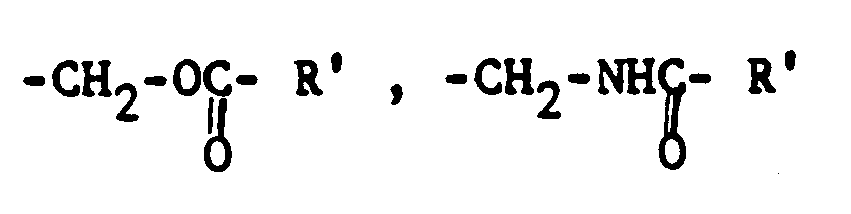
- Rʹ=
- ungesättigter Kohlenwasserstoffrest von Monocarbonsäuren. (C₂ bis C₁₈)
- Als ungesättigte Monoepoxidverbindungen können, wie in der DE-A-31 22 641 beschrieben, dabei verwendet werden:
- a) Glycidylester von linearen oder verzweigten, isoliert oder konjugiert ungesättigten C₃ bis C₁₈-Monocarbonsäuren,
- b) Glycidylether von linearen oder verzweigten, isoliert oder konjugiert ungesättigten C₃ bis C₁₈-Monoalkoholen.
- Wesentliche Eigenschaftsverbesserungen werden nach der DE-A-33 36 746 gefunden, wenn Amin-Epoxid-Harzmoleküle mindestens ein molekülvergrößerndes Diamin der Formel

eingebaut enthalten, worin Y für -H oder CmH2m+1 (m = 1 bis 8) oder einen zum Defunktionalisieren verwendeten organischen Rest, der durch Umsetzung der primären Aminogruppe mit Monoepoxiden gebildet wird, und X eine Molekülgruppierung mit mindestens einer Amid-, Harnstoff-und/oder Urethangruppe darstellen, wobei diese Gruppen an die Stickstoffatome der Formel (I) über Alkylengruppen mit 2 bis 16 C-Atomen gebunden sind. - Ein amidgruppenhaltiges Diamin wird durch Kondensation einer Aminocarbonsäure mit einem primären Diamin oder von 1 Mol Dicarbonsäure mit 2 Mol Diamin erhalten. Ein harnstoffgruppenhaltiges Diamin wird durch Addition von Diaminoalkanen an Polyisocyanate mit mindestens zwei Isocyanatgruppen hergestellt. So können 2 Mol primäres oder sekundäres Diamin oder 1 Mol primäres oder sekundäres Monoamin und 1 Mol primäres Diamin mit 1 Mol Diisocyanat umgesetzt werden.
- Für die Erfindung müssen für die unterschiedlich ablaufenden Vernetzungsreaktionen jedoch stets Hydroxylgruppen vorhanden sein. Die im Molekül vorhandene Hydroxylzahl (ausgedrückt in mg KOH pro Gramm Festharz) ist maßgebend für die Vernetzungsfähigkeit des Films. Sie sollte über 50, vorzugsweise über 100, besonders vorteilhaft über 150 liegen. Die obere Grenze der Hydroxylzahl liegt bei 400, vorteilhafter unter 300. Ist die Hydroxylzahl zu niedrig, so entstehen bei der Vernetzung Filme, die noch in organischen Lösemitteln wie Methylethylketon löslich sind. Ist die Hydroxylzahl dagegen zu hoch, so wird der Film zu spröde und bleibt eventuell auch zu hydrophil. Im Molekül müssen mindestens zwei vernetzungsfähige, bevorzugt primäre Hydroxylgruppen vorliegen.
- Die für den Vernetzungsprozeß wichtigen primären und/oder sekundären Hydroxylgruppen können anteilweise durch primäre und/oder sekundäre Aminogruppen ersetzt werden. Das Einführen von primären Aminogruppen in den Harzgrundkörper erfolgt vorzugsweise durch Umsetzen von mindestens einer, bevorzugt mindestens zwei Epoxidgruppen pro Molekül enthaltenden Harzen mit einem amino- und/oder hydroxylgruppenhaltigen Ketimin und/oder Aldimin und/oder Polyamin. Bei den bevorzugten Ketiminen handelt es sich um Umsetzungsprodukte aus Ketonen und sekundäre Aminogruppe enthaltenden Alkylaminen wie Methylisobutylketon und Diethylentriamin.
- Die Ketimine werden nach bekannten Methoden durch Wasserabspaltung aus den entsprechenden Polyaminen der allgemeinen Struktur R-NH-R-NH₂ oder den entsprechenden Aminoalkoholen der allgemeinen Struktur HO-R-NH₂ und den geeigneten aliphatischen Ketonen wie Diethylketon, Methylisobutylketon, Ethyl-n-propylketon oder auch Cyclopentanon, Cyclohexanon, Acetophenon usw. hergestellt. Die Reaktionsbedingungen (Reaktionstemperatur, Auswahl des Lösemittels) müssen so geführt werden, daß keine die Ketiminbindung zersetzende Substanzen wie Wasser in dem Reaktionsprodukt vorhanden bleiben.
- Das Ketimin schützt die primäre Aminogruppe so (vgl. US-A-3 523 925), daß sie über eine weitere funktionelle Gruppe, z.B. eine Hydroxylgruppe oder bevorzugt eine sekundäre Aminogruppe ohne Schwierigkeiten mit dem Epoxidgrundharz umgesetzt werden kann. Durch die Wahl der Molverhältnisse der eingesetzten Komponenten muß gewährleistet sein, daß kein unumgesetztes niedrigmolekulares Amin im Ansatz zurückbleibt, weil sonst durchbruchartige Oberflächenstörungen beim elektrophoretischen Beschichten auftreten. Die Reaktion der sekundären Aminogruppe des Polyaminoketimins mit der Epoxidgruppe beginnt schon bei Raumtemperatur und ist im allgemeinen exotherm. Um eine vollständige Umsetzung zu erreichen, ist es in der Regel notwendig , die Temperatur zeitweise auf 50 bis 120°C zu erhöhen.
- Die Komponente B) der erfindungsgemäßen Bindemittelkombination stellt ein primäre, sekundäre und/oder tertiäre Aminogruppe enthaltendes organisches Kunstharz-Bindemittel dar, das aus radikalisch polymerisierbaren Monomeren erhältlich ist. Bevorzugt handelt es sich dabei um ein Poly(meth)acrylatharz, insbesondere um eines, das durch Neutralisation mit organischen Säuren mit Wasser verdünnbar ist.
- Mit Wasser verdünnbare Amino-poly(meth)acrylate werden nach dem Stand der Technik, wie er beispielsweise in der DE-A-15 46 854, DE-A-20 57 799 oder der DE-A-23 25 177 beschrieben wird, hergestellt. Als radikalisch polymerisierbare Monomere kommen beispielsweise ethylenisch ungesättigte Monomere infrage, wobei die üblichen Einschränkungen für Copolymerisationen gelten, die durch das Q- und e-Schema nach Alfrey und Price gelten, bzw. die Copolymerisationsparameter vorgegeben sind ( vgl. Brandrup und Immergut, Polymer Handbook, 2nd ed. John Wiley + Sons, New York,1975).
- Zur Herstellung der Komponente B) werden Mischungen verschiedener ungesättigter Monomerer verwendet, die entweder basische Stickstoffatome enthalten oder in die durch chemische Umsetzungen ein solches basisches Stickstoffatom eingeführt werden kann. So basiert die Komponente B) beispielsweise auf jeweils radikalisch polymerisierbaren
- a) 6 bis 40 Gewichtsteilen aminogruppenhaltige Monomeren,
- b) 4 bis 50 Gewichtsteilen hydroxylgruppenhaltigen Monomeren und
- c) 10 bis 90 Gewichtsteilen weiterer radikalisch polymerisierbarer Monomere ,die außer einer ungesättigten Doppelbindung keine weiteren reaktiven Gruppen enthalten
- Die radikalisch polymerisierbaren aminogruppenhaltigen Monomeren und hydroxylgruppenhaltigen Monomeren müssen nicht als Gemisch vorgelegt werden. Es können auch Monomerarten eingesetzt werden, die sowohl Aminogruppen als auch Hydroxylgruppen gleichzeitig enthalten. Für diesen Fall werden 8 bis 60 Gewichtsteile der aminogruppen-und hydroxylgruppenhaltigen Monomeren und 10 bis 90 Gewichtsteile der radikalisch polymerisierbaren Monomeren, die keine weiteren reaktiven Gruppen enthalten, eingesetzt, wobei gegebenenfalls bis zu 10 Gewichtsteile der letzteren radikalisch polymerisierbare polyungesättigte Monomere sind.
- Als radikalisch polymerisierbare aminogruppenhaltige bzw. N-gruppenhaltige Monomere werden beispielsweise Monomere der folgenden allgemeinen Formel eingesetzt:
R-CH=CRʹ-X-A-N(Rʺ)₂
worin - R =
- -Rʹ oder -X-CnH2n+1
- Rʹ=
- -H oder -CnH2n+1
- Rʺ=
- -Rʹ, -CnH2nOH und/oder -CnH2nNR₂
- X =
- -COO-, -CONH- oder -O-
- A =
- -CnH2n- oder

- n
- = 1 bis 8, bevorzugt 1 bis 3
- Beispiele für ungesättigte N-gruppenhaltige Monomere sind N-Dialkyl- oder N-Monoalkyl-aminoalkyl(meth)acrylate wie beispielsweise N-Diethyl-aminoethylmethacrylat oder N-tert-Butylaminoethylacrylat oder die entsprechenden N-Alkanol-Verbindungen, N-Dialkyl- oder N-Monoalkylaminoalkyl(meth)acrylamid wie beispielsweise N-Dimethyl-aminoethanolacrylamid oder die entsprechenden N-Alkanol-Verbindungen und/oder Vinylgruppen enthaltende heterocyclische Verbindungen mit einem oder mehreren basischen Stickstoffatomen wie beispielsweise N-Vinylimidazol.
- Unter radikalisch polymerisierbaren hydroxylgruppenhaltigen Monomeren werden solche verstanden, die neben einer polymerisierbaren ethylenisch ungesättigten Gruppe noch mindestens eine Hydroxylgruppe an einem C2 bis C20 linearen, verzweigten oder cyclischen Kohlenstoffgerüst enthalten. Es sind hauptsächlich ungesättigte Veresterungsprodukte der allgemeinen Formel
R-CH=CRʹ-X-B
worin
R,Rʹ und X die auf Seite 18 angegebenen Bedeutungen haben
und β eine lineare oder verzweigte C1-6Alkylgruppe mit 1 bis 3 OH-Gruppen ist. - Besonders geeignet sind (Meth)acrylsäure-hydroxyalkylester wie beispielsweise 2-Hydroxyethylacrylat, 2-Hydroxypropylmethacrylat, Butandiol-1.4-monoacrylat, 2.3-Dihydroxypropylmethacrylat, Pentaerythrit-monomethacrylat, Polypropylenglykol-monoacrylat oder auch Fumarsäuredihydroxyalkylester. Es können jedoch auch N-Hydroxyalkyl(meth)acrylamide oder N-Hydroxyalkylfumarsäure-mono-oder -diamide wie beispielsweise N-Hydroxyethyl-acrylamid oder N-(2-Hydroxypropyl)-methacrylamid eingesetzt werden. Besonders elastische Eigenschaften sind beim Einsatz eines Reaktionsproduktes von Hydroxyalkyl-(meth)acrylat mit ε-Caprolacton zu erhalten. Andere hydroxylgruppenhaltige Verbindungen sind Allylalkohol, Monovinylether von Polyalkoholen, besonders Diolen wie der Monovinylether des Ethylenglykols oder Butandiols, sowie hydroxylgruppenhaltige Allylether oder -ester wie 2.3-Dihydroxypropylmonoallylether, Trimethylolpropan-monoallylether oder 2.3-Dihydroxypropansäureallylester. Besonders geeignet sind Hydroxyethyl-, Hydroxypropyl- und/oder Butandiol-1.4-(meth)acrylat.
- Unter ethylenisch polyungesättigten Monomeren werden Verbindungen mit mindestens 2 radikalisch polymerisierbaren Doppelbindungen nach der allgemeinen Formel
R-CH=CRʹ-D-(-CRʹ=CH-R)m,
worin m = 1 bis 3, bevorzugt m = 1 ist verstanden, wobei außer den auf Seite 18 angegebenen Bedeutungen D das allgemeine tragende chemische Grundgerüst für die reaktive Doppelbindung ist. Beispiele für D sind der o-, m- oder p-Phenylrest oder Reste der Formel -X-Alkyl-Xʹ-, worin Alkyl bevorzugt 2 bis 18 C-Atome aufweisen, X und Xʹ gleiche oder verschiedene verbindende Gruppen, z.B. -O-, -CONH-, -COO-, -NHCOO- oder -NH-CO-NH-sind. B kann zum Beispiel ein Benzolring wie im Divinylbenzol sein, der gegebenenfalls auch substituiert sein kann wie p-Methyldivinylbenzol oder o-Nonyldivinylbenzol. Weitere Beispiele für geeignete polyungesättigte Monomere sind Reaktionsprodukte aus Polyalkoholen, besonders Dialkoholen, mit α,β-ungesättigten Carbonsäuren, wie sie schon definiert sind. Beispiele hierfür sind Ethandioldiacrylat, Glykol- dimethacrylat, 1.4-Butandiol-diacrylat, 1.6-Hexandiol-diacrylat, Neopentylglykol-dimethacrylat, Triethylenglykol-dimethacrylat, Polyglykol-400-diacrylat, Glycerin- dimethacrylat, Trimethylolpropan-triacrylat und/oder Pentaerythrit-diacrylat. Urethan- und amidgruppenhaltige polyfunktionelle Monomere werden hergestellt durch Reaktion von beispielsweise Hexandiisocyanat oder Methacrylsäure-β-isocyanato-ethylester mit Hydroxyethyl(meth)acrylat oder (Meth)acrylsäure. Beispiele für anders aufgebaute geeignete Verbindungen sind Allylmethacrylat, Diallylphthalat, Butandioldivinylether, Divinylethylenharnstoff, Divinylpropylenharnstoff, Maleinsäurediallylester, Bis-maleinimide, Glyoxabisacrylamid und/oder das Reaktionsprodukt von Epoxidharz mit (Meth)acrylsäure oder Fumarsäure-halbestern. Bevorzugt wird der Einsatz von difunktionellen ungesättigten Monomeren wie Butandiol-diacrylat oder Hexandiol-diacrylat. Bei Verwendung von Glycidyl-methacrylat und Methacrylsäure entsteht das entsprechende Glycerin-dimethacrylat automatisch bei der Polymerisation. Die Art und Menge an polyungesättigten Monomeren ist mit den Reaktionsbedingungen (Katalysatoren, Reaktionstemperatur) sorgfältig abzustimmen, um die gewünschte hohe Viskosität ohne Gelierungen zu erhalten. Es wird der vollständige Einbau der polyungesättigten Monomeren bevorzugt, d.h. das einpolymerisierte Produkt enthält praktisch keine Doppelbindungen mehr. - Die Auswahl der radikalisch polymerisierbaren Monomeren, die außer der ethylenisch ungesättigten Bindung keine weiteren reaktiven Gruppen enthalten, erfolgt nach den mechanischen Eigenschaften des Films und der Verträglichkeit der dabei eingesetzten Harzkombination. Es werden Acrylsäure- alkylester, Methacrylsäure-alkylester, Maleinsäure- und/oder Fumarsäure-dialkylester eingesetzt, wobei die Alkylreste aus 1 bis 20 Kohlenstoffatomen bestehen und in linearer oder verzweiger aliphatischer Kette und/oder als cycloaliphatischer und/oder (alkyl)aromatischer Rest angeordnet sind. "Harte" Monomere mit einer hohen Glasübergangstemperatur als Polymere sind beispielsweise Monomere vom Vinylaromatentyp wie Styrol, α-substituierte Styrole wie α-Methylstyrol, o-, m-und p-Alkylstyrole wie Vintyltoluol oder p-tert.-Butylstyrol, halogenierte Vinylbenzole wie o- oder p-Chlorstyrol, Methacrylsäureester mit kurzer Kette wie Methylmethacrylat, Ethylmethacrylat, Propylmethacrylat, Butylmethacrylat, Cyclohexylmethacrylat, Isobornylmethacrylat, Dihydrodicyclopentadienyl-methacrylat, (Meth)acrylamid und/oder auch (Meth)acrylnitril. "Weiche" Monomere sind dagegen Acrylsäureester mit einer langen Alkoholkette wie n-Butylacrylat, Isobutylacrylat, tert.-Butylacrylat , 2-Ethylhexylacrylat und/oder Laurylacrylat. Es können auch ungesättigte Ether wie Ethoxyethylmethacrylat oder Tetrahydrofurfurylacrylat eingesetzt werden. Monomere vom Vinylestertyp, vorzugsweise Vinylester α-verzeigter Monocarbonsäuren wie dem Versaticsäure-vinylester,
können auch einpolymerisiert werden, wenn geeignete Reaktionsbedingungen und Reaktionscomonomere ausgewählt werden. - Die Copolymerisation erfolgt in bekannter Weise durch Lösungspolymerisation unter Zusatz von radikalischen Initiatoren, sowie gegebenenfalls Molekulargewichtsreglern bei Temperaturen von 50 bis 180°C. Sie erfolgt in einer Flüssigkeit, in der sich Monomere und Polymere gemeinsam lösen. Der Gehalt an Monomeren, bzw. Polymeren nach der Auspolymerisation beträgt dabei etwa 50 bis 90 Gew.-% . Es wird eine Lösungspolymerisation in organischen Lösemittel bevorzugt, die mit Wasser verdünnbar sind. Solche Lösemittel sind beispielsweise Ethylenglykol, Methoxyethanol, Butoxyethanol, Diethylenglykol, Triethylenglykol, Diethylenglykol-dimethylether, Propylenglykol, Methoxypropanol, Ethoxypropanol, Dipropylenglykol-monomethylether, Dipropylenglykol-dimethylether, Diacetonalkohol, Ethanol, Isopropanol, sek. Butanol, tert. Butanol, Aceton, Methoxypropanon, Dioxan, Tetrahydrofuran, N-Methylpyrrolidon oder ihren Gemischen.
- Im allgemeinen wird das Lösemittel bzw. Lösemittelgemisch bis zur Reaktionstemperatur erwärmt und dann das Monomerengemisch über mehrere Stunden zulaufen gelassen. Um bei Rückflußtemperatur arbeiten zu können, wird der Initiator auf die Siedetemperatur des Lösemittelgemisches abgestimmt. Er zerfällt dabei üblicherweise mit einer Halbwertzeit von 30 Minuten bis zu 10 Stunden. Der Initiator wird entweder im Monomerengemisch kalt gelöst oder aus Sicherheitsgründen während des Zulaufs der Monomeren getrennt zudosiert. Als Katalysatoren, die in organischen Lösemitteln löslich sind, werden 0,1 bis 5 Gew.-%, bevorzugt 0,5 bis 3 Gew.-%, bezogen auf die eingesetzte Monomeren-Menge an Peroxiden und/oder Azo-Verbindungen zugesetzt. Als Peroxide werden beispielsweise verwendet Benzoylperoxid der Di-tert.-butylperoxid, Hydroperoxide wie tert.-Butylhydroperoxid oder Cumolhydroperoxid und Perester wie tert.-Butylperoctoat oder tert.-Butylperbenzoat. Thermisch zerfallende Azo-Verbindungen sind beispielsweise 2.2ʹ-Azo-bis-(2-cyanopropan) oder 1.1ʹ-Azo-bis-cyclohexancarbonitril. Als Initiatoren können auch radikalbildende Verbindungen von Dibenzyltyp verwendet werden, wie 1.2-Bis(4-methylphenyl)-1.2-dicarbethoxy-1.2-dicyanoethan. Durch den Einsatz von Reglern kann die Molmasse in bekannter Weise herabgesetzt werden. Bevorzugt werden hierzu Mercaptane, halogenhaltige Verbindungen und andere radikalübertragende Substanzen eingesetzt. Besonders bevorzugt sind n-oder tert.-Dodecylmercaptan, Tetrakis-mercaptoacetylpentaerythrit, tert.-Butyl-o-thiokresol, Thiosalicylsäure, Buten-1-ol oder dimeres α-Methylstyrol.
- Die Herstellung von Amino(meth)acrylatharzen kann auch durch polymeranaloge Umsetzung geschehen. So kann man beispielsweise ein Acrylamidgruppen enthaltendes Copolymeres mit Formaldehyd und einem sekundären Amin und/oder Aminoalkohol umsetzen. Ein besonders bevorzugtes Verfahren wird in der DE-A-34 36 346 beschrieben. Hier werden zunächst epoxidgruppenhaltige monoethylenisch ungesättigte Monomere in das Copolymere einpolymerisiert. Danach wird mit überschüssige primären und/oder sekundären Monoaminen und/oder Monoaminoalkoholen umgesetzt und anschließend der Aminüberschuß abdestilliert.
- Epoxidgruppen enthaltende radikalisch polymerisierbare Monomere sind Mono- und/oder Diglycidylverbindungen von α,β-ungesättigten Säuren, Säureamiden, Alkoholen oder Aminen wie beispielsweise Glycidylester, β-Methylglycidylester der (Meth)acrylsäure, der Fumarsäure und/oder Maleinsäure, der Fumarsäure- und/oder Maleinsäuremonoalkylester, sowie Glycidylverbindungen von (Meth)acrylsäureamid, Fumarsäurediamid, Maleinsäurediamid oder Maleinimid und/oder Glycidylether von ungesättigten Alkoholen wie Vinyl- und/oder Allylalkohol. Andere geeignete Verbindungen sind Monoglycidylester von Dicarbonsäuremonoestern mit ungesättigten Alkoholen wie Phthalsäure-allyl-glycidylester. Es können jedoch auch Vinyl- und Allylester von epoxidierten Fettsäuren eingesetzt werden wie 2.3-Epoxy-buttersäure-allylester oder Epoxy-stearinsäure-allylester. Außerdem eignen sich auch Diolefine, deren eine Doppelbindung epoxidiert worden ist, wie Vinyl-ethylenoxd, 1-Methyl-1-vinylethylenoxid oder 3.4-Epoxy-1-vinyl-cyclohexan. Glycidylacrylat und Glycidylmethacrylat werden für die Copolymerisation bevorzugt. Der Anteil von Epoxidgruppen enthaltenden ungesättigten Monomeren im Copolymerisat beträgt im allgemeinen 8 bis 50 Gew.-%. Die untere Grenze liegt bevorzugt bei 12 Gew.-%, die obere Grenze bei 35 Gew.-%. Die Polymerisation muß vollständig abgelaufen sein, bevor die Umsetzung mit Aminen stattfindet, weil sonst reversible Nebenraktionen an den aktivierten Doppelbindungen der Monomeren mit den sekundären Aminen auftreten.
- Als sekundäre Amine für die Umsetzung mit den Epoxidgruppen sind besonders zweckmäßig sekundäre Amine der Formel
R-NH-Rʹ
wobei - R =
- -H oder -Rʹ
- Rʹ =
- -CnH2n+1, -CnH2nOH und/oder -CnH2n-N=CR₂
und - n =
- 1 bis 8, bevorzugt 1 bis 2 betragen.
- Folgende Amine können beispielsweise für die Reaktion eingesetzt werden: C₁ bis C₆-Dialkylamine mit gleichen oder verschiedenen Alkylgruppen im Molekül wie Dimethyl-, Diethyl-, Diisopropyl-, Dibutyl-, Methylethyl-, Methylpropyl-, Methylbutylamin, monocycloaliphatische Amine wie Morpholin, Piperidin, Pyrrolidin, Oxazolidin und/oder Monoalkanolamine wie N-Methylaminoethanol und/oder Dialkanolamine wie Diethanolamin, Diisopropanolamin. Beispiele für primäre Amine oder Aminoalkohole sind C₁ bis C₈-Alkylamine wie Ethylamin, 2-Ethylhexylamin oder Aminoethanol. In jedem Fall sind C₁ bis C₄-Alkylgruppen, insbesondere C₁ und/oder C₂-Alkylgruppen bevorzugt. Besonders bevorzugt sind sekundäre Amine wie Dimethylamin, Diethylamin, Methylethylamin oder N-Methyl-aminoethanol, weil damit gut lösliche ET-Bäder mit hohem pH-Wert erhalten werden können. Die oben erwähnten primären Amine werden meistens im Gemisch mit sekundären Aminen eingesetzt, weil sonst zu hochviskose Produkte entstehen.
- Eine ähnliche Umsetzung kann beispielsweise bevorzugt in äquivalenten Mengen mit Ketiminen von Polyaminen erfolgen, die eine sekundäre Aminogruppe und eine oder mehrere primäre Aminogruppen enthalten wie beispielsweise das Monoketimin aus Methylisobutylketon und Methylaminopropylamin oder das Diketimin aus Methylisobutylketon und Diethylentriamin.
- Die Zahl der primären und/oder sekundären Hydroxylgruppen wird so optimiert, daß beim Einbrennen des Lackes ein gut vernetzter, lösemittelbeständiger Film entsteht. Berücksichtigt man, daß beim Umsetzen mit Amin aus jeder Epoxidgruppe eine sekundäre OH-Gruppe entsteht, so ist es angebracht, mindestens eine weitere Hydroxylgruppe pro Molekül, bevorzugt primäre Hydroxylgruppe über andere ungesättigte Monomere einzupolymerisieren. Die Zahl der Epoxidgruppen bestimmt die Zahl der damit zur Umsetzung kommenden Aminogruppen und damit auch die Löslichkeit des Produktes. Es soll mindestens eine Epoxidgruppe pro Molekül vorhanden sein. Oft ist es vorteilhaft, eine erhöhte Hydroxylzahl mit einer niedrigen Aminzahl zu kombinieren. Das Entwicklungsziel ist im allgemeinen ein gut lösliches Produkt bei niedrigem Neutralisationsgrad und möglichst hohem pH-Wert.
- Die vorstehend beschriebenen Fremdvernetzenden, Epoxidgruppen freien Amino-poly(meth)acrylatharze werden erfindungsgemäß in den Bindemitteln für die kathodische Abscheidung in ET-Bädern (KTL-Bädern) eingesetzt. Sie können außer den Aminoepoxidharzen als Komponente A) und den Amino(meth)acrylatharzen als Komponente B) noch die nachfolgende Komponente C) als Vernetzungsmittel enthalten. Außerdem können sie übliche Zusatzstoffe enthalten, wie sie beispielsweise in den eingangs genannten, KTL-betreffenden Literaturstellen beschrieben und teilweise nachfolgend genauer erläutert werden.
- Beispiele für die Komponente C) sind Formaldehyd-Kondensationsharze (Harnstoff-, Melamin-, Benzoguanin- oder Phenol-Formaldehydharze), blockierte Polyisocyanate, Harze mit umesterungsfähigen Estergruppen und/oder Harze mit aktivierten Doppelbindungen. Die Komponente C) kann gegebenenfalls unter Zusatz von üblichen Katalysatoren enthalten sein.
- Blockierte Polyisocyanate werden dadurch hergestellt, daß man ein multifunktionelles Isocyanat mindestens mit einer stöchiometrischen Menge an einer monofunktionellen, aktiven Wasserstoff (Zerewitinoff-Reaktion) enthaltenden Verbindung umsetzt, wobei gegebenenfalls basische Katalysatoren wie tert. Amine oder geringe Mengen an Zinnsalzen wie Dibutylzinndilaurat zugegeben werden können. Die Isocyanatgruppe wird auf diese Weise bei Raumtemperatur gegen Reaktionen mit Wasser oder Alkoholen geschützt. Das erhaltene Reaktionsprodukt setzt sich beim Erwärmen mit den Hydroxylgruppen des Amino-poly(meth)acrylatharzes um, wobei die Schutzgruppe wieder abgespalten wird. Sie spaltet sich bei Einbrenntemperaturen von weniger als 210°C, vorzugsweise weniger als 190°C, besonders unter 180°C, andererseits über 110°C, vorzugsweise über 140°C, besonders bevorzugt über 150°C, wieder ab, damit die freiwerdende Isocyanatgruppe mit dem Basisharz reagieren kann. Mittel, die die Isocyanate blockieren, enthalten nur eine einzige Amin-, Amid-, Lactam-, Thio- oder Hydroxylgruppe. So haben sich beispielsweise bewährt aliphatische oder cycloaliphatische Alkohole wird 2-Ethylhexanol, Dialkylaminoalkohol wie Dimethylaminoethanol, Oxime wie Methylethylketoxim, Lactame wie ε-Caprolactam oder Pyrrolidon-2, Imide wie Phthalimid oder N-Hydroxy-maleinimid, Hydroxylalkylester, Malonsäure- oder Acetessigsäureester. Es werden aber auch β-Hydroxyglykole oder - glykolether und Glykolamide empfohlen.
- Als typische multifunktionelle Isocyanate eignen sich aliphatische, cycloaliphatische und/oder aromatische Polyisocyanate mit mindestens zwei Isocyanatgruppen pro Molekül. Als aromatische Diisocyanate eignen sich die Isomeren oder Isomerengemische von Phenylendiisocyanat, Toluylendiisocyanat, Xylylendiisocyanat, Biphenylendiisocyanat, Naphthylendiisocyanat und Diphenylmethan-diisocyanat, Diphenyltetraisocyanat, Naphthyltetraisocyanat. Aufgrund ihrer guten Beständigkeit gegenüber ultraviolettem Licht ergeben (cyclo)aliphatische Diisocyanate Produkte mit geringer Vergilbungsneigung. Beispiele hierfür sind Isophorondiisocyanat, Cyclopentylendiisocyanat, sowie die Hydrierungsprodukte der aromatischen Diisocyanate wie Cyclohexylendiisocyanat, Methylcyclohexylendiisocyanat und Dicyclohexylmethan-diisocyanat. Aliphatische Diisocyanate sind Verbindungen der Formel

worin r eine ganze Zahl von 2 bis 20, insbesondere 6 bis 8 ist und R, das gleich oder verschieden sein kann, Wasserstoff oder einen niedrigen Alkylrest mit 1 bis 8 C-Atomen , vorzugsweise 1 oder 2 C-Atomen darstellt. - Beispiele hierfür sind Trimethylendiisocyanat, Tetramethylendiisocyanat, Pentamethylendiisocyanat, Hexamethylendiisocyanat, Propylendiisocyanat, Ethylethylendiisocyanat, Dimethylethylendiisocyanat, Methyltrimethylendiisocyanat und Trimethylhexandiisocyanat. Besonders bevorzugt werden als Diisocyanate Isophorondiisocyanat und Dicyclohexylmethan-diisocyanat.
- Vinylpolymerisate, die Isocyanatgruppen enthalten und durch Copolymerisation von z.B. Cyanatoethyl(meth)acrylat oder Dimethyl-isopropylbenzylisocyanat mit noch Alkyl(meth)acrylaten und/oder (Alkyl)vinylbenzolen entstehen, können auch verwendet werden.
- Gemischt aliphatisch/aromatische Isocyanat-Verbindungen sind auch geeignet.
- Als Triisocyanate haben sich Produkte bewährt, die durch Trimerisation oder Oligomerisation von Diisocyanaten oder durch Reaktion von Diisocyanaten mit polyfunktionellen OH- oder NH-Gruppen enthaltenden Verbindungen entstehen. Hierzu gehören beispielsweise die schon bei der Komponente B) beschriebenen Handelsprodukte. Falls notwendig, kann die mittlere Funktionalität gegebenenfalls durch Zusatz von Monoisocyanaten gesenkt werden. Beispiele für solche kettenabbrechenden Monoisocyanate sind Phenylisocyanat, Cyclohexylisocyanat und Stearylisocyanat.
- Eine Molekülvergrößerung kann auch durch Reaktion mit tert. Aminogruppen enthaltenden Polyalkoholen wie N-Methyl-diethanolamin, Triethanolamin oder tertiäre Aminogruppen enthaltenden Polyaminen wie 3-(Methyl)-3-(2-Aminoethyl)-aminopropylamin erfolgen. Um die Löslichkeit zu verbessern, können außerdem kettenabbrechende N-Dialkyl-aminoalkohole wie Dimethyl-aminoethanl oder N,N-Dialkyl-alkylendiamine wie Dimethylaminopropylamin oder N,N-Diethyl-Nʹ-Methyl-1.3-ethandiamin eingesetzt werden. Isocyanathaltige Präpolymere auf Basis von Polyglykolethern, Polyesterpolyolen, Polyetherpolyolen, Polycaprolactonpolyolen und/oder Polycaprolactampolyolen können ebenfalls mit Vorteil eingesetzt werden. Für nicht-vergilbende Einschichtlacke werden aliphatische und cycloaliphatische Polyisocyanate bevorzugt.
- Ein anderer geeigneter Typ Vernetzungsmittel (Komponente C) ist ein Harz mit endständigen oder seitenständigen, veresterten Carboxylgruppen, die im neutralen, wäßrigen Medium weitgehend stabil/sind, jedoch im basischen Medium des abgeschiedenen Films bei Temperaturen über etwa 140°C mit einem oder mehreren hydroxylgruppenhaltigen Harzen (Komponenten A) and B) ) reagieren. Hierbei estern die umesterungsfähigen Estergruppen mit den Hydroxylgruppen der Komponenten A) und B) unter Abspalten der leichter flüchtigen "alkoholischen Schutzgruppen" um. Es sollen im wesentlichen alle endständigen oder seitenständigen Carboxylgruppen mit Alkoholen verestert sein, die unter den Einbrennbedingungen flüchtig sind. Um ein Wandern des Polyesters zur Anode zu vermeiden, ist darauf zu achten, daß er eine Säurezahl unter 20, bevorzugt unter 10, besonders bevorzugt unter 3 hat.
- Die Reaktivität der Ester wird durch geeigneten chemischen Aufbau gesteigert, z.B. durch Erhöhen der elektrophilen Aktivität der Carboxylgruppe oder durch einen negativen induktiven Effekt auf die Alkoholgruppe. Zur Umesterung befähigt sind Ester von primären, sekundären und tertiären Carboxylgruppen. Aufgrund ihrer höheren Reaktivität werden Ester von primären Carboxylgruppen bevorzugt.
- Die Umesterung wird unterstützt durch die Flüchtigkeit von niederen linearen oder verzweigten primären Monoalkoholen oder durch 1.2-Glykole, die gegebenenfalls durch Ether- oder Estergruppen substituiert sind. Je niedrigermolekular die Alkohole sind, die bei der Umesterung abgespalten werden, desto niedriger sind die Spaltverluste. Methanol oder Ethanol werden besonders bevorzugt. In der Literatur werden eine Reihe von estergruppenhaltigen Vernetzungsmitteln beschrieben, die zur Umesterung mit OH-Gruppen und/oder Umamidierung mit NH₂-Gruppen eingesetzt werden, z.B. in der EP-A-0 04 090, der EP-A-0 12 463, DE-A-31 03 642, der EP-A-0 82 291, DE-A-33 766 und DE-A-34 36 345.
- Vernetzungsmittel (Komponente C) mit aktivierten Doppelbindungen, die entweder alt ungesättigten Doppelbindungen der Komponente A) oder den Hydroxylgruppen, primären oder sekundären Aminogruppen der Komponente A) und/oder B) reagieren können, werden in den US-PS 3 921 181, US-PS 3 975 251, sowie den nicht vorveröffentlichten Patentanmeldungen DE-OS 36 15 810.0 und DE-OS 35 30 179.1 beschrieben. Es sind Polymerisations-, Polykondensations- und/oder Polyadditionsharze, die im Mittel mindestens zwei end- oder seitenständige ethylenische Doppelbindungen pro Molekül enthalten. Die von den Doppelbindungen ausgehende Reaktion soll so schnell ablaufen, daß eine ausreichende Vernetzung bei Einbrenntemperaturen von 140 bis 160°C oder niedriger erreicht wird. Besonders gut eignen sich hierfür Doppelbindungen von Acryl- und/oder Methacrylgruppen. Die Reaktion kann durch Auswahl von geeigneten Sikkativen von Schwermetallen mit organischen Monocarbonsäuren gegebenenfalls unter Zusatz von Komplexbildnern wie Phenanthrolein in bekannter Weise beschleunigt werden.
- Als Komponente C) können geeignete niedrigmolekulare Acrylsäureverbindungen verwendet werden, wie Ethylenglykoldiacrylat, 1,3-Butylenglykoldiacrylat, Bisphenol-A-diacrylat, Diethylenglykol-diacrylat, Triethylenglykoldiacrylat, Tetraethylenglykoldiacrylat, 1,6-Hexandioldiacrylat, Polyethylenglykoldiacrylat, Trimethylolpropandiacrylat, Trimethylolpropantriacrylat, Pentaerythritdiacrylat, Pentaerythrittriacrylat, Pentaerythrittetraacrylat und Melamin acrylat sowie die entsprechenden Methacrylsäureverbindungen.
- Höhermolekulare ungesättigte Polymerisationsharze können dadurch hergestellt werden, daß ein Copolymerisat mit solchen funktionellen Gruppen hergestellt wird, die anschließend in einem zweiten Reaktionsschritt zur Einführung von Verbindungen mit ungesättigten Doppelbindungen geeignet sind. So lassen sich amid- oder carboxylgruppenhaltige Polymerisatharze mit Glycidylacrylat oder Glycidylmethacrylat umsetzen. Hierbei muß durch die Wahl der Reaktionstemperatur darauf geachtet werden, daß die entstehenden β-Hydroxyester oder-amide nicht während des Einbrennens durch Umesterung abspalten. Andere Möglichkeiten bestehen in der Umsetzung von Glycidyl(meth)acrylat - Copolymeren mit Acrylsäure oder Methacrylsäure oder der von hydroxylgruppenhaltigen Poly(meth)acrylatharzen mit methylolierten (Meth)acrylamiden, die auch mit niedrigen Alkoholen verethert sein können.
- Die Komponente C) kann auch durch Reaktion von Diisocyanaten oder Polyisocyanaten, Isocyanatgruppen tragenden Präpolymeren, Präkondensaten und Kunstharzen mit Hydroxyalkyl(meth)acrylat, z.B. durch Reaktion des Reaktionsproduktes aus 1 Mol Trimethylolpropan und 3 Mol Toluylendiisocyanat mit 3 Mol 2-Hydroxyethylacrylat, hergestellt werden. Besonders bevorzugt wird die Herstellung von Isocyanatgruppen enthaltenden höhermolekularen Polyurethan-und/oder Polyharnstoffharzen, die anschließend in zweiter Reaktionsstufe mit Hydroxyethyl oder Hydroxypropyl-(meth)acrylat umgesetzt werden.
- Die Vernetzungsmittel können gegebenenfalls tertiäre Aminogruppen enthalten, damit eine bessere Dispergierung in Wasser erreicht wird. Die Menge an tertiären Aminogruppen muß in solchen Fällen so groß oder so klein sein, daß die gemeinsame elektrophoretische Abscheidung mit den Komponenten A) und B) gewährleistet ist.
- Es ist natürlich auch möglich, Doppelbindungen enthaltende Gruppen, z.B. die Acrylgruppe, direkt in das Kunstharzmolekül der Komponente A) einzuführen, wodurch in gewissem Umfang selbsthärtende CED-Bindemittel entstehen. Vorteilhaft ist es jedoch, die Komponente C) als reaktive Verdünnerkomponente dem System zuzumischen, wodurch CED-Beschichtungen mit höherer Schichtdicke (30 bis 50 µm) und hervorragendem Umgriff (throwing power) erhalten werden.
- Für eine Vernetzung bei der möglichst wenig Spaltprodukte entstehen, ist es zweckmäßig, daß die Komponente C) pro Molekül im Mittel weniger als eine endständige, beim Einbrennen umesterungsfähige Estergruppe, bevorzugt weniger als 0,5, besonders bevorzugt im wesentlichen keine endständigen, beim Einbrennen umesterungsfähigen Estergruppen oder blockierte Isocyanatgruppen enthält. Unter dem Begriff "im wesentlichen" wird verstanden, daß praktisch alle derartigen Gruppen nicht vorliegen, wobei jedoch bei hochmolekularen Produkten der vorliegenden Art es immer möglich ist, daß ein sehr geringer Gehalt an solchen Gruppen vorliegt.
- Bei Anwesenheit primärer und sekundärer Aminogruppen im Bindemittel ist darauf zu achten, daß nur solche end-oder seitenständigen Doppelbindungen im System vorhanden sind, die zwar im Sinne der Erfindung reaktiv sind, d.h. während des Einbrennens vernetzen, wie z.B. Doppelbindungen gemäß der Formel

wobei R = CnH2n+1 ,
die jedoch gegenüber primären und sekundären Aminen nicht besonders aktiviert sind. - Wie gemäß dem Stand der Technik werden auf 50 bis 95 Gew.-% der Komponenten A) und B) 50 bis 5 Gew.-% Vernetzungsmittel (Komponente C) ) eingesetzt, wobei als Vernetzungsmittel auch aus dem Stand der Technik bekannte Produkte eingesetzt werden können. Die KTL-Bäder können gegebenenfalls zusätzlich bis zu 30 Gew.-% hydroxyfunktionelle Harze einemulgiert enthalten, die mit den Vernetzungsmitteln reaktionsfähig sind (vgl. z.B. EP-A-0 04 090).
- Das Mischungsverhältnis der Komponenten (A + B) und C) liegt bevorzugt zwischen 90 zu 10 und 60 zu 40 und wird empirisch aus den optimal erreichbaren anwendungstechnischen Eigenschaften bei der gegebenen Einbrenntemperatur bestimmt. Eine Kombination mehrerer Vernetzungssysteme kann in bestimmten Fällen von Vorteil sein.
- Die Vernetzung der OH-gruppenhaltigen Komponenten A) und B) mit blockierten Polyisocyanaten kann gegebenenfalls durch Zusatz von 0,01 bis 2 Gew.-%, speziell 0,5 bis 1 Gew.%, bezogen auf Festharz der Komponenten A) und B), stark basische tertiäre Amine und/oder aktive Metallverbindungen beschleunigt werden. Eine besondere, manchmal synergistische Wirkung wird erreicht durch die Kombination von basischem Medium des abgeschiedenen OH-Gruppen haltigen Harz es und den Metallsalzen von Wismut, Blei, Cobalt, Eisen Antimon und/oder Zinn-II- und -IV. Besonders bevorzugt werden Katalysatoren wie Eisen-III-acetylacetonat, Dibutylzinn-dilaurat, Tri-n-butyl-zinn-oxid, Dibutyl-zinn-dioctylmaleat, Zinn-octoat, Zinn-oleat, Tetrabutyltitanat und/oder Cobalt-2-ethylhexoat.
- Zur Katalyse des Umesterungsverfahrens ist im allgemeinen ein höherer Katalysatorgehalt notwendig.Zweckmäßig werden 0,1 bis 10 Gew.-%, bevorzugt 2 bis 6 Gew.-%, bezogen auf die Komponenten A) und B), Metalloxide, Metallsalze oder Metallkomplexe von ein- oder mehrwertigen Metallen verwendet. Sie werden im allgemeinen nach Salzbildung mit 2-Ethylhexansäure oder Naphthensäure in aliphatischen und aromatischen Kohlenwasserstoffen gelöst. Diese Lösungen werden in das Elektrophoresebad einemulgiert. Eine andere Möglichkeit besteht in der Komplexbildung der Metalle mit Acetylacetonat, Dicyclopentadien, 8-Oxy-hydrochinolin, 4-Methylcatechin und/oder 2,5-Dimercapto-1,3,4-thiodiazol.
- Beispiele für geeignete Katalysatoren sind Antimontrioxid, Cobaltnaphthenat, Bleioctoat, Eisen-acetylacetonat, das Reaktionsprodukt aus Zinkoxid + 8-Oxyhydrochinolin, Thalliumdicyclopentadien oder Triethanolamin-titanat. Bevorzugt werden Bleioctoat und das Zink-Oxyhydrochinolat. Die Metallkatalysatoren können auch in fein verteilter Form als Pigmente wie Bleisililat eindispergiert werden. Wasser-ver dünnbare Metallsalze sind ebenfalls als Umesterungskatalysatoren geeignet, wenn das Metall als Verbindung oder Komplex in fein verteilter Form mit dem Lack abgeschieden wird. Bevorzugt sind Katalysatoren, die im ET-Bad schlecht löslich sind und sich nach der elektrophoretischen Abscheidung im abgeschiedenen Film beim Einbrennen gleichmäßig verteilen.
- Die Komponenten A),B) und C) können kalt gemischt werden. Die Komponente C) kann mit A) und/oder B) auch bei erhöhter Temperatur präkondensiert werden. Dabei reagieren die Komponenten A) oder B) und C) in gewissem Umfang miteinander, ohne daß das Gemisch seine Hitzehärtbarkeit und die Eigenschaft, durch Protonisieren mit Säure wasserlöslich gemacht werden zu können, verliert.
- Zum Ausbalancieren der anwendungstechnischen Eigenschaften ist es zweckmäßig, daß das an der Kathode abscheidbare Harz außer dem Vernetzungsmittel noch zusätzlich bis zu 30Gew.%, bevorzugt 5 bis 20 Gew.-% eines hydroxyfunktionellen Harzes enthält, das mit den blockierten Polyisocyanaten und den umesterungsfähigen Vernetzungsmitteln reagiert. So können zum Steigern des Umgriffs hydroxyfunktionelle Harze mit einer OH-Zahl von 30 bis 500, speziell 50 bis 300 und einer mittleren Molmasse (
M n)von 300 bis 5000, speziell 500 bis 3000 eingesetzt werden. Beispiele für solche Harze sind Styrol-Allylalkohol-Copolymere, OH-gruppenhaltige (Meth)acrylcopolymere, Caprolactonpolyole, Caprolactampolyole, Urethanpolyole, OH-gruppenhaltige Polyether und Polyester. - Die Harze enthalten eine solche Menge an polaren Gruppen, bevorzugt primären OH-Gruppen, daß sie einwandfrei in dem neutralisierten, basischen Harzgemisch (Komponenten A) und B) ) einemulgiert sind. Zum Erreichen einer besseren Verträglichkeit und Wasserverdünnbarkeit ist der Einbau einer geringen Aminzahl unter 30, besonders unter 20, möglich.
- Der Molmassenbereich wird so ausgewählt, daß sie nicht mehr flüchtig sind, jedoch durch eine verbesserte Fließfähigkeit eine gute Filmbildung erzielen. Eine eventuell erfolgende Präkondensation kann in beliebiger Reihenfolge erfolgen.
- Durch Protonisieren mit Säuren wird das kationische Bindemittelgemisch in an sich bekannter Weise wasserverdünnbar gemacht. Beispiele für Säuren sind Ameisensäure, Milchsäure, Essigsäure, Propionsäure, Zitronensäure, Malonsäure, Acrylsäure, Phosphorsäure oder Alkylphosphorsäure. Monobasische niedrigmolekulare organische Carbonsäuren werden bevorzugt. Es muß mindestens so viel Säure zugegeben werden, daß eine stabile Emulgierung des kationischen Basisharzes erfolgt. Ein Überschuß an Säure, d.h. ein Neutralisationsgrad über 100%, ist zweckmäßig zu vermeiden. Der MEQ-Wert (Milliäquvalente Säure pro 100 g Festharz) liegt im allgemeinen zwischen 20 und 80. Es wird ein möglichst niedriger MEQ-Wert angestrebt, um ein möglichst hohes Abscheideäquivalent zu erhalten.
- Das Überzugsmittel kann zum Senken der Viskosität , zum Steuern der Abscheidespannung und zum Verbessern der Haftung und des Verlaufs bis zu ungefähr 20 Gew.-% organische Lösemittel enthalten. Es wird ein möglichst niedriger Gehalt an organischen Lösemitteln angestrebt, besonders unter 15 Gew.-%, ganz besonders unter 10 Gew.-%. Als Lösemittel dienen Alkohole, Glykolether, Ketoalkohole, gegebenenfalls unter Zusatz von aliphatischen und/oder aromatischen Kohlenwasserstoffen verschiedener Kettenlänge. Bei der Auswahl muß berücksichtigt werden, daß das Vernetzungsmittel nicht wasserlöslich ist und Anteile von wasserunlöslichen Lösemitteln gegebenenfalls den Dispergiervorgang erleichtern und Stabilisieren können. Mit steigendem Lösemittelgehalt verschlechtert sich der Umgriff und die abgeschiedene Schichtdicke erhöht sich und es können Überbeschichtungen auftreten.
- Wasserunlösliche Lösemittel wirken hierbei stärker als wässerlösliche. Zur Verlaufsverbesserung und zum Senken des Schichtwiderstandes kann auch anteilweise ein nichtwasserlösliches, hochsiedendes Lösemittel zugesetzt werden wie Hexylenglykol, Phenoxyethanol, Ethylhexanol, Isodekanol oder 2.2.4-Trimethylpentandiol-1.3-monoisobutyrat. Die eventuell für die Herstellung der Harze notwendigen aprotischen Lösemittel können gegebenenfalls nach der Herstellung des Produktes gegen andere Lösemittel durch Abdestillieren ausgetauscht werden.
- Der Feststoffgehalt des Überzugsmittels gemäß der Erfindung beträgt nach Verdünnen mit Wasser zweckmäßig 5 bis 50 Gew.%. Beim Einstellen des Lackes auf einen höheren Festkörper von 25 bis 50 Gew.-%,bevorzugt 30 bis 45 Gew.-%, werden wasserverdünnbare Einbrennlacke erhalten, die durch Tauchen, Spritzen, Walzen usw. auf das zu lackierende Objekt aufgebracht werden können. Verdünnt man dagegen auf einen Festkörper von 5 bis 30 Gew.-%, vorzugsweise 10 bis 20 Gew.-%, so ist der Lack für die elektrophoretische Abscheidung geeignet. Das Bad wird ständig gerührt, um an der Kathodenoberfläche eine gleichmäßige Temperatur aufrechtzuerhalten und ein Absetzen der unlöslichen Bestandteile der Dispersion, z.B. der Pigmente zu verhindern. Der pH-Wert des Lackes liegt im allgemeinen zwischen 4,0 und 7.5, vorzugsweise zwischen 5,0 und 6,5. Liegt der pH-Wert zu niedrig, so ist mit einem Angriff der Säure auf das Eisen von Becken, Rohrleitungen und Pumpen zu rechnen. Die elektrophoretische Abscheidung erfolgt zweckmäßig frühestens 24 Stunden nach Herstellen des Bades. Während dieser Zeit wird zweckmäßig kontinuierlich gerührt, um eine gleichmäßige Verteilung zu erhalten. Als Anode werden elektrisch leitfähige, nicht-korrodierende Elektroden, z.B. aus nicht-rostendem Stahl oder Graphit verwendet. Der an der Kathode zu beschichtende Gegenstand und die Anode werden, wie für die elektrophoretische Abscheidung bekannt, in ein wäßriges Bad eingetaucht. Es können alle metallisch leitenden Werkstücke beschichtet werden, wie Kupfer, Aluminium, Zinn, Zink, Eisen und Legierungen dieser Metalle. Während des Abscheidens wird das Bad bei Temperaturen von zweckmäßig etwa 15 bis 35°C gehalten. Festkörper, Abscheidetemperatur und -zeit, sowie Spannung werden so gewählt, daß die gewünschte Schichtstärke nach Abspülen mit Wasser und/oder Ultrafiltrat und Einbrennen der Temperaturen von etwa 150 bis 230°C erhalten wird. So steigt z.B. die Schichtstärke mit zunehmender Beschichtungszeit und Abscheidespannung. Beim Anlegen eines elektrischen Stromes mit einer Spannung von zweckmäßig 50 bis 500 Volt zwischen metallisch leitendem Werkstück und einer Gegenelektrode wird das wasserverdünnbare Basisharz an der Kathode koaguliert. Es transportiert hierbei das wasserunlösliche Vernetzungsmittel, Pigmente, Katalysatoren usw. mit . Hierbei kann sich das Verhältnis von Pigment zum Kunstharz-Bindemittel im abgeschiedenen Film zugunsten des Pigmentes verschieben. Gleichzeitig werden Wasser und die zur Neutralisation verwendete Säure im Bad angereichert. Zum Nachfüllen müssen daher konzentrierte Lacke verwendet werden, die diese Verschiebung durch geänderte Mengenverhältnisse ausgleichen. Diese Korrektur kann auch durch geeignete apparative Einrichtungen, z.B. Elektrodialyseverfahren oder Ultrafiltration erfolgen.
- Das konzentrierte, mit Wasser zu verdünnende Bindemittel gemäß der Erfindung mit z.B. einem Festkörper von etwa 85 bis 60 Gew.-% kann in üblicher Weise mit Kugelmühle, Dreiwalze oder Perlmühle pigmentiert werden. Hierzu können übliche Pigmente, wie sie z.B. in der DIN 55 944 beschrieben werden, Füllstoffe, Korrosionsschutz-Inhibitoren und Lackhilfsmitteln, wie Antikratermittel, Verlaufmittel oder Antischaummittel, verwendet werden. Naturgemäß wählt man solche aus, die mit Wasser im sauren bis neutralen Medium keine störenden Reaktionen eingehen, keine wasserlöslichen Fremdionen einschleppen und beim Altern nicht so ausfallen, daß das Koagulat nicht wieder aufgerührt werden kann. Die Lacke sind besonders für die Elektrotauchlackierung von Metallen geeignet und geben nach Einbrennen von bevorzugt 15 bis 45 Minuten bei 130 bis 190°C glatte, kraterfreie Grundierungen mit verbesserter Kantenabdeckung und Elastizität, sowie wenig vergilbende, glänzende witterungsbeständige Filme mit verbessertem Salzsprühtest. Das Pigment-Bindemittelverhältnis ist abhängig von Dispergierfähigkeit und Viskosität des Bindemittels und liegt im allgemeine zwischen 0,1:1 und 1,5:1.
- Falls durch die erfindungsgemäße Bindemittelkombination Überzugsmaterialien bereitgestellt werden sollen, die zu Filmen führen, die eine besonders geringe Kraterneigung haben, die zusätzlich eine Verbesserung des Katenschutzes aufweisen und eine einwandfreie Oberfläche besitzen, ist es günstig 98 bis 85 Gew.-% der Komponente A) (des Amino-Epoxidharzes) mit 2 bis 15 Gew.-% der Komponente B) ( Amino-poly(meth)acrylatharz) zu kombinieren.
- Es hat sich gezeigt , daß die Elastizität und die Steinschlagfestigkeit der herstellbaren Filme günstig verbessert werden können, wenn 84 bis 21 Gew.-% der Komponente A) und 16 bis 79 Gew.-% der Komponente B) vorliegen. Andererseits werden Haftungsstörungen und Kantenrost (gemäß Salzsprühtest) in nicht-vergilbenden Filmen verbessert, ohne daß die Bewitterungsbeständigkeit (Glanzabfall, Kreidung) beeinträchtigt werden, wenn 98 bis 80 Gew.-% der Komponente B) mit 2 bis 20 Gew.-% der Komponente A) kombiniert werden. Bei den vorstehenden Zusammensetzungen handelt es sich somit um bevorzugte Ausführungsformen der erfindungsgemäßen Bindemittel.
- Zu einer Lösung von 283.2 g Polyglycidylether auf Basis Bisphenol A mit einem Epoxid-Äquivalentgewicht von 472 in 161 g Butoxyethanol werden 21 g Diethanolamin, 10.2 g 3(-N.N-Dimethylamino)propylamin und 61.6 g eines Adduktes von 116 g 1.6-Diaminohexan mit 500 g Cardura E 10®, dem Glycidylester einer α-verzweigten C₉ bis C₁₁-Monocarbonsäure, zugegeben. Die Mischung von Polyether und den Aminen reagiert 4 Stunden lang unter Rühren bei Temperaturen von 85 bis 90°C. Zum Vervollständigen der Reaktion wird dann noch 1 Stunde auf 120°C geheizt. Der Epoxidgehalt ist dann Null.
Aminzahl : 98 (mg KOH pro g Festharz)
Festkörpergehalt: etwa 70 Gew.-% - In einem Reaktionsgefäß, das mit Rührer, Thermometer, Tropftrichter und Rückflußkühler ausgestattet ist,werden 706 g eines flüssigen Epoxidharzes auf Basis Bisphenol A mit einem Epoxid-Äquivalentgewicht von ca. 260 in 631 g Ethylglykolacetat bei 60 bis 70°C gelöst. Nach Zusatz von 0.25 g Hydrochinon und 756 g eines Halbesters aus Tetrahydrophthalsäureanhydrid und Hydroxyethylmethacrylat wird die Temperatur auf 100 bis 110°C gesteigert. Die Reaktion wird bei dieser Temperatur gehalten bis eine Säurezahl von unter 5 (mg KOH pro g Feststoff) erreicht ist. Anschließend wird das Reaktionsprodukt bei 60 bis 70°C mit 1017 g einer 70%igen Lösung eines basischen Monoisocyanats in wasserfreiem Ethyglykolacetat umgesetzt. Das Monosiocyanat wurde unter Feuchtigkeitsausschluß hergestellt durch langsames Eintropfen von 241 g Dimethylaminoethanol bei 20 bis 30°C in eine Lösung von 471 g Toluylendiisocyanat in 305 g wasserfreiem Ethylglykolacetat. Das Lösemittel wurde unter Vakuum abdestilliert und mit Ethoxypropanol auf 70 Gew.-% verdünnt.
Aminzahl: 70 (mg KOH pro g Festharz) - 725 g Butoxyethanol werden unter Inertgas auf 110°C unter Einschalten eines Rückflußkühlers erwärmt. Innerhalb von 3 Stunden wird eine Mischung aus 192 g Hydroxyethylacrylat, 137 g Butandiol-monoacrylat, 228 g Glycidyl-methacrylat, 364 g 2-Ethyl-hexylacrylat, 439 g Butylmethacrylat, 438 g Methylmethacrylat, 90 g Styrol und 44 g Azo-bis-isobutyronitril zugegeben. Danach wird 1 Stunde bei 110°C gehalten, 6 g Azo-bis-isobutyronitril zugegeben und dieser Vorgang nach einer weiteren Stunde wiederholt. Nach 3 Stunden 110°C wird ein Festkörpergehalt von 72.2 Gew.-% und nach Verdünnen auf 60 Gew.-% mit Butoxyethanol eine Viskosität von 2.14 Pa·s bei 25°C gemessen. Nach Abkühlen auf 50°C werden ein Gemisch von 129 g Diethylamin und 201 Isopropanol schnell zugegeben (1.10 Mol Amin auf 1.00 Mol Epoxid). Nach 30 Minuten wird auf 65°C erwärmt, dann 1 Stunde gehalten, anschließend auf 105°C aufgeheizt und dann 3 Stunden gehalten. Nach Abkühlen auf 80°C wird unter Vakuum Isopropanol und Aminüberschuß sorgfältig abdestilliert.Einstellen des Festkörpergehaltes mit Butoxyethanol auf 78 Gew.-%.
Endwerte:
Festkörpergehalt : 78.7 Gew.-% (30 min 150°C)
Aminzahl : 45 (mg KOH pro g Festharz)
Viskosität : 3.44 Pa·s (nach Verdünnen auf 60 Gew.-% mit Butoxyethanol) - 725 g Butoxyethanol werden unter Inertgas auf 110°C unter Einschalten eines Rückflußkühlers erwärmt. Innerhalb von 3 Stunden wird eine Mischung aus 20.7g Butandioldiacrylat, 192 g Hydroxyethylacrylat, 137 g Butandiol-monoacrylat, 251 g Glycidyl-methacrylat, 346 g 2-Ethyl-hexylacrylat, 439 g Butylmethacrylat, 438 g Methylmethacrylat, 90 g Styrol und 44 g Azo-bis-isobutyronitril zugegeben. Danach wird eine Stunde bei 110°C gehalten, 6 g Azo-bis-isobutyronitril zugegeben und dieser Vorgang nach einer weiteren Stunde wiederholt. Nach 3 Stunden 110°C wird ein Festkörpergehalt von 71.2 Gew.-% (30 min 180°C) und nach Verdünnen auf 50 Gew.-% mit Butoxyethanol eine Viskosität von 2650 mPa·s bei 25°C gemessen. Nach Abkühlen auf 50°C werden ein Gemisch von 142 g Diethylamin und Isopropanol schnell zugegeben (1.10 Mol Amin auf 1.0 Mol Epoxid). Nach 30 Minuten wird auf 65°C erwärmt, dann 1 Stunde gehalten, anschließend auf 105°C aufgeheizt und dann 3 Stunden gehalten. Nach Abkühlen auf 80°C wird unter Vakuum Isopropanol und Aminüberschuß sorgfältig abdestilliert.
Endwerte:
Festkörpergehalt : 77.2 Gew.-% (30 min 180°C)
Aminzahl : 46 (m KOH pro g Festharz)
Viskosität : 4.2 Pa·s (nach Verdünnen auf 50 Gew.-% mit Butoxyethanol). - 1248 g eines Glycidylesters einer α-verzeigten C₉bis C₁₁-Monocarbonsäure (Cardura E®) werden auf 100°C unter Inertgas erwärmt und dann unter gutem Rühren in mehreren Portionen 460.8 g Trimellithsäureanhydrid zugegeben. Unter Ausnutzen der exothermen Reaktion wird bis auf 195°C geheizt. Wenn das Harz klar ist, wird auf 145°C abgekühlt und 1.8 ml Benzyldimethylamin als Katalysator zugegeben. Nach Erreichen einer Säurezahl von 1 (mg KOH pro g Festharz) wird auf 100°C abgekühlt und mit 712 g Butoxyethanol verdünnt.
Festkörpergehalt: etwa 70 Gew.-% (nach 40 Minuten Erwärmen auf 180°C)
Epoxid-Äquivalentgewicht: > 10 000. - 666 g Isophorondiisocyanat und 134 g Trimethylolpropan werden mit 431 g wasserfreiem Ethylenglykolacetat gemischt und unter Rühren und Ausschluß von Luftfeuchtigkeit innerhalb 1 Stunde auf 60°C erwärmt. Das zunächst feste Trimethylolpropan schmilzt hierbei und reagiert dann langsam innerhalb einer weiteren Stunde, wobei die Temperatur auf 90°C erhöht wird. Zum Vervollständigen der Reaktion hält man noch weitere 3 Stunden bei 90°C, wonach ein NCO-Äquivalentgewicht von 410 erhalten wird. Dann werden 366 g ε-Caprolactam in 3 Stunden so langsam zugegeben, daß die Reaktionstemperatur von 100°C nicht überschritten wird. Man hält diese Temperatur bis die NCO-Zahl unter 0,1% abgesunken ist. Das Lösemittel wird unter Vakuum weitgehend abdestilliert. Dann wird mit Butoxyethanol auf 80 Gew.-% verdünnt.
- 875 g eines Umsetzungsproduktes von 1 Mol Trimethylolpropan mit 3 Mol Toluylendiisocyanat (Desmodur L®), das 75%ig in Ethylacetat gelöst ist, wird unter Ausschluß von Feuchtigkeit und Überleiten von trockenem Inertgas unter gutem Rühren auf 90°C erwärmt. Es werden 342 g ε-Caprolactam in 3 Stunden so langsam zugegeben, daß eine Reaktionstemperatur von 100°C nicht überschritten wird. Man hält diese Temperatur, bis die NCO-Zahl unter 0,1% abgesunken ist. Das Lösemittel wird über Vakuum weitgehend abdestilliert und mit Butoxyethanol auf 80 Gew.-% verdünnt.
- 108.4 g Titandioxid und 2.42 g Ruß werden gemeinsam mit 1.41 g Bleisilikat und 3.04 g Bleioctoat in 253 g Amino-Epoxidharz A2 angerieben und mit 3.1 g Amino-poly(meth)acrylatharz B1 und 57.6 g Vernetzungsmittel C3 gemischt. Nach Neutralisation mit 5.96 g Ameisensäure wurde auf 2 Liter mit vollentsalztem Wasser verdünnt. Auf zinkphosphatiertem Karosserieblech wurde bei 250 Volt 2 min bei einer Badtemperatur von 28°C beschichtet, mit Wasser abgespült und 30 min bei 180°C eingebrannt. Der eingebrannte Film zeigte bei einer Trockenfilmstärke von 20 µm keine Krater.
Festkörper ca. 18 Gew.-%. - Es wurde mit der gleichen Rezeptur wie im Beispiel 1 gearbeitet , aber das Amino-poly(meth)acrylatharz B1 durch eine höhere Menge (284 g) Amino-Epoxidharz A2 ersetzt. Der abgeschiedene Film zeigte Oberflächenstörungen in Form von Kratern.
Festkörper ca. 18 Gew.-%. - In einer Perlmühle werden 198 g Amino-poly(meth)acrylatharz B2 , 22 g Amino-Epoxidharz A1, 85.5 g eines Rutilpigmentes, 7.4 g eines handelsüblichen Extenders auf Silikatbasis und 18 g Ethoxypropanol bei einer Temperatur unter 50°C 30 min lang gerieben. Danach werden 79.6 g Vernetzungsmittel C2 zugegeben und unter dem Dissolver vermischt, wobei mit 9.4 g Ameisensäure (50%ig) neutralisiert wird. Unter Rühren wird mit vollentsalztem Wasser vorsichtig auf 2 Liter verdünnt.
Festkörper ca. 15 Gew.-%.
Auf zinkphosphatiertem Stahlblech wird bei einer Badtemperatur von 30°C 2 min lang mit 150 Volt beschichtet. Nach Abspülen mit Wasser und 30 min langem Einbrennen bei 180°C ergab sich eine Trockenfilmstärke von 30 µm. - Es wurde mit der gleichen Rezeptur wie im Beispiel 2 gearbeitet, aber das Amino-Epoxidharz A1 durch eine höhere Menge (220 g) Amino-poly(meth)acrylatharz B2 ausgeglichen.
Ergebnisse des Salzsprühtestes nach DIN 50021 (504 h) Haftstörungen Kantenrost Vergleich B 6.5mm 5 Beispiel 2 2.5mm 0-1
Claims (8)
- Fremdvernetzende Bindemittelkombination für mit Wasser verdünnbare Lacke, enthaltendA) 1 bis 99 Gew.-% eines primäre und/oder sekundäre Hydroxylgruppen und primäre, sekundäre und/oder tertiäre Aminogruppen enthaltenden gesättigten oder ungesättigten organischen Kunstharz-Bindemittels auf der Basis von Epoxidharzen undB) 99 bis 1 Gew.-% primäre, sekundäre und/oder tertiäre Aminogruppen enthaltendes gesättigtes organisches Kunstharz-Bindemittel, hergestellt aus radikalisch polymerisierbaren Monomeren.
- Fremdvernetzende Bindemittelkombination gemäß Anspruch 1, dadurch gekennzeichnet, daß die Komponente A) ein basisches, Epoxidgruppen-freies Additionsprodukt von Epoxidharzen und Aminen ist, mit einer Aminzahl von 30 bis 150 (mgKOH pro g Festharz), einer Hydroxylzahl von 50 bis 500 (mgKOH pro g Festharz), einer zahlenmittleren Molmasse (
M n) von 250 bis 10 000 und einer Viskosität von 0,1 bis 10 Pa·s (in 50%iger Lösung in Monoglykolethern bei 25°C). - Fremdvernetzende Bindemittelkombination nach Anspruch 1 oder 2, dadurch gekennzeichnet, daß die Komponente B) ein basisches Epoxidgruppen-freies Polymerisationsharz ist, mit einer Amin-zahl von 30 bis 150, einer Hydroxylzahl von 30 bis 450, einer zahlenmittleren Molmasse (
M n)von 1000 bis 500 000, und einer Viskosität von 0,1 bis 10Pa·s in 50%iger Lösung in Butoxyethanol bei 25°C, sowie einer Glasübergangstemperatur von -50 bis +150°C. - Fremdvernetzende Bindemittelkombination nach Anspruch 1, 2 oder 3, dadurch gekennzeichnet, daß die Komponente B) erhältlich ist aus radikalisch polymerisierbarena) aminogruppenhaltigen Monomeren undb) hydroxylgruppenhaltigen Monomeren oderab) aminogruppen- und hydroxylgruppenhaltigen Monomeren und jeweilsc) Monomeren, die außer einer ungesättigten Bindung keine weiteren reaktiven Gruppen enthalten, wobei entweder 6 bis 40 Gewichtsteile der Komponente a) und 4 bis 50 Gewichtsteile der Komponente b) oder 8 bis 60 Gewichtsteile der Komponente ab), pro 10 bis 90 Gewichtsteile der Komponente c) eingesetzt werden.
- Fremdvernetzende Bindemittelkombination gemäß Anspruch 4, dadurch gekennzeichnet, daß von den 10 bis 90 Gewichtsteilen der Komponente c) bis zu 10 Gewichtsteile durch d) polyungesättigte Monomere ersetzt sind.
- Fremdvernetzende Bindemittelkombination nach einem der vorhergehenden Ansprüche, dadurch gekennzeichnet, daß zusätzlichC) 5 bis 50 Gew.-% von mindestens zweiwertigen Vermetzungsmitteln mit einer zahlenmittleren Molmasse (
M n) von 170 bis 10 000, mit blockierten Isocyanatgruppen und/oder umesterungsfähigen Estergruppen, bezogen auf die Summe der Gewichtsteile der Komponenten A),B) und C), vorhanden sind. - An der Kathode abscheidbares wäßriges Elektrotauchlacküberzugsmittel (KTL-Bad), das ein Kunstharzbindemittel mit Aminogruppen, welches durch Protonisieren mit Säuren wasserlöslich gemacht werden kann, in Kombination mit Vernetzungsmitteln und gegebenenfalls hydroxyfunktionellen Harzen enthält, und das gegebenenfalls Pigmente, Füllstoffe, Korrosionsschutzinhibitoren, Lackhilfsmittel, Katalysatoren und in einer Menge von bis zu 20 Gew.-%, bezogen auf das Gesamtgewicht des Überzugsmittels, organische Lösemittel enthält, dadurch gekennzeichnet, daß es als Kunstharzbindemittel die fremdvernetzende Bindemittelkombination gemäß einem der Ansprüche 1 bis 6 enthält.
- Verwendung des wäßrigen Bades gemäß Anspruch 7 zum Beschichten von Gegenständen mit elektrisch leitender Oberfläche an der Kathode.
Priority Applications (1)
| Application Number | Priority Date | Filing Date | Title |
|---|---|---|---|
| AT87111853T ATE74941T1 (de) | 1986-08-19 | 1987-08-15 | Fremdvernetzende bindemittelkombination fuer mit wasser verduennbare lacke, an der kathode abscheidbares elektrotauchlackueberzugsmittel und deren verwendung. |
Applications Claiming Priority (2)
| Application Number | Priority Date | Filing Date | Title |
|---|---|---|---|
| DE19863628121 DE3628121A1 (de) | 1986-08-19 | 1986-08-19 | Fremdvernetzende bindemittelkombination fuer mit wasser verduennbare lacke, kathodisch abscheidbares elektrotauchlackueberzugsmittel und dessen verwendung |
| DE3628121 | 1986-08-19 |
Publications (3)
| Publication Number | Publication Date |
|---|---|
| EP0261385A2 EP0261385A2 (de) | 1988-03-30 |
| EP0261385A3 EP0261385A3 (en) | 1990-01-31 |
| EP0261385B1 true EP0261385B1 (de) | 1992-04-15 |
Family
ID=6307714
Family Applications (1)
| Application Number | Title | Priority Date | Filing Date |
|---|---|---|---|
| EP87111853A Expired - Lifetime EP0261385B1 (de) | 1986-08-19 | 1987-08-15 | Fremdvernetzende Bindemittelkombination für mit Wasser verdünnbare Lacke, an der Kathode abscheidbares Elektrotauchlacküberzugsmittel und deren Verwendung |
Country Status (7)
| Country | Link |
|---|---|
| US (1) | US4865704A (de) |
| EP (1) | EP0261385B1 (de) |
| JP (1) | JPH0819372B2 (de) |
| AT (1) | ATE74941T1 (de) |
| CA (1) | CA1325071C (de) |
| DE (2) | DE3628121A1 (de) |
| ES (1) | ES2037040T3 (de) |
Cited By (1)
| Publication number | Priority date | Publication date | Assignee | Title |
|---|---|---|---|---|
| US6200447B1 (en) | 1995-11-06 | 2001-03-13 | Basf Coatings Ag | Electrically deposited coating agent |
Families Citing this family (43)
| Publication number | Priority date | Publication date | Assignee | Title |
|---|---|---|---|---|
| JPH02229869A (ja) * | 1988-01-08 | 1990-09-12 | Kansai Paint Co Ltd | カチオン電着塗料組成物 |
| DE3825754A1 (de) * | 1988-07-29 | 1990-02-01 | Huels Chemische Werke Ag | Waessrige zweikomponentensysteme auf epoxidbasis und diaminen |
| DE3839171A1 (de) * | 1988-11-19 | 1990-05-23 | Bayer Ag | Waessriges beschichtungsmittel, ein verfahren zu seiner herstellung und seine verwendung |
| US5071481A (en) * | 1989-01-13 | 1991-12-10 | Akzo N.V. | Low-temperature curable compositions based upon polyaromatic aldehyde group-containing compounds and ketiminized polyamino compounds |
| DE3906145A1 (de) * | 1989-02-28 | 1990-09-06 | Basf Lacke & Farben | Mittels kathodischer elektrotauchlackierung mit einem zweiphasigen ueberzug beschichtetes substrat |
| US5177125A (en) * | 1989-02-28 | 1993-01-05 | Basf Lacke & Farben Aktiengeselllschaft | Two-phase cathodic electrocoat containing epoxy resin-ATBN adducts |
| GB8907487D0 (en) * | 1989-04-03 | 1989-05-17 | Shell Int Research | Polyglycidyl polyether resins and process for preparing the same |
| US5034109A (en) * | 1989-04-20 | 1991-07-23 | Kansai Paint Company, Limited | Resin coating compositions and electrophoretic coating method using same |
| DE3920214A1 (de) * | 1989-06-21 | 1991-01-03 | Herberts Gmbh | Waessrige loesung oder dispersion eines bindemittels fuer an der kathode abscheidbare waessrige ueberzugsmittel und ihre verwendung zur kathodischen abscheidung |
| JP2865722B2 (ja) * | 1989-08-14 | 1999-03-08 | 日産自動車株式会社 | カチオン電着塗料組成物 |
| JP2862577B2 (ja) * | 1989-08-14 | 1999-03-03 | 日産自動車株式会社 | カチオン電着塗料組成物 |
| DE3932744A1 (de) * | 1989-09-30 | 1991-04-11 | Herberts Gmbh | Waessriges ueberzugsmittel fuer die elektrotauchlackierung, verfahren zur elektrotauchlackierung und verwendung von zirkonaluminaten in ueberzugsmitteln fuer die elektrotauchlackierung |
| DE3942921C1 (de) * | 1989-12-23 | 1991-01-31 | Herberts Gmbh, 5600 Wuppertal, De | |
| AT395438B (de) * | 1991-02-12 | 1992-12-28 | Vianova Kunstharz Ag | Verfahren zur herstellung von organozinn-zubereitungen und deren verwendung |
| DE4115588A1 (de) * | 1991-05-13 | 1992-11-19 | Herberts Gmbh | Verfahren zur grundierung von kunststoffsubstraten, ueberzugsmittel hierzu und dessen verwendung |
| US5185065A (en) * | 1991-08-01 | 1993-02-09 | E. I. Du Pont De Nemours And Company | Low temperature coring cathodic electrocoating composition |
| AT396242B (de) * | 1991-08-02 | 1993-07-26 | Vianova Kunstharz Ag | Verfahren zur herstellung von wasserverduennbaren, kathodisch abscheidbaren lackbindemittel-kombinationen |
| JPH05287223A (ja) * | 1992-04-14 | 1993-11-02 | Nippon Paint Co Ltd | カチオン電着塗料組成物 |
| JP3119533B2 (ja) * | 1992-05-27 | 2000-12-25 | 日本ペイント株式会社 | 耐チッピング性塗料組成物 |
| DE4314297A1 (de) * | 1993-04-30 | 1994-11-03 | Hoechst Ag | Wäßrige Kunstharzdispersionen |
| US5356529A (en) * | 1993-05-03 | 1994-10-18 | Ppg Industries, Inc. | Electrodepositable compositions containing triorganotin catalysts |
| US6001900A (en) * | 1993-07-28 | 1999-12-14 | Elf Atochem North America, Inc. | Metal containing e-coat catalysts optionally with tin catalysts |
| US5718817A (en) * | 1993-07-28 | 1998-02-17 | Elf Atochem North America, Inc. | Catalyst for low temperature cure of blocked isocyanates |
| TW282479B (de) * | 1994-06-30 | 1996-08-01 | Hoechst Ag | |
| GB2295828B (en) * | 1994-12-07 | 1997-05-28 | Nihon Parkerizing | Aqueous hydrophililzation treatment composition and method for aluminum-containing metal material |
| DE19512017C1 (de) * | 1995-03-31 | 1996-07-18 | Herberts Gmbh | Verfahren zur Mehrschichtlackierung |
| DE19530225C1 (de) * | 1995-08-17 | 1996-06-13 | Herberts Gmbh | Einbrennüberzugsmittel und Verwendung desselben |
| DE19606706A1 (de) | 1996-02-23 | 1997-08-28 | Basf Lacke & Farben | Verfahren zur mehrlagigen Beschichtung von Substraten mit Elektrotauchlack und Pulverlack |
| JP4000575B2 (ja) * | 1997-03-25 | 2007-10-31 | 日本ペイント株式会社 | カチオン電着塗料組成物 |
| AT409638B (de) * | 1998-11-17 | 2002-09-25 | Solutia Austria Gmbh | Haftungsverbesserer für lackschichten |
| US6217674B1 (en) * | 1999-05-11 | 2001-04-17 | Ppg Industries Ohio, Inc. | Compositions and process for treating metal substrates |
| DE19930060A1 (de) | 1999-06-30 | 2001-01-11 | Basf Coatings Ag | Elektrotauchlackbad mit wasserlöslichem Polyvinylalkohol(co)polymeren |
| DE19944483A1 (de) | 1999-09-16 | 2001-03-29 | Basf Coatings Ag | Integriertes Lackierverfahren für Kunststoffteile enthaltende Karosserien oder Kabinen von PKW und Nutzfahrzeugen sowie deren Ersatzteile und Anbauteile |
| DE10236350A1 (de) | 2002-08-08 | 2004-02-19 | Basf Coatings Ag | Bismutverbindungen enthaltende Elektrotauchlacke (ETL) |
| EP1743925A1 (de) | 2005-07-16 | 2007-01-17 | Cytec Surface Specialties Austria GmbH | Wasserverdünnbare Bindemittel für kathodisch abscheidbare Überzugsmittel |
| US8481622B2 (en) * | 2006-09-01 | 2013-07-09 | The Curators Of The University Of Missouri | Soybean based epoxy resin and methods of making and use |
| DE102007038824A1 (de) | 2007-08-16 | 2009-02-19 | Basf Coatings Ag | Einsatz von Bismutsubnitrat in Elektrotauchlacken |
| DE102008016220A1 (de) | 2008-03-27 | 2009-10-01 | Basf Coatings Ag | Elektrotauchlacke enthaltend Polymethylenharnstoff |
| EP2361941A1 (de) | 2010-02-19 | 2011-08-31 | Cytec Austria GmbH | Kationische Acrylharze |
| EP2774957A1 (de) | 2013-03-06 | 2014-09-10 | ALLNEX AUSTRIA GmbH | Kationische Lackadditive |
| KR20160099715A (ko) | 2013-12-20 | 2016-08-22 | 바스프 코팅스 게엠베하 | 안료 및 충전제 함유 제형 |
| AR100953A1 (es) | 2014-02-19 | 2016-11-16 | Tenaris Connections Bv | Empalme roscado para una tubería de pozo de petróleo |
| EP3854831A1 (de) | 2020-01-24 | 2021-07-28 | BASF Coatings GmbH | Verbindung enthaltend vollständig blockierte isocyanat- und silangruppen und deren verwendung als vernetzer in elektrotauchlackierungsmaterialien |
Family Cites Families (21)
| Publication number | Priority date | Publication date | Assignee | Title |
|---|---|---|---|---|
| JPS538568B2 (de) * | 1974-09-20 | 1978-03-30 | ||
| DE2756808C3 (de) * | 1977-02-07 | 1987-12-03 | Vianova Kunstharz Ag, Werndorf | Bindemittel für Überzugsmittel für die kathodische Abscheidung nach dem Elektrotauchlackierverfahren |
| DE2727850C2 (de) * | 1977-06-21 | 1982-08-26 | Kansai Paint Co., Ltd., Amagasaki, Hyogo | Kationische elektrophoretische Überzugsmasse aus einem wäßrigen Medium und einem darin gelösten oder dispergierten harzartigen Binder und Verfahren zu deren Herstellung |
| JPS555933A (en) * | 1978-06-27 | 1980-01-17 | Nippon Soda Co Ltd | Cation electrodeposition coating composition |
| JPS5523313A (en) * | 1978-08-02 | 1980-02-19 | Toyota Motor Corp | Two-cycle diesel engine |
| JPS5534238A (en) * | 1978-08-31 | 1980-03-10 | Chisso Corp | Preparation of alpha-olefin polymer |
| DE2962966D1 (en) * | 1978-11-06 | 1982-07-15 | Herberts & Co Gmbh | Heat-hardenable aqueous coating composition, application thereof to the electrodeposition and method for coating a conductive substrate by cathodic deposition |
| JPS5590566A (en) * | 1978-12-29 | 1980-07-09 | Kansai Paint Co Ltd | Cationic electrodeposition coating resin composition |
| JPS5693727A (en) * | 1979-12-28 | 1981-07-29 | Asahi Chem Ind Co Ltd | Novel epoxy resin composition, paint therefrom, crosslinked product therefrom and film formation therefrom |
| DE3002865C2 (de) * | 1980-01-28 | 1983-04-21 | Basf Farben + Fasern Ag, 2000 Hamburg | Wäßrige Dispersion und deren Verwendung |
| JPS6045666B2 (ja) * | 1980-10-01 | 1985-10-11 | 大日本塗料株式会社 | 水系塗料用レベリング剤 |
| DE3044447C2 (de) * | 1980-11-26 | 1982-12-09 | Basf Farben + Fasern Ag, 2000 Hamburg | Verfahren zum Beschichten eines als Kathode geschalteten elektrisch leitfähigen Substrates und wässrige Dispersion dafür |
| DE3103642A1 (de) * | 1981-02-04 | 1982-08-12 | Basf Farben + Fasern Ag, 2000 Hamburg | Hitzehaertbare bindemittelmischung |
| DE3123536A1 (de) * | 1981-06-13 | 1982-12-30 | Basf Farben + Fasern Ag, 2000 Hamburg | Bindemittel fuer kathodisch abscheidbare ueberzugsmassen, verfahren zu ihrer herstellung und ihre verwendung |
| JPS5853675A (ja) * | 1981-09-24 | 1983-03-30 | Toyota Motor Corp | 多気筒内燃機関の点火時期制御方法 |
| DE3170652D1 (en) * | 1981-12-22 | 1985-06-27 | Wuelfing Lackwerke | Method of producing water-based heat-curable lacquers for use in cathodic electro-deposition, and use thereof |
| JPS58204065A (ja) * | 1982-05-24 | 1983-11-28 | Shinto Paint Co Ltd | カチオン型電着塗料用アクリル系樹脂組成物 |
| DE3311516A1 (de) * | 1983-03-30 | 1984-10-04 | Basf Farben + Fasern Ag, 2000 Hamburg | Hitzehaertbare ueberzugsmittel und deren verwendung |
| JPS6011068A (ja) * | 1983-06-30 | 1985-01-21 | 株式会社クボタ | エンジン駆動式ヒ−トポンプ利用空調装置の自動運転制御方法 |
| JPH0233069B2 (ja) * | 1984-04-19 | 1990-07-25 | Shinto Paint Co Ltd | Nisotomakugataseikeiatsumakudenchakutoryososeibutsuoyobidenchakutosohoho |
| JPH0629371B2 (ja) * | 1986-08-05 | 1994-04-20 | 日産自動車株式会社 | カチオン電着塗装用塗料組成物 |
-
1986
- 1986-08-19 DE DE19863628121 patent/DE3628121A1/de not_active Withdrawn
-
1987
- 1987-08-15 DE DE8787111853T patent/DE3778266D1/de not_active Expired - Fee Related
- 1987-08-15 EP EP87111853A patent/EP0261385B1/de not_active Expired - Lifetime
- 1987-08-15 AT AT87111853T patent/ATE74941T1/de not_active IP Right Cessation
- 1987-08-15 ES ES198787111853T patent/ES2037040T3/es not_active Expired - Lifetime
- 1987-08-18 US US07/086,700 patent/US4865704A/en not_active Expired - Fee Related
- 1987-08-19 CA CA000544892A patent/CA1325071C/en not_active Expired - Fee Related
- 1987-08-19 JP JP62206209A patent/JPH0819372B2/ja not_active Expired - Lifetime
Cited By (1)
| Publication number | Priority date | Publication date | Assignee | Title |
|---|---|---|---|---|
| US6200447B1 (en) | 1995-11-06 | 2001-03-13 | Basf Coatings Ag | Electrically deposited coating agent |
Also Published As
| Publication number | Publication date |
|---|---|
| DE3628121A1 (de) | 1988-03-03 |
| EP0261385A3 (en) | 1990-01-31 |
| JPS6351470A (ja) | 1988-03-04 |
| EP0261385A2 (de) | 1988-03-30 |
| ATE74941T1 (de) | 1992-05-15 |
| US4865704A (en) | 1989-09-12 |
| DE3778266D1 (de) | 1992-05-21 |
| ES2037040T3 (es) | 1993-06-16 |
| CA1325071C (en) | 1993-12-07 |
| JPH0819372B2 (ja) | 1996-02-28 |
Similar Documents
| Publication | Publication Date | Title |
|---|---|---|
| EP0261385B1 (de) | Fremdvernetzende Bindemittelkombination für mit Wasser verdünnbare Lacke, an der Kathode abscheidbares Elektrotauchlacküberzugsmittel und deren Verwendung | |
| EP0180051B1 (de) | Verfahren zur Herstellung eines fremdvernetzenden, epoxidgruppenfreien Amino-Poly(meth)-acrylatharzes, das dabei erhältliche Harz, dessen Verwendung, es enthaltendes KTL-Bad und dessen Verwendung zum Beschichten von Gegenständen | |
| EP0178531B1 (de) | Wässriges Elektrotauchlack-Überzugsmittel und dessen Verwendung zum Beschichten von Gegenständen | |
| EP0260448A2 (de) | Fremdvernetzende Bindemittelkombination, diese enthaltende wässriges Überzugsmittel und dessen Verwendung | |
| EP0259647B1 (de) | Fremdvernetzende Bindemittelkombination, diese enthaltende wässriges Überzugsmittel und dessen Verwendung | |
| EP0123880A1 (de) | Hitzehärtbare Überzugsmittel und ihre Verwendung | |
| EP0245786B1 (de) | Kathodisch abscheidbares wässriges Elektrotauchlacküberzugsmittel und seine Verwendung | |
| EP0622389A1 (de) | Wässrige Kunstharzdispersion | |
| DE3103642A1 (de) | Hitzehaertbare bindemittelmischung | |
| EP0066859A1 (de) | Kathodisch abscheidbares wässriges Elektrotauchlack-Uberzugsmittel | |
| EP0643111B1 (de) | Lösemittelfreie, wässrige Kunstharzdispersion | |
| EP0694578B1 (de) | Wässrige Kunstharzdispersion | |
| US20030096906A1 (en) | An Improved Method for making an aqueous dispersion | |
| EP0337422B1 (de) | Wasserverdünnbare Bindemittel und deren Verwendung für Überzugsmittel insbesondere im Kraftfahrzeugbau | |
| US7314900B2 (en) | Aqueous dispersions and aqueous electrodepositable primers | |
| EP0010766B1 (de) | Hitzehärtbares, wässriges Lacküberzugsmittel, dessen Verwendung zur elektrischen Ablagerung und ein Verfahren zur kathodischen Beschichtung eines elektrisch leitenden Substrats | |
| EP0404033B1 (de) | Wässrige Lösung oder Dispersion eines Bindemittels für an der Kathode abscheidbare wässrige Überzugsmittel und ihre Verwendung zur kathodischen Abscheidung | |
| EP0546494A1 (de) | Kathodisch abscheidbare Elektrotauchlackbäder mit Additiven zur Oberflächenverbesserung, sowie die Verwendung letzterer für Beschichtungsverfahren | |
| DE3530179A1 (de) | Kathodisch abscheidbares waessriges elektrotauchlack-ueberzugsmittel | |
| DE4331780A1 (de) | Lösemittelarme wäßrige Dispersionen, deren Herstellung und Verwendung in Überzugsmitteln zur kathodischen Tauchlackierung | |
| DE4436093A1 (de) | Styrolisierte, wäßrige Kunstharzdispersion |
Legal Events
| Date | Code | Title | Description |
|---|---|---|---|
| PUAI | Public reference made under article 153(3) epc to a published international application that has entered the european phase |
Free format text: ORIGINAL CODE: 0009012 |
|
| AK | Designated contracting states |
Kind code of ref document: A2 Designated state(s): AT BE CH DE ES FR GB IT LI NL SE |
|
| PUAL | Search report despatched |
Free format text: ORIGINAL CODE: 0009013 |
|
| AK | Designated contracting states |
Kind code of ref document: A3 Designated state(s): AT BE CH DE ES FR GB IT LI NL SE |
|
| 17P | Request for examination filed |
Effective date: 19900721 |
|
| 17Q | First examination report despatched |
Effective date: 19910603 |
|
| GRAA | (expected) grant |
Free format text: ORIGINAL CODE: 0009210 |
|
| AK | Designated contracting states |
Kind code of ref document: B1 Designated state(s): AT BE CH DE ES FR GB IT LI NL SE |
|
| REF | Corresponds to: |
Ref document number: 74941 Country of ref document: AT Date of ref document: 19920515 Kind code of ref document: T |
|
| REF | Corresponds to: |
Ref document number: 3778266 Country of ref document: DE Date of ref document: 19920521 |
|
| GBT | Gb: translation of ep patent filed (gb section 77(6)(a)/1977) | ||
| ET | Fr: translation filed | ||
| ITF | It: translation for a ep patent filed | ||
| PLBE | No opposition filed within time limit |
Free format text: ORIGINAL CODE: 0009261 |
|
| STAA | Information on the status of an ep patent application or granted ep patent |
Free format text: STATUS: NO OPPOSITION FILED WITHIN TIME LIMIT |
|
| 26N | No opposition filed | ||
| REG | Reference to a national code |
Ref country code: ES Ref legal event code: FG2A Ref document number: 2037040 Country of ref document: ES Kind code of ref document: T3 |
|
| EAL | Se: european patent in force in sweden |
Ref document number: 87111853.5 |
|
| PGFP | Annual fee paid to national office [announced via postgrant information from national office to epo] |
Ref country code: CH Payment date: 19950824 Year of fee payment: 9 |
|
| PGFP | Annual fee paid to national office [announced via postgrant information from national office to epo] |
Ref country code: NL Payment date: 19950831 Year of fee payment: 9 |
|
| PGFP | Annual fee paid to national office [announced via postgrant information from national office to epo] |
Ref country code: BE Payment date: 19960723 Year of fee payment: 10 |
|
| PGFP | Annual fee paid to national office [announced via postgrant information from national office to epo] |
Ref country code: GB Payment date: 19960726 Year of fee payment: 10 |
|
| PGFP | Annual fee paid to national office [announced via postgrant information from national office to epo] |
Ref country code: ES Payment date: 19960816 Year of fee payment: 10 |
|
| PGFP | Annual fee paid to national office [announced via postgrant information from national office to epo] |
Ref country code: AT Payment date: 19960820 Year of fee payment: 10 |
|
| PGFP | Annual fee paid to national office [announced via postgrant information from national office to epo] |
Ref country code: SE Payment date: 19960821 Year of fee payment: 10 Ref country code: FR Payment date: 19960821 Year of fee payment: 10 |
|
| PG25 | Lapsed in a contracting state [announced via postgrant information from national office to epo] |
Ref country code: LI Effective date: 19960831 Ref country code: CH Effective date: 19960831 |
|
| PGFP | Annual fee paid to national office [announced via postgrant information from national office to epo] |
Ref country code: DE Payment date: 19961011 Year of fee payment: 10 |
|
| PG25 | Lapsed in a contracting state [announced via postgrant information from national office to epo] |
Ref country code: NL Effective date: 19970301 |
|
| REG | Reference to a national code |
Ref country code: CH Ref legal event code: PL |
|
| NLV4 | Nl: lapsed or anulled due to non-payment of the annual fee |
Effective date: 19970301 |
|
| PG25 | Lapsed in a contracting state [announced via postgrant information from national office to epo] |
Ref country code: GB Free format text: LAPSE BECAUSE OF NON-PAYMENT OF DUE FEES Effective date: 19970815 Ref country code: AT Free format text: LAPSE BECAUSE OF NON-PAYMENT OF DUE FEES Effective date: 19970815 |
|
| PG25 | Lapsed in a contracting state [announced via postgrant information from national office to epo] |
Ref country code: SE Free format text: LAPSE BECAUSE OF NON-PAYMENT OF DUE FEES Effective date: 19970816 Ref country code: ES Free format text: LAPSE BECAUSE OF THE APPLICANT RENOUNCES Effective date: 19970816 |
|
| PG25 | Lapsed in a contracting state [announced via postgrant information from national office to epo] |
Ref country code: BE Free format text: LAPSE BECAUSE OF NON-PAYMENT OF DUE FEES Effective date: 19970831 |
|
| BERE | Be: lapsed |
Owner name: HERBERTS G.M.B.H. Effective date: 19970831 |
|
| GBPC | Gb: european patent ceased through non-payment of renewal fee |
Effective date: 19970815 |
|
| PG25 | Lapsed in a contracting state [announced via postgrant information from national office to epo] |
Ref country code: FR Free format text: LAPSE BECAUSE OF NON-PAYMENT OF DUE FEES Effective date: 19980430 |
|
| PG25 | Lapsed in a contracting state [announced via postgrant information from national office to epo] |
Ref country code: DE Free format text: LAPSE BECAUSE OF NON-PAYMENT OF DUE FEES Effective date: 19980501 |
|
| EUG | Se: european patent has lapsed |
Ref document number: 87111853.5 |
|
| REG | Reference to a national code |
Ref country code: FR Ref legal event code: ST |
|
| REG | Reference to a national code |
Ref country code: ES Ref legal event code: FD2A Effective date: 20001102 |
|
| PG25 | Lapsed in a contracting state [announced via postgrant information from national office to epo] |
Ref country code: IT Free format text: LAPSE BECAUSE OF NON-PAYMENT OF DUE FEES;WARNING: LAPSES OF ITALIAN PATENTS WITH EFFECTIVE DATE BEFORE 2007 MAY HAVE OCCURRED AT ANY TIME BEFORE 2007. THE CORRECT EFFECTIVE DATE MAY BE DIFFERENT FROM THE ONE RECORDED. Effective date: 20050815 |