EP0250436B1 - Mehrfach substituierte pyridin-1-oxide, verfahren zu ihrer herstellung, die sie enthaltenden arzneimittel und ihre verwendung - Google Patents
Mehrfach substituierte pyridin-1-oxide, verfahren zu ihrer herstellung, die sie enthaltenden arzneimittel und ihre verwendung Download PDFInfo
- Publication number
- EP0250436B1 EP0250436B1 EP86902402A EP86902402A EP0250436B1 EP 0250436 B1 EP0250436 B1 EP 0250436B1 EP 86902402 A EP86902402 A EP 86902402A EP 86902402 A EP86902402 A EP 86902402A EP 0250436 B1 EP0250436 B1 EP 0250436B1
- Authority
- EP
- European Patent Office
- Prior art keywords
- formula
- group
- carbon atoms
- compound
- pyridine
- Prior art date
- Legal status (The legal status is an assumption and is not a legal conclusion. Google has not performed a legal analysis and makes no representation as to the accuracy of the status listed.)
- Expired
Links
- ILVXOBCQQYKLDS-UHFFFAOYSA-N pyridine N-oxide Chemical class [O-][N+]1=CC=CC=C1 ILVXOBCQQYKLDS-UHFFFAOYSA-N 0.000 title claims abstract description 25
- 238000000034 method Methods 0.000 title claims abstract description 18
- 230000008569 process Effects 0.000 title claims abstract description 15
- 239000003814 drug Substances 0.000 title claims abstract description 12
- 238000004519 manufacturing process Methods 0.000 title description 5
- 229940079593 drug Drugs 0.000 title 1
- 150000001875 compounds Chemical class 0.000 claims abstract description 61
- 125000004432 carbon atom Chemical group C* 0.000 claims abstract description 30
- 238000002360 preparation method Methods 0.000 claims abstract description 23
- 150000003839 salts Chemical class 0.000 claims abstract description 23
- -1 amino, hydroxyl Chemical group 0.000 claims abstract description 19
- 125000000217 alkyl group Chemical group 0.000 claims abstract description 17
- IJGRMHOSHXDMSA-UHFFFAOYSA-N Atomic nitrogen Chemical compound N#N IJGRMHOSHXDMSA-UHFFFAOYSA-N 0.000 claims abstract description 14
- 125000001997 phenyl group Chemical group [H]C1=C([H])C([H])=C(*)C([H])=C1[H] 0.000 claims abstract description 12
- 125000004093 cyano group Chemical group *C#N 0.000 claims abstract description 9
- 229910052736 halogen Inorganic materials 0.000 claims abstract description 9
- 229910052757 nitrogen Inorganic materials 0.000 claims abstract description 9
- 150000002367 halogens Chemical class 0.000 claims abstract description 8
- 125000001424 substituent group Chemical group 0.000 claims abstract description 8
- NINIDFKCEFEMDL-UHFFFAOYSA-N Sulfur Chemical compound [S] NINIDFKCEFEMDL-UHFFFAOYSA-N 0.000 claims abstract description 7
- 125000005842 heteroatom Chemical group 0.000 claims abstract description 7
- 229910052739 hydrogen Inorganic materials 0.000 claims abstract description 7
- 239000001257 hydrogen Substances 0.000 claims abstract description 7
- 208000014644 Brain disease Diseases 0.000 claims abstract description 6
- 125000000449 nitro group Chemical group [O-][N+](*)=O 0.000 claims abstract description 6
- 229910052717 sulfur Inorganic materials 0.000 claims abstract description 6
- 230000002792 vascular Effects 0.000 claims abstract description 6
- 230000003412 degenerative effect Effects 0.000 claims abstract description 5
- 125000000623 heterocyclic group Chemical group 0.000 claims abstract description 5
- 125000004435 hydrogen atom Chemical class [H]* 0.000 claims abstract description 5
- 239000011593 sulfur Substances 0.000 claims abstract description 5
- 238000011282 treatment Methods 0.000 claims abstract description 5
- 125000002887 hydroxy group Chemical group [H]O* 0.000 claims abstract description 4
- 125000005358 mercaptoalkyl group Chemical group 0.000 claims abstract description 4
- 125000000956 methoxy group Chemical group [H]C([H])([H])O* 0.000 claims abstract description 4
- 125000004433 nitrogen atom Chemical group N* 0.000 claims abstract description 4
- 229910052760 oxygen Inorganic materials 0.000 claims abstract description 4
- 239000001301 oxygen Substances 0.000 claims abstract description 4
- 125000004430 oxygen atom Chemical group O* 0.000 claims abstract description 4
- 125000003884 phenylalkyl group Chemical group 0.000 claims abstract description 4
- 230000002265 prevention Effects 0.000 claims abstract description 4
- 125000003545 alkoxy group Chemical group 0.000 claims abstract description 3
- QVGXLLKOCUKJST-UHFFFAOYSA-N atomic oxygen Chemical compound [O] QVGXLLKOCUKJST-UHFFFAOYSA-N 0.000 claims abstract description 3
- 239000000243 solution Substances 0.000 claims description 21
- 238000006243 chemical reaction Methods 0.000 claims description 18
- 239000002253 acid Substances 0.000 claims description 17
- MHAJPDPJQMAIIY-UHFFFAOYSA-N Hydrogen peroxide Chemical compound OO MHAJPDPJQMAIIY-UHFFFAOYSA-N 0.000 claims description 13
- 239000002904 solvent Substances 0.000 claims description 13
- 150000007513 acids Chemical class 0.000 claims description 12
- NQRYJNQNLNOLGT-UHFFFAOYSA-N Piperidine Chemical compound C1CCNCC1 NQRYJNQNLNOLGT-UHFFFAOYSA-N 0.000 claims description 10
- QGZKDVFQNNGYKY-UHFFFAOYSA-N Ammonia Chemical compound N QGZKDVFQNNGYKY-UHFFFAOYSA-N 0.000 claims description 9
- RWRDLPDLKQPQOW-UHFFFAOYSA-N Pyrrolidine Chemical compound C1CCNC1 RWRDLPDLKQPQOW-UHFFFAOYSA-N 0.000 claims description 9
- QTBSBXVTEAMEQO-UHFFFAOYSA-N Acetic acid Chemical compound CC(O)=O QTBSBXVTEAMEQO-UHFFFAOYSA-N 0.000 claims description 8
- 150000001412 amines Chemical class 0.000 claims description 8
- 239000007787 solid Substances 0.000 claims description 8
- ZAMOUSCENKQFHK-UHFFFAOYSA-N Chlorine atom Chemical compound [Cl] ZAMOUSCENKQFHK-UHFFFAOYSA-N 0.000 claims description 7
- 239000000460 chlorine Substances 0.000 claims description 7
- 238000007254 oxidation reaction Methods 0.000 claims description 7
- BRNULMACUQOKMR-UHFFFAOYSA-N thiomorpholine Chemical compound C1CSCCN1 BRNULMACUQOKMR-UHFFFAOYSA-N 0.000 claims description 7
- YNAVUWVOSKDBBP-UHFFFAOYSA-N Morpholine Chemical compound C1COCCN1 YNAVUWVOSKDBBP-UHFFFAOYSA-N 0.000 claims description 6
- GLUUGHFHXGJENI-UHFFFAOYSA-N Piperazine Chemical compound C1CNCCN1 GLUUGHFHXGJENI-UHFFFAOYSA-N 0.000 claims description 6
- 150000001408 amides Chemical class 0.000 claims description 6
- 238000009835 boiling Methods 0.000 claims description 6
- 230000007062 hydrolysis Effects 0.000 claims description 6
- 238000006460 hydrolysis reaction Methods 0.000 claims description 6
- 125000002496 methyl group Chemical group [H]C([H])([H])* 0.000 claims description 6
- 230000003647 oxidation Effects 0.000 claims description 6
- NHQDETIJWKXCTC-UHFFFAOYSA-N 3-chloroperbenzoic acid Chemical compound OOC(=O)C1=CC=CC(Cl)=C1 NHQDETIJWKXCTC-UHFFFAOYSA-N 0.000 claims description 5
- WKBOTKDWSSQWDR-UHFFFAOYSA-N Bromine atom Chemical compound [Br] WKBOTKDWSSQWDR-UHFFFAOYSA-N 0.000 claims description 5
- ZSIQJIWKELUFRJ-UHFFFAOYSA-N azepane Chemical compound C1CCCNCC1 ZSIQJIWKELUFRJ-UHFFFAOYSA-N 0.000 claims description 5
- 125000003178 carboxy group Chemical group [H]OC(*)=O 0.000 claims description 5
- 229910052801 chlorine Inorganic materials 0.000 claims description 5
- 229910021529 ammonia Inorganic materials 0.000 claims description 4
- 239000003708 ampul Substances 0.000 claims description 4
- 150000001735 carboxylic acids Chemical class 0.000 claims description 4
- 239000012429 reaction media Substances 0.000 claims description 4
- FQUYSHZXSKYCSY-UHFFFAOYSA-N 1,4-diazepane Chemical group C1CNCCNC1 FQUYSHZXSKYCSY-UHFFFAOYSA-N 0.000 claims description 3
- PXGOKWXKJXAPGV-UHFFFAOYSA-N Fluorine Chemical compound FF PXGOKWXKJXAPGV-UHFFFAOYSA-N 0.000 claims description 3
- GDTBXPJZTBHREO-UHFFFAOYSA-N bromine Substances BrBr GDTBXPJZTBHREO-UHFFFAOYSA-N 0.000 claims description 3
- 229910052794 bromium Inorganic materials 0.000 claims description 3
- 125000005843 halogen group Chemical group 0.000 claims description 3
- 229910052740 iodine Inorganic materials 0.000 claims description 3
- 150000003457 sulfones Chemical class 0.000 claims description 3
- 150000003462 sulfoxides Chemical class 0.000 claims description 3
- 125000000101 thioether group Chemical group 0.000 claims description 3
- 150000003568 thioethers Chemical class 0.000 claims description 3
- 239000011737 fluorine Substances 0.000 claims description 2
- 229910052731 fluorine Inorganic materials 0.000 claims description 2
- 239000007924 injection Substances 0.000 claims description 2
- 238000002347 injection Methods 0.000 claims description 2
- KHIWWQKSHDUIBK-UHFFFAOYSA-N periodic acid Chemical class OI(=O)(=O)=O KHIWWQKSHDUIBK-UHFFFAOYSA-N 0.000 claims description 2
- 125000001174 sulfone group Chemical group 0.000 claims description 2
- 239000002270 dispersing agent Substances 0.000 claims 2
- YNGPAZLOYRQQOE-UHFFFAOYSA-N 2,6-dimethyl-1-oxido-4-thiomorpholin-4-ylpyridin-1-ium-3-carbonitrile Chemical compound CC1=[N+]([O-])C(C)=CC(N2CCSCC2)=C1C#N YNGPAZLOYRQQOE-UHFFFAOYSA-N 0.000 claims 1
- 238000002955 isolation Methods 0.000 claims 1
- YMWUJEATGCHHMB-UHFFFAOYSA-N Dichloromethane Chemical compound ClCCl YMWUJEATGCHHMB-UHFFFAOYSA-N 0.000 description 58
- OKKJLVBELUTLKV-UHFFFAOYSA-N Methanol Chemical compound OC OKKJLVBELUTLKV-UHFFFAOYSA-N 0.000 description 30
- XLYOFNOQVPJJNP-UHFFFAOYSA-N water Substances O XLYOFNOQVPJJNP-UHFFFAOYSA-N 0.000 description 25
- KFZMGEQAYNKOFK-UHFFFAOYSA-N Isopropanol Chemical compound CC(C)O KFZMGEQAYNKOFK-UHFFFAOYSA-N 0.000 description 24
- LFQSCWFLJHTTHZ-UHFFFAOYSA-N Ethanol Chemical compound CCO LFQSCWFLJHTTHZ-UHFFFAOYSA-N 0.000 description 19
- VEXZGXHMUGYJMC-UHFFFAOYSA-N Hydrochloric acid Chemical compound Cl VEXZGXHMUGYJMC-UHFFFAOYSA-N 0.000 description 15
- KWYUFKZDYYNOTN-UHFFFAOYSA-M Potassium hydroxide Chemical compound [OH-].[K+] KWYUFKZDYYNOTN-UHFFFAOYSA-M 0.000 description 14
- 239000000203 mixture Substances 0.000 description 12
- 239000012071 phase Substances 0.000 description 12
- RTZKZFJDLAIYFH-UHFFFAOYSA-N Diethyl ether Chemical compound CCOCC RTZKZFJDLAIYFH-UHFFFAOYSA-N 0.000 description 9
- LYCAIKOWRPUZTN-UHFFFAOYSA-N Ethylene glycol Chemical compound OCCO LYCAIKOWRPUZTN-UHFFFAOYSA-N 0.000 description 9
- 238000012360 testing method Methods 0.000 description 9
- 206010021143 Hypoxia Diseases 0.000 description 7
- 238000004458 analytical method Methods 0.000 description 7
- 230000000694 effects Effects 0.000 description 7
- 230000007954 hypoxia Effects 0.000 description 7
- 238000002844 melting Methods 0.000 description 7
- 230000008018 melting Effects 0.000 description 7
- HEMHJVSKTPXQMS-UHFFFAOYSA-M sodium hydroxide Inorganic materials [OH-].[Na+] HEMHJVSKTPXQMS-UHFFFAOYSA-M 0.000 description 7
- UHOVQNZJYSORNB-UHFFFAOYSA-N Benzene Chemical compound C1=CC=CC=C1 UHOVQNZJYSORNB-UHFFFAOYSA-N 0.000 description 6
- UIIMBOGNXHQVGW-UHFFFAOYSA-M Sodium bicarbonate Chemical compound [Na+].OC([O-])=O UIIMBOGNXHQVGW-UHFFFAOYSA-M 0.000 description 6
- YXFVVABEGXRONW-UHFFFAOYSA-N Toluene Chemical compound CC1=CC=CC=C1 YXFVVABEGXRONW-UHFFFAOYSA-N 0.000 description 6
- ZMANZCXQSJIPKH-UHFFFAOYSA-N Triethylamine Chemical compound CCN(CC)CC ZMANZCXQSJIPKH-UHFFFAOYSA-N 0.000 description 6
- OKTJSMMVPCPJKN-UHFFFAOYSA-N activated carbon Substances [C] OKTJSMMVPCPJKN-UHFFFAOYSA-N 0.000 description 6
- YEJRWHAVMIAJKC-UHFFFAOYSA-N 4-Butyrolactone Chemical compound O=C1CCCO1 YEJRWHAVMIAJKC-UHFFFAOYSA-N 0.000 description 5
- 229930000680 A04AD01 - Scopolamine Natural products 0.000 description 5
- STECJAGHUSJQJN-GAUPFVANSA-N Hyoscine Natural products C1([C@H](CO)C(=O)OC2C[C@@H]3N([C@H](C2)[C@@H]2[C@H]3O2)C)=CC=CC=C1 STECJAGHUSJQJN-GAUPFVANSA-N 0.000 description 5
- 241001465754 Metazoa Species 0.000 description 5
- STECJAGHUSJQJN-UHFFFAOYSA-N N-Methyl-scopolamin Natural products C1C(C2C3O2)N(C)C3CC1OC(=O)C(CO)C1=CC=CC=C1 STECJAGHUSJQJN-UHFFFAOYSA-N 0.000 description 5
- 239000004480 active ingredient Substances 0.000 description 5
- 150000002148 esters Chemical class 0.000 description 5
- 230000000144 pharmacologic effect Effects 0.000 description 5
- STECJAGHUSJQJN-FWXGHANASA-N scopolamine Chemical compound C1([C@@H](CO)C(=O)O[C@H]2C[C@@H]3N([C@H](C2)[C@@H]2[C@H]3O2)C)=CC=CC=C1 STECJAGHUSJQJN-FWXGHANASA-N 0.000 description 5
- 229960002646 scopolamine Drugs 0.000 description 5
- XEKOWRVHYACXOJ-UHFFFAOYSA-N Ethyl acetate Chemical compound CCOC(C)=O XEKOWRVHYACXOJ-UHFFFAOYSA-N 0.000 description 4
- GMZVRMREEHBGGF-UHFFFAOYSA-N Piracetam Chemical compound NC(=O)CN1CCCC1=O GMZVRMREEHBGGF-UHFFFAOYSA-N 0.000 description 4
- PMZURENOXWZQFD-UHFFFAOYSA-L Sodium Sulfate Chemical compound [Na+].[Na+].[O-]S([O-])(=O)=O PMZURENOXWZQFD-UHFFFAOYSA-L 0.000 description 4
- QAOWNCQODCNURD-UHFFFAOYSA-N Sulfuric acid Chemical compound OS(O)(=O)=O QAOWNCQODCNURD-UHFFFAOYSA-N 0.000 description 4
- WYURNTSHIVDZCO-UHFFFAOYSA-N Tetrahydrofuran Chemical compound C1CCOC1 WYURNTSHIVDZCO-UHFFFAOYSA-N 0.000 description 4
- 150000001298 alcohols Chemical class 0.000 description 4
- 150000001733 carboxylic acid esters Chemical class 0.000 description 4
- 150000003254 radicals Chemical class 0.000 description 4
- JQWHASGSAFIOCM-UHFFFAOYSA-M sodium periodate Chemical compound [Na+].[O-]I(=O)(=O)=O JQWHASGSAFIOCM-UHFFFAOYSA-M 0.000 description 4
- LULAYUGMBFYYEX-UHFFFAOYSA-N 3-chlorobenzoic acid Chemical compound OC(=O)C1=CC=CC(Cl)=C1 LULAYUGMBFYYEX-UHFFFAOYSA-N 0.000 description 3
- FQAWBGAIOYWONH-UHFFFAOYSA-N 3-chloroperoxybenzoic acid Chemical compound OC(=O)C1=CC=CC(OOCl)=C1 FQAWBGAIOYWONH-UHFFFAOYSA-N 0.000 description 3
- UDDMFGVPELWNMI-UHFFFAOYSA-N 4-chloro-2,6-dimethylpyridine-3-carbonitrile Chemical compound CC1=CC(Cl)=C(C#N)C(C)=N1 UDDMFGVPELWNMI-UHFFFAOYSA-N 0.000 description 3
- SSOYJVDWFBFDRF-UHFFFAOYSA-N 4-chloro-2,6-dipropylpyridine-3-carbonitrile Chemical compound CCCC1=CC(Cl)=C(C#N)C(CCC)=N1 SSOYJVDWFBFDRF-UHFFFAOYSA-N 0.000 description 3
- XDTMQSROBMDMFD-UHFFFAOYSA-N Cyclohexane Chemical compound C1CCCCC1 XDTMQSROBMDMFD-UHFFFAOYSA-N 0.000 description 3
- 241001295925 Gegenes Species 0.000 description 3
- PEDCQBHIVMGVHV-UHFFFAOYSA-N Glycerine Chemical compound OCC(O)CO PEDCQBHIVMGVHV-UHFFFAOYSA-N 0.000 description 3
- 241000699670 Mus sp. Species 0.000 description 3
- ZMXDDKWLCZADIW-UHFFFAOYSA-N N,N-Dimethylformamide Chemical compound CN(C)C=O ZMXDDKWLCZADIW-UHFFFAOYSA-N 0.000 description 3
- JUJWROOIHBZHMG-UHFFFAOYSA-N Pyridine Chemical group C1=CC=NC=C1 JUJWROOIHBZHMG-UHFFFAOYSA-N 0.000 description 3
- 230000000141 anti-hypoxic effect Effects 0.000 description 3
- 239000003153 chemical reaction reagent Substances 0.000 description 3
- 239000003795 chemical substances by application Substances 0.000 description 3
- 239000000825 pharmaceutical preparation Substances 0.000 description 3
- 229960004526 piracetam Drugs 0.000 description 3
- 239000002244 precipitate Substances 0.000 description 3
- 239000000376 reactant Substances 0.000 description 3
- 239000011541 reaction mixture Substances 0.000 description 3
- LPXPTNMVRIOKMN-UHFFFAOYSA-M sodium nitrite Chemical compound [Na+].[O-]N=O LPXPTNMVRIOKMN-UHFFFAOYSA-M 0.000 description 3
- 239000007858 starting material Substances 0.000 description 3
- RYHBNJHYFVUHQT-UHFFFAOYSA-N 1,4-Dioxane Chemical compound C1COCCO1 RYHBNJHYFVUHQT-UHFFFAOYSA-N 0.000 description 2
- TZEMGKRZGDHCQL-UHFFFAOYSA-N 2,6-dimethyl-1-oxido-4-thiomorpholin-4-ylpyridin-1-ium-3-carbonitrile;hydrochloride Chemical compound Cl.CC1=[N+]([O-])C(C)=CC(N2CCSCC2)=C1C#N TZEMGKRZGDHCQL-UHFFFAOYSA-N 0.000 description 2
- VXUONFWJMFHOFJ-UHFFFAOYSA-N 4-(2,6-dimethyl-3-nitropyridin-4-yl)morpholine Chemical compound CC1=NC(C)=CC(N2CCOCC2)=C1[N+]([O-])=O VXUONFWJMFHOFJ-UHFFFAOYSA-N 0.000 description 2
- 150000003928 4-aminopyridines Chemical class 0.000 description 2
- CJKQHPNDXNMTJN-UHFFFAOYSA-N 4-chloro-2,6-dimethyl-1-oxidopyridin-1-ium-3-carbonitrile Chemical compound CC1=CC(Cl)=C(C#N)C(C)=[N+]1[O-] CJKQHPNDXNMTJN-UHFFFAOYSA-N 0.000 description 2
- 0 CC(C1C)*=C(C)C=C1N Chemical compound CC(C1C)*=C(C)C=C1N 0.000 description 2
- HEDRZPFGACZZDS-UHFFFAOYSA-N Chloroform Chemical compound ClC(Cl)Cl HEDRZPFGACZZDS-UHFFFAOYSA-N 0.000 description 2
- RGHNJXZEOKUKBD-SQOUGZDYSA-N D-gluconic acid Chemical compound OC[C@@H](O)[C@@H](O)[C@H](O)[C@@H](O)C(O)=O RGHNJXZEOKUKBD-SQOUGZDYSA-N 0.000 description 2
- ZAFNJMIOTHYJRJ-UHFFFAOYSA-N Diisopropyl ether Chemical compound CC(C)OC(C)C ZAFNJMIOTHYJRJ-UHFFFAOYSA-N 0.000 description 2
- XTHFKEDIFFGKHM-UHFFFAOYSA-N Dimethoxyethane Chemical compound COCCOC XTHFKEDIFFGKHM-UHFFFAOYSA-N 0.000 description 2
- IAZDPXIOMUYVGZ-UHFFFAOYSA-N Dimethylsulphoxide Chemical compound CS(C)=O IAZDPXIOMUYVGZ-UHFFFAOYSA-N 0.000 description 2
- UFHFLCQGNIYNRP-UHFFFAOYSA-N Hydrogen Chemical compound [H][H] UFHFLCQGNIYNRP-UHFFFAOYSA-N 0.000 description 2
- DGAQECJNVWCQMB-PUAWFVPOSA-M Ilexoside XXIX Chemical compound C[C@@H]1CC[C@@]2(CC[C@@]3(C(=CC[C@H]4[C@]3(CC[C@@H]5[C@@]4(CC[C@@H](C5(C)C)OS(=O)(=O)[O-])C)C)[C@@H]2[C@]1(C)O)C)C(=O)O[C@H]6[C@@H]([C@H]([C@@H]([C@H](O6)CO)O)O)O.[Na+] DGAQECJNVWCQMB-PUAWFVPOSA-M 0.000 description 2
- GRYLNZFGIOXLOG-UHFFFAOYSA-N Nitric acid Chemical compound O[N+]([O-])=O GRYLNZFGIOXLOG-UHFFFAOYSA-N 0.000 description 2
- NBIIXXVUZAFLBC-UHFFFAOYSA-N Phosphoric acid Chemical compound OP(O)(O)=O NBIIXXVUZAFLBC-UHFFFAOYSA-N 0.000 description 2
- 241000700159 Rattus Species 0.000 description 2
- VYPSYNLAJGMNEJ-UHFFFAOYSA-N Silicium dioxide Chemical compound O=[Si]=O VYPSYNLAJGMNEJ-UHFFFAOYSA-N 0.000 description 2
- GWEVSGVZZGPLCZ-UHFFFAOYSA-N Titan oxide Chemical compound O=[Ti]=O GWEVSGVZZGPLCZ-UHFFFAOYSA-N 0.000 description 2
- 229960000583 acetic acid Drugs 0.000 description 2
- 230000002378 acidificating effect Effects 0.000 description 2
- 239000003513 alkali Substances 0.000 description 2
- 150000008044 alkali metal hydroxides Chemical class 0.000 description 2
- 229910052784 alkaline earth metal Inorganic materials 0.000 description 2
- 239000008346 aqueous phase Substances 0.000 description 2
- 239000002585 base Substances 0.000 description 2
- 239000011230 binding agent Substances 0.000 description 2
- 210000004556 brain Anatomy 0.000 description 2
- 239000002775 capsule Substances 0.000 description 2
- 150000004649 carbonic acid derivatives Chemical class 0.000 description 2
- 150000001732 carboxylic acid derivatives Chemical class 0.000 description 2
- 239000000969 carrier Substances 0.000 description 2
- KRKNYBCHXYNGOX-UHFFFAOYSA-N citric acid Natural products OC(=O)CC(O)(C(O)=O)CC(O)=O KRKNYBCHXYNGOX-UHFFFAOYSA-N 0.000 description 2
- 230000000052 comparative effect Effects 0.000 description 2
- 238000009109 curative therapy Methods 0.000 description 2
- 238000009826 distribution Methods 0.000 description 2
- 150000002170 ethers Chemical class 0.000 description 2
- 238000001704 evaporation Methods 0.000 description 2
- 230000008020 evaporation Effects 0.000 description 2
- 239000000706 filtrate Substances 0.000 description 2
- 238000001914 filtration Methods 0.000 description 2
- 230000026030 halogenation Effects 0.000 description 2
- 238000005658 halogenation reaction Methods 0.000 description 2
- 238000007912 intraperitoneal administration Methods 0.000 description 2
- 238000001990 intravenous administration Methods 0.000 description 2
- 239000000314 lubricant Substances 0.000 description 2
- 238000006396 nitration reaction Methods 0.000 description 2
- 229910017604 nitric acid Inorganic materials 0.000 description 2
- 239000000902 placebo Substances 0.000 description 2
- 229940068196 placebo Drugs 0.000 description 2
- NNFCIKHAZHQZJG-UHFFFAOYSA-N potassium cyanide Chemical compound [K+].N#[C-] NNFCIKHAZHQZJG-UHFFFAOYSA-N 0.000 description 2
- TYJJADVDDVDEDZ-UHFFFAOYSA-M potassium hydrogencarbonate Chemical class [K+].OC([O-])=O TYJJADVDDVDEDZ-UHFFFAOYSA-M 0.000 description 2
- BDERNNFJNOPAEC-UHFFFAOYSA-N propan-1-ol Chemical compound CCCO BDERNNFJNOPAEC-UHFFFAOYSA-N 0.000 description 2
- 230000000069 prophylactic effect Effects 0.000 description 2
- 238000011321 prophylaxis Methods 0.000 description 2
- 230000001681 protective effect Effects 0.000 description 2
- 230000035484 reaction time Effects 0.000 description 2
- 238000010992 reflux Methods 0.000 description 2
- 229910000030 sodium bicarbonate Inorganic materials 0.000 description 2
- 235000017557 sodium bicarbonate Nutrition 0.000 description 2
- 229910052938 sodium sulfate Inorganic materials 0.000 description 2
- 235000011152 sodium sulphate Nutrition 0.000 description 2
- 239000000126 substance Substances 0.000 description 2
- 239000000829 suppository Substances 0.000 description 2
- 239000003826 tablet Substances 0.000 description 2
- VZGDMQKNWNREIO-UHFFFAOYSA-N tetrachloromethane Chemical compound ClC(Cl)(Cl)Cl VZGDMQKNWNREIO-UHFFFAOYSA-N 0.000 description 2
- YLQBMQCUIZJEEH-UHFFFAOYSA-N tetrahydrofuran Natural products C=1C=COC=1 YLQBMQCUIZJEEH-UHFFFAOYSA-N 0.000 description 2
- 238000002560 therapeutic procedure Methods 0.000 description 2
- 239000008096 xylene Substances 0.000 description 2
- NDOVLWQBFFJETK-UHFFFAOYSA-N 1,4-thiazinane 1,1-dioxide Chemical compound O=S1(=O)CCNCC1 NDOVLWQBFFJETK-UHFFFAOYSA-N 0.000 description 1
- YHIIJNLSGULWAA-UHFFFAOYSA-N 1,4-thiazinane 1-oxide Chemical compound O=S1CCNCC1 YHIIJNLSGULWAA-UHFFFAOYSA-N 0.000 description 1
- VHFVKMTVMIZMIK-UHFFFAOYSA-N 1-(3-chlorophenyl)piperazine Chemical group ClC1=CC=CC(N2CCNCC2)=C1 VHFVKMTVMIZMIK-UHFFFAOYSA-N 0.000 description 1
- AVJKDKWRVSSJPK-UHFFFAOYSA-N 1-(4-fluorophenyl)piperazine Chemical compound C1=CC(F)=CC=C1N1CCNCC1 AVJKDKWRVSSJPK-UHFFFAOYSA-N 0.000 description 1
- PVOAHINGSUIXLS-UHFFFAOYSA-N 1-Methylpiperazine Chemical group CN1CCNCC1 PVOAHINGSUIXLS-UHFFFAOYSA-N 0.000 description 1
- IQXXEPZFOOTTBA-UHFFFAOYSA-N 1-benzylpiperazine Chemical group C=1C=CC=CC=1CN1CCNCC1 IQXXEPZFOOTTBA-UHFFFAOYSA-N 0.000 description 1
- KBGOOZVXPRUSDY-UHFFFAOYSA-N 1-oxido-3-phenoxypyridin-1-ium-2-carbonitrile Chemical compound [O-][N+]1=CC=CC(OC=2C=CC=CC=2)=C1C#N KBGOOZVXPRUSDY-UHFFFAOYSA-N 0.000 description 1
- WOOVSQCALYYUDO-UHFFFAOYSA-N 1-oxidopyridin-1-ium-3-carbonitrile Chemical class [O-][N+]1=CC=CC(C#N)=C1 WOOVSQCALYYUDO-UHFFFAOYSA-N 0.000 description 1
- DZJLJUXZISUCGU-UHFFFAOYSA-N 1-oxidopyridin-1-ium;hydrochloride Chemical compound Cl.[O-][N+]1=CC=CC=C1 DZJLJUXZISUCGU-UHFFFAOYSA-N 0.000 description 1
- BFOFEOBHJHJJRG-UHFFFAOYSA-N 2,6-dimethyl-1-oxido-4-thiomorpholin-4-ylpyridin-1-ium-3-carboxamide Chemical compound CC1=[N+]([O-])C(C)=CC(N2CCSCC2)=C1C(N)=O BFOFEOBHJHJJRG-UHFFFAOYSA-N 0.000 description 1
- DZTSOZHIYIKBTI-UHFFFAOYSA-N 2-[(4-ethoxy-3-nitrophenyl)methylsulfanyl]-4,5-dihydro-1h-imidazole;hydrochloride Chemical compound Cl.C1=C([N+]([O-])=O)C(OCC)=CC=C1CSC1=NCCN1 DZTSOZHIYIKBTI-UHFFFAOYSA-N 0.000 description 1
- MHHCLPHGZOISFK-UHFFFAOYSA-N 2-methylthiomorpholine Chemical compound CC1CNCCS1 MHHCLPHGZOISFK-UHFFFAOYSA-N 0.000 description 1
- NJHMJTZPDXWLCV-UHFFFAOYSA-N 3-nitro-1-oxidopyridin-1-ium Chemical class [O-][N+](=O)C1=CC=C[N+]([O-])=C1 NJHMJTZPDXWLCV-UHFFFAOYSA-N 0.000 description 1
- QLILRKBRWXALIE-UHFFFAOYSA-N 3-nitropyridine Chemical class [O-][N+](=O)C1=CC=CN=C1 QLILRKBRWXALIE-UHFFFAOYSA-N 0.000 description 1
- KDGUIKPOZGYLQJ-UHFFFAOYSA-N 3-phenoxypyridine Chemical compound C=1C=CN=CC=1OC1=CC=CC=C1 KDGUIKPOZGYLQJ-UHFFFAOYSA-N 0.000 description 1
- SGDYGVJIDCQASB-UHFFFAOYSA-N 4-(2,6-dimethyl-3-nitro-1-oxidopyridin-1-ium-4-yl)morpholine Chemical compound CC1=[N+]([O-])C(C)=CC(N2CCOCC2)=C1[N+]([O-])=O SGDYGVJIDCQASB-UHFFFAOYSA-N 0.000 description 1
- PSBGFLWVQDGETK-UHFFFAOYSA-N 4-chloro-2,6-dimethyl-3-nitropyridine Chemical compound CC1=CC(Cl)=C([N+]([O-])=O)C(C)=N1 PSBGFLWVQDGETK-UHFFFAOYSA-N 0.000 description 1
- YOTJCEPVPATCCA-UHFFFAOYSA-N 4-chloro-2,6-dipropylpyridin-3-amine Chemical compound CCCC1=CC(Cl)=C(N)C(CCC)=N1 YOTJCEPVPATCCA-UHFFFAOYSA-N 0.000 description 1
- QAIAEFDIBCOBLE-UHFFFAOYSA-N 4-chloro-2-hexyl-6-methylpyridine Chemical class CCCCCCC1=CC(Cl)=CC(C)=N1 QAIAEFDIBCOBLE-UHFFFAOYSA-N 0.000 description 1
- WYJFKLQHIHSIDH-UHFFFAOYSA-N 4-chloro-3-nitro-2,6-dipropylpyridine Chemical compound CCCC1=CC(Cl)=C([N+]([O-])=O)C(CCC)=N1 WYJFKLQHIHSIDH-UHFFFAOYSA-N 0.000 description 1
- PXRKCOCTEMYUEG-UHFFFAOYSA-N 5-aminoisoindole-1,3-dione Chemical compound NC1=CC=C2C(=O)NC(=O)C2=C1 PXRKCOCTEMYUEG-UHFFFAOYSA-N 0.000 description 1
- GUBGYTABKSRVRQ-XLOQQCSPSA-N Alpha-Lactose Chemical compound O[C@@H]1[C@@H](O)[C@@H](O)[C@@H](CO)O[C@H]1O[C@@H]1[C@@H](CO)O[C@H](O)[C@H](O)[C@H]1O GUBGYTABKSRVRQ-XLOQQCSPSA-N 0.000 description 1
- 239000004135 Bone phosphate Substances 0.000 description 1
- COVZYZSDYWQREU-UHFFFAOYSA-N Busulfan Chemical compound CS(=O)(=O)OCCCCOS(C)(=O)=O COVZYZSDYWQREU-UHFFFAOYSA-N 0.000 description 1
- 229940127291 Calcium channel antagonist Drugs 0.000 description 1
- BVKZGUZCCUSVTD-UHFFFAOYSA-L Carbonate Chemical compound [O-]C([O-])=O BVKZGUZCCUSVTD-UHFFFAOYSA-L 0.000 description 1
- RYGMFSIKBFXOCR-UHFFFAOYSA-N Copper Chemical compound [Cu] RYGMFSIKBFXOCR-UHFFFAOYSA-N 0.000 description 1
- VMQMZMRVKUZKQL-UHFFFAOYSA-N Cu+ Chemical class [Cu+] VMQMZMRVKUZKQL-UHFFFAOYSA-N 0.000 description 1
- FBPFZTCFMRRESA-KVTDHHQDSA-N D-Mannitol Chemical compound OC[C@@H](O)[C@@H](O)[C@H](O)[C@H](O)CO FBPFZTCFMRRESA-KVTDHHQDSA-N 0.000 description 1
- RGHNJXZEOKUKBD-UHFFFAOYSA-N D-gluconic acid Natural products OCC(O)C(O)C(O)C(O)C(O)=O RGHNJXZEOKUKBD-UHFFFAOYSA-N 0.000 description 1
- MYMOFIZGZYHOMD-UHFFFAOYSA-N Dioxygen Chemical compound O=O MYMOFIZGZYHOMD-UHFFFAOYSA-N 0.000 description 1
- 108010010803 Gelatin Proteins 0.000 description 1
- GUBGYTABKSRVRQ-QKKXKWKRSA-N Lactose Natural products OC[C@H]1O[C@@H](O[C@H]2[C@H](O)[C@@H](O)C(O)O[C@@H]2CO)[C@H](O)[C@@H](O)[C@H]1O GUBGYTABKSRVRQ-QKKXKWKRSA-N 0.000 description 1
- 238000005684 Liebig rearrangement reaction Methods 0.000 description 1
- 229930195725 Mannitol Natural products 0.000 description 1
- 102000014171 Milk Proteins Human genes 0.000 description 1
- 108010011756 Milk Proteins Proteins 0.000 description 1
- 238000001367 Mood's median test Methods 0.000 description 1
- 241000699666 Mus <mouse, genus> Species 0.000 description 1
- FXHOOIRPVKKKFG-UHFFFAOYSA-N N,N-Dimethylacetamide Chemical compound CN(C)C(C)=O FXHOOIRPVKKKFG-UHFFFAOYSA-N 0.000 description 1
- LRHPLDYGYMQRHN-UHFFFAOYSA-N N-Butanol Chemical class CCCCO LRHPLDYGYMQRHN-UHFFFAOYSA-N 0.000 description 1
- PVNIIMVLHYAWGP-UHFFFAOYSA-N Niacin Chemical class OC(=O)C1=CC=CN=C1 PVNIIMVLHYAWGP-UHFFFAOYSA-N 0.000 description 1
- CTQNGGLPUBDAKN-UHFFFAOYSA-N O-Xylene Chemical compound CC1=CC=CC=C1C CTQNGGLPUBDAKN-UHFFFAOYSA-N 0.000 description 1
- 229920002472 Starch Polymers 0.000 description 1
- FZNCGRZWXLXZSZ-CIQUZCHMSA-N Voglibose Chemical compound OCC(CO)N[C@H]1C[C@](O)(CO)[C@@H](O)[C@H](O)[C@H]1O FZNCGRZWXLXZSZ-CIQUZCHMSA-N 0.000 description 1
- ZKJOXOJMGXFSPF-QYZPTAICSA-N [[(2r,3r,4r,5r)-5-(6-aminopurin-9-yl)-3-hydroxy-4-phosphonooxyoxolan-2-yl]methoxy-hydroxyphosphoryl] [(2r,3s,4r,5r)-5-(3-carbamoylpyridin-1-ium-1-yl)-3,4-dihydroxyoxolan-2-yl]methyl phosphate;hydrate Chemical compound O.NC(=O)C1=CC=C[N+]([C@H]2[C@@H]([C@H](O)[C@@H](COP([O-])(=O)OP(O)(=O)OC[C@@H]3[C@H]([C@@H](OP(O)(O)=O)[C@@H](O3)N3C4=NC=NC(N)=C4N=C3)O)O2)O)=C1 ZKJOXOJMGXFSPF-QYZPTAICSA-N 0.000 description 1
- 230000009471 action Effects 0.000 description 1
- 239000013543 active substance Substances 0.000 description 1
- 230000007059 acute toxicity Effects 0.000 description 1
- 231100000403 acute toxicity Toxicity 0.000 description 1
- 239000000443 aerosol Substances 0.000 description 1
- 229910001854 alkali hydroxide Inorganic materials 0.000 description 1
- 229910001860 alkaline earth metal hydroxide Inorganic materials 0.000 description 1
- 238000005904 alkaline hydrolysis reaction Methods 0.000 description 1
- 229910000147 aluminium phosphate Inorganic materials 0.000 description 1
- 238000007098 aminolysis reaction Methods 0.000 description 1
- 239000010775 animal oil Substances 0.000 description 1
- 230000003496 anti-amnesic effect Effects 0.000 description 1
- 230000003257 anti-anginal effect Effects 0.000 description 1
- 230000003501 anti-edematous effect Effects 0.000 description 1
- 230000001315 anti-hyperlipaemic effect Effects 0.000 description 1
- 230000002785 anti-thrombosis Effects 0.000 description 1
- 239000003146 anticoagulant agent Substances 0.000 description 1
- 239000000935 antidepressant agent Substances 0.000 description 1
- 229940005513 antidepressants Drugs 0.000 description 1
- 239000002220 antihypertensive agent Substances 0.000 description 1
- 229940030600 antihypertensive agent Drugs 0.000 description 1
- 239000003524 antilipemic agent Substances 0.000 description 1
- 239000003963 antioxidant agent Substances 0.000 description 1
- 230000006502 antiplatelets effects Effects 0.000 description 1
- 229960004676 antithrombotic agent Drugs 0.000 description 1
- 239000000010 aprotic solvent Substances 0.000 description 1
- 150000004945 aromatic hydrocarbons Chemical class 0.000 description 1
- 102000012740 beta Adrenergic Receptors Human genes 0.000 description 1
- 108010079452 beta Adrenergic Receptors Proteins 0.000 description 1
- 239000002876 beta blocker Substances 0.000 description 1
- 238000007664 blowing Methods 0.000 description 1
- 230000003925 brain function Effects 0.000 description 1
- 230000000572 bronchospasmolytic effect Effects 0.000 description 1
- 239000000872 buffer Substances 0.000 description 1
- 239000000480 calcium channel blocker Substances 0.000 description 1
- 229910052799 carbon Inorganic materials 0.000 description 1
- BVKZGUZCCUSVTD-UHFFFAOYSA-N carbonic acid Chemical class OC(O)=O BVKZGUZCCUSVTD-UHFFFAOYSA-N 0.000 description 1
- 238000006555 catalytic reaction Methods 0.000 description 1
- 239000001913 cellulose Substances 0.000 description 1
- 229920002678 cellulose Polymers 0.000 description 1
- 235000010980 cellulose Nutrition 0.000 description 1
- 230000008859 change Effects 0.000 description 1
- 238000000576 coating method Methods 0.000 description 1
- 238000004440 column chromatography Methods 0.000 description 1
- 238000009833 condensation Methods 0.000 description 1
- 230000005494 condensation Effects 0.000 description 1
- 239000000470 constituent Substances 0.000 description 1
- 238000001816 cooling Methods 0.000 description 1
- DOBRDRYODQBAMW-UHFFFAOYSA-N copper(i) cyanide Chemical compound [Cu+].N#[C-] DOBRDRYODQBAMW-UHFFFAOYSA-N 0.000 description 1
- 239000012043 crude product Substances 0.000 description 1
- HCAJEUSONLESMK-UHFFFAOYSA-N cyclohexylsulfamic acid Chemical compound OS(=O)(=O)NC1CCCCC1 HCAJEUSONLESMK-UHFFFAOYSA-N 0.000 description 1
- UFULAYFCSOUIOV-UHFFFAOYSA-N cysteamine Chemical compound NCCS UFULAYFCSOUIOV-UHFFFAOYSA-N 0.000 description 1
- 238000006114 decarboxylation reaction Methods 0.000 description 1
- 239000012954 diazonium Substances 0.000 description 1
- 150000001989 diazonium salts Chemical class 0.000 description 1
- 238000006193 diazotization reaction Methods 0.000 description 1
- WASQWSOJHCZDFK-UHFFFAOYSA-N diketene Chemical compound C=C1CC(=O)O1 WASQWSOJHCZDFK-UHFFFAOYSA-N 0.000 description 1
- 239000003085 diluting agent Substances 0.000 description 1
- MPFLRYZEEAQMLQ-UHFFFAOYSA-N dinicotinic acid Chemical class OC(=O)C1=CN=CC(C(O)=O)=C1 MPFLRYZEEAQMLQ-UHFFFAOYSA-N 0.000 description 1
- 201000010099 disease Diseases 0.000 description 1
- 208000037265 diseases, disorders, signs and symptoms Diseases 0.000 description 1
- 239000007884 disintegrant Substances 0.000 description 1
- 239000002934 diuretic Substances 0.000 description 1
- 229940030606 diuretics Drugs 0.000 description 1
- 231100000673 dose–response relationship Toxicity 0.000 description 1
- 239000008298 dragée Substances 0.000 description 1
- 239000006196 drop Substances 0.000 description 1
- 238000006056 electrooxidation reaction Methods 0.000 description 1
- 238000000921 elemental analysis Methods 0.000 description 1
- 239000000839 emulsion Substances 0.000 description 1
- KBTAWKCADOMPGE-UHFFFAOYSA-N ethyl 4-chloro-2,6-dimethylpyridine-3-carboxylate Chemical compound CCOC(=O)C1=C(C)N=C(C)C=C1Cl KBTAWKCADOMPGE-UHFFFAOYSA-N 0.000 description 1
- IIEWJVIFRVWJOD-UHFFFAOYSA-N ethyl cyclohexane Natural products CCC1CCCCC1 IIEWJVIFRVWJOD-UHFFFAOYSA-N 0.000 description 1
- 238000002474 experimental method Methods 0.000 description 1
- 239000000796 flavoring agent Substances 0.000 description 1
- 235000019634 flavors Nutrition 0.000 description 1
- 235000003599 food sweetener Nutrition 0.000 description 1
- 230000006870 function Effects 0.000 description 1
- 239000008273 gelatin Substances 0.000 description 1
- 229920000159 gelatin Polymers 0.000 description 1
- 235000019322 gelatine Nutrition 0.000 description 1
- 235000011852 gelatine desserts Nutrition 0.000 description 1
- 239000012362 glacial acetic acid Substances 0.000 description 1
- 239000000174 gluconic acid Substances 0.000 description 1
- 235000012208 gluconic acid Nutrition 0.000 description 1
- 239000008187 granular material Substances 0.000 description 1
- 229940093915 gynecological organic acid Drugs 0.000 description 1
- 150000008282 halocarbons Chemical class 0.000 description 1
- 238000010438 heat treatment Methods 0.000 description 1
- GNOIPBMMFNIUFM-UHFFFAOYSA-N hexamethylphosphoric triamide Chemical compound CN(C)P(=O)(N(C)C)N(C)C GNOIPBMMFNIUFM-UHFFFAOYSA-N 0.000 description 1
- 229930195733 hydrocarbon Natural products 0.000 description 1
- 150000002430 hydrocarbons Chemical class 0.000 description 1
- 150000002431 hydrogen Chemical class 0.000 description 1
- 150000004679 hydroxides Chemical class 0.000 description 1
- 238000011065 in-situ storage Methods 0.000 description 1
- 238000002329 infrared spectrum Methods 0.000 description 1
- 229910052500 inorganic mineral Inorganic materials 0.000 description 1
- 239000004041 inotropic agent Substances 0.000 description 1
- 239000000543 intermediate Substances 0.000 description 1
- 238000011835 investigation Methods 0.000 description 1
- 230000000302 ischemic effect Effects 0.000 description 1
- 150000002576 ketones Chemical class 0.000 description 1
- 239000008101 lactose Substances 0.000 description 1
- 239000007788 liquid Substances 0.000 description 1
- ZLNQQNXFFQJAID-UHFFFAOYSA-L magnesium carbonate Chemical compound [Mg+2].[O-]C([O-])=O ZLNQQNXFFQJAID-UHFFFAOYSA-L 0.000 description 1
- 239000001095 magnesium carbonate Substances 0.000 description 1
- 229910000021 magnesium carbonate Inorganic materials 0.000 description 1
- 239000000594 mannitol Substances 0.000 description 1
- 235000010355 mannitol Nutrition 0.000 description 1
- 229960003151 mercaptamine Drugs 0.000 description 1
- 208000030159 metabolic disease Diseases 0.000 description 1
- 239000003094 microcapsule Substances 0.000 description 1
- 235000021239 milk protein Nutrition 0.000 description 1
- 239000011707 mineral Substances 0.000 description 1
- 235000010755 mineral Nutrition 0.000 description 1
- 208000015122 neurodegenerative disease Diseases 0.000 description 1
- 150000002828 nitro derivatives Chemical class 0.000 description 1
- 230000000269 nucleophilic effect Effects 0.000 description 1
- 239000003921 oil Substances 0.000 description 1
- 235000019198 oils Nutrition 0.000 description 1
- 150000007524 organic acids Chemical class 0.000 description 1
- 235000005985 organic acids Nutrition 0.000 description 1
- 150000007530 organic bases Chemical class 0.000 description 1
- 239000012074 organic phase Substances 0.000 description 1
- 239000007800 oxidant agent Substances 0.000 description 1
- MRDGZSKYFPGAKP-UHFFFAOYSA-N para-methoxyphenylpiperazine Chemical compound C1=CC(OC)=CC=C1N1CCNCC1 MRDGZSKYFPGAKP-UHFFFAOYSA-N 0.000 description 1
- YZTJYBJCZXZGCT-UHFFFAOYSA-N phenylpiperazine Chemical group C1CNCCN1C1=CC=CC=C1 YZTJYBJCZXZGCT-UHFFFAOYSA-N 0.000 description 1
- XHXFXVLFKHQFAL-UHFFFAOYSA-N phosphoryl trichloride Chemical compound ClP(Cl)(Cl)=O XHXFXVLFKHQFAL-UHFFFAOYSA-N 0.000 description 1
- HDOWRFHMPULYOA-UHFFFAOYSA-N piperidin-4-ol Chemical compound OC1CCNCC1 HDOWRFHMPULYOA-UHFFFAOYSA-N 0.000 description 1
- 229920001223 polyethylene glycol Polymers 0.000 description 1
- 239000000843 powder Substances 0.000 description 1
- 229940096055 prax Drugs 0.000 description 1
- 125000002924 primary amino group Chemical group [H]N([H])* 0.000 description 1
- 239000000047 product Substances 0.000 description 1
- 230000000750 progressive effect Effects 0.000 description 1
- 238000000425 proton nuclear magnetic resonance spectrum Methods 0.000 description 1
- UMJSCPRVCHMLSP-UHFFFAOYSA-N pyridine Natural products COC1=CC=CN=C1 UMJSCPRVCHMLSP-UHFFFAOYSA-N 0.000 description 1
- 150000003222 pyridines Chemical class 0.000 description 1
- 238000011084 recovery Methods 0.000 description 1
- 230000009467 reduction Effects 0.000 description 1
- 238000011160 research Methods 0.000 description 1
- 201000009570 retrograde amnesia Diseases 0.000 description 1
- 238000007127 saponification reaction Methods 0.000 description 1
- 229960004499 scopolamine hydrobromide Drugs 0.000 description 1
- WTGQALLALWYDJH-MOUKNHLCSA-N scopolamine hydrobromide (anhydrous) Chemical compound Br.C1([C@@H](CO)C(=O)O[C@H]2C[C@@H]3N([C@H](C2)[C@@H]2[C@H]3O2)C)=CC=CC=C1 WTGQALLALWYDJH-MOUKNHLCSA-N 0.000 description 1
- 229940125723 sedative agent Drugs 0.000 description 1
- 239000000932 sedative agent Substances 0.000 description 1
- 238000000926 separation method Methods 0.000 description 1
- 230000035939 shock Effects 0.000 description 1
- 238000004904 shortening Methods 0.000 description 1
- 239000000741 silica gel Substances 0.000 description 1
- 229910002027 silica gel Inorganic materials 0.000 description 1
- 235000010288 sodium nitrite Nutrition 0.000 description 1
- 239000008107 starch Substances 0.000 description 1
- 235000019698 starch Nutrition 0.000 description 1
- 239000008223 sterile water Substances 0.000 description 1
- 238000003756 stirring Methods 0.000 description 1
- 235000000346 sugar Nutrition 0.000 description 1
- 150000005846 sugar alcohols Polymers 0.000 description 1
- 150000008163 sugars Chemical class 0.000 description 1
- 150000003460 sulfonic acids Chemical class 0.000 description 1
- 239000001117 sulphuric acid Substances 0.000 description 1
- 239000000725 suspension Substances 0.000 description 1
- 239000003765 sweetening agent Substances 0.000 description 1
- 230000008961 swelling Effects 0.000 description 1
- 239000006188 syrup Substances 0.000 description 1
- 235000020357 syrup Nutrition 0.000 description 1
- 239000000454 talc Substances 0.000 description 1
- 229910052623 talc Inorganic materials 0.000 description 1
- 235000012222 talc Nutrition 0.000 description 1
- 239000004408 titanium dioxide Substances 0.000 description 1
- 208000019553 vascular disease Diseases 0.000 description 1
- 235000015112 vegetable and seed oil Nutrition 0.000 description 1
- 239000008158 vegetable oil Substances 0.000 description 1
- 235000013343 vitamin Nutrition 0.000 description 1
- 239000011782 vitamin Substances 0.000 description 1
- 229940088594 vitamin Drugs 0.000 description 1
- 229930003231 vitamin Natural products 0.000 description 1
- 150000003738 xylenes Chemical class 0.000 description 1
Classifications
-
- C—CHEMISTRY; METALLURGY
- C07—ORGANIC CHEMISTRY
- C07D—HETEROCYCLIC COMPOUNDS
- C07D213/00—Heterocyclic compounds containing six-membered rings, not condensed with other rings, with one nitrogen atom as the only ring hetero atom and three or more double bonds between ring members or between ring members and non-ring members
-
- C—CHEMISTRY; METALLURGY
- C07—ORGANIC CHEMISTRY
- C07D—HETEROCYCLIC COMPOUNDS
- C07D213/00—Heterocyclic compounds containing six-membered rings, not condensed with other rings, with one nitrogen atom as the only ring hetero atom and three or more double bonds between ring members or between ring members and non-ring members
- C07D213/02—Heterocyclic compounds containing six-membered rings, not condensed with other rings, with one nitrogen atom as the only ring hetero atom and three or more double bonds between ring members or between ring members and non-ring members having three double bonds between ring members or between ring members and non-ring members
- C07D213/89—Heterocyclic compounds containing six-membered rings, not condensed with other rings, with one nitrogen atom as the only ring hetero atom and three or more double bonds between ring members or between ring members and non-ring members having three double bonds between ring members or between ring members and non-ring members with hetero atoms directly attached to the ring nitrogen atom
-
- C—CHEMISTRY; METALLURGY
- C07—ORGANIC CHEMISTRY
- C07D—HETEROCYCLIC COMPOUNDS
- C07D401/00—Heterocyclic compounds containing two or more hetero rings, having nitrogen atoms as the only ring hetero atoms, at least one ring being a six-membered ring with only one nitrogen atom
- C07D401/02—Heterocyclic compounds containing two or more hetero rings, having nitrogen atoms as the only ring hetero atoms, at least one ring being a six-membered ring with only one nitrogen atom containing two hetero rings
- C07D401/04—Heterocyclic compounds containing two or more hetero rings, having nitrogen atoms as the only ring hetero atoms, at least one ring being a six-membered ring with only one nitrogen atom containing two hetero rings directly linked by a ring-member-to-ring-member bond
-
- C—CHEMISTRY; METALLURGY
- C07—ORGANIC CHEMISTRY
- C07D—HETEROCYCLIC COMPOUNDS
- C07D417/00—Heterocyclic compounds containing two or more hetero rings, at least one ring having nitrogen and sulfur atoms as the only ring hetero atoms, not provided for by group C07D415/00
- C07D417/02—Heterocyclic compounds containing two or more hetero rings, at least one ring having nitrogen and sulfur atoms as the only ring hetero atoms, not provided for by group C07D415/00 containing two hetero rings
- C07D417/04—Heterocyclic compounds containing two or more hetero rings, at least one ring having nitrogen and sulfur atoms as the only ring hetero atoms, not provided for by group C07D415/00 containing two hetero rings directly linked by a ring-member-to-ring-member bond
Definitions
- DE-OS-2 900 504 describes the preparation of bronchospasmolytically active substituted 3-nitro- (or cyano-) 4-aminopyridines.
- the corresponding pyridine-1-oxides are not described in this document.
- US Pat. No. 3,547,935 relates to herbicidally active 3-nitropyridines, the definition of substituents for describing the general structural formula also including 2,6-dialkyl-4-dialkylamino-3-nitropyridine-1-oxide, but without such Compounds are disclosed by way of example or by name.
- the two DE-OS-3 209 274 and 3 209 276 describe 3-pyridinecarboxylic acid esters and 3,5-pyridinedicarboxylic acid esters with a substituent bonded via a carbon atom in the 4-position, which are suitable for the therapy of ischemic and / or hypoxia-related diseases should.
- 3-phenoxypyridine and derivatives J. Med. Chem 24, 346 (1981) and BE-PS-876 389) and 2-cyan-3-phenoxypyridin-1-oxide (US Pat. No. 4,187) are also from the literature 379 and 4 229 457), to which anti-amnestic properties are attributed.
- the present invention consequently relates to new, multiply substituted pyridine-1-oxides including the associated salts, processes for their preparation, medicaments containing them, in particular those which allow the prophylactic and curative treatment of vascular and degenerative brain diseases, and the use of pyridine -1-oxides of the formula I and / or the salts for the preparation of medicaments which are intended for the prevention and treatment of vascular and degenerative brain diseases.
- Preferred compounds of the formula I and their salts are those in which R 1 and R 2 each represent 1 to 3 C atoms, preferably methyl, which means cyano or nitro group and the grouping NR 3 R 4 is an unsubstituted or with an alkyl with up to 2 carbon atoms substituted heterocyclic ring with at least 4 carbon atoms, preferably a thiomorpholine, morpholine, pyrrolidine, piperidine, hexamethyleneimine, piperazine or homopiperazine ring or an unsubstituted or substituted in the phenyl nucleus with a halogen 4-phenylpiperazine residue.
- the compounds of the formula I are new and, as mentioned at the outset, have valuable pharmacological, especially brain-protective properties.
- acid addition salts for example mineral acids such as sulfuric or phosphoric acid or hydrohalic acids, in particular hydrochloric acid, and organic acids such as mono- to tri-basic carboxylic acids, e.g. B. acetic, lactic, maleic, fumaric, oxalic, wine, citric or gluconic acid, or other physiologically acceptable acids, such as sulfonic acids, e.g. B. p-toluenesulfone, methanesulfonic, trifluoromethylsulfonic and cyclohexylamido sulfonic acid in question.
- mineral acids such as sulfuric or phosphoric acid or hydrohalic acids, in particular hydrochloric acid
- organic acids such as mono- to tri-basic carboxylic acids, e.g. B. acetic, lactic, maleic, fumaric, oxalic, wine, citric or gluconic acid, or other physiologically acceptable acids, such as sulfonic
- the compounds of formula 1 in which X represents a carboxyl group can also form stable, water-soluble alkali and alkaline earth metal salts with basic reagents, such as hydroxides, alcoholates, carbonates and hydrogen carbonates.
- the starting materials of the formulas II and V are mostly known from the literature or can easily be prepared by methods described in the literature.
- Suitable compounds II which may be mentioned are the symmetrical 2,6-dialkyl-4-halogen-3-nitropyridines, such as 4-chloro-2,6-dimethyl-3-nitropyridine (P. Nantka-Namirski, Acta Polon. Pharm.
- the compounds of formula 11 in which X represents the cyano group are also from the corresponding nitro compounds by reduction of the nitro group Amino function, its diazotization and subsequent nucleophilic exchange for the cyano group (C. Räth, Liebigs Ann. Chem. 486, 95 (1931)), advantageously under copper (I) salt catalysis.
- This sequence of reactions can be transferred to the 3-nitropyridine-1-oxides of the formula 111 and thus also allows their conversion into the corresponding 3-cyanopyridine-1-oxides.
- both the pyridine derivatives II to the intermediates III according to process a) and the substituted 4-aminopyridines V to the compounds I according to process b) are, for.
- hydrogen peroxide perborates, but preferably organic percarboxylic acids, such as performic, peracetic, trifluoroperacetic, monopermaleic, monoperberstein, perbenzoic, 4-nitroperbenzoic, monoperphthalic and in particular 3-chloroperbenzoic acid.
- electrochemical oxidation is also possible.
- reaction with the percarboxylic acids is expediently carried out in a solvent or distribution medium which is inert to the reaction participants and which, based on experience, has a considerable influence on the reaction rate.
- the reaction is carried out at atmospheric pressure, although the use of positive or negative pressure is also possible.
- aromatic hydrocarbons such as benzene, toluene or xylenes
- halogenated hydrocarbons such as dichloromethane, chloroform or carbon tetrachloride, or mixtures thereof
- ether such as diethyl ether, dioxane, tetrahydrofuran or ethylene glycol dimethyl ether
- alcohols, esters and carboxylic acids are often preferred.
- the reaction usually takes place at temperatures between + 10 ° C and the boiling point of the respective solvent, i. i.
- the reaction time can range up to several hours.
- Percarboxylic acids are usually used in an isolated form for the reaction, but they can also be generated in situ in the reaction mixture, for example from the corresponding carboxylic acid and hydrogen peroxide.
- alcohols such as methanol, ethanol, isopropanol, n-propanol, the various butanols, and mixtures thereof, or else mixtures thereof with ethers, such as tetrahydrofuran and dioxane, or hydrocarbons, such as benzene, toluene and xylene, and aprotic solvents such as Pyridine, dimethylformamide, dimethylacetamide, dimethyl sulfoxide and hexamethylphosphoric triamide in question.
- ethers such as tetrahydrofuran and dioxane
- hydrocarbons such as benzene, toluene and xylene
- aprotic solvents such as Pyridine, dimethylformamide, dimethylacetamide, dimethyl sulfoxide and hexamethylphosphoric triamide in question.
- the compounds 111 are reacted with the amines IV, it is advantageous to work with the at least twice the molar amount of the amine; the use of equimolar amounts of both reactants is also possible, but the addition of an acid-binding agent, e.g. B. an alkali or alkaline earth metal hydroxide or carbonate or an organic base, such as triethylamine, in at least a stoichiometric amount.
- the reaction is generally carried out at temperatures between 0 ° C and the boiling point of the particular solvent, i. i. of the reaction medium, preferably between 20 and 100 ° C, wherein the reaction time can be up to several hours.
- Suitable amines IV are, for example, pyrrolidine, piperidine, 4-hydroxypiperidine, hexamethyleneimine, morpholine, thiomorpholine, 2-methylthiomorpholine, 2-mercaptoethylamine, piperazine, homopiperazine and the monosubstituted piperazines, such as 1-methyl-, 1-benzyl-, 1-phenyl- , 1- (4-methoxyphenyl) -, 1- (3-chlorophenyl) or 1- (4-fluorophenyl) piperazine as well as thiomorpholine-1-oxide and -1,1-dioxide.
- the oxidation of compounds of the formula I according to the invention with an NR 3 R 4 radical containing thioether groups to give sulfoxides or sulfones in accordance with process c) is carried out by customary methods, for example for the preparation of sulfoxides with nitric acid, elemental chlorine, perborates, the above-mentioned percarboxylic acids and hydrogen peroxide , but preferably with periodates such as tetrabutylammonium periodate and sodium metaperiodate.
- the same oxidizing agents are suitable for the production of sulfones, but nitric acid, chlorine and in particular hydrogen peroxide are preferred. Water is preferably used as the diluent.
- the addition of a carboxylic acid, such as acetic acid, has also frequently proven successful.
- the reaction temperatures are generally between -20 ° and + 100 ° C, preferably between 0 ° and 80 ° C.
- the possible conversion of the cyan compounds and carboxylic acid esters of the formula I according to the invention into the associated amides of the formula I according to process d) and of the carboxylic acid esters according to the invention into the carboxylic acids of the formula according to process e) takes place in a customary manner.
- the hydrolysis of the cyan compounds to the amides can be carried out under acidic or, preferably, alkaline, in particular strongly alkaline, conditions, primarily in lower alcohols, ethers or, in particular, water with the addition of alkaline reagents, preferably alkali metal hydroxides, such as sodium or potassium hydroxide, at temperatures between 20 ° and the boiling point of the respective solvent works.
- the aminolysis of the carboxylic acid esters according to the invention with ammonia to give the amides of the formula I is advantageously carried out in a solvent which is inert to the reactants, preferably an alcohol, such as methanol, ethanol or isopropanol, the use of higher pressures and temperatures between 100 and 200 ° C recommends.
- a solvent which is inert to the reactants preferably an alcohol, such as methanol, ethanol or isopropanol
- the acids of the formula I can also be worked under both acidic and alkaline conditions.
- alkaline hydrolysis is preferred and is advantageously carried out in a solvent, such as water, an ether, ketone or lower alcohol, preferably ethylene glycol, in the presence of alkaline reagents, preferably alkali metal hydroxides or carbonates, in particular sodium or potassium hydroxide, if appropriate at elevated temperatures .
- a solvent such as water, an ether, ketone or lower alcohol, preferably ethylene glycol
- alkaline reagents preferably alkali metal hydroxides or carbonates, in particular sodium or potassium hydroxide, if appropriate at elevated temperatures .
- the pyridine-1-oxides of the formula I according to the invention and their physiologically tolerated salts can, owing to their pharmacological properties, be used as medicaments, in particular as such for the prophylactic and curative treatment of vascular and degenerative diseases of the brain, using them either alone, e.g. B. in the form of microcapsules, in mixtures with one another or in combination with suitable auxiliaries and / or carriers.
- the invention thus also relates to medicaments which contain or consist of at least one compound of the formula I, optionally in the form of one of its physiologically tolerable salts, as an active ingredient and which are a real asset to pharmacy.
- the medicaments according to the invention are generally administered orally or parenterally; in principle, rectal or percutaneous use is also possible.
- suitable solid or liquid pharmaceutical preparation forms are, for example, granules, powders, tablets, dragees, (micro) capsules, suppositories, syrups, emulsions, suspensions, aerosols, drops or injectable solutions in ampoule form, the dry ampoule also being included as a special preparation form, and also Preparations with a protracted active ingredient release, in the production of which aids, such as carriers, disintegrants, binders, coatings, swelling agents, lubricants or lubricants, flavors, sweeteners, buffer substances, antioxidants or solubilizers, are used.
- auxiliaries such as magnesium carbonate, titanium dioxide, lactose, mannitol and other sugars, talc, milk protein, gelatin, starch, vitamins, cellulose and their derivatives, animal and vegetable oils, polyethylene glycols and solvents such as sterile water, alcohols, glycerol and other polyhydric alcohols .
- the pharmaceutical preparations are preferably produced and administered in dosage units, each unit containing as active ingredient a certain dose of a compound of the formula I, optionally in the form of one of its physiologically tolerable salts.
- this dose can be up to 1000 mg, preferably 100 to 300 mg, and for injection solutions in ampoule form up to 200 mg, but preferably 20 to 100 mg.
- daily doses 100 to 2000 mg of active ingredient, preferably 300 to 900 mg, with oral administration and from 5 to 500 mg, preferably 20 to 200 mg , indicated for intravenous administration. Under certain circumstances, however, higher or lower daily doses may also be recommended.
- the daily dose can be administered either as a single dose in the form of a single dose unit or else several smaller dose units or as a multiple dose at divided intervals.
- pyridine-1-oxides of the formula I and their salts can also be used together with other suitable active ingredients, for example antihypertensives including ⁇ -receptor and calcium channel blockers, antianginal and positively inotropic agents, diuretics, sedatives in the preparation of the aforementioned pharmaceutical preparation forms , Antidepressants, antihyperlipidemics, antithrombotics and vasotherapeutics.
- antihypertensives including ⁇ -receptor and calcium channel blockers, antianginal and positively inotropic agents, diuretics, sedatives in the preparation of the aforementioned pharmaceutical preparation forms .
- Antidepressants antihyperlipidemics, antithrombotics and vasotherapeutics.
- EEG hypoxia tolerance test EEG: electroencephalogram
- This method exposes male anesthetized rats with implanted EEG electrodes to progressive hypoxia by blowing nitrogen into a chamber. This causes the electrical brain function to go out after about 2 minutes. H. the EEG becomes isoelectric. Immediately after the isoelectricity occurs, the hypoxia chamber is opened, whereupon the first EEG signals can be registered again after about 60 seconds in untreated control animals.
- EEG hypoxia recovery latency serves as the assessment criterion for an antihypoxic effect, which is the time period from opening the chamber after EEG silence to the recurrence of the first signals.
- a protective, i.e. H. antihypoxic, active substance leads to a shortening of the EEG-EL in comparison with an untreated control group, whereby the percentage change serves as a measure for the activity.
- ID50 values or LD 50 ranges were carried out as standard using the mortality occurring within 7 days in Naval Medical Research Institute mice after a single intravenous (iv), intraperitoneal (ip) or oral (po) administration.
- the test arrangement consists of a Patoscuro box with an electrifiable grid floor in the dark part. 90 minutes after administration of placebo and preparation, inexperienced male mice are treated with scopolamine hydrobromide (3 mg / kg) subcutaneously. 5 minutes later, the mice are placed in the light part of the box. After changing over to the dark part, they receive an electrical foot shock that they find unpleasant. 24 hours later, each mouse is placed in the bright part of the test apparatus and the dwell time (max. 180 seconds) is measured. It was shown in the animals treated with an active dose of a preparation and scopolamine as well as in the animals not with Animals treated with scopolamine have a long stay, whereas those who only received placebo and scopolamine only stay for a short time. The significant effect of a test substance is calculated using a median test by comparison with the control group.
- the minimum effective dose (MED) of a preparation is that which has a significant effect against scopolamine.
- the compound from Example 1 when administered orally with a MED of 25 mg / kg, proved to be four times more effective than piracetam, for which the corresponding MED value was found to be 100 mg / kg.
Landscapes
- Chemical & Material Sciences (AREA)
- Organic Chemistry (AREA)
- Pharmaceuticals Containing Other Organic And Inorganic Compounds (AREA)
- Pyridine Compounds (AREA)
- Plural Heterocyclic Compounds (AREA)
- Hydrogenated Pyridines (AREA)
- Nitrogen And Oxygen Or Sulfur-Condensed Heterocyclic Ring Systems (AREA)
Description
- In der DE-OS-2 900 504 ist die Herstellung bronchospasmolytisch wirksamer substituierter 3-Nitro- (bzw. Cyano-)4-aminopyridine beschrieben. Die entsprechenden Pyridin-1-oxide werden in dieser Druckschrift aber nicht beschrieben. Gegenstand der US-PS-3 547 935 sind herbizid wirksame 3-Nitropyridine, wobei die Substituentendefinition zur Beschreibung der allgemeinen Strukturformel unter anderem auch 2,6-Dialkyl-4-dialkylamino-3-nitropyridin-1-oxide umfaßt, ohne daß aber derartige Verbindungen anhand von Beispielen oder durch Nennung offenbart werden. Weiterhin beschreiben die beiden DE-OS-3 209 274 und 3 209 276 3-Pyridincarbonsäureester und 3,5-Pyridindicarbonsäureester mit einem über ein C-Atom gebundenen Substituenten in 4-Stellung, die sich zur Therapie ischämie- und/oder hypoxiebedingter Erkrankungen eignen sollen. Aus der Literatur sind ferner das 3-Phenoxypyridin und Derivate (J. Med. Chem 24, 346 (1981) und BE-PS-876 389) und 2-Cyan-3-phenoxypyridin-1-oxide (US-PS-4 187 379 und 4 229 457) bekannt, denen antiamnestische Eigenschaften zugeschrieben werden.
- Überraschend wurde nun gefunden, daß durch die Einführung eines Sauerstoffatoms in die 1-Position von Pyridinderivaten des in der DE-OS-2 900 504 beschriebenen Strukturtyps neue Verbindungen erhalten werden, die keine bronchospasmolytische Aktivität mehr zeigen, sondern andere wertvolle pharmakologische Eigenschaften besitzen. Im Vordergrund steht hierbei eine ausgeprägte gehirnprotektive Wirkung, die von thrombocytenaggregationshemmenden und antiödematösen Effekten begleitet wird. Die erfindungsgemäßen Verbindungen sind darin den Verbindungen der übrigen zum Stand der Technik genannten Literaturzitate, von denen ebenfalls repräsentative Vertreter in die pharmakologische Untersuchung miteinbezogen worden sind, erheblich überlegen, denn die bekannten Verbindungen haben sich als wesentlich schwächer aktiv oder gar unwirksam erwiesen. Darüber hinaus eignen sich die erfindungsgemäßen Verbindungen auch als Ausgangsstoffe für die Herstellung weiterer wertvoller Pharmaka.
- Die vorliegende Erfindung betrifft folglich neue, mehrfach substituierte Pyridin-1-oxide einschließlich der zugehörigen Salze, Verfahren zu ihrer Herstellung, sie enthaltende Arzneimittel, insbesondere solche, die die prophylaktische und kurative Behandlung von vaskulär und degenerativ bedingten Gehirnerkrankungen gestatten, und die Verwendung der Pyridin-1-oxide der Formel I und/oder der Salze zur Herstellung von Arzneimitteln, die zur Vorbeugung und Behandlung von vaskulär und degenerativ bedingten Gehirnerkrankungen bestimmt sind.
- Gegenstand sind somit die substituierten Pyridin-1-oxide der Formel (s. Anspruch 1), in der
- R1 und R2 jeweils gleich oder verschieden sind und für geradkettiges oder verzweigtes Alkyl mit 1 bis 6, vorzugsweise mit 1 bis 3 C-Atomen, insbesondere Methyl stehen,
- R3 Wasserstoff und
- R4 Mercaptoalkyl mit bis zu 4 C-Atomen bedeuten oder
- R3 und R4 zusammen mit dem 4-ständigen N-Atom einen unsubstituierten oder bis zu zwei gleiche oder verschiedene Substituenten aus der Gruppe Hydroxy und Alkyl mit bis zu 2 C-Atomen tragenden fünf- bis siebengliedrigen gesättigten heterocyclischen Ring mit bis zu 2 Heteroatomen bilden, wobei das zweite Heteroatom Sauerstoff, Schwefel, der bis zu zwei Sauerstoffatome tragen kann, oder Stickstoff in Form der NRB-Gruppe darstellt, worin R6 Wasserstoff, Alkyl mit bis zu 2 C-Atomen, Phenylalkyl mit bis zu 2 C-Atomen im Alkylteil oder Phenyl ist und die Phenylringe der beiden letztgenannten Reste bis zu zwei gleiche oder verschiedene Substituenten aus der Gruppe Halogen und Methoxy tragen können, und
- X die Cyan- oder Nitrogruppe oder die Gruppe -CO-R5 bedeutet, in der R5 für die Amino-, Hydroxy- oder eine Alkoxygruppe mit 1 bis 4 C-Atomen steht,
und die physiologisch verträglichen Salze dieser Verbindungen. - Rl und R2 enthalten zusammen vorzugsweise nicht mehr als 8 und insbesondere nicht mehr als 6 C-Atome. In R4 enthält der Mercaptoalkylrest vorzugsweise bis zu 2 C-Atome. In dem aus R3 und R4 gebildeten Ring und im Phenylalkylrest kann der Alkylrest ein oder zwei C-Atome enthalten und das Halogen am Phenylring insbesondere Fluor, Chlor oder Brom sein.
- Bevorzugt sind solche Verbindungen der Formel I und deren Salze, bei denen R1 und R2 jeweils für 1 bis 3 C-Atome, vorzugsweise Methyl stehen, die Cyan- oder Nitrogruppe bedeutet und die Gruppierung NR3R4 einen unsubstituierten oder mit einem Alkyl mit bis zu 2 C-Atomen substituierten heterocyclischen Ring mit mindestens 4 C-Atomen, vorzugsweise einen Thiomorpholin-, Morpholin-, Pyrrolidin-, Piperidin-, Hexamethylenimin-, Piperazin- oder Homopiperazin-Ring oder einen unsubstituierten oder im Phenylkern mit einem Halogen substituierten 4-Phenylpiperazinrest darstellt.
- Unter diesen Verbindungen sind wiederum jene der Formel 1 und deren Salze besonders hervorzuheben, in denen R1 und R2 jeweils Methyl, X die Cyangruppe und NR3R4 den Thiomorpholin-, Piperidin- oder Hexamethylenimin-Ring bedeuten, und vor allem das 3-Cyan-2,6-dimethyl-4-(4-thiomorpholinyl)-pyridin-1-oxid.
- Die Verbindungen der Formel I sind neu und besitzen, wie eingangs erwähnt, wertvolle pharmakologische, vor allem gehirnprotektive Eigenschaften.
- Gegenstand der Erfindung ist weiterhin ein Verfahren zur Herstellung der Pyridin-1-oxide gemäß Formel I und ihrer physiologisch verträglichen Salze, das dadurch gekennzeichnet ist, daß man
- a) eine Verbindung der Formel II zu einem Pyridin-1-oxid der Formel 111 oxydiert und dieses anschließend mit einem Amin der Formel HNR3R4 (IV) zu einem Pyridin-1-oxid der Formel (I) umsetzt, wobei R1 bis R4 und X die oben genannten Bedeutungen haben und Z ein Halogenatom darstellt, insbesondere Chlor oder Brom, oder


- b) eine Verbindung der Formel V in der R' bis R4 und X die vorgenannten Bedeutungen haben, zu einem Pyridin-1-oxid der Formel I oxydiert, wobei eine etwa in dem Rest -NR3R4 enthaltene Thioätherfunktion gleichzeitig mitoxydiert wird,

- c) zur Herstellung einer Verbindung der Formel 1, in der die NR3R4-Gruppe eine Sulfoxy- oder Sulfongruppe enthält, eine nach dem Verfahren a) erhaltene Thioätherverbindung nachträglich, gegebenenfalls schrittweise am Schwefel oxydiert oder
- d) zur Herstellung einer Verbindung der Formel 1, in der X für den Rest -CONH2 steht, eine 3-Cyanverbindung der Formel zum Amid hydrolysiert oder einen 3-Carbonsäureester der Formel mit Ammoniak umsetzt oder
- e) zur Herstellung einer Verbindung der Formel I, in der X die Carboxylgruppe bedeutet, einen 3-Carbonsäureester der Formel 1 hydrolysiert,
wobei man die Verbindungen der Formel I entweder in freier Form isoliert oder mit geeigneten, d. i. physiologisch verträglichen, Säuren oder, für den Fall, daß X eine COOH-Gruppe darstellt, auch mit geeigneten, d. i. physiologisch verträglichen Basen physiologisch verträgliche Salze bildet. - Für die Herstellung von Säureadditionssalzen kommen beispielsweise Mineralsäuren wie Schwefel- oder Phosphorsäure oder Halogenwasserstoffsäuren, insbesondere Salzsäure, und organische Säuren wie ein- bis dreibasische Carbonsäuren, z. B. Essig-, Milch-, Malein-, Fumar-, Oxal-, Wein-, Zitronen- oder Glukonsäure, oder andere physiologisch verträgliche Säuren, wie Sulfonsäuren, z. B. p-Toluolsulfon, Methansulfon-, Trifluormethylsulfon- und Cyclohexylamidosulfonsäure in Frage.
- Die Verbindungen der Formel 1, in denen X eine Carboxylgruppe darstellt, können auch mit basischen Reagentien, wie Hydroxiden, Alkoholaten, Carbonaten und Hydrogencarbonaten stabile, wasserlösliche Alkali-und Erdalkalisalze bilden.
- Die Ausgangsstoffe der Formeln II und V sind zumeist literaturbekannt oder aber nach in der Literatur beschriebenen Methoden leicht herstellbar.
- Als geeignete Verbindungen II seien beispielsweise genannt die symmetrischen 2,6-Dialkyl-4-halogen-3-nitropyridine, wie 4-Chlor-2,6-dimethyl-3-nitropyridin (P. Nantka-Namirski, Acta Polon. Pharm. 18, 449 (1961) und 4-Chlor-2,6-dipropyl-3-nitropyridin, die sich aus Acylessigsäureestern über die 6-Alkyl-3-acyl-2,3-dihydro-2,4-dioxo-pyrane durch Umsetzung mit Ammoniak, anschließende Nitrierung in 3-Stellung und Halogenierung der 4-Position gewinnen lassen; ferner eignen sich 2,6-Dialkyl-3-cyan-4-halogenpyridine, wie 4-Chlor-3-cyan-2,6-dimethylpyridin (T. Kato et al., Yakugaku Zasshi 91, 740 (1971)) und 4-Chlor-3-cyan-2,6-dipropylpyridin, und 2,6-Dialkyl-4-halogen-pyridin-3-carbonsäureester, wie 2,6-Dimethyl-4-chlorpyridin-3-carbonsäureäthylester, die durch Kondensation von 3-Alkyl-3-aminoacrylsäureestern mit Phosphoroxytrichlorid (J. N. Phillips et al., Angew. Chem. 88, 539 (1976)) oder mit Acylessigsäureestern (Tschechoslow. Patentschrift 147 252; CA. 78, 159 448 j) herstellbar sind, sowie deren unsymmetrische 2,6-Dialkylderivate, wie die 3-substituierten 2-Hexyl-6-methyl- bzw. 6-Hexyl-2-methyl-4-chlorpyridine, die man beispielsweise durch Umsetzung entsprechender 3-Alkyl-3-aminoacrylsäureester mit Diketen (T. Kato et al., Yakugaku Zasshi 91, 740 (1971) oder beliebigen Acylessigsäureestern und anschließende Verseifung, Decarboxylierung, Nitrierung, Isomerentrennung und Halogenierung aufbauen kann. Darüber hinaus sind die Verbindungen der Formel 11, in denen X für die Cyangruppe steht, auch aus den entsprechenden Nitroverbindungen durch Reduktion der Nitrogruppe zur Aminofunktion, deren Diazotierung und nachfolgenden nucleophilen Austausch gegen die Cyangruppe (C. Räth, Liebigs Ann. Chem. 486, 95 (1931)), vorteilhaft unter Kupfer (I)-salz-Katalyse, zugänglich. Diese Reaktionsfolge ist auf die 3-Nitropyridin-1-oxide der Formel 111 übertragbar und gestattet somit auch hier deren Umwandlung in die entsprechenden 3-Cyanpyridin-1-oxide.
- Die Ausgangsverbindungen V sind größtenteils aus der DE-OS-2 900 504 bekannt oder aber auf analoge Weise durch Umsetzung der 3-substituierten 2,6-Dialkyl-4-halogenpyridine II mit den Aminen IV leicht herstellbar.
- Für die N-Oxydation sowohl der Pyridinderivate II zu den Zwischenprodukten III entsprechend Verfahren a) als auch der substituierten 4-Aminopyridine V zu den erfindungsgemäßen Verbindungen I entsprechend Verfahren b) eignen sich z. B. Wasserstoffperoxyd, Perborate, vorzugsweise aber organische Percarbonsäuren, wie Perameisen-, Peressig-, Trifluorperessig-, Monopermalein-, Monoperbernstein-, Perbenzoe-, 4-Nitroperbenzoe-, Monoperphthal- und insbesondere 3-Chlorperbenzoesäure. Jedoch ist auch eine elektrochemische Oxydation möglich.
- Die Umsetzung mit den Percarbonsäuren wird zweckmäßig in einem gegenüber den Reaktionsteilnehmern inerten Lösungs- oder Verteilungsmittel durchgeführt, das erfahrungsgemäß einen beachtlichen Einfluß auf die Reaktionsgeschwindigkeit ausübt. Im allgemeinen führt man die Reaktion bei Atmosphärendruck aus, wenngleich die Anwendung von Über- bzw. Unterdruck ebenfalls möglich ist. Da Lösungs- bzw. Verteilungsmittel, die mit den Percarbonsäuren Wasserstoffbrückenbindungen bilden können, im allgemeinen die Reaktionsgeschwindigkeit herabsetzen, sind aromatische Kohlenwasserstoffe, wie Benzol, Toluol oder Xylole, und halogenierte Kohlenwasserstoffe, wie Dichlormethan, Chloroform oder Tetrachlormethan, bzw. Gemische derselben, gegenüber Äthern, wie Diäthyläther, Dioxan, Tetrahydrofuran oder Äthylenglykoldimethyläther, Alkoholen, Estern und Carbonsäuren häufig bevorzugt. Die Umsetzung erfolgt gewöhnlich bei Temperaturen zwischen +10°C und der Siedetemperatur des jeweiligen Lösungsmittel, d. i. des Reaktionsmediums, vorzugsweise bei Raumtemperatur oder 20 bis 70° C, wobei die Reaktionszeit bis zu mehreren Stunden reichen kann. Gewöhnlich setzt man Percarbonsäuren in isolierter Form zur Reaktion ein, sie können aber auch, beispielsweise aus der entsprechenden Carbonsäure und Wasserstoffperoxyd, im Reaktionsansatz in situ erzeugt werden.
- Auch bei der Umsetzung der in 4-Stellung halogenierten Pyridin-1-oxide III mit den Aminen IV entsprechend Verfahren a) wird zweckmäßig in einem gegenüber den Reaktionspartnern inerten Lösungs- oder Verteilungsmittel gearbeitet. Hierfür kommen z. B. Alkohole, wie Methanol, Äthanol, Isopropanol, n-Propanol, die verschiedenen Butanole, sowie Gemische derselben, oder auch deren Mischungen mit Äthern, wie Tetrahydrofuran und Dioxan, oder Kohlenwasserstoffen, wie Benzol, Toluol und Xylol, sowie aprotische Lösungsmittel, wie Pyridin, Dimethylformamid, Dimethylacetamid, Dimethylsulfoxyd und Hexamethylphosphorsäuretriamid in Frage.
- Bei der Umsetzung der Verbindungen 111 mit den Aminen IV arbeitet man vorteilhaft mit der mindestens zweifach molaren Menge des Amins; auch der Einsatz äquimolarer Mengen beider Reaktionspartner ist möglich, doch empfiehlt sich dann die Zugabe eines säurebindenden Mittels, z. B. eines Alkali- oder Erdalkalihydroxids oder -carbonats oder auch einer organischen Base, wie Triäthylamin, in mindestens stöchiometrischer Menge. Die Reaktion wird im allgemeinen bei Temperaturen zwischen 0°C und dem Siedepunkt des jeweiligen Lösungsmittels, d. i. des Reaktionsmediums, vorzugsweise zwischen 20 und 100°C durchgeführt, wobei die Reaktionszeit bis zu mehreren Stunden betragen kann.
- Geeignete Amine IV sind beispielsweise Pyrrolidin, Piperidin, 4-Hydroxypiperidin, Hexamethylenimin, Morpholin, Thiomorpholin, 2-Methylthiomorpholin, 2-Mercaptoäthylamin, Piperazin, Homopiperazin und die monosubstituierten Piperazine, wie 1-Methyl-, 1-Benzyl-, 1-Phenyl-, 1-(4-Methoxyphenyl)-, 1-(3-Chlorphenyl)-oder 1-(4-Fluorphenyl)-piperazin sowie Thiomorpholin-1-oxid und -1,1-dioxid.
- Die Oxydation von erfindungsgemäßen Verbindungen der Formel I mit einem Thioäthergruppen enthaltenden NR3R4-Rest zu Sulfoxiden bzw. Sulfonen gemäß Verfahren c) gelingt nach üblichen Methoden, beispielsweise zur Herstellung von Sulfoxiden mit Salpetersäure, elementarem Chlor, Perboraten, den obengenannten Percarbonsäuren und Wasserstoffperoxyd, vorzugsweise aber mit Perjodaten, wie Tetrabutylammoniumperjodat und Natriummetaperjodat. Zur Herstellung von Sulfonen eignen sich im Prinzip die gleichen Oxydationsmittel, wobei jedoch Salpetersäure, Chlor und insbesondere Wasserstoffperoxyd bevorzugt sind. Dabei dient bevorzugt Wasser als Verdünnungsmittel. Häufig bewährt sich hierbei auch der Zusatz einer Carbonsäure, wie Essigsäure. Die Reaktionstemperaturen liegen in der Regel zwischen -20° und + 100° C, vorzugsweise zwischen 0° und 80° C.
- Die etwaige Umwandlung der erfindungsgemäßen Cyanverbindungen und Carbonsäureester der Formel I in die zugehörigen Amide der Formel I gemäß Verfahren d) sowie der erfindungsgemäßen Carbonsäureester in die Carbonsäuren der Formel entsprechend Verfahren e) erfolgt in üblicher Weise. So kann die Hydrolyse der Cyanverbindungen zu den Amiden unter sauren oder bevorzugt alkalischen, insbesondere stark alkalischen Bedingungen durchgeführt werden, wobei man vornehmlich in niederen Alkoholen, Äthern oder insbesondere Wasser unter Zusatz alkalischer Reagentien, vorzugsweise Alkalihydroxiden, wie Natrium- oder Kaliumhydroxid bei Temperaturen zwischen 20° und dem Siedepunkt des jeweiligen Lösungsmittels arbeitet. Auch die Aminolyse der erfindungsgemäßen Carbonsäureester mit Ammoniak zu den Amiden der Formel I wird zweckmäßig in einem gegenüber den Reaktionspartnern inerten Lösungsmittel, vorzugsweise einem Alkohol, wie Methanol, Äthanol oder Isopropanol, vorgenommen, wobei sich die Anwendung höherer Drucke und Temperaturen zwischen 100 und 200°C empfiehlt. Bei der Hydrolyse der erfindungsgemäßen Carbonsäureester zu den Säuren der Formel I kann ebenfalls sowohl unter sauren als auch alkalischen Bedingungen gearbeitet werden. Die alkalische Hydrolyse ist aber bevorzugt und wird vorteilhaft in einem Lösungsmittel, wie Wasser, einem Äther, Keton oder niederen Alkohol, vorzugsweise Äthylenglykol, in Gegenwart von alkalischen Reagentien, vorzugsweise Alkalihydroxiden oder -carbonaten, insbesondere Natrium- oder Kaliumhydroxid, gegebenenfalls bei erhöhten Temperaturen durchgeführt.
- Die erfindungsgemäßen Pyridin-1-oxide der Formel I und ihre physiologisch verträglichen Salze können aufgrund ihrer pharmakologischen Eigenschaften als Arzneimittel, insbesondere als solche zur prophylaktischen und kurativen Behandlung von vaskulär und degenerativ bedingten Erkrankungen des Gehirns Verwendung finden, wobei man sie entweder allein, z. B. in Form von Mikrokapseln, in Mischungen untereinander oder in Kombination mit geeigneten Hilfs- und/oder Trägerstoffen verabreicht.
- Gegenstand der Erfindung sind somit auch Arzneimittel, die mindestens eine Verbindung der Formel I, gegebenenfalls in Form eines ihrer physiologisch verträglichen Salze, als Wirkstoff enthalten oder daraus bestehen, und eine echte Bereicherung der Pharmazie darstellen.
- Die erfindungsgemäßen Arzneimittel werden im allgemeinen oral oder parenteral verabreicht; aber auch eine rektale oder perkutane Anwendung ist prinzipiell möglich. Geeignete feste oder flüssige galenische Zubereitungsformen sind beispielsweise Granulate, Pulver, Tabletten, Dragees, (Mikro)Kapseln, Zäpfchen, Sirupe, Emulsionen, Suspensionen, Aerosole, Tropfen oder injizierbare Lösungen in Ampullenform, wobei auch die Trockenampulle als eine spezielle Zubereitungsform miteingeschlossen ist, sowie Präparate mit protrahierter Wirkstoff-Freigabe, bei deren Herstellung gewöhnlich Hilfsmittel, wie Trägerstoffe, Spreng-, Binde-, Überzugs-, Quellungs-, Gleit- oder Schmiermittel, Geschmackstoffe, Süßungsmittel, Puffersubstanzen, Antioxidantien oder Lösungsvermittler, Verwendung finden. Als häufig verwendete Hilfsstoffe seien z. B. Magnesiumcarbonat, Titandioxid, Laktose, Mannit und andere Zucker, Talkum, Milcheiweiß, Gelatine, Stärke, Vitamine, Cellulose und ihre Derivate, tierische und pflanzliche Öle, Polyäthylenglykole und Lösungsmittel, wie etwa steriles Wasser, Alkohole, Glycerin und andere mehrwertige Alkohole genannt.
- Vorzugsweise werden die pharmazeutischen Präparate in Dosierungseinheiten hergestellt und verabreicht, wobei jede Einheit als aktiven Bestandteil eine bestimmte Dosis einer Verbindung gemäß Formel I, gegebenenfalls in Form eines ihrer physiologisch verträglichen Salze enthält. Bei festen Dosierungseinheiten, wie Tabletten, Kapseln und Suppositorien, kann diese Dosis bis zu 1000 mg bevorzugt jedoch 100 bis 300 mg, und bei Injektionslösungen in Ampullenform bis zu 200 mg, vorzugsweise aber 20 bis 100 mg, betragen.
- Für die Behandlung eines erwachsenen Patienten sind - je nach Wirksamkeit der Verbindungen gemäß Formel und ihrer Salze am Menschen - Tagesdosen von 100 bis 2000 mg Wirkstoff, vorzugsweise 300 bis 900 mg, bei oraler Verabreichung und von 5 bis 500 mg, bevorzugt 20 bis 200 mg, bei intravenöser Applikation indiziert. Unter Umständen können jedoch auch höhere oder niedrigere Tagesdosen empfehlenswert sein. Die Verabreichung der Tagesdosis kann sowohl durch Einmalgabe in Form einer einzelnen Dosierungseinheit oder aber mehrerer kleinerer Dosierungseinheiten als auch durch Mehrfachgabe unterteilter Dosen in bestimmen Intervallen erfolgen.
- Schließlich können die Pyridin-1-oxide der Formel I sowie deren Salze bei der Herstellung der vorgenannten galenischen Zubereitungsformen auch zusammen mit anderen geeigneten Wirkstoffen, beispielsweise Antihypertensiva einschließlich ß-Rezeptoren- und Calciumkanal-Blockern, antianginösen und positiv inotrop wirkenden Mitteln, Diuretika, Sedativa, Antidepressiva, Antihyperlipidämika, Antithrombotika und Vasotherapeutika, formuliert werden.
- Die Struktur der nachstehend beschriebenen Verbindungen wurde durch Elementaranalyse sowie IR- und 1H-NMR-Spektren bewiesen.
- 1) 3-Cyan-2,6-dimethyl-4-(4-thiomorpholinyl)-pyridin-1-oxid-hydrochlorid:
- a) Man löste 50 g (0,3 Mol) 4-Chlor-3-cyan-2,6-dimethylpyridin in 1 I Dichlormethan, gab portionsweise bei Raumtemperatur 130 g (0,6 Mol) 80 %-ige m-Chlorperoxybenzoesäure hinzu, rührte über Nacht weiter und filtrierte die ausgefallene m-Chlorbenzoesäure ab. Das Filtrat wurde mit Wasser versetzt, mit festem Kaliumhydroxid auf pH 12 eingestellt und die beiden Phasen gegeneinander ausgeschüttelt. Die Dichlormethanphase wurde abgetrennt, über Natriumsulfat getrocknet, filtriert und eingeengt. Man erhielt das 4-Chlor-3-cyan-2,6-dimethylpyridin-1-oxid als feste Verbindung, die bei 140°C sinterte. Ausbeute: 49,3 g (90 % der Theorie)
- b) Man löste 49,3 g (0,27 Mol) der vorstehend erhaltenen Verbindung, 31,0 g (0,30 Mol) Thiomorpholin und 40 ml (0,28 Mol) Triäthylamin in 150 ml Methanol und erhitzte 10 Stunden unter Stickstoff zum Rückfluß. Nach beendeter Reaktion wurde das Lösungsmittel unter vermindertem Druck abdestilliert, der Rückstand in 200 ml Dichlormethan aufgenommen und 100 ml Wasser zugefügt. Man säuerte mit 2 N Salzsäure bis pH 5 an. Die Wasserphase wurde abgetrennt, die verbleibende Dichlormethanphase über Natriumsulfat getrocknet, filtriert und unter vermindertem Druck zur Trockne eingeengt. Der Rückstand wurde aus Isopropanol/Wasser (Volumenverhältnis 3 : 1) umkristallisiert.
- Die so gereinigte Base wurde in der Hitze mit möglichst wenig Äthanol gelöst und 8 N äthanolische HCI zugegeben. Man engte die Lösung bis zur Trübung ein und ließ im Kühlschrank auskristallisieren. Ausbeute: 46,3 g (60 % der Theorie)
-

- 9 g (0,03 Mol) der Verbindung gemäß Beispiel 1b wurden in Wasser gelöst und bei 0°C mit 7,07 g (0,033 Mol) Natriumperjodat versetzt. Man ließ das Reaktionsgemisch auf Raumtemperatur kommen, rührte 20 Stunden nach, verdünnte den Ansatz mit Methanol und filtrierte vom ausgefallenen Niederschlag ab. Die wäßrige Phase wurde gegen Dichlormethan ausgeschüttelt, dann mit Natriumhydrogencarbonat neutralisiert und nochmals mit Dichlormethan ausgeschüttelt. Diese Dichlormethanphase wurde eingeengt und der feste Rückstand aus Isopropanol/Diisopropyläther (Volumenverhältnis 4 : 1) umkristallisiert.
-

- 3 g (0,012 Mol) der Verbindung des Beispiels 1b wurden in 10 ml 30%-iges Wasserstoffperoxid und 20 ml Eisessig gelöst. Diese Mischung erhitzte man 3 Stunden auf 70°C, setzte nach dem Abkühlen auf Raumtemperatur 100 ml Isopropanol hinzu, rührte für weitere 30 Minuten, dampfte die Lösung unter vermindertem Druck zur Trockne ein, nahm in Wasser auf und neutralisierte die Lösung mit Natriumhydrogencarbonat. Die wäßrige Phase wurde gegen Dichlormethan ausgeschüttelt. Man kochte die abgetrennte Dichlormethanphase mit Aktivkohle auf. Die Lösung wurde zur Trockne eingeengt und mit äthanolischer HCI ins Hydrochlorid übergeführt. Man kristallisierte aus Isopropanol um. Ausbeute: 3,4 g (91 % der Theorie).
-

- Die gleiche Verbindung ließ sich in analoger Weise auch aus der Verbindung gemäß Beispiel 2 erhalten.
- 4) 3-Cyan-2,6-dipropyl-4-(4-thiomorpholinyl)-pyridin-1-oxid-hydrochlorid:
- 14 g (0,066 Mol)3-Amino-4-chlor-2,6-dipropylpyridin wurden in einer Mischung aus 9,4 g konzentrierter Schwefelsäure und 70 ml Wasser gelöst. Man kühlte diese Lösung auf 0°C und tropfte eine Lösung von 4,8 g (0,07 Mol) Natriumnitrit in 14 ml Wasser dazu. Die so erhaltene Diazoniumsalzlösung ließ man in eine siedende Lösung von 5,9 g (0,07 Mol) Kupfer(I)cyanid und 12,92 g (0,198 Mol) Kaliumcyanid in 100 ml Wasser einfließen. Nach kurzem weiteren Erhitzen war die Reaktion beendet. Das Reaktionsgemisch wurde stark alkalisch gestellt und ausgeäthert. Die Ätherphase hinterließ nach dem Eindampfen 6 g (0,027 Mol) rohes 4-Chlor-3-cyan-2,6- dipropylpyridin, das in 100 ml Dichlormethan aufgenommen, mit 11,6 g (0,054 Mol) 80 %-iger m-Chlorperoxybenzoesäure versetzt und danach bei Raumtemperatur 12 Stunden gerührt wurde. Man filtrierte die Lösung, schüttelte gegen eine gesättigte Kaliumcarbonatlösung aus und engte die Dichlormethanphase ein. Die so erhaltenen 6 g (0,025 Mol) des Pyridin-1-oxids wurden, wie bei Beispiel 1 beschrieben, mit 5,18 g (0,05 Mol) Thiomorpholin in Isopropanol umgesetzt. Das erhaltene Rohprodukt ließ sich durch Säulenchromatographie an Kieselgel mit Essigester/Cyclohexan (Volumenverhältnis 4 : 1) als Fließmittel reinigen. Man erhielt ein gelb gefärbtes Öl, das nach längerem Stehen auskristallisierte. Ausbeute: 2,3 g (42 % der Theorie)
-

- 4 g (0,016 Mol) 2,6-Dimethyl-4-(4-morpholinyl)-3-nitropyridin wurden in 200 ml Dichlormethan gelöst und 3,8 g (0,018 Mol) 80 %-ige 3-Chlorperoxybenzoesäure zugefügt. Nach 20 Stunden filtrierte man den ausgefallenen Niederschlag ab, engte das Filtrat zur Trockne ein und schüttelte den Rückstand zwischen einer gesättigten Kaliumcarbonat-Lösung und Dichlormethan aus. Der Eindampfrückstand der organischen Phase wurde aus Äthanol/Diisopropyläther (Volumenverhältnis 3 : 1) umkristallisiert.
- Ausbeute: 5,6 g (56 % der Theorie)
- Analyse:

- 3 g (0,012 Mol) 3-Cyan-2,6-dimethyl-4-(4-thiomorpholinyl)-pyridin-1-oxid-hydrochlorid (aus Beispiel 1) wurden in 10 ml 10 N Natronlauge gelöst und 6 Stunden unter Rückfluß erhitzt. Danach engte man bis zur Bildung eines Niederschlages ein, kühlte, filtrierte den Feststoff ab und kristallisierte aus Methanol um. Ausbeute: 2,5 g (78 % der Theorie)
-

- 38,2 g (0,129 Mol) 2,6-Dimethyl-4-thiomorpholinylpyridin-1-oxid-3-carbonsäureäthylester (s. Tabelle 1, Beispiel 19), 10,6 g (0,189 Mol) festes Kaliumhydroxid und 100 ml Äthylenglykol wurden 5 Stunden auf 170°C erhitzt. Man verdünnte anschließend mit Wasser, neutralisierte mit 6 N Salzsäure und destillierte das Wasser und Äthylenglykol unter vermindertem Druck ab. Der Rückstand wurde in Äthanol aufgenommen, durch Filtration vom unlöslichen Bestandteil befreit, mit Aktivkohle aufgekocht, nochmals filtriert und mit äthanolischer HCI versetzt. Man engte zur Trockne ein und kristallisierte das Hydrochlorid aus Methanol um. Ausbeute: 9,6 g (24,8 % der Theorie)
- Die vorgenannten und die auf analoge Weise hergestellten Verbindungen sind in nachstehender Tabelle 1 zusammengefaßt.


- Die Prüfung der erfindungsgemäßen Verbindungen auf gehirnprotektive Wirkung gegenüber Hypoxiebedingten Schädigungen erfolgte mit dem EEG-Hypoxietoleranztest (EEG: Elektroencephalogramm) im Vergleich mit den wichtigsten Vertretern der zum Stand der Technik gehörenden Verbindungstypen. Bei dieser Methode werden männliche, narkotisierte Ratten mit implantierten EEG-Elektroden einer progressiven Hypoxie durch Einblasen von Stickstoff in eine Kammer ausgesetzt. Dadurch kommt es nach etwa 2 Minuten zum Erlöschen der elektrischen Hirnfunktion, d. h. das EEG wird isoelektrisch. Unmittelbar nach Eintritt der lsoelektrizität öffnet man die Hypoxiekammer, worauf nach etwa 60 Sekunden bei unbehandelten Kontrolltieren wieder erste EEG-Signale registriert werden können. Als Beurteilungskriterium für eine antihypoxische Wirkung dient die EEG-Hypoxieerholungslatenz (EEG-EL), worunter die Zeitspanne vom Öffnen der Kammer nach Eintritt der EEG-Stille bis zum Wiederauftreten erster Signale zu verstehen ist. Eine protektiv, d. h. antihypoxisch, wirkende Substanz führt zu einer Verkürzung der EEG-EL im Vergleich mit einer unbehandelten Kontrollgruppe, wobei die prozentuale Änderung als Maß für die Aktivität dient. Die erfindungsgemäßen Verbindungen wurden 15 Minuten vor Beginn der Hypoxie intraperitoneal verabreicht. Die Gruppengröße betrug n = 8.
- Die Bestimmung der lD50-Werte bzw. LD50-Bereiche erfolgte standardgemäß über die innerhalb von 7 Tagen bei Naval Medical Research Institute-Mäusen nach einmaliger intravenöser (i. v.), intraperitonealer (i. p.) bzw. oraler (p. o.) Gabe auftretende Mortalität.
- Die Ergebnisse dieser Untersuchungen, die die Überlegenheit der erfindungsgemäßen Verbindungen der Formel gegenüber bekannten Vergleichspräparaten belegen, sind in Tabelle 2 zusammengefaßt.

- Die gute gehirnprotektive Wirkung der erfindungsgemäßen Verbindungen ließ sich auch in weiteren Spezialversuchen eindrucksvoll bestätigen, wobei sich ebenfalls eine eindeutige Überlegenheit, diesmal gegenüber Piracetam (2-Oxo-1-pyrrolidinacetamid), einem häufig zur Therapie von Gehirnerkrankungen eingesetzten Mittel (S. Hoyer, Med. Prax. 79, 22 - 34 (1984)), ergab:
- Die Testanordnung besteht aus einer Hell-Dunkel-Box mit elektrifizierbarem Gitterboden im dunklen Teil. 90 Minuten nach Verabreichung von Placebo und Präparat werden unerfahrene Mäuse männlichen Geschlechts mit Scopolamin-hydrobromid (3 mg/kg) subkutan behandelt. 5 Minuten später werden die Mäuse in den hellen Teil der Box gesetzt. Nach dem Uberwechseln in den dunklen Teil erhalten sie dort einen als unangenehm empfundenen elektrischen Fußschock. 24 Stunden danach wird jede Maus einmal in den hellen Teil der Testapparatur gesetzt und die Verweildauer (max. 180 Sekunden) gemessen. Dabei zeigte sich bei den mit einer aktiven Dosis eines Präparates und Scopolamin behandelten Tieren ebenso wie bei den nicht mit Scopolamin behandelten Tieren eine lange Verweildauer, während jene, die nur Placebo und Scopolamin erhalten haben, nur kurze Zeit verweilen. Die signifikante Wirkung einer Testsubstanz wird mittels Mediantest durch Vergleich mit der Kontrollgruppe berechnet. Als minimale effektive Dosis (MED) eines Präparates gilt jene, die eine signifikante Wirkung gegen Scopolamin hervorruft.
- In diesem Test erwies sich beispielsweise die Verbindung aus Beispiel 1 bei oraler Verabreichung mit einer MED von 25 mg/kg viermal stärker wirksam als Piracetam, für das der entsprechende MED-Wert mit 100 mg/kg ermittelt wurde.
- Aus der Literatur ist bekannt (L. I. Wolfson et al., J. Neurochem. 29, 777 (1977)), daß Gamma-Butyrolacton (GBL) u. a. Stoffwechselstörungen im Gehirn hervorruft, die sich anhand von Veränderungen im EEG verfolgen lassen. Die Verbindungen der Formel I vermögen diese GBL-Wirkung auf das EEG zu antagonisieren. So zeigte beispielsweise die Verbindung des Beispiels 1 nach intraperitonealer Verabreichung von 100 und 200 mg/kg eine starke, dosisabhängige Schutzwirkung, die jene des Vergleichspräparates Piracetam bei weitem Übertraf.
Claims (10)
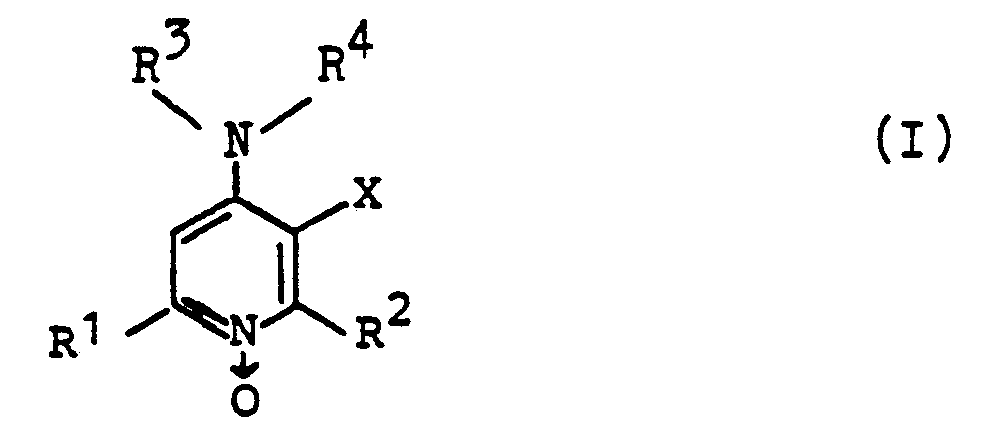
und die physiologisch verträglichen Salze dieser Verbindungen.


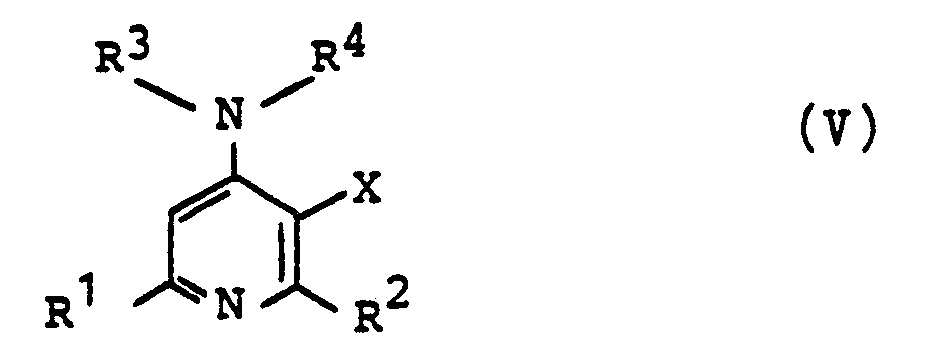
wobei man die Verbindungen der Formel I entweder in freier Form isoliert oder mit physiologisch verträglichen Säuren oder, für den Fall, daß X eine COOH-Gruppe darstellt, auch mit physiologisch verträglichen Basen physiologisch verträgliche Salze bildet.
Priority Applications (1)
| Application Number | Priority Date | Filing Date | Title |
|---|---|---|---|
| AT86902402T ATE47995T1 (de) | 1985-04-18 | 1986-04-10 | Mehrfach substituierte pyridin-1-oxide, verfahren zu ihrer herstellung, die sie enthaltenden arzneimittel und ihre verwendung. |
Applications Claiming Priority (2)
| Application Number | Priority Date | Filing Date | Title |
|---|---|---|---|
| DE19853514073 DE3514073A1 (de) | 1985-04-18 | 1985-04-18 | Mehrfach substituierte pyridin-1-oxide, verfahren zu ihrer herstellung, die sie enthaltenden arzneimittel und ihre verwendung |
| DE3514073 | 1985-04-18 |
Publications (2)
| Publication Number | Publication Date |
|---|---|
| EP0250436A1 EP0250436A1 (de) | 1988-01-07 |
| EP0250436B1 true EP0250436B1 (de) | 1989-11-15 |
Family
ID=6268515
Family Applications (1)
| Application Number | Title | Priority Date | Filing Date |
|---|---|---|---|
| EP86902402A Expired EP0250436B1 (de) | 1985-04-18 | 1986-04-10 | Mehrfach substituierte pyridin-1-oxide, verfahren zu ihrer herstellung, die sie enthaltenden arzneimittel und ihre verwendung |
Country Status (19)
| Country | Link |
|---|---|
| US (1) | US4859663A (de) |
| EP (1) | EP0250436B1 (de) |
| JP (1) | JPS62502751A (de) |
| KR (1) | KR870700605A (de) |
| AT (1) | ATE47995T1 (de) |
| AU (1) | AU586255B2 (de) |
| DE (2) | DE3514073A1 (de) |
| DK (1) | DK157924C (de) |
| ES (1) | ES8704477A1 (de) |
| FI (1) | FI874549A0 (de) |
| GR (1) | GR861002B (de) |
| HU (1) | HU199123B (de) |
| IL (1) | IL78521A (de) |
| NO (1) | NO865131L (de) |
| NZ (1) | NZ215852A (de) |
| PH (1) | PH23308A (de) |
| PT (1) | PT82416B (de) |
| WO (1) | WO1986006067A1 (de) |
| ZA (1) | ZA862875B (de) |
Families Citing this family (2)
| Publication number | Priority date | Publication date | Assignee | Title |
|---|---|---|---|---|
| GB9008818D0 (en) * | 1990-04-19 | 1990-06-13 | Ici Plc | Amine derivatives |
| TW200462B (de) * | 1990-09-27 | 1993-02-21 | Hoechst Roussel Pharma |
Family Cites Families (7)
| Publication number | Priority date | Publication date | Assignee | Title |
|---|---|---|---|---|
| NL6604123A (de) * | 1965-05-28 | 1966-11-29 | ||
| US3547935A (en) * | 1967-08-07 | 1970-12-15 | American Cyanamid Co | Certain nitro-4-pyridinols,n-oxides thereof and derivatives thereof |
| US3495969A (en) * | 1967-09-25 | 1970-02-17 | Mobil Oil Corp | Substituted nitropyridines as herbicides |
| BE786565A (fr) * | 1971-07-23 | 1973-01-22 | Upjohn Co | Nouveaux oxydes de pyridine substitues et leur preparation |
| GB1542605A (en) * | 1977-02-22 | 1979-03-21 | Bristol Myers Co | 4-tertiary-amino-2,6-diaminopyridine-1-oxides |
| DE2708058A1 (de) * | 1977-02-24 | 1978-08-31 | Bristol Myers Co | Pyridin-1-oxide, verfahren zu ihrer herstellung und daraus hergestellte arzneimittel |
| DE2900504A1 (de) * | 1979-01-08 | 1980-07-24 | Hoechst Ag | Neue substituierte 4-aminopyridine, verfahren zu ihrer herstellung und ihre verwendung als arzneimittel |
-
1985
- 1985-04-18 DE DE19853514073 patent/DE3514073A1/de not_active Withdrawn
-
1986
- 1986-04-10 AU AU58143/86A patent/AU586255B2/en not_active Ceased
- 1986-04-10 JP JP61502469A patent/JPS62502751A/ja active Pending
- 1986-04-10 AT AT86902402T patent/ATE47995T1/de active
- 1986-04-10 WO PCT/EP1986/000211 patent/WO1986006067A1/de not_active Ceased
- 1986-04-10 US US06/942,385 patent/US4859663A/en not_active Expired - Fee Related
- 1986-04-10 KR KR860700901A patent/KR870700605A/ko not_active Withdrawn
- 1986-04-10 HU HU863339A patent/HU199123B/hu not_active IP Right Cessation
- 1986-04-10 EP EP86902402A patent/EP0250436B1/de not_active Expired
- 1986-04-10 DE DE8686902402T patent/DE3666951D1/de not_active Expired
- 1986-04-16 GR GR861002A patent/GR861002B/el unknown
- 1986-04-16 IL IL78521A patent/IL78521A/xx unknown
- 1986-04-16 NZ NZ215852A patent/NZ215852A/xx unknown
- 1986-04-16 PH PH33662A patent/PH23308A/en unknown
- 1986-04-16 ES ES554054A patent/ES8704477A1/es not_active Expired
- 1986-04-17 PT PT82416A patent/PT82416B/pt not_active IP Right Cessation
- 1986-04-17 ZA ZA862875A patent/ZA862875B/xx unknown
- 1986-12-17 NO NO865131A patent/NO865131L/no unknown
- 1986-12-17 DK DK608586A patent/DK157924C/da not_active IP Right Cessation
-
1987
- 1987-10-15 FI FI874549A patent/FI874549A0/fi not_active IP Right Cessation
Also Published As
| Publication number | Publication date |
|---|---|
| DK608586A (da) | 1986-12-17 |
| DK608586D0 (da) | 1986-12-17 |
| NO865131L (no) | 1986-12-17 |
| DE3514073A1 (de) | 1986-10-23 |
| NZ215852A (en) | 1989-01-06 |
| KR870700605A (ko) | 1987-12-30 |
| FI874549A7 (fi) | 1987-10-15 |
| AU5814386A (en) | 1986-11-05 |
| ZA862875B (en) | 1986-12-30 |
| HUT47910A (en) | 1989-04-28 |
| DE3666951D1 (en) | 1989-12-21 |
| HU199123B (en) | 1990-01-29 |
| IL78521A0 (en) | 1986-08-31 |
| PT82416B (pt) | 1988-08-17 |
| ATE47995T1 (de) | 1989-12-15 |
| IL78521A (en) | 1989-09-10 |
| WO1986006067A1 (fr) | 1986-10-23 |
| ES554054A0 (es) | 1987-04-01 |
| ES8704477A1 (es) | 1987-04-01 |
| AU586255B2 (en) | 1989-07-06 |
| US4859663A (en) | 1989-08-22 |
| DK157924B (da) | 1990-03-05 |
| PT82416A (de) | 1986-05-01 |
| GR861002B (en) | 1986-08-04 |
| DK157924C (da) | 1990-08-27 |
| EP0250436A1 (de) | 1988-01-07 |
| JPS62502751A (ja) | 1987-10-22 |
| FI874549A0 (fi) | 1987-10-15 |
| PH23308A (en) | 1989-06-30 |
Similar Documents
| Publication | Publication Date | Title |
|---|---|---|
| DE60006823T2 (de) | Quinolin-derivate und deren verwendung als antibakterielle wirkstoffe | |
| DE3752201T2 (de) | Pyridin-Derivate, deren pharmazeutische Zusammenstellungen, deren Anwendung für die Herstellung von Arzneimitteln mit therapeutischem oder vorbeugendem Wert und Verfahren zu deren Herstellung | |
| DE69623358T2 (de) | Pyridoncarbonsäurederivate als antibakterielle Wirkstoffe | |
| DE3514076C2 (de) | ||
| DE69021501T2 (de) | Anti-entzündende 4-aminophenol-derivate. | |
| DE69019859T2 (de) | Chinolon-Derivate und deren Salze, Verfahren zu deren Herstellung und diese enthaltende antibakterielle Wirkstoffe. | |
| DE69722858T2 (de) | Intimale verdickungsinhibitoren | |
| EP0418797B1 (de) | Pyrimidin-4,6-dicarbonsäurediamide, Verfahren zu deren Herstellung sowie Verwendung derselben sowie Arzneimittel auf Basis dieser Verbindungen | |
| DD211555A5 (de) | Verfahren zur herstellung neuer 4-amino-6,7-dimethoxychinolin-derivate | |
| EP0183159A2 (de) | 1-Heteroaryl-4-aryl-pyrazolin-5-one zur Verwendung als Arzneimittel | |
| DE3934082A1 (de) | Chinoloncarbonsaeurederivate, verfahren zu ihrer herstellung sowie ihre verwendung als antivirale mittel | |
| EP0117403A1 (de) | 6-(Acylaminoaryl)-3(2H)-pyridazinonderivate, ihre Herstellung und Verwendung | |
| DE69127976T2 (de) | Tropolonderivate und pharmazeutische zubereitungen davon zur vorbeugung und behandlung von ischämischen krankheiten | |
| DE19513048A1 (de) | Neue 5-Pyrrolyl-6-halogen-2-pyridylmethylsulfinylbenzimidazol-Derivate | |
| DE3509333A1 (de) | Substituierte benzimidazolderivate, verfahren zu ihrer herstellung, sie enthaltende pharmazeutische zubereitungen und ihre verwendung als magensaeuresekretionshemmer | |
| DE3532279A1 (de) | 1,4-benzoxathiin-derivate | |
| DE3415971A1 (de) | Acylierte benzimidazole, verfahren zu ihrer herstellung, ihre anwendung und sie enthaltende arzneimittel | |
| DE4027592A1 (de) | Neue pyrrolobenzimidazole, imidazobenzoxazinone und imidazochinolone, verfahren zu ihrer herstellung und ihre verwendung sowie die verbindungen enthaltende zubereitungen | |
| EP0224159B1 (de) | Neue basisch substituierte Pyridinverbindungen, Verfahren zu ihrer Herstellung, die sie enthaltenden Arzneimittel und ihre Verwendung | |
| DD202563A5 (de) | Verfahren zur herstellung von 1,5-diphenylpyrazolin-3-on-verbindungen | |
| DE3781703T2 (de) | 2-benzimidazolylalkylthio(oder sulfinyl- oder sulfonyl)-derivate, verfahren zu deren herstellung und deren anwendung als arzneimittel. | |
| WO1986006067A1 (fr) | Oxydes de pyridine 1-substitues de maniere multiple, procede pour leur production, les medicaments les contenant et leur utilisation | |
| EP0013408B1 (de) | 4-Aminopyridine, Verfahren zu ihrer Herstellung und diese enthaltende Arzneimittel | |
| DE2161827A1 (de) | l-(3-Cyano-3,3-diphenylpropyl-)4phenylpiperidinderivate und Verfahren zu ihrer Herstellung | |
| EP0138034B1 (de) | Substituierte Pyrido(1,2-c)imidazo((1,2-a)benzimidazole, Verfahren zu ihrer Herstellung, ihre Verwendung sowie pharmazeutische Präparate auf Basis dieser Verbindungen |
Legal Events
| Date | Code | Title | Description |
|---|---|---|---|
| PUAI | Public reference made under article 153(3) epc to a published international application that has entered the european phase |
Free format text: ORIGINAL CODE: 0009012 |
|
| 17P | Request for examination filed |
Effective date: 19871009 |
|
| AK | Designated contracting states |
Kind code of ref document: A1 Designated state(s): AT BE CH DE FR GB IT LI LU NL SE |
|
| 17Q | First examination report despatched |
Effective date: 19890221 |
|
| GRAA | (expected) grant |
Free format text: ORIGINAL CODE: 0009210 |
|
| AK | Designated contracting states |
Kind code of ref document: B1 Designated state(s): AT BE CH DE FR GB IT LI LU NL SE |
|
| REF | Corresponds to: |
Ref document number: 47995 Country of ref document: AT Date of ref document: 19891215 Kind code of ref document: T |
|
| ITF | It: translation for a ep patent filed | ||
| REF | Corresponds to: |
Ref document number: 3666951 Country of ref document: DE Date of ref document: 19891221 |
|
| ET | Fr: translation filed | ||
| GBT | Gb: translation of ep patent filed (gb section 77(6)(a)/1977) | ||
| PGFP | Annual fee paid to national office [announced via postgrant information from national office to epo] |
Ref country code: FR Payment date: 19900322 Year of fee payment: 5 |
|
| PGFP | Annual fee paid to national office [announced via postgrant information from national office to epo] |
Ref country code: SE Payment date: 19900326 Year of fee payment: 5 |
|
| PGFP | Annual fee paid to national office [announced via postgrant information from national office to epo] |
Ref country code: LU Payment date: 19900328 Year of fee payment: 5 |
|
| PGFP | Annual fee paid to national office [announced via postgrant information from national office to epo] |
Ref country code: AT Payment date: 19900329 Year of fee payment: 5 |
|
| PGFP | Annual fee paid to national office [announced via postgrant information from national office to epo] |
Ref country code: GB Payment date: 19900331 Year of fee payment: 5 |
|
| PGFP | Annual fee paid to national office [announced via postgrant information from national office to epo] |
Ref country code: BE Payment date: 19900411 Year of fee payment: 5 |
|
| ITTA | It: last paid annual fee | ||
| PG25 | Lapsed in a contracting state [announced via postgrant information from national office to epo] |
Ref country code: LU Free format text: LAPSE BECAUSE OF NON-PAYMENT OF DUE FEES Effective date: 19900430 |
|
| PGFP | Annual fee paid to national office [announced via postgrant information from national office to epo] |
Ref country code: NL Payment date: 19900430 Year of fee payment: 5 |
|
| PGFP | Annual fee paid to national office [announced via postgrant information from national office to epo] |
Ref country code: DE Payment date: 19900618 Year of fee payment: 5 |
|
| PGFP | Annual fee paid to national office [announced via postgrant information from national office to epo] |
Ref country code: CH Payment date: 19900621 Year of fee payment: 5 |
|
| PLBE | No opposition filed within time limit |
Free format text: ORIGINAL CODE: 0009261 |
|
| STAA | Information on the status of an ep patent application or granted ep patent |
Free format text: STATUS: NO OPPOSITION FILED WITHIN TIME LIMIT |
|
| 26N | No opposition filed | ||
| PG25 | Lapsed in a contracting state [announced via postgrant information from national office to epo] |
Ref country code: GB Effective date: 19910410 Ref country code: AT Effective date: 19910410 |
|
| PG25 | Lapsed in a contracting state [announced via postgrant information from national office to epo] |
Ref country code: SE Effective date: 19910411 |
|
| PG25 | Lapsed in a contracting state [announced via postgrant information from national office to epo] |
Ref country code: LI Effective date: 19910430 Ref country code: CH Effective date: 19910430 Ref country code: BE Effective date: 19910430 |
|
| BERE | Be: lapsed |
Owner name: HOECHST A.G. Effective date: 19910430 |
|
| PG25 | Lapsed in a contracting state [announced via postgrant information from national office to epo] |
Ref country code: NL Effective date: 19911101 |
|
| GBPC | Gb: european patent ceased through non-payment of renewal fee | ||
| NLV4 | Nl: lapsed or anulled due to non-payment of the annual fee | ||
| PG25 | Lapsed in a contracting state [announced via postgrant information from national office to epo] |
Ref country code: FR Effective date: 19911230 |
|
| REG | Reference to a national code |
Ref country code: CH Ref legal event code: PL |
|
| PG25 | Lapsed in a contracting state [announced via postgrant information from national office to epo] |
Ref country code: DE Effective date: 19920201 |
|
| REG | Reference to a national code |
Ref country code: FR Ref legal event code: ST |
|
| EUG | Se: european patent has lapsed |
Ref document number: 86902402.6 Effective date: 19911108 |
|
| PG25 | Lapsed in a contracting state [announced via postgrant information from national office to epo] |
Ref country code: IT Free format text: LAPSE BECAUSE OF NON-PAYMENT OF DUE FEES;WARNING: LAPSES OF ITALIAN PATENTS WITH EFFECTIVE DATE BEFORE 2007 MAY HAVE OCCURRED AT ANY TIME BEFORE 2007. THE CORRECT EFFECTIVE DATE MAY BE DIFFERENT FROM THE ONE RECORDED. Effective date: 20050410 |