EP0248062B1 - Arzeimittel - Google Patents
Arzeimittel Download PDFInfo
- Publication number
- EP0248062B1 EP0248062B1 EP87900101A EP87900101A EP0248062B1 EP 0248062 B1 EP0248062 B1 EP 0248062B1 EP 87900101 A EP87900101 A EP 87900101A EP 87900101 A EP87900101 A EP 87900101A EP 0248062 B1 EP0248062 B1 EP 0248062B1
- Authority
- EP
- European Patent Office
- Prior art keywords
- alkylamino
- formula
- possibly
- alkyl group
- compound
- Prior art date
- Legal status (The legal status is an assumption and is not a legal conclusion. Google has not performed a legal analysis and makes no representation as to the accuracy of the status listed.)
- Expired - Lifetime
Links
Classifications
-
- A—HUMAN NECESSITIES
- A61—MEDICAL OR VETERINARY SCIENCE; HYGIENE
- A61K—PREPARATIONS FOR MEDICAL, DENTAL OR TOILETRY PURPOSES
- A61K31/00—Medicinal preparations containing organic active ingredients
- A61K31/66—Phosphorus compounds
- A61K31/683—Diesters of a phosphorus acid with two hydroxy compounds, e.g. phosphatidylinositols
- A61K31/685—Diesters of a phosphorus acid with two hydroxy compounds, e.g. phosphatidylinositols one of the hydroxy compounds having nitrogen atoms, e.g. phosphatidylserine, lecithin
-
- A—HUMAN NECESSITIES
- A61—MEDICAL OR VETERINARY SCIENCE; HYGIENE
- A61K—PREPARATIONS FOR MEDICAL, DENTAL OR TOILETRY PURPOSES
- A61K31/00—Medicinal preparations containing organic active ingredients
- A61K31/075—Ethers or acetals
- A61K31/08—Ethers or acetals acyclic, e.g. paraformaldehyde
-
- A—HUMAN NECESSITIES
- A61—MEDICAL OR VETERINARY SCIENCE; HYGIENE
- A61P—SPECIFIC THERAPEUTIC ACTIVITY OF CHEMICAL COMPOUNDS OR MEDICINAL PREPARATIONS
- A61P35/00—Antineoplastic agents
-
- C—CHEMISTRY; METALLURGY
- C07—ORGANIC CHEMISTRY
- C07F—ACYCLIC, CARBOCYCLIC OR HETEROCYCLIC COMPOUNDS CONTAINING ELEMENTS OTHER THAN CARBON, HYDROGEN, HALOGEN, OXYGEN, NITROGEN, SULFUR, SELENIUM OR TELLURIUM
- C07F9/00—Compounds containing elements of Groups 5 or 15 of the Periodic Table
- C07F9/02—Phosphorus compounds
- C07F9/06—Phosphorus compounds without P—C bonds
- C07F9/22—Amides of acids of phosphorus
- C07F9/24—Esteramides
- C07F9/2454—Esteramides the amide moiety containing a substituent or a structure which is considered as characteristic
- C07F9/2458—Esteramides the amide moiety containing a substituent or a structure which is considered as characteristic of aliphatic amines
Definitions
- alkylglycerols penetrate anti-tumor agents such as e.g. Improve cyclophosphamide through the blood-brain barrier.
- the invention relates to medicaments which are particularly suitable for the treatment of tumors.
- the medicaments according to the invention according to claim 1 have, for example, an improved action compared to the agents known from European application 108 585.
- the prerequisites for topical treatment on the part of the active ingredient to be used are tolerance on the skin, cytotoxic activity against tumor cells and sufficient deep penetration.
- the aim of the invention is therefore primarily to provide a medicament which is suitable for the topical treatment of tumors.
- Another object of the invention is, more generally, in others
- a medicament which is characterized in that it contains at least one compound of the general formula I or I 'according to claims 1 or 2 as active ingredient (a) or a physiologically tolerable salt thereof, and as active ingredient (b) an alkylglycerol of the general formula II in which one of the radicals R3 and R4 is an alkyl group having 2 to 12 carbon atoms and the other radical is an H atom, optionally together with conventional pharmacological additives and diluents.
- Preferred active substances for component (a) are: hexadecylphosphocholine, oleylphosphocholine, hexadecylphosphoric acid (N, N) bis (2-chloroethyl) amide.
- Formulas I and I ' also include the possible enantiomers and diasteromers. If the compounds are racemates, they can be split into the optically active isomers in a manner known per se, for example by means of an optically active acid. However, enantiomeric or optionally diastereomeric starting materials are preferably used from the outset, in which case a corresponding pure optically active or diastereomeric compound is then obtained as the end product.
- R is preferably an alkyl group of the specified chain length, which is linked to the oxygen of the glycol residue via a terminal C atom or else via a C atom within the alkyl chain (for example via the C atom 2 or C atom 3 or another medium carbon atom).
- This alkyl chain can be straight-chain or branched.
- the alkyl chain R can be one contain two or three carbon double bonds or triple bonds, which can also be mixed, and / or have halogen substituents. Suitable halogen atoms are: fluorine, chlorine or bromine. One to three such halogen atoms can be present in the chain R, where these can be located on one or on different C atoms of the radical R.
- Substituents R which contain an alkyl radical having 14 to 20, preferably 15 to 20, in particular 16 to 20 C atoms or a corresponding alkenyl radical having 14 to 20, preferably 15 to 20, in particular 16 to 20, carbon atoms are particularly preferred.
- halogen-substituted radicals R are: Chlorhexadecyl, bromhexadecyl, fluorohexadecyl, 9,10-dibromoctadecyl, 2,3-dibromoctadecyl, 15,16-dibromohexadecyl, bromotetradecyl.
- unsaturated radicals R are: 9-octadecenyl radical (oleyl alcohol radical, in particular in formula I or I 'R means this 9-octadecenyl radical), 15-hexadecenyl radical, 9,12-octadecadienyl radical (linoleyl radical).
- saturated and unsubstituted radicals R are: tetradecyl radical, hexadecyl radical, octadecyl radical.
- R1 or R2 represent an unsubstituted alkyl group, this consists for example of 1-6, preferably 1-4 carbon atoms. If R1 or R2 is an unsaturated alkyl group, it consists in particular of 3 to 6 carbon atoms, with at least one simple CC bond being present between the unsaturated function of such an unsaturated alkyl group and X. In particular, it is C3-C6 alkenyl groups. Examples include: allyl, butenyl, pentenyl, hexenyl.
- R1 or R2 are substituted, it is in particular straight-chain alkyl or alkenyl radicals, preferably R1 in this case consists of 2-6 C atoms, the substituents given preferably in the ⁇ -position of the alkyl or alkenyl group R1 or R2 stand; for example, it is the ethyl or straight propyl radical with one of the specified substituents in the ⁇ position (ie in the 2 position with ethyl and the 3 position with propyl).
- R1 is a 2-tert-butyloxycarbonylaminoethyl radical or a 2-tert-butyloxycarbonylethyl radical, it is preferably the D or L form.
- the trialkylammoniumethyl radicals are preferred when X is an oxygen atom, the trialkyl radicals preferably each consisting of one, two or three carbon atoms, preferably methyl groups.
- the trimethylammonium-ethyl radical is therefore particularly preferred.
- the compounds of the formula I are phosphatidylcholine derivatives.
- the 2,3-dihydroxy-propyl (1) group is in particular the sn-1,2-dihydroxy-propylamino (3) structure or the sn-2,3-dihydroxy-propylamino ( 1) structure.
- component (a) according to formula I 'according to claim 2 are new compounds. Of these new compounds, the following are preferably suitable as active substances according to the invention:
- Oleyl-phospho- (N, N, N-trimethyl) propanolamine Oleyl-phospho- (N, N, N-trimethyl) butanolamine, Oleyl-phospho- (N, N, N-trimethyl) pentanolamine, Oleylphosphoserine, oleylphosphoethanolamine, Oleyl-phosphopropanolamine, oleyl-phosphobutanolamine, Oleyl phosphoglycerol, hexadecyl phospho (N, N, N-trimetyl) propanolamine.
- salts are inner salts in question (for example when R1 is a trimethylammonio-alkyl group) or salts with physiologically compatible cations.
- the medicaments or compounds according to the invention can be present as internal salts, for example if R 1 contains an amino group. If there are no internal salts, or the radical R 1 does not contain a basic group, the negative charge of the phosphoric acid group is saturated by a physiologically compatible cation.
- Such physiologically compatible cations are: alkali cations (Na, K), alkaline earth cations (Mg, Ca) or the cations of organic amines, such as guanidinium, morpholinium, cyclohexylammonium cations, ethylenediammonium cations, piperazonium cations (one or both in the latter cases dibasic) or the cation which is derived from an amine of the formula NR a R b R c , in which the radicals R a to R c are the same or different and are hydrogen, C1-C2-alkyl groups or oxyethyl groups.
- cations which are derived from an amine of the formula NR a R b R c it is preferably the ammonium cation or an ammonium cation substituted with one to three C1-C2-alkyl groups or an ammonium cation substituted with one to three 2-hydroxyethyl groups.
- the active compounds according to the general formula I or I ' can be prepared by methods known per se.
- the basic structure can easily be obtained by reacting a compound of the formula ROH or a functional derivative thereof with phosphorus oxychloride and triethylamine, reacting the product with a compound HXR 1 and acidic cleavage, where R, R 1 and X have the meaning given above.
- protective groups are, for example, acyl groups which can be easily solvolytically removed or groups which can be removed by hydrogenation.
- the solvolytically removable protective groups are, for example, by saponification with dilute acids (for example acetic acid, perchloric acid, hydrochloric acid, sulfuric acid, formic acid, trifluoroacetic acid). or by means of basic substances (potash, soda, aqueous alkali solutions, alcoholic alkali solutions, NK3) at temperatures between -50 and 150 ° C, in particular between 0 and 100 ° C, split off.
- Hydrogen-releasable groups such as arylalkyl radicals (benzyl radical) or hydroxycarbonyl radicals (carbobenzoxy radical) are expediently catalytically hydrogenated in the presence of customary hydrogenation catalysts (noble metal catalysts), in particular palladium catalysts or else platinum catalysts (platinum oxide), Raney nickel, in a solvent or suspending agent, if appropriate increased pressure, (for example 1-50 bar) at temperatures split off between 20 - 150 ° C, especially 30 - 100 ° C, preferably 40 - 80 ° C.
- customary hydrogenation catalysts noble metal catalysts
- Suitable solvents or suspending agents for the removal of such protective groups are: water, lower aliphatic alcohols, cyclic ethers such as dioxane or tetrahydrofuran, aliphatic ethers, halogenated hydrocarbons, dimethylformamide and mixtures of these agents.
- Protective groups which can be split off by hydrogenolysis are: benzyl radical, ⁇ -phenylethyl radical, benzyl radicals substituted in the benzene nucleus (p-bromo or p-nitrobenzyl radical), carbobenzoxy radical, carbobenzthio radical, tert.-butyloxycarbonyl radical.
- radicals which can be eliminated hydrolytically are: trifluoroacetyl radical, phthalyl radical, trityl radical, p-toluenesulfonyl radical, tert-butyloxycarbonyl radical, tert-butyl radical and dimethylmethylene radical and lower alkanoyl radicals such as acetyl radical, formyl radical and tert-butylcarboxy radical.
- the protective groups customary in peptide synthesis and the cleavage processes customary there are suitable.
- the carbalkoxy group (for example low molecular weight) can also be used.
- the OZ (preferably this is OCH3) is split off, for example, with alkali bromides or alkali iodides, lower alkylmagnesium halides or with primary, secondary or tertiary amines, in particular the corresponding lower alkylamines, such as, for example, tertiary C1-C6alkylamines (trimethylamine).
- Possible alkali bromides or alkali iodides are: lithium bromide, sodium bromide, lithium iodide, sodium iodide.
- suitable lower alkylmagnesium halides are: methylmagnesium iodide, methylmagnesium bromide (in this case, solvents are lower aliphatic ethers, such as diethyl ether).
- the group OZ is split off from a compound of the formula III at temperatures between 10 and 150 ° C., preferably 10 and 80 ° C., in particular 50 and 80 ° C., the reaction product obtained up to that point being removed after removal of the solvents in an inert medium dissolves.
- inert agents come into question: saturated aliphatic C3-C8 ketones (ethyl methyl ketone, diethyl ketone, acetone), cyclic ethers, non-cyclic lower aliphatic ethers (for example diethyl ether).
- 1.5 to 3 mol of the abovementioned splitting agents, preferably 2 mol, are used per 1 mol of the compound III used.
- reaction of products obtained with ammonia or an amine of the formula NR3R4R5 takes place at temperatures between 10 and 200, preferably 20 and 150 ° C, in particular 40 and 80 ° C with or without solvent.
- Aromatic hydrocarbons such as, for example, pentane, hexane, heptane, benzene, mesitylene, toluene, xylene; lower aliphatic ketones such as acetone, methyl ethyl ketone; halogenated hydrocarbons: chloroform, trichlorethylene, carbon tetrachloride, chlorobenzene, methylene chloride; cyclic ethers: tetrahydrofuran and dioxane; lower aliphatic noncyclic ethers (diethyl ether, diisopropyl ether); lower aliphatic alcohols (1-6 C atoms): methanol, ethanol, isopropanol, amyl alcohol, butanol, tert-butanol; Amides and N-alkyl-substituted amides of aliphatic C1-C4 carb
- the individual alkyl radicals of the solvents given above contain, for example, 1-6, in particular 1-4, carbon atoms. Mixtures of these agents as well Mixtures with water can be used as the reaction medium.
- the reaction is carried out, for example, at temperatures from 0 to 200 ° C., preferably 20 to 150 ° C. or also 50 to 120 ° C. If a solvent or dispersion medium is used, one often works at the reflux temperature of this medium.
- This amination reaction is expediently carried out in the presence of basic substances.
- basic substances alkali hydroxides, alkali carbonates, tertiary amines.
- the alkylation of free amino groups in the radicals R1 and / or R2 takes place at temperatures between 0 and 200, preferably between 20 and 150, in particular 20 and 80 ° C.
- This alkylation takes place, for example, by reaction with compounds of the formula R'Hal, ArSO2OR ' and SO2 (OR'3) 2, where Hal is a halogen atom (especially chlorine, bromine or iodine) and Ar is an aromatic radical (for example a phenyl or naphthyl radical optionally substituted by one or more lower alkyl radicals and R 'is a C1-C6- Examples are p-toluenesulfonic acid-C1-C6-alkyl esters, C1-C6-dialkyl sulfates, C1-C6-alkyl halides ..
- the alkylation reaction is optionally carried out with the addition of customary acid-binding agents, such as alkali metal hydroxides, alkali metal carbonates, alkali metal bicarbonates, alkaline earth metal carbonates, alkali metal alkali metal carbonates, alkali metal alkali metal carbonates, alkali metal alkali metal carbonates, alkali metal alkali metal carbonates, alkali metal alkali metal carbonates, alkali metal alkali metal carbonates Amines (for example trialkylamine such as triethylamine), pyridine or alkali hydrides in inert solvents or suspensions Suitable solvents or dispersants are: aromatic hydrocarbons such as benzene, toluene, xylene; aliphatic ketones such as acetone, methyl ethyl ketone; halogenated hydrocarbons such as chloroform, carbon tetrachloride, chlorobenzene, methylene chloride; aliphatic ethers such
- Aqueous mixtures of the solvents mentioned can also be used will. One often works at the reflux temperature of the solvents or dispersants used.
- the alkylation reaction components are frequently used in excess.
- the alkylation can also be carried out in the presence of tetraalkylammonium salts (especially the halides) in combination with alkali metal hydroxides at temperatures between 0-100 ° C., preferably 20-80 ° C. in an aprotic solvent or in chloroform or methylene chloride.
- Suitable aprotic solvents are in particular: tertiary amides (dimethylformamide, N-methyl-pyrrolidone, hexamethylphosphoric triamide), dimethyl sulfoxide, acetonitrile, dimethoxyethane, acetone, tetrahydrofuran.
- the active ingredients contained in the medicament according to the invention for component (a) of the general formula I or I ' are partly new and have a pronounced cytotoxic activity, which was demonstrated both in vivo on chemically induced rat carcinoma and in vitro on leukemia cells in cell culture.
- skin metastases were brought to complete healing with topical application.
- Such a mixture is also referred to below as a cascade.
- the content of compound of general formula I or I 'in mg / ml cascade is denoted by a subsequent index, such that, for example, a cascade mixture which contains 5 mg / ml compound of formula I or I' as a cascade5, a mixture with 200 mg of compound of formula I or I 'per ml of cascade is referred to as Kaskade200.
- the preparation of the alkylglycerols is known, for example from DE-OS 33 43 530.8.
- alkylglycerol-water mixtures which contain, for example, nonylglycerol, octylglycerol, hexylglycerol, pentylglycerol, propylglycerol and ethylglycerol are preferred.
- Such aqueous mixtures preferably contain 3 of the glycerol ethers mentioned, namely a lower (ethyl, propyl), a medium (petnyl, hexyl) and a higher (nonyl, octyl), the amount by weight of the lower ether being approximately as large as the sum of the Amounts by weight of the other two glycerol ethers.
- the amount of water is about the same as the amount of the lower glycerol ether, and is, for example, half the total amount of the glycerol ethers present. Examples of such glycerol ether-water mixtures are listed below:
- the pharmaceuticals according to the invention are particularly suitable for topical application.
- the affected skin areas are rubbed two to three times a day, for example with Kaskade K to Kaskade200. So far, harmful side effects could occur not observed, not even in patients treated for 3 months.
- the remission of the skin metastases is accompanied by normalization of the skin, as was clearly demonstrated by tissue sections. Several patients with skin metastases were treated in this way and a complete disappearance of the breast carcinoma skin metastases was observed.
- the topical treatment with the agent preferred according to the invention in the formulation Kaskade5 to Kaskade200 can also be used for the treatment of internal tumors or metastases by rubbing the skin over a large area. Therapeutically effective blood levels are achieved through absorption through the skin.
- An advantage of this type of application is that the preparations Kaskade5 to Kaskade200 are easily tolerated by the skin.
- This preferred method of preparation of the medicament according to the invention in the form of the solutions Kaskade5 to Kaskade200 is also well suited for the production of suppositories for rectal introduction. Internal tumors and internal metastases can also be treated well with this.
- Another type of application of the medicament according to the invention is instillation into preformed body cavities.
- This type of application is particularly suitable for pleural cancers, malignant ascites, malignant pericardial effusions and bladder cancers.
- the antitumor agents according to the invention of the general formula I are used either alone or in conjunction with conventional carriers and diluents, in particular also with a cascade.
- oral or intravenous administration can be considered.
- the compounds of general formula I are expediently used in the form of a drinking solution.
- Milk, cocoa, fruit juice or drinking water are suitable carriers.
- Such a drinking solution can be prepared, for example, by diluting a concentrated alcoholic solution of a compound of the formula I or I 'according to Claims 1 and / or 2 with water or another of the aforementioned agents.
- rats daily doses of 20, 40 and 60 mg / kg body weight resulted in complete remission of chemically induced breast cancer when hexadexylphosphocholine and oleylphosphocholine were used.
- These compounds proved to be more effective and better tolerated than 1-octadecyl-2-methyl-rac-glycero-3-phosphochloline.
- the tumor model used for these experiments is a so-called hard model. This means that the findings made on this model can also be transferred to the human situation.
- the compounds of the formula I or I ' are expediently used in physiological saline.
- Other infusion solutions can also be used. Human dose for such solutions is, for example, 1-10 mg / kg body weight.
- Another carrier mixture for the compounds of the formula I or I ' which has proven particularly useful, consists of a mixture of about 4 parts by weight of water, 4 parts by weight of propylglycerol and 2 parts by weight of hexylglycerol and nonylglycerol.
- the topical application of the medicament according to the invention in the particularly preferred preparation form Kaskade5 to Kaskade200 over a period of several months showed that the local toxicity is limited to an increased desquamation of the skin, similar to the local application of acetylsalicylic acid.
- the invention thus provides a new drug for the treatment of tumors and not only provides another anti-tumor agent at all, but for the first time introduces an agent which has been proven to be effective even when applied topically in clinical trials. This opens up new possibilities for the treatment of tumor patients.
- At least one compound of the formula I or I ' is processed with customary pharmaceutical carriers and / or diluents or other auxiliaries to give pharmaceutical preparations or brought into a form which can be used therapeutically.
- the mixture obtained by mixing compounds of the formula I or I 'with one or more of the following substances: starch, cellulose, lactose, formalin-casein, modified starch, magnesium stearate, calcium hydrogen phosphate, finely divided silica, talc, phenoxyethanol, the mixture obtained , optionally granulated with an aqueous solution containing at least gelatin, starch, polyvinylpyrrolidone, vinylpyrrolidone-vinyl acetate copolymer and / or polyoxyethylsorbitan monooleate, the granules are optionally homogenized with one or more of the above-mentioned auxiliaries, and this mixture is compressed into tablets or in Fills capsules, such tablets or capsules each containing 5 to 2000 mg of active ingredient of the formula I or I 'in the dosage unit; or that compounds of the formula I or their salts are suspended and homogenized in molten hard fat at temperatures between 33-37 ° C.
- the dosage unit containing 5 to 2000 mg of active ingredient and optionally 0.1-0.5 part by weight of phenoxyethanol (based on one part by weight of compound I or I '); or that compounds of the formula I or I 'or their salts at a temperature between 50 to 120 ° C, preferably 50 to 100 ° C, optionally in the presence of one or more emulsifiers and / or 0.1-0.5 parts by weight of phenoxyethanol ( based on a part by weight of compound I or I ') with at least one of the following substances homogenized: paraffin, petroleum jelly, aliphatic alcohol with 12 to 25 C atoms, aliphatic monocarboxylic acid with 15 to 20 C atoms, sorbitan monopalmitate, polyoxyethylene polyol fatty acid ester, and the mixture obtained between 50 and
- suitable emulsifiers are: nonionogenic emulsifiers and ionogenic emulsifiers.
- the nonionic emulsifiers are, for example, triglyceride mixtures of saturated vegetable fatty acids with C8, C10 and C12 or emulsifiers based on polyadducts of ethylene oxide, such as, for example, alkyl- and acyl-substituted polyadducts of ethylene oxide, polyethylene glycol-fatty acid ester products, reaction with ethylene glycol or hydrogenated castor oil, esters of hydrogenated castor oil fatty acids with oxyethylated glycerol.
- emulsifiers based on fatty acid amides or fatty acid condensation products with hydrophilic groups can be involved.
- ionogenic emulsifiers are emulsifiers based on fatty acid monoesters of glycerin or other polyhydric alcohols (Lunacera alba) in question.
- the active compounds of the formula I or I ' are mixed with 1 to 30, preferably 2 to 20 parts by weight (based in each case on one part by weight of compound I or I') of at least one glycerol ether of the formula II or a mixture of such glycerol ethers and, if appropriate, 0.5 - 30, preferably 1 - 20 parts by weight of water (also based on a part by weight of compound I or I ') used.
- This mixing with the glycerol ethers can take place at the beginning in the production of the corresponding medicaments, but optionally also at a later production stage.
- the compounds of the formulas I and I ' show, for example, a good action on rat 7,12-dimethylbenzanthracene-induced breast cancer; also on the methyl nitrosourea-induced mammary carcinoma of the rat.
- the tumors stopped growing at a dose of 10 mg / kg of body weight in rats, and at higher doses the tumors completely disappeared.
- the lowest, already effective dose in the animal experiment given above is 5 mg / kg orally 5 mg / kg intravenously.
- the following can be used as a general dose range for the effect (animal experiment as above): 5 - 50 mg / kg orally, especially 15 - 32 mg / kg 5 - 50 mg / kg intravenously, especially 15 - 32 mg / kg.
- the direction of action of the compounds according to the invention is comparable to the action of the known active pharmaceutical ingredient TAMOXIFEN, but there are in particular the following differences: The action is stronger and longer than that of TAMOXIFEN.
- Indications for which the compounds according to the invention can be considered breast cancer and other human cancers.
- the pharmaceutical preparations generally contain between 5-2000 mg, for example 10-400 mg, of the active components according to the invention.
- the administration can take place, for example, in the form of tablets, capsules, pills, dragées, suppositories, ointments, jellies, creams, powders, dusting powder, aerosols or in liquid form.
- Possible liquid application forms are, for example: oily or alcoholic or aqueous solutions as well as suspensions and emulsions.
- Preferred forms of use are tablets which contain between 40 and 400 mg or solutions which contain between 0.1% and 5% of active substance.
- 1 tablet containing 40 - 400 mg of active substance 3 times a day or, for example, for intravenous injection, 1 - 5 times a day, an ampoule of 1 - 5 ml content with 50 - 250 mg of substance are recommended.
- the minimum daily dose is, for example, 120 mg; the maximum daily dose for oral administration should not exceed 100 mg / kg body weight.
- the acute toxicity of the compounds according to the invention on the mouse is, for example, between 200 when administered orally and 450 mg / kg body weight.
- the medicinal products can be used in human medicine, veterinary medicine and agriculture alone or in a mixture with other pharmacologically active substances.
- Hexadecylphosphoethanolamine (phosphorylation, ring closure and ring opening)
- Hexadecanol (1 mol, 243 g) and triethylamine (1.8 mol, 180 g) are dissolved in 1.5 l of THF (tetrahydrofuran) and added dropwise to a strongly stirred solution of phosphorus oxychloride (1.2 mol, 184 g) in 120 ml of THF is added so that the temperature in the reaction vessel (three-necked, 5 l, with dropping funnel, thermometer and stirrer) does not exceed 10 ° C.
- the reaction vessel is cooled with an ice-salt mixture.
- the reaction is completed immediately after the dropwise addition (detection by DSC in ether: Rf values of 0.8 for the starting product and 0.0 for the reaction product after hydrolysis with water).
- the ring opening is completed after 15 minutes (detection by DSC in ether: Rf value 0.0; DSC in chloroform / methanol / acetic acid / water 100: 60: 20: 5 by volume: RF value 0.8).
- the mixture is cooled to -20 ° C. and the precipitate, which consists of largely pure hexadecylphosphoethanolamine, is filtered off. If there is slight contamination, a chromatographic cleaning is connected (see example 2).
- Microanalysis MW 365.50: calc. (%): C 59.15 H 11.03 N 3.83 P 8.48 found (%): 59.01 10.95 3.79 8.31
- the crystals obtained according to Example 1 are taken up in 1.2 l of 2-propanol and 0.4 l of dichloromethane without further purification.
- Potassium carbonate (4 mol, 560 g) in 1 l of water is added to the suspension of the crystals with vigorous stirring.
- Dimethyl sulfate (4 mol, 500 g) is added dropwise to the two-phase reaction mixture with stirring so that the temperature does not exceed 40 ° C.
- the reaction is complete 60 minutes after the dropping (detection by DSC in chloroform / methanol / 25% ammonia 50: 50: 5 by volume: Rf value 0.3).
- the solvent is removed on a rotary evaporator under vacuum and the viscous residue is chromatographed on silica gel (Merck Art. 7733, silica gel 60, particle size 0.2 to 0.5 mm).
- Silica gel 2 kg, are mixed with chloroform / methanol / 25% ammonia (200/15/1 per vol.) And filled into a chromatography column.
- the viscous oil is dissolved in 800 ml of the above solvent mixture and the crude product is added to the column (insoluble constituents are filtered off beforehand).
- the product is finally eluted with chloroform / methanol / 25% ammonia (50/50/5 by volume).
- the combined eluates are spun in and the remaining water is removed with toluene.
- the residue is taken up in 600 ml of dichloromethane and mixed with 4 l of acetone.
- Corresponding phosphoethanolamines and phosphocholines were prepared using tetradecanol, octadecanol, eicosanol, oleyl alcohol, cis-11-hexadeun-1-ol and dodecanol.
- the phosphorylation step is carried out as in Example 1.
- the reaction mixture is mixed with methanol (10 mol; 320 g) and triethanolamine (1.8 mol; 180 g) 20 ° C offset.
- the methanolysis is complete after 30 minutes. 1.51 hexane and 1.51 water are added, the mixture is shaken well and the solvent is removed from the hexane phase.
- the oily residue is refluxed with LiBr (2 mol; 174 g) in 1.51 ethyl methyl ketone. After an hour, the reaction is complete.
- the solvent is removed, taken up in a mixture of 1 liter of methanol / water / chloroform, shaken well and the lower chloroform phase containing the product is isolated.
- allyl ester was prepared accordingly. Furthermore, methyl and allyl phosphoric acid esters of the following alcohols were prepared by the process described: tetradecanol, hexadecanol, octadecanol and eicosanol.
- Hexadecylphosphohexyl ester, sodium salt x 1H2O phosphorylation with phosphorus oxychloride, phosphorylation with hexadecylphosphoric dichloride, methanolysis, cleavage with LiBr
- alkyl esters were prepared by this process: hexadecylphosphobutyl, octyl, decyl and dodecyl esters.
- Hexadecylphosphoglycol ester, sodium salt x 1H2O phosphorylation, ring closure with glycol, ring opening
- the phosphorylation is carried out as described in Example 1.
- the reaction mixture is further reacted directly with dropwise addition of ethylene glycol (1.5 mol, 93 g) and triethanolamine (1.8 mol, 180 g) in 1.5 l THF.
- the temperature is increased to 60 ° C to complete the ring formation.
- the reaction is complete after 2 hours at this temperature.
- the precipitated triethylamine hydrochloride is filtered off through a process frit and 1.5 l of water are added to the filtrate with vigorous stirring at 20.degree.
- the hydrolysis is complete after 2 hours.
- the solvent is removed from the upper THF phase by spinning in a vacuum.
- glycol esters were prepared analogously: tetradecylphosphoglycol esters, octadecylphosphoglycol esters, oleylphosphoglycol esters.
- the phosphorylation is carried out as described in Example 1, as is the ring closure.
- 1 l of 1 M potassium carbonate solution in water is added to the filtrate with vigorous stirring.
- the ring opening is complete after 1 hour.
- the solvent is removed in the upper THF phase, taken up in a mixture of 1 liter of chloroform / methanol / semi-saturated NaCl solution, shaken well and the chloroform phase is separated off. After removing the solvent, the product is chromatographed on silica gel and purified. Microanalysis (MG 405.50) calc. (%): C 53.32 H 10.19 N 3.46 P 7.64 found (%): 53.26 10.01 3.21 7.59
- Hexadecylphosphoglycerin, sodium salt + H2O phosphorylation with phosphorus oxychloride, phosphorylation with the resulting phosphoric acid dichloride, methanolysis, LiBr cleavage, hydrolysis in 70% acetic acid
- the phosphorylation corresponds to Example 1.
- the reaction mixture is further reacted directly in dropwise addition of 1,2-isopropylidene-glycerol (1.5 mol, 198 g) and triethylamine (1.8 mol, 180 g) in 1.5 l THF.
- the temperature is increased to 30 ° C after the dropping.
- the reaction is complete after two hours.
- Methanolysis is carried out according to Example 5, as is the LiBr cleavage.
- the reaction product, sodium salt is taken up in 2 liters of 70% acetic acid and heated to 60 ° C.
- the resulting acetone is removed in a slight vacuum (water jet vacuum).
- the reaction is complete after 2 hours. 2 l of water are added and the mixture is extracted with 2 l of chloroform.
- glycerol esters were prepared analogously: tetradecyl, octadecyl, oleylphosphoglycerol.
- Hexadecylphosphoric acid N, N bis (chloroethyl) amide, Na salt + H2O (phosphorylation with phosphorus oxychloride, amide formation with bis (chloroethyl) amine, hydrolysis)
- the phosphorylation step corresponds to Example 1.
- the reaction mixture is reacted directly with the dropwise addition of bis (chloroethyl) amine in 1.0 l of THF.
- triethylamine 0.4 mol, 40 g
- the reaction is complete after 3 hours at 20 ° C.
- the precipitated triethylamine hydrochloride is separated off over a porcelain frit and the filtrate is mixed with vigorous stirring with 1 l of 1M acetic acid for the hydrolysis.
- the upper THF phase is separated off, freed from the solvent and taken up in 1 liter of chloroform / methanol / 0.5 M sodium carbonate.
- Example of a solution 25 g of 1-n-propyloxy-2,3-propanediol, 12.5 g of 1-n-hexyloxy-2,3-propanediol, 12.5 g of 1-n-nonyloxy-2,3-propanediol, 44 g of water and 1 g of phenoxyethanol is mixed and 5 g of hexadecylphosphocholine are dissolved in this mixture. The solution is freed from visible particles by filtration through suitable filters. 1 g solution contains 50 mg hexadecylphosphocholine.
- Example of an ointment 5 g of substance hexadecylphosphoglycerin are suspended in 35 g of viscous paraffin, 30 g of emulsifying cetylstearyl alcohol and 30 g of white petroleum jelly are added and melted. This melt is stirred until it cools down. A homogeneous active ingredient distribution is achieved by processing the cooled melt using a suitable homogenizing device (for example a three-roll mill). 1 g of the hydrophilic salts contains 50 mg of hexadecylphosphoglycerin.
- Example of an emulsion 11.83 g of 1-n-propyloxy-2,3-propanediol, 5.91 g of 1-n-hexyloxy-2,3-propanediol, 5.91 g of 1-n-nonyloxy-2,3-propanediol, 20 35 g of water and 1.0 g of phenoxyethanol are mixed and 5 g of hexadecylphosphocholine are dissolved in this mixture. 30 g of white petroleum jelly, 15 g of cetyl alcohol and 5 g of sorbitan monopalmitate are melted on a water bath, heated to 70 ° C.
- Example for capsules 1.25 kg of hexadecylphosphoglycerol are dissolved in 5 kg of chloroform and 1.25 kg of Aerosil are suspended in this solution. The solvent is then removed in vacuo. The dry mass is passed through a 1 mm sieve and dried again in vacuo at 30 ° C. to remove any remaining solvent residues. These granules are filled in a known manner on a suitable capsule machine in gelatin hard capsules of size 00 to 500 mg. One capsule contains 250 mg hexadecylphosphoglycerin.
- Example for a lyophilisate 500 g of mannitol are dissolved in 3 liters of water for injection purposes under nitrogen gassing, 50 g of hexadecylphosphoglycerin are dispersed with the aid of a high-speed homogenizer and made up to 4 liters with water for injection purposes. This milky dispersion is converted into a slightly opalescent colloid-disperse system by ultrasound treatment or with the aid of a gap homogenizer. Under aseptic conditions, a membrane filter with a pore size of 0.22 ⁇ m is then sterile filtered and filled to 40 ml in 100 ml injection bottles under nitrogen gassing.
- the bottles are provided with freeze-drying stoppers and lyophilized in a suitable system. After drying, gassing is carried out with sterile, dried nitrogen and the bottles are closed in the system. The plugs are secured with a crimp cap.
- the lyophilisate is reconstituted in 100 ml of water for injections. 1 bottle contains 500 mg hexadecylphosphoglycerin.
Landscapes
- Health & Medical Sciences (AREA)
- Chemical & Material Sciences (AREA)
- Life Sciences & Earth Sciences (AREA)
- General Health & Medical Sciences (AREA)
- Public Health (AREA)
- Medicinal Chemistry (AREA)
- Veterinary Medicine (AREA)
- Organic Chemistry (AREA)
- Pharmacology & Pharmacy (AREA)
- Animal Behavior & Ethology (AREA)
- Epidemiology (AREA)
- Molecular Biology (AREA)
- Biochemistry (AREA)
- Nuclear Medicine, Radiotherapy & Molecular Imaging (AREA)
- General Chemical & Material Sciences (AREA)
- Chemical Kinetics & Catalysis (AREA)
- Pharmaceuticals Containing Other Organic And Inorganic Compounds (AREA)
- Acyclic And Carbocyclic Compounds In Medicinal Compositions (AREA)
- Medicines Containing Material From Animals Or Micro-Organisms (AREA)
- Medicines That Contain Protein Lipid Enzymes And Other Medicines (AREA)
- Organic Low-Molecular-Weight Compounds And Preparation Thereof (AREA)
- Medicinal Preparation (AREA)
- Heterocyclic Carbon Compounds Containing A Hetero Ring Having Nitrogen And Oxygen As The Only Ring Hetero Atoms (AREA)
- Nitrogen Condensed Heterocyclic Rings (AREA)
- Respiratory Apparatuses And Protective Means (AREA)
- Transition And Organic Metals Composition Catalysts For Addition Polymerization (AREA)
- Adhesives Or Adhesive Processes (AREA)
- Electrically Operated Instructional Devices (AREA)
- Ultra Sonic Daignosis Equipment (AREA)
- Measurement And Recording Of Electrical Phenomena And Electrical Characteristics Of The Living Body (AREA)
- Steroid Compounds (AREA)
Description
- Die Europa-Anmeldung 108 565 betrifft Verbindungen der Formel

worin R¹ ein aliphatischer C₈-C₃₀-Kohlenwasserstoffrest ist und R², R³ und R⁴ Wasserstoff oder niedere Alkylreste sind oder die Gruppe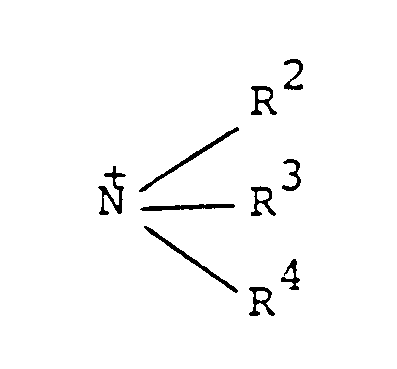
einen cyclischen Ammoniumrest bedeutet, und n = 0 oder 1 ist. Für diese Verbindungen wird angegeben, daß sie die Vermehrung von Tumorzellen hemmen und die Lebenszeit von warmblütigen Tieren, welche Tumore haben, verlängern; außerdem wird eine antifungide Wirkung erwähnt. - Eine Arbeit von Unger et al. (Klin. Wochenschr. 63 (1985), 565-571) offenbart, daß Alkylglycerine die Penetration von Antitumormitteln wie z.B. Cyclophosphamid durch die Blut-Hirn-Schranke verbessern.
- Die Erfindung betrifft Arzneimittel, welche sich besonders zur Behandlung von Tumoren eignen.
- Die erfindungsgemäßen Arzneimittel gemäß Anspruch 1 besitzen zum Beispiel gegenüber den Mitteln, die aus der Europa-Anmeldung 108 585 bekannt sind, eine verbesserte Wirkung.
- Es ist bekannt, daß bisher kein in jeder Hinsicht zufriedenstellendes Arzneimittel zur Behandlung von Tumoren, insbesondere von bösartigen Tumoren, zur Verfügung steht. So ist beispielsweise zur topischen Behandlung von Hautmetastasen bei Patienten mit metastasierenden Tumoren derzeit lediglich 5-Fluorouracil verfügbar. Weiterentwicklungen anderer Cytostatika sind für diese Applikationsart bisher nicht bis zur Klinikreife verfolgt worden. Andererseits ist aus klinischer Sicht ein solches Konzept im palliativen Therapieansatz besonders erwünscht, da alternative Behandlungskonzepte wie chirurgische Maßnahmen, Strahlentherapie und systemische Chemotherapie, vergleichsweise aggressive Therapiemodalitäten darstellen. Außerdem liegt eine beträchtliche Zahl von Patienten als potentielle Behandlungskandidaten für eine solche topische Behandlung vor. So beträgt z. B. der Anteil der Mamma-Karzinom-Patienten, die einen Hautbefall aufweisen, etwa 25 bis 35 %.
- Die Voraussetzung zur topischen Behandlung seitens des einzusetzenden Wirkstoffes sind Verträglichkeit auf der Haut, cytotoxische Wirksamkeit gegen Tumorzellen und ausreichende Tiefenpenetration.
- Ziel der Erfindung ist daher in erster Linie, ein Arzneimittel zu schaffen, welches zur topischen Behandlung von Tumoren geeignet ist. Ein weiteres Ziel der Erfindung ist es darüberhinaus, ein generell auch in anderen
- Applikationsformen anwendbares Arzneimittel zu schaffen, welches eine gute Wirksamkeit gegen Tumoren mit geringer Toxizität verbindet und daher allgemein in der Tumortherapie einsetzbar ist.
- Diese Aufgaben werden erfindungsgemäß gelöst durch ein Arzneimittel, welches dadurch gekennzeichnet ist, daß es als Wirkstoff (a) wenigstens eine Verbindung der allgemeinen Formel I beziehungsweise I' gemäß den Ansprüchen 1 bzw. 2

oder ein physiologisch verträgliches Salz hiervon, und als Wirkstoff (b) ein Alkylglycerin der allgemeinen Formel II
in der einer der Reste R₃ und R₄ eine Alkylgruppe mit 2 bis 12 C-Atomen und der andere Rest ein H-Atom bedeutet, gegebenenfalls zusammen mit üblichen pharmakologischen Zusatz- und Verdünnungsmitteln enthält. Vorzugsweise kommen als Wirkstoffe für die Komponente (a) in Frage: Hexadecylphosphocholin, Oleylphosphocholin, Hexadecylphosphorsäure-(N,N)-bis-(2-chlorethyl)-amid. - Die Formeln I und I' umfassen auch die möglichen Enantiomere und Diasteromere. Falls die Verbindungen Racemate sind, können diese in an sich bekannter Weise, zum Beispiel mittels einer optisch aktiven Säure, in die optisch aktiven Isomere gespalten werden. Bevorzugt werden jedoch von vornherein enantiomere oder gegebenenfalls diastereomere Ausgangsstoffe eingesetzt, wobei dann als Endprodukt eine entsprechende reine optisch aktive beziehungsweise diastereomere Verbindung erhalten wird.
- Im Rahmen der Erfindung ist R vorzugsweise eine Alkylgruppe der angegebenen Kettenlänge, die mit dem Sauerstoff des Glykolrestes über ein endständiges C-Atom oder auch über ein C-Atom innerhalb der Alkylkette verknüpft ist (zum Beispiel über das C-Atom 2 oder C-Atom 3 oder ein anderes mittleres C-Atom). Diese Alkylkette kann geradkettig oder verzweigt sein. Die Alkylkette R kann eine, zwei oder drei Kohlenstoff-Doppelbindungen oder Dreifachbindungen, die auch gemischt vorliegen können, enthalten und/oder Halogensubstituenten aufweisen. Als Halogenatome kommen in Frage: Fluor, Chlor oder Brom. In der Kette R können ein bis drei solcher Halogenatome vorliegen, wobei diese sich an einem oder an verschiedenen C-Atomen des Restes R befinden können.
- Bevorzugt werden neben den gesättigten geradkettigen Alkylresten solche mit ein oder zwei Kohlenstoffdoppelbindungen im Molekül. Besonders bevorzugt werden solche Substituenten R, welche einen Alkylrest mit 14 bis 20, vorzugsweise 15 bis 20, insbesondere 16 bis 20 C-Atomen oder einen entsprechenden Alkenylrest mit 14 bis 20, vorzugsweise 15 bis 20, insbesondere 16 bis 20 C-Atomen enthalten.
- Beispiele für halogensubstituierte Reste R sind:
Chlorhexadecyl, Bromhexadecyl, Fluorhexadecyl, 9,10-Dibromoctadecyl, 2,3-Dibromoctadecyl, 15,16-Dibromhexadecyl, Bromtetradecyl. - Beispiele für ungesättigte Reste R sind:
9-Octadecenylrest (Oleylalkoholrest, insbesondere bedeutet in der Formel I beziehungsweise I' R diesen 9-Octadecenylrest), 15-Hexadecenylrest, 9,12-Octadecadienylrest (Linoleylrest). - Falls mehr als eine Doppel- oder Dreifachbindung vorliegt, sind diese konjungiert.
Beispiele für gesättigte und unsubstituierte Reste R sind: Tetradecylrest, Hexadecylrest, Octadecylrest. - Falls R₁ beziehungsweise R₂ eine unsubstituierte Alkylgruppe bedeuten, besteht diese zum Beispiel aus 1 - 6, vorzugsweise 1 - 4 C-Atomen. Falls R₁ beziehungsweise R₂ eine ungesättigte Alkylgruppe bedeutet, besteht sie insbesondere aus 3 bis 6 C-Atomen, wobei zwischen der ungesättigten Funktion einer solchen ungesättigten Alkylgruppe und X mindestens eine einfache C-C-Bindung vorliegen muß. Insbesondere handelt es sich um C₃-C₆-Alkenylgruppen. Beispiele hierfür sind: Allyl, Butenyl, Pentenyl, Hexenyl.
Falls R₁ beziehungsweise R₂ substituiert sind, handelt es sich insbesondere um geradkettige Alkyl- oder Alkenylreste, vorzugsweise besteht R₁ in diesem Fall aus 2 - 6 C-Atomen, wobei die angegebenen Substituenten vorzugsweise in der ω-Stellung der Alkyl- beziehungsweise Alkenylgruppe R₁ beziehungsweise R₂ stehen; beispielsweise handelt es sich um den Ethyl- oder geraden Propylrest mit einem der angegebenen Substituenten in ω-Stellung (das heißt in 2-Stellung bei Ethyl und 3-Stellung bei Propyl). Falls R₁ ein 2-tert.-Butyloxycarbonylaminoethyl-Rest oder ein 2-tert.-Butyloxycarbonylethyl-Rest ist, handelt es sich vorzugsweise um die D- oder L-Form. - Unter den Substituenten von R₁ werden die Trialkylammoniumethylreste bevorzugt, wenn X ein Sauerstoffatom ist, wobei die Trialkylreste vorzugsweise jeweils aus einem, zwei oder drei C-Atomen bestehen, vorzugsweise handelt es sich um Methylgruppen. Besonders bevorzugt ist daher der Trimethylammonium-ethylrest.
In dieser besonders bevorzugten Ausführungsform handelt es sich bei den Verbindungen der Formel I um Phosphatidylcholinderivate. - Im Falle des C₃-C₈-Cycloalkyl-Substituenten besteht dieser insbesondere aus 3 - 6 C-Atomen (zum Beispiel Cyclopropyl bis Cyclohexyl). Bei der 2,3-Dihydroxy-propyl-(1)-gruppe handelt es sich insbesondere um die sn-1,2-dihydroxy-propylamino-(3)-Struktur oder um die sn-2,3-dihydroxy-propylamino-(1)-Struktur.
- Die Wirkstoffe der Komponente (a) gemäß Formel I' nach Anspruch 2 sind neue Verbindungen. Von diesen neuen Verbindungen kommen als Wirkstoffe gemäß der Erfindung vorzugsweise die folgenden in Frage:
- Oleyl-phospho-(N,N,N-trimethyl)-propanolamin,
Oleyl-phospho-(N,N,N-trimethyl)-butanolamin,
Oleyl-phospho-(N,N,N-trimethyl)-pentanolamin,
Oleylphosphoserin, Oleyl-phosphoethanolamin,
Oleyl-phosphopropanolamin, Oleyl-phosphobutanolamin,
Oleyl-phosphoglycerin, Hexadecyl-phospho-(N,N,N-trimetyl) -propanolamin. - Als Salze kommen innere Salze in Frage (zum Beispiel wenn R₁ eine Trimethylammonio-Alkylgruppe bedeutet) oder Salze mit physiologisch verträglichen Kationen. Die erfindungsgemäßen Arzneimittel beziehungsweise Verbindungen können als innere Salze vorliegen, zum Beispiel wenn R₁ eine Aminogruppe enthält. Falls keine inneren Salze vorliegen, beziehungsweise der Rest R₁ keine basische Gruppe enthält, wird die negative Ladung der Phosphorsäuregruppe durch ein physiologisch verträgliches Kation abgesättigt. Als solche physiologisch verträglichen Kationen kommen in Frage: Alkalikationen (Na, K), Erdalkalikationen (Mg, Ca) oder die Kationen von organischen Aminen, wie zum Beispiel Guanidinium-, Morpholinium, Cyclohexylammoniumkation, Ethylendiammoniumkation, Piperazoniumkation (in beiden letzteren Fällen ein- oder zweibasisch) oder das Kation, welches sich von einem Amin der Formel NRaRbRc ableitet, worin die Reste Ra bis Rc gleich oder verschieden sind und Wasserstoff, C₁-C₂-Alkylgruppen oder Oxyethylgruppen bedeuten. Falls es sich um Kationen handelt, welche sich von einem Amin der Formel NRaRbRc ableiten, handelt es sich vorzugsweise um das Ammoniumkation oder um ein mit ein bis drei C₁-C₂-Alkylgruppen substituiertes Ammoniumkation oder um ein mit ein bis drei 2-Hydroxyethylgruppen substituiertes Ammoniumkation.
- Die Herstellung der Wirkstoffe gemäß der allgemeinen Formel I beziehungsweise I' kann nach an sich bekannten Methoden erfolgen. Das Grundgerüst läßt sich leicht durch Umsetzung einer Verbindung der Formel ROH oder einem funktionellen Derivat davon mit Phosphoroxychlorid und Triethylamin, Umsetzung des Produktes mit einer Verbindung HXR₁ und saure Spaltung, wobei R, R₁ und X die obige Bedeutung besitzen, erhalten.
- Das Herstellungsverfahren für die Verbindungen der Formel I und I' ist in den folgenden Reaktionsgleichungen beispielhaft schematisch erläutert: (Die Gruppe OCH₃ in den entsprechenden Formeln steht dabei stellvertretend für die Gruppe OZ.)
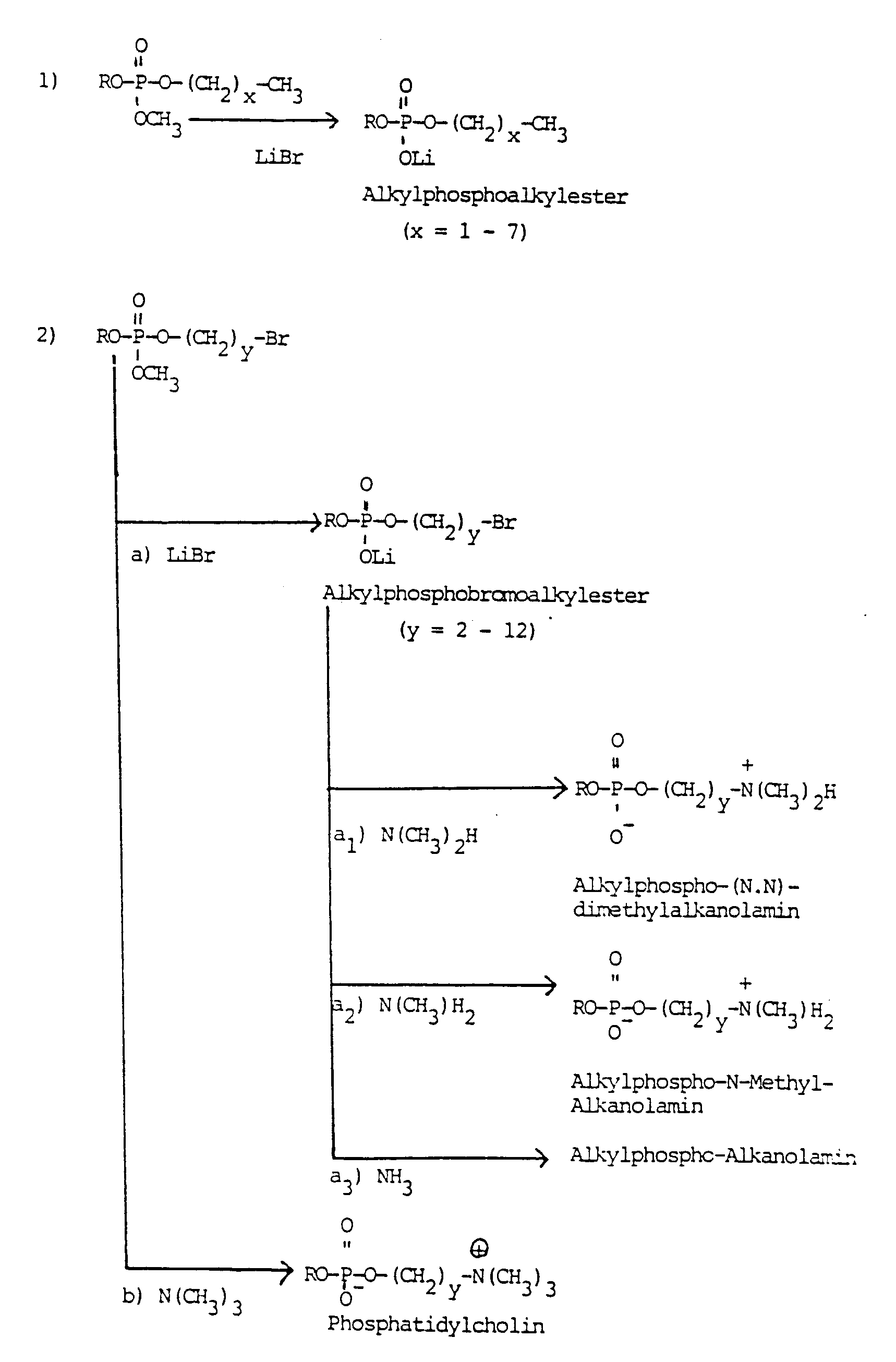


- Weitere Angaben zu dem erfindungsgemäßen Verfahren:
In den Ausgangsstoffen der Formel III können vorhandene Hydroxygruppen, Carboxygruppen, Aminogruppen oder C₁-C₆-Alkylaminogruppen, die in dem Rest R¹ oder auch in dem Rest R² (falls X die Gruppe NR² ist) vorkommen, durch übliche Schutzgruppen geschützt sein. Benachbarte Hydroxygruppen können durch Ketalisierung mit einem aliphatischen gesättigten C₃-C₆-Keton geschützt sein. - Es handelt sich hierbei um Reste, die durch Hydrolyse oder Hydrogenolyse leicht abspaltbar sind und während oder nach der Reaktion abgespalten werden. Falls solche Schutzgruppen bei der Verfahrensreaktion nicht abgespalten werden, dann erfolgt eine Abspaltung nach der Reaktion. Häufig enthalten die Ausgangsverbindungen aufgrund ihrer Herstellung bereits derartige Schutzgruppen.
- Bei diesen Schutzgruppen handelt es sich beispielsweise um leicht solvolytisch abspaltbare Acylgruppen oder hydrierend abspaltbare Gruppen. Die solvolytisch abspaltbaren Schutzgruppen werden beispielsweise durch Verseifung mit verdünnten Säuren (zum Beispiel Essigsäure, Perchlorsäure, Salzsäure, Schwefelsäure, Ameisensäure, Trifluoressigsäure). oder mittels basischer Substanzen (Pottasche, Soda, wässrige Alkalilösungen, alkoholische Alkalilösungen, NK₃) bei Temperaturen zwischen -50 und 150° C, insbesondere zwischen 0 und 100° C, abgespalten. Hydrierend abspaltbare Gruppen wie Arylalkylreste (Benzylrest) oder Hydroxycarbonylreste (Carbobenzoxyrest) werden zweckmäßig durch katalytische Hydrierung in Gegenwart üblicher Hydrierungskatalysatoren (Edelmetallkatalysatoren), insbesondere Palladium-Katalysatoren oder auch platinkatalysatoren (Platinoxyd), Raney-Nickel, in einem Lösungs- oder Suspensionsmittel, gegebenenfalls unter erhöhtem Druck, (zum Beispiel 1 - 50 bar) bei Temperaturen zwischen 20 - 150° C, insbesondere 30 - 100° C. vorzugsweise 40 - 80° C abgespalten.
Als Lösungs- beziehungsweise Suspensionsmittel für die Abspaltung solcher Schutzgruppen kommen beispielsweise in Betracht: Wasser, niedere aliphatische Alkohole, cyclische Ether wie Dioxan oder Tetrahydrofuran, aliphatische Ether, Halogenkohlenwasserstoffe, Dimethylformamid sowie Mischungen dieser Mittel. Als Schutzgruppen, die durch Hydrogenolyse abspaltbar sind, kommen in Frage: Benzylrest, α-Phenyläthylrest, im Benzolkern substituierte Benzylreste (p-Brom- oder p-Nitrobenzylrest), Carbobenzoxyrest, Carbobenzthiorest, tert.-Butyloxycarbonylrest. Beispiele für hydrolytisch abspaltbare Reste sind: Trifluoracetylrest, Phthalylrest, Tritylrest, p-Toluolsulfonylrest, tert.-Butyloxycarbonylrest, tert.-Butylrest und Dimethylmethylenrest sowie niedere Alkanoylreste wie Acetylrest, Formylrest und tert.-Butylcarboxyrest. - Insbesondere kommen die bei der Peptid-Synthese üblichen Schutzgruppen und die dort üblichen Abspaltungsverfahren in Frage. Unter anderem wird hierzu auch auf das Buch von Jesse P. Greenstein und Milton Winitz "Chemistry of Amino Acids", New York 1961, John Wiley and Sons, Inc. Volume 2, beispielsweise Seite 883 und folgende, verwiesen. Auch die Carbalkoxygruppe (zum Beispiel niedrigmolekulare) kommt in Frage.
- Die Abspaltung der Gruppe OZ (vorzugsweise ist diese OCH₃) erfolgt beispielsweise mit Alkalibromiden oder Alkalijodiden, niederen Alkylmagnesiumhalogeniden oder mit primären, sekundären oder tertiären Aminen, insbesondere den entsprechenden niederen Alkylaminen, wie zum Beispiel tertiären C₁-C₆-Alkylaminen (Trimethylamin). Als Alkalibromide beziehungsweise Alkalijodide kommen in Frage: Lithiumbromid, Natriumbromid, Lithiumjodid, Natriumjodid. Als niedere Alkylmagnesiumhalogenide kommen zum Beispiel in Frage: Methylmagnesiumjodid, Methylmagnesiumbromid (Lösungsmittel in diesem Fall niedere aliphatische Ether, wie Diethylether).
- Die Abspaltung der Gruppe OZ aus einer Verbindung der Formel III erfolgt bei Temperaturen zwischen 10 und 150° C, vorzugsweise 10 und 80° C, insbesondere 50 und 80° C, wobei man das bis dahin erhaltene Reaktionsprodukt nach Entfernung der Lösungsmittel in einem inerten Mittel auflöst. Als solche inerten Mittel kommen in Frage: Gesättigte aliphatische C₃-C₈-Ketone (Ethylmethylketon, Diethylketon, Aceton), cyclische Ether, nichtcyclische niedere aliphatische Ether (zum Beispiel Diethylether). Pro 1 Mol der eingesetzten Verbindung III werden im allgemeinen 1,5 bis 3 Mol der zuvor genannten Abspaltungsmittel, vorzugsweise 2 Mol verwendet.
- Die Umsetzung von erhaltenen Produkten (beispielsweise Verbindungen, bei welchen R¹ und/oder R² Halogenalkyl bedeuten) mit Ammoniak oder einem Amin der Formel NR³R⁴R⁵ erfolgt bei Temperaturen zwischen 10 und 200, vorzugsweise 20 und 150° C, insbesondere 40 und 80° C mit oder ohne Lösungsmittel. Falls ein Lösungs- oder Suspensionsmittel verwendet wird, kommen hierfür in Frage: Aromatische Kohlenwasserstoffe, wie zum Beispiel- Pentan, Hexan, Heptan, Benzol, Mesitylen, Toluol, Xylol; niedere aliphatische Ketone wie zum Beispiel Aceton, Methylathylketon; halogenierte Kohlenwasserstoffe: Chloroform, Trichlorethylen, Tetrachlorkohlenstoff, Chlorbenzol, Methylenchlorid; cyclische Ether: Tetrahydrofuran und Dioxan; niedere aliphatische nichtcyclische Ether (Diethylether, Diisopropylether); niedere aliphatische Alkohole (1 - 6 C-Atome): Methanol, Äthanol, Isopropanol, Amylalkohol, Butanol, tert.-Butanol; Amide und N-alkyl-substituierte Amide von aliphatischen C₁-C₄-Carbonsäuren (Dimethylformamid, Dimethylacetamid); C₁-C₆-Dialkylsulfone (Dimethylsulfon, Tetramethylsulfon); C₁-C₆-Dialkylsulfoxide (Dimethylsulfoxid) sowie weitere aprotische Mittel wie N-Methylpyrrolidon, Tetramethylharnstoff, Hexamethylphosphorsäuretriamid, Acetonitril. Die einzelnen Alkylreste der oben angegebenen Lösungsmittel enthalten beispielsweise 1 - 6, insbesondere 1 - 4 Kohlenstoffatome. Auch Gemische dieser Mittel sowie Mischungen mit Wasser kommen als Reaktionsmedium in Frage. Die Reaktion wird beispielsweise bei Temperaturen von 0 bis 200° C, vorzugsweise 20 bis 150° C oder auch 50 bis 120° C durchgeführt. Wird ein Lösungs- beziehungsweise Dispersionsmittel verwendet, arbeitet man häufig bei der Rückflußtemperatur dieses Mittels.
- Diese Aminisierungsreaktion wird zweckmäßig in Gegenwart basischer Stoffe durchgeführt. Als basische Stoffe kommen in Frage: Alkalihydroxyde, Alkalicarbonate, tertiäre Amine.
- Die Alkylierung von freien Aminogruppen in den Resten R¹ und/oder R² erfolgt bei Temperaturen zwischen 0 und 200, vorzugsweise zwischen 20 und 150, insbesondere 20 und 80° C. Diese Alkylierung erfolgt beispielsweise durch Umsetzung mit Verbindungen der Formel R'Hal, ArSO₂OR' und SO₂(OR'₃)₂, wobei Hal ein Halogenatom (insbesondere Chlor, Brom oder Jod) und Ar ein aromatischer Rest (zum Beispiel ein gegebenenfalls durch einen oder mehrere niedere Alkylreste substituierter Phenyl- oder Naphthylrest und R' eine C₁-C₆-Alkylgruppe ist. Beispiele sind p-Toluolsulfonsäure-C₁-C₆-alkylester, C₁-C₆-Dialkylsulfate, C₁-C₆-Alkylhalogenide. Die Alkylierungsreaktion wird gegebenenfalls unter Zusatz von üblichen säurebindenen Mitteln, wie Alkalihydroxiden, Alkalicarbonaten, Alkalihydrogencarbonaten, Erdalkalicarbonaten, Alkaliacetaten, tertiären Aminen (zum Beispiel Trialkylamin wie Triethylamin), Pyridin oder auch Alkalihydriden in inerten Lösungsmitteln oder Suspensionsmitteln durchgeführt. Als Lösungs- oder Dispergiermittel kommen in Betracht: Aromatische Kohlenwasserstoffe wie Benzol, Toluol, Xylol; aliphatische Ketone wie Aceton, Methylethylketon; halogenierte Kohlenwasserstoffe wie Chloroform, Tetrachlorkohlenstoff, Chlorbenzol, Methylenchlorid; aliphatische Ether wie Butylether; cyclische Ether wie Tetrahydrofuran, Dioxan; Sulfoxyde wie Dimethylsulfoxyd; tertiäre Säureamide wie Dimethylformamid, N-Methylpyrrolidon, Hexamethylphosphorsäuretriamid; aliphatische Alkohole wie Methanol, Ethanol, Isopropanol, Amylalkohol, tert.-Butanol, cycloaliphatische Kohlenwasserstoffe wie Cyclohexan. Auch wässrige Mischungen der genannten Lösungsmittel können verwendet werden. Häufig arbeitet man bei der Rückflußtemperatur der verwendeten Lösungs- beziehungsweise Dispergiermittel. Häufig werden die Alkylierungsreaktionskomponenten im Überschuß eingesetzt. Die Alkylierung kann auch in Gegenwart von Tetraalkylammoniumsalzen (insbesondere der Halogenide) in Kombination mit Alkalihydroxiden bei Temperaturen zwischen 0 - 100° C, vorzugsweise 20 - 80° C in einem aprotischen Lösungsmittel oder auch in Chloroform oder Methylenchlorid vorgenommen werden. Als aprotische Lösungsmittel kommen insbesondere in Betracht: tertiäre Amide (Dimethylformamid, N-Methyl-Pyrrolidon, Hexamethylphosphorsäuretriamid), Dimethylsulfoxid, Acetonitril, Dimethoxyethan, Aceton, Tetrahydrofuran.
- Die im erfindungsgemäßen Arzneimittel enthaltenen Wirkstoffe für die Komponente (a) der allgemeinen Formel I bzw. I' sind teilweise neu und
besitzen eine ausgeprägte cytotoxische Wirksamkeit, die sowohl in vivo am chemisch induzierten Mamma-Karzinom der Ratte, als auch in vitro an Leukämiezellen in der Zellkultur nachgewiesen wurde. Darüberhinaus wurden in einer klinischen Pilotstudie bei Patientinnen mit Mamma-Karzinom Hautmetastasen zur vollständigen Abheilung bei topischer Anwendung gebracht. - Die folgenden Verbindungen und deren physiologisch verträgliche Salze sind neu:
- Verbindungen der allgemeinen Formel

worin R einen gesättigten oder ungesättigten Kohlenwasserstoffrest mit 12 bis 24 C-Atomen bedeutet, der auch halogensubstituiert sein kann, X ein Sauerstoffatom, NH oder NR₂ und Y ein Sauerstoffatom oder NH ist,
der Rest R₁ - a) eine C₁-C₈-Alkylgruppe, eine ungesättigte C₃-C₈-Alkylgruppe oder eine gegebenenfalls ungesättigte C₃-C₈-Alkylgruppe, die durch Halogen, Amino, C₁-C₆-Alkylamino, Di-C₁-C₆-alkylamino, Tri-C₁-C₆-alkylamino, Hydroxy, Carboxy, C₃-C₈-Cycloalkyl oder Phenyl substituiert ist, darstellt oder
- b) eine C₂-Alkylgruppe, die durch Halogen, Hydroxy, Carboxy, C₃-C₈-Cycloalkyl oder Phenyl substituiert ist, darstellt, oder
- c) eine ungesättigte C₂-Alkylgruppe, die durch Di-C₁-C₆-alkylamino, Tri-C₁-C₆-alkylamino, Carboxy, C₃-C₈-Cycloalkyl oder Phenyl substituiert ist, darstellt, oder
- d) eine C₂-Alkylgruppe, die durch Amino, C₁-C₆-Alkylamino, Di-C₁-C₆-alkylamino oder Tri-C₁-C₆-alkylamino substituiert ist, darstellt, falls X Sauerstoff, NH oder NR₂ und Y die Gruppe NH bedeutet oder falls X die Gruppe NH oder NR₂ und Y Sauerstoff bedeutet und R die angegebenen Bedeutungen hat, oder
- e) 2-tert.-Butyloxycarbonylaminoethyl, 2-tert.-Butyloxycarbonylethyl, 2,3-Isopropylidendioxy-propyl-(1), 2,3-Dibenzyloxypropyl-(1), 1,3-Dibenzyloxy-propyl-(2) oder N-C₁-C₆-Alkylamino-C₂-C₆-alkyl bedeuten kann, wenn X ein Sauerstoffatom ist und Y und R die angegebenen Bedeutungen haben, oder
- f) 2,3-Dihydroxypropyl-(1) bedeuten kann, wenn X die NH-Gruppe ist und Y und R die angegebenen Bedeutungen haben,
- Insbesondere für die topische Applikation, aber auch für die Zubereitung als Arzneimittel für andere Applikationsarten hat es sich als besonders günstig herausgestellt, die Verbindungen der allgemeinen Formel I beziehungsweise I' zusammen mit wenigstens einem Alkylglycerin mit 3 bis 12 Kohlenstoffatomen im Alkylrest, der in Form einer Ethergruppe an eine der primären oder sekundären OH-Gruppen des Glycerins gebunden vorliegen kann, einzusetzen. Derartige Alkylglycerine steigern beziehungsweise verbessern die Wirkung der Verbindungen der allgemeinen Formel I beziehungsweise I' synergistisch. Bevorzugt werden hierbei Alkylglycerine mit 3 bis 9 C-Atomen allein oder in Mischung verwendet.
- Besonders günstige Wirkungen besitzt daher ein synergistisch wirkendes Arzneimittel, welches
- a) mindestens eine Verbindung der allgemeinen Formel

- b) ein Alkylglycerin der allgemeinen Formel II

- Eine derartige Mischung wird im folgenden auch als Kaskade bezeichnet.
Der Gehalt an Verbindung der allgemeinen Formel I beziehungsweise I' in mg/ml Kaskade wird durch einen nachgesetzten Index bezeichnet, derart, daß zum Beispiel ein Kaskadengemisch, welches 5 mg/ml Verbindung von Formel I beziehungsweise I' enthält, als Kaskade₅, ein Gemisch mit 200 mg Verbindung der Formel I beziehungsweise I' pro ml Kaskade als Kaskade₂₀₀ bezeichnet wird. Die Herstellung der Alkylglycerine ist bekannt, beispielsweise aus der DE-OS 33 43 530.8.
Beispielsweise werden Alkylglycerin-Wasser-Mischungen, welche zum Beispiel Nonylglycerin, Octylglycerin, Hexylglycerin, Pentylglycerin, Propylglycerin und Ethylglycerin enthalten, bevorzugt. Vorzugsweise enthalten solche wäßrigen Mischungen 3 der genannten Glycerinether und zwar einen niederen (Ethyl, Propyl), einen mittleren (Petnyl, Hexyl) und einen höheren (Nonyl, Octyl), wobei die Gewichtsmenge an dem niederen Ether etwa so groß ist wie die Summe der Gewichtsmengen an den beiden anderen Glycerinethern. Die Wassermenge ist etwa gleich der Menge an dem niederen Glycerinether, und beträgt beispielsweise die Hälfte der Gesamtmenge an den vorliegenden Glycerinethern. Beispiele für solche Glycerinether-Wasser-Mischungen sind im folgenden angeführt:
- Zur topischen Applikation sind die erfindungsgemäßen Arzneimittel in besonderem Maße geeignet. Um Hauttumoren beziehungsweise Hautmetastasen mit diesem Arzneimittel zu behandeln, werden die betroffenen Hautbezirke beispielsweise mit Kaskade₅ bis Kaskade₂₀₀ zwei- bis dreimal täglich eingerieben. Schädliche Nebenwirkungen konnten bisher nicht beobachtet werden, auch nicht bei Patienten, die über einen Zeitraum von 3 Monaten behandelt wurden. Die Remission der Hautmetastasen ist begleitet von einer Normalisierung der Haut, wie durch Gewebeschnitte eindeutig nachgewiesen werden konnte. Mehrere Patientinnen mit Hautmetastasen wurden auf diese Weise behandelt und hierbei ein vollständiges Verschwinden der Mamma-Karzinom-Hautmetastasen beobachtet.
- Die topische Behandlung mit dem erfindungsgemäß bevorzugten Mittel in der Formulierung Kaskade₅ bis Kaskade₂₀₀ läßt sich auch für die Behandlung von inneren Tumoren bzw. Metastasen durch großflächiges Einreiben der Haut anwenden. Über die Resorption durch die Haut werden hierbei therapeutisch wirksame Blutspiegel erreicht. Ein Vorteil dieser Applikationsart liegt darin, daß die Zubereitungen Kaskade₅ bis Kaskade₂₀₀ von der Haut problemlos toleriert werden.
- Diese bevorzugte Zubereitungsart des erfindungsgemäßen Arzneimittels in Form der Lösungen Kaskade₅ bis Kaskade₂₀₀ eignet sich auch gut für die Herstellung von Suppositorien für die rektale Einführung. Auch hiermit lassen sich innere Tumoren bzw. innere Metastasen gut behandeln.
- Eine andere Anwendungsart des erfindungsgemäßen Arzneimittels besteht in der Instillation in präformierte Körperhöhlen. Diese Anwendungsart eignet sich besonders für Pleurakarzinosen, malignen Aszites, maligne Perikardergüsse und Blasenkarzinome. In diesem Fall werden die erfindungsgemäßen Antitumormittel der allgemeinen Formel I entweder alleine oder in Verbindung mit üblichen Träger- und Verdünnungsmitteln, insbesondere auch mit Kaskade eingesetzt werden.
- Zur systematischen Applikation kommt orale oder intravenöse Verabreichung in Betracht.
- Für die orale Verabreichung werden die Verbindungen der allgemeinen Formel I zweckmäßig in Form einer Trinklösung angewendet. Als Träger eignen sich beispielsweise Milch, Kakao, Fruchtsaft oder Trinkwasser. Die Herstellung einer solchen Trinklösung kann zum Beispiel durch Verdünnen einer konzentrierten alkoholischen Lösung einer Verbindung der Formel I beziehungsweise I' gemäß den Ansprüchen 1 und/oder 2 mit Wasser oder einem anderen der zuvor genannten Mittel erfolgen. Bei Ratten führten Tagesdosen von 20, 40 und 60 mg/kg Körpergewicht bei Verwendung von Hexadexylphosphocholin und oleylphosphocholin zu einer vollständigen Remission von chemisch induzierten Mamma-Karzinomen. Hierbei erwiesen sich diese Verbindungen als besser wirksam und besser verträglich als 1-Octadecyl-2-methyl-rac-glycero-3-phosphochlolin. Bei dem für diese Versuche verwendeten Tumormodell handelt es sich um ein sogenanntes hartes Modell. Dies bedeutet, daß die an diesem Modell erstellten Befunde auch auf die humane Situation übertragbar sind.
- Für die intravenöse Verabreichung über die intravenöse Infusionstherapie werden die Verbindungen der Formel I beziehungsweise I' zweckmäßig in physiologischer Kochsalzlösung angewendet. Auch andere Infusionslösungen können hierbei angewendet werden. Dosis am Menschen für solche Lösungen ist beispielsweise 1 - 10 mg/kg Körpergewicht.
- Schließlich können mehrere Applikationsarten des erfindungsgemäßen Arzneimittels kombiniert angewendet werden, wobei die besondere topische Verträglichkeit dazu führt, daß einerseits ein Einreiben der Haut mit einer der anderen Applikationsformen kombiniert angewendet wird.
- Eine weitere Trägermischung für die Verbindungen der Formel I beziehungsweise I', die sich besonders bewährt hat, besteht aus einer Mischung von etwa 4 Gewichtsteilen Wasser, 4 Gewichtsteilen Propylglycerin und je 2 Gewichtsteilen Hexylglycerin und Nonylglycerin.
- Die topische Anwendung des erfindungsgemäßen Arzneimittels in der besonders bevorzugten Zubereitsungsform Kaskade₅ bis Kaskade₂₀₀ über einen Zeitraum von mehreren Monaten zeigte, daß die lokale Toxizität sich auf ein verstärktes Abschuppen der Haut, ähnlich wie bei der lokalen Anwendung von Acetylsalicylsäure, beschränkt.
- Die Erfindung stellt somit ein neues Arzneimittel zur Behandlung von Tumoren zur Verfügung und liefert hierbei nicht nur überhaupt ein weiteres Antitumormittel, sondern bringt erstmals ein auch bei topischer Anwendung im klinischen Versuch nachgewiesenermaßen wirksames Mittel. Hierdurch werden für die Behandlung von Tumorpatienten neue Möglichkeiten eröffnet.
- Zur Herstellung von entsprechenden Arzneimitteln wird mindestens eine Verbindung der Formel I beziehungsweise I' mit gebräuchlichen pharmazeutischen Trägerstoffen und/oder Verdünnungsmitteln beziehungsweise sonstigen Hilfsstoffen zu pharmazeutischen Zubereitungen verarbeitet beziehungsweise in eine therapeutisch anwendbare Form gebracht. Dies erfolgt zum Beispiel dadurch, daß man Verbindungen der Formel I beziehungsweise I', worin die einzelnen Reste und Symbole die angegebenen Bedeutungen haben, beziehungsweise deren physiologisch verträgliche Salze zusammen mit üblichen Träger- und/oder Verdünnungsbeziehungsweise Hilfsstoffen bei Temperaturen zwischen 20 und 120° C, vorzugsweise 30 - 100° C vermischt beziehungsweise homogenisiert, die so erhaltene Mischung zur Herstellung von Zubereitungen, die in der Dosierungseinheit 5 bis 2000 mg, vorzugsweise 10 bis 500 mg, insbesondere 30 bis 400 mg Wirkstoff der Formel I beziehungsweise I' enthalten, in Hohlzellen entsprechender Größe ausgießt oder in Kapseln entsprechender Größe abfüllt oder granuliert und dann, gegebenenfalls unter Zusatz von weiteren üblichen Hilfsstoffen zu Tabletten verpreßt.
Zum Beispiel dadurch, daß man Verbindungen der Formel I beziehungsweise I' mit einem oder mehreren der folgenden Stoffe: Stärke, Cellulose, Lactose, Formalin-Casein, modifizierte Stärke, Magnesiumstearat, Calciumhydrogen phosphat, hochdisperse Kieselsäure, Talkum, Phenoxyethanol vermischt, die erhaltene Mischung, gegebenenfalls mit einer wässrigen Lösung, die als Bestandteil mindestens Gelatine, Stärke, Polyvinylpyrrolidon, Vinylpyrrolidon-Vinylacetat-Copolymerisat und/oder Polyoxyethylsorbitanmonooleat enthält, granuliert, das Granulat gegebenenfalls mit einem oder mehreren der obengenannten Hilfsstoffe homogenisiert, und diese Mischung zu Tabletten verpresst oder in Kapseln abfüllt, wobei solche Tabletten oder Kapseln in der Dosierungseinheit jeweils 5 bis 2000 mg Wirkstoff der Formel I beziehungsweise I' enthalten; oder daß man Verbindungen der Formel I oder deren Salze nach Zusatz von Sojalecithin sowie gegebenenfalls 0,1 - 0,5 Gewichtsteilen Phenoxyethanol (bezogen auf einen Gewichtsteil Verbindung I beziehungsweise I') bei Temperaturen zwischen 33 - 37° C in geschmolzenem Hartfett suspendiert und homogenisiert und anschließend die Mischung in Hohlzellen ausgießt, wobei die Dosierungseinheit 5 bis 2000 mg Wirkstoff sowie gegebenenfalls 0,1 - 0,5 Gewichtsteile Phenoxyethanol (bezogen auf einen Gewichtsteil Verbindung I oder I') enthält; oder daß man Verbindungen der Formel I beziehungsweise I' oder deren Salze bei einer Temperatur zwischen 50 bis 120° C, vorzugsweise 50 bis 100° C, gegebenenfalls in Gegenwart eines oder mehrerer Emulgatoren und/oder 0,1 - 0,5 Gewichtsteilen Phenoxyethanol (bezogen auf einen Gewichtsteil Verbindung I oder I') mit mindestens einem der folgenden Stoffe homogenisiert: Paraffin, Vaseline, aliphatischer Alkohol mit 12 bis 25 C-Atomen, aliphatische Monocarbonsäure mit 15 bis 20 C-Atomen, Sorbitanmonopalmitat, Polyoxyethylenpolyolfettsäureester, und die erhaltene Mischung zwischen 50 und 120° C mit Wasser, gegebenenfalls unter Zusatz eines mehrwertigen niederen aliphatischen Alkohols und/oder Phenoxyethanol emulgiert; oder daß man Verbindungen der Formel I beziehungsweise I' oder deren Salze in Wasser oder Pflanzenöl, gegebenenfalls in Gegenwart von 0,1 - 0,5 Gewichtsteilen Phenoxyethanol (bezogen auf einen Gewichtsteil Verbindung I oder I') sowie gegebenenfalls in Gegenwart eines Emulgators, bei Temperaturen zwischen 30 - 100° C auflöst, und gegebenenfalls die so erhaltene Lösung mit soviel Wasser oder Pflanzenöl auffüllt, daß die Endlösung 0,05 bis 10 Gewichtsprozent, vorzugsweise 0,1 bis 5 Gewichtsprozent an Wirkstoff der Formel I beziehungsweise I' enthält. - Als Emulgatoren kommen zum Beispiel in Frage: nichtionogene Emulgatoren sowie ionogene Emulgatoren. Bei den nichtionogenen Emulgatoren handelt es sich beispielsweise um Triglyceridgemische von gesättigten Pflanzenfettsäuren mit C₈, C₁₀ und C₁₂ oder um Emulgatoren auf der Basis von Polyadditionsprodukten des Ethylenoxids, wie zum Beispiel alkyl- und acylsubstituierte Polyadditionsprodukte des Ethylenoxids, Polyethylenglykol-fettsäureester, Umsetzungsprodukte von Ethylenoxid mit Ricinusöl beziehungsweise hydriertem Ricinusöl, Ester von hydrierten Ricinusölfettsäuren mit oxyethyliertem Glycerin. Weiterhin kann es sich um Emulgatoren auf Basis von Fettsäureamiden oder Fettsäurekondensationsprodukten mit hydrophilen Gruppen handeln. Als ionogene Emulgatoren kommen zum Beispiel Emulgatoren auf Basis von Fettsäuremonoestern des Glycerins oder anderer mehrwertiger Alkohole (Lunacera alba) in Frage.
- Bei der wie oben angegebenen Herstellung der Arzneimittel in Gegenwart von einem Glycerinether der Formel II oder einer Mischung von solchen Glycerinethern der Formel II wird eine synergistische Wirkungssteigerung der Antitumorwirkung beobachtet.
Hierzu werden die Wirkstoffe der Formel I beziehungsweise I' mit 1 bis 30, vorzugsweise 2 bis 20 Gewichtsteilen (bezogen jeweils auf einen Gewichtsteil an Verbindung I oder I') von mindestens einem Glycerinether der Formel II oder einem Gemisch solcher Glycerinether sowie gegebenenfalls 0,5 - 30, vorzugsweise 1 - 20 Gewichtsteilen Wasser (ebenfalls bezogen auf einen Gewichtsteil an Verbindung I beziehungsweise I') verwendet. Diese Vermischung mit den Glycerinethern kann bei der Herstellung der entsprechenden Arzneimittel am Anfang erfolgen, aber gegebenenfalls auch in einem späteren Herstellungsstadium. - Die Verbindungen der Formeln I und I' zeigen beispielsweise eine gute Wirkung am 7,12-Dimethylbenzanthracen induzierten Brustdrüsenkrebs der Ratte; ebenso am Methyl-nitrosoharnstoff-induzierten Mammacarcinom der Ratte.
- Beispielsweise wird bei obengenannter Versuchsmethode bei einer Dosis von 10 mg/kg Körpergewicht Ratte ein Wachstumsstillstand der Tumore, bei höheren Dosen auch ein völliges Verschwinden der Geschwülste erzielt.
- Die niedrigste, bereits wirksame Dosis in dem obenangegebenen Tierversuch ist beispielsweise
5 mg/kg oral
5 mg/kg intravenös. - Als allgemeiner Dosisbereich für die Wirkung (Tierversuch wie oben) kommt beispielsweise in Frage:
5 - 50 mg/kg oral, insbesondere 15 - 32 mg/kg
5 - 50 mg/kg intravenös, insbesondere 15 - 32 mg/kg. - Die Wirkungsrichtung der erfindungsgemäßen Verbindungen ist mit der Wirkung des bekannten Arzneimittelwirkstoffs TAMOXIFEN vergleichbar, jedoch bestehen hierzu insbesondere folgende Unterschiede: Die Wirkung ist stärker und von längerer Dauer als die von TAMOXIFEN.
- Indikationen, für die die erfindungsgemäßen Verbindungen in Betracht kommen können: Brustdrüsenkrebs und andere menschliche Krebsarten.
- Die pharmazeutischen Zubereitungen enthalten im allgemeinen zwischen 5 - 2000 mg, beispielsweise 10 - 400 mg der erfindungsgemäßen aktiven Komponenten.
- Die Verabreichung kann beispielsweise in Form von Tabletten, Kapseln, Pillen, Dragees, Zäpfchen, Salben, Gelees, Cremes, Puder, Stäubepulver, Aerosolen oder in flüssiger Form erfolgen. Als flüssige Anwendungsformen kommen zum Beispiel in Frage: Ölige oder alkoholische beziehungsweise wässrige Lösungen sowie Suspensionen und Emulsionen. Bevorzugte Anwendungsformen sind Tabletten, die zwischen 40 und 400 mg oder Lösungen, die zwischen 0,1 % bis 5 % an aktiver Substanz enthalten.
- Die Einzeldosis der erfindungsgemäßen aktiven Komponenten kann beispielsweise liegen
- a) bei oralen Arzneiformen zwischen 5 - 100 mg/kg Körpergewicht, vorzugsweise 15 - 50 mg/kg Körpergewicht,
- b) bei parenteralen Arzneiformen (zum Beispiel intravenös, intramuskulär) zwischen 5 - 100 mg/kg Körpergewicht,
- c) bei Arzneiformen zur lokalen Applikation auf die Haut und Schleimhäute (zum Beispiel in Form von Lösungen, Lotionen, Emulsionen, Salben und so weiter) zwischen 50 - 2000 mg, vorzugsweise 80 - 1500 mg.
-
- Beispielsweise können 3 mal täglich 1 Tablette mit einem Gehalt von 40 - 400 mg wirksamer Substanz oder zum Beispiel bei intravenöser Injektion 1 - 5 mal täglich eine Ampulle von 1 - 5 ml Inhalt mit 50 - 250 mg Substanz empfohlen werden. Bei oraler Verabreichung ist die minimale tägliche Dosis beispielsweise 120 mg; die maximale tägliche Dosis bei oraler Verabreichung soll nicht über 100 mg/kg Körpergewicht liegen.
- Die akute Toxizität der erfindungsgemäßen Verbindungen an der Maus (ausgedrückt durch die LD 50 mg/kg; Methode nach Miller und Tainter: Proc. Soc. Exper. Biol. a. Med. 57 (1944) 261) liegt beispielsweise bei oraler Applikation zwischen 200 und 450 mg/kg Körpergewicht.
- Die Arzneimittel können in der Humanmedizin, der Veterinärmedizin sowie in der Landwirtschaft allein oder im Gemisch mit anderen pharmakologisch aktiven Stoffen verwendet werden.
- Die Erfindung wird durch die folgenden Beispiele erläutert.
- Hexadecanol (1 Mol, 243 g) und Triethylamin (1,8 Mol, 180 g) werden in 1,5 l THF (Tetrahydrofuran) gelöst und tropfenweise zu einer stark gerührten Lösung von Phosphoroxychlorid (1,2 Mol, 184 g) in 120 ml THF so zugegeben, daß die Temperatur im Reaktionsgefäß (Dreihals, 5 l, mit Tropftrichter, Thermometer und Rührer) 10°C nicht übersteigt. Zur Beschleunigung des Vorgangs wird das Reaktionsgefäß mit einer Eis-Kochsalzmischung gekühlt. Unmittelbar nach dem Eintropfen ist die Reaktion abgeschlossen (Nachweis über DSC in Ether: Rf-Werte von 0,8 für das Ausgangsprodukt, von 0,0 für das Reaktionsprodukt nach Hydrolyse mit Wasser).
- Man entfernt das Eisbad und tropft in das Reaktionsgemisch unter starkem Rühren eine Lösung von Ethanolamin (1,5 Mol, 92 g) und Triethylamin (1,8 Mol, 180 g) in 1 l Dioxan so ein, daß die Temperatur im Reaktionsgefäß auf 65 bis 70°C steigt. Dann ist die Ringbildung abgeschlossen (Nachweis durch DSC in Ether: Rf-Wert von 0,2). Man filtriert von ausgefallenem Triethylaminhydrochlorid noch warm ab und versetzt das Filtrat bei 40 bis 50°C mit 1,5 l 2H Ameisensäure. Nach 15 Minuten ist die Ringöffnung abgeschlossen (Nachweis durch DSC in Ether: Rf-Wert 0,0; DSC in Chloroform/Methanol/Essigsäure/Wasser 100:60:20:5 per Vol.:Rf-Wert 0,8). Man kühlt auf -20°C und filtriert vom Niederschlag ab, der aus weitgehend reinem Hexadecylphosphoethanolamin besteht. Bei leichten Verunreinigungen wird eine chromatographiscne Reinigung angeschlossen (siehe Beispiel 2).
Mikroanalyse (MG 365,50): ber. (%): C 59,15 H 11,03 N 3,83 P 8,48 gef. (%): 59,01 10,95 3,79 8,31 - Die nach Beispiel 1 erhaltenen Kristalle werden ohne weitere Reinigung in 1,2 l 2-Propanol und 0,4 l Dichlormethan aufgenommen. Man versetzt die Suspension der Kristalle unter starkem Rühren mit Kaliumkarbonat (4 Mol, 560 g) in 1 l Wasser. Das zweiphasige Reaktionsgemisch wird mit Dimethylsulfat (4 Mol, 500 g) tropfenweise und unter Rühren so versetzt, daß die Temperatur 40°C nicht übersteigt. Die Reaktion ist 60 Minuten nach dem Eintropfen beendet (Nachweis durch DSC in Chloroform/Methanol/25%igem Ammoniak 50:50:5 per Vol.: Rf-Wert 0,3). Nach Phasenseparation bei 20°C enthält die obere Phase das Produkt. Man entfernt das Lösungsmittel am Rotationsverdampfer unter Vakuum und chromatographiert den viskosen Rückstand an Kieselgel (Merck Art. 7733, Kieselgel 60, Korngröße 0,2 bis 0,5 mm).
- Kieselgel, 2 kg, werden mit Chloroform/Methanol/25%igem Ammoniak (200/15/1 per Vol.) versetzt und in eine Chromatographiesäule gefüllt. Man löst das viskose Öl in 800 ml des obigen Lösungsmittelgemisches und gibt das Rohprodukt auf die Säule (unlösliche Anteile werden vorher abfiltriert). Man eluiert mit Fließmitteln steigender Polarität bis die Verunreinigungen ausgewaschen sind. Das Produkt wird schließlich mit Chloroform/Methanol/25%igem Ammoniak (50/50/5 per Vol.) eluiert. Die vereinigten Eluate werden einrotiert und mit Toluol das restliche Wasser entfernt. Der Rückstand wird in 600 ml Dichlormethan aufgenommen und mit 4 l Aceton versetzt. Die bei -20°C abgeschiedenen Kristalle werden mit kaltem Aceton gewaschen, dann mit Pentan und im Vakuum getrocknet. Die Ausbeute an reinem Hexadecylphosphocholin beträgt 250 g (ca. 70 % bezogen auf Hexadecylglycerin).
Mikroanalyse (MG 407,58): ber. (%): C 59,27 H 11,37 N 3,29 P 7,28 gef. (%): 58,98 11,31 3,21 7,11 - Entsprechende Phosphoethanolamine und Phosphocholine wurden mit Tetradecanol, Octadecanol, Eicosanol, Oleylalkohol, cis-11-Hexadeun-1-ol und Dodecanol hergestellt.
- Der Ansatz erfolgt wie unter Beispiel 1 beschrieben, jedoch für 0,1 Mol. Um gute Ausbeuten zu erreichen, müssen die Phosphorylierungsbedingungen etwas modifiziert werden, d. h. die Temperatur im Phosphorylierungsschritt wird auf 25°C gesteigert. Sonst wird wie beschrieben verfahren und aufgearbeitet.
Mikroanalyse (MG 365,50) ber. (%): C 59,15 H 11,03 N 3,83 P 8,48 gef. (%): 58,96 10,91 3,69 8,39 - Es kann, wie in Vorschrift 2 angegeben vorgegangen, aufgearbeitet und gereinigt werden.
Mikroanalyse (MG 407,58): ber. (%): C 59,27 H 11,37 N 3,29 P 7,28 gef. (%): 59,14 11,11 3,14 7,09 - Der Phosphorylierungsschritt erfolgt wie in Beispiel 1. Zur Methanolyse wird das Reaktionsgemisch mit Methanol (10 Mol; 320 g) und Triethanolamin (1,8 Mol; 180 g) bei 20°C versetzt. Die Methanolyse ist nach 30 Minuten abgeschlossen. Man versetzt mit 1,51 Hexan und 1,51 Wasser, schüttelt gut durch und entfernt das Lösungsmittel von der Hexanphase. Der ölige Rückstand wird mit LiBr (2 Mol; 174 g) in 1,51 Ethylmethylketon unter Rückfluß gekocht. Nach einer Stunde ist die Reaktion vollständig. Man entfernt das Lösungsmittel, nimmt in einem Gemisch aus jeweils 1 l Methanol/Wasser/Chloroform auf, schüttelt gut durch und isoliert die untere Chloroformphase, die das Produkt enthält. Zur Umwandlung in das Natriumsalz behandelt man die Chloroformphase mit 1 l gesättigter NaCl-Lösung. Die Chloroformphase wird isoliert und einrotiert. Man reinigt das Produkt durch Chromatographie an Kieselgel (siehe Beispiel 2).
Mikroanalyse (MG 402,50) ber. (%): C 56,70 H 10,02 P 7,70 gef. (%): 56,65 9,98 7,45 - Entsprechend wurde der Allylester hergestellt. Weiterhin wurden nach dem beschriebenen Verfahren Methyl- und Allylphosphorsäureester von folgenden Alkoholen dargestellt: Tetradecanol, Hexadecanol, Octadecanol und Eicosanol.
- Die Phosphorylierung von Hexadecanol erfolgt wie unter Beispiel 1 beschrieben. Das Reaktionsgemisch wird direkt unter tropfenweiser Zugabe von Hexanol (1,5 Mol, 303 g) und Triethylamin (1,8 Mol, 180 g) in 1,5 l THF weiter umgesetzt. Die Temperatur wird jetzt auf 30°C erhöht. Nach zwei Stunden ist die Reaktion beendet. Methanolyse erfolgt wie in Beispiel 5 beschrieben, ebenso die LiBr-Spaltung.
Mikroanalyse (MG 446,59) ber. (%): C 59,17 H 10,83 P 6,94 gef. (%): 59,08 10,74 6,71 - Nach diesem Verfahren wurden folgende Alkylester dargestellt: Hexadecylphosphobutyl-,-octyl-, -decyl- und -dodecylester.
- Die Phosphorylierung erfolgt wie unter Beispiel 1 beschrieben. Das Reaktionsgerisch wird direkt unter tropfenweiser Zugabe von Ethylenglykol (1,5 Mol, 93 g) und Triethanolamin (1,8 Mol, 180 g) in 1,5 l THF weiter umgesetzt. Die Temperatur wird dabei zur Vervollständigung der Ringbildung auf 60°C erhöht. Nach 2 Stunden bei dieser Temperatur ist die Reaktion abgeschlossen. Man filtriert das ausgefallene Triethylaminhydrochlorid über eine Prozellanfritte ab und versetzt das Filtrat unter starkem Rühren bei 20°C mit 1,5 l Wasser. Nach 2 Stunden ist die Hydrolyse beendet. Man entfernt das Lösungsmittel von der oberen THF-Phase durch Einrotieren im Vakuum. Der Rückstand wird mit einem Gemisch Chloroform/Methanol/halbgesättigte NaCl-Lösung versetzt, geschüttelt und Phasenseparation abgewartet. Die untere Chloroformphase enthält das Produkt. Man entfernt das Lösungsmittel und reinigt das Produkt durch Chromatographie (Beispiel 2).
Mikroanalyse (MG 406,48) ber. (%): C 53,19 H 9,92 P 7,62 gef. (%): 53,07 9,73 7,53 - Analog wurden folgende Glykolester hergestellt: Tetradecylphosphoglykolester, Octadecylphosphoglykolester, Oleylphosphoglykolester.
- Die Phosphorylierung erfolgt wie unter Beispiel 1 beschrieben, ebenso der Ringschluß. Nach Entfernen des Triethylaminhydrochlorids wird das Filtrat unter starkem Rühren mit 1 l 1 M Kaliumcarbonatlösung in Wasser versetzt. Nach 1 Stunde ist die Ringöffnung abgeschlossen. Man entfernt in der oberen THF-Phase das Lösungsmittel, nimmt in einem Gemisch aus jeweils 1 l Chloroform/ Methanol/halbgesättigte NaCl-Lösung auf, schüttelt gut durch und trennt die Chloroformphase ab. Nach Entfernen des Lösungsmittels wird das Produkt an Kieselgel chromatographiert und gereinigt.
Mikroanalyse (MG 405,50) ber. (%): C 53,32 H 10,19 N 3,46 P 7,64 gef. (%): 53,26 10,01 3,21 7,59 - Analog wurden folgende Verbindungen hergestellt: Tetradecyl-, Octadecyl-, Oleylphospho-hydroxyethylamid.
- Die Phosphorylierung entspricht Beispiel 1. Das Reaktionsgemisch wird direkt unter tropfenweiser Zugabe von 1,2-Isopropyliden-glycerin (1,5 Mol, 198 g) und Triethylamin (1,8 Mol, 180 g) in 1,5 l THF weiter umgesetzt. Die Temperatur wird nach dem Eintropfen auf 30°C erhöht. Die Reaktion ist nach zwei Stunden beendet. Methanolyse erfolgt nach Beispiel 5, ebenso die LiBr-Spaltung. Das Reaktionsprodukt, Natriumsalz, wird in 2 1 70%iger Essigsäure aufgenommen und auf 60°C erwärmt. Das entstehende Aceton wird in leichten Vakuum (Wasserstrahlvakuum) entfernt. Die Reaktion ist nach 2 Stunden abgeschlossen. Man versetzt mit 2 l Wasser und extrahiert mit 2 l Chloroform. Die Chloroformphase wird mit 2 l 0,5 M Natriumcarbonat-Lösung behandelt und nach Phasenseparation abgetrennt. Man entfernt das Lösungsmittel und chromatographiert an Kieselgel.
Mikroanalyse (MG 436,51) ber. (%): C 52,28 H 9,70 P 7,10 gef. (%): 52,13 9,59 6,91 - Analog wurden folgende Glycerinester hergestellt: Tetradecyl-, Octadecyl-, Oleylphosphoglycerin.
- Der Phosphorylierungsschritt entspricht Beispiel 1. Das Reaktionsgemisch wird direkt unter tropfenweiser Zugabe von Bis-(chlorethyl)-amin in 1,0 l THF weiter umgesetzt. Danach wird Triethylamin (0,4 Mol, 40 g) in 0,5 l THF zugegeben. Nach 3 Stunden bei 20°C ist die Reaktion beendet. Man trennt das ausgefallene Triethylaminhydrochlorid über einer Porzellanfritte ab und versetzt das Filtrat unter starkem Rühren mit 1 l 1M Essigsäure zur Hydrolyse. Nach 4 Stunden wird die obere THF-Phase abgetrennt, vom Lösungsmittel befreit und in jeweils 1 l an Chloroform/Methanol/0,5 M Natriumcarbonat aufgenommen. Die Chloroformphase wird abgenommen, das Lösungsmittel entfernt und das Produkt durch Chromatographie an Kieselgel gereinigt.
Mikroanalyse (MG 486,452) ber. (%): C 49,38 H 8,91 Cl 14,58 N 2,88 P 6,37 gef. (%): 49,21 8,75 14,11 2,76 6,31 - Analog wurden folgende Verbindungen hergestellt: Tetradecyl-, Octadecyl-, Oleylphosphorsäure-(N,N)-bis-(chlorethyl)-amid.
- Beispiel für eine Lösung:
25 g 1-n-Propyloxy-2,3-Propandiol, 12,5 g 1-n-Hexyloxy-2,3-propandiol, 12,5 g 1-n-Nonyloxy-2,3-propandiol, 44 g Wasser und 1 g phenoxyethanol werden gemischt und 5 g Hexadecylphosphocholin in dieser Mischung gelöst. Die Lösung wird durch Filtration über geeignete Filter von sichtbaren Partikeln befreit.
1 g Lösung enthält 50 mg Hexadecylphosphocholin. - Beispiel für eine Salbe:
5 g Substanz Hexadecylphosphoglycerin werden in 35 g dickflüssigem Paraffin suspendiert, 30 g emulgierender Cetylstearylalkohol und 30 g weißes Vaselin werden zugesetzt und geschmolzen. Diese Schmelze wird bis zum Erkalten gerührt. Eine homogene Wirkstoffverteilung wird durch Bearbeitung der erkalteten Schmelze mittels eines geeigneten Homogenisiergerätes (zum Beispiel Dreiwalzenstuhl) erreicht.
1 g der hydrophilen Salze enthält 50 mg Hexadecylphosphoglycerin. - Beispiel für eine Emulsion:
11,83 g 1-n-Propyloxy-2,3-propandiol, 5,91 g 1-n-Hexyloxy-2,3-propandiol, 5,91 g 1-n-Nonyloxy-2,3-propandiol, 20,35 g Wasser und 1,0 g Phenoxyethanol werden gemischt und 5 g Hexadecylphosphocholin in dieser Mischung gelöst. Auf einem Wasserbad werden 30 g weißes Vaselin, 15 g Cetylalkohol und 5 g Sorbitanmonopalmitat geschmolzen, auf 70° C erwärmt und die ebenfalls auf 70° C erwärmte Wirkstofflösung mit Hilfe eines hochtourigen Dispergiergerätes in der Fettphase emulgiert. Anschließend wird unter Rühren die Creme auf 30° C abgekühlt.
1 g Wasser in Öl-Creme enthält 50 mg Hexadecylphosphocholin. - Beispiel für Kapseln:
1,25 kg Hexadecylphosphoglycerin werden in 5 kg Chloroform gelöst und in dieser Lösung 1,25 kg Aerosil suspendiert. Anschließend wird das Lösungsmittel im Vakuum abgezogen. Die trockene Masse wird durch ein 1 mm-Sieb gegeben und noch einmal im Vakuum bei 30° C getrocknet, um letzte Lösungsmittelrückstände zu entfernen. Dieses Granulat wird in bekannter Weise auf einer geeigneten Kapselmaschine in Gelatine Hartkapseln der Größe 00 zu 500 mg abgefüllt.
Eine Kapsel enthält 250 mg Hexadecylphosphoglycerin. - Beispiel für ein Lyophilisat:
In 3 Liter Wasser für Injektionszwecke werden unter Stickstoffbegasung 500 g Mannit gelöst, 50 g Hexadecylphosphoglycerin mit Hilfe eines hochtourigen Homogenisiergerätes dispergiert und mit Wasser für Injektionszwecke auf 4 Liter aufgefüllt. Diese milchige Dispersion wird durch Ultraschallbehandlung oder mit Hilfe eines Spalthomogenisators in ein leicht opaleszierendes kolloiddisperses System überführt.
Unter aseptischen Bedingungen wird nun über ein Membranfilter von 0,22 µm Porenweite sterilfiltriert und zu 40 ml in 100 ml-Injektionsflaschen unter Stickstoffbegasung abgefüllt. Die Flaschen versieht man mit Gefriertrocknungsstopfen und lyophilisiert in einer geeigneten Anlage. Nach der Trocknung wird mit sterilem, getrockneten Stickstoff begast und die Flaschen in der Anlage verschlossen. Die Stopfen werden mit einer Bördelkappe gesichert.
Für die intravenöse Anwendung wird das Lyophilisat in 100 ml Wasser für Injektionszwecke rekonstituiert. 1 Flasche enthält 500 mg Hexadecylphosphoglycerin.
wobei solche Verbindungen ausgenommen sind, wo in der Formel I' X und Y beide Sauerstoff sind, R₁ ein gesättigter oder ungesättigter C₁-C₈-Alkylrest ist, der auch durch Hydroxy, Amino, C₁-C₆-Alkylamino, Di-C₁-C₆-alkylamino oder Tri-C₁-C₆-alkylamino substituiert sein kann und R einen gesättigten oder ungesättigten C₁₂-C₂₄-Alkylrest darstellt.
Claims (12)
- Arzneimittel,
dadurch gekennzeichnet,
daß esa) mindestens eine Verbindung der allgemeinen Formel
R einen gesättigten oder ungesättigten Kohlenwasserstoffrest mit 12 bis 24 C-Atomen bedeutet, der auch halogensubstituiert sein kann,
X ein Sauerstoffatom, NH oder NR₂ und Y ein Sauerstoffatom oder NH ist, R₁ eine C₁-C₈-Alkylgruppe ist, oder worin R₁ eine C₂-C₈-Alkylgruppe darstellt, die ungesättigt und/oder mit Halogen, Amino, C₁-C₆-Alkylamino, Di-C₁-C₆-alkylamino, Tri-C₁-C₆-alkylamino, Hydroxy, Carboxy, C₃-C₈-Cycloalkyl oder Phenyl substituiert ist, und worin R₁ außerdem auch 2-tert.-Butyloxycarbonylaminoethyl, 2-tert.-butyloxycarbonylethyl, 2,3-Isopropylidendioxy-propyl-(1), 2,3-Dibenzyloxy-propyl-(1), 1,3-Dibenzyloxy-propyl-(2) oder N-C₁-C₆-Alkylamino-C₂-C₆-alkyl bedeuten kann, wenn X ein Sauerstoffatom ist, und worin R₁ außerdem auch 2,3-Dihydroxypropyl-(1) bedeuten kann, wenn X die NH-Gruppe ist,
und R₂ eine 2,3-Dihydroxypropyl-(1)-gruppe, eine C₁-C₈-Alkylgruppe oder eine C₂-C₈-Alkylgruppe, die ungesättigt und/oder mit Halogen, Amino, C₁-C₆-Alkylamino, Di-C₁-C₆-alkylamino, Tri-C₁-C₆-alkylamino, Hydroxy, Carboxy, C₃-C₈-Cycloalkyl oder Phenyl substituiert ist, darstellt, undb) ein Alkylglycerin der allgemeinen Formel IIsowie gegebenenfalls weitere übliche pharmazeutische Zusatz- und Verdünnungsmittel.
- Arzneimittel nach Anspruch 1,
dadurch gekennzeichnet,
daß es als Komponente (a) mindestens eine Verbindung der allgemeinen Formel
R einen gesättigten oder ungesättigten Kohlenwasserstoffrest mit 12 bis 24 C-Atomen bedeutet, der auch halogensubstituiert sein kann,
X ein Sauerstoffatom, NH oder NR₂ und Y ein Sauerstoffatom oder NH ist, der Rest R₁(1) eine C₁-C₈-Alkylgruppe, eine ungesättigte C₃-C₈-Alkylgruppe oder eine gegebenenfalls ungesättigte C₃-C₈-Alkylgruppe, die durch Halogen, Amino, C₁-C₆-Alkylamino, Di-C₁-C₆-alkylamino, Tri-C₁-C₆-alkylamino, Hydroxy, Carboxy, C₃-C₈-Cycloalkyl oder Phenyl substituiert ist, darstellt oder(2) eine C₂-Alkylgruppe, die durch Halogen, Hydroxy, Carboxy, C₃-C₈-Cycloalkyl oder Phenyl substituiert ist, darstellt, oder(3) eine ungesättigte C₂-Alkylgruppe, die durch Di-C₁-C₆-alkylamino, Tri-C₁-C₆-alkylamino, Carboxy, C₃-C₈-Cycloalkyl oder Phenyl substituiert ist, darstellt, oder(4) eine C₂-Alkylgruppe, die durch Amino, C₁-C₆-Alkylamino, Di-C₁-C₆-alkylamino oder Tri-C₁-C₆-alkylamino substituiert ist, darstellt, falls X Sauerstoff, NH oder NR₂ und Y die Gruppe NH bedeutet oder falls X die Gruppe NH oder NR₂ und Y Sauerstoff bedeutet und R die angegebenen Bedeutungen hat, oder(5) 2-tert.-Butyloxycarbonylaminoethyl, 2-tert.-Butyloxycarbonylethyl, 2,3-Isopropylidendioxy-propyl-(1), 2,3-Dibenzyloxypropyl-(1), 1,3-Dibenzyloxy-propyl-(2) oder N-C₁-C₆-Alkylamino-C₂-C₆-alkyl bedeuten kann, wenn X ein Sauerstoffatom ist und Y und R die angegebenen Bedeutungen haben, oder(6) 2,3-Dihydroxypropyl-(1) bedeuten kann, wenn X die NH-Gruppe ist und Y und R die angegebenen Bedeutungen haben,und R₂ eine 2,3-Dihydroxypropyl-(1)-gruppe, eine C₁-C₈-Alkylgruppe oder eine C₂-C₈-Alkylgruppe, die ungesättigt und/oder mit Halogen, Amino, C₁-C₆-Alkylamino, Di-C₁-C₆-alkylamino, Tri-C₁-C₆-alkylamino, Hydroxy, Carboxy, C₃-C₈-Cycloalkyl oder Phenyl substituiert ist, darstellt, gegebenenfalls mit zusätzlichen üblichen pharmazeutischen Zusatz- und Verdünnungsmitteln. - Arzneimittel nach Anspruch 1 oder 2,
dadurch gekennzeichnet,
daß R ein Alkyl- oder Alkenylrest mit 14 bis 20 C-Atomen, X ein Sauerstoffatom und R₁ = Trialkylammoniumethyl mit 1 bis 3 C-Atomen je Alkylgruppe ist. - Mittel nach einem oder mehreren der vorangegangenen Ansprüche,
dadurch gekennzeichnet,
daß es zur topischen Behandlung von Hauttumoren 5 bis 200 mg Verbindung gemäß Formel I oder I' pro ml Alkylglycerin enthält. - Mittel nach einem oder mehreren der vorangegangenen Ansprüche,
dadurch gekennzeichnet,
daß es ein Alkylglycerin-Gemisch enthält aus Nonyl- beziehungsweise Octylglycerin, Hexylbeziehungsweise Pentylglycerin und Propylbeziehungsweise Ethylglycerin sowie Wasser. - Mittel nach einem oder mehreren der vorangegangenen Ansprüche,
dadurch gekennzeichnet,
daß es zur oralen Behandlung von Tumoren als Trinklösung formuliert wird mit einer Tagesdosis zwischen 5 und 100 mg/kg Körpergewicht. - Mittel nach einem oder mehreren der vorangegangenen Ansprüche,
dadurch gekennzeichnet,
daß es zur intravenösen Behandlung von Tumoren, eine Verbindung gemäß allgemeiner Formel I oder I' in einer Menge von 5 bis 100 mg/kg Körpergewicht in physiologischer Kochsalzlösung enthält. - Verfahren zur Herstellung eines (antitumorwirksamen) synergistisch wirkenden Arzneimittels,
dadurch gekennzeichnet,
daß man 1 Gewichtsteil von mindestens einer Verbindung der Formel I oder I', worin R, R₁, R₂, X und Y die angegebenen Bedeutungen haben und die Verbindungen I und I' auch in Form ihrer physiologisch verträglichen Salze vorliegen können, mit 1 bis 30 Gewichtsteilen von mindestens einem Glycerinether der Formel II, worin R₃ und R₄ die angegebene Bedeutung haben, oder einem Gemisch solcher Glycerinether sowie gegebenenfalls 1 bis 30 Gewichtsteilen Wasser und gegebenenfalls weiteren üblichen Träger- und/oder Verdünnungs- beziehungsweise Hilfsstoffen bei Temperaturen zwischen 20 und 120° C vermischt beziehungsweise homogenisiert und gegebenenfalls die so erhaltene Mischung zur Herstellung von Zubereitungen, die in der Dosierungseinheit 5 bis 2000 mg Wirkstoff der Formel I beziehungsweise I' enthalten, in Hohlzellen entsprechender Größe ausgießt oder in Kapseln entsprechender Größe abfüllt oder granuliert und dann gegebenenfalls unter Zusatz von weiteren üblichen Hilfsstoffen zu Tabletten verpreßt. - Verfahren zur Herstellung eines (antitumorwirksamen) synergistisch wirkenden Arzneimittels,
dadurch gekennzeichnet,
daß man 1 Gewichtsteil von mindestens einer Verbindung der Formel I oder I', worin R, R₁, R₂, X und Y die angegebenen Bedeutungen haben und die Verbindungen I und I' auch in Form ihrer physiologisch verträglichen Salze vorliegen können, mit 1 bis 30 Gewichtsteilen von mindestens einem Glycerinether der Formel II, worin R₃ und R₄ die angegebene Bedeutung haben, oder einem Gemisch solcher Glycerinether sowie gegebenenfalls 1 bis 30 Gewichtsteilen Wasser sowie einem oder mehreren der folgenden Stoffe: Stärke, Cellulose, Lactose, Formalin-Casein, modifizierte Stärke, Magnesiumstearat, Calciumhydrogenphosphat, hochdisperse Kieselsäure, Talkum, Phenoxyethanol vermischt, die erhaltene Mischung, gegebenenfalls mit einer wässrigen Lösung, die als Bestandteil mindestens Gelatine, Stärke, Polyvinylpyrrolidon, Vinylpyrrolidon-Vinylacetat-Copolymerisat und/oder Polyoxyethylensorbitanmonooleat enthält, granuliert, das Granulat gegebenenfalls mit einem oder mehreren der obengenannten Hilfsstoffe homogenisiert, und diese Mischung zu Tabletten verpresst oder in Kapseln abfüllt, wobei die Tabletten oder Kapseln in der Dosierungseinheit jeweils 5 bis 2000 mg Wirkstoff der Formel I enthalten. - Verfahren zur Herstellung eines (antitumorwirksamen) synergistisch wirkenden Arzneimittels,
dadurch gekennzeichnet,
daß man 1 Gewichtsteil von mindestens einer Verbindung der Formel I oder I', worin R, R₁, R₂, X und Y die angegebenen Bedeutungen haben und die Verbindungen I und I' auch in Form ihrer physiologisch verträglichen Salze vorliegen können, mit 1 bis 30 Gewichtsteilen von mindestens einem Glycerinether der Formel II, worin R₃ und R₄ die angegebene Bedeutung haben, oder einem Gemisch solcher Glycerinether sowie gegebenenfalls 1 bis 30 Gewichtsteilen Wasser nach Zusatz von Sojalecithin sowie gegebenenfalls 0,1 - 0,5 Gewichtsteilen Phenoxyethanol (bezogen auf einen Gewichtsteil Verbindung I oder I') bei Temperaturen zwischen 33 - 37° C in geschmolzenem Hartfett suspendiert und homogenisiert und anschließend die Mischung in Hohlzellen ausgießt, wobei die Dosierungseinheit 5 bis 2000 mg Wirkstoff der Formel I enthält. - Verfahren zur Herstellung eines (antitumorwirksamen) synergistisch wirkenden Arzneimittels (Salze, Creme, Emulsion),
dadurch gekennzeichnet,
daß man 1 Gewichtsteil von mindestens einer Verbindung der Formel I oder I', worin R, R₁, R₂, X und Y die angegebenen Bedeutungen haben und die Verbindungen I und I' auch in Form ihrer physiologisch vertraglichen Salze vorliegen können, mit 1 bis 30 Gewichtsteilen von mindestens einem Glycerinether der Formel II, worin R₃ und R₄ die angegegebene Bedeutung haben, oder einem Gemisch solcher Glycerinether sowie gegebenenfalls 1 bis 30 Gewichtsteilen Wasser bei einer Temperatur zwischen 50 bis 120° C, gegebenenfalls in Gegenwart eines oder mehrerer Emulgatoren und/oder 0,1 - 0,5 Gewichtsteilen Phenoxyethanol (bezogen auf 1 Gewichtsteil Verbindung I oder I') mit mindestens einem der folgenden Stoffe homogenisiert: Paraffin, Vaseline, aliphatischer Alkohol mit 12 bis 25 C-Atomen, Sorbitanmonopalmitat, aliphatische Monocarbonsäure mit 15 bis 20 C-Atomen, Polyoxyethylenpolyolfettsäureester, und gegebenenfalls unter Zusatz eines mehrwertigen niederen aliphatischen Alkohols emulgiert. - Verfahren zur Herstellung einer (antitumorwirksamen) synergistisch wirkenden Lösung,
dadurch gekennzeichnet,
daß man 1 Gewichtsteil von mindestens einer Verbindung der Formel I oder I', worin R, R₁, R₂, X und Y die angegebenen Bedeutungen haben und die Verbindungen I und I' auch in Form ihrer physiologisch verträglichen Salze vorliegen können, mit 1 bis 30 Gewichtsteilen von mindestens einem Glycerinether der Formel II, worin R₃ und R₄ die angegebene Bedeutung haben, oder einem Gemisch solcher Glycerinether sowie gegebenenfalls 1 bis 30 Gewichtsteilen Wasser,gegebenenfalls in Gegenwart von 0,1 - 0,5 Gewichtsteilen Phenoxyethanol (bezogen auf einen Gewichtsteil Verbindung I oder I') sowie gegebenenfalls in Anwesenheit eines Emulgators, bei Temperaturen zwischen 30 - 100° C auflöst, und gegebenenfalls die so erhaltene Lösung mit soviel Wasser oder Pflanzenöl auffüllt, daß die Endlösung 0,1 - 5 Gewichtsprozent an Wirkstoff der Formel I beziehungsweise I' enthält.
Priority Applications (1)
| Application Number | Priority Date | Filing Date | Title |
|---|---|---|---|
| AT87900101T ATE75608T1 (de) | 1985-12-04 | 1986-12-04 | Arzeimittel. |
Applications Claiming Priority (4)
| Application Number | Priority Date | Filing Date | Title |
|---|---|---|---|
| DE3542893 | 1985-12-04 | ||
| DE3542893 | 1985-12-04 | ||
| DE3606631 | 1986-02-28 | ||
| DE3606631 | 1986-02-28 |
Publications (2)
| Publication Number | Publication Date |
|---|---|
| EP0248062A1 EP0248062A1 (de) | 1987-12-09 |
| EP0248062B1 true EP0248062B1 (de) | 1992-05-06 |
Family
ID=25838509
Family Applications (4)
| Application Number | Title | Priority Date | Filing Date |
|---|---|---|---|
| EP86116858A Pending EP0225608A3 (de) | 1985-12-04 | 1986-12-04 | Arzneimittel |
| EP87900101A Expired - Lifetime EP0248062B1 (de) | 1985-12-04 | 1986-12-04 | Arzeimittel |
| EP86906829A Expired - Lifetime EP0248047B1 (de) | 1985-12-04 | 1986-12-04 | Hexadecylphosphocolin enthaltende arzneimittel mit antitumorwirkung |
| EP86116860A Pending EP0230575A3 (de) | 1985-12-04 | 1986-12-04 | Arzneimittel mit Antitumorwirkung das Hexadecylphosphocholin enthält |
Family Applications Before (1)
| Application Number | Title | Priority Date | Filing Date |
|---|---|---|---|
| EP86116858A Pending EP0225608A3 (de) | 1985-12-04 | 1986-12-04 | Arzneimittel |
Family Applications After (2)
| Application Number | Title | Priority Date | Filing Date |
|---|---|---|---|
| EP86906829A Expired - Lifetime EP0248047B1 (de) | 1985-12-04 | 1986-12-04 | Hexadecylphosphocolin enthaltende arzneimittel mit antitumorwirkung |
| EP86116860A Pending EP0230575A3 (de) | 1985-12-04 | 1986-12-04 | Arzneimittel mit Antitumorwirkung das Hexadecylphosphocholin enthält |
Country Status (15)
| Country | Link |
|---|---|
| US (2) | US4837023A (de) |
| EP (4) | EP0225608A3 (de) |
| JP (2) | JPH0637393B2 (de) |
| AT (2) | ATE64529T1 (de) |
| CA (2) | CA1280369C (de) |
| DE (4) | DE3641491A1 (de) |
| DK (2) | DK172954B1 (de) |
| ES (2) | ES2032755T3 (de) |
| FI (2) | FI873363L (de) |
| GR (2) | GR3002487T3 (de) |
| HU (2) | HU208143B (de) |
| IE (2) | IE59778B1 (de) |
| NO (2) | NO175620C (de) |
| PT (2) | PT83872B (de) |
| WO (2) | WO1987003478A2 (de) |
Families Citing this family (43)
| Publication number | Priority date | Publication date | Assignee | Title |
|---|---|---|---|---|
| US5916884A (en) * | 1985-12-04 | 1999-06-29 | Max-Planck-Gesellschaft Zur Foederung Der Wissenschaften | Compositions containing a mixture of phosphorus compounds and alkylglycerols |
| CA2001401A1 (en) * | 1988-10-25 | 1990-04-25 | Claude Piantadosi | Quaternary amine containing ether or ester lipid derivatives and therapeutic compositions |
| EP0412941B1 (de) * | 1989-08-10 | 1996-05-15 | Sandoz Ltd. | Phospholipide zur Behandlung der multiplen Sklerose |
| US5182271A (en) * | 1989-08-10 | 1993-01-26 | Sandoz Ltd. | Thioether, keto-ester and alkyl phospholipids useful in treating multiple sclerosis |
| US5290769A (en) * | 1989-09-27 | 1994-03-01 | Asta Pharma Aktiengesellschaft | Use of hexadecylphosphocholine for the treatment of psoriasis |
| EP0916343A1 (de) * | 1989-09-27 | 1999-05-19 | ASTA Medica Aktiengesellschaft | Verwendung von Alkylphosphorsäure-Verbindungen zur Bekämpfung von Psoriasis-Erkrankungen |
| DE4111105A1 (de) * | 1991-04-05 | 1992-10-08 | Max Planck Gesellschaft | Neue erucyl-, brassidyl- und nervonylderivate |
| US5369097A (en) * | 1991-04-25 | 1994-11-29 | The University Of British Columbia | Phosphonates as anti-cancer agents |
| US5506217A (en) * | 1991-04-25 | 1996-04-09 | The University Of British Columbia | Phosphonates as anti-cancer agents |
| ATE158295T1 (de) * | 1991-07-04 | 1997-10-15 | Asta Medica Ag | Verfahren zur herstellung von alkylphosphocholinen und reinherstellung derselben |
| US5298655A (en) * | 1991-09-27 | 1994-03-29 | Merck & Co., Inc. | Farnesyl pyrophosphate analogs |
| US6254879B1 (en) | 1991-09-27 | 2001-07-03 | Max-Planck-Gessellschaft zun Förderung der Wissenschaften e.V. | Methods of treating protozoal diseases |
| DE4132344A1 (de) * | 1991-09-27 | 1993-04-01 | Max Planck Gesellschaft | Verfahren zur herstellung eines arzneimittels zur oralen oder topischen verabreichung bei der behandlung von leishmaniasis |
| DE4222910A1 (de) * | 1992-07-11 | 1994-01-13 | Asta Medica Ag | Neue Phospholipidderivate |
| US6172050B1 (en) | 1992-07-11 | 2001-01-09 | Asta Medica Aktiengesellschaft | Phospholipid derivatives |
| DE4235911A1 (de) * | 1992-10-23 | 1994-04-28 | Asta Medica Ag | Stabilisierte Hexadecylphosphocholinlösungen in Glycerinalkylethern |
| DE69431596T4 (de) * | 1993-06-10 | 2003-10-30 | University Of North Carolina At Chapel Hill, Chapel Hill | (phospho)lipide zum bekämpfen einer hepatitis b-infektion |
| CN1132586C (zh) | 1993-09-09 | 2003-12-31 | 罗拉斯医疗公司 | 来自胆汁的免疫调节组合物、其制备方法及其用途 |
| US6551623B1 (en) | 1993-09-09 | 2003-04-22 | Lorus Therapeutics Inc. | Immunomodulating compositions from bile |
| EP0781138B1 (de) | 1994-08-29 | 2008-05-21 | Wake Forest University | Lipid-analoge zur behandlung von viralen infektionen |
| US7135584B2 (en) * | 1995-08-07 | 2006-11-14 | Wake Forest University | Lipid analogs for treating viral infections |
| US5574025A (en) * | 1994-10-26 | 1996-11-12 | Merck & Co., Inc. | Inhibitors of prenyl-protein transferases |
| WO1996024598A1 (en) * | 1995-02-10 | 1996-08-15 | The University Of British Columbia | [4-hexadecyl-3-methoxy-butyl] phosphonic acid and its protein conjugates useful as anti-cancer agents |
| NZ302638A (en) | 1995-03-16 | 2001-04-27 | Imutec Pharma Inc | Immunomodulating composition from bile for the treatment of immune system disorders |
| KR100499190B1 (ko) * | 1996-03-29 | 2006-04-17 | 교와 핫꼬 고교 가부시끼가이샤 | 육모제 |
| US20040101569A1 (en) * | 1996-05-16 | 2004-05-27 | Lorus Therapeutics Inc. | Immunomodulating compositions from bile |
| US6121245A (en) * | 1997-01-29 | 2000-09-19 | Firshein; Richard N. | Method of treating cancer using alkylglycerols in conjunction with chemotherapy |
| SE9701912D0 (sv) * | 1997-05-22 | 1997-05-22 | Interhealth Ab | Pharmaceutical composition and use thereof |
| US7582678B2 (en) * | 1997-07-09 | 2009-09-01 | D-Pharm Limited | Use of branched-chain fatty acids and derivatives thereof for the treatment of pain |
| ES2175663T3 (es) * | 1998-01-22 | 2002-11-16 | Zentaris Ag | Composiciones farmaceuticas solidas que contienen miltefosina para administracion oral en el tratamiento de la leshmaniasis. |
| US7026469B2 (en) * | 2000-10-19 | 2006-04-11 | Wake Forest University School Of Medicine | Compositions and methods of double-targeting virus infections and cancer cells |
| IL137672A0 (en) * | 2000-08-03 | 2001-10-31 | Dpharm Ltd | Derivatives of branched-chain lipophilic molecules and uses thereof |
| US7309696B2 (en) | 2000-10-19 | 2007-12-18 | Wake Forest University | Compositions and methods for targeting cancer cells |
| CN1486289A (zh) * | 2001-05-29 | 2004-03-31 | 皇家菲利浦电子有限公司 | 金属-陶瓷的结合 |
| WO2003021959A1 (en) * | 2001-08-31 | 2003-03-13 | Thomson Licensing Sa | Sequence counter for an audio visual stream |
| AU2002346284A1 (en) * | 2002-04-26 | 2003-11-10 | Rudolf Perl | Pharmaceutical compositions of phospholipid derivatives |
| US20050187191A1 (en) * | 2004-02-20 | 2005-08-25 | Kucera Louis S. | Methods and compositions for the treatment of respiratory syncytial virus |
| EP1962862B1 (de) | 2005-12-19 | 2013-09-04 | Æterna Zentaris GmbH | Alkylphospholipidderivate und deren verwendung |
| EP2120873B1 (de) * | 2006-12-20 | 2012-06-27 | Alphaptose Gmbh | Topische Dosierform mit trisubstituierten Glycerinverbindungen |
| JP2011057647A (ja) * | 2009-09-14 | 2011-03-24 | Adeka Corp | 化粧料 |
| EP3616701A1 (de) | 2011-06-24 | 2020-03-04 | GRI Bio, Inc. | Vorbeugung und behandlung entzündlicher erkrankungen |
| CN102491994B (zh) * | 2011-12-07 | 2014-10-15 | 宁波九胜创新医药科技有限公司 | 一种胆碱磷酸烷基酯的制备方法 |
| DK3229811T3 (da) * | 2014-12-09 | 2021-03-08 | Gri Bio Inc | Forebyggelse og behandling af betændelseslidelser |
Family Cites Families (4)
| Publication number | Priority date | Publication date | Assignee | Title |
|---|---|---|---|---|
| DE3225227A1 (de) * | 1982-07-06 | 1984-01-12 | Max Planck Gesellschaft zur Förderung der Wissenschaften e.V., 3400 Göttingen | Derivate des n.n-bis-(2-chlor-aethyl)-phosphorsaeureamids |
| JPS5984824A (ja) * | 1982-11-08 | 1984-05-16 | Takeda Chem Ind Ltd | 抗腫瘍剤 |
| US4690935A (en) * | 1983-03-31 | 1987-09-01 | Wayne State University | Inhibition of tumor growth and metastasis with calcium channel blocker compounds |
| JPS60184092A (ja) | 1984-03-01 | 1985-09-19 | Kao Corp | リン酸エステルおよびその製法 |
-
1986
- 1986-12-03 IE IE317786A patent/IE59778B1/en not_active IP Right Cessation
- 1986-12-03 CA CA000524479A patent/CA1280369C/en not_active Expired - Lifetime
- 1986-12-03 IE IE317686A patent/IE59777B1/en not_active IP Right Cessation
- 1986-12-03 CA CA000524478A patent/CA1338627C/en not_active Expired - Fee Related
- 1986-12-04 HU HU87831A patent/HU208143B/hu not_active IP Right Cessation
- 1986-12-04 AT AT86906829T patent/ATE64529T1/de active
- 1986-12-04 PT PT83872A patent/PT83872B/pt not_active IP Right Cessation
- 1986-12-04 EP EP86116858A patent/EP0225608A3/de active Pending
- 1986-12-04 HU HU865560A patent/HU203201B/hu unknown
- 1986-12-04 ES ES198686906829T patent/ES2032755T3/es not_active Expired - Lifetime
- 1986-12-04 EP EP87900101A patent/EP0248062B1/de not_active Expired - Lifetime
- 1986-12-04 PT PT83873A patent/PT83873B/pt unknown
- 1986-12-04 DE DE19863641491 patent/DE3641491A1/de not_active Withdrawn
- 1986-12-04 WO PCT/EP1986/000706 patent/WO1987003478A2/de not_active Ceased
- 1986-12-04 US US07/097,960 patent/US4837023A/en not_active Expired - Lifetime
- 1986-12-04 WO PCT/EP1986/000705 patent/WO1987003480A2/de not_active Ceased
- 1986-12-04 EP EP86906829A patent/EP0248047B1/de not_active Expired - Lifetime
- 1986-12-04 DE DE19863641379 patent/DE3641379A1/de not_active Withdrawn
- 1986-12-04 DE DE19375061C patent/DE19375061I2/de active Active
- 1986-12-04 EP EP86116860A patent/EP0230575A3/de active Pending
- 1986-12-04 AT AT87900101T patent/ATE75608T1/de not_active IP Right Cessation
- 1986-12-04 ES ES198787900101T patent/ES2038215T3/es not_active Expired - Lifetime
- 1986-12-04 JP JP50634086A patent/JPH0637393B2/ja not_active Expired - Lifetime
- 1986-12-04 FI FI873363A patent/FI873363L/fi not_active Application Discontinuation
- 1986-12-04 DE DE8686906829T patent/DE3679908D1/de not_active Expired - Lifetime
-
1987
- 1987-07-28 DK DK198703931A patent/DK172954B1/da not_active IP Right Cessation
- 1987-07-30 DK DK398587A patent/DK398587D0/da not_active Application Discontinuation
- 1987-08-03 NO NO873244A patent/NO175620C/no not_active IP Right Cessation
- 1987-08-03 NO NO873243A patent/NO174877C/no not_active IP Right Cessation
- 1987-08-03 FI FI873364A patent/FI873364A0/fi not_active Application Discontinuation
-
1989
- 1989-02-27 US US07/316,413 patent/US5049552A/en not_active Expired - Lifetime
-
1991
- 1991-08-16 GR GR91401135T patent/GR3002487T3/el unknown
-
1992
- 1992-07-15 GR GR920401514T patent/GR3005168T3/el unknown
-
1995
- 1995-07-24 JP JP7187517A patent/JP2857084B2/ja not_active Expired - Fee Related
Also Published As
Similar Documents
| Publication | Publication Date | Title |
|---|---|---|
| EP0225608A2 (de) | Arzneimittel | |
| DE69904600T2 (de) | Calcium (3s) tetrahydro-3-furanyl(1s,2r)-3-[[(4-aminophenyl) sulfonyl](isobutyl)amino]-1-benzyl-2-(phosphonooxy)propylcarbamat | |
| EP0534445B1 (de) | Verfahren zur Herstellung eines Arzneimittels zur oralen oder topischen Verabreichung bei der Behandlung von Leishmaniasis | |
| DE4111105A1 (de) | Neue erucyl-, brassidyl- und nervonylderivate | |
| EP0441279B1 (de) | Bilobalid-Phospholipid-Komplexe, ihre Anwendung und Zusammensetzungen enthaltend diese. | |
| DE2924691C2 (de) | ||
| EP0112872A1 (de) | Neue glycerinderivate zur synthese von phospholipiden | |
| DE69023045T2 (de) | Carboxamidderivate. | |
| AT393505B (de) | Arzneimittel, welche alkylphosphoamine in kombination mit einem alkylglycerin enthalten | |
| EP0419998A2 (de) | Verwendung von Alkylphosphorsäure-Verbindungen zur Bekämpfung von Psoriasis-Erkrankungen | |
| DE10356409B4 (de) | Neues Arzneimittel Oxachelin und Derivate | |
| US5916884A (en) | Compositions containing a mixture of phosphorus compounds and alkylglycerols | |
| EP0248858B1 (de) | Neue phosphorverbindungen und diese enthaltende arzneimittel | |
| EP0098601A1 (de) | Derivate des N.N-Bis-(2-chlor-äthyl)-phosphorsäureamids | |
| DD259405A5 (de) | Verfahren zur herstellung von verbindungen mit cytotoxischer wirkung | |
| DE69215761T2 (de) | Thioxanthenone als Antitumormittel | |
| DE4219972A1 (de) | Arzneimittel mit antineoplastischer wirkung enthaltend als wirkstoff octadecyl-(2-(n-methylpiperidino)-ethyl)-phosphat und verfahren zu dessen herstellung | |
| DE3606633A1 (de) | Neue phosphoverbindungen und diese enthaltende arzneimittel | |
| DE3641377A1 (de) | Neue phosphorverbindungen und diese enthaltende arzneimittel | |
| DD252541A5 (de) | Verfahren zur herstellung von phosphoverbindungen enthaltenden arzneimitteln fuer die tumorbehandlung | |
| DE10156617A1 (de) | Herstellung reiner Stereoisomere von Tricyclo[5.2.1.0··2··.··6··]-dec-9-yl-xanthogenat und Arzneimittel daraus | |
| DE69302889T2 (de) | p-[Di(2-Chloroethyl)amino]phenylalanin-Derivate, Verfahren zu ihrer Herstellung und diese enthaltende pharmazeutische Zusammensetzungen | |
| EP0150719B1 (de) | Substituierte Salicylsäureamide, Verfahren zu ihrer Herstellung sowie ihre Verwendung als Arzneimittel | |
| DE2748794A1 (de) | Malonylharnstoffderivate, verfahren zu deren herstellung und diese enthaltende pharmazeutische zusammensetzungen | |
| EP0033825A2 (de) | 2-Cyano-vinyl-(thiono)(thiol)-phospor- bzw. -phosphonsäure-Derivate als endoparasitizide Mittel |
Legal Events
| Date | Code | Title | Description |
|---|---|---|---|
| PUAI | Public reference made under article 153(3) epc to a published international application that has entered the european phase |
Free format text: ORIGINAL CODE: 0009012 |
|
| 17P | Request for examination filed |
Effective date: 19870803 |
|
| AK | Designated contracting states |
Kind code of ref document: A1 Designated state(s): AT BE CH DE FR GB IT LI LU NL SE |
|
| RBV | Designated contracting states (corrected) |
Designated state(s): AT BE CH DE ES FR GB GR IT LI LU NL SE |
|
| XX | Miscellaneous (additional remarks) |
Free format text: VERBUNDEN MIT 86116858.1/0225608 (EUROPAEISCHE ANMELDENUMMER/VEROEFFENTLICHUNGSNUMMER) DURCH ENTSCHEIDUNG VOM 08.01.90. |
|
| 17Q | First examination report despatched |
Effective date: 19900213 |
|
| ITTA | It: last paid annual fee | ||
| GRAA | (expected) grant |
Free format text: ORIGINAL CODE: 0009210 |
|
| AK | Designated contracting states |
Kind code of ref document: B1 Designated state(s): AT BE CH DE ES FR GB GR IT LI LU NL SE |
|
| REF | Corresponds to: |
Ref document number: 75608 Country of ref document: AT Date of ref document: 19920515 Kind code of ref document: T |
|
| XX | Miscellaneous (additional remarks) |
Free format text: VERBUNDEN MIT 86116858.1/0225608 (EUROPAEISCHE ANMELDENUMMER/VEROEFFENTLICHUNGSNUMMER) DURCH ENTSCHEIDUNG VOM 08.01.90. |
|
| ITF | It: translation for a ep patent filed | ||
| REF | Corresponds to: |
Ref document number: 3685214 Country of ref document: DE Date of ref document: 19920611 |
|
| GBT | Gb: translation of ep patent filed (gb section 77(6)(a)/1977) | ||
| ET | Fr: translation filed | ||
| K2C1 | Correction of patent specification (title page) published |
Effective date: 19920506 |
|
| REG | Reference to a national code |
Ref country code: GR Ref legal event code: FG4A Free format text: 3005168 |
|
| PLBE | No opposition filed within time limit |
Free format text: ORIGINAL CODE: 0009261 |
|
| STAA | Information on the status of an ep patent application or granted ep patent |
Free format text: STATUS: NO OPPOSITION FILED WITHIN TIME LIMIT |
|
| 26N | No opposition filed | ||
| REG | Reference to a national code |
Ref country code: ES Ref legal event code: FG2A Ref document number: 2038215 Country of ref document: ES Kind code of ref document: T3 |
|
| EPTA | Lu: last paid annual fee | ||
| REG | Reference to a national code |
Ref country code: GB Ref legal event code: IF02 |
|
| PGFP | Annual fee paid to national office [announced via postgrant information from national office to epo] |
Ref country code: GB Payment date: 20031126 Year of fee payment: 18 |
|
| PGFP | Annual fee paid to national office [announced via postgrant information from national office to epo] |
Ref country code: LU Payment date: 20031127 Year of fee payment: 18 Ref country code: GR Payment date: 20031127 Year of fee payment: 18 |
|
| PGFP | Annual fee paid to national office [announced via postgrant information from national office to epo] |
Ref country code: NL Payment date: 20031128 Year of fee payment: 18 |
|
| PGFP | Annual fee paid to national office [announced via postgrant information from national office to epo] |
Ref country code: CH Payment date: 20031201 Year of fee payment: 18 Ref country code: AT Payment date: 20031201 Year of fee payment: 18 |
|
| PGFP | Annual fee paid to national office [announced via postgrant information from national office to epo] |
Ref country code: SE Payment date: 20031202 Year of fee payment: 18 |
|
| PGFP | Annual fee paid to national office [announced via postgrant information from national office to epo] |
Ref country code: DE Payment date: 20031205 Year of fee payment: 18 |
|
| PGFP | Annual fee paid to national office [announced via postgrant information from national office to epo] |
Ref country code: FR Payment date: 20031209 Year of fee payment: 18 |
|
| PGFP | Annual fee paid to national office [announced via postgrant information from national office to epo] |
Ref country code: ES Payment date: 20031217 Year of fee payment: 18 |
|
| PGFP | Annual fee paid to national office [announced via postgrant information from national office to epo] |
Ref country code: BE Payment date: 20040115 Year of fee payment: 18 |
|
| PG25 | Lapsed in a contracting state [announced via postgrant information from national office to epo] |
Ref country code: LU Free format text: LAPSE BECAUSE OF NON-PAYMENT OF DUE FEES Effective date: 20041204 Ref country code: GB Free format text: LAPSE BECAUSE OF NON-PAYMENT OF DUE FEES Effective date: 20041204 Ref country code: AT Free format text: LAPSE BECAUSE OF NON-PAYMENT OF DUE FEES Effective date: 20041204 |
|
| PG25 | Lapsed in a contracting state [announced via postgrant information from national office to epo] |
Ref country code: SE Free format text: LAPSE BECAUSE OF NON-PAYMENT OF DUE FEES Effective date: 20041205 |
|
| PG25 | Lapsed in a contracting state [announced via postgrant information from national office to epo] |
Ref country code: ES Free format text: LAPSE BECAUSE OF NON-PAYMENT OF DUE FEES Effective date: 20041207 |
|
| PG25 | Lapsed in a contracting state [announced via postgrant information from national office to epo] |
Ref country code: LI Free format text: LAPSE BECAUSE OF NON-PAYMENT OF DUE FEES Effective date: 20041231 Ref country code: CH Free format text: LAPSE BECAUSE OF NON-PAYMENT OF DUE FEES Effective date: 20041231 Ref country code: BE Free format text: LAPSE BECAUSE OF NON-PAYMENT OF DUE FEES Effective date: 20041231 |
|
| BERE | Be: lapsed |
Owner name: *MAX-PLANCK-GESELLSCHAFT ZUR FORDERUNG DER WISSENS Effective date: 20041231 |
|
| PG25 | Lapsed in a contracting state [announced via postgrant information from national office to epo] |
Ref country code: NL Free format text: LAPSE BECAUSE OF NON-PAYMENT OF DUE FEES Effective date: 20050701 Ref country code: DE Free format text: LAPSE BECAUSE OF NON-PAYMENT OF DUE FEES Effective date: 20050701 |
|
| PG25 | Lapsed in a contracting state [announced via postgrant information from national office to epo] |
Ref country code: GR Free format text: LAPSE BECAUSE OF NON-PAYMENT OF DUE FEES Effective date: 20050704 |
|
| GBPC | Gb: european patent ceased through non-payment of renewal fee |
Effective date: 20041204 |
|
| EUG | Se: european patent has lapsed | ||
| REG | Reference to a national code |
Ref country code: CH Ref legal event code: PL |
|
| PG25 | Lapsed in a contracting state [announced via postgrant information from national office to epo] |
Ref country code: FR Free format text: LAPSE BECAUSE OF NON-PAYMENT OF DUE FEES Effective date: 20050831 |
|
| NLV4 | Nl: lapsed or anulled due to non-payment of the annual fee |
Effective date: 20050701 |
|
| REG | Reference to a national code |
Ref country code: FR Ref legal event code: ST |
|
| PG25 | Lapsed in a contracting state [announced via postgrant information from national office to epo] |
Ref country code: IT Free format text: LAPSE BECAUSE OF NON-PAYMENT OF DUE FEES;WARNING: LAPSES OF ITALIAN PATENTS WITH EFFECTIVE DATE BEFORE 2007 MAY HAVE OCCURRED AT ANY TIME BEFORE 2007. THE CORRECT EFFECTIVE DATE MAY BE DIFFERENT FROM THE ONE RECORDED. Effective date: 20051204 |
|
| REG | Reference to a national code |
Ref country code: ES Ref legal event code: FD2A Effective date: 20041207 |
|
| BERE | Be: lapsed |
Owner name: *MAX-PLANCK-GESELLSCHAFT ZUR FORDERUNG DER WISSENS Effective date: 20041231 |