EP0246494B1 - Verfahren zur polarographischen Bestimmung von Zusätzen in galvanischen Bädern - Google Patents
Verfahren zur polarographischen Bestimmung von Zusätzen in galvanischen Bädern Download PDFInfo
- Publication number
- EP0246494B1 EP0246494B1 EP87106582A EP87106582A EP0246494B1 EP 0246494 B1 EP0246494 B1 EP 0246494B1 EP 87106582 A EP87106582 A EP 87106582A EP 87106582 A EP87106582 A EP 87106582A EP 0246494 B1 EP0246494 B1 EP 0246494B1
- Authority
- EP
- European Patent Office
- Prior art keywords
- electrode
- polarographic
- peak
- bath
- bath solution
- Prior art date
- Legal status (The legal status is an assumption and is not a legal conclusion. Google has not performed a legal analysis and makes no representation as to the accuracy of the status listed.)
- Expired - Lifetime
Links
- 239000000654 additive Substances 0.000 title claims abstract description 46
- 238000000034 method Methods 0.000 title claims abstract description 14
- 238000009713 electroplating Methods 0.000 title claims abstract description 6
- 238000003969 polarography Methods 0.000 title claims abstract description 4
- 239000010949 copper Substances 0.000 claims abstract description 28
- RYGMFSIKBFXOCR-UHFFFAOYSA-N Copper Chemical compound [Cu] RYGMFSIKBFXOCR-UHFFFAOYSA-N 0.000 claims abstract description 27
- 229910052802 copper Inorganic materials 0.000 claims abstract description 27
- 239000000080 wetting agent Substances 0.000 claims abstract description 27
- 229910052753 mercury Inorganic materials 0.000 claims abstract description 22
- QSHDDOUJBYECFT-UHFFFAOYSA-N mercury Chemical compound [Hg] QSHDDOUJBYECFT-UHFFFAOYSA-N 0.000 claims abstract description 21
- 230000000996 additive effect Effects 0.000 claims abstract description 18
- 238000005282 brightening Methods 0.000 claims abstract 2
- 239000000243 solution Substances 0.000 claims description 20
- BASFCYQUMIYNBI-UHFFFAOYSA-N platinum Chemical compound [Pt] BASFCYQUMIYNBI-UHFFFAOYSA-N 0.000 claims description 4
- 239000000872 buffer Substances 0.000 claims description 3
- 229910052709 silver Inorganic materials 0.000 claims description 3
- 239000004332 silver Substances 0.000 claims description 3
- 229910021607 Silver chloride Inorganic materials 0.000 claims description 2
- 229910052697 platinum Inorganic materials 0.000 claims description 2
- HKZLPVFGJNLROG-UHFFFAOYSA-M silver monochloride Chemical compound [Cl-].[Ag+] HKZLPVFGJNLROG-UHFFFAOYSA-M 0.000 claims description 2
- HEMHJVSKTPXQMS-UHFFFAOYSA-M Sodium hydroxide Chemical compound [OH-].[Na+] HEMHJVSKTPXQMS-UHFFFAOYSA-M 0.000 claims 3
- 239000007853 buffer solution Substances 0.000 claims 2
- KRKNYBCHXYNGOX-UHFFFAOYSA-K Citrate Chemical compound [O-]C(=O)CC(O)(CC([O-])=O)C([O-])=O KRKNYBCHXYNGOX-UHFFFAOYSA-K 0.000 claims 1
- 238000005259 measurement Methods 0.000 description 10
- 230000008021 deposition Effects 0.000 description 5
- 238000011088 calibration curve Methods 0.000 description 4
- 150000002500 ions Chemical class 0.000 description 4
- 238000012544 monitoring process Methods 0.000 description 4
- 150000003839 salts Chemical class 0.000 description 4
- 238000001736 differential pulse polarography Methods 0.000 description 3
- 229910052751 metal Inorganic materials 0.000 description 3
- 239000002184 metal Substances 0.000 description 3
- JPVYNHNXODAKFH-UHFFFAOYSA-N Cu2+ Chemical compound [Cu+2] JPVYNHNXODAKFH-UHFFFAOYSA-N 0.000 description 2
- BQCADISMDOOEFD-UHFFFAOYSA-N Silver Chemical compound [Ag] BQCADISMDOOEFD-UHFFFAOYSA-N 0.000 description 2
- 238000004458 analytical method Methods 0.000 description 2
- 229910001431 copper ion Inorganic materials 0.000 description 2
- 230000000694 effects Effects 0.000 description 2
- 239000000203 mixture Substances 0.000 description 2
- 239000002244 precipitate Substances 0.000 description 2
- 230000035945 sensitivity Effects 0.000 description 2
- 239000000126 substance Substances 0.000 description 2
- 0 CCC[C@@]1(C2*)[C@@](C)C*(*C)*2[C@@]1**C Chemical compound CCC[C@@]1(C2*)[C@@](C)C*(*C)*2[C@@]1**C 0.000 description 1
- 239000012190 activator Substances 0.000 description 1
- 238000000086 alternating current polarography Methods 0.000 description 1
- 238000013459 approach Methods 0.000 description 1
- 239000007864 aqueous solution Substances 0.000 description 1
- 230000015572 biosynthetic process Effects 0.000 description 1
- 238000010586 diagram Methods 0.000 description 1
- 238000010494 dissociation reaction Methods 0.000 description 1
- 230000005593 dissociations Effects 0.000 description 1
- 238000011156 evaluation Methods 0.000 description 1
- 239000011521 glass Substances 0.000 description 1
- 239000003112 inhibitor Substances 0.000 description 1
- 239000007788 liquid Substances 0.000 description 1
- 150000002730 mercury Chemical class 0.000 description 1
- 229910021645 metal ion Inorganic materials 0.000 description 1
- 239000006259 organic additive Substances 0.000 description 1
- 238000007747 plating Methods 0.000 description 1
- 239000011148 porous material Substances 0.000 description 1
- 239000000047 product Substances 0.000 description 1
- 238000011160 research Methods 0.000 description 1
- 238000000926 separation method Methods 0.000 description 1
- IGHGOYDCVRUTSU-UHFFFAOYSA-M sodium;2-hydroxypropane-1,2,3-tricarboxylic acid;hydroxide Chemical compound [OH-].[Na+].OC(=O)CC(O)(C(O)=O)CC(O)=O IGHGOYDCVRUTSU-UHFFFAOYSA-M 0.000 description 1
- 239000007787 solid Substances 0.000 description 1
- 238000001179 sorption measurement Methods 0.000 description 1
- 229910052720 vanadium Inorganic materials 0.000 description 1
Images
Classifications
-
- C—CHEMISTRY; METALLURGY
- C25—ELECTROLYTIC OR ELECTROPHORETIC PROCESSES; APPARATUS THEREFOR
- C25D—PROCESSES FOR THE ELECTROLYTIC OR ELECTROPHORETIC PRODUCTION OF COATINGS; ELECTROFORMING; APPARATUS THEREFOR
- C25D21/00—Processes for servicing or operating cells for electrolytic coating
- C25D21/12—Process control or regulation
- C25D21/14—Controlled addition of electrolyte components
Definitions
- the invention relates to a method for the polarographic determination of gloss additives and wetting agents in galvanic copper baths.
- the galvanic deposition of a metal ion on a workpiece connected as a cathode is possible from an aqueous solution of the corresponding metal salt.
- technical baths used in electroplating consistently contain several salts and other additives.
- conductive salts increase the conductivity of the bath and influence the dissociation of the metal salts.
- Buffers have the task of keeping the pH of a bath constant.
- Additives influence the properties of the metal deposits. For example, gloss additives allow the deposition of shiny precipitates, while wetting agents suppress the pore formation in the precipitates.
- the invention has for its object to provide a method for determining gloss additives and wetting agents in galvanic copper baths, which provides information about whether and in what effective concentration these additives are contained in the copper bath with little effort.
- This object is achieved in that the current-voltage relationship of the bath solution to be examined is determined on the electrodes of a polarographic analyzer with a mercury drop electrode with a hanging mercury drop and with an applied direct voltage and that in the event of a sudden increase in the current intensity in the form of a polarographic spade each peak voltage is evaluated as a characteristic variable for the type of additive contained in the bath solution and the peak height as a characteristic variable for the effective concentration of this additive.
- Conventional polarography is an electrometric method of chemical analysis based on the current-voltage relationship on a specific type of electrode.
- the solution to be examined is located between two electrodes and is exposed to a constantly increasing voltage. As soon as the reduction potential of one of the ion types in the solution is reached, the current strength increases suddenly. If there is a further reduction in the ions concerned at a higher voltage, a new increase in the current intensity is obtained. If you plot the voltage in a diagram, the so-called polarogram, against the respective current strength, you get a step-shaped curve that z. B. shows in the reduction of the divalent copper ion Cu 2 + two such polarographic steps. The position of the steps can then be used to infer the type of the respective ions, while the height of the steps provides information about the concentration of the respective ions.
- the corresponding polarogram shows the polarographic steps typical for the reduction of the divalent copper ion Cu2 +.
- the polarogram is now modified in a characteristic manner by the presence of gloss additives and wetting agents. H. at certain voltages associated with the gloss additive or the wetting agent, there is a sudden increase in the current intensity in the form of a polarographic peak. This is due to adsorption processes on the polarized electrode, due to which gloss additive and wetting agent act as an activator or inhibitor for copper reduction.
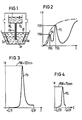
- FIG. 1 shows a highly simplified schematic representation of a polarographic analyzer for determining gloss additives in galvanic copper baths.
- a sample of the bath solution BI to be examined is located in a container Bh.
- a storage vessel Vg with mercury Hg from which a glass capillary Gk extends below the level of the bath solution BI.
- a drop of mercury acts as a so-called mercury drop electrode with a hanging drop of mercury.
- a counter electrode denoted by Ge and a reference electrode denoted by Re are also immersed in the bath solution BI.
- the current-voltage relationship of the bath solution BI to be examined is now determined by applying a time-variable DC potential E between the mercury drip electrode Qe and the reference electrode Re and measuring the current i between the mercury drip electrode Qe and the counter electrode Ge.
- FIG. 2 shows a highly simplified schematic illustration of the polarogram recorded with the analyzer according to FIG. 1, in which the ordinate indicates the current intensity i, while the potential E is plotted on the breaks.
- the dash-dotted curve shows the polarogram of a pure galvanic copper bath that contains neither a gloss additive nor a wetting agent.
- the solid curve shows the polarogram of a galvanic copper bath, which contains a gloss additive and a wetting agent.
- the first polarographic peak PN is caused by the wetting agent in the copper bath, while the second polarographic peak PG is caused by the addition of gloss in the copper bath.
- the peak voltage PNS i.e. H. the potential E at which the polarographic peak PN occurs is a characteristic variable for the wetting agent contained in the copper bath.
- the peak voltage PGS i.e. H. the potential E at which the polarographic peak PG occurs, a characteristic variable for the gloss additive contained in the copper bath.
- the peak height PNH which corresponds to the highest current i of the polarographic peak PN, is a characteristic variable for the effective concentration of the wetting agent contained in the copper bath.
- the peak height PGH which corresponds to the highest current i of the polarographic peak PG, is a characteristic variable for the effective concentration of the gloss additive contained in the copper bath.
- the peak heights therefore do not indicate the absolute amounts of the additives contained in the galvanic bath, but rather the effective amounts or the efficiencies of these additives. This is a considerable advantage for bath monitoring, since the effective amounts always allow a comparison with the fresh bath batch and the corresponding separation conditions.
- the gloss additive labeled "Glänzer 67 liquid” and the wetting agent labeled "Netzstoff 67 M” are products from Henkel & Cie. GmbH, Düsseldorf (DE).
- the measurements are carried out separately for the wetting agent and the gloss additive, since a higher sensitivity can be achieved with separate measurements.
- FIG. 3 shows an example of a polarographic peak PN caused by wetting agents.
- the potential E between the mercury drop electrode Qe and a reference electrode Re designed as a silver / silver chloride electrode was determined starting from an initial potential E of + 0.1 V at a rate of 20 mV / sec to a final potential E of - 0.5 V changed, in which area the polarographic peak PN occurred.
- the corresponding current strength i was measured between the mercury drip electrode Qe and the counter electrode Ge designed as a platinum electrode. The measurement was carried out with direct current in a large drop of mercury (drop size: large).
- the peak height is given as the current in ⁇ A; however, it can also be measured in mm.
- FIG. 4 shows an example of a polarographic pic PG caused by the addition of gloss, where the measurement was carried out on an undiluted bath solution BI.
- the potential E was changed with direct current in the case of a large drop of mercury, starting from an initial potential E of + 0.200 V at a rate of 20 mV / sec to an end potential of - 0.450 V, in which area the polarographic peak PG occurred.
- the current strength i or peak height is given in wA; however, it can also be measured in mm.
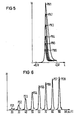
- FIG. 5 shows the determination of polarographic spades PN1, PN2, PN3, PN4, PN5 and PN6 with corresponding concentrations of the wetting agent of 4, 6, 7, 8, 9 and 10 ml per I bath solution. The measurements were carried out on a fresh bath.
- FIG. 6 shows the determination of polarographic spades PG1, PG2, PG3, PG4, PGS, PG6 PG7 and PG8 with corresponding concentrations GK of the gloss addition of 20, 30, 40, 50, 60, 70, 80 and 100 ⁇ l per I bath solution. The measurements were also carried out on a fresh bath. The potential was changed from + 0.2 V to - 0.45 V for each of the spades PG1 to PG8 measured.
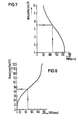
- FIGS. 7 and 8 show the calibration curves obtained from the measurements corresponding to FIGS. 5 and 6.
- 7 shows the effective concentration of the wetting agent in m / l above the peak height PNH given in mm.
- 8 shows the effective concentration of the gloss additive in ⁇ l / l above the peak height PGH given in mm.
- the peak height PNH of the peak PN shown in FIG. 3 is approximately 120 mm, this corresponds to an effective concentration of the wetting agent of 7.5 ml / l according to FIG. 7.
- the peak height PGH of the peak PG shown in FIG. 4 is approximately 75 mm, this corresponds to an effective concentration of the added gloss of 45 ⁇ l / l according to FIG. 8.
- the measurements described above can be carried out both in a standing and in a stirred bath solution.
- the measuring sensitivity is increased and there is a better correlation between the effective amount of the added gloss and the properties of the electrodeposited layers, especially when analyzing a loaded bath.
Landscapes
- Engineering & Computer Science (AREA)
- Chemical & Material Sciences (AREA)
- Automation & Control Theory (AREA)
- Chemical Kinetics & Catalysis (AREA)
- Electrochemistry (AREA)
- Materials Engineering (AREA)
- Metallurgy (AREA)
- Organic Chemistry (AREA)
- Electrolytic Production Of Metals (AREA)
- Electroplating And Plating Baths Therefor (AREA)
- Investigating Or Analyzing Materials By The Use Of Electric Means (AREA)
Description
- Die Erfindung betrifft ein Verfahren zur polarographischen Bestimmung von Glanzzusätzen und Netzmitteln in galvanischen Kupferbädern.
- Die galvanische Abscheidung eines Metallions auf einem als Kathode geschalteten Werkstück ist im einfachsten Fall aus einer wäßrigen Lösung des entsprechenden Metallsalzes möglich. In der Galvanotechnik eingesetzte technische Bäder enthalten jedoch durchweg mehrere Salze und sonstige Zusätze. So erhöhen beispielsweise Leitsalze die Leitfähigkeit des Bades und beeinflussen die Dissoziation der Metallsalze. Puffer haben die Aufgabe den pH-Wert eines Bades konstant zu halten. Zusätze beeinflussen die Eigenschaften der Metallniederschläge. So ermöglichen beispielsweise Glanzzusätze die Abscheidung glänzender Niederschläge, während Netzmittel die Porenbildung in den Niederschlägen zurückdrängen.
- Bei der galvanischen Abscheidurig von Kupfer aus Bädern die Glanzzusätze und Netzmittel enthalten, können konstante Abscheidebedingungen und einwandfreie Kupferschichten nur dann erzielt werden, wenn neben der Überwachung der Hauptkomponenten des Kupferbades auch die Bestimmung der Zusätze in die Badüberwachung und Badführung einbezogen wird. Diese Überwachung der Zusätze wird dadurch erschwert, daß die chemische Zusammensetzung der jeweiligen Zusätze dem Anwender in der Regel nicht bekannt ist. Es sind auch bislang keine Analyseverfahren bekannt, die eine zuverlässige Bestimmung von Glanzzusätzen und Netzmitteln in galvanischen Kupferbädern ermöglichen.
- Aus "PLATING AND SURFACE FINISHING" Juni 1981, Seiten 78 bis 83 ist ein Verfahren zur polarographischen Bestimmung von organischen Zusätzen in galvanischen Bädern bekannt, bei welchen die sogenannte Differential Puls Polargraphie (DPP = Differential pulse polarography) zur Ermittlung der Art und der Konzentration der Zusätze eingesetzt wird. Aus der ermittelten Konzentration der Zusätze kann man jedoch nicht erkennen ob die Zusätze im Bad tatsächlich auch noch in einer wirksamen Form vorliegen.
- Der Erfindung liegt die Aufgabe zugrunde, ein Verfahren zur Bestimmung von Glanzzusätzen und Netzmitteln in galvanischen Kupferbädern anzugeben, welches mit geringem Aufwand darüber Aufschluß gibt, ob und in welcher wirksamen Konzentration diese Zusätze im Kupferbad enthalten sind.
- Diese Aufgabe wird erfindungsgemäß dadurch gelöst, daß an den Elektroden eines polarographischen Analysators mit einer Quecksilbertropfenelektrode mit einem hängenden Quecksilbertropfen und mit einer angelegten Gleichspannung die Strom-Spannungsbeziehung der zu untersuchenden Badlösung ermittelt wird und daß bei einem sprungartigen Anstieg der Stromstärke in Form eines polarographischen Piks die jeweilige Pikspannung als charakteristische Größe für die Art eines in der Badlösung enthaltenen Zusatzes und die Pikhöhe als charakteristische Größe für die wirksame Konzentration dieses Zusatzes ausgewertet wird.
- Bei der konventionellen Polarographie handelt es sich um eine elektrometrische Methode der chemischen Analyse, die auf der Strom-Spannungsbeziehung an einem speziellen Typ von Elektroden beruht. Die zu untersuchende Lösung befindet sich zwischen zwei Elektroden und wird dabei einer ständig steigenden Spannung ausgesetzt. Sobald dann das Reduktionspotential einer der in der Lösung befindlichen lonenarten erreicht ist, steigt die Stromstärke sprungartig an. Wenn bei höherer Spannung eine weitere Reduktion der betreffenden Ionen stattfindet, erhält man einen neuerlichen Stromstärkeanstieg. Trägt man die Spannung in einem Diagramm, dem sogenannten Polarogramm, gegen die jeweilige Stromstärke auf, erhält man eine treppenförmige Kurve, die z. B. bei der Reduktion des zweiwertigen Kupferions Cu2+ zwei solcher polarographischer Treppenstufen zeigt. Aus der Lage der Stufen kann man dann auf die Art der jeweiligen Ionen schließen, während die Höhe der Stufen Aufschluß über die Konzentration der jeweiligen Ionen gibt.
- Wird nun ein galvanisches Kupferbad in einem polarographischen Analysator untersucht, so zeigt das entsprechende Polarogramm die für die Reduktion des zweiwertigen Kupferions Cu2+ typischen polarographischen Stufen. Überraschenderweise wird nun das Polarogramm durch das Vorhandensein von Glanzzusätzen und Netzmitteln in charakteristischer Weise modifiziert,d. h. bei bestimmten, dem Glanzzusatz oder dem Netzmittel zugeordneten Spannungen tritt ein sprungartiger Anstieg der Stromstärke in Form eines polarographischen Piks auf. Dies ist auf Adsorptionsvorgänge an der polarisierten Elektrode zurückzuführen, aufgrund welcher Glanzzusatz und Netzmittel als Aktivator bzw. Inhibitor für die Kupferreduktion wirken. Da die Abscheidung von Kupfer an dem hängenden Quecksilbertropfen durch Netzmittel inhibiert und durch Glanzzusätze aktiviert werden, kann aus diesem Effekt der Wirkungsgrad der Zusätze im Bad und nicht die absolute Konzentration ermittelt werden. Voraussetzung für eine derartige Ermittlung des Wirkungsgrades von Zusätzen ist jedoch die Verwendung einer Quecksilbertropfenelektrode mit einem hängenden Quecksilbertropfen und mit einer ausgelegten Gleichspannung. Die Zusätze werden dabei weder reduziert noch oxidiert. Die Verwendung der sonst üblichen tropfenden Quersilbertropfelektrode oder der Differential Puls Polarographie oder der Wechselstrom-Polarographie würde keine derartige Ermittlung des Wirkungsgrades eines Zusatzes ermöglichen. Vorteilhafte Ausgestaltungen der Erfindung gehen aus den Unteransprüchen hervor.
- Ein Ausführungsbeispiel der Erfindung ist in der Zeichnung dargestellt und wird im folgenden näher beschrieben.
- Es zeigen
- Fig. 1 einen polarographischen Analysator zur Bestimmung von Glanzzusätzen und Netzmitteln in galvanischen Kupferbädern,
- Fig. 2 eine vereinfachte, schematische Darstellung eines mit dem Analysator nach Fig. 1 ermittelten Polarogramms,
- Fig. 3 ein Beispiel für die Bestimmung von Netzmitteln in einem galvanischen Kupferbad,
- Fig. 4 ein Beispiel für die Bestimmung von Glanzzusätzen in einem galvanischen Kupferbad,
- Fig. 5 die Ermittlung von polarographischen Piks bei verschiedenen wirksamen Konzentrationen des Netzmittels,
- Fig. 6 die Ermittlung von polarographischen Piks bei verschiedenen wirksamen Konzentrationen des Glanzzusatzes,
- Fig. 7 eine Eichkurve für die Ermittlung von Netzmitteln und
- Fig. 8 eine Eichkurve für die Ermittlung von Glanzzusatz.
- Figur 1 zeigt in stark vereinfachter schematischer Darstellung einen polarographischen Analysator zur Bestimmung von Glanzzusätzen in galvanischen Kupferbädern. Dabei befindet sich eine Probe der zu untersuchenden Badlösung BI in einem Behälter Bh. Oberhalb des Behälters Bh ist ein Vorratsgefäß Vg mit Quecksilber Hg angeordnet, aus welchem eine Glaskapillare Gk bis unter den Spiegel der Badlösung BI reicht. Am unteren Ende der Kapillare Gk hängt ein Quecksilbertropfen der als sogenannte Quecksilbertropfelektrode mit hängendem Quecksilbertropfen wirkt. Neben dieser mit Qe bezeichneten Quecksilbertropfelektrode tauchen zusätzlich auch noch eine mit Ge bezeichnete Gegenelektrode und eine mit Re bezeichnete Referenzelektrode in die Badlösung BI ein. Die Strom-Spannungsbeziehung der zu untersuchenden Badlösung BI wird nun dadurch ermittelt, daß zwischen die Quecksilbertropfelektrode Qe und die Referenzelektrode Re ein zeitlich veränderbares Gleichspannungspotential E angelegt und der Strom i zwischen der Quecksilbertropfelektrode Qe und der Gegenelektrode Ge gemessen wird.
- Figur 2 zeigt in stark vereinfachter schematischer Darstellung das mit dem Analysator nach Figur 1 aufgezeichnete Polarogramm, bei welchem die Ordiante die Stromstärke i angibt, während auf Abrisse das Potential E aufgetragen ist. Dabei zeigt die strichpunktiert dargestellte Kurve das Polarogramm eines reinen galvanischen Kupferbades, das weder einen Glanzzusatz noch ein Netzmittel enthält. Die ausgezogene Kurve zeigt demgegenüber das Polarogramm eines galvanischen Kupferbades, welches einen Glanzzusatz und ein Netzmittel enthält. Bei zwei verschiedenen Potentialen ist ein sprungartiger Anstieg der Stromstärke i in Form eines polarographischen Piks zu erkennen. Bei einem weiteren Anstieg des Potentials E nähert die Kurve sich dann dem strichpunktiert dargestellten Polarogramm des zusatzfreien Kupferbades.
- Es wurde nun herausgefunden, daß der erste polarographische Pik PN durch das Netzmittel im Kupferbad verursacht wird, während der zweite polarographische Pik PG durch den Glanzzusatz im Kupferbad hervorgerufen wird. Die Pikspannung PNS, d. h. das Potential E bei welchem der polarographische Pik PN auftritt, ist eine charakteristische Größe für das im Kupferbad enthaltene Netzmittel. Demgegenüber ist die Pikspannung PGS, d. h. das Potenital E bei welchem der polarographische Pik PG auftritt, eine charakteristische Größe für den im Kupferbad enthaltenen Glanzzusatz. Die Pikhöhe PNH, welche dem höchsten Strom i des polarographischen Piks PN entspricht, ist eine charakteristische Größe für die wirksame Konzentration des im Kupferbad enthaltenen Netzmittels. In entsprechender Weise ist die Pikhöhe PGH, welche dem höchsten Strom i des polarographischen Piks PG entspricht, eine charakteristische Größe für die wirksame Konzentration des im Kupferbad enthaltenen Glanzzusatzes. Die Pikhöhen geben also dabei nicht die absoluten Mengen der im galvanischen Bad enthaltenen Zusätze sondern die wirksamen Mengen bzw. die Wirkungsgrade dieser Zusätze an. Dies ist für die Badüberwachung ein erheblicher Vorteil, da die Angabe der wirksamen Mengen stets einen Vergleich mit dem frischen Badansatz und den entsprechenden Abscheidebedingungen ermöglicht.
- Anhand der Figuren 3 bis 8 wird ein spezielles Ausführungsbeispiel näher erläutert. Die Messungen wurden an einem wie folgt zusammengesetzten galvanischen Kupferbad durchgeführt:

- Bei dem mit "Glänzer 67 flüssig" bezeichneten Glanzzusatz und dem mit "Netzmittel 67 M" bezeichneten Netzmittel handelt es sich um Produkte der Fa. Henkel & Cie. GmbH, Düsseldorf (DE).
- Für die Messungen wurden folgende Geräte der Firma "EG & G Princeton applied research" eingesetzt:
-

- Fig. 3 zeigt ein Beispiel für einen durch Netzmittel hervorgerufenen polarographischen Pik PN. Mit dem vorstehend angegebenen polarographischen Analysator wurde das Potential E zwischen der Quecksilbertropfelektrode Qe und einer als Silber/Silberchlorid-Elektrode ausgebildeten Referenzelektrode Re ausgehend von einem Anfangspotential E von + 0,1 V mit einer Rate von 20 mV/sec bis zu einem Endpotential E von - 0,5 V verändert, wobei in diesem Bereich der polarographische Pik PN auftrat. Die entsprechende Stromstärke i wurde zwischen der Quecksilbertropfelektrode Qe und der als Platinelektrode ausgebildeten Gegenelektrode Ge gemessen. Die Messung erfolgte mit Gleichstrom bei einem großen Quecksilbertropfen (Drop Size : Large). Die Pikhöhe ist als Stromstärke in µA angegeben; sie kann jedoch auch in mm gemessen werden.
- Der in Figur 3 dargestellte polarographische Pik PN wurde nicht an einer unverdünnten Badlösung BI ermittelt, sondern an einer Mischung aus 0,1 ml Badlösung BI und 10 ml eines Citrat-Natronlauge-Puffers pH=5.
- Figur 4 zeigt ein Beispiel für einen durch Glanzzusatz hervorgerufenen polarographischen Pik PG, wobei hier die Messung an einer unverdünnten Badlösung BI vorgenommen wurde. Mit dem bereits geschilderten polarographischen Analysator wurde mit Gleichstrom bei einem großen Quecksilbertropfen das Potential E ausgehend von einem Anfangspotential E von + 0,200 V mit einer Rate von 20 mV/sec bis zu einem Endpotential von - 0,450 V verändert, wobei in diesem Bereich der polarographische Pik PG auftrat. Die Stromstärke i bzw. Pikhöhe ist in wA angegeben; sie kann jedoch auch in mm gemessen werden.
- Figur 5 zeigt die Ermittlung von polarographischen Piks PN1, PN2, PN3, PN4, PN5 und PN6 bei entsprechenden Konzentrationen des Netzmittels von 4, 6, 7, 8, 9 und 10 ml pro I Badlösung. Die Messungen wurden am frischen Bad durchgeführt.
- Figur 6 zeigt die Ermittlung von polarographischen Piks PG1, PG2, PG3, PG4, PGS, PG6 PG7 und PG8 bei entsprechenden Konzentrationen GK des Glanzzusatzes von 20, 30, 40, 50, 60, 70, 80 und 100 µl pro I Badlösung. Die Messungen wurden ebenfalls am frischen Bad durchgeführt. Dabei wurde bei jedem der gemessenen Piks PG1 bis PG8 das Potential von + 0,2 V bis - 0,45 V geändert.
- Die Figuren 7 und 8 zeigen die aus den Messungen entsprechend den Figuren 5 und 6 gewonnenen Eichkurven. Dabei ist in Fig. 7 die wirksame Konzentration des Netzmittels in m/l über der in mm angegebenen Pikhöhe PNH aufgetragen. In Fig. 8 ist die wirksame Konzentration des Glanzzusatzes in µl/l über der in mm angegebenen Pikhöhe PGH aufgetragen.
- Beträgt die Pikhöhe PNH des in Fig. 3 dargestellten Piks PN etwa 120 mm, so entspricht dies gemäß Fig. 7 einer wirksamen Konzentration des Netzmittels von 7,5 mI/I.
- Beträgt die Pikhöhe PGH des in Fig. 4 dargestellten Piks PG etwa 75 mm, so entspricht dies gemäß Fig. 8 einer wirksamen Konzentration des Glanzzusatzes von 45 µl/l.
- Aus der vorstehenden Schilderung geht hervor, daß mit Hilfe eines polarographsichen Analysators die qualitative und quantitative Bestimmung von Zusätzen in galvanischen Bädern auf einfache Weise vorgenommen werden kann. Von besonderem Vorteil ist dabei, daß die Konzentrationen des wirksamen Zusatzes angegeben werden. Anstelle von Eichkurven können für die Angabe der jeweils gemessenen Konzentrationen auch entsprechende Auswerte-schaltungen verwendet werden. Es ist auch möglich die ermittelten Ergebnisse unmittelbar für die Badführung heranzuziehen.
- Die vorstehend beschriebenen Messungen können sowohl in stehender als auch in gerührter Badlösung durchgeführt werden. Beim Messen in einer gerührten Badlösung wird jedoch die Meßempfindlichkeit erhöht und es gibt, vor allem beim Analysieren eines belasteteten Bades, eine bessere Korrelation zwischen der wirksamen Menge des Glanzzusatzes und den Eigenschaften der galvanisch abgeschiedenen Schichten.
Claims (7)
dadurch gekennzeichnet, daß als Gegenelektrode (Ge) eine Platinelektrode verwendet wird.
dadurch gekennzeichnet, daß zur qualitativen Bestimmung und zur Bestimmung der wirksamen Konzentration von Netzmitteln in galvanischen Kupferbädern die zu untersuchende Badlösung (BI) mit einer Pufferlösung verdünnt wird.
dadurch gekennzeichnet, daß die zu untersuchende Badlösung zumindest während der Ermittlung der Strom-Spannungsbeziehung gerührt wird.
Priority Applications (1)
| Application Number | Priority Date | Filing Date | Title |
|---|---|---|---|
| AT87106582T ATE49613T1 (de) | 1986-05-21 | 1987-05-07 | Verfahren zur polarographischen bestimmung von zusaetzen in galvanischen baedern. |
Applications Claiming Priority (2)
| Application Number | Priority Date | Filing Date | Title |
|---|---|---|---|
| DE3617046 | 1986-05-21 | ||
| DE3617046 | 1986-05-21 |
Publications (2)
| Publication Number | Publication Date |
|---|---|
| EP0246494A1 EP0246494A1 (de) | 1987-11-25 |
| EP0246494B1 true EP0246494B1 (de) | 1990-01-17 |
Family
ID=6301279
Family Applications (1)
| Application Number | Title | Priority Date | Filing Date |
|---|---|---|---|
| EP87106582A Expired - Lifetime EP0246494B1 (de) | 1986-05-21 | 1987-05-07 | Verfahren zur polarographischen Bestimmung von Zusätzen in galvanischen Bädern |
Country Status (4)
| Country | Link |
|---|---|
| EP (1) | EP0246494B1 (de) |
| JP (1) | JPS62285057A (de) |
| AT (1) | ATE49613T1 (de) |
| DE (1) | DE3761442D1 (de) |
Families Citing this family (3)
| Publication number | Priority date | Publication date | Assignee | Title |
|---|---|---|---|---|
| EP1932953B1 (de) * | 2006-12-11 | 2012-11-14 | Atotech Deutschland GmbH | Galvanisches Verfahren mit Analyse des Elektrolytbads durch Festphasenextraktion |
| JP5509121B2 (ja) * | 2011-02-28 | 2014-06-04 | メルテックス株式会社 | 無電解ニッケルめっき液の硫黄化合物定量分析方法 |
| CN103014823B (zh) * | 2013-01-05 | 2015-05-13 | 华进半导体封装先导技术研发中心有限公司 | 改进铜电沉积的添加剂效果快速判定方法 |
-
1987
- 1987-05-07 EP EP87106582A patent/EP0246494B1/de not_active Expired - Lifetime
- 1987-05-07 DE DE8787106582T patent/DE3761442D1/de not_active Expired - Lifetime
- 1987-05-07 AT AT87106582T patent/ATE49613T1/de not_active IP Right Cessation
- 1987-05-19 JP JP62122355A patent/JPS62285057A/ja active Pending
Also Published As
| Publication number | Publication date |
|---|---|
| DE3761442D1 (de) | 1990-02-22 |
| EP0246494A1 (de) | 1987-11-25 |
| ATE49613T1 (de) | 1990-02-15 |
| JPS62285057A (ja) | 1987-12-10 |
Similar Documents
| Publication | Publication Date | Title |
|---|---|---|
| DE60113214T2 (de) | Plattierungsbadanalyse | |
| DE2757458C2 (de) | ||
| DE3586435T2 (de) | Verfahren zur ueberwachung der konzentrationen von metallischen ionen in metallisierbaedern. | |
| EP0294001B1 (de) | Verfahren zur Messung der wirksamen Inhibitorkonzentration während der Metallabscheidung aus wässrigen Elektrolyten | |
| DE2729115A1 (de) | Verfahren und vorrichtung zur bestimmung der effektiven konzentration eines elektroaktiven bestandteils | |
| DE69318932T2 (de) | Verfahren zur selektiven Überwachung von Spurenbestandteilen in Plattierungsbädern | |
| EP0581081A1 (de) | Verfahren zur Bestimmung von Persäuren | |
| EP0246494B1 (de) | Verfahren zur polarographischen Bestimmung von Zusätzen in galvanischen Bädern | |
| EP0513564A2 (de) | Reagenz zur Bestimmung der Ionenstärke bzw. des spezifischen Gewichtes von wässrigen Flüssigkeiten und Verfahren | |
| DE1621427C2 (de) | Verhinderung der galvanischen korrosion bei elektrischen kontakten | |
| DE19911447C2 (de) | Verfahren zum analytischen Ermitteln der Konzentration von Zusatzstoffen in galvanischen Metallabscheidebädern | |
| DE60112425T2 (de) | Voltammetrische Analyse unter Verwendung einer Amalgamelektrode | |
| EP0154705B1 (de) | Verfahren zur vollautomatischen Steuerung der galvanischen Abscheidung von Kupferüberzügen aus sauren Kupferbädern | |
| DE69318933T2 (de) | Verfahren zur Feststellung von wesentlichen Bestandteilen in andere mitniedersetzende Bestandteile enthaltenden Plattierungsbädern | |
| DE3042504A1 (de) | Ph-unabhaengiges verfahren zur messung und ueberwachung der gesamtkonzentration einer reihe von ionenarten in einem probenstrom | |
| DE1771955C3 (de) | Bad und Verfahren zur Verbesserung der Verschleissfestigkeit von Metalloberflächen | |
| EP0157434A1 (de) | Verfahren zur Regelung des Zink- und/oder Nickelgehaltes in Phosphatierbädern | |
| DE2629879A1 (de) | Verfahren zur instandhaltung eines galvanischen verchromungsbades auf der basis von 3-wertigem chrom und die hierzu verwendeten mittel | |
| DE2225275A1 (de) | Verfahren zur quantitativen Calciumbestimmung | |
| EP0171842A1 (de) | Verfahren zur Aufrechterhaltung des Zinkgehaltes in Zinkphosphatierbädern | |
| DE2363462C3 (de) | Verfahren zum galvanischen Abscheiden von Weichgoldschichten | |
| DE1935231C3 (de) | Verfahren zur Bestimmung der Stromansbeute elektrolytischer Bäder | |
| DE112022001109T5 (de) | Reagenzienfreie verfahren und prozesskontrolle zur messung und überwachung der halogenidkonzentration in elektroabscheidungslösungen für metalle der eisentrias und deren legierungen | |
| DE102004035245A1 (de) | Verfahren zum voltammetrischen Messen einer Meßsubstanz und Vorrichtung für eine voltammetrische Messung | |
| DE3408726C2 (de) |
Legal Events
| Date | Code | Title | Description |
|---|---|---|---|
| PUAI | Public reference made under article 153(3) epc to a published international application that has entered the european phase |
Free format text: ORIGINAL CODE: 0009012 |
|
| AK | Designated contracting states |
Kind code of ref document: A1 Designated state(s): AT BE CH DE FR GB IT LI NL SE |
|
| 17P | Request for examination filed |
Effective date: 19880205 |
|
| 17Q | First examination report despatched |
Effective date: 19881122 |
|
| GRAA | (expected) grant |
Free format text: ORIGINAL CODE: 0009210 |
|
| AK | Designated contracting states |
Kind code of ref document: B1 Designated state(s): AT BE CH DE FR GB IT LI NL SE |
|
| REF | Corresponds to: |
Ref document number: 49613 Country of ref document: AT Date of ref document: 19900215 Kind code of ref document: T |
|
| REF | Corresponds to: |
Ref document number: 3761442 Country of ref document: DE Date of ref document: 19900222 |
|
| ET | Fr: translation filed | ||
| ITF | It: translation for a ep patent filed | ||
| GBT | Gb: translation of ep patent filed (gb section 77(6)(a)/1977) | ||
| PGFP | Annual fee paid to national office [announced via postgrant information from national office to epo] |
Ref country code: AT Payment date: 19900504 Year of fee payment: 4 |
|
| PGFP | Annual fee paid to national office [announced via postgrant information from national office to epo] |
Ref country code: SE Payment date: 19900518 Year of fee payment: 4 |
|
| PGFP | Annual fee paid to national office [announced via postgrant information from national office to epo] |
Ref country code: NL Payment date: 19900531 Year of fee payment: 4 Ref country code: BE Payment date: 19900531 Year of fee payment: 4 |
|
| PGFP | Annual fee paid to national office [announced via postgrant information from national office to epo] |
Ref country code: CH Payment date: 19900824 Year of fee payment: 4 |
|
| PLBE | No opposition filed within time limit |
Free format text: ORIGINAL CODE: 0009261 |
|
| STAA | Information on the status of an ep patent application or granted ep patent |
Free format text: STATUS: NO OPPOSITION FILED WITHIN TIME LIMIT |
|
| 26N | No opposition filed | ||
| PG25 | Lapsed in a contracting state [announced via postgrant information from national office to epo] |
Ref country code: AT Effective date: 19910507 |
|
| PG25 | Lapsed in a contracting state [announced via postgrant information from national office to epo] |
Ref country code: SE Effective date: 19910508 |
|
| PGFP | Annual fee paid to national office [announced via postgrant information from national office to epo] |
Ref country code: FR Payment date: 19910527 Year of fee payment: 5 |
|
| ITTA | It: last paid annual fee | ||
| PG25 | Lapsed in a contracting state [announced via postgrant information from national office to epo] |
Ref country code: LI Effective date: 19910531 Ref country code: CH Effective date: 19910531 Ref country code: BE Effective date: 19910531 |
|
| PGFP | Annual fee paid to national office [announced via postgrant information from national office to epo] |
Ref country code: DE Payment date: 19910726 Year of fee payment: 5 |
|
| BERE | Be: lapsed |
Owner name: SIEMENS A.G. Effective date: 19910531 |
|
| PG25 | Lapsed in a contracting state [announced via postgrant information from national office to epo] |
Ref country code: NL Effective date: 19911201 |
|
| NLV4 | Nl: lapsed or anulled due to non-payment of the annual fee | ||
| REG | Reference to a national code |
Ref country code: CH Ref legal event code: PL |
|
| PGFP | Annual fee paid to national office [announced via postgrant information from national office to epo] |
Ref country code: GB Payment date: 19920424 Year of fee payment: 6 |
|
| PG25 | Lapsed in a contracting state [announced via postgrant information from national office to epo] |
Ref country code: FR Effective date: 19930129 |
|
| PG25 | Lapsed in a contracting state [announced via postgrant information from national office to epo] |
Ref country code: DE Effective date: 19930202 |
|
| REG | Reference to a national code |
Ref country code: FR Ref legal event code: ST |
|
| PG25 | Lapsed in a contracting state [announced via postgrant information from national office to epo] |
Ref country code: GB Effective date: 19930507 |
|
| GBPC | Gb: european patent ceased through non-payment of renewal fee |
Effective date: 19930507 |
|
| EUG | Se: european patent has lapsed |
Ref document number: 87106582.7 Effective date: 19911209 |
|
| PG25 | Lapsed in a contracting state [announced via postgrant information from national office to epo] |
Ref country code: IT Free format text: LAPSE BECAUSE OF NON-PAYMENT OF DUE FEES;WARNING: LAPSES OF ITALIAN PATENTS WITH EFFECTIVE DATE BEFORE 2007 MAY HAVE OCCURRED AT ANY TIME BEFORE 2007. THE CORRECT EFFECTIVE DATE MAY BE DIFFERENT FROM THE ONE RECORDED. Effective date: 20050507 |