EP0241696A2 - Naphtholactamfarbstoffe und diese ethaltendes optisches Aufzeichnungsmedium - Google Patents
Naphtholactamfarbstoffe und diese ethaltendes optisches Aufzeichnungsmedium Download PDFInfo
- Publication number
- EP0241696A2 EP0241696A2 EP87103197A EP87103197A EP0241696A2 EP 0241696 A2 EP0241696 A2 EP 0241696A2 EP 87103197 A EP87103197 A EP 87103197A EP 87103197 A EP87103197 A EP 87103197A EP 0241696 A2 EP0241696 A2 EP 0241696A2
- Authority
- EP
- European Patent Office
- Prior art keywords
- optionally substituted
- hydrogen
- alkyl
- alkoxy
- substituted
- Prior art date
- Legal status (The legal status is an assumption and is not a legal conclusion. Google has not performed a legal analysis and makes no representation as to the accuracy of the status listed.)
- Granted
Links
- 239000000975 dye Substances 0.000 title claims abstract description 47
- 230000003287 optical effect Effects 0.000 title claims abstract description 22
- GPYLCFQEKPUWLD-UHFFFAOYSA-N 1h-benzo[cd]indol-2-one Chemical compound C1=CC(C(=O)N2)=C3C2=CC=CC3=C1 GPYLCFQEKPUWLD-UHFFFAOYSA-N 0.000 title claims abstract description 21
- -1 C1-C6-carboxyalkyl Chemical group 0.000 claims abstract description 62
- 239000001257 hydrogen Substances 0.000 claims abstract description 31
- 229910052739 hydrogen Inorganic materials 0.000 claims abstract description 31
- 125000000229 (C1-C4)alkoxy group Chemical group 0.000 claims abstract description 25
- 229910052736 halogen Inorganic materials 0.000 claims abstract description 25
- 150000002367 halogens Chemical class 0.000 claims abstract description 25
- 125000001997 phenyl group Chemical group [H]C1=C([H])C([H])=C(*)C([H])=C1[H] 0.000 claims abstract description 21
- UFHFLCQGNIYNRP-UHFFFAOYSA-N Hydrogen Chemical compound [H][H] UFHFLCQGNIYNRP-UHFFFAOYSA-N 0.000 claims abstract description 20
- 125000004663 dialkyl amino group Chemical group 0.000 claims abstract description 17
- 150000002431 hydrogen Chemical class 0.000 claims abstract description 15
- 125000004178 (C1-C4) alkyl group Chemical group 0.000 claims abstract description 13
- 125000000449 nitro group Chemical group [O-][N+](*)=O 0.000 claims abstract description 13
- 125000003837 (C1-C20) alkyl group Chemical group 0.000 claims abstract description 5
- 125000004454 (C1-C6) alkoxycarbonyl group Chemical group 0.000 claims abstract description 5
- 125000004169 (C1-C6) alkyl group Chemical group 0.000 claims abstract description 5
- 150000001450 anions Chemical class 0.000 claims abstract description 5
- 125000002915 carbonyl group Chemical group [*:2]C([*:1])=O 0.000 claims abstract description 5
- 125000002947 alkylene group Chemical group 0.000 claims abstract description 4
- 125000004356 hydroxy functional group Chemical group O* 0.000 claims abstract 3
- 229920000642 polymer Polymers 0.000 claims description 13
- WKBOTKDWSSQWDR-UHFFFAOYSA-N Bromine atom Chemical compound [Br] WKBOTKDWSSQWDR-UHFFFAOYSA-N 0.000 claims description 7
- ZAMOUSCENKQFHK-UHFFFAOYSA-N Chlorine atom Chemical compound [Cl] ZAMOUSCENKQFHK-UHFFFAOYSA-N 0.000 claims description 7
- GDTBXPJZTBHREO-UHFFFAOYSA-N bromine Substances BrBr GDTBXPJZTBHREO-UHFFFAOYSA-N 0.000 claims description 7
- 229910052794 bromium Inorganic materials 0.000 claims description 7
- 229910052801 chlorine Inorganic materials 0.000 claims description 7
- 239000000460 chlorine Substances 0.000 claims description 7
- 125000000094 2-phenylethyl group Chemical group [H]C1=C([H])C([H])=C(C([H])=C1[H])C([H])([H])C([H])([H])* 0.000 claims description 4
- 125000001797 benzyl group Chemical group [H]C1=C([H])C([H])=C(C([H])=C1[H])C([H])([H])* 0.000 claims description 4
- 125000004093 cyano group Chemical group *C#N 0.000 claims description 4
- 125000001495 ethyl group Chemical group [H]C([H])([H])C([H])([H])* 0.000 claims description 4
- 125000002496 methyl group Chemical group [H]C([H])([H])* 0.000 claims description 4
- 125000000020 sulfo group Chemical group O=S(=O)([*])O[H] 0.000 claims description 4
- 125000003356 phenylsulfanyl group Chemical group [*]SC1=C([H])C([H])=C([H])C([H])=C1[H] 0.000 claims description 3
- 125000006700 (C1-C6) alkylthio group Chemical group 0.000 claims 1
- 125000004435 hydrogen atom Chemical group [H]* 0.000 claims 1
- 239000010410 layer Substances 0.000 description 53
- LFQSCWFLJHTTHZ-UHFFFAOYSA-N Ethanol Chemical compound CCO LFQSCWFLJHTTHZ-UHFFFAOYSA-N 0.000 description 10
- 238000010521 absorption reaction Methods 0.000 description 9
- WFDIJRYMOXRFFG-UHFFFAOYSA-N acetic acid anhydride Natural products CC(=O)OC(C)=O WFDIJRYMOXRFFG-UHFFFAOYSA-N 0.000 description 9
- 230000008859 change Effects 0.000 description 8
- ZWEHNKRNPOVVGH-UHFFFAOYSA-N 2-Butanone Chemical compound CCC(C)=O ZWEHNKRNPOVVGH-UHFFFAOYSA-N 0.000 description 7
- 239000011230 binding agent Substances 0.000 description 7
- 239000000463 material Substances 0.000 description 7
- XKRFYHLGVUSROY-UHFFFAOYSA-N Argon Chemical compound [Ar] XKRFYHLGVUSROY-UHFFFAOYSA-N 0.000 description 6
- XEKOWRVHYACXOJ-UHFFFAOYSA-N Ethyl acetate Chemical compound CCOC(C)=O XEKOWRVHYACXOJ-UHFFFAOYSA-N 0.000 description 6
- OKKJLVBELUTLKV-UHFFFAOYSA-N Methanol Chemical compound OC OKKJLVBELUTLKV-UHFFFAOYSA-N 0.000 description 6
- YXFVVABEGXRONW-UHFFFAOYSA-N Toluene Chemical compound CC1=CC=CC=C1 YXFVVABEGXRONW-UHFFFAOYSA-N 0.000 description 6
- 239000000203 mixture Substances 0.000 description 6
- 239000004065 semiconductor Substances 0.000 description 6
- 150000001875 compounds Chemical class 0.000 description 5
- 239000011241 protective layer Substances 0.000 description 5
- 150000003254 radicals Chemical class 0.000 description 5
- RTZKZFJDLAIYFH-UHFFFAOYSA-N Diethyl ether Chemical compound CCOCC RTZKZFJDLAIYFH-UHFFFAOYSA-N 0.000 description 4
- JCXJVPUVTGWSNB-UHFFFAOYSA-N Nitrogen dioxide Chemical class O=[N]=O JCXJVPUVTGWSNB-UHFFFAOYSA-N 0.000 description 4
- 239000004793 Polystyrene Substances 0.000 description 4
- 238000000034 method Methods 0.000 description 4
- 229920002223 polystyrene Polymers 0.000 description 4
- 230000005855 radiation Effects 0.000 description 4
- 239000000243 solution Substances 0.000 description 4
- 238000004528 spin coating Methods 0.000 description 4
- 238000003860 storage Methods 0.000 description 4
- 229920001169 thermoplastic Polymers 0.000 description 4
- 239000004416 thermosoftening plastic Substances 0.000 description 4
- CSCPPACGZOOCGX-UHFFFAOYSA-N Acetone Chemical compound CC(C)=O CSCPPACGZOOCGX-UHFFFAOYSA-N 0.000 description 3
- WEVYAHXRMPXWCK-UHFFFAOYSA-N Acetonitrile Chemical compound CC#N WEVYAHXRMPXWCK-UHFFFAOYSA-N 0.000 description 3
- 229910000980 Aluminium gallium arsenide Inorganic materials 0.000 description 3
- YMWUJEATGCHHMB-UHFFFAOYSA-N Dichloromethane Chemical compound ClCCl YMWUJEATGCHHMB-UHFFFAOYSA-N 0.000 description 3
- 229910052786 argon Inorganic materials 0.000 description 3
- 229920001577 copolymer Polymers 0.000 description 3
- 238000007598 dipping method Methods 0.000 description 3
- 238000001704 evaporation Methods 0.000 description 3
- 238000004519 manufacturing process Methods 0.000 description 3
- 229920003229 poly(methyl methacrylate) Polymers 0.000 description 3
- 239000004926 polymethyl methacrylate Substances 0.000 description 3
- 125000002861 (C1-C4) alkanoyl group Chemical group 0.000 description 2
- KDOAHVPFGIYCEU-AATRIKPKSA-N (e)-3-ethoxy-2-methylprop-2-enal Chemical compound CCO\C=C(/C)C=O KDOAHVPFGIYCEU-AATRIKPKSA-N 0.000 description 2
- WAOPPELONVRRKQ-UHFFFAOYSA-N 1h-indol-1-ium;iodide Chemical compound [I-].C1=CC=C2[NH2+]C=CC2=C1 WAOPPELONVRRKQ-UHFFFAOYSA-N 0.000 description 2
- 125000000143 2-carboxyethyl group Chemical group [H]OC(=O)C([H])([H])C([H])([H])* 0.000 description 2
- QTBSBXVTEAMEQO-UHFFFAOYSA-N Acetic acid Chemical compound CC(O)=O QTBSBXVTEAMEQO-UHFFFAOYSA-N 0.000 description 2
- CPELXLSAUQHCOX-UHFFFAOYSA-M Bromide Chemical compound [Br-] CPELXLSAUQHCOX-UHFFFAOYSA-M 0.000 description 2
- VEXZGXHMUGYJMC-UHFFFAOYSA-M Chloride anion Chemical compound [Cl-] VEXZGXHMUGYJMC-UHFFFAOYSA-M 0.000 description 2
- HEDRZPFGACZZDS-UHFFFAOYSA-N Chloroform Chemical compound ClC(Cl)Cl HEDRZPFGACZZDS-UHFFFAOYSA-N 0.000 description 2
- LRHPLDYGYMQRHN-UHFFFAOYSA-N N-Butanol Chemical compound CCCCO LRHPLDYGYMQRHN-UHFFFAOYSA-N 0.000 description 2
- CTQNGGLPUBDAKN-UHFFFAOYSA-N O-Xylene Chemical compound CC1=CC=CC=C1C CTQNGGLPUBDAKN-UHFFFAOYSA-N 0.000 description 2
- VMHLLURERBWHNL-UHFFFAOYSA-M Sodium acetate Chemical compound [Na+].CC([O-])=O VMHLLURERBWHNL-UHFFFAOYSA-M 0.000 description 2
- WYURNTSHIVDZCO-UHFFFAOYSA-N Tetrahydrofuran Chemical compound C1CCOC1 WYURNTSHIVDZCO-UHFFFAOYSA-N 0.000 description 2
- 238000002835 absorbance Methods 0.000 description 2
- 229910052782 aluminium Inorganic materials 0.000 description 2
- XAGFODPZIPBFFR-UHFFFAOYSA-N aluminium Chemical compound [Al] XAGFODPZIPBFFR-UHFFFAOYSA-N 0.000 description 2
- 229940040526 anhydrous sodium acetate Drugs 0.000 description 2
- 230000006399 behavior Effects 0.000 description 2
- 230000008901 benefit Effects 0.000 description 2
- 125000002057 carboxymethyl group Chemical group [H]OC(=O)C([H])([H])[*] 0.000 description 2
- 239000000969 carrier Substances 0.000 description 2
- 238000006243 chemical reaction Methods 0.000 description 2
- MVPPADPHJFYWMZ-UHFFFAOYSA-N chlorobenzene Chemical compound ClC1=CC=CC=C1 MVPPADPHJFYWMZ-UHFFFAOYSA-N 0.000 description 2
- JHIVVAPYMSGYDF-UHFFFAOYSA-N cyclohexanone Chemical compound O=C1CCCCC1 JHIVVAPYMSGYDF-UHFFFAOYSA-N 0.000 description 2
- 230000008020 evaporation Effects 0.000 description 2
- 238000005562 fading Methods 0.000 description 2
- 230000002349 favourable effect Effects 0.000 description 2
- 239000011521 glass Substances 0.000 description 2
- 238000009499 grossing Methods 0.000 description 2
- XMBWDFGMSWQBCA-UHFFFAOYSA-N hydrogen iodide Chemical compound I XMBWDFGMSWQBCA-UHFFFAOYSA-N 0.000 description 2
- 125000002887 hydroxy group Chemical group [H]O* 0.000 description 2
- 239000012442 inert solvent Substances 0.000 description 2
- 238000002347 injection Methods 0.000 description 2
- 239000007924 injection Substances 0.000 description 2
- 239000011147 inorganic material Substances 0.000 description 2
- 229910052751 metal Inorganic materials 0.000 description 2
- 239000002184 metal Substances 0.000 description 2
- 229910052757 nitrogen Inorganic materials 0.000 description 2
- 125000004430 oxygen atom Chemical group O* 0.000 description 2
- VLTRZXGMWDSKGL-UHFFFAOYSA-M perchlorate Inorganic materials [O-]Cl(=O)(=O)=O VLTRZXGMWDSKGL-UHFFFAOYSA-M 0.000 description 2
- VLTRZXGMWDSKGL-UHFFFAOYSA-N perchloric acid Chemical compound OCl(=O)(=O)=O VLTRZXGMWDSKGL-UHFFFAOYSA-N 0.000 description 2
- IEQIEDJGQAUEQZ-UHFFFAOYSA-N phthalocyanine Chemical class N1C(N=C2C3=CC=CC=C3C(N=C3C4=CC=CC=C4C(=N4)N3)=N2)=C(C=CC=C2)C2=C1N=C1C2=CC=CC=C2C4=N1 IEQIEDJGQAUEQZ-UHFFFAOYSA-N 0.000 description 2
- 229920003023 plastic Polymers 0.000 description 2
- 239000004033 plastic Substances 0.000 description 2
- 239000004417 polycarbonate Substances 0.000 description 2
- 229920000515 polycarbonate Polymers 0.000 description 2
- 239000004800 polyvinyl chloride Substances 0.000 description 2
- 229920000915 polyvinyl chloride Polymers 0.000 description 2
- 238000002360 preparation method Methods 0.000 description 2
- 239000011347 resin Substances 0.000 description 2
- 229920005989 resin Polymers 0.000 description 2
- 230000035945 sensitivity Effects 0.000 description 2
- 239000002904 solvent Substances 0.000 description 2
- 239000000758 substrate Substances 0.000 description 2
- 238000010345 tape casting Methods 0.000 description 2
- VZGDMQKNWNREIO-UHFFFAOYSA-N tetrachloromethane Chemical compound ClC(Cl)(Cl)Cl VZGDMQKNWNREIO-UHFFFAOYSA-N 0.000 description 2
- 239000012815 thermoplastic material Substances 0.000 description 2
- JOXIMZWYDAKGHI-UHFFFAOYSA-N toluene-4-sulfonic acid Chemical compound CC1=CC=C(S(O)(=O)=O)C=C1 JOXIMZWYDAKGHI-UHFFFAOYSA-N 0.000 description 2
- 238000007738 vacuum evaporation Methods 0.000 description 2
- 239000008096 xylene Substances 0.000 description 2
- QGKMIGUHVLGJBR-UHFFFAOYSA-M (4z)-1-(3-methylbutyl)-4-[[1-(3-methylbutyl)quinolin-1-ium-4-yl]methylidene]quinoline;iodide Chemical compound [I-].C12=CC=CC=C2N(CCC(C)C)C=CC1=CC1=CC=[N+](CCC(C)C)C2=CC=CC=C12 QGKMIGUHVLGJBR-UHFFFAOYSA-M 0.000 description 1
- 125000004400 (C1-C12) alkyl group Chemical group 0.000 description 1
- 125000004769 (C1-C4) alkylsulfonyl group Chemical group 0.000 description 1
- RYHBNJHYFVUHQT-UHFFFAOYSA-N 1,4-Dioxane Chemical compound C1COCCO1 RYHBNJHYFVUHQT-UHFFFAOYSA-N 0.000 description 1
- 125000004182 2-chlorophenyl group Chemical group [H]C1=C([H])C(Cl)=C(*)C([H])=C1[H] 0.000 description 1
- 125000004200 2-methoxyethyl group Chemical group [H]C([H])([H])OC([H])([H])C([H])([H])* 0.000 description 1
- 125000004493 2-methylbut-1-yl group Chemical group CC(C*)CC 0.000 description 1
- 125000005916 2-methylpentyl group Chemical group 0.000 description 1
- 125000004800 4-bromophenyl group Chemical group [H]C1=C([H])C(*)=C([H])C([H])=C1Br 0.000 description 1
- 125000004861 4-isopropyl phenyl group Chemical group [H]C1=C([H])C(=C([H])C([H])=C1*)C([H])(C([H])([H])[H])C([H])([H])[H] 0.000 description 1
- 125000004172 4-methoxyphenyl group Chemical group [H]C1=C([H])C(OC([H])([H])[H])=C([H])C([H])=C1* 0.000 description 1
- 125000000590 4-methylphenyl group Chemical group [H]C1=C([H])C(=C([H])C([H])=C1*)C([H])([H])[H] 0.000 description 1
- RYGMFSIKBFXOCR-UHFFFAOYSA-N Copper Chemical compound [Cu] RYGMFSIKBFXOCR-UHFFFAOYSA-N 0.000 description 1
- SNRUBQQJIBEYMU-UHFFFAOYSA-N Dodecane Natural products CCCCCCCCCCCC SNRUBQQJIBEYMU-UHFFFAOYSA-N 0.000 description 1
- PXGOKWXKJXAPGV-UHFFFAOYSA-N Fluorine Chemical compound FF PXGOKWXKJXAPGV-UHFFFAOYSA-N 0.000 description 1
- VEXZGXHMUGYJMC-UHFFFAOYSA-N Hydrochloric acid Chemical compound Cl VEXZGXHMUGYJMC-UHFFFAOYSA-N 0.000 description 1
- WSMYVTOQOOLQHP-UHFFFAOYSA-N Malondialdehyde Chemical compound O=CCC=O WSMYVTOQOOLQHP-UHFFFAOYSA-N 0.000 description 1
- CERQOIWHTDAKMF-UHFFFAOYSA-N Methacrylic acid Chemical compound CC(=C)C(O)=O CERQOIWHTDAKMF-UHFFFAOYSA-N 0.000 description 1
- AFVFQIVMOAPDHO-UHFFFAOYSA-M Methanesulfonate Chemical compound CS([O-])(=O)=O AFVFQIVMOAPDHO-UHFFFAOYSA-M 0.000 description 1
- VVQNEPGJFQJSBK-UHFFFAOYSA-N Methyl methacrylate Chemical compound COC(=O)C(C)=C VVQNEPGJFQJSBK-UHFFFAOYSA-N 0.000 description 1
- YCUVUDODLRLVIC-UHFFFAOYSA-N Sudan black B Chemical compound C1=CC(=C23)NC(C)(C)NC2=CC=CC3=C1N=NC(C1=CC=CC=C11)=CC=C1N=NC1=CC=CC=C1 YCUVUDODLRLVIC-UHFFFAOYSA-N 0.000 description 1
- QAOWNCQODCNURD-UHFFFAOYSA-L Sulfate Chemical compound [O-]S([O-])(=O)=O QAOWNCQODCNURD-UHFFFAOYSA-L 0.000 description 1
- ATJFFYVFTNAWJD-UHFFFAOYSA-N Tin Chemical compound [Sn] ATJFFYVFTNAWJD-UHFFFAOYSA-N 0.000 description 1
- 239000006096 absorbing agent Substances 0.000 description 1
- 229960000583 acetic acid Drugs 0.000 description 1
- 230000002378 acidificating effect Effects 0.000 description 1
- 230000009471 action Effects 0.000 description 1
- 230000032683 aging Effects 0.000 description 1
- 150000001298 alcohols Chemical class 0.000 description 1
- 125000000217 alkyl group Chemical group 0.000 description 1
- 229910045601 alloy Inorganic materials 0.000 description 1
- 239000000956 alloy Substances 0.000 description 1
- 125000004397 aminosulfonyl group Chemical group NS(=O)(=O)* 0.000 description 1
- 125000002490 anilino group Chemical group [H]N(*)C1=C([H])C([H])=C([H])C([H])=C1[H] 0.000 description 1
- 150000001449 anionic compounds Chemical class 0.000 description 1
- 125000000129 anionic group Chemical group 0.000 description 1
- 125000001204 arachidyl group Chemical group [H]C([*])([H])C([H])([H])C([H])([H])C([H])([H])C([H])([H])C([H])([H])C([H])([H])C([H])([H])C([H])([H])C([H])([H])C([H])([H])C([H])([H])C([H])([H])C([H])([H])C([H])([H])C([H])([H])C([H])([H])C([H])([H])C([H])([H])C([H])([H])[H] 0.000 description 1
- 238000000889 atomisation Methods 0.000 description 1
- 239000000987 azo dye Substances 0.000 description 1
- SRSXLGNVWSONIS-UHFFFAOYSA-M benzenesulfonate Chemical compound [O-]S(=O)(=O)C1=CC=CC=C1 SRSXLGNVWSONIS-UHFFFAOYSA-M 0.000 description 1
- 230000015572 biosynthetic process Effects 0.000 description 1
- 229910052797 bismuth Inorganic materials 0.000 description 1
- JCXGWMGPZLAOME-UHFFFAOYSA-N bismuth atom Chemical compound [Bi] JCXGWMGPZLAOME-UHFFFAOYSA-N 0.000 description 1
- 125000000484 butyl group Chemical group [H]C([*])([H])C([H])([H])C([H])([H])C([H])([H])[H] 0.000 description 1
- 125000003917 carbamoyl group Chemical group [H]N([H])C(*)=O 0.000 description 1
- 125000001951 carbamoylamino group Chemical group C(N)(=O)N* 0.000 description 1
- 125000003178 carboxy group Chemical group [H]OC(*)=O 0.000 description 1
- 125000004181 carboxyalkyl group Chemical group 0.000 description 1
- 239000012876 carrier material Substances 0.000 description 1
- 229920002678 cellulose Polymers 0.000 description 1
- 229910052798 chalcogen Inorganic materials 0.000 description 1
- 150000001787 chalcogens Chemical class 0.000 description 1
- 239000007795 chemical reaction product Substances 0.000 description 1
- 238000009833 condensation Methods 0.000 description 1
- 230000005494 condensation Effects 0.000 description 1
- 229910052802 copper Inorganic materials 0.000 description 1
- 239000010949 copper Substances 0.000 description 1
- 125000000332 coumarinyl group Chemical class O1C(=O)C(=CC2=CC=CC=C12)* 0.000 description 1
- 238000002425 crystallisation Methods 0.000 description 1
- 230000008025 crystallization Effects 0.000 description 1
- 125000000582 cycloheptyl group Chemical group [H]C1([H])C([H])([H])C([H])([H])C([H])([H])C([H])(*)C([H])([H])C1([H])[H] 0.000 description 1
- 125000000113 cyclohexyl group Chemical group [H]C1([H])C([H])([H])C([H])([H])C([H])(*)C([H])([H])C1([H])[H] 0.000 description 1
- 125000001511 cyclopentyl group Chemical group [H]C1([H])C([H])([H])C([H])([H])C([H])(*)C1([H])[H] 0.000 description 1
- 238000013500 data storage Methods 0.000 description 1
- 125000002704 decyl group Chemical group [H]C([H])([H])C([H])([H])C([H])([H])C([H])([H])C([H])([H])C([H])([H])C([H])([H])C([H])([H])C([H])([H])C([H])([H])* 0.000 description 1
- TUXJTJITXCHUEL-UHFFFAOYSA-N disperse red 11 Chemical compound C1=CC=C2C(=O)C3=C(N)C(OC)=CC(N)=C3C(=O)C2=C1 TUXJTJITXCHUEL-UHFFFAOYSA-N 0.000 description 1
- 239000006185 dispersion Substances 0.000 description 1
- 125000003438 dodecyl group Chemical group [H]C([H])([H])C([H])([H])C([H])([H])C([H])([H])C([H])([H])C([H])([H])C([H])([H])C([H])([H])C([H])([H])C([H])([H])C([H])([H])C([H])([H])* 0.000 description 1
- 238000001035 drying Methods 0.000 description 1
- 239000003822 epoxy resin Substances 0.000 description 1
- 125000003754 ethoxycarbonyl group Chemical group C(=O)(OCC)* 0.000 description 1
- 229910052731 fluorine Inorganic materials 0.000 description 1
- 239000011737 fluorine Substances 0.000 description 1
- 229920002313 fluoropolymer Polymers 0.000 description 1
- 239000011888 foil Substances 0.000 description 1
- 239000012362 glacial acetic acid Substances 0.000 description 1
- 230000009477 glass transition Effects 0.000 description 1
- KWIUHFFTVRNATP-UHFFFAOYSA-N glycine betaine Chemical group C[N+](C)(C)CC([O-])=O KWIUHFFTVRNATP-UHFFFAOYSA-N 0.000 description 1
- PCHJSUWPFVWCPO-UHFFFAOYSA-N gold Chemical compound [Au] PCHJSUWPFVWCPO-UHFFFAOYSA-N 0.000 description 1
- 229910052737 gold Inorganic materials 0.000 description 1
- 239000010931 gold Substances 0.000 description 1
- 150000004820 halides Chemical class 0.000 description 1
- LNEPOXFFQSENCJ-UHFFFAOYSA-N haloperidol Chemical compound C1CC(O)(C=2C=CC(Cl)=CC=2)CCN1CCCC(=O)C1=CC=C(F)C=C1 LNEPOXFFQSENCJ-UHFFFAOYSA-N 0.000 description 1
- 125000006343 heptafluoro propyl group Chemical group 0.000 description 1
- 125000003187 heptyl group Chemical group [H]C([*])([H])C([H])([H])C([H])([H])C([H])([H])C([H])([H])C([H])([H])C([H])([H])[H] 0.000 description 1
- 125000004051 hexyl group Chemical group [H]C([H])([H])C([H])([H])C([H])([H])C([H])([H])C([H])([H])C([H])([H])* 0.000 description 1
- 125000005935 hexyloxycarbonyl group Chemical group 0.000 description 1
- 229910010272 inorganic material Inorganic materials 0.000 description 1
- 230000002452 interceptive effect Effects 0.000 description 1
- 230000001678 irradiating effect Effects 0.000 description 1
- 125000000959 isobutyl group Chemical group [H]C([H])([H])C([H])(C([H])([H])[H])C([H])([H])* 0.000 description 1
- 125000005929 isobutyloxycarbonyl group Chemical group [H]C([H])([H])C([H])(C([H])([H])[H])C([H])([H])OC(*)=O 0.000 description 1
- 125000001449 isopropyl group Chemical group [H]C([H])([H])C([H])(*)C([H])([H])[H] 0.000 description 1
- 150000003951 lactams Chemical class 0.000 description 1
- 239000000990 laser dye Substances 0.000 description 1
- 239000011133 lead Substances 0.000 description 1
- 230000031700 light absorption Effects 0.000 description 1
- 229940118019 malondialdehyde Drugs 0.000 description 1
- 125000002960 margaryl group Chemical group [H]C([*])([H])C([H])([H])C([H])([H])C([H])([H])C([H])([H])C([H])([H])C([H])([H])C([H])([H])C([H])([H])C([H])([H])C([H])([H])C([H])([H])C([H])([H])C([H])([H])C([H])([H])C([H])([H])C([H])([H])[H] 0.000 description 1
- 239000011159 matrix material Substances 0.000 description 1
- 238000002844 melting Methods 0.000 description 1
- 230000008018 melting Effects 0.000 description 1
- 230000015654 memory Effects 0.000 description 1
- 150000002739 metals Chemical class 0.000 description 1
- 125000001434 methanylylidene group Chemical group [H]C#[*] 0.000 description 1
- 125000001160 methoxycarbonyl group Chemical group [H]C([H])([H])OC(*)=O 0.000 description 1
- XXTISPYPIAPDGY-UHFFFAOYSA-N n,n-diphenylmethanimidamide Chemical compound C=1C=CC=CC=1N(C=N)C1=CC=CC=C1 XXTISPYPIAPDGY-UHFFFAOYSA-N 0.000 description 1
- 230000007935 neutral effect Effects 0.000 description 1
- OLYIBSWMAQCHOP-UHFFFAOYSA-N nonacyclo[20.10.1.113,17.02,10.04,9.012,33.023,31.025,30.021,34]tetratriaconta-1(32),2,4,6,8,10,12(33),13,15,17(34),18,20,22,24,26,28,30-heptadecaene Chemical group C12=CC3=CC=CC=C3C2=CC2=C3C=C(C=CC=C4)C4=C3C=C3C2=C1C1=C2C3=CC=CC2=CC=C1 OLYIBSWMAQCHOP-UHFFFAOYSA-N 0.000 description 1
- 125000001196 nonadecyl group Chemical group [H]C([*])([H])C([H])([H])C([H])([H])C([H])([H])C([H])([H])C([H])([H])C([H])([H])C([H])([H])C([H])([H])C([H])([H])C([H])([H])C([H])([H])C([H])([H])C([H])([H])C([H])([H])C([H])([H])C([H])([H])C([H])([H])C([H])([H])[H] 0.000 description 1
- 231100000252 nontoxic Toxicity 0.000 description 1
- 230000003000 nontoxic effect Effects 0.000 description 1
- 125000001400 nonyl group Chemical group [H]C([*])([H])C([H])([H])C([H])([H])C([H])([H])C([H])([H])C([H])([H])C([H])([H])C([H])([H])C([H])([H])[H] 0.000 description 1
- 125000002347 octyl group Chemical group [H]C([*])([H])C([H])([H])C([H])([H])C([H])([H])C([H])([H])C([H])([H])C([H])([H])C([H])([H])[H] 0.000 description 1
- 150000002891 organic anions Chemical class 0.000 description 1
- 150000002894 organic compounds Chemical class 0.000 description 1
- 239000011368 organic material Substances 0.000 description 1
- 239000003960 organic solvent Substances 0.000 description 1
- 150000004893 oxazines Chemical class 0.000 description 1
- 125000000913 palmityl group Chemical group [H]C([*])([H])C([H])([H])C([H])([H])C([H])([H])C([H])([H])C([H])([H])C([H])([H])C([H])([H])C([H])([H])C([H])([H])C([H])([H])C([H])([H])C([H])([H])C([H])([H])C([H])([H])C([H])([H])[H] 0.000 description 1
- 125000002958 pentadecyl group Chemical group [H]C([*])([H])C([H])([H])C([H])([H])C([H])([H])C([H])([H])C([H])([H])C([H])([H])C([H])([H])C([H])([H])C([H])([H])C([H])([H])C([H])([H])C([H])([H])C([H])([H])C([H])([H])[H] 0.000 description 1
- 125000001147 pentyl group Chemical group C(CCCC)* 0.000 description 1
- 125000001148 pentyloxycarbonyl group Chemical group 0.000 description 1
- 125000003170 phenylsulfonyl group Chemical group C1(=CC=CC=C1)S(=O)(=O)* 0.000 description 1
- 229920003227 poly(N-vinyl carbazole) Polymers 0.000 description 1
- 229920000058 polyacrylate Polymers 0.000 description 1
- 229920000647 polyepoxide Polymers 0.000 description 1
- 229920006254 polymer film Polymers 0.000 description 1
- 229920000306 polymethylpentene Polymers 0.000 description 1
- 239000011116 polymethylpentene Substances 0.000 description 1
- 229920001290 polyvinyl ester Polymers 0.000 description 1
- 230000008569 process Effects 0.000 description 1
- 125000001436 propyl group Chemical group [H]C([*])([H])C([H])([H])C([H])([H])[H] 0.000 description 1
- 125000004742 propyloxycarbonyl group Chemical group 0.000 description 1
- 230000001681 protective effect Effects 0.000 description 1
- 238000010992 reflux Methods 0.000 description 1
- 229910052703 rhodium Inorganic materials 0.000 description 1
- 239000010948 rhodium Substances 0.000 description 1
- MHOVAHRLVXNVSD-UHFFFAOYSA-N rhodium atom Chemical compound [Rh] MHOVAHRLVXNVSD-UHFFFAOYSA-N 0.000 description 1
- 229920002050 silicone resin Polymers 0.000 description 1
- 125000006850 spacer group Chemical group 0.000 description 1
- 238000009987 spinning Methods 0.000 description 1
- PWEBUXCTKOWPCW-UHFFFAOYSA-N squaric acid Chemical class OC1=C(O)C(=O)C1=O PWEBUXCTKOWPCW-UHFFFAOYSA-N 0.000 description 1
- 239000007858 starting material Substances 0.000 description 1
- 125000004079 stearyl group Chemical group [H]C([*])([H])C([H])([H])C([H])([H])C([H])([H])C([H])([H])C([H])([H])C([H])([H])C([H])([H])C([H])([H])C([H])([H])C([H])([H])C([H])([H])C([H])([H])C([H])([H])C([H])([H])C([H])([H])C([H])([H])C([H])([H])[H] 0.000 description 1
- 125000001424 substituent group Chemical group 0.000 description 1
- 238000006467 substitution reaction Methods 0.000 description 1
- 125000000999 tert-butyl group Chemical group [H]C([H])([H])C(*)(C([H])([H])[H])C([H])([H])[H] 0.000 description 1
- YLQBMQCUIZJEEH-UHFFFAOYSA-N tetrahydrofuran Natural products C=1C=COC=1 YLQBMQCUIZJEEH-UHFFFAOYSA-N 0.000 description 1
- 229920001187 thermosetting polymer Polymers 0.000 description 1
- 229910052718 tin Inorganic materials 0.000 description 1
- 239000011135 tin Substances 0.000 description 1
- 125000003866 trichloromethyl group Chemical group ClC(Cl)(Cl)* 0.000 description 1
- 125000002023 trifluoromethyl group Chemical group FC(F)(F)* 0.000 description 1
- 230000001960 triggered effect Effects 0.000 description 1
- AAAQKTZKLRYKHR-UHFFFAOYSA-N triphenylmethane Chemical compound C1=CC=CC=C1C(C=1C=CC=CC=1)C1=CC=CC=C1 AAAQKTZKLRYKHR-UHFFFAOYSA-N 0.000 description 1
- 238000001771 vacuum deposition Methods 0.000 description 1
- 238000007740 vapor deposition Methods 0.000 description 1
Classifications
-
- G—PHYSICS
- G11—INFORMATION STORAGE
- G11B—INFORMATION STORAGE BASED ON RELATIVE MOVEMENT BETWEEN RECORD CARRIER AND TRANSDUCER
- G11B7/00—Recording or reproducing by optical means, e.g. recording using a thermal beam of optical radiation by modifying optical properties or the physical structure, reproducing using an optical beam at lower power by sensing optical properties; Record carriers therefor
- G11B7/24—Record carriers characterised by shape, structure or physical properties, or by the selection of the material
- G11B7/241—Record carriers characterised by shape, structure or physical properties, or by the selection of the material characterised by the selection of the material
- G11B7/242—Record carriers characterised by shape, structure or physical properties, or by the selection of the material characterised by the selection of the material of recording layers
- G11B7/244—Record carriers characterised by shape, structure or physical properties, or by the selection of the material characterised by the selection of the material of recording layers comprising organic materials only
- G11B7/245—Record carriers characterised by shape, structure or physical properties, or by the selection of the material characterised by the selection of the material of recording layers comprising organic materials only containing a polymeric component
-
- C—CHEMISTRY; METALLURGY
- C09—DYES; PAINTS; POLISHES; NATURAL RESINS; ADHESIVES; COMPOSITIONS NOT OTHERWISE PROVIDED FOR; APPLICATIONS OF MATERIALS NOT OTHERWISE PROVIDED FOR
- C09B—ORGANIC DYES OR CLOSELY-RELATED COMPOUNDS FOR PRODUCING DYES, e.g. PIGMENTS; MORDANTS; LAKES
- C09B57/00—Other synthetic dyes of known constitution
- C09B57/06—Naphtholactam dyes
-
- G—PHYSICS
- G11—INFORMATION STORAGE
- G11B—INFORMATION STORAGE BASED ON RELATIVE MOVEMENT BETWEEN RECORD CARRIER AND TRANSDUCER
- G11B7/00—Recording or reproducing by optical means, e.g. recording using a thermal beam of optical radiation by modifying optical properties or the physical structure, reproducing using an optical beam at lower power by sensing optical properties; Record carriers therefor
- G11B7/24—Record carriers characterised by shape, structure or physical properties, or by the selection of the material
- G11B7/241—Record carriers characterised by shape, structure or physical properties, or by the selection of the material characterised by the selection of the material
- G11B7/242—Record carriers characterised by shape, structure or physical properties, or by the selection of the material characterised by the selection of the material of recording layers
- G11B7/244—Record carriers characterised by shape, structure or physical properties, or by the selection of the material characterised by the selection of the material of recording layers comprising organic materials only
-
- G—PHYSICS
- G11—INFORMATION STORAGE
- G11B—INFORMATION STORAGE BASED ON RELATIVE MOVEMENT BETWEEN RECORD CARRIER AND TRANSDUCER
- G11B7/00—Recording or reproducing by optical means, e.g. recording using a thermal beam of optical radiation by modifying optical properties or the physical structure, reproducing using an optical beam at lower power by sensing optical properties; Record carriers therefor
- G11B7/24—Record carriers characterised by shape, structure or physical properties, or by the selection of the material
- G11B7/241—Record carriers characterised by shape, structure or physical properties, or by the selection of the material characterised by the selection of the material
- G11B7/242—Record carriers characterised by shape, structure or physical properties, or by the selection of the material characterised by the selection of the material of recording layers
- G11B7/244—Record carriers characterised by shape, structure or physical properties, or by the selection of the material characterised by the selection of the material of recording layers comprising organic materials only
- G11B7/246—Record carriers characterised by shape, structure or physical properties, or by the selection of the material characterised by the selection of the material of recording layers comprising organic materials only containing dyes
- G11B7/247—Record carriers characterised by shape, structure or physical properties, or by the selection of the material characterised by the selection of the material of recording layers comprising organic materials only containing dyes methine or polymethine dyes
-
- G—PHYSICS
- G11—INFORMATION STORAGE
- G11B—INFORMATION STORAGE BASED ON RELATIVE MOVEMENT BETWEEN RECORD CARRIER AND TRANSDUCER
- G11B7/00—Recording or reproducing by optical means, e.g. recording using a thermal beam of optical radiation by modifying optical properties or the physical structure, reproducing using an optical beam at lower power by sensing optical properties; Record carriers therefor
- G11B7/24—Record carriers characterised by shape, structure or physical properties, or by the selection of the material
- G11B7/241—Record carriers characterised by shape, structure or physical properties, or by the selection of the material characterised by the selection of the material
- G11B7/252—Record carriers characterised by shape, structure or physical properties, or by the selection of the material characterised by the selection of the material of layers other than recording layers
- G11B7/253—Record carriers characterised by shape, structure or physical properties, or by the selection of the material characterised by the selection of the material of layers other than recording layers of substrates
- G11B7/2533—Record carriers characterised by shape, structure or physical properties, or by the selection of the material characterised by the selection of the material of layers other than recording layers of substrates comprising resins
- G11B7/2534—Record carriers characterised by shape, structure or physical properties, or by the selection of the material characterised by the selection of the material of layers other than recording layers of substrates comprising resins polycarbonates [PC]
-
- G—PHYSICS
- G11—INFORMATION STORAGE
- G11B—INFORMATION STORAGE BASED ON RELATIVE MOVEMENT BETWEEN RECORD CARRIER AND TRANSDUCER
- G11B7/00—Recording or reproducing by optical means, e.g. recording using a thermal beam of optical radiation by modifying optical properties or the physical structure, reproducing using an optical beam at lower power by sensing optical properties; Record carriers therefor
- G11B7/24—Record carriers characterised by shape, structure or physical properties, or by the selection of the material
- G11B7/241—Record carriers characterised by shape, structure or physical properties, or by the selection of the material characterised by the selection of the material
- G11B7/252—Record carriers characterised by shape, structure or physical properties, or by the selection of the material characterised by the selection of the material of layers other than recording layers
- G11B7/258—Record carriers characterised by shape, structure or physical properties, or by the selection of the material characterised by the selection of the material of layers other than recording layers of reflective layers
- G11B7/2585—Record carriers characterised by shape, structure or physical properties, or by the selection of the material characterised by the selection of the material of layers other than recording layers of reflective layers based on aluminium
-
- Y—GENERAL TAGGING OF NEW TECHNOLOGICAL DEVELOPMENTS; GENERAL TAGGING OF CROSS-SECTIONAL TECHNOLOGIES SPANNING OVER SEVERAL SECTIONS OF THE IPC; TECHNICAL SUBJECTS COVERED BY FORMER USPC CROSS-REFERENCE ART COLLECTIONS [XRACs] AND DIGESTS
- Y10—TECHNICAL SUBJECTS COVERED BY FORMER USPC
- Y10S—TECHNICAL SUBJECTS COVERED BY FORMER USPC CROSS-REFERENCE ART COLLECTIONS [XRACs] AND DIGESTS
- Y10S428/00—Stock material or miscellaneous articles
- Y10S428/913—Material designed to be responsive to temperature, light, moisture
-
- Y—GENERAL TAGGING OF NEW TECHNOLOGICAL DEVELOPMENTS; GENERAL TAGGING OF CROSS-SECTIONAL TECHNOLOGIES SPANNING OVER SEVERAL SECTIONS OF THE IPC; TECHNICAL SUBJECTS COVERED BY FORMER USPC CROSS-REFERENCE ART COLLECTIONS [XRACs] AND DIGESTS
- Y10—TECHNICAL SUBJECTS COVERED BY FORMER USPC
- Y10S—TECHNICAL SUBJECTS COVERED BY FORMER USPC CROSS-REFERENCE ART COLLECTIONS [XRACs] AND DIGESTS
- Y10S430/00—Radiation imagery chemistry: process, composition, or product thereof
- Y10S430/146—Laser beam
-
- Y—GENERAL TAGGING OF NEW TECHNOLOGICAL DEVELOPMENTS; GENERAL TAGGING OF CROSS-SECTIONAL TECHNOLOGIES SPANNING OVER SEVERAL SECTIONS OF THE IPC; TECHNICAL SUBJECTS COVERED BY FORMER USPC CROSS-REFERENCE ART COLLECTIONS [XRACs] AND DIGESTS
- Y10—TECHNICAL SUBJECTS COVERED BY FORMER USPC
- Y10T—TECHNICAL SUBJECTS COVERED BY FORMER US CLASSIFICATION
- Y10T428/00—Stock material or miscellaneous articles
- Y10T428/24—Structurally defined web or sheet [e.g., overall dimension, etc.]
- Y10T428/24802—Discontinuous or differential coating, impregnation or bond [e.g., artwork, printing, retouched photograph, etc.]
-
- Y—GENERAL TAGGING OF NEW TECHNOLOGICAL DEVELOPMENTS; GENERAL TAGGING OF CROSS-SECTIONAL TECHNOLOGIES SPANNING OVER SEVERAL SECTIONS OF THE IPC; TECHNICAL SUBJECTS COVERED BY FORMER USPC CROSS-REFERENCE ART COLLECTIONS [XRACs] AND DIGESTS
- Y10—TECHNICAL SUBJECTS COVERED BY FORMER USPC
- Y10T—TECHNICAL SUBJECTS COVERED BY FORMER US CLASSIFICATION
- Y10T428/00—Stock material or miscellaneous articles
- Y10T428/24—Structurally defined web or sheet [e.g., overall dimension, etc.]
- Y10T428/24802—Discontinuous or differential coating, impregnation or bond [e.g., artwork, printing, retouched photograph, etc.]
- Y10T428/24851—Intermediate layer is discontinuous or differential
-
- Y—GENERAL TAGGING OF NEW TECHNOLOGICAL DEVELOPMENTS; GENERAL TAGGING OF CROSS-SECTIONAL TECHNOLOGIES SPANNING OVER SEVERAL SECTIONS OF THE IPC; TECHNICAL SUBJECTS COVERED BY FORMER USPC CROSS-REFERENCE ART COLLECTIONS [XRACs] AND DIGESTS
- Y10—TECHNICAL SUBJECTS COVERED BY FORMER USPC
- Y10T—TECHNICAL SUBJECTS COVERED BY FORMER US CLASSIFICATION
- Y10T428/00—Stock material or miscellaneous articles
- Y10T428/24—Structurally defined web or sheet [e.g., overall dimension, etc.]
- Y10T428/24802—Discontinuous or differential coating, impregnation or bond [e.g., artwork, printing, retouched photograph, etc.]
- Y10T428/24851—Intermediate layer is discontinuous or differential
- Y10T428/24868—Translucent outer layer
- Y10T428/24876—Intermediate layer contains particulate material [e.g., pigment, etc.]
-
- Y—GENERAL TAGGING OF NEW TECHNOLOGICAL DEVELOPMENTS; GENERAL TAGGING OF CROSS-SECTIONAL TECHNOLOGIES SPANNING OVER SEVERAL SECTIONS OF THE IPC; TECHNICAL SUBJECTS COVERED BY FORMER USPC CROSS-REFERENCE ART COLLECTIONS [XRACs] AND DIGESTS
- Y10—TECHNICAL SUBJECTS COVERED BY FORMER USPC
- Y10T—TECHNICAL SUBJECTS COVERED BY FORMER US CLASSIFICATION
- Y10T428/00—Stock material or miscellaneous articles
- Y10T428/31504—Composite [nonstructural laminate]
Definitions
- the present invention relates to new naphtholactam dyes and an optical recording medium containing at least one naphtholactam dye and optionally a support.
- solid-state injection lasers that emit in the near infrared are suitable, especially the AlGaAs laser, which is in the wavelength range between about 750 and 950 nm works, particularly well as a light source for an optical recording system.
- the known information recording materials consist of a support on which thin layers of inorganic materials, e.g. Metals, semimetals, alloys or chalcogen glass or organic compounds, e.g. IR dyes are applied.
- the thin layers are mainly created by vacuum deposition or atomization techniques.
- the thickness of the layers should be chosen so that all the radiated radiation is absorbed, unless interference phenomena are to be exploited.
- the carrier can be made of glass or a suitable plastic, e.g. Polycarbonate, polymethyl methacrylate, polystyrene, polystyrene copolymers, polyvinyl chloride or polymethylpentene.
- the amorphous layers do not change over long periods of time.
- Optical recording media for operation with semiconductor injection lasers are widely known with regard to carrier material, reflector material and laser-sensitive layer.
- phthalocyanine compounds, methine dyes and squaric acid derivatives are described as organic IR dyes.
- US-A-4 023 185 describes recording media in which the light-absorbing layer is evaporated by evaporating the dyes C.I. Solvent Black 3 and C.I. No. 26 150 is generated. These record carriers can be written with an argon laser.
- US Pat. No. 4,380,769 discloses further recording media which can be written on with an argon laser and which contain azo dyes and / or coumarin compounds in a polymeric binder in the light-absorbing layer or as a light-absorbing layer.
- DE-A-3 007 296 deals with a system for data recording which contains an indigoid photochromic dye bound to a polymer with an absorption maximum at 545 nm.
- JP-A-112 793/1983 teaches the use of triphenylmethane dyes as a light absorbing layer in optical recording systems.
- optical storage systems which, as absorbing compounds, oxazines (JP-A-132 231/1983), cyanine dyes (JP-A-112 790/1983 and 125 246/1983), phthalocyanine compounds (EP-A-84 729, US Pat. A-4 241 355, JP-A-56 892/1983) and naphthoquinone-1,4-compounds which carry substituents with donor action (JP-A-112 793/1983).
- These memories can be written with a He-Ne laser (633 nm).
- DE-A-3 014 677 describes an optical recording medium which contains 1,4-diamino-2-methoxyanthraquinone, dissolved in a polymer matrix, as the dye.
- Materials which are to be used as the light-absorbing layer of the recording medium must be applied to suitable carriers in the form of a thin, smooth layer of high optical quality and a predetermined thickness.
- the materials must also absorb at the wavelength of the light source used and be sufficiently sensitive, that is, when irradiating light pulses of a few nJ energy content or below, which are focused on focal diameter of approx. ⁇ 1 ⁇ m diameter, their optical properties in the irradiated area in one change the ways described above.
- the object of the present invention was to provide new naphtholactam dyes and optical recording media containing naphtholactam dyes as light-absorbing layers, which meet the above-mentioned requirements, which are also easy to manufacture, stable over a long period of time and corrosion-free and non-toxic.
- R1 and R3 in the formula Ia and Ib are, for example, C1-C20-alkyl, optionally substituted by phenyl, halogen, C1-C4-alkanoyl, carboxyl, C1-C4-alkanoylamino, C1-C4-alkoxycarbonyl, C1-C4-alkoxycarbonylamino or C1-C4-alkylanilino substituted and / or interrupted by oxygen atoms, such as methyl, ethyl, propyl, isopropyl, butyl, isobutyl, tert-butyl, pentyl, 2-methylbutyl, hexyl, 2-methylpentyl, heptyl, octyl, 2-ethylhexyl , Isooctyl, nonyl, isononyl, decyl, isodecyl, dodecyl, 3,5,5,7-
- R2, R4 and R5 in the formulas Ia and Ib are, for example, hydrogen; optionally substituted C1-C6 alkyl (examples include the corresponding unsubstituted and substituted radicals listed under R1 and R3); optionally substituted C5-C6-cycloalkyl (examples include the corresponding unsubstituted and substituted radicals listed under R1 and R3); optionally substituted phenyl (examples include the corresponding unsubstituted and substituted radicals listed under R1 and R3); C1-C6 alkoxycarbonyl such as methoxycarbonyl, ethoxycarbonyl, propoxycarbonyl, isobutoxycarbonyl, pentyloxycarbonyl, hexyloxycarbonyl; C1-C6 carboxyalkyl such as carboxymethyl, 2-carboxyethyl, 2-carboxypropyl, 3-carboxypropyl; Hydroxy; C1-C4 alk
- Z1 and Z2 in the formulas Ia and Ib each represent, for example, hydrogen or, in the case where n is 1, also together a C2-C3-alkyl chain which is optionally substituted by C1-C4-alkyl, such as 1,2-ethylene, 1,2 -Propylene or 1,3-propylene; or one or two carbonyl groups.
- X ⁇ in the formulas Ia and Ib represents an inorganic or organic anion, for example a halide, such as chloride, bromide or iodide; Sulfate, perchlorate, tetrafluoroborate, methyl sulfonate, phenyl sulfonate, 4-methylphenyl sulfonate or salicyclate.
- the formulas Ia and Ib are also intended to be such naphtho comprise lactam dyes which have betaine structure, ie in which the anionic group is part of the dye molecule.
- the rings A, B, C and D in the formulas Ia and Ib can be unsubstituted or, for example, by C1-C4-alkyl, phenyl C1-C4-alkoxy, C1-C20-alkylthio, halogen, nitro, cyano, C1-C4-mono - or dialkylamino, C1-C4-alkylsulfonyl, C1-C4-alkoxysulfonyl, phenylsulfonyl, C1-C4-alkylphenylsulfonyl, hydroxysulfonyl, anilino, C1-C4-alkylanilino, C1-C4-alkanoyl, C1-C4-alkanoylamino Alkoxycarbonyl, C1-C4-alkoxycarbonylamino, carbamoyl, C1-C4-N-mono or N, N-dial
- Preferred naphtholactam dyes of the formula Ia in which R1 and R3 are optionally interrupted by oxygen atoms are C1-C12-alkyl, in particular C1-C4-alkyl, benzyl, 2-phenylethyl, C5-C6-cycloaklyl or phenyl, R2, R4 and R5 hydrogen , C1-C4-alkyl, in particular C1-C2-alkyl, C5-C6-cycloalkyl, phenyl, C1-C4-alkoxycarbonyl, C1-C2-carboxyalkyl, chlorine or bromine, n 1 and p are 0 or 1 and in which the rings A, B, C and D unsubstituted or by methyl, ethyl, phenyl, C1-C4-alkoxy, C1-C4-alkylthio, cyano, C1-C2-dialkylamino, chlorine, bromine, hydroxysulf
- Preferred anions X ⁇ are chloride, bromide, iodide, perchlorate, tetrafluoroborate or 4-methylphenyl sulfonate.
- the dyes according to the invention are obtained by condensation of cycloammonium compounds of the formula II in which R1, A, B and X ⁇ have the meaning given above, with C-1, C-3 or C-5 building blocks in an acidic or alkaline medium in the presence of an inert solvent at a temperature of 20 to 150 ° C.
- suitable C-1, C-3 and C-5 building blocks are:
- cycloammonium compounds of the formula II required as starting materials and the C-1, C-3 and C-5 building blocks are known or can be prepared by processes known per se.
- Inert solvents for the reactions are e.g. Methanol, ethanol, butanol, toluene, xylene, chlorobenzene, tetrahydrofuran, dioxane, glacial acetic acid, acetic anhydride or compatible mixtures thereof are suitable.
- the naphtholactam dyes of the formula Ia have a very high molar absorption in the range from 700 to 1200 nm. They are readily soluble in organic solvents and / or thermoplastic or cross-linked plastics.
- the recording system according to the invention has a very high absorption at the wavelength of the semiconductor laser of approximately 750 to 950 nm.
- the polymer layers can be applied to a light-reflecting layer in such a way that smooth absorption layers of high optical quality result, which have a favorable threshold energy and into which the information to be stored can be written with a high signal-to-noise ratio.
- the recording medium according to the present invention is writable and readable with a semiconductor laser. Furthermore, it is very stable against atmospheric influences and daylight.
- the recording medium according to the invention is very sensitive to the light of the GaAlAs semiconductor laser.
- a reflective layer can be present between the light-absorbing layer and the carrier, so that the radiated light which is traveling through the colored layer, insofar as it is not absorbed, is reflected on the reflector layer and migrates again through the colored layer.
- substrate-absorber layer optionally reflector layer.
- the light-reflecting layer should be such that it reflects the light used for recording and scanning as quantitatively as possible. Suitable light reflecting materials are e.g. Aluminum, rhodium, gold, tin, lead, bismuth, copper or dielectric mirrors. The thickness of the light-reflecting layer should be so large that it reflects the light used for recording or scanning as completely as possible.
- the carrier or the light-reflecting layer must have an optically smooth, flat surface and must be designed on the surface in such a way that the absorbing layer adheres firmly to it.
- the support and / or the reflector can be provided with a smoothing layer made of a thermosetting or thermoplastic material.
- Metallic reflection layers are preferably applied in a known manner by vapor deposition in a vacuum or else by applying suitable metal foils to the carrier.
- the layer according to the invention which is sensitive to laser light, is preferably applied by spinning on dissolved or dispersed dye in the presence of binders. Doctor blade or dipping can also be considered as methods for producing the layers.
- a solution or optionally a dispersion of the dye or dye mixture and in a suitable solvent such as methylene chloride, chloroform, carbon tetrachloride, acetone, methyl ethyl ketone, cyclohexanone, toluene, acetonitrile, ethyl acetate, methanol or mixtures of these solvents of the polymer and optionally adds a binder.
- binder come either radiation or heat curable resins, e.g. B. photopolymers, silicone resins and epoxy resins or thermoplastics.
- Thermoplastic materials with little or no crystalline content and glass transition temperatures of> 35 ° C., in particular> 75 ° C., are preferred.
- the binders such as resins or thermoplastics, must be well compatible with the naphtholactam dyes of the formula Ib.
- water-insoluble binders with high solubility are suitable for the naphtholactam dyes, such as (meth) acrylate polymers or copolymers, polystyrene homo- or copolymers, polyvinyl carbazole, polyvinyl ester copolymers, polyvinyl chloride and cellulose esters.
- the dye preparation is then applied by knife coating or dipping, but preferably by spin coating onto a previously cleaned or pretreated (“subbing layer”) substrate and the layer is dried or cured in air.
- the film can also be dried or cured in vacuo, at elevated temperature or, if appropriate, with radiation.
- the dye-in-polymer layer is applied first and then the reflector or vice versa.
- the application of intermediate and protective layers or a reflective layer can optionally be dispensed with.
- the dye-in-polymer layer does not have sufficient mechanical stability, it can be covered with a transparent protective layer.
- a transparent protective layer A number of polymers are suitable for this purpose, which can form a protective layer by spin-coating, knife coating or dipping of dissolved polymers or by vacuum evaporation, in particular fluorinated polymers.
- the system data storage
- a protective layer can be dispensed with.
- the "sandwich” structure offers the advantage of double the storage capacity.
- the protective and / or intermediate layers can be dispensed with if the optical recording medium is of sufficient quality. If it is not possible to do without intermediate layers, the Refractive index of the material used for this and the laser light wavelength used, the layer thickness of which are chosen so that no interfering interference can occur.
- thermoplastic The heat generated when the laser light is absorbed leads to a radially outward flow of the thermoplastic and thus to the formation of sharp "holes" which results in excellent signal / noise behavior.
Landscapes
- Chemical & Material Sciences (AREA)
- Organic Chemistry (AREA)
- Optical Record Carriers And Manufacture Thereof (AREA)
- Thermal Transfer Or Thermal Recording In General (AREA)
Abstract
Description
- Die vorliegende Erfindung betrifft neue Naphtholactamfarbstoffe sowie ein optisches Aufzeichnungsmedium, enthaltend mindestens einen Naphtholactamfarbstoff und gegebenenfalls einen Träger.
- Aufzeichnungsmaterialien, die mit Strahlen hoher Energiedichte, z.B. Laserlicht, eine lokal begrenzte Zustandsänderung erfahren, sind bekannt. Mit dieser thermisch ausgelösten Zustandsänderung, z.B. Verdampfen, Änderung des Fließverhaltens oder Ausbleichen, ist eine Änderung der optischen Eigenschaften, z.B. der Absorption durch Änderung des Absorptionsmaximums oder der Extinktion verbunden, welche zur Informations- oder Datenaufzeichnung ausgenutzt werden kann.
- Wegen der geringen Größe des Bauelementes, seines geringen Energiebedarfs und der Möglichkeit der direkten Modulation der optischen Ausgangsleistung durch Modulation des elektrischen Antriebstromes eignen sich Festkörper-Injektionslaser, die im nahen Infrarot emittieren, vor allem der AlGaAs-Laser, der im Wellenlängenbereich zwischen etwa 750 und 950 nm arbeitet, besonders gut als Lichtquelle für ein optisches Aufnahmesystem.
- Für diese Anwendung ist eine große Anzahl von anorganischen und organischen Materialien bekannt, die im betreffenden Wellenlängenbereich eine ausreichende Absorption aufweisen, und die ihre optischen Eigenschaften durch Absorption der Strahlung und damit der darin enthaltenen Energie im angegebenen Wellenlängenbereich durch Ablösen, Verdampfen, Schmelzen oder in anderer Weise verändern.
- Die bekannten Informationsaufzeichnungsmaterialien bestehen aus einem Träger, auf den dünne Schichten von anorganischen Materialien, z.B. Metalle, Halbmetalle, Legierungen oder Chalkogenglas oder organischen Verbindungen, z.B. IR-Farbstoffe, aufgebracht sind. Die dünnen Schichten werden vor allem durch Aufdampfen im Vakuum oder durch Zerstäubungstechniken erzeugt. Die Dicke der Schichten sollte so gewählt werden, daß die gesamte eingestrahlte Strahlung absorbiert wird, es sei denn, daß Interferenzphänomene ausgenutzt werden sollen. Der Träger kann aus Glas oder einem geeigneten Kunststoff, z.B. Polycarbonat, Polymethylmethacrylat, Polystyrol, Polystyrol-Copolymere, Polyvinylchlorid oder Polymethylpenten, bestehen.
- Für die Anwendung als Speichermedium ist es erforderlich, daß sich die amorphen Schichten über längere Zeiträume nicht verändern.
- Alterungsprozesse, z.B. Kristallisation oder Ausbleichen durch Licht und Wärme, welche die Morphologie der Speicherschicht verändern, treten bei dünnen, aufgedampften Schichten relativ häufig auf. Neutrale IR-Farbstoffe in Polymerfilmen, ionogene IR-Farbstoffe in verlackter Form oder an Polymere chemisch gebundene IR-Chromophore sollten über längere Zeiträume stabil sein. Außerdem haben letztere den Vorteil eines wirtschaftlicheren Herstellungsverfahrens.
- Optische Aufzeichnungsmedien für den Betrieb mit Halbleiter-Injektionslasern sind in großem Umfang hinsichtlich Trägermaterial, Reflektormaterial und laserlichtempfindlicher Schicht bekannt. Als organische IR-Farbstoffe werden insbesondere Phthalocyaninverbindungen, Methin-Farbstoffe und Quadratsäure-Derivate beschrieben.
- Aus der US-A-4 242 689 ist ein Aufzeichnungsträger bekannt, der Di-indenoperylen als lichtabsorbierende Schicht enthält. Diese Träger kann mit einem Argonlaser beschrieben werden.
- In der US-A-4 023 185 werden Aufzeichnungsträger beschrieben, bei denen die lichtabsorbierende Schicht durch Verdampfen der Farbstoffe C.I. Solvent Black 3 und C.I. Nr. 26 150 erzeugt wird. Diese Aufzeichnungsträger können mit einem Argonlaser beschrieben werden.
- Aus der US-A-4 380 769 sind weitere mit einem Argonlaser beschreibbare Aufzeichnungsträger bekannt, die in der lichtabsorbierenden Schicht bzw. als lichtabsorbierende Schicht Azofarbstoffe und/oder Cumarinverbindungen in einem polymeren Bindemittel enthalten.
- Die DE-A-3 007 296 behandelt ein System zur Datenaufzeichnung, das einen an ein Polymer gebundenen indigoiden photochromen Farbstoff mit einem Absorptionsmaximum bei 545 nm enthält.
- Die JP-A-112 793/1983 lehrt die Verwendung von Triphenylmethanfarbstoffen als Licht absorbierende Schicht in optischen Aufzeichnungssystemen.
- Weiterhin sind optische Speichersysteme bekannt, die als absorbierende Verbindungen Oxazine (JP-A-132 231/1983), Cyaninfarbstoffe (JP-A-112 790/1983 und 125 246/1983), Phthalocyaninverbindungen (EP-A-84 729, US-A-4 241 355, JP-A-56 892/1983) und Naphthochinon-1,4-Vebindungen, die Substituenten mit Donorwirkung tragen (JP-A-112 793/1983), enthalten. Diese Speicher können mit einem He-Ne-Laser (633 nm) beschrieben werden.
- Schließlich ist in der DE-A-3 014 677 ein optisches Aufzeichnungsmedium beschrieben, das als Farbstoff 1,4-Diamino-2-methoxy-anthrachinon, in einer Polymermatrix gelöst, enthält.
- Materialien, die als lichtabsorbierende Schicht des Aufzeichnungsträgers verwendet werden sollen, müssen in Form einer dünnen, glatten Schicht hoher optischer Qualität und vorbestimmter Dicke auf geeignete Träger aufzubringen sein. Die Materialien müssen ferner bei der Wellenlänge der verwendeten Lichtquelle absorbieren und hinreichend empfindlich sein, d.h., bei Einstrahlung von Lichtpulsen von wenigen nJ Energiegehalt oder darunter, die auf Brennpunktdurchmesser von ca. ≦ 1 µm Durchmesser fokussiert sind, ihre optischen Eigenschaften im bestrahlten Bereich in einer der oben beschriebenen Weisen ändern.
- Aufgabe der vorliegenden Erfindung war es, neue Naphtholactamfarbstoffe sowie optische Aufzeichnungsmedien, enthaltend Naphtholactamfarbstoffe als Licht absorbierende Schichten, zur Verfügung zu stellen, die den oben genannten Anforderungen genügen, die außerdem einfach herzustellen, über einen langen Zeitraum hinweg stabil sowie korrosionsfrei und ungiftig sind. Außerdem sollten diese Aufzeichnungsmedien mittels Halbleiter-Laser beschrieben und gelesen werden können.
- Es wurde gefunden, daß sehr gute für das Beschreiben und Lesen mittels eines Halbleiter-Lasers geeignete optische Aufzeichnungsmedien aus einem Träger und einer gegenüber Laserlicht empfindlichen, Farbstoff enthaltenden Schicht aus einem Polymeren vorliegen, wenn das Polymere mindestens einen Farbstoff der Formel Ib

R¹ und R²
gleich oder verschieden sind und unabhängig voneinander jeweils gegebenenfalls substituiertes und/oder durch Sauerstoffatome unterbrochenes C₁-C₂₀-Alkyl, gegebenenfalls substituiertes C₅-C₇-Cycloalkyl oder gegebenenfalls substituiertes Phenyl,
R², R⁴ und R⁵
gleich oder verschieden sind und unabhängig voneinander jeweils Wasserstoff, gegebenenfalls substituiertes C₁-C₆-Alkyl, gegebenenfalls substituiertes C₅-C₆-Cycloalkyl, gegebenenfalls substituiertes Phenyl, C₁-C₆-Alkoxycarbonyl, C₁-C₆-Carboxyalkyl, Hydroxy, C₁-C₄-Alkoxy oder Halogen,
n 0 oder 1,
p unabhängig von n 0, 1 oder 2,
Z¹ und Z²
jeweils Wasserstoff oder für den Fall, daß n für 1 steht, zusammen auch eine gegebenenfalls durch C₁-C₄-Alkyl substituierte C₂-C₃-Alkylenkette oder eine oder zwei Carbonylgruppen und
X⊖ ein Anion bedeuten und in der
die Ringe A, B, C und D gegebenenfalls substituiert oder benzoanelliert sind.
Naphtholactamfarbsotffe der Formel Ia
- a) die Ringe A, B, C und/oder D unsubstituiert oder durch Halogen, C₁-C₄-Alkoxy, C₁-C₄-Mono- oder Dialkylamino oder Nitro substituiert sind, n und p nicht gleichzeitig 0 bedeuten,
- b) die Ringe A, B, C und/oder D unsubstituiert oder durch Halogen, C₁-C₄-Alkoxy, C₁-C₄-Mono- oder Dialkylamino oder Nitro substituiert sind und n für 1, p für 0 und Z¹ und Z² jeweils für Wasserstoff stehen, R² nicht Wasserstoff bedeutet,
- c) die Ringe A, B C und/oder D unsubstituiert oder durch Halogen, C₁-C₄-Alkoxy, C₁-C₄-Mono- oder Dialkylamino oder Nitro substituiert sind und n für 0 und p für 1 oder 2 stehen, R⁴ und R⁵ nicht gleichzeitig Wasserstoff bedeuten und
- d) die Ringe A, B, C und/oder D unsubstituiert oder durch Halogen, C₁-C₄-Alkoxy, C₁-C₄-Mono- oder Dialkylamino oder Nitro substituiert sind und n und p jeweils für 1 und Z¹ und Z² jeweils für Wasserstoff stehen, mindestens einer der Reste R², R⁴ und R⁵ nicht Wasserstoff bedeutet, sind neu.
- Alle in den oben genannten Resten auftretetenden Alkylgruppen können sowohl geradkettig als auch verzweigt sein.
- R¹ und R³ in der Formel Ia und Ib bedeuten beispielsweise C₁-C₂₀-Alkyl, das gegebenenfalls durch Phenyl, Halogen, C₁-C₄-Alkanoyl, Carboxyl, C₁-C₄-Alkanoylamino, C₁-C₄-Alkoxycarbonyl, C₁-C₄-Alkoxycarbonylamino oder C₁-C₄-Alkylanilino substituiert und/oder durch Sauerstoffatome unterbrochen ist, wie Methyl, Ethyl, Propyl, Isopropyl, Butyl, Isobutyl, tert-Butyl, Pentyl, 2-Methylbutyl, Hexyl, 2-Methylpentyl, Heptyl, Octyl, 2-Ethylhexyl, Isooctyl, Nonyl, Isononyl, Decyl, Isodecyl, Dodecyl, 3,5,5,7-Tetramethylnonyl, Isotridecyl, Pentadecyl, Hexadecyl, Heptadecyl, Octadecyl, Nonadecyl, Eicosyl (die Bezeichnungen Isooctyl, Isononyl, Isodecyl und Isotridecyl sind Trivialbezeichnungen und stammen von den nach der Oxosynthese erhaltenen Alkoholen - vgl. dazu Ullmann, Enzyklopädie der Technischen Chemie, 4. Auflage , Band 7, Seiten 216 und 217 sowie Band 11, Seiten 435 und 436), Benzyl, 2-Phenylethyl, Trifluormethyl, Trichlormethyl, 1,1,1-Trifluorethyl, Heptafluorpropyl, 2-Methoxyethyl, 2-Ethoxypropyl, 3-Ethoxypropyl, 3,6-Dioxaheptyl, 3,6-Dioxaoctyl, 3,6,9-Trioxadecyl, Propan-2-on-1-yl, Butan-3-on-1-yl, 2-Ethylpentan-3-on-1--yl, Carboxymethyl, 2-Carboxyethyl, 3-Carboxypropyl, 4-Carboxybutyl, 5-Carboxypentyl, 4-Carboxy-3-oxabutyl, Acetylaminomethyl, 2-(Acetylamino)ethyl, 2-(Butyrylamino)ethyl, Ethoxycarbonylmethyl, 2-(Ethoxycarbonyl)ethyl, 3-(Methoxycarbonyl)propyl, Ethoxycarbonylaminomethyl, 2-(Ethoxycarbonylamino)ethyl, 4-Methylanilinomethyl, 2-(4-Isopropylanilino)ethyl; C₅-C₇-Cycloalkyl, das gegebenenfalls durch C₁-C₄-Alkyl oder Halogen substituiert ist, wie Cyclopentyl, Cyclohexyl, Cycloheptyl, 3-Methylcyclopentyl, 4-Ethylcyclohexyl, 2,3-Dichlorcyclohexyl; Phenyl, das gegebenenfalls durch C₁-C₄-Alkyl, C₁-C₄-Alkoxy, Halogen oder C₁-C₄-Dialkylamino substituiert ist, wie Phenyl,4-Methylphenyl, 4-Isopropylphenyl, 4-Methoxyphenyl, 2,4-Dimethoxyphenyl, 2-Chlorphenyl, 4-Bromphenyl oder 4-Dimethylaminophenyl.
- R², R⁴ und R⁵ in den Formeln Ia und Ib bedeuten beispielsweise Wasserstoff; gegebenenfalls substituiertes C₁-C₆-Alkyl (beispielhaft sind hier die entsprechenden unter R¹ und R³ aufgeführten unsubstituierten und substituierten Reste zu nennen); gegebenenfalls substituiertes C₅-C₆-Cycloalkyl (beispielhaft sind hier die entsprechenden unter R¹ und R³ aufgeführten unsubstituierten und substituierten Reste zu nennen); gegebenenfalls substituiertes Phenyl (beispielhaft sind hier die entsprechenden unter R¹ und R³ aufgeführten unsubstituierten und substituierten Reste zu nennen); C₁-C₆-Alkoxycarbonyl, wie Methoxycarbonyl, Ethoxycarbonyl, Propoxycarbonyl, Isobutoxycarbonyl, Pentyloxycarbonyl, Hexyloxycarbonyl; C₁-C₆-Carboxyalkyl, wie Carboxymethyl, 2-Carboxyethyl, 2-Carboxypropyl, 3-Carboxypropyl; Hydroxy; C₁-C₄-Alkoxy, wie Methoxy, Ethoxy, Propoxy, Isopropoxy, Butoxy; Halogen, wie Fluor, Chlor oder Brom.
- Z¹ und Z² in den Formeln Ia und Ib bedeuten beispielsweise jeweils Wasserstoff oder für den Fall, daß n für 1 steht auch zusammen eine gegebenenfalls durch C₁-C₄-Alkyl substituierte C₂-C₃-Alkylkette, wie 1,2-Ethylen, 1,2-Propylen oder 1,3-Propylen; oder eine oder zwei Carbonylgruppen.
- X⊖ in den Formeln Ia und Ib bedeutet ein anorganisches oder organisches Anion, z.B. ein Halogenid, wie Chlorid, Bromid der Iodid; Sulfat, Perchlorat, Tetrafluoroborat, Methylsulfonat, Phenylsulfonat, 4-Methylphenylsulfonat oder Salicyclat. Die Formeln Ia und Ib sollen auch solche Naphtho lactamfarbstoffe umfassen, die Betainstruktur aufweisen, d.h. bei denen die anionische Gruppe Bestandteil des Farbstoffmoleküls ist.
- Die Ringe A, B, C und D in den Formeln Ia und Ib können unsubstituiert oder z.B. durch C₁-C₄-Alkyl, Phenyl C₁-C₄-Alkoxy, C₁-C₂₀-Alkylthio, Halogen, Nitro, Cyano, C₁-C₄-Mono- oder Dialkylamino, C₁-C₄-Alkylsulfonyl, C₁-C₄-Alkoxysulfonyl, Phenylsulfonyl, C₁-C₄-Alkylphenylsulfonyl, Hydroxysulfonyl, Anilino, C₁-C₄-Alkylanilino, C₁-C₄-Alkanoyl, C₁-C₄-Alkanoylamino, C₁-C₄-Alkoxycarbonyl, C₁-C₄-Alkoxycarbonylamino, Carbamoyl, C₁-C₄-N-Mono-oder N,N-Dialkylcarbamoyl, Sulfamoyl, C₁-C₄-N-Mono- oder N,N-Dialkylsulfamoyl, Ureido, durch C₁-C₄-Alkyl substituiertes Ureido, Phenoxy, Phenylthio oder den Rest

- Beispielsweise sind folgende Substitutionsmuster am Naphtholactamsystem zu nennen:

- Bevorzugt sind solche Naphtholactamfarbstoffe der Formel Ia, in der R¹ und R³ gegebenenfalls durch Sauerstoffatome unterbrochenes C₁-C₁₂-Alkyl, insbesondere C₁-C₄-Alkyl, Benzyl, 2-Phenylethyl, C₅-C₆-Cycloaklyl oder Phenyl, R², R⁴ und R⁵ Wasserstoff, C₁-C₄-Alkyl, insbesondere C₁-C₂-Alkyl, C₅-C₆-Cycloalkyl, Phenyl, C₁-C₄-Alkoxycarbonyl, C₁-C₂-Carboxyalkyl Chlor oder Brom, n 1 und p 0 oder 1 bedeuten und in der die Ringe A, B, C und D unsubstituiert oder durch Methyl, Ethyl, Phenyl, C₁-C₄-Alkoxy, C₁-C₄-Alkylthio, Cyano, C₁-C₂-Dialkylamino, Chlor, Brom, Hydroxysulfonyl, Phenylthio oder der Rest

Weiterhin bevorzugt sind Naphtholactamfarbstoffe der Formel Ia, in der n 1 und p 0 oder 1 bedeuten und Z¹ und Z² jeweils für Wasserstoff oder zusammen für eine 1,2-Ethylen- oder 1,3-Propylenkette stehen. - Bevorzugte Anionen X⊖ sind Chlorid, Bromid, Iodid, Perchlorat, Tetrafluoroborat oder 4-Methylphenylsulfonat.
- Die erfindungsgemäßen Farbstoffe werden durch Kondensation von Cycloammoniumverbindungen der Formel II


- Die als Ausgangsstoffe benötigten Cycloammoniumverbindungen der Formel II sowie die C-1, C-3 und C-5 Bausteine sind bekannt oder können nach an sich bekannten Verfahren hergestellt werden.
- Als inerte Lösungsmittel für die Umsetzungen sind z.B. Methanol, Ethanol, Butanol, Toluol, Xylol, Chlorbenzol, Tetrahydrofuran, Dioxan, Eisessig, Acetanhydrid oder kompatible Gemische davon geeignet.
- Bei der Umsetzung der Cycloammoniumverbindungen der Formel II mit Malondialdehydbisanil-hydrochlorid oder Diphenylformamidin können bei Wahl geeigneter Reaktionsbedingungen 1:1 Umsetzungsprodukte der Formel III


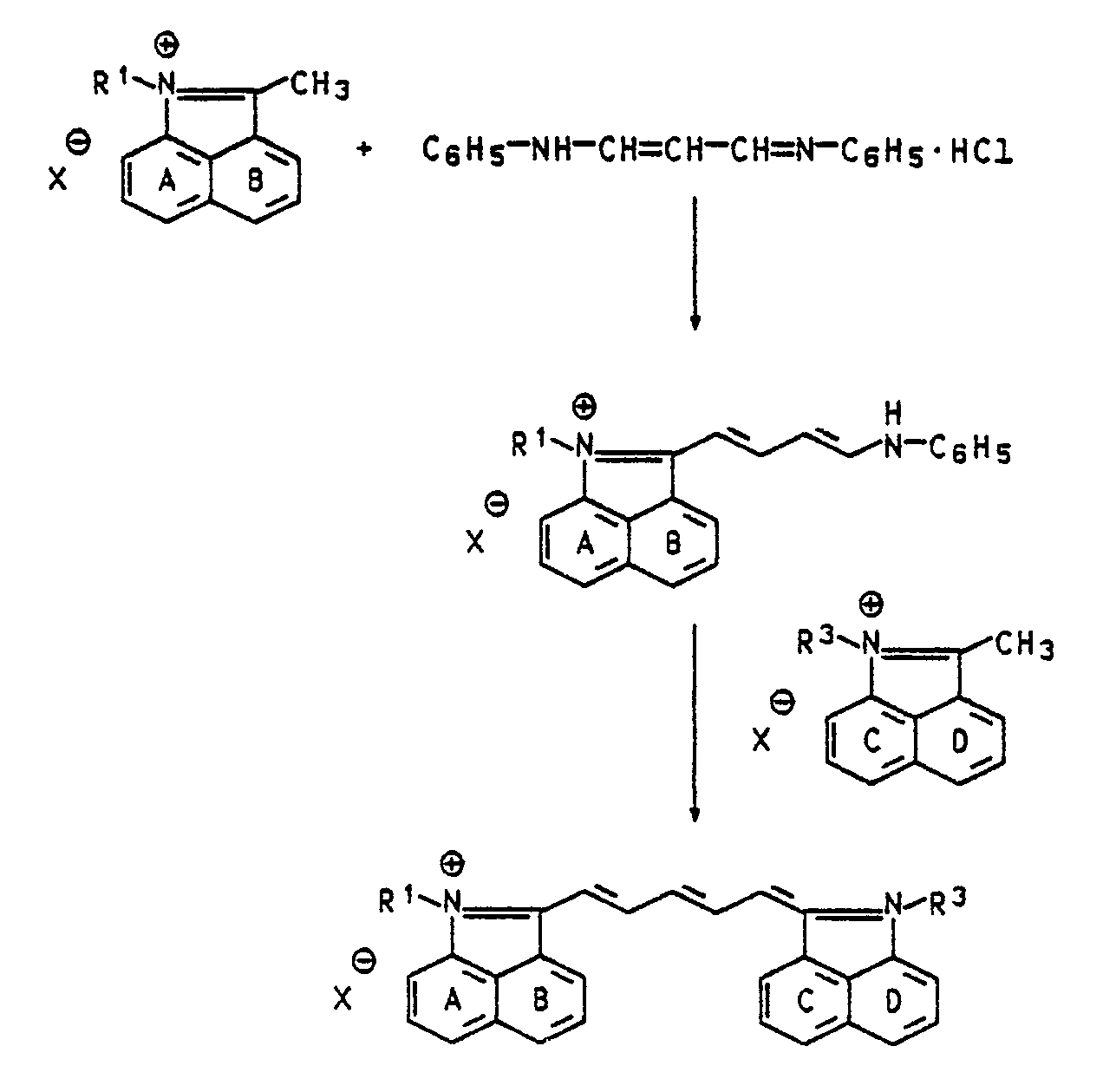
- Einige symmetrische Naphtholactamfarbstoffe sind bereits bekannt und in J. Org. Chem. USSR 18, 380-386 (1982) und in Chem. Heterocyl. Comp. 9, 314-315 (1973) beschrieben. Aus der SU-A-613 692 sind Laserfarbstoffe auf Basis Naphtholactam bekannt.
- Die Naphtholactamfarbstoffe der Formel Ia weisen eine sehr hohe molare Absorption im Bereich von 700 bis 1200 nm auf. Sie sind in organischen Lösungsmitteln und/oder thermoplastischen oder vernetzten Kunststoffen gut löslich.
- Das erfindungsgemäße Aufzeichnungssystem hat bei der Wellenlänge der Halbleiterlaser von ca. 750 bis 950 nm eine sehr hohe Absorption. Die Polymerschichten können auf eine lichtreflektierende Schicht so aufgebracht werden, daß sich glatte Absorptionsschichten von hoher optischer Qualität ergeben, die eine günstige Schwellenenergie besitzen, und in die die zu speichernde Information mit hohem Signal-zu-Rauschen-Verhältnis eingeschrieben werden kann.
- Das Aufzeichnungsmedium gemäß der vorliegenden Erfindung ist mit einem Halbleiter-Laser beschreibbar und lesbar. Weiterhin ist es gegenüber atmosphärischen Einflüssen und Tageslicht sehr stabil.
- Aufgrund der hohen Lichtabsorption der Farbstoffe ist das erfindungsgemäße Aufzeichnungsmedium sehr empfindlich gegenüber dem Licht des GaAlAs-Halbleiter-Lasers.
- Der Aufbau von Aufzeichnungsmedien ist an sich bekannt [J. Vac. Sci. Technol. 18 (1) Jan./Feb. 1981, S. 105].
- Zwischen der lichtabsorbierenden Schicht und dem Träger kann eine reflektierende Schicht vorhanden sein, so daß das eingestrahlte und durch die farbige Schicht wandernde Licht, soweit es nicht absorbiert wird, an der Reflektorschicht reflektiert wird und nochmals durch die gefärbte Schicht wandert.
- Die Belichtung kann auch durch ein transparentes Substrat erfolgen. Als Schichtfolge kommt dann in Frage: Substrat-Absorberschicht- gegebenenfalls Reflektorschicht.
- Die lichtreflektierende Schicht sollte so beschaffen sein, daß diese das zur Aufnahme und zur Abtastung verwendete Licht möglichtst quantitativ reflektiert. Geeignete lichtreflektierende Materialien sind z.B. Aluminium, Rhodium, Gold, Zinn, Blei, Wismut, Kupfer oder dielektrische Spiegel. Die Dicke der lichtreflektierenden Schicht soll so groß sein, daß diese das zur Aufnahme oder zum Abtasten benutzte Licht möglichst vollständig reflektiert.
- Für diesen Zweck sind Spiegel mit geringer Wärmeleitfähigkeit vorteilhaft. Der Träger, bzw. die Licht reflektierende Schicht muß eine optisch glatte, ebene Oberfläche aufweisen und an der Oberfläche so beschaffen sein, daß die absorbierende Schicht darauf fest haftet. Um die Oberflächenqualität und Adhäsionsphänomene günstig zu beeinflussen, kann der Träger und/oder der Reflektor mit einer Glättungsschicht aus einem duroplastischen oder thermoplastischen Material versehen werden.
- Das Aufbringen von metallischen Reflektionsschichten erfolgt vorzugsweise in bekannter Weise durch Aufdampfen im Vakuum oder auch durch Aufbringen geeigneter Metallfolien auf den Träger. Das Aufbringen der erfindungsgemäßen, gegen Laserlicht empfindlichen Schicht erfolgt vorzugsweise durch Aufschleudern von gelöstem oder dispergiertem Farbstoff in Gegenwart von Bindemitteln. Auch Aufrakeln oder Tauchen kommen als Verfahren zur Herstellung der Schichten in Betracht.
- Für das Aufbringen der Absorptionsschichten aus Lösung bereitet man in einem geeigneten Lösungsmittel, wie Methylenchlorid, Chloroform, Tetrachlorkohlenstoff, Aceton, Methylethylketon, Cyclohexanon, Toluol, Acetonitril, Essigester, Methanol oder Mischungen dieser Lösungsmittel, eine Lösung oder gegebenenfalls eine Dispersion des Farbstoffs oder Farbstoffgemisches und des Polymeren und setzt gegebenenfalls ein Bindemittel zu.
- Als Bindemittel kommen entweder durch Strahlung oder Wärme härtbare Harze, z. B. Photopolymere, Silikonharze sowie Epoxidharze oder thermoplastische Kunststoffe in Betracht.
- Bevorzugt sind thermoplastische Kunststoffe mit keinem oder nur sehr geringem kristallinen Anteil und Glastemperaturen von > 35 °C, insbesondere > 75 °C. Darüberhinaus müssen die Bindemittel,wie Harze oder thermoplastische Kunststoffe, mit den Naphtholactamfarbstoffen der Formel Ib gut verträglich sein. Geeignet sind beispielsweise wasserunlösliche Bindemittel mit hohem Lösungsvermögen, für die Naphtholactamfarbstoffe, wie (Meth)-Acrylatpolymere oder -copolymere, Polystyrolhomo- oder -copolymerisate, Polyvinylcarbazol, Polyvinylestercopolymere, Polyvinylchlorid und Celluloseester.
- Die Farbstoffzubereitung wird dann durch Rakeln oder Tauchen, vorzugsweise aber durch Aufschleudern auf ein vorher gereinigtes oder vorbehandeltes ("subbing-layer") Substrat aufgebracht und die Schicht an der Luft getrocknet oder gehärtet. Der Film kann auch im Vakuum, bei erhöhter Temperatur oder gegebenenfalls mit Strahlung, getrocknet bzw. gehärtet werden.
- Je nach Systemaufbau wird zuerst die Farbstoff-in-Polymer-Schicht und dann der Reflektor aufgebracht oder umgekehrt verfahren. Auf das Aufbringen von Zwischen- und Schutzschichten oder einer reflektierenden Schicht kann gegebenenfalls verzichtet werden.
- Sofern die Farbstoff-in-Polymer-Schicht keine ausreichende mechanische Stabilität aufweist, kann diese mit einer transparenten Schutzschicht überzogen werden. Hierzu bieten sich eine Reihe von Polymeren an, welche durch Aufschleudern, Aufrakeln oder Tauchen von gelösten Polymeren oder durch Aufdampfen im Vakuum, insbesondere von fluorierten Polymeren, eine Schutzschicht bilden können.
- Wenn das System (Datenspeicher) aus zwei gleichen oder verschiedenen Aufzeichnungsmedien in Form eines "Sandwich" aufgebaut wird, kann auf eine Schutzschicht verzichtet werden. Neben größerer mechanischer und rotationsdynamischer Stabilität bietet der "Sandwich"-Aufbau den Vorteil der doppelten Speicherkapazität.
- Auf die Schutz- und/oder Zwischenschichten kann bei ausreichender Qualität des optischen Aufzeichnungsmediums verzichtet werden. Wenn auf Zwischenschichten nicht verzichtet werden kann, muß unter Berücksichtigung des Brechungsindex des dazu verwendeten Materials und der verwendeten Laserlichtwellenlänge deren Schichtdicke so gewählt werden, daß keine störenden Interferenzen auftreten können.
- Die beim Absorbieren des Laserlichtes entstehende Wärme führt zu einem radial nach außen gerichteten Fließen des Thermoplastes und somit zur Ausbildung von kantenscharfen "Löchern" wodurch ein ausgezeichnetes Signal/Rausch-Verhalten erzielt wird.
- Die nachfolgenden Beispiele sollen die Erfindung näher erläutern.
- Eine Mischung von 3,2 g (10 mMol) 1-Ethyl-2-methyl-benzo[c,d]indoliumiodid, 0,46 g (4 mMol) 3-Ethoxy-2-methyl-2-propen-1-al, 0,42 g wasserfreies Natriumacetat und 20 ml Essigsäureanhydrid wurde 10 Minuten unter Rückfluß erhitzt. Man ließ noch abkühlen, filtrierte den Farbstoff ab, wusch mit Ethanol und Ether nach und kristallisierte aus Ethanol um. λmax (DMF) : 860 nm.

- Eine Mischung von 0,75 g (l,4 mMol) 1-Ethyl-2-methyl-6,8-diphenylthiobenzo[c,d]indoliumiodid und 0,08 g (0,7 mMol) 3-Ethoxy-2-methyl-2-propen-1-al wurde mit 0,05 g wasserfreiem Natriumacetat und 6 ml Essigsäureanhydrid 10 Minuten unter Rückfluß erhitzt. Man filtrierte ab, wusch mit Ethanol und Ether nach. λmax (DMF) : 940 nm.

- Die in der nachfolgenden Tabelle aufgeführten Farbstoffe werden in analoger Weise erhalten.

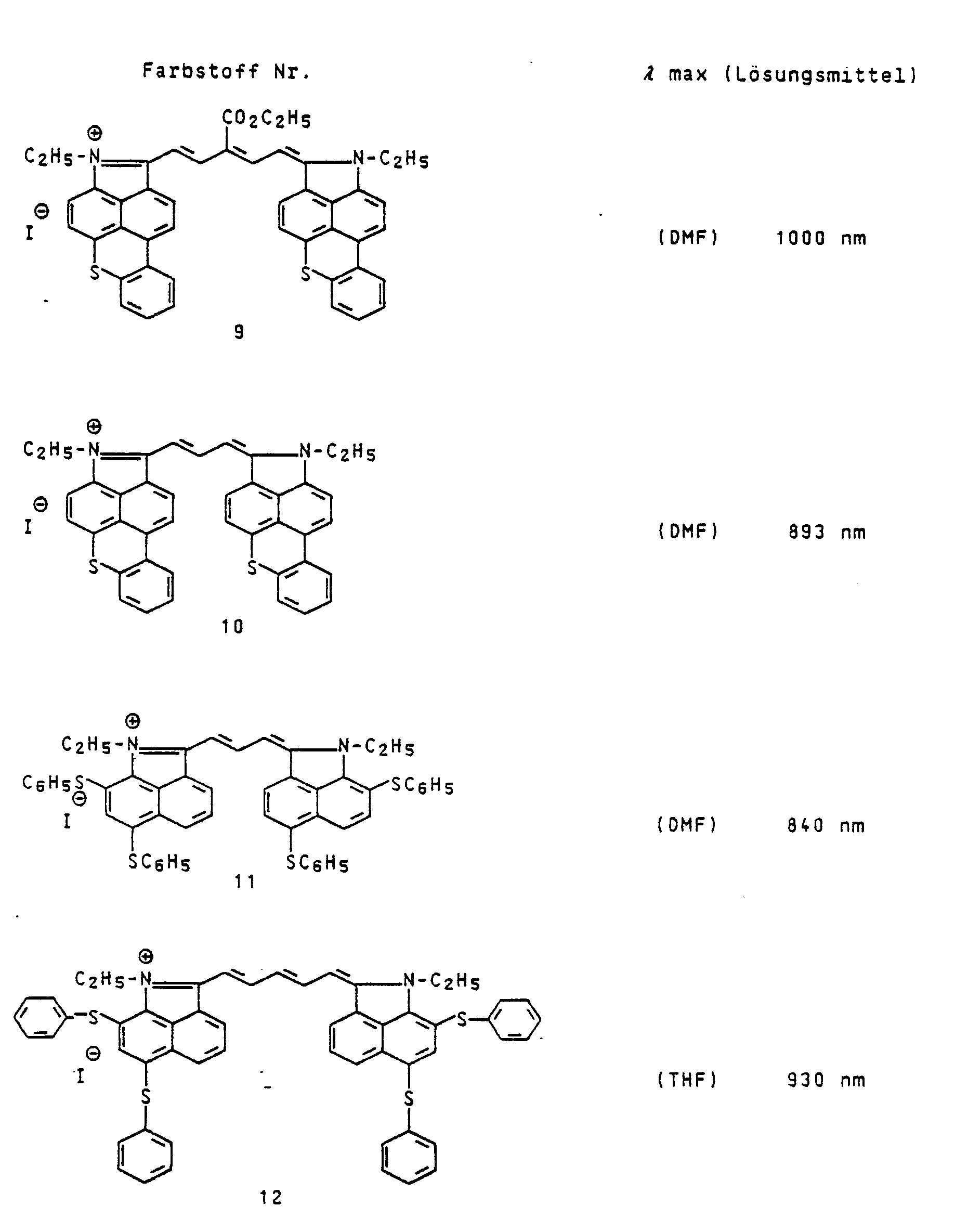


-
- 1) Zwei 1,2 mm dicke Polycarbonatscheiben mit einem Durchmesser von 120 mm und einem Innenlochdurchmesser von 15 mm wurden mit Alkohol gereinigt und unter Reinraumbedingungen mit einer 0,3 µm starken Glättungsschicht aus einem Photopolymer beschichtet. Nach Aushärtung des Photopolymers mit UV-Licht wurde eine Lösung aus Farbstoff Nr. 23 und 1,3 g eines Copolymers aus Methylmethacrylat/Methacrylsäure (70 : 30) in 200 ml Essigester nach dem Schleuderbeschichtungsverfahren bei 4800 U/min auf die Platten aufgetragen. Nach dem Trocknen betrug die Schichtdicke 0,26 µm. In einer Vakuumbedampfungsapparatur wurde ein Aluminiummspiegel in einer Schichtdicke von 0,03 µm auf die Farbschicht aufgebracht und darauf eine Schutzschicht von 1,2 µm aus Polystyrol in Xylol aufgeschleudert.
Beide Platten wurden sandwichartig mit den beschichteten Seiten nach innen über geeignete Abstandsringe zusammengeklebt, so daß ein Luftspalt von 0,4 mm verblieb. Mit einem auf einem Drehtisch montierten AlGaAs-Laser (λ = 820 nm) wurden einzelne, etwa 1 µ große Löcher in die aktive Schicht geschrieben. Die Empfindlichkeit der Schicht war besser als 1 nJ/Loch, beim Auslesen der Punkte wurde ein ausgezeichnetes Signal/Rausch-Verhältnis gefunden. - 2) 0,129 g Farbstoff Nr. 23 und 1,29 g eines Bindemittels auf Basis Polymethylmethacrylat (10 gew.%-ig in Butan-2-on) wurden in 2,43 g Butan-2-on gelöst. Die Lösung wurde filtriert und nach dem Schleuderbeschichtungsverfahren bei 1000 U/min auf eine Platte aus Polymethylmethacrylat (Durchmesser: 120 mm, Innenlochdurchmesser: 15 mm) aufgebracht. Die entstandene Schicht wies eine Extinktion von 0,34 (bei 788 nm) auf.
Mit einem auf einem Drehtisch montierten AlGaAs-Laser (λ = 820 nm) wurden einzelne, etwa 1 µ große Löcher in die aktive Schicht geschrieben. Die Empfindlichkeit der Schicht war besser als 1 nJ/Loch. Beim Auslesen der Punkte wurde ein ausgezeichnetes Signal/Rausch-Verhältnis gefunden. - 3) Analog zu 2) wurde ein Aufzeichnungsmedium unter Verwendung des Farbstoffs Nr. 22 erhalten.
Claims (8)
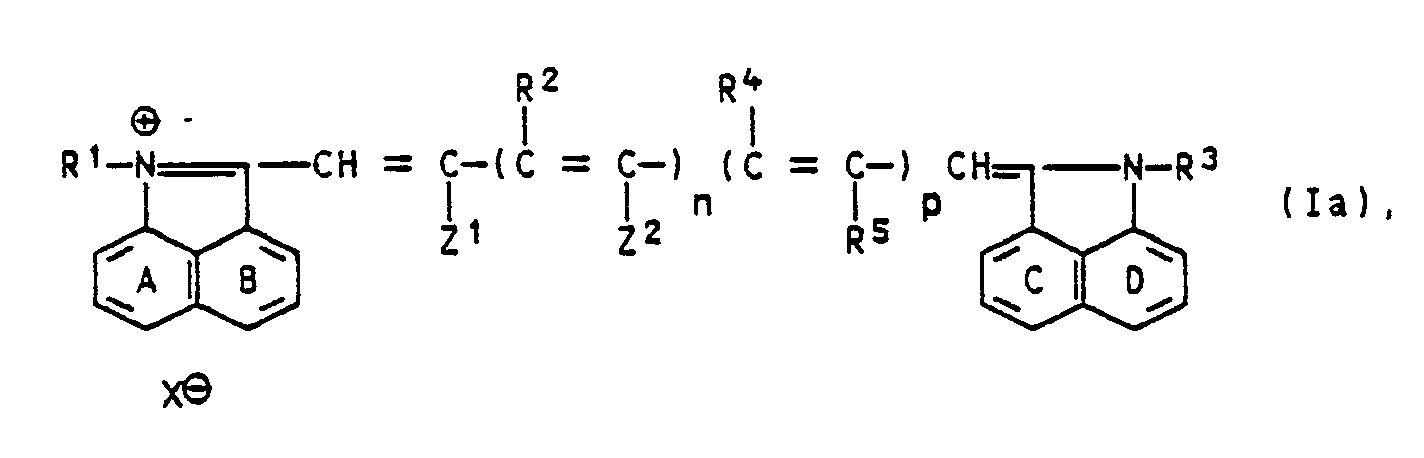
R¹ und R³
gleich oder verschieden sind und unabhängig voneinander jeweils gegebenenfalls substituiertes und/oder durch Sauerstoffatome unterbrochenes C₁-C₂₀-Alkyl, gegebenenfalls substituiertes C₅-C₇-Cycloalkyl oder gegebenenfalls substituiertes Phenyl,
R², R⁴ und R⁵
gleich oder verschieden sind und unabhängig voneinander jeweils Wasserstoff, gegebenenfalls substituiertes C₁-C₆-Alkyl, gegebenenfalls substituiertes C₅-C₆-Cycloalkyl, gegebenenfalls substituiertes Phenyl, C₁-C₆-Alkoxycarbonyl, C₁-C₆-Carboxyalkyl, Hydroxy, C₁-C₄-Alkoxy oder Halogen,
n O oder 1,
p unabhängig von n 0, 1 oder 2,
Z¹ und Z²
jeweils Wasserstoff oder für den Fall, daß n für 1 steht, zusammen auch eine gegebenenfalls durch C₁-C₄-Alkyl substituierte C₂-C₃-Alkylenkette oder eine oder zwei Carbonylgruppen und
X⊖ ein Anion bedeuten, und in der
die Ringe A, B, C und D gegebenenfalls substituiert oder benzoanelliert sind, mit der Maßgabe, daß wenn
R², R⁴ und R⁵ Wasserstoff, C₁-C₄-Alkyl, C₅-C₆-Cycloalkyl, Phenyl, C₁-C₄-Alkoxycarbonyl, C₁-C₂-Carboxyalkyl, Chlor oder Brom, n 1 und p 0 oder 1 bedeuten und die Ringe A, B, C und D unsubstituiert oder durch Methyl, Ethyl, Phenyl, C₁-C₄-Alkoxy, C₁-C₆-Alkylthio, Cyano, C₁-C₂-Dialkylamino, Chlor, Brom, Hydroxysulfonyl, Phenylthio oder den Rest


R¹ und R²
gleich oder verschieden sind und unabhängig voneinander jeweils gegebenenfalls substituiertes und/oder durch Sauerstoffatome unterbrochenes C₁-C₂₀-Alkyl, gegebenenfalls substituiertes C₅-C₇-Cycloalkyl oder gegebenenfalls substituiertes Phenyl,
R², R⁴ und R⁵
gleich oder verschieden sind und unabhängig voneinander jeweils Wasserstoff, gegebenenfalls substituiertes C₁-C₆-Alkyl, gegebenenfalls substituiertes C₅-C₆-Cycloalkyl, gegebenenfalls substituiertes Phenyl, C₁-C₆-Alkoxycarbonyl, C₁-C₆-Carboxyalkyl, Hydroxy, C₁-C₄-Alkoxy oder Halogen,
n 0 oder 1,
p unabhängig von n 0, 1 oder 2
Z¹ und Z²
jeweils Wasserstoff oder für den Fall, daß n für 1 steht, zusammen auch eine gegebenenfalls durch C₁-C₄-Alkyl substituierte C₂-C₃-Alkylenkette oder eine oder zwei Carbonylgruppen und
X⊖ ein Anion bedeuten und in der
die Ringe A, B, C und D gegebenenfalls substituiert oder benzoanelliert sind.
R² , R⁴ und R⁵ Wasserstoff, C₁-C₄-Alkyl, C₅-C₆-Cycloalkyl, Phenyl, C₁-C₄-Alkoxycarbonyl, C₁-C₂-Carboxyalkyl, Chlor oder Brom, n 1 und p 0 oder 1 bedeuten und die Ringe A, B, C und D unsubstituiert oder durch Methyl, Ethyl, Phenyl, C₁-C₄-Alkoxy, C₁-C₄-Alkylthio, Cyano, C₁-C₂-Dialkylamino, Chlor, Brom, Hydroxysulfonyl, Phenylthio oder den Rest

Applications Claiming Priority (2)
| Application Number | Priority Date | Filing Date | Title |
|---|---|---|---|
| DE3608214 | 1986-03-12 | ||
| DE19863608214 DE3608214A1 (de) | 1986-03-12 | 1986-03-12 | Naphtholactamfarbstoffe und diese enthaltende optische aufzeichnungsmedien |
Publications (3)
| Publication Number | Publication Date |
|---|---|
| EP0241696A2 true EP0241696A2 (de) | 1987-10-21 |
| EP0241696A3 EP0241696A3 (en) | 1990-08-22 |
| EP0241696B1 EP0241696B1 (de) | 1993-07-14 |
Family
ID=6296161
Family Applications (1)
| Application Number | Title | Priority Date | Filing Date |
|---|---|---|---|
| EP87103197A Expired - Lifetime EP0241696B1 (de) | 1986-03-12 | 1987-03-07 | Naphtholactamfarbstoffe und diese ethaltendes optisches Aufzeichnungsmedium |
Country Status (4)
| Country | Link |
|---|---|
| US (2) | US4876356A (de) |
| EP (1) | EP0241696B1 (de) |
| JP (1) | JPH0791482B2 (de) |
| DE (2) | DE3608214A1 (de) |
Cited By (1)
| Publication number | Priority date | Publication date | Assignee | Title |
|---|---|---|---|---|
| EP1314981A3 (de) * | 2001-11-26 | 2003-07-30 | Chromeon GmbH | Benzo[c,d]indol-Fluorochrome für die Markierung von Biomolekülen und Polymerpartikeln |
Families Citing this family (21)
| Publication number | Priority date | Publication date | Assignee | Title |
|---|---|---|---|---|
| DE3631843A1 (de) * | 1986-09-19 | 1988-03-24 | Basf Ag | Naphtholactamquadratsaeurefarbstoffe und diese farbstoffe enthaltende optische aufzeichnungsmedien |
| DE3738911A1 (de) * | 1987-11-17 | 1989-05-24 | Basf Ag | Naphtholactamtrimethinfarbstoffe sowie optisches aufzeichnungsmedium, enthaltend die neuen farbstoffe |
| DE3740421A1 (de) * | 1987-11-28 | 1989-06-08 | Basf Ag | Mehrschichtiges, elektrophotographisches aufzeichnungsmaterial |
| US5187043A (en) * | 1989-01-20 | 1993-02-16 | Canon Kabushiki Kaisha | Optical recording medium |
| US5061341A (en) * | 1990-01-25 | 1991-10-29 | Eastman Kodak Company | Laser-ablating a marking in a coating on plastic articles |
| EP0458604B1 (de) * | 1990-05-22 | 1997-08-27 | Canon Kabushiki Kaisha | Verfahren und Gerät zur Aufzeichnung und Wiedergabe von Informationen in Zellen, die eine vielfache Interferenz gebrauchen |
| JP2676117B2 (ja) * | 1990-11-22 | 1997-11-12 | 富士写真フイルム株式会社 | ハロゲン化銀写真感光材料 |
| US5215957A (en) * | 1992-04-23 | 1993-06-01 | Eastman Kodak Company | Benz-cd-indole merocyanine blue dyes for color filter array element |
| DE4331162A1 (de) * | 1993-09-14 | 1995-03-16 | Bayer Ag | Verfahren zur Herstellung von Cyaninfarbstoffen |
| US6284184B1 (en) | 1999-08-27 | 2001-09-04 | Avaya Technology Corp | Method of laser marking one or more colors on plastic substrates |
| US6461804B1 (en) | 1999-10-13 | 2002-10-08 | Agfa-Gevaert | IR-photographic sensitizing dyes |
| US20040131969A1 (en) * | 2002-10-07 | 2004-07-08 | Fuji Photo Film Co., Ltd. | Non-resonant two-photon absorbing material, non-resonant two-photon emitting material, method for inducing absorption of non-resonant two-photons and method for generating emission of non-resonant two-photons |
| JP4534089B2 (ja) * | 2005-10-21 | 2010-09-01 | コニカミノルタホールディングス株式会社 | 光情報記録媒体及び情報記録方法 |
| US7733659B2 (en) | 2006-08-18 | 2010-06-08 | Delphi Technologies, Inc. | Lightweight audio system for automotive applications and method |
| US9237685B2 (en) | 2006-08-18 | 2016-01-12 | Delphi Technologies, Inc. | Lightweight audio system for automotive applications and method |
| WO2010099415A1 (en) | 2009-02-27 | 2010-09-02 | Delphi Technologies, Inc. | Lightweight audio system for automotive appalications and method |
| JP5431001B2 (ja) * | 2009-04-01 | 2014-03-05 | 株式会社Adeka | シアニン化合物及び該シアニン化合物を含有する光学フィルター |
| US12144246B2 (en) | 2020-06-30 | 2024-11-12 | Samsung Electronics Co., Ltd. | Compounds, infrared absorbers, infrared absorbing/blocking films, photoelectric devices, sensors, and electronic devices |
| CN117777751B (zh) * | 2023-12-21 | 2026-03-13 | 中国科学技术大学 | 一种花菁类染料及其应用 |
| KR102847363B1 (ko) * | 2024-04-16 | 2025-08-18 | 한국화학연구원 | 시아닌계 화합물 및 이를 포함하는 근적외선 흡수성 조성물 |
| CN119739003B (zh) * | 2024-11-29 | 2025-10-28 | 珠海莫界科技有限公司 | 近红外光敏引发体系、全息记录介质及全息光学元件 |
Family Cites Families (18)
| Publication number | Priority date | Publication date | Assignee | Title |
|---|---|---|---|---|
| BE636462A (de) * | 1962-08-29 | |||
| CH451373A (de) * | 1963-08-30 | 1968-05-15 | Bayer Ag | Verfahren zur Herstellung von basischen Farbstoffen |
| US3687972A (en) * | 1970-09-02 | 1972-08-29 | American Cyanamid Co | AMINE DERIVATIVES OF 1,2-DIHYDROBENZ {8 cd{9 {11 INDOLES |
| DE2328163A1 (de) * | 1973-06-02 | 1974-12-19 | Basf Ag | Basische arylmercaptonaphtholactamfarbstoffe |
| US4023185A (en) * | 1976-03-19 | 1977-05-10 | Rca Corporation | Ablative optical recording medium |
| US4242689A (en) * | 1977-09-19 | 1980-12-30 | Rca Corporation | Ablative optical recording medium |
| US4241355A (en) * | 1977-09-29 | 1980-12-23 | Rca Corporation | Ablative optical recording medium |
| JPH0114038B2 (de) * | 1977-12-19 | 1989-03-09 | Eastman Kodak Co | |
| CA1127945A (en) * | 1979-06-04 | 1982-07-20 | James H. Sharp | Optical disc |
| DE3007296A1 (de) * | 1980-02-27 | 1981-09-03 | Philips Patentverwaltung Gmbh, 2000 Hamburg | Aufzeichnungstraeger zum einschreiben von loeschbaren informationen mittels lichtstrahlen |
| JPS5856892A (ja) * | 1981-10-01 | 1983-04-04 | Ricoh Co Ltd | 光学的情報記録媒体 |
| DE3148104A1 (de) * | 1981-12-04 | 1983-06-09 | Bayer Ag, 5090 Leverkusen | Kationische farbstoffe, verfahren zu ihrer herstellung sowie ihre verwendung zum faerben und massefaerben von textilmaterialien und anderen substraten |
| JPS58121149A (ja) * | 1981-12-22 | 1983-07-19 | Fujitsu Ltd | 記録媒体 |
| US4460665A (en) * | 1981-12-28 | 1984-07-17 | Ricoh Co., Ltd. | Optical information recording medium |
| JPS58125246A (ja) * | 1982-01-22 | 1983-07-26 | Ricoh Co Ltd | レ−ザ記録媒体 |
| JPS58132231A (ja) * | 1982-02-01 | 1983-08-06 | Ricoh Co Ltd | 光学的情報記録媒体 |
| JPS60226035A (ja) * | 1984-04-24 | 1985-11-11 | Mitsui Toatsu Chem Inc | 追記式光記録媒体 |
| JPS62124986A (ja) * | 1985-11-27 | 1987-06-06 | Mitsubishi Chem Ind Ltd | 光学的記録媒体 |
-
1986
- 1986-03-12 DE DE19863608214 patent/DE3608214A1/de not_active Withdrawn
-
1987
- 1987-03-07 EP EP87103197A patent/EP0241696B1/de not_active Expired - Lifetime
- 1987-03-07 DE DE8787103197T patent/DE3786476D1/de not_active Expired - Lifetime
- 1987-03-11 JP JP62054323A patent/JPH0791482B2/ja not_active Expired - Fee Related
- 1987-03-12 US US07/024,988 patent/US4876356A/en not_active Expired - Lifetime
-
1989
- 1989-08-21 US US07/396,117 patent/US4939012A/en not_active Expired - Lifetime
Non-Patent Citations (3)
| Title |
|---|
| CHEMICAL ABSTRACTS, Band 79, Nr. 4, 30. Juli 1973, Seite 89, Zusammenfassung Nr. 20287h, Columbus, Ohio, US; Y.B. SHTEINBERG et al.: "Benzo[c,d]indolecarbocyanines", & KHIM. GETEROTSIKL. SOEDIN. 1973, (3), 340-1 * |
| CHEMICAL ABSTRACTS, Band 96, Nr. 26, 1982, Seite 85, Zusammenfassung Nr. 219248c, Columbus, Ohio, US; F.A. MIKHAILENKO et al.: "Effect of polar substituents and polymethine chain length on the color of cyanine dyes of the benz[cd]indole series", & ZH. ORG. KHIM. 1982, 18(2), 435-41 * |
| Derwent Kurzreferat 43459B/23 der SU-A-613692 * |
Cited By (2)
| Publication number | Priority date | Publication date | Assignee | Title |
|---|---|---|---|---|
| EP1314981A3 (de) * | 2001-11-26 | 2003-07-30 | Chromeon GmbH | Benzo[c,d]indol-Fluorochrome für die Markierung von Biomolekülen und Polymerpartikeln |
| US6979575B1 (en) | 2001-11-26 | 2005-12-27 | Chromeon Gmbh | Fluorochromes for labelling biomolecules and polymer particles and bioanalytical and screening methods based thereon |
Also Published As
| Publication number | Publication date |
|---|---|
| JPH0791482B2 (ja) | 1995-10-04 |
| US4939012A (en) | 1990-07-03 |
| DE3608214A1 (de) | 1987-09-17 |
| EP0241696A3 (en) | 1990-08-22 |
| DE3786476D1 (de) | 1993-08-19 |
| EP0241696B1 (de) | 1993-07-14 |
| US4876356A (en) | 1989-10-24 |
| JPS62230857A (ja) | 1987-10-09 |
Similar Documents
| Publication | Publication Date | Title |
|---|---|---|
| EP0241696B1 (de) | Naphtholactamfarbstoffe und diese ethaltendes optisches Aufzeichnungsmedium | |
| EP0252360B1 (de) | Optisches Aufzeichnungsmedium | |
| DE69725607T2 (de) | Polymethin-komplex-farbstoffe und ihre verwendung | |
| DE69130344T2 (de) | Optisches Aufzeichnungsmedium, Verfahren zur optischen Aufzeichnung und Verfahren zur optischen Wiedergabe | |
| EP0192215B1 (de) | Neue Tetraphenyldithiolen-Komplexe, unsymmetrisch substituierte Benzoine sowie die neuen Komplexe enthaltende optische Aufzeichnungsmedien | |
| EP0540468B1 (de) | NIR-Farbstoffe, Verfahren zu ihrer Herstellung und ihre Verwendung | |
| DE69718585T2 (de) | Medium für Informationsaufzeichnung | |
| DE69728093T2 (de) | Datenaufzeichnungsmedium | |
| DE60027220T2 (de) | Herstellungsverfahren einer optischen Disc, optische Disc und Farblösung | |
| EP1088857A1 (de) | Cyaninfarbstoff | |
| DE3879283T2 (de) | Optischer Aufzeichnungsträger. | |
| EP0193892B1 (de) | Optisches Aufzeichnungsmedium | |
| DE68918536T2 (de) | Optisches Aufzeichnungsmedium. | |
| EP0190444B1 (de) | Optisches Aufzeichnungsmedium | |
| DE4021078A1 (de) | Polymethinfarbstoffe | |
| EP0260689B1 (de) | Naphtolactamquadratsäurefarbstoffe und diese Farbstoffe enthaltende optische Aufzeichnungsmedien | |
| EP1090961A1 (de) | Cyaninfarbstoffe | |
| EP0319728B1 (de) | Naphtholactamtrimethinfarbstoffe sowie optisches Aufzeichnungsmedium, enthaltend die neuen Farbstoffe | |
| DE3510361A1 (de) | Optisches aufzeichungsmedium und verfahren zu seiner herstellung | |
| EP0425932B1 (de) | Chinoxalinpentamethinfarbstoffe sowie optisches Aufzeichnungsmedium, enthaltend die neuen Farbstoffe | |
| EP0251117B1 (de) | Optische Aufzeichnungsmedien | |
| EP0338426B1 (de) | Azulenmethinfarbstoffe sowie optisches Aufzeichnungsmedium, enthaltend die neuen Farbstoffe | |
| DE3724836A1 (de) | Optisches aufzeichnungsmedium | |
| DE3636157A1 (de) | Neue methylendithiolenchinon-farbstoffe und diese enthaltende duenne strahlungsempfindliche beschichtungsfilme | |
| DE3724819A1 (de) | Optisches aufzeichnungsmedium |
Legal Events
| Date | Code | Title | Description |
|---|---|---|---|
| PUAI | Public reference made under article 153(3) epc to a published international application that has entered the european phase |
Free format text: ORIGINAL CODE: 0009012 |
|
| AK | Designated contracting states |
Kind code of ref document: A2 Designated state(s): CH DE FR GB LI NL |
|
| PUAL | Search report despatched |
Free format text: ORIGINAL CODE: 0009013 |
|
| AK | Designated contracting states |
Kind code of ref document: A3 Designated state(s): CH DE FR GB LI NL |
|
| 17P | Request for examination filed |
Effective date: 19900714 |
|
| 17Q | First examination report despatched |
Effective date: 19911009 |
|
| GRAA | (expected) grant |
Free format text: ORIGINAL CODE: 0009210 |
|
| AK | Designated contracting states |
Kind code of ref document: B1 Designated state(s): CH DE FR GB LI NL |
|
| REF | Corresponds to: |
Ref document number: 3786476 Country of ref document: DE Date of ref document: 19930819 |
|
| GBT | Gb: translation of ep patent filed (gb section 77(6)(a)/1977) |
Effective date: 19930806 |
|
| ET | Fr: translation filed | ||
| PLBE | No opposition filed within time limit |
Free format text: ORIGINAL CODE: 0009261 |
|
| STAA | Information on the status of an ep patent application or granted ep patent |
Free format text: STATUS: NO OPPOSITION FILED WITHIN TIME LIMIT |
|
| 26N | No opposition filed | ||
| REG | Reference to a national code |
Ref country code: GB Ref legal event code: IF02 |
|
| PGFP | Annual fee paid to national office [announced via postgrant information from national office to epo] |
Ref country code: DE Payment date: 20020309 Year of fee payment: 16 |
|
| PGFP | Annual fee paid to national office [announced via postgrant information from national office to epo] |
Ref country code: FR Payment date: 20030213 Year of fee payment: 17 |
|
| PGFP | Annual fee paid to national office [announced via postgrant information from national office to epo] |
Ref country code: NL Payment date: 20030214 Year of fee payment: 17 |
|
| PGFP | Annual fee paid to national office [announced via postgrant information from national office to epo] |
Ref country code: GB Payment date: 20030227 Year of fee payment: 17 Ref country code: CH Payment date: 20030227 Year of fee payment: 17 |
|
| PG25 | Lapsed in a contracting state [announced via postgrant information from national office to epo] |
Ref country code: DE Free format text: LAPSE BECAUSE OF THE APPLICANT RENOUNCES Effective date: 20030522 |
|
| PG25 | Lapsed in a contracting state [announced via postgrant information from national office to epo] |
Ref country code: GB Free format text: LAPSE BECAUSE OF NON-PAYMENT OF DUE FEES Effective date: 20040307 |
|
| PG25 | Lapsed in a contracting state [announced via postgrant information from national office to epo] |
Ref country code: LI Free format text: LAPSE BECAUSE OF NON-PAYMENT OF DUE FEES Effective date: 20040331 Ref country code: CH Free format text: LAPSE BECAUSE OF NON-PAYMENT OF DUE FEES Effective date: 20040331 |
|
| PG25 | Lapsed in a contracting state [announced via postgrant information from national office to epo] |
Ref country code: NL Free format text: LAPSE BECAUSE OF NON-PAYMENT OF DUE FEES Effective date: 20041001 |
|
| GBPC | Gb: european patent ceased through non-payment of renewal fee | ||
| REG | Reference to a national code |
Ref country code: CH Ref legal event code: PL |
|
| PG25 | Lapsed in a contracting state [announced via postgrant information from national office to epo] |
Ref country code: FR Free format text: LAPSE BECAUSE OF NON-PAYMENT OF DUE FEES Effective date: 20041130 |
|
| NLV4 | Nl: lapsed or anulled due to non-payment of the annual fee |
Effective date: 20041001 |
|
| REG | Reference to a national code |
Ref country code: FR Ref legal event code: ST |