EP0241414B1 - Verfahren zur Herstellung von 1:2-Metallkomplexazofarbstoffen - Google Patents
Verfahren zur Herstellung von 1:2-Metallkomplexazofarbstoffen Download PDFInfo
- Publication number
- EP0241414B1 EP0241414B1 EP87810143A EP87810143A EP0241414B1 EP 0241414 B1 EP0241414 B1 EP 0241414B1 EP 87810143 A EP87810143 A EP 87810143A EP 87810143 A EP87810143 A EP 87810143A EP 0241414 B1 EP0241414 B1 EP 0241414B1
- Authority
- EP
- European Patent Office
- Prior art keywords
- coupling
- cobalt
- chromium
- amino
- process according
- Prior art date
- Legal status (The legal status is an assumption and is not a legal conclusion. Google has not performed a legal analysis and makes no representation as to the accuracy of the status listed.)
- Expired - Lifetime
Links
- 238000000034 method Methods 0.000 title claims description 52
- 239000000987 azo dye Substances 0.000 title claims description 19
- 238000002360 preparation method Methods 0.000 title claims description 13
- 150000004696 coordination complex Chemical class 0.000 title claims description 12
- 238000005859 coupling reaction Methods 0.000 claims description 95
- 230000008878 coupling Effects 0.000 claims description 94
- 238000010168 coupling process Methods 0.000 claims description 94
- -1 nitro, sulfamoyl Chemical group 0.000 claims description 62
- 239000000243 solution Substances 0.000 claims description 55
- UHOVQNZJYSORNB-UHFFFAOYSA-N Benzene Chemical compound C1=CC=CC=C1 UHOVQNZJYSORNB-UHFFFAOYSA-N 0.000 claims description 54
- VYZAMTAEIAYCRO-UHFFFAOYSA-N Chromium Chemical compound [Cr] VYZAMTAEIAYCRO-UHFFFAOYSA-N 0.000 claims description 46
- 239000011651 chromium Substances 0.000 claims description 42
- 229910052804 chromium Inorganic materials 0.000 claims description 41
- 150000001412 amines Chemical class 0.000 claims description 32
- 239000010941 cobalt Substances 0.000 claims description 30
- 229910017052 cobalt Inorganic materials 0.000 claims description 30
- 150000001875 compounds Chemical class 0.000 claims description 28
- GUTLYIVDDKVIGB-UHFFFAOYSA-N cobalt atom Chemical compound [Co] GUTLYIVDDKVIGB-UHFFFAOYSA-N 0.000 claims description 24
- XEEYBQQBJWHFJM-UHFFFAOYSA-N Iron Chemical group [Fe] XEEYBQQBJWHFJM-UHFFFAOYSA-N 0.000 claims description 20
- PXHVJJICTQNCMI-UHFFFAOYSA-N Nickel Chemical compound [Ni] PXHVJJICTQNCMI-UHFFFAOYSA-N 0.000 claims description 20
- 230000009918 complex formation Effects 0.000 claims description 17
- 229910052736 halogen Inorganic materials 0.000 claims description 17
- 150000002367 halogens Chemical group 0.000 claims description 17
- 150000002790 naphthalenes Chemical class 0.000 claims description 16
- 229910052742 iron Inorganic materials 0.000 claims description 15
- 238000001465 metallisation Methods 0.000 claims description 15
- 239000000203 mixture Substances 0.000 claims description 13
- GSOLWAFGMNOBSY-UHFFFAOYSA-N cobalt Chemical compound [Co][Co][Co][Co][Co][Co][Co][Co] GSOLWAFGMNOBSY-UHFFFAOYSA-N 0.000 claims description 12
- 229910052759 nickel Inorganic materials 0.000 claims description 12
- 125000000020 sulfo group Chemical group O=S(=O)([*])O[H] 0.000 claims description 12
- 150000004700 cobalt complex Chemical class 0.000 claims description 11
- 125000000664 diazo group Chemical group [N-]=[N+]=[*] 0.000 claims description 11
- JWAZRIHNYRIHIV-UHFFFAOYSA-N 2-naphthol Chemical compound C1=CC=CC2=CC(O)=CC=C21 JWAZRIHNYRIHIV-UHFFFAOYSA-N 0.000 claims description 10
- 125000004178 (C1-C4) alkyl group Chemical group 0.000 claims description 8
- 239000007864 aqueous solution Substances 0.000 claims description 8
- 239000003795 chemical substances by application Substances 0.000 claims description 8
- 125000000623 heterocyclic group Chemical group 0.000 claims description 8
- 238000002955 isolation Methods 0.000 claims description 8
- 229910052739 hydrogen Inorganic materials 0.000 claims description 7
- 239000001257 hydrogen Substances 0.000 claims description 7
- KJCVRFUGPWSIIH-UHFFFAOYSA-N 1-naphthol Chemical compound C1=CC=C2C(O)=CC=CC2=C1 KJCVRFUGPWSIIH-UHFFFAOYSA-N 0.000 claims description 6
- 125000003277 amino group Chemical group 0.000 claims description 6
- 229910052751 metal Inorganic materials 0.000 claims description 6
- 239000002184 metal Substances 0.000 claims description 6
- 239000003960 organic solvent Substances 0.000 claims description 6
- 125000001997 phenyl group Chemical group [H]C1=C([H])C([H])=C(*)C([H])=C1[H] 0.000 claims description 6
- 125000004769 (C1-C4) alkylsulfonyl group Chemical group 0.000 claims description 5
- 125000000229 (C1-C4)alkoxy group Chemical group 0.000 claims description 5
- DYRDKSSFIWVSNM-UHFFFAOYSA-N acetoacetanilide Chemical compound CC(=O)CC(=O)NC1=CC=CC=C1 DYRDKSSFIWVSNM-UHFFFAOYSA-N 0.000 claims description 5
- 229950011260 betanaphthol Drugs 0.000 claims description 5
- 125000004093 cyano group Chemical group *C#N 0.000 claims description 5
- 150000004698 iron complex Chemical class 0.000 claims description 5
- MCJGNVYPOGVAJF-UHFFFAOYSA-N quinolin-8-ol Chemical compound C1=CN=C2C(O)=CC=CC2=C1 MCJGNVYPOGVAJF-UHFFFAOYSA-N 0.000 claims description 5
- JBIJLHTVPXGSAM-UHFFFAOYSA-N 2-naphthylamine Chemical compound C1=CC=CC2=CC(N)=CC=C21 JBIJLHTVPXGSAM-UHFFFAOYSA-N 0.000 claims description 4
- 239000005725 8-Hydroxyquinoline Substances 0.000 claims description 4
- 125000000751 azo group Chemical group [*]N=N[*] 0.000 claims description 4
- 150000002431 hydrogen Chemical group 0.000 claims description 4
- 229960003540 oxyquinoline Drugs 0.000 claims description 4
- 125000002023 trifluoromethyl group Chemical group FC(F)(F)* 0.000 claims description 4
- QELUYTUMUWHWMC-UHFFFAOYSA-N edaravone Chemical compound O=C1CC(C)=NN1C1=CC=CC=C1 QELUYTUMUWHWMC-UHFFFAOYSA-N 0.000 claims description 3
- 125000004760 (C1-C4) alkylsulfonylamino group Chemical group 0.000 claims description 2
- BEHLMOQXOSLGHN-UHFFFAOYSA-N benzenamine sulfate Chemical compound OS(=O)(=O)NC1=CC=CC=C1 BEHLMOQXOSLGHN-UHFFFAOYSA-N 0.000 claims description 2
- 150000001768 cations Chemical class 0.000 claims description 2
- UFWIBTONFRDIAS-UHFFFAOYSA-N naphthalene-acid Natural products C1=CC=CC2=CC=CC=C21 UFWIBTONFRDIAS-UHFFFAOYSA-N 0.000 claims description 2
- 150000002815 nickel Chemical group 0.000 claims description 2
- HEMHJVSKTPXQMS-UHFFFAOYSA-M Sodium hydroxide Chemical compound [OH-].[Na+] HEMHJVSKTPXQMS-UHFFFAOYSA-M 0.000 description 60
- XLYOFNOQVPJJNP-UHFFFAOYSA-N water Substances O XLYOFNOQVPJJNP-UHFFFAOYSA-N 0.000 description 35
- 239000000975 dye Substances 0.000 description 25
- VEXZGXHMUGYJMC-UHFFFAOYSA-N Hydrochloric acid Chemical compound Cl VEXZGXHMUGYJMC-UHFFFAOYSA-N 0.000 description 23
- LPXPTNMVRIOKMN-UHFFFAOYSA-M sodium nitrite Chemical compound [Na+].[O-]N=O LPXPTNMVRIOKMN-UHFFFAOYSA-M 0.000 description 22
- QTBSBXVTEAMEQO-UHFFFAOYSA-N Acetic acid Chemical compound CC(O)=O QTBSBXVTEAMEQO-UHFFFAOYSA-N 0.000 description 17
- 238000006193 diazotization reaction Methods 0.000 description 17
- 235000002639 sodium chloride Nutrition 0.000 description 17
- FAPWRFPIFSIZLT-UHFFFAOYSA-M Sodium chloride Chemical compound [Na+].[Cl-] FAPWRFPIFSIZLT-UHFFFAOYSA-M 0.000 description 16
- 239000000725 suspension Substances 0.000 description 14
- 125000000217 alkyl group Chemical group 0.000 description 11
- 239000012954 diazonium Substances 0.000 description 11
- 150000001989 diazonium salts Chemical class 0.000 description 11
- 235000010288 sodium nitrite Nutrition 0.000 description 11
- 210000002268 wool Anatomy 0.000 description 10
- 125000003545 alkoxy group Chemical group 0.000 description 9
- 125000001424 substituent group Chemical group 0.000 description 9
- RWZYAGGXGHYGMB-UHFFFAOYSA-N anthranilic acid Chemical compound NC1=CC=CC=C1C(O)=O RWZYAGGXGHYGMB-UHFFFAOYSA-N 0.000 description 8
- KTVIXTQDYHMGHF-UHFFFAOYSA-L cobalt(2+) sulfate Chemical compound [Co+2].[O-]S([O-])(=O)=O KTVIXTQDYHMGHF-UHFFFAOYSA-L 0.000 description 8
- 150000003839 salts Chemical class 0.000 description 8
- 239000011780 sodium chloride Substances 0.000 description 8
- 238000003756 stirring Methods 0.000 description 8
- 229940124530 sulfonamide Drugs 0.000 description 8
- 125000005420 sulfonamido group Chemical group S(=O)(=O)(N*)* 0.000 description 8
- 229910000361 cobalt sulfate Inorganic materials 0.000 description 7
- 229940044175 cobalt sulfate Drugs 0.000 description 7
- 125000002496 methyl group Chemical group [H]C([H])([H])* 0.000 description 7
- DQIVFTJHYKDOMZ-UHFFFAOYSA-N 96-67-3 Chemical compound NC1=CC([N+]([O-])=O)=CC(S(O)(=O)=O)=C1O DQIVFTJHYKDOMZ-UHFFFAOYSA-N 0.000 description 6
- 229960000583 acetic acid Drugs 0.000 description 6
- 125000005153 alkyl sulfamoyl group Chemical group 0.000 description 6
- 238000004043 dyeing Methods 0.000 description 6
- 238000001914 filtration Methods 0.000 description 6
- ZAMOUSCENKQFHK-UHFFFAOYSA-N Chlorine atom Chemical compound [Cl] ZAMOUSCENKQFHK-UHFFFAOYSA-N 0.000 description 5
- WCUXLLCKKVVCTQ-UHFFFAOYSA-M Potassium chloride Chemical compound [Cl-].[K+] WCUXLLCKKVVCTQ-UHFFFAOYSA-M 0.000 description 5
- 238000006243 chemical reaction Methods 0.000 description 5
- 125000002887 hydroxy group Chemical group [H]O* 0.000 description 5
- 125000001449 isopropyl group Chemical group [H]C([H])([H])C([H])(*)C([H])([H])[H] 0.000 description 5
- 239000010985 leather Substances 0.000 description 5
- 125000000449 nitro group Chemical class [O-][N+](*)=O 0.000 description 5
- WKBOTKDWSSQWDR-UHFFFAOYSA-N Bromine atom Chemical compound [Br] WKBOTKDWSSQWDR-UHFFFAOYSA-N 0.000 description 4
- TWRXJAOTZQYOKJ-UHFFFAOYSA-L Magnesium chloride Chemical compound [Mg+2].[Cl-].[Cl-] TWRXJAOTZQYOKJ-UHFFFAOYSA-L 0.000 description 4
- NHIRTPYVBADBSR-UHFFFAOYSA-J [Na+].[Cr+3].Oc1ccccc1C([O-])=O.Oc1ccccc1C([O-])=O.Oc1ccccc1C([O-])=O.Oc1ccccc1C([O-])=O Chemical compound [Na+].[Cr+3].Oc1ccccc1C([O-])=O.Oc1ccccc1C([O-])=O.Oc1ccccc1C([O-])=O.Oc1ccccc1C([O-])=O NHIRTPYVBADBSR-UHFFFAOYSA-J 0.000 description 4
- 239000002253 acid Substances 0.000 description 4
- 238000001035 drying Methods 0.000 description 4
- RBTARNINKXHZNM-UHFFFAOYSA-K iron trichloride Chemical compound Cl[Fe](Cl)Cl RBTARNINKXHZNM-UHFFFAOYSA-K 0.000 description 4
- 238000004519 manufacturing process Methods 0.000 description 4
- 229920002647 polyamide Polymers 0.000 description 4
- 239000000843 powder Substances 0.000 description 4
- 239000002023 wood Substances 0.000 description 4
- ZARYBZGMUVAJMK-UHFFFAOYSA-N 2-amino-4-chloro-5-nitrophenol Chemical compound NC1=CC(Cl)=C([N+]([O-])=O)C=C1O ZARYBZGMUVAJMK-UHFFFAOYSA-N 0.000 description 3
- WZSBYBXNPKFJTA-UHFFFAOYSA-N 2-amino-4-methyl-5-nitrophenol Chemical compound CC1=CC(N)=C(O)C=C1[N+]([O-])=O WZSBYBXNPKFJTA-UHFFFAOYSA-N 0.000 description 3
- ZAJAQTYSTDTMCU-UHFFFAOYSA-N 3-aminobenzenesulfonic acid Chemical compound NC1=CC=CC(S(O)(=O)=O)=C1 ZAJAQTYSTDTMCU-UHFFFAOYSA-N 0.000 description 3
- DHXPRBHRJQAXHK-UHFFFAOYSA-N 4-amino-3-hydroxy-7-nitronaphthalene-1-sulfonic acid Chemical compound [O-][N+](=O)C1=CC=C2C(N)=C(O)C=C(S(O)(=O)=O)C2=C1 DHXPRBHRJQAXHK-UHFFFAOYSA-N 0.000 description 3
- KEGNUIZNBCHWLZ-UHFFFAOYSA-N 5,8-dichloronaphthalen-1-ol Chemical compound C1=CC(Cl)=C2C(O)=CC=CC2=C1Cl KEGNUIZNBCHWLZ-UHFFFAOYSA-N 0.000 description 3
- SEMRCUIXRUXGJX-UHFFFAOYSA-N 6-aminonaphthalene-2-sulfonic acid Chemical compound C1=C(S(O)(=O)=O)C=CC2=CC(N)=CC=C21 SEMRCUIXRUXGJX-UHFFFAOYSA-N 0.000 description 3
- UFHFLCQGNIYNRP-UHFFFAOYSA-N Hydrogen Chemical compound [H][H] UFHFLCQGNIYNRP-UHFFFAOYSA-N 0.000 description 3
- 239000004952 Polyamide Substances 0.000 description 3
- VMHLLURERBWHNL-UHFFFAOYSA-M Sodium acetate Chemical compound [Na+].CC([O-])=O VMHLLURERBWHNL-UHFFFAOYSA-M 0.000 description 3
- 230000002378 acidificating effect Effects 0.000 description 3
- 125000004442 acylamino group Chemical group 0.000 description 3
- 125000005236 alkanoylamino group Chemical group 0.000 description 3
- 239000000460 chlorine Substances 0.000 description 3
- 229910052801 chlorine Inorganic materials 0.000 description 3
- 150000002739 metals Chemical class 0.000 description 3
- 239000000123 paper Substances 0.000 description 3
- 238000005185 salting out Methods 0.000 description 3
- 239000001632 sodium acetate Substances 0.000 description 3
- 235000017281 sodium acetate Nutrition 0.000 description 3
- AIDFJGKWTOULTC-UHFFFAOYSA-N 1-butylsulfonylbutane Chemical compound CCCCS(=O)(=O)CCCC AIDFJGKWTOULTC-UHFFFAOYSA-N 0.000 description 2
- NAZDVUBIEPVUKE-UHFFFAOYSA-N 2,5-dimethoxyaniline Chemical compound COC1=CC=C(OC)C(N)=C1 NAZDVUBIEPVUKE-UHFFFAOYSA-N 0.000 description 2
- DOPJTDJKZNWLRB-UHFFFAOYSA-N 2-Amino-5-nitrophenol Chemical compound NC1=CC=C([N+]([O-])=O)C=C1O DOPJTDJKZNWLRB-UHFFFAOYSA-N 0.000 description 2
- QQDKXJSYZGJGKJ-UHFFFAOYSA-N 2-amino-3,4,6-trichlorophenol Chemical compound NC1=C(O)C(Cl)=CC(Cl)=C1Cl QQDKXJSYZGJGKJ-UHFFFAOYSA-N 0.000 description 2
- WASQBNCGNUTVNI-UHFFFAOYSA-N 2-amino-4,6-dichlorophenol Chemical compound NC1=CC(Cl)=CC(Cl)=C1O WASQBNCGNUTVNI-UHFFFAOYSA-N 0.000 description 2
- MWTACRQOFSROOC-UHFFFAOYSA-N 2-amino-4-methoxy-5-nitrophenol Chemical compound COC1=CC(N)=C(O)C=C1[N+]([O-])=O MWTACRQOFSROOC-UHFFFAOYSA-N 0.000 description 2
- TUADYTFWZPZZTP-UHFFFAOYSA-N 2-amino-4-methoxyphenol Chemical compound COC1=CC=C(O)C(N)=C1 TUADYTFWZPZZTP-UHFFFAOYSA-N 0.000 description 2
- RDFIUQJNELYXKG-UHFFFAOYSA-N 2-amino-5-chloro-4-methoxyphenol Chemical compound COC1=CC(N)=C(O)C=C1Cl RDFIUQJNELYXKG-UHFFFAOYSA-N 0.000 description 2
- IFXKXCLVKQVVDI-UHFFFAOYSA-N 2-amino-5-chlorobenzoic acid Chemical compound NC1=CC=C(Cl)C=C1C(O)=O IFXKXCLVKQVVDI-UHFFFAOYSA-N 0.000 description 2
- MJNYPLCGWXFYPD-UHFFFAOYSA-N 2-amino-5-sulfobenzoic acid Chemical compound NC1=CC=C(S(O)(=O)=O)C=C1C(O)=O MJNYPLCGWXFYPD-UHFFFAOYSA-N 0.000 description 2
- AACMNEWXGKOJJK-UHFFFAOYSA-N 2-amino-6-nitrophenol Chemical compound NC1=CC=CC([N+]([O-])=O)=C1O AACMNEWXGKOJJK-UHFFFAOYSA-N 0.000 description 2
- ZMXYNJXDULEQCK-UHFFFAOYSA-N 2-amino-p-cresol Chemical compound CC1=CC=C(O)C(N)=C1 ZMXYNJXDULEQCK-UHFFFAOYSA-N 0.000 description 2
- CDAWCLOXVUBKRW-UHFFFAOYSA-N 2-aminophenol Chemical compound NC1=CC=CC=C1O CDAWCLOXVUBKRW-UHFFFAOYSA-N 0.000 description 2
- YCOXTKKNXUZSKD-UHFFFAOYSA-N 3,4-xylenol Chemical compound CC1=CC=C(O)C=C1C YCOXTKKNXUZSKD-UHFFFAOYSA-N 0.000 description 2
- SFUJTLIHMWZDTL-UHFFFAOYSA-N 3-acetamido-5-amino-4-hydroxybenzenesulfonic acid Chemical compound CC(=O)NC1=CC(S(O)(=O)=O)=CC(N)=C1O SFUJTLIHMWZDTL-UHFFFAOYSA-N 0.000 description 2
- GXINVVNDQWECJP-UHFFFAOYSA-N 3-amino-2-hydroxy-5-methylbenzenesulfonic acid Chemical compound CC1=CC(N)=C(O)C(S(O)(=O)=O)=C1 GXINVVNDQWECJP-UHFFFAOYSA-N 0.000 description 2
- RHPXYZMDLOJTFF-UHFFFAOYSA-N 3-amino-4-hydroxy-5-nitrobenzenesulfonic acid Chemical compound NC1=CC(S(O)(=O)=O)=CC([N+]([O-])=O)=C1O RHPXYZMDLOJTFF-UHFFFAOYSA-N 0.000 description 2
- ULUIMLJNTCECJU-UHFFFAOYSA-N 3-amino-4-hydroxybenzenesulfonate;hydron Chemical compound NC1=CC(S(O)(=O)=O)=CC=C1O ULUIMLJNTCECJU-UHFFFAOYSA-N 0.000 description 2
- YFGOOWJUPKTAPF-UHFFFAOYSA-N 3-amino-4-hydroxynaphthalene-1-sulfonic acid Chemical compound C1=CC=CC2=C(O)C(N)=CC(S(O)(=O)=O)=C21 YFGOOWJUPKTAPF-UHFFFAOYSA-N 0.000 description 2
- YCTAOQGPWNTYJE-UHFFFAOYSA-N 3-amino-5-chloro-2-hydroxybenzenesulfonic acid Chemical compound NC1=CC(Cl)=CC(S(O)(=O)=O)=C1O YCTAOQGPWNTYJE-UHFFFAOYSA-N 0.000 description 2
- QGTXBWMKRGHPDD-UHFFFAOYSA-N 3-amino-5-chloro-4-hydroxybenzenesulfonic acid Chemical compound NC1=CC(S(O)(=O)=O)=CC(Cl)=C1O QGTXBWMKRGHPDD-UHFFFAOYSA-N 0.000 description 2
- XRZDIHADHZSFBB-UHFFFAOYSA-N 3-oxo-n,3-diphenylpropanamide Chemical class C=1C=CC=CC=1NC(=O)CC(=O)C1=CC=CC=C1 XRZDIHADHZSFBB-UHFFFAOYSA-N 0.000 description 2
- ZHFQMIJJHMEELH-UHFFFAOYSA-N 4-amino-3-hydroxynaphthalene-1,5-disulfonic acid Chemical compound C1=CC(S(O)(=O)=O)=C2C(N)=C(O)C=C(S(O)(=O)=O)C2=C1 ZHFQMIJJHMEELH-UHFFFAOYSA-N 0.000 description 2
- QFMJFXFXQAFGBO-UHFFFAOYSA-N 4-methoxy-2-nitroaniline Chemical compound COC1=CC=C(N)C([N+]([O-])=O)=C1 QFMJFXFXQAFGBO-UHFFFAOYSA-N 0.000 description 2
- FVELBSCPKVNJHA-UHFFFAOYSA-N 5-acetamido-3-amino-2-hydroxybenzenesulfonic acid Chemical compound CC(=O)NC1=CC(N)=C(O)C(S(O)(=O)=O)=C1 FVELBSCPKVNJHA-UHFFFAOYSA-N 0.000 description 2
- YEGALJMLEVEVNB-UHFFFAOYSA-N 5-amino-4-hydroxy-2-nitrobenzenesulfonic acid Chemical compound NC1=CC(S(O)(=O)=O)=C([N+]([O-])=O)C=C1O YEGALJMLEVEVNB-UHFFFAOYSA-N 0.000 description 2
- WBSMIPLNPSCJFS-UHFFFAOYSA-N 5-chloro-2-methoxyaniline Chemical compound COC1=CC=C(Cl)C=C1N WBSMIPLNPSCJFS-UHFFFAOYSA-N 0.000 description 2
- OWQWWSQQIIHZNF-UHFFFAOYSA-N 6-amino-5-hydroxynaphthalene-2-sulfonic acid Chemical compound C1=C(S(O)(=O)=O)C=CC2=C(O)C(N)=CC=C21 OWQWWSQQIIHZNF-UHFFFAOYSA-N 0.000 description 2
- TWLMSPNQBKSXOP-UHFFFAOYSA-N 6358-09-4 Chemical compound NC1=CC([N+]([O-])=O)=CC(Cl)=C1O TWLMSPNQBKSXOP-UHFFFAOYSA-N 0.000 description 2
- PGMHWKVKJGDMMW-UHFFFAOYSA-N 7-acetamido-4-amino-3-hydroxynaphthalene-1-sulfonic acid Chemical compound NC1=C(O)C=C(S(O)(=O)=O)C2=CC(NC(=O)C)=CC=C21 PGMHWKVKJGDMMW-UHFFFAOYSA-N 0.000 description 2
- DUBMLZHUAWJXOL-UHFFFAOYSA-N 8-amino-7-hydroxynaphthalene-1-sulfonic acid Chemical compound C1=CC(S(O)(=O)=O)=C2C(N)=C(O)C=CC2=C1 DUBMLZHUAWJXOL-UHFFFAOYSA-N 0.000 description 2
- PAYRUJLWNCNPSJ-UHFFFAOYSA-N Aniline Chemical compound NC1=CC=CC=C1 PAYRUJLWNCNPSJ-UHFFFAOYSA-N 0.000 description 2
- IJGRMHOSHXDMSA-UHFFFAOYSA-N Atomic nitrogen Chemical compound N#N IJGRMHOSHXDMSA-UHFFFAOYSA-N 0.000 description 2
- 125000002853 C1-C4 hydroxyalkyl group Chemical group 0.000 description 2
- FEWJPZIEWOKRBE-JCYAYHJZSA-N Dextrotartaric acid Chemical compound OC(=O)[C@H](O)[C@@H](O)C(O)=O FEWJPZIEWOKRBE-JCYAYHJZSA-N 0.000 description 2
- PXGOKWXKJXAPGV-UHFFFAOYSA-N Fluorine Chemical compound FF PXGOKWXKJXAPGV-UHFFFAOYSA-N 0.000 description 2
- 229910021578 Iron(III) chloride Inorganic materials 0.000 description 2
- KEQFTVQCIQJIQW-UHFFFAOYSA-N N-Phenyl-2-naphthylamine Chemical compound C=1C=C2C=CC=CC2=CC=1NC1=CC=CC=C1 KEQFTVQCIQJIQW-UHFFFAOYSA-N 0.000 description 2
- VWUKLRSLDSBRLX-UHFFFAOYSA-N N-[(2-acetamidophenyl)-[(2-acetamidophenyl)-benzamido-(propanoylamino)methyl]sulfonyl-(propanoylamino)methyl]benzamide Chemical compound C=1C=CC=C(NC(C)=O)C=1C(S(=O)(=O)C(NC(=O)CC)(NC(=O)C=1C=CC=CC=1)C=1C(=CC=CC=1)NC(C)=O)(NC(=O)CC)NC(=O)C1=CC=CC=C1 VWUKLRSLDSBRLX-UHFFFAOYSA-N 0.000 description 2
- SMWDFEZZVXVKRB-UHFFFAOYSA-N Quinoline Chemical compound N1=CC=CC2=CC=CC=C21 SMWDFEZZVXVKRB-UHFFFAOYSA-N 0.000 description 2
- 125000000738 acetamido group Chemical group [H]C([H])([H])C(=O)N([H])[*] 0.000 description 2
- 125000002252 acyl group Chemical group 0.000 description 2
- 125000004397 aminosulfonyl group Chemical group NS(=O)(=O)* 0.000 description 2
- 150000003863 ammonium salts Chemical class 0.000 description 2
- 150000003931 anilides Chemical class 0.000 description 2
- 125000000043 benzamido group Chemical group [H]N([*])C(=O)C1=C([H])C([H])=C([H])C([H])=C1[H] 0.000 description 2
- 125000003236 benzoyl group Chemical group [H]C1=C([H])C([H])=C(C([H])=C1[H])C(*)=O 0.000 description 2
- GDTBXPJZTBHREO-UHFFFAOYSA-N bromine Substances BrBr GDTBXPJZTBHREO-UHFFFAOYSA-N 0.000 description 2
- 229910052794 bromium Inorganic materials 0.000 description 2
- 229910052799 carbon Inorganic materials 0.000 description 2
- GRWVQDDAKZFPFI-UHFFFAOYSA-H chromium(III) sulfate Chemical compound [Cr+3].[Cr+3].[O-]S([O-])(=O)=O.[O-]S([O-])(=O)=O.[O-]S([O-])(=O)=O GRWVQDDAKZFPFI-UHFFFAOYSA-H 0.000 description 2
- 238000010668 complexation reaction Methods 0.000 description 2
- 125000002147 dimethylamino group Chemical group [H]C([H])([H])N(*)C([H])([H])[H] 0.000 description 2
- 125000001495 ethyl group Chemical group [H]C([H])([H])C([H])([H])* 0.000 description 2
- 238000009413 insulation Methods 0.000 description 2
- 125000000959 isobutyl group Chemical group [H]C([H])([H])C([H])(C([H])([H])[H])C([H])([H])* 0.000 description 2
- 229910001629 magnesium chloride Inorganic materials 0.000 description 2
- 239000000463 material Substances 0.000 description 2
- 125000000956 methoxy group Chemical group [H]C([H])([H])O* 0.000 description 2
- 125000004170 methylsulfonyl group Chemical group [H]C([H])([H])S(*)(=O)=O 0.000 description 2
- IYGXQHCKSGMPRG-UHFFFAOYSA-N n-(3-amino-4-hydroxy-5-nitrophenyl)acetamide Chemical compound CC(=O)NC1=CC(N)=C(O)C([N+]([O-])=O)=C1 IYGXQHCKSGMPRG-UHFFFAOYSA-N 0.000 description 2
- ZZLSKMRCEGCSIH-UHFFFAOYSA-N n-(3-amino-4-hydroxyphenyl)acetamide Chemical compound CC(=O)NC1=CC=C(O)C(N)=C1 ZZLSKMRCEGCSIH-UHFFFAOYSA-N 0.000 description 2
- ALEBAWIMALZDCP-UHFFFAOYSA-N n-(3-amino-5-chloro-2-hydroxyphenyl)acetamide Chemical compound CC(=O)NC1=CC(Cl)=CC(N)=C1O ALEBAWIMALZDCP-UHFFFAOYSA-N 0.000 description 2
- BKEFUBHXUTWQED-UHFFFAOYSA-N n-(4-amino-3-hydroxyphenyl)acetamide Chemical compound CC(=O)NC1=CC=C(N)C(O)=C1 BKEFUBHXUTWQED-UHFFFAOYSA-N 0.000 description 2
- 125000004108 n-butyl group Chemical group [H]C([H])([H])C([H])([H])C([H])([H])C([H])([H])* 0.000 description 2
- LGQLOGILCSXPEA-UHFFFAOYSA-L nickel sulfate Chemical compound [Ni+2].[O-]S([O-])(=O)=O LGQLOGILCSXPEA-UHFFFAOYSA-L 0.000 description 2
- 229910000363 nickel(II) sulfate Inorganic materials 0.000 description 2
- 229910052757 nitrogen Inorganic materials 0.000 description 2
- VMPITZXILSNTON-UHFFFAOYSA-N o-anisidine Chemical compound COC1=CC=CC=C1N VMPITZXILSNTON-UHFFFAOYSA-N 0.000 description 2
- 125000003854 p-chlorophenyl group Chemical group [H]C1=C([H])C(*)=C([H])C([H])=C1Cl 0.000 description 2
- IWDCLRJOBJJRNH-UHFFFAOYSA-N p-cresol Chemical compound CC1=CC=C(O)C=C1 IWDCLRJOBJJRNH-UHFFFAOYSA-N 0.000 description 2
- WXWCDTXEKCVRRO-UHFFFAOYSA-N para-Cresidine Chemical compound COC1=CC=C(C)C=C1N WXWCDTXEKCVRRO-UHFFFAOYSA-N 0.000 description 2
- QXYMVUZOGFVPGH-UHFFFAOYSA-N picramic acid Chemical compound NC1=CC([N+]([O-])=O)=CC([N+]([O-])=O)=C1O QXYMVUZOGFVPGH-UHFFFAOYSA-N 0.000 description 2
- 239000001103 potassium chloride Substances 0.000 description 2
- 235000011164 potassium chloride Nutrition 0.000 description 2
- 125000001436 propyl group Chemical group [H]C([*])([H])C([H])([H])C([H])([H])[H] 0.000 description 2
- WLFXSECCHULRRO-UHFFFAOYSA-N pyridine-2,6-diol Chemical compound OC1=CC=CC(O)=N1 WLFXSECCHULRRO-UHFFFAOYSA-N 0.000 description 2
- 238000000926 separation method Methods 0.000 description 2
- 239000011734 sodium Substances 0.000 description 2
- 239000001488 sodium phosphate Substances 0.000 description 2
- 125000000999 tert-butyl group Chemical group [H]C([H])([H])C(*)(C([H])([H])[H])C([H])([H])[H] 0.000 description 2
- NPOFOLGHUPWWAY-UHFFFAOYSA-N (2-chlorophenyl) 2-amino-4-methylbenzenesulfonate Chemical compound NC1=CC(C)=CC=C1S(=O)(=O)OC1=CC=CC=C1Cl NPOFOLGHUPWWAY-UHFFFAOYSA-N 0.000 description 1
- CHTUYMSCUDDQSE-UHFFFAOYSA-N (3-amino-4-chlorophenyl)-(4-chlorophenyl)methanone Chemical compound C1=C(Cl)C(N)=CC(C(=O)C=2C=CC(Cl)=CC=2)=C1 CHTUYMSCUDDQSE-UHFFFAOYSA-N 0.000 description 1
- MXUQMGQNTODIEL-UHFFFAOYSA-N (3-amino-4-chlorophenyl)-(4-methylphenyl)methanone Chemical compound C1=CC(C)=CC=C1C(=O)C1=CC=C(Cl)C(N)=C1 MXUQMGQNTODIEL-UHFFFAOYSA-N 0.000 description 1
- ZRHUHDUEXWHZMA-UHFFFAOYSA-N 1,4-dihydropyrazol-5-one Chemical class O=C1CC=NN1 ZRHUHDUEXWHZMA-UHFFFAOYSA-N 0.000 description 1
- FRASJONUBLZVQX-UHFFFAOYSA-N 1,4-dioxonaphthalene Natural products C1=CC=C2C(=O)C=CC(=O)C2=C1 FRASJONUBLZVQX-UHFFFAOYSA-N 0.000 description 1
- BOKGTLAJQHTOKE-UHFFFAOYSA-N 1,5-dihydroxynaphthalene Chemical compound C1=CC=C2C(O)=CC=CC2=C1O BOKGTLAJQHTOKE-UHFFFAOYSA-N 0.000 description 1
- ISNBNFDDASNNHS-UHFFFAOYSA-N 1-(dimethylsulfamoylamino)-7-hydroxynaphthalene Chemical compound C1=C(O)C=C2C(NS(=O)(=O)N(C)C)=CC=CC2=C1 ISNBNFDDASNNHS-UHFFFAOYSA-N 0.000 description 1
- BLZCBSSJLKGXHT-UHFFFAOYSA-N 1-(sulfamoylamino)-3-(trifluoromethyl)benzene Chemical compound FC(C=1C=C(C=CC=1)NS(=O)(=O)N)(F)F BLZCBSSJLKGXHT-UHFFFAOYSA-N 0.000 description 1
- ULHFFAFDSSHFDA-UHFFFAOYSA-N 1-amino-2-ethoxybenzene Chemical compound CCOC1=CC=CC=C1N ULHFFAFDSSHFDA-UHFFFAOYSA-N 0.000 description 1
- KXKHCCWYNOGEOU-UHFFFAOYSA-N 1-chloro-2-(sulfamoylamino)benzene Chemical compound NS(=O)(=O)NC1=CC=CC=C1Cl KXKHCCWYNOGEOU-UHFFFAOYSA-N 0.000 description 1
- AMQRFTVZDJTBEQ-UHFFFAOYSA-N 1-methyl-2-(sulfamoylamino)benzene Chemical compound CC1=CC=CC=C1NS(N)(=O)=O AMQRFTVZDJTBEQ-UHFFFAOYSA-N 0.000 description 1
- RUFPHBVGCFYCNW-UHFFFAOYSA-N 1-naphthylamine Chemical compound C1=CC=C2C(N)=CC=CC2=C1 RUFPHBVGCFYCNW-UHFFFAOYSA-N 0.000 description 1
- LHEPTIRLRDQRQR-UHFFFAOYSA-N 2,4-bis(2-methylphenoxy)aniline Chemical compound CC1=CC=CC=C1OC1=CC=C(N)C(OC=2C(=CC=CC=2)C)=C1 LHEPTIRLRDQRQR-UHFFFAOYSA-N 0.000 description 1
- KUFFULVDNCHOFZ-UHFFFAOYSA-N 2,4-xylenol Chemical compound CC1=CC=C(O)C(C)=C1 KUFFULVDNCHOFZ-UHFFFAOYSA-N 0.000 description 1
- JDMFXJULNGEPOI-UHFFFAOYSA-N 2,6-dichloroaniline Chemical compound NC1=C(Cl)C=CC=C1Cl JDMFXJULNGEPOI-UHFFFAOYSA-N 0.000 description 1
- PEHCLPGYMNFIOV-UHFFFAOYSA-N 2-(2-chloro-6-methylphenyl)-5-methyl-4h-pyrazol-3-one Chemical compound O=C1CC(C)=NN1C1=C(C)C=CC=C1Cl PEHCLPGYMNFIOV-UHFFFAOYSA-N 0.000 description 1
- LZZDWKISOYRMAA-UHFFFAOYSA-N 2-(2-methoxyphenyl)-5-methyl-4h-pyrazol-3-one Chemical compound COC1=CC=CC=C1N1C(=O)CC(C)=N1 LZZDWKISOYRMAA-UHFFFAOYSA-N 0.000 description 1
- JYJPXACGURQSCB-UHFFFAOYSA-N 2-(2-methylphenoxy)aniline Chemical compound CC1=CC=CC=C1OC1=CC=CC=C1N JYJPXACGURQSCB-UHFFFAOYSA-N 0.000 description 1
- VLZVIIYRNMWPSN-UHFFFAOYSA-N 2-Amino-4-nitrophenol Chemical compound NC1=CC([N+]([O-])=O)=CC=C1O VLZVIIYRNMWPSN-UHFFFAOYSA-N 0.000 description 1
- LWUAMROXVQLJKA-UHFFFAOYSA-N 2-amino-3-chlorobenzoic acid Chemical compound NC1=C(Cl)C=CC=C1C(O)=O LWUAMROXVQLJKA-UHFFFAOYSA-N 0.000 description 1
- MEJCWWAPVDABBG-UHFFFAOYSA-N 2-amino-5-hydroxy-1H-naphthalene-2,7-disulfonic acid Chemical compound OS(=O)(=O)C1=CC(O)=C2C=CC(N)(S(O)(=O)=O)CC2=C1 MEJCWWAPVDABBG-UHFFFAOYSA-N 0.000 description 1
- ZMCHBSMFKQYNKA-UHFFFAOYSA-N 2-aminobenzenesulfonic acid Chemical compound NC1=CC=CC=C1S(O)(=O)=O ZMCHBSMFKQYNKA-UHFFFAOYSA-N 0.000 description 1
- GWIAAIUASRVOIA-UHFFFAOYSA-N 2-aminonaphthalene-1-sulfonic acid Chemical compound C1=CC=CC2=C(S(O)(=O)=O)C(N)=CC=C21 GWIAAIUASRVOIA-UHFFFAOYSA-N 0.000 description 1
- LNEVUNYUJNORRV-UHFFFAOYSA-N 2-chloro-4-methoxyaniline Chemical compound COC1=CC=C(N)C(Cl)=C1 LNEVUNYUJNORRV-UHFFFAOYSA-N 0.000 description 1
- AKCRQHGQIJBRMN-UHFFFAOYSA-N 2-chloroaniline Chemical compound NC1=CC=CC=C1Cl AKCRQHGQIJBRMN-UHFFFAOYSA-N 0.000 description 1
- YRGYYQCOWUULNF-UHFFFAOYSA-N 2-hydroxy-4-methyl-6-oxo-1h-pyridine-3-carbonitrile Chemical compound CC1=CC(=O)NC(O)=C1C#N YRGYYQCOWUULNF-UHFFFAOYSA-N 0.000 description 1
- NMFFUUFPJJOWHK-UHFFFAOYSA-N 2-phenoxyaniline Chemical compound NC1=CC=CC=C1OC1=CC=CC=C1 NMFFUUFPJJOWHK-UHFFFAOYSA-N 0.000 description 1
- FHXUYFKYRBLZJU-UHFFFAOYSA-N 3-(5-methyl-3-oxo-1h-pyrazol-2-yl)benzenesulfonic acid Chemical compound N1C(C)=CC(=O)N1C1=CC=CC(S(O)(=O)=O)=C1 FHXUYFKYRBLZJU-UHFFFAOYSA-N 0.000 description 1
- WAVOOWVINKGEHS-UHFFFAOYSA-N 3-(diethylamino)phenol Chemical compound CCN(CC)C1=CC=CC(O)=C1 WAVOOWVINKGEHS-UHFFFAOYSA-N 0.000 description 1
- MESJRHHDBDCQTH-UHFFFAOYSA-N 3-(dimethylamino)phenol Chemical compound CN(C)C1=CC=CC(O)=C1 MESJRHHDBDCQTH-UHFFFAOYSA-N 0.000 description 1
- ZEWCASRNRWXXSO-UHFFFAOYSA-N 3-amino-4-hydroxybenzonitrile Chemical compound NC1=CC(C#N)=CC=C1O ZEWCASRNRWXXSO-UHFFFAOYSA-N 0.000 description 1
- QGOYCSUFHXJFCI-UHFFFAOYSA-N 3-methyl-4-(5-methyl-3-oxo-1h-pyrazol-2-yl)benzenesulfonic acid Chemical compound N1C(C)=CC(=O)N1C1=CC=C(S(O)(=O)=O)C=C1C QGOYCSUFHXJFCI-UHFFFAOYSA-N 0.000 description 1
- CWJQQASJVVAXKL-UHFFFAOYSA-N 4-(3-Methyl-5-oxo-4,5-dihydro-1H-pyrazol-1-yl)benzenesulfonic acid Chemical compound O=C1CC(C)=NN1C1=CC=C(S(O)(=O)=O)C=C1 CWJQQASJVVAXKL-UHFFFAOYSA-N 0.000 description 1
- DNSITMMLXGPVNN-UHFFFAOYSA-N 4-(4-aminophenyl)-5-methylpyrazol-3-one Chemical compound O=C1N=NC(C)=C1C1=CC=C(N)C=C1 DNSITMMLXGPVNN-UHFFFAOYSA-N 0.000 description 1
- BOTGCZBEERTTDQ-UHFFFAOYSA-N 4-Methoxy-1-naphthol Chemical compound C1=CC=C2C(OC)=CC=C(O)C2=C1 BOTGCZBEERTTDQ-UHFFFAOYSA-N 0.000 description 1
- HWAUAPHDMHWNCM-UHFFFAOYSA-N 4-acetamidonaphthalene-2-sulfonic acid Chemical compound C1=CC=C2C(NC(=O)C)=CC(S(O)(=O)=O)=CC2=C1 HWAUAPHDMHWNCM-UHFFFAOYSA-N 0.000 description 1
- YIGBNEDFDIDTJU-UHFFFAOYSA-N 4-amino-3-hydroxybenzenesulfonamide Chemical compound NC1=CC=C(S(N)(=O)=O)C=C1O YIGBNEDFDIDTJU-UHFFFAOYSA-N 0.000 description 1
- RXCMFQDTWCCLBL-UHFFFAOYSA-N 4-amino-3-hydroxynaphthalene-1-sulfonic acid Chemical compound C1=CC=C2C(N)=C(O)C=C(S(O)(=O)=O)C2=C1 RXCMFQDTWCCLBL-UHFFFAOYSA-N 0.000 description 1
- ZFRBZRZEKIOGQI-UHFFFAOYSA-N 4-amino-5-hydroxynaphthalene-1,3-disulfonic acid Chemical compound C1=CC(O)=C2C(N)=C(S(O)(=O)=O)C=C(S(O)(=O)=O)C2=C1 ZFRBZRZEKIOGQI-UHFFFAOYSA-N 0.000 description 1
- LRDIEHDJWYRVPT-UHFFFAOYSA-N 4-amino-5-hydroxynaphthalene-1-sulfonic acid Chemical compound C1=CC(O)=C2C(N)=CC=C(S(O)(=O)=O)C2=C1 LRDIEHDJWYRVPT-UHFFFAOYSA-N 0.000 description 1
- HVBSAKJJOYLTQU-UHFFFAOYSA-N 4-aminobenzenesulfonic acid Chemical compound NC1=CC=C(S(O)(=O)=O)C=C1 HVBSAKJJOYLTQU-UHFFFAOYSA-N 0.000 description 1
- MNVMYTVDDOXZLS-UHFFFAOYSA-N 4-methoxyguaiacol Natural products COC1=CC=C(O)C(OC)=C1 MNVMYTVDDOXZLS-UHFFFAOYSA-N 0.000 description 1
- BTJIUGUIPKRLHP-UHFFFAOYSA-N 4-nitrophenol Chemical compound OC1=CC=C([N+]([O-])=O)C=C1 BTJIUGUIPKRLHP-UHFFFAOYSA-N 0.000 description 1
- QHPQWRBYOIRBIT-UHFFFAOYSA-N 4-tert-butylphenol Chemical compound CC(C)(C)C1=CC=C(O)C=C1 QHPQWRBYOIRBIT-UHFFFAOYSA-N 0.000 description 1
- XRUHWPCWXZKWDO-UHFFFAOYSA-N 5,8-dichloronaphthalen-1-amine Chemical compound C1=CC(Cl)=C2C(N)=CC=CC2=C1Cl XRUHWPCWXZKWDO-UHFFFAOYSA-N 0.000 description 1
- CFZAOQASYGKUBO-UHFFFAOYSA-N 5-amino-4-hydroxynaphthalene-2-sulfonic acid Chemical compound OS(=O)(=O)C1=CC(O)=C2C(N)=CC=CC2=C1 CFZAOQASYGKUBO-UHFFFAOYSA-N 0.000 description 1
- KJPBAQPJXKBQOA-UHFFFAOYSA-N 5-amino-6-hydroxynaphthalene-1-sulfonic acid Chemical compound C1=CC=C2C(N)=C(O)C=CC2=C1S(O)(=O)=O KJPBAQPJXKBQOA-UHFFFAOYSA-N 0.000 description 1
- VLDABBRVDVXQPV-UHFFFAOYSA-N 5-amino-6-hydroxynaphthalene-2-sulfonic acid Chemical compound OS(=O)(=O)C1=CC=C2C(N)=C(O)C=CC2=C1 VLDABBRVDVXQPV-UHFFFAOYSA-N 0.000 description 1
- PHORTNLNXNZNET-UHFFFAOYSA-N 5-chloro-2-(2-chlorophenoxy)aniline Chemical compound NC1=CC(Cl)=CC=C1OC1=CC=CC=C1Cl PHORTNLNXNZNET-UHFFFAOYSA-N 0.000 description 1
- SXEBHIMOUHBBOS-UHFFFAOYSA-N 5-chloro-2-phenoxyaniline Chemical compound NC1=CC(Cl)=CC=C1OC1=CC=CC=C1 SXEBHIMOUHBBOS-UHFFFAOYSA-N 0.000 description 1
- IPZJPYHEVWLBNH-UHFFFAOYSA-N 5-chloronaphthalen-1-ol Chemical compound C1=CC=C2C(O)=CC=CC2=C1Cl IPZJPYHEVWLBNH-UHFFFAOYSA-N 0.000 description 1
- GWHZXIMAQAFUCP-UHFFFAOYSA-N 5-methyl-2-(3-methylphenyl)-4h-pyrazol-3-one Chemical compound O=C1CC(C)=NN1C1=CC=CC(C)=C1 GWHZXIMAQAFUCP-UHFFFAOYSA-N 0.000 description 1
- HBZVNWNSRNTWPS-UHFFFAOYSA-N 6-amino-4-hydroxynaphthalene-2-sulfonic acid Chemical compound C1=C(S(O)(=O)=O)C=C(O)C2=CC(N)=CC=C21 HBZVNWNSRNTWPS-UHFFFAOYSA-N 0.000 description 1
- BUSSHKSWSQDAOX-UHFFFAOYSA-N 6-amino-n-methyl-n-phenylnaphthalene-2-sulfonamide Chemical compound C=1C=C2C=C(N)C=CC2=CC=1S(=O)(=O)N(C)C1=CC=CC=C1 BUSSHKSWSQDAOX-UHFFFAOYSA-N 0.000 description 1
- RBQODZRXIYFUJS-UHFFFAOYSA-N 6-amino-n-methylnaphthalene-2-sulfonamide Chemical compound C1=C(N)C=CC2=CC(S(=O)(=O)NC)=CC=C21 RBQODZRXIYFUJS-UHFFFAOYSA-N 0.000 description 1
- UBLKHAWYJFEPDX-UHFFFAOYSA-N 6-bromonaphthalen-2-amine Chemical compound C1=C(Br)C=CC2=CC(N)=CC=C21 UBLKHAWYJFEPDX-UHFFFAOYSA-N 0.000 description 1
- MJWDIGUUVRCTFY-UHFFFAOYSA-N 6-methoxynaphthalen-2-amine Chemical compound C1=C(N)C=CC2=CC(OC)=CC=C21 MJWDIGUUVRCTFY-UHFFFAOYSA-N 0.000 description 1
- GSUBEKBKJCYWBJ-UHFFFAOYSA-N 6-methylnaphthalen-2-amine Chemical compound C1=C(N)C=CC2=CC(C)=CC=C21 GSUBEKBKJCYWBJ-UHFFFAOYSA-N 0.000 description 1
- NWYPJANFHLUNFH-UHFFFAOYSA-N 7-amino-3-hydroxynaphthalene-1-sulfonic acid Chemical compound C1=C(O)C=C(S(O)(=O)=O)C2=CC(N)=CC=C21 NWYPJANFHLUNFH-UHFFFAOYSA-N 0.000 description 1
- KSWRZJNADSIDKV-UHFFFAOYSA-N 8-amino-3-hydroxynaphthalene-1,6-disulfonic acid Chemical compound OC1=CC(S(O)(=O)=O)=C2C(N)=CC(S(O)(=O)=O)=CC2=C1 KSWRZJNADSIDKV-UHFFFAOYSA-N 0.000 description 1
- GGZZISOUXJHYOY-UHFFFAOYSA-N 8-amino-4-hydroxynaphthalene-2-sulfonic acid Chemical compound C1=C(S(O)(=O)=O)C=C2C(N)=CC=CC2=C1O GGZZISOUXJHYOY-UHFFFAOYSA-N 0.000 description 1
- GOLGWURCNFGCPN-UHFFFAOYSA-N 8-amino-7-hydroxynaphthalene-2-sulfonic acid Chemical compound C1=C(S(O)(=O)=O)C=C2C(N)=C(O)C=CC2=C1 GOLGWURCNFGCPN-UHFFFAOYSA-N 0.000 description 1
- ONMOULMPIIOVTQ-UHFFFAOYSA-N 98-47-5 Chemical compound OS(=O)(=O)C1=CC=CC([N+]([O-])=O)=C1 ONMOULMPIIOVTQ-UHFFFAOYSA-N 0.000 description 1
- WDJHALXBUFZDSR-UHFFFAOYSA-N Acetoacetic acid Natural products CC(=O)CC(O)=O WDJHALXBUFZDSR-UHFFFAOYSA-N 0.000 description 1
- 0 C[C@](C=*N=NC)O Chemical compound C[C@](C=*N=NC)O 0.000 description 1
- 229910021556 Chromium(III) chloride Inorganic materials 0.000 description 1
- 229910021564 Chromium(III) fluoride Inorganic materials 0.000 description 1
- 229910021503 Cobalt(II) hydroxide Inorganic materials 0.000 description 1
- KZQYIMCESJLPQH-UHFFFAOYSA-N Demethylated antipyrine Chemical compound N1C(C)=CC(=O)N1C1=CC=CC=C1 KZQYIMCESJLPQH-UHFFFAOYSA-N 0.000 description 1
- 206010013786 Dry skin Diseases 0.000 description 1
- 101000952234 Homo sapiens Sphingolipid delta(4)-desaturase DES1 Proteins 0.000 description 1
- DGAQECJNVWCQMB-PUAWFVPOSA-M Ilexoside XXIX Chemical compound C[C@@H]1CC[C@@]2(CC[C@@]3(C(=CC[C@H]4[C@]3(CC[C@@H]5[C@@]4(CC[C@@H](C5(C)C)OS(=O)(=O)[O-])C)C)[C@@H]2[C@]1(C)O)C)C(=O)O[C@H]6[C@@H]([C@H]([C@@H]([C@H](O6)CO)O)O)O.[Na+] DGAQECJNVWCQMB-PUAWFVPOSA-M 0.000 description 1
- WHXSMMKQMYFTQS-UHFFFAOYSA-N Lithium Chemical compound [Li] WHXSMMKQMYFTQS-UHFFFAOYSA-N 0.000 description 1
- 229920002292 Nylon 6 Polymers 0.000 description 1
- 229920002302 Nylon 6,6 Polymers 0.000 description 1
- ISWSIDIOOBJBQZ-UHFFFAOYSA-N Phenol Chemical compound OC1=CC=CC=C1 ISWSIDIOOBJBQZ-UHFFFAOYSA-N 0.000 description 1
- ZLMJMSJWJFRBEC-UHFFFAOYSA-N Potassium Chemical compound [K] ZLMJMSJWJFRBEC-UHFFFAOYSA-N 0.000 description 1
- 102100037416 Sphingolipid delta(4)-desaturase DES1 Human genes 0.000 description 1
- FEWJPZIEWOKRBE-UHFFFAOYSA-N Tartaric acid Natural products [H+].[H+].[O-]C(=O)C(O)C(O)C([O-])=O FEWJPZIEWOKRBE-UHFFFAOYSA-N 0.000 description 1
- GSEJCLTVZPLZKY-UHFFFAOYSA-N Triethanolamine Chemical compound OCCN(CCO)CCO GSEJCLTVZPLZKY-UHFFFAOYSA-N 0.000 description 1
- 239000003929 acidic solution Substances 0.000 description 1
- 239000003513 alkali Substances 0.000 description 1
- 229910052783 alkali metal Inorganic materials 0.000 description 1
- 150000001340 alkali metals Chemical class 0.000 description 1
- 229910052784 alkaline earth metal Inorganic materials 0.000 description 1
- 125000004466 alkoxycarbonylamino group Chemical group 0.000 description 1
- 125000004390 alkyl sulfonyl group Chemical group 0.000 description 1
- 125000002490 anilino group Chemical group [H]N(*)C1=C([H])C([H])=C([H])C([H])=C1[H] 0.000 description 1
- 229940111121 antirheumatic drug quinolines Drugs 0.000 description 1
- 125000006615 aromatic heterocyclic group Chemical group 0.000 description 1
- 125000004429 atom Chemical group 0.000 description 1
- HNYOPLTXPVRDBG-UHFFFAOYSA-N barbituric acid Chemical compound O=C1CC(=O)NC(=O)N1 HNYOPLTXPVRDBG-UHFFFAOYSA-N 0.000 description 1
- 150000001555 benzenes Chemical class 0.000 description 1
- 230000015572 biosynthetic process Effects 0.000 description 1
- 239000001049 brown dye Substances 0.000 description 1
- 239000006172 buffering agent Substances 0.000 description 1
- 125000004432 carbon atom Chemical group C* 0.000 description 1
- BVKZGUZCCUSVTD-UHFFFAOYSA-N carbonic acid Chemical class OC(O)=O BVKZGUZCCUSVTD-UHFFFAOYSA-N 0.000 description 1
- 150000001735 carboxylic acids Chemical class 0.000 description 1
- 125000004218 chloromethyl group Chemical group [H]C([H])(Cl)* 0.000 description 1
- 150000001845 chromium compounds Chemical class 0.000 description 1
- QSWDMMVNRMROPK-UHFFFAOYSA-K chromium(3+) trichloride Chemical compound [Cl-].[Cl-].[Cl-].[Cr+3] QSWDMMVNRMROPK-UHFFFAOYSA-K 0.000 description 1
- WYYQVWLEPYFFLP-UHFFFAOYSA-K chromium(3+);triacetate Chemical compound [Cr+3].CC([O-])=O.CC([O-])=O.CC([O-])=O WYYQVWLEPYFFLP-UHFFFAOYSA-K 0.000 description 1
- QOWZHEWZFLTYQP-UHFFFAOYSA-K chromium(3+);triformate Chemical compound [Cr+3].[O-]C=O.[O-]C=O.[O-]C=O QOWZHEWZFLTYQP-UHFFFAOYSA-K 0.000 description 1
- 239000011636 chromium(III) chloride Substances 0.000 description 1
- 235000007831 chromium(III) chloride Nutrition 0.000 description 1
- 229910000356 chromium(III) sulfate Inorganic materials 0.000 description 1
- 239000011696 chromium(III) sulphate Substances 0.000 description 1
- 235000015217 chromium(III) sulphate Nutrition 0.000 description 1
- 150000001868 cobalt Chemical class 0.000 description 1
- RECCKCFXMJNLFO-ZVGUSBNCSA-L cobalt(2+);(2r,3r)-2,3-dihydroxybutanedioate Chemical compound [Co+2].[O-]C(=O)[C@H](O)[C@@H](O)C([O-])=O RECCKCFXMJNLFO-ZVGUSBNCSA-L 0.000 description 1
- QAHREYKOYSIQPH-UHFFFAOYSA-L cobalt(II) acetate Chemical compound [Co+2].CC([O-])=O.CC([O-])=O QAHREYKOYSIQPH-UHFFFAOYSA-L 0.000 description 1
- 229910000335 cobalt(II) sulfate Inorganic materials 0.000 description 1
- PKSIZOUDEUREFF-UHFFFAOYSA-N cobalt;dihydrate Chemical compound O.O.[Co] PKSIZOUDEUREFF-UHFFFAOYSA-N 0.000 description 1
- 239000003086 colorant Substances 0.000 description 1
- 239000013078 crystal Substances 0.000 description 1
- WOWBFOBYOAGEEA-UHFFFAOYSA-N diafenthiuron Chemical compound CC(C)C1=C(NC(=S)NC(C)(C)C)C(C(C)C)=CC(OC=2C=CC=CC=2)=C1 WOWBFOBYOAGEEA-UHFFFAOYSA-N 0.000 description 1
- 125000001664 diethylamino group Chemical group [H]C([H])([H])C([H])([H])N(*)C([H])([H])C([H])([H])[H] 0.000 description 1
- BNIILDVGGAEEIG-UHFFFAOYSA-L disodium hydrogen phosphate Chemical compound [Na+].[Na+].OP([O-])([O-])=O BNIILDVGGAEEIG-UHFFFAOYSA-L 0.000 description 1
- 229910000397 disodium phosphate Inorganic materials 0.000 description 1
- 235000019800 disodium phosphate Nutrition 0.000 description 1
- WLNSRGZKOZVSEW-UHFFFAOYSA-N ethyl 2-amino-7-hydroxynaphthalene-1-carboxylate Chemical compound C1=C(O)C=C2C(C(=O)OCC)=C(N)C=CC2=C1 WLNSRGZKOZVSEW-UHFFFAOYSA-N 0.000 description 1
- JHPHOFWHLYJZRN-UHFFFAOYSA-N ethyl n-(2-hydroxy-5-methylphenyl)carbamate Chemical compound CCOC(=O)NC1=CC(C)=CC=C1O JHPHOFWHLYJZRN-UHFFFAOYSA-N 0.000 description 1
- 239000004744 fabric Substances 0.000 description 1
- 239000000835 fiber Substances 0.000 description 1
- 229910052731 fluorine Inorganic materials 0.000 description 1
- 239000011737 fluorine Substances 0.000 description 1
- 239000012362 glacial acetic acid Substances 0.000 description 1
- 238000010438 heat treatment Methods 0.000 description 1
- 125000005842 heteroatom Chemical group 0.000 description 1
- 125000002510 isobutoxy group Chemical group [H]C([H])([H])C([H])(C([H])([H])[H])C([H])([H])O* 0.000 description 1
- 239000003446 ligand Substances 0.000 description 1
- 229910052744 lithium Inorganic materials 0.000 description 1
- 239000000434 metal complex dye Substances 0.000 description 1
- FXHSLXPCKVVSLS-UHFFFAOYSA-N methyl n-(2-hydroxy-5-methylphenyl)carbamate Chemical compound COC(=O)NC1=CC(C)=CC=C1O FXHSLXPCKVVSLS-UHFFFAOYSA-N 0.000 description 1
- 229910000403 monosodium phosphate Inorganic materials 0.000 description 1
- 235000019799 monosodium phosphate Nutrition 0.000 description 1
- BFVHBHKMLIBQNN-UHFFFAOYSA-N n-(2-chlorophenyl)-3-oxobutanamide Chemical compound CC(=O)CC(=O)NC1=CC=CC=C1Cl BFVHBHKMLIBQNN-UHFFFAOYSA-N 0.000 description 1
- TVZIWRMELPWPPR-UHFFFAOYSA-N n-(2-methylphenyl)-3-oxobutanamide Chemical compound CC(=O)CC(=O)NC1=CC=CC=C1C TVZIWRMELPWPPR-UHFFFAOYSA-N 0.000 description 1
- QOGDWFQMGXHBEC-UHFFFAOYSA-N n-(3-hydroxynaphthalen-1-yl)acetamide Chemical compound C1=CC=C2C(NC(=O)C)=CC(O)=CC2=C1 QOGDWFQMGXHBEC-UHFFFAOYSA-N 0.000 description 1
- KBJFWKRDRSFIBS-UHFFFAOYSA-N n-(4-hydroxynaphthalen-1-yl)acetamide Chemical compound C1=CC=C2C(NC(=O)C)=CC=C(O)C2=C1 KBJFWKRDRSFIBS-UHFFFAOYSA-N 0.000 description 1
- MHQYNOHBRKPLGX-UHFFFAOYSA-N n-(5-hydroxy-2-methylphenyl)acetamide Chemical compound CC(=O)NC1=CC(O)=CC=C1C MHQYNOHBRKPLGX-UHFFFAOYSA-N 0.000 description 1
- FCQGSMZDIIILCP-UHFFFAOYSA-N n-(6-hydroxynaphthalen-2-yl)acetamide Chemical compound C1=C(O)C=CC2=CC(NC(=O)C)=CC=C21 FCQGSMZDIIILCP-UHFFFAOYSA-N 0.000 description 1
- ALNWQAFPXMGLTJ-UHFFFAOYSA-N n-(7-hydroxynaphthalen-1-yl)acetamide Chemical compound C1=C(O)C=C2C(NC(=O)C)=CC=CC2=C1 ALNWQAFPXMGLTJ-UHFFFAOYSA-N 0.000 description 1
- DFPNOBYKTMZUIK-UHFFFAOYSA-N n-(7-hydroxynaphthalen-1-yl)propanamide Chemical compound C1=C(O)C=C2C(NC(=O)CC)=CC=CC2=C1 DFPNOBYKTMZUIK-UHFFFAOYSA-N 0.000 description 1
- AJDUTMFFZHIJEM-UHFFFAOYSA-N n-(9,10-dioxoanthracen-1-yl)-4-[4-[[4-[4-[(9,10-dioxoanthracen-1-yl)carbamoyl]phenyl]phenyl]diazenyl]phenyl]benzamide Chemical compound O=C1C2=CC=CC=C2C(=O)C2=C1C=CC=C2NC(=O)C(C=C1)=CC=C1C(C=C1)=CC=C1N=NC(C=C1)=CC=C1C(C=C1)=CC=C1C(=O)NC1=CC=CC2=C1C(=O)C1=CC=CC=C1C2=O AJDUTMFFZHIJEM-UHFFFAOYSA-N 0.000 description 1
- PSZYNBSKGUBXEH-UHFFFAOYSA-N naphthalene-1-sulfonic acid Chemical compound C1=CC=C2C(S(=O)(=O)O)=CC=CC2=C1 PSZYNBSKGUBXEH-UHFFFAOYSA-N 0.000 description 1
- 125000001624 naphthyl group Chemical group 0.000 description 1
- 150000005002 naphthylamines Chemical class 0.000 description 1
- 230000007935 neutral effect Effects 0.000 description 1
- 238000005580 one pot reaction Methods 0.000 description 1
- BHAAPTBBJKJZER-UHFFFAOYSA-N p-anisidine Chemical compound COC1=CC=C(N)C=C1 BHAAPTBBJKJZER-UHFFFAOYSA-N 0.000 description 1
- NRZWYNLTFLDQQX-UHFFFAOYSA-N p-tert-Amylphenol Chemical compound CCC(C)(C)C1=CC=C(O)C=C1 NRZWYNLTFLDQQX-UHFFFAOYSA-N 0.000 description 1
- 229960003742 phenol Drugs 0.000 description 1
- 229920002239 polyacrylonitrile Polymers 0.000 description 1
- 229920002635 polyurethane Polymers 0.000 description 1
- 239000004814 polyurethane Substances 0.000 description 1
- 229910052700 potassium Inorganic materials 0.000 description 1
- 239000011591 potassium Substances 0.000 description 1
- 125000002924 primary amino group Chemical group [H]N([H])* 0.000 description 1
- KQTXINGLCJCFJE-UHFFFAOYSA-N propyl n-(7-hydroxynaphthalen-1-yl)carbamate Chemical compound C1=C(O)C=C2C(NC(=O)OCCC)=CC=CC2=C1 KQTXINGLCJCFJE-UHFFFAOYSA-N 0.000 description 1
- 150000003254 radicals Chemical class 0.000 description 1
- 239000011541 reaction mixture Substances 0.000 description 1
- 230000035484 reaction time Effects 0.000 description 1
- 238000010992 reflux Methods 0.000 description 1
- 238000001223 reverse osmosis Methods 0.000 description 1
- 230000000630 rising effect Effects 0.000 description 1
- YGSDEFSMJLZEOE-UHFFFAOYSA-M salicylate Chemical compound OC1=CC=CC=C1C([O-])=O YGSDEFSMJLZEOE-UHFFFAOYSA-M 0.000 description 1
- 229960001860 salicylate Drugs 0.000 description 1
- 125000002914 sec-butyl group Chemical group [H]C([H])([H])C([H])([H])C([H])(*)C([H])([H])[H] 0.000 description 1
- 229910052708 sodium Inorganic materials 0.000 description 1
- 229960004249 sodium acetate Drugs 0.000 description 1
- AJPJDKMHJJGVTQ-UHFFFAOYSA-M sodium dihydrogen phosphate Chemical compound [Na+].OP(O)([O-])=O AJPJDKMHJJGVTQ-UHFFFAOYSA-M 0.000 description 1
- 239000002904 solvent Substances 0.000 description 1
- 239000000126 substance Substances 0.000 description 1
- 229950000244 sulfanilic acid Drugs 0.000 description 1
- 125000001174 sulfone group Chemical group 0.000 description 1
- 229920002994 synthetic fiber Polymers 0.000 description 1
- 239000012209 synthetic fiber Substances 0.000 description 1
- 235000002906 tartaric acid Nutrition 0.000 description 1
- 239000011975 tartaric acid Substances 0.000 description 1
- 229940095064 tartrate Drugs 0.000 description 1
- 239000004753 textile Substances 0.000 description 1
- FTBATIJJKIIOTP-UHFFFAOYSA-K trifluorochromium Chemical compound F[Cr](F)F FTBATIJJKIIOTP-UHFFFAOYSA-K 0.000 description 1
- 238000000108 ultra-filtration Methods 0.000 description 1
- 239000007966 viscous suspension Substances 0.000 description 1
- 239000002351 wastewater Substances 0.000 description 1
- 239000001043 yellow dye Substances 0.000 description 1
Classifications
-
- C—CHEMISTRY; METALLURGY
- C09—DYES; PAINTS; POLISHES; NATURAL RESINS; ADHESIVES; COMPOSITIONS NOT OTHERWISE PROVIDED FOR; APPLICATIONS OF MATERIALS NOT OTHERWISE PROVIDED FOR
- C09B—ORGANIC DYES OR CLOSELY-RELATED COMPOUNDS FOR PRODUCING DYES, e.g. PIGMENTS; MORDANTS; LAKES
- C09B45/00—Complex metal compounds of azo dyes
- C09B45/02—Preparation from dyes containing in o-position a hydroxy group and in o'-position hydroxy, alkoxy, carboxyl, amino or keto groups
- C09B45/04—Azo compounds in general
- C09B45/10—Cobalt compounds
-
- C—CHEMISTRY; METALLURGY
- C09—DYES; PAINTS; POLISHES; NATURAL RESINS; ADHESIVES; COMPOSITIONS NOT OTHERWISE PROVIDED FOR; APPLICATIONS OF MATERIALS NOT OTHERWISE PROVIDED FOR
- C09B—ORGANIC DYES OR CLOSELY-RELATED COMPOUNDS FOR PRODUCING DYES, e.g. PIGMENTS; MORDANTS; LAKES
- C09B45/00—Complex metal compounds of azo dyes
- C09B45/01—Complex metal compounds of azo dyes characterised by the method of metallisation
Definitions
- the present invention relates to a new process for the preparation of symmetrical or mixed 1: 2 metal complex azo dyes by diazotization, coupling and metallization without intermediate isolation of the coupling product, in which the diazotization or coupling takes place in the presence of a metal-donating compound.
- the present invention thus relates to a process for the preparation of 1: 2 chromium, 1: 2 cobalt, 1: 2 nickel or 1: 2 iron complex azo dyes by diazotization, coupling and metallization without intermediate isolation of the Coupling product, which is characterized in that at least one amine of the benzene or naphthalene series is diazotized in aqueous solution without addition of an organic solvent and coupled to at least one coupling component of the benzene or naphthalene series or the heterocyclic series, the azo dye formed as an intermediate being suitable for complexation Contains groups, wherein the diazotization or the coupling takes place in the presence of a compound which gives off the chromium, cobalt, nickel or iron atom and the sum of the coupling components or the sum of the diazo component to the metallizing agent in a molar ratio of 1.2: 1 , 0 to 2.4: 1.0 are used.
- sensitive azo compounds can also be obtained in good yield and purity, since the azo compound formed can be stabilized in the acidic pH range immediately after coupling by intermediate complexation with the metal present in the reaction mass.
- the diazotization or coupling takes place in the presence of a compound which gives off the chromium, cobalt, nickel or iron atom.
- the metal-donating compound is part of the diazonium salt solution and thus is present in the diazotization and coupling, while coupling in the presence of the metal-donating compound means that the metal-donating compound is part of the solution of the coupling component.
- a preferred embodiment of the process according to the invention is characterized in that in aqueous solution at least one amine of the benzene or naphthalene series, which is a Contains suitable group formation, diazotized and couples to at least one coupling component of the benzene or naphthalene series or the heterocyclic series, which contains a group suitable for complex formation, the diazotization or the coupling in the presence of a chromium, cobalt, nickel or Iron atom donating compound takes place.
- Another preferred embodiment of the process according to the invention is characterized in that the diazotization or the coupling takes place in the presence of a compound which gives off the chromium, cobalt or nickel atom.
- a further preferred embodiment of the method according to the invention is characterized in that the aqueous solution of the coupling component contains the chromium, cobalt, nickel or iron atom-releasing compound.
- the coupling of at least one diazonium salt to at least one coupling component generally takes place at temperatures above 0 ° C., for example 0 to 100 ° C.
- the coupling advantageously takes place at a temperature of 40 to 100 . C, preferably 55 to 85 . C and in particular 70 to 80 ° C.
- the initial temperature of the coupling is 0 to 100 C, preferably 40 to 60 C.
- the pH value can fluctuate over a wide range.
- a pH range from 0.5 to 11 has proven to be advantageous.
- the metallization is generally carried out at a temperature of 40 to 160 ° C, preferably 60 to 120 ° C and in particular 75 to 100 ° C, working at a temperature above 100 ° C in a closed vessel under pressure (excess pressure) , a pressure of 1 to 6 bar, in particular 2 to 4 bar, having proven advantageous.
- the metallization is generally carried out in a pH range from 2 to 12.
- the process according to the invention is carried out in aqueous solution without the addition of an organic solvent.
- the aqueous solution may optionally contain further salts, such as, for example, alkali metal or alkaline earth metal salts such as Na 2 SO 4 , MgCl 2 or NaCl , or the salts of carboxylic acids, such as sodium acetate, tartrate, salicylate, which contain directly as salts or also as free acid, which is partially or completely neutralized during the metallization, and agents which influence the solution or suspension, such as, for example, defoamers.
- the diazotization of at least one amine is carried out in a manner known per se, in which the amine is treated with a diazotizing agent, Sodium nitrite, in acidic solution e.g. at pH 0.1 to 2, at a temperature of -10 ° C to + 70 ° C, optionally adiabatically converted into the diazonium salt.
- a diazotizing agent Sodium nitrite
- the amines and coupling components used in the process according to the invention contain groups suitable for complex formation in such a way that either the diazo component or in particular the coupling component contain two groups suitable for complex formation, with e.g. one group can form a covalent bond and the other group can form a coordinative bond, or that both the diazo component and the coupling component each contain a group suitable for complex formation, generally forming covalent bonds.
- the amines used in the process according to the invention which are substituted by a group suitable for complex formation preferably contain this group in the o-position to the amino group and the coupling components used which are substituted by a group suitable for complex formation preferably contain this group in the adjacent position to the coupling point.
- the following groups can be considered for complex formation: the hydroxyl, carboxy, methoxy or amino group and optionally mono-C 1 -C 4 -alkylamino or phenylamino substituted by hydroxyl, C 1 -C 4 -alkoxy or halogen.
- Other groups suitable for complex formation are those which can form a coordinative bond.
- they are heteroatoms in a heterocyclic aromatic ring, e.g. the nitrogen in quinoline.
- the amines of the benzene or naphthalene series which can be used in the processes according to the invention can contain the substituents customary in azo dyes.
- Amines are preferably used which contain a group suitable for complex formation in the o-position to the amino group.
- Wide amines which do not contain a group suitable for complex formation are, for example: 2-amino-1,1'-diphenylsulfone, 2-amino-4-chloro-1-phenyl-2'-naphthylsulfone, 2-amino-4'-methyl -1,1'-diphenyl sulfone, 2-amino-4'-chloro-1,1'-diphenyl sulfone, 2-amino-1-phenyl-2'-naphthyl sulfone, 4-amino-4'-chloro-1,1 ' -diphenylsulfone, 4-amino-1,1'-diphenylsulfone, aniline-4-sulfamide, aniline-4-N-methylsulfamide, aniline-4-N-ether-ylsulfamide, aniline-2-N-methyl-N-ß- hydroxyethylsulfamide, aniline-4-N-methyl-N-
- Examples of such coupling components are 2-naphthol, 1-naphthol, 1-hydroxynaphthalene-4- or 5-sulfonic acid, 1,3- or 1,5-dihydroxynaphthalene, 1-hydroxy-7-aminonaphthalene-3-sulfonic acid, 2-naphthol-6-sulfonamide, 1-hydroxy-7-N-methyl or N-acetylaminonaphthalene-3-sulfonic acid, 2-naphthol-6-ß-hydroxyethylsulfone, 1-hydroxy-6-amino- or -6-N-methyl- or -6-N -Acetylaminonaphthalene-3-sulfonic acid, 1-hydroxy-7-aminonapthalene-3,6-disulfonic acid, 1-hydroxy-6-aminonaphthalene-3,6-disulfonic acid, 1-acetylamino-7-naphthol, 1-hydroxy-6-N - (4'-aminopheny
- chromium, cobalt, nickel or iron atom releasing compounds are, for example, the usual salts or complex compounds of these metals, such as chromium (III) chloride, chromium (III) fluoride, chromium (III) acetate, Cr (OH) S0 4 , chromium (III) formate, cobalt (II) sulfate, cobalt (II) acetate, cobalt tartrate, freshly precipitated cobalt (II) hydroxide, nickel sulfate, iron (III) chloride; as well as complex iron and chromium compounds, aliphatic dicarboxylic acids, hydroxycarboxylic acids or aromatic hydroxycarboxylic acids, such as sodium chromium salicylate.
- these metals such as chromium (III) chloride, chromium (III) fluoride, chromium (III) acetate, Cr (OH) S0 4 , chromium (III) formate,
- a likewise preferred embodiment of the process according to the invention for the production of mixed 1: 2 metal complex azo dyes, consisting of at least two symmetrical and at least one asymmetrical 1: 2 chromium, 1: 2 cobalt or 1: 2 iron complex, is characterized in that that at least one amine of the formula (2) is coupled to at least one coupling component of the formula (3), the solution of the coupling component (s) containing the chromium, cobalt or iron atom-releasing compound with the condition that at least two amines of the Formula (2) or at least two coupling components of formula (3) can be used.
- the preparation according to the invention of the 1: 2 chromium or 1: 2 cobalt complexes is preferred.
- advantageously used is an amine of formula (2) wherein A is a benzene or naphthalene radical which can be substituted by C 1-4 alkyl, Ci- 4 alkoxy, halogen, nitro, sulfamoyl , NC 1-4 alkylsulfamoyl, NC 1-4 -alkoxy-C 1-4 alkylsulfamoyl, phenylaminosulfonyl, Carboxyphenylaminosulfonyl, C 1-4 alkylsulfonyl, C 2 - 5 alkanoylamino, cyano, trifluoromethyl and sulfo.
- A is a benzene or naphthalene radical which can be substituted by C 1-4 alkyl, Ci- 4 alkoxy, halogen, nitro, sulfamoyl , NC 1-4 alkylsulfamoyl, NC 1-4 -alkoxy-C 1-4 alkyl
- Acetoacetanilide, 1-phenyl-3-methyl-S-pyrazolone, 1- or 2-naphthol or 2-naphthylamine, which can be substituted by halogen, C1-4-alkyl, cyano, are advantageously used as coupling component of the formula (3).
- phenol which can be substituted by C 1 -C 5 alkyl, can also be used as the coupling component of the formula (3).
- a further preferred embodiment of the process according to the invention for the preparation of symmetrical 1: 2 chromium or 1: 2 cobalt complex azo dyes is characterized in that an amine from the benzene or naphthalene series, which can be substituted by the substituents indicated above, is diazotized and couples to a heterocyclic coupling component which contains two groups suitable for complex formation;
- an amine of the benzene series preferably an aniline sulfonic acid, and 8-hydroxyquinoline as the coupling component are particularly preferably used;
- a compound which releases the cobalt atom is very particularly preferably used as the metal-donating compound.
- an important embodiment of the method according to the invention is characterized in that the dyes of the following formulas according to the invention are prepared: 1: 2 chromium, 1: 2 cobalt or 1: 2 iron complex 1: 2 chromium, 1: 2 cobalt or 1: 2 iron complex 1: 2-chromium, 1: 2-cobalt or 1: 2-iron complex where in formulas (4) to (6) x the number 1 or 2, preferably 1, y the number 0, 1 or 2, preferably 1 and z represents the number 0, 1 or 2, preferably 0 or 1.
- a particularly preferred embodiment of the process according to the invention is characterized in that the dyes of the following formulas according to the invention are prepared: 1: 2 cobalt complex in which (R 1 ) 0 - 2 stands for 0 to 2 substituents R 1 which independently of one another are C 1 - 4 alkyl, Ci- 4 alkoxy, halogen, nitro, sulfamoyl, sulfo, NC 1 - 4 -Alkylsulfamoyl, NC 1 - 2 -alkoxy-C 1 -C 2 -alkylsulfamoyl, phenylaminosulfonyl, carboxyphenylaminosulfonyl, C i - 4 -alkylsulfonyl or acetylamino; 1: 2 cobalt or 1: 2 chromium complex wherein (R 2) 0-2 represents 0 to 2 substituents R 2, independently of one another C 1-4 -alkyl, C 1-4
- a very particularly preferred embodiment of the process according to the invention is characterized in that at least one 2-amino-5-sulfamoylphenol, 2-amino-5-or 4-nitrophenol, 2-amino-4-nitro- 6-sulfophenol, 2-amino-6-methylphenol-4-sulfonic acid, 2-amino-4-methyl-5-nitrophenol, 2-amino-4-chloro-5-nitrophenol, 2-aminobenzoic acid, 2-amino-5- sulfobenzoic acid, 2-amino-6-nitrophenol-4-sulfonic acid, 2-amino-4-chlorophenol-5-sulfamide, 1-amino-2-hydroxy-6-nitronaphthalene-4-sulfonic acid, 1-amino-2-hydroxynaphthalene 4-sulfonic acid, 2-aminophenol-4-, e-methoxyethylsulfonamide or 2-aminophenol-4- [2'-carboxyphenyl] sulfonamide and used as
- aniline-3-sulfonic acid is diazotized and coupled to 8-hydroxyquinoline, the coupling taking place in the presence of a compound which gives off the cobalt atom.
- the molar ratio of amine to the coupling component or the molar ratio of the sum of all the amines used to the sum of all the coupling components used is 0.8: 1.0 to 1.2: 1.0, in particular 0.9: 1.0 to 1.1: 1.0.
- the molar ratio of the sum of the amines or the sum of the coupling components to the metallizing agent is 1.2: 1.0 to 2.4: 1.0 and in particular 1.6: 1.0 to 2: 1.
- the dyes obtained according to the invention are either in the form of their free acid or preferably as their salts.
- suitable salts are the alkali, alkaline earth or ammonium salts or the salts of an organic amine.
- Examples include the sodium, lithium, potassium or ammonium salts or the salt of triethanolamine.
- the dyes obtained according to the invention can still be isolated by methods known per se and processed to usable, dry dyeing preparations.
- the isolation is preferably carried out at the lowest possible temperatures by salting out and filtering or by reverse osmosis or ultrafiltration.
- the filtered dyes can optionally be added after the addition of couping agents and / or buffering agents, e.g. after adding a mixture of equal parts of mono- or disodium phosphate, dried; drying is preferably carried out at temperatures which are not too high and under reduced pressure.
- the drying preparations according to the invention can be directly dried, i.e. Manufacture without intermediate insulation of the dyes.
- the 1: 2 metal complex azo dyes obtained by the process according to the invention are suitable for dyeing and printing a wide variety of substances, but especially for dyeing animal materials such as silk, leather and in particular wool, but also for dyeing and printing synthetic fibers made of superpolyamides (in particular polyamide 6 and polyamide 66), super polyurethanes or polyacrylonitrile and as wood stain dyes. They are particularly suitable for dyeing from a weakly alkaline, neutral or weakly acidic, preferably acetic acid bath.
- the dyeings obtained in this way are uniform, very brilliant and have good general fastness properties, in particular good light and wet fastness properties.
- the textile material mentioned can be in a wide variety of processing forms, such as as fiber, yarn, woven or knitted fabric.
- parts represent parts by weight.
- the temperatures are degrees Celsius.
- the relationship between parts by weight and parts by volume is the same as that between grams and cubic centimeters.
- Example 1 To 34.7 parts of 2-amino-5-nitrophenol dissolved in 160 parts of water and 22.5 parts of 30% sodium hydroxide solution, 22.5 parts of sodium chloride and 4 parts of magnesium chloride are allowed to trickle in, and then 56.3 parts of 4N Sodium nitrite solution run in and make up to a volume of 350 parts with water. This solution is added to 108 parts of naphthalene-1-sulfonic acid, 22.5 parts of 33% hydrochloric acid in 200 parts of ice, resulting in a viscous suspension of the yellow diazonium salt crystals. The temperature of the suspension is kept below 10 ° C. with ice and stirring is continued for about 45 minutes. A 50 ° C.
- Example 2 44.6 parts of 2-aminophenol-5-sulfamide are added to 40 parts of 33% hydrochloric acid in 80 parts of water at 60 ° C. 8 parts of magnesium chloride in 15 parts of water and 100 parts of ice and then 56.3 parts of a 4N sodium nitrite solution are added to the fine suspension obtained, the temperature being kept below 10 ° C. The mixture is stirred for about 1 hour, adjusted to pH 3 with 18 parts of 30% sodium hydroxide solution and 300 parts of ice are added.
- the pH is immediately adjusted to 12.5 with 30% sodium hydroxide solution and the mixture is stirred for about 2 hours.
- the pH is then adjusted to 9 to 9.5 using acetic acid and the reaction solution is heated to 100.degree.
- the pH is kept constant at 9.5 with sodium hydroxide. Allow to stir for about 2 hours. It is then adjusted to pH 7 with glacial acetic acid, 96 parts of sodium chloride are added in portions, filtered off and dried at 65.degree.
- the dye of the formula obtained dyes wool in blue tones with good fastness properties.
- Example 3 31.2 parts of 2-amino-4-chlorophenol-5-sulfamide are stirred well in 140 parts of water and 16.7 parts of 32% hydrochloric acid are added. After adding 75 parts of ice, the temperature drops to approx. 0 ° C. 35 parts of 4N sodium nitrite solution are run in with vigorous stirring, the temperature rising to 20 to 25 ° C. The mixture is stirred for 30 minutes and the resulting diazonium salt suspension is left in a 50 ° C.
- Example 4 37 parts of 2-aminophenol-4-N- ( ⁇ -methoxyethyl) sulfonamide are dissolved in 100 parts of water with 36 parts of 30% sodium hydroxide solution at 30 ° C. and filtered clear. Then 200 parts of ice and 40 parts of 33% hydrochloric acid are added. The temperature of the solution is approx. -6 ° C. Then 37.5 parts of 4N sodium nitrite solution are added to the solution and stirring is continued for 30 minutes. This diazonium salt solution is run in a fine stream to a solution containing 210 parts of water, 22.2 parts of 2-naphthol, 31 parts of 30% sodium hydroxide solution and 10.7 parts of cobalt sulfate.
- the pH is adjusted to about 9.25 with 30% sodium hydroxide solution and, after the addition has ended, the suspension is heated to 75 ° C.
- the mixture is stirred at 75 ° C. for about 1 hour, then adjusted to pH 5.5 with 80% acetic acid and after 5 minutes again to pH 9.25 with 30% sodium hydroxide solution, and stirring is continued for about 75 minutes.
- the suspension is then diluted with water to a volume of 1500 parts, 150 parts of sodium chloride are added, the mixture is stirred for a further 15 minutes and adjusted to pH 7 with 80% acetic acid. After filtering and drying, the dye of the formula is obtained dyes the wool in burgundy shades with good fastness properties.
- Example 5 23.4 parts of 2-amino-6-nitrophenol-4-sulfonic acid are introduced into 100 parts of water and adjusted to pH 7.5 with 2N sodium hydroxide solution. The solution obtained is mixed with 22.4 parts of 32% hydrochloric acid and 160 parts of ice and cooled to 0 ° C. 28 parts of a 4N sodium nitrite solution are then added within half an hour and the temperature is kept below 15 ° C. with 120 parts of ice.
- the dye obtained is salted out at room temperature with 15% by volume sodium chloride and 15% by volume potassium chloride, filtered and dried.
- the dye obtained dyes wool, polyamide, leather, wood and paper in a red shade with good fastness properties.
- Example 6 15.4 parts of 2-amino-4-nitro-phenol are suspended in 40 parts of water and 20 parts of 32% hydrochloric acid are added. After the addition of 120 parts of ice, diazotization is carried out with 28 parts of a 4N sodium nitrite solution and finally crystallized with 13.6 parts of sodium acetate. transferred.
- Example 7 17.5 parts of 2-amino-4-nitro-phenol-6-sulfonic acid are mixed with 50 parts of water and 150 parts of ice. After 17.2 parts of 32% hydrochloric acid have been added, diazotization is carried out with 18.5 parts of 4N sodium nitrite solution.
- the yellow powder obtained dyes wool, polyamide, leather, wood and paper in a yellow color with good fastness properties.
- Example 8 92.4 parts of 2-aminophenol-4- (2'-carboxy) sulfanilide are homogenized in 180 parts of water and adjusted to 5 ° with ice. 47.5 parts of 32% hydrochloric acid are then added, and 20.7 parts of sodium nitrite dissolved in water are diazotized.
- This suspension of the diazonium salt is run into a suspension containing 66.5 parts of acetoacetic acid 2'-chloroanilide, 200 parts of water, 40 parts of concentrated sodium hydroxide solution, 22.3 parts of cobalt sulfate and 10 parts of 3-nitrobenzenesulfonic acid, which is adjusted to pH 8 .
- the pH is adjusted to 7.5 and heated to 50 °.
- a yellow dye is formed with a yield of 85% based on the diazo component used, which dyes wool with good fastness properties in a yellow shade.
- Example 9 34.6 g of aniline-3-sulfonic acid are diazotized in the usual manner with 50 ml of 4N sodium nitrite solution and hydrochloric acid. After 100 ml of 1 M cobalt sulfate solution has been added dropwise, 29.1 g of 8-oxyquinoline dissolved in hydrochloric acid are added. The pH is approx. 1, the temperature approx. 10 ° C. The pH is adjusted to 5 with sodium hydroxide solution and the temperature is slowly increased to 40 C. After no more diazonium salt can be detected, the mixture is heated to 80.degree. After about 3-6 hours, the metallization is complete and the water is drawn off on a rotary evaporator. About 135 g of a dark powder is obtained, which colors leather in a yellow-brown color.
Landscapes
- Chemical & Material Sciences (AREA)
- Organic Chemistry (AREA)
- Coloring (AREA)
- Organic Low-Molecular-Weight Compounds And Preparation Thereof (AREA)
Description
- Die vorliegende Erfindung betrifft ein neues Verfahren zur Herstellung von symmetrischen oder gemischten 1:2-Metallkomplexazofarbstoffen durch Diazotierung, Kupplung und Metallisierung ohne Zwischenisolierung des Kupplungsproduktes, in dem die Diazotierung oder die Kupplung in Gegenwart einer metallabgebenden Verbindung erfolgt.
- Das bisher übliche Herstellungsverfahren für symmetrische 1:2-Metallkomplexazofarbstoffe, die pro Metallatom zwei identische Azoliganden enthalten, oder gemischt 1:2-Metallkomplexazofarbstoffe, die aus mindestens zwei symmetrischen und mindestens einem asymmetrischen Komplex bestehen, kann z.B. durch folgende Schritte charakteristiert werden:
- - Diazotierung eines Amins, welches eine zur Komplexbildung geeignete Gruppe enthält, bei tiefer Temperatur;
- - Kupplung auf eine Kupplungskomponente, welche eine zur Komplexbildung geeignete Gruppe enthält, bei zumeist tiefer Temperatur;
- - Isolierung des Kupplungsproduktes durch Aussalzen und Filtration;
- - Lösen oder Suspendieren des Kupplungsproduktes;
- - Metallisierung des Kupplungsproduktes; und
- - Isolierung des 1:2-Metallkomplexazofarbstoffes.
- Nachteil dieser Verfahrensweise sind z.B. die folgenden zeit- und materialaufwendigen Schritte:
- - Isolierung des Kupplungsproduktes z.B. durch Aussalzen und Abfiltration;
- - Erneutes Lösen des Kupplungsproduktes gegebenenfalls unter Erwärmen für die Metallisierungsstufe.
- Bekannt sind ferner Herstellungsverfahren für symmetrische oder gemischte 1:2-Metallkomplexazofarbstoffe ohne Zwischenisolierung des Kupplungsproduktes, indem man die Kupplungsreaktion und die Metallisierung in organischen Lösungsmitteln insbesondere wasserhaltigen, organischen mit Wasser mischbaren Lösungsmitteln durchführt.
- Nachteil dieser Verfahrensweise ist die notwendige Abscheidung des organischen Lösungsmittels bzw. die aufwendige Trennoperation von Farbstoff, Wasser und organischem Lösungsmittel.
- Nachteil dieser bekannten Verfahrensweise ist ferner die grössere Abwasserbelastung gegenüber der rein wässrigen Verfahrensweise.
- Ueberraschenderweise wurde nun ein neues Verfahren gefunden, welches die genannten Nachteile nicht aufweist und welches erlaubt, auf einfache Art und Weise 1:2-Metallkomplexazofarbstoffe herzustellen.
- Gegenstand der vorliegenden Erfindung ist somit ein Verfahren zur Herstellung von 1:2-Chrom-, 1:2-Kobalt-, 1:2-Nickel- oder 1:2-Eisenkomplexazo-farbstoffen durch Diazotierung, Kupplung und Metallisierung ohne Zwischen-isolierung des Kupplungsproduktes, welches dadurch gekennzeichnet ist, dass man in wässriger Lösung ohne Zusatz eines organischen Lösungsmittels mindestens ein Amin der Benzol- oder Naphthalinreihe diazotiert und auf mindestens eine Kupplungskomponente der Benzol- oder Naphthalinreihe oder der heterocyclischen Reihe kuppelt, wobei der intermediär gebildete Azofarbstoff zur Komplexierung geeignete Gruppen enthält, wobei die Diazotierung oder die Kupplung in Gegenwart einer das Chrom-, Kobalt-, Nickel- oder Eisenatom abgebenden Verbindung erfolgt und wobei man die Summe der Kupplungskomponenten bzw. die Summe der Diazokomponente zum Metallisierungsmittel im molaren Verhältnis von 1,2:1,0 bis 2,4:1,0 verwendet.
- Bei der erfindungsgemässen Verfahrensweise kann man überraschenderweise
- - auf die aufwendige Zwischenisolierung des Kupplungsproduktes verzichten;
- - Diazotierung, Kupplung und Metallisierung als Eintopfverfahren durchführen;
- - die Reaktionszeit verkürzen durch höhere Kupplungstemperatur und sofort mögliche Metallisierung;
- - Umsetzungen in konzentrierter Lösung durchführen.
- Gemäss der erfindungsgemässen Verfahrensweise können auch empfindliche Azoverbindungen in guter Ausbeute und Reinheit erhalten werden, da die gebildete Azoverbindung sofort nach erfolgter Kupplung durch intermediäre Komplexierung mit dem in der Reaktionsmasse vorhandenen Metall auch im sauren pH-Bereich stabilisiert werden kann.
- In dem erfindungsgemässen Verfahren erfolgt die Diazotierung oder Kupplung in Gegenwart einer das Chrom-, Kobalt-, Nickel- oder Eisenatom abgebenden Verbindung. Bei der Diazotierung in Gegenwart der metallabgebenden Verbindung ist die metallabgebende Verbindung Bestandteil der Diazoniumsalz-Lösung und damit bei der Diazotierung und der Kupplung anwesend, während Kupplung in Gegenwart der metallabgebenden Verbindung bedeutet, dass die metallabgebende Verbindung Bestandteil der Lösung der Kupplungskomponente ist.
- Eine bevorzugte Ausführungsform des erfindungsgemässen Verfahrens ist dadurch gekennzeichnet, dass man in wässriger Lösung mindestens ein Amin der Benzol- oder Naphthalinreihe, welches eine zur Komplexbildung geeignete Gruppe enthält, diazotiert und auf mindestens eine Kupplungskomponente der Benzol- oder Naphthalinreihe oder der heterocyclischen Reihe, welche eine zur Komplexbildung geeignete Gruppe enthält, kuppelt, wobei die Diazotierung oder die Kupplung in Gegenwart einer das Chrom-, Kobalt-, Nickel- oder Eisenatom abgebenden Verbindung erfolgt.
- Eine ebenfalls bevorzugte Ausführungsform das erfindungsgemässen Verfahren ist dadurch gekennzeichnet, dass die Diazotierung oder die Kupplung in Gegenwart einer das Chrom-, Kobalt- oder Nickelatom abgebenden Verbindung erfolgt.
- Eine weitere bevorzugte Ausführungsform des erfindungsgemässen Verfahrens ist dadurch gekennzeichnet, dass die wässrige Lösung der Kupplungskomponente das Chrom-, Kobalt-, Nickel- oder Eisenatomabgebende Verbindung enthält.
- Insbesondere verwendet man in dem erfindungsgemässen Verfahren eine das Chrom- oder Kobaltatom abgebende Verbindung.
- Die Kupplung mindestens eines Diazoniumsalzes auf mindestens eine Kupplungskomponente erfolgt in der Regel bei Temperaturen oberhalb von 0 °C, z.b. 0 bis 100 °C. Vorteilhaft erfolgt die Kupplung bei einer Temperatur von 40 bis 100. C, vorzugsweise 55 bis 85. C und insbesondere 70 bis 80° C. Die Aufangstemperatur der Kupplung beträgt 0 bis 100 C, bevorzugt 40 bis 60 C.
- Da die Kupplung sowohl im sauren wie im alkalischen pH-Bereich ausgeführt werden kann, kann der pH-Wert in einem grossen Bereich schwanken. Im allgemeinen hat sich eine pH-Bereich von 0,5 bis 11 als vorteilhaft erwiesen.
- Die Metallisierung erfolgt in der Regel bei einer Temperatur von 40 bis 160 °C, vorzugsweise 60 bis 120° C und insbesondere 75 bis 100°C, wobei bei einer Temperatur oberhalb von 100°C in einem geschlossenen Gefäss unter Druck (Ueberdruck) gearbeitet wird, wobei sich ein Druck von 1 bis 6 bar insbesondere 2 bis 4 bar als vorteilhaft erwiesen hat.
- Die Metallisierung erfolgt im allgemeinen in einem pH-Bereich von 2 bis 12.
- Das erfindungsgemässe Verfahren wird in wässriger Lösung ohne Zusatz eines organischen Lösungsmittels ausgeführt. Die wässrige Lösung kann gegebenenfalls ausser den zur Diazotierung und Metallisierung notwendigen Verbindungen, wie z.B. Natriumnitrit und Kobaltsulfat, Eisen(III)chlorid, Natriumchromsalicylat oder Nickelsulfat, noch weitere Salze, wie z.B. Alkali- oder Erdalkalisalze wie Na2S04, MgCl2 oder NaCI, oder die Salze von Carbonsäuren, wie Natriumacetat, -tartrat, -salicylat, die direkt als Salze oder auch als freie Säure, welche bei der Metallisierung teilweise oder ganz neutralisiert wird, und die Lösung oder Suspension beeinflussende Mittel wie z.B. Entschäumungsmittel enthalten.
- Die Diazotierung mindestens eines Amins erfolgt nach an sich bekannter Verfahrensweise, indem das Amin mit einem Diazotierungsmittel, wie z.B. Natriumnitrit, in saurer Lösung z.B. bei pH 0,1 bis 2, bei einer Temperatur von -10° C bis +70° C gegebenenfalls adiabatisch in das Diazoniumsalz überführt wird.
- Die in dem erfindungsgemässen Verfahren eingesetzten Amine und Kupplungskomponenten enthalten zur Komplexbildung geeignete Gruppen in der Weise, dass entweder die Diazokomponente oder insbesondere die Kupplungskomponente zwei zur Komplexbildung geeignete Gruppen enthalten, wobei z.B. eine Gruppe eine kovalente Bindung ausbilden kann und die andere Gruppe eine koordinative Bindung ausbilden kann, oder dass sowohl die Diazokomponente wie die Kupplungskomponente je eine zur Komplexbildung geeignete Gruppe, wobei im allgemeinen kovalente Bindungen ausgebildet werden, enthalten.
- Die in dem erfindungsgemässen Verfahren eingesetzten Amine, die durch eine zur Komplexbildung geeignete Gruppe substituiert sind, enthalten diese Gruppe vorzugsweise in o-Stellung zu der Aminogruppe und die verwendeten Kupplungskomponenten, die durch eine zur Komplexbildung geeignete Gruppe substituiert sind, enthalten diese Gruppe vorzugsweise in Nachbarstellung zu der Kupplungsstelle.
- Zur Komplexbildung kommen z.B. folgende Gruppen in Betracht: die Hydroxy-, Carboxy-, Methoxy-oder Aminogruppe sowie gegebenenfalls durch Hydroxy, C1-C4-Alkoxy oder Halogen substituiertes Mono-C1-C4-Alkylamino oder Phenylamino.
- Weitere zur Komplexbildung geeignete Gruppen sind solche die eine koordinative Bindung ausbilden können. Beispielsweise handelt es sich um Heteroatome in einem heterocyclischen aromatischen Ring, wie z.B. das Stickstoffen im Chinolin.
- Die in den erfindungsgemässen Verfahren verwendbaren Amine der Benzol- oder Naphthalinreihe können die in Azofarbstoffen üblichen Substituenten enthalten.
- Als Beispiele für derartige Substituenten seien genannt:
- Ci-4-Alkyl, wie Methyl, Aethyl, Propyl, Isopropyl, n-Butyl, sek.-Butyl, Isobutyl, tert-Butyl, C1-4-Alkoxy, wie Methoxy, Aethoxy, Propoxy, Isopropoxy, n-Butyoxy, sek.-Butoxy, Isobutoxy, tert.-Butoxy, Halogen, wie Fluor, Chlor oder Brom, Nitro, Cyan, Trifluormethyl, -S02NH2, N-C1-4-Alkylsulfamoyl, wie N-Methylsulfamoyl, N-C1-4-Alkoxy-C1-4-alkylsulfamoyl, wie N-(ß-Methoxyäthyl)-sulfamoyl, Phenylaminosulfonyl, Carboxyphenylaminosulfonyl, C1-4-Alkylsulfonyl, wie Methylsulfonyl, C2-5-Alkanoylamino, wie Acetylamino, Propionylamino, Benzoylamino, Benzylsulfon, C1-4-Hydroxyalkylsulfonyl, N-C1-4-Hydroxyalkylsulfamoyl, Sulfo.
- Bevorzugt werden Amine verwendet, die eine zur Komplexbildung geeignete Gruppe in o-Stellung zur Aminogruppe enthalten.
- Als Amine kommen z.B. in Betracht:
- 2-Amino-1-hydroxybenzol, 2-Amino-1-methoxybenzol, Anthranilsäure, 4-oder 5-Sulfonamido-anthranilsäure, 3- oder 5-Chloranthranilsäure, 4-Chlor- und 4,6-Dichlor-2-amino-1-hydroxybenzol, 4- oder 5- oder 6-Nitro-2-amino-1-hydroxybenzol, 4-Chlor- und 4-Methyl- und 4-Acetylamino-6-nitro-2-amino-1-hydroxybenzol, 6-Acetylamino- und 6-Chlor-4-nitro-2-amino-1-hydroxybenzol, 4-Cyan-2-amino-1-hydroxybenzol, 4-Methoxy-2-amino-1-hydroxybenzol, 2-Amino-1-hydroxybenzol-5-methyl-und 5-benzylsulfon, 2-Amino-1-hydroxybenzol-4-methyl-, -äthyl-, -chlormethyl- und butylsulfon, 6-Chlor-, 5-Nitro- und 6-Nitro-2-amino-1-hydroxybenzol-4-methylsulfon, 2-Amino-1-hydroxybenzol-4-oder -5-sulfamid, -sulf-N-methyl- und -sulf-N-ß- hydroxyäthylamid,2-Amino-1-methoxybenzol-4-sulfanilid, 4-Methoxy-5-chlor-2-amino-1-hydroxybenzol, 4-Methyl-2-amino-1-hydroxybenzol, 4-Chlor-5-nitro-2-amino-1-hydroxybenzol, 5-Nitro-4-methyl-2-amino-1-hydroxybenzol, 5-Nitro-4-methoxy-2-amino-1-hydroxybenzol, 3,4,6-Trichlor-2-amino-1-hydroxybenzol, 6-Acetylamino-4-chlor-2-amino-1-hydroxybenzol, 4,6-Dinitro-2-amino-1-hydroxybenzol, 4-Nitro-2-amino-1 - hydroxybenzol-5-oder -6-sulfonsäureamid, 4- oder 5-Chloranisidin, 4- oder 5-Nitro-anisidin, 2-Methoxy-5-methylanilin, 2,5-Dimethoxyanilin, 2-Anisidin-4- oder -5-ß-hydroxyäthylsulfon, 4-Methyl-6-sulfo-2-amino-1-hydroxybenzol, 2-Amino-4-sulfo-1-hydroxybenzol, 4-Chlor-6-sulfo-2-amino-1-hydroxybenzol, 6-Chlor-4-sulfo-2-amino-1-hydroxybenzol, 5-Nitro-4-sulfo-2-amino-1-hydroxybenzol, 4-Nitro-6-sulfo-2-amino-1-hydroxybenzol, 6-Nitro-4-sulfo-2-amino-1-hydroxybenzol, 2-Aminobenzoesäure, 2-Amino-5-sulföbenzoesäure, 4-Acetylamino-2-amino-1-hydroxybenzol, 4-Acetylamino-6-sulfo-2-amino-1-hydroxybenzol, 5-Acetylamino-2-amino-1-hydroxybenzol, 6-Acetylamino-4-sulfo-2-amino-1-hydroxybenzol, 4-Chlor-2-amino-1-hydroxybenzol-5-sulfamid, 2-Amino-l-hydroxybenzol-4-(N-2'-Carboxyphenyl)-sulfamid, 1-Amino-2-hydroxy-5-sulfonaphtha- lin, 1-Amino-2-hydroxy-4-sulfo-6-nitronaphthalin, 1-Amino-2-hydroxy-4-sulfo-6-acetamidonaphthalin, 1-Amino-2-hydroxy-4,8-disulfonaphthalin, 1-Amino-2-hydroxy-6-sulfonaphthalin,1-Amino-2-hydroxy-7-sulfo- naphthalin, 1-Amino-2-hydroxy-8-sulfonaphthalin, 2-Amino-1-hydroxy-4-sulfonaphthalin, 2-Amino-1-hydroxy-6-sulfonaphthalin, 2-Amino-1-hydroxy-6-sulfo-4-nitrobenzol.
- Weite Amine, die keine zur Komplexbildung geeignete Gruppe enthalten, sind z.B.: 2-Amino-1,1'-diphenylsulfon, 2-Amino-4-chlor-1-phenyl-2'-naphthylsulfon, 2-Amino-4'-methyl-1,1'-diphenylsulfon, 2-Amino-4'-chlor-1,1'-diphenylsulfon, 2-Amino-1-phenyl-2'-naphthylsulfon, 4-Amino-4'-chlor-1,1'-diphenylsulfon, 4-Amino-1,1'-diphenylsulfon, Anilin-4-sulfamid, Anilin-4-N-methylsulfamid, Anilin-4-N-äth- ylsulfamid, Anilin-2-N-methyl-N-ß-hydroxyäthylsulfamid, Anilin-4-N-methyl-N-ß-hydroxyäthylsulfamid, Anilin-4-N,N-dimethylsulfamid, Anilin-4-N-phenylsulfamid, 2-Chlor-5-(4'-methylphenylcarbonyl)-anilin, 2-Amino-1-phenyl-2'-naphthylsulfon-4-sulfamid, Anilin-2-N-äthyl-N-phenylsulfamid, 2-Chlor-5(4'-chlorphenyl-carbonyl)-anilin, Anilin-4-N(2'-methylphenyl)-sulfamid, Anilin-4-N(2'-chlorphenyl)-sulfamid, Anilin-4-N(3'-trifluormethylphenyl)-sulfamid, Anilin-2-N-methyl-N-cyclohexylsulfamid, 4-Methylanilin-3-N-phenylsulfamid, 4-Methylanilin-3-N-äthyl-N-phenylsulfamid, 2-Trifluormethyl-4-acetylaminoanilin, 2-ChloraniliR, 2-Methoxy-5-chloranilin, Anilin, 2-Aethoxyanilin, 2-(2'-Chlorphenoxy)-5-chloranilin, Anilin-3-N-äthyl-N-phenylsulfamid, 2,4-Di(o-methylp- henoxy)-anilin, 2-Phenoxyanilin-5-N-äthyl-N-Phenylsulfamid, 2-(2'-Methylphenoxy)-anilin, 2-Methoxyanilin-5-sulfamid, 2-Phenoxyanilin, 2-Phenoxy-5-chloranilin, 2,3-oder 3,4 oder 2,4 oder 2,5- oder 3,5- oder 2,6-Dichloranilin, 2-(2'-Chlorphenoxysulfonyl)-5-methylanilin, 2-, 3- oder 4-Sulfoanilin.
- Die Kupplungskomponenten können sich z.B. von folgenden Gruppen von Kupplungskomponenten ableiten:
- - In o-Stellung zur OH-Gruppe kuppelnde Naphthole, die gegebenenfalls mit Halogen, wie z.B. Chlor, Amino, Acylamino, wie C2-s-Alkanoylamino, Benzoylamino, Acyl, wie C2-5-Alkanoyl, Benzoyl, C1-4-Alkyl, Ci-4-Alkoxy,Sulfonamido-, N-mono oder N,N-disubstituierten Sulfonamidogruppen, Sulfo- und Sulfongruppen substituiert sind.
- - In o-Stellung zur Aminogruppe kuppelnde Naphthylamine, die gegebenenfalls mit Halogen, insbesondere Brom, Ci-4-Alkyl, Ci-4-Alkoxy, Sulfonamido-, mono- oder disubstituierten Sulfonamido-, Sulfo-oder Sulfongruppe substituiert sind.
- - 5-Pyrazolone, die in 1-Stellung einen gegebenenfalls mit Chlor, Nitro, C1-4-Alkyl- und Alkoxygruppen, Sulfonamido-, N-alkylierten Sulfonamidogruppen, Sulfo- oder Sulfongruppen und insbesondere Aminogruppen substituierten Phenyl- oder Naphthylrest besitzen.
- - 2,6-Dihydroxy-3-cyano- oder -3-carbonamido-4-alkylpyridine und 6-Hydroxy-2-pyridone, die in 1-Stellung durch gegebenenfalls substituiertes C1-4-Alkyl, z.B. Methyl, Isopropyl, ß-Hydroxyäthyl, β-Aminoäthyl, γ-Isopropoxypropyl oder durch -NH2 oder eine substituierte Aminogruppe wie z.B. Dimethylamino oder Diäthylamino substituiert sind, in 3-Stellung eine Cyano- oder Carbonamidogruppe und in 4-Stellung eine C1-4-Alkylgruppe, insbesondere Methyl, tragen.
- - Acetessigsäureanilide oder -naphthylamide und Benzoylessigsäureanilide, die im Anilidkern gegebenenfalls mit C1-4-Alkyl-, C1-4-Alkoxy-, Ci-4-Alkylsulfonylgruppen, C1-4-Hydroxyalkyl-, C1-4-Alkoxy-C,- 4-alkyl oder Cl-4-Cyanalkylsulfonylgruppen, Sulfonamido-, N-alkylierten Sulfonamidogruppen, Sulfo, Acetylamino und Halogen substituiert sein können.
- - Phenole, die mit niedrigmolekularen Acylaminogruppen und/oder mit 1 bis 5 Kohlenstoffatome enthaltenden Alkylgruppen substituiert sind und in o-Stellung kupplen.
- - Chinoline, die durch 1 oder 2 Hydroxygruppen substituiert sind.
- Beispiele solcher Kupplungskomponenten sind
2-Naphthol, 1-Naphthol, 1-Hydroxynaphthalin-4- oder 5-sulfonsäure, 1,3- oder 1,5-Dihydroxynaphthalin, 1-Hydroxy-7-aminonaphthalin-3-sulfonsäure, 2-Naphthol-6-sulfonamid, 1-Hydroxy-7-N-methy- oder N-acetylaminonaphthalin-3-sulfonsäure, 2-Naphthol-6-ß-hydroxyäthylsulfon, 1-Hydroxy-6-amino- oder -6-N-Methyl- oder -6-N-Acetylaminonaphthalin-3-sulfonsäure, 1-Hydroxy-7-aminonapthalin-3,6-disulfonsäure, 1-Hydroxy-6-aminonaphthalin-3,6-disulfonsäure,1-Acetylamino-7-naphthol, 1-Hydroxy-6-N-(4'-aminophenyl)-aminonaphthalin-3-sulfonsäure, 1-Hydroxy-5-aminonaphthalin-3-sulfonsäure, 1-Propionylamino-7-naphthol, 2-Hydroxy-6-aminonaphthalin-4-sulfonsäure, 1 -Carbonmethoxyamino-7-naphthol, 1-Hydroxy-8-aminonaphthalin-5-sulfonsäure, 1-Carboäthoxy-amino-7-naphthol, 1-Hydroxy-8-aminonaphthalin-5,7-disulfonsäure, 1-Carbopropoxyamino-7-naphthol, 1-Hydroxy-8-aminonaphthalin-3-sulfonsäure, 1-Dimethylaminosulfonylamino-7-naphthol, 6-Acetylamino-2-naphthol, 1-Hydroxy-8-amino-naphthalin-3,5-oder -3,6-disulfonsäure, 4-Acetylamino-2-naphthol, 2-Hydroxy-5-aminonaphthalin-4,7-disulfonsäure, 4-Methoxy-1-naphthol,4-Acetylamino-1-naphthol, 1-Naphthol-3-, -4- oder -5-sulfonamid, 2-Naphthol-3-, -4-, -5-, -6-, -7-oder -8-sulfonamid, 5,8-Dichlor-1-naphthol, 5-Chlor-1-naphthol, 2-Naphthylamin, 2-Naphthylamin-1-sulfonsäure, 2-Aminonaphthalin-5-, -6- oder -7-sulfonamid, 2-Aminonaphthalin-6-sulfonsäure-N-methyl-, -äthyl-, -isopropyl-, -ß-oxyäthyl-oder -y-methoxypropylamid, 2-Aminonaphthalin--6-sulfanilid, 2-Aminonaphthalin-6-sulfonsäure-N-methylanilid, 1-Amino-naphthalin-3-, -4- oder -5-sulfonamid, 1-Aminonaphthalin-5-methyl-oder -äthylsulfon, 5,8-Dichlor-1-aminonaphthalin, 2-Phenylaminonaphthalin, 2-N-Methylaminonaphthalin, 2-N-Aethylaminonaphthalin, 2-Phenylaminonaphthalin-5-, -6- oder -7-sulfonamid, 2-(3'-Chlorphenylamino)-naphthalin-5-, -6- oder -7-sulfonamid, 6-Methyl-2-aminonaphthalin, 6-Brom-2-amino-naphthalin, 6-Methoxy-2-aminonaphthalin, 1,3-Dimethylpyrazolon, 3-Methyl-5-pyrazolon, 1-Phenyl-3-methyl-5-pyrazolon, 1-Phenyl-3-carbonamido-5-pyrazolon, 1-(2'-, 3'- oder 4'-Methylphenyl)-3-methyl-5-pyrazolon, 1-[3'- oder 4'-(ß-Hydro- xyäthylsulfonyl)-phenyl]-3-methyl-5-pyrazolon, 1-(2'-Methoxyphenyl)-3-methyl-5-pyrazolon,l-(2'-, 3'- oder 4'-Chlorphenyl)-3-methyl-5-pyrazolon, 1-(2'-, 3'- oder 4'-Nitrophenyl)-3-methyl-5-pyrazolon, 1-(2',5'-oder 3',4'-Dichlorphenyl)-3-methyl-5-pyrazolon, 1-(2'-, 3'- »oder 4'-Sulfamoylphenyl)-3-methyl-5-pyrazolon, 1-(2'-, 3'-oder 4'-Methylsulfonylphenyl)-3-methyl-5-pyrazolon, 2,6-Dihydroxy-3-cyano-4-methylpyridin, 1-Methyl-3-cyano-4-äthyl-6-hydroxypridon-(2), 1-Amino-3-cyano-4-methyl-6-hydroxypyridon-(2), 1-Phenyl-3-carbonamido-4-methyl-6-hydroxypyridon-(2), Acetoacetanilid, Acetoacet-o-, -m- oder -p-sulfoanilid, Acetoacet-4-(hydroxyäthylsulfonyl)-anilid, Acetoaceto-anisidid, acetoacetnaphthylamid, Acetoacet-o-toluidid, Acetoacet-o-chloranilid, Acetoacet-m- oder -p-chloranilid, Acetoacetanilid-3-oder -4-sulfonamid, Acetoacet-3-oder -4-aminoanilid, Acetoacet-m-xylidid, Benzoylessigsäureanilid, 4-Methylphenol, 3-Dialkylaminophenol, besonders 3-Dimethylamino- und 3-Diäthyl-aminophenol, 4-t-Butylphenol, 4-t-Amylphenol, 2- oder 3-Acetylamino-4-methylphenol, 2-Methoxycarbonylamino-4-methylphenol, 2-Aethoxycarbonylamino-4-methylphenol, 3,4-Dimethylphenol und 2,4-Dimethylphenol, 1-(4'-Aminophenyl)-3-methyl-5-pyrazolon, 1-(2'-, 3'- oder 4'-Sulfonphenyl)-3-methyl-5-pyrazolon, 1-(2'-Chlor-4'- oder 5'-sulfophenyl)-3-methyl-5-pyrazolon, 1-(2'-Methyl-6'-chlorphenyl)-3-methyl-5-pyrazolon, 1-(2'-Methyl-4'-sulfophenyl)-3-methyl-5-pyrazolon, 1-(2'-, 3'-oder 4'-Chlor- oder Methyl- oder Sulfophenyl)-3-carboxy-5-pyrazolon, 1-[5'-sulfonaphthyl(2')]-3-methyl-5-pyrazolon, 1-[4"-Amino-2',2"-disulfostilben-(4')]-3-methyl-5-pyrazolon, 1-Aethyl-3-cyano-4-methyl-6-hydroxypyridon-(2), 1-Aethyl-3-sulfomethyl-4-methyl-6-hydroxypyridon-(2), 2,6-Dihyrodyx-3-cyano-4-sulfo- methylpyridin, 2,4,6-Trihydroxypyrimidin. - Als weitere Kupplungskomponente, welche zwei zur Komplexbildung geeignete Gruppen enthält, die nicht in Nachbarstellung zur Kupplungsstelle an die Kupplungskomponente gebunden sind, sei z.B. genannt: 8-Hydroxychinolin.
- Als das Chrom-, Kobalt-, Nickel- oder Eisenatom abgebende Verbindungen kommen z.B. die üblichen Salze oder Komplexverbindungen dieser Metalle in Betracht, wie z.B. Chrom(III)-chlorid, Chrom(III)-fluorid,Chrom(III)-acetat, Cr(OH)S04, Chrom(III)-formiat, Kobalt(II)-sulfat, Kobalt(II)-acetat, Kobaltartrat, frisch gefälltes Kobalt(II)-hydroxid, Nickelsulfat, Eisen(III)chlorid; sowie komplexe Eisen- und Chromverbindungen, aliphatische Dicarbonsäuren, Hydroxycarbonsäuren oder aromatische Hydroxycarbonsäuren, wie z.B. Natriumchromsalicylat.
- Eine bevorzugte Ausführungsform des erfindungsgemässen Verfahrens zur Herstellung symmetrischer 1:2-Metallkomplexazofarbstoffe der Formel


- Eine ebenfalls bevorzugte Ausführungsform des erfindungsgemässen Verfahrens zur Herstellung von gemischten 1:2-Metallkomplexazofarbstoffen, bestehend aus mindestens zwei symmetrischen und mindestens einem asymmetrischen 1:2-Chrom-, 1:2-Kobalt- oder 1:2-Eisenkomplex, ist dadurch gekennzeichnet, dass man mindestens ein Amin der Formel (2) auf mindestens eine Kupplungskomponente der Formel (3) kuppelt, wobei die Lösung der Kupplungskomponente(n) die das Chrom-, Kobalt- oder Eisenatom abgebende Verbindung enthält mit der Bedingung, dass mindestens zwei Amine der Formel (2) oder mindestens zwei Kupplungskomponenten der Formel (3) verwendet werden. Die erfindungsgemässe Herstellung der 1:2-Chrom- oder 1:2-Kobaltkomplexe ist bevorzugt.
- In den beiden oben genannten bevorzugten Ausführungsformen verwendet man vorteilhaft ein Amin der Formel (2), worin A ein Benzol- oder Naphthalinrest ist, der substituiert sein kann durch C1-4-Alkyl, Ci-4-Alkoxy, Halogen, Nitro, Sulfamoyl, N-C1-4-Alkylsulfamoyl, N-C1-4-Alkoxy-C1-4-alkylsulfamoyl, Phenylaminosulfonyl, Carboxyphenylaminosulfonyl, C1-4-Alkylsulfonyl, C2-5-Alkanoylamino, Cyan, Trifluormethyl und Sulfo.
- Als Kupplungskomponente der Formel (3) verwendet man vorteilhaft Acetoacetanilid, 1-Phenyl-3-methyl-S-pyrazolon, 1- oder 2-Naphthol oder 2-Naphthylamin, die substituiert sein können durch Halogen, C1-4-Alkyl, Cyan, Sulfamoyl, C1-4-Alkanoylamino, C2-s-Alkoxycarbonylamino, C1-4-Alkylsulfonylamino, C1-4-Alkoxy, Sulfo, Hydroxy, Phenyl oder -S02-CH2-O-. Ferner kann als Kupplungskomponente der Formel (3) auch Phenol, welches durch C1-C5-Alkyl substituiert sein kann, verwendet werden.
- Eine weitere bevorzugte Ausführungsform des erfindungsgemässen Verfahrens zur Herstellung von symmetrischen 1:2-Chrom- oder 1:2-Kobaltkomplexazofarbstoffen ist dadurch gekennzeichnet, dass man ein Amin der Benzol- oder Naphthalinreihe, welches durch die weiter oben angegebenen Substituenten substituiert sein kann, diazotiert und auf eine heterocyclische Kupplungskomponente, welche zwei zur Komplexbildung geeignete Gruppen enthält kuppelt; insbesondere bevorzugt wird bei dieser Ausführungsform des erfindungsgemässen Verfahrens ein Amin der Benzolreihe, vorzugsweise eine Anilinsulfonsäure, und als Kupplungskomponentne 8-Hydroxychinolin verwendet; ganz besonders bevorzugt wird bei dieser Ausführungsform des erfindungsgemässen Verfahrens als metallabgebende Verbindung eine das Kobaltatom abgebende Verbindung verwendet.
- Eine wichtige Ausführungsform des erfindungsgemässen Verfahrens ist dadurch gekennzeichnet, dass man die Farbstoffe der folgenden Formeln erfindungsgemässen herstellt:


- Eine besonders bevorzugte Ausführungsform des erfindungsgemässen Verfahrens ist dadurch gekennzeichnet, dass man die Farbstoffe der folgenden Formeln erfindungsgemässen herstellt:


- Eine ganz besonders bevorzugte Ausführungsform des erfindungsgemässen Verfahrens ist dadurch gekennzeichnet, dass man als Amin der Formel (2) mindestens ein 2-Amino-5-sulfamoylphenol, 2-Amino-5-oder 4-Nitrophenol, 2-Amino-4-nitro-6-sulfophenol, 2-Amino-6-methylphenol-4-sulfonsäure, 2-Amino-4-methyl-5-nitrophenol, 2-Amino-4-chlor-5-nitrophenol, 2-Aminobenzoesäure, 2-Amino-5-sulfobenzoesäure, 2-Amino-6-nitrophenol-4-sulfonsäure, 2-Amino-4-chlorphenol-5-sulfamid, 1-Amino-2-hydroxy-6-nitronaphthalin-4-sulfonsäure, 1-Amino-2-hydroxynaphthalin-4-sulfonsäure, 2-Aminophenol-4-,e-methoxyäthylsulfonsäurea- mid oder 2-Aminophenol-4-[2'-carboxyphenyl]-sulfonsäureamid verwendet und als Kupplungskomponente der Formel (3) mindestens ein 2-Naphthol, 5,8-Dichlor-1-naphthol, 1-(3'-Methylphenyl)-3-methyl-5-pyrazolon, 1-Phenyl-3-methyl-5-pyrazolon, 1-(2',5'-Dichlor- oder 3',4'-Dichlorphenyl)-3-methyl-5-pyrazolon, 1-(2'-oder3'-oder 4'-Chlorphenyl)-3-methyl-5-pyrazolon, 2-Naphthylamin-6-sulfonsäuremethylamid, Acetoacet-2'-chlor oder 3'-chloranilid, 1-(4'-Sulfonphenyl)-3-methyl-5-pyrazolon, Acetessigsäurenanilid, 1-Naphthol-3- oder -4-oder -5-sulfonsäure, 2-Naphthylamin-6-sulfonsäure, 4-Dimethyläthylmethylphenol oder 1-(3'-Sulfophenyl)-3-methyl-5-pyrazolon verwendet.
- Eine ebenfalls ganz besonders bevorzugte Ausführungsform des erfindungsgemässen Verfahren ist dadurch gekennzeichnet, dass man Anilin-3-sulfonsäure diazotiert und auf 8-Hydroxychinolin kuppelt, wobei die Kupplung in Gegenwart einer das Kobaltatom abgebenden Verbindung erfolgt.
- Insbesondere ist in dem erfindungsgemässen Verfahren das molare Verhältnis von Amin zu der Kupplungskomponente bzw. das molare Verhältnis der Summe aller eingesetzten Amine zu der Summe aller eingesetzten Kupplungskomponenten 0,8:1,0 bis 1,2:1,0 insbesondere 0,9:1,0 bis 1,1:1,0.
- In dem erfindungsgemässen Verfahren ist das molare Verhältnis der Summe der Amine bzw. der Summe der Kupplungskomponenten zu dem Metallisierungsmittel 1,2:1,0 bis 2,4:1,0 und insbesondere 1,6:1,0 bis 2:1.
- Im allgemeinen hat sich in dem erfindungsgemässen Verfahren ein Ueberschuss an Metallisierungsmittel von 1 bis 20 Gewichtsprozent als vorteilhaft erwiesen.
- Die erfindungsgemäss erhaltenen Farbstoffe liegen entweder in der Form ihrer freien Säure oder vorzugsweise als deren Salze vor. Als Salze kommen beispielsweise die Alkali-, Erdalkali- oder Ammoniumsalze oder die Salze eines organischen Amins in Betracht. Als Beispiele seien die Natrium-, Lithium-, Kalium- oder Ammoniumsalze oder das Salz des Triäthanolamine genannt.
- Die erfindungsgemäss erhaltenen Farbstoffe können noch an sich bekannten Methoden isoliert und zu brauchbaren, trockenen Färbepräparaten verarbeitet werden. Die Isolierung erfolgt vorzugsweise bei möglichst niedrigen Temperaturen durch Aussalzen und Filtrieren oder durch Umkehrosmose oder Ultrafiltration. Die filtrierten Farbstoffe können gegebenenfalls nach Zugabe von Coupagemitteln und/oder Puffermitteln, z.B. nach Zugabe eines Gemisches gleicher Teile Mono- oder Dinatriumphosphat, getrocknet werden; vorzugsweise wird die Trocknung bei nicht zu hohen Temperaturen und unter vermindertem Druck vorgenommen. Durch Zerstäubungstrocknung des ganzen Herstellungsgemisches kann man in gewissen Fällen die erfindungsgemässen trockenen Präparate direkt, d.h. ohne Zwischen-isolierung der Farbstoffe herstellen.
- Die nach dem erfindungsgemässen Verfahren erhaltenen 1:2-Metallkomplexazofarbstoffe eignen sich zum Färben und Bedrucken verschiedenster Stoffe, vor allem aber zum Färben tierischer Materialien, wie Seide, Leder und insbesondere Wolle, aber auch zum Färben und Bedrucken synthetischer Fasern aus Superpolyamiden (insbesondere Polyamid 6 und Polyamid 66), Superpolyurethanen oder Polyacrylnitril und als Holzbeizenfarbstoffe. Sie sind vor allem zum Färben aus schwach alkalischem, neutralem oder schwach saurem, vorzugsweise essigsaurem Bad geeignet. Die so erhaltenen Färbungen sind gleichmässig, sehr brillant und haben gute Allgemeinechtheiten, insbesondere gute Licht- und Nassechtheiten.
- Das genannte Textilmaterial kann dabei in den verschiedensten Verarbeitungsformen vorliegen, wie z.B. als Faser, Garn, Gewebe oder Gewirke.
- Aus der US-A-1 480 640 und der DE-C-350 697 sind ähnliche Verfahren bekannt, welche jedoch nicht alle vorteilhaften Eigenschaften des erfindungsgemässen Verfahrens aufweisen.
- In den folgenden Beispielen stehen Teile für Gewichtsteile. Die Temperaturen sind Celsiusgrade. Die Beziehung zwischen Gewichtsteilen und Volumenteilen ist dieselbe wie diejenige zwischen Gramm und Kubikzentimeter.
- Beispiel 1: Zu 34,7 Teilen 2-Amino-5-nitrophenol in 160 Teilen Wasser und 22,5 Teilen 30%iger Natronlauge gelöst, lässt man 22,5 Teile Kochsalz und 4 Teile Magnesiumchlorid einrieseln und lässt dann 56,3 Teile 4N Natriumnitritlösung zulaufen und stellt mit Wasser auf ein Volumen von 350 Teilen. Diese Lösung lässt man zu 108 Teilen Naphthalin-1-sulfonsäure, 22,5 Teilen 33%-ige Salzsäure in 200 Teilen Eis zulaufen, wobei eine dickflüssige Suspension der gelben Diazoniumsalzkristalle entsteht. Mit Eis wird die Temperatur der Suspension unter 10° C gehalten und es wird ca. 45 Minuten nachgerührt. Zu dieser Suspension des Diazoniumsalzes lässt man eine 50 °C warme Suspension enthaltend 149,6 Teile 2-Aminonaphthalin-6-sulfonsäure-N-methylamid, 6 Teile 2-Amino-naphthalin-6-sulfonsäure und 16,6 Teile Kobaltsulfat, die mit Wasser auf ein Volumen von 300 Teilen gestellt ist, zulaufen. Nach Beendigung des Zulaufens beträgt die Temperatur 20 bis 30 °C und der pH 1,5 bis 1,7. Sofort nach Beendigung des Zulaufens wird auf ca. 75 C erwärmt und 2 Stunden bei ca. 75 C gerührt. Zu der Suspension lässt man bei 75. C 67,5 Teile Kochsalz einrieseln und stellt mit 30%-iger Natronlauge auf pH 8. Der in feinkristalliner Form vorliegende Farbstoff wird abfiltriert und bei 65°C getrocknet. Der erhaltene Farbstoff färbt Wolle in blauen Tönen mit guten Echtheitseigenschaften.
- Beispiel 2: 44,6 Teile 2-Aminophenol-5-sulfamid werden in 80 Teilen Wasser bei 60 °C mit 40 Teilen 33%-iger Salzsäure versetzt. Der erhaltenen feinen Suspension werden 8 Teile Magnesiumchlorid in 15 Teilen Wasser sowie 100 Teile Eis und dann 56,3 Teile einer 4N Natriumnitritlösung zugesetzt, wobei die Temperatur unter 10° C gehalten wird. Man lässt ca. 1 Stunde nachrühren, stellt mit 18 Teilen 30%-iger Natronlauge auf pH 3 und setzt 300 Teile Eis zu. Zu dieser Diazoniumsalz-Suspension lässt man bei einer Temperatur unter 0°C eine Lösung enthaltend 50,34 Teile 5,8-Dichlor-1-naphthol, 456 Teile einer 3%-igen Natriumchromsalicylatlösung, 38,5 Teile 20%-ige Natronlauge und 100 Teile Eis zulaufen. Nach Beendigung des Zulaufens stellt man sofort mit 30%iger Natronlauge auf pH 12,5 und lässt ca. 2 Stunden rühren. Anschliessend wird mit Essigsäure auf pH 9 bis 9,5 gestellt und die Reaktionslösung auf 100°C erwärmt. Der pH wird mit Natronlage konstant bei 9,5 gehalten. Man lässt ca. 2 Stunden nachrühren. Anschliessend wird mit Eissigsäure auf pH 7 gestellt, portionenweise 96 Teile Kochsalze zugegeben, abfiltriert und bei 65 C getrocknet. Der erhaltene Farbstoff der Formel

- Beispiel 3: 31,2 Teile 2-Amino-4-chlorphenol-5-sulfamid werden in 140 Teilen Wasser gut verrührt und mit 16,7 Teilen 32%-iger Salzsäure versetzt. Nach Zugabe von 75 Teilen Eis sinkt die Temperatur auf ca. 0°C. Unter starkem Rühren lässt man 35 Teile 4N Natriumnitritlösung zulaufen, wobei die Temperatur auf 20 bis 25° C steigt. Man lässt 30 Minuten nachrühren und lässt die eerhaltene Diazoniumsalzsuspension in eine 50° C warm Lösung enthaltend 216 Teile einer 3%-igen Natriumchromsalicylatlösung, 25,6 Teile 1-Phenyl-3-methylpyrazol-5-on und 13,4 Teile 30%-ige Natronlauge, zulaufen, heizt sofort auf 80° C, stellt den pH auf 8,5 bis 9 und heizt auf 100° C. Man lässt 90 Minuten bei 100° C rühren, ergänzt das Volumen mit Wasser auf 800 Teile und stellt anschliessend mit 80%-iger Essigsäure auf pH 5,0 und lässt 30 Minuten nachrühren. Anschliessend wird mit Kochsalz ausgesalzen, abfiltriert und bei 65° C getrocknet. Der erhaltene Farbstoff der Formel

- Beispiel 4: 37 Teile 2-Aminophenol-4-N-(ß-methoxyäthyl)-sulfonsäureamid werden in 100 Teilen Wasser mit 36 Teilen 30%-iger Natronlauge bei 30° C gelöst und klarfiltriert. Anschliessend versetzt man mit 200 Teilen Eis und 40 Teilen 33%-iger Salzsäure. Die Temperatur der Lösung beträgt ca. -6°C. Dann werden der Lösung 37,5 Teile 4N Natriumnitritlösung zugesetzt und 30 Minuten nachgerührt. Diese Diazoniumsalz-lösung lässt man in feinem Strahl zu einer Lösung enthaltend 210 Teile Wasser, 22,2 Teile 2-Naphthol, 31 Teile 30%-ige Natronlauge und 10,7 Teile Kobaltsulfat, zulaufen. Während des Zulaufens wird der pH mit 30%-iger Natronlauge auf ca. 9,25 gestellt und nach Beendigung des Zulaufens wird die Suspension auf 75 ° C erwärmt. Man lässt ca. 1 Stunde bei 75 C rühren, stellt dann mit 80%-iger Essigsäure auf pH 5,5 und nach 5 Minuten mit 30%-iger Natronlauge wieder auf pH 9,25 und lässt ca. 75 Minuten nachrühren. Anschliessend verdünnt man die Suspension mit Wasser auf ein Volumen von 1500 Teilen, versetzt mit 150 Teilen Kochsalz, rührt 15 Minuten nach und stellt mit 80%-iger Essigsäure auf pH 7. Nach Abfiltrieren und Trocknen erhält man den Farbstoff der Formel

- Beispiel 5:
23,4 Teile 2-Amino-6-nitrophenol-4-sulfonsäure werden in 100 Teile Wasser eingetragen und mit 2N Natronlauge auf pH 7.5 eingestellt. Die erhaltene Lösung wird mit 22.4 Teilen 32 %iger Salzsäure und 160 Teilen Eis versetzt und auf 0°C abgekühlt. Anschliessend gibt man 28 Teile einer 4N Natriumnitritlösung innerhalb einer halben Stunde zu und hält mit 120 Teilen Eis die Temperatur unter 15" C. - Zu dieser Diazoniumsalz-Lösung gibt man die auf pH 6 gestellte kalte Suspensionslösung aus 21,4 Teilen 1,3'-Chlor-phenyl-3-phenyl-pyrazol-5-on, 13.6 Teilen Natriumacetat krist. und 2.6 Teilen Chrom (als 33 %-iges basisches Chrom(III)sulfat-Pulver) innerhalb 5 Minuten zu. Der pH Wert der Mischung wird dabei mit 2N Natronlauge auf pH 6 gestellt und die Temperatur langsam auf 40. C angehoben.
- Bei diesem pH Wert wird 1 - 2 Stunden nachgerührt und anschliessend auf Rückfluss erwärmt, bis die Reaktion beendet ist.
- Der erhaltene Farbstoff wird bei Raumtemperatur mit 15 Vol % Natriumchlorid und 15 Vol % Kaliumchlorid ausgesalzen, filtriert und getrocknet.
- Der erhaltene Farbstoff färbt Wolle, Polyamid, Leder, Holz und Papier in einem roten Farbton mit guten Echtheiten.
- Wird anstelle von Chromsulfat, Kobaltsulfat verwendet, so erhält man einen rotbraunen Farbstoff.
- Beispiel 6:
15,4 Teile 2-Amino-4-nitro-phenol werden in 40 Teilen Wasser angeschlämmt und mit 20 Teilen 32 %iger Salzsäure versetzt. Nach Zugabe von 120 Teilen Eis wird mit 28 Teilen einer 4N Natriumnitritlösung diazotiert und zum Schluss mit 13,6 Teilen Natriumacetat krist. versetzt. - Zu dieser Diazosuspension gibt man eine Lösung aus 26,7 Teilen 1-(4'-Sulfophenyl)-3-methyl-5-pyrazolon,
- 100 Teilen Wasser
- 17 Teilen 3M FeCl3-Lösung und
- 15 Teilen Weinsäure
- Beispiel 7:
17,5 Teile 2-Amino-4-nitro-phenol-6-sulfonsäure werden mit 50 Teilen Wasser und 150 Teile Eis versetzt. Nachdem man 17,2 Teile 32%ige Salzsäure zugegeben hat wird mit 18,5 Teilen 4N Natriumnitritlösung diazotiert. - Diese Diazolösung wird in ein Reaktionsgemisch bestehend aus
- 13,9 Teilen Acetessigsäureanilid
- 11,6 Teilen Natronlauge (30 %)
- 11,0 Teilen Kobaltsulfat.7 H20
- Das erhaltene gelbe Pulver färbt Wolle, Polyamid, Leder, Holz und Papier in einem gelben Farbton mit guten Echtheiten.
- Beispiel 8:
92,4 Teile 2-Aminophenol-4-(2'-carboxy)-sulfanilid werden in 180 Teilen Wasser homogenisiert und mit Eis auf 5° gestellt. Anschliessend versetzt man mit 47,5 Teilen 32%-iger Salzsäure und diazotiert mit 20,7 Teilen in Wasser gelöstem Natriumnitrit. - Diese Suspension des Diazoniumsalzes lässt man zu einer Suspension enthaltend 66,5 Teile Acetessigsäure-2'-chloranilid, 200 Teile Wasser, 40 Teile konzentrierter Natronlauge, 22,3 Teile Kobaltsulfat und 10 Teile 3-Nitrobenzolsulfonsäure, die auf pH 8 gestellt ist, zulaufen. Man stellt den pH auf 7,5 und erwärmt auf 50°. Nach beendeter Umsetzung entsteht ein gelber Farbstoff mit 85%-iger Ausbeute bezogen auf die eingesetzte Diazokomponente, welcher Wolle mit guten Echtheiten in gelbem Farbton färbt.
- Beispiel 9:
34,6 g Anilin-3-sulfonsäure werden nach üblicher Weise mit 50 ml 4N Natriumnitritlösung und Salzsäure wässerig diazotiert. Nachdem man 100 ml 1 M Kobaltsulfatlösung eingetropft hat gibt man 29,1 g 8-Oxychinolin gelöst in Salzsäure zu. Der pH-Wert beträgt ca. 1, die Temperatur ca. 10° C. Der pH-Wert wird mit Natronlauge auf 5 gestellt, und die Temperatur langsam auf 40 C erhöht. Nachdem kein Diazoniumsalz mehr nachweisbar ist, wird auf 80 C erwärmt. Nach ca. 3-6 Stunden ist die Metallisierung beendet und das Wasser wird am Rotationsverdampfer abgezogen. Man erhält ca. 135 g eines dunklen Pulvers, dass Leder in einem gelbbraunen Farbton färbt. - Wenn man wie in den Beispielen 1 bis 9 angegeben verfährt und anstelle der Amine, Kupplungskomponenten und Metalle die in der folgenden Tabelle in Spalte 2 angegebenen Amine, die in Spalte 3 angegebenen Kupplungskomponenten und die in Spalte 4 angegebenen Metalle verwendet, so erhält man 1:2-Metallkomplexfarbstoffe, die Wolle in dem in Spalte 5 angegebenen Farbton anfärben.


deren pH mit 2N Natronlauge auf pH 9 gestellt worden ist, zu. Dabei hält man den pH Wert mit weiterer 2N Natronlauge auf 6. Nach 2 Stunden Rührzeit bei 40. C wird die Temperatur auf 80. C angehoben und für 6 Stunden gehalten. Nach dieser Zeit versetzt man mit 20 Vol % Natriumchlorid und 5 Vol % Kaliumchlorid und lässt auf Raumtemperatur abkühlen. Nach dem Filtrieren und Trocknen erhält man ein dunkles Pulver welches Polyamid, Wolle, Leder, Papier und Holz in braunen Tönen mit guten Echtheiten färbt.
zugegeben. Der pH wird während der Diazozugabe mit 2N Natronlauge bei 8 - 10 gehalten und man lässt die Temperatur auf 40. C ansteigen. Nach einer Stunde erwärmt man die Mischung auf 85° C, stellt für eine halbe Stunde den pH mit 2N Salzsäure auf pH 5.5 und anschliessend mit 2N Natronlauge wieder auf 9 zurück. Nachdem die Reaktion beendet ist, wird das Wasser am Rotationsverdampfer abgezogen.
Claims (15)
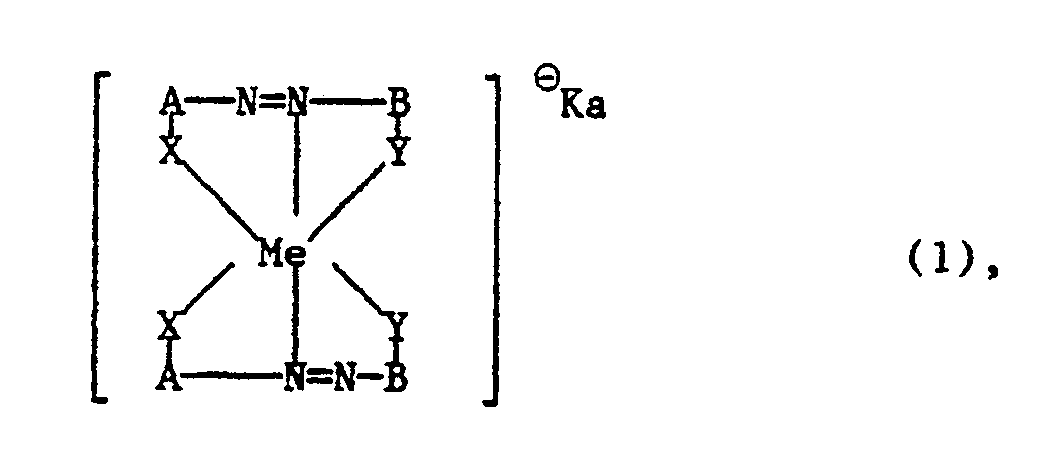


Applications Claiming Priority (4)
| Application Number | Priority Date | Filing Date | Title |
|---|---|---|---|
| CH1087/86 | 1986-03-18 | ||
| CH108786 | 1986-03-18 | ||
| CH3061/86 | 1986-07-30 | ||
| CH306186 | 1986-07-30 |
Publications (3)
| Publication Number | Publication Date |
|---|---|
| EP0241414A2 EP0241414A2 (de) | 1987-10-14 |
| EP0241414A3 EP0241414A3 (en) | 1987-12-02 |
| EP0241414B1 true EP0241414B1 (de) | 1991-05-08 |
Family
ID=25686612
Family Applications (1)
| Application Number | Title | Priority Date | Filing Date |
|---|---|---|---|
| EP87810143A Expired - Lifetime EP0241414B1 (de) | 1986-03-18 | 1987-03-12 | Verfahren zur Herstellung von 1:2-Metallkomplexazofarbstoffen |
Country Status (8)
| Country | Link |
|---|---|
| EP (1) | EP0241414B1 (de) |
| JP (1) | JPH0822969B2 (de) |
| KR (1) | KR870008968A (de) |
| AR (1) | AR246538A1 (de) |
| BR (1) | BR8701207A (de) |
| DE (1) | DE3769826D1 (de) |
| ES (1) | ES2022444B3 (de) |
| MX (1) | MX171226B (de) |
Cited By (1)
| Publication number | Priority date | Publication date | Assignee | Title |
|---|---|---|---|---|
| CZ300680B6 (cs) * | 2007-09-25 | 2009-07-15 | Univerzita Pardubice | Kovokomplexní azobarviva na bázi kyseliny citrazinové, zpusob jejich prípravy a zpusob barvení živocišných a syntetických substrátu |
Families Citing this family (3)
| Publication number | Priority date | Publication date | Assignee | Title |
|---|---|---|---|---|
| JPH0742451B2 (ja) * | 1986-07-31 | 1995-05-10 | 保土谷化学工業株式会社 | 近赤外線吸収剤 |
| CH688281A5 (de) * | 1987-12-04 | 1997-07-15 | Ciba Geigy Ag | Verfahren zur Herstellung von 1:2-Metallkomplexazofarbstoffen. |
| JP2627143B2 (ja) * | 1993-05-27 | 1997-07-02 | 田岡化学工業株式会社 | 1:2−クロム錯体アゾ染料溶液の製造方法 |
Family Cites Families (4)
| Publication number | Priority date | Publication date | Assignee | Title |
|---|---|---|---|---|
| DE350697C (de) * | 1915-07-18 | 1922-03-25 | Chemische Ind Ges | Verfahren zur Herstellung von Kupferverbindungen substantiver o-Oxyazofarbstoffe |
| US1480640A (en) * | 1922-02-27 | 1924-01-15 | Chem Ind Basel | Manufacture of chromium compounds of azo dyestuffs |
| DE2918634A1 (de) * | 1979-05-09 | 1980-11-20 | Basf Ag | Verfahren zur herstellung von kobalt- und chrom-1 zu 2-komplexfarbstoffen |
| DE3208141A1 (de) * | 1982-03-06 | 1983-09-08 | Bayer Ag, 5090 Leverkusen | Verfahren zur herstellung konzentrierter, wasserhaltiger loesungen von chromkomplexen sulfogruppenhaltiger azo- und/oder azomethinfarbstoffe |
-
1987
- 1987-03-12 DE DE8787810143T patent/DE3769826D1/de not_active Expired - Lifetime
- 1987-03-12 ES ES87810143T patent/ES2022444B3/es not_active Expired - Lifetime
- 1987-03-12 EP EP87810143A patent/EP0241414B1/de not_active Expired - Lifetime
- 1987-03-17 AR AR87307035A patent/AR246538A1/es active
- 1987-03-17 KR KR870002385A patent/KR870008968A/ko not_active Withdrawn
- 1987-03-17 MX MX005603A patent/MX171226B/es unknown
- 1987-03-17 BR BR8701207A patent/BR8701207A/pt not_active IP Right Cessation
- 1987-03-18 JP JP62061406A patent/JPH0822969B2/ja not_active Expired - Lifetime
Cited By (1)
| Publication number | Priority date | Publication date | Assignee | Title |
|---|---|---|---|---|
| CZ300680B6 (cs) * | 2007-09-25 | 2009-07-15 | Univerzita Pardubice | Kovokomplexní azobarviva na bázi kyseliny citrazinové, zpusob jejich prípravy a zpusob barvení živocišných a syntetických substrátu |
Also Published As
| Publication number | Publication date |
|---|---|
| EP0241414A3 (en) | 1987-12-02 |
| MX171226B (es) | 1993-10-12 |
| BR8701207A (pt) | 1988-01-12 |
| ES2022444B3 (es) | 1991-12-01 |
| DE3769826D1 (de) | 1991-06-13 |
| EP0241414A2 (de) | 1987-10-14 |
| AR246538A1 (es) | 1994-08-31 |
| KR870008968A (ko) | 1987-10-22 |
| JPS62225563A (ja) | 1987-10-03 |
| JPH0822969B2 (ja) | 1996-03-06 |
Similar Documents
| Publication | Publication Date | Title |
|---|---|---|
| EP0719837B1 (de) | Azofarbstoffe, Verfahren zu deren Herstellung und deren Verwendung | |
| CH624979A5 (de) | ||
| EP0278910B1 (de) | Schwermetallkomplexfarbstoffe, deren Herstellung und Verwendung | |
| DE2745024A1 (de) | Neue schwermetallkomplexe, deren herstellung und verwendung | |
| EP0157733B1 (de) | Verfahren zur Herstellung von 1:2-Chromkomplexazofarbstoffen | |
| DE1089095B (de) | Verfahren zur Herstellung von Farbstoffen | |
| EP0319474B1 (de) | Verfahren zur Herstellung von 1:2-Metallkomplexazofarbstoffen | |
| DE2236299C2 (de) | Azoverbindungen, deren Herstellung und Verwendung | |
| DE1219155B (de) | Verfahren zur Herstellung wasserloeslicher Azofarbstoffe | |
| EP0156768B1 (de) | Verfahren zur Herstellung von 1:2-Chromkomplexfarbstoffen | |
| DE1155548B (de) | Verfahren zur Herstellung von metallisierten Azofarbstoffen | |
| CH324677A (de) | Verfahren zur Herstellung von schwermetallhaltigen Azofarbstoffen | |
| EP0241414A2 (de) | Verfahren zur Herstellung von 1:2-Metallkomplexazofarbstoffen | |
| DE2617314A1 (de) | Neue azofarbstoffe, verfahren zu ihrer herstellung und ihre verwendung | |
| EP0110825B1 (de) | Unsymmetrische 1:2-Chromkomplexfarbstoffe, enthaltend eine Azo- und eine Azomethinverbindung | |
| DE1012007B (de) | Verfahren zur Herstellung chromhaltiger Azofarbstoffe | |
| DE2201030A1 (de) | Azofarbstoffe,deren Herstellung und Verwendung | |
| CH336139A (de) | Verfahren zur Herstellung von komplexen Schwermetallverbindungen von Azofarbstoffen | |
| DE909758C (de) | Verfahren zur Herstellung von chromhaltigen Monoazofarbstoffen | |
| CH319237A (de) | Verfahren zur Herstellung neuer kobalthaltiger Azofarbstoffe | |
| DE2236245A1 (de) | Azofarbstoffe, deren herstellung und verwendung | |
| EP0384893B1 (de) | Verfahren zur Herstellung von asymmetrischen 1:2-Metallkomplexfarbstoffen | |
| DE2450884A1 (de) | Neue metallkomplexfarbstoffe, deren herstellung und verwendung | |
| DE842091C (de) | Verfahren zur Herstellung von metallisierbaren Azofarbstoffen | |
| DE2039737A1 (de) | Azoverbindungen,deren Herstellung und Verwendung |
Legal Events
| Date | Code | Title | Description |
|---|---|---|---|
| PUAI | Public reference made under article 153(3) epc to a published international application that has entered the european phase |
Free format text: ORIGINAL CODE: 0009012 |
|
| PUAL | Search report despatched |
Free format text: ORIGINAL CODE: 0009013 |
|
| 17P | Request for examination filed |
Effective date: 19870314 |
|
| AK | Designated contracting states |
Kind code of ref document: A2 Designated state(s): BE CH DE ES FR GB LI |
|
| AK | Designated contracting states |
Kind code of ref document: A3 Designated state(s): BE CH DE ES FR GB LI |
|
| 17Q | First examination report despatched |
Effective date: 19890602 |
|
| GRAA | (expected) grant |
Free format text: ORIGINAL CODE: 0009210 |
|
| AK | Designated contracting states |
Kind code of ref document: B1 Designated state(s): BE CH DE ES FR GB LI |
|
| ET | Fr: translation filed | ||
| REF | Corresponds to: |
Ref document number: 3769826 Country of ref document: DE Date of ref document: 19910613 |
|
| GBT | Gb: translation of ep patent filed (gb section 77(6)(a)/1977) | ||
| PLBE | No opposition filed within time limit |
Free format text: ORIGINAL CODE: 0009261 |
|
| STAA | Information on the status of an ep patent application or granted ep patent |
Free format text: STATUS: NO OPPOSITION FILED WITHIN TIME LIMIT |
|
| 26N | No opposition filed | ||
| REG | Reference to a national code |
Ref country code: CH Ref legal event code: PUE Owner name: CIBA-GEIGY AG TRANSFER- CIBA SC HOLDING AG |
|
| BECN | Be: change of holder's name |
Effective date: 19961129 |
|
| REG | Reference to a national code |
Ref country code: FR Ref legal event code: TP |
|
| REG | Reference to a national code |
Ref country code: GB Ref legal event code: 732E |
|
| REG | Reference to a national code |
Ref country code: CH Ref legal event code: PFA Free format text: CIBA SC HOLDING AG TRANSFER- CIBA SC HOLDING AG;CIBA SPECIALTY CHEMICALS HOLDING INC. Ref country code: CH Ref legal event code: NV |
|
| PGFP | Annual fee paid to national office [announced via postgrant information from national office to epo] |
Ref country code: ES Payment date: 19980319 Year of fee payment: 12 |
|
| REG | Reference to a national code |
Ref country code: FR Ref legal event code: CD |
|
| PGFP | Annual fee paid to national office [announced via postgrant information from national office to epo] |
Ref country code: BE Payment date: 19980518 Year of fee payment: 12 |
|
| REG | Reference to a national code |
Ref country code: ES Ref legal event code: PC2A |
|
| PGFP | Annual fee paid to national office [announced via postgrant information from national office to epo] |
Ref country code: FR Payment date: 19990129 Year of fee payment: 13 |
|
| PGFP | Annual fee paid to national office [announced via postgrant information from national office to epo] |
Ref country code: CH Payment date: 19990201 Year of fee payment: 13 |
|
| PGFP | Annual fee paid to national office [announced via postgrant information from national office to epo] |
Ref country code: DE Payment date: 19990208 Year of fee payment: 13 |
|
| PGFP | Annual fee paid to national office [announced via postgrant information from national office to epo] |
Ref country code: GB Payment date: 19990217 Year of fee payment: 13 |
|
| PG25 | Lapsed in a contracting state [announced via postgrant information from national office to epo] |
Ref country code: ES Free format text: LAPSE BECAUSE OF NON-PAYMENT OF DUE FEES Effective date: 19990313 |
|
| PG25 | Lapsed in a contracting state [announced via postgrant information from national office to epo] |
Ref country code: BE Free format text: LAPSE BECAUSE OF NON-PAYMENT OF DUE FEES Effective date: 19990331 |
|
| BERE | Be: lapsed |
Owner name: CIBA SPECIALTY CHEMICALS HOLDING INC. Effective date: 19990331 |
|
| PG25 | Lapsed in a contracting state [announced via postgrant information from national office to epo] |
Ref country code: GB Free format text: LAPSE BECAUSE OF NON-PAYMENT OF DUE FEES Effective date: 20000312 |
|
| PG25 | Lapsed in a contracting state [announced via postgrant information from national office to epo] |
Ref country code: LI Free format text: LAPSE BECAUSE OF NON-PAYMENT OF DUE FEES Effective date: 20000331 Ref country code: CH Free format text: LAPSE BECAUSE OF NON-PAYMENT OF DUE FEES Effective date: 20000331 |
|
| GBPC | Gb: european patent ceased through non-payment of renewal fee |
Effective date: 20000312 |
|
| REG | Reference to a national code |
Ref country code: CH Ref legal event code: PL |
|
| PG25 | Lapsed in a contracting state [announced via postgrant information from national office to epo] |
Ref country code: FR Free format text: LAPSE BECAUSE OF NON-PAYMENT OF DUE FEES Effective date: 20001130 |
|
| REG | Reference to a national code |
Ref country code: FR Ref legal event code: ST |
|
| PG25 | Lapsed in a contracting state [announced via postgrant information from national office to epo] |
Ref country code: DE Free format text: LAPSE BECAUSE OF NON-PAYMENT OF DUE FEES Effective date: 20010103 |
|
| REG | Reference to a national code |
Ref country code: ES Ref legal event code: FD2A Effective date: 20010503 |