EP0157733B1 - Verfahren zur Herstellung von 1:2-Chromkomplexazofarbstoffen - Google Patents
Verfahren zur Herstellung von 1:2-Chromkomplexazofarbstoffen Download PDFInfo
- Publication number
- EP0157733B1 EP0157733B1 EP85810090A EP85810090A EP0157733B1 EP 0157733 B1 EP0157733 B1 EP 0157733B1 EP 85810090 A EP85810090 A EP 85810090A EP 85810090 A EP85810090 A EP 85810090A EP 0157733 B1 EP0157733 B1 EP 0157733B1
- Authority
- EP
- European Patent Office
- Prior art keywords
- process according
- group
- azo dyes
- water
- metallisable
- Prior art date
- Legal status (The legal status is an assumption and is not a legal conclusion. Google has not performed a legal analysis and makes no representation as to the accuracy of the status listed.)
- Expired
Links
- 238000000034 method Methods 0.000 title claims abstract description 71
- 239000011651 chromium Substances 0.000 title claims abstract description 39
- 229910052804 chromium Inorganic materials 0.000 title claims abstract description 39
- 238000002360 preparation method Methods 0.000 title claims abstract description 8
- 239000000987 azo dye Substances 0.000 claims abstract description 52
- VYZAMTAEIAYCRO-UHFFFAOYSA-N Chromium Chemical compound [Cr] VYZAMTAEIAYCRO-UHFFFAOYSA-N 0.000 claims abstract description 38
- 230000008878 coupling Effects 0.000 claims abstract description 33
- 238000010168 coupling process Methods 0.000 claims abstract description 33
- 238000005859 coupling reaction Methods 0.000 claims abstract description 33
- 239000000203 mixture Substances 0.000 claims abstract description 14
- 230000007935 neutral effect Effects 0.000 claims abstract description 12
- 125000000664 diazo group Chemical group [N-]=[N+]=[*] 0.000 claims abstract description 11
- 238000006243 chemical reaction Methods 0.000 claims abstract description 9
- 239000002253 acid Substances 0.000 claims abstract description 8
- 239000012736 aqueous medium Substances 0.000 claims abstract description 4
- 239000000975 dye Substances 0.000 claims description 34
- UHOVQNZJYSORNB-UHFFFAOYSA-N Benzene Chemical compound C1=CC=CC=C1 UHOVQNZJYSORNB-UHFFFAOYSA-N 0.000 claims description 24
- UFWIBTONFRDIAS-UHFFFAOYSA-N Naphthalene Chemical compound C1=CC=CC2=CC=CC=C21 UFWIBTONFRDIAS-UHFFFAOYSA-N 0.000 claims description 16
- YGSDEFSMJLZEOE-UHFFFAOYSA-N salicylic acid Chemical compound OC(=O)C1=CC=CC=C1O YGSDEFSMJLZEOE-UHFFFAOYSA-N 0.000 claims description 12
- 150000001412 amines Chemical class 0.000 claims description 9
- KRKNYBCHXYNGOX-UHFFFAOYSA-N citric acid Chemical compound OC(=O)CC(O)(C(O)=O)CC(O)=O KRKNYBCHXYNGOX-UHFFFAOYSA-N 0.000 claims description 9
- 125000000449 nitro group Chemical group [O-][N+](*)=O 0.000 claims description 9
- 229910052700 potassium Inorganic materials 0.000 claims description 9
- AEMRFAOFKBGASW-UHFFFAOYSA-N Glycolic acid Chemical compound OCC(O)=O AEMRFAOFKBGASW-UHFFFAOYSA-N 0.000 claims description 6
- 125000003277 amino group Chemical group 0.000 claims description 6
- JVTAAEKCZFNVCJ-UHFFFAOYSA-N lactic acid Chemical compound CC(O)C(O)=O JVTAAEKCZFNVCJ-UHFFFAOYSA-N 0.000 claims description 6
- FJKROLUGYXJWQN-UHFFFAOYSA-N papa-hydroxy-benzoic acid Natural products OC(=O)C1=CC=C(O)C=C1 FJKROLUGYXJWQN-UHFFFAOYSA-N 0.000 claims description 6
- 229960004889 salicylic acid Drugs 0.000 claims description 6
- 125000000020 sulfo group Chemical group O=S(=O)([*])O[H] 0.000 claims description 6
- 229910052736 halogen Inorganic materials 0.000 claims description 5
- 150000002367 halogens Chemical class 0.000 claims description 5
- 125000002887 hydroxy group Chemical group [H]O* 0.000 claims description 5
- 125000000542 sulfonic acid group Chemical group 0.000 claims description 5
- ZAMOUSCENKQFHK-UHFFFAOYSA-N Chlorine atom Chemical group [Cl] ZAMOUSCENKQFHK-UHFFFAOYSA-N 0.000 claims description 3
- FEWJPZIEWOKRBE-JCYAYHJZSA-N Dextrotartaric acid Chemical compound OC(=O)[C@H](O)[C@@H](O)C(O)=O FEWJPZIEWOKRBE-JCYAYHJZSA-N 0.000 claims description 3
- FEWJPZIEWOKRBE-UHFFFAOYSA-N Tartaric acid Natural products [H+].[H+].[O-]C(=O)C(O)C(O)C([O-])=O FEWJPZIEWOKRBE-UHFFFAOYSA-N 0.000 claims description 3
- 229910052801 chlorine Chemical group 0.000 claims description 3
- 239000000460 chlorine Chemical group 0.000 claims description 3
- 235000015165 citric acid Nutrition 0.000 claims description 3
- 125000000623 heterocyclic group Chemical group 0.000 claims description 3
- 239000004310 lactic acid Substances 0.000 claims description 3
- 235000014655 lactic acid Nutrition 0.000 claims description 3
- 229940124530 sulfonamide Drugs 0.000 claims description 3
- 150000003457 sulfones Chemical class 0.000 claims description 3
- 239000011975 tartaric acid Substances 0.000 claims description 3
- 235000002906 tartaric acid Nutrition 0.000 claims description 3
- 125000000751 azo group Chemical group [*]N=N[*] 0.000 claims description 2
- 230000003197 catalytic effect Effects 0.000 claims description 2
- 150000001768 cations Chemical class 0.000 claims description 2
- 239000012954 diazonium Substances 0.000 claims description 2
- 150000001989 diazonium salts Chemical class 0.000 claims description 2
- NYGZLYXAPMMJTE-UHFFFAOYSA-M metanil yellow Chemical group [Na+].[O-]S(=O)(=O)C1=CC=CC(N=NC=2C=CC(NC=3C=CC=CC=3)=CC=2)=C1 NYGZLYXAPMMJTE-UHFFFAOYSA-M 0.000 claims description 2
- 150000002790 naphthalenes Chemical class 0.000 claims description 2
- HVZWVEKIQMJYIK-UHFFFAOYSA-N nitryl chloride Chemical group [O-][N+](Cl)=O HVZWVEKIQMJYIK-UHFFFAOYSA-N 0.000 claims description 2
- 239000007858 starting material Substances 0.000 claims description 2
- 150000003456 sulfonamides Chemical class 0.000 claims description 2
- 230000000536 complexating effect Effects 0.000 claims 1
- 239000000243 solution Substances 0.000 description 33
- XLYOFNOQVPJJNP-UHFFFAOYSA-N water Chemical compound O XLYOFNOQVPJJNP-UHFFFAOYSA-N 0.000 description 15
- JWAZRIHNYRIHIV-UHFFFAOYSA-N 2-naphthol Chemical compound C1=CC=CC2=CC(O)=CC=C21 JWAZRIHNYRIHIV-UHFFFAOYSA-N 0.000 description 10
- QAOWNCQODCNURD-UHFFFAOYSA-N Sulfuric acid Chemical compound OS(O)(=O)=O QAOWNCQODCNURD-UHFFFAOYSA-N 0.000 description 10
- 238000004043 dyeing Methods 0.000 description 10
- 210000002268 wool Anatomy 0.000 description 10
- QTBSBXVTEAMEQO-UHFFFAOYSA-N Acetic acid Chemical compound CC(O)=O QTBSBXVTEAMEQO-UHFFFAOYSA-N 0.000 description 9
- HEMHJVSKTPXQMS-UHFFFAOYSA-M Sodium hydroxide Chemical compound [OH-].[Na+] HEMHJVSKTPXQMS-UHFFFAOYSA-M 0.000 description 9
- VEXZGXHMUGYJMC-UHFFFAOYSA-N Hydrochloric acid Chemical compound Cl VEXZGXHMUGYJMC-UHFFFAOYSA-N 0.000 description 8
- 230000002378 acidificating effect Effects 0.000 description 8
- 238000005580 one pot reaction Methods 0.000 description 8
- 235000002639 sodium chloride Nutrition 0.000 description 8
- 150000001844 chromium Chemical class 0.000 description 7
- CDBYLPFSWZWCQE-UHFFFAOYSA-L sodium carbonate Substances [Na+].[Na+].[O-]C([O-])=O CDBYLPFSWZWCQE-UHFFFAOYSA-L 0.000 description 7
- QELUYTUMUWHWMC-UHFFFAOYSA-N edaravone Chemical compound O=C1CC(C)=NN1C1=CC=CC=C1 QELUYTUMUWHWMC-UHFFFAOYSA-N 0.000 description 6
- DQIVFTJHYKDOMZ-UHFFFAOYSA-N 96-67-3 Chemical compound NC1=CC([N+]([O-])=O)=CC(S(O)(=O)=O)=C1O DQIVFTJHYKDOMZ-UHFFFAOYSA-N 0.000 description 5
- FAPWRFPIFSIZLT-UHFFFAOYSA-M Sodium chloride Chemical compound [Na+].[Cl-] FAPWRFPIFSIZLT-UHFFFAOYSA-M 0.000 description 5
- 229950011260 betanaphthol Drugs 0.000 description 5
- 239000003795 chemical substances by application Substances 0.000 description 5
- 238000004532 chromating Methods 0.000 description 5
- 150000003839 salts Chemical class 0.000 description 5
- DGAQECJNVWCQMB-PUAWFVPOSA-M Ilexoside XXIX Chemical compound C[C@@H]1CC[C@@]2(CC[C@@]3(C(=CC[C@H]4[C@]3(CC[C@@H]5[C@@]4(CC[C@@H](C5(C)C)OS(=O)(=O)[O-])C)C)[C@@H]2[C@]1(C)O)C)C(=O)O[C@H]6[C@@H]([C@H]([C@@H]([C@H](O6)CO)O)O)O.[Na+] DGAQECJNVWCQMB-PUAWFVPOSA-M 0.000 description 4
- 238000004519 manufacturing process Methods 0.000 description 4
- LPXPTNMVRIOKMN-UHFFFAOYSA-M sodium nitrite Chemical compound [Na+].[O-]N=O LPXPTNMVRIOKMN-UHFFFAOYSA-M 0.000 description 4
- VLZVIIYRNMWPSN-UHFFFAOYSA-N 2-Amino-4-nitrophenol Chemical compound NC1=CC([N+]([O-])=O)=CC=C1O VLZVIIYRNMWPSN-UHFFFAOYSA-N 0.000 description 3
- IOVCWXUNBOPUCH-UHFFFAOYSA-M Nitrite anion Chemical compound [O-]N=O IOVCWXUNBOPUCH-UHFFFAOYSA-M 0.000 description 3
- 125000003545 alkoxy group Chemical group 0.000 description 3
- 238000009835 boiling Methods 0.000 description 3
- GRWVQDDAKZFPFI-UHFFFAOYSA-H chromium(III) sulfate Chemical compound [Cr+3].[Cr+3].[O-]S([O-])(=O)=O.[O-]S([O-])(=O)=O.[O-]S([O-])(=O)=O GRWVQDDAKZFPFI-UHFFFAOYSA-H 0.000 description 3
- 229910000356 chromium(III) sulfate Inorganic materials 0.000 description 3
- 239000011696 chromium(III) sulphate Substances 0.000 description 3
- 235000015217 chromium(III) sulphate Nutrition 0.000 description 3
- -1 methoxy, ethoxy, propoxy, isopropoxy Chemical group 0.000 description 3
- 150000007522 mineralic acids Chemical class 0.000 description 3
- 239000011541 reaction mixture Substances 0.000 description 3
- 229910000029 sodium carbonate Inorganic materials 0.000 description 3
- 239000011780 sodium chloride Substances 0.000 description 3
- KJCVRFUGPWSIIH-UHFFFAOYSA-N 1-naphthol Chemical compound C1=CC=C2C(O)=CC=CC2=C1 KJCVRFUGPWSIIH-UHFFFAOYSA-N 0.000 description 2
- AACMNEWXGKOJJK-UHFFFAOYSA-N 2-amino-6-nitrophenol Chemical compound NC1=CC=CC([N+]([O-])=O)=C1O AACMNEWXGKOJJK-UHFFFAOYSA-N 0.000 description 2
- CDAWCLOXVUBKRW-UHFFFAOYSA-N 2-aminophenol Chemical compound NC1=CC=CC=C1O CDAWCLOXVUBKRW-UHFFFAOYSA-N 0.000 description 2
- RHPXYZMDLOJTFF-UHFFFAOYSA-N 3-amino-4-hydroxy-5-nitrobenzenesulfonic acid Chemical compound NC1=CC(S(O)(=O)=O)=CC([N+]([O-])=O)=C1O RHPXYZMDLOJTFF-UHFFFAOYSA-N 0.000 description 2
- RXCMFQDTWCCLBL-UHFFFAOYSA-N 4-amino-3-hydroxynaphthalene-1-sulfonic acid Chemical compound C1=CC=C2C(N)=C(O)C=C(S(O)(=O)=O)C2=C1 RXCMFQDTWCCLBL-UHFFFAOYSA-N 0.000 description 2
- HDHQZCHIXUUSMK-UHFFFAOYSA-N 4-hydroxy-2-quinolone Chemical compound C1=CC=C2C(O)=CC(=O)NC2=C1 HDHQZCHIXUUSMK-UHFFFAOYSA-N 0.000 description 2
- 239000004952 Polyamide Substances 0.000 description 2
- 150000007513 acids Chemical class 0.000 description 2
- 150000003863 ammonium salts Chemical class 0.000 description 2
- 239000007864 aqueous solution Substances 0.000 description 2
- ZCDOYSPFYFSLEW-UHFFFAOYSA-N chromate(2-) Chemical class [O-][Cr]([O-])(=O)=O ZCDOYSPFYFSLEW-UHFFFAOYSA-N 0.000 description 2
- 150000001875 compounds Chemical class 0.000 description 2
- 238000006193 diazotization reaction Methods 0.000 description 2
- 238000001035 drying Methods 0.000 description 2
- 239000004744 fabric Substances 0.000 description 2
- 238000002955 isolation Methods 0.000 description 2
- 125000000468 ketone group Chemical group 0.000 description 2
- 239000000463 material Substances 0.000 description 2
- 238000002156 mixing Methods 0.000 description 2
- LNOPIUAQISRISI-UHFFFAOYSA-N n'-hydroxy-2-propan-2-ylsulfonylethanimidamide Chemical compound CC(C)S(=O)(=O)CC(N)=NO LNOPIUAQISRISI-UHFFFAOYSA-N 0.000 description 2
- 150000007524 organic acids Chemical class 0.000 description 2
- 235000005985 organic acids Nutrition 0.000 description 2
- IWDCLRJOBJJRNH-UHFFFAOYSA-N p-cresol Chemical compound CC1=CC=C(O)C=C1 IWDCLRJOBJJRNH-UHFFFAOYSA-N 0.000 description 2
- 229920002647 polyamide Polymers 0.000 description 2
- SCVFZCLFOSHCOH-UHFFFAOYSA-M potassium acetate Chemical compound [K+].CC([O-])=O SCVFZCLFOSHCOH-UHFFFAOYSA-M 0.000 description 2
- BWHMMNNQKKPAPP-UHFFFAOYSA-L potassium carbonate Chemical compound [K+].[K+].[O-]C([O-])=O BWHMMNNQKKPAPP-UHFFFAOYSA-L 0.000 description 2
- 229910052708 sodium Inorganic materials 0.000 description 2
- 235000010288 sodium nitrite Nutrition 0.000 description 2
- 125000001424 substituent group Chemical group 0.000 description 2
- 239000004753 textile Substances 0.000 description 2
- 125000004178 (C1-C4) alkyl group Chemical group 0.000 description 1
- FHMMQQXRSYSWCM-UHFFFAOYSA-N 1-aminonaphthalen-2-ol Chemical compound C1=CC=C2C(N)=C(O)C=CC2=C1 FHMMQQXRSYSWCM-UHFFFAOYSA-N 0.000 description 1
- MBDUIEKYVPVZJH-UHFFFAOYSA-N 1-ethylsulfonylethane Chemical compound CCS(=O)(=O)CC MBDUIEKYVPVZJH-UHFFFAOYSA-N 0.000 description 1
- LUZXGSRCYGQGQF-UHFFFAOYSA-N 2,5-dichloro-4-(5-methyl-3-oxo-1h-pyrazol-2-yl)benzenesulfonic acid Chemical compound N1C(C)=CC(=O)N1C1=CC(Cl)=C(S(O)(=O)=O)C=C1Cl LUZXGSRCYGQGQF-UHFFFAOYSA-N 0.000 description 1
- MZKALFCNIJHTJG-UHFFFAOYSA-N 2,5-diphenyl-4h-pyrazol-3-one Chemical compound O=C1CC(C=2C=CC=CC=2)=NN1C1=CC=CC=C1 MZKALFCNIJHTJG-UHFFFAOYSA-N 0.000 description 1
- FCWUFSJRTXLBTH-UHFFFAOYSA-N 2-(2,5-dichlorophenyl)-5-methyl-4h-pyrazol-3-one Chemical compound O=C1CC(C)=NN1C1=CC(Cl)=CC=C1Cl FCWUFSJRTXLBTH-UHFFFAOYSA-N 0.000 description 1
- DOPJTDJKZNWLRB-UHFFFAOYSA-N 2-Amino-5-nitrophenol Chemical compound NC1=CC=C([N+]([O-])=O)C=C1O DOPJTDJKZNWLRB-UHFFFAOYSA-N 0.000 description 1
- QQDKXJSYZGJGKJ-UHFFFAOYSA-N 2-amino-3,4,6-trichlorophenol Chemical compound NC1=C(O)C(Cl)=CC(Cl)=C1Cl QQDKXJSYZGJGKJ-UHFFFAOYSA-N 0.000 description 1
- GOJUJUVQIVIZAV-UHFFFAOYSA-N 2-amino-4,6-dichloropyrimidine-5-carbaldehyde Chemical group NC1=NC(Cl)=C(C=O)C(Cl)=N1 GOJUJUVQIVIZAV-UHFFFAOYSA-N 0.000 description 1
- SWFNPENEBHAHEB-UHFFFAOYSA-N 2-amino-4-chlorophenol Chemical compound NC1=CC(Cl)=CC=C1O SWFNPENEBHAHEB-UHFFFAOYSA-N 0.000 description 1
- FZCQMIRJCGWWCL-UHFFFAOYSA-N 2-amino-5-chlorophenol Chemical compound NC1=CC=C(Cl)C=C1O FZCQMIRJCGWWCL-UHFFFAOYSA-N 0.000 description 1
- YCTAOQGPWNTYJE-UHFFFAOYSA-N 3-amino-5-chloro-2-hydroxybenzenesulfonic acid Chemical group NC1=CC(Cl)=CC(S(O)(=O)=O)=C1O YCTAOQGPWNTYJE-UHFFFAOYSA-N 0.000 description 1
- GPAPPPVRLPGFEQ-UHFFFAOYSA-N 4,4'-dichlorodiphenyl sulfone Chemical group C1=CC(Cl)=CC=C1S(=O)(=O)C1=CC=C(Cl)C=C1 GPAPPPVRLPGFEQ-UHFFFAOYSA-N 0.000 description 1
- UQKAOPWZAUTFPK-UHFFFAOYSA-N 4-amino-2-chloro-5-hydroxybenzenesulfonic acid Chemical compound NC1=CC(Cl)=C(S(O)(=O)=O)C=C1O UQKAOPWZAUTFPK-UHFFFAOYSA-N 0.000 description 1
- HUOMKCOMHYGKIP-UHFFFAOYSA-N 4-amino-3-hydroxy-7-methylnaphthalene-1-sulfonic acid Chemical compound NC1=C(O)C=C(S(O)(=O)=O)C2=CC(C)=CC=C21 HUOMKCOMHYGKIP-UHFFFAOYSA-N 0.000 description 1
- DHXPRBHRJQAXHK-UHFFFAOYSA-N 4-amino-3-hydroxy-7-nitronaphthalene-1-sulfonic acid Chemical compound [O-][N+](=O)C1=CC=C2C(N)=C(O)C=C(S(O)(=O)=O)C2=C1 DHXPRBHRJQAXHK-UHFFFAOYSA-N 0.000 description 1
- 125000000590 4-methylphenyl group Chemical group [H]C1=C([H])C(=C([H])C([H])=C1*)C([H])([H])[H] 0.000 description 1
- KEGNUIZNBCHWLZ-UHFFFAOYSA-N 5,8-dichloronaphthalen-1-ol Chemical compound C1=CC(Cl)=C2C(O)=CC=CC2=C1Cl KEGNUIZNBCHWLZ-UHFFFAOYSA-N 0.000 description 1
- ACNOLCYSQPFXFF-UHFFFAOYSA-N 5,8-dichloronaphthalen-2-ol Chemical compound ClC1=CC=C(Cl)C2=CC(O)=CC=C21 ACNOLCYSQPFXFF-UHFFFAOYSA-N 0.000 description 1
- IPZJPYHEVWLBNH-UHFFFAOYSA-N 5-chloronaphthalen-1-ol Chemical compound C1=CC=C2C(O)=CC=CC2=C1Cl IPZJPYHEVWLBNH-UHFFFAOYSA-N 0.000 description 1
- WVNPSAZZSXCSJO-UHFFFAOYSA-N 5-methyl-2-(2-naphthalen-1-ylphenyl)-4H-pyrazol-3-one Chemical compound C1(=CC=CC2=CC=CC=C12)C1=C(C=CC=C1)N1N=C(CC1=O)C WVNPSAZZSXCSJO-UHFFFAOYSA-N 0.000 description 1
- RMWAUOKTFDJYCD-UHFFFAOYSA-N 5-methyl-2-octyl-4h-pyrazol-3-one Chemical compound CCCCCCCCN1N=C(C)CC1=O RMWAUOKTFDJYCD-UHFFFAOYSA-N 0.000 description 1
- WWPKRXOOVICNJY-UHFFFAOYSA-N 6-methoxynaphthalen-2-ol Chemical compound C1=C(O)C=CC2=CC(OC)=CC=C21 WWPKRXOOVICNJY-UHFFFAOYSA-N 0.000 description 1
- TWLMSPNQBKSXOP-UHFFFAOYSA-N 6358-09-4 Chemical compound NC1=CC([N+]([O-])=O)=CC(Cl)=C1O TWLMSPNQBKSXOP-UHFFFAOYSA-N 0.000 description 1
- 239000005725 8-Hydroxyquinoline Substances 0.000 description 1
- QVKBELCKHUHPRW-UHFFFAOYSA-N 8-chloronaphthalen-1-ol Chemical compound C1=CC(Cl)=C2C(O)=CC=CC2=C1 QVKBELCKHUHPRW-UHFFFAOYSA-N 0.000 description 1
- KXDAEFPNCMNJSK-UHFFFAOYSA-N Benzamide Chemical compound NC(=O)C1=CC=CC=C1 KXDAEFPNCMNJSK-UHFFFAOYSA-N 0.000 description 1
- WKBOTKDWSSQWDR-UHFFFAOYSA-N Bromine atom Chemical compound [Br] WKBOTKDWSSQWDR-UHFFFAOYSA-N 0.000 description 1
- 229910021556 Chromium(III) chloride Inorganic materials 0.000 description 1
- 229910021564 Chromium(III) fluoride Inorganic materials 0.000 description 1
- PXGOKWXKJXAPGV-UHFFFAOYSA-N Fluorine Chemical compound FF PXGOKWXKJXAPGV-UHFFFAOYSA-N 0.000 description 1
- WHXSMMKQMYFTQS-UHFFFAOYSA-N Lithium Chemical compound [Li] WHXSMMKQMYFTQS-UHFFFAOYSA-N 0.000 description 1
- OJGMBLNIHDZDGS-UHFFFAOYSA-N N-Ethylaniline Chemical compound CCNC1=CC=CC=C1 OJGMBLNIHDZDGS-UHFFFAOYSA-N 0.000 description 1
- AFBPFSWMIHJQDM-UHFFFAOYSA-N N-methylaniline Chemical compound CNC1=CC=CC=C1 AFBPFSWMIHJQDM-UHFFFAOYSA-N 0.000 description 1
- IOVCWXUNBOPUCH-UHFFFAOYSA-N Nitrous acid Chemical compound ON=O IOVCWXUNBOPUCH-UHFFFAOYSA-N 0.000 description 1
- 229920002302 Nylon 6,6 Polymers 0.000 description 1
- ZLMJMSJWJFRBEC-UHFFFAOYSA-N Potassium Chemical compound [K] ZLMJMSJWJFRBEC-UHFFFAOYSA-N 0.000 description 1
- PMZURENOXWZQFD-UHFFFAOYSA-L Sodium Sulfate Chemical compound [Na+].[Na+].[O-]S([O-])(=O)=O PMZURENOXWZQFD-UHFFFAOYSA-L 0.000 description 1
- GSEJCLTVZPLZKY-UHFFFAOYSA-N Triethanolamine Chemical compound OCCN(CCO)CCO GSEJCLTVZPLZKY-UHFFFAOYSA-N 0.000 description 1
- 239000000654 additive Substances 0.000 description 1
- 125000001931 aliphatic group Chemical group 0.000 description 1
- 239000003513 alkali Substances 0.000 description 1
- 229910052783 alkali metal Inorganic materials 0.000 description 1
- 150000001340 alkali metals Chemical class 0.000 description 1
- 229910052784 alkaline earth metal Inorganic materials 0.000 description 1
- 150000001342 alkaline earth metals Chemical class 0.000 description 1
- 125000000217 alkyl group Chemical group 0.000 description 1
- 125000003118 aryl group Chemical group 0.000 description 1
- HNYOPLTXPVRDBG-UHFFFAOYSA-N barbituric acid Chemical compound O=C1CC(=O)NC(=O)N1 HNYOPLTXPVRDBG-UHFFFAOYSA-N 0.000 description 1
- 230000015572 biosynthetic process Effects 0.000 description 1
- GDTBXPJZTBHREO-UHFFFAOYSA-N bromine Substances BrBr GDTBXPJZTBHREO-UHFFFAOYSA-N 0.000 description 1
- 229910052794 bromium Inorganic materials 0.000 description 1
- 125000004106 butoxy group Chemical group [*]OC([H])([H])C([H])([H])C(C([H])([H])[H])([H])[H] 0.000 description 1
- 125000000484 butyl group Chemical group [H]C([*])([H])C([H])([H])C([H])([H])C([H])([H])[H] 0.000 description 1
- 150000001845 chromium compounds Chemical class 0.000 description 1
- BFGKITSFLPAWGI-UHFFFAOYSA-N chromium(3+) Chemical class [Cr+3] BFGKITSFLPAWGI-UHFFFAOYSA-N 0.000 description 1
- QSWDMMVNRMROPK-UHFFFAOYSA-K chromium(3+) trichloride Chemical compound [Cl-].[Cl-].[Cl-].[Cr+3] QSWDMMVNRMROPK-UHFFFAOYSA-K 0.000 description 1
- XHFVDZNDZCNTLT-UHFFFAOYSA-H chromium(3+);tricarbonate Chemical compound [Cr+3].[Cr+3].[O-]C([O-])=O.[O-]C([O-])=O.[O-]C([O-])=O XHFVDZNDZCNTLT-UHFFFAOYSA-H 0.000 description 1
- 239000011636 chromium(III) chloride Substances 0.000 description 1
- 235000007831 chromium(III) chloride Nutrition 0.000 description 1
- CTQMJYWDVABFRZ-UHFFFAOYSA-N cloxiquine Chemical compound C1=CN=C2C(O)=CC=C(Cl)C2=C1 CTQMJYWDVABFRZ-UHFFFAOYSA-N 0.000 description 1
- 239000003086 colorant Substances 0.000 description 1
- KZTYYGOKRVBIMI-UHFFFAOYSA-N diphenyl sulfone Chemical compound C=1C=CC=CC=1S(=O)(=O)C1=CC=CC=C1 KZTYYGOKRVBIMI-UHFFFAOYSA-N 0.000 description 1
- 125000001495 ethyl group Chemical group [H]C([H])([H])C([H])([H])* 0.000 description 1
- 239000000835 fiber Substances 0.000 description 1
- 239000002657 fibrous material Substances 0.000 description 1
- 238000001914 filtration Methods 0.000 description 1
- 229910052731 fluorine Inorganic materials 0.000 description 1
- 239000011737 fluorine Substances 0.000 description 1
- 229910052500 inorganic mineral Inorganic materials 0.000 description 1
- 125000000959 isobutyl group Chemical group [H]C([H])([H])C([H])(C([H])([H])[H])C([H])([H])* 0.000 description 1
- 125000001449 isopropyl group Chemical group [H]C([H])([H])C([H])(*)C([H])([H])[H] 0.000 description 1
- 239000010985 leather Substances 0.000 description 1
- 229910052744 lithium Inorganic materials 0.000 description 1
- 238000001465 metallisation Methods 0.000 description 1
- 125000002496 methyl group Chemical group [H]C([H])([H])* 0.000 description 1
- 235000010755 mineral Nutrition 0.000 description 1
- 239000011707 mineral Substances 0.000 description 1
- 125000001624 naphthyl group Chemical group 0.000 description 1
- 239000003960 organic solvent Substances 0.000 description 1
- 229960003540 oxyquinoline Drugs 0.000 description 1
- 125000003854 p-chlorophenyl group Chemical group [H]C1=C([H])C(*)=C([H])C([H])=C1Cl 0.000 description 1
- NRZWYNLTFLDQQX-UHFFFAOYSA-N p-tert-Amylphenol Chemical compound CCC(C)(C)C1=CC=C(O)C=C1 NRZWYNLTFLDQQX-UHFFFAOYSA-N 0.000 description 1
- 125000001997 phenyl group Chemical group [H]C1=C([H])C([H])=C(*)C([H])=C1[H] 0.000 description 1
- QXYMVUZOGFVPGH-UHFFFAOYSA-N picramic acid Chemical compound NC1=CC([N+]([O-])=O)=CC([N+]([O-])=O)=C1O QXYMVUZOGFVPGH-UHFFFAOYSA-N 0.000 description 1
- 238000007747 plating Methods 0.000 description 1
- 229920002239 polyacrylonitrile Polymers 0.000 description 1
- 239000011591 potassium Substances 0.000 description 1
- 229960003975 potassium Drugs 0.000 description 1
- 235000011056 potassium acetate Nutrition 0.000 description 1
- 239000011736 potassium bicarbonate Substances 0.000 description 1
- 235000015497 potassium bicarbonate Nutrition 0.000 description 1
- 229910000028 potassium bicarbonate Inorganic materials 0.000 description 1
- 229910000027 potassium carbonate Inorganic materials 0.000 description 1
- 235000011181 potassium carbonates Nutrition 0.000 description 1
- TYJJADVDDVDEDZ-UHFFFAOYSA-M potassium hydrogencarbonate Chemical compound [K+].OC([O-])=O TYJJADVDDVDEDZ-UHFFFAOYSA-M 0.000 description 1
- 229940086066 potassium hydrogencarbonate Drugs 0.000 description 1
- 125000001436 propyl group Chemical group [H]C([*])([H])C([H])([H])C([H])([H])[H] 0.000 description 1
- JEXVQSWXXUJEMA-UHFFFAOYSA-N pyrazol-3-one Chemical group O=C1C=CN=N1 JEXVQSWXXUJEMA-UHFFFAOYSA-N 0.000 description 1
- MCJGNVYPOGVAJF-UHFFFAOYSA-N quinolin-8-ol Chemical compound C1=CN=C2C(O)=CC=CC2=C1 MCJGNVYPOGVAJF-UHFFFAOYSA-N 0.000 description 1
- 230000035484 reaction time Effects 0.000 description 1
- 238000005185 salting out Methods 0.000 description 1
- 125000002914 sec-butyl group Chemical group [H]C([H])([H])C([H])([H])C([H])(*)C([H])([H])[H] 0.000 description 1
- 239000011734 sodium Substances 0.000 description 1
- 235000015424 sodium Nutrition 0.000 description 1
- 239000001632 sodium acetate Substances 0.000 description 1
- 235000017281 sodium acetate Nutrition 0.000 description 1
- 235000017557 sodium bicarbonate Nutrition 0.000 description 1
- 229910000030 sodium bicarbonate Inorganic materials 0.000 description 1
- UIIMBOGNXHQVGW-UHFFFAOYSA-M sodium bicarbonate Substances [Na+].OC([O-])=O UIIMBOGNXHQVGW-UHFFFAOYSA-M 0.000 description 1
- 229910052938 sodium sulfate Inorganic materials 0.000 description 1
- 235000011152 sodium sulphate Nutrition 0.000 description 1
- IAAKNVCARVEIFS-UHFFFAOYSA-M sodium;4-hydroxynaphthalene-1-sulfonate Chemical compound [Na+].C1=CC=C2C(O)=CC=C(S([O-])(=O)=O)C2=C1 IAAKNVCARVEIFS-UHFFFAOYSA-M 0.000 description 1
- 238000003756 stirring Methods 0.000 description 1
- 239000000126 substance Substances 0.000 description 1
- 125000000565 sulfonamide group Chemical group 0.000 description 1
- HHVIBTZHLRERCL-UHFFFAOYSA-N sulfonyldimethane Chemical compound CS(C)(=O)=O HHVIBTZHLRERCL-UHFFFAOYSA-N 0.000 description 1
- 229920002994 synthetic fiber Polymers 0.000 description 1
- 239000012209 synthetic fiber Substances 0.000 description 1
- 125000000999 tert-butyl group Chemical group [H]C([H])([H])C(*)(C([H])([H])[H])C([H])([H])[H] 0.000 description 1
- FTBATIJJKIIOTP-UHFFFAOYSA-K trifluorochromium Chemical compound F[Cr](F)F FTBATIJJKIIOTP-UHFFFAOYSA-K 0.000 description 1
Classifications
-
- C—CHEMISTRY; METALLURGY
- C09—DYES; PAINTS; POLISHES; NATURAL RESINS; ADHESIVES; COMPOSITIONS NOT OTHERWISE PROVIDED FOR; APPLICATIONS OF MATERIALS NOT OTHERWISE PROVIDED FOR
- C09B—ORGANIC DYES OR CLOSELY-RELATED COMPOUNDS FOR PRODUCING DYES, e.g. PIGMENTS; MORDANTS; LAKES
- C09B62/00—Reactive dyes, i.e. dyes which form covalent bonds with the substrates or which polymerise with themselves
- C09B62/44—Reactive dyes, i.e. dyes which form covalent bonds with the substrates or which polymerise with themselves with the reactive group not directly attached to a heterocyclic ring
- C09B62/78—Reactive dyes, i.e. dyes which form covalent bonds with the substrates or which polymerise with themselves with the reactive group not directly attached to a heterocyclic ring with other reactive groups
- C09B62/82—Azo dyes
- C09B62/835—Metal complex azo dyes
-
- C—CHEMISTRY; METALLURGY
- C09—DYES; PAINTS; POLISHES; NATURAL RESINS; ADHESIVES; COMPOSITIONS NOT OTHERWISE PROVIDED FOR; APPLICATIONS OF MATERIALS NOT OTHERWISE PROVIDED FOR
- C09B—ORGANIC DYES OR CLOSELY-RELATED COMPOUNDS FOR PRODUCING DYES, e.g. PIGMENTS; MORDANTS; LAKES
- C09B45/00—Complex metal compounds of azo dyes
- C09B45/01—Complex metal compounds of azo dyes characterised by the method of metallisation
Definitions
- Chromium complex azo dyes have long been known and are widely used for dyeing and printing textiles made of fiber materials in a wide variety of shades.
- the known processes for producing 1: 1, symmetrical 1: 2, mixed 1: 2 and pure asymmetrical 1: 2 chromium complex azo dyes differ from one another in a characteristic manner; the 1: 1 chromium complex azo dyes are prepared by metallizing the azo dyes present in aqueous solution with excess chromium (III) salts, a pH of about 1 to 2 being maintained in order to prevent the formation of 1: 2 complexes avoid; symmetrical and mixed 1: 2 chromium complex azo dyes are generally prepared in aqueous solution at weakly acidic, neutral or weakly alkaline pH, the mixed 1: 2 complexes being composed of the symmetrical and the asymmetrical complex; Until now, pure asymmetrical 1: 2 chromium complex azo dyes could only be prepared using the addition method from appropriately preformed 1: 1 chrom
- the object on which the present invention is based is to find a new process for the preparation of as pure, asymmetrical 1: 2 chromium complex azo dyes as possible, which enables one-pot chroming and is thus superior to the two-step or multi-step chromating process customary hitherto, and which dyes from delivers purity that meets today's high quality requirements. It has been shown that the method described below meets these requirements.
- the present invention thus relates to a process for the preparation of at least 90% pure, asymmetrical 1: 2 chromium complex azo dyes containing at least one water-solubilizing group in an aqueous medium, which is characterized in that a mixture of two metallizable azo dyes in a molar ratio of 0 , 85: 1.0 to 1.2: 1.0, which contain identical diazo components or identical coupling components and where only one of the two azo dyes contains at least one water-solubilizing group, in a one-pot process with a chromium-releasing agent under pressure, at a temperature above 100 ° C and a pH between 0 and 2 and then continues the reaction in weakly acidic, neutral or weakly alkaline pH.
- asymmetrical 1: 2 chromium complex azo dyes can be produced by a one-pot chromating process which contain less than 10% of symmetrical 1: 2 complexes.
- One-pot chrome plating means a significant simplification of the process compared to the prior art for the production of asymmetrical 1: 2 chromium complexes.
- the metal-free azo dyes are reacted with the chromium-donating agent in aqueous media in a closed apparatus under pressure.
- Chromium salts of inorganic or organic acids come into consideration as chromium-releasing agents, e.g. B. chromium (III) fluoride, chromium (III) chloride, chromium (III) carbonate and in particular chromium compounds of aliphatic or aromatic oxycarboxylic acids which contain the chromium in a complex bond such as.
- chromium-releasing agents e.g. B. chromium (III) fluoride, chromium (III) chloride, chromium (III) carbonate and in particular chromium compounds of aliphatic or aromatic oxycarboxylic acids which contain the chromium in a complex bond such as.
- lactic acid citric acid, glycolic acid, tartaric acid and salicylic acid.
- the chromating is preferably carried out in the presence of catalytic amounts of auxiliary complex compounds, e.g. Tartaric acid, lactic acid, citric acid or glycolic acid or in particular sal
- the chromation can optionally in the presence of suitable additives such.
- the implementation of the method according to the invention is characterized in that the chromium of the reaction mixture is adjusted to pH using strong acids, preferably inorganic acids, such as. B. sulfuric acid, to a value between 0 and 2, the reaction mixture is heated to a temperature above 100 ° C. under pressure and left at this temperature for some time, in particular 2 to 10 hours, preferably 4 to 8 hours, then the reaction mixture can cool to a temperature and preferably below 100 ° C and by adding alkali, such as. B. soda, a weakly acidic, neutral or weakly alkaline pH and the reaction for a short time, preferably 10 minutes to 3 hours, in particular 30 to 90 minutes, continues.
- alkali such as. B. soda
- the isolation of the at least 90% pure asymmetrical 1: 2 chromium complex azo dye can also be carried out using methods known per se, such as e.g. B. Salting out, filtering and subsequent drying.
- the dyes obtained by the process according to the invention are either in the form of their free acid or preferably as salts.
- suitable salts are the alkali metal, alkaline earth metal or ammonium salts or the salts of an organic amine.
- suitable salts include the sodium, lithium, potassium or ammonium salts or the salt of triethanolamine.
- the diazotization of the diazo components is carried out according to methods known per se, e.g. B. by the action of nitrous acid in aqueous mineral acid solution at low temperature, the coupling to the coupling component is also carried out according to methods known per se, for. B. at acidic, neutral to alkaline pH values.
- the metallizable azo dyes or the diazo and coupling components used in the process according to the invention contain, as metallizable groups, in particular hydroxyl groups.
- One of the azo dyes used must have a water-solubilizing group, such as. B. a sulfone, sulfonamide, N-mono- or N, N-dialkylsulfonamide or in particular sulfonic acid group.
- alkylsulfonic especially C 1-4 -Alkylsulfon phenomenon into consideration.
- N-mono- or N, N-dialkylsulfonamide group is one with one or two Cl-.4-alkyl radicals.
- the method in which he f indungsgefflessen metallizable azo dyes used are monoazo dyes preferably contain, the diazo components and coupling components of the benzene, naphthalene or heterocyclic series.
- a very particularly preferred embodiment is characterized in that a dye of the formula (1) in which D is a benzene residue substituted by nitro or chlorine and K is a 1-phenyl-3-methylpyrazolone (5) or naphthalene residue and a dye of Formula (2), in which D 'is a benzene radical substituted by nitro, chlorine or optionally sulfo or a naphthalene radical substituted by nitro or optionally sulfo and K' is a 1-phenyl-3-methyl-pyrazolone- (5) - or one optionally by sulfo substituted naphthalene radical is used, the dye of the formula (2) containing a single sulfonic acid group.
- diazo components and coupling components or azo dyes formed from these are used as starting materials, with the condition that the azo dyes contain identical diazo components or identical coupling components and only one of the two azo dyes contains at least one water-solubilizing group.
- the azo dyes used in the process according to the invention are known and are prepared by methods known per se.
- diazo components such. B. those of the benzene or naphthalene series into consideration, which in addition to the metallizable group and optionally a water-solubilizing group may also contain other substituents of non-salt-forming type, such as.
- Examples include: 4- or 5-chloro-2-aminophenol, 4-, 5- or 6-nitro-2-aminophenol, 4,6-dichloro-2-aminophenoi, 3,4,6-trichloro-2- aminophenol, 4-chloro-5- or 6-nitro-2-aminophenol, 4-nitro-6-chloro-2-aminophenol, 4,6-dinitro-2-aminophenol, 1-amino-2-hydroxynaphthalene, 2-amino -1-hydroxybenzene-4- or 5-sulfonic acid phenylamide, 4-chloro-2-amino-1-hydroxybenzene-5-sulfonic acid phenyl- or N-ethyl-N-phenylamide, 2-aminophenol-4- or -5-sulfonic acid , 4-chloro- or 4-methyl-2-aminophenol-5- or -6-sulfonic acid, 4-nitro-2-aminophenol-6-sulfonic acid, 6-nitro-2-aminophenol-4-sulf
- Suitable coupling components are those which can couple to a hydroxy group in the adjacent position; this also includes keto compounds which can be coupled in the vicinity of their enolized or enolizable keto group.
- Suitable coupling components are, in particular, those of the benzene, naphthalene or heterocyclic series which, in addition to the metallizable group and, if appropriate, a water-solubilizing group, may also contain further non-salt-forming substituents as described for the diazo components.
- Examples include: p-cresol, p-tert-amylphenol, 1-phenyl-3-methyl-5-pyrazolone, 1- (2'-naphthylphenyl) -3-methyl-5-pyrazolone, 1,3-diphenyl -5-pyrazolone, 1- (2'-, 3'- or 4'-chlorophenyl) -3-methyl-5-pyrazolone, 1- (2 ', 5'-dichlorophenyl) -3-methyl-5-pyrazolone, 1- (2'-, 3'- or 4'-methylphenyl) -3-methyl-5-pyrazolone, 1-n-octyl-3-methyl-5-pyrazolone, 8-hydroxyquinoline, barbituric acid, 5-bromo-, 6-methyl- or 6-methoxy-2-hydroxynaphthalene, 8-chloro-1-hydroxynaphthalene, 5-chloro-1-hydroxynaphthalene, 5,8-dichloro-1-hydroxynaphthalen
- a further embodiment of the process according to the invention is characterized in that, before chroming at pH 0 to 2, a mixture of the metallizable starting dyes defined above in a molar ratio of 0.85: 1.0 to 1.2: 1.0 in a one-pot process pretreated with a chromium donating agent at pH 3 to 4, and then the reaction as described above, ie under pressure at a temperature above 100 ° C and a pH between 0 and 2 and then at weakly acidic, neutral or weakly alkaline pH.
- One advantage of the described pretreatment of the process according to the invention is that the pretreatment at pH 3 to 4 in particular reduces the reaction time in the case of starting dyes which can be reacted very slowly with a chromium donor at a pH of 0 to 2.
- the asymmetrical 1: 2 chromium complex azo dyes obtained by the process according to the invention are distinguished by a high product purity, as has hitherto only been known from complexes prepared by the addition method.
- the asymmetrical 1: 2 chromium complex azo dyes obtained by the process according to the invention are suitable for dyeing and printing a wide variety of substances, but especially for dyeing animal materials such as silk, leather and in particular wool, but also for dyeing and printing synthetic fibers made of superpolyamides, superpolyurethanes or polyacrylonitrile. They are particularly suitable for dyeing from a weakly alkaline, neutral or weakly acidic, preferably acetic acid bath.
- the dyeings obtained in this way are uniform, very brilliant and have good general fastness properties, in particular good light and wet fastness properties.
- the textile material mentioned can be in a wide variety of processing forms, such as. B. as fiber, yarn, woven or knitted fabric.
- DD-B-151 003 describes a process for the preparation of 1: 2 chromium complex azo dyes which, however, does not have the same good results as the process according to the invention.
- a further process for the preparation of 1: 2 chromium complex azo dyes in organic solvent is known from US-A-3939140.
- Solution A is added to a solution of 380 parts of 1-phenyl-3-methyl-5-pyrazolone in 4000 parts of water, which has been adjusted to pH 4.5 to 5 with 10 N hydrochloric acid, the temperature being at most 5 ° C. may achieve.
- the solution is adjusted to pH 4.5 with sodium carbonate.
- Solution B is then added.
- a pH of about 0.5 is set with 300 parts of 70% sulfuric acid and 20 parts of salicylic acid and 176 parts of chromium (III) sulfate are added to the solution.
- the solution is heated to 130 ° C. in a closed apparatus, so that a pressure of 1.8 to 2 kg / cm 2 is established and left at 130 ° C. for 6 hours.
- the solution is cooled to 90 to 95 ° C. and adjusted to pH 7.5 to 8 with 800 parts of a 10 N sodium hydroxide solution. Allow to stir for an hour.
- the dye is salted out with common salt, filtered off and dried at 70 ° C.
- the dye formed of the above constitution dyes wool in orange tones with good fastness properties.
- the dye obtained consists of 96% pure asymmetric 1: 2 chromium complex. The yield is 93%.
- Example 2 If one proceeds as described in Example 1 and as solution A a solution with 245 parts of 1-amino-2-hydroxynaphthalene-4-sulfonic acid instead of 2-amino-4-nitrophenol-6-sulfonic acid and as solution B that given in Example 2 If solution B is used, the dye of the constitution mentioned above is obtained, which dyes wool in red tones. The dye obtained consists of 95% pure asymmetrical 1: 2 chromium complex. The yield is 90%.
- a solution of 300 parts of the azo dye 5-nitro-2-aminophenoh 2-naphthol and 400 parts of the azo dye 5-nitro-2-aminophenoh 1-naphthol-4-sulfonic acid is adjusted to pH 1 in 10,000 parts of water with 70% sulfuric acid , 20 parts of salicylic acid and 155 parts of chromium (III) sulfate were added.
- the mixture is heated to 130 ° C. under a pressure of 1.8 to 2 bar and left at this temperature for 4 h. Subsequently the mixture is cooled to 90 ° C. and adjusted to pH 8 with sodium hydroxide and stirred at 90 ° C. for 1 to 2 h.
- the dye is separated off by adding sodium chloride, filtered off and dried.
- the dye obtained consists of 95% pure asymmetrical 1: 2 chromium component.
- the yield is 94%.
- the dye of the constitution mentioned above dyes wool in gray tones.
- the mixture is then cooled to 90 ° C. and adjusted to pH 7 with sodium hydroxide and stirred at 90 ° C. for 1 to 2 h. After the reaction has ended, the dye is separated off by adding sodium chloride, filtered off and dried. The dye obtained consists of 95% pure asymmetrical 1: 2 chromium complex. The yield is 92%.
- the dye of the constitution given above dyes wool or polyamide in gray tones.
Landscapes
- Chemical & Material Sciences (AREA)
- Organic Chemistry (AREA)
- Coloring (AREA)
- Organic Low-Molecular-Weight Compounds And Preparation Thereof (AREA)
- Plural Heterocyclic Compounds (AREA)
Description
- Chromkomplexazofarbstoffe sind seit langem bekannt und werden in grossem Umfang für das Färben und Bedrucken von Textilien aus Fasermaterialien in den verschiedensten Nuancen eingesetzt. Die bekannten Verfahren zur Herstellung von 1:1-, symmetrischen 1:2-, gemischten 1:2-und reinen asymmetrischen 1:2-Chromkomplexazofarbstoffen unterscheiden sich voneinander in charakteristischer Weise; so erfolgt die Herstellung der 1:1-Chromkomplexazofarbstoffe durch Metallisieren der in wässriger Lösung vorliegenden Azofarbstoffe mit überschüssigen Chrom-(III)-Salzen, wobei ein pH von ca. 1 bis 2 eingehalten wird, um die Bildung von 1:2-Komplexen zu vermeiden; symmetrische und gemischte 1:2-Chromkomplexazofarbstoffe werden im allgemeinen in wässriger Lösung bei schwach saurem, neutralem oder schwach alkalischem pH hergestellt, wobei sich die gemischten 1:2-Komplexe aus den symmetrischen und dem asymmetrischen Komplex zusammensetzen; reine asymmetrische 1:2-Chromkomplexazofarbstoffe konnten bisher nur nach der Anlagerungsmethode aus entsprechend vorgebildeten 1:1-Chromkomplexazofarbstoffen und metallfreien Azofarbstoffen hergestellt werden.
- Reine asymmetrische 1:2-Chromkomplexazofarbstoffe haben trotz des aufwendigen Verfahrens zu ihrer Herstellung grosse Bedeutung erlangt, da diese Farbstoffe gegenüber den 1:1-Chromkomplexen Vorteile in faserschonenden Färbemethoden bieten, gegenüber den symmetrischen 1:2-Chromkomplexen Vorteile in Löslichkeitsverhalten bieten und gegenüber 1:2-Chrom-Mischkomplexen Vorteile in der Brillanz der Nuancen bieten.
- Diese Vorteile der reinen asymmetrischen 1:2-Chromkomplexazofarbstoffe sind verbunden mit dem aufwendigen, mehrstufigen Herstellungsverfahren: getrennte Herstellung der nicht-metallisierten Azofarbstoffe, Herstellung eines 1:1-Chromkomplexazofarbstoffes und dessen Isolierung und Umsetzung des 1:1-Komplexes mit dem metallfreien Azofarbstoff unter genauer Einhaltung der Mengenverhältnisse.
- Die der vorliegenden Erfindung zugrunde liegende Aufgabe ist es, ein neues Verfahren zur Herstellung möglichst reiner, asymmetrischer 1:2-Chromkomplexazofarbstoffe zu finden, das eine Eintopf-Chromierung ermöglicht und damit dem bisher üblichen zwei- oder mehrstufigen Chromierungsverfahren überlegen ist, und welches Farbstoffe von solcher Reinheit liefert, die den heutigen hohen Qualitätsanforderungen entsprechen. Es hat sich gezeigt, dass das weiter unten beschriebene Verfahren diesen Anforderungen genügt.
- Gegenstand der vorliegenden Erfindung ist somit ein Verfahren zur Herstellung von zu mindestens 90% reinen, mindestens eine wasserlöslichmachende Gruppe enthaltenden, asymmetrischen 1:2-Chromkomplexazofarbstoffen in wässrigem Medium, welches dadurch gekennzeichnet ist, dass man ein Gemisch zweier metallisierbarer Azofarbstoffe im molaren Verhältnis von 0,85:1,0 bis 1,2:1,0, die identische Diazokomponenten oder identische Kupplungskomponenten enthalten und wobei nur einer der beiden Azofarbstoffe mindestens eine wasserlöslichmachende Gruppe enthält, in einem Eintopfverfahren mit einem chromabgebenden Mittel unter Druck, bei einer Temperatur oberhalb von 100 °C und einem pH zwischen 0 und 2 umsetzt und anschliessend die Umsetzung in schwach saurem, neutralem oder schwach alkalischem pH weiterführt.
- Mit dem erfindungsgemässen Verfahren sind überraschenderweise nahezu reine asymmetrische 1:2-Chromkomplexazofarbstoffe nach einem Eintopf-Chromierungsverfahren herstellbar, die weniger als 10% an symmetrischen 1:2-Komplexen enthalten. Die Eintopf-Chromierung bedeutet für die Herstellung von asymmetrischen 1:2-Chromkomplexen eine gegenüber dem Stand der Technik wesentliche Verfahrensvereinfachung.
- Besonders bevorzugte Ausführungsformen des erfindungsgemässen Verfahrens sind dadurch gekennzeichnet, dass man
- a) als Temperatur oberhalb von 100 °C eine Temperatur von 100 bis 150 °C, insbesondere 125 bis 135°C, wählt;
- b) als pH zwischen 0 und 2 einen pH von 0 bis 1, insbesondere 0,3 bis 0,7, wählt;
- c) die Umsetzung in schwach saurem, neutralem oder schwach alkalischem pH bei einer Temperatur unterhalb von 100 °C, insbesondere bei 70 bis 100 °C, und vorzugsweise bei 90 bis 95 °C, durchführt;
- d) als schwach sauren, neutralen oder schwach alkalischen pH einen pH von 5 bis 9, insbesondere 6 bis 8, wählt;
- e) ein Gemisch zweier definitionsgemäss verschiedener metallisierbarer Azofarbstoffe im molaren Verhältnis von 0,95:1,0 bis 1,05:1,0, insbesondere im Verhältnis von 1:1, verwendet;
- f) unter einem Druck von 1 bis 5 bar (entsprechend 100000 bis 500000 Pa) vorzugsweise 1 bis 3 bar chromiert;
- g) einen Überschuss von 1 bis 5 Mol-% an chromabgebendem Mittel verwendet.
- Die Umsetzung der metallfreien Azofarbstoffe mit dem chromabgebenden Mittel erfolgt in wässrigen Medien in einer geschlossenen Apparatur unter Druck.
- Als chromabgebende Mittel kommen Chromsalze von anorganischen oder organischen Säuren in Betracht, wie z. B. Chrom-(III)-fluorid, Chrom-(III)-chlorid, Chrom-(III)-carbonat und insbesondere Chromverbindungen aliphatischer oder aromatischer Oxycarbonsäuren, die das Chrom in komplexer Bindung enthalten wie z. B. Milchsäure, Zitronensäure, Glykolsäure, Weinsäure und Salicylsäure. Werden in dem erfindungsgemässen Verfahren anorganische Chromsalze verwendet, so führt man die Chromierung vorzugsweise in Gegenwart katalytischer Mengen von Hilfskomplexverbindungen durch, wie z.B. Weinsäure, Milchsäure, Zitronensäure oder Glykolsäure oder insbesondere Salicylsäure.
- Die Chromierung kann gegebenenfalls in Anwesenheit geeigneter Zusätze, wie z. B. Salzen anorganischer oder organischer Säuren erfolgen, z. B. Natrium- oder Kaliumacetat, Natrium- oder Kaliumcarbonat, Natrium- oder Kaliumhydrogencarbonat.
- Die Durchführung des erfindungsgemässen Verfahrens ist dadurch gekennzeichnet, dass man zur Chromierung des Reaktionsgemisches den pH mittels starker Säuren vorzugsweise anorganischer Säuren, wie z. B. Schwefelsäure, auf einen Wert zwischen 0 und 2 einstellt, unter Druck das Reaktionsgemisch auf eine Temperatur oberhalb von 100 °C aufheizt und einige Zeit, insbesondere 2 bis 10 Stunden, vorzugsweise 4 bis 8 Stunden, bei dieser Temperatur belässt, anschliessend das Reaktionsgemisch auf eine Temperatur und vorzugsweise unterhalb 100 °C abkühlen lässt und durch Zugabe von Alkali, wie z. B. Soda, einen schwach sauren, neutralen oder schwach alkalischen pH einstellt und die Umsetzung für kurze Zeit, vorzugsweise 10 Minuten bis 3 Stunden, insbesondere 30 bis 90 Minuten, weiterführt. Die Isolierung des zu mindestens 90% reinen asymmetrischen 1:2-Chromkomplexazofarbstoffes kann auch an sich bekannten Methoden erfolgen, wie z. B. Aussalzen, Filtrieren und anschliessender Trocknung.
- Die nach dem erfindungsgemässen Verfahren erhaltenen Farbstoffe liegen entweder in der Form ihrer freien Säure oder vorzugsweise als Salze vor.
- Als Salze kommen beispielsweise die Alkali-, Erdalkali- oder Ammoniumsalze oder die Salze eines organischen Amins in Betracht. Als Beispiele seien die Natrium-, Lithium-, Kalium- oder Ammoniumsalze oder das Salz des Triäthanolamins genannt.
- Weitere bevorzugte Ausführungsformen des erfindungsgemässen Verfahrens sind dadurch gekennzeichnet,
- a) dass man in einem Eintopfverfahren zwei mindestens durch eine wasserlöslichmachende Gruppe voneinander verschiedene diazotierbare Amine, die in Nachbarstellung zur Aminogruppe eine metallisierbare Gruppe enthalten, diazotiert und auf die 1,8- bis 2,2-fache molare Menge einer von wasserlöslichmachenden Gruppen freien Kupplungskomponente, die in Nachbarstellung zur Kupplungsstelle eine metallisierbare Gruppe enthält, kuppelt und anschliessend gemäss der oben angegebenen Verfahrensweise chromiert;
- b) dass man in einem Eintopfverfahren ein von wasserlöslichmachenden Gruppen freies diazotierbares Amin, das in Nachbarstellung zur Aminogruppe eine metallisierbare Gruppe enthält, diazotiert und auf die je halbmolaren Mengen zweier mindestens durch eine wasserlöslichmachende Gruppe voneinander verschiedenen Kupplungskomponenten, die je in Nachbarstellung zur Kupplungsstelle eine metallisierbare Gruppe enthalten, kuppelt und anschliessend gemäss der oben angegebenen Verfahrensweise chromiert;
- c) dass man zwei mindestens durch eine wasserlöslichmachende Gruppe voneinander verschiedene diazotierbare Amine, die in Nachbarstellung zur Aminogruppe eine metallisierbare Gruppe enthalten, getrennt diazotiert und beide Diazoniumsalze auf die 1,8- bis 2,2-fache molare Menge einer von wasserlöslichmachenden Gruppen freien Kupplungskomponente, die in Nachbarstellung zur Kupplungsstelle eine metallisierbare Gruppe enthält, kuppelt und anschliessend gemäss der oben angegebenen Verfahrensweise chromiert; oder
- d) dass man von getrennt hergestellten Azofarbstoffen, die den oben angegebenen Anforderungen entsprechen, ausgeht.
- Mit den oben angegebenen bevorzugten Varianten a) bis c) des erfindungsgemässen Verfahrens wird eine weitere Verfahrensvereinfachung erreicht, da in einem Eintopfverfahren die Diazotierung, Kupplung und Chromierung [Varianten a) und b)] oder die Kupplung und Chromierung [Variante c)] durchgeführt werden kann.
- Die Diazotierung der Diazokomponenten erfolgt nach an sich bekannten Methoden, z. B. durch Einwirken salpetriger Säure in wässrig-mineralsaurer Lösung bei tiefer Temperatur, die Kupplung auf die Kupplungskomponente erfolgt ebenfalls nach an sich bekannten Methoden, z. B. bei sauren, neutralen bis alkalischen pH-Werten.
- Die in dem erfindungsgemässen Verfahren eingesetzten, metallisierbaren Azofarbstoffe bzw. die Diazo- und Kupplungskomponenten enthalten als metallisierbare Gruppen insbesondere Hydroxylgruppen. Einer der eingesetzten Azofarbstoffe muss eine wasserlöslichmachende Gruppe, wie z. B. eine Sulfon-, Sulfonamid-, N-Mono- oder N,N-Dialkylsulfonamid- oder insbesondere Sulfonsäuregruppe, enthalten.
- Als Sulfongruppe kommen Alkylsulfon-, insbesondere C1-4-Alkylsulfongruppen in Betracht.
- Als N-Mono- oder N,N-Dialkylsulfonamidgrup- pe kommt insbesondere eine solche mit einem oder zwei Cl-.4-Alkylresten in Betracht.
- Die in dem erfindungsgemässen Verfahren eingesetzten metallisierbaren Azofarbstoffe sind vorzugsweise Monoazofarbstoffe, die Diazokomponenten und Kupplungskomponenten der Benzol-, Naphthalin- oder heterocyclischen Reihe enthalten.
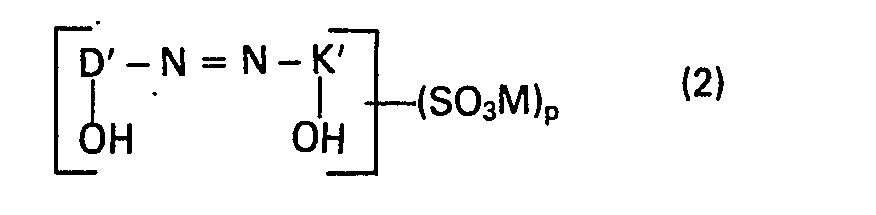
- Vorzugsweise verwendet man in dem erfindungsgemässen Verfahren ein Gemisch der Azofarbstoffe der Formeln


- Eine ganz besonders bevorzugte Ausführungsform ist dadurch gekennzeichnet, dass man einen Farbstoff der Formel (1), worin D ein durch Nitro oder Chlor substituierter Benzolrest und K ein 1-Phenyl-3-methylpyrazolon-(5)- oder Naphthalinrest ist und einen Farbstoff der Formel (2), worin D' ein durch Nitro, Chlor oder gegebenenfalls Sulfo substituierter Benzolrest oder ein durch Nitro oder gegebenenfalls Sulfo substituierter Naphthalinrest und K' ein 1-Phenyl-3-methyl-pyrazolon-(5)- oder ein gegebenenfalls durch Sulfo substituierter Naphthalinrest ist, verwendet, wobei der Farbstoff der Formel (2) eine einzige Sulfonsäuregruppe enthält.
- In dem erfindungsgemässen Verfahren werden als Ausgangsstoffe Diazokomponenten und Kupplungskomponenten oder aus diesen gebildete Azofarbstoffe eingesetzt, mit der Bedingung, dass die Azofarbstoffe identische Diazokomponenten oder identische Kupplungskomponenten enthalten und nur einer der beiden Azofarbstoffe mindestens eine wasserlöslichmachende Gruppe enthält.
- Die in dem erfindungsgemässen Verfahren eingesetzten Azofarbstoffe sind bekannt und werden nach an sich bekannten Methoden hergestellt.
- Als Diazokomponenten kommen z. B. solche der Benzol- oder Naphthalinreihe in Betracht, die ausser der metallisierbaren Gruppe und gegebenenfalls einer wasserlöslichmachenden Gruppe noch weitere Substituenten nicht salzbildender Art enthalten können, wie z. B. Nitrogruppen, Halogen, wie Fluor, Chlor und Brom, Alkylgruppen, insbesondere C1-4-Alkylgruppen wie z. B. Methyl, Äthyl, Propyl, Isopropyl, Butyl, Isobutyl, sek.-Butyl und tert.-Butyl, Alkoxygruppen insbesondere Cl-4-A1- koxygruppen, wie z. B. Methoxy, Äthoxy, Propoxy, Isopropoxy und Butoxy.
- Als Beispiele seien erwähnt: 4- oder 5-Chlor-2-aminophenol, 4-, 5- oder 6-Nitro-2-aminophenol, 4,6-Dichlor-2-aminophenoi, 3,4,6-Trichlor-2-aminophenol, 4-Chlor-5- oder 6-nitro-2-aminophenoi, 4-Nitro-6-chlor-2-aminophenol, 4,6-Dinitro-2-aminophenol, 1-Amino-2-hydroxynaphthalin, 2-Amino-1-hydroxybenzol-4- oder 5-sulfonsäurephenylamid, 4-Chlor-2-amino-1-hydroxybenzol-5-sulfon- säurephenyl- oder N-äthyl-N-phenylamid, 2-Aminophenol-4- oder -5-sulfonsäure, 4-Chlor- oder 4-Methyl-2-amino-phenol-5- oder -6-sulfonsäure, 4-Nitro-2-aminophenol-6-sulfonsäure, 6-Nitro-2-aminophenol-4-sulfonsäure, 2-Amino-1-hydroxynaphthalin-4- oder -8-sulfonsäure, 6-Nitro-1-amino-2-hydroxynaphthalin-4-sulfonsäure, 6-Brom-oder 6-Methyl-1-amino-2-hydroxynaphthalin-4-sulfonsäure, 1-Amino-2-hydroxynaphthalin-4-sulfonsäure, 4-Chlor- oder 4-Nitro-2-aminophenol-6-sulfonsäureamid, 6-Nitro-2-aminophenol-4-sulfonsäureamid, 2-Aminophenol- 4- oder -5-sulfonsäure-N-methylamid, 2-Aminophenol-4- oder -5-sulfonsäure-N-phenylamid, 2-Aminophenoi-4-oder -5-sulfonsäure-N,N-dimethylamid, 4-Chlor-2-aminophenol-5-sulfonsäure-N-methyl-, -äthyl-, -isopropyl- oder -phenylamid, 4-Chlor-2-aminophenol-5-sulfonsäure-N,N-dimethyl-, -phenylamid, 4-Chlor-2-aminophenol-5-sulfonsäure-N,N-dimethyl-, -diäthyl- oder N-methyl-N-phenylamid und die entsprechenden Verbindungen, die anstelle einer Sulfonsäureamidgruppe eine Methylsulfon-, Äthylsulfon-, Phenylsulfon-, p-Methyl-oder p-Chlorphenylsulfongruppe enthalten.
- Als Kupplungskomponenten kommen solche in Betracht, die in Nachbarstellung zu einer Hydroxygruppe kuppeln können; darunter sind auch Ketoverbindungen zu verstehen, die in Nachbarstellung zu ihrer enolisierten bzw. enolisierbaren Ketogruppe kuppelbar sind. As Kupplungskomponenten kommen insbesondere solche der Benzol-, Naphthalin- oder heterocyclischen Reihe in Betracht, die ausser der metallisierbaren Gruppe und gegebenenfalls einer wasserlöslichmachenden Gruppe noch weitere Substituenten nicht salzbildender Art wie bei den Diazokomponenten beschrieben, enthalten können.
- Als Beispiele seien erwähnt: p-Kresol, p-tert.-Amylphenol, 1-Phenyl-3-methyl-5-pyrazolon, 1-(2'-Naphthylphenyl)-3-methyl-5-pyrazolon, 1,3-Diphenyl-5-pyrazolon, 1-(2'-, 3'- oder 4'-Chlorphenyl)-3-methyl-5-pyrazolon, 1-(2',5'-Dichlorphenyl)-3-methyl-5-pyrazolon, 1-(2'-, 3'- oder 4'-Methylphenyl)-3-methyl-5-pyrazolon, 1-n-Octyl-3-methyl-5-pyrazolon, 8-Hydroxychinolin, Barbitursäure, 5-Brom-, 6-Methyl- oder 6-Methoxy-2-hydroxynaphthalin, 8-Chlor-1-hydroxynaphthalin, 5-Chlor-1-hydroxynaphthalin, 5,8-Dichlor-1-hydroxynaphthalin, 4,8- oder 5,8-Dichlor-2-hydroxynaphthalin, 2-Hydroxynaphthalin, 1-Hydroxynaphthalin, 1-Phenyl-3-methyl-5-pyrazolon-2'-, -3'- oder -4'-sulfonsäure, 1-(2'-Chlor-4'- oder -5'-sulfophenyl)-3-methyl-5-pyrazolon, 1-(2',5'-Dichlor-4'-sulfophenyl)-3-methyl-5-pyrazolon, 1-[Naphthyl-(1)]-3-methyl-5-pyrazolon-4'-, -5'-, -6'-, -7'- oder -8'-sulfonsäure, 1-[Naphthyl-(2')]-3-methyl-5-pyrazolon-1'- oder -8'-sulfonsäure, 2-Hydroxynaphthalin-4-, -5-, -6- oder -7-sulfonsäure, 1-Hydroxynaphthalin-4-, -5- oder -8-sulfonsäure, 1-Phenyl-3-methyl-6-pyrazolon-3'-sulfonsäureamid oder -N-methylsulfonsäureamid, 2,4-Dihydroxychinolin, 5-Chlor-8-hydroxychinolin, 1-Hydroxynaphthalin-4-, -5- oder -8-sulfonsäureamid, 2-Hydroxynaphthalin-4-, -6- oder 7-sulfonsäureamid.
- Eine weitere Ausführungsform des erfindungsgemässen Verfahrens ist dadurch gekennzeichnet, dass man vor der Chromierung bei pH 0 bis 2 ein Gemisch der weiter oben definierten metallisierbaren Ausgangsfarbstoffe in molarem Verhältnis von 0,85:1,0 bis 1,2:1,0 in einem Eintopfverfahren mit einem chromabgebenden Mittel bei pH 3 bis 4 vorbehandelt, und anschliessend die Umsetzung wie oben beschrieben, d. h. unter Druck bei einer Temperatur oberhalb von 100 °C und einem pH zwischen 0 und 2 und dann bei schwach saurem, neutralem oder schwach alkalischem pH weiterführt.
- Ein Vorteil der beschriebenen Vorbehandlung des erfindungsgemässen Verfahrens ist, dass insbesondere bei Ausgangsfarbstoffen, die sich nur sehr langsam bei einem pH von 0 bis 2 mit einem chromabgebenden Mittel umsetzen lassen, durch die Vorbehandlung bei pH 3 bis 4 eine Verkürzung der Reaktionszeit erzielt wird.
- Die nach dem erfindungsgemässen Verfahren erhaltenen, asymmetrischen 1:2-Chromkomplexazofarbstoffe zeichnen sich durch eine hohe Produktreinheit aus, wie sie bisher nur von nach der Anlagerungsmethode hergestellten Komplexen bekannt ist. c
- Insbesondere bei einem molaren Verhältnis von 1:1 der Mischungspartner werden nach dem erfindungsgemässen Verfahren 1:2-Chromkomplexe mit über 95%iger Reinheit erhalten. Abweichungen von dem molaren Verhältnis von 1:1 der Mischungspartner dienen zur Einstellung der gewünschten Nuance.
- Die nach dem erfindungsgemässen Verfahren erhaltenen, asymmetrischen 1:2-Chromkomplexazofarbstoffe eignen sich zum Färben und Bedrukken verschiedenster Stoffe, vor allem aber zum Färben tierischer Materialien, wie Seide, Leder und insbesondere Wolle, aber auch zum Färben und Bedrucken synthetischer Fasern aus Superpolyamiden, Superpolyurethanen oder Polyacrylnitril. Sie sind vor allem zum Färben aus schwach alkalischem, neutralem oder schwach saurem, vorzugsweise essigsaurem Bad geeignet. Die so erhaltenen Färbungen sind gleichmässig, sehr brillant und haben gute Allgemeinechtheiten, insbesondere gute Licht- und Nassechtheiten.
- Das genannte Textilmaterial kann dabei in den verschiedensten Verarbeitungsformen vorliegen, wie z. B. als Faser, Garn, Gewebe oder Gewirke.
- In der DD-B-151 003 wird ein Verfahren zur Herstellung von 1:2-Chromkomplexazofarbstoffen beschrieben, welches jedoch nicht gleich gute Resultate wie das erfindungsgemässe Verfahren aufweist. Aus der US-A-3939140 ist ein weiterers Verfahren zur Herstellung von 1:2-Chromkomplexazofarbstoffen in organischem Lösungsmittel bekannt.
- In den folgenden Beispielen stehen Teile für Gewichtsteile. Die Temperaturen sind Celsiusgrade. Die Beziehung zwischen Gewichtsteilen und Volumenteilen ist dieselbe wie diejenige zwischen Gramm und Kubikzentimeter. Beispiel 1
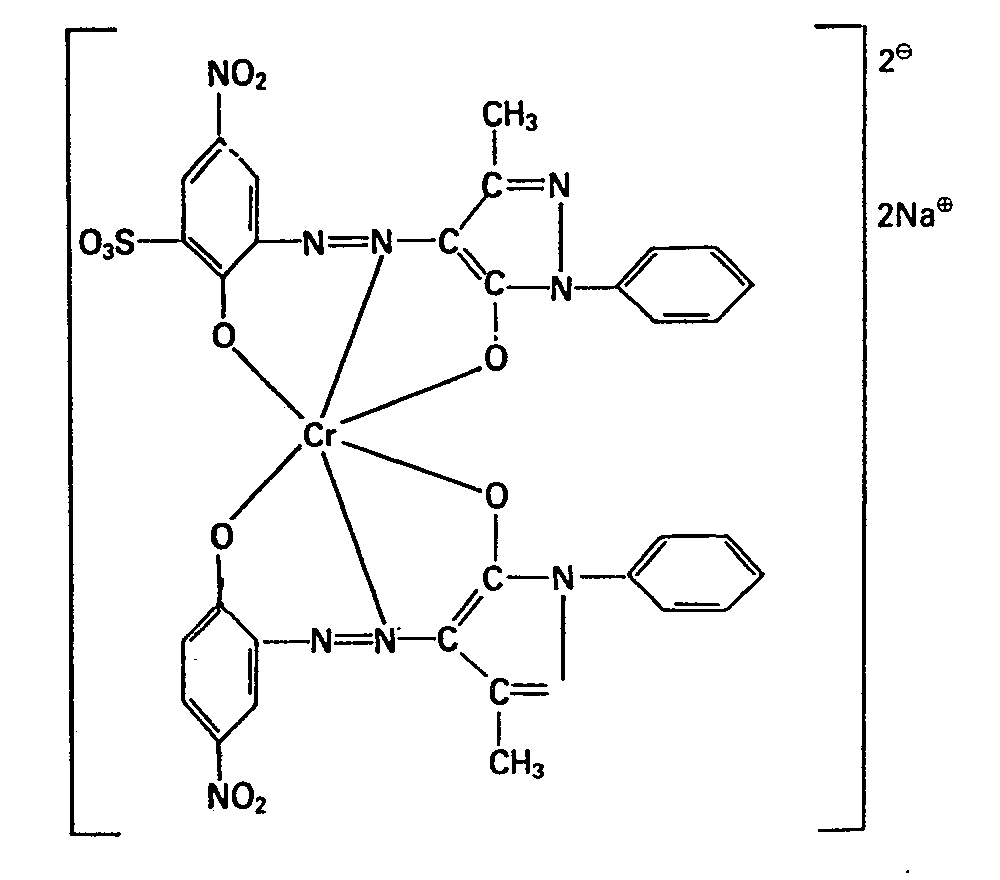
- 246 Teile 2-Amino-4-nitrophenol-6-sulfonsäure werden in 3000 Teilen Wasser gelöst und mit 200 Teilen 10 N Salzsäure versetzt. Diese Lösung wird mit ca. 1000 Teilen Eis auf 6 bis 8 °C gekühlt. Zu der Lösung lässt man dann 210 Teile einer 5 N Natriumnitritlösung einfliessen, wobei die Temperatur maximal 12 °C erreichen darf. Es wird eine Stunde nachgerührt und ein Überschuss an Nitrit mit Sulfaminsäure zerstört. Vor der Kupplung wird die Lösung mit 150 Teilen Eis auf 10 °C abgekühlt und mit 45 Teilen Natriumcarbonat in 300 Teilen Wasser auf pH 3 bis 3,2 gestellt (Lösung A).
- 162 Teile 2-Amino-4-nitrophenol werden in 1500 Teilen Wasser gelöst unter Zusatz von 250 Teilen 10 N Salzsäure und mit ca. 300 Teilen Eis auf 10 °C abgekühlt. Zu der Lösung lässt man 210 Teile 5 N Natriumnitritlösung einfliessen, wobei die Temperatur der Lösung 15 bis 20 °C beträgt. Ein geringer Nitritüberschuss wird mit Sulfaminsäure zerstört .(Lösung B).
- Zu einer Lösung aus 380 Teilen 1-Phenyl-3-methyl-5-pyrazolon in 4000 Teilen Wasser, die mit 10 N Salzsäure auf pH 4,5 bis 5 gestellt wurde, wird die Lösung A zugegeben, wobei die Temperatur maximal 5 °C erreichen darf. Die Lösung wird nach beendeter Kupplung mit Natriumcarbonat auf pH 4,5 gestellt. Anschliessend wird die Lösung B zugegeben. Nach beendeter Kupplung wird mit 300 Teilen 70%iger Schwefelsäure ein pH von ca. 0,5 eingestellt und der Lösung 20 Teile Salicylsäure und 176 Teile Chrom-(lII)-sulfat zugegeben. Die Lösung wird auf 130 °C in einer geschlossenen Apparatur aufgeheizt, so dass sich ein Druck von 1,8 bis 2 kg/cm2 einstellt und 6 h bei 130 °C belassen. Nach beendeter Metallisierung wird die Lösung auf 90 bis 95 °C abgekühlt und mit 800 Teilen einer 10 N Natriumhydroxid-Lösung auf pH 7,5 bis 8 gestellt. Man lässt eine Stunde nachrühren. Der Farbstoff wird mit Kochsalz ausgesalzen, abfiltriert, und bei 70 °C getrocknet. Der gebildete Farbstoff der oben angegebenen Konstitution färbt Wolle in orangen Tönen mit guten Echtheitseigenschaften. Der erhaltene Farbstoff besteht zu 96% aus dem reinen asymmetrischen 1:2-Chromkomplex. Die Ausbeute beträgt 93%.

- Wenn man wie in Beispiel 1 angegeben verfährt und als Lösung B eine Lösung mit 162 Teilen 2-Amino-5-nitrophenol anstelle von 2-Amino-4-nitrophenol verwendet, so erhält man den Farbstoff der oben angegebenen Konstitution, der Wolle in roten Tönen färbt. Der erhaltene Farbstoff besteht zu 93% aus dem reinen asymmetrischen 1:2-Chromkomplex. Die Ausbeute beträgt 90%.
-

- Wenn man wie in Beispiel 2 angegeben verfährt und als Kupplungskomponente 312 Teile 2-Hydroxynaphthalin anstelle von 380 Teilen 1-Phenyl-3-methyl-5-pyrazolon verwendet, so erhält man den Farbstoff der oben angegebenen Konstitution, der Wolle in grauen Tönen färbt. Der erhaltene Farbstoff besteht zu 93% aus dem reinen asymmetrischen 1:2-Chromkomplex. Die Ausbeute beträgt 92%.
-

- Wenn man wie in Beispiel 1 angegeben verfährt und als Lösung A eine Lösung mit 245 Teilen 1-Amino-2-hydroxynaphthalin-4-sulfonsäure anstelle von 2-Amino-4-nitrophenol-6-sulfonsäure und als Lösung B die in Beispiel 2 angegebene Lösung B verwendet, so erhält man den Farbstoff der oben angegebenen Konstitution, der Wolle in roten Tönen färbt. Der erhaltene Farbstoff besteht zu 95% aus dem reinen asymmetrischen 1:2-Chromkomplex. Die Ausbeute beträgt 90%.
-

- Eine Lösung aus 300 Teilen des Azofarbstoffes 5-Nitro-2-aminophenoh 2-Naphthol und 400 Teilen des Azofarbstoffes 5-Nitro-2-aminophenoh 1-Naphthol-4-sulfonsäurewird in 10 000 Teilen Wasser mit 70%iger Schwefelsäure auf pH 1 gestellt, 20 Teile Salicylsäure und 155 Teile Chrom(III)-sulfat zugesetzt. Die Mischung wird unter einem Druck von 1,8 bis 2 bar auf 130 °C erhitzt und 4 h bei dieser Temperatur belassen. Anschliessend wird die Mischung auf 90 °C abgekühlt und mit Natriumhydroxid auf pH 8 gestellt und 1 bis 2 h bei 90 °C gerührt. Nach beendeter Reaktion wird der Farbstoff durch Natriumchloridzugabe abgeschieden, abfiltriert und getrocknet. Der erhaltene Farbstoff besteht zu 95% aus dem reinen asymmetrischen 1:2-Chromkomp!ex. Die Ausbeute beträgt 94%. Der so erhaltene Farbstoff der oben angegebenen Konstitution färbt Wolle in grauen Tönen.
-

- Eine Lösung aus 30 Teilen des Azofarbstoffes 5-Nitro-2-aminophenoh 2-Naphthol und 40 Teilen des Azofarbstoffes 4-Nitro-2-amino-1-hydroxybenzol-6-sulfonsäure→ 2-Naphthol wird in 1000 Teilen Wasser mit 70%iger Schwefelsäure auf pH 3,5 gestellt und 2 Teile Salicylsäure und 16,0 Teile Chrom(III)-sulfat werden zugesetzt. Die Mischung wird bei pH 3,5 so lange gerührt, bis kein metallfreier Azofarbstoff nachweisbar ist. Anschliessend wird die Mischung der gebildeten 1:2-Chromkomplexe mit 70%iger Schwefelsäure auf pH 1 gestellt und unter einem Druck von 1,8 bis 2 bar auf 130 °C erhitzt, und 4 h bei dieser Temperatur belassen. Anschliessend wird die Mischung auf 90 °C abgekühlt und mit Natriumhydroxid auf pH 7 gestellt und 1 bis 2 h bei 90 °C gerührt. Nach beendeter Reaktion wird der Farbstoff durch Natriumchloridzugabe abgeschieden, abfiltriert und getrocknet. Der erhaltene Farbstoff besteht zu 95% aus dem reinen asymmetrischen 1:2-Chromkomplex. Die Ausbeute beträgt 92%. Der so erhaltene Farbstoff der oben angegebenen Konstitution färbt Wolle oder Polyamid in grauen Tönen.
- In 4000 Teilen Wasser löst man 2 Teile Farbstoff gemäss Beispiel 1 und geht bei 40-50 °C mit 100 Teilen gut befeuchteter Wolle in das Färbebad. Man fügt hierauf 2 Teile 40%ige Essigsäure hinzu, erhitzt das Bad innert ½ h zum Sieden und hält %h bei Siedetemperatur. Hierauf spült man die Wolle mit kaltem Wasser und trocknet sie. Die orange Färbung zeichnet sich durch gute Nassechtheiten und hohe Lichtechtheit aus. Färbevorschrift für Polyamid
- In ein Färbebad, das aus 3000 Teilen Wasser, 5 Teilen 40%iger Essigsäure, 10 Teilen Natriumsulfat und 2 Teilen des im Beispiel 1 erwähnten Chromkomplexes besteht, wird bei einer Temperatur um 50 bis 60 °C mit 100 Teilen Nylon 6,6-Gewebe eingegangen. Nachdem innerhalb einer halben Stunde das Bad zum Kochen erhitzt wurde, wird eine weitere Stunde bei Siedetemperatur gefärbt. Nach dem Spülen und Trocknen resultiert eine gleichmässige orange Färbung.
Claims (20)

Applications Claiming Priority (2)
| Application Number | Priority Date | Filing Date | Title |
|---|---|---|---|
| CH1147/84 | 1984-03-08 | ||
| CH1147/84A CH658065A5 (de) | 1984-03-08 | 1984-03-08 | Verfahren zur herstellung von 1:2-chromkomplexazofarbstoffen. |
Publications (2)
| Publication Number | Publication Date |
|---|---|
| EP0157733A1 EP0157733A1 (de) | 1985-10-09 |
| EP0157733B1 true EP0157733B1 (de) | 1988-04-20 |
Family
ID=4203581
Family Applications (1)
| Application Number | Title | Priority Date | Filing Date |
|---|---|---|---|
| EP85810090A Expired EP0157733B1 (de) | 1984-03-08 | 1985-03-04 | Verfahren zur Herstellung von 1:2-Chromkomplexazofarbstoffen |
Country Status (7)
| Country | Link |
|---|---|
| US (1) | US4933437A (de) |
| EP (1) | EP0157733B1 (de) |
| JP (1) | JPS60208364A (de) |
| KR (1) | KR850006210A (de) |
| CH (1) | CH658065A5 (de) |
| DE (1) | DE3562257D1 (de) |
| HK (1) | HK92790A (de) |
Families Citing this family (7)
| Publication number | Priority date | Publication date | Assignee | Title |
|---|---|---|---|---|
| CH688281A5 (de) * | 1987-12-04 | 1997-07-15 | Ciba Geigy Ag | Verfahren zur Herstellung von 1:2-Metallkomplexazofarbstoffen. |
| DE3829518A1 (de) * | 1988-08-31 | 1990-03-01 | Basf Ag | Verfahren zur herstellung von loesungen von 1:2-chromkomplex-azofarbstoffen |
| DE59007014D1 (de) * | 1989-02-23 | 1994-10-13 | Ciba Geigy Ag | Verfahren zur Herstellung von asymmetrischen 1:2-Metallkomplexfarbstoffen. |
| JP2008052306A (ja) * | 2007-11-12 | 2008-03-06 | Hubei Dinglong Chemical Co Ltd | トナー用荷電制御剤およびその製造方法並びにトナー |
| JP5799485B2 (ja) * | 2008-12-25 | 2015-10-28 | 住友化学株式会社 | 着色感光性樹脂組成物 |
| JP5796273B2 (ja) * | 2008-12-25 | 2015-10-21 | 住友化学株式会社 | 着色感光性樹脂組成物 |
| CN111635645A (zh) * | 2020-06-05 | 2020-09-08 | 宁夏保隆科技有限公司 | 一种酸性红405新型生产工艺 |
Family Cites Families (13)
| Publication number | Priority date | Publication date | Assignee | Title |
|---|---|---|---|---|
| US2906746A (en) * | 1959-09-29 | Metalliferous azo dyestuffs | ||
| FR1040664A (fr) * | 1950-04-06 | 1953-10-16 | Ciba Geigy | Colorants azoïques métallifères, leur préparation et leur ? |
| US2985646A (en) * | 1957-03-14 | 1961-05-23 | Geigy Ag J R | Chromium-containing dyestuffs |
| GB967011A (en) * | 1962-04-12 | 1964-08-19 | Wolfen Filmfab Veb | New chromium complex azo dyestuff |
| GB1143643A (de) * | 1965-07-23 | |||
| GB1163713A (en) * | 1966-02-10 | 1969-09-10 | Ici Ltd | Chromium-Containing Azo Dyestuffs |
| US3939140A (en) * | 1971-04-23 | 1976-02-17 | Hoechst Aktiengesellschaft | Process for the preparation of a dyestuff consisting substantially of only unsymmetrical 1:2-chromium complex azo dyestuffs |
| NL7205191A (de) * | 1971-04-23 | 1972-10-25 | ||
| DE2313722C3 (de) * | 1973-03-20 | 1987-04-16 | Bayer Ag, 5090 Leverkusen | Chromischkomplex-Farbstoff und dessen Verwendung zum Färben und Bedrucken von stickstoffhaltigen Fasermaterialien |
| US4083839A (en) * | 1974-01-15 | 1978-04-11 | Ciba-Geigy Corporation | Unsymmetrical mono sulfo containing 1:2 azo, azo chromium complex dyes |
| DD151003A3 (de) * | 1979-03-05 | 1981-09-30 | Guenther Essbach | Verfahren zur herstellung einheitlicher 1:2-chrommischkomplexazofarbstoffe |
| CH649773A5 (de) * | 1979-09-24 | 1985-06-14 | Sandoz Ag | Asymmetrische 1:2-chromkomplexe aromatischer azoverbindungen, verfahren zu ihrer herstellung und diese enthaltende praeparate. |
| DE3023664A1 (de) * | 1980-06-25 | 1982-01-21 | Hoechst Ag, 6000 Frankfurt | 1:2-chrom-mischkomplexfarbstoffe, verfahren zu ihrer herstellung und ihre verwendung |
-
1984
- 1984-03-08 CH CH1147/84A patent/CH658065A5/de not_active IP Right Cessation
-
1985
- 1985-03-04 DE DE8585810090T patent/DE3562257D1/de not_active Expired
- 1985-03-04 EP EP85810090A patent/EP0157733B1/de not_active Expired
- 1985-03-07 KR KR1019850001469A patent/KR850006210A/ko not_active Withdrawn
- 1985-03-08 JP JP60046329A patent/JPS60208364A/ja active Granted
-
1987
- 1987-03-23 US US07/029,363 patent/US4933437A/en not_active Expired - Fee Related
-
1990
- 1990-11-08 HK HK927/90A patent/HK92790A/xx not_active IP Right Cessation
Also Published As
| Publication number | Publication date |
|---|---|
| HK92790A (en) | 1990-11-16 |
| EP0157733A1 (de) | 1985-10-09 |
| US4933437A (en) | 1990-06-12 |
| CH658065A5 (de) | 1986-10-15 |
| JPS60208364A (ja) | 1985-10-19 |
| DE3562257D1 (en) | 1988-05-26 |
| KR850006210A (ko) | 1985-10-02 |
| JPH0511149B2 (de) | 1993-02-12 |
Similar Documents
| Publication | Publication Date | Title |
|---|---|---|
| EP0719837B1 (de) | Azofarbstoffe, Verfahren zu deren Herstellung und deren Verwendung | |
| EP0278910B1 (de) | Schwermetallkomplexfarbstoffe, deren Herstellung und Verwendung | |
| DE2313722B2 (de) | Chromischkomplex-farbstoffe und ihre verwendung zum faerben und bedrucken von stickstoffhaltigen fasermaterialien | |
| EP0044937B1 (de) | 1:2-Chrom-Mischkomplexfarbstoffe, Verfahren zu ihrer Herstellung und ihre Verwendung | |
| EP0157733A1 (de) | Verfahren zur Herstellung von 1:2-Chromkomplexazofarbstoffen | |
| EP0156768B1 (de) | Verfahren zur Herstellung von 1:2-Chromkomplexfarbstoffen | |
| DE2704364C2 (de) | ||
| DE1544464B1 (de) | Verfahren zur Herstellung von wasserloeslichen,metallisierbaren Dis- und Trisazofarbstoffen und deren Schwermetallkomplexen | |
| DE2236299C2 (de) | Azoverbindungen, deren Herstellung und Verwendung | |
| DE1644366B1 (de) | Verfahren zur Herstellung von metallhaltigen wasserloeslichen Pyrimidinreaktiv-Azofarbstoffen | |
| EP0110825B1 (de) | Unsymmetrische 1:2-Chromkomplexfarbstoffe, enthaltend eine Azo- und eine Azomethinverbindung | |
| EP0241414B1 (de) | Verfahren zur Herstellung von 1:2-Metallkomplexazofarbstoffen | |
| AT166451B (de) | Verfahren zur Herstellung neuer chromhaltiger Monoazofarbstoffe | |
| DE2501449C2 (de) | Neue Chromkomplexfarbstoffe, deren Herstellung und Verwendung | |
| CH688281A5 (de) | Verfahren zur Herstellung von 1:2-Metallkomplexazofarbstoffen. | |
| DE2501039C2 (de) | Neue Chromkomplexfarbstoffe, deren Herstellung und Verwendung | |
| EP0384893B1 (de) | Verfahren zur Herstellung von asymmetrischen 1:2-Metallkomplexfarbstoffen | |
| DE3512253A1 (de) | Chrom- oder kobaltkomplexe, deren herstellung und verwendung | |
| EP0141416B1 (de) | Faserreaktive Chromkomplexe, deren Herstellung und Verwendung | |
| DE951527C (de) | Verfahren zur Herstellung von metallisierbaren Disazofarbstoffen | |
| DE957507C (de) | Verfahren zur Herstellung von chromhaltigen Azofarbstoffen | |
| CH640556A5 (de) | Metallisierbare und metallisierte azoverbindungen, deren herstellung und verwendung. | |
| DE923027C (de) | Verfahren zur Herstellung von chromierbaren Monoazofarbstoffen | |
| AT165532B (de) | Verfahren zur Herstellung neuer Azofarbstoffe | |
| DE1283990B (de) | Verfahren zur Herstellung von metallhaltigen Azofarbstoffen |
Legal Events
| Date | Code | Title | Description |
|---|---|---|---|
| PUAI | Public reference made under article 153(3) epc to a published international application that has entered the european phase |
Free format text: ORIGINAL CODE: 0009012 |
|
| AK | Designated contracting states |
Designated state(s): BE CH DE FR GB IT LI |
|
| 17P | Request for examination filed |
Effective date: 19850306 |
|
| 17Q | First examination report despatched |
Effective date: 19860922 |
|
| R17C | First examination report despatched (corrected) |
Effective date: 19870304 |
|
| GRAA | (expected) grant |
Free format text: ORIGINAL CODE: 0009210 |
|
| AK | Designated contracting states |
Kind code of ref document: B1 Designated state(s): BE CH DE FR GB IT LI |
|
| REF | Corresponds to: |
Ref document number: 3562257 Country of ref document: DE Date of ref document: 19880526 |
|
| ET | Fr: translation filed | ||
| GBT | Gb: translation of ep patent filed (gb section 77(6)(a)/1977) | ||
| ITF | It: translation for a ep patent filed | ||
| PLBE | No opposition filed within time limit |
Free format text: ORIGINAL CODE: 0009261 |
|
| STAA | Information on the status of an ep patent application or granted ep patent |
Free format text: STATUS: NO OPPOSITION FILED WITHIN TIME LIMIT |
|
| PG25 | Lapsed in a contracting state [announced via postgrant information from national office to epo] |
Ref country code: CH Effective date: 19890331 Ref country code: LI Effective date: 19890331 |
|
| 26N | No opposition filed | ||
| REG | Reference to a national code |
Ref country code: CH Ref legal event code: PL |
|
| ITTA | It: last paid annual fee | ||
| PGFP | Annual fee paid to national office [announced via postgrant information from national office to epo] |
Ref country code: BE Payment date: 19960412 Year of fee payment: 12 |
|
| REG | Reference to a national code |
Ref country code: FR Ref legal event code: TP |
|
| PG25 | Lapsed in a contracting state [announced via postgrant information from national office to epo] |
Ref country code: BE Effective date: 19970331 |
|
| REG | Reference to a national code |
Ref country code: GB Ref legal event code: 732E |
|
| BERE | Be: lapsed |
Owner name: CIBA-GEIGY A.G. Effective date: 19970331 |
|
| REG | Reference to a national code |
Ref country code: FR Ref legal event code: CD |
|
| PGFP | Annual fee paid to national office [announced via postgrant information from national office to epo] |
Ref country code: FR Payment date: 19990129 Year of fee payment: 15 |
|
| PGFP | Annual fee paid to national office [announced via postgrant information from national office to epo] |
Ref country code: DE Payment date: 19990208 Year of fee payment: 15 |
|
| PGFP | Annual fee paid to national office [announced via postgrant information from national office to epo] |
Ref country code: GB Payment date: 19990217 Year of fee payment: 15 |
|
| PG25 | Lapsed in a contracting state [announced via postgrant information from national office to epo] |
Ref country code: GB Free format text: LAPSE BECAUSE OF NON-PAYMENT OF DUE FEES Effective date: 20000304 |
|
| GBPC | Gb: european patent ceased through non-payment of renewal fee |
Effective date: 20000304 |
|
| PG25 | Lapsed in a contracting state [announced via postgrant information from national office to epo] |
Ref country code: FR Free format text: LAPSE BECAUSE OF NON-PAYMENT OF DUE FEES Effective date: 20001130 |
|
| REG | Reference to a national code |
Ref country code: FR Ref legal event code: ST |
|
| PG25 | Lapsed in a contracting state [announced via postgrant information from national office to epo] |
Ref country code: DE Free format text: LAPSE BECAUSE OF NON-PAYMENT OF DUE FEES Effective date: 20010103 |