EP0240868B1 - Verfahren zur Herstellung von 1-Desoxynojirimycin und dessen N-Derivaten - Google Patents
Verfahren zur Herstellung von 1-Desoxynojirimycin und dessen N-Derivaten Download PDFInfo
- Publication number
- EP0240868B1 EP0240868B1 EP87104555A EP87104555A EP0240868B1 EP 0240868 B1 EP0240868 B1 EP 0240868B1 EP 87104555 A EP87104555 A EP 87104555A EP 87104555 A EP87104555 A EP 87104555A EP 0240868 B1 EP0240868 B1 EP 0240868B1
- Authority
- EP
- European Patent Office
- Prior art keywords
- formula
- preparation
- amino
- compounds
- formyl
- Prior art date
- Legal status (The legal status is an assumption and is not a legal conclusion. Google has not performed a legal analysis and makes no representation as to the accuracy of the status listed.)
- Expired - Lifetime
Links
- 238000000034 method Methods 0.000 title claims description 14
- 238000002360 preparation method Methods 0.000 title description 37
- 150000001875 compounds Chemical class 0.000 claims abstract description 21
- 125000006239 protecting group Chemical group 0.000 claims abstract description 16
- 229910052739 hydrogen Inorganic materials 0.000 claims abstract description 12
- 239000001257 hydrogen Substances 0.000 claims abstract description 8
- 230000003647 oxidation Effects 0.000 claims abstract description 8
- 238000007254 oxidation reaction Methods 0.000 claims abstract description 8
- KULQACNMKIDJNN-GASJEMHNSA-N (2r,3s,4r,5r)-1-aminohexane-1,2,3,4,5,6-hexol Chemical compound NC(O)[C@H](O)[C@@H](O)[C@H](O)[C@H](O)CO KULQACNMKIDJNN-GASJEMHNSA-N 0.000 claims abstract description 7
- WQZGKKKJIJFFOK-GASJEMHNSA-N Glucose Natural products OC[C@H]1OC(O)[C@H](O)[C@@H](O)[C@@H]1O WQZGKKKJIJFFOK-GASJEMHNSA-N 0.000 claims abstract description 5
- 125000003277 amino group Chemical group 0.000 claims abstract description 4
- 238000004519 manufacturing process Methods 0.000 claims abstract description 4
- 230000001590 oxidative effect Effects 0.000 claims abstract description 4
- -1 C1-C4-alkoxy radicals Chemical class 0.000 claims description 9
- 125000000008 (C1-C10) alkyl group Chemical group 0.000 claims description 7
- 230000002906 microbiologic effect Effects 0.000 claims description 6
- 239000003513 alkali Substances 0.000 claims description 5
- 239000002585 base Substances 0.000 claims description 5
- 150000002431 hydrogen Chemical group 0.000 claims description 5
- 125000002485 formyl group Chemical group [H]C(*)=O 0.000 claims description 4
- UFHFLCQGNIYNRP-UHFFFAOYSA-N Hydrogen Chemical compound [H][H] UFHFLCQGNIYNRP-UHFFFAOYSA-N 0.000 claims description 3
- 239000007864 aqueous solution Substances 0.000 claims description 3
- 150000004678 hydrides Chemical class 0.000 claims description 3
- GAWIXWVDTYZWAW-UHFFFAOYSA-N C[CH]O Chemical group C[CH]O GAWIXWVDTYZWAW-UHFFFAOYSA-N 0.000 claims description 2
- 241000589236 Gluconobacter Species 0.000 claims description 2
- AGJSNMGHAVDLRQ-IWFBPKFRSA-N methyl (2s)-2-[[(2s)-2-[[(2s)-2-[[(2r)-2-amino-3-sulfanylpropanoyl]amino]-3-methylbutanoyl]amino]-3-(4-hydroxy-2,3-dimethylphenyl)propanoyl]amino]-4-methylsulfanylbutanoate Chemical compound SC[C@H](N)C(=O)N[C@@H](C(C)C)C(=O)N[C@H](C(=O)N[C@@H](CCSC)C(=O)OC)CC1=CC=C(O)C(C)=C1C AGJSNMGHAVDLRQ-IWFBPKFRSA-N 0.000 claims 1
- LXBIFEVIBLOUGU-JGWLITMVSA-N duvoglustat Chemical compound OC[C@H]1NC[C@H](O)[C@@H](O)[C@@H]1O LXBIFEVIBLOUGU-JGWLITMVSA-N 0.000 abstract description 14
- LXBIFEVIBLOUGU-UHFFFAOYSA-N Deoxymannojirimycin Natural products OCC1NCC(O)C(O)C1O LXBIFEVIBLOUGU-UHFFFAOYSA-N 0.000 abstract description 10
- 125000004435 hydrogen atom Chemical group [H]* 0.000 abstract description 2
- VXIVYEDEIZTBBY-VNIRCRIMSA-N NC(O)C(=O)[C@H](O)[C@@H](O)[C@H](O)CO Chemical compound NC(O)C(=O)[C@H](O)[C@@H](O)[C@H](O)CO VXIVYEDEIZTBBY-VNIRCRIMSA-N 0.000 abstract 2
- 125000003710 aryl alkyl group Chemical group 0.000 abstract 1
- 125000000547 substituted alkyl group Chemical group 0.000 abstract 1
- 239000000243 solution Substances 0.000 description 18
- XLYOFNOQVPJJNP-UHFFFAOYSA-N water Substances O XLYOFNOQVPJJNP-UHFFFAOYSA-N 0.000 description 13
- OKKJLVBELUTLKV-UHFFFAOYSA-N Methanol Chemical compound OC OKKJLVBELUTLKV-UHFFFAOYSA-N 0.000 description 12
- 150000002500 ions Chemical class 0.000 description 10
- 238000006243 chemical reaction Methods 0.000 description 9
- LFQSCWFLJHTTHZ-UHFFFAOYSA-N Ethanol Chemical compound CCO LFQSCWFLJHTTHZ-UHFFFAOYSA-N 0.000 description 8
- 239000000047 product Substances 0.000 description 8
- FBPFZTCFMRRESA-FSIIMWSLSA-N D-Glucitol Natural products OC[C@H](O)[C@H](O)[C@@H](O)[C@H](O)CO FBPFZTCFMRRESA-FSIIMWSLSA-N 0.000 description 7
- 230000002378 acidificating effect Effects 0.000 description 7
- 239000000203 mixture Substances 0.000 description 7
- 229960002920 sorbitol Drugs 0.000 description 7
- 239000000600 sorbitol Substances 0.000 description 7
- ZMXDDKWLCZADIW-UHFFFAOYSA-N N,N-Dimethylformamide Chemical compound CN(C)C=O ZMXDDKWLCZADIW-UHFFFAOYSA-N 0.000 description 6
- WUOOSYAMGMRIQW-WLDMJGECSA-N N-[(2R,3S,4R,5R)-1,2,3,4,5,6-hexahydroxyhexyl]formamide Chemical compound C(=O)NC(O)[C@H](O)[C@@H](O)[C@H](O)[C@H](O)CO WUOOSYAMGMRIQW-WLDMJGECSA-N 0.000 description 6
- HEMHJVSKTPXQMS-UHFFFAOYSA-M Sodium hydroxide Chemical compound [OH-].[Na+] HEMHJVSKTPXQMS-UHFFFAOYSA-M 0.000 description 6
- TZIHFWKZFHZASV-UHFFFAOYSA-N methyl formate Chemical compound COC=O TZIHFWKZFHZASV-UHFFFAOYSA-N 0.000 description 6
- 238000003776 cleavage reaction Methods 0.000 description 5
- 230000007017 scission Effects 0.000 description 5
- 239000002904 solvent Substances 0.000 description 5
- CSCPPACGZOOCGX-UHFFFAOYSA-N Acetone Chemical compound CC(C)=O CSCPPACGZOOCGX-UHFFFAOYSA-N 0.000 description 4
- NBIIXXVUZAFLBC-UHFFFAOYSA-N Phosphoric acid Chemical compound OP(O)(O)=O NBIIXXVUZAFLBC-UHFFFAOYSA-N 0.000 description 4
- 238000002955 isolation Methods 0.000 description 4
- NVIFVTYDZMXWGX-UHFFFAOYSA-N sodium metaborate Chemical compound [Na+].[O-]B=O NVIFVTYDZMXWGX-UHFFFAOYSA-N 0.000 description 4
- 239000000758 substrate Substances 0.000 description 4
- 235000020357 syrup Nutrition 0.000 description 4
- WEVYAHXRMPXWCK-UHFFFAOYSA-N Acetonitrile Chemical compound CC#N WEVYAHXRMPXWCK-UHFFFAOYSA-N 0.000 description 3
- YMFGXTPPFXSQGJ-NFRNADEISA-N C(=O)N(C)C(O)C(=O)[C@H](O)[C@@H](O)[C@H](O)CO Chemical compound C(=O)N(C)C(O)C(=O)[C@H](O)[C@@H](O)[C@H](O)CO YMFGXTPPFXSQGJ-NFRNADEISA-N 0.000 description 3
- VYPSYNLAJGMNEJ-UHFFFAOYSA-N Silicium dioxide Chemical compound O=[Si]=O VYPSYNLAJGMNEJ-UHFFFAOYSA-N 0.000 description 3
- 239000003054 catalyst Substances 0.000 description 3
- HKMLRUAPIDAGIE-UHFFFAOYSA-N methyl 2,2-dichloroacetate Chemical compound COC(=O)C(Cl)Cl HKMLRUAPIDAGIE-UHFFFAOYSA-N 0.000 description 3
- 244000005700 microbiome Species 0.000 description 3
- 230000035484 reaction time Effects 0.000 description 3
- 239000000741 silica gel Substances 0.000 description 3
- 229910002027 silica gel Inorganic materials 0.000 description 3
- 239000000725 suspension Substances 0.000 description 3
- UTQNKKSJPHTPBS-UHFFFAOYSA-N 2,2,2-trichloroethanone Chemical group ClC(Cl)(Cl)[C]=O UTQNKKSJPHTPBS-UHFFFAOYSA-N 0.000 description 2
- SJKQTHLDVHXINA-DYKLIILESA-N 2,2-dichloro-N-[(2R,3S,4R,5R)-1,2,3,4,5,6-hexahydroxyhexyl]acetamide Chemical compound ClC(C(=O)NC(O)[C@H](O)[C@@H](O)[C@H](O)[C@H](O)CO)Cl SJKQTHLDVHXINA-DYKLIILESA-N 0.000 description 2
- XNWFRZJHXBZDAG-UHFFFAOYSA-N 2-METHOXYETHANOL Chemical compound COCCO XNWFRZJHXBZDAG-UHFFFAOYSA-N 0.000 description 2
- QGZKDVFQNNGYKY-UHFFFAOYSA-N Ammonia Chemical compound N QGZKDVFQNNGYKY-UHFFFAOYSA-N 0.000 description 2
- VHUUQVKOLVNVRT-UHFFFAOYSA-N Ammonium hydroxide Chemical compound [NH4+].[OH-] VHUUQVKOLVNVRT-UHFFFAOYSA-N 0.000 description 2
- CQZAKTJZRXKKAY-CIFZYDKDSA-N ClC(C(=O)NC(O)C(=O)[C@H](O)[C@@H](O)[C@H](O)CO)Cl Chemical compound ClC(C(=O)NC(O)C(=O)[C@H](O)[C@@H](O)[C@H](O)CO)Cl CQZAKTJZRXKKAY-CIFZYDKDSA-N 0.000 description 2
- IAZDPXIOMUYVGZ-UHFFFAOYSA-N Dimethylsulphoxide Chemical compound CS(C)=O IAZDPXIOMUYVGZ-UHFFFAOYSA-N 0.000 description 2
- 101100476962 Drosophila melanogaster Sirup gene Proteins 0.000 description 2
- 241000589232 Gluconobacter oxydans Species 0.000 description 2
- KFZMGEQAYNKOFK-UHFFFAOYSA-N Isopropanol Chemical compound CC(C)O KFZMGEQAYNKOFK-UHFFFAOYSA-N 0.000 description 2
- LRHPLDYGYMQRHN-UHFFFAOYSA-N N-Butanol Chemical compound CCCCO LRHPLDYGYMQRHN-UHFFFAOYSA-N 0.000 description 2
- SECXISVLQFMRJM-UHFFFAOYSA-N N-Methylpyrrolidone Chemical compound CN1CCCC1=O SECXISVLQFMRJM-UHFFFAOYSA-N 0.000 description 2
- QAOWNCQODCNURD-UHFFFAOYSA-N Sulfuric acid Chemical compound OS(O)(=O)=O QAOWNCQODCNURD-UHFFFAOYSA-N 0.000 description 2
- 239000002253 acid Substances 0.000 description 2
- 238000005273 aeration Methods 0.000 description 2
- GZCGUPFRVQAUEE-SLPGGIOYSA-N aldehydo-D-glucose Chemical compound OC[C@@H](O)[C@@H](O)[C@H](O)[C@@H](O)C=O GZCGUPFRVQAUEE-SLPGGIOYSA-N 0.000 description 2
- 239000012670 alkaline solution Substances 0.000 description 2
- 229910000147 aluminium phosphate Inorganic materials 0.000 description 2
- 150000001412 amines Chemical class 0.000 description 2
- 235000011114 ammonium hydroxide Nutrition 0.000 description 2
- 150000001450 anions Chemical class 0.000 description 2
- TZCXTZWJZNENPQ-UHFFFAOYSA-L barium sulfate Chemical compound [Ba+2].[O-]S([O-])(=O)=O TZCXTZWJZNENPQ-UHFFFAOYSA-L 0.000 description 2
- 150000001244 carboxylic acid anhydrides Chemical class 0.000 description 2
- YPTUAQWMBNZZRN-UHFFFAOYSA-N dimethylaminoboron Chemical compound [B]N(C)C YPTUAQWMBNZZRN-UHFFFAOYSA-N 0.000 description 2
- 239000000706 filtrate Substances 0.000 description 2
- 150000004679 hydroxides Chemical class 0.000 description 2
- 239000000543 intermediate Substances 0.000 description 2
- 230000007935 neutral effect Effects 0.000 description 2
- 125000002924 primary amino group Chemical group [H]N([H])* 0.000 description 2
- 239000006188 syrup Substances 0.000 description 2
- 239000008399 tap water Substances 0.000 description 2
- 235000020679 tap water Nutrition 0.000 description 2
- VQSVOQJUFSROBP-LXGUWJNJSA-N (2r,3r,4r,5s)-6-(2-hydroxyethylamino)hexane-1,2,3,4,5-pentol Chemical compound OCCNC[C@H](O)[C@@H](O)[C@H](O)[C@H](O)CO VQSVOQJUFSROBP-LXGUWJNJSA-N 0.000 description 1
- ZKQBBUDWVWETGT-SLPGGIOYSA-N (2r,3r,4r,5s)-6-(hydroxyamino)hexane-1,2,3,4,5-pentol Chemical compound OC[C@@H](O)[C@@H](O)[C@H](O)[C@@H](O)CNO ZKQBBUDWVWETGT-SLPGGIOYSA-N 0.000 description 1
- SDOFMBGMRVAJNF-SLPGGIOYSA-N (2r,3r,4r,5s)-6-aminohexane-1,2,3,4,5-pentol Chemical compound NC[C@H](O)[C@@H](O)[C@H](O)[C@H](O)CO SDOFMBGMRVAJNF-SLPGGIOYSA-N 0.000 description 1
- APMMRUCUTJHHLZ-AMVSKUEXSA-N (3r,4s,5s)-6-amino-1,3,4,5,6-pentahydroxyhexan-2-one Chemical compound NC(O)[C@@H](O)[C@H](O)[C@@H](O)C(=O)CO APMMRUCUTJHHLZ-AMVSKUEXSA-N 0.000 description 1
- 125000004178 (C1-C4) alkyl group Chemical group 0.000 description 1
- WJAUXRPBSXELTD-SLPGGIOYSA-N 2,2,2-trichloro-n-[(2s,3r,4r,5r)-2,3,4,5,6-pentahydroxyhexyl]acetamide Chemical compound OC[C@@H](O)[C@@H](O)[C@H](O)[C@@H](O)CNC(=O)C(Cl)(Cl)Cl WJAUXRPBSXELTD-SLPGGIOYSA-N 0.000 description 1
- PXPPEWRJOARVRM-LXGUWJNJSA-N 2,2-dichloro-N-(2-hydroxyethyl)-N-[(2S,3R,4R,5R)-2,3,4,5,6-pentahydroxyhexyl]acetamide Chemical compound OCCN(C(=O)C(Cl)Cl)C[C@H](O)[C@@H](O)[C@H](O)[C@H](O)CO PXPPEWRJOARVRM-LXGUWJNJSA-N 0.000 description 1
- RZKCRAQQPKHHNE-SLPGGIOYSA-N 2,2-dichloro-n-[(2s,3r,4r,5r)-2,3,4,5,6-pentahydroxyhexyl]acetamide Chemical compound OC[C@@H](O)[C@@H](O)[C@H](O)[C@@H](O)CNC(=O)C(Cl)Cl RZKCRAQQPKHHNE-SLPGGIOYSA-N 0.000 description 1
- 229940077274 Alpha glucosidase inhibitor Drugs 0.000 description 1
- QGZKDVFQNNGYKY-UHFFFAOYSA-O Ammonium Chemical compound [NH4+] QGZKDVFQNNGYKY-UHFFFAOYSA-O 0.000 description 1
- NLXLAEXVIDQMFP-UHFFFAOYSA-N Ammonium chloride Substances [NH4+].[Cl-] NLXLAEXVIDQMFP-UHFFFAOYSA-N 0.000 description 1
- RQNHFDTWDRFVLC-GHKVCSSESA-N C(=O)N(CCO)C(O)C(=O)[C@H](O)[C@@H](O)[C@H](O)CO Chemical compound C(=O)N(CCO)C(O)C(=O)[C@H](O)[C@@H](O)[C@H](O)CO RQNHFDTWDRFVLC-GHKVCSSESA-N 0.000 description 1
- RUKWWUWOUIZNDR-LOFWALOHSA-N C(=O)N(CCO)C(O)[C@H](O)[C@@H](O)[C@H](O)[C@H](O)CO Chemical compound C(=O)N(CCO)C(O)[C@H](O)[C@@H](O)[C@H](O)[C@H](O)CO RUKWWUWOUIZNDR-LOFWALOHSA-N 0.000 description 1
- HAODLVRNXXHAOE-QGOIGLFOSA-N C(=O)NC(O)C(=O)[C@H](O)[C@@H](O)[C@H](O)CO Chemical compound C(=O)NC(O)C(=O)[C@H](O)[C@@H](O)[C@H](O)CO HAODLVRNXXHAOE-QGOIGLFOSA-N 0.000 description 1
- PXJSNKSVVXLIKJ-SAVKQTQPSA-N ClC(C(=O)N(CCO)C(O)C(=O)[C@H](O)[C@@H](O)[C@H](O)CO)Cl Chemical compound ClC(C(=O)N(CCO)C(O)C(=O)[C@H](O)[C@@H](O)[C@H](O)CO)Cl PXJSNKSVVXLIKJ-SAVKQTQPSA-N 0.000 description 1
- INDKWLPSYCXCBE-FNRFDOJGSA-N ClC(C(=O)N(CCO)C(O)[C@H](O)[C@@H](O)[C@H](O)[C@H](O)CO)Cl Chemical compound ClC(C(=O)N(CCO)C(O)[C@H](O)[C@@H](O)[C@H](O)[C@H](O)CO)Cl INDKWLPSYCXCBE-FNRFDOJGSA-N 0.000 description 1
- ARMHVEGGMQOQGG-VNIRCRIMSA-N ClC(C(=O)NC(O)C(=O)[C@H](O)[C@@H](O)[C@H](O)CO)(Cl)Cl Chemical compound ClC(C(=O)NC(O)C(=O)[C@H](O)[C@@H](O)[C@H](O)CO)(Cl)Cl ARMHVEGGMQOQGG-VNIRCRIMSA-N 0.000 description 1
- HUECUNGZRGUITG-GASJEMHNSA-N ClC(C(=O)NC(O)[C@H](O)[C@@H](O)[C@H](O)[C@H](O)CO)(Cl)Cl Chemical compound ClC(C(=O)NC(O)[C@H](O)[C@@H](O)[C@H](O)[C@H](O)CO)(Cl)Cl HUECUNGZRGUITG-GASJEMHNSA-N 0.000 description 1
- NTIZESTWPVYFNL-UHFFFAOYSA-N Methyl isobutyl ketone Chemical compound CC(C)CC(C)=O NTIZESTWPVYFNL-UHFFFAOYSA-N 0.000 description 1
- UIHCLUNTQKBZGK-UHFFFAOYSA-N Methyl isobutyl ketone Natural products CCC(C)C(C)=O UIHCLUNTQKBZGK-UHFFFAOYSA-N 0.000 description 1
- AAKDPDFZMNYDLR-UHFFFAOYSA-N N-methyl deoxynojirimycin Natural products CN1CC(O)C(O)C(O)C1CO AAKDPDFZMNYDLR-UHFFFAOYSA-N 0.000 description 1
- AAKDPDFZMNYDLR-XZBKPIIZSA-N N-methyl-1-deoxynojirimycin Chemical compound CN1C[C@H](O)[C@@H](O)[C@H](O)[C@H]1CO AAKDPDFZMNYDLR-XZBKPIIZSA-N 0.000 description 1
- MBBZMMPHUWSWHV-BDVNFPICSA-N N-methylglucamine Chemical compound CNC[C@H](O)[C@@H](O)[C@H](O)[C@H](O)CO MBBZMMPHUWSWHV-BDVNFPICSA-N 0.000 description 1
- 150000001298 alcohols Chemical class 0.000 description 1
- 125000005599 alkyl carboxylate group Chemical group 0.000 description 1
- 239000003888 alpha glucosidase inhibitor Substances 0.000 description 1
- 150000001408 amides Chemical group 0.000 description 1
- 229910021529 ammonia Inorganic materials 0.000 description 1
- 150000007860 aryl ester derivatives Chemical class 0.000 description 1
- ZUDYPQRUOYEARG-UHFFFAOYSA-L barium(2+);dihydroxide;octahydrate Chemical compound O.O.O.O.O.O.O.O.[OH-].[OH-].[Ba+2] ZUDYPQRUOYEARG-UHFFFAOYSA-L 0.000 description 1
- 238000010923 batch production Methods 0.000 description 1
- VDPYMEBVIDZKMD-UHFFFAOYSA-N betiatide Chemical compound OC(=O)CNC(=O)CNC(=O)CNC(=O)CSC(=O)C1=CC=CC=C1 VDPYMEBVIDZKMD-UHFFFAOYSA-N 0.000 description 1
- 230000015572 biosynthetic process Effects 0.000 description 1
- 150000004649 carbonic acid derivatives Chemical class 0.000 description 1
- 150000003857 carboxamides Chemical class 0.000 description 1
- 150000001733 carboxylic acid esters Chemical class 0.000 description 1
- 238000009903 catalytic hydrogenation reaction Methods 0.000 description 1
- 239000003638 chemical reducing agent Substances 0.000 description 1
- 239000003795 chemical substances by application Substances 0.000 description 1
- 238000004140 cleaning Methods 0.000 description 1
- 239000012141 concentrate Substances 0.000 description 1
- 235000008504 concentrate Nutrition 0.000 description 1
- 239000008367 deionised water Substances 0.000 description 1
- 229910021641 deionized water Inorganic materials 0.000 description 1
- 238000010511 deprotection reaction Methods 0.000 description 1
- 206010012601 diabetes mellitus Diseases 0.000 description 1
- 230000008030 elimination Effects 0.000 description 1
- 238000003379 elimination reaction Methods 0.000 description 1
- 125000004494 ethyl ester group Chemical group 0.000 description 1
- 238000000605 extraction Methods 0.000 description 1
- 238000001914 filtration Methods 0.000 description 1
- 125000003843 furanosyl group Chemical group 0.000 description 1
- 150000002576 ketones Chemical class 0.000 description 1
- 239000000401 methanolic extract Substances 0.000 description 1
- 125000002496 methyl group Chemical group [H]C([H])([H])* 0.000 description 1
- ILXGPMLOFSWMBU-UHFFFAOYSA-N n-(2,3,4,5,6-pentahydroxyhexyl)formamide Chemical compound OCC(O)C(O)C(O)C(O)CNC=O ILXGPMLOFSWMBU-UHFFFAOYSA-N 0.000 description 1
- RTRSAQQPRFRFNP-JQCXWYLXSA-N n-(2-hydroxyethyl)-n-[(2s,3r,4r,5r)-2,3,4,5,6-pentahydroxyhexyl]formamide Chemical compound OCCN(C=O)C[C@H](O)[C@@H](O)[C@H](O)[C@H](O)CO RTRSAQQPRFRFNP-JQCXWYLXSA-N 0.000 description 1
- QJKCWWWHNXJDSA-LXGUWJNJSA-N n-methyl-n-[(2s,3r,4r,5r)-2,3,4,5,6-pentahydroxyhexyl]formamide Chemical compound O=CN(C)C[C@H](O)[C@@H](O)[C@H](O)[C@H](O)CO QJKCWWWHNXJDSA-LXGUWJNJSA-N 0.000 description 1
- 229910000510 noble metal Inorganic materials 0.000 description 1
- 239000003960 organic solvent Substances 0.000 description 1
- 238000000746 purification Methods 0.000 description 1
- 150000003222 pyridines Chemical class 0.000 description 1
- 150000003254 radicals Chemical class 0.000 description 1
- 239000000376 reactant Substances 0.000 description 1
- 229920005989 resin Polymers 0.000 description 1
- 239000011347 resin Substances 0.000 description 1
- 150000003839 salts Chemical class 0.000 description 1
- 239000011734 sodium Substances 0.000 description 1
- 239000012279 sodium borohydride Substances 0.000 description 1
- 229910000033 sodium borohydride Inorganic materials 0.000 description 1
- BEOOHQFXGBMRKU-UHFFFAOYSA-N sodium cyanoborohydride Chemical compound [Na+].[B-]C#N BEOOHQFXGBMRKU-UHFFFAOYSA-N 0.000 description 1
- 238000003756 stirring Methods 0.000 description 1
- 239000000126 substance Substances 0.000 description 1
- 239000006228 supernatant Substances 0.000 description 1
- 150000005622 tetraalkylammonium hydroxides Chemical class 0.000 description 1
Classifications
-
- C—CHEMISTRY; METALLURGY
- C07—ORGANIC CHEMISTRY
- C07D—HETEROCYCLIC COMPOUNDS
- C07D211/00—Heterocyclic compounds containing hydrogenated pyridine rings, not condensed with other rings
- C07D211/04—Heterocyclic compounds containing hydrogenated pyridine rings, not condensed with other rings with only hydrogen or carbon atoms directly attached to the ring nitrogen atom
- C07D211/06—Heterocyclic compounds containing hydrogenated pyridine rings, not condensed with other rings with only hydrogen or carbon atoms directly attached to the ring nitrogen atom having no double bonds between ring members or between ring members and non-ring members
- C07D211/36—Heterocyclic compounds containing hydrogenated pyridine rings, not condensed with other rings with only hydrogen or carbon atoms directly attached to the ring nitrogen atom having no double bonds between ring members or between ring members and non-ring members with hetero atoms or with carbon atoms having three bonds to hetero atoms with at the most one bond to halogen, e.g. ester or nitrile radicals, directly attached to ring carbon atoms
- C07D211/40—Oxygen atoms
- C07D211/44—Oxygen atoms attached in position 4
- C07D211/46—Oxygen atoms attached in position 4 having a hydrogen atom as the second substituent in position 4
-
- Y—GENERAL TAGGING OF NEW TECHNOLOGICAL DEVELOPMENTS; GENERAL TAGGING OF CROSS-SECTIONAL TECHNOLOGIES SPANNING OVER SEVERAL SECTIONS OF THE IPC; TECHNICAL SUBJECTS COVERED BY FORMER USPC CROSS-REFERENCE ART COLLECTIONS [XRACs] AND DIGESTS
- Y02—TECHNOLOGIES OR APPLICATIONS FOR MITIGATION OR ADAPTATION AGAINST CLIMATE CHANGE
- Y02P—CLIMATE CHANGE MITIGATION TECHNOLOGIES IN THE PRODUCTION OR PROCESSING OF GOODS
- Y02P20/00—Technologies relating to chemical industry
- Y02P20/50—Improvements relating to the production of bulk chemicals
- Y02P20/55—Design of synthesis routes, e.g. reducing the use of auxiliary or protecting groups
Definitions
- the compounds of the formula I are very good ⁇ -glucosidase inhibitors and can be used as anti-diabetes agents, as is known from European patent application 0 000 947 A1.
- DE-OS 2 834 122 discloses a process for the preparation of 1-deoxynojirimycins in which 1-aminosorbitol II is used microbiologically 6-aminosorbose III is oxidized, which can then be hydrogenated to 1-deoxynojirimycin.
- the yields and volume yields are unsatisfactory.
- aminosorboses IV are obtained if aminosorbites of the formula V are protected with an acid-releasable group X which is stable during microbiological oxidation, the compounds of the formula VI thus obtained in a manner known per se oxidized to protected amino sorboses VII and then cleaved off the protective group with acid. By hydrogenating the compounds IV, deoxynojirimycins I are obtained.
- deoxynojirimycine I can be obtained if amino sorbites V are protected with a hydrogenolytically cleavable group that is stable in microbiological oxidation, the amino sorbites VI thus obtained are microbiologically oxidized to the protected amino sorboses VII and then the protective group is split hydrogenolytically in one step and the intermediate aminosorboses are hydrogenated to deoxynojirimycins.
- this last step requires a large amount of a valuable noble metal catalyst.
- the radical R is preferably hydrogen or C1-C10-, especially C1-C4-alkyl. These alkyl radicals can be substituted by up to 3 OH or C1-C4 alkoxy radicals.
- R very particularly preferably denotes hydrogen, C1-C10 alkyl or hydroxyethyl.
- Suitable groups X are all groups which can be split off under alkaline conditions and are stable under the conditions of microbiological oxidation.
- the following protective groups are mentioned as examples: Formyl, di- and trihaloacetyl such as dichloroacetyl, trichloroacetyl.
- the formyl, dichloroacetyl and trichloroacetyl protective groups are particularly preferred.
- the intermediates XII are prepared in a manner known per se from the amines XI and the corresponding carboxylic esters or carboxylic acid anhydrides in suitable solvents.
- Both the alkyl carboxylates and the aryl esters and the symmetrical and mixed carboxylic acid anhydrides are suitable for the preparation.
- All inert organic solvents and water and mixtures thereof are suitable as solvents. Examples include alcohols such as methanol, ethanol, isopropanol and tert.
- Carboxylic acid methyl and ethyl esters as well as water, methanol, ethanol, dimethylformamide and N-methylpyrrolidone are particularly preferred as solvents.
- the compounds of the formula XIII can be very easily prepared in a manner known per se from the compounds of the formula XII by oxidizing the protected aminosorbites XII in aqueous solutions with suitable microorganisms (e.g. Gluconobacter oxidans).
- suitable microorganisms e.g. Gluconobacter oxidans.
- the compounds obtained in this way are either readily water-soluble or can be separated from the microorganisms by extraction with suitable solvents.
- the solution of XIV thus obtained is optionally diluted or concentrated and a concentrated or dilute base is added.
- the course of the cleavage can be followed chromatographically and, depending on the type and amount of the base used and the protective group, is complete within a few minutes to a few hours.
- the cleavage can take place at temperatures from 0 ° C. to 60 ° C., a range from 15 to 30 ° C. is preferred.
- ammonium, alkali and alkaline earth hydroxides and tetraalkylammonium hydroxides are preferred.
- Basic ion exchangers can also be used as bases. Strongly basic ion exchangers such as Lewatit® MP 500 OH form are particularly preferred.
- the exchange resins can be both gel-like and macroporous be. They can be used in a batch process, ie adding the exchanger to the solution of XIV, or in columns.
- aminosorboses XIV can nevertheless be reduced to the compounds I in a simple manner and in high yields.
- the reduction of the aminosorboses XIV can be carried out according to a method known per se. It can be achieved, for example, by catalytic hydrogenation on suitable catalysts as described in European patent application 49 858 A 2. However, reduction with complex borohydrides is preferred. Sodium boranate , sodium cyanoborohydride , dialkylaminoborane and basic anion exchangers in the BH4 ⁇ form are particularly preferred.
- deoxynojirimycin I depending on the process variant and substance properties, either crystallize directly from the optionally concentrated batch solution or the deoxynojirimycins are drawn up onto an acidic ion exchanger and eluted "with an optionally dilute acid, salt, ammonia or amine solution” or one passes over an anion exchanger in the OH ⁇ form or one chromatographs on suitable ion exchangers (e.g. Lewatit TSW 40 Na ⁇ form), silica gel or silanized silica gel, each concentrates the product-containing solutions and recrystallizes them from suitable solvents.
- suitable ion exchangers e.g. Lewatit TSW 40 Na ⁇ form
- silica gel or silanized silica gel each concentrates the product-containing solutions and recrystallizes them from suitable solvents.
- N-formyl-6-amino-6-deoxy-L-sorbose 200 g N are added to a suspension of 40 g Gluconobacter oxydans spp.suboxydans (DSM-50049) in 1 l tap water, adjusted to pH 4.5 with phosphoric acid, at 32 ° C, 700 rpm and aeration of 3 l air / hour Formylaminosorbitol and after 4 hours another 200 g of N-formylaminosorbitol. The reaction is complete after 22 hours, the cells are spun off and discarded. The product is isolated as an oil by concentration in vacuo.
- N-dichloroacetyl-6-amino-6-deoxy-L-sorbose 20 g N are added to a suspension of 40 g Gluconobacter oxydans ssp.suboxydans (DSM 50049) in 1 l tap water, adjusted to pH 4.5 with phosphoric acid, at 32 ° C, 700 rpm and aeration of 3 l air / hour -Dichloroacetylaminosorbitol.
- the reaction is complete after 10 hours, after which the cells are centrifuged off, washed twice with 100 ml of methanol each time and discarded.
- the methanol extracts are combined with the aqueous supernatant and concentrated to dryness in vacuo.
Landscapes
- Chemical & Material Sciences (AREA)
- Organic Chemistry (AREA)
- Hydrogenated Pyridines (AREA)
- Pharmaceuticals Containing Other Organic And Inorganic Compounds (AREA)
- Preparation Of Compounds By Using Micro-Organisms (AREA)
Description
- Die Erfindung betrifft ein neues Verfahren zur Herstellung von 1-Desoxynojirimycinen der Formel

worin - R
- Wasserstoff, C₁-C₁₀-Alkyl, welches durch bis zu 30H- oder C₁-C₄ Alkoxy-Reste substituiert sein kann, bedeutet.
- Die Verbindungen der Formel I sind sehr gute α-Glucosidasehemmer und können als Mittel gegen Diabetes verwendet werden, wie aus der Europäischen Patentanmeldung 0 000 947 A 1 bekannt ist.
- Aus der DE-OS 2 834 122 ist ein Verfahren zur Herstellung von 1-Desoxynojirimycinen bekannt, bei dem 1-Aminosorbit II mikrobiologisch zur

6-Aminosorbose III oxidiert wird, die dann zum 1-Desoxynojirimycin hydriert werden kann. Die Ausbeuten und Volumenausbeuten sind jedoch unbefriedigend. Aus der Europäischen Patentanmeldung 0 049 858 A 2 ist bekannt, daß man Aminosorbosen IV erhält, wenn man Aminosorbite der Formel V mit einer sauer abspaltbaren und bei der mikrobiologischen Oxidation stabilen Gruppe X schützt, die so erhaltenen Verbindungen der Formel VI in an sich bekannter Weise zu geschützten Aminosorbosen VII oxidiert und anschließend die Schutzgruppe mit Säure abspaltet.
Durch Hydrierung der Verbindungen IV werden Desoxynojirimycine I erhalten. - Weiterhin ist aus der Europäischen Patentanmeldung 0 012 278 A 3 bekannt, daß man Desoxynojirimycine I erhält, wenn man Aminosorbite V mit einer hydrogenolytisch spaltbaren und in der mikrobiologischen Oxidation stabilen Gruppe schützt, die so erhaltenen Aminosorbite VI zu den geschützten Aminosorbosen VII mikrobiologisch oxidiert und anschließend in einem Schritt die Schutzgruppe hydrogenolytisch spaltet und die intermediär entstehenden Aminosorbosen zu Desoxynojirimycinen hydriert. Bei diesem letzten Schritt wird jedoch eine große Menge eines wertvollen Edelmetallkatalysators benötigt.
- Alle weiteren bekannten Verfahren zur Herstellung von Desoxynojirimycinen benötigen viele Stufen und aufwendige Reinigungsverfahren. Sie sind in den Europäischen Patentanmeldungen 0 012 278 A 3 und 0 000 947 A 1 zitiert.
- Es wurde nun gefunden, daß man Verbindungen der Formel I auf einfachstem Wege und in hohen Ausbeuten erhalten kann, ohne daß eine Reinigung der Aminosorbosen VII oder eine große Katalysatormenge notwendig ist. Dazu wird D-Glucose X in
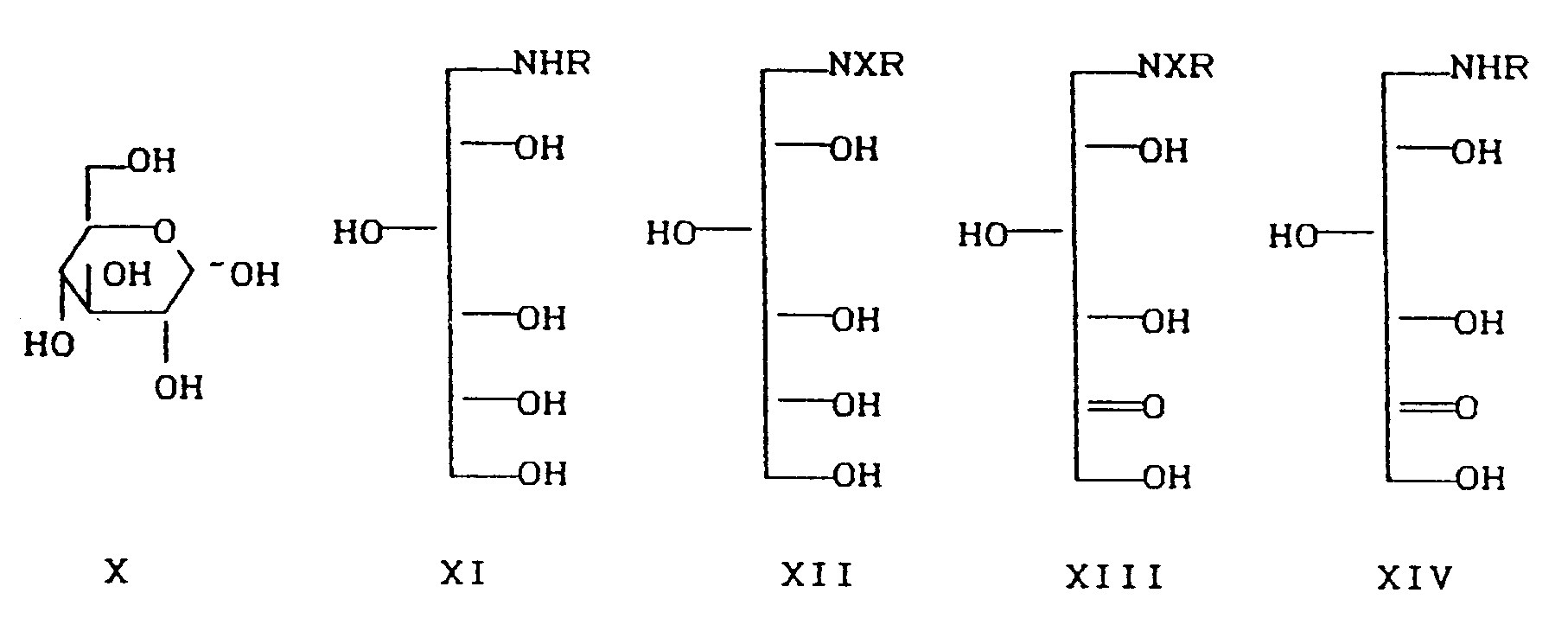
an sich bekannter Weise in die Aminosorbite XI überführt, wobei R die oben angegebene Bedeutung hat und die Aminogruppe mit einer alkalisch abspaltbaren und in der anschließenden mikrobiologischen Oxidation stabilen Gruppe geschützt. Die so erhaltenen Verbindungen XII werden in an sich bekannter Weise mikrobiologisch zu den geschützten Aminosorbosen XIII oxidiert, Anschließend spaltet man die Schutzgruppen alkalisch ab und reduziert die so erhaltenen Aminosorbosen in an sich bekannter Weise katalytisch oder mit komplexen Hydriden zu den Desoxynojirimycinen der Formel I. - Die Erfindung betrifft daher ein Verfahren zur Herstellung von 1-Desoxynojirimycinen der Formel (I)

worin - R
- Wasserstoff, C₁-C₁₀-Alkyl, welches durch bis zu 30H- oder C₁-C₄ Alkoxy-Reste substituiert sein kann, bedeutet,
- Der Rest R bedeutet vorzugsweise Wasserstoff oder C₁-C₁₀-, insbesondere C₁-C₄-Alkyl. Diese Alkylreste können durch bis zu 3 OH- oder C₁-C₄-Alkoxy-Reste substituiert sein.
- Ganz besonders bevorzugt ist die Gruppe der in den Beispielen beschriebenen Verbindungen im Zusammenhang mit deren Herstellungsverfahren.
- Ganz besonders bevorzugt bedeutet R Wasserstoff, C₁-C₁₀-Alkyl oder Hydroxyethyl.
- Als Schutzgruppen X eignen sich alle Gruppen, die sich alkalisch abspalten lassen und unter den Bedingungen der mikrobiologischen Oxidation beständig sind. Beispielhaft seien folgende Schutzgruppen genannt:
Formyl, Di- und Trihalogenacetyl wie Dichloracetyl, Trichloracetyl. - Besonders bevorzugt sind die Formyl-, die Dichloracetyl- und die Trichloracetylschutzgruppen. Die Herstellung der Zwischenprodukte XII erfolgt im Falle der Amidschutzgruppen in an sich bekannter Weise aus den Aminen XI und den entsprechenden Carbonsäureestern oder Carbonsaureanhydriden in geeigneten Lösemitteln.
- Die Verbindungen XII sind besonders für R=H gut kristallisierende Verbindungen, die oft schon während des Ansatzes in der Wärme auskristallisieren und somit in einfachster Weise in hoher Reinheit erhalten werden können.
- Für die Herstellung sind sowohl die Carbonsäurealkyl- als auch die -arylester sowie die symmetrischen und gemischten Carbonsäureanhydride geeignet. Als Lösungsmittel sind alle inerten organischen Lösungsmittel und Wasser sowie Mischungen davon geeignet. Beispielhaft seien die Alkohole wie Methanol, Ethanol, Isopropanol und tert. Butanol, Ketone wie Aceton und Methylisobutylketon, Carbonsäureamide wie Dimethylformamid und N-Methylpyrrolidon und Dimethylsulfoxid genannt.
- Besonders bevorzugt sind Carbonsäuremethyl- und -ethyl-ester, sowie Wasser, Methanol, Ethanol, Dimethylformamid und N-methylpyrrolidon als Lösungsmittel.
- Die Verbindungen der Formel XIII lassen sich sehr einfach in an sich bekannter Weise aus den Verbindungen der Formel XII herstellen, indem man die geschützten Aminosorbite XII in wäßrigen Lösungen mit geeigneten Microorganismen (z.B. Gluconobacter oxidans) oxidiert. Die so erhaltenen Verbindungen sind entweder gut wasserlöslich oder lassen sich durch Extraktion mit geeigneten Lösungsmitteln von den Mikroorganismen abtrennen.
- Zur Abspaltung der Schutzgruppen wird die so erhaltene Lösung von XIV gegebenenfalls verdünnt oder aufkonzentriert und mit einer konzentrierten oder verdünnten Base versetzt. Der Verlauf der Abspaltung kann chromatographisch verfolgt werden und ist, abhängig von Art und Menge der verwendeten Base sowie der Schutzgruppe, innerhalb von einigen Minuten bis zu einigen Stunden vollständig. Die Abspaltung kann bei Temperaturen von 0°C bis 60°C erfolgen, bevorzugt ist ein Bereich von 15 bis 30°C.
- Als Basen können alle Hydroxide und Carbonate verwendet werden, soweit sie ausreichend in Wasser löslich sind.
- Bevorzugt sind die Ammonium-, Alkali- und Erdalkalihydroxide sowie Tetraalkylammoniumhydroxide.
- Weiterhin sind basische Ionenaustauscher als Basen verwendbar. Besonders bevorzugt sind stark basische Ionenaustaucher wie z.B. Lewatit® MP 500 OH-Form. Die Austauscherharze können sowohl gelförmig als auch makroporös sein. Der Einsatz kann im batch-Verfahren, d.h. Zugabe des Austauschers zur Lösung von XIV, oder auch in Säulen erfolgen.
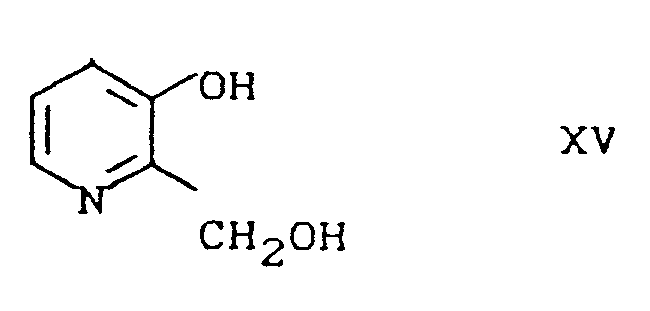
- Die alkalische Abspaltung der Schutzgruppen führt in praktisch einheitlicher Reaktion zu den Aminosorbosen XIV. Dieses Ergebnis ist nach dem Stand der Technik ausgesprochen überraschend, da nach Paulsen et.al. Chem. Ber. 100, 802 (1967) bekannt ist, daß Aminosorbosen XIV insbesondere mit R=H in stark sauren wäßrigen Lösungen in der Furanose-Form vorliegen und stabil sind, sich jedoch im neutralen Bereich schnell z.B. zum Pyridinderivat XV zersetzen. In alkalischer Lösung liegen sie in der Piperidinose-Form vor und sind nur relativ beständig (siehe Seite 805 unten), d.h. sie sind instabiler als unter sauren Bedingungen . Dieses Zitat enthält nicht den geringsten Hinweis, daß die alkalische Abspaltung eine wesentliche Steigerung der Ausbeute bringt. Weiterhin ist auch überraschend, daß die Aminosorbosen XIV trotzdem in einfacher Weise und in hohen Ausbeuten zu den Verbindungen I reduziert werden können.
Die Reduktion der Aminosorbosen XIV kann nach an sich bekanntem Verfahren erfolgen. Sie gelingt z.B. durch katalytische Hydrierung an geeigneten Katalysatoren wie in der Europäischen Patentanmeldung 49 858 A 2 beschrieben. Bevorzugt ist jedoch die Reduktion mit komplexen Borhydriden. Besonders bevorzugt sind Natriumboranat, Natriumcyanoborhydrid, Dialkylaminoborane und basische Anionenaustaucher in der BH₄⊖-Form. Ganz besonders bevorzugt sind Natriumboranat NaBH₄, Dimethylaminoboran-BH₄N(CH₃)₂ und die Ionenaustauscher Lewatit M 500, M 600 AP 246, MP 500, MP 600 in der BH₄⊖-Form, Die Verwendung von komplexen Borhydriden ist bekannt und in der Europäischen Patentanmeldung EP 055 431 A 1 beschrieben. Zweckmäßigerweise wird die Reduktion unmittelbar nach beendeter Schutzgruppenabspaltung durchgeführt. Vor Beginn der Reduktion kann der pH-Wert der Lösung auf Werte zwischen pH=1 und pH=14 eingestellt werden. Bevorzugt ist der Bereich zwischen pH 4-13. - Eine besonders einfache Verfahrensweise ergibt sich, wenn man eine mit Alkali stabilisierte Natriumboranat-Lösung zur alkalischen Lösung der Abspaltungsreaktiven gibt. Diese Reduktion im alkalischen Milieu hat weiterhin den Vorteil, daß sich praktisch kein Boranat unter Wasserstoffbildung zersetzt, wie es bei der Reduktion im sauren und neutralen Bereich der Fall ist, und mit Luft gefährliche Knallgasgemische bilden kann,
- Dieser besondere Vorteil der alkalischen Spaltung ermöglicht die Reduktion der Aminosorbosen XIII in Rohrreaktoren, die mit basischen Ionenaustauschern in der BH₄⊖-Form gefüllt sind.
- Zur Isolierung und Reinigung des Desoxynojirimycins I kann je nach Verfahrensvariante und Substanzeigenschaften entweder direkt aus der gegebenenfalls konzentrierten Ansatzlösung kristallisiert werden oder man zieht die Desoxynojirimycine auf einen sauren Ionenaustauscher auf und eluiert "mit gegebenenfalls verdünnter Säure-, Salz-, Ammoniak- oder Aminlösung" oder man gibt über einen Anionenaustauscher in der OH⊖-Form oder aber man chromatographiert an geeigneten Ionenaustauschern (z.B. Lewatit TSW 40 Na⊕-Form), Kieselgel oder silanisierten Kieselgel, konzentriert jeweils die produkthaltigen Lösungen auf und kristallisiert aus geeigneten Lösungsmitteln um.
- Als Ionenaustauscher können prinzipiell alle schwach und stark sauren, sowie schwach und stark basischen Typen eingesetzt werden.
- Bevorzugt sind stark saure und stark basische Ionenaustauscher.
- Die Durchführung des erfindungsgemäßen Verfahrens ist nicht auf die in den Beispielen genannten Mikroorganismen beschränkt, sondern kann vielmehr auch mit anderen durch den Fachmann in der Natur aufgefundenen oder bei Hinterlegungsstellen erhältlichen oxidierenden Stämmen durchgeführt werden.
- Herstellung von N-Formyl-1-amino-1-desoxy-D-glucitol. Eine Suspension von 1-Aminosorbit (1-Amino-1-desoxy-D-glucitol) (200 g) in Methanol (800 ml) und Methylformiat (102 ml) wird 3 Stunden unter Rückfluß gekocht. Nach kurzer Zeit erhält man eine klare Lösung, aus der alsbald die Kristallisation des Produktes einsetzt. Es wird abgekühlt und das Produkt durch Filtration isoliert.
- Ausbeute:
- 212 g (92 % der Theorie)
- Fp.:
- 139-141°C
- Herstellung von N-Dichloracetyl-1-amino-1-desoxy-D-glucitol.
Die Herstellung erfolgt analog Beispiel 1 aus 1-Aminosorbit und Methyldichloracetat. - Ausbeute:
- 86 % der Theorie
- Fp.:
- 167-169°C.
- Herstellung von N-Trichloracetyl-1-amino-1-desoxy-D-glucitol.
Die Herstellung erfolgt analog Beispiel 1 aus 1-Aminosorbit und Methyldichloracetat. - Ausbeute:
- 83 % der Theorie
- Herstellung von N-Formyl-N-methyl-1-amino-1-desoxy-D-glucitol.
Die Herstellung erfolgt analog Beispiel 1 aus N-Methyl-1-amino-1-desoxy-D-glucitol und Methylformiat. - Ausbeute:
- 85 % der Theorie
- Fp.:
- 119-121°C.
- Herstellung von N-Formyl-N-hydroxyethyl-1-amino-1-desoxy-D-glucitol.
Die Herstellung erfolgt analog Beispiel 1 aus N-Hydroxy-1-amino-1-desoxy-D-glucitol und Methylformiat. Nach vollständiger Umsetzung wird im Vakuum zur Trockne eingeengt. - Ausbeute:
- 93 % der Theorie Sirup.
- Herstellung von N-Dichloracetyl-N-hydroxyethyl-1-amino-1-desoxy-D-glucitol.
Die Herstellung erfolgt analog Beispiel 1 aus N-Hydroxyethyl-1-amino-1-desoxy-D-glucitol und Methyldichloracetat. - Ausbeute:
- 96 % der Theorie Sirup.
- Herstellung von N-Formyl-6-amino-6-desoxy-L-sorbose.
Man gibt zu einer Suspension von 40 g Gluconobacter oxydans spp.suboxydans (DSM-50049) in 1 l Leitungswasser, mit Phosphorsäure auf pH4,5 eingestellt, bei 32°C, 700 rpm und einer Belüftung von 3 l Luft/Stunde 200 g N-Formylaminosorbit und nach 4 Stunden weitere 200 g N-Formylaminosorbit. Nach 22 Stunden ist die Umsetzung beendet, die Zellen werden abgeschleudert und verworfen. Das Produkt wird durch Einengen im Vakuum als Öl isoliert. - Herstellung von N-Dichloracetyl-6-amino-6-desoxy-L-sorbose.
Man gibt zu einer Suspension von 40 g Gluconobacter oxydans ssp.suboxydans (DSM 50049) in 1 l Leitungswasser, mit Phosphorsäure auf pH 4,5 eingestellt, bei 32°C, 700 rpm und einer Belüftung von 3 l Luft/Stunde 20 g N-Dichloracetylaminosorbit. Die Reaktion ist nach 10 Stunden beendet, wonach die Zellen abzentrifugiert, 2 mal mit je 100 ml Methanol gewaschen und verworfen werden. Die Methanolextrakte werden mit dem wäßrigen Überstand vereinigt und im Vakuum zur Trockne eingeengt. - Herstellung von N-Trichloracetyl-6-amino-6-desoxy-L-sorbose.
Die Umsetzung und Isolierung erfolgt bei einer Reaktionsdauer von 24 Stunden und einer Substratmenge von 55 g des entsprechenden Sorbits wie in Beispiel 8 beschrieben. - Herstellung von N-Formyl-N-methyl-6-amino-6-desoxy-L-sorbose. Die Umsetzung und Isolierung erfolgt bei einer Reaktions
dauer von 16 Stunden und einer Substratmenge von 10 g des entsprechenden Sorbits wie in Beispiel 8 beschrieben. - Herstellung von N-Formyl-N-hydroxyethyl-6-amino-6-desoxy-L-sorbose.
Die Umsetzung und Isolierung erfolgt bei einer Reaktionsdauer von 45 Stunden und einer Substratmenge von 250 g des entsprechenden Sorbits die in 5 Portionen a 50 g innerhalb von 25 Stunden zugegeben wurden, wie in Beispiel 8 beschrieben, - Herstellung von N-Dichloracetyl-N-hydroxyethyl-6-amino-6-desoxy-L-sorbose.
Die Umsetzung und Isolierung erfolgt bei einer Reaktionsdauer von 28 Stunden und einer Substratmenge von 80 g des entsprechenden Sorbits wie in Beispiel 8 beschrieben. - Herstellung von Desoxynojirimycin aus N-Formyl-6-amino-6-desoxy-L-sorbose.
- Zur Lösung von N-Formyl-6-amino-6-desoxy-L-sorbose (aus 0,4 Mol N-Formylaminosorbit) in Wasser (400 ml) wird eine Lösung von Natriumhydroxid (20 g) in Wasser (24 ml) gegeben und zwei Stunden bei 20°C gerührt. Dann wird eine Lösung von Natriumboranat (3,8 g) in Wasser (40 ml), die mit einigen Tropfen 45 %iger Natronlauge stabilisiert worden ist, zugegeben und 1 Stunde bei 20 bis 25°C nachgerührt, Nach Zugabe von Aceton (10 ml) wird die Ansatzlösung über eine Säule mit einem stark sauren Ionenaustauscher (1 l Lewatit SP 112 H⊕-Form) gegeben, mit entsalztem Wasser (zwei Säulenvolumina) nachgewaschen und das Desoxynojirimycin mit 6 %igem Ammoniakwasser wieder eluiert. Die produkthaltigen Lösungen werden im Vakuum zur Trockne eingeengt und das Produkt aus Ethylenglykolmonomethylether kristallisiert.
- Ausbeute:
- 33,3 g 51,0 % bezogen auf eingesetzten N-Formylaminosorbit
- Fp.:
- 193-194°C.
- Herstellung von 1-Desoxynojirimycin aus N-Formyl-6-amino-6-desoxy-L-sorbose.
Zur Lösung der Formylaminosorbose (aus 0,4 Mol N-Formylaminosorbit) in Wasser (400 ml) wird Bariumhydroxyd-Oktahydrat gegeben und 2 Stunden bei 20°C gerührt. Dazu wird nun eine Lösung von Dimethylaminoboran (20 g) in Wasser (200 ml) gegeben und eine weitere Stunde nachgerührt. Der pH-Wert der Ansatzlösung wird mit Schwefelsäure (30 %ig) auf 6,8-7,2 eingestellt und vom ausgefallenen Bariumsulfat abfiltriert.
Das Filtrat wird eingeengt und an Kieselgel chromatographiert (mobile Phase Acetonitril:Wasser:25 %ige Ammoniaklösung 4:1:1 v/v/v).
Die produkthaltigen Lösungen werden im Vakuum zur Trockne eingeengt und der Rückstand aus Wasser/Ethanol umkristallisiert. - Ausbeute:
- 50,2 % bezogen auf eingesetzten N-Formylaminosorbit
- Fp.:
- 192-193°C,
- Herstellung von Desoxynojirimycin aus N-Formyl-6-amino-6-desoxy-L-sorbose.
Zur Lösung des N-Formylaminosorbose (aus 0,4 Mol Formylaminosorbit) wird in Wasser (400 ml) Lewatit MP 500 OH⊖-Form (1 l) gegeben und eine Stunde bei 20°C gerührt. Dann wird Lewatit MP 500 BH₄⊖-Form (200 ml) zugegeben und eine weitere Stunde bei 20°C gerührt. Der Ionenaustauscher wird abfiltriert und Produktreste werden mit Wasser vollständig ausgewaschen. Das Filtrat wird im Vakuum eingedampft und aus Ethylenglykolmonomethylether kristallisiert. - Ausbeute:
- 53,3 % bezogen auf eingesetzten N-Formylaminosorbit
- Fp.:
- 192-193°C.
- Herstellung von 1-Desoxynojirimycin aus N-Dichloracetyl-6-amino-6-desoxy-L-sorbose.
Die Herstellung erfolgt analog Beispiel 13 aus N-Dichloracetylaminosorbose. - Ausbeute:
- 53,9 % bezogen auf eingesetzten N-Dichloracetylaminosorbit
- Fp.:
- 192-193°C.
- Herstellung von Desoxynojirimycin aus N-Dichloracetyl-6-amino-6-desoxy-L-sorbose.
Die Herstellung erfolgt analog Beispiel 14 aus N-Dichloracetylaminosorbose. Als Reduktionsmittel wird Lewatit MP 500 BH₄⊖-Form (200 ml) statt Dimethylaminoboran verwendet. - Ausbeute:
- 53,3 % bezogen auf eingesetzten N-Dichloracetylaminosorbit
- Fp.:
- 192-193°C,
- Herstellung von Desoxynojirimycin aus N-Trichloracetyl-6-amino-6-desoxy-L-sorbose.
Die Herstellung erfolgt analog Beispiel 13 aus N-Trichloracetylaminosorbose, - Ausbeute:
- 57 % der Theorie, bezogen auf N-Trichloracetylaminosorbit
- Fp.:
- 193-194°C.
- Herstellung von N-Methyl-1-desoxynojirimycin aus N-Formyl-N-methyl-6-amino-6-desoxy-L-sorbose.
Die Herstellung erfolgt analog Beispiel 13 aus N-Formyl-N-methylaminosorbose. - Ausbeute:
- 46 % der Theorie, bezogen auf eingesetzten N-Formyl-N-methylaminosorbose
- Fp.:
- 152-153°C.
- Herstellung von N-Hydroxyethyl-1-desoxynojirimycin aus N-Formyl-N-hydroxyethyl-6-amino-6-desoxy-L-sorbose.
Die Herstellung erfolgt analog Beispiel 13 aus N-Formyl-N-hydroxyethylaminosorbose. - Ausbeute:
- 42 % der Theorie, bezogen auf eingesetzten N-Formyl-N-hydroxyethylaminosorbit.
- Herstellung von N-Hydroxyethyl-1-desoxynojirimycin aus N-Dichloracetyl-N-hydroxyethyl-6-amino-6-desoxy-L-sorbose.
Die Herstellung erfolgt analog Beispiel 13 aus N-Dichloracetyl-N-hydroxyethylaminosorbose. - Ausbeute:
- 47 % der Theorie, bezogen auf eingesetzten N-Dichloracetyl-N-hydroxyethylaminosorbit.

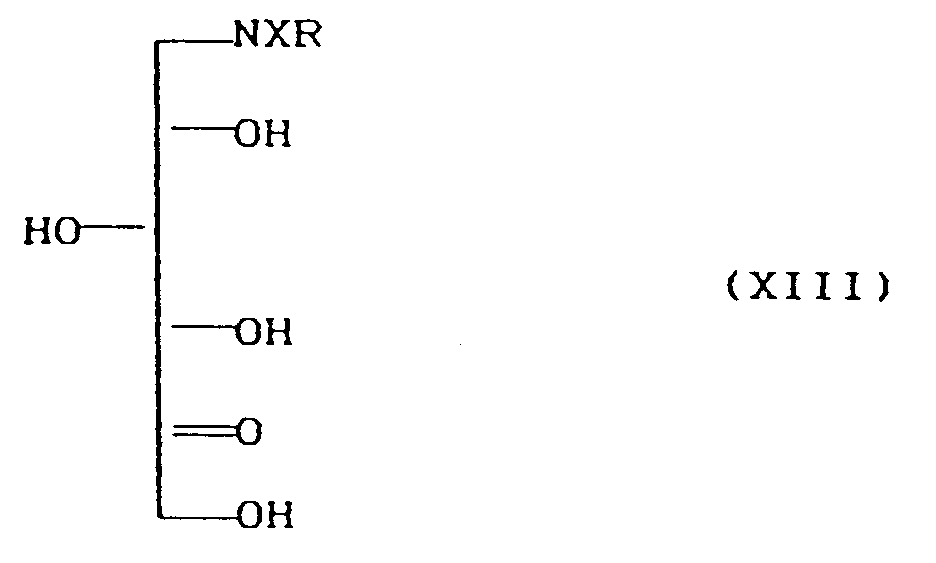
überführt, die Aminogruppe in (XI) mit einer alkalisch abspaltbaren und in der anschließenden mikrobiologischen Oxidation stabilen Gruppe schützt, die geschützten Verbindungen der Formel (XII)

worin X für eine alkalisch abspaltbare Schutzgruppe steht,
mikrobiologisch zu Verbindungen der Formel (XIII) oxidiert

und anschließend die Schutzgruppen alkalisch abspaltet, wobei die Verbindungen der Formel (XIV) erhalten werden,
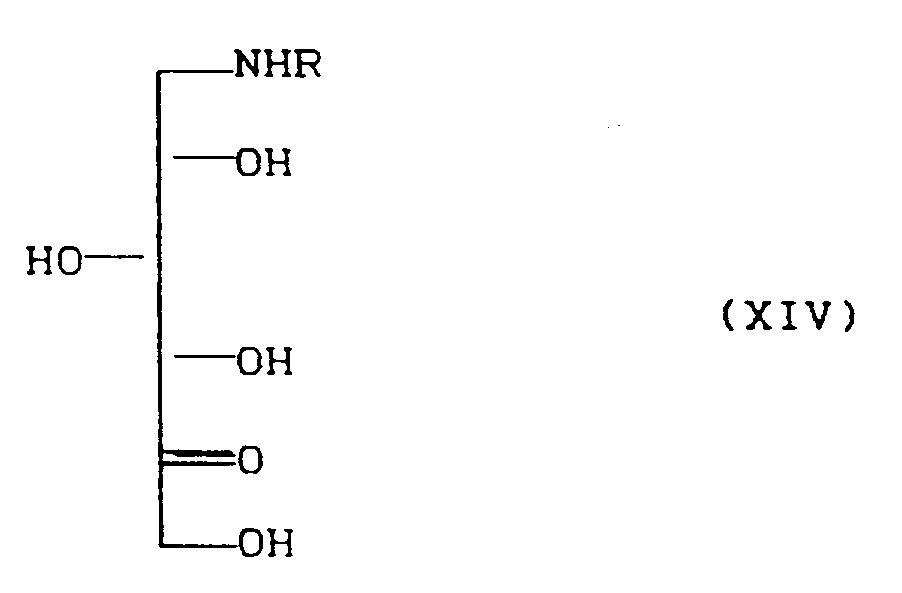
und die so erhaltenen Aminosorbosen in an sich bekannter Weise katalytisch oder mit komplexen Hydriden zu den Desoxynojirimycinen der Formel I reduziert, wobei R die eingangs angegebene Bedeutung hat.
| C₈H₁₄Cl₃NO₆ (326,6) | ||||
| Ber.: | C 29,4 % | H 4,3 % | N 4,3 % | Cl 32,6 % |
| Gef.: | C 29,7 % | H 4,3 % | N 4,4 % | Cl 32,2 %. |
Claims (5)
- Verfahren zur Herstellung von 1-Desoxynojirimycinen der Formel (I)
 R Wasserstoff, C₁-C₁₀-Alkyl, welches durch bis zu 30H- oder C₁-C₄ Alkoxy-Reste substituiert sein kann, bedeutet,wobei das Verfahren beinhaltet, daß man D-Glucose in an sich bekannter Weise in Aminosorbite (XI)


- Verfahren nach Anspruch 1, dadurch gekennzeichnet, daß man Aminosorbite verwendet, in denen R für Wasserstoff, C₁-C₁₀-Alkyl oder Hydroxyethyl steht.
- Verfahren nach den Ansprüchen 1 und 2, dadurch gekennzeichnet, daß X in den verwendeten Verbindungen für eine Formyl-, schutzgruppe steht.
- Verfahren nach den Ansprüchen 1, 2 und 3, dadurch gekennzeichnet, daß man die geschützten Aminosorbite der Formel XII in wäßrigen Lösungen mit Gluconobacter oxidans oxidiert.
- Verfahren nach den Ansprüchen 1, 2, 3 und 4, dadurch gekennzeichnet, daß man die Schutzgruppe in der Verbindung XIV mit konzentrierter oder verdünnter Base bei Temperaturen von 0°C bis 60°C abspaltet.
Priority Applications (1)
| Application Number | Priority Date | Filing Date | Title |
|---|---|---|---|
| AT8787104555T ATE104962T1 (de) | 1986-04-09 | 1987-03-27 | Verfahren zur herstellung von 1-desoxynojirimycin und dessen n-derivaten. |
Applications Claiming Priority (2)
| Application Number | Priority Date | Filing Date | Title |
|---|---|---|---|
| DE3611841 | 1986-04-09 | ||
| DE19863611841 DE3611841A1 (de) | 1986-04-09 | 1986-04-09 | Verfahren zur herstellung von 1-desoxynojirimycin und dessen n-derivaten |
Publications (3)
| Publication Number | Publication Date |
|---|---|
| EP0240868A2 EP0240868A2 (de) | 1987-10-14 |
| EP0240868A3 EP0240868A3 (en) | 1988-09-21 |
| EP0240868B1 true EP0240868B1 (de) | 1994-04-27 |
Family
ID=6298252
Family Applications (1)
| Application Number | Title | Priority Date | Filing Date |
|---|---|---|---|
| EP87104555A Expired - Lifetime EP0240868B1 (de) | 1986-04-09 | 1987-03-27 | Verfahren zur Herstellung von 1-Desoxynojirimycin und dessen N-Derivaten |
Country Status (11)
| Country | Link |
|---|---|
| US (1) | US4806650A (de) |
| EP (1) | EP0240868B1 (de) |
| JP (1) | JPH085858B2 (de) |
| KR (1) | KR950005196B1 (de) |
| AT (1) | ATE104962T1 (de) |
| CA (1) | CA1277624C (de) |
| DE (2) | DE3611841A1 (de) |
| DK (1) | DK172539B1 (de) |
| ES (1) | ES2051701T3 (de) |
| HU (1) | HU196819B (de) |
| IL (1) | IL82120A (de) |
Families Citing this family (44)
| Publication number | Priority date | Publication date | Assignee | Title |
|---|---|---|---|---|
| US5329025A (en) * | 1988-09-21 | 1994-07-12 | G. D. Searle & Co. | 3-azido compound |
| US5256788A (en) * | 1989-02-13 | 1993-10-26 | Nippon Shinyaku Co. Ltd. | Moranoline derivatives and their production and the use of moranoline and its derivatives as a stabilizing agent for enzymes |
| ES2036512T3 (es) * | 1989-07-27 | 1996-03-01 | Monsanto Co | Compuestos de piperidina con actividad inhibidora de las glicosidasas. |
| DE3936295A1 (de) * | 1989-11-01 | 1991-05-02 | Bayer Ag | Verfahren zur herstellung von zwischenprodukten und zur synthese von n-(2-hydroxyethyl)-2-hydroxymethyl-3,4,5-trihydroxypiperidine |
| US5151519A (en) * | 1990-05-07 | 1992-09-29 | G. D. Searle & Co. | Process for the preparation of 1,5-(alkylimino)-1,5-dideoxy-d-glucitol and derivatives thereof |
| EP0536402A4 (en) * | 1990-06-29 | 1993-05-12 | Nippon Shinyaku Company, Limited | Piperidine derivative |
| DK0477160T3 (da) * | 1990-09-20 | 1996-05-20 | Monsanto Co | Fremgangsmåde til fremstilling af N-substitueret 1-deoxynojirimycin |
| DE4030040A1 (de) * | 1990-09-22 | 1992-03-26 | Bayer Ag | Enzymatische de-acylierung von acyl-aminosorbosen und dessen verwendung bei der herstellung von 1-desoxynojirimicin |
| US5401645A (en) * | 1992-03-16 | 1995-03-28 | Monsanto Company | Process for producing n-substituted polyhydroxy nitrogen-containing heterocycles utilizing acetobacteraceae and corynebacterium |
| US5258518A (en) * | 1992-04-01 | 1993-11-02 | G. D. Searle & Co. | 2-substituted tertiary carbinol derivatives of deoxynojirimycin |
| AU1876095A (en) * | 1994-02-25 | 1995-09-11 | G.D. Searle & Co. | Use of 1-deoxynojirimycin and its derivatives for treating mammals infected with respiratory syncytial virus |
| US20030100532A1 (en) | 1997-02-14 | 2003-05-29 | Gary S. Jacob | Use of n-substituted-1,5-dideoxy-1,5-imino-d-glucitol compounds in combination therapy for treating hepatitis virus infections |
| JP2001522833A (ja) | 1997-11-10 | 2001-11-20 | ジー・ディー・サール・アンド・カンパニー | 多剤耐性を治療するためのアルキル化イミノ糖類の使用 |
| US6465488B1 (en) | 1997-12-11 | 2002-10-15 | Chancellor, Masters & Scholars Of The University Of Oxford | Inhibition of glycolipid biosynthesis |
| AU761748B2 (en) | 1997-12-11 | 2003-06-12 | Chancellor, Masters And Scholars Of The University Of Oxford, The | Inhibition of membrane-associated viral replication |
| EA004705B1 (ru) | 1998-02-12 | 2004-06-24 | Дж.Д.Серл Энд Ко. | Применение n-замещенных 1,5-дидезокси-1,5-имино-d-глюцитных производных для лечения инфекций, вызываемых вирусами гепатита |
| US6689759B1 (en) | 1998-02-12 | 2004-02-10 | G. D. Searle & Co. | Methods of Treating hepatitis virus infections with N-substituted-1,5-dideoxy-1,5-imino-d-glucitol compounds in combination therapy |
| WO2001008672A2 (en) | 1999-02-12 | 2001-02-08 | G.D. Searle & Co. | Glucamine compounds for treating hepatitis virus infections |
| ES2311921T3 (es) * | 1999-02-12 | 2009-02-16 | United Therapeutics Corporation | N-(8,8,8-trifluorooctil)1-5,-didesoxi-1,5-imino-d-glucitol para tratar infecciones por el virus de la hepatitis. |
| US7256005B2 (en) | 1999-08-10 | 2007-08-14 | The Chancellor, Masters And Scholars Of The University Of Oxford | Methods for identifying iminosugar derivatives that inhibit HCV p7 ion channel activity |
| DE60037664T2 (de) | 1999-08-10 | 2008-12-24 | The Chancellor, Masters And Scholars Of The University Of Oxford | Langkettige n-alkyl verbindungen und deren oxa-derivate zur verwendung als anitvirale mittel |
| WO2001060366A1 (en) * | 2000-02-14 | 2001-08-23 | Pharmacia Corporation | Use of n-substituted-1,5-dideoxy-1,5-imino-d-glucitol compounds for treating hepatitis virus infections |
| KR100446483B1 (ko) | 2000-03-31 | 2004-09-01 | 미시간 스테이트 유니버시티 | 옥심 또는 이민으로부터 1,5-디데옥시-1,5-이미노 헥시톨제조방법 |
| US20030236489A1 (en) * | 2002-06-21 | 2003-12-25 | Baxter International, Inc. | Method and apparatus for closed-loop flow control system |
| KR100520007B1 (ko) | 2003-05-19 | 2005-10-11 | 건 식 조 | 혈압 강하 기능을 가지는 키토산 함유 소금의 제조방법 |
| EP3782655A1 (de) | 2005-05-17 | 2021-02-24 | Amicus Therapeutics, Inc. | Verfahren zur behandlung der pompe-krankheit unter verwendung von 1-deoxynojirimycin und derivaten |
| GB0614947D0 (en) * | 2006-07-27 | 2006-09-06 | Isis Innovation | Epitope reduction therapy |
| CN102727437A (zh) | 2006-08-02 | 2012-10-17 | 牛津大学院长校长专家委员会 | 病毒感染的脂质体治疗 |
| CA2666814A1 (en) * | 2006-08-21 | 2008-05-29 | United Therapeutics Corporation | Combination therapy for treatment of viral infections |
| US8097728B2 (en) * | 2007-04-30 | 2012-01-17 | Philadelphia Health & Education Corporation | Iminosugar compounds with antiflavirus activity |
| KR20100127842A (ko) * | 2008-03-26 | 2010-12-06 | 유니버시티 오브 옥스퍼드 | 소포체 표적화 리포좀 |
| ES2579628T3 (es) | 2009-02-23 | 2016-08-12 | Emergent Virology Llc | Iminoazúcares y métodos de tratamiento de enfermedades virales |
| EP2400843B1 (de) * | 2009-02-24 | 2015-11-11 | United Therapeutics Corporation | Iminozucker und verfahren zur behandlung von arenaviridae-erkrankungen |
| EP2410989A2 (de) * | 2009-03-27 | 2012-02-01 | The Chancellor, Masters and Scholars of the University of Oxford | Liposome zur senkung des cholesterinspiegels |
| WO2010144759A1 (en) | 2009-06-12 | 2010-12-16 | United Therapeutics Corporation | Iminosugars and methods of treating bunyaviral and togaviral diseases |
| CN102595895A (zh) | 2009-09-04 | 2012-07-18 | 联合治疗公司 | 亚氨基糖以及治疗丝状病毒性疾病的方法 |
| EP2473482B1 (de) * | 2009-09-04 | 2014-03-05 | United Therapeutics Corporation | Verfahren zur behandlung von orthomyxovirusinfektionen |
| JP5575246B2 (ja) * | 2009-09-04 | 2014-08-20 | ユナイテッド セラピューティクス コーポレイション | ポックスウイルス感染の治療方法 |
| JP2013512945A (ja) * | 2009-12-07 | 2013-04-18 | ザ チャンセラー,マスターズ アンド スカラーズ オブ ザ ユニバーシティ オブ オックスフォード | 破骨細胞生成および/または破骨細胞活性化の阻害における使用のためのn置換デオキシノジリマイシン化合物 |
| WO2014017915A2 (en) | 2012-07-27 | 2014-01-30 | Universiteit Utrecht Holding B.V. | Urea and guanidinium derivatives of iminosugars |
| CA2924026C (en) | 2013-09-16 | 2021-12-28 | Emergent Virology Llc | Deoxynojirimycin derivatives and methods of their using |
| CA2966893C (en) | 2014-11-05 | 2023-10-24 | Emergent Virology Llc | Iminosugars |
| EP3318277A1 (de) | 2016-11-04 | 2018-05-09 | Institut du Cerveau et de la Moelle Epiniere-ICM | Inhibitoren der glucosylceramidsynthase zur behandlung von motoneuronerkrankungen |
| JP2021514200A (ja) | 2018-01-26 | 2021-06-10 | 浙江工▲業▼大学 | グルコノバクターオキシダンスのソルビトールデヒドロゲナーゼおよびコエンザイムピロロキノリンキニーネの合成を促進する方法 |
Citations (2)
| Publication number | Priority date | Publication date | Assignee | Title |
|---|---|---|---|---|
| EP0008031A1 (de) * | 1978-08-03 | 1980-02-20 | Bayer Ag | Verfahren zur Herstellung von 6-Amino-6-desoxy-L-sorbose |
| EP0055431A1 (de) * | 1980-12-30 | 1982-07-07 | Bayer Ag | Verfahren zur Herstellung von 1,5-Didesoxy-1,5-imino-D-glucitol und dessen N-Derivaten |
Family Cites Families (6)
| Publication number | Priority date | Publication date | Assignee | Title |
|---|---|---|---|---|
| NO154918C (no) * | 1977-08-27 | 1987-01-14 | Bayer Ag | Analogifremgangsmaate til fremstilling av terapeutisk aktive derivater av 3,4,5-trihydroksypiperidin. |
| GB2009152B (en) * | 1977-11-10 | 1982-01-06 | Nippon Shinyaku Co Ltd | Method for producing moranoline and n-methylmoranoline |
| DE2853573A1 (de) * | 1978-12-12 | 1980-07-03 | Bayer Ag | Herstellung von n-substituierten derivaten des l-desoxynojirimycins |
| DE2936240A1 (de) * | 1979-09-07 | 1981-03-26 | Bayer Ag, 51373 Leverkusen | Verfahren zur herstellung bekannter und neuer 6-amino-6-desoxy-2,3-0-isopropyliden-(alpha)-l-sorbofuranose-derivate sowie neue zwischenprodukte des verfahrens |
| DE2942365A1 (de) * | 1979-10-19 | 1981-05-14 | Bayer Ag, 5090 Leverkusen | 2-hydroxyalkyl-3,4,5-trihydroxy-(pi)-peridine, verfahren zu ihrer herstellung und ihre verwendung als arzneimittel |
| DE3038901A1 (de) * | 1980-10-15 | 1982-05-06 | Bayer Ag, 5090 Leverkusen | Verfahren zur herstellung von n-substituierten derivaten des 1-desoxynojirimycins |
-
1986
- 1986-04-09 DE DE19863611841 patent/DE3611841A1/de not_active Withdrawn
-
1987
- 1987-03-27 EP EP87104555A patent/EP0240868B1/de not_active Expired - Lifetime
- 1987-03-27 AT AT8787104555T patent/ATE104962T1/de not_active IP Right Cessation
- 1987-03-27 DE DE3789682T patent/DE3789682D1/de not_active Expired - Lifetime
- 1987-03-27 ES ES87104555T patent/ES2051701T3/es not_active Expired - Lifetime
- 1987-04-02 US US07/034,466 patent/US4806650A/en not_active Expired - Lifetime
- 1987-04-06 IL IL82120A patent/IL82120A/xx not_active IP Right Cessation
- 1987-04-07 CA CA000533983A patent/CA1277624C/en not_active Expired - Lifetime
- 1987-04-08 DK DK198701793A patent/DK172539B1/da active IP Right Grant
- 1987-04-08 KR KR1019870003336A patent/KR950005196B1/ko not_active Expired - Lifetime
- 1987-04-08 JP JP62084889A patent/JPH085858B2/ja not_active Expired - Lifetime
- 1987-04-08 HU HU871518A patent/HU196819B/hu unknown
Patent Citations (2)
| Publication number | Priority date | Publication date | Assignee | Title |
|---|---|---|---|---|
| EP0008031A1 (de) * | 1978-08-03 | 1980-02-20 | Bayer Ag | Verfahren zur Herstellung von 6-Amino-6-desoxy-L-sorbose |
| EP0055431A1 (de) * | 1980-12-30 | 1982-07-07 | Bayer Ag | Verfahren zur Herstellung von 1,5-Didesoxy-1,5-imino-D-glucitol und dessen N-Derivaten |
Non-Patent Citations (4)
| Title |
|---|
| al.: "Structure and synthesis of nojirimycin" * |
| CHEMISCHE BERICHTE (1967) 100, 802-819 * |
| HOUBEN-WEYL, METHODEN DER ORGANISCHEN CHEMIE (1974) BAND XV/1, SEITEN 126, 129, 177 * |
| RöMPP CHEMIE LEXIKON (1989) 9.AUFLAGE, SEITE 236 * |
Also Published As
| Publication number | Publication date |
|---|---|
| DK172539B1 (da) | 1998-12-07 |
| JPH085858B2 (ja) | 1996-01-24 |
| IL82120A0 (en) | 1987-10-30 |
| HUT43865A (en) | 1987-12-28 |
| DK179387A (da) | 1987-10-10 |
| ES2051701T3 (es) | 1994-07-01 |
| ATE104962T1 (de) | 1994-05-15 |
| EP0240868A3 (en) | 1988-09-21 |
| DE3611841A1 (de) | 1987-10-15 |
| EP0240868A2 (de) | 1987-10-14 |
| KR950005196B1 (ko) | 1995-05-19 |
| IL82120A (en) | 1990-12-23 |
| KR870010071A (ko) | 1987-11-30 |
| DK179387D0 (da) | 1987-04-08 |
| CA1277624C (en) | 1990-12-11 |
| US4806650A (en) | 1989-02-21 |
| JPS62242663A (ja) | 1987-10-23 |
| HU196819B (en) | 1989-01-30 |
| DE3789682D1 (de) | 1994-06-01 |
Similar Documents
| Publication | Publication Date | Title |
|---|---|---|
| EP0240868A2 (de) | Verfahren zur Herstellung von 1-Desoxynojirimycin und dessen N-Derivaten | |
| DE2346535C3 (de) | Verfahren zur Herstellung von 7-Dimethylamino-6-desmethyl-6-desoxytetracyclin über 9-tert.Butyl-6-desmethyl-6-desoxytetracyclin | |
| EP0574667A1 (de) | Verfahren zur Herstellung von 2,2,6,6-Tetramethylpiperidin-N-oxyl und in seiner 4-Stellung substituierten Derivaten | |
| DE69401008T2 (de) | Verfahren zur Herstellung von 5-Aminolävulinsäure | |
| DE2827627C2 (de) | ||
| EP0007040B1 (de) | Herstellung von 1-Desoxy-nojirimycin und N-substituierten Derivaten | |
| DE3224795A1 (de) | Verfahren zur herstellung von glyoxylsaeure und glyoxylsaeurederivaten | |
| EP0847990A1 (de) | 4-(C1-C4)-Alkoxy-3-pyrrolin-2-on-1-yl-essigsäuren, deren Herstellung und Verwendung zur Synthese von 4-Hydroxy-2-oxo-pyrrolidin-1-yl-acetamid | |
| DE2740950A1 (de) | Verfahren zur herstellung von flavonen | |
| DE2229223C3 (de) | 2-Nitro-S-imidazol-Derivate und Verfahren zu deren Herstellung | |
| DE2929058A1 (de) | Anorganische salze von trimethylammoniumderivaten der polyenmakrolide, insbesondere anorganische salze von methylestern dieser derivate, und verfahren zu deren herstellung | |
| EP0425929B1 (de) | Verfahren zur Herstellung von Zwischenprodukten und zur Synthese von N-(2-Hydroxyethyl)-2-hydroxymethyl-3,4,5-trihydroxypiperidine | |
| DE2409675C3 (de) | 5-Hydroxytryptophan-Derivate und Verfahren zu ihrer Herstellung | |
| DE2720088C2 (de) | ||
| DE2027890C3 (de) | 8-AIkoxy oder -Benzyloxy-3-methyl-lO- methylen-2,9-dioxatricyclo-(43,l,03,7 )-decan-4-one und 8-AIkoxy oder 8-Benzyloxy-3,10-dimethyl-2,9dioxatricyclo- (43,1,O" )-decan-4-one | |
| DE3106463C2 (de) | Verfahren zur Herstellung von Derivaten des Kanamycin A | |
| EP0046495B1 (de) | Verfahren zur Herstellung von N-(D)-Ribityl-2-phenylazo-4,5-dimethylanilin | |
| DE3700331A1 (de) | Verfahren zur herstellung der desmalonylverbindung von makrolid-lactonen | |
| DE2113254C3 (de) | Verfahren zur Herstellung von γ-Piperidinoburyrophenonderivaten | |
| DE3102984A1 (de) | Verfahren zur herstellung von cysteamin-s-substituierten verbindungen und deren derivaten | |
| EP0027956A1 (de) | Verfahren zur Herstellung von (1-(4-Chlorbenzoyl)-5-methoxy-2-methyl-3-indol)acetoxyessigsäure | |
| DE935009C (de) | Verfahren zur Herstellung von freien und N-substituierten ª‡-Aminoaldehyden | |
| CH449006A (de) | Verfahren zur Herstellung von Fusidinsäure- und Dihydrofusidinsäurederivaten | |
| DE3831695A1 (de) | Elaiophylinderivate, verfahren zu ihrer herstellung ihre verwendung als arzneimittel und sie enthaltende arzneimittel | |
| DE2857509C2 (de) | Verfahren zur Herstellung von N-Methylmoranolin |
Legal Events
| Date | Code | Title | Description |
|---|---|---|---|
| PUAI | Public reference made under article 153(3) epc to a published international application that has entered the european phase |
Free format text: ORIGINAL CODE: 0009012 |
|
| 17P | Request for examination filed |
Effective date: 19870331 |
|
| AK | Designated contracting states |
Kind code of ref document: A2 Designated state(s): AT BE CH DE ES FR GB IT LI NL SE |
|
| PUAL | Search report despatched |
Free format text: ORIGINAL CODE: 0009013 |
|
| AK | Designated contracting states |
Kind code of ref document: A3 Designated state(s): AT BE CH DE ES FR GB IT LI NL SE |
|
| 17Q | First examination report despatched |
Effective date: 19900209 |
|
| GRAA | (expected) grant |
Free format text: ORIGINAL CODE: 0009210 |
|
| AK | Designated contracting states |
Kind code of ref document: B1 Designated state(s): AT BE CH DE ES FR GB IT LI NL SE |
|
| REF | Corresponds to: |
Ref document number: 104962 Country of ref document: AT Date of ref document: 19940515 Kind code of ref document: T |
|
| REF | Corresponds to: |
Ref document number: 3789682 Country of ref document: DE Date of ref document: 19940601 |
|
| GBT | Gb: translation of ep patent filed (gb section 77(6)(a)/1977) |
Effective date: 19940510 |
|
| REG | Reference to a national code |
Ref country code: ES Ref legal event code: FG2A Ref document number: 2051701 Country of ref document: ES Kind code of ref document: T3 |
|
| ITF | It: translation for a ep patent filed | ||
| ET | Fr: translation filed | ||
| EAL | Se: european patent in force in sweden |
Ref document number: 87104555.5 |
|
| PLBE | No opposition filed within time limit |
Free format text: ORIGINAL CODE: 0009261 |
|
| STAA | Information on the status of an ep patent application or granted ep patent |
Free format text: STATUS: NO OPPOSITION FILED WITHIN TIME LIMIT |
|
| 26N | No opposition filed | ||
| REG | Reference to a national code |
Ref country code: GB Ref legal event code: IF02 |
|
| REG | Reference to a national code |
Ref country code: CH Ref legal event code: PUE Owner name: BAYER HEALTHCARE AG Free format text: BAYER AKTIENGESELLSCHAFT##D-51368 LEVERKUSEN (DE) -TRANSFER TO- BAYER HEALTHCARE AG##51368 LEVERKUSEN (DE) |
|
| REG | Reference to a national code |
Ref country code: GB Ref legal event code: 732E |
|
| NLS | Nl: assignments of ep-patents |
Owner name: BAYER HEALTHCARE AG |
|
| REG | Reference to a national code |
Ref country code: FR Ref legal event code: TP |
|
| PGFP | Annual fee paid to national office [announced via postgrant information from national office to epo] |
Ref country code: DE Payment date: 20060215 Year of fee payment: 20 |
|
| PGFP | Annual fee paid to national office [announced via postgrant information from national office to epo] |
Ref country code: ES Payment date: 20060303 Year of fee payment: 20 |
|
| PGFP | Annual fee paid to national office [announced via postgrant information from national office to epo] |
Ref country code: CH Payment date: 20060320 Year of fee payment: 20 |
|
| PGFP | Annual fee paid to national office [announced via postgrant information from national office to epo] |
Ref country code: FR Payment date: 20060322 Year of fee payment: 20 Ref country code: GB Payment date: 20060322 Year of fee payment: 20 |
|
| PGFP | Annual fee paid to national office [announced via postgrant information from national office to epo] |
Ref country code: BE Payment date: 20060330 Year of fee payment: 20 Ref country code: AT Payment date: 20060330 Year of fee payment: 20 |
|
| PGFP | Annual fee paid to national office [announced via postgrant information from national office to epo] |
Ref country code: NL Payment date: 20060331 Year of fee payment: 20 Ref country code: IT Payment date: 20060331 Year of fee payment: 20 |
|
| PG25 | Lapsed in a contracting state [announced via postgrant information from national office to epo] |
Ref country code: GB Free format text: LAPSE BECAUSE OF EXPIRATION OF PROTECTION Effective date: 20070326 |
|
| PG25 | Lapsed in a contracting state [announced via postgrant information from national office to epo] |
Ref country code: NL Free format text: LAPSE BECAUSE OF EXPIRATION OF PROTECTION Effective date: 20070327 |
|
| PG25 | Lapsed in a contracting state [announced via postgrant information from national office to epo] |
Ref country code: ES Free format text: LAPSE BECAUSE OF EXPIRATION OF PROTECTION Effective date: 20070328 |
|
| REG | Reference to a national code |
Ref country code: CH Ref legal event code: PL |
|
| EUG | Se: european patent has lapsed | ||
| NLV7 | Nl: ceased due to reaching the maximum lifetime of a patent |
Effective date: 20070327 |
|
| REG | Reference to a national code |
Ref country code: ES Ref legal event code: FD2A Effective date: 20070328 |
|
| BE20 | Be: patent expired |
Owner name: *BAYER HEALTHCARE A.G. Effective date: 20070327 |
|
| PGFP | Annual fee paid to national office [announced via postgrant information from national office to epo] |
Ref country code: SE Payment date: 20060309 Year of fee payment: 20 |