EP0240260A2 - Materialien für optische Harze - Google Patents
Materialien für optische Harze Download PDFInfo
- Publication number
- EP0240260A2 EP0240260A2 EP87302655A EP87302655A EP0240260A2 EP 0240260 A2 EP0240260 A2 EP 0240260A2 EP 87302655 A EP87302655 A EP 87302655A EP 87302655 A EP87302655 A EP 87302655A EP 0240260 A2 EP0240260 A2 EP 0240260A2
- Authority
- EP
- European Patent Office
- Prior art keywords
- mixture
- ethylenically unsaturated
- ester
- methacrylic acid
- monomer
- Prior art date
- Legal status (The legal status is an assumption and is not a legal conclusion. Google has not performed a legal analysis and makes no representation as to the accuracy of the status listed.)
- Granted
Links
Images

Classifications
-
- C—CHEMISTRY; METALLURGY
- C08—ORGANIC MACROMOLECULAR COMPOUNDS; THEIR PREPARATION OR CHEMICAL WORKING-UP; COMPOSITIONS BASED THEREON
- C08F—MACROMOLECULAR COMPOUNDS OBTAINED BY REACTIONS ONLY INVOLVING CARBON-TO-CARBON UNSATURATED BONDS
- C08F220/00—Copolymers of compounds having one or more unsaturated aliphatic radicals, each having only one carbon-to-carbon double bond, and only one being terminated by only one carboxyl radical or a salt, anhydride ester, amide, imide or nitrile thereof
- C08F220/02—Monocarboxylic acids having less than ten carbon atoms; Derivatives thereof
- C08F220/10—Esters
- C08F220/26—Esters containing oxygen in addition to the carboxy oxygen
- C08F220/30—Esters containing oxygen in addition to the carboxy oxygen containing aromatic rings in the alcohol moiety
Definitions
- This invention relates to resin materials consisting essentially of radical polymers of ethylenically unsaturated monomers. More specifically, this invention relates to resin materials characterized mainly by the ethylenically unsaturated monomers to be polymerized into the resin materials.
- discs e.g., videodiscs, memory discs, and digital audiodiscs
- optical discs are expected to be widely used practically for recording and reproducing images and sounds, memory and reproduction of a large amount of information and the like because such optical discs exhibit many characteristics such as markedly high recording density and excellent images and sounds reproduced therefrom and the like.
- inorganic glass and polymethylmethacrylate resin are practically used as the disc materials.
- Inorganic glass as a disc material is disadvantageous in that it is heavy and fragile, costly for its precise processing and the like, although it is moisture-proof, and thus moisture has little adverse effects on a recording layer.
- polymethylmethacrylate resin materials are less fragile than the inorganic glass and are lower in cost, but have fatal defects as materials for optical devices in that they have low heat resistance and high hygroscopicity.
- the resulting discs warp so easily that an objective lens in a recording-reproducing optical system becomes out of focus owing to the warp and causes errors in operation.
- resins are radical polymers of di(meth) acrylate of tricyclo[5,2,1,0 2,6 ]decanedimethanol(Japanese Patent Application Nos. 12686/85 and 131237/85).
- the polymers produced by radical polymerization of this specified diethylenically unsaturated monomer are largely improved in heat-resistance, hygroscopicity and mechanical properties and the discs made from these resins are substantially satisfactory in the above mentioned properties.
- the resins obtained from di(meth)acrylates of this specified dimethanol compound have ample high heat-resistant characteristics.
- the features of the heat-resistant characteristics vary depending upon the kind of the carboxylic acid moiety in these di(meth)acrylates. That is, the resin obtained from the bismethacrylate has very high heat resistance but does not have a very high thermal stability, whereas the resin obtained from the bisacrylate has very high thermal stability but not a high heat resistance. Therefore, needless to say, it is desirable to provide a resin with both the heat resistance inherent in the resin obtained from the bismethacrylate and the thermal stability inherent in the resin obtained from the bisacrylate.
- heat resistance is a factor which controls thermal-resistant shape retention property generally indicated by a heat deformation temperature.
- thermal stability is a decomposition resistance indicated by the temperature at which loss in weight starts owing to the decomposition by high-temperature heating and is a factor which controls resistances against quality deteriorations such as discoloration of resins, deterioration in characteristics of optical devices, etc.
- An object of the present invention is to provide resin materials which are not accompanied by the above described problems. This object can be achieved by using, as the above mentioned di(meth)acrylate, those prepared by a specific method.
- the optical resin material according to the present invention consists essentially of a radical polymer of an ethylenically unsaturated monomer and is characterized in that at least a major part of the ethylenically unsaturated monomer is an ester of 1 mole of tricyclo[5,2,1,0 2,6 ]decanedimethanol with 2 moles of a mixture of acrylic acid and methacrylic acid.
- the specific di(meth)acrylates of the dimethanol compound are enhanced both in heat resistance and thermal stability in addition to their inherent good moisture-proof property and mechanical properties.
- the monomers which constitute the unique features of the present invention are obtained by esterifying 1 mole of a polycyclic alkanedimethanol with 2 moles of a mixture of methacrylic acid and acrylic acid.
- This ester is sometimes referred to as "meth/acrylate” which means acrylate, methacrylate and/or mixed methacrylate/ acrylate.
- the polycyclic alkanedimethanols are produced by subjecting the substrate polycyclic alkadiene to hydroxymethylation by, e.g. the oxo synthesis.
- the substrate "polycyclic alkadiene”, in turn, is produced by the Diels-Alder reaction of cyclopentadiene, whereby the product produced has unsaturation, and the unsaturation is then saturated when the Diels-Alder adduct undergoes the oxo synthesis reaction with Co and H2 in the presence of a Co catalyst.
- the Diels-Alder adduct of two moles of cyclopentadiene can undergo further Diels-Alder addition with another mole of cyclopentadiene to a further adduct, namely pentacyclo[9,2,1,1 1,8 ,0 2,7 ,0 9,13 ]pentadecane-4,11-diene and pentacyclo[9,2,1,1, 4,7 ,0 2,10 ,0 3,3 ]pentadecane-5,12-diene in admixture as shown in Japanese Patent Laid-Open No. 99782/1974 and No.
- the dimethanol compound (I) is commercially available under the trade name of "TCD-DM" (supplied from Hoechst A.G.).
- the monomers obtained by esterifying this dimethanol compound with a mixture of methacrylic acid and acrylic acid consist of a corresponding methacrylic acid ester, i.e., bismethacrylate, a corresponding acrylic acid ester, i.e., bisacrylate, and a mixed methacrylate/acrylate wherein one of the -CH2OH groups is esterified with methacrylic acid, and the other -CH2OH group is esterified with acrylic acid.
- the ratio of the amounts of these three components varies depending upon the ratio of the methacrylic acid to the acrylic acid in the mixture of these acids as well as the ratio of the bismethanol compound to this mixture. It is desirable, in view of obtaining an optical resin material, that the ratio of the amounts of these raw materials is as described hereinafter (details thereof are described below).
- FIG. 1(A) shows liquid chromatograms of the tricyclo[5,2,1,0 2,6 ]decanedimethanolbismethacrylate (TCDDMA) and the bisacrylate (TCDDA) obtained in the Comparative Examples 1 and 2, respectively, wherein both chromatograms start from the same point.
- FIG. 1(B) shows a liquid chromatogram of the meth/acrylate obtained in Example 1 according to the present invention, wherein the chromatogram starts from the point corresponding to the starting point in FIG. 1(A).
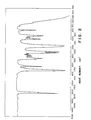
- FIGS. 1(A) and (B) wherein all the chromatograms start at the same time, that the peaks 1 ⁇ and 2 ⁇ of the meth/acrylate in FIG. 1(B) correspond to the peak 1 of the bisacrylate (chain line in FIG. 1(A)) and the peak 2 of the bismethacrylate (solid line in FIG. 1(A)), respectively and, thus, that the meth/acrylate includes both the bismethacrylate and the bisacrylate.
- the peak 3 in FIG. 1(B) corresponds to a mixed methacrylate/acrylate.
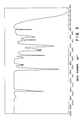
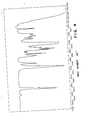
- FIGS. 2 through 4 show infrared absorption spectra of the bismethacrylate (Comparative Example 1), the bisacrylate (Comparative Example 2) and the meth/acrylate (Example 1) according to the present invention, respectively.
- the above mentioned monomers are compounds that are obtained by esterifying 1 mole of the above mentioned polycyclic alkanedimethanol with 2 moles of a mixture of methacrylic acid and acrylic acid.
- esterifying 1 mole of the dimethanol with 2 moles of a mixture of methacrylic acid and acrylic acid merely means that the stoichiometric amount of one of the reactants, a mixture of methacrylic acid and acrylic acid, is 2 moles, and involves (a) using one of the reactants (usually cheaper or more readily removable monomer, which corresponds to a mixture of methacrylic acid and acrylic acid in the present invention) in an excess amount in accordance with conventional methods in a chemical reaction, as well as (b) carrying out the reaction in two stages (for example, at first reacting the dimethanol with methacrylic acid and then adding thereto acrylic acid for further reaction).
- esterification is not restricted to a dehydration reaction wherein both reactant are used in the form of an alcohol and a carboxylic acid, respectively; the esterification involves ester interchange by using one or both of the reactants in the form of a functional derivative such as in the form of a lower alcohol ester to produce the aimed ester.
- the esterification can be carried out according to a conventional method under conventional conditions except taking care to inhibit polymerization reaction, since the reactants are specific compounds and the reactants and the product have ethylenically unsaturated bonds.
- 1 mole of the dimethanol compound and approximately 2.0 to 2.6 moles of a mixture of meth/acrylic acid are subjected to an esterification reaction.
- the molar ratio of the methacrylic acid to the acrylic acid in the meth/acrylic acid mixture is suitably in the range of approximately from 0.25 to 4, preferably approximately from 0.5 to 2.5.
- the esterification is carried out by charging these materials at the same time in a reaction vessel and adding thereto a reaction solvent which also serves as a dehydrating agent, an esterification catalyst and, as necessary, a polymerization inhibitor to conduct esterification reaction at a reaction temperature of 50 to 200°C, preferably 80 to 150°C in air or in an inert gas.
- the polymerization inhibitors used herein include, for example, phenols such as hydroquinone, hydroquinone monomethylether, etc.; quinones such as benzoquinone, diphenylbenzoquinone, etc.; phenothiazine, copper salts and the like.
- the amount of the polymerization inhibitor to be used is 0.001 to 10 parts by weight, preferably 0.1 to 5 parts by weight, to 100 parts by weight of the mixture of methacrylic acid and acrylic acid.
- a dehydration azeotropic agent preferably used are n-hexane, n-pentane, cyclohexane, methylcyclohexane, benzene, toluene, xylene, trichloroethylene, tetrachloroethylene, methylchloroform, diisopropylether, etc.
- esterification catalyst ordinary esterification catalysts such as sulfuric acid, hydrochloric acid, phosphoric acid, boron fluoride, p-toluenesulfonic acid, benzenesulfonic acid, cation-exchange resins and the like are used.
- reaction liquid After terminatin of the esterification reaction, the reaction liquid is washed with an aqueous alkaline solution and water, then an aqueous layer is separated therefrom, and the dehydration azeotropic agent is removed from an organic layer under reduced pressure.
- the resin materials according to the present invention are obtained by subjecting the monomers comprising at least a major part thereof the above mentioned diethylenically unsaturated monomers to radical polymerization.
- the phrase "comprising at least a major part thereof the (specified) monomers” means either that the monomers to be subjected to the polymerization consist of the above mentioned specified monomers alone or that other ethylenically unsaturated monomers which are copolymerizable with the specified monomers can be used in combination therewith in a small amount (for example, up to 20% by weight based on the weight of the resulting monomer mixture).
- the resin obtained by copolymerizing some of the above mentioned comonomer with a decanemethanol ester according to the present invention has a relatively low water absorption property. Higher content of such a comonomer tends to produce higher birefringence and lower heat resistance, and therefore the content should not exceed a certain level.
- the resin which is the most preferable in the present invention consists of substantially 100% of such decanemethanol esters.
- radical copolymerization can be conducted by, for example, a method with comprises adding to a polymerizable composition a radical initiator such as an organic peroxide, an azo compound or the like and then heating the resulting mixture, or by a method which comprises adding to a polymerizable composition a photosensitizer and irradiating the resulting mixture with ultraviolet light, electron beam, radiation or the like.
- a radical initiator such as an organic peroxide, an azo compound or the like
- the radical initiators used therein include, for example, organic peroxides such as benzoyl peroxide, diisopropyl peroxide, tert-butylperoxypivalate, and lauroylperoxide; azo compounds such as azoisobutylonitrile; photosensitizers such as benzophenone, benzoin ethyl ether, benzyl, acetophenone, and anthraquinone; and sulfur compounds such as diphenylsulfite, and thiocarbamate.
- the amount of the radical initiator is in the range of 0.01 to 20 parts, more preferably 0.01 to 10 parts, to 100 parts of the acrylic compound represented by the foregoing general formula.
- the radical copolymerization of the polymerizable composition according to the present invention is preferably conducted in air or in an inert gas at a temperature of from 10 to 150°C. Post curing at ca. 250°C can be made upon necessity.
- the monomers which constitute unique features of the invention are diethylenically unsaturated monomers, the resulting polymer is crosslinked and, thus, cannot be molded by a method with is accompanied by melting. Thus, it is preferable to carry out the polymerization by means of a so-called “cast polymerization” to obtain the resulting polymer in the form of plates or blocks
- the resin thus obtained has a light transmission of not less than 85%, birefringence of not more than 1x10 ⁇ 5, a heat resistance of not lower than 180°C, preferably not lower than 200°C, a thermal stability of not lower than 250°C, and a modulus of elasticity of not less than 300 kg/mm2.
- optical resin materials used herein means resin materials for optical uses having the above described properties.
- a 1-liter four-necked flask equipped with a stirrer, thermometer, nitrogen-inlet tube and water separater was charged with 197 parts of tricyclo[5,2,1,0 2,6 ] decanedimethanol, 193 parts of a mixture of methacrylic acid and acrylic acid [the molar ratio of the methacrylic acid to acrylic acid in the mixture (hereinafter, referred to as M/A ratio) was 1.5 and the molar ratio of the dimethanol to the acid mixture was 1/2.4], 200 parts of toluene, 50 parts of p-toluenesulfonic acid, and 0.3 part of copper powder, all at the same time.
- reaction mixture reacted at a reaction temperature of 90 to 120°C for 3 hours while nitrogen gas was caused to overflow. After termination of the reaction, the reaction system was cooled, and excess acid was neutralized with aqueous solution of sodium carbonate. The organic layer was washed three times with pure water, and toluene was distilled away therefrom by means of an evaporator to prepare 340 parts of the objective polymerizable composition having an M/A ratio of 1.5.
- the resulting cured article was taken from the mold to obtain disc plates of 120-mm diameter. Various physical properties of the disc plate were evaluated. The results thereof are shown in Table 1.
- Example 2 Various polymerizable compositions were obtained by repeating the procedure in Example 1 except that, instead of 193 parts of the mixture having an M/A ratio of 1.5 in Example 1, 200 parts of the mixture having an M/A ratio of 4.0, 186 parts of the mixture having an M/A ratio of 0.67, or 180 parts of the mixture having an M/A ratio of 0.25 were used.
- the resulting polymerizable compositions were molded into disc plates of 120-mm diameter in the same way as in Example 1.
- the results of the evaluated physical properties of the disc plates are shown in Table 1.
- Example 1 The procedure of Example 1 was repeated except that 206 parts of methacrylic acid was used instead of the mixture having an M/A ratio of 1.5 to prepare 342 parts of bis(oxymethyl)tricyclo[5,2,1,0 2,6 ]decanedimethacrylate.
- Example 1 To 100 parts of the resulting bis(oxymethyl) tricyclo[5,2,1,0 2,6 ]decanedimethacrylate was added 0.5 part of benzoyl peroxide. Then, the procedure of Example 1 was repeated to obtain disc plates of 120-mm diameter.
- Example 1 The procedure of Example 1 was repeated except that 173 parts of acrylic acid was used instead of 193 parts of the mixture having an M/A ratio of 1.5 to prepare 330 parts of bis(oxymethyl)tricyclo[5,2,1,0 2,6 ]decanediacrylate.
- Example 1 To 100 parts of the bis(oxymethyl) tricyclo[5,2,1,0 2,6 ]decanediacrylate was added 0.5 part of benzoylperoxide. Then, the procedure of Example 1 was repeated to obtain disc plates of 120-mm diameter.
- composition obtained in Example 1 was added (a) 30 parts of benzylmethacrylate or (b) 30 parts of divinylbenzene 55% m-, p-divinylbenzene (others m-,p-ethylvinylbenzene etc.) from Aldrich Chemical Company (US) to prepare polymerizable compositions, respectively.
- the polymerizable composition was subjected to polymerization under the same conditions as in Example 1 and then molded into disc plates of 120-mm diameter.
- the results of the evaluated physical properties of the disc plates are shown in Table 1.
- Example 1 The procedure of Example 1 was repeated except that 1 mol(265 parts) of pentacyclopentadecanedimethanol (obtained by reacting a cyclopentadiene trimer having a pentacyclo [9,2,1,1 1,8 , 0 2,7 ,0 9,13 ] pentadecane-4, 11-diene/pentacyclo [9,2,1,1 4,7 ,0 2,10 ,0 3,8 ] pentadecane-5,12-diene ratio of 86/14 was used instead of the tricyclo[5,2,1,0 2,6 ] decanedimethanol to prepare 380 parts of the objective polymerizable composition having an M/A ratio of 1.5, the resulting polymerizable compositions were molded into disc plates of 120-mm diameter in the same way as in Example 1.
- pentacyclopentadecanedimethanol obtained by reacting a cyclopentadiene trimer having a pentacyclo [9,2,1,
Landscapes
- Chemical & Material Sciences (AREA)
- Health & Medical Sciences (AREA)
- Chemical Kinetics & Catalysis (AREA)
- Medicinal Chemistry (AREA)
- Polymers & Plastics (AREA)
- Organic Chemistry (AREA)
- Addition Polymer Or Copolymer, Post-Treatments, Or Chemical Modifications (AREA)
Applications Claiming Priority (2)
| Application Number | Priority Date | Filing Date | Title |
|---|---|---|---|
| JP70347/86 | 1986-03-28 | ||
| JP61070347A JPH0745555B2 (ja) | 1986-03-28 | 1986-03-28 | 光学材料用樹脂およびその製造法 |
Publications (3)
| Publication Number | Publication Date |
|---|---|
| EP0240260A2 true EP0240260A2 (de) | 1987-10-07 |
| EP0240260A3 EP0240260A3 (en) | 1989-03-29 |
| EP0240260B1 EP0240260B1 (de) | 1991-05-15 |
Family
ID=13428801
Family Applications (1)
| Application Number | Title | Priority Date | Filing Date |
|---|---|---|---|
| EP87302655A Expired EP0240260B1 (de) | 1986-03-28 | 1987-03-27 | Materialien für optische Harze |
Country Status (4)
| Country | Link |
|---|---|
| US (1) | US4923942A (de) |
| EP (1) | EP0240260B1 (de) |
| JP (1) | JPH0745555B2 (de) |
| DE (1) | DE3770036D1 (de) |
Cited By (2)
| Publication number | Priority date | Publication date | Assignee | Title |
|---|---|---|---|---|
| EP1595874A1 (de) * | 2004-05-11 | 2005-11-16 | Basf Aktiengesellschaft | Pumpbare Tricyclodecandimethylol enthaltende Zusammensetzung |
| EP3924323A4 (de) * | 2019-02-14 | 2023-03-29 | Dairen Chemical Corporation | Tricyclodecandimethanolzusammensetzungen und ihre verwendungen |
Families Citing this family (10)
| Publication number | Priority date | Publication date | Assignee | Title |
|---|---|---|---|---|
| US7179551B2 (en) | 1999-02-12 | 2007-02-20 | General Electric Company | Poly(arylene ether) data storage media |
| WO2000048172A2 (en) | 1999-02-12 | 2000-08-17 | General Electric Company | Data storage media |
| US6429281B1 (en) * | 1999-07-01 | 2002-08-06 | Loctite | Hydrophobic, high Tg cycloaliphatic epoxy resins |
| US7235192B2 (en) * | 1999-12-01 | 2007-06-26 | General Electric Company | Capped poly(arylene ether) composition and method |
| US6905637B2 (en) * | 2001-01-18 | 2005-06-14 | General Electric Company | Electrically conductive thermoset composition, method for the preparation thereof, and articles derived therefrom |
| JP2003137938A (ja) * | 2001-11-07 | 2003-05-14 | Daiso Co Ltd | 光学的特性に優れた硬化性組成物 |
| ATE498648T1 (de) * | 2002-10-11 | 2011-03-15 | Univ Connecticut | Mischungen von amorphen und semikristallinen polymeren mit formgedächtniseigenscchaften |
| US7226980B2 (en) | 2003-08-07 | 2007-06-05 | General Electric Company | Thermoset composition, method for the preparation thereof, and articles prepared therefrom |
| JP4678008B2 (ja) * | 2007-05-01 | 2011-04-27 | ダイソー株式会社 | プラスチックレンズ用硬化性組成物 |
| JP6048029B2 (ja) * | 2012-09-21 | 2016-12-21 | 三菱瓦斯化学株式会社 | 高硬度樹脂組成物 |
Family Cites Families (13)
| Publication number | Priority date | Publication date | Assignee | Title |
|---|---|---|---|---|
| US3240767A (en) * | 1961-12-26 | 1966-03-15 | Eastman Kodak Co | Acetonitrile soluble copolymers of acrylonitrile and alicyclic alcohol esters of acrylic and methacrylic acids |
| US3271374A (en) * | 1963-01-31 | 1966-09-06 | Eastman Kodak Co | Acrylic compounds |
| US3925333A (en) * | 1966-06-17 | 1975-12-09 | Goodrich Co B F | Olefinic polymers of methyl-tricyclo-3,8-decadiene |
| NL7006513A (de) * | 1969-05-12 | 1970-11-16 | ||
| US3923740A (en) * | 1969-05-14 | 1975-12-02 | Espe Pharm Praep | Compositions for use in prosthodontia |
| DE2714538C3 (de) * | 1977-04-01 | 1979-11-15 | Henkel Kgaa, 4000 Duesseldorf | Methacrylsäureester von auf tricyclischen Decanolen aufgebauten Verbindungen |
| US4131729A (en) * | 1978-04-21 | 1978-12-26 | Espe Fabrik Pharmazeutischer Praparate Gmbh | Dental compositions comprising acrylic esters of tricyclo [5.2.1.02,6 ] decane polymers |
| JPS58101163A (ja) * | 1981-12-14 | 1983-06-16 | Toyo Ink Mfg Co Ltd | 硬化性被覆剤 |
| JPS60152515A (ja) * | 1984-01-18 | 1985-08-10 | Japan Synthetic Rubber Co Ltd | 光学材料の製造法 |
| JPS60208008A (ja) * | 1984-03-31 | 1985-10-19 | 日本ゼオン株式会社 | 電気絶縁用材料 |
| JPH0618833B2 (ja) * | 1984-04-25 | 1994-03-16 | 株式会社リコー | 非水系樹脂分散液の製造方法 |
| US4540723A (en) * | 1984-05-16 | 1985-09-10 | J&J Dental Products Inc. | Dental restorative composition containing monofunctional monomer and diolefinically unsaturated monomer |
| DE3780337T2 (de) * | 1986-03-28 | 1993-02-11 | Hitachi Ltd | Optische platte. |
-
1986
- 1986-03-28 JP JP61070347A patent/JPH0745555B2/ja not_active Expired - Lifetime
-
1987
- 1987-03-27 EP EP87302655A patent/EP0240260B1/de not_active Expired
- 1987-03-27 DE DE8787302655T patent/DE3770036D1/de not_active Expired - Lifetime
-
1988
- 1988-09-30 US US07/251,999 patent/US4923942A/en not_active Expired - Lifetime
Cited By (3)
| Publication number | Priority date | Publication date | Assignee | Title |
|---|---|---|---|---|
| EP1595874A1 (de) * | 2004-05-11 | 2005-11-16 | Basf Aktiengesellschaft | Pumpbare Tricyclodecandimethylol enthaltende Zusammensetzung |
| EP3924323A4 (de) * | 2019-02-14 | 2023-03-29 | Dairen Chemical Corporation | Tricyclodecandimethanolzusammensetzungen und ihre verwendungen |
| EP4582465A3 (de) * | 2019-02-14 | 2025-09-17 | Dairen Chemical Corporation | Tricyclodecandimethanolzusammensetzungen und verwendungen davon |
Also Published As
| Publication number | Publication date |
|---|---|
| JPS62225508A (ja) | 1987-10-03 |
| DE3770036D1 (de) | 1991-06-20 |
| US4923942A (en) | 1990-05-08 |
| JPH0745555B2 (ja) | 1995-05-17 |
| EP0240260B1 (de) | 1991-05-15 |
| EP0240260A3 (en) | 1989-03-29 |
Similar Documents
| Publication | Publication Date | Title |
|---|---|---|
| US6291704B1 (en) | Polymerizable halogenated vinyl ethers | |
| JP5466863B2 (ja) | 重合性化合物、これを含有する重合性組成物及びその重合体 | |
| US4923942A (en) | Optical disc and method of manufacturing the same | |
| US5391587A (en) | Fluorinated photoinitiators and their application in UV curing of fluorinated monomers | |
| JP2009173647A (ja) | フルオレン骨格を有する二官能性(メタ)アクリレート | |
| US6133472A (en) | Fluorinated oxyvinyl compounds and methods of preparing and using same | |
| US6579667B2 (en) | Radiation curable fluorinated vinyl ethers derived from hexafluoropropene | |
| JP3454544B2 (ja) | (メタ)アクリル酸エステル、その製造方法、それを用いた硬化性樹脂組成物およびその硬化物 | |
| US5138001A (en) | Vinylphenyl compound, process for the production thereof, polymerizable composition containing same, and crosslinked polymer formed therefrom | |
| AU757140B2 (en) | Brominated materials | |
| US5654350A (en) | Contact lenses with hydrophilic crosslinkers | |
| JP2801494B2 (ja) | ジアリル化合物および該化合物を用いた架橋重合体の製造方法 | |
| US5563183A (en) | Contact lenses with hydrophilic crosslinkers | |
| JPS6322205B2 (de) | ||
| JPH01168712A (ja) | 光学材料用樹脂 | |
| JPH02115205A (ja) | 光学材料用樹脂組成物 | |
| JPH0224308A (ja) | 光学材料用樹脂 | |
| JP3821601B2 (ja) | アクリル酸エステル誘導体およびその用途 | |
| JPH01261408A (ja) | 光学材料用樹脂 | |
| JPH04356443A (ja) | フッ素含有(メタ)アクリル酸エステル、その製造方法およびその硬化物 | |
| JPH0240345A (ja) | ビフェニル化合物及びその製造方法 | |
| US5231220A (en) | Derivatives of norbornylane and of dimethanodecahydronaphthylane which can be used for obtaining new polymers | |
| JPH0643464B2 (ja) | (メタ)アクリレート及びそれを用いる(共)重合体の製造方法 | |
| CN114031707A (zh) | 一种固化材料组合物及其应用和固化树脂及其制备方法和应用 | |
| JPS6322204B2 (de) |
Legal Events
| Date | Code | Title | Description |
|---|---|---|---|
| PUAI | Public reference made under article 153(3) epc to a published international application that has entered the european phase |
Free format text: ORIGINAL CODE: 0009012 |
|
| AK | Designated contracting states |
Kind code of ref document: A2 Designated state(s): DE FR GB NL |
|
| PUAL | Search report despatched |
Free format text: ORIGINAL CODE: 0009013 |
|
| AK | Designated contracting states |
Kind code of ref document: A3 Designated state(s): DE FR GB NL |
|
| 17P | Request for examination filed |
Effective date: 19890601 |
|
| 17Q | First examination report despatched |
Effective date: 19890922 |
|
| GRAA | (expected) grant |
Free format text: ORIGINAL CODE: 0009210 |
|
| AK | Designated contracting states |
Kind code of ref document: B1 Designated state(s): DE FR GB NL |
|
| REF | Corresponds to: |
Ref document number: 3770036 Country of ref document: DE Date of ref document: 19910620 |
|
| ET | Fr: translation filed | ||
| PLBE | No opposition filed within time limit |
Free format text: ORIGINAL CODE: 0009261 |
|
| STAA | Information on the status of an ep patent application or granted ep patent |
Free format text: STATUS: NO OPPOSITION FILED WITHIN TIME LIMIT |
|
| 26N | No opposition filed | ||
| REG | Reference to a national code |
Ref country code: GB Ref legal event code: IF02 |
|
| PGFP | Annual fee paid to national office [announced via postgrant information from national office to epo] |
Ref country code: FR Payment date: 20060308 Year of fee payment: 20 |
|
| PGFP | Annual fee paid to national office [announced via postgrant information from national office to epo] |
Ref country code: NL Payment date: 20060315 Year of fee payment: 20 |
|
| PGFP | Annual fee paid to national office [announced via postgrant information from national office to epo] |
Ref country code: GB Payment date: 20060322 Year of fee payment: 20 |
|
| PGFP | Annual fee paid to national office [announced via postgrant information from national office to epo] |
Ref country code: DE Payment date: 20060323 Year of fee payment: 20 |
|
| PG25 | Lapsed in a contracting state [announced via postgrant information from national office to epo] |
Ref country code: GB Free format text: LAPSE BECAUSE OF EXPIRATION OF PROTECTION Effective date: 20070326 |
|
| PG25 | Lapsed in a contracting state [announced via postgrant information from national office to epo] |
Ref country code: NL Free format text: LAPSE BECAUSE OF EXPIRATION OF PROTECTION Effective date: 20070327 |
|
| NLV7 | Nl: ceased due to reaching the maximum lifetime of a patent |
Effective date: 20070327 |