EP0229921A1 - Verfahren zum Herstellen von Scheiben mit hohem Transmissionsverhalten im sichtbaren Spektralbereich und mit hohem Reflexionsverhalten für Wärmestrahlung - Google Patents
Verfahren zum Herstellen von Scheiben mit hohem Transmissionsverhalten im sichtbaren Spektralbereich und mit hohem Reflexionsverhalten für Wärmestrahlung Download PDFInfo
- Publication number
- EP0229921A1 EP0229921A1 EP86116068A EP86116068A EP0229921A1 EP 0229921 A1 EP0229921 A1 EP 0229921A1 EP 86116068 A EP86116068 A EP 86116068A EP 86116068 A EP86116068 A EP 86116068A EP 0229921 A1 EP0229921 A1 EP 0229921A1
- Authority
- EP
- European Patent Office
- Prior art keywords
- layer
- oxide
- group
- silver
- percent
- Prior art date
- Legal status (The legal status is an assumption and is not a legal conclusion. Google has not performed a legal analysis and makes no representation as to the accuracy of the status listed.)
- Granted
Links
- 239000011521 glass Substances 0.000 title claims abstract description 19
- 238000000034 method Methods 0.000 title claims abstract description 17
- 230000008569 process Effects 0.000 title claims abstract description 7
- 238000002310 reflectometry Methods 0.000 title 1
- 238000001429 visible spectrum Methods 0.000 title 1
- BQCADISMDOOEFD-UHFFFAOYSA-N Silver Chemical compound [Ag] BQCADISMDOOEFD-UHFFFAOYSA-N 0.000 claims abstract description 29
- 229910052709 silver Inorganic materials 0.000 claims abstract description 29
- 239000004332 silver Substances 0.000 claims abstract description 29
- 229910052751 metal Inorganic materials 0.000 claims abstract description 24
- 239000002184 metal Substances 0.000 claims abstract description 24
- XEEYBQQBJWHFJM-UHFFFAOYSA-N Iron Chemical compound [Fe] XEEYBQQBJWHFJM-UHFFFAOYSA-N 0.000 claims abstract description 16
- PXHVJJICTQNCMI-UHFFFAOYSA-N Nickel Chemical compound [Ni] PXHVJJICTQNCMI-UHFFFAOYSA-N 0.000 claims abstract description 16
- 239000000758 substrate Substances 0.000 claims abstract description 14
- VYPSYNLAJGMNEJ-UHFFFAOYSA-N Silicium dioxide Chemical compound O=[Si]=O VYPSYNLAJGMNEJ-UHFFFAOYSA-N 0.000 claims abstract description 12
- 239000000956 alloy Substances 0.000 claims abstract description 8
- 229910045601 alloy Inorganic materials 0.000 claims abstract description 8
- 229910052742 iron Inorganic materials 0.000 claims abstract description 8
- 229910052759 nickel Inorganic materials 0.000 claims abstract description 8
- 229910052715 tantalum Inorganic materials 0.000 claims abstract description 8
- GUVRBAGPIYLISA-UHFFFAOYSA-N tantalum atom Chemical compound [Ta] GUVRBAGPIYLISA-UHFFFAOYSA-N 0.000 claims abstract description 8
- WFKWXMTUELFFGS-UHFFFAOYSA-N tungsten Chemical compound [W] WFKWXMTUELFFGS-UHFFFAOYSA-N 0.000 claims abstract description 8
- 229910052721 tungsten Inorganic materials 0.000 claims abstract description 8
- 239000010937 tungsten Substances 0.000 claims abstract description 8
- 229910052500 inorganic mineral Inorganic materials 0.000 claims abstract description 6
- 239000011707 mineral Substances 0.000 claims abstract description 6
- BPUBBGLMJRNUCC-UHFFFAOYSA-N oxygen(2-);tantalum(5+) Chemical compound [O-2].[O-2].[O-2].[O-2].[O-2].[Ta+5].[Ta+5] BPUBBGLMJRNUCC-UHFFFAOYSA-N 0.000 claims abstract description 6
- RVTZCBVAJQQJTK-UHFFFAOYSA-N oxygen(2-);zirconium(4+) Chemical compound [O-2].[O-2].[Zr+4] RVTZCBVAJQQJTK-UHFFFAOYSA-N 0.000 claims abstract description 6
- 239000000377 silicon dioxide Substances 0.000 claims abstract description 6
- 235000012239 silicon dioxide Nutrition 0.000 claims abstract description 6
- 229910001936 tantalum oxide Inorganic materials 0.000 claims abstract description 6
- XOLBLPGZBRYERU-UHFFFAOYSA-N tin dioxide Chemical compound O=[Sn]=O XOLBLPGZBRYERU-UHFFFAOYSA-N 0.000 claims abstract description 6
- 229910001887 tin oxide Inorganic materials 0.000 claims abstract description 6
- 229910001928 zirconium oxide Inorganic materials 0.000 claims abstract description 6
- 229910001316 Ag alloy Inorganic materials 0.000 claims abstract description 4
- 230000005540 biological transmission Effects 0.000 claims description 29
- 230000001590 oxidative effect Effects 0.000 claims description 12
- 238000010438 heat treatment Methods 0.000 claims description 9
- 150000002739 metals Chemical class 0.000 claims description 9
- 230000005855 radiation Effects 0.000 claims description 8
- 230000003595 spectral effect Effects 0.000 claims description 8
- 239000011248 coating agent Substances 0.000 claims description 7
- 238000000576 coating method Methods 0.000 claims description 7
- 238000004519 manufacturing process Methods 0.000 claims description 3
- TWNQGVIAIRXVLR-UHFFFAOYSA-N oxo(oxoalumanyloxy)alumane Chemical compound O=[Al]O[Al]=O TWNQGVIAIRXVLR-UHFFFAOYSA-N 0.000 claims description 3
- 238000004544 sputter deposition Methods 0.000 claims description 3
- PXGOKWXKJXAPGV-UHFFFAOYSA-N Fluorine Chemical compound FF PXGOKWXKJXAPGV-UHFFFAOYSA-N 0.000 claims description 2
- ATJFFYVFTNAWJD-UHFFFAOYSA-N Tin Chemical compound [Sn] ATJFFYVFTNAWJD-UHFFFAOYSA-N 0.000 claims description 2
- 238000010521 absorption reaction Methods 0.000 claims description 2
- 229910052787 antimony Inorganic materials 0.000 claims description 2
- WATWJIUSRGPENY-UHFFFAOYSA-N antimony atom Chemical compound [Sb] WATWJIUSRGPENY-UHFFFAOYSA-N 0.000 claims description 2
- 239000011737 fluorine Substances 0.000 claims description 2
- 229910052731 fluorine Inorganic materials 0.000 claims description 2
- 239000000654 additive Substances 0.000 claims 1
- 230000000996 additive effect Effects 0.000 claims 1
- 239000011261 inert gas Substances 0.000 claims 1
- 229910044991 metal oxide Inorganic materials 0.000 claims 1
- 230000007935 neutral effect Effects 0.000 claims 1
- 229910052756 noble gas Inorganic materials 0.000 claims 1
- 230000000737 periodic effect Effects 0.000 claims 1
- 238000005477 sputtering target Methods 0.000 claims 1
- PNEYBMLMFCGWSK-UHFFFAOYSA-N Alumina Chemical compound [O-2].[O-2].[O-2].[Al+3].[Al+3] PNEYBMLMFCGWSK-UHFFFAOYSA-N 0.000 abstract 6
- 238000009792 diffusion process Methods 0.000 description 6
- 230000003287 optical effect Effects 0.000 description 6
- 238000005259 measurement Methods 0.000 description 4
- 230000008901 benefit Effects 0.000 description 3
- 230000000694 effects Effects 0.000 description 3
- 239000000463 material Substances 0.000 description 3
- KDLHZDBZIXYQEI-UHFFFAOYSA-N Palladium Chemical compound [Pd] KDLHZDBZIXYQEI-UHFFFAOYSA-N 0.000 description 2
- 238000000149 argon plasma sintering Methods 0.000 description 2
- QVGXLLKOCUKJST-UHFFFAOYSA-N atomic oxygen Chemical compound [O] QVGXLLKOCUKJST-UHFFFAOYSA-N 0.000 description 2
- 239000005329 float glass Substances 0.000 description 2
- 229910052760 oxygen Inorganic materials 0.000 description 2
- 239000001301 oxygen Substances 0.000 description 2
- BASFCYQUMIYNBI-UHFFFAOYSA-N platinum Chemical compound [Pt] BASFCYQUMIYNBI-UHFFFAOYSA-N 0.000 description 2
- 230000009467 reduction Effects 0.000 description 2
- RYGMFSIKBFXOCR-UHFFFAOYSA-N Copper Chemical compound [Cu] RYGMFSIKBFXOCR-UHFFFAOYSA-N 0.000 description 1
- 230000009471 action Effects 0.000 description 1
- 230000002411 adverse Effects 0.000 description 1
- 229910052782 aluminium Inorganic materials 0.000 description 1
- XAGFODPZIPBFFR-UHFFFAOYSA-N aluminium Chemical compound [Al] XAGFODPZIPBFFR-UHFFFAOYSA-N 0.000 description 1
- 230000004888 barrier function Effects 0.000 description 1
- 238000005452 bending Methods 0.000 description 1
- 230000015572 biosynthetic process Effects 0.000 description 1
- 238000001816 cooling Methods 0.000 description 1
- 229910052802 copper Inorganic materials 0.000 description 1
- 239000010949 copper Substances 0.000 description 1
- 230000007547 defect Effects 0.000 description 1
- 230000006866 deterioration Effects 0.000 description 1
- 230000002542 deteriorative effect Effects 0.000 description 1
- 238000009826 distribution Methods 0.000 description 1
- 239000005357 flat glass Substances 0.000 description 1
- 239000011888 foil Substances 0.000 description 1
- 239000013067 intermediate product Substances 0.000 description 1
- 238000011835 investigation Methods 0.000 description 1
- 230000007774 longterm Effects 0.000 description 1
- 239000000203 mixture Substances 0.000 description 1
- 230000003647 oxidation Effects 0.000 description 1
- 238000007254 oxidation reaction Methods 0.000 description 1
- 229910052763 palladium Inorganic materials 0.000 description 1
- 229910052697 platinum Inorganic materials 0.000 description 1
- 238000001556 precipitation Methods 0.000 description 1
- 239000000047 product Substances 0.000 description 1
- 230000001681 protective effect Effects 0.000 description 1
- 238000010791 quenching Methods 0.000 description 1
- 230000000171 quenching effect Effects 0.000 description 1
- 238000001953 recrystallisation Methods 0.000 description 1
- NTHWMYGWWRZVTN-UHFFFAOYSA-N sodium silicate Chemical compound [Na+].[Na+].[O-][Si]([O-])=O NTHWMYGWWRZVTN-UHFFFAOYSA-N 0.000 description 1
- 238000005476 soldering Methods 0.000 description 1
- 238000010186 staining Methods 0.000 description 1
- 238000005496 tempering Methods 0.000 description 1
- 238000010257 thawing Methods 0.000 description 1
- 238000001771 vacuum deposition Methods 0.000 description 1
- 238000007738 vacuum evaporation Methods 0.000 description 1
Images

Classifications
-
- C—CHEMISTRY; METALLURGY
- C03—GLASS; MINERAL OR SLAG WOOL
- C03C—CHEMICAL COMPOSITION OF GLASSES, GLAZES OR VITREOUS ENAMELS; SURFACE TREATMENT OF GLASS; SURFACE TREATMENT OF FIBRES OR FILAMENTS MADE FROM GLASS, MINERALS OR SLAGS; JOINING GLASS TO GLASS OR OTHER MATERIALS
- C03C17/00—Surface treatment of glass, not in the form of fibres or filaments, by coating
- C03C17/34—Surface treatment of glass, not in the form of fibres or filaments, by coating with at least two coatings having different compositions
- C03C17/36—Surface treatment of glass, not in the form of fibres or filaments, by coating with at least two coatings having different compositions at least one coating being a metal
- C03C17/3602—Surface treatment of glass, not in the form of fibres or filaments, by coating with at least two coatings having different compositions at least one coating being a metal the metal being present as a layer
- C03C17/3618—Coatings of type glass/inorganic compound/other inorganic layers, at least one layer being metallic
-
- C—CHEMISTRY; METALLURGY
- C03—GLASS; MINERAL OR SLAG WOOL
- C03C—CHEMICAL COMPOSITION OF GLASSES, GLAZES OR VITREOUS ENAMELS; SURFACE TREATMENT OF GLASS; SURFACE TREATMENT OF FIBRES OR FILAMENTS MADE FROM GLASS, MINERALS OR SLAGS; JOINING GLASS TO GLASS OR OTHER MATERIALS
- C03C17/00—Surface treatment of glass, not in the form of fibres or filaments, by coating
- C03C17/34—Surface treatment of glass, not in the form of fibres or filaments, by coating with at least two coatings having different compositions
- C03C17/36—Surface treatment of glass, not in the form of fibres or filaments, by coating with at least two coatings having different compositions at least one coating being a metal
-
- C—CHEMISTRY; METALLURGY
- C03—GLASS; MINERAL OR SLAG WOOL
- C03C—CHEMICAL COMPOSITION OF GLASSES, GLAZES OR VITREOUS ENAMELS; SURFACE TREATMENT OF GLASS; SURFACE TREATMENT OF FIBRES OR FILAMENTS MADE FROM GLASS, MINERALS OR SLAGS; JOINING GLASS TO GLASS OR OTHER MATERIALS
- C03C17/00—Surface treatment of glass, not in the form of fibres or filaments, by coating
- C03C17/34—Surface treatment of glass, not in the form of fibres or filaments, by coating with at least two coatings having different compositions
- C03C17/36—Surface treatment of glass, not in the form of fibres or filaments, by coating with at least two coatings having different compositions at least one coating being a metal
- C03C17/3602—Surface treatment of glass, not in the form of fibres or filaments, by coating with at least two coatings having different compositions at least one coating being a metal the metal being present as a layer
- C03C17/3644—Surface treatment of glass, not in the form of fibres or filaments, by coating with at least two coatings having different compositions at least one coating being a metal the metal being present as a layer the metal being silver
-
- C—CHEMISTRY; METALLURGY
- C03—GLASS; MINERAL OR SLAG WOOL
- C03C—CHEMICAL COMPOSITION OF GLASSES, GLAZES OR VITREOUS ENAMELS; SURFACE TREATMENT OF GLASS; SURFACE TREATMENT OF FIBRES OR FILAMENTS MADE FROM GLASS, MINERALS OR SLAGS; JOINING GLASS TO GLASS OR OTHER MATERIALS
- C03C17/00—Surface treatment of glass, not in the form of fibres or filaments, by coating
- C03C17/34—Surface treatment of glass, not in the form of fibres or filaments, by coating with at least two coatings having different compositions
- C03C17/36—Surface treatment of glass, not in the form of fibres or filaments, by coating with at least two coatings having different compositions at least one coating being a metal
- C03C17/3602—Surface treatment of glass, not in the form of fibres or filaments, by coating with at least two coatings having different compositions at least one coating being a metal the metal being present as a layer
- C03C17/3652—Surface treatment of glass, not in the form of fibres or filaments, by coating with at least two coatings having different compositions at least one coating being a metal the metal being present as a layer the coating stack containing at least one sacrificial layer to protect the metal from oxidation
-
- C—CHEMISTRY; METALLURGY
- C03—GLASS; MINERAL OR SLAG WOOL
- C03C—CHEMICAL COMPOSITION OF GLASSES, GLAZES OR VITREOUS ENAMELS; SURFACE TREATMENT OF GLASS; SURFACE TREATMENT OF FIBRES OR FILAMENTS MADE FROM GLASS, MINERALS OR SLAGS; JOINING GLASS TO GLASS OR OTHER MATERIALS
- C03C17/00—Surface treatment of glass, not in the form of fibres or filaments, by coating
- C03C17/34—Surface treatment of glass, not in the form of fibres or filaments, by coating with at least two coatings having different compositions
- C03C17/36—Surface treatment of glass, not in the form of fibres or filaments, by coating with at least two coatings having different compositions at least one coating being a metal
- C03C17/3602—Surface treatment of glass, not in the form of fibres or filaments, by coating with at least two coatings having different compositions at least one coating being a metal the metal being present as a layer
- C03C17/3657—Surface treatment of glass, not in the form of fibres or filaments, by coating with at least two coatings having different compositions at least one coating being a metal the metal being present as a layer the multilayer coating having optical properties
- C03C17/366—Low-emissivity or solar control coatings
-
- C—CHEMISTRY; METALLURGY
- C03—GLASS; MINERAL OR SLAG WOOL
- C03C—CHEMICAL COMPOSITION OF GLASSES, GLAZES OR VITREOUS ENAMELS; SURFACE TREATMENT OF GLASS; SURFACE TREATMENT OF FIBRES OR FILAMENTS MADE FROM GLASS, MINERALS OR SLAGS; JOINING GLASS TO GLASS OR OTHER MATERIALS
- C03C17/00—Surface treatment of glass, not in the form of fibres or filaments, by coating
- C03C17/34—Surface treatment of glass, not in the form of fibres or filaments, by coating with at least two coatings having different compositions
- C03C17/36—Surface treatment of glass, not in the form of fibres or filaments, by coating with at least two coatings having different compositions at least one coating being a metal
- C03C17/3602—Surface treatment of glass, not in the form of fibres or filaments, by coating with at least two coatings having different compositions at least one coating being a metal the metal being present as a layer
- C03C17/3681—Surface treatment of glass, not in the form of fibres or filaments, by coating with at least two coatings having different compositions at least one coating being a metal the metal being present as a layer the multilayer coating being used in glazing, e.g. windows or windscreens
-
- C—CHEMISTRY; METALLURGY
- C03—GLASS; MINERAL OR SLAG WOOL
- C03C—CHEMICAL COMPOSITION OF GLASSES, GLAZES OR VITREOUS ENAMELS; SURFACE TREATMENT OF GLASS; SURFACE TREATMENT OF FIBRES OR FILAMENTS MADE FROM GLASS, MINERALS OR SLAGS; JOINING GLASS TO GLASS OR OTHER MATERIALS
- C03C17/00—Surface treatment of glass, not in the form of fibres or filaments, by coating
- C03C17/34—Surface treatment of glass, not in the form of fibres or filaments, by coating with at least two coatings having different compositions
- C03C17/36—Surface treatment of glass, not in the form of fibres or filaments, by coating with at least two coatings having different compositions at least one coating being a metal
- C03C17/3602—Surface treatment of glass, not in the form of fibres or filaments, by coating with at least two coatings having different compositions at least one coating being a metal the metal being present as a layer
- C03C17/3689—Surface treatment of glass, not in the form of fibres or filaments, by coating with at least two coatings having different compositions at least one coating being a metal the metal being present as a layer one oxide layer being obtained by oxidation of a metallic layer
Definitions
- the invention relates to a method for producing panes with high transmission behavior in the visible spectral range and with high reflection behavior for thermal radiation according to the preamble of claim 1 and a pane according to the preamble of claim 8.
- panes are intended to transmit as large a portion of the visible light as possible and to retain as large a portion of the invisible spectral portion of the solar radiation as possible. This measure is intended to prevent the undesired heat radiation of sunlight from entering rooms in summer. This effect is particularly undesirable in motor vehicles because of the inclined and therefore very large front and rear windows.
- EP-PS 35 906 it is known to arrange a thin metallic layer on one or both sides of a silver layer and also to embed this layer system between two oxide layers.
- the thin metallic layer is intended to achieve greater long-term stability, although the investigations are limited to a temperature range of up to 120 ° C. Since the absorption behavior of the metallic layers further deteriorates the optical transparency of the coated substrates, the overall thickness of the metallic layers is limited to achieve a certain transmission behavior, and therefore only a single metallic layer should preferably be applied to the side of the silver layer facing away from the substrate in order to limit the deterioration in the transmission values.
- the invention is therefore based on the object of specifying a method of the type described at the outset with which curved or curved panes can be produced in a more economical manner.
- the object is achieved according to the invention by the measure indicated in the indicator.
- the already coated panes can not only be heated up to the softening temperature of the mineral glass of about 640 ° C, but that they are also plastically deformed together with the layer system already applied at such temperatures, i.e. can be bent and / or hardened by quenching without the layer properties deteriorating or the layer system even detaching. This property was not predictable since the known layer systems lost their essential properties even when a temperature of about 150 ° C. was exceeded.
- the silver layer is not only protected on both sides by metal layers made of tantalum, tungsten, nickel, iron or alloys with these metals, but these metal layers can also be applied in a thickness such that they - without the step of reactive temperature treatment - Have transmission values in the visible range that are clearly too low for the required end use.
- metal layers made of tantalum, tungsten, nickel and / or iron, however, exert an excellent protective effect even with a temperature treatment of well above 150 ° C., so that the otherwise observed staining and the light scattering are omitted.
- the temperature treatment in an oxidizing atmosphere above the softening temperature of the glass significantly increases the (initially too low) transmission values in the visible range and brings them to a value that corresponds to the intended use of the panes in question.
- the mean transmitted solar energy radiation can be reduced to values below 50% while maintaining the minimum transmission values in the visible spectral range, the major part of the solar radiation being reflected, i.e. not contributing to heating of the pane, as is the case with those colored in the mass Glasses or applied foils is the case.
- panes according to the invention are that, owing to the low sheet resistance of the silver layer, an electrical voltage can be applied to the pane via corresponding contacts, so that rapid defrosting can be brought about, for example, when the glass is iced up.
- an electrical voltage can be applied to the pane via corresponding contacts, so that rapid defrosting can be brought about, for example, when the glass is iced up.
- a higher surface resistance was measured, but a lower surface resistance after the oxidative temperature treatment.
- This lowering of the sheet resistance is an opposite effect, as it would occur in a diffusion process, and is obviously due to a recrystallization process.
- an increase in the sheet resistance is to be expected.
- surface resistances below about 5 Ohm / a, heating by the usual on-board voltage of 12 V is easily possible.
- the metal layers in question are preferably applied in an oxygen-poor or oxygen-free atmosphere as possible, since layers which have already been partially oxidized from the start have too high porosity and cannot fulfill their effect as a diffusion barrier.
- the subsequent oxidative temperature treatment increases the originally too low transmission again to the prescribed values, namely by converting the thin metallic layers on the silver layer at least partially into their oxides, which is due to the presence of oxygen at temperatures of at least about 640 ° C happens at a sufficiently slow speed.
- the layer thicknesses for layers b) and d) are set by optical measurements on the intermediate product, ie before the temperature treatment and by appropriate selection of the precipitation rate and the coating duration, ie by appropriate variation of these coating parameters in accordance with the layer properties after the temperature treatment. In other words, this means that due to the action of the heat treatment, the initial state must be calculated in order to obtain the desired end result after the heat treatment.
- the metallic layers in question preferably have a different thickness, since they are also exposed to different oxidation conditions because of the differently long diffusion paths.
- the silver layer can be a pure silver layer, but the silver can also be alloyed, for example, with copper (maximum 20 percent by weight), palladium (maximum 30 percent by weight) and platinum (maximum 20 percent by weight).
- the fifth layer i.e. Add 4 to 8 percent by weight of antimony or fluorine or 5 to 15 percent by weight of tin to the top oxide layer in order to facilitate the contacting of the electrically conductive layers by a soldering process.
- the individual layers in particular the oxide layers a) and e), can also be composed of partial layers, i.e. a layer sequence of two different oxides or oxide mixtures is understood as one layer, even if it is inherently inhomogeneous.
- S denotes the substrate, which consists of a mineral glass such as a conventional float glass such as a sodium silicate glass.
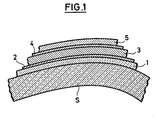
- a first layer 1 made of an oxide from the group consisting of tin oxide, silicon dioxide and aluminum is placed on this substrate oxide, tantalum oxide, zirconium oxide or their mixed oxides applied.
- a third layer 3 of silver or a silver alloy with at least 50 percent by weight of silver and then a fourth layer 4 of a metal from the group of tantalum, tungsten, nickel, iron or alloys with at least 50 percent by weight of one of these metals, and a fifth or subsequent layer 5 follows, which like the first layer in turn consists of an oxide from the group consisting of tin oxide, silicon dioxide, aluminum oxide, tantalum oxide, zirconium oxide or their mixed oxides.
- the third layer 3 made of silver there is no need for a symmetrical layer structure, but that the layer materials can also be varied within the metals or oxides specified in a group.
- curves 1a and 1b stand for the transmission values T, curves 2a and 2b for the reflection values R on the glass side and curves 3a and 3b for the reflection values R on the layer side. It is It can be clearly seen that the transmission maximum in the visible range between 500 and 550 nm has risen from approximately 78% to 85% as a result of the oxidative temperature treatment. The reflection values have also improved noticeably.
Landscapes
- Chemical & Material Sciences (AREA)
- Life Sciences & Earth Sciences (AREA)
- Engineering & Computer Science (AREA)
- Chemical Kinetics & Catalysis (AREA)
- General Chemical & Material Sciences (AREA)
- Geochemistry & Mineralogy (AREA)
- Materials Engineering (AREA)
- Organic Chemistry (AREA)
- Surface Treatment Of Glass (AREA)
- Laminated Bodies (AREA)
- Joining Of Glass To Other Materials (AREA)
- Glass Compositions (AREA)
Abstract
- Schicht 1: Oxid aus der Gruppe Zinnoxid, Siliziumdioxid, Aluminiumoxid, Tantaloxid, Zirkonoxid oder deren Mischoxide,
- Schicht 2: Metall aus der Gruppe Tantal, Wolfram, Nickel, Eisen oder deren Legierungen,
- Schicht 3: Silber oder eine Silberlegierung mit mindestens 50 Gewichtsprozent Silberanteil,
- Schicht 4: Metall aus der Gruppe Tantal, Wolfram, Nickel, Eisen oder deren Legierungen,
- Schicht 5: Oxid aus der Gruppe Zinnoxid, Siliziumdioxid, Aluminiumoxid, Tantaloxid, Zirkonoxid oder deren Mischoxide.
Im Anschluß daran wird das Substrat mit dem gesamten Schichtpaket auf die Erweichungstemperatur des Glases erwärmt und in die Endform gebogen.
Description
- Die Erfindung betrifft ein Verfahren zum Herstellen von Scheiben mit hohem Transmissionsverhalten im sichtbaren Spektralbereich und mit hohem Reflexionsverhalten für Wärmestrahlung nach dem Oberbegriff des Patentanspruchs 1 sowie eine Scheibe nach dem Oberbegriff des Patentanspruchs 8.
- Derartige Scheiben sollen einen möglichst großen Anteil des sichtbaren Lichts durchlassen und einen möglichst großen Anteil des nicht sichtbaren spektralen Anteils der Sonnenstrahlung zurückhalten. Diese Maßnahme soll im Sommer verhindern, daß die unerwünschte Wärmestrahlung des Sonnenlichts in Räume eindringt. Besonders bei Kraftfahrzeugen ist dieser Effekt wegen der schräggestellten und dadurch sehr großen Front- und Heckscheiben besonders unerwünscht.
- Durch die DE-OS 33 07 661 und die EP-OS 104 870 ist es bekannt, eine Silberschicht und eine unmittelbar auf das Silber aufgebrachte sehr dünne Metallschicht zwischen zwei Oxidschichten einzuschliessen, wobei die dünne Metallschicht die Silberschicht gegen einen chemisch-thermischen Angriff beim Herstellen der obersten Oxidschicht schützt. Setzt man ein derartiges Schichtsystem jedoch Temperaturen oberhalb 150 °C aus, so erfolgt eine Diffusion des Silbers in die angrenzende Oxid- und/oder Metallschicht, wobei ein starker Anstieg des Flächenwiderstandes und eine entsprechende Verringerung der Transmissionswerte des Schichtsystems zu beobachten ist, d.h. zwei der wesentlichen Eigenschaften des Schichtsystems werden verschlechtert.
- Durch die EP-PS 35 906 ist es bekannt, auf einer Seite oder beiden Seiten einer Silberschicht eine dünne metallische Schicht anzuordnen und dieses Schichtsystem gleichfalls zwischen zwei Oxidschichten einzubetten. Durch die dünne metallische Schicht soll eine größere Langzeitstabilität erreicht werden, wobei sich die Untersuchungen jedoch auf einen Temperaturbereich bis 120 °C beschränken. Da weiterhin durch das Absorptionsverhalten der metallischen Schichten eine Verschlechterung der optischen Transparenz der beschichteten Substrate eintritt, ist die Gesamtdicke der metallischen Schichten zur Erzielung eines bestimmten Transmissionsverhaltens begrenzt, und es soll daher bevorzugt nur eine einzige metallische Schicht auf der dem Substrat abgewandten Seite der Silberschicht angebracht werden, damit die Verschlechterung der Transmissionswerte in Grenzen gehalten werden kann. Es hat sich jedoch bei Verwendung von Substraten aus Mineralglas und einem derartigen Schichtsystem gezeigt, daß bei einer Erwärmung auf Temperaturen merklich oberhalb 150 °C gleichfalls eine Verschlechterung der Schichteigenschaften eintrat, und zwar nicht nur durch eine an sich wünschenswerte Erhöhung der Transmissionswerte im sichtbaren Bereich, sondern gleichzeitig auch durch einen unerwünschten Anstieg des Flächenwiderstandes, so daß die Bordspannung eines normalen Kraftfahrzeugs nicht mehr ausreicht, um im Winter eine ausreichende Beheizung durchzuführen. Weiterhin wurden Flecken und unerwünschte Lichtstreuungen beobachtet, die offensichtlich auf eine teilweise Agglomeratbildung sowie auf eine teilweise Diffusion des Silbers in die Oxidschichten hinein zurückzuführen ist.
- Dieses Verhalten läßt nur den Schluß zu, daß die Dicke der metallischen Schicht bzw. Schichten im Hinblick auf die angestrebten hohen Transmissionswerte im sichtbaren Bereich, die teilweise auf gesetzliche Vorschriften zurückzuführen sind (Kraftfahrzeugscheiben) für einen wirksamen Schutz der Silberschicht insbesondere bei höheren Temperaturen nicht mehr ausreichend ist.
- Es ist bekannt, gekrümmte oder gewölbte Scheiben mit annähernd ähnlichem spektralen Verhalten dadurch herzustellen, daß man eine in andere Schichten eingebettete Silberschicht auf bereits verformte Glassubstrate aufbringt. Dies setzt jedoch spezielle Beschichtungsanlagen voraus, die der unterschiedlichen Formgebung der Substrate Rechnung tragen und durch komplizierte Blendenanordnungen die Einflüsse unterschiedlicher Abstände von Flächenelementen des Substrats von den Beschichtungsquellen und unterschiedlicher Auftreffwinkel des Schichtmaterials kompensieren.
- Der Erfindung liegt daher die Aufgabe zugrunde, ein Verfahren der eingangs beschriebenen Gattung anzugeben, mit dem gekrümmte oder gewölbte Scheiben auf wirtschaftlichere Weise hergestellt werden können.
- Die Lösung der gestellten Aufgabe erfolgt bei dem eingangs beschriebenen Verfahren erfindungsgemäß durch die im Kennzeichen angegebene Maßnahme.
- Es wurde überraschend festgestellt, daß die bereits beschichteten Scheiben nicht nur bis auf die Erweichungstemperatur des Mineralglases von etwa 640 °C aufgeheizt werden können, sondern daß sie zusammen mit dem bereits aufgebrachten Schichtsystem bei derartigen Temperaturen auch noch plastisch verformt, d.h. gebogen und/oder durch Abschrecken gehärtet werden können, ohne daß sich die Schichteigenschaften verschlechtern oder das Schichtsystem sich gar ablöst. Diese Eigenschaft war nicht vorhersehbar, da die bekannten Schichtsysteme bereits bei überschreiten einer Temperatur von etwa 150 °C ihre wesentlichen Eigenschaften verloren.
- Die Möglichkeit bereits beschichtete Scheiben zu biegen, vorzugsweise für die Verwendung bei Automobilverglasungen, führt zu dem ganz erheblichen Vorteil, daß die Beschichtung in herkömmlichen Vakuumanlagen erfolgen kann, beispielsweise durch Vakuumaufdampfen und/oder Katodenzerstäubung, und daß die Scheiben nach dem Verlassen der Vakuumanlage in dem abschliessenden Verfahrensschritt an Luft gebogen und/oder gehärtet werden können, ohne die gezielt eingestellten Eigenschaften des beschichteten Glases nachteilig zu verändern. Dieser Vorteil ist insofern nicht zu unterschätzen, als die Handhabung von gebogenen Scheiben in Vakuumanlagen beträchtliche Probleme mit sich bringt und das Beschichten von stark gekrümmten Teilen dann problematisch ist, wenn das Schichtmaterial nicht mehr im wesentlichen im rechten Winkel auf das Substrat bzw. die Glasscheibe auftrifft.
- Bei dem erfindungsgemäßen Verfahren wird die Silberschicht nicht nur auf beiden Seiten von Metallschichten aus Tantal, Wolfram, Nickel, Eisen oder Legierungen mit diesen Metallen geschützt, sondern diese Metallschichten können auch in einer solchen Dicke aufgebracht werden, daß sie - ohne den Schritt der reaktiven Temperaturbehandlung - Transmissionswerte im sichtbaren Bereich aufweisen, die für den geforderten Endzweck eindeutig zu gering sind. Derartige, vergleichsweise dicke Schichten aus den genannten Metallen Tantal, Wolfram, Nickel und/oder Eisen üben jedoch auch bei einer Temperaturbehandlung von deutlich oberhalb 150 °C eine ausgezeichnete Schutzwirkung aus, so daß das ansonsten zu beobachtende Fleckigwerden und die Lichtstreuung unterbleiben.
- Durch die Temperaturbehandlung in oxidierender Atmosphäre oberhalb der Erweichungstemperatur des Glases werden die (anfänglich zu niedrigen) Transmissionswerte im sichtbaren Bereich deutlich angehoben und auf einen Wert gebracht, der dem geforderten Verwendungszweck der betreffenden Scheiben entspricht.
- Bei den erfindungsgemäßen Scheiben kann unter Beibehaltung der Mindest-Transmissionswerte im sichtbaren Spektralbereich die mittlere durchgelassene Sonnenenergiestrahlung auf Werte unter 50 % gesenkt werden, wobei der überwiegende Teil der Sonnenstrahlung reflektiert wird, also zu keiner Erwärmung der Scheibe beiträgt, wie dies bei in der Masse gefärbten Gläsern oder aufgebrachten Folien der Fall ist.
- Ein weiterer Vorteil der erfindungsgemäßen Scheiben besteht darin, daß infolge des geringen Flächenwiderstandes der Silberschicht über entsprechende Kontakte eine elektrische Spannung an die Scheibe angelegt werden kann, so daß z.B. bei einer Vereisung des Glases ein schnelles Abtauen herbeigeführt werden kann. So wurde beispielsweise bei dem erfindungsgemäßen Verfahren vor der oxidativen Temperaturbehandlung ein höherer Flächenwiderständ gemessen, nach der oxidativen Temperaturbehandlung jedoch ein geringerer Flächenwiderstand. Diese Erniedrigung des Flächenwiderstandes ist ein genau umgekehrter Effekt, wie er bei einem Diffusionsvorgang auftreten würde, und offensichtlich auf einen Rekristallisationsvorgana zurückzuführen. Bei einem Diffusionsvorgang ist nämlich eine Erhöhung des Flächenwiderstandes zu erwarten. Mit Flächenwiderständen unterhalb von etwa 5 Ohm/a ist aber eine Beheizung durch die übliche Bordspannung von 12 V ohne weiteres möglich.
- Durch die beidseitige Einbettung der Silberschicht zwischen Metallschichten relativ großer Dicke wird erreicht, daß die Silberschicht gegen die Diffusion von Sauerstoff aus den gleichfalls beidseitigen Oxidschichten wirksam geschützt wird. Die betreffenden Metallschichten werden dabei vorzugsweise in einer möglichst sauerstoffarmen bzw. sauerstoff-freien Atmosphäre aufgebracht, da Schichten, die von Anfang bereits teilweise oxidiert sind, eine zu hohe Porosität aufweisen und ihre Wirkung als Diffusionssperre nicht erfüllen können. Durch die nachfolgende oxidative Temperaturbehandlung wird die ursprünglich zu geringe Transmission jedoch wieder auf die vorgeschriebenen Werte erhöht, und zwar dadurch, daß die an der Silbersschicht anliegenden dünnen metallischen Schichten mindestens teilweise in ihre Oxide umgewandelt werden, was durch die Anwesenheit von Sauerstoff bei Temperaturen von mindestens etwa 640 °C mit ausreichend langsamer Geschwindigkeit geschieht. Dies bedeutet, daß die genaue Dicke der an der Silberschicht anliegenden metallischen Schichten für eine bestimmte Wärmebehandlung im Versuch ermittelt werden muß. Die Einstellung der Schichtdicken für die Schichten b) und d) erfolgt durch optische Messungen am Zwischenprodukt, d.h. vor der Temperaturbehandlung und durch entsprechende Wahl der Niederschlagsrate und der Beschichtungsdauer, d.h. durch entsprechende Variation dieser Beschichtungsparameter nach Maßgabe der Schichteigenschaften nach der Temperaturbehandlung. Anders ausgedrückt besagt dies, daß man aufgrund der Einwirkung der Temperaturbehandlung den Ausgangszustand vorausberechnen muß, um nach der Temperaturbehandlung das gewünschte Endergebnis zu erhalten. Dabei weisen die betreffenden metallischen Schichten vorzugsweise eine unterschiedliche Dicke auf, da sie wegen der unterschiedlich langen Diffusionswege auch unterschiedlichen Oxidationsbedingungen ausgesetzt sind.
- Die Silberschicht kann dabei eine reine Silberschicht sein, jedoch kann das Silber beispielsweise auch mit Kupfer (maximal 20 Gewichtsprozent), Palladium (maximal 30 Gewichtsprozent) und Platin (maximal 20 Gewichtsprozent) legiert sein.
- Es hat sich außerdem gezeigt, daß durch die Temperaturbehandlung ganz offensichtlich eine Ausheilung von Defekten in der Silberschicht möglich ist und eine deutliche Verbesserung der optischen und elektrischen Daten der fertigen Scheibe erreicht wird.
- Es ist besonders vorteilhaft, der fünften Schicht, d.h. der obersten Oxidschicht, Anteile von 4 bis 8 Gewichtsprozent Antimon oder Fluor oder von 5 bis 15 Gewichtsprozent Zinn zuzusetzen, um die Kontaktierung der elektrisch leitfähigen Schichten durch einen Lötvorgang zu erleichtern.
- Die einzelnen Schichten, insbesondere die oxidischen Schichten a) und e) können auch aus Teilschichten aufgebaut sein, d.h. eine Schichtenfolge aus zwei unterschiedlichen Oxiden bzw. Oxidgemischen wird als eine Schicht aufgefaßt, auch wenn sie in sich inhomogen ist.
- Weitere vorteilhafte Ausgestaltungen des Erfindungsgegenstandes sowie das Verfahrensprodukt sind in den übrigen Unteransprüchen aufgeführt.
- Ein Ausführungsbeispiel des Erfindu-gsgegenstandes wird na-h-folgend anhand der Figuren 1 bis 3 näher erläutert.
- Es zeigen:

- In Figur 1 ist mit S das Substrat bezeichnet, das aus einem Mineralglas wie beispielsweise einem üblichen Float-Glas wie einem Natrium-Silikat-Glas besteht. Auf dieses Substrat ist eine erste Schicht 1 aus einem Oxid aus der Gruppe Zinnoxid, Siliziumdioxid, Aluminiumoxid, Tantaloxid, Zirkonoxid oder deren Mischoxide aufgebracht. Darauf befindet sich eine zweite Schicht 2 aus einem Metall aus der Gruppe Tantal, Wolfram, Nickel und Eisen oder Legierungen mit Anteilen dieser Metalle. Als nächstes folgt eine dritte Schicht 3 aus Silber oder einer Silberlegierung mit mindestens 50 Gewichtsprozent Silberanteil, und hierauf wiederum eine vierte Schicht 4 aus einem Metall aus der Gruppe Tantal, Wolfram, Nickel, Eisen oder Legierungen mit mindestens 50 Gewichtsprozent Anteil eines dieser Metalle, und als Abschluß- oder Deckschicht folgt eine fünfte Schicht 5, die wie die erste Schicht wiederum aus einem Oxid aus der Gruppe Zinnoxid, Siliziumdioxid, Aluminiumoxid, Tantaloxid, Zirkonoxid oder deren Mischoxide besteht. Es versteht sich, daß im Hinblick auf die dritte Schicht 3 aus Silber kein symmetrischer Schichtaufbau vorliegen muß, sondern daß die Schichtmaterialien innerhalb der in einer Gruppe angegebenen Metalle bzw. Oxide auch variiert werden können.
- In den Figuren 2 und 3 sind auf der Ordinate die Transmissionswerte T bzw. die Reflexionswerte R in Prozent aufgetragen. Bei T bzw. R = 80 % ist eine horizontale Linie eingetragen.
- In den Figuren 2 und 3 stehen die Kurven 1a und 1b für die Transmissionswerte T, die Kurven 2a und 2b für die Reflexionswerte R auf der Glasseite und die Kurven 3a und 3 b für die Reflexionswerte R auf der Schichtseite. Es ist deutlich zu erkennen, daß das Transmissionsmaximum im sichtbaren Bereich zwischen 500 und 550 nm durch die oxidative Temperaturbehandlung von etwa 78 % auf 85 % angestiegen ist. Auch die Reflexionswerte haben sich merklich verbessert.
- In einer Vakuum-Beschichtungsanlage der Firma Leybold-Heraeus GmbH mit der Typenbezeichnung A 1100 Z3H/4 für Flachglas, die mit Hochleistungszerstäubungskatoden (Magnetronkatoden) ausgerüstet war, wurden Glasscheiben aus Floatglas mit den Abmessungen 1200 x 800 x 2 mm3 mit einer Schichtenfolge Sn02-Ni-Ag-Ni-Sn02 gemäß Figur 1 beschichtet, wobei die einzelnen Schichten folgende Dicken aufwiesen:

- (x) Experimentell angepaßt, so daß die maximale Transmission des Zwischenproduktes (d.h. vor der Temperaturbehandlung) im sichtbaren Bereich 67 % betrug. Im Anschluß daran wurde die beschichtete Scheibe für die Dauer von 5 Minuten in einem Temperofen bei gleichmäßiger Temperaturverteilung an Luft einer Temperatur von 640 °C ausgesetzt, wobei eine Krümmung des Glases erfolgte. Aus den Meßdaten war ersichtlich, daß durch die oxidative Temperaturbehandlung die optischen Transmissionswerte im sichtbaren Spektralbereich um ca. 8 % erhöht wurden und der Flächenwiderstand um 1,0 Ohm/ herabgesetzt wurde. Dies bedeutet, daß die angestrebten Eigenschaften der Scheibe durch die oxidative Temperaturbehandlung deutlich verbessert wurden.
- Auf die gleiche Weise wie in Beispiel 1 wurde das nachstehend angegebene Schichtsystem hergestellt:

- (x) Experimentell angepaßt, so daß die maximale Transmission im sichtbaren Bereich 77 % betrug. Die optischen Daten des noch nicht getemperten Schichtpakets sind in Figur 2 dargestellt, und zwar wie angegeben, die Transmission T und die Reflexion R auf der Schichtseite und auf der Glasseite. Die betreffenden Messungen wurden an einem Spektralfotometer vom Typ Lambda 9 der Firma Perkin Elmer durchgeführt, das für die Reflexionsmessungen mit einer Ulbrichtschen Kugel ausgerüstet war. Weiterhin wurden aus den gemessenen Daten nach DIN 67507 die Lichttransmission und die Sonnenenergietransmission berechnet (Tabelle). Die nach der gleichen oxidativen Temperaturbehandlung wie in Beispiel 1 und nach dem Abkühlen der Scheibe erneut gemessenen optischen Daten sind in Figur 3 dargestellt.
- Die spektrale Abhängigkeit der Transmissions- und Reflexionswerte entsprach dabei im wesentlichen den Kurven in Figur 3. Auch hier ergab sich durch die oxidative Temperaturbehandlung eine Erhöhung des maximalen Transmissionswertes von 75 % auf 83 % und eine Herabsetzung des Flächenwiderstandes von 4,7 Ohm/auf 2,5 Ohm/
 . Weiterhin ergab sich, daß nach der Temperaturbehandlung 34 % der Sonnenenergiestrahlung reflektiert und nur etwa 15 % absorbiert wurden, so daß die gesamte Sonnenenergietransmission auf 50 % begrenzt wurde.

Claims (8)
dadurch gekennzeichnet, daß die Scheibe gebogen ist.
Priority Applications (1)
| Application Number | Priority Date | Filing Date | Title |
|---|---|---|---|
| AT86116068T ATE60316T1 (de) | 1985-12-06 | 1986-11-20 | Verfahren zum herstellen von scheiben mit hohem transmissionsverhalten im sichtbaren spektralbereich und mit hohem reflexionsverhalten fuer waermestrahlung. |
Applications Claiming Priority (2)
| Application Number | Priority Date | Filing Date | Title |
|---|---|---|---|
| DE3543178 | 1985-12-06 | ||
| DE19853543178 DE3543178A1 (de) | 1985-12-06 | 1985-12-06 | Verfahren zum herstellen von scheiben mit hohem transmissionsverhalten im sichtbaren spektralbereich und mit hohem reflexionsverhalten fuer waermestrahlung sowie durch das verfahren hergestellte scheiben |
Publications (2)
| Publication Number | Publication Date |
|---|---|
| EP0229921A1 true EP0229921A1 (de) | 1987-07-29 |
| EP0229921B1 EP0229921B1 (de) | 1991-01-23 |
Family
ID=6287817
Family Applications (1)
| Application Number | Title | Priority Date | Filing Date |
|---|---|---|---|
| EP86116068A Expired - Lifetime EP0229921B1 (de) | 1985-12-06 | 1986-11-20 | Verfahren zum Herstellen von Scheiben mit hohem Transmissionsverhalten im sichtbaren Spektralbereich und mit hohem Reflexionsverhalten für Wärmestrahlung |
Country Status (6)
| Country | Link |
|---|---|
| US (1) | US4919778A (de) |
| EP (1) | EP0229921B1 (de) |
| JP (1) | JPS62216944A (de) |
| AT (1) | ATE60316T1 (de) |
| DE (2) | DE3543178A1 (de) |
| ES (1) | ES2020182B3 (de) |
Cited By (12)
| Publication number | Priority date | Publication date | Assignee | Title |
|---|---|---|---|---|
| US4749397A (en) * | 1986-01-29 | 1988-06-07 | Pilington Brothers P.L.C. | Method of coating glass |
| DE3806124A1 (de) * | 1988-02-26 | 1989-09-07 | Leybold Ag | Verfahren zum herstellen von scheiben aus mineralglas mit hohem transmissionsverhalten im sichtbaren spektralbereich und mit niedriger sonnenenergietransmission sowie durch das verfahren hergestellte scheiben |
| EP0418435A1 (de) * | 1987-07-24 | 1991-03-27 | Guardian Industries Corp. | Mehrlagige Dünnfilmbeschichtungen mit geringem Emissionsvermögen |
| EP0281894B1 (de) * | 1987-03-13 | 1992-12-09 | Flachglas Aktiengesellschaft | Verfahren zum Herstellen einer vorgespannten und/oder gebogenen Glasscheibe mit Silberschicht, danach hergestellte Glasscheibe sowie deren Verwendung |
| EP0599071A1 (de) * | 1992-11-24 | 1994-06-01 | Leybold Aktiengesellschaft | Transparentes Substrat mit einem transparenten Schichtsystem und Verfahren zur Herstellung eines solchen Schichtsystems |
| EP0636587A2 (de) | 1993-07-22 | 1995-02-01 | Saint Gobain Vitrage International | Verfahren zur Herstellung einer mit einer Mehrfachschicht versehenen Glasscheibe |
| DE4412318C1 (de) * | 1994-04-11 | 1995-11-16 | Ver Glaswerke Gmbh | Wärmebehandlung einer mit einer teilreflektierenden Silberschicht versehenen Glasscheibe |
| FR2728559A1 (fr) * | 1994-12-23 | 1996-06-28 | Saint Gobain Vitrage | Substrats en verre revetus d'un empilement de couches minces a proprietes de reflexion dans l'infrarouge et/ou dans le domaine du rayonnement solaire |
| US5543229A (en) * | 1991-10-30 | 1996-08-06 | Asahi Glass Company Ltd. | Method of making a heat treated coated glass |
| WO2002076901A1 (en) | 2001-03-27 | 2002-10-03 | Pilkington Deutschland Ag | Coated glass sheet |
| KR100459868B1 (ko) * | 2002-09-25 | 2004-12-03 | 한국과학기술연구원 | 저온 소성 세라믹 히터용 조성물 및 세라믹 히터 제조방법 |
| US8003235B2 (en) | 2006-03-31 | 2011-08-23 | Pilkington Group Limited | Coated glass pane |
Families Citing this family (75)
| Publication number | Priority date | Publication date | Assignee | Title |
|---|---|---|---|---|
| US4898790A (en) * | 1986-12-29 | 1990-02-06 | Ppg Industries, Inc. | Low emissivity film for high temperature processing |
| ATE73742T1 (de) * | 1987-08-08 | 1992-04-15 | Leybold Ag | Verfahren zum herstellen von scheiben mit hohem transmissionsverhalten im sichtbaren spektralbereich und mit hohem reflexionsverhalten fuer waermestrahlung sowie durch das verfahren hergestellte scheiben. |
| DE3825671A1 (de) * | 1987-08-08 | 1989-03-02 | Leybold Ag | Verfahren zum herstellen von scheiben mit hohem transmissionsverhalten im sichtbaren spektralbereich und mit hohem reflexionsverhalten fuer waermestrahlung sowie durch das verfahren hergestellte scheiben |
| US5201926A (en) * | 1987-08-08 | 1993-04-13 | Leybold Aktiengesellschaft | Method for the production of coated glass with a high transmissivity in the visible spectral range and with a high reflectivity for thermal radiation |
| DE3728478A1 (de) * | 1987-08-26 | 1989-03-09 | Leybold Ag | Verfahren zum herstellen von scheiben mit hohem transmissionsverhalten im sichtbaren spektralbereich und mit hohem reflexionsverhalten fuer waermestrahlung sowie durch das verfahren hergestellte scheiben |
| JPH0764598B2 (ja) * | 1987-12-01 | 1995-07-12 | 旭硝子株式会社 | 赤外線遮断ガラス |
| US5605609A (en) * | 1988-03-03 | 1997-02-25 | Asahi Glass Company Ltd. | Method for forming low refractive index film comprising silicon dioxide |
| JP2518116B2 (ja) * | 1988-03-03 | 1996-07-24 | 旭硝子株式会社 | 耐久性の優れた光学体の製造方法 |
| US4834857A (en) * | 1988-04-01 | 1989-05-30 | Ppg Industries, Inc. | Neutral sputtered films of metal alloy oxides |
| US4898789A (en) * | 1988-04-04 | 1990-02-06 | Ppg Industries, Inc. | Low emissivity film for automotive heat load reduction |
| JP2601546B2 (ja) * | 1988-10-21 | 1997-04-16 | 旭硝子株式会社 | 耐擦傷性保護膜付ガラス基体の製造方法 |
| JPH0791089B2 (ja) * | 1988-12-13 | 1995-10-04 | セントラル硝子株式会社 | 熱線反射ガラス |
| JPH0764599B2 (ja) * | 1988-12-20 | 1995-07-12 | 旭硝子株式会社 | 耐久性の優れた熱線反射性を有する光学体 |
| DE3906374A1 (de) * | 1989-03-01 | 1990-09-06 | Leybold Ag | Verfahren zum herstellen von scheiben mit hohem transmissionsverhalten im sichtbaren spektralbereich und mit hohem reflexionsverhalten fuer waermestrahlung |
| JP2917432B2 (ja) * | 1989-08-01 | 1999-07-12 | 旭硝子株式会社 | 電導性ガラスの製造方法 |
| US5216551A (en) * | 1990-02-16 | 1993-06-01 | Asahi Kogaku Kogyo K.K. | Surface reflector |
| GB2267509B (en) * | 1990-02-16 | 1994-07-20 | Asahi Optical Co Ltd | Surface reflector |
| DE4109708C1 (de) * | 1991-03-23 | 1992-11-12 | Vegla Vereinigte Glaswerke Gmbh, 5100 Aachen, De | |
| AU655119B2 (en) * | 1992-07-11 | 1994-12-01 | Pilkington Glass Limited | Coatings on glass |
| GB9400323D0 (en) * | 1994-01-10 | 1994-03-09 | Pilkington Glass Ltd | Coatings on glass |
| GB9400319D0 (en) * | 1994-01-10 | 1994-03-09 | Pilkington Glass Ltd | Coatings on glass |
| GB9400320D0 (en) * | 1994-01-10 | 1994-03-09 | Pilkington Glass Ltd | Coating on glass |
| FR2719036B1 (fr) * | 1994-04-21 | 1996-05-24 | Saint Gobain Vitrage | Substrats en verre revêtus d'un empilement de couches minces, à propriétés de réflexion dans l'infra-rouge et/ou dans le domaine du rayonnement solaire. |
| US5472795A (en) * | 1994-06-27 | 1995-12-05 | Board Of Regents Of The University Of The University Of Wisconsin System, On Behalf Of The University Of Wisconsin-Milwaukee | Multilayer nanolaminates containing polycrystalline zirconia |
| FR2727107B1 (fr) * | 1994-11-21 | 1996-12-27 | Saint Gobain Vitrage | Vitrage muni d'au moins une couche mince et son procede d'obtention |
| US5812405A (en) * | 1995-05-23 | 1998-09-22 | Viratec Thin Films, Inc. | Three variable optimization system for thin film coating design |
| FR2734811B1 (fr) * | 1995-06-01 | 1997-07-04 | Saint Gobain Vitrage | Substrats transparents revetus d'un empilement de couches minces a proprietes de reflexion dans l'infrarouge et/ou dans le domaine du rayonnement solaire |
| DE19520843A1 (de) * | 1995-06-08 | 1996-12-12 | Leybold Ag | Scheibe aus durchscheinendem Werkstoff sowie Verfahren zu ihrer Herstellung |
| DE19533053C1 (de) * | 1995-09-07 | 1997-04-17 | Ver Glaswerke Gmbh | Verfahren zum Beschichten einer Glasscheibe mit einer wenigstens eine Silberschicht aufweisenden Mehrfachschicht |
| DE19607611C1 (de) * | 1996-02-29 | 1997-10-02 | Sekurit Saint Gobain Deutsch | Thermisch hoch belastbares Schichtsystem für Glasscheiben und Verwendung einer mit dem Schichtsystem beschichteten Glasscheibe |
| US6231999B1 (en) * | 1996-06-21 | 2001-05-15 | Cardinal Ig Company | Heat temperable transparent coated glass article |
| US6132881A (en) * | 1997-09-16 | 2000-10-17 | Guardian Industries Corp. | High light transmission, low-E sputter coated layer systems and insulated glass units made therefrom |
| US6436541B1 (en) | 1998-04-07 | 2002-08-20 | Ppg Industries Ohio, Inc. | Conductive antireflective coatings and methods of producing same |
| US6660365B1 (en) | 1998-12-21 | 2003-12-09 | Cardinal Cg Company | Soil-resistant coating for glass surfaces |
| US6964731B1 (en) * | 1998-12-21 | 2005-11-15 | Cardinal Cg Company | Soil-resistant coating for glass surfaces |
| US6974629B1 (en) * | 1999-08-06 | 2005-12-13 | Cardinal Cg Company | Low-emissivity, soil-resistant coating for glass surfaces |
| US6395398B1 (en) * | 1999-03-31 | 2002-05-28 | Central Glass Company, Limited | Frequency selective plate and method for producing same |
| WO2001024929A1 (de) * | 1999-10-06 | 2001-04-12 | Infineon Technologies Ag | Substrat mit mindestems eimer pore |
| JP4453886B2 (ja) | 2000-06-05 | 2010-04-21 | フジノン株式会社 | アルミ反射鏡の製造方法およびアルミ反射鏡 |
| EP1326809B1 (de) * | 2000-09-29 | 2006-09-06 | Schott Ag | Optisches substrat sowie ein verahren zur herstellung optischer substrate |
| US7232615B2 (en) * | 2001-10-22 | 2007-06-19 | Ppg Industries Ohio, Inc. | Coating stack comprising a layer of barrier coating |
| BE1014579A3 (fr) * | 2002-01-17 | 2004-01-13 | Glaverbel | Vitrage a couches transforme thermiquement. |
| US6919133B2 (en) * | 2002-03-01 | 2005-07-19 | Cardinal Cg Company | Thin film coating having transparent base layer |
| EP1480920B1 (de) * | 2002-03-01 | 2006-11-02 | Cardinal CG Company | Dünnfilmbeschichtung mit einer transparenten grundierungsschicht |
| US6827977B2 (en) * | 2002-03-07 | 2004-12-07 | Guardian Industries Corp. | Method of making window unit including diamond-like carbon (DLC) coating |
| US7067195B2 (en) * | 2002-04-29 | 2006-06-27 | Cardinal Cg Company | Coatings having low emissivity and low solar reflectance |
| US7122252B2 (en) * | 2002-05-16 | 2006-10-17 | Cardinal Cg Company | High shading performance coatings |
| JP4298654B2 (ja) * | 2002-07-31 | 2009-07-22 | 日本板硝子株式会社 | 焼入れ可能な高遮光性コーティング |
| US7294404B2 (en) * | 2003-12-22 | 2007-11-13 | Cardinal Cg Company | Graded photocatalytic coatings |
| US8524051B2 (en) * | 2004-05-18 | 2013-09-03 | Centre Luxembourg de Recherches pour le Verre et al Ceramique S. A. (C.R.V.C.) | Coated article with oxidation graded layer proximate IR reflecting layer(s) and corresponding method |
| US7311975B2 (en) * | 2004-06-25 | 2007-12-25 | Centre Luxembourgeois De Recherches Pour Le Verre Et La Ceramique S.A. (C.R.V.C.) | Coated article having low-E coating with ion beam treated IR reflecting layer and corresponding method |
| US7563347B2 (en) * | 2004-06-25 | 2009-07-21 | Centre Luxembourgeois De Recherches Pour Le Verre Et La Ceramique S.A. (C.R.V.C.) | Method of forming coated article using sputtering target(s) and ion source(s) and corresponding apparatus |
| US7229533B2 (en) * | 2004-06-25 | 2007-06-12 | Guardian Industries Corp. | Method of making coated article having low-E coating with ion beam treated and/or formed IR reflecting layer |
| EP1765740B1 (de) * | 2004-07-12 | 2007-11-07 | Cardinal CG Company | Wartungsarme beschichtungen |
| US7923114B2 (en) | 2004-12-03 | 2011-04-12 | Cardinal Cg Company | Hydrophilic coatings, methods for depositing hydrophilic coatings, and improved deposition technology for thin films |
| US8092660B2 (en) * | 2004-12-03 | 2012-01-10 | Cardinal Cg Company | Methods and equipment for depositing hydrophilic coatings, and deposition technologies for thin films |
| JP2009534563A (ja) * | 2006-04-19 | 2009-09-24 | 日本板硝子株式会社 | 同等の単独の表面反射率を有する対向機能コーティング |
| US20080011599A1 (en) | 2006-07-12 | 2008-01-17 | Brabender Dennis M | Sputtering apparatus including novel target mounting and/or control |
| GB0625513D0 (en) * | 2006-12-21 | 2007-01-31 | Pilkington Group Ltd | Coated glass panes and porcess for their manufacture |
| DE102007036407B4 (de) * | 2007-02-28 | 2010-01-28 | Schott Ag | Verfahren zur Herstellung einer beschichteten dreidimensional verformten Scheibe aus Glaskeramik |
| PL1975274T3 (pl) * | 2007-03-14 | 2012-10-31 | Fraunhofer Ges Forschung | Sposób wytwarzania izolujących cieplnie, silnie przezroczystych systemów warstwowych oraz system warstwowy wytworzony według tego sposobu |
| CA2664369A1 (en) * | 2007-09-14 | 2009-03-19 | Cardinal Cg Company | Low-maintenance coatings, and methods for producing low-maintenance coatings |
| DE102009051796A1 (de) | 2009-11-03 | 2011-05-05 | Kramer & Best Process Engineering Gmbh | Thermisch belastbares Schichtsystem |
| DE102010008518B4 (de) | 2010-02-18 | 2013-11-28 | Von Ardenne Anlagentechnik Gmbh | Wärmebehandelbares Infrarotstrahlung reflektierendes Schichtsystem und Verfahren zu dessen Herstellung |
| DE102011087967B4 (de) | 2011-12-08 | 2016-12-29 | Von Ardenne Gmbh | Farbstabiles, IR-reflektierendes und transparentes Low-E-Schichtsystem und Verfahren zu dessen Herstellung, Glaseinheit |
| DE102012207561A1 (de) | 2012-05-07 | 2013-11-07 | Von Ardenne Anlagentechnik Gmbh | IR-reflektierendes, transparentes Schichtsystem und Verfahren zu dessen Herstellung |
| DE102012207556A1 (de) | 2012-05-07 | 2013-11-07 | Von Ardenne Anlagentechnik Gmbh | IR-reflektierendes, transparentes Schichtsystem und Verfahren zu dessen Herstellung |
| PH12015501774B1 (en) | 2013-02-14 | 2023-12-06 | Agc Glass Europe | Solar control glazing |
| US9499899B2 (en) * | 2013-03-13 | 2016-11-22 | Intermolecular, Inc. | Systems, methods, and apparatus for production coatings of low-emissivity glass including a ternary alloy |
| DE102013111845B4 (de) | 2013-10-28 | 2022-04-14 | VON ARDENNE Asset GmbH & Co. KG | Kratzfestes Infrarotstrahlung reflektierendes Schichtsystem und Verfahren zu dessen Herstellung |
| DE102014108650A1 (de) | 2014-06-20 | 2016-01-07 | Von Ardenne Gmbh | Stabiles IR-reflektierendes Schichtsystem und Verfahren zu dessen Herstellung |
| DE102014108651B4 (de) | 2014-06-20 | 2016-07-07 | Von Ardenne Gmbh | Infrarotstrahlung reflektierendes Schichtsystem mit hoher Stabilität gegen mechanische Belastungen und Verfahren zu dessen Herstellung |
| WO2018093985A1 (en) | 2016-11-17 | 2018-05-24 | Cardinal Cg Company | Static-dissipative coating technology |
| US10472274B2 (en) | 2017-07-17 | 2019-11-12 | Guardian Europe S.A.R.L. | Coated article having ceramic paint modified surface(s), and/or associated methods |
| US11495557B2 (en) * | 2020-03-20 | 2022-11-08 | Advanced Semiconductor Engineering, Inc. | Semiconductor device and method of manufacturing the same |
Citations (3)
| Publication number | Priority date | Publication date | Assignee | Title |
|---|---|---|---|---|
| USRE25711E (en) * | 1965-01-19 | Method for producing electrically conductive windshield | ||
| CH400714A (de) * | 1960-05-21 | 1965-10-15 | Bosch Gmbh Robert | Oberflächenspiegel mit metallischer Spiegelschicht und anorganischer Schutzschicht |
| GB2135697A (en) * | 1983-03-04 | 1984-09-05 | Leybold Heraeus Gmbh & Co Kg | Thermally insulating glazing |
Family Cites Families (8)
| Publication number | Priority date | Publication date | Assignee | Title |
|---|---|---|---|---|
| US25711A (en) * | 1859-10-11 | Machine fob bending wood | ||
| DE2309288C3 (de) * | 1973-02-24 | 1975-09-18 | W.C. Heraeus Gmbh, 6450 Hanau | Durchsichtige Scheibe, insbesondere Fensterscheibe, aus Glas oder Kunststoff mit wärmereflektierender, silberhaltiger Metallschicht und ihre Verwendung |
| US4337990A (en) * | 1974-08-16 | 1982-07-06 | Massachusetts Institute Of Technology | Transparent heat-mirror |
| DE2924824C3 (de) * | 1979-06-20 | 1986-07-10 | Bfg Glassgroup, Paris | Wärmereflexionsscheibe, insbesondere wärmereflektierende Fensterscheibe und deren Verwendung als Außenscheibe einer Mehrscheibenanordnung |
| DE3160998D1 (en) * | 1980-03-10 | 1983-11-03 | Teijin Ltd | Selectively light-transmitting laminated structure |
| NO157212C (no) * | 1982-09-21 | 1988-02-10 | Pilkington Brothers Plc | Fremgangsmaate for fremstilling av belegg med lav emisjonsevne. |
| US4650557A (en) * | 1982-11-03 | 1987-03-17 | Donnelly Corporation | Process for making a conductively coated glass member and the product thereof |
| DE3316548C2 (de) * | 1983-03-25 | 1985-01-17 | Flachglas AG, 8510 Fürth | Verfahren zur Beschichtung eines transparenten Substrates |
-
1985
- 1985-12-06 DE DE19853543178 patent/DE3543178A1/de not_active Withdrawn
-
1986
- 1986-11-20 AT AT86116068T patent/ATE60316T1/de not_active IP Right Cessation
- 1986-11-20 DE DE8686116068T patent/DE3677178D1/de not_active Expired - Fee Related
- 1986-11-20 EP EP86116068A patent/EP0229921B1/de not_active Expired - Lifetime
- 1986-11-20 ES ES86116068T patent/ES2020182B3/es not_active Expired - Lifetime
- 1986-12-05 JP JP61289119A patent/JPS62216944A/ja active Pending
-
1989
- 1989-05-19 US US07/356,668 patent/US4919778A/en not_active Expired - Fee Related
Patent Citations (3)
| Publication number | Priority date | Publication date | Assignee | Title |
|---|---|---|---|---|
| USRE25711E (en) * | 1965-01-19 | Method for producing electrically conductive windshield | ||
| CH400714A (de) * | 1960-05-21 | 1965-10-15 | Bosch Gmbh Robert | Oberflächenspiegel mit metallischer Spiegelschicht und anorganischer Schutzschicht |
| GB2135697A (en) * | 1983-03-04 | 1984-09-05 | Leybold Heraeus Gmbh & Co Kg | Thermally insulating glazing |
Non-Patent Citations (1)
| Title |
|---|
| CHEMICAL ABSTRACTS, Band 93, Nr. 24, Dezember 1980, Seite 252, Zusammenfassung Nr. 224625r, Columbus, Ohio, US; & JP-A-80 67 547 (ASAHI GLASS CO., LTD.) 21-05-1980 * |
Cited By (17)
| Publication number | Priority date | Publication date | Assignee | Title |
|---|---|---|---|---|
| US4894290A (en) * | 1986-01-29 | 1990-01-16 | Pilkington Brothers P.L.C. | Coated glass |
| US4749397A (en) * | 1986-01-29 | 1988-06-07 | Pilington Brothers P.L.C. | Method of coating glass |
| EP0281894B1 (de) * | 1987-03-13 | 1992-12-09 | Flachglas Aktiengesellschaft | Verfahren zum Herstellen einer vorgespannten und/oder gebogenen Glasscheibe mit Silberschicht, danach hergestellte Glasscheibe sowie deren Verwendung |
| EP0418435A1 (de) * | 1987-07-24 | 1991-03-27 | Guardian Industries Corp. | Mehrlagige Dünnfilmbeschichtungen mit geringem Emissionsvermögen |
| DE3806124A1 (de) * | 1988-02-26 | 1989-09-07 | Leybold Ag | Verfahren zum herstellen von scheiben aus mineralglas mit hohem transmissionsverhalten im sichtbaren spektralbereich und mit niedriger sonnenenergietransmission sowie durch das verfahren hergestellte scheiben |
| US5543229A (en) * | 1991-10-30 | 1996-08-06 | Asahi Glass Company Ltd. | Method of making a heat treated coated glass |
| EP0599071A1 (de) * | 1992-11-24 | 1994-06-01 | Leybold Aktiengesellschaft | Transparentes Substrat mit einem transparenten Schichtsystem und Verfahren zur Herstellung eines solchen Schichtsystems |
| EP0636587A2 (de) | 1993-07-22 | 1995-02-01 | Saint Gobain Vitrage International | Verfahren zur Herstellung einer mit einer Mehrfachschicht versehenen Glasscheibe |
| EP0636587A3 (de) * | 1993-07-22 | 1995-10-11 | Saint Gobain Vitrage | Verfahren zur Herstellung einer mit einer Mehrfachschicht versehenen Glasscheibe. |
| DE4412318C1 (de) * | 1994-04-11 | 1995-11-16 | Ver Glaswerke Gmbh | Wärmebehandlung einer mit einer teilreflektierenden Silberschicht versehenen Glasscheibe |
| DE4412318C2 (de) * | 1994-04-11 | 1998-08-13 | Ver Glaswerke Gmbh | Wärmebehandlung einer mit einer teilreflektierenden Silberschicht versehenen Glasscheibe |
| FR2728559A1 (fr) * | 1994-12-23 | 1996-06-28 | Saint Gobain Vitrage | Substrats en verre revetus d'un empilement de couches minces a proprietes de reflexion dans l'infrarouge et/ou dans le domaine du rayonnement solaire |
| EP0718250A3 (de) * | 1994-12-23 | 1998-05-06 | Saint-Gobain Vitrage | Glasssubstrate beschichtet mit einem Dünnschichtaufbau mit reflektierenden Eigenschaften für Infrarot- und/oder Sonnenstrahlung |
| EP1382583A3 (de) * | 1994-12-23 | 2008-07-16 | Saint-Gobain Glass France | Glasssubstrate, beschichtet mit einem Dünnschichtaufbau mit reflektierenden Eigenschaften für Infrarot- und/oder Sonnenstrahlung |
| WO2002076901A1 (en) | 2001-03-27 | 2002-10-03 | Pilkington Deutschland Ag | Coated glass sheet |
| KR100459868B1 (ko) * | 2002-09-25 | 2004-12-03 | 한국과학기술연구원 | 저온 소성 세라믹 히터용 조성물 및 세라믹 히터 제조방법 |
| US8003235B2 (en) | 2006-03-31 | 2011-08-23 | Pilkington Group Limited | Coated glass pane |
Also Published As
| Publication number | Publication date |
|---|---|
| EP0229921B1 (de) | 1991-01-23 |
| US4919778A (en) | 1990-04-24 |
| DE3677178D1 (de) | 1991-02-28 |
| JPS62216944A (ja) | 1987-09-24 |
| DE3543178A1 (de) | 1987-06-11 |
| ATE60316T1 (de) | 1991-02-15 |
| ES2020182B3 (es) | 1991-08-01 |
Similar Documents
| Publication | Publication Date | Title |
|---|---|---|
| EP0229921B1 (de) | Verfahren zum Herstellen von Scheiben mit hohem Transmissionsverhalten im sichtbaren Spektralbereich und mit hohem Reflexionsverhalten für Wärmestrahlung | |
| EP0303109B1 (de) | Verfahren zum Herstellen von Scheiben mit hohem Transmissionsverhalten im sichtbaren Spektralbereich und mit hohem Reflexionsverhalten für Wärmestrahlung sowie durch das Verfahren hergestellte Scheiben | |
| EP0281894B1 (de) | Verfahren zum Herstellen einer vorgespannten und/oder gebogenen Glasscheibe mit Silberschicht, danach hergestellte Glasscheibe sowie deren Verwendung | |
| DE3544840C2 (de) | ||
| DE69526191T2 (de) | Geglühte Beschichtung mit niedrigem Strahlungsvermögen | |
| DE19852358C1 (de) | Thermisch hoch belastbares Low-E-Schichtsystem | |
| DE60026157T2 (de) | Verglasung | |
| EP0543077B1 (de) | Verfahren zum Herstellen von Scheiben mit hohem Transmissionsverhalten im sichtbaren Spektralbereich und mit hohem Reflexionsverhalten für Wärmestrahlung sowie durch das Verfahren hergestellte Scheiben | |
| EP2300389B1 (de) | Glasprodukt | |
| DE69925641T2 (de) | Verglasungsscheibe | |
| DE10105199C1 (de) | Vorspannbares Low-E-Schichtsystem für Fensterscheiben sowie mit dem Low-E-Schichtsystem beschichtete transparente Scheibe | |
| EP3390044B1 (de) | Beheizbares verbundglas mit dünner innenscheibe und dünner aussenscheibe | |
| DE3825671A1 (de) | Verfahren zum herstellen von scheiben mit hohem transmissionsverhalten im sichtbaren spektralbereich und mit hohem reflexionsverhalten fuer waermestrahlung sowie durch das verfahren hergestellte scheiben | |
| DE3628057A1 (de) | Verfahren zur herstellung von waermereflektierendem glas | |
| DE19533053C1 (de) | Verfahren zum Beschichten einer Glasscheibe mit einer wenigstens eine Silberschicht aufweisenden Mehrfachschicht | |
| EP0226901A2 (de) | Verfahren zum Herstellen von Kontaktbahnen auf Substraten, insbesondere auf Scheiben, und durch das Verfahren hergestellte Scheiben | |
| DE202012013088U1 (de) | Anlage zur Beschichtung und Wärmebehandlung | |
| DE10115196A1 (de) | Glasscheibe als Vorprodukt für eine thermisch vorgespannte und/oder gebogene Glasscheibe mit Sonnenschutz- und/oder Low-E-Beschichtung | |
| EP2394969B1 (de) | Verwendung von Gläsern für Photovoltaik-Anwendungen | |
| DE69529114T2 (de) | Herstellungsverfahren für eine mit einer halbreflektierenden Silberschicht bekleideten Glassscheibe | |
| EP0636587B1 (de) | Verfahren zur Herstellung einer mit einer Mehrfachschicht versehenen Glasscheibe | |
| DE69220655T2 (de) | Beschichtung mit niedriger Emittierung | |
| DE19719542C1 (de) | Low-E-Schichtsystem für transparente Substrate | |
| DE69907747T2 (de) | Verglasungsscheibe | |
| DE19719543C1 (de) | Low-E-Schichtsystem für Glasscheiben |
Legal Events
| Date | Code | Title | Description |
|---|---|---|---|
| PUAI | Public reference made under article 153(3) epc to a published international application that has entered the european phase |
Free format text: ORIGINAL CODE: 0009012 |
|
| AK | Designated contracting states |
Kind code of ref document: A1 Designated state(s): AT BE CH DE ES FR GB IT LI LU NL SE |
|
| 17P | Request for examination filed |
Effective date: 19870915 |
|
| RAP1 | Party data changed (applicant data changed or rights of an application transferred) |
Owner name: LEYBOLD AKTIENGESELLSCHAFT |
|
| 17Q | First examination report despatched |
Effective date: 19881018 |
|
| GRAA | (expected) grant |
Free format text: ORIGINAL CODE: 0009210 |
|
| AK | Designated contracting states |
Kind code of ref document: B1 Designated state(s): AT BE CH DE ES FR GB IT LI LU NL SE |
|
| REF | Corresponds to: |
Ref document number: 60316 Country of ref document: AT Date of ref document: 19910215 Kind code of ref document: T |
|
| ITF | It: translation for a ep patent filed | ||
| GBT | Gb: translation of ep patent filed (gb section 77(6)(a)/1977) | ||
| REF | Corresponds to: |
Ref document number: 3677178 Country of ref document: DE Date of ref document: 19910228 |
|
| ET | Fr: translation filed | ||
| PLBE | No opposition filed within time limit |
Free format text: ORIGINAL CODE: 0009261 |
|
| STAA | Information on the status of an ep patent application or granted ep patent |
Free format text: STATUS: NO OPPOSITION FILED WITHIN TIME LIMIT |
|
| 26N | No opposition filed | ||
| PGFP | Annual fee paid to national office [announced via postgrant information from national office to epo] |
Ref country code: FR Payment date: 19921010 Year of fee payment: 7 |
|
| PGFP | Annual fee paid to national office [announced via postgrant information from national office to epo] |
Ref country code: AT Payment date: 19921013 Year of fee payment: 7 |
|
| PGFP | Annual fee paid to national office [announced via postgrant information from national office to epo] |
Ref country code: CH Payment date: 19921015 Year of fee payment: 7 |
|
| PGFP | Annual fee paid to national office [announced via postgrant information from national office to epo] |
Ref country code: GB Payment date: 19921016 Year of fee payment: 7 |
|
| PGFP | Annual fee paid to national office [announced via postgrant information from national office to epo] |
Ref country code: SE Payment date: 19921019 Year of fee payment: 7 Ref country code: DE Payment date: 19921019 Year of fee payment: 7 |
|
| PGFP | Annual fee paid to national office [announced via postgrant information from national office to epo] |
Ref country code: BE Payment date: 19921026 Year of fee payment: 7 |
|
| PGFP | Annual fee paid to national office [announced via postgrant information from national office to epo] |
Ref country code: LU Payment date: 19921109 Year of fee payment: 7 |
|
| PGFP | Annual fee paid to national office [announced via postgrant information from national office to epo] |
Ref country code: ES Payment date: 19921110 Year of fee payment: 7 |
|
| PGFP | Annual fee paid to national office [announced via postgrant information from national office to epo] |
Ref country code: NL Payment date: 19921130 Year of fee payment: 7 |
|
| EPTA | Lu: last paid annual fee | ||
| PG25 | Lapsed in a contracting state [announced via postgrant information from national office to epo] |
Ref country code: LU Free format text: LAPSE BECAUSE OF NON-PAYMENT OF DUE FEES Effective date: 19931120 Ref country code: GB Effective date: 19931120 Ref country code: AT Effective date: 19931120 |
|
| PG25 | Lapsed in a contracting state [announced via postgrant information from national office to epo] |
Ref country code: SE Effective date: 19931121 Ref country code: ES Free format text: LAPSE BECAUSE OF NON-PAYMENT OF DUE FEES Effective date: 19931121 |
|
| PG25 | Lapsed in a contracting state [announced via postgrant information from national office to epo] |
Ref country code: LI Effective date: 19931130 Ref country code: CH Effective date: 19931130 Ref country code: BE Effective date: 19931130 |
|
| BERE | Be: lapsed |
Owner name: LEYBOLD A.G. Effective date: 19931130 |
|
| PG25 | Lapsed in a contracting state [announced via postgrant information from national office to epo] |
Ref country code: NL Effective date: 19940601 |
|
| NLV4 | Nl: lapsed or anulled due to non-payment of the annual fee | ||
| GBPC | Gb: european patent ceased through non-payment of renewal fee |
Effective date: 19931120 |
|
| PG25 | Lapsed in a contracting state [announced via postgrant information from national office to epo] |
Ref country code: FR Effective date: 19940729 |
|
| REG | Reference to a national code |
Ref country code: CH Ref legal event code: PL |
|
| PG25 | Lapsed in a contracting state [announced via postgrant information from national office to epo] |
Ref country code: DE Effective date: 19940802 |
|
| REG | Reference to a national code |
Ref country code: FR Ref legal event code: ST |
|
| EUG | Se: european patent has lapsed |
Ref document number: 86116068.7 Effective date: 19940610 |
|
| REG | Reference to a national code |
Ref country code: ES Ref legal event code: FD2A Effective date: 19941214 |
|
| PG25 | Lapsed in a contracting state [announced via postgrant information from national office to epo] |
Ref country code: IT Free format text: LAPSE BECAUSE OF NON-PAYMENT OF DUE FEES;WARNING: LAPSES OF ITALIAN PATENTS WITH EFFECTIVE DATE BEFORE 2007 MAY HAVE OCCURRED AT ANY TIME BEFORE 2007. THE CORRECT EFFECTIVE DATE MAY BE DIFFERENT FROM THE ONE RECORDED. Effective date: 20051120 |