EP0211395B1 - Polymerisate mit Aminogruppen, deren Herstellung und Verwendung - Google Patents
Polymerisate mit Aminogruppen, deren Herstellung und Verwendung Download PDFInfo
- Publication number
- EP0211395B1 EP0211395B1 EP86110539A EP86110539A EP0211395B1 EP 0211395 B1 EP0211395 B1 EP 0211395B1 EP 86110539 A EP86110539 A EP 86110539A EP 86110539 A EP86110539 A EP 86110539A EP 0211395 B1 EP0211395 B1 EP 0211395B1
- Authority
- EP
- European Patent Office
- Prior art keywords
- polymer
- polymers
- alkyl
- groups
- functional groups
- Prior art date
- Legal status (The legal status is an assumption and is not a legal conclusion. Google has not performed a legal analysis and makes no representation as to the accuracy of the status listed.)
- Expired
Links
- 229920000642 polymer Polymers 0.000 title claims description 68
- 125000003277 amino group Chemical group 0.000 title claims description 9
- 238000004519 manufacturing process Methods 0.000 title description 3
- IJGRMHOSHXDMSA-UHFFFAOYSA-N Atomic nitrogen Chemical compound N#N IJGRMHOSHXDMSA-UHFFFAOYSA-N 0.000 claims description 38
- 229910052757 nitrogen Inorganic materials 0.000 claims description 19
- 125000000524 functional group Chemical group 0.000 claims description 16
- 238000006243 chemical reaction Methods 0.000 claims description 15
- 229910052783 alkali metal Inorganic materials 0.000 claims description 14
- 150000001340 alkali metals Chemical class 0.000 claims description 13
- 150000001993 dienes Chemical class 0.000 claims description 13
- 238000000034 method Methods 0.000 claims description 11
- 150000002429 hydrazines Chemical class 0.000 claims description 10
- 238000002360 preparation method Methods 0.000 claims description 10
- 125000000217 alkyl group Chemical group 0.000 claims description 9
- 229920001400 block copolymer Polymers 0.000 claims description 9
- 229920001577 copolymer Polymers 0.000 claims description 9
- XLYOFNOQVPJJNP-UHFFFAOYSA-N water Substances O XLYOFNOQVPJJNP-UHFFFAOYSA-N 0.000 claims description 9
- RTZKZFJDLAIYFH-UHFFFAOYSA-N Diethyl ether Chemical compound CCOCC RTZKZFJDLAIYFH-UHFFFAOYSA-N 0.000 claims description 6
- 229910052799 carbon Inorganic materials 0.000 claims description 6
- 229920002521 macromolecule Polymers 0.000 claims description 6
- 125000001570 methylene group Chemical group [H]C([H])([*:1])[*:2] 0.000 claims description 6
- 229920001519 homopolymer Polymers 0.000 claims description 5
- 239000002904 solvent Substances 0.000 claims description 5
- 125000003118 aryl group Chemical group 0.000 claims description 4
- 229910052739 hydrogen Inorganic materials 0.000 claims description 4
- 239000001257 hydrogen Substances 0.000 claims description 4
- 125000000753 cycloalkyl group Chemical group 0.000 claims description 3
- 150000002431 hydrogen Chemical class 0.000 claims description 3
- 125000004433 nitrogen atom Chemical group N* 0.000 claims description 3
- OKTJSMMVPCPJKN-UHFFFAOYSA-N Carbon Chemical compound [C] OKTJSMMVPCPJKN-UHFFFAOYSA-N 0.000 claims description 2
- 125000002723 alicyclic group Chemical group 0.000 claims description 2
- 125000004178 (C1-C4) alkyl group Chemical group 0.000 claims 1
- YXFVVABEGXRONW-UHFFFAOYSA-N Toluene Chemical compound CC1=CC=CC=C1 YXFVVABEGXRONW-UHFFFAOYSA-N 0.000 description 24
- 239000000243 solution Substances 0.000 description 23
- PPBRXRYQALVLMV-UHFFFAOYSA-N Styrene Chemical compound C=CC1=CC=CC=C1 PPBRXRYQALVLMV-UHFFFAOYSA-N 0.000 description 20
- VLKZOEOYAKHREP-UHFFFAOYSA-N n-Hexane Chemical compound CCCCCC VLKZOEOYAKHREP-UHFFFAOYSA-N 0.000 description 13
- RZIHIJJOVJRDTA-UHFFFAOYSA-N 1,5-diazabicyclo[3.1.0]hexane Chemical compound C1CCN2CN21 RZIHIJJOVJRDTA-UHFFFAOYSA-N 0.000 description 9
- QTBSBXVTEAMEQO-UHFFFAOYSA-N Acetic acid Chemical compound CC(O)=O QTBSBXVTEAMEQO-UHFFFAOYSA-N 0.000 description 9
- YMWUJEATGCHHMB-UHFFFAOYSA-N Dichloromethane Chemical compound ClCCl YMWUJEATGCHHMB-UHFFFAOYSA-N 0.000 description 9
- 238000005227 gel permeation chromatography Methods 0.000 description 9
- KAKZBPTYRLMSJV-UHFFFAOYSA-N Butadiene Chemical compound C=CC=C KAKZBPTYRLMSJV-UHFFFAOYSA-N 0.000 description 8
- XDTMQSROBMDMFD-UHFFFAOYSA-N Cyclohexane Chemical compound C1CCCCC1 XDTMQSROBMDMFD-UHFFFAOYSA-N 0.000 description 8
- WGOPGODQLGJZGL-UHFFFAOYSA-N lithium;butane Chemical compound [Li+].CC[CH-]C WGOPGODQLGJZGL-UHFFFAOYSA-N 0.000 description 7
- UHOVQNZJYSORNB-UHFFFAOYSA-N Benzene Chemical compound C1=CC=CC=C1 UHOVQNZJYSORNB-UHFFFAOYSA-N 0.000 description 6
- MZRVEZGGRBJDDB-UHFFFAOYSA-N N-Butyllithium Chemical compound [Li]CCCC MZRVEZGGRBJDDB-UHFFFAOYSA-N 0.000 description 6
- HEMHJVSKTPXQMS-UHFFFAOYSA-M Sodium hydroxide Chemical compound [OH-].[Na+] HEMHJVSKTPXQMS-UHFFFAOYSA-M 0.000 description 6
- WYURNTSHIVDZCO-UHFFFAOYSA-N Tetrahydrofuran Chemical compound C1CCOC1 WYURNTSHIVDZCO-UHFFFAOYSA-N 0.000 description 6
- 150000003254 radicals Chemical class 0.000 description 6
- 125000000391 vinyl group Chemical group [H]C([*])=C([H])[H] 0.000 description 6
- 229920002554 vinyl polymer Polymers 0.000 description 6
- 239000004793 Polystyrene Substances 0.000 description 5
- -1 aliphatic lactam Chemical class 0.000 description 5
- 239000002585 base Substances 0.000 description 5
- 229920001971 elastomer Polymers 0.000 description 5
- 229920002223 polystyrene Polymers 0.000 description 5
- PDNMGRZNIXGWJW-UHFFFAOYSA-N 6,6-dimethyl-1,5-diazabicyclo[3.1.0]hexane Chemical compound C1CCN2C(C)(C)N21 PDNMGRZNIXGWJW-UHFFFAOYSA-N 0.000 description 4
- CSCPPACGZOOCGX-UHFFFAOYSA-N Acetone Chemical compound CC(C)=O CSCPPACGZOOCGX-UHFFFAOYSA-N 0.000 description 4
- ZAMOUSCENKQFHK-UHFFFAOYSA-N Chlorine atom Chemical compound [Cl] ZAMOUSCENKQFHK-UHFFFAOYSA-N 0.000 description 4
- 229960000583 acetic acid Drugs 0.000 description 4
- 150000005840 aryl radicals Chemical class 0.000 description 4
- 239000000460 chlorine Substances 0.000 description 4
- 229910052801 chlorine Inorganic materials 0.000 description 4
- 150000001875 compounds Chemical class 0.000 description 4
- 238000002347 injection Methods 0.000 description 4
- 239000007924 injection Substances 0.000 description 4
- 229910052744 lithium Inorganic materials 0.000 description 4
- 239000012528 membrane Substances 0.000 description 4
- 238000003756 stirring Methods 0.000 description 4
- XFNJVJPLKCPIBV-UHFFFAOYSA-N trimethylenediamine Chemical compound NCCCN XFNJVJPLKCPIBV-UHFFFAOYSA-N 0.000 description 4
- CXNIFVRMDAOLKY-UHFFFAOYSA-N 1,2-dibutyldiaziridine Chemical compound CCCCN1CN1CCCC CXNIFVRMDAOLKY-UHFFFAOYSA-N 0.000 description 3
- RRHGJUQNOFWUDK-UHFFFAOYSA-N Isoprene Chemical compound CC(=C)C=C RRHGJUQNOFWUDK-UHFFFAOYSA-N 0.000 description 3
- WMFOQBRAJBCJND-UHFFFAOYSA-M Lithium hydroxide Chemical compound [Li+].[OH-] WMFOQBRAJBCJND-UHFFFAOYSA-M 0.000 description 3
- 150000001338 aliphatic hydrocarbons Chemical class 0.000 description 3
- 239000012362 glacial acetic acid Substances 0.000 description 3
- 239000000178 monomer Substances 0.000 description 3
- 238000006116 polymerization reaction Methods 0.000 description 3
- 238000003918 potentiometric titration Methods 0.000 description 3
- 125000002924 primary amino group Chemical group [H]N([H])* 0.000 description 3
- 239000000126 substance Substances 0.000 description 3
- YLQBMQCUIZJEEH-UHFFFAOYSA-N tetrahydrofuran Natural products C=1C=COC=1 YLQBMQCUIZJEEH-UHFFFAOYSA-N 0.000 description 3
- YIKWDHIUKPTENJ-UHFFFAOYSA-N 1,2-dibutyl-3-propyldiaziridine Chemical compound CCCCN1C(CCC)N1CCCC YIKWDHIUKPTENJ-UHFFFAOYSA-N 0.000 description 2
- SDJHPPZKZZWAKF-UHFFFAOYSA-N 2,3-dimethylbuta-1,3-diene Chemical compound CC(=C)C(C)=C SDJHPPZKZZWAKF-UHFFFAOYSA-N 0.000 description 2
- RQFRVSFQOGLFDV-UHFFFAOYSA-N 3-ethyl-1,2,3-trimethyldiaziridine Chemical compound CCC1(C)N(C)N1C RQFRVSFQOGLFDV-UHFFFAOYSA-N 0.000 description 2
- HJRFIYAKRHZMRL-UHFFFAOYSA-N 6-methyl-3-oxa-1,5-diazabicyclo[3.1.0]hexane Chemical compound C1OCN2C(C)N21 HJRFIYAKRHZMRL-UHFFFAOYSA-N 0.000 description 2
- CURLTUGMZLYLDI-UHFFFAOYSA-N Carbon dioxide Chemical compound O=C=O CURLTUGMZLYLDI-UHFFFAOYSA-N 0.000 description 2
- LFQSCWFLJHTTHZ-UHFFFAOYSA-N Ethanol Chemical compound CCO LFQSCWFLJHTTHZ-UHFFFAOYSA-N 0.000 description 2
- WSFSSNUMVMOOMR-UHFFFAOYSA-N Formaldehyde Chemical compound O=C WSFSSNUMVMOOMR-UHFFFAOYSA-N 0.000 description 2
- VEXZGXHMUGYJMC-UHFFFAOYSA-N Hydrochloric acid Chemical compound Cl VEXZGXHMUGYJMC-UHFFFAOYSA-N 0.000 description 2
- WHXSMMKQMYFTQS-UHFFFAOYSA-N Lithium Chemical compound [Li] WHXSMMKQMYFTQS-UHFFFAOYSA-N 0.000 description 2
- 125000000129 anionic group Chemical group 0.000 description 2
- 150000004945 aromatic hydrocarbons Chemical class 0.000 description 2
- 239000007844 bleaching agent Substances 0.000 description 2
- MVPPADPHJFYWMZ-UHFFFAOYSA-N chlorobenzene Chemical compound ClC1=CC=CC=C1 MVPPADPHJFYWMZ-UHFFFAOYSA-N 0.000 description 2
- 238000001816 cooling Methods 0.000 description 2
- JHIVVAPYMSGYDF-UHFFFAOYSA-N cyclohexanone Chemical compound O=C1CCCCC1 JHIVVAPYMSGYDF-UHFFFAOYSA-N 0.000 description 2
- 238000009826 distribution Methods 0.000 description 2
- 230000007062 hydrolysis Effects 0.000 description 2
- 238000006460 hydrolysis reaction Methods 0.000 description 2
- 239000003999 initiator Substances 0.000 description 2
- 229910052751 metal Inorganic materials 0.000 description 2
- 239000002184 metal Substances 0.000 description 2
- TVMXDCGIABBOFY-UHFFFAOYSA-N octane Chemical compound CCCCCCCC TVMXDCGIABBOFY-UHFFFAOYSA-N 0.000 description 2
- 125000002524 organometallic group Chemical group 0.000 description 2
- VLTRZXGMWDSKGL-UHFFFAOYSA-N perchloric acid Chemical compound OCl(=O)(=O)=O VLTRZXGMWDSKGL-UHFFFAOYSA-N 0.000 description 2
- 239000000047 product Substances 0.000 description 2
- 125000000467 secondary amino group Chemical group [H]N([*:1])[*:2] 0.000 description 2
- 229910052708 sodium Inorganic materials 0.000 description 2
- 239000011734 sodium Substances 0.000 description 2
- 239000007787 solid Substances 0.000 description 2
- AKEJUJNQAAGONA-UHFFFAOYSA-N sulfur trioxide Chemical compound O=S(=O)=O AKEJUJNQAAGONA-UHFFFAOYSA-N 0.000 description 2
- PMJHHCWVYXUKFD-SNAWJCMRSA-N (E)-1,3-pentadiene Chemical group C\C=C\C=C PMJHHCWVYXUKFD-SNAWJCMRSA-N 0.000 description 1
- IGGDKDTUCAWDAN-UHFFFAOYSA-N 1-vinylnaphthalene Chemical compound C1=CC=C2C(C=C)=CC=CC2=C1 IGGDKDTUCAWDAN-UHFFFAOYSA-N 0.000 description 1
- PZPVZGVCPSUFEK-UHFFFAOYSA-N 2-bromo-n-trimethylsilylethanamine Chemical compound C[Si](C)(C)NCCBr PZPVZGVCPSUFEK-UHFFFAOYSA-N 0.000 description 1
- MMFVRXWZBKFZMA-UHFFFAOYSA-N 3,6-dimethyl-1,3,5-triazabicyclo[3.1.0]hexane Chemical compound C1N(C)CN2C(C)N21 MMFVRXWZBKFZMA-UHFFFAOYSA-N 0.000 description 1
- RQFRVSFQOGLFDV-UHFFFAOYSA-O CCC1(C)[NH+](C)N1C Chemical compound CCC1(C)[NH+](C)N1C RQFRVSFQOGLFDV-UHFFFAOYSA-O 0.000 description 1
- VGGSQFUCUMXWEO-UHFFFAOYSA-N Ethene Chemical compound C=C VGGSQFUCUMXWEO-UHFFFAOYSA-N 0.000 description 1
- 239000005977 Ethylene Substances 0.000 description 1
- UFHFLCQGNIYNRP-UHFFFAOYSA-N Hydrogen Chemical compound [H][H] UFHFLCQGNIYNRP-UHFFFAOYSA-N 0.000 description 1
- DGAQECJNVWCQMB-PUAWFVPOSA-M Ilexoside XXIX Chemical compound C[C@@H]1CC[C@@]2(CC[C@@]3(C(=CC[C@H]4[C@]3(CC[C@@H]5[C@@]4(CC[C@@H](C5(C)C)OS(=O)(=O)[O-])C)C)[C@@H]2[C@]1(C)O)C)C(=O)O[C@H]6[C@@H]([C@H]([C@@H]([C@H](O6)CO)O)O)O.[Na+] DGAQECJNVWCQMB-PUAWFVPOSA-M 0.000 description 1
- 239000002253 acid Substances 0.000 description 1
- 150000007513 acids Chemical class 0.000 description 1
- 239000003513 alkali Substances 0.000 description 1
- 150000001339 alkali metal compounds Chemical class 0.000 description 1
- 229910000272 alkali metal oxide Inorganic materials 0.000 description 1
- XYLMUPLGERFSHI-UHFFFAOYSA-N alpha-Methylstyrene Chemical compound CC(=C)C1=CC=CC=C1 XYLMUPLGERFSHI-UHFFFAOYSA-N 0.000 description 1
- 238000005576 amination reaction Methods 0.000 description 1
- 150000001412 amines Chemical class 0.000 description 1
- 238000004458 analytical method Methods 0.000 description 1
- 125000004467 aryl imino group Chemical group 0.000 description 1
- 230000015572 biosynthetic process Effects 0.000 description 1
- XZKRXPZXQLARHH-UHFFFAOYSA-N buta-1,3-dienylbenzene Chemical compound C=CC=CC1=CC=CC=C1 XZKRXPZXQLARHH-UHFFFAOYSA-N 0.000 description 1
- 239000006227 byproduct Substances 0.000 description 1
- 229910052792 caesium Inorganic materials 0.000 description 1
- 239000001569 carbon dioxide Substances 0.000 description 1
- 229910002092 carbon dioxide Inorganic materials 0.000 description 1
- QGJOPFRUJISHPQ-NJFSPNSNSA-N carbon disulfide-14c Chemical compound S=[14C]=S QGJOPFRUJISHPQ-NJFSPNSNSA-N 0.000 description 1
- 238000012512 characterization method Methods 0.000 description 1
- 239000007795 chemical reaction product Substances 0.000 description 1
- 239000003153 chemical reaction reagent Substances 0.000 description 1
- 238000004140 cleaning Methods 0.000 description 1
- 229920001795 coordination polymer Polymers 0.000 description 1
- 230000008034 disappearance Effects 0.000 description 1
- 238000001035 drying Methods 0.000 description 1
- 238000001914 filtration Methods 0.000 description 1
- 238000011010 flushing procedure Methods 0.000 description 1
- 238000010438 heat treatment Methods 0.000 description 1
- 229920006158 high molecular weight polymer Polymers 0.000 description 1
- 239000012535 impurity Substances 0.000 description 1
- 239000012442 inert solvent Substances 0.000 description 1
- 239000000543 intermediate Substances 0.000 description 1
- 150000002605 large molecules Chemical class 0.000 description 1
- 238000004811 liquid chromatography Methods 0.000 description 1
- 238000005259 measurement Methods 0.000 description 1
- 238000006263 metalation reaction Methods 0.000 description 1
- 150000002739 metals Chemical class 0.000 description 1
- 239000000203 mixture Substances 0.000 description 1
- 239000012452 mother liquor Substances 0.000 description 1
- 150000002902 organometallic compounds Chemical class 0.000 description 1
- PMJHHCWVYXUKFD-UHFFFAOYSA-N piperylene Natural products CC=CC=C PMJHHCWVYXUKFD-UHFFFAOYSA-N 0.000 description 1
- 229920001195 polyisoprene Polymers 0.000 description 1
- 229910052700 potassium Inorganic materials 0.000 description 1
- 238000000746 purification Methods 0.000 description 1
- 238000010992 reflux Methods 0.000 description 1
- 229910052701 rubidium Inorganic materials 0.000 description 1
- 150000003839 salts Chemical class 0.000 description 1
- 238000007086 side reaction Methods 0.000 description 1
- 229910052710 silicon Inorganic materials 0.000 description 1
- 239000010703 silicon Substances 0.000 description 1
- 150000003384 small molecules Chemical class 0.000 description 1
- 238000006467 substitution reaction Methods 0.000 description 1
- 238000003786 synthesis reaction Methods 0.000 description 1
- 229920001897 terpolymer Polymers 0.000 description 1
- 150000003512 tertiary amines Chemical class 0.000 description 1
Classifications
-
- C—CHEMISTRY; METALLURGY
- C08—ORGANIC MACROMOLECULAR COMPOUNDS; THEIR PREPARATION OR CHEMICAL WORKING-UP; COMPOSITIONS BASED THEREON
- C08F—MACROMOLECULAR COMPOUNDS OBTAINED BY REACTIONS ONLY INVOLVING CARBON-TO-CARBON UNSATURATED BONDS
- C08F8/00—Chemical modification by after-treatment
- C08F8/30—Introducing nitrogen atoms or nitrogen-containing groups
-
- C—CHEMISTRY; METALLURGY
- C08—ORGANIC MACROMOLECULAR COMPOUNDS; THEIR PREPARATION OR CHEMICAL WORKING-UP; COMPOSITIONS BASED THEREON
- C08C—TREATMENT OR CHEMICAL MODIFICATION OF RUBBERS
- C08C19/00—Chemical modification of rubber
- C08C19/30—Addition of a reagent which reacts with a hetero atom or a group containing hetero atoms of the macromolecule
- C08C19/42—Addition of a reagent which reacts with a hetero atom or a group containing hetero atoms of the macromolecule reacting with metals or metal-containing groups
- C08C19/44—Addition of a reagent which reacts with a hetero atom or a group containing hetero atoms of the macromolecule reacting with metals or metal-containing groups of polymers containing metal atoms exclusively at one or both ends of the skeleton
-
- C—CHEMISTRY; METALLURGY
- C08—ORGANIC MACROMOLECULAR COMPOUNDS; THEIR PREPARATION OR CHEMICAL WORKING-UP; COMPOSITIONS BASED THEREON
- C08F—MACROMOLECULAR COMPOUNDS OBTAINED BY REACTIONS ONLY INVOLVING CARBON-TO-CARBON UNSATURATED BONDS
- C08F8/00—Chemical modification by after-treatment
- C08F8/42—Introducing metal atoms or metal-containing groups
Definitions
- the invention relates to homo-, co- and / or block copolymers of vinyl aromatics and / or dienes which are functionally modified with amino groups, their production from living anionically polymerized or from homo, co- and / or block copolymers of vinyl aromatics and / or dienes metallized with an alkali metal and their use for the preparation of analogous polymers by reaction with water.
- Such polymers are high molecular weight compounds with molecular weights M w between 500 and 500,000, which contain functional groups and / or end groups statistically distributed on the polymer molecules and / or at the chain ends.
- US Pat. No. 4,015,051 discloses polymers with terminal bistrialkylsilylamino groups which are obtained from the corresponding metalated polymers and silicon amino compounds and which can be converted into the corresponding amine-substituted polymers by reaction with water.
- the synthesis of polymers with primary amino end groups by reactions of anionically living polymers with protected amination reagents such as trimethylsilylbromethylamine is described by A. Hirao et al. in the Makromol magazine. Chem., Rapid Commun. 3 (1962), pages 59 to 63.
- a disadvantage of the known processes for introducing amino groups into polymers is that they often run with a moderate yield, so that the reaction products contain high proportions of inert, high molecular weight polymers resulting from a side reaction.
- the amine-modified polymers are also not obtained in one step.
- the polymers with amino end groups must be liberated from the intermediates initially formed in complex reactions and purifications.
- the object of the invention was therefore to create polymers from vinyl aromatics and / or dienes in a clear and high-conversion reaction with at least one amine group or end group.
- a further object was to create polymers of vinylaromatics and / or dienes which are functionally modified with amino groups and which are not or only slightly contaminated by inert by-products or by the reactive low-molecular compounds.
- Polymers functionally modified with amino groups are understood to mean polymers which contain the functional groups (I), (11) and (V) to (VIII), both statistically in the chain and at the chain ends of a macromolecule.
- the polymers are preferably equipped with 1 to 10 functional groups per macromolecule, entirely depending on the number of living anionic chain ends or metalated groups used.
- Homopolymers, copolymers and block copolymers of vinyl aromatics and / or dienes are to be understood as the known polymers of this type, which are anionic e.g. can be obtained from the corresponding monomers using organic alkali metal initiators. Such methods are so well known that they do not have to be discussed further here (see, for example, GB Patent 1,444,680 or Journal of Applied Polymer Science, 22, [1978], pages 2007 to 2913.)
- Particularly suitable vinylaromatics are styrene, the various alkylstyrenes or vinylnaphthalene, butadiene, isoprene, 2,3-dimethylbutadiene, piperylene, phenylbutadiene or other anionically polymerizable conjugated C 4 -C 12 -dienes are suitable as dienes.
- the copolymers and the known block copolymers of vinyl aromatics and dienes are also suitable, depending on the choice of initiator and solvent, block copolymers or copolymers with a statistical distribution of the monomers can be obtained.
- the polymers generally have average molecular weights (weight average M w ) of between 500 and 500,000, determined by gel permeation chromatography (GPC) and comparison with standardized poly suitable for calibration meren (cf. G. Glöckner, "Polymer Characterization by Liquid Chromatography", Verlag A. Wilsonhig, Heidelberg, 1982. Usually measurements are carried out in 0.25% by weight tetrahydrofuran solution at 23 ° C and a flow rate of 1.2 ml / min) .
- Possible alkali metals are Li, Na, K, Rb or Cs, in particular Li.
- the new polymers preferably contain on average 1 to 10 functional groups (I) or (11) in the macromolecule. This means that, based on the sum of all macromolecules, there should be 1 to 10 functional groups on average per macromolecule.
- polymers in which the radicals R 1 and R Z are C 1 -C 4 -alkyl radicals, in particular butyl radicals, and the carbon bridge A is the methylene group -CH z - or dimethylmethylene group -C (CH 3 ) 2 -.
- the bridge B is composed of three or four optionally substituted methylene groups, and in particular consists of -CH z CH z CH z -or -CH (CH 3 ) CH z CH (CH 3 ) -.
- B consists of two to four carbon members, at least one of which is a methylene group and the other two are components of one or more alicyclic or aromatic ring systems.
- the grouping for B is suitable for this:
- the polymers according to the invention with the functional groups (I) or (II) are either prepared from the living anionically polymerized or from alkali metal-metallized homo-, co- and / or block polymers from vinylaromatics and / or dienes by known processes (cf. cited literature and JM Malan et al. Chem. Rev. 69 [1969] (5), pages 693 to 755).
- the monomers at low temperatures in the presence of alkali metals or their alkyl or aryl derivatives in particular in the presence of the alkyl derivatives of lithium such as sec-butyllithium in an inert solvent such as aliphatic or aromatic hydrocarbons, especially hexane, cyclohexane, benzene or toluene or anionically polymerized in the presence of tetrahydrofuran.
- polymers are obtained which contain metals bound to the end groups.
- homo-, co- and / or block copolymers from vinylaromatics and / or dienes and subsequently metalize them with alkali metals or their derivatives.
- Polymers metallized in this way contain the organometallic groups statistically distributed along the chain.
- Aliphatic or aromatic hydrocarbons such as hexane, cyclohexane, benzene, toluene etc. are preferably suitable as solvents.
- the reaction is preferably carried out in the absence of water and in an inert atmosphere, for example under pure nitrogen. During the reaction, the ratio of equivalents of hydrazine derivative to alkali metal should advantageously be between 1: 1 and 1.5: 1.
- the reaction takes place between -70 and 100 ° C, preferably at temperatures between 0 and 60 ° C.
- the NN bond is cleaved, the polymer residue attaching to one nitrogen and the metal, for example lithium, to the other nitrogen.
- R 1 and R Z an alkyl or aryl radical
- A a one-membered, optionally substituted carbon bridge
- B a 2- to 12-membered bridge, at least those of which are adjacent to the N atoms
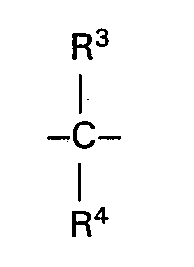
- R 3 and R 4 can be the same or different and are hydrogen, alkyl, cycloalkyl or aryl radicals and the removed members also - (CR3, R4) radicals
- R 3 and R 4 can be the same or different and are hydrogen, alkyl, cycloalkyl or aryl radicals and the removed members also - (CR3, R4) radicals
- Preferred radicals R 1 and R Z and bridges A and B are disclosed in subclaims 3 to 5 and at the outset in the description.
- the preferred alkali metal is lithium.
- the reaction with the hydrazine derivatives is rapid and quantitative. It is an advantage that little or no excess is required when using them, so that the reacted polymers are hardly contaminated by unreacted hydrazine derivatives.
- the living polymer solutions which have an intense orange-red color when the chain end consists of styrene or its substitution products, can e.g. be titrated with the hydrazine derivatives for the disappearance of the color.
- Another advantage of the polymers according to the invention with the functional groups (I) and (11) is that they are converted into the polymers with functional groups of the general formulas (VII) and (VIII) with an excess of water, with the bridge A being split off can:
- the polymers according to the invention can also be treated with water-containing acids, for example concentrated hydrochloric acid or 80% by weight acetic acid at temperatures between 40 and 100 ° C., the bridge A being split off.
- water-containing acids for example concentrated hydrochloric acid or 80% by weight acetic acid at temperatures between 40 and 100 ° C., the bridge A being split off.
- a polymer with primary or secondary amino groups is formed
- Base nitrogen is determined by potentiometric titration with perchloric acid in a mixture of chlorobenzene / glacial acetic acid: 0.58% by weight total nitrogen determined according to Kjeldahl: 0.6% by weight.
- the almost black colored solution is then titrated with a 50% by weight solution of 1,5-diaza-bicyclo [3,1,0] hexane in toluene by means of an injection syringe through the rubber membrane for colorlessness. 4.7 cm 3 1, 5-diaza-bicyclo [3.1.0] hexane solution corresponding to 28 mmol are required.
- the polymer shows the following analytical data.
- An M w of 55,000 is determined according to GPC.
- the nitrogen content according to Kjeldahl is 0.047% by weight (theory 0.051).
- Example 4 In the apparatus according to Example 4, 540 g of Isopren® (purified over cahydride) are polymerized in 3000 cm 3 of cyclohexane with about 8 mmol of sec-butyllithium. When the polymerization is complete, 2 cm 3 of styrene are added. After a further hour, titrate to colorless with 1.68 cm 3 of a 50% by weight 1,5-diaza-bicyclo [3.1.0] hexane solution.
- Isopren® purified over cahydride
Landscapes
- Chemical & Material Sciences (AREA)
- General Chemical & Material Sciences (AREA)
- Health & Medical Sciences (AREA)
- Chemical Kinetics & Catalysis (AREA)
- Medicinal Chemistry (AREA)
- Polymers & Plastics (AREA)
- Organic Chemistry (AREA)
- Addition Polymer Or Copolymer, Post-Treatments, Or Chemical Modifications (AREA)
Description
- Die Erfindung betrifft mit Aminogruppen funktionell modifizierte Homo-, Co- und/oder Blockcopolymerisate aus Vinylaromaten und/oder Dienen, deren Herstellung aus lebenden anionisch polymerisierten oder aus mit einem Alkalimetall metallisierten Homo, Co- und/oder Blockcopolymerisaten aus Vinylaromaten und/oder Dienen und deren Verwendung zur Herstellung analoger Polymerisate durch Umsetzen mit Wasser.
- Bei derartigen Polymerisaten handelt es sich um hochmolekulare Verbindungen mit Molekulargewichten Mw zwischen 500 und 500.000, die funktionelle Gruppen und/oder Endgruppen an den Polymerisatmolekülen statistisch verteilt und/oder an den Kettenenden enthalten.
- Funktionell modifizierte Polymerisate aus Vinylaromaten und/oder Dienen und deren Herstellung aus den entsprechenden lebenden, anionisch polymerisierten oder aus den mit Alkalimetall metallierten Polymerisaten sind bereits seit längerer Zeit bekannt. So können gemäss der deutschen Offenlegungsschrift 2 003 128 sekundäre Aminogruppen enthaltende Polymerisate dadurch erhalten werden, dass man hochmolekulare, alkalimetallorganische Verbindungen mit N-Alkyllactamen umsetzt. Ein bekanntes Verfahren zur Herstellung polymerer Verbindungen mit einer beliebigen Anzahl funktioneller Gruppen besteht darin, dass man polymere, polyfunktionelle alkalimetallorganische Verbindungen mit reaktionsfähigen niedermolekularen Verbindungen wie Kohlendioxid, Kohlenstoffdisulfid, halogensubstituierten Aminen, Alkalenoxiden, halogenierten aliphatischen Kohlenwasserstoffen umsetzt (vgl. US-Patent 3 951 931). Verfahren zur Metallierung ungesättigter Polymerisate und Umsetzen des erhaltenen metallierten Polymerisats mit reaktionsfähigen chemischen Verbindungen sind auch in den US-Patenten 3 781 260 und 3 976 628 beschrieben. Aus der Druckschrift FR-A-2 437 417 ist ein Verfahren zur Metallierung von bestimmten Ethylenterpolymerisaten und anschliessende Reaktion mit einem aliphatischen Lactam bekannt, wobei funktionell modifizierte Copolymerisate entstehen. Auch in den britischen Patenten 1 173 508 und 2 138 005 werden funktionell modifizierte Polymerisate, insbesondere Dienpolymerisate, beschrieben, welche durch Umsetzen der entsprechenden Alkalimetall-Dienpolymerisate mit aliphatischen tertiären Aminen oder Komplexen aus tertiären Aminen mit Schwefeltrioxid entstehen. Schliesslich sind aus dem US-Patent 4 015 051 Polymere mit terminalen Bistrialkylsilylaminogruppen bekannt, die aus den entsprechenden metallierten Polymeren und Siliziumaminoverbindungen erhalten werden und die durch Umsetzen mit Wasser in die entsprechenden aminsubstituierten Polymerisate überführt werden können. Die Synthese von Polymeren mit primären Aminoendgruppen durch Reaktionen von anionisch lebenden Polymeren mit geschützten Aminierungsreagenzien wie Trimethylsilylbromethylamin ist von A. Hirao et al. in der Zeitschrift Makromol. Chem., Rapid Commun. 3 (1962), Seiten 59 bis 63 beschrieben.
- Nachteilig bei den bekannten Verfahren zur Einführung von Aminogruppen in Polymerisate ist, dass diese häufig mit mässiger Ausbeute verlaufen, so dass die Reaktionsprodukte hohe Anteile an inerten und infolge Nebenreaktion entstehenden Polymeren mit hohem Molekulargewicht enthalten. Auch erhält man die Amin modifizierten Polymeren nicht in einem Schritt. Aus zunächst entstehenden Zwischenprodukten müssen in aufwendigen Umsetzungen und Reinigungen die Polymeren mit Aminoendgruppen in Freiheit gesetzt werden.
- Aufgabe der Erfindung war es daher Polymere aus Vinylaromaten und/oder Dienen in einer eindeutigen und mit hohem Umsatz verlaufenden Reaktion mit mindestens einer aminischen Gruppe oder Endgruppe zu schaffen. Eine weitere Aufgabe bestand darin, mit Aminogruppen funktionell modifizierte Polymere aus Vinylaromaten und/oder Dienen zu schaffen, die nicht oder nur wenig durch inerte Nebenprodukte oder durch die reaktionsfähigen niedermolekularen Verbindungen verunreinigt sind. Es bestand ferner die Aufgabe Polymerisate mit Aminogruppen auf einfachem Wege zu erhalten.
- Diese Aufgaben wurden durch Polymerisate nach Ansprüchen 1 bis 5 und 7 bis 8, durch ein Verfahren zur Herstellung der Polymerisate gemäss Anspruch 6 sowie durch die Verwendung der Polymerisate nach Anspruch 1 zur Herstellung von Polymerisaten gemäss Ansprüchen 7 und 8 gelöst.
- Unter mit Aminogruppen funktionell modifizierten Polymerisaten werden Polymerisate verstanden, welche die funktionellen Gruppen (I), (11) und (V) bis (VIII) enthalten, und zwar sowohl statistisch in der Kette als auch an den Kettenenden eines Makromoleküls. Die Polymeren sind bevorzugt mit 1 bis 10 funktionellen Gruppen pro Makromolekül ausgerüstet, ganz in Abhängigkeit von der Zahl der eingesetzten lebenden anionischen Kettenenden bzw. metallierten Gruppen.
- Unter Homo-, Co- und Blockcopolymerisaten aus Vinylaromaten und/oder Dienen sind die bekannten Polymerisate dieser Art zu verstehen, die anionisch z.B. mit Hilfe von alkalimetallorganischen Initiatoren aus den entsprechenden Monomeren erhalten werden können. Derartige Verfahren sind so bekannt, dass sie hier nicht weiter erörtert werden müssen (vgl. z.B. GB-Patent 1 444 680 oder Journal of Applied Polymer Science, 22, [1978], Seiten 2007 bis 2913.)
- Als Vinylaromaten kommen insbesondere Styrol, die verschiedenen Alkylstyrole oder Vinylnaphthalin, als Diene Butadien, Isopren, 2,3-Dimethylbutadien, Piperylen, Phenylbutadien oder andere anionisch polymerisierbare konjugierte C4- bis C12-Diene in Betracht. Ausser den jeweiligen Homopolymerisaten kommen auch die Copolymerisate und die bekannten Blockcopolymerisate von Vinylaromaten und Dienen in Frage, wobei je nach Wahl des Initiators und Lösungsmittels Blockcopolymerisate oder Copolymerisate mit statistischer Verteilung der Monomeren erhalten werden können.
- Die Polymeren weisen im allgemeinen Durchschnittsmolekulargewichte (Gewichtsmittel Mw) zwischen 500 und 500.000 auf, ermittelt durch Gelpermeationschromatographie (GPC) und Vergleich mit standardisierten, zur Eichung geeigneten Polymeren (vgl. G. Glöckner, «Polymercharakterisierung durch Flüssigkeitchromatographie», Verlag A. Hüthig, Heidelberg, 1982. Gemessen wird üblicherweise in 0,25 gew. %iger Tetrahydrofuranlösung bei 23°C und einer Durchflussgeschwindigkeit von 1,2 ml/min).
- Die neuen Polymerisate sollen erfindungsgemäss die funktionellen Gruppen der Formeln (I) oder (11) enthalten:

- Bevorzugt enthalten die neuen Polymerisate im Mittel 1 bis 10 derfunktionelle Gruppen (I) oder (11) im Makromolekül. Das bedeutet, dass, bezogen auf die Summe aller Makromoleküle, im statistischen Durchschnitt pro Makromolekül 1 bis 10 funktionelle Gruppen vorliegen sollen.
- Bevorzugt sind auch Polymerisate, bei denen die Reste R1 und RZ C1- bis C4-Alkylreste, insbesondere Butylreste, sind und die Kohlenstoffbrücke A die Methylengruppe -CHz- oder Dimethylmethylengruppen -C(CH3)2- ist. Bevorzugt sind auch Polymerisate, in denen die Brücke B aus drei oder vier gegebenenfalls substituierten Methylengruppen zusammengesetzt ist, und insbesondere aus -CHzCHzCHz-oder -CH(CH3)CHzCH(CH3)- besteht. Bevorzugt sind auch Polymerisate, bei denen B aus zwei bis vier Kohlenstoffgliedern besteht, von denen mindestens eines eine Methylengruppe ist und die beiden anderen Bestandteile eines oder mehrerer alicyclischer oder aromatischer Ringsysteme sind. Hierzu geeignet ist beispielsweise für B die Gruppierung:

- Die erfindungsgemässen Polymerisate mit den funktionellen Gruppen (I) oder (II) werden entweder aus den lebenden anionisch polymerisierten oder aus mit Alkalimetall metallisierten Homo-, Co- und/oder Blockpolymerisaten aus Vinylaromaten und/oder Dienen nach bekannten Verfahren hergestellt (vgl. die eingangs zitierte Literatur sowie J. M. Malan et al. Chem. Rev. 69 [1969] (5). Seiten 693 bis 755). Hierzu werden die Monomeren bei tiefen Temperaturen in Gegenwart von Alkalimetallen oder deren Alkyl-oder Arylderivaten, insbesondere in Gegenwart der Alkylderivate des Lithiums wie sec.-Butyllithium in einem inerten Lösungsmittel wie aliphatischen oder aromatischen Kohlenwasserstoffen, insbesondere Hexan, Cyclohexan, Benzol oder Toluol bzw. in Gegenwart von Tetrahydrofuran anionisch polymerisiert. Bei diesen Verfahren erhält man Polymerisate, welche an den Endgruppen Metalle gebunden enthalten. Man kann aber auch Homo-, Co- und/oder Blockcopolymerisat aus Vinylaromaten und/oder Dienen herstellen und nachträglich mit Alkalimetallen oder deren Derivaten metallieren. Derartig metallierte Polymerisate enthalten die metallorganischen Gruppierungen statistisch längs der Kette verteilt.
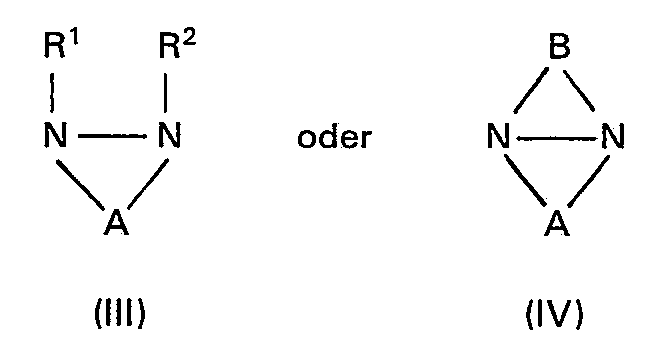
- Erfindungsgemäss werden die obigen metallorganischen Polymeren mit Hydrazinderivaten der allgemeinen Formeln (111) und (IV):

- Als Verbindungen (III). oder (IV) sind solche geeignet, in denen R1 und RZ = ein Alkyl- oder Arylrest, A = eine eingliedrige, gegebenenfalls substituierte Kohlenstoffbrücke, und B = eine 2- bis 12gliedrige Brücke, von der mindestens die den N-Atomen benachbarten Glieder aus -(CR3,R4)- Radikalen bestehen, wobei R3 und R4 gleich oder verschieden sein können und Wasserstoff, Alkyl-, Cycloalkyl- oder Arylreste sind und die entfernten Glieder ausser -(CR3,R4)-Radikalen auch Ether oder N-Alkyl- bzw. N-Aryliminogruppen sein können.
- Bevorzugte Reste R1 und RZ sowie Brücken A und B sind in den Unteransprüchen 3 bis 5 sowie eingangs in der Beschreibung offenbart. Bevorzugtes Alkalimetall ist Lithium.
- Als Hydrazinderivate der allgemeinen Formeln (111) und (IV) sind z.B. die folgenden geeignet:
- 1,2-Dibutyldiaziridin

- 1,5-Diaza-bicyclo[3,1,0]hexan

- 6,6-Dimethyl-1,5-diazabicyclo[3,1,0]hexan

- 1,2-Dimethyl-3-methyl-3-ethyl-diaziridin

- 1,2-Dimethyl-1,2-diazaspiro[2,3]octan

- 1,2-Dibutyl-3-propyl-diaziridin

- 3,6-Dimethyl-1,3,5-triaza-bicyclo(3,1,0]hexan

- 6-Methyl-3-oxa-1, 5-diaza-bicyclo[3,1,0]hexan

- 6,6-Pentamethylen-1,5-diaza-bicyclo[3,1,O1hexan

- Insbesondere geeignet ist die Verbindung (b).
- Diese Aufzählung ist nicht vollständig und soll keine Abgrenzung sein. Weitere Individuen und die Herstellung derartiger Hydrazinderivate ist z.B. beschrieben von R. Ohme et al., Chemische Berichte 99, (1966), Seiten 2104 bis 2109 sowie von E. Schmitz und K. Schinkowsky, Chemische Berichte 97, (1964), Seite 49.
- Die Umsetzung mit den Hydrazinderivaten verläuft mit grosser Geschwindigkeit und quantitativ. Es ist ein Vorteil, dass man bei ihrer Anwendung keinen oder nur wenig Überschuss benötigt, so dass die umgesetzten Polymeren kaum durch nicht umgesetzte Hydrazinderivate verunreinigt werden. Die lebenden Polymerlösungen, die eine intensive Orangerotfärbung aufweisen, wenn das Kettenende aus Styrol oder seinen Substitutionsprodukten besteht, können z.B. mit den Hydrazinderivaten auf das Verschwinden der Farbe austitriert werden.
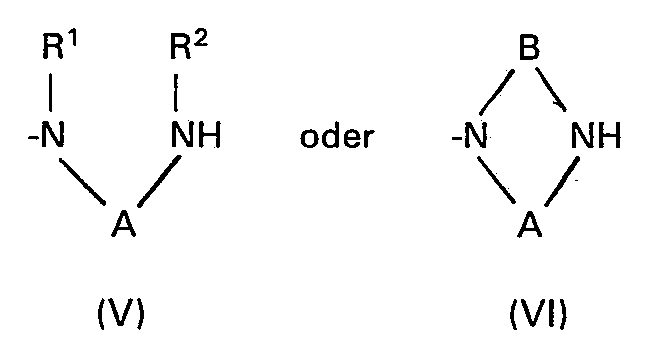
- Es ist ein Vorteil der erfindungsgemässen Polymerisate mit den funktionellen Gruppen (I) und (11) dass sie zur Herstellung analoger Polymerisate mit den funktionellen Gruppen der allgemeinen Formeln (V) und (VI) verwendet werden können:

- Ein weiterer Vorteil der erfindungsgemässen Polymerisate mit den funktionellen Gruppen (I) und (11) besteht darin, dass sie mit einem Überschuss an Wasser unter Abspaltung der Brücke A in die Polymerisate mit funktionellen Gruppen der allgemeinen Formeln (VII) und (VIII) umgewandelt werden können:

- Auch diese Reaktion erfolgt zum Teil spontan. Man kann auch die erfindungsgemässen Polymerisate mit Wasser enthaltenden Säuren, z.B. konzentrierter Salzsäure oder 80 gew.-%iger Essigsäure bei Temperaturen zwischen 40 und 100°C behandeln, wobei die Brücke A abgespalten wird. Je nach verwendetem Hydrazinderivat entsteht ein Polymerisat mit primären oder sekundären Aminogruppen


- Die folgenden Beispiele dienen der Erläuterung der Erfindung.
- In einem 2-1-Kolben werden 37,2 g (1/2 Mol) 1,3-Propylendiamin und 250 cm3 2n NaOH unter Kühlung so mit 50 cm3 30 gew.-%iger Formalinlösung gemischt, dass die Temperatur nicht über 5°C steigt. Sodann werden 274 cm3 Chlorbleichlauge (160 g freies Chlor/Liter) unter sehr gutem Rühren so zugemischt, dass die Temperatur nicht über 5°C steigt. Danach wird die Lösung im Vakuum auf ca. 1/2 des ursprünglichen Volumens eingeengt (T < 35°C), das ausgefallene Salz abfiltriert und die Mutterlauge erschöpfend 5x mit je 200 cm3 Methylenchlorid extrahiert. Der vereinigte Extrakt wird mit festem KOH getrocknet, das Methylenchlorid bei partiellem Vakuum (T - 35°C) abgezogen und das 1,5-Diaza-bicyc)o[3,1,0]hexan bei 7 mbar abdestilliert.
- Kp. 7 mbar = 47 bis 52°C, Ausbeute 22,5 g = 53,6% d. Theorie.
- Gehalt an (in Gew.-%)
-

- Es wurde die Vorschrift in Chemische Berichte, 99 (1966). Seiten 2105 bis 2109 verwendet.
- 37,2g g (1/2 mol) 1,3-Propylendiamin und 250 cm3 2n NaOH wurden bei 5°C mit 29 g Aceton gemischt und unter Kühlung bei 5°C 274 cm3 Chlorbleichlauge (160 g aktives Chlor/Liter) zugetropft. Die Lösung wird 3x mit je 200 cm3 Methylenchlorid extrahiert, der Extrakt mit festem KOH getrocknet, das Lösungsmittel so abgetrieben, dass die Temperatur im Sumpf 40°C nicht überschreitet und das Zielprodukt bei 0,3 mbar abdestilliert.
- Kp 0,3 mbar = 40°C, Ausbeute 38,5 g = 69% d. Theorie. Gehalt an (in Gew.-%)
-

- Herstellung wie Vorschrift für 6,6-Dimethyl-1,5--diaza-bicyclo[3,1,0]hexan, jedoch werden an Stelle des Acetons 49 g Cyclohexanon (1/2 Mol) verwendet.
- Kp 0,8 mbar = 87-89°C, Ausbeute 34,9 g = 45% d. Theorie.

- In einem unter Reinstickstoff mit einer Lösung von sec.-Butyllithium in Cyclohexan gespülten 2-Liter-Dreihalskolben, der mit Rührer und Thermometer versehen und einer Gummimembrane verschlossen ist, werden 1000 cm3 Cyclohexan und 104 g (1 Mol) gereinigtes Styrol gegeben.
- Bei 50°C wird mit einer Injektionsspritze unter gutem Rühren so lange eine 1,4 molare Lösung von sec.-Butyllithium in Cyclohexan zu der Styrollösung gegeben, bis eine bleibende schwache Orangefärbung entsteht. Unmittelbar darauf werden weitere 21 mMol sec.-Butyllithium zugegeben. Die jetzt intensiv orange gefärbte Lösung erwärmt sich. Nach einer Stunde bei 70°C ist die Polymerisation beendet. Die Lösung wird mit einer 50 gew.-%igen Lösung von 1,5-Diaza-bicyclo-[3,1,0]hexan in Toluol mittels einer Injektionsspritze durch die Gummimembranen titriert. Nach Zugabe von 3,7 cm3 ist die orange Farbe verschwunden. Das Polymer wird unter intensivem Rühren durch Eingiessen der Lösung in 5 1 Ethanol gefällt. Nach Abfiltrieren und Trocknen werden an dem schneeweissen pulvrigen Polystyrol die folgenden analytischen Daten festgestellt:
- Mm 5000 ermittelt durch GPC, die mit einem eng verteilten Standardpolystyrol geeicht wurde.
- Mw/Mn = 1,02 Mn = Zahlenmittel des Molekulargewichts, ermittelt nach GPC. Mw/Mn ist ein Mass für die Breite der Molekulargewichtsverteilung.
- Basenstickstoff bestimmt dsurch potentiometrische Titration mit Perchlorsäure in einer Mischung von Chlorbenzol/Eisessig: 0,58 Gew.-% Gesamtstickstoff bestimmt nach Kjeldahl: 0,6 Gew.-%.
- 10 g des so hergestellten Polystyrols werden in 1000 cm3 Toluol gelöst und mit 100 cm3 90 gew.-%igen Eisessig 2 Stunden bei 90° gehalten. Durch Hydrolyse wird die Methylenbrücke abgespalten. Die potentiometrische Titration ergibt einen Basenstickstoffgehalt von 0,5 Gew.-%.
- In gleicher Weise wie in Beispiel 1 wird ein Polystyrol hergestellt, jedoch erfolgte der Abbruch mit einem 1,2-Dibutyldiaziridin. Das Polymer zeigt die folgenden Daten:
- Mw:_5300 (GPC-Methode)
-
M w-M n = 1,03 - Basenstickstoff: 0,57 Gew.-%
- Gesamtstickstoff: 0,6 Gew.-%.
- Nach Hxdrolyse mit Eisessig/H20 in Toluol ist der Gesamtstickstoff auf 0,35 Gew.-% abgesunken, der Basenstickstoff wurde zu 0,25 Gew.-% bestimmt.
- In einem unter Stickstoff durch Spülen mit Butyllithiumlösung gereinigten, mit Rührer, Thermometer, Tropftrichter und Gummikappe versehenen Kolben wird unter inerten Bedingungen 1000 cm3 Toluol und 1 Mol (104 g) Styrol eingefüllt. Dazu wurden bei 20°C aus dem Tropftrichter schnell und unter intensiven Rühren 28 cm3 einer frischen Lösung von 23,0 g aktivem Natrium in 1000 cm3 Tetrahydrofuran und 500 g a-Methylstyrol gegeben, die nach bekannten Verfahren hergestellt wurde. Die Reaktion setzt sofort ein. Der Inhalt des Kolbens erwärmt sich in einer Minute auf 57°C. Die fast schwarz gefärbte Lösung wird nun mit einer 50 gew.-%igen Lösung von 1, 5-Diaza-bicyclo-[3,1,0]hexan in Toluol mittels einer Injektionsspritze durch die Gummimembran auf Farblosigkeit titriert. Es werden 4,7 cm3 1, 5-Diaza-bicyclo-[3,1,0]hexanlösung entsprechend 28 mMol benötigt. Das Polymer zeigt die folgenden analytischen Daten.

- Gesamtstickstoff nach Kjeldahl: 0,8 Gew.-%
- Basenstickstoff durch potentiometrische Titration: 0,7 Gew.-%.
- Aus den Analysendaten ergibt sich, dass ein an beiden Enden mit insgesamt 4 Aminogruppen versehenes Polystyrol entstanden ist.
- Zur Herstellung eines 2-Blockcopolymeren aus 17 Gew.-% Styrol und 83 Gew.-% Butadien mit Diaminoendgruppen wird ein mit Rührer, Thermometer, Rückflusskühler, Gummimembran und Heizmantel versehener 6-I-Reaktor mit Cyclohexan, das 2 cm3 sec.-Butyllithium enthält, unter Reinstickstoff zur Reinigung ausgekocht. Nach Ablassen dieser Lösung wird der Reaktor mit 3000 cm3 Cyclohexan und 0,9 Mol = 93,6 g Styrol beschickt. Mit Hilfe einer Injektionsspritze wird bei 40°C so lange eine Lösung von sec.-Butyllithium zudosiert, bis eine leichte Orangefarbe anzeigt, dass alle Verunreinigungen verbraucht sind. Darauf werden 12 mMol sec.-Butyllithium zugegeben und eine Stunde bei 65°C das Styrol auspolymerisiert. Sodann lässt man 10,2 Mol Butadien, das durch Abdestillieren von Butyllithium gereinigt wurde, nach und nach bei dieser Temperatur zulaufen. Eine Stunde nach Beendigung des Zulaufs setzt man mit einer Spritze 2 cm3 Styrol zu. Die während der Polymerisation des Butadiens fast farblose Lösung färbt sich nach einer weiteren Stunde bei 65°C orange. Jetzt wird durch Zugabe von 1,5-Diaza-bicyclo-[3,1,0]hexan (50 gew.-%ige Lösung in Toluol) aus einer kalibrierten Injektionsspritze auf farblos titriert. Es werden 1,85 cm3 (= 11 mMol bzw. 0,924 g) der Lösung benötigt.
- Nach GPC wird ein Mw von 55.000 ermittelt. Der Stickstoffgehalt nach Kjeldahl beträgt 0,047 Gew.-% (Theorie 0,051).
- In der Apparatur gemäss Beispiel 4 wird in 3000 cm3 Cyclohexan 540 g Isopren® (gereinigt über Cahydrid) mit ca. 8 mMol sec.-Butyllithium polymerisiert. Nach Beendigung der Polymerisation werden 2 cm3 Styrol zugegeben. Nach einer weiteren Stunde wird mit 1,68 cm3 einer 50 gew.-%igen 1,5-Diaza-bicyclo-[3,1,0]hexanlösung auf farblos titriert.
- Molgewicht des Polyisoprens Mw aus GPC: 60.000
- Stickstoffgehalt nach Kjeldahl: 0,05 Gew.-% (Theorie 0,047%).
Claims (8)


Applications Claiming Priority (2)
| Application Number | Priority Date | Filing Date | Title |
|---|---|---|---|
| DE3527909 | 1985-08-03 | ||
| DE19853527909 DE3527909A1 (de) | 1985-08-03 | 1985-08-03 | Polymerisate mit aminogruppen, deren herstellung und verwendung |
Publications (2)
| Publication Number | Publication Date |
|---|---|
| EP0211395A1 EP0211395A1 (de) | 1987-02-25 |
| EP0211395B1 true EP0211395B1 (de) | 1988-12-28 |
Family
ID=6277625
Family Applications (1)
| Application Number | Title | Priority Date | Filing Date |
|---|---|---|---|
| EP86110539A Expired EP0211395B1 (de) | 1985-08-03 | 1986-07-30 | Polymerisate mit Aminogruppen, deren Herstellung und Verwendung |
Country Status (5)
| Country | Link |
|---|---|
| US (1) | US4753991A (de) |
| EP (1) | EP0211395B1 (de) |
| JP (1) | JPH0618816B2 (de) |
| CA (1) | CA1267248A (de) |
| DE (2) | DE3527909A1 (de) |
Families Citing this family (40)
| Publication number | Priority date | Publication date | Assignee | Title |
|---|---|---|---|---|
| US4988773A (en) * | 1986-05-27 | 1991-01-29 | Basf Aktiengesellschaft | Homopolymers or block copolymers of vinylaromatics and/or dienes with ammonium groups, and preparation of same |
| DE3617785A1 (de) * | 1986-05-27 | 1987-12-03 | Basf Ag | Homopolymere oder blockcopolymere aus vinylaromaten und/oder dienen mit ammoniumgruppen, verfahren zur herstellung und verwendung derartiger polymerer |
| DE3639569A1 (de) * | 1986-11-20 | 1988-06-01 | Basf Ag | Am kettenende funktionalisierte polymere und verfahren zu ihrer herstellung |
| DE3706016A1 (de) * | 1987-02-25 | 1988-11-17 | Basf Ag | Mit funktionalisierten polymeren schlagzaeh modifizierte thermoplaste und deren verwendung zur herstellung von formteilen |
| DE3706017A1 (de) * | 1987-02-25 | 1988-09-08 | Basf Ag | Mit funktionalisierten polymeren schlagzaeh modifizierte thermoplaste und deren verwendung zur herstellung von formteilen |
| DE3709807A1 (de) * | 1987-03-25 | 1988-10-06 | Basf Ag | Mit saeureendgruppen modifizierte polymerisate, deren herstellung und verwendung |
| DE3726285A1 (de) * | 1987-08-07 | 1989-02-16 | Basf Ag | Polymerisate mit funktionellen gruppen |
| JP2652795B2 (ja) * | 1988-03-31 | 1997-09-10 | 日本ゼオン株式会社 | ジエン系重合体ゴムの製造方法及びゴム組成物 |
| US5013469A (en) * | 1989-08-24 | 1991-05-07 | Texaco Inc. | VI improver, dispersant, and anti-oxidant additive and lubricating oil composition containing same |
| DE4015533A1 (de) * | 1990-05-15 | 1991-11-21 | Basf Ag | Thermoplastische formmassen auf der basis von polyestern und polyphenylenethern |
| JPH04209611A (ja) * | 1990-11-30 | 1992-07-31 | Nippon Zeon Co Ltd | スチレン系樹脂組成物 |
| DE4228160A1 (de) * | 1992-08-25 | 1994-03-03 | Basf Ag | Polymerisate auf Basis von konjugierten Dienen |
| NL9201564A (nl) * | 1992-09-09 | 1994-04-05 | Dsm Nv | Thermoplastische polymeersamenstelling. |
| US5336726A (en) * | 1993-03-11 | 1994-08-09 | Shell Oil Company | Butadiene polymers having terminal silyl groups |
| US5391637A (en) * | 1993-11-23 | 1995-02-21 | Shell Oil Company | Capping of anionic polymers with oxetanes |
| US5376745A (en) * | 1993-12-01 | 1994-12-27 | Shell Oil Company | Low viscosity terminally functionalized isoprene polymers |
| AU1922095A (en) * | 1994-02-18 | 1995-09-04 | Fmc Corporation | New functionalized initiators for anionic polymerization |
| JP3438742B2 (ja) * | 1994-02-25 | 2003-08-18 | 日本ゼオン株式会社 | ゴム組成物及びその製造方法 |
| US6197891B1 (en) | 1994-05-13 | 2001-03-06 | Fmc Corporation | Functionalized chain extended initiators for anionic polymerization |
| EP0697247B1 (de) | 1994-07-15 | 1999-09-29 | Shell Internationale Researchmaatschappij B.V. | Verfahren zum Umwandlung von Kohlenwasserstoffeinsätzen |
| EP0698638B1 (de) | 1994-07-18 | 1998-01-28 | Shell Internationale Researchmaatschappij B.V. | Vernetzbare wässrige Dispersionen von hydroxyfunktionellen Dienpolymeren und Aminoharzen |
| US5827929A (en) * | 1994-10-31 | 1998-10-27 | Fmc Corporation | Functionalized initiators for anionic polymerization |
| DE69603571T2 (de) | 1995-12-28 | 2000-01-20 | Shell Internationale Maatschappij B.V., Den Haag | Entfernung von Alkalimetallverbindungen aus Polymer in Lösung |
| US5750032A (en) | 1995-12-28 | 1998-05-12 | Shell Oil Company | Removal of lithium from polymer cements |
| US5847072A (en) | 1995-12-28 | 1998-12-08 | Shell Oil Company | Removal of lithium from polymer cements |
| AU5803796A (en) * | 1995-12-29 | 1997-07-28 | Fmc Corporation | Functionalized initiators for anionic polymerization |
| EP1443077A3 (de) * | 1996-04-05 | 2004-10-27 | The Yokohama Rubber Co., Ltd. | Russ enthaltende Kautschukzusammensetzung |
| US5628856A (en) * | 1996-04-29 | 1997-05-13 | The Procter & Gamble Company | Method for forming a composite elastic material |
| US5663250A (en) * | 1996-05-16 | 1997-09-02 | Shell Oil Company | Deprotection with molten salt |
| US5965681A (en) * | 1996-06-18 | 1999-10-12 | Fmc Corporation | Protected functionalized telechelic polymers and processes for making the same |
| AU3641897A (en) * | 1996-07-17 | 1998-02-09 | Conrad W Kamienski | Protected functionalized heterotelechelic polymers and processes for preparing the same |
| US6075097A (en) * | 1997-06-06 | 2000-06-13 | Shell Oil Company | Process for producing conjugated diene diols using carbon dioxide |
| US6153706A (en) * | 1997-07-30 | 2000-11-28 | Fmc Corporation | Protected multi-functionalized star polymers and processes for making the same |
| US6420490B1 (en) | 1998-12-02 | 2002-07-16 | Kraton Polymers U.S. Llc | Telechelic polymers are produced by ozonation degradation of diene polymers |
| US6881795B2 (en) | 2001-03-28 | 2005-04-19 | Firestone Polymers, Llc | CO2 terminated rubber for plastics |
| US20030069366A1 (en) * | 2001-09-17 | 2003-04-10 | Letchford Robert J. | Urethane oligomers of heterotelechelic amine functional polyolefins |
| ES2437965T3 (es) * | 2001-11-21 | 2014-01-15 | Cray Valley Usa, Llc | Polibutadienos con terminación de grupos amino |
| US8716409B2 (en) * | 2006-12-29 | 2014-05-06 | Firestone Polymers, Llc | Carboxylate terminated polymers and their use in impact-modified plastics |
| US20130230929A1 (en) * | 2010-06-29 | 2013-09-05 | National Institute Of Advanced Industrial Science And Technology | Agent for detecting halide, method for detecting halide, and detection sensor |
| ES2545428T3 (es) | 2013-04-16 | 2015-09-10 | Borealis Ag | Capa aislante para cables |
Family Cites Families (20)
| Publication number | Priority date | Publication date | Assignee | Title |
|---|---|---|---|---|
| US3251812A (en) * | 1961-06-15 | 1966-05-17 | Phillips Petroleum Co | Terminally reactive polymers |
| NL294833A (de) * | 1962-08-09 | |||
| US3976628A (en) * | 1968-12-18 | 1976-08-24 | The Firestone Tire & Rubber Company | Process for polylithiating unsaturated polymers |
| US3890294A (en) * | 1970-05-14 | 1975-06-17 | Pennwalt Corp | Azo containing polybutadienes |
| US3781260A (en) * | 1971-10-21 | 1973-12-25 | Firestone Tire & Rubber Co | Process for metalation |
| US3862107A (en) * | 1971-10-28 | 1975-01-21 | Pennwalt Corp | Method of curing polymers with azo compounds |
| US3801520A (en) * | 1972-01-21 | 1974-04-02 | Phillips Petroleum Co | Carbon dioxide and water treatment of coupled lithium initiated polymer |
| US4111856A (en) * | 1972-11-15 | 1978-09-05 | Mobil Oil Corporation | Insoluble resin-metal compound complex prepared by contacting weak base ion exchange resin with solution of metal-ligand |
| US3976723A (en) * | 1972-12-15 | 1976-08-24 | Rohm And Haas Company | Preparation and use of acrylic ionomer elastomers |
| CA1041693A (en) * | 1973-05-17 | 1978-10-31 | Robert E. Cunningham | METHOD OF PREPARING A -B -A TYPE BLOCK POLYMERS OF POLY-.alpha.-METHYLSTYRENE AND THE POLYMER OF A CONJUGATED DIENE |
| US4076913A (en) * | 1973-07-31 | 1978-02-28 | Glaxo Laboratories Limited | Solid or gel polymers containing a plurality of free hydrazone groups |
| GB1482921A (en) * | 1973-07-31 | 1977-08-17 | Glaxo Lab Ltd | Polymers |
| US3907925A (en) * | 1973-10-10 | 1975-09-23 | Ciba Geigy Corp | Metal deactivators as adhesion promotors for vulcanizable elastomers to metals |
| US4015061A (en) * | 1975-02-14 | 1977-03-29 | The Firestone Tire & Rubber Company | Protected amino-functional initiators and amino-terminated polymers and their production |
| US4299932A (en) * | 1975-05-05 | 1981-11-10 | The Firestone Tire & Rubber Company | Amine terminated polymers and the formation of block copolymers |
| CS204190B1 (en) * | 1978-02-22 | 1981-03-31 | Jaroslav Drobnik | Activation method for hydrxyl groups containing insoluble carriers |
| CA1229699A (en) * | 1982-01-04 | 1987-11-24 | William G. Carson | Increasing the reactivity of coupling homopolymers |
| US4461876A (en) * | 1982-09-09 | 1984-07-24 | Columbia University | Polymeric reagents for the isolation and protection of carbonyl compounds |
| GB2138005B (en) * | 1983-04-11 | 1987-05-20 | Secr Defence | Functionally-terminated polymers |
| US4478984A (en) * | 1983-09-23 | 1984-10-23 | Smithkline Beckman Corporation | Synthesis of benzhydrylamine resins |
-
1985
- 1985-08-03 DE DE19853527909 patent/DE3527909A1/de not_active Withdrawn
-
1986
- 1986-07-22 CA CA000514379A patent/CA1267248A/en not_active Expired - Lifetime
- 1986-07-25 US US06/889,372 patent/US4753991A/en not_active Expired - Fee Related
- 1986-07-29 JP JP61176838A patent/JPH0618816B2/ja not_active Expired - Lifetime
- 1986-07-30 DE DE8686110539T patent/DE3661539D1/de not_active Expired
- 1986-07-30 EP EP86110539A patent/EP0211395B1/de not_active Expired
Also Published As
| Publication number | Publication date |
|---|---|
| DE3661539D1 (en) | 1989-02-02 |
| DE3527909A1 (de) | 1987-02-12 |
| JPH0618816B2 (ja) | 1994-03-16 |
| JPS6234904A (ja) | 1987-02-14 |
| CA1267248A (en) | 1990-03-27 |
| EP0211395A1 (de) | 1987-02-25 |
| US4753991A (en) | 1988-06-28 |
Similar Documents
| Publication | Publication Date | Title |
|---|---|---|
| EP0211395B1 (de) | Polymerisate mit Aminogruppen, deren Herstellung und Verwendung | |
| EP0274021B1 (de) | Am Kettenende funktionalisierte Polymere und Verfahren zu ihrer Herstellung | |
| EP0244603A2 (de) | Polymerisate mit Aminogruppen, deren Herstellung und Verwendung | |
| DD203727A5 (de) | Katalytisches system fuer die polymerisation von konjugierten diolefinen | |
| EP0288761B1 (de) | Verfahren zur Herstellung multifunktioneller Initiatoren für die anionische Polymerisation, oligomere multifunktionelle Initiatoren, Verwendung der erhaltenen Polymeren zur Herstellung gegebenenfalls funktionalisierter Polymere und als Prepolymere für andere Harze | |
| DD247455A1 (de) | Verfahren zur herstellung von polymeren mit funktionellen endgruppen | |
| DD209582A5 (de) | Katalytisches system fuer die polymerisation konjugierter diolefine | |
| DE3735403A1 (de) | Verzweigte copolymerisate und verfahren zu ihrer herstellung | |
| EP0363659B1 (de) | Verwendung von Stilbenverbindungen bei der anionischen Polymerisation | |
| DE2742948A1 (de) | Sulfonierte butadien- und isoprenoligomere, verfahren zu deren herstellung und deren verwendung | |
| EP0477679B1 (de) | Lebende Polymere, Verfahren zu ihrer Herstellung und ihre Verwendung zur Herstellung von Telechele | |
| EP0283948B1 (de) | Mit Säureendgruppen modifizierte Polymerisate, deren Herstellung und Verwendung | |
| EP0303177B1 (de) | Polymerisate mit funktionellen Gruppen | |
| DE1954255C3 (de) | Polymere mit einem System von konjugierten Doppelbindungen in der Hauptkette und Verfahren zu deren Herstellung | |
| DE2217532C3 (de) | Verfahren zur Herstellung von DilithiokohJenwasserstoffen | |
| EP0273237A2 (de) | Polymere mit Aminogruppen, deren Herstellung und Verwendung | |
| DE2141941A1 (de) | Quaternäre Ammoniumpolymerkompositionen Verfahren zu deren Herstellung und Verfahren zu deren Verwendung zum Ausflocken fester Teilchen aus deren wässerigen Suspensionen | |
| DE1620931A1 (de) | Verfahren zur Polymerisation und Mischpolymerisation konjugierter Diene | |
| AT215428B (de) | Verfahren zur Herstellung von neuen kristallisierbaren organometallischen Komplexen | |
| DE3710468A1 (de) | Lithiumorganischer initiator fuer die anionische polymerisation, verfahren zur herstellung des initiators und verwendung des initiators zur herstellung von polymeren | |
| DE2432696B2 (de) | Verfahren zur Herstellung von Blockcopolymeren | |
| DD204931A1 (de) | Verfahren zur selektiven butadienpolymerisation aus c tief 4 fraktionen | |
| DD154980A1 (de) | Verfahren zur selektiven polymerisation von butadien aus c tief 4-fraktionen | |
| DE3706037A1 (de) | Polymere aus 1,5-diaza-(3,1,0)-bicyclohexan und dessen substituierten derivaten und verfahren zu deren herstellung | |
| DE2711915A1 (de) | Verfahren zur herstellung von fluessigen polymeren mit niedrigem molekulargewicht |
Legal Events
| Date | Code | Title | Description |
|---|---|---|---|
| PUAI | Public reference made under article 153(3) epc to a published international application that has entered the european phase |
Free format text: ORIGINAL CODE: 0009012 |
|
| AK | Designated contracting states |
Kind code of ref document: A1 Designated state(s): BE DE FR GB IT NL |
|
| 17P | Request for examination filed |
Effective date: 19870212 |
|
| 17Q | First examination report despatched |
Effective date: 19880330 |
|
| GRAA | (expected) grant |
Free format text: ORIGINAL CODE: 0009210 |
|
| AK | Designated contracting states |
Kind code of ref document: B1 Designated state(s): BE DE FR GB IT NL |
|
| ITF | It: translation for a ep patent filed | ||
| REF | Corresponds to: |
Ref document number: 3661539 Country of ref document: DE Date of ref document: 19890202 |
|
| GBT | Gb: translation of ep patent filed (gb section 77(6)(a)/1977) | ||
| ET | Fr: translation filed | ||
| PLBE | No opposition filed within time limit |
Free format text: ORIGINAL CODE: 0009261 |
|
| STAA | Information on the status of an ep patent application or granted ep patent |
Free format text: STATUS: NO OPPOSITION FILED WITHIN TIME LIMIT |
|
| 26N | No opposition filed | ||
| ITTA | It: last paid annual fee | ||
| PGFP | Annual fee paid to national office [announced via postgrant information from national office to epo] |
Ref country code: FR Payment date: 19980625 Year of fee payment: 13 |
|
| PGFP | Annual fee paid to national office [announced via postgrant information from national office to epo] |
Ref country code: GB Payment date: 19980715 Year of fee payment: 13 |
|
| PGFP | Annual fee paid to national office [announced via postgrant information from national office to epo] |
Ref country code: NL Payment date: 19980728 Year of fee payment: 13 Ref country code: DE Payment date: 19980728 Year of fee payment: 13 |
|
| PGFP | Annual fee paid to national office [announced via postgrant information from national office to epo] |
Ref country code: BE Payment date: 19980806 Year of fee payment: 13 |
|
| PG25 | Lapsed in a contracting state [announced via postgrant information from national office to epo] |
Ref country code: DE Free format text: LAPSE BECAUSE OF THE APPLICANT RENOUNCES Effective date: 19990716 |
|
| PG25 | Lapsed in a contracting state [announced via postgrant information from national office to epo] |
Ref country code: GB Free format text: LAPSE BECAUSE OF NON-PAYMENT OF DUE FEES Effective date: 19990730 |
|
| PG25 | Lapsed in a contracting state [announced via postgrant information from national office to epo] |
Ref country code: FR Free format text: THE PATENT HAS BEEN ANNULLED BY A DECISION OF A NATIONAL AUTHORITY Effective date: 19990731 Ref country code: BE Free format text: LAPSE BECAUSE OF NON-PAYMENT OF DUE FEES Effective date: 19990731 |
|
| BERE | Be: lapsed |
Owner name: BASF A.G. Effective date: 19990731 |
|
| PG25 | Lapsed in a contracting state [announced via postgrant information from national office to epo] |
Ref country code: NL Free format text: LAPSE BECAUSE OF NON-PAYMENT OF DUE FEES Effective date: 20000201 |
|
| GBPC | Gb: european patent ceased through non-payment of renewal fee |
Effective date: 19990730 |
|
| NLV4 | Nl: lapsed or anulled due to non-payment of the annual fee |
Effective date: 20000201 |
|
| REG | Reference to a national code |
Ref country code: FR Ref legal event code: ST |
|
| PG25 | Lapsed in a contracting state [announced via postgrant information from national office to epo] |
Ref country code: IT Free format text: LAPSE BECAUSE OF NON-PAYMENT OF DUE FEES;WARNING: LAPSES OF ITALIAN PATENTS WITH EFFECTIVE DATE BEFORE 2007 MAY HAVE OCCURRED AT ANY TIME BEFORE 2007. THE CORRECT EFFECTIVE DATE MAY BE DIFFERENT FROM THE ONE RECORDED. Effective date: 20050730 |