EP0209494B1 - Verfahren zum Nuancenstabilen Färben oder Bedrucken - Google Patents
Verfahren zum Nuancenstabilen Färben oder Bedrucken Download PDFInfo
- Publication number
- EP0209494B1 EP0209494B1 EP86810310A EP86810310A EP0209494B1 EP 0209494 B1 EP0209494 B1 EP 0209494B1 EP 86810310 A EP86810310 A EP 86810310A EP 86810310 A EP86810310 A EP 86810310A EP 0209494 B1 EP0209494 B1 EP 0209494B1
- Authority
- EP
- European Patent Office
- Prior art keywords
- formula
- azo dye
- chromium
- dye
- mixture
- Prior art date
- Legal status (The legal status is an assumption and is not a legal conclusion. Google has not performed a legal analysis and makes no representation as to the accuracy of the status listed.)
- Expired - Lifetime
Links
- 238000000034 method Methods 0.000 title claims description 35
- 238000004043 dyeing Methods 0.000 title claims description 19
- 239000000987 azo dye Substances 0.000 claims description 62
- 239000000203 mixture Substances 0.000 claims description 53
- 229910052804 chromium Inorganic materials 0.000 claims description 48
- 239000011651 chromium Substances 0.000 claims description 48
- 239000000975 dye Substances 0.000 claims description 40
- 239000004753 textile Substances 0.000 claims description 20
- 239000000985 reactive dye Substances 0.000 claims description 13
- XLYOFNOQVPJJNP-UHFFFAOYSA-N water Substances O XLYOFNOQVPJJNP-UHFFFAOYSA-N 0.000 claims description 10
- 239000000463 material Substances 0.000 claims description 9
- 239000000835 fiber Substances 0.000 claims description 6
- -1 amino- Chemical class 0.000 description 152
- VYZAMTAEIAYCRO-UHFFFAOYSA-N Chromium Chemical compound [Cr] VYZAMTAEIAYCRO-UHFFFAOYSA-N 0.000 description 23
- 150000004700 cobalt complex Chemical class 0.000 description 22
- 229910052751 metal Inorganic materials 0.000 description 19
- 239000002184 metal Substances 0.000 description 19
- 239000004744 fabric Substances 0.000 description 18
- XSQUKJJJFZCRTK-UHFFFAOYSA-N Urea Chemical compound NC(N)=O XSQUKJJJFZCRTK-UHFFFAOYSA-N 0.000 description 14
- 239000002657 fibrous material Substances 0.000 description 12
- 150000003254 radicals Chemical class 0.000 description 10
- 125000003178 carboxy group Chemical group [H]OC(*)=O 0.000 description 9
- 125000003277 amino group Chemical group 0.000 description 7
- 238000001035 drying Methods 0.000 description 7
- 239000011734 sodium Substances 0.000 description 7
- 101000952234 Homo sapiens Sphingolipid delta(4)-desaturase DES1 Proteins 0.000 description 6
- HEMHJVSKTPXQMS-UHFFFAOYSA-M Sodium hydroxide Chemical compound [OH-].[Na+] HEMHJVSKTPXQMS-UHFFFAOYSA-M 0.000 description 6
- 102100037416 Sphingolipid delta(4)-desaturase DES1 Human genes 0.000 description 6
- 238000004040 coloring Methods 0.000 description 6
- 229910052757 nitrogen Inorganic materials 0.000 description 6
- 239000000243 solution Substances 0.000 description 6
- 210000002268 wool Anatomy 0.000 description 6
- 229920000742 Cotton Polymers 0.000 description 5
- 229920002678 cellulose Polymers 0.000 description 5
- 239000001913 cellulose Substances 0.000 description 5
- 239000000986 disperse dye Substances 0.000 description 5
- IJGRMHOSHXDMSA-UHFFFAOYSA-N nitrogen Substances N#N IJGRMHOSHXDMSA-UHFFFAOYSA-N 0.000 description 5
- 229920000728 polyester Polymers 0.000 description 5
- 125000000020 sulfo group Chemical group O=S(=O)([*])O[H] 0.000 description 5
- 239000004952 Polyamide Substances 0.000 description 4
- FAPWRFPIFSIZLT-UHFFFAOYSA-M Sodium chloride Chemical compound [Na+].[Cl-] FAPWRFPIFSIZLT-UHFFFAOYSA-M 0.000 description 4
- 239000004202 carbamide Substances 0.000 description 4
- 125000000753 cycloalkyl group Chemical group 0.000 description 4
- 229920002647 polyamide Polymers 0.000 description 4
- 150000003839 salts Chemical class 0.000 description 4
- 125000001439 semicarbazido group Chemical group [H]N([H])C(=O)N([H])N([H])* 0.000 description 4
- LJRGBERXYNQPJI-UHFFFAOYSA-M sodium;3-nitrobenzenesulfonate Chemical compound [Na+].[O-][N+](=O)C1=CC=CC(S([O-])(=O)=O)=C1 LJRGBERXYNQPJI-UHFFFAOYSA-M 0.000 description 4
- 238000010025 steaming Methods 0.000 description 4
- 229920003043 Cellulose fiber Polymers 0.000 description 3
- YLQBMQCUIZJEEH-UHFFFAOYSA-N Furan Chemical compound C=1C=COC=1 YLQBMQCUIZJEEH-UHFFFAOYSA-N 0.000 description 3
- JUJWROOIHBZHMG-UHFFFAOYSA-N Pyridine Chemical compound C1=CC=NC=C1 JUJWROOIHBZHMG-UHFFFAOYSA-N 0.000 description 3
- YTPLMLYBLZKORZ-UHFFFAOYSA-N Thiophene Chemical compound C=1C=CSC=1 YTPLMLYBLZKORZ-UHFFFAOYSA-N 0.000 description 3
- 239000006096 absorbing agent Substances 0.000 description 3
- 125000003282 alkyl amino group Chemical group 0.000 description 3
- 125000000217 alkyl group Chemical group 0.000 description 3
- 125000002915 carbonyl group Chemical group [*:2]C([*:1])=O 0.000 description 3
- 230000000052 comparative effect Effects 0.000 description 3
- 229910001385 heavy metal Inorganic materials 0.000 description 3
- 230000035939 shock Effects 0.000 description 3
- 229910052708 sodium Inorganic materials 0.000 description 3
- 239000008234 soft water Substances 0.000 description 3
- 239000002562 thickening agent Substances 0.000 description 3
- JYEUMXHLPRZUAT-UHFFFAOYSA-N 1,2,3-triazine Chemical group C1=CN=NN=C1 JYEUMXHLPRZUAT-UHFFFAOYSA-N 0.000 description 2
- HYZJCKYKOHLVJF-UHFFFAOYSA-N 1H-benzimidazole Chemical compound C1=CC=C2NC=NC2=C1 HYZJCKYKOHLVJF-UHFFFAOYSA-N 0.000 description 2
- FHVDTGUDJYJELY-UHFFFAOYSA-N 6-{[2-carboxy-4,5-dihydroxy-6-(phosphanyloxy)oxan-3-yl]oxy}-4,5-dihydroxy-3-phosphanyloxane-2-carboxylic acid Chemical compound O1C(C(O)=O)C(P)C(O)C(O)C1OC1C(C(O)=O)OC(OP)C(O)C1O FHVDTGUDJYJELY-UHFFFAOYSA-N 0.000 description 2
- WKBOTKDWSSQWDR-UHFFFAOYSA-N Bromine atom Chemical compound [Br] WKBOTKDWSSQWDR-UHFFFAOYSA-N 0.000 description 2
- 101100116570 Caenorhabditis elegans cup-2 gene Proteins 0.000 description 2
- ZAMOUSCENKQFHK-UHFFFAOYSA-N Chlorine atom Chemical compound [Cl] ZAMOUSCENKQFHK-UHFFFAOYSA-N 0.000 description 2
- 101100116572 Drosophila melanogaster Der-1 gene Proteins 0.000 description 2
- PXGOKWXKJXAPGV-UHFFFAOYSA-N Fluorine Chemical compound FF PXGOKWXKJXAPGV-UHFFFAOYSA-N 0.000 description 2
- 0 N*(**(C1[C@]2C1C2)**1)*1O Chemical compound N*(**(C1[C@]2C1C2)**1)*1O 0.000 description 2
- WTKZEGDFNFYCGP-UHFFFAOYSA-N Pyrazole Chemical compound C=1C=NNC=1 WTKZEGDFNFYCGP-UHFFFAOYSA-N 0.000 description 2
- CZPWVGJYEJSRLH-UHFFFAOYSA-N Pyrimidine Chemical compound C1=CN=CN=C1 CZPWVGJYEJSRLH-UHFFFAOYSA-N 0.000 description 2
- SMWDFEZZVXVKRB-UHFFFAOYSA-N Quinoline Chemical compound N1=CC=CC2=CC=CC=C21 SMWDFEZZVXVKRB-UHFFFAOYSA-N 0.000 description 2
- CDBYLPFSWZWCQE-UHFFFAOYSA-L Sodium Carbonate Chemical compound [Na+].[Na+].[O-]C([O-])=O CDBYLPFSWZWCQE-UHFFFAOYSA-L 0.000 description 2
- NINIDFKCEFEMDL-UHFFFAOYSA-N Sulfur Chemical compound [S] NINIDFKCEFEMDL-UHFFFAOYSA-N 0.000 description 2
- 125000000738 acetamido group Chemical group [H]C([H])([H])C(=O)N([H])[*] 0.000 description 2
- 125000003647 acryloyl group Chemical group O=C([*])C([H])=C([H])[H] 0.000 description 2
- 229940072056 alginate Drugs 0.000 description 2
- 235000010443 alginic acid Nutrition 0.000 description 2
- 229920000615 alginic acid Polymers 0.000 description 2
- 125000001931 aliphatic group Chemical group 0.000 description 2
- 125000003545 alkoxy group Chemical group 0.000 description 2
- 125000004397 aminosulfonyl group Chemical group NS(=O)(=O)* 0.000 description 2
- 150000003863 ammonium salts Chemical class 0.000 description 2
- 125000001691 aryl alkyl amino group Chemical group 0.000 description 2
- 125000003710 aryl alkyl group Chemical group 0.000 description 2
- 150000005840 aryl radicals Chemical class 0.000 description 2
- CREXVNNSNOKDHW-UHFFFAOYSA-N azaniumylideneazanide Chemical group N[N] CREXVNNSNOKDHW-UHFFFAOYSA-N 0.000 description 2
- IOJUPLGTWVMSFF-UHFFFAOYSA-N benzothiazole Chemical compound C1=CC=C2SC=NC2=C1 IOJUPLGTWVMSFF-UHFFFAOYSA-N 0.000 description 2
- 238000009835 boiling Methods 0.000 description 2
- 125000003917 carbamoyl group Chemical group [H]N([H])C(*)=O 0.000 description 2
- 150000001868 cobalt Chemical class 0.000 description 2
- 239000003086 colorant Substances 0.000 description 2
- 229920001577 copolymer Chemical group 0.000 description 2
- 125000006310 cycloalkyl amino group Chemical group 0.000 description 2
- 229910052731 fluorine Inorganic materials 0.000 description 2
- 239000011737 fluorine Substances 0.000 description 2
- 229910052736 halogen Inorganic materials 0.000 description 2
- 150000002367 halogens Chemical class 0.000 description 2
- 125000005842 heteroatom Chemical group 0.000 description 2
- 125000000623 heterocyclic group Chemical group 0.000 description 2
- 125000000717 hydrazino group Chemical group [H]N([*])N([H])[H] 0.000 description 2
- 125000002496 methyl group Chemical group [H]C([H])([H])* 0.000 description 2
- 125000000449 nitro group Chemical class [O-][N+](*)=O 0.000 description 2
- 229910052760 oxygen Inorganic materials 0.000 description 2
- 239000001301 oxygen Substances 0.000 description 2
- 125000001997 phenyl group Chemical group [H]C1=C([H])C([H])=C(*)C([H])=C1[H] 0.000 description 2
- LVOICKNPHXSSQM-UHFFFAOYSA-N prop-2-en-1-one Chemical compound C=C[C]=O LVOICKNPHXSSQM-UHFFFAOYSA-N 0.000 description 2
- 239000011780 sodium chloride Substances 0.000 description 2
- 125000002023 trifluoromethyl group Chemical group FC(F)(F)* 0.000 description 2
- 125000004178 (C1-C4) alkyl group Chemical group 0.000 description 1
- 125000000229 (C1-C4)alkoxy group Chemical group 0.000 description 1
- RHUYHJGZWVXEHW-UHFFFAOYSA-N 1,1-Dimethyhydrazine Chemical compound CN(C)N RHUYHJGZWVXEHW-UHFFFAOYSA-N 0.000 description 1
- BCMCBBGGLRIHSE-UHFFFAOYSA-N 1,3-benzoxazole Chemical compound C1=CC=C2OC=NC2=C1 BCMCBBGGLRIHSE-UHFFFAOYSA-N 0.000 description 1
- OLCKRGCUQOKQCM-UHFFFAOYSA-N 2-fluoro-1,3,5-triazine Chemical group FC1=NC=NC=N1 OLCKRGCUQOKQCM-UHFFFAOYSA-N 0.000 description 1
- 125000000094 2-phenylethyl group Chemical group [H]C1=C([H])C([H])=C(C([H])=C1[H])C([H])([H])C([H])([H])* 0.000 description 1
- LSNNMFCWUKXFEE-UHFFFAOYSA-M Bisulfite Chemical compound OS([O-])=O LSNNMFCWUKXFEE-UHFFFAOYSA-M 0.000 description 1
- RYGMFSIKBFXOCR-UHFFFAOYSA-N Copper Chemical compound [Cu] RYGMFSIKBFXOCR-UHFFFAOYSA-N 0.000 description 1
- MYMOFIZGZYHOMD-UHFFFAOYSA-N Dioxygen Chemical compound O=O MYMOFIZGZYHOMD-UHFFFAOYSA-N 0.000 description 1
- DGAQECJNVWCQMB-PUAWFVPOSA-M Ilexoside XXIX Chemical compound C[C@@H]1CC[C@@]2(CC[C@@]3(C(=CC[C@H]4[C@]3(CC[C@@H]5[C@@]4(CC[C@@H](C5(C)C)OS(=O)(=O)[O-])C)C)[C@@H]2[C@]1(C)O)C)C(=O)O[C@H]6[C@@H]([C@H]([C@@H]([C@H](O6)CO)O)O)O.[Na+] DGAQECJNVWCQMB-PUAWFVPOSA-M 0.000 description 1
- WHXSMMKQMYFTQS-UHFFFAOYSA-N Lithium Chemical compound [Li] WHXSMMKQMYFTQS-UHFFFAOYSA-N 0.000 description 1
- 229920001407 Modal (textile) Polymers 0.000 description 1
- ZLMJMSJWJFRBEC-UHFFFAOYSA-N Potassium Chemical compound [K] ZLMJMSJWJFRBEC-UHFFFAOYSA-N 0.000 description 1
- 229920000297 Rayon Polymers 0.000 description 1
- GSEJCLTVZPLZKY-UHFFFAOYSA-N Triethanolamine Chemical compound OCCN(CCO)CCO GSEJCLTVZPLZKY-UHFFFAOYSA-N 0.000 description 1
- 238000010521 absorption reaction Methods 0.000 description 1
- 239000000980 acid dye Substances 0.000 description 1
- 125000004442 acylamino group Chemical group 0.000 description 1
- 239000000654 additive Substances 0.000 description 1
- 239000003513 alkali Substances 0.000 description 1
- 229910052783 alkali metal Inorganic materials 0.000 description 1
- 150000001340 alkali metals Chemical class 0.000 description 1
- 229910052784 alkaline earth metal Inorganic materials 0.000 description 1
- 150000001342 alkaline earth metals Chemical class 0.000 description 1
- 150000001412 amines Chemical class 0.000 description 1
- QGZKDVFQNNGYKY-UHFFFAOYSA-O ammonium group Chemical group [NH4+] QGZKDVFQNNGYKY-UHFFFAOYSA-O 0.000 description 1
- 125000001769 aryl amino group Chemical group 0.000 description 1
- 125000003118 aryl group Chemical group 0.000 description 1
- 125000004104 aryloxy group Chemical group 0.000 description 1
- QVGXLLKOCUKJST-UHFFFAOYSA-N atomic oxygen Chemical compound [O] QVGXLLKOCUKJST-UHFFFAOYSA-N 0.000 description 1
- 125000001797 benzyl group Chemical group [H]C1=C([H])C([H])=C(C([H])=C1[H])C([H])([H])* 0.000 description 1
- 125000000440 benzylamino group Chemical group [H]N(*)C([H])([H])C1=C([H])C([H])=C([H])C([H])=C1[H] 0.000 description 1
- GDTBXPJZTBHREO-UHFFFAOYSA-N bromine Substances BrBr GDTBXPJZTBHREO-UHFFFAOYSA-N 0.000 description 1
- 229910052794 bromium Inorganic materials 0.000 description 1
- 125000002837 carbocyclic group Chemical group 0.000 description 1
- 125000004432 carbon atom Chemical group C* 0.000 description 1
- 239000003638 chemical reducing agent Substances 0.000 description 1
- 239000000460 chlorine Substances 0.000 description 1
- 229910052801 chlorine Inorganic materials 0.000 description 1
- 125000002668 chloroacetyl group Chemical group ClCC(=O)* 0.000 description 1
- 229910052802 copper Inorganic materials 0.000 description 1
- 239000010949 copper Substances 0.000 description 1
- 125000004093 cyano group Chemical group *C#N 0.000 description 1
- 125000000113 cyclohexyl group Chemical group [H]C1([H])C([H])([H])C([H])([H])C([H])(*)C([H])([H])C1([H])[H] 0.000 description 1
- 239000003599 detergent Substances 0.000 description 1
- 239000000982 direct dye Substances 0.000 description 1
- 125000001301 ethoxy group Chemical group [H]C([H])([H])C([H])([H])O* 0.000 description 1
- 239000012530 fluid Substances 0.000 description 1
- 238000009998 heat setting Methods 0.000 description 1
- 238000010438 heat treatment Methods 0.000 description 1
- 125000002887 hydroxy group Chemical group [H]O* 0.000 description 1
- 229910052744 lithium Inorganic materials 0.000 description 1
- 239000000434 metal complex dye Substances 0.000 description 1
- 125000000956 methoxy group Chemical group [H]C([H])([H])O* 0.000 description 1
- 125000000250 methylamino group Chemical group [H]N(*)C([H])([H])[H] 0.000 description 1
- 125000004170 methylsulfonyl group Chemical group [H]C([H])([H])S(*)(=O)=O 0.000 description 1
- TVMXDCGIABBOFY-UHFFFAOYSA-N octane Chemical compound CCCCCCCC TVMXDCGIABBOFY-UHFFFAOYSA-N 0.000 description 1
- 239000007800 oxidant agent Substances 0.000 description 1
- 125000000951 phenoxy group Chemical group [H]C1=C([H])C([H])=C(O*)C([H])=C1[H] 0.000 description 1
- 229920002239 polyacrylonitrile Polymers 0.000 description 1
- 229920006306 polyurethane fiber Polymers 0.000 description 1
- 229910052700 potassium Inorganic materials 0.000 description 1
- 239000011591 potassium Substances 0.000 description 1
- 239000002243 precursor Substances 0.000 description 1
- 125000002924 primary amino group Chemical group [H]N([H])* 0.000 description 1
- UMJSCPRVCHMLSP-UHFFFAOYSA-N pyridine Natural products COC1=CC=CN=C1 UMJSCPRVCHMLSP-UHFFFAOYSA-N 0.000 description 1
- 230000009257 reactivity Effects 0.000 description 1
- 229920006395 saturated elastomer Polymers 0.000 description 1
- 229910000029 sodium carbonate Inorganic materials 0.000 description 1
- 238000001694 spray drying Methods 0.000 description 1
- 239000000126 substance Substances 0.000 description 1
- 125000001424 substituent group Chemical group 0.000 description 1
- 125000000542 sulfonic acid group Chemical group 0.000 description 1
- 229910052717 sulfur Inorganic materials 0.000 description 1
- 239000011593 sulfur Substances 0.000 description 1
- 229920002994 synthetic fiber Polymers 0.000 description 1
- 239000012209 synthetic fiber Substances 0.000 description 1
- 125000003396 thiol group Chemical group [H]S* 0.000 description 1
- 229930192474 thiophene Natural products 0.000 description 1
- 238000005406 washing Methods 0.000 description 1
Classifications
-
- C—CHEMISTRY; METALLURGY
- C09—DYES; PAINTS; POLISHES; NATURAL RESINS; ADHESIVES; COMPOSITIONS NOT OTHERWISE PROVIDED FOR; APPLICATIONS OF MATERIALS NOT OTHERWISE PROVIDED FOR
- C09B—ORGANIC DYES OR CLOSELY-RELATED COMPOUNDS FOR PRODUCING DYES, e.g. PIGMENTS; MORDANTS; LAKES
- C09B62/00—Reactive dyes, i.e. dyes which form covalent bonds with the substrates or which polymerise with themselves
- C09B62/002—Reactive dyes, i.e. dyes which form covalent bonds with the substrates or which polymerise with themselves with the linkage of the reactive group being alternatively specified
- C09B62/006—Azodyes
- C09B62/012—Metal complex azo dyes
-
- C—CHEMISTRY; METALLURGY
- C09—DYES; PAINTS; POLISHES; NATURAL RESINS; ADHESIVES; COMPOSITIONS NOT OTHERWISE PROVIDED FOR; APPLICATIONS OF MATERIALS NOT OTHERWISE PROVIDED FOR
- C09B—ORGANIC DYES OR CLOSELY-RELATED COMPOUNDS FOR PRODUCING DYES, e.g. PIGMENTS; MORDANTS; LAKES
- C09B67/00—Influencing the physical, e.g. the dyeing or printing properties of dyestuffs without chemical reactions, e.g. by treating with solvents grinding or grinding assistants, coating of pigments or dyes; Process features in the making of dyestuff preparations; Dyestuff preparations of a special physical nature, e.g. tablets, films
- C09B67/0033—Blends of pigments; Mixtured crystals; Solid solutions
- C09B67/0046—Mixtures of two or more azo dyes
- C09B67/0047—Mixtures of two or more reactive azo dyes
-
- D—TEXTILES; PAPER
- D06—TREATMENT OF TEXTILES OR THE LIKE; LAUNDERING; FLEXIBLE MATERIALS NOT OTHERWISE PROVIDED FOR
- D06P—DYEING OR PRINTING TEXTILES; DYEING LEATHER, FURS OR SOLID MACROMOLECULAR SUBSTANCES IN ANY FORM
- D06P3/00—Special processes of dyeing or printing textiles, or dyeing leather, furs, or solid macromolecular substances in any form, classified according to the material treated
- D06P3/02—Material containing basic nitrogen
- D06P3/04—Material containing basic nitrogen containing amide groups
- D06P3/14—Wool
- D06P3/16—Wool using acid dyes
-
- D—TEXTILES; PAPER
- D06—TREATMENT OF TEXTILES OR THE LIKE; LAUNDERING; FLEXIBLE MATERIALS NOT OTHERWISE PROVIDED FOR
- D06P—DYEING OR PRINTING TEXTILES; DYEING LEATHER, FURS OR SOLID MACROMOLECULAR SUBSTANCES IN ANY FORM
- D06P3/00—Special processes of dyeing or printing textiles, or dyeing leather, furs, or solid macromolecular substances in any form, classified according to the material treated
- D06P3/58—Material containing hydroxyl groups
- D06P3/60—Natural or regenerated cellulose
- D06P3/66—Natural or regenerated cellulose using reactive dyes
-
- Y—GENERAL TAGGING OF NEW TECHNOLOGICAL DEVELOPMENTS; GENERAL TAGGING OF CROSS-SECTIONAL TECHNOLOGIES SPANNING OVER SEVERAL SECTIONS OF THE IPC; TECHNICAL SUBJECTS COVERED BY FORMER USPC CROSS-REFERENCE ART COLLECTIONS [XRACs] AND DIGESTS
- Y10—TECHNICAL SUBJECTS COVERED BY FORMER USPC
- Y10S—TECHNICAL SUBJECTS COVERED BY FORMER USPC CROSS-REFERENCE ART COLLECTIONS [XRACs] AND DIGESTS
- Y10S8/00—Bleaching and dyeing; fluid treatment and chemical modification of textiles and fibers
- Y10S8/916—Natural fiber dyeing
- Y10S8/917—Wool or silk
-
- Y—GENERAL TAGGING OF NEW TECHNOLOGICAL DEVELOPMENTS; GENERAL TAGGING OF CROSS-SECTIONAL TECHNOLOGIES SPANNING OVER SEVERAL SECTIONS OF THE IPC; TECHNICAL SUBJECTS COVERED BY FORMER USPC CROSS-REFERENCE ART COLLECTIONS [XRACs] AND DIGESTS
- Y10—TECHNICAL SUBJECTS COVERED BY FORMER USPC
- Y10S—TECHNICAL SUBJECTS COVERED BY FORMER USPC CROSS-REFERENCE ART COLLECTIONS [XRACs] AND DIGESTS
- Y10S8/00—Bleaching and dyeing; fluid treatment and chemical modification of textiles and fibers
- Y10S8/916—Natural fiber dyeing
- Y10S8/918—Cellulose textile
-
- Y—GENERAL TAGGING OF NEW TECHNOLOGICAL DEVELOPMENTS; GENERAL TAGGING OF CROSS-SECTIONAL TECHNOLOGIES SPANNING OVER SEVERAL SECTIONS OF THE IPC; TECHNICAL SUBJECTS COVERED BY FORMER USPC CROSS-REFERENCE ART COLLECTIONS [XRACs] AND DIGESTS
- Y10—TECHNICAL SUBJECTS COVERED BY FORMER USPC
- Y10S—TECHNICAL SUBJECTS COVERED BY FORMER USPC CROSS-REFERENCE ART COLLECTIONS [XRACs] AND DIGESTS
- Y10S8/00—Bleaching and dyeing; fluid treatment and chemical modification of textiles and fibers
- Y10S8/92—Synthetic fiber dyeing
- Y10S8/924—Polyamide fiber
-
- Y—GENERAL TAGGING OF NEW TECHNOLOGICAL DEVELOPMENTS; GENERAL TAGGING OF CROSS-SECTIONAL TECHNOLOGIES SPANNING OVER SEVERAL SECTIONS OF THE IPC; TECHNICAL SUBJECTS COVERED BY FORMER USPC CROSS-REFERENCE ART COLLECTIONS [XRACs] AND DIGESTS
- Y10—TECHNICAL SUBJECTS COVERED BY FORMER USPC
- Y10S—TECHNICAL SUBJECTS COVERED BY FORMER USPC CROSS-REFERENCE ART COLLECTIONS [XRACs] AND DIGESTS
- Y10S8/00—Bleaching and dyeing; fluid treatment and chemical modification of textiles and fibers
- Y10S8/92—Synthetic fiber dyeing
- Y10S8/926—Polyurethane fiber
Definitions
- the present invention relates to a new process for dyeing or printing textile fiber materials with stable shades using gray or black-coloring reactive dyes and subsequent fixation.
- This nuance is particularly critical for medium to light shades in the gray area and for fashionable shades that require a shading component of the gray area.
- the process according to the invention gives shades or prints which are stable in nuances.
- the amounts in which the defined dye mixture is used in dyebaths or printing pastes can vary within wide limits depending on the desired depth of color, in general, amounts of 0.01 to 10 percent by weight, based on the material to be dyed or the printing paste, have proven advantageous.
- the sulfo-containing dyes used in the process according to the invention are present either in the form of their free sulfonic acid or preferably as their salts.
- suitable salts are the alkali metal, alkaline earth metal or ammonium salts or the salts of an organic amine.
- suitable salts include the sodium, lithium, potassium or ammonium salts or called the salt of triethanolamine.
- X in formulas (1) and (2) can be the same or different.
- the weight ratio of 1: 2 chromium complex to 1: 2 cobalt complex is in particular 80:20 to 60:40.
- the weight ratio of the metal complexes of the formula (1) to the metal complexes of the formula (2) is preferably 80:20 to 20:80 and in particular 60:40 to 40:60 and especially 50:50.
- a preferred embodiment of the process according to the invention is characterized in that the 1: 2-chromium and 1: 2-cobalt complex of the azo dye of the formula (1) is used as a mixture component and the 1: 2-chromium and 1: 2 as the other mixture component Cobalt complex of the azo dye of the formula (2) used.
- a likewise preferred embodiment of the process according to the invention is characterized in that the 1 2-chromium complex of the azo dye of the formula (2) is used as a mixture component and the 1 2-cobalt complex of the azo dye of the formula (1) is used as the other mixture component.
- the azo dyes of the formulas (1) and (2) preferably contain identical radicals X.
- X is particularly preferably 2-chloro 4-amino-1,3,5-triazin-6-yl.
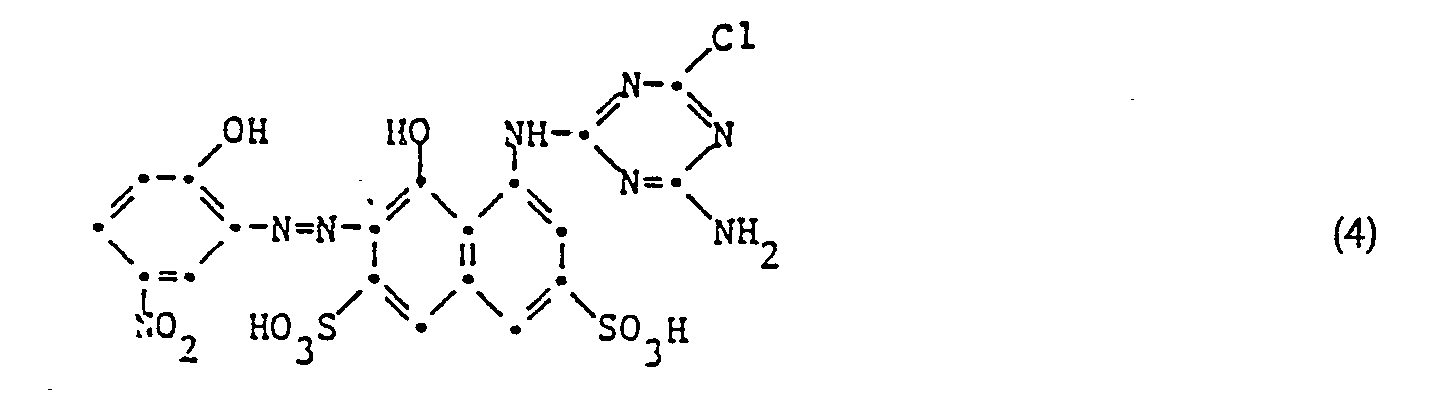
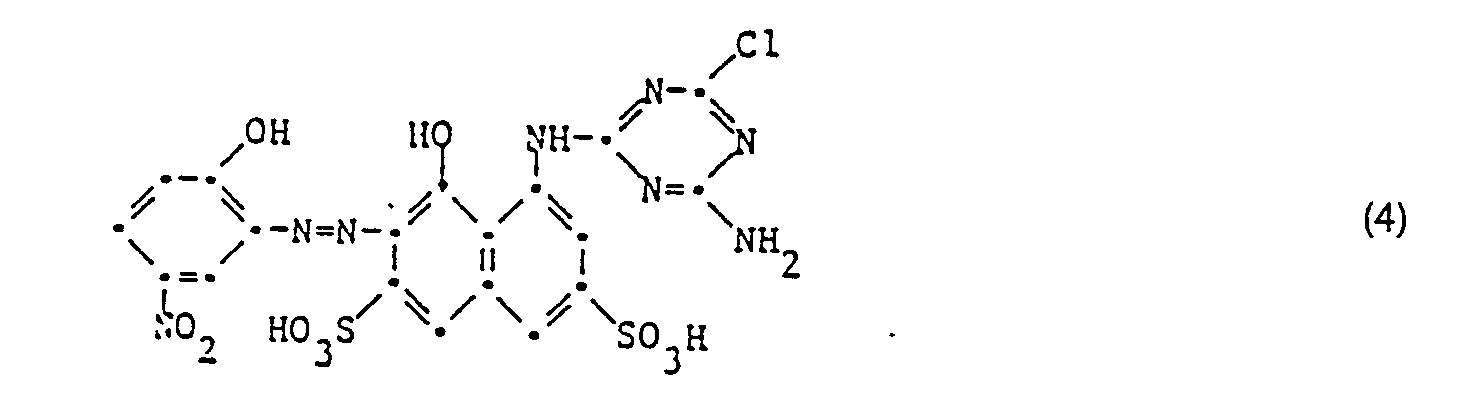
- a very particularly important embodiment of the method according to the invention is thus characterized in that the 1: 2 chromium and 1: 2 cobalt complex of the azo dye of the formula is used as a mixture component and as another mixture component the 1: 2-chromium and 1: 2-cobalt complex of the azo dye of the formula used.
- the weight ratio of 1: 2 chromium complex to 1: 2 cobalt complex is in particular 80:20 to 60:40.
- the weight ratio of the metal complexes of the formula (3) to the metal complexes of the formula (4) is preferably 80:20 to 20:80 and in particular 60:40 to 40:60 and especially 50:50.
- Another particularly important embodiment of the process according to the invention is characterized in that the 1: 2 chromium complex of the azo dye of the formula is used as a mixture component and as another mixture component, the 1: 2 cobalt complex of the azo dye of the formula used.
- the weight ratio of 1 2-chromium complex to 1: 2 cobalt complex is 95: 5 to 50:50 and in particular 90: 10 to 75:25.
- the sulfo-containing 1 2-metal complex dyes used in the process according to the invention are known per se and are obtained by known methods.
- the dye mixtures used in the process according to the invention can, for. B. by mixing the individual dyes. This mixing process takes place, for example, in suitable mills, e.g. B. ball or pin mills, as well as in kneaders or mixers.
- the dye mixtures can be prepared by drying the aqueous dye solutions, preferably by spray drying.
- the dye baths and printing pastes can contain other conventional additives in addition to the dye and the auxiliaries mentioned.
- Natural and synthetic fibers and their mixtures can be considered as textile materials. Examples include: cotton, linen, viscose, polynosic, copper synthetic silk, wool, silk, synthetic polyamide and polyurethane fibers, wool / polyamide, wool / polyester, wool / cellulose, wool / polyacrylonitrile and polyester / cellulose Blended fabrics.
- Textile materials made of synthetic polyamide fibers, cellulose fibers and polyester / cellulose blended fabrics are preferably used.
- the textile materials are dyed or printed by methods known per se and then fixed.
- the dye is fixed on the fiber by customary methods, the fixing time and fixing temperature depending on the fiber material and the reactivity of the reactive dyes used. Steaming times in saturated steam between 30 seconds and 12 minutes, in particular 2 to 10 minutes, at 90 to 140 ° C., in particular 100 to 105 ° C., are generally sufficient to achieve a uniform and optimal dye fixation. High temperature steaming or dry heat treatment is used to fix at 105 to 220 ° C for 20 seconds to 8 minutes.
- the dyeings or prints are fixed in the process according to the invention in the presence of steam or hot air, under normal pressure and at a temperature between 90 ° C. and 220 ° C.
- the dyeings or prints are finished by rinsing in hot and / or cold water and, if appropriate, subsequent washing in the presence of a commercially available detergent, followed by rinsing in water and drying.
- Suitable disperse dyes come e.g. B. the dyes known from the Color Index as Disperse Dyes.
- water-soluble dyes which can be applied together with the defined mixture of heavy metal-containing, water-soluble gray- or black-coloring reactive dyes, and which, as a water-solubilizing group, for. B. contain one or more sulfonic acid groups, are non-reactive or fiber-reactive dyes, such as. B. the dyes known in the Color Index as Acid, Direct and Reactive Dyes.
- the weight ratio of 1: 2 chromium complex to 1: 2 cobalt complex is in particular 80:20 to 60:40.
- the ratio of the metal complexes of the formula (1) to the metal complexes of the formula (2) is preferably 80:20 to 20:80, in particular 60:40 to 40:60 and especially 50:50.
- X in formulas (1) and (2) preferably denotes the identical 2,5,6-trichloropyrimidin-4-yl- or 2-chloro-4- (amino-, morpholino-, ⁇ -sulfoethylamino-, p-sulfophenylamino- , o-sulfophenylamino, N-ethyl, N-phenylamino or 2 '- ( ⁇ - chloroethylsulfonylethoxy-ethylamino) -1,3,5, -triazin-6-yl radical.
- 2-chloro-4 is particularly preferred -amino-1,3,5-triazin-6-yl.
- the dye mixture containing the 1: 2 chromium and 1 2 cobalt complex of the azo dye of the formula is therefore particularly important and the 1: 2 chromium and 1: 2 cobalt complex of the azo dye of the formula
- the weight ratio of 1: 2 chromium complex to 1: 2 cobalt complex is in particular 80 20 to 60 40.
- the ratio of the metal complexes of the formula (3) to the metal complexes of the formula (4) is preferably 80:20 to 20:80, in particular 60:40 to 40:60 and especially 50:50.
- the dye mixture containing the 1: 2 chromium complex of the azo dye of the formula is also particularly important and the 1: 2 cobalt complex of the azo dye of the formula
- the weight ratio of 1: 2 chromium complex to 1:: 2 cobalt complex of the metal complexes is preferably 95: 5 to 50:50 and in particular 90: 10 to 75:25.
- the dye mixtures according to the invention can be used for dyeing or printing textile fiber materials.
- the materials mentioned above can be considered as textile fiber materials.
- Cellulose fibers are preferably dyed or printed with the dye mixtures according to the invention, it being possible to use the customary dyeing, printing and fixing processes.
- Fiber-reactive radicals X are understood to mean those which react with the hydroxyl groups of cellulose, the amino, carboxy, hydroxyl and thiol groups in wool and silk, or with the amino and possibly carboxy groups of synthetic polyamides to form covalent chemical bonds capital.
- X is preferably a fiber-reactive radical of the aliphatic, aromatic or heterocyclic series which is bonded to the chromophore directly or via a bridge member.
- X is preferably directly or via an optionally monoalkylated amino group such as.
- fiber-reactive radicals X of the heterocyclic series are to be mentioned, such as. B. 2,4-dichlorotriazinyl-6, mono- di- or trihalopyrimidinyl residues, such as 2,4-dichloropyrimidinyl-6, 2,4,5-trichloropyrimidinyl-6, 2,4-dichloro-5-nitro - or 5-methyl- or -5-carboxymethyl- or -5-carboxy- or -5-cyano- or -5-vinyl- or -5-sulfo- or -5-mono-, -di or trichloromethyl- or 5-methylsulfonylpyrimidinyl-6-, 2,5-dichloro-4-methylsufonyl-pyrimidinyl-6-, 2-fluoro-4-pyrimidinyl-, 2,6-difluoro-4-pyrimidinyl-, 2,6-difluoro-5- chloro-4-pyrimidinyl,
- 2-oniumtriazinyi-6 radicals which are in the 4-position by alkylamino, such as methylamino, ethylamino or ⁇ -hydroxyethylamino, or alkoxy, such as methoxy or ethoxy, or aryloxy, such as phenoxy, or sulfophenox y groups are substituted.
- the process according to the invention is distinguished from known processes with heavy-metal-containing, water-soluble gray or black-coloring reactive dyes by a significantly better stability to shades of the resulting dyeings or prints.
- the following examples serve to illustrate the invention.
- the parts are parts by weight and the percentages are percentages by weight.
- the temperatures are given in degrees Celsius.
- the relationship between parts by weight and parts by volume is the same as that between grams and cubic centimeters.
- Example 1 If one proceeds as indicated in Example 1, but instead of mixing the metal complexes of the formulas (3) and (4) 1 g / kg of the 1: 2-chromium and 1: 2-cobalt complex of the azo dye of the formula (4) given in Example 1, light gray prints are obtained with otherwise the same procedure, whereby the fabric treated in the Mathis damper has a green tint and the fabric treated in the star damper has a red tint.
- the fluid absorption of the tissue is approx. 70%. Subsequently, steaming is carried out at 102 ° C. for 90 seconds without intermediate drying.
Landscapes
- Chemical & Material Sciences (AREA)
- Engineering & Computer Science (AREA)
- Textile Engineering (AREA)
- Organic Chemistry (AREA)
- Chemical Kinetics & Catalysis (AREA)
- Coloring (AREA)
Description
- Die vorliegende Erfindung betrifft ein neues Verfahren zum nuancenstabilen Färben oder Bedrucken textiler Fasermaterialien mit grau- bzw. schwarzfärbenden Reaktivfarbstoffen und anschliessender Fixierung.
- Textile Fasermaterialien, die mit einem grau- bzw. schwarzfärbenden Reaktivfarbstoff gefärbt oder bedruckt sind, zeigen häufig eine Instabilität der Nuance, d. h. bei ein und demselben Farbstoff kann eine Nuancenabweichung nach rot oder nach gelb bzw. grün auftreten. Diese Nuancenabweichung wird z. B. hauptsächlich beeinflusst vom Fasermaterial und dessen Vorbehandlung, Färbebedingungen, Druckrezeptur und Trocknungs- und Fixierbedingungen. Beeinflussende Faktoren sind z. B.
- a) bei der Druckrezeptur: Art des Verdickungsmittels, Alkalimenge, Menge des Oxydationsmittels ;
- b) bei der Trocknung : Temperatur, Zeit;
- c) bei der Dämpffixierung: Dampfzustand, Dampfbeschaffenheit, wie Temperatur, Feuchtigkeit, Luftfreiheit, Gehalt an Reduktionsmitteln und Dämpfzeit ;
- d) bei der Thermofixierung : Hamstoffmenge, Temperatur, Zeit.
- Speziell kritisch wirkt sich diese Nuancenabweichung aus bei mittleren bis hellen Farbtönen im Graubereich und bei modischen Farbtönen, die eine Nuancierkomponente des Graubereichs benötigen.
- Aufgabe der vorliegenden Erfindung ist es, ein Verfahren zum nuancenstabilen Färben oder Bedrucken von textilen Fasermaterialien mit grau- bzw. schwarzfärbenden Reaktivfarbstoffen zu finden, welches die vorstehend beschriebenen Nachteile nicht aufweist und den heutigen Anforderungen genügt.
- Diese Aufgabe wird dadurch gelöst, dass man anstelle eines grau-bzw. schwarzfärbenden Reaktivfarbstoffes eine Mischung von zwei grau- bzw. schwarzfärbenden Reaktivfarbstoffen appliziert, die sich in ihrer Nuancenabweichung unter identischen Bedingungen gegenläufig verhalten, d. h. ein Farbstoff zeigt die Nuancenabweichung nach rot und unter identischen Bedingungen zeigt der andere Farbstoff die Nuancenabweichung nach gelb bzw. grün.
- Gegenstand der vorliegenden Erfindung ist somit ein Verfahren zum nuancenstabilen Färben oder Bedrucken von textilen Fasermaterialien mit grau- bzw. schwarzfärbenden Reaktivfarbstoffen, welches dadurch gekennzeichnet ist, dass man textile Fasermaterialien
- A) mit einer Mischung der 1 : 2-Chrom- und 1 : 2-Kobaltkomplexe des Azofarbstoffes der Formel


- B) mit dem 1 : 2-Kobaltkomplex des Azofarbstoffes der Formel (1) und dem 1 : 2-Chromkomplex des Azofarbstoffes der Formel (2), färbt oder bedruckt und anschliessend fixiert.
- Ueberraschenderweise werden mit dem erfindungsgemässen Verfahren nuancenstabile Färbungen bzw. Drucke erhalten.
- Die Mengen, in denen die definierte Farbstoffmischung in Färbebädern oder Druckpasten verwendet wird, können je nach der gewünschten Farbtiefe in weiten Grenzen schwanken, im allgemeinen haben sich Mengen von 0,01 bis 10 Gewichtsprozent, bezogen auf das Färbegut, bzw. die Druckpaste, als vorteilhaft erwiesen.
- Die im erfindungsgemässen Verfahren verwendeten sulfogruppenhaltigen Farbstoffe liegen entweder in Form ihrer freien Sulfonsäure oder vorzugsweise als deren Salze vor.
- Als Salze kommen beispielsweise die Alkali-, Erdalkali- oder Ammoniumsalze oder die Salze eines organischen Amins in Betracht. Als Beispiele seien die Natrium-, Lithium-, Kalium- oder Ammoniumsalze oder das Salz des Triäthanolamins genannt.
- X in den Formeln (1) und (2) kann gleich oder verschieden sein.
- In den Metallkomplexen der Azofarbstoffe der Formeln (1) bzw. (2) ist das Gewichtsverhältnis von 1 : 2-Chromkomplex zu 1 : 2-Kobaltkomplex insbesondere 80 : 20 bis 60 : 40.
- Das Gewichtsverhältnis der Metallkomplexe der Formel (1) zu den Metallkomplexen der Formel (2) ist vorzugsweise 80 : 20 bis 20 : 80 und insbesondere 60 : 40 bis 40 : 60 und vor allem 50 : 50.
- Eine bevorzugte Ausführungsform des erfindungsgemässen Verfahrens ist dadurch gekennzeichnet, dass man als eine Mischungskomponente den 1 :2-Chrom- und 1 :2-Kobaltkomplex des Azofarbstoffes der Formel (1) und als andere Mischungskomponente den 1 : 2-Chrom- und 1 : 2 Kobaltkomplex des Azofarbstoffes der Formel (2) verwendet.
- Eine ebenfalls bevorzugte Ausführungsform des erfindungsgemässen Verfahrens ist dadurch gekennzeichnet, dass man als eine Mischungskomponente den 1 2-Chromkomplex des Azofarbstoffes der Formel (2) und als andere Mischungskomponente den 1 2-Kobaltkomplex des Azofarbstoffes der Formel (1) verwendet.
- Die Azofarbstoffe der Formeln (1) und (2) enthalten vorzugsweise identische Reste X.
- Vorzugsweise verwendet man Azofarbstoffe der Formeln (1) und (2), worin X ein identischer 2,5,6-Trichlorpyrimidin-4-yl- oder 2-Chlor-4-(amino-, morpholino-, β-sulfoäthylamino-, p-sulfophenylamino-, o-sulfophenylamino-, N-äthyl, N-phenylamino- oder 2'-(ß-chloräthylsulfonyläthoxyäthylamino)-1,3,5-triazin-6-yl-Rest ist. Besonders bevorzugt bedeutet X 2-Chlor-4-amino-1,3,5-triazin-6-yl.
- Eine ganz besonders wichtige Ausführungsform des erfindungsgemässen Verfahrens ist somit dadurch gekennzeichnet, dass man als eine Mischungskomponente den 1 :2-Chrom- und 1 :2-Kobaltkomplex des Azofarbstoffs der Formel


- In den Metallkomplexen der Azofarbstoffe der Formeln (3) bzw. (4) ist das Gewichtsverhältnis von 1 : 2-Chromkomplex zu 1 : 2-Kobaltkomplex insbesondere 80 : 20 bis 60 : 40.
- Das Gewichtsverhältnis der Metallkomplexe der Formel (3) zu den Metallkomplexen der Formel (4) ist vorzugsweise 80 : 20 bis 20 : 80 und insbesondere 60 : 40 bis 40 : 60 und vor allem 50 : 50.
- Eine ebenfalls ganz besonders wichtige Ausführungsform des erfindungsgemässen Verfahrens ist dadurch gekennzeichnet, dass man als eine Mischungskomponente den 1 :2-Chromkomplex des Azofarbstoffes der Formel


- In dieser Mischung ist das Gewichtsverhältnis von 1 2-Chromkomplex zu 1 : 2-Kobaltkomplex 95:5 bis 50 : 50 und insbesondere 90 : 10 bis 75 : 25.
- Die in dem erfindungsgemässen Verfahren verwendeten sulfogruppenhaltigen 1 2-Metallkomplexfarbstoffe sind an sich bekannt und werden nach bekannten Methoden erhalten.
- Die in dem erfindungsgemässen Verfahren verwendeten Farbstoffmischungen können z. B. durch Mischung der Einzelfarbstoffe hergestellt werden. Dieser Mischprozess erfolgt beispielsweise in geeigneten Mühlen, z. B. Kugel- oder Stiftmühlen, sowie in Knetern oder Mixern.
- Ferner können die Farbstoffmischungen durch Trocknen der wässrigen Farbstofflösungen hergestellt werden, bevorzugt Zerstäubungstrocknen.
- Die Färbebäder und Druckpasten können neben dem Farbstoff und den genannten Hilfsmitteln noch weitere übliche Zusätze enthalten.
- Besondere Vorrichtungen sind beim erfindungsgemässen Verfahren nicht erforderlich. Es können die üblichen Druck- bzw. Färbeapparate und -maschinen verwendet werden.
- Weitere bevorzugte Ausführungsformen des erfindungsgemässen Verfahrens sind dadurch gekennzeichnet, dass man
- a) textile Fasermaterialien mit der oben angegebenen Mischung bedruckt,
- b) textile Fasermaterialien mit Farbstoffmischungen, enthaltend die oben angegebene Mischung sowie weiter Farbstoffe oder Farbstoffmischungen, färbt oder bedruckt ; insbesondere textile Fasermaterialien aus Mischgeweben mit Farbstoffmischungen, enthaltend mindestens einen Dispersionsfarbstoff, färbt oder bedruckt ; vorzugsweise wird ein Polyester/Cellulose-Mischgewebe verwendet ;
- c) Cellulosefasem färbt oder bedruckt.
- Als Textilmaterialien kommen natürliche und synthetische Fasern und deren Mischungen in Betracht. Als Beispiele seien genannt: Baumwolle, Leinen, Viscose, Polynosic, Kupfer-Kunstseiden, Wolle, Seide, synthetische Polyamid- und Polyurethanfasern, Wolle/Polyamid-, Wolle/Polyester, Wolle/Cellulose-, Wolle/Polyacrylnitril- und Polyester/Cellulose-Mischgewebe.
- Bevorzugt werden Textilmaterialien aus synthetischen Polyamidfasern, Cellulosefasern und Polyester/Cellulose-Mischgewebe verwendet.
- Die Textilmaterialien werden nach an sich bekannten Methoden gefärbt oder bedruckt und anschliessend fixiert.
- Die Farbstoff-Fixierung auf der Faser erfolgt nach üblichen Verfahren, wobei Fixierzeit und Fixiertemperatur vom Fasermaterial und der Reaktivität der eingesetzten Reaktivfarbstoffe abhängen. Zur Erzielung einer gleichmässigen und optimalen Farbstoff-Fixierung genügen im allgemeinen Dämpfzeiten im Sattdampf zwischen 30 Sekunden und 12 Minuten, insbesondere 2 bis 10 Minuten, bei 90 bis 140 °C, insbesondere 100 bis 105°C. Durch Hochtemperatur-Dämpfen bzw. Trokkenhitze-Behandlung wird während 20 Sekunden bis 8 Minuten bei 105 bis 220 °C fixiert.
- Insbesondere erfolgt die Fixierung der Färbungen oder Drucke in dem erfindungsgemässen Verfahren in Gegenwart von Wasserdampf oder Heissluft, unter Normaldruck und bei einer Temperatur zwischen 90 °C und 220 °C.
- Die Fertigstellung der Färbungen oder Drucke erfolgt durch Spülen in heissem und/oder kaltem Wasser und gegebenenfalls anschliessendem Waschen in Gegenwart eines handelsüblichen Waschmittels, nachfolgendem Spülen in Wasser und Trocknen.
- Zusammen mit der definierten Mischung schwermetallhaltiger, wasserlöslicher grau- bzw. schwarzfärbender Reaktivfarbstoffe können in Wasser nur wenig lösliche Farbstoffe (Dispersionsfarbstoffe) oder andere wasserlösliche Farbstoffe appliziert werden.
- Als geeignete Dispersionsfarbstoffe kommen z. B. die aus dem Colour Index als Disperse Dyes bekannten Farbstoffe in Betracht.
- Als geeignete wasserlösliche Farbstoffe die zusammen mit der definierten Mischung schwermetallhaltiger, wasserlöslicher grau- bzw. schwarzfärbender Reaktivfarbstoffe appliziert werden können, und die als wasserlöslichmachende Gruppe z. B. eine oder mehrere Sulfonsäuregruppen enthalten, kommen nicht-reaktive oder faserreaktive Farbstoffe in Betracht, wie z. B. die im Colour Index als Acid-, Direct- und Reactive Dyes bekannten Farbstoffe.
- Gegenstand der Erfindung ist ferner die Farbstoffmischung enthaltend
- A) den 1 :2-Chrom-und 1 : 2-Kobaltkomplex des Azofarbstoffes der Formel (1) und den 1 :2-Chrom-und 1 : 2-Kobaltkomplex des Azofarbstoffes der Formel (2) ; oder
- B) den 1 2-Kobaltkomplex des Azofarbstoffes der Formel (1) und den 1 : 2-Chromkomplex des Azofarbstoffes der Formel (2).
- In den Metallkomplexen der Azofarbstoffe der Formeln (1) bzw. (2) ist das Gewichtsverhältnis von 1 : 2-Chromkomplex zu 1 : 2-Kobaltkomplex insbesondere 80 : 20 bis 60 : 40.
- Das Verhältnis der Metallkomplexe der Formel (1) zu den Metallkomplexen der Formel (2) ist vorzugsweise 80 : 20 bis 20 : 80, insbesondere 60 : 40 bis 40 : 60 und vor allem 50 : 50.
- Vorzugsweise bedeutet X in den Formeln (1) und (2) den identischen 2,5,6-Trichlorpyrimidin-4-yl-oder 2-Chlor-4-(amino-, morpholino-, β-sulfoäthylamino-, p-sulfophenylamino-, o-sulfophenylamino-, N-äthyl, N-phenylamino- oder 2'-(ß-chloräthylsulfonyläthoxy-äthylamino)-1,3,5,-triazin-6-yl-Rest. Besonders bevorzugt ist X 2-Chlor-4-amino-1,3,5-triazin-6-yl.
- Ganz besonders wichtig ist somit die Farbstoffmischung, enthaltend den 1 :2-Chrom- und 1 2-Kobaltkomplex des Azofarbstoffes der Formel


- In den Metallkomplexen der Azofarbstoffe der Formeln (3) bzw. (4) ist das Gewichtsverhältnis von 1 : 2-Chromkomplex zu 1 : 2-Kobaltkomplex insbesondere 80 20 bis 60 40.
- Das Verhältnis der Metallkomplexe der Formel (3) zu den Metallkomplexen der Formel (4) ist vorzugsweise 80 : 20 bis 20 : 80, insbesondere 60 : 40 bis 40 : 60 und vor allem 50 : 50.
- Ebenfalls besonders wichtig ist die Farbstoffmischung enthaltend den 1 :2-Chromkomplex des Azofarbstoffes der Formel


- In dieser Farbstoffmischung ist das Gewichtsverhältnis von 1 : 2-Chromkomplex zu 1 : :2-Kobaltkomplex der Metallkomplexe vorzugsweise 95 : 5 bis 50 : 50 und insbesondere 90 : 10 bis 75 : 25.
- Die erfindungsgemässen Farbstoffmischungen können zum Färben oder Bedrucken textiler Fasermaterialien verwendet werden. Als textile Fasermaterialien kommen die vorstehend genannten Materialien in Betracht. Vorzugsweise werden mit den erfindungsgemässen Farbstoffmischungen Cellulosefasern gefärbt oder bedruckt, wobei die üblichen Färbe-, Druck- und Fixierverfahren angewendet werden können.
- Interessant ist ferner die Verwendung der erfindungsgemässen Farbstoffmischungen als Komponente in Mischungen mit anderen Farbstoffen, z. B. zur Erzielung gedeckter Farbtöne.
- Unter faserreaktiven Resten X sind solche zu verstehen, die mit den Hydroxygruppen der Cellulose, den Amino-, Carboxy-, Hydroxy- und Thiolgruppen bei Wolle und Seide, oder mit den Amino- und eventuell Carboxygruppen von synthetischen Polyamiden unter Bildung kovalenter chemischer Bindungen zu reagieren vermögen.
- Vorzugsweise bedeutet X einen faserreaktiven Rest der aliphatischen, aromatischen oder heterocyclischen Reihe, der direkt oder über ein Brückenglied an den Chromophor gebunden ist.
- Vorzugsweise ist X direkt oder über eine gegebenenfalls monoalkylierte Aminogruppe wie z. B. -NH-, -N(CH3)-, ―N(C2H5)― oder ―N(C3H7)― oder über ein eine Aminogruppe enthaltendes Brückenglied an den Chromophor gebunden.
- Als faserreaktive Reste X kommen z. B. die folgenden aliphatischen und aromatischen Reste in Betracht :
- Vinylsulfonyl-, β-Chloräthylsulfonyl-, ß-Sulfatoäthylsulfonyl-, Acetoxy-äthylsulfonyl-, Phosphonooxy- äthylsulfonyl-, ß-Thiosulfatoäthylsulfonyl, N-Methyl-N-(ß-sulfatoäthyl-sulfonyl)-amino, Acryloyl, Mono-, Di-oder Trichloracryloyl wie ―CO―CCl=CH2, -CO-CH=CH-CI, ―CO―CCl=CH―CH3; Mono-, Di- oder Tribromacryloyl wie -CO-CBr=CH2, -CO-CH=CH-Br, ―CO―CBr=CH―CH3; sowie -CO-CCI=CH-COOH -CO-CH=CCI-COOH, -CO-CBr=CH-COOH, ―CO―CH=CBr―COOH; -CO-CCI=CCI-COOH, ―CO―CBr=CBr―COOH ; Vorstufen des Acryloyl-Restes und der Derivate des Acryloyl-Restes wie β-Chlor- oder β-Brompropionyl, 3-Phenylsulfonylpropionyl, 3-Methylsulfonylpropionyl, 3-Chlor-3-phenylsulfonylpropionyl, 2,3-Dichlorpropionyl, 2,3-Dibrompropionyl ; sowie 2-Fluor-2-chlor-3,3-difluorcyclobutan-1-carbonyl, 2,2,3,3-Tetrafluorcyclobutan-carbonyl-1-oder sulfonyl-1-, β-(2,2,3,3-Tetrafluorcyclobutyl-1)-acryloyl, α- oder β-Alkenyl- oder Arylsulfonyl-acryloyl-Gruppe wie α- oder β-Methylsulfonylacryloyl, Propiolyl, Chloracetyl, Bromacetyl, 4-(ß-Chloräthyl-sulfonyl)-butyryl, 4-Vinyisulfonyl-butyryl, 5-(ß-Chloräthyl-sulfonyl)-valeryl, 5-Vinylsulfonyl-valeryl, 6-(ß-Chloräthyl-sulfonyl)-caproyl, 6-Vinylsulfonyl-carproyl ; sowie 4-Fluor-3-nitro-benzoyl, 4-Fluor-3-nitrophenylsulfonyl, 4-Fluor-3-methylsulfonylben- zoyl, 4-Fluor-3-cyanbenzoyl, 2-Fluor-5-methylsulfonylbenzoyl.
- Des weiteren sind faserreaktive Reste X der heterocyclischen Reihe zu nennen, wie z. B. 2,4-Dichlortriazinyl-6-, Mono- Di- oder Trihalogenpyrimidinylreste, wie 2,4-Dichlorpyrimidinyl-6-, 2,4,5-Trich- lorpyrimidinyl-6-, 2,4-Dichlor-5-nitro- oder 5-methyl- oder -5-carboxymethyl- oder -5-carboxy- oder -5-cyano- oder -5-vinyl- oder -5-sulfo- oder -5-mono-, -di- oder trichlormethyl- oder 5-methylsulfonylpyrimidinyl-6-, 2,5-Dichlor-4-methylsufonyl-pyrimidinyl-6-, 2-Fluor-4-pyrimidinyl-, 2,6-Difluor-4-pyrimidinyl-, 2,6-Difluor-5-chlor-4-pyrimidinyl-, 2-Fluor-5,6-dichlor-4-pyrimidinyl-, 2,6-Difluor-5-methyl-4-pyrimidinyl-, 2,5-Difluor-6-methyl-4-pyrimidinyl-, 2-Fluor-5-methyl-6-chlor-4-pyrimidinyl-, 2-Fluor-5-nitro-6-chlor-4-pyrim!- dinyl-, 2-Fluor-5-nitro-6-chlor 4-pyrimidinyl-, 5-Brom-2-fluor-4-pyrimidinyl-, 2-Fluor 5-cyan-4-pyrimidinyl-, 2-Fluor-5-methyl-4-pyrimidinyl-, 2,5,6-Trifluor-4-pyrimidinyl-, S-Chlor-6-chlormethyl-2-fluor-4-pyrimidinyl-, 2,6-Difluor-5-brom-4-pyrimidinyl-, 2-Fluor 5-brom-6-chlormethyl-4-pyrimidinyl-, 2,6-Difluor-5-chlormethyl-4-pyrimidinyl-, 2,6-Difluor-5-nitro-4-pyrimidinyl-, 2-Fluor-6-methyl-4-pyrimidinyl-, 2-Fluor-5-chlor-6-methyl-4-pyrimidinyl-, 2-Fluor-5-chlor-4-pyrimidinyl-, 2-Fluor-6-chlor-4-pyrimidinyl-, 6-Trifluormethyl-5-chlor-2-fluor-4-pyrimidinyl-, 6-Trifluormethyl-2-fluor-4-pyrimidinyl-, 6-Trifluormethyl-2-fluor-4-pyrimidinyl- , 2-Fluor-5-nitro-4-pyrimidinyl-, 2-Fluor-5-trifluormethyl-4-pyrimidinyl-, 2-Fluor-5-phenyl-oder 5-methylsulfonyl-4-pyrimidinyl-, 2-Fluor-5-carbonamido-4-pyrimidinyl-, 2-Fluor-5-carbomethoxy-4-pyrimidinyl-, 2-Fluor-5-brom-6-trifluormethyl-4-pyrimidinyl-, 2-Fluor-6-carbonamido-4-pyrimidinyl-, 2-Fluor-6-carbomet- hoxy-4-pyrimidinyl-, 2-Fluor-6-phenyl-4-pyrimidinyl-, 2-Fluor-6-cyan-4-pyrimidinyl-, 2,6-Difluor-5-methylsulfonyl-4-pyrimidinyl-, 2-Fluor 5-sulfonamido-4-pyrimidinyl-, 2-Fluor-5-chlor-6-carbomethoxy-4-pyrimidinyl-, 2,6-Difluor-5-trifluormethyl-4-pyrimidinyl ; 2,4-Bis-methylsulfonyl-pyrimidinyl-4-, 2,5-Bis-methylsulfonyl-6-chlor-pyrimidinyl-4-, 2-Methylsulfonyl-pyrimidinyl-4-, 2-Phenylsulfonyl-pyrimidinyl-4-, 2-Methylsulfonyl-5-chlor-6-methylpyrimidinyl-4-, 2-Methylsulfonyl-5-brom-6-methyl-pyrimidinyl-4-, 2-Methylsulfonyl-5-chlor-6-äthyl-pyrimidinyl-4-, 2-Methylsulfonyl-S-chlor-methyl-pyrimidinyl-4-, 2-Methylsulfonyl-5-nitro-6-methylpyrimidinyl-4-, 2,5,6-Tris-methylsulfonyl-pyrimidinyl-4-, 2-Methylsulfonyl-5,6-dimethyl-pyrimidinyl-4-, 2-Aethylsulfonyl-5-chlor-6-methyl-pyrimidinyl-4-, 2-Methylsulfonyl-6-chlor-pyrimidinyl-4-, 2,6-Bis-methylsulfonyl-5-chlor-pyrimidinyl-4-, 2-Methylsulfonyl-6-carboxypyrimidinyl-4-, 2-Methylsulfonyl-5-sulfo-pyrimidinyl-4-, 2-Methylsulfonyl-6-carbomethoxy-pyrimidinyl-4-, 2-Methylsulfonyl-5-carboxypyrimidinyl-4-, 2-Methylsulfonyl-5-cyan-6-methoxy-pyrimidinyl-4-, 2-Methylsulfonyl-5-chlor-pyrimidinyl-4-, 2-Sulfoäthyl- sulfonyl-6-methyl-pyrimidinyl-4-, 2-Methylsulfonyl-5-brom-pyrimidinyl-4-, 2-Phenylsulfonyl-5-chlor-pyrimidinyl-4-, 2-Carboxymethylsulfonyl-5-chlor-6-methyl-pyrimidinyl-4-, 2,4-Dichlorpyrimidin-6-carbonyl oder 6-sulfonyl, 2,4-Dichlorpyrimidin-5-carbonyl- oder 5-sulfonyl, 2-Chlor-4-methylpyrimidin-5-carbonyl, 2-Methyl-4-chlorpyrimidin-5-carbonyl, 2-Methylthio-4-fluorpyrimidin-5-carbonyl, 6-Methyl-2,4-dichlorpyrimidin-5-carbonyi, 2,4,6-Trichlorpyrimidin-5-carbonyl, 2,4-Dichlorpyrimidin-5-sulfonyl, 2,4-Dichlor-6-methyl-pyrimidin-5-carbonyl oder 5-sulfonyl, 2-Methylsulfonyl-6-chlorpyrimidin-4- und 5-carbonyl, 2,6-Bis-(methylsulfonyl)-pyrimidin-4- oder -5-carbonyl, 2-Ethylsulfonyl-6-chlorpyrimidin-5-carbonyl, 2,4-Bis-(methylsulfonyl)-pyrimidin-5-sulfonyl, 2-Methylsulfonyl-4-chlor-6-methylpyrimidin-5-sulfonyl- oder -5-carbonyl, 2-Chlorchinoxalin-3-carbonyl, 2- oder 3-Monochlorchinoxalin-6-carbonyl, 2- oder 3-Monochlorchino- xalin-6-sulfonyl, 2,3-Dichlorchinoxalin-5- oder -6-carbonyl, 2,3-Dichlorchinoxalin-5- oder -6-sulfonyl, 1,4-Dichlorphthalazin-6-sulfonyl- oder -6-carbonyl, 2,4-Dichlorchinazolin-7- oder -6-sulfonyl- oder carbonyl, 2,4,6-Trichlorchinazolin-7- oder -8-sulfonyl, 2- oder 3- oder 4-(4',5'-Dichlorpyridazon-6'-yl-i')-phenylsulfonyl- oder carbonyl, β-(4',5'-Dichlorpyridazinon-6'-yl-1')-propionyl, 3,6-Dichlorpyridazin-4-carbonyl-oder 4-sulfonyl, 2-Chlorbenzthiazol-5- oder 6-carbonyl- oder -5-oder -6-sulfonyl, 2-Arylsulfonyl- oder -Alkylsulfo- nylbenzthiazol-5-oder -6-carbonyl- oder -5- oder -6-sulfonyl, wie 2-Methylsulfonyl-oder 2-Ethylsulfonyl- benzthiazol-5- oder -6-sulfonyl- oder -carbonyl, 2-Phenylsulfonyl-benzthiazol-5- oder -6-sulfonyl- oder carbonyl und die entsprechenden im ankondensierten Benzolring Sulfogruppen enthaltenden 2-Sulfonyl- benzthiazol-5- oder -6-carbonyl- oder -sulfonyl-Derivate, 2-Chlorbenzoxazol-5- oder -6-carbonyl- oder - sulfonyl, 2-Chlorbenzimidazol-5- oder -6-carbonyl- oder -sulfonyl, 2-Chlor-l-methylbenzimidazol-5- oder - 6-carbonyl- oder -sulfonyl, 2-Chlor-4-methylthiazol-(1, 3)-5-carbonyl) oder -4- oder -5-sulfonyl ; ammoniumgruppenhaltige Triazinringe, wie 2-Trimethylammonium-4-phenylamino- oder -4-(o-, m- oder p-sulfophenyl)-amino-triazinyl-6-, 2-(1,1-Dimethylhydrazinium)-4-phenylamino- oder -4-(o-, m- oder p-sulfophenyl)-aminotriazinyl-6-, 2-(2-Isopropyliden-1,1-dimethyl)-hydrazinium-4-phenylamino- oder -4-(o-, m-oder p-sulfophenyl)-aminotriazinyl-6-, 2-N-Aminopyrrolidinium- oder 2-N-Aminopiperidinium-4-phenylamino-oder -4-(o-, m- oder p-sulfophenyl)-aminotriazinyl-6-, ferner 4-Phenylamino- oder 4-(sulfophenylamino)-triazinyl-6-Reste, die in 2-Stellung über eine Stickstoffbinding das 1,4-Bis-aza-bicyclo[2,2,2]-octan oder das 1,2-Bis-aza-bicyclo-[0,3,3]-octan quartär gebunden enthalten, 2-Pyridinium-4-phenylamino- oder -4-(o-, m- oder p-sulfophenyl)-amino-triazinyl-6- sowie entsprechende 2-Oniumtriazinyi-6-Reste, die in 4-Stellung durch Alkylamino-, wie Methylamino, Aethylamino- oder β-Hydroxy-äthylamino-, oder Alkoxy-, wie Methoxy- oder Aethoxy-, oder Aryloxy-, wie Phenoxy-, oder Sulfophenoxy-Gruppen substituiert sind.
- Besonders interessante faserreaktive Reste sind Fluor-1,3,5-triazinreste der Formel

- -NH2, Alkylamino-, N,N-Dialkylamino-, Cycloalkylamino-, N,N-Dicycloalkylamino-, Aralkylamino-, Arylaminogruppen, gemischt substituierte Aminogruppen, wie N-Alkyl-N-cyclohexylamino- und N-Alkyl-N-arylaminogruppen, ferner Aminogruppen, die heterocyclische Reste enthalten, welche weitere ankondensierte carbocyclische Ringe aufweisen können, und Aminogruppen, worin das Aminostickstoffatom Glied eines N-heterocyclischen Ringes ist, der gegebenenfalls weitere Heteroatome enthält, sowie Hydrazino und Semicarbazido. Die oben genannten Alkylreste können geradkettig oder verzweigt, niedrigmolekular oder höhermolekular sein, bevorzugt sind Alkylreste mit 1 bis 6 Kohlenstoffatomen ; als Cycloalkyl-, Aralkyl- und Arylreste kommen insbesondere Cyclohexyl-, Benzyl-, Phenäthyl-, Phenyl- und Naphthylreste in Frage ; heterocyclische Reste sind vor allem Furan-, Thiophen-, Pyrazol-, Pyridin-, Pyrimidin-, Chinolin-, Benzimidazol-, Benzthiazol- und Benzoxazolreste; und als Aminogruppen, worin das Aminostickstoffatom Glied eines N-heterocyclischen Ringes ist, kommen vorzugsweise Reste von sechsgliedrigen N-heterocyclischen Verbindungen in Betracht, die als weitere Heteroatome Stickstoff, Sauerstoff oder Schwefel enthalten können. Die oben genannten Alkyl-, Cycloalkyl-, Aralkyl- und Arylreste, die heterocyclischen Resten sowie die N-heterocyclischen Ringe können weitersubstituiert sein, z. B. durch : Halogen, wie Fluor, Chlor und Brom, Nitro, Cyan, Trifluormethyl, Sulfamoyl, Carbamoyl, C1-4-Alkyl, C1-4-Alkoxy, Acylaminogruppen, wie Acetylamino oder Benzoylamino, Ureido, Hydroxy, Carboxy, Sulfomethyl oder Sulfo. Als Beispiele für derartige Aminogruppen seien genannt : -NH2, Methylamino, Aethylamino, Propylamino, Isopropylamino, Butylamino, Hexylamino, β-Methoxyäthylamino, γ-Methoxypropylamino, β-Aethoxyäthylamino, N,N-Dimethylamino, N,N-Diäthylamino, β-Chloräthylamino, β-Cyanäthylamino, γ-Cyanpropylamino, β-Carboxyäthylamino, Sulfomethylamino, β-Sulfoäthylamino, β-Hydroxyäthylamino, N,N-Di-ß-hydroxyäthylamino, y-Hydroxypropyiamino, Benzylamino, Phenäthylamino, Cyclohexylamino, Phenylamino, Toluidino, Xylidino, Chloranilino, Anisidino, Phenetidino, N-Methyl-N-phenylamino, N-Aethyl-N-phenylamino, N-ß-Hydroxyäthyl-N-phenylamino, 2-, 3- oder 4-Sulfoanilino, 2,5-Disulfoanilino, 4-Sulfomethylanilino, N-Sulfomethylanilino, 2-, 3- oder 4-Carboxyphenylamino, 2-Carboxy-5-sulfophenylamino, 2-Carboxy-4-sulfophenylamino, 4-Sulfonaphthyl-(1)-amino, 3,6-Disulfonaphthyl-(1)-amino, 3,6,8-Trisulfonaphthyl-(1)-amino, 4,6,8-Trisulfonaphthyl-(1.)-amino, 1-Sulfonaphthyl-(2)-amino, 1,5-Disulfonaphthyl-(2)-amino, 6-Sulfonaphthyl-(2)-amino, Morpholino, Piperidino, Piperazino, Hydrazino und Semicarbazido.
- Das erfindungsgemässe Verfahren zeichnet sich gegenüber bekannten Verfahren mit schwermetallhaltigen, wasserlöslichen grau- bzw. schwarzfärbenden Reaktivfarbstoffen durch eine deutlich bessere Nuancenstabilität der resultierenden Färbungen bzw. Drucke aus.
- Die nachfolgenden Beispiele dienen der Veranschaulichung der Erfindung. Darin sind die Teile Gewichtsteile und die Prozente Gewichtsprozente. Die Temperaturen sind in Celsiusgraden angegeben. Die Beziehung zwischen Gewichtsteilen und Volumenteilen ist diesseibe wie diejenige zwischen Gramm und Kubikzentimeter.
- Ein Gewebe aus mercerisierter Baumwolle wird mit einer Druckpaste, enthaltend 0,5 g/kg des 1 : 2-Chrom-und 1 : 2-Kobaltkomplexes des Azofarbstoffes der Formel

- 0 5 g/kg des 1 : 2-Chrom- und 1 : 2-Kobaltkomplexes des Azofarbstoffes der Formel

- 120 g/kg Harnstoff,
- 8 g/kg m-Nitrobenzolsulfonsäure-Na-Salz,
- 48 g/kg 25 %-ige Na2C03-Lösung,
- 400 g/kg Na-Alginat-Verdicker und
- 423 g/kg Weichwasser,
- musterförmig bedruckt, bei 100 °C während 3 Minuten getrocknet, anschliessend
- a) in einem Dämpfer offener Bauart (Mathis-Dämpfer)
- b) in einem Dämpfer geschlossener Bauart (Stemdämpfer)
- während 8 Minuten bei 101 bis 102°C gedämpft, mit kaltem Wasser und dann mit kochendem Wasser gespült bis die nicht-fixierten Anteile der eingesetzten Farbstoffe entfernt sind. Nach Trocknung des bedruckten Gewebes bei 90 bis 100°C erhält man hellgraue Drucke. Die im Mathis-Dämpfer und die im Stemdämpfer behandelten Gewebe sind nuancengleich.
- Wenn man wie im Beispiel 1 angegeben verfährt, jedoch anstelle der Mischung der Metallkomplexe der Formeln (3) und (4) 1 g/kg des in Beispiel 1 angegebenen 1 : 2-Chrom- und 1 : 2-Kobaltkomplexes des Azofarbstoffes der Formel (3) verwendet, so erhält man bei sonst gleicher Verfahrensweise hellgraue Drucke, wobei das im Mathis-Dämpfer behandelte Gewebe einen rotstichigen Farbton hat und das im Stemdämpfer behandelte Gewebe einen grünstichigen Farbton hat.
- Wenn man wie im Beispiel 1 angegeben verfährt, jedoch anstelle der Mischung der Metallkomplexe der Formeln (3) und (4) 1 g/kg des in Beispiel 1 angegebenen 1 : 2-Chrom- und 1 : 2-Kobaltkomplexes des Azofarbstoffes der Formel (4) verwendet, so erhält man bei sonst gleicher Verfahrensweise hellgraue Drucke, wobei das im Mathis-Dämpfer behandelte Gewebe einen grünstichigen Farbton hat und das im Sterndämpfer behandelte Gewebe einen rotstichigen Farbton hat.
- Ein Gewebe aus mercerisierter Baumwolle wird mit einer Flotte folgender Zusammensetzung imprägniert :
- 4,8 g/l des 1 2-Chrom- und 1 2-Kobaltkomplexes des Azofarbstoffes der Formel (3) gemäss Beispiel 1,
- 1,2 g/l des 1 2-Chrom- und 1 2-Kobaltkomplexes des Azofarbstoffes der Formel (4) gemäss Beispiel 1,
- 200 g/l Harnstoff,
- 3 g/I m-Nitrobenzolsulfonsäure-Na-Salz
- 20 g/I kalziniertes Na2CO3 und
- 771 g/I Weichwasser.
- Das imprägnierte Gewebe wird während 75 Sekunden bei 120°C getrocknet und dann während 2 Minuten bei 160°C fixiert. Anschliessend wird das Gewebe auf übliche Art gespült, geseift und getrocknet. Man erhält eine graue gleichmässige Färbung im gleichen Farbton wie die nach dem folgenden Pad-Steam-Verfahren erhaltene Färbung : Ein Gewebe aus mercerisierter Baumwolle wird mit einer Lösung foulardiert, enthaltend :
- 4,8 g/I des 1 :2-Chrom und 1 :2-Kobaltkomplexes des Azofarbstoffes der Formel (3) gemäss Beispiel 1,
- 1,2 g/l des 1 : 2-Chrom und 1 : 2-Kobaltkomplexes des Azofarbstoffes der Formel (4) gemäss Beispiel 1, und
- 3 g/I m-Nitrobenzolsulfonsäure-Na-Salz.
- Man trocknet bei 120°C während 75 Sekunden und imprägniert das Gewebe mit einer Flotte enthaltend
- 250 g/I NaCl und
- 40 g/I 30 %-ige NaOH.
- Die Flüssigkeitsaufnahme des Gewebes beträgt ca. 70 %. Anschliessend wird ohne Zwischentrocknung bei 102°C während 90 Sekunden gedämpft.
- Wenn man anstelle der Mischung der Metallkomplexe die einzelnen Metallkomplexe wie in den Vergleichsbeispielen 1 und 2 einsetzt, so erhält man Färbungen unterschiedlicher Nuancenabweichung, d. h. grünstichige bzw. rotstichige graue Färbungen.
- Ein Gewebe aus mercerisierter Baumwolle wird mit einer Druckpaste, enthaltend 0,15 g/kg des 1 : 2-Kobaltkomplexes des Azofarbstoffes der Formel

- 0,85 g/kg des 1 : 2-Chromkomplexes des Azofarbstoffes der Formel

- 120 g/kg Harnstoff,
- 8 g/kg m-Nitrobenzolsulfonsäure-Na-Salz,
- 48 g/kg 25 %-ige Na2C03-Lösung,
- 400 g/kg Ha-Alginat-Verdicker und
- 423 g/kg Weichwasser,
- musterförmig bedruckt, bei 100 °C während 3 Minuten getrocknet, anschliessend
- a) in einem Mathis-Dämpfer
- b) in einem Sterndämpfer
während 8 Minuten bei 101 bis 102°C gedämpft, mit kaltem Wasser und dann mit kochendem Wasser gespült bis die nicht-fixierten Anteile der eingesetzten Farbstoffe entfernt sind. Nach Trocknung des bedruckten Gewebes bei 90 bis 100°C erhält man hellgraue Drucke. Die im Mathis-Dämpfer und die im Sterndämpfer behandelten Gewebe sind nuancengleich. - Wenn man wie in den Beispielen 1 bis 3 angegeben verfährt, jedoch anstelle der Metallkomplexe der Azofarbstoffe der Formeln (3) und (4) eine äquimolare Menge der entsprechenden Metallkomplexe der Azofarbstoffe der Formeln


Claims (12)






Applications Claiming Priority (4)
| Application Number | Priority Date | Filing Date | Title |
|---|---|---|---|
| CH3143/85 | 1985-07-19 | ||
| CH314385 | 1985-07-19 | ||
| CH3641/85 | 1985-08-23 | ||
| CH364185 | 1985-08-23 |
Publications (2)
| Publication Number | Publication Date |
|---|---|
| EP0209494A1 EP0209494A1 (de) | 1987-01-21 |
| EP0209494B1 true EP0209494B1 (de) | 1990-01-24 |
Family
ID=25692295
Family Applications (1)
| Application Number | Title | Priority Date | Filing Date |
|---|---|---|---|
| EP86810310A Expired - Lifetime EP0209494B1 (de) | 1985-07-19 | 1986-07-14 | Verfahren zum Nuancenstabilen Färben oder Bedrucken |
Country Status (9)
| Country | Link |
|---|---|
| US (1) | US4828572A (de) |
| EP (1) | EP0209494B1 (de) |
| JP (1) | JPH0778311B2 (de) |
| KR (1) | KR940011840B1 (de) |
| BR (1) | BR8603412A (de) |
| DE (1) | DE3668479D1 (de) |
| ES (1) | ES8802191A1 (de) |
| FI (1) | FI83340C (de) |
| TR (1) | TR23250A (de) |
Families Citing this family (6)
| Publication number | Priority date | Publication date | Assignee | Title |
|---|---|---|---|---|
| KR100510242B1 (ko) * | 2002-11-22 | 2005-08-26 | (주)경인양행 | 신규의 반응성 회색 염료 및 그것의 제조방법 |
| KR20090130048A (ko) * | 2007-04-23 | 2009-12-17 | 니폰 가야꾸 가부시끼가이샤 | 모노아조 금속 착체, 아조형 안료 분산제 및 이를 포함한 안료 조성물 |
| CN102719115B (zh) * | 2012-07-02 | 2014-01-15 | 浙江劲光化工有限公司 | 一种复合活性黑染料 |
| CN102898869A (zh) * | 2012-09-28 | 2013-01-30 | 浙江亿得化工有限公司 | 一种复合深黑色活性染料 |
| DE102019210610A1 (de) * | 2018-07-23 | 2020-01-23 | Uzin Utz Ag | Farbstoffgemisch zur bestimmung der belegreife einer spachtelmasse |
| JP7283249B2 (ja) * | 2019-06-19 | 2023-05-30 | セイコーエプソン株式会社 | 水系インクジェット捺染インク組成物及び捺染方法 |
Family Cites Families (13)
| Publication number | Priority date | Publication date | Assignee | Title |
|---|---|---|---|---|
| US969001A (en) * | 1909-12-23 | 1910-08-30 | George E Swan | Heel-spring. |
| CH399629A (de) * | 1959-04-10 | 1965-09-30 | Sandoz Ag | Verfahren zur Herstellung metallhaltiger Reaktivfarbstoffe |
| BE601246A (de) * | 1960-03-11 | |||
| GB985481A (en) * | 1960-09-22 | 1965-03-10 | Ici Ltd | Mixtures of metal-complex monoazo dyestuffs containing triazinylamino groups |
| FR1353723A (fr) * | 1963-02-26 | 1964-02-28 | Ici Ltd | Compositions de matières colorantes |
| CH390868A (de) * | 1963-04-23 | 1965-08-31 | Ciba Geigy | Verfahren zum Färben oder Bedrucken von Textilfasern aus regenerierter Cellulose mit Reaktivfarbstoffen |
| GB1371781A (en) * | 1970-09-22 | 1974-10-30 | Sandoz Ltd | Finishing process |
| PL77928B1 (pl) * | 1970-09-22 | 1975-04-30 | Sandoz Ag | Sposob wykonezania porowatych materialow wloknistych |
| UST969001I4 (en) * | 1976-08-09 | 1978-04-04 | Dyed fibers | |
| DE3027546A1 (de) * | 1980-07-21 | 1982-02-18 | Bayer Ag, 5090 Leverkusen | Reaktivfaerbeverfahren |
| PL123773B2 (en) * | 1980-12-04 | 1982-11-30 | Tadeusz Andrzejewski | Reactive dyestuff for cellulose fibres |
| DD201316A1 (de) * | 1981-08-13 | 1983-07-13 | Wulfdieter Hepp | Verfahren zur herstellung homogener gemische von 1:2-metallkomplexfarbstoffen |
| DE3247727A1 (de) * | 1982-12-23 | 1984-06-28 | Hoechst Ag, 6230 Frankfurt | Nuancierverfahren unter verwendung reaktiver und nicht reaktiver farbstoffe |
-
1986
- 1986-06-25 ES ES556972A patent/ES8802191A1/es not_active Expired
- 1986-07-14 FI FI862929A patent/FI83340C/fi not_active IP Right Cessation
- 1986-07-14 EP EP86810310A patent/EP0209494B1/de not_active Expired - Lifetime
- 1986-07-14 DE DE8686810310T patent/DE3668479D1/de not_active Expired - Lifetime
- 1986-07-17 TR TR378/86A patent/TR23250A/xx unknown
- 1986-07-18 BR BR8603412A patent/BR8603412A/pt not_active IP Right Cessation
- 1986-07-19 KR KR1019860005861A patent/KR940011840B1/ko not_active Expired - Fee Related
- 1986-07-19 JP JP61169070A patent/JPH0778311B2/ja not_active Expired - Lifetime
-
1987
- 1987-10-13 US US07/107,900 patent/US4828572A/en not_active Expired - Fee Related
Also Published As
| Publication number | Publication date |
|---|---|
| KR940011840B1 (ko) | 1994-12-26 |
| ES556972A0 (es) | 1988-04-16 |
| JPS6221881A (ja) | 1987-01-30 |
| BR8603412A (pt) | 1987-03-04 |
| KR870001362A (ko) | 1987-03-13 |
| FI83340B (fi) | 1991-03-15 |
| DE3668479D1 (de) | 1990-03-01 |
| ES8802191A1 (es) | 1988-04-16 |
| US4828572A (en) | 1989-05-09 |
| FI862929A0 (fi) | 1986-07-14 |
| TR23250A (tr) | 1989-07-24 |
| EP0209494A1 (de) | 1987-01-21 |
| FI83340C (fi) | 1991-06-25 |
| JPH0778311B2 (ja) | 1995-08-23 |
| FI862929L (fi) | 1987-01-20 |
Similar Documents
| Publication | Publication Date | Title |
|---|---|---|
| EP0437184B1 (de) | Verfahren zum Trichromiefärben oder -bedrucken von cellulosehaltigen textilen Fasermaterialien | |
| EP0040790B2 (de) | Verfahren zum Färben und Bedrucken von Hydroxy- und/oder Carbonamidgruppen enthaltenden Fasermaterialien | |
| EP0546476B1 (de) | Verfahren zur Herstellung eines modifizierten Faser- materials und Verfahren zum Färben des modifizierten Fasermaterials mit anionischen Farbstoffen | |
| DE3314663C2 (de) | Verfahren zum Färben von Cellulosefasern oder Cellulosemischfasern nach der Ausschöpf-Färbemethode | |
| EP0775776B1 (de) | Verfahren zum Di- oder Trichromie-Färben oder -Bedrucken | |
| EP0478503A2 (de) | Faserreaktive Farbstoffe und Farbstoffmischungen und deren Verwendung | |
| EP0177449B1 (de) | Verfahren zum Bedrucken von Cellulosefasern | |
| EP0144093B1 (de) | Lagerstabile Druckpasten und deren Verwendung | |
| EP0181292A2 (de) | Verfahren zum Kontinuierlichen Trichromie-Färben von synthetischen Polyamidmaterialien | |
| EP0178255B1 (de) | Verfahren zum Fixieren von Färbungen oder Drucken | |
| EP0209494B1 (de) | Verfahren zum Nuancenstabilen Färben oder Bedrucken | |
| EP0625551B1 (de) | Farbstoffmischungen, Verfahren zu deren Herstellung und deren Verwendung | |
| EP0458152B1 (de) | Farbstoffgemische | |
| EP0549529B1 (de) | Verfahren zum Färben oder Bedrucken von hydroxylgruppenhaltigen Fasermaterialien | |
| EP0199950A1 (de) | Verfahren zum Färben oder Bedrucken von Hydroxygruppen enthaltenden Fasermaterialien mit neuen faserreaktiven Farbstoffen | |
| EP0352222B1 (de) | Faserreaktive Formazanfarbstoffe, Verfahren zu deren Herstellung und deren Verwendung | |
| EP0242324B1 (de) | Verfahren zum endengleichen Färben von Cellulosefasern | |
| EP0638686A1 (de) | Verfahren und Verwendung reaktiver Dispersionsfarbstoffe zum Färben oder Bedrucken aminierter, textiler Baumwoll- und Baumwoll-/Polyester-Mischgewebe | |
| EP0889098A2 (de) | Azofarbstoffe, Verfahren zu deren Herstellung und deren Verwendung | |
| EP0580091B1 (de) | Verfahren zur Herstellung eines modifizierten Fasermaterials und Verfahren zum Färben des modifizierten Fasermaterials mit anionischen Textilfarbstoffen | |
| EP0181293B1 (de) | Verfahren zum Färben von synthetischen Polyamidmaterialien mit faserreaktiven Anthrachinonfarbstoffen | |
| EP0681055A2 (de) | Verfahren zum Färben oder Bedrucken von hydroxylgruppenhaltigen Fasermaterialien | |
| EP0969051A1 (de) | Mischungen von Reaktivfarbstoffen und deren Verwendung | |
| EP0230909B1 (de) | Wasserlösliche Azoverbindungen, Verfahren zu ihrer Herstellung und ihre Verwendung als Farbstoffe | |
| EP0524147B1 (de) | Azofarbstoffe, Verfahren zu deren Herstellung und deren Verwendung |
Legal Events
| Date | Code | Title | Description |
|---|---|---|---|
| PUAI | Public reference made under article 153(3) epc to a published international application that has entered the european phase |
Free format text: ORIGINAL CODE: 0009012 |
|
| 17P | Request for examination filed |
Effective date: 19860716 |
|
| AK | Designated contracting states |
Kind code of ref document: A1 Designated state(s): BE CH DE FR GB IT LI NL SE |
|
| 17Q | First examination report despatched |
Effective date: 19880421 |
|
| GRAA | (expected) grant |
Free format text: ORIGINAL CODE: 0009210 |
|
| AK | Designated contracting states |
Kind code of ref document: B1 Designated state(s): BE CH DE FR GB IT LI NL SE |
|
| ET | Fr: translation filed | ||
| REF | Corresponds to: |
Ref document number: 3668479 Country of ref document: DE Date of ref document: 19900301 |
|
| ITF | It: translation for a ep patent filed | ||
| GBT | Gb: translation of ep patent filed (gb section 77(6)(a)/1977) | ||
| PLBE | No opposition filed within time limit |
Free format text: ORIGINAL CODE: 0009261 |
|
| STAA | Information on the status of an ep patent application or granted ep patent |
Free format text: STATUS: NO OPPOSITION FILED WITHIN TIME LIMIT |
|
| 26N | No opposition filed | ||
| ITTA | It: last paid annual fee | ||
| EAL | Se: european patent in force in sweden |
Ref document number: 86810310.2 |
|
| REG | Reference to a national code |
Ref country code: CH Ref legal event code: PUE Owner name: CIBA-GEIGY AG TRANSFER- CIBA SC HOLDING AG |
|
| BECN | Be: change of holder's name |
Effective date: 19961129 |
|
| NLS | Nl: assignments of ep-patents |
Owner name: CIBA SC HOLDING AG |
|
| REG | Reference to a national code |
Ref country code: FR Ref legal event code: TP |
|
| REG | Reference to a national code |
Ref country code: GB Ref legal event code: 732E |
|
| REG | Reference to a national code |
Ref country code: CH Ref legal event code: PFA Free format text: CIBA SC HOLDING AG TRANSFER- CIBA SPECIALTY CHEMICALS HOLDING INC. |
|
| NLT1 | Nl: modifications of names registered in virtue of documents presented to the patent office pursuant to art. 16 a, paragraph 1 |
Owner name: CIBA SPECIALTY CHEMICALS HOLDING INC. |
|
| REG | Reference to a national code |
Ref country code: FR Ref legal event code: CD |
|
| PGFP | Annual fee paid to national office [announced via postgrant information from national office to epo] |
Ref country code: FR Payment date: 19990531 Year of fee payment: 14 Ref country code: CH Payment date: 19990531 Year of fee payment: 14 |
|
| PGFP | Annual fee paid to national office [announced via postgrant information from national office to epo] |
Ref country code: DE Payment date: 19990609 Year of fee payment: 14 |
|
| PGFP | Annual fee paid to national office [announced via postgrant information from national office to epo] |
Ref country code: SE Payment date: 19990611 Year of fee payment: 14 |
|
| PGFP | Annual fee paid to national office [announced via postgrant information from national office to epo] |
Ref country code: NL Payment date: 19990615 Year of fee payment: 14 |
|
| PGFP | Annual fee paid to national office [announced via postgrant information from national office to epo] |
Ref country code: GB Payment date: 19990618 Year of fee payment: 14 |
|
| PGFP | Annual fee paid to national office [announced via postgrant information from national office to epo] |
Ref country code: BE Payment date: 19990915 Year of fee payment: 14 |
|
| PG25 | Lapsed in a contracting state [announced via postgrant information from national office to epo] |
Ref country code: GB Free format text: LAPSE BECAUSE OF NON-PAYMENT OF DUE FEES Effective date: 20000714 |
|
| PG25 | Lapsed in a contracting state [announced via postgrant information from national office to epo] |
Ref country code: SE Free format text: LAPSE BECAUSE OF NON-PAYMENT OF DUE FEES Effective date: 20000715 |
|
| PG25 | Lapsed in a contracting state [announced via postgrant information from national office to epo] |
Ref country code: LI Free format text: LAPSE BECAUSE OF NON-PAYMENT OF DUE FEES Effective date: 20000731 Ref country code: CH Free format text: LAPSE BECAUSE OF NON-PAYMENT OF DUE FEES Effective date: 20000731 Ref country code: BE Free format text: LAPSE BECAUSE OF NON-PAYMENT OF DUE FEES Effective date: 20000731 |
|
| BERE | Be: lapsed |
Owner name: CIBA SPECIALTY CHEMICALS HOLDING INC. Effective date: 20000731 |
|
| PG25 | Lapsed in a contracting state [announced via postgrant information from national office to epo] |
Ref country code: NL Free format text: LAPSE BECAUSE OF NON-PAYMENT OF DUE FEES Effective date: 20010201 |
|
| GBPC | Gb: european patent ceased through non-payment of renewal fee |
Effective date: 20000714 |
|
| REG | Reference to a national code |
Ref country code: CH Ref legal event code: PL |
|
| EUG | Se: european patent has lapsed |
Ref document number: 86810310.2 |
|
| PG25 | Lapsed in a contracting state [announced via postgrant information from national office to epo] |
Ref country code: FR Free format text: LAPSE BECAUSE OF NON-PAYMENT OF DUE FEES Effective date: 20010330 |
|
| NLV4 | Nl: lapsed or anulled due to non-payment of the annual fee |
Effective date: 20010201 |
|
| REG | Reference to a national code |
Ref country code: FR Ref legal event code: ST |
|
| PG25 | Lapsed in a contracting state [announced via postgrant information from national office to epo] |
Ref country code: DE Free format text: LAPSE BECAUSE OF NON-PAYMENT OF DUE FEES Effective date: 20010501 |
|
| PG25 | Lapsed in a contracting state [announced via postgrant information from national office to epo] |
Ref country code: IT Free format text: LAPSE BECAUSE OF NON-PAYMENT OF DUE FEES;WARNING: LAPSES OF ITALIAN PATENTS WITH EFFECTIVE DATE BEFORE 2007 MAY HAVE OCCURRED AT ANY TIME BEFORE 2007. THE CORRECT EFFECTIVE DATE MAY BE DIFFERENT FROM THE ONE RECORDED. Effective date: 20050714 |