EP0437184B1 - Verfahren zum Trichromiefärben oder -bedrucken von cellulosehaltigen textilen Fasermaterialien - Google Patents
Verfahren zum Trichromiefärben oder -bedrucken von cellulosehaltigen textilen Fasermaterialien Download PDFInfo
- Publication number
- EP0437184B1 EP0437184B1 EP90811025A EP90811025A EP0437184B1 EP 0437184 B1 EP0437184 B1 EP 0437184B1 EP 90811025 A EP90811025 A EP 90811025A EP 90811025 A EP90811025 A EP 90811025A EP 0437184 B1 EP0437184 B1 EP 0437184B1
- Authority
- EP
- European Patent Office
- Prior art keywords
- dye
- formula
- process according
- alkyl
- hydrogen
- Prior art date
- Legal status (The legal status is an assumption and is not a legal conclusion. Google has not performed a legal analysis and makes no representation as to the accuracy of the status listed.)
- Revoked
Links
- 238000000034 method Methods 0.000 title claims description 72
- 238000004043 dyeing Methods 0.000 title claims description 30
- 239000000463 material Substances 0.000 title claims description 13
- 239000000835 fiber Substances 0.000 title claims description 11
- 239000004753 textile Substances 0.000 title claims description 6
- 229920002678 cellulose Polymers 0.000 title description 7
- 239000001913 cellulose Substances 0.000 title description 7
- 239000000975 dye Substances 0.000 claims description 150
- -1 C2-C4alkanoylamino Chemical class 0.000 claims description 114
- 229910052736 halogen Inorganic materials 0.000 claims description 33
- 150000002367 halogens Chemical class 0.000 claims description 33
- 239000001257 hydrogen Substances 0.000 claims description 30
- 229910052739 hydrogen Inorganic materials 0.000 claims description 30
- 125000000020 sulfo group Chemical group O=S(=O)([*])O[H] 0.000 claims description 29
- 125000001997 phenyl group Chemical group [H]C1=C([H])C([H])=C(*)C([H])=C1[H] 0.000 claims description 27
- 125000001424 substituent group Chemical group 0.000 claims description 24
- 239000003513 alkali Substances 0.000 claims description 23
- 150000002431 hydrogen Chemical class 0.000 claims description 23
- 239000000985 reactive dye Substances 0.000 claims description 20
- 125000004178 (C1-C4) alkyl group Chemical group 0.000 claims description 17
- 239000000725 suspension Substances 0.000 claims description 13
- 125000000229 (C1-C4)alkoxy group Chemical group 0.000 claims description 11
- 229920000742 Cotton Polymers 0.000 claims description 11
- UFHFLCQGNIYNRP-UHFFFAOYSA-N Hydrogen Chemical compound [H][H] UFHFLCQGNIYNRP-UHFFFAOYSA-N 0.000 claims description 11
- 125000003917 carbamoyl group Chemical group [H]N([H])C(*)=O 0.000 claims description 11
- 125000000449 nitro group Chemical group [O-][N+](*)=O 0.000 claims description 11
- 238000010025 steaming Methods 0.000 claims description 11
- 125000004397 aminosulfonyl group Chemical group NS(=O)(=O)* 0.000 claims description 10
- 125000000391 vinyl group Chemical group [H]C([*])=C([H])[H] 0.000 claims description 10
- 229920002554 vinyl polymer Polymers 0.000 claims description 10
- XLYOFNOQVPJJNP-UHFFFAOYSA-N water Substances O XLYOFNOQVPJJNP-UHFFFAOYSA-N 0.000 claims description 10
- 125000003277 amino group Chemical group 0.000 claims description 9
- 125000004093 cyano group Chemical group *C#N 0.000 claims description 9
- 125000001624 naphthyl group Chemical group 0.000 claims description 9
- 125000002023 trifluoromethyl group Chemical group FC(F)(F)* 0.000 claims description 9
- 125000003178 carboxy group Chemical group [H]OC(*)=O 0.000 claims description 8
- 125000002887 hydroxy group Chemical group [H]O* 0.000 claims description 8
- 239000000203 mixture Substances 0.000 claims description 8
- 150000003839 salts Chemical class 0.000 claims description 8
- 238000001035 drying Methods 0.000 claims description 7
- FAPWRFPIFSIZLT-UHFFFAOYSA-M Sodium chloride Chemical compound [Na+].[Cl-] FAPWRFPIFSIZLT-UHFFFAOYSA-M 0.000 claims description 6
- 239000002562 thickening agent Substances 0.000 claims description 6
- 239000000654 additive Substances 0.000 claims description 5
- 239000003795 chemical substances by application Substances 0.000 claims description 5
- PMZURENOXWZQFD-UHFFFAOYSA-L Sodium Sulfate Chemical compound [Na+].[Na+].[O-]S([O-])(=O)=O PMZURENOXWZQFD-UHFFFAOYSA-L 0.000 claims description 3
- 125000004573 morpholin-4-yl group Chemical group N1(CCOCC1)* 0.000 claims description 3
- 239000007800 oxidant agent Substances 0.000 claims description 3
- 239000011780 sodium chloride Substances 0.000 claims description 3
- 239000002904 solvent Substances 0.000 claims description 3
- NAWXUBYGYWOOIX-SFHVURJKSA-N (2s)-2-[[4-[2-(2,4-diaminoquinazolin-6-yl)ethyl]benzoyl]amino]-4-methylidenepentanedioic acid Chemical compound C1=CC2=NC(N)=NC(N)=C2C=C1CCC1=CC=C(C(=O)N[C@@H](CC(=C)C(O)=O)C(O)=O)C=C1 NAWXUBYGYWOOIX-SFHVURJKSA-N 0.000 claims description 2
- 125000002853 C1-C4 hydroxyalkyl group Chemical group 0.000 claims description 2
- 229910052783 alkali metal Inorganic materials 0.000 claims description 2
- 229910000288 alkali metal carbonate Inorganic materials 0.000 claims description 2
- 150000008041 alkali metal carbonates Chemical class 0.000 claims description 2
- 229910000318 alkali metal phosphate Inorganic materials 0.000 claims description 2
- 125000001951 carbamoylamino group Chemical group C(N)(=O)N* 0.000 claims description 2
- 230000007935 neutral effect Effects 0.000 claims description 2
- 229910052938 sodium sulfate Inorganic materials 0.000 claims description 2
- 235000011152 sodium sulphate Nutrition 0.000 claims description 2
- 125000004169 (C1-C6) alkyl group Chemical group 0.000 claims 2
- 238000012856 packing Methods 0.000 claims 1
- 238000004040 coloring Methods 0.000 description 31
- 0 C*CCNCCNC Chemical compound C*CCNCCNC 0.000 description 23
- 150000003254 radicals Chemical class 0.000 description 23
- 239000002657 fibrous material Substances 0.000 description 18
- 125000004432 carbon atom Chemical group C* 0.000 description 13
- 239000000243 solution Substances 0.000 description 13
- PXGOKWXKJXAPGV-UHFFFAOYSA-N Fluorine Chemical compound FF PXGOKWXKJXAPGV-UHFFFAOYSA-N 0.000 description 12
- 239000004744 fabric Substances 0.000 description 10
- WKBOTKDWSSQWDR-UHFFFAOYSA-N Bromine atom Chemical compound [Br] WKBOTKDWSSQWDR-UHFFFAOYSA-N 0.000 description 9
- HEMHJVSKTPXQMS-UHFFFAOYSA-M Sodium hydroxide Chemical compound [OH-].[Na+] HEMHJVSKTPXQMS-UHFFFAOYSA-M 0.000 description 9
- 125000000753 cycloalkyl group Chemical group 0.000 description 9
- ZAMOUSCENKQFHK-UHFFFAOYSA-N Chlorine atom Chemical compound [Cl] ZAMOUSCENKQFHK-UHFFFAOYSA-N 0.000 description 8
- XSQUKJJJFZCRTK-UHFFFAOYSA-N Urea Chemical compound NC(N)=O XSQUKJJJFZCRTK-UHFFFAOYSA-N 0.000 description 8
- GDTBXPJZTBHREO-UHFFFAOYSA-N bromine Substances BrBr GDTBXPJZTBHREO-UHFFFAOYSA-N 0.000 description 7
- 229910052794 bromium Inorganic materials 0.000 description 7
- 125000000484 butyl group Chemical group [H]C([*])([H])C([H])([H])C([H])([H])C([H])([H])[H] 0.000 description 7
- 239000000460 chlorine Substances 0.000 description 7
- 229910052801 chlorine Inorganic materials 0.000 description 7
- 229910052731 fluorine Inorganic materials 0.000 description 7
- 239000011737 fluorine Substances 0.000 description 7
- 125000002496 methyl group Chemical group [H]C([H])([H])* 0.000 description 7
- 125000001436 propyl group Chemical group [H]C([*])([H])C([H])([H])C([H])([H])[H] 0.000 description 7
- 238000010521 absorption reaction Methods 0.000 description 6
- 229910052757 nitrogen Inorganic materials 0.000 description 6
- UHOVQNZJYSORNB-UHFFFAOYSA-N Benzene Chemical group C1=CC=CC=C1 UHOVQNZJYSORNB-UHFFFAOYSA-N 0.000 description 5
- CDBYLPFSWZWCQE-UHFFFAOYSA-L Sodium Carbonate Chemical compound [Na+].[Na+].[O-]C([O-])=O CDBYLPFSWZWCQE-UHFFFAOYSA-L 0.000 description 5
- 125000000217 alkyl group Chemical group 0.000 description 5
- 238000009998 heat setting Methods 0.000 description 5
- 238000004383 yellowing Methods 0.000 description 5
- IJGRMHOSHXDMSA-UHFFFAOYSA-N Atomic nitrogen Chemical compound N#N IJGRMHOSHXDMSA-UHFFFAOYSA-N 0.000 description 4
- 235000010443 alginic acid Nutrition 0.000 description 4
- 229920000615 alginic acid Polymers 0.000 description 4
- 125000003236 benzoyl group Chemical group [H]C1=C([H])C([H])=C(C([H])=C1[H])C(*)=O 0.000 description 4
- 229910052799 carbon Inorganic materials 0.000 description 4
- 239000003599 detergent Substances 0.000 description 4
- 230000000694 effects Effects 0.000 description 4
- 125000001495 ethyl group Chemical group [H]C([H])([H])C([H])([H])* 0.000 description 4
- 229920006395 saturated elastomer Polymers 0.000 description 4
- 239000000080 wetting agent Substances 0.000 description 4
- FHVDTGUDJYJELY-UHFFFAOYSA-N 6-{[2-carboxy-4,5-dihydroxy-6-(phosphanyloxy)oxan-3-yl]oxy}-4,5-dihydroxy-3-phosphanyloxane-2-carboxylic acid Chemical compound O1C(C(O)=O)C(P)C(O)C(O)C1OC1C(C(O)=O)OC(OP)C(O)C1O FHVDTGUDJYJELY-UHFFFAOYSA-N 0.000 description 3
- YLQBMQCUIZJEEH-UHFFFAOYSA-N Furan Chemical compound C=1C=COC=1 YLQBMQCUIZJEEH-UHFFFAOYSA-N 0.000 description 3
- KWYUFKZDYYNOTN-UHFFFAOYSA-M Potassium hydroxide Chemical compound [OH-].[K+] KWYUFKZDYYNOTN-UHFFFAOYSA-M 0.000 description 3
- JUJWROOIHBZHMG-UHFFFAOYSA-N Pyridine Chemical compound C1=CC=NC=C1 JUJWROOIHBZHMG-UHFFFAOYSA-N 0.000 description 3
- YTPLMLYBLZKORZ-UHFFFAOYSA-N Thiophene Chemical compound C=1C=CSC=1 YTPLMLYBLZKORZ-UHFFFAOYSA-N 0.000 description 3
- 229940072056 alginate Drugs 0.000 description 3
- 125000003545 alkoxy group Chemical group 0.000 description 3
- 239000004202 carbamide Substances 0.000 description 3
- 239000000839 emulsion Substances 0.000 description 3
- 125000000959 isobutyl group Chemical group [H]C([H])([H])C([H])(C([H])([H])[H])C([H])([H])* 0.000 description 3
- 125000001449 isopropyl group Chemical group [H]C([H])([H])C([H])(*)C([H])([H])[H] 0.000 description 3
- 230000005012 migration Effects 0.000 description 3
- 238000013508 migration Methods 0.000 description 3
- IXPNQXFRVYWDDI-UHFFFAOYSA-N 1-methyl-2,4-dioxo-1,3-diazinane-5-carboximidamide Chemical compound CN1CC(C(N)=N)C(=O)NC1=O IXPNQXFRVYWDDI-UHFFFAOYSA-N 0.000 description 2
- HYZJCKYKOHLVJF-UHFFFAOYSA-N 1H-benzimidazole Chemical compound C1=CC=C2NC=NC2=C1 HYZJCKYKOHLVJF-UHFFFAOYSA-N 0.000 description 2
- 229920003043 Cellulose fiber Polymers 0.000 description 2
- WMFOQBRAJBCJND-UHFFFAOYSA-M Lithium hydroxide Chemical compound [Li+].[OH-] WMFOQBRAJBCJND-UHFFFAOYSA-M 0.000 description 2
- WTKZEGDFNFYCGP-UHFFFAOYSA-N Pyrazole Chemical compound C=1C=NNC=1 WTKZEGDFNFYCGP-UHFFFAOYSA-N 0.000 description 2
- CZPWVGJYEJSRLH-UHFFFAOYSA-N Pyrimidine Chemical compound C1=CN=CN=C1 CZPWVGJYEJSRLH-UHFFFAOYSA-N 0.000 description 2
- SMWDFEZZVXVKRB-UHFFFAOYSA-N Quinoline Chemical compound N1=CC=CC2=CC=CC=C21 SMWDFEZZVXVKRB-UHFFFAOYSA-N 0.000 description 2
- UIIMBOGNXHQVGW-UHFFFAOYSA-M Sodium bicarbonate Chemical compound [Na+].OC([O-])=O UIIMBOGNXHQVGW-UHFFFAOYSA-M 0.000 description 2
- NINIDFKCEFEMDL-UHFFFAOYSA-N Sulfur Chemical compound [S] NINIDFKCEFEMDL-UHFFFAOYSA-N 0.000 description 2
- 125000002777 acetyl group Chemical group [H]C([H])([H])C(*)=O 0.000 description 2
- 125000005236 alkanoylamino group Chemical group 0.000 description 2
- 125000004453 alkoxycarbonyl group Chemical group 0.000 description 2
- 125000003282 alkyl amino group Chemical group 0.000 description 2
- 150000003863 ammonium salts Chemical class 0.000 description 2
- 125000002490 anilino group Chemical group [H]N(*)C1=C([H])C([H])=C([H])C([H])=C1[H] 0.000 description 2
- 125000003710 aryl alkyl group Chemical group 0.000 description 2
- 125000001769 aryl amino group Chemical group 0.000 description 2
- 150000005840 aryl radicals Chemical class 0.000 description 2
- CREXVNNSNOKDHW-UHFFFAOYSA-N azaniumylideneazanide Chemical group N[N] CREXVNNSNOKDHW-UHFFFAOYSA-N 0.000 description 2
- IOJUPLGTWVMSFF-UHFFFAOYSA-N benzothiazole Chemical compound C1=CC=C2SC=NC2=C1 IOJUPLGTWVMSFF-UHFFFAOYSA-N 0.000 description 2
- 238000009835 boiling Methods 0.000 description 2
- 125000004063 butyryl group Chemical group O=C([*])C([H])([H])C([H])([H])C([H])([H])[H] 0.000 description 2
- 239000006103 coloring component Substances 0.000 description 2
- 125000006310 cycloalkyl amino group Chemical group 0.000 description 2
- 125000006254 cycloalkyl carbonyl group Chemical group 0.000 description 2
- 125000006639 cyclohexyl carbonyl group Chemical group 0.000 description 2
- 125000004663 dialkyl amino group Chemical group 0.000 description 2
- 239000002270 dispersing agent Substances 0.000 description 2
- 230000002349 favourable effect Effects 0.000 description 2
- 125000005842 heteroatom Chemical group 0.000 description 2
- 125000004051 hexyl group Chemical group [H]C([H])([H])C([H])([H])C([H])([H])C([H])([H])C([H])([H])C([H])([H])* 0.000 description 2
- 125000002347 octyl group Chemical group [H]C([*])([H])C([H])([H])C([H])([H])C([H])([H])C([H])([H])C([H])([H])C([H])([H])C([H])([H])[H] 0.000 description 2
- 229910052760 oxygen Inorganic materials 0.000 description 2
- 239000001301 oxygen Substances 0.000 description 2
- 125000003170 phenylsulfonyl group Chemical group C1(=CC=CC=C1)S(=O)(=O)* 0.000 description 2
- 239000004033 plastic Substances 0.000 description 2
- 229920003023 plastic Polymers 0.000 description 2
- BWHMMNNQKKPAPP-UHFFFAOYSA-L potassium carbonate Chemical compound [K+].[K+].[O-]C([O-])=O BWHMMNNQKKPAPP-UHFFFAOYSA-L 0.000 description 2
- 125000001501 propionyl group Chemical group O=C([*])C([H])([H])C([H])([H])[H] 0.000 description 2
- 125000002914 sec-butyl group Chemical group [H]C([H])([H])C([H])([H])C([H])(*)C([H])([H])[H] 0.000 description 2
- 239000011734 sodium Substances 0.000 description 2
- 239000000661 sodium alginate Substances 0.000 description 2
- 235000010413 sodium alginate Nutrition 0.000 description 2
- 229940005550 sodium alginate Drugs 0.000 description 2
- 229910000029 sodium carbonate Inorganic materials 0.000 description 2
- 239000001488 sodium phosphate Substances 0.000 description 2
- 125000000999 tert-butyl group Chemical group [H]C([H])([H])C(*)(C([H])([H])[H])C([H])([H])[H] 0.000 description 2
- 230000008719 thickening Effects 0.000 description 2
- 238000005406 washing Methods 0.000 description 2
- JIHQDMXYYFUGFV-UHFFFAOYSA-N 1,3,5-triazine Chemical group C1=NC=NC=N1 JIHQDMXYYFUGFV-UHFFFAOYSA-N 0.000 description 1
- BCMCBBGGLRIHSE-UHFFFAOYSA-N 1,3-benzoxazole Chemical compound C1=CC=C2OC=NC2=C1 BCMCBBGGLRIHSE-UHFFFAOYSA-N 0.000 description 1
- ZLRFPQPVXRIBCQ-UHFFFAOYSA-N 2-$l^{1}-oxidanyl-2-methylpropane Chemical compound CC(C)(C)[O] ZLRFPQPVXRIBCQ-UHFFFAOYSA-N 0.000 description 1
- HIXDQWDOVZUNNA-UHFFFAOYSA-N 2-(3,4-dimethoxyphenyl)-5-hydroxy-7-methoxychromen-4-one Chemical compound C=1C(OC)=CC(O)=C(C(C=2)=O)C=1OC=2C1=CC=C(OC)C(OC)=C1 HIXDQWDOVZUNNA-UHFFFAOYSA-N 0.000 description 1
- 125000000094 2-phenylethyl group Chemical group [H]C1=C([H])C([H])=C(C([H])=C1[H])C([H])([H])C([H])([H])* 0.000 description 1
- ONMOULMPIIOVTQ-UHFFFAOYSA-N 98-47-5 Chemical compound OS(=O)(=O)C1=CC=CC([N+]([O-])=O)=C1 ONMOULMPIIOVTQ-UHFFFAOYSA-N 0.000 description 1
- YVTOBASHGQXMCH-DTTHWBISSA-N CCN(c1ccccc1)c1nc(Nc(c2c3O)cc(S(O)(=O)=O)cc2cc(S(O)(=O)=O)c3/N=N\c(ccc2c3cccc2S(O)(=O)=O)c3S(O)(=O)=O)nc(Cl)n1 Chemical compound CCN(c1ccccc1)c1nc(Nc(c2c3O)cc(S(O)(=O)=O)cc2cc(S(O)(=O)=O)c3/N=N\c(ccc2c3cccc2S(O)(=O)=O)c3S(O)(=O)=O)nc(Cl)n1 YVTOBASHGQXMCH-DTTHWBISSA-N 0.000 description 1
- 244000025254 Cannabis sativa Species 0.000 description 1
- 235000012766 Cannabis sativa ssp. sativa var. sativa Nutrition 0.000 description 1
- 235000012765 Cannabis sativa ssp. sativa var. spontanea Nutrition 0.000 description 1
- MYMOFIZGZYHOMD-UHFFFAOYSA-N Dioxygen Chemical compound O=O MYMOFIZGZYHOMD-UHFFFAOYSA-N 0.000 description 1
- DGAQECJNVWCQMB-PUAWFVPOSA-M Ilexoside XXIX Chemical compound C[C@@H]1CC[C@@]2(CC[C@@]3(C(=CC[C@H]4[C@]3(CC[C@@H]5[C@@]4(CC[C@@H](C5(C)C)OS(=O)(=O)[O-])C)C)[C@@H]2[C@]1(C)O)C)C(=O)O[C@H]6[C@@H]([C@H]([C@@H]([C@H](O6)CO)O)O)O.[Na+] DGAQECJNVWCQMB-PUAWFVPOSA-M 0.000 description 1
- WHXSMMKQMYFTQS-UHFFFAOYSA-N Lithium Chemical compound [Li] WHXSMMKQMYFTQS-UHFFFAOYSA-N 0.000 description 1
- GAUPYFDEVHTURJ-FCQUAONHSA-N Nc(c1c2O)cc(S(O)(=O)=O)cc1cc(S(O)(=O)=O)c2/N=N\c(ccc1c2cccc1S(O)(=O)=O)c2S(O)(=O)=O Chemical compound Nc(c1c2O)cc(S(O)(=O)=O)cc1cc(S(O)(=O)=O)c2/N=N\c(ccc1c2cccc1S(O)(=O)=O)c2S(O)(=O)=O GAUPYFDEVHTURJ-FCQUAONHSA-N 0.000 description 1
- 240000007817 Olea europaea Species 0.000 description 1
- ZLMJMSJWJFRBEC-UHFFFAOYSA-N Potassium Chemical compound [K] ZLMJMSJWJFRBEC-UHFFFAOYSA-N 0.000 description 1
- 229920002472 Starch Polymers 0.000 description 1
- GSEJCLTVZPLZKY-UHFFFAOYSA-N Triethanolamine Chemical compound OCCN(CCO)CCO GSEJCLTVZPLZKY-UHFFFAOYSA-N 0.000 description 1
- CIUQDSCDWFSTQR-UHFFFAOYSA-N [C]1=CC=CC=C1 Chemical compound [C]1=CC=CC=C1 CIUQDSCDWFSTQR-UHFFFAOYSA-N 0.000 description 1
- 239000002253 acid Substances 0.000 description 1
- 125000002252 acyl group Chemical group 0.000 description 1
- 125000004442 acylamino group Chemical group 0.000 description 1
- 230000000996 additive effect Effects 0.000 description 1
- 150000008044 alkali metal hydroxides Chemical class 0.000 description 1
- 125000004466 alkoxycarbonylamino group Chemical group 0.000 description 1
- 125000004471 alkyl aminosulfonyl group Chemical group 0.000 description 1
- 150000005215 alkyl ethers Chemical class 0.000 description 1
- 125000004390 alkyl sulfonyl group Chemical group 0.000 description 1
- 150000001412 amines Chemical class 0.000 description 1
- 239000012736 aqueous medium Substances 0.000 description 1
- 239000007864 aqueous solution Substances 0.000 description 1
- 125000001691 aryl alkyl amino group Chemical group 0.000 description 1
- QVGXLLKOCUKJST-UHFFFAOYSA-N atomic oxygen Chemical compound [O] QVGXLLKOCUKJST-UHFFFAOYSA-N 0.000 description 1
- 239000000987 azo dye Substances 0.000 description 1
- 230000009286 beneficial effect Effects 0.000 description 1
- 125000001797 benzyl group Chemical group [H]C1=C([H])C([H])=C(C([H])=C1[H])C([H])([H])* 0.000 description 1
- 239000001049 brown dye Substances 0.000 description 1
- 235000009120 camo Nutrition 0.000 description 1
- 125000002837 carbocyclic group Chemical group 0.000 description 1
- 235000005607 chanvre indien Nutrition 0.000 description 1
- 150000003841 chloride salts Chemical class 0.000 description 1
- 238000010014 continuous dyeing Methods 0.000 description 1
- JEVCWSUVFOYBFI-UHFFFAOYSA-N cyanyl Chemical compound N#[C] JEVCWSUVFOYBFI-UHFFFAOYSA-N 0.000 description 1
- 125000004122 cyclic group Chemical group 0.000 description 1
- 125000005145 cycloalkylaminosulfonyl group Chemical group 0.000 description 1
- 125000000113 cyclohexyl group Chemical group [H]C1([H])C([H])([H])C([H])([H])C([H])(*)C([H])([H])C1([H])[H] 0.000 description 1
- QGBSISYHAICWAH-UHFFFAOYSA-N dicyandiamide Chemical compound NC(N)=NC#N QGBSISYHAICWAH-UHFFFAOYSA-N 0.000 description 1
- 238000009792 diffusion process Methods 0.000 description 1
- BNIILDVGGAEEIG-UHFFFAOYSA-L disodium hydrogen phosphate Chemical compound [Na+].[Na+].OP([O-])([O-])=O BNIILDVGGAEEIG-UHFFFAOYSA-L 0.000 description 1
- 229910000397 disodium phosphate Inorganic materials 0.000 description 1
- 235000019800 disodium phosphate Nutrition 0.000 description 1
- RTZKZFJDLAIYFH-UHFFFAOYSA-N ether Substances CCOCC RTZKZFJDLAIYFH-UHFFFAOYSA-N 0.000 description 1
- 125000001301 ethoxy group Chemical group [H]C([H])([H])C([H])([H])O* 0.000 description 1
- 239000000834 fixative Substances 0.000 description 1
- 239000011487 hemp Substances 0.000 description 1
- 239000003112 inhibitor Substances 0.000 description 1
- 229910052744 lithium Inorganic materials 0.000 description 1
- 230000014759 maintenance of location Effects 0.000 description 1
- 125000000956 methoxy group Chemical group [H]C([H])([H])O* 0.000 description 1
- 229920000609 methyl cellulose Polymers 0.000 description 1
- 125000000250 methylamino group Chemical group [H]N(*)C([H])([H])[H] 0.000 description 1
- 239000001923 methylcellulose Substances 0.000 description 1
- 235000010981 methylcellulose Nutrition 0.000 description 1
- 125000004433 nitrogen atom Chemical group N* 0.000 description 1
- 239000001048 orange dye Substances 0.000 description 1
- 125000004430 oxygen atom Chemical group O* 0.000 description 1
- GJVFBWCTGUSGDD-UHFFFAOYSA-L pentamethonium bromide Chemical compound [Br-].[Br-].C[N+](C)(C)CCCCC[N+](C)(C)C GJVFBWCTGUSGDD-UHFFFAOYSA-L 0.000 description 1
- 229910052700 potassium Inorganic materials 0.000 description 1
- 239000011591 potassium Substances 0.000 description 1
- 229960003975 potassium Drugs 0.000 description 1
- 229910000028 potassium bicarbonate Inorganic materials 0.000 description 1
- 235000015497 potassium bicarbonate Nutrition 0.000 description 1
- 239000011736 potassium bicarbonate Substances 0.000 description 1
- 229910000027 potassium carbonate Inorganic materials 0.000 description 1
- 235000011181 potassium carbonates Nutrition 0.000 description 1
- TYJJADVDDVDEDZ-UHFFFAOYSA-M potassium hydrogencarbonate Chemical compound [K+].OC([O-])=O TYJJADVDDVDEDZ-UHFFFAOYSA-M 0.000 description 1
- 229940086066 potassium hydrogencarbonate Drugs 0.000 description 1
- 125000002924 primary amino group Chemical group [H]N([H])* 0.000 description 1
- UMJSCPRVCHMLSP-UHFFFAOYSA-N pyridine Natural products COC1=CC=CN=C1 UMJSCPRVCHMLSP-UHFFFAOYSA-N 0.000 description 1
- 230000009257 reactivity Effects 0.000 description 1
- 239000004627 regenerated cellulose Substances 0.000 description 1
- 229910052708 sodium Inorganic materials 0.000 description 1
- 229910000030 sodium bicarbonate Inorganic materials 0.000 description 1
- 235000017557 sodium bicarbonate Nutrition 0.000 description 1
- 159000000000 sodium salts Chemical class 0.000 description 1
- LJRGBERXYNQPJI-UHFFFAOYSA-M sodium;3-nitrobenzenesulfonate Chemical compound [Na+].[O-][N+](=O)C1=CC=CC(S([O-])(=O)=O)=C1 LJRGBERXYNQPJI-UHFFFAOYSA-M 0.000 description 1
- 238000001228 spectrum Methods 0.000 description 1
- 239000008107 starch Substances 0.000 description 1
- 235000019698 starch Nutrition 0.000 description 1
- 229910052717 sulfur Inorganic materials 0.000 description 1
- 239000011593 sulfur Substances 0.000 description 1
- 150000003467 sulfuric acid derivatives Chemical class 0.000 description 1
- 229930192474 thiophene Natural products 0.000 description 1
- RYFMWSXOAZQYPI-UHFFFAOYSA-K trisodium phosphate Chemical compound [Na+].[Na+].[Na+].[O-]P([O-])([O-])=O RYFMWSXOAZQYPI-UHFFFAOYSA-K 0.000 description 1
- 229910000406 trisodium phosphate Inorganic materials 0.000 description 1
- 235000019801 trisodium phosphate Nutrition 0.000 description 1
- 239000001043 yellow dye Substances 0.000 description 1
Classifications
-
- D—TEXTILES; PAPER
- D06—TREATMENT OF TEXTILES OR THE LIKE; LAUNDERING; FLEXIBLE MATERIALS NOT OTHERWISE PROVIDED FOR
- D06P—DYEING OR PRINTING TEXTILES; DYEING LEATHER, FURS OR SOLID MACROMOLECULAR SUBSTANCES IN ANY FORM
- D06P3/00—Special processes of dyeing or printing textiles, or dyeing leather, furs, or solid macromolecular substances in any form, classified according to the material treated
- D06P3/82—Textiles which contain different kinds of fibres
-
- D—TEXTILES; PAPER
- D06—TREATMENT OF TEXTILES OR THE LIKE; LAUNDERING; FLEXIBLE MATERIALS NOT OTHERWISE PROVIDED FOR
- D06P—DYEING OR PRINTING TEXTILES; DYEING LEATHER, FURS OR SOLID MACROMOLECULAR SUBSTANCES IN ANY FORM
- D06P3/00—Special processes of dyeing or printing textiles, or dyeing leather, furs, or solid macromolecular substances in any form, classified according to the material treated
- D06P3/58—Material containing hydroxyl groups
- D06P3/60—Natural or regenerated cellulose
- D06P3/66—Natural or regenerated cellulose using reactive dyes
- D06P3/663—Natural or regenerated cellulose using reactive dyes reactive group directly attached to heterocyclic group
-
- C—CHEMISTRY; METALLURGY
- C09—DYES; PAINTS; POLISHES; NATURAL RESINS; ADHESIVES; COMPOSITIONS NOT OTHERWISE PROVIDED FOR; APPLICATIONS OF MATERIALS NOT OTHERWISE PROVIDED FOR
- C09B—ORGANIC DYES OR CLOSELY-RELATED COMPOUNDS FOR PRODUCING DYES, e.g. PIGMENTS; MORDANTS; LAKES
- C09B67/00—Influencing the physical, e.g. the dyeing or printing properties of dyestuffs without chemical reactions, e.g. by treating with solvents grinding or grinding assistants, coating of pigments or dyes; Process features in the making of dyestuff preparations; Dyestuff preparations of a special physical nature, e.g. tablets, films
- C09B67/0033—Blends of pigments; Mixtured crystals; Solid solutions
- C09B67/0046—Mixtures of two or more azo dyes
- C09B67/0047—Mixtures of two or more reactive azo dyes
-
- D—TEXTILES; PAPER
- D06—TREATMENT OF TEXTILES OR THE LIKE; LAUNDERING; FLEXIBLE MATERIALS NOT OTHERWISE PROVIDED FOR
- D06P—DYEING OR PRINTING TEXTILES; DYEING LEATHER, FURS OR SOLID MACROMOLECULAR SUBSTANCES IN ANY FORM
- D06P1/00—General processes of dyeing or printing textiles, or general processes of dyeing leather, furs, or solid macromolecular substances in any form, classified according to the dyes, pigments, or auxiliary substances employed
- D06P1/38—General processes of dyeing or printing textiles, or general processes of dyeing leather, furs, or solid macromolecular substances in any form, classified according to the dyes, pigments, or auxiliary substances employed using reactive dyes
- D06P1/382—General processes of dyeing or printing textiles, or general processes of dyeing leather, furs, or solid macromolecular substances in any form, classified according to the dyes, pigments, or auxiliary substances employed using reactive dyes reactive group directly attached to heterocyclic group
-
- Y—GENERAL TAGGING OF NEW TECHNOLOGICAL DEVELOPMENTS; GENERAL TAGGING OF CROSS-SECTIONAL TECHNOLOGIES SPANNING OVER SEVERAL SECTIONS OF THE IPC; TECHNICAL SUBJECTS COVERED BY FORMER USPC CROSS-REFERENCE ART COLLECTIONS [XRACs] AND DIGESTS
- Y10—TECHNICAL SUBJECTS COVERED BY FORMER USPC
- Y10S—TECHNICAL SUBJECTS COVERED BY FORMER USPC CROSS-REFERENCE ART COLLECTIONS [XRACs] AND DIGESTS
- Y10S8/00—Bleaching and dyeing; fluid treatment and chemical modification of textiles and fibers
- Y10S8/916—Natural fiber dyeing
- Y10S8/918—Cellulose textile
Definitions
- the present invention relates to a method for trichromatic dyeing or printing of cellulose-containing textile fiber materials with at least one red- or red-brown dyeing reactive dye, at least one yellow- or orange-dyeing reactive dye and at least one blue-dyeing reactive dye.
- the object on which the present invention is based was to find a process for dyeing or printing cellulosic textile fiber materials with reactive dyes suitable for combination according to the trichromatic principle.
- the dyeings and prints thus obtained meet the tasks.
- the dyeings obtained are distinguished by a uniform color structure with simultaneous shade constancy in different concentrations and very good combinability, and the prints obtained are distinguished by the fact that no two-sidedness occurs, i.e. the pressure obtained is constant in nuance.
- the present invention relates to a process for trichromatic dyeing or printing of cellulose-containing textile fiber materials, which is characterized in that these fiber materials are made from an aqueous liquor with at least one red- or red-brown dyeing dye of the formula or and at least one yellow or orange coloring dye of the formula or and at least one blue-coloring dye of the formula or dyes or prints, in which in the formulas (1), (2) and (3) the benzine rings A 1 , A 2 and B 1 may be further substituted, the benzene rings A 1 , A 2 and B 1 together with the condensed benzene rings shown in dashed lines represent alternatively possible naphthalene rings, (B 2 ) 1-3 for 1 to 3 substituents B 2 independently of one another, from the group hydrogen, C 1 -C 4 alkyl, C 1 -C 4 alkoxy, C 2 -C 4 - Alkanoylamino, halogen, nitro, cyano, trifluoromethyl, sulfamoy
- Trichromatic is to be understood as the additive color mixture of suitably selected yellow or orange, red or red-brown and blue-coloring reactive dyes, with which almost any desired shade of the visible color spectrum can be adjusted by suitable choice of the proportions of the reactive dyes.
- the process according to the invention is distinguished in particular by an excellent combinability of the reactive dyes in continuous dyeing processes and printing processes, preferably for the processes known as pad-dry-pad-steam and pad-thermofix and for the cold retention process.
- the method according to the invention there are neither end inequalities when padding nor migration problems when drying. Furthermore, the method according to the invention is distinguished by excellent sharpness of contours and by the fact that no two-sidedness occurs during printing.
- the alkyl radicals B 2 , R 1 , R 3 , X and Y are preferably unsubstituted.
- Halogen B 2 and X in the formulas (3) and (5) is fluorine or bromine and in particular chlorine.
- Examples of suitable C 2-4 alkanoylamino for B 2 and X in formulas (3) and (5) are acetylamino, propionylamino or butyrylamino.
- Suitable alkoxy radicals for B 2 and X in formulas (3) and (5) are, for example, the methoxy, ethoxy, propoxy, isopropoxy, butoxy, sec-butoxy, isobutoxy or tert-butoxy radical .
- the radical B contains 1 to 6, preferably 1 to 4, carbon atoms; Examples of B are: methylene, ethylene, propylene, butylene, methyleneoxy, ethyleneoxy, propyleneoxy and butyleneoxy. If B is a residue ⁇ O ⁇ (CH 2 represents, B is bonded to the benzene ring through the oxygen atom. B is preferably the direct bond.
- T is a radical -S0 2 -Z 'and R' is hydrogen
- the radical of the formula (8c) preferably has the formula in which Z 'and Z "are, independently of one another, ⁇ -sulfatoethyl, ⁇ -halogenoethyl or vinyl.
- ⁇ -Halogenethyl is particularly suitable for Z 'or Z ", ⁇ -chloroethyl.
- a preferred radical of the formula (8a) corresponds to the formula
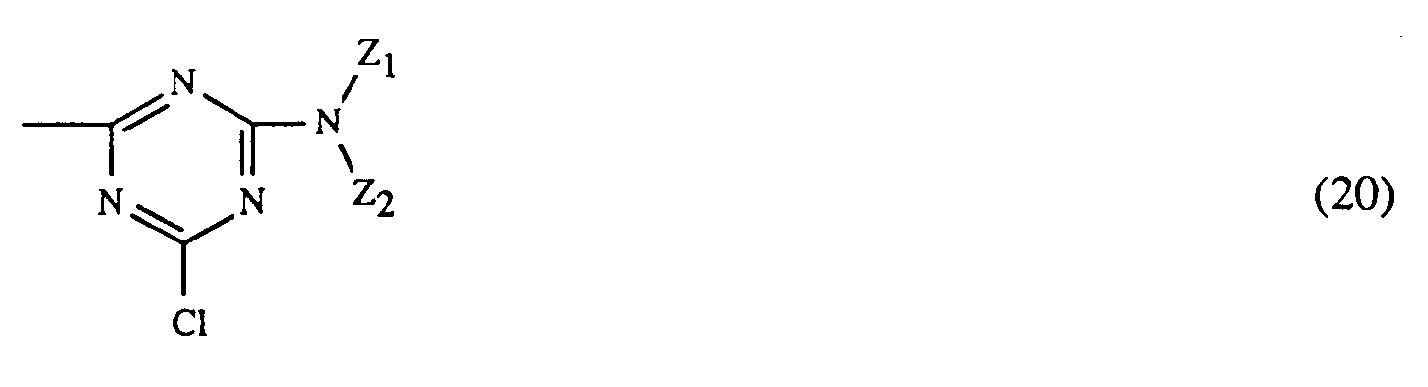
- a particularly preferred embodiment of the process according to the invention is characterized in that dyes of the formulas (1) to (7) and (10) to (16) are used, in which Z is a radical of the formula and Z 1 and Z 2 independently of one another are hydrogen, optionally substituted C 1 -C 6 alkyl, optionally substituted C 5 -C 7 cycloalkyl or optionally substituted phenyl or naphthyl, in particular in which Z 1 and Z 2 independently of one another are hydrogen, C 1 -C 6 alkyl, which is substituted by hydroxy, C 1 -C 4 alkoxy, hydroxy-C 1 -C 4 alkoxy, halogen, sulfo, sulfato or a fiber-reactive radical, such as those under formula (8a) and ( 9) radicals may be substituted, C 5 -C 7 cycloalkyl, which may be substituted by C 1 -C 4 alkyl, phenyl or naphthyl, which is substituted by C 1 -C
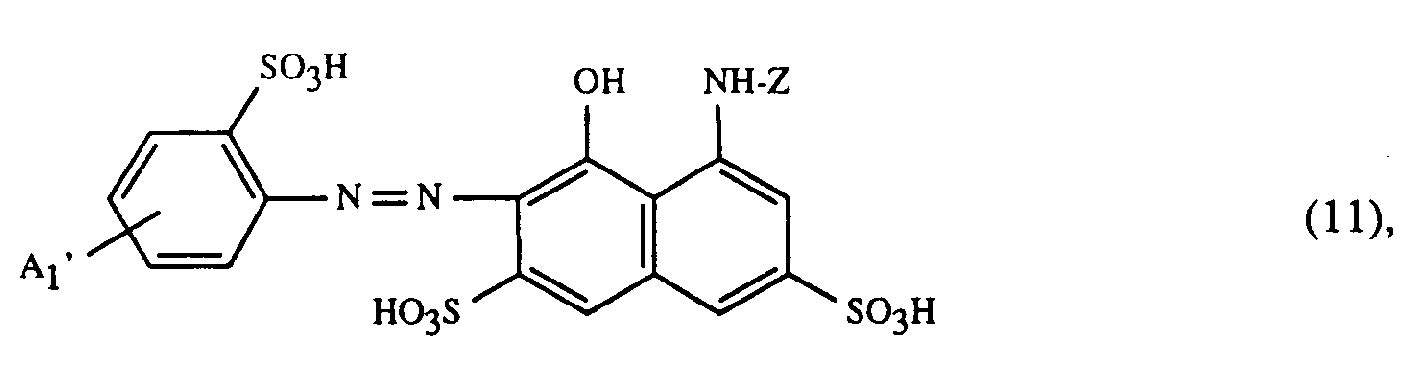
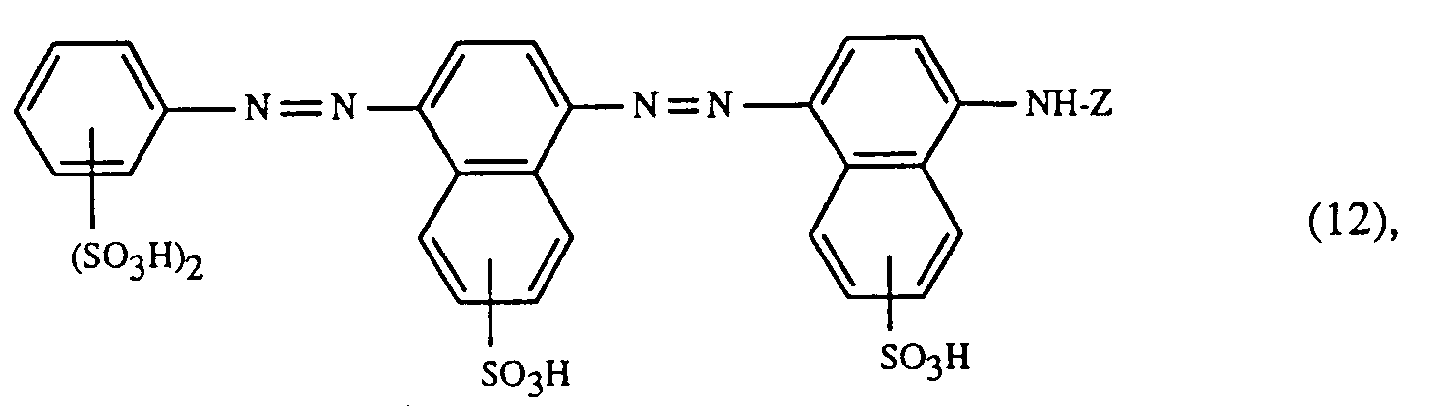
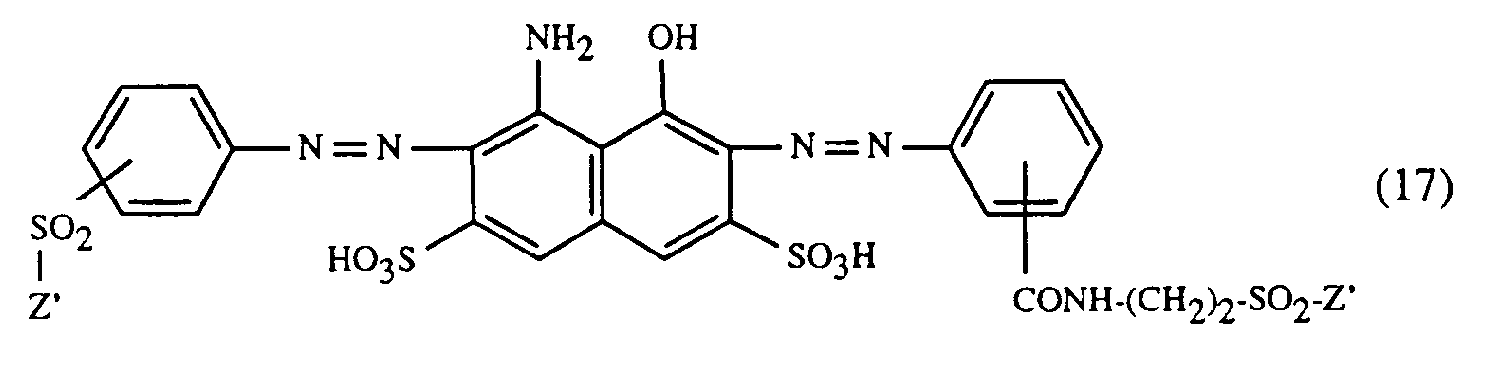
- a very particularly preferred embodiment of the process according to the invention is characterized in that a dye of the formulas (10), (11) or (12) is used as the red- or red-brown dye, as a yellow or orange dye is a dye of the formula (13) and a dye of the formulas (14), (15), (16) or (17) is used as the blue-coloring dye.
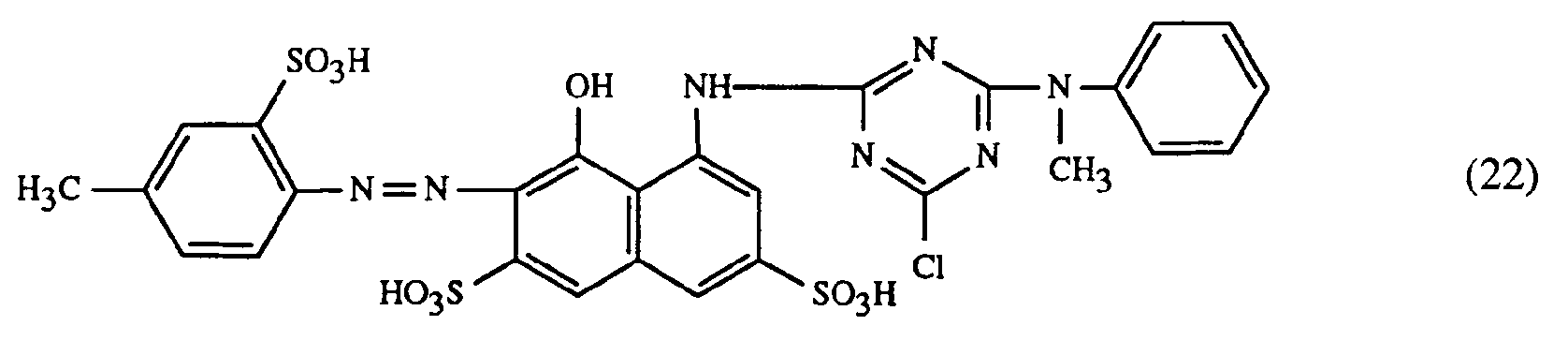
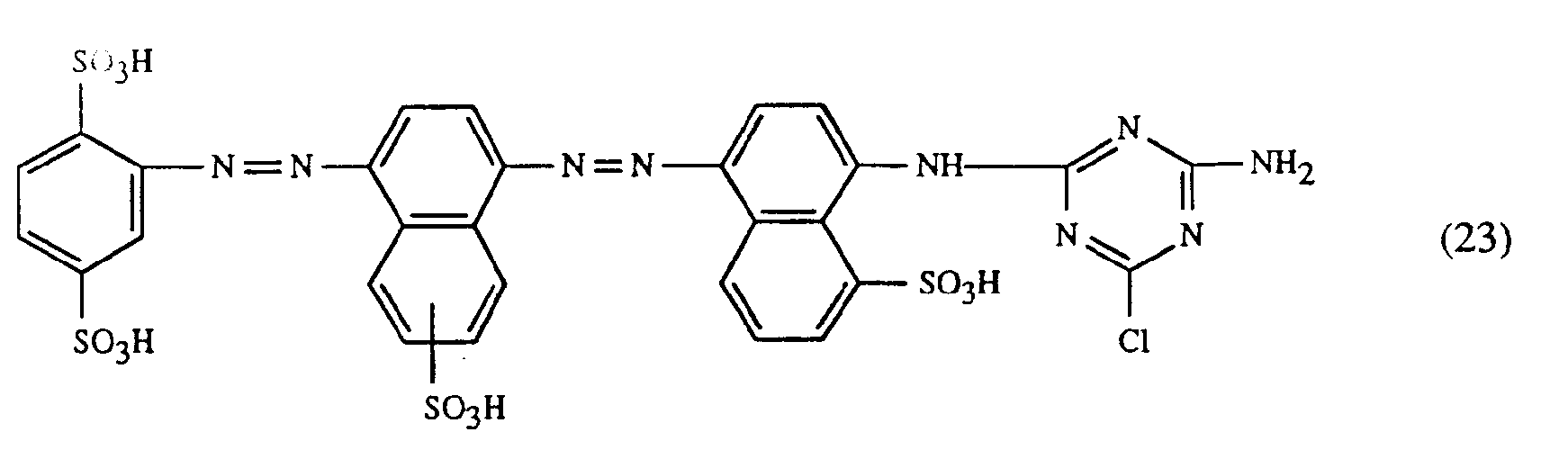
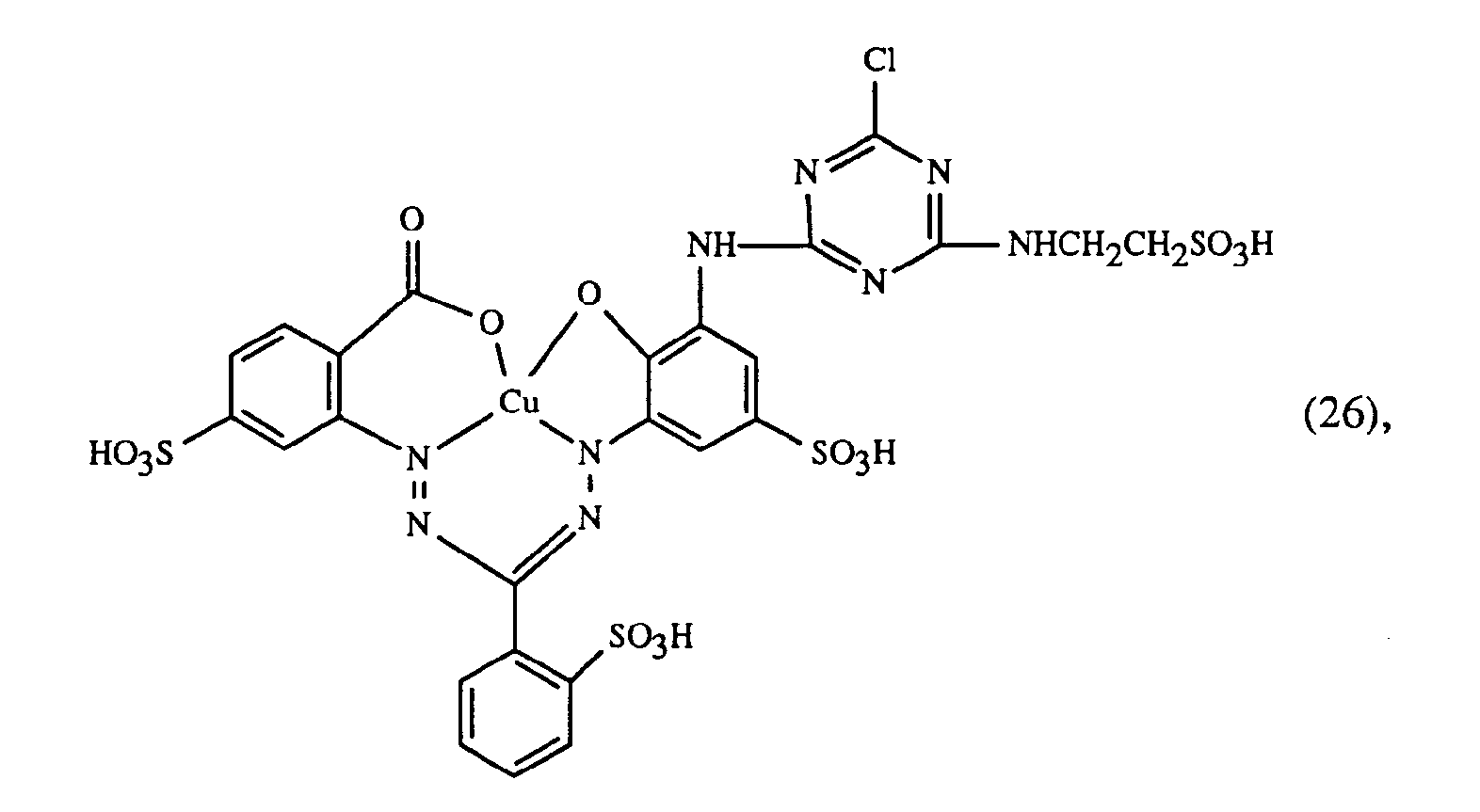
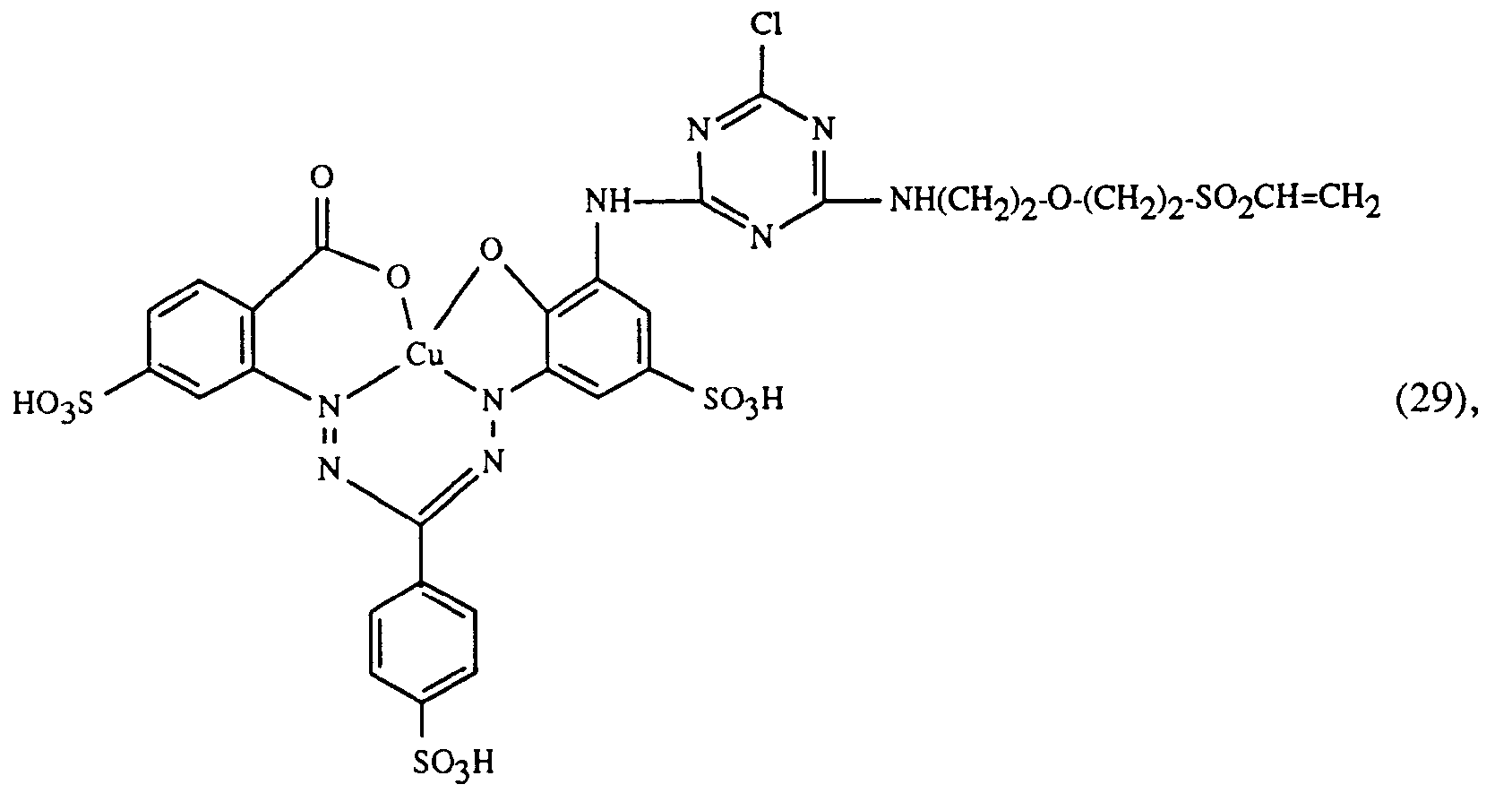
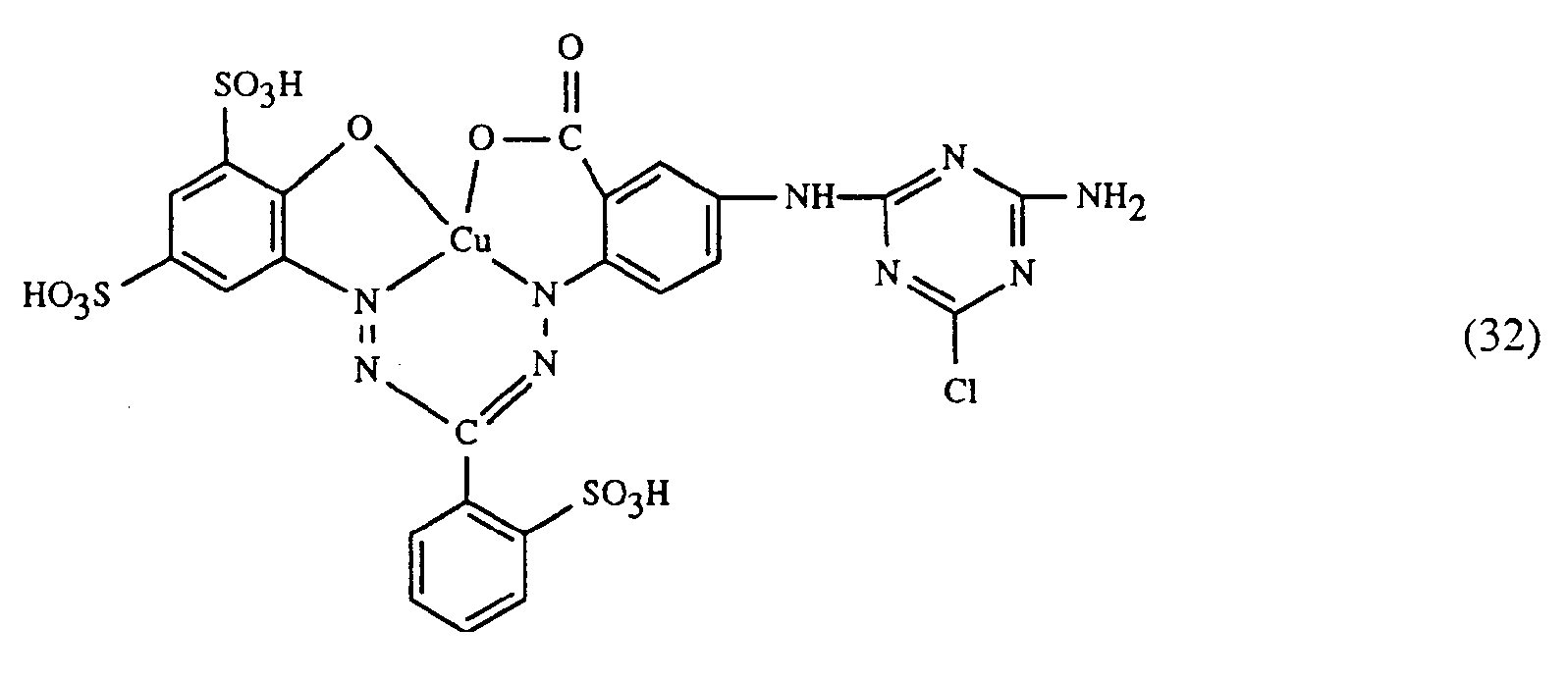
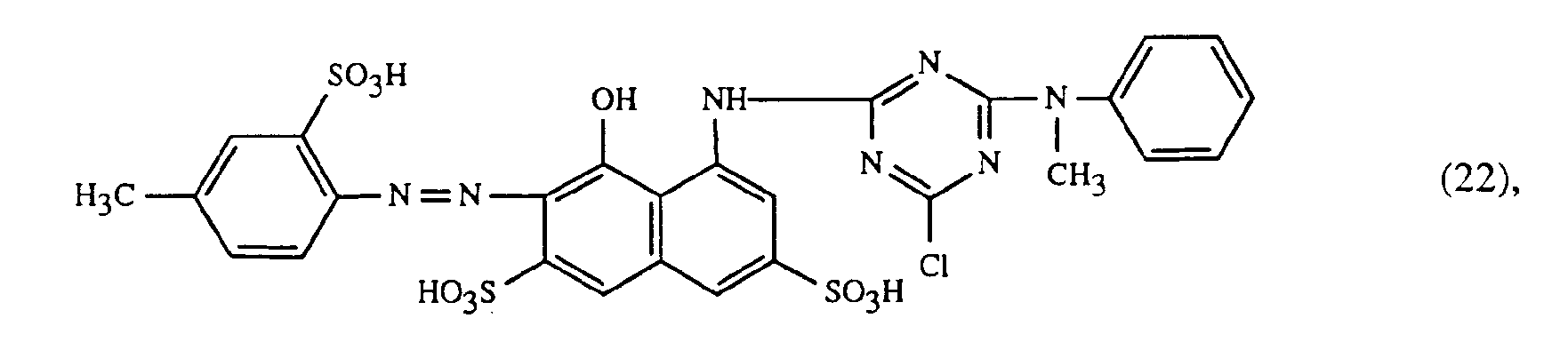
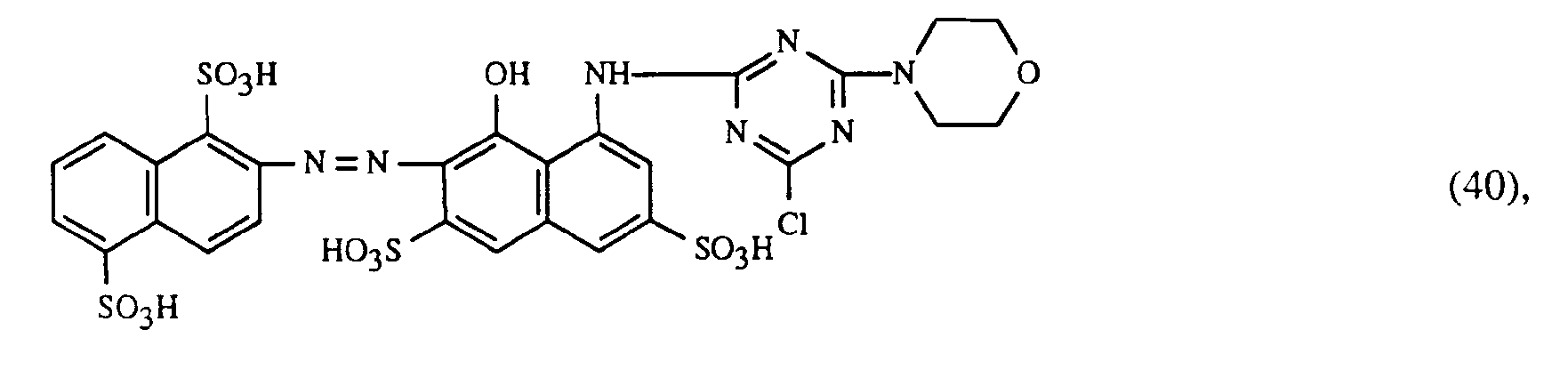
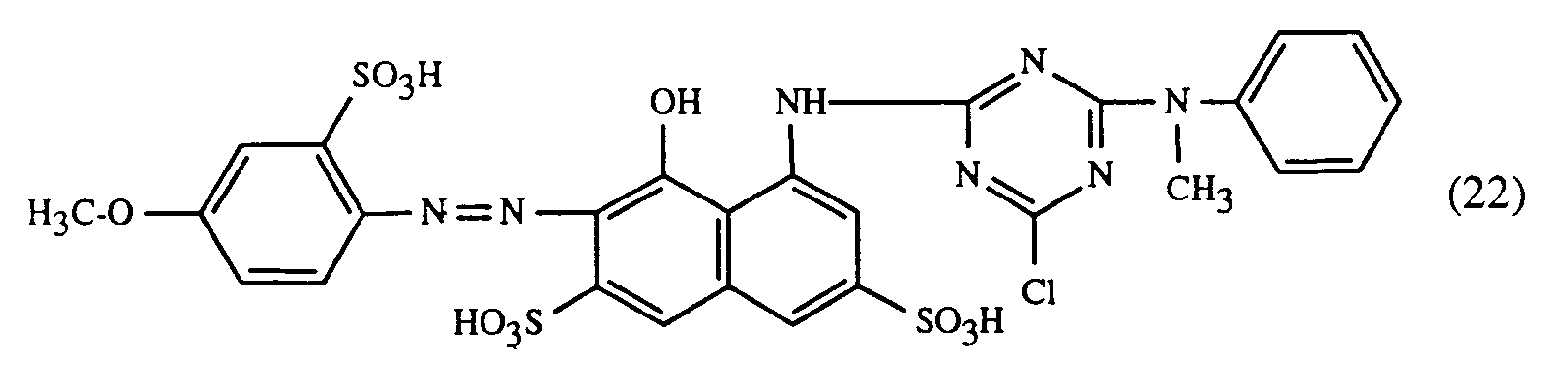
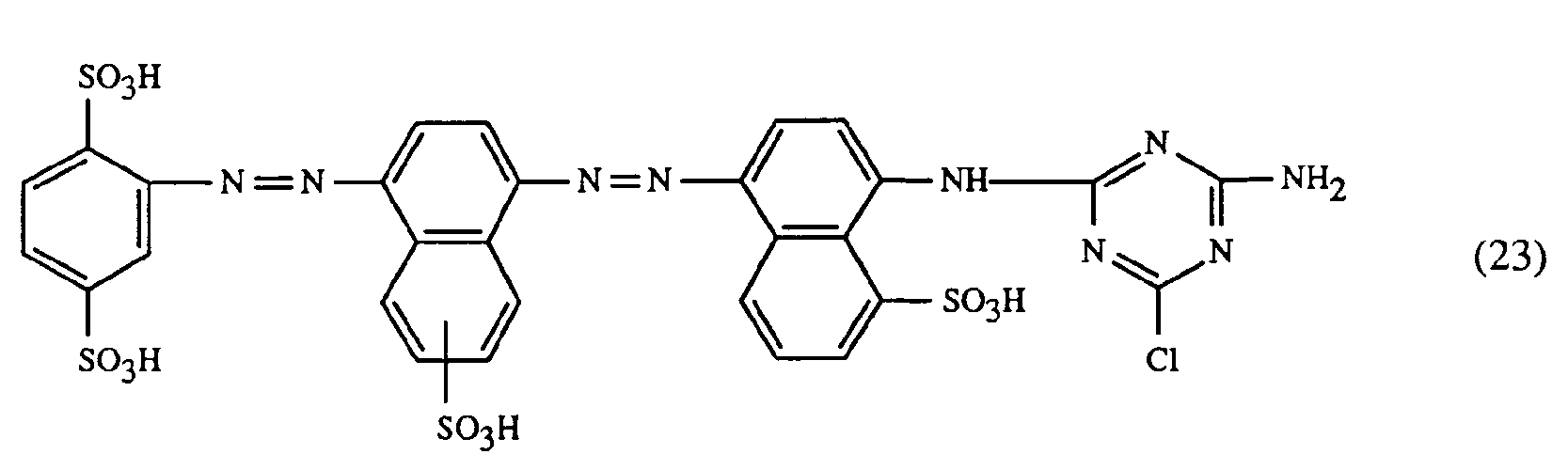
- a particularly important embodiment of the process according to the invention is characterized in that a red or red-brown coloring dye of the formulas (21), (22) or (23) together with a yellow or orange coloring dye of the formula (24) and a blue-coloring dye of the Formula (25), (26), (27), (28), (29), (30), (31), (32), (33) or (34) are used.
- a very particularly important embodiment of the method according to the invention is characterized in that one of the yellowing dyes of the formulas or together with one of the red coloring dyes of the formulas or and the blue-coloring dye of the formula or used.
- dyeing is carried out in an aqueous medium.
- the design is such that the reactive dyes of the formulas given are applied at a temperature between 15 and 100 ° C., in particular between 20 and 80 ° C., and are fixed on the fiber material by means of vapors in the presence of alkaline agents, or are heat set or that the reactive dyes of the formulas given are applied at a temperature between 15 and 100 ° C, in particular between 20 and 80 ° C, in the presence of alkaline agents and then at a temperature between 10 and 40 ° C, in particular between 20 and 30 ° C , are stored for 4 to 80 hours, in particular for 8 to 48 hours.
- a printing paste comprising, in addition to one or more of said reactive dyes, at least one alkali-acting agent such as Na 2 C0 3, NaHC0 3, CH 3 COONa, optionally a solubilizer, such as urea, s-caprolactam, Dicyandiamide, a thickener, in particular alginates, such as sodium alginate, and emulsions or half-emulsions and, if appropriate, an oxidizing agent, such as the sodium salt of m-nitrobenzenesulfonic acid.
- alkali-acting agent such as Na 2 C0 3, NaHC0 3, CH 3 COONa
- a solubilizer such as urea, s-caprolactam, Dicyandiamide
- a thickener in particular alginates, such as sodium alginate, and emulsions or half-emulsions and, if appropriate, an oxidizing agent, such as the sodium salt of m-nitrobenzenesulfonic acid.
- An amount of 30 to 90 g, in particular 50-70 g of fixing alkali per kg of printing paste has proven to be favorable.
- an amount of 0 to 200 g per kg of printing paste is used as a solubilizer.
- a 5% alginate thickening with about 500 g per kg of printing paste has proven to be advantageous as a thickening agent.
- the amount of the oxidizing agent is in the range between 10 and 20 g per kg of printing paste.
- the dye fixation on pure cellulose fibers is carried out by customary methods, the fixing time and fixing temperature depending on the fiber material and the reactivity of the reactive dyes used.
- To Er To achieve a uniform and optimal dye fixation, steaming times in saturated steam between 3 and 15 minutes at 100 to 105 ° C are generally sufficient. High-temperature steaming or dry-heat steaming is used to fix at 105-190 ° C for 20 seconds to 8 minutes.
- the reactive dyes are fixed with steam at a temperature of 100 ° C. to 150 ° C. for 30 seconds to 12 minutes, in particular for 2 to 10 minutes.
- the prints are finished by rinsing in hot and / or cold water and, if appropriate, subsequent washing in the presence of a commercially available detergent, followed by rinsing in water and drying.
- the method according to the invention is used to produce dyeings or prints of cellulose-containing fiber materials.
- Suitable cellulose-containing fiber materials are, for example, natural cellulose fiber, such as cotton, linen and hemp, as well as cellulose and regenerated cellulose.
- the dyeing process according to the invention is characterized in that the fiber material is impregnated with a dye solution or suspension, or is padded, the liquor absorption being between 50 and 120 percent by weight, in particular between 50 and 80 percent by weight.
- the padding liquor can already contain the necessary amount of fixing alkali.
- the padding fleet preferably contains no fixing alkali.
- the material can be used as a post-treatment e.g. are dried to a residual moisture content of approx. 5 to 20, in particular 5 to 15 percent by weight and then can be impregnated again with a liquor which contains the fixing alkali and this is followed by the fixation by steaming the goods.
- Another embodiment of the dyeing process according to the invention is characterized in that the fiber material is impregnated with a dye solution or suspension which already contains the fixing alkali and, if appropriate, further additives, then the goods are dried and then at a temperature of 110 ° to 220 ° C heat set.
- the duration of the heat setting depends on the heat setting temperature, i.e. the higher the temperature, the shorter the duration.
- a duration of 2 to 4 minutes has proven to be beneficial for heat setting at 110 to 140 ° C.
- a duration of 20 to 90 seconds has proven to be favorable for heat setting at 160 to 220 ° C.
- Another embodiment of the dyeing process according to the invention is characterized in that the fiber material is impregnated with a dye solution or suspension which already contains the fixing alkali and, if appropriate, further additives, then the goods are airtight, e.g. in plastic bags, packed and stored at a temperature between 10 and 40 ° C, in particular between 20 and 30 ° C, for 4 to 80 hours, in particular for 8 to 48 hours. It depends on the material, the type of reactive dye and the desired color strength, in which temperature interval one works most advantageously.
- a particularly preferred embodiment of the dyeing process according to the invention is characterized in that the goods are impregnated with a liquor which contains the dye solution or suspension, so that the liquor absorption is 50 to 80 percent by weight, then the goods up to a residual moisture of 5 up to 15 percent by weight dries, for example between 70 and 150 ° C, then impregnated the goods with a liquor containing the fixing alkali, so that the liquor absorption is 50 to 80 percent by weight, and then dampens the goods.
- the liquor ratio of the padding liquor with which the reactive dyes of the formulas given are applied to the fiber material is preferably 1: 0.5 to 1: 1.2, in particular 1: 0.5 to 1: 0.8.
- the liquor is applied at a temperature between 15 and 100 ° C., in particular between 20 and 80 ° C. and very particularly preferably between 20 and 30 ° C.
- Fixing alkali which can be used in the dyeing or printing process according to the invention are alkali metal hydroxides such as NaOH, KOH and LiOH, alkali metal carbonates such as sodium carbonate and potassium carbonate and alkali metal hydrogen carbonates such as sodium hydrogen carbonate and potassium hydrogen carbonate, and alkali metal phosphates such as trisodium phosphate and disodium phosphate if proven together with neutral salts such as sodium chloride.
- alkali metal hydroxides such as NaOH, KOH and LiOH
- alkali metal carbonates such as sodium carbonate and potassium carbonate and alkali metal hydrogen carbonates such as sodium hydrogen carbonate and potassium hydrogen carbonate
- alkali metal phosphates such as trisodium phosphate and disodium phosphate if proven together with neutral salts such as sodium chloride.
- Cotton in particular has proven to be particularly suitable as the fiber material.
- the pH of the liquor is between 8.5 and 14.
- the pH of this liquor is between 8.5 and 14.
- a temperature between 100 ° and 220 ° C., in particular 100 ° to 105 ° C. or 150 ° to 190 ° C., based on a pressure of 1 bar, has been found to be particularly advantageous for fixing in a hot steam atmosphere proven.
- a temperature between 10 and 40 ° C., in particular between 20 and 30 ° C., for 4 to 80 hours, in particular for 8 to 48 hours, has proven to be particularly advantageous for the embodiment of the cold residence process.
- the fixation according to the embodiment is very particularly preferably carried out as a pad-dry-pad-steam process with saturated steam at 100 to 105 ° C.
- the steaming time is 30 seconds to 20 minutes, in particular 60 seconds to 3 minutes.
- the dyes are used in amounts of about 0.1 to 10%, depending on the desired depth of color of the coloring.
- the dyeings are thoroughly rinsed with cold and hot water, if appropriate with the addition of a dispersing agent which promotes the diffusion of the unfixed portions.
- a preferred embodiment is characterized in that the dyed goods are washed in an aqueous washing liquor at a pH of 8.5 to 9 and elevated temperature, preferably 70 to 85 ° C, optionally in the presence of a nonionic detergent.
- the dyeings produced with the reactive dyes used according to the invention are notable for very good combinability on the goods. High fixation rates and a very good build-up are achieved, and the dyeings have good general fastness properties, in particular good light fastness properties and very good wet fastness properties. With the method according to the invention, neither end inequality nor migration problems occur.
- the prints produced with the reactive dyes used according to the invention are distinguished by excellent sharpness of contours. Furthermore, there is no two-sidedness.
- the dye liquors can contain the generally customary additives, for example the aqueous solutions of inorganic salts, such as e.g. of alkali chlorides or alkali sulfates, urea, thickenings such as e.g. Alginate thickeners, water-soluble cellulose alkyl ethers as well as dispersing agents, leveling agents and migration inhibitors, also sodium m-nitrobenzenesulfonate and as further thickening agents, e.g. Methyl cellulose, starch ether, emulsion thickeners, preferably an alginate, e.g. Sodium alginate and wetting agents.
- inorganic salts such as e.g. of alkali chlorides or alkali sulfates, urea
- thickenings such as e.g. Alginate thickeners, water-soluble cellulose alkyl ethers as well as dispersing agents, leveling agents and migration inhibitors, also sodium m-
- the dyes used in the process according to the invention are either in the form of their free acid or preferably as their salts.
- suitable salts are the alkali, alkaline earth or ammonium salts or the salts of an organic amine.
- suitable salts include the sodium, lithium, potassium or ammonium salts or the salt of triethanolamine.
- the following examples serve to illustrate the invention.
- the parts are parts by weight and the percentages are percentages by weight.
- the temperatures are given in degrees Celsius.
- the relationship between parts by weight and parts by volume is the same as that between grams and cubic centimeters.
- the amounts of dye given relate to commercially available dye.
- the dive time is 2 seconds.
- the cotton cretonne fabric is dried at 100 ° for one minute, padded with a liquor containing 250 g / l NaCl and 40 ml / l 30% NaOH with a squeezing effect of about 80% and then for one minute fixed in saturated steam at 101 to 103 °.
- the cotton cretonne fabric is then rinsed first with cold water and then with hot to boiling water, soaped at the boil with 1 to 2 g / l of a detergent, rinsed again with hot and then with cold water and then dried.
- the dive time is 2 seconds.
- the padded fabric is then dried on the hot flue at 100 ° for 1 minute and then heat-set on the hot flue at 180 ° for 1 minute.
- the dive time is 2 seconds.
- the padded fabric is then packed airtight in a plastic bag and stored at 25 ° for 24 hours.
- the cotton cretonne fabric is then rinsed first with cold water and then with hot boiling water, soaped at the boil with 1 to 2 g / l of a detergent, rinsed again with hot and then with cold water and then dried.
Landscapes
- Engineering & Computer Science (AREA)
- Textile Engineering (AREA)
- Chemical & Material Sciences (AREA)
- Chemical Kinetics & Catalysis (AREA)
- Organic Chemistry (AREA)
- Coloring (AREA)
- Inks, Pencil-Leads, Or Crayons (AREA)
Description
- Die vorliegende Erfindung betrifft ein Verfahren zum Trichromiefärben oder -bedrucken von cellulosehaltigen textilen Fasermaterialien mit mindestens einem rot- oder rot braunfärbenden Reaktivfarbstoff, mindestens einem gelb- oder orangefärbenden Reaktivfarbstoff und mindestens einem blaufärbenden Reaktivfarbstoff.
- Die der vorliegenden Erfindung zugrundeliegende Aufgabe war es, ein Verfahren zum Färben oder Bedrucken von cellulosehaltigen textilen Fasermaterialien mit zur Kombination nach dem Trichromie-Prinzip geeigneten Reaktivfarbstoffen zu finden.
- Es wurde nun gefunden, dass man diese Aufgabe erfindungsgemäss durch das nachfolgend beschriebene Verfahren lösen kann. Die so erhaltenen Färbungen und Drucke genügen den gestellten Aufgaben. Insbesondere zeichnen sich die erhaltenen Färbungen durch einen gleichmässigen Farbaufbau bei gleichzeitiger Nuancenkonstanz in verschiedenen Konzentrationen und eine sehr gute Kombinierbarkeit aus, und die erhaltenen Drucke zeichnen sich dadurch aus, dass keine Zweiseitigkeit auftritt, d.h. der erhaltene Druck ist nuancenkonstant.
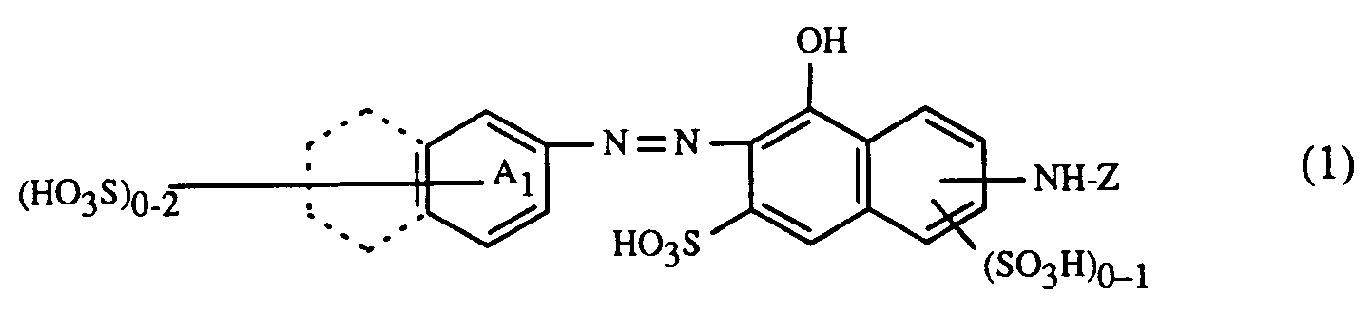
- Gegenstand der vorliegenden Erfindung ist ein Verfahren zum Trichromiefärben oder-bedrucken von cellulosehaltigen textilen Fasermaterialien, welches dadurch gekennzeichnet ist, dass man diese Fasermaterialien aus wässriger Flotte mit mindestens einem rot- oder rotbraunfärbenden Farbstoff der Formel


- Unter Trichromie ist die additive Farbmischung passend gewählter gelb- bzw. orange-, rot- bzw. rotbraun-und blaufärbender Reaktivfarbstoffe zu verstehen, mit denen fast jeder gewünschte Farbton des sichtbaren Farbspektrums durch geeignete Wahl der Mengenverhältnisse der Reaktivfarbstoffe eingestellt werden kann.
- Das erfindungsgemässe Verfahren zeichnet sich insbesondere durch eine hervorragende Kombinierbarkeit der Reaktivfarbstoffe in kontinuierlichen Färbeverfahren und Druckverfahren aus, vorzugsweise für die als pad-dry-pad-steam und pad-thermofix bekannten Verfahren sowie für das Kaltverweilverfahren.
- Mit dem erfindungsgemässen Verfahren treten weder Endenungleichheit beim Foulardieren noch Migrationsprobleme beim Trocknen auf. Ferner zeichnet sich das erfindungsgemässe Verfahren durch eine ausgezeichnete Konturenschärfe aus, und dadurch dass beim Druck keine Zweiseitigkeit auftritt.
- Die Benzinringe A1, A2 und B1 können durch für Azofarbstoffe übliche Substituenten substituiert sein. Als Beispiele seien genannt:
- Alkylgruppen mit 1 bis 8, vorzugsweise 1 bis 4 Kohlenstoffatomen, wie z.B. Methyl, Aethyl, Propyl, Isopropyl, Butyl, Isobutyl, sek.-Butyl, tert.-Butyl, Hexyl, Octyl, wobei die Alkylgruppen z.B. durch Sulfo substituiert sein können, Alkoxygruppen mit 1 bis 8 Kohlenstoffatomen, insbesondere 1 bis 4 Kohlenstoffatomen, wie z.B. Methoxy, Aethoxy, Propoxy, Isopropoxy, Butoxy, Acylaminogruppen wie Alkanoylaminogruppen mit 2 bis 8 Kohlenstoffatomen und Alkoxycarbonylaminogruppen mit 2 bis 8 Kohlenstoffatomen, wie z.B. Acetylamino, Propionylamino, Methoxycarbonylamino, Aethoxycarbonylamino, Alkanoylgruppen mit 2 bis 8, vorzugsweise 2 bis 4 Kohlenstoffatomen, wie z.B. Acetyl, Propionyl, Butyryl oder Isobutyryl, C5-C7-Cycloalkylcarbonyl, wie z.B. Cyclohexylcarbonyl, im Cycloalkylring durch C1-C4-Alkyl, wie z.B. Methyl, Aethyl, Propyl, Butyl, oder Halogen, wie z.B. Fluor, Chlor, Brom, Sulfo oder Sulfato, substituiertes C5-C7-Cycloalkylcarbonyl, Benzoyl, im Phenylring durch C1-C4-Alkyl, wie z.B. Methyl, Aethyl, Propyl, Butyl oder Halogen, wie z.B. Fluor, Chlor, Brom, Sulfo oder Sulfato, substituiertes Benzoyl, Benzoylamino, Amino, Mono- oder Dialkylamino mit 1 bis 8 Kohlenstoffatomen im Alkylrest, Phenylamino, Alkoxycarbonyl mit 1 bis 8 Kohlenstoffatomen im Alkoxyrest, C5-C7-Cycloalkylaminosulfonyl, Nitro, Cyan, Trifluormethyl, Halogen, wie Fluor, Brom oder insbesondere Chlor, Sulfamoyl, am Stickstoffatom ein- oder zweifach durch C1-C4-Alkyl, C5-C7-Cycloalkyl oder Phenyl substituiertes Sulfamoyl, Carbamoyl, Ureido, Hydroxy, C1-C8-Alkylsulfonyl, C1-C8-Alkylaminosulfonyl, gegebenenfalls im Phenylring durch C1-C4-Alkyl, Halogen wie z.B. Fluor, Chlor, Brom, Sulfo oder Sulfato substituiertes Phenylsulfonyl, Carboxy, Sulfomethyl, Sulfo, Sulfato, Thiosulfato sowie Phenyl, Naphthyl, Phenoxy, Phenoxysulfonyl, Phenylaminosulfonyl, wobei die angegebenen Phenyl- oder Naphthylreste durch die oben angegebenen Substituenten weitersubstituiert sein können. Gegebenenfalls können je zwei benachbarte Substituenten der genannten Ringsysteme einen weiteren ankondensierte Phenylring bilden, wobei ein solcher möglicher ankondensierter Phenylring in den Formeln (1), (2) und (3) gestrichelt gezeichnet ist.
- Als C1-C4-Alkyl kommt für B2, R1, R3, X und Y in den Formeln (3), (4), (5) und (7) z.B. in Betracht:
- Methyl, Aethyl, Propyl, Isopropyl, Butyl, Isobutyl, sek.-Butyl oder tert.-Butyl, sowie die entsprechenden Reste, die z.B. durch Hydroxy, Alkoxy mit 1 bis 4 Kohlenstoffatomen, wie z.B. Methoxy, Aethoxy, Propoxy, Isopropoxy oder Butoxy, Sulfo, Sulfato, Thiosulfato, Cyan oder Halogen, wie z.B. Fluor, Chlor oder Brom, und Phenyl substituiert sind, wobei der Phenylrest durch die oben für B1 angegebenen Substituenten weitersubstituiert sein kann. Vorzugsweise sind die Alkylreste B2, R1, R3, X und Y unsubstituiert.
- Als Halogen kommt für B2 und X in den Formeln (3) und (5) Fluor oder Brom und insbesondere Chlor in Betracht.
- Als C2-4Alkanoylamino kommt für B2 und X in den Formeln (3) und (5) beispielsweise Acetylamino-, Propionylamino- oder Butyrylaminorest in Betracht.
- Als Alkoxyreste kommen für B2 und X in den Formeln (3) und (5) beispielsweise der Methoxy-, Aethoxy-, Propoxy-, Isopropoxy-, Butoxy-, sek.-Butoxy-, Isobutoxy- oder tert.-Butoxyrest in Betracht.
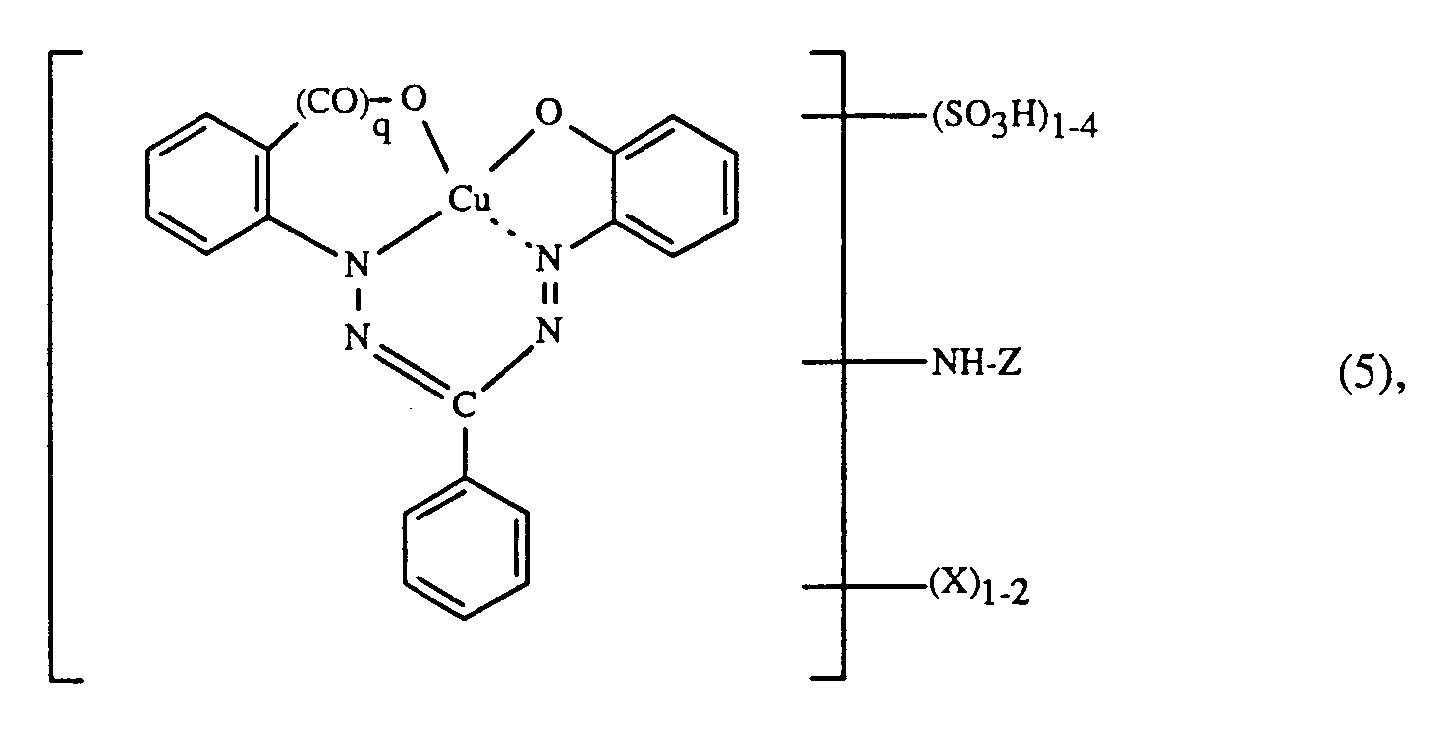
- Als Aminoreste in 4-Stellung des 2-Chlor-s-triazin-6-yl-Restes Z in den Formeln (1) bis (7) kommen z.B. in Betracht:
- -NH2, Alkylamino-, N,N-Dialkylamino-, Cycloalkylamino-, N,N-Dicycloalkylamino-,Aralkylamino-,Arylami- nogruppen, gemischt substituierte Aminogruppen, wie N-Alkyl-N-cyclohexylamino-und N-Alkyl-N-arylaminogruppen, ferner Aminogruppen, die heterocyclische Reste enthalten, welche weitere ankondensierte carbocyclische Ringe aufweisen können, und Aminogruppen, worin das Aminostickstoffatom Glied eines N-heterocyclischen Ringes ist, der gegebenenfalls weitere Heteroatome enthält. Die oben genannten Alkylreste können geradkettig oder verzweigt, niedrigmolekular oder höhermolekular sein, bevorzugt sind Alkylreste mit 1 bis 6 Kohlenstoffatomen; als Cycloalkyl-, Aralkyl- und Arylreste kommen insbesondere Cyclohexyl-, Benzyl-, Phenäthyl-, Phenyl- und Naphthylreste in Frage; heterocyclische Rest sind vor allem Furan-, Thiophen-, Pyrazol-, Pyridin-, Pyrimidin-, Chinolin-, Benzimidazol-, Benzthiazol- und Benzoxazolreste; und als Aminogruppen, worin das Aminostickstoffatom Glied eines N-heterocyclischen Ringes ist, kommen vorzugsweise Reste von sechsgliedrigen N-heterocyclischen Verbindungen in Betracht, die als weitere Heteroatome Stickstoff, Sauerstoff oder Schwefel enthalten können. Die oben genannten Alkyl-, Cycloalkyl-, Aralkyl- und Arylreste, die heterocyclischen Resten sowie die N-heterocyclischen Ringe können weitersubstituiert sein, z.B. durch: Halogen, wie Fluor, Chlor und Brom, Nitro, Cyan, Trifluormethyl, Sulfamoyl, Carbamoyl, C1-C4-Alkyl, C1-C4-Alkoxy, Hydroxy-C1-C4-alkoxy, C1-C4-Alkanoylaminogruppen, wie Acetylamino, Benzoylamino, Ureido, Hydroxy, Carboxy, Sulfomethyl, Sulfo oderweitere faserreaktive Reste. Als Beispiele für derartige Aminogruppen seinen genannt: -NH2, Methylamino, Aethylamino, Propylamino, Isopropylamino, Butylamino, Hexylamino, ß-Methoxyäthylamino, y-Methoxypropylamino, ß-Aethoxyäthylamino, N,N-Dimethylamino, N,N-Diäthylami- no, ß-Chloräthylamino, ß-Cyanäthylamino, γ-Cyanpropylamino, β-Carboxyäthylamino, Sulfomethylamino, β-Sulfoäthylamino, β-Hydroxyäthylamino, N,N-Di-ß-hydroxyäthylamino, γ-Hydroxypropylamino, Benzylamino, Phenäthylamino, Cyclohexylamino, Phenylamino, Toluidino, Xylidino, Chloranilino, Anisidino, Phenetidino, N-Methyl-N-phenylamino, N-Aethyl-N-phenylamino, N-ß-Hydroxyäthyl-N-phenylamino, 2-,3- oder 4-Sulfoanilino, 2,5-Disulfoanilino, 4-Sulfomethylanilino, N-Sulfomethylanilino, 2-, 3- oder 4-Carboxyphenylamino, 2-Carboxy-5-sulfophenylamino, 2-Carboxy-4-sulfophenylamino, 4-Sulfonaphthyl-(1)-amino, 3,6-Disulfonaphthyl-(1)-amino, 3,6,8-Trisulfonaphthyl-(1)-amino, 4,6,8-Trisulfonaphthyl-(1)-amino, 1-Sulfonaphthyl-(2)-amino, 1,5-Disulfonaphthyl-(2)-amino, 6-Sulfonaphthyl-(2)-amino, Morpholino, Piperidino und Piperazino.
- Als weitere faserreaktive Reste die an die in 4-Stellung des s-Triazins gebundene Aminogruppe gebunden sind, kommen z.B. in Betracht: ein Rest der Formel
 oder―O―CH2
 ; n'=1, 2,3,4,5 oder 6; R5 ein Rest der Formel


oder ein Rest der Formel
- Der Rest B enthält 1 bis 6, vorzugsweise 1 bis 4 Kohlenstoffatome; Beispiele für B sind: Methylen, Aethylen, Propylen, Butylen, Methylenoxy, Aethylenoxy, Propylenoxy und Butylenoxy. Falls B einen Rest ―O―(CH2darstellt, ist B durch das Sauerstoffatom an den Benzolring gebunden. Vorzugsweise ist B die direkte Bindung.

- Falls T ein Rest -S02-Z' und R' Wasserstoff ist, hat der Rest der Formel (8c) vorzugsweise die Formel


- Als β-Halogenäthyl kommt für Z' bzw. Z" insbesondere β-Chloräthyl in Betracht.
- Ein bevorzugter Rest der Formel (8a) entspricht der Formel


- Bevorzugte Ausführungsformen des erfindungsgemässen Verfahrens sind dadurch gekennzeichnet, dass man
- a) als Farbstoff der Formel (1) einen Farbstoff der Formel


- b) als Farbstoff der Formel (2) einen Farbstoff der Formel

- c) als Farbstoff der Formel (3) einen Farbstoff der Formel

- d) als Farbstoff der Formel (5) einen Farbstoff der Formel


- e) als Farbstoff der Formel (6) einen Farbstoff der Formel

- f) als Farbstoff der Formel (7) einen Farbstoff der Formel


- Eine besonders bevorzugte Ausführungsform des erfindungsgemässen Verfahrens ist dadurch gekennzeichnet, dass man Farbstoffe der Formeln (1) bis (7) und (10) bis (16) verwendet, worin Z ein Rest der Formel

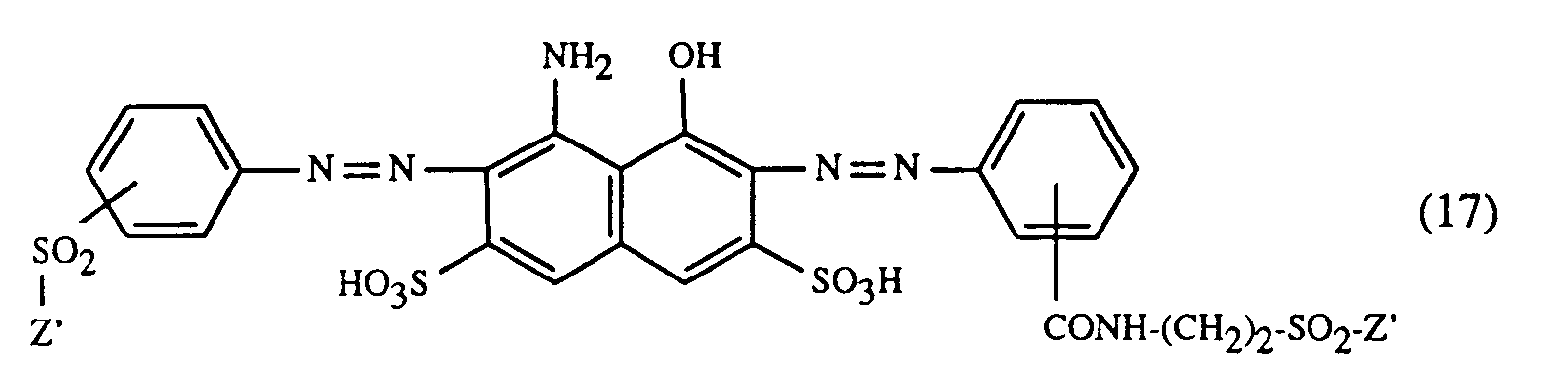
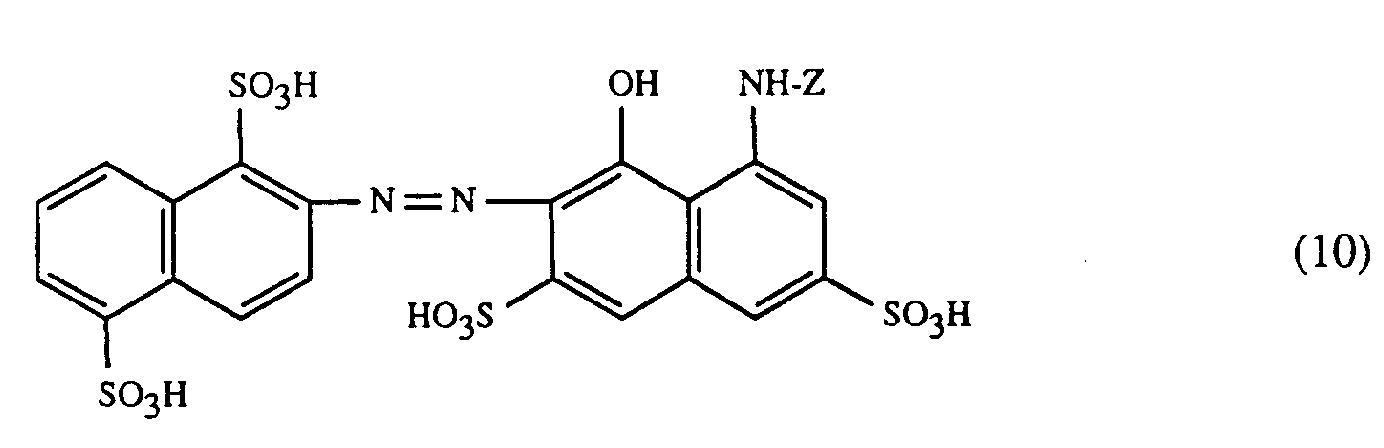
- Eine ganz besonders bevorzugte Ausführungsform des erfindungsgemässen Verfahrens ist dadurch gekennzeichnet, dass an als rot- oder rotbraunfärbenden Farbstoff einen Farbstoff der Formeln (10), (11) oder (12), als gelb- oder orangefärbenden Farbstoff einen Farbstoff der Formel (13) und als blaufärbenden Farbstoff einen Farbstoff der Formeln (14), (15), (16) oder (17) verwendet.
- Wichtige Ausführungsformen des erfindungsgemässen Verfahrens sind dadurch gekennzeichnet, dass man
- f) als Farbstoff der Formel (10) einen Farbstoff der Formel

- g) als Farbstoff der Formel (11) den Farbstoff der Formel

- h) als Farbstoff der Formel (12) einen Farbstoff der Formel

- i) als Farbstoff der Formel (13) einen Farbstoff der Formel

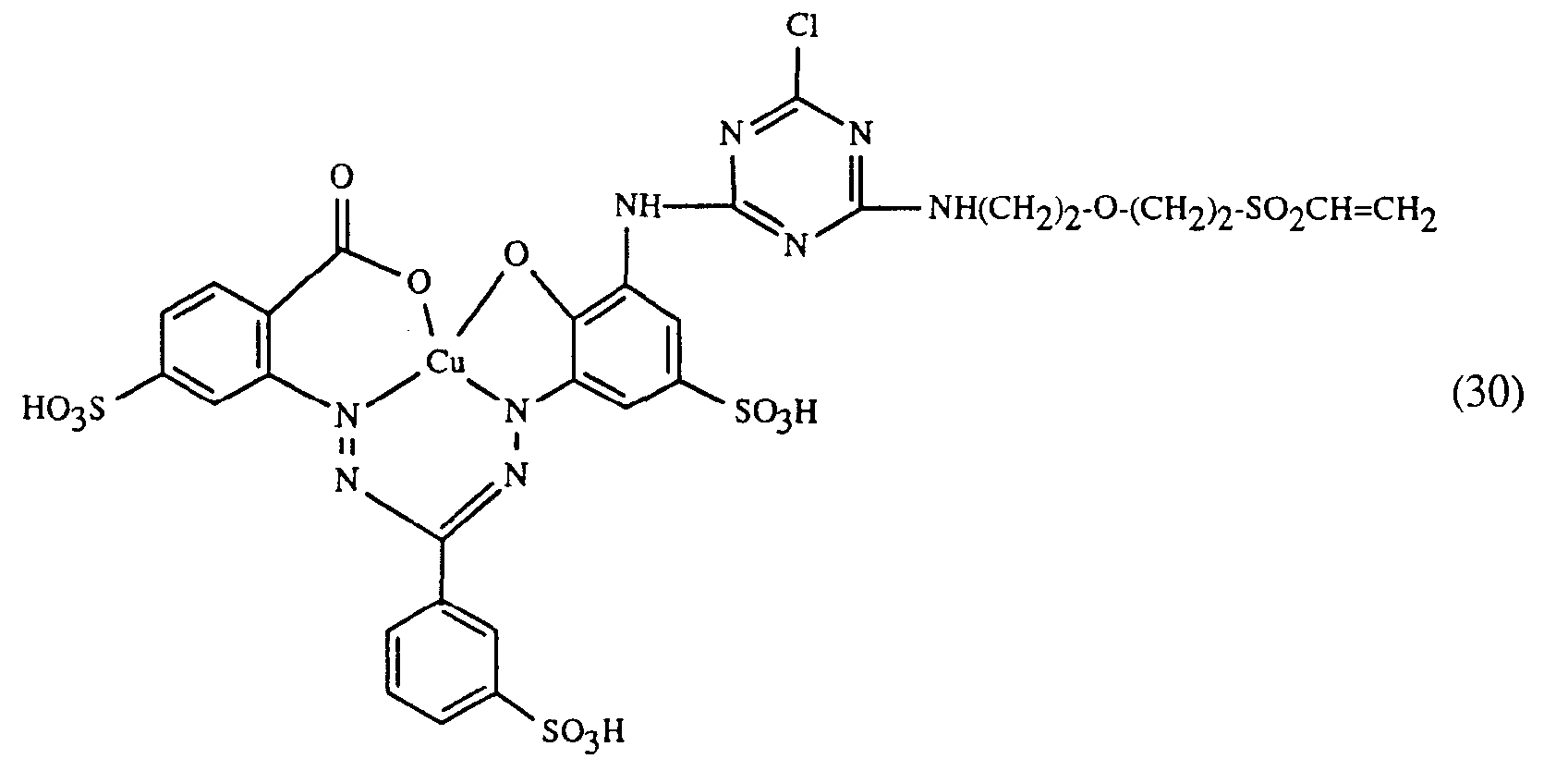
- j) als Farbstoff der Formel (14) den Farbstoff der Formel



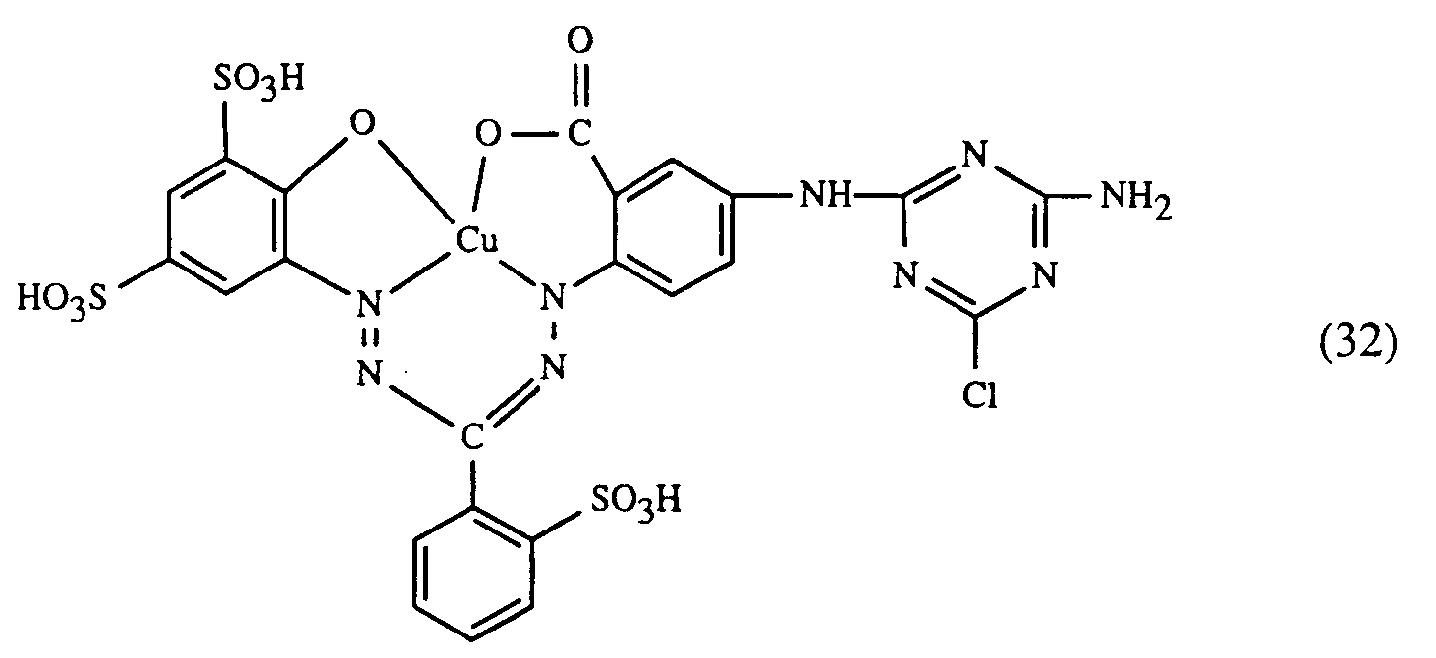
- k) als Farbstoff der Formel (15) den Farbstoff der Formel
- I) als Farbstoff der Formel (16) den Farbstoff der Formel

- m) als Farbstoff der Formel (17) einen Farbstoff der Formel

- Eine besonders wichtige Ausführungsform des erfindungsgemässen Verfahrens ist dadurch gekennzeichnet, dass man einen rot- oder rotbraunfärbenden Farbstoff der Formeln (21), (22) oder (23) zusammen mit einem gelb- oder orangefärbenden Farbstoff der Formel (24) und einem blaufärbenden Farbstoff der Formel (25), (26), (27),(28), (29), (30), (31), (32), (33) oder (34) verwendet.
- Eine ganz besonders wichtige Ausführungsform des erfindungsgemässen Verfahrens ist dadurch gekennzeichnet, dass man einen der gelbfärbenden Farbstoffe der Formeln

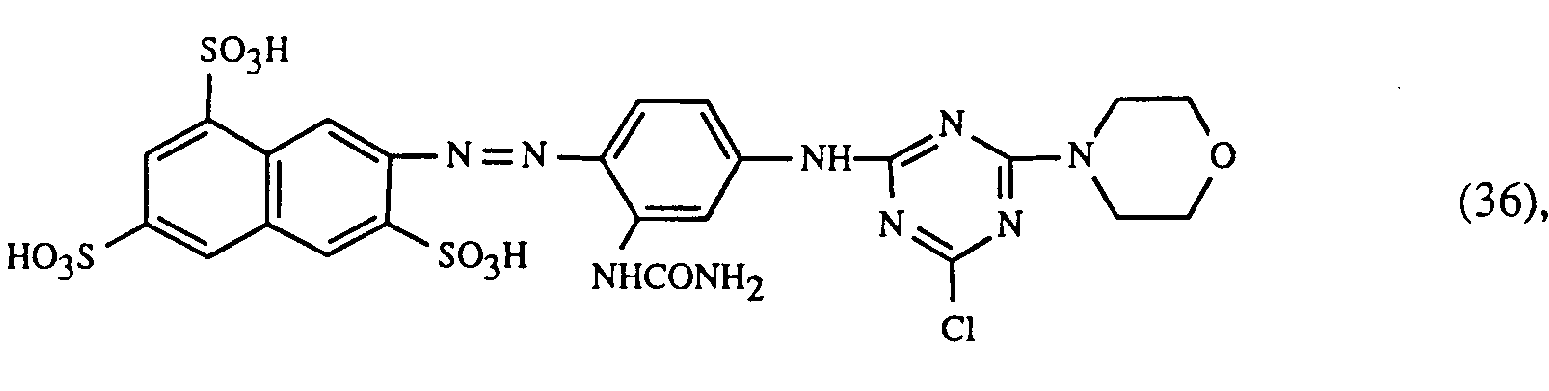


- Die allerwichtigsten Ausführungsformen des erfindungsgemässen Verfahrens sind dadurch gekennzeichnet, dass man
- n) eine Trichromie-Mischung der Farbstoffe der Formeln


- o) eine Trichromie-Mischung der Farbstoffe der Formeln


- Nach dem erfindungsgemässen Verfahren wird das Färben in wässrigem Medium vorgenommen. Die Ausführung gestaltet sich so, dass die Reaktivfarbstoffe der angegebenen Formeln bei einer Temperatur zwischen 15 und 100°C, insbesondere zwischen 20 und 80°C, aufgetragen werden und in Gegenwart alkalisch wirkender Mittel auf dem Fasermaterial mittels Dämpfen fixiert werden, oder thermofixiert werden oder dass die Reaktivfarbstoffe der angegebenen Formeln bei einer Temperatur zwischen 15 und 100°C, insbesondere zwischen 20 und 80°C, in Gegenwart alkalisch wirkender Mittel aufgetragen werden und dann bei einer Temperatur zwischen 10 und 40°C, insbesondere zwischen 20 und 30°C, während 4 bis 80 Stunden, insbesondere während 8 bis 48 Stunden gelagert werden.
- Nach dem erfindungsgemässen Verfahren wird das Bedrucken mit einer wässrigen Druckpaste vorgenommen. Die Ausführung gestaltet sich beispielsweise so, dass eine Druckpaste enthaltend ausser einem oder mehreren der genannten Reaktivfarbstoffe mindestens ein alkalisch wirkendes Mittel, wie z.B. Na2C03, NaHC03, CH3COONa, gegebenenfalls einen Lösungsvermittler, wie z.B. Harnstoff, s-Caprolactam, Dicyandiamid, ein Verdickungsmittel, insbesondere Alginate, wie z.B. Natriumalginat, und Emulsionen bzw. Halbemulsionen und gegebenenfalls ein Oxydationsmittel wie z.B. das Natriumsalz der m-Nitrobenzolsulfonsäure. Die Menge Fixiersalz richtet sich z.B. nach Art und Anzahl der faserreaktiven Reste. Eine Menge von 30 bis 90 g, insbesondere 50-70 g Fixieralkali pro kg Druckpaste hat sich als günstig erwiesen. Als Lösungvermittler wird z.B. eine Menge von 0 bis 200 g pro kg Druckpaste verwendet. Als Verdickungsmittel hat sich eine z.B. 5%- ige Alginatverdickung mit ca. 500 g pro kg Durckpaste als günstig erwiesen. Die Menge des Oxidationsmittels liegt im Bereich zwischen 10 und 20 g pro kg Druckpaste. Nach dem Bedrucken wird die Ware gegebenenfalls nach Trocknung zur Fixierung der Farbstoffe auf der Faser gedämpft oder thermofixiert.
- Die Farbstoff-Fixierung auf reinen Cellulosefasern erfolgt nach üblichen Verfahren, wobei Fixierzeit und Fixiertemperatur vom Fasermaterial und der Reaktivität der eingesetzten Reaktivfarbstoffe abhängen. Zur Erzielung einergleichmässigen und optimalen Farbstoff-Fixierung genügen im allgemeinen Dämpfzeiten im Sattdampf zwischen 3 und 15 Minuten bei 100 bis 105°C. Durch Hochtemperatur-Dämpfen bzw. Trockenhitze-Dämpfen wird während 20 Sekunden bis 8 Minuten bei 105-190°C fixiert. Insbesondere werden die Reaktivfarbstoffe mit Dampf bei einer Temperatur von 100°C bis 150°C während 30 Sekunden bis 12 Minuten, insbesondere während 2 bis 10 Minuten, fixiert.
- Die Fertigstellung der Drucke erfolgt durch Spülung in heissem und/oder kaltem Wasser und gegebenenfalls anschliessendem Waschen in Gegenwart eines handelsüblichen Waschmittels, nachfolgendem Spülen in Wasser und Trocknen.
- Das erfindungsgemässe Verfahren dient zur Herstellung von Färbungen oder Drucken von cellulosehaltigen Fasermaterialien. Als cellulosehaltige Fasermaterialien kommen beispielsweise natürliche Cellulosefaser, wie Baumwolle, Leinen und Hanf, sowie Zellstoff und regenerierte Cellulose in Betracht.
- Das erfindungsgemässe Verfahren zum Färben zeichnet sich dadurch aus, dass das Fasermaterial mit einer Farbstofflösung oder-suspension imprägniert wird, oderfoulardiertwird, wobei die Flottenaufnahme zwischen 50 und 120 Gewichtsprozent, insbesondere zwischen 50 und 80 Gewichtsprozent liegt. Die Foulardflotte kann ausser der Farbstoffkomponente bereits die nötige Menge Fixieralkali enthalten. Vorzugsweise enthält die Foulardflotte bei pad-dry-pad-steam und pad-thermofix Verfahren kein Fixieralkali. Im Anschluss an das Auftragen der farbgebenden Komponente kann das Material als Nachbehandlung z.B. getrocknet werden bis zu einer Restfeuchte von ca. 5 bis 20, insbesondere 5 bis 15 Gewichtsprozent und anschliessend kann mit einer Flotte die das Fixieralkali enthält erneut imprägniert werden und daran schliesst sich die Fixierung durch Dämpfen der Ware an.
- Eine weitere Ausführungsform des erfindungsgemässen Verfahrens zum Färben ist dadurch gekennzeichnet, dass man das Fasermaterial mit einer Farbstofflösung oder -suspension, die bereits das Fixieralkali sowie gegebenenfalls weitere Zusätze enthält, imprägniert, dann die Ware trocknet und anschliessend bei einer Temperatur von 110° bis 220°C thermofixiert. Die Dauer der Thermofixierung richtet sich nach der Thermofixiertemperatur, d.h. je höherdie Temperatur ist, desto kürzer kann die Dauer sein. Für die Thermofixierung bei 110 bis 140°C hat sich eine Dauer von 2 bis 4 Minuten als günstig erwiesen. Für die Thermofixierung bei 160 bis 220°C hat sich eine Dauer von 20 bis 90 Sekunden als günstig erwiesen.
- Eine weitere Ausführungsform des erfindungsgemässen Verfahrens zum Färben ist dadurch gekennzeichnet, dass man das Fasermaterial mit einer Farbstofflösung oder -suspension, die bereits das Fixieralkali sowie gegebenenfalls weitere Zusätze enthält, imprägniert, dann die Ware luftdicht, z.B. in Plastikhüllen, verpackt und bei einer Temperatur zwischen 10 und 40°C, insbesondere zwischen 20 und 30°C, während 4 bis 80 Stunden, insbesondere während 8 bis 48 Stunden, lagert. Dabei hängt es vom Material, der Art des Reaktivfarbstoffes und der gewünschten Farbstärke ab, in welchem Temperaturintervall man am vorteilhaftesten arbeitet.
- Bevorzugte Auführungsformen des erfindungsgemässen Verfahrens zum Färben sind dadurch gekennzeichnet, dass man
- - das Fasermaterial mit einer Farbstofflösung oder -suspension imprägniert, anschliessend das Fasermaterial mit einer Lösung des Fixieralkalis imprägniert und dann die Ware dämpft; oder
- - das Fasermaterial mit einer Flotte, welche die Farbstofflösung oder-suspension und das Fixieralkali enthält, imprägniert und dann die Ware dämpft oder thermofixiert; oder
- - das Fasermaterial mit einer Farbstofflösung oder -suspension imprägniert, trocknet, mit einer Lösung, welche das Fixieralkali enthält, erneut imprägniert und anschliessend dämpft; oder
- - das Fasermaterial in Gegenwart eines Fixieralkalis mit einer Farbstofflösung oder-suspension imprägniert und dann die Ware luftdicht verpackt lagert.
- Eine besonders bevorzugte Ausführungsform des erfindungsgemässen Verfahrens zum Färben ist dadurch gekennzeichnet, dass man die Ware mit einer Flotte, welche die Farbstofflösung oder-suspension enthält, imprägniert, so dass die Flottenaufnahme 50 bis 80 Gewichtsprozent beträgt, dann die Ware bis zu einer Restfeuchte von 5 bis 15 Gewichtsprozent trocknet z.B. zwischen 70 und 150°C, anschliessend die Ware mit einer Flotte, welche das Fixieralkali enthält, imprägniert, so dass die Flottenaufnahme 50 bis 80 Gewichtsprozent beträgt, und dann die Ware dämpft.
- Das Flottenverhältnis der Foulardflotte mit welcher die Reaktivfarbstoffe der angegebenen Formeln auf das Fasermaterial aufgetragen werden, beträgt vorzugsweise 1:0,5 bis 1:1,2, insbesondere 1:0,5 bis 1:0,8. Der Auftrag der Flotte erfolgt bei einer Temperatur zwischen 15 und 100°C, insbesondere zwischen 20 und 80°C und ganz besonders bevorzugt zwischen 20 und 30°C.
- Als Fixieralkali, welches in dem erfindungsgemässen Verfahren zum Färben oder Bedrucken verwendet werden kann, haben sich Alkalihydroxide, wie z.B. NaOH, KOH und LiOH, Alkalicarbonate, wie z.B. Natriumcarbonat und Kaliumcarbonat und Alkalihydrogencarbonate, wie z.B. Natriumhydrogencarbonat und Kaliumhydrogencarbonat, sowie Alkaliphosphate, wie z.B. Trinatriumphosphat und Dinatriumphosphat, gegebenenfalls zusammen mit neutralen Salzen, wie z.B. Natriumchlorid, als geeignet erwiesen.
- Als Fasermaterial hat sich insbesondere Baumwolle als besonders geeignet erwiesen.
- Falls das Fixieralkali zusammen mit der farbgebenden Komponente auf die Ware aufgetragen wird, liegt der pH-Wert der Flotte zwischen 8,5 und 14.
- Falls das Fixieralkali mit separater Flotte auf die Ware aufgetragen wird, liegt der pH-Wert dieser Flotte zwischen 8,5 und 14.
- In dem erfindungsgemässen Verfahren hat sich für die Fixierung in einer Heiss-Wasserdampfatmosphäre eine Temperatur zwischen 100° und 220°C, insbesondere 100° bis 105°C oder 150° bis 190°C, bezogen auf einen Druck von 1 bar, als besonders vorteilhaft erwiesen.
- In dem erfindungsgemässen Verfahren hat sich für die Ausführungsform des Kaltverweilverfahrens eine Temperatur zwischen 10 und 40°C, insbesondere zwischen 20 und 30°C, während 4 bis 80 Stunden, insbesondere während 8 bis 48 Stunden als besonders vorteilhaft erwiesen.
- Ganz besonders bevorzugt erfolgt die Fixierung gemäss der Ausführungsform als pad-dry-pad-steam Verfahren mit Sattdampf bei 100 bis 105°C.
- Die Dämpfzeit beträgt 30 Sekunden bis 20 Minuten, insbesondere 60 Sekunden bis 3 Minuten.
- Die Farbstoffe werden, je nach der gewünschten Farbtiefe der Färbung in Mengen von etwa 0,1 bis 10 % angewandt.
- Nach dem Fixieren werden die Färbungen mit kaltem und heissem Wasser, gegebenenfalls unter Zusatz eines dispergierend wirkenden und die Diffusion der nicht fixierten Anteile fördernden Mittels gründlich gespült.
- Eine bevorzugte Ausführungsform ist dadurch gekennzeichnet, dass man die gefärbte Ware in einerwässrigen Waschflotte bei einem pH von 8,5 bis 9 und erhöhter Temperatur, vorzugsweise 70 bis 85°C, gegebenenfalls in Gegenwart eines nichtionischen Waschmittels, auswäscht.
- Die mit den erfindungsgemäss zur Anwendung gelangenden Reaktivfarbstoffen hergestellten Färbungen zeichnen sich durch sehr gute Kombinierbarkeit auf der Ware aus. Es werden hohe Fixierraten und ein sehr guterAufbau erzielt, und die Färbungen besitzen gute Allgemeinechtheiten, insbesondere gute Lichtechtheiten und sehr gute Nassechtheiten. Mit dem erfindungsgemässen Verfahren treten weder Endenungleichheit noch Migrationsprobleme auf. Die mit den erfindungsgemäss zur Anwendung gelangenden Reaktivfarbstoffen hergestellten Drucke zeichnen sich durch hervorragende Konturenschärfe aus. Ferner tritt keine Zweiseitigkeit auf.
- Die Färbeflotten können die allgemein üblichen Zusätze enthalten, beispielsweise die wässrigen Lösungen anorganischen Salzen, wie z.B. von Alkalichloriden oder Alkalisulfaten, Harnstoff, Verdickungen, wie z.B. Alginatverdickungen, wasserlösliche Cellulosealkyläther sowie Dispergierhilfsmittel, Egalisierhilfsmittel und Migrationsinhibitoren, ferner Natrium-m-nitrobenzolsulfonat und als weitere Verdickungsmittel, z.B. Methylcellulose, Stärkeäther, Emulsionsverdickungen, vorzugsweise ein Alginat, z.B. Natriumalginat, sowie Netzmittel.
- Die in dem erfindungsgemässen Verfahren verwendeten Farbstoffe liegen entweder in der Form ihrer freien Säure oder vorzugsweise als deren Salze vor.
- Als Salze kommen beispielsweise die Alkali-, Erdalkali- oder Ammoniumsalze oder die Salze eines organischen Amins in Betracht. Als Beispiele seien die Natrium-, Lithium-, Kalium- oder Ammoniumsalze oder das Salz des Triäthanolamins genannt.
- Die nachfolgenden Beispiele dienen der Veranschaulichung der Erfindung. Darin sind die Teile Gewichtsteile und die Prozente Gewichtsprozente. Die Temperaturen sind in Celsiusgraden angegeben. Die Beziehung zwischen Gewichtsteilen und Volumenteilen ist dieselbe wie diejenige zwischen Gramm und Kubikzentimeter. Die angegebenen Farbstoffmengen beziehen sich auf handelsüblichen Farbstoff.
- Beispiel 1: Ein gebleichtes Baumwoll-Cretonne Gewebe wird auf dem Foulard mit einem Abquetscheffekt von 70 % Flottenaufnahme imprägniert mit einer Klotzflotte nachstehender Zusammensetzung:
- 1,0 g/I des gelbfärbenden Farbstoffes der Formel

- 0,2 g/I des rotfärbenden Farbstoffes der Formel

- 0,5 g/I des blaufärbenden Farbstoffes der Formel

- 10 g/I Natriumsulfat, kalziniert, und
- 1 g/I eines Netzmittels.
- Die Tauchzeit beträgt 2 Sekunden.
- Nach dem Foulardieren wird das Baumwoll-Cretonne-Gewebe während einer Minute bei 100° getrocknet, foulardiert mit einer Flotte enthaltend 250 g/I NaCl und 40 ml/l 30%ige NaOH mit einem Abquetscheffekt von ca. 80 % und dann während einer Minute im Sattdampf bei 101 bis 103° fixiert.
- Danach wird das Baumwoll-Cretonne-Gewebe zunächst mit kaltem Wasser und dann mit heissem bis kochendem Wasser gespült, kochend mit 1 bis 2 g/I eines Waschmittels geseift, erneut mit heissem und dann mit kaltem Wasser gespült und danach getrocknet.
- Man erhält eine egale, endengleiche olive Färbung mit guten Echtheiten.
- Beispiel 2: Ein gebleichtes, mercerisiertes Baumwoll-Cretonne-Gewebe wird auf dem Foulard mit einem Abquetscheffekt von 70 % Flottenaufnahme imprägniert mit einer Klotzflotte nachstehender Zusammensetzung:
- 1,0 g/I des gelbfärbenden Farbstoffes der Formel

- 0,5 g/I des rotfärbenden Farbstoffes der Formel
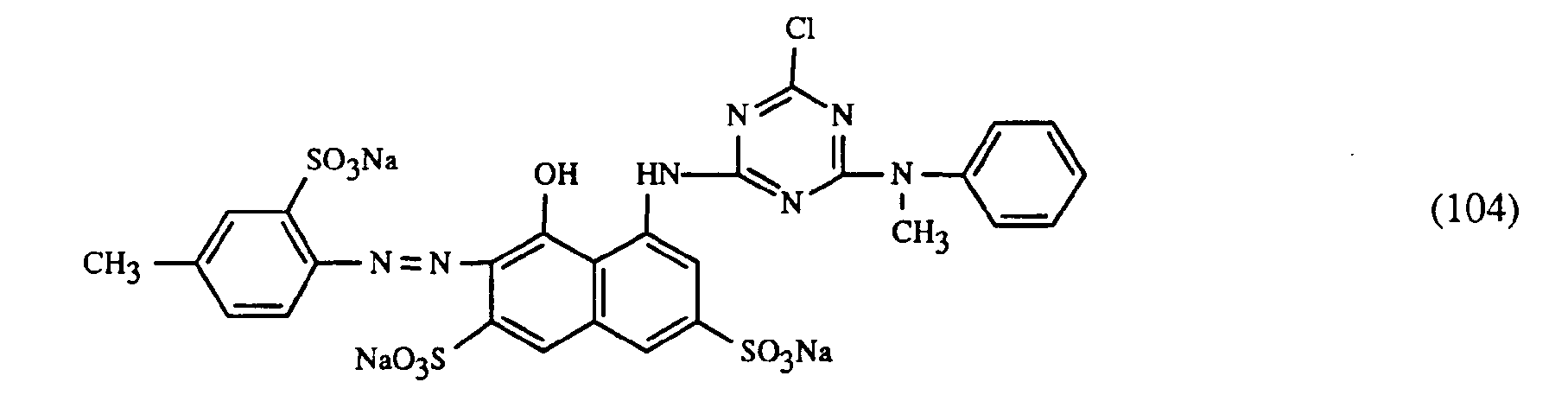
- 0,5 g/I des blaufärbenden Farbstoffes der Formel

- 50 g/I Harnstoff,
- 20 g/I Natriumkarbonat, kalziniert und
- 1 g/I eines Netzmittels.
- Die Tauchzeit beträgt 2 Sekunden.
- Anschliessend wird das foulardierte Gewebe 1 Minute bei 100° auf der Hotflue getrocknet und dann 1 Minute bei 180° auf der Hotflue thermofixiert.
- Nach Spülen, Seifen, Spülen und Trocknen gemäss den Angaben in Beispiel 1 erhält man ein endengleich in beigem Farbton gefärbtes Baumwoll-Cretonne-Gewebe mit guten Echtheiten.
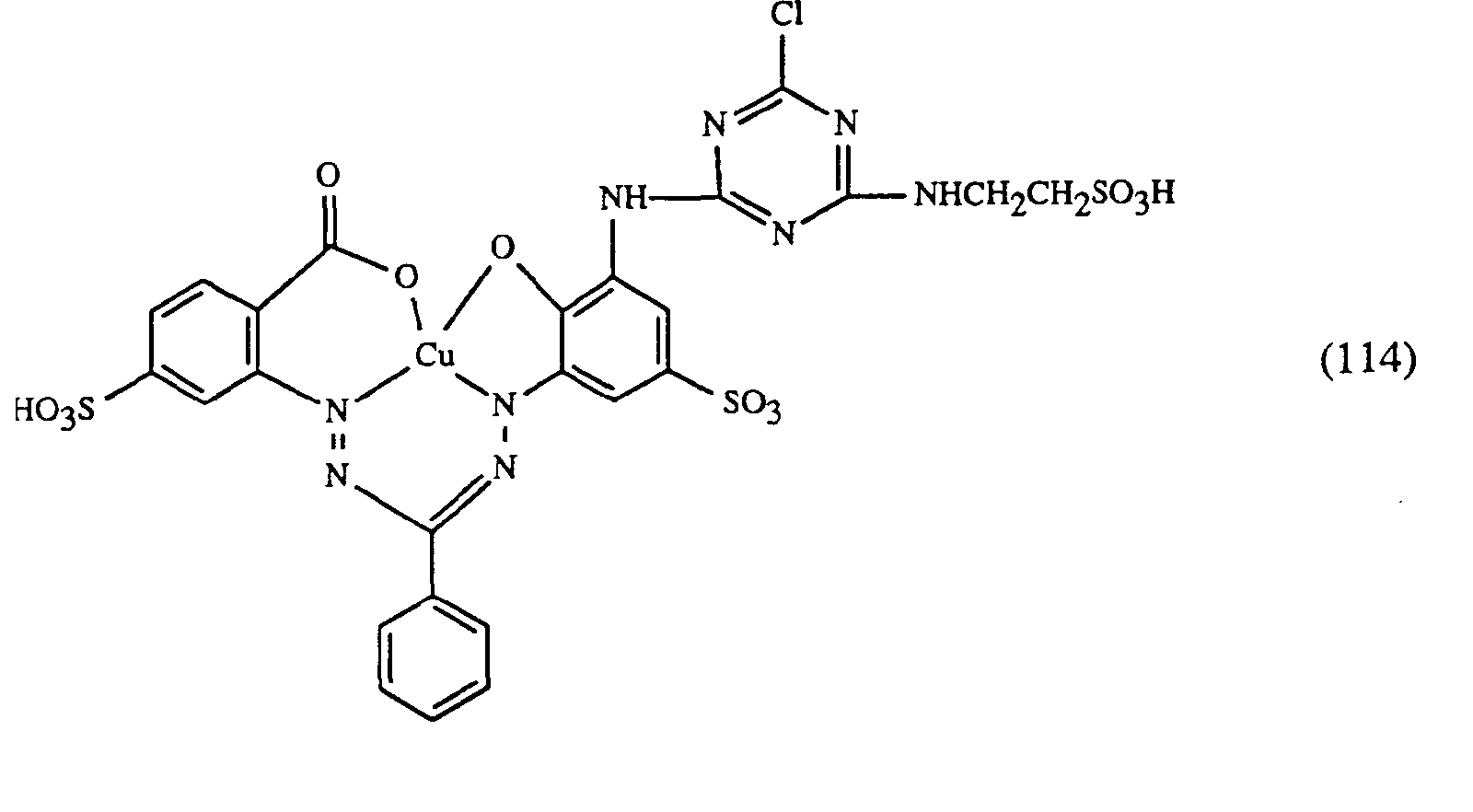
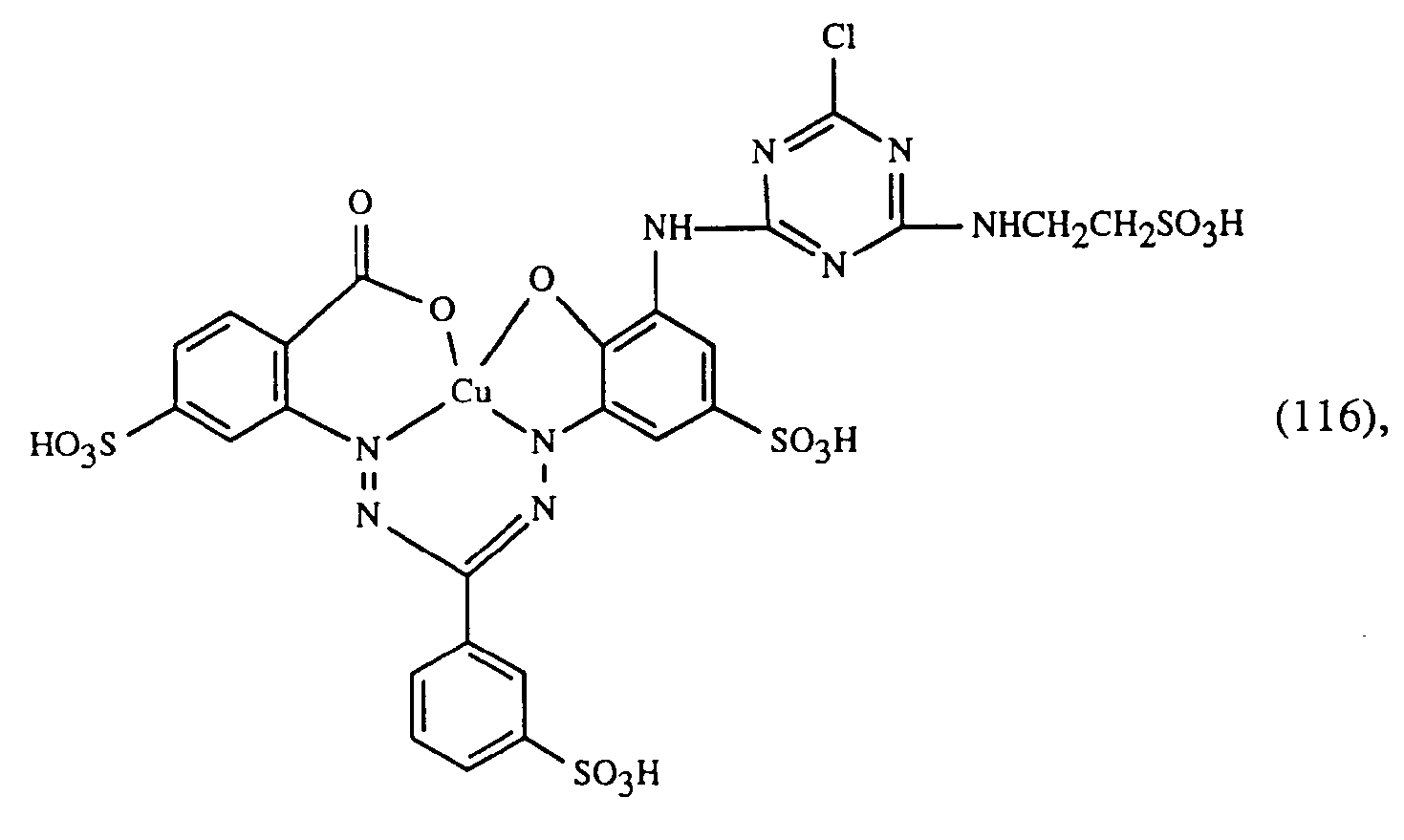
- Wenn man in obigen Beispielen anstelle des gelbfärbenden Farbstoffes der Formel (101) eine äquivalente Menge eines der nachfolgenden Farbstoffe der Formeln (105) bis (107) verwendet und anstelle der rotfärbenden Farbstoffe der Formeln (102) bis (104) eine äquivalente Menge eines Farbstoffes der Formel (108) bis (111) und anstelle des blaufärbenden Farbstoffes der Formel (103) eine äquivalente Menge eines Farbstoffes der Formel (112) bis (120) verwendet, so erhält man ebenfalls endengleiche, egale Färbungen mit guten Echtheiten.

-


-


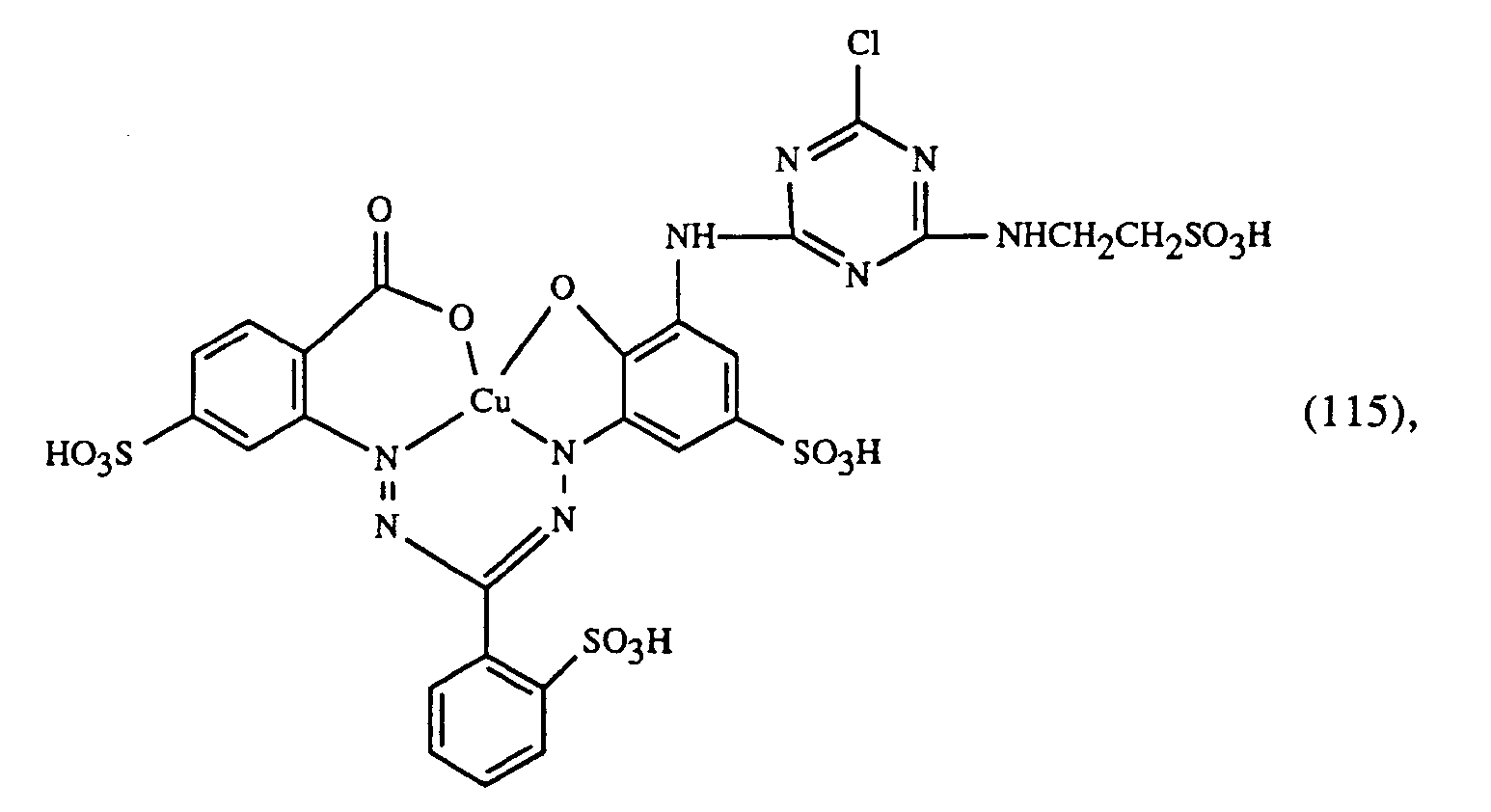


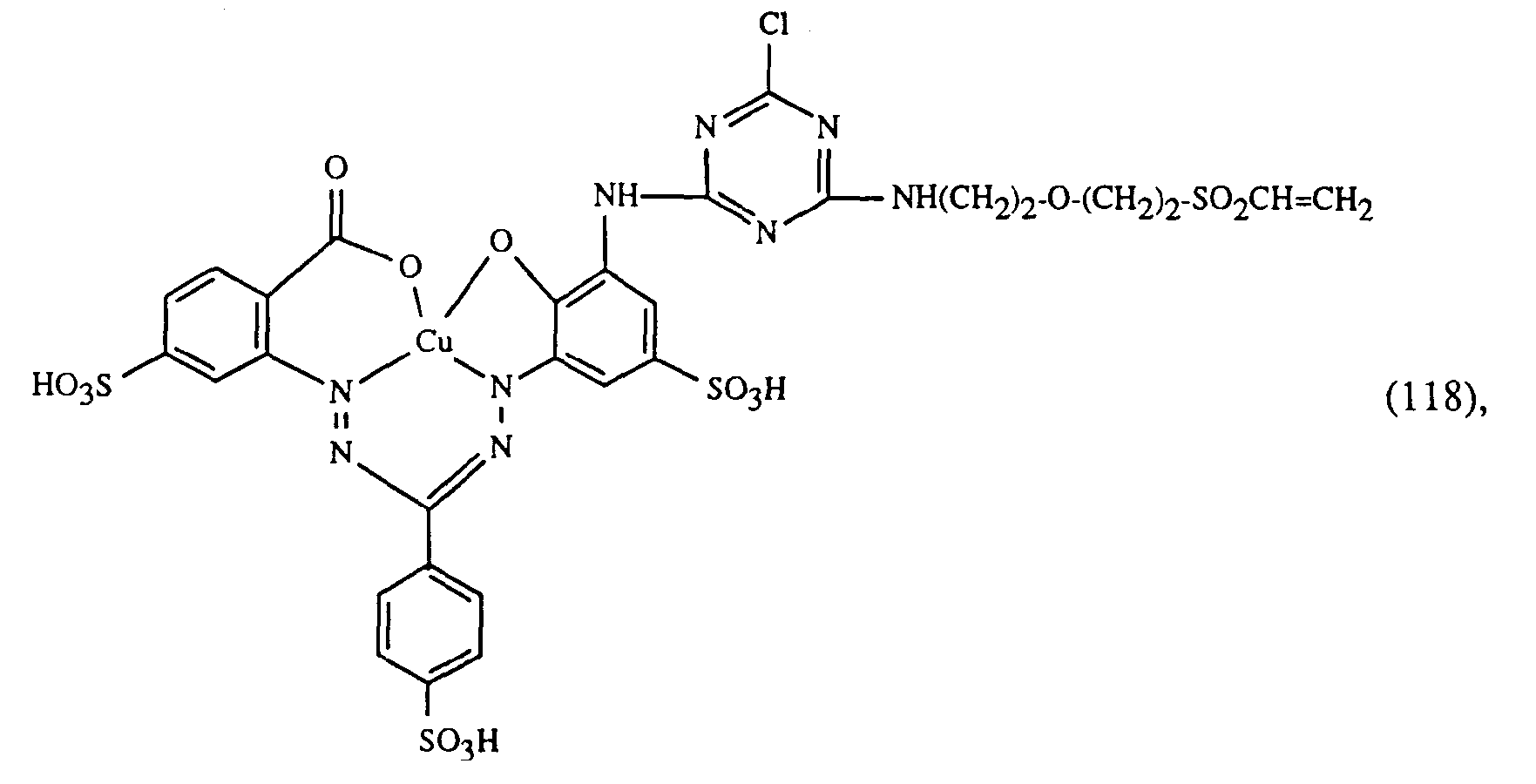


- Beispiel 3: Ein gebleichtes, mercerisiertes Baumwoll-Cretonne-Gewebe wird auf dem Foulard mit einem Abquetscheffekt von 70 % Flottenaufnahme imprägniert mit einer Klotzflotte nachstehender Zusammensetzung:
- 1,0 g/I des gelbfärbenden Farbstoffes der Formel

- 0,5 g/I des rotfärbenden Farbstoffes der Formel

- 0,5 g/I des blaufärbenden Farbstoffes der Formel

- 30 g/I Natronlauge (30 %) und
- 1 g/I eines Netzmittels.
- Die Tauchzeit beträgt 2 Sekunden.
- Anschliessend wird das foulardierte Gewebe in einem Plastiksäckchen luftdicht verpackt und 24 Stunden bei 25° gelagert.
- Danach wird das Baumwoll-Cretonne-Gewebe zunächst mit kaltem Wasser und dann mit heissem kochendem Wasser gespült, kochend mit 1 bis 2 g/I eines Waschmittels geseift, erneut mit heissem und dann mit kaltem Wasser gespült und danach getrocknet.
- Man erhält eine egale, endengleiche beige Färbung mit guten Echtheiten.
- Wenn man in obigem Beispiel anstelle des gelbfärbenden Farbstoffes der Formel (107) eine äquivalente Menge eines der nachfolgenden Farbstoffe der Formeln (101), (105) oder (106) verwendet und anstelle des rotfärbenden Farbstoffes der Formel (104) eine äquivalente Menge eines Farbstoffes der Formel (108) bis (111) und anstelle des blaufärbenden Farbstoffes der Formel (103) eine äquivalente Menge eines Farbstoffes der Formel (112) bis (122) verwendet, so erhält man ebenfalls endengleiche, egale Färbungen mit guten Echtheiten.

-


-





- Beispiel 4: Ein gebleichtes mercerisiertes Baumwoll-Satin-Gewebe wird unter normalen Flachfilmdruckbedingungen mit einer Druckpaste nachstehender Zusammensetzung bedruckt:
- 10 g des gelbfärbenden Farbstoffes der Formel (107)
- 5 g des rotfärbenden Farbstoffes der Formel (104)
- 5 g des blaufärbenden Farbstoffes der Formel (103)

- Anschliessend wird 5 Minuten bei 90° getrocknet und 8 Minuten bei 102° mit Sattdampf fixiert.
- Danach wird wie in Beispiel 3 angegeben gewaschen. Man erhält einen egalen nicht zweiseitigen braunbeigen Druck mit guten Echtheiten.
- Wenn man anstelle des gelbfärbenden Farbstoffes der Formel (107) eine äquivalente Menge eines der Farbstoffe der Formeln (101), (105) oder (106) verwendet und anstelle des rotfärbenden Farbstoffes der Formel (104) eine äquivalente Menge eines Farbstoffes der Formel (108) bis (111) und anstelle des blaufärbenden Farbstoffes der Formel (103) eine äquivalente Menge eines Farbstoffes der Formel (112) bis (122) verwendet, so erhält man ebenfalls endengleiche, egale, nicht zweiseitige Drucke mit guten Echtheiten.
Claims (33)


















Applications Claiming Priority (6)
| Application Number | Priority Date | Filing Date | Title |
|---|---|---|---|
| CH57/90 | 1990-01-09 | ||
| CH5790 | 1990-01-09 | ||
| CH567/90 | 1990-02-21 | ||
| CH56790 | 1990-02-21 | ||
| CH156990 | 1990-05-09 | ||
| CH1569/90 | 1990-05-09 |
Publications (2)
| Publication Number | Publication Date |
|---|---|
| EP0437184A1 EP0437184A1 (de) | 1991-07-17 |
| EP0437184B1 true EP0437184B1 (de) | 1994-04-20 |
Family
ID=27171741
Family Applications (1)
| Application Number | Title | Priority Date | Filing Date |
|---|---|---|---|
| EP90811025A Revoked EP0437184B1 (de) | 1990-01-09 | 1990-12-21 | Verfahren zum Trichromiefärben oder -bedrucken von cellulosehaltigen textilen Fasermaterialien |
Country Status (9)
| Country | Link |
|---|---|
| US (1) | US5071442A (de) |
| EP (1) | EP0437184B1 (de) |
| JP (1) | JPH0748781A (de) |
| KR (1) | KR910014566A (de) |
| BR (1) | BR9100053A (de) |
| DE (1) | DE59005451D1 (de) |
| DK (1) | DK0437184T3 (de) |
| ES (1) | ES2052229T3 (de) |
| PT (1) | PT96444A (de) |
Cited By (6)
| Publication number | Priority date | Publication date | Assignee | Title |
|---|---|---|---|---|
| EP0545207A1 (de) * | 1991-12-04 | 1993-06-09 | Bayer Ag | Reaktivfarbstoffmischung mit verbessertem Kombinationsverhalten |
| EP0525805A3 (en) * | 1991-08-02 | 1993-06-16 | Sumitomo Chemical Company, Limited | Fiber reactive dye composition and method for dyeing or printing fiber materials using the composition |
| TR27867A (tr) * | 1993-09-21 | 1995-10-11 | Hoechst Ag | Boyar maddelerin elyaf reaktiviteli gruplarla olan karisimlari ve bunlarin elyaf malzemesinin boyanmasi amaciyla kullanilmalari. |
| US5704951A (en) * | 1995-03-30 | 1998-01-06 | Hoechst Aktiengesellschaft | Mixtures of blue-dyeing fiber-reactive dyes and their use for dyeing hydroxy-and/or carboxamido-containing fiber material |
| US5779739A (en) * | 1995-03-30 | 1998-07-14 | Hoechst Aktiengesellschaft | Dye mixtures of fiber-reactive azo dyes and their use for dyeing hydroxy-and/or carboxamido-containing fiber material |
| EP1046677B1 (de) * | 1999-04-22 | 2003-07-23 | DyStar Textilfarben GmbH & Co. Deutschland KG | Wasserlösliche Disazoverbindungen mit Arylcarbonamid-Diazokomponenten, Verfahren zu ihrer Herstellung und ihre Verwendung |
Families Citing this family (25)
| Publication number | Priority date | Publication date | Assignee | Title |
|---|---|---|---|---|
| CH685762A5 (de) * | 1992-09-17 | 1995-09-29 | Sandoz Ag | Faserreaktive Monoazofarbstoffe. |
| JP3657627B2 (ja) * | 1992-10-12 | 2005-06-08 | クラリアント ファイナンス (ビーブイアイ) リミティド | 繊維反応性アゾ染料化合物およびその製造法 |
| US5456727A (en) * | 1994-05-24 | 1995-10-10 | Hoechst Celanese Corporation | Dye compositions for polyamides |
| TW446734B (en) * | 1997-12-11 | 2001-07-21 | Ciba Sc Holding Ag | Process for dyeing or printing and novel reactive dyes |
| BR0007953A (pt) | 1999-02-05 | 2001-11-06 | Ciba Sc Holding Ag | Tintas para tingimento em preto e seu uso |
| CN1419589A (zh) * | 2000-03-22 | 2003-05-21 | 西巴特殊化学品控股有限公司 | 纤维活性萘基偶氮基萘基三嗪基染料 |
| FR2831177B1 (fr) | 2001-10-22 | 2005-02-18 | Rhodia Elect & Catalysis | Dispersion colloidale et poudre colorees de cerium ou de cerium et de titane, de zirconium, d'aluminium ou d'une terre rare, leur procede de preparation et leur utilisation |
| FR2831176A1 (fr) | 2001-10-22 | 2003-04-25 | Rhodia Elect & Catalysis | Composition pigmentaire a base d'un sulfure de terre rare, d'un colorant et, eventuellement, d'un agent de couplage, son procede de preparation et son utilisation |
| GB0208444D0 (en) * | 2002-04-12 | 2002-05-22 | Clariant Int Ltd | Composition for printing recording materials |
| BRPI0718595A2 (pt) * | 2006-11-09 | 2013-12-10 | Huntsman Adv Mat Switzerland | Misturas de corantes reativos e sua utilização em um método para tingimento ou impressão tricromática. |
| CN101565560B (zh) * | 2009-04-14 | 2012-10-17 | 丽源(湖北)科技有限公司 | 一种红色活性染料混合物及其制备及使用 |
| CN101565559B (zh) * | 2009-04-14 | 2013-02-13 | 丽源(湖北)科技有限公司 | 一种藏青活性染料混合物及其制备及使用 |
| CN102321387B (zh) * | 2011-07-07 | 2016-03-02 | 天津德凯化工股份有限公司 | 一种尼龙活性黄染料及其制备方法 |
| CN102321388B (zh) * | 2011-07-07 | 2016-01-20 | 天津德凯化工股份有限公司 | 一种尼龙用黄色活性染料 |
| WO2013022044A1 (ja) * | 2011-08-09 | 2013-02-14 | 日本化薬株式会社 | インクジェット捺染用グレーインク組成物及びそれを用いた繊維の捺染方法 |
| JP5943568B2 (ja) * | 2011-08-09 | 2016-07-05 | 日本化薬株式会社 | インクジェット捺染用ブラックインク組成物及びそれを用いた繊維の捺染方法 |
| JP2013035951A (ja) * | 2011-08-09 | 2013-02-21 | Nippon Kayaku Co Ltd | インクジェット捺染用ゴールデンイエローインク組成物及びそれを用いた繊維の捺染方法 |
| CN102504590B (zh) * | 2011-09-27 | 2016-03-23 | 天津德凯化工股份有限公司 | 一种高固色酱红色活性染料及其制备方法 |
| KR101471457B1 (ko) * | 2012-11-27 | 2014-12-10 | (주)경인양행 | 반응성 청색 염료 조성물 및 이를 이용한 섬유의 염색방법 |
| TW201446886A (zh) | 2013-02-19 | 2014-12-16 | Huntsman Adv Mat Switzerland | 反應性染料混合物及其於雙或三色染料或印刷方法中之用途 |
| GB201305416D0 (en) * | 2013-03-25 | 2013-05-08 | Univ Leeds | Novel method for coloration and treatment of substrates |
| CN107345082A (zh) * | 2016-05-05 | 2017-11-14 | 中山上如化工有限公司 | 一种具有水洗怀旧功能的活性染料组合物 |
| CN107254787A (zh) * | 2017-07-03 | 2017-10-17 | 上海安诺其集团股份有限公司 | 活性染料在棉类纤维素织物染色中的应用 |
| CN107236327A (zh) * | 2017-07-03 | 2017-10-10 | 上海安诺其集团股份有限公司 | 活性染料、活性染料组合物及其制备方法 |
| CN113150576B (zh) * | 2021-03-02 | 2022-11-25 | 泰兴锦云染料有限公司 | 一种喷墨印花活性红色染料及其制备方法和应用 |
Family Cites Families (7)
| Publication number | Priority date | Publication date | Assignee | Title |
|---|---|---|---|---|
| CH657144A5 (de) * | 1983-05-04 | 1986-08-15 | Ciba Geigy Ag | Verfahren zur umwandlung schwerloeslicher salze anionischer farbstoffe und optischer aufheller in leichter loesliche salze mittels kationenaustausch. |
| DE3479589D1 (en) * | 1983-11-10 | 1989-10-05 | Ciba Geigy Ag | Process for the preparation of reactive dyes |
| JPH0733487B2 (ja) * | 1987-12-25 | 1995-04-12 | 三菱化学株式会社 | 水溶性染料混合物 |
| JPH0713202B2 (ja) * | 1987-12-25 | 1995-02-15 | 三菱化学株式会社 | 水溶性染料混合物 |
| JPH0713204B2 (ja) * | 1987-12-25 | 1995-02-15 | 三菱化学株式会社 | 水溶性染料混合物 |
| JPH0713203B2 (ja) * | 1987-12-25 | 1995-02-15 | 三菱化学株式会社 | 水溶性染料混合物 |
| EP0360735A1 (de) * | 1988-08-26 | 1990-03-28 | Ciba-Geigy Ag | Verfahren zum Trichromie-Färben oder -Bedrucken |
-
1990
- 1990-12-21 EP EP90811025A patent/EP0437184B1/de not_active Revoked
- 1990-12-21 DE DE59005451T patent/DE59005451D1/de not_active Revoked
- 1990-12-21 DK DK90811025.7T patent/DK0437184T3/da not_active Application Discontinuation
- 1990-12-21 ES ES90811025T patent/ES2052229T3/es not_active Expired - Lifetime
-
1991
- 1991-01-04 US US07/638,253 patent/US5071442A/en not_active Expired - Fee Related
- 1991-01-07 KR KR1019910000084A patent/KR910014566A/ko not_active Abandoned
- 1991-01-08 BR BR919100053A patent/BR9100053A/pt not_active Application Discontinuation
- 1991-01-09 JP JP98391A patent/JPH0748781A/ja not_active Withdrawn
- 1991-01-09 PT PT96444A patent/PT96444A/pt not_active Application Discontinuation
Cited By (10)
| Publication number | Priority date | Publication date | Assignee | Title |
|---|---|---|---|---|
| EP0525805A3 (en) * | 1991-08-02 | 1993-06-16 | Sumitomo Chemical Company, Limited | Fiber reactive dye composition and method for dyeing or printing fiber materials using the composition |
| US5254136A (en) * | 1991-08-02 | 1993-10-19 | Sumitomo Chemical Company, Limited | Trichromatic fiber reactive dye composition and method for dyeing or printing fiber materials using the composition |
| TR26567A (tr) * | 1991-08-02 | 1995-03-15 | Sumitomo Chemical Co | Fiber tepkin boya bilesimi ve bilesimi kullanarak fiber malzemeleri boyamak ya da bunlara baski yapmak icin yöntem |
| EP0545207A1 (de) * | 1991-12-04 | 1993-06-09 | Bayer Ag | Reaktivfarbstoffmischung mit verbessertem Kombinationsverhalten |
| US5456728A (en) * | 1991-12-04 | 1995-10-10 | Bayer Aktiengesellschaft | Reactive dyestuff mixture having improved properties in combination |
| TR27867A (tr) * | 1993-09-21 | 1995-10-11 | Hoechst Ag | Boyar maddelerin elyaf reaktiviteli gruplarla olan karisimlari ve bunlarin elyaf malzemesinin boyanmasi amaciyla kullanilmalari. |
| US5496381A (en) * | 1993-09-21 | 1996-03-05 | Hoechst Ag | Mixtures of fiber-reactive dyes and use thereof for dyeing fiber materials |
| US5704951A (en) * | 1995-03-30 | 1998-01-06 | Hoechst Aktiengesellschaft | Mixtures of blue-dyeing fiber-reactive dyes and their use for dyeing hydroxy-and/or carboxamido-containing fiber material |
| US5779739A (en) * | 1995-03-30 | 1998-07-14 | Hoechst Aktiengesellschaft | Dye mixtures of fiber-reactive azo dyes and their use for dyeing hydroxy-and/or carboxamido-containing fiber material |
| EP1046677B1 (de) * | 1999-04-22 | 2003-07-23 | DyStar Textilfarben GmbH & Co. Deutschland KG | Wasserlösliche Disazoverbindungen mit Arylcarbonamid-Diazokomponenten, Verfahren zu ihrer Herstellung und ihre Verwendung |
Also Published As
| Publication number | Publication date |
|---|---|
| US5071442A (en) | 1991-12-10 |
| DK0437184T3 (da) | 1994-05-16 |
| DE59005451D1 (de) | 1994-05-26 |
| EP0437184A1 (de) | 1991-07-17 |
| BR9100053A (pt) | 1991-10-22 |
| KR910014566A (ko) | 1991-08-31 |
| JPH0748781A (ja) | 1995-02-21 |
| ES2052229T3 (es) | 1994-07-01 |
| PT96444A (pt) | 1991-10-15 |
Similar Documents
| Publication | Publication Date | Title |
|---|---|---|
| EP0437184B1 (de) | Verfahren zum Trichromiefärben oder -bedrucken von cellulosehaltigen textilen Fasermaterialien | |
| EP0775776B1 (de) | Verfahren zum Di- oder Trichromie-Färben oder -Bedrucken | |
| EP0040790B2 (de) | Verfahren zum Färben und Bedrucken von Hydroxy- und/oder Carbonamidgruppen enthaltenden Fasermaterialien | |
| EP0070807B1 (de) | Reaktivfarbstoffe, deren Herstellung und Verwendung | |
| EP0623655B1 (de) | Faserreaktive Farbstoffe, ihre Herstellung und Verwendung | |
| EP0478503A2 (de) | Faserreaktive Farbstoffe und Farbstoffmischungen und deren Verwendung | |
| EP0922735A1 (de) | Verfahren zum Färben oder Bedrucken sowie neue Reaktivfarbstoffe | |
| EP0177449B1 (de) | Verfahren zum Bedrucken von Cellulosefasern | |
| EP0181292A2 (de) | Verfahren zum Kontinuierlichen Trichromie-Färben von synthetischen Polyamidmaterialien | |
| EP0549529B1 (de) | Verfahren zum Färben oder Bedrucken von hydroxylgruppenhaltigen Fasermaterialien | |
| EP1061105B1 (de) | Faserreaktive Farbstoffe, Verfahren zu ihrer Herstellung und ihre Verwendung | |
| EP0419413A1 (de) | Verfahren zum Färben oder Bedrucken von Mischfasern aus cellulosehaltigen Fasermaterialien und Seide | |
| EP0199950A1 (de) | Verfahren zum Färben oder Bedrucken von Hydroxygruppen enthaltenden Fasermaterialien mit neuen faserreaktiven Farbstoffen | |
| EP0803543A1 (de) | Faserreaktive Farbstoffe, ihre Herstellung und Verwendung | |
| EP0764694A1 (de) | Reaktivfarbstoffe, ihre Herstellung und Verwendung | |
| EP0428482B1 (de) | Reaktivfarbstoffe, Verfahren zu deren Herstellung und deren Verwendung | |
| EP0352222B1 (de) | Faserreaktive Formazanfarbstoffe, Verfahren zu deren Herstellung und deren Verwendung | |
| EP0495753B1 (de) | Reaktivfarbstoffe, Verfahren zu deren Herstellung und deren Verwendung | |
| EP0242324B1 (de) | Verfahren zum endengleichen Färben von Cellulosefasern | |
| EP0209494B1 (de) | Verfahren zum Nuancenstabilen Färben oder Bedrucken | |
| EP0776947B1 (de) | Faserreaktive Farbstoffe, ihre Herstellung und Verwendung | |
| EP0170612B1 (de) | Reaktivfarbstoffe, deren Herstellung und Verwendung | |
| EP0969051B1 (de) | Mischungen von Reaktivfarbstoffen und deren Verwendung | |
| EP0889098A2 (de) | Azofarbstoffe, Verfahren zu deren Herstellung und deren Verwendung | |
| EP0857762B1 (de) | Wässrige Reaktivfarbstoff-Formulierungen sowie Verfahren zum Färben und Bedrucken von textilen Fasermaterialien |
Legal Events
| Date | Code | Title | Description |
|---|---|---|---|
| PUAI | Public reference made under article 153(3) epc to a published international application that has entered the european phase |
Free format text: ORIGINAL CODE: 0009012 |
|
| 17P | Request for examination filed |
Effective date: 19901224 |
|
| AK | Designated contracting states |
Kind code of ref document: A1 Designated state(s): BE CH DE DK ES FR GB IT LI |
|
| 17Q | First examination report despatched |
Effective date: 19930702 |
|
| GRAA | (expected) grant |
Free format text: ORIGINAL CODE: 0009210 |
|
| AK | Designated contracting states |
Kind code of ref document: B1 Designated state(s): BE CH DE DK ES FR GB IT LI |
|
| ET | Fr: translation filed | ||
| REG | Reference to a national code |
Ref country code: DK Ref legal event code: T3 |
|
| REF | Corresponds to: |
Ref document number: 59005451 Country of ref document: DE Date of ref document: 19940526 |
|
| REG | Reference to a national code |
Ref country code: ES Ref legal event code: FG2A Ref document number: 2052229 Country of ref document: ES Kind code of ref document: T3 |
|
| ITF | It: translation for a ep patent filed | ||
| GBT | Gb: translation of ep patent filed (gb section 77(6)(a)/1977) |
Effective date: 19940627 |
|
| PGFP | Annual fee paid to national office [announced via postgrant information from national office to epo] |
Ref country code: DK Payment date: 19941121 Year of fee payment: 5 |
|
| PGFP | Annual fee paid to national office [announced via postgrant information from national office to epo] |
Ref country code: BE Payment date: 19950104 Year of fee payment: 5 |
|
| PLBI | Opposition filed |
Free format text: ORIGINAL CODE: 0009260 |
|
| 26 | Opposition filed |
Opponent name: BAYER AG, LEVERKUSEN KONZERNVERWALTUNG RP PATENTE Effective date: 19950120 |
|
| PGFP | Annual fee paid to national office [announced via postgrant information from national office to epo] |
Ref country code: FR Payment date: 19951026 Year of fee payment: 6 |
|
| REG | Reference to a national code |
Ref country code: DK Ref legal event code: EBP |
|
| PGFP | Annual fee paid to national office [announced via postgrant information from national office to epo] |
Ref country code: GB Payment date: 19951106 Year of fee payment: 6 |
|
| PGFP | Annual fee paid to national office [announced via postgrant information from national office to epo] |
Ref country code: DE Payment date: 19951129 Year of fee payment: 6 |
|
| PGFP | Annual fee paid to national office [announced via postgrant information from national office to epo] |
Ref country code: ES Payment date: 19951218 Year of fee payment: 6 |
|
| ITTA | It: last paid annual fee | ||
| RDAG | Patent revoked |
Free format text: ORIGINAL CODE: 0009271 |
|
| STAA | Information on the status of an ep patent application or granted ep patent |
Free format text: STATUS: PATENT REVOKED |
|
| 27W | Patent revoked |
Effective date: 19951028 |
|
| GBPR | Gb: patent revoked under art. 102 of the ep convention designating the uk as contracting state |
Free format text: 951028 |
|
| PGFP | Annual fee paid to national office [announced via postgrant information from national office to epo] |
Ref country code: CH Payment date: 19960314 Year of fee payment: 6 |
|
| REG | Reference to a national code |
Ref country code: CH Ref legal event code: PL |