EP0352222B1 - Faserreaktive Formazanfarbstoffe, Verfahren zu deren Herstellung und deren Verwendung - Google Patents
Faserreaktive Formazanfarbstoffe, Verfahren zu deren Herstellung und deren Verwendung Download PDFInfo
- Publication number
- EP0352222B1 EP0352222B1 EP89810475A EP89810475A EP0352222B1 EP 0352222 B1 EP0352222 B1 EP 0352222B1 EP 89810475 A EP89810475 A EP 89810475A EP 89810475 A EP89810475 A EP 89810475A EP 0352222 B1 EP0352222 B1 EP 0352222B1
- Authority
- EP
- European Patent Office
- Prior art keywords
- formula
- compound
- process according
- dye
- amine
- Prior art date
- Legal status (The legal status is an assumption and is not a legal conclusion. Google has not performed a legal analysis and makes no representation as to the accuracy of the status listed.)
- Expired - Lifetime
Links
- 239000000975 dye Substances 0.000 title claims description 143
- 238000000034 method Methods 0.000 title claims description 55
- 238000002360 preparation method Methods 0.000 title claims description 11
- 150000001875 compounds Chemical class 0.000 claims description 63
- -1 α-bromoacryloyl Chemical group 0.000 claims description 35
- 238000004043 dyeing Methods 0.000 claims description 34
- 150000001412 amines Chemical class 0.000 claims description 33
- 210000002268 wool Anatomy 0.000 claims description 33
- 229910052801 chlorine Inorganic materials 0.000 claims description 31
- 239000000460 chlorine Substances 0.000 claims description 28
- 229910052736 halogen Inorganic materials 0.000 claims description 23
- ZAMOUSCENKQFHK-UHFFFAOYSA-N Chlorine atom Chemical compound [Cl] ZAMOUSCENKQFHK-UHFFFAOYSA-N 0.000 claims description 22
- 150000002367 halogens Chemical group 0.000 claims description 22
- 125000000020 sulfo group Chemical group O=S(=O)([*])O[H] 0.000 claims description 16
- 229910052731 fluorine Inorganic materials 0.000 claims description 15
- 239000011737 fluorine Substances 0.000 claims description 15
- 239000000463 material Substances 0.000 claims description 15
- PXGOKWXKJXAPGV-UHFFFAOYSA-N Fluorine Chemical compound FF PXGOKWXKJXAPGV-UHFFFAOYSA-N 0.000 claims description 12
- 125000001997 phenyl group Chemical group [H]C1=C([H])C([H])=C(*)C([H])=C1[H] 0.000 claims description 10
- 125000001309 chloro group Chemical group Cl* 0.000 claims description 9
- 239000007859 condensation product Substances 0.000 claims description 9
- MGNCLNQXLYJVJD-UHFFFAOYSA-N cyanuric chloride Chemical compound ClC1=NC(Cl)=NC(Cl)=N1 MGNCLNQXLYJVJD-UHFFFAOYSA-N 0.000 claims description 9
- 125000001424 substituent group Chemical group 0.000 claims description 9
- 239000000203 mixture Substances 0.000 claims description 8
- 239000004952 Polyamide Substances 0.000 claims description 7
- GDTBXPJZTBHREO-UHFFFAOYSA-N bromine Substances BrBr GDTBXPJZTBHREO-UHFFFAOYSA-N 0.000 claims description 7
- 229910052739 hydrogen Inorganic materials 0.000 claims description 7
- 239000001257 hydrogen Substances 0.000 claims description 7
- 229910052757 nitrogen Inorganic materials 0.000 claims description 7
- 229920002647 polyamide Polymers 0.000 claims description 7
- NAWXUBYGYWOOIX-SFHVURJKSA-N (2s)-2-[[4-[2-(2,4-diaminoquinazolin-6-yl)ethyl]benzoyl]amino]-4-methylidenepentanedioic acid Chemical compound C1=CC2=NC(N)=NC(N)=C2C=C1CCC1=CC=C(C(=O)N[C@@H](CC(=C)C(O)=O)C(O)=O)C=C1 NAWXUBYGYWOOIX-SFHVURJKSA-N 0.000 claims description 6
- 229910052794 bromium Inorganic materials 0.000 claims description 6
- VMKJWLXVLHBJNK-UHFFFAOYSA-N cyanuric fluoride Chemical compound FC1=NC(F)=NC(F)=N1 VMKJWLXVLHBJNK-UHFFFAOYSA-N 0.000 claims description 6
- 125000004435 hydrogen atom Chemical class [H]* 0.000 claims description 6
- 125000000843 phenylene group Chemical group C1(=C(C=CC=C1)*)* 0.000 claims description 6
- WKBOTKDWSSQWDR-UHFFFAOYSA-N Bromine atom Chemical compound [Br] WKBOTKDWSSQWDR-UHFFFAOYSA-N 0.000 claims description 5
- 125000005843 halogen group Chemical group 0.000 claims description 5
- VMGAPWLDMVPYIA-HIDZBRGKSA-N n'-amino-n-iminomethanimidamide Chemical compound N\N=C\N=N VMGAPWLDMVPYIA-HIDZBRGKSA-N 0.000 claims description 5
- BOLDJAUMGUJJKM-LSDHHAIUSA-N renifolin D Natural products CC(=C)[C@@H]1Cc2c(O)c(O)ccc2[C@H]1CC(=O)c3ccc(O)cc3O BOLDJAUMGUJJKM-LSDHHAIUSA-N 0.000 claims description 5
- 125000004178 (C1-C4) alkyl group Chemical group 0.000 claims description 4
- 125000000229 (C1-C4)alkoxy group Chemical group 0.000 claims description 4
- 125000001931 aliphatic group Chemical group 0.000 claims description 4
- 125000002668 chloroacetyl group Chemical group ClCC(=O)* 0.000 claims description 4
- 125000004769 (C1-C4) alkylsulfonyl group Chemical group 0.000 claims description 3
- 125000004093 cyano group Chemical group *C#N 0.000 claims description 3
- 125000001153 fluoro group Chemical group F* 0.000 claims description 3
- 125000005179 haloacetyl group Chemical group 0.000 claims description 3
- 125000000449 nitro group Chemical group [O-][N+](*)=O 0.000 claims description 3
- 239000004753 textile Substances 0.000 claims description 3
- 239000000987 azo dye Substances 0.000 claims description 2
- 150000005694 halopyrimidines Chemical group 0.000 claims description 2
- 239000010985 leather Substances 0.000 claims description 2
- 238000004519 manufacturing process Methods 0.000 claims description 2
- IJGRMHOSHXDMSA-UHFFFAOYSA-N Atomic nitrogen Chemical compound N#N IJGRMHOSHXDMSA-UHFFFAOYSA-N 0.000 claims 6
- 125000002485 formyl group Chemical group [H]C(*)=O 0.000 claims 1
- 125000002887 hydroxy group Chemical group [H]O* 0.000 claims 1
- QJGQUHMNIGDVPM-UHFFFAOYSA-N nitrogen group Chemical group [N] QJGQUHMNIGDVPM-UHFFFAOYSA-N 0.000 claims 1
- 239000000047 product Substances 0.000 claims 1
- QTBSBXVTEAMEQO-UHFFFAOYSA-N Acetic acid Chemical compound CC(O)=O QTBSBXVTEAMEQO-UHFFFAOYSA-N 0.000 description 33
- HEMHJVSKTPXQMS-UHFFFAOYSA-M Sodium hydroxide Chemical compound [OH-].[Na+] HEMHJVSKTPXQMS-UHFFFAOYSA-M 0.000 description 33
- XLYOFNOQVPJJNP-UHFFFAOYSA-N water Substances O XLYOFNOQVPJJNP-UHFFFAOYSA-N 0.000 description 33
- FAPWRFPIFSIZLT-UHFFFAOYSA-M Sodium chloride Chemical compound [Na+].[Cl-] FAPWRFPIFSIZLT-UHFFFAOYSA-M 0.000 description 30
- 239000000243 solution Substances 0.000 description 27
- 235000002639 sodium chloride Nutrition 0.000 description 24
- 239000011780 sodium chloride Substances 0.000 description 17
- CSCPPACGZOOCGX-UHFFFAOYSA-N Acetone Chemical compound CC(C)=O CSCPPACGZOOCGX-UHFFFAOYSA-N 0.000 description 14
- BDAGIHXWWSANSR-UHFFFAOYSA-N methanoic acid Natural products OC=O BDAGIHXWWSANSR-UHFFFAOYSA-N 0.000 description 14
- 238000004040 coloring Methods 0.000 description 13
- VEXZGXHMUGYJMC-UHFFFAOYSA-N Hydrochloric acid Chemical compound Cl VEXZGXHMUGYJMC-UHFFFAOYSA-N 0.000 description 12
- 239000004744 fabric Substances 0.000 description 11
- 239000002253 acid Substances 0.000 description 10
- 239000002657 fibrous material Substances 0.000 description 10
- 150000003863 ammonium salts Chemical class 0.000 description 8
- 239000000985 reactive dye Substances 0.000 description 8
- OSWFIVFLDKOXQC-UHFFFAOYSA-N 4-(3-methoxyphenyl)aniline Chemical compound COC1=CC=CC(C=2C=CC(N)=CC=2)=C1 OSWFIVFLDKOXQC-UHFFFAOYSA-N 0.000 description 7
- NLXLAEXVIDQMFP-UHFFFAOYSA-N Ammonium chloride Substances [NH4+].[Cl-] NLXLAEXVIDQMFP-UHFFFAOYSA-N 0.000 description 7
- VHUUQVKOLVNVRT-UHFFFAOYSA-N Ammonium hydroxide Chemical compound [NH4+].[OH-] VHUUQVKOLVNVRT-UHFFFAOYSA-N 0.000 description 7
- QAOWNCQODCNURD-UHFFFAOYSA-N Sulfuric acid Chemical compound OS(O)(=O)=O QAOWNCQODCNURD-UHFFFAOYSA-N 0.000 description 7
- 235000011114 ammonium hydroxide Nutrition 0.000 description 7
- 125000004432 carbon atom Chemical group C* 0.000 description 7
- 238000001035 drying Methods 0.000 description 7
- 235000019253 formic acid Nutrition 0.000 description 7
- 150000003839 salts Chemical class 0.000 description 7
- 238000003756 stirring Methods 0.000 description 7
- HWKWYDXHMQQDQJ-UHFFFAOYSA-N 2,3-dibromopropanoyl chloride Chemical compound ClC(=O)C(Br)CBr HWKWYDXHMQQDQJ-UHFFFAOYSA-N 0.000 description 6
- ZMXDDKWLCZADIW-UHFFFAOYSA-N N,N-Dimethylformamide Chemical compound CN(C)C=O ZMXDDKWLCZADIW-UHFFFAOYSA-N 0.000 description 6
- BFNBIHQBYMNNAN-UHFFFAOYSA-N ammonium sulfate Chemical compound N.N.OS(O)(=O)=O BFNBIHQBYMNNAN-UHFFFAOYSA-N 0.000 description 6
- 229910052921 ammonium sulfate Inorganic materials 0.000 description 6
- 235000011130 ammonium sulphate Nutrition 0.000 description 6
- 239000000758 substrate Substances 0.000 description 6
- FYSNRJHAOHDILO-UHFFFAOYSA-N thionyl chloride Chemical compound ClS(Cl)=O FYSNRJHAOHDILO-UHFFFAOYSA-N 0.000 description 6
- FJLUATLTXUNBOT-UHFFFAOYSA-N 1-Hexadecylamine Chemical compound CCCCCCCCCCCCCCCCN FJLUATLTXUNBOT-UHFFFAOYSA-N 0.000 description 5
- 0 CC[C@@](C1[C@](C*)[C@]1*)[C@@]1(C)[C@@](C)C(C)(C)CC1 Chemical compound CC[C@@](C1[C@](C*)[C@]1*)[C@@]1(C)[C@@](C)C(C)(C)CC1 0.000 description 5
- IAYPIBMASNFSPL-UHFFFAOYSA-N Ethylene oxide Chemical compound C1CO1 IAYPIBMASNFSPL-UHFFFAOYSA-N 0.000 description 5
- REYJJPSVUYRZGE-UHFFFAOYSA-N Octadecylamine Chemical compound CCCCCCCCCCCCCCCCCCN REYJJPSVUYRZGE-UHFFFAOYSA-N 0.000 description 5
- QGZKDVFQNNGYKY-UHFFFAOYSA-N ammonia Natural products N QGZKDVFQNNGYKY-UHFFFAOYSA-N 0.000 description 5
- 238000009835 boiling Methods 0.000 description 5
- RTZKZFJDLAIYFH-UHFFFAOYSA-N Diethyl ether Chemical compound CCOCC RTZKZFJDLAIYFH-UHFFFAOYSA-N 0.000 description 4
- UIIMBOGNXHQVGW-UHFFFAOYSA-M Sodium bicarbonate Chemical compound [Na+].OC([O-])=O UIIMBOGNXHQVGW-UHFFFAOYSA-M 0.000 description 4
- 238000005119 centrifugation Methods 0.000 description 4
- 238000009833 condensation Methods 0.000 description 4
- 230000005494 condensation Effects 0.000 description 4
- OKXNKHCMFIIMMG-UHFFFAOYSA-N n-(3-aminophenyl)-2-bromoprop-2-enamide Chemical compound NC1=CC=CC(NC(=O)C(Br)=C)=C1 OKXNKHCMFIIMMG-UHFFFAOYSA-N 0.000 description 4
- 125000004433 nitrogen atom Chemical group N* 0.000 description 4
- 230000020477 pH reduction Effects 0.000 description 4
- DFSYFSVQLPJHLF-UHFFFAOYSA-N 4-(2,3-dibromopropanoylamino)benzenesulfonyl chloride Chemical compound ClS(=O)(=O)C1=CC=C(NC(=O)C(Br)CBr)C=C1 DFSYFSVQLPJHLF-UHFFFAOYSA-N 0.000 description 3
- WSFSSNUMVMOOMR-UHFFFAOYSA-N Formaldehyde Chemical compound O=C WSFSSNUMVMOOMR-UHFFFAOYSA-N 0.000 description 3
- 238000010521 absorption reaction Methods 0.000 description 3
- 125000000484 butyl group Chemical group [H]C([*])([H])C([H])([H])C([H])([H])C([H])([H])[H] 0.000 description 3
- 238000006243 chemical reaction Methods 0.000 description 3
- BNIILDVGGAEEIG-UHFFFAOYSA-L disodium hydrogen phosphate Chemical compound [Na+].[Na+].OP([O-])([O-])=O BNIILDVGGAEEIG-UHFFFAOYSA-L 0.000 description 3
- 125000001495 ethyl group Chemical group [H]C([H])([H])C([H])([H])* 0.000 description 3
- 125000000959 isobutyl group Chemical group [H]C([H])([H])C([H])(C([H])([H])[H])C([H])([H])* 0.000 description 3
- 125000001449 isopropyl group Chemical group [H]C([H])([H])C([H])(*)C([H])([H])[H] 0.000 description 3
- 125000002496 methyl group Chemical group [H]C([H])([H])* 0.000 description 3
- LGPDYKNKQKUAKC-UHFFFAOYSA-N n-(4-aminophenyl)-2-bromoprop-2-enamide Chemical compound NC1=CC=C(NC(=O)C(Br)=C)C=C1 LGPDYKNKQKUAKC-UHFFFAOYSA-N 0.000 description 3
- 125000001436 propyl group Chemical group [H]C([*])([H])C([H])([H])C([H])([H])[H] 0.000 description 3
- 125000002914 sec-butyl group Chemical group [H]C([H])([H])C([H])([H])C([H])(*)C([H])([H])[H] 0.000 description 3
- 239000000725 suspension Substances 0.000 description 3
- 239000002562 thickening agent Substances 0.000 description 3
- 239000001043 yellow dye Substances 0.000 description 3
- OBCQPUSRAUNDAB-UHFFFAOYSA-N 2-bromoprop-2-enoyl chloride Chemical compound ClC(=O)C(Br)=C OBCQPUSRAUNDAB-UHFFFAOYSA-N 0.000 description 2
- PYBKUTVHUQWQKT-UHFFFAOYSA-N 3-(2,3-dibromopropanoylamino)benzoyl chloride Chemical compound ClC(=O)C1=CC=CC(NC(=O)C(Br)CBr)=C1 PYBKUTVHUQWQKT-UHFFFAOYSA-N 0.000 description 2
- GGTKKDACICENQM-UHFFFAOYSA-N 4-(2,3-dibromopropanoylamino)benzoyl chloride Chemical compound ClC(=O)C1=CC=C(NC(=O)C(Br)CBr)C=C1 GGTKKDACICENQM-UHFFFAOYSA-N 0.000 description 2
- GRDXCFKBQWDAJH-UHFFFAOYSA-N 4-acetamidobenzenesulfonyl chloride Chemical compound CC(=O)NC1=CC=C(S(Cl)(=O)=O)C=C1 GRDXCFKBQWDAJH-UHFFFAOYSA-N 0.000 description 2
- HVBSAKJJOYLTQU-UHFFFAOYSA-N 4-aminobenzenesulfonic acid Chemical compound NC1=CC=C(S(O)(=O)=O)C=C1 HVBSAKJJOYLTQU-UHFFFAOYSA-N 0.000 description 2
- VGCXGMAHQTYDJK-UHFFFAOYSA-N Chloroacetyl chloride Chemical compound ClCC(Cl)=O VGCXGMAHQTYDJK-UHFFFAOYSA-N 0.000 description 2
- UFWIBTONFRDIAS-UHFFFAOYSA-N Naphthalene Chemical compound C1=CC=CC2=CC=CC=C21 UFWIBTONFRDIAS-UHFFFAOYSA-N 0.000 description 2
- NBIIXXVUZAFLBC-UHFFFAOYSA-N Phosphoric acid Chemical compound OP(O)(O)=O NBIIXXVUZAFLBC-UHFFFAOYSA-N 0.000 description 2
- QAOWNCQODCNURD-UHFFFAOYSA-L Sulfate Chemical compound [O-]S([O-])(=O)=O QAOWNCQODCNURD-UHFFFAOYSA-L 0.000 description 2
- 230000002378 acidificating effect Effects 0.000 description 2
- 150000007513 acids Chemical class 0.000 description 2
- 150000008044 alkali metal hydroxides Chemical class 0.000 description 2
- 125000004397 aminosulfonyl group Chemical group NS(=O)(=O)* 0.000 description 2
- 229910021529 ammonia Inorganic materials 0.000 description 2
- 125000000129 anionic group Chemical group 0.000 description 2
- 239000003795 chemical substances by application Substances 0.000 description 2
- 150000001805 chlorine compounds Chemical class 0.000 description 2
- 238000001816 cooling Methods 0.000 description 2
- 238000003379 elimination reaction Methods 0.000 description 2
- 150000002191 fatty alcohols Chemical class 0.000 description 2
- 150000004820 halides Chemical class 0.000 description 2
- 239000012433 hydrogen halide Substances 0.000 description 2
- 229910000039 hydrogen halide Inorganic materials 0.000 description 2
- 239000007788 liquid Substances 0.000 description 2
- LNOPIUAQISRISI-UHFFFAOYSA-N n'-hydroxy-2-propan-2-ylsulfonylethanimidamide Chemical compound CC(C)S(=O)(=O)CC(N)=NO LNOPIUAQISRISI-UHFFFAOYSA-N 0.000 description 2
- LCAGAKXGPVINGX-UHFFFAOYSA-N n-(4-aminophenyl)-2-chloroacetamide Chemical compound NC1=CC=C(NC(=O)CCl)C=C1 LCAGAKXGPVINGX-UHFFFAOYSA-N 0.000 description 2
- AJDUTMFFZHIJEM-UHFFFAOYSA-N n-(9,10-dioxoanthracen-1-yl)-4-[4-[[4-[4-[(9,10-dioxoanthracen-1-yl)carbamoyl]phenyl]phenyl]diazenyl]phenyl]benzamide Chemical compound O=C1C2=CC=CC=C2C(=O)C2=C1C=CC=C2NC(=O)C(C=C1)=CC=C1C(C=C1)=CC=C1N=NC(C=C1)=CC=C1C(C=C1)=CC=C1C(=O)NC1=CC=CC2=C1C(=O)C1=CC=CC=C1C2=O AJDUTMFFZHIJEM-UHFFFAOYSA-N 0.000 description 2
- 125000004957 naphthylene group Chemical group 0.000 description 2
- 150000007524 organic acids Chemical class 0.000 description 2
- 239000001044 red dye Substances 0.000 description 2
- 235000017557 sodium bicarbonate Nutrition 0.000 description 2
- 229910000030 sodium bicarbonate Inorganic materials 0.000 description 2
- 125000000999 tert-butyl group Chemical group [H]C([H])([H])C(*)(C([H])([H])[H])C([H])([H])[H] 0.000 description 2
- MGSRCZKZVOBKFT-UHFFFAOYSA-N thymol Chemical compound CC(C)C1=CC=C(C)C=C1O MGSRCZKZVOBKFT-UHFFFAOYSA-N 0.000 description 2
- 239000000080 wetting agent Substances 0.000 description 2
- 238000004804 winding Methods 0.000 description 2
- KBGQHTLAFWWRLV-UHFFFAOYSA-N 3-(2,3-dibromopropanoylamino)benzenesulfonyl chloride Chemical compound ClS(=O)(=O)C1=CC=CC(NC(=O)C(Br)CBr)=C1 KBGQHTLAFWWRLV-UHFFFAOYSA-N 0.000 description 1
- AJHPGXZOIAYYDW-UHFFFAOYSA-N 3-(2-cyanophenyl)-2-[(2-methylpropan-2-yl)oxycarbonylamino]propanoic acid Chemical compound CC(C)(C)OC(=O)NC(C(O)=O)CC1=CC=CC=C1C#N AJHPGXZOIAYYDW-UHFFFAOYSA-N 0.000 description 1
- BSNCGXHXSOEIEZ-UHFFFAOYSA-N 3-acetamidobenzenesulfonyl chloride Chemical compound CC(=O)NC1=CC=CC(S(Cl)(=O)=O)=C1 BSNCGXHXSOEIEZ-UHFFFAOYSA-N 0.000 description 1
- WPFGNWOTVRTHLR-UHFFFAOYSA-N 3-acetamidobenzoyl chloride Chemical compound CC(=O)NC1=CC=CC(C(Cl)=O)=C1 WPFGNWOTVRTHLR-UHFFFAOYSA-N 0.000 description 1
- WVNQJXALVNLALS-UHFFFAOYSA-N 4-[(2-chloroacetyl)amino]benzenesulfonyl chloride Chemical compound ClCC(=O)NC1=CC=C(S(Cl)(=O)=O)C=C1 WVNQJXALVNLALS-UHFFFAOYSA-N 0.000 description 1
- OPYFXLVAXAONRX-UHFFFAOYSA-N 4-[(2-chloroacetyl)amino]benzoyl chloride Chemical compound ClCC(=O)NC1=CC=C(C(Cl)=O)C=C1 OPYFXLVAXAONRX-UHFFFAOYSA-N 0.000 description 1
- KRKXGCJUNKZXOY-UHFFFAOYSA-N 4-acetamidobenzoyl chloride Chemical compound CC(=O)NC1=CC=C(C(Cl)=O)C=C1 KRKXGCJUNKZXOY-UHFFFAOYSA-N 0.000 description 1
- GOYNRDSJTYLXBU-UHFFFAOYSA-N 5-chloro-2,4,6-trifluoropyrimidine Chemical compound FC1=NC(F)=C(Cl)C(F)=N1 GOYNRDSJTYLXBU-UHFFFAOYSA-N 0.000 description 1
- BVKZGUZCCUSVTD-UHFFFAOYSA-M Bicarbonate Chemical class OC([O-])=O BVKZGUZCCUSVTD-UHFFFAOYSA-M 0.000 description 1
- LSNNMFCWUKXFEE-UHFFFAOYSA-M Bisulfite Chemical compound OS([O-])=O LSNNMFCWUKXFEE-UHFFFAOYSA-M 0.000 description 1
- DGAQECJNVWCQMB-PUAWFVPOSA-M Ilexoside XXIX Chemical compound C[C@@H]1CC[C@@]2(CC[C@@]3(C(=CC[C@H]4[C@]3(CC[C@@H]5[C@@]4(CC[C@@H](C5(C)C)OS(=O)(=O)[O-])C)C)[C@@H]2[C@]1(C)O)C)C(=O)O[C@H]6[C@@H]([C@H]([C@@H]([C@H](O6)CO)O)O)O.[Na+] DGAQECJNVWCQMB-PUAWFVPOSA-M 0.000 description 1
- WHXSMMKQMYFTQS-UHFFFAOYSA-N Lithium Chemical compound [Li] WHXSMMKQMYFTQS-UHFFFAOYSA-N 0.000 description 1
- 229920002292 Nylon 6 Polymers 0.000 description 1
- 229920002302 Nylon 6,6 Polymers 0.000 description 1
- ZLMJMSJWJFRBEC-UHFFFAOYSA-N Potassium Chemical compound [K] ZLMJMSJWJFRBEC-UHFFFAOYSA-N 0.000 description 1
- OFOBLEOULBTSOW-UHFFFAOYSA-N Propanedioic acid Natural products OC(=O)CC(O)=O OFOBLEOULBTSOW-UHFFFAOYSA-N 0.000 description 1
- PMZURENOXWZQFD-UHFFFAOYSA-L Sodium Sulfate Chemical compound [Na+].[Na+].[O-]S([O-])(=O)=O PMZURENOXWZQFD-UHFFFAOYSA-L 0.000 description 1
- 239000005844 Thymol Substances 0.000 description 1
- GSEJCLTVZPLZKY-UHFFFAOYSA-N Triethanolamine Chemical compound OCCN(CCO)CCO GSEJCLTVZPLZKY-UHFFFAOYSA-N 0.000 description 1
- 238000006887 Ullmann reaction Methods 0.000 description 1
- XSQUKJJJFZCRTK-UHFFFAOYSA-N Urea Chemical compound NC(N)=O XSQUKJJJFZCRTK-UHFFFAOYSA-N 0.000 description 1
- 125000002777 acetyl group Chemical group [H]C([H])([H])C(*)=O 0.000 description 1
- 125000002252 acyl group Chemical group 0.000 description 1
- 125000004442 acylamino group Chemical group 0.000 description 1
- 239000000654 additive Substances 0.000 description 1
- 230000000996 additive effect Effects 0.000 description 1
- 150000007933 aliphatic carboxylic acids Chemical class 0.000 description 1
- 239000003513 alkali Substances 0.000 description 1
- 150000001447 alkali salts Chemical class 0.000 description 1
- 125000005236 alkanoylamino group Chemical group 0.000 description 1
- 125000003545 alkoxy group Chemical group 0.000 description 1
- 125000004453 alkoxycarbonyl group Chemical group 0.000 description 1
- 125000004466 alkoxycarbonylamino group Chemical group 0.000 description 1
- 125000000217 alkyl group Chemical group 0.000 description 1
- 229910000147 aluminium phosphate Inorganic materials 0.000 description 1
- 125000002490 anilino group Chemical group [H]N(*)C1=C([H])C([H])=C([H])C([H])=C1[H] 0.000 description 1
- 239000007864 aqueous solution Substances 0.000 description 1
- 239000002585 base Substances 0.000 description 1
- 125000005605 benzo group Chemical group 0.000 description 1
- PASDCCFISLVPSO-UHFFFAOYSA-N benzoyl chloride Chemical compound ClC(=O)C1=CC=CC=C1 PASDCCFISLVPSO-UHFFFAOYSA-N 0.000 description 1
- 125000003236 benzoyl group Chemical group [H]C1=C([H])C([H])=C(C([H])=C1[H])C(*)=O 0.000 description 1
- 239000004202 carbamide Substances 0.000 description 1
- 125000003917 carbamoyl group Chemical group [H]N([H])C(*)=O 0.000 description 1
- 150000004649 carbonic acid derivatives Chemical class 0.000 description 1
- 239000001913 cellulose Substances 0.000 description 1
- 229920002678 cellulose Polymers 0.000 description 1
- 239000007795 chemical reaction product Substances 0.000 description 1
- 239000003086 colorant Substances 0.000 description 1
- 150000001879 copper Chemical class 0.000 description 1
- 125000004663 dialkyl amino group Chemical group 0.000 description 1
- 230000008030 elimination Effects 0.000 description 1
- 239000003995 emulsifying agent Substances 0.000 description 1
- 239000000839 emulsion Substances 0.000 description 1
- 125000001301 ethoxy group Chemical group [H]C([H])([H])C([H])([H])O* 0.000 description 1
- 125000006125 ethylsulfonyl group Chemical group 0.000 description 1
- 239000000835 fiber Substances 0.000 description 1
- 238000001914 filtration Methods 0.000 description 1
- 150000002222 fluorine compounds Chemical class 0.000 description 1
- 125000004051 hexyl group Chemical group [H]C([H])([H])C([H])([H])C([H])([H])C([H])([H])C([H])([H])C([H])([H])* 0.000 description 1
- 150000002431 hydrogen Chemical class 0.000 description 1
- 229910052500 inorganic mineral Inorganic materials 0.000 description 1
- 238000009940 knitting Methods 0.000 description 1
- 229910052744 lithium Inorganic materials 0.000 description 1
- VZCYOOQTPOCHFL-UPHRSURJSA-N maleic acid Chemical compound OC(=O)\C=C/C(O)=O VZCYOOQTPOCHFL-UPHRSURJSA-N 0.000 description 1
- 239000011976 maleic acid Substances 0.000 description 1
- 125000000956 methoxy group Chemical group [H]C([H])([H])O* 0.000 description 1
- 125000004170 methylsulfonyl group Chemical group [H]C([H])([H])S(*)(=O)=O 0.000 description 1
- 235000010755 mineral Nutrition 0.000 description 1
- 239000011707 mineral Substances 0.000 description 1
- OUEDIKSSMUCCGK-UHFFFAOYSA-N n-(3-aminophenyl)-2-chloroacetamide Chemical compound NC1=CC=CC(NC(=O)CCl)=C1 OUEDIKSSMUCCGK-UHFFFAOYSA-N 0.000 description 1
- 125000001624 naphthyl group Chemical group 0.000 description 1
- 230000007935 neutral effect Effects 0.000 description 1
- 125000002347 octyl group Chemical group [H]C([*])([H])C([H])([H])C([H])([H])C([H])([H])C([H])([H])C([H])([H])C([H])([H])C([H])([H])[H] 0.000 description 1
- 239000001048 orange dye Substances 0.000 description 1
- 235000005985 organic acids Nutrition 0.000 description 1
- 229910052700 potassium Inorganic materials 0.000 description 1
- 239000011591 potassium Substances 0.000 description 1
- 125000002924 primary amino group Chemical group [H]N([H])* 0.000 description 1
- 239000011814 protection agent Substances 0.000 description 1
- 238000010992 reflux Methods 0.000 description 1
- 229920006395 saturated elastomer Polymers 0.000 description 1
- 229910052708 sodium Inorganic materials 0.000 description 1
- 239000011734 sodium Substances 0.000 description 1
- HRZFUMHJMZEROT-UHFFFAOYSA-L sodium disulfite Chemical compound [Na+].[Na+].[O-]S(=O)S([O-])(=O)=O HRZFUMHJMZEROT-UHFFFAOYSA-L 0.000 description 1
- 229940001584 sodium metabisulfite Drugs 0.000 description 1
- 235000010262 sodium metabisulphite Nutrition 0.000 description 1
- 229910052938 sodium sulfate Inorganic materials 0.000 description 1
- 235000011152 sodium sulphate Nutrition 0.000 description 1
- 238000001228 spectrum Methods 0.000 description 1
- 229950000244 sulfanilic acid Drugs 0.000 description 1
- 125000000542 sulfonic acid group Chemical group 0.000 description 1
- YBBRCQOCSYXUOC-UHFFFAOYSA-N sulfuryl dichloride Chemical compound ClS(Cl)(=O)=O YBBRCQOCSYXUOC-UHFFFAOYSA-N 0.000 description 1
- 239000000979 synthetic dye Substances 0.000 description 1
- 125000004213 tert-butoxy group Chemical group [H]C([H])([H])C(O*)(C([H])([H])[H])C([H])([H])[H] 0.000 description 1
- 229960000790 thymol Drugs 0.000 description 1
- VZCYOOQTPOCHFL-UHFFFAOYSA-N trans-butenedioic acid Natural products OC(=O)C=CC(O)=O VZCYOOQTPOCHFL-UHFFFAOYSA-N 0.000 description 1
- 125000002023 trifluoromethyl group Chemical group FC(F)(F)* 0.000 description 1
Classifications
-
- C—CHEMISTRY; METALLURGY
- C09—DYES; PAINTS; POLISHES; NATURAL RESINS; ADHESIVES; COMPOSITIONS NOT OTHERWISE PROVIDED FOR; APPLICATIONS OF MATERIALS NOT OTHERWISE PROVIDED FOR
- C09B—ORGANIC DYES OR CLOSELY-RELATED COMPOUNDS FOR PRODUCING DYES, e.g. PIGMENTS; MORDANTS; LAKES
- C09B50/00—Formazane dyes; Tetrazolium dyes
-
- D—TEXTILES; PAPER
- D21—PAPER-MAKING; PRODUCTION OF CELLULOSE
- D21H—PULP COMPOSITIONS; PREPARATION THEREOF NOT COVERED BY SUBCLASSES D21C OR D21D; IMPREGNATING OR COATING OF PAPER; TREATMENT OF FINISHED PAPER NOT COVERED BY CLASS B31 OR SUBCLASS D21G; PAPER NOT OTHERWISE PROVIDED FOR
- D21H21/00—Non-fibrous material added to the pulp, characterised by its function, form or properties; Paper-impregnating or coating material, characterised by its function, form or properties
- D21H21/14—Non-fibrous material added to the pulp, characterised by its function, form or properties; Paper-impregnating or coating material, characterised by its function, form or properties characterised by function or properties in or on the paper
- D21H21/28—Colorants ; Pigments or opacifying agents
-
- C—CHEMISTRY; METALLURGY
- C09—DYES; PAINTS; POLISHES; NATURAL RESINS; ADHESIVES; COMPOSITIONS NOT OTHERWISE PROVIDED FOR; APPLICATIONS OF MATERIALS NOT OTHERWISE PROVIDED FOR
- C09B—ORGANIC DYES OR CLOSELY-RELATED COMPOUNDS FOR PRODUCING DYES, e.g. PIGMENTS; MORDANTS; LAKES
- C09B62/00—Reactive dyes, i.e. dyes which form covalent bonds with the substrates or which polymerise with themselves
- C09B62/44—Reactive dyes, i.e. dyes which form covalent bonds with the substrates or which polymerise with themselves with the reactive group not directly attached to a heterocyclic ring
- C09B62/4401—Reactive dyes, i.e. dyes which form covalent bonds with the substrates or which polymerise with themselves with the reactive group not directly attached to a heterocyclic ring with two or more reactive groups at least one of them being directly attached to a heterocyclic system and at least one of them being directly attached to a non-heterocyclic system
-
- C—CHEMISTRY; METALLURGY
- C09—DYES; PAINTS; POLISHES; NATURAL RESINS; ADHESIVES; COMPOSITIONS NOT OTHERWISE PROVIDED FOR; APPLICATIONS OF MATERIALS NOT OTHERWISE PROVIDED FOR
- C09B—ORGANIC DYES OR CLOSELY-RELATED COMPOUNDS FOR PRODUCING DYES, e.g. PIGMENTS; MORDANTS; LAKES
- C09B62/00—Reactive dyes, i.e. dyes which form covalent bonds with the substrates or which polymerise with themselves
- C09B62/44—Reactive dyes, i.e. dyes which form covalent bonds with the substrates or which polymerise with themselves with the reactive group not directly attached to a heterocyclic ring
- C09B62/465—Reactive dyes, i.e. dyes which form covalent bonds with the substrates or which polymerise with themselves with the reactive group not directly attached to a heterocyclic ring the reactive group being an acryloyl group, a quaternised or non-quaternised aminoalkyl carbonyl group or a (—N)n—CO—A—O—X or (—N)n—CO—A—Hal group, wherein A is an alkylene or alkylidene group, X is hydrogen or an acyl radical of an organic or inorganic acid, Hal is a halogen atom, and n is 0 or 1
-
- D—TEXTILES; PAPER
- D06—TREATMENT OF TEXTILES OR THE LIKE; LAUNDERING; FLEXIBLE MATERIALS NOT OTHERWISE PROVIDED FOR
- D06P—DYEING OR PRINTING TEXTILES; DYEING LEATHER, FURS OR SOLID MACROMOLECULAR SUBSTANCES IN ANY FORM
- D06P1/00—General processes of dyeing or printing textiles, or general processes of dyeing leather, furs, or solid macromolecular substances in any form, classified according to the dyes, pigments, or auxiliary substances employed
- D06P1/38—General processes of dyeing or printing textiles, or general processes of dyeing leather, furs, or solid macromolecular substances in any form, classified according to the dyes, pigments, or auxiliary substances employed using reactive dyes
-
- Y—GENERAL TAGGING OF NEW TECHNOLOGICAL DEVELOPMENTS; GENERAL TAGGING OF CROSS-SECTIONAL TECHNOLOGIES SPANNING OVER SEVERAL SECTIONS OF THE IPC; TECHNICAL SUBJECTS COVERED BY FORMER USPC CROSS-REFERENCE ART COLLECTIONS [XRACs] AND DIGESTS
- Y10—TECHNICAL SUBJECTS COVERED BY FORMER USPC
- Y10S—TECHNICAL SUBJECTS COVERED BY FORMER USPC CROSS-REFERENCE ART COLLECTIONS [XRACs] AND DIGESTS
- Y10S534/00—Organic compounds -- part of the class 532-570 series
- Y10S534/01—Mixtures of azo compounds
-
- Y—GENERAL TAGGING OF NEW TECHNOLOGICAL DEVELOPMENTS; GENERAL TAGGING OF CROSS-SECTIONAL TECHNOLOGIES SPANNING OVER SEVERAL SECTIONS OF THE IPC; TECHNICAL SUBJECTS COVERED BY FORMER USPC CROSS-REFERENCE ART COLLECTIONS [XRACs] AND DIGESTS
- Y10—TECHNICAL SUBJECTS COVERED BY FORMER USPC
- Y10S—TECHNICAL SUBJECTS COVERED BY FORMER USPC CROSS-REFERENCE ART COLLECTIONS [XRACs] AND DIGESTS
- Y10S8/00—Bleaching and dyeing; fluid treatment and chemical modification of textiles and fibers
- Y10S8/916—Natural fiber dyeing
- Y10S8/917—Wool or silk
-
- Y—GENERAL TAGGING OF NEW TECHNOLOGICAL DEVELOPMENTS; GENERAL TAGGING OF CROSS-SECTIONAL TECHNOLOGIES SPANNING OVER SEVERAL SECTIONS OF THE IPC; TECHNICAL SUBJECTS COVERED BY FORMER USPC CROSS-REFERENCE ART COLLECTIONS [XRACs] AND DIGESTS
- Y10—TECHNICAL SUBJECTS COVERED BY FORMER USPC
- Y10S—TECHNICAL SUBJECTS COVERED BY FORMER USPC CROSS-REFERENCE ART COLLECTIONS [XRACs] AND DIGESTS
- Y10S8/00—Bleaching and dyeing; fluid treatment and chemical modification of textiles and fibers
- Y10S8/916—Natural fiber dyeing
- Y10S8/919—Paper
-
- Y—GENERAL TAGGING OF NEW TECHNOLOGICAL DEVELOPMENTS; GENERAL TAGGING OF CROSS-SECTIONAL TECHNOLOGIES SPANNING OVER SEVERAL SECTIONS OF THE IPC; TECHNICAL SUBJECTS COVERED BY FORMER USPC CROSS-REFERENCE ART COLLECTIONS [XRACs] AND DIGESTS
- Y10—TECHNICAL SUBJECTS COVERED BY FORMER USPC
- Y10S—TECHNICAL SUBJECTS COVERED BY FORMER USPC CROSS-REFERENCE ART COLLECTIONS [XRACs] AND DIGESTS
- Y10S8/00—Bleaching and dyeing; fluid treatment and chemical modification of textiles and fibers
- Y10S8/92—Synthetic fiber dyeing
- Y10S8/924—Polyamide fiber
Definitions
- the present invention relates to new fiber-reactive formazan dyes, processes for their preparation and the use of these dyes for dyeing and printing fiber materials.
- the present invention relates to fiber-reactive formazan dyes of the formula wherein B optionally substituted by C1-C4-alkoxy or halogen, C1-C8-alkylene or a sulfo-free aromatic bridge member, R ⁇ , ⁇ -dihalopropionyl, ⁇ -haloacryloyl or haloacetyl, T1 halogen, X halogen, C1-C4 alkyl, C1- C4-alkoxy, cyan or nitro, Y -CO- or -SO2-, Z is a nitrogen atom or -C-T2, T2 halogen, hydrogen, C1-C4-alkylthio, cyano, formyl or C1-C4-alkylsulfonyl, m is the number 1 or 2, n the number 0, 1 or 2, q the number 0 or 1, r the number 0 or 1 and s the number 0 or 1, where r and s have different meanings
- Suitable as C1-C8-alkylene for B in formula (1) are in particular C1-C in-alkylene, where the alkylene radical can be substituted, e.g. by halogen, such as fluorine, chlorine or bromine or C1-C4 alkoxy, such as methoxy or ethoxy.
- halogen such as fluorine, chlorine or bromine
- C1-C4 alkoxy such as methoxy or ethoxy.
- Suitable aromatic bridges for B in formula (1) are naphthylene or, in particular, phenylene.
- substituents for naphthylene and phenylene include: Alkyl groups with 1 to 8, preferably 1 to 4, carbon atoms, such as, for example, methyl, ethyl, propyl, isopropyl, butyl, isobutyl, sec-butyl, tert-butyl, hexyl, octyl, alkoxy groups with 1 to 8 carbon atoms, in particular 1 up to 4 carbon atoms, such as methoxy, ethoxy, propoxy, isopropoxy, butoxy, acylamino groups such as alkanoylamino groups with 2 to 8 carbon atoms and alkoxycarbonylamino groups with 2 to 8 carbon atoms such as acetylamino, propionylamino, methoxycarbonylamino, ethoxycarbonylamino, benzoylamyl
- ⁇ -dihalopropionyl for R in formula (1) e.g. ⁇ , ⁇ -dibromopropionyl, ⁇ , ⁇ -dichloropropionyl, ⁇ -chloro- ⁇ -bromopropionyl and ⁇ -bromo- ⁇ -chloropropionyl into consideration.
- Suitable ⁇ -haloacryloyl for R in formula (1) are, for example, ⁇ -bromoacryloyl and ⁇ -chloroacryloyl.
- Halogenacetyl for R in formula (1) is bromoacetyl and chloroacetyl.
- halogen for T1 in formula (1) e.g. Fluorine or chlorine in particular.
- halogen for T2 in formula (1) e.g. Fluorine or chlorine in particular.
- C1-C4-alkylthio for T2 in formula (1) e.g. Methyl, ethyl, propyl, isopropyl, butyl, isobutyl, sec-butyl or tert-butylthio.
- C1-C4 alkylsulfonyl for T2 e.g. Methylsulfonyl, ethylsulfonyl or isopropylsulfonyl can be considered.
- the halogen for X in formula (1) is e.g. Fluorine, bromine or especially chlorine.
- C1-C4 alkyl for X in formula (1) e.g. Methyl, ethyl, propyl, isopropyl, butyl, isobutyl, sec-butyl or tert-butyl.
- C1-C4 alkoxy for X in formula (1) e.g. Methoxy, ethoxy, propoxy, isopropoxy, butoxy, isobutoxy, sec-butoxy or tert-butoxy.
- Dyes of the formula (1) in which m is the number 2 are preferred. Dyes of the formula (1) in which q is 1 are also preferred.
- dyes of the formula (1) in which X is halogen, in particular chlorine; dyes of the formula (1), in which m is 2 and q is 1 and X is chlorine, are particularly preferred.
- dyes of the formula (1) are preferred, in which B - (CH2) p - or and p is 1, 2, 3, 4, 5 or 6 and X1 is hydrogen or a substituent other than sulfo; in particular B has the meaning given above, m is the number 2, q is the number 1 and X is chlorine.
- the substituent X1 can have the same meaning as the above-mentioned substituents of the radical B as phenylene.
- n is preferably the number 0 or 1, in particular together with the preferred meanings of m, q, X and / or B given above.
- T1 in formula (1) is fluorine or in particular chlorine and L is the radical -C-F or -C-Cl or in particular a nitrogen atom; in particular T1 and Z have the meanings given above together with the preferred meanings indicated of m, n, q, X and / or B.
- the dyes of the formula are particularly preferred in which B is phenylene, R is a halogen, bromine and / or chlorine atom containing ⁇ , ⁇ -dihalopropionyl, ⁇ -haloacryloyl or haloacetyl radical, T1 fluorine or in particular chlorine, X chlorine, Y -CO- or -SO2-, n the Number 0 or 1, r the number 0 or 1 and s the number 0 or 1.
- the dyes of the formula are very particularly preferred wherein R, T1, Y, r and s have the meanings given under formula (2).
- dyes of the formula (3) are the dyes of the formulas and wherein in formulas (4) and (5) R is ⁇ , ⁇ -dibromopropionyl, ⁇ -bromoacryloyl or chloroacetyl, the sulfo group is bonded to the benzene ring A in the 4- or 5-position, -NH-R in 3- or 4 -Position to the benzene ring D, T1 in formula (4) is fluorine or in particular chlorine, and Y in formula (5) is -CO- or -SO2-, is particularly important.
- the invention further relates to a process for the preparation of the dyes of the formula (1), which is characterized in that a compound of the formula wherein X, m, n and q have the meanings given under formula (1), with one the rest of the formula introducing compound in which B, R, Y, T 1, Z, r and s have the meanings given under formula (1), or an amine of formula (6) in which X, m, n and q are those under formula ( 1) have the meanings indicated, with a compound of the formula wherein Z and T1 have the meanings given under formula (1), and Hal each represent a halogen atom, in particular a fluorine or chlorine atom, condensed, and the condensation product then with the rest of the formula -NH-B-NH-R (9) introducing compound, wherein B and R in formula (9) have the meanings given under formula (1).
- Suitable compounds introducing the rest of the formula (7) are preferably halides, in particular chlorides or fluorides. Examples include:
- a preferred embodiment of the process according to the invention is characterized in that a compound of the formula (6) is initially reacted with a compound of the formula wherein Z and T1 have the meanings given under formula (1), and Hal each represent a halogen atom, in particular a fluorine or chlorine atom, condensed, and the condensation product is then followed by the rest of the formula -NH-B-NH-R (9) introducing compound, wherein B and R in formula (9) have the meanings given under formula (1).
- the following may be mentioned as examples of compounds of the formula (8): cyanuric chloride, cyanuric fluoride, 2,4,6-trifluoro-5-chloropyrimidine.
- Examples of compounds which introduce the rest of the formula (9) are: 3'-amino-2,3-dibromopropionylanilide, 4'-amino-2,3-dibromopropionylanilide, 3'-amino-2-bromoacrylanilide, 4'-amino -2-bromoacrylanilide, 3'-aminochloroacetanilide, 4'-aminochloroacetanilide.
- a likewise preferred embodiment of the process according to the invention is characterized in that a compound of the formula (6) with the rest of the formula -YB-NH-R (10) introducing compound, wherein Y, B and R have the meanings given under formula (1).
- Examples of compounds which introduce the rest of the formula (10) are corresponding acid halides, preferably acid chlorides such as, for example
- the compounds of the formula (10) which contain a removable group, preferably a halogen atom, and those of the formula Z ⁇ Y ⁇ B ⁇ NH ⁇ R (10a) correspond to a further subject of the invention.
- Z in formula (10a) denotes a removable group, in particular a halogen atom, preferably chlorine.
- Y, B and R have the meanings given in formula (1).
- B and R preferably have the preferred meanings given above.
- the compounds of the formula (10a) are prepared, for example, by using a compound of the formula HO-YB-NH2 (10b), wherein Y and B have the meanings given under formula (1), condensed with a compound introducing the radical R and then reacted with a compound introducing the group Z.
- the compounds introducing the radical R are e.g. 2,3-dibromopropionyl chloride or 2-bromoacryloyl chloride.
- Another very particularly preferred embodiment of the process according to the invention for the preparation of the dyes of the formula (1) is characterized in that a compound of the formula (6) is combined with a compound of the formula ZYB-NHCOCH3 (10c), wherein Z, Y and B have the meanings given under formula (10a), then the reaction product is saponified in the presence of a base, such as NaOH, and then condensed with a compound introducing the radical R.
- a base such as NaOH
- Examples of suitable compounds of the formula (10c) are: Examples of compounds which introduce the radical R are 2,3-dibromopropionyl chloride, 2-bromoacryloyl chloride or ⁇ -chloroacetyl chloride.
- An elimination reaction can be connected to the preparation of the dyes of the formula (1) with a dihalopropionyl group.
- the dye of formula (1) containing a dihalopropionyl group can be used under alkaline conditions such as e.g. Treat sodium hydroxide, the dihalogenpropionyl radical being converted into a haloacryloyl radical with the elimination of hydrogen halide.
- the condensation of the amine of the formula (6) with the compound introducing the rest of the formula (7) or the condensation of the amine of the formula (6) with the compound of the formula (8) and the subsequent reaction with the rest of the formula (9) introducing compound, or the condensation of the amine of formula (6) with the compound introducing the rest of formula (10) is preferably carried out in aqueous solution, emulsion or suspension, at low temperature, for example 0 to 40 ° C, and with a weakly acidic, neutral to weakly alkaline pH.
- the hydrogen halide liberated in the condensation is advantageously continuously neutralized by adding aqueous alkali metal hydroxides, carbonates or bicarbonates.
- a preferred embodiment of the process according to the invention is characterized in that an amine of the formula (6) is used, in which m is the number 2.
- a further preferred embodiment of the process according to the invention is characterized in that an amine of the formula (6) is used in which q denotes the number 1.
- a likewise preferred embodiment of the process according to the invention is characterized in that an amine of the formula (6) is used in which X is halogen, in particular chlorine; in particular, an amine of formula (6) in which X is chlorine, m is 2 and q is 1 together with a compound introducing the rest of formula (7) are used.
- a further preferred embodiment of the process according to the invention is characterized in that a compound introducing the rest of the formula (7), (8) or (9) is used, in which B - (CH2) p - or is, and p is the number 1, 2, 3, 4, 5 or 6 and X1 is hydrogen or a substituent other than sulfo.
- Amines of the formula (6) are also preferably used, in which n is the number 0 or 1; in particular together with the preferred meanings of the radicals m, q and X given above.
- T1 is fluorine or especially chlorine and Z represents the radical -C-F or -C-Cl or in particular a nitrogen atom.
- a particularly preferred embodiment of the process according to the invention for the preparation of the dyes of the formula (2) is characterized in that a compound of the formula wherein X and n have the meanings given under formula (2), either condensed with a compound of formula (8) and then the condensation product with one introducing the rest of formula (9) Reacts compound, or with a compound introducing the rest of formula (10), wherein B, R, T1, X, Y and n have the meanings given under formula (2).
- a very particularly preferred embodiment of the process according to the invention for the preparation of the dyes of the formula (3) is characterized in that an amine of the formula either condensed with cyanuric chloride or cyanuric fluoride and then reacting the condensation product with a compound introducing the rest of the formula (9), or reacting with a compound introducing the rest of the formula (10), where R and Y have the meanings given under formula (3) .
- the particularly important dyes of the formula (4) are prepared by using an amine of the formula wherein the sulfo group is bonded to the benzene ring A in the 4- or 5-position, condensed with cyanuric chloride or cyanuric fluoride and the condensation product then with a compound of the formula wherein R has the meaning given under formula (4), wherein -NHR is bonded to the benzo ring D in the 3- or 4-position.
- the particularly important dyes of formula (5) are prepared by combining an amine of formula (13) with a compound of formula wherein Hal is halogen, in particular chlorine, and Y and R have the meanings given under formula (5), wherein -NH-R is bonded to the benzene ring D in the 3- or 4-position.
- the compounds of formula (6) are known per se or can be prepared analogously to known compounds.
- the dyes of the formula (1) are suitable for dyeing and printing a wide variety of fiber materials, in particular textile fiber materials such as silk, fiber materials made of cellulose and in particular wool, synthetic polyamide fiber materials such as polyamide 6 and polyamide 6,6 and leather.
- textile fiber materials such as silk, fiber materials made of cellulose and in particular wool
- synthetic polyamide fiber materials such as polyamide 6 and polyamide 6,6 and leather.
- level dyeings in blue shades with good general fastness properties in particular good wet fastness properties, such as, for example, wet rub fastness and good light fastness are obtained.
- the dyes of the formula (1) are very good with other reactive dyes can be combined.
- the above-mentioned textile material can be in a wide variety of processing forms, such as yarn, woven or knitted fabric.
- the dyes of the formula (1) according to the invention have a high reduction stability, have a good pull-up behavior and a good fixing speed, have a high fiber levelness and high surface levelness and show no dichroism.
- the dyes of the formula (1) according to the invention which contain at least one sulfonic acid group are either in the form of their free acid or preferably as their salts.
- Suitable salts are, for example, alkali, alkaline earth or ammonium salts or the salts of an organic amine. Examples include the sodium, lithium, potassium or ammonium salts or the salt of triethanolamine.
- the dyestuffs of the formula (1) according to the invention is their suitability for trichromatic dyeing and printing of natural or synthetic polyamide fiber materials together with a fiber-reactive yellow or orange-dyeing dye and a fiber-reactive red-dyeing dye.
- Trichromatic is to be understood as the additive color mixture of suitably selected yellow or orange, red and blue coloring dyes, with which any desired shade of the visible color spectrum can be adjusted by a suitable choice of the proportions.
- the dyes to be used in the trichromatic process are said to show a uniform color build-up with constant shade in different concentrations and good combinability.
- the invention thus relates to a process for trichromatic dyeing or printing of natural and synthetic polyamide fiber materials with dye mixtures of fiber-reactive dyes, which is characterized in that a blue-coloring dye of the formula (1) used together with a yellow or orange-colored reactive dye containing sulfo groups and a red-colored reactive dye containing sulfo groups.
- fiber-reactive, sulfo-containing yellow or orange and red-dyeing azo dyes which preferably contain a halogenotriazine or halopyrimidine group or a group from the aliphatic series as the fiber-reactive group.
- difluorochloropyrimidinyl in particular 2,4-difluoro-5-chloropyrimidinyl
- ⁇ , ⁇ -dihalopropionyl in particular ⁇ , ⁇ -dibromopropionyl
- ⁇ -haloacryloyl in particular ⁇ -bromoacryloyl
- Suitable yellow or orange-colored, fiber-reactive, fiber-reactive dyes are:
- suitable red-coloring, sulfo-containing, fiber-reactive dyes are the following: wherein acyl is, for example, acetyl or optionally substituted benzoyl.
- R1 is a fiber-reactive radical, in particular a fiber-reactive radical of the halotriazine or halogen-pyrimidine series or the aliphatic series, preferably R1 means difluorochloropyrimidinyl or ⁇ , ⁇ -dihalopropionyl or ⁇ -bromoacryloyl.
- R1 2,4-difluoro-5-chloropyrimidin-6-yl- or ⁇ , ⁇ -dibromopropionyl or ⁇ -bromoacyloyl is particularly preferred.
- the abovementioned in particular those of the formulas (2) and (3) and very particularly preferably the dyes of the formulas (4) and (5) are used as blue-dyeing dyes .
- the yellow, orange and red coloring dyes used in the process according to the invention for trichromatic dyeing or printing are known or can be prepared analogously to known dyes.
- the dyes are either in the form of their free sulfonic acid or, preferably, as their salt, it being possible to use the same salts as those given for the dyes of the formula (1).
- the amounts in which the dyes of the formula (1) and the yellow or orange and red-dyeing fiber-reactive dyes are used in the dyebaths or printing pastes can vary within wide limits depending on the desired depth of color; in general, amounts have varied from 0.01 to 10 percent by weight, in particular 2 to 10 percent by weight, based on the material to be dyed or the printing paste, has been found to be advantageous.
- Fiber material made from natural polyamides, in particular wool, is preferably used in the process according to the invention.
- the usual dyeing and printing apparatus and machines can be used, for example for flake, sliver, strand yarn, bobbins, piece goods and carpets.
- the aqueous dye baths can also contain auxiliaries, in particular leveling assistants.
- the leveling aids are used in an amount of 0.3 to 3 percent by weight, based on the fiber material.
- the dyebaths can contain mineral acids, such as sulfuric acid, sulfamic acid or phosphoric acid, organic acids, expediently lower, aliphatic carboxylic acids, such as formic acid, acetic acid or maleic acid.
- the acids are used primarily to adjust the pH of the liquors used according to the invention.
- the pH is preferably adjusted from 3 to 6 with an organic acid, in particular formic acid or acetic acid.
- the dye liquor can also contain various salts, in particular ammonium salts or alkali salts, such as e.g. Contain ammonium sulfate or sodium sulfate as an aid.
- various salts in particular ammonium salts or alkali salts, such as e.g. Contain ammonium sulfate or sodium sulfate as an aid.
- the liquor ratio can be selected within a wide range, from 1: 6 to 1:80, preferably 1:10 to 1:50.
- Dyeing is carried out from an aqueous liquor using the exhaust process, e.g. at a temperature between 80 and 105 ° C or 110 ° C when using a formaldehyde-releasing wool protection agent, preferably between 98 ° and 103 ° C.
- the dyeing time is usually 30 to 90 minutes.
- a particularly preferred embodiment of the process according to the invention is characterized in that after dyeing at preferably 98 to 103 ° C., the dye liquor is allowed to cool to approx. 75 ° to 90 ° C. and the pH to 8 to 9, preferably to approx. 8.5.
- the pH can be adjusted using customary means, for example alkali metal hydroxide solutions and in particular using an aqueous ammonia solution of the customary concentration, for example containing 25% by weight of ammonia.
- parts represent parts by weight.
- the temperatures are degrees Celsius.
- the relationship between parts by weight and parts by volume is the same as that between grams and cubic centimeters.
- Example 1 13.24 parts of the dye of the formula (101) are taken up in 200 parts of water, mixed with 0.6 parts of disodium hydrogen phosphate and heated to 40 °, a clear solution being formed after the addition of sodium hydroxide solution up to pH 6.5. After cooling to 0-2 °, a solution of 3.9 parts of cyanuric chloride in 25 parts of acetone is added dropwise over the course of 2-3 minutes, the pH being kept at 6.25 with sodium hydroxide solution.
- Example 3 If the procedure is as described in Example 1, but instead of the dye of the formula (101), an equimolar amount of the dye of the formula used, a dye of formula (105) is obtained which dyes wool in real blue tones.
- EXAMPLE 4 If the procedure is as given in Example 2, but instead of the dye of the formula (102), the dye of the formula (105) from Example 3 is used, the dye of the formula (106) is obtained, the wool in real blue tones colors.
- Examples 5 to 8 If the procedure is as given in Examples 1 to 4, but instead of 4'-amino-2,3-dibromopropionylanilide an equimolar amount of 3'-amino-2,3-dibromopropionylanilide is used, the result is that in Table 1 in column 2 dyes that dye wool in the tones shown in column 3.
- Example 9 6.62 parts of the dye of the formula (104) from Example 3 are dissolved in 50 parts of water with the addition of hydrochloric acid at a pH of 7. After adding 0.84 part of sodium hydrogen carbonate, a solution of 6.1 parts of 4- (2 ', 3'-dibromopropionamido) benzenesulfonyl chloride (prepared by converting sulfanilic acid with 2,3-dibromopropionyl chloride and then converting it to the corresponding sulfonyl chloride) is added at room temperature with thionyl chloride with the addition of dimethylformamide) in 25 parts of acetone added dropwise over the course of 10-15 minutes, the pH being kept at 7 with sodium hydroxide solution.
- 4- (2 ', 3'-dibromopropionamido) benzenesulfonyl chloride prepared by converting sulfanilic acid with 2,3-dibromopropionyl chloride and then converting it to the
- Examples 11 and 12 5.5 parts of the dye of the formula (111) or (112) are stirred in 100 parts of water with the addition of sodium hydroxide solution at a pH of 12 to 12.5 for one hour at 0 to 5 °. The pH is then adjusted to 7 using hydrochloric acid and sodium chloride is added. The dye is suctioned off, washed with sodium chloride solution and dried at 60-70 °. This gives 5.3 parts of the dye of the formula (113) or 5.6 parts of the dye of the formula (114), which dye wool in real blue tones.
- Examples 13 to 16 If the procedure described in Examples 9 to 12 is followed, instead of 6.1 parts of 4- (2 ', 3'-dibromopropionamido) benzenesulfonyl chloride, an equimolar amount of 3- (2', 3'-dibromopropionamido) -benzenesulfonyl chloride used, the dyes given in Table 2 in column 2 are obtained, which dye wool in the tones indicated in column 3.
- Example 17 1.7 parts of the dye of the formula (104) in Example 3 are dissolved with the addition of hydrochloric acid in 50 parts of water at a pH of 7 and a little disodium hydrogen phosphate is added. 1 part of 3- (2 ', 3'-dibromopropionamido) benzoyl chloride (prepared by converting 3-aminobenzoic acid with 2,3-dibromopropionyl chloride and then converting it to the corresponding benzoyl chloride with thionyl chloride with the addition of dimethylformamide) is dissolved in acetone to this solution added dropwise during 5 minutes.
- 3- (2 ', 3'-dibromopropionamido) benzoyl chloride prepared by converting 3-aminobenzoic acid with 2,3-dibromopropionyl chloride and then converting it to the corresponding benzoyl chloride with thionyl chloride with the addition of dimethylformamide
- Example 18 If the procedure is as in Example 17, but using a dye of the formula (101) from Example 1, 2.8 parts of a dye of the formula (120) are obtained which dye wool in real blue tones.
- Examples 19 and 20 If the procedure is as given in Examples 11 and 12, but the dyes of the formulas (119) and (120) are used instead of the dyes of the formulas (111) and (112), dyes of the formulas are obtained (121) or (122), which dye wool in real blue tones.
- Examples 21 to 24 If the procedure is as given in Examples 17 to 20, but instead of 3- (2 ', 3'-dibromopropionamido) benzoyl chloride, an equimolar amount of 4- (2', 3'-dibromopropionamido) benzoyl chloride is used, this gives the dyes indicated in table 3 in column 2, which dye wool in the tones indicated in column 3.
- Examples 53 to 56 If the procedure is as described in Examples 9, 10, 13 and 14, but instead of 3- or 4- (2 ', 3'-dibromopropionamido) benzenesulfonyl chloride, an equimolar amount of 3- or 4-chloroacetamidobenzenesulfonyl chloride is used This gives the dyes specified in column 6 of table 6 below, which dye wool in the tones indicated in column 3.
- Examples 57 to 60 The procedure is as described in Examples 17, 18, 21 and 22, but instead of 3- or 4- (2 ', 3'-dibromopropionamido) benzoyl chloride, an equimolar amount of 3- or 4-chloroacetamidobenzoyl chloride is used one obtains the dyes specified in column 2 of table 7 below, which dye wool in the tones indicated in column 3.
- a felt-resistant wool fabric is soaked with the preparation described below and squeezed to a moisture absorption of 250% on the foulard: 4th Parts of Diaprint REG® (acid-resistant thickener), 1 Part of sulfamic acid 0.2 Parts of thymol 0.2 Parts emulsifier 94.6 Parts of water 100 Parts
- the impregnated material is then pressed in a heatable press for 3 minutes at 100 to 105 ° under a pressure of about 0.5 kg / cm2 with a transfer paper, which is a conventional way with the dye according to Example 3 applied print pattern. After rinsing and drying the wool fabric, it has a corresponding blue print pattern with very good fastness properties.
- a flannel fabric made of chlorinated wool is soaked on a foulard with the dye preparation described below and squeezed to a liquid absorption of 100%.
- 50 Parts of the dye according to Example 8 300 Parts of urea 320 Parts of 4% Solvitose OFA® (thickener) 10th Parts of a mixture of anionic fatty alcohol ether sulfate with non-ionic wetting agents 10th Parts of the leveling agent used in dyeing example 1 10th Parts of sodium metabisulfite 10th Parts of acetic acid 80% 290 Parts of water 1000 Share padding fleet.
- the impregnated fabric is then stored rolled up and airtight for 48 hours at room temperature. After rinsing with cold water, the material is treated on a fresh bath with 24% ammonia so that a pH of 8.5 is reached and kept at 80 ° for 15 minutes. After rinsing in warm water, it is finally acidified with 80% acetic acid and dried. The wool fabric is dyed in a full shade of blue with excellent fastness properties.
- a flannel fabric made of chlorinated wool is soaked on a foulard with the dye preparation described below and squeezed to a liquid absorption of 100%: 50 Parts of the dye according to Example 1 300 Parts of 40% Solvitose OFA® (thickener) 20th Parts of a mixture of anionic fatty alcohol ether sulfate with non-ionic wetting agents 10th Parts of the leveling agent used in dyeing example 1 20th Parts of acetic acid 80% 600 Parts of water 1000 Share padding fleet.
- the impregnated fabric is then placed in a steamer and treated with saturated steam for 20 to 40 minutes. After rinsing with cold water, the material is treated in a fresh bath with sufficient 24% ammonia solution that a pH of 8.5 is reached and kept at 80 ° for 15 minutes. After rinsing in warm water, it is finally acidified with 80% acetic acid and dried.
- the wool fabric is dyed in a full shade of blue with excellent fastness properties.
- Example 18 3 parts of the dye obtained in Example 18 are dissolved in 100 parts of hot water and added to the above dyebath.
- a circulation dyeing machine is loaded with 100 parts of pre-wetted comb in a winding form and the temperature of the bath is increased from 50 to 97-99 ° in the course of 30 minutes, and then stained boiling for 90 minutes. The dye is almost completely absorbed on the substrate.
- the pH is increased from about 4.5 to 8.5 by adding ammonia solution and the material to be dyed is aftertreated at this temperature.
- acidification 1 part of 80% formic acid, centrifugation and drying, a dark blue colored material with very good wet fastness and excellent light fastness is obtained.
- Example 2 3 parts of the dye obtained in Example 2 are dissolved in 100 parts of hot water and added to the above dyebath.
- a circulation dyeing machine is charged with 150 parts of pre-wetted loose wool and the temperature of the liquor is raised from 50 ° to 97-99 ° in the course of 30 minutes and then dyed boiling for 90 minutes. The dye is almost completely absorbed on the substrate.
- the pH is raised from about 4.5 to 8.5 by adding ammonia solution and the material to be dyed is aftertreated for 20 minutes at this temperature.
- acidification with 1 part of 80% formic acid, centrifugation and drying, a fiber-shelved blue-colored substrate with good wet and rub fastness and excellent lightfastness is obtained.
- 0.25 part of the dye obtained in Example 9 and 0.30 part of the yellow dye of the formula and 0.30 parts of the red dye of the formula are dissolved in 100 parts of hot water and added to the above dyebath. Then 100 parts of pre-wetted wool fabric are used and the temperature of the bath is increased from 50 to 80 ° in the course of 30 minutes. After 20 minutes of dyeing at 80 °, the mixture is heated to boiling and then dyeing at the boil for 90 minutes. The dye is almost completely absorbed on the substrate. After the bath has cooled to 80 °, the pH is raised from about 4.5 to 8.5 by adding ammonia solution and the material to be dyed is aftertreated for 20 minutes at this temperature. After thorough rinsing with hot and cold water, acidify with 1 part of 80% formic acid. Centrifuging and drying give a fiber-regal dark brown colored wool fabric with very good fastness to wet and rubbing as well as excellent light fastness.
- Example 2 0.6 part of the dye obtained in Example 2 and 0.09 part of the yellow dye of the formula and 0.2 part of the red dye of the formula are dissolved in 100 parts of hot water and added to the above dyebath.
- a circulation dyeing machine is charged with 100 parts of pre-wetted comb in a winding form and the temperature of the bath is increased from 50 to 97-99 ° in the course of 30 minutes and then stained boiling for 90 minutes. The dye is almost completely absorbed on the substrate.
- the pH is raised from about 4.5 to 8.5 by adding ammonia solution and the material to be dyed is aftertreated for 20 minutes at this temperature.
- acidification 1 part of 80% formic acid, centrifugation and drying, a gray-colored material to be dyed is obtained with very good fastness to wetness and excellent lightfastness.
Landscapes
- Chemical & Material Sciences (AREA)
- Organic Chemistry (AREA)
- Engineering & Computer Science (AREA)
- Textile Engineering (AREA)
- Coloring (AREA)
- Paper (AREA)
Description
- Die vorliegende Erfindung betrifft neue faserreaktive Formazanfarbstoffe, Verfahren zu deren Herstellung und die Verwendung dieser Farbstoffe zum Färben und Bedrucken von Fasermaterialien.
- Gegenstand der vorliegenden Erfindung sind faserreaktive Formazanfarbstoffe der Formel

worin B gegebenenfalls durch C₁-C₄-Alkoxy oder Halogen substituiertes C₁-C₈-Alkylen oder ein sulfogruppenfreies aromatisches Brückenglied, R α,β-Dihalogenpropionyl, α-Halogenacryloyl oder Halogenacetyl, T₁ Halogen, X Halogen, C₁-C₄-Alkyl, C₁-C₄-Alkoxy, Cyan oder Nitro, Y -CO- oder -SO₂-, Z ein Stickstoffatom oder -C-T₂, T₂ Halogen, Wasserstoff, C₁-C₄-Alkylthio, Cyano, Formyl oder C₁-C₄-Alkylsulfonyl, m die Zahl 1 oder 2, n die Zahl 0, 1 oder 2, q die Zahl 0 oder 1, r die Zahl 0 oder 1 und s die Zahl 0 oder 1 ist, wobei r und s voneinander verschiedene Bedeutungen haben. - Als C₁-C₈-Alkylen kommt für B in Formel (1) insbesondere C₁-C₆-Alkylen in Betracht, wobei der Alkylenrest substituiert sein kann, z.B. durch Halogen, wie Fluor, Chlor oder Brom oder C₁-C₄-Alkoxy, wie Methoxy oder Aethoxy.
- Als aromatisches Brückenglied kommt für B in Formel (1) Naphthylen oder insbesondere Phenylen in Betracht. Als Substituenten für Naphthylen und Phenylen seien z.B. genannt:
Alkylgruppen mit 1 bis 8, vorzugsweise 1 bis 4, Kohlenstoffatomen, wie z.B. Methyl, Aethyl, Propyl, Isopropyl, Butyl, Isobutyl, sek.-Butyl, tert.-Butyl, Hexyl, Octyl, Alkoxygruppen mit 1 bis 8 Kohlenstoffatomen, insbesondere 1 bis 4 Kohlenstoffatomen, wie z.B. Methoxy, Aethoxy, Propoxy, Isopropoxy, Butoxy, Acylaminogruppen wie Alkanoylaminogruppen mit 2 bis 8 Kohlenstoffatomen und Alkoxycarbonylaminogruppen mit 2 bis 8 Kohlenstoffatomen wie z.B. Acetylamino, Propionylamino, Methoxycarbonylamino, Aethoxycarbonylamino, Benzoylamino, C₅-C₇-Cycloalkylcarbonyl, Benzoyl, Amino, Mono- oder Dialkylamino mit 1 bis 8 Kohlenstoffatomen im Alkylrest, Phenylamino, Alkoxycarbonyl mit 1 bis 8 Kohlenstoffatomen im Alkoxyrest, C₅-C₇-Cycloalkylaminosulfonyl, Nitro, Cyan, Trifluormethyl, Halogen, wie Fluor, Brom oder insbesondere Chlor, Sulfamoyl, am Stickstoffatom ein- oder zweifach durch C₁-C₄-Alkyl, C₅-C₇-Cycloalkyl oder Phenyl substituiertes Sulfamoyl, Carbamoyl, Ureido, Hydroxy, C₁-C₈-Alkylsulfonyl, C₁-C₈-Alkylaminosulfonyl, gegebenenfalls durch C₁-C₄-Alkyl substituiertes Phenylsulfonyl, Carboxy, Sulfomethyl, Sulfato, Thiosulfato sowie Phenyl, Naphthyl, Phenoxy, Phenoxysulfonyl, Phenylaminosulfonyl, wobei die angegebenen Phenyl- oder Naphthylreste durch die oben angegebenen Substituenten weitersubstituiert sein können. - Als α,β-Dihalogenpropionyl kommt für R in Formel (1) z.B. α,β-Dibrompropionyl, α,β-Dichlorpropionyl, α-Chlor-β-brompropionyl und α-Brom-β-chlorpropionyl in Betracht.
- Als α-Halogenacryloyl kommt für R in Formel (1) z.B. α-Bromacryloyl und α-Chloracryloyl in Betracht.
- Als Halogenacetyl kommt für R in Formel (1) Bromacetyl und Chloracetyl in Betracht.
- Als Halogen kommt für T₁ in Formel (1) z.B. Fluor oder insbesondere Chlor in Betracht.
- Als Halogen kommt für T₂ in Formel (1) z.B. Fluor oder insbesondere Chlor in Betracht.
- Als C₁-C₄-Alkylthio kommt für T₂ in Formel (1) z.B. Methyl-, Aethyl-, Propyl-, Isopropyl-, Butyl-, Isobutyl-, sek.-Butyl- oder tert.-Butylthio in Betracht.
- Als C₁-C₄-Alkylsulfonyl kommt für T₂ z.B. Methylsulfonyl, Aethylsulfonyl oder Isopropylsulfonyl in Betracht.
- Als Halogen kommt für X in Formel (1) z.B. Fluor, Brom oder insbesondere Chlor in Betracht.
- Als C₁-C₄-Alkyl kommt für X in Formel (1) z.B. Methyl, Aethyl, Propyl, Isopropyl, Butyl, Isobutyl, sek.-Butyl oder tert.-Butyl in Betracht.
- Als C₁-C₄-Alkoxy kommt für X in Formel (1) z.B. Methoxy, Aethoxy, Propoxy, Isopropoxy, Butoxy, Isobutoxy, sek.-Butoxy oder tert.-Butoxy in Betracht.
- Bevorzugt sind Farbstoffe der Formel (1), worin m die Zahl 2 bedeutet. Bevorzugt sind ferner Farbstoffe der Formel (1), worin q die Zahl 1 bedeutet.
- Ebenfalls bevorzugt sind Farbstoffe der Formel (1), worin X Halogen, insbesondere Chlor, ist; insbesondere bevorzugt sind Farbstoffe der Formel (1), worin m die Zahl 2 und q die Zahl 1 bedeutet, und X Chlor ist.
- Ferner sind Farbstoffe der Formel (1) bevorzugt, worin B -(CH₂)p- oder

ist, und p die Zahl 1, 2, 3, 4, 5 oder 6 ist und X₁ Wasserstoff oder ein Substituent, ausgenommen Sulfo, ist; insbesondere hat B die oben angegebene Bedeutung, m ist die Zahl 2, q ist die Zahl 1 und X ist Chlor. Der Substituent X₁ kann die gleiche Bedeutung haben wie die oben angegebenen Substituenten des Restes B als Phenylen. - Vorzugsweise bedeutet n in Formel (1) die Zahl 0 oder 1, insbesondere zusammen mit den oben angegebenen bevorzugten Bedeutungen von m, q, X und/oder B.
- Vorzugsweise bedeutet T₁ in Formel (1) Fluor oder inbesondere Chlor und L den Rest -C-F oder -C-Cl oder insbesondere ein Stickstoffatom; insbesondere haben T₁ und Z die oben angegebenen Bedeutungen zusammen mit den angegebenen bevorzugten Bedeutungen von m, n, q, X und/oder B.
- Besonders bevorzugt sind die Farbstoffe der Formel

worin B Phenylen, R ein als Halogen, Brom- und/oder Chloratome enthaltender α,β-Dihalogenpropionyl-, α-Halogenacryloyl- oder Halogenacetylrest, T₁ Fluor oder insbesondere Chlor, X Chlor, Y -CO- oder -SO₂-, n die Zahl 0 oder 1, r die Zahl 0 oder 1 und s die Zahl 0 oder 1 ist. - Ganz besonders bevorzugt sind die Farbstoffe der Formel
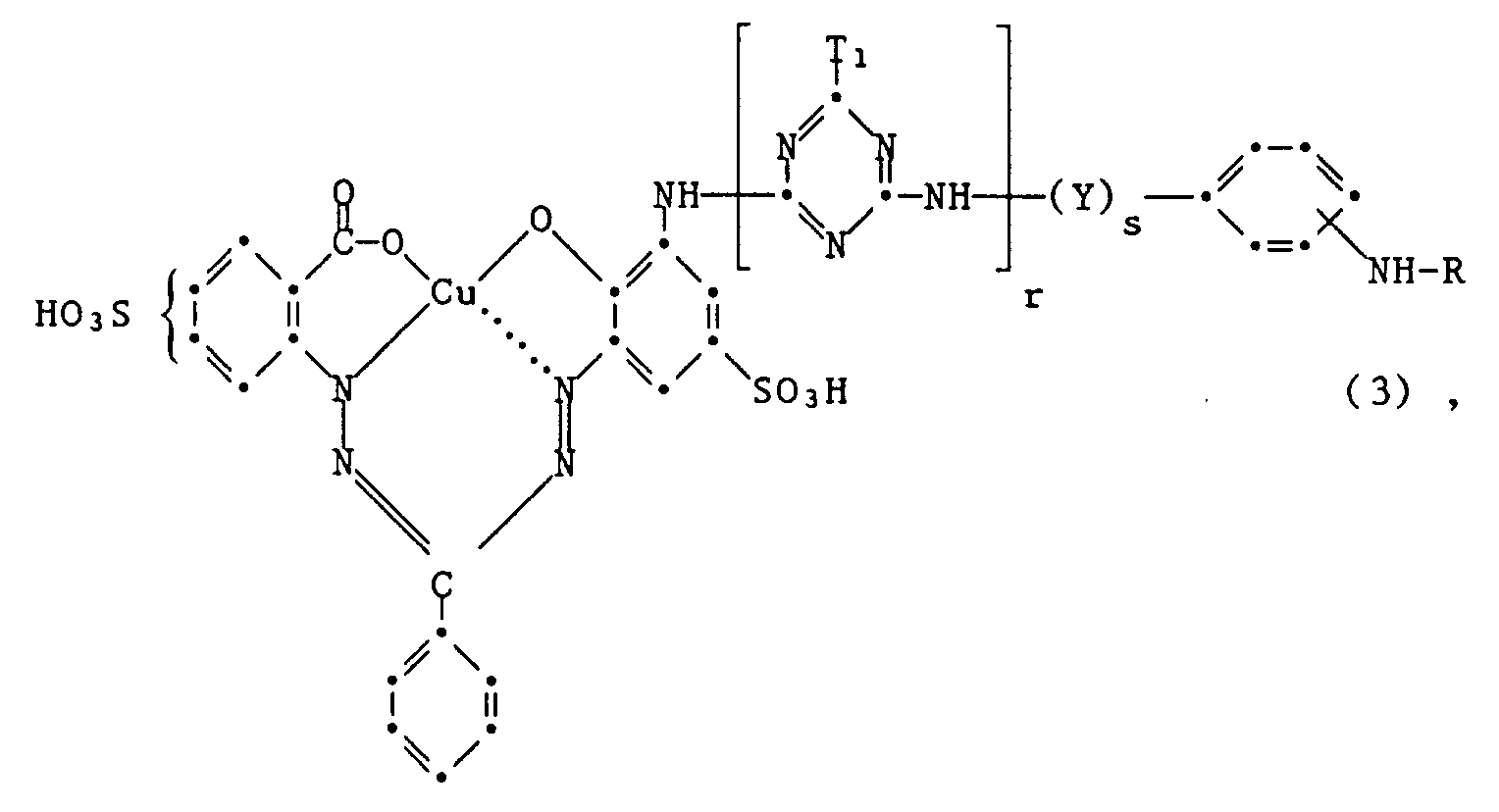
worin R, T₁, Y, r und s die unter Formel (2) angegebenen Bedeutungen haben. - Von den ganz besonders bevorzugten Farbstoffen der Formel (3) sind die Farbstoffe der Formeln

und
worin in den Formeln (4) und (5) R α,β-Dibrompropionyl, α-Bromacryloyl oder Chloracetyl ist, die Sulfogruppe in 4- oder 5-Position an den Benzring A gebunden ist, -NH-R in 3- oder 4-Position an den Benzring D gebunden ist, T₁ in Formel (4) Fluor oder insbesondere Chlor ist, und Y in Formel (5) -CO- oder -SO₂- ist, ganz besonders wichtig. - Gegenstand der Erfindung ist ferner ein Verfahren zur Herstellung der Farbstoffe der Formel (1), welches dadurch gekennzeichnet ist, dass man eine Verbindung der Formel

worin X, m, n und q die unter Formel (1) angegebenen Bedeutungen haben, mit einer den Rest der Formel
einführenden Verbindung, worin B, R, Y, T₁, Z, r und s die unter Formel (1) angegebenen Bedeutungen haben, umsetzt, oder ein Amin der Formel (6), worin X, m, n und q die unter Formel (1) angegebenen Bedeutungen haben, mit einer Verbindung der Formel
worin Z und T₁ die unter Formel (1) angegebenen Bedeutungen haben, und Hal je ein Halogenatom, insbesondere ein Fluor- oder Chloratom, bedeuten, kondensiert, und das Kondensationsprodukt anschliessend mit einer den Rest der Formel
-NH-B-NH-R (9)
einführenden Verbindung umsetzt, wobei B und R in Formel (9) die unter Formel (1) angegebenen Bedeutungen haben. - Als den Rest der Formel (7) einführende Verbindungen kommen vorzugsweise entsprechende Halogenide, insbesondere Chloride oder Fluoride, in Betracht. Als Beispiele seien genannt:
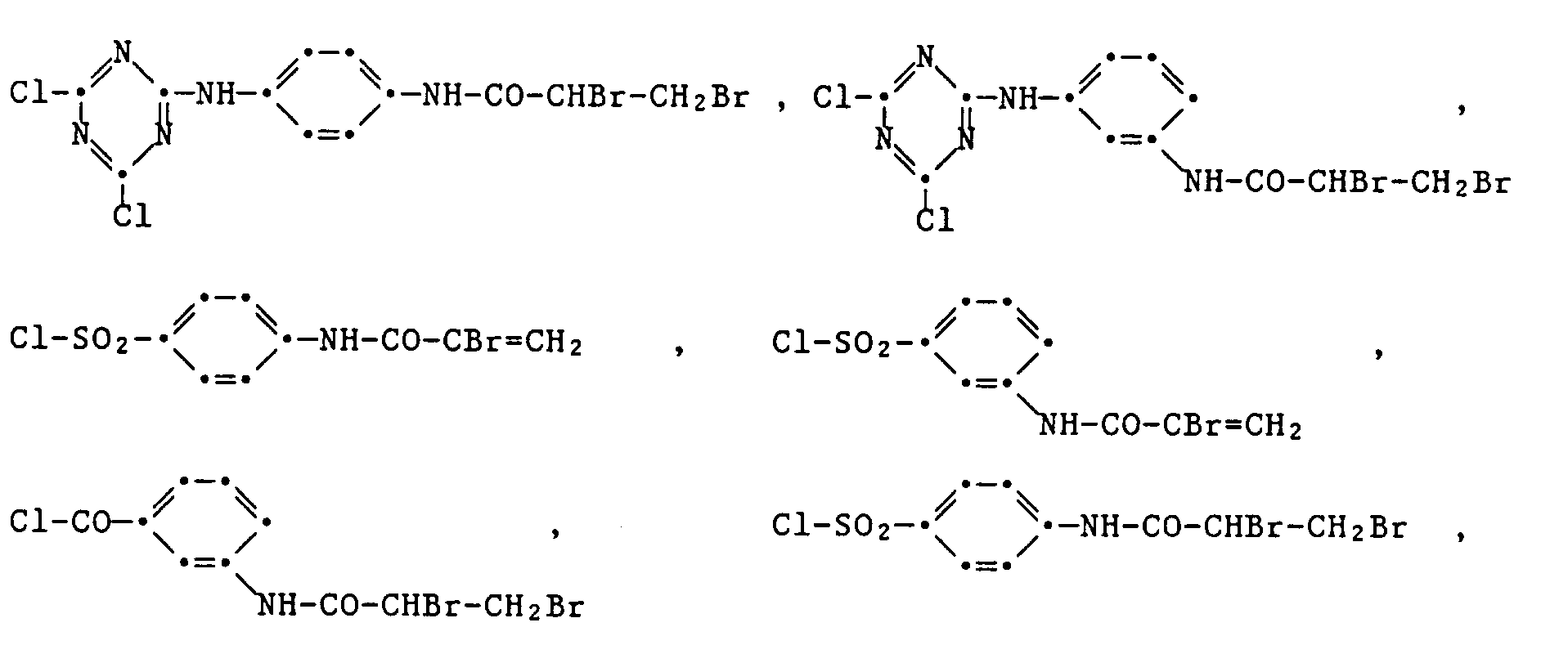
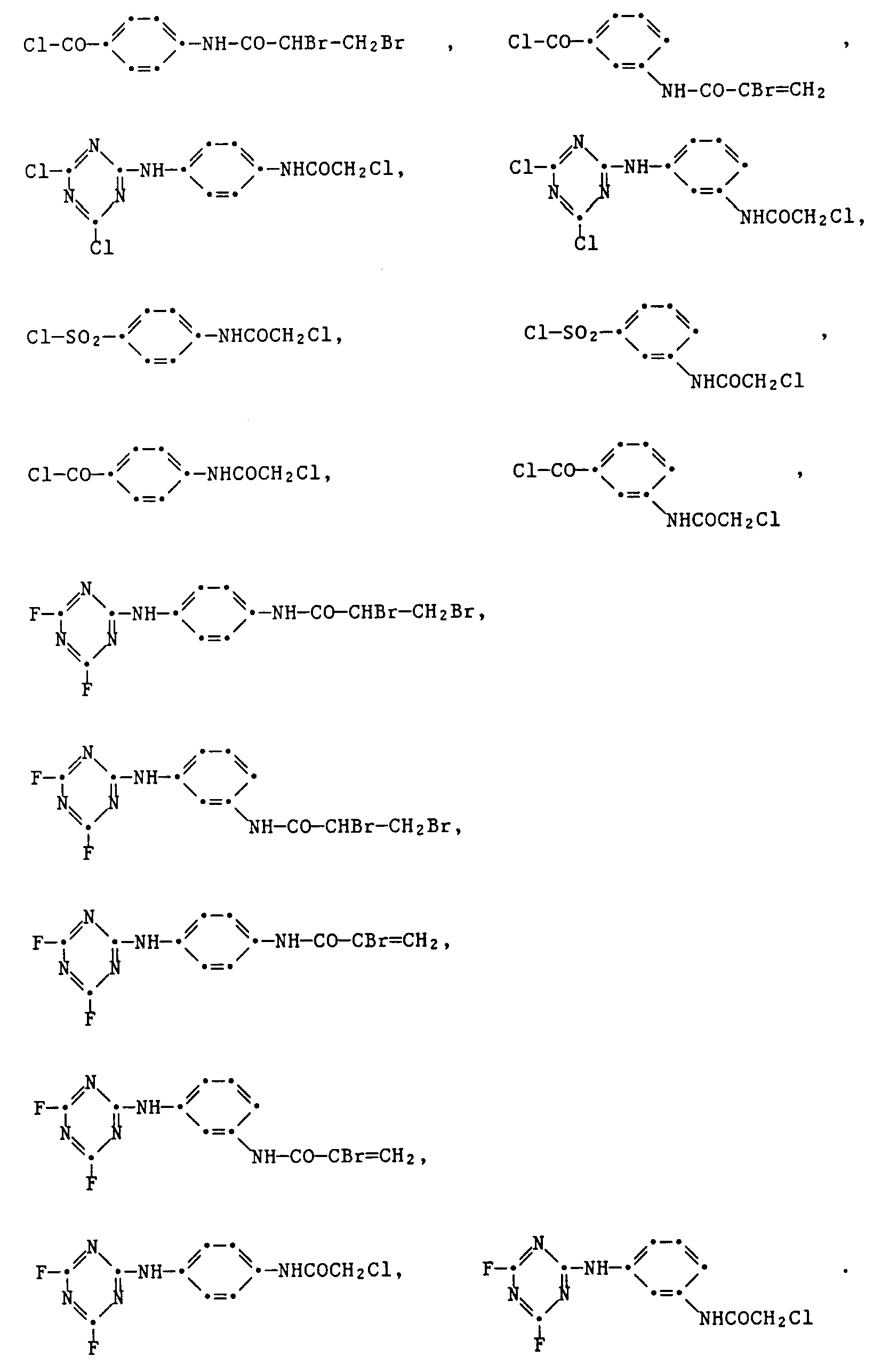
- Eine bevorzugte Ausführungsform des erfindungsgemässen Verfahrens ist dadurch gekennzeichnet, dass man eine Verbindung der Formel (6) zunächst mit einer Verbindung der Formel

worin Z und T₁ die unter Formel (1) angegebenen Bedeutungen haben, und Hal je ein Halogenatom insbesondere ein Fluor- oder Chloratom bedeuten, kondensiert, und das Kondensationsprodukt anschliessend mit einer den Rest der Formel
-NH-B-NH-R (9)
einführenden Verbindung umsetzt, wobei B und R in Formel (9) die unter Formel (1) angegebenen Bedeutungen haben. Als Beispiele für Verbindungen der Formel (8) seien genannt: Cyanurchlorid, Cyanurfluorid, 2,4,6-Trifluor-5-chlorpyrimidin. Als Beispiele für den Rest der Formel (9) einführende Verbindungen seien genannt: 3'-Amino-2,3-dibrompropionylanilid, 4'-Amino-2,3-dibrompropionylanilid, 3'-Amino-2-bromacrylanilid, 4'-Amino-2-bromacrylanilid, 3'-Aminochloracetanilid, 4'-Aminochloracetanilid. - Eine ebenfalls bevorzugte Ausführungsform des erfindungsgemässen Verfahrens ist dadurch gekennzeichnet, dass man eine Verbindung der Formel (6) mit einer den Rest der Formel
-Y-B-NH-R (10)
einführenden Verbindung umsetzt, wobei Y, B und R die unter Formel (1) angegebenen Bedeutungen haben. Beispiele für Verbindungen, die den Rest der Formel (10) einführen sind entsprechende Säurehalogenide, vorzugsweise Säurechloride wie z.B.

Die Verbindungen der Formel (10), die eine abspaltbare Gruppe, vorzugsweise ein Halogenatom enthalten, und die der Formel
Z―Y―B―NH―R (10a)
entsprechen, stellen einen weiteren Gegenstand der Erfindung dar. Z in Formel (10a) bedeutet eine abspaltbare Gruppe, insbesondere ein Halogenatom, vorzugsweise Chlor. Y, B und R haben die in Formel (1) angegebenen Bedeutungen. Bevorzugt haben B und R die oben angegebenen bevorzugten Bedeutungen. - Hergestellt werden die Verbindungen der Formel (10a), indem man z.B. eine Verbindung der Formel
HO-Y-B-NH₂ (10b),
worin Y und B die unter Formel (1) angegebenen Bedeutungen haben, mit einer den Rest R einführenden Verbindung kondensiert und anschliessend mit einer die Gruppe Z einführenden Verbindung umsetzt. - Insbesondere verwendet man eine Verbindung der Formel (10b), worin B -(CH₂)p- oder

p die Zahl 1, 2, 3, 4, 5 oder 6 und X₁ Wasserstoff oder ein Substituent, ausgenommen Sulfo, ist. - Als den Rest R einführende Verbindungen kommen z.B. 2,3-Dibrompropionylchlorid oder 2-Bromacryloylchlorid in Betracht.
- Als die Gruppe Z einführende Verbindung kommt z.B. Thionylchlorid in Betracht.
- Eine weitere ganz besonders bevorzugte Ausführungsform des erfindungsgemässen Verfahrens zur Herstellung der Farbstoffe der Formel (1) ist dadurch gekennzeichnet, dass man eine Verbindung der Formel (6) mit einer Verbindung der Formel
Z-Y-B-NHCOCH₃ (10c),
worin Z, Y und B die unter Formel (10a) angegebenen Bedeutungen haben, umsetzt, anschliessend das Reaktionsprodukt in Gegenwart einer Base, wie z.B. NaOH, verseift und dann mit einer den Rest R einführenden Verbindung kondensiert. - Als Verbindungen der Formel (10c) kommen z.B. in Betracht:

Als den Rest R einführende Verbindungen kommen z.B. 2,3-Dibrompropionylchlorid, 2-Bromacryloylchlorid oder α-Chloracetylchlorid in Betracht. - An die Herstellung der Farbstoffe der Formel (1) mit einer Dihalogenpropionyl-Gruppe kann eine Eliminierungsreaktion angeschlossen werden. Beispielsweise kann man den Farbstoff der Formel (1), welcher eine Dihalogenpropionyl-Gruppe enthält, unter alkalischen Bedingungen, wie z.B. Natriumhydroxid, behandeln, wobei unter Abspaltung von Halogenwasserstoff der Dihalogenpropionylrest in einen Halogenacryloylrest übergeht.
- Die Kondensation des Amins der Formel (6) mit der den Rest der Formel (7) einführenden Verbindung, bzw. die Kondensation des Amins der Formel (6) mit der Verbindung der Formel (8) und die anschliessende Umsetzung mit der den Rest der Formel (9) einführenden Verbindung, bzw. die Kondensation des Amins der Formel (6) mit der den Rest der Formel (10) einführenden Verbindung erfolgt vorzugsweise in wässriger Lösung, Emulsion oder Suspension, bei niederiger Temperatur, z.B. 0 bis 40°C, und bei schwach saurem, neutralem bis schwach alkalischem pH-Wert. Vorteilhaft wird der bei der Kondensation freiwerdende Halogenwasserstoff laufend durch Zugabe wässriger Alkalihydroxide, -carbonate oder -bicarbonate neutralisiert.
- Eine bevorzugte Ausführungsform des erfindungsgemässen Verfahrens ist dadurch gekennzeichnet, dass man ein Amin der Formel (6) verwendet, worin m die Zahl 2 ist.
- Eine weitere bevorzugte Ausführungsform des erfindungsgemässen Verfahrens ist dadurch gekennzeichnet, dass man ein Amin der Formel (6) verwendet, worin q die Zahl 1 bedeutet.
- Eine ebenfalls bevorzugte Ausführungsform des erfindungsgemässen Verfahrens ist dadurch gekennzeichnet, dass man ein Amin der Formel (6) verwendet, worin X Halogen, insbesondere Chlor ist; insbesondere verwendet man ein Amin der Formel (6), worin X Chlor ist, m die Zahl 2 und q die Zahl 1 bedeutet zusammen mit einer den Rest der Formel (7) einführenden Verbindung.
- Eine weitere bevorzugte Ausführungsform des erfindungsgemässen Verfahrens ist dadurch gekennzeichnet, dass man eine den Rest der Formel (7), (8) oder (9) einführende Verbindung verwendet, worin B -(CH₂)p- oder

ist, und p die Zahl 1, 2, 3, 4, 5 oder 6 ist und X₁ Wasserstoff oder ein Substituent, ausgenommen Sulfo, ist. - Insbesondere verwendet man ein Amin der Formel (6), worin m die Zahl 2, q die Zahl 1 und X Chlor bedeutet, zusammen mit einer dem Rest der Formel (7) einführenden Verbindung, worin B die als bevorzugt angegebene Bedeutung hat.
- Bevorzugt werden ausserdem Amine der Formel (6) verwendet, worin n die Zahl 0 oder 1 ist; insbesondere zusammen mit den vorstehend angegebenen bevorzugten Bedeutungen der Reste m, q und X.
- Bevorzugt sind ferner Verbindungen der Formel (7) bzw. der Formel (8), worin T₁ Fluor oder insbesondere Chlor ist und Z den Rest -C-F oder -C-Cl oder insbesondere ein Stickstoffatom bedeutet.
- Eine besonders bevorzugte Ausführungsform des erfindungsgemässen Verfahrens zur Herstellung der Farbstoffe der Formel (2) ist dadurch gekennzeichnet, dass man eine Verbindung der Formel

worin X und n die unter Formel (2) angegebenen Bedeutungen haben, entweder mit einer Verbindung der Formel (8) kondensiert und anschliessend das Kondensationsprodukt mit einer den Rest der Formel (9) einführenden Verbindung umsetzt, oder mit einer den Rest der Formel (10) einführenden Verbindung umsetzt, wobei B, R, T₁, X, Y und n die unter Formel (2) angegebenen Bedeutungen haben. - Eine ganz besonders bevorzugte Ausführungsform des erfindungsgemässen Verfahrens zur Herstellung der Farbstoffe der Formel (3) ist dadurch gekennzeichnet, dass man ein Amin der Formel

entweder mit Cyanurchlorid oder Cyanurfluorid kondensiert und anschliessend das Kondensationsprodukt mit einer den Rest der Formel (9) einführenden Verbindung umsetzt, oder mit einer den Rest der Formel (10) einführenden Verbindung umsetzt, wobei R und Y die unter Formel (3) angegebenen Bedeutungen haben. - Die besonders wichtigen Farbstoffe der Formel (4) werden hergestellt, indem man ein Amin der Formel

worin die Sulfogruppe in 4- oder 5-Position an den Benzring A gebunden ist, mit Cyanurchlorid oder Cyanurfluorid kondensiert und das Kondensationsprodukt anschliessend mit einer Verbindung der Formel
worin R die unter Formel (4) angegebene Bedeutung hat, umsetzt, wobei -NHR in 3- oder 4-Position an den Benzring D gebunden ist. - Die besonders wichtigen Farbstoffe der Formel (5) werden hergestellt, indem man ein Amin der Formel (13) mit einer Verbindung der Formel

worin Hal Halogen, insbesondere Chlor, ist und Y und R die unter Formel (5) angegebenen Bedeutungen haben, umsetzt, wobei -NH-R in 3- oder 4-Position an den Benzring D gebunden ist. - Die Verbindungen der Formel (6) sind an sich bekannt oder können in Analogie zu bekannten Verbindungen hergestellt werden. Zur Herstellung der Kupferkomplexe der vierzähnigen Formazane sei auf K. Venkataraman, The Chemistry of Synthetic Dyes, Volume VI, Seiten 287 bis 297, Academic Press New York und London (1972) und Ullmanns Encyklopädie der technischen Chemie, Band 11, Seiten 714 bis 718, Verlage Chemie (1976) verwiesen.
- Die den Rest der Formel (7), (9) oder (10) einführenden Verbindungen sowie die Verbindungen der Formel (8) sind ebenfalls an sich bekannt oder können in Analogie zu bekannten Verbindungen hergestellt werden.
- Die Farbstoffe der Formel (1) eignen sich zum Färben und Bedrucken der verschiedensten Fasermaterialien, insbesondere textiler Fasermaterialien, wie z.B. Seide, Fasermaterialien aus Cellulose und insbesondere Wolle, synthetische Polyamidfasermaterialien, wie z.B. Polyamid-6 und Polyamid-6,6 und Leder. Man erhält mit den Farbstoffen der Formel (1) egale Färbungen in blauen Tönen mit guten Allgemeinechtheiten, insbesondere guter Nassechtheit, wie z.B. Nassreibechtheit und guter Lichtechtheit. Ferner sind die Farbstoffe der Formel (1) sehr gut mit anderen Reaktivfarbstoffen kombinierbar. Das oben genannt Textilmaterial kann in den verschiedensten Verarbeitungsformen vorliegen, wie z.B. als Garn, Gewebe oder Gewirke.
- Hervorzuheben ist, dass die erfindungsgemässen Farbstoffe der Formel (1) eine hohe Reduktionsstabilität besitzen, ein gutes Aufziehverhalten und gute Fixiergeschwindigkeit sowie eine hohe Faseregalität und hohe Flächenegalität aufweisen und keinen Dichroismus zeigen.
- Aus der EP-A-0 179 019 sind ähnliche Farbstoffe bekannt, welche jedoch nicht alle vorteilhaften Eigenschaften der erfindungsgemässen Farbstoffe aufweisen.
- Die erfindungsgemässen Farbstoffe der Formel (1), welche mindestens eine Sulfonsäuregruppe enthalten, liegen entweder in der Form ihrer freien Säure oder vorzugsweise als deren Salze vor. Als Salze kommen beispielsweise Alkali-, Erdalkali- oder Ammoniumsalze oder die Salze eines organischen Amins in Betracht. Als Beispiel seien die Natrium-, Lithium-, Kalium- oder Ammoniumsalze oder das Salz des Triäthanolamins genannt.
- Hervorzuheben ist ferner für die erfindungsgemässen Farbstoffe der Formel (1) deren Eignung zum Trichromie-Färben und -Bedrucken von natürlichen oder synthetischen Polyamidfasermaterialien zusammen mit einem faserreaktiven gelb- oder orangefärbenden Farbstoff und einem faserreaktiven rotfärbenden Farbstoff.
- Unter Trichromie ist die additive Farbmischung passend gewählter gelb- bzw. orange-, rot- und blaufärbender Farbstoffe zu verstehen, mit denen jede gewünschte Nuance des sichtbaren Farbspektrums durch geeignete Wahl der Mengenverhältnisse eingestellt werden kann.
- Die in dem Trichromie-Verfahren zu verwendenden Farbstoffe sollen einen gleichmässigen Farbaufbau bei gleichzeitiger Nuancenkonstanz in verschiedenen Konzentrationen und eine gute Kombinierbarkeit zeigen.
- Gegenstand der Erfindung ist somit ein Verfahren zum Trichromie-Färben oder -Bedrucken von natürlichen und synthetischen Polyamidfasermaterialien mit Farbstoffmischungen faserreaktiver Farbstoffe, welches dadurch gekennzeichnet ist, dass man einen blaufärbenden Farbstoff der Formel (1) zusammen mit einem gelb- oder orangefärbenden sulfogruppenhaltigen Reaktivfarbstoff und einem rotfärbenden sulfogruppenhaltigen Reaktivfarbstoff verwendet.
- Insbesondere werden faserreaktive, sulfogruppenhaltige gelb- oder orange- und rotfärbende Azofarbstoffe verwendet, die als faserreaktive Gruppe vorzugsweise eine Halogentriazin- oder Halogenpyrimidingruppe oder eine Gruppe der aliphatischen Reihe enthalten.
- Als Halogenpyrimidingruppe oder Gruppe der aliphatischen Reihe werden vorzugsweise als faserreaktive Gruppe Difluorchlorpyrimidinyl, insbesondere 2,4-Difluor-5-chlorpyrimidinyl, oder α,β-Dihalogenpropionyl, insbesondere α,β-Dibrompropionyl, oder α-Halogenacryloyl, insbesondere α-Bromacryloyl, verwendet.
- Als gelb- oder orangefärbende, sulfogruppenhaltige, faserreaktive Farbstoffe kommen z.B. die folgenden in Betracht:


Als rotfärbende, sulfogruppenhaltige, faserreaktive Farbstoffe kommen z.B. die folgenden in Betracht: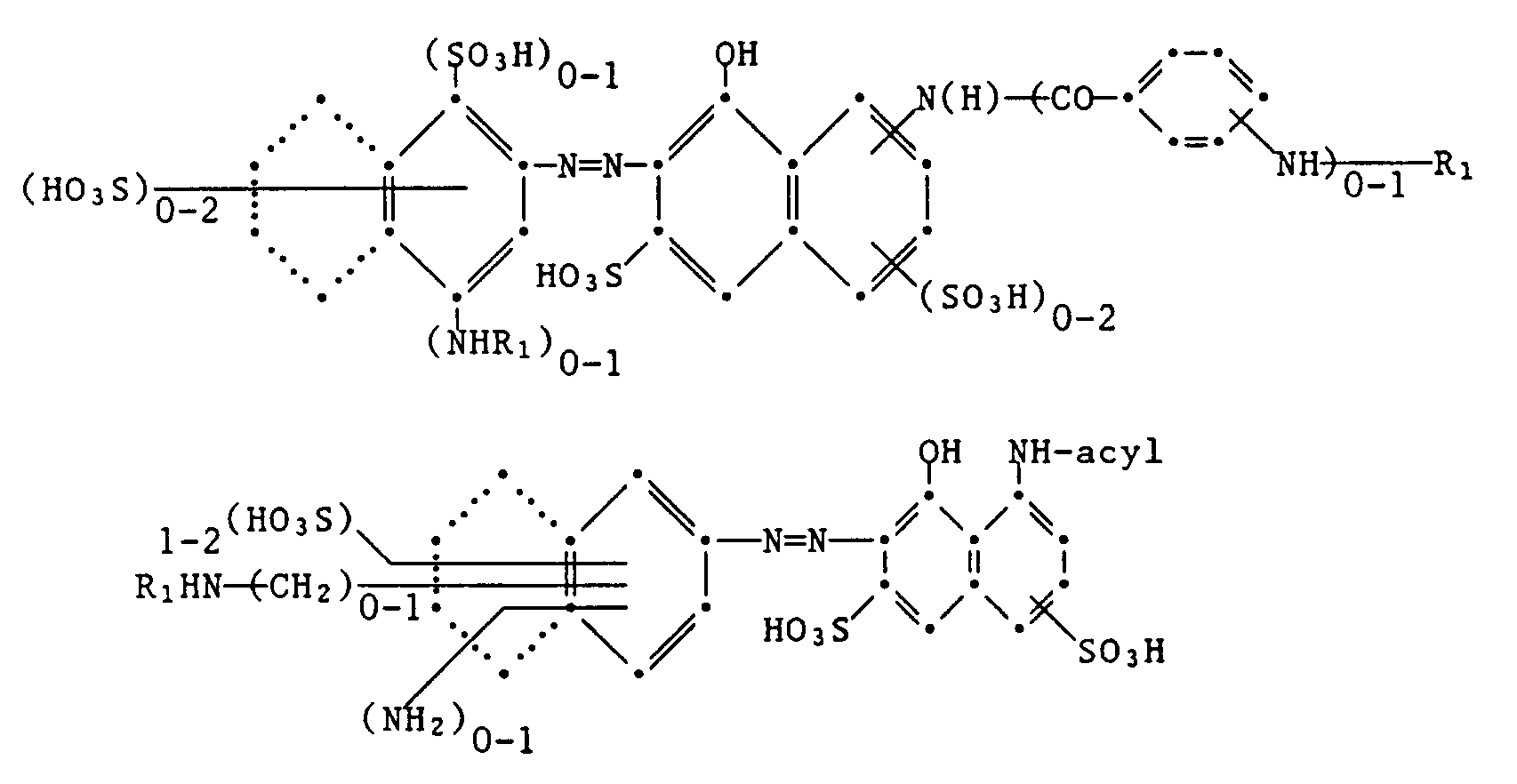
worin Acyl z.B. Acetyl oder gegebenenfalls substituiertes Benzoyl ist. - Die durch Punkte angedeuteten kondensierten Ringe stehen für alternativ mögliche Naphthalinsysteme.

In den vorstehenden Formeln bedeutet R₁ einen faserreaktiven Rest, insbesondere einen faserreaktiven Rest der Halogentriazin- oder der Halogen-Pyrimidinreihe oder der aliphatischen Reihe, vorzugsweise bedeutet R₁ Difluorchlorpyrimidinyl oder α,β-Dihalogenpropionyl oder α-Bromacryloyl. Besonders bevorzugt ist R₁ 2,4-Difluor-5-chlorpyrimidin-6-yl- oder α,β-Dibrompropionyl oder α-Bromacyloyl. - In dem erfindungsgemässen Verfahren zum Trichromie-Färben oder -Bedrucken von natürlichen und synthetischen Polyamidfasermaterialien werden als blaufärbende Farbstoffe die obengenannten, insbesondere diejenigen der Formeln (2) und (3) und ganz besonders bevorzugt die Farbstoffe der Formeln (4) und (5) verwendet.
- Als besonders bevorzugte gelb- oder orangefärbende Farbstoffe kommen in Betracht:

oder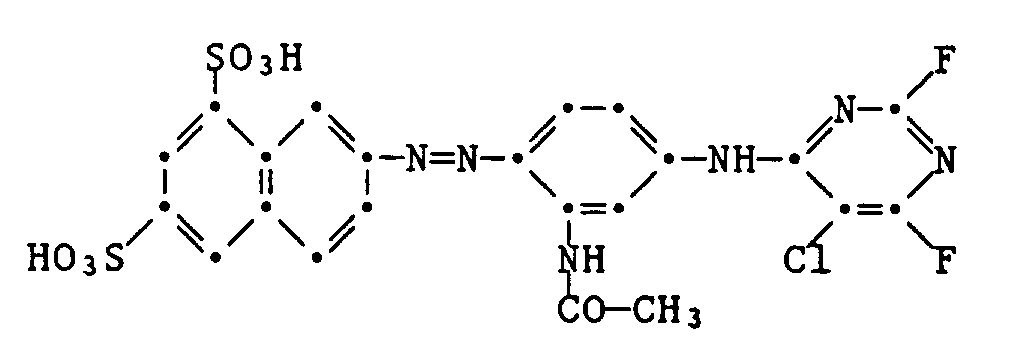
Als besonders bevorzugte rotfärbende Farbstoffe kommen in Betracht: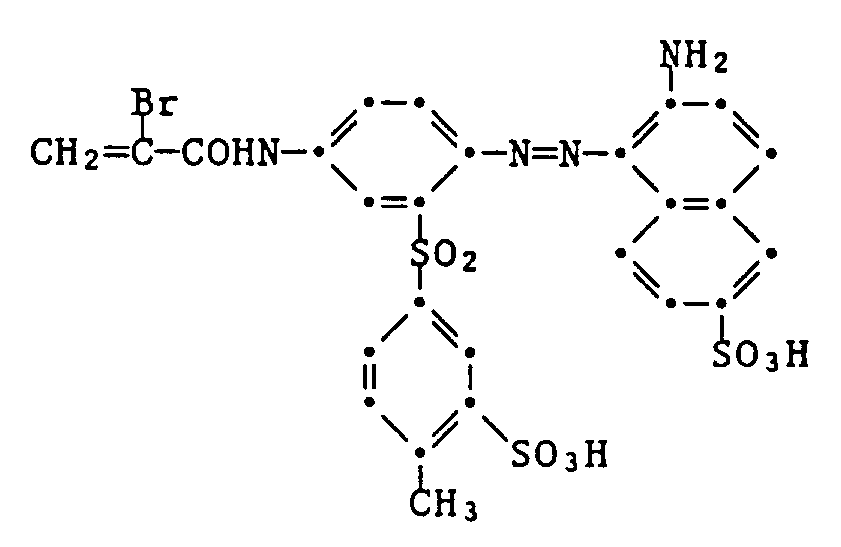
oder
Die in dem erfindungsgemässen Verfahren zum Trichromie-Färben oder -Bedrucken verwendeten gelb- bzw. orange- und rotfärbenden Farbstoffe sind bekannt oder können in Analogie zu bekannten Farbstoffen hergestellt werden. Die Farbstoffe liegen entweder in der Form ihrer freien Sulfonsäure oder vorzugsweise als deren Salz vor, wobei die gleichen Salze wie für die Farbstoffe der Formel (1) angegeben verwendet werden können. - Die Mengen, in denen die Farbstoffe der Formel (1) und die gelb- bzw. orange- und rot-färbenden faserreaktiven Farbstoffe in den Färbebädern oder Druckpasten verwendet werden, können je nach der gewünschten Farbtiefe in weiten Grenzen schwanken, im allgemeinen haben sich Mengen von 0,01 bis 10 Gewichtsprozent, insbesondere 2 bis 10 Gewichtsprozent, bezogen auf das Färbegut, bzw. die Druckpaste, als vorteilhaft erwiesen.
- Vorzugsweise wird in dem erfindungsgemässen Verfahren Fasermaterial aus natürlichen Polyamiden, insbesondere Wolle, verwendet.
- Besondere Vorrichtungen sind beim erfindungsgemässen Verfahren nicht erforderlich. Es können die üblichen Färbe- und Druckapparate und -maschinen, beispielsweise für Flocke, Kammzug, Stranggarn, Wickelkörper, Stückware und Teppiche verwendet werden.
- Die wässrigen Färbebäder können neben dem Reaktivfarbstoff noch Hilfsmittel, insbesondere Egalisierhilfsmittel, enthalten. Die Egalisierhilfsmittel werden in einer Menge von 0,3 bis 3 Gewichtsprozent, bezogen auf das Fasermaterial, verwendet.
- Als weitere Hilfsmittel können die Färbebäder Mineralsäuren, wie Schwefelsäure, Sulfaminsäure oder Phosphorsäure, organische Säuren, zweckmässig niedere, aliphatische Carbonsäuren, wie Ameisensäure, Essigsäure oder Maleinsäure, enthalten. Die Säuren dienen vor allem der Einstellung des pH-Wertes der erfindungsgemäss verwendeten Flotten.
- Vorzugsweise erfolgt die Einstellung des pH-Wertes von 3 bis 6 mit einer organischen Säure, insbesondere Ameisensäure oder Essigsäure.
- Vorzugsweise färbt man bei einem pH-Wert von 4 bis 6, insbesondere 4,2 bis 5,5.
- Ferner kann die Färbeflotte verschiedene Salze, insbesondere Ammoniumsalze oder Alkalisalze, wie z.B. Ammoniumsulfat oder Natriumsulfat als Hilfsmittel enthalten.
- Das Flottenverhältnis kann innerhalb eines weiten Bereichs gewählt werden, von 1:6 bis 1:80, vorzugsweise 1:10 bis 1:50.
- Das Färben erfolgt aus wässriger Flotte nach dem Ausziehverfahren z.B. bei einer Temperatur zwischen 80 und 105°C bzw. 110°C bei Verwendung eines Formaldehyd-abspaltenden Wollschutzmittels, vorzugsweise zwischen 98° und 103°C.
- Die Färbedauer beträgt in der Regel 30 bis 90 Minuten.
- Eine besonders bevorzugte Ausführungsform des erfindungsgemässen Verfahrens ist dadurch gekennzeichnet, dass man nach dem Färben bei vorzugsweise 98 bis 103°C die Färbeflotte abkühlen lässt auf ca. 75° bis 90°C und den pH-Wert auf 8 bis 9, vorzugsweise auf ca. 8,5, einstellt. Die Einstellung des pH-Wertes kann mit üblichen Mitteln erfolgen, z.B. Alkalihydroxidlösungen sowie insbesondere mit wässriger Ammoniaklösung üblicher Konzentration, z.B. 25 Gewichtsprozent Ammoniak enthaltend.
- In den folgenden Beispielen stehen Teile für Gewichtsteile. Die Temperaturen sind Celsiusgrade. Die Beziehung zwischen Gewichtsteilen und Volumenteilen ist dieselbe wie zwischen diejenige zwischen Gramm und Kubikzentimeter.
- Beispiel 1: 13,24 Teile des Farbstoffs der Formel (101)

werden in 200 Teilen Wasser aufgenommen, mit 0,6 Teilen Dinatriumhydrogenphosphat versetzt und auf 40° erwärmt, wobei nach Zugabe von Natronlauge bis zum pH-Wert 6,5 eine klare Lösung entsteht. Nach Kühlung auf 0-2° wird eine Lösung von 3,9 Teilen Cyanurchlorid in 25 Teilen Aceton innerhalb von 2-3 Minuten zugetropft, wobei der pH mit Natronlauge bei einem Wert von 6,25 gehalten wird. - Nach beendeter Umsetzung wird eine Lösung von 7,72 Teilen 4'-Amino-2,3-dibrompropionylanilid in Wasser/Aceton 1:2 innert 5 Minuten bei 0-5° zugetropft. Der pH-Wert wird dabei mit Natronlauge bei 6,25 konstant gehalten. Nach Ausrühren über Nacht wird der Farbstoff abgenuscht, mit Natriumchloridlösung gewaschen und bei 60-70° getrocknet. Man erhält 25,1 Teile eines Farbstoffs der Formel (102), der Wolle in echten blauen Tönen färbt.

Beispiel 2: 3 Teile des Farbstoffs der Formel (102) aus Beispiel 1 werden in 50 Teilen Wasser gelöst. Die Lösung wird mit Natronlauge auf den pH-Wert 12 gestellt und 2 Stunden bei 40° gehalten. Nach Abkühlen wird der pH-Wert auf 7 gesenkt und nach Zusatz von Kochsalz der Farbstoff abgenutscht, mit Kochsalzlösung gewaschen und bei 60 - 70° getrocknet. Man erhält 3,1 g Farbstoff der Formel (103), der Wolle in echten blauen Tönen färbt.
Beispiel 3: Wenn man wie in Beispiel 1 angegeben verfährt, jedoch anstelle des Farbstoffs der Formel (101) eine äquimolare Menge des Farbstoffes der Formel
verwendet, so erhält man einen Farbstoff der Formel (105), der Wolle in echten blauen Tönen färbt.
Beispiel 4: Wenn man wie in Beispiel 2 angegeben verfährt, jedoch anstelle des Farbstoffs der Formel (102) den Farbstoff der Formel (105) aus Beispiel 3 verwendet, so erhält man den Farbstoff der Formel (106), der Wolle in echten blauen Tönen färbt.
Beispiel 5 bis 8: Wenn man wie in den Beispielen 1 bis 4 angegeben verfährt, jedoch anstelle von 4'-Amino-2,3-dibrompropionylanilid eine äquimolare Menge 3'-Amino-2,3-dibrompropionylanilid verwendet, so erhält man die in Tabelle 1 in Spalte 2 angegebenen Farbstoffe, die Wolle in den in Spalte 3 angegebenen Tönen färben.

- Beispiel 9: 6,62 Teile des Farbstoffs der Formel (104) aus Beispiel 3 werden in 50 Teilen Wasser unter Zusatz von Salzsäure bei einem pH-Wert von 7 gelöst. Nach Zugabe von 0,84 Teilen Natriumhydrogencarbonat wird bei Raumtemperatur eine Lösung von 6,1 Teilen 4-(2',3'-Dibrompropionamido)-benzolsulfonylchlorid (hergestellt durch Umsatz von Sulfanilsäure mit 2,3-Dibrompropionylchlorid und anschliessender Ueberführung in das entsprechende Sulfonylchlorid mit Thionylchlorid unter Zusatz von Dimethylformamid) in 25 Teilen Aceton während 10 - 15 Minuten zugetropft, wobei der pH-Wert mit Natronlauge bei 7 gehalten wird. Nach einer Stunde bei 30° und Ausrühren bei Raumtemperatur wird der Farbstoff durch Zugabe von Kochsalz ausgefällt, abgesaugt, mit Kochsalzlösung gewaschen und bei 60 - 70° getrocknet. Man erhält 11 Teile eines Farbstoffs der Formel (111), der Wolle in echten blauen Tönen färbt.

Beispiel 10: Verfährt man wie in Beispiel 9 angegeben, verwendet aber eine Lösung von 6,62 Teilen des Farbstoffs der Formel (101) aus Beispiel 1 in 100 Teilen Wasser und 0,3 Teilen Dinatriumhydrogenphosphat erhält man 11 Teile eines Farbstoffs der Formel (112), der Wolle in echten blauen Tönen färbt.
Beispiele 11 und 12: 5,5 Teile des Farbstoffs der Formel (111) oder (112) werden in 100 Teilen Wasser unter Zusatz von Natronlauge bei einem pH-Wert von 12 bis 12,5 während einer Stunde bei 0 bis 5° gerührt. Anschliessend wird mit Salzsäure auf einen pH-Wert von 7 gestellt und mit Kochsalz versetzt. Der Farbstoff wird abgesaugt, mit Kochsalz-Lösung gewaschen und bei 60 - 70° getrocknet. Man erhält 5,3 Teile des Farbstoffs der Formel (113) bzw. 5,6 Teile des Farbstoffs der Formel (114), die Wolle in echten blauen Tönen färben.
Beispiele 13 bis 16: Wenn man wie in den Beispielen 9 bis 12 angegeben verfährt jedoch anstelle von 6,1 Teilen 4-(2',3'-Dibrompropionamido)-benzolsulfonylchlorid eine äquimolare Menge 3-(2',3'-Dibrompropionamido)-benzolsulfonylchlorid verwendet, so erhält man die in Tabelle 2 in Spalte 2 angegebenen Farbstoffe, die Wolle in den in Spalte 3 angegebenen Tönen färben.

- Beispiel 17: 1,7 Teile des Farbstoffs der Formel (104) in Beispiel 3 werden unter Zusatz von Salzsäure in 50 Teilen Wasser bei einem pH-Wert von 7 gelöst und mit wenig Dinatriumhydrogenphosphat versetzt. Zu dieser Lösung wird 1 Teil 3-(2',3'-Dibrompropionamido)-benzoylchlorid (hergestellt durch Umsatz von 3-Aminobenzoesäure mit 2,3-Dibrompropionylchlorid und anschliessender Ueberführung in das entsprechende Benzoylchlorid mit Thionylchlorid unter Zusatz von Dimethylformamid) gelöst in Aceton während 5 Minuten zugetropft. Nach Ausrühren über Nacht unter Konstanthaltung des pH-Werts bei 7 mit Natronlauge wird nach Zugabe von Kochsalz filtriert, mit Kochsalzlösung gewaschen und bei 60-70° getrocknet. Man erhält 2,5 Teile eines Farbstoffs der Formel (119), der Wolle in echten blauen Tönen färbt.
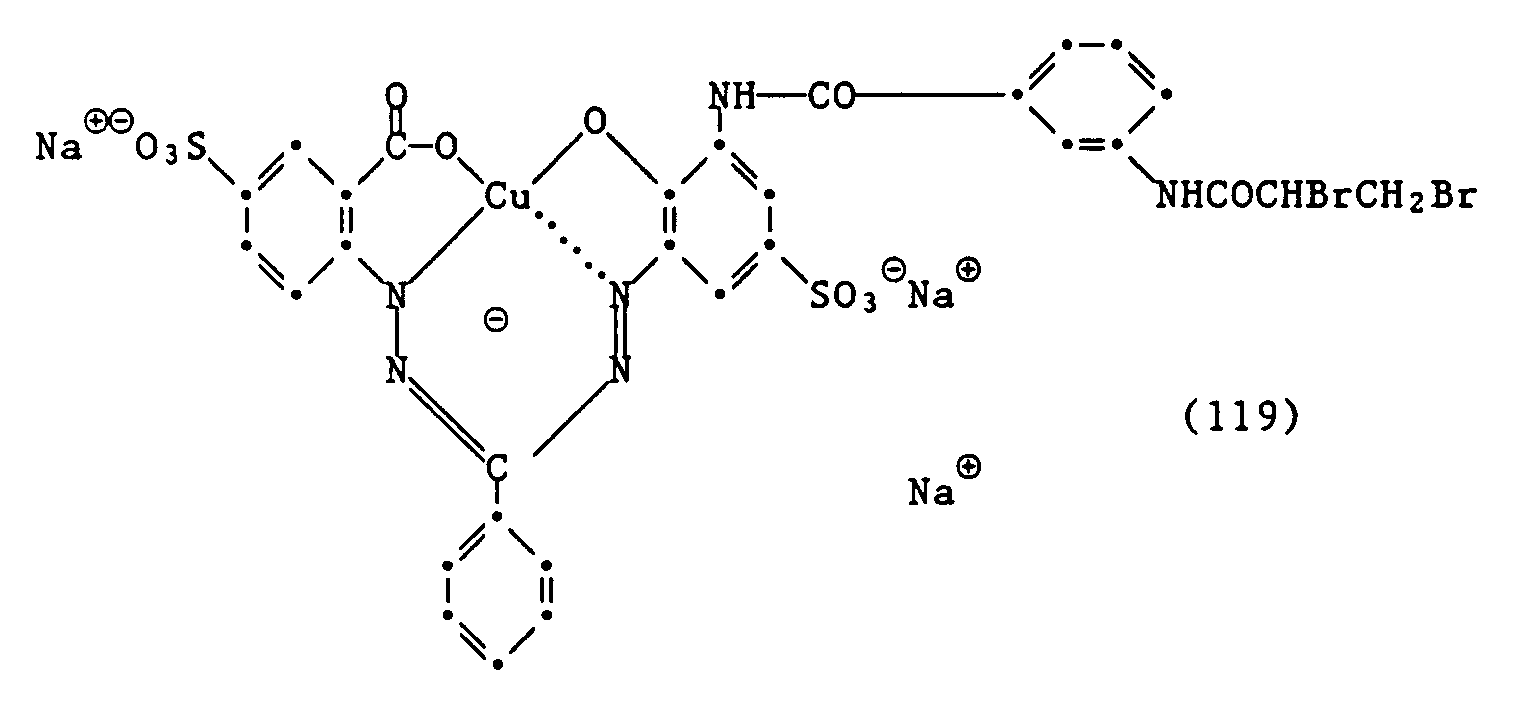
Beispiel 18: Verfährt man wie in Beispiel 17, verwendet aber einen Farbstoff der Formel (101) aus Beispiel 1, erhält man 2,8 Teile eines Farbstoffs der Formel (120), der Wolle in echten blauen Tönen färbt.
Beispiel 19 und 20: Verfährt man wie in den Beispielen 11 und 12 angegeben, verwendet aber anstelle der Farbstoffe der Formeln (111) bzw. (112) die Farbstoffe der Formeln (119) bzw. (120), so erhält man Farbstoffe der Formeln (121) bzw. (122), die Wolle in echten blauen Tönen färben.
Beispiele 21 bis 24: Wenn man wie in den Beispielen 17 bis 20 angegeben verfährt, jedoch anstelle von 3-(2',3'-Dibrompropionamido)benzoylchlorid eine äquimolare Menge 4-(2',3'-Dibrompropionamido)-benzoylchlorid verwendet, so erhält man die in Tabelle 3 in Spalte 2 angegebenen Farbstoffe, die Wolle in den in Spalte 3 angegebenen Tönen färben.

- 6,62 Teile des Farbstoffs der Formel (101) werden wie in Beispiel 1 angegeben gelöst und mit Cyanurchlorid umgesetzt. Anschliessend wird eine Lösung von 2,9 Teilen 3'-Amino-2-bromacrylanilid in 40 Teilen Aceton bei 0-5° und einem pH-Wert von 6,5 innert 10 Minuten zugetropft. Nach Ausrühren über Nacht wird Kochsalz zugesetzt, filtriert und mit Kochsalzlösung gewaschen. Nach Trocknung bei 60-70° werden 12,6 Teile des Farbstoffs der Formel (108) erhalten.
- Verfährt man wie in Beispiel 25 angegeben, verwendet aber anstelle des Farbstoffs der Formel (101) den Farbstoff der Formel (104), erhält man den Farbstoff der Formel (110).
- Verfährt man wie in den Beispielen 25 und 26 angegeben, verwendet aber anstelle von 3'-Amino-2-bromacrylanilid eine äquimolare Menge 4'-Amino-2-bromacrylanilid werden Farbstoffe der Formeln (103) bzw. (106) erhalten.
- Verfährt man wie in den Beispielen 1 bis 8 angegeben, verwendet aber anstelle von Cyanurchlorid eine äquimolare Menge Cyanurfluorid, so erhält man die in Tabelle 4 in Spalte 2 angegebenen Farbstoffe, die Wolle in den in Spalte 3 angegebenen Tönen färben.


- Zu einer Suspension von 3,22 Teilen 4'-Amino-2,3-dibrompropionylanilid in 25 Teilen Wasser wird eine Lösung von 2,02 Teilen Cyanurchlorid in 30 Teilen Aceton bei 0-2° und einem pH-Wert von 6-6,5 getropft. Nach beendeter Reaktion wird eine Lösung von 6 Teilen des Farbstoffs der Formel (104) in 50 Teilen Wasser (mit Salzsäure auf einen pH-Wert von 7 gestellt) innert 15 Minuten bei 5° zugegeben, wobei der pH-Wert mit Natronlauge konstant bei 6,25 gehalten wird. Nach Ausrühren über Nacht bei Raumtemperatur wird Kochsalz zugesetzt. Der Farbstoff wird abgesaugt, mit Kochsalzlösung gewaschen und bei 60-70° getrocknet. Man erhält 10,8 Teile Farbstoff der Formel (105).
- Verfährt man wie in Beispiel 37 angegeben, verwendet aber anstatt 4'-Amino-2,3-dibrompropionylanilid eine äquimolare Menge 3'-Amino-2,3-dibrompropionylanilid oder 4'-Amino-2-brom-acrylanilid bzw. 3'-Amino-2-bromacrylanilid zusammen mit einem Farbstoff der Formel (104) oder eine äquimolare Menge des Farbstoffs der Formel (101), erhält man die entsprechenden Farbstoffe der Formeln (102), (103), (106), (107), (108) (109) und (110).
- Verfährt man wie in den Beispielen 1, 3, 5, 7, 29, 31, 33 und 35 angegeben, verwendet aber anstelle von 3'- oder 4'-Amino-2,3-dibrompropionylanilid eine äquimolare Menge 3'- oder 4'-Aminochloracetanilid, so erhält man die in Tabelle 5 in Spalte 2 angegebenen Farbstoffe, die Wolle in den in Spalte 3 angegebenen Tönen färben.
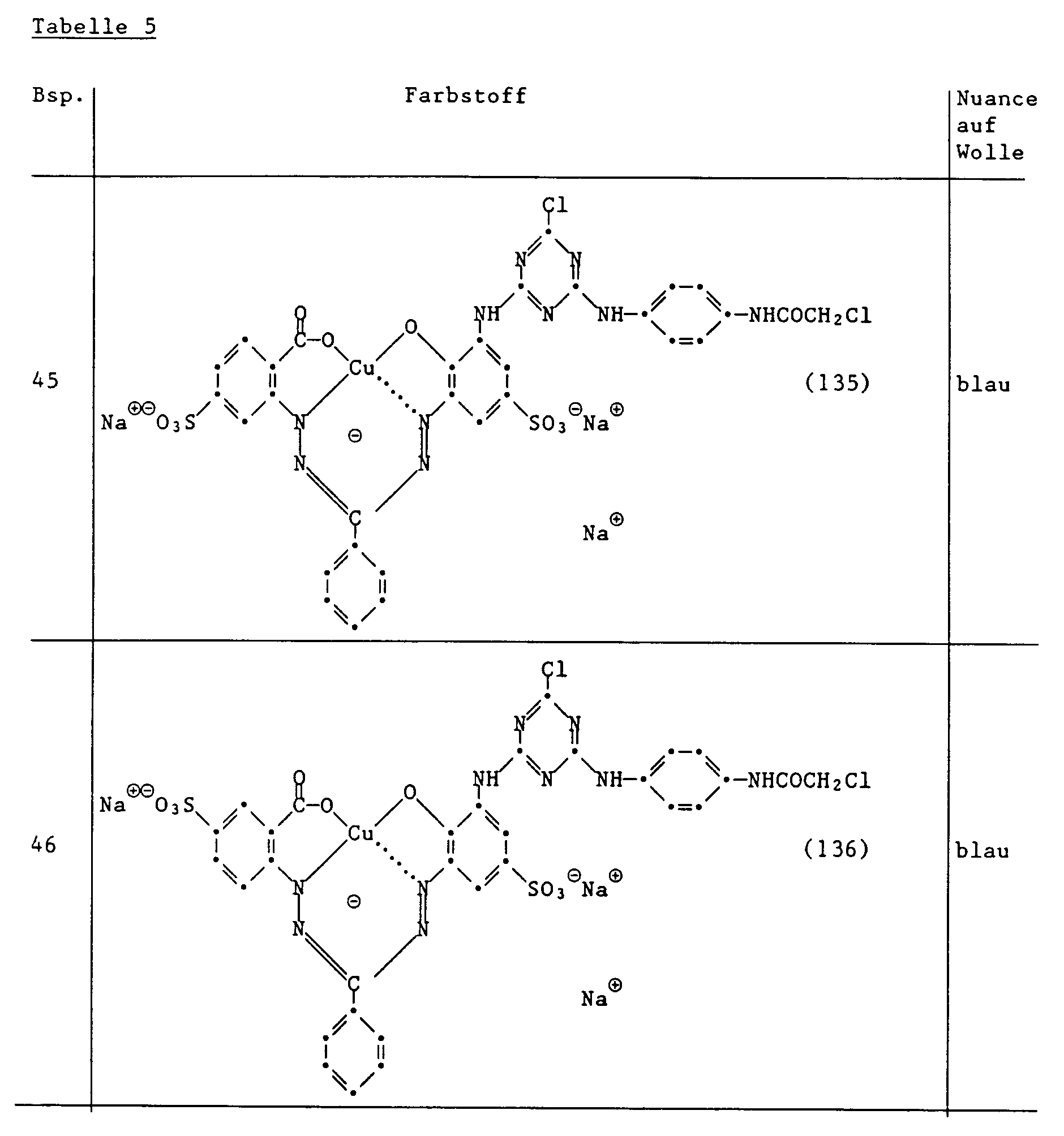


- Beispiele 53 bis 56: Verfährt man wie in den Beispielen 9, 10, 13 und 14 angegeben, verwendet aber anstatt 3- oder 4-(2',3'-Dibrompropionamido)-benzolsulfonylchlorid eine äquimolare Menge 3- oder 4-Chloracetamidobenzolsulfonylchlorid, so erhält man die in der folgenden Tabelle 6 in Spalte 2 angegebenen Farbstoffe, die Wolle in den in Spalte 3 angegebenen Tönen färben.


- Beispiele 57 bis 60: Verfährt man wie in den Beispielen 17, 18, 21 und 22 angegeben, verwendet aber anstatt 3- oder 4-(2',3'-Dibrompropionamido)-benzoylchlorid eine äquimolare Menge 3- oder 4-Chloracetamidobenzoylchlorid, so erhält man die in der folgenden Tabelle 7 in Spalte 2 angegebenen Farbstoffe, die Wolle in den in Spalte 3 angegebenen Tönen färben.


- 6,62 Teile des Farbstoffs der Formel (104) werden in 50 Teilen Wasser unter Zusatz von Salzsäure bei einem pH-Wert von 7 gelöst. Anschliessend wird bei Raumtemperatur eine Suspension von 2,9 Teilen 4-Acetamidobenzolsulfonylchlorid in 40 Teilen Aceton innert 10 Minuten zugetropft. Der pH-Wert wird dabei konstant bei 7 gehalten. Nach Ausrühren über Nacht wird klärfiltriert, mit Natronlauge auf einen pH-Wert von 13,5 gestellt und eine Stunde am Rückfluss gehalten. Anschliessend wird bei Raumtemperatur klärfiltriert, mit Salzsäure auf einen pH-Wert von 7-8 gestellt und mit Kochsalz versetzt. Der Farbstoff wird abgesaugt und mit Kochsalzlösung gewaschen. Die feuchte Farbstoffpaste wird in 200 Teilen Wasser gelöst und mit 0,84 Teilen Natriumhydrogencarbonat versetzt. Anschliessend werden 2,76 Teile 2,3-Dibrompropionylchlorid bei einem pH-Wert von 7 rasch zugetropft. Nach Ausrühren über Nacht beim pH-Wert von 7 wird Kochsalz zugesetzt, filtriert, mit Kochsalzlösung gewaschen und bei 60-70° getrocknet. Man erhält 8,7 Teile Farbstoff der Formel (111).
- Verfährt man wie in Beispiel 61 angegeben, verwendet aber anstelle von 4-Acetamido-benzolsulfonylchlorid eine äquimolare Menge 3-Acetamido-benzolsulfonylchlorid oder 4-Acetamidobenzoylchlorid bzw. 3-Acetamido-benzoylchlorid zusammen mit dem Farbstoff der Formel (104) oder verwendet man eine äquimolare Menge des Farbstoffs der Formel (101), erhält man Farbstoffe der Formeln (112), (115), (116), (119), (120), (123) und (124).
- Verfährt man wie in den Beispielen 61 bis 68 angegeben, verwendet aber anstatt 2,3-Dibrompropionylchlorid eine äquimolare Menge Chloracetylchlorid, so erhält man die Farbstoffe der Formeln (143), (144), (145), (146), (147), (148), (149) und (150).
- Verfährt man wie in den Beispielen 1, 2, 5, 6, 10, 12, 16, 18, 22, 24, 30, 33, 34, 55 oder 60 angegeben, verwendet aber anstelle eines Amins der Formel (101) eine äquimolare Menge eines der in Tabelle 8 in Spalte 2 angegebenen Amine, so erhält man die in Spalte 3 angegebenen Farbstoffe, die Wolle in den in Spalte 4 aufgeführten Nuancen färben.


- In 4000 Teilen Wasser von 50° werden nacheinander 4 Teile 80%ige Essigsäure, 2 Teile des Ammoniumsalzes des sauren Schwefelsäureesters des Adduktes aus einem Fettamin (bestehend aus 30 % Hexadecylamin, 25 % Octadecylamin und 45 % Octadecenylamin und 7 Mol-Aequivalente Aethylenoxid) sowie 4 Teile Ammoniumsulfat gelöst.
- 5 Teile des gemäss Beispiel 2 erhaltenen Farbstoffes der Formel (103) werden in 100 Teilen Wasser heiss gelöst und dem obigen Färbebad zugegeben. Dann wird mit 100 Teilen vorgenetzten Wollstrickgarns eingegangen und im Verlaufe von 30 Minuten die Temperatur des Bades von 50 auf 80° erhöht. Nach 20 Minuten Färben bei 80° wird zum Sieden erhitzt und anschliessend 90 Minuten kochend gefärbt. Der Farbstoff zieht fast vollkommen auf das Substrat auf. Nach Abkühlen des Bades auf 80° wird der pH-Wert von etwa 4,5 durch Zugabe von Ammoniaklösung auf bleibend 8,5 erhöht und das Färbegut 20 Minuten bei dieser Temperatur nachbehandelt. Nach gründlichem Spülen mit heissem und kaltem Wasser, Ansäuern mit 1 Teil 80%iger Ameisensäure, Zentrifugieren und Trocknen erhält man ein dunkelblau gefärbtes Wollgarn von sehr guter Nass- und Reibechtheit sowie ausgezeichneter Lichtechtheit.
- Ein filzfest ausgerüstetes Wollgewebe wird mit der nachfolgend beschriebenen Zubereitung getränkt und auf dem Foulard auf eine Feuchtigkeitsaufnahme von 250 % abgequetscht:
4 Teile Diaprint REG® (säurebeständiges Verdickungsmittel), 1 Teil Sulfaminsäure 0,2 Teile Thymol 0,2 Teile Emulgator 94,6 Teile Wasser 100 Teile - Das imprägnierte Material wird anschliessend in einer heizbaren Presse während 3 Minuten bei 100 bis 105° unter einem Druck von etwa 0,5 kg/cm² mit einem Transferpapier zusammengepresst, welches ein in üblicher Weise mit dem Farbstoff gemäss Beispiel 3 aufgebrachtes Druckmuster trägt. Nach Spülen und Trocknen des Wollgewebes weist dieses ein entsprechendes, blaues Druckmuster von sehr guten Echtheitseigenschaften auf.
- Ein Flanellgewebe aus chlorierter Wolle wird auf einem Foulard mit nachfolgend beschriebener Farbstoffzubereitung getränkt und auf eine Flüssigkeitsaufnahme von 100 % abgequetscht.
50 Teile des Farbstoffes gemäss Beispiel 8 300 Teile Harnstoff 320 Teile Solvitose OFA® à 4 % (Verdickungsmittel) 10 Teile einer Mischung von anionaktivem Fettalkoholäthersulfat mit nichtionogenen Netzmitteln 10 Teile des in Färbebeispiel 1 verwendeten Egalisiermittels 10 Teile Natrium-metabisulfit 10 Teile Essigsäure 80%ig 290 Teile Wasser 1000 Teile Foulardierflotte. - Das imprägnierte Gewebe wird anschliessend in aufgerolltem und luftdicht verpacktem Zustand während 48 Stunden bei Raumtemperatur gelagert. Nach Spülen mit kaltem Wasser wird das Material auf frischem Bad mit soviel Ammoniak zu 24 % behandelt, dass ein pH-Wert von 8,5 erreicht wird und während 15 Minuten bei 80° gehalten. Nach Spülen in warmem Wasser wird zum Schluss mit Essigsäure 80%ig abgesäuert und getrocknet. Das Wollgewebe ist in einem vollen Blauton von ausgezeichneten Echtheitseigenschaften gefärbt.
- Ein Flanellgewebe aus chlorierter Wolle wird auf einem Foulard mit nachfolgend beschriebener Farbstoffzubereitung getränkt und auf eine Flüssigkeitsaufnahme von 100 % abgequetscht:
50 Teile des Farbstoffes gemäss Beispiel 1 300 Teile Solvitose OFA® à 40 % (Verdickungsmittel) 20 Teile einer Mischung von anionaktivem Fettalkoholäthersulfat mit nichtionogenen Netzmitteln 10 Teile des in Färbebeispiel 1 verwendeten Egalisiermittels 20 Teile Essigsäure 80%ig 600 Teile Wasser 1000 Teile Foulardierflotte. - Das imprägnierte Gewebe wird anschliessend in einen Dämpfer gebracht und während 20 bis 40 Minuten mit gesättigtem Dampf behandelt. Nach Spülen mit kaltem Wasser wird das Material auf frischem Bad mit soviel 24%iger Ammoniaklösung behandelt, dass ein pH-Wert von 8,5 erreicht wird und während 15 Minuten bei 80° gehalten. Nach Spülen in warmem Wasser wird zum Schluss mit Essigsäure 80%ig abgesäuert und getrocknet. Das Wollgewebe ist in einem vollen Blauton von ausgezeichneten Echtheitseigenschaften gefärbt.
- In 1000 Teilen Wasser von 50° werden nacheinander 4 Teile 80%ige Essigsäure, 2 Teile des Ammoniumsalzes des sauren Schwefelsäureesters des Adduktes aus einem Fettamin (bestehend aus 30 % Hexadecylamin, 25 % Octadecylamin und 45 % Octadecenylamin und 7 Mol Aethylenoxid) sowie 4 Teile Ammoniumsulfat gelöst.
- 3 Teile des gemäss Beispiel 18 erhaltenen Farbstoffes werden in 100 Teilen Wasser heiss gelöst und dem obigen Färbebad zugegeben. Ein Zirkulationsfärbeapparat wird mit 100 Teilen vorgenetztem Kammzug in Wickelform beschickt und im Verlaufe von 30 Minuten die Temperatur des Bades von 50 auf 97-99° erhöht, und anschliessend 90 Minuten kochend gefärbt. Der Farbstoff zieht fast vollkommen auf das Substrat auf. Nach Abkühlen des Bades auf 80° wird der pH-Wert von etwa 4,5 durch Zugabe von Ammoniaklösung auf bleibend 8,5 erhöht und das Färbegut bei dieser Temperatur nachbehandelt. Nach gründlichem Spülen mit heissem und kaltem Wasser, Absäuren mit 1 Teil 80%iger Ameisensäure, zentrifugieren und Trocknen erhält man ein dunkelblau gefärbtes Färbegut von sehr guter Nassechtheit sowie ausgezeichneter Lichtechtheit.
- In 1000 Teilen Wasser von 50° werden nacheinander 6 Teile 80%ige Essigsäure, 3 Teile des Ammoniumsalzes des sauren Schwefelsäureesters des Adduktes aus einem Fettamin (bestehend aus 30 % Hexadecylamin, 25 % Octadecylamin und 45 % Octadecenylamin und 7 Mol Aethylenoxid) sowie 6 Teile Ammoniumsulfat gelöst.
- 3 Teile des gemäss Beispiel 2 erhaltenen Farbstoffes werden in 100 Teilen Wasser heiss gelöst und dem obigen Färbebad zugegeben. Ein Zirkulationsfärbeapparat wird mit 150 Teilen vogenetzter loser Wolle beschickt und im Verlaufe von 30 Minuten die Temperatur der Flotte von 50° auf 97-99° erhöht, und anschliessend 90 Minuten kochend gefärbt. Der Farbstoff zieht fast vollkommen auf das Substrat auf. Nach Abkühlen der Flotte auf 80° wird der pH-Wert von etwa 4,5 durch Zugabe von Ammoniaklösung auf bleibend 8,5 erhöht und das Färbegut 20 Minuten bei dieser Temperatur nachbehandelt. Nach gründlichem Spülen mit heissem und kaltem Wasser, Absäuern mit 1 Teil 80%iger Ameisensäure, Zentrifugieren und Trocknen erhält man ein faseregal blau gefärbtes Substrat mit guter Nass- und Reibechtheit sowie ausgezeichneter Lichtechtheit.
- In 4000 Teilen Wasser von 50° werden nacheinander 4 Teile 80%ige Essigsäure, 2 Teile des Ammoniumsalzes des sauren Schwefelsäureesters des Adduktes aus einem Fettamin (bestehend aus 30 % Hexadecylamin, 25 % Octadecylamin und 45 % Octadecenylamin und 7 Mol Aethylenoxid) sowie 4 Teile Ammoniumsulfat gelöst.
- 0,25 Teile des gemäss Beispiel 9 erhaltenen Farbstoffes und 0,30 Teile des gelben Farbstoffes der Formel

und 0,30 Teile des roten Farbstoffes der Formel
werden in 100 Teilen Wasser heiss gelöst und dem obigen Färbebad zugegeben. Dann wird mit 100 Teilen vorgenetztem Wollgewebe eingegangen und im Verlaufe von 30 Minuten die Temperatur des Bades von 50 auf 80° erhöht. Nach 20 Minuten Färben bei 80° wird zum Sieden erhitzt und anschliessend 90 Minuten kochend gefärbt. Der Farbstoff zieht fast vollkommen auf das Substrat auf. Nach Abkühlen des Bades auf 80° wird der pH-Wert von etwa 4,5 durch Zugabe von Ammoniaklösung auf bleibend 8,5 erhöht und das Färbegut 20 Minuten bei dieser Temperatur nachbehandelt. Nach gründlichem Spülen mit heissem und kaltem Wasser, Absäuern mit 1 Teil 80%iger Ameisensäure. Zentrifugieren und Trocknen erhält man ein faseregales dunkelbraun gefärbtes Wollgewebe von sehr guter Nass- und Reibechtheit sowie ausgezeichneter Lichtechtheit. - In 1000 Teilen Wasser von 50° werden nacheinander 4 Teile 80%ige Essigsäure, 2 Teile des Ammoniumsalzes des sauren Schwefelsäureesters des Adduktes aus einem Fettamin (bestehend aus 30 % Hexadecylamin, 25 % Octadecylamin und 45 % Octadecenylamin und 7 Mol Aethylenoxid) sowie 4 Teile Ammoniumsulfat gelöst.
- 0,6 Teile des gemäss Beispiel 2 erhaltenen Farbstoffes und 0,09 Teile des gelben Farbstoffes der Formel

und 0,2 Teile des roten Farbstoffes der Formel
werden in 100 Teilen Wasser heiss gelöst und dem obigen Färbebad zugegeben. Ein Zirkulationsfärbeapparat wird mit 100 Teilen vorgenetztem Kammzug in Wickelform beschickt und im Verlaufe von 30 Minuten die Temperatur des Bades von 50 auf 97-99° erhöht und anschliessend 90 Minuten kochend gefärbt. Der Farbstoff zieht fast vollkommen auf das Substrat auf. Nach Abkühlen des Bades auf 80° wird der pH-Wert von etwa 4,5 durch Zugabe von Ammoniaklösung auf bleibend 8,5 erhöht und das Färbegut 20 Minuten bei dieser Temperatur nachbehandelt. Nach gründlichem Spülen mit heissem und kaltem Wasser, Absäuern mit 1 Teil 80%iger Ameisensäure, Zentrifugieren und Trocknen erhält man ein grau gefärbtes Färbegut von sehr guter Nassechtheit sowie ausgezeichneter Lichtechtheit.
Claims (21)
- Faserreaktive Formazanfarbstoffe der Formel
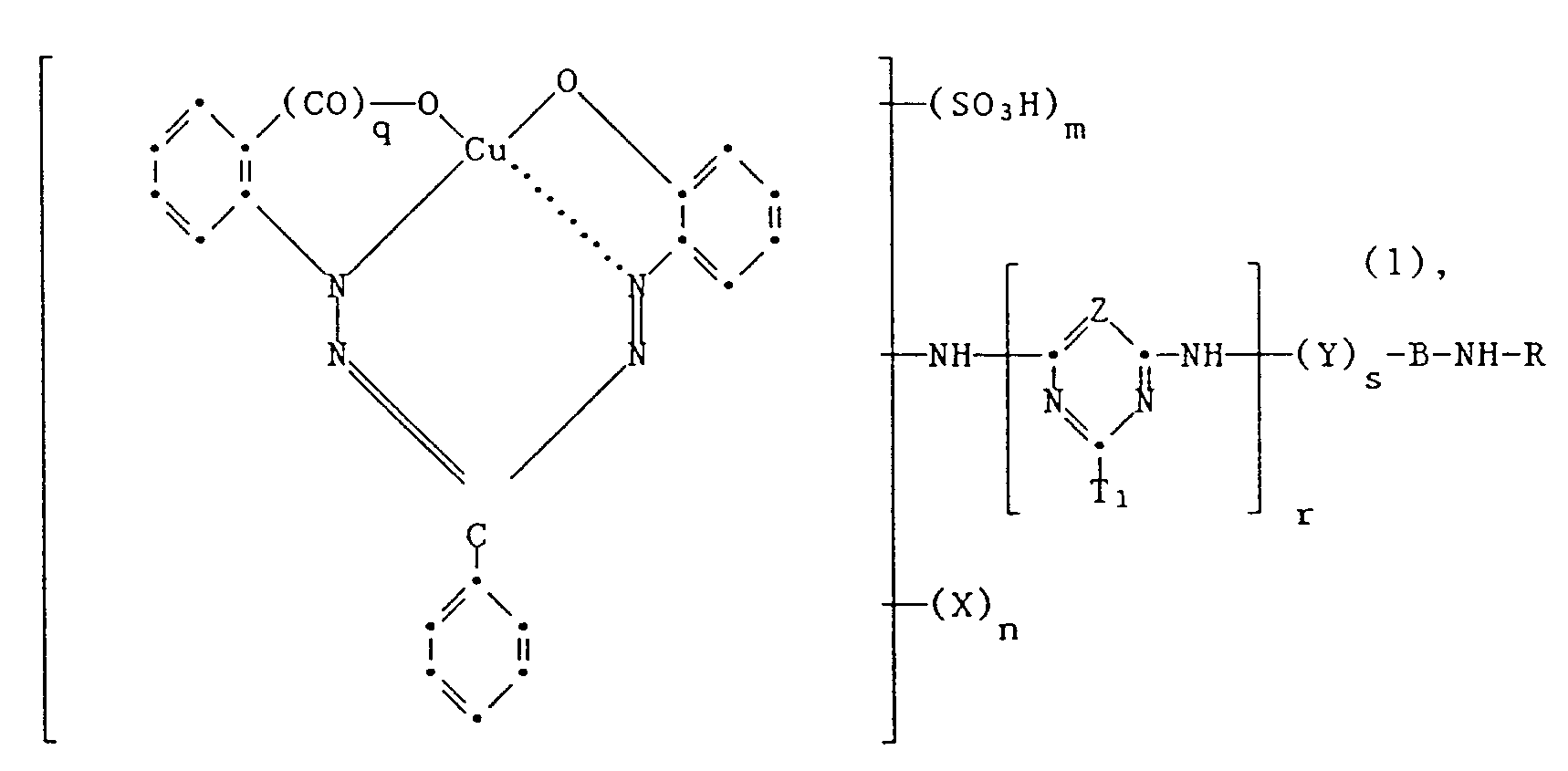
- Faserreaktive Formazanfarbstoffe gemäss Anspruch 1, worin q die Zahl 1 bedeutet.
- Faserreaktive Formazanfarbstoffe gemäss einem der Ansprüche 1 und 2, worin m die Zahl 2 bedeutet.
- Faserreaktive Formazanfarbstoffe gemäss einem der Ansprüche 1 bis 3, worin X Halogen, insbesondere Chlor, bedeutet.
- Faserreaktive Formazanfarbstoffe gemäss einem der Ansprüche 1 bis 4, worin B -(CH₂)p- oder

- Faserreaktive Formazanfarbstoffe gemäss einem der Ansprüche 1 bis 5, worin n die Zahl 0 oder 1 ist.
- Faserreaktive Formazanfarbstoffe gemäss einem der Ansprüche 1 bis 6, worin T₁ Fluor oder insbesondere Chlor ist und Z den Rest -C-F oder -C-Cl oder insbesondere ein Stickstoffatom bedeutet.
- Faserreaktive Formazanfarbstoffe gemäss einem der Ansprüche 1 bis 7 der Formel

- Faserreaktive Formazanfarbstoffe gemäss Anspruch 8 der Formel

- Faserreaktive Formazanfarbstoffe gemäss Anspruch 9 der Formel

- Faserreakive Formazanfarbstoffe gemäss Anspruch 9 der Formel

- Verfahren zur Herstellung der faserreaktiven Formazanfarbstoffe gemäss Anspruch 1, dadurch gekennzeichent, dass man ein Amin der Formel


- Verwendung der faserreaktiven Formazanfarbstoffe gemäss einem der Ansprüche 1 bis 11, bzw. der gemäss Anspruch 12 erhaltenen faserreaktiven Formazanfarbstoffe zum Färben und Bedrucken.
- Verwendung gemäss Anspruch 13 zum Färben und Bedrucken von Papier, Leder und hydroxylgruppenhaltigen oder stickstoffhaltigen Textilmaterialien.
- Verfahren zum Trichromie-Färben oder -Bedrucken von natürlichen und synthetischen Polyamidmaterialien mit Farbstoffmischungen, dadurch gekennzeichnet, dass man einen faserreaktiven Formazanfarbstoff der Formel

- Verfahren gemäss Anspruch 15, dadurch gekennzeichnet, dass man als faserreaktive, sulfogruppenhaltige gelb- oder orange- und rotfärbende Farbstoffe Azofarbstoffe verwendet.
- Verfahren gemäss einem der Ansprüche 15 und 16, dadurch gekennzeichnet, dass die gelb- oder orange- und rotfärbenden Farbstoffe als faserreaktive Gruppe jeweils eine Halogentriazin-, Halogenpyrimidin-Gruppe oder eine Gruppe der aliphatischen Reihe enthalten.
- Verfahren gemäss einem der Ansprüche 15 bis 17, dadurch gekennzeichnet, dass die gelb- oder orange- und rotfärbenden Farbstoffe als faserreaktive Gruppe Difluorchlorpyrimidinyl, insbesondere 2,4-Difluor-5-chlorpyrimidinyl, oder α,β-Dihalogenpropionyl, insbesondere α,β-Dibrompropionyl, oder α-Halogenacryloyl, insbesondere α-Bromacryloyl, enthalten.
- Verfahren gemäss einem der Ansprüche 15 bis 18, dadurch gekennzeichnet, dass zum Trichromie-Färben oder -Bedrucken natürliches Polyamidmaterial, insbesondere Wolle, verwendet wird.
- Verbindungen der Formel
Z-Y-B-NH-R ,
worin Z eine abspaltbare Gruppe, insbesondere ein Halogenatom, B gegebenenfalls durch C₁-C₄-Alkoxy oder Halogen substituiertes C₁-C₈-Alkylen oder ein sulfogruppenfreies aromatisches Brückenglied, R α,β-Dihalogenpropionyl, α-Halogenacryloyl oder Halogenacetyl, und Y -CO- oder -SO₂-ist. - Verbindungen gemäss Anspruch 20, worin B -(CH₂)p- oder
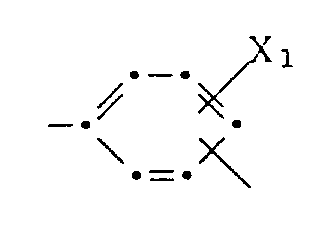
Applications Claiming Priority (2)
| Application Number | Priority Date | Filing Date | Title |
|---|---|---|---|
| CH2473/88 | 1988-06-29 | ||
| CH247388 | 1988-06-29 |
Publications (3)
| Publication Number | Publication Date |
|---|---|
| EP0352222A2 EP0352222A2 (de) | 1990-01-24 |
| EP0352222A3 EP0352222A3 (en) | 1990-05-02 |
| EP0352222B1 true EP0352222B1 (de) | 1994-05-25 |
Family
ID=4234596
Family Applications (1)
| Application Number | Title | Priority Date | Filing Date |
|---|---|---|---|
| EP89810475A Expired - Lifetime EP0352222B1 (de) | 1988-06-29 | 1989-06-20 | Faserreaktive Formazanfarbstoffe, Verfahren zu deren Herstellung und deren Verwendung |
Country Status (12)
| Country | Link |
|---|---|
| US (2) | US4994562A (de) |
| EP (1) | EP0352222B1 (de) |
| JP (1) | JPH0247163A (de) |
| KR (1) | KR910000941A (de) |
| AR (1) | AR245474A1 (de) |
| AU (1) | AU612500B2 (de) |
| BR (1) | BR8903171A (de) |
| DE (1) | DE58907709D1 (de) |
| ES (1) | ES2054086T3 (de) |
| MX (1) | MX16648A (de) |
| RU (1) | RU2061006C1 (de) |
| ZA (1) | ZA894898B (de) |
Families Citing this family (8)
| Publication number | Priority date | Publication date | Assignee | Title |
|---|---|---|---|---|
| DE58907709D1 (de) * | 1988-06-29 | 1994-06-30 | Ciba Geigy | Faserreaktive Formazanfarbstoffe, Verfahren zu deren Herstellung und deren Verwendung. |
| EP0402318B1 (de) * | 1989-06-08 | 1994-04-20 | Ciba-Geigy Ag | Verfahren zur Herstellung von faserreaktiven Formazanverbindungen |
| TW204339B (de) * | 1990-05-17 | 1993-04-21 | Ciba Geigy Ag | |
| US5268457A (en) * | 1990-09-25 | 1993-12-07 | Ciba-Geigy Corporation | Reactive dyes containing a chloro or fluorotriazine group |
| ES2103791T3 (es) * | 1990-09-25 | 1997-10-01 | Ciba Geigy Ag | Colorantes reactivos, procedimientos para su obtencion y uso de los mismos. |
| US5456727A (en) * | 1994-05-24 | 1995-10-10 | Hoechst Celanese Corporation | Dye compositions for polyamides |
| SG64479A1 (en) * | 1997-03-18 | 1999-04-27 | Ciba Geigy Ag | Reactive dyes their preparation and use |
| BR0007953A (pt) | 1999-02-05 | 2001-11-06 | Ciba Sc Holding Ag | Tintas para tingimento em preto e seu uso |
Family Cites Families (17)
| Publication number | Priority date | Publication date | Assignee | Title |
|---|---|---|---|---|
| US3068219A (en) * | 1959-11-13 | 1962-12-11 | Geigy Ag J R | Formazane dyes containing a halogen-pyrimidyl substituent |
| US4024123A (en) * | 1966-07-21 | 1977-05-17 | Paul Dussy | Fiber-reactive, heavy metal-containing formazane dyestuffs |
| GB1398601A (en) * | 1972-08-31 | 1975-06-25 | Ici Ltd | Reactive formazan dyestuffs |
| CH577544A5 (de) * | 1972-12-29 | 1976-07-15 | Ciba Geigy Ag | |
| CH606328A5 (de) * | 1974-05-08 | 1978-10-31 | Ciba Geigy Ag | |
| CH612448A5 (de) * | 1974-12-20 | 1979-07-31 | Ciba Geigy Ag | |
| DE2945537A1 (de) * | 1979-11-10 | 1981-05-21 | Hoechst Ag, 6000 Frankfurt | Kupferkomplex-formazanverbindungen, verfahren zu ihrer herstellung und ihre verwendung als farbstoffe |
| EP0089004B1 (de) * | 1982-03-12 | 1986-04-16 | Ciba-Geigy Ag | Verfahren zum Färben von Fasermaterial aus natürlichen Polyamiden |
| EP0114032B1 (de) * | 1982-12-20 | 1987-07-01 | Ciba-Geigy Ag | Reaktivfarbstoffe, deren Herstellung und Verwendung |
| US4560388A (en) * | 1983-04-20 | 1985-12-24 | Ciba-Geigy Corporation | Process for dyeing silk or fibre blends containing silk |
| DE3464626D1 (en) * | 1983-08-30 | 1987-08-13 | Ciba Geigy Ag | Reactive dyes, their preparation and their use |
| US4563192A (en) * | 1983-09-19 | 1986-01-07 | Ciba-Geigy Corporation | Process for dyeing fibre material made of synthetic polyamides with anionic dyes and an auxiliary mixture |
| EP0174909B1 (de) * | 1984-08-30 | 1991-10-16 | Ciba-Geigy Ag | Reaktivfarbstoffe, deren Herstellung und Verwendung |
| EP0179019B1 (de) * | 1984-10-15 | 1990-05-16 | Ciba-Geigy Ag | Reaktivfarbstoffe, deren Herstellung und Verwendung |
| FR2578852B1 (fr) * | 1985-03-16 | 1988-09-09 | Sandoz Sa | Melanges de composes formazyliques, leur preparation et leur utilisation comme colorants. |
| DE3669323D1 (de) * | 1985-07-12 | 1990-04-12 | Ciba Geigy Ag | Reaktivfarbstoffe, deren herstellung und verwendung. |
| DE58907709D1 (de) * | 1988-06-29 | 1994-06-30 | Ciba Geigy | Faserreaktive Formazanfarbstoffe, Verfahren zu deren Herstellung und deren Verwendung. |
-
1989
- 1989-06-20 DE DE58907709T patent/DE58907709D1/de not_active Expired - Fee Related
- 1989-06-20 EP EP89810475A patent/EP0352222B1/de not_active Expired - Lifetime
- 1989-06-20 ES ES89810475T patent/ES2054086T3/es not_active Expired - Lifetime
- 1989-06-27 AR AR89314263A patent/AR245474A1/es active
- 1989-06-28 ZA ZA894898A patent/ZA894898B/xx unknown
- 1989-06-28 BR BR898903171A patent/BR8903171A/pt not_active IP Right Cessation
- 1989-06-28 KR KR1019890008922A patent/KR910000941A/ko not_active Withdrawn
- 1989-06-28 AU AU37130/89A patent/AU612500B2/en not_active Ceased
- 1989-06-28 RU SU894614519A patent/RU2061006C1/ru active
- 1989-06-29 JP JP1168239A patent/JPH0247163A/ja active Pending
- 1989-06-29 US US07/374,320 patent/US4994562A/en not_active Expired - Fee Related
- 1989-06-29 MX MX1664889A patent/MX16648A/es unknown
-
1990
- 1990-11-13 US US07/612,754 patent/US5114430A/en not_active Expired - Fee Related
Also Published As
| Publication number | Publication date |
|---|---|
| AU612500B2 (en) | 1991-07-11 |
| ZA894898B (en) | 1990-02-28 |
| EP0352222A2 (de) | 1990-01-24 |
| JPH0247163A (ja) | 1990-02-16 |
| EP0352222A3 (en) | 1990-05-02 |
| AU3713089A (en) | 1990-01-04 |
| US4994562A (en) | 1991-02-19 |
| DE58907709D1 (de) | 1994-06-30 |
| RU2061006C1 (ru) | 1996-05-27 |
| HK1005036A1 (en) | 1998-12-18 |
| US5114430A (en) | 1992-05-19 |
| KR910000941A (ko) | 1991-01-30 |
| AR245474A1 (es) | 1994-01-31 |
| MX16648A (es) | 1993-10-01 |
| BR8903171A (pt) | 1990-02-13 |
| ES2054086T3 (es) | 1994-08-01 |
Similar Documents
| Publication | Publication Date | Title |
|---|---|---|
| EP0040790B1 (de) | Verfahren zum Färben und Bedrucken von Hydroxy- und/oder Carbonamidgruppen enthaltenden Fasermaterialien | |
| EP0437184B1 (de) | Verfahren zum Trichromiefärben oder -bedrucken von cellulosehaltigen textilen Fasermaterialien | |
| EP0070807B1 (de) | Reaktivfarbstoffe, deren Herstellung und Verwendung | |
| EP1247842B1 (de) | Faserreaktive Anthrachinonfarbstoffe, deren Herstellung und deren Verwendung | |
| EP0202436A2 (de) | Verfahren zum Färben oder Bedrucken von Cellulosefasern oder Cellulosemischfasern | |
| EP0056975A2 (de) | Wasserlösliche Monoazoverbindungen, Verfahren zu ihrer Herstellung und ihre Verwendung als Farbstoffe | |
| EP0352222B1 (de) | Faserreaktive Formazanfarbstoffe, Verfahren zu deren Herstellung und deren Verwendung | |
| EP0586331B1 (de) | Verfahren zum Färben von synthetischen Polyamidfasermaterialien | |
| EP0657508A1 (de) | Reaktivfarbstoffe, Verfahren zu deren Herstellung und deren Verwendung | |
| EP0356394A2 (de) | Reaktivfarbstoffe, deren Herstellung und Verwendung | |
| EP0410931B1 (de) | Faserreaktive Formazanfarbstoffe, Verfahren zu deren Herstellung und deren Verwendung | |
| EP0209494B1 (de) | Verfahren zum Nuancenstabilen Färben oder Bedrucken | |
| EP0410930B1 (de) | Faserreaktive Formazanfarbstoffe, Verfahren zu deren Herstellung und deren Verwendung | |
| EP0305021A2 (de) | Reaktive Monoazofarbstoffe, deren Herstellung und Verwendung | |
| EP0341206A1 (de) | Faserreaktive Formazanfarbstoffe, Verfahren zu deren Herstellung und deren Verwendung | |
| EP0775731A1 (de) | Reaktivfarbstoffe, Verfahren zu deren Herstellung und deren Verwendung | |
| EP0889098A2 (de) | Azofarbstoffe, Verfahren zu deren Herstellung und deren Verwendung | |
| EP0708151B1 (de) | Faserreaktive Anthrachinonfarbstoffe, Verfahren zu deren Herstellung und deren Verwendung | |
| EP0457729B1 (de) | Azofarbstoffe, Verfahren zu deren Herstellung und deren Verwendung | |
| EP0866100B1 (de) | Reaktivfarbstoffe, ihre Herstellung und Verwendung | |
| EP0524147B1 (de) | Azofarbstoffe, Verfahren zu deren Herstellung und deren Verwendung | |
| EP0651028A1 (de) | Verfahren zum Trichromie-Färben oder -Bedrucken | |
| EP1081196B1 (de) | Verfahren zum Färben oder Bedrucken von polyamidhaltigen Materialien | |
| EP0570333B1 (de) | Faserreaktive Anthrachinonfarbstoffe, Verfahren zu deren Herstellung und deren Verwendung | |
| EP1088858A1 (de) | Reaktivfarbstoffe, enthaltend einen Formazan- und einen Monoazofarbstoffrest, Verfahren zu deren Herstellung und deren Verwendung |
Legal Events
| Date | Code | Title | Description |
|---|---|---|---|
| PUAI | Public reference made under article 153(3) epc to a published international application that has entered the european phase |
Free format text: ORIGINAL CODE: 0009012 |
|
| 17P | Request for examination filed |
Effective date: 19890622 |
|
| AK | Designated contracting states |
Kind code of ref document: A2 Designated state(s): BE CH DE ES FR GB IT LI |
|
| PUAL | Search report despatched |
Free format text: ORIGINAL CODE: 0009013 |
|
| AK | Designated contracting states |
Kind code of ref document: A3 Designated state(s): BE CH DE ES FR GB IT LI |
|
| 17Q | First examination report despatched |
Effective date: 19921223 |
|
| GRAA | (expected) grant |
Free format text: ORIGINAL CODE: 0009210 |
|
| AK | Designated contracting states |
Kind code of ref document: B1 Designated state(s): BE CH DE ES FR GB IT LI |
|
| ET | Fr: translation filed | ||
| ITTA | It: last paid annual fee | ||
| REF | Corresponds to: |
Ref document number: 58907709 Country of ref document: DE Date of ref document: 19940630 |
|
| ITF | It: translation for a ep patent filed | ||
| REG | Reference to a national code |
Ref country code: ES Ref legal event code: FG2A Ref document number: 2054086 Country of ref document: ES Kind code of ref document: T3 |
|
| GBT | Gb: translation of ep patent filed (gb section 77(6)(a)/1977) |
Effective date: 19940712 |
|
| PLBE | No opposition filed within time limit |
Free format text: ORIGINAL CODE: 0009261 |
|
| STAA | Information on the status of an ep patent application or granted ep patent |
Free format text: STATUS: NO OPPOSITION FILED WITHIN TIME LIMIT |
|
| 26N | No opposition filed | ||
| REG | Reference to a national code |
Ref country code: CH Ref legal event code: PUE Owner name: CIBA-GEIGY AG TRANSFER- CIBA SC HOLDING AG |
|
| BECN | Be: change of holder's name |
Effective date: 19961129 |
|
| REG | Reference to a national code |
Ref country code: FR Ref legal event code: TP |
|
| REG | Reference to a national code |
Ref country code: CH Ref legal event code: PFA Free format text: CIBA SC HOLDING AG TRANSFER- CIBA SPECIALTY CHEMICALS HOLDING INC. |
|
| REG | Reference to a national code |
Ref country code: GB Ref legal event code: 732E |
|
| REG | Reference to a national code |
Ref country code: FR Ref legal event code: CD |
|
| REG | Reference to a national code |
Ref country code: ES Ref legal event code: PC2A |
|
| PGFP | Annual fee paid to national office [announced via postgrant information from national office to epo] |
Ref country code: FR Payment date: 19990427 Year of fee payment: 11 Ref country code: CH Payment date: 19990427 Year of fee payment: 11 |
|
| PGFP | Annual fee paid to national office [announced via postgrant information from national office to epo] |
Ref country code: DE Payment date: 19990507 Year of fee payment: 11 |
|
| PGFP | Annual fee paid to national office [announced via postgrant information from national office to epo] |
Ref country code: GB Payment date: 19990520 Year of fee payment: 11 |
|
| PGFP | Annual fee paid to national office [announced via postgrant information from national office to epo] |
Ref country code: ES Payment date: 19990614 Year of fee payment: 11 |
|
| PGFP | Annual fee paid to national office [announced via postgrant information from national office to epo] |
Ref country code: BE Payment date: 19990819 Year of fee payment: 11 |
|
| PG25 | Lapsed in a contracting state [announced via postgrant information from national office to epo] |
Ref country code: GB Free format text: LAPSE BECAUSE OF NON-PAYMENT OF DUE FEES Effective date: 20000620 |
|
| PG25 | Lapsed in a contracting state [announced via postgrant information from national office to epo] |
Ref country code: ES Free format text: LAPSE BECAUSE OF EXPIRATION OF PROTECTION Effective date: 20000621 |
|
| PG25 | Lapsed in a contracting state [announced via postgrant information from national office to epo] |
Ref country code: LI Free format text: LAPSE BECAUSE OF NON-PAYMENT OF DUE FEES Effective date: 20000630 Ref country code: CH Free format text: LAPSE BECAUSE OF NON-PAYMENT OF DUE FEES Effective date: 20000630 Ref country code: BE Free format text: LAPSE BECAUSE OF NON-PAYMENT OF DUE FEES Effective date: 20000630 |
|
| BERE | Be: lapsed |
Owner name: CIBA SPECIALTY CHEMICALS HOLDING INC. Effective date: 20000630 |
|
| GBPC | Gb: european patent ceased through non-payment of renewal fee |
Effective date: 20000620 |
|
| REG | Reference to a national code |
Ref country code: CH Ref legal event code: PL |
|
| PG25 | Lapsed in a contracting state [announced via postgrant information from national office to epo] |
Ref country code: FR Free format text: LAPSE BECAUSE OF NON-PAYMENT OF DUE FEES Effective date: 20010228 |
|
| REG | Reference to a national code |
Ref country code: FR Ref legal event code: ST |
|
| PG25 | Lapsed in a contracting state [announced via postgrant information from national office to epo] |
Ref country code: DE Free format text: LAPSE BECAUSE OF NON-PAYMENT OF DUE FEES Effective date: 20010403 |
|
| REG | Reference to a national code |
Ref country code: ES Ref legal event code: FD2A Effective date: 20020401 |
|
| PG25 | Lapsed in a contracting state [announced via postgrant information from national office to epo] |
Ref country code: IT Free format text: LAPSE BECAUSE OF NON-PAYMENT OF DUE FEES;WARNING: LAPSES OF ITALIAN PATENTS WITH EFFECTIVE DATE BEFORE 2007 MAY HAVE OCCURRED AT ANY TIME BEFORE 2007. THE CORRECT EFFECTIVE DATE MAY BE DIFFERENT FROM THE ONE RECORDED. Effective date: 20050620 |