EP0200751B1 - Artikel mit träger aus einem polymeren blatt mit verminderter reibung - Google Patents
Artikel mit träger aus einem polymeren blatt mit verminderter reibung Download PDFInfo
- Publication number
- EP0200751B1 EP0200751B1 EP85905273A EP85905273A EP0200751B1 EP 0200751 B1 EP0200751 B1 EP 0200751B1 EP 85905273 A EP85905273 A EP 85905273A EP 85905273 A EP85905273 A EP 85905273A EP 0200751 B1 EP0200751 B1 EP 0200751B1
- Authority
- EP
- European Patent Office
- Prior art keywords
- range
- friction
- article
- film
- sputter
- Prior art date
- Legal status (The legal status is an assumption and is not a legal conclusion. Google has not performed a legal analysis and makes no representation as to the accuracy of the status listed.)
- Expired
Links
- 229920000642 polymer Polymers 0.000 title description 34
- 238000000992 sputter etching Methods 0.000 claims abstract description 30
- 239000000463 material Substances 0.000 claims abstract description 24
- 239000002346 layers by function Substances 0.000 claims abstract description 13
- 230000003068 static effect Effects 0.000 claims abstract description 13
- 239000002131 composite material Substances 0.000 claims abstract description 10
- 238000000926 separation method Methods 0.000 claims abstract description 8
- 239000002178 crystalline material Substances 0.000 claims abstract description 5
- 238000000034 method Methods 0.000 claims description 14
- 238000000576 coating method Methods 0.000 claims description 12
- 239000000203 mixture Substances 0.000 claims description 12
- 239000011248 coating agent Substances 0.000 claims description 8
- 229920000728 polyester Polymers 0.000 claims description 6
- 239000000839 emulsion Substances 0.000 claims description 4
- 239000010410 layer Substances 0.000 claims description 4
- 229920002313 fluoropolymer Polymers 0.000 claims description 3
- 239000004811 fluoropolymer Substances 0.000 claims description 3
- 239000004952 Polyamide Substances 0.000 claims description 2
- 229920001577 copolymer Polymers 0.000 claims description 2
- 229920002647 polyamide Polymers 0.000 claims description 2
- 229920000570 polyether Polymers 0.000 claims description 2
- 229920000098 polyolefin Polymers 0.000 claims description 2
- 229920002635 polyurethane Polymers 0.000 claims description 2
- 239000004814 polyurethane Substances 0.000 claims description 2
- 239000004721 Polyphenylene oxide Substances 0.000 claims 1
- 239000004820 Pressure-sensitive adhesive Substances 0.000 claims 1
- 239000012790 adhesive layer Substances 0.000 claims 1
- 230000003667 anti-reflective effect Effects 0.000 claims 1
- 238000010276 construction Methods 0.000 abstract description 5
- 238000000026 X-ray photoelectron spectrum Methods 0.000 description 19
- -1 polytetrafluoroethylene Polymers 0.000 description 19
- IJGRMHOSHXDMSA-UHFFFAOYSA-N Atomic nitrogen Chemical compound N#N IJGRMHOSHXDMSA-UHFFFAOYSA-N 0.000 description 16
- 229910052799 carbon Inorganic materials 0.000 description 16
- 238000005259 measurement Methods 0.000 description 15
- 238000011282 treatment Methods 0.000 description 14
- 238000004458 analytical method Methods 0.000 description 13
- 229920000139 polyethylene terephthalate Polymers 0.000 description 13
- 239000005020 polyethylene terephthalate Substances 0.000 description 13
- XKRFYHLGVUSROY-UHFFFAOYSA-N Argon Chemical compound [Ar] XKRFYHLGVUSROY-UHFFFAOYSA-N 0.000 description 12
- 230000000875 corresponding effect Effects 0.000 description 12
- 238000001228 spectrum Methods 0.000 description 12
- QVGXLLKOCUKJST-UHFFFAOYSA-N atomic oxygen Chemical compound [O] QVGXLLKOCUKJST-UHFFFAOYSA-N 0.000 description 11
- 239000007789 gas Substances 0.000 description 11
- 239000001301 oxygen Substances 0.000 description 11
- 229910052760 oxygen Inorganic materials 0.000 description 11
- 239000000523 sample Substances 0.000 description 11
- 238000004626 scanning electron microscopy Methods 0.000 description 11
- 239000002245 particle Substances 0.000 description 10
- 229920006267 polyester film Polymers 0.000 description 9
- 229920002799 BoPET Polymers 0.000 description 8
- 208000028659 discharge Diseases 0.000 description 8
- 229910052757 nitrogen Inorganic materials 0.000 description 8
- 239000000126 substance Substances 0.000 description 8
- 229910052786 argon Inorganic materials 0.000 description 6
- 229920006126 semicrystalline polymer Polymers 0.000 description 6
- 238000004544 sputter deposition Methods 0.000 description 6
- OKTJSMMVPCPJKN-UHFFFAOYSA-N Carbon Chemical compound [C] OKTJSMMVPCPJKN-UHFFFAOYSA-N 0.000 description 5
- 229920002302 Nylon 6,6 Polymers 0.000 description 5
- 150000002500 ions Chemical class 0.000 description 5
- 229920006254 polymer film Polymers 0.000 description 5
- 238000001878 scanning electron micrograph Methods 0.000 description 5
- 239000002585 base Substances 0.000 description 4
- 238000004519 manufacturing process Methods 0.000 description 4
- 229920001707 polybutylene terephthalate Polymers 0.000 description 4
- 230000008569 process Effects 0.000 description 4
- 238000004833 X-ray photoelectron spectroscopy Methods 0.000 description 3
- 239000000654 additive Substances 0.000 description 3
- 238000003486 chemical etching Methods 0.000 description 3
- 238000005530 etching Methods 0.000 description 3
- 238000012986 modification Methods 0.000 description 3
- 230000004048 modification Effects 0.000 description 3
- 229920001343 polytetrafluoroethylene Polymers 0.000 description 3
- 239000004810 polytetrafluoroethylene Substances 0.000 description 3
- 238000012545 processing Methods 0.000 description 3
- 239000000047 product Substances 0.000 description 3
- 230000003746 surface roughness Effects 0.000 description 3
- 238000012876 topography Methods 0.000 description 3
- CURLTUGMZLYLDI-UHFFFAOYSA-N Carbon dioxide Chemical compound O=C=O CURLTUGMZLYLDI-UHFFFAOYSA-N 0.000 description 2
- MYMOFIZGZYHOMD-UHFFFAOYSA-N Dioxygen Chemical compound O=O MYMOFIZGZYHOMD-UHFFFAOYSA-N 0.000 description 2
- 239000004698 Polyethylene Substances 0.000 description 2
- 239000004743 Polypropylene Substances 0.000 description 2
- 238000005299 abrasion Methods 0.000 description 2
- 239000002390 adhesive tape Substances 0.000 description 2
- 229910052782 aluminium Inorganic materials 0.000 description 2
- XAGFODPZIPBFFR-UHFFFAOYSA-N aluminium Chemical compound [Al] XAGFODPZIPBFFR-UHFFFAOYSA-N 0.000 description 2
- 239000006117 anti-reflective coating Substances 0.000 description 2
- 230000008901 benefit Effects 0.000 description 2
- 229910002092 carbon dioxide Inorganic materials 0.000 description 2
- 238000012512 characterization method Methods 0.000 description 2
- 230000001276 controlling effect Effects 0.000 description 2
- 238000003851 corona treatment Methods 0.000 description 2
- 229910001882 dioxygen Inorganic materials 0.000 description 2
- 238000010849 ion bombardment Methods 0.000 description 2
- 239000000314 lubricant Substances 0.000 description 2
- 238000001000 micrograph Methods 0.000 description 2
- 229920000573 polyethylene Polymers 0.000 description 2
- 229920001155 polypropylene Polymers 0.000 description 2
- 230000009467 reduction Effects 0.000 description 2
- 238000004381 surface treatment Methods 0.000 description 2
- 238000012360 testing method Methods 0.000 description 2
- XLYOFNOQVPJJNP-UHFFFAOYSA-N water Substances O XLYOFNOQVPJJNP-UHFFFAOYSA-N 0.000 description 2
- 239000004793 Polystyrene Substances 0.000 description 1
- 238000002441 X-ray diffraction Methods 0.000 description 1
- 239000003082 abrasive agent Substances 0.000 description 1
- 239000000853 adhesive Substances 0.000 description 1
- 230000001070 adhesive effect Effects 0.000 description 1
- 239000003513 alkali Substances 0.000 description 1
- 230000004075 alteration Effects 0.000 description 1
- 230000015572 biosynthetic process Effects 0.000 description 1
- 229910052793 cadmium Inorganic materials 0.000 description 1
- 125000004432 carbon atom Chemical group C* 0.000 description 1
- 150000001722 carbon compounds Chemical class 0.000 description 1
- 239000001569 carbon dioxide Substances 0.000 description 1
- 238000001311 chemical methods and process Methods 0.000 description 1
- 238000006243 chemical reaction Methods 0.000 description 1
- 239000007795 chemical reaction product Substances 0.000 description 1
- 239000003795 chemical substances by application Substances 0.000 description 1
- 238000004140 cleaning Methods 0.000 description 1
- 238000009838 combustion analysis Methods 0.000 description 1
- 239000000356 contaminant Substances 0.000 description 1
- 230000002596 correlated effect Effects 0.000 description 1
- 239000013078 crystal Substances 0.000 description 1
- 238000002425 crystallisation Methods 0.000 description 1
- 230000008025 crystallization Effects 0.000 description 1
- 238000007405 data analysis Methods 0.000 description 1
- 230000007547 defect Effects 0.000 description 1
- 230000001419 dependent effect Effects 0.000 description 1
- 238000011161 development Methods 0.000 description 1
- 238000010586 diagram Methods 0.000 description 1
- 238000009826 distribution Methods 0.000 description 1
- 230000009977 dual effect Effects 0.000 description 1
- 230000000694 effects Effects 0.000 description 1
- 238000004945 emulsification Methods 0.000 description 1
- 238000001125 extrusion Methods 0.000 description 1
- 239000012467 final product Substances 0.000 description 1
- 238000010438 heat treatment Methods 0.000 description 1
- 239000001307 helium Substances 0.000 description 1
- 229910052734 helium Inorganic materials 0.000 description 1
- 238000007373 indentation Methods 0.000 description 1
- 230000006698 induction Effects 0.000 description 1
- 230000000977 initiatory effect Effects 0.000 description 1
- 238000010884 ion-beam technique Methods 0.000 description 1
- 238000002386 leaching Methods 0.000 description 1
- 230000007246 mechanism Effects 0.000 description 1
- 239000000155 melt Substances 0.000 description 1
- 229910052751 metal Inorganic materials 0.000 description 1
- 239000002184 metal Substances 0.000 description 1
- 229910044991 metal oxide Inorganic materials 0.000 description 1
- 150000004706 metal oxides Chemical class 0.000 description 1
- 238000003801 milling Methods 0.000 description 1
- 230000007935 neutral effect Effects 0.000 description 1
- 230000003647 oxidation Effects 0.000 description 1
- 238000007254 oxidation reaction Methods 0.000 description 1
- 238000012856 packing Methods 0.000 description 1
- 238000000053 physical method Methods 0.000 description 1
- 239000013047 polymeric layer Substances 0.000 description 1
- 229920002223 polystyrene Polymers 0.000 description 1
- 238000007788 roughening Methods 0.000 description 1
- 239000012748 slip agent Substances 0.000 description 1
- 239000007787 solid Substances 0.000 description 1
- 238000012306 spectroscopic technique Methods 0.000 description 1
- 239000000758 substrate Substances 0.000 description 1
- 231100000331 toxic Toxicity 0.000 description 1
- 230000002588 toxic effect Effects 0.000 description 1
- 230000001052 transient effect Effects 0.000 description 1
- 239000002699 waste material Substances 0.000 description 1
- 238000009736 wetting Methods 0.000 description 1
Images



Classifications
-
- C—CHEMISTRY; METALLURGY
- C23—COATING METALLIC MATERIAL; COATING MATERIAL WITH METALLIC MATERIAL; CHEMICAL SURFACE TREATMENT; DIFFUSION TREATMENT OF METALLIC MATERIAL; COATING BY VACUUM EVAPORATION, BY SPUTTERING, BY ION IMPLANTATION OR BY CHEMICAL VAPOUR DEPOSITION, IN GENERAL; INHIBITING CORROSION OF METALLIC MATERIAL OR INCRUSTATION IN GENERAL
- C23C—COATING METALLIC MATERIAL; COATING MATERIAL WITH METALLIC MATERIAL; SURFACE TREATMENT OF METALLIC MATERIAL BY DIFFUSION INTO THE SURFACE, BY CHEMICAL CONVERSION OR SUBSTITUTION; COATING BY VACUUM EVAPORATION, BY SPUTTERING, BY ION IMPLANTATION OR BY CHEMICAL VAPOUR DEPOSITION, IN GENERAL
- C23C14/00—Coating by vacuum evaporation, by sputtering or by ion implantation of the coating forming material
- C23C14/02—Pretreatment of the material to be coated
- C23C14/021—Cleaning or etching treatments
- C23C14/022—Cleaning or etching treatments by means of bombardment with energetic particles or radiation
-
- B—PERFORMING OPERATIONS; TRANSPORTING
- B05—SPRAYING OR ATOMISING IN GENERAL; APPLYING FLUENT MATERIALS TO SURFACES, IN GENERAL
- B05D—PROCESSES FOR APPLYING FLUENT MATERIALS TO SURFACES, IN GENERAL
- B05D3/00—Pretreatment of surfaces to which liquids or other fluent materials are to be applied; After-treatment of applied coatings, e.g. intermediate treating of an applied coating preparatory to subsequent applications of liquids or other fluent materials
- B05D3/04—Pretreatment of surfaces to which liquids or other fluent materials are to be applied; After-treatment of applied coatings, e.g. intermediate treating of an applied coating preparatory to subsequent applications of liquids or other fluent materials by exposure to gases
- B05D3/0433—Pretreatment of surfaces to which liquids or other fluent materials are to be applied; After-treatment of applied coatings, e.g. intermediate treating of an applied coating preparatory to subsequent applications of liquids or other fluent materials by exposure to gases the gas being a reactive gas
- B05D3/044—Pretreatment
- B05D3/0446—Pretreatment of a polymeric substrate
-
- B—PERFORMING OPERATIONS; TRANSPORTING
- B29—WORKING OF PLASTICS; WORKING OF SUBSTANCES IN A PLASTIC STATE IN GENERAL
- B29C—SHAPING OR JOINING OF PLASTICS; SHAPING OF MATERIAL IN A PLASTIC STATE, NOT OTHERWISE PROVIDED FOR; AFTER-TREATMENT OF THE SHAPED PRODUCTS, e.g. REPAIRING
- B29C59/00—Surface shaping of articles, e.g. embossing; Apparatus therefor
- B29C59/14—Surface shaping of articles, e.g. embossing; Apparatus therefor by plasma treatment
-
- G—PHYSICS
- G11—INFORMATION STORAGE
- G11B—INFORMATION STORAGE BASED ON RELATIVE MOVEMENT BETWEEN RECORD CARRIER AND TRANSDUCER
- G11B5/00—Recording by magnetisation or demagnetisation of a record carrier; Reproducing by magnetic means; Record carriers therefor
- G11B5/62—Record carriers characterised by the selection of the material
- G11B5/73—Base layers, i.e. all non-magnetic layers lying under a lowermost magnetic recording layer, e.g. including any non-magnetic layer in between a first magnetic recording layer and either an underlying substrate or a soft magnetic underlayer
- G11B5/739—Magnetic recording media substrates
- G11B5/73923—Organic polymer substrates
-
- G—PHYSICS
- G11—INFORMATION STORAGE
- G11B—INFORMATION STORAGE BASED ON RELATIVE MOVEMENT BETWEEN RECORD CARRIER AND TRANSDUCER
- G11B5/00—Recording by magnetisation or demagnetisation of a record carrier; Reproducing by magnetic means; Record carriers therefor
- G11B5/62—Record carriers characterised by the selection of the material
- G11B5/73—Base layers, i.e. all non-magnetic layers lying under a lowermost magnetic recording layer, e.g. including any non-magnetic layer in between a first magnetic recording layer and either an underlying substrate or a soft magnetic underlayer
- G11B5/739—Magnetic recording media substrates
- G11B5/73923—Organic polymer substrates
- G11B5/73927—Polyester substrates, e.g. polyethylene terephthalate
-
- G—PHYSICS
- G11—INFORMATION STORAGE
- G11B—INFORMATION STORAGE BASED ON RELATIVE MOVEMENT BETWEEN RECORD CARRIER AND TRANSDUCER
- G11B5/00—Recording by magnetisation or demagnetisation of a record carrier; Reproducing by magnetic means; Record carriers therefor
- G11B5/84—Processes or apparatus specially adapted for manufacturing record carriers
- G11B5/8404—Processes or apparatus specially adapted for manufacturing record carriers manufacturing base layers
-
- Y—GENERAL TAGGING OF NEW TECHNOLOGICAL DEVELOPMENTS; GENERAL TAGGING OF CROSS-SECTIONAL TECHNOLOGIES SPANNING OVER SEVERAL SECTIONS OF THE IPC; TECHNICAL SUBJECTS COVERED BY FORMER USPC CROSS-REFERENCE ART COLLECTIONS [XRACs] AND DIGESTS
- Y10—TECHNICAL SUBJECTS COVERED BY FORMER USPC
- Y10T—TECHNICAL SUBJECTS COVERED BY FORMER US CLASSIFICATION
- Y10T428/00—Stock material or miscellaneous articles
- Y10T428/24—Structurally defined web or sheet [e.g., overall dimension, etc.]
- Y10T428/24355—Continuous and nonuniform or irregular surface on layer or component [e.g., roofing, etc.]
-
- Y—GENERAL TAGGING OF NEW TECHNOLOGICAL DEVELOPMENTS; GENERAL TAGGING OF CROSS-SECTIONAL TECHNOLOGIES SPANNING OVER SEVERAL SECTIONS OF THE IPC; TECHNICAL SUBJECTS COVERED BY FORMER USPC CROSS-REFERENCE ART COLLECTIONS [XRACs] AND DIGESTS
- Y10—TECHNICAL SUBJECTS COVERED BY FORMER USPC
- Y10T—TECHNICAL SUBJECTS COVERED BY FORMER US CLASSIFICATION
- Y10T428/00—Stock material or miscellaneous articles
- Y10T428/24—Structurally defined web or sheet [e.g., overall dimension, etc.]
- Y10T428/24355—Continuous and nonuniform or irregular surface on layer or component [e.g., roofing, etc.]
- Y10T428/24471—Crackled, crazed or slit
Definitions
- the present invention relates to a composite article having a reduced friction polymeric sheet support and a method therefor.
- the polymeric sheet is useful as a support for a functional layer in a composite sheet construction.
- Thin polymer films are used as backings for a variety of products such as photographic films, adhesive tapes, abrasive sheets, anti-reflective coatings and, in a most important area, for magnetic recording tape.
- the end product consists of a composite sheet construction comprising a polymer support coated with a functional layer.
- handling or runnability relate to the properties of a sheet as it is transported though any processing mechanism whether it be during film manufacture, coating or converting, or end-use, as for example through a magnetic tape recorder.
- handling or runnability has to do with the forces encountered in movement of the sheet; first, to unwind it from the jumbo or roll and, second, to move it over idler rolls and past stationary rolls and the like. For sheets without any treatment, these forces can be very large.
- the addition of a "slip” agent is commonly used to make the untreated sheet more slippery. Sometimes lubricants are used on the sheet but, for the most part, solid particles are added to the melt before the film is extruded.
- 4,233,352 teaches a polyester film made to have reduced coefficient of friction by adding "worm-like nodules" of other polymer to the surface of the polyester for use in magnetic tape.
- slip particles cause either a hole in the coating or, in the case of an indentation, a slightly different coating-to-head spacing, and both of these result in a signal loss or-so-called "drop-out".
- U.S. Patent Nos. 3,900,604 and 3,967,025 disclose magnetic recording material with the polymeric base film having been thermally treated on one side only, then stretched to give a "finely rugged" surface on the annealed side which imparts good running properties, the second side being relatively smooth and coated with the magnetic media to give good magnetic properties.
- the fine ruggedness obtained by this heat/stretch treatment may be characterized as small irregularly distributed bumps corresponding to clustered crystallites on the heated surface.
- U.S. Patent Nos. 4,097,650 and 4,153,920 disclose a recording tape to provide improved output and signal to noise ratio by controlling the film surface roughness (as by chemical etching in alkali or by ion bombardment), the surface roughness of both surfaces of the film having a mean value of 0.1 micrometer or less.
- U.S. Patent Nos. 4,064,030 and 4,155,826 disclose sputter-etching of a polymer film to provide a microstructured surface that promotes adhesion.
- U.S. Patent No. 4,340,276 teaches preferential sputter-etching of the composite surface of a polymer sheet after discontinuous metal or metal oxide coating to provide an anti-reflection coating and good adhesion.
- papers were published by workers at Nitto Electric Industries, Japan, that indicated sputter-etched fluoropolymers (polytetrafluoroethylene) showed improved adhesion properties.
- the present invention provides a composite sheet-like article comprising a semicrystalline polymeric sheet support having a first, sputter-etched surface and a second surface, said surfaces having in the range of 5 to 99 percent crystalline polymeric material and 1 to 95 percent amorphous polymeric material, said second surface having at least one functional layer coated thereon, said amorphous material being preferentially ablated in comparison with the crystalline material and said article having on said first surface ridges or needles of amplitude in the range of 0.01 to 5.0 micrometers, with a separation at their apexes in the range of 0.01 to 1.0 micrometers, and having an aspect ratio in the range of 0.5 to 7, said first surface having at least one of static and dynamic coefficients of friction in the range of 0.01 to 0.7 so as to provide a reduced friction backside for said sheet-like article.
- the invention also provides a method for making a composite sheet-like article having a reduced friction backside comprising the steps of:
- the present invention provides for reduced friction between sheet materials, at least one of which is a polymeric sheet material, without use of lubricants or other additives.
- the method of the invention eliminates chemical slip agents and other additives that may either alter the performance of the polymer, create toxic hazards upon leaching, or be economically unattractive, etc.
- Reduced friction polymeric sheet-like articles are desirable for all processes requiring such articles to be moved about or handled. This so-called "runnability" can be correlated to the coefficient of friction of the sheet surface.
- the coefficient of friction of a sheet material surface is a good measure of the unwind force of the roll of sheet material; that is, the lower the coefficient of friction the lower the unwind force.
- a sheet-like article with a coefficient of friction greater than about 0.7 is almost impossible to run on processing equipment because of the high driving forces required.
- a sheet-like article with a low coefficient of friction results in less force required to move the article against idlers and also results in less abrasion of the article as it is transported.
- Corona treatment produces an unstable surface in that it is a transient effect, i.e., short lived.
- Glow discharge treatment may or may not provide a stable surface, but obtaining topographical modification of the surface requires a long treatment time.
- Chemical etching can cause pollution and handling problems.
- sputter-etching is a rapid and clean surface treatment method wherein there are no fire hazards, no need for disposing of waste solutions, and no concerns about spillage.
- Sputter-etching provides a roughened polymeric surface having lower static and dynamic coefficients of friction than the original smooth surface. It is a very clean and inexpensive method which serves the dual purpose of both cleaning the surface and roughening it to increase its slip. It is believed novel in the art to provide a composite sheet material having a support with a low friction surface achieved by means of sputter-etching of a semi-crystalline polymer.
- the surprising discovery of this invention is that sputter-etching of the backside of a polymeric sheet support provides the support with a desirably low coefficient of friction, i.e., in the range of 0.01 to 0.7.
- the reduced friction polymeric surfaces provided by the present invention allow thinner substrates and thinner functional layer coatings to be used. In the case of magnetic recording tape, this results in more tape in the same size cassette and thinner coatings with less defects.
- Functional layers can be magnetic media, photographic emulsions, adhesives, anti-reflection coatings, organic photoconductors, abrasives, etc. These functional layers can have a thickness in the range of 1 X 10⁻³ to 1 x 10 2 micrometers.
- the present invention sheet-like article comprises a semi-crystalline polymer having crystallinity in the range of 5 to 99 percent, preferably 20 to 90 percent and coated on at least one surface thereof a functional layer.
- Representative polymers useful in the present invention include semicrystalline polymers, examples of which are polyesters such as poly(ethylene terephthalate) (PET) and poly(butylene terephthalate); polyolefins such as polypropylene and polyethylene; polyamides such as Nylon 66; fluoropolymers such as polytetrafluoroethylene (PTFE); polyethers such as poly(methylene oxide); polyurethanes; and blends and copolymers thereof.
- Representative thickness of polymeric sheets is in the range of 2.5 to 250 micrometers.
- the treated surface (backside) of the polymeric sheet undergoes a reduction in friction.
- the surface exposed to sputter-etching used have no modification or additives.
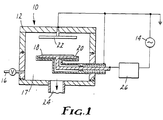
- a discharge chamber is schematically shown in Fig. 1.
- the most important features of the apparatus 10 and procedure include a plasma (not shown) which is generated in housing 12 by a capacitive RF generator 14.
- Gas inlet 16 allows an appropriate gas such as 0 2 , Ar, N 2 , or C0 2 to enter chamber 17 in which a vacuum has been created by means of exit port 24.
- Matching box 26 induction couples RF generator 14 to electrodes 20 and 22.
- a polymeric sheet 18 is placed directly on driven electrode 20 which is opposite electrode 22 which may be cooled by appropriate means (not shown).
- polymer sheet 18 When the apparatus is operating, polymer sheet 18 is not inside the glowing region of the plasma (as is the case in conventional glow discharge treatments) but rather in the cathode "dark space".
- the ion energy in the cathode dark space is about 10 to 100 times greater than the ion energy inside the glow discharge itself.
- the gas pressure inside the evacuated chamber is kept at 6.67x 10⁻² to 2.67 Pa (0.5x 10⁻³ to 20x10- 3 torr).
- the voltage drop across the electrodes is 0.4 to 1 KV at a frequency of 13.56 MHz.
- the discharge power is typically in the range of 0.06-0.50 watt/cm2 (w/cm 2 ).
- the reduction in friction of the sputter-etched polymeric surface is accompanied by substantial changes in both the topography and chemical constitution of the surface.
- the topographical changes in the surface are believed to be unique to the sputter-etching treatment and due to the preferential etching that occurs with semi-crystalline polymer upon ion-bombardment whereby the amorphous portions are ablated away at a faster rate than the more ordered crystalline portions.
- this phenomenon leads to the development of a characteristic grass-like or needle-like microtexture on the surface where the stalks or needles can be identified (by X-ray diffraction for example) as partially ablated crystallites.
- sputter-etching is not solely limited to altering the microtexture of the surface, but involves, in addition, readily identifiable chemical changes within the outermost 10 nm of the polymer surface as revealed by surface spectroscopic techniques. These chemical changes, induced at least partially by free-radical generation in the plasma, appear to be inherent to the sputter-etching treatment and are of general applicability to all the polymers examined in this work.
- sputter-etched surfaces can be accomplished by various methods, the first of which is scanning electron microscopy.
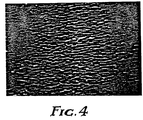
- the typical appearance of both uniaxially and biaxially oriented polymers is shown in the attached micrographs (Figs. 3 and 4). Both micrographs are at 30,000 magnification and were taken at 45° tilt of the sample.
- the sputter-etched surface is characterized by peaks or ridges which are believed to constitute centers of sputter resistance. That is, the less ordered or amorphous material in the interstitial spaces between the polymer crystallites were preferentially ablated.
- the protruding grass-like peaks are not obtained initially. Instead, an intermediate striation pattern (ridges) is obtained characterized by more or less parallel rows of hard crystallites aligned more or less normal (perpendicular) to the stretch direction and alternating with interstitial non-crystalline regions. Further sputter-etching, however, eventually leads to break up of the crystallites conducive to formation of a needle-like microtexture except that the protruding needles are aligned in more or less parallel rows as in a brush. In all cases the depths of etching for any particular polymer is determined by discharge power, time of treatment, and the nature of the gas. By varying these parameters, peak heights in the range of 0.01 to 5.0, preferably 0.01 to 2.0 micrometers can be obtained.
- a low film-on-film coefficient of friction is realized by sputter-etching one or both surfaces of a polymeric film, with the back surface treated, the film will unwind easily from its jumbo roll in production.
- Sputter-etching provides a reduced friction backside for improved handling throughout both manufacturing processes and end-use processes.
- Sputter-etched polymeric surfaces of the present invention have at least one of static and dynamic coefficients of friction in the range of 0.01 to 0.7, preferably 0.01 to 0.4, and most preferably 0.01 to 0.3.
- the process of the present invention will produce, by sputter-etching with an oxygen plasma, a polymer surface with 50-85% carbon and 15-50% oxygen content in the surface. If nitrogen is used as a plasma, or a starting polymer with nitrogen incorporated therein is used, a 1-15% nitrogen content will also be present on the surface. If sputtering gases such as argon are used, both oxygen and nitrogen will be incorporated on the surface (due to contaminants in the gas, presence of oxygen in the original polymer, and reaction of the active surface with atmospheric gases).
- the preferred ratios for any plasma are 70-85% carbon, 10-30% oxygen and 0-10% nitrogen and the surface will contain four distinct types of carbon bonding (designated herein C a , C c , C,, C j and described in Table I below). It is to be understood that these specific types of carbon bonding are in or attached to a polymer backbone. Determination of polymer oxidation levels and carbon species in a polymer surface can most readily be accomplished by a surface analytical technique called X-ray Photoelectron Spectroscopy (XPS) or Electron Spectroscopy for Chemical Analysis (ESCA) (see for example the references "Polymer Surfaces", ed. D. T.
- XPS X-ray Photoelectron Spectroscopy
- ESA Electron Spectroscopy for Chemical Analysis
- Sputter-etched surfaces contain at least 4 atomic percent more oxygen than the bulk polymer. This can be shown by comparison of XPS analysis of the sputtered surface to conventional combustion analysis of the bulk. Determination of surface atomic ratios and chemical make-up of the surface of a sample by the XPS method of analysis is accomplished by bombarding the sample with monochromatic soft x-rays and analyzing the intensity and energies of the emitted core level electrons.
- These types of carbon can be designated C a , C b , C c , C d , C e , C f , Cg, and C h and refer to chemical functionalities shown in Table I below.
- Figs. 5,6,7 and 8 show XPS tracings of untreated polyester film, and polyester film sputter-etched with oxygen, nitrogen, and argon gases, respectively.
- the areas under each curve are proportional to the relative amount of the particular carbon bonding present on the surface. This information is shown in Table II below where different carbon types observed on the surface and their relative contributions as a result of sputter-etching in three different gases is given.
- Distribution of relative amounts of C a , C c , C,, C j may be quite broad with each peak being at least 0.2% of the total carbon region of the spectra and not more than 75%.
- C a is in the range of 20 ⁇ 70%
- C i is in the range of 10-40%
- C c is in the range 2-60%
- C j is in the range 3-25%.
- C a is in the range of 40-70%
- C is in the range of 15-30%
- C c is in the range 5-20%
- C j is in the range of 4 ⁇ 20%.
- Another characterization measurement of interest to the present invention is coefficient of friction of the polymer surface. This measurement is carried out using a modified ASTM D 1894 (1981) standard and involves attaching the sample to a 200 gram hemicylindrical sled riding on a second horizontal surface (which may be more sample) at a constant rate of speed of 12.7 cm (5 inches) per minute pulled by a Universal Testing machine Model TT (Instron Engineering Corp., Canton, MA). Both static and dynamic coefficients can be measured.
- the reduced friction polymer film made according to this invention can be combined with different functional layers to form various products.
- a sputter-etched biaxially oriented PET film combined with a layer of magnetic media, forms an easily-handleable, low-abrasion, and low-drop-out magnetic recording tape.
- the present invention also provides a base for photographic films, adhesive tapes, abrasive sheets, and anti-reflective coatings.
- a low-friction polyester sheet surface was prepared by processing a biaxially oriented PET sheet of 0.0014 cm (0.00056 inch) thickness.
- the sheet was biaxially oriented in a (3/3) ratio, meaning it was stretched three times normal in both the machine direction and the cross web direction.
- the equipment consisted of an UltechTM Model 2400 radio frequency diode sputtering apparatus (Perkin Elmer, Palo Alto, CA) operating at a frequency of 13.56 MHz, modified to include an automatic impedance matching network.
- the apparatus included two substantially parallel, shielded, water cooled aluminum electrodes with a 5 cm (2 inch-gap between them. The electrodes were housed in a bell jar provided with RF shielding.
- the bell jar was evacuated to about 1.33 ⁇ 10 -2 Pa (1 ⁇ 10 -5 torr) and oxygen gas introduced through a needle valve at a flow rate of 60 standard cubic centimeters per minute (SCCM).
- SCCM standard cubic centimeters per minute
- RF energy was capacitively coupled to the cathode, initiating a plasma.
- the energy input was set to a power density of about 0.06 watt/cm2, thus causing the polymer sheet to be sputtered at the surface as positive ions from the plasma were accelerated toward the cathode and impinged on the sample to etch it.
- Treatment time was one minute. Using this apparatus, the etching time, gas pressure, and radiofrequency power were independently adjustable. Upon completion of the treatment the sheet was removed from the apparatus and the following information was noted and recorded.
- microstructured surface of this polyester sheet An SEM analysis showed the microstructured surface of this polyester sheet.
- the microstructured, topography could generally be described as a plurality of randomly positioned peaks, a predominant number of which ranged in height between 0.01 and 0.02 micrometers and had an aspect ratio between 2 and 3 and an average peak to peak distance of 0.015 micrometer.
- XPS analysis of the surface gives the spectrum shown in Fig. 6 where peaks corresponding to C a , C,, C c , and C j can be observed within the composition ratio disclosed above.
- Coefficient of friction measurements were made as per ASTM D-1894 (1981) except for the sled which carried the sample.
- the sled was a 200 g hemicylindrical body with a radius of 2.86 cm (1.13 inches) and a width of 2.86 cm (1.13 inches). The sample size was thus 8.9 cm (3.5 inches) by 2.86 cm (1.13 inches). The sled was pulled in such a fashion that the flat bottom of the hemicylindrical portion was in contact with the base platform.
- the static or starting coefficient of friction, ⁇ s, and the dynamic or moving coefficient of friction, pd, were measured for treated film moving on untreated film and found to be 0.45 and 0.43 respectively and for treated film moving on treated film were found to be 0.40 and 0.45 respectively.
- the experimental error of measurement in this example and all of the following examples is estimated to be ⁇ 0.07 for the static coefficients of friction and ⁇ 0.02 for the dynamic coefficients of friction.
- the observed values of the static coefficients tend to be slightly more erratic than the dynamic coefficients because they were not averaged over a period of time.
- the low-friction sheet thus formed can be used as a support in a construction comprising a magnetic recording medium. Such a medium and method are disclosed, for example, in U.S. Patent No. 4,156,037, Examples 1 through 8.
- Biaxially oriented (3/3) PET film of 0.0014 cm (0.00056 inch) thickness was treated as in Example 1 for 5 minutes, SEMs showed a plurality of random peaks which range in height from 0.02 to 0.03 micrometers and had an aspect ratio between 3 and 4 and an average peak to peak distance of 0.025 micrometers. Coefficient of friction measurements showed ⁇ s and pd to be 0.40 and 0.47 for treated film on untreated film and 0.40 and 0.40 for treated film on treated film. XPS analysis of the surface gives a spectrum similar to that shown in Fig. 6 with peaks corresponding to C a , C,, C c , and C j within the composition ratio disclosed above.
- the low-friction sheet thus formed can be used as a support in a photographic construction comprising a light-sensitive emulsion.
- a photographic construction comprising a light-sensitive emulsion.
- Such an emulsion and coating method are disclosed, for example, in U.S. Patent No. 3,320,069 and Egan, F. Paper Trade J., 121, No. 17, 49 (1945).
- Biaxially oriented (3/3) PET film of 0.0014 cm (0.00056 inch) thickness was treated as in Example 1 for 20 minutes.
- SEMs showed a plurality of random peaks which ranged in height from 0.05 to 0.1 micrometers and had an aspect ratio between 3 and 4 and an average peak distance of 0.066 micrometer.
- Coefficient of friction measurements showed ps and ⁇ d to be 0.40 and 0.45 for treated film on untreated film and 0.25 and 0.25 for treated film on treated film.
- XPS analysis of the surface gives a spectrum similar to that shown in Fig. 6 with peaks corresponding to C a , C,, C c , and C j within the composition ratio disclosed above.
- the topograph would generally be described as a series of ridges and valleys with a height between 0.05 and 0.06 micrometer and spacings between 0.03 and 0.06 micrometer.
- XPS analysis of the surface gives a spectrum similar to that shown in Fig. 6 with peaks corresponding to C a , C,, C o , and C j within the composition ratio disclosed above.
- Biaxially oriented (3/3) PET film of 0.010 cm (0.004 inches) thickness was treated as in Example 4 for 5 minutes, SEMs showed a plurality of random peaks which ranged in height from 0.02 to 0.03 micrometers and had an aspect ratio between 3 and 4 and an average peak to peak distance of 0.02 micrometers. Coefficient of friction measurements showed ps and pd to be 1.14 and 0.53 for treated film on untreated film and ⁇ s and pd to be 0.36 and 0.36 for treated film on treated film.
- XPS analysis of the surface gives a spectrum similar to that shown in Fig. 6 with peaks corresponding to C a , C,, C o , and C j within the composition ratio disclosed above.
- Biaxially oriented (3/3) Nylon 66 film of 0.010 cm (0.004 inches) thickness was treated as in Example 4 for 1.2 minutes.
- SEMs showed a plurality of random peaks which ranged in height from 0.03 to 0.10 micrometer and had an aspect ratio between 1 and 5 and an average peak to peak distance of 0.3 micrometer.
- Coefficient of friction measurements showed ⁇ s and ⁇ d to be 0.41 and 0.42 for treated film on treated film.
- XPS analysis of the surface gives a spectrum similar to that shown in Fig. 7 with peaks corresponding to C a , C,, C o , and C j within the composition ratio disclosed above.
- Biaxially oriented (3/3) Nylon 66 film of 0.010 cm (0.004 inches) thickness was treated as in Example 4 for five minutes.
- SEMs showed a plurality of random peaks which ranged in height from 0.03 to 0.20 micrometer and had an aspect ratio between 2 and 3 and an average peak to peak distance of 0.3 micrometer.
- Coefficient of friction measurements showed ps and pd to be 0.38 and 0.32 for treated film on treated film.
- XPS analysis of the surface gives a spectrum similar to that shown in Fig. 7 with peaks corresponding to C a , C i , C o , and C j within the composition ratio disclosed above.
- Biaxially oriented (3/3) poly(butylene terephthalate) (PET) film of 0.010 cm (0.004 inches) thickness was treated as in Example 4 for one minute.
- SEMs showed a plurality of random peaks which ranged in height from 0.01 to 0.02 micrometer and had an aspect ratio between 2 and 4 and an average peak to peak distance of 0.03 micrometers.
- Coefficient of friction measurements showed ⁇ s and pd to be 0.38 and 0.40 for treated film on treated film.
- XPS analysis of the surface gives a spectrum similar to that shown in Fig. 6 with peaks corresponding to C a , C f , C c , and C j within the composition ratio disclosed above.
- Biaxially oriented (3/3) PBT film of 0.010 cm (0.004 inches) thickness was treated as in Example 4 for 5 minutes.
- SEMs showed a plurality of random peaks which ranged in height from 0.02 to 0.06 micrometer and had an aspect ratio between 3 and 4 and an average peak to peak separation distance of 0.05 micrometer.
- Coefficient of friction measurements showed ps and ⁇ d to be 0.40 and 0.40 for treated film on treated film.
- XPS analysis of the surface gives a spectrum similar to that shown in Fig. 6 with peaks corresponding to C a , C,, C c and C j within the composition ratio disclosed above.
- Biaxially oriented (3/3) PBT film of 0.010 cm (0.004 inches) thickness was treated as in Example 4, except with argon instead of oxygen gas in the apparatus chamber, for 10 minutes.
- SEMs showed a plurality of random peaks which ranged in height from 0.01 to 0.03 micrometer and had an aspect ratio between 4 and 5 and an average separation distance of 0.07 micrometer.
- Coefficient of friction measurements showed ⁇ s and pd to be 0.60 and 0.55 for treated film on treated film.
- XPS analysis of the surface gives a spectrum similar to that shown in Fig. 8 with peaks corresponding to C a , C i , C o , and C j within the composition ratiio disclosed above.
- Table III summarizes the coefficient of friction measurements of the examples.
- the numbers after the film name indicate the orientation ratios; thus, biaxial PET 3/3 indicates a PET film oriented three times its normal extruded dimensions in both the machine direction and the cross web direction.
- the number in parenthesis after the film type indicates the treatment time in minutes; thus, PET (5)/PET (5) indicates the coefficient of friction was measured for PET sliding on PET, both samples having been treated for five minutes.
Landscapes
- Chemical & Material Sciences (AREA)
- Engineering & Computer Science (AREA)
- Materials Engineering (AREA)
- Plasma & Fusion (AREA)
- Physics & Mathematics (AREA)
- Chemical Kinetics & Catalysis (AREA)
- Manufacturing & Machinery (AREA)
- Mechanical Engineering (AREA)
- Metallurgy (AREA)
- Organic Chemistry (AREA)
- Treatments Of Macromolecular Shaped Articles (AREA)
- Manufacture Of Macromolecular Shaped Articles (AREA)
- Laminated Bodies (AREA)
- Magnetic Record Carriers (AREA)
Claims (10)
Applications Claiming Priority (2)
| Application Number | Priority Date | Filing Date | Title |
|---|---|---|---|
| US06/666,491 US4568598A (en) | 1984-10-30 | 1984-10-30 | Article with reduced friction polymer sheet support |
| US666491 | 1984-10-30 |
Publications (2)
| Publication Number | Publication Date |
|---|---|
| EP0200751A1 EP0200751A1 (de) | 1986-11-12 |
| EP0200751B1 true EP0200751B1 (de) | 1988-12-28 |
Family
ID=24674310
Family Applications (1)
| Application Number | Title | Priority Date | Filing Date |
|---|---|---|---|
| EP85905273A Expired EP0200751B1 (de) | 1984-10-30 | 1985-10-09 | Artikel mit träger aus einem polymeren blatt mit verminderter reibung |
Country Status (5)
| Country | Link |
|---|---|
| US (1) | US4568598A (de) |
| EP (1) | EP0200751B1 (de) |
| JP (1) | JPS62500648A (de) |
| DE (1) | DE3567121D1 (de) |
| WO (1) | WO1986002766A1 (de) |
Families Citing this family (69)
| Publication number | Priority date | Publication date | Assignee | Title |
|---|---|---|---|---|
| KR890004258B1 (ko) * | 1984-11-14 | 1989-10-28 | 가부시끼가이샤 도오시바 | 수직자기기록 매체 및 그 제조방법 |
| US4908094A (en) * | 1986-04-14 | 1990-03-13 | International Business Machines Corporation | Method for laminating organic materials via surface modification |
| US4715941A (en) * | 1986-04-14 | 1987-12-29 | International Business Machines Corporation | Surface modification of organic materials to improve adhesion |
| US4892635A (en) * | 1986-06-26 | 1990-01-09 | American Telephone And Telegraph Company At&T Bell Laboratories | Pattern transfer process utilizing multilevel resist structure for fabricating integrated-circuit devices |
| US5178957A (en) * | 1989-05-02 | 1993-01-12 | Minnesota Mining And Manufacturing Company | Noble metal-polymer composites and flexible thin-film conductors prepared therefrom |
| JPH0450242A (ja) * | 1990-06-16 | 1992-02-19 | Somar Corp | 摺動性と導電性を有するプラスチックフィルム |
| US5389195A (en) * | 1991-03-07 | 1995-02-14 | Minnesota Mining And Manufacturing Company | Surface modification by accelerated plasma or ions |
| US5238729A (en) * | 1991-04-05 | 1993-08-24 | Minnesota Mining And Manufacturing Company | Sensors based on nanosstructured composite films |
| US5336558A (en) * | 1991-06-24 | 1994-08-09 | Minnesota Mining And Manufacturing Company | Composite article comprising oriented microstructures |
| US5328557A (en) * | 1993-01-07 | 1994-07-12 | Micron Semiconductor, Inc. | Plasma treatment of O-rings |
| US5425980A (en) * | 1994-02-22 | 1995-06-20 | Eastman Kodak Company | Use of glow discharge treatment to promote adhesion of aqueous coats to substrate |
| JPH07319119A (ja) * | 1994-05-26 | 1995-12-08 | Fuji Photo Film Co Ltd | 写真用支持体 |
| US5653266A (en) * | 1994-10-11 | 1997-08-05 | Markel Corporation | Chemically bonded multi-wall conduit |
| WO1996019345A1 (en) * | 1994-12-22 | 1996-06-27 | Dai Nippon Printing Co., Ltd. | Composite film |
| DE69625105T2 (de) * | 1995-02-17 | 2003-07-17 | Eastman Kodak Co., Rochester | Photographisches Element und photographische Filmunterlage dafür |
| US5726524A (en) * | 1996-05-31 | 1998-03-10 | Minnesota Mining And Manufacturing Company | Field emission device having nanostructured emitters |
| US6136412A (en) * | 1997-10-10 | 2000-10-24 | 3M Innovative Properties Company | Microtextured catalyst transfer substrate |
| US6042959A (en) * | 1997-10-10 | 2000-03-28 | 3M Innovative Properties Company | Membrane electrode assembly and method of its manufacture |
| US5879827A (en) * | 1997-10-10 | 1999-03-09 | Minnesota Mining And Manufacturing Company | Catalyst for membrane electrode assembly and method of making |
| US5879828A (en) * | 1997-10-10 | 1999-03-09 | Minnesota Mining And Manufacturing Company | Membrane electrode assembly |
| US6040124A (en) * | 1998-11-20 | 2000-03-21 | Eastman Kodak Company | Imaging element with biaxially oriented sheet with fluoropolymer |
| US6521324B1 (en) | 1999-11-30 | 2003-02-18 | 3M Innovative Properties Company | Thermal transfer of microstructured layers |
| US6605321B1 (en) * | 2000-07-20 | 2003-08-12 | Centre National De La Recherche Scientifique (Cnrs) | Method of treating materials by irradiation |
| US6458462B1 (en) | 2000-12-13 | 2002-10-01 | 3M Innovative Properties Company | Sporting goods having a ceramer coating |
| US20030077466A1 (en) * | 2001-10-19 | 2003-04-24 | Smith Sidney T. | Multilayered polymer structure |
| US7262334B2 (en) * | 2002-11-13 | 2007-08-28 | Regents Of The University Of Minnesota | Catalytic partial oxidation of hydrocarbons |
| US7419741B2 (en) * | 2003-09-29 | 2008-09-02 | 3M Innovative Properties Company | Fuel cell cathode catalyst |
| US7572534B2 (en) * | 2004-09-20 | 2009-08-11 | 3M Innovative Properties Company | Fuel cell membrane electrode assembly |
| US8101317B2 (en) * | 2004-09-20 | 2012-01-24 | 3M Innovative Properties Company | Durable fuel cell having polymer electrolyte membrane comprising manganese oxide |
| CA2597290A1 (en) * | 2005-02-16 | 2006-08-24 | 3M Innovative Properties Company | Fuel cell catalyst |
| JP2006318550A (ja) * | 2005-05-11 | 2006-11-24 | Fuji Photo Film Co Ltd | 磁気記録媒体 |
| US7790304B2 (en) * | 2005-09-13 | 2010-09-07 | 3M Innovative Properties Company | Catalyst layers to enhance uniformity of current density in membrane electrode assemblies |
| US20070059452A1 (en) | 2005-09-13 | 2007-03-15 | Debe Mark K | Formation of nanostructured layers through continued screw dislocation growth |
| US7622217B2 (en) | 2005-10-12 | 2009-11-24 | 3M Innovative Properties Company | Fuel cell nanocatalyst |
| US20070082814A1 (en) * | 2005-10-12 | 2007-04-12 | 3M Innovative Properties Company | Ternary nanocatalyst and method of making |
| US8628871B2 (en) | 2005-10-28 | 2014-01-14 | 3M Innovative Properties Company | High durability fuel cell components with cerium salt additives |
| US8367267B2 (en) * | 2005-10-28 | 2013-02-05 | 3M Innovative Properties Company | High durability fuel cell components with cerium oxide additives |
| US7740902B2 (en) * | 2006-04-20 | 2010-06-22 | 3M Innovative Properties Company | Method for making oxygen-reducing catalyst layers |
| US7906251B2 (en) * | 2006-04-20 | 2011-03-15 | 3M Innovative Properties Company | Oxygen-reducing catalyst layer |
| EP2338193A1 (de) * | 2008-08-25 | 2011-06-29 | 3M Innovative Properties Company | Brennstoffzellen-nanokatalysator mit spannungsumpolungstoleranz |
| US8735023B2 (en) | 2009-12-14 | 2014-05-27 | GM Global Technology Operations LLC | Fuel cell with layered electrode |
| CN102668201B (zh) | 2009-12-22 | 2015-05-20 | 3M创新有限公司 | 具有纳米结构化催化剂和分散催化剂亚层的燃料电池电极 |
| JP6050367B2 (ja) | 2011-10-10 | 2016-12-21 | スリーエム イノベイティブ プロパティズ カンパニー | 触媒電極を作製する方法 |
| EP2798690A1 (de) | 2011-12-29 | 2014-11-05 | 3M Innovative Properties Company | Elektrochemische zellelektrode |
| CN104884161A (zh) | 2012-12-19 | 2015-09-02 | 3M创新有限公司 | 纳米结构化晶须制品 |
| CA2909743A1 (en) | 2013-04-23 | 2014-11-27 | 3M Innovative Properties Company | Catalyst electrodes and method of making it |
| WO2016100034A1 (en) | 2014-12-15 | 2016-06-23 | 3M Innovative Properties Company | Membrane electrode assembly |
| EP3303657B1 (de) | 2015-05-26 | 2023-06-28 | 3M Innovative Properties Company | Sauerstoffentwicklungskatalysatorelektroden sowie verfahren zur herstellung und verwendung davon |
| JP6816938B2 (ja) * | 2015-07-27 | 2021-01-20 | 日東電工株式会社 | 撥油性が付与された通気フィルタ |
| CN109923716A (zh) | 2016-10-26 | 2019-06-21 | 3M创新有限公司 | 催化剂 |
| JP2019534148A (ja) | 2016-10-26 | 2019-11-28 | スリーエム イノベイティブ プロパティズ カンパニー | 燃料電池用pt−ni−ir触媒 |
| WO2018080794A1 (en) | 2016-10-26 | 2018-05-03 | 3M Innovative Properties Company | Catalyst |
| WO2018080792A1 (en) | 2016-10-26 | 2018-05-03 | 3M Innovative Properties Company | Pt-ni-ir catalyst for fuel cell |
| WO2018118877A1 (en) | 2016-12-20 | 2018-06-28 | 3M Innovative Properties Company | Electrolyzer including a porous hydrophobic gas diffusion layer |
| US20200017980A1 (en) | 2017-04-03 | 2020-01-16 | 3M Innovative Properties Company | Water electrolyzers |
| EP3607113B1 (de) | 2017-04-03 | 2023-07-19 | 3M Innovative Properties Company | Wasserelektrolysatoren |
| WO2018185616A1 (en) | 2017-04-03 | 2018-10-11 | 3M Innovative Properties Company | Water electrolyzers |
| WO2018226444A1 (en) | 2017-06-05 | 2018-12-13 | 3M Innovative Properties Company | Electrode catalyst-containing dispersion compositions and articles therefrom |
| WO2019126243A1 (en) | 2017-12-22 | 2019-06-27 | 3M Innovative Properties Company | Dispersed catalyst-containing anode compositions for electrolyzers |
| US11973232B2 (en) | 2018-04-04 | 2024-04-30 | 3M Innovative Properties Company | Catalyst |
| US20210008528A1 (en) | 2018-04-04 | 2021-01-14 | 3M Innovative Properties Company | Catalyst comprising pt, ni, and ru |
| WO2019193461A1 (en) | 2018-04-04 | 2019-10-10 | 3M Innovative Properties Company | Catalyst comprising pt, ni, and cr |
| CN111954950A (zh) | 2018-04-04 | 2020-11-17 | 3M创新有限公司 | 包含Pt、Ni和Ta的催化剂 |
| CN112042022A (zh) | 2018-04-13 | 2020-12-04 | 3M创新有限公司 | 催化剂 |
| WO2019198029A1 (en) | 2018-04-13 | 2019-10-17 | 3M Innovative Properties Company | Catalyst |
| EP3776703B1 (de) | 2018-04-13 | 2024-02-21 | 3M Innovative Properties Company | Katalysator |
| US11560632B2 (en) | 2018-09-27 | 2023-01-24 | 3M Innovative Properties Company | Membrane, membrane electrode assembly, and water electrolyzer including the same |
| EP3895238B1 (de) | 2018-12-13 | 2025-08-06 | 3M Innovative Properties Company | Katalysator |
| WO2020128849A1 (en) | 2018-12-19 | 2020-06-25 | 3M Innovative Properties Company | Water electrolyzers |
Family Cites Families (8)
| Publication number | Priority date | Publication date | Assignee | Title |
|---|---|---|---|---|
| JPS5416723B2 (de) * | 1971-10-27 | 1979-06-25 | ||
| US4155826A (en) * | 1975-04-14 | 1979-05-22 | Nitto Electric Industrial Co., Ltd. | Process for surface treating molded articles of fluorine resins |
| JPS51125455A (en) * | 1975-04-14 | 1976-11-01 | Jiyunkichi Nakai | Method of surface treatment of molded article |
| US4153920A (en) * | 1975-08-23 | 1979-05-08 | Fuji Photo Film Co., Ltd. | Recording method employing a magnetic recording medium |
| JPS585452B2 (ja) * | 1975-08-28 | 1983-01-31 | 富士写真フイルム株式会社 | 磁気記録媒体 |
| JPS6035267B2 (ja) * | 1978-01-09 | 1985-08-13 | 東レ株式会社 | 表面の改質されたポリエステルフイルム |
| US4340276A (en) * | 1978-11-01 | 1982-07-20 | Minnesota Mining And Manufacturing Company | Method of producing a microstructured surface and the article produced thereby |
| JPS5919230A (ja) * | 1982-07-21 | 1984-01-31 | Fuji Photo Film Co Ltd | 磁気記録媒体 |
-
1984
- 1984-10-30 US US06/666,491 patent/US4568598A/en not_active Expired - Fee Related
-
1985
- 1985-10-09 DE DE8585905273T patent/DE3567121D1/de not_active Expired
- 1985-10-09 EP EP85905273A patent/EP0200751B1/de not_active Expired
- 1985-10-09 JP JP60504629A patent/JPS62500648A/ja active Pending
- 1985-10-09 WO PCT/US1985/001958 patent/WO1986002766A1/en not_active Ceased
Also Published As
| Publication number | Publication date |
|---|---|
| EP0200751A1 (de) | 1986-11-12 |
| JPS62500648A (ja) | 1987-03-19 |
| US4568598A (en) | 1986-02-04 |
| DE3567121D1 (en) | 1989-02-02 |
| WO1986002766A1 (en) | 1986-05-09 |
Similar Documents
| Publication | Publication Date | Title |
|---|---|---|
| EP0200751B1 (de) | Artikel mit träger aus einem polymeren blatt mit verminderter reibung | |
| US4297187A (en) | Surface treatment of plastic material | |
| EP0238663B1 (de) | Polyesterfilm mit glatter und stark adhäsiver oberfläche und verfahren zu seiner herstellung | |
| US5080971A (en) | Magnetic recording medium | |
| KR100517045B1 (ko) | 복합 폴리에스테르 필름 및 자기 기록 매체 | |
| US5798135A (en) | Method for producing a magnetic recording medium having a carbon protective layer | |
| US4844978A (en) | Magnetic recording medium | |
| EP0936600B1 (de) | Magnetischer Aufzeichungsträger, Verfahren zu seiner Herstellung und Verfahren zur Bildung eines Filmes mit Plasma CVD | |
| Zhang et al. | Thermal graft copolymerization with concurrent lamination of low density polyethylene and poly (tetrafluoroethylene) films | |
| JPS60171622A (ja) | 磁気記録媒体 | |
| KR19990014066A (ko) | 2축 배향 적층 폴리에스테르 필름 | |
| CA1092451A (en) | Leader or trailer tape for a magnetic recording medium | |
| JPH043896B2 (de) | ||
| JPH10289445A (ja) | 磁気記録媒体 | |
| Engelmann et al. | Dependence of photoresist surface modifications during plasma-based pattern transfer on choice of feedgas composition: Comparison of C4F8-and CF4-based discharges | |
| US4863811A (en) | Magnetic recording medium and method of making | |
| Sumiya et al. | Study of 193nm photoresist degradation during short time fluorocarbon plasma exposures. II. Plasma parameter trends for photoresist degradation | |
| JPH0253936B2 (de) | ||
| Inaba et al. | Properties of diamond-like carbon films fabricated by the filtered cathodic vacuum arc method | |
| KR100497594B1 (ko) | 저대전성복합폴리에스테르필름 | |
| JPH0568353B2 (de) | ||
| JPH08167146A (ja) | 磁気記録媒体の製造方法 | |
| JP2672421B2 (ja) | 磁気記録媒体用二軸配向ポリエステルフイルム | |
| JP2003011255A (ja) | 機能性膜とその製造方法 | |
| JPH08180363A (ja) | 磁気記録媒体およびその製造方法 |
Legal Events
| Date | Code | Title | Description |
|---|---|---|---|
| PUAI | Public reference made under article 153(3) epc to a published international application that has entered the european phase |
Free format text: ORIGINAL CODE: 0009012 |
|
| AK | Designated contracting states |
Kind code of ref document: A1 Designated state(s): AT BE CH DE FR GB IT LI LU NL SE |
|
| 17P | Request for examination filed |
Effective date: 19861013 |
|
| RBV | Designated contracting states (corrected) |
Designated state(s): DE FR GB IT |
|
| 17Q | First examination report despatched |
Effective date: 19870904 |
|
| ITF | It: translation for a ep patent filed | ||
| GRAA | (expected) grant |
Free format text: ORIGINAL CODE: 0009210 |
|
| AK | Designated contracting states |
Kind code of ref document: B1 Designated state(s): DE FR GB IT |
|
| REF | Corresponds to: |
Ref document number: 3567121 Country of ref document: DE Date of ref document: 19890202 |
|
| ET | Fr: translation filed | ||
| PLBE | No opposition filed within time limit |
Free format text: ORIGINAL CODE: 0009261 |
|
| STAA | Information on the status of an ep patent application or granted ep patent |
Free format text: STATUS: NO OPPOSITION FILED WITHIN TIME LIMIT |
|
| 26N | No opposition filed | ||
| ITTA | It: last paid annual fee | ||
| PGFP | Annual fee paid to national office [announced via postgrant information from national office to epo] |
Ref country code: FR Payment date: 19930915 Year of fee payment: 9 |
|
| PGFP | Annual fee paid to national office [announced via postgrant information from national office to epo] |
Ref country code: DE Payment date: 19930916 Year of fee payment: 9 |
|
| PGFP | Annual fee paid to national office [announced via postgrant information from national office to epo] |
Ref country code: GB Payment date: 19930920 Year of fee payment: 9 |
|
| PG25 | Lapsed in a contracting state [announced via postgrant information from national office to epo] |
Ref country code: GB Effective date: 19941009 |
|
| GBPC | Gb: european patent ceased through non-payment of renewal fee |
Effective date: 19941009 |
|
| PG25 | Lapsed in a contracting state [announced via postgrant information from national office to epo] |
Ref country code: FR Effective date: 19950630 |
|
| PG25 | Lapsed in a contracting state [announced via postgrant information from national office to epo] |
Ref country code: DE Effective date: 19950701 |
|
| REG | Reference to a national code |
Ref country code: FR Ref legal event code: ST |