EP0186036B1 - Liquid crystal display device - Google Patents
Liquid crystal display device Download PDFInfo
- Publication number
- EP0186036B1 EP0186036B1 EP85115694A EP85115694A EP0186036B1 EP 0186036 B1 EP0186036 B1 EP 0186036B1 EP 85115694 A EP85115694 A EP 85115694A EP 85115694 A EP85115694 A EP 85115694A EP 0186036 B1 EP0186036 B1 EP 0186036B1
- Authority
- EP
- European Patent Office
- Prior art keywords
- gate
- liquid crystal
- display device
- crystal display
- layer
- Prior art date
- Legal status (The legal status is an assumption and is not a legal conclusion. Google has not performed a legal analysis and makes no representation as to the accuracy of the status listed.)
- Expired - Lifetime
Links
- 239000004973 liquid crystal related substance Substances 0.000 title claims abstract description 44
- 239000004065 semiconductor Substances 0.000 claims abstract description 70
- 239000010408 film Substances 0.000 claims abstract description 56
- 239000010409 thin film Substances 0.000 claims abstract description 52
- 229910021417 amorphous silicon Inorganic materials 0.000 claims description 30
- 239000000758 substrate Substances 0.000 claims description 30
- 239000000463 material Substances 0.000 claims description 13
- 230000003071 parasitic effect Effects 0.000 claims description 10
- 150000001875 compounds Chemical class 0.000 claims description 8
- 229910052751 metal Inorganic materials 0.000 claims description 7
- 239000002184 metal Substances 0.000 claims description 7
- LEVVHYCKPQWKOP-UHFFFAOYSA-N [Si].[Ge] Chemical compound [Si].[Ge] LEVVHYCKPQWKOP-UHFFFAOYSA-N 0.000 claims description 4
- 210000002858 crystal cell Anatomy 0.000 claims description 4
- LQJIDIOGYJAQMF-UHFFFAOYSA-N lambda2-silanylidenetin Chemical compound [Si].[Sn] LQJIDIOGYJAQMF-UHFFFAOYSA-N 0.000 claims description 4
- 150000003377 silicon compounds Chemical class 0.000 claims description 3
- 238000003475 lamination Methods 0.000 claims 1
- 239000011159 matrix material Substances 0.000 abstract description 3
- 238000004519 manufacturing process Methods 0.000 description 6
- 229910052782 aluminium Inorganic materials 0.000 description 5
- XAGFODPZIPBFFR-UHFFFAOYSA-N aluminium Chemical compound [Al] XAGFODPZIPBFFR-UHFFFAOYSA-N 0.000 description 5
- 230000000903 blocking effect Effects 0.000 description 4
- 230000000694 effects Effects 0.000 description 4
- 238000000034 method Methods 0.000 description 4
- 229910052581 Si3N4 Inorganic materials 0.000 description 3
- 238000002161 passivation Methods 0.000 description 3
- 238000000059 patterning Methods 0.000 description 3
- HQVNEWCFYHHQES-UHFFFAOYSA-N silicon nitride Chemical compound N12[Si]34N5[Si]62N3[Si]51N64 HQVNEWCFYHHQES-UHFFFAOYSA-N 0.000 description 3
- VYZAMTAEIAYCRO-UHFFFAOYSA-N Chromium Chemical compound [Cr] VYZAMTAEIAYCRO-UHFFFAOYSA-N 0.000 description 2
- VYPSYNLAJGMNEJ-UHFFFAOYSA-N Silicium dioxide Chemical compound O=[Si]=O VYPSYNLAJGMNEJ-UHFFFAOYSA-N 0.000 description 2
- 230000015572 biosynthetic process Effects 0.000 description 2
- 238000005229 chemical vapour deposition Methods 0.000 description 2
- 229910052804 chromium Inorganic materials 0.000 description 2
- 239000011651 chromium Substances 0.000 description 2
- 238000011109 contamination Methods 0.000 description 2
- 230000006866 deterioration Effects 0.000 description 2
- 239000007789 gas Substances 0.000 description 2
- 229910052732 germanium Inorganic materials 0.000 description 2
- GNPVGFCGXDBREM-UHFFFAOYSA-N germanium atom Chemical compound [Ge] GNPVGFCGXDBREM-UHFFFAOYSA-N 0.000 description 2
- 239000011521 glass Substances 0.000 description 2
- 238000005286 illumination Methods 0.000 description 2
- 238000009413 insulation Methods 0.000 description 2
- 229910052755 nonmetal Inorganic materials 0.000 description 2
- 238000001259 photo etching Methods 0.000 description 2
- 125000006850 spacer group Chemical group 0.000 description 2
- 239000004642 Polyimide Substances 0.000 description 1
- BLRPTPMANUNPDV-UHFFFAOYSA-N Silane Chemical compound [SiH4] BLRPTPMANUNPDV-UHFFFAOYSA-N 0.000 description 1
- XUIMIQQOPSSXEZ-UHFFFAOYSA-N Silicon Chemical compound [Si] XUIMIQQOPSSXEZ-UHFFFAOYSA-N 0.000 description 1
- 229910009201 Sn(CH3)4 Inorganic materials 0.000 description 1
- 230000002411 adverse Effects 0.000 description 1
- -1 black ink Chemical class 0.000 description 1
- 239000004020 conductor Substances 0.000 description 1
- 238000010586 diagram Methods 0.000 description 1
- 230000003993 interaction Effects 0.000 description 1
- 150000002739 metals Chemical class 0.000 description 1
- 229920001721 polyimide Polymers 0.000 description 1
- 238000001556 precipitation Methods 0.000 description 1
- 229910052710 silicon Inorganic materials 0.000 description 1
- 239000010703 silicon Substances 0.000 description 1
- 235000012239 silicon dioxide Nutrition 0.000 description 1
- 239000000377 silicon dioxide Substances 0.000 description 1
- 229910001415 sodium ion Inorganic materials 0.000 description 1
- 238000005476 soldering Methods 0.000 description 1
- VXKWYPOMXBVZSJ-UHFFFAOYSA-N tetramethyltin Chemical compound C[Sn](C)(C)C VXKWYPOMXBVZSJ-UHFFFAOYSA-N 0.000 description 1
Images




Classifications
-
- H—ELECTRICITY
- H10—SEMICONDUCTOR DEVICES; ELECTRIC SOLID-STATE DEVICES NOT OTHERWISE PROVIDED FOR
- H10D—INORGANIC ELECTRIC SEMICONDUCTOR DEVICES
- H10D30/00—Field-effect transistors [FET]
- H10D30/60—Insulated-gate field-effect transistors [IGFET]
- H10D30/67—Thin-film transistors [TFT]
- H10D30/6729—Thin-film transistors [TFT] characterised by the electrodes
- H10D30/673—Thin-film transistors [TFT] characterised by the electrodes characterised by the shapes, relative sizes or dispositions of the gate electrodes
- H10D30/6731—Top-gate only TFTs
-
- G—PHYSICS
- G02—OPTICS
- G02F—OPTICAL DEVICES OR ARRANGEMENTS FOR THE CONTROL OF LIGHT BY MODIFICATION OF THE OPTICAL PROPERTIES OF THE MEDIA OF THE ELEMENTS INVOLVED THEREIN; NON-LINEAR OPTICS; FREQUENCY-CHANGING OF LIGHT; OPTICAL LOGIC ELEMENTS; OPTICAL ANALOGUE/DIGITAL CONVERTERS
- G02F1/00—Devices or arrangements for the control of the intensity, colour, phase, polarisation or direction of light arriving from an independent light source, e.g. switching, gating or modulating; Non-linear optics
- G02F1/01—Devices or arrangements for the control of the intensity, colour, phase, polarisation or direction of light arriving from an independent light source, e.g. switching, gating or modulating; Non-linear optics for the control of the intensity, phase, polarisation or colour
- G02F1/13—Devices or arrangements for the control of the intensity, colour, phase, polarisation or direction of light arriving from an independent light source, e.g. switching, gating or modulating; Non-linear optics for the control of the intensity, phase, polarisation or colour based on liquid crystals, e.g. single liquid crystal display cells
- G02F1/133—Constructional arrangements; Operation of liquid crystal cells; Circuit arrangements
- G02F1/136—Liquid crystal cells structurally associated with a semi-conducting layer or substrate, e.g. cells forming part of an integrated circuit
- G02F1/1362—Active matrix addressed cells
- G02F1/1368—Active matrix addressed cells in which the switching element is a three-electrode device
-
- H—ELECTRICITY
- H10—SEMICONDUCTOR DEVICES; ELECTRIC SOLID-STATE DEVICES NOT OTHERWISE PROVIDED FOR
- H10D—INORGANIC ELECTRIC SEMICONDUCTOR DEVICES
- H10D30/00—Field-effect transistors [FET]
- H10D30/60—Insulated-gate field-effect transistors [IGFET]
- H10D30/67—Thin-film transistors [TFT]
- H10D30/6704—Thin-film transistors [TFT] having supplementary regions or layers in the thin films or in the insulated bulk substrates for controlling properties of the device
- H10D30/6723—Thin-film transistors [TFT] having supplementary regions or layers in the thin films or in the insulated bulk substrates for controlling properties of the device having light shields
-
- H—ELECTRICITY
- H10—SEMICONDUCTOR DEVICES; ELECTRIC SOLID-STATE DEVICES NOT OTHERWISE PROVIDED FOR
- H10D—INORGANIC ELECTRIC SEMICONDUCTOR DEVICES
- H10D30/00—Field-effect transistors [FET]
- H10D30/60—Insulated-gate field-effect transistors [IGFET]
- H10D30/67—Thin-film transistors [TFT]
- H10D30/6729—Thin-film transistors [TFT] characterised by the electrodes
- H10D30/673—Thin-film transistors [TFT] characterised by the electrodes characterised by the shapes, relative sizes or dispositions of the gate electrodes
-
- H—ELECTRICITY
- H10—SEMICONDUCTOR DEVICES; ELECTRIC SOLID-STATE DEVICES NOT OTHERWISE PROVIDED FOR
- H10D—INORGANIC ELECTRIC SEMICONDUCTOR DEVICES
- H10D30/00—Field-effect transistors [FET]
- H10D30/60—Insulated-gate field-effect transistors [IGFET]
- H10D30/67—Thin-film transistors [TFT]
- H10D30/674—Thin-film transistors [TFT] characterised by the active materials
- H10D30/6741—Group IV materials, e.g. germanium or silicon carbide
- H10D30/6743—Silicon
- H10D30/6746—Amorphous silicon
Definitions
- This invention relates to a liquid crystal display device comprising: a liquid crystal cell including first and second transparent substrates spaced apart a small distance and facing each other and a liquid crystal sealed between said first and second transparent substrates; a common electrode constituted by a transparent conductive film formed on the inner surface of said first transparent substrate; a plurality of display electrodes constituted by a transparent conductive film formed on the inner surface of said second transparent substrate; a plurality of thin film transistors having respective drains connected to respective ones of the said plurality of display electrodes; each of said thin film transistors including: a drain electrode constituted by a portion of said display electrode; a source electrode electrically connected to a corresponding source bus; a semiconductor layer provided between and overlying said drain and source electrodes; a gate insulating film overlying said semiconductor layer; and a gate electrode connected to a corresponding gate bus and formed on said gate insulating film, an edge of said gate electrode being spaced back from the corresponding edge of said gate insulating film, so that the gate electrode only partly
- Such a device is employable for displaying an image, for instance, and may constitute an active matrix type liquid crystal display device, that has a plurality of display electrodes provided in a liquid crystal cell and selectively drivable by thin film transistors for display.
- a prior art liquid crystal display device is disclosed in "Electronics International", May 19, 1982 at page 94.
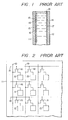
- Another such display device of conventional type has a structure as shown in Fig. 1.
- the device comprises a pair of transparent substrates of glass or the like facing each other.
- a spacer 13 is provided between the substrates 11 and 12 along the edges thereof.
- a liquid crystal 14 is sealed between the substrates 11 and 12.
- the substrates 11 and 12, spacer 13 and liquid crystal 14 constitute a liquid crystal cell.
- a plurality of display electrodes 15 consisting of a transparent conductive film are formed on the inner surface of one of the transparent substrates, i.e. substrate 11.
- thin film transistors 16 are formed as switching elements such that they are contiguous to the display electrodes 15 with their drains connected thereto.
- a common electrode 17 is formed on the other transparent substrate 12. The common electrode 17 faces the plurality of display electrodes 15.
- the display electrodes 15 serve as picture element electrodes, for instance. As shown in Fig. 2, they are square in shape and arranged in a closely spaced-apart relation to one another. They are arranged in rows and columns on the transparent substrate 11. Gate buses 18 are formed such that they extend near and along the individual rows of display electrodes 15. Source buses 19 are formed such that they extend near and along the individual columns of display electrodes 15. The thin film transistors 16 noted above are formed at the intersections of the gate buses 18 and source buses 19. Each thin film transistor 16 has its gate connected to the associated gate bus 18, its source connected to the associated source bus 19 and its drain connected to the corresponding display electrode 15.
- the thin film transistor 16 has a structure as shown in Figs. 3 and 4.
- the display electrodes 15 and source buses 19 are formed from a transparent conductive film, e.g., an ITO, on the transparent substrate 11.
- a semiconductor layer 21 of amorphous silicon or the like is formed such that it strides parallel and closely spaced-apart portions of each display electrode 15 and the associated source bus 19.
- a gate insulating film 22 of silicon nitride or the like is formed on the semiconductor layer 21.
- a gate electrode 23 is formed on the gate insulating film 22 such that it overlies part of each display electrode 15 and associated source bus 19 via the gate insulating film 22 and each semiconductor layer 21. One end of the gate electrode 23 is connected to the associated gate bus 18.
- Portions of the display electrode 15 and source bus 19 facing each gate electrode 23 constitute drain and source electrodes 15a and 19a, respectively.
- the thin film transistor 16 is constituted by these electrodes 15a and 19a, the semiconductor layer 21, the gate insulating film 22 and the gate electrode 23.
- the individual gate electrodes 23 and gate buses 18 are formed simultaneously from aluminum, for instance.
- the semiconductor layer 21 is formed only over the region where the thin film transistor 16 is formed. Therefore, there is a considerable level difference between the gate electrode 23 and gate bus 18 with respect to the substrate 11. Due to this level difference, breakage of connection between the gate electrode 23 and gate bus 18 is liable to result.
- each of the semiconductor layer 21 and the gate insulating film 22 is formed over the entire surface other than the regions of display electrode 15 and source bus 19 in the same pattern as that of the contiguous gate bus 18 and gate electrode 23 to be formed.
- an aluminum layer, for instance, for the gate bus 18 and gate electrode 23 is formed over the two layers.
- a parasitic thin film transistor is formed by a portion (not shown) of the semiconductor layer 21 extending beneath the gate bus 18, gate insulating film 22, source bus 19 and drain electrode 15a.
- the amorphous silicon of the semiconductor layer 21 is photo-conductive, and its resistivity is reduced from 109 ⁇ -cm to about 104 ⁇ -cm when it is illuminated by light of 100,000 luxes. Therefore, when the semiconductor layer portion of the parasitic thin film transistor is illuminated, a current leak from the source bus 19 adjacent to the thin film transistor 16 is caused to deteriorate the on-off ratio thereof.
- a light-blocking layer 25 of chromium or like metal is formed such that it faces the semiconductor layer 21, as shown in Fig. 5.
- the light-blocking layer 25 is insulated from display electrode 15 and source bus 19 by an insulating layer 27. It may be thought to form the light-blocking layer 25 such that it faces the entire surface of the semiconductor layer portion to avoid the influence of the parasitic thin film transistor noted above. In this case, however, the electrostatic capacitance between the light-blocking layer and gate bus is increased too much to permit high speed control of the thin film transistor.
- the source bus terminal is constituted by the same material as the source bus, while the gate bus terminal is constituted by the same material as the gate bus.
- the source bus terminal is made of a transparent conductive material, e.g., ITO, while the gate bus terminal is made of aluminum. Since the two terminals are made of different materials, their connection to an external drive circuit requires different connection steps suited to these materials. The connection process, therefore, is rather cumbersome.
- the ITO constituting the source bus 19 has a comparatively low electric conductivity, that is, the source bus 19 has a comparatively high electric resistance. Therefore, a comparatively large difference in the drive voltage is produced between the opposite ends of the source bus 19. In other words, the transistors provided along the source bus can not be driven with a uniform voltage. This leads to a brightness slope in the screen of the liquid crystal display device according to the potential gradient along the source bus. It may be thought to increase the thickness of the source bus 19 to solve this problem. Doing so, however, would result in the precipitation of In during the formation of ITO by the plasma chemical vapor deposition process. The ITO film is thus denatured to deteriorate the characteristics of the thin film transistor. Further, since the source bus 19 is transparent, light leaks from portions of the source bus 19 which are not overlied by the transistors 16 and gate buses 18. This deteriorates the contrast of the displayed image.
- SID 84 Digest, 1984 discloses at page 308 a colour LCD addressed by a-Si thin-film transistors in which the gate electrode is narrower than the underlying a-Si.
- the gate insulating film extends substantially over the entire glass substrate, so that the gate electrode is completely isolated from the semiconductor layer and current leaks therefore cannot occur.
- An object of the invention is to provide a liquid crystal display device, which can be comparatively readily manufactured, can reduce the possibility of contamination of semiconductor layers in its manufacturing process, and has comparatively long surface distances of the source and drain electrodes from the gate electrode so that sufficient insulation can be maintained between these parts.
- Another object of the invention is to provide a liquid crystal display device, which can be readily connected to an external drive circuit.
- a further object of the invention is to provide a liquid crystal display device, with which a display image having high contrast can be obtained.
- a further object of the invention is to provide a liquid crystal display device, in which gate buses and gate electrodes have less level difference with respect to the associated substrate so that they are less liable to be broken and the on-off ratio of thin film transistors is high, and which is capable of high speed operation.
- a still further object of the invention is to provide a liquid crystal display device, in which the influence of parasitic transistors is reduced.
- the display device initially defined is characterized in that said gate insulating film has the same pattern as and perfectly overlies said semiconductor layer.
- the semiconductor layer and gate insulating film have extensions extending under the gate bus, and the gate bus and gate electrode have less level difference with respect to the associated transparent substrate so that they are less liable to be broken.
- a light-blocking layer may be formed such that it faces the semiconductor layer of the thin film transistor.
- the light-blocking layer may have an extension having an extra width on each side and extending to occupy the junction of the gate bus and corresponding gate electrode. The influence of the parasitic transistor is blocked by the extra width portion.
- the semiconductor layer and gate insulating layer have extensions extending under the gate bus, and the ratio L/W3 of the distance L between the gate bus and the nearest thin film transistor connected to the gate bus to the width W3 of the gate bus is set such that the current that flows from the nearest thin film transistor to the corresponding display electrode is higher by the order of one digit place or above than the current flowing from a parasitic transistor to the nearest thin film transistor on the side of the gate bus terminal to the display electrode.
- the ratio L/W3 is selected to be preferably higher than 4.5, for example.
- each of the source bus terminals is formed as a double-layered structure of a layer of the same material as that of the source buses and a layer of the same metal as the gate buses, the latter layer being formed on the former layer so that the portions of both the source bus terminals and the gate bus terminals can be directly connected to an external drive circuit.
- auxiliary conductive layers of the same material as the gate buses are formed on the source buses such that they are spaced apart from the gate buses and gate electrodes.
- the auxiliary conductive layers have an effect of reducing the resistance of the source buses, so that display having a uniform brightness can be obtained over the entire screen.
- the auxiliary conductive layers block light, so that substantially no light is transmitted at all time. Thus it is possible to obtain image display having a satisfactory contrast.
- amorphous silicon is used for the semiconductor layer of the thin film transistor, and a light-blocking layer of an amorphous silicon compound semiconductor having a smaller energy band gap than the energy band gap of amorphous silicon is formed such that it is contiguous to the semiconductor layer.
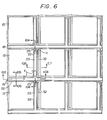
- Fig. 6 shows an embodiment of the liquid crystal display device according to the invention.
- This embodiment of device like the device described before in connection with Fig. 2, has display electrodes 15 arranged as picture element electrodes in rows and columns. Parts like those in Figs. 1 to 4 are designated by like reference numerals.
- Fig. 6 is a plan view similar to Fig. 3.
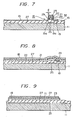
- Fig. 7 is a sectional view similar to Fig. 4, showing a thin film transistor 16.
- Fig. 8 is a sectional view taken along and showing a gate bus 18.
- Fig. 9 is a sectional view taken along and showing a channel region of the thin film transistor 16.
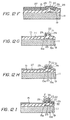
- Fig. 10 is a sectional view taken along and showing a gate bus. The structure shown in Figs. 6 through 10 will now be described with reference to Figs. 11 through 14 in the order of the steps of manufacture.
- each light-blocking layer 25 is formed on a portion of transparent substrate 11 between a region 15', which is to be occupied by a display electrode 15, and a region 19', which is to be occupied by a source bus 19.
- the light-blocking layer 25 overlies portions of regions 15a' and 19a' which are to serve as source and drain electrodes 15a and 19a, respectively.
- the light-blocking layer 25 is made of chromium, for instance and completely faces a so-called channel region of thin film transistor 16. In this embodiment, it extends into a region 26, which is to be occupied by a gate bus, to form a blocking portion 25a.
- the blocking portion 25a overlying the region 26 has extra width on each side with respect to the rest of it corresponding to the channel region.
- the film 28 will constitute the display electrodes 15 and source buses 19.
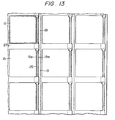
- the transparent conductive film 28 and ohmic contact layer 29 are then selectively photo-etched to form display electrodes 15, drain electrodes 15a, source buses 19 and source electrodes 19a, as shown in Figs. 7 to 10 and 13. At this time, the ohmic contact layer 29 remains on each display electrode 15 and source bus 19, as shown in Fig. 12E.
- a semiconductor layer 21 of amorphous silicon or the like is then formed on and over the entire surface of the wafer, as shown in Fig. 12F.
- a gate insulating film 22, e.g., a silicon nitride film, is formed on the semiconductor film 21.
- the semiconductor layer 21 and gate insulating film 22 are then selectively photo-etched to leave those regions constituting the thin film transistors 16, i.e. the regions striding across the opposing marginal edges of the display electrodes 15 and the source buses 19, and also those regions corresponding to the gate buses 18 but being slightly wider than them.
- the portions of the photo-etched semiconductor layer 21 left above the blocking portions 25a of the light-blocking layer 25 have a width W2 which is slightly larger than the width W1 of the portions 25a photo-etched semiconductor layer 21 left as parts of the thin film transistors as shown in Fig. 14.
- the ohmic contact layer 29 over the display electrodes 15 and source buses 19 is removed except for portions over the drain and source electrodes 15a and 19a.
- the semiconductor layer 21 and gate insulating film 22 are patterned with entirely the same pattern so that they perfectly overlie each other.
- the semiconductor layer 21 is in ohmic contact with the drain and source electrodes 15a and 19a via the ohmic contact layer 29.
- a metal layer e.g., an aluminum layer 31, which will constitute the gate electrodes, is formed as shown in Fig. 12H.
- This layer is then selectively photo-etched to form the gate electrodes 23 and gate buses 18, as shown in Figs. 6 to 10. This patterning is done such that the edges of the gate electrode 23 and gate bus 18 are not flush with the corresponding edges of the patterned gate insulating film 22 but are inwardly spaced apart therefrom by a slight distance d, e.g., 2 to 3 ⁇ m or above as shown in Figs. 6, 7 and 10.
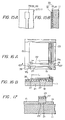
- auxiliary conductive layers 32 are preferably formed from an aluminum layer 31 on the source buses 19 each to extend along one side of the adjacent display electrode 15 between adjacent two gate buses 18, as shown in Figs. 6 and 7. That is, the source bus 19 preferably has a double-layer structure. It is also preferable to form source bus terminals 33 in a similar double-layer structure as shown in Figs. 15A and 15B, where each source bus terminal 33 consists of a layer 19 of the same material (e.g. ITO) as the source bus 19 and an auxiliary conductive layer 32.
- ITO the same material
- L/W3 is set to 4.5 or above.
- the end of the semiconductor layer portion 21a extending underneath the gate bus 18 is connected to the gate bus terminal 38, and a sort of parasitic FET is formed by the gate bus terminal 38 as the source along with the drain electrode 15a, semiconductor layer 21a and gate bus 18.
- the afore-mentioned ratio L/W3 is set such that the current that flows from channel of the thin film transistor 16 to the display electrode 15 is higher by the order of one digit place or above than the current flowing from the parasitic FET to the display electrode 15.
- a passivation film 35 consisting of a transparent insulating film, e.g., of silicon nitride, polyimide, etc., is formed over the entire surface, as shown in Fig. 12I.
- the passivation film 35 prevents direct contact of the thin film transistors 16 with the liquid crystal 14. Thus, it improves the stability. In addition, it reduces leak current between the gate 23 and source and drain electrodes 19a and 15a.
- the semiconductor layer 21 and gate insulating film 22 are formed under the entirety of the gate electrode 23 of each thin film transistor 16 and each gate bus 18.
- the difference in level between the gate electrode 23 and the gate bus 18 with respect to the substrate 11 is reduced that much to reduce the possibility of breakage of the connection between the gate electrode 23 and the gate bus 18.
- the possibility of short-circuit between the gate and the source buses 18 and 19 is reduced by the presence of the two layers, i.e., the semiconductor layer 21 and the gate insulating film 22, between these buses 18 and 19.
- the side edges of the gate electrode 23 and gate bus 18 are spaced apart inwardly, by the distance d in Fig. 7, from the corresponding side edges of the gate insulating film 22.
- the surface distance of the drain or source electrode 15a or 19a from the gate electrode 23 is increased that much to reduce the possibility of current leak between these electrodes.
- the gate insulating film 22 and semiconductor layer 21 has the same pattern and perfectly over lie each other. Since these two layers are patterned simultaneously, the possibility of contamination between these two layers is reduced.
- the auxiliary conductive layer 32 is formed on the source bus 19 as described above, the thickness of the source bus is increased that much to reduce the possibility of breakage of the bus. In addition, the electric resistance is reduced. Besides, the auxiliary conductive layer 32 is formed simultaneously with the formation of the gate electrode 23 and does not require any additional step of manufacture. Moreover, the double-layer structure of the source bus terminal 33 consisting of the material of the source bus 19 and the auxiliary conductive layer 32 as described before in connection with Figs. 15A and 15B, has a further advantage.
- the surface of the source bus terminal 33, which is to be connected to the external part, is constituted by the same material as the gate bus terminal 38. Thus, the source and gate bus terminals can be connected simultaneously and under the same conditions to an external drive circuit by means of thermal press or soldering, which is very convenient.
- the light-blocking layer 25 with the extra width portion 25a is provided.
- the semiconductor layer portion 21a extending underneath the gate bus 18 undergoes a resistance reduction when it receives external light, i.e., ambient external light or illumination light.
- the extra width portion 25a substantially eliminates such current increase.
- the extra width portion 25a eliminates the interaction between the semiconductor layer portion 21a underneath the gate bus 18 and the channel portion of the thin film transistor 16. If the light-blocking layer 25 is formed underneath the entire length of each gate bus 18, the increase of the current when the thin film transistors 16 are turned off can be significantly reduced. In this case, however, a large electrostatic capacitance is formed between the light-blocking layer 25 and gate bus 18, and coupled to the gate electrode 23, which is undesired.
- the source buses 19 are constituted by a transparent conductive film, which has a comparatively high resistance. If it is intended to reduce the resistance of each source bus 19 by increasing the thickness thereof, the manufacturing process is extended. In addition, deterioration of the thin film transistor characteristics due to denaturing is liable to result. Since the source buses 19 are transparent, the liquid crystal display device can transmit light in the regions of the source buses 19 at all time. The contrast of the displayed image is thus correspondingly deteriorated.
- the auxiliary conductive layer 32 blocks light and can improve the contrast that much. In addition, it reduces the resistance of each source bus 19. This has an effect of improving the uniformity of brightness of the image display on the display device.
- the passivation film 35 eliminates mutual adverse effects of the liquid crystal 14 and thin film transistors 16. In addition, it reduces the possibility of such fault as a short-circuit between buses due to rubbing. Further, it can block any residual DC component of a liquid crystal drive signal waveform, i.e., it will prevent such DC component from being applied across the liquid crystal 14.
- the light-blocking layer 25 has been made of a metal.
- Fig. 17 shows an instance, which uses a non-metal light-blocking layer.
- the non-metal light-blocking layer 25' is formed on transparent substrate 11, and a semiconductor layer 21 of amorphous silicon is formed on the layer 25'.
- light-blocking layer 25', semiconductor layer 21, gate insulating film 22 and gate electrode 23 are formed by simultaneous selective photo-etching patterning using the same mask.
- display electrode 15 and source bus 19 are formed directly on the substrate 11 such that they have edges contiguous to corresponding edges of the display electrode 15 and source bus 19.
- an insulating layer capable of blocking sodium ions may be formed on transparent substrate 11, and display electrode 15, source bus 19 and light-blocking layer 25' may be formed on the insulating layer.
- the light-blocking layer 25' of this example is made of a compound semiconductor containing amorphous silicon.
- This compound semiconductor has a narrower energy band gap and no less resistivity than those of the amorphous silicon constituting the semiconductor layer 21.
- compound semiconductors as amorphous silicon germanium and amorphous silicon tin may be used.
- the energy band gap of these compound semiconductors is 1.0 to 1.7 electron volts, which is narrower than that of the amorphous silicon semiconductor layer 21, namely 1.7 to 20 electron volts.
- the light-blocking layer 25' may be formed using a so-called plasma chemical vapor deposition process.
- a binary compound semiconductor layer of amorphous silicon germanium may be obtained by using SiH and GeH gases as sources of components and by suitably controlling their mole ratio.
- the layer thus formed contains silicon and germanium in atomic weight proportions of about 0.8 : 0.2. These proportions may be suitably varied by appropriately selecting the mole ratio of the vapor growth. Usually, germanium is contained more than the ratio of 0.8 : 0.2 noted above.
- a binary compound semiconductor of amorphous silicon tin may be obtained by suitably selecting the mole ratio of SiH4 and Sn(CH3)4, i.e., by controlling the gas flow.
- a resistivity of 108 to 1012 ⁇ -cm which is substantially the same as the resistivity of the amorphous silicon semiconductor layer 21. It is possible to form first a layer of amorphous silicon germanium or amorphous silicon tin as the light-blocking layer and continually form an amorphous silicon layer, i.e., the semiconductor layer 21.
- the amorphous silicon compound semiconductor light-blocking layer is free from the problems of the electrostatic capacitance and insulation between it and the display electrode and source bus. In addition, it can be readily formed.
- the light-blocking layer 25' may be omitted.
- the display electrodes 15 are not limited to the picture element electrodes and may be used in other forms as well. For example, seven display electrodes may be arranged as respective segments of a figure eight and selectively driven for the display of a figure.
Landscapes
- Physics & Mathematics (AREA)
- Nonlinear Science (AREA)
- Mathematical Physics (AREA)
- Engineering & Computer Science (AREA)
- Chemical & Material Sciences (AREA)
- Crystallography & Structural Chemistry (AREA)
- Microelectronics & Electronic Packaging (AREA)
- General Physics & Mathematics (AREA)
- Optics & Photonics (AREA)
- Liquid Crystal (AREA)
- Thin Film Transistor (AREA)
- Liquid Crystal Display Device Control (AREA)
- Devices For Indicating Variable Information By Combining Individual Elements (AREA)
- Cookers (AREA)
Priority Applications (1)
| Application Number | Priority Date | Filing Date | Title |
|---|---|---|---|
| AT85115694T ATE91805T1 (de) | 1984-12-10 | 1985-12-10 | Fluessigkristallanzeigevorrichtung. |
Applications Claiming Priority (2)
| Application Number | Priority Date | Filing Date | Title |
|---|---|---|---|
| JP260474/84 | 1984-12-10 | ||
| JP59260474A JPS61138285A (ja) | 1984-12-10 | 1984-12-10 | 液晶表示素子 |
Publications (3)
| Publication Number | Publication Date |
|---|---|
| EP0186036A2 EP0186036A2 (en) | 1986-07-02 |
| EP0186036A3 EP0186036A3 (en) | 1988-09-07 |
| EP0186036B1 true EP0186036B1 (en) | 1993-07-21 |
Family
ID=17348447
Family Applications (1)
| Application Number | Title | Priority Date | Filing Date |
|---|---|---|---|
| EP85115694A Expired - Lifetime EP0186036B1 (en) | 1984-12-10 | 1985-12-10 | Liquid crystal display device |
Country Status (5)
| Country | Link |
|---|---|
| US (1) | US4723838A (enExample) |
| EP (1) | EP0186036B1 (enExample) |
| JP (1) | JPS61138285A (enExample) |
| AT (1) | ATE91805T1 (enExample) |
| DE (1) | DE3587470T2 (enExample) |
Families Citing this family (40)
| Publication number | Priority date | Publication date | Assignee | Title |
|---|---|---|---|---|
| US4857907A (en) * | 1986-04-30 | 1989-08-15 | 501 Sharp Kabushiki Kaisha | Liquid-crystal display device |
| US4903094A (en) * | 1986-08-26 | 1990-02-20 | General Electric Company | Memory cell structure having radiation hardness |
| DE3808400A1 (de) * | 1987-05-14 | 1988-12-01 | Licentia Gmbh | Fluessigkristall-anzeigevorrichtung |
| US4810061A (en) * | 1987-06-24 | 1989-03-07 | Alps Electric Co., Ltd. | Liquid crystal element having conductive wiring part extending from top of transistor light shield to edge |
| JP2786628B2 (ja) * | 1987-10-15 | 1998-08-13 | シャープ株式会社 | 液晶パネルの電極構造 |
| US4960719A (en) * | 1988-02-04 | 1990-10-02 | Seikosha Co., Ltd. | Method for producing amorphous silicon thin film transistor array substrate |
| JPH01217421A (ja) * | 1988-02-26 | 1989-08-31 | Seikosha Co Ltd | 非晶質シリコン薄膜トランジスタアレイ基板およびその製造方法 |
| US5245452A (en) * | 1988-06-24 | 1993-09-14 | Matsushita Electronics Corporation | Active matric drive liquid crystal display device using polycrystalline silicon pixel electrodes |
| US5053347A (en) * | 1989-08-03 | 1991-10-01 | Industrial Technology Research Institute | Amorphous silicon thin film transistor with a depletion gate |
| WO1991007689A1 (en) * | 1989-11-14 | 1991-05-30 | Greyhawk Systems, Inc. | Improved light addressed liquid crystal light valve incorporating electrically insulating light blocking material |
| US5084777A (en) * | 1989-11-14 | 1992-01-28 | Greyhawk Systems, Inc. | Light addressed liquid crystal light valve incorporating electrically insulating light blocking material of a-SiGe:H |
| AU7166291A (en) * | 1989-12-22 | 1991-07-24 | Manufacturing Sciences, Inc. | Programmable masking apparatus |
| JP2538086B2 (ja) * | 1990-01-11 | 1996-09-25 | 松下電器産業株式会社 | 液晶表示デバイスおよびその製造方法 |
| US5098860A (en) * | 1990-05-07 | 1992-03-24 | The Boeing Company | Method of fabricating high-density interconnect structures having tantalum/tantalum oxide layers |
| GB2245741A (en) * | 1990-06-27 | 1992-01-08 | Philips Electronic Associated | Active matrix liquid crystal devices |
| FR2679057B1 (fr) * | 1991-07-11 | 1995-10-20 | Morin Francois | Structure d'ecran a cristal liquide, a matrice active et a haute definition. |
| US6556257B2 (en) * | 1991-09-05 | 2003-04-29 | Sony Corporation | Liquid crystal display device |
| JPH07175084A (ja) * | 1993-12-21 | 1995-07-14 | Hitachi Ltd | 液晶表示装置及びその製造方法 |
| US5614729A (en) * | 1994-07-08 | 1997-03-25 | Hosiden Corporation | Top gate thin-film transistor |
| US5691782A (en) * | 1994-07-08 | 1997-11-25 | Sanyo Electric Co., Ltd. | Liquid-crystal display with inter-line short-circuit preventive function and process for producing same |
| US5539219A (en) * | 1995-05-19 | 1996-07-23 | Ois Optical Imaging Systems, Inc. | Thin film transistor with reduced channel length for liquid crystal displays |
| US5532180A (en) * | 1995-06-02 | 1996-07-02 | Ois Optical Imaging Systems, Inc. | Method of fabricating a TFT with reduced channel length |
| US5650358A (en) * | 1995-08-28 | 1997-07-22 | Ois Optical Imaging Systems, Inc. | Method of making a TFT having a reduced channel length |
| JP3149793B2 (ja) * | 1996-07-22 | 2001-03-26 | 日本電気株式会社 | 反射型液晶表示装置及びその製造方法 |
| JP2798066B2 (ja) | 1996-08-05 | 1998-09-17 | 日本電気株式会社 | 薄膜トランジスター、その製造方法および表示装置 |
| GB9626487D0 (en) * | 1996-12-17 | 1997-02-05 | Philips Electronics Nv | Electronic devices and their manufacture |
| JPH11174491A (ja) * | 1997-12-08 | 1999-07-02 | Nec Corp | アクティブマトリクス型液晶表示装置 |
| JP3022443B2 (ja) * | 1997-11-05 | 2000-03-21 | 日本電気株式会社 | 半導体デバイスおよびその製造方法 |
| JP3617458B2 (ja) * | 2000-02-18 | 2005-02-02 | セイコーエプソン株式会社 | 表示装置用基板、液晶装置及び電子機器 |
| GB0029315D0 (en) * | 2000-12-01 | 2001-01-17 | Koninkl Philips Electronics Nv | Method of increasing the conductivity of a transparent conductive layer |
| KR100721304B1 (ko) * | 2000-12-29 | 2007-05-25 | 엘지.필립스 엘시디 주식회사 | 액정표시장치용 액정패널 및 그의 제조방법 |
| US9176353B2 (en) * | 2007-06-29 | 2015-11-03 | Semiconductor Energy Laboratory Co., Ltd. | Liquid crystal display device |
| US8921858B2 (en) * | 2007-06-29 | 2014-12-30 | Semiconductor Energy Laboratory Co., Ltd. | Light-emitting device |
| US8330887B2 (en) * | 2007-07-27 | 2012-12-11 | Semiconductor Energy Laboratory Co., Ltd. | Liquid crystal display device and electronic device |
| CN101807583B (zh) | 2009-02-18 | 2011-07-27 | 北京京东方光电科技有限公司 | Tft-lcd阵列基板及其制造方法 |
| CN102269900B (zh) * | 2010-06-03 | 2013-04-24 | 北京京东方光电科技有限公司 | Tft阵列基板及其制造方法 |
| KR101731047B1 (ko) * | 2010-12-01 | 2017-05-12 | 삼성디스플레이 주식회사 | 적외선 감지 트랜지스터, 이를 포함하는 표시 장치의 제조 방법 |
| KR20130027188A (ko) * | 2011-09-07 | 2013-03-15 | 삼성디스플레이 주식회사 | 표시 장치 및 그 제조 방법 |
| KR102105485B1 (ko) * | 2012-11-23 | 2020-04-29 | 삼성디스플레이 주식회사 | 박막 트랜지스터 기판 및 그 제조 방법 |
| KR102112844B1 (ko) * | 2013-10-15 | 2020-05-19 | 삼성디스플레이 주식회사 | 유기 발광 표시 장치 및 이의 제조방법 |
Family Cites Families (7)
| Publication number | Priority date | Publication date | Assignee | Title |
|---|---|---|---|---|
| DE1789084B2 (de) * | 1961-08-17 | 1973-05-30 | Rca Corp., New York, N.Y. (V.St.A.) | Duennschicht-verknuepfungsglied und verfahren zu seiner herstellung |
| US3671820A (en) * | 1970-04-27 | 1972-06-20 | Rudolph R Haering | High voltage thin-film transistor |
| US4094582A (en) * | 1976-10-18 | 1978-06-13 | Rca Corporation | Liquid crystal matrix display device with transistors |
| JPS5715469A (en) * | 1980-07-02 | 1982-01-26 | Matsushita Electric Ind Co Ltd | Thin film transistor for transmission type display panel and manufacture thereof |
| JPS58170067A (ja) * | 1982-03-31 | 1983-10-06 | Fujitsu Ltd | 薄膜トランジスタの製造方法 |
| FR2533072B1 (fr) * | 1982-09-14 | 1986-07-18 | Coissard Pierre | Procede de fabrication de circuits electroniques a base de transistors en couches minces et de condensateurs |
| US4597001A (en) * | 1984-10-05 | 1986-06-24 | General Electric Company | Thin film field-effect transistors with tolerance to electrode misalignment |
-
1984
- 1984-12-10 JP JP59260474A patent/JPS61138285A/ja active Granted
-
1985
- 1985-12-04 US US06/804,556 patent/US4723838A/en not_active Expired - Lifetime
- 1985-12-10 DE DE85115694T patent/DE3587470T2/de not_active Expired - Fee Related
- 1985-12-10 AT AT85115694T patent/ATE91805T1/de not_active IP Right Cessation
- 1985-12-10 EP EP85115694A patent/EP0186036B1/en not_active Expired - Lifetime
Also Published As
| Publication number | Publication date |
|---|---|
| EP0186036A3 (en) | 1988-09-07 |
| EP0186036A2 (en) | 1986-07-02 |
| ATE91805T1 (de) | 1993-08-15 |
| DE3587470T2 (de) | 1993-12-09 |
| US4723838A (en) | 1988-02-09 |
| JPH0584490B2 (enExample) | 1993-12-02 |
| DE3587470D1 (de) | 1993-08-26 |
| JPS61138285A (ja) | 1986-06-25 |
Similar Documents
| Publication | Publication Date | Title |
|---|---|---|
| EP0186036B1 (en) | Liquid crystal display device | |
| US6475837B2 (en) | Electro-optical device | |
| CN100502047C (zh) | 薄膜晶体管 | |
| US5061648A (en) | Method of fabricating a thin-film transistor | |
| US5614427A (en) | Method of making an array of TFTs having reduced parasitic capacitance | |
| US5650637A (en) | Active matrix assembly | |
| CN1050939C (zh) | 用于显示的薄膜半导体器件及其制造方法 | |
| US6812489B2 (en) | Liquid crystal display | |
| US4770498A (en) | Dot-matrix liquid crystal display | |
| US6278504B1 (en) | Thin film transistor for liquid crystal display device having a semiconductor layer's width smaller than a width of the gate, drain and source electrodes | |
| JPH05251705A (ja) | 薄膜トランジスタ | |
| US6064091A (en) | Thin film transistors having an active region composed of intrinsic and amorphous semiconducting layers | |
| US20010045995A1 (en) | Liquid crystal display and manufacturing method therfor | |
| GB2362509A (en) | Thin film transistor (TFT) with front and back channel gates connected together | |
| KR100316072B1 (ko) | 액정 표시 장치 제조 방법 및 그 구조 | |
| JPH04360583A (ja) | 薄膜トランジスタ | |
| KR19990003501A (ko) | 박막 트랜지스터 및 그의 제조방법 | |
| JPH0758793B2 (ja) | 薄膜トランジスタの製造方法 | |
| JP2668317B2 (ja) | アクティブマトリクスパネル | |
| JP2675587B2 (ja) | マトリックス型液晶表示パネル | |
| JPH05235398A (ja) | 薄膜光センサ | |
| JPH11154752A (ja) | 薄膜トランジスタおよびこれを用いた液晶表示装置並びにtftアレイ基板の製造方法 | |
| JP2656555B2 (ja) | 薄膜トランジスタならびにそれを用いたアクティブマトリクス回路基板と画像表示装置 | |
| JPH0685440B2 (ja) | 薄膜トランジスタ | |
| JPH0786607A (ja) | 薄膜トランジスタ |
Legal Events
| Date | Code | Title | Description |
|---|---|---|---|
| PUAI | Public reference made under article 153(3) epc to a published international application that has entered the european phase |
Free format text: ORIGINAL CODE: 0009012 |
|
| 17P | Request for examination filed |
Effective date: 19851210 |
|
| AK | Designated contracting states |
Kind code of ref document: A2 Designated state(s): AT BE CH DE FR GB IT LI LU NL SE |
|
| PUAL | Search report despatched |
Free format text: ORIGINAL CODE: 0009013 |
|
| AK | Designated contracting states |
Kind code of ref document: A3 Designated state(s): AT BE CH DE FR GB IT LI LU NL SE |
|
| 17Q | First examination report despatched |
Effective date: 19910603 |
|
| RAP1 | Party data changed (applicant data changed or rights of an application transferred) |
Owner name: HOSIDEN CORPORATION |
|
| GRAA | (expected) grant |
Free format text: ORIGINAL CODE: 0009210 |
|
| AK | Designated contracting states |
Kind code of ref document: B1 Designated state(s): AT BE CH DE FR GB IT LI LU NL SE |
|
| PG25 | Lapsed in a contracting state [announced via postgrant information from national office to epo] |
Ref country code: SE Effective date: 19930721 Ref country code: LI Effective date: 19930721 Ref country code: IT Free format text: LAPSE BECAUSE OF FAILURE TO SUBMIT A TRANSLATION OF THE DESCRIPTION OR TO PAY THE FEE WITHIN THE PRESCRIBED TIME-LIMIT;WARNING: LAPSES OF ITALIAN PATENTS WITH EFFECTIVE DATE BEFORE 2007 MAY HAVE OCCURRED AT ANY TIME BEFORE 2007. THE CORRECT EFFECTIVE DATE MAY BE DIFFERENT FROM THE ONE RECORDED. Effective date: 19930721 Ref country code: CH Effective date: 19930721 Ref country code: BE Effective date: 19930721 Ref country code: AT Effective date: 19930721 |
|
| REF | Corresponds to: |
Ref document number: 91805 Country of ref document: AT Date of ref document: 19930815 Kind code of ref document: T |
|
| ET | Fr: translation filed | ||
| REF | Corresponds to: |
Ref document number: 3587470 Country of ref document: DE Date of ref document: 19930826 |
|
| REG | Reference to a national code |
Ref country code: CH Ref legal event code: PL |
|
| PG25 | Lapsed in a contracting state [announced via postgrant information from national office to epo] |
Ref country code: LU Free format text: LAPSE BECAUSE OF NON-PAYMENT OF DUE FEES Effective date: 19931231 |
|
| PLBE | No opposition filed within time limit |
Free format text: ORIGINAL CODE: 0009261 |
|
| STAA | Information on the status of an ep patent application or granted ep patent |
Free format text: STATUS: NO OPPOSITION FILED WITHIN TIME LIMIT |
|
| 26N | No opposition filed | ||
| REG | Reference to a national code |
Ref country code: GB Ref legal event code: 732E |
|
| PGFP | Annual fee paid to national office [announced via postgrant information from national office to epo] |
Ref country code: FR Payment date: 19971030 Year of fee payment: 13 |
|
| REG | Reference to a national code |
Ref country code: FR Ref legal event code: TP |
|
| NLS | Nl: assignments of ep-patents |
Owner name: HOSIDEN AND PHILIPS DISPLAY CORPORATION |
|
| PGFP | Annual fee paid to national office [announced via postgrant information from national office to epo] |
Ref country code: GB Payment date: 19971201 Year of fee payment: 13 |
|
| PGFP | Annual fee paid to national office [announced via postgrant information from national office to epo] |
Ref country code: NL Payment date: 19971231 Year of fee payment: 13 |
|
| PGFP | Annual fee paid to national office [announced via postgrant information from national office to epo] |
Ref country code: DE Payment date: 19980123 Year of fee payment: 13 |
|
| PG25 | Lapsed in a contracting state [announced via postgrant information from national office to epo] |
Ref country code: GB Free format text: LAPSE BECAUSE OF NON-PAYMENT OF DUE FEES Effective date: 19981210 |
|
| PG25 | Lapsed in a contracting state [announced via postgrant information from national office to epo] |
Ref country code: NL Free format text: LAPSE BECAUSE OF NON-PAYMENT OF DUE FEES Effective date: 19990701 |
|
| GBPC | Gb: european patent ceased through non-payment of renewal fee |
Effective date: 19981210 |
|
| PG25 | Lapsed in a contracting state [announced via postgrant information from national office to epo] |
Ref country code: FR Free format text: LAPSE BECAUSE OF NON-PAYMENT OF DUE FEES Effective date: 19990831 |
|
| NLV4 | Nl: lapsed or anulled due to non-payment of the annual fee |
Effective date: 19990701 |
|
| REG | Reference to a national code |
Ref country code: FR Ref legal event code: ST |
|
| PG25 | Lapsed in a contracting state [announced via postgrant information from national office to epo] |
Ref country code: DE Free format text: LAPSE BECAUSE OF NON-PAYMENT OF DUE FEES Effective date: 19991001 |