EP0185935B1 - Verfahren zur Herstellung von pulverförmigen, linearen, basischen Polymerisaten - Google Patents
Verfahren zur Herstellung von pulverförmigen, linearen, basischen Polymerisaten Download PDFInfo
- Publication number
- EP0185935B1 EP0185935B1 EP85114796A EP85114796A EP0185935B1 EP 0185935 B1 EP0185935 B1 EP 0185935B1 EP 85114796 A EP85114796 A EP 85114796A EP 85114796 A EP85114796 A EP 85114796A EP 0185935 B1 EP0185935 B1 EP 0185935B1
- Authority
- EP
- European Patent Office
- Prior art keywords
- polymer
- vinylformamide
- polymers
- carried out
- reaction
- Prior art date
- Legal status (The legal status is an assumption and is not a legal conclusion. Google has not performed a legal analysis and makes no representation as to the accuracy of the status listed.)
- Expired - Lifetime
Links
- 229920000642 polymer Polymers 0.000 title claims abstract description 55
- 238000000034 method Methods 0.000 title claims description 20
- 238000004519 manufacturing process Methods 0.000 title description 2
- ZQXSMRAEXCEDJD-UHFFFAOYSA-N n-ethenylformamide Chemical compound C=CNC=O ZQXSMRAEXCEDJD-UHFFFAOYSA-N 0.000 claims abstract description 28
- 125000002485 formyl group Chemical group [H]C(*)=O 0.000 claims abstract description 17
- XLYOFNOQVPJJNP-UHFFFAOYSA-N water Substances O XLYOFNOQVPJJNP-UHFFFAOYSA-N 0.000 claims abstract description 17
- 239000000843 powder Substances 0.000 claims abstract description 16
- 229910000039 hydrogen halide Inorganic materials 0.000 claims abstract 2
- 239000012433 hydrogen halide Substances 0.000 claims abstract 2
- VEXZGXHMUGYJMC-UHFFFAOYSA-N Hydrochloric acid Chemical compound Cl VEXZGXHMUGYJMC-UHFFFAOYSA-N 0.000 claims description 13
- 239000002253 acid Substances 0.000 claims description 12
- 239000002245 particle Substances 0.000 claims description 12
- 238000006243 chemical reaction Methods 0.000 claims description 10
- 150000007513 acids Chemical class 0.000 claims description 8
- 229910000041 hydrogen chloride Inorganic materials 0.000 claims description 7
- IXCSERBJSXMMFS-UHFFFAOYSA-N hydrogen chloride Substances Cl.Cl IXCSERBJSXMMFS-UHFFFAOYSA-N 0.000 claims description 7
- WYURNTSHIVDZCO-UHFFFAOYSA-N Tetrahydrofuran Chemical compound C1CCOC1 WYURNTSHIVDZCO-UHFFFAOYSA-N 0.000 claims description 6
- 239000000375 suspending agent Substances 0.000 claims description 6
- RYHBNJHYFVUHQT-UHFFFAOYSA-N 1,4-Dioxane Chemical compound C1COCCO1 RYHBNJHYFVUHQT-UHFFFAOYSA-N 0.000 claims description 5
- XDTMQSROBMDMFD-UHFFFAOYSA-N Cyclohexane Chemical compound C1CCCCC1 XDTMQSROBMDMFD-UHFFFAOYSA-N 0.000 claims description 5
- FAPWRFPIFSIZLT-UHFFFAOYSA-M Sodium chloride Chemical compound [Na+].[Cl-] FAPWRFPIFSIZLT-UHFFFAOYSA-M 0.000 claims description 5
- CPELXLSAUQHCOX-UHFFFAOYSA-N Hydrogen bromide Chemical compound Br CPELXLSAUQHCOX-UHFFFAOYSA-N 0.000 claims description 4
- 230000008030 elimination Effects 0.000 claims description 3
- 238000003379 elimination reaction Methods 0.000 claims description 3
- 238000002360 preparation method Methods 0.000 claims description 3
- YLQBMQCUIZJEEH-UHFFFAOYSA-N tetrahydrofuran Natural products C=1C=COC=1 YLQBMQCUIZJEEH-UHFFFAOYSA-N 0.000 claims description 3
- 229910000042 hydrogen bromide Inorganic materials 0.000 claims description 2
- 239000011780 sodium chloride Substances 0.000 claims description 2
- ZXEKIIBDNHEJCQ-UHFFFAOYSA-N isobutanol Chemical compound CC(C)CO ZXEKIIBDNHEJCQ-UHFFFAOYSA-N 0.000 description 10
- 150000001298 alcohols Chemical class 0.000 description 9
- LFQSCWFLJHTTHZ-UHFFFAOYSA-N Ethanol Chemical compound CCO LFQSCWFLJHTTHZ-UHFFFAOYSA-N 0.000 description 6
- KFZMGEQAYNKOFK-UHFFFAOYSA-N Isopropanol Chemical compound CC(C)O KFZMGEQAYNKOFK-UHFFFAOYSA-N 0.000 description 6
- OKKJLVBELUTLKV-UHFFFAOYSA-N Methanol Chemical compound OC OKKJLVBELUTLKV-UHFFFAOYSA-N 0.000 description 6
- HEMHJVSKTPXQMS-UHFFFAOYSA-M Sodium hydroxide Chemical compound [OH-].[Na+] HEMHJVSKTPXQMS-UHFFFAOYSA-M 0.000 description 6
- 230000007062 hydrolysis Effects 0.000 description 6
- 238000006460 hydrolysis reaction Methods 0.000 description 6
- BDAGIHXWWSANSR-UHFFFAOYSA-N Formic acid Chemical class OC=O BDAGIHXWWSANSR-UHFFFAOYSA-N 0.000 description 5
- 238000003776 cleavage reaction Methods 0.000 description 5
- 230000007017 scission Effects 0.000 description 5
- 239000002904 solvent Substances 0.000 description 5
- 238000010557 suspension polymerization reaction Methods 0.000 description 5
- UGFAIRIUMAVXCW-UHFFFAOYSA-N Carbon monoxide Chemical compound [O+]#[C-] UGFAIRIUMAVXCW-UHFFFAOYSA-N 0.000 description 4
- DKGAVHZHDRPRBM-UHFFFAOYSA-N Tert-Butanol Chemical compound CC(C)(C)O DKGAVHZHDRPRBM-UHFFFAOYSA-N 0.000 description 4
- 229910002091 carbon monoxide Inorganic materials 0.000 description 4
- RTZKZFJDLAIYFH-UHFFFAOYSA-N Diethyl ether Chemical compound CCOCC RTZKZFJDLAIYFH-UHFFFAOYSA-N 0.000 description 3
- YXFVVABEGXRONW-UHFFFAOYSA-N Toluene Chemical compound CC1=CC=CC=C1 YXFVVABEGXRONW-UHFFFAOYSA-N 0.000 description 3
- 239000000203 mixture Substances 0.000 description 3
- 239000000047 product Substances 0.000 description 3
- YIWUKEYIRIRTPP-UHFFFAOYSA-N 2-ethylhexan-1-ol Chemical compound CCCCC(CC)CO YIWUKEYIRIRTPP-UHFFFAOYSA-N 0.000 description 2
- QGZKDVFQNNGYKY-UHFFFAOYSA-N Ammonia Chemical compound N QGZKDVFQNNGYKY-UHFFFAOYSA-N 0.000 description 2
- LRHPLDYGYMQRHN-UHFFFAOYSA-N N-Butanol Chemical compound CCCCO LRHPLDYGYMQRHN-UHFFFAOYSA-N 0.000 description 2
- IMNFDUFMRHMDMM-UHFFFAOYSA-N N-Heptane Chemical compound CCCCCCC IMNFDUFMRHMDMM-UHFFFAOYSA-N 0.000 description 2
- OFBQJSOFQDEBGM-UHFFFAOYSA-N Pentane Chemical compound CCCCC OFBQJSOFQDEBGM-UHFFFAOYSA-N 0.000 description 2
- 238000001816 cooling Methods 0.000 description 2
- SNRUBQQJIBEYMU-UHFFFAOYSA-N dodecane Chemical compound CCCCCCCCCCCC SNRUBQQJIBEYMU-UHFFFAOYSA-N 0.000 description 2
- 238000001035 drying Methods 0.000 description 2
- UYMKPFRHYYNDTL-UHFFFAOYSA-N ethenamine Chemical group NC=C UYMKPFRHYYNDTL-UHFFFAOYSA-N 0.000 description 2
- 239000008394 flocculating agent Substances 0.000 description 2
- 235000019253 formic acid Nutrition 0.000 description 2
- 239000007789 gas Substances 0.000 description 2
- 230000000379 polymerizing effect Effects 0.000 description 2
- 238000012673 precipitation polymerization Methods 0.000 description 2
- BDERNNFJNOPAEC-UHFFFAOYSA-N propan-1-ol Chemical compound CCCO BDERNNFJNOPAEC-UHFFFAOYSA-N 0.000 description 2
- 230000035484 reaction time Effects 0.000 description 2
- 239000000243 solution Substances 0.000 description 2
- 238000003756 stirring Methods 0.000 description 2
- 239000000725 suspension Substances 0.000 description 2
- OSWFIVFLDKOXQC-UHFFFAOYSA-N 4-(3-methoxyphenyl)aniline Chemical compound COC1=CC=CC(C=2C=CC(N)=CC=2)=C1 OSWFIVFLDKOXQC-UHFFFAOYSA-N 0.000 description 1
- NHTMVDHEPJAVLT-UHFFFAOYSA-N Isooctane Chemical compound CC(C)CC(C)(C)C NHTMVDHEPJAVLT-UHFFFAOYSA-N 0.000 description 1
- CTQNGGLPUBDAKN-UHFFFAOYSA-N O-Xylene Chemical compound CC1=CC=CC=C1C CTQNGGLPUBDAKN-UHFFFAOYSA-N 0.000 description 1
- 238000006136 alcoholysis reaction Methods 0.000 description 1
- 150000001338 aliphatic hydrocarbons Chemical class 0.000 description 1
- 150000001412 amines Chemical class 0.000 description 1
- 229910021529 ammonia Inorganic materials 0.000 description 1
- 239000007864 aqueous solution Substances 0.000 description 1
- 150000004945 aromatic hydrocarbons Chemical class 0.000 description 1
- 238000010533 azeotropic distillation Methods 0.000 description 1
- 239000011324 bead Substances 0.000 description 1
- 238000009835 boiling Methods 0.000 description 1
- 239000007795 chemical reaction product Substances 0.000 description 1
- 230000006324 decarbonylation Effects 0.000 description 1
- 238000006606 decarbonylation reaction Methods 0.000 description 1
- JVSWJIKNEAIKJW-UHFFFAOYSA-N dimethyl-hexane Natural products CCCCCC(C)C JVSWJIKNEAIKJW-UHFFFAOYSA-N 0.000 description 1
- 150000002170 ethers Chemical class 0.000 description 1
- 230000007717 exclusion Effects 0.000 description 1
- -1 formic acid ester Chemical class 0.000 description 1
- 239000003292 glue Substances 0.000 description 1
- 229920006158 high molecular weight polymer Polymers 0.000 description 1
- 229920001519 homopolymer Polymers 0.000 description 1
- 230000014759 maintenance of location Effects 0.000 description 1
- 238000002156 mixing Methods 0.000 description 1
- TVMXDCGIABBOFY-UHFFFAOYSA-N octane Chemical compound CCCCCCCC TVMXDCGIABBOFY-UHFFFAOYSA-N 0.000 description 1
- 238000001556 precipitation Methods 0.000 description 1
- 239000007870 radical polymerization initiator Substances 0.000 description 1
- 239000007787 solid Substances 0.000 description 1
- 239000012265 solid product Substances 0.000 description 1
- 238000003797 solvolysis reaction Methods 0.000 description 1
- 238000010558 suspension polymerization method Methods 0.000 description 1
- 239000002351 wastewater Substances 0.000 description 1
- 239000008096 xylene Substances 0.000 description 1
Classifications
-
- C—CHEMISTRY; METALLURGY
- C08—ORGANIC MACROMOLECULAR COMPOUNDS; THEIR PREPARATION OR CHEMICAL WORKING-UP; COMPOSITIONS BASED THEREON
- C08F—MACROMOLECULAR COMPOUNDS OBTAINED BY REACTIONS ONLY INVOLVING CARBON-TO-CARBON UNSATURATED BONDS
- C08F8/00—Chemical modification by after-treatment
Definitions
- Linear, basic polymers are known from EP patent application 71050, which are characterized by a content of 90 to 10 mol% of units of the formula and 10 to 90 mol% of units of the formula and have a Fikentscher K value of 10 to 200 (measured in 0.5% aqueous saline solution at 25 ° C.). These polymers are prepared by first polymerizing N-vinylformamide in the presence of radical polymerization initiators to give polyvinylformamides and the polymers thus obtained at from 20 to 200 ° C.
- the formyl group is preferably split off in aqueous solution with sodium hydroxide solution or hydrochloric acid. Attempting to partially hydrolyze polymers of N-vinylformamide which are prepared by the reverse suspension polymerization process and are in powder form with aqueous hydrochloric acid gives no useful products because the particles form a solid mass with one another under the conditions of hydrolysis glue.
- the present invention is based on the object of providing a process for the preparation of powdery, linear, basic polymers which contain copolymerized vinylamine units.
- This process is based on powdery polymers of N-vinylformamide and is preferably reacted with gaseous hydrohalic acids in the presence of at most 2.5% by weight of water, based on the polymer, or with the exclusion of water.
- Suitable hydrohalic acids are preferably hydrogen chloride or hydrogen bromide.
- the hydrohalic acids are brought into contact with the solid products in the anhydrous state. Under these reaction conditions, carbon monoxide is split off. The reaction proceeds via a decarbonylation if water is excluded or the water content is at most 2.5% by weight.
- those polymers of N-vinylformamide which are prepared by the reverse suspension polymerization process must first be dried.
- Drying of the polymer beads which are obtained in the reverse suspension polymerization process is state of the art and is preferably achieved with the aid of an azeotropic distillation.
- very high molecular weight polymers are obtained which have a K value of up to 250.
- solution polymers which are described, for example, in the examples of EP-PS 71050, it is first necessary to remove the water and to reduce the polymer mass to the desired particle size. It is also possible to start from precipitation polymers which are obtained by polymerizing N-vinylformamide in alcohols such as ethanol, isopropanol or tert-butanol.
- the alcohols act as regulators and give polymers which have a low molecular weight, e.g. corresponding to a K value of 20. It is preferable to start from powdered poly-N-vinylformamides which are obtained by the precipitation polymerization method or by the reverse suspension polymerization method.
- the products made by the reverse suspension polymerization process must be dried, e.g. by azeotropic dewatering, while the polymers of N-vinylformamide originating from the precipitation polymerization - if polymerized in the absence of water - can be prevented from drying.
- the cleavage of the formyl group from poly-N-vinylformamide is preferably carried out in an inert suspension medium which contains the polymer particles does not solve.
- solvents are ethers, such as dioxane, tetrahydrofuran, diethyl ether, and aliphatic and aromatic hydrocarbons, such as pentane, cyclohexane, heptane, octane, isooctane, dodecane, toluene and xylene.
- the formyl group can also be split off in C1 to C8 alcohols, the polymer being solvolysed and the associated formic acid esters being formed after the alcohols, in accordance with the reaction with the formyl groups of the polymer.
- C1 to C8 alcohols are e.g. Methanol, ethanol, n-propanol, isopropanol, n-butanol, isobutanol, tert-butanol and 2-ethylhexanol.
- C1 to C4 alcohols are preferably used.
- the alcoholysis can also be carried out in the presence of the above-mentioned inert suspension media.
- the particle size of the N-vinylformamide polymer is 10 to 1000, preferably 50 to 400 microns.
- the cleavage of the formyl group from the polymers can be carried out, for example, in a powder bed, in which hydrohalic acids are allowed to act on powdered polymers of N-vinylformamide and thereby ensure thorough mixing of the powder. This can be done, for example, in a stirred tank or a fluidized bed. The carbon monoxide that is split off is removed from the exhaust gas, while the excess hydrohalic acid is returned to the powder bed.
- Dioxane, tetrahydrofuran or cyclohexane are preferably used as solvents.
- the polymer particles are suspended therein and exposed to the action of hydrohalic acids, preferably hydrochloric acid, in the temperature range from 20 to 200, preferably 35 to 150 ° C.
- hydrohalic acids preferably hydrochloric acid
- About 0.05 to 10, preferably 0.1 to 1.5 equivalents of an anhydrous hydrohalic acid are required per formyl group equivalent in the poly-N-vinylformamide (one equivalent should be understood to mean 1 g equivalent which is identical to the name 1 Val).
- partial or complete elimination of formyl groups from the powdery N-vinylformamide polymers is obtained.
- Partial cleavage of formyl groups gives polymers, the units of the formula and the formula contain.
- the cleavage is preferably carried out in such a way that a polymer is obtained which contains 90 to 10 mol% of units of the formula (1) and 10 to 90 mol% of units of the formula (II).
- Such polymers as well as the polyvinylamine are suitable, for example, as flocculants for waste water and sludges and as retention aids, drainage aids and flocculants in the production of paper.
- the reaction is carried out in an autoclave. If the cleavage of the formyl group from poly-N-vinylformamide is carried out in the presence of small amounts of water and alcohols, instead of carbon monoxide, formic acid or formic acid ester is obtained.
- the K value of the polymers containing vinylamine units corresponds approximately to the K value of the N-vinylformamide polymers.
- Example 4 7.1 g (0.1 mol) of a mixture of 2.6 g of a poly-N-vinylformamide powder having an average diameter of 200 to 300 ⁇ m and 4.5 g of the mixture are placed in an autoclave same polymers with an average diameter of 100 to 200 microns in 355 g of dry cyclohexane together with 3.7 g (50 mmol) of isobutanol and 3.65 g (0.1 mol) of hydrogen chloride and preheat the autoclave contents to a temperature of 4 hours 100 ° C.
- the K value of the polymers is 142.5. 7.65 g of a poly-N-vinylformamide powder are obtained, from which the formyl groups have in part been split off.
Landscapes
- Chemical & Material Sciences (AREA)
- General Chemical & Material Sciences (AREA)
- Health & Medical Sciences (AREA)
- Chemical Kinetics & Catalysis (AREA)
- Medicinal Chemistry (AREA)
- Polymers & Plastics (AREA)
- Organic Chemistry (AREA)
- Addition Polymer Or Copolymer, Post-Treatments, Or Chemical Modifications (AREA)
- Medicinal Preparation (AREA)
- Pharmaceuticals Containing Other Organic And Inorganic Compounds (AREA)
- Dental Preparations (AREA)
- Macromolecular Compounds Obtained By Forming Nitrogen-Containing Linkages In General (AREA)
- Graft Or Block Polymers (AREA)
- Processes Of Treating Macromolecular Substances (AREA)
Description
- Aus der EP-Patentanmeldung 71050 sind lineare, basische Polymerisate bekannt, die gekennzeichnet sind durch einen Gehalt an 90 bis 10 Mol.% Einheiten der Formel

und 10 bis 90 Mol.% Einheiten der Formel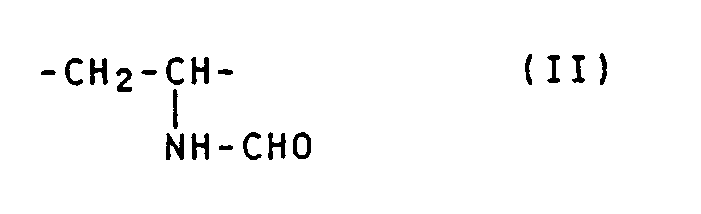
und einen K-Wert nach Fikentscher von 10 bis 200 (gemessen in 0,5 %iger wäßriger Kochsalzlösung bei 25°C) haben. Diese Polymerisate werden dadurch hergestellt, daß man zunächst N-Vinylformamid in Gegenwart von radikalischen Polymerisationsinitiatoren zu Polyvinylformamiden polymerisiert und die so erhaltenen Polymerisate bei Temperaturen von 20 bis 200°C in Gegenwart von Säuren oder Basen unter Abspaltung von 10 bis 90 % der Formylgruppen aus dem Homopolymerisat des N-Vinylformamids in Wasser, Alkoholen, Ammoniak und Aminen oder Mischungen der genannten Lösemittel solvolysiert. Die Abspaltung der Formylgruppe erfolgt dabei vorzugsweise in wäßriger Lösung mit Natronlauge oder Salzsäure. Versucht man, Polymerisate des N-Vinylformamids, die nach dem Verfahren der umgekehrten Suspensionspolymerisation hergestellt werden und in Pulverform vorliegen, partiell mit wäßriger Salzsäure zu hydrolysieren, so erhält man keine brauchbaren Produkte, weil die Teilchen unter den Bedingungen der Hydrolyse zu einer festen Masse miteinander verkleben. - Der vorliegenden Erfindung liegt die Aufgabe zugrunde, ein Verfahren zur Herstellung von pulverförmigen, linearen, basischen Polymerisaten zur Verfügung zu stellen, die Vinylamin-Einheiten einpolymerisiert enthalten.
- Die Aufgabe wird erfindungsgemäß mit einem Verfahren zur Herstellung von pulverförmigen, linearen, basischen Polymerisaten, die Einheiten der Formel

enthalten und einen K-Wert nach Fikentscher von 10 bis 250 (gemessen bei einer Polymerkonzentration von 0,5 Gew.% in 5 %iger wäßriger Kochsalzlösung bei 25°C) haben, durch Abspaltung der Formylgruppe aus Polymerisaten des N-Vinylformamids (CH₂=CH-NH-CHO) in Gegenwart von Säuren bei Temperaturen bis zu 200°C dadurch gelöst, daß man pulverförmige Polymerisate des N-Vinylformamids in Gegenwart von höchstens 5 Gew.% Wasser mit einer gasförmigen Halogenwasserstoffsäure zur Reaktion bringt. - Man geht bei diesem Verfahren von pulverförmigen Polymerisaten des N-Vinylformamids aus und setzt sie vorzugsweise in Gegenwart von höchstens 2,5 Gew.% Wasser, bezogen auf Polymerisat, oder unter Ausschluß von Wasser mit gasförmigen Halogenwasserstoffsäuren um. Als Halogenwasserstoffsäuren kommen vorzugsweise Chlorwasserstoff oder Bromwasserstoff in Betracht. Die Halogenwasserstoffsäuren werden dabei in wasserfreiem Zustand mit den Festprodukten in Kontakt gebracht. Unter diesen Reaktionsbedingungen kommt es zu einer Abspaltung von Kohlenmonoxid. Die Reaktion verläuft über eine Decarbonylierung, wenn unter Ausschluß von Wasser bzw. bei einem Wassergehalt von höchstens 2,5 Gew.% gearbeitet wird. Um einen solch niedrigen Wassergehalt in den Polymerisaten zu erreichen, müssen diejenigen Polymerisate des N-Vinylformamids, die nach dem Verfahren der umgekehrten Suspensionspolymerisation hergestellt werden, zunächst getrocknet werden. Das Trocknen der Polymerisatperlen, die bei dem Verfahren der umgekehrten Suspensionspolymerisation anfallen, ist Stand der Technik und wird vorzugsweise mit Hilfe einer azeotropen Destillation erreicht. Nach dem Verfahren der umgekehrten Suspensionspolymerisation erhält man vor allem sehr hochmolekulare Polymerisate, die einen K-Wert bis zu 250 aufweisen. Stehen für die Solvolyse lediglich Lösungspolymerisate zur Verfügung, die beispielsweise in den Beispielen der EP-PS 71050 beschrieben sind, so ist es zunächst erforderlich, das Wasser zu entfernen und die Polymerisatmasse auf die gewünschte Korngröße zu zerkleinern. Man kann auch von Fällungspolymerisaten ausgehen, die man durch Polymerisieren von N-Vinylformamid in Alkoholen wie Ethanol, Isopropanol oder tert.-Butanol erhält. Die Alkohole wirken als Regler und ergeben Polymerisate, die ein niedriges Molekulargewicht haben, z.B. entsprechend einem K-Wert von 20. Vorzugsweise geht man von pulverförmigen Poly-N-Vinylformamiden aus, die nach dem Verfahren der Fällungspolymerisation oder nach dem Verfahren der umgekehrten Suspensionspolymerisation erhalten werden. Die nach dem Verfahren der umgekehrten Suspensionspolymerisation hergestellten Produkte müssen getrocknet werden, z.B. durch azeotropes Entwässern, während bei den aus der Fällungspolymerisation stammenden Polymerisaten des N-Vinylformamids - sofern in Abwesenheit von Wasser polymerisiert wurde - eine Trocknung unterbleiben kann.
- Die Abspaltung der Formylgruppe aus Poly-N-Vinylformamid wird vorzugsweise in einem inerten Suspensionsmittel durchgeführt, das die Polymerisatteilchen nicht löst. Solche Lösemittel sind beispielsweise Ether, wie Dioxan, Tetrahydrofuran, Diethylether, sowie aliphatische und aromatische Kohlenwasserstoffe, wie Pentan, Cyclohexan, Heptan, Octan, Isooctan, Dodecan, Toluol und Xylol.
- Die Abspaltung der Formylgruppe kann auch in C₁- bis C₈-Alkoholen durchgeführt werden, wobei das Polymerisat solvolysiert wird und sich nach den Alkoholen entsprechend der Umsetzung mit den Formylgruppen des Polymerisats die zugehörigen Ameisensäureester bilden. C₁- bis C₈-Alkohole sind z.B. Methanol, Ethanol, n-Propanol, Isopropanol, n-Butanol, Isobutanol, tert.-Butanol und 2-Ethylhexanol. Vorzugsweise verwendet man C₁- bis C₄-Alkohole.
- Die Alkoholyse kann auch in Gegenwart der oben genannten inerten Suspensionsmittel vorgenommen werden.
- Die Teilchengröße des N-Vinylformamidpolymerisats beträgt 10 bis 1000, vorzugsweise 50 bis 400 µm. Die Abspaltung der Formylgruppe aus den Polymerisaten kann beispielsweise in einem Pulverbett vorgenommen werden, in dem man auf pulverförmige Polymerisate des N-Vinylformamids Halogenwasserstoffsäuren einwirken läßt und dabei für eine Durchmischung des Pulvers sorgt. Dies kann beispielsweise in einem Rührkessel oder einem Wirbelbett durchgeführt werden. Das dabei abgespaltene Kohlenmonoxid wird aus dem Abgas entfernt, während die überschüssige Halogenwasserstoffsäure in das Pulverbett zurückgeführt wird.
- Vorzugsweise verwendet man als Lösemittel Dioxan, Tetrahydrofuran oder Cyclohexan. Die Polymerisatteilchen werden darin suspendiert und in dem Temperaturbereich von 20 bis 200, vorzugsweise 35 bis 150°C der Einwirkung von Halogenwasserstoffsäuren, vorzugsweise Salzsäure, ausgesetzt. Pro Formylgruppenäquivalent im Poly-N-Vinylformamid benötigt man etwa 0,05 bis 10, vorzugsweise 0,1 bis 1,5 Äquivalente einer wasserfreien Halogenwasserstoffsäure (unter einem Äquivalent soll 1 g Äquivalent verstanden werden, das mit der Bezeichnung 1 Val identisch ist). In Abhängigkeit von der Konzentration an Halogenwasserstoffsäure und der Temperatur erhält man eine teilweise oder vollständige Abspaltung von Formylgruppen aus den pulverförmigen N-Vinylformamid-Polymerisaten. Bei einer partiellen Abspaltung von Formylgruppen erhält man Polymerisate, die Einheiten der Formel

und der Formel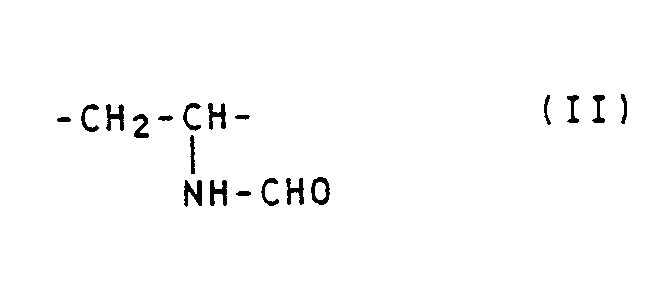
enthalten. Vorzugsweise wird die Abspaltung so geführt, daß ein Polymerisat anfällt, das 90 bis 10 Mol.% Einheiten der Formel (1) und 10 bis 90 Mol.% Einheiten der Formel (II) enthält. Derartige Polymerisate wie auch das Polyvinylamin eignen sich beispielsweise als Flockungsmittel für Abwässer und Schlämme sowie als Retentions-, Entwässerungshilfsmittel und Flockungsmittel bei der Herstellung von Papier. - Sofern die Abspaltung der Formylgruppe in Gegenwart eines Lösemittels vorgenommen wird und die Reaktionstemperatur oberhalb des Siedepunkts des Lösemittels liegt, wird die Reaktion in einem Autoklaven durchgeführt. Führt man die Abspaltung der Formylgruppe aus Poly-N-Vinylformamid in Gegenwart geringer Mengen an Wasser und Alkoholen durch, so erhält man anstelle von Kohlenmonoxid, Ameisensäure bzw. Ameisensäureester. Der K-Wert der Vinylamin-Einheiten enthaltenden Polymerisate entspricht etwa dem K-Wert der N-Vinylformamidpolymerisate. Der K-Wert der Polymerisate wurde nach H. Fikentscher, Cellulosechemie 13. 58-64 und 71-74 (1932). bei einer Polymerkonzentration von 0,5 Gew.% in 5 %iger wäßriger Kochsalzlösung bei einer Temperatur von 25°c gemessen; dabei bedeutet K = k · 10³.
- In drei verschiedenen Ansätzen werden jeweils 7,1 g (100 mMol) eines wasserfreien Poly-N-Vinylformamid-Pulvers unter Rühren mit trockenem Chlorwasserstoff begast. Das Abgas wird durch eine Natronlaugewäsche geleitet, anschließend bestimmt man die Kohlenmonoxidmenge volumetrisch. In der Tabelle 1 sind die Raktionsbedingungen sowie der Hydrolysegrad und die Ausbeute an Polymerisat angegeben. Tabelle 2 enthält Angaben über den Teilchendurchmesser der Ausgangsprodukte.
Tabelle 1 Beispiel 1 K-Wert HCl/h mH/h Temp. (°C) Reak.-Zeit (h) Hydrolyse-grad (%) CO (% d.Th.) Ausbeute (g) a 29,3 72 115 7 50 100 7,5 b 87 82 115 6,5 62 87 7,5 c 122 112 110 4 34 100 7,4 Tabelle 2 Beispiel 1 > 160 µm 160-100 µm 100- 60 µm < 60 µm a 16,6 % 44 % 22,5 % 17 % b 5,6 % 3 % 8.4 % 83 % > 300 µm 300-200 µm 200-100 µm < 100 µm c 6.7 % 39 % 51,6 % 2,8 % - 17,8 g (250 mmol) eines Poly-N-Vinylformamid-Pulvers vom K-Wert 30,8 und einem mittleren Teilchendurchmesser von 100 bis 300 µm werden in 82.2 g Dioxan suspendiert und nach dem Eingasen von 9.1 g (250 mmol) trockenem Chlorwasserstoff zwei Stunden unter Rühren auf eine Temperatur von 90°C erhitzt. Der Wassergehalt im Polymerisat beträgt 1 Gew.%, bezogen auf das eingesetzte Polymerisat. Nach dem Abkühlen wird das Reaktionsprodukt abfiltriert und das anhaftende Suspensionsmittel (Dioxan) unter vermindertem Druck entfernt. Man erhält 17,0 g eines Poly-N-Vinylformamids aus dem 12 % der Formylgruppen abgespalten sind.
- 100 g (1.406 mol) Poly-N-Vinvlformamid-Pulver (Teilchendurchmesser 100 bis 300 µm) werden jeweils in den in Tabelle 3 angegebenen Alkoholen suspendiert und bei den ebenfalls in Tabelle 3 angegebenen Bedingungen solvolisiert. Der Wassergehalt, bezogen auf Polymerisat, beträgt 1,5 Gew.%
Tabelle 3 Beispiel 3 K-Wert Alkohol HCL (Mol) Reak.-temp. (°C) Reak.-Zeit (h) Hydrolysegrad (%) Ausbeute (g) Art Menge a 140 Methanol 513 1,406 40 14 44 105,1 b 29,3 Isopropanol 910 3,173 84 3 28 103,2 c 93,4 Isobutanol 385 1,058 100 6 56 105 d 93,4 Isobutanol 373 0,702 80 3,3 26 102,5 - In einem Autoklaven werden 113,6 g (1,566 mol) Poly-N-Vinylformamid-Pulver einer Teilchengröße von 100 bis 200 µm und einem K-Wert von 28 vorgelegt. Der Wassergehalt des Polymeren beträgt 2,1 Gew.%. Man gibt dann 71 g (0,96 mol) Isobutanol und 355 g Cyclohexan zu, verschließt den Autoklav und preßt bei Raumtemperatur 37,6 g (1,03 mol) gasförmigen Chlorwasserstoff auf und erhitzt den Autoklaveninhalt 4 Stunden auf eine Temperatur von 100°C. Es stellt sich ein Druck von maximal 1,7 bar ein. Nach dem Abkühlen trennt man das Pulver vom Suspensionsmittel, wäscht das Pulver und entfernt das anhaftende Suspensionsmittel unter vermindertem Druck. Man erhält 113 g eines Polymeren mit einem Hydrolysegrad von 71 %.
- Wie in Beispiel 4 angegeben, legt man in einem Autoklaven 7,1 g (0,1 mol) einer Mischung aus 2,6 g eines Poly-N-Vinylformamid-Pulvers eines mittleren Durchmessers von 200 bis 300 µm und 4,5 g des gleichen Polymeren mit einem mittleren Durchmesser von 100 bis 200 µm in 355 g trockenem Cyclohexan zusammen mit 3,7 g (50 mmol) Isobutanol und 3,65 g (0,1 mol) Chlorwasserstoff vor und erhitzt den Autoklaveninhalt 4 Stunden auf eine Temperatur von 100°C. Der K-Wert der Polymerisate beträgt 142,5. Man erhält 7,65 g eines Poly-N-Vinylformamid-Pulvers, aus dem teilweise die Formylgruppen abgespalten sind. Wie aus Tabelle 4 hervorgeht, ist der Hydrolysegrad (HG) weitgehend unabhängig von der Korngröße des Polymeren.
Tabelle 4 a) 0,46 g mit Körnung > 250 µm : HG = 37 % b) 6,65 g mit Körnung 125-250 µm : HG = 44 % c) 0,54 g mit Körnung < 125 µm : HG = 42 %
Claims (10)
- Verfahren zur Herstellung von pulverförmigen, linearen, basischen Polymerisaten, die Einheiten der Formel

- Verfahren nach Anspruch 1, dadurch gekennzeichnet, daß man die Reaktion in Gegenwart von höchstens 2,5 Gew.% Wasser mit gasförmigem Chlorwasserstoff oder Bromwasserstoff vornimmt.
- Verfahren nach den Ansprüchen 1 und 2, dadurch gekennzeichnet, daß man die Reaktion in Abwesenheit von Wasser durchführt.
- Verfahren nach den Ansprüchen 1 bis 3, dadurch gekennzeichnet, daß man die Reaktion in Gegenwart eines inerten Suspensionsmittels durchführt, das die Polymerisatteilchen nicht löst.
- Verfahren nach Anspruch 4, dadurch gekennzeichnet, daß man als Suspensionsmittel Dioxan, Tetrahydrofuran oder Cyclohexan einsetzt.
- Verfahren nach den Ansprüchen 1 bis 3, dadurch gekennzeichnet, daß man die Abspaltung der Formylgruppe in einem C₁- bis C₈-Alkohol vornimmt.
- Verfahren nach Anspruch 6, dadurch gekennzeichnet, daß man zusätzlich ein inertes Suspensionsmittel einsetzt.
- Verfahren nach den Ansprüchen 1 bis 7, dadurch gekennzeichnet, daß die Teilchengröße des N-Vinylformamid-Polymerisats 10 bis 1000 µm beträgt.
- Verfahren nach den Ansprüchen 1 bis 7, dadurch gekennzeichnet, daß die Teilchengröße des N-Vinylformamid-Polymerisats 50 bis 400 µm beträgt.
- Verfahren nach den Ansprüchen 1 bis 9, dadurch gekennzeichnet, daß man die Reaktion bei Temperaturen von 35 bis 150°C durchführt.
Priority Applications (1)
| Application Number | Priority Date | Filing Date | Title |
|---|---|---|---|
| AT85114796T ATE76083T1 (de) | 1984-11-29 | 1985-11-21 | Verfahren zur herstellung von pulverfoermigen, linearen, basischen polymerisaten. |
Applications Claiming Priority (2)
| Application Number | Priority Date | Filing Date | Title |
|---|---|---|---|
| DE3443461 | 1984-11-29 | ||
| DE19843443461 DE3443461A1 (de) | 1984-11-29 | 1984-11-29 | Verfahren zur herstellung von pulverfoermigen, linearen, basischen polymerisaten |
Publications (3)
| Publication Number | Publication Date |
|---|---|
| EP0185935A2 EP0185935A2 (de) | 1986-07-02 |
| EP0185935A3 EP0185935A3 (en) | 1989-04-26 |
| EP0185935B1 true EP0185935B1 (de) | 1992-05-13 |
Family
ID=6251419
Family Applications (1)
| Application Number | Title | Priority Date | Filing Date |
|---|---|---|---|
| EP85114796A Expired - Lifetime EP0185935B1 (de) | 1984-11-29 | 1985-11-21 | Verfahren zur Herstellung von pulverförmigen, linearen, basischen Polymerisaten |
Country Status (13)
| Country | Link |
|---|---|
| US (1) | US4623699A (de) |
| EP (1) | EP0185935B1 (de) |
| JP (1) | JPS61133207A (de) |
| AT (1) | ATE76083T1 (de) |
| AU (1) | AU580352B2 (de) |
| CA (1) | CA1250696A (de) |
| DE (2) | DE3443461A1 (de) |
| DK (1) | DK549785A (de) |
| ES (1) | ES8606422A1 (de) |
| FI (1) | FI81814C (de) |
| NO (1) | NO165300C (de) |
| NZ (1) | NZ214359A (de) |
| ZA (1) | ZA859103B (de) |
Families Citing this family (30)
| Publication number | Priority date | Publication date | Assignee | Title |
|---|---|---|---|---|
| JPS61190508A (ja) * | 1985-02-19 | 1986-08-25 | Mitsubishi Chem Ind Ltd | 粉末状ポリビニルアミン塩の製造方法 |
| US4808683A (en) * | 1986-06-19 | 1989-02-28 | Mitsubishi Chemical Industries Limited | Vinylamine copolymer, flocculating agent using the same, and process for preparing the same |
| US4804793A (en) * | 1986-10-01 | 1989-02-14 | Air Products And Chemicals, Inc. | Drilling mud compositions containing high molecular weight poly (vinylamines) |
| US4931194A (en) * | 1986-10-01 | 1990-06-05 | Pinschmidt Jr Robert K | Enhanced oil recovery with high molecular weight polyvinylamine formed in-situ |
| US4828725A (en) * | 1986-10-01 | 1989-05-09 | Air Products And Chemicals, Inc. | Completion fluids containing high molecular weight poly(vinylamines) |
| MX168601B (es) * | 1986-10-01 | 1993-06-01 | Air Prod & Chem | Procedimiento para la preparacion de un homopolimero de vinilamina de alto peso molecular |
| US4798871A (en) * | 1986-10-01 | 1989-01-17 | Air Products And Chemicals, Inc. | Compositions containing high molecular weight poly(vinylamines) for enhanced oil recovery |
| US4795770A (en) * | 1986-10-01 | 1989-01-03 | Air Products And Chemicals, Inc. | Cement composition for oil well drilling holes containing high molecular weight poly (vinylamines) |
| EP0295614A1 (de) * | 1987-06-19 | 1988-12-21 | Air Products And Chemicals, Inc. | Hochmolekulare Polyvinylamine enthaltende saure Aufbrechflüssigkeiten für die Tertiärförderung (EOR) |
| DE3842820A1 (de) * | 1988-12-20 | 1990-06-28 | Basf Ag | Verfahren zur herstellung von stabilen wasser-in-oel-emulsionen von hydrolysierten polymerisaten von n-vinylamiden und ihre verwendung |
| US4943676A (en) * | 1989-07-12 | 1990-07-24 | Air Products And Chemicals, Inc. | Thermolysis of poly(N-vinylformamide) to poly(N-vinylamine) |
| US4973410A (en) * | 1989-11-29 | 1990-11-27 | Air Products And Chemicals, Inc. | Crosslinked vinylamine polymer in enhanced oil recovery |
| US5085787A (en) * | 1989-11-29 | 1992-02-04 | Air Products And Chemicals, Inc. | Crosslinked vinylamine polymer in enhanced oil recovery |
| DE4007312C2 (de) * | 1990-03-08 | 2000-04-27 | Basf Ag | Verfahren zur Herstellung von feinteiligen, wasserlöslichen, Vinylamin-Einheiten enthaltenden Polymerisaten |
| US5126395A (en) * | 1990-03-08 | 1992-06-30 | Basf Aktiengesellschaft | Preparation of stable water-in-oil emulsions of hydrolyzed polymers of n-vinylamides |
| JP3042546B2 (ja) * | 1991-04-23 | 2000-05-15 | 昭和電工株式会社 | 微粒子状の架橋型n−ビニルアミド樹脂及びミクロゲル、その製造法及び用途 |
| DE4237439A1 (de) * | 1992-11-06 | 1994-05-11 | Basf Ag | Unlösliche, nur wenig quellbare Polymerisate mit Aminogruppen, Verfahren zu ihrer Herstellung und ihre Verwendung |
| US5391710A (en) * | 1993-03-25 | 1995-02-21 | Air Products And Chemicals, Inc. | Production of amine functional polymers having improved purity |
| DE4411311A1 (de) * | 1994-03-31 | 1995-10-05 | Basf Ag | Verfahren zur Herstellung von lagerstabilen wäßrigen Lösungen von Vinylamin-Einheiten enthaltenden Polymerisaten |
| DE4418156A1 (de) * | 1994-05-25 | 1995-11-30 | Basf Ag | Verfahren zur Herstellung von stabilen Wasser-in-Öl-Emulsionen von hydrolysierten Polymerisaten von N-Vinylamiden und ihre Verwendung |
| US5609857A (en) * | 1995-04-05 | 1997-03-11 | National Starch And Chemical Investment Holding Corporation | Methods of conditioning hair which utilize polymeric N-vinyl formamide |
| KR970704414A (ko) * | 1994-08-05 | 1997-09-06 | 해밀톤 데이비드 엘. | 플리머 n-비닐 포름아미드를 함유하는 헤어케어조성물 및 모발손질법(hair care compositions containing polymeric n-vinyl formamide and methods of treating hair) |
| US5478553A (en) * | 1994-08-05 | 1995-12-26 | National Starch And Chemical Investment Holding Corporation | Hair fixative compositions containing polymeric N-vinyl formamide |
| DE4433481A1 (de) * | 1994-09-20 | 1996-03-21 | Basf Ag | Oligomerisate und Polymerisate von Aminoalkenen |
| US6599999B1 (en) | 1997-02-04 | 2003-07-29 | National Starch And Chemical Investment Holding Corporation | Hair care compositions containing polymeric N-vinyl acetamide and methods of treating hair |
| US5977274A (en) * | 1998-03-09 | 1999-11-02 | National Starch And Chemical Investment Holding Corporation | Method for making polymers from N-vinyl formamide monomer |
| DE10342862A1 (de) * | 2003-09-15 | 2005-04-21 | Basf Ag | Verwendung von polyvinylamin- und/oder polyvinylamidhaltigen Polymeren zur Geruchsverhinderung beim maschinellen Geschirrspülen |
| US20080257507A1 (en) * | 2007-04-17 | 2008-10-23 | Campbell Clayton J | Acidified polyamidoamine adhesives, method of manufacture, and use for creping and ply bond applications |
| WO2010052179A1 (de) * | 2008-11-05 | 2010-05-14 | Basf Se | Verfahren zur hydrolyse von vinylcarbonsäureamideinheiten enthaltenden polymeren |
| CN107849175B (zh) | 2015-07-24 | 2020-12-04 | 巴斯夫欧洲公司 | 在反应器单元系列中制备n-乙烯基羧酰胺 |
Family Cites Families (7)
| Publication number | Priority date | Publication date | Assignee | Title |
|---|---|---|---|---|
| DE1817309A1 (de) * | 1968-12-28 | 1970-07-02 | Hoechst Ag | Basische und kationische Copolymere des AEthylens und Verfahren zu ihrer Herstellung |
| US4018826A (en) * | 1974-11-04 | 1977-04-19 | Dynapol Corporation | Process for preparing polyvinylamine and salts thereof |
| US4238579A (en) | 1979-05-18 | 1980-12-09 | Dynapol | Vinylamine aromatic copolymers and salts thereof |
| FI70230C (fi) * | 1981-07-18 | 1986-09-15 | Basf Ag | Rakkedjiga basiska polymerisat foerfarande foer deras framstaellning och deras anvaendning |
| DE3213873A1 (de) | 1982-04-15 | 1983-10-27 | Basf Ag, 6700 Ludwigshafen | Flockungsmittel fuer schlaemme |
| US4499232A (en) | 1982-07-19 | 1985-02-12 | Cassella Aktiengesellschaft | Water soluble, crosslinkable polymer compositions, their preparation and use |
| DE3534273A1 (de) * | 1985-09-26 | 1987-04-02 | Basf Ag | Verfahren zur herstellung von vinylamin-einheiten enthaltenden wasserloeslichen copolymerisaten und deren verwendung als nass- und trockenverfestigungsmittel fuer papier |
-
1984
- 1984-11-29 DE DE19843443461 patent/DE3443461A1/de not_active Withdrawn
-
1985
- 1985-11-21 AT AT85114796T patent/ATE76083T1/de active
- 1985-11-21 EP EP85114796A patent/EP0185935B1/de not_active Expired - Lifetime
- 1985-11-21 DE DE8585114796T patent/DE3586046D1/de not_active Expired - Lifetime
- 1985-11-22 FI FI854625A patent/FI81814C/fi not_active IP Right Cessation
- 1985-11-25 CA CA000496141A patent/CA1250696A/en not_active Expired
- 1985-11-25 US US06/802,060 patent/US4623699A/en not_active Expired - Fee Related
- 1985-11-27 JP JP60265180A patent/JPS61133207A/ja active Granted
- 1985-11-28 AU AU50450/85A patent/AU580352B2/en not_active Ceased
- 1985-11-28 ZA ZA859103A patent/ZA859103B/xx unknown
- 1985-11-28 ES ES549388A patent/ES8606422A1/es not_active Expired
- 1985-11-28 DK DK549785A patent/DK549785A/da not_active Application Discontinuation
- 1985-11-28 NO NO854768A patent/NO165300C/no unknown
- 1985-11-28 NZ NZ214359A patent/NZ214359A/en unknown
Also Published As
| Publication number | Publication date |
|---|---|
| DK549785A (da) | 1986-05-30 |
| CA1250696A (en) | 1989-02-28 |
| DE3586046D1 (de) | 1992-06-17 |
| FI854625L (fi) | 1986-05-30 |
| DE3443461A1 (de) | 1986-05-28 |
| ES8606422A1 (es) | 1986-04-16 |
| AU5045085A (en) | 1986-06-05 |
| NZ214359A (en) | 1988-02-29 |
| ZA859103B (en) | 1986-08-27 |
| JPH0436162B2 (de) | 1992-06-15 |
| JPS61133207A (ja) | 1986-06-20 |
| DK549785D0 (da) | 1985-11-28 |
| AU580352B2 (en) | 1989-01-12 |
| NO165300C (no) | 1991-01-23 |
| FI81814C (fi) | 1990-12-10 |
| NO165300B (no) | 1990-10-15 |
| FI81814B (fi) | 1990-08-31 |
| FI854625A0 (fi) | 1985-11-22 |
| EP0185935A3 (en) | 1989-04-26 |
| ES549388A0 (es) | 1986-04-16 |
| US4623699A (en) | 1986-11-18 |
| EP0185935A2 (de) | 1986-07-02 |
| ATE76083T1 (de) | 1992-05-15 |
| NO854768L (no) | 1986-05-30 |
Similar Documents
| Publication | Publication Date | Title |
|---|---|---|
| EP0185935B1 (de) | Verfahren zur Herstellung von pulverförmigen, linearen, basischen Polymerisaten | |
| DE69121496T2 (de) | Suspensionspolymerisation von vinylverbindungen | |
| EP0438836B1 (de) | Dispergiermittel, ihre Verwendung und damit beschichtete Feststoffe | |
| EP0025515B1 (de) | Verwendung von stickstoffhaltigen Kondensationsprodukten als Retentionsmittel, Flockungsmittel und Entwässerungsbeschleuniger bei der Papierherstellung | |
| EP0065643B1 (de) | Polymere Ammoniumverbindungen mit kieselsäureartigem Grundgerüst, ihre Herstellung und Verwendung | |
| EP0066074B1 (de) | Polymere tertiäre und sekundäre Organosiloxanamine, ihre Herstellung und Verwendung | |
| DE60035414T2 (de) | Verfahren zur herstellung von vernetzten polyallyaminderivaten | |
| DE2641960A1 (de) | Katalysatoren zur polymerisation von olefinen zu polymeren sphaeroidischer form | |
| DE2345707A1 (de) | Katalysatoren fuer die polymerisation von olefinen und verfahren zu deren herstellung | |
| DE2347577A1 (de) | Verfahren zur stereospezifischen polymerisation von alpha-olefinen | |
| EP0177812A1 (de) | Verfahren zur Herstellung von unlöslichen, nur wenig quellbaren pulverförmigen Polymerisaten | |
| DE3823729A1 (de) | Verfahren zur herstellung eines harzes mit einem hohen wasserabsorptionsvermoegen | |
| DE69430860T2 (de) | Polymere-Binder für die Keramikherstellung | |
| EP0175335A1 (de) | Verfahren zur Herstellung von unlöslichen, nur wenig quellbaren pulverförmigen Polymeren | |
| DE3715117C2 (de) | Poly-ß-alanin-Verbindung, Verfahren zu ihrer Herstellung und ihre Verwendung in Polyacetalharz-Zusammensetzungen | |
| DE2760272C2 (de) | Verfahren zur Herstellung von Poly-(tetramethylenether)-glykol durch Alkoholyse eines Ester-Endgruppen aufweisenden Poly-(tetramethylenether)-glykols | |
| DE1595544C3 (de) | Verfahren zur Herstellung von stabilen, wasserlöslichen kationischen Carbamoyl-Gruppen tragenden Polymerisaten | |
| DE69518027T2 (de) | Verfahren zur Herstellung von Acrylamid | |
| EP0038009B1 (de) | Verfahren zur Herstellung von hydroxylgruppenhaltigen Polymeren | |
| DE2529587A1 (de) | Verfahren zur herstellung feinverteilter vinylidenfluorid-polymerisatteilchen und deren verwendung | |
| EP0067362A1 (de) | Verbessertes Verfahren zur alkalischen Verseifung von PAN | |
| DE1420482A1 (de) | Verfahren zur Polymerisation von Lactamen | |
| EP0358067B1 (de) | Vinylchloridcopolymerisate | |
| EP0047381A1 (de) | Verfahren zur Herstellung wasserlöslicher Hydrolyseprodukte von Polyacrylnitrilpolymerisaten und deren Verwendung als Bohrspülmittel | |
| DE2715518C2 (de) |
Legal Events
| Date | Code | Title | Description |
|---|---|---|---|
| PUAI | Public reference made under article 153(3) epc to a published international application that has entered the european phase |
Free format text: ORIGINAL CODE: 0009012 |
|
| AK | Designated contracting states |
Kind code of ref document: A2 Designated state(s): AT BE CH DE FR GB IT LI NL SE |
|
| PUAL | Search report despatched |
Free format text: ORIGINAL CODE: 0009013 |
|
| AK | Designated contracting states |
Kind code of ref document: A3 Designated state(s): AT BE CH DE FR GB IT LI NL SE |
|
| 17P | Request for examination filed |
Effective date: 19890318 |
|
| 17Q | First examination report despatched |
Effective date: 19900608 |
|
| GRAA | (expected) grant |
Free format text: ORIGINAL CODE: 0009210 |
|
| AK | Designated contracting states |
Kind code of ref document: B1 Designated state(s): AT BE CH DE FR GB IT LI NL SE |
|
| REF | Corresponds to: |
Ref document number: 76083 Country of ref document: AT Date of ref document: 19920515 Kind code of ref document: T |
|
| ITF | It: translation for a ep patent filed | ||
| REF | Corresponds to: |
Ref document number: 3586046 Country of ref document: DE Date of ref document: 19920617 |
|
| GBT | Gb: translation of ep patent filed (gb section 77(6)(a)/1977) | ||
| ET | Fr: translation filed | ||
| PLBE | No opposition filed within time limit |
Free format text: ORIGINAL CODE: 0009261 |
|
| STAA | Information on the status of an ep patent application or granted ep patent |
Free format text: STATUS: NO OPPOSITION FILED WITHIN TIME LIMIT |
|
| 26N | No opposition filed | ||
| EAL | Se: european patent in force in sweden |
Ref document number: 85114796.7 |
|
| PGFP | Annual fee paid to national office [announced via postgrant information from national office to epo] |
Ref country code: FR Payment date: 19971027 Year of fee payment: 13 |
|
| PGFP | Annual fee paid to national office [announced via postgrant information from national office to epo] |
Ref country code: SE Payment date: 19971028 Year of fee payment: 13 |
|
| PGFP | Annual fee paid to national office [announced via postgrant information from national office to epo] |
Ref country code: NL Payment date: 19971029 Year of fee payment: 13 |
|
| PGFP | Annual fee paid to national office [announced via postgrant information from national office to epo] |
Ref country code: CH Payment date: 19971105 Year of fee payment: 13 |
|
| PGFP | Annual fee paid to national office [announced via postgrant information from national office to epo] |
Ref country code: AT Payment date: 19971106 Year of fee payment: 13 |
|
| PGFP | Annual fee paid to national office [announced via postgrant information from national office to epo] |
Ref country code: BE Payment date: 19971114 Year of fee payment: 13 |
|
| PGFP | Annual fee paid to national office [announced via postgrant information from national office to epo] |
Ref country code: GB Payment date: 19971117 Year of fee payment: 13 |
|
| PGFP | Annual fee paid to national office [announced via postgrant information from national office to epo] |
Ref country code: DE Payment date: 19971128 Year of fee payment: 13 |
|
| PG25 | Lapsed in a contracting state [announced via postgrant information from national office to epo] |
Ref country code: GB Free format text: LAPSE BECAUSE OF NON-PAYMENT OF DUE FEES Effective date: 19981121 Ref country code: AT Free format text: LAPSE BECAUSE OF NON-PAYMENT OF DUE FEES Effective date: 19981121 |
|
| PG25 | Lapsed in a contracting state [announced via postgrant information from national office to epo] |
Ref country code: SE Free format text: LAPSE BECAUSE OF NON-PAYMENT OF DUE FEES Effective date: 19981122 |
|
| PG25 | Lapsed in a contracting state [announced via postgrant information from national office to epo] |
Ref country code: LI Free format text: LAPSE BECAUSE OF NON-PAYMENT OF DUE FEES Effective date: 19981130 Ref country code: CH Free format text: LAPSE BECAUSE OF NON-PAYMENT OF DUE FEES Effective date: 19981130 Ref country code: BE Free format text: LAPSE BECAUSE OF NON-PAYMENT OF DUE FEES Effective date: 19981130 |
|
| PG25 | Lapsed in a contracting state [announced via postgrant information from national office to epo] |
Ref country code: DE Free format text: LAPSE BECAUSE OF THE APPLICANT RENOUNCES Effective date: 19981204 |
|
| BERE | Be: lapsed |
Owner name: BASF A.G. Effective date: 19981130 |
|
| PG25 | Lapsed in a contracting state [announced via postgrant information from national office to epo] |
Ref country code: NL Free format text: LAPSE BECAUSE OF NON-PAYMENT OF DUE FEES Effective date: 19990601 |
|
| GBPC | Gb: european patent ceased through non-payment of renewal fee |
Effective date: 19981121 |
|
| REG | Reference to a national code |
Ref country code: CH Ref legal event code: PL |
|
| PG25 | Lapsed in a contracting state [announced via postgrant information from national office to epo] |
Ref country code: FR Free format text: LAPSE BECAUSE OF NON-PAYMENT OF DUE FEES Effective date: 19990730 |
|
| EUG | Se: european patent has lapsed |
Ref document number: 85114796.7 |
|
| NLV4 | Nl: lapsed or anulled due to non-payment of the annual fee |
Effective date: 19990601 |
|
| REG | Reference to a national code |
Ref country code: FR Ref legal event code: ST |