EP0177960B1 - Tetrahydronaphtalinderivate, Verfahren und Zwischenprodukte zu deren Herstellung sowie diese enthaltende Arzneimittel - Google Patents
Tetrahydronaphtalinderivate, Verfahren und Zwischenprodukte zu deren Herstellung sowie diese enthaltende Arzneimittel Download PDFInfo
- Publication number
- EP0177960B1 EP0177960B1 EP85112863A EP85112863A EP0177960B1 EP 0177960 B1 EP0177960 B1 EP 0177960B1 EP 85112863 A EP85112863 A EP 85112863A EP 85112863 A EP85112863 A EP 85112863A EP 0177960 B1 EP0177960 B1 EP 0177960B1
- Authority
- EP
- European Patent Office
- Prior art keywords
- alkoxy
- tetrahydro
- isopropyl
- signifies
- methylamino
- Prior art date
- Legal status (The legal status is an assumption and is not a legal conclusion. Google has not performed a legal analysis and makes no representation as to the accuracy of the status listed.)
- Expired - Lifetime
Links
- 0 CCCCC1C*=CC1 Chemical compound CCCCC1C*=CC1 0.000 description 3
Classifications
-
- C—CHEMISTRY; METALLURGY
- C07—ORGANIC CHEMISTRY
- C07C—ACYCLIC OR CARBOCYCLIC COMPOUNDS
- C07C211/00—Compounds containing amino groups bound to a carbon skeleton
- C07C211/01—Compounds containing amino groups bound to a carbon skeleton having amino groups bound to acyclic carbon atoms
- C07C211/02—Compounds containing amino groups bound to a carbon skeleton having amino groups bound to acyclic carbon atoms of an acyclic saturated carbon skeleton
- C07C211/03—Monoamines
-
- A—HUMAN NECESSITIES
- A61—MEDICAL OR VETERINARY SCIENCE; HYGIENE
- A61K—PREPARATIONS FOR MEDICAL, DENTAL OR TOILETRY PURPOSES
- A61K31/00—Medicinal preparations containing organic active ingredients
- A61K31/21—Esters, e.g. nitroglycerine, selenocyanates
- A61K31/215—Esters, e.g. nitroglycerine, selenocyanates of carboxylic acids
-
- A—HUMAN NECESSITIES
- A61—MEDICAL OR VETERINARY SCIENCE; HYGIENE
- A61P—SPECIFIC THERAPEUTIC ACTIVITY OF CHEMICAL COMPOUNDS OR MEDICINAL PREPARATIONS
- A61P9/00—Drugs for disorders of the cardiovascular system
- A61P9/06—Antiarrhythmics
-
- A—HUMAN NECESSITIES
- A61—MEDICAL OR VETERINARY SCIENCE; HYGIENE
- A61P—SPECIFIC THERAPEUTIC ACTIVITY OF CHEMICAL COMPOUNDS OR MEDICINAL PREPARATIONS
- A61P9/00—Drugs for disorders of the cardiovascular system
- A61P9/10—Drugs for disorders of the cardiovascular system for treating ischaemic or atherosclerotic diseases, e.g. antianginal drugs, coronary vasodilators, drugs for myocardial infarction, retinopathy, cerebrovascula insufficiency, renal arteriosclerosis
-
- A—HUMAN NECESSITIES
- A61—MEDICAL OR VETERINARY SCIENCE; HYGIENE
- A61P—SPECIFIC THERAPEUTIC ACTIVITY OF CHEMICAL COMPOUNDS OR MEDICINAL PREPARATIONS
- A61P9/00—Drugs for disorders of the cardiovascular system
- A61P9/12—Antihypertensives
Definitions
- the present invention relates to tetrahydronaphthalene derivatives.
- tetrahydronaphthalene derivatives of the general formula wherein R is hydrogen or lower alkyl, R1, R2, R3 and R4 independently of one another each hydrogen, halogen or lower alkoxy or two adjacent radicals together methylenedioxy or ethylenedioxy, R5, R6, R7, R8 and R9 independently of one another each hydrogen, halogen, C1-C10-alkoxy, lower alkylthio, lower-alkoxy-lower-alkoxy or ⁇ , ⁇ , ⁇ -trifluoro-lower-alkoxy or two adjacent radicals together methylenedioxy or ethylenedioxy, Y hydroxy, lower-alkylcarbonyloxy, lower-alkoxy-lower alkylcarbonyloxy, lower alkoxycarbonyloxy, lower alkoxy lower alkoxycarbonyloxy, lower alkylthio lower alkylcarbonyloxy or given
- the present invention relates to compounds of the general formula I as such and for use as therapeutic active substances, the preparation of these compounds. Intermediates for the preparation of these compounds, furthermore medicaments containing them and the production of such medicaments, and also the use of compounds of the general formula I in combating or preventing diseases or in improving health, in particular in combating or preventing Angina, ischemia, arrhythmias and high blood pressure
- phenylalkylamines and their coronary vasodilator In EPA 0.080.721 phenylalkylamines and their coronary vasodilator, antihypoxic, antispasmodic and antiplatelet properties are known.
- the compounds according to the application differ significantly from the previously known compounds by the presence of an amino group which interrupts the alkylene chain and the replacement of the phenyl ring by a tetrahydronaphthalene radical.
- lower alkyl used in the present description - alone or in combination - means straight-chain and branched, saturated hydrocarbon radicals having 1-6, preferably 1-4, carbon atoms, such as methyl, ethyl, n-propyl, isopropyl, n- Butyl, isobutyl, sec-butyl, tert-butyl and the like.
- lower alkoxy means lower alkyl ether groups, wherein the term “lower alkyl” has the above meaning.
- C1-C10 alkoxy similarly refers to alkyl ether groups in which the alkyl group has 1-10 carbon atoms.
- halogen includes the four halogen atoms fluorine, chlorine, bromine and iodine.
- substituted benzylcarbonyloxy includes benzylcarbonyloxy groups in which one or two hydrogen atoms are substituted by lower alkyl, lower alkoxy, halogen or nitro.
- leaving group means known groups such as halogen, preferably chlorine or bromine, arylsulfonyloxy, such as tosyloxy, bromobenzenesulfonyloxy, benzenesulfonyloxy or Mesitylenesulfonyloxy, or alkylsulfonyloxy, such as mesyloxy or trifluoromethylsulfonyloxy.
- halogen preferably chlorine or bromine
- arylsulfonyloxy such as tosyloxy, bromobenzenesulfonyloxy, benzenesulfonyloxy or Mesitylenesulfonyloxy
- alkylsulfonyloxy such as mesyloxy or trifluoromethylsulfonyloxy.
- Preferred compounds of the formula I are those in which R is lower alkyl, particularly preferably isopropyl.
- Y preferably denotes hydroxyl, lower alkylcarbonyloxy, particularly preferably acetyloxy, or lower alkoxy-lower alkylcarbonyloxy, particularly preferably methoxyacetyloxy.
- m and n are preferably the number 1.
- those compounds of the formula I are preferred in which two of the substituents R1, R2, R3 and R4 are hydrogen and the other two are each independently hydrogen, halogen or lower alkoxy.
- Those compounds of the formula I are particularly preferred in which R1 and R4 are each hydrogen and R2 and R3 are each lower alkoxy or R2 is halogen and R3 is hydrogen.
- R5, R6, R7, R8 and R9 are hydrogen and the three others are each independently hydrogen, halogen, C1-C10 alkoxy, lower alkylthio or lower alkoxy lower mean alkoxy.
- R8 and R9 are particularly preferably hydrogen and R5 is hydrogen or C1-C10-alkoxy
- R6 is hydrogen, C1-C10-alkoxy or lower alkoxy-lower-alkoxy
- R7 is hydrogen, halogen, C1-C10-alkoxy, lower-alkylthio or lower alkoxy lower alkoxy.
- a compound of the formula II is reacted with an amine of the formula III by methods known per se.
- the reaction takes place in the presence or absence of an organic solvent which is inert under the reaction conditions at a temperature between about 20 ° and 150 ° C, preferably between about 80 ° and 120 ° C.
- This reaction includes solvents such as dimethylformamide, dimethyl sulfoxide, alcohols such as isopropanol or tert-butanol, ethers such as tetrahydrofuran or dioxane, aromatic hydrocarbons such as benzene, toluene or xylene, chlorinated hydrocarbons such as methylene chloride, carbon tetrachloride or chlorobenzene, and the like in question.
- solvents such as dimethylformamide, dimethyl sulfoxide, alcohols such as isopropanol or tert-butanol, ethers such as tetrahydrofuran or dioxane,
- the reaction is advantageously carried out in the presence of an acid-binding agent, such as a tertiary amine, such as trimethylamine, triethylamine, ethyldiisopropylamine or 1,5-diazabicyclo [4.3.0] non-5-ene, and excess amine of the formula III can also serve as the acid-binding agent .
- an acid-binding agent such as a tertiary amine, such as trimethylamine, triethylamine, ethyldiisopropylamine or 1,5-diazabicyclo [4.3.0] non-5-ene
- excess amine of the formula III can also serve as the acid-binding agent .
- an acid-binding agent such as a tertiary amine, such as trimethylamine, triethylamine, ethyldiisopropylamine or 1,5-diazabicyclo [4.3.0] non-5-ene
- the reductive amination of a compound of the formula IV is also carried out in a manner known per se by reaction with an amine of the formula III in the presence of a reducing agent, such as sodium cyanoborohydride or hydrogen / catalyst, in a solvent, such as an alcohol or an aqueous alcohol, such as methanol, Ethanol or propanol or aqueous solutions thereof.
- a reducing agent such as sodium cyanoborohydride or hydrogen / catalyst
- a solvent such as an alcohol or an aqueous alcohol, such as methanol, Ethanol or propanol or aqueous solutions thereof.
- a reducing agent such as sodium cyanoborohydride or hydrogen / catalyst
- a solvent such as an alcohol or an aqueous alcohol, such as methanol, Ethanol or propanol or aqueous solutions thereof.
- Suitable catalysts are, in particular, Raney nickel and palladium.
- the reaction temperature is between about 0 °
- acylation of a compound of formula Ia is also carried out according to methods known per se.
- Suitable acylating agents are in particular activated acid derivatives, such as acid halides and acid anhydrides or mixed acid anhydrides.
- the reaction is carried out in an organic solvent or solvent mixture which is inert under the reaction conditions at a temperature between about 0 ° C. and the reflux temperature.
- Aromatic hydrocarbons such as benzene, toluene or xylene, chlorinated hydrocarbons such as methylene chloride or chloroform, ethers such as diethyl ether, tetrahydrofuran or dioxane, and the like are particularly suitable as solvents.
- a tetralone derivative of the formula V is reacted in a manner known per se with an alkyl haloacetate in the presence of zinc, the reaction with a tert-butyl haloacetate also being able to be carried out in the presence of magnesium.
- the reaction is carried out in an inert organic solvent or solvent mixture, such as an ether, such as diethyl ether or tetrahydrofuran, or an aromatic hydrocarbon, such as benzene or toluene, or mixtures thereof at a temperature between about 0 ° C. and the reflux temperature of the solvent.
- In situ decomposition of the intermediate addition product provides an ester of the formula VI, which can be hydrolyzed in a manner known per se to the corresponding acid of the formula VI.
- An ester or an acid of the formula VI can also be reduced to the corresponding alcohol of the formula VII by known methods.
- Suitable reducing agents are, for example, lithium aluminum hydride, sodium bis (2-methoxyethoxy) aluminum dihydride, lithium borohydride, diisobutyl aluminum hydride or diborane and the like.
- the reduction is carried out in an organic, aprotic solvent which is inert under the reaction conditions, such as an ether such as diethyl ether, tetrahydrofuran or dioxane a hydrocarbon, such as hexane or cyclohexane, or an aromatic hydrocarbon, such as benzene or toluene, and the like. at a temperature between about room temperature and 100 ° C, preferably between about room temperature and 50 ° C.
- An alcohol of formula VII can then be converted by reaction with an aryl or alkylsulfonyl halide in a known manner into a compound of formula IIa, in which X represents an aryl or alkylsulfonyl group.
- This reaction is advantageously carried out in the presence of an acid-binding agent, such as a tertiary amine, such as triethylamine, ethyldiisopropylamine or pyridine Absence of an organic solvent inert under the reaction conditions at a temperature between about 0 ° and 80 ° c.
- Suitable solvents are ethers, such as diethyl ether, tetrahydrofuran or dioxane, aromatic hydrocarbons, such as benzene or toluene, chlorinated hydrocarbons, such as methylene chloride or chloroform, and the like, mixtures thereof or excess acid-binding agent.
- a compound of formula IIa in which X is halogen is conveniently obtained by reacting a compound of formula IIa in which X is aryl or alkylsulfonyl with a sodium halide in acetone or a pyridine hydrohalide at a temperature between about 0 ° and 100 ° C.
- a compound of the formula IIa is then converted into a compound of the formula VIII by known methods by reaction with sodium or potassium cyanide.
- the reaction with the cyanide is carried out in an organic solvent which is inert under the reaction conditions, such as dimethyl sulfoxide, dimethylformamide, hexamethylphosphoric acid triamide and the like, at a temperature between about room temperature and 150 ° C., preferably between about 40 ° and 80 ° C.
- a compound of formula VIII can then be reduced to a compound of formula IV by known methods.
- Reducing agents suitable for this stage are, for example, sodium bis (2-methoxyethoxy) aluminum dihydride, diisobutyl aluminum hydride and the like.
- the reduction is carried out in an organic solvent which is inert under the reaction conditions, such as a chlorinated hydrocarbon such as methylene chloride, an ether such as diethyl ether, tetrahydrofuran or Dioxane, a hydrocarbon such as hexane or cyclohexane, and the like.
- a chlorinated hydrocarbon such as methylene chloride
- an ether such as diethyl ether, tetrahydrofuran or Dioxane
- a hydrocarbon such as hexane or cyclohexane, and the like.
- a compound of the formula IV can then be further reduced to the corresponding alcohol of the formula IX, which in turn can then be converted into the compound of the formula IIb in an analogous manner to that indicated for the conversion VII ⁇ IIa.
- the reduction of a compound of formula IV is carried out in a manner known per se using reducing agents customary for such a reduction, such as hydrogen in the presence of a catalyst, such as Raney nickel or palladium, lithium aluminum hydride, sodium borohydride or lithium borohydride and the like, in an inert manner under the reaction conditions organic solvents such as an ether such as diethyl ether or tetrahydrofuran, an alcohol such as methanol or ethanol, and the like at a temperature between about 20 ° and 100 ° C.
- reducing agents customary for such a reduction such as hydrogen in the presence of a catalyst, such as Raney nickel or palladium, lithium aluminum hydride, sodium borohydride or lithium borohydride and the like, in an inert manner
- the compounds of the formulas VI, VII, VIII and IX are new, while the tetralone derivatives of the formula V are either known or can be obtained analogously to the preparation of the known compounds.
- the compounds of formulas VII and IX are also the subject of the present invention.
- the compounds of the general formula I contain at least one asymmetric center (2-position) and can therefore exist as optical antipodes or as racemates.
- Compounds of formula I which contain more than one asymmetric center are in the relative configuration indicated by formula I.
- the compounds of the formula I have a pronounced calcium-antagonistic effect and can therefore be used as medicaments, in particular for combating or preventing angina pectoris, ischemia, arrhythmias and high blood pressure.
- the determination is carried out on homogenates or on partially purified membranes from the heart of rabbits or guinea pigs.
- the reaction mixture (0.3 ml) consists of 0.2-0.8 mg membrane protein- 1 nM 3 H-nifedipine (or 0.25 nM 3 H-nitrendipine) and various concentrations of the test substances.
- the incubation lasts 30 minutes at 25 ° C or 37 ° C and is stopped by dilution with the incubation buffer; Filtration then takes place.
- the filter-bound radioactivity is measured with a scintillation counter.
- Specific binding i.e. receptor-bound
- the nonspecific binding is determined in the presence of an excess of non-radioactive nifedipine (1 ⁇ M).
- IC50 is the substance concentration (in mol / 1) that causes half-maximum inhibition of the specific 3H-nifedipine (or 3H-nitrendipine) binding.
- the maximum inhibition of specific binding is indicated by the% maximum inhibition value; this value is set at 100% for the reference compound nifedipine. Both parameters are extrapolated from a concentration-binding curve.
- IC50 value The effectiveness of a test substance in this test is indicated by the IC50 value. This value is defined as the substance concentration (in mol / 1) that causes a half-maximum relaxation of a KCl contracture. This value is also extrapolated from the resulting concentration-effect curve.
- the 4 most important measurement parameters (with measurement units respectively) of the hemodynamic tests are: (1) CBF: Coronary Blood Flow (in ml / min) - the blood flow rate through the coronary arteries; (2) HR: Heart Rate (in beats / min) - the heart rate; (3) BP: Blood Pressure (in mm Hg) - the blood pressure; and (4) dp / dt: Rate of increase in left ventricular pressure (in mm Hg / sec) - the rate of increase of left ventricular pressure, as a measure of the contractility of the heart. The values are given as% maximum change from the initial value ( ⁇ %) per dose administered.
- the compounds of formula I can be used as medicines, e.g. in the form of pharmaceutical preparations.
- the pharmaceutical preparations can be administered orally, e.g. in the form of tablets, coated tablets, dragées, hard and soft gelatin capsules, solutions, emulsions or suspensions.
- administration can also be rectal, e.g. in the form of suppositories, or parenterally, e.g. in the form of injection solutions.
- Suitable excipients for the production of solutions and syrups are e.g. Water, polyols, sucrose, invert sugar, glucose etc.
- Suitable excipients for injection solutions are e.g. Water, alcohols, polyols, glycerin, vegetable oils etc.
- excipients are e.g. natural or hardened oils, waxes, fats, semi-liquid or liquid polyols etc.
- the pharmaceutical preparations can also contain preservatives, solubilizers, stabilizers, wetting agents, emulsifiers, sweeteners, colorants, flavoring agents, salts for changing the osmotic Contain pressure, buffer, coating agent or antioxidants. They can also contain other therapeutically valuable substances.
- compounds of the general formula I can be used in the control or prevention of angina pectoris, ischemia, arrhythmias and high blood pressure.
- the dosage can vary within wide limits and is of course to be adapted to the individual circumstances in each individual case.
- a daily dose of about 25 to 150 mg of a compound of the general formula I should be appropriate for oral administration, but the upper limit just stated can also be exceeded if this should prove to be appropriate.
- the cooled mixture is slowly mixed with a solution of 40 g of ammonium chloride in 400 ml of water and then distributed between 600 ml of water and 1.5 l of methylene chloride.
- the organic phase is washed with water, dried over magnesium sulfate and concentrated.
- column chromatography sica gel, hexane / ethyl acetate 5: 1), tert-butyl 6-fluoro-1,2,3,4-tetrahydro-2-hydroxy-1 ⁇ -isopropyl -2 ⁇ -naphthalene acetate is obtained.
- aqueous phase is acidified with hydrochloric acid and the product extracted into 1200 ml of ether.
- the extract is dried over magnesium sulfate and evaporated. Recrystallization from toluene gives 6,7-dimethoxy-1,2,3,4-tetrahydro -2-hydroxy-1 ⁇ -isopropyl-2 ⁇ -naphthaleneacetic acid, mp. 99-101 °.
- the 6,7-dimethoxy -2- [2 is obtained from 2- (6,7-dimethoxy - 1,2,3,4-tetrahydro -2-hydroxy-2-naphthyl) ethyl p-toluenesulfonate - [(3,4-dimethoxyphenethyl) methylamino] ethyl] -1,2,3,4-tetrahydro-2-naphthalenol hydrochloride, mp. 175-177 °.
- the 2- (5,8-dimethoxy -1,2,3,4-tetrahydro-2-hydroxy-2-naphthyl) ethyl p-toluenesulfonate used as starting material in paragraph (A) above can be prepared as follows: (B) 11.5 g (45.6 mmol) of 5 ⁇ 8-dimethoxy-1,2,3,4-tetrahydro -2-hydroxy-2-naphthaleneethanol are dissolved in 70 ml of pyridine and mixed with 10.5 g (55 mmol) of p-toluenesulfonyl chloride. The mixture is stirred at 0 ° for 16 hours and then poured onto 500 ml of water.
- the product is extracted into 500 ml of ether, the extract is washed with 0.5N aqueous hydrochloric acid and saturated aqueous sodium bicarbonate solution and dried over magnesium sulfate. After evaporation, 2- (5,8-dimethoxy -1,2,3,4-tetrahydro-2-hydroxy-2-naphthyl) ethyl p-toluenesulfonate remains.
- 2- (6,7-dimethoxy -1,2,3,4-) is obtained by selective tosylation of 6,7-dimethoxy-1,2,3,4-tetrahydro -2-hydroxy-2-naphthaleneethanol.
- the organic phase is washed with water and saturated aqueous sodium bicarbonate solution and evaporated.
- the residue is dissolved in 200 ml of methanol, a solution of 10 g of sodium hydroxide in 100 ml of water is added, and the mixture is heated under reflux for 3 hours.
- the solution is evaporated to half the volume, 500 ml of water are added and the neutral components are extracted with 500 ml of chloroform.
- the aqueous phase is acidified with sulfuric acid and the product extracted into 900 ml of ether.
- the extract is dried over magnesium sulfate and evaporated. Recrystallization of the residue gives 5,8-dimethoxy-1,2,3,4-tetrahydro -2-hydroxy-2-naphthaleneacetic acid, mp. 112-114 °.
- the 6.7 is obtained by acetylating 6,7-dimethoxy -2- [2 - [(3,4-dimethoxyphenethyl) methylamino] ethyl] -1,2,3,4-tetrahydro-2-naphthalenol -Dimethoxy -2- [2 - [(3,4-dimethoxyphenethyl) methylamino] ethyl] -1,2,3,4-tetrahydro-2-naphthylacetate hydrochloride, mp 162-164 °.
- Linpropionaldehyde can be produced as follows:
- 1-3 are mixed intensively.
- the mixture is then moistened with an aqueous solution of 4 and kneaded, and the resulting mass is granulated, dried and ge seven.
- the granules are mixed with 5-7 and pressed into tablets of a suitable size.
- 1-3 are mixed intensively.
- the mixture is then moistened with an aqueous solution of 4 and kneaded, and the resulting mass is granulated, dried and sieved.
- the granules are mixed with 5-7 and pressed into tablets of a suitable size.
- the active ingredient is mixed intensively with the milk sugar.
- the cornstarch, talc and magnesium stearate are then mixed into this mixture and the mixture is filled into capsules of a suitable size.
- the active ingredient is mixed intensively with the cellulose.
- the sodium carboxymethyl starch, the talc and the magnesium stearate are then mixed into this mixture, and the mixture is filled into capsules of a suitable size.
Landscapes
- Health & Medical Sciences (AREA)
- Chemical & Material Sciences (AREA)
- Organic Chemistry (AREA)
- Veterinary Medicine (AREA)
- Public Health (AREA)
- General Health & Medical Sciences (AREA)
- Animal Behavior & Ethology (AREA)
- Life Sciences & Earth Sciences (AREA)
- Medicinal Chemistry (AREA)
- Pharmacology & Pharmacy (AREA)
- Bioinformatics & Cheminformatics (AREA)
- Engineering & Computer Science (AREA)
- General Chemical & Material Sciences (AREA)
- Chemical Kinetics & Catalysis (AREA)
- Nuclear Medicine, Radiotherapy & Molecular Imaging (AREA)
- Heart & Thoracic Surgery (AREA)
- Cardiology (AREA)
- Emergency Medicine (AREA)
- Epidemiology (AREA)
- Urology & Nephrology (AREA)
- Vascular Medicine (AREA)
- Organic Low-Molecular-Weight Compounds And Preparation Thereof (AREA)
- Acyclic And Carbocyclic Compounds In Medicinal Compositions (AREA)
- Nitrogen And Oxygen Or Sulfur-Condensed Heterocyclic Ring Systems (AREA)
- Pharmaceuticals Containing Other Organic And Inorganic Compounds (AREA)
- Transition And Organic Metals Composition Catalysts For Addition Polymerization (AREA)
- Nitrogen Condensed Heterocyclic Rings (AREA)
Description
- Die vorliegende Erfindung betrifft Tetrahydronaphthalinderivate. Im speziellen betrifft sie Tetrahydronaphthalinderivate der allgemeinen Formel

- Diese Verbindungen sind neu und zeichnen sich durch wertvolle pharmakodynamische Eigenschaften aus.
- Gegenstand der vorliegenden Erfindung sind Verbindungen der allgemeinen Formel I als solche und zur Anwendung als therapeutische Wirkstoffe, die Herstellung dieser Verbindungen. Zwischenprodukte für die Herstellung dieser Verbindungen, ferner diese enthaltende Arzneimittel und die Herstellung solcher Arzneimittel, sowie die Verwendung von Verbindungen der allgemeinen Formel I bei der Bekämpfung bzw. Verhütung von Krankheiten bzw. bei der Verbesserung der Gesundheit, insbesondere bei der Bekämpfung bzw. Verhütung von Angina pectoris, Ischämie, Arrhythmien und Bluthochdruck
- In EPA 0.080.721 sind Phenylalkylamine und deren koronargefässerweiternde, antihypoxische, antispasmodische und Blutblättchenagregations-hemmende Eigenschaften bekannt. Die anmeldegemässen Verbindungen unterscheiden sich durch die Anwesenheit einer die Alkylenkette unterbrechenden Aminogruppe sowie den Ersatz des Phenylrings durch einen Tetrahydronaphthalinrest in signifikanter Weise von den vorbekannten Verbindungen.
- Der in der vorliegenden Beschreibung verwendete Ausdruck "nieder-Alkyl" - allein oder in Kombination - bedeutet geradkettige und verzweigte, gesättigte Kohlenwasserstoffreste mit 1-6, vorzugsweise 1-4, Kohlenstoffatomen, wie Methyl, Aethyl, n-Propyl, Isopropyl, n-Butyl, Isobutyl, sec.-Butyl, tert.-Butyl und dergleichen. Der Ausdruck "nieder-Alkoxy" bedeutet nieder-Alkyläthergruppen, worin der Ausdruck "nieder-Alkyl" die obige Bedeutung hat. Der Ausdruck "C₁-C₁₀-Alkoxy" betrifft in ähnlicher Weise Alkyläthergruppen, worin der Alkylrest 1-10 Kohlenstoffatome aufweist. Der Ausdruck "Halogen" umfasst die vier Halogenatome Fluor, Chlor, Brom und Jod. Der Ausdruck "substituiertes Benzylcarbonyloxy" umfasst Benzylcarbonyloxy-Gruppen, in denen ein oder zwei Wasserstoffatome durch nieder-Alkyl, nieder--Alkoxy, Halogen oder Nitro substituiert sind. Der Ausdruck "Abgangsgruppe" bedeutet bekannte Gruppen wie Halogen, vorzugsweise Chlor oder Brom, Arylsulfonyloxy, wie etwa Tosyloxy, Brombenzolsulfonyloxy, Benzolsulfonyloxy oder Mesitylensulfonyloxy, oder Alkylsulfonyloxy, wie etwa Mesyloxy oder Trifluormethylsulfonyloxy.
- Bevorzugt sind solche Verbindungen der Formel I, worin R nieder-Alkyl, besonders bevorzugt Isopropyl, bedeutet. Y bedeutet vorzugsweise Hydroxy, nieder-Alkylcarbonyloxy, besonders bevorzugt Acetyloxy, oder nieder-Alkoxy-nieder-alkylcarbonyloxy, besonders bevorzugt Methoxyacetyloxy. m und n bedeuten vorzugsweise die Zahl 1. Weiter sind solche Verbindungen der Formel I bevorzugt, worin zwei der Substituenten R¹, R², R³ und R⁴ Wasserstoff und die beiden anderen unabhängig voneinander je Wasserstoff, Halogen oder nieder-Alkoxy bedeuten. Besonders bevorzugt sind solche Verbindungen der Formel I, worin R¹ und R⁴ je Wasserstoff und R² und R³ je nieder-Alkoxy oder R² Halogen und R³ Wasserstoff bedeuten. Ebenfalls bevorzugt sind die Verbindungen der Formel I, worin zwei der Substituenten R⁵, R⁶ , R⁷ , R⁸ und R⁹ Wasserstoff und die drei anderen unabhängig voneinander je Wasserstoff, Halogen, C₁-C₁₀-Alkoxy, nieder-Alkylthio oder nieder-Alkoxy-nieder-alkoxy bedeuten. Besonders bevorzugt bedeuten R⁸ und R⁹ je Wasserstoff und R⁵ Wasserstoff oder C₁-C₁₀-Alkoxy, R⁶ Wasserstoff, C₁-C₁₀-Alkoxy oder nieder-Alkoxy-nieder-alkoxy und R⁷ Wasserstoff, Halogen, C₁-C₁₀-Alkoxy, nieder-Alkylthio oder nieder-Alkoxy-nieder-alkoxy.
- Aus dem obigen folgt, dass solche Verbindungen der Formel I ganz besonders sind, worin R Isopropyl, Y Hydroxy, Acetyloxy oder Methoxyacetyloxy, R¹, R⁴, R⁸ und R⁹ je Wasserstoff, R² und R³ je nieder-Alkoxy oder R² Halogen und R³ Wasserstoff, R⁵ Wasserstoff oder C₁-C₁₀-Alkoxy, R6 Wasserstoff, C₁-C₁₀-Alkoxy oder nieder-Alkoxy-nieder-alkoxy, R⁷ Wasserstoff, Halogen, C₁-C₁₀-Alkoxy, nieder-Alkylthio oder nieder-Alkoxy-nieder-alkoxy und m und n die Zahl 1 bedeuten. Ganz speziell bevorzugte Verbindungen der Formel I sind:
- 2-[2-[(3,4-Dimethoxyphenäthyl)methylamino]äthyl]-6-fluor-1,2,3,4-tetrahydro-1α-isopropyl-2α-naphthylmethoxyacetat,
- 6.7-Dimethoxy-2-[2-[(3,4-dimethoxyphenäthyl)methylamino] äthyl]-1,2,3,4-tetrahydro-1α-isopropyl-2α-naphthylmethoxyacetat,
- 6.7-Dimethoxy-2-[2-[(3.4-dimethoxyphenäthyl)methylamino] äthyl]-1,2,3,4-tetrahydro-1α-isopropyl-2α-naphthylacetat und
- [1S,2S]-2-[2-[(3.4-Dimethoxyphenäthyl)methylamino]äthyl]-6-fluor-1,2,3,4-tetrahydro-1-isopropyl-2-naphthylmethoxyacetat.
- Die Verbindungen der Formel I in Form von Racematen und optischen Antipoden, sowie pharmazeutisch verwendbare Säureadditionssalze davon können hergestellt werden, indem man
- a) zur Herstellung von Verbindungen der Formel I, worin Y Hydroxy bedeutet und die übrigen Symbole die oben angegebene Bedeutung besitzen, eine Verbindung der allgemeinen Formel

worin x eine Abgangsgruppe bedeutet und R, R¹, R²,
R³, R⁴ und m die oben angegebene Bedeutung besitzen. mit einem Amin der allgemeinen Formel
worin R⁵ , R⁶ , R⁷ , R⁸ , R⁹ und n die oben ange
gebene Bedeutung besitzen, umsetzt, oder - b) zur Herstellung von Verbindungen der Formel I, worin Y Hydroxy und m die Zahl 2 bedeuten und die übrigen Symbole die oben angegebene Bedeutung besitzen, einen Aldehyd der allgemeinen Formel

worin R, R¹, R², R³ und R⁴ die oben angegebene
Bedeutung besitzen, mit einem Amin der obigen Formel III reduktiv aminiert, oder - c) zur Herstellung von Verbindungen der Formel I, worin Y nieder-Alkylcarbonyloxy, nieder-Alkoxy-nieder-alkylcarbonyloxy, nieder-Alkoxycarbonyloxy, nieder-Alkoxy-nieder-alkoxycarbonyloxy, nieder-Alkylthio-nieder-alkylcarbonyloxy oder gegebenenfalls substituiertes Benzylcarbonyloxy bedeutet und die übrigen Symbole die oben angegebene Bedeutung besitzen, eine Verbindung der allgemeinen Formel

worin R, R¹, R², R³, R⁴, R⁵, R⁶, R⁷, R⁸,
R⁹ , m und n die oben angegebene Bedeutung besitzen, mit einem eine nieder-Alkylcarbonyl-, nieder-Alkoxy-nieder--alkylcarbonyl-, nieder-Alkoxycarbonyl-, nieder-Alkoxy-nieder-alkoxycarbonyl-, nieder-Alkylthio-nieder-alkylcarbonyl-oder gegebenenfalls substituierte Benzylcarbonyl -Gruppe abgebenden Acylierungsmittel umsetzt, und - d) erwünschtenfalls, ein erhaltenes Racemat in die optischen Antipoden auftrennt, und/oder
- e) eine erhaltene Verbindung in ein pharmazeutisch verwendbares Säureadditionssalz überführt.
- Eine Verbindung der Formel II wird nach an sich bekannten Methoden mit einem Amin der Formel III umgesetzt. Die Umsetzung erfolgt in Gegenwart oder Abwesenheit eines unter den Reaktionsbedingungen inerten organischen Lösungsmittels bei einer Temperatur zwischen etwa 20° und 150°C, vorzugsweise zwischen etwa 80ü und 120°C. Bei dieser Umsetzung kommen Lösungsmittel, wie Dimethylformamid, Dimethylsul-foxid, Alkohole, wie Isopropanol oder tert.-Butanol, Aether, wie Tetrahydrofuran oder Dioxan, aromatische Kohlenwasserstoffe, wie Benzol, Toluol oder Xylol, chlorierte Kohlenwasserstoffe, wie Methylenchlorid, Tetrachlorkohlenstoff oder Chlorbenzol, und dgl. in Frage. Die Umsetzung erfolgt vorteilhafterweise in Gegenwart eines säurebindenden Mittels, wie eines tertiären Amins, wie Trimethylamin, Triäthylamin, Aethyldiisopropylamin oder 1,5-Diazabicyclo[4.3.0]non-5-en, wobei auch überschüssiges Amin der Formel III als säurebindendes Mittel dienen kann. Aus Zweckmässigkeitsgründen arbeitet man bei Atmosphärendruck, obwohl höhere Drucke ebenfalls angewandt werden können.
- Die reduktive Aminierung einer Verbindung der Formel IV erfolgt ebenfalls in an sich bekannter Weise durch Umsetzen mit einem Amin der Formel III in Gegenwart eines Reduktionsmittels, wie Natriumcyanoborhydrid oder Wasserstoff/Katalysator, in einem Lösungsmittel, wie einem Alkohol oder einem wässrigen Alkohol, wie Methanol, Aethanol oder Propanol oder wässrigen Lösungen davon. Aus Zweckmässigkeitsgründen erfolgt die reduktive Aminierung bei Atmosphärendruck, obwohl insbesondere bei der Verwendung von Wasserstoff/Katalysator als Reduktionsmittel auch bei höheren Drucken gearbeitet werden kann. Geeignete Katalysatoren sind insbesondere Raney-Nickel und Palladium. Die Reaktionstemperatur liegt in Abhängigkeit vom eingesetzten Reduktionsmittel zwischen etwa 0° und 50°C für Natriumcyanoborhydrid und zwischen etwa 0° und 100°C für Wasserstoff/Katalysator.
- Die Acylierung einer Verbindung der Formel Ia erfolgt ebenfalls nach an sich bekannten Methoden. Geeignete Acylierungsmittel sind insbesondere aktivierte Säurederivate, wie Säurehalogenide und Säureanhydride oder gemischte Säureanhydride. Die Reaktion wird in einem unter den Reaktionsbedingungen inerten organischen Lösungsmittel oder Lösungsmittelgemisch bei einer Temperatur zwischen etwa 0°C und der Rückflusstemperatur durchgeführt. Als Lösungsmittel kommen insbesondere aromatische Kohlenwasserstoffe, wie Benzol, Toluol oder Xylol, chlorierte Kohlenwasserstoffe, wie Methylenchlorid oder Chloroform, Aether, wie Diäthyläther, Tetrahydrofuran oder Dioxan, und dgl. in Frage.
- Die Ausgangsstoffe der Formeln II und IV sind neu und ebenfalls Gegenstand der vorliegenden Erfindung. Ein Herstellungsverfahren ist im nachfolgenden Schema I skizziert. Bezüglich der genauen Reaktionsbedingungen wird auf den Beispielteil verwiesen.

- In der ersten Stufe wird in an sich bekannter Weise ein Tetralonderivat der Formel V mit einem Halogenessigsäure-alkylester in Gegenwart von Zink umgesetzt, wobei die Umsetzung mit einem Halogenessigsäure-tert.-butylester auch in Gegenwart von Magnesium durchgeführt werden kann. Die Umsetzung erfolgt in einem inerten organischen Lösungsmittel oder Lösungsmittelgemisch, wie einem Aether, wie Diäthyläther oder Tetrahydrofuran, oder einem aromatischen Kohlenwasserstoff, wie Benzol oder Toluol, oder Gemischen davon bei einer Temperatur zwischen etwa 0°C und der Rückflusstemperatur des Lösungsmittels. In situ-Zerlegung des intermediär gebildeten Additionsproduktes liefert einen Ester der Formel VI, welcher in an sich bekannter Weise zur entsprechenden Säure der Formel VI hydrolysiert werden kann.
- Ein Ester oder eine Säure der Formel VI kann ebenfalls nach bekannten Methoden zum entsprechenden Alkohol der Formel VII reduziert werden. Geeignete Reduktionsmittel sind beispielsweise Lithiumaluminiumhydrid, Natrium-bis-(2-methoxyäthoxy)aluminiumdihydrid, Lithiumborhydrid, Diisobutylaluminiumhydrid oder Diboran und dgl. Die Reduktion wird in einem unter den Reaktionsbedingungen inerten organischen, aprotischen Lösungsmittel, wie einem Aether, wie Diäthyläther, Tetrahydrofuran oder Dioxan, einem Kohlenwasserstoff, wie Hexan oder Cyclohexan, oder einem aromatischen Kohlenwasserstoff, wie Benzol oder Toluol, und dgl. bei einer Temperatur zwischen etwa Raumtemperatur und 100°C, vorzugsweise zwischen etwa Raumtemperatur und 50°C, durchgeführt.
- Ein Alkohol der Formel VII kann dann durch Umsetzen mit einem Aryl- oder Alkylsulfonylhalogenid in bekannter Weise in eine Verbindung der Formel IIa überführt werden, worin X eine Aryl- oder Alkylsulfonylgruppe bedeutet. Diese Umsetzung erfolgt vorteilhafterweise in Gegenwart eines säurebindenden Mittels, wie eines tertiären Amins, wie Triäthylamin, Aethyldiisopropylamin oder Pyridin, in Gegenwart oder Abwesenheit eines unter den Reaktionsbedingungen inerten organischen Lösungsmittels bei einer Temperatur zwischen etwa 0° und 80°c. Als Lösungsmittel kommen Aether, wie Diäthyläther, Tetrahydrofuran oder Dioxan, aromatische Kohlenwasserstoffe, wie Benzol oder Toluol, chlorierte Kohlenwasserstoffe, wie Methylenchlorid oder Chloroform, und dgl., Gemische davon oder überschüssiges säurebindendes Mittel in Frage. Eine Verbindung der Formel IIa, worin X Halogen bedeutet, erhält man zweckmässig durch Umsetzen einer Verbindung der Formel IIa, worin X Aryl- oder Alkylsulfonyl bedeutet, mit einem Natriumhalogenid in Aceton oder einem Pyridinhydrohalogenid bei einer Temperatur zwischen etwa 0° und 100°C.
- Eine Verbindung der Formel IIa wird dann nach bekannten Methoden durch Umsetzen mit Natrium- oder Kaliumcyanid in eine Verbindung der Formel VIII überführt. Die Umsetzung mit dem Cyanid wird in einem unter den Reaktionsbedingungen inerten organischen Lösungsmittel, wie Dimethylsulfoxid, Dimethylformamid, Hexamethylphosphorsäuretriamid und dgl. bei einer Temperatur zwischen etwa Raumtemperatur und 150°C, vorzugsweise zwischen etwa 40° und 80°C, durchgeführt.
- Eine Verbindung der Formel VIII kann danach nach bekannten Methoden zu einer Verbindung der Formel IV reduziert werden. Für diese Stufe geeignete Reduktionsmittel sind beispielsweise Natrium-bis-(2-methoxyäthoxy)aluminiumdihydrid, Diisobutylaluminiumhydrid und dgl. Die Reduktion wird in einem unter den Reaktionsbedingungen inerten organischen Lösungsmittel, wie einem chlorierten Kohlenwasserstoff, wie Methylenchlorid, einem Aether, wie Diäthyläther, Tetrahydrofuran oder Dioxan, einem Kohlenwasserstoff, wie Hexan oder Cyclohexan, und dgl. bei einer Temperatur zwischen etwa 20° und 100°C, vorzugsweise zwischen etwa 30° und 50°C, durchgeführt.
- Eine Verbindung der Formel IV kann dann weiter zum entsprechenden Alkohol der Formel IX reduziert werden, der dann seinerseits in analoger Weise, wie oben für die Ueberführung VII→IIa angegeben, in die Verbindung der Formel IIb überführt werden kann. Die Reduktion einer Verbindung der Formel IV erfolgt in an sich bekannter Weise mit für eine solche Reduktion üblichen Reduktionsmitteln, wie Wasserstoff in Gegenwart eines Katalysators, wie Raney-Nickel oder Palladium, Lithiumaluminiumhydrid, Natriumborhydrid oder Lithiumborhydrid und dgl., in einem unter den Reaktionsbedingungen inerten organischen Lösungsmittel, wie einem Aether, wie Diäthyläther oder Tetrahydrofuran, einem Alkohol, wie Methanol oder Aethanol, und dgl. bei einer Temperatur zwischen etwa 20° und 100°C.
- Die Verbindungen der Formeln VI, VII, VIII und IX sind neu, während die Tetralonderivate der Formel V entweder bekannt sind oder in Analogie zur Herstellung der bekannten Verbindungen erhalten werden können. Die Verbindungen der Formels VII und IX sind ebenfalls Gegenstand der vorliegenden Erfindung.
- Die Verbindungen der allgemeinen Formel I enthalten mindestens ein asymmetrisches Zentrum (2-Stellung) und können deshalb als optische Antipoden oder als Racemate vorliegen. Verbindungen der Formel I, die mehr als ein asymmetrisches Zentrum enthalten, liegen in der durch die Formel I angegebenen relativen Konfiguration vor.
- Die Verbindungen der Formel I besitzen eine ausgeprägte Calcium-antagonistische Wirkung und können deshalb als Arzneimittel verwendet werden, insbesondere für die Bekämpfung bzw. Verhütung von Angina pectoris, Ischämie, Arrhythmien und Bluthochdruck.
- Die Calcium-antagonistische Wirkung sowie die blutdrucksenkenden Eigenschaften der erfindungsgemässen Verbindungen können in den nachstehend beschriebenen Tests gezeigt werden:
- Die Bestimmung wird an Homogenaten oder an partiell-gereinigten Membranen vom Kaninchen- oder Meerschweinchen-Herz durchgeführt. Die Reaktionsmischung (0,3 ml) besteht aus 0,2-0,8 mg Membranprotein- 1 nM ³H-Nifedipin (oder 0,25 nM ³H-Nitrendipin) und verschiedenen Konzentrationen der Prüfsubstanzen. Die Inkubation dauert 30 Minuten bei 25°C oder 37°C und wird durch Verdünnung mit dem Inkubationspuffer gestoppt; anschliessend erfolgt eine Filtration. Die filtergebundene Radioaktivität wird mit einem Szintillationszähler gemessen. Spezifische Bindung (d.h. rezeptorgebundene) wird als die Differenz zwischen total- und unspezifischgebundener Radioaktivität definiert. Die unspezifische Bindung wird in Gegenwart von einem Ueberschuss nichtradioaktivem Nifedipin (1µM) bestimmt.
- Die Wirksamkeit (Potenz) einer Verbindung in diesem Test wird durch die IC₅₀- und % Maximale Hemmungs-Werte (% max. Inhibition) definiert. IC₅₀ ist die Substanzkonzentration (in Mol/1), die eine halb-maximale Inhibition der spezifischen ³H-Nifedipin (bzw. ³H-Nitrendipin)-Bindung verursacht. Die maximale Hemmung der spezifischen Bindung wird durch den % Maximale-Hemmungs-Wert angegeben; für die Referenzverbindung Nifedipin ist dieser Wert als 100% festgesetzt. Beide Parameter werden aus einer Konzentration-Bindung-Kurve extrapoliert.
- In diesem Versuch werden spirale Streifen (2-2,5 mm breit und 10 mm lang) von Hunde-Koronararterien geschnitten und in einer 0rgankammer unter 1,5 g Vorspannung aufgehängt. Diese Streifen werden ca. 1 bis 2 Stunden lang in Krebs-Henseleit-Pufferlösung vorinkubiert, die bei 37°C mit Oxycarbon (Gemisch von 95% Sauerstoff und 5% Kohlendioxyd) begast wird. Anschliessend wird die relaxierende Wirkung einer dieser Substanzen auf einer KCl (84`7 mM)-Kontraktur geprüft, durch Zugabe steigender Konzentrationen der Prüfsubstanz in die Organkammer. Die Calcium-Kanal-blockierende Wirkung der Prüfsubstanzen kann deshalb festgestellt werden, weil die KCl-Kontraktur ausschliesslich mittels Calcium-Einstrom durch den spannungsabhängigen Calcium-Kanal erfolgt.
- Die Wirksamkeit einer Prüfsubstanz in diesem Test wird durch den IC₅₀-Wert angegeben. Dieser Wert wird als die Substanzkonzentration (in Mol/1) definiert, die eine halb-maximale Relaxation einer KCl-Kontraktur verursacht. Dieser Wert wird auch aus der resultierenden Konzentration-Wirkung-Kurve extrapoliert.
- Die 4 wichtigsten Messparameter (mit resp. Messeinheiten) der hämodynamischen Versuche sind: (1) CBF: Coronary Blood Flow (in ml/min) - die Blutflussgeschwindigkeit durch die Koronararterien; (2) HR: Heart Rate (in Schläge/min) - die Herzfrequenz; (3) BP: Blood Pressure (in mm Hg) - der Blutdruck; und (4) dp/dt: Rate of increase in left ventricular pressure (in mm Hg/sec) - die Anstiegsgeschwindigkeit des linksventrikulären Druckes, als Mass für die Kontraktilitätskraft des Herzens. Die Werte werden als % maximale Aenderung vom Ausgangswert (Δ%) pro verabreichter Dosis angegeben.
- Dadurch bekommt man nicht nur ein Gesamtbild der Substanzwirkung, sondern auch eine Abschätzung über die potentielle Selektivität für einen bestimmten Teil des Kreislaufsystems im ganzen Organismus. Nach Verabreichung eines Anästhetikums, wird der Hund intubiert und künstlich beatmet. Blut pH, pCO₂, pO₂ und Hämoglobin werden mit einem Blut-Gas-Analysator stündlich gemessen. Der Blutdruck (systolisch und diastolisch) wird mit einer Sonde in der Aorta abdominalis gemessen. Die Herzfrequenz wird mittels eines Tachometers erfasst, der vom Druckpuls ausgelöst wird. Für die anderen Messungen muss das Herz zuerst freigelegt werden, um eine Sonde in den linken Ventrikel (Herzkammer) für die Druckmessungen (dp/dt) einsetzen zu können. Der Coronarblutfluss wird mit einer Fluss-Sonde an der linken Coronararterie (descendens) gemessen.
- Die in diesen Tests erhaltenen Resultate sind in der folgenden Tabelle zusammengefasst:

- Die Verbindungen der Formel I können als Heilmittel, z.B. in Form pharmazeutischer Präparate, Verwendung finden. Die pharmazeutischen Präparate können oral, z.B. in Form von Tabletten, Lacktabletten, Dragées, Hart- und Weichgelatinekapseln, Lösungen, Emulsionen oder Suspensionen, verabreicht werden. Die Verabreichung kann aber auch rektal, z.B. in Form von Suppositorien, oder parenteral, z.B. in Form von Injektionslösungen, erfolgen.
- Zur Herstellung von Tabletten, Lacktabletten, Dragées und Hartgelatinekapseln können die Verbindungen der Formel I mit pharmazeutisch inerten, anorganischen oder organischen Excipientien verarbeitet werden. Als solche Excipientien kann man z.B. für Tabletten, Dragées und Hartgelatinekapseln, Lactose, Maisstärke oder Derivate davon, Talk, Stearinsäure oder deren Salze etc. verwenden.
- Für Weichgelatinekapseln eignen sich als Excipientien z.B. vegetabile Oele, Wachse, Fette, halbfeste und flüssige Polyole etc.
- Zur Herstellung von Lösungen und Sirupen eignen sich als Excipientien z.B. Wasser, Polyole, Saccharose, Invertzucker, Glukose etc.
- Für Injektionslösungen eignen sich als Excipientien z.B. Wasser, Alkohole, Polyole, Glycerin, vegetabile Oele etc.
- Für Suppositorien eignen sich als Excipientien z.B. natürliche oder gehärtete Oele, Wachse, Fette, halbflüssige oder flüssige Polyole etc.
- Die pharmazeutischen Präparate können daneben noch Konservierungsmittel, Lösungsvermittler, Stabilisierungsmittel, Netzmittel, Emulgiermittel, Süssmittel, Färbemittel, Aromatisierungsmittel, Salze zur Veränderung des osmotischen Druckes, Puffer, Ueberzugsmittel oder Antioxidantien enthalten. Sie können auch noch andere therapeutisch wertvolle Stoffe enthalten.
- Erfindungsgemäss kann man Verbindungen der allgemeinen Formel I bei der Bekämpfung bzw. Verhütung von Angina pectoris, Ischämie, Arrhythmien und Bluthochdruck verwenden. Die Dosierung kann innerhalb weiter Grenzen variieren und ist natürlich in jedem einzelnen Fall den individuellen Gegebenheiten anzupassen. Im allgemeinen dürfte bei oraler Verabreichung eine Tagesdosis von etwa 25 bis 150 mg einer Verbindung der allgemeinen Formel I angemessen sein, wobei aber die soeben angegebene obere Grenze auch überschritten werden kann, wenn sich dies als angezeigt erweisen sollte.
- Die folgenden Beispiele sollen die vorliegende Erfindung erläutern, sie jedoch in keiner Weise einschränken. Alle Temperaturen sind in Celsius Graden angegeben.
- (A) 20,0 g (49,2 mMol) 2-(6-Fluor-1,2,3,4-tetrahydro -2-hydroxy-1α₋isopropyl-2β-naphthyl)äthyl -p-toluolsulfonat und 19,2 g (98,4 mMol) N-Methylhomoveratrylamin werden in 70 ml wasserfreiem Dimethylsulfoxid gelöst und bei 80° 1 Stunde gerührt. Das Reaktionsgemisch wird auf 800 ml Eiswasser gegossen und mit 400 ml Aether extrahiert. Der Extrakt wird mit Wasser gewaschen, über Magnesiumsulfat getrocknet und eingedampft. Das durch Säulenchromatographie (Silicagel; Chloroform/Methanol 30:1) gereinigte Produkt wird in Aethylacetat gelöst, mit einem Ueberschuss von Chlorwasserstoff in Aether versetzt und nochmals eingedampft. Der amorphe Rückstand wird in Aethylacetat gelöst, mit Aether versetzt, angeimpft und über Nacht bei Raumtemperatur gerührt. Das Kristallisat wird abfiltriert, mit Aether gewaschen und getrocknet. Man erhält 2-[2-[(3,4-Dimethoxyphenäthyl)methylamino]äthyl -6-fluor-1,2,3,4-tetrahydro -1α-isopropyl -2α-naphthalinol-hydrochlorid, Smp. 190-192°.
- In analoger Weise wie oben beschrieben erhält man durch Kondensation der substituierten 2-(1,2,3,4-Tetrahydro-1α-alkyl-2-hydroxy-2ß-naphthyl)äthyl -p-toluolsulfonate mit den entsprechenden N-Methyl-arylalkylaminen die folgenden Verbindungen:
- 6-Chlor-2-[2-[(3,4-dimethoxyphenäthyl)methylamino]-äthyl]-1,2,3,4-tetrahydro-1α-isopropyl-2α-naphthalinol-hydrochlorid, Smp. 195-198°,
- 2-[2-[(3,4-Dimethoxyphenäthyl)methylamino]äthyl]-1,2,3,4-tetrahydro-1α-isopropyl-2α-naphthalinol-hydrochlorid, Smp. 175-177°,
- 6,7-Dimethoxy-2-[2-[(3,4-dimethoxyphenäthyl)methylamino]-äthyl]-l,2,3,4-tetrahydro-1α-isopropyl-2α-naphthalinol, Smp. 119-120°,
- 2-[2-[(3,4-Dimethoxyphenäthyl)methylamino]äthyl]-1,2,3,4-tetrahydro-1α-isopropyl-5,6,7-trimethoxy-2α-naphthalinol-hydrochlorid, Smp. 170-172°,
- 6,7-Dimethoxy-2-[2-[[3-(3,4-dimethoxyphenyl)propyl]-methyl-amino]äthyl]-1,2,3,4-tetrahydro-1α-isopropyl-2α-naphthalinol-hydrochlorid, Smp. 110-113°,
- 6-Fluor-1,2,3,4-tetrahydro-1α-isopropyl-2-[2-[(2,4,6-trimethoxyphenäthyl)methylamino]äthyl]-2α-naphthalinol-hydrochlorid, Smp. 146-148°,
- 6-Fluor-1,2,3,4-tetrahydro-1α-isopropyl-2-[2-[(3,4,5-trimethoxyphenäthyl)methylamino]äthyl]-2α-naphthalinol-hydrochlorid, Smp. 173-175°,
- [1S,2S]-2-[2-[(3,4-Dimethoxyphenäthyl)methylamino]äthyl]-6-fluor-1,2,3,4-tetrahydro-1-isopropyl-2-naphthalinol-hydrochlorid, Smp. 164-165°, [α]

- 2-[2-[(2,5-Dimethoxyphenäthyl)methylamino]äthyl]-6-fluor-1,2,3,4-tetrahydro-1α-isopropyl-2α-naphthalinol-hydrochlorid, Smp. 164-166°,
- 6-Fluor-1,2,3,4-tetrahydro-1α-isopropyl-2-[2-[(2-(2,2,2-trifluoräthoxy)phenäthyl)methylamino]äthyl]-2α-naphthalinol-hydrochlorid, Smp. 146-148°,
- 6-Fluor-1,2,3,4-tetrahydro-1α-isopropyl-2-[2-[(3-(2,2,2-trifluoräthoxy)phenäthyl)methylamino]äthyl]-2α-naphthalinol-hydrochlorid,
- 6-Fluor-1,2,3,4-tetrahydro-1α-isopropyl-2-[2-[(3-methoxy-4-(methylthio)phenäthyl)methylamino]äthyl]-2α-naphthalinol-hydrochlorid, Smp. 190-192°,
- 6-Fluor-2-[2-[(4-fluorphenäthyl)methylamino]äthyl]-1,2,3,4-tetrahydro-1α-isopropyl-2α-naphthalinol-hydrochlorid, Smp. 148-150°,
- 1α-Butyl-2-[2-[(3,4-dimethoxyphenäthyl)methylamino]-äthyl]-6-fluor-1,2,3,4-tetrahydro-2α-naphthalinol-hydrochlorid, Smp. 123-125°,
- 6-Fluor-1,2,3,4-tetrahydro-1α-isopropyl-2-[2-[(4-methoxyphenäthyl)methylamino]äthyl]-2α-naphthalinol-hydrochlorid, Smp. 123-125°,
- 2-[2-[(4-Butoxyphenäthyl)methylamino]äthyl]-6-fluor-1,2,3,4-tetrahydro-1α-isopropyl-2α-naphthalinol-hydrochlorid, Smp. 169-170° und
- 2-[2-[(4-Decyloxyphenäthyl)methylamino]äthyl]-6-fluor-1,2,3,4-tetrahydro-1α-isopropyl-2α-naphthalinol-hydrochlorid, Smp. 137-139°.
- Das in obigem Absatz (A) als Ausgangsmaterial eingesetzte 2-(6-Fluor-1,2,3,4-tetrahydro -2-hydroxy-1α-isopropyl-2β-naphthyl)äthyl-p-toluolsulfonat kann wie folgt hergestellt werden:
- (B) 20,0 g (79,3 mMol) 6-Fluor-1,2,3,4-tetrahydro -2-hydroxy-1α-isopropyl-2β-naphthalinäthanol werden in 140 ml Pyridin gelöst und auf 0° gekühlt. Nach Zugabe von 18,2 g (95,5 mMol) p-Toluolsulfonylchlorid wird das Gemisch ohne Kühlung 3 Stunden gerührt und dann auf 1 1 Wasser gegossen. Das Produkt wird mit 600 ml Aether extrahiert, der Aetherextrakt mit 600 ml 3N wässriger Salzsäure, 600 ml gesättig ter wässriger Natriumbicarbonat-Lösung und 600 ml Wasser gewaschen. Nach dem Trocknen über Magnesiumsulfat wird der Aether unter vermindertem Druck abgedampft, und das verbleibende Oel aus 300 ml Cyclohexan umkristallisiert. Man erhält 2-(6-Fluor-1,2,3,4-tetrahydro -2-hydroxy-1α-isopropyl-2β-naphthyl)äthyl-p-toluolsulfonat, Smp. 91-92°.
- In analoger Weise wie oben beschrieben erhält man durch Umsetzen der entsprechenden l,2,3,4-Tetrahydro-2-hydroxy -1α-alkyl-2β-naphthalinäthanole mit p-Toluolsulfonylchlorid die folgenden Verbindungen:
- 2-(6-Chlor-1,2,3,4-tetrahydro-2-hydroxy-1α-isopropyl-2β-naphthyl)äthyl-p-toluolsulfonat,
- 2-(1,2,3,4-Tetrahydro-2-hydroxy-1α-isopropyl-2β-naphthyl)äthyl-p-toluolsulfonat,
- 2-(6,7-Dimethoxy-1,2,3,4-tetrahydro-2-hydroxy-1α-isopropyl-2β-naphthyl)äthyl-p-toluolsulfonat, Smp. 74-75°,
- 2-(1,2,3,4-Tetrahydro-2-hydroxy-1α-isopropyl-5,6,7-trimethoxy-2β-naphthyl)äthyl-p-toluolsulfonat
- 2-(1α-Butyl-6-fluor-1,2,3,4-tetrahydro-2-hydroxy-2β-naphthyl)äthyl-p-toluolsulfonat und
- [1S,2S]-2-(6-Fluor-1,2,3,4-tetrahydro-2-hydroxy-1-isopropyl-2-naphthyl)äthyl-p-toluolsulfonat, Smp. 66-67°.
- Die Derivate, die bei Raumtemperatur nicht kristallisieren, werden mit Hilfe spektroskopischer Methoden charakterisiert.
- Das in obigem Absatz (B) als Ausgangsmaterial eingesetzte 6-Fluor-1,2,3,4-tetrahydro -2-hydroxy-1α-isopropyl-2β-naphthalinäthanol kann wie folgt hergestellt werden:
- (C) Ein Zehntel einer Lösung von 57 g (0,276 Mol) 6-Fluor-3,4-dihydro-1-isopropyl-2(1H)-naphthalinon und 59,5 g (0,305 Mol) Bromessigsäure-tert.-butylester in 330 ml Tetrahydrofuran wird zu 10,6 g (0,436 Mol) aktiviertem Magnesium gegeben. Nachdem die durch Erhitzen verursachte, visuell er kennbare Reaktion einsetzt, wird der Rest der Lösung unter Rückfluss innert 30 Minuten zugetropft. Nach beendigter Zugabe wird das Reaktionsgemisch weitere 1 1/2 Stunden zum Rückfluss erhitzt. Das abgekühlte Gemisch wird langsam mit einer Lösung von 40 g Ammoniumchlorid in 400 ml Wasser versetzt und dann zwischen 600 ml Wasser und 1,5 l Methylenchlorid verteilt. Die organische Phase wird mit Wasser gewaschen, über Magnesiumsulfat getrocknet und eingeengt. Nach säulenchromatographischer Reinigung (Silicagel,Hexan/Aethylacetat 5:1) erhält man tert.-Butyl 6-fluor-1,2,3,4-tetrahydro-2-hydroxy-1α-isopropyl -2β-naphthalinacetat. Das ölige Produkt wird in 415 ml Tetrahydrofuran gelöst und innert 30 Minuten zu einer gerührten Suspension von 13,44 g (0,354 Mol) Lithiumaluminiumhydrid in 400 ml Tetrahydrofuran getropft, wobei die Reaktionstemperatur auf 60° steigt. Das Gemisch wird weitere 30 Minuten gerührt und dann auf 10° abgekühlt. Vorsichtig werden nacheinander 22 ml Wasser, 22 ml 28%ige wässrige Natronlauge und 66 ml Wasser zugegeben. Die erhaltene Suspension wird filtriert, der Filterkuchen mit Tetrahydrofuran gewaschen, und das Filtrat eingedampft. Der kristalline Rückstand wird aus 120 ml Cyclohexan umkristallisiert. Man erhält 6-Fluor-1,2,3,4-tetrahydro -2-hydroXY-1α-isopropyl-2β-naphthalinäthanol, Smp. 97-98°.
- In analoger Weise wie oben beschrieben erhält man durch Umsetzen der entsprechenden 3`4-Dihydro-1-alkyl-2(1H)-naphthalinone mit Magnesium/Bromessigsäure-tert.-butylester und anschliessender Reduktion die folgenden Verbindungen:
- 6-Chlor-1,2,3,4-tetrahydro-2-hydroxy-1α-isopropyl-2β-naphthalinäthanol, Smp. 99-100°,
- 6,7-Dimethoxy-1,2,3,4-tetrahydro-2-hydroxy-1α-isopropyl-2β-naphthalinäthanol, Sdp. 170°/13 Pa,
- 1,2,3,4-Tetrahydro-2-hydroxy-1α-isopropyl-5,6,7-trimethoxy-2β-naphthalinäthanol, Smp. 96-97°,
- 1α-Butyl-6-fluor-1,2,3,4-tetrahydro-2-hydroxy-2β-naphthalinäthanol und
- [1S,2S]-6-Fluor-1,2,3,4-tetrahydro-2-hydroxy-1-isopropyl-2-naphthalinäthanol, Smp. 78-80°, [α]

- (D) 1,2,3,4-Tetrahydro -2-hydroxy-1α-isopropyl-2β-naphthalinäthanol lässt sich wie folgt herstellen:
- 10,0 g (37,2 mMol) 6-Chlor-1,2,3,4-tetrahydro -2-hydroxy-1α-isopropyl-2β-naphthalinäthanol und 4`5 g Triäthylamin in 150 ml Methanol werden in Gegenwart von 1,9 g 5%igem Palladium auf Kohle bei Raumtemperatur und Atmosphärendruck hydriert. Die filtrierte Reaktionslösung wird eingedampft, und der Rückstand durch Säulenchromatographie (Silicagel, Hexan/Aethylacetat 1:11) gereinigt. Nach Umkristallisation aus Aethylacetat/Hexan erhält man 1,2,3,4-Tetrahydro -2-hydroxy-1α-isopropyl-2β-naphthalinäthanol, Smp. 103-104°.
- Das in obigem Absatz (C) als Ausgangsmaterial eingesetzte 6-Fluor-3,4-dihydro -1-isopropyl-2(1H)-naphthalinon kann wie folgt hergestellt werden:
- 50 g (0,255 Mol) 2-(p-Fluorphenyl)-3-methylbuttersäure werden in 200 ml Benzol gelöst und mit 54,2 g (0,456 Mol) Thionylchlorid versetzt. Das Gemisch wird bei 60° 45 Minuten gerührt und anschliessend 2 Stunden zum Rückfluss erhitzt. Nach dem Abdampfen des Lösungsmittels wird der Rückstand destilliert, wobei man 2-(4-Fluorphenyl)-3-methylbutyryl-chlorid, Sdp. 70°/93 Pa, erhält.
- 79 g (0,368 Mol) dieses Säurechlorids werden in 2,7 1 Methylenchlorid gelöst und auf -10° abgekühlt. Ein Strom von Aethylengas wird während 1 Stunde in die Lösung eingeleitet. Dann werden 122,4 g (0,918 Mol) wasserfreies Aluminiumchlorid zugegeben und weitere l5 Minuten Aethylengas eingeleitet. Das Gemisch wird 1 Stunde bei 0° gerührt und dann langsam mit 900 ml Wasser versetzt, wobei die Temperatur unter 25° gehalten wird. Die organische Phase wird mit 1 1 3N wässriger Salzsäure und 1 1 gesättigter wässriger Natriumbicarbonatlösung gewaschen, über Magnesiumsulfat getrocknet und eingedampft. Das Rohprodukt wird durch fraktionierte Destillation im Vakuum gereinigt. Man erhält 6-Fluor-3,4-dihydro-1-isopropyl-2(1H)-naphthalinon, Sdp. 100-105°/53 Pa.
- In analoger Weise wie oben beschrieben erhält man durch Umsetzen der entsprechenden Säurechloride mit Aethylen und Aluminiumchlorid die folgenden Verbindungen:
- 6-Chlor-3,4-dihydro-1-isopropyl-2(1H)-naphthalinon, Sdp. 100°/40 Pa,
- 3,4-Dihydro-6,7-dimethoxy-1-isopropyl-2(1H)-naphthalinon, Smp. 78-79°,
- 3,4-Dihydro-1-isopropyl-5,6,7-trimethoxy-2(1H)-naphthalinon, Sdp. 140°/13 Pa,
- 1-Butyl-6-fluor-3,4-dihydro-2(1H)-naphthalinon, Sdp. 110-112°/67 Pa und
- [1S]-6-Fluor-3,4-dihydro-1-isopropyl-2(1H)-naphthalinon, [α]

- Das in Beispiel 1(C) genannte 6,7-Dimethoxy-1,2,3,4-tetrahydro-2-hydroxy-1α-isopropyl -2β-naphthalinäthanol kann auch auf folgendem Weg gewonnen werden:
- 22,0 g (0,106 Mol) 3,4-Dihydro-6,7-dimethoxy-2(1H)-naphthalinon werden in 300 ml Dimethylformamid gelöst und mit 13 g (0,116 Mol) Kalium-tert.-butylat versetzt. Die Lösung wird bei 18° 30 Minuten gerührt. Nach Zugabe von 19,7 g (0,116 Mol) Isopropyljodid wird das Gemisch weitere 30 Minuten gerührt, wobei die Temperatur unterhalb 30° gehalten wird, und dann auf Wasser gegossen. Das Produkt wird mit Aether extrahiert, der Extrakt mit Wasser gewaschen, über Magnesiumsulfat getrocknet und eingedampft. Das zurückbleibende Oel wird durch Säulenchromatographie (Silicagel, Hexan/Aethylacetat 6:1) gereinigt. Man erhält 3,4-Dihydro-6.7-dimethoxy -1-isopropyl-2(1H)-naphthalinon, Smp. 77-79°.
- Ein Drittel einer Lösung von 28,0 g (0.113 Mol) 3,4-Dihydro-6,7-dimethoxy -1-isopropyl-2(1H)-naphthalinon und 20.9 g (0,125 Mol) Bromessigsäureäthylester in 180 ml Toluol/Benzol 1:1 wird zu 8.3 g (0.127 Mol) aktiviertem Zinkstaub gegeben.
- Nach einigen Minuten Erhitzen zum Rückfluss setzt eine exotherme Reaktion ein. Der Rest der Lösung wird dann innerhalb von 10 Minuten zugetropft. Nach beendigter Zugabe wird das Reaktionsgemisch 1 Stunde zum Rückfluss erhitzt, danach abgekühlt und zwischen 300 ml Benzol und 250 ml 3N wässriger Schwefelsäure verteilt. Die organische Phase wird mit Wasser und gesättigter Natriumbicarbonatlösung gewaschen und eingedampft. Der ölige Rückstand wird in 300 ml Methanol gelöst, mit 20 g Natriumhydroxid in 150 ml Wasser versetzt, und das Gemisch 1 Stunde zum Rückfluss erhitzt. Man verdünnt dann die Lösung mit 1.6 l Wasser und extrahiert die neutralen Bestandteile mit 900 ml Aether. Die wässrige Phase wird mit Salzsäure sauer gestellt, und das Produkt in 1200 ml Aether extrahiert. Der Extrakt wird über Magnesiumsulfat getrocknet und eingedampft. Umkristallisation aus Toluol liefert 6,7-Dimethoxy-1,2,3,4-tetrahydro -2-hydroxy-1α-isopropyl-2β-naphthalinessigsäure, Smp. 99-101°.
- 16.9 g (55 mMol) 6,7-Dimethoxy-1,2,3,4-tetrahydro -2-hydroxy-1α-isopropyl-2β-naphthalinessigsäure werden in 175 ml Tetrahydrofuran gelöst. 17.6 ml (0.176 Mol) einer 10M Lösung des Boran-Methylsulfid-Komplexes in Tetrahydrofuran werden bei 20° innert 30 Minuten zugetropft. Das Reaktionsgemisch wird bei Raumtemperatur 48 Stunden gerührt. Nach Zugabe von 50 ml Methanol wird die Lösung eingedampft. Der Rückstand wird in 300 ml Methanol aufgenommen und 3 Stunden zum Rückfluss erhitzt. Das nach dem Abdampfen des Methanols verbleibende Oel wird durch Säulenchromatographie (Silicagel, Chloroform/Methanol 40:1) gereinigt und anschliessend unter vermindertem Druck destilliert. Man erhält 6,7-Dimethoxy-1,2,3,4-tetrahydro -2-hydroxy-1α-isopropyl-2β-naphthalinäthanol, Sdp. 180°/27 Pa.
- 19,8 g (46.1 mMol) 2-[2-[(3,4-Dimethoxyphenäthyl)methylamino]äthyl] -6-fluor-1,2,3,4-tetrahydro-1α-isopropyl -2α-naphthalinol werden in 140 ml Chloroform gelöst und auf 0° gekühlt. 10,0 g (92,2 mMol) Methoxyacetylchlorid werden zugegeben, und das Gemisch bei 0° 3 Stunden gerührt. Die Reaktionslösung wird auf 500 ml eiskalte 1N wässrige Natronlauge gegossen, die organische Phase mit Wasser gewaschen, über Magnesiumsulfat getrocknet und eingedampft. Der Rückstand wird in Aethylacetat gelöst, mit einem Ueberschuss von Chlorwasserstoff in Aether versetzt und nochmals eingedampft. Der amorphe Rückstand wird in Aethylacetat gelöst, mit Aether versetzt, angeimpft und über Nacht bei Raumtemperatur gerührt. Das Kristallisat wird abfiltriert, mit Aether gewaschen und getrocknet. Man erhält 2-[2-[(3,4-Dimethoxyphenäthyl)methylamino]äthyl] -6-fluor-1,2,3,4-tetrahydro-1α-isopropyl -2α-naphthylmethoxyacetat-hydrochlorid, Smp. 150-152°.
- In analoger Weise wie oben beschrieben erhält man durch Umsetzen der entsprechenden 1,2,3,4-Tetrahydro-2-naphthalinol-Derivate mit Carbonsäurechloriden die folgenden Verbindungen:
- 6-Chlor-2-[2-[(3,4-dimethoxyphenäthyl)methylamino]-äthyl]-1,2,3,4-tetrahydro-1α-isopropyl-2α-naphthylmethoxyacetat-hydrochlorid, Smp. 177-180°.
- 2-[2-[(3,4-Dimethoxyphenäthyl)methylamino]äthyl]-1,2,3,4-tetrahydro-1α-isopropyl-2α-naphthylmethoxyacetat-hydrochlorid, Smp. 176-178°,
- 6,7-Dimethoxy-2-[2-[(3,4-dimethoxyphenäthyl)methylamino]äthyl]-1,2,3,4-tetrahydro-1α-isopropyl-2α-naphthylmethoxyacetat-hydrochlorid, Smp. 183-186°,
- 2-[2-[(3,4-Dimethoxyphenäthyl)methylamino]äthyl]-1,2,3,4-tetrahydro-1α-isopropyl-5,6,7-trimethoxy-2α-naphthylmethoxyacetat-hydrochlorid, Smp. 162-164°,
- 6,7-Dimethoxy-2-[2-[(3-/3,4-dimethoxyphenyl/propyl)-methylamino]äthyl]-1,2,3,4-tetrahydro-1α-isopropyl-2α-naphthylmethoxyacetat-hydrochlorid, Smp. 148-150°,
- 6-Fluor-1,2,3,4-tetrahydro-1α-isopropyl-2-[2-[(2,4,6-trimethoxyphenäthyl)methylamino]äthyl]-2α-naphthylmethoxyacetat-hydrochlorid, Smp. 138-140°,
- 6-Fluor-1,2,3,4-tetrahydro-1α-isopropyl-2-[2-[(3,4,5-trimethoxyphenäthyl)methylamino]äthyl]-2α-naphthylmethoxyacetat-hydrochlorid, Smp. 157-159°,
- 2-[2-[(2,5-Dimethoxyphenäthyl)methylamino]äthyl]-6-fluor-1,2,3,4-tetrahydro-1α-isopropyl-2α-naphthylmethoxyacetat-hydrochlorid, Smp. 161-163°,
- 6-Fluor-1,2,3,4-tetrahydro-1α-isopropyl-2-[2-[(2-/2,2,2-trifluoräthoxy/phenäthyl)methylamino]äthyl]-2α-naphthylmethoxyacetat-hydrochlorid, Smp. 169-171°,
- 6-Fluor-1,2,3,4-tetrahydro-1α-isopropyl-2-[2-[(3-(2,2,2-trifluoräthoxy)phenäthyl)methylamino]äthyl]-2α-naphthylmethoxyacetat-hydrochlorid, Smp. 167-169°,
- 6-Fluor-1,2,3,4-tetrahydro-1α-isopropyl-2-[2-[(3-methoxy-4-(methylthio)phenäthyl)methylamino]äthyl]-2α-naphthylmethoxyacetat-hydrochlorid, Smp. 157-159°,
- 6-Fluor-2-[2-[(4-fluorphenäthyl)methylamino]äthyl]-1,2,3,4-tetrahydro-1α-isopropyl-2α-naphthylmethoxyacetat-hydrochlorid, Smp. 193-195°,
- 1α-Butyl-2-[2-[(3,4-dimethoxyphenäthyl)methylamino]-äthyl]-6-fluor-1,2,3,4-tetrahydro-2α-naphthylmethoxyacetat-hydrochlorid, Smp. 108-110°,
- 6-Fluor-1,2,3-4-tetrahydro-1α-isopropyl-2-[2-[(4-methoxyphenäthyl)methylamino]äthyl]-2α-naphthylmethoxyacetat-hydrochlorid, Smp. 204-206°,
- 2-[2-[(4-Butoxyphenäthyl)methylamino]äthyl]-6-fluor-1,2,3,4-tetrahydro-1α-isopropyl-2α-naphthylmethoxyacetat-hydrochlorid, Smp. 134-135°,
- 2-[2-[(4-Decyloxyphenäthyl)methylamino]äthyl]-6-fluor-1,2,3,4-tetrahydro-1α-isopropyl-2α-naphthylmethoxyacetat-hydrochlorid, Smp. 105-106°,
- 2-[2-[(3,4-Dimethoxyphenäthyl)methylamino]äthyl]-6-fluor-1,2,3,4-tetrahydro-1α-isopropyl-2α-naphthyläthylcarbonat-hydrochlorid, Smp. 94-97°,
- 2-[2-[(3,4-Dimethoxyphenäthyl)methylamino]äthyl]-6-fluor-1,2,3,4-tetrahydro-1α-isopropyl-2α-naphthyl(2-methoxyäthyl)carbonat-hydrochlorid, Smp. 113-115°,
- 2-[2-[(3,4-Dimethoxyphenäthyl)methylamino]äthyl]-6-fluor-1,2,3,4-tetrahydro-1α-isopropyl-2α-naphthyl-(methylthio)acetat-hydrochlorid, Smp. 110-112°,
- 2-[2-[(3,4-Dimethoxyphenäthyl)methylamino]äthyl]-6-fluor-1,2,3,4-tetrahydro-1α-isopropyl-2α-naphthyl-(4-methoxyphenyl)acetat-hydrochlorid, Smp. 129-131°,
- 6,7-Dimethoxy-2-[2-[(3,4-dimethoxyphenäthyl)methylamino]-äthyl]-1,2,3,4-tetrahydro-1α-isopropyl-2α-naphthylbutyrat, Smp. 104-106° und
- [1S,2S]-2-[2-[(3,4-Dimethoxyphenäthyl)methylamino]äthyl]-6-fluor-1,2,3,4-tetrahydro-1-isopropyl-2-naphthylmethoxyacetat-hydrochlorid, Smp. 175-176°, [α]

- 3,97 g (8,85 mMol) 2-(6,7-Dimethoxy-1,2,3,4-tetrahydro -2-hydroxy-1α-isopropyl-2β-naphthyl)äthyl-p-toluolsulfonat und 3,96 g (17,7 mMol) 4-[(3,4-Dimethoxyphenyl)butyl]methylamin werden in 7 ml Dimethylsulfoxid gelöst und 1 Stunde bei 80° gerührt. Das Reaktionsgemisch wird zwischen Aethylacetat und Wasser verteilt, und die organische Phase mit Wasser gewaschen, über Magnesiumsulfat getrocknet und eingeengt. Das durch Säulenchromatographie (Silicagel, Chloroform/Methanol 25:1) gereinigte Produkt wird, wie oben beschrieben, in das Hydrochlorid überführt. Man erhält 6,7-Dimethoxy -2-[2-[[4--(3,4-dimethoxyphenyl)butyl]methylamino]äthyl] -1,2,3,4-tetrahydro-1α-isopropyl -2α-naphthalinol-hydrochlorid, Smp. 137-139°.
- In analoger Weise wie oben beschrieben erhält man durch Kondensation der in Beispiel 1 genannten, substituierten 2-(1,2,3,4-Tetrahydro -2-hydroxy-1α-isopropyl-2β-naphthyl)äthyl -p-toluolsulfonate mit den entsprechenden N-Methyl-arylalkylaminen folgende Verbindungen:
- 6-Fluor-1,2,3,4-tetrahydro-1α-isopropyl-2-[2-[(phenäthyl)methylamino]iäthyl]-2α-naphthalinol-hydrochlorid, Smp. 176-177°,
- 6,7-Dimethoxy-1,2,3,4-tetrahydro-1α-isopropyl-2-[2-[[4-methoxy-3-(3-methoxypropoxy)phenäthyl]methylamino]-äthyl]-2α-naphthalinol und
- 6,7-Dimethoxy-1,2,3,4-tetrahydro-1α-isopropyl-2-[2-[[3-methoxy-4-(3-methoxypropoxy)phenäthyl]methylamino]-äthyl]-2α-naphthalinol.
- Eine Lösung von 2,3 g (4,6 mMol) 6,7-Dimethoxy -2-[2-[[4-(3,4-dimethoxyphenyl)butyl]methylamino]äthyl] -1,2,3,4-tetrahydro-1α-isopropyl-2α-naphthalinol in 20 ml Essigsäureanhydrid wird bei Raumtemperatur 16 Stunden gerührt. Das Reaktionsgemisch wird zu 200 ml Eiswasser gegeben, mit 28%iger wässriger Natronlauge alkalisch gestellt, und das Produkt mit Aethylacetat extrahiert. Der Extrakt wird mit Wasser gewaschen, über Magnesiumsulfat getrocknet und eingedampft. Der Rückstand wird in Aethylacetat gelöst, mit einem Ueberschuss von Chlorwasserstoff in Aether versetzt und nochmals eingedampft. Der amorphe Rückstand wird in Aethylacetat gelöst, mit Aether versetzt und 2 Stunden gerührt. Das gebildete Kristallisat wird abfiltriert, mit Aether gewaschen und getrocknet. Man erhält 6,7-Dimethoxy -2-[2-[[4-(3,4-dimethoxyphenyl)butyl]methylamino]äthyl] -1,2,3,4-tetrahydro-1α-isopropyl -2α-naphthylacetat-hydrochlorid, Smp. 143-145°.
- In analoger Weise wie oben beschrieben erhält man durch Umsetzen der entsprechenden 1,2,3,4-Tetrahydro-2-naphthalinol-Derivate mit Essigsäureanhydrid die folgenden Verbindungen:
- 6-Chlor-2-[2-[(3,4-dimethoxyphenäthyl)methylamino]-äthyl]-1,2,3,4-tetrahydro-1α-isopropyl-2α-naphthylacetat-hydrochlorid, Smp. 172-174°,
- 2-[2-[(3,4-Dimethoxyphenäthyl)methylamino]äthyl]-1,2,3,4-tetrahydro-1α-isopropyl-2α-naphthylacetat-hydrochlorid, Smp. 184-185°,
- 6,7-Dimethoxy-2-[2-[(3,4-dimethoxyphenäthyl)methylamino]-äthyl]-1,2,3,4-tetrahydro-1α-isopropyl-2α-naphthylacetat-hydrochlorid, Smp. 194-196°,
- 2-[2-[(3,4-Dimethoxyphenäthyl)methylamino]äthyl]-1,2,3,4-tetrahydro-1α-isopropyl-5,6,7-trimethoxy-2α-naphthylacetat-hydrochlorid (amorph),
- 6,7-Dimethoxy-2-[2-[[3-(3,4-dimethoxyphenyl)propyl]-methylamino]äthyl]-1,2,3,4-tetrahydro-1α-isopropyl-2α-naphthylacetat-hydrochlorid, Smp. 151-153°,
- 6-Fluor-1,2,3,4-tetrahydro-1α-isopropyl-2-[2-[(2,4,6-trimethoxyphenäthyl)methylamino]äthyl]-2α-naphthylacetat-hydrochlorid, Smp. 159-161°,
- 6-Fluor-1,2,3,4-tetrahydro-1α-isopropyl-2-[2-[(2-(2,2,2-trifluoräthoxy)phenäthyl)methylamino]äthyl]-2α-naphthylacetat-hydrochlorid, Smp. 152-154°,
- 6-Fluor-1,2,3,4-tetrahydro-1α-isopropyl-2-[2-[(3-(2,2,2-trifluoräthoxy)phenäthyl)methylamino]äthyl]-2α-naphthylacetat-hydrochlorid, Smp. 163-165°,
- 1α-Butyl-2-[2-[(3,4-dimethoxyphenäthyl)methylamino]-äthyl]-6-fluor-1,2,3,4-tetrahydro-2α-naphthylacetat-hydrochlorid, Smp. 117-119°,
- 6-Fluor-1,2,3,4-tetrahydro-1α-isopropyl-2-[2-[(phenäthyl)methylamino]äthyl]-2α-naphthylacetat-hydrochlorid, Smp. 225-227°,
- 2-[2-[(3,4-Dimethoxyphenäthyl)methylamino]äthyl]-6-fluor-1,2,3,4-tetrahydro-1α-isopropyl-2α-naphthylacetat-hydrochlorid, Smp. 169-171°.
- 6,7-Dimethoxy-1,2,3,4-tetrahydro-1α-isopropyl-2-[2-[[4-methoxy-3-(3-methoxypropoxy)phenäthyl]methylamino]-äthyl]-2α-naphthylacetat-hydrochlorid, Smp. 143-145° und
- 6,7-Dimethoxy-1,2,3,4-tetrahydro-1α-isopropyl-2-[2-[[3-methoxy-4-(3-methoxypropoxy)phenäthyl]methylamino]-äthyl]-2α-naphthylacetat-hydrochlorid, Smp. 136-138°.
- (A) 17,0 g (41.8 mMol) 2-(5,8-Dimethoxy-1,2,3,4-tetrahydro -2-hydroxy-2-naphthyl)äthyl-p-toluolsulfonat und 16,3 g (83,6 mMol) N-Methylhomoveratrylamin werden 30 Minuten auf 100° erhitzt. Das Reaktionsgemisch wird zwischen Aethylacetat und Wasser verteilt, die organische Phase über Magnesiumsulfat getrocknet und eingedampft. Nach säulenchromatographischer Reinigung (Silicagel, Chloroform/Methanol 40:1) erhält man 5,8-Dimethoxy -2-[2-[(3,4-dimethoxyphenäthyl)methylamino]äthyl] -1,2,3,4-tetrahydro-2-naphthalinol, das in das Hydrochlorid überführt wird, Smp. 156-158°.
- In analoger Weise erhält man aus 2-(6,7-Dimethoxy--1,2,3,4-tetrahydro -2-hydroxy-2-naphthyl)äthyl-p-toluolsulfonat das 6,7-Dimethoxy -2-[2-[(3,4-dimethoxyphenäthyl)-methylamino]äthyl] -1,2,3,4-tetrahydro-2-naphthalinol-hydrochlorid, Smp. 175-177°.
- Das in obigem Absatz (A) als Ausgangsmaterial verwendete 2-(5,8-Dimethoxy -1,2,3,4-tetrahydro-2-hydroxy -2-naphthyl)-äthyl-p-toluolsulfonat kann wie folgt hergestellt werden: (B) 11,5 g (45,6 mMol) 5`8-Dimethoxy-1,2,3,4-tetrahydro -2-hydroxy-2-naphthalinäthanol werden in 70 ml Pyridin gelöst und mit 10,5 g (55 mMol) p-Toluolsulfonylchlorid versetzt. Das Gemisch wird bei 0° 16 Stunden gerührt und dann auf 500 ml Wasser gegossen. Das Produkt wird in 500 ml Aether extrahiert, der Extrakt mit 0,5N wässriger Salzsäure und gesättigter wässriger Natriumbicarbonatlösung gewaschen und über Magnesiumsulfat getrocknet. Nach dem Eindampfen verbleiben 2-(5,8-Dimethoxy -1,2,3,4-tetrahydro-2-hydroxy-2-naphthyl)äthyl -p-toluolsulfonat.
- In analoger Weise erhält man durch selektive Tosylierung von 6,7-Dimethoxy-1,2,3,4-tetrahydro -2-hydroxy-2-naphthalinäthanol das 2-(6,7-Dimethoxy -1,2,3,4-tetrahydro-2-hydroxy -2-naphthyl)äthyl-p-toluolsulfonat.
- Das in obigem Absatz (B) als Ausgangsmaterial verwendete 5,8-Dimethoxy-1,2,3,4-tetrahydro -2-hydroxy-2-naphthalinäthanol kann wie folgt hergestellt werden:
- (C) 15,5 g (58,2 mMol) 5,8-Dimethoxy-1,2,3,4-tetrahydro -2-hydroxy-2-naphthalinessigsäure in 150 ml Tetrahydrofuran werden innert 15 Minuten zu 3,32 g (87,5 mMol) Lithiumaluminiumhydrid in 150 ml Tetrahydrofuran getropft. Das Reaktionsgemisch wird 1 Stunde zum Rückfluss erhitzt und dann abgekühlt. Nach tropfenweiser Zugabe von 15 ml Aethylacetat und 20 ml Wasser wird die Suspension filtriert, und das Filtrat eingeengt. Das Rohprodukt wird durch Säulenchromatographie (Silicagel, Chloroform/Methanol 30:1) gereinigt. Man erhält 5,8-Dimethoxy-1,2,3,4-tetrahydro -2-hydroxy-2-naphthalinäthanol, Smp. 121-122°.
- In analoger Weise erhält man durch Reduktion von 6,7-Dimethoxy-l,2,3,4-tetrahydro -2-hydroxy-2-naphthalinessigsäure das 6,7-Dimethoxy-1,2,3,4-tetrahydro -2-hydroxy-2-naphthalinäthanol, Smp. 91-93°.
- (D) Die in obigem Absatz (C) als Ausgangsmaterial verwendete 5,8-Dimethoxy-1,2,3,4-tetrahydro -2-hydroxy-2-naphthalinessigsäure kann wie folgt hergestellt werden:
- Ein Fünftel einer Lösung von 20,6 g (0,1 Mol) 3,4-Dihydro -5,8-dimethoxy-2(1H)-naphthalinon und 18,4 g (0.11 Mol) Bromessigsäureäthylester in 100 ml Toluol/Benzol (1:1) wird zu 7,4 g (0,113 Mol) aktiviertem Zinkstaub gegeben. Nach einigen Minuten Erhitzen zum Rückfluss setzt eine exotherme Reaktion ein. Dann wird der Rest der Lösung innert 10 Minuten zugetropft. Das Reaktionsgemisch wird dann 1 1/2 Stunden zum Rückfluss erhitzt, abgekühlt und zwischen 300 ml Benzol und 300 ml 3N wässriger Schwefelsäure verteilt. Die organische Phase wird mit Wasser und gesättigter wässriger Natriumbicarbonatlösung gewaschen und eingedampft. Der Rückstand wird in 200 ml Methanol gelöst, mit einer Lösung von 10 g Natriumhydroxid in 100 ml Wasser versetzt, und das Gemisch 3 Stunden zum Rückfluss erhitzt. Die Lösung wird auf das halbe Volumen eingedampft, mit 500 ml Wasser versetzt, und die neutralen Bestandteile mit 500 ml Chloroform extrahiert. Die wässrige Phase wird mit Schwefelsäure sauer gestellt, und das Produkt in 900 ml Aether extrahiert. Der Extrakt wird über Magnesiumsulfat getrocknet und eingedampft. Umkristallisation des Rückstandes liefert 5,8-Dimethoxy-1,2,3,4-tetrahydro -2-hydroxy-2-naphthalinessigsäure, Smp. 112-114°.
- In analoger Weise kann durch Umsetzen von 3,4-Dihydro -6,7-dimethoxy-2(1H)-naphthalinon mit Zink/Bromessigsäureäthylester und anschliessender Verseifung die 6,7-Dimethoxy--1,2,3,4-tetrahydro -2-hydroxy-2-naphthalinessigsäure erhalten werden, Smp. 100-102°.
- (A) 4,3 g (10 mMol) 5,8-Dimethoxy -2-[2-[(3,4-dimethoxyphenäthyl)methylamino]äthyl] -1,2,3,4-tetrahydro-2-naphthalinol werden in 15 ml Essigsäureanhydrid gelöst und bei Raumtemperatur 18 Stunden gerührt. Das Reaktionsgemisch wird auf Wasser gegossen, mit Natronlauge alkalisch gestellt, und das Produkt in Chloroform extrahiert. Das Lösungsmittel wird eingedampft, und der Rückstand in Aethylacetat gelöst, mit einem Ueberschuss von Chlorwasserstoff in Aether versetzt und erneut eingedampft. Kristallisation des amorphen Rückstandes aus Aethylacetat liefert 5,8-Dimethoxy -2-[2-[(3,4-dimethoxyphenäthyl)methylamino]äthyl] -1,2,3,4-tetrahydro-2-naphthylacetat-hydrochlorid, Smp. 115-117°.
- In analoger Weise erhält man durch Acetylieren von 6,7-Dimethoxy -2-[2-[(3,4-dimethoxyphenäthyl)methylamino]-äthyl] -1,2,3,4-tetrahydro-2-naphthalinol das 6,7-Dimethoxy -2-[2-[(3,4-dimethoxyphenäthyl)methylamino]äthyl] -1,2,3,4-tetrahydro-2-naphthylacetat-hydrochlorid, Smp. 162-164°.
- Ein Gemisch von 2,0 g (6,5 mMol) 6,7-Dimethoxy-1,2,3,4-tetrahydro -2-hydroxy-1α-isopropyl-2β-naphthalinpropionaldehyd, 1,51 g (6,5 mMol) N-Methylhomoveratrylamin-hydrochlorid und 0,33 g (3,3 mMol) Triäthylamin in 35 ml Methanol wird mit 0,41 g (6,5 mMol) Natriumcyanoborhydrid versetzt und 2 Stunden bei Raumtemperatur gerührt. Nach Zugabe von 3,5 ml 36%iger Salzsäure wird das Reaktionsgemisch eingedampft, und der Rückstand zwischen 50 ml 3N wässriger Natronlauge und 100 ml Aether verteilt. Die organische Phase wird eingedampft und das Rohprodukt durch Säulenchromatographie (Silicagel, Chloroform/Methanol 20:1) gereinigt. Man erhält 6,7-Dimethoxy -2-[3-[(3,4-dimethoxyphenäthyl)methylamino]propyl] -1,2,3,4-tetrahydro-1α-isopropyl-2α-naphthalinol, Smp. 97-99°.
- Der als Ausgangsmaterial eingesetzte 6,7-Dimethoxy-1,2,3,4-tetrahydro -2-hydroxy-1α-isopropyl-2β-naphtha linpropionaldehyd kann wie folgt hergestellt werden:
- 2,8 g (9,2 mMol) 6,7-Dimethoxy-1,2,3,4-tetrahydro -2-hydroxy-1α-isopropyl-2β-naphthalinpropionitril werden in 50 ml Methylenchlorid gelöst und auf 0° gekühlt. Nun werden bei dieser Temperatur innert 10 Minuten 10 ml einer 1,2M Lösung von Diisobutylaluminiumhydrid in Toluol (12 mMol) zugetropft, und das Gemisch anschliessend 2 Stunden bei Raumtemperatur gerührt. Man setzt hintereinander 4 ml Methanol, 2,2 ml Wasser und 5 ml Methanol zu, rührt die Suspension für 30 Minuten und filtriert. Das Filtrat wird eingeengt, und das Rohprodukt durch Säulenchromatographie (Silicagel, Hexan/Aethylacetat 1:2) gereinigt. Nach Umkristallisation aus Cyclohexan erhält man 6,7-Dimethoxy-1,2,3,4-tetrahydro -2-hydroxy-1α-isopropyl-2β-naphthalinpropionaldehyd, Smp. 133-135°. Die spektroskopischen Daten (NMR, IR) zeigen, dass die Substanz als Hemiacetal vorliegt.
- Das als Ausgangsmaterial eingesetzte, oben genannte 6,7-Dimethoxy-1,2,3,4-tetrahydro -2-hydroxy-1α-isopropyl-2β-naphthalinpropionitril kann wie folgt hergestellt werden:
- 1,6 g (33 mMol) Natriumcyanid werden in 20 ml Dimethylsulfoxid bei 100° gelöst und auf 40° gekühlt. Man gibt 7,3 g (16,3 mMol) 2-(6,7-Dimethoxy -1,2,3,4-tetrahydro -2-hydroxy-1α-isopropyl-2β-naphthyl)äthyl-p-toluolsulfonat in 10 ml Dimethylsulfoxid zu. Das Gemisch wird bei Raumtemperatur 2 Tage gerührt und anschliessend zwischen 200 ml Wasser und 200 ml Aether verteilt. Die organische Phase wird nochmals mit Wasser gewaschen, eingedampft, und der Rückstand durch Säulenchromatographie (Silicagel, Hexan/Aethylacetat 4:1) gereinigt. Man erhält 6,7-Dimethoxy-1,2,3,4-tetrahydro -2-hydroxy-1α-isopropyl-2β-naphthalinpropionitril, Smp. 82-83°.
- 1,1 g (2,3 mMol) 6,7-Dimethoxy -2-[3-[(3,4-dimethoxyphenäthyl)methylamino]propyl] -1,2,3,4-tetrahydro-1α-isopropyl-2α-naphthalinol werden in 15 ml Essigsäureanhydrid gelöst, und die Lösung 20 Stunden bei 70° gerührt. Das Reaktionsgemisch wird auf Eiswasser gegossen, mit Natronlauge alkalisch gestellt, und das Produkt in Aethylacetat extrahiert. Der eingedampfte Extrakt wird durch Säulenchromatographie (Silicagel, Chloroform/Methanol 25:1) gereinigt, und das Produkt in das Hydrochlorid überführt. Man erhält 6,7-Dimethoxy -2-[3-[(3,4-dimethoxyphenäthyl)methylamino]-propyl] -1,2,3,4-tetrahydro-1α-isopropyl -2α-naphthylacetat-hydrochlorid, Smp. 145-147°.
-

- 1-3 werden intensiv gemischt. Die Mischung wird danach mit einer wässrigen Lösung von 4 befeuchtet und geknetet, und die resultierende Masse granuliert, getrocknet und ge siebt. Das Granulat wird mit 5-7 gemischt und zu Tabletten geeigneter Grösse verpresst.
-

- 1-3 werden intensiv gemischt. Die Mischung wird danach mit einer wässrigen Lösung von 4 befeuchtet und geknetet, und die resultierende Masse granuliert, getrocknet und gesiebt. Das Granulat wird mit 5-7 gemischt und zu Tabletten geeigneter Grösse verpresst.
-

- 1-3 werden intensiv gemischt. Die Mischung wird danach mit einer wässrigen Lösung von 4 befeuchtet und geknetet, und die resultierende Masse granuliert, getrocknet und gesiebt. Das Granulat wird mit 5-7 gemischt und zu Tabletten geeigneter Grösse verpresst.
-

- Der Wirkstoff wird mit dem Milchzucker intensiv gemischt. Dieser Mischung wird danach die Maisstärke, der Talk und das Magnesiumstearat zugemischt, und das Gemisch in Kapseln geeigneter Grösse abgefüllt.
-

- Der Wirkstoff wird mit der Cellulose intensiv gemischt. Dieser Mischung wird danach die Natriumcarboxymethylstärke, den Talk und das Magnesiumstearat zugemischt, und das Gemisch in Kapseln geeigneter Grösse abgefüllt.
-

- Wenn man nach den in den Beispielen A-F beschriebenen Verfahren arbeitet, können aus den folgenden, ebenfalls bevorzugten Verbindungen und ihren pharmazeutisch verwendbaren Salzen Tabletten, Kapseln und Injektionspräparate hergestellt werden:
- [1S,2S]-2-[2-[(3,4-Dimethoxyphenäthyl)methylamino]-äthyl]-6-fluor-1,2,3,4-tetrahydro-1-isopropyl-2-naphthylmethoxyacetat-hydrochlorid.
- 6,7-Dimethoxy-2-[2-[(3,4-dimethoxyphenäthyl)methyl-amino]äthyl]-1,2,3,4-tetrahydro-1α-isopropyl-2α-naphthylmethoxyacetat-hydrochlorid.
- 6,7-Dimethoxy-2-[2-[(3,4-dimethoxyphenäthyl)methyl-amino]äthyl]-1,2,3,4-tetrahydro-1α-isopropyl-2α-naphthylacetat-hydrochlorid.
Claims (27)
- Tetrahydronaphthalinderivate der allgemeinen Formel
 worin R Wasserstoff oder nieder-Alkyl, R¹, R², R³ und R⁴ unabhängig voneinander je Wasserstoff, Halogen oder nieder-Alkoxy oder zwei benachbarte Reste zusammen Methylendioxy oder Aethylendioxy, R⁵, R⁶, R⁷, R⁸ und R⁹ unabhängig voneinander je Wasserstoff, Halogen, C₁-C₁₀-Alkoxy, nieder Alkylthio, nieder--Alkoxy-nieder-alkoxy oder ω,ω,ω-Trifluor-nieder-alkoxy oder zwei benachbarte Reste zusammen Methylendioxy oder Aethylendioxy, Y Hydroxy, nieder-Alkylcarbonyloxy, nieder-Alkoxy-nieder-alkylcarbonyloxy, nieder-Alkoxycarbonyloxy, nieder-Alkoxy-nieder-alkoxycarbonyloxy, nieder-Alkylthio-nieder-alkylcarbonyloxy oder gegebenenfalls substituiertes Benzylcarbonyloxy, m die Zahl 1 oder 2 und n die Zahl 1, 2 oder 3 bedeuten,in Form von Racematen und optischen Antipoden, sowie pharmazeutisch verwendbare Säureadditionssalze davon.
 - Verbindungen gemäss Anspruch 1, worin R nieder-Alkyl bedeutet.
- Verbindungen gemäss Anspruch 2, worin R Isopropyl bedeutet.
- Verbindungen gemäss einem der Ansprüche 1-3, worin Y Hydroxy, nieder-Alkylcarbonyloxy oder nieder-Alkoxy-nieder--alkylcarbonyloxy bedeutet.
- Verbindungen gemäss Anspruch 4, worin Y Hydroxy, Acetyloxy oder Methoxyacetyloxy bedeutet.
- Verbindungen gemäss einem der Ansprüche 1-5, worin m und n je die Zahl 1 bedeuten.
- Verbindungen gemäss einem der Ansprüche 1-6, worin zwei der Substituenten R¹, R², R³ und R⁴ Wasserstoff und die beiden anderen unabhängig voneinander je Wasserstoff, Halogen oder nieder-Alkoxy bedeuten.
- Verbindungen gemäss Anspruch 7, worin R¹ und R⁴ je Wasserstoff, R² und R³ je nieder-Alkoxy oder R² Halogen und R³ Wasserstoff bedeuten.
- Verbindungen gemäss einem der Ansprüche 1-8, worin zwei der Substituenten R⁵, R⁶, R⁷, R⁸ und R⁹ Wasserstoff und die drei anderen unabhängig voneinander je Wasserstoff, Halogen, C₁-C₁₀-Alkoxy, nieder-Alkylthio oder nieder-Alkoxy-nieder-alkoxy bedeuten.
- Verbindungen gemäss Anspruch 9, worin R⁵ Wasserstoff oder C₁-C₁₀-Alkoxy, R⁶ Wasserstoff,C₁-C₁₀--Alkoxy oder nieder-Alkoxy-nieder-alkoxy, R⁷ Wasserstoff, Halogen, C₁-C₁₀-Alkoxy, nieder-Alkylthio oder nieder--Alkoxy-nieder-alkoxy und R⁸ und R⁹ je Wasserstoff bedeuten.
- Verbindungen gemäss einem der Ansprüche 1-10, worin R Isopropyl,Y Hydroxy, Acetyloxy oder Methoxyacetyloxy, R¹ , R⁴ , R⁸ und R⁹ je Wasserstoff, R² und R³ je nieder-Alkoxy oder R² Halogen und R³ Wasserstoff, R⁵ Wasserstoff oder C₁-C₁₀-Alkoxy, R⁶ Wasserstoff, C₁-C₁₀-Alkoxy oder nieder-Alkoxy-nieder-alkoxy, R⁷ Wasserstoff, Halogen, C₁-C₁₀-Alkoxy, nieder-Alkylthio oder nieder-Alkoxy-nieder-alkoxy und m und n je die Zahl 1 bedeuten.
- 2-[2-[(3,4-Dimethoxyphenäthyl)methylamino]äthyl]-6-fluor-1,2,3,4-tetrahydro-1α-isopropyl-2α-naphthylmethoxyacetat.
- 6,7-Dimethoxy-2-[2-[(3,4-dimethoxyphenäthyl)methylamino]äthyl]-1,2,3,4-tetrahydro-1α-isopropyl-2α-naphtyl-methoxyacetat.
- 6,7-Dimethoxy-2-[2-[(3,4-dimethoxyphenätpyl)methylamino]äthyl]-1,2,3,4-tetrahydro-1α-isopropyl-2α-naphthylacetat.
- [1S,2S]-2-[2-[(3,4-Dimethoxyphenäthyl)methylamino]-äthyl]-6-fluor-1,2,3,4-tetrahydro-1-isopropyl-2-naphthylmethoxyacetat.
- Verbindungen der allgemeinen Formel
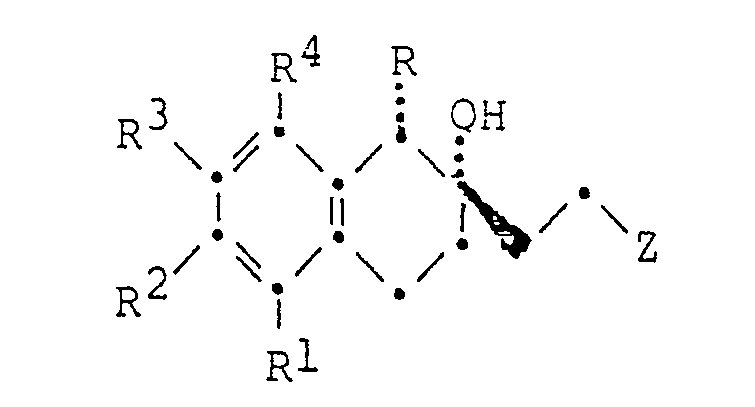 worin R Wasserstoff oder nieder-Alkyl, R¹, R², R³ und R⁴ unabhängig voneinander je Wasserstoff, Halogen oder nieder-Alkoxy oder zwei benachbarte Reste zusammen Methylendioxy oder Aethylendioxy und Z Hydroxy, Hydroxymethyl, Formyl, eine Abgangsgruppe oder die Gruppe -CH₂-X bedeuten, worin X eine Abgangsgruppe bedeutet.
 - Tetrahydronaphthalinderivate gemäss einer der Ansprüche 1-15 zur Anwendung als therapeutische Wirkstoffe.
- Tetrahydronaphthalinderivate gemäss einem der AnSprüche 1-15 zur Anwendung bei der Bekämpfung bzw. Verhütung von Angina pectoris, Ischämie, Arrhythmien und Bluthochdruck.
- [1S,2S]-2-[2-[(3,4-Dimethoxyphenäthyl)methylamino]-äthyl]-6-fluor-1,2,3,4-tetrahydro-1-isopropyl-2-naphthylmethoxyacetat oder dessen Racemat zur Anwendung als therapeutischer Wirkstoff.
- [1S,2S]-2-[2-[(3,4-Dimethoxyphenäthyl)methylamino]-äthyl]-6-fluor-1,2,3,4-tetrahydro-1-isopropyl-2-naphthylmethoxyacetat oder dessen Racemat zur Anwendung bei der Bekämpfung bzw. Verhütung von Angina pectoris, Ischämie, Arrhythmien und Bluthochdruck.
- Verfahren zur Herstellung einer Verbindung gemäss einem der Ansprüche 1-15, dadurch gekennzeichnet, dass mana) zur Herstellung von Verbindungen der Formel 1, worin Y Hydroxy bedeutet und die übrigen Symbole die in Anspruch 1 angegebene Bedeutung besitzen, eine Verbindung der allge meinen Formel
 worin X eine Abgangsgruppe bedeutet und R, R¹, R², R³, R⁴ und m die in Anspruch 1 angegebene Bedeutung besitzen,mit einem Amin der allgemeinen Formel
 worin R⁵, R⁶, R⁷, R⁸, R⁹ und n die in Anspruch 1 angegebene Bedeutung besitzen,umsetzt, oderb) zur Herstellung von Verbindungen der Formel I, worin Y Hydroxy und m die Zahl 2 bedeuten und die übrigen Symbole die in Anspruch 1 angegebene Bedeutung besitzen, einen Aldehyd der allgemeinen Formel
 worin R, R¹, R², R³ und R⁴ die in Anspruch 1 angegebene Bedeutung besitzen,mit einem Amin der obigen Formel III reduktiv aminiert, oderc) zur Herstellung von Verbindungen der Formel I, worin Y nieder-Alkylcarbonyloxy, nieder-Alkoxy-nieder-alkylcarbonyloxy, nieder-Alkoxycarbonyloxy, nieder-Alkoxy-nieder-alkoxy carbonyloxy, nieder-Alkylthio-nieder-alkylcarbonyloxy oder gegebenenfalls substituiertes Benzylcarbonyloxy bedeutet und die übrigen Symbole die in Anspruch 1 angegebene Bedeutung besitzen, eine Verbindung der allgemeinen Formel
 worin R, R¹, R², R³, R⁴, R⁵, R⁶, R⁷, R⁸, R⁹, m und n die in Anspruch 1 angegebene Bedeutung besitzen,mit einem eine nieder-Alkylcarbonyl-, nieder-Alkoxy-nieder--alkylcarbonyl-, nieder-Alkoxycarbonyl-, nieder-Alkoxy-nieder-alkoxycarbonyl-, nieder-Alkylthio-nieder-alkylcarbonyl-oder gegebenenfalls substituierte Benzylcarbonyl-Gruppe abgebenden Acylierungsmittel umsetzt, undd) erwünschtenfalls, ein erhaltenes Racemat in die optischen Antipoden auftrennt, und/odere) eine erhaltene Verbindung in ein pharmazeutisch verwendbares Säureadditionssalz überführt.
 - Arzneimittel, enthaltend ein Tetrahydronaphthalinderivat gemäss einem der Ansprüche 1-15 und ein therapeutisch inertes Excipiens.
- Mittel zur Bekämpfung bzw. Verhütung von Angina pectoris, Ischämie, Arrhythmien und Bluthochdruck, enthaltend ein Tetrahydronaphthalinderivat gemäss einem der Ansprüche 1-15 und ein therapeutisch inertes Excipiens.
- Arzneimittel, enthaltend [1S,2S]-2-[2-[(3,4--Dimethoxyphenäthyl)methylamino]äthyl]-6-fluor-1,2,3,4--tetrahydro-1-isopropyl-2-naphthyl-methoxyacetat oder dessen Racemat und ein therapeutisch inertes Excipiens.
- Mittel zur Bekämpfung bzw. Verhütung von Angina pectoris, Ischämie, Arrhythmien und Bluthochdruck, enthaltend [1S,2S]-2-[2-[(3,4-Dimethoxyphenäthyl)methylamino]-äthyl]-6-fluor-1,2,3,4-tetrahydro-1-isopropyl -2-naphthyl--methoxyacetat oder dessen Racemat und ein therapeutisch inertes Excipiens.
- Verwendung eines Tetrahydronaphthalinderivates gemäss einem der Ansprüche 1-15 zur Herstellung von Mitteln gegen Angina pectoris, Ischämie, Arrhythmien und/oder Bluthochdruck.
- Verwendung von [1S,2S]-2-[2-[(3,4-Dimethoxyphenäthyl)methylamino]äthyl]-6-fluor-1,2,3,4-tetrahydro-1-isopropyl -2-naphthyl-methoxyacetat oder von dessen Racemat nach Anspruch 26.
Priority Applications (1)
| Application Number | Priority Date | Filing Date | Title |
|---|---|---|---|
| AT85112863T ATE61791T1 (de) | 1984-10-11 | 1985-10-10 | Tetrahydronaphtalinderivate, verfahren und zwischenprodukte zu deren herstellung sowie diese enthaltende arzneimittel. |
Applications Claiming Priority (2)
| Application Number | Priority Date | Filing Date | Title |
|---|---|---|---|
| CH4870/84 | 1984-10-11 | ||
| CH487084 | 1984-10-11 |
Publications (3)
| Publication Number | Publication Date |
|---|---|
| EP0177960A2 EP0177960A2 (de) | 1986-04-16 |
| EP0177960A3 EP0177960A3 (en) | 1988-01-13 |
| EP0177960B1 true EP0177960B1 (de) | 1991-03-20 |
Family
ID=4283985
Family Applications (1)
| Application Number | Title | Priority Date | Filing Date |
|---|---|---|---|
| EP85112863A Expired - Lifetime EP0177960B1 (de) | 1984-10-11 | 1985-10-10 | Tetrahydronaphtalinderivate, Verfahren und Zwischenprodukte zu deren Herstellung sowie diese enthaltende Arzneimittel |
Country Status (21)
| Country | Link |
|---|---|
| US (1) | US4680310A (de) |
| EP (1) | EP0177960B1 (de) |
| JP (1) | JPS6191157A (de) |
| KR (1) | KR860003200A (de) |
| CN (1) | CN1007727B (de) |
| AT (1) | ATE61791T1 (de) |
| AU (1) | AU589375B2 (de) |
| CA (1) | CA1287636C (de) |
| DE (1) | DE3582217D1 (de) |
| DK (1) | DK464885A (de) |
| ES (3) | ES8701145A1 (de) |
| FI (1) | FI83508C (de) |
| GR (1) | GR852450B (de) |
| HU (1) | HU199773B (de) |
| IL (1) | IL76576A0 (de) |
| MC (1) | MC1706A1 (de) |
| NO (1) | NO161971C (de) |
| NZ (1) | NZ213651A (de) |
| PH (1) | PH23223A (de) |
| PT (1) | PT81286B (de) |
| ZA (1) | ZA857681B (de) |
Cited By (1)
| Publication number | Priority date | Publication date | Assignee | Title |
|---|---|---|---|---|
| EP3585376A4 (de) * | 2017-02-15 | 2020-11-25 | Cavion, Inc. | Calciumkanalinhibitoren |
Families Citing this family (15)
| Publication number | Priority date | Publication date | Assignee | Title |
|---|---|---|---|---|
| AU573828B2 (en) * | 1984-05-17 | 1988-06-23 | E.R. Squibb & Sons, Inc. | Tetrahydronaphthalenols |
| DE3630903A1 (de) * | 1986-09-11 | 1988-03-24 | Thomae Gmbh Dr K | Neue tetrahydronaphthalin- und indanderivate, verfahren zu deren herstellung sowie diese enthaltende arzneimittel |
| CA1319144C (en) * | 1986-11-14 | 1993-06-15 | Quirico Branca | Tetrahydronaphthalene derivatives |
| CA1329937C (en) * | 1987-04-09 | 1994-05-31 | Dennis Charles Thompson | 1-phenyl-3-naphthalenyloxypropanamines |
| IT1224405B (it) * | 1987-12-23 | 1990-10-04 | Simes | Composti attivi sul sistema cardiovascolare |
| DE3807813A1 (de) * | 1988-03-10 | 1989-09-21 | Thomae Gmbh Dr K | Neue benzocycloheptenderivate, diese verbindungen enthaltende arzneimittel und verfahren zu deren herstellung |
| CA2011461A1 (en) * | 1989-03-20 | 1990-09-20 | Urs Hengartner | Tetrahydronaphthalene derivatives |
| US5202486A (en) * | 1990-07-31 | 1993-04-13 | E. R. Squibb & Sons, Inc. | Tetrahydroethanonaphthaleneamine derivatives |
| US5204373A (en) * | 1991-08-26 | 1993-04-20 | Bristol-Myers Squibb Company | Farnesylated tetrahydro-naphthalenols as hypolipidemic agents |
| US5811557A (en) * | 1997-04-30 | 1998-09-22 | Roche Colorado Corporation | Preparation of mibefradil via an acetonitrile anion |
| US5811556A (en) * | 1997-04-30 | 1998-09-22 | Roche Colorado Corporation | Preparation of mibefradil via a naphthalenylacetic acid |
| US5808088A (en) * | 1997-04-30 | 1998-09-15 | Roche Colorado Corporation | Preparation of mibefradil via an acetamide anion |
| WO2010046729A2 (en) * | 2008-10-23 | 2010-04-29 | Actelion Pharmaceuticals Ltd | Tetrahydronaphthalene compounds |
| US8575361B2 (en) | 2010-03-02 | 2013-11-05 | Concert Pharmaceuticals Inc. | Tetrahydronaphthalene derivatives |
| US8513434B2 (en) | 2010-03-02 | 2013-08-20 | Concert Pharmaceuticals Inc. | Tetrahydronaphthalene derivatives |
Family Cites Families (5)
| Publication number | Priority date | Publication date | Assignee | Title |
|---|---|---|---|---|
| DE913199C (de) * | 1952-05-28 | 1954-06-10 | Hartmann & Braun Ag | Anzeigeinstrument zur Bestimmung von Polung und ungefaehrer Groesse des Strom- und Spannungsfehlers von Messwandlern in Verbindung mit Messwandler-Pruefeinrichtungen, die nach dem Differentialverfahren arbeiten |
| US3957845A (en) * | 1962-04-27 | 1976-05-18 | Knoll A.G. Chemische Fabriken | Trifluoromethyl-substituted phenyl acetonitriles |
| GB1256753A (de) * | 1969-05-30 | 1971-12-15 | ||
| US4127588A (en) * | 1976-10-01 | 1978-11-28 | Hoffmann-La Roche Inc. | Sulphur containing derivatives |
| JPS5896045A (ja) * | 1981-11-30 | 1983-06-07 | Sumitomo Chem Co Ltd | 新規なジフエニルアルカノアミン誘導体およびその製造法 |
-
1985
- 1985-09-30 NZ NZ213651A patent/NZ213651A/xx unknown
- 1985-10-02 FI FI853817A patent/FI83508C/fi not_active IP Right Cessation
- 1985-10-04 ZA ZA857681A patent/ZA857681B/xx unknown
- 1985-10-04 AU AU48301/85A patent/AU589375B2/en not_active Ceased
- 1985-10-04 IL IL76576A patent/IL76576A0/xx not_active IP Right Cessation
- 1985-10-08 MC MC851795A patent/MC1706A1/fr unknown
- 1985-10-08 JP JP60222893A patent/JPS6191157A/ja active Pending
- 1985-10-09 GR GR852450A patent/GR852450B/el unknown
- 1985-10-09 HU HU853915A patent/HU199773B/hu not_active IP Right Cessation
- 1985-10-09 CA CA000492588A patent/CA1287636C/en not_active Expired - Lifetime
- 1985-10-09 CN CN85107496A patent/CN1007727B/zh not_active Expired
- 1985-10-10 DE DE8585112863T patent/DE3582217D1/de not_active Expired - Lifetime
- 1985-10-10 PT PT81286A patent/PT81286B/pt not_active IP Right Cessation
- 1985-10-10 AT AT85112863T patent/ATE61791T1/de not_active IP Right Cessation
- 1985-10-10 US US06/786,253 patent/US4680310A/en not_active Expired - Fee Related
- 1985-10-10 KR KR1019850007448A patent/KR860003200A/ko not_active Ceased
- 1985-10-10 NO NO854036A patent/NO161971C/no unknown
- 1985-10-10 ES ES547756A patent/ES8701145A1/es not_active Expired
- 1985-10-10 PH PH32917A patent/PH23223A/en unknown
- 1985-10-10 DK DK464885A patent/DK464885A/da not_active Application Discontinuation
- 1985-10-10 EP EP85112863A patent/EP0177960B1/de not_active Expired - Lifetime
-
1986
- 1986-04-16 ES ES554021A patent/ES8801174A1/es not_active Expired
- 1986-04-16 ES ES554020A patent/ES8802359A1/es not_active Expired
Cited By (1)
| Publication number | Priority date | Publication date | Assignee | Title |
|---|---|---|---|---|
| EP3585376A4 (de) * | 2017-02-15 | 2020-11-25 | Cavion, Inc. | Calciumkanalinhibitoren |
Also Published As
Similar Documents
| Publication | Publication Date | Title |
|---|---|---|
| AT401053B (de) | Brenzkatechin-derivate, verfahren zu ihrer herstellung und ihre verwendung als arzneistoffe | |
| DE69200685T2 (de) | Benzocyclobutyl- oder Indanyl-Alkyl-Amino-Alkyl substituierte 3-Benzazepin-2-ones, verwendbar in der Behandlung von kardiovaskularen Krankheiten. | |
| EP0242518B1 (de) | Cycloalkano[1,2-b]indol-sulfonamide | |
| EP0177960A2 (de) | Tetrahydronaphtalinderivate, Verfahren und Zwischenprodukte zu deren Herstellung sowie diese enthaltende Arzneimittel | |
| EP0004952A1 (de) | Spiro-(dihydrobenzofuranpiperidine und -pyrrolidine) und deren Derivate, Verfahren zu ihrer Herstellung und ihre Verwendung für Arzneimittel | |
| DE69120899T2 (de) | Neue N-Benzoylprolin-Derivate, Verfahren zur Herstellung und diese enthaltende Arzneimittel | |
| JP2009007258A (ja) | Pai−1産生抑制作用を有する3−アニリノ−2−シクロアルケノン誘導体 | |
| DE3223463C2 (de) | ||
| DD264919A5 (de) | Verfahren zur herstellung von 5-hydroxy-3-aminochromanen | |
| DE60129829T2 (de) | Zyklisierte benzamid-neurokinin-antagonisten zur verwendung in der therapie | |
| EP0157267B1 (de) | Substituierte Benzopyrane, Verfahren zu ihrer Herstellung sowie ihre Verwendung in Arzneimitteln | |
| DE3788507T2 (de) | Substituierte 1H-Imidazole. | |
| EP0033156B1 (de) | 1-Phenyl-2-cyclohexen-1-alkylamin-Derivate, Verfahren zu deren Herstellung und diese enthaltende Arzneimittel | |
| DE3319956A1 (de) | 1,4-dihydropyridine, verfahren zu ihrer herstellung sowie ihre verwendung in arzneimitteln | |
| DE69611303T2 (de) | Benzolsulfonamidderivate, ihre herstellung und ihre therapeutische verwendung | |
| DE69616357T2 (de) | Benzocycloalken-verbindungen mit bindungsaffinität an den melatonin-rezeptor, ihre herstellung und verwendung | |
| EP0065295A1 (de) | Substituierte Tryptaminderivate von Thienyloxypropanolaminen, Verfahren zu ihrer Herstellung, pharmazeutische Präparate auf Basis dieser Verbindungen sowie ihre Verwendung | |
| DE1643198C3 (de) | ||
| DE69232812T2 (de) | Neue cyclische aminophenylessigsäurederivate, ihre herstellung und immunomodulatoren , welche diese als aktiven bestandteil enthalten | |
| DE3888811T2 (de) | Tricyclische Carbamate, Verfahren zu ihrer Herstellung und ihre therapeutische Verwendung. | |
| DE3642105A1 (de) | Substituierte aminomethyl-5,6,7,8-tetrahydronaphtyl-oxyessigsaeuren, neue zwischenprodukte, verfahren zu ihrer herstellung sowie ihre verwendung in arzneimitteln | |
| Baltzly et al. | Amines Related to 2, 5-Dimethoxyphenethylamine. 1 I | |
| CH636076A5 (de) | Benzylalkoholderivate und verfahren zu deren herstellung. | |
| DE69515402T2 (de) | Oxazolochinolinonderivate, ihre Herstellung und ihre Verwendung als Arzneimittel | |
| DE2748466A1 (de) | 4a-aryloctahydro-1h-2-pyrindine |
Legal Events
| Date | Code | Title | Description |
|---|---|---|---|
| PUAI | Public reference made under article 153(3) epc to a published international application that has entered the european phase |
Free format text: ORIGINAL CODE: 0009012 |
|
| 17P | Request for examination filed |
Effective date: 19851010 |
|
| AK | Designated contracting states |
Kind code of ref document: A2 Designated state(s): AT BE CH DE FR GB IT LI LU NL SE |
|
| PUAL | Search report despatched |
Free format text: ORIGINAL CODE: 0009013 |
|
| AK | Designated contracting states |
Kind code of ref document: A3 Designated state(s): AT BE CH DE FR GB IT LI LU NL SE |
|
| RAP1 | Party data changed (applicant data changed or rights of an application transferred) |
Owner name: F. HOFFMANN-LA ROCHE AG |
|
| 17Q | First examination report despatched |
Effective date: 19890810 |
|
| GRAA | (expected) grant |
Free format text: ORIGINAL CODE: 0009210 |
|
| AK | Designated contracting states |
Kind code of ref document: B1 Designated state(s): AT BE CH DE FR GB IT LI LU NL SE |
|
| REF | Corresponds to: |
Ref document number: 61791 Country of ref document: AT Date of ref document: 19910415 Kind code of ref document: T |
|
| REF | Corresponds to: |
Ref document number: 3582217 Country of ref document: DE Date of ref document: 19910425 |
|
| ITF | It: translation for a ep patent filed | ||
| ET | Fr: translation filed | ||
| GBT | Gb: translation of ep patent filed (gb section 77(6)(a)/1977) | ||
| PLBE | No opposition filed within time limit |
Free format text: ORIGINAL CODE: 0009261 |
|
| STAA | Information on the status of an ep patent application or granted ep patent |
Free format text: STATUS: NO OPPOSITION FILED WITHIN TIME LIMIT |
|
| 26N | No opposition filed | ||
| PGFP | Annual fee paid to national office [announced via postgrant information from national office to epo] |
Ref country code: FR Payment date: 19920824 Year of fee payment: 8 |
|
| PGFP | Annual fee paid to national office [announced via postgrant information from national office to epo] |
Ref country code: BE Payment date: 19920902 Year of fee payment: 8 |
|
| PGFP | Annual fee paid to national office [announced via postgrant information from national office to epo] |
Ref country code: SE Payment date: 19920909 Year of fee payment: 8 |
|
| PGFP | Annual fee paid to national office [announced via postgrant information from national office to epo] |
Ref country code: GB Payment date: 19920925 Year of fee payment: 8 |
|
| PGFP | Annual fee paid to national office [announced via postgrant information from national office to epo] |
Ref country code: DE Payment date: 19921012 Year of fee payment: 8 |
|
| PGFP | Annual fee paid to national office [announced via postgrant information from national office to epo] |
Ref country code: LU Payment date: 19921014 Year of fee payment: 8 |
|
| PGFP | Annual fee paid to national office [announced via postgrant information from national office to epo] |
Ref country code: CH Payment date: 19921026 Year of fee payment: 8 |
|
| PGFP | Annual fee paid to national office [announced via postgrant information from national office to epo] |
Ref country code: AT Payment date: 19921030 Year of fee payment: 8 |
|
| PGFP | Annual fee paid to national office [announced via postgrant information from national office to epo] |
Ref country code: NL Payment date: 19921031 Year of fee payment: 8 |
|
| EPTA | Lu: last paid annual fee | ||
| PG25 | Lapsed in a contracting state [announced via postgrant information from national office to epo] |
Ref country code: LU Free format text: LAPSE BECAUSE OF NON-PAYMENT OF DUE FEES Effective date: 19931010 Ref country code: GB Effective date: 19931010 Ref country code: AT Effective date: 19931010 |
|
| PG25 | Lapsed in a contracting state [announced via postgrant information from national office to epo] |
Ref country code: SE Effective date: 19931011 |
|
| PG25 | Lapsed in a contracting state [announced via postgrant information from national office to epo] |
Ref country code: LI Effective date: 19931031 Ref country code: CH Effective date: 19931031 Ref country code: BE Effective date: 19931031 |
|
| BERE | Be: lapsed |
Owner name: F. HOFFMANN-LA ROCHE A.G. Effective date: 19931031 |
|
| PG25 | Lapsed in a contracting state [announced via postgrant information from national office to epo] |
Ref country code: NL Effective date: 19940501 |
|
| GBPC | Gb: european patent ceased through non-payment of renewal fee |
Effective date: 19931010 |
|
| NLV4 | Nl: lapsed or anulled due to non-payment of the annual fee | ||
| PG25 | Lapsed in a contracting state [announced via postgrant information from national office to epo] |
Ref country code: FR Effective date: 19940630 |
|
| REG | Reference to a national code |
Ref country code: CH Ref legal event code: PL |
|
| PG25 | Lapsed in a contracting state [announced via postgrant information from national office to epo] |
Ref country code: DE Effective date: 19940701 |
|
| REG | Reference to a national code |
Ref country code: FR Ref legal event code: ST |
|
| EUG | Se: european patent has lapsed |
Ref document number: 85112863.7 Effective date: 19940510 |