EP0165686A2 - Photomaskenreparaturverfahren durch Laser induzierte Polymerdegradation - Google Patents
Photomaskenreparaturverfahren durch Laser induzierte Polymerdegradation Download PDFInfo
- Publication number
- EP0165686A2 EP0165686A2 EP85303093A EP85303093A EP0165686A2 EP 0165686 A2 EP0165686 A2 EP 0165686A2 EP 85303093 A EP85303093 A EP 85303093A EP 85303093 A EP85303093 A EP 85303093A EP 0165686 A2 EP0165686 A2 EP 0165686A2
- Authority
- EP
- European Patent Office
- Prior art keywords
- polymer
- laser
- photomask
- coating
- photoresist
- Prior art date
- Legal status (The legal status is an assumption and is not a legal conclusion. Google has not performed a legal analysis and makes no representation as to the accuracy of the status listed.)
- Granted
Links
- 238000000034 method Methods 0.000 title claims abstract description 84
- 238000012667 polymer degradation Methods 0.000 title 1
- 229920000642 polymer Polymers 0.000 claims abstract description 111
- 239000011248 coating agent Substances 0.000 claims abstract description 45
- 238000000576 coating method Methods 0.000 claims abstract description 45
- 230000007547 defect Effects 0.000 claims abstract description 28
- 229920002120 photoresistant polymer Polymers 0.000 claims abstract description 26
- 238000010438 heat treatment Methods 0.000 claims abstract description 21
- 239000000758 substrate Substances 0.000 claims description 22
- 229920003986 novolac Polymers 0.000 claims description 18
- SYQQWGGBOQFINV-FBWHQHKGSA-N 4-[2-[(2s,8s,9s,10r,13r,14s,17r)-10,13-dimethyl-17-[(2r)-6-methylheptan-2-yl]-3-oxo-1,2,6,7,8,9,11,12,14,15,16,17-dodecahydrocyclopenta[a]phenanthren-2-yl]ethoxy]-4-oxobutanoic acid Chemical compound C1CC2=CC(=O)[C@H](CCOC(=O)CCC(O)=O)C[C@]2(C)[C@@H]2[C@@H]1[C@@H]1CC[C@H]([C@H](C)CCCC(C)C)[C@@]1(C)CC2 SYQQWGGBOQFINV-FBWHQHKGSA-N 0.000 claims description 15
- 230000002950 deficient Effects 0.000 claims description 13
- 230000003287 optical effect Effects 0.000 claims description 7
- CSCPPACGZOOCGX-UHFFFAOYSA-N Acetone Chemical compound CC(C)=O CSCPPACGZOOCGX-UHFFFAOYSA-N 0.000 claims description 6
- 229920005989 resin Polymers 0.000 claims description 4
- 239000011347 resin Substances 0.000 claims description 4
- 239000002904 solvent Substances 0.000 claims description 4
- 238000006243 chemical reaction Methods 0.000 claims description 2
- 239000000463 material Substances 0.000 description 14
- 230000008439 repair process Effects 0.000 description 8
- WSFSSNUMVMOOMR-UHFFFAOYSA-N Formaldehyde Chemical compound O=C WSFSSNUMVMOOMR-UHFFFAOYSA-N 0.000 description 6
- 239000010410 layer Substances 0.000 description 5
- 238000004140 cleaning Methods 0.000 description 3
- 239000011247 coating layer Substances 0.000 description 3
- ISWSIDIOOBJBQZ-UHFFFAOYSA-N Phenol Chemical compound OC1=CC=CC=C1 ISWSIDIOOBJBQZ-UHFFFAOYSA-N 0.000 description 2
- 230000015556 catabolic process Effects 0.000 description 2
- 238000006731 degradation reaction Methods 0.000 description 2
- 239000002184 metal Substances 0.000 description 2
- 229920001187 thermosetting polymer Polymers 0.000 description 2
- 229920002472 Starch Polymers 0.000 description 1
- 239000003377 acid catalyst Substances 0.000 description 1
- XKRFYHLGVUSROY-UHFFFAOYSA-N argon Substances [Ar] XKRFYHLGVUSROY-UHFFFAOYSA-N 0.000 description 1
- 229910052786 argon Inorganic materials 0.000 description 1
- 229920005601 base polymer Polymers 0.000 description 1
- 238000006482 condensation reaction Methods 0.000 description 1
- 238000000151 deposition Methods 0.000 description 1
- 238000010586 diagram Methods 0.000 description 1
- 239000000203 mixture Substances 0.000 description 1
- 238000000206 photolithography Methods 0.000 description 1
- 230000005855 radiation Effects 0.000 description 1
- 238000009987 spinning Methods 0.000 description 1
- 235000019698 starch Nutrition 0.000 description 1
- 239000008107 starch Substances 0.000 description 1
- 229920001169 thermoplastic Polymers 0.000 description 1
- 239000004416 thermosoftening plastic Substances 0.000 description 1
Images
Classifications
-
- G—PHYSICS
- G03—PHOTOGRAPHY; CINEMATOGRAPHY; ANALOGOUS TECHNIQUES USING WAVES OTHER THAN OPTICAL WAVES; ELECTROGRAPHY; HOLOGRAPHY
- G03F—PHOTOMECHANICAL PRODUCTION OF TEXTURED OR PATTERNED SURFACES, e.g. FOR PRINTING, FOR PROCESSING OF SEMICONDUCTOR DEVICES; MATERIALS THEREFOR; ORIGINALS THEREFOR; APPARATUS SPECIALLY ADAPTED THEREFOR
- G03F1/00—Originals for photomechanical production of textured or patterned surfaces, e.g., masks, photo-masks, reticles; Mask blanks or pellicles therefor; Containers specially adapted therefor; Preparation thereof
- G03F1/68—Preparation processes not covered by groups G03F1/20 - G03F1/50
- G03F1/72—Repair or correction of mask defects
-
- G—PHYSICS
- G03—PHOTOGRAPHY; CINEMATOGRAPHY; ANALOGOUS TECHNIQUES USING WAVES OTHER THAN OPTICAL WAVES; ELECTROGRAPHY; HOLOGRAPHY
- G03F—PHOTOMECHANICAL PRODUCTION OF TEXTURED OR PATTERNED SURFACES, e.g. FOR PRINTING, FOR PROCESSING OF SEMICONDUCTOR DEVICES; MATERIALS THEREFOR; ORIGINALS THEREFOR; APPARATUS SPECIALLY ADAPTED THEREFOR
- G03F1/00—Originals for photomechanical production of textured or patterned surfaces, e.g., masks, photo-masks, reticles; Mask blanks or pellicles therefor; Containers specially adapted therefor; Preparation thereof
- G03F1/54—Absorbers, e.g. of opaque materials
- G03F1/56—Organic absorbers, e.g. of photo-resists
-
- Y—GENERAL TAGGING OF NEW TECHNOLOGICAL DEVELOPMENTS; GENERAL TAGGING OF CROSS-SECTIONAL TECHNOLOGIES SPANNING OVER SEVERAL SECTIONS OF THE IPC; TECHNICAL SUBJECTS COVERED BY FORMER USPC CROSS-REFERENCE ART COLLECTIONS [XRACs] AND DIGESTS
- Y10—TECHNICAL SUBJECTS COVERED BY FORMER USPC
- Y10S—TECHNICAL SUBJECTS COVERED BY FORMER USPC CROSS-REFERENCE ART COLLECTIONS [XRACs] AND DIGESTS
- Y10S430/00—Radiation imagery chemistry: process, composition, or product thereof
- Y10S430/146—Laser beam
Definitions
- the present invention relates to a method for repairing a photomask and more particularly to a method for repairing a photomask by laser-induced degradation of a polymer coating the photomask to change the color of the polymer without damaging the photomask.
- a known method for repairing a photomask is shown in the U.S. Patent No. 4,340,654.
- This. method includes the steps of coating a photomask having a transparent substrate with a material such as a starch polymer, the thickness of the coating being between 5 and 35 microns; directing a laser beam through the substrate of the photomask onto the coating so as to fuse the coating and substrate to form an opaque mixture thereof; and removing any unfused coating material from the photomask surface.
- the technique suffers from several disadvantages.
- the laser burns valleys into the substrate, damaging it. If any coating is fused to an area of the substrate where it is undesired, the coating cannot be removed.
- This method not only causes damage to the substrate, but can add unremovable defects to the photomask in areas where none existed before. Further, when using this technique one cannot demonstrate a resolution of 5 microns or less.
- the method of the present invention repairs clear defects on a photomask by laser-induced degradation of a polymer coating the photomask without causing damage thereto.
- the method for repairing clear defects on a photomask includes the steps of coating the photomask with a novo-0 lak-based polymer having a thickness between 2,OOOA and 0 20,OOOA; exposing the polymer coating a defective area of the photomask to a laser for localized heating thereof to a temperature above 500°C to darken the polymer; and removing the unexposed polymer from the photomask.
- the method for repairing clear defects on a photomask includes the steps of coating the photomask with a novolak-based polymer; heating the polymer to a temperature of between 200°C and 500°C to brown the polymer; exposing the polymer covering a defective area of the photomask to a laser for localized heating thereof to a temperature which is greater than 500'C to char or darken the polymer; and removing the unexposed polymer from the photomask.
- the method of the first and second embodiments of the present invention darkens or chars the polymer coating the defective area of the photomask without altering or damaging the photomask substrate. Also, if the polymer is charred in an area where it is undesired, the charred polymer can be removed without damaging either the photomask substrate or the metal pattern forming the mask on the substrate. Further, the resolution of this process is better than 2pm; the optical density of the repaired area is greater than 2.5; and the repair is able to withstand the standard cleaning processes to which a photomask may be subjected.
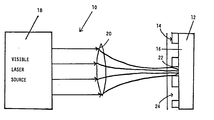
- the drawing is a block diagram illustrating the method of the present invention for repairing a photomask.
- the method of the present invention repairs clear defects on a photomask 10 having a transparent substrate 12 with a metal pattern or mask 14 formed on a surface 16 thereof.
- the method employs a visible or infrared laser.
- an argon ion laser 18 is focused by a microscope objective 20 onto a defective area of the photomask 22 as described in detail below.
- One embodiment of the method includes the step of coating the surface 16 of the photomask with a novolak-based polymer by spinning the polymer onto the photomask to form a coating layer 24, the thickness of which is between 2,0009 and 20,000 ⁇ .
- the novolak-based polymer is preferably a positive photoresist.
- the preferred thickness of the coating layer is greater than or 0 equal to 4,OOOA to insure that the laser does not burn a hole in the photoresist.
- the preferred thickness of the 0 coating layer is also less than or equal to 9,OOOA to insure that the photoresist layer 24 will be charred through to the face thereof abutting the surface 14 of the photomask when the photoresist is exposed to laser radiation.
- the laser from the source 18 should have a pulse length between 1 ⁇ second to 500 milliseconds, the preferred pulse length of the laser being between 100 ⁇ seconds and 10 milliseconds. Further, the surface power of the laser should be between 0.01 milliwatts and 50 milliwatts and such that the laser is incident to an area on the photomask having a diameter of approximately 1pm.
- the above method darkens or chars the polymer coating the defective area of the photomask without altering or damaging the substrate 12. Because the substrate 12 is not damaged while making the repair, if a portion of the polymer coating 24 is charred where it is undesired, the charred polymer may be removed by scanning the area with a laser as well known in the art. Further, the resolution of this method is better than 2pm and the optical density of the repaired area is greater than 2.5. The repair made according to this method is also extremely durable and capable of withstanding the standard processes for cleaning a photomask.
- an additional step is performed.
- the polymer After coating the photomask 10 with the novolak-based polymer, the polymer is heated to a temperature which is between 200 * C and 500 * C to brown the polymer.
- the polymer may be heated by scanning a laser across the surface thereof with the power of the laser source 18 adjusted so that the laser heats the polymer to the temperature at which it will brown without charring.
- the polymer layer 24 Is browned the polymer coating a defective area of the photomask is exposed to a laser from the visible laser source 18.
- the power of the laser source 18 is adjusted for localized heating of the polymer to a temperature which is greater than 500°C to darken or char the polymer. Thereafter, that portion of the polymer which is not exposed to the laser is removed, again by immersing the photomask 10 in a solvent such as acetone.
- the second embodiment of the method of the present invention darkens or chars the polymer layer 24 exposed to the laser without altering or damaging the substrate as does the first embodiment of the method.
- the resolution of this process is also greater than 2pm, the optical density of the repaired area being greater than 2.5 and the repair being capable of withstanding the standard cleaning process to which a photomask is subjected.
- the method of the first embodiment is suitable for repairing spot type clear defects on the photomask, lines are difficult to draw with this method.
- the step of browning the polymer layer 24 prior to charring the polymer covering the defective area of the photomask allows a line to be drawn by the visible laser source 16 when the power thereof is adjusted to heat the polymer to which the laser beam is incident to a temperature which is greater than 500 . C.
- the thickness of the polymer coating 24 may be the same as the thickness of the polymer coating for the first embodiment of the method.
- the preferred pulse length of the laser from the source 18 for the second embodiment is between 1 second and 20 seconds for charring the polymer.
- the preferred surface power of the laser from the source 18 is between 0.1 milliwatts and 5 milliwatts for charring the polymer.
- the novolak-based polymer is used because it exhibits the following properties. These properties are: (1) excellent uniform film-forming characteristics; (2) differential substrate adhesion after charring; and (3) the ability to become opaque to near-ultraviolet light upon heating.
- the uniform film-forming characteristics of the novolak-based polymer have been developed by others skilled in the art to the extent that very uniform films on the order of 2,000 ⁇ to 20,OOOA can be formed. Other materials may be used having uniform film-forming characteristics. Uniform film-forming characteristics are desirable because uniformity enhances the reproducibility of the process. A nonuniform film causes the process to behave unpredictably when attempting to repair very small clear defects in a photomask.
- Adequate adhesion is required for the material used prior to and after heating.
- the material has increased adhesion characteristics after heating. Such a characteristic enhances the ability to remove unheated portions selectively without affecting the characteristic of the charred or heated portion.
- the material exhibits thermosetting properties.
- the novolak-based polymer initially exhibits thermoplastic characteristics prior to heating. It is important to first convert the novolak-based polymer to a more thermosetting-like material prior to charring. This conversion process is accomplished by first slowly heating the material in a controlled manner to a temperature which causes the novolak-based polymer to brown. Empirically, this temperature has been discovered to be approximately 200°C to 500°C in the preferred embodiment. It is believed this "browning" stage causes the novolak-based polymer to convert from a thermoplastic-like resin to a thermosetting-like resin.
- novolak-based polymers are currently used in the preferred embodiment because they exhibit acceptable characteristics as discussed above, in future embodiments, it is envisioned that it would be highly desirable to use a resin which has greater thermosetting characteristics.
- the material used in the preferred embodiment becomes opaque when subjected to heating.
- the optical density of the material used should be at least 2.5 in the presence of ultraviolet light. In most photolithography processes, near ultraviolet light is used. If other forms of light are used, the material used in accordance with this invention should exhibit similarly opaque characteristics.
- a novolak-based polymer is a polymer which is formed by a condensation reaction between formaldehyde and phenol in the presence of acid catalysts wherein the mole ratio of formaldehyde to phenol is less than 1.
- Novolak is the base polymer in a positive photoresist. It is important to note that other materials can be used other than novolak-based polymers in accordance with the present invention provided that they exhibit satisfactory characteristics as discussed above. For the purposes of this application, thermoset-like means the material does not flow significantly when heated.
Landscapes
- Physics & Mathematics (AREA)
- General Physics & Mathematics (AREA)
- Preparing Plates And Mask In Photomechanical Process (AREA)
- Treatments Of Macromolecular Shaped Articles (AREA)
Priority Applications (1)
| Application Number | Priority Date | Filing Date | Title |
|---|---|---|---|
| AT85303093T ATE61488T1 (de) | 1984-06-20 | 1985-05-01 | Photomaskenreparaturverfahren durch laser induzierte polymerdegradation. |
Applications Claiming Priority (2)
| Application Number | Priority Date | Filing Date | Title |
|---|---|---|---|
| US622367 | 1984-06-20 | ||
| US06/622,367 US4592975A (en) | 1984-06-20 | 1984-06-20 | Method for repairing a photomask by laser-induced polymer degradation |
Publications (3)
| Publication Number | Publication Date |
|---|---|
| EP0165686A2 true EP0165686A2 (de) | 1985-12-27 |
| EP0165686A3 EP0165686A3 (en) | 1988-01-27 |
| EP0165686B1 EP0165686B1 (de) | 1991-03-06 |
Family
ID=24493924
Family Applications (1)
| Application Number | Title | Priority Date | Filing Date |
|---|---|---|---|
| EP85303093A Expired - Lifetime EP0165686B1 (de) | 1984-06-20 | 1985-05-01 | Photomaskenreparaturverfahren durch Laser induzierte Polymerdegradation |
Country Status (5)
| Country | Link |
|---|---|
| US (1) | US4592975A (de) |
| EP (1) | EP0165686B1 (de) |
| JP (1) | JPS6113247A (de) |
| AT (1) | ATE61488T1 (de) |
| DE (1) | DE3581961D1 (de) |
Cited By (2)
| Publication number | Priority date | Publication date | Assignee | Title |
|---|---|---|---|---|
| DE4018135A1 (de) * | 1989-06-06 | 1990-12-13 | Dainippon Printing Co Ltd | Verfahren und vorrichtung zur reparatur von fehlern in emulsionsmasken |
| RU2471263C1 (ru) * | 2011-07-12 | 2012-12-27 | Мойше Самуилович Китай | Способ создания маски на поверхности подложки |
Families Citing this family (8)
| Publication number | Priority date | Publication date | Assignee | Title |
|---|---|---|---|---|
| JP2523633B2 (ja) * | 1987-05-13 | 1996-08-14 | 株式会社日立製作所 | レ−ザレ−ダの走査方法 |
| US4960613A (en) * | 1988-10-04 | 1990-10-02 | General Electric Company | Laser interconnect process |
| US4940651A (en) * | 1988-12-30 | 1990-07-10 | International Business Machines Corporation | Method for patterning cationic curable photoresist |
| US5268245A (en) * | 1992-07-09 | 1993-12-07 | Polaroid Corporation | Process for forming a filter on a solid state imager |
| US5405659A (en) * | 1993-03-05 | 1995-04-11 | University Of Puerto Rico | Method and apparatus for removing material from a target by use of a ring-shaped elliptical laser beam and depositing the material onto a substrate |
| US6074571A (en) * | 1997-09-30 | 2000-06-13 | International Business Machines Corporation | Cut and blast defect to avoid chrome roll over annealing |
| US5981110A (en) * | 1998-02-17 | 1999-11-09 | International Business Machines Corporation | Method for repairing photomasks |
| KR100732740B1 (ko) * | 2001-06-13 | 2007-06-27 | 주식회사 하이닉스반도체 | 포토마스크 리페어 장치 및 리페어 방법 |
Family Cites Families (15)
| Publication number | Priority date | Publication date | Assignee | Title |
|---|---|---|---|---|
| GB1222071A (en) * | 1967-03-13 | 1971-02-10 | Agfa Gevaert Nv | Light-sensitive photographic material |
| US3574657A (en) * | 1967-12-14 | 1971-04-13 | Fmc Corp | Polymeric images formed by heat |
| US3549733A (en) * | 1968-12-04 | 1970-12-22 | Du Pont | Method of producing polymeric printing plates |
| CA967365A (en) * | 1970-10-12 | 1975-05-13 | Fuji Photo Film Co. | Laser recording method and material therefor |
| US3723121A (en) * | 1970-11-03 | 1973-03-27 | Du Pont | Process for recording images with laser beams |
| BE793605A (fr) * | 1972-01-03 | 1973-05-02 | Rca Corp | Appareil et procede pour corriger un masque photographique defectueux |
| US3847644A (en) * | 1972-11-24 | 1974-11-12 | Xerox Corp | Imaging by phase aggregation from block copolymers |
| US4059461A (en) * | 1975-12-10 | 1977-11-22 | Massachusetts Institute Of Technology | Method for improving the crystallinity of semiconductor films by laser beam scanning and the products thereof |
| US4200668A (en) * | 1978-09-05 | 1980-04-29 | Western Electric Company, Inc. | Method of repairing a defective photomask |
| JPS5635130A (en) * | 1979-08-31 | 1981-04-07 | Fujitsu Ltd | Resist material and method for forming resist pattern |
| US4340617A (en) * | 1980-05-19 | 1982-07-20 | Massachusetts Institute Of Technology | Method and apparatus for depositing a material on a surface |
| US4340654A (en) * | 1980-06-19 | 1982-07-20 | Campi James G | Defect-free photomask |
| US4444801A (en) * | 1981-01-14 | 1984-04-24 | Hitachi, Ltd. | Method and apparatus for correcting transparent defects on a photomask |
| JPS586127A (ja) * | 1981-07-03 | 1983-01-13 | Hitachi Ltd | フオトマスク欠陥修正方法とその装置 |
| JPS58203443A (ja) * | 1982-05-24 | 1983-11-26 | Hitachi Ltd | ホトマスクの白点欠陥修正用組成物 |
-
1984
- 1984-06-20 US US06/622,367 patent/US4592975A/en not_active Expired - Lifetime
-
1985
- 1985-05-01 DE DE8585303093T patent/DE3581961D1/de not_active Expired - Fee Related
- 1985-05-01 EP EP85303093A patent/EP0165686B1/de not_active Expired - Lifetime
- 1985-05-01 AT AT85303093T patent/ATE61488T1/de active
- 1985-06-20 JP JP60133143A patent/JPS6113247A/ja active Pending
Cited By (4)
| Publication number | Priority date | Publication date | Assignee | Title |
|---|---|---|---|---|
| DE4018135A1 (de) * | 1989-06-06 | 1990-12-13 | Dainippon Printing Co Ltd | Verfahren und vorrichtung zur reparatur von fehlern in emulsionsmasken |
| DE4018135B4 (de) * | 1989-06-06 | 2004-07-29 | Dai Nippon Insatsu K.K. | Verfahren und Vorrichtung zur Reparatur von Fehlern in Emulsionsmasken |
| RU2471263C1 (ru) * | 2011-07-12 | 2012-12-27 | Мойше Самуилович Китай | Способ создания маски на поверхности подложки |
| WO2013009219A1 (ru) * | 2011-07-12 | 2013-01-17 | Rudoy Igor Georgievich | Способ создания маски на поверхности подложки |
Also Published As
| Publication number | Publication date |
|---|---|
| US4592975A (en) | 1986-06-03 |
| EP0165686A3 (en) | 1988-01-27 |
| ATE61488T1 (de) | 1991-03-15 |
| EP0165686B1 (de) | 1991-03-06 |
| DE3581961D1 (de) | 1991-04-11 |
| JPS6113247A (ja) | 1986-01-21 |
Similar Documents
| Publication | Publication Date | Title |
|---|---|---|
| US4636403A (en) | Method of repairing a defective photomask | |
| EP0182332B1 (de) | Behandlungsverfahren für integrierte Schaltungen durch Photolithographie | |
| US4592975A (en) | Method for repairing a photomask by laser-induced polymer degradation | |
| EP0913730B1 (de) | Verfahren zum Herstellen einer Druckform | |
| KR890013736A (ko) | 마스크 및 무마스크 처리 스트립을 사용한 새로운 레지스트의 엑사이머 레이저 패턴화 방법 | |
| US4704342A (en) | Photomask having a patterned carbon light-blocking coating | |
| US5001038A (en) | Process for photoimaging a three dimensional printed circuit substrate | |
| JPH07281418A (ja) | レーザ融除マスクの修理法 | |
| JP5997289B2 (ja) | マイクロ波エネルギーを用いて感光性エレメントの端部を溶接することによるフレキソ印刷フォームの製造方法 | |
| JP3592678B2 (ja) | ブランク盤の製造方法とダイレクトスタンパーの製作方法 | |
| JP2882233B2 (ja) | 補助パターン付き位相シフトマスクの製造方法 | |
| KR100629831B1 (ko) | 광디스크제조용원반을형성하는방법 | |
| JP3596543B2 (ja) | スタンパーとその製造方法及び光ディスク並びにブランクス | |
| JPH0982309A (ja) | 電池用接続端子の製造法 | |
| WO1981003628A1 (en) | Process for forming a defect-free photomask or repairing defects in an existing photomask and product thereof | |
| JP3232853B2 (ja) | レーザ加工用誘電体マスクとその製造方法 | |
| JP2004505398A (ja) | スタンパの製造プロセスで用いる基板の製造方法、及びその方法を用いて得られる基板 | |
| JP2000113520A (ja) | 光ディスク原盤の製造方法 | |
| JPH04142037A (ja) | 導体欠損部の修正方法 | |
| JP2002245687A (ja) | 光ディスク原盤の製造方法 | |
| JPS6052889A (ja) | ホログラムの製法 | |
| JPH062284A (ja) | 捺染型の製作方法 | |
| JPS60152027A (ja) | パタ−ン欠陥修正方法 | |
| JP2004152397A (ja) | 光ディスク成型用基盤、その製造方法、及び光ディスク成型用基盤のブランクス | |
| JPH0580213A (ja) | カラーフイルター |
Legal Events
| Date | Code | Title | Description |
|---|---|---|---|
| PUAI | Public reference made under article 153(3) epc to a published international application that has entered the european phase |
Free format text: ORIGINAL CODE: 0009012 |
|
| AK | Designated contracting states |
Designated state(s): AT BE DE FR GB NL SE |
|
| PUAL | Search report despatched |
Free format text: ORIGINAL CODE: 0009013 |
|
| AK | Designated contracting states |
Kind code of ref document: A3 Designated state(s): AT BE DE FR GB NL SE |
|
| 17P | Request for examination filed |
Effective date: 19880229 |
|
| 17Q | First examination report despatched |
Effective date: 19891012 |
|
| GRAA | (expected) grant |
Free format text: ORIGINAL CODE: 0009210 |
|
| AK | Designated contracting states |
Kind code of ref document: B1 Designated state(s): AT BE DE FR GB NL SE |
|
| REF | Corresponds to: |
Ref document number: 61488 Country of ref document: AT Date of ref document: 19910315 Kind code of ref document: T |
|
| REF | Corresponds to: |
Ref document number: 3581961 Country of ref document: DE Date of ref document: 19910411 |
|
| ET | Fr: translation filed | ||
| PLBE | No opposition filed within time limit |
Free format text: ORIGINAL CODE: 0009261 |
|
| STAA | Information on the status of an ep patent application or granted ep patent |
Free format text: STATUS: NO OPPOSITION FILED WITHIN TIME LIMIT |
|
| 26N | No opposition filed | ||
| REG | Reference to a national code |
Ref country code: GB Ref legal event code: 732E |
|
| NLS | Nl: assignments of ep-patents |
Owner name: GOULD ELECTRONICS INC. TE EASTLAKE, OHIO, VER. ST. |
|
| REG | Reference to a national code |
Ref country code: FR Ref legal event code: TP |
|
| EAL | Se: european patent in force in sweden |
Ref document number: 85303093.0 |
|
| PGFP | Annual fee paid to national office [announced via postgrant information from national office to epo] |
Ref country code: SE Payment date: 19980420 Year of fee payment: 14 Ref country code: FR Payment date: 19980420 Year of fee payment: 14 |
|
| PGFP | Annual fee paid to national office [announced via postgrant information from national office to epo] |
Ref country code: DE Payment date: 19980421 Year of fee payment: 14 |
|
| PGFP | Annual fee paid to national office [announced via postgrant information from national office to epo] |
Ref country code: AT Payment date: 19980422 Year of fee payment: 14 |
|
| PGFP | Annual fee paid to national office [announced via postgrant information from national office to epo] |
Ref country code: GB Payment date: 19980427 Year of fee payment: 14 |
|
| PGFP | Annual fee paid to national office [announced via postgrant information from national office to epo] |
Ref country code: NL Payment date: 19980430 Year of fee payment: 14 |
|
| PGFP | Annual fee paid to national office [announced via postgrant information from national office to epo] |
Ref country code: BE Payment date: 19980513 Year of fee payment: 14 |
|
| PG25 | Lapsed in a contracting state [announced via postgrant information from national office to epo] |
Ref country code: GB Free format text: LAPSE BECAUSE OF NON-PAYMENT OF DUE FEES Effective date: 19990501 Ref country code: AT Free format text: LAPSE BECAUSE OF NON-PAYMENT OF DUE FEES Effective date: 19990501 |
|
| PG25 | Lapsed in a contracting state [announced via postgrant information from national office to epo] |
Ref country code: SE Free format text: LAPSE BECAUSE OF NON-PAYMENT OF DUE FEES Effective date: 19990502 |
|
| PG25 | Lapsed in a contracting state [announced via postgrant information from national office to epo] |
Ref country code: BE Free format text: LAPSE BECAUSE OF NON-PAYMENT OF DUE FEES Effective date: 19990531 |
|
| BERE | Be: lapsed |
Owner name: GOULD ELCTRONIC INC. Effective date: 19990531 |
|
| PG25 | Lapsed in a contracting state [announced via postgrant information from national office to epo] |
Ref country code: NL Free format text: LAPSE BECAUSE OF NON-PAYMENT OF DUE FEES Effective date: 19991201 |
|
| GBPC | Gb: european patent ceased through non-payment of renewal fee |
Effective date: 19990501 |
|
| EUG | Se: european patent has lapsed |
Ref document number: 85303093.0 |
|
| PG25 | Lapsed in a contracting state [announced via postgrant information from national office to epo] |
Ref country code: FR Free format text: LAPSE BECAUSE OF NON-PAYMENT OF DUE FEES Effective date: 20000131 |
|
| NLV4 | Nl: lapsed or anulled due to non-payment of the annual fee |
Effective date: 19991201 |
|
| PG25 | Lapsed in a contracting state [announced via postgrant information from national office to epo] |
Ref country code: DE Free format text: LAPSE BECAUSE OF NON-PAYMENT OF DUE FEES Effective date: 20000301 |
|
| REG | Reference to a national code |
Ref country code: FR Ref legal event code: ST |