EP0164492B1 - Aktivkohle und das Verfahren zu ihrer Herstellung - Google Patents
Aktivkohle und das Verfahren zu ihrer Herstellung Download PDFInfo
- Publication number
- EP0164492B1 EP0164492B1 EP85101594A EP85101594A EP0164492B1 EP 0164492 B1 EP0164492 B1 EP 0164492B1 EP 85101594 A EP85101594 A EP 85101594A EP 85101594 A EP85101594 A EP 85101594A EP 0164492 B1 EP0164492 B1 EP 0164492B1
- Authority
- EP
- European Patent Office
- Prior art keywords
- molasses
- solution
- activated carbon
- lignite
- methylene blue
- Prior art date
- Legal status (The legal status is an assumption and is not a legal conclusion. Google has not performed a legal analysis and makes no representation as to the accuracy of the status listed.)
- Expired - Lifetime
Links
- OKTJSMMVPCPJKN-UHFFFAOYSA-N Carbon Chemical compound [C] OKTJSMMVPCPJKN-UHFFFAOYSA-N 0.000 title claims description 66
- 238000000034 method Methods 0.000 title claims description 17
- 229910052799 carbon Inorganic materials 0.000 title claims description 10
- 235000013379 molasses Nutrition 0.000 claims description 41
- 239000003077 lignite Substances 0.000 claims description 28
- 239000000571 coke Substances 0.000 claims description 25
- RBTBFTRPCNLSDE-UHFFFAOYSA-N 3,7-bis(dimethylamino)phenothiazin-5-ium Chemical compound C1=CC(N(C)C)=CC2=[S+]C3=CC(N(C)C)=CC=C3N=C21 RBTBFTRPCNLSDE-UHFFFAOYSA-N 0.000 claims description 19
- 229960000907 methylthioninium chloride Drugs 0.000 claims description 19
- 230000004913 activation Effects 0.000 claims description 14
- ZCYVEMRRCGMTRW-UHFFFAOYSA-N 7553-56-2 Chemical compound [I] ZCYVEMRRCGMTRW-UHFFFAOYSA-N 0.000 claims description 12
- 229910052740 iodine Inorganic materials 0.000 claims description 12
- 239000011630 iodine Substances 0.000 claims description 12
- BWHMMNNQKKPAPP-UHFFFAOYSA-L potassium carbonate Chemical compound [K+].[K+].[O-]C([O-])=O BWHMMNNQKKPAPP-UHFFFAOYSA-L 0.000 claims description 8
- 239000000126 substance Substances 0.000 claims description 8
- 239000003513 alkali Substances 0.000 claims description 6
- BVKZGUZCCUSVTD-UHFFFAOYSA-L Carbonate Chemical compound [O-]C([O-])=O BVKZGUZCCUSVTD-UHFFFAOYSA-L 0.000 claims description 4
- XLYOFNOQVPJJNP-UHFFFAOYSA-M hydroxide Chemical compound [OH-] XLYOFNOQVPJJNP-UHFFFAOYSA-M 0.000 claims description 4
- 238000004519 manufacturing process Methods 0.000 claims description 4
- 229910000027 potassium carbonate Inorganic materials 0.000 claims description 4
- ZLMJMSJWJFRBEC-UHFFFAOYSA-N Potassium Chemical compound [K] ZLMJMSJWJFRBEC-UHFFFAOYSA-N 0.000 claims description 2
- 229910001854 alkali hydroxide Inorganic materials 0.000 claims description 2
- 150000008044 alkali metal hydroxides Chemical class 0.000 claims description 2
- 229910052700 potassium Inorganic materials 0.000 claims description 2
- 239000011591 potassium Substances 0.000 claims description 2
- 239000000243 solution Substances 0.000 description 40
- 239000003245 coal Substances 0.000 description 16
- 239000003054 catalyst Substances 0.000 description 11
- 238000004042 decolorization Methods 0.000 description 11
- HEMHJVSKTPXQMS-UHFFFAOYSA-M Sodium hydroxide Chemical compound [OH-].[Na+] HEMHJVSKTPXQMS-UHFFFAOYSA-M 0.000 description 10
- 238000012360 testing method Methods 0.000 description 9
- 239000000047 product Substances 0.000 description 8
- XLYOFNOQVPJJNP-UHFFFAOYSA-N water Substances O XLYOFNOQVPJJNP-UHFFFAOYSA-N 0.000 description 8
- KWYUFKZDYYNOTN-UHFFFAOYSA-M Potassium hydroxide Chemical compound [OH-].[K+] KWYUFKZDYYNOTN-UHFFFAOYSA-M 0.000 description 6
- ATUOYWHBWRKTHZ-UHFFFAOYSA-N Propane Chemical compound CCC ATUOYWHBWRKTHZ-UHFFFAOYSA-N 0.000 description 6
- 238000002835 absorbance Methods 0.000 description 6
- 239000000706 filtrate Substances 0.000 description 5
- 239000007789 gas Substances 0.000 description 5
- 230000008033 biological extinction Effects 0.000 description 3
- 239000001273 butane Substances 0.000 description 3
- 238000001816 cooling Methods 0.000 description 3
- 239000003651 drinking water Substances 0.000 description 3
- 235000020188 drinking water Nutrition 0.000 description 3
- 238000001914 filtration Methods 0.000 description 3
- 238000010438 heat treatment Methods 0.000 description 3
- 239000007788 liquid Substances 0.000 description 3
- IJDNQMDRQITEOD-UHFFFAOYSA-N n-butane Chemical compound CCCC IJDNQMDRQITEOD-UHFFFAOYSA-N 0.000 description 3
- OFBQJSOFQDEBGM-UHFFFAOYSA-N n-pentane Natural products CCCCC OFBQJSOFQDEBGM-UHFFFAOYSA-N 0.000 description 3
- 239000001294 propane Substances 0.000 description 3
- 239000000725 suspension Substances 0.000 description 3
- 238000009835 boiling Methods 0.000 description 2
- 150000008280 chlorinated hydrocarbons Chemical class 0.000 description 2
- 238000001035 drying Methods 0.000 description 2
- 239000002737 fuel gas Substances 0.000 description 2
- 239000011521 glass Substances 0.000 description 2
- 239000003673 groundwater Substances 0.000 description 2
- 238000005259 measurement Methods 0.000 description 2
- 239000000203 mixture Substances 0.000 description 2
- TYJJADVDDVDEDZ-UHFFFAOYSA-M potassium hydrogencarbonate Chemical compound [K+].OC([O-])=O TYJJADVDDVDEDZ-UHFFFAOYSA-M 0.000 description 2
- AKHNMLFCWUSKQB-UHFFFAOYSA-L sodium thiosulfate Chemical compound [Na+].[Na+].[O-]S([O-])(=O)=S AKHNMLFCWUSKQB-UHFFFAOYSA-L 0.000 description 2
- 235000019345 sodium thiosulphate Nutrition 0.000 description 2
- 238000001179 sorption measurement Methods 0.000 description 2
- 239000002351 wastewater Substances 0.000 description 2
- 241001295925 Gegenes Species 0.000 description 1
- 229910019142 PO4 Inorganic materials 0.000 description 1
- 229920002472 Starch Polymers 0.000 description 1
- 238000005299 abrasion Methods 0.000 description 1
- 230000003213 activating effect Effects 0.000 description 1
- 229910052783 alkali metal Inorganic materials 0.000 description 1
- 150000001340 alkali metals Chemical class 0.000 description 1
- 229910052784 alkaline earth metal Inorganic materials 0.000 description 1
- -1 alkaline earth metal carbonate Chemical class 0.000 description 1
- 239000007853 buffer solution Substances 0.000 description 1
- 238000012512 characterization method Methods 0.000 description 1
- 239000003795 chemical substances by application Substances 0.000 description 1
- 238000012937 correction Methods 0.000 description 1
- BNIILDVGGAEEIG-UHFFFAOYSA-L disodium hydrogen phosphate Chemical compound [Na+].[Na+].OP([O-])([O-])=O BNIILDVGGAEEIG-UHFFFAOYSA-L 0.000 description 1
- 229910000397 disodium phosphate Inorganic materials 0.000 description 1
- 235000019800 disodium phosphate Nutrition 0.000 description 1
- 238000011156 evaluation Methods 0.000 description 1
- 239000005337 ground glass Substances 0.000 description 1
- 238000005470 impregnation Methods 0.000 description 1
- 239000007791 liquid phase Substances 0.000 description 1
- 235000019799 monosodium phosphate Nutrition 0.000 description 1
- 238000001139 pH measurement Methods 0.000 description 1
- 239000012071 phase Substances 0.000 description 1
- 235000021317 phosphate Nutrition 0.000 description 1
- 150000003013 phosphoric acid derivatives Chemical class 0.000 description 1
- 229910052573 porcelain Inorganic materials 0.000 description 1
- 239000011148 porous material Substances 0.000 description 1
- 239000000843 powder Substances 0.000 description 1
- 239000002994 raw material Substances 0.000 description 1
- 229920006395 saturated elastomer Polymers 0.000 description 1
- AJPJDKMHJJGVTQ-UHFFFAOYSA-M sodium dihydrogen phosphate Chemical compound [Na+].OP(O)([O-])=O AJPJDKMHJJGVTQ-UHFFFAOYSA-M 0.000 description 1
- 229910000162 sodium phosphate Inorganic materials 0.000 description 1
- 239000007787 solid Substances 0.000 description 1
- 238000005507 spraying Methods 0.000 description 1
- 235000019698 starch Nutrition 0.000 description 1
- 239000008107 starch Substances 0.000 description 1
- 239000007858 starting material Substances 0.000 description 1
- 238000003756 stirring Methods 0.000 description 1
- 239000012085 test solution Substances 0.000 description 1
Classifications
-
- C—CHEMISTRY; METALLURGY
- C01—INORGANIC CHEMISTRY
- C01B—NON-METALLIC ELEMENTS; COMPOUNDS THEREOF; METALLOIDS OR COMPOUNDS THEREOF NOT COVERED BY SUBCLASS C01C
- C01B32/00—Carbon; Compounds thereof
- C01B32/30—Active carbon
- C01B32/312—Preparation
- C01B32/336—Preparation characterised by gaseous activating agents
Definitions
- the brown coal coke is suspended in the aqueous catalyst solution before the actual activation.
- an uncontrolled amount of catalyst is absorbed by the brown coal coke.
- the amount of catalyst absorbed can fluctuate depending on the quality of the brown coal coke.
- the lignite coke impregnated in this way is filtered off in known processes, dried and subjected to the actual activation.
- the activated carbons produced by known processes have the disadvantage that they cannot be used with particular success in the removal of chlorinated hydrocarbons in the treatment of drinking water from groundwater or in the treatment of waste water.
- the invention relates to a Activated carbon made from brown coal coke, which has the following physical and chemical properties: and characterized by the product of molasses times iodine number divided by 1000 equal to 350 to 1000 and the product of molasses number times methylene blue titer divided by 10 equal to 500 to 1200.
- This characterization is indicative of the specific combination of fine and coarse pores in the activated carbon according to the invention.
- the activated carbon according to the invention advantageously has better adsorption properties in the treatment of drinking water from groundwater or the treatment of waste water.
- chlorinated hydrocarbons are excellently adsorbed and thus removed from the water. Because of the higher abrasion hardness, the activated carbons according to the invention can be regenerated better.
- the activated carbon according to the invention can be used particularly advantageously for water treatment to drinking water.
- Another object of the invention is a Process for the production of activated carbon from brown coal coke, which has the following physical and chemical properties: where the product of molasses times iodine number divided by 1000 equals 350 to 1000 and the product of molasses times methylene blue titer divided by, 10 equals 500 to 1200, whereby brown coal coke is activated with steam in a rotary tube and during the activation phase aqueous alkali or alkaline earth carbonate solution and / or spraying aqueous alkali or alkaline earth hydroxide solution into the rotary tube by means of a lance, the activation temperatures in the flow direction of the activates (brown coal coke) in the front part of the rotary kiln between 900 and 1045 ° C, in the middle part between 905 and 1055 ° C and in the rear part between 880 and 995 ° C.
- potassium carbonate can be used as the alkali carbonate or potassium hydroxide as the alkali hydroxide.
- the potassium concentration, based on the lignite used, can be 1.0 to 8.0% by weight, preferably 1.5 to 6.0% by weight.
- Lignite coke is used as the starting raw material in the process according to the invention.
- This brown coal coke can be characterized in terms of the following data:
- brown coal coke it is essential the special grain size of the brown coal coke.
- finely powdered brown coal coke cannot be used in the rotary tube in the method according to the invention.
- the activation method according to the invention is carried out in a rotary tube.
- a gas burner in which e.g. Liquid gas such as butane or propane is burned.
- Water vapor is introduced into the rotary tube in a known manner as an activating agent.
- Aqueous potassium carbonate solution or aqueous potassium hydroxide solution preferably in a concentration of 10 to 50% by weight, can be used as the catalyst.
- the aqueous alkali metal or alkaline earth metal carbonate or hydroxide solution can be added via a lance which is designed as a single-substance nozzle or a two-substance nozzle. Using this lance, the aqueous catalyst solution is sprayed onto the lignite coke in the rotary tube during activation.
- the catalyst solution is preferably added to the front part of the rotary kiln in the direction of flow of the activate (brown coal coke).
- the catalyst solution is added in the top of the rotary kiln.
- the activation temperatures in the process according to the invention in the flow direction of the activate (brown coal coke) in the front part of the rotary kiln are preferably between 1000-1020 ° C, in the middle part between preferably 960-980 ° C, and in the rear part preferably between 920-940 ° C .
- the process according to the invention has the advantage that the addition of the catalyst solution can be controlled in a targeted manner in terms of the amount, based on the amount of brown coal coke used.
- the filtering and drying stage which are necessary in known activation methods which use the impregnation stage, are advantageously eliminated.
- the individual data of the examples are listed in Table 2: The data given relate to the activated carbon which is water-washed under industrial conditions and has an ash content of 10 to 15% by weight.
- the activated carbons obtained have the following products from molasses times iodine number divided by 1,000:
- Lignite coke - as used in Examples 1 to 4 - is activated with steam in a rotary kiln.
- Aqueous potassium hydroxide solution is added as catalyst via a lance equipped with a single-component nozzle at the top of the rotary kiln.
- the finished activates are discharged via a trumpet pipe in the flow direction of the activates (brown coal coke) at the rear end of the rotary kiln.
- Liquid gas propane / butane is used as the fuel gas.
- the individual data are listed in Table 2: The data given relate to the activated carbon which is water-washed under industrial conditions and has an ash content of 10 to 15% by weight.
- the activated carbons obtained have the following products from molasses times iodine number divided by 1000:
- the decolorization of molasses solution is used to identify the adsorption capacity of activated carbon intended for use in the liquid phase.
- the coal to be examined is always used in powder form. Grain carbons are ground to a grain size of 100% ⁇ 0.1 mm, at least 60% ⁇ 40 ⁇ m (test sieve DIN 4188). The decolorization performance of a standard coal is used as a benchmark.
- test molasses (Zuckerfabrik Wabern 1976/77) are weighed in, with dist. Diluted water from room temperature, adjusted to pH 7.0 ⁇ 0.1 with 0.1 N NaOH or 0.1 N HCl and made up to 1.0 liter. Now add 20 ml of a NaH2PO4 / Na2HPO4 buffer solution of pH 7.0. After heating for 10 minutes in a water bath at 80-82 ° C, the molasses solution must have a pH of 7.0 ⁇ 0.1. The solution is then used (without further filtration) to determine the decolorization power of activated carbon.
- the amount of activated charcoal fixed in each case is stirred in an undried state with 100 ml of the preheated molasses solution in a 300 ml porcelain beaker and kept at 80-82 ° C. in a thermostat with repeated shaking or stirring for 10 minutes.
- the pH of the suspension after removal from the thermostatted water bath is then determined within 5 minutes using a pH combination electrode and, if necessary, brought back to the value 7.0 ⁇ 0.1 by adding 2 n-NaOH or HCl .
- the fine adjustment is made with 0.1 n-NaOH or 0.1 n-HCl.
- the temperature of the suspension should be in the range of 70 ° C during the pH measurement.
- the pH meter is set to an average temperature of 75 ° C.
- the pH combination electrode must be suitable for use in suspension in this temperature range.
- the hot solution is then filtered through a pleated filter (Schlei and Schüll No. 602 1 / 2h) and the filtrate is poured back twice through the same filter after the solution has completely run through. After cooling to ⁇ 30 ° C, at the latest after 2 hours, the absorbance of the solution is measured. Before the measurement, the pH value is checked again on samples, optimally on all simulated solutions and, if necessary, adjusted to the value 7.0 ⁇ 0.1 by further addition of n / 10 NaOH or HCl.
- a 100 ml sample is also treated without the use of activated carbon for each activated carbon test and filtered through a folded filter No. 602 1 / 2h (from Schleicher and Schüll). After the filtration, through which the alkaline earth phosphates flocculated in the molasses solution were removed, the solution is absolute bare. It must have an absorbance of 0.76-0.80 in the Lange colorimeter (layer thickness 34.4 mm heat protection filter) to meet the quality requirements (when using other cuvette lengths corresponding to an absorbance / cm of 0.22-0.23) If the specified extinction values are not reached, the test molasses weight must be changed.
- the evaluation is carried out graphically by entering the measuring points of the test coal and the standard coal on double-lagorithmic coordination paper with the residual text as an abscissa scale and the loading of the activated carbon as an ordinate scale.
- the measuring points of each coal form approximately a straight line (molasses isotherm).
- the molasses factor and the molasses number are determined from the molasses isotherms.
- the correct dimension of the load when using the absorbance as a concentration measure is:
- the molasses number indicates how many milligrams of the activated carbon to be tested are required to achieve the same molasses decolorization level as with 200 mg of the main standard activated carbon.
- the iodine number in Examples 1 to 4 is determined in the following way: The amount of iodine that is adsorbed from an aqueous iodine solution under certain conditions by 1 g of activated carbon is determined. The value obtained is a measure of the total active surface of the activated carbon.
- the mixture is heated to boiling and left at the boiling temperature for 30 seconds.
- the first 20-30 ml of the filtrate are discarded.
- the remaining filtrate is placed in a beaker and homogenized with a glass rod.
- the residual concentration in the solution is calculated as follows (expressed as nominality):
- the residual concentration of the filtrate must be 0.02 n .
- the number of milliliters of methylene blue solution read off is the approximate value of the methylene blue number.
- the first sample should completely decolorize, while the second may still appear slightly blue.
- the number of ml of methylene blue solution that is between the last completely decolorized sample and the first sample that appears blue is then given as the methylene blue titer. It is given in ml of decolorized 0.15% methylene blue solution per 0.1 g of activated carbon.
Landscapes
- Chemical & Material Sciences (AREA)
- Organic Chemistry (AREA)
- Inorganic Chemistry (AREA)
- Carbon And Carbon Compounds (AREA)
Description
- Es ist bekannt, die Aktivierung von Braunkohlenkoks in einem Drehrohr nach dem Zusatz von 25 %iger wässriger Kaliumcarbonatlösung durchzuführen (vgl. Chem.Techn. 34 (1982) 290-300).
- Aus Ullmann's Enzyklopädie der technischen Chemie 4. Auflage, 14. Band, Seiten 623, 625 und 626 ist die Gasaktivierung von Braunkohlenkoks unter Zusatz von festem oder in Wasser gelöstem Kaliumcarbonat vor der Aktivierung bekannt.
- Aus der DE-PS 524 614 ist ein Verfahren zur Herstellung aktiver Kohle bekannt, bei dem man die kohlenstoffhaltigen Ausgangsstoffe vor oder während der Aktivierung mit im allgemeinen 1 % nicht übersteigenden Mengen von Alkalien oder alkalisch wirkenden Stoffen behandelt.
- Die bekannten Verfahren haben den Nachteil, daß besonders feinporige Aktivkohlen nicht zu erhalten sind.
- Bei bekannten Verfahren wird der Braunkohlenkoks in der wässrigen Katalysatorlösung vor der eigentlichen Aktivierung suspendiert. Hierdurch wird eine nicht zu kontrollierende Menge an Katalysator von dem Braunkohlenkoks aufgenommen. Dabei kann die Menge an aufgenommenem Katalysator je nach Qualität des Braunkohlenkoks schwanken. Der derart imprägnierte Braunkohlenkoks wird bei bekannten Verfahren abfiltriert, getrocknet und der eigentlichen Aktivierung unterworfen.
- Aufgrund der nicht genau kontrollierbaren Aufnahme an Katalysator ist die reproduzierbare Herstellung einer vorgegebenen Aktivkohlequalität nicht möglich.
- Weiterhin haben die nach bekannten Verfahren hergestellten Aktivkohlen den Nachteil, daß sie sich nicht mit besonderem Erfolg bei der Entfernung von Chlorkohlenwasserstoffen bei der Aufbereitung von Trinkwasser aus Grundwasser oder bei der Aufbereitung von Abwasser einsetzen lassen.
- Gegenstand der Erfindung ist eine Aktivkohle hergestellt aus Braunkohlenkoks , der die folgenden physikalischen und chemischen Eigenschaften aufweist:


und gekennzeichnet durch das Produkt aus Melassezahl mal Jodzahl dividiert durch 1000 gleich 350 bis 1000 und das Produkt aus Melassezahl mal Methylenblautiter dividiert durch 10 gleich 500 bis 1200. - Diese Charakterisierung ist bezeichnend für die spezifische Kombination aus feinen und groben Poren bei der erfindungsgemäßen Aktivkohle.
- Die erfindungsgemäße Aktivkohle weist vorteilhafterweise bessere Adsorptionseigenschaften bei der Trinkwasseraufbereitung aus Grundwasser bzw. der Aufbereitung von Abwasser auf. Vorallem werden Chlorkohlenwasserstoffe ausgezeichnet adsorbiert und damit aus dem Wasser entfernt. Aufgrund der höheren Abriebhärte sind die erfindungsgemäßen Aktivkohlen besser regenerierbar.
- Besonders vorteilhaft kann die erfindungsgemäße Aktivkohle zur Wasseraufbereitung zu Trinkwasser eingesetzt werden.
- Ein weiterer Gegenstand der Erfindung ist ein Verfahren zur Herstellung der Aktivkohle aus Braunkohlenkoks, der die folgenden physikalischen und chemischen Eigenschaften aufweist:


bei der das Produkt aus Melassezahl mal Jodzahl dividiert durch 1000 gleich 350 bis 1000 und das Produkt aus Melassezahl mal Methylenblautiter dividiert durch, 10 gleich 500 bis 1200 beträgt, wobei man Braunkohlenkoks mit Wasserdampf in einem Drehrohr aktiviert und während der Aktivierungsphase wässrige Alkali- oder Erdalkalicarbonatlösung und/oder wässrige Alkali- oder Erdalkalihydroxidlösung mittels einer Lanze in das Drehrohr einsprüht, wobei die Aktivierungstemperaturen in Fließrichtung des Aktivates (Braunkohlenkoks) im vorderen Teil des Drehrohrofens zwischen 900 und 1045 °C, im mittleren Teil zwischen 905 und 1055 °C und im hinteren Teil zwischen 880 und 995 °C liegen. - In einer bevorzugten Ausführungsform der Erfindung kann man als Alkalicarbonat Kaliumcarbonat bzw. als Alkalihydroxid Kaliumhydroxid einsetzen.
- Die Kaliumkonzentration kann, bezogen auf die eingesetzte Braunkohle 1,0 bis 8,0 Gew.-%, vorzugsweise 1,5 bis 6,0 Gew.-%, betragen.
- Als Ausgangsrohstoff wird bei dem erfindungsgemäßen Verfahren Braunkohlenkoks eingesetzt. Dieser Braunkohlenkoks kann in Bezug auf die folgenden Daten charakterisiert werden:

- Wesentlich ist u.a. die besondere Körnung des Braunkohlenkokses. So kann beispielsweise feingepulverter Braunkohlenkoks bei dem erfindungsgemäßen Verfahren im Drehrohr nicht eingesetzt werden.
- Das erfindungsgemäße Aktivierungsverfahren wird in einem Drehrohr durchgeführt. In bekannter Weise wird die Beheizung des Drehrohres mit einem Gasbrenner, in dem z.B. Flüssiggas wie Butan oder Propan verbrannt wird, durchgeführt. Als Aktivierungsmittel wird Wasserdampf in bekannter Weise in das Drehrohr eingeführt.
- Als Katalysator kann wässrige Kaliumcarbonatlösung, oder wäßrige Kaliumhydroxidlösung, vorzugsweise in einer Konzentration von 10 bis 50 Gew.-%, eingesetzt werden.
- Die Zugabe der wässrigen Alkali- oder Erdalkalicarbonat- bzw. hydroxidlösung kann erfindungsgemäß über eine Lanze, die als Einstoffdüse oder Zweistoffdüse ausgebildet ist, erfolgen. Mittels dieser Lanze wird die wässrige Katalysatorlösung während der Aktivierung auf den Braunkohlenkoks in dem Drehrohr aufgesprüht.
- Bevorzugt wird die Katalysatorlösung in dem in Fließrichtung des Aktivates (Braunkohlenkoks gesehen) vorderen Teil des Drehrohrofens zugesetzt.
- In einer besonders bevorzugten Ausführungsform wird die Katalysatorlösung in dem Kopf des Drehrohrofens zugesetzt.
- Die Aktivierungstemperaturen können bei dem erfindungsgemäßen Verfahren in Fließrichtung des Aktivates (Braunkohlenkoks) im vorderen Teil des Drehrohrofens zwischen vorzugsweise 1000 - 1020°C, im mittleren Teil zwischen vorzugsweise 960 - 980°C,und im hinteren Teil zwischen vorzugsweise 920 - 940°C liegen.
- Das erfindungsgemäße Verfahren hat den Vorteil, daß die Zugabe der Katalysatorlösung gezielt in der Menge, bezogen auf die eingesetzte Menge an Braunkohlenkoks, gesteuert werden kann.
- Bei dem erfindungsgemäßen Verfahren entfallen vorteilhafterweise die Filtrier-und Trockenstufe, die bei bekannten Aktivierungsverfahren, die die Imprägnierstufe verwenden, notwendig sind.
- Braunkohlenkoks mit den folgenden, in der Tabelle 1 aufgeführten, physikalisch-chemischen Daten.:


wird in einem Drehrohrofen mit Wasserdampf aktiviert. Als Katalysator wird wässrige Kaliumcarbonat oder wässrige Kaliumhydroxidlösung über eine mit einer Einstoffdüse ausgestatteten Lanze am Kopf des Drehrohrofens hinzugegeben. Der Austrag des fertigen Aktivates erfolgt über ein Trompetenrohr in Fließrichtung des Aktivats (Braunkohlenkoks) am hinteren Ende des Drehrohrofens. Als Brenngas wird Flüssiggas (Propan/Butan) eingesetzt. - Die einzelnen Daten der Beispiele sind in der Tabelle 2 aufgeführt:
Die angegebenen Daten beziehen sich auf die unter industriellen Bedingungen wassergewaschene Aktivkohle mit einem Aschgehalt von 10 bis 15 Gew.-%

- Die erhaltenen Aktivkohlen weisen die folgenden Produkte aus Melassezahl mal Jodzahl dividiert durch 1.000 auf:

- Das Produkt aus Melassezahl mals Methylenblauzahl dividiert durch 10 beträgt:

- Braunkohlenkoks - wie in den Beispielen 1 bis 4 eingesetzt - wird in einem Drehrohrofen mit Wasserdampf aktiviert.
- Als Katalysator wird wässrige Kaliumhydroxidlösung über eine mit einer Einstoffdüse ausgestatteten Lanze am Kopf des Drehrohrofens hinzugegeben.
- Der Austrag des fertigen Aktivates erfolgt über ein Trompetenrohr in Fließrichtung des Aktivates (Braunkohlenkoks) am hinteren Ende des Drehrohrofens. Als Brenngas wird Flüssiggas (Propan/Butan) eingesetzt.
- Die einzelnen Daten sind in der Tabelle 2 aufgeführt: Die angegebenen Daten beziehen sich auf die unter industriellen Bedingungen wassergewaschene Aktivkohle mit einem Aschegehalt von 10 bis 15 Gew.-%.
- Die erhaltenen Aktivkohlen weisen die folgenden Produkte aus Melassezahl mal Jodzahl dividiert durch 1000 auf:

- Das Produkt aus Melassezahl mal Methylenblauzahl dividiert durch 10 beträgt:

- Die Bestimmung der Melassezahl in den Beispielen 1 bis 4 erfolgt auf die folgende Weise:
- Zur Kennzeichnung der Adsorptionskapazität von für die Anwendung in der Flüssigphase vorgesehene Aktivkohlen dient u.a. die Entfärbung von Melasselösung. Die zu untersuchende Kohle wird hierzu stets in Pulverform angewendet. Kornkohlen werden auf eine Korngröße 100 % < 0,1 mm, mind. 60 % < 40 µm, (Prüfsieb DIN 4188) gemahlen. Als Vergleichsmaßstab wird die Entfärbungsleistung einer Standard-Kohle benutzt.
- Die Auswahl und Eichung einer geeigneten Melasse wird für alle Parteien vom LAT vorgenommen. Sie muß bezüglich Eigenschaften und Farbstoffzusammensetzung bestimmten Anforderungen entsprechen.
- Als Standardkohlen werden folgende Kohlen in ungetrocknetem Zustand verwendet und mit der zu untersuchenden Kohle verglichen:
- a) Haupt-Standard-Carboraffin Wi-La-Me A 167:
(Bezeichnung Labor Ffm); 200 mg Trockensubstanz - b) Sekundär-Standard-Carboraffin:
Eine gegen den Hauptstandard geeichtes Carboraffin mit gleicher Entfärbungsleistung - Diese Standard-Kohlen gewährleisten Vergleichbarkeit der Ergebnisse aus den verschiedenen Labors der Partner des LAT. Grundsätzlich kann auch auf einen anderen Standard bezogen werden. Dann ist jedoch die Vergleichbarkeit nicht mehr gegeben.
- Die Entfärbung der Melasselösung wird optisch gemessen. Hierzu können folgende Geräte verwendet werden:
- a) Lange-Kolorimeter mit 34,4 mm Küvette und zugehörigem Wärmeschutzfilter. Anstelle des Original-Wärmeschutzfilters kann auch ein Filter der Glassorte KG 3 der Firma Schott & Fen., Mainz, Dicke 5 mm, verwendet werden.
- b) das Lange-Fotometer LP 1 W mit 4 cm Küvette und der im LB-Nr. 25 330 angegebenen Filterkombination, nämlich
6 + 1 mm KG 3
+ 1,4 mm KG 9
+ 1 mm BG 38 - Andere Küvettenlängen als die angegebenen und andere Filter sind nicht zulässig, da sonst abweichende Ergebnisse erhalten werden.
- 42 g Prüfmelasse (Zuckerfabrik Wabern 1976/77) werden eingewogen, mit dest. Wasser von Zimmertemperatur verdünnt, mit 0,1 n NaOH oder 0,1 n HCl auf den pH-Wert 7,0 ± 0,1 eingestellt und auf 1,0 Liter aufgefüllt. Nun fügt man 20 ml einer NaH₂PO₄/Na₂HPO₄-Pufferlösung vom pH 7,0 hinzu. Die Melasselösung muß nach 10-minütigem Erwärmen im Wasserbad auf 80-82°C den pH-Wert 7,0 ± 0,1 besitzen. Die Lösung wird anschließend (ohne weitere Filtration) zur Ermittlung der Entfärbungskraft von Aktivkohle benutzt.
- Hierbei wird die jeweils festgesetzte Menge Aktivkohle in ungetrocknetem Zustand mit 100 ml der vorgewärmten Melasselösung in einem Porzellanbecher von 300 ml angerührt und 10 Minuten lang in einem Thermostaten unter mehrfachem Schütteln oder Rühren auf 80-82°C gehalten. Anschließend wird der pH-Wert der Suspension nach Entnahme aus dem thermostatisierten Wasserbad innerhalb von 5 Minuten mit einer pH-Einstabmeßkette bestimmt und, falls erforderlich, durch Zugabe von 2 n-NaOH oder HCl wieder auf den Wert 7,0 ± 0,1 gebracht. Die Feineinstellung wird mit 0,1 n-NaOH oder 0,1 n-HCl vorgenommen.
- Die Temperatur der Suspension soll bei der pH-Messung im Bereich 70°C liegen. Das pH-Meter wird auf die Mitteltemperatur 75°C eingestellt. Die pH-Einstabmeßkette muß zum Einsatz in Suspension in diesem Temperaturbereich geeignet sein.
- Anschließend wird die heiße Lösung durch ein Faltenfilter (Firma Schlei und Schüll Nr. 602 1/2h) filtriert und das Filtrat, nachdem die Lösung vollständig durchgelaufen ist, noch zweimal über das gleiche Filter zurückgegossen. Nach Abkühlung auf ≦ 30°C, spätestens nach 2 Stunden, wird die Extinktion der Lösung gemessen. Vor der Messung wird der PH-Wert an Stichproben, optimal an allen nachgestellten Lösungen nochmals überprüft und ggf. durch weitere Zugabe von n/10 NaOH oder HCl auf den Wert 7,0 ± 0,1 eingestellt.
- Zur Qualitätskontrolle der verwendeten Melasse wird bei jeder Aktivkohleprüfung eine 100 ml-Probe ohne Anwendung von Aktivkohle mitbehandelt und durch Faltenfilter Nr. 602 1/2h (Firma Schleicher u. Schüll) filtriert. Nach der Filtration, durch die in der Melasselösung ausgeflockte Erdalkaliphosphate entfernt wurden, ist die Lösung absolut blank. Sie muß im Lange-Kolorimeter (Schichtdicke 34,4 mm Wärmeschutzfilter) eine Extinktion von 0,76-0,80 aufweisen, um den Qualitätsanforderungen zu entsprechen (bei Verwendung anderer Küvettenlängen entsprechend einer Extinktion/cm von 0,22-0,23).Werden die angegebenen Extinktionswerte nicht erreicht, muß die Prüfmelasse-Einwaage verändert werden.
- Zur Bestimmung der Melasseisotherme werden von jeder Prüfkohle und von der Standardkohle je 5 Punkte, wie unter 5. angegeben, gemessen, mit z.B. 0,2, 0,4, 0,6, 0,8 und 1,2 g Aktivkohleeinwaage auf 100 ml Prüflösung. Je nach zu erwartender Entfärbungsleistung können auch geringe oder höhere Kohleeinwaagen gewählt werden.
- Die Auswertung erfolgt graphisch, indem man die Meßpunkte der Prüfkohle und der Standard-Kohle auf doppeltlagorithmischem Koordinationspapier mit der Restextinktion als Abszissenmaßstab und der Beladung der Aktivkohle als Ordinatenmaßstab einträgt. Die Meßpunkte jeder Kohle bilden annähernd eine Gerade (Melasseisotherme). Aus den Melasseisothermen bestimmt man, wie unten angegeben, als Kennzahlen den Melassefaktor und die Melassezahl.
- Da die adsorbierten Farbstoffmenge nur durch die Extinktion der Lösung nicht aber gewichtsmäßig erfaßt werden kann, gibt man die Beladung vereinfach als

- Hierin bedeutet:
- E =
- Eo - E = Extinktionsdifferenz
- Eo=
- Extinktion ohne Aktivkohle
- E =
- Extinktion nach Aktivkohleanwendung
- g =
- Aktivkohleeinwaage in Gramm
- Zur Ermittlung des Melassefaktors liest man aus den Isothermen bei einer Ext. von 0,38 (Lange-Kolorimeter) = Ext/cm von 0,11 die Beladung der Standardkohle und der Prüfkohle ab und bildet den Quotienten:

- Die richtige Dimension der Beladung bei Verwendung der Extinktion als Konzentrationsmaß ist:

- Für die Melasseistoherme gilt annähernd die Freundlichsche Isothermengleichung:

- Hierin bedeuten:
- v =
- Lösungsvolumen
- l =
- Küvettenlänge
- K =
- Konstante der Freundlich-Gleichung
- n =
- Exponent der Freundlich-Gleichung
- Da Prüfkohle und Standardkohle unter gleichen Bedingungen (Lösungsvolumen, Küvettenlänge) gemessen werden, kann man bei der Bestimmung von Melasse-Faktor bzw. -Wert durch l u. V kürzen. Es ist daher zulässig, die Beladung vereinfacht als

- Die Melassezahl erhält man durch Multiplikation des Melassefaktors mit der Standardkohle-Einwaage (mg):

- Die Melassezahl gibt an, wieviel Milligramm der zu prüfenden Aktivkohle erforderlich sind, um denselben Melasse-Entfärbungsgrad wie mit 200 mg der Haupt-Standard-Aktivkohle zu erreichen.
- Die Bestimmung der Jodzahl in den Beispielen 1 bis 4 erfolgt auf die folgende Weise:
Man bestimmt diejenige Menge Jod, die aus einer wässrigen Jodlösung unter bestimmten Bedingungen von 1 g Aktivkohle adsorbiert werden. Der erhaltene Wert ist ein Maß für die gesamte wirksame Oberfläche der Aktivkohle. - 10 g Aktivkohle werden in einer Labormühle soweit pulverisiert, daß 80 - 90 % durch ein 40 µm-Sieb nach DIN 4188 gehen. Danach wird 3 Stunden bei 150°C im Trockenschrank getrocknet.
- Von der getrockneten Kohle werden 1 g analytisch genau eingewogen, in einen 250 ml-Erlenmeyer-Schliffkolben gegeben und mit 10 ml HCl 5 %ig versetzt.
- Man erhitzt zum Sieden und beläßt 30 Sekunden bei der Siedetemperatur.
- Nach dem Abkühlen auf Raumtemperatur werden 100 ml 0,1 n Jodlösung in den Kolben gegeben. Man verschließt die Flasche und schüttelt intensiv 30 Sekunden.
- Nach dem Schütteln wird durch ein trockenes Faltenfilter filtriert. Der Rückstand auf dem Filter wird nicht ausgewaschen.
- Die ersten 20 - 30 ml des Filtrats werden verworfen. Das Restfiltrat wird in ein Becherglas gegeben und mit einem Glasstab homogenisiert.
- 50 ml des Filtrats werden in einem 250 ml-Erlenmeyer-Kolbengegeben und mit 0,1 n Na₂S₂O₃-Lösung titriert bis die Farbe der Lösung hellgelb ist.
- Danach werden 2 ml der gesättigten Stärkelösung zugegeben und bis zum Verschwinden der blauen Farbe titriert.
-

- X =
- Jodzahl in mg Jod/1 g Aktivkohle
- E =
- Aktivkohleeinwaage (g)
- V =
- Verbrauch an 0,1 n Na₂S₂O₃-Lösung (ml)
- Die Restkonzentration in der Lösung errechnet sich folgendermassen (ausgedrückt als Nomalität):
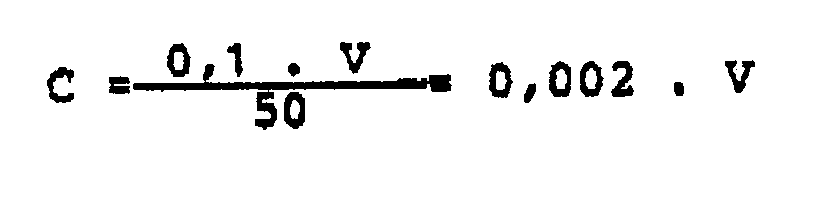
- Ansonsten muß die gesamte Bestimmung mit anderer Einwaage wiederholt werden. Es besteht jedoch auch die Möglichkeit, Restkonzentrationen von 0,008 n bis 0,035 n mit Hilfe von Korrekturfaktoren auf die Restkonzentration 0,2 n umzurechnen.
- Die Bestimmung erfolgt in Anlehnung an die Vorschrift des DAB VII, zweiter Nachtrag 1975
Es wird ermittelt, wieviel ml Methylenblaulösung mit einer bestimmten Aktivkohlemenge in vorgegebener Zen vollständig entfärbt werden.
Hierzu wird eine Methylenblaulösung 0,15 %ig (3 g cm/21) wie folgt hergestellt. - 3,0 g Methylenblau (nach DAB VII) werden in einem 21-Meßkolben in 1000 ml H₂O dest. unter 8-stündigem Erwärmen bei ca. 40°C gelöst. Nach dem Abkühlen wird auf 2 1 aufgefüllt. Die zu verwendende Lösung sollte ca. 20°C haben.
- 0,1 g trockene pulverförmige Aktivkohle, in einer Labormühle soweit vermahlen, daß 80 - 90 % durch ein 40 µm-Sieb nach DIN 4188 gehen oder die 0,1 g trockene Kohle entsprechende Handelsware werden analytisch genau eingewogen und in einen 50 ml-Meßzylinder mit Schliffstopfen gegeben.
- Während genau 5 Minuten wird portionsweise unter ständigem Schütteln soviel Methylenblaulösung zugegeben, daß vollständige Entfärbung eintritt.
- Die danach abgelesene Zahl der Milliliter Methylenblaulösung ist der ungefähre Wert Methylenblauzahl.
- Zwei weitere Proben mit 1 ml weniger bzw. 1 ml mehr der o.g. gefundenen Anzahl ml Methylenblaulösung werden genau 5 Minuten geschüttelt.
- Bei der ersten Probe sollte vollständige Entfärbung eintreten, während die zweite noch schwach blau erscheinen darf.
- Sind beide Proben entfärbt, so ist solange jeweils mit 1 ml mehr Methylenblaulösung 5 Minuten zu schütteln, bis eine Probe noch schwach blau erscheint.
- Als Methylenblautiter wird dann die Anzahl der ml Methylenblaulösung angegeben, die zwischen der letzten vollständig entfärbten Probe und der ersten blau erscheinenden Probe liegt. Er wird angegeben in ml entfärbte 0,15 %ige Methylenblaulösung pro 0,1 g Aktivkohle.
Claims (4)
- Aktivkohle hergestellt aus Braunkohlenkoks , der die folgenden physikalischen und chemischen Eigenschaften aufweist:
 und gekennzeichnet durch das Produkt aus Melassezahl mal Jodzahl dividiert durch 1000 gleich 350 bis 1000 und das Produkt aus Melassezahl mal Methylenblautiter dividiert durch 10 gleich 500 bis 1200.
- Verfahren zur Herstellung von Aktivkohle aus Braunkohlenkoks, der die folgenden physikalischen und chemischen Eigenschaften aufweist:
 bei der das Produkt aus Melassezahl mal Jodzahl dividiert durch 1000 gleich 350 bis 1000 und das Produkt aus Melassezahl mal Methylenblautiter dividiert durch 10 gleich 500 bis 1200 beträgt, wobei man Braunkohlenkoks mit Wasserdampf in einem Drehrohr aktiviert und während der Aktivierungsphase wässrige Alkali- oder Erdalkalicarbonatlösung und/oder wässrige Alkali- oder Erdalkalihydroxidlösung mittels einer Lanze in das Drehrohr einsprüht, wobei die Aktivierungstemperaturen in Fließrichtung des Aktivates (Braunkohlenkoks) im vorderen Teil des Drehrohrofens zwischen 900 und 1045 °C, im mittleren Teil zwischen 905 und 1055 °C und im hinteren Teil zwischen 880 und 995 °C liegen.
- Verfahren nach Anspruch 2, dadurch gekennzeichnet, daß man als Alkalicarbonat Kaliumcarbonat bzw. als Alkalihydroxid Kalimhydroxid verwendet.
- Verfahren nach Anspruch 2 oder 3, dadurch gekennzeichnet, daß die Kaliumkonzentration, bezogen auf die eingesetzte Braunkohle, 1,0 bis 8,0 Gew.-% beträgt.
Applications Claiming Priority (2)
| Application Number | Priority Date | Filing Date | Title |
|---|---|---|---|
| DE3418150 | 1984-05-16 | ||
| DE19843418150 DE3418150A1 (de) | 1984-05-16 | 1984-05-16 | Aktivkohle und das verfahren zu ihrer herstellung |
Publications (3)
| Publication Number | Publication Date |
|---|---|
| EP0164492A2 EP0164492A2 (de) | 1985-12-18 |
| EP0164492A3 EP0164492A3 (en) | 1988-06-01 |
| EP0164492B1 true EP0164492B1 (de) | 1991-08-28 |
Family
ID=6235992
Family Applications (1)
| Application Number | Title | Priority Date | Filing Date |
|---|---|---|---|
| EP85101594A Expired - Lifetime EP0164492B1 (de) | 1984-05-16 | 1985-02-14 | Aktivkohle und das Verfahren zu ihrer Herstellung |
Country Status (6)
| Country | Link |
|---|---|
| US (2) | US4603119A (de) |
| EP (1) | EP0164492B1 (de) |
| JP (1) | JPS60255608A (de) |
| AU (1) | AU567811B2 (de) |
| DE (2) | DE3418150A1 (de) |
| ZA (1) | ZA853489B (de) |
Cited By (1)
| Publication number | Priority date | Publication date | Assignee | Title |
|---|---|---|---|---|
| WO2024184092A1 (en) | 2023-03-03 | 2024-09-12 | Sk Embio Diagnostics Limited | Method and system for checking and evaluation of activation of porous materials |
Families Citing this family (28)
| Publication number | Priority date | Publication date | Assignee | Title |
|---|---|---|---|---|
| DE3525961A1 (de) * | 1985-07-20 | 1987-01-29 | Degussa | Aktivkohle und das verfahren zu ihrer herstellung |
| US4818293A (en) * | 1985-08-01 | 1989-04-04 | Betz Laboratories, Inc. | Stable slurries comprising powdered activated carbon |
| GB8724211D0 (en) * | 1987-10-15 | 1987-11-18 | British Petroleum Co Plc | Activation of carbons |
| JPH01264918A (ja) * | 1988-04-14 | 1989-10-23 | Nippon Enji Kk | 活性炭原料炭化物の製造方法 |
| US5292708A (en) * | 1988-10-12 | 1994-03-08 | Degussa Aktiengesellschaft | Method of producing activated carbon from pit-wet lignite |
| DE3834743A1 (de) * | 1988-10-12 | 1990-04-19 | Degussa | Verfahren zur herstellung einer grobporigen formkohle |
| DE4039014C2 (de) * | 1990-12-04 | 1994-07-07 | Michael Dr Suder | Verfahren zur Herstellung und Anwendung eines Mittels zur Senkung des Calciumsulfatgehaltes in Lösungen |
| US5172644A (en) * | 1991-12-12 | 1992-12-22 | Electric Power Research Institute, Inc. | Method and apparatus for enhanced suppression of the multiple pollutants produced by a combusted fuel |
| TW222251B (de) * | 1992-04-09 | 1994-04-11 | Takeda Chemical Industries Ltd | |
| US5405593A (en) * | 1992-08-03 | 1995-04-11 | University Of North Dakota Energy And Environmental Research Center Foundation | Leonardite char adsorbents |
| US5254521A (en) * | 1992-08-03 | 1993-10-19 | University Of North Dakota Energy And Environment Research Center Foundation | Leonardite char adsorbents |
| DE4327598C2 (de) * | 1993-08-17 | 1997-01-30 | Etc Engineering & Technology C | Verwendung von Aktivkohle bei der Wasseraufbereitung, insbesondere für die Aufbereitung von Schwimm- und Badebeckenwasser |
| KR100458133B1 (ko) * | 1999-12-21 | 2004-11-26 | 주식회사 포스코 | 분코크스를 이용한 다이옥신 제거용 흡착제 제조방법 및이로부터 제조된 흡착제 |
| US6534677B1 (en) | 2001-06-04 | 2003-03-18 | Engelhard Corporation | Non-crushable, non-friable, non-breakable carbon catalyst supports |
| JP4708409B2 (ja) * | 2001-07-26 | 2011-06-22 | クラレケミカル株式会社 | 廃ガス処理用成型活性炭及びその製造方法 |
| US6992037B2 (en) | 2001-09-17 | 2006-01-31 | Engelhard Corporation | Precious metal catalyst for debenzylation |
| US7659225B2 (en) * | 2001-09-17 | 2010-02-09 | Basf Catalysts Llc | Precious metal catalyst for debenzylation |
| US6706658B2 (en) * | 2001-12-21 | 2004-03-16 | Engelhard Corporation | Catalyst for purification of aromatic acids |
| US20060205592A1 (en) | 2005-03-14 | 2006-09-14 | Chien-Chung Chao | Catalytic adsorbents for mercury removal from flue gas and methods of manufacture therefor |
| US20060204429A1 (en) * | 2005-03-14 | 2006-09-14 | Bool Lawrence E Iii | Production of activated char using hot gas |
| WO2008083704A1 (de) * | 2006-12-28 | 2008-07-17 | Jochen Zingelmann | Verfahren zur erzeugung von aktivkohle aus kompaktierten organischen abfallstoffen |
| DE102009001230A1 (de) | 2009-02-27 | 2010-09-02 | Evonik Oxeno Gmbh | Verfahren zur Abtrennung und teilweiser Rückführung von Übergangsmetallen bzw. deren katalytisch wirksamen Komplexverbindungen aus Prozessströmen |
| RU2393990C1 (ru) * | 2009-04-06 | 2010-07-10 | Министерство промышленности и торговли Российской Федерации (Минпромторг России) | Способ получения активного угля |
| CN102728322B (zh) * | 2011-04-13 | 2015-04-22 | 宝山钢铁股份有限公司 | 一种用于烟气中二噁英吸附的活性焦及其制备方法 |
| US9539538B2 (en) | 2011-10-28 | 2017-01-10 | Ada Carbon Solutions, Llc | Multi-functional composition of matter for rapid removal of mercury from a flue gas |
| US10722865B2 (en) | 2011-10-28 | 2020-07-28 | Ada Carbon Solutions, Llc | Multi-functional composition of matter for removal of mercury from high temperature flue gas streams |
| CN105136711A (zh) * | 2015-10-19 | 2015-12-09 | 马钢(集团)控股有限公司 | 一种烧结混合料中固定碳的检测方法 |
| CN116559162B (zh) * | 2023-07-11 | 2023-09-08 | 四川蜀道建筑科技有限公司 | 一种基于图像识别技术的砂料mb值快速判定方法 |
Family Cites Families (9)
| Publication number | Priority date | Publication date | Assignee | Title |
|---|---|---|---|---|
| DE524614C (de) * | 1928-07-10 | 1931-05-07 | Oskar Schober Dr | Herstellung aktiver Kohle |
| JPS4945681B1 (de) * | 1965-10-13 | 1974-12-05 | ||
| US3817874A (en) * | 1968-09-18 | 1974-06-18 | Standard Oil Co | Process for increasing the surface area of active carbons |
| US3764561A (en) * | 1971-03-09 | 1973-10-09 | Takeda Chemical Industries Ltd | Activated carbon from admixture of coking coal and inorganic potassium salts |
| CA1057729A (en) * | 1975-03-18 | 1979-07-03 | Harry N.S. Schafer | Active carbon |
| US4082694A (en) * | 1975-12-24 | 1978-04-04 | Standard Oil Company (Indiana) | Active carbon process and composition |
| DD138013A3 (de) * | 1977-05-09 | 1979-10-10 | Hans Hoppe | Verfahren zur verbesserung der eigenschaften von aktivkohlen |
| JPS5585413A (en) * | 1978-12-19 | 1980-06-27 | Hemifuazerukonbinaato Shiyuwar | Method of making activated charcoal |
| US4551155A (en) * | 1983-07-07 | 1985-11-05 | Sri International | In situ formation of coal gasification catalysts from low cost alkali metal salts |
-
1984
- 1984-05-16 DE DE19843418150 patent/DE3418150A1/de not_active Withdrawn
-
1985
- 1985-02-14 DE DE8585101594T patent/DE3583894D1/de not_active Expired - Lifetime
- 1985-02-14 EP EP85101594A patent/EP0164492B1/de not_active Expired - Lifetime
- 1985-05-08 ZA ZA853489A patent/ZA853489B/xx unknown
- 1985-05-09 US US06/732,407 patent/US4603119A/en not_active Expired - Fee Related
- 1985-05-15 AU AU42490/85A patent/AU567811B2/en not_active Ceased
- 1985-05-16 JP JP60102798A patent/JPS60255608A/ja active Granted
-
1986
- 1986-03-28 US US06/845,246 patent/US4642304A/en not_active Expired - Fee Related
Cited By (1)
| Publication number | Priority date | Publication date | Assignee | Title |
|---|---|---|---|---|
| WO2024184092A1 (en) | 2023-03-03 | 2024-09-12 | Sk Embio Diagnostics Limited | Method and system for checking and evaluation of activation of porous materials |
Also Published As
| Publication number | Publication date |
|---|---|
| US4603119A (en) | 1986-07-29 |
| AU4249085A (en) | 1985-11-28 |
| DE3418150A1 (de) | 1985-11-21 |
| JPS60255608A (ja) | 1985-12-17 |
| AU567811B2 (en) | 1987-12-03 |
| EP0164492A3 (en) | 1988-06-01 |
| EP0164492A2 (de) | 1985-12-18 |
| US4642304A (en) | 1987-02-10 |
| JPH0159970B2 (de) | 1989-12-20 |
| DE3583894D1 (de) | 1991-10-02 |
| ZA853489B (en) | 1985-12-24 |
Similar Documents
| Publication | Publication Date | Title |
|---|---|---|
| EP0164492A2 (de) | Aktivkohle und das Verfahren zu ihrer Herstellung | |
| DE3932122C2 (de) | ||
| DE69405166T2 (de) | Verfahren zur entfernung von chloramin durch katalytischen kohlenstoff | |
| DE2010185C3 (de) | Verfahren zum Bestimmen dampf fluchtiger organischer Basen, insbe sondere Alkaloiden des Tabaks, und Vor richtung zur Durchfuhrung des Verfahrens | |
| DE2361097A1 (de) | Herstellung von aktivkohle | |
| DE1184742B (de) | Verfahren zur Herstellung eines synthetischen Minerals des Hectorit-Typus | |
| DE69533026T2 (de) | Verfahren zum testen von bodenproben auf organische verschmutzung | |
| DE19824047A1 (de) | Oxidativ nachbehandelter Ruß | |
| AT509275A1 (de) | Verfahren zur bestimmung von bodenproben | |
| DE60213065T2 (de) | Stabilisierung von getränken | |
| EP0210333B1 (de) | Aktivkohle und das Verfahren zur ihrer Herstellung | |
| DE2848692C3 (de) | Verfahren zur Herstellung von anorganischen Filterhilfen mit vermindertem bierlöslichem Eisengehalt durch Behandlung mit verdünnten Säuren | |
| DE2414925A1 (de) | Verfahren zum oxydieren von zellulose | |
| DE2656169A1 (de) | Verfahren zur herstellung von aktivkohle und das dabei erhaltene produkt | |
| EP0708683B1 (de) | Verfahren zur herstellung von sorbentien aus polysaccharidhaltigen rohstoffen, sorbentien und ihre verwendung | |
| DE3021408A1 (de) | Verfahren zum auftragen von palladium auf rauchtabakmischungen | |
| DE69406655T2 (de) | Amorphes Aluminosilikat und Verfahren zu seiner Herstellung | |
| DE1907913C3 (de) | Verfahren zur Herstellung von Aktivkohle mit mehrkerniger dreidimensionaler Struktur | |
| DE2460650A1 (de) | Tabakrauchfilter | |
| Norwitz et al. | Dissolution of carbon blacks by nitric acid | |
| DE1161532B (de) | Verfahren zur Herstellung von stark rotstichigem Kupferphthalocyanin | |
| Gimba et al. | Optimum conditions for carbonisation of coconut shell | |
| Sulyman et al. | Preparation 0f Activated Carbon from Coconut shells Use the Kim-al-Ali as abond material And use it to adsorb the pigment of the methylene blue. | |
| DE1941291C (de) | Verfahren zur Herstellung von niedri gen Trinatnummonohydrogendiphosphat Hydra ten | |
| DE2000847C3 (de) |
Legal Events
| Date | Code | Title | Description |
|---|---|---|---|
| PUAI | Public reference made under article 153(3) epc to a published international application that has entered the european phase |
Free format text: ORIGINAL CODE: 0009012 |
|
| 17P | Request for examination filed |
Effective date: 19850214 |
|
| AK | Designated contracting states |
Designated state(s): BE DE FR GB IT NL |
|
| PUAL | Search report despatched |
Free format text: ORIGINAL CODE: 0009013 |
|
| AK | Designated contracting states |
Kind code of ref document: A3 Designated state(s): BE DE FR GB IT NL |
|
| 17Q | First examination report despatched |
Effective date: 19890731 |
|
| GRAA | (expected) grant |
Free format text: ORIGINAL CODE: 0009210 |
|
| AK | Designated contracting states |
Kind code of ref document: B1 Designated state(s): BE DE FR GB IT NL |
|
| ET | Fr: translation filed | ||
| ITF | It: translation for a ep patent filed | ||
| REF | Corresponds to: |
Ref document number: 3583894 Country of ref document: DE Date of ref document: 19911002 |
|
| GBT | Gb: translation of ep patent filed (gb section 77(6)(a)/1977) | ||
| PLBE | No opposition filed within time limit |
Free format text: ORIGINAL CODE: 0009261 |
|
| STAA | Information on the status of an ep patent application or granted ep patent |
Free format text: STATUS: NO OPPOSITION FILED WITHIN TIME LIMIT |
|
| 26N | No opposition filed | ||
| PGFP | Annual fee paid to national office [announced via postgrant information from national office to epo] |
Ref country code: DE Payment date: 19950118 Year of fee payment: 11 |
|
| PGFP | Annual fee paid to national office [announced via postgrant information from national office to epo] |
Ref country code: BE Payment date: 19950125 Year of fee payment: 11 |
|
| PGFP | Annual fee paid to national office [announced via postgrant information from national office to epo] |
Ref country code: GB Payment date: 19950206 Year of fee payment: 11 |
|
| PGFP | Annual fee paid to national office [announced via postgrant information from national office to epo] |
Ref country code: NL Payment date: 19950228 Year of fee payment: 11 Ref country code: FR Payment date: 19950228 Year of fee payment: 11 |
|
| PG25 | Lapsed in a contracting state [announced via postgrant information from national office to epo] |
Ref country code: GB Effective date: 19960214 |
|
| PG25 | Lapsed in a contracting state [announced via postgrant information from national office to epo] |
Ref country code: BE Effective date: 19960228 |
|
| BERE | Be: lapsed |
Owner name: DEGUSSA A.G. Effective date: 19960228 |
|
| PG25 | Lapsed in a contracting state [announced via postgrant information from national office to epo] |
Ref country code: NL Effective date: 19960901 |
|
| GBPC | Gb: european patent ceased through non-payment of renewal fee |
Effective date: 19960214 |
|
| PG25 | Lapsed in a contracting state [announced via postgrant information from national office to epo] |
Ref country code: FR Effective date: 19961031 |
|
| NLV4 | Nl: lapsed or anulled due to non-payment of the annual fee |
Effective date: 19960901 |
|
| PG25 | Lapsed in a contracting state [announced via postgrant information from national office to epo] |
Ref country code: DE Effective date: 19961101 |
|
| REG | Reference to a national code |
Ref country code: FR Ref legal event code: ST |