EP0146135B1 - Photochrome Substanzen - Google Patents
Photochrome Substanzen Download PDFInfo
- Publication number
- EP0146135B1 EP0146135B1 EP84115602A EP84115602A EP0146135B1 EP 0146135 B1 EP0146135 B1 EP 0146135B1 EP 84115602 A EP84115602 A EP 84115602A EP 84115602 A EP84115602 A EP 84115602A EP 0146135 B1 EP0146135 B1 EP 0146135B1
- Authority
- EP
- European Patent Office
- Prior art keywords
- optical element
- aryl
- alkyl
- photochromic compound
- photochromic
- Prior art date
- Legal status (The legal status is an assumption and is not a legal conclusion. Google has not performed a legal analysis and makes no representation as to the accuracy of the status listed.)
- Expired - Lifetime
Links
- 239000000126 substance Substances 0.000 title claims description 15
- 125000003118 aryl group Chemical group 0.000 claims abstract description 13
- 125000000217 alkyl group Chemical group 0.000 claims abstract description 10
- 229910052736 halogen Inorganic materials 0.000 claims abstract description 4
- 125000005843 halogen group Chemical group 0.000 claims abstract description 4
- 150000001875 compounds Chemical class 0.000 claims description 24
- 230000003287 optical effect Effects 0.000 claims description 9
- 239000004033 plastic Substances 0.000 claims description 7
- 229920003023 plastic Polymers 0.000 claims description 7
- 125000004432 carbon atom Chemical group C* 0.000 claims description 6
- 125000001424 substituent group Chemical group 0.000 claims description 6
- 238000009833 condensation Methods 0.000 claims description 4
- 230000005494 condensation Effects 0.000 claims description 4
- 238000002844 melting Methods 0.000 claims description 4
- 230000008018 melting Effects 0.000 claims description 4
- 239000000203 mixture Substances 0.000 claims description 4
- 238000009835 boiling Methods 0.000 claims description 3
- 239000003795 chemical substances by application Substances 0.000 claims description 3
- 125000000113 cyclohexyl group Chemical group [H]C1([H])C([H])([H])C([H])([H])C([H])(*)C([H])([H])C1([H])[H] 0.000 claims description 3
- 125000001072 heteroaryl group Chemical group 0.000 claims description 3
- 239000000463 material Substances 0.000 claims description 3
- 125000004433 nitrogen atom Chemical group N* 0.000 claims description 3
- 239000007795 chemical reaction product Substances 0.000 claims description 2
- 238000010438 heat treatment Methods 0.000 claims description 2
- 239000012442 inert solvent Substances 0.000 claims description 2
- 125000005936 piperidyl group Chemical group 0.000 claims description 2
- 229920002545 silicone oil Polymers 0.000 claims description 2
- 238000003756 stirring Methods 0.000 claims description 2
- 239000012876 carrier material Substances 0.000 claims 1
- 238000007598 dipping method Methods 0.000 claims 1
- 125000002496 methyl group Chemical group [H]C([H])([H])* 0.000 abstract description 13
- 125000005842 heteroatom Chemical group 0.000 abstract 2
- BCHZICNRHXRCHY-UHFFFAOYSA-N 2h-oxazine Chemical compound N1OC=CC=C1 BCHZICNRHXRCHY-UHFFFAOYSA-N 0.000 abstract 1
- 239000011159 matrix material Substances 0.000 description 6
- 230000000694 effects Effects 0.000 description 5
- 230000005540 biological transmission Effects 0.000 description 4
- YMWUJEATGCHHMB-UHFFFAOYSA-N Dichloromethane Chemical compound ClCCl YMWUJEATGCHHMB-UHFFFAOYSA-N 0.000 description 3
- XSTXAVWGXDQKEL-UHFFFAOYSA-N Trichloroethylene Chemical group ClC=C(Cl)Cl XSTXAVWGXDQKEL-UHFFFAOYSA-N 0.000 description 3
- 238000004040 coloring Methods 0.000 description 3
- 238000004519 manufacturing process Methods 0.000 description 3
- 238000005481 NMR spectroscopy Methods 0.000 description 2
- NQRYJNQNLNOLGT-UHFFFAOYSA-N Piperidine Chemical compound C1CCNCC1 NQRYJNQNLNOLGT-UHFFFAOYSA-N 0.000 description 2
- 230000015572 biosynthetic process Effects 0.000 description 2
- 238000006243 chemical reaction Methods 0.000 description 2
- 230000000052 comparative effect Effects 0.000 description 2
- 230000001419 dependent effect Effects 0.000 description 2
- 239000011521 glass Substances 0.000 description 2
- 230000004048 modification Effects 0.000 description 2
- 238000012986 modification Methods 0.000 description 2
- 238000001228 spectrum Methods 0.000 description 2
- 230000037072 sun protection Effects 0.000 description 2
- 238000003786 synthesis reaction Methods 0.000 description 2
- ZTUKGBOUHWYFGC-UHFFFAOYSA-N 1,3,3-trimethyl-2-methylideneindole Chemical compound C1=CC=C2N(C)C(=C)C(C)(C)C2=C1 ZTUKGBOUHWYFGC-UHFFFAOYSA-N 0.000 description 1
- KJCVRFUGPWSIIH-UHFFFAOYSA-N 1-naphthol Chemical compound C1=CC=C2C(O)=CC=CC2=C1 KJCVRFUGPWSIIH-UHFFFAOYSA-N 0.000 description 1
- 238000005160 1H NMR spectroscopy Methods 0.000 description 1
- 235000005811 Viola adunca Nutrition 0.000 description 1
- 240000009038 Viola odorata Species 0.000 description 1
- 235000013487 Viola odorata Nutrition 0.000 description 1
- 235000002254 Viola papilionacea Nutrition 0.000 description 1
- 244000172533 Viola sororia Species 0.000 description 1
- PNEYBMLMFCGWSK-UHFFFAOYSA-N aluminium oxide Inorganic materials [O-2].[O-2].[O-2].[Al+3].[Al+3] PNEYBMLMFCGWSK-UHFFFAOYSA-N 0.000 description 1
- SYFOAKAXGNMQAX-UHFFFAOYSA-N bis(prop-2-enyl) carbonate;2-(2-hydroxyethoxy)ethanol Chemical compound OCCOCCO.C=CCOC(=O)OCC=C SYFOAKAXGNMQAX-UHFFFAOYSA-N 0.000 description 1
- 238000001816 cooling Methods 0.000 description 1
- 229910052593 corundum Inorganic materials 0.000 description 1
- 239000003480 eluent Substances 0.000 description 1
- 235000021190 leftovers Nutrition 0.000 description 1
- 238000005259 measurement Methods 0.000 description 1
- 238000000034 method Methods 0.000 description 1
- 125000000956 methoxy group Chemical group [H]C([H])([H])O* 0.000 description 1
- 238000002360 preparation method Methods 0.000 description 1
- 239000000047 product Substances 0.000 description 1
- 238000010992 reflux Methods 0.000 description 1
- 230000000630 rising effect Effects 0.000 description 1
- 150000003839 salts Chemical class 0.000 description 1
- 230000035945 sensitivity Effects 0.000 description 1
- 239000002904 solvent Substances 0.000 description 1
- 230000003595 spectral effect Effects 0.000 description 1
- 239000007858 starting material Substances 0.000 description 1
- 229910052724 xenon Inorganic materials 0.000 description 1
- FHNFHKCVQCLJFQ-UHFFFAOYSA-N xenon atom Chemical compound [Xe] FHNFHKCVQCLJFQ-UHFFFAOYSA-N 0.000 description 1
- 229910001845 yogo sapphire Inorganic materials 0.000 description 1
Classifications
-
- C—CHEMISTRY; METALLURGY
- C07—ORGANIC CHEMISTRY
- C07D—HETEROCYCLIC COMPOUNDS
- C07D498/00—Heterocyclic compounds containing in the condensed system at least one hetero ring having nitrogen and oxygen atoms as the only ring hetero atoms
- C07D498/02—Heterocyclic compounds containing in the condensed system at least one hetero ring having nitrogen and oxygen atoms as the only ring hetero atoms in which the condensed system contains two hetero rings
- C07D498/10—Spiro-condensed systems
-
- G—PHYSICS
- G03—PHOTOGRAPHY; CINEMATOGRAPHY; ANALOGOUS TECHNIQUES USING WAVES OTHER THAN OPTICAL WAVES; ELECTROGRAPHY; HOLOGRAPHY
- G03C—PHOTOSENSITIVE MATERIALS FOR PHOTOGRAPHIC PURPOSES; PHOTOGRAPHIC PROCESSES, e.g. CINE, X-RAY, COLOUR, STEREO-PHOTOGRAPHIC PROCESSES; AUXILIARY PROCESSES IN PHOTOGRAPHY
- G03C1/00—Photosensitive materials
- G03C1/685—Compositions containing spiro-condensed pyran compounds or derivatives thereof, as photosensitive substances
Definitions
- the invention relates to photochromic substances, i.e. on substances whose coloring changes in intensity and color impression according to the ambient lighting.
- Photochromic substances have a multitude of possible uses, for example they are used for the production of photochromic sun protection lenses made of plastic, eyeglass frames, etc.
- Photochromic substances are, for example, from US-A-3 562 172, US-A-3 578 602, US-A-4 215 010 or DE-A 1 927 849, DE-A-29 26 255 or GB-A -2 029 410 known.
- the photochromic substances or compounds known from these publications have the disadvantage, among other things, that the photochromic effect is strongly temperature-dependent: with increasing ambient temperatures, the darkening becomes less with the same illuminance.
- the object of the invention is to provide photochromic substances or compounds whose photochromic effect changes only slightly with increasing temperature, i.e. which have good darkening properties even with increasing temperature.
- the photochromic compounds according to the invention are thus synthesized by condensation of a substituted 2-alkylene indoline with a 2-hydroxy-1-nitrosoaromatic.
- the 2-alkylene indoline can be formed by previous synthesis or during the last synthesis step from an appropriate indoleninium salt.
- the introduction of the rest -NR2 takes place in this step via the condensing agent.
- the back reaction is favored by rising temperatures, i.e. the equilibrium between molecules with the structural formula (1) and (2) is shifted from the modification (2) to the basic form (1) by increasing temperature at the same illuminance.
- the residue -NR2 provided according to the invention represents a strong steric and additionally an electronic hindrance for the back reaction. This applies to a somewhat lesser extent also for the residues R4, R5 and R6.
- the photochromic substances according to the invention have the additional advantage of positive thermochromism, ie the darkening increases with increasing temperature.
- the spiro-CO bond also opens for compounds with positive thermochromism, and the following molecules are likely to be formed, which have a blue-violet color:
- the balance between the basic form (1) and the modification (3) depends only on the temperature, but not on the illuminance.
- Such photochromic and thermochromic compounds in a matrix are exclusively phototropic compounds, as are described, for example, in US Pat. No. 3,578,602, even when assuming the same phototropic properties, that they are superior in that they pass through in sunlight the heating of the matrix caused by this has a greater darkening.
- the photochromic substances according to the invention have the additional advantage that with the same concentration of the molecules in a matrix, for example an optical element, the darkening is greater than with the substances that are described in the above-mentioned copies.
- the photochromic substances according to the invention can be used in a particularly advantageous manner in a sun protection spectacle lens made from a plastic material.
- the solution is concentrated to about 1/3 of its volume and chromatographed on Al2O3 using trichlorethylene as the eluent.
- the unreacted basic starting compound can be recovered from the first eluate; the green main zone contains the product.
- the solvent is removed in vacuo.
- the purified piperidyl derivative of 1,3,3-trimethyl-spiro (indolino-2 '- 2,3' - (3H) naphth (2,1-b) (1.4) oxazin) has a melting point of 226 ° C.
- the compound has the general formula: the remainder -NR2 is connected to the basic structure of the spirooxazine at a point specified by the manufacturing process and specified in more detail by the above NMR data.
- a dyebath is prepared by stirring about 5% by weight of the dye into a silicone oil or into a similar high-boiling inert solvent.
- the plastic lens After appropriate preheating, the plastic lens is approx. 20 min. long immersed in this bath.
- the temperature of the bath depends on the melting point of the photochromic Connection, it is about 10 ° C above this. Since temperatures above 200 ° C destroy the matrix, higher melting substances at 180 ° C in max. Introduced 30 min.
- the lens After cooling, the lens is washed with methylene chloride, the dye has diffused into the plastic material on both sides. This coloring can be repeated several times if necessary.
- the plastic lenses colored with the photochromic compounds according to the invention show a significantly improved transmission behavior compared to the prior art:
- the lenses were colored using the method described above such that the transmission difference, assessed according to V ⁇ , between unexposed and exposed glass at the standard temperature of 23 ° C. according to DIN 58217 was approximately the same.
- the measurement was carried out in a kinetic bench with a temperature-controlled cuvette, and the exposure was carried out at an angle of 30 ° with an illuminance of 60,000 lux.
- the spectrum of the high-pressure xenon lamp used was largely adapted to the spectrum of natural sunlight at sea level through filter combinations.
- the compounds listed in the table have the following radicals in the general formula (1) (the comparative substances are taken from US-A-3 578 602 and US-A-4 215 010): R 1.3 R2 R4 R5 R6 -NR2 example H H CH3 CH3 CH3 NC5H10 Comparative 1 H H CH3 CH3 CH3 - 2nd H 9-OCH3 CH3 CH3 CH3 -
- the compounds according to the invention show a stronger photochromic effect than these at 30 ° C.
Landscapes
- Chemical & Material Sciences (AREA)
- Organic Chemistry (AREA)
- Engineering & Computer Science (AREA)
- Materials Engineering (AREA)
- Physics & Mathematics (AREA)
- General Physics & Mathematics (AREA)
- Nitrogen And Oxygen Or Sulfur-Condensed Heterocyclic Ring Systems (AREA)
- Eyeglasses (AREA)
- Non-Silver Salt Photosensitive Materials And Non-Silver Salt Photography (AREA)
- Manufacturing Of Micro-Capsules (AREA)
Description
- Die Erfindung bezieht sich auf photochrome Substanzen, d.h. auf Substanzen, deren Einfärbung sich entsprechend der Umgebungsbeleuchtung in Intensität und Farbeindruck ändert.
- Photochrome Substanzen haben eine Vielzahl von Anwendungsmöglichkeiten, beispielsweise werden sie zur Herstellung von photochromen Sonnenschutz-Brillengläsern aus Kunststoff, Brillenfassungen etc. verwendet.
- Photochrome Substanzen sind beispielsweise aus US-A-3 562 172, US-A-3 578 602, US-A-4 215 010 oder der DE-A 1 927 849, der DE-A-29 26 255 oder der GB-A-2 029 410 bekannt.
- Die aus diesen Druckschriften bekannten photochromen Substanzen bzw. Verbindungen haben jedoch unter anderem den Nachteil, daß der photochrome Effekt stark temperaturabhängig ist: Mit steigenden Umgebungstemperaturen wird die Eindunkelung bei gleicher Beleuchtungsstärke geringer.
- Der Erfindung liegt die Aufgabe zugrunde, photochrome Substanzen bzw. Verbindungen anzugeben, deren photochromer Effekt sich auch mit steigender Temperatur nur wenig ändert, d.h. die auch bei steigender Temperatur gute Eindunkelungseigenschaften aufweisen.
- Diese Aufgabe wird erfindungsgemäß durch Verbindungen gelöst, die in an sich bekannter Weise erhalten werden durch die Kondensation
- eines substituierten 2-Alkylenindolins
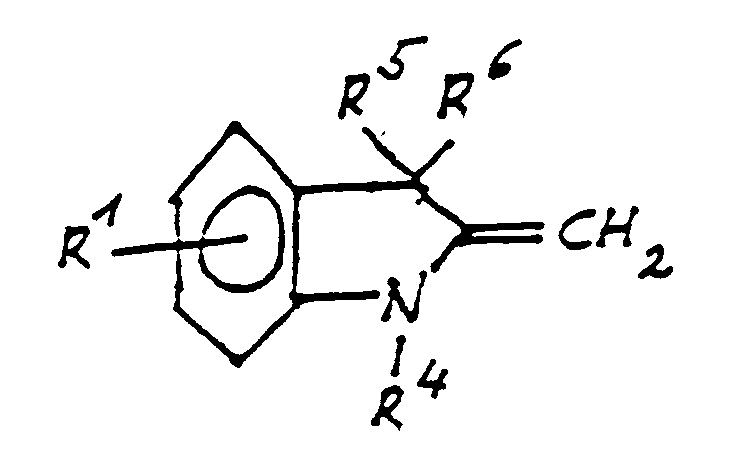
- mit einem 2-Hydroxy-1-nitroso-aromaten

- in Anwesenheit eines Kondensationsmittels der Formel HNR₂, das den Rest -NR₂ in das Reaktionsprodukt einführt,
- R¹,R²,R³
- einen oder mehrere Substituenten aus der Reihe -H, -CN, -SCN, NO₂, -X, -CH₂X, -CX₃, -OR, -SR, -COR, -COOR darstellen,
wobei X = Halogen und R = H, Alkyl mit bis zu 8 C-Atomen, Aryl, Heteroaryl sind bzw. annelierte aromatische oder heteroaromatische Ringsysteme bedeuten, - R⁴,R⁵,R⁶
- ein Substituent aus der Reihe -R⁷, -CH₂R⁷, ist,
wobei R⁷ = Alkyl mit bis zu 8 C-Atomen oder Aryl bedeutet, und - R
- Alkyl mit bis zu 8 C-Atomen, Aryl oder Cyclohexyl ist,
oder die beiden R zusammen mit dem N-Atom einen Piperidylrest bilden. - Die erfindungsgemäßen photochromen Verbindungen werden also durch Kondensation eines substituierten 2-Alkylenindolins mit einem 2-Hydroxy-1-nitroso-aromaten synthetisiert.
- Die Bildung des 2-Alkylenindolins kann durch vorhergehende Synthese oder während des letzten Synthesenschritts aus einem entsprechenden Indoleninium Salz erfolgen. Die Einführung des Restes -NR₂ erfolgt in diesem Schritt über das Kondensationsmittel.
- Anders ausgedrückt, wird eine Verbindung der allgemeinen - an sich bekannten - Formel

mit einem Substituenten -NR₂ an geeigneter, durch das erfindungsgemäße Herstellverfahren festgelegter Stelle versehen. Erfindungsgemäß ist nämlich erkannt worden, daß für die Verringerung der Temperaturabhängigkeit des photochromen Effekts die Reste R⁴, R⁵, R⁶ und -NR₂ entscheidend sind:
Durch die Einwirkung von kurzwelligem Licht öffnet sich die Spiro-C-O Bindung; nach der von den Erfindern entwickelten Modellvorstellung entstehen aus der Grundform, d.h. dem Molekül mit der allgemeinen Formel (1) folgende Moleküle, die miteinander im Gleichgewicht stehen:
Die Moleküle mit der Strukturformel (2) haben eine blaue Farbe, während das Molekül mit der Strukturformel (1) farblos ist. - Durch steigende Temperaturen wird die Rückreaktion begünstigt, d.h. das Gleichgewicht zwischen Molekülen mit der Strukturformel (1) und (2) wird bei gleicher Beleuchtungsstärke durch steigende Temperatur von der Modifikation (2) zu der Grundform (1) hin verschoben.
- Der erfindungsgemäß vorgesehene Rest -NR₂ stellt eine starke sterische und zusätzlich eine elektronische Hinderung für die Rückreaktion dar. Dies trifft in etwas geringerem Maße auch für die Reste R⁴, R⁵ und R⁶ zu.
- Sind die Reste R⁵ und R⁶ "größer" als Methyl, so weisen die erfindungsgemäßen photochromen Substanzen den zusätzlichen Vorteil der positiven Thermochromie auf, d.h. die Eindunkelung nimmt mit steigender Temperatur zu. Nach einer ebenfalls von den Erfindern entwickelten Modellvorstellung öffnet sich bei Verbindungen mit positiver Thermochromie ebenfalls die Spiro-C-O-Bindung, und es dürften folgende Moleküle entstehen, die eine blau-violette Farbe haben:

Das Gleichgewicht zwischen der Grundform (1) und der Modifikation (3) hängt nur von der Temperatur, nicht jedoch von der Beleuchtungsstärke ab. - Solche photo- und thermochromen Verbindungen sind in einer Matrix, beispielsweise einem optischen Element, ausschließlich phototropen Verbindungen, wie sie beispielsweise in der US-A-3 578 602 beschrieben sind, auch unter der Annahme gleicher phototroper Eigenschaften dadurch überlegen, daß sie im Sonnenlicht durch das durch dieses bewirkte Aufheizen der Matrix eine stärkere Eindunkelung aufweisen.
- Die erfindungsgemäßen photochromen Substanzen haben den zusätzlichen Vorteil, daß bei gleicher Konzentration der Moleküle in einer Matrix, beispielsweise einem optischen Element, die Eindunkelung größer ist als bei den Substanzen, die in den eingangs genannten Durckschriften beschrieben sind.
- Im Anspruch 2 sind besonders vorteilhafte Verbindungen für die Restgruppe -NR₂ angegeben. Bei Verwendung dieser Reste ist die beleuchtungsabhängige Einfärbung der photochromen Verbindung blau bis violett.
- In den Ansprüchen 4 bis 6 sind Möglichkeiten gekennzeichnet, wie optische Elemente mit der erfindungsgemäßen photochromen Verbindung hergestellt werden können.
- In besonders vorteilhafter Weise lassen sich die erfindungsgemäßen photochromen Substanzen bei einem Sonnenschutz-Brillenglas aus einem Kunststoffmaterial einsetzen.
- Im folgenden soll ein Beispiel für eine erfindungsgemäße photochrome Verbindung vorgestellt werden:
17,1g (0,1mol) 1-Nitroso-2-napthol wird in 150 ml Trichlorethylen suspendiert, mit 17g (0,2 mol) Piperidin versetzt und unter Rückfluß bis zur vollständigen Lösung des Naphthols gekocht. - 21,5g (0,1 mol)-1,1,3-Trimethyl-2-methylen-indolin werden in 100 ml Trichlorethylen gelöst und langsam zur ersteren Lösung bei Siedehitze zugetropft. Das Gemisch wird anschließend noch ca. 3 Stunden unter Rückfluß gekocht.
- Die Lösung wird auf ca. 1/3 ihres Volumens eingeengt und über Al₂O₃ mit Trichlorethylen als Laufmittel chromatographiert. Aus dem ersten Eluat kann die nicht umgesetzte basische Ausgangsverbindung zurückgewonnen werden, die grüne Hauptzone enthält das Produkt. Das Laufmittel wird im Vakuum abgezogen.
- Das gereinigte Piperidylderivat von 1,3,3-Trimethyl-spiro(indolino-2'--2,3'-(3H)naphth(2,1-b)(1.4)oxazin) besitzt einen Schmelzpunkt von 226°C. Die Verbindung hat dabei die folgenden 1H-NMR-Daten in ppm:
δ(-CH₃) = 1,35 (S) R⁵, R⁶ δ(-CH₂-) = 1,75 (S) -NR₂ δ(N-CH₃) = 2,75 (S) R⁴ - Entsprechend diesen NMR-Daten hat die Verbindung die allgemeine Formel:
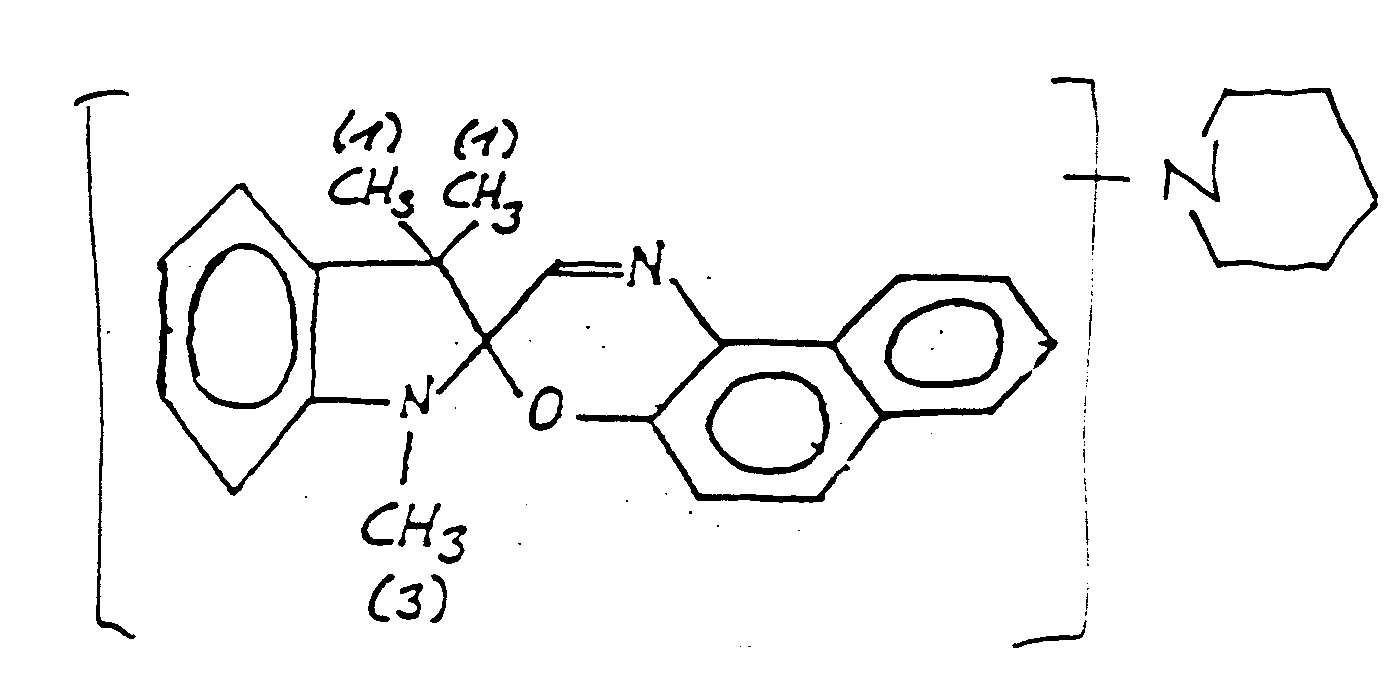
wobei der Rest -NR₂ an einer durch das Herstellverfahren vorgegebenen und durch die vorstehenden NMR-Daten näher spezifizierten Stelle mit dem Spirooxazin-Grundgerüst verbunden ist. - In folgenden soll exemplarisch eine Möglichkeit beschrieben werden, wie erfindungsgemäße Verbindungen, beispielsweise die Substanz, deren Herstellung vorstehend beschrieben worden ist, in eine Matrix eingebracht werden können.
- Bei den folgenden Ausführungsbeispielen wird als Matrix eine 2mm dicke Planlinse aus Diethylenglykol-bis-allylcarbonat verwendet, das beispielsweise unter dem Warenzeichen CR 39 vertrieben wird.
- Durch Einrühren von ca 5 Gew.% des Farbstoffs in ein Silikonöl oder in ein ähnliches hochsiedendes inertes Lösemittel wird ein Färbebad bereitet.
- Die Kunststofflinse wird nach entsprechender Vorwärmung ca 20 min. lang in dieses Bad getaucht. Die Temperatur des Bads richtet sich nach dem Schmelzpunkt der photochromen Verbindung, sie liegt etwa 10°C über diesem. Da Temperaturen über 200°C die Matrix zerstören, werden höher schmelzende Substanzen bei 180°C in max. 30 min eingebracht. Nach dem Abkühlen wird die Linse mit Methylenchlorid gewaschen, der Farbstoff ist beidseitig in das Kunststoffmaterial eindiffundiert. Diese Einfärbung kann gegebenenfalls mehrfach wiederholt werden.
- Die mit den erfindungsgemäßen photochromen Verbindungen eingefärbten Kunststofflinsen zeigen verglichen mit dem Stand der Technik ein wesentlich verbessertes Transmissionsverhalten:
Zur Messung der Temperaturabhängigkeit des photochromen Effekts wurden die Linsen nach dem vorstehend beschriebenen Verfahren so eingefärbt, daß der nach Vλ-bewertete Transmissionsunterschied zwischen unbelichtetem und belichtetem Glas bei der Standardtemperatur 23°C nach DIN 58217 gemessen annähernd gleich war. Die Messung erfolgte in einer Kinetikbank mit temperierbarer Küvette, die Belichtung erfolgte unter einem Winkel von 30° mit einer Beleuchtungsstärke von 60 000 lux. Das Spektrum der verwendeten Xenonhochdrucklampe war durch Filterkombinationen dem Spektrum des natürlichen Sonnenlichts auf Meereshöhe weitgehend angepaßt. Gemessen wurde die nach der spektralen Empfindlichkeit des menschlichen Auges bewertete Transmission nach 15-minütiger Bestrahlung. Zum Ausbleichen wurden die Gläser 30 min bei 90°C ausgeheizt und anschließend im Dunkeln auf Raumtemperatur abgekühlt.Tabelle Unterschied in der Lichtdurchlässigkeit Temp. Beispiel Vergl.-subst.1 Vergl. subst.2 10°C 62,5 72,5 65,5 20°C 59,5 61,5 52 30°C 40,5 35,5 31 Δ(Δτ) 22 37 34 - Die in der Tabelle aufgeführten Verbindungen haben folgende Reste in der allgemeinen Formel (1) (die Vergleichssustanzen sind der US-A-3 578 602 und der US-A-4 215 010 entnommen) :
R1,3 R² R⁴ R⁵ R⁶ -NR₂ Beispiel H H CH₃ CH₃ CH₃ NC₅H₁₀ Vergleichss. 1 H H CH₃ CH₃ CH₃ - 2 H 9-OCH₃ CH₃ CH₃ CH₃ - - Wie aus der Tabelle ersichtlich ist, zeigen die erfindungsgemäßen Verbindungen bei gleicher oder sogar geringerer Eindunkelung als die bislang bekannten Verbindungen bei 10°C, einen stärkeren photochromen Effekt als diese bei 30°C. Der störende Abfall der Eindunkelung mit steigender Temperatur bei gleicher Beleuchtungsstärke, als Δ(Δτ) zwischen 10°C und 20°C und 30°C bewertet, wird um bis zu 40% reduziert.
Claims (5)
- Photochrome Verbindung, erhalten in an sich bekannter Weise durch die Kondensation- eines substituierten 2-Alkylenindolins
 - mit einem 2-Hydroxy-1-nitroso-aromaten
 - in Anwesenheit eines Kondensationsmittels der Formel HNR₂, das den Rest -NR₂ in das Reaktionsprodukt einführt,wobei die ResteR¹,R²,R³ einen oder mehrere Substituenten aus der Reihe -H, -CN, -SCN, NO₂, -X, -CH₂X, -CX₃, -OR, -SR, -COR, -COOR darstellen,
wobei X = Halogen und R = H, Alkyl mit bis zu 8 C-Atomen, Aryl, Heteroaryl sind bzw. annelierte aromatische oder heteroaromatische Ringsysteme bedeuten,R⁴,R⁵,R⁶ ein Substituent aus der Reihe -R⁷, -CH₂R⁷, ist
wobei R⁷ = Alkyl mit bis zu 8 C-Atomen oder Aryl bedeutet, undR Alkyl mit bis zu 8 C-Atomen, Aryl oder Cyclohexyl ist,
oder die beiden R zusammen mit dem N-Atom einen Piperidylrest bilden. - Verbindungen nach Anspruch 1,
dadurch gekennzeichnet, daß der Rest -NR₂ die Bedentungen, -NC₅H₁₀ oder N(C₆H₁₁)₂ besitzt. - Optisches Element,
dadurch gekennzeichnet, daß es eine wirksame Menge einer photochromen Verbindung nach Anspruch 1 oder 2 enthält, die in das optische Element eingebracht oder als Schicht auf einem Kunststoffträgermaterial aufgebracht ist. - Optisches Element nach Anspruch 3,
dadurch gekennzeichnet, daß das optische Element aus einem Kunststoffmaterial besteht. - Optisches Element nach Anspruch 3 oder 4,
dadurch gekennzeichnet, daß das Element dadurch hergestellt ist,
daß die photochrome Verbindung in ein Silikonöl oder ein ähnliches hochsiedendes inertes Lösemittel eingerührt wird, daß die Mischung auf eine Temperatur etwa 10° oberhalb des Schmelzpunktes der photochromen Verbindung, maximal jedoch 180°C erwärmt wird, und daß das optische Grundelement maximal 30 min in die Mischung getaucht wird.
Priority Applications (2)
| Application Number | Priority Date | Filing Date | Title |
|---|---|---|---|
| EP92105128A EP0508219B1 (de) | 1983-12-16 | 1984-12-17 | Photochrome Substanzen |
| AT84115602T ATE88475T1 (de) | 1983-12-16 | 1984-12-17 | Photochrome substanzen. |
Applications Claiming Priority (4)
| Application Number | Priority Date | Filing Date | Title |
|---|---|---|---|
| DE3345625 | 1983-12-16 | ||
| DE3345624 | 1983-12-16 | ||
| DE3345624 | 1983-12-16 | ||
| DE3345625 | 1983-12-16 |
Related Child Applications (2)
| Application Number | Title | Priority Date | Filing Date |
|---|---|---|---|
| EP92105128A Division EP0508219B1 (de) | 1983-12-16 | 1984-12-17 | Photochrome Substanzen |
| EP92105128.0 Division-Into | 1992-03-25 |
Publications (3)
| Publication Number | Publication Date |
|---|---|
| EP0146135A2 EP0146135A2 (de) | 1985-06-26 |
| EP0146135A3 EP0146135A3 (de) | 1985-07-24 |
| EP0146135B1 true EP0146135B1 (de) | 1993-04-21 |
Family
ID=25816510
Family Applications (3)
| Application Number | Title | Priority Date | Filing Date |
|---|---|---|---|
| EP92105128A Expired - Lifetime EP0508219B1 (de) | 1983-12-16 | 1984-12-17 | Photochrome Substanzen |
| EP85900063A Pending EP0165953A1 (de) | 1983-12-16 | 1984-12-17 | Photochrome substanzen |
| EP84115602A Expired - Lifetime EP0146135B1 (de) | 1983-12-16 | 1984-12-17 | Photochrome Substanzen |
Family Applications Before (2)
| Application Number | Title | Priority Date | Filing Date |
|---|---|---|---|
| EP92105128A Expired - Lifetime EP0508219B1 (de) | 1983-12-16 | 1984-12-17 | Photochrome Substanzen |
| EP85900063A Pending EP0165953A1 (de) | 1983-12-16 | 1984-12-17 | Photochrome substanzen |
Country Status (6)
| Country | Link |
|---|---|
| EP (3) | EP0508219B1 (de) |
| JP (1) | JP2568499B2 (de) |
| AT (1) | ATE192156T1 (de) |
| AU (2) | AU3786085A (de) |
| DE (2) | DE3486476D1 (de) |
| WO (1) | WO1985002619A1 (de) |
Cited By (1)
| Publication number | Priority date | Publication date | Assignee | Title |
|---|---|---|---|---|
| EP4480697A1 (de) | 2023-06-19 | 2024-12-25 | Kuraray Europe GmbH | Verbundglas mit photochromen polymerfolien |
Families Citing this family (31)
| Publication number | Priority date | Publication date | Assignee | Title |
|---|---|---|---|---|
| US4699473A (en) * | 1983-08-08 | 1987-10-13 | American Optical Corporation | Trifluoromethyl substituted spirooxazine photochromic dyes |
| CA1246565A (en) * | 1984-07-06 | 1988-12-13 | Shinichi Yamamoto | Spiro-oxazine compounds and preparation thereof and photochronic shaped article |
| US4636561A (en) * | 1984-12-11 | 1987-01-13 | Unitika Ltd. | Spiroindolinenaphthoxadine photochromic compounds |
| JPS61138686A (ja) * | 1984-12-11 | 1986-06-26 | Unitika Ltd | フオトクロミツク物質 |
| GB2184734A (en) * | 1985-12-19 | 1987-07-01 | Pilkington Brothers Plc | Process for manufacturing photochromic articles |
| US4785097A (en) * | 1986-09-26 | 1988-11-15 | Ppg Industries, Inc. | Method for synthesizing spiro-oxazines |
| US4831142A (en) * | 1986-09-26 | 1989-05-16 | Ppg Industries, Inc. | Spiro indoline-pyranobenzoxazinones |
| GB8627859D0 (en) * | 1986-11-21 | 1986-12-31 | Pilkington Brothers Plc | Spiro-oxazine compounds |
| EP0277639B1 (de) * | 1987-02-02 | 1995-01-25 | Toray Industries, Inc. | Photochrome Verbindung |
| US4931219A (en) * | 1987-07-27 | 1990-06-05 | Ppg Industries, Inc. | Photochromic compound and articles containing the same |
| IT1223067B (it) * | 1987-11-05 | 1990-09-12 | Enichem Sintesi | Composto fotocromatico ed articoli fotocromatici che lo contengono |
| US4968454A (en) * | 1988-01-25 | 1990-11-06 | Ppg Industries, Inc. | Variable-light transmittance article and method for preparing same |
| US5021196A (en) * | 1988-01-25 | 1991-06-04 | Ppg Industries, Inc. | Method for preparing variable-light transmittance article |
| DE3814631A1 (de) * | 1988-04-29 | 1989-11-09 | Rodenstock Optik G | Photochrome substanzen (iv) |
| IT1237529B (it) * | 1989-12-12 | 1993-06-08 | Enichem Sintesi | Composti spiro-indolino-ossazine con caratteristiche fotocromatiche e fotosensibilizzatrici e procedimento per la loro preparazione |
| US5186867A (en) * | 1989-12-12 | 1993-02-16 | Enichem Synthesis, S.P.A. | Spiro-indoline oxazine compounds with photochromatic and photosensitizing characteristics and the process for their preparation |
| IT1250697B (it) * | 1991-07-24 | 1995-04-21 | Enichem Sintesi | Composti fotocromatici e termocromatici e loro applicazione in materiali polimerici. |
| GB9225346D0 (en) * | 1992-12-03 | 1993-01-27 | Pilkington Plc | Photochromic compounds |
| GB9225347D0 (en) * | 1992-12-03 | 1993-01-27 | Pilkington Plc | Photo reactive material |
| GB9225348D0 (en) * | 1992-12-03 | 1993-01-27 | Pilkington Plc | Bridged photochromics |
| US5405958A (en) * | 1992-12-21 | 1995-04-11 | Transitions Optical, Inc. | Photochromic spiro(indoline)naphthoxazine compounds |
| US5531940A (en) * | 1993-12-10 | 1996-07-02 | Innotech, Inc. | Method for manufacturing photochromic lenses |
| JPH07233174A (ja) * | 1993-12-28 | 1995-09-05 | Hodogaya Chem Co Ltd | スピロナフトオキサジン化合物および該化合物を使用した感光材料 |
| US6034193A (en) * | 1995-07-12 | 2000-03-07 | Corning Incorporated | Photochromic organic materials |
| US5789015A (en) * | 1996-06-26 | 1998-08-04 | Innotech, Inc. | Impregnation of plastic substrates with photochromic additives |
| DE19643773A1 (de) * | 1996-10-23 | 1998-04-30 | Tschochner Rolfheinz | UV-sensitive Farbstoffe |
| US5914174A (en) * | 1996-12-05 | 1999-06-22 | Innotech, Inc. | Lens or semi-finished blank comprising photochromic resin compositions |
| IT1292461B1 (it) * | 1997-07-03 | 1999-02-08 | Great Lakes Chemical Italia | Composti fotocromatici,procedimento per la loro preparazione e loro utilizzo in materiali polimerici |
| US6811727B2 (en) | 2002-01-09 | 2004-11-02 | Corning Incorporated | Ophthalmic filter materials |
| US8188181B2 (en) | 2009-09-22 | 2012-05-29 | Corning Incorporated | Photochromic compositions, resins and articles obtained therefrom |
| FR2954523B1 (fr) | 2009-12-17 | 2014-08-22 | Essilor Int | Article optique photochrome comportant un revetement photochrome sature et un film absorbant le rayonnement uv |
Citations (2)
| Publication number | Priority date | Publication date | Assignee | Title |
|---|---|---|---|---|
| US357862A (en) * | 1887-02-15 | sheldos | ||
| US4215012A (en) * | 1978-03-28 | 1980-07-29 | C L Industries, Inc. | Catalyst for increasing the tensile strength and core hardness of a sand mold or core |
Family Cites Families (3)
| Publication number | Priority date | Publication date | Assignee | Title |
|---|---|---|---|---|
| GB1186987A (en) * | 1967-08-30 | 1970-04-08 | Fuji Photo Film Co Ltd | Photochromic Compounds |
| DE1927849A1 (de) * | 1969-05-31 | 1970-12-10 | Licentia Gmbh | Spiroverbindung |
| US4215010A (en) * | 1978-09-08 | 1980-07-29 | American Optical Corporation | Photochromic compounds |
-
1984
- 1984-12-17 AT AT92105128T patent/ATE192156T1/de not_active IP Right Cessation
- 1984-12-17 DE DE3486476T patent/DE3486476D1/de not_active Expired - Fee Related
- 1984-12-17 DE DE8484115602T patent/DE3486132D1/de not_active Expired - Fee Related
- 1984-12-17 EP EP92105128A patent/EP0508219B1/de not_active Expired - Lifetime
- 1984-12-17 AU AU37860/85A patent/AU3786085A/en not_active Abandoned
- 1984-12-17 JP JP60500240A patent/JP2568499B2/ja not_active Expired - Lifetime
- 1984-12-17 EP EP85900063A patent/EP0165953A1/de active Pending
- 1984-12-17 EP EP84115602A patent/EP0146135B1/de not_active Expired - Lifetime
- 1984-12-17 WO PCT/DE1984/000275 patent/WO1985002619A1/de not_active Ceased
-
1989
- 1989-07-06 AU AU37883/89A patent/AU633833B2/en not_active Ceased
Patent Citations (2)
| Publication number | Priority date | Publication date | Assignee | Title |
|---|---|---|---|---|
| US357862A (en) * | 1887-02-15 | sheldos | ||
| US4215012A (en) * | 1978-03-28 | 1980-07-29 | C L Industries, Inc. | Catalyst for increasing the tensile strength and core hardness of a sand mold or core |
Cited By (1)
| Publication number | Priority date | Publication date | Assignee | Title |
|---|---|---|---|---|
| EP4480697A1 (de) | 2023-06-19 | 2024-12-25 | Kuraray Europe GmbH | Verbundglas mit photochromen polymerfolien |
Also Published As
| Publication number | Publication date |
|---|---|
| ATE192156T1 (de) | 2000-05-15 |
| AU633833B2 (en) | 1993-02-11 |
| EP0508219A3 (en) | 1993-04-28 |
| DE3486476D1 (de) | 2000-05-31 |
| EP0146135A3 (de) | 1985-07-24 |
| EP0146135A2 (de) | 1985-06-26 |
| EP0165953A1 (de) | 1986-01-02 |
| AU3786085A (en) | 1985-06-26 |
| JP2568499B2 (ja) | 1997-01-08 |
| EP0508219B1 (de) | 2000-04-26 |
| EP0508219A2 (de) | 1992-10-14 |
| WO1985002619A1 (fr) | 1985-06-20 |
| AU3788389A (en) | 1989-10-19 |
| DE3486132D1 (en) | 1993-07-01 |
| JPS61501145A (ja) | 1986-06-12 |
Similar Documents
| Publication | Publication Date | Title |
|---|---|---|
| EP0508219B1 (de) | Photochrome Substanzen | |
| DE2936255C2 (de) | ||
| DE69510061T2 (de) | Fotochrome verbindungen mit einer spiro(indolin-(2,3')-benzoxazin) struktur, die in position 6' eine cyano- oder benzylsulfonylgruppe und in 7',8' des benzoxazins einen kondenzierten benzolring enthält, und ihre verwendung in der ophthalmischen optik | |
| DE69710775T2 (de) | (benzofuran)naphthopyrane, zubereitungen damit und sie enthaltende (co)polymermatrizen | |
| DE69711640T2 (de) | Naphthopyrane, zusammensetzungen und artikel die diese enthalten | |
| EP0232295B1 (de) | Photochrome verbindungen | |
| US5114621A (en) | Indolino-spiro-oxazine photochromic compounds with five-membered rings, method for their preparation, photochromic compositions and articles containing such compounds | |
| CA1335377C (en) | Photochromic compound and photochromic composition | |
| US5266447A (en) | Photochromic composition | |
| EP0339661B1 (de) | Photochrome Substanzen (IV) | |
| CH656393A5 (de) | Organisches photochromes mittel. | |
| DE1293773B (de) | Substituierte Spiro-[(2'H-1'-benzopyran)-2, 2'-indoline] | |
| DE2906193C2 (de) | ||
| EP0524692A1 (de) | Photochrome und thermochrome Verbindungen und ihre Anwendung in polymeren Materialien | |
| JPH07242672A (ja) | 新規スピロオキサジン類およびその眼科光学分野での使用方法 | |
| US3692688A (en) | Plastic optical filter | |
| EP3010924B1 (de) | Uv-härtungskompatible photochrome annellierte naphthopyrane | |
| US5399687A (en) | Photochrome alkyl substituted spiroindoline compounds | |
| DE60007996T2 (de) | BI- ODER TERTHIENYL-SUBSTITUIERTE PHOTOCHROMISCHE NAPHTHO[2,1 -b]PYRANE-VERBINDUNGEN | |
| JPH02243694A (ja) | スピロオキサジン系化合物及び該化合物を使用した感光材料 | |
| JPH01163184A (ja) | 光互変組成物 | |
| DE69620203T2 (de) | Photochrome spiroxazine, zubereitungen und diese enthaltende gegenstände | |
| EP1044979A2 (de) | 1-[(N-(Un)substitutierte)amidoalkyl]spiroindolinonaphthoxazine, deren Herstellung, Zubereitungen und diese enthaltende (Co)polymer-Matrizen | |
| DE19881665B4 (de) | Heterozyklisch annellierte photochrome 2H- und 3H-Naphthopyransysteme, Verfahren zu ihrer Herstellung und ihre Verwendung | |
| JP2692115B2 (ja) | フォトクロミック材料 |
Legal Events
| Date | Code | Title | Description |
|---|---|---|---|
| PUAI | Public reference made under article 153(3) epc to a published international application that has entered the european phase |
Free format text: ORIGINAL CODE: 0009012 |
|
| PUAL | Search report despatched |
Free format text: ORIGINAL CODE: 0009013 |
|
| AK | Designated contracting states |
Designated state(s): IT |
|
| AK | Designated contracting states |
Designated state(s): IT |
|
| RTI1 | Title (correction) | ||
| 17P | Request for examination filed |
Effective date: 19851220 |
|
| XX | Miscellaneous (additional remarks) |
Free format text: VERBUNDEN MIT 85900063.0/0165953 (EUROPAEISCHE ANMELDENUMMER/VEROEFFENTLICHUNGSNUMMER) DURCH ENTSCHEIDUNG VOM 04.06.86. |
|
| 17Q | First examination report despatched |
Effective date: 19861208 |
|
| ITF | It: translation for a ep patent filed | ||
| GRAA | (expected) grant |
Free format text: ORIGINAL CODE: 0009210 |
|
| AK | Designated contracting states |
Kind code of ref document: B1 Designated state(s): AT BE CH DE FR GB IT LI LU NL SE |
|
| PG25 | Lapsed in a contracting state [announced via postgrant information from national office to epo] |
Ref country code: SE Effective date: 19930421 Ref country code: NL Effective date: 19930421 Ref country code: BE Effective date: 19930421 |
|
| RBV | Designated contracting states (corrected) |
Designated state(s): VE BU DE |
|
| REF | Corresponds to: |
Ref document number: 88475 Country of ref document: AT Date of ref document: 19930515 Kind code of ref document: T |
|
| XX | Miscellaneous (additional remarks) |
Free format text: VERBUNDEN MIT 85900063.0/0165953 (EUROPAEISCHE ANMELDENUMMER/VEROEFFENTLICHUNGSNUMMER) DURCH ENTSCHEIDUNG VOM 04.06.86. |
|
| ET | Fr: translation filed | ||
| GBT | Gb: translation of ep patent filed (gb section 77(6)(a)/1977) |
Effective date: 19930426 |
|
| REF | Corresponds to: |
Ref document number: 3486132 Country of ref document: DE Date of ref document: 19930701 |
|
| NLV1 | Nl: lapsed or annulled due to failure to fulfill the requirements of art. 29p and 29m of the patents act | ||
| ITTA | It: last paid annual fee | ||
| PG25 | Lapsed in a contracting state [announced via postgrant information from national office to epo] |
Ref country code: LU Free format text: LAPSE BECAUSE OF NON-PAYMENT OF DUE FEES Effective date: 19931231 Ref country code: LI Effective date: 19931231 Ref country code: CH Effective date: 19931231 |
|
| PLBE | No opposition filed within time limit |
Free format text: ORIGINAL CODE: 0009261 |
|
| STAA | Information on the status of an ep patent application or granted ep patent |
Free format text: STATUS: NO OPPOSITION FILED WITHIN TIME LIMIT |
|
| 26N | No opposition filed | ||
| REG | Reference to a national code |
Ref country code: CH Ref legal event code: PL |
|
| PGFP | Annual fee paid to national office [announced via postgrant information from national office to epo] |
Ref country code: AT Payment date: 19941124 Year of fee payment: 11 |
|
| PG25 | Lapsed in a contracting state [announced via postgrant information from national office to epo] |
Ref country code: AT Effective date: 19951217 |
|
| PGFP | Annual fee paid to national office [announced via postgrant information from national office to epo] |
Ref country code: FR Payment date: 19981015 Year of fee payment: 15 |
|
| PG25 | Lapsed in a contracting state [announced via postgrant information from national office to epo] |
Ref country code: FR Free format text: LAPSE BECAUSE OF NON-PAYMENT OF DUE FEES Effective date: 20000831 |
|
| REG | Reference to a national code |
Ref country code: FR Ref legal event code: ST |
|
| REG | Reference to a national code |
Ref country code: GB Ref legal event code: IF02 |
|
| PGFP | Annual fee paid to national office [announced via postgrant information from national office to epo] |
Ref country code: DE Payment date: 20020807 Year of fee payment: 19 |
|
| PGFP | Annual fee paid to national office [announced via postgrant information from national office to epo] |
Ref country code: GB Payment date: 20021211 Year of fee payment: 19 |
|
| PG25 | Lapsed in a contracting state [announced via postgrant information from national office to epo] |
Ref country code: GB Free format text: LAPSE BECAUSE OF NON-PAYMENT OF DUE FEES Effective date: 20031217 |
|
| PG25 | Lapsed in a contracting state [announced via postgrant information from national office to epo] |
Ref country code: DE Free format text: LAPSE BECAUSE OF NON-PAYMENT OF DUE FEES Effective date: 20040701 |
|
| GBPC | Gb: european patent ceased through non-payment of renewal fee |
Effective date: 20031217 |