EP0130342A2 - Kapazitiver Hochfrequenz-Durchlaufofen - Google Patents
Kapazitiver Hochfrequenz-Durchlaufofen Download PDFInfo
- Publication number
- EP0130342A2 EP0130342A2 EP84105784A EP84105784A EP0130342A2 EP 0130342 A2 EP0130342 A2 EP 0130342A2 EP 84105784 A EP84105784 A EP 84105784A EP 84105784 A EP84105784 A EP 84105784A EP 0130342 A2 EP0130342 A2 EP 0130342A2
- Authority
- EP
- European Patent Office
- Prior art keywords
- frequency
- drying
- fabric
- continuous furnace
- furnace according
- Prior art date
- Legal status (The legal status is an assumption and is not a legal conclusion. Google has not performed a legal analysis and makes no representation as to the accuracy of the status listed.)
- Granted
Links
Images
Classifications
-
- D—TEXTILES; PAPER
- D06—TREATMENT OF TEXTILES OR THE LIKE; LAUNDERING; FLEXIBLE MATERIALS NOT OTHERWISE PROVIDED FOR
- D06B—TREATING TEXTILE MATERIALS USING LIQUIDS, GASES OR VAPOURS
- D06B13/00—Treatment of textile materials with liquids, gases or vapours with aid of vibration
-
- D—TEXTILES; PAPER
- D06—TREATMENT OF TEXTILES OR THE LIKE; LAUNDERING; FLEXIBLE MATERIALS NOT OTHERWISE PROVIDED FOR
- D06B—TREATING TEXTILE MATERIALS USING LIQUIDS, GASES OR VAPOURS
- D06B15/00—Removing liquids, gases or vapours from textile materials in association with treatment of the materials by liquids, gases or vapours
- D06B15/06—Removing liquids, gases or vapours from textile materials in association with treatment of the materials by liquids, gases or vapours by vibrating the textile material
-
- F—MECHANICAL ENGINEERING; LIGHTING; HEATING; WEAPONS; BLASTING
- F26—DRYING
- F26B—DRYING SOLID MATERIALS OR OBJECTS BY REMOVING LIQUID THEREFROM
- F26B13/00—Machines and apparatus for drying fabrics, fibres, yarns, or other materials in long lengths, with progressive movement
- F26B13/10—Arrangements for feeding, heating or supporting materials; Controlling movement, tension or position of materials
- F26B13/101—Supporting materials without tension, e.g. on or between foraminous belts
- F26B13/103—Supporting materials without tension, e.g. on or between foraminous belts with mechanical supporting means, e.g. belts, rollers, and fluid impingement arrangement having a displacing effect on the materials
-
- F—MECHANICAL ENGINEERING; LIGHTING; HEATING; WEAPONS; BLASTING
- F26—DRYING
- F26B—DRYING SOLID MATERIALS OR OBJECTS BY REMOVING LIQUID THEREFROM
- F26B13/00—Machines and apparatus for drying fabrics, fibres, yarns, or other materials in long lengths, with progressive movement
- F26B13/10—Arrangements for feeding, heating or supporting materials; Controlling movement, tension or position of materials
- F26B13/12—Controlling movement, tension or position of material
-
- F—MECHANICAL ENGINEERING; LIGHTING; HEATING; WEAPONS; BLASTING
- F26—DRYING
- F26B—DRYING SOLID MATERIALS OR OBJECTS BY REMOVING LIQUID THEREFROM
- F26B3/00—Drying solid materials or objects by processes involving the application of heat
- F26B3/32—Drying solid materials or objects by processes involving the application of heat by development of heat within the materials or objects to be dried, e.g. by fermentation or other microbiological action
- F26B3/34—Drying solid materials or objects by processes involving the application of heat by development of heat within the materials or objects to be dried, e.g. by fermentation or other microbiological action by using electrical effects
- F26B3/343—Drying solid materials or objects by processes involving the application of heat by development of heat within the materials or objects to be dried, e.g. by fermentation or other microbiological action by using electrical effects in combination with convection
Definitions
- the invention relates to a capacitive high-frequency continuous oven for drying textile fabrics, in particular knitted cotton fabrics, in which the fabric can be transported between the electrodes.
- Capacitive radio-frequency ovens of the aforementioned type are known in a wide variety of embodiments (cf. e.g. DE-OS 29 41 845, 28 17 067) and have proven themselves well in the drying of textiles.
- textile fabrics are repeatedly dried after various wet treatments. It is desirable that the fabrics, and in particular the knitted fabrics, shrink in the final drying processes in such a way that the end user only has to accept a small amount of residual shrinkage when washing and drying the fabric.
- the object of the present invention is to design a high-frequency continuous furnace of the type mentioned at the outset in such a way that the shrink resistance of the fabrics treated with high frequency can also be increased.
- This object is achieved in that a mechanical device for shaking the tissue during the drying process is arranged in the oven. Surprisingly, this results in a residual shrinkage of the tissue that is clearly below 5%. This effect may be due to the fact that the binding forces between the individual threads of the fabric at the weaving crossing points, which have already been loosened by the high-frequency heating, are further loosened by the additional mechanical vibration, so that the threads can shift and shrink as desired. Such a freely shrunk fabric is then relatively resistant to shrinkage later on.
- a periodic impact device for example in the form of impact cams, which acts periodically on the conveyor belt and / or its support, can be provided as the mechanical shaking device. But it is also possible that the conveyor belt and / or its support is new to put them into vibrating vibrations.
- a shaker for transporting the goods to be dried or to generate the vibrations using ultrasound.
- the shaking frequency and / or shaking amplitude can be changed so that the shaking can be optimally adapted to the tissue in question.
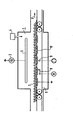
- a mechanical device for shaking the knitted cotton fabric 7 during the drying process is arranged in the high-frequency oven 1.
- This shaking device can consist, for example, of motor-driven impact cams, as indicated by reference number 8, which strike against the support of the conveyor belt 5 or also from nozzles through which pulsating compressed air flows against the support and vibrates them together with the knitted fabrics.
- the vibrating frequencies and vibrating amplitudes can be changed.
- the shaking additionally loosens the binding forces between the individual threads of the fabric, i.e. an effect of high-frequency drying is still supported, so that a largely unobstructed shrinkage of the knitted fabric is possible during the transport and drying process.
Landscapes
- Engineering & Computer Science (AREA)
- Textile Engineering (AREA)
- Mechanical Engineering (AREA)
- General Engineering & Computer Science (AREA)
- Microbiology (AREA)
- Life Sciences & Earth Sciences (AREA)
- Health & Medical Sciences (AREA)
- Materials Engineering (AREA)
- Biomedical Technology (AREA)
- Biotechnology (AREA)
- Chemical & Material Sciences (AREA)
- Molecular Biology (AREA)
- Treatment Of Fiber Materials (AREA)
- Drying Of Solid Materials (AREA)
Abstract
Description
- Die Erfindung bezieht sich auf einen kapazitiven Hochfrequenz-Durchlaufofen zum Trocknen von textilem Gewebe, insbesondere von Baumwollgewirken (Trikot), bei dem das Gewebe zwischen den Elektroden transportierbar ist.
- Kapazitive Hochfrequenzöfen der vorgenannten Art sind in den verschiedensten Ausführungsformen bekannt (vgl. z.B. DE-OS 29 41 845, 28 17 067) und haben sich gut bei der Trocknung von Textilien bewährt.
- Im Rahmen des Fertigungsprozesses werden Textilgewebe nach verschiedenen Naßbehandlungen immer wieder getrocknet. Es ist dabei wünschenswert, daß vor allen bei den letzten Trocknungsvorgängen die Gewebe und hier vor allem die Gewirke bereits derart schrumpfen, daß der Endverbraucher beim Waschen und Trocknen des Gewebes nur noch eine kleine Restschrumpfung in Kauf nehmen muß.
- Zum Trocknen im textilen Sektor werden häufig Kontakttrockner in Form von erhitzten Walzen benutzt. Diese Trocknung hat den Nachteil, daß der Schrumpfungsprozeß beim Trocknen durch eventuelles Festkleben der Gewebe auf den Rollen behindert wird. Ähnliche Gesichtspunkte gelten auch hinsichtlich der bekannten Trocknung mit Luftdüsen oder der energieaufwendigen Trocknung in Siebtrommeln. Außerdem ist hier und bei Waschetrocknern mit Wäscheschleudern immer eine gewisse Gefahr der Formver- änderung gegeben.
- Als allgemeine Erfahrungstatsache kann gelten, daß sich mit diesen bekannten Trocknungsverfahren in etwa eine aoch nachtiäglich eintretende Restschrumpfung von etwa 5 bis 7% erreichen läßt.
- Es wurde nun erkannt, daß die Anwendung von kapazitiver Hochfrequenzenergie - vor allem bei relativ labilen Geweben, wie z.B. Baumwollgewirken -, beträchtliche Verbesserungen in der Trocknungsgeschwindigkeit und Schrumpfbeständigkeit bringt.
- Die Aufgabe der vorliegenden Erfindung besteht darin, einen Hochfrequenz-Durchlaufofen der eingangs genannten Art-so auszubilden, daß die Schrumpfungsbeständigkeit der mit Hochfrequenz behandelten Gewebe zusätzlich erhöhbar ist.
- Diese Aufgabe wird erfindungsgemäß dadurch gelöst, daß im Ofen eine mechanische Yorrichtung zum Schütteln des Gewebes während des Trocknungsvorganges angeordnet ist. Hierdurch läßt sich überraschenderweise eine deutlich unter 5% liegende Restschrumpfung des Gewebes erreichen. Dieser Effekt mag darauf beruhen, daß die bereits durch die Hochfrequnezerwärmung gelockerten Bindungskräfte zwischen den einzelnen Fäden des Gewebes an den Webkreuzungspunkten durch die zusätzliche mechanische Erschütterung noch weiter gelöst werden, so daß sich die Fäden beliebig gegeneinander verschieben und schrumpfen können. Ein derart frei geschrumpften Gewebe ist dann späterhin relativ schrumpfbeständig.
- Als mechanische Schüttelvorrichtung kann z.B. eine periodisch auf das Transportband und/oder dessen Auflage einwirkende Schlagvorrichtung, z.B. in Form von Schlagnocken vorgesehen werden. Es ist aber auch möglieh, das Transportband und/oder dessen Auflage pneumatisch in Schwingangen zu versetzen.
- Alternativ ist es auch möglich, zum Transport des zu trocknenden Gutes einen Schüttelforderer zu verwenden oder auch die Vibrationen durch Ultraschall zu erzeugen. In jedem der vorgenannten Fälle ist es von Vorteil, wenn die Schüttelfrequenz und/oder Schüttelamplitude veränderbar sind, damit die Rüttlung dem jeweils vorliegenden Gewebe optimal angepaßt werden kann.
- Anhand eines in der Zeichnung dargestellten Auaführungsbeispiels sei die Erfindung näher erläutert:
- Das zu trocknende Baumwollgewirke 7 in Form eines gefalteten Schlauches mit einer Schütthöhe zwischen 5 und 10 cm läuft in Richtung des Pfeiles 6 auf einem Transportband 5 durch einen kapazitiven Hochfrequenzofen 1. Die Trocknung geschieht im wesentlichen durch das elektrische Feld, das sich zwischen der mit den Hochfrequenzgenerator 2 verbundenen "heißen" Elektrode 3 und der geerdeten Gegenelektrode 10 ausbildet. Diese geerdete Gegenelektrode 10 ist im vorliegenden Fall ein Siebblech und bildet gleichzeitig die Auflage für das Transportband 5. Zusätzlich wird in den Hochfrequenzofen 1 noch Heißluft eingeblasen, die von einen Heißlufterzeuger 4 stammt. Diese gegebenenfalls im Umluftbetrieb gefahrene Heißluft dient zur zusätzlichen Trocknung und Abfuhr der verdampften Feuchte.
- Zusätzlich ist im Hochfrequenzofen 1 noch eine mechanische Vorrichtung zum Schütteln des Baumwollgewirkes 7 während des Trocknungsvorganges angeordnet. Diese Schüttelvorrichtung kann beispielsweise aus von einen Motor angetriebenen Schlagnocken bestehen, wie durch das Bezugszeichen 8 angedeutet, die gegen die Auflage des Transportbandes 5 schlagen oder auch aus Düsen, durch die pulsierend Preßluft gegen die Auflage strömt und diese damit samt den Gewirke zum Vibrieren bringt.
- Die Rüttelfrequenzen und Rüttelamplituden sind dabei veränderbar.
- Durch die Rüttlung werden die Bindekräfte zwischen den einzelnen Fäden der Gewebe zusätzlich gelockert, d.h. ein Effekt der Hochfrequenztrocknung noch unterstützt, so daß eine weitgehende unbehinderte Schrumpfung des Gewirkes während des Transport- und Trocknungsvorganges möglich ist.
Claims (6)
Priority Applications (1)
| Application Number | Priority Date | Filing Date | Title |
|---|---|---|---|
| AT84105784T ATE36751T1 (de) | 1983-06-03 | 1984-05-21 | Kapazitiver hochfrequenz-durchlaufofen. |
Applications Claiming Priority (2)
| Application Number | Priority Date | Filing Date | Title |
|---|---|---|---|
| DE19833320225 DE3320225A1 (de) | 1983-06-03 | 1983-06-03 | Kapazitiver hochfrequenz-durchlaufofen |
| DE3320225 | 1983-06-03 |
Publications (3)
| Publication Number | Publication Date |
|---|---|
| EP0130342A2 true EP0130342A2 (de) | 1985-01-09 |
| EP0130342A3 EP0130342A3 (en) | 1985-12-11 |
| EP0130342B1 EP0130342B1 (de) | 1988-08-24 |
Family
ID=6200648
Family Applications (1)
| Application Number | Title | Priority Date | Filing Date |
|---|---|---|---|
| EP84105784A Expired EP0130342B1 (de) | 1983-06-03 | 1984-05-21 | Kapazitiver Hochfrequenz-Durchlaufofen |
Country Status (3)
| Country | Link |
|---|---|
| EP (1) | EP0130342B1 (de) |
| AT (1) | ATE36751T1 (de) |
| DE (2) | DE3320225A1 (de) |
Cited By (5)
| Publication number | Priority date | Publication date | Assignee | Title |
|---|---|---|---|---|
| EP0269358A3 (de) * | 1986-11-25 | 1989-08-30 | PETRIE & McNAUGHT LIMITED | Trocknungs- oder Backvorrichtung |
| WO1996035340A1 (fr) * | 1995-05-09 | 1996-11-14 | Consejo Superior De Investigaciones Cientificas | Procede et dispositif de deshydratation |
| ITPO20080018A1 (it) * | 2008-12-03 | 2010-06-04 | Biancalani S P A | Macchina e metodo per il trattamento combinato meccanico e termico di tessuti |
| WO2012001722A2 (en) | 2010-06-29 | 2012-01-05 | Biancalani S.R.L. | Improved machine and method for the combined mechanical and thermal treatment of fabrics, especially knitted fabrics |
| CN111893690B (zh) * | 2020-08-05 | 2021-08-03 | 湖州五兴达丝绸整理有限公司 | 一种布料定型机的振动式冷却装置 |
Families Citing this family (1)
| Publication number | Priority date | Publication date | Assignee | Title |
|---|---|---|---|---|
| DE3627390A1 (de) * | 1986-08-13 | 1988-02-18 | Sucker & Franz Mueller Gmbh | Schlichtmaschine und verfahren zum betrieb der maschine |
Family Cites Families (3)
| Publication number | Priority date | Publication date | Assignee | Title |
|---|---|---|---|---|
| DE1105372B (de) * | 1958-10-01 | 1961-04-27 | Robert Augsten | Verfahren und Vorrichtung zum Krumpfen von bahnfoermigem Textilgut mittels Schwingungen eines Ruettelgitters |
| AT232952B (de) * | 1959-01-31 | 1964-04-10 | Rene Paul Ruegg | Verfahren zur Schrumpfbehandlung von Textilstoffen |
| DE2941845A1 (de) * | 1979-10-16 | 1981-04-30 | Siemens AG, 1000 Berlin und 8000 München | Kapazitiver hochfrequenzofen |
-
1983
- 1983-06-03 DE DE19833320225 patent/DE3320225A1/de not_active Withdrawn
-
1984
- 1984-05-21 EP EP84105784A patent/EP0130342B1/de not_active Expired
- 1984-05-21 AT AT84105784T patent/ATE36751T1/de not_active IP Right Cessation
- 1984-05-21 DE DE8484105784T patent/DE3473642D1/de not_active Expired
Cited By (11)
| Publication number | Priority date | Publication date | Assignee | Title |
|---|---|---|---|---|
| EP0269358A3 (de) * | 1986-11-25 | 1989-08-30 | PETRIE & McNAUGHT LIMITED | Trocknungs- oder Backvorrichtung |
| WO1996035340A1 (fr) * | 1995-05-09 | 1996-11-14 | Consejo Superior De Investigaciones Cientificas | Procede et dispositif de deshydratation |
| BE1009377A3 (fr) * | 1995-05-09 | 1997-03-04 | Consejo Superior Investigacion | Procede et dispositif de deshydratation. |
| ITPO20080018A1 (it) * | 2008-12-03 | 2010-06-04 | Biancalani S P A | Macchina e metodo per il trattamento combinato meccanico e termico di tessuti |
| WO2010064130A3 (en) * | 2008-12-03 | 2010-07-29 | Biancalani S.R.L. | Machine and method for the combined mechanical and heat treatment of fabrics, especially knitted fabrics |
| US8720020B2 (en) | 2008-12-03 | 2014-05-13 | Biancalani S.R.L. | Machine and method for the combined mechanical and heat treatment of fabrics, especially knitted fabrics |
| EP2762629A1 (de) | 2008-12-03 | 2014-08-06 | Biancalani S.R.L. | Maschine und Verfahren zum Behandeln von Textilien |
| EP2998425A1 (de) | 2008-12-03 | 2016-03-23 | Biancalani S.R.L. | Maschine und verfahren zum behandeln von textilien |
| WO2012001722A2 (en) | 2010-06-29 | 2012-01-05 | Biancalani S.R.L. | Improved machine and method for the combined mechanical and thermal treatment of fabrics, especially knitted fabrics |
| DE202011110544U1 (de) | 2010-06-29 | 2014-08-18 | Biancalani S.R.L. | Verbesserte Maschine für die kombinierte mechanische und thermische Bearbeitung von Stoffen, insbesondere von Gewebestoffen |
| CN111893690B (zh) * | 2020-08-05 | 2021-08-03 | 湖州五兴达丝绸整理有限公司 | 一种布料定型机的振动式冷却装置 |
Also Published As
| Publication number | Publication date |
|---|---|
| EP0130342B1 (de) | 1988-08-24 |
| DE3473642D1 (en) | 1988-09-29 |
| DE3320225A1 (de) | 1984-12-06 |
| EP0130342A3 (en) | 1985-12-11 |
| ATE36751T1 (de) | 1988-09-15 |
Similar Documents
| Publication | Publication Date | Title |
|---|---|---|
| DE1635585A1 (de) | Verfahren zur Herstellung von gleichmaessigen ungewebten Stoffbahner aus Endlosfaeden | |
| DE2819013B2 (de) | Verfahren und Vorrichtung zur Abtrennung von an Federn anhaftenden Verunreinigungen | |
| EP0130342B1 (de) | Kapazitiver Hochfrequenz-Durchlaufofen | |
| DE1635342A1 (de) | Verfahren und Vorrichtung zum Ausruesten von Wirk- und Strickwaren | |
| DE1710502C3 (de) | Vorrichtung zum Stauchen von Ge webebahnen in Schußfadenrichtung | |
| EP0351482B1 (de) | Verfahren und Vorrichtung zum Glätten und Schrumpfen | |
| EP0535287B2 (de) | Verfahren und Vorrichtung zur Griff- und Oberflächenverbesserung von textilen Geweben und Gewirken | |
| EP0358136A2 (de) | Verfahren und Vorrichtung zum Behandeln von textilen Warenbahnen | |
| EP0195835B1 (de) | Endloses Siebband für Papiermaschinen o.dgl. | |
| EP0669416B1 (de) | Verfahren und Vorrichtung zum Behandeln einer insbesondere zugempfindlichen Textilbahn | |
| EP0137066A1 (de) | Vorrichtung zum Krumpfen und Finishen von textilen Warenbahnen | |
| DE1942461A1 (de) | Vorrichtung zum Entwassern von Massen,?sbesondere Nahrungsm?tteln,bei med?ger Temperatur auf einem Forderband | |
| EP0107002A2 (de) | Verfahren und Vorrichtung zum Schrumpffreimachen von schlauchförmigem Textilgut | |
| DE650865C (de) | Verfahren zum Entwaessern und Trocknen von Rohstoffbahnen oder -bogen, wie Cellulose, Holzstoff o. dgl. | |
| DE19935061A1 (de) | Verfahren zum kontinuierlichen Trocknen und Veredeln, wie Oberflächenentwicklung, von textilen Warenbahnen und Vorrichtung zur Durchführung des Verfahrens | |
| DE3005353A1 (de) | Verfahren zum trocknen von textilgut | |
| DE19712848A1 (de) | Verfahren und Vorrichtung zum automatischen Glätten von Kleidungsstücken | |
| DE1064466B (de) | Siebtrommeltrockner fuer loses Fasergut in Vliesform | |
| DE942087C (de) | Vorrichtung zum OEffnen und Aufrichten des Flors von gewebten Teppichen od. dgl. | |
| DE19932666A1 (de) | Verfahren zum kontinuierlichen Trocknen und Veredeln wie Oberflächenentwicklung, von textilen Warenbahnen und Vorrichtung zur Durchführung des Verfahrens | |
| DE1560694A1 (de) | Vorrichtung zur Faserausrichtung und zur Entfernung nicht verankerter Fasern in Beflockungsanlagen fuer die Bildung von Faservliesen auf Geweben od.dgl. | |
| DE531306C (de) | Einrichtung zum Trocknen von Papiermaschinenfilzen | |
| DE1137712B (de) | Verfahren zur Schwingungsbehandlung von bahnenfoermigem Gut | |
| DE2041557C3 (de) | Vorrichtung zum Trocknen der Schlichte von Glasseidefäden | |
| EP0607476A1 (de) | Vorrichtung und Verfahren zum Herstellen eines Vlieses mit Wirrfaserlage |
Legal Events
| Date | Code | Title | Description |
|---|---|---|---|
| PUAI | Public reference made under article 153(3) epc to a published international application that has entered the european phase |
Free format text: ORIGINAL CODE: 0009012 |
|
| AK | Designated contracting states |
Designated state(s): AT CH DE FR GB IT LI |
|
| PUAL | Search report despatched |
Free format text: ORIGINAL CODE: 0009013 |
|
| AK | Designated contracting states |
Designated state(s): AT CH DE FR GB IT LI |
|
| 17P | Request for examination filed |
Effective date: 19860128 |
|
| 17Q | First examination report despatched |
Effective date: 19860917 |
|
| D17Q | First examination report despatched (deleted) | ||
| GRAA | (expected) grant |
Free format text: ORIGINAL CODE: 0009210 |
|
| AK | Designated contracting states |
Kind code of ref document: B1 Designated state(s): AT CH DE FR GB IT LI |
|
| REF | Corresponds to: |
Ref document number: 36751 Country of ref document: AT Date of ref document: 19880915 Kind code of ref document: T |
|
| REF | Corresponds to: |
Ref document number: 3473642 Country of ref document: DE Date of ref document: 19880929 |
|
| ET | Fr: translation filed | ||
| ITF | It: translation for a ep patent filed | ||
| GBT | Gb: translation of ep patent filed (gb section 77(6)(a)/1977) | ||
| PLBE | No opposition filed within time limit |
Free format text: ORIGINAL CODE: 0009261 |
|
| STAA | Information on the status of an ep patent application or granted ep patent |
Free format text: STATUS: NO OPPOSITION FILED WITHIN TIME LIMIT |
|
| 26N | No opposition filed | ||
| ITTA | It: last paid annual fee | ||
| PGFP | Annual fee paid to national office [announced via postgrant information from national office to epo] |
Ref country code: CH Payment date: 19920821 Year of fee payment: 9 |
|
| PGFP | Annual fee paid to national office [announced via postgrant information from national office to epo] |
Ref country code: GB Payment date: 19930419 Year of fee payment: 10 |
|
| PGFP | Annual fee paid to national office [announced via postgrant information from national office to epo] |
Ref country code: AT Payment date: 19930421 Year of fee payment: 10 |
|
| PGFP | Annual fee paid to national office [announced via postgrant information from national office to epo] |
Ref country code: FR Payment date: 19930519 Year of fee payment: 10 |
|
| PG25 | Lapsed in a contracting state [announced via postgrant information from national office to epo] |
Ref country code: LI Effective date: 19930531 Ref country code: CH Effective date: 19930531 |
|
| PGFP | Annual fee paid to national office [announced via postgrant information from national office to epo] |
Ref country code: DE Payment date: 19930720 Year of fee payment: 10 |
|
| REG | Reference to a national code |
Ref country code: CH Ref legal event code: PL |
|
| PG25 | Lapsed in a contracting state [announced via postgrant information from national office to epo] |
Ref country code: GB Effective date: 19940521 Ref country code: AT Effective date: 19940521 |
|
| GBPC | Gb: european patent ceased through non-payment of renewal fee |
Effective date: 19940521 |
|
| PG25 | Lapsed in a contracting state [announced via postgrant information from national office to epo] |
Ref country code: FR Effective date: 19950131 |
|
| PG25 | Lapsed in a contracting state [announced via postgrant information from national office to epo] |
Ref country code: DE Effective date: 19950201 |
|
| REG | Reference to a national code |
Ref country code: FR Ref legal event code: ST |