EP0116115A1 - Verfahren zur Herstellung positiver Elektroden für galvanische Elemente, insbesondere Lithium-Mangandioxidzellen - Google Patents
Verfahren zur Herstellung positiver Elektroden für galvanische Elemente, insbesondere Lithium-Mangandioxidzellen Download PDFInfo
- Publication number
- EP0116115A1 EP0116115A1 EP83109381A EP83109381A EP0116115A1 EP 0116115 A1 EP0116115 A1 EP 0116115A1 EP 83109381 A EP83109381 A EP 83109381A EP 83109381 A EP83109381 A EP 83109381A EP 0116115 A1 EP0116115 A1 EP 0116115A1
- Authority
- EP
- European Patent Office
- Prior art keywords
- weight
- heat treatment
- water
- manganese dioxide
- subjected
- Prior art date
- Legal status (The legal status is an assumption and is not a legal conclusion. Google has not performed a legal analysis and makes no representation as to the accuracy of the status listed.)
- Granted
Links
Images


Classifications
-
- H—ELECTRICITY
- H01—ELECTRIC ELEMENTS
- H01M—PROCESSES OR MEANS, e.g. BATTERIES, FOR THE DIRECT CONVERSION OF CHEMICAL ENERGY INTO ELECTRICAL ENERGY
- H01M6/00—Primary cells; Manufacture thereof
- H01M6/14—Cells with non-aqueous electrolyte
- H01M6/16—Cells with non-aqueous electrolyte with organic electrolyte
-
- H—ELECTRICITY
- H01—ELECTRIC ELEMENTS
- H01M—PROCESSES OR MEANS, e.g. BATTERIES, FOR THE DIRECT CONVERSION OF CHEMICAL ENERGY INTO ELECTRICAL ENERGY
- H01M4/00—Electrodes
- H01M4/02—Electrodes composed of, or comprising, active material
- H01M4/06—Electrodes for primary cells
- H01M4/08—Processes of manufacture
-
- H—ELECTRICITY
- H01—ELECTRIC ELEMENTS
- H01M—PROCESSES OR MEANS, e.g. BATTERIES, FOR THE DIRECT CONVERSION OF CHEMICAL ENERGY INTO ELECTRICAL ENERGY
- H01M4/00—Electrodes
- H01M4/02—Electrodes composed of, or comprising, active material
- H01M4/36—Selection of substances as active materials, active masses, active liquids
- H01M4/48—Selection of substances as active materials, active masses, active liquids of inorganic oxides or hydroxides
- H01M4/50—Selection of substances as active materials, active masses, active liquids of inorganic oxides or hydroxides of manganese
- H01M4/502—Selection of substances as active materials, active masses, active liquids of inorganic oxides or hydroxides of manganese for non-aqueous cells
-
- Y—GENERAL TAGGING OF NEW TECHNOLOGICAL DEVELOPMENTS; GENERAL TAGGING OF CROSS-SECTIONAL TECHNOLOGIES SPANNING OVER SEVERAL SECTIONS OF THE IPC; TECHNICAL SUBJECTS COVERED BY FORMER USPC CROSS-REFERENCE ART COLLECTIONS [XRACs] AND DIGESTS
- Y02—TECHNOLOGIES OR APPLICATIONS FOR MITIGATION OR ADAPTATION AGAINST CLIMATE CHANGE
- Y02E—REDUCTION OF GREENHOUSE GAS [GHG] EMISSIONS, RELATED TO ENERGY GENERATION, TRANSMISSION OR DISTRIBUTION
- Y02E60/00—Enabling technologies; Technologies with a potential or indirect contribution to GHG emissions mitigation
- Y02E60/10—Energy storage using batteries
Definitions
- the invention relates to a method for producing positive electrodes for electrochemical elements with non-aqueous electrolytes, in particular Li / Mn0 2 cells, in which manganese dioxide is used as the active material, which is mixed with a conductive agent and a binder to form the electrode and a final Is subjected to heat treatment.
- the invention further relates to a cathode produced according to this method, in particular a Li / MnO 2 cell.
- a method of the type mentioned is known from US Pat. No. 4,133,856.
- a first heat treatment of the manganese dioxide takes place at temperatures that are greater than 250 ° C.
- the objective is to remove the necessary water from the manganese dioxide in order to prepare it for use in cells with non-aqueous electrolytes. Incomplete removal of water would be detrimental to functionality and performance bring the cell with you. Since there is a large proportion of both bound water and additional adhering water in the manganese dioxide, the first heat treatment alone is not sufficient. Disadvantageously, only the surface water is removed, but not the bound water. It is therefore necessary in the known method to subject the already heat-treated manganese dioxide to a second heat treatment after mixing with a conductive additive and a binder as a molding.
- the first treatment stage takes place at temperatures between 350 and 430 ° C and the second treatment stage at temperatures in the range of 200 to 350 ° C.
- the process is therefore very complex, requires high energy input and causes a change in the structure of the manganese dioxide from ⁇ -Mn ° 2 to ⁇ -Mn02. This disadvantageously reduces the activity.
- the invention has the object of providing a procedural - ren for the preparation of positive electrodes for electro-chemical elements with nonaqueous electrolytes, especially Li / Mn0 2 cells to develop with manganese dioxide as an active material, which is easy to perform, is suitable, high cell performance also for complete discharges down to the range of low temperatures of -30 ° C, with which the shelf life is also improved.
- the invention aims to propose an improved cathode, in particular for a Li / MnO 2 cell.
- the object is achieved in that a synthetic manganese dioxide with an ⁇ crystal structure is used, which after the production of Shaped the final heat treatment between 180 ° C and ⁇ 200 ° C is subjected. While avoiding the heat treatment previously considered necessary, Mn0 2 , carbon black, methanol, polytetrafluoroethylene in aqueous suspension and water are mixed together and mixed to a paste and / or kneaded, the paste is then introduced into a predetermined shape, the molding with a metal -The expanded mesh is pressed and the drying is then carried out as the only heat treatment.
- a starting mixture of 40 to 60% by weight Mn0 2 , 3 to 8% by weight carbon black, 4 to 8% by weight methanol, 2 to 6% by weight polytetrafluoroethylene in aqueous suspension and water is advantageously used.
- a high water content of, for example, 34% by weight requires only a single drying process step at below 200 ° C. in order to be able to produce an anhydrous positive electrode.
- the Mn0 2 used basically has the advantage of releasing the water, including the bound water, at a previously unknown low temperature, so that it can be used in Li / Mn0 2 cells with a surprisingly low loss of electrochemical activity.
- An aqueous PTFE suspension can advantageously be used as a binder.
- the Li / Mn0 2 cell of the invention consists of a hermetically sealed stainless steel pot in which alternately flat lithium anodes in the form of lithium foil pocketed in polypropylene separators and Mn0 2 cathodes of the type described above are arranged together with an electrolyte made of propylene carbonate, 1,2 dimethoxyethane in a ratio of 1: 1 and 1 M lithium tetrafluoroborate as the conductive salt.
- an aluminum expanded metal mesh is used in the cathode as a carrier for the dried paste.
- the described Li / Mn0 2 cell of the invention is characterized by high performance even for complete discharges down to the range of low temperatures of -30 ° C. This is the first time that such a cell has entered the power / energy range of the Li / SO 2 system.
- the Li / MnO 2 cell according to the invention consists of a pot-shaped housing 1 made of stainless steel, which is hermetically sealed at the top by a cover 2. Extending through the cover 2 is a filling tube 4 embedded in a glass / metal seal 3, which at the same time represents the positive base due to corresponding internal connections, while the housing 1 itself forms the negative pole.
- the electrolyte contains 5 propylene carbonate (PC) with 1,2 dimethoxyethane (DME) in a mixing ratio of 1: 1 and 1 M lithium tetrafluoroborate LIBF 4 as the conductive salt.
- the anode consists of a lithium foil 6, which is pocketed in a polypropylene separator 7.
- the negative electrode is flat and, in the exemplary embodiment, is combined to form a cylindrical cell together with the cathode 8.
- the positive electrode 8 is Manganese dioxide is produced by 10 parts by weight
- MnO 2 can be dry mixed with a part by weight of carbon black.
- a paste is produced from the premix by stirring and kneading 75 parts by weight of MnO 2 / carbon black mixture with 50 parts by weight of water and 10 parts by weight of methanol and 6 parts by weight of polytetrafluoroethylene.
- a cathode paste is then present which contains water in the form of bound water and adhering surface water.
- the cathode paste is then pasted into a predetermined shape and pressed therein with an aluminum expanded metal mesh. Finally, a heat treatment is Runaway at a temperature of 195 ° C - lead. Essential for the release of the water during the heat treatment is the ability of the Mn0 2 used to also release the enclosed water completely at temperatures below 200 ° C as part of the heat treatment.
- the carbon black used in the preparation of the cathode as a conductive additive to MnO 2, in contrast to the otherwise used acetylene carbon blacks a Furnace - carbon black high relative conductivity is This carbon black has proven to be optimal with respect to the cathode volume (Ah / cm 3). , the pore volume, the inner pore surface (Li incorporation) and the activity (performance) were proven. An aqueous PTFE suspension has been used as a binder.
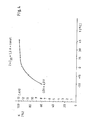
- Fig. 2 of the drawing shows a discharge curve of the element shown in Fig. 1 of the drawing at a temperature of -30 0 C at a discharge resistance of 100 ⁇ .
- the yield in this case is 62.25%.
- the predetermined final discharge voltage was 2.0 V. It is thus clear that the electrical values achieved are significantly above the corresponding values of known Li / MnO 2 cells.
Landscapes
- Chemical & Material Sciences (AREA)
- Chemical Kinetics & Catalysis (AREA)
- Electrochemistry (AREA)
- General Chemical & Material Sciences (AREA)
- Engineering & Computer Science (AREA)
- Manufacturing & Machinery (AREA)
- Inorganic Chemistry (AREA)
- Battery Electrode And Active Subsutance (AREA)
- Inorganic Compounds Of Heavy Metals (AREA)
Abstract
Description
- Die Erfindung betrifft ein Verfahren zur Herstellung positiver Elektroden für elektrochemische Elemente mit nicht wässrigem Elektrolyten, insbesondere Li/Mn02-Zellen, in denen Mangandioxid als aktives Material verwendet wird, welches im Gemisch mit einem leitenden Mittel und einem Bindemittel zur Elektrode geformt und einer abschließenden Wärmebehandlung unterzogen wird. Die Erfindung betrifft ferner eine gemäß diesem Verfahren hergestellte Kathode, insbesondere einer Li/MnO2-Zelle.
- Ein Verfahren der eingangs genannten Art ist aus der US-PS 4 133 856 bekannt. Dabei findet eine erste Wärmebehandlung des Mangandioxids bei Temperaturen statt, die größer als 250°C sind. Die Zielsetzung ist, die notwendige Entfernung von Wasser aus dem Mangandioxid vorzunehmen, um es für die Verwendung in Zellen mit nicht wässrigem Elektrolyten aufzubereiten. Eine unvollständige Entfernung des Wassers würde nachteilig hinsichtlich der Funktionsfähigkeit und der Leistung der Zelle mitsichbringen. Da im Mangandioxid ein großer Anteil sowohl gebundenen Wassers als auch zusätzlichen anhaftenden Wassers vorliegt, reicht die erste Wärmebehandlung allein nicht aus. Nachteiligerweise wird dabei nur das Oberflächenwasser, nicht jedoch das gebundene Wasser entfernt. Es ist daher bei dem bekannten Verfahren notwendig, das bereits wärmebehandelte Mangandioxid nach dem Mischen mit einem leitfähigen Zusatz und einem Bindemittel als Formling einer zweiten Wärmebehandlung zu unterziehen. Die erste Behandlungsstufe findet bei Temperaturen zwischen 350 und 430°C und die zweite Behandlungsstufe bei Temperaturen im Bereich von 200 bis 350°C statt. Das Verfahren ist dadurch sehr aufwendig, erfordert hohen Energieeinsatz und bewirkt eine Strukturveränderung des Mangandioxids von α -Mn°2 zu β -Mn02, Hierdurch wird die Aktivität nachteiligerweise verringert.
- Ein ähnliches Verfahren ist aus der DE-OS 30 00 189 bekannt, bei dem ebenfalls eine zweistufige Wärmebehandlung vorgenommen wird. Auch hierbei werden Temperaturen zwischen 220 und 3500C angewandt. Anders als bei dem Verfahren nach der US-PS 4 133 856, bei dem es nicht gelingt, das in dem Formkörper eingeschlossene Wasser durch das Erhitzen nach dem Verformen im zweiten Wärmebehandlungsschritt vollständig zu entfernen, ist hier vorgeschlagen, vor der Formung der Elektrode die erhaltene Mischung aus Mangandioxid, dem leitenden Mittel und dem Bindemittel der zweiten Wärmebehandlung zu unterziehen. Hierdurch soll es gelingen, die Entladungseigenschaften der Zelle und die Lagerfähigkeit zu verbessern. Nachteilig bleibt jedoch weiterhin, daß bei hohen Temperaturen zwei Wärmebehandlungen vorgenommen werden müssen, die als solche aufwendig sind und darüber hinaus die Struktur des verwendeten Mangandioxids negativ beeinflussen.
- Insgesamt ergibt sich aus dem Stand der Technik, daß die elektrochemischen Eigenschaften von Li/Mn02-Zellen sehr stark von der Herstellungsart und Zusammensetzung der positiven Elektroden abhängen, wobei bislang Mangandioxid mit einer Gamma-Kristallstruktur gegenüber der β -Kristallform wegen der höheren Aktivität bevorzugt wurde, die notwendige Entfernung des gebundenen Wassers sowie des Oberflächenwassers jedoch bei Temperaturen vorgenommen werden mußte, die eine Umwandlung des α-Mangandioxids in die β -Kristallstruktur unter Verringerung der Aktivität begünstigen. Darüber hinaus betreffen die bekannten Verfahren grundsätzlich die trockene, wasserfreie Herstellung der Kathoden.
- Der Erfindung liegt die Aufgabe zugrunde, ein Verfah- ren zur Herstellung positiver Elektroden für elektrochemische Elemente, mit nicht wässrigem Elektrolyten, insbesondere Li/Mn02-Zellen, mit Mangandioxid als aktivem Material zu entwickeln, welches einfach durchführbar ist, geeignet ist, hohe Zellenleistungen auch für komplette Entladungen bis in den Bereich tiefer Temperaturen von -30°C zu erbringen, mit welchem auch die Lagerfähigkeit verbessert ist. Schließlich bezweckt die Erfindung, eine verbesserte Kathode insbesondere für eine Li/MnO2-Zelle vorzuschlagen.
- Die Aufgabe ist erfindungsgemäß dadurch gelöst, daß ein synthetisches Mangandioxid mit einer α -Kristallstruktur verwendet wird, welches nach Herstellung des Formlings der abschließenden Wärmebehandlung zwischen 180°C und < 200°C unterworfen wird. Vorzugsweise werden unter Meidung der bislang für notwendig angesehenen Wärmebehandlung Mn02, Ruß, Methanol, Polytetrafluoräthylen in wässriger Suspension und Wasser miteinander gemischt und zu einer Paste verrührt und/ oder geknetet, wird anschließend die Paste in eine vorgegebene Form eingebracht, der Formling mit einem Metall-Streckgitter verpreßt und abschließend als einzige Wärmebehandlung die Trocknung durchgeführt. Dabei wird vorteilhafterweise eine Ausgangsmischung von 40 bis 60 Gew. % Mn02, 3 bis 8 Gew. % Ruß, 4 bis 8 Gew. % Methanol, 2 bis 6 Gew. % Polytetrafluoräthylen in wässriger Suspension und Wasser verwendet. Im Vergleich zu den bisher bekannten Mischungen aus 65 bis 95 Gew. % Mangandioxidpulver, 20 bis 30 Gew. % Kohlenstoffpulver und ggf. 15 bis 2 Gew. % Polytetrafluoräthylenpulver ist es die überraschende Erkenntnis der Erfindung, mit relativ geringen Gewichtsprozenten an Mangandioxid und Ruß bei einem hohen Wasseranteil von beispielsweise 34 Gew. % nur einen einzigen Trocknungsverfahrensschritt bei unter 200°C zu benötigen, um eine wasserfreie positive Elektrode herstellen zu können.
- Es ist vorteilhaft, zunächst 45 bis 55 Gew. %, vorzugsweise 50 Gew. % Mn02, mit 4 bis 6 Gew. %, vorzugsweise 5 Gew. % Ruß zu mischen, die Mischung einer Homogenisierung zu unterziehen, dann durch Zurühren von 6 bis 7 Gew. %, insbesondere 6,5 Gew. % Methanol, 4 bis 5 Gew. %, vorzugsweise 4,5 Gew. % Polytetrafluoräthylen und etwa 34 Gew. % Wasser die Paste herzustellen und dann den abschließenden Trocknungsvorgang durchzuführen.
- Das verwendete Mn02 hat grundsätzlich den Vorteil, das Wasser, also auch das gebundene Wasser, bei bislang nicht bekannter niedriger Temperatur abzugeben, so daß es in Li/Mn02-Zellen mit überraschend geringem Verlust an elektrochemischer Aktivität einsetzbar ist. Besonders vorteilhaft ist ein Braunstein mit einer Korngröße von <50 µ, der sehr gute Formungs- und Gleitfähigkeitseigenschaften aufweist. Letztere werden weiter verbessert, wenn zur Mischung ein gleitfähiger Ofenruß verwendet wird. Dabei kann mit Vorteil als Binder eine wässrige PTFE-Suspension Verwendung finden.
- Die Li/Mn02-Zelle der Erfindung besteht aus einem hermetisch verschlossenen Edelstahl-Topf, in welchem abwechselnd flache Lithiumanoden in Form von in Polypropylenseparatoren eingetaschter Lithium-Folie und Mn02-Kathoden obenbeschriebener Art gemeinsam mit einem Elektrolyten angeordnet sind, der aus Propylencarbonat, 1,2 Dimethoxyäthan im Verhältnis 1 : 1 und 1 M Lithiumtetrafluoroborat als Leitsalz besteht. In der Kathode wird dabei erfindungsgemäß ein Aluminium-Streckgitter als Träger für die getrocknete Paste benutzt.
- Die beschriebene Li/Mn02-Zelle der Erfindung zeichnet sich durch hohe Leistung auch für komplette Entladungen bis in den Bereich tiefer Temperaturen von -30°C aus. Damit gelangt erstmals eine derartige Zelle in den Leistungs-Energie-Bereich des Li/SO2-Systems.
- Weitere Einzelheiten, Merkmale und Vorteile der Erfindung ergeben sich aus der nachfolgenden Beschreibung eines Herstellungsverfahrens für positive MnO2-Elektroden sowie einer Li/Mn02-Zelle unter Bezugnahme auf die zugehörige Zeichnung. In der Zeichnung zeigt:
- Fig. 1 eine Li/MnO2-Zelle schematisch,
- Fig. 2 den Verlauf der Klemmenspannung über der Kapazität bei -30°C,
- Fig. 3 den Verlauf der Klemmenspannung über der Kapazität bei -30°C mit einem konstanten Strom von 120 (20 Stunden) und
- Fig. 4 den Verlauf der Kapazität über der Temperatur.
- Grundsätzlich besteht die erfindungsgemäße Li/MnO2-Zelle aus einem topfförmigen Gehäuse 1 aus Edelstahl, welches oben durch einen Deckel 2 hermetisch verschlossen ist. Durch den Deckel 2 erstreckt sich ein in eine Glas/Metall-Dichtung 3 eingebettetes Füllrohr 4, welches gleichzeitig den positiven Boden aufgrund entsprechender innerer Anschlüsse darstellt, während das Gehäuse 1 selbst den negativen Pol bildet.
- Im Gehäuse befindet sich als Elektrolyt 5 Propylencarbonat (PC) mit 1,2 Dimethoxyäthan (DME) im Mischungsverhältnis 1 : 1 sowie 1 M Lithiumtetrafluoroborat LIBF4 als Leitsalz. Die Anode besteht aus einer Lithiumfolie 6, die in einen Polypropylen-Separator 7 eingetascht ist. Die negative Elektrode ist flächig ausgebildet und im Ausführungsbeispiel zu einer zylindrischen Zelle gemeinsam mit der Kathode 8 zusammengestellt.
- Die positive Elektrode 8 wird unter Verwendung von Rho-Mangandioxid hergestellt, indem 10 Gewichtsteile
- MnO2 mit einem Gewichtsteil Ruß trocken gemischt werden. Aus der Vormischung wird eine Paste hergestellt, indem 75 Gewichtsteile Mn02/Ruß-Gemisch mit 50 Gewichtsteilen Wasser und 10 Gewichtsteilen Methanol sowie 6 Gewichtsteilen Polytetrafluoräthylen gerührt und geknetet werden. Es liegt dann eine Kathodenpaste vor, die Wasser in Form gebundenen Wassers sowie anhaftenden Oberflächenwassers enthält.
- Anschließend wird die Kathodenpaste in eine vorgegebene Form pastiert und darin mit einem Aluminium-Streckgitter verpreßt. Abschließend wird eine Wärmebehandlung bei einer Temperatur von 195°C durchge- führt. Wesentlich für die Abgabe des Wassers während der Wärmebehandlung ist die Fähigkeit des verwendeten Mn02, auch das eingeschlossene Wasser bei Temperaturen unterhalb von 200°C vollständig im Rahmen der Wärmebehandlung abzugeben.
- Der bei der Herstellung der Kathode verwendete Ruß als leitfähiges Additiv zum MnO2 stellt im Gegensatz zu den sonst verwendete Acethylen-Rußen einen Furnace-Ruß hoher relativer Leitfähigkeit dar. Dieser Ruß hat sich als optimal in bezug auf das Kathodenvolumen (Ah/cm3), das Porenvolumen, die innere Porenoberfläche (Li-Einlagerung) und die Aktivität (Leistung) erwiesen. Als Binder ist eine wässrige PTFE-Suspension verwendet worden.
- Wesentlich ist auch die Anwendung des Aluminium-Streckmetallgitters, welches folgende Vorteile im Rahmen des Aufbaus der Li/Mn02-Zelle bietet:
- Aufgrund der spezifischen Materialeigenschaften des Aluminiums wird eine hohe elektrische Leitfähigkeit bei guter Verformbarkeit erzielt. Insbesondere eignet sich dieses Gitter zur Herstellung von Wickelelektroden, bei denen üblicherweise die Formgebung aufgrund der engen inneren Radien Schwierigkeiten bereitet. Zusätzlich vorteilhaft ist das im Vergleich zu Nickel oder Edelstahl geringe Gewicht des Aluminium-Streckgitters.
- Fig. 2 der Zeichnung zeigt eine Entladekurve des in Fig. 1 der Zeichnung dargestellten Elementes bei einer Temperatur von -300C an einem Entladewiderstand von 100 Ω. Die Ausbeute bis zu einer Entladeschlußspannung beträgt 94,7 % der angegebenen Nennkapazität Kn = 13 Ah.
- Fig. 3 der Zeichnung zeigt für das gleiche Element die Abhängigkeit der Klemmenspannung Ukl von der entnommenen Kapazität K bei einem konstanten Entladestrom I20 = 0,65 A und einer Temperatur von -30°C. Die Ausbeute beträgt in diesem Fall 62,25 %. In beiden Fällen betrug die vorgegebene Entladeschlußspannung 2,0 V. Es ist damit verdeutlicht, daß die erreichten elektrischen Werte wesentlich über den entsprechenden Werten von bekannten Li/MnO2-Zellen liegen.
- Fig. 4 zeigt die Abhängigkeit der entnehmbaren Kapazität bis zu einer Entladeschlußspannung von 2,0 V für konstante Ströme von 2 x I20 = 1,3 A von der Umgebungstemperatur.
- Insgesamt wird mit der beschriebenen Li/Mn02-Zelle ein elektrochemisches Element vorgestellt, welches außerordentlich hohe Leistungen auch für komplette Entladungen bis in den Bereich tiefer Temperaturen von -30°C aufweist. Folgende Werte wurden festgestellt:
- Li/Mn02-Zelle von 41 mm Durchmesser und 51 mm Höhe:
- I = 2 x I20 mit Ausbeute 62,25 % Kn erreicht (-30°C) 125 Wh/kg 250 Wh/l 6 h -30°C 150 Wh/kg 300 Wh/l 1 h RT 300 Wh/kg 600 Wh/l 500 h 'RT Entladeschlußspannung jeweils 2,0 V Kn = 13 Ah.
-
- 1 Gehäuse
- 2 Deckel
- 3 Glas/Metall-Dichtung
- 4 Füllrohr
- 5 Elektrolyt
- 6 Lithiumfolie
- 7 Polypropylen-Separator
- 8 Kathode
Claims (6)

Applications Claiming Priority (2)
| Application Number | Priority Date | Filing Date | Title |
|---|---|---|---|
| DE3242139A DE3242139C2 (de) | 1982-11-13 | 1982-11-13 | Verfahren zur Herstellung positiver Elektroden für elektrochemische Elemente, insbesondere Li/Mn0↓2↓-Zellen und nach diesem Verfahren hergestellte Elektroden |
| DE3242139 | 1982-11-13 |
Publications (2)
| Publication Number | Publication Date |
|---|---|
| EP0116115A1 true EP0116115A1 (de) | 1984-08-22 |
| EP0116115B1 EP0116115B1 (de) | 1986-05-21 |
Family
ID=6178133
Family Applications (1)
| Application Number | Title | Priority Date | Filing Date |
|---|---|---|---|
| EP83109381A Expired EP0116115B1 (de) | 1982-11-13 | 1983-09-21 | Verfahren zur Herstellung positiver Elektroden für galvanische Elemente, insbesondere Lithium-Mangandioxidzellen |
Country Status (5)
| Country | Link |
|---|---|
| EP (1) | EP0116115B1 (de) |
| JP (1) | JPS59101767A (de) |
| DE (1) | DE3242139C2 (de) |
| DK (1) | DK154039C (de) |
| NO (1) | NO157158C (de) |
Cited By (7)
| Publication number | Priority date | Publication date | Assignee | Title |
|---|---|---|---|---|
| US7279250B2 (en) | 2003-11-24 | 2007-10-09 | The Gillette Company | Battery including aluminum components |
| US7459234B2 (en) | 2003-11-24 | 2008-12-02 | The Gillette Company | Battery including aluminum components |
| US7479348B2 (en) | 2005-04-08 | 2009-01-20 | The Gillette Company | Non-aqueous electrochemical cells |
| US7524581B2 (en) | 2004-07-23 | 2009-04-28 | The Gillette Company | Non-aqueous electrochemical cells |
| US7544384B2 (en) | 2003-11-24 | 2009-06-09 | The Gillette Company | Methods of making coated battery components |
| US7566350B2 (en) | 2002-02-28 | 2009-07-28 | The Gillette Company | Method of making non-aqueous electrochemical cell |
| CN111653778A (zh) * | 2020-05-20 | 2020-09-11 | 佛山科学技术学院 | 一种锂锰电池用正极复合材料及其制备方法 |
Families Citing this family (4)
| Publication number | Priority date | Publication date | Assignee | Title |
|---|---|---|---|---|
| FR2557734B1 (fr) * | 1983-12-28 | 1986-10-17 | Gipelec | Procede de preparation d'une matiere active positive a base de dioxyde de manganese pour generateur electrochimique, matiere active issue de ce procede et generateur en faisant application |
| JPS618852A (ja) * | 1984-06-22 | 1986-01-16 | Sanyo Electric Co Ltd | 非水電解液電池 |
| GB2196785B (en) * | 1986-10-29 | 1990-05-23 | Sony Corp | Organic electrolyte secondary cell |
| US7238448B1 (en) | 2000-04-26 | 2007-07-03 | The Gillette Company | Cathode for air assisted battery |
Citations (4)
| Publication number | Priority date | Publication date | Assignee | Title |
|---|---|---|---|---|
| FR1509122A (fr) * | 1966-11-30 | 1968-01-12 | Accumulateurs Fixes | Perfectionnements à la fabrication des piles sèches au bioxyde de manganèse |
| FR2167716A1 (de) * | 1972-01-06 | 1973-08-24 | Mallory & Co Inc P R | |
| GB2041633A (en) * | 1979-01-06 | 1980-09-10 | Hitachi Chemical Co Ltd | Process for producing a positive electrode for a non-aqueous battery |
| DE3036962A1 (de) * | 1979-10-04 | 1981-04-23 | Mitsui Mining & Smelting Co.Ltd., Tokyo | Verfahren zur herstellung von mangandioxid |
Family Cites Families (5)
| Publication number | Priority date | Publication date | Assignee | Title |
|---|---|---|---|---|
| JPS5342325A (en) * | 1976-09-29 | 1978-04-17 | Sanyo Electric Co | Method of making cathode of nonnaqueous battery |
| JPS5446344A (en) * | 1977-09-20 | 1979-04-12 | Sanyo Electric Co | Method of producing positive plate for nonnaqueous battery |
| GB1557754A (en) * | 1978-03-02 | 1979-12-12 | Ever Ready Co | Dry electric cells |
| DE2835976C3 (de) * | 1978-08-17 | 1982-05-19 | Hitachi Chemical Co., Ltd. | Galvanisches Element |
| IN154337B (de) * | 1979-06-25 | 1984-10-20 | Union Carbide Corp |
-
1982
- 1982-11-13 DE DE3242139A patent/DE3242139C2/de not_active Expired
-
1983
- 1983-09-21 EP EP83109381A patent/EP0116115B1/de not_active Expired
- 1983-10-21 NO NO833863A patent/NO157158C/no unknown
- 1983-11-07 JP JP58207631A patent/JPS59101767A/ja active Granted
- 1983-11-11 DK DK516983A patent/DK154039C/da not_active IP Right Cessation
Patent Citations (4)
| Publication number | Priority date | Publication date | Assignee | Title |
|---|---|---|---|---|
| FR1509122A (fr) * | 1966-11-30 | 1968-01-12 | Accumulateurs Fixes | Perfectionnements à la fabrication des piles sèches au bioxyde de manganèse |
| FR2167716A1 (de) * | 1972-01-06 | 1973-08-24 | Mallory & Co Inc P R | |
| GB2041633A (en) * | 1979-01-06 | 1980-09-10 | Hitachi Chemical Co Ltd | Process for producing a positive electrode for a non-aqueous battery |
| DE3036962A1 (de) * | 1979-10-04 | 1981-04-23 | Mitsui Mining & Smelting Co.Ltd., Tokyo | Verfahren zur herstellung von mangandioxid |
Non-Patent Citations (6)
| Title |
|---|
| CHEMICAL ABSTRACTS, Band 95, Nr. 18, November 1981, Seite 200, Nr. 153879e, Columbus, Ohio, USA & JP - A - 81 76166 (MATSUSHITA ELECTRIC INDUSTRIAL CO., LTD.) 23.06.1981 * |
| ELECTROCHIMICA ACTA, Band 26, Nr. 10, Oktober 1981, Seiten 1467-1476, Pergamon Press Ltd., Oxford, GB. * |
| ELECTROCHIMICA ACTA, Band 27, Nr. 7, Juli 1982, Seiten 833-835, Pergamon Press Ltd., Oxford, GB. * |
| JOURNAL OF POWER SOURCES, Band 8, Nr. 2/3, September/Oktober 1982, Seiten 133-141, Elsevier Sequoia, Lausanne, CH. * |
| JOURNAL OF THE CHEMICAL SOCIETY, Band 129, Nr. 9, September 1982, Seiten 1861-1865, Manchester, New Hampshire, USA * |
| PATENTS ABSTRACTS OF JAPAN, Band 4, Nr. 75(E-13)(557), 31. Mai 1980, Seite 70E13 & JP - A - 55 43761 (HITACHI MAXELL K.K.) 27.03.1980 * |
Cited By (10)
| Publication number | Priority date | Publication date | Assignee | Title |
|---|---|---|---|---|
| US7566350B2 (en) | 2002-02-28 | 2009-07-28 | The Gillette Company | Method of making non-aqueous electrochemical cell |
| US7744659B2 (en) | 2002-02-28 | 2010-06-29 | The Gillette Company | Method of making non-aqueous electrochemical cell |
| US7749288B2 (en) | 2002-02-28 | 2010-07-06 | The Gillette Company | Method of making non-aqueous electrochemical cell |
| US7279250B2 (en) | 2003-11-24 | 2007-10-09 | The Gillette Company | Battery including aluminum components |
| US7459234B2 (en) | 2003-11-24 | 2008-12-02 | The Gillette Company | Battery including aluminum components |
| US7544384B2 (en) | 2003-11-24 | 2009-06-09 | The Gillette Company | Methods of making coated battery components |
| US8435670B2 (en) | 2003-11-24 | 2013-05-07 | The Gillette Company | Battery including aluminum components |
| US7524581B2 (en) | 2004-07-23 | 2009-04-28 | The Gillette Company | Non-aqueous electrochemical cells |
| US7479348B2 (en) | 2005-04-08 | 2009-01-20 | The Gillette Company | Non-aqueous electrochemical cells |
| CN111653778A (zh) * | 2020-05-20 | 2020-09-11 | 佛山科学技术学院 | 一种锂锰电池用正极复合材料及其制备方法 |
Also Published As
| Publication number | Publication date |
|---|---|
| NO833863L (no) | 1984-05-14 |
| NO157158C (no) | 1988-01-27 |
| DE3242139A1 (de) | 1984-05-17 |
| NO157158B (no) | 1987-10-19 |
| EP0116115B1 (de) | 1986-05-21 |
| DK516983A (da) | 1984-05-14 |
| DK154039B (da) | 1988-10-03 |
| DE3242139C2 (de) | 1984-09-06 |
| DK154039C (da) | 1989-02-20 |
| JPH0324023B2 (de) | 1991-04-02 |
| DK516983D0 (da) | 1983-11-11 |
| JPS59101767A (ja) | 1984-06-12 |
Similar Documents
| Publication | Publication Date | Title |
|---|---|---|
| DE69203229T2 (de) | Verfahren zur herstellung von wiederaufladbarem abgeändertem mangandioxid-material und ähnliche verbindungen sowie elektrodenmaterial. | |
| DE3000189C2 (de) | Verfahren zur Herstellung einer positiven Elektrode für nichtwäßrige galvanische Zellen | |
| DE69401246T2 (de) | Batterie mit nicht-wässrigen Elektrolyte | |
| DE69713541T2 (de) | Verfahren zur Herstellung von Lithiumnickelat positiver Elektrode sowie diese verwendende Lithiumbatterie | |
| DE2706489A1 (de) | Elektrochemische zelle (i) | |
| DE2803211A1 (de) | Elektrochemische zelle und kathode dafuer | |
| EP0116115B1 (de) | Verfahren zur Herstellung positiver Elektroden für galvanische Elemente, insbesondere Lithium-Mangandioxidzellen | |
| DE69710434T2 (de) | Elektrochemische Zelle mit feinteiliger Kohlenstoffmaterial als Zusatzstoff | |
| DE10000949A1 (de) | Elektrochemischer Kondensator | |
| DE69407612T2 (de) | Verfahren zur herstellung von wiederaufladbarem mangandioxid-material und ähnlichem elektrodenmaterial | |
| DE2951167A1 (de) | Elektrochemische primaerzelle und verfahren zur herstellung eines kathodenstromkollektors dafuer | |
| DE2205099C3 (de) | Galvanisches Element von hoher Energiedichte mit einer negativen Lithiummetallelektrode | |
| DE2543121A1 (de) | Hochtemperatur-lithium-schwefel-sekundaerbatterie | |
| DE3785834T2 (de) | Zelle mit organischem elektrolyten. | |
| DE60005015T2 (de) | Leistungsverbessernde zusatzstoffe für elektrochemische zellen | |
| DE2555654A1 (de) | Wiederaufladbare galvanische zelle | |
| DE2309239A1 (de) | Verfahren zur herstellung eines bornitrid-filzes | |
| DE2154092A1 (de) | Elektrische Lithiumzelle mit nichtwäßrigem Elektrolyten | |
| DE2433488C3 (de) | Material für positive Elektroden von Primärelementen mit alkalischem Elektrolyten und Verfahren zu seiner Herstellung | |
| GB2117278A (en) | A method of manufacturing a positive electrode for a lead acid electric storage cell | |
| DE60001580T2 (de) | Verfahren zur herstellung von alkalischen zellen, die eine leitende metallschicht auf einem kathodenbehälter haben | |
| DE2738216B2 (de) | Verfahren zur Herstellung einer gepreßten Nickelektrode | |
| DE2600638A1 (de) | Vorgeformte kathode, verfahren zu ihrer herstellung und mit ihr ausgestattetes elektro-chemisches element | |
| DE19641970A1 (de) | Modifiziertes Elektrodenmaterial und dessen Verwendung | |
| DE2117114C3 (de) | Verfahren zur Herstellung einer positiven Kupfersulfidelektrode für galvanische Zellen |
Legal Events
| Date | Code | Title | Description |
|---|---|---|---|
| PUAI | Public reference made under article 153(3) epc to a published international application that has entered the european phase |
Free format text: ORIGINAL CODE: 0009012 |
|
| AK | Designated contracting states |
Designated state(s): BE CH FR GB IT LI NL SE |
|
| 17P | Request for examination filed |
Effective date: 19840710 |
|
| GRAA | (expected) grant |
Free format text: ORIGINAL CODE: 0009210 |
|
| AK | Designated contracting states |
Kind code of ref document: B1 Designated state(s): BE CH FR GB IT LI NL SE |
|
| ET | Fr: translation filed | ||
| ITF | It: translation for a ep patent filed | ||
| PLBE | No opposition filed within time limit |
Free format text: ORIGINAL CODE: 0009261 |
|
| STAA | Information on the status of an ep patent application or granted ep patent |
Free format text: STATUS: NO OPPOSITION FILED WITHIN TIME LIMIT |
|
| 26N | No opposition filed | ||
| ITTA | It: last paid annual fee | ||
| ITPR | It: changes in ownership of a european patent |
Owner name: CESSIONE;ULTRALIFE BATTERIES ( UK ) LTD |
|
| REG | Reference to a national code |
Ref country code: GB Ref legal event code: 732E |
|
| EAL | Se: european patent in force in sweden |
Ref document number: 83109381.0 |
|
| REG | Reference to a national code |
Ref country code: CH Ref legal event code: PUE Owner name: ULTRALIFE BATTERIES (UK) LTD |
|
| NLS | Nl: assignments of ep-patents |
Owner name: ULTRALIFE BATTERIES (UK) LTD. TE ABINGDON, GROOT-B |
|
| REG | Reference to a national code |
Ref country code: FR Ref legal event code: TP |
|
| PGFP | Annual fee paid to national office [announced via postgrant information from national office to epo] |
Ref country code: FR Payment date: 19951017 Year of fee payment: 13 |
|
| PGFP | Annual fee paid to national office [announced via postgrant information from national office to epo] |
Ref country code: CH Payment date: 19951019 Year of fee payment: 13 |
|
| PGFP | Annual fee paid to national office [announced via postgrant information from national office to epo] |
Ref country code: NL Payment date: 19951020 Year of fee payment: 13 |
|
| PGFP | Annual fee paid to national office [announced via postgrant information from national office to epo] |
Ref country code: SE Payment date: 19951023 Year of fee payment: 13 |
|
| PGFP | Annual fee paid to national office [announced via postgrant information from national office to epo] |
Ref country code: GB Payment date: 19951102 Year of fee payment: 13 |
|
| PGFP | Annual fee paid to national office [announced via postgrant information from national office to epo] |
Ref country code: BE Payment date: 19951110 Year of fee payment: 13 |
|
| PG25 | Lapsed in a contracting state [announced via postgrant information from national office to epo] |
Ref country code: GB Effective date: 19960921 |
|
| PG25 | Lapsed in a contracting state [announced via postgrant information from national office to epo] |
Ref country code: SE Effective date: 19960922 |
|
| PG25 | Lapsed in a contracting state [announced via postgrant information from national office to epo] |
Ref country code: LI Effective date: 19960930 Ref country code: FR Effective date: 19960930 Ref country code: CH Effective date: 19960930 Ref country code: BE Effective date: 19960930 |
|
| BERE | Be: lapsed |
Owner name: ULTRALIFE BATTERIES (UK) LTD Effective date: 19960930 |
|
| PG25 | Lapsed in a contracting state [announced via postgrant information from national office to epo] |
Ref country code: NL Effective date: 19970401 |
|
| GBPC | Gb: european patent ceased through non-payment of renewal fee |
Effective date: 19960921 |
|
| REG | Reference to a national code |
Ref country code: CH Ref legal event code: PL |
|
| NLV4 | Nl: lapsed or anulled due to non-payment of the annual fee |
Effective date: 19970401 |
|
| EUG | Se: european patent has lapsed |
Ref document number: 83109381.0 |
|
| REG | Reference to a national code |
Ref country code: FR Ref legal event code: ST |
|
| REG | Reference to a national code |
Ref country code: FR Ref legal event code: ST |