EP0107138A2 - Neue Cephalosporine und Verfahren zu ihrer Herstellung - Google Patents
Neue Cephalosporine und Verfahren zu ihrer Herstellung Download PDFInfo
- Publication number
- EP0107138A2 EP0107138A2 EP83110116A EP83110116A EP0107138A2 EP 0107138 A2 EP0107138 A2 EP 0107138A2 EP 83110116 A EP83110116 A EP 83110116A EP 83110116 A EP83110116 A EP 83110116A EP 0107138 A2 EP0107138 A2 EP 0107138A2
- Authority
- EP
- European Patent Office
- Prior art keywords
- formula
- compounds
- alkyl
- preparation
- cephem
- Prior art date
- Legal status (The legal status is an assumption and is not a legal conclusion. Google has not performed a legal analysis and makes no representation as to the accuracy of the status listed.)
- Granted
Links
Classifications
-
- C—CHEMISTRY; METALLURGY
- C07—ORGANIC CHEMISTRY
- C07D—HETEROCYCLIC COMPOUNDS
- C07D501/00—Heterocyclic compounds containing 5-thia-1-azabicyclo [4.2.0] octane ring systems, i.e. compounds containing a ring system of the formula:, e.g. cephalosporins; Such ring systems being further condensed, e.g. 2,3-condensed with an oxygen-, nitrogen- or sulfur-containing hetero ring
- C07D501/14—Compounds having a nitrogen atom directly attached in position 7
- C07D501/16—Compounds having a nitrogen atom directly attached in position 7 with a double bond between positions 2 and 3
- C07D501/20—7-Acylaminocephalosporanic or substituted 7-acylaminocephalosporanic acids in which the acyl radicals are derived from carboxylic acids
- C07D501/24—7-Acylaminocephalosporanic or substituted 7-acylaminocephalosporanic acids in which the acyl radicals are derived from carboxylic acids with hydrocarbon radicals, substituted by hetero atoms or hetero rings, attached in position 3
- C07D501/38—Methylene radicals, substituted by nitrogen atoms; Lactams thereof with the 2-carboxyl group; Methylene radicals substituted by nitrogen-containing hetero rings attached by the ring nitrogen atom; Quaternary compounds thereof
- C07D501/46—Methylene radicals, substituted by nitrogen atoms; Lactams thereof with the 2-carboxyl group; Methylene radicals substituted by nitrogen-containing hetero rings attached by the ring nitrogen atom; Quaternary compounds thereof with the 7-amino radical acylated by carboxylic acids containing hetero rings
-
- C—CHEMISTRY; METALLURGY
- C07—ORGANIC CHEMISTRY
- C07D—HETEROCYCLIC COMPOUNDS
- C07D277/00—Heterocyclic compounds containing 1,3-thiazole or hydrogenated 1,3-thiazole rings
- C07D277/02—Heterocyclic compounds containing 1,3-thiazole or hydrogenated 1,3-thiazole rings not condensed with other rings
- C07D277/20—Heterocyclic compounds containing 1,3-thiazole or hydrogenated 1,3-thiazole rings not condensed with other rings having two or three double bonds between ring members or between ring members and non-ring members
-
- A—HUMAN NECESSITIES
- A61—MEDICAL OR VETERINARY SCIENCE; HYGIENE
- A61P—SPECIFIC THERAPEUTIC ACTIVITY OF CHEMICAL COMPOUNDS OR MEDICINAL PREPARATIONS
- A61P31/00—Antiinfectives, i.e. antibiotics, antiseptics, chemotherapeutics
- A61P31/04—Antibacterial agents
Definitions
- the invention relates to new cephalosporins, their use as medicaments, in particular in antibacterial therapy, and processes for their preparation.
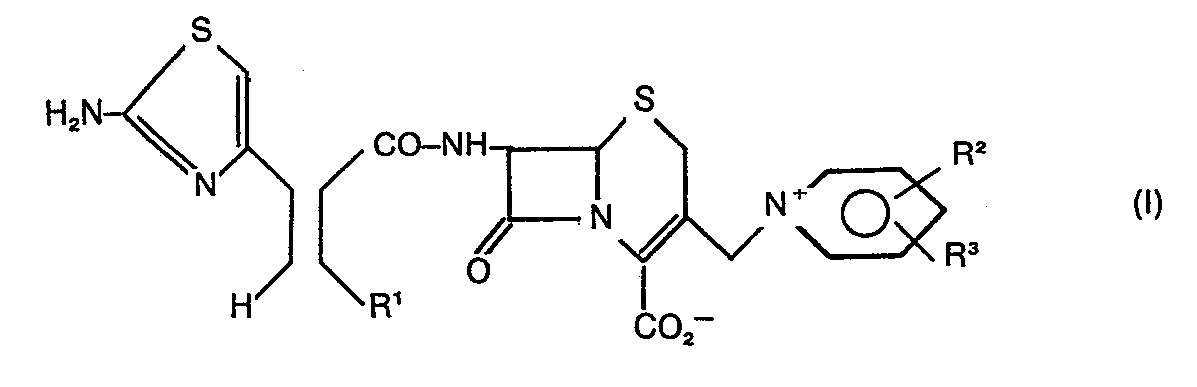
- the invention provides cephalosporins of the general formula I.
- connection with is very particularly preferred
- the compounds of the formula I are obtained by converting the acids of the formula II, in which R 4 is a customary protective group, into the mixed anhydrides of the formula III and reacting them with the known compounds of the formula IV and then from the compounds of the formula obtained V splits off the protective group R 4 .
- an acid-labile protecting group such as tert-butyloxycarbonyl, trityl, formyl or to use and the elimination of R 4 in V with, for example trifluoroacetic acid or formic acid with R 4.
- the compounds II and III can be prepared according to the following formula.
- radicals R 6 and / or R 7 are substituted, preferably by the abovementioned substituents, they can carry 1-5, preferably 1 or 2, substituents.
- the compounds of the formula X are obtained by reacting the known compounds of the formula IX in a suitable solvent with a pyrocarbonate of the formula R 7_0 -CO-O-CO-OR 7 .
- Aprotic polar solvents such as e.g. Acetonitrile, dimethylformamide, hexamethylphosphoric triamide or dimethyl sulfoxide, especially the last two.
- the reaction is particularly advantageous at room temperature or at lower temperatures e.g. 0 to -50 ° C, allowing the components to react with each other for 1-7 days.
- the pyrocarbonic acid ester is generally used with 2-2.5 molar equivalents.
- the compounds of the formula XI are mixed in a suitable solvent at low temperatures with 1 to 1.1 equivalents of a base and then 1 to 1.2 equivalents of an aldehyde of the formula R 1- CHO are added.
- solvents for the reaction e.g. Dimethylformamide, dimethyl sulfoxide, diethyl ether, tetrahydrofuran or toluene - preferably tetrahydrofuran - and as bases alcoholates, hydrides, amides or metal organyls - preferably potassium tert-butoxide, lithium diisopropylamide and butyllithium - can be used.
- the base is added to a solution of X at -50 to -80 ° C. and then the aldehyde is added at -50 to -60 ° C. and the mixture is stirred at -50 to -60 ° C. for about 12 hours.
- the mixture is neutralized and worked up.
- R 4 , R 6 and R 7 have the meanings listed for the compounds of the formula X and R 1 has the meaning given above.
- the compounds of the formula XII are obtained as E / Z isomer mixtures, which are e.g. allow to be separated by recrystallization or by column chromatography on silica gel.
- R 1 , R 4 and R 6 have the same meaning as in the compounds of the formula XI.
- the Z-esters which can be obtained by separating the E / Z isomer mixtures of the esters of the formula XII, can be saponified.
- the mild saponification conditions that lead to the E-carboxylic acids II a are e.g. Ethanol / 2 N sodium hydroxide solution / room temperature / 24 h.
- the saponification is expediently carried out in such a way that, after the compounds of the formula XI have been converted into the compounds of the formula XII, 2N sodium hydroxide solution is added directly to the reaction mixture, and the mixture is stirred at room temperature or with gentle heating until the E- Esters are saponified. Then one extracts the Z-esters from the batch by alkaline extraction and saponifies them under more drastic conditions.
- More drastic saponification conditions are e.g. Ethanol / 2 N sodium hydroxide solution / 24 h reflux - possibly also stronger sodium hydroxide solution or higher boiling solvents such as e.g. Dioxane.
- the desired Z-carboxylic acids of the formula II and the E-carboxylic acids of the formula II a are obtained.
- the latter can be converted into the Silylester - e.g. with bistrimethylsilylacetamide - in a suitable solvent - e.g. Diethyl ether or tetrahydrofuran - with a base such as potassium tert-butoxide and subsequent hydrolysis with dilute acid again convert into a mixture of the E-carboxylic acids of the formula II a and the Z-carboxylic acids of the formula II.
- the Z-carboxylic acids of the formula II can be isolated purely from this E / Z isomer mixture, for example by crystallization or by separation on an ion exchanger. The separation with the help of ion exchangers is easy since the Z-carboxylic acids of the formula II are much more acidic than the E-carboxylic acids of the formula II a.
- the E-carboxylic acids of formula II a are already eluted with methanol from weakly basic ion exchangers, while the Z-carboxylic acids of formula II are only eluted after the addition of electrolytes, eg 2 N sodium hydroxide solution.
- Weakly basic ion exchangers are to be understood as ion exchangers in solid or liquid form which contain tertiary amino groups, such as Lewatit MP 62.
- R 1 and R 4 have the same meaning as in the compounds of the formula XII.
- R 4 H if, before the saponification in the compounds of the formula XII, R 4 was an alkaline saponifiable protective group, such as acetyl.
- R 4 is a protective group which is stable under the saponification conditions - preferably tert-butyloxycarbonyl.
- the Z-carboxylic acids of the formula II can be activated in a simple, gentle and inexpensive manner if they are converted into the mixed anhydrides of the formula III at low temperatures.
- Such mixed anhydrides of the formula III can be prepared by dissolving the carboxylic acid II and a suitable amine in equimolar amounts in a suitable solvent and reacting with 1 to 1.05 equivalents of a sulfonic acid derivative of the formula VII.
- Suitable solvents are all solvents which are stable under the reaction conditions, e.g. Diethyl ether, tetrahydrofuran, acetonitrile, acetone, methylene chloride, chloroform or dimethylformamide.
- Suitable amines are tertiary amines such as e.g. Triethylamine or tributylamine but also sterically hindered secondary amines such as e.g. Diisopropylamine.
- the reactions can be carried out at temperatures between -80 ° C. and room temperature, with low temperatures indicating isomerization of the substituents avoid the double bond.
- the reactions at -20 to -50 ° C with a reaction time of 10 min are advantageous. up to 10 h.
- the compounds of formula III can be isolated by working, for example, in tetrahydrofuran as solvent and with triethylamine as base, suctioning off the triethylamine hydrochloride formed and distilling off the solvent in vacuo.
- the cephalosporanates of the formula IV or their salts are dissolved in a suitable solvent with 1-4 equivalents of an amine, the solution is cooled to the desired subsequent reaction temperature and this solution is added at this temperature to the solution of the compound of the formula III described above .
- the reaction is advantageously carried out at -60 to -30 ° C. and the batch is allowed to come to room temperature overnight.
- solubility of the compounds of the formula IV in these solvents is very limited, so that they are advantageously silylated in a manner known per se or with water as the solvent.
- the mixed anhydrides of the formula VIII are prepared analogously to the anhydrides of the formula III by dissolving the carboxylic acids of the formula VI and 1-1.4 equivalents of an amine in a solvent and with 1 to 1.2 equivalents of a sulfonic acid derivative of the formula VII can react.
- Suitable solvents are all solvents which are stable under the reaction conditions, e.g. Diethyl ester, tetrahydrofuran, acetonitrile, acetone, methylene chloride, chloroform or dimethylformamide.
- Suitable amines are tertiary amines such as e.g. Triethylamine or tributylamine but also sterically hindered secondary amines such as e.g. Diisopropylamine.
- the reactions can be carried out at temperatures between -80 ° C. and room temperature, low temperatures avoiding isomerization of the substituents on the double bond.
- the reaction is advantageously carried out with Cl-SO 2 CH 3 in dimethylformamide at -40 to -60 ° C.
- solubility of the compounds of the formula IV in these solvents is very limited, so that they are advantageously silylated in a manner known per se or with water as the solvent.
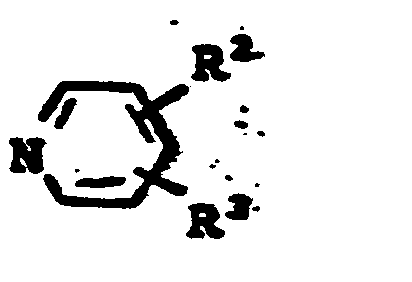
- Another process for the preparation of the compounds of the formula I is the reaction of cephalosporins of the formula XII with pyridines of the formula XIII, where R 1 - R 3 have the meaning given for the compounds of the formula I.
- the implementation is in a polar organic solvents such as dimethylformamide or in water - preferably in water with an excess of pyridine - generally 10 equivalents at temperatures between 40 and 95 ° C and reaction times between 5 min. and carried out for 6 hours.
- the compounds of the formula XII can be obtained in a manner analogous to the compounds of the formula I according to the invention.
- 7-aminocephalosporanic acid is used only in the coupling of the compounds of the formula VIII instead of the cephalosporanate of the formula IV.
- the compounds according to the invention have a strong and broad antimicrobial activity, particularly against gram-negative and gram-positive bacteria. These properties enable them to be used as chemotherapeutic agents in medicine, and with their help the diseases caused by gram-negative and gram-positive bacteria and bacteria-like microorganisms can be prevented, improved and / or cured.
- the compounds according to the invention are particularly effective against bacteria and bacterial-like microorganisms. They are therefore particularly well suited for the prophylaxis and chemotherapy of local and systemic infections in human and veterinary medicine, which are caused by these pathogens.
- the present invention includes pharmaceutical preparations which, in addition to non-toxic, inert pharmaceutically suitable excipients, contain one or more compounds according to the invention or which consist of one or more active compounds according to the invention, and processes for the preparation of these preparations.
- the present invention also includes pharmaceutical preparations in dosage units.
- the preparation is in the form of individual parts, for example tablets, dragées, capsules, pills, suppositories and ampoules, the active ingredient content of which is one Fraction or a multiple of a single dose.
- the dosage units can contain, for example, 1, 2, 3 or 4 single doses or 1/2, 1/3 or 1/4 of a single dose.
- a single dose preferably contains the amount of active ingredient which is administered in one application and which usually corresponds to a whole, a half or a third or a quarter of a daily dose.
- Non-toxic, inert pharmaceutically suitable carriers are to be understood as solid, semi-solid or liquid diluents, fillers and formulation auxiliaries of all kinds.
- Tablets, dragees, capsules, pills, granules, suppositories, solutions, suspensions and emulsions, pastes, ointments, gels, creams, lotions, powders and sprays may be mentioned as preferred pharmaceutical preparations.
- Tablets, coated tablets, capsules, pills and granules can contain the active ingredient (s) in addition to the usual carriers, they (a) fillers and extenders, for example starches, lactose, cane sugar, glucose, mannitol and silica, (b) binders, for example carboxymethyl cellulose, Alginates, gelatin, polyvinylpyrrolidone, (c) humectants, e.g. glycerin, (d) disintegrants, e.g. agar-agar, calcium carbonate and sodium carbonate, (e) solution retarders, eg paraffin and (f) absorption accelerators, e.g. quaternary
- Ammonium compounds (g) wetting agents, e.g. Cetyl alcohol, glycerol monostearate, (h) adsorbent e.g. Kaolin and bentonite and (i) lubricants, e.g. Talc, calcium and magnesium stearate and solid polyethylene glycols or mixtures of the substances listed under (a) to (i).
- wetting agents e.g. Cetyl alcohol, glycerol monostearate
- adsorbent e.g. Kaolin and bentonite
- lubricants e.g. Talc, calcium and magnesium stearate and solid polyethylene glycols or mixtures of the substances listed under (a) to (i).
- the tablets, dragees, capsules, pills and granules can be provided with the customary coatings and casings optionally containing opacifying agents and can also be composed in such a way that they release the active ingredient (s) only or preferably in a certain part of the intestinal tract, possibly with a delay, with embedding materials e.g. Polymer substances and waxes can be used.
- the active ingredient (s) can optionally also be in microencapsulated form with one or more of the above-mentioned excipients.
- suppositories can contain the usual water-soluble or water-insoluble carriers, for example polyethylene glycols, fats, for example cocoa fat and higher esters (for example C 14 alcohol with C 16 fatty acid) or mixtures of these substances.
- water-soluble or water-insoluble carriers for example polyethylene glycols, fats, for example cocoa fat and higher esters (for example C 14 alcohol with C 16 fatty acid) or mixtures of these substances.
- the solutions can also be in sterile and blood isotonic form.
- the therapeutically active compounds should be present in the pharmaceutical preparations listed above preferably in a concentration of about 0.1 to 99.5, preferably about 0.5 to 95 percent by weight of the total mixture.
- the pharmaceutical preparations listed above can also contain further active pharmaceutical ingredients.
- the pharmaceutical preparations listed above are prepared in a conventional manner by known methods, e.g. by mixing the active substance or substances with the carrier substance or substances.
- the active substances or the pharmaceutical preparations can be administered locally, orally, parenterally, intraperitonally and / or rectally, preferably orally or parenterally, such as intravenously or intramuscularly.
- the active compound (s) according to the invention in total amounts of about 1 to about 1000, preferably 1 to 200 mg / kg of body weight per 24 hours, if appropriate in the form of several individual doses to deliver the results you want.
- a single dose contains the active ingredient (s) according to the invention, preferably in amounts of about 1 to about 250, in particular 1 to 60 mg / kg of body weight.
- the optimum dosage and type of application of the active ingredients required in each case can easily be determined by any person skilled in the art on the basis of his specialist knowledge.
- the compounds according to the invention can be used with another ⁇ -lactam antibiotic or with aminoglycoside antibiotics, such as e.g. Gentamicin, Sisomicin, Kanamicin, Amikacin or Tobramicin can be combined.
- aminoglycoside antibiotics such as e.g. Gentamicin, Sisomicin, Kanamicin, Amikacin or Tobramicin
- the -55 ° C cold solution thus prepared was poured onto a solution of 4 mmol (1.16 g) of 7-amino-3-pyridiniummethyl-3-cephem-4-carboxylate and 4 mmol (0.55 ml) of triethylamine poured into 2 ml of water, allowed to warm to room temperature while maintaining the pH at 8-9.5 with triethylamine.
- the product was purified by chromatography on cellulose with acetonitrile / water 5: 1 or by absorption on e.g. Diaion HP 20 or XAD 7 and desorption cleaned with water / acetone 90:10. Yield; 10.5 g.
- the product was purified by chromatography on cellulose with acetonitrile / water 5: 1 or by absorption on e.g. B. Diaion HP 20 or XAD 7 and desorption with water / acetone 90:10. Yield: 10.5 g.
- Example 2 The product from Example 1 was stirred at room temperature for 2 h with 20 ml of trifluoroacetic acid, i.Vac. evaporated in a rotary evaporator, the residue was triturated with ether, suction filtered, washed with triethylamine-containing methylene chloride, methylene chloride and acetone and purified as indicated in Example 6.
- Example 7 For the preparation, the product from Example 2 was reacted analogously to Example 7.
- Example 3 For the production, the product from Example 3 was implemented analogously to Example 7.
- Example 7 For the preparation, the product from Example 4 was reacted analogously to Example 7.
- Example 7 For the preparation, the product from Example 5 was reacted analogously to Example 7.
Landscapes
- Chemical & Material Sciences (AREA)
- Organic Chemistry (AREA)
- Health & Medical Sciences (AREA)
- Chemical Kinetics & Catalysis (AREA)
- Life Sciences & Earth Sciences (AREA)
- General Chemical & Material Sciences (AREA)
- Medicinal Chemistry (AREA)
- Nuclear Medicine, Radiotherapy & Molecular Imaging (AREA)
- Communicable Diseases (AREA)
- Pharmacology & Pharmacy (AREA)
- Oncology (AREA)
- Animal Behavior & Ethology (AREA)
- General Health & Medical Sciences (AREA)
- Public Health (AREA)
- Veterinary Medicine (AREA)
- Cephalosporin Compounds (AREA)
- Pharmaceuticals Containing Other Organic And Inorganic Compounds (AREA)
- Saccharide Compounds (AREA)
- Nitrogen And Oxygen Or Sulfur-Condensed Heterocyclic Ring Systems (AREA)
Abstract
Description
- Die Erfindung betrifft neue Cephalosporine ihre Verwendung als Arzneimittel, insbesondere in der antibakteriellen Therapie sowie Verfahren zu ihrer Herstellung.
- Durch die Erfindung werden Cephalosporine der allgemeinen Formel I zur Verfügung gestellt.

- In der allgemeinen Formel I bedeuten
- R1 = C1-C6 Alkyl, Phenyl oder Halogen-substituiertes Phenyl,
- R2 und R3 = verschieden oder gleich = H, C1-C4-Alkyl, Chlor, Brom, Carbamoyl, N-C1-C4-Alkylcarbamoyl.
- Bevorzugte Verbindungen sind solche mit
- R1 = C1-C5 Alkyl
- R2 = H, C1-C2-Alkyl, Carbamoyl, Chlor, Brom.
- Ganz besonders bevorzugt ist die Verbindung mit
-


- Die Verbindungen der Formel I erhält man, indem man die Säuren der Formel II, worin R4 eine übliche Schutzgruppe darstellt, in die gemischten Anhydride der Formel III überführt und diese mit den bekannten Verbindungen der Formel IV umsetzt und anschließend von den erhaltenen Verbindungen der Formel V die Schutzgruppe R4 abspaltet.

- Für das Verfahren ist es vorteilhaft, mit R4 eine säurelabile Schutzgruppe wie z.B. tert.-Butyloxycarbonyl, Trityl oder Formyl zu verwenden und die Abspaltung von R 4 in V mit z.B. Trifluoressigsäure oder Ameisensäure vorzunehmen.
- Weiterhin ist es vorteilhaft, R5=CH3 zu wählen.
- Die Verbindungen II und III lassen sich nach folgendem Formelschema herstellen.


- Zunächst werden die Verbindungen der Formel IX (siehe z.B. E. Campaigne und T.P. Selby, J. Heterocycl. Chemie 17 (1980), 1255) zu den Verbindungen der Formel X umgesetzt werden.
- Es bedeutet
- R 4 eine Aminschutzgruppe wie z.B. Acetyl, Benzoyl, Formyl, Trichloracetyl, Benzyloxycarbonyl, Methyloxycarbonyl oder tert.-Butyloxycarbonyl ist
- R 6 und R 7 verschieden oder gleich sein können und einen gegebenenfalls substituierten Alkyl-, Cycloalkyl-, Alkenyl-, Cycloalkenyl-, Aryl- oder Heterocyclylrest bedeuten können, wobei Heteroatome als Substituenten der Reste sowie Doppelbindungen in den
- Alkenyl- und Cycloalkenylresten mindestens durch ein C-Atom von der Oxycarbonylgruppe getrennt sind.
- R 6 und R7 ein gegebenenfalls substituierter Alkylrest mit 1-15 C-Atomen, ein gegebenenfalls substituierter Alkenylrest mit 3-15 C-Atomen, ein gegebenenfalls substituierter Cycloalkylrest mit 3-10 C-Atomen, ein gegebenenfalls substituierter Cycloalkenylrest mit 5-10 C-Atomen, ein gegebenenfalls substituierter Arylrest mit 1 bis 3 Ringen oder ein gegebenenfalls substituierter Heterocyclylrest mit 1-3 Ringen, die bis zu 5 Stickstoff-, Schwefel- oder Sauerstoffatome enthalten können.
- Die genannten Alkyl-, Alkenyl-, Cycloalkyl- und Cycloalkenylreste können durch Alkylreste mit 1-4 C-Atomen, O-Alkylreste mit 1-4 C-Atomen, Halogen, vorzugsweise Chlor, gegebenenfalls substituierte Phenylreste, C=N und Cl-C5-Trialkylsilyl substituiert sein.
- Alle Aryl- und Heterocyclylreste einschließlich der genannten Phenylreste können durch Alkyl-, O-Alkyl-, S-Alkyl-, Alkyloxycarbonyl-, Halogen- und Phenylreste substituiert sein, wobei alle Alkylreste 1 bis 4 C-Atome haben können, sowie durch Nitro und C=N.
- Wenn die Reste R6 und/oder R7 substituiert sind, vorzugsweise durch die obengenannten Substituenten, so können sie 1-5, vorzugsweise 1 oder 2 Substituenten tragen.
- Besonders vorteilhaft für das Verfahren ist es, wenn
- R4= eine basenstabile, im Sauren abspaltbare Schutzgruppe wie z.B. tert.-Butoxycarbonyl ist, und wenn
- R 6= ein basisch verseifbarer Rest wie z.B. Methyl oder Ethyl ist.
- Die Verbindungen der Formel X erhält man, indem man die an sich bekannten Verbindungen der Formel IX in einem geeigneten Lösungsmittel mit einem Pyrokohlensäureester der Formel R 7_0-CO-O-CO-O-R7 reagieren läßt.
- Als Lösungsmittel eignen sich besonders aprotische, polare Lösungsmittel wie z.B. Acetonitril, Dimethylformamid, Hexamethylphosphorsäuretriamid oder Dimethylsulfoxid, besonders die beiden letzten. Die Reaktion läuft besonders vorteilhaft bei Zimmertemperatur oder bei niedrigeren Temperaturen z.B. 0 bis -50°C ab, wobei man die Komponenten 1-7 Tage miteinander reagieren läßt. Der Pyrokohlensäureester wird im allgemeinen mit 2-2,5 Moläquivalenten eingesetzt.
- Zur Herstellung der Verbindungen der Formel XI versetzt man die Verbindungen der Formel X in einem geeigneten Lösungsmittel bei tiefen Temperaturen mit 1 bis 1,1 Äquivalenten einer Base und gibt anschließend 1 bis 1,2 Äquivalente eines Aldehyds der Formel R1-CHO hinzu.
- Als Lösungsmittel für die Reaktion können z.B. Dimethylformamid, Dimethylsulfoxid, Diethylether, Tetrahydrofuran oder Toluol - bevorzugt Tetrahydrofuran - und als Base Alkoholate, Hydride, Amide oder Metallorganyle - bevorzugt Kalium-tert.-Butylat, Lithiumdiisopropylamid und Butyllithium - verwendet werden. Zur Durchführung der Reaktion gibt man die Base bei -50 bis -80°C zu einer Lösung von X und fügt anschließend bei -50 bis -60°C den Aldehyd hinzu und rührt ca. 12 Stunden bei -50 bis -60°C. Zur Isolierung der Produkte der Formel XI wird der Ansatz neutralisiert und aufgearbeitet.
- In den Verbindungen der Formel XI haben R4, R6 und R7 die bei den Verbindungen der Formel X aufgeführten Bedeutungen und R1 hat die eingangs genannte Bedeutung.
- Zur Durchführung des Verfahrens zur Herstellung der Verbindungen der Formel I ist es nicht notwendig, die Verbindungen der Formel XI zu isolieren. Es ist vielmehr zweckmäßig, sie in situ direkt in die Verbindungen der Formel XII umzuwandeln. Hierzu reicht es im allgemeinen aus, den Ansatz nach Zugabe des Aldehyds R1-CHO auf Raumtemperatur erwärmen zu lassen und über Nacht bei Raumtemperatur zu rühren. Sollte bis dahin die Eliminierung von XI nach XII nicht vollständig sein, gibt man 1 bis 1,2 Äquivalente einer Base - wie z.B. ein Hydrid, ein Alkoholat oder ein Amid - besonders Kalium-tert.-butylat hinzu und rührt etwa 10 h bei Raumtemperatur.
- Hatte man dagegen die Verbindung der Formel XI zuvor isoliert, so gibt man zur Herstellung der Verbindungen der Formel XII zu einer Lösung der Verbindungen der Formel XI in einem geeigneten Lösungsmittel 1,1 bis 2,2 Äquivalente einer Base. Als Lösungsmittel und als Base können die bei der Umsetzung von X nach XI genannten Verwendung finden, bevorzugt Tetrahydrofuran und Kalium-tert.-butylat.
- Man erhält die Verbindungen der Formel XII als E/Z-Isomerengemische, die sich z.B. durch Umkristallisieren oder durch Säulenchromatographie an Kieselgel trennen lassen.
- In den Verbindungen der Formel XII haben R 1, R 4 und R 6 die gleiche Bedeutung wie in den Verbindungen der Formel XI.
- Zur Herstellung der Z-Carbonsäuren der Formel II kann man die Z-Ester, die man durch Trennung des E/Z-Isomerengemische der Ester der Formel XII erhalten kann, verseifen. Es ist aber für die Durchführung des Verfahrens zur Herstellung der Verbindungen der Formel I günstiger, das E/Z-Isomerengemisch der Ester der Formel XII in der Weise selektiv zu verseifen, daß man unter milden Bedingungen erst die E-Ester in die E-Carbonsäuren der Formel II a überführt und abtrennt und anschließend die verbleibenden Z-Ester, in denen die Estergruppe sterisch stärker abgeschirmt ist, unter drastischen Bedingungen zu den Z-Carbonsäuren der Formel II verseift.
- Die milden Verseifungsbedingungen, die zu den E-Carbonsäuren II a führen, sind z.B. Ethanol/2 N Natronlauge/ Raumtemperatur/24 h. Zweckmäßigerweise führt man die Verseifung in der Art durch, daß man nach der Überführung der Verbindungen der Formel XI in die Verbindungen der Formel XII direkt zu dem Reaktionsansatz 2 N Natronlauge gibt, und bei Raumtemperatur oder unter leichtem Erwärmen so lange rührt, bis die E-Ester verseift sind. Dann trennt man durch Extraktion im Alkalischen die Z-Ester von dem Ansatz ab und verseift sie unter drastischeren Bedingungen.
- Drastischere Verseifungsbedingungen sind z.B. Ethanol/ 2 N Natronlauge/24 h Rückfluß - eventuell auch stärkere Natronlauge oder höherer siedende Lösungsmittel wie z.B. Dioxan.
- Auf diese Weise erhält man die gewünschten Z-Carbonsäuren der Formel II und die E-Carbonsäuren der Formel II a. Letztere lassen sich nach Überführung in die Silylester - z.B. mit Bistrimethylsilylacetamid - in einem geeigneten Lösungsmittel - z.B. Diethylether oder Tetrahydrofuran - mit einer Base wie Kalium-tert.-butylat und anschließender Hydrolyse mit verdünnter Säure wieder in ein Gemisch der E-Carbonsäuren der Formel II a und der Z-Carbonsäuren der Formel II überführen.
- Aus diesem E/Z-Isomerengemisch lassen sich die Z-Carbonsäuren der Formel II z.B. durch Kristallisation oder durch Trennung an einem Ionenaustauscher rein isolieren. Die Trennung mit Hilfe von Ionenaustauschern ist einfach, da die Z-Carbonsäuren der Formel II sehr viel stärker sauer sind als die E-Carbonsäuren der Formel II a. So werden die E-Carbonsäuren der Formel II a bereits mit Methanol von schwach-basischen Ionenaustauschern eluiert, die Z-Carbonsäuren der Formel II dagegen erst nach Zusatz von Elektrolyten, z.B. 2 N Natronlauge. Unter schwach basischen Ionenaustauschern sind solche Ionenaustauscher in fester oder flüssiger Form zu verstehen, die tertiäre Aminogruppen enthalten wie z.B. Lewatit MP 62.
- In den Verbindungen der Formel II und II a haben R1 und R4 die gleiche Bedeutung wie bei den Verbindungen der Formel XII. Zusätzlich kann R4=H sein, wenn vor der Verseifung in den Verbindungen der Formel XII R4 eine alkalisch verseifbare Schutzgruppe wie z.B. Acetyl war. Für die Durchführung des Verfahrens zur Herstellung der Verbindungen der Formel I ist es aber zweckmäßiger, wenn R4 eine Schutzgruppe ist, die unter den Verseifungsbedingungen stabil ist - bevorzugt tert.-Butyloxycarbonyl.
- Für die Kupplung von Carbonsäuren an 7-Aminocephalosporansäuren sind in der Cephalosporinchemie eine große Anzahl von Methoden bekannt, die sich letztlich aus der Peptidchemie ableiten. Bei den Versuchen zur Knüpfung der Amidbindung zwischen den Z-Carbonsäuren der Formel II und den Cephalosporansäuren der Formel IV versagen diese Methoden jedoch oder führen nur zu sehr schlechten Ausbeuten, insbesondere dann, wenn R1 ein Alkylrest ist. Die Gründe hierfür sind in der großen sterischen Hinderung der Carboxygruppe in den Carbonsäuren der Formel II durch den Rest R1 sowie in der ausgeprägten Neigung des Restes R1, nach Aktivierung der Carboxylfunktion - z.B. überführung in das Säurechlorid - in die E-Form zu isomerisieren.
- Man kann aber die Z-Carbonsäuren der Formel II auf einfache, schonende und billige Weise aktivieren, wenn man sie bei tiefen Temperaturen in die gemischten Anhydride der Formel III überführt.
- Solche gemischten Anhydride der Formel III können hergestellt werden, indem man die Carbonsäure II und ein geeignetes Amin in äquimolaren Mengen in einem geeigneten Lösungsmittel löst und mit 1 bis 1,05 Äquivalenten eines Sulfonsäurederivates der Formel VII reagieren läßt.
- Als Lösungsmittel eignen sich alle Solventien, die unter den Reaktionsbedingungen stabil sind, wie z.B. Diethylether, Tetrahydrofuran, Acetonitril, Aceton, Methylenchlorid, Chloroform oder Dimethylformamid.
- Als Amin eignen sich tertiäre Amine wie z.B. Triethylamin oder Tributylamin aber auch sterisch gehinderte sekundäre Amine wie z.B. Diisopropylamin.
- Die Umsetzungen können bei Temperaturen zwischen -80°C und Raumtemperatur durchgeführt werden, wobei tiefe Temperaturen eine Isomerisierung der Substituenten an der Doppelbindung vermeiden. Vorteilhaft werden die Reaktionen bei -20 bis -50°C bei einer Reaktionsdauer von 10 min. bis 10 h durchgeführt.
- Die Verbindungen der Formel III können isoliert werden, indem man z.B. in Tetrahydrofuran als Lösungsmittel und mit Triethylamin als Base arbeitet, das gebildete Triethylaminhydrochlorid absaugt und das Lösungsmittel im Vakuum abdestilliert. Es ist aber zweckmäßiger, die erhaltenen Lösungen der Verbindungen der Formel III direkt mit den Cephalosporanaten der Formel IV umzusetzen. Hierzu löst man die Cephalosporanaten der Formel IV oder deren Salze in einem geeigneten Lösungsmittel mit 1-4 Äquivalenten eines Amins, kühlt die Lösung auf die gewünschte, anschließende Reaktionstemperatur vor und gibt bei dieser Temperatur diese Lösung zu der oben beschriebenen Lösung der Verbindung der Formel III. Zur Vermeidung einer Isomerisierung des Restes R1 in den Reaktionsprodukten der Formel V führt man die Reaktion zweckmäßigerweise bei -60 bis -30°C durch und läßt den Ansatz über Nacht auf Raumtemperatur kommen.
- Zum Lösen der Verbindungen der Formel IV können die bei der Herstellung der Verbindungen der Formel III genannten Lösungsmittel sowie als Base die dort genannten Amine verwendet werden.
- Im allgemeinen ist die Löslichkeit der Verbindungen der Formel IV in diesen Lösemitteln sehr beschränkt, so daß man hier vorteilhaft in ansich bekannter Weise silyliert oder mit Wasser als Lösemittel arbeitet.
- Es ist besonders vorteilhaft, die Carbonsäuren VI ohne Schutzgruppe mit den Sulfonsäurederivaten VII in die gemischten Anhydride der Formel VIII zu überführen und diese mit IV direkt zu den Verbindungen der Formel I umzusetzen.

- Es bedeuten
- X = Cl, Br, OSO2R5
- R5= einen Alkylrest mit 1-10 C-Atomen, der gegebenenfalls durch Fluor, Chlor, CN, Phenyl, Alkyloxycarbonyl, Alkyloxy oder Alkyl substituiert sein kann, wobei letztere Alkylreste 1-4 C-Atome tragen können, oder ein Phenylrest, der gegebenenfalls durch Fluor, Chlor, Brom, CN, Alkyl, Alkyloxy, Alkylthio, Alkyloxycarbonyl - wobei letztere Alkylgruppen 1-4 C-Atome tragen können - Nitro, Trifluormethyl und Phenyl substituiert sein kann.
- Wenn R5 substituiert ist, sind vorzugsweise 1-3 Substituenten, vorzugsweise die genannten vorhanden.
- Ganz besonders bevorzugt stellt R5 einen Methyl- oder p-Tolylrest dar.
- Die gemischten Anhydride der Formel VIII werden in Analogie zu den Anhydriden der Formel III hergestellt, indem man die Carbonsäuren der Formel VI und 1-1,4 Äquivalente eines Amins in einem Lösungsmittel löst und mit 1 bis 1,2 Äquivalenten eines Sulfonsäurederivates der Formel VII reagieren läßt.
- Als Lösungsmittel eignen sich alle Solventien, die unter den Reaktionsbedingungen stabil sind, wie z.B. Diethylester, Tetrahydrofuran, Acetonitril, Aceton, Methylenchlorid, Chloroform oder Dimethylformamid.
- Als Amin eignen sich tertiäre Amine wie z.B. Triethylamin oder Tributylamin aber auch sterisch gehinderte sekundäre Amine wie z.B. Diisopropylamin.
- Die Umsetzungen können bei Temperaturen zwischen -80°C und Raumtemperatur durchgeführt werden, wobei tiefe Temperaturen eine Isomerisierung der Substituenten an der Doppelbindung vermeiden. Vorteilhaft wird die Umsetzung mit Cl-SO2CH3, in Dimethylformamid bei -40 bis -60°C durchgeführt.
- Zum Lösen der Verbindungen der Formel IV können die bei der Herstellung der Verbindungen der Formel VIII genannten Lösungsmittel sowie als Base die dort genannten Amine verwendet werden.
- Im allgemeinen ist die Löslichkeit der Verbindungen der Formel IV in diesen Lösungsmitteln sehr beschränkt, sodaß man hier vorteilhaft in an sich bekannter Weise silyliert oder mit Wasser als Lösungsmittel arbeitet.
- Die Verbindungen der Formel VI erhält man, indem man von den Verbindungen der Formel II die Schutzgruppe R4 abspaltet - z.B. die Boc-Schutzgruppe mit Trifluoressigsäure.
- Ein weiteres Verfahren zur Herstellung der Verbindungen der Formel I ist die Umsetzung von Cephalosporinen der Formel XII mit Pyridinen der Formel XIII, wobei

- Die Verbindungen der Formel XII können erhalten werden in analoger Weise wie die erfindungsgemäßen Verbindungen der Formel I. Hierzu wird lediglich bei der Kupplung der Verbindungen der Formel VIII statt des Cephalosporanats der Formel IV 7-Aminocephalosporansäure eingesetzt.
- Die erfindungsgemäßen Verbindungen weisen eine starke und breite antimikrobielle Wirksamkeit besonders gegen gram-negative und gram-positive Bakterien auf. Diese Eigenschaften ermöglichen ihre Verwendung als chemotherapeutische Wirkstoffe in der Medizin.Mit ihrer Hilfe können die durch gramnegative und grampositive Bakterien und bakterienähnliche Mikroorganismen hervorgerufenen Erkrankungen verhindert, gebessert und/oder geheilt werden.
- Besonders wirksam sind die erfindungsgemäßen Verbindungen gegen Bakterien und bakterienähnliche Mikroorganismen. Sie sind daher besonders gut zur Prophylaxe und Chemotherapie von lokalen und systemischen Infektionen in der Human- und Tiermedizin geeignet, die durch diese Erreger hervorgerufen werden.
- Beispielsweise können lokale und/oder systemische Erkrankungen behandelt und/oder verhindert werden, die durch die folgenden Erreger oder durch Mischungen der folgenden Erreger verursacht werden:
- Micrococcacae, wie Staphylokokken, z.B. Staphylococcus aureus, Staph. epidermidis, Staph. aerogenes und Gaffkya tetragena (Staph. = Staphylococcus);
- Lactobacteriaceae, wie Streptokokken, z.B. Streptococcus pyogenes, α-bzw. β-hämolysierende Streptokokken, nicht γ-)-hämolysierende Streptokokken, Str. viridans, Str. faecalis (Enterokokken) und Dipolococcus pneumoniae (Pneumokokken) (Str.=Streptococcus);
- Enterobacteriaceae, wie Escherichiae-Bakterien der Coli-Gruppe: Escherichia-Bakterien, z.B. Escherichia coli, Enterobacter-Bakterien, z.B. E.aerogenes, E. cloacae, Klebsiella-Bakterien, z.B. K. pneumoniae, Serratia, z.B. Serratia marvescens (E. = Enterobacter) (K. = Klebsiella), Proteae-Bakterien der Proteus-Gruppe: Proteus, z.B. Proteus vulgaris, Pr. morganii, Pr. rettgeri, Pr. mirabillis, (Pr. = Proteus);
- Pseudomonadaceae, wie Pseudomonas-Bakterien, z.B.
- Pseudomonas aeruginosa, (Ps. = Pseudomonas);
- Bacteroidaceae, wie Bacteroides-Bakterien, z. B. Bacteroides fragilis, (B. = Bacteroides).
- Die obige Aufzählung von Erregern ist lediglich beispielhaft und keineswegs beschränkend aufzufassen.
- Als Krankheiten, die durch die erfindungsgemäßen Verbindungen verhindert, gebessert und/oder geheilt werden können seien beispielsweise genannt:
- Erkrankungen der Atemwege und des Rachenraumes;
- Otitis; Pharyngitis; Pneumonie; Peritonitis; Pyelonephritis; Cystitis; Endocarditis; Systeminfektionen; Bronchitis; Arthritis; lokale Infektionen.
- Zur vorliegenden Erfindung gehören pharmazeutische Zubereitungen, die neben nichttoxischen, inerten pharmzeutisch geeigneten Trägerstoffen einen oder mehrere erfindungsgemäße Verbindungen enthalten oder die aus einem oder mehreren erfindungsgemäßen Wirkstoffen bestehen sowie Verfahren zur Herstellung dieser Zubereitungen.
- Zur vorliegenden Erfindung gehören auch pharmazeutische Zubereitungen in Dosierungseinheiten. Dies bedeutet, daß die Zubereitung in Form einzelner Teile, z.B. Tabletten, Dragees, Kapseln, Pillen, Suppositorien und Ampullen vorliegen, deren Wirkstoffgehalt einem Bruchteil oder einem Vielfachen einer Einzeldosis entspricht. Die Dosierungseinheiten können z.B. 1, 2, 3 oder 4 Einzeldosen oder 1/2, 1/3 oder 1/4 einer Einzeldosis enthalten. Eine Einzeldosis enthält vorzugsweise die Menge Wirkstoff, die bei einer Applikation verabreicht wird und die gewöhnlich einer ganzen, einer halben oder einem Drittel oder einem Viertel einer Tagesdosis entspricht.
- Unter nichtoxischen, inerter pharmazeutisch geeigneten Trägerstoffen sind feste, halbfeste oder flüssige Verdünnungsmittel, Füllstoffe und Formulierungshilfsmittel jeder Art zu verstehen.
- Als bevorzugte pharmazeutische Zubereitungen seien Tabletten, Dragees, Kapseln, Pillen, Granulate, Suppositorien, Lösungsn, Suspensionen und Emulsionen, Pasten, Salben, Gele, Cremes, Lotions, Puder und Sprays genannt.
- Tabletten, Dragees, Kapseln, Pillen und Granulate können den oder die Wirkstoffe neben den üblichen Trägerstoffen enthalten, sie (a) Füll- und Streckmittel, z.B. Stärken, Milchzucker, Rohrzucker, Glukose, Mannit und Kieselsäure, (b) Bindemittel, z.B. Carboxymethylcellulose, Alginate, Gelatine, Polyvinylpyrrolidon, (c) Feuchthaltemittel, z.B. Glycerin, (d) Sprengmittel, z.B. Agar-Agar, Calciumcarbonat und Natriumcarbonat, (e) Lösungsverzögerer, Z.B. Paraffin und (f) Resorptionsbeschleuniger, z.B. quarternäre
- Ammoniumverbindungen, (g) Netzmittel, z.B. Cetylalkohol, Glycerinmonostearat, (h) Adsorptionsmittel, z.B. Kaolin und Bentonit und (i) Gleitmittel, z.B. Talkum, Calcium und Magnesiumstearat und feste Polyethylenglykole oder Gemische der unter (a) bis (i) aufgeführten Stoffe.
- Die Tabletten, Dragees, Kapseln, Pillen und Granulate können mit den üblichen gegebenenfalls Opakisierungsmittel enthaltenden Überzügen und Hüllen versehen sein und auch so zusammengesetzt sein, daß sie den oder die Wirkstoffe nur oder bevorzugt in einem bestimmten Teil des Intestinaltraktes gegebenenfalls verzögert abgeben, wobei als Einbettungsmassen z.B. Polymersubstanzen und Wachse verwendet werden können.
- Der oder die Wirkstoffe können gegebenenfalls mit einem oder mehreren der oben angegebenen Trägerstoffe auch in mikroverkapselter Form vorliegen.
- Suppositorien können neben dem oder den Wirkstoffen die üblichen wasserlöslichen oder wasserunlöslichen Trägerstoffe enthalten, z.B. Polyethylenglykole, Fette, z.B. Kakaofett und höhere Ester (z.B. C14-Alkohol mit C16-Fettsäure) oder Gemische dieser Stoffe.
- Zur parenteralen Applikation können die Lösungen auch in steriler und blutisotonischer Form vorliegen.
- Die therapeutisch wirksamen Verbindungen sollen in den oben aufgeführten pharmazeutischen Zubereitungen vorzugsweise in einer Konzentration von etwa 0,1 bis 99,5, vorzugsweise von etwa 0,5 bis 95 Gewichtsprozent der Gesamtmischung vorhanden sein.
- Die oben aufgeführten pharmazeutischen Zubereitungen können außer den erfindungsgemäßen Verbindungen auch weitere pharmazeutische Wirkstoffe enthalten.
- Die Herstellung der oben aufgeführten pharmazeutischen Zubereitungen erfolgt in üblicher Weise nach bekannten Methoden, z.B. durch Mischen des oder der Wirkstoffe mit dem oder den Trägerstoffen.
- Die Wirkstoffe oder die pharmazeutischen Zubereitungen können lokal, oral, parenteral, intraperitonal und/ oder rectal, vorzugsweise oral oder parenteral wie intravenös oder intramuskulär appliziert werden.
- Im allgemeinen hat es sich sowohl in der Human- als auch in der Veterinärmedizin als vorteilhaft erwiesen, den oder die erfindungsgemäßen Wirkstoffe in Gesamtmengen von etwa 1 bis etwa 1000, vorzugsweise 1 bis 200 mg/kg Körpergewicht je 24 Stunden, gegebenenfalls in Form mehrerer Einzelgaben, zur Erzielung der gewünschten Ergebnisse zu verabreichen. Eine Einzelgabe enthält den oder die erfindungsgemäßen Wirkstoffe, vorzugsweise in Mengen von etwa 1 bis etwa 250, insbesondere 1 bis 60 mg/kg Körpergewicht. Es kann jedoch erforderlich sein, von den genannten Dosierungen abzuweichen,
- und zwar in Abhängigkeit von der Art und dem Körpergewicht des zu behandelnden Objekts, der Art und der Schwere der Erkrankung, der Art der Zubereitung und der Applikation des Arzneimittels sowie dem Zeitraum bzw. Intervall, innerhalb welchem die Verabreichung erfolgt. So kann es in einigen Fällen ausreichend sein, mit weniger als der oben genannten Menge Wirkstoff auszukommen, während in anderen Fällen die oben angeführte Wirkstoffmenge überschritten werden muß. Die Festlegung der jeweils erforderlichen optimalen Dosierung und Applikationsart der Wirkstoffe kann durch jeden Fachmann aufgrund seines Fachwissens leicht erfolgen.
- Die erfindungsgemäßen Verbindungen können zum Zwecke der Erweiterung des Wirkungsspektrums mit einem anderen ß-Lactamantibiotikum oder auch mit Aminoglykosidantibiotica, wie z.B. Gentamicin, Sisomicin, Kanamicin, Amikacin oder Tobramicin kombiniert werden.
- 5 mMol (1, 42 g) 1-(2-tert.-Butoxycarbonylaminothiazol-4-yl)-1(Z)-propencarbonsäure und 5,5 mMol (0,76 ml) Triethylamin wurden in 30 ml wasserfreiem Dimethylformamid gelöst, auf -55°C abgekühlt, 5,1 mMol (0,4 ml) Methansulfonsäurechlorid hinzugeben und eine halbe Stunde bei -55°C gerührt.
- Die so hergestellte -55°C kalte Lösung wurde in einem Guß auf eine Lösung von 4 mMol (1,16 g) 7-Amino-3-pyridiniummethyl-3-cephem-4-carboxylat und 4 mMol (0,55 ml) Triethylamin in 2 ml Wasser gegossen, man ließ auf Raumtemperatur erwärmen und hielt dabei den pH mit Triethylamin auf 8-9.5.
- Nach 30 min. wurde der Ansatz i.Vak. einrotiert, der Rückstand in wenig Wasser gelöst, ein pH von 3-4 eingestellt, die Lösung mit Essigester extrahiert und die wäßrige Lösung lyophilisiert.
- Die Herstellung erfolgte analog Beispiel 1 aus 1-(2-tert.-Butoxycarbonylaminothiazol-4-yl)-1(Z)-buten- carbonsäure.
- Die Herstellung erfolgte analog Beispiel 1 aus 1-(2-tert.-Butoxycarbonylaminothiazol-4-yl)-1(Z)-penten- carbonsäure.
- Die Herstellung erfolgte analog Beispiel 1 aus 1-(2-tert.-Butoxycarbonylaminothiazol-4-yl)-1(Z)-hepten- carbonsäure.
- Die Herstellung erfolgte analog Beispiel 1 aus 1-(2-tert.-Butoxycarbonylaminothiazol-4-yl)-1(Z)-propen- carbonsäure und 7-Amino-3-(4-aminocarbonylpyridinium- methyl)-3-cephem-4-carboxylat.
- 41 mMol (7,5 g) 1-(2-Aminothiazol-4-yl)-1(Z)-propen- carbonsäure und 45 mMol (6,3 ml) Triethylamin wurden in 200 ml wasserfreiem Dimethylformamid gelöst, auf -55°C abgekühlt, 42 mMol (3,3 ml) Methansulfonsäurechlorid hinzugegeben und 30 min. bei -55°C gerührt.
- Danach wurde die -55°C kalte Lösung in einem Guß auf eine Lösung von 31 mMol (11,2 g) 7-Amino-3-pyridinium- methyl-3-cephem-4-carboxylat, 31 mMol (4,3 ml) Triethylamin in 20 ml Wasser gegeben und unter starkem Rühren auf Raumtemperatur erwärmen gelassen, wobei der pH mit Triethylamin bei 8-9.5 gehalten wurde.
- Zur Aufarbeitung wurde der Ansatz i.Vak. einrotiert, der Rückstand mit Ether verrieben, mehrfach mit Methylenchlorid und Aceton gewaschen.
- Um Rest von Salzen und Verunreinigungen zu entfernen, wurde das Produkt durch Chromatographie an Cellulose mit Acetonitril/Wasser 5:1 oder durch Absorption an z.B. Diaion HP 20 oder XAD 7 und Desorption mit Wasser/Aceton 90:10 gereinigt. Ausbeute; 10,5 g.
- 41 mMol (7,5 g) 1-(2-Aminothiazol-4-yl)-1(Z)-propen- carbonsäure und 45 mMol (7,8 ml) Ethyl-di-isopropylamin wurden in 100 ml wasserfreiem Dimethylformamid gelöst, auf -550C abgekühlt, 42 mMol (3,3 ml) Methansulfonsäurechlorid hinzugegeben und 40 min. bei -55°C gerührt.
- Danach wurde die -55°C kalte Lösung in einem Guß unter starkem Rühren auf eine Lösung von 31 mMol (11,2 g) 7-Amino-3-pyridinium-methyl-3-cephem-4-carboxylat in 12 ml Wasser gegeben, gleichzeitig 31 mMol (4,3 ml) Triethylamin hinzugegeben und auf Raumtemperatur erwärmen gelassen, wobei der pH mit Triethylamin bei 8.5-9.5 gehalten wurde.
- Zur Aufarbeitung wurde der Ansatz nach 10-20 min. in 1,5 1 Aceton eingerührt,der Niederschlag abgesaugt und mehrfach mit Methylenchlorid und Aceton gewaschen.
- Um Rest von Salzen und Verunreinigungen zu entfernen, wurde das Produkt durch Chromatographie an Cellulose mit Acetonitril/Wasser 5:1 oder durch Absorption an z. B. Diaion HP 20 oder XAD 7 und Desorption mit Wasser/Aceton 90:10 gereinigt. Ausbeute: 10,5 g.
- Das Produkt aus Beispiel 1 wurde bei Raumtemperatur 2 h mit 20 ml Trifluoressigsäure gerührt, i.Vak. einrotiert, der Rückstand mit Ether verrieben, abgesaugt, mit triethylaminhaltigem Methylenchlorid, Methylenchlorid und Aceton gewaschen und wie in Beispiel 6 angegeben gereinigt.
- Zur Herstellung wurde das Produkt aus Beispiel 2 analog Beispiel 7 umgesetzt.
- Zur Herstellung wurde das Produkt aus Beispiel 3 analog Beispiel 7 umgesetzt.
- Zur Herstellung wurde das Produkt aus Beispiel 4 analog Beispiel 7 umgesetzt.
- Zur Herstellung wurde das Produkt aus Beispiel 5 analog Beispiel 7 umgesetzt.
- 50 g (0,176 Mol) 1-(2-tert.-Butoxycarbonylamino- thiazol-4-yl)-1(Z)-propencarbonsäure und 350 ml Trifluoressigsäure wurden bei 0°C zusammengegeben und 3 h bei Raumtemperatur gerührt. Die Trifluoressigsäure wurde i.Vak. abgezogen und der Rückstand unter Rühren und Eiskühlung mit gesättigter wäßriger NaHCO3-Lösung bis pH 2 und anschließend mit gesättigter wäßriger KHC03-Lösung bis pH 3,7-4,0 versetzt. Der Niederschlag wurde abgesaugt, mit Wasser gewaschen und über P205 i.Vak. getrocknet.
- Ausbeute 29,5 g (91 %).
- Die Herstellung erfolgte analog Beispiel 6 aus 3 mmol (552 mg) 1-(2-Aminothiazol-4-yl)-1(Z)-propencarbonsäure und 3 mmol (915 mg) 7-Amino-3-(2-methylpyridinium)methyl-3-cephem-4-carboxylat.
- Zur Aufarbeitung wurde der Ansatz auf 450 ml Aceton gegoßen, der entstehende Niederschlag abgesaugt und durch Absorption an Diaion HP 20 und Desorption mit Wasser/Acetonitril 9:1 gereinigt. Ausbeute: 377 mg.
- 1H-NMR (D6-DMSO)
cf= 9.35 (1H, d, J=6 Hz, H-6-Py); 9.19 (1H, d, J=8 Hz, NH); 8.42 (1H, m, H-4-Py); 7.97 (2H, m, H-3,5-Py); 6.98 (2H, bs, NH2); 6.37 (1H, q, J=8 Hz, C=CH); 6.18 (1H, s, Thiazol); 5.66 (1H, dd, J=8 Hz, J=5 Hz, H-7-Lactam); 5.39 (2H, bs, CH2-Py); 5.07 (1H, d, J=5 Hz, H-6-Lactam); 3.42 (1H, d, J=18 Hz, S-CH2); 3.09 (1H, d, J=18 Hz, S-CH2); 2.84 (2H, s, Py-CH3); 1.75 (3H, d, J=8 Hz, C=C-CH3). - Die Herstellung erfolgte analog Beispiel 13 aus 7-Amino-3-(3-methylpyridinium)methyl-3-cephem-4-carboxylat.
- Ausbeute: 370 mg.
- 1H-NMR (D6-DMSO)
δ= 9.42 (1H, d, J=5 Hz, H-6-Py); 9.29 (1H, s, H-2-Py); 9.18 (1H, d, J=7 Hz, NH); 8.42 (1H, d, J=8 Hz, H-4-Py); 8.06 (1H, m, H-5-Py); 6.98 (2H, bs, NH2); 6.38 (1H, q, J=8 Hz, C=CH); 6.17 (1H, s, Thiazol); 5.65 (2H, m, H-7-Lactam, CH2-Py); 5.09 (1H, d, J=5 Hz, H-6-Lactam); 5.06 (1H, d, J=15 Hz, CH2-Py); 3.55 (1H, d, J=18 Hz, S-CH2); 3.08 (1H, d, J=18 Hz, S-CH2); 2.48 (3H, s, Py-CH3); 1.75 (3H, d, J=8 Hz; C=C-CH3). - Die Herstellung erfolgte analog Beispiel 13 aus 7-Amino-3-(4-methylpyridinium)methyl-3-cephem-4-carboxylat.
- Ausbeute: 360 mg.
- 1H-NMR (D6-DMSO)
δ= 9.33 (2H, d, J=6 Hz, H-2,6-Py); 9.20 (lH, d, J=8 Hz, NH); 7.99 (2H, d, J=6 HZ, H-3,5-Py); 6.98 (2H, bs, NH2); 6.30 (1H, q, J=8 Hz, C=CH); 6.18 (1H, s, Thiazol); 5.68 (1H, dd, J=8 Hz, J=5 Hz, H-7-Lactam); 5.61 (1H, d, J=15 Hz, CH2-Py); 5.11 (1H, d, J=5 Hz, H-6-Lactam); 5.03 (1H, d, J=15 Hz, CH2-Py); 3.55 (1H, d, J=18 Hz, S-CH2); 3.04 (1H, d, J=18 Hz, S-CH2); 2.60 (3H, s, Py-CH3); 1.76 (3H, d, J=8 Hz, C=C-CH3). - Die Herstellung erfolgte analog Beispiel 16 aus 7-Amino-3-(4-äthylpyridinium)methyl-3-cephem-4-carboxylat.
- Ausbeute: 140 mg.
- 1H-NMR (D6-DMSO)
δ= 9.35 (2H, d, J=6 Hz, H-2,6-Py); 9.18 (1H, d, J=9 Hz, NH); 8.03 (2H, d, J=6 Hz, H-3,5-Py); 6.98 (2H, bs, NH2); 6.29 (1H, q, J=8 Hz, C=CH); 6.18 (1H, s, Thiazol); 5.68 (1H, dd, J=9 Hz, J=5 Hz, H-7-Lactam); 5.61 (1H, d, J=15 Hz, CH2-Py); 5.10 (1H, d, J=5 Hz, H-6-Lactam); 5.05 (1H, d, J=15 Hz, CH2-Py); 3.54 (lH, d, J=18 Hz, S-CH2); 3.04 (1H, d, J=18 Hz, S-CH2); 2.89 (2H, q, J=6 Hz, Py-CH2-CH3); 1.75 (3H, d, J=8 Hz, C=C-CH3); 1.26 (3H, t, J=6 Hz, Py-CH2-CH3). - Die Herstellung erfolgte analog Beispiel 13 aus 7-Amino-3-(2,3-dimethylpyridinium)methyl-3-cephem-4-carboxylat.
- Ausbeute: 280 mg.
- 1H-NMR (D6-DMSO)
δ= 9.19 (1H, d, J=9 Hz, NH); 9.16 (1H, d, J=6 Hz, H-6-Py); 8.29 (1H, d, J=8 Hz, H-4-Py); 7.88 (1H, m, H-5-Py); 6.98 (2H, bs, NH2); 6.27 (1H, q, J=8 Hz, C=CH); 6.17 (1H, s, Thiazol); 5.65 (lH, dd, J=9 Hz, J=5 Hz, H-7-Lactam); 5.38 (2H, bs, CH2-Py); 5.07 (1H, d, J=5 Hz, H-6-Lactam); 3.42 (1H, d, J=18 Hz, S-CH2); 3.07 (1H, d, J=18 Hz, S-CH2); 2.74 (3H, s, Py-2-CH3); 2.40 (3H, s, Py-3-CH3); 1.75 (3H, d, J=8 Hz, C=C-CH3). - Die Herstellung erfolgte analog Beispiel 13 aus 7-Amino-3-(2,4-dimethylpyridinium)methyl-3-cephem-4-carboxylat.
- Ausbeute: 320 mg.
- 1H-NMR (D6-DMSO)
cf= 9.20 (1H, d, J=9 Hz, NH); 9.17 (lH, d, J=6 Hz, H-6-Py); 7.83 (1H, s, H-3-Py); 7.81 (1H, d, J=6 Hz, H-5-Py); 6.98 (2H, bs, NH2); 6.28 (1H, q, J=8 Hz, C=CH); 6.17 (1H, s, Thiazol); 5.65 (1H, dd, J=9 Hz; J=5 Hz, H-7-Lactam); 5.31 (2H, bs, CH2-Py); 5.05 (lH, d, J=5 Hz, H-6-Lactam); 3.40 (1H, d, J=18 Hz, S-CH2); 3.05 (1H, d, J=18 Hz, S-CH2); 2.75 (3H, s, Py-2-CH3); 2.50 (3H, s, Py-4-CH3); 1.75 (3H, d, J=8 Hz, C=C-CH3). - Die Herstellung erfolgte analog Beispiel 16 aus 7-Amino-3-(3,4-dimethylpyridinium)methyl-3-cephem-4-carboxylat.
- Ausbeute: 200 mg.
- 1H-NMR (D6-DMSO)
δ= 9.20 (3H, m, NH, H-2,6-Py); 7.95 (lH, d, J=6 Hz, H-5-Py); 6.98 (2H, bs, NH2); 6.29 (1H, q, J=8 Hz, C=CH); 6.18 (1H, s, Thiazol); 5.66 (1H, dd, J=9 Hz, J=5 Hz, H-7-Lactam); 5.58 (1H, d, J=15 Hz, CH2-Py); 5.09 (1H, d, J=5 Hz, H-6-Lactam); 5.00 (1H, d, J=15 Hz, CH2-Py); 3.52 (1H, d, J=18 Hz, S-CH2); 3.05 (1H, d, J=18 Hz, S-CH2); 2.50 (3H, s, Py-4-CH3); 2.36 (3H, s, Py-3-CH3); 1.75 (3H, d, J=8 Hz, C=C-CH3) - Die Herstellung erfolgte analog Beispiel 16 aus 7-Amino-3-(3,5-dimethylpyridinium)methyl-3-cephem-4-carboxylat.
- Ausbeute: 220 mg.
- 1H-NMR (D6-DMSO)
J= 9.20 (2H, s, H-2,6-Py); 9.18 (1H, d, J=9 Hz, NH); 8.27 (1H, s, H-4-Py); 6.97 (2H, bs, NH2); 6.28 (1H, q, J=8 Hz, C=CH); 6.17 (1H, s, Thiazol); 5.65 (1H, dd, J=9 Hz, J=5 Hz, H-7-Lactam); 5.60 (1H, d, J=15 Hz, CH2-Py); 5.07 (1H, d, J=5 Hz, H-6-Lactam); 5.00 (1H, d, J=15 Hz, CH2-Py); 3.51 (lH, d, J=18 Hz, S-CH2); 3.08 (1H, d, J=18 Hz, S-CH2); 2.42 (6H, s, Py-3,5-CH3); 1.74 (3H, d, J=8 Hz, C=C-CH3). - Die Herstellung erfolgte analog Beispiel 13 aus 7-Amino-3-(3-chlorpyridinium)methyl-3-cephem-4-carboxylat.
- Ausbeute: 210 mg.
- 1H-NMR (D6-DMSO)
cf= 9.92 (lH, s, H-2-Py); 9.50 (lH, d, J=6 Hz, H-6-Py); 9.22 (1H, d, J=9 Hz, NH); 8.88 (1H, d, J=8 Hz, H-4-Py); 8.22 (1H, dd, J=8 Hz, J=6 Hz, H-5-Py); 6.98 (2H, bs, NH); 6.30 (lH, q, J=8 Hz, C=CH); 6.18 (lH, s, Thiazol); 5.68 (2H, m, H-7-Lactam, CH2-Py); 5.11 (1H, d, J=5 Hz, H-6-Lactam); 5.08 (1H, J=15 Hz, CH2-Py); 3.54 (lH, d, J=18 Hz, S-CH2); 3.16 (1H, d, J=18 Hz, S-CH2); 1.76 (1H, d, J=8 Hz, C=C-CH3). - Die Herstellung erfolgte analog Beispiel 13 aus 7-Amino-3-(3-aminocarbonylpyridinium)methyl-3-cephem-4-carboxylat.
- Ausbeute: 540 mg.
- 1H-NMR (D6-DMSO)
δ= 9.78 (2H, m, H-2,6-Py); 9.21 (1H, d, J=9 Hz, NH); 8.94 (1H, d, J=8 Hz, H-4-Py); 8.28 (1H, m, H-5-Py); 6.98 (2H, bs, NH2); 6.29 (1H, q, J=8 Hz, C=CH); 6.18 (1H, s, Thiazol); 5.73 (1H, d, J=15 Hz, CH2-Py); 5.69 (1H, dd, J=9 Hz, J=5 Hz, H-7-Lactam); 5.20 (1H, d, J=15 Hz, CH2-Py); 5.11 (1H, d, J=5 Hz, H-6-Lactam); 3.47 (1H, d, J=18 Hz, S-CH2); 3.17 (1H, d, J=18 Hz, S-CH2); 1.75 (3H, d, J=8 Hz, C=C-CH3). - Die Herstellung erfolgte analog Beispiel 13 aus 7-Amino-3-(4-aminocarbonylpyridinium)methyl-3-cephem-4-carboxylat.
- Ausbeute: 350 mg.
- 1H-NMR (D6-DMSO)
δ= 9.62 (2H, d, J=6 Hz, H-2,6-Py); 9.17 (1H, d, J=9 Hz, NH); 8.42 (2H, d, J=6 Hz, H-3,5-Py); 6.96 (2H, bs, NH2); 6.28 (1H, q, J=8 Hz, C=CH); 5.71 (1H, d, J=18 Hz, CH2-Py); 5.68 (1H, dd, J=5 Hz; H-7-Lactam); 5.13 (9H, d, J=5 Hz, CH2-Py); 5.09 (1H, d, J=5 Hz, H-6-Lactam); 3.55 (1H, d, J=18 Hz, S-CH2); 3.08 (1H, d, J=18 Hz, S-CH2); 1.75 (3H, d, J=8 Hz, C=C-CH3). - Unter Stickstoff wurden 7.0 g (38.6 mM) 1-(2-Aminothiazol-4-yl)-1(Z)-propencarbonsäure in 100 ml DMF gelöst und mit 7.4 ml (42.8 mM) Ethyl-diisopropylamin bei 20°C versetzt. Man kühlte auf -55° unter Rühren ab, versetzt mit 3.1 ml (40 mM) Mesylchlorid und rührte 40 Min. nach. 10.7 g (29 mM) 7-Amino-3-pyridiniummethyl-3-cephem-4-carbonsäure-chlorid-hydrat (enthält 0.7 Moläquiv. HCl zusätzlich) wurden inzwischen in 12 ml Wasser unter Zugabe von 5.8 ml (41 mM) Triethylamin auf pH = 7 gestellt und auf 10°C gekühlt. Die -55°C kalte DMF-Lösung wurde unter Rühren zugegossen, gleichzeitig hielt man durch Zugabe von Triethylamin den pH-Wert bei 9.5. Nach 10 Min. wurde auf 0°C gekühlt und mit konz. 12 n HCl auf pH = 1.5-2 gestellt. Nun wurden nochmals 50 ml 12 n HCl zugefügt und anschließend insgesamt 600 ml i-Propanol innerhalb 2 Std. zugegeben, während das Produkt auskristallisierte. Man rührte 1 Std. im Eisbad, saugte scharf ab und wusch mit i-Propanol und Ether. 10.6 g (64%) Produkt-Dihydrat.
- NMR-Signale (in CD30D) bei
cf= 9.1 (2H), 8.64 (1H), 8.18 (2H), 6.7 (1H), 6.46 (1H), 5.95 (1H), 5.85 (1H), 5.48 (1H), 5.3 (1H), 3.75 (lH), 3.4 (1H) und 1.98 ppm (3H). - ber.: C 42.4 H 4.4 Cl 12.5 N 12.4 S 11.3
- gef.: C 42.0 H 4.4 Cl 12.5 N 12.3 S 11.2
Besonders sind
Claims (10)

bedeuten.
bedeuten.


darstellt


Priority Applications (1)
| Application Number | Priority Date | Filing Date | Title |
|---|---|---|---|
| AT83110116T ATE29498T1 (de) | 1982-10-23 | 1983-10-11 | Neue cephalosporine und verfahren zu ihrer herstellung. |
Applications Claiming Priority (2)
| Application Number | Priority Date | Filing Date | Title |
|---|---|---|---|
| DE19823239365 DE3239365A1 (de) | 1982-10-23 | 1982-10-23 | Neue cephalosporine und verfahren zu ihrer herstellung |
| DE3239365 | 1982-10-23 |
Publications (3)
| Publication Number | Publication Date |
|---|---|
| EP0107138A2 true EP0107138A2 (de) | 1984-05-02 |
| EP0107138A3 EP0107138A3 (en) | 1985-05-15 |
| EP0107138B1 EP0107138B1 (de) | 1987-09-09 |
Family
ID=6176491
Family Applications (1)
| Application Number | Title | Priority Date | Filing Date |
|---|---|---|---|
| EP83110116A Expired EP0107138B1 (de) | 1982-10-23 | 1983-10-11 | Neue Cephalosporine und Verfahren zu ihrer Herstellung |
Country Status (19)
| Country | Link |
|---|---|
| US (1) | US4489076A (de) |
| EP (1) | EP0107138B1 (de) |
| JP (1) | JPS5993086A (de) |
| KR (1) | KR840006487A (de) |
| AT (1) | ATE29498T1 (de) |
| AU (1) | AU556826B2 (de) |
| CA (1) | CA1208206A (de) |
| DE (2) | DE3239365A1 (de) |
| DK (1) | DK486183A (de) |
| ES (1) | ES8406491A1 (de) |
| FI (1) | FI73689C (de) |
| GR (1) | GR79682B (de) |
| HU (1) | HU189763B (de) |
| IL (1) | IL70012A (de) |
| NO (1) | NO833644L (de) |
| NZ (1) | NZ206017A (de) |
| PH (3) | PH20918A (de) |
| PT (1) | PT77501B (de) |
| ZA (1) | ZA837850B (de) |
Cited By (5)
| Publication number | Priority date | Publication date | Assignee | Title |
|---|---|---|---|---|
| EP0144032A3 (en) * | 1983-11-30 | 1986-03-19 | Bayer Ag | Cephalosporins and process for their preparation |
| DE3610581A1 (de) * | 1985-03-29 | 1986-10-02 | Shionogi & Co., Ltd., Osaka | Alkenamidocephalosporinester |
| EP0163190A3 (en) * | 1984-05-22 | 1986-11-26 | Bayer Ag | Beta-lactam antibiotics, process for their preparation and their use as medicaments on growth stimulators in animal-raising or as anti-oxidants |
| EP0161617A3 (de) * | 1984-05-17 | 1986-12-30 | Bayer Ag | Zwischenprodukte sowie Verfahren zur Herstellung von Zwischenproducten für die Synthese von Cephalosporinen |
| AT397963B (de) * | 1985-03-29 | 1994-08-25 | Shionogi & Co | Verfahren zur herstellung von neuen 7 beta-(2-(2- amino-4-thiazolyl)-alkenoylamimo)-3-cephem-4- carbonsäureestern |
Families Citing this family (4)
| Publication number | Priority date | Publication date | Assignee | Title |
|---|---|---|---|---|
| DE3300593A1 (de) * | 1983-01-11 | 1984-07-12 | Bayer Ag, 5090 Leverkusen | Neue cephalosporine und verfahren zu ihrer herstellung |
| JP2501785B2 (ja) * | 1984-07-09 | 1996-05-29 | 明治製菓株式会社 | 新規セフアロスポリン系化合物 |
| JP4554395B2 (ja) | 2005-02-17 | 2010-09-29 | 浜松ホトニクス株式会社 | 光源装置 |
| JP4589142B2 (ja) | 2005-02-17 | 2010-12-01 | 浜松ホトニクス株式会社 | 光源装置 |
Family Cites Families (8)
| Publication number | Priority date | Publication date | Assignee | Title |
|---|---|---|---|---|
| JPS4970990A (de) * | 1973-09-29 | 1974-07-09 | ||
| NZ176206A (en) * | 1973-12-25 | 1978-03-06 | Takeda Chemical Industries Ltd | Cephalosporins |
| DK154939C (da) * | 1974-12-19 | 1989-06-12 | Takeda Chemical Industries Ltd | Analogifremgangsmaade til fremstilling af thiazolylacetamido-cephemforbindelser eller farmaceutisk acceptable salte eller estere deraf |
| US4148997A (en) * | 1977-11-07 | 1979-04-10 | Yeda Research And Development Co., Ltd. | 7-[Sulfomethyl)phenyl]acetamidocephalosporin derivatives |
| GB2025398B (en) * | 1978-05-26 | 1982-08-11 | Glaxo Group Ltd | Gephalosporin antibiotics |
| IT1148888B (it) * | 1980-07-15 | 1986-12-03 | Schiena Ricerche Di | Composti antibiotici |
| DE3037997A1 (de) * | 1980-10-08 | 1982-05-13 | Bayer Ag | (beta) -lactamantibiotika, verfahren zu deren herstellung sowie sie enthaltende mittel |
| DE3145727A1 (de) * | 1981-11-19 | 1983-05-26 | Bayer Ag, 5090 Leverkusen | Zwischenprodukte, verfahren zu deren herstellung und verfahren zur herstellung von cephalosporinen |
-
1982
- 1982-10-23 DE DE19823239365 patent/DE3239365A1/de not_active Withdrawn
-
1983
- 1983-10-06 NO NO833644A patent/NO833644L/no unknown
- 1983-10-11 DE DE8383110116T patent/DE3373476D1/de not_active Expired
- 1983-10-11 AT AT83110116T patent/ATE29498T1/de active
- 1983-10-11 EP EP83110116A patent/EP0107138B1/de not_active Expired
- 1983-10-13 PT PT77501A patent/PT77501B/pt unknown
- 1983-10-17 US US06/542,833 patent/US4489076A/en not_active Expired - Fee Related
- 1983-10-20 IL IL70012A patent/IL70012A/xx unknown
- 1983-10-20 NZ NZ206017A patent/NZ206017A/en unknown
- 1983-10-20 FI FI833846A patent/FI73689C/fi not_active IP Right Cessation
- 1983-10-21 ZA ZA837850A patent/ZA837850B/xx unknown
- 1983-10-21 DK DK486183A patent/DK486183A/da not_active Application Discontinuation
- 1983-10-21 AU AU20447/83A patent/AU556826B2/en not_active Ceased
- 1983-10-21 GR GR72763A patent/GR79682B/el unknown
- 1983-10-21 PH PH29734A patent/PH20918A/en unknown
- 1983-10-21 HU HU833636A patent/HU189763B/hu not_active IP Right Cessation
- 1983-10-21 CA CA000439476A patent/CA1208206A/en not_active Expired
- 1983-10-21 ES ES526674A patent/ES8406491A1/es not_active Expired
- 1983-10-22 KR KR1019830005011A patent/KR840006487A/ko not_active Ceased
- 1983-10-22 JP JP58198180A patent/JPS5993086A/ja active Pending
-
1985
- 1985-07-15 PH PH32524A patent/PH20665A/en unknown
- 1985-07-15 PH PH32523A patent/PH20908A/en unknown
Cited By (10)
| Publication number | Priority date | Publication date | Assignee | Title |
|---|---|---|---|---|
| US4767754A (en) * | 1983-11-11 | 1988-08-30 | Bayer Aktiengesellschaft | Cephalosporins |
| EP0144032A3 (en) * | 1983-11-30 | 1986-03-19 | Bayer Ag | Cephalosporins and process for their preparation |
| US4757065A (en) * | 1983-11-30 | 1988-07-12 | Bayer Aktiengesellschaft | Cephalosporins |
| EP0161617A3 (de) * | 1984-05-17 | 1986-12-30 | Bayer Ag | Zwischenprodukte sowie Verfahren zur Herstellung von Zwischenproducten für die Synthese von Cephalosporinen |
| EP0163190A3 (en) * | 1984-05-22 | 1986-11-26 | Bayer Ag | Beta-lactam antibiotics, process for their preparation and their use as medicaments on growth stimulators in animal-raising or as anti-oxidants |
| DE3610581A1 (de) * | 1985-03-29 | 1986-10-02 | Shionogi & Co., Ltd., Osaka | Alkenamidocephalosporinester |
| GB2173194A (en) * | 1985-03-29 | 1986-10-08 | Shionogi & Co | 7-beta-(2-(amino-4-thiazolyl)-2-alkenoylamino)-3-cephem-4-carboxylic acid ester derivativess |
| GB2173194B (en) * | 1985-03-29 | 1989-06-28 | Shionogi & Co | 7-beta-(2-(amino-4-thiazolyl)-2-alkenoylamino)-3-cephem-4-carboxylic acid ester derivatives |
| AT392471B (de) * | 1985-03-29 | 1991-04-10 | Shionogi & Co | Verfahren zur herstellung von neuen 7beta-(2-(2- amino-4-thiazolyl)-alkenoylamino)-3-cephem-4- carbonsaeureestern |
| AT397963B (de) * | 1985-03-29 | 1994-08-25 | Shionogi & Co | Verfahren zur herstellung von neuen 7 beta-(2-(2- amino-4-thiazolyl)-alkenoylamimo)-3-cephem-4- carbonsäureestern |
Also Published As
| Publication number | Publication date |
|---|---|
| DK486183D0 (da) | 1983-10-21 |
| PH20908A (en) | 1987-05-27 |
| FI73689B (fi) | 1987-07-31 |
| FI833846L (fi) | 1984-04-24 |
| US4489076A (en) | 1984-12-18 |
| JPS5993086A (ja) | 1984-05-29 |
| DK486183A (da) | 1984-04-24 |
| IL70012A0 (en) | 1984-01-31 |
| PT77501A (en) | 1983-11-01 |
| CA1208206A (en) | 1986-07-22 |
| HU189763B (en) | 1986-07-28 |
| ATE29498T1 (de) | 1987-09-15 |
| PH20665A (en) | 1987-03-23 |
| DE3373476D1 (en) | 1987-10-15 |
| ZA837850B (en) | 1984-06-27 |
| PT77501B (en) | 1986-02-12 |
| GR79682B (de) | 1984-10-31 |
| FI73689C (fi) | 1987-11-09 |
| DE3239365A1 (de) | 1984-04-26 |
| FI833846A0 (fi) | 1983-10-20 |
| EP0107138B1 (de) | 1987-09-09 |
| NO833644L (no) | 1984-04-24 |
| KR840006487A (ko) | 1984-11-30 |
| ES526674A0 (es) | 1984-07-01 |
| EP0107138A3 (en) | 1985-05-15 |
| HUT34210A (en) | 1985-02-28 |
| IL70012A (en) | 1987-09-16 |
| AU2044783A (en) | 1984-05-03 |
| ES8406491A1 (es) | 1984-07-01 |
| NZ206017A (en) | 1985-11-08 |
| AU556826B2 (en) | 1986-11-20 |
| PH20918A (en) | 1987-05-28 |
Similar Documents
| Publication | Publication Date | Title |
|---|---|---|
| DE3486259T2 (de) | Carboxyalkenamidocephalosporine. | |
| DE2837264C2 (de) | ||
| DE3750443T2 (de) | Cephalosporinverbindungen, Verfahren zu ihrer Herstellung und antibakterielle Mittel. | |
| EP0137441A2 (de) | Cephalosporinderivate und Verfahren zu ihrer Herstellung | |
| DE2736471C2 (de) | ||
| EP0107138B1 (de) | Neue Cephalosporine und Verfahren zu ihrer Herstellung | |
| EP0111934B1 (de) | Cephalosporinderivate und Verfahren zu ihrer Herstellung | |
| EP0163190A2 (de) | Beta-Lactamantibiotika, Verfahren zu deren Herstellung sowie ihre Verwendung als Arzneimittel oder Wachstumsförderer in der Tieraufzucht oder als Antioxidantien | |
| EP0144032B1 (de) | Cephalosporine und Verfahren zu ihrer Herstellung | |
| CH669384A5 (de) | ||
| EP0162394B1 (de) | Neue Cephalosporine und Verfahren zu ihrer Herstellung | |
| DE69030502T2 (de) | Cephalosporinverbindungen und deren herstellung | |
| EP0185679B1 (de) | Cephalosporinzwischenprodukte, verfahren zu ihrer herstellung und ihre verwendung | |
| EP0008343B1 (de) | Cephalosporinderivate, Verfahren zu ihrer Herstellung und diese enthaltende pharmazeutische Präparate | |
| DE69816057T2 (de) | Antibakterielle substituierte 7-acylamino-3-(methylhydrazono)methyl-cephalosporine und zwischenprodukte | |
| DE3541095A1 (de) | Neue cephalosporine, verfahren zu deren herstellung sowie ihre verwendung als arzneimittel | |
| US4626535A (en) | Cephalosporins | |
| DE2818985C2 (de) | Halogenarylmalonamidooxacephalosporine und deren Verwendung bei der Bekämpfung bakterieller Infektionen | |
| EP0049499B1 (de) | Neue Cephalosporinderivate, Verfahren zu ihrer Herstellung und Zwischenprodukte dafür sowie entsprechende pharmazeutische Präparate | |
| EP0154793B1 (de) | 1-Oxadethiacephalosporinderivate sowie Verfahren zu ihrer Herstellung | |
| DE3342929A1 (de) | Ss-lactamantibiotika, verfahren zu deren herstellung sowie ihre verwendung als arzneimittel | |
| DE2534850C2 (de) | 7-Methoxycephalosporinderivate, Verfahren zu deren Herstellung und sie enthaltende Arzneimittel | |
| EP0390099B1 (de) | Polare Cephalosporinderivate und Verfahren zu ihrer Herstellung | |
| DE3686777T2 (de) | Penemderivate. | |
| CH657133A5 (de) | Oxacephalosporine. |
Legal Events
| Date | Code | Title | Description |
|---|---|---|---|
| PUAI | Public reference made under article 153(3) epc to a published international application that has entered the european phase |
Free format text: ORIGINAL CODE: 0009012 |
|
| 17P | Request for examination filed |
Effective date: 19831011 |
|
| AK | Designated contracting states |
Designated state(s): AT BE CH DE FR GB IT LI NL SE |
|
| PUAL | Search report despatched |
Free format text: ORIGINAL CODE: 0009013 |
|
| AK | Designated contracting states |
Designated state(s): AT BE CH DE FR GB IT LI NL SE |
|
| 17Q | First examination report despatched |
Effective date: 19860616 |
|
| GRAA | (expected) grant |
Free format text: ORIGINAL CODE: 0009210 |
|
| ITF | It: translation for a ep patent filed | ||
| AK | Designated contracting states |
Kind code of ref document: B1 Designated state(s): AT BE CH DE FR GB IT LI NL SE |
|
| REF | Corresponds to: |
Ref document number: 29498 Country of ref document: AT Date of ref document: 19870915 Kind code of ref document: T |
|
| REF | Corresponds to: |
Ref document number: 3373476 Country of ref document: DE Date of ref document: 19871015 |
|
| GBT | Gb: translation of ep patent filed (gb section 77(6)(a)/1977) | ||
| ET | Fr: translation filed | ||
| PGFP | Annual fee paid to national office [announced via postgrant information from national office to epo] |
Ref country code: NL Payment date: 19871031 Year of fee payment: 5 |
|
| PLBE | No opposition filed within time limit |
Free format text: ORIGINAL CODE: 0009261 |
|
| STAA | Information on the status of an ep patent application or granted ep patent |
Free format text: STATUS: NO OPPOSITION FILED WITHIN TIME LIMIT |
|
| 26N | No opposition filed | ||
| PG25 | Lapsed in a contracting state [announced via postgrant information from national office to epo] |
Ref country code: GB Effective date: 19891011 Ref country code: AT Effective date: 19891011 |
|
| PG25 | Lapsed in a contracting state [announced via postgrant information from national office to epo] |
Ref country code: SE Effective date: 19891012 |
|
| PG25 | Lapsed in a contracting state [announced via postgrant information from national office to epo] |
Ref country code: LI Effective date: 19891031 Ref country code: CH Effective date: 19891031 Ref country code: BE Effective date: 19891031 |
|
| BERE | Be: lapsed |
Owner name: BAYER A.G. Effective date: 19891031 |
|
| PG25 | Lapsed in a contracting state [announced via postgrant information from national office to epo] |
Ref country code: NL Effective date: 19900501 |
|
| GBPC | Gb: european patent ceased through non-payment of renewal fee | ||
| NLV4 | Nl: lapsed or anulled due to non-payment of the annual fee | ||
| PG25 | Lapsed in a contracting state [announced via postgrant information from national office to epo] |
Ref country code: FR Effective date: 19900629 |
|
| REG | Reference to a national code |
Ref country code: CH Ref legal event code: PL |
|
| REG | Reference to a national code |
Ref country code: FR Ref legal event code: ST |
|
| PGFP | Annual fee paid to national office [announced via postgrant information from national office to epo] |
Ref country code: DE Payment date: 19940913 Year of fee payment: 12 |
|
| EUG | Se: european patent has lapsed |
Ref document number: 83110116.7 Effective date: 19900706 |
|
| PG25 | Lapsed in a contracting state [announced via postgrant information from national office to epo] |
Ref country code: DE Effective date: 19960702 |