EP0056845B1 - Strukturierung von Metalloxidmasken, insbesondere durch reaktives Ionenstrahlätzen - Google Patents
Strukturierung von Metalloxidmasken, insbesondere durch reaktives Ionenstrahlätzen Download PDFInfo
- Publication number
- EP0056845B1 EP0056845B1 EP81108438A EP81108438A EP0056845B1 EP 0056845 B1 EP0056845 B1 EP 0056845B1 EP 81108438 A EP81108438 A EP 81108438A EP 81108438 A EP81108438 A EP 81108438A EP 0056845 B1 EP0056845 B1 EP 0056845B1
- Authority
- EP
- European Patent Office
- Prior art keywords
- metal oxide
- layer
- etching
- oxide layer
- lacquer
- Prior art date
- Legal status (The legal status is an assumption and is not a legal conclusion. Google has not performed a legal analysis and makes no representation as to the accuracy of the status listed.)
- Expired
Links
Images
Classifications
-
- H—ELECTRICITY
- H10—SEMICONDUCTOR DEVICES; ELECTRIC SOLID-STATE DEVICES NOT OTHERWISE PROVIDED FOR
- H10P—GENERIC PROCESSES OR APPARATUS FOR THE MANUFACTURE OR TREATMENT OF DEVICES COVERED BY CLASS H10
- H10P76/00—Manufacture or treatment of masks on semiconductor bodies, e.g. by lithography or photolithography
- H10P76/40—Manufacture or treatment of masks on semiconductor bodies, e.g. by lithography or photolithography of masks comprising inorganic materials
- H10P76/405—Manufacture or treatment of masks on semiconductor bodies, e.g. by lithography or photolithography of masks comprising inorganic materials characterised by their composition, e.g. multilayer masks
-
- G—PHYSICS
- G03—PHOTOGRAPHY; CINEMATOGRAPHY; ANALOGOUS TECHNIQUES USING WAVES OTHER THAN OPTICAL WAVES; ELECTROGRAPHY; HOLOGRAPHY
- G03F—PHOTOMECHANICAL PRODUCTION OF TEXTURED OR PATTERNED SURFACES, e.g. FOR PRINTING, FOR PROCESSING OF SEMICONDUCTOR DEVICES; MATERIALS THEREFOR; ORIGINALS THEREFOR; APPARATUS SPECIALLY ADAPTED THEREFOR
- G03F7/00—Photomechanical, e.g. photolithographic, production of textured or patterned surfaces, e.g. printing surfaces; Materials therefor, e.g. comprising photoresists; Apparatus specially adapted therefor
- G03F7/004—Photosensitive materials
- G03F7/09—Photosensitive materials characterised by structural details, e.g. supports, auxiliary layers
- G03F7/094—Multilayer resist systems, e.g. planarising layers
-
- G—PHYSICS
- G03—PHOTOGRAPHY; CINEMATOGRAPHY; ANALOGOUS TECHNIQUES USING WAVES OTHER THAN OPTICAL WAVES; ELECTROGRAPHY; HOLOGRAPHY
- G03F—PHOTOMECHANICAL PRODUCTION OF TEXTURED OR PATTERNED SURFACES, e.g. FOR PRINTING, FOR PROCESSING OF SEMICONDUCTOR DEVICES; MATERIALS THEREFOR; ORIGINALS THEREFOR; APPARATUS SPECIALLY ADAPTED THEREFOR
- G03F7/00—Photomechanical, e.g. photolithographic, production of textured or patterned surfaces, e.g. printing surfaces; Materials therefor, e.g. comprising photoresists; Apparatus specially adapted therefor
- G03F7/26—Processing photosensitive materials; Apparatus therefor
- G03F7/40—Treatment after imagewise removal, e.g. baking
-
- Y—GENERAL TAGGING OF NEW TECHNOLOGICAL DEVELOPMENTS; GENERAL TAGGING OF CROSS-SECTIONAL TECHNOLOGIES SPANNING OVER SEVERAL SECTIONS OF THE IPC; TECHNICAL SUBJECTS COVERED BY FORMER USPC CROSS-REFERENCE ART COLLECTIONS [XRACs] AND DIGESTS
- Y10—TECHNICAL SUBJECTS COVERED BY FORMER USPC
- Y10S—TECHNICAL SUBJECTS COVERED BY FORMER USPC CROSS-REFERENCE ART COLLECTIONS [XRACs] AND DIGESTS
- Y10S438/00—Semiconductor device manufacturing: process
- Y10S438/942—Masking
- Y10S438/948—Radiation resist
- Y10S438/949—Energy beam treating radiation resist on semiconductor
-
- Y—GENERAL TAGGING OF NEW TECHNOLOGICAL DEVELOPMENTS; GENERAL TAGGING OF CROSS-SECTIONAL TECHNOLOGIES SPANNING OVER SEVERAL SECTIONS OF THE IPC; TECHNICAL SUBJECTS COVERED BY FORMER USPC CROSS-REFERENCE ART COLLECTIONS [XRACs] AND DIGESTS
- Y10—TECHNICAL SUBJECTS COVERED BY FORMER USPC
- Y10S—TECHNICAL SUBJECTS COVERED BY FORMER USPC CROSS-REFERENCE ART COLLECTIONS [XRACs] AND DIGESTS
- Y10S438/00—Semiconductor device manufacturing: process
- Y10S438/942—Masking
- Y10S438/948—Radiation resist
- Y10S438/95—Multilayer mask including nonradiation sensitive layer
Definitions
- the invention relates to a method for producing the finest structures in microelectronics with very thin layers of photoresist, which are sensitive to light, electrons or X-rays, as a mask.
- photoresist layers that are sensitive to light, electrons or X-rays (e.g. PMMA) are generally used as a mask.
- the paint thickness must also be reduced.
- wet chemical etching processes are increasingly being replaced by dry etching processes such as plasma, sputter or ion beam etching.
- dry etching processes such as plasma, sputter or ion beam etching.
- the latter two methods work with a directed ion beam which, depending on the energy and type of ions (argon, reactive gases), can cause considerable paint removal.
- the removal rate of the varnish is also strongly dependent on the angle of the incident ions and has its greatest value at an angle of incidence of about 60 ° (deviation from the normal).
- a thin metal film e.g. Ti, Va, Mn, Al
- This structured metal film serves as a mask for the underlying layer. This takes advantage of the fact that the etching rate of the oxide with Ar ions is significantly lower than that of the metal itself in many metals.
- the corresponding process can first be carried out in a wet chemical manner by ion beam or sputter etching with pure argon or by lifting technology Structure the metal and then continue to use it as a mask by etching with a mixture of Ar and about 10% 0 2 . The metal oxide is then formed on the surface of the metal mask during etching.
- the invention has for its object to implement the method mentioned. This is done by first applying a thin metal oxide layer over the layer to be etched, then covering this metal oxide layer with a photoresist layer, exposing and developing the photoresist layer according to a pattern, then structuring the metal oxide layer by reactive sputtering or ion beam etching and then this structured metal oxide layer as a masking of the underlying layer for a dry etching process, e.g. B. sputter or ion beam etching.
- a dry etching process e.g. B. sputter or ion beam etching.
- a fluorocarbon for. B. trifluoromethane
- an etching gas for etching the metal oxide layer selectively with respect to the photoresist layers.
- the various metal oxides e.g. TiO, A1 2 0 3 , Ta 2 0 5 , MgO, MnO, VO
- the various metal oxides can be selected with a comparatively high selectivity (factor 3 to 10) against photoresists or X-ray coatings (e.g. B. PMMA).
- the remaining lacquer can serve as additional protection, at least initially, during the subsequent actual etching.
- the actual etching of the layer to be etched with a suitable gas e.g. B. pure argon.
- a suitable gas e.g. B. pure argon.
- the advantage of this solution is that it protects the system (ionization filaments, lattice systems) and on the other hand can be used to etch all types of materials, including those that form oxides resistant to argon bombardment.
- the rest of the metal oxide mask is finally removed with a suitable etching if necessary.
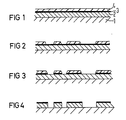
- a substrate 1 is used in each case, which can consist of a silicon dioxide layer which was formed on a semiconductor wafer (not shown) during manufacture. Usually contains one Semiconductor wafer at least one integrated circuit manufactured in a conventional manner including ohmic contacts (which are not shown).
- a metal oxide layer 3 is evaporated or sputtered over it.
- a layer 4 of a peelable mask material is applied over layer 3.
- This mask material is characterized as an organic, polymeric material, which can be, for example, a photoresist, an electron beam or X-ray sensitive lacquer, which is applied in the usual way, for example by spinning, as a coating (FIG. 1).
- the paint is structured in the usual way ( Figure 2).
- z. B. by reactive ion-beam etching the metal oxide 3 at the vacant locations structured without lacquer shrinkage ( Figure 3).
- the layer to be etched etched Figure 4).
Landscapes
- Physics & Mathematics (AREA)
- General Physics & Mathematics (AREA)
- Engineering & Computer Science (AREA)
- Architecture (AREA)
- Structural Engineering (AREA)
- Drying Of Semiconductors (AREA)
- ing And Chemical Polishing (AREA)
Description
- Die Erfindung betrifft ein Verfahren zur Herstellung feinster Strukturen in der Mikroelektronik mit sehr dünnen Fotolackschichten, die licht-, elektronen- oder röntgenstrahlempfindlich sind, als Maskierung.
- Zur Herstellung kleiner und kleinster Strukturen in der Mikroelektronik werden in der Regel Fotolackschichten, die licht, elektronen- oder röntgenstrahlempfindlich sind (z. B. PMMA), als Maskierung verwendet. Mit zunehmender Integration muß auch die Lackdicke verringert werden. Gleichzeitig werden die naßchemischen Ätzverfahren immer mehr durch Trockenätzverfahren wie Plasma-, Sputter- oder lonenstrahlätzen ersetzt. Die beiden letztgenannten Verfahren arbeiten mit einem gerichteten lonenstrahl, der je nach Energie und Art der Ionen (Argon, reaktive Gase) einen erheblichen Lackabtrag verursachen kann. Die Abtragsprate des Lackes ist zudem stark abhängig vom Winkel der einfallenden Ionen und hat ihren größten Wert bei etwa 60° Einfallswinkel (Abweichung von der Normalen). Dieser Effekt führt zu schrägen Lackflanken (60°), die sich mit zunehmender Ätzdauer immer weiter zurückziehen. Die Folge davon sind schräge Kanten an der geätzten Schicht und schließlich lateraler Schwund. Dieses Problem tritt vor allem dann auf, wenn das zu ätzende Material keine Selektivität gegenüber dem verwendeten Lack besitzt (vor allem beim Ätzen von Metallen mit Argon) bzw. wenn die zu ätzende Schicht relativ dick ist.
- Nach der bisherigen Lösung, wie sie z. B. von M. Cantagrel in IEEE Transactions on Electron Devices, Vol. ED.-22, No. 7, Juli 1975, p.483-486, beschrieben ist, wird zunächst ein dünner Metallfilm (z. B. Ti, Va, Mn, Al) über der zu ätzenden Schicht aufgebracht und mit Lack strukturiert. Dieser strukturierte Metallfilm dient dann selbst als Maskierung für die darunterliegende Schicht. Dabei wird die Tatsache ausgenutzt, daß bei vielen Metallen die Ätzrate des Oxides mit Ar-Ionen wesentlich geringer ist als die des Metalles selbst. Auf diese Weise kann man zunächst auf naßchemische Weise durch lonenstrahl- bzw. Sputterätzen mit reinem Argon oder durch Abhebetechnik das entsprechende Metall strukturieren und dann weiter als Maske benutzen, indem man mit einer Mischung aus Ar und etwa 10% 02 weiterätzt. Das Metalloxid wird dann während des Ätzens an der Oberfläche der Metallmaske gebildet.
- Dieses Verfahren hat aber einige Nachteile. So läßt sich die Metallschicht, die als Maske dienen soll, nur sehr schwer strukturieren. Oft findet man eine dünne Oxidschicht vor, die das naßchemische- .bzw. Plasmaätzen des Metalls erschwert und wegen des unterschiedlichen Ätzangriffes auch zu undefinierten Unterätzungen führt. Für das Sputter- oder lonenstrahlätzen der Metallmaske ist andererseits die Selektivität gegenüber den verwendeten Lacken (insbesondere PMMA) meist zu gering, um einen Lackschwund und damit einen lateralen Schwund der Maske zu verhindern. Ein weiterer Nachteil ist, daß bei der anschließenden Ätzung der Schicht mit einem Ar-02-Gemisch nur solche Materialien abgetragen werden können, die selbst keine gegen Ar-Beschuß resistenten Oxide bilden, z. B. Gold.
- Der Erfindung liegt die Aufgabe zugrunde, das eingangs genannte Verfahren zu realisieren. Dies geschieht in der Weise, daß zunächst eine dünne Metalloxidschicht über der zu ätzenden Schicht aufgebracht wird, daraufhin diese Metalloxidschicht mit einer Fotolackschicht abgedeckt, die Fotolackschicht nach einem Muster belichtet und entwickelt wird, anschließend die Metalloxidschicht durch reaktives Sputter- oder lonenstrahlätzen strukturiert wird und anschließend diese strukturierte Metalloxidschicht als Maskierung der darunterliegenden Schicht für einen Trockenätzvorgang, z. B. Sputter- oder lonenstrahlätzen, dient. Auf diese Weise wird die Verwendung von Sputter- oder lonenstrahlätzen auch bei sehr ungüngstigen Lackhöhen zu Ätztiefenverhältnissen möglich gemacht.
- Nach einer Weiterbildung der Erfindung wird ein Fluorkohlenwasserstoff, z. B. Trifluormethan, als Ätzgas zum Ätzen der Metalloxidschicht selektiv gegenüber den Fotolackschichten verwendet. Unter Verwendung von Trifluormethan als Ätzgas lassen sich die verschiedenen Metalloxide (z. B. TiO, A1203, Ta205, MgO, MnO, VO) mit vergleichsweise hoher Selektivität (Faktor 3 bis 10) gegen Fotolacke oder Röntgenlacke (z. B. PMMA) ätzen. Auf diese Weise lassen sich auch mit geringer Lackhöhe sehr feine Strukturen ohne lateralen Schwund auf der Metalloxidmaske herstellen. Der verbleibende Lack kann bei der anschließenden eigentlichen Ätzung zumindest am Anfang noch als zusätzlicher Schutz dienen.
- Nach einer weiteren Ausgestaltung der Erfindung wird in der selben Anlage wie die Strukturierung der Metalloxidschicht im darauffolgenden Arbeitsschritt die eigentliche Ätzung der zu ätzenden Schicht mit einem geeigneten Gas, z. B. reinem Argon, ausgeführt. Dies setzt voraus, daß die Maske bereits als Oxid vorliegt. Der Vorteil dieser Lösung besteht darin, daß damit die Anlage (lonisationsfilamente, Gittersysteme) geschont werden und zum anderen damit alle Arten von Materialien geätzt werden können, und zwar auch diejenigen, die gegen Argonbeschuß resistente Oxide bilden. Der Rest der Metalloxidmaske wird am Schluß, wenn notwendig, mit einer geeigneten Ätze entfernt.
- Die Erfindung wird anhand der Figuren erläutert.
- Nach den Figuren wird jeweils ein Substrat 1 verwendet, das aus einer Silizium-Dioxid-Schicht bestehen kann, die auf einem nicht dargestellten Halbleiterplättchen während der Herstellung gebildet wurde. Normalerweise enthält eine solche Halbleiterscheibe mindestens eine in üblicher Weise hergestellte integrierte Schaltung einschließlich ohm'scher Kontakte (die nicht gezeigt sind). Auf diesem Substrat 1 befindet sich eine Schicht 2, die normalerweise durch Trockenätzverfahren strukturiert wird. Darüber wird eine Metalloxidschicht 3 aufgedampft oder aufgestäubt. Als nächstes wird über der Schicht 3 eine Schicht 4 aus einem abziehbaren Maskenmaterial aufgebracht. Dieses Maskenmaterial ist als organisches, polymeres Material gekennzeichnet, das beispielsweise ein Fotolack, ein elektronenstrahl-oder röntgenstrahlempfindlicher Lack sein kann, der in üblicher Weise, beispielsweise durch Schleudern, als Überzug aufgebracht wird (Figur 1).
- Beim ersten Arbeitsschritt wird in üblicher Weise der Lack strukturiert (Figur 2). Anschließend wird z. B. durch reaktives lonenstrahlätzen das Metalloxid 3 an den frei bleibenden Stellen maßgetreu ohne Lackschwund strukturiert (Figur 3). Schließlich wird dann in der selben Anlage im daraufiolgenden Arbeitsschritt, z. B. mit Argon, die zu ätzende Schicht geätzt (Figur 4).
Claims (3)
Applications Claiming Priority (2)
| Application Number | Priority Date | Filing Date | Title |
|---|---|---|---|
| DE19813102647 DE3102647A1 (de) | 1981-01-27 | 1981-01-27 | Strukturierung von metalloxidmasken, insbesondere durch reaktives ionenstrahlaetzen |
| DE3102647 | 1981-01-27 |
Publications (3)
| Publication Number | Publication Date |
|---|---|
| EP0056845A2 EP0056845A2 (de) | 1982-08-04 |
| EP0056845A3 EP0056845A3 (en) | 1982-09-01 |
| EP0056845B1 true EP0056845B1 (de) | 1985-01-30 |
Family
ID=6123431
Family Applications (1)
| Application Number | Title | Priority Date | Filing Date |
|---|---|---|---|
| EP81108438A Expired EP0056845B1 (de) | 1981-01-27 | 1981-10-16 | Strukturierung von Metalloxidmasken, insbesondere durch reaktives Ionenstrahlätzen |
Country Status (4)
| Country | Link |
|---|---|
| US (1) | US4390394A (de) |
| EP (1) | EP0056845B1 (de) |
| JP (1) | JPS57143830A (de) |
| DE (1) | DE3102647A1 (de) |
Families Citing this family (16)
| Publication number | Priority date | Publication date | Assignee | Title |
|---|---|---|---|---|
| JPS59202636A (ja) * | 1983-05-04 | 1984-11-16 | Hitachi Ltd | 微細パタ−ン形成方法 |
| JPH061769B2 (ja) * | 1983-08-10 | 1994-01-05 | 株式会社日立製作所 | アルミナ膜のパターニング方法 |
| JPS60133516A (ja) * | 1983-12-22 | 1985-07-16 | Hitachi Ltd | 薄膜磁気ヘツドの製造方法 |
| US4581099A (en) * | 1985-01-30 | 1986-04-08 | Canon Kabushiki Kaisha | Method for preparation of a photosensor |
| US4619894A (en) * | 1985-04-12 | 1986-10-28 | Massachusetts Institute Of Technology | Solid-transformation thermal resist |
| GB2189903A (en) * | 1986-04-01 | 1987-11-04 | Plessey Co Plc | An etch technique for metal mask definition |
| US5024724A (en) * | 1987-03-27 | 1991-06-18 | Sanyo Electric Co., Ltd. | Dry-etching method |
| FR2640809B1 (fr) * | 1988-12-19 | 1993-10-22 | Chouan Yannick | Procede de gravure d'une couche d'oxyde metallique et depot simultane d'un film de polymere, application de ce procede a la fabrication d'un transistor |
| TW451355B (en) * | 1996-09-10 | 2001-08-21 | United Microelectronics Corp | Method for increasing the etching selectivity |
| JPH1098100A (ja) * | 1996-09-20 | 1998-04-14 | Nec Corp | コンタクトホール/スルーホール形成方法 |
| US6958295B1 (en) * | 1998-01-20 | 2005-10-25 | Tegal Corporation | Method for using a hard mask for critical dimension growth containment |
| US6287975B1 (en) * | 1998-01-20 | 2001-09-11 | Tegal Corporation | Method for using a hard mask for critical dimension growth containment |
| JP3067737B2 (ja) * | 1998-05-18 | 2000-07-24 | 日本電気株式会社 | 酸化バナジウム膜のプラズマエッチング方法 |
| DE10234734A1 (de) * | 2002-07-30 | 2004-02-12 | Infineon Technologies Ag | Verwendung von Masken aus Metalloxiden zur Bearbeitung von Oberflächen bei der Herstellung von Mikrochips |
| CN112490131B (zh) * | 2020-11-27 | 2024-09-13 | 西安交通大学 | 一种基于刻蚀工艺的引线框架制备方法 |
| CN115148433A (zh) * | 2022-06-15 | 2022-10-04 | 无锡尚积半导体科技有限公司 | 一种提升f基氧化钒刻蚀形貌的方法 |
Family Cites Families (12)
| Publication number | Priority date | Publication date | Assignee | Title |
|---|---|---|---|---|
| JPS4840811B1 (de) * | 1969-11-13 | 1973-12-03 | ||
| IT999819B (it) * | 1972-11-29 | 1976-03-10 | Philips Nv | Procedimento per la fabbricazione di strutture incise mediante inci sione ionica |
| US3925677A (en) * | 1974-04-15 | 1975-12-09 | Bell Telephone Labor Inc | Platinum oxide lithographic masks |
| US3975252A (en) * | 1975-03-14 | 1976-08-17 | Bell Telephone Laboratories, Incorporated | High-resolution sputter etching |
| JPS5851412B2 (ja) * | 1975-03-19 | 1983-11-16 | 株式会社日立製作所 | 半導体装置の微細加工方法 |
| FR2312114A1 (fr) * | 1975-05-22 | 1976-12-17 | Ibm | Attaque de materiaux par ions reactifs |
| JPS5812338B2 (ja) * | 1975-07-15 | 1983-03-08 | 凸版印刷株式会社 | ドライエツチングホウホウ |
| FR2399486A1 (fr) * | 1977-08-04 | 1979-03-02 | Comp Generale Electricite | Procede de gravure d'une couche metallique par attaque ionique |
| US4132586A (en) * | 1977-12-20 | 1979-01-02 | International Business Machines Corporation | Selective dry etching of substrates |
| JPS5593225A (en) * | 1979-01-10 | 1980-07-15 | Hitachi Ltd | Forming method of minute pattern |
| JPS5913592B2 (ja) * | 1979-06-22 | 1984-03-30 | 三菱電機株式会社 | エツチング方法 |
| US4211582A (en) * | 1979-06-28 | 1980-07-08 | International Business Machines Corporation | Process for making large area isolation trenches utilizing a two-step selective etching technique |
-
1981
- 1981-01-27 DE DE19813102647 patent/DE3102647A1/de not_active Withdrawn
- 1981-10-16 EP EP81108438A patent/EP0056845B1/de not_active Expired
-
1982
- 1982-01-11 US US06/338,605 patent/US4390394A/en not_active Expired - Fee Related
- 1982-01-20 JP JP57007369A patent/JPS57143830A/ja active Pending
Non-Patent Citations (1)
| Title |
|---|
| IEEE Transactions on Electron Devices, Vol. ED-22, No. 7, Juli 1975, p. 483-486 * |
Also Published As
| Publication number | Publication date |
|---|---|
| EP0056845A2 (de) | 1982-08-04 |
| DE3102647A1 (de) | 1982-08-19 |
| JPS57143830A (en) | 1982-09-06 |
| US4390394A (en) | 1983-06-28 |
| EP0056845A3 (en) | 1982-09-01 |
Similar Documents
| Publication | Publication Date | Title |
|---|---|---|
| DE2617914C2 (de) | Verfahren zum Herstellen von Mustern eines dünnen Films auf einem Substrat bei der Herstellung von integrierten Schaltungen | |
| DE2536718C3 (de) | Verfahren zur Herstellung geätzter Strukturen in Festkörperoberflächen durch Ionenätzung und Bestrahlungsmaske zur Verwendung in diesem Verfahren | |
| EP0056845A2 (de) | Strukturierung von Metalloxidmasken, insbesondere durch reaktives Ionenstrahlätzen | |
| DE2754396C2 (de) | ||
| DE69308822T2 (de) | Verfahren zum Ätzen von Aluminium und dessen Legierungen unter Verwendung eines HC1, C1 und N2 enthaltenden Ätzmittels | |
| DE4107006C2 (de) | ||
| DE2460988C2 (de) | Verfahren zum Niederschlagen eines Musters aus einem dünnen Film auf einem anorganischen Substrat | |
| DE2448535C2 (de) | Verfahren zum Niederschlagen dünner leitfähiger Filme auf einem anorganischen Substrat | |
| DE69023023T2 (de) | Röntgenstrahl-Maskenstruktur und Röntgenstrahl-Belichtungsverfahren. | |
| EP0002669B1 (de) | Verfahren zum Entfernen von Material von einem Substrat durch selektive Trockemätzung und Anwendung dieses Verfahrens bei der Herstellung von Leitungsmustern | |
| DE3940087A1 (de) | Verfahren zur herstellung eines gemusterten gegenstands und danach hergestellter gegenstand | |
| DE2610014C2 (de) | ||
| DE2953117A1 (en) | Fabrication of integrated circuits utilizing thick high-resolution patterns | |
| DE4320033A1 (de) | Verfahren zur Bildung eines Metallmusters bei der Herstellung einer Halbleitereinrichtung | |
| DE4102422A1 (de) | Verfahren zur herstellung einer in mehreren ebenen angeordneten leiterstruktur einer halbleitervorrichtung | |
| DE2408235A1 (de) | Verfahren zur herstellung einer halbleiter-sonnenzelle | |
| DE2432719B2 (de) | Verfahren zum erzeugen von feinen strukturen aus aufdampfbaren materialien auf einer unterlage und anwendung des verfahrens | |
| DE19717363C2 (de) | Herstellverfahren für eine Platinmetall-Struktur mittels eines Lift-off-Prozesses und Verwendung des Herstellverfahrens | |
| EP0166893B1 (de) | Trockenätzverfahren | |
| DE2853295C2 (de) | Verfahren zum Herstellen einer Speicherplatte für ein Vidikon | |
| DE2504500A1 (de) | Verfahren zur herstellung eines musters aus einer oder mehreren schichten auf einer unterlage durch oertliche entfernung dieser schicht oder schichten durch sputteraetzen und gegenstaende, insbesondere halbleiteranordnungen, die unter verwendung dieses verfahrens hergestellt sind | |
| DE69201291T2 (de) | Musterbildungsverfahren. | |
| DE2703473C2 (de) | ||
| EP0132823B1 (de) | Verfahren zum Herstellen von masshaltigen Strukturen mit hohem Aspektverhältnis im 1 Millimikron-Bereich und darunter für die Mikroelektronik und Anwendung dieses Verfahrens zur Herstellung einer Röntgenabsorbermaske | |
| DE2526382A1 (de) | Kathodenzerstaeubungsverfahren zur herstellung geaetzter strukturen |
Legal Events
| Date | Code | Title | Description |
|---|---|---|---|
| PUAI | Public reference made under article 153(3) epc to a published international application that has entered the european phase |
Free format text: ORIGINAL CODE: 0009012 |
|
| PUAL | Search report despatched |
Free format text: ORIGINAL CODE: 0009013 |
|
| 17P | Request for examination filed |
Effective date: 19811016 |
|
| AK | Designated contracting states |
Designated state(s): FR GB IT NL |
|
| AK | Designated contracting states |
Designated state(s): FR GB IT NL |
|
| ITF | It: translation for a ep patent filed | ||
| GRAA | (expected) grant |
Free format text: ORIGINAL CODE: 0009210 |
|
| AK | Designated contracting states |
Designated state(s): FR GB IT NL |
|
| ET | Fr: translation filed | ||
| PLBE | No opposition filed within time limit |
Free format text: ORIGINAL CODE: 0009261 |
|
| STAA | Information on the status of an ep patent application or granted ep patent |
Free format text: STATUS: NO OPPOSITION FILED WITHIN TIME LIMIT |
|
| 26N | No opposition filed | ||
| PGFP | Annual fee paid to national office [announced via postgrant information from national office to epo] |
Ref country code: NL Payment date: 19871031 Year of fee payment: 7 |
|
| PG25 | Lapsed in a contracting state [announced via postgrant information from national office to epo] |
Ref country code: NL Effective date: 19890501 |
|
| NLV4 | Nl: lapsed or anulled due to non-payment of the annual fee | ||
| PGFP | Annual fee paid to national office [announced via postgrant information from national office to epo] |
Ref country code: GB Payment date: 19910913 Year of fee payment: 11 |
|
| PGFP | Annual fee paid to national office [announced via postgrant information from national office to epo] |
Ref country code: FR Payment date: 19911022 Year of fee payment: 11 |
|
| ITTA | It: last paid annual fee | ||
| PG25 | Lapsed in a contracting state [announced via postgrant information from national office to epo] |
Ref country code: GB Effective date: 19921016 |
|
| GBPC | Gb: european patent ceased through non-payment of renewal fee |
Effective date: 19921016 |
|
| PG25 | Lapsed in a contracting state [announced via postgrant information from national office to epo] |
Ref country code: FR Effective date: 19930630 |
|
| REG | Reference to a national code |
Ref country code: FR Ref legal event code: ST |