EP0051247B1 - 4-Thia- und 4-Sulfinyl-PGI1-Derivate, Verfahren zu deren Herstellung sowie diese Verbindungen enthaltende pharmazeutische Präparate - Google Patents
4-Thia- und 4-Sulfinyl-PGI1-Derivate, Verfahren zu deren Herstellung sowie diese Verbindungen enthaltende pharmazeutische Präparate Download PDFInfo
- Publication number
- EP0051247B1 EP0051247B1 EP81108959A EP81108959A EP0051247B1 EP 0051247 B1 EP0051247 B1 EP 0051247B1 EP 81108959 A EP81108959 A EP 81108959A EP 81108959 A EP81108959 A EP 81108959A EP 0051247 B1 EP0051247 B1 EP 0051247B1
- Authority
- EP
- European Patent Office
- Prior art keywords
- general formula
- pgl
- thia
- compound
- sulfinyl
- Prior art date
- Legal status (The legal status is an assumption and is not a legal conclusion. Google has not performed a legal analysis and makes no representation as to the accuracy of the status listed.)
- Expired
Links
- 0 *CC(CCO)(CC(C1BC(*)(*)CI)ICC1O)O Chemical compound *CC(CCO)(CC(C1BC(*)(*)CI)ICC1O)O 0.000 description 1
Classifications
-
- C—CHEMISTRY; METALLURGY
- C07—ORGANIC CHEMISTRY
- C07D—HETEROCYCLIC COMPOUNDS
- C07D307/00—Heterocyclic compounds containing five-membered rings having one oxygen atom as the only ring hetero atom
- C07D307/77—Heterocyclic compounds containing five-membered rings having one oxygen atom as the only ring hetero atom ortho- or peri-condensed with carbocyclic rings or ring systems
- C07D307/93—Heterocyclic compounds containing five-membered rings having one oxygen atom as the only ring hetero atom ortho- or peri-condensed with carbocyclic rings or ring systems condensed with a ring other than six-membered
- C07D307/935—Not further condensed cyclopenta [b] furans or hydrogenated cyclopenta [b] furans
- C07D307/937—Not further condensed cyclopenta [b] furans or hydrogenated cyclopenta [b] furans with hydrocarbon or substituted hydrocarbon radicals directly attached in position 2, e.g. prostacyclins
-
- A—HUMAN NECESSITIES
- A61—MEDICAL OR VETERINARY SCIENCE; HYGIENE
- A61P—SPECIFIC THERAPEUTIC ACTIVITY OF CHEMICAL COMPOUNDS OR MEDICINAL PREPARATIONS
- A61P1/00—Drugs for disorders of the alimentary tract or the digestive system
- A61P1/04—Drugs for disorders of the alimentary tract or the digestive system for ulcers, gastritis or reflux esophagitis, e.g. antacids, inhibitors of acid secretion, mucosal protectants
-
- A—HUMAN NECESSITIES
- A61—MEDICAL OR VETERINARY SCIENCE; HYGIENE
- A61P—SPECIFIC THERAPEUTIC ACTIVITY OF CHEMICAL COMPOUNDS OR MEDICINAL PREPARATIONS
- A61P11/00—Drugs for disorders of the respiratory system
- A61P11/08—Bronchodilators
-
- A—HUMAN NECESSITIES
- A61—MEDICAL OR VETERINARY SCIENCE; HYGIENE
- A61P—SPECIFIC THERAPEUTIC ACTIVITY OF CHEMICAL COMPOUNDS OR MEDICINAL PREPARATIONS
- A61P9/00—Drugs for disorders of the cardiovascular system
- A61P9/08—Vasodilators for multiple indications
Definitions
- the hydrogen atom of the 3-carbon atom of the 2-oxa-bicyclo [3.3.0] octane structure can have steric a or ⁇ (exo or endo) configuration.
- the invention encompasses both series of epimers.
- the hydroxyl group of the side chain on the 6-carbon atom of the 2-oxa-bicyclo [3.3.0] octane structure can have the S or R configuration.
- the compounds of the invention may be in the form of racemates or optically active enantiomers.
- PKI 2 prostacyclin
- the compounds of the general formula I meet these criteria. They inhibit platelet aggregation, they expand the preferably peripheral vessels and the bronchi, and they have a protective effect on the gastric mucosa. They show practically the same biological activity as prostacyclin, but at the same time are characterized by a much greater stability.
- the compounds of the invention are thermally and hydrolytically stable in an extremely wide pH range.
- the individual representatives of the compounds of the general formula I show a higher selectivity than prostacyclin in the fields of activity mentioned.
- the drug concentration that inhibits platelet-enriched human plasma (PRP) aggregation in 50% is shown in the table below.
- the invention also relates to pharmaceutical preparations which contain at least one of the compounds of the general formula I as active ingredient.
- the usual auxiliaries such as. B. fillers, additives which improve the taste and the smell, which facilitate the formulation, which regulate the pH and the osmotic pressure, stabilizers and / or absorption accelerators, the active ingredient or the active ingredients.
- the preparations can be solid, semi-liquid or liquid.
- solid preparations such.
- the solutions, emulsions can be prepared in spray form using known carrier gases.
- the required dosage of the active ingredients depends on the severity of the disease, the rate of absorption of the drug, the sensitivity of the object or organ to be treated or its reactivity. It usually varies between about 1 ⁇ g / kg and 100 mg / kg.
- the invention further relates to the preparation of the 4-thia and 4-sulfinyl-PGl 1 compounds of the formula I, preferably from a compound of the general formula in which B, R 1 , R 2 and R 3 have the meaning given above and X is bromine or iodine.
- the compounds of general formula II are known (Tetrahedron Lett., 1978, 581)).
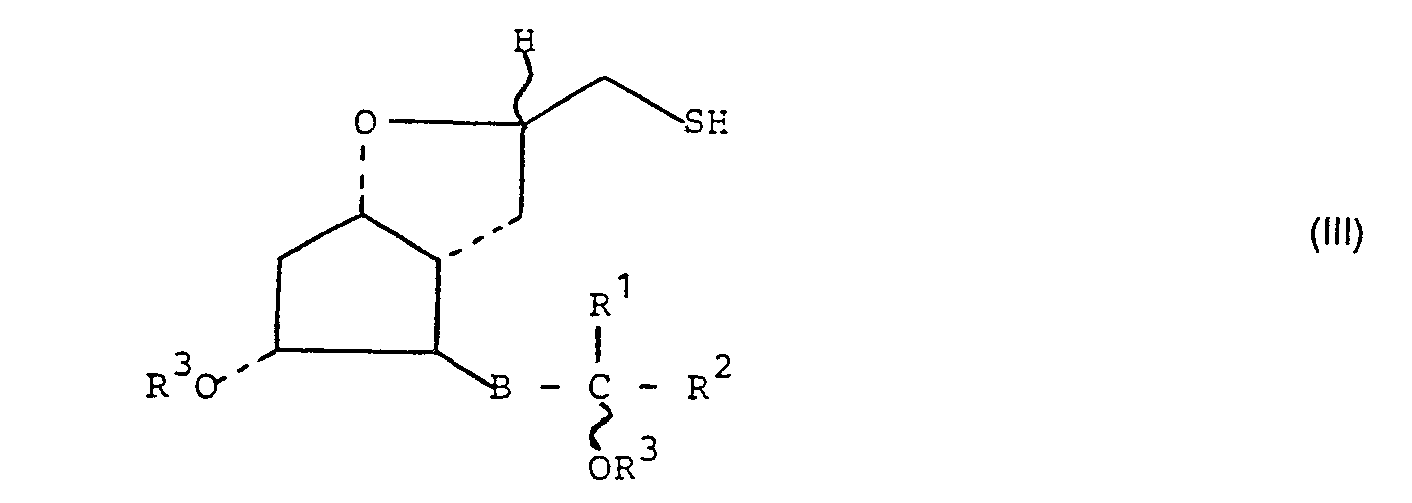
- the compounds of the general formula II - preferably in C 1 -C 4 -alkanols or their aqueous mixtures - are reacted at 25 to 120 ° C. with thiourea, alkali metal sulfide, alkali metal hydrogen sulfide or hydrogen sulfide and the product formed by basic hydrolysis and thereon following acidification or acid treatment converted into a thiol of the general formula III.
- the halogen compounds of the general formula II are reacted with a salt of mercaptoacetic acid, preferably with sodium mercaptoacetate, compounds of the general formula in which B, R 1 , R 2 and R 3 have the meaning given above, which give the thiols of the general formula III after alkaline hydrolysis.
- the thiols of the general formula III are either with ethylene compounds of the general formula V in the presence of a catalytic amount of alkali metal hydroxides or alkylimetal alcoholates, preferably sodium ethylate, or tertiary amines, preferably triethylamine or pyridine, or with alkyl halides of the general formula VI in the presence of an equivalent or a little excess Amount of base in C 1 -C 4 alkanol or preferably reacted in acetone.
- alkali metal hydroxides or alkylimetal alcoholates preferably sodium ethylate, or tertiary amines, preferably triethylamine or pyridine
- alkyl halides of the general formula VI in the presence of an equivalent or a little excess Amount of base in C 1 -C 4 alkanol or preferably reacted in acetone.
- reaction in C 1 -C 4 alkanols for. B. ethanol, or in a mixture of alkanols and water preferably at 25 to 70 ° C.
- m-chloro-perbenzoic acid or peracetic acid can be used as peracids.
- the reactions indicated as additional reactions of the compounds of general formula I, such as. B. the esterification, salt formation, amidation, hydrolysis or reduction can be carried out in a conventional manner. So z. B. in the compounds obtained, the ester groups can be converted by alkaline hydrolysis into the free carboxyl groups or their salt or into the free hydroxyl groups. The free carboxyl groups can be esterified or amidated in a manner known per se. After dehydrogenation of the amides, nitriles can be obtained and free acids can be obtained from the nitriles or amides by hydrolysis.
- the R f value of the starting compound is 0.53 and the R f value of the end product is 0.47 on silica gel (elution with a 1: 1 mixture of hexane and ethyl acetate).
- the reaction mixture is poured onto 40 ml of water at 0 ° C., extracted 3 times with 50 ml of ether each time, the ether solution is washed twice with 20 ml of cold water, with 20 ml of saturated sodium chloride solution, dried over magnesium sulfate and constricted.
- the title compound is obtained in the form of a viscous oil in an amount of 0.8-0.85 g (94-99%).
- the end product does not need to be purified for further processing, but it can - if necessary - be chromatographed on silica gel and eluted with a 1: 2 mixture of ethyl acetate and hexane.
- the thiuronium salt formed remains practically at the starting point.
- the ethanol is removed by concentration on a rotary evaporator, the residue is dissolved in 5 ml of a 1 M aqueous sodium hydroxide solution and the mixture is stirred at 80 ° C. for 4 hours.
- reaction mixture is diluted with 10 ml of water, acidified with 2 ml of 1 M aqueous sodium hydrogen sulfate solution and extracted 3 times with 30 ml of ether each time.
- the ether solution is washed with 10 ml of saturated sodium chloride solution and dried over magnesium sulfate. After the solvent has been distilled off, 1.063 g (94.7%) of the title compound is obtained as an oil.
- R f 0.33, eluent: 1: 1 mixture of hexane and acetate.
- Example 2 0.601 g (0.022 mol) of the product obtained in Example 2 is dissolved in 20 ml of anhydrous ethanol and the solution is first mixed with 0.8 ml of methyl acylate and then with stirring with a few drops of a 5% ethanolic sodium ethylate solution. The reaction is complete in 1 to 2 hours at room temperature. The course of the reaction is observed on a thin layer of silica gel with a 1: 1 mixture of hexane and acetone as the eluent. Rf of the target compound: 0.33 and the starting compound: 0.27.
- the ethanol is removed from the reaction mixture by evaporation on a rotary evaporator and the residue is chromatographed on a 100 g silica gel column using a 1: 1 mixture of hexane and acetone as the eluent.
- the methanol is then removed in vacuo on a rotary evaporator, the residue obtained is acidified with 1 ml of 1 M aqueous sodium hydrogen sulfate solution and extracted with 30 ml of a 1: 1 mixture of ether and ethyl acetate.
- the organic solution thus obtained is washed twice with 5 ml of saturated sodium chloride solution and dried over magnesium sulfate. After removal of the solvent, 0.360 g (96.6%) of the title compound is obtained as a residue as a crystalline substance which can be recrystallized from a mixture of ether and hexane or ethyl acetate and hexane.
- R f 0.18, eluent: 20: 10: 1 mixture of benzene, dioxane and acetic acid.
Landscapes
- Chemical & Material Sciences (AREA)
- Organic Chemistry (AREA)
- Health & Medical Sciences (AREA)
- Life Sciences & Earth Sciences (AREA)
- General Health & Medical Sciences (AREA)
- Veterinary Medicine (AREA)
- Chemical Kinetics & Catalysis (AREA)
- General Chemical & Material Sciences (AREA)
- Medicinal Chemistry (AREA)
- Nuclear Medicine, Radiotherapy & Molecular Imaging (AREA)
- Bioinformatics & Cheminformatics (AREA)
- Pharmacology & Pharmacy (AREA)
- Engineering & Computer Science (AREA)
- Animal Behavior & Ethology (AREA)
- Public Health (AREA)
- Heart & Thoracic Surgery (AREA)
- Cardiology (AREA)
- Pulmonology (AREA)
- Organic Low-Molecular-Weight Compounds And Preparation Thereof (AREA)
- Pharmaceuticals Containing Other Organic And Inorganic Compounds (AREA)
- Furan Compounds (AREA)
- Steroid Compounds (AREA)
- Saccharide Compounds (AREA)
- Detergent Compositions (AREA)
Description
- Die Erfindung betrifft neue, biologisch aktive und therapeutisch verwendbare 4-Thia- und 4-Sulfinyl-PGl1-Derivate der allgemeinen Formel

- Q -S- oder -SO-,
- A geradkettiges oder verzweigtes C1-Ca-Alkylen,
- B Äthylen, Vinylen oder Äthinylen,
- R1 Wasserstoff oder C1-C4-Alkyl,
- R2 geradkettiges oder verzweigtes C1-C8-Alkyl oder gegebenenfalls durch Chlor oder Methoxy monosubstituiertes Aryloxymethyl,
- R3 Wasserstoff oder Acetyl und
- Z -COOH, -CN, -CH20H oder -COOW bedeuten, worin W ein Äquivalent eines pharmakologisch verträglichen Kations oder ein C1-C4-Alkyl ist.
- In der allgemeinen Formel I kann das Wasserstoffatom des 3-Kohlenstoffatoms der 2-Oxa-bi- cyclo[3.3.0]octan-Struktur sterische a- oder ß- (Exo oder Endo) Konfiguration haben. Die Erfindung umfaßt beide Epimer-Reihen. Außerdem kann die Hydroxylgruppe der Seitenkette am 6-Kohlenstoffatom der 2-Oxa-bicyclo[3.3.0]octan-Struktur S- oder R-Konfiguration aufweisen.
- Die Verbindungen der Erfindung können in Form von Racematen oder optisch aktiven Enantiomeren vorliegen.
- Ein wichtiger Vertreter der 1976 entdecken endogenen Prostaglandine ist das Prostacyclin (PGI2), das eine bedeutende biologische Wirksamkeit aufweist (Prostacyclin, ed. : J.R. Vane und S. Bergström, Raven Press, N.Y., 1979).
- Vom therapeutischen Standpunkt ist die die Thrombocytenaggregation hemmende, die peripheren Gefäße erweiternde und die cytoprotektive Wirkung des Prostacyclins sehr bedeutend. Die therapeutische Nutzung dieser biologischen Wirkungen wird jedoch durch die außerordentlich große Instabilität des Prostacyclins stark beschränkt. Seine Halbzeit in wäßriger Lösung bei neutralem pH beträgt nämlich nur 3,5 Minuten. Infolgedessen sind vom therapeutischen Standpukt dem Prostacyclin alle die Verbindungen vorzuziehen, die bei etwa gleicher biologischer Aktivität eine größere Stabilität als das Prostacyclin aufweisen.
- Es wurde überraschenderweise gefunden, daß die Verbindungen der allgemeinen Formel I diesen Kriterien entsprechen. Sie hemmen die Thrombocytenaggregation, sie führen eine Erweiterung der vorzugsweise peripheren Gefäße und der Bronchien herbei, und sie üben eine Schutzwirkung auf die Magenschleimhaut aus. Sie zeigen damit praktisch die gleiche biologische Aktivität wie das Prostacyclin, zeichnen sich aber gleichzeitig durch eine viel größere Stabilität aus. Thermisch und hydrolytisch sind die Verbindungen der Erfindung in einem extrem großen pH-Bereich stabil. Außerdem zeigen die einzelnen Vertreter der Verbindungen der allgemeinen Formel I - je nach ihrer Struktur - auf den genannten Wirkungsgebieten eine höhere Selektivität als das Prostacyclin.
- Die mit den Verbindungen der Erfindung erzielte Hemmwirkung auf die mit ADP (Adenosindiphosphat) bzw. Kollagen erzeugte Thrombocytenaggregation wurde nach Born untersucht. Die Wirkstoffkonzentration, die in 50% die Aggregation des an Thrombocyten angereicherten Humanplasmas (PRP) hemmt, ist in der nachstehenden Tabelle angegeben.

- Die haemodynamische Wirkung der Wirkstoffe wurde an Katzen untersucht. Den Ergebnissen ist zu entnehmen, daß das 4-Thia-PGl1 erst in einer Dosis von 100 µg/kg den Kreislauf in dem gleichen Maße beeinflußt, wie PGl2 in einer Dosis von 1 µg/kg. Dies zeigt, daß die unerwünschten Nebenwirkungen bei den Verbindungen der Erfindung wesentlich geringer sind.
- Das 4-Thia-PGII erzeugt eine Erschlaffung der Trachea des Meerschweinchens. Die Relaxation kann mit Inderal (1-Isopropylamino-3-[1-naphthyloxy]-propan-2-ol) nicht gehemmt werden. Das Maß der Relaxation betrug :
- bei einer Dosis von 1 µg/ml 4-Thia-PGl1 = 50 %,
- bei einer Dosis von 10 µg/ml 4-Thia-PGl1 = 83 %.
- Die Erfindung betrifft auch pharmazeutische Präparate, die als Wirkstoff mindestens eine der Verbindungen der allgemeinen Formel I enthalten. Zur Herstellung der pharmazeutischen Präparate können die üblichen Hilfsstoffe, wie z. B. Füllmittel, Zusätze, die den Geschmack und den Geruch verbessern, die die Formulierung erleichtern, die den pH und den osmotischen Druck regulieren, Stabilisierungsmittel und/oder Resorptionsbeschleuniger, dem Wirkstoff oder den Wirkstoffen zugegeben werden. Die Präparate können, ebenso wie die Hilfsstoffe, fest, halb-flüssig oder flüssig sein. Als feste Präparate sind z. B. Tabletten, Kapseln, Pillen, Dragees, Pulver, als flüssige Präparate, Infusionen, Inhalations- und Injektionslösungen, Umschlaglösungen, Löffelarzneien, Tropfen usw. und als halbflüssige Präparate Creme, Salben, Suppositorien Balsam usw. zu nennen. Die Lösungen, Emulsionen können unter Verwendung bekannter Trägergase in Sprayform zubereitet werden.
- Die erforderliche Dosierung der Wirkstoffe hängt von der Schwere der Erkrankung, der Geschwindigkeit der Resorption des Arzneimittels, der Empfindlichkeit des zu behandelnden Objektes oder Organs oder dessen Reaktionsfähigkeit ab. Sie variiert gewöhnlich zwischen etwa 1 µg/kg und 100 mg/kg.
- Die Erfindung betrifft ferner die Herstellung der 4-Thia- und 4-Sulfinyl-PGl1-Verbindungen der Formel I, wobei man vorzugsweise von einer Verbindung der allgemeinen Formel

- Hierbei wird gemäß Erfindung so verfahren, daß man die Verbindung der allgemeinen Formel II entweder
- a) mit Thioharnstoff, Alkalimetallsulfid, Alkalimetallhydrogensulfid, Schwefelwasserstoff oder einem Salz der Mercaptoessigsäure umsetzt und mit Säure behandelt, wobei das Halogenatom der Halogenverbindung der allgemeinen Formel II durch -SH ersetzt wird, und das erhaltene Thiol der allgemeinen Formel


- b) zur Herstellung von Verbindungen der allgemeinen Formel I, in der Z -COOH ist, mit einem Salz einer Mercaptosäure der allgemeinen Formel

- wobei die nach Verfahrensvariante a) oder b) erhaltene 4-Thia-Verbindung der allgemeinen Formel I (Q = ―S―) gewünschtenfalls durch Oxydation in die entsprechende 4-Sulfinyl-Verbindung der allgemeinen Formel I (Q = -SO-) und/oder durch Veresterung, Amidierung, Salzbildung, Hydrolyse und/oder Reduktion in eine andere Verbindung der allgemeinen Formel I übergeführt werden kann.
- Gemäß Verfahrensvariante a) werden die Verbindungen der allgemeinen Formel II - vorzugsweise in C1-C4-Alkanolen oder deren wäßrigen Gemischen - bei 25 bis 120 °C mit Thioharnstoff, Alkalimetallsulfid, Alkalimetallhydrogensulfid oder Schwefelwasserstoff umgesetzt und das entstandene Produkt durch basische Hydrolyse und darauf folgendes Ansäuern oder saure Behandlung in ein Thiol der allgemeinen Formel III übergeführt.
- Nach einer bevorzugten Verfahrensweise werden die Halogenverbindungen der allgemeinen Formel II mit einem Salz der Mercaptoessigsäure, vorzugsweise mit Natrium-mercaptoacetat, umgesetzt, wobei Verbindungen der allgemeinen Formel

- Die Thiole der allgemeinen Formel III werden entweder mit Äthylenverbindungen der allgemeinen Formel V in Gegenwart einer katalytischen Menge von Alkalimetallhydroxyden oder Alkylimetallalkoholaten, vorzugsweise Natriumäthylat, oder tertiären Aminen, vorzugsweise Triäthylamin oder Pyridin, oder mit Alkylhalogeniden der allgemeinen Formel VI in Gegenwart einer äquivalenten oder etwas überschüssigen Menge an Base in C1-C4-Alkanol oder vorzugsweise in Aceton umgesetzt.
- Gemäß Verfahrensvariante b) wird die Umsetzung in C1-C4-Alkanolen, z. B. Äthanol, oder in einem Gemisch von Alkanolen und Wasser vorzugsweise bei 25 bis 70 °C durchgeführt.
- Die Salze der Mercaptocarbonsäuren sind ambidente nucleophile Reagenzien. Da aber die Reaktion des « weichen » Thiolat-lons an dem Kohlenstoffatom, das ebenfalls ein « weiches » elektrophiles Halogenatom trägt, sehr viel stärker « begünstigt als die des « harten nucleophilen Carboxylations ist, entsteht nur die Verbindung der allgemeinen Formel I (Diese Reaktion ist in J. Chem. Educ. 1968, 45, S. 581 und 683 ausführlich beschrieben).
- Die erhaltenen 4-Thia-Verbindungen der allgemeinen Formel I (Q = ―S―) werden in bekannten Lösungsmitteln, vorzugsweise in chlorierten Kohlenwasserstoffen, z. B. Dichlormethan, durch Oxydation mit organischen Persäuren in die entsprechenden 4-Sulfinyl-Verbindungen der allgemeinen Formel I (Q = ―SO―) übergeführt. Als Persäuren können vorzugsweise m-Chlor-perbenzoesäure oder Peressigsäure verwendet werden.
- Die als zusätzliche Reaktionen der Verbindungen der allgemeinen Formel I angegebenen Reaktionen, wie z. B. die Veresterung, Salzbildung, Amidierung, Hydrolyse oder Reduktion können in an sich bekannter Weise durchgeführt werden. So können z. B. in den erhaltenen Verbindungen die Estergruppen durch alkalische Hydrolyse in die freien Carboxylgruppen, bzw. deren Salz oder in die freien Hydroxylgruppen übergeführt werden. Die freien Carboxylgruppen können in an sich bekannter Weise verestert bzw. amidiert werden. Nach Dehydrierung der Amide kann man Nitrile und aus den Nitrilen bzw. Amiden kann man durch Hydrolyse freie Säuren erhalten.
- Weitere Einzelheiten der Erfindung sind den folgenden Beispielen zu entnehmen.
- In 10 ml wasserfreiem Aceton löst man 0,956 g (0,002 Mol) 3ß-Jodmethyl-6ß-(3a-acetoxy-oct-1-trans- enyl)-7α-acetoxy-cis-2-oxa-bicyclo[3.3.0]octan (Verbindung der Formel II : X = Jod ; B, R1, R2, R3 wie oben angegeben), gibt unter Rühren 0,21 g (0,204 Mol) Natriummercaptoacetat zu und erhitzt das Reaktionsgemisch unter Rühren auf einem Bad von 60 °C. Die Reaktion wird mittels Dünnschichtchromatographie beobachtet. Der Rf-Wert der Ausgangsverbindung beträgt 0,53 und der Rf-Wert des Endproduktes beträgt 0,47 an Kieselgel (Elution mit einem 1 : 1 Gemisch von Hexan und Äthylacetat). Nach Verbrauch der Ausgangsverbindung wird das Reaktionsgemisch auf 40 ml Wasser von 0 °C gegossen, 3-mal mit je 50 ml Äther extrahiert, die Ätherlösung 2-mal mit je 20 ml kaltem Wasser, mit 20 ml gesättigter Natriumchloridlösung gewaschen, über Magnesiumsulfat getrocknet und eingeengt. Die Titelverbindung wird in Form eines zähen Öls in einer Menge von 0,8-0,85 g (94-99 %) erhalten. Das Endprodukt braucht für die weitere Verarbeitung nicht gereinigt zu werden, aber es kann - falls erforderlich - an Kieselgel chromatographiert und mit einem 1 : 2 Gemisch von Äthylacetat und Hexan eluiert werden.
- Rf : 0,26 (1 : 2 Gemisch von Äthylacetat und Hexan)
- H1-NMR(CDCl3) : 5,48 (m, 2H), 5,18 (m, 1H), 4,75 (q, 1H), 4,48 (m, 1 H), 4,15 (m, 1H), 3,09 (dd, 2H), 2,34 (s, 3H), 2,03 (s, 3H), 2,00 (s, 3H), 0,87 (t, 3H) ppm.
- Man löst 1,472 g 3β-Jodmethyl-6β-(3α-hydroxy-oct-1-trans-enyl)-7α-hydroxy-cis-2-oxa-bi- cyclo[3.3.0]octan (Verbindung der Formel II : X = Jod ; B, R1, R2, R3 wie oben angegeben) in 5 ml wasserfreiem Äthanol, gibt 0,3 g Thioharnstoff zu der Lösung und erhitzt die Lösung unter Rühren und unter Rückfluß bis zum Verbrauch der Ausgangsverbindung. Die Reaktion ist nach 60 bis 80 Stunden beendet. Der Rf-Wert der Jodverbindung der Formel II beträgt 0,38 (Elution mit einem 1 : 1 Gemisch von Hexan und Aceton). Das gebildete Thiuronium-Salz bleibt praktisch am Startpunkt. Nach Beendigung der Reaktion wird das Äthanol durch Einengen auf einem Rotationsverdampfer entfernt, der Rückstand in 5 ml einer 1 M wäßrigen Natriumhydroxydlösung gelöst und 4 Stunden bei 80 °C gerührt.
- Nach Abkühlen verdünnt man das Reaktionsgemisch mit 10 ml Wasser, säuert es mit 2 ml 1 M wäßriger Natriumhydrogensulfatlösung an und extrahiert es 3-mal mit je 30 ml Äther. Die Ätherlösung wird mit 10 ml gesättigter Natriumchloridlösung gewaschen und über Magnesiumsulfat getrocknet. Nach dem Abdestillieren des Lösungsmittels erhält man 1,063 g (94,7 %) der Titelverbindung als Öl. Rf = 0,33, Elutionsmittel : 1 : 1 Gemisch von Hexan und Acetat.
- Das erhaltene Produkt liefert nach Behandeln mit 2 ml Acetanhydrid in 5 ml Pyridin bei Raumtemperatur für 14 Stunden ein mit dem Produkt des Beispiels 1 identisches Triacetylderivat.
- 0,601 g (0,022 Mol) des in Beispiel 2 erhaltenen Produktes löst man in 20 ml wasserfreiem Äthanol und versetzt die Lösung zunächst mit 0,8 ml Acylsäuremethylester und dann unter Rühren mit ein paar Tropfen einer 5 %igen äthanolischen Natriumäthylatlösung. Die Reaktion ist bei Raumtemperatur in 1 bis 2 Stunden beendet. Der Verlauf der Reaktion wird an einer Kieselgel-Dünnschicht mit einem 1 : 1 Gemisch von Hexan und Aceton als Elutionsmittel beobachtet. Rf-Wert der Zielverbindung : 0,33 und der Ausgangsverbindung : 0,27. Nach Beendigung der Reaktion wird das Äthanol aus dem Reaktionsgemisch durch Eindampfen auf einem Rotationsverdampfer entfernt und der Rückstand an einer 100 g Kieselgelsäule mit einem 1 : 1 Gemisch von Hexan und Aceton als Elutionsmittel chromatographiert.
- Man erhält 0,678 g (88 %) 4-Thia-ß-PGI1-methylester.
- H1-NMR(CDCl3) : 5,5 (m, 2H), 4,43 (q, 1H), 4,16 (m, 1H), 4,06 (m, 1H), 3,66 (s, 3H), 3,61 (m, 1H), 2,84-2,85 (m, 7H), 2,5-1,15 (m, 15H), 0,84 (t, 3H) ppm.
- Es wird wie in Beispiel 3 verfahren aber statt Acrylsäuremethylester 0,8 ml Crotonsäuremethylester verwendet. Die Titelverbindung erhält man in einer Ausbeute von 66 % in Form eines chromatographisch nicht trennbaren Epimerengemisches. Die Komponenten unterscheiden sich in der absoluten sterischen Konfiguration des Methylsubstituenten am 3-Kohlenstoffatom. Rf = 0,31, mit einem 1 : 1 Gemisch von Hexan und Aceton.
- H1-NMR(CDCl3) : 5,53 (m, 2H), 4,45 (q, 1 H), 4,25-3,97 (m, 2H), 3,67 (s, 3H), 3,60 (m, 1 H), 3,22 (m, 1 H), 2,56-1,18 (m, 20H), 1,33 (2d, 3H, J = 7,5 Hz), 0,87 (t, 3H) ppm.
- Es wird wie in Beispiel 3 verfahren aber statt Acrylsäuremethylester 0,8 ml Acrylonitril verwendet. Man erhält 0,629 g (89 %) der Titelverbindung in Form eines farblosen Öls. Rf = 0,21. Elutionsmittel : 1 : 1 Gemisch von Aceton und Hexan.
- IR (Film) : 3 300-3 100 (assoziiertes OH), 2 190 (C = N) cm-1
- 0,386 g (0,001 Mol) des nach Beispiel 3 hergestellten 4-Thia-β-PGl1-methylesters löst man in 10 ml Methanol, gibt unter Rühren 2 ml 0,5 M Natriumhydroxydlösung zu und läßt das Reaktionsgemisch 24 Stunden bei Raumtemperatur stehen. Während dieser Zeit wird der Ester vollkommen verseift (auf dem Dünnschichtchromatogramm - Elutionsmittel = 1 : 1 Gemisch von Hexan und Aceton - verschwindet der dem Ester entsprechende Fleck Rf = 0,27 und ein sich von dem Startpunkt kaum bewegender Fleck erscheint). Danach wird das Methanol im Vakuum auf einem Rotationsverdampfer entfernt, der erhaltene Rückstand mit 1 ml 1 M wäßriger Natriumhydrogensulfatlösung angesäuert und mit 30 ml eines 1 : 1 Gemisches von Äther und Äthylacetat extrahiert. Die so erhaltene organische Lösung wird 2-mal mit je 5 ml gesättigter Natriumchloridlösung gewaschen und über Magnesiumsulfat getrocknet. Nach Entfernung des Lösungsmittels erhält man als Rückstand 0,360 g (96,6 %) der Titelverbindung als kristalline Substanz, die aus einem Gemisch von Äther und Hexan oder Äthylacetat und Hexan umkristallisiert werden kann.
- Rf = 0,18, Elutionsmittel : 20 : 10 : 1 Gemisch von Benzol, Dioxan und Essigsäure.
- Man löst 1,00 g (0,002 6 Mol) des nach Beispiel 3 hergestellten 4-Thia-β-PGl1-methylesters in 20 ml wasserfreiem Dichlormethan, kühlt die Lösung auf 0 °C und gibt unter Rühren in kleinen Portionen 0,55 g (0,003 2 Mol) 3-Chlor-perbenzoesäure innerhalb von 15 Minuten zu. Nach weiterem Rühren von 30 Minuten wird die Lösung in einem Schütteltrichter mit 5 ml gesättigter Natriumhydrogencarbonatlösung, 5 ml 5 %iger Natriumhydrogensulfatlösung und 2 mal mit je 5 ml Wasser ausgeschüttelt bzw. gewaschen. Das Gemisch wird über Magnesiumsulfat getrocknet und das Lösungsmittel im Vakuum entfernt. Man erhält 0,845 g (81 %) Rohprodukt.
- Rf = 0,106, an Kieselgel ; Elutionsmittel : 1 : 2 Gemisch von Aceton und Hexan.
Claims (9)

dadurch gekennzeichnet, daß man eine Halogenverbindung der allgemeinen Formel

entweder


oder
in der
mit einem Salz einer Mercaptocarbonsäure der allgemeinen Formel

Priority Applications (1)
| Application Number | Priority Date | Filing Date | Title |
|---|---|---|---|
| AT81108959T ATE11138T1 (de) | 1980-10-28 | 1981-10-27 | 4-thia- und 4-sulfinyl-pgi1-derivate, verfahren zu deren herstellung sowie diese verbindungen enthaltende pharmazeutische praeparate. |
Applications Claiming Priority (2)
| Application Number | Priority Date | Filing Date | Title |
|---|---|---|---|
| HU802596A HU183238B (en) | 1980-10-28 | 1980-10-28 | Process for preparing 4-thia- and 4-sulphinyl-pgi down 1 further derivatives thereof |
| HU259680 | 1980-10-28 |
Publications (2)
| Publication Number | Publication Date |
|---|---|
| EP0051247A1 EP0051247A1 (de) | 1982-05-12 |
| EP0051247B1 true EP0051247B1 (de) | 1985-01-09 |
Family
ID=10960188
Family Applications (1)
| Application Number | Title | Priority Date | Filing Date |
|---|---|---|---|
| EP81108959A Expired EP0051247B1 (de) | 1980-10-28 | 1981-10-27 | 4-Thia- und 4-Sulfinyl-PGI1-Derivate, Verfahren zu deren Herstellung sowie diese Verbindungen enthaltende pharmazeutische Präparate |
Country Status (12)
| Country | Link |
|---|---|
| US (1) | US4379164A (de) |
| EP (1) | EP0051247B1 (de) |
| JP (1) | JPS5799581A (de) |
| AT (1) | ATE11138T1 (de) |
| CS (1) | CS224628B2 (de) |
| DD (1) | DD201791A5 (de) |
| DE (1) | DE3168198D1 (de) |
| DK (1) | DK474481A (de) |
| FI (1) | FI813374L (de) |
| HU (1) | HU183238B (de) |
| PL (1) | PL135452B1 (de) |
| SU (1) | SU1053746A3 (de) |
Families Citing this family (2)
| Publication number | Priority date | Publication date | Assignee | Title |
|---|---|---|---|---|
| JPS57165383A (en) * | 1981-04-06 | 1982-10-12 | Teijin Ltd | Prostaglandin i1 derivative and its preparation |
| EP1609398A1 (de) | 2004-06-25 | 2005-12-28 | Nestec S.A. | Method for improving the production of steam during the preparation of drinks starting from a cartridge and device for carrying out the method |
Family Cites Families (1)
| Publication number | Priority date | Publication date | Assignee | Title |
|---|---|---|---|---|
| US4125713A (en) * | 1976-06-01 | 1978-11-14 | The Upjohn Company | Certain 5,6-dihydra-prostacyclin analogs |
-
1980
- 1980-10-28 HU HU802596A patent/HU183238B/hu not_active IP Right Cessation
-
1981
- 1981-10-20 CS CS817688A patent/CS224628B2/cs unknown
- 1981-10-23 US US06/314,433 patent/US4379164A/en not_active Expired - Fee Related
- 1981-10-27 AT AT81108959T patent/ATE11138T1/de not_active IP Right Cessation
- 1981-10-27 DK DK474481A patent/DK474481A/da not_active Application Discontinuation
- 1981-10-27 DD DD81234390A patent/DD201791A5/de unknown
- 1981-10-27 JP JP56171962A patent/JPS5799581A/ja active Granted
- 1981-10-27 DE DE8181108959T patent/DE3168198D1/de not_active Expired
- 1981-10-27 PL PL1981233590A patent/PL135452B1/pl unknown
- 1981-10-27 EP EP81108959A patent/EP0051247B1/de not_active Expired
- 1981-10-28 SU SU813346253A patent/SU1053746A3/ru active
- 1981-10-28 FI FI813374A patent/FI813374L/fi not_active Application Discontinuation
Also Published As
| Publication number | Publication date |
|---|---|
| SU1053746A3 (ru) | 1983-11-07 |
| DE3168198D1 (en) | 1985-02-21 |
| FI813374A7 (fi) | 1982-04-29 |
| US4379164A (en) | 1983-04-05 |
| HU183238B (en) | 1984-04-28 |
| PL233590A1 (de) | 1982-12-20 |
| ATE11138T1 (de) | 1985-01-15 |
| FI813374L (fi) | 1982-04-29 |
| JPS5799581A (en) | 1982-06-21 |
| DD201791A5 (de) | 1983-08-10 |
| JPH038351B2 (de) | 1991-02-05 |
| EP0051247A1 (de) | 1982-05-12 |
| PL135452B1 (en) | 1985-10-31 |
| CS224628B2 (en) | 1984-01-16 |
| DK474481A (da) | 1982-04-29 |
Similar Documents
| Publication | Publication Date | Title |
|---|---|---|
| DE3116066C2 (de) | Hydronaphthalinderivate, deren Epoxide und diese Verbindungen enthaltende Arzneimittel | |
| DD202697A5 (de) | Verfahren zur herstellung von alkansaeuren und deren derivate | |
| CH648286A5 (de) | Prostaglandinderivate, ihre herstellung und diese derivate enthaltende pharmazeutische zusammensetzungen. | |
| DE2858726C2 (de) | Arzneimittel zur senkung des serumcholesterinspiegels | |
| DE2440606A1 (de) | Polyenverbindungen | |
| US3636120A (en) | Prostaglandin e primary alcohols | |
| EP0099538B1 (de) | Neue Carbacycline, Verfahren zu ihrer Herstellung und ihre Verwendung als Arzneimittel | |
| DE1804691C3 (de) | Taurocholensäurederivate | |
| DE3107743A1 (de) | Neue klasse von acylderivaten des carnitins, verfahren zu deren herstellung sowie ihre therapeutische verwendung | |
| EP0051247B1 (de) | 4-Thia- und 4-Sulfinyl-PGI1-Derivate, Verfahren zu deren Herstellung sowie diese Verbindungen enthaltende pharmazeutische Präparate | |
| DE3925496A1 (de) | (rs)-2-(2,3-dihydro-5-hydroxy-4,6,7-trimethylbenzofuranyl)-essigsaeuren und 2-(2,3-dihydro-5-acyloxy-4,6,7-trimethylbenzofuranyl)-essigsaeuren sowie deren ester, die als mucoregulatoren und anti-ischaemische wirkstoffe verwendbar sind, sowie deren herstellungsverfahren | |
| DE2347172A1 (de) | Prostaglandin e tief 1-synthese | |
| EP0001270A1 (de) | Neue Prostacyclin-Analoga, Verfahren zu ihrer Herstellung und ihre Verwendung bei der Behandlung von Herzkreislauf-Krankheiten | |
| EP0013955B1 (de) | Neue Analoga von Prostacyclin, deren Zwischenprodukte, Verfahren zu ihrer Herstellung sowie sie enthaltende Arzneimittel | |
| DE3029984C2 (de) | 2-Oxabicyclo [3.3.0] octanderivate und diese enthaltende Arzneimittel | |
| EP0112502B1 (de) | Omega,omega-Diacyloxy-2,6-dimethyl-octatriensäureester und -aldehyde, Verfahren zu ihrer Herstellung und Verwendung zur Synthese von Terpenverbindungen | |
| CH623570A5 (de) | ||
| EP0031426B1 (de) | 7-Oxo-PGI2-derivate, Verfahren zu deren Herstellung sowie diese Verbindungen enthaltende pharmazeutische Präparate | |
| EP0004335A2 (de) | Neue Analoga von Prostacyclin, Verfahren und Zwischenprodukte zu ihrer Herstellung und ihre Verwendung als Arzneimittel | |
| DE69303333T2 (de) | Substituierte Benzoate-Derivate | |
| DE4447594A1 (de) | Neue pharmakologisch wirksame, enantiomere Sesquiterpene und pharmazeutische Zubereitungen, enthaltend diese Verbindungen | |
| CH683340A5 (de) | Verfahren zur Herstellung von 2,2-Dimethyl-5-(2,5-Dimethylphenoxy)-Pentansäure. | |
| EP0063323B1 (de) | 5-Substituierte 4-Oxo-PGI1-Derivate, Verfahren zu deren Herstellung sowie diese Verbindungen enthaltende pharmazeutische Präparate | |
| CH639950A5 (de) | Verfahren zur herstellung von neuen 13-thiaprostansaeurederivaten. | |
| DE1593644C3 (de) |
Legal Events
| Date | Code | Title | Description |
|---|---|---|---|
| PUAI | Public reference made under article 153(3) epc to a published international application that has entered the european phase |
Free format text: ORIGINAL CODE: 0009012 |
|
| AK | Designated contracting states |
Designated state(s): AT BE CH DE FR GB IT LI NL SE |
|
| 17P | Request for examination filed |
Effective date: 19820703 |
|
| RAP1 | Party data changed (applicant data changed or rights of an application transferred) |
Owner name: CHINOIN GYOGYSZER ES VEGYESZETI TERMEKEK GYARA RT. |
|
| ITF | It: translation for a ep patent filed | ||
| GRAA | (expected) grant |
Free format text: ORIGINAL CODE: 0009210 |
|
| AK | Designated contracting states |
Designated state(s): AT BE CH DE FR GB IT LI NL SE |
|
| REF | Corresponds to: |
Ref document number: 11138 Country of ref document: AT Date of ref document: 19850115 Kind code of ref document: T |
|
| REF | Corresponds to: |
Ref document number: 3168198 Country of ref document: DE Date of ref document: 19850221 |
|
| ET | Fr: translation filed | ||
| PGFP | Annual fee paid to national office [announced via postgrant information from national office to epo] |
Ref country code: AT Payment date: 19850919 Year of fee payment: 5 |
|
| PGFP | Annual fee paid to national office [announced via postgrant information from national office to epo] |
Ref country code: NL Payment date: 19851031 Year of fee payment: 5 |
|
| PLBE | No opposition filed within time limit |
Free format text: ORIGINAL CODE: 0009261 |
|
| STAA | Information on the status of an ep patent application or granted ep patent |
Free format text: STATUS: NO OPPOSITION FILED WITHIN TIME LIMIT |
|
| 26N | No opposition filed | ||
| PG25 | Lapsed in a contracting state [announced via postgrant information from national office to epo] |
Ref country code: AT Effective date: 19861027 |
|
| PG25 | Lapsed in a contracting state [announced via postgrant information from national office to epo] |
Ref country code: SE Effective date: 19861028 |
|
| PG25 | Lapsed in a contracting state [announced via postgrant information from national office to epo] |
Ref country code: LI Effective date: 19861031 Ref country code: CH Effective date: 19861031 Ref country code: BE Effective date: 19861031 |
|
| BERE | Be: lapsed |
Owner name: CHINOIN GYOGYSZER ES VEGYESZETI TERMEKEK GYARA RT Effective date: 19861031 |
|
| PG25 | Lapsed in a contracting state [announced via postgrant information from national office to epo] |
Ref country code: NL Effective date: 19870501 |
|
| NLV4 | Nl: lapsed or anulled due to non-payment of the annual fee | ||
| PG25 | Lapsed in a contracting state [announced via postgrant information from national office to epo] |
Ref country code: FR Free format text: LAPSE BECAUSE OF NON-PAYMENT OF DUE FEES Effective date: 19870630 |
|
| REG | Reference to a national code |
Ref country code: CH Ref legal event code: PL |
|
| GBPC | Gb: european patent ceased through non-payment of renewal fee | ||
| PG25 | Lapsed in a contracting state [announced via postgrant information from national office to epo] |
Ref country code: DE Effective date: 19870701 |
|
| REG | Reference to a national code |
Ref country code: FR Ref legal event code: ST |
|
| PG25 | Lapsed in a contracting state [announced via postgrant information from national office to epo] |
Ref country code: GB Effective date: 19881118 |
|
| EUG | Se: european patent has lapsed |
Ref document number: 81108959.8 Effective date: 19870812 |