EP0031426B1 - 7-Oxo-PGI2-derivate, Verfahren zu deren Herstellung sowie diese Verbindungen enthaltende pharmazeutische Präparate - Google Patents
7-Oxo-PGI2-derivate, Verfahren zu deren Herstellung sowie diese Verbindungen enthaltende pharmazeutische Präparate Download PDFInfo
- Publication number
- EP0031426B1 EP0031426B1 EP80106884A EP80106884A EP0031426B1 EP 0031426 B1 EP0031426 B1 EP 0031426B1 EP 80106884 A EP80106884 A EP 80106884A EP 80106884 A EP80106884 A EP 80106884A EP 0031426 B1 EP0031426 B1 EP 0031426B1
- Authority
- EP
- European Patent Office
- Prior art keywords
- oxo
- methyl
- pgl
- alkyl
- general formula
- Prior art date
- Legal status (The legal status is an assumption and is not a legal conclusion. Google has not performed a legal analysis and makes no representation as to the accuracy of the status listed.)
- Expired
Links
Classifications
-
- C—CHEMISTRY; METALLURGY
- C07—ORGANIC CHEMISTRY
- C07D—HETEROCYCLIC COMPOUNDS
- C07D307/00—Heterocyclic compounds containing five-membered rings having one oxygen atom as the only ring hetero atom
- C07D307/77—Heterocyclic compounds containing five-membered rings having one oxygen atom as the only ring hetero atom ortho- or peri-condensed with carbocyclic rings or ring systems
- C07D307/93—Heterocyclic compounds containing five-membered rings having one oxygen atom as the only ring hetero atom ortho- or peri-condensed with carbocyclic rings or ring systems condensed with a ring other than six-membered
- C07D307/935—Not further condensed cyclopenta [b] furans or hydrogenated cyclopenta [b] furans
- C07D307/937—Not further condensed cyclopenta [b] furans or hydrogenated cyclopenta [b] furans with hydrocarbon or substituted hydrocarbon radicals directly attached in position 2, e.g. prostacyclins
-
- A—HUMAN NECESSITIES
- A61—MEDICAL OR VETERINARY SCIENCE; HYGIENE
- A61K—PREPARATIONS FOR MEDICAL, DENTAL OR TOILETRY PURPOSES
- A61K31/00—Medicinal preparations containing organic active ingredients
- A61K31/33—Heterocyclic compounds
- A61K31/335—Heterocyclic compounds having oxygen as the only ring hetero atom, e.g. fungichromin
- A61K31/34—Heterocyclic compounds having oxygen as the only ring hetero atom, e.g. fungichromin having five-membered rings with one oxygen as the only ring hetero atom, e.g. isosorbide
-
- A—HUMAN NECESSITIES
- A61—MEDICAL OR VETERINARY SCIENCE; HYGIENE
- A61P—SPECIFIC THERAPEUTIC ACTIVITY OF CHEMICAL COMPOUNDS OR MEDICINAL PREPARATIONS
- A61P1/00—Drugs for disorders of the alimentary tract or the digestive system
- A61P1/04—Drugs for disorders of the alimentary tract or the digestive system for ulcers, gastritis or reflux esophagitis, e.g. antacids, inhibitors of acid secretion, mucosal protectants
-
- A—HUMAN NECESSITIES
- A61—MEDICAL OR VETERINARY SCIENCE; HYGIENE
- A61P—SPECIFIC THERAPEUTIC ACTIVITY OF CHEMICAL COMPOUNDS OR MEDICINAL PREPARATIONS
- A61P11/00—Drugs for disorders of the respiratory system
-
- A—HUMAN NECESSITIES
- A61—MEDICAL OR VETERINARY SCIENCE; HYGIENE
- A61P—SPECIFIC THERAPEUTIC ACTIVITY OF CHEMICAL COMPOUNDS OR MEDICINAL PREPARATIONS
- A61P43/00—Drugs for specific purposes, not provided for in groups A61P1/00-A61P41/00
-
- A—HUMAN NECESSITIES
- A61—MEDICAL OR VETERINARY SCIENCE; HYGIENE
- A61P—SPECIFIC THERAPEUTIC ACTIVITY OF CHEMICAL COMPOUNDS OR MEDICINAL PREPARATIONS
- A61P7/00—Drugs for disorders of the blood or the extracellular fluid
- A61P7/02—Antithrombotic agents; Anticoagulants; Platelet aggregation inhibitors
-
- Y—GENERAL TAGGING OF NEW TECHNOLOGICAL DEVELOPMENTS; GENERAL TAGGING OF CROSS-SECTIONAL TECHNOLOGIES SPANNING OVER SEVERAL SECTIONS OF THE IPC; TECHNICAL SUBJECTS COVERED BY FORMER USPC CROSS-REFERENCE ART COLLECTIONS [XRACs] AND DIGESTS
- Y02—TECHNOLOGIES OR APPLICATIONS FOR MITIGATION OR ADAPTATION AGAINST CLIMATE CHANGE
- Y02P—CLIMATE CHANGE MITIGATION TECHNOLOGIES IN THE PRODUCTION OR PROCESSING OF GOODS
- Y02P20/00—Technologies relating to chemical industry
- Y02P20/50—Improvements relating to the production of bulk chemicals
- Y02P20/55—Design of synthesis routes, e.g. reducing the use of auxiliary or protecting groups
Definitions
- the new compounds of the general formula are biologically active compounds which can be regarded as stabilized analogs of the extraordinarily effective natural PGl 2 .
- PGl 2 prostacyclin
- PG1 2 prevents the aggregation of platelets even in quantities of nanograms and has a thrombolytic effect on the aggregated thrombus.
- PGl 2 is a very valuable pharmaceutical in the treatment of the disease of the century: thrombosis and abnormal hemostasis. The clinical use of this compound has already been described in a large number of articles.
- PGl 2 The biggest problem with the use of PGl 2 as a drug is its extremely strong instability. In acidic or neutral medium, PGl 2 decomposes to form 6-keto-PGF 1 ⁇ in equilibrium with the hemiketal form. PGl 2 contains a very reactive enol ether grouping, which is formed by the O atom of the furan ring and the 5,6 double bond in the side chain and which reacts equally strongly with the outer or inner proton source. As a result, PGl 2 is not stable in the form of the free acid, rather it is used in the form of its salts and esters in pharmacological and clinical studies.
- the very reactive enol ether configuration is not only the cause of the strong chemical instability of the natural PGl 2 , it is also the carrier of the strong aggregation inhibitory effect of the PGl 2 on the platelets.
- the development of new PGl 2 derivatives which have sufficient stability for practical use has usually been carried out by replacing the labile enol ether configuration by another chemically stable configuration and by balancing the two factors: loss of activity compared to the achieved molecular stability was to achieve an optimum.
- the aim of the invention was to produce no longer unstable PGl 2 derivatives, that is to say those derivatives which have sufficient stability for practical use as a pharmaceutical without changing the enol ether configuration which is important for the anti-aggregation effect.
- physiologically compatible cation is understood to mean any organic or inorganic cation that is not harmful in the doses used (toxic) effect.
- inorganic cations are: alkali ions, for example sodium, potassium or ammonium ions, or alkaline earth metal ions, for example calcium or magnesium ions.
- organic cations are: ammonium ions substituted by organic groups, preferably alkyl groups, the substituents of the ammonium ions being able to carry further substituents, for example hydroxyl groups or amino groups, in order to have a favorable effect on the solvency and crystallization capacity of the salts.
- An example of such a cation is the tris (hydroxymethyl) ammonium ion.
- the alkyl groups with 1-6 carbon atoms are to be understood as straight-chain or branched groups. Some examples are: methyl, ethyl and iso-propyl, n-, sec.-, tert.- and iso-butyl, the different pentyl and hexyl groups.
- the preferred alkyl groups contain 1-4 carbon atoms.
- the hydroxyl protective groups R 6 are to be understood as the protective groups known in prostaglandin chemistry, their introduction into the hydroxyl group and their removal can be carried out using the methods known from the literature.
- the introduction of the protective groups is expedient so that in the oxidation of the compounds of the general formula only the hydroxyl group in the 7-position is oxidized.
- the protective groups can be removed after the oxidation and after the elimination of the alcohol R 5 OH.
- Monosubstituted phenyl - instead of R 3 - may contain one or more of the substituents listed below - which may be the same or different in the presence of several substituents: optionally C 1-6 alkyl, hydroxyl, sulfhydryl, C 1 substituted by one or more halogen atoms -6 alkanoyloxy, benzoyloxy, amino, mono- or di-C 1 - 6 -alkylamino, halogen, C l - 6 alkoxy or C 1 - 6 -Akylthio.
- the compounds of the general formula 1 can be obtained, for example, from the compounds of the general formula wherein R 1 , R 2 , R 3 , X, Y and Q have the meaning given above, and Ac is acetyl, getting produced.
- the compounds of the general formula III are known [J. At the. Chem. Soc., 100, 6756 (1978)] or can be prepared from the corresponding starting compounds by the methods known from this publication.
- the compounds of the general formula III are reacted with a lower alcohol, preferably methanol, in the presence of a catalytic amount of an acid catalyst at -78 ° C. to + 25 ° C.
- a catalytic amount of an acid catalyst at -78 ° C. to + 25 ° C.
- Mineral acids, sulfonic acids or Lewis acids can be used as the acid catalyst; boron trifluoride etherate is preferred.
- Trialkylchlorosilanes e.g. Use dimethyl-tert-butyl-chlorosilane, trimethylchlorosilane, the dimethyl-tert-butyl-chlorosilane being used in aprotic solvents, preferably in dimethylformamide, in the presence of catalysts, preferably imidazole, and the trimethylchlorosilane in pyridine or in aprotic solvents , preferably in the presence of tertiary amines.
- the reaction temperature can be varied in a range between -20 and + 60 ° C.
- Ethyl vinyl ether, isopropenyl methyl ether in aprotic solvents, in particular in dichloromethane, are preferably used as the enol ether of the general formula VIII in the presence of a catalytic amount of an acid.
- Mineral acids, phosphoryl chloride, sulfonic acids, preferably p-toluenesulfonic acid, are used as catalysts.
- the reaction temperature can be varied in a range between -78 to + 50 ° C.
- the oxidation of the hydroxyl group in the 7-position of the compounds of the general formula where R 5 is replaced by hydrogen or is C 1-6 alkyl can with any oxidizing agent - which is capable of oxidizing a secondary hydroxyl group to the oxo group, for example Jones reagent, Collins reagent, thioanisole-chlorine complex, pyridinium chlorochromate etc. - with preference given to pyrimidinium chlorochromate - in aprotic solvents, preferably in chlorinated hydrocarbons , be performed.
- the reaction temperature can be varied between -40 and + 50 ° C.
- the protecting groups R 6 may, if desired, cleaved and the free 11- and 15-hydroxyl groups with a C 1-4 alkanoyl group may be acylated.
- the 7-oxo-PGl 2 derivatives of the general formula 1 are obtained from the 7-oxo derivatives of the general formula II by splitting off the alcohol of the general formula R 5- OH.
- R 6 can have the meaning of, for example, trialkylsilyl-, alkoxy-alkyl for the hydroxyl protective groups specified above.
- the compounds of general formula I in which R 13 is an R 6- protection - means group can be isolated after purification by column chromatography and if desired, after removal of the protective groups can be converted into compounds of general formula 1, in which R 13 is hydrogen.
- Trialkylsilyl protective groups are preferably removed with tetrabutylammonium fluoride in solvents of the ether type, preferably tetrahydrofuran, at a temperature of from -20 to + 50 ° C., preferably at room temperature.
- the 7-oxo-PGl 2 derivatives of the general formula 1 can be obtained by splitting off water, which is expediently carried out by azeotropic distillation is removed.
- azeotropic distillation is expediently carried out by boiling in aromatic hydrocarbons, preferably benzene, in the presence of water-binding agents, preferably anhydrous magnesium sulfate.
- the compounds of the general formula I in which R 13 is hydrogen and Q is lower alkyl are purified, for example by chromatography.
- the compounds of general formula 1 according to the invention inhibit the aggregation of platelets and have a thrombolytic effect, like natural PGl 2 .
- the new compounds inhibit the synthesis of thromboxane A 2 , the action of thromboxane A 2 , gastric acid secretion and influence some circulatory processes.
- the compounds can be used to cure asthma, myocardial infarction, thrombosis, gastric ulcers and vascular irregularities in mammals, especially humans.
- compositions of the invention which contain 7-oxo-PGl 2 derivatives as active substance, have a thrombolytic effect and can at the same time eliminate the risk of thrombi. This is of particular importance in blood preservation, in the perfusion of organs, tissues and in eliminating the risk of thrombosis after surgery.
- the contraction effect of the 7-oxo-PGl 2 derivative of the invention on the gastric fundus is 0.1 times greater than that of the PGl 2 .
- the 7-oxo-PGl 2 derivatives of the invention - as the data above show - are only slightly inferior to the natural PGl 2 , but in stability are significantly superior to what the use of the 7-oxo-PGl 2 derivatives in pharmaceutical preparations.
- the dose of the 7-oxo-PG1 2 derivatives of the general formula 1 per day is 100 ng to 100 mg, and depends on the level of the effect to be achieved and on the type of application, the sensitivity of the person treated, the animal, the organs and the tissue. With continuous infusion, a dose of 1 to 10 mg per day is generally sufficient.
- the preparations can be in liquid, semi-liquid form, in the form of ointments, pastes.
- Liquid preparations include solutions, emulsions or injectable solutions, infusion solutions, drops, and solid preparations include tablets, capsules, dragees, powders, boluses, powder ampoules, the usual diluents, diluents, additives for influencing the osmotic pressure, the pH value, of taste or aroma, lubricants, wetting agents, which may contain solubility-retarding agents.
- the invention thus also relates to pharmaceutical and laboratory preparations which contain 7-oxo-PGl 2 derivatives of the general formula I as active ingredient, for the anti-asthmatic treatment which inhibits aggregation, thrombosis and gastric secretion.
- the product obtained can be used for the further reaction without purification.
- the oil obtained as a residue is chromatographed on 15 g of silica gel with a 2: 1 mixture of benzene and ethyl acetate.
- Epi derivative is to be understood as a derivative in which the carbon atom identified by the number preceding “epi” bears a substituent whose configuration is opposite to that of the corresponding carbon atom of natural prostaglandins.
- the product obtained as a residue 250 mg, is dissolved in 5 ml of tetrahydrofuran, and the mixture obtained after adding 2 equivalents of the tetrabutylammonium fluoride is stirred at room temperature for three hours.
- the solvent is distilled off in vacuo and the residue in ethyl acetate solved.
- the ethyl acetate solution obtained is washed with water, then with saturated aqueous sodium chloride solution, dried over anhydrous sodium sulfate, filtered and finally the solvent is distilled off.
- the oil obtained as a residue is chromatographed on 10 g of silica gel with ethyl acetate.
- the free acids can be obtained from the alkali metal salt, e.g. the sodium salt, can be prepared by acidifying its aqueous solution with a strong organic or inorganic acid. The free acid is eliminated from the solution.
- the alkali metal salt e.g. the sodium salt
Landscapes
- Health & Medical Sciences (AREA)
- Chemical & Material Sciences (AREA)
- Organic Chemistry (AREA)
- Life Sciences & Earth Sciences (AREA)
- Veterinary Medicine (AREA)
- Public Health (AREA)
- General Health & Medical Sciences (AREA)
- Medicinal Chemistry (AREA)
- Animal Behavior & Ethology (AREA)
- Pharmacology & Pharmacy (AREA)
- General Chemical & Material Sciences (AREA)
- Nuclear Medicine, Radiotherapy & Molecular Imaging (AREA)
- Engineering & Computer Science (AREA)
- Chemical Kinetics & Catalysis (AREA)
- Bioinformatics & Cheminformatics (AREA)
- Diabetes (AREA)
- Hematology (AREA)
- Pulmonology (AREA)
- Epidemiology (AREA)
- Pharmaceuticals Containing Other Organic And Inorganic Compounds (AREA)
- Furan Compounds (AREA)
Description
- Die Erfindung betrifft neue optisch aktive oder racemische 7-Oxo-PG12-derivate der allgemeinen Formel
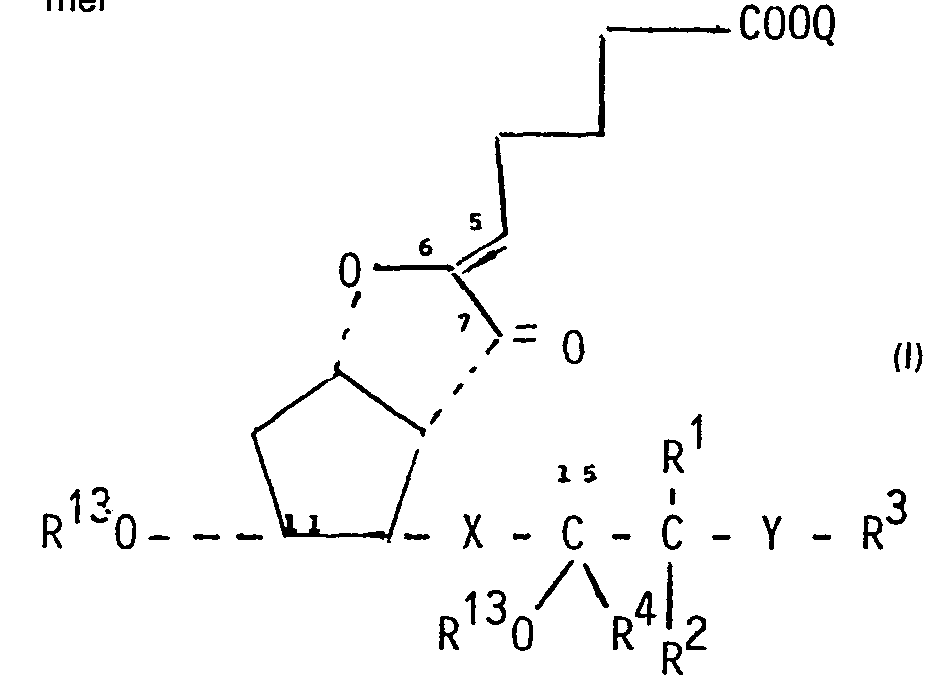
- Q Wasserstoff, ein physiologisch verträgliches Kation oder C1-6-Alkyl,
- X cis- oder trans-CH=CH, -C≡C- oder -CH2-CH2-,
- R13 Wasserstoff, C1-4-Alkanoyl, eine Schutzgruppe der allgemeinen Formel
- R7R8R9Si- oder R11CH2-C(R10)- bedeuten, OR12
- worin R7, R8 und R9, die gleich oder verschieden sein können, C1-4-Alkyl,
- R10 und R11, die gleich oder verschieden sein können, Wasserstoff oder Methyl und
- R12 Methyl oder Äthyl bedeuten oder
- die Tetrahydro-pyran-2-yl-gruppe,
- R4 Wasserstoff, C1-6-Alkyl in sterischer a- oder ß-Konfiguration,
- R1 und R2 Wasserstoff oder C1-6-Alkyl,
- Y Methylen, Sauerstoff oder -NH- und
- R3 C1-6-Alkyl oder Phenyl, das durch Halogen substituiertes C1-6-Alkyl, Hydroxyl, Sulfhydryl, C1-6-Alkanoyloxy, Benzoyloxy, Amino, Mono- oder Di-C1-6-alkylamino, Halogen, C1-6-Alkoxy oder C1-6-Alkylthio monosubstituiert sein kann, bedeuten,
- Die neuen Verbindungen der allgemeinen Formel sind biologisch aktive Verbindungen, die als stabilisierte Analoga des ausserordentlich wirksamen natürlichen PGl2 angesehen werden können. PGl2 (Prostacyclin) wurde erstmalig in Nature, 263, 663 (1976) beschrieben. Es stellt eines der wichtigsten Kettenglieder des Arachidonsäure-Metabolismus dar und ist schon in sehr geringer Menge wirksam. Unter den bemerkenswerten pharmakologischen Wirkungen ist insbesondere die aggregationshemmende und blutdrucksenkende Wirkung zu erwähnen. PG12 verhindert schon in Mengen von Nanogrammen die Aggregation der Blutplättchen und weist eine thrombolytische Wirkung bei dem aggregierten Thrombus auf. Infolge dieser speziellen pharmakologischen Wirkung stellt PGl2 ein sehr wertvolles Pharmakon bei der Behandlung der Krankheit des Jahrhunderts: der Thrombose und der abnormalen Hämostase dar. Die klinische Anwendung dieser Verbindung ist schon in einer grossen Anzahl von Artikeln beschrieben worden.
- Das grösse Problem bei der Anwendung von PGl2 als Arzneimittel stellt seine ausserordentlich starke Instabilität dar. In saurem oder neutralem Medium zersetzt sich PGl2 unter Bildung von 6-Keto-PGF1α im Gleichgewicht mit der Hemiketal-Form. PGl2 enthält eine sehr reaktionsfähige Enoläthergruppierung, die durch das O-Atom des Furanrings und die 5,6-Doppelbindung der Seitenkette gebildet wird und die mit der äusseren oder inneren Protonenquelle gleich stark reagiert. PGl2 ist infolgedessen in Form der freien Säure nicht beständig, es wird vielmehr in Form seiner Salze und Ester bei den pharmakologischen und klinischen Untersuchungen verwendet.
- Die sehr reaktionsfähige Enolätherkonfiguration ist aber nicht nur Ursache für die starke chemische Instabilität des natürlichen PGl2, sie ist auch Träger der starken Aggregationshemmwirkung des PGl2 auf die Blutplättchen. Infolgedessen wurde bei der Entwicklung von neuen PGl2-derivaten, die eine für den praktischen Gebrauch ausreichende Stabilität aufweisen, gewöhnlich so vorgegangen, dass die labile Enolätherkonfiguration durch eine andere chemisch stabile Konfiguration ersetzt und durch Ausbalancieren der beiden Faktoren: Wirkungsverlust gegenüber erzielter Molekülstabilität, versucht wurde, ein Optimum zu erzielen.
- So beruht bei den aus Tetrahedron Lett. Nr. 9, S. 805/808 (1979) bekannten 6-Aza-6,9-methano-PGl1-derivaten, die gegenüber dem PGl2 wesentlich verbesserte Stabilität darauf, dass der Furanring des PGl2 durch einen Pyrrolidinring ersetzt und die Seitenkette durch eine Einfachbindung mit dem Ringstickstoff verbunden worden ist. Gegebenenfalls in den Pyrrolidinring eingeführte Oxogruppen führten nicht zu einer weiteren Erhöhung der Molekülstabilität. Die Aggregationshemmwirkung der so erhaltenen Verbindungen ist jedoch nur schwach.
- Ziel der Erfindung war, nicht mehr instabile PGl2-derivate herzustellen, d.h. solche Derivate, die eine für den praktischen Gebrauch als Pharmazeuticum ausreichende Stabilität aufweisen, ohne die für die Aggregationshemmwirkung wichtige Enolätherkonfiguration zu verändern.
- Dieses Ziel ist gemäss Erfindung mit der Einführung der Oxogruppe in die 7-Stellung des PGl2-Moleküls erreicht worden. Die neuen, optisch aktiven oder racemischen 7-Oxo-PGl2-derivate der allgemeinen Formel weisen bei wesentlich verbesserter Stabilität die vorteilhaften pharmazeutischen Eigenschaften des PGl2, wie die Thrombozytenaggregation hemmende und die thrombolytische Aktivität auf.
- In der allgemeinen Formel 1 ist unter physiologisch verträglichem Kation (eine Bedeutung von Q) jedes organische oder anorganische Kation zu verstehen, das in den angewendeten Dosen keine schädigende (toxische) Wirkung ausübt. Einige Beispiele für solche anorganische Kationen sind: Alkaliionen, z.B. Natrium-, Kalium- oder Ammoniumionen, oder Erdalkalimetallionen, z.B. Calcium- oder Magnesiumionen. Einige Beispiele für organische Kationen sind: durch organische Gruppen, vorzugsweise Alkylgruppen, substituierte Ammoniumionen, wobei die Substituenten der Ammoniumionen zur günstigen Beeinflussung des Lösungsvermögens und Kristallisierungsvermögens der Salze weitere Substituenten, z.B. Hydroxygruppen oder Aminogruppen, tragen können. Ein Beispiel für ein solches Kation ist das Tris-(hydroxymethyl)-ammoniumion.
- Unter den Alkylgruppen mit 1-6 Kohlenstoffatomen sind geradkettige oder verzweigte Gruppen zu verstehen. Einige Beispiele hierfür sind: Methyl, Äthyl und iso-Propyl, n-, sec.-, tert.- und iso-Butyl, die verschiedenen Pentyl- und Hexylgruppen. Die bevorzugten Alkylgruppen enthalten 1-4 Kohlenstoffatome.
- Unter den Hydroxyl-Schutzgruppen R6 sind die in der Prostaglandinchemie bekannten Schutzgruppen zu verstehen, deren Einführung in die Hydroxylgruppe und deren Entfernung mittels der aus der Literatur bekannten Methoden erfolgen können. Die Einführung der Schutzgruppen ist zweckmässig, damit bei der Oxydation der Verbindungen der allgemeinen Formel
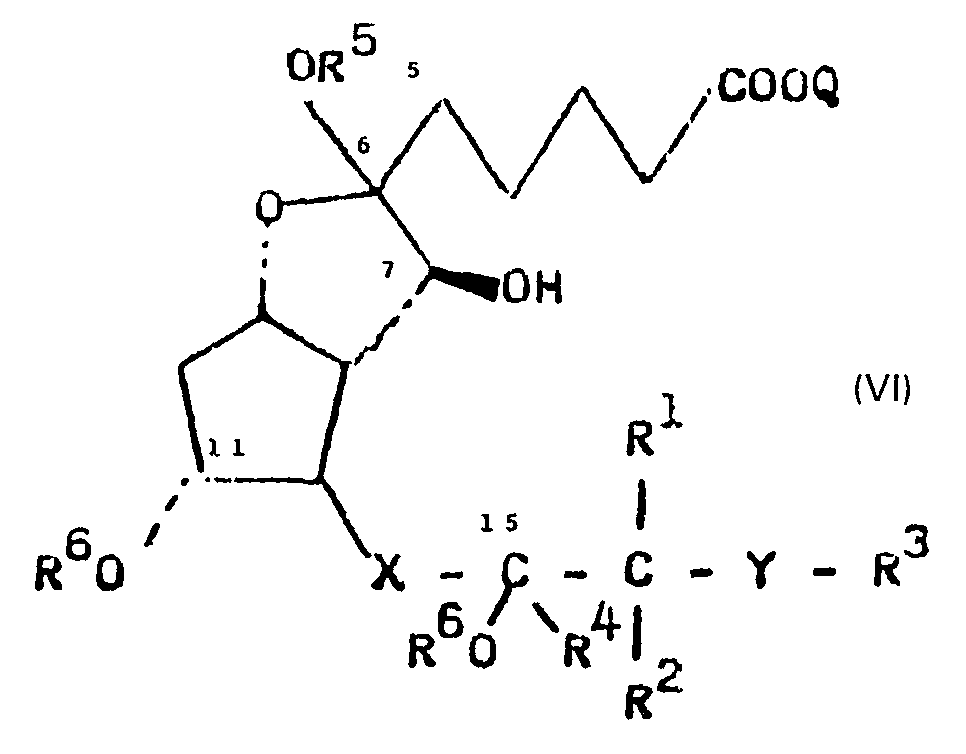
- Die Schutzgruppen können nach der Oxydation sowie nach der Abspaltung des Alkohols R5OH entfernt werden.
- Monosubstituiertes Phenyl - anstelle von R3 - kann eine oder mehrere der nachfolgend aufgezählten Substituenten - die bei Anwesenheit mehrerer Substituenten gleich oder verschieden sein können - enthalten: gegebenenfalls durch ein oder mehrere Halogenatome substituiertes C1-6-Alkyl, Hydroxyl, Sulfhydryl, C1-6-Alkanoyloxy, Benzoyloxy, Amino, Mono- oder Di-C1-6-alkylamino, Halogen, Cl-6-Alkoxy oder C1-6-Akylthio.
- Die Verbindungen der allgemeinen Formel 1 können gemäss Erfindung z.B. aus den Verbindungen der allgemeinen Formel

Ac Acetyl ist,
hergestellt werden. Die Verbindungen der allgemeinen Formel III sind bekannt [J. Am. Chem. Soc., 100, 6756 (1978)] oder können aus den entsprechenden Ausgangsverbindungen durch die aus dieser Veröffentlichung bekannten Methoden hergestellt werden. - Die Verbindungen der allgemeinen Formel III werden gemäss Erfindung mit einem niederen Alkohol, vorzugsweise Methanol, in Gegenwart einer katalytischen Menge eines Säurekatalysators bei -78°C bis + 25 ° C umgesetzt. Als Säurekatalysator können Mineralsäuren, Sulfonsäuren oder Lewis-Säureneingesetzt werden; bevorzugt wird Bortrifluorid- ätherat.
- Die isomeren 6-Ketale der allgemeinen Formel

- R5 C1-6-Alkyl ist,
- Um die 7-Acetoxygruppe selektiv zu desacetylisieren und die gebildete Hydroxylgruppe selektiv zu oxydieren werden die freien 11- und 1 5-Hydroxylgruppen der Verbindungen der allgemeinen Formel IV vorübergehend durch beständige Schutzgruppen geschützt, wobei die Verbindungen der allgemeinen Formel IV in alkalischem oder basischem Medium, vorzugsweise mit
- a) einem Trialkylchlorsilan der allgemeinen Formel

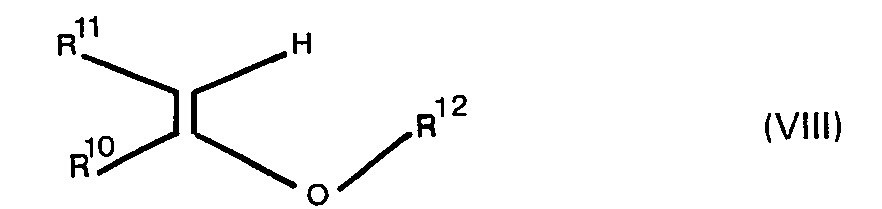
- b) einem Enol-äther der allgemeinen Formel

- R12 Methyl oder Äthyl bedeuten, oder
- c) mit 3,4-Dihydro-2H-pyran umgesetzt werden.
- Als Silylierungsmittel der allgemeinen Formel VII kann man Trialkylchlorsilane, z.B. Dimethyl-tert.--butyl-chlorsilan, Trimethylchlorsilan, verwenden, wobei das Dimethyl-tert.-butyl-chlorsilan in aprotischen Lösungsmitteln, vorzugsweise in Dimethylformamid, in Gegenwart von Katalysatoren, vorzugsweise Imidazol, eingesetzt und das Trimethylchlorsilan in Pyridin oder in aprotischen Lösungsmitteln, vorzugsweise in Gegenwart von tertiären Aminen, verwendet wird. Die Reaktionstemperatur kann in einem Bereich zwischen -20 und + 60°C variiert werden.
- Als Enol-äther der allgemeinen Formel VIII werden vorzugsweise Äthyl-vinyl-äther, iso-Propenyl-methyl-äther in aprotischen Lösungsmitteln, insbesondere in Dichlormethan, in Gegenwart einer katalytischen Menge einer Säure verwendet. Als Katalysatoren werden Mineralsäuren, Phosphorylchlorid, Sulfonsäuren, vorzugsweise p-Toluol-sulfonsäure, eingesetzt. Die Reaktionstemperatur kann in einem Bereich zwischen -78 bis + 50°C variiert werden.
- Anstelle der Enol-äther der allgemeinen Formel VIII kann man auch das 3,4-Dihydro-2H-pyran verwenden.
- Die so erhaltenen, geschützte Hydroxylgruppen aufweisenden Verbindungen der allgemeinen Formel

- R6 eine Silylgruppe der Formel R'R8R9Si-, eine a-Alkoxyalkylgruppe der Formel R11CH2-C (R10)- oder eine Tetrahydropyran-2-yl-gruppe OR12 darstellt und
- worin R7, R8, R9, R10, R11 und R12 die oben angegebene Bedeutung haben,
- Die Oxydation der Hydroxylgruppe in 7-Stellung der Verbindungen der allgemeinen Formel

kann mit jedem Oxydationsmittel - das eine sekundäre Hydroxylgruppe zur Oxogruppe zu oxydieren vermag, z.B. Jones-Reagens, Collins-Reagens, Thioanisol-Chlor-Komplex, Pyridiniumchlorchromat usw. - wobei dem Pyrimidiniumchlorchromat der Vorzug gegeben wird - in aprotischen Lösungsmitteln, vorzugsweise in chlorierten Kohlenwasserstoffen, durchgeführt werden. Die Reaktionstemperatur kann zwischen -40 und +50°C variiert werden. - Werden Verbindungen der allgemeinen Formel VI oxydiert, worin R5 durch Wasserstoff ersetzt ist, findet eine selektive Oxydation der Hydroxylgruppe in 7-Stellung statt, wobei man Hemiketal-derivate der allgemeinen Formel

- Diese Verbindungen können weiter umgesetzt oder - gewünschtenfalls - in Verbindungen der allgemeinen Formel II übergeführt werden, in denen R5 C1-6-Alkyl bedeutet.
- In den durch Oxydation erhaltenen Verbindungen der allgemeinen Formel II können gewünschtenfalls die Schutzgruppen R6 abgespalten und die freien 11- und 15-Hydroxylgruppen mit einer C1-4-Alkanoylgruppe acyliert werden.
- In der Reaktionsstufe - der Ausbildung der 5,6-Doppelbindung - können sowohl durch die R6-Gruppe geschützte, als auch acylierte und freie 11- und 15-Hydroxylgruppen enthaltende Verbindungen der allgemeinen Formel II eingesetzt werden.
- Die 7-Oxo-PGl2-derivate der allgemeinen Formel 1 werden aus den 7-Oxo-derivaten der allgemeinen Formel II durch Abspalten des Alkohols der allgemeinen Formel R5-OH erhalten.
- Dieser Alkoholabspaltung können auch Verbindungen der allgemeinen Formel II, worin R5 C1-6-Alkyl bedeutet und R6 durch Wasserstoff ersetzt ist, unterworfen werden, wobei Verbindungen der allgemeinen Formel 1, worin R13 Wasserstoff ist, erhalten werden. Die Alkoholabspaltung kann durch Erhitzen in verschiedenen dipolaren aprotischen Lösungsmitteln, z.B. Dimethylformamid, Dimethylsulfoxyd, Hexamethyl-phosphorsäure-triamid - wobei dem Hexamethyl-phosphorsäure-triamid der Vorzug gegeben wird - vorgenommen werden. Die Reaktionstemperatur kann im Bereich zwischen 70 und 180°C, vozugsweise zwischen 80 und 160°C, variiert werden. Die Alkoholabspaltung kann durch Verwendung von Alkansäureanhydriden mit 1-4 Kohlenstoffatomen im Alkylteil, Benzol oder Toluol beschleunigt werden. Bei Verwendung von Säureanhydriden entstehen auch Verbindungen der allgemeinen Formel I, worin R13 Acyl bedeutet, das gewünschtenfalls durch eine durch Basen katalysierte Alkoholyse entfernt werden kann.
- Verbindungen der allgemeinen Formel I, in denen Q = C1-6-Alkyl bedeutet und die nach der Alkoholabspaltung erhalten worden sind, können z.B. nach säulenchromatographischer Reinigung isoliert werden.
- Verbindungen der allgemeinen Formel 1, in denen anstelle von R6 R13 steht, können auch aus Verbindungen der allgemeinen Formel II, in denen R6 durch Wasserstoff ersetzt ist und R5 C1-6-Alkyl bedeutet, durch die oben angegebene Alkoholabspaltung erhalten werden.
- R6 kann für die weiter oben angegebenen Hydroxylschutzgruppen die Bedeutung von z.B. Trialkylsilyl-, Alkoxy-alkyl haben. Die Verbindungen der allgemeinen Formel l, in denen R13 eine R6-Schutz- gruppe bedeutet, können nach säulenchromatographischer Reinigung isoliert und gewünschtenfalls nach Entfernung der Schutzgruppen in Verbindungen der allgemeinen Formel 1 übergeführt werden, in denen R13 Wasserstoff bedeutet. Trialkyl-silyl-Schutzgruppen werden bevorzugt mit Tetrabutylammoniumfluorid in Lösungsmitteln vom Äther-Typ, vorzugsweise Tetrahydrofuran, bei einer Temperatur von -20 bis +50°C, vorzugsweise bei Raumtemperatur, entfernt.
- Aus den Verbindungen der allgemeinen Formel II, die anstelle von R5 Wasserstoff enthalten und in denen R6 die oben angegebene Schutzgruppen bedeutet, können die 7-Oxo-PGl2-derivate der allgemeinen Formel 1 durch Abspalten von Wasser, das zweckmässig durch azeotrope Destillation entfernt wird, erhalten werden. Die Wasserabspaltung durch azeotrope Destillation wird zweckmässig durch Kochen in aromatischen Kohlenwasserstoffen, vorzugsweise Benzol, in Gegenwart von wasserbindenden Mitteln, vorzugsweise wasserfreiem Magnesiumsulfat durchgeführt. Nach Entfernung der Schutzgruppen R6 werden die Verbindungen der allgemeinen Formel I, worin R13 Wasserstoff und Q niederes Alkyl bedeuten, z.B. durch Chromatographieren gereinigt.
- Verbindungen der allgemeinen Formel I, in denen Q ein physiologisch verträgliches Kation bedeutet, werden aus den entsprechenden Estern der allgemeinen Formel I, in denen Q = C1-6-Alkyl ist, durch wässrige alkalische Hydrolyse erhalten. Die Hydrolyse wird zweckmässig mit wässrigen Alkali- und Erdalkalimetallhydroxydlösungen bei 0 bis 100°C durchgeführt. Die Salze werden z.B. nach dem Lyophilisieren isoliert. Aus den wässrigen Lösungen der Salze können die Carbonsäuren durch vorsichtiges Ansäuern freigesetzt, in organischen Lösungsmitteln und mit aliphatische und aromatischen Aminen in weitere Salze übergeführt werden.
- Die erfindungsgemässen Verbindungen der allgemeinen Formel 1 hemmen die Aggregation der Thrombocyten und weisen eine thrombolytische Wirkung auf, wie das natürliche PGl2. Die neuen Verbindungen hemmen die Synthese des Thromboxan A2, die Wirkung des Thromboxan A2, die Magensäuresekretion und beeinflussen einige Kreislaufprozesse. Die Verbindungen können zur Heilung von Asthma, von myokardialem Infarkt, Thrombose, Magengeschwäuren und vaskulären Unregelmässigkeiten bei Säugetieren, insbesondere bei Menschen, verwendet werden.
- Pharmazeutische Präparate der Erfindung, die als Wirkstoff 7-Oxo-PGl2-derivate enthalten, haben einethrombolytische Wirkung und können gleichzeitig die Gefahr des Entstehens der Thrombi ausschalten. Dies ist von besonders grosser Bedeutung bei der Blutkonservierung, bei der Perfusion von Organen, Geweben und bei der Ausschaltung der Thrombose-Gefahr nach Operationen.
- Mit einem an Thrombocyten angereicherten, aus Humanblut isolierten Plasma (PRP) wurden bei der durch ADP oder Kollagen verursachten Aggregation die folgenden ID50-Konzentrationen erhalten:

- Es ist sehr wichtig, dass die Kontraktionswirkung des 7-Oxo-PGl2-derivats der Erfindung auf den Magenfundus 0,1-mal grösser als die des PGl2 ist. In der Hemmwirkung auf die Thrombocytenaggregation sind die 7-Oxo-PGl2-derivate der Erfindung - wie die Angaben weiter oben zeigen - dem natürlichen PGl2 nur geringfügig unterlegen, in der Stabilität dagegen wesentlich überlegen, was die Verwendung der 7-Oxo-PGl2-derivate in pharmazeutischen Zubereitungen ermöglicht.
- Die Dosis der 7-Oxo-PG12-derivate der allgemeinen Formel 1 pro Tag beträgt 100 ng bis 100 mg, und hängt von der Höhe der zu erreichenden Wirkung sowie von der Applikationsart, der Empfindlichkeit der behandelten Person, des Tieres, der Organe und der Gewebe ab. Bei kontinuierlicher Infusion ist im allgemeinen eine Dosis von 1 bis 10 mg pro Tag genügend.
- Die Präparate können in flüssiger, halb-flüssiger Form, in Form von Salben, Pasten vorliegen.
- Als flüssige Zubereitungen sind Lösungen, Emulsionen oder injizierbare Lösungen, Infusionslösungen, Tropfen und als feste Zubereitungen Tabletten, Kapseln, Dragees, Pulver, Bolus, Pulverampullen zu nennen, die gebräuchliche Streckmittel, Verdünnungsmittel, Zusatzstoffe zur Beeinflussung des osmotischen Druckes, des pH-Wertes, des Geschmacks oder des Aromas, Gleitmittel, Benetzungsmittel, das Lösungsvermögen-retardierende Mittel enthalten können.
- Die Erfindung betrifft somit auch pharmazeutische und Laboratoriums-Präparate, die als Wirkstoff 7-Oxo-PGl2-derivate der allgemeinen Formel I enthalten, für die die Aggregation, die Thrombose- und die Magensekretion hemmende und antiasthmatische Behandlung.
- Die weiteren Einzelheiten der Erfindung sind den folgenden Beispielen zu entnehmen.
- 1 g der Verbindung der Formel II (worin die Substituenten die im vorhergehenden Absatz angegebene Bedeutung haben) löst man in 10 ml Methanol, gibt zur Lösung eine katalytische Menge Bortrifluorid- ätherat und rührt das Reaktionsgemisch 20 Minuten. Nach Zugabe einer kleinen Menge an festem Natriumhydrogencarbonat destilliert man das Methanol im Vakuum ab, löst den Rückstand in Äthylacetat, wäscht die Äthylacetatlösung zunächst mit Wasser, dann mit einer gesättigten wässrigen Natriumchloridlösung, trocknet sie über wasserfreiem Natriumsulfat, filtriert sie und destilliert das Lösungsmittel ab. Das als Rückstand erhaltene Öl wird an 120 g Silicagel chromatographiert und mit Äthylenacetat eluiert.
- Man erhält 240 mg (22%) exo-Methylketal und 680 mg (63%) endo-Methylketal in Form eines farblosen Öls.
- exo-IV: Rf: 0,31 Laufmittel: Äthylacetat
- δ1H NMR 3,64 (3H, COOCH3), 3,24 (3H, OCH3) endo-IV: Rf: 0,26 Laufmittel: Äthylacetat
- δ1H NMR 3,57 (3H, COOCH3), 3,14 (3H, OCH3).
- 700 mg (1,52 mMol) des nach Beispiel 1 erhaltenen Methylketals der Formel IV, löst man in 1,4 ml wasserfreiem Dimethylformamid, gibt zur Lösung 517 mg (7,6 mmol) Imidazol und 552 mg (3,6 mMol) tert.-Butyl-dimethyl-chlor-silan, rührt das erhaltene Reaktionsgemisch 4 Stunden bei 35 bis 40°C und gibt es dann in 30 ml Wasser. Die wässrige Lösung extrahiert man 3 mal mit je 50 ml Dichlormethan, wäscht die vereinigten Dichlormethan-extrakte mit einer gesättigten wässrigen Natriumchloridlösung, trocknet sie mit wasserfreiem Natriumsulfat und destilliert das Lösungsmittel ab. Das als Rückstand erhaltene Öl wird an 120 g Silicagel chromatographiert und mit einem 8 : 1 Gemisch von Hexan-Äthylacetat eluiert.
- Man erhält 788 mg (75%) des gewünschten Produktes in Form eines farblosen Öls.
- Rf: 0,42, Laufmittel: ein 7 : 1 Gemisch von Hexan und Äthylacetat.
- b1H NMR: 2,05 (3H, OAc), 0,88 (6H, tert.-Butyl).
- 200 mg (0,29 mmol) des nach Beispiel 2 erhaltenen Silyläthers der Formel V löst man in 2 ml Methanol, gibt eine katalytische Menge frisch calciniertes Kaliumcarbonat zur Lösung, rührt das Reaktionsgemisch eine Stunde bei Raumtemperatur und destilliert das Lösungsmittel im Vakuum ab. Der Rückstand wird in Äthylacetat gelöst, mit Wasser und mit gesättigter wässriger Natriumchloridlösung gewaschen, mit wasserfreiem Natriumsulfat getrocknet, filtriert und dann das Lösungsmittel abdestilliert. Das als Rückstand erhaltene Öl wird an 20 g Silicagel chromatographiert und mit einem 4: 1 Gemisch von Hexan und Äthylacetat eluiert.
- Man erhält 150 mg (80%) des gewünschten Produktes in Form eines farblosen Öls.
- Rf: 0,5 Laufmittel: ein 4 : 1 Gemisch von Hexan und Äthylacetat.
- IR (Film) 335 0 cm-1, (OH).
- 200 mg (0,29 mMol) des nach Beispiel 2 hergestellten Silyläthers der Formel V werden in 2 ml Methanol gelöst und der Lösung 50 mg frisch caiciniertes Kaliumcarbonat zugegeben. Das Reaktionsgemisch wird bei Raumtemperatur 48 Stunden gerührt und wie in Beispiel 3 weiter aufgearbeitet. Das Rohprodukt wird an 20 g Silicagel chromatographiert und mit einem 2 : 1 Gemisch von Hexan und Äthylacetat eluiert.
- Man erhält 113 mg (60%) des gewünschten Produktes in Form eines farblosen Öls.
- Rf: 0,1 Laufmittel: ein 4 : 1 Gemisch von Hexan und Äthylacetat.
- δ1H NMR: 3,67 (3H, COOCH3).
- 75 mg (0,11 mMol) der Verbindung von Beispiel 3 (Formel VI) löst man in 0,7 ml Dichlormethan, gibt zur Lösung 63 mg (0,29 mMol) Pyridinium-chlorchromat, behandelt das Reaktionsgemisch mit einem Natriumacetatpuffer und rührt es fünf Stunden bei Raumtemperatur. Dann filtriert man das Reaktionsgemisch, wäscht es mit Dichlormethan und dampft die vereinigten Phasen ein. Der Rückstand wird an 10 g Silicagel mit einem 12 : 1 Gemisch von Hexan und Äthylacetat chromatographiert.
- Man erhält 56 mg (75%) des gewünschten Produktes in Form eines farblosen Öls.
- Rf: 0,59 Laufmittel: 7 : 1 Gemisch von Hexan und Äthylacetat.
- IR (Film): 1735 cm-1 (C=O), 1000-1250 cm-1 (O―C―O).
- 50 mg (0,08 Mol) des nach Beispiel 4 hergestellten Silyläthers der Formel VI (worin R5 = Wasserstoff ist) löst man in 0,5 ml Dichlormethan, gibt zur Lösung 45 mg (0,21 mMol) Pyridiniumchlorcarbonat, rührt das Reaktionsgemisch sechs Stunden bei Raumtemperatur und arbeitet weiter, wie in Beispiel 5 angegeben ist. Das Rohprodukt wird an 10 g Silicagel chromatographiert und mit einem 1 : 1 Gemisch von Äthylacetat-Hexan eluiert.
- Man erhält 37 mg (75%) des gewünschten Produktes in Form eines farblosen Öls.
- Rf: 0,55 Laufmittel: 1 : 1 Gemisch von Äthylacetat und Hexan.
- IR (Film): 3300 cm-1 (OH), 1730 cm-1 (C=0).
- 570 mg (1,24 mMol) der nach Beispiel 1 hergestellten Verbindung der Formel IV löst man in 5 ml wasserfreiem Dichlormethan, gibt zur Lösung 1,13 ml (12,4 mMol) wasserfreies 3,4-Dihydro-2H-pyran und eine katalytische Menge an p-Toluol-sulfonsäure, rührt das Reaktionsgemisch bei Raumtemperatur 10 Minuten und verdünnt es mit 50 ml Äthylacetat. Die Äthylacetatlösung wird mit gesättigter wässriger Natriumhydrogencarbonatlösung, mit Wasser und mit gesättigter Natriumchloridlösung gewaschen, über Natriumsulfat getrocknet, filtriert und danach das Lösungsmittel abdestilliert.
- Man erhält 831 mg (Rohprodukt) des gewünschten Produktes in Form eines hellgelben Öls.
- Rf: 0,53 Laufmittel: 1 : 1 Gemisch von Benzol und Äthylacetat.
- IR (Film): 1740 cm-1 (C=O), 100-1200 cm-1 (O-CH-O).
- Das erhaltene Produkt kann ohne Reinigung für die weitere Reaktion verwendet werden.
- 831 mg (1,32 mMol) der in Beispiel 7 hergestellten Verbindung der Formel V löst man in 8 ml Methanol, gibt zur Lösung eine katalytische Menge frisch calciniertes Kaliumcarbonat, rührt das Reaktionsgemisch eine Stunde bei Raumtemperatur und führt die weitere Aufarbeitung wie in Beispiel 3 durch. Das als Rückstand erhaltene Öl wird an 40 g Silicagel mit einem 1 : 1 Gemisch von Benzol und Äthylacetat als Elutionsmittel chromatographiert.
- Man erhält 471 mg (65%) des gewünschten Produktes in Form eines farblosen Öls.
- Rf: 0,35 Laufmittel:1 : 1 Gemisch von Benzol und Äthylacetat.
- IR (Film): 3350 cm-1(OH), 1735 cm-1 (C=O), 100-1200 cm-1 (O-CH-O).
- 344 mg (0,59 mMol) der nach Beispiel 8 hergestellten Verbindung der Formel VI löst man in 3,5 ml Dichlormethan, gibt zur Lösung 254 mg (1,18 mMol) Pyridiniumchlorchromat, behandelt das Reaktionsgemisch mit Natriumacetatpuffer und rührt fünf Stunden bei Raumtemperatur. Die weitere Aufarbeitung des Reaktionsgemisches erfolgt nach der in Beispiel 5 angegebenen Weise. Das Rohprodukt wird an 30 g Silicagel mit einem 1 : 1 Gemisch von Benzol und Äthylacetat als Elutionsmittel chromatographiert.
- Man erhält 275 mg (80%) des gewünschten Produktes als farbloses Öl.
- Rf: 0,57 Laufmittel: ein 1 : 1 Gemisch von Benzol und Äthylacetat.
- IR (Film): 1730-1740 cm-1 (C=0),
- 1000-1200 cm-1 (O-CH-O).
- 194 mg (0,33 mMol) des nach Beispiel 9 erhaltenen Methylketals der Formel II (worin R6 = Tetrahydropyranyl ist und die übrigen Substituenten die im vorangehenden Absatz angegebene Bedeutung haben) löst man in 10 ml Methanol, gibt zum Reaktionsgemisch eine katalytische Menge an p-Toluol-sulfonsäure, rührt die Lösung eine Stunde bei Raumtemperatur und destilliert das Lösungsmittel im Vakuum ab. Der Rückstand wird in Äthylacetat gelöst, die Äthylacetatlösung mit einer gesättigten Natriumhydrogencarbonatlösung, mit Wasser und dann mit wässriger Natriumchloridlösung gewaschen, über Natriumsulfat getrocknet, filtriert und dann das Lösungsmittel abdestilliert.
- Das als Rückstand erhaltene Öl wird an 1 5 g Silicagel mit einem 2 : 1 Gemisch von Benzol und Äthylacetat chromatographiert.
- Man erhält 117 mg (85%) des gewünschten Produktes in Form eines farblosen Öls.
- Rf: 0,34 Laufmittel: Äthylacetat.
- δ1H NMR (CDCI3): 3,67 (COOCH3), 3,17 (OCH3) IR (Film): 3350 cm-1 (OH), 1735 cm-1 (C=0).
- Durch Verwendung von entsprechend substituierten Ausgangsverbindungen der allgemeinen Formel III erhält man nach den Verfahrensschritten der Beispiele 1 bis 10 die folgenden Zwischenprodukte der allgemeinen Formel II:
- Hemiketaledes7-Oxo-6-keto-16-methyl-PGF1α-methyl-, -äthyl-, -propyl- und -butylester sowie deren Methyl-, Äthyl-, Propyl- und Butylketale.
- Hemiketale des 7-Oxo-6-keto-16,16-dimethyl--PGF1α-methyl-, -äthyl-, -propyl- und -butylester sowie deren Methyl-, Äthyl-, Propyl- und Butylketale. Hemiketale des 7-Oxo-6-keto-16-phenoxy-17,18,-19,20-tetra-nor-PGF1α-methyl-,-äthyl-,-propyl-und -butylester sowie deren Methyl-, Äthyl-, Propyl- und Butylketale.
- Hemiketale des 7-Oxo-6-keto-20-methyl-PGF1α-methyl-, -äthyl-, -propyl- und -butylester sowie deren Methyl-, Äthyl-, Propyl- und Butylketale.
- Hemiketale des 7-Oxo-6-keto-13,14-didehydro--PGF1α-methyl-, -äthyl-, -propyl- und -butylester sowie deren Methyl-, Äthyl-, Propyl- und Butylketale. Hemiketale des 7-Oxo-6-keto-15-methyl-PGF1α -methyl-, -äthyl-, -propyl- und -butylester sowie deren Methyl-, Äthyl-, Propyl- und Butylketale.
- Hemiketale des 7-Oxo-6-15-epi-PGF1α-methyl-, -äthyl-, -propyl- und -butylester sowie deren Methyl-, Äthyl-, Propyl- und Butylketale.
- Hemiketale des 7-Oxo-6-keto-15-epi-16,16-dimethyl-PGF1α-methyl-, -äthyl-, -propyl- und -butylester sowie deren Methyl-, Äthyl-, Propyl- und Butylketale.
- Hemiketale des 7-Oxo-6-keto-15-epi-16-phenoxy--17,18,19,20-tetra-nor-PGF1α-methyl-, -äthyl-, - propyl- und -butylester sowie deren Methyl-, Äthyl-, Propyl- und Butylketale.
- Hemiketale des 7-Oxo-6-keto-15-epi-20-methyl--PGF1α-methyl-, -äthyl-, -propyl- und -butylester sowie deren Methyl-, Äthyl-, Propyl- und Butylketale.
- Werden während der Synthese die Schutzgruppen gemäss Beispiel 10 nicht entfernt, werden die 11,15-bis-Silyloxy-, 11,15-bis-(Tetrahydropyran-2--yl-oxy)- und 11,15-bis-(α-A)koxyalkyl)-derivate der oben angegebenen Verbindungen erhalten.
- (R6 = Silyl, Tetrahydropyran-2-yl, a-Alkoxyalkyl).
- Unter «epi»-Derivat ist ein Derivat zu verstehen, in dem das durch die vor «epi» stehende Nummer gekennzeichnete Kohlenstoffatom einen Substituenten trägt, dessen Konfiguration der des Substituenten am entsprechenden Kohlenstoffatome der natürlichen Prostaglandine entgegengesetzt ist.
- 20 mg (0,31 mMol) einer nach Beispiel 5 hergestellten Verbindung der Formel II (worin R5 = Methyl, R6 = Dimethyl-tert.-butyl-silyl und die übrigen Substituenten die im vorhergehenden Absatz angegebene Bedeutung haben) löst man in 5 ml Hexamethylphosphorsäuretriamid, rührt das Reaktionsgemisch drei Stunden bei 150 bis 160°C, giesst es in 18 ml Wasser, extrahiert die wässrige Phase 3 mal mit je 15 ml Äthylacetat, wäscht die vereinigten Äthylacetat-Extrakte mit gesättigter Natriumchloridlösung, trocknet sie mit wasserfreiem Natriumsulfat, filtriert und destilliert das Lösungsmittel ab. Das als Rückstand erhaltene Produkt, 250 mg, wird in 5 ml Tetrahydrofuran gelöst, und das nach Zugabe von 2 Äquivalenten des Tetrabutylammonium-fluorids erhaltene Gemisch wird bei Raumtemperatur drei Stunden gerührt. Das Lösungsmittel wird im Vakuum abdestilliert und der Rückstand in Äthylacetat gelöst. Die erhaltene Äthylacetatlösung wird mit Wasser, dann mit gesättigter wässriger Natriumchloridlösung gewaschen, über wasserfreiem Natriumsulfat getrocknet, filtriert und schliesslich wird das Lösungsmittel abdestilliert. Das als Rückstand erhaltene Öl wird an 10 g Silicagel mit Äthylacetat chromatographiert.
- Man erhält 62 ml (50%) des gewünschten Produktes in Form eines farblosen Öls.
- Rf: 0,44 Laufmittel: Äthylacetat.
- δ1H NMR: 5,37 (1H, t, O-C=CH-), 3,76 (3H, s, -COOCH3).
- 200 mg (0,31 mMol) der nach Beispiel 6 hergestellten Verbindung der allgemeinen Formel II (R5 = Wasserstoff, R6 = Dimethyl-tert.-butyl-silyl, die übrigen Substituenten, wie in der in Beispiel 11 erhaltenen Verbindung) erhitzt man in 30 ml wasserfreiem Benzol und in einem wasserfreies Magnesiumsulfat enthaltenden Soxhlet-Extraktor zwei Stunden zum Sieden. Die organische Phase wird zunächst mit Wasser, dann mit gesättigter wässriger Natriumchloridlösung gewaschen, mit wasserfreiem Natriumsulfat getrocknet, filtriert, das Lösungsmittel abdestilliert und das erhaltene Rohprodukt in Tetrahydrofuran mit 2 Äquivalenten Tetrabutylammonium-fluorid behandelt. Die weitere Aufarbeitung des Reaktionsgemisches erfolgt in der in Beispiel 11 angegebenen Weise. Das Gemisch wird an 10 g Silicagel mit Äthylacetat chromatographiert.
- Man erhält 52 mg (45%) des gewünschten Produktes in Form eines farblosen Öls.
- Die physikalischen Konstanten des Produktes stimmen mit denen des Beispiels 11 überein.
- 90 mg (0,215 mMol) des nach Beispiel 10 erhaltenen 7-Oxo-6-keto-PGF1α-methylester-methylketals der Formel II (R6 = R13 = Wasserstoff) werden in 0,8 ml Hexamethyl-phosphorsäure-triamid gelöst und das Gemisch zwei Stunden bei 140 bis 150°C gerührt. Das Reaktionsgemisch wird wie in Beispiel 11 weiter aufgearbeitet. Das als Rückstand erhaltene Öl wird an 10 g Silicagel mit Äthylacetat chromatographiert.
- Man erhält 40 mg (47%) des gewünschten Produktes in Form eines farblosen Öls.
- Die physikalischen Konstanten des Produktes stimmen mit denen des Beispiels 11 überein.
- 100 mg 7-Oxo-6-keto-PGF1α-methylester-methylketal-11,15-diacetat werden in 3 ml Hexamethyl-phosphorsäure-triamid gelöst und in Gegenwart von 0,05 ml Essigsäureanhydrid zwei Stunden bei 80 bis 100°C gerührt. Die weitere Aufarbeitung des Reaktionsgemisches erfolgt wie in Beispiel 11. Das Rohprodukt wird an 15 g Silicagel mit einem 1 : 1 Gemisch von Äthylacetat und Hexan chromatographiert.
- Man erhält 70 mg (72%) eines Produktes in Form eines farblosen Öls.
- Rf: 0,65 Laufmittel: 1 : 1 Gemisch von Äthylacetat und Hexan.
- 90 mg (0,21 mMol) 16,16-Dimethyl-7-oxo-6--keto-PGF1α-methylester-methylketal (R1 und R2 = Methyl) werden in 1 ml Hexamethyl-phosphorsäure--triamid gelöst und das Reaktionsgemisch zwei Stunden bei 140 bis 150°Cgerührt. Die weitere Aufarbeitung erfolgt in der in Beispiel 13 angegebenen Weise.
- Man erhält 50 mg (56%) der Gewünschten Verbindung in Form eines farblosen Öls.
- Rf: 0,52 (in Äthylacetat).
- 50 mg (0,13 mMol) 7-Oxo-PGl2-methylester werden in 0,1 ml Methanol gelöst und das Gemisch nach Zugabe von 1,4 ml 0,1 n wässriger Natriumhydroxydlösung bei Raumtemperatur 24 Stunden gerührt. Die Lösung wird lyophilisiert.
- Man erhält 55 mg des gewünschten Produktes in Form einer weissen Masse.
- Unter Anwendung der Umsetzungen der Beispiele 11 bis 16 sind aus den nach den Beispielen 1 bis 10 hergestellten Verbindungen der Formel II die folgenden Verbindungen erhalten worden:
- 7-0xo-16-phenoxy-17,18,19,20-tetra-nor-PGl2 und dessen C1-4-Alkylester (Rf des Methylesters in Äthylacetat: 0,57).
- 7-Oxo-16-methyl-PG12 und dessen C1-4-Alkylester (Rf des Methylesters in Äthylacetat: 0,49).
- 7-Oxo-20-methyl-PGl2 und dessen C1-4-Alkylester (Rf des Methylesters in Äthylacetat: 0,51).
- 7-Oxo-13,14-didehydro-PGl2 und dessen C1-4-Alkylester (Rf des Methylesters in Äthylacetat: 0,47).
- 7-Oxo-15-methyl-PGl2 und dessen C1-4-Alkylester (Rf des Methylesters in Äthylacetat: 0,53).
- 7-Oxo-15-epi-PGl2 und dessen C1-4-Alkylester (Rf des Methylesters in Äthylacetat: 0,50).
- 7-Oxo-15-epi-16,16-dimethyl-PGl2 und dessen C1-4-Alkylester (Rf des Methylesters in Äthylacetat: 0,58).
- 7-Oxo-l 5-epi-16-phenoxy-17,18,19,20-tetra-nor--PGl2 und dessen C1-4-Alkylester (Rf des Methylesters in Äthylacetat: 0,63).
- 7-Oxo-15-epi-20-methyl-PGl2 und dessen C1-4-Alkylester (Rf des Methylesters in Äthylacetat: 0,55).
- Die freien Säuren können durch die in Beispiel 16 angegebene Verseifung aus dem Alkalimetallsalz, z.B. dem Natriumsalz, hergestellt werden, indem man dessen wässrige Lösung mit einer starken organischen oder anorganischen Säure ansäuert. Die freie Säure scheidet sich aus der Lösung aus.
sowie Verfahren zur Herstellung dieser Verbindungen und diese Verbindungen enthaltende pharmazeutische Präparate.
können in Form ihrer Gemische oder nach chromatographischer Trennung in der nachfolgenden Reaktion eingesetzt werden.
können in einem basischen Medium zu Verbindungen der allgemeinen Formel VI hydrolysiert werden, wobei die 7-Acetylgruppe in niederen Alkanolen, vorzugsweise Methanol, in Gegenwart von milden Basen, vorzugsweise Kaliumcarbonat, oder mit wässrigen Lösungen von Alkali- oder Erdalkalihydroxyden hydrolytisch abgespalten wird. Im letztgenannten Fall werden die aus dem Reaktionsgemisch isolierten Carbonsäuren wieder in ihre niederen Alkylester, vorzugsweise - durch Verwendung von Diazomethan - in ihre Methylester, übergeführt. Die Reaktionstemperatur kann zwischen 0°C und dem Siedepunkt des eingesetzten Lösungsmittels variiert werden, vorzugsweise arbeitet man bei Raumtemperatur. Bei längeren Reaktionszeiten und in einem stark basischen Reaktionsmedium kann die Alkylgruppe R5 durch Wasserstoff ersetzt werden.
Claims (16)

worin R7, R8 und R9, die gleich oder verschieden sein können, C1-4-Alkyl,

worin R7, R8 und R9, die gleich oder verschieden sein können, C1-4-Alkyl,
dadurch gekennzeichnet, dass man eine Verbindung der allgemeinen Formel




gegebenenfalls nach Entfernung der R5-Alkylgruppe durch Hydrolyse in aprotischen Lösungsmitteln, oxydiert und die erhaltenen 7-Oxo-derivate der allgemeinen Formel

Applications Claiming Priority (3)
| Application Number | Priority Date | Filing Date | Title |
|---|---|---|---|
| HUCI001987 | 1979-11-12 | ||
| HUCI001988 | 1979-11-12 | ||
| HU79CI1987A HU182012B (en) | 1979-11-12 | 1979-11-12 | Process for preparing 6-substituted-7-oxo-pgi down 1 derivatives |
Publications (2)
| Publication Number | Publication Date |
|---|---|
| EP0031426A1 EP0031426A1 (de) | 1981-07-08 |
| EP0031426B1 true EP0031426B1 (de) | 1984-02-15 |
Family
ID=10994775
Family Applications (1)
| Application Number | Title | Priority Date | Filing Date |
|---|---|---|---|
| EP80106884A Expired EP0031426B1 (de) | 1979-11-12 | 1980-11-08 | 7-Oxo-PGI2-derivate, Verfahren zu deren Herstellung sowie diese Verbindungen enthaltende pharmazeutische Präparate |
Country Status (3)
| Country | Link |
|---|---|
| EP (1) | EP0031426B1 (de) |
| JP (1) | JPS5683485A (de) |
| HU (1) | HU182012B (de) |
Families Citing this family (4)
| Publication number | Priority date | Publication date | Assignee | Title |
|---|---|---|---|---|
| DE3035454A1 (de) * | 1980-09-18 | 1982-04-22 | Schering Ag, 1000 Berlin Und 4619 Bergkamen | 7-oxoprostacyclinderivate und verfahren zu ihrer herstellung |
| HU184951B (en) * | 1981-04-14 | 1984-11-28 | Chinoin Gyogyszer Es Vegyeszet | Simple process for preparing 6-substituted 7-oxo-pgi down 1 derivatives |
| HU197733B (en) * | 1985-05-29 | 1989-05-29 | Chinoin Gyogyszer Es Vegyeszet | Process for producing ephedrin-salts of 7-oxo-prosta-cyclin derivatives |
| DE3610556A1 (de) * | 1986-03-26 | 1987-10-01 | Schering Ag | 7-oxoprostacyclinderivate und verfahren zu ihrer herstellung |
-
1979
- 1979-11-12 HU HU79CI1987A patent/HU182012B/hu not_active IP Right Cessation
-
1980
- 1980-11-08 EP EP80106884A patent/EP0031426B1/de not_active Expired
- 1980-11-11 JP JP15777480A patent/JPS5683485A/ja active Granted
Also Published As
| Publication number | Publication date |
|---|---|
| JPS5683485A (en) | 1981-07-08 |
| EP0031426A1 (de) | 1981-07-08 |
| HU182012B (en) | 1983-12-28 |
| JPH0222071B2 (de) | 1990-05-17 |
Similar Documents
| Publication | Publication Date | Title |
|---|---|---|
| DE2660851C2 (de) | Derivate von Polyprenylalkoholen und diese enthaltende pharmazeutische Zusammensetzung | |
| EP0011591B1 (de) | Neue Prostanderivate, ihre Herstellung und sie enthaltende Arzneimittel | |
| CH638483A5 (de) | 2,2-difluor-6a-carba-pgi2-verbindungen. | |
| EP0099538B1 (de) | Neue Carbacycline, Verfahren zu ihrer Herstellung und ihre Verwendung als Arzneimittel | |
| DE2627671A1 (de) | Arzneimittel, enthaltend ein lacton eines prostaglandins oder prostaglandinanalogen | |
| EP0051558B1 (de) | Prostacyclinderivate, Verfahren zu ihrer Herstellung und ihre Verwendung als Arzneimittel | |
| EP0031426B1 (de) | 7-Oxo-PGI2-derivate, Verfahren zu deren Herstellung sowie diese Verbindungen enthaltende pharmazeutische Präparate | |
| EP0062902B1 (de) | 2,3,4-Trinor-m-inter-phenylen-prostaglandin-Derivate, Verfahren zu deren Herstellung sowie diese Verbindungen enthaltende pharmazeutische Präparate | |
| US4330553A (en) | 7-Oxo-PGI2 -derivatives and process for the preparation thereof and pharmaceutical compositions containing same | |
| EP0013955B1 (de) | Neue Analoga von Prostacyclin, deren Zwischenprodukte, Verfahren zu ihrer Herstellung sowie sie enthaltende Arzneimittel | |
| DE2850885A1 (de) | Bicyclische prostaglandine, verfahren zu ihrer herstellung und sie enthaltende pharmazeutische und veterinaermedizinische mittel | |
| DE3606431A1 (de) | Thiabicycloheptan-substituierte aminoprostaglandin-analoge | |
| EP0086404B1 (de) | Neue Carbacycline, Verfahren zu ihrer Herstellung und ihre Verwendung als Arzneimittel | |
| EP0094951B1 (de) | Neue prostacycline und verfahren zu ihrer herstellung | |
| EP0004335A2 (de) | Neue Analoga von Prostacyclin, Verfahren und Zwischenprodukte zu ihrer Herstellung und ihre Verwendung als Arzneimittel | |
| EP0268548B1 (de) | Verbesserte Ketoreduktion von Carbacyclinzwischenprodukten | |
| EP0063323B1 (de) | 5-Substituierte 4-Oxo-PGI1-Derivate, Verfahren zu deren Herstellung sowie diese Verbindungen enthaltende pharmazeutische Präparate | |
| EP0080718B1 (de) | Inter-m-Phenylen-PGI2-Derivate, Verfahren zu deren Herstellung und diese Verbindungen enthaltende pharmazeutische Präparate | |
| EP0051597B1 (de) | Neue prostacyclinderivate und ihre herstellung | |
| DE2716075A1 (de) | Neue zwischenprodukte und verfahren zur herstellung von thromboxan-analoga | |
| EP0202529A2 (de) | Neue Phenolderivate, diese enthaltende Arzneimittel und Verfahren zur Herstellung dieser Verbindungen und Arzneimittel | |
| DD154295A5 (de) | Verfahren zur herstellung von 7-oxo-pgi tief 2-derivaten | |
| EP0051247B1 (de) | 4-Thia- und 4-Sulfinyl-PGI1-Derivate, Verfahren zu deren Herstellung sowie diese Verbindungen enthaltende pharmazeutische Präparate | |
| DE3146278C2 (de) | cis-Bicyclo[3.3.0]octanderivate, diese enthaltende Arzneimittel und Verfahren zur Herstellung dieser Verbindungen | |
| DE2319873C2 (de) | 16-O-Alkylderivate von Gitoxigenin-digitoxosiden, Verfahren zu ihrer Herstellung und diese enthaltende Arzneimittel |
Legal Events
| Date | Code | Title | Description |
|---|---|---|---|
| PUAI | Public reference made under article 153(3) epc to a published international application that has entered the european phase |
Free format text: ORIGINAL CODE: 0009012 |
|
| AK | Designated contracting states |
Designated state(s): BE CH DE FR GB IT NL SE |
|
| 17P | Request for examination filed |
Effective date: 19810423 |
|
| ITF | It: translation for a ep patent filed | ||
| GRAA | (expected) grant |
Free format text: ORIGINAL CODE: 0009210 |
|
| AK | Designated contracting states |
Designated state(s): BE CH DE FR GB IT LI NL SE |
|
| REF | Corresponds to: |
Ref document number: 3066636 Country of ref document: DE Date of ref document: 19840322 |
|
| ET | Fr: translation filed | ||
| RAP2 | Party data changed (patent owner data changed or rights of a patent transferred) |
Owner name: CHINOIN GYOGYSZER ES VEGYESZETI TERMEKEK GYARA RT. |
|
| PLBE | No opposition filed within time limit |
Free format text: ORIGINAL CODE: 0009261 |
|
| STAA | Information on the status of an ep patent application or granted ep patent |
Free format text: STATUS: NO OPPOSITION FILED WITHIN TIME LIMIT |
|
| BECN | Be: change of holder's name |
Effective date: 19840215 |
|
| 26N | No opposition filed | ||
| ITTA | It: last paid annual fee | ||
| PGFP | Annual fee paid to national office [announced via postgrant information from national office to epo] |
Ref country code: SE Payment date: 19931130 Year of fee payment: 14 Ref country code: NL Payment date: 19931130 Year of fee payment: 14 Ref country code: FR Payment date: 19931130 Year of fee payment: 14 Ref country code: CH Payment date: 19931130 Year of fee payment: 14 |
|
| PGFP | Annual fee paid to national office [announced via postgrant information from national office to epo] |
Ref country code: GB Payment date: 19931203 Year of fee payment: 14 |
|
| PGFP | Annual fee paid to national office [announced via postgrant information from national office to epo] |
Ref country code: BE Payment date: 19931215 Year of fee payment: 14 |
|
| PGFP | Annual fee paid to national office [announced via postgrant information from national office to epo] |
Ref country code: DE Payment date: 19931218 Year of fee payment: 14 |
|
| PG25 | Lapsed in a contracting state [announced via postgrant information from national office to epo] |
Ref country code: GB Effective date: 19941108 |
|
| PG25 | Lapsed in a contracting state [announced via postgrant information from national office to epo] |
Ref country code: SE Effective date: 19941109 |
|
| PG25 | Lapsed in a contracting state [announced via postgrant information from national office to epo] |
Ref country code: LI Effective date: 19941130 Ref country code: CH Effective date: 19941130 Ref country code: BE Effective date: 19941130 |
|
| EAL | Se: european patent in force in sweden |
Ref document number: 80106884.2 |
|
| BERE | Be: lapsed |
Owner name: CHINOIN GYOGYSZER ES VEGYESZETI TERMEKEK GYARA RT Effective date: 19941130 |
|
| PG25 | Lapsed in a contracting state [announced via postgrant information from national office to epo] |
Ref country code: NL Effective date: 19950601 |
|
| GBPC | Gb: european patent ceased through non-payment of renewal fee |
Effective date: 19941108 |
|
| NLV4 | Nl: lapsed or anulled due to non-payment of the annual fee | ||
| PG25 | Lapsed in a contracting state [announced via postgrant information from national office to epo] |
Ref country code: FR Effective date: 19950731 |
|
| REG | Reference to a national code |
Ref country code: CH Ref legal event code: PL |
|
| PG25 | Lapsed in a contracting state [announced via postgrant information from national office to epo] |
Ref country code: DE Effective date: 19950801 |
|
| EUG | Se: european patent has lapsed |
Ref document number: 80106884.2 |
|
| REG | Reference to a national code |
Ref country code: FR Ref legal event code: ST |