EP0046239A2 - Magnetischer Aufzeichnungsträger für die vertikale Aufzeichnung - Google Patents
Magnetischer Aufzeichnungsträger für die vertikale Aufzeichnung Download PDFInfo
- Publication number
- EP0046239A2 EP0046239A2 EP81106127A EP81106127A EP0046239A2 EP 0046239 A2 EP0046239 A2 EP 0046239A2 EP 81106127 A EP81106127 A EP 81106127A EP 81106127 A EP81106127 A EP 81106127A EP 0046239 A2 EP0046239 A2 EP 0046239A2
- Authority
- EP
- European Patent Office
- Prior art keywords
- foil
- magnetic
- aluminium
- record carrier
- soft
- Prior art date
- Legal status (The legal status is an assumption and is not a legal conclusion. Google has not performed a legal analysis and makes no representation as to the accuracy of the status listed.)
- Granted
Links
Images
Classifications
-
- G—PHYSICS
- G11—INFORMATION STORAGE
- G11B—INFORMATION STORAGE BASED ON RELATIVE MOVEMENT BETWEEN RECORD CARRIER AND TRANSDUCER
- G11B5/00—Recording by magnetisation or demagnetisation of a record carrier; Reproducing by magnetic means; Record carriers therefor
- G11B5/84—Processes or apparatus specially adapted for manufacturing record carriers
-
- G—PHYSICS
- G11—INFORMATION STORAGE
- G11B—INFORMATION STORAGE BASED ON RELATIVE MOVEMENT BETWEEN RECORD CARRIER AND TRANSDUCER
- G11B5/00—Recording by magnetisation or demagnetisation of a record carrier; Reproducing by magnetic means; Record carriers therefor
- G11B5/62—Record carriers characterised by the selection of the material
Definitions
- the invention concerns a magnetic record carrier on which recording is effected perpendicularly to the recording surface, in accordance with the preamble of claim 1.
- a magnetic record carrier whereby recording or reading, generally speaking the storing of information, is effected perpendicularly to the recording surface.
- a storage layer is provided, whose easy axis of magnetization and anisotropy, respectively, is arranged perpendicularly to the surface of the record carrier.
- a soft-magnetic layer for example, of permalloy, is provided for amplifying the stray field strength to increase the read signal and to eliminate cross-talk to the storage layer on the other substrate side.
- the storage density obtainable by means of such an arrangement is considerably higher than that of longitudinal recording methods which have been generally used so far and whereby the information to be stored is recorded longitudinally in a direction parallel to the plane of the record carrier in accordance with the direction of magnetization of the storage medium extending in that direction.
- Such layer structures which are known, for example, from the above- mentioned Offenlegungsschrift and which comprise a soft-magnetic permalloy layer on the substrate and the vertical storage layer arranged thereon, are manufactured in such a manner that the layers are vapor deposited in an elaborate vacuum process or are applied by means of another process, such as sputtering.
- the apparatus used is extensive, costly and time-consuming. If defects occur in the manufactured product, the value of the rejects is particularly high. This disadvantageously affects the cheap and efficient manufacture of such storage media in great quantities.
- An anisotropic magnetic recording material suitable for vertical information storage and on which the magnetic particles are arranged perpendicularly to the substrate is known from German Auslegeschrift 23 09 594.
- the magnetic storage material is arranged in aluminium oxide micropores which are positioned perpendicularly on the record carrier.
- the record carrier generally the substrate, consists primarily of aluminium or an aluminium alloy, the surface of which is provided with such pores by anodic oxidation.
- the pores are filled with magnetic material in an electrochemical process.
- the pores have a small thickness relative to their length, so that the magnetic material has a shape anisotropy which extends perpendicularly to the plane of the record carrier, so that the direction of magnetization is vertical.
- the substrate i.e., the core of the record carrier, which also determines its mechanical strength, consists of aluminium or an aluminium alloy. Inclusions in the substrate- material, which do not consist of aluminium, i.e., generally second-phase inclusions, act as magnetic defects in such a manner that parts are not recorded or are missing afterwards.
- the carrier material or the substrate determines the mechanical strength, in particular in the case of non-flexible magnetic disks.
- the aluminium or aluminium alloy used for the substrate must be a commercial aluminium or a commercial alloy, rather than pure aluminium which is very soft. The purity of technical alloys leads to a rough interface between metal and aluminium oxide during the anodization process.
- the problem to be solved consists in providing an approach for designing and manufacturing a vertically storing record carrier, whose structure is simple and whose technical behaviour is improved.
- the risk of weak and differing read signals, cross-talk or defects in the record carrier, leading to missing bits is to be considerably reduced or eliminated.
- the advantages obtained by means of the invention are essentially such that the elaborate application process, such as application by means of a vacuum process, used to manufacture a soft-magnetic underlayer underneath a perpendicular recording layer can be replaced by the simple application of a foil. If necessary, this foil, prior to being applied to the substrate, may be advantageously intimately linked to a further foil, for example, by rolling. After having been suitably prepared, this further aluminium foil serves to accommodate the perpendicularly storing magnetic particles.
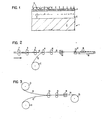
- Fig. 1 is a sectional view of part of a magnetic-record carrier 1, for example, a magnetic disk.
- the substrate 2 is provided with a soft-magnetic foil 3 on to which the recording layer 4 with the perpendicular direction of magnetization is arranged perpendicularly to the direction of the plane of the record carrier 1.
- the arrows 5 show the course of the direction of magnetization in the soft- magnetic layer 3 which extends parallel to the plane of the record carrier 1.
- Arrows 6 show schematically the course of the stray field outside the record carrier 1. This stray field exiting from the record carrier 1 and in particular from the storage layer 4 is decisive for the direction and strength of the read signal which is detected by a magnetic head, not shown.
- the recording and writing, respectively, of the signals on the storage layer 4 is effected perpendicularly to the plane of the record carrier 1.
- the record carrier 1, which is preferably realized in the form of a non-flexible magnetic disk, may also be provided with the soft-magnetic layer 3 and the perpendicularly recording layer 4 on the other side of the substrate 2. However, such an arrangement is not shown in the drawings.
- the application of the soft-magnetic foil 3, which is in particular a permalloy foil, to the substrate 2 is effected by rolling on., gluing or hot sealing.
- rolling on is preferably employed for metallic substrates, for example, in the case of the aluminium alloy AlMg5, which is widely used at present for magnetic disks.
- the foil may also be applied to the substrate 2 by gluing or, if the substrate 2 consists of a plastic, by hot sealing, i.e., by pressing the foil 3 and the substrate 2 together under the influence of heat.
- both the foil and the substrate it is preferable for both the foil and the substrate to have the same shape as the record carrier 1, i.e., in the case of a magnetic disk, both should be circular and be applied to each other in an aligned form.
- Fig. 2 shows a particular embodiment, in accordance with which the soft- magnetic foil is rolled on to the substrate 2.
- the raw material of the magnetic disks which consists of the aluminium alloy AlMg5
- AlMg5 tape 10 and the foil tape 12 are rolled on to each other.
- a composite material designated as 15 is obtained after treatment in roll stand 14.
- This composite material may be fed through a station 16 for subsequent treatment, for example, for stress-relieving the material.
- the raw material for producing magnetic disks is obtained, which already comprise the substrate 2 and the soft-magnetic foil 3 (cf.. Fig. 1).
- this tape material is cut into square and rectangular pieces which are removed by means of a transfer device 18. From the blanks 19 removed by transfer device 18 the so-called rounds, i.e., the circular disk blanks, are punched in an arrangement, not shown.
- a substrate with a soft-magnetic layer serving as an underlayer for the perpendicular recording layer to be applied thereto can be produced in a particularly simple manner.
- different materials are known.
- cobalt-chromium alloys or cobalt-gadolinium compounds as well as an alloy of one or several transition metals, such as iron and/or cobalt with one or several elements from the group of the rare earths, such as gadolinium, samarium, terbium or holmium may be used.
- these materials are applied to the underlayer, i.e., in the case of the present invention, to the soft-magnetic layer 3, by sputtering or a vacuum process.
- the perpendicularly storing layer 4 it is also known for the perpendicularly storing layer 4 to consist of very small pores, so-called micropores, which are filled with magnetic material. To this end, the micropores have a small thickness compared to their length, so that they can accommodate rod-shaped magnetic particles. It.is known for such micropores to be generated from an aluminium layer which by anodic oxidation forms micropores positioned perpendicularly to said layer.
- a soft- magnetic permalloy foil 12 is taken off the delivery roll 13 and by means of roll stands-20 and 21 is intimately linked to an aluminium foil 22 taken off a delivery roll 23, thus yielding a composite foil 24 which is wound on to a roll 25.
- This intimate linkage of the two foils 12 and 22 for-forming composite foil 24 is advantageously effected by rolling in roll stands 20 and 21 and subsequent treatment in station 26, if required. It cannot be ruled out, however, that a composite foil may be produced by intimately linking the two foils 12 and 22 in another manner, for example, by adhesion.
- This composite foil 24 manufactured from the soft-magnetic and the aluminium material is applied to a substrate 2 as a layer sequence similar to layer sequence 3 and 4 in Fig. 1. If this cannot be done by means of the rolling process explained briefly by means of Fig. 2, application may be accomplished by gluing suitably cut pieces to a substrate 2 or, if the substrate material is not a metal compound, by hot sealing the cut pieces on to a substrate 2 consisting of plastic.
- Anodization continues until the aluminium layer is fully oxidized.
- the time at which the aluminium layer is fully oxidized i.e., at which it reaches the interface between soft-magnetic permalloy material and aluminium, may be determined by the change in the current-voltage characteristic in the anodization process.
- perpendicularly positioned aluminium oxide pores are formed which are thin in comparison to their great length.
- these pores are subsequently filled with magnetic material which by its very shape in said pores has a definite shape anisotropy extending perpendicularly to the plane of the record carrier 1.
- an aluminium foil 22 which in accordance with the arrangement in Fig. 3 is combined with the soft-magnetic permalloy foil 12 to form a composite foil 24, highly pure aluminium with a minimum aluminium content of 99.999 % is preferably used: T6is- highly pure aluminium ensures that defects are prevented during the anodic-oxidation process, so that such defects, which may lead to missing bits during recording, are eliminated when the magnetic material is subsequently introduced in the pores.
- the soft-magnetic foil in particular the permalloy foil 3, used in accordance with the invention has a thickness of between 10 and 100 pm, whereby a slightly greater thickness in the range of the value of 100 pm would substantially increase the exiting stray field 6.
- Such foils are commercially available.
- foils with thicknesses of up to 10 ⁇ m are also commercially available. If micropores consisting of aluminium oxide are used, the layer thickness of the perpendicular record carrier layer 4 can be determined by a polishing process following the electrochemical filling process during which the magnetic material is introduced. This permits optimum determination of the surface quality required.
Landscapes
- Magnetic Record Carriers (AREA)
- Manufacturing Of Magnetic Record Carriers (AREA)
Applications Claiming Priority (2)
| Application Number | Priority Date | Filing Date | Title |
|---|---|---|---|
| DE3035148 | 1980-08-18 | ||
| DE19803035148 DE3035148A1 (de) | 1980-09-18 | 1980-09-18 | Magnetischer aufzeichnungstraeger fuer vertikales aufzeichnen |
Publications (3)
| Publication Number | Publication Date |
|---|---|
| EP0046239A2 true EP0046239A2 (de) | 1982-02-24 |
| EP0046239A3 EP0046239A3 (en) | 1983-08-03 |
| EP0046239B1 EP0046239B1 (de) | 1987-05-27 |
Family
ID=6112231
Family Applications (1)
| Application Number | Title | Priority Date | Filing Date |
|---|---|---|---|
| EP81106127A Expired EP0046239B1 (de) | 1980-08-18 | 1981-08-05 | Magnetischer Aufzeichnungsträger für die vertikale Aufzeichnung |
Country Status (3)
| Country | Link |
|---|---|
| EP (1) | EP0046239B1 (de) |
| JP (1) | JPS5755532A (de) |
| DE (2) | DE3035148A1 (de) |
Cited By (2)
| Publication number | Priority date | Publication date | Assignee | Title |
|---|---|---|---|---|
| EP0122326A3 (de) * | 1982-12-01 | 1986-06-04 | Knogo Corporation | Methode und Apparat zur Herstellung von Sicherheitsstreifen |
| RU2169398C1 (ru) * | 2000-02-11 | 2001-06-20 | Общество с ограниченной ответственностью "ЛабИНТЕХ" (Лаборатория ионных нанотехнологий) | Способ изготовления магнитного носителя |
Families Citing this family (2)
| Publication number | Priority date | Publication date | Assignee | Title |
|---|---|---|---|---|
| JPS60223029A (ja) * | 1984-04-17 | 1985-11-07 | Toshiro Takahashi | 磁気記録媒体の製造方法 |
| JPS618223A (ja) * | 1984-06-22 | 1986-01-14 | Inst Tech Precision Eng | 放電加工装置 |
Family Cites Families (11)
| Publication number | Priority date | Publication date | Assignee | Title |
|---|---|---|---|---|
| US3161946A (en) * | 1964-12-22 | permalloy | ||
| DE915738C (de) * | 1951-05-27 | 1954-07-29 | Basf Ag | Verfahren zur Herstellung von als Magnetogrammtraeger geeigneten mehrschichtigen Formkoerpern |
| DE934731C (de) * | 1952-11-11 | 1955-11-03 | Tefi Appbau Dr Daniel K G | Verfahren zum Herstellen von Magnettonbaendern |
| DE1147262B (de) * | 1958-04-02 | 1963-04-18 | Fuji Photo Film Co Ltd | Verfahren zur Herstellung von Magnetogrammtraegern |
| DE2001044A1 (de) * | 1970-01-12 | 1971-07-22 | Basf Ag | Starre Magnetogrammtraeger |
| JPS5121562B2 (de) * | 1972-04-14 | 1976-07-03 | ||
| DE2460320A1 (de) * | 1974-12-20 | 1976-07-01 | Ibm Deutschland | Magnetischer aufzeichnungstraeger |
| FR2406654A1 (fr) * | 1977-10-21 | 1979-05-18 | Pyral Soc | Procede de transfert de couches magnetiques sur un support et materiaux de mise en oeuvre de ce procede |
| FR2428886A1 (fr) * | 1978-06-13 | 1980-01-11 | Cii Honeywell Bull | Support d'information magnetique a enregistrement perpendiculaire |
| DE2827870A1 (de) * | 1978-06-24 | 1980-01-10 | Ibm Deutschland | Magnetischer aufzeichnungstraeger mit vertikaler aufzeichnung |
| JPS5555441A (en) * | 1978-10-16 | 1980-04-23 | Nec Corp | Production of metallic magnetic tape |
-
1980
- 1980-09-18 DE DE19803035148 patent/DE3035148A1/de not_active Withdrawn
-
1981
- 1981-07-10 JP JP56107161A patent/JPS5755532A/ja active Pending
- 1981-08-05 EP EP81106127A patent/EP0046239B1/de not_active Expired
- 1981-08-05 DE DE8181106127T patent/DE3176223D1/de not_active Expired
Cited By (2)
| Publication number | Priority date | Publication date | Assignee | Title |
|---|---|---|---|---|
| EP0122326A3 (de) * | 1982-12-01 | 1986-06-04 | Knogo Corporation | Methode und Apparat zur Herstellung von Sicherheitsstreifen |
| RU2169398C1 (ru) * | 2000-02-11 | 2001-06-20 | Общество с ограниченной ответственностью "ЛабИНТЕХ" (Лаборатория ионных нанотехнологий) | Способ изготовления магнитного носителя |
Also Published As
| Publication number | Publication date |
|---|---|
| DE3035148A1 (de) | 1982-04-22 |
| DE3176223D1 (en) | 1987-07-02 |
| EP0046239A3 (en) | 1983-08-03 |
| EP0046239B1 (de) | 1987-05-27 |
| JPS5755532A (en) | 1982-04-02 |
Similar Documents
| Publication | Publication Date | Title |
|---|---|---|
| US4901179A (en) | Magnetic head having a laminated structure | |
| GB2252661A (en) | Thin film laminated magnetic head | |
| JPH0546014B2 (de) | ||
| EP0046239A2 (de) | Magnetischer Aufzeichnungsträger für die vertikale Aufzeichnung | |
| JPS5996527A (ja) | 磁気ヘツドの製造方法 | |
| KR100233697B1 (ko) | 자기 기록 매체 | |
| US4837080A (en) | Magnetic recording mediums for high density recording comprising an improved structure of a magnetic layer | |
| JPH01220120A (ja) | 磁気テープ | |
| JPH06243451A (ja) | 磁気記録媒体および磁気記録装置 | |
| JPH026130B2 (de) | ||
| US20020163758A1 (en) | Thin film magnetic head and method of manufacturing the same | |
| JPS63241717A (ja) | 磁気記録体 | |
| JPS62246112A (ja) | 磁気ヘツドの製造方法 | |
| JPS59157837A (ja) | 磁気記録媒体 | |
| US5636433A (en) | Method of manufacturing a magnetic head | |
| JPH0142815Y2 (de) | ||
| JP3565103B2 (ja) | 磁気記録装置 | |
| JPH0737237A (ja) | 磁気記録媒体、その製造方法及び磁気記録装置 | |
| JPH0581662A (ja) | 垂直磁気記録媒体の製造方法 | |
| JPS58171717A (ja) | 磁気記録媒体 | |
| JPS58189824A (ja) | 垂直磁気記録媒体 | |
| JPH02227805A (ja) | 磁気消去ヘッド | |
| JPH06150240A (ja) | 磁気ヘッドおよびその製造方法 | |
| JPS6095720A (ja) | 垂直磁気記録用媒体 | |
| JPH08273109A (ja) | 磁気ヘッドコアおよびその製造方法 |
Legal Events
| Date | Code | Title | Description |
|---|---|---|---|
| PUAI | Public reference made under article 153(3) epc to a published international application that has entered the european phase |
Free format text: ORIGINAL CODE: 0009012 |
|
| 17P | Request for examination filed |
Effective date: 19810805 |
|
| AK | Designated contracting states |
Designated state(s): DE FR GB IT |
|
| PUAL | Search report despatched |
Free format text: ORIGINAL CODE: 0009013 |
|
| AK | Designated contracting states |
Designated state(s): DE FR GB IT |
|
| GRAA | (expected) grant |
Free format text: ORIGINAL CODE: 0009210 |
|
| AK | Designated contracting states |
Kind code of ref document: B1 Designated state(s): DE FR GB IT |
|
| PG25 | Lapsed in a contracting state [announced via postgrant information from national office to epo] |
Ref country code: IT Free format text: LAPSE BECAUSE OF FAILURE TO SUBMIT A TRANSLATION OF THE DESCRIPTION OR TO PAY THE FEE WITHIN THE PRESCRIBED TIME-LIMIT;WARNING: LAPSES OF ITALIAN PATENTS WITH EFFECTIVE DATE BEFORE 2007 MAY HAVE OCCURRED AT ANY TIME BEFORE 2007. THE CORRECT EFFECTIVE DATE MAY BE DIFFERENT FROM THE ONE RECORDED. Effective date: 19870527 |
|
| REF | Corresponds to: |
Ref document number: 3176223 Country of ref document: DE Date of ref document: 19870702 |
|
| ET | Fr: translation filed | ||
| PLBE | No opposition filed within time limit |
Free format text: ORIGINAL CODE: 0009261 |
|
| STAA | Information on the status of an ep patent application or granted ep patent |
Free format text: STATUS: NO OPPOSITION FILED WITHIN TIME LIMIT |
|
| 26N | No opposition filed | ||
| PGFP | Annual fee paid to national office [announced via postgrant information from national office to epo] |
Ref country code: FR Payment date: 19900720 Year of fee payment: 10 |
|
| PGFP | Annual fee paid to national office [announced via postgrant information from national office to epo] |
Ref country code: GB Payment date: 19910717 Year of fee payment: 11 |
|
| PGFP | Annual fee paid to national office [announced via postgrant information from national office to epo] |
Ref country code: DE Payment date: 19910828 Year of fee payment: 11 |
|
| PG25 | Lapsed in a contracting state [announced via postgrant information from national office to epo] |
Ref country code: FR Effective date: 19920430 |
|
| REG | Reference to a national code |
Ref country code: FR Ref legal event code: ST |
|
| PG25 | Lapsed in a contracting state [announced via postgrant information from national office to epo] |
Ref country code: GB Effective date: 19920805 |
|
| GBPC | Gb: european patent ceased through non-payment of renewal fee |
Effective date: 19920805 |
|
| PG25 | Lapsed in a contracting state [announced via postgrant information from national office to epo] |
Ref country code: DE Effective date: 19930501 |