EP0039397B1 - Ternäre thermoplastische Formmasse enthaltend Propylen-Mischpolymere - Google Patents
Ternäre thermoplastische Formmasse enthaltend Propylen-Mischpolymere Download PDFInfo
- Publication number
- EP0039397B1 EP0039397B1 EP81101751A EP81101751A EP0039397B1 EP 0039397 B1 EP0039397 B1 EP 0039397B1 EP 81101751 A EP81101751 A EP 81101751A EP 81101751 A EP81101751 A EP 81101751A EP 0039397 B1 EP0039397 B1 EP 0039397B1
- Authority
- EP
- European Patent Office
- Prior art keywords
- weight
- mfi
- ethylene
- propylene
- propylene copolymer
- Prior art date
- Legal status (The legal status is an assumption and is not a legal conclusion. Google has not performed a legal analysis and makes no representation as to the accuracy of the status listed.)
- Expired
Links
Classifications
-
- C—CHEMISTRY; METALLURGY
- C08—ORGANIC MACROMOLECULAR COMPOUNDS; THEIR PREPARATION OR CHEMICAL WORKING-UP; COMPOSITIONS BASED THEREON
- C08L—COMPOSITIONS OF MACROMOLECULAR COMPOUNDS
- C08L23/00—Compositions of homopolymers or copolymers of unsaturated aliphatic hydrocarbons having only one carbon-to-carbon double bond; Compositions of derivatives of such polymers
- C08L23/02—Compositions of homopolymers or copolymers of unsaturated aliphatic hydrocarbons having only one carbon-to-carbon double bond; Compositions of derivatives of such polymers not modified by chemical after-treatment
- C08L23/10—Homopolymers or copolymers of propene
- C08L23/12—Polypropene
-
- C—CHEMISTRY; METALLURGY
- C08—ORGANIC MACROMOLECULAR COMPOUNDS; THEIR PREPARATION OR CHEMICAL WORKING-UP; COMPOSITIONS BASED THEREON
- C08L—COMPOSITIONS OF MACROMOLECULAR COMPOUNDS
- C08L23/00—Compositions of homopolymers or copolymers of unsaturated aliphatic hydrocarbons having only one carbon-to-carbon double bond; Compositions of derivatives of such polymers
- C08L23/02—Compositions of homopolymers or copolymers of unsaturated aliphatic hydrocarbons having only one carbon-to-carbon double bond; Compositions of derivatives of such polymers not modified by chemical after-treatment
- C08L23/10—Homopolymers or copolymers of propene
- C08L23/14—Copolymers of propene
- C08L23/142—Copolymers of propene at least partially crystalline copolymers of propene with other olefins
-
- C—CHEMISTRY; METALLURGY
- C08—ORGANIC MACROMOLECULAR COMPOUNDS; THEIR PREPARATION OR CHEMICAL WORKING-UP; COMPOSITIONS BASED THEREON
- C08L—COMPOSITIONS OF MACROMOLECULAR COMPOUNDS
- C08L23/00—Compositions of homopolymers or copolymers of unsaturated aliphatic hydrocarbons having only one carbon-to-carbon double bond; Compositions of derivatives of such polymers
- C08L23/02—Compositions of homopolymers or copolymers of unsaturated aliphatic hydrocarbons having only one carbon-to-carbon double bond; Compositions of derivatives of such polymers not modified by chemical after-treatment
- C08L23/16—Ethylene-propylene or ethylene-propylene-diene copolymers
-
- C—CHEMISTRY; METALLURGY
- C08—ORGANIC MACROMOLECULAR COMPOUNDS; THEIR PREPARATION OR CHEMICAL WORKING-UP; COMPOSITIONS BASED THEREON
- C08L—COMPOSITIONS OF MACROMOLECULAR COMPOUNDS
- C08L2205/00—Polymer mixtures characterised by other features
- C08L2205/02—Polymer mixtures characterised by other features containing two or more polymers of the same C08L -group
-
- C—CHEMISTRY; METALLURGY
- C08—ORGANIC MACROMOLECULAR COMPOUNDS; THEIR PREPARATION OR CHEMICAL WORKING-UP; COMPOSITIONS BASED THEREON
- C08L—COMPOSITIONS OF MACROMOLECULAR COMPOUNDS
- C08L2205/00—Polymer mixtures characterised by other features
- C08L2205/03—Polymer mixtures characterised by other features containing three or more polymers in a blend
-
- C—CHEMISTRY; METALLURGY
- C08—ORGANIC MACROMOLECULAR COMPOUNDS; THEIR PREPARATION OR CHEMICAL WORKING-UP; COMPOSITIONS BASED THEREON
- C08L—COMPOSITIONS OF MACROMOLECULAR COMPOUNDS
- C08L23/00—Compositions of homopolymers or copolymers of unsaturated aliphatic hydrocarbons having only one carbon-to-carbon double bond; Compositions of derivatives of such polymers
- C08L23/02—Compositions of homopolymers or copolymers of unsaturated aliphatic hydrocarbons having only one carbon-to-carbon double bond; Compositions of derivatives of such polymers not modified by chemical after-treatment
- C08L23/04—Homopolymers or copolymers of ethene
- C08L23/06—Polyethylene
Definitions
- the invention relates to a ternary molding composition based on ethylene-propylene copolymer, propylene copolymer and polyethylene.
- EP-A 6 620 ternary molding compositions of the generic type are known, which are characterized by good impact strength at high proportions of polypropylene from 60 to 90%, preferably over 65%. award.
- polypropylene In addition to some very favorable properties, such as a relatively low density, excellent resistance to higher temperatures and aqueous and non-aqueous liquids, polypropylene also has less favorable properties, which include poor impact resistance at temperatures below room temperature, especially below 0 ° C. Adequate impact resistance, but is for many applications, such as. B. required for transport boxes, suitcases, automotive parts and the like and important.
- High-density polyethylene from which such molded parts are usually made, has this good high impact resistance, but shows less resistance to high temperatures.
- ethylene-propylene copolymers both the saturated and the unsaturated, have high aging and ozone resistance and low-temperature resistance, so that they are also particularly suitable for applications exposed to weathering. Because of their rubber-like properties, they are often mixed with harder polymers.
- GB-PS 11 54 447 ternary molding composition containing 50 to 90 wt .-% crystalline polypropylene, which is more than 90 wt .-% insoluble in n-heptane, and 5 to 30 wt .-% polyethylene and 5 to 40% by weight of ethylene-propylene block copolymer, which is 80% by weight insoluble in n-heptane, has a tensile strength which is only 10 N / mm 2 and which is at temperatures below -30 ° C. is no longer flexible.
- DE-OS 27 42 910 a thermoplastic elastomer mixture of 25 to 85 wt .-% of a practically amorphous ethylene-propylene copolymer and 15 to 75 wt .-% of a crystalline block copolymer of propylene and optionally additional polyethylene is known.
- this molding composition is in need of improvement in terms of hardness, tensile strength, better resistance to high temperatures, and is preferred for example in these properties by a molding composition.
- DE-OS 28 21 342 exceeded, as Table 1, DE-OS 28 21 342 demonstrates.
- DE-OS 28 21 342 discloses thermoplastic elastomer mixtures containing 30 to 75 parts of crystalline isotactic propylene homopolymer and 25 to 70 parts of an essentially amorphous rubber-like ethylene-propylene polymer and a maximum of 15 parts of polyethylene, which proportionately comprise the propylene homopolymer replace, known. These mixtures have improved properties compared to binary molding compositions, which also make them more suitable for the production of bumpers for motor vehicles. However, it has been shown that for extreme loads, the mechanical properties of the ternary elastomer mixtures known from DE-OS 28 21 342, in particular with regard to the impact strength and low-temperature flexibility, still need improvement.
- the invention has for its object to provide a thermoplastic molding composition which has high heat resistance, good mechanical properties, in particular tensile strengths, high cold flexibility, ie notched impact strength at low temperatures and can also be pelletized and overall compared to the known binary and ternary molding compositions with respect to a or several properties is improved. It is also a concern of the invention to be able to use simple means to produce such an optimally impact-resistant ternary molding compound with desired properties, which is not accidentally found as a marginal product in addition to others in known molding compounds.
- the desired Molding compositions should also be improved with regard to their shrinkage and are particularly suitable for use in the injection molding process.
- the marking on the basis of the melt index is based on the information contained herein about the flowability of the molding compound, which is essential for the processability of the same.
- the molding composition according to the invention should in particular be processable by injection molding and should therefore have a melt index MFI (230/5) of at least 8.
- the ethylene-propylene copolymer used preferably has an ethylene content of more than 70% by weight.
- the partially crystalline ethylene-propylene copolymers with high strength which are also known as very high green rigid rubbers, are used.
- These ethylene-propylene copolymers can be expanded and thus give the molding composition an overall processing advantage over the amorphous or almost amorphous ethylene-propylene copolymers which cannot be pelletized, see DE-OS 2742910.
- Dicyclopentadiene, alkylidene norbones, alkenyl norbones, alkadienes and cycloalkadienes are generally used as the ter component. According to the invention, preference is given to using ethylene-propylene terpolymers with a minimum tensile strength of 8.0 N / mm 2 , preferably a tensile strength above 20 N / mm 2 , for the molding composition.
- Propylene copolymers with an ethylene content of less than 12% by weight are particularly suitable for the molding composition according to the invention.
- the ternary molding composition according to the invention is particularly suitable for the production of technical molded parts which are exposed to high temperatures up to 100 ° C on the one hand, but also very low temperatures below - 30 ° C with high mechanical stresses at the same time.
- a preferred field of application is the production of bumpers for motor vehicles, which also have to withstand shock loads at low temperatures down to -40 ° C.
- the molding composition according to the invention also meets these extreme stresses in that, on the one hand, it has a sufficient proportion of ethylene-propylene interpolymer to achieve the required notched impact strength at low temperatures, but this entails a certain reduction in the heat resistance. This reduction in the heat resistance is counteracted by using an amount of selected propylene copolymers according to the invention which give the molding composition improved mechanical properties at low temperatures and at the same time good heat resistance.
- the melting ranges of the propylene copolymers used are preferably above 155 ° C., preferably between 160 to 162 °.
- the propylene copolymers used have the disadvantage that, when mixed with ethylene-propylene copolymers, they cause a relatively large post-shrinkage (shrinkage) in injection-molded parts. This leads to difficulties in the production of corresponding dimensionally stable injection molded parts.
- the third component polyethylene not only brings in its otherwise known properties, but obviously reduces this post-shrinkage until it can largely compensate.
- a polyethylene with an MFI (230/5) greater than 15, but preferably between 20 to 50, has proven to be particularly advantageous.
- a low-pressure polyethylene is advantageously used here.
- Preferred molding compositions according to the invention starting from the components described above with optimal properties, have a ratio of the melt index MFI of polyethylene to the ethylene-propylene copolymer equal to or greater than 15, but preferably greater than 25.
- the ratio of the melt index of polyethylene to provide that of the propylene copolymer between 0.3 and 3.0.
- the ternary molding compositions according to the invention can be produced in a known manner using the apparatuses customary for plastics, such as rollers, extruders, mixers and kneaders, it being possible for all the components to be mixed at the same time.
- the mixing is advantageously carried out at elevated temperature, in particular at a temperature between 180 and 280 ° C., under the action of shear forces.
- additives such as colorants, lubricants, fillers, antioxidants, UV stabilizers, flame retardants, fibers or the like can additionally be added to the molding composition according to the invention.
- MFI 230/5) g / 10 min is always meant when the MFI is specified.
- the granules produced in this way are sprayed at a melt temperature of 220 to 260 ° C. into a molded part in the form of a bumper, which has a desired length of 1,436 mm when removed from the injection mold. Storage at room temperature causes the molded part to shrink (shrink). After 48 hours, the bumper only shows a length of 1 435.5 mm, i.e. H. a shrinkage of - 0.5 mm compared to the nominal length.
- a comparison of a mixture of 40 parts by weight of an EPDM with an MFI 0.8 is mixed with 50 parts by weight of a propylene homopolymer with an MFI of 55 and 10 parts by weight of a propylene copolymer with an .MFI of 25 homogenized as in Example 1 and processed into granules.
- a bumper made from these granules under the same spraying conditions as in Example 1 shows a length of - 1.5 mm compared to the desired length after 48 hours of storage. This example shows that even a small amount of a propylene copolymer causes a high shrinkage of the molded part.
- a comparative binary mixture of 36 parts by weight of EPDM with an MFI of 0.8 and 64 parts by weight of a propylene copolymer with an MFI of 25 is homogenized in a kneader and processed into granules as described in Example 1 .
- the granules produced in this way are injected at a melt temperature of 220 to 260 ° C. into a molded part which has a desired length of 1,436 mm when removed from the injection mold.
- the molded part shows a post-shrinkage, i. H. a shrinkage of 2.5 mm compared to the nominal length.
- a further binary molding composition is obtained from a mixture of 39 parts by weight of EPDM with an MFI of 0.8 and 37 parts by weight of a propylene copolymer with an MFI of 25 and 24 parts by weight of a propylene copolymer with one MFI of 65 as described in Example 1, produced and injection molded into a molding as described in Example 1.
- the molded part removed from the injection mold already shows a shrinkage in length of - 1.5 mm compared to the initial desired length of 1 436 mm. This shows that the use of a free-flowing propylene copolymer with a high melt index does not prevent shrinkage.
- a ternary molding composition according to the invention is made from 36 parts by weight of an EPDM with an MFI of 0.8 and 54 parts by weight of a propylene copolymer with an MFI of 25 and 10 parts by weight of a polyethylene with an MFI (230/5 ) manufactured from 30 and injection molded into a molded part, as described in Example 1. After 48 hours of storage at room temperature, the molded part is +1.5 mm longer than the initial target length of 1,436 mm.
- a ternary molding composition according to the invention consisting of 38 parts by weight of EPDM with an MFI of 0.8 and 52 parts by weight of a propylene copolymer with an MFI of 25 and 10 parts by weight of polyethylene with an MFI of 30 is as in Example 3 processed into a molded part with a nominal length of 1 436 mm. After 48 hours of storage at room temperature, the molded part shows a length increased by + 3.5 mm compared to the nominal length. See table for further properties.
- Example 2 As described in Example 1, a comparison of a binary mixture of 35 parts by weight of an EPM with an MFI of 0.9 and 65 parts by weight of a propylene copolymer with an MFI of 25 is made and sprayed into a bumper. After 48 hours of storage at room temperature, the bumper shrinks by 1.5 compared to the nominal length.
- a binary mixture of 48 parts by weight of an EPDM with an MFI of 0.8 and 52 parts by weight of a propylene homopolymer with an MFI of 55 is produced and sprayed analogously to Example 1 to form a bumper. After 48 hours of storage at room temperature, the bumper shows a shrinkage ⁇ 0 compared to the nominal length.
- a mixture according to the invention consists of 38 parts by weight of an EPM with an MFI of 0.9 and 52 parts by weight of a propylene copolymer with an MFI of 25 and 10 parts by weight of polyethylene with an MFI (230/5) made from 30 and molded into a bumper. After 48 hours of storage at room temperature, this shows a shrinkage of + 1.5 mm.
- Example 7 of Table 1 was taken over from DE-OS 28 21 342 as a comparative example.
- example 7 from table 2 was taken from DE-OS 28 21 342.
- a mixture is prepared from 45 parts by weight of EPDM as in Example 11 and 50 parts by weight of a propylene block copolymer as in Example 11 and 5 parts by weight of polyethylene as in Example 11 and pressed to give a molding.
- DE-OS 28 21 342 From the information given in DE-OS 28 21 342 on the properties of the plate, such as tensile strength 6.1 N / mm 2 , elongation at break% 280, shore hardness (D) 47, the overall assessment of the mechanical properties is only moderately satisfactory Impression, whereby the toughness at low temperatures is in any case insufficient.
- a ternary molding composition according to the invention consisting of 41 parts by weight of EPDM with an MFI of 0.8 and 49 parts by weight of a propylene copolymer with an MFI of 25 and 10 parts by weight of polyethylene with an MFI of 30 is as in Example 3 Processed into a molded part with a nominal length of 1 436 mm. After 48 hours of storage at room temperature, the molded part shows a change in length of + 3 mm compared to the nominal length.
- Example 6 shows that the properties of the molding composition according to the invention can be further improved by slightly increasing the EPDM content at the expense of the propylene copolymer, in particular with regard to low-temperature flexibility and shrinkage. It is surprising here that the good heat resistance is retained (in contrast to the behavior according to Examples 1 and 8).
- Example 7 shows a binary molding compound based on EPM with propylene copolymer. This shows properties that are analogous to the binary molding compounds based on EPDM, whereby the shrinkage behavior is unfavorable and the spraying work of complicated molded parts with high dimensional accuracy is questioned.
- Examples 10 and 11 show the known ternary molding compositions which are based on amorphous or almost amorphous ethylene-propylene copolymers and which give a completely different property profile, in particular not the high mechanical properties such as elongation at break and tensile strength and in no case the desired high flexibility at low temperatures be able to show.
Landscapes
- Chemical & Material Sciences (AREA)
- Health & Medical Sciences (AREA)
- Chemical Kinetics & Catalysis (AREA)
- Medicinal Chemistry (AREA)
- Polymers & Plastics (AREA)
- Organic Chemistry (AREA)
- Crystallography & Structural Chemistry (AREA)
- Compositions Of Macromolecular Compounds (AREA)
- Injection Moulding Of Plastics Or The Like (AREA)
- Moulding By Coating Moulds (AREA)
- Materials For Medical Uses (AREA)
- Processing And Handling Of Plastics And Other Materials For Molding In General (AREA)
- Casting Or Compression Moulding Of Plastics Or The Like (AREA)
Description
- Die Erfindung betrifft eine ternäre Formmasse auf Basis von Ethylen-Propylen-Mischpolymerisat, Propylen-Mischpolymer und Polyethylen.
- Aus der EP-A 6 620 sind ternäre Formmassen der gattungsgemäßen Art bekannt, die sich durch gute Schlagfestigkeit bei hohen Anteilen von Polypropylen von 60 bis 90 %, vorzugsweise über 65 %. auszeichnen.
- Polypropylen besitzt neben einigen sehr günstigen Eigenschaften, wie beispielsweise einer relativ niedrigen Dichte, einer ausgezeichneten Beständigkeit gegen höhere Temperaturen und wässrigen und nichtwässrigen Flüssigkeiten, auch weniger günstige Eigenschaften, wozu die mangelhafte Schlagfestigkeit bei Temperaturen unterhalb Raumtemperatur, insbesondere unterhalb 0 °C zu zählen ist. Ausreichende Schlagfestigkeit, ist jedoch für viele Anwendungen, wie z. B. für Transportkästen, Koffer, Automobilteile und ähnliche erforderlich und von Bedeutung.
- Polyethylen hoher Dichte, aus welchem man derartige Formteile gewöhnlich herstellt, besitzt zwar diese gute hohe Schlagfestigkeit, zeigt jedoch eine geringere Beständigkeit gegen hohe Temperaturen.
- Ethylen-Propylen-Mischpolymerisate, sowohl die gesättigten als auch die ungesättigten, weisen neben guten mechanischen Eigenschaften hohe Alterungs- und Ozonfestigkeit und Kältefestigkeit auf, so daß sie insbesondere auch für der Bewitterung ausgesetzte Anwendungen hervorragend geeignet sind. Wegen ihrer kautschukartigen Eigenschaften versetzt man sie gerne mit härteren Polymeren.
- Man hat nun vielfach versucht, die Eigenschaften von Polypropylen und/oder Polyethylen und/oder Ethylen-Propylen-Mischpolymerisaten (EPM) durch Herstellen binärer oder ternärer Formmassen zu verbinden. Beispielsweise ist es bekannt, Gemische aus Polypropylen und Polyethylen zu verwenden, die jedoch eine kaum verbesserte Schlagfestigkeit im Vergleich zu Polypropylen allein besitzen. Die DE-OS 22 02 706 und 22 02 738 zeigen Abmischungen aus isotaktischem Polypropylen und Ethylen-Propylen-Kautschuken, die entweder durch Zugabe von Vulkanisationsmitteln nach der Abmischung teilvernetzt werden oder bei deren Herstellung bereits teilvernetztes EPM eingesetzt wird. Solche Mischungen sind jedoch in Bezug auf die erreichbaren Zugfestigkeitswerte, die Bruchdehnungswerte, die Weiterreißfestigkeiten sowie die Härtewerte, gemessen bei 100 °C für viele Anwendungsfälle noch verbesserungsbedürftig, d. h. sie genügen den gestellten Anforderungen nicht für alle Anwendungsfälle.
- Abmischungen von Polyethylen mit EPDM-Polymeren, deren Kristallinität zwischen 10 bis 20 % liegt, sind aus der US-PS 3919358 bekannt. Derartige Produkte besitzen zwar hohe Reißfestigkeiten, aber wegen der niedrigen Schmelztemperatur des Polyethylens keine ausreichende Wärmebeständigkeit, auch die bleibende Verformung, die Steifigkeit und die Härte sind unbefriedigend.
- Aus der DE-OS 27 32 969 ist eine binäre Formmasse aus unvernetzten Ethylen-Propylen-Sequenz-PolymEren mit isotaktischem Polypropylen bekannt. Es hat sich jedoch gezeigt, daß solche Abmischungen unter anderem eine relativ große Schrumpfung beim Spritzgießen erfahren, so daß es oft schwierig ist, maßhaltige Formteile zu spritzen aufgrund der großen Nachschwindung ; dies gilt insbesondere für komplizierte Formteile.
- Aus der GB-PS 11 54 447 bekannte ternäre Formmasse enthaltend 50 bis 90 Gew.-% kristallines Polypropylen, das zu mehr als 90 Gew.-% in n-Heptan unlöslich ist, und 5 bis 30 Gew.-% Polyethylen und 5 bis 40 Gew.-% Ethylen-Propylen-Block-Copolymer, das in n-Heptan zu 80 Gew.-% unlöslich ist, weist eine Zugfestigkeit auf, die bei nur 10 N/mm2 liegt und die bei Temperaturen unter - 30 °C nicht mehr flexibel ist.
- Aus der DE-OS 27 42 910 hingegen ist ein thermoplastisches Elastomergemisch aus 25 bis 85 Gew.-% eines praktisch amorphen Ethylen-Propylen-Mischpolymerisates und 15 bis 75 Gew.-% eines kristallinen Blockmischpolymerisates von Propylen und ggf. zusätzlichem Polyethylen bekannt. Wie in der DE-OS 28 21 342 ausgeführt, ist diese Formmasse in Bezug auf die Härte, die Zugfestigkeit, bessere Beständigkeit gegen hohe Temperaturen verbesserungsbedürftig, und wird beispielsweise in diesen Eigenschaften durch eine Formmasse gern. der DE-OS 28 21 342 übertroffen, wie die Tabelle 1, der DE-OS 28 21 342 nachweist.
- Aus der DE-OS 28 21 342 sind thermoplastische Elastomer-Gemische enthaltend 30 bis 75 Teile kristallines isotaktisches Propylen-Homopolymerisat und 25 bis 70 Teile eines im wesentlichen amorphen kautschukarten Ethylen-Propylen-Polymerisates und maximal 15 Teile Polyethylen, die anteilig das Propylen-Homopolymerisat ersetzen, bekannt. Diese Gemische weisen gegenüber binären Formmassen teils verbesserte Eigenschaften auf, die sie auch zur Herstellung von Stoßstangen für Kraftfahrzeuge geeigneter machen. Es hat sich jedoch gezeigt, daß für extreme Beanspruchungen, die mechanischen Eigenschaften der aus der DE-OS 28 21 342 bekannten ternären Elastomer-Gemische insbesondere was die Kerbschlag-Zähigkeit und Kälteflexibilität angeht, noch verbesserungsbedürftig ist.
- Der Erfindung liegt die Aufgabe zugrunde, eine thermoplastische Formmasse zu schaffen, die hohe Wärmebeständigkeit, gute mechanische Eigenschaften, insbesondere Zugfestigkeiten, hohe Kälteflexibilität d. h. Kerbschlagzähigkeit bei tiefen Temperaturen aufweist und darüber hinaus pelletisierbar ist und insgesamt gegenüber den bekannten binären und ternären Formmassen in Bezug auf eine oder mehrere Eigenschaften verbessert ist. Es ist auch ein Anliegen der Erfindung, mit einfachen Mitteln eine solche optimal schlagfeste ternäre Formmasse mit gewünschten Eigenschaften herstellen zu können, die sich nicht zufällig als Randprodukt neben anderen bei bekannten Formmassen einfindet. Die gewünschte Formmasse sollte auch hinsichtlich ihrer Schrumpfung verbessert werden und sich besonders zur Anwendung im Spritzgußverfahren eignen.
- Es wurde nun gefunden, daß die vorangehend genannte Aufgabenstellung mit einfachen Mitteln optimal gelöst wird durch eine Formmasse enthaltend
- a) 35 bis 43 Gew.-% eines teilkristallinen Ethylen-Propylen-Mischpolymerisates mit einem Ethylengehalt von mindestens 65 Gew.%, einem Schmelzindex MFI (230/5) von 0,7 bis 2,0 g/10 min und einer Zugfestigkeit größer 5,0 N/mm2,
- b) 40 bis 60 Gew.-% Propylen-Mischpolymer mit einem Ethylengehalt von unter 12 Gew.-% und mit einem Schmelzindex MFI (230/5) von 15 bis 50 g/10 min und
- c) 5 bis 20 Gew.-% Polyethylen mit einem Schmelzindex MFI (230/5) von 15 bis 50 g /10 min, wobei die Formmasse einen Schmelzindex MFI (230/5) von mindestens 8 g/10 min aufweist.
- Es ist völlig überraschend im Hinblick auf die aus den EP-A 6 620, DE-OS 27 42 910 und 28 21 342 bekannten Abmischungen, daß es durch die Erfindung gelingt, unter Einsatz von teilkristallinen Ethylen-Propylen-Mischpolymerisaten mit einer Zugfestigkeit, die mindestens 5,0 N/mm2 beträgt, ternäre Formmassen mit hoher Schlagfestigkeit, hoher Wärmeformbeständigkeit, hoher Kerbschlagzähigkeit auch bei teifen Temperaturen von - 40 °C zu schaffen, die sich zudem hervorragend zu Spritzgußformteilen unter Vermeidung von Schrumpf verarbeiten lassen.
- Die Kennzeichnung auf Basis der Schmelzindizes erfolgt wegen der hierin enthaltenen Aussage über die Fließfähigkeit der Formmasse, die wesentlich für die Verarbeitbarkeit derselben ist. Die erfindungsgemäße Formmasse soll insbesondere durch Spritzgießen verarbeitbar sein und soll daher einen Schmelzindex MFI (230/5) von mindestens 8 aufweisen.
- Das verwendete Ethylen-Propylen-Mischpolymerisat weist vorzugsweise einen Ethylen-Gehalt von mehr als 70 Gew.-% auf. Erfindungsgemäß werden die teilkristallinen Ethylen-Propylen-Mischpolymerisate mit hoher Festigkeit, die auch als Very High Green Strenght-Kautschuke bekannt sind, eingesetzt. Diese Ethylen-Propylen-Mischpolymerisate sind peitetisierbar und verleihen damit insgesamt der Formmasse einen verarbeitungstechnischen Vorteil gegenüber den amorphen oder nahezu amorphen Ethylen-Propylen-Mischpolymerisaten, die nicht pelletisierbar sind, siehe DE-OS 2742910. Bevorzugt wird ein Ethylen-Propylen-Mischpolymer und/oder ein Ethylen-Propylen-Terpolymer bestehend aus 65 bis 82 Gew.-% Ethylen, 18 bis 35 Gew.-% Propylen und 0 bis 8 Gew.-% Terkomponente für die Formmasse eingesetzt. Als Terkomponente werden in der Regel Dicyclopentadien, Alkylidennorbonen, Alkenylnorbone, Alkadiene und Cycloalkadiene verwendet. Bevorzugt werden für die Formmasse erfindungsgemäß Ethyfen-Propylen-Terpolymere mit einer Mindest-Zugfestigkeit von 8,0 N/mm2, vorzugsweise einer über 20 N/mm2 liegenden Zugfestigkeit, eingesetzt.
- Besonders geeignet für die erfindungsgemäße Formmasse sind Propylen-Mischpolymere mit einem Ethylen-Gehalt unfer 12 Gew.-%.
- Die erfindungsgemäße ternäre Formmasse ist besonders geeignet zum Herstellen von technischen Formteilen, die einerseits hohen Temperaturen bis 100 °C, aber auch sehr niedrigen Temperaturen unter - 30 °C bei gleichzeitig hohen mechanischen Beanspruchungen ausgesetzt sind.
- Ein bevorzugtes Anwendungsgebiet ist das Herstellen von Stoßfängern für Kraftfahrzeuge, die auch noch Stoßbeanspruchungen bei niedrigen Temperaturen bis - 40 °C aushalten müssen. Die erfindungsgemäße Formmasse wird auch diesen extremen Beanspruchungen dadurch gerecht, daß sie einerseits zum Erreichen der erforderlichen Kerbschlag-Zähigkeit bei tiefen Temperaturen einen ausreichenden Anteil von Ethylen-Propylen-Mischpolymerisat aufweist, der jedoch eine gewisse Erniedrigung der Wärmeformbeständigkeit mit sich bringt. Dieser Erniedrigung der Wärmeformbeständigkeit wird durch Einsatz einer erfindungsgemäßen Menge ausgewählter Propylen-Mischpolymere entgegengewirkt, die der Formmasse verbesserte mechanische Eigenschaften bei tiefen Temperaturen und zugleich gute Wärmeformbeständigkeit verleihen. Die Schmelzbereiche der eingesetzten Propylen-Mischpolymere liegen vorzugsweise über 155 °C, bevorzugt zwischen 160 bis 162°. Die eingesetzten Propylen-Mischpolymere haben jedoch den Nachteil, daß sie in Abmischung mit Ethylen-Propylen-Mischpolymerisaten eine relativ große Nachschwindung (Schrumpfung) bei spritzgegossenen Formteilen bewirken. Dieses führt zu Schwierigkeiten bei der Herstellung entsprechender maßhaltiger Spritzgußteile. Überraschend hat sich herausgestellt, daß die dritte Komponente Polyethylen nicht nur ihre sonst bekannten Eigenschaften einbringt, sondern offensichtlich diese Nachschwindung verringert, bis weitgehend ausgleichen kann. Besonders vorteilhaft hat sich ein Polyethylen mit einem MFI (230/5) größer 15, vorzugsweise jedoch zwischen 20 bis 50 erweisen. Vorteilhaft wird hierbei ein Niederdruck-Polyethylen eingesetzt.
- Bevorzugte erfindungsgemäße Formmassen, ausgehend von den vorangehend beschriebenen Komponenten mit optimalen Eigenschaften weisen ein Verhältnis der Schmelzindizes MFI des Polyethylens zum Ethylen-Propylen-Mischpolymerisat gleich oder größer 15 auf, bevorzugt jedoch größer 25. Hierbei ist es vorteilhaft, zugleich das Verhältnis der Schmelzindizes des Polyethylens zu dem des Propylen-Mischpolymerisates zwischen 0,3 und 3,0 vorzusehen. Die ternären Formmassen nach der Erfindung können auf bekannte Weise mit Hilfe der für Kunststoffe üblichen Apperaturen wie Walzen, Extruder, Mischer und Kneter hergestellt werden, wobei alle Komponenten gleichzeitig vermischt werden können. Die Vermischung ist vorteilhaft bei erhöhter Temperatur, insbesondere bei einer Temperatur zwischen 180 und 280 °C unter Einwirkung von Scherkräften durchzuführen.
- Der erfindungsgemäßen Formmasse können zusätzlich bekannte Zusatzstoffe wie Farbmittel, Gleitmittel, Füllstoffe, Antioxydationsmittel, UV-Stabilisatoren, Flammschutzmittel, Fasern oder dgl. zugegeben werden.
- Es ist auch möglich, die erfindungsgemäßen ternären Formmassen mit anderen Kunststoffen beispielsweise zur Verbesserung deren Schlagfestigkeit zuzugeben.
- Die Erfindung wird nachfolgend an einigen Beispielen mit Vergleichen erläutert.
- Für die Prüfung von Eigenschaften werden folgende Methoden angewendet:
- MFI (230/5) g/10 Min. nach DIN 53735 oder MFI (190/2,16) Zugfestigkeit N/mm2 nach DIN 53455.
- Kerbschlagzähigkeit nach DIN 53453 bei verschiedenen Temperaturen, un = nicht gebrochen, g = gebrochen Bruchdehnung in % nach DIN 53455.
- Vicat-Erweichungstemperatur VST/A °C.
- Schrumpf gemessen nach 48 h Lagerung bei Raumtemperatur in mm.
- Sofern nichts anderes angegeben ist, sind bei Angabe des MFI stets MFI (230/5) g/10 min gemeint.
- Eine als Vergleich ausgeführte binäre Mischung aus 43 Gew.-Teilen eines EPDM mit einem MFI von 0,8 wird mit 57 Gew.-Teilen Propylen-Homopolymerisat mit einem MFI 55 homogenisiert und zu einem Granulat verarbeitet. Das so hergestellte Granulat wird bei 220 bis 260 °C Massetemperatur zu einem Formteil in Gestalt eines Stoßfängers verspritzt, das eine Sollänge von 1 436 mm bei Entnahme aus der Spritzgußform aufweist. Durch Lagerung bei Raumtemperatur findet eine Nachschwindung (Schrumpfung) des Formteils statt. Nach 48 h.zeigt der Stoßfänger nur noch eine Länge von 1 435.5 mm, d. h. einen Schrumpf von - 0,5 mm gegenüber Sollänge.
- Weitere Eigenschaften finden sich in der Tabelle.
- Eine als Vergleich ausgeführte Mischung aus 40 Gew.-Teilen eines EPDM's mit einem MFI 0,8 wird mit 50 Gew.-Teilen eines Propylen-Homopolymerisates mit einem MFI von 55 und 10 Gew.-Teilen eines Propylen-Mischpolymeren mit einem .MFI von 25 wie in Beispiel 1 homogenisiert und zu Granulat verarbeitet. Ein aus diesem Granulat unter gleichen Spritzbedingungen wie in Beispiel 1 gefertigter Stoßfänger zeigt nach 48 h Lagerung eine Länge von - 1,5 mm gegenüber Sollänge. Dieses Beispiel zeigt, daß bereits eine geringe Menge eines Propylen-Mischpolymeren eine hohe Schwindung des Formteils bewirkt.
- Eine als Vergleich ausgeführte binäre Mischung aus 36 Gew.-Teilen EPDM mit einem MFI von 0,8 und 64 Gew.-Teilen eines Propylen-Mischpolymerisates mit einem MFI von 25 wird in einem Kneter homogenisiert und zu einem Granulat verarbeitet wie in Beispiel 1 beschrieben. Das so hergestellte Granulat wird bei einer Massetemperatur von 220 bis 260 °C zu einem Formteil verspritzt, das eine Sollänge von 1 436 mm bei Entnahme aus der Spritzgußform aufweist. Nach Lagerung des Formteiles bei Raumtemperatur während 48 Stunden nach Entnahme aus der Spritzgußform zeigt das Formteil eine Nachschwindung, d. h. eine Schrumpfung von 2,5 mm gegenüber Sollänge.
- Weitere Eigenschaften der binären Formmasse sind in der beigefügten Tabelle aufgeführt.'
- Es wird eine weitere binäre Formmasse aus einer Mischung von 39 Gew.-Teilen EPDM mit einem MFI von 0,8 und 37 Gew.-Teilen eines Propylen-Mischpolymerisates mit einem MFI von 25 und 24 Gew.-Teilen eines Propylen-Mischpolymerisates mit einem MFI von 65 wie im Beispiel 1 beschrieben, hergestellt und zu einem Formteil, wie in Beispiel 1 beschrieben, verspritzt. Das aus der Spritzgußform entnommene Formteil zeigt nach 48 Stunden Lagerung bei Raumtemperatur bereits eine Schrumpfung in der Länge von - 1,5 mm gegenüber der anfänglichen Sollänge von 1 436 mm. Hier zeigt sich, daß auch die Verwendung eines gut fließfähigen Propylen-Mischpolymerisates mit einem hohen Schmelzindex das Schrumpfen nicht verhindert.
- Weitere Eigenschaften sind in der beigefügten Tabelle aufgeführt.
- Eine erfindungsgemäße ternäre Formmasse wird aus 36 Gew.-Teilen eines EPDM mit einem MFI von 0,8 und 54 Gew.-Teilen eines Propylen-Mischpolymerisates mit einem MFI von 25 und 10 Gew.-Teilen eines Polyethylens mit einem MFI (230/5) von 30 hergestellt und zu einem Formteil verspritzt, wie im Beispiel 1 beschrieben. Nach 48 Stunden Lagerung bei Raumtemperatur zeigt das Formteil eine um + 1,5 mm vergrößerte Länge gegenüber der anfänglichen Sollänge von 1 436 mm.
- Weitere Eigenschaften sind in der beigefügten Tabelle aufgeführt.
- Eine erfindungsgemäße ternäre Formmasse aus 38 Gew.-Teilen EPDM mit einem MFI von 0,8 und 52 Gew.-Teilen eines Propylen-Mischpolymerisates mit einem MFI von 25 und 10 Gew.-Teilen Polyethylen mit einem MFI von 30 wird wie im Beispiel 3 verarbeitet zu einem Formteil mit der Sollänge von 1 436 mm. Nach 48 Stunden Lagerung bei Raumtemperatur zeigt das Formteil eine um + 3,5 mm gegenüber der Sollänge vergrößerte Länge. Weitere Eigenschaften siehe Tabelle.
- Wie in Beispiel 1 beschrieben, wird eine als Vergleich ausgeführte binäre Mischung aus 35 Gew.-Teilen eines EPM mit einem MFI von 0,9 und 65 Gew.-Teilen eines Propylen-Mischpolymerisates mit einem MFI von 25 hergestellt und zu einem Stoßfänger verspritzt. Nach 48 Stunden Lagerung bei Raumtemperatur zeigt der Stoßfänger eine Schrumpfung von - 1,5 gegenüber Sollänge.
- Weitere Eigenschaften siehe Tabelle.
- Als weiteres Vergleichsbeispiel wird eine binäre Mischung aus 48 Gew.-Teilen eines EPDM mit einem MFI von 0,8 und 52 Gew.-Teilen eines Propylen-Homopolymers mit einem MFI von 55 hergestellt und analog Beispiel 1 zu einem Stoßfänger verspritzt. Nach 48 Stunden Lagerung bei Raumtemperatur zeigt der Stoßfänger eine Nachschwindung ± 0 gegenüber der Sollänge.
- Weitere Angaben siehe Tabelle:
- Wie in Beispiel 1 beschrieben, wird eine erfindungsgemäße Mischung aus 38 Gew.-Teilen eines EPM mit einem MFI von 0,9 und 52 Gew.-Teilen eines Propylen-Mischpolymers mit einem MFI von 25 und 10 Gew.-Teilen Polyethylen mit einem MFI (230/5) von 30 hergestellt und zu einem Stoßfänger verspritzt. Dieser zeigt nach 48 Stunden Lagerung bei Raumtemperatur einen Schrumpf von + 1,5 mm.
- Weitere Angaben siehe Tabelle.
- Als Vergleichsbeispiel wurde aus der DE-OS 28 21 342 das Beispiel 7 der Tabelle 1 übernommen. Hier wird aus 35 Gew.-Teilen eines amorphen EPDM (Kristallinität unter 0,25 % und Mooney Viskosität (ML/1 + 4) 125 °C) von 52 mit einer Zugfestigkeit von 6,5 N/mm2 und 55 Gew.-Teilen eines Propylen-Blockmischpolymerisates mit 7 % Ethylen, einer Dichte von 0,905 g/cm2 und einem MFI (230/2,16) von 6,0 dg/min, das entspricht einem MFI (230/5) von 24 und 10 Gew.-Teilen Polyethylen mit einer Dichte 0,963 g/cm3, MFI (190/2,16) von 8 eine Mischung hergestellt und zu einer Platte verspritzt. Die Eigenschaftswerte sind in der beigefügten Tabelle übernommen und aufgeführt. Die in der DE-OS 28 21 342 gemachten Angaben shore Härte D 54, Heatsagtest (mm) 30 ; Flachfallversuch und Zerreißkraft ergeben sich mäßrige Werte für die mechanischen Eigenschaften des Formteiles, insbesondere ist die Kerbschlagzähigkeit bei tiefen Temperaturen unzureichend.
- Als weiteres Vergleichsbeispiel wurde aus der DE-OS 28 21 342 das Beispiel 7 aus der Tabelle 2 übernommen. Aus 45 Gew.-Teilen aus EPDM wie in Beispiel 11 und 50 Gew.-Teilen eines Propylen-Blockmischpolymerisates wie in Beispiel 11 und 5 Gew.-Teilen Polyethylen wie in Beispiel 11 wird eine Mischung hergestellt und zu einem Formteil verpreßt. Aus den in der DE-OS 28 21 342 gemachten Angaben zu den Eigenschaften der Platte, wie Zugfestigkeit 6,1 N/mm2, Bruchdehnung % 280, Shore Härte (D) 47 ergibt sich als Gesamturteil über die mechanischen Eigenschaften ein nur mäßig befriedigender Eindruck, wobei dann die Zähigkeit bei niedrigen Temperaturen in jedem Fall unzureichend ist.
- Eine erfindungsgemäße ternäre Formmasse aus 41 Gew.-Teilen EPDM mit einem MFI von 0,8 und 49 Gew.-Teilen eines Propylen-Mischpolymers mit einem MFI von 25 und 10 Gew.-Teilen Polyethylen mit einem MFI von 30 wird wie in Beispiel 3 beschrieben verarbeitet zu einem Formteil mit der Sollänge 1 436 mm. Nach 48 Stunden Lagerung bei Raumtemperatur zeigt das Formteil eine Längenänderung von + 3 mm gegenüber der Sollänge.
- Weitere Angaben siehe Tabelle.
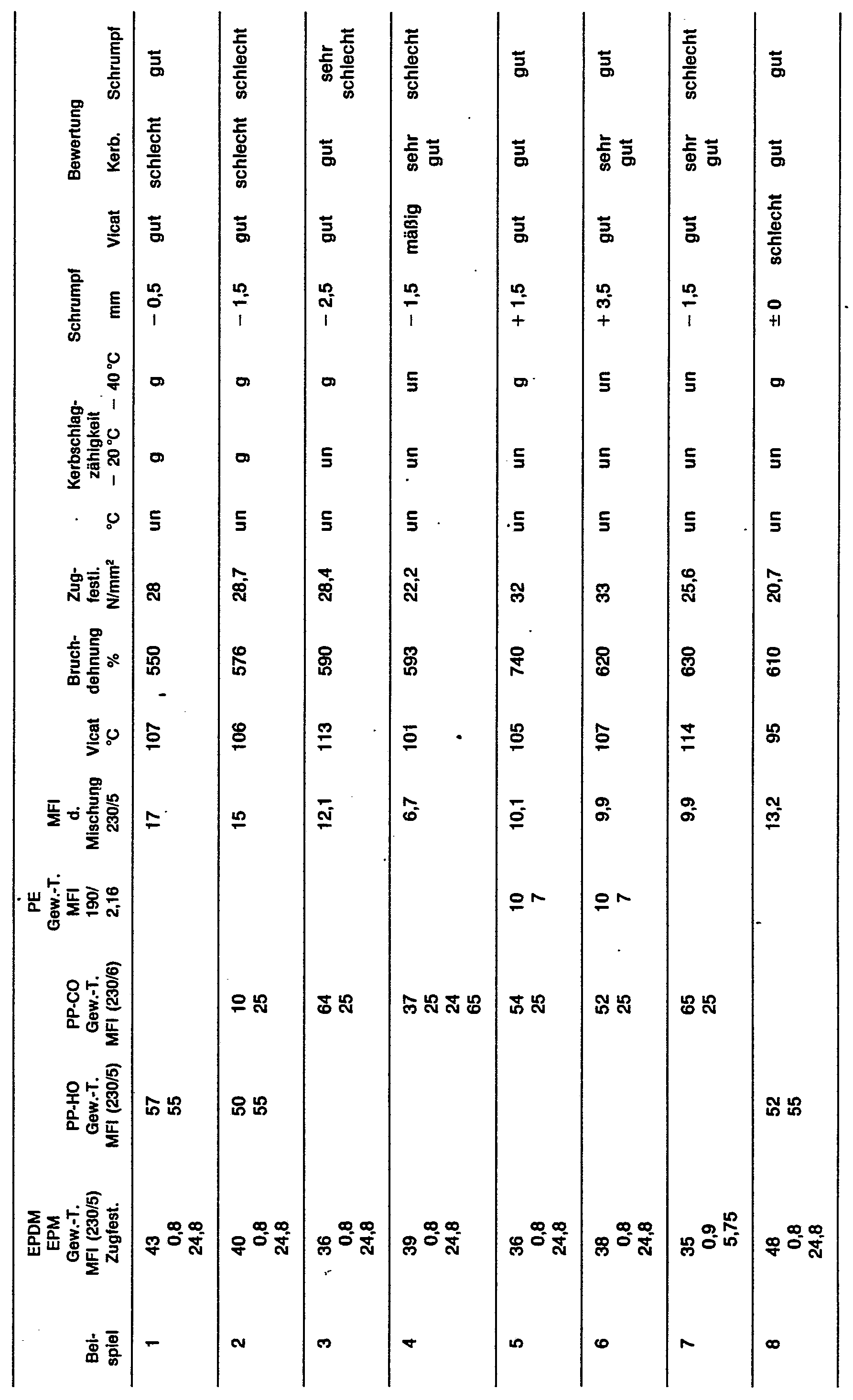

- Kommentar zur Tabelle :
- In der Tabelle sind die aufgeführten Beispiele mit den wichtigsten Eigenschaften, die etwas über das gewünschte Anforderungsprofil für so hoch beanspruchte technische Teile wie beispielsweise Stoßfänger aussagen, zusammengestellt. Der MFI der Gesamtmischung gibt einen Hinweis auf die Fließeigenschaften und damit über die Eignung zum Verarbeiten durch Spritzgießen, hier zeigen MFI-Werte ab etwa 8 die gute Verarbeitbarkeit an. Der Vicat-Wert steht für die gute Wärmeformbeständigkeit, Dehnung und Zugfestigkeit für die allgemeinen mechanischen Eigenschaften, Kerbschlagzähigkeit als Maß für die Kälteflexibilität bei extrem tiefen Temperaturen und der Schrumpfals Maß für die Güte und Maßhaltigkeit der Herstellbarkeit von Spritzguß-Formteilen. Die in der Tabelle vorgenommene Bewertung steht unter dem Gesichtspunkt eines hohen Anforderungsprofils mehrerer Eigenschaften. Es geht hieraus eindeutig hervor, daß oft einseitig gute Eigenschaftswerte mit anderen schlechten gekoppelt sind. Die vielen Vergleichsbeispiele 1 bis 4, 7, 8, 10 und 11 zeigen eindeutig, daß jeweils ein oder mehrere der gewünschten Eigenschaften unzureichend gemäß dem erfindungsgemäßen Anforderungsprofil sind und es der Erfindung, gemäß Beispielen 5, 6, 9, 12 vorbehalten ist, ein in allen gewünschten Eigenschaften gutes und sehr gutes Verhalten aufzuweisen.
-
- Beispiele 1 und 8 zeigen, daß binäre thermoplastische Mischungen aus EPDM und Propylen-Homopolymerisat bei zu niedrigem Gehalt an EPDM keine ausreichende Kälteflexibilität (Beisp. 1) und bei höherem Gehalt an EPDM eine niedrige Wärmeformbeständigkeit (Beisp.8) aufweisen. Eine Optimierung der gewünschten Eigenschaften ist nicht möglich. Beispiel 2 zeigt, daß durch Zusatz von Propylen-Mischpolymeren zu Mischungen gemäß Beispiel 1 die Nachschwindung der Formteile ungünstig beeinflußt, d. h. vergrößert wird, im übrigen aber auch keine sonstigen Verbesserungen der gewünschten Eigenschaftswerte auftreten.
- Beispiel 3 zeigt, daß binäre Mischungen aus EPDM und Propylen-Mischpolymeren in Bezug auf die Kälteflexibilität Mischungen gemäß Beispiel 1 mit Propylen-Homopolymeren überlegen sind, jedoch erheblichen Schrumpf aufweisen; was sich nachteilig auf die Verarbeitbarkeit zu maßhaltigen Spritzguß-formteilen mit komplizierter Gestalt auswirkt.
- Beispiel 4 zeigt im Vergleich zu Beispiel 3, daß der Zusatz von sehr gut fließfähigem Propylen-Mischpolymeren (MFI 65) den Nachteil eines zu hohen Schrumpfes nicht ausgleichen kann.
- Beispiel 5 einer erfindungsgemäßen Formmasse zeigt ein ausgewogenes Eigenschaftsbild gegenüber den binären Formmassen nach den vorangehenden Beispielen. Der MFI der Formmasse von 10 zeigt die sehr gute Verspritzbarkeit an, die mechanischen Eigenschaften Zugfestigkeit, Bruchdehnung sind ebenfalls als gut zu bezeichnen, die Kerbschlagzähigkeit ist bis - 30 °C vorhanden.
- Das Beispiel 6 zeigt, daß die Eigenschaften der erfindungsgemäßen Formmasse durch geringe Erhöhung des EPDM-Anteils zu Lasten des Propylen-Mischpolymeren weiter verbessert werden können, insbesondere was die Kälteflexibilität und den Schrumpf betrifft. Überraschend ist hierbei, daß die gute Wärmeformbeständigkeit erhalten bleibt (im Gegensatz zu dem Verhalten gemäß Beispiel 1 und 8).
- Das Beispiel 7 belegt eine binäre Formmasse auf Basis EPM mit Propylen-Mischpolymer. Hier zeigen sich analoge Eigenschaftsbilder zu den binären Formmassen auf Basis EPDM, wobei das Schrumpfverhalten ungünstig ist und damit die Spritzarbeit komplizierter Formteile mit hoher Maßgenauigkeit in Frage gestellt wird.
- Erst die erfindungsgemäße ternäre Formmasse gemäß Beispiel 9 auf Basis EPM zeigt gute und sehr gute Eigenschaftswerte in allen geforderten Bereichen, wobei durch weitere Erhöhung des EPM-Anteils die Verspritzbarkeit noch weiter verbessert werden kann, bei Erhalt der übrigen Eigenschaftswerte.
- Die Beispiele 10 und 11 zeigen die bekannten ternären Formmassen, die auf amorphen bzw. nahezu amorphen Ethylen-Propylen-Mischpolymerisaten aufbauen und die ein völlig anderes Eigenschaftsbild ergeben, insbesondere nicht die hohen mechanischen Eigenschaften wie Bruchdehnung und Zugfestigkeit und in keinem Fall die gewünschte hohe Kältflexibilität vorweisen können.
Claims (6)
vorgesehen sind.
Priority Applications (1)
| Application Number | Priority Date | Filing Date | Title |
|---|---|---|---|
| AT81101751T ATE13685T1 (de) | 1980-04-02 | 1981-03-10 | Ternaere thermoplastische formmasse enthaltend propylen-mischpolymere. |
Applications Claiming Priority (2)
| Application Number | Priority Date | Filing Date | Title |
|---|---|---|---|
| DE3012804A DE3012804C2 (de) | 1980-04-02 | 1980-04-02 | Ternäre thermoplastische Formmasse enthaltend Polypropylen-Copolymere |
| DE3012804 | 1980-04-02 |
Publications (3)
| Publication Number | Publication Date |
|---|---|
| EP0039397A2 EP0039397A2 (de) | 1981-11-11 |
| EP0039397A3 EP0039397A3 (en) | 1982-02-17 |
| EP0039397B1 true EP0039397B1 (de) | 1985-06-05 |
Family
ID=6099091
Family Applications (1)
| Application Number | Title | Priority Date | Filing Date |
|---|---|---|---|
| EP81101751A Expired EP0039397B1 (de) | 1980-04-02 | 1981-03-10 | Ternäre thermoplastische Formmasse enthaltend Propylen-Mischpolymere |
Country Status (8)
| Country | Link |
|---|---|
| US (1) | US4319005A (de) |
| EP (1) | EP0039397B1 (de) |
| JP (1) | JPS5943058B2 (de) |
| AT (1) | ATE13685T1 (de) |
| BR (1) | BR8101980A (de) |
| DE (2) | DE3012804C2 (de) |
| ES (1) | ES500962A0 (de) |
| MX (1) | MX158503A (de) |
Families Citing this family (9)
| Publication number | Priority date | Publication date | Assignee | Title |
|---|---|---|---|---|
| DE3519064A1 (de) * | 1985-05-28 | 1986-12-04 | Avery International Corp., Wilmington, Del. | Mehrschichtige, selbstklebende und tiefziehbare schutzfolie insbesondere fuer kraftfahrzeuge |
| DE3530364C1 (en) * | 1985-08-24 | 1987-01-02 | Dynamit Nobel Ag | Moulding composition based on polyolefins |
| JP2618735B2 (ja) * | 1990-04-27 | 1997-06-11 | 豊田合成株式会社 | ポリプロピレン樹脂組成物 |
| EP0462722B1 (de) * | 1990-06-04 | 1996-09-25 | Illinois Tool Works Inc. | Feuerhemmende Zusammensetzung |
| WO1994003538A1 (en) * | 1992-07-30 | 1994-02-17 | Exxon Chemical Patents Inc. | Thermoplastic olefins |
| US5502112A (en) * | 1992-07-30 | 1996-03-26 | Exxon Chemical Patents Inc. | Thermoplastic olefins |
| US5288806A (en) * | 1992-09-22 | 1994-02-22 | Exxon Chemical Patents Inc. | Thermoplastic olefins with low viscosity |
| US20060286324A1 (en) * | 2005-06-17 | 2006-12-21 | Achim Helmenstein | Plastic package |
| WO2020005442A1 (en) * | 2018-06-29 | 2020-01-02 | Dow Global Technologies Llc | Thermoplastic vulcanizates modified polypropylene for subsea insulation |
Family Cites Families (10)
| Publication number | Priority date | Publication date | Assignee | Title |
|---|---|---|---|---|
| US3627852A (en) * | 1967-02-02 | 1971-12-14 | Asahi Chemical Ind | Impact resistant polymer compositions |
| US3919358A (en) * | 1974-08-02 | 1975-11-11 | Goodrich Co B F | Thermoplastic polymer blends of (1) EPDM having a high degree of unstretched crystallinity with (2) polyethylene |
| US4031169A (en) * | 1975-09-11 | 1977-06-21 | Uniroyal Inc. | Thermoplastic elastomeric polymer blend |
| US4036912A (en) * | 1975-10-06 | 1977-07-19 | The B. F. Goodrich Company | Thermoplastic polymer blends of EP or EPDM polymer with crystalline polypropylene |
| ATA674777A (de) * | 1976-09-25 | 1980-11-15 | Stamicarbon | Thermoplastisches elastomergemisch |
| NL7705367A (nl) * | 1977-05-16 | 1978-11-20 | Stamicarbon | Werkwijze voor het bereiden van een thermo- plastisch elastomeer polymeer. |
| DE2732969A1 (de) * | 1977-07-21 | 1979-02-01 | Bayer Ag | Elastomermodifizierte thermoplaste |
| US4220579A (en) * | 1978-04-17 | 1980-09-02 | Uniroyal, Inc. | Thermoplastic elastomeric blend of monoolefin copolymer rubber, amorphous polypropylene resin and crystalline polyolefin resin |
| DE2828763A1 (de) * | 1978-06-30 | 1980-01-10 | Hoechst Ag | Verfahren zum herstellen einer polypropylen-formmasse |
| US4251646A (en) * | 1979-07-27 | 1981-02-17 | Exxon Research & Engineering Co. | Thermoplastic blend of polypropylene, EPM and propylene-ethylene copolymer |
-
1980
- 1980-04-02 DE DE3012804A patent/DE3012804C2/de not_active Expired
-
1981
- 1981-03-10 EP EP81101751A patent/EP0039397B1/de not_active Expired
- 1981-03-10 DE DE8181101751T patent/DE3170807D1/de not_active Expired
- 1981-03-10 AT AT81101751T patent/ATE13685T1/de active
- 1981-03-19 MX MX186442A patent/MX158503A/es unknown
- 1981-03-31 US US06/249,466 patent/US4319005A/en not_active Expired - Lifetime
- 1981-04-01 BR BR8101980A patent/BR8101980A/pt not_active IP Right Cessation
- 1981-04-01 ES ES500962A patent/ES500962A0/es active Granted
- 1981-04-02 JP JP56050013A patent/JPS5943058B2/ja not_active Expired
Also Published As
| Publication number | Publication date |
|---|---|
| US4319005A (en) | 1982-03-09 |
| ES8206595A1 (es) | 1982-08-16 |
| BR8101980A (pt) | 1981-10-06 |
| MX158503A (es) | 1989-02-09 |
| JPS56152856A (en) | 1981-11-26 |
| DE3170807D1 (en) | 1985-07-11 |
| DE3012804A1 (de) | 1981-10-22 |
| EP0039397A2 (de) | 1981-11-11 |
| ATE13685T1 (de) | 1985-06-15 |
| EP0039397A3 (en) | 1982-02-17 |
| DE3012804C2 (de) | 1982-05-27 |
| JPS5943058B2 (ja) | 1984-10-19 |
| ES500962A0 (es) | 1982-08-16 |
Similar Documents
| Publication | Publication Date | Title |
|---|---|---|
| EP0039396B1 (de) | Ternäre thermoplastische Formmasse enthaltend Propylen-Homopolymer | |
| DE2822815C2 (de) | Verfahren zur Herstellung einer teilweise vulkanisierten thermoplastischen Masse | |
| DE69018015T2 (de) | Thermoplastisches Elastomer aus Propylen-Polymer-Material und vernetztem Äthylen-Propylen-Kautschuk. | |
| DE3850365T3 (de) | Thermoplastische elastomere Zusammensetzungen und Verfahren zu deren Herstellung. | |
| DE1694914C3 (de) | Formmasse auf Polypropylenbasis und ihre Verwendung zur Herstellung von Formkörpern | |
| DE69513237T2 (de) | Polyolefin-Harzzusammensetzung für Innenbekleidung für Kraftfahrzeuge | |
| DE69724258T2 (de) | Vernetzte thermoplastische elastomere auf olefinbasis und ein verfahren zu deren herstellung | |
| DE2848448C3 (de) | Elastoplastische Formmasse und Verfahren zu ihrer Herstellung | |
| DE69207048T2 (de) | Harzzusammensetzung für Automobilstossstangen | |
| DE69212543T2 (de) | Thermoplastische Elastomer und Verfahren zu seiner Herstellung | |
| DE2714193A1 (de) | Thermoplastische elastomere | |
| EP0000583A2 (de) | Hochschlagzähe Polyamidmasse und deren Verwendung in Formkörpern | |
| DE10152099A1 (de) | Polypropylenharz Zusammensetzung | |
| DE1104694B (de) | Verfahren zur Herstellung von thermoplastischen Massen | |
| DE2640850C3 (de) | Thermoplastisches, elastomeres und wiederverarbeitbares Polymergemisch | |
| EP0568815A1 (de) | Folie oder Formkörper aus einem thermoplastischen Kunststoff mit einem Terpolymergehalt | |
| DE3012804C2 (de) | Ternäre thermoplastische Formmasse enthaltend Polypropylen-Copolymere | |
| DE3785547T2 (de) | Thermoplastische Elastomerzusammensetzung und Verfahren zu deren Herstellung. | |
| EP0362472A2 (de) | Polyblend aus thermoplastischem Polyurethan-Elastomer und Verfahren zu seiner Herstellung | |
| DE2618954A1 (de) | Thermoplastische elastomerzusammensetzung | |
| DE69517610T2 (de) | Reformierte Polypropylen-Harzzusammensetzung und Verfahren zu ihrer Herstellung | |
| DE2363206C2 (de) | Polypropylenmischungen mit verbesserten mechanischen Eigenschaften | |
| DE2821342C2 (de) | ||
| DE3116494C2 (de) | ||
| EP0039395B1 (de) | Ternäre thermoplastische Formmasse enthaltend Äthylen-Propylen-Mischpolymerisat |
Legal Events
| Date | Code | Title | Description |
|---|---|---|---|
| PUAI | Public reference made under article 153(3) epc to a published international application that has entered the european phase |
Free format text: ORIGINAL CODE: 0009012 |
|
| AK | Designated contracting states |
Designated state(s): AT BE CH DE FR GB IT LU NL SE |
|
| PUAL | Search report despatched |
Free format text: ORIGINAL CODE: 0009013 |
|
| AK | Designated contracting states |
Designated state(s): AT BE CH DE FR GB IT LU NL SE |
|
| 17P | Request for examination filed |
Effective date: 19820603 |
|
| ITF | It: translation for a ep patent filed | ||
| GRAA | (expected) grant |
Free format text: ORIGINAL CODE: 0009210 |
|
| AK | Designated contracting states |
Designated state(s): AT BE CH DE FR GB IT LI LU NL SE |
|
| REF | Corresponds to: |
Ref document number: 13685 Country of ref document: AT Date of ref document: 19850615 Kind code of ref document: T |
|
| REF | Corresponds to: |
Ref document number: 3170807 Country of ref document: DE Date of ref document: 19850711 |
|
| ET | Fr: translation filed | ||
| BECN | Be: change of holder's name |
Effective date: 19850605 |
|
| PLBI | Opposition filed |
Free format text: ORIGINAL CODE: 0009260 |
|
| 26 | Opposition filed |
Opponent name: NAAMLOZE VENNOOTSCHAP DSM Effective date: 19860304 |
|
| NLR1 | Nl: opposition has been filed with the epo |
Opponent name: NAAMLOZE VENNOOTSCHAP DSM |
|
| PLAB | Opposition data, opponent's data or that of the opponent's representative modified |
Free format text: ORIGINAL CODE: 0009299OPPO |
|
| R26 | Opposition filed (corrected) |
Opponent name: NAAMLOZE VENNOOTSCHAP DSM Effective date: 19860304 |
|
| RAP2 | Party data changed (patent owner data changed or rights of a patent transferred) |
Owner name: HUELS TROISDORF AKTIENGESELLSCHAFT |
|
| RAP2 | Party data changed (patent owner data changed or rights of a patent transferred) |
Owner name: DYNAMIT NOBEL AKTIENGESELLSCHAFT |
|
| NLT2 | Nl: modifications (of names), taken from the european patent patent bulletin |
Owner name: HUELS TROISDORF AKTIENGESELLSCHAFT TE TROISDORF, B |
|
| NLT2 | Nl: modifications (of names), taken from the european patent patent bulletin |
Owner name: DYNAMIT NOBEL AKTIENGESELLSCHAFT TE TROISDORF, BON |
|
| BECN | Be: change of holder's name |
Effective date: 19880316 |
|
| ITTA | It: last paid annual fee | ||
| PLBN | Opposition rejected |
Free format text: ORIGINAL CODE: 0009273 |
|
| STAA | Information on the status of an ep patent application or granted ep patent |
Free format text: STATUS: OPPOSITION REJECTED |
|
| 27O | Opposition rejected |
Effective date: 19900502 |
|
| NLR2 | Nl: decision of opposition | ||
| EPTA | Lu: last paid annual fee | ||
| EAL | Se: european patent in force in sweden |
Ref document number: 81101751.6 |
|
| PGFP | Annual fee paid to national office [announced via postgrant information from national office to epo] |
Ref country code: SE Payment date: 19970319 Year of fee payment: 17 |
|
| PGFP | Annual fee paid to national office [announced via postgrant information from national office to epo] |
Ref country code: AT Payment date: 19970324 Year of fee payment: 17 |
|
| PGFP | Annual fee paid to national office [announced via postgrant information from national office to epo] |
Ref country code: CH Payment date: 19970325 Year of fee payment: 17 Ref country code: BE Payment date: 19970325 Year of fee payment: 17 |
|
| PGFP | Annual fee paid to national office [announced via postgrant information from national office to epo] |
Ref country code: NL Payment date: 19970331 Year of fee payment: 17 |
|
| PGFP | Annual fee paid to national office [announced via postgrant information from national office to epo] |
Ref country code: LU Payment date: 19970423 Year of fee payment: 17 |
|
| PGFP | Annual fee paid to national office [announced via postgrant information from national office to epo] |
Ref country code: GB Payment date: 19980227 Year of fee payment: 18 |
|
| PG25 | Lapsed in a contracting state [announced via postgrant information from national office to epo] |
Ref country code: LU Free format text: LAPSE BECAUSE OF NON-PAYMENT OF DUE FEES Effective date: 19980310 Ref country code: AT Free format text: LAPSE BECAUSE OF NON-PAYMENT OF DUE FEES Effective date: 19980310 |
|
| PGFP | Annual fee paid to national office [announced via postgrant information from national office to epo] |
Ref country code: FR Payment date: 19980310 Year of fee payment: 18 |
|
| PG25 | Lapsed in a contracting state [announced via postgrant information from national office to epo] |
Ref country code: SE Free format text: LAPSE BECAUSE OF NON-PAYMENT OF DUE FEES Effective date: 19980311 |
|
| PG25 | Lapsed in a contracting state [announced via postgrant information from national office to epo] |
Ref country code: LI Free format text: LAPSE BECAUSE OF NON-PAYMENT OF DUE FEES Effective date: 19980331 Ref country code: CH Free format text: LAPSE BECAUSE OF NON-PAYMENT OF DUE FEES Effective date: 19980331 Ref country code: BE Free format text: LAPSE BECAUSE OF NON-PAYMENT OF DUE FEES Effective date: 19980331 |
|
| PGFP | Annual fee paid to national office [announced via postgrant information from national office to epo] |
Ref country code: DE Payment date: 19980511 Year of fee payment: 18 |
|
| BERE | Be: lapsed |
Owner name: DYNAMIT NOBEL A.G. Effective date: 19980331 |
|
| PG25 | Lapsed in a contracting state [announced via postgrant information from national office to epo] |
Ref country code: NL Free format text: LAPSE BECAUSE OF NON-PAYMENT OF DUE FEES Effective date: 19981001 |
|
| REG | Reference to a national code |
Ref country code: CH Ref legal event code: PL |
|
| NLV4 | Nl: lapsed or anulled due to non-payment of the annual fee |
Effective date: 19981001 |
|
| EUG | Se: european patent has lapsed |
Ref document number: 81101751.6 |
|
| PG25 | Lapsed in a contracting state [announced via postgrant information from national office to epo] |
Ref country code: GB Free format text: LAPSE BECAUSE OF NON-PAYMENT OF DUE FEES Effective date: 19990310 |
|
| GBPC | Gb: european patent ceased through non-payment of renewal fee |
Effective date: 19990310 |
|
| PG25 | Lapsed in a contracting state [announced via postgrant information from national office to epo] |
Ref country code: FR Free format text: LAPSE BECAUSE OF NON-PAYMENT OF DUE FEES Effective date: 19991130 |
|
| REG | Reference to a national code |
Ref country code: FR Ref legal event code: ST |
|
| PG25 | Lapsed in a contracting state [announced via postgrant information from national office to epo] |
Ref country code: DE Free format text: LAPSE BECAUSE OF NON-PAYMENT OF DUE FEES Effective date: 20000101 |
|
| APAH | Appeal reference modified |
Free format text: ORIGINAL CODE: EPIDOSCREFNO |