EP0033843B1 - Cerhaltige Fällungskieselsäure, Verfahren zu deren Herstellung, sowie zu Elastomeren härtbare Massen, die die cerhaltige Fällungskieselsäure enthalten - Google Patents
Cerhaltige Fällungskieselsäure, Verfahren zu deren Herstellung, sowie zu Elastomeren härtbare Massen, die die cerhaltige Fällungskieselsäure enthalten Download PDFInfo
- Publication number
- EP0033843B1 EP0033843B1 EP81100138A EP81100138A EP0033843B1 EP 0033843 B1 EP0033843 B1 EP 0033843B1 EP 81100138 A EP81100138 A EP 81100138A EP 81100138 A EP81100138 A EP 81100138A EP 0033843 B1 EP0033843 B1 EP 0033843B1
- Authority
- EP
- European Patent Office
- Prior art keywords
- cerium
- precipitated silica
- value
- solution
- elastomers
- Prior art date
- Legal status (The legal status is an assumption and is not a legal conclusion. Google has not performed a legal analysis and makes no representation as to the accuracy of the status listed.)
- Expired
Links
- VYPSYNLAJGMNEJ-UHFFFAOYSA-N Silicium dioxide Chemical compound O=[Si]=O VYPSYNLAJGMNEJ-UHFFFAOYSA-N 0.000 title claims description 89
- 239000000377 silicon dioxide Substances 0.000 title claims description 44
- 229910052684 Cerium Inorganic materials 0.000 title claims description 29
- GWXLDORMOJMVQZ-UHFFFAOYSA-N cerium Chemical compound [Ce] GWXLDORMOJMVQZ-UHFFFAOYSA-N 0.000 title claims description 29
- 229920001971 elastomer Polymers 0.000 title claims description 16
- 239000000806 elastomer Substances 0.000 title claims description 16
- 238000000034 method Methods 0.000 title claims description 6
- 239000000203 mixture Substances 0.000 claims description 26
- 239000000243 solution Substances 0.000 claims description 18
- 239000000725 suspension Substances 0.000 claims description 14
- 239000000126 substance Substances 0.000 claims description 10
- XLYOFNOQVPJJNP-UHFFFAOYSA-N water Substances O XLYOFNOQVPJJNP-UHFFFAOYSA-N 0.000 claims description 10
- 238000001556 precipitation Methods 0.000 claims description 9
- 239000012065 filter cake Substances 0.000 claims description 8
- 239000002253 acid Substances 0.000 claims description 7
- 239000011541 reaction mixture Substances 0.000 claims description 7
- 229920005645 diorganopolysiloxane polymer Polymers 0.000 claims description 6
- 235000019353 potassium silicate Nutrition 0.000 claims description 6
- NTHWMYGWWRZVTN-UHFFFAOYSA-N sodium silicate Chemical compound [Na+].[Na+].[O-][Si]([O-])=O NTHWMYGWWRZVTN-UHFFFAOYSA-N 0.000 claims description 6
- 239000012266 salt solution Substances 0.000 claims description 4
- 239000007787 solid Substances 0.000 claims description 3
- 238000009835 boiling Methods 0.000 claims description 2
- 239000007795 chemical reaction product Substances 0.000 claims description 2
- 238000004519 manufacturing process Methods 0.000 claims description 2
- 239000012736 aqueous medium Substances 0.000 claims 1
- HEMHJVSKTPXQMS-UHFFFAOYSA-M Sodium hydroxide Chemical compound [OH-].[Na+] HEMHJVSKTPXQMS-UHFFFAOYSA-M 0.000 description 21
- GWEVSGVZZGPLCZ-UHFFFAOYSA-N Titan oxide Chemical compound O=[Ti]=O GWEVSGVZZGPLCZ-UHFFFAOYSA-N 0.000 description 19
- 229910000422 cerium(IV) oxide Inorganic materials 0.000 description 12
- 229920002379 silicone rubber Polymers 0.000 description 10
- 239000004945 silicone rubber Substances 0.000 description 10
- CETPSERCERDGAM-UHFFFAOYSA-N ceric oxide Chemical compound O=[Ce]=O CETPSERCERDGAM-UHFFFAOYSA-N 0.000 description 8
- -1 cerium (IV) compound Chemical class 0.000 description 8
- QAOWNCQODCNURD-UHFFFAOYSA-N Sulfuric acid Chemical compound OS(O)(=O)=O QAOWNCQODCNURD-UHFFFAOYSA-N 0.000 description 7
- 238000012360 testing method Methods 0.000 description 7
- 239000004408 titanium dioxide Substances 0.000 description 7
- 239000011734 sodium Substances 0.000 description 5
- 229910004298 SiO 2 Inorganic materials 0.000 description 4
- BASFCYQUMIYNBI-UHFFFAOYSA-N platinum Chemical compound [Pt] BASFCYQUMIYNBI-UHFFFAOYSA-N 0.000 description 4
- 230000001698 pyrogenic effect Effects 0.000 description 4
- RNFJDJUURJAICM-UHFFFAOYSA-N 2,2,4,4,6,6-hexaphenoxy-1,3,5-triaza-2$l^{5},4$l^{5},6$l^{5}-triphosphacyclohexa-1,3,5-triene Chemical compound N=1P(OC=2C=CC=CC=2)(OC=2C=CC=CC=2)=NP(OC=2C=CC=CC=2)(OC=2C=CC=CC=2)=NP=1(OC=1C=CC=CC=1)OC1=CC=CC=C1 RNFJDJUURJAICM-UHFFFAOYSA-N 0.000 description 3
- QTBSBXVTEAMEQO-UHFFFAOYSA-N Acetic acid Chemical compound CC(O)=O QTBSBXVTEAMEQO-UHFFFAOYSA-N 0.000 description 3
- ITZXULOAYIAYNU-UHFFFAOYSA-N cerium(4+) Chemical compound [Ce+4] ITZXULOAYIAYNU-UHFFFAOYSA-N 0.000 description 3
- 239000003063 flame retardant Substances 0.000 description 3
- 230000006641 stabilisation Effects 0.000 description 3
- 238000011105 stabilization Methods 0.000 description 3
- CURLTUGMZLYLDI-UHFFFAOYSA-N Carbon dioxide Chemical compound O=C=O CURLTUGMZLYLDI-UHFFFAOYSA-N 0.000 description 2
- NBIIXXVUZAFLBC-UHFFFAOYSA-N Phosphoric acid Chemical compound OP(O)(O)=O NBIIXXVUZAFLBC-UHFFFAOYSA-N 0.000 description 2
- 230000002378 acidificating effect Effects 0.000 description 2
- 238000002845 discoloration Methods 0.000 description 2
- 238000000227 grinding Methods 0.000 description 2
- 239000000463 material Substances 0.000 description 2
- BDAGIHXWWSANSR-UHFFFAOYSA-N methanoic acid Natural products OC=O BDAGIHXWWSANSR-UHFFFAOYSA-N 0.000 description 2
- BMMGVYCKOGBVEV-UHFFFAOYSA-N oxo(oxoceriooxy)cerium Chemical compound [Ce]=O.O=[Ce]=O BMMGVYCKOGBVEV-UHFFFAOYSA-N 0.000 description 2
- 229910052697 platinum Inorganic materials 0.000 description 2
- 229920001296 polysiloxane Polymers 0.000 description 2
- 229920002545 silicone oil Polymers 0.000 description 2
- 229910052708 sodium Inorganic materials 0.000 description 2
- 229920001187 thermosetting polymer Polymers 0.000 description 2
- OSWFIVFLDKOXQC-UHFFFAOYSA-N 4-(3-methoxyphenyl)aniline Chemical compound COC1=CC=CC(C=2C=CC(N)=CC=2)=C1 OSWFIVFLDKOXQC-UHFFFAOYSA-N 0.000 description 1
- OKTJSMMVPCPJKN-UHFFFAOYSA-N Carbon Chemical compound [C] OKTJSMMVPCPJKN-UHFFFAOYSA-N 0.000 description 1
- 239000004971 Cross linker Substances 0.000 description 1
- GRYLNZFGIOXLOG-UHFFFAOYSA-N Nitric acid Chemical compound O[N+]([O-])=O GRYLNZFGIOXLOG-UHFFFAOYSA-N 0.000 description 1
- 239000013543 active substance Substances 0.000 description 1
- 239000000654 additive Substances 0.000 description 1
- 230000000996 additive effect Effects 0.000 description 1
- 230000032683 aging Effects 0.000 description 1
- 229910000147 aluminium phosphate Inorganic materials 0.000 description 1
- 230000003712 anti-aging effect Effects 0.000 description 1
- 125000001797 benzyl group Chemical group [H]C1=C([H])C([H])=C(C([H])=C1[H])C([H])([H])* 0.000 description 1
- 230000008033 biological extinction Effects 0.000 description 1
- 230000033228 biological regulation Effects 0.000 description 1
- 239000001569 carbon dioxide Substances 0.000 description 1
- 229910002092 carbon dioxide Inorganic materials 0.000 description 1
- 150000001735 carboxylic acids Chemical class 0.000 description 1
- 239000003054 catalyst Substances 0.000 description 1
- 229910000420 cerium oxide Inorganic materials 0.000 description 1
- IKNAJTLCCWPIQD-UHFFFAOYSA-K cerium(3+);lanthanum(3+);neodymium(3+);oxygen(2-);phosphate Chemical group [O-2].[La+3].[Ce+3].[Nd+3].[O-]P([O-])([O-])=O IKNAJTLCCWPIQD-UHFFFAOYSA-K 0.000 description 1
- OZECDDHOAMNMQI-UHFFFAOYSA-H cerium(3+);trisulfate Chemical compound [Ce+3].[Ce+3].[O-]S([O-])(=O)=O.[O-]S([O-])(=O)=O.[O-]S([O-])(=O)=O OZECDDHOAMNMQI-UHFFFAOYSA-H 0.000 description 1
- VZDYWEUILIUIDF-UHFFFAOYSA-J cerium(4+);disulfate Chemical compound [Ce+4].[O-]S([O-])(=O)=O.[O-]S([O-])(=O)=O VZDYWEUILIUIDF-UHFFFAOYSA-J 0.000 description 1
- 229910000421 cerium(III) oxide Inorganic materials 0.000 description 1
- 229910000355 cerium(IV) sulfate Inorganic materials 0.000 description 1
- CQGVSILDZJUINE-UHFFFAOYSA-N cerium;hydrate Chemical compound O.[Ce] CQGVSILDZJUINE-UHFFFAOYSA-N 0.000 description 1
- 239000003795 chemical substances by application Substances 0.000 description 1
- 238000010073 coating (rubber) Methods 0.000 description 1
- 239000013065 commercial product Substances 0.000 description 1
- 150000001875 compounds Chemical class 0.000 description 1
- 229920001577 copolymer Polymers 0.000 description 1
- 125000004177 diethyl group Chemical group [H]C([H])([H])C([H])([H])* 0.000 description 1
- 125000000118 dimethyl group Chemical group [H]C([H])([H])* 0.000 description 1
- 239000002270 dispersing agent Substances 0.000 description 1
- 230000000694 effects Effects 0.000 description 1
- 239000003792 electrolyte Substances 0.000 description 1
- 238000001914 filtration Methods 0.000 description 1
- 239000010419 fine particle Substances 0.000 description 1
- 239000011888 foil Substances 0.000 description 1
- 235000019253 formic acid Nutrition 0.000 description 1
- 238000009472 formulation Methods 0.000 description 1
- 239000012760 heat stabilizer Substances 0.000 description 1
- 230000002209 hydrophobic effect Effects 0.000 description 1
- NYMPGSQKHIOWIO-UHFFFAOYSA-N hydroxy(diphenyl)silicon Chemical class C=1C=CC=CC=1[Si](O)C1=CC=CC=C1 NYMPGSQKHIOWIO-UHFFFAOYSA-N 0.000 description 1
- 239000012774 insulation material Substances 0.000 description 1
- 229910052590 monazite Inorganic materials 0.000 description 1
- 238000000465 moulding Methods 0.000 description 1
- 230000007935 neutral effect Effects 0.000 description 1
- 229910017604 nitric acid Inorganic materials 0.000 description 1
- 239000004533 oil dispersion Substances 0.000 description 1
- 230000003287 optical effect Effects 0.000 description 1
- 125000005375 organosiloxane group Chemical group 0.000 description 1
- 125000001997 phenyl group Chemical group [H]C1=C([H])C([H])=C(*)C([H])=C1[H] 0.000 description 1
- 125000000286 phenylethyl group Chemical group [H]C1=C([H])C([H])=C(C([H])=C1[H])C([H])([H])C([H])([H])* 0.000 description 1
- 229920000642 polymer Polymers 0.000 description 1
- 239000000047 product Substances 0.000 description 1
- 229910001404 rare earth metal oxide Inorganic materials 0.000 description 1
- 239000004576 sand Substances 0.000 description 1
- 229920006395 saturated elastomer Polymers 0.000 description 1
- 229920005573 silicon-containing polymer Polymers 0.000 description 1
- 239000007921 spray Substances 0.000 description 1
- 238000001694 spray drying Methods 0.000 description 1
- 238000012430 stability testing Methods 0.000 description 1
- 239000003381 stabilizer Substances 0.000 description 1
- 230000000087 stabilizing effect Effects 0.000 description 1
- 238000003756 stirring Methods 0.000 description 1
- 125000001424 substituent group Chemical group 0.000 description 1
- 230000002195 synergetic effect Effects 0.000 description 1
- OGIDPMRJRNCKJF-UHFFFAOYSA-N titanium oxide Inorganic materials [Ti]=O OGIDPMRJRNCKJF-UHFFFAOYSA-N 0.000 description 1
- 238000004073 vulcanization Methods 0.000 description 1
- 238000005406 washing Methods 0.000 description 1
- 238000004383 yellowing Methods 0.000 description 1
Classifications
-
- C—CHEMISTRY; METALLURGY
- C09—DYES; PAINTS; POLISHES; NATURAL RESINS; ADHESIVES; COMPOSITIONS NOT OTHERWISE PROVIDED FOR; APPLICATIONS OF MATERIALS NOT OTHERWISE PROVIDED FOR
- C09C—TREATMENT OF INORGANIC MATERIALS, OTHER THAN FIBROUS FILLERS, TO ENHANCE THEIR PIGMENTING OR FILLING PROPERTIES ; PREPARATION OF CARBON BLACK ; PREPARATION OF INORGANIC MATERIALS WHICH ARE NO SINGLE CHEMICAL COMPOUNDS AND WHICH ARE MAINLY USED AS PIGMENTS OR FILLERS
- C09C1/00—Treatment of specific inorganic materials other than fibrous fillers; Preparation of carbon black
- C09C1/28—Compounds of silicon
- C09C1/30—Silicic acid
- C09C1/3045—Treatment with inorganic compounds
- C09C1/3054—Coating
-
- C—CHEMISTRY; METALLURGY
- C08—ORGANIC MACROMOLECULAR COMPOUNDS; THEIR PREPARATION OR CHEMICAL WORKING-UP; COMPOSITIONS BASED THEREON
- C08K—Use of inorganic or non-macromolecular organic substances as compounding ingredients
- C08K3/00—Use of inorganic substances as compounding ingredients
- C08K3/34—Silicon-containing compounds
- C08K3/36—Silica
-
- C—CHEMISTRY; METALLURGY
- C01—INORGANIC CHEMISTRY
- C01P—INDEXING SCHEME RELATING TO STRUCTURAL AND PHYSICAL ASPECTS OF SOLID INORGANIC COMPOUNDS
- C01P2002/00—Crystal-structural characteristics
- C01P2002/50—Solid solutions
- C01P2002/52—Solid solutions containing elements as dopants
- C01P2002/54—Solid solutions containing elements as dopants one element only
-
- C—CHEMISTRY; METALLURGY
- C01—INORGANIC CHEMISTRY
- C01P—INDEXING SCHEME RELATING TO STRUCTURAL AND PHYSICAL ASPECTS OF SOLID INORGANIC COMPOUNDS
- C01P2006/00—Physical properties of inorganic compounds
- C01P2006/12—Surface area
Definitions
- DE-B-1 242 866 describes the use of an oxide mixture of rare earths corresponding to the composition of the monazite sand for heat stabilization in molding compositions based on diorganopolysiloxane elastomers.
- the disadvantages of this oxide mixture are the intensive discoloration of the elastomer materials, the high amount of addition of 16-40 parts by weight to 100 parts by weight of elastomer, the lack of fine particles (approx. 50 microns) and the difficult dispersibility of the rare earth oxides, the surface stickiness of those made from the elastomer materials Causes foils.
- DE-B-1 230 562 describes the use of hydrophobic precipitated silica as an anti-aging agent.
- DE-A-2 617 434 describes the use of a mixture of pyrogenically produced titanium dioxide and cerium (III) oxide as a heat stabilizing agent for diorganopolysiloxane elastomers.
- DE-A-2 727 611 describes a flame-retardant silicone rubber composition which contains 0.1-3 parts by weight of cerium (IV) hydroxide.
- the cerium-containing precipitated silica according to the invention can have the following physico-chemical characteristics:
- Another object of the invention is a method for producing the cerium-containing precipitated silica with the following physico-chemical characteristics: which is characterized in that an aqueous template consisting of water having a pH of 7 to 9 at a temperature above 50 ° C to the boiling point of the reaction mixture using shear forces and while maintaining a constant pH 7 to 9 simultaneously add water glass solution and acid over a period of 80 to 120 minutes, a pH of 7 to 9 being present in the reaction mixture after the precipitation has ended, and an aqueous cerium (IV) - to the original precipitated silica suspension thus obtained - Saline solution adds, which now adjusts the acidic reaction mixture to a pH of 6 to 8, the solid reaction product is filtered off, the precipitated silica filter cake obtained in this way is washed out with water, dried and ground.
- an aqueous template consisting of water having a pH of 7 to 9 at a temperature above 50 ° C to the boiling point of the reaction mixture using shear forces and while maintaining a constant pH
- the aqueous receiver can have a pH of 7 to 8.5.
- the pH value of the aqueous receiver can be adjusted using a water glass solution which has a SiO 2 : Na 2 O molar ratio of 1: 3.46 and a content of 26.8% by weight of SiO 2 and 8.0% by weight. % Na 2 O, carry out.
- an acid you can e.g. B. use sulfuric acid, nitric acid, phosphoric acid, carbon dioxide, formic acid, or acetic acid.
- sulfuric acid can be used in a concentration of 50 to 96% by weight.
- the cerium-containing precipitated silica filter cake can be liquefied, spray-dried and ground by using shear forces.
- a pin mill can preferably be used to grind the spray-dried precipitated silica.
- a cerium (IV) salt solution As a cerium (IV) salt solution, a Ce (SO 4 ) 2 .4H 2 O solution saturated at 20 ° C., which contains 100 g / l of Ce (SO 4 ) 2 .4H 2 O, can preferably be continuously stirred, whereby it is ensured that a homogeneous distribution of the cerium (IV) compound in the precipitated silica suspension is added.
- a cerium sulfate solution has a pH of 0.65 at 20 ° C.
- the therefore highly acidic, cerium-containing precipitated silica suspension can be brought to a pH of 6 to 8 by adding a 15-20% strength by weight aqueous sodium hydroxide solution.
- the sodium hydroxide solution is added continuously with stirring.
- the invention further relates to compositions curable to elastomers based on diorganopolysiloxanes which contain the cerium-containing precipitated silica according to the invention.
- compositions curable to elastomers can contain 0.1 to 1.0% by weight of the cerium-containing precipitated silica.
- cerium-containing precipitated silica according to the invention can be very readily dispersed in compositions curable to give elastomers.
- compositions according to the invention curable to elastomers have a surprisingly high thermal stability. Because of the small amount of precipitated silica containing cerium, the compositions of the invention curable to elastomers have almost no yellowing and no spots on the surface.
- compositions of the invention curable to elastomers surprisingly have self-extinguishing properties. They can therefore be used advantageously as cable insulation material.
- the pH and temperature are kept constant during the mentioned precipitation time. After the precipitation is complete, the reaction mixture has a pH of 8.5. The solids content of the suspension is 58 g / l at the end of the precipitation. Immediately after the precipitation has ended, 27.4 liters of a Ce (SO 4 ) 2 .4H 2 O solution with 100 g / l (20 ° C.) are added to the precipitated silica suspension in the course of 15 minutes with the EKATO turbine running. This results in a pH of 1.7. Following the addition of the cerium (IV) salt solution, 4.5 liters of a 20% sodium hydroxide solution are added to the suspension while the turbine is running, a pH of 7 being established.
- a Ce (SO 4 ) 2 .4H 2 O solution with 100 g / l (20 ° C.
- the cerium-containing precipitated silica is separated from the precipitation suspension with the aid of a laboratory filter press and washed with water with little electrolyte.
- the filter press dough is then liquefied using shear forces but without further addition of water or acid and dried using a pilot spray dryer. After grinding, use a laboratory pin mill 8.2 kg of a cerium-containing precipitated silica with a light yellow color, which has the following physico-chemical characteristics:
- a precipitated silica original suspension is prepared according to Example 1. Following the precipitation, 30.2 liters of a Ce (S0 4 ) 2 . 4H 2 0 solution with 100 g / I at 20 ° C in the course of 22 minutes with the EKATO turbine running and 66 liters of a 15% sodium hydroxide solution added to the suspension, a pH of 7 being established.
- the further processing of the cerium-containing precipitated silica - such as filtration, washing out, dough liquefaction, spray drying and grinding - is carried out according to Example 1.
- An original precipitated silica suspension is prepared according to Example 1. It is mixed with 1.25 l of a cerium (IV) sulfate solution with a concentration of 100 g / l at 20 ° C. and then with 15% sodium hydroxide solution to a pH set from 7. The precipitated silica is worked up further in accordance with Example 1. 6.9 kg of a cerified precipitated silica which has the following characteristics are obtained:
- Example 2 An original precipitated silica suspension according to Example 1 is produced. Then 210 liters of Ce (SO 4 ) 2 .4H 2 O solution with a concentration of 100 g / l at 20 ° C. are added to the precipitated silica suspension. Finally, the suspension is adjusted to a pH of 7 with 15% sodium hydroxide solution. The further processing of the cerified precipitated silica is carried out according to Example 1. However, 0.8 kg of water is added per kg of filter cake dough to liquefy the filter cake batter. 12.6 kg of a cerium-containing silica are obtained, which have the following characteristics:
- cerium-containing silica according to the invention as a heat stabilizer in elastomer-curable compositions based on diorganopolysiloxanes
- the cerium-containing precipitated silicas according to Examples 1 and 2 are compared to pyrogenic titanium dioxide P 25 0 (Degussa), pure cerium oxide and a cerium dioxide predispersed in silicone polymers (50 %) and in comparison to the non-stabilized silicone rubber mixture in a test formulation subjected to a heat aging test.
- hot-vulcanizing organosiloxanes those can be used which consist of organic substituents of methyl ethyl, phenyl, trifluoromethylphenyl [F 3 CC 6 H 4 -)] or triethylsilmethylene radicals [(CH 3 ) 3 SiCH 2 -], e.g. B. dimethyl, diethyl, phenylmethyl, phenylethyl, ethylmethyl, trimethylsilmethylene, trimethylsilmethylene, trifluoromethylphenylmethyl or trifluoromethylphenylethylsiloxanes or copolymers of such compounds.
- the polymers can contain limited amounts of diphenylsiloxane, bis-trimethylsilmethylene siloxane, bis-trifluoromethylphenylsiloxane units and also siloxanes with units of the formulas RSiO 1.5 and R 3 SiO 0.5 , where R is one of the above radicals.
- thermosetting silicone rubber mixtures are vulcanized in the known manner for 7 minutes at 130 ° C. in the vulcanization press and for 6 hours at 200 ° C. in the circulating air cabinet and their mechanical data are determined.
- the silicone rubber is stored in a forced air cabinet at 300 ° C. Its mechanical data, such as Shore A hardness, tensile strength, elongation at break and resilience, are examined at certain intervals.
- Silopren VS® is a vinyl-methyl-polysiloxane elastomer.
- the C150® siloprene crosslinker is bis-2,4-dichlorobenzoyl peroxide in a 50% silicone oil dispersion.
- This mixture is first treated in the press at 130 ° C. for 7 minutes and then in a circulating air cabinet at 200 ° C. for 6 hours.
- test strips are made of silicone rubber with the dimensions 130 x 13 x 2 mm. The strips are hung vertically and burned with a Bunsen burner for 15 seconds. The lower end of the test strip is touched by the upper part of the inner flame (inner flame height approx. 20 mm, outer flame height 40 mm). After the flame has been removed, the time until the burning silicone rubber sample is extinguished is measured. After the sample has cooled, it is burned for a second time and the time until it goes out is determined again. A detailed description of the process can be found in DE-A-2 750 706 (TORAY SILICONE Co.).
Landscapes
- Chemical & Material Sciences (AREA)
- Organic Chemistry (AREA)
- Health & Medical Sciences (AREA)
- Chemical Kinetics & Catalysis (AREA)
- Medicinal Chemistry (AREA)
- Polymers & Plastics (AREA)
- Compositions Of Macromolecular Compounds (AREA)
- Silicon Compounds (AREA)
- Silicates, Zeolites, And Molecular Sieves (AREA)
- Pigments, Carbon Blacks, Or Wood Stains (AREA)
Description
- Es ist bekannt, Fällungskieselsäuren in Kombination mit 0,3-3,0 Gew.-% Carbonsäuren bzw. deren Derivate zur Hitzestabilisierung von Silikonölen einzusetzen (japanische Patentschrift Nr. 34 868/76). Diese Fällungskieselsäuren sind jedoch in Diorganopolysiloxan-Elastomeren, wie heißhärtendem Silikonkautschuk, nicht wirksam.
- Die DE-B-1 242 866 beschreibt die Verwendung einer der Zusammensetzung des Monazitsandes entsprechenden Oxidmischung von Seltenen Erden zur Wärmestabilisierung in Formmassen auf der Basis von Diorganopolysiloxan-Elastomeren. Die Nachteile dieses Oxidgemisches sind die intensive Verfärbung der Elastomermassen, die hohe Zugabemenge von 16-40 Gewichtsteilen auf 100 Gewichtsteile Elastomer, die fehlende Feinteiligkeit (ca. 50 Mikron) und die schwierige Dispergierbarkeit der Oxide der Seltenen Erden, die Oberflächenstippigkeit bei aus den Elastomerermassen hergestellten Folien hervorruft.
- In der DE-B-1 230 562 wird die Verwendung hydrophobierter Fällungskieselsäure als Alterungsschutzmittel beschrieben.
- Die DE-A-2 617 434 beschreibt den Einsatz einer Mischung aus pyrogen hergestelltem Titandioxid und Cer(III)oxid als Wärmestabilisierungsmittel für Diorganopolysiloxan-Elastomere.
- In der DE-A-2 727 611 wird eine flammgeschützte Silikonkautschukmasse, die 0,1 - 3 Gewichtsteile Cer(IV)-Hydroxid enthält, beschrieben.
- Gegenstand der Erfindung ist eine cerhaltige Fällungskieselsäure, die durch folgende physikalisch-chemischen Stoffdaten gekennzeichnet ist:

- In einer bevorzugten Ausführungsform kann die erfindungsgemäße cerhaltige Fällungskieselsäure die folgenden physikalisch-chemischen Kenndaten aufweisen:

- Ein weiterer Gegenstand der Erfindung ist ein Verfahren zur Herstellung der cerhaltigen Fällungskieselsäure mit den folgenden physikalisch-chemischen Kenndaten:

- In einer bevorzugten Ausführungsform der Erfindung kann die wäßrige Vorlage einen pH-Wert von 7 bis 8,5 aufweisen. Die Einstellung des pH-Wertes der wäßrigen Vorlage, die im neutralen Zustand, d. h., bei einem pH-Wert von 7, aus Wasser allein bestehen kann, kann durch Zusatz von z. B. Wasserglas-Lösung, NaOH oder NazC03 erfolgen.
- So kann man insbesondere die pH-Werteinsteltung der wäßrigen Vorlage mit einer Wasserglaslösung, welche ein Molverhältnis SiO2: Na2O=1 : 3,46 und einen Gehalt von 26,8 Gew.-% SiO2 und 8,0 Gew.-% Na2O aufweist, durchführen.
- Als Säure kann man z. B. Schwefelsäure, Salpetersäure, Phosphorsäure, Kohlendioxid, Ameisensäure, oder Essigsäure einsetzen.
- In einer bevorzugten Ausführungsform des Verfahrens kann man Schwefelsäure in einer Konzentration von 50 bis 96 Gew.-% verwenden.
- In einer bevorzugten Ausführungsform kann man den Cer enthaltenden Fällungskieselsäurefilterkuchen durch Anwendung von Scherkräften verflüssigen, sprühtrocknen und vermahlen. Zum Vermahlen der sprühgetrockneten Fällungskieselsäure kann man vorzugsweise eine Stiftmühle verwenden.
- Zum Verflüssigen des cerhaltigen Fällungskieseisäurefilterkuchens kann man intensive Scherkräfte ausübende Dispergatoren, Homogenisatoren oder ähnliche Vorrichtungen verwenden. Eine bevorzugte Ausführungsform dieser Vorrichtung ist in der DE-C-2 447 613 beschrieben. Bei einem Gehalt an Cerdioxid von über 20 Gew.-% kann es notwendig sein, dem Fällungskieselsäurefilterkuchen - zusätzlich Wasser hinzuzufügen.
- Als Cer(IV)-Salzlösung kann bevorzugt eine bei 20° C gesättigte Ce(SO4)2 · 4H2O-Lösung, die 100 g/l Ce(SO4)2 · 4H2O enthält, kontinuierlich unter Rühren, wodurch sichergestellt wird, daß eine homogene Verteilung der Cer(IV)-Verbindung in der Fällungskieselsäuresuspension erfolgt, zugegeben werden. Eine derartige Cersulfatlösung weist bei 20° C einen pH-Wert von 0,65 auf.
- Die daher stark saure, cerhaltige Fällungskieselsäuresuspension kann durch Zusatz einer 15-20 Gew.-%igen wäßrigen Natronlauge auf einen pH-Wert von 6 bis 8 gebracht werden. Die Zugabe der Natronlaugelösung erfolgt dabei kontinuierlich unter Rühren.
- Ein weiterer Gegenstand der Erfindung sind zu Elastomeren härtbare Massen auf der Basis von Diorganopolysiloxanen, welche die erfindungsgemäße cerhaltige Fällungskieselsäure enthalten.
- In einer bevorzugten Ausführungsform der Erfindung können die zu Elastomeren härtbaren Massen 0,1 bis 1,0 Gew.-% der cerhaltigen Fällungskieselsäure enthalten.
- Überraschenderweise läßt sich die erfindungsgemäße cerhaltige Fällungskieselsäure in zu Elastomeren härtbaren Massen sehr gut dispergieren.
- Die erfindungsgemäßen zu Elastomeren härtbaren Massen weisen eine überraschend hohe Wärmestabilität auf. Aufgrund der geringen Menge an cerhaltiger Fällungskieselsäure weisen die erfindungsgemäßen zu Elastomeren härtbare Massen nahezu keine Gelbfärbung und keine Stippen an der Oberfläche auf.
- Die erfindungsgemäßen, zu Elastomeren härtbare Massen weisen überraschenderweise selbstverlöschende Eigenschaften auf. Sie können deshalb vorteilhaft als Kabelisoliermaterial eingesetzt werden.
- In einem Fällgefäß mit Gummierung werden 1C0 Liter Wasser vorgelegt, mit Wasserglas auf einen pH-Wert von 8,5 eingestellt und auf eine Temperatur von 83°C erhitzt. Im Verlauf von 80 Minuten werden anschließend 19,0 l Wasserglaslösung (handelsübliches Produkt mit einem Molverhältnis SiO2 : Na2O = 1 : 3,40 und einem Gehalt von 26,8 Gew.-% Si02 und 8,0 Gew.-% Na2O) und 1,78 I konzentrierter Schwefelsäure (96 Gew.-%) zur Vorlage gegeben.. Die Schwefelsäure wird über einen EKATO-Scheibenrührer der Vorlage zugeführt. Die EKATO-Turbine wirkt dabei nicht nur als Rührer, sondern auch als Scherorgan auf die sich bildende Fällungskieselsäure.
- Während der genannten Fällzeit werden pH-Wert und Temperatur konstant gehalten. Nach Abschluß der Fällung weist die Reaktionsmischung einen pH-Wert von 8,5 auf. Der Feststoffgehalt der Suspension liegt bei Fällungsende bei 58 g/I. Unmittelbar nach beendeter Fällung werden 27,4 Liter einer Ce(SO4)2 · 4H2O-Lösung mit 100 g/I (20° C) im Laufe von 15 Minuten bei laufender EKATO-Turbine der Fällungskieselsäuresuspension zugesetzt. Dabei stellt sich ein pH-Wert von 1,7 ein. Im Anschluß an die Zugabe der Cer(IV)-Salzlösung werden bei laufender Turbine 4,5 Liter einer 20%igen Natronlaugelösung zur Suspension gefügt, wobei sich ein pH-Wert von 7 einstellt. Die cerhaltige Fällungskieselsäure wird mit Hilfe einer Laborfilterpresse aus der Fällungssuspension abgetrennt und mit Wasser elektrolytarm gewaschen. Der Filterpressenteig wird anschließend unter Anwendung von Scherkräften jedoch ohne weitere Zusätze von Wasser oder Säure verflüssigt und mittels eines Technikumsprühtrockners getrocknet. Nach der Vermahlung mittels einer Laborstiftmühle werden 8,2 kg einer cerhaltigen Fällungskieselsäure mit hellgelber Farbe erhalten, die die nachfolgend aufgeführten physikalisch-chemischen Kenndaten besitzt:

- Die Herstellung einer Fällungskieselsäure-Originalsuspension erfolgt gemäß Beispiel 1. Im Anschluß an die Fällung werden 30,2 Liter einer Ce(S04)2 . 4H20-Lösung mit 100 g/I bei 20° C im Verlauf von 22 Minuten bei laufender EKATO-Turbine und 66 Liter einer 15%oigen Natronlaugelösung zur Suspension gefügt, wobei sich ein pH-Wert von 7 einstellt. Die weitere Aufarbeitung der cerhaltigen Fällungskieselsäure - wie Filtration, Auswaschen, Teigverflüssigung, Sprühtrocknung und Vermahlung - erfolgt gemäß Beispiel 1.
- Es werden 8,4 kg einer cerhaitigen Fällungskieselsäure mit hellgelber Farbe erhalten, die die nachfolgend aufgeführten physikalisch-chemischen Kenndaten aufweist:

- Die Herstellung einer Original-Fällungskieselsäuresuspension erfolgt gemäß Beispiel 1. Sie wird mit 1,25 l einer Cer(IV)-Sulfatlösung mit einer Konzentration von 100 g/l bei 20°C versetzt und anschließend mit 15%iger Natronlauge auf einen pH-Wert von 7 eingestellt. Die weitere Aufarbeitung der Fällungskieselsäure erfolgt gemäß Beispiel 1. Es werden 6,9 kg einer cerhaitigen Fällungskieselsäure erhalten, die folgende Kenndaten besitzt:

- Es wird eine Fällungskieselsäure-Originalsuspension gemäß Beispiel 1 hergestellt. Daran anschließend werden 210 Liter Ce(SO4)2 · 4H2O-Lösung mit einer Konzentration von 100 g/l bei 20° C der Fällungskieselsäuresuspension zugesetzt. Schließlich wird die Suspension mit 15%oiger Natronlauge auf einen pH-Wert von 7 eingestellt. Die weitere Aufarbeitung der cerhaitigen Fällungskieselsäure erfolgt gemäß Beispiel 1. Dabei wird jedoch zur Verflüssigung des Filterkuchenteiges pro kg Filterkuchenteig 0,8 kg Wasser hinzugegeben. Es werden 12,6 kg einer cerhaltigen Kieselsäure erhalten, die folgende Kenndaten besitzt:

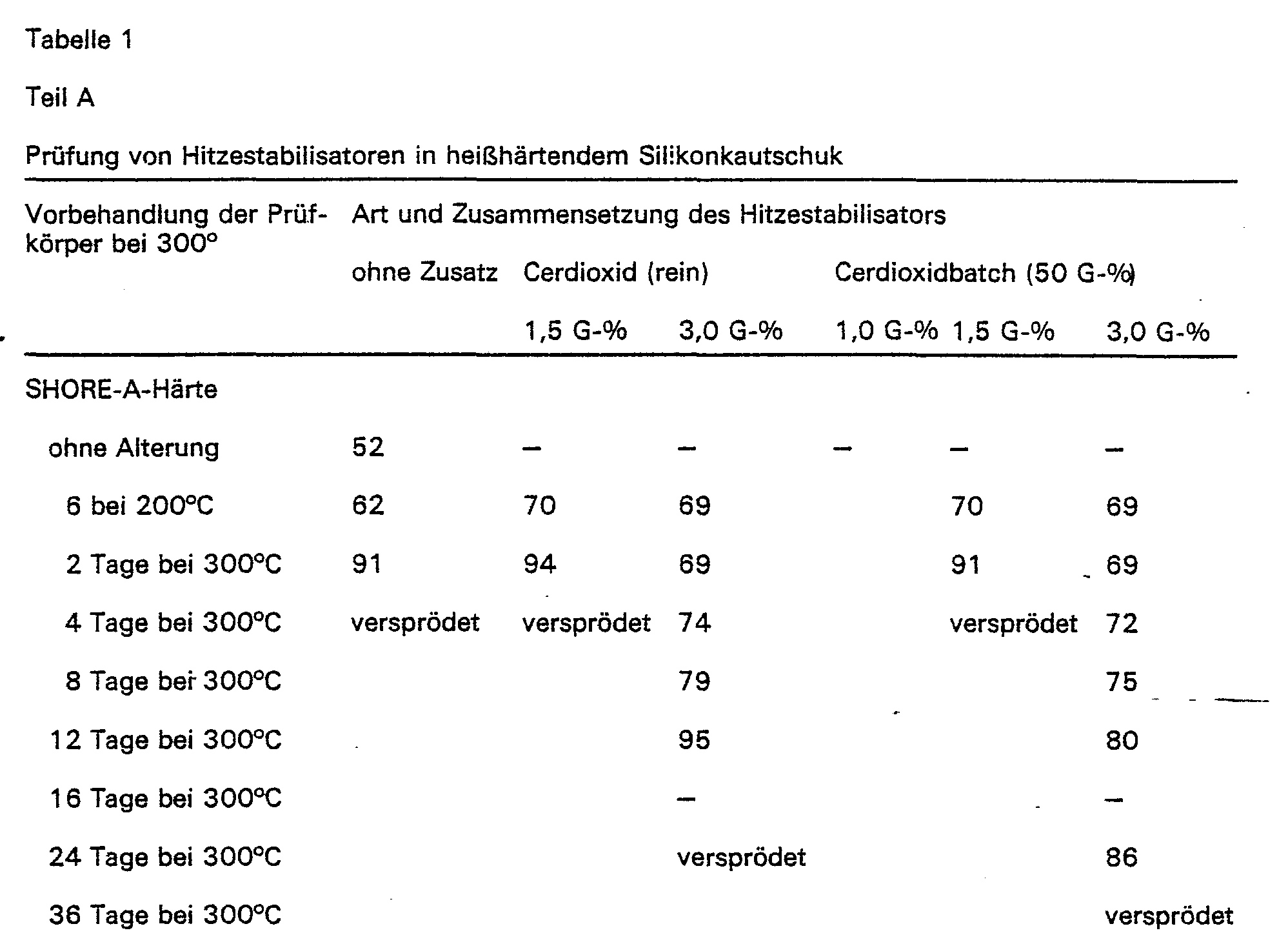
- Zur Prüfung der Wirksamkeit der erfindungsgemäßen cerhaltigen Kieselsäure als Wärmestabilisierungsmittel in zu Elastomeren härtbaren Massen auf Basis von Diorganopolysiloxanen werden die cerhaltigen Fällungskieselsäuren gemäß Beispiel 1 und 2 im Vergleich zu pyrogenem Titandioxid P 250 (Degussa), reinem Ceroxid und einem in Silikonpolymeren vordispergierten Cerdioxid (50%ig) sowie im Vergleich zur nicht-stabilisierten Silikongummi-Mischung in einer Testrezeptur einem Hitzealterungstest unterzogen.
- Als heißvulkanisierende Organosiloxane können solche verwendet werden, der organische Substituenten aus Methyl-Äthyl-, Phenyl-, Trifluormethylphenyl [F3CC6H4-)] oder Triäthylsilmethylenresten [(CH3)3SiCH2-] bestehen, z. B. Dimethyl-, Diäthyl-, Phenylmethyl-, Phenyläthyl-, Äthylmethyl-, Trimethylsilmethylenmethyl-, Trimethylsilmethylenäthyl-, Trifluormethylphenylmethyl- oder Trifluormethylphenyläthylsiloxane bzw. Mischpolymerisate solcher Verbindungen. Außerdem können die Polymerisate begrenzte Mengen von Diphenylsiloxan-, Bis-trimethylsilmethylensiloxan-, Bis-trifluormethylphenylsiloxaneinheiten sowie auch Siloxane mit Einheiten der Formel RSiO1,5 und R3SiO0,5 enthalten, wobei R eine der obigen Reste darstellt.
- Es wird folgende Rezeptur benutzt:

- Die heißhärtenden Silikonkautschukmischungen werden auf bekannte Weise 7 Minuten bei 130° C in der Vulkanisationspresse und 6 Stunden bei 200°C im Umluftschrank ausvulkanisiert und deren mechanische Daten bestimmt.
- Zur Stabilitätsprüfung wird der Silikongummi in einem Umluftschrank bei 300° C gelagert. In bestimmten Zeitabständen werden seine mechanischen Daten, wie Shore-A-Härte, Zugfestigkeit, Bruchdehnung und Rückprallelastizität, untersucht.
- Die Ergebnisse dieser Untersuchungen sind in Tabelle 1 zusammengefaßt und werden wie folgt erläutert:
- - Die Hitzestabilisierung der vulkanisierten, zu Elastomeren härtbaren Massen durch die erfindungsgemäßen Kieselsäuren übertrifft deutlich diejenige durch reines Cerdioxid. Das vordispergierte Ce02 verhält sich zwar vorteilhafter als das direkt eingesetzte Ce02, zeigt sich aber der erfindungsgemäßen Kieselsäure noch weit unterlegen.
- - Im Vergleich zum pyrogenen Titandioxid besteht auf gleicher Gewichtsbasis, bezogen auf die eingesetzte cerhaltige Fällungskieselsäure, gleiche Wirksamkeit.
- Vergleicht man die Hitzestabilisierungswirkung jedoch auf der Basis der wirksamen Substanzen (Ce02-Gehalt mit Ti02-Gehalt), so erweisen sich die erfindungsgemäßen cerhaltigen Kieselsäuren mit 13 -15 Gew.-% CeO2 um das 6 - 7fache überlegen.
- - Deutliche Überlegenheit gegenüber den Stoffen des Standes der Technik zeigen die erfindungsgemäßen Kieselsäuren nach Beispiel 1 und 2 auch im Hinblick auf die optischen Eigenschaften der mit diesen Substanzen gefüllten Vulkanisate. Während Titandioxid eine weiße Opazität und Cerdioxid, bzw. Cerdioxidbatch eine grauweiße Verfärbung erzeugen, zeigen die erfindungsgemäßen vulkanisierten zu Elastomeren härtbare Massen nur eine leichte Gelbfärbung.
- Die Prüfung der selbstverlöschenden Eigenschaften von Silikongummi erfolgt an einer Basismischung mit folgender Zusammensetzung:

- Silopren VS® ist ein Vinyl-Methyl-Polysiloxan-Elastomer. Der Siloprenvernetzer C150® ist Bis-2,4-Dichlorbenzoylperoxid in 50%iger Silikonöldispersion.
- Diese Mischung wird zunächst 7 Minuten lang bei 130°C in der Presse und anschließend 6 Stunden lang bei 200° C im Umluftschrank behandelt.
- Als flammhemmende Additive werden der Mischung
- pyrogenes Titandioxid,
- reines Cerdioxid, sowie
- die erfindungsgemäße cerhaltige Kieselsäure nach Beispiel 1 und 2
- in Mengen von 3,5 Teilen auf 100 Teile Basismischung zugesetzt.
- Die selbstverlöschenden Eigenschaften werden in Anlehnung an die Vorschrift UL-94 bestimmt. Dazu werden Teststreifen aus Silikongummi mit den Abmessungen 130 x 13 x 2 mm hergestellt. Die Streifen werden vertikal aufgehängt und 15 Sekunden mit einem Bunsenbrenner beflammt. Das untere Ende des Teststreifens wird dazu von dem oberen Teil der inneren Flamme berührt (innere Flammenhöhe ca. 20 mm, äußere Flammenhöhe 40 mm). Nach Entfernung der Flamme wird die Zeit bis zum Erlöschen der brennenden Silikongummiprobe gemessen. Nach dem Erkalten der Probe wird zum zweiten Male angebrannt und nochmals die Zeit bis zum Erlöschen bestimmt. Eine genaue Beschreibung des Verfahrens findet sich in der DE-A-2 750 706 (TORAY SILICONE Co.).
- Die Ergebnisse sind in der Tabelle 2 zusammengefaßt. Die Diskussion der Versuchsergebnisse mit einem Zusatz von 0,14Teilen Hexachloroplatinsäure (Tabelle 2) zeigt:
- - HTV-Silikonkautschuk ohne Platinkatalysator brennt vollkommen ab.
- - Eine Zugabe von Hexachloroplatinsäure (0,14 Teile) bewirkt bereits ein Verlöschen.
- - Der Einsatz von 3,5 Teilen von pyrogenem Titandioxid vermindert die Brenndauer.
- - Reines Cerdioxid zeigt sich praktisch im Vergleich zur platinhaltigen Mischung unwirksam, die erfindungsgemäße cerhaltige Fällungskieselsäure entsprechend einem Ce02-Gehalt von 0,5 Teilen Ce02 ist bereits wirksam. Eine gute flammhemmende Wirkung wird bei einer Dosierung von 10 Teilen der erfindungsgemäßen Kieselsäure entsprechend 1,5 Teilen Ce02 erreicht.
- - Synergistische Effekte von Mischungen aus reinem Cerdioxid bzw. cerhaltiger Fällungskieselsäure gemäß Beispiel 2 einerseits und pyrogenem Titandioxid andererseits ergeben sich unter den gewählten Bedingungen nicht und im Hinblick auf die mechanischen Eigenschaften des HTV-Silikonkautschukvulkanisates verhält sich das erfindungsgemäße Produkt am günstigsten.


Claims (5)


Applications Claiming Priority (2)
| Application Number | Priority Date | Filing Date | Title |
|---|---|---|---|
| DE3005137 | 1980-02-12 | ||
| DE19803005137 DE3005137A1 (de) | 1980-02-12 | 1980-02-12 | Cerhaltige faellungskieselsaeure, verfahren zu deren herstellung, sowie zu elastomeren haertbare massen, die die cerhaltige faellungskieselsaeure enthalten |
Publications (2)
| Publication Number | Publication Date |
|---|---|
| EP0033843A1 EP0033843A1 (de) | 1981-08-19 |
| EP0033843B1 true EP0033843B1 (de) | 1983-02-09 |
Family
ID=6094379
Family Applications (1)
| Application Number | Title | Priority Date | Filing Date |
|---|---|---|---|
| EP81100138A Expired EP0033843B1 (de) | 1980-02-12 | 1981-01-10 | Cerhaltige Fällungskieselsäure, Verfahren zu deren Herstellung, sowie zu Elastomeren härtbare Massen, die die cerhaltige Fällungskieselsäure enthalten |
Country Status (5)
| Country | Link |
|---|---|
| US (1) | US4360388A (de) |
| EP (1) | EP0033843B1 (de) |
| JP (2) | JPS56134512A (de) |
| DE (2) | DE3005137A1 (de) |
| ES (1) | ES498437A0 (de) |
Families Citing this family (28)
| Publication number | Priority date | Publication date | Assignee | Title |
|---|---|---|---|---|
| FR2559755A1 (fr) * | 1984-02-20 | 1985-08-23 | Rhone Poulenc Spec Chim | Oxyde cerique a nouvelles caracteristiques morphologiques et son procede d'obtention |
| FR2559754A1 (fr) * | 1984-02-20 | 1985-08-23 | Rhone Poulenc Spec Chim | Oxyde cerique a nouvelles caracteristiques morphologiques et son procede d'obtention |
| JP2838208B2 (ja) * | 1988-03-29 | 1998-12-16 | 東レ・ダウコーニング・シリコーン株式会社 | 透明な難燃性シリコーンゴム組成物 |
| FR2632961B1 (fr) * | 1988-06-15 | 1992-03-13 | Rhone Poulenc Chimie | Elastomeres silicones, a resistance a la flamme amelioree |
| FR2671068B1 (fr) * | 1990-12-28 | 1993-04-23 | Rhone Poulenc Chimie | Nouvelles silices, leur procede de preparation et leur utilisation comme charges notamment pour papiers. |
| DE4401606A1 (de) * | 1994-01-20 | 1995-07-27 | Wacker Chemie Gmbh | Hitzestabilisierte, zu Elastomeren vernetzbare Organopolysiloxanmassen |
| US6193795B1 (en) | 1993-08-02 | 2001-02-27 | Degussa Corporation | Low structure pyrogenic hydrophilic and hydrophobic metallic oxides, production and use |
| EP0649885A1 (de) * | 1993-10-25 | 1995-04-26 | Wacker-Chemie GmbH | Übergangsmetallhaltige hydrophobe Kieselsäure |
| FR2732331B1 (fr) * | 1995-03-29 | 1997-06-20 | Rhone Poulenc Chimie | Nouveau procede de preparation de silice precipitee, nouvelles silices precipitees contenant du zinc et leur utilisation au renforcement des elastomeres |
| FR2732330B1 (fr) * | 1995-03-29 | 1997-06-20 | Rhone Poulenc Chimie | Nouveau procede de preparation de silice precipitee, nouvelles silices precipitees contenant du zinc et leur utilisation au renforcement des elastomeres |
| DE19616780A1 (de) * | 1996-04-26 | 1997-11-06 | Degussa | Ceroxid-Metall/Metalloidoxid-Mischung |
| US5897675A (en) * | 1996-04-26 | 1999-04-27 | Degussa Aktiengesellschaft | Cerium oxide-metal/metalloid oxide mixture |
| US5985459A (en) * | 1996-10-31 | 1999-11-16 | The Gillette Company | Method of treating razor blade cutting edges |
| US5807501A (en) * | 1997-02-20 | 1998-09-15 | Dow Corning Corporation | Neutral-aged hydrophobic organosilicate-modified silica gels |
| AU6658998A (en) * | 1997-02-24 | 1998-09-09 | Dow Corning Corporation | Method for preparing hydrophobic silica gels with improved heat stability |
| US5708069A (en) * | 1997-02-24 | 1998-01-13 | Dow Corning Corporation | Method for making hydrophobic silica gels under neutral conditions |
| CN1248226A (zh) * | 1997-02-24 | 2000-03-22 | 陶氏康宁公司 | 具有降低表面积的疏水硅胶 |
| US5750610A (en) * | 1997-02-24 | 1998-05-12 | Dow Corning Corporation | Hydrophobic organosilicate-modified silica gels |
| AU6178498A (en) * | 1997-02-24 | 1998-09-09 | Dow Corning Corporation | Neutral-aged hydrophobic silica gels with reduced surface area |
| US5789495A (en) * | 1997-02-24 | 1998-08-04 | Dow Corning Corporation | Method for making hydrophobic organosilicate-modified silica gels under neutral conditions |
| US6007626A (en) * | 1997-03-04 | 1999-12-28 | Leendertsen; Howard V. | Apparatus for applying liquid fluoropolymer solutions to substrates |
| US6239205B1 (en) * | 1999-01-28 | 2001-05-29 | Dow Corning Toray Silicone Co. | Silicone rubber composition |
| FR2831179B1 (fr) | 2001-10-22 | 2005-04-15 | Rhodia Chimie Sa | Procede de preparation en milieu aqueux de compositions pigmentaires a base de silice |
| KR100766166B1 (ko) | 2006-01-18 | 2007-10-10 | 주식회사 케이씨씨 | 우수한 기계적물성을 가지는 열경화형 실리콘고무 조성물 |
| JP5410762B2 (ja) | 2006-12-28 | 2014-02-05 | 東レ・ダウコーニング株式会社 | 加熱硬化性シリコーンゴム組成物 |
| JP2013035890A (ja) | 2011-08-03 | 2013-02-21 | Shin-Etsu Chemical Co Ltd | 耐熱性に優れたシリコーンゴム組成物 |
| EP3954743A1 (de) | 2020-08-12 | 2022-02-16 | Evonik Operations GmbH | Verwendung von siliziumdioxid zur verbesserung der leitfähigkeit von beschichtungen |
| KR20250126745A (ko) | 2022-12-19 | 2025-08-25 | 사이언스코 스페셜티 폴리머스 이태리 에스.피.에이. | 라디칼 스캐빈저로서의 SiO2 담지된 CeO2 |
Citations (7)
| Publication number | Priority date | Publication date | Assignee | Title |
|---|---|---|---|---|
| DE1230562B (de) * | 1964-02-29 | 1966-12-15 | Degussa | Verfahren zur Herstellung von Polysiloxanelastomeren |
| DE1242866B (de) * | 1960-03-23 | 1967-06-22 | Gen Electric | Verwendung von Oxyden der seltenen Erden zur Stabilisierung in organopolysiloxanhaltigen Formmassen |
| JPS5134868B2 (de) * | 1972-02-14 | 1976-09-29 | ||
| DE2617434A1 (de) * | 1975-04-24 | 1976-11-04 | Dow Corning Ltd | Elastomerbildende siloxanzubereitung und verfahren zu ihrer herstellung |
| DE2727611A1 (de) * | 1977-03-07 | 1978-09-14 | Dow Corning | Zu einem flammgeschuetzten elastomer haertbare siliconmasse |
| DE2716225A1 (de) * | 1977-04-13 | 1978-10-26 | Degussa | Borhaltige faellungskieselsaeure |
| DE2924915A1 (de) * | 1978-06-22 | 1980-01-03 | Snam Progetti | Modifizierte kristalline kieselsaeuren und verfahren zu deren herstellung |
Family Cites Families (8)
| Publication number | Priority date | Publication date | Assignee | Title |
|---|---|---|---|---|
| US2462236A (en) * | 1945-07-30 | 1949-02-22 | Universal Oil Prod Co | Manufacture of silica hydrogel and catalysts |
| US3313739A (en) * | 1962-10-15 | 1967-04-11 | Ellsworth G Acker | Process for the preparation of silica gel |
| US3832327A (en) * | 1971-02-03 | 1974-08-27 | Huber Corp J M | Alkali metal alumino silicates,methods for their production and compositions thereof |
| US3716493A (en) * | 1971-02-26 | 1973-02-13 | Grace W R & Co | Process for making fine sized low density silica |
| US4122160A (en) * | 1974-10-31 | 1978-10-24 | J. M. Huber Corporation | Toothpaste compositions containing improved amorphous precipitated silicas |
| DE2505191B2 (de) * | 1975-02-07 | 1977-08-18 | Deutsche Gold- Und Silber-Scheideanstalt Vormals Roessler, 6000 Frankfurt | Verfahren zur herstellung einer feinteiligen kieselsaeure durch spruehtrocknung |
| DE2628975A1 (de) * | 1976-06-28 | 1977-12-29 | Degussa | Faellungskieselsaeure |
| DE2829045A1 (de) * | 1978-07-01 | 1980-01-10 | Degussa | Borhaltige faellungskieselsaeure |
-
1980
- 1980-02-12 DE DE19803005137 patent/DE3005137A1/de not_active Ceased
-
1981
- 1981-01-10 DE DE8181100138T patent/DE3160043D1/de not_active Expired
- 1981-01-10 EP EP81100138A patent/EP0033843B1/de not_active Expired
- 1981-01-12 ES ES498437A patent/ES498437A0/es active Granted
- 1981-02-11 US US06/233,434 patent/US4360388A/en not_active Expired - Fee Related
- 1981-02-12 JP JP1955381A patent/JPS56134512A/ja active Granted
-
1984
- 1984-12-07 JP JP59257729A patent/JPS6055544B2/ja not_active Expired
Patent Citations (7)
| Publication number | Priority date | Publication date | Assignee | Title |
|---|---|---|---|---|
| DE1242866B (de) * | 1960-03-23 | 1967-06-22 | Gen Electric | Verwendung von Oxyden der seltenen Erden zur Stabilisierung in organopolysiloxanhaltigen Formmassen |
| DE1230562B (de) * | 1964-02-29 | 1966-12-15 | Degussa | Verfahren zur Herstellung von Polysiloxanelastomeren |
| JPS5134868B2 (de) * | 1972-02-14 | 1976-09-29 | ||
| DE2617434A1 (de) * | 1975-04-24 | 1976-11-04 | Dow Corning Ltd | Elastomerbildende siloxanzubereitung und verfahren zu ihrer herstellung |
| DE2727611A1 (de) * | 1977-03-07 | 1978-09-14 | Dow Corning | Zu einem flammgeschuetzten elastomer haertbare siliconmasse |
| DE2716225A1 (de) * | 1977-04-13 | 1978-10-26 | Degussa | Borhaltige faellungskieselsaeure |
| DE2924915A1 (de) * | 1978-06-22 | 1980-01-03 | Snam Progetti | Modifizierte kristalline kieselsaeuren und verfahren zu deren herstellung |
Also Published As
| Publication number | Publication date |
|---|---|
| JPS56134512A (en) | 1981-10-21 |
| ES8200626A1 (es) | 1981-11-01 |
| DE3160043D1 (en) | 1983-03-17 |
| JPS621322B2 (de) | 1987-01-13 |
| US4360388A (en) | 1982-11-23 |
| ES498437A0 (es) | 1981-11-01 |
| JPS6055544B2 (ja) | 1985-12-05 |
| EP0033843A1 (de) | 1981-08-19 |
| DE3005137A1 (de) | 1981-08-20 |
| JPS60173050A (ja) | 1985-09-06 |
Similar Documents
| Publication | Publication Date | Title |
|---|---|---|
| EP0033843A1 (de) | Cerhaltige Fällungskieselsäure, Verfahren zu deren Herstellung, sowie zu Elastomeren härtbare Massen, die die cerhaltige Fällungskieselsäure enthalten | |
| DE4427137B4 (de) | Fällungskieselsäure | |
| DE69222098T2 (de) | Organosilicium-behandeltes Pigment, Verfahren zu dessen Herstellung und damit hergestellte Kosmetika | |
| EP1284277B1 (de) | Mit Siliziumdioxid umhüllte Metalloxidpartikel | |
| EP0158141B1 (de) | Platin, Organopolysiloxan und Füllstoff enthaltende Pasten | |
| EP0038900B1 (de) | Verfahren zur Herstellung pyrogener Kieselsäure | |
| EP0032176A1 (de) | Wärmeisolationsmischung und Verfahren zu deren Herstellung | |
| DE2643468C3 (de) | Hitzehärtbare Organopolysiloxanformmassen | |
| EP0113796B1 (de) | Wasserhaltiges Aluminiumoxid enthaltend im wesentlichen Pseudoböhmit, Verfahren zu seiner Herstellung und Verwendung | |
| DE2750706B2 (de) | Selbsterlöschende, hitzehärtbare Polysiloxanformmassen | |
| DE4041827A1 (de) | Faellungskieselsaeurepaste | |
| DE1467456C3 (de) | Verfahren zur Herstellung von Ruß erhöhter Farbtiefe | |
| DE2638452A1 (de) | Zweikomponenten-siliconkautschuk | |
| DE10115544A1 (de) | Titandioxid-Pigmentzusammensetzung | |
| DE3043815C2 (de) | ||
| DE2854200B1 (de) | Verfahren zur Herstellung von Zirkonoxid aus technischem Calciumzirkonat | |
| DE2124477A1 (de) | Verfahren zur Herstellung eines Pigmentes auf Tonbasis | |
| EP0546421A1 (de) | Fassadenanstrichmittel und Putze mit hoher Frühwasserbeständigkeit | |
| DE2226672C3 (de) | Teilchenförmiges festes Antimonoxid/ Siliciumdioxid enthaltendes anorganisches Material, Verfahren zu seiner Herstellung und seine Verwendung | |
| EP2070992A1 (de) | Lacksysteme | |
| DE3243194A1 (de) | Verfahren zur herstellung von siliconkautschuk-vulkanisaten | |
| DE69909264T2 (de) | Keine pastelltöne aufweisende, gefärbte thermisch stabile wärmehärtende silikonelastomer-zusammensetzung | |
| DE1494223A1 (de) | Stabilisatorzusammensetzung | |
| DE2619679A1 (de) | Suspendiermittel fuer anstrichmittelsysteme, verfahren zu seiner herstellung und es enthaltende anstrichmittelsysteme | |
| DE2113297A1 (de) | Leicht dispergierbare anorganische Pigmente |
Legal Events
| Date | Code | Title | Description |
|---|---|---|---|
| PUAI | Public reference made under article 153(3) epc to a published international application that has entered the european phase |
Free format text: ORIGINAL CODE: 0009012 |
|
| AK | Designated contracting states |
Designated state(s): BE DE FR GB IT NL |
|
| 17P | Request for examination filed |
Effective date: 19810110 |
|
| ITF | It: translation for a ep patent filed | ||
| GRAA | (expected) grant |
Free format text: ORIGINAL CODE: 0009210 |
|
| AK | Designated contracting states |
Designated state(s): BE DE FR GB IT NL |
|
| REF | Corresponds to: |
Ref document number: 3160043 Country of ref document: DE Date of ref document: 19830317 |
|
| ET | Fr: translation filed | ||
| ITTA | It: last paid annual fee | ||
| PGFP | Annual fee paid to national office [announced via postgrant information from national office to epo] |
Ref country code: NL Payment date: 19920131 Year of fee payment: 12 |
|
| PG25 | Lapsed in a contracting state [announced via postgrant information from national office to epo] |
Ref country code: NL Effective date: 19930801 |
|
| NLV4 | Nl: lapsed or anulled due to non-payment of the annual fee | ||
| PGFP | Annual fee paid to national office [announced via postgrant information from national office to epo] |
Ref country code: DE Payment date: 19931215 Year of fee payment: 14 |
|
| PGFP | Annual fee paid to national office [announced via postgrant information from national office to epo] |
Ref country code: BE Payment date: 19931221 Year of fee payment: 14 |
|
| PGFP | Annual fee paid to national office [announced via postgrant information from national office to epo] |
Ref country code: GB Payment date: 19931231 Year of fee payment: 14 Ref country code: FR Payment date: 19931231 Year of fee payment: 14 |
|
| PG25 | Lapsed in a contracting state [announced via postgrant information from national office to epo] |
Ref country code: GB Effective date: 19950110 |
|
| PG25 | Lapsed in a contracting state [announced via postgrant information from national office to epo] |
Ref country code: BE Effective date: 19950131 |
|
| BERE | Be: lapsed |
Owner name: DEGUSSA A.G. Effective date: 19950131 |
|
| GBPC | Gb: european patent ceased through non-payment of renewal fee |
Effective date: 19950110 |
|
| PG25 | Lapsed in a contracting state [announced via postgrant information from national office to epo] |
Ref country code: FR Effective date: 19950929 |
|
| PG25 | Lapsed in a contracting state [announced via postgrant information from national office to epo] |
Ref country code: DE Effective date: 19951101 |
|
| REG | Reference to a national code |
Ref country code: FR Ref legal event code: ST |
|
| PLBE | No opposition filed within time limit |
Free format text: ORIGINAL CODE: 0009261 |
|
| STAA | Information on the status of an ep patent application or granted ep patent |
Free format text: STATUS: NO OPPOSITION FILED WITHIN TIME LIMIT |