EP0016870A1 - Verfahren zum Polymerisieren von Methylmethacrylat sowie aus diesem Polymerisat hergestellte Platte und Verwendung derselben - Google Patents
Verfahren zum Polymerisieren von Methylmethacrylat sowie aus diesem Polymerisat hergestellte Platte und Verwendung derselben Download PDFInfo
- Publication number
- EP0016870A1 EP0016870A1 EP79105366A EP79105366A EP0016870A1 EP 0016870 A1 EP0016870 A1 EP 0016870A1 EP 79105366 A EP79105366 A EP 79105366A EP 79105366 A EP79105366 A EP 79105366A EP 0016870 A1 EP0016870 A1 EP 0016870A1
- Authority
- EP
- European Patent Office
- Prior art keywords
- methyl methacrylate
- radiation
- sterically hindered
- hindered amine
- formula
- Prior art date
- Legal status (The legal status is an assumption and is not a legal conclusion. Google has not performed a legal analysis and makes no representation as to the accuracy of the status listed.)
- Granted
Links
- VVQNEPGJFQJSBK-UHFFFAOYSA-N Methyl methacrylate Chemical compound COC(=O)C(C)=C VVQNEPGJFQJSBK-UHFFFAOYSA-N 0.000 title claims abstract description 18
- 238000000034 method Methods 0.000 title claims description 8
- 229920000642 polymer Polymers 0.000 title abstract description 17
- 239000000203 mixture Substances 0.000 claims abstract description 10
- 239000000178 monomer Substances 0.000 claims abstract description 10
- 150000001412 amines Chemical class 0.000 claims abstract description 8
- 125000002947 alkylene group Chemical group 0.000 claims abstract description 4
- 239000000463 material Substances 0.000 claims abstract description 4
- UFHFLCQGNIYNRP-UHFFFAOYSA-N Hydrogen Chemical compound [H][H] UFHFLCQGNIYNRP-UHFFFAOYSA-N 0.000 claims abstract description 3
- 229910052739 hydrogen Inorganic materials 0.000 claims abstract description 3
- 239000001257 hydrogen Substances 0.000 claims abstract description 3
- 238000011065 in-situ storage Methods 0.000 claims abstract description 3
- 238000006116 polymerization reaction Methods 0.000 claims description 10
- -1 alkyl radicals Chemical class 0.000 claims description 9
- RKMGAJGJIURJSJ-UHFFFAOYSA-N 2,2,6,6-tetramethylpiperidine Chemical class CC1(C)CCCC(C)(C)N1 RKMGAJGJIURJSJ-UHFFFAOYSA-N 0.000 claims description 6
- 125000004432 carbon atom Chemical group C* 0.000 claims description 6
- 150000001875 compounds Chemical class 0.000 claims description 6
- 239000003999 initiator Substances 0.000 claims description 6
- 125000005907 alkyl ester group Chemical group 0.000 claims description 4
- 150000003254 radicals Chemical class 0.000 claims description 4
- SMZOUWXMTYCWNB-UHFFFAOYSA-N 2-(2-methoxy-5-methylphenyl)ethanamine Chemical compound COC1=CC=C(C)C=C1CCN SMZOUWXMTYCWNB-UHFFFAOYSA-N 0.000 claims description 3
- NIXOWILDQLNWCW-UHFFFAOYSA-N 2-Propenoic acid Natural products OC(=O)C=C NIXOWILDQLNWCW-UHFFFAOYSA-N 0.000 claims description 3
- 229920001577 copolymer Polymers 0.000 claims description 2
- OFOBLEOULBTSOW-UHFFFAOYSA-N Malonic acid Chemical compound OC(=O)CC(O)=O OFOBLEOULBTSOW-UHFFFAOYSA-N 0.000 claims 1
- 125000001931 aliphatic group Chemical group 0.000 claims 1
- 150000005690 diesters Chemical class 0.000 claims 1
- 229920001519 homopolymer Polymers 0.000 claims 1
- 230000005855 radiation Effects 0.000 abstract description 15
- 238000010526 radical polymerization reaction Methods 0.000 abstract description 5
- 229940116351 sebacate Drugs 0.000 abstract description 3
- CXMXRPHRNRROMY-UHFFFAOYSA-L sebacate(2-) Chemical compound [O-]C(=O)CCCCCCCCC([O-])=O CXMXRPHRNRROMY-UHFFFAOYSA-L 0.000 abstract description 2
- 230000003685 thermal hair damage Effects 0.000 abstract description 2
- 230000035699 permeability Effects 0.000 description 16
- 229920003229 poly(methyl methacrylate) Polymers 0.000 description 15
- 239000004926 polymethyl methacrylate Substances 0.000 description 14
- 238000000465 moulding Methods 0.000 description 7
- 239000000654 additive Substances 0.000 description 6
- 239000006188 syrup Substances 0.000 description 5
- 235000020357 syrup Nutrition 0.000 description 5
- OZAIFHULBGXAKX-UHFFFAOYSA-N 2-(2-cyanopropan-2-yldiazenyl)-2-methylpropanenitrile Chemical compound N#CC(C)(C)N=NC(C)(C)C#N OZAIFHULBGXAKX-UHFFFAOYSA-N 0.000 description 4
- YIVJZNGAASQVEM-UHFFFAOYSA-N Lauroyl peroxide Chemical compound CCCCCCCCCCCC(=O)OOC(=O)CCCCCCCCCCC YIVJZNGAASQVEM-UHFFFAOYSA-N 0.000 description 4
- BAPJBEWLBFYGME-UHFFFAOYSA-N Methyl acrylate Chemical compound COC(=O)C=C BAPJBEWLBFYGME-UHFFFAOYSA-N 0.000 description 4
- 230000000694 effects Effects 0.000 description 4
- 238000004519 manufacturing process Methods 0.000 description 4
- 229920001169 thermoplastic Polymers 0.000 description 4
- 239000004416 thermosoftening plastic Substances 0.000 description 4
- 230000000996 additive effect Effects 0.000 description 3
- 230000005540 biological transmission Effects 0.000 description 3
- IVCQBDFQYUAIIJ-UHFFFAOYSA-N bis(2,2,3,3-tetramethylpiperidin-1-yl) decanedioate Chemical compound CC1(C)C(C)(C)CCCN1OC(=O)CCCCCCCCC(=O)ON1C(C)(C)C(C)(C)CCC1 IVCQBDFQYUAIIJ-UHFFFAOYSA-N 0.000 description 3
- 230000006378 damage Effects 0.000 description 3
- 230000007423 decrease Effects 0.000 description 3
- 239000011521 glass Substances 0.000 description 3
- 239000004611 light stabiliser Substances 0.000 description 3
- 230000002035 prolonged effect Effects 0.000 description 3
- 238000007789 sealing Methods 0.000 description 3
- MYRTYDVEIRVNKP-UHFFFAOYSA-N 1,2-Divinylbenzene Chemical compound C=CC1=CC=CC=C1C=C MYRTYDVEIRVNKP-UHFFFAOYSA-N 0.000 description 2
- GHKOFFNLGXMVNJ-UHFFFAOYSA-N Didodecyl thiobispropanoate Chemical compound CCCCCCCCCCCCOC(=O)CCSCCC(=O)OCCCCCCCCCCCC GHKOFFNLGXMVNJ-UHFFFAOYSA-N 0.000 description 2
- 239000004793 Polystyrene Substances 0.000 description 2
- PPBRXRYQALVLMV-UHFFFAOYSA-N Styrene Chemical compound C=CC1=CC=CC=C1 PPBRXRYQALVLMV-UHFFFAOYSA-N 0.000 description 2
- 239000006096 absorbing agent Substances 0.000 description 2
- 150000001565 benzotriazoles Chemical class 0.000 description 2
- 238000010276 construction Methods 0.000 description 2
- 238000000354 decomposition reaction Methods 0.000 description 2
- 150000002148 esters Chemical class 0.000 description 2
- BHIWKHZACMWKOJ-UHFFFAOYSA-N methyl isobutyrate Chemical compound COC(=O)C(C)C BHIWKHZACMWKOJ-UHFFFAOYSA-N 0.000 description 2
- 229920000098 polyolefin Polymers 0.000 description 2
- 229920002223 polystyrene Polymers 0.000 description 2
- 239000004800 polyvinyl chloride Substances 0.000 description 2
- 229920000915 polyvinyl chloride Polymers 0.000 description 2
- CXMXRPHRNRROMY-UHFFFAOYSA-N sebacic acid Chemical compound OC(=O)CCCCCCCCC(O)=O CXMXRPHRNRROMY-UHFFFAOYSA-N 0.000 description 2
- 238000002834 transmittance Methods 0.000 description 2
- BJELTSYBAHKXRW-UHFFFAOYSA-N 2,4,6-triallyloxy-1,3,5-triazine Chemical compound C=CCOC1=NC(OCC=C)=NC(OCC=C)=N1 BJELTSYBAHKXRW-UHFFFAOYSA-N 0.000 description 1
- JHDNFMVFXUETMC-UHFFFAOYSA-N 2-(2H-benzotriazol-4-yl)-4-methylphenol Chemical compound CC1=CC=C(O)C(C=2C=3N=NNC=3C=CC=2)=C1 JHDNFMVFXUETMC-UHFFFAOYSA-N 0.000 description 1
- DBCAQXHNJOFNGC-UHFFFAOYSA-N 4-bromo-1,1,1-trifluorobutane Chemical compound FC(F)(F)CCCBr DBCAQXHNJOFNGC-UHFFFAOYSA-N 0.000 description 1
- OMPJBNCRMGITSC-UHFFFAOYSA-N Benzoylperoxide Chemical compound C=1C=CC=CC=1C(=O)OOC(=O)C1=CC=CC=C1 OMPJBNCRMGITSC-UHFFFAOYSA-N 0.000 description 1
- RWSOTUBLDIXVET-UHFFFAOYSA-N Dihydrogen sulfide Chemical class S RWSOTUBLDIXVET-UHFFFAOYSA-N 0.000 description 1
- JIGUQPWFLRLWPJ-UHFFFAOYSA-N Ethyl acrylate Chemical compound CCOC(=O)C=C JIGUQPWFLRLWPJ-UHFFFAOYSA-N 0.000 description 1
- CERQOIWHTDAKMF-UHFFFAOYSA-M Methacrylate Chemical compound CC(=C)C([O-])=O CERQOIWHTDAKMF-UHFFFAOYSA-M 0.000 description 1
- CERQOIWHTDAKMF-UHFFFAOYSA-N Methacrylic acid Chemical compound CC(=C)C(O)=O CERQOIWHTDAKMF-UHFFFAOYSA-N 0.000 description 1
- UCKMPCXJQFINFW-UHFFFAOYSA-N Sulphide Chemical compound [S-2] UCKMPCXJQFINFW-UHFFFAOYSA-N 0.000 description 1
- 230000006750 UV protection Effects 0.000 description 1
- XTXRWKRVRITETP-UHFFFAOYSA-N Vinyl acetate Chemical compound CC(=O)OC=C XTXRWKRVRITETP-UHFFFAOYSA-N 0.000 description 1
- 238000000137 annealing Methods 0.000 description 1
- QVGXLLKOCUKJST-UHFFFAOYSA-N atomic oxygen Chemical compound [O] QVGXLLKOCUKJST-UHFFFAOYSA-N 0.000 description 1
- 125000000751 azo group Chemical group [*]N=N[*] 0.000 description 1
- 150000008366 benzophenones Chemical class 0.000 description 1
- QRUDEWIWKLJBPS-UHFFFAOYSA-N benzotriazole Chemical compound C1=CC=C2N[N][N]C2=C1 QRUDEWIWKLJBPS-UHFFFAOYSA-N 0.000 description 1
- 239000012964 benzotriazole Substances 0.000 description 1
- 235000019400 benzoyl peroxide Nutrition 0.000 description 1
- LEDIWWJKWAMGLD-UHFFFAOYSA-N bis(2-methylundecan-2-yl) disulfide Chemical compound CCCCCCCCCC(C)(C)SSC(C)(C)CCCCCCCCC LEDIWWJKWAMGLD-UHFFFAOYSA-N 0.000 description 1
- 239000003795 chemical substances by application Substances 0.000 description 1
- 230000007797 corrosion Effects 0.000 description 1
- 238000005260 corrosion Methods 0.000 description 1
- 238000006731 degradation reaction Methods 0.000 description 1
- WNAHIZMDSQCWRP-UHFFFAOYSA-N dodecane-1-thiol Chemical compound CCCCCCCCCCCCS WNAHIZMDSQCWRP-UHFFFAOYSA-N 0.000 description 1
- STVZJERGLQHEKB-UHFFFAOYSA-N ethylene glycol dimethacrylate Substances CC(=C)C(=O)OCCOC(=O)C(C)=C STVZJERGLQHEKB-UHFFFAOYSA-N 0.000 description 1
- 230000002349 favourable effect Effects 0.000 description 1
- 239000011888 foil Substances 0.000 description 1
- 125000000623 heterocyclic group Chemical group 0.000 description 1
- 125000004435 hydrogen atom Chemical group [H]* 0.000 description 1
- 150000002432 hydroperoxides Chemical class 0.000 description 1
- 239000012442 inert solvent Substances 0.000 description 1
- 230000005764 inhibitory process Effects 0.000 description 1
- WDAXFOBOLVPGLV-UHFFFAOYSA-N isobutyric acid ethyl ester Natural products CCOC(=O)C(C)C WDAXFOBOLVPGLV-UHFFFAOYSA-N 0.000 description 1
- 125000002496 methyl group Chemical group [H]C([H])([H])* 0.000 description 1
- 229910052760 oxygen Inorganic materials 0.000 description 1
- 239000001301 oxygen Substances 0.000 description 1
- PNJWIWWMYCMZRO-UHFFFAOYSA-N pent‐4‐en‐2‐one Natural products CC(=O)CC=C PNJWIWWMYCMZRO-UHFFFAOYSA-N 0.000 description 1
- 150000002978 peroxides Chemical class 0.000 description 1
- 229920000728 polyester Polymers 0.000 description 1
- QTECDUFMBMSHKR-UHFFFAOYSA-N prop-2-enyl prop-2-enoate Chemical compound C=CCOC(=O)C=C QTECDUFMBMSHKR-UHFFFAOYSA-N 0.000 description 1
- 230000004224 protection Effects 0.000 description 1
- 239000011814 protection agent Substances 0.000 description 1
- 230000001681 protective effect Effects 0.000 description 1
- 239000002516 radical scavenger Substances 0.000 description 1
- 239000012966 redox initiator Substances 0.000 description 1
- 230000002000 scavenging effect Effects 0.000 description 1
- MWNQXXOSWHCCOZ-UHFFFAOYSA-L sodium;oxido carbonate Chemical compound [Na+].[O-]OC([O-])=O MWNQXXOSWHCCOZ-UHFFFAOYSA-L 0.000 description 1
- 230000006641 stabilisation Effects 0.000 description 1
- 238000011105 stabilization Methods 0.000 description 1
- 239000003381 stabilizer Substances 0.000 description 1
- KQYLUTYUZIVHND-UHFFFAOYSA-N tert-butyl 2,2-dimethyloctaneperoxoate Chemical compound CCCCCCC(C)(C)C(=O)OOC(C)(C)C KQYLUTYUZIVHND-UHFFFAOYSA-N 0.000 description 1
- OPQYOFWUFGEMRZ-UHFFFAOYSA-N tert-butyl 2,2-dimethylpropaneperoxoate Chemical compound CC(C)(C)OOC(=O)C(C)(C)C OPQYOFWUFGEMRZ-UHFFFAOYSA-N 0.000 description 1
- 238000005979 thermal decomposition reaction Methods 0.000 description 1
- 239000003017 thermal stabilizer Substances 0.000 description 1
- 150000003568 thioethers Chemical class 0.000 description 1
- 230000001960 triggered effect Effects 0.000 description 1
- 238000009281 ultraviolet germicidal irradiation Methods 0.000 description 1
- 230000004580 weight loss Effects 0.000 description 1
Classifications
-
- C—CHEMISTRY; METALLURGY
- C08—ORGANIC MACROMOLECULAR COMPOUNDS; THEIR PREPARATION OR CHEMICAL WORKING-UP; COMPOSITIONS BASED THEREON
- C08F—MACROMOLECULAR COMPOUNDS OBTAINED BY REACTIONS ONLY INVOLVING CARBON-TO-CARBON UNSATURATED BONDS
- C08F20/00—Homopolymers and copolymers of compounds having one or more unsaturated aliphatic radicals, each having only one carbon-to-carbon double bond, and only one being terminated by only one carboxyl radical or a salt, anhydride, ester, amide, imide or nitrile thereof
- C08F20/02—Monocarboxylic acids having less than ten carbon atoms, Derivatives thereof
- C08F20/10—Esters
- C08F20/12—Esters of monohydric alcohols or phenols
- C08F20/14—Methyl esters, e.g. methyl (meth)acrylate
-
- C—CHEMISTRY; METALLURGY
- C08—ORGANIC MACROMOLECULAR COMPOUNDS; THEIR PREPARATION OR CHEMICAL WORKING-UP; COMPOSITIONS BASED THEREON
- C08F—MACROMOLECULAR COMPOUNDS OBTAINED BY REACTIONS ONLY INVOLVING CARBON-TO-CARBON UNSATURATED BONDS
- C08F2/00—Processes of polymerisation
- C08F2/44—Polymerisation in the presence of compounding ingredients, e.g. plasticisers, dyestuffs, fillers
Definitions
- the invention relates to the production of polymers of methyl methacrylate with high resistance to UV radiation and thermal damage.
- the polymers of methyl methacrylate are distinguished from other polymers by their high resistance to the above-mentioned effects, but some damage to these polymers occurs with prolonged exposure. For example, a decrease in Vicat softening temperature by 8 to 10 ° when polymethyl methacrylate has been heated to 160 ° C for the purpose of forming.
- the permeability to UV radiation decreases significantly with prolonged weathering or after prolonged exposure to UV radiation. At the same time, a reduction in the molecular weight can be determined, which results in deteriorated mechanical properties.
- TPS di- (2,2,6,6-tetramethyl-piperidyl-4) -sebacate
- Thermal stabilization is also evident in the production of PMMA sheets from a prepolymerized syrup.
- methyl methacrylate is converted into a so-called syrup with a polymer content of about 25%.
- a plate is made from such a syrup by polymerization in a flat chamber formed from two glass plates, a Vicat softening temperature (VET) of 119 ° C. is found there. When heated to 160 ° C for half an hour, the VET drops to 111 ° C. If you add a thioether to the syrup as a thermal stabilizer, e.g. Dilauryl thiodipropionic acid, too, then a VET of only 110 ° C.
- a thermal stabilizer e.g. Dilauryl thiodipropionic acid
- UV radiation-absorbing additives alone such as benzotriazoles or benzophenone derivatives, the protective effect of which only benefits the PMMA molecules located inside the plate, extends the effect of the additives according to the invention to the surface of the plate. Therefore surface corrosion is avoided.
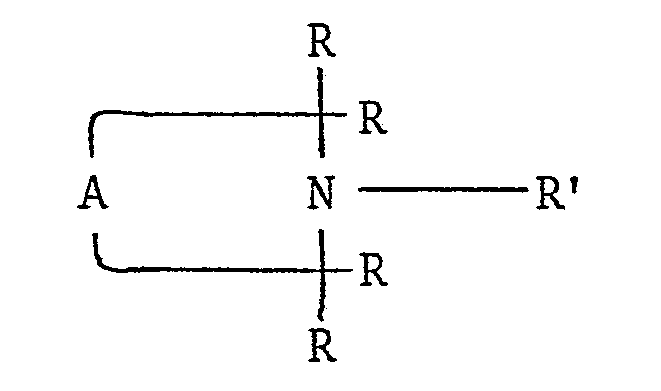
- R is the same or different alkyl radicals, in particular lower alkyl radicals having 1 to 4 carbon atoms, preferably methyl groups;
- R ' is hydrogen or a - preferably lower - alkyl radical and A is an optionally substituted 2- or 3-membered alkylene chain which closes the molecule to form a saturated heterocyclic ring.
- R ' is preferably a hydrogen atom and A is a 3-membered alkylene chain.
- the sterically hindered amines are generally used in an amount of 0.01 to 1%, preferably 0.1 to 0.5% based on the weight of the monomers to be polymerized, used.
- the polymerization of methyl methacrylate according to the invention is generally carried out in bulk, i.e. carried out in the absence of substantial amounts of inert solvents or distributing agents. Polymerization is preferably carried out in situ in a flat chamber formed from two parallel glass plates and a sealing cord which is guided around the edge, PMMA plates being produced, for example, from 2 to 20 mm thick.
- one or more comonomers can also be used.
- examples include the alkyl esters of acrylic acid and the alkyl esters of methacrylic acid which contain at least two carbon atoms in the alkyl radical.
- Alkyl esters of acrylic acid with 1 to 4 carbon atoms in the alkyl radical are the preferred comonomers and are preferably used in an amount of up to 15% of the total monomer weight.
- Further comonomers are styrene, vinyl acetate and - in minor amounts - monomers with two or more polymerizable double bonds, for example divinylbenzene, triallyl cyanurate, ethylene glycol dimethacrylate or allyl acrylate or methacrylate.
- the radical polymerization of the monomers can be triggered with the usual amounts of the usual radical initiators.
- Peroxides such as dibenzoyl peroxide, dilauroyl peroxide, tert-butyl perpivalate or percarbonate, or azo initiators, such as azo-bis-isobutyronitrile, are used, for example or methyl isobutyrate.
- the polymerization is carried out in a manner known per se at a temperature between 20 and 120 ° C., the lowest temperatures in this range being able to be achieved with redox initiators.
- the preferred polymerization temperature is 40 to 100 ° C.
- the amines used according to the invention have no influence on the decomposition temperature and rate of the initiators.
- the usual amounts of initiator from 0.02 to 0.1 wt .-% (based on monomer weight)
- polymers with a molecular weight of 500,000 or more are obtained.
- Particularly preferred molecular weight ranges are 1 to 2 million on the one hand and more than 5 million on the other.
- the molecular weight can be kept within low limits by polymerization in the presence of transfer regulators, in particular mercaptans, but the molecular weight is preferably not less than 150,000.
- the polymers produced by the process of the invention are particularly suitable for all purposes where permanent high permeability to UV radiation is important, e.g. at solariums. These contain fluorescent tubes under a flat or trough-shaped lying surface made of a PMMA plate, which emit UV radiation with a high intensity in a range above 280 nm.
- Another important area of application is shaped bodies produced by reshaping PMMA sheets, e.g. Lamp covers that are characterized by increased heat resistance compared to those made from conventional PMMA sheets.
- methyl methacrylate 100 parts are mixed with 0.1 part of dilauroyl peroxide, 0.4 part of dodecyl mercaptan and 0.25 part of di- (2,2,6,6-tetramethyl-piperidyl-4) sebacate (TPS) and in a sealed foil bag 20 Polymerized for hours at 55 ° C and 10 hours at 100 ° C.
- the molding compound formed has a Vicat softening temperature of 109 ° C.
- a 6 mm thick plate is produced from the molding compound and the permeability to UV radiation of 300 nm is measured after exposure to a UV-A lamp and a UV-B lamp. During the irradiation, the sample is placed directly on the emitter.
- methyl methacrylate 100 parts are mixed with 0.1 part of dilauroyl peroxide, 0.05 part of TPS and 0.05 part of 2-hydroxy-5-methylphenyl-benzotriazole (UV protection agent) and formed in a sealing cord consisting of two glass plates and a circumferential sealing cord between them Flat chamber polymerized within 20 hours at 45 to 50 ° C and 3 hours at 115 ° C to a clear, 6 mm thick acrylic glass plate.
- the reduced solution viscosity is measured after various loads on the material.
- methyl methacrylate 100 parts are combined with 0.02 part of tert-butyl perneodecanoate, 0.05 part of dilauroyl peroxide and 0.05 part of TPS within 15 hours at 45 ° C. and 3 hours at 120 ° C. in a flat chamber (see Example 2) 6 mm thick plate polymerized.
- a plate is made without the TPS addition. Both plates have a Vicat softening temperature of 119 ° C. After an annealing of 30 minutes at 160 ° C. (for the purpose of thermoelastic forming), the Vicat softening temperature of the plate according to the invention has dropped to 117 ° C., that of the comparison plate to 111 ° C.
- Example 4 is repeated, but instead of methyl methacrylate, a mixture of this ester with 12% by weight of methyl acrylate is used.
- a plate is produced from a mixture of 88% by weight of methyl methacrylate and 12% by weight of ethyl acrylate.
- the Vicat softening temperature is 99 ° C.
- the transmittance for UV radiation of 300 nm is initially 80% and after 250 hours of UV-A radiation it is 75%.
Landscapes
- Chemical & Material Sciences (AREA)
- Health & Medical Sciences (AREA)
- Chemical Kinetics & Catalysis (AREA)
- Medicinal Chemistry (AREA)
- Polymers & Plastics (AREA)
- Organic Chemistry (AREA)
- Addition Polymer Or Copolymer, Post-Treatments, Or Chemical Modifications (AREA)
- Compositions Of Macromolecular Compounds (AREA)
- Polymerisation Methods In General (AREA)
Abstract
Description
- Die Erfindung betrifft die Herstellung von Polymerisaten des Methylmethacrylats von hoher Beständigkeit gegen UV-Strahlung und thermische Schädigungen. Die Polymerisate des Methylmethacrylats zeichnen sich zwar gegenüber anderen Polymeren bereits durch eine hohe Beständigkeit gegen die genannten Einwirkungen aus, jedoch treten bei längerer Einwirkung gewisse Schädigungen dieser Polymerisate ein. So beobachtet man z.B. eine Verminderung der Vicat-Erweichungstemperatur um 8 bis 10°, wenn Polymethylmethacrylat zum Zwecke der Umformung auf eine Temperatur von 160° erhitzt worden ist. Die Durchlässigkeit für UV-Strahlung nimmt bei längerer Bewitterung oder nach längerer Einwirkung einer UV-Strahlung erheblich ab. Gleichzeitig läßt sich eine Verringerung des Molekulargewichts feststellen, was verschlechterte mechanische Eigenschaften zur Folge hat.
- Ähnliche Schädigungen sind auch von anderen Polymerisaten, wie Polyolefinen, Polystyrol, Polyvinylchlorid oder Polyestern bekannt. Sie lassen sich vermindern, wenn man bei der thermoplastischen Verarbeitung dieser Polymeren sogenannte Lichtschutzmittel einarbeitet. Hoch wirksame Lichtschutzmittel sind z.B. Derivate des 2,2,6,6-Tetramethylpiperidins. [H.J. Heller, H.R. Blattmann, Pure Appl. Chem. 1973, 36 (1-2), 141 - 61] Diese Verbindungen verhindern radikalische Abbaureaktionen an den Polymeren, indem sie einerseits mit den bei UV-Bestrahlung und Sauerstoffeinwirkung gebildeten Hydroperoxiden reagieren und andererseits Radikale abfangen. Sie werden gemäß DE-OS 24 17 535 in Polystyrol und gemäß der japanischen Patentanmeldung 75 58 141 in Polyolefine oder PVC im thermoplastischen Zustand dieser Polymeren eingearbeitet, jeweils in Kombination mit UV-Absorbem.
- Bei dem Versuch, auch Formmassen auf Basis von Polymethylmethacrylat durch Einarbeiten von 2,2,6,6-Tetramethylpiperidin-Verbindungen in entsprechender Weise gegen schädigende Einflüsse der genannten Art zu schützen, ergaben sich von vornherein sehr niedrige Werte für die Durchlässigkeit von UV-Strahlung und eine weitere Verminderung der Durchlässigkeit trat bei UV-Bestrahlung auf. In zwei Formmassen wurden jeweils 0,25 Gew.-% Di-(2,2,6,6-Tetramethyl-piperidyl-4)-sebacat (TPS) auf dem Extruder eingearbeitet, die Formmassen zu einer 6 mm dicken Platte verarbeitet und die Durchlässigkeit für UV-Strahlung von 300 nm nach zunehmenden Belichtungszeiten mittels einem UV-A-Strahler (300 - 400 nm) und einem UV-B-Strahler (260 - 320 nm) gemessen. Die Ergebnisse sind in der nachfolgenden Tabelle im Vergleich zu einer nach der Erfindung hergestellten Formmasse angegeben.

- Die Durchlässigkeitswerte, die bei den Formmassen mit im thermoplastischen Zustand eingearbeitetem TPS gefunden wurden, ließen diesen Zusatz für Polymerisate auf Basis von Polymethylmethacrylaten ungeeignet erscheinen. Noch weniger aussichtsreich mußte es erscheinen, den gleichen Zusatz schon während der Herstellung der Polymeren durch radikalische Polymerisation einzuarbeiten, weil ein solches Vorgehen noch nicht einmal bei der Herstellung von solchen Polymeren bekanntgeworden ist, bei denen die Lichtschutzwirkung von TPS nachweislich auftritt, und darüber hinaus eine erhebliche Störung der radikalischen Polymerisation infolge der Radikalfänger-Eigenschaft des TPS vorauszusehen war.
+) vor oder - Überraschenderweise treten diese Effekte bei der radikalischen Polymerisation von Methylmethacrylat nicht ein. Die Poly- merisation verläuft in Gegenwart der genannten Verbindungen ohne verlängerte Inhibierungsperiode mit unveränderter Geschwindigkeit und führt zu hochmolekularen Produkten. Überraschenderweise ist sowohl die Anfangsdurchlässigkeit als auch die Durchlässigkeit nach langer Belichtung höher, wenn das Lichtschutzmittel schon bei der Polymerisation und nicht erst im thermoplastischen Zustand zugesetzt wird. Dies geht aus der letzten Zeile der obigen Tabelle hervor.
- Die thermische Stabilisierung'zeigt sich auch bei der Herstellung von PMMA-Platten aus einem vorpolymerisierten Sirup. Methylmethacrylat wird in einer ersten Polymerisationsstufe zu einem sogenannten Sirup mit einem Polymerisatgehalt von etwa 25 % umgesetzt. Stellt man aus einem solchen Sirup durch Polymerisation in einer aus zwei Glasplatten gebildeten Flachkammer eine Platte her, so findet man an dieser eine Vicat-Erweichungstemperatur (VET) von 119°C. Bei halbstündigem Erhitzen auf 160°C sinkt die VET auf 111°C. Setzt man dem Sirup als Thermostabilisator einen Thioäther, z.B. Thiodipropionsäure-dilaurylester, zu, so erreicht man an der auspolymerisierten Platte eine VET von nur 110°C, die allerdings bei halbstündigem Erhitzen auf 160° nur geringfügig auf 108 bis 109° absinkt. Versetzt man dagegen erfindungsgemäß den Sirup mit 0,05 Gew.-% Di-(tetramethyl-piperidyl)-sebacat (TPS), so erhält man eine PMMA-Platte mit einer VET von 119°C; bei halbstündigem Erhitzen auf 160°C sinkt die VET nur unwesentlich bab und bleibt mit 117°C auf einem Wert, der mit keinem anderen Material zu erhalten war.
- Für die Verwendung von PMMA-Platten bei der Errichtung von Gewächshäusern oder zum Bau von Solarien ist es von Bedeutung, daß die Durchlässigkeit für UV-Strahlung über die Lebensdauer dieser Erzeugnisse im wesentlichen erhalten bleibt. Reines PMMA ist in dieser Hinsicht nicht voll befriedigend; bei der Belichtung einer 6 mm dicken Scheibe mit einer UV-Lampe mit einem Strahlungsmaximum bei 300 nm sinkt die Transmission bei dieser Wellenlänge innerhalb von 1000 Std. von anfänglich 82 % auf etwa 12 % ab. Wird dagegen eine entsprechende Polymerisatscheibe von 6 mm erfindungsgemäß mit einem Gehalt von 0,25 an Di-(tetramethyl-piperidyl)-sebacat erzeugt, so sinkt die Durchlässigkeit bei 300 nm in der gleichen Zeit nur auf etwa 63 % ab. Noch günstigere Ergebnisse werden bei Mischpolymerisaten aus 88 % Methylmethacrylat und 12 Methylacrylat gefunden. Ohne TPS findet man einen Anfangswert von 76 % Durchlässigkeit, nach 1000 Stunden noch 49 %. Mit 0,25 % TPS hergestellt entsteht eine Platte mit einer Anfangsdurchlässigkeit von 80 %, die innerhalb einer 1000-stündigen Belichtung nicht meßbar absinkt. Tauscht man den Zusatz von TPS gegen andere bekannte Stabilisatoren gegen photooxydative Schädigung aus, so ist eine stärkere Verminderung der UV-Durchlässigkeit zu beobachten. So wurde nach 1000 Std. bei einem Gehalt von 0,05 % Di-tert.-dodecyl-disulfid eine Durchlässigkeit von etwa 20 %, mit 0,25 % Thiodipropionsäure-dilaurylester eine Durchlässigkeit von 17 % und mit 0,23 % Bis-(2-methoxicarbonylpropyl)-sulfid nur noch eine Durchlässigkeit von 12 % erhalten.
- Bei der freien Bewitterung einer PMMA-Platte tritt ein langsamer Molekulargewichtsabbau ein, erkennbar am Absinken der reduzierten Viskosität. Bei einem Gehalt von 0,05 % Di-(tetramethyl-piperidyl)-sebacat + 0,05 % eines üblichen UV-Absorbers, wie Benztriazol oder Benztriazolderivaten sinkt die reduzierte Viskosität von ursprüngliche ηsp/C = 1175 ml/g innerhalb von 2 Jahren auf ηsp/C = 1029 ml/g. Ohne den erfindungsgemäßen Zusatz ist ein Absinken auf ηsp/C = 545 ml/g festzustellen. UV-strahlungsabsorbierende Zusätze allein, wie Benztriazole oder Benzophenonderivate, deren schützende Wirkung nur den im Innern der Platte gelegenen PMMA-Molekülen zugute kommt, erstreckt sich die Wirkung der erfindungsgemäßen Zusätze bis an die Plattenoberfläche. Daher wird auch die Oberflächenkorrosion vermieden.
- Die Wirksamkeit der erfindungsgemäß verwendeten Zusätze wird auf die darin enthaltene sterisch gehinderte Aminstruktur
- Die erfindungsgemäße Polymerisation des Methylmethacrylats wird in der Regel in Substanz, d.h. in Abwesenheit von wesentlichen Mengen an inerten Lösungs- oder Verteilungsmitteln durchgeführt. Vorzugsweise wird in einer aus zwei parallelen Glasplatten und einer am Rand herumgeführten Dichtungsschnur gebildeten Flachkammer in situ polymerisiert, wobei PMMA-Platten von beispielsweise 2 bis 20 mm Dicke hergestellt werden.
- Neben Methylmethacrylat, das wenigstens 80 % der zu polymerisierenden Monomeren ausmacht, können ein oder mehrere Comonomere mitvenvendet werden. Als Beispiele seien die Alkylester der Acrylsäure sowie die Alkylester der Methacrylsäure genannt, die wenigstens zwei C-Atome im Alkylrest enthalten. Alkylester der Acrylsäure mit 1 bis 4 C-Atomen im Alkylrest sind die bevorzugten Comonomeren und werden vorzugsweise in einer Menge bis zu 15 des gesamten Monomerengewichts eingesetzt. Als weitere Comonomere sind Styrol, Vinylacetat sowie - in untergeordneten Mengen - Monomere mit zwei oder mehr polymerisierbaren Doppelbindungen zu nennen, beispielsweise Divinylbenzol, Triallylcyanurat, Äthylenglykol-dimethacrylat oder Allylacrylat oder -methacrylat.
- Die radikalische Polymerisation der Monomeren kann mit den üblichen Mengen der gebräuchlichen radikalischen Initiatoren ausgelöst werden. Man verwendet z.B. Peroxide, wie Dibenzoylperoxid, Dilauroylperoxid, tert.-Butylperpivalat oder -percarbonat, oder Azoinitiatoren, wie Azo-bis-isobutyronitril oder -isobuttersäuremethylester. Je nach der Zerfallstemperatur des verwendeten radikalbildenden Initiators wird die Polymerisation in an sich bekannter Weise bei einer Temperatur zwischen 20 und 120°C durchgeführt, wobei die niedrigsten Temperaturen in diesem Bereich mit Redox-Initiatoren zu verwirklichen sind. Die bevorzugte Polymerisationstemperatur liegt bei 40 bis 100°C.
- Es ist überraschend, daß die erfindungsgemäß eingesetzten Amine keinen Einfluß auf die Zerfallstemperatur und -geschwindigkeit der Initiatoren ausüben. Mit den gebräuchlichen Initiatormengen von 0,02 bis 0,1 Gew.-% (bezogen auf Monomergewicht) erhält man Polymerisate mit einem Molekulargewicht von 500.000.oder darüber. Besonders bevorzugte Molekulargewichtsbereiche liegen bei 1 bis 2 Millionen einerseits und bei mehr als 5 Millionen andererseits. Durch Polymerisation in Gegenwart von Übertragungsreglern, insbesondere Merkaptanen, läßt sich das Molekulargewicht in niedrigen Grenzen halten, jedoch wird vorzugsweise ein Molekulargewicht von 150.000 nicht unterschritten.
- Die nach dem Verfahren der Erfindung hergestellten Polymerisate, insbesondere PMMA-Platten, eignen sich in besonderem Maße für alle Zwecke, bei denen es auf eine dauerhaft hohe Durchlässigkeit für UV-Strahlung ankommt, z.B. bei Solarien. Diese enthalten unter einer planen oder muldenartig geformten Liegefläche aus einer PMMA-Platte Leuchtröhren, die UV-Strahlung mit einer hohen Intensität in einem Bereich oberhalb 280 nm aussenden. Ein weiteres wichtiges Einsatzgebiet sind durch Umformen von PMMA-Platten hergestellte Formkörper, z.B. Lampenabdeckungen, die sich gegenüber solchen aus herkömmlichen PMMA-Platten durch eine erhöhte Wärmeformbestandigkeit auszeichnen.
- In den nachfolgenden Beispielen sind "Teile" stets Gewichtsteile.
- 100 Teile Methylmethacrylat werden mit 0,1 Teilen Dilauroylperoxid, 0,4 Teilen Dodecylmerkaptan und 0,25 Teilen Di-(2,2,6,6-tetramethyl-piperidyl-4)-sebacat (TPS) versetzt und in einem verschlossenen Folienbeutel 20 Stunden bei 55°C und 10 Stunden bei 100°C polymerisiert. Die gebildete Formmasse hat eine Vicat-Erweichungstemperatur von 109°C.
- Aus der Formmasse wird eine 6 mm dicke Platte hergestellt und die Durchlässigkeit für W-Strahlung von 300 nm nach Einwirkung eines UV-A-Strahlers und eines UV-B-Strahlers gemessen. Bei der Bestrahlung wird die Probe unmittelbar an den Strahler angelegt.
- Durchlässigkeitswerte:

- 100 Teile Methylmethacrylat werden mit 0,1 Teilen Dilauroylperoxid, 0,05 Teilen TPS und 0,05 Teilen 2-Hydroxy-5-methylphenyl-benztriazol (UV-Schutzmittel) versetzt und in einer aus zwei Glasplatten und einer dazwischen am Rand umlaufenden Dichtungsschnur gebildeten Flachkammer innerhalb 20 Stunden bei 45 bis 50°C und 3 Stunden bei 115°C zu einer klaren, 6 mm dicken Acrylglasplatte polymerisiert.
- Zum Vergleich wird in gleicher Weise eine Platte ohne den Zusatz von TPS hergestellt.
- Die reduzierte Lösungsviskosität wird nach verschiedenen Belastungen des Materials gemessen.

- 100 Teile Methylmethacrylat werden mit 0,02 Teilen tert.-Butylperneodecanoat, 0,05 Teilen Dilauroylperoxid und 0,05 Teilen TPS innerhalb 15 Stunden bei 45°C und 3 Stunden bei 120°C in einer Flachkammer (vgl. Beispiel 2) zu einer 6 mm dicken Platte polymerisiert. Zum Vergleich wird eine Platte ohne den TPS-Zusatz hergestellt. Beide Platten haben eine Vicat-Erweichungstemperatur von 119°C. Nach einer Temperung von 30 min bei 160°C (zum Zweck der thermoelastischen Umformung) ist die Vicat-Erweichungstemperatur der erfindungsgemäßen Platte auf 117°C, die der Vergleichsplatte auf 111°C gesunken.
- Zur Prüfung der thermischen Zersetzung werden die Platten auf eine Temperatur erhitzt, bei der innerhalb von 5 min ein Gewichtsverlust von 1 % eintritt. Diese Temperaturen betragen:
- Platte mit TPS 270°C
- Platte ohne TPS 220°C
- 100 Teile Methylmethacrylat werden mit 0,05 Teilen Azo-bis-isobutyronitril und 0,25 Teilen TPS versetzt und 16 Stunden bei 40 - 45°C und 3 Stunden bei 120°C in einer Flachkammer (vgl. Beispiel 2) zu einer 6 mm dicken Platte polymerisiert. Zum Vergleich wird eine Platte ohne den Zusatz von TPS hergestellt. Die UV-Strahlungsdurchlässigkeit nach Belichtung mit einem UV-A-Strahler wird gemessen:

- Beispiel 4 wird wiederholt, jedoch wird anstelle von Methylmethacrylat ein Gemisch dieses Esters mit 12 Gew.-% Methylacrylat eingesetzt.

- Entsprechend Beispiel 4 wird eine Platte aus einem Gemisch von 88 Gew.-% Methylmethacrylat und 12 Gew.-% Äthylacrylat hergestellt. Die Vicat-Erweichungstemperatur beträgt 99°C. Die Durchlässigkeit für UV-Strahlung von 300 nm beträgt anfangs 80 % und nach 250 Stunden UV-A-Bestrahlung 75 %.
Claims (7)
dadurch gekennzeichnet,
daß die Polymerisation in Gegenwart eines sterisch gehinderten Amins der Formel 1


Applications Claiming Priority (2)
| Application Number | Priority Date | Filing Date | Title |
|---|---|---|---|
| DE2913853 | 1979-04-06 | ||
| DE19792913853 DE2913853A1 (de) | 1979-04-06 | 1979-04-06 | Verfahren zum polymerisieren von methylmethacrylat |
Publications (3)
| Publication Number | Publication Date |
|---|---|
| EP0016870A1 true EP0016870A1 (de) | 1980-10-15 |
| EP0016870B1 EP0016870B1 (de) | 1982-04-21 |
| EP0016870B2 EP0016870B2 (de) | 1987-08-12 |
Family
ID=6067598
Family Applications (1)
| Application Number | Title | Priority Date | Filing Date |
|---|---|---|---|
| EP79105366A Expired EP0016870B2 (de) | 1979-04-06 | 1979-12-24 | Verfahren zum Polymerisieren von Methylmethacrylat sowie aus diesem Polymerisat hergestellte Platte und Verwendung derselben |
Country Status (6)
| Country | Link |
|---|---|
| US (1) | US4550136A (de) |
| EP (1) | EP0016870B2 (de) |
| JP (1) | JPS55139404A (de) |
| CA (1) | CA1166381A (de) |
| DE (2) | DE2913853A1 (de) |
| FI (1) | FI67869C (de) |
Cited By (8)
| Publication number | Priority date | Publication date | Assignee | Title |
|---|---|---|---|---|
| EP0164663A3 (en) * | 1984-06-13 | 1988-07-27 | Rohm Gmbh | Plastic with a great uv transparency and process for producing it |
| FR2623515A1 (fr) * | 1987-11-24 | 1989-05-26 | Sandoz Sa | Composition polymere a base de methacrylate de methyle |
| EP0332136A3 (de) * | 1988-03-08 | 1990-10-10 | Mitsubishi Rayon Co., Ltd. | Zusammensetzung eines thermoplastische Methacrylimidgruppen enthaltenden Harzes |
| EP0315151A3 (de) * | 1987-11-04 | 1990-12-27 | ELF ATOCHEM ITALIA S.r.l. | Verfahren zur Herstellung von imidierten Acrylpolymeren |
| EP0404311A1 (de) * | 1989-05-02 | 1990-12-27 | Rohm And Haas Company | Gegen Ultraviolett-Strahlung beständige Glutarimidpolymere |
| EP0324940A3 (de) * | 1988-01-22 | 1991-05-02 | Resart GmbH | Kunststoffmaterial mit hoher UV-Durchlässigkeit, Verfahren zu dessen Herstellung und dessen Verwendung |
| DE102008002423A1 (de) | 2008-06-13 | 2009-12-17 | Evonik Röhm Gmbh | Verglasungsmaterial für Gewächshäuser zur Verbesserung des Pflanzenwuchses |
| US8089057B2 (en) | 2003-11-03 | 2012-01-03 | Spectrometrix Optoelectronic Systems Gmbh | Radiation converter and irradiation arrangement containing said converter |
Families Citing this family (21)
| Publication number | Priority date | Publication date | Assignee | Title |
|---|---|---|---|---|
| US4960593A (en) * | 1985-01-30 | 1990-10-02 | Hilmont Incorporated | Process for preparing thermally stable olefinic polymers |
| IT1207505B (it) * | 1985-10-09 | 1989-05-25 | Eniricherche Sp A | Composti stabilizzanti polimerici solidi e procedimento per la loro preparazione. |
| US5274016A (en) * | 1985-12-06 | 1993-12-28 | Ciba-Geigy Corporation | Light-stabilized polymer microparticles |
| EP0226538B1 (de) * | 1985-12-06 | 1991-09-11 | Ciba SC Holding AG | Lichtstabilisierte Polymermikropartikel |
| IT1213077B (it) * | 1986-06-05 | 1989-12-07 | Eniricerche Spa | Composti stabilizzanti polimerici e procedimento per la loro preparazione. |
| US5466756A (en) * | 1988-11-28 | 1995-11-14 | Rohm And Haas Company | Methyl methacrylate compositions |
| US5538514A (en) * | 1994-04-07 | 1996-07-23 | Zimmer, Inc. | Method for forming bone cement to an implant |
| DE4443355A1 (de) * | 1994-12-06 | 1996-06-13 | Roehm Gmbh | Flugzeugverglasung mit erhöhter Lichtstabilität, verbesserter chemischer Stabilität und verbesserter Wärmeformbeständigkeit |
| DE19605154C2 (de) * | 1996-02-13 | 1998-04-09 | Agomer Gmbh | Verfahren zur Herstellung von Copolymerisaten des Methylmethacrylats, aus diesem Copolymerisat hergestellte Acrylglasplatte sowie Verwendung derselben bei verbesserter UV-Durchlässigkeit |
| JP3461125B2 (ja) * | 1998-08-18 | 2003-10-27 | 出光石油化学株式会社 | 難燃性ポリカーボネート樹脂組成物及びブロー成形品 |
| DE10040060A1 (de) * | 2000-08-11 | 2002-02-28 | Roehm Gmbh | Verbessertes Solarienliegematerial |
| DE20306628U1 (de) | 2003-04-28 | 2003-10-02 | Brommer-Reuß, Wolfgang, Dipl.-Ing., 49492 Westerkappeln | Folienbeutel zum Verpacken, Versand und Lagerung von Pulvern |
| DE102004032393A1 (de) * | 2004-07-02 | 2006-01-26 | Röhm GmbH & Co. KG | Kantenbeleuchtete Solarliegen |
| US20060074161A1 (en) * | 2004-09-28 | 2006-04-06 | Shi-Jun Yang | Stabilized UV transparent acrylic composition |
| US7407998B2 (en) * | 2004-09-28 | 2008-08-05 | Arkema France | Stabilized UV transparent acrylic composition |
| DE102006016642A1 (de) * | 2006-04-08 | 2007-10-18 | Bayer Materialscience Ag | UV-härtende Schutzschicht für thermoplastische Substrate |
| JP7425985B2 (ja) * | 2018-11-29 | 2024-02-01 | 三菱ケミカル株式会社 | メタクリル系樹脂組成物及び樹脂成形体 |
| MX2023010765A (es) | 2021-03-15 | 2023-09-22 | Mitsubishi Chem Corp | Composicion monomerica, resina metacrilica, y metodo para producir resina metacrilica. |
| TWI845945B (zh) | 2021-05-20 | 2024-06-21 | 日商三菱化學股份有限公司 | 單體組成物、甲基丙烯酸系樹脂組成物及樹脂成形體 |
| KR20250039461A (ko) | 2022-10-28 | 2025-03-20 | 미쯔비시 케미컬 주식회사 | 단량체 조성물, 메타크릴계 수지 조성물 및 그 제조 방법, 및 수지 성형체 |
| JPWO2024106522A1 (de) | 2022-11-18 | 2024-05-23 |
Citations (1)
| Publication number | Priority date | Publication date | Assignee | Title |
|---|---|---|---|---|
| DE2417535A1 (de) * | 1973-04-19 | 1974-11-07 | Ciba Geigy Ag | Neues stabilisatorsystem und dessen verwendung zum stabilisieren von styrolpolymeren |
Family Cites Families (7)
| Publication number | Priority date | Publication date | Assignee | Title |
|---|---|---|---|---|
| US3759881A (en) * | 1970-12-14 | 1973-09-18 | Texaco Inc | Polyacrylate casting process |
| CH589056A5 (de) * | 1973-12-10 | 1977-06-30 | Ciba Geigy Ag | |
| US3920661A (en) * | 1973-12-28 | 1975-11-18 | Ciba Geigy Corp | Hindered piperidine carboxylic acids, metal salts thereof and stabilized compositions |
| US3939163A (en) * | 1973-12-28 | 1976-02-17 | Ciba-Geigy Corporation | Metal salts of hindered piperidine carboxylic acids and stabilized compositions |
| US4067848A (en) * | 1975-10-15 | 1978-01-10 | Ciba-Geigy Corporation | Alkyl alkanoate derivatives of substituted piperazine-diones and polymer compositions stabilized thereby |
| JPS53127583A (en) * | 1977-04-12 | 1978-11-07 | Mitsubishi Electric Corp | Production of light-resistant plastics |
| DE2748362A1 (de) * | 1977-10-28 | 1979-05-03 | Hoechst Ag | Polymere substituierter piperidine, ihre herstellung und verwendung |
-
1979
- 1979-04-06 DE DE19792913853 patent/DE2913853A1/de active Granted
- 1979-12-24 EP EP79105366A patent/EP0016870B2/de not_active Expired
- 1979-12-24 DE DE7979105366T patent/DE2962599D1/de not_active Expired
-
1980
- 1980-01-03 FI FI800020A patent/FI67869C/fi not_active IP Right Cessation
- 1980-04-01 CA CA000349013A patent/CA1166381A/en not_active Expired
- 1980-04-07 JP JP4476880A patent/JPS55139404A/ja active Granted
-
1982
- 1982-09-27 US US06/424,407 patent/US4550136A/en not_active Expired - Lifetime
Patent Citations (1)
| Publication number | Priority date | Publication date | Assignee | Title |
|---|---|---|---|---|
| DE2417535A1 (de) * | 1973-04-19 | 1974-11-07 | Ciba Geigy Ag | Neues stabilisatorsystem und dessen verwendung zum stabilisieren von styrolpolymeren |
Non-Patent Citations (1)
| Title |
|---|
| CHEMICAL ABSTRACTS, Band 83, No. 22, 1. December 1975, Seite 55, Zusammenfassung 180327g. Columbus, Ohio, USA & JP-A-50 058 141 (SANKYO CO. LTD.) (20-05-1975) * |
Cited By (8)
| Publication number | Priority date | Publication date | Assignee | Title |
|---|---|---|---|---|
| EP0164663A3 (en) * | 1984-06-13 | 1988-07-27 | Rohm Gmbh | Plastic with a great uv transparency and process for producing it |
| EP0315151A3 (de) * | 1987-11-04 | 1990-12-27 | ELF ATOCHEM ITALIA S.r.l. | Verfahren zur Herstellung von imidierten Acrylpolymeren |
| FR2623515A1 (fr) * | 1987-11-24 | 1989-05-26 | Sandoz Sa | Composition polymere a base de methacrylate de methyle |
| EP0324940A3 (de) * | 1988-01-22 | 1991-05-02 | Resart GmbH | Kunststoffmaterial mit hoher UV-Durchlässigkeit, Verfahren zu dessen Herstellung und dessen Verwendung |
| EP0332136A3 (de) * | 1988-03-08 | 1990-10-10 | Mitsubishi Rayon Co., Ltd. | Zusammensetzung eines thermoplastische Methacrylimidgruppen enthaltenden Harzes |
| EP0404311A1 (de) * | 1989-05-02 | 1990-12-27 | Rohm And Haas Company | Gegen Ultraviolett-Strahlung beständige Glutarimidpolymere |
| US8089057B2 (en) | 2003-11-03 | 2012-01-03 | Spectrometrix Optoelectronic Systems Gmbh | Radiation converter and irradiation arrangement containing said converter |
| DE102008002423A1 (de) | 2008-06-13 | 2009-12-17 | Evonik Röhm Gmbh | Verglasungsmaterial für Gewächshäuser zur Verbesserung des Pflanzenwuchses |
Also Published As
| Publication number | Publication date |
|---|---|
| CA1166381A (en) | 1984-04-24 |
| DE2913853A1 (de) | 1980-10-23 |
| EP0016870B2 (de) | 1987-08-12 |
| JPH0261485B2 (de) | 1990-12-20 |
| US4550136B1 (de) | 1987-06-30 |
| EP0016870B1 (de) | 1982-04-21 |
| FI67869B (fi) | 1985-02-28 |
| DE2962599D1 (en) | 1982-06-03 |
| FI67869C (fi) | 1985-06-10 |
| US4550136A (en) | 1985-10-29 |
| FI800020A7 (fi) | 1980-10-07 |
| JPS55139404A (en) | 1980-10-31 |
| DE2913853C2 (de) | 1989-04-13 |
Similar Documents
| Publication | Publication Date | Title |
|---|---|---|
| EP0016870B1 (de) | Verfahren zum Polymerisieren von Methylmethacrylat sowie aus diesem Polymerisat hergestellte Platte und Verwendung derselben | |
| DE1495520C3 (de) | ||
| DE3439483A1 (de) | Radikalisch polymerisierbarer uv-absorber, verfahren zu seiner herstellung und seine polymere | |
| DE1768083B2 (de) | Vernetzbare Polymere und deren Verwendung | |
| DE1495520B2 (de) | Verfahren zum Polymerisieren | |
| DE1800327B2 (de) | Verfahren zur polymerisation olefinischer verbindungen | |
| DE2555857A1 (de) | Verfahren zur herstellung von polymethylmethycrylat-giessplatten | |
| DE2743811A1 (de) | Photochromatische zusammensetzung | |
| DE68916712T2 (de) | Verfahren zur Herstellung von organischen Gläsern. | |
| DE3838480A1 (de) | Lichtstabilisierte flammfest ausgeruestete methylmethacrylatpolymere und -copolymere | |
| EP0164663B1 (de) | Kunststoff mit hoher UV-Durchlässigkeit und Verfahren zu seiner Herstellung | |
| DE2704768C3 (de) | Verfahren zur Herstellung einer vorpolymerisierten Methylmethacrylat- Gießlösung und ihre Verwendung zur kontinuierlichen Herstellung von Tafeln | |
| DE1032537B (de) | Verfahren zur Herstellung von phosphorhaltigen Polymerisaten | |
| EP0324940B1 (de) | Kunststoffmaterial mit hoher UV-Durchlässigkeit, Verfahren zu dessen Herstellung und dessen Verwendung | |
| US4593064A (en) | Method for polymerizing methyl methacrylate | |
| DE4120312C1 (de) | ||
| DE69216845T2 (de) | Verfahren zur viskositätsmodifizierung von ethylencopolymeren | |
| DE2337767C2 (de) | Verfahren zur Herstellung von Platten aus einem Methacrylsäurepolymeren mit erhöhter Flammwidrigkeit und verbesserten antistatischen Eigenschaften | |
| DE871366C (de) | Verfahren zum Polymerisieren ungesaettigter Verbindungen | |
| DE3781028T2 (de) | Flammhemmende polymerzusammensetzungen. | |
| DE19605154C2 (de) | Verfahren zur Herstellung von Copolymerisaten des Methylmethacrylats, aus diesem Copolymerisat hergestellte Acrylglasplatte sowie Verwendung derselben bei verbesserter UV-Durchlässigkeit | |
| WO2006063635A1 (de) | Uv-stabilisator für pmma | |
| DE1544881B2 (de) | Stufenweise haertung von formmassen aus ungesaettigten polyestern und anpolymerisierbaren monomeren | |
| DE1645232C3 (de) | Polymethylmethacrylat-Formmassen | |
| DE1420282C (de) | Verfahren zur Herstellung von UV-Licht absorbierenden Polymerisaten. Antn: Ciba-Geigy AG, Basel (Schweiz) |
Legal Events
| Date | Code | Title | Description |
|---|---|---|---|
| PUAI | Public reference made under article 153(3) epc to a published international application that has entered the european phase |
Free format text: ORIGINAL CODE: 0009012 |
|
| AK | Designated contracting states |
Designated state(s): DE FR GB NL SE |
|
| 17P | Request for examination filed |
Effective date: 19801029 |
|
| GRAA | (expected) grant |
Free format text: ORIGINAL CODE: 0009210 |
|
| AK | Designated contracting states |
Designated state(s): DE FR GB NL SE |
|
| REF | Corresponds to: |
Ref document number: 2962599 Country of ref document: DE Date of ref document: 19820603 |
|
| PLBI | Opposition filed |
Free format text: ORIGINAL CODE: 0009260 |
|
| 26 | Opposition filed |
Opponent name: CIBA-GEIGY AG Effective date: 19830121 |
|
| PUAH | Patent maintained in amended form |
Free format text: ORIGINAL CODE: 0009272 |
|
| STAA | Information on the status of an ep patent application or granted ep patent |
Free format text: STATUS: PATENT MAINTAINED AS AMENDED |
|
| 27A | Patent maintained in amended form |
Effective date: 19870812 |
|
| AK | Designated contracting states |
Kind code of ref document: B2 Designated state(s): DE FR GB NL SE |
|
| PG25 | Lapsed in a contracting state [announced via postgrant information from national office to epo] |
Ref country code: SE Effective date: 19870812 |
|
| NLR2 | Nl: decision of opposition | ||
| NLR3 | Nl: receipt of modified translations in the netherlands language after an opposition procedure | ||
| EN3 | Fr: translation not filed ** decision concerning opposition | ||
| PGFP | Annual fee paid to national office [announced via postgrant information from national office to epo] |
Ref country code: SE Payment date: 19901212 Year of fee payment: 12 |
|
| PGFP | Annual fee paid to national office [announced via postgrant information from national office to epo] |
Ref country code: FR Payment date: 19901214 Year of fee payment: 12 |
|
| REG | Reference to a national code |
Ref country code: FR Ref legal event code: BR |
|
| EUG | Se: european patent has lapsed |
Ref document number: 79105366.3 Effective date: 19880926 |
|
| PGFP | Annual fee paid to national office [announced via postgrant information from national office to epo] |
Ref country code: DE Payment date: 19981211 Year of fee payment: 20 |
|
| PGFP | Annual fee paid to national office [announced via postgrant information from national office to epo] |
Ref country code: GB Payment date: 19981215 Year of fee payment: 20 |
|
| PGFP | Annual fee paid to national office [announced via postgrant information from national office to epo] |
Ref country code: NL Payment date: 19981231 Year of fee payment: 20 |
|
| PG25 | Lapsed in a contracting state [announced via postgrant information from national office to epo] |
Ref country code: GB Free format text: LAPSE BECAUSE OF EXPIRATION OF PROTECTION Effective date: 19991223 |
|
| PG25 | Lapsed in a contracting state [announced via postgrant information from national office to epo] |
Ref country code: NL Free format text: LAPSE BECAUSE OF EXPIRATION OF PROTECTION Effective date: 19991224 |
|
| REG | Reference to a national code |
Ref country code: GB Ref legal event code: PE20 Effective date: 19991223 |
|
| NLV7 | Nl: ceased due to reaching the maximum lifetime of a patent |
Effective date: 19991224 |
|
| PG25 | Lapsed in a contracting state [announced via postgrant information from national office to epo] |
Ref country code: FR Free format text: LAPSE BECAUSE OF NON-PAYMENT OF DUE FEES Effective date: 19911231 |