WO2025115338A1 - 硫化リチウム、および、硫化物固体電解質の製造方法 - Google Patents
硫化リチウム、および、硫化物固体電解質の製造方法 Download PDFInfo
- Publication number
- WO2025115338A1 WO2025115338A1 PCT/JP2024/031718 JP2024031718W WO2025115338A1 WO 2025115338 A1 WO2025115338 A1 WO 2025115338A1 JP 2024031718 W JP2024031718 W JP 2024031718W WO 2025115338 A1 WO2025115338 A1 WO 2025115338A1
- Authority
- WO
- WIPO (PCT)
- Prior art keywords
- sulfide
- lithium
- lithium sulfide
- solid electrolyte
- carbon
- Prior art date
- Legal status (The legal status is an assumption and is not a legal conclusion. Google has not performed a legal analysis and makes no representation as to the accuracy of the status listed.)
- Pending
Links
Images
Classifications
-
- C—CHEMISTRY; METALLURGY
- C01—INORGANIC CHEMISTRY
- C01B—NON-METALLIC ELEMENTS; COMPOUNDS THEREOF; METALLOIDS OR COMPOUNDS THEREOF NOT COVERED BY SUBCLASS C01C
- C01B17/00—Sulfur; Compounds thereof
- C01B17/22—Alkali metal sulfides or polysulfides
- C01B17/24—Preparation by reduction
- C01B17/26—Preparation by reduction with carbon
-
- H—ELECTRICITY
- H01—ELECTRIC ELEMENTS
- H01B—CABLES; CONDUCTORS; INSULATORS; SELECTION OF MATERIALS FOR THEIR CONDUCTIVE, INSULATING OR DIELECTRIC PROPERTIES
- H01B13/00—Apparatus or processes specially adapted for manufacturing conductors or cables
-
- Y—GENERAL TAGGING OF NEW TECHNOLOGICAL DEVELOPMENTS; GENERAL TAGGING OF CROSS-SECTIONAL TECHNOLOGIES SPANNING OVER SEVERAL SECTIONS OF THE IPC; TECHNICAL SUBJECTS COVERED BY FORMER USPC CROSS-REFERENCE ART COLLECTIONS [XRACs] AND DIGESTS
- Y02—TECHNOLOGIES OR APPLICATIONS FOR MITIGATION OR ADAPTATION AGAINST CLIMATE CHANGE
- Y02E—REDUCTION OF GREENHOUSE GAS [GHG] EMISSIONS, RELATED TO ENERGY GENERATION, TRANSMISSION OR DISTRIBUTION
- Y02E60/00—Enabling technologies; Technologies with a potential or indirect contribution to GHG emissions mitigation
- Y02E60/10—Energy storage using batteries
Definitions
- the present invention relates to lithium sulfide suitable as a constituent material of a sulfide solid electrolyte material for an all-solid-state battery, for example, and to a method for producing a sulfide solid electrolyte using this lithium sulfide.
- Lithium ion batteries are widely used as power sources in vehicles such as EVs (electric vehicles) and HEVs (hybrid electric vehicles), as well as electronic devices such as mobile phones and laptops.
- Conventional lithium ion batteries use an organic electrolyte solution in which a lithium salt such as lithium hexafluorophosphate (LiPF 6 ) is dissolved in an organic solvent as the electrolyte.
- a lithium salt such as lithium hexafluorophosphate (LiPF 6 ) is dissolved in an organic solvent as the electrolyte.
- sulfide-based solid electrolytes In order to improve the safety and durability of conventional lithium ion batteries using such organic electrolytes, all-solid-state lithium ion batteries using sulfide-based solid electrolytes have been proposed.
- sulfide-based solid electrolytes currently proposed include Li2S - P2S5 , Li2S - P2S3 , Li2S - SiS2 , Li2S - Ga2S2 , and Li2S - GeS2 .
- high-purity lithium sulfide Li 2 S
- Li 2 S high-purity lithium sulfide
- Patent Document 1 discloses a method in which lithium hydroxide is reacted with hydrogen sulfide in an aprotic organic solvent to produce lithium hydrosulfide, and lithium sulfide is obtained from this lithium hydrosulfide.
- Patent Document 2 also discloses a method for obtaining lithium sulfide by repeating a reaction cycle in which metallic lithium is reacted with sulfur gas or hydrogen sulfide to produce lithium sulfide on the surface of metallic lithium, and then the unreacted metallic lithium is melted and diffused and permeated into the lithium sulfide that has already been produced, and then the unreacted metallic lithium is reacted again with sulfur gas or hydrogen sulfide.
- Patent Document 3 proposes a method for producing lithium sulfide by reacting lithium carbonate with hydrogen sulfide. Furthermore, Patent Documents 4 and 5 propose methods for producing lithium sulfide by reacting lithium sulfate with a carbon material.
- Japanese Patent Application Publication No. 2006-151725 A) Japanese Patent Application Publication No. 09-110404 (A) Japanese Patent Application Publication No. 2012-221819 (A) Japanese Patent Application Publication No. 2013-227180 (A) Japanese Patent Application Publication No. 2021-147251 (A)
- Patent Document 1 requires the use of an aprotic organic solvent, and the organic solvent used must be treated separately, resulting in problems such as a complex manufacturing process and high manufacturing costs. In addition, there is a risk that some of the aprotic organic solvent may remain in the lithium sulfide produced.
- Patent Document 2 requires metallic lithium to be reacted with sulfur gas or hydrogen sulfide multiple times, which lengthens the production time and reduces production efficiency.
- metallic lithium is highly reactive and prone to forming an oxide film on its surface, so it must be handled in an inert gas atmosphere, making it difficult to handle the raw material.
- the reaction cycle is insufficient, there is a risk that unreacted materials will remain in the lithium sulfide produced.
- Patent Document 3 requires the use of toxic hydrogen sulfide gas, which poses the problem of high equipment costs, such as the need to maintain the airtightness of the reaction apparatus and to treat unreacted hydrogen sulfide gas. In addition, if the reaction is insufficient, there is a risk that unreacted materials will remain in the lithium sulfide produced.
- Patent Documents 4 and 5 there is no need to use an organic solvent or hydrogen sulfide, and handling and management are relatively easy.
- lithium sulfate is reacted with a carbon material, unreacted carbon remains in the produced lithium sulfide, and there is a risk that high-purity lithium sulfide cannot be obtained.
- Patent Document 4 lithium sulfate and carbon powder need to be made into fine particles to improve reactivity, which increases the number of processing steps and raises concerns that impurities may be mixed in during the fine particle process.
- by-products such as lithium carbonate and lithium oxide may be produced depending on the reaction, which may reduce the purity of lithium sulfide.
- Patent Document 5 the reaction is promoted and the amount of unreacted matter is reduced by specifying lithium sulfate as a raw material, but the carbon remaining in lithium sulfide cannot be sufficiently reduced.
- This invention was made in consideration of the above-mentioned circumstances, and aims to provide lithium sulfide that is of sufficiently high purity and is particularly suitable as a raw material for sulfide solid electrolytes, and a method for producing a sulfide solid electrolyte using this lithium sulfide.
- the inventors conducted extensive research and discovered that it is possible to evaluate the impurities (mainly carbon) remaining in lithium sulfide by evaluating the color of the lithium sulfide.
- the present invention has been made based on the above-mentioned findings, and the lithium sulfide (lithium sulfide powder) of aspect 1 of the present invention is characterized in that the L * value (lightness) defined in the L * a * b * color space is 85 or more.
- the L * value (lightness) defined in the L * a * b * color space is 85 or more, and therefore the amount of impurities such as carbon is kept low, and the purity is sufficiently high, making it particularly suitable as a raw material for sulfide solid electrolytes.
- the lithium sulfide of embodiment 2 of the present invention is the lithium sulfide of embodiment 1 of the present invention, characterized in that the L * value (lightness) is 90 or more.
- the L * value (lightness) defined in the L * a * b * color space is 90 or more, and therefore the amount of impurities such as carbon is further reduced, and the purity is sufficiently high, making it particularly suitable as a raw material for sulfide solid electrolytes.
- the method for producing a sulfide solid electrolyte according to the third aspect of the present invention is characterized by using the lithium sulfide according to the first or second aspect of the present invention.
- the method for producing a sulfide solid electrolyte of Aspect 3 of the present invention the lithium sulfide of Aspect 1 or Aspect 2 of the present invention is used, and therefore the amount of impurities such as carbon in the raw materials is kept low, and a high-purity sulfide solid electrolyte can be produced.
- the present invention provides lithium sulfide that is sufficiently pure and particularly suitable as a raw material for sulfide solid electrolytes, as well as a method for producing a sulfide solid electrolyte using this lithium sulfide.
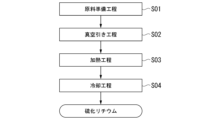
- FIG. 1 is a flow chart showing an example of a method for producing lithium sulfide according to an embodiment of the present invention.
- the lithium sulfide according to this embodiment is used, for example, as a raw material for a sulfide solid electrolyte constituting a lithium ion battery.
- the lithium sulfide according to this embodiment has an L * value (brightness) defined in the L * a * b * color space of 85 or more.
- the L * value (brightness) is preferably 90 or more.
- the L * value (lightness) may be 95 or more.
- the L * value (lightness) may be 100 or less, 98 or less, or 95 or less.
- the L * a * b * color space is a color system that represents the color of an object, and is defined in JIS Z 8781-4.
- L* a * b * color space lightness is represented by L *
- chromaticity indicating hue and saturation is represented by a * and b * .
- Chromaticity a * , b * indicate the direction of the color, with +a * indicating the red direction, -a * indicating the green direction, +b * indicating the yellow direction, and -b * indicating the blue direction. The larger these values are, the more vivid the color becomes.
- Lightness L * indicates brightness.
- the color tone becomes whiter (lighter), and when the L * value is small, the color tone becomes blacker (darker). That is, by increasing the L * value (brightness) to 85 or more, the color of the lithium sulfide becomes white, and the content of impurities such as carbon is sufficiently suppressed.
- the L * value (lightness) of lithium sulfide defined in the L * a * b * color space can be measured by a commercially available color difference meter.
- a combustion infrared spectrometry which is very time-consuming, is carried out.
- lithium sulfate and a carbon material are prepared as raw materials.
- Lithium sulfate may be anhydrous without water of crystallization or may be monohydrate.
- the volume change during heating causes fine cracks due to the removal of water of crystallization on the surface of lithium sulfate, increasing the surface area and enhancing reactivity.
- the carbon material that serves as the reducing agent may be, for example, activated carbon, carbon black, etc. In this embodiment, it is preferable to use activated carbon as the carbon material.
- the mixed powder of lithium sulfate and the carbon material was simply mixed and stirred without granulation.
- the average particle size (d50) of the lithium sulfate is preferably in the range of 10 ⁇ m to 100 ⁇ m
- the average particle size (d50) of the carbon material is preferably in the range of 1 ⁇ m to 10 ⁇ m.
- Heating step S03 As described above, the vacuum furnace is evacuated until the internal pressure becomes 1 ⁇ 10 2 Pa or less, and then heat treatment is performed to reduce lithium sulfate with activated carbon to produce lithium sulfide.
- the heating temperature in the heating step S03 is preferably within a range of 600° C. to 900° C.
- the holding time at the heating temperature is preferably within a range of 500 minutes to 3000 minutes.
- the rate of temperature rise up to the heating temperature is preferably within the range of 0.5° C./min to 10° C./min.
- lithium sulfide is produced having an L * value (lightness) defined in the L * a * b * color space of at least 85. That is, the lithium sulfide according to this embodiment is a carbo-reduced lithium sulfide obtained by reducing lithium sulfate with carbon, and although it contains carbon, the amount of impurities such as carbon is sufficiently reduced.
- the method for producing a sulfide solid electrolyte according to this embodiment uses the lithium sulfide according to this embodiment as a raw material.
- the lithium sulfide according to this embodiment has a sufficiently reduced amount of impurities such as carbon, and therefore the amount of impurities is also reduced in the sulfide solid electrolyte produced using this as a raw material, resulting in the production of a sulfide solid electrolyte with excellent characteristics.
- the lithium sulfide of the present embodiment configured as described above has an L * value (lightness) of 85 or more as defined in the L * a * b * color space. This means that the amount of impurities such as carbon is kept low and the purity is sufficiently high, making it particularly suitable as a raw material for sulfide solid electrolytes.
- the lithium sulfide according to this embodiment when the L * value (lightness) defined in the L * a * b * color space is 90 or more, the amount of impurities such as carbon is further reduced, and the purity is sufficiently high, making it particularly suitable as a raw material for a sulfide solid electrolyte.
- the lithium sulfide according to this embodiment is used as the raw material, so the amount of impurities such as carbon in the raw material is kept low, making it possible to produce a high-purity sulfide solid electrolyte.
- Lithium sulfate powder (average particle size 20 ⁇ m) and activated carbon powder (average particle size 8 ⁇ m) were prepared and weighed out so as to have the molar ratio shown in Table 1.
- the weighed lithium sulfate powder and activated carbon were mixed in a mortar to obtain a mixed powder.
- This mixed powder was transferred to an alumina crucible and placed in a vacuum furnace equipped with a glove box, and the vacuum furnace was evacuated so that the internal pressure was reduced stepwise by 1 ⁇ 10 3 Pa until the internal pressure reached 1 ⁇ 10 2 Pa.
- the mixture was then held at 780° C. for 12 hours and then naturally cooled to produce lithium sulfide of Invention Examples 1 to 7 and Comparative Example 1.
- Comparative Example 2 Lithium sulfate powder (average particle size 20 ⁇ m) and activated carbon powder (average particle size 8 ⁇ m) were prepared, weighed out so as to have the molar ratio shown in Table 1, and mixed and granulated to obtain mixed particles. The mixed particles were transferred to an alumina crucible and placed in a vacuum furnace equipped with a glove box, and the vacuum furnace was evacuated in one step until the internal pressure reached 1 ⁇ 10 2 Pa. The mixture was then held at 780° C. for 12 hours and then naturally cooled to produce lithium sulfide of Comparative Example 2.
- the obtained lithium sulfide was pulverized in an agate mortar, and the pulverized lithium sulfide was flattened on a glass plate in a glove box.
- Carbon Content 0.1 g of the obtained lithium sulfide was weighed out and completely combusted at 1400°C in an O2 atmosphere using a CSLS-600 CS analyzer manufactured by LECO, and the carbon content was determined by measuring the generated CO2 gas.
- Comparative Example 1 the L * value was 61 and the carbon content was as high as 2.1 mass %. This is presumably because the mixture ratio of activated carbon mixed as a raw material was high, and a large amount of unreacted carbon remained. In Comparative Example 2, the L * value was 70, and the carbon content was as high as 0.4 mass%. This is presumably because the mixed particles of lithium sulfate and activated carbon were heat-treated, and some of the activated carbon did not react sufficiently, leaving unreacted carbon.
- the L * value was 85 or more and the carbon content was 0.31 mass% or less, which was a sufficient reduction in the carbon content
- the L * value was 90 or more and the carbon content was 0.24 mass% or less, which was an even lower carbon content. Comparing Inventive Examples 1 to 7, it is confirmed that the larger the L * value, the smaller the carbon content and the reduced amount of impurities.
- the present invention can provide lithium sulfide that is of sufficiently high purity and is particularly suitable as a raw material for sulfide solid electrolytes, as well as a method for producing a sulfide solid electrolyte using this lithium sulfide.
- the present invention makes it possible to provide lithium sulfide that is sufficiently pure and particularly suitable as a raw material for sulfide solid electrolytes, as well as a method for producing a sulfide solid electrolyte using this lithium sulfide.
Landscapes
- Chemical & Material Sciences (AREA)
- Organic Chemistry (AREA)
- Engineering & Computer Science (AREA)
- Manufacturing & Machinery (AREA)
- Inorganic Chemistry (AREA)
- Conductive Materials (AREA)
Abstract
純度が十分に高く硫化物固体電解質の原料として特に適した硫化リチウム、および、この硫化リチウムを用いた硫化物固体電解質の製造方法を提供することを目的とする。 本発明は、L*a*b*色空間で規定されるL*値(明度)が85以上であることを特徴とする、硫化リチウム、および、原料として上述の硫化リチウムを用いることを特徴とする、硫化物固体電解質の製造方法である。
Description
この発明は、例えば全固体電池の硫化物固体電解質材料の構成材料として好適な硫化リチウム、および、この硫化リチウムを用いた硫化物固体電解質の製造方法に関するものである。
本願は、2023年12月1日に、日本に出願された特願2023-203663号に基づき優先権を主張し、その内容をここに援用する。
本願は、2023年12月1日に、日本に出願された特願2023-203663号に基づき優先権を主張し、その内容をここに援用する。
EV(電気自動車)やHEV(ハイブリッド電気自動車)等の車両から、携帯電話、ノートパソコン等の電子機器に至るまで、電源としてリチウムイオン電池が広く用いられている。従来のリチウムイオン電池は、電解質として有機溶媒にヘキサフルオロリン酸リチウム(LiPF6)などのリチウム塩を溶解した有機電解液が用いられている。
こうした有機電解液は可燃性であり、過度な昇温、衝撃によって破損する可能性がある。また、負極に金属リチウムを用いたリチウムイオン電池は、充電時に負極表面にデンドライト状の金属リチウムが成長して、これが電極間の内部短絡の原因となり不具合を引き起こす可能性がある。
このような有機電解液を使用した従来のリチウムイオン電池の安全性、耐久性を向上させるために、硫化物系固体電解質を使用した全固体型のリチウムイオン電池が提案されている。現在提案されている硫化物系固体電解質としては、例えばLi2S-P2S5系、Li2S-P2S3系、Li2S-SiS2系、Li2S-Ga2S2系、Li2S-GeS2系などが挙げられる。
これらいずれの硫化物系固体電解質においても、構成材料として高純度な硫化リチウム(Li2S)が用いられる。
これらいずれの硫化物系固体電解質においても、構成材料として高純度な硫化リチウム(Li2S)が用いられる。
高純度な硫化リチウムの製造方法として、例えば、特許文献1には、水酸化リチウムを非プロトン性有機溶媒の中で硫化水素と反応させて水硫化リチウムを生成し、この水硫化リチウムから硫化リチウムを得る方法が開示されている。
また、特許文献2には、金属リチウムと硫黄ガスまたは硫化水素とを反応させて、金属リチウムの表面に硫化リチウムを生成させ、次いで未反応の金属リチウムを溶融し、既に生成している硫化リチウムに拡散、浸透させた後、再び未反応の金属リチウムと硫黄ガスや硫化水素とを反応させるといった反応サイクルを繰り返して硫化リチウムを得る方法が開示されている。
特許文献3には、炭酸リチウムを硫化水素と反応させて硫化リチウムを製造する方法が提案されている。
また、特許文献4,5には、硫酸リチウムと炭素材料とを反応させて硫化リチウムを製造する方法が提案されている。
また、特許文献4,5には、硫酸リチウムと炭素材料とを反応させて硫化リチウムを製造する方法が提案されている。
ところで、特許文献1に開示された発明では、非プロトン性有機溶媒を用いる必要があり、また、使用した有機溶媒の処理が別途必要であるために、製造工程が複雑で製造コストが高いという課題があった。また、非プロトン性有機溶媒の一部が生成した硫化リチウムに残存するおそれがあった。
特許文献2に開示された発明では、金属リチウムと硫黄ガスまたは硫化水素とを繰り返し複数回反応させる必要があり、製造時間が長くなり、製造効率が低いという課題があった。また、金属リチウムは反応性が高く、表面に酸化膜が発生しやすいため、不活性ガス雰囲気で取り扱う必要があるなど、原材料の取り扱いが難しいといった問題があった。また、反応サイクルが不十分であった場合には、未反応物が生成した硫化リチウムに残存するおそれがあった。
特許文献3に開示された発明では、有毒な硫化水素ガスを使用する必要があり、反応装置の気密性の管理、未反応の硫化水素ガスの処理など、設備コストが高くなるという課題があった。また、反応が不十分な場合には、未反応物が生成した硫化リチウムに残存するおそれがあった。
ここで、特許文献4,5においては、有機溶剤や硫化水素を用いる必要がなく、取り扱いや管理が比較的容易である。
しかしながら、硫酸リチウムと炭素材料を反応させた場合、製造した硫化リチウムに未反応の炭素が残存し、高純度の硫化リチウムが得られないおそれがあった。
しかしながら、硫酸リチウムと炭素材料を反応させた場合、製造した硫化リチウムに未反応の炭素が残存し、高純度の硫化リチウムが得られないおそれがあった。
なお、特許文献4においては、反応性向上のために硫酸リチウムと炭素粉末を微粒子状にする必要があり、処理工程が多くなるとともに、微粒子状にする過程で不純物が混合する懸念がある。また、反応によっては炭酸リチウムや酸化リチウムなどの副生成物が生じて、硫化リチウムの純度が低下する懸念がある。
また、特許文献5においては、原料となる硫酸リチウムを規定することで、反応を促進し、未反応物の低減を図っているが、硫化リチウムに残存する炭素を十分に低減することはできなかった。
また、特許文献5においては、原料となる硫酸リチウムを規定することで、反応を促進し、未反応物の低減を図っているが、硫化リチウムに残存する炭素を十分に低減することはできなかった。
以上のように、従来の製造方法では、純度の高い硫化リチウムを得ることはできていなかった。
また、硫化リチウムに含まれる微量不純物を評価する際には、高精度の分析を行う必要があった。
また、硫化リチウムに含まれる微量不純物を評価する際には、高精度の分析を行う必要があった。
この発明は、前述した事情に鑑みてなされたものであって、純度が十分に高く硫化物固体電解質の原料として特に適した硫化リチウム、および、この硫化リチウムを用いた硫化物固体電解質の製造方法を提供することを目的とする。
上記課題を解決するために、本発明者らが鋭意検討した結果、硫化リチウムの色あいを評価することで、硫化リチウムに残存する不純物(主に炭素)を評価可能であるとの知見を得た。
本発明は、上述の知見に基づいてなされたものであって、本発明の態様1の硫化リチウム(硫化リチウム粉末)は、L*a*b*色空間で規定されるL*値(明度)が85以上であることを特徴としている。
本発明の態様1の硫化リチウムによれば、L*a*b*色空間で規定されるL*値(明度)が85以上とされていることから、炭素等の不純物量が少なく抑えられており、純度が十分に高く硫化物固体電解質の原料として特に適している。
本発明の態様2の硫化リチウムは、本発明の態様1の硫化リチウムにおいて、前記L*値(明度)が90以上であることを特徴としている。
本発明の態様2の硫化リチウムによれば、L*a*b*色空間で規定されるL*値(明度)が90以上とされているので、炭素等の不純物量がさらに少なく抑えられており、純度が十分に高く硫化物固体電解質の原料として特に適している。
本発明の態様2の硫化リチウムによれば、L*a*b*色空間で規定されるL*値(明度)が90以上とされているので、炭素等の不純物量がさらに少なく抑えられており、純度が十分に高く硫化物固体電解質の原料として特に適している。
本発明の態様3の硫化物固体電解質の製造方法は、本発明の態様1または態様2の硫化リチウムを用いることを特徴としている。
本発明の態様3の硫化物固体電解質の製造方法によれば、本発明の態様1または態様2の硫化リチウムを用いていることから、原料における炭素等の不純物量が少なく抑えられており、高純度の硫化物固体電解質を製造することができる。
本発明の態様3の硫化物固体電解質の製造方法によれば、本発明の態様1または態様2の硫化リチウムを用いていることから、原料における炭素等の不純物量が少なく抑えられており、高純度の硫化物固体電解質を製造することができる。
本発明によれば、純度が十分に高く硫化物固体電解質の原料として特に適した硫化リチウム、および、この硫化リチウムを用いた硫化物固体電解質の製造方法を提供することができる。
以下に、本発明の実施形態について添付した図面を参照して説明する。なお、以下に示す各実施形態は、発明の趣旨をより良く理解させるために具体的に説明するものであり、特に指定のない限り、本発明を限定するものではない。
本実施形態に係る硫化リチウムは、例えば、リチウムイオン電池を構成する硫化物固体電解質の原料として用いられるものである。
そして、本実施形態に係る硫化リチウムは、L*a*b*色空間で規定されるL*値(明度)が85以上とされている。なお、L*値(明度)が90以上であることが好ましい。
特に限定されないが、L*値(明度)は95以上であってもよい。
また、特に限定されないが、L*値(明度)は100以下であってもよく、98以下であってもよく、95以下であってもよい。
そして、本実施形態に係る硫化リチウムは、L*a*b*色空間で規定されるL*値(明度)が85以上とされている。なお、L*値(明度)が90以上であることが好ましい。
特に限定されないが、L*値(明度)は95以上であってもよい。
また、特に限定されないが、L*値(明度)は100以下であってもよく、98以下であってもよく、95以下であってもよい。
ここで、L*a*b*色空間は、物体の色を表す表色系であり、JIS Z 8781-4で規定されるものである。L*a*b*色空間では、明度をL*、色相と彩度を示す色度をa*,b*で表している。
色度a*,b*は、色の方向を示しており、+a*は赤方向、-a*は緑方向、そして、+b*は黄方向、-b*は青方向を示している。これらの数値が大きくなるにしたがって色あざやかとなる。
明度L*は、明るさを示すものであり、L*の数値が大きいと色合いが白く(薄く)なり、L*の数値が小さいと色合いが黒く(濃く)なる。
すなわち、L*値(明度)を85以上と大きくすることにより、硫化リチウムの色合いが白くなっており、炭素等の不純物の含有量が十分に抑えられていることになる。
色度a*,b*は、色の方向を示しており、+a*は赤方向、-a*は緑方向、そして、+b*は黄方向、-b*は青方向を示している。これらの数値が大きくなるにしたがって色あざやかとなる。
明度L*は、明るさを示すものであり、L*の数値が大きいと色合いが白く(薄く)なり、L*の数値が小さいと色合いが黒く(濃く)なる。
すなわち、L*値(明度)を85以上と大きくすることにより、硫化リチウムの色合いが白くなっており、炭素等の不純物の含有量が十分に抑えられていることになる。
ここで、硫化リチウムのL*a*b*色空間で規定されるL*値(明度)は、市販の色差計によって測定することができる。
なお、通常、硫化リチウム等の物質に含まれる炭素の含有量を評価する場合には、非常に手間がかかる燃焼式赤外線法を実施することになるが、本実施形態に係る硫化リチウムでは、上述のように、色差計によってL*値(明度)を測定することで、簡易的に硫化リチウム等の物質に含まれる炭素の含有量を評価することが可能となる。
なお、通常、硫化リチウム等の物質に含まれる炭素の含有量を評価する場合には、非常に手間がかかる燃焼式赤外線法を実施することになるが、本実施形態に係る硫化リチウムでは、上述のように、色差計によってL*値(明度)を測定することで、簡易的に硫化リチウム等の物質に含まれる炭素の含有量を評価することが可能となる。
次に、本実施形態に係る硫化リチウムの製造方法の一例について、図1を参照して説明する。
(原料準備工程S01)
まず、原料となる硫酸リチウムと炭素材料とを準備する。
硫酸リチウムは、結晶水の無い無水のものであっても、1水和物であってもよい。硫酸リチウム1水和物であれば、加熱昇温時の体積変化によって、硫酸リチウムの表面に結晶水の離脱による細かいクラックが生じ、表面積が増加して反応性が高められる。本実施形態では、120℃までの昇温時の重量減少が5%以上25%以下の範囲内の硫酸リチウム一水和物を用いることが好ましい。
また、還元剤となる炭素材料は、例えば、活性炭、カーボンブラックなどを用いることができる。本実施形態では、炭素材料として、活性炭を用いることが好ましい。
まず、原料となる硫酸リチウムと炭素材料とを準備する。
硫酸リチウムは、結晶水の無い無水のものであっても、1水和物であってもよい。硫酸リチウム1水和物であれば、加熱昇温時の体積変化によって、硫酸リチウムの表面に結晶水の離脱による細かいクラックが生じ、表面積が増加して反応性が高められる。本実施形態では、120℃までの昇温時の重量減少が5%以上25%以下の範囲内の硫酸リチウム一水和物を用いることが好ましい。
また、還元剤となる炭素材料は、例えば、活性炭、カーボンブラックなどを用いることができる。本実施形態では、炭素材料として、活性炭を用いることが好ましい。
なお、硫酸リチウムと炭素材料の混合粉については、造粒することなく、硫酸リチウムの粉末と炭素材料の粉末を単に混合撹拌した。
ここで、硫酸リチウムの平均粒径(d50)は10m以上100μm以下の範囲内とすることが好ましい。また、炭素材料の平均粒径(d50)は1μm以上10μm以下の範囲内とすることが好ましい。
ここで、硫酸リチウムの平均粒径(d50)は10m以上100μm以下の範囲内とすることが好ましい。また、炭素材料の平均粒径(d50)は1μm以上10μm以下の範囲内とすることが好ましい。
(真空引き工程S02)
準備した硫酸リチウムと炭素材料を真空炉の炉内に投入し、真空炉の内圧を、1×10²Pa以下となるまで真空引きする。真空引きは段階的に実施し、1回の真空引きにおける内圧の変化を1×10²Pa以上1×10³Pa以下の範囲内とする。このように、段階的に真空引きすることにより、真空炉内に原料粉末が飛散することを抑制する。
準備した硫酸リチウムと炭素材料を真空炉の炉内に投入し、真空炉の内圧を、1×10²Pa以下となるまで真空引きする。真空引きは段階的に実施し、1回の真空引きにおける内圧の変化を1×10²Pa以上1×10³Pa以下の範囲内とする。このように、段階的に真空引きすることにより、真空炉内に原料粉末が飛散することを抑制する。
(加熱工程S03)
上述のように、真空炉の内圧を1×10²Pa以下となるまで真空引きした後、加熱処理を行い、硫酸リチウムを活性炭で還元することで硫化リチウムを生成する。
ここで、加熱工程S03における加熱温度は600℃以上900℃以下の範囲内とすることが好ましい。また、加熱温度での保持時間は500分以上3000分以下の範囲内とすることが好ましい。
さらに、加熱温度までの昇温速度は0.5℃/分以上10℃/分以下の範囲内とすることが好ましい。
上述のように、真空炉の内圧を1×10²Pa以下となるまで真空引きした後、加熱処理を行い、硫酸リチウムを活性炭で還元することで硫化リチウムを生成する。
ここで、加熱工程S03における加熱温度は600℃以上900℃以下の範囲内とすることが好ましい。また、加熱温度での保持時間は500分以上3000分以下の範囲内とすることが好ましい。
さらに、加熱温度までの昇温速度は0.5℃/分以上10℃/分以下の範囲内とすることが好ましい。
(冷却工程S04)
次に、真空炉内で室温にまで自然冷却し、生成した硫化リチウムを回収する。
さらに、室温までの冷却速度は1℃/分以上20℃/分以下の範囲内とすることが好ましい。
次に、真空炉内で室温にまで自然冷却し、生成した硫化リチウムを回収する。
さらに、室温までの冷却速度は1℃/分以上20℃/分以下の範囲内とすることが好ましい。
以上のような工程により、L*a*b*色空間で規定されるL*値(明度)が85以上である硫化リチウムが製造されることになる。すなわち、本実施形態に係る硫化リチウムは、硫酸リチウムを炭素で還元して得られた炭素還元硫化リチウムであり、炭素を含むものであるが、炭素等の不純物量が十分に低減されている。
そして、本実施形態に係る硫化物固体電解質の製造方法においては、原料として本実施形態に係る硫化リチウムを用いる。本実施形態に係る硫化リチウムは、上述のように炭素等の不純物量が十分に低減されたものであることから、これを原料として製造された硫化物固体電解質においても不純物量が低減され、特性に優れた硫化物固体電解質が製造されることになる。
以上のような構成とされた本実施形態である硫化リチウムによれば、L*a*b*色空間で規定されるL*値(明度)が85以上とされていることから、炭素等の不純物量が少なく抑えられており、純度が十分に高く硫化物固体電解質の原料として特に適している。
さらに、本実施形態に係る硫化リチウムにおいて、L*a*b*色空間で規定されるL*値(明度)が90以上とされている場合には、炭素等の不純物量がさらに少なく抑えられており、純度が十分に高く硫化物固体電解質の原料として特に適している。
本実施形態に係る硫化物固体電解質の製造方法においては、原料として本実施形態に係る硫化リチウムを用いていることから、原料における炭素等の不純物量が少なく抑えられており、高純度の硫化物固体電解質を製造することができる。
以上、本発明の一実施形態について説明したが、本発明はこれに限定されることはなく、その発明の技術的思想を逸脱しない範囲で適宜変更可能である。
本発明の有効性を確認するために行った確認実験について説明する。
(本発明例1~7、比較例1)
硫酸リチウムの粉末(平均粒径20μm)と活性炭の粉末(平均粒径8μm)を準備し、表1に示すモル比となるように、それぞれ秤量した。秤量した硫酸リチウムの粉末と活性炭を乳鉢で混合し、混合粉末を得た。
この混合粉末をアルミナ製の坩堝に移し替えて、グローボックス付きの真空炉の炉内に装入し、真空炉の内圧が1×10²Paとなるまで、内圧が1×10³Paずつ段階的に低下するように真空引きを行った。そして、780℃で12時間保持後、自然冷却することにより、本発明例1~7、比較例1の硫化リチウムを生成した。
硫酸リチウムの粉末(平均粒径20μm)と活性炭の粉末(平均粒径8μm)を準備し、表1に示すモル比となるように、それぞれ秤量した。秤量した硫酸リチウムの粉末と活性炭を乳鉢で混合し、混合粉末を得た。
この混合粉末をアルミナ製の坩堝に移し替えて、グローボックス付きの真空炉の炉内に装入し、真空炉の内圧が1×10²Paとなるまで、内圧が1×10³Paずつ段階的に低下するように真空引きを行った。そして、780℃で12時間保持後、自然冷却することにより、本発明例1~7、比較例1の硫化リチウムを生成した。
(比較例2)
硫酸リチウムの粉末(平均粒径20μm)と活性炭の粉末(平均粒径8μm)を準備し、表1に示すモル比となるように、それぞれ秤量し、これらを混合するとともに造粒し、混合粒を得た。
この混合粒をアルミナ製の坩堝に移し替えて、グローボックス付きの真空炉の炉内に装入し、真空炉の内圧が1×10²Paとなるまで一段階で真空引きを行った。そして、780℃で12時間保持後、自然冷却することにより、比較例2の硫化リチウムを生成した。
硫酸リチウムの粉末(平均粒径20μm)と活性炭の粉末(平均粒径8μm)を準備し、表1に示すモル比となるように、それぞれ秤量し、これらを混合するとともに造粒し、混合粒を得た。
この混合粒をアルミナ製の坩堝に移し替えて、グローボックス付きの真空炉の炉内に装入し、真空炉の内圧が1×10²Paとなるまで一段階で真空引きを行った。そして、780℃で12時間保持後、自然冷却することにより、比較例2の硫化リチウムを生成した。
上述のようにして得られた本発明例1~7、比較例1,2の硫化リチウムのL*値(明度)、炭素含有量について、以下のように評価した。
(L*値)
得られた硫化リチウムをメノウ乳鉢で粉砕し、粉砕した硫化リチウムをグローブボックス内にガラス板上に平らにし、日本電計株式会社製ポータブル色差計TES-3250(計測範囲:L*=5~100、計測条件:CIE2°標準視野、光源:白色LED、計測間隔の最小間隔:2秒)を用いて、色座標のL*値の測定を行った。
得られた硫化リチウムをメノウ乳鉢で粉砕し、粉砕した硫化リチウムをグローブボックス内にガラス板上に平らにし、日本電計株式会社製ポータブル色差計TES-3250(計測範囲:L*=5~100、計測条件:CIE2°標準視野、光源:白色LED、計測間隔の最小間隔:2秒)を用いて、色座標のL*値の測定を行った。
(炭素含有量)
得られた硫化リチウムを0.1g秤量し、LECO製CS分析計CSLS-600を用いて、O2雰囲気下、1400℃で完全燃焼させ、発生したCO2ガスを測定することにより、炭素含有量を求めた。
得られた硫化リチウムを0.1g秤量し、LECO製CS分析計CSLS-600を用いて、O2雰囲気下、1400℃で完全燃焼させ、発生したCO2ガスを測定することにより、炭素含有量を求めた。

比較例1においては、L*値が61であり、炭素含有量が2.1mass%と多かった。原料として混合した活性炭の混合比率が高く、未反応の炭素が多く残留したためと推測される。
比較例2においては、L*値が70であり、炭素含有量が0.4mass%と多かった。硫酸リチウムと活性炭との混合粒を加熱処理したことから、一部の活性炭が十分に反応せず、未反応の炭素が残留したためと推測される。
比較例2においては、L*値が70であり、炭素含有量が0.4mass%と多かった。硫酸リチウムと活性炭との混合粒を加熱処理したことから、一部の活性炭が十分に反応せず、未反応の炭素が残留したためと推測される。
これに対して、本発明例1~7においては、L*値が85以上であり、炭素含有量が0.31mass%以下であり、炭素含有量が十分に低減されていた。また、本発明例1~6においては、L*値が90以上であり、炭素含有量が0.24mass%以下と、炭素含有量がさらに低かった。
本発明例1~7を比較すると、L*値が大きい程、炭素含有量が少なく、不純物量が低減されていることが確認される。
本発明例1~7を比較すると、L*値が大きい程、炭素含有量が少なく、不純物量が低減されていることが確認される。
以上のように、本発明によれば、純度が十分に高く硫化物固体電解質の原料として特に適した硫化リチウム、および、この硫化リチウムを用いた硫化物固体電解質の製造方法を提供可能であることが確認された。
本発明によれば、純度が十分に高く硫化物固体電解質の原料として特に適した硫化リチウム、および、この硫化リチウムを用いた硫化物固体電解質の製造方法を提供可能である。
Claims (3)
- L*a*b*色空間で規定されるL*値(明度)が85以上であることを特徴とする硫化リチウム。
- 前記L*値(明度)が90以上であることを特徴とする請求項1に記載の硫化リチウム。
- 原料として請求項1又は請求項2に記載の硫化リチウムを用いることを特徴とする硫化物固体電解質の製造方法。
Applications Claiming Priority (2)
| Application Number | Priority Date | Filing Date | Title |
|---|---|---|---|
| JP2023203663A JP2025088877A (ja) | 2023-12-01 | 2023-12-01 | 硫化リチウム、および、硫化物固体電解質の製造方法 |
| JP2023-203663 | 2023-12-01 |
Publications (1)
| Publication Number | Publication Date |
|---|---|
| WO2025115338A1 true WO2025115338A1 (ja) | 2025-06-05 |
Family
ID=95897358
Family Applications (1)
| Application Number | Title | Priority Date | Filing Date |
|---|---|---|---|
| PCT/JP2024/031718 Pending WO2025115338A1 (ja) | 2023-12-01 | 2024-09-04 | 硫化リチウム、および、硫化物固体電解質の製造方法 |
Country Status (2)
| Country | Link |
|---|---|
| JP (1) | JP2025088877A (ja) |
| WO (1) | WO2025115338A1 (ja) |
Citations (6)
| Publication number | Priority date | Publication date | Assignee | Title |
|---|---|---|---|---|
| JP2012221819A (ja) * | 2011-04-12 | 2012-11-12 | Mitsui Mining & Smelting Co Ltd | リチウムイオン電池固体電解質材料用硫化リチウムの製造方法 |
| JP2013227180A (ja) * | 2012-04-26 | 2013-11-07 | Furukawa Co Ltd | 硫化リチウムの製造方法 |
| JP2015174787A (ja) * | 2014-03-14 | 2015-10-05 | 東レ・ファインケミカル株式会社 | 硫化リチウム製造装置およびそれを用いた硫化リチウムの製造方法 |
| KR20220118575A (ko) * | 2021-02-18 | 2022-08-26 | 주식회사 정석케미칼 | 고 순도 황화리튬의 대량 생산 방법 |
| KR20220161749A (ko) * | 2021-05-31 | 2022-12-07 | 한양대학교 산학협력단 | 고순도의 황화 리튬 제조방법 |
| WO2024160430A1 (en) * | 2023-02-01 | 2024-08-08 | Albemarle Germany Gmbh | A process for producing carbon impurity reduced/carbon impurity free lithium sulfide, said carbon impurity reduced/carbon impurity free lithium sulfide, and its use for producing solid electrolytes and solid batteries |
-
2023
- 2023-12-01 JP JP2023203663A patent/JP2025088877A/ja active Pending
-
2024
- 2024-09-04 WO PCT/JP2024/031718 patent/WO2025115338A1/ja active Pending
Patent Citations (6)
| Publication number | Priority date | Publication date | Assignee | Title |
|---|---|---|---|---|
| JP2012221819A (ja) * | 2011-04-12 | 2012-11-12 | Mitsui Mining & Smelting Co Ltd | リチウムイオン電池固体電解質材料用硫化リチウムの製造方法 |
| JP2013227180A (ja) * | 2012-04-26 | 2013-11-07 | Furukawa Co Ltd | 硫化リチウムの製造方法 |
| JP2015174787A (ja) * | 2014-03-14 | 2015-10-05 | 東レ・ファインケミカル株式会社 | 硫化リチウム製造装置およびそれを用いた硫化リチウムの製造方法 |
| KR20220118575A (ko) * | 2021-02-18 | 2022-08-26 | 주식회사 정석케미칼 | 고 순도 황화리튬의 대량 생산 방법 |
| KR20220161749A (ko) * | 2021-05-31 | 2022-12-07 | 한양대학교 산학협력단 | 고순도의 황화 리튬 제조방법 |
| WO2024160430A1 (en) * | 2023-02-01 | 2024-08-08 | Albemarle Germany Gmbh | A process for producing carbon impurity reduced/carbon impurity free lithium sulfide, said carbon impurity reduced/carbon impurity free lithium sulfide, and its use for producing solid electrolytes and solid batteries |
Also Published As
| Publication number | Publication date |
|---|---|
| JP2025088877A (ja) | 2025-06-12 |
Similar Documents
| Publication | Publication Date | Title |
|---|---|---|
| CN107531510B (zh) | 铝包覆含镍钴复合氢氧化物及制造方法、非水系电解质二次电池及正极活性物质及制造方法 | |
| CN108137347B (zh) | 含锂镍的复合氧化物及其制造方法、非水系电解质二次电池 | |
| TWI596828B (zh) | Positive electrode active material for lithium ion battery, positive electrode for lithium ion battery, and lithium ion battery | |
| JPWO2019131725A1 (ja) | 固体電解質 | |
| US12113204B2 (en) | Method for producing positive electrode active material for lithium ion secondary battery, and molded body | |
| JP7753944B2 (ja) | 硫化リチウムの製造方法 | |
| WO2015011937A1 (ja) | リチウムイオン電池用硫化物系固体電解質 | |
| CN107078294A (zh) | 非水系电解质二次电池用正极活性物质、其制造方法和使用其的非水系电解质二次电池 | |
| CN119890295A (zh) | 金属复合氢氧化物及其制造方法、非水电解质二次电池用正极活性物质及其制造方法、以及非水电解质二次电池 | |
| JP2023168496A (ja) | 非水系電解質二次電池用正極活物質 | |
| US20250096313A1 (en) | Method for producing a sulfide-based solid electrolyte, lithium halide-containing composition, and a lithium sulfide-containing composition | |
| JP2019167257A (ja) | リチウムニッケル含有複合酸化物とその製造方法、および、リチウムイオン二次電池、並びに、リチウムニッケル含有複合酸化物の評価方法 | |
| CN111279530A (zh) | 非水电解质二次电池用正极活性物质、非水电解质二次电池用正极活性物质的制造方法、锂金属复合氧化物粉末的评价方法 | |
| CN111247101A (zh) | 镍复合氧化物和锂镍复合氧化物的制造方法 | |
| WO2025115338A1 (ja) | 硫化リチウム、および、硫化物固体電解質の製造方法 | |
| CN113130887A (zh) | 一种锂离子电池的补锂方法 | |
| KR102709615B1 (ko) | 전고체 리튬 이온 전지용 정극 활물질, 전고체 리튬 이온 전지용 정극, 전고체 리튬 이온 전지 및 전고체 리튬 이온 전지용 정극 활물질의 제조 방법 | |
| JP2023131040A (ja) | 硫化リチウム粉末、硫化リチウム粉末の製造方法 | |
| CN111373583B (zh) | 锂离子二次电池用正极活性物质及其制造方法 | |
| CN111386620B (zh) | 非水类电解质二次电池用正极活性物质前体 | |
| WO2026023118A1 (ja) | 硫化リチウム、および、硫化物系固体電解質の製造方法 | |
| WO2026028486A1 (ja) | 硫化リチウムの製造方法、および、硫化物系固体電解質の製造方法 | |
| CN111033831B (zh) | 非水系电解质二次电池用正极活性物质及其制造方法和使用其的非水系电解质二次电池 | |
| TWI467836B (zh) | A positive electrode active material for a lithium ion battery, a positive electrode for a lithium ion battery, and a lithium ion battery | |
| WO2025225098A1 (ja) | 硫化リチウム、および、硫化物系固体電解質の製造方法 |
Legal Events
| Date | Code | Title | Description |
|---|---|---|---|
| 121 | Ep: the epo has been informed by wipo that ep was designated in this application |
Ref document number: 24897029 Country of ref document: EP Kind code of ref document: A1 |