WO2024262074A1 - 試料分析装置 - Google Patents
試料分析装置 Download PDFInfo
- Publication number
- WO2024262074A1 WO2024262074A1 PCT/JP2024/002267 JP2024002267W WO2024262074A1 WO 2024262074 A1 WO2024262074 A1 WO 2024262074A1 JP 2024002267 W JP2024002267 W JP 2024002267W WO 2024262074 A1 WO2024262074 A1 WO 2024262074A1
- Authority
- WO
- WIPO (PCT)
- Prior art keywords
- cleaning
- sample
- cleaning solution
- amount
- sample analyzer
- Prior art date
- Legal status (The legal status is an assumption and is not a legal conclusion. Google has not performed a legal analysis and makes no representation as to the accuracy of the status listed.)
- Ceased
Links
Images


Classifications
-
- G—PHYSICS
- G01—MEASURING; TESTING
- G01N—INVESTIGATING OR ANALYSING MATERIALS BY DETERMINING THEIR CHEMICAL OR PHYSICAL PROPERTIES
- G01N27/00—Investigating or analysing materials by the use of electric, electrochemical, or magnetic means
- G01N27/62—Investigating or analysing materials by the use of electric, electrochemical, or magnetic means by investigating the ionisation of gases, e.g. aerosols; by investigating electric discharges, e.g. emission of cathode
Definitions
- the present invention relates to a sample analyzer that quantifies the amount of a target component contained in a sample.
- Inductively coupled plasma mass sample analyzers are used to quantify harmful metal elements contained in liquid samples such as environmental water and drinking water collected from rivers, lakes, etc. (see, for example, Patent Document 1).
- Inductively coupled plasma mass sample analyzers are equipped with an inductively coupled plasma ion source and a mass analysis section.
- inductively coupled plasma is generated from argon gas, and an atomized liquid sample is introduced into the plasma to generate atomic ions from the components contained in the liquid sample.
- the atomic ions generated by the inductively coupled plasma ion source are introduced into the mass analysis section, where they are separated according to their mass-to-charge ratio and detected by an ion detector.
- Inductively coupled plasma mass sample analyzers are highly sensitive and therefore suitable for the detection and quantification of trace elements. However, if elements contained in a previously analyzed sample remain in the instrument, carryover is likely to occur. For this reason, when analyzing multiple samples consecutively, a cleaning solution appropriate for the type and amount of elements expected to be contained in each sample based on the attributes of the sample (tap water, river water, etc.) is introduced into the instrument to clean it.
- the amount of element contained in the sample may be overestimated and extra cleaning solution may be sent, or a cleaning solution corresponding to an element may be sent to take into account the possibility that the element is contained even if it is unlikely to actually be present.
- Increasing the amount and type of cleaning solution sent in this way increases the cleaning time accordingly. It is common for inductively coupled plasma mass sample analyzers to analyze hundreds of samples continuously, and if the time required for one cleaning is increased by just 30 seconds, the time required for a series of analyses can increase by several hours.
- the problem that this invention aims to solve is to reduce the time required for continuous analysis of multiple samples while preventing carryover.
- the present invention which has been made to solve the above problems, is a sample analyzer for quantifying an analyte component contained in a sample, comprising: a memory unit in which information is stored that associates, for each of a plurality of known components that may be contained in a sample, the amount of the known component with the type and amount of a cleaning solution for removing the known component; a quantitative analysis unit that introduces a plurality of samples into the sample analyzer in a predetermined order and quantifies an analyte component contained in each sample; a washing liquid introduction section that introduces a washing liquid for washing the plurality of known components into the sample analyzer; a cleaning execution unit which, each time the quantitative analysis unit quantifies an analyte contained in one sample, compares information on the analyte quantified by the quantitative analysis unit with information stored in the memory unit to determine the type and amount of a cleaning liquid, and operates the cleaning liquid introduction unit to perform a cleaning operation to remove the analyte from the sample analyzer; Equipped with.
- the sample analyzer In the sample analyzer according to the present invention, information is stored in advance in the memory unit that associates the amount of each of the known components with the type and amount of cleaning solution used to remove the known components. Then, each time the quantitative analysis unit quantifies the amount of the target component contained in one sample, the cleaning execution unit checks the information on the quantified target component against the information stored in the memory unit to determine the type and amount of cleaning solution, operates the cleaning solution introduction unit, and performs a cleaning operation to remove the target component from the sample analyzer using that type and amount of cleaning solution. Therefore, the sample analyzer can be cleaned using an appropriate type and amount of cleaning solution according to the amount of the target component contained in the sample analyzed immediately before, thereby preventing carryover.
- the amount of component contained in the sample is not overestimated and excess cleaning solution is not supplied, and a cleaning operation is not performed using a cleaning solution used to clean components not contained in the sample, so the time required to continuously analyze multiple samples can be shortened.
- FIG. 1 is a diagram showing the configuration of a main part of an inductively coupled plasma mass spectrometry apparatus, which is one embodiment of a sample analysis apparatus according to the present invention.
- 4 shows an example of information regarding a cleaning solution used in the inductively coupled plasma mass spectrometer of the present embodiment.
- 4 is a flowchart showing a procedure for continuously measuring a plurality of samples in the inductively coupled plasma mass spectrometer of the present embodiment.
- 11 is another example of information relating to a cleaning solution used in the inductively coupled plasma mass spectrometer of the present embodiment.
- ICP-MS inductively coupled plasma mass spectrometer
- FIG. 1 is a diagram showing the main components of an inductively coupled plasma mass spectrometry device 1 according to this embodiment.
- This inductively coupled plasma mass spectrometry device 1 includes a plasma ionization section 10, a mass spectrometry section 30, and a control and processing section 40.
- the plasma ionization section 10 has a plasma torch 20 with a sample flow tube through which the liquid sample atomized by the nebulizer gas flows, a plasma gas tube formed on the outer periphery of the sample flow tube, and a cooling gas tube formed on the outer periphery of the plasma torch 20 formed inside.
- the sample flow tube is connected to an autosampler 11 that introduces the liquid sample, a nebulizer gas supply source 12 that supplies nebulizer gas that atomizes the liquid sample introduced from the autosampler 11, and a cleaning liquid introduction section 13 that introduces a cleaning liquid.
- a flow path from the cleaning liquid introduction section 13 is connected to the flow path from the autosampler 11 to the sample flow tube, and a flow path switching valve 14 is arranged at the connection section to switch the flow path so that the autosampler 11 and the cleaning liquid introduction section 13 are alternatively connected to the sample introduction tube.
- a plasma gas supply source 15 is connected to the plasma gas pipe.
- a cooling gas supply source (not shown) that supplies cooling gas is connected to the cooling gas pipe.
- Argon gas for example, is used as the nebulizer gas, cooling gas, and plasma gas.
- argon plasma 21 is generated at the tip of the plasma torch 20, and atomic ions are generated from the liquid sample by introducing an atomized liquid sample into the argon plasma 21.
- the mass analysis section 30 is equipped with a first vacuum chamber 31 having a skimmer formed at the inlet facing the argon plasma 21, and a second vacuum chamber 32 having a skimmer formed between the first vacuum chamber 31 and a quadrupole mass filter 321 and a detector 322 disposed therein for detecting ions separated by the quadrupole mass filter 321.
- the control/processing unit 40 includes a memory unit 41, as well as the following functional blocks: a quantitative analysis unit 42, a cleaning execution unit 43, and a cleaning setting change unit 44.
- the actual control/processing unit 40 is a personal computer, and each of the above functional blocks is realized by executing a dedicated program pre-installed on the processor.
- an input unit 60 such as a keyboard and mouse
- a display unit 70 such as a liquid crystal display are connected to the control/processing unit 40.
- the memory unit 41 stores information on the measurement conditions for the element to be measured (the mass-to-charge ratio of the ions generated from the element, the mass-to-charge ratio of the target ions in the SIM measurement, interfering ions, etc.).
- the elements to be measured may include elements that are the subject of quantification (elements to be quantified) as well as elements that need to be measured in order to quantify the elements to be quantified (related elements that generate interfering ions for the elements to be quantified).
- the target ions in the SIM measurement are determined based on factors such as not being affected (or only being affected to a small extent) by interfering ions derived from other elements and having high detection sensitivity (for example, Patent Document 1).
- the memory unit 41 also stores data on calibration curves that show the relationship between the measurement intensity and concentration of the target ions of each element to be measured.
- the calibration curves are prepared, for example, by the user performing preliminary measurements using standard samples prepared for each element to be measured, taking into account the attributes of the sample to be analyzed, and include information on the minimum concentration (lower limit of quantification) and the maximum concentration (upper limit of quantification) expected to be contained in the sample.
- the maximum concentration is the maximum concentration expected to be contained in the sample, and is usually determined by the user based on the attributes of the sample and the contents of the pretreatment.
- the memory unit 41 also stores information about the cleaning liquid used to clean the plasma ionization unit 10 and the mass analysis unit 30. Specifically, information about the standard cleaning liquid (type of cleaning liquid and supply time), the concentration thresholds for each element to be measured, and information about additional cleaning liquids related to each element to be measured (type of cleaning liquid and supply time) are stored.
- FIG. 2 is an example of cleaning solution information.
- the information on the standard cleaning solution is set to supply cleaning solution a for 30 seconds, cleaning solution b for 30 seconds, and cleaning solution c for 30 seconds, in that order.
- the information on the additional cleaning solution is set to supply additional cleaning solution a for 30 seconds when the concentration of element A exceeds a threshold value (100 ppm), supply additional cleaning solution b' for 20 seconds when the concentration of element B exceeds a threshold value (200 ppm), supply additional cleaning solution c for 30 seconds when the concentration of element C exceeds a threshold value (100 ppm), and supply additional cleaning solution c for 20 seconds when the concentration of element D exceeds a threshold value (150 ppm).
- cleaning solution b' is a cleaning solution of the same type as cleaning solution b, but with a higher concentration.
- the information on the additional cleaning solution may be set for all elements, or may be set for only some elements. In the latter case, the threshold value for the concentration of the element may be set, for example, to the maximum concentration of the calibration curve or infinity.
- the cleaning solution is usually a solvent such as hydrochloric acid, nitric acid, or hydrofluoric acid, which is used to dissolve the elements to be measured, such as metals, contained in the sample. All of these are acidic solvents, but pure water, alkaline solvents, organic solvents, etc. may also be used.
- the user places multiple samples to be analyzed in the autosampler 11 in advance.
- the user places cleaning solution a, cleaning solution b, cleaning solution b', cleaning solution c, cleaning solution d, ... in the cleaning solution inlet 13.
- the quantitative analysis unit 42 After setting a sample in the autosampler 11, when the user issues an instruction to perform a measurement by performing a predetermined operation via the input unit 60, the quantitative analysis unit 42 displays a screen on the display unit 70 for specifying the element to be quantified.
- the quantitative analysis unit 42 determines the specified element to be quantified and its related elements as the elements to be measured, and reads out the measurement conditions for the elements to be measured and information on the cleaning solution corresponding to each element from the memory unit 41.
- elements A, B, C, and D are the elements to be measured.
- the cleaning setting change unit 44 After reading out the measurement conditions for the element to be measured and the cleaning solution information, the cleaning setting change unit 44 displays the read cleaning solution information on the screen of the display unit 70.
- the content displayed at this time is what is saved in the memory unit 41, for example what was set by the equipment administrator when the equipment was installed, or what was changed and saved during subsequent analysis.
- the user checks the displayed cleaning solution content, makes changes as necessary, and then determines the cleaning solution information (step 1). If the user makes changes, the cleaning setting change unit 44 saves the changed cleaning solution information in the memory unit 41.
- the quantitative analysis unit 42 supplies the first sample set in a predetermined position in the autosampler 11 to the sample introduction tube.
- the nebulizer gas supply source 12 also supplies nebulizer gas to the sample introduction tube
- the plasma gas supply source 15 supplies plasma gas to the plasma gas tube
- the cooling gas supply source supplies cooling gas to the cooling gas tube.
- the sample supplied to the sample introduction tube and atomized by the nebulizer gas is introduced into the argon plasma 21 generated at the tip of the plasma torch 20, generating atomic ions.
- the generated atomic ions are introduced into the mass analysis section 30, where they are mass-separated by the quadrupole mass filter 321 and then detected by the detector 322.
- ions (target ions) of a predetermined mass-to-charge ratio for each of the target elements A, B, C, and D of the quantitative analysis are measured by SIM.
- the quantitative analysis unit 42 reads out the calibration curves of elements A, B, C, and D stored in the memory unit 41. Then, the measured intensities in the SIM measurement of the target ions of elements A, B, C, and D are compared with the calibration curves to determine the concentration values of elements A, B, C, and D (calculate the quantitative values) (step 3).
- the cleaning execution unit 43 After determining the concentration values of elements A, B, C, and D, the cleaning execution unit 43 compares the concentration value of each element with the threshold value of each element stored in the memory unit 41. If the concentration of any element is below the threshold value (NO in step 4), the cleaning execution unit 43 operates the cleaning liquid introduction unit 13 and the flow path switching valve 14 to clean the plasma ionization unit 10 and the mass analysis unit 30 using a standard cleaning liquid based on the information stored in the memory unit 41 (step 5).
- the cleaning execution unit 43 operates the cleaning liquid introduction unit 13 and the flow path switching valve 14 to clean the plasma ionization unit 10 and the mass analysis unit 30 using the standard cleaning liquid, and further cleans the plasma ionization unit 10 and the mass analysis unit 30 using an additional cleaning liquid based on the information stored in the memory unit 41 (step 6).
- the concentration value of element A exceeds the threshold value (100 ppm)
- cleaning is performed with the standard cleaning solution, and then cleaning solution a is run for an additional 30 seconds.
- the concentration values of elements A and B both exceed the threshold value (element A: 100 ppm, element B: 200 ppm)
- cleaning is performed with the standard cleaning solution, and then cleaning solution a is run for an additional 30 seconds, and cleaning solution b' is run for 20 seconds.
- an additional cleaning solution of the element that has a longer supply time or is supplied in a larger amount
- cleaning solution a is run for an additional 40 seconds to perform an additional cleaning operation.
- the quantitative analysis unit 42 checks whether the measurement of all samples has been completed. At this point, only the first sample has been measured, and there are still samples left to be measured (NO in step 7), so the process returns to step 2 and the next sample is measured. When the measurement of all samples has been completed (YES in step 7), the series of measurement operations ends.
- Inductively coupled plasma mass spectrometry is highly sensitive and therefore suitable for detecting and quantifying trace elements, but it is prone to carryover if elements contained in a previously measured sample remain. Therefore, in order to reliably prevent carryover, it has been common to overestimate the amount of an element contained in a sample and supply extra cleaning solution, or to supply a cleaning solution corresponding to an element that is unlikely to actually be present, in consideration of the possibility that that element is present.
- the concentration value of each element is determined (quantified) each time the measurement element contained in one sample is quantified. If the concentration value (quantitative value) of any element does not exceed the threshold, the inside of the device is cleaned using only the standard cleaning solution, and only if the concentration value (quantitative value) of any element exceeds the threshold, additional cleaning is performed using a type and amount of cleaning solution corresponding to the element. Therefore, the sample analyzer can be cleaned using an appropriate type and amount of cleaning solution according to the amount of the analysis target component contained in the sample analyzed immediately before, thereby preventing carryover.
- the amount of element contained in the sample is not overestimated and an extra cleaning solution is not fed, and a cleaning operation is not performed using a cleaning solution used to clean elements not contained in the sample, so the time required for continuous analysis of multiple samples can be shortened compared to conventional methods.
- the inside of the device is cleaned using only the standard cleaning solution when the concentration of any of the elements to be measured does not exceed the threshold value, and cleaning is performed using an additional cleaning solution when the concentration of any of the elements exceeds the threshold value, but other configurations can also be adopted. Below, several examples of such configurations are described. The configurations described below can be implemented by the cleaning setting change unit 44 changing the settings related to cleaning of the device in response to a specified input operation by the user.
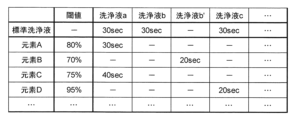
- the threshold value is set as a concentration value (absolute value), but it may be set as a percentage based on the maximum concentration in the calibration curve of each element. Specifically, for example, 80% of the maximum concentration in the calibration curve can be set as a common threshold value for elements A, B, C, and D. Alternatively, 80%, 70%, 75%, and 95% of the maximum concentration in the calibration curve can be set as threshold values individually for elements A, B, C, and D, respectively. In this case, for example, information about the cleaning solution as shown in FIG. 4 can be stored in advance in memory unit 41.
- one type of cleaning liquid is associated with each element, but multiple cleaning liquids may be associated with one element.
- the device when the concentration value of element E exceeds a threshold value, in addition to cleaning with the standard cleaning liquid, the device may be cleaned by flowing cleaning liquid A for 30 seconds, cleaning liquid B for 20 seconds, and pure water for 30 seconds, in that order; when the concentration value of element F exceeds a threshold value, in addition to cleaning with the standard cleaning liquid, the device may be cleaned by flowing cleaning liquid A for 40 seconds, cleaning liquid C for 30 seconds, and pure water for 30 seconds, in that order.
- cleaning operations using multiple cleaning liquids can be performed, and such elements can be more reliably removed from the device.
- a cleaning liquid corresponding to each element may be supplied for a time (amount) according to the quantitative value of the element.
- information showing the relationship between the quantitative value of the element and the amount or supply time of the cleaning liquid (for example, a formula for calculating the amount or supply time of the cleaning liquid using the quantitative value as a variable) is stored in the memory unit 41 for each element, and the cleaning execution unit 43 determines the amount or supply time of the cleaning liquid based on the formula.
- the inside of the device can be cleaned using different amounts of cleaning liquid according to the concentration (quantitative value) of the element actually contained in the sample. Note that when a common cleaning liquid is associated with multiple elements, the longest supply time of the cleaning liquid calculated from the formula corresponding to each of the multiple elements may be used.
- the above embodiment is an inductively coupled plasma mass spectrometer, but the above-mentioned configuration can also be used in devices that detect atomic ions generated by an inductively coupled plasma ion source using other measurement methods.
- the above-mentioned configuration can also be used in various analytical devices that use other ion sources, or that perform analysis without generating ions from the sample to be analyzed, and that perform analysis of multiple samples to quantify the components contained in the sample.
- the above-mentioned configuration can be suitably used in atomic absorption spectrometry, which, like an inductively coupled plasma mass spectrometer, quantifies trace elements contained in a sample.
- threshold value is set for each element, but multiple threshold values may be set, and a cleaning operation may be performed using a preset type and amount (or supply time) of additional cleaning liquid each time each threshold is exceeded.
- One aspect of the present invention is a sample analyzer for quantifying an analyte component contained in a sample, comprising: a memory unit in which information is stored that associates, for each of a plurality of known components that may be contained in a sample, the amount of the known component with the type and amount of a cleaning solution for removing the known component; a quantitative analysis unit that introduces a plurality of samples into the sample analyzer in a predetermined order and quantifies an analyte component contained in each sample; a washing liquid introduction section that introduces a washing liquid for washing the plurality of known components into the sample analyzer; a cleaning execution unit which, each time the quantitative analysis unit quantifies an analyte contained in one sample, compares information on the analyte quantified by the quantitative analysis unit with information stored in the memory unit to determine the type and amount of a cleaning liquid, and operates the cleaning liquid introduction unit to perform a cleaning operation to remove the analyte from the sample analyzer; Equipped with.
- the sample analyzer In the sample analyzer according to paragraph 1, information associating the amount of each of the known components with the type and amount of the cleaning solution used to remove the known components is stored in the memory unit in advance. Then, every time the quantitative analysis unit quantifies the amount of the target component contained in one sample, the cleaning execution unit checks the information of the quantified target component against the information stored in the memory unit to determine the type and amount of cleaning solution, operates the cleaning solution introduction unit, and performs a cleaning operation to remove the target component from the sample analyzer using the type and amount of cleaning solution. Therefore, the sample analyzer can be cleaned using an appropriate type and amount of cleaning solution according to the amount of the target component contained in the sample analyzed immediately before, thereby preventing carryover.
- the amount of element contained in the sample is not overestimated and an excess of cleaning solution is not fed, and a cleaning operation is not performed using a cleaning solution used to clean elements not contained in the sample, so that the time required to continuously analyze multiple samples can be shortened.
- a cleaning operation is not performed using a cleaning solution used to clean elements not contained in the sample, so that the time required to continuously analyze multiple samples can be shortened.
- the sample analyzer according to paragraph 2 is the sample analyzer according to paragraph 1, the storage unit further stores information on the type and amount of a standard cleaning solution, information on threshold values associated with each of the plurality of known components, and information on the type and amount of an additional cleaning solution to be used when the threshold values are exceeded;
- the cleaning execution unit performs a cleaning operation using the standard cleaning solution when the quantitative value of the target component does not exceed a threshold value corresponding to the target component, and when the quantitative value of the target component exceeds a threshold value corresponding to the target component, in addition to the cleaning operation using the standard cleaning solution, performs a cleaning operation using an additional cleaning solution corresponding to the target component.
- the device can be washed with an appropriate type and amount of washing liquid based on whether the quantitative value of each of the components to be analyzed exceeds the threshold value. If the concentration values of the components for which additional washing liquid is common exceed the threshold value, additional washing liquid for the component that is supplied in greater quantity can be supplied.
- the sample analyzer according to paragraph 3 is the sample analyzer according to paragraph 2,
- the storage unit further stores information on a calibration curve and a maximum concentration for each of the plurality of known components,
- the threshold is set as a percentage of the maximum density.
- the sample analyzer according to paragraph 4 is the sample analyzer according to paragraph 3, The ratio is set individually for the plurality of known components.
- a threshold value can be set as a percentage of the maximum concentration thus stored, and the apparatus can be cleaned using an appropriate type and amount of cleaning solution.
- the percentage of the maximum concentration may be a value common to multiple known components, or may be set individually as in the sample analyzer of paragraph 4. In the latter case, the threshold value can be set more precisely.
- the sample analyzer according to claim 5 is a sample analyzer according to any one of claims 1 to 4, the storage unit further stores information representing a relationship between the quantitative values of the plurality of known components and the amount of the cleaning solution; The cleaning execution unit executes a cleaning operation using a cleaning solution in an amount corresponding to the quantitative value of the target component.
- the sample analyzer In the sample analyzer according to paragraph 5, information indicating the relationship between the quantitative value of each known component and the amount or supply time of cleaning liquid (for example, a formula that uses the quantitative value as a variable to determine the amount or supply time of cleaning liquid) is stored in a memory unit, and a cleaning execution unit determines the amount or supply time of cleaning liquid based on the formula.
- the inside of the apparatus can be cleaned using different amounts of cleaning liquid depending on the concentration (quantitative value) of the elements actually contained in the sample.
- concentration quantitative value
- the sample analyzer according to paragraph 6 is a sample analyzer according to any one of paragraphs 1 to 5, For at least one of the plurality of known components, a threshold value for the amount of the known component and a cleaning sequence for performing cleaning operations using a plurality of cleaning solutions in sequence are set, the cleaning sequence being used when the quantitative value of the known component exceeds the threshold value.
- components that tend to remain in the device can be more reliably removed from the device by performing a cleaning operation using multiple cleaning solutions.
- the sample analyzer according to paragraph 7 is a sample analyzer according to any one of paragraphs 1 to 5,
- the quantitative analysis unit includes an inductively coupled plasma ion source that generates atomic ions from components contained in the sample using inductively coupled plasma.
- sample analytical device equipped with an inductively coupled plasma ion source, as described in paragraph 7.
- Reference Signs List 1 ...Inductively coupled plasma mass spectrometry apparatus 10
- Plasma ionization section 11 ...Autosampler 12
- Nebulizer gas supply source 13 ...Cleaning liquid introduction section 14
- Flow path switching valve 15 ...Plasma gas supply source 20
- Plasma torch 21 ...Argon plasma 30
- Mass analysis section 31 ...First vacuum chamber 32
- Second vacuum chamber 321 ...Quadrupole mass filter 322...Detector 40
- Control and processing section 41 ...Memory section 42
- Qantitative analysis section 43 ...Cleaning execution section 44
- Cleaning setting change section 60 ...Input section 70...Display section
Landscapes
- Chemical & Material Sciences (AREA)
- Chemical Kinetics & Catalysis (AREA)
- Electrochemistry (AREA)
- Physics & Mathematics (AREA)
- Health & Medical Sciences (AREA)
- Life Sciences & Earth Sciences (AREA)
- Analytical Chemistry (AREA)
- Biochemistry (AREA)
- General Health & Medical Sciences (AREA)
- General Physics & Mathematics (AREA)
- Immunology (AREA)
- Pathology (AREA)
- Other Investigation Or Analysis Of Materials By Electrical Means (AREA)
Priority Applications (3)
| Application Number | Priority Date | Filing Date | Title |
|---|---|---|---|
| CN202480037143.1A CN121263684A (zh) | 2023-06-20 | 2024-01-25 | 样品分析装置 |
| JP2025527437A JPWO2024262074A1 (https=) | 2023-06-20 | 2024-01-25 | |
| EP24825486.4A EP4733754A1 (en) | 2023-06-20 | 2024-01-25 | Sample analyzing device |
Applications Claiming Priority (2)
| Application Number | Priority Date | Filing Date | Title |
|---|---|---|---|
| JP2023-100519 | 2023-06-20 | ||
| JP2023100519 | 2023-06-20 |
Publications (1)
| Publication Number | Publication Date |
|---|---|
| WO2024262074A1 true WO2024262074A1 (ja) | 2024-12-26 |
Family
ID=93935626
Family Applications (1)
| Application Number | Title | Priority Date | Filing Date |
|---|---|---|---|
| PCT/JP2024/002267 Ceased WO2024262074A1 (ja) | 2023-06-20 | 2024-01-25 | 試料分析装置 |
Country Status (4)
| Country | Link |
|---|---|
| EP (1) | EP4733754A1 (https=) |
| JP (1) | JPWO2024262074A1 (https=) |
| CN (1) | CN121263684A (https=) |
| WO (1) | WO2024262074A1 (https=) |
Citations (6)
| Publication number | Priority date | Publication date | Assignee | Title |
|---|---|---|---|---|
| JPH04169851A (ja) * | 1990-11-02 | 1992-06-17 | Olympus Optical Co Ltd | 自動分析装置用洗浄装置 |
| JP2001324476A (ja) | 2000-05-15 | 2001-11-22 | Murata Mfg Co Ltd | 誘導結合プラズマ質量分析方法 |
| JP2011220928A (ja) * | 2010-04-13 | 2011-11-04 | Toshiba Corp | 自動分析装置 |
| JP2017156332A (ja) | 2016-03-04 | 2017-09-07 | 株式会社島津製作所 | 質量分析方法及び誘導結合プラズマ質量分析装置 |
| JP2022528457A (ja) * | 2019-04-02 | 2022-06-10 | ダインジーエル テク カンパニー,リミテッド | Gcカラムクリーナー |
| WO2022131153A1 (ja) * | 2020-12-16 | 2022-06-23 | 株式会社日立ハイテク | オートサンプラの流路洗浄方法及びオートサンプラの流路洗浄装置 |
-
2024
- 2024-01-25 EP EP24825486.4A patent/EP4733754A1/en active Pending
- 2024-01-25 JP JP2025527437A patent/JPWO2024262074A1/ja active Pending
- 2024-01-25 CN CN202480037143.1A patent/CN121263684A/zh active Pending
- 2024-01-25 WO PCT/JP2024/002267 patent/WO2024262074A1/ja not_active Ceased
Patent Citations (6)
| Publication number | Priority date | Publication date | Assignee | Title |
|---|---|---|---|---|
| JPH04169851A (ja) * | 1990-11-02 | 1992-06-17 | Olympus Optical Co Ltd | 自動分析装置用洗浄装置 |
| JP2001324476A (ja) | 2000-05-15 | 2001-11-22 | Murata Mfg Co Ltd | 誘導結合プラズマ質量分析方法 |
| JP2011220928A (ja) * | 2010-04-13 | 2011-11-04 | Toshiba Corp | 自動分析装置 |
| JP2017156332A (ja) | 2016-03-04 | 2017-09-07 | 株式会社島津製作所 | 質量分析方法及び誘導結合プラズマ質量分析装置 |
| JP2022528457A (ja) * | 2019-04-02 | 2022-06-10 | ダインジーエル テク カンパニー,リミテッド | Gcカラムクリーナー |
| WO2022131153A1 (ja) * | 2020-12-16 | 2022-06-23 | 株式会社日立ハイテク | オートサンプラの流路洗浄方法及びオートサンプラの流路洗浄装置 |
Also Published As
| Publication number | Publication date |
|---|---|
| JPWO2024262074A1 (https=) | 2024-12-26 |
| EP4733754A1 (en) | 2026-04-29 |
| CN121263684A (zh) | 2026-01-02 |
Similar Documents
| Publication | Publication Date | Title |
|---|---|---|
| CN105051529B (zh) | 校准色谱系统的方法 | |
| CN103389345B (zh) | 色谱质谱分析用数据处理系统 | |
| JP4973628B2 (ja) | クロマトグラフ質量分析データ解析方法及び装置 | |
| EP2625517A1 (en) | Learned automated spectral peak detection and quantification | |
| CN111784197A (zh) | 一种植物源性食品化学污染物风险分析与检测方法 | |
| JPWO2018207228A1 (ja) | クロマトグラフ質量分析データ処理装置及びクロマトグラフ質量分析データ処理用プログラム | |
| JP6308107B2 (ja) | クロマトグラフ質量分析データ処理装置 | |
| WO2018138901A1 (ja) | スペクトルデータ処理装置 | |
| JP5757264B2 (ja) | クロマトグラフ質量分析データ処理装置 | |
| WO2017002156A1 (ja) | 分析結果出力処理装置及び分析結果出力処理用プログラム | |
| JPWO2008053530A1 (ja) | 測定物質定量方法 | |
| WO2018029847A1 (ja) | クロマトグラフ装置、クロマトグラフ分析方法、クロマトグラフ分析用プログラム、及びクロマトグラフ分析用データベース | |
| WO2024262074A1 (ja) | 試料分析装置 | |
| JP3663140B2 (ja) | 質量分析方法および質量分析装置 | |
| CN110546496B (zh) | 试样分析装置 | |
| JP4915623B2 (ja) | 化学剤検出・定量方法 | |
| JP7779170B2 (ja) | クロマトグラフ分析装置及びクロマトグラフ分析用プログラム | |
| JP5191954B2 (ja) | 臨床検査用自動分析装置 | |
| JP4009737B2 (ja) | クロマトグラム用解析装置 | |
| Li et al. | Membrane introduction mass spectrometry combined with an orthogonal partial-least squares calibration model for mixture analysis | |
| US6765200B2 (en) | Mass spectrometry and mass spetrometer using the same | |
| JP7771876B2 (ja) | 元素分析装置 | |
| JP5747839B2 (ja) | クロマトグラフ質量分析用データ処理装置 | |
| WO2025192659A1 (ja) | 質量分析における干渉の予測方法および装置 | |
| JP7800221B2 (ja) | スペクトル測定装置を用いた分析方法 |
Legal Events
| Date | Code | Title | Description |
|---|---|---|---|
| 121 | Ep: the epo has been informed by wipo that ep was designated in this application |
Ref document number: 24825486 Country of ref document: EP Kind code of ref document: A1 |
|
| ENP | Entry into the national phase |
Ref document number: 2025527437 Country of ref document: JP Kind code of ref document: A |
|
| WWE | Wipo information: entry into national phase |
Ref document number: 2025527437 Country of ref document: JP |
|
| WWE | Wipo information: entry into national phase |
Ref document number: CN2024800371431 Country of ref document: CN |
|
| WWE | Wipo information: entry into national phase |
Ref document number: 2024825486 Country of ref document: EP |
|
| NENP | Non-entry into the national phase |
Ref country code: DE |
|
| ENP | Entry into the national phase |
Ref document number: 2024825486 Country of ref document: EP Effective date: 20260120 |
|
| ENP | Entry into the national phase |
Ref document number: 2024825486 Country of ref document: EP Effective date: 20260120 |
|
| ENP | Entry into the national phase |
Ref document number: 2024825486 Country of ref document: EP Effective date: 20260120 |